Child Labor In Cocoa Production Between 2020-2025: Why Global Certification Schemes Are Failing
By Nagpur Times
March 8, 2026
Words: 9494
Views: 4188
Why it matters:
Despite the promise of ethical consumption through certification labels, child labor in West African cocoa production continues to rise, revealing a deepening crisis.
Investigative journalism and legal actions have exposed the failure of voluntary standards and the disconnect between certification audits and the reality on the ground.
For the average consumer in a grocery aisle, the small green frog seal or the Fairtrade logo offers a comforting transaction. It sells a story of ethical consumption, promising that the chocolate bar in their hand was not born from the suffering of children. This assurance is the bedrock of a global certification industry worth billions. Yet, data from 2020 to 2025 reveals this promise of no Child Labor In Cocoa Production is largely hollow, a marketing veneer covering a deepening crisis in West Africa.
The NORC Reality Check
The discovery of the certification myth began in earnest with the release of the 2020 report by NORC at the University of Chicago. Commissioned by the US Department of Labor, this study provided a devastating baseline for the decade. It found that despite twenty years of industry pledges, 1.56 million children were engaged in child labor across cocoa producing areas in Côte d’Ivoire and Ghana. More alarmingly, the prevalence of child labor had not decreased; it had risen. Between 2008 and 2019, the proportion of agricultural households using child labor in cocoa production climbed from 31 percent to 45 percent. Nearly all these children, about 1.48 million, were exposed to hazardous tasks like wielding machetes or handling agrochemicals.
Key Data Point (2020): Child labor prevalence in West African cocoa production increased by 14 percentage points over a decade, defying voluntary corporate regulation.
Investigative Journalism Exposes the Cracks (2023)
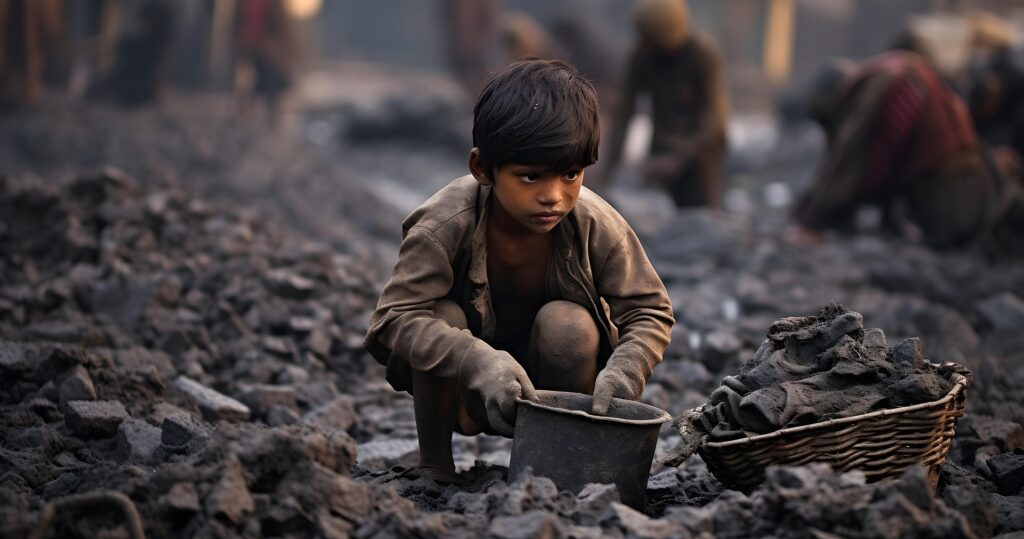
While industry groups argued that their new monitoring systems needed time to work, investigative journalists on the ground found evidence of systemic failure. In late 2023, a CBS News investigation shattered the credibility of corporate “prevention” programs. Journalists traveled to remote farms in Ghana supplying Mars, a giant heavily reliant on certification schemes. They found children as young as five years old using machetes to harvest cocoa beans.
The investigation uncovered a particularly disturbing practice: the fabrication of success. CBS obtained confidential lists of children supposedly rescued or monitored by corporate sustainability programs. When reporters tracked down these specific children, they found them still working in the fields. One beneficiary list included a girl who had never been to school and was harvesting cocoa daily, contradicting the company records that claimed she was safe and in a classroom. This revelation suggested that certification audits and corporate monitoring data were often effectively divorced from reality.
The Legal and Regulatory Backlash (2024)
By 2024, the failure of voluntary standards shifted from news reports to courtrooms. A class action lawsuit filed against the Rainforest Alliance and Hershey in the US District Court alleged deceptive marketing. The plaintiffs argued that the “assess and address” framework adopted by certifiers allowed farms to retain their certified status even when child labor was detected, provided they promised to fix it. This loophole meant a consumer buying a certified product had no actual guarantee that the cocoa was free of child labor.
Furthermore, the financial model underpinning certification was exposed as inadequate. A 2024 Fairtrade study revealed that despite premium payments, 76 percent of cocoa farmers in Côte d’Ivoire still earned below a living income. Without addressing the root cause of extreme poverty, certification labels were merely treating the symptoms while the disease festered.
2025: A System Still in Crisis
The most recent data from the 2025 Cocoa Barometer confirms that the sector remains trapped in a cycle of poverty and exploitation. Released in October 2025, the report noted that while global cocoa prices hit record highs, the benefits failed to reach the farm gate due to forward selling mechanisms and systemic market imbalances. Consequently, 1.5 million children remain in hazardous work. The sheer persistence of this figure, five years after the shocking NORC report, indicates that the current certification model is functionally broken. It serves to protect corporate reputation more effectively than it protects the vulnerable children in the cocoa fields.
The evidence gathered between 2020 and 2025 is conclusive: a logo on a wrapper is not a shield against human rights abuses. The certification schemes have failed to deliver on their primary promise, leaving millions of children to bear the weight of the global chocolate industry.
Historical Context: The Failure of the 2001 Harkin Engel Protocol
The global chocolate industry operates under the shadow of a broken promise. In 2001, major chocolate manufacturers signed the Harkin Engel Protocol. This voluntary agreement aimed to eradicate the worst forms of child labor in West African cocoa fields. The signatories set an initial deadline of 2005. That deadline passed with little progress. Subsequent targets for 2008, 2010, and 2020 were also missed. By 2025, the sector has not only failed to meet these goals but has presided over an increase in the prevalence of child labor in key regions.The definitive evidence of this failure emerged in October 2020. The National Opinion Research Center (NORC) at the University of Chicago released a landmark report commissioned by the US Department of Labor. The data shattered the industry narrative of progress. The researchers found that 1.56 million children were engaged in child labor across the cocoa growing areas of Ghana and Ivory Coast during the 2018 to 2019 harvest season. Far from declining, the prevalence rate among agricultural households in these areas rose from 31 percent in 2008 to 45 percent in 2019.
Details within the 2020 NORC report reveal the severity of the crisis. Of the 1.56 million children identified, approximately 95 percent were engaged in hazardous work. These tasks include using sharp machetes to open cocoa pods, carrying heavy loads of wet beans, and exposure to agrochemicals without protective gear. The voluntary certification schemes promoted by the Protocol proved insufficient against the economic reality of the region. Poverty remains the root cause. Most cocoa farmers in West Africa earn less than one dollar a day, leaving them unable to hire adult laborers. They rely on their children to survive.
In the years following the 2020 deadline, the industry strategy shifted from elimination to remediation. Major corporations began touting Child Labor Monitoring and Remediation Systems (CLMRS). However, data from 2023 and 2024 indicates these systems cover only a fraction of the supply chain. The International Cocoa Initiative reported in its 2023 Annual Report that while coverage has expanded, vast numbers of farming households remain outside these monitoring networks. Independent assessments suggest that effective monitoring covers between 10 percent and 20 percent of cocoa producing communities in West Africa. This leaves the vast majority of children invisible to corporate oversight.
Legal developments in the United States further highlighted the limitations of the Harkin Engel framework. In June 2021, the US Supreme Court ruled in favor of Nestle and Cargill in a lawsuit brought by former child slaves from Mali. While the court dismissed the case on jurisdictional grounds regarding the Alien Tort Statute, the proceedings placed the brutality of the supply chain on public record. The voluntary nature of the 2001 Protocol meant that companies faced no legal penalties for missing their eradication targets.
The US Department of Labor 2024 Findings on the Worst Forms of Child Labor reinforced the grim outlook. The report maintained a rating of “Moderate Advancement” for Ghana and Ivory Coast but noted that children continue to perform hazardous tasks in cocoa production on a massive scale. The 2024 assessment emphasized that despite new laws and national action plans, enforcement remains weak due to resource constraints. Inspections are rare in remote farming villages where the cocoa is harvested.
Two decades after Senators Tom Harkin and Eliot Engel drafted their protocol, the data proves that voluntary corporate self regulation has failed. The absolute number of children working in cocoa has remained stubbornly high, and the proportion of farming families relying on child labor has increased. The industry has moved goalposts and redefined success, yet the core reality for 1.56 million children remains unchanged. They sacrifice their education and safety to supply the global demand for chocolate.
The Certification Ecosystem: Deciphering Fairtrade, Rainforest Alliance, and UTZ
For two decades, the global chocolate industry has relied on three primary seals to assure consumers that their treats are ethical: Fairtrade, Rainforest Alliance, and UTZ. Following the 2018 merger of Rainforest Alliance and UTZ, which fully rolled out its unified standard by 2021, the landscape consolidated into two dominant players. Yet, despite the proliferation of these green frogs and blue figures on packaging, the prevalence of child labor in West Africa remains obstinately high. The 2020 NORC report, funded by the US Department of Labor, revealed that 1.56 million children were still engaged in cocoa production in Côte d’Ivoire and Ghana, a figure that defies the narrative of certified success.
The Mass Balance Loophole
A central failing of the certification model is the “mass balance” sourcing system. This accounting method allows companies to buy a volume of certified cocoa but mix it with uncertified beans during processing. A chocolate bar stamped with a certification seal does not necessarily contain certified cocoa. Instead, the manufacturer purchases credits equivalent to the certified volume, theoretically funding sustainability programs. However, this disconnect dilutes the financial impact for farmers.
Critics argue that mass balance obscures the supply chain. In 2023, industry watchdogs noted that while companies like Mars and Mondelez claim high percentages of “responsibly sourced” cocoa, the physical traceability of these beans often vanishes at the grinding phase. This system benefits corporate logistics but fails to guarantee that the specific farm utilizing child labor is excluded from the final product.
From Zero Tolerance to Risk Management
In response to the impossibility of policing millions of small farms, certification bodies have shifted their strategy. The Rainforest Alliance 2020 Sustainable Agriculture Standard introduced an “Assess and Address” approach. Rather than immediately decertifying a cooperative when child labor is found, the new standard focuses on remediation. While this acknowledges the reality that poverty drives families to use their children for labor, it also means that certified supply chains knowingly contain child labor risks.
The 2022 Cocoa Barometer, a biennial review by a consortium of civil society organizations, highlighted that this shift, while pragmatic, essentially admits that certification alone cannot guarantee a child labor free product. The report emphasized that auditing remains sporadic. An auditor might visit a cooperative once a year, inspecting only a fraction of its thousands of member farms. During the 2020 to 2022 period, pandemic restrictions further reduced physical inspections, leaving vast blind spots in the surveillance network.
The Premium Mirage
The core promise of certification is the premium: an extra sum paid to farmers to alleviate the poverty that fuels child labor. However, data from 2020 through 2025 shows these premiums are insufficient. The 2022 Cocoa Barometer revealed that certified farmers in Ghana and Côte d’Ivoire still earn barely one third of a living income. The “Fairtrade Minimum Price” was increased in late 2023 to provide a stronger safety net, yet the market volatility of 2024 demonstrated that even higher global prices do not automatically translate to wealth for farmers due to forward selling mechanisms and government set farm gate prices.
When a family cannot afford to hire adult laborers, they turn to their children. Certification schemes have spent years treating the symptoms through school kit distribution and training while the root cause, abject poverty, remains unaddressed by the meager premiums. As long as the industry relies on voluntary certification rather than mandatory regulatory frameworks that enforce living incomes, the seals on chocolate wrappers will remain symbols of aspiration rather than verification.
The Economics of Poverty: Why Price Premiums Are Insufficient for Living Incomes
The global chocolate industry is built upon a fundamental economic paradox. While consumers pay premium prices for ethically certified bars, the farmers cultivating the essential ingredient remain trapped in structural poverty. The central promise of certification schemes like Fairtrade and Rainforest Alliance is that additional monetary premiums will bridge the gap between subsistence and a decent livelihood. However, data from 2020 to 2025 reveals that these mechanisms are mathematically incapable of delivering a living income to the vast majority of West African growers. The sheer scale of the income gap, compounded by volatile markets and rampant inflation, renders current premiums little more than a token gesture.
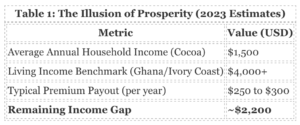
The failure of the premium model lies in its volume based nature. Premiums are paid per tonne of cocoa sold. In Ghana and Ivory Coast, the average farm size is small, typically under three hectares, with low productivity rates hovering around 400 kilograms per hectare. A farmer producing 1.2 tonnes of cocoa annually might receive a Fairtrade Premium of roughly 240 USD per tonne. This amounts to an extra 288 USD per year. Yet, research from 2022 and 2024 indicates that the living income gap—the difference between what a farmer earns and what constitutes a decent standard of living—often exceeds 2,500 USD per household annually. A premium that covers barely 10 percent of this deficit cannot solve poverty nor eliminate the child labor it drives.
“The math simply does not work. A premium of a few hundred dollars cannot compensate for a structural income gap of several thousand dollars. Farmers are running a race where the finish line is constantly moving further away.”
In 2019, the governments of Ghana and Ivory Coast introduced the Living Income Differential (LID), a surcharge of 400 USD per tonne intended to directly boost farmer income. By 2023, investigative reports showed this mechanism had largely failed to achieve its goal. Major buyers neutralized the extra cost by negotiating down the “country differential,” another component of the cocoa price that reflects bean quality. As the country differential turned negative, the net price paid to national marketing boards barely moved, meaning the LID did not translate into the substantial farm gate price increase promised to growers.
The economic crisis of 2024 further exposed the fragility of these schemes. Following severe crop failures driven by disease and weather patterns, global market prices surged to record highs, briefly exceeding 10,000 USD per tonne in early 2024. However, most farmers saw none of this windfall. Because state run marketing boards sell the majority of the crop months in advance (forward selling) to secure revenue, they were locked into contracts signed when prices were much lower. Consequently, while speculators in New York and London profited, farmers in the Ashanti and Western North regions faced destitute conditions, with yields down by nearly half due to the swollen shoot virus.
Inflation has been the final nail in the coffin for the purchasing power of cocoa farmers. In 2023, inflation in Ghana reached levels exceeding 50 percent. Even when the nominal producer price was raised for the 2023 to 2024 season, the real value of that income had already been decimated by the rising cost of fertilizer, fuel, and food. The Cocoa Barometer 2022 report highlighted that despite certification efforts, the net income of many farming households actually declined over the preceding years when adjusted for the cost of living.
This data illustrates that poverty in the cocoa sector is not a marginal issue manageable by small toppings on the market price. It is a systemic failure. The reliance on modest premiums allows multinational corporations to claim sustainability credentials while avoiding the necessary structural change: a significantly higher guaranteed base price that reflects the true cost of production and living. Until the industry moves beyond voluntary certification premiums and addresses the core imbalance of power and pricing, child labor will remain an economic necessity for impoverished families striving to survive.
The Audit Illusion: Flaws in Periodic and Scheduled Inspections
The global cocoa industry relies heavily on certification labels to reassure consumers that their chocolate is ethical. However, an investigative look into the auditing mechanisms used between 2020 and 2025 reveals a system that is fundamentally broken. The primary tool for enforcement is the farm inspection, yet these visits are almost never random or surprising. They are orchestrated events that effectively mask the reality of child labor.
Most certification bodies operate under a protocol where auditors do not visit every single farm. Instead, they inspect a small sample, typically the square root of the total number of farmers in a cooperative, or roughly 10 percent. This means that in a group of 1,000 farmers, 900 will never see an auditor in a given year. This statistical gap creates a massive blind spot where labor violations can thrive undetected. Data from the 2020 NORC report at the University of Chicago estimated that 1.56 million children were engaged in cocoa production in Côte d’Ivoire and Ghana. Despite this prevalence, certified groups often report zero or near zero instances of child labor, a discrepancy that points to a failure in detection rather than an absence of the problem.
The Problem of Advance Notice
A critical flaw in the current system is the practice of scheduling inspections. Auditors typically notify cooperative leaders weeks or days before their arrival. This advance warning allows farm managers to sanitize their operations. Children are sent away from the fields, hazardous tools like machetes are hidden, and school uniforms are suddenly distributed. Investigations by the Corporate Accountability Lab in 2023 and 2024 confirmed that farm owners routinely coach workers on what to say to inspectors. The audit becomes a theater performance rather than a factual verification.
Real time data from the 2024 Chocolate Scorecard indicates that while 91 percent of major companies claim to have monitoring programs, only about half of the farmer households in their supply chains are actually covered by these systems. The remaining households operate with virtually no oversight. Furthermore, the inspection model is ill suited for the complex reality of West African agriculture. Auditors often spend less than an hour at a site, checking paperwork and checklists rather than investigating the remote corners of the plantation where children are most likely to be working with dangerous chemicals or heavy loads.
Structural Conflicts of Interest
The integrity of these audits is further compromised by the payment structure. Cooperatives or the chocolate companies themselves pay the auditing firms. This client relationship creates a conflict of interest where auditors may feel pressure to deliver favorable results to retain business. A harsh report could result in a cooperative losing its certification and the auditor losing a client. Consequently, the threshold for passing an audit is often lowered, and minor infractions are ignored.
Between 2020 and 2025, reports surfaced showing that certified farms in some regions had higher rates of child labor than those without labels, as the premium prices paid for certified cocoa incentivized farmers to increase production by any means necessary, including the use of family labor. The 2020 NORC study highlighted that hazardous child labor had not decreased in high production areas despite a decade of industry promises. The reliance on periodic, scheduled inspections has created an illusion of compliance that fails to protect vulnerable children while allowing global brands to market their products as sustainable.
Shadow Supply Chains: The Role of Pisteurs and Unregistered Farms
The global chocolate industry relies on a comfortable fiction: the idea that a certification label on a wrapper guarantees the ethical origin of the beans inside. Consumers trust that the “Fairtrade” or “Rainforest Alliance” seal proves the absence of child labor and deforestation. Yet investigative analysis from 2020 to 2025 reveals a massive structural loophole that renders these assurances largely performative. This loophole is the “shadow supply chain,” a vast and opaque network driven by unregulated middlemen known as pisteurs.
Certification schemes typically audit cooperatives, not individual farms. A cooperative is a registered group of farmers that ostensibly adheres to strict standards. However, the supply chain reality is far more chaotic. When a certified cooperative cannot meet its contract quotas due to poor harvests or disease, it often turns to the open market. This is where the pisteur enters. These itinerant buyers ride motorbikes into the remote bush, purchasing sacks of cocoa beans with cash from unregistered, unmonitored farms. They then sell these beans to the cooperative, which mixes them with their “clean” supply. Once the beans are bagged at the cooperative warehouse, they all become “certified.”
The 2022 Cocoa Barometer, a leading industry report, highlighted the scale of this opacity. It revealed that for some major global traders, over 60 percent of their sourcing remains indirect. Even among the most transparent actors, significant volumes of cocoa cannot be traced back to the farm level.
This “indirect sourcing” is the primary mechanism through which tainted cocoa enters the global market. A 2020 report by NORC at the University of Chicago estimated that 1.56 million children work in cocoa production across Côte d’Ivoire and Ghana. The vast majority of this labor occurs on the very farms that certification auditors never see: the unregistered plots hidden deep within protected forests or on the fringes of rural communities.
The First Mile Black Box
Industry insiders refer to this as the “first mile” problem. While a chocolate bar can be tracked from a European warehouse back to the port in Abidjan, tracing it from the port to the specific tree is often impossible. The pisteur operates in a zone of total anonymity. They do not keep records of which farm provided which sack. Their only goal is volume.
This anonymity fuels environmental destruction. In 2023, satellite analysis confirmed that cocoa farming remains a primary driver of deforestation in West Africa. The study found that nearly 38 percent of deforestation in Ivorian protected areas since 2000 was linked to cocoa cultivation. These beans are grown illegally in national parks, harvested by children using machetes, and then washed clean through the shadow supply chain. By the time the cocoa reaches the port, it is indistinguishable from legally grown crops.
The financial incentives for this system are powerful. Unregistered farmers, who are often migrants or lack land titles, have no access to the premiums paid for certified cocoa. They sell at rock bottom prices to pisteurs. The pisteurs then sell to cooperatives at a slight markup, but still below the official market rate. The cooperative managers pocket the difference while fulfilling their contracts with major international buyers. Everyone in the chain profits from the opacity except the child laborer and the forest.
Data Versus Reality
Corporate sustainability reports from 2023 and 2024 often boast of achieving “100 percent traceability” for their direct supply chains. This phrasing is a deliberate sleight of hand. It ignores the massive volume of beans purchased indirectly. According to data from the Cocoa Barometer, less than half of the cocoa beans exported from Côte d’Ivoire in recent years could be traced to a specific cooperative with high confidence. The remainder flows through the hands of pisteurs and other intermediaries who obscure the origin.
Efforts to digitize the supply chain have faced resistance. While some companies have introduced GPS mapping for farms, these systems rely on the integrity of the data entry. If a cooperative registers 500 farmers but buys beans from 1,000, the digital map is useless. The shadow supply chain effectively effectively launders the reputation of the industry, allowing major brands to claim progress while the fundamental drivers of abuse remain untouched. Until the role of the pisteur is formalized or eliminated, and until every single farm is mapped and monitored, certification will remain a marketing tool rather than a mechanism for genuine change.
Defining Hazardous Labor: Machetes, Pesticides, and Heavy Loads
The term “hazardous labor” often appears in corporate sustainability reports as a bureaucratic metric, yet on the ground in West Africa, it represents a visceral reality for millions of minors. Between 2020 and 2025, data from organizations including NORC at the University of Chicago and the International Cocoa Initiative (ICI) revealed that the vast majority of child laborers in the cocoa sector are not merely helping with light chores. They are engaged in work that directly endangers their health, safety, and physical development. Despite the prevalence of global certification labels on chocolate bars, the dangerous nature of this work has persisted and, in specific categories like chemical exposure, has worsened.
The Sharp Edge: Machetes and Land Clearing
The most visible symbol of hazardous labor in Ghana and Ivory Coast remains the machete. A 2020 report by NORC established that roughly 1.48 million children in these two nations were exposed to at least one component of hazardous labor. Among the most common tasks was the use of sharp tools for weeding, pruning, and harvesting pods. Unlike mechanized farming found in other regions, cocoa farming in West Africa relies heavily on manual clearing. Children as young as ten wield steel blades nearly half the length of their bodies.
Medical teams visiting rural clinics frequently document lacerations and deep tissue injuries consistent with machete accidents. The certification bodies such as Rainforest Alliance and Fairtrade strictly prohibit minors from using these tools. However, compliance monitors cannot be present on millions of smallholder farms simultaneously. During the harvest peaks of 2023 and 2024, ICI monitoring systems identified thousands of cases where children used these tools because families could not afford adult labor. The economic pressure to maximize yield forces farmers to utilize every available family member, bypassing safety standards mandated by certification audits.
The Silent Threat: Agrochemical Exposure
While physical injuries from blades are immediate, the rising use of agrochemicals poses a more insidious threat. The NORC study highlighted a disturbing trend that continued through 2024: the proportion of children exposed to pesticides and fertilizers increased dramatically over the last decade. Data showed that exposure rates jumped from approximately 5 percent to 24 percent between previous survey periods and recent assessments. In Ghana specifically, exposure rates among children skyrocketed from 7 percent to 32 percent.
This surge correlates with the push for higher productivity. Cocoa trees are aging, and soil fertility is declining. To maintain output, farmers apply stronger chemical agents. Children frequently mix these toxic compounds, carry water for spraying, or work in fields immediately after application without protective gear. Certification schemes mandate training on chemical safety, but these rules often fail to reach the bottom of the supply chain. A 2021 investigation by the Corporate Accountability Lab found evidence of hazardous labor on farms that supposedly adhered to strict certification standards, proving that the label on a wrapper does not guarantee a chemical free environment for the child worker.
The Weight of the Industry: Heavy Loads
The third pillar of hazardous labor is the carrying of heavy loads. Harvested cocoa pods are dense and heavy. Once cracked open, the wet beans must be transported from the farm to the village for fermentation and drying. This distance can span several miles over rough terrain. International labor standards suggest that children should not carry weights exceeding 20 percent of their body mass. In reality, boys and girls frequently haul sacks weighing 30 kilograms or more.
The physiological impact is severe. Stunted growth, spinal compression, and chronic joint pain are common among young adults who spent their childhoods as carriers. The 2022 Cocoa Barometer report emphasized that while the severity of work in some areas might have decreased slightly due to monitoring, the absolute number of children involved in such tasks grew due to overall production increases.
By 2025, it became clear that certification had failed to eradicate these three hazards. The structural poverty of the cocoa farmer means that hiring adult laborers to clear land, spray crops, or carry bags remains financially impossible for many. Consequently, the machete, the pesticide pump, and the heavy sack remain the primary tools of the trade for nearly 1.5 million children.
Corporate Consolidation: How Big Chocolate Controls the Pricing Narrative
The failure of certification to eradicate child labor is not merely a flaw in auditing; it is a direct result of market structure. While consumers imagine a direct link between their purchase and the farmer, the global cocoa trade is choked by a powerful oligopoly that dictates terms, suppresses prices, and renders voluntary certification schemes ineffective. Between 2020 and 2025, data reveals a stark divergence: while chocolate manufacturers reported record profits, West African farmer incomes plummeted, exposing the inability of certification labels to override the crushing weight of corporate consolidation.
The Grinding Chokehold
The supply chain is hourglass shaped. Millions of farmers at the bottom supply billions of consumers at the top, but the middle is controlled by a handful of giants. As of 2024, just three entities—Barry Callebaut, Cargill, and Olam—dominate the global processing and grinding sector. Further up the chain, six massive corporations, including Mars, Mondelez, Nestlé, and Hershey, control approximately 55 percent of the global retail chocolate market. This concentration grants these firms monopsony power, allowing them to set prices rather than accept them.
In the 2024 to 2025 harvest season in Ivory Coast, the top five traders, led by Cargill and Olam, handled nearly 400,000 tonnes of the main harvest alone. This immense buying leverage allows these corporations to neutralize government attempts to raise prices.
Sabotaging the Living Income Differential
The most damning evidence of this control occurred following the 2019 introduction of the Living Income Differential (LID) by Ghana and Ivory Coast. The LID added a $400 premium per tonne to cocoa prices, intended solely to alleviate farmer poverty. Publicly, the chocolate giants voiced support. Privately, they maneuvered to avoid paying it.
Market data from 2020 and 2021 shows that major buyers responded to the LID by slashing their purchase of the “country differential,” another premium based on bean quality. By negotiating this quality premium down to zero or even negative territory, they effectively negated the LID cost. When Ghana and Ivory Coast attempted to hold firm, corporations drew down their stockpiles or shifted sourcing to non LID countries like Ecuador and Indonesia.
In November 2020, the Hershey Company took the unprecedented step of sourcing cocoa through the ICE futures exchange rather than physical markets to bypass the surcharge. This move crashed the premium pricing structure, demonstrating that when a $100 billion industry decides to protect its margins, it can easily outmaneuver national governments and certification bodies alike.
Record Profits Amidst Deepening Poverty
The disparity in financial performance between the industry and the farmers is grotesque. According to Oxfam, between 2020 and 2022, the four largest public chocolate corporations saw their profits rise by 16 percent, amassing nearly $15 billion. During that exact period, the net income of Ghanaian cocoa farmers fell by roughly 16 percent. By 2023, while Mondelez International reported a profit margin jump to 13.8 percent and Hershey to 16.7 percent, nearly 90 percent of Ghanaian cocoa farmers were earning less than a living income.
Even the historic global price spike of 2024, where cocoa prices on the terminal markets tripled due to climate induced shortages, failed to reach the farmers. Because of the opaque “forward selling” systems mandated by the consolidated buyers, farmers were locked into low prices set 12 to 18 months prior. The 2022 Cocoa Barometer notably concluded that not a single stakeholder group is currently doing what is necessary to ensure a living income. The wealth remained trapped at the top.
The Hollow Shield of Certification
Certification schemes like Fairtrade or Rainforest Alliance are powerless against this structural imbalance. They operate within the market reality set by the oligopoly. When the market price is manipulated below the cost of production, a small certification premium (often around $200 per tonne) is insufficient to bridge the gap to a living wage. Data from 2023 indicates that the Fairtrade Living Income Reference Price for Ghana was over $2,100 per tonne, yet the actual farmgate price frequently hovered far lower, even with premiums attached.
Big Chocolate uses these labels as a shield, outsourcing the moral responsibility to the consumer while maintaining a pricing narrative that ensures poverty remains a structural feature of the industry. Until antitrust mechanisms dismantle this buyer power, certification will remain a marketing tool rather than a mechanism for justice.
Infrastructure Deficits: The Correlation Between School Access and Farm Labor
The persistent failure of certification bodies to eradicate child labor in West Africa is often framed as a monitoring oversight, yet a deeper investigation reveals a more tangible, structural void: the physical absence of schools. While sustainability logos on chocolate wrappers imply a guaranteed ethical standard, they cannot summon concrete infrastructure into existence. In the remote cocoa growing belts of Ghana and Ivory Coast, the choice between the classroom and the farm is rarely a decision made by parents. It is a decision made by geography.
Data from the 2020 NORC report at the University of Chicago established a baseline that certification audits frequently gloss over. While school attendance rates nominally rose to 96 percent in Ghana and 78 percent in Ivory Coast during the 2018 to 2019 season, these figures mask a “hollow shell” crisis. Attendance does not equate to learning, nor does it guarantee a full day of safety. The International Cocoa Initiative (ICI) released its 2023 Annual Report, which highlighted a stark reality for older children. In 47 communities supported by the organization in Ivory Coast, not a single one possessed education facilities beyond the primary level. When a child completes primary school at age 11 or 12, their educational path effectively ends unless they can migrate to larger towns.
This “secondary school cliff” creates a demographic bottleneck where hazardous labor thrives. Adolescents aged 15 to 17 constitute the demographic most likely to engage in heavy farm work, such as clearing brush or applying agrochemicals. Without a local secondary school, these teenagers are left in a vacuum. The ICI data revealed that some students in Ivorian cocoa communities would need to travel up to 66 kilometers to reach the nearest secondary institution. Faced with such impossible commutes, the farm becomes the default setting for their daily lives.
Even where physical structures exist, they often stand empty. The crisis of “ghost classrooms” in Ghana undermines the theoretical access touted by certification schemes. Reports from 2023 and 2024 indicate a severe rural teacher shortage. Civil society organizations in Northern Ghana noted that approximately 68 percent of teaching vacancies in rural districts remained unfilled. Teachers, deterred by the lack of housing, electricity, and transport, frequently refuse postings to remote cocoa growing areas. Consequently, a “certified” community may boast a school building that satisfies an auditor’s checklist, yet the facility operates with skeletal staff or remains shuttered for days at a time. When the teacher does not show up, the children return to the fields.
The 2022 Cocoa Barometer argued that this systemic failure renders project based interventions insufficient. Corporate sustainability programs often focus on building a single classroom block as a photo opportunity, yet they lack the mandate or budget to hire civil servants to staff it. This creates a disconnect where certification bodies approve cooperatives based on the presence of infrastructure rather than its functionality. An auditor visiting a cooperative might verify that a school exists within a five kilometer radius, but they rarely verify if a math teacher has conducted a class that month.
Economic necessity fills the void left by the state. When education is inaccessible due to distance or rendered worthless by staff shortages, the opportunity cost of schooling becomes too high for impoverished families. The labor of a child, even if it yields only a marginal increase in harvest volume, offers a tangible return that a hollow classroom cannot. Until the gap between “school access” on paper and functional education in reality is closed, global certification schemes will continue to certify labor violations disguised as gaps in infrastructure.
Governance Gaps: Enforcement Issues in Ghana and Ivory Coast
The failure of global certification schemes often stems not from the standards themselves but from the hollow legal frameworks upon which they rely. While Fairtrade and Rainforest Alliance audits presume a functioning baseline of national law, the reality in West Africa reveals a governance vacuum that renders voluntary compliance mechanisms ineffective. Between 2020 and 2025, data from Ghana and Ivory Coast exposed a systemic inability to police the cocoa supply chain, leaving millions of children vulnerable despite decades of corporate promises.
In Ghana, the enforcement gap is quantifiable and severe. The United States Department of Labor (USDOL) reported in its 2023 findings that the nation employed only 179 labor inspectors to cover a workforce of nearly 15.5 million people. While the government increased this number slightly to around 235 by 2024, the coverage remains negligible. A workforce of that magnitude would require nearly 1,000 inspectors to meet even basic international benchmarks. Consequently, the vast majority of cocoa farms never see a government official. In 2023, Ghanaian inspectors conducted merely 1,290 worksite inspections across the entire country, finding only 54 child labor violations. These figures stand in stark contrast to the 2020 NORC report, which estimated that 1.56 million children were engaged in cocoa production across Ghana and Ivory Coast. The disparity between 54 violations and over a million estimated cases highlights a regulatory apparatus that exists on paper but is absent in the field.
Financial constraints further cripple these efforts. The Ghanaian Ministry of Employment and Labor Relations struggles with insufficient resource allocation, meaning that even when inspectors are hired, they often lack the vehicles and fuel required to reach remote cocoa growing communities. Without the physical ability to patrol the hinterlands, the state effectively cedes control to informal labor brokers. Certification bodies, which conduct infrequent and announced audits, cannot compensate for this permanent lack of state oversight.
The situation in Ivory Coast presents a different but equally daunting governance challenge: the opacity of the supply chain. In 2024, the Cocoa Barometer report revealed that despite ambitious government digitization efforts, approximately 60 percent of Ivorian cocoa remained untracked. The state launched the “Carte du Planteur” or Planter Card system to map farms and ensure traceability, yet implementation has lagged. By the 2024 and 2025 harvest season, authorities had successfully traced only 40 percent of production. The remaining cocoa enters the market through a fragmented network of “pisteurs” or middlemen who aggregate beans from unregistered farms, mixing them with legal supplies before they reach the ports of Abidjan or San Pedro.
This “dark cocoa” undermines all certification claims. If the Ivorian government cannot identify the origin of over half its national export, private auditors have no reliable way to guarantee that a specific bag of beans is free from child labor. The governance gap here is not just about boots on the ground but about data integrity. Recent efforts to meet the European Union Deforestation Regulation (EUDR) have accelerated the push for mapping, yet the sheer volume of small scale farms creates a logistical nightmare. The 2025 delay of the EUDR enforcement provided a temporary reprieve, but it also signaled that the infrastructure for total transparency simply does not exist yet.
Furthermore, the budget for enforcement in Ivory Coast remains disproportionately low relative to the industry’s value. In 2024, the government increased funding for the labor inspectorate from 305,600 USD to roughly 416,300 USD. While this represents a 36 percent increase, the total amount is infinitesimal for a sector generating billions in annual revenue. This underfunding ensures that child labor laws remain aspirational rather than operational. Until Ghana and Ivory Coast can close these governance gaps with robust financing and comprehensive digital tracking, global certification labels will continue to act as a veneer of sustainability over a foundation of invisible labor.
Consumer Psychology: The Disconnect Between Marketing Labels and Field Reality
The modern supermarket aisle is a landscape of moral reassurance. When a shopper reaches for a chocolate bar, they rarely see the commodity itself. Instead, they interact with a meticulously curated interface of badges, seals, and certifications. Green frogs, human figures holding hands, and bold promises of sustainability trigger a specific neurochemical reward. This is the dopamine hit of “ethical consumption,” a psychological mechanism that allows consumers to purchase absolution alongside their confection. However, field investigations from 2020 to 2025 reveal a stark dissonance between this retail therapy and the grinding poverty in West Africa.
Consumer perception studies from 2023 indicate that fifty five percent of purchasing decisions are heavily influenced by sustainability labels. A 2024 report by Tridge highlights that sixty eight percent of global consumers prefer brands that claim to support people and the planet. The shopper pays a premium, believing that the extra cost translates directly to higher wages for a farmer in Ghana or Côte d’Ivoire. This belief forms the bedrock of the “halo effect,” a cognitive bias where a single positive attribute, such as a Fairtrade logo, causes the consumer to assume the entire supply chain is virtuous. The reality is far more complex and troubling.
Data from the ground contradicts this marketing narrative. The NORC report, released in late 2020, established a devastating baseline: 1.56 million children were involved in child labor in cocoa production across Côte d’Ivoire and Ghana. Despite the proliferation of ethical labels during the preceding decade, the prevalence rate had actually risen by fourteen percentage points. These children are not merely helping out on family farms after school; ninety five percent are exposed to hazardous work, including handling agrochemicals and using sharp machetes. The labels on the wrapper promise protection, but the statistics describe a systemic failure.
The Cocoa Barometer, a biennial investigative report, provided further evidence of this disconnect in 2022 and updated findings in 2024. It exposed that certification schemes, often relied upon by consumers as a guarantee of slave free sourcing, cannot structurally solve the problem of farmer poverty. In 2024, data showed that while income distribution had improved marginally, seventy six percent of cocoa farmers still fell below the living income benchmark. The premium paid by the western consumer dissolves into a murky supply chain long before it reaches the farm gate. The “ethical” badge effectively monetizes consumer guilt without necessarily alleviating the farmer’s distress.
Corporate sustainability programs further muddy the waters. Giants like Mondelez and Nestlé have launched proprietary initiatives such as “Cocoa Life” and the “Cocoa Plan.” A 2023 investigation by the Corporate Accountability Lab described these programs as lacking public standards, suggesting they function more as marketing tools than strict regulatory frameworks. By creating their own unchecked standards, companies can project an image of progress while maintaining the status quo of low payments to producers. This phenomenon relies on the psychological “warm glow” effect, where vague promises of “empowering communities” satisfy the consumer’s desire for ethical action, precluding deeper inquiry into why child labor persists.
The disconnect is structural. Certification audits are sporadic, often announced in advance, and cover only a fraction of the harvest. Yet, on the shelf, the seal implies total oversight. This gap between the absolute promise of the label and the partial reality of the audit creates a comfortable delusion. The consumer imagines a direct line of benevolence from their wallet to a specific child in West Africa. In truth, they are funding a bureaucracy of verification that has failed to dismantle the economic engine of child labor. As long as the psychological need for moral comfort outweighs the demand for rigorous supply chain transparency, the badge will remain a product in itself, distinct from the chocolate it decorates.
The Limits of Voluntary Compliance: Why Self Regulation Has Stalled
For two decades, the global chocolate industry asked consumers to trust a simple premise: that voluntary certification and internal corporate oversight would eventually eradicate child labor from the cocoa supply chain. By 2025, that premise has largely collapsed under the weight of undeniable data. The era of trusting the “fair” label on a wrapper is ending, replaced by a harsh realization that policing oneself simply does not work when profit margins are on the line. The evidence from the last five years reveals a systemic failure of voluntary compliance, forcing governments to step in where corporations stood still.
The turning point in this narrative arrived in October 2020, not with a press release from a confectionary giant, but with a federally funded report from NORC at the University of Chicago. The data was devastating. After years of promises following the 2001 Harkin Engel Protocol, the report found that 1.56 million children were still harvesting cocoa in Côte d’Ivoire and Ghana. More alarming was the revelation that hazardous child labor had not vanished; it remained a persistent reality for 43 percent of children in agricultural households in these regions. The industry had pledged to reduce the worst forms of child labor by 70 percent. Instead, the absolute number of children exposed to chemicals, machetes, and heavy loads had barely shifted.
This stagnation exposes the deep flaws in the certification model. For years, stickers from organizations like Fairtrade or the Rainforest Alliance provided a moral shield for multinational buyers. Yet, as the 2022 Cocoa Barometer detailed, these schemes often failed to address the root cause: poverty. The Barometer, a biennial investigative report, described the situation as a “systemic failure.” It argued that certification audits are often too infrequent and predictable to catch violations, while “mass balance” sourcing allows certified beans to mix with uncertified ones, obscuring the true origin of the raw material. A consumer buying a bar with a green frog or a fair trade seal has no guarantee that the specific beans inside were not picked by a child.
The illusion of progress crumbled further in the courtrooms of Washington D.C. In 2021 and continuing through 2023, International Rights Advocates filed landmark legal actions against major players including Mars, Nestlé, and Cargill. These lawsuits alleged that the companies knowingly profited from the labor of trafficked children. While corporate defense teams argued legal technicalities about jurisdiction and specific linkage to farms, the filings themselves laid out a gruesome tapestry of allegations: children trafficked from Mali, forced to work unpaid, and locked in sheds at night. These were not isolated incidents on rogue farms but, the plaintiffs argued, predictable outcomes of a supply chain designed to extract maximum value at minimum cost.
Corporate sustainability reports from 2023 and 2024 continued to tout “community monitoring systems” and school building projects. However, the sheer scale of the problem dwarfs these interventions. Data from the International Cocoa Initiative in 2024 showed that while monitoring systems covered more households than before, they still missed vast swaths of the sprawling, informal network of smallholder farms. With millions of individual farmers supplying the global market, voluntary company programs reached only a fraction of the workforce.
“We have never solved the problems because we didn’t really have to. All of the sustainability programmes were based on voluntary ideas.” — Antonie Fountain, Voice Network (2022).
The failure of this soft approach inevitably led to the hard hand of the law. Recognizing that companies would not fully act unless compelled, the European Union finally moved to mandatory enforcement. In May 2024, the EU Council formally adopted the Corporate Sustainability Due Diligence Directive (CSDDD). This directive, which entered into force in July 2024, marks the death knell for the era of pure volunteerism. It obliges large companies to identify and mitigate human rights risks in their chains or face significant liability. No longer can a corporation claim ignorance of what happens three tiers down its procurement structure. They must now prove their compliance or face penalties.
The shift from 2020 to 2025 illustrates a painful lesson in global economics. As long as compliance remained a choice, the industry chose the path of least resistance: high profile pilot projects and public relations campaigns that masked an ugly reality. Real change only began when the option to look away was removed by legislative force.
Beyond Certification: The Rise of Mandatory Due Diligence Legislation (EU & US)
For two decades, the global chocolate industry relied on a voluntary patchwork of certification labels to police itself. That era is effectively over. The data from 2020 through 2025 revealed a stark reality: voluntary standards failed to curb the prevalence of child labor in West Africa. The 2020 NORC report, funded by the US Department of Labor, estimated that 1.56 million children were still exposed to cocoa related child labor in Ivory Coast and Ghana. By 2024, despite record nominal market prices, the structural poverty driving this exploitation remained largely intact. In response, lawmakers in Brussels and Washington moved from polite requests to hard legal requirements, fundamentally altering the liability landscape for multinational corporations.
The European Union led this legislative pivot with the Corporate Sustainability Due Diligence Directive (CSDDD), formally adopted in May 2024. Unlike previous voluntary frameworks, the CSDDD mandates that large companies operating within the EU market must identify, prevent, and mitigate human rights abuses throughout their global supply chains. The directive applies to firms with over 1,000 employees and €450 million in turnover. Crucially, it introduces civil liability, allowing victims of child labor or forced labor to sue companies in European courts if the firm failed to conduct adequate due diligence. This shifts the burden from consumer choice to corporate legal compliance.
Parallel to the CSDDD is the EU Deforestation Regulation (EUDR), which set a compliance deadline of December 30, 2025, for large operators. While ostensibly focused on environmental protection, the EUDR acts as a de facto labor transparency law. It requires companies to prove that cocoa did not originate from deforested land after 2020, necessitating precise geolocation coordinates for every farm plot. This level of traceability exposes the darkest corners of the supply chain where labor abuses often hide. However, critics note a dangerous side effect: rather than investing in the remediation of smallholder farms, some major buyers began excising “high risk” suppliers to protect their own legal standing, potentially deepening the poverty that fuels child labor.
In the United States, the legal pathway took a different but equally aggressive turn. The Supreme Court ruling in Nestlé USA, Inc. v. Doe (2021) severely limited the ability of foreign plaintiffs to sue US corporations under the Alien Tort Statute for abuses occurring overseas. This judicial blockage forced activists to pivot toward trade enforcement. By 2023, pressure mounted on Customs and Border Protection (CBP) to utilize Section 307 of the Tariff Act of 1930, which prohibits the importation of goods made with forced labor. Senators Sherrod Brown and Ron Wyden intensified calls for “Withhold Release Orders” against cocoa from specific regions. In August 2023, International Rights Advocates sued the US government itself, demanding enforcement of federal law against cocoa imports implicated in child labor, signalling a new era where government inaction is also subject to litigation.
The economic disconnect between these mandates and farm reality remains the central failure. Legal compliance imposes significant costs, yet the pricing mechanisms to cover them are absent from the legislation. In August 2025, Ghana raised its farm gate price to approximately $5,040 per ton, a massive increase aimed at stabilizing farmer income. Yet in neighboring Ivory Coast, prices remained fixed lower around $2,440 per ton for the main crop, creating a smuggling incentive and destabilizing the region. 2025 data suggests that while regulations now demand first world compliance standards, the average cocoa farmer in Ivory Coast still earns well below a living income. Without mandatory pricing regulations to accompany mandatory due diligence, the new laws risk becoming an exclusionary wall that bars the poorest farmers from global markets rather than lifting them out of poverty.
Conclusion: Redefining Sustainability Beyond the Sticker
For two decades, the chocolate industry relied on a simple promise: a colorful label on a wrapper could assure consumers that their sweet treat was free from ethical compromise. By 2025, that promise has largely collapsed under the weight of data. The era of voluntary certification, defined by Fairtrade, Rainforest Alliance, and UTZ, effectively raised consumer awareness but failed to alter the grim economic reality for farmers in West Africa. The conclusion is stark. Sustainability cannot be purchased with a sticker while the underlying business model relies on poverty wages.
The Data of Failure
The most damning evidence comes from the very period when certification reached its peak saturation. The 2020 report by NORC at the University of Chicago revealed that 1.56 million children were still engaged in cocoa production across Ghana and Ivory Coast. Far from disappearing, the prevalence of hazardous child labor actually remained stable or increased in specific low production zones. These figures appeared years after major industry pledges to eradicate the practice.
Economic data from 2022 through 2024 reinforces this failure. A 2024 study referenced by the Rainforest Alliance noted that merely 13 percent of cocoa farming households in Ivory Coast earn a living income. The vast majority subsist on less than $1.20 a day. Certification premiums, often a fraction of a cent per bar, are mathematically incapable of bridging this gap. When a farmer requires a threefold income increase to escape poverty, a ten percent bonus for “compliant” beans serves as little more than a rounding error.
The Price Mechanism Trap
Structural poverty remains the root cause of child labor, yet certification schemes rarely mandate the necessary floor prices to fix it. The 2022 Cocoa Barometer report offered a scathing critique, noting that certification bodies have become caught in a “race to the bottom” to satisfy corporate clients who demand cheap audits over expensive structural change.
Attempts to fix this through government intervention, such as the Living Income Differential (LID) introduced by Ghana and Ivory Coast in 2019, faced immediate market backlash. The LID added a $400 premium per tonne. However, between 2020 and 2023, buyers often offset this cost by negotiating down the “country differential” premium, effectively neutralizing the gain for farmers. This behavior exposes a system where voluntary ethics dissolve the moment they threaten profit margins.
From Voluntary Audits to Mandatory Law
The failure of voluntary measures has triggered a legislative pivot. The European Union Deforestation Regulation (EUDR), which entered force in 2023 with full compliance targeting late 2024 and 2025, marks the end of the “trust us” era. This law compels companies to prove their supply chains are deforestation free and legally compliant. It shifts liability from the farmer to the importer.
This legislative approach acknowledges what activists have argued for years: corporations will not regulate themselves. While the EUDR focuses heavily on environmental metrics, its strict traceability requirements are forcing companies to map farms with GPS precision. This visibility is the first step toward genuine accountability, though it does not inherently solve the income crisis.
A New Path Forward
True sustainability requires dismantling the colonial extraction model. The future demands direct cash transfers and mandatory pricing structures that guarantee a living income, not just a “premium” on top of a starvation wage. Pilot programs in 2023 and 2024 involving direct payments to households have shown more success in reducing child labor than decades of auditing.
We must stop viewing child labor as a compliance issue to be policed and start treating it as an economic crisis to be funded. Until the farmer earns enough to hire adult labor, children will remain in the fields. The sticker on the bar has peeled away, revealing that the only true certification of ethics is a living wage.
**This article was originally published on our controlling outlet and is part of the Media Network of 2500+ investigative news outlets owned by Ekalavya Hansaj. It is shared here as part of our content syndication agreement.” The full list of all our brands can be checked here.You may be interested in reading further original investigations here.
Part of the global news network of investigative outlets owned by global media baron Ekalavya Hansaj.
Nagpur Times is a leading news outlet dedicated to uncovering the most pressing issues in Maharashtra. Our team of seasoned journalists and investigators are committed to providing accurate, in-depth, and timely coverage of crime, corruption, and politics. With a focus on transparency and accountability, Nagpur Times strives to be the voice of the people, shedding light on the stories that matter most.