The Home Of Investigative Journalism For Global Humanity
Africa
Fintech Frontiers In Africa: The High Interest Rates Predating on Kenya’s Poor In Last 10 Years
By Africa Observer
February 25, 2026
Words: 9708
Views: 297
Why it matters:
Digital lending in Kenya boomed from 2020 to 2025, promising financial freedom but trapping vulnerable citizens in cycles of debt.
The unregulated digital credit marketplace led to predatory interest rates, aggressive debt collection practices, and widespread financial distress among borrowers.
Nairobi earned the moniker Silicon Savannah a decade ago, a title reflecting its status as a technological beacon in East Africa. The narrative was built on hope and inclusion. Innovations like Mpesa revolutionized how money moved, allowing millions of unbanked citizens to participate in the formal economy. By 2020, this digital infrastructure had laid the groundwork for a new wave of financial products and Fintech Frontiers in Africa. Fintech apps promised instant credit to anyone with a smartphone, bypassing the rigid requirements of traditional banks. For a casual laborer needing bus fare or a market vendor restocking vegetables, these apps seemed like a lifeline. Yet, as the years progressed from 2020 to 2025, this promise of financial freedom curdled into a cycle of entrapment for the nations most vulnerable.
The explosion of digital credit providers created a chaotic marketplace. By 2021, reports indicated that digital lending accounted for 54 percent of all borrowing in Kenya. The allure was speed and convenience, but the cost was often buried in obscure terms. While traditional bank loans averaged 12 percent interest per annum, unregulated digital lenders charged monthly rates that, when annualized, soared to predatory heights. Some platforms levied annual percentage rates exceeding 100 percent, with extreme cases surpassing 400 percent. A 2024 analysis of lending apps revealed that true costs were frequently 40 percent higher than advertised, trapping borrowers in debt before they even spent the cash.
Real data from the period illustrates the scale of this crisis. In 2019, approximately 2.7 million Kenyans were negatively listed with Credit Reference Bureaus, effectively blacklisting them from future credit. By early 2021, amidst the economic fallout of the global pandemic, this number had surged. The digital lending model relied on high volume and high risk, using aggressive tactics to ensure repayment. Borrowers who defaulted on amounts as small as 500 shillings found their reputations ruined. The consequences were severe. A negative listing meant an inability to secure employment in some sectors or access capital for business growth, pushing the poor further into poverty.
The aggressive collection practices employed by these firms drew widespread condemnation. Until strict regulations began to bite in 2022 and 2023, debt shaming was a standard industry tool. Agents would scrub a borrowers contact list and harass friends, family, and employers, broadcasting the borrowers default status. This psychological warfare drove many into depression. The Central Bank of Kenya finally intervened with the Digital Credit Providers Regulations of 2022. The aim was to bring order to the Wild West of fintech. By October 2024, the Central Bank had licensed 85 providers out of over 400 applicants, signalling a massive purge of non compliant actors.
Despite these regulatory efforts, the legacy of high interest debt remains. Data from 2023 showed that while negative listings dropped to under one million due to the government backed credit repair framework, default rates remained stubborn. In December 2023, over 7.6 million loan accounts were in default, a figure that highlights the deep financial distress among the populace. The typical borrower is no longer just using these funds for emergencies but for daily consumption, using one app to pay off another in a precarious juggling act. As the market moves toward 2025, the sector is projected to grow, but the fundamental question remains: does this technology serve the poor, or does it merely farm them for profit?
The Rise of MPesa: How Mobile Money Laid the Foundation
In the dusty streets of Kibera or the bustling markets of downtown Nairobi, one symbol is more ubiquitous than the Kenyan flag: the green signage of Safaricom. What began in 2007 as a simple method to “send money home” has metastasized into the central nervous system of the Kenyan economy. By 2025, MPesa was no longer just a transaction tool; it had become the digital soil upon which a predatory lending empire was built.
To understand the current crisis of high interest debt, one must first scrutinize the sheer scale of the platform that enables it. Between 2020 and 2025, MPesa cemented its status as a monopoly in all but name. Data from the Communications Authority of Kenya reveals that by early 2025, MPesa commanded a staggering 92.3 percent market share in the mobile money space. For the vast majority of Kenyans, MPesa is not an option; it is the financial system itself.
The numbers from this period paint a picture of total dependency. In the financial year ending March 2024, the total value of transactions processed through the MPesa ecosystem reached KES 40.24 trillion. To put this into perspective, the Central Bank of Kenya reported that mobile money agents handled transactions equivalent to 53 percent of the nation’s GDP in 2024. This volume generated an immense data trail, recording every shilling earned, spent, and saved by over 32 million active customers. This data became the raw material for the fintech revolution, transforming the platform from a passive ledger into an active credit scoring engine.
The true pivot occurred when the platform integrated credit directly into the user experience. The launch and subsequent explosion of Fuliza, an overdraft service, marked the transition from payment rails to profit extraction. While earlier products like M Shwari introduced the concept of mobile savings and loans, Fuliza normalized the state of perpetual debt. By 2024, the service had become a daily survival mechanism for millions. Safaricom financial results for the year ending March 2024 show that KES 833.8 billion was disbursed through Fuliza, a sharp rise from KES 502.6 billion in 2022.
This massive surge in disbursement reveals a disturbing trend: Kenyans are borrowing to transact. The data indicates that users are not taking loans for capital investment but to cover the friction of daily life—buying food, paying bus fare, or settling utility bills. By 2025, reports indicated that Kenyans were borrowing approximately KES 2.3 billion every single day through the overdraft facility. The convenience is undeniable, but it comes at a cost. The fee structure, often calculated as a daily access charge rather than a traditional interest rate, can translate into an annualized cost of credit that rivals the most aggressive loan sharks.
The dominance of MPesa provided the perfect infrastructure for digital lenders to thrive. Unlike traditional banks that require collateral and physical verification, fintech apps plugged directly into the MPesa API. They utilized transactional history to assign risk profiles instantly. A vegetable vendor in Gikomba market could be assessed, approved, and indebted in seconds. However, this seamless integration also meant that default had immediate consequences. Being barred from MPesa meant being locked out of the economy, effectively freezing the user out of business and social networks.
By the start of 2025, the transformation was complete. The platform that was celebrated globally for bringing financial inclusion to the unbanked had laid the foundation for a new form of financial enclosure. The same rails that allowed money to flow freely across the country now served as the extraction tubes for high interest fees, siphoning wealth from the pockets of the poor directly into the balance sheets of corporate giants. The rise of MPesa did not just create a way to move money; it created a captive market where debt is just a PIN entry away.
The Explosion of Unregulated Digital Lenders and Fintech Frontiers In Africa (2015–2020)
Between 2015 and 2020, Kenya witnessed a financial phenomenon often described as the “Silicon Savannah” miracle. Yet, beneath the glossy narrative of financial inclusion lay a more predatory reality. This period marked the unchecked proliferation of digital credit providers who operated outside the purview of the Central Bank of Kenya (CBK). These lenders utilized mobile apps to dispense unsecured micro loans in seconds, bypassing traditional banking safeguards. While they promised convenience, retrospective data from 2020 to 2025 reveals they engineered a crisis of indebtedness that disproportionately targeted the poor.
The sheer scale of this explosion is evident in borrower statistics analyzed by the 2021 FinAccess Household Survey. In 2016, approximately 200,000 Kenyans reported using digital loans. By 2019, that number had surged tenfold to over 2 million individuals. This rapid expansion was driven by a lack of oversight, allowing hundreds of unregulated apps to flood the Google Play Store. These platforms marketed themselves as lifelines for emergency cash but functioned as debt traps.
Key Data Point (2025 Retrospective):
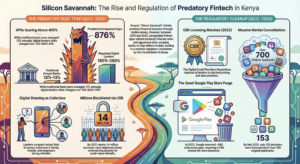
Investigations cited in 2025 revealed that during the peak of this unregulated era, some platforms charged annualized interest rates as high as 876%. Even moderate estimates from the Competition Authority of Kenya in 2021 placed the average annual percentage rate (APR) for unregulated lenders at 280.5%.
The mechanics of this predation were simple yet devastating. Lenders disguised exorbitant costs as “facilitation fees.” A borrower might take 2,000 shillings with a 15 percent fee payable in one week. While this appeared negligible on paper, the annualized cost was astronomical. When borrowers inevitably defaulted due to these crushing terms, the lenders weaponized data privacy breaches.
The Office of the Data Protection Commissioner (ODPC) in reports from 2023 exposed the extent of these “shaming” tactics. Lenders scraped contacts from users’ phones and harassed friends, family, and employers to compel repayment. In a landmark move in late 2023, the ODPC fined Mulla Pride Ltd, the operator of KeCredit and Faircash, nearly 3 million shillings for such violations. Further penalties were levied against Whitepath and Regus Kenya in April 2023, with fines reaching 5 million shillings each for relentless data misuse that defined the 2015 to 2020 era.
“The digital credit market in Kenya grew such that at different points there were several hundred lenders operating… charging excessive interest rates and targeting anyone with a mobile money account.” — Competition Authority of Kenya Report, 2021
The most enduring scar from this period was the weaponization of the Credit Reference Bureau (CRB). Before the 2021 regulatory intervention, digital lenders automatically listed borrowers for defaulting on sums as low as 200 shillings. This created a class of “financial pariahs” unable to access mainstream employment or bank credit.
Data from 2022 indicates the magnitude of this fallout. The number of Kenyans with records at CRBs reached a staggering 25 million that year, with 19 million active records. A significant portion of these negative listings stemmed from digital mobile loans issued during the unregulated boom. The crisis became so acute that the government initiated a Credit Repair Framework in October 2022, aimed at delisting over 5 million borrowers who had been blacklisted by digital lenders.
The 2021 FinAccess survey provided a grim post mortem of the sector’s “wild west” phase. It showed a default rate of 50.9 percent for digital app borrowers, more than double the rate for traditional bank borrowers. This statistical reality shattered the myth that high interest rates were merely pricing for risk; rather, they were a feature of a business model designed to extract maximum value from vulnerable citizens before discarding them to the CRB blacklist.
This era of impunity officially began to close with the Central Bank of Kenya Amendment Act of 2021. By September 2025, the CBK had licensed 153 digital credit providers, bringing them under the same supervisory framework as banks. However, the damage wrought between 2015 and 2020 remains visible in the millions of households still recovering from the debt cycles initiated by these onetime frontier fintechs.
Algorithmic Underwriting: Assessing Risk or Harvesting Data?
In the bustling digital economy of Nairobi, a new borrower can secure a loan in less than five minutes. They do not need a bank account, collateral, or a guarantor. They only need a smartphone and a willingness to surrender their digital privacy. This convenience is the hallmark of the Kenyan fintech revolution, a movement that promised financial inclusion but has increasingly relied on aggressive surveillance capitalism. Between 2020 and 2025, the mechanism driving this industry shifted from traditional credit scoring to algorithmic underwriting, a model that treats personal data as the ultimate currency.
The promise of these algorithms is simple: by analyzing thousands of alternative data points, lenders can assess the risk of “credit invisible” individuals who lack formal banking histories. However, the reality reveals a system that often harvests more data than is necessary for risk assessment. To access liquidity, borrowers grant apps permission to scrape their devices. The algorithms analyze SMS logs to track spending habits, read contact lists to map social networks, and monitor GPS data to verify location and stability. Some lenders even factor in battery life and call duration to predict reliability.
This data driven approach has sparked significant regulatory backlash. The Office of the Data Protection Commissioner (ODPC) became increasingly active between 2023 and 2025, penalizing lenders who crossed the line from assessment to harassment. In September 2023, the ODPC fined Mulla Pride Ltd, which operated the KeCredit and Faircash apps, KES 2.975 million (approximately $20,000). The regulator found that the company had used contact information obtained from third parties to shame borrowers, a tactic where lenders text friends and family to demand repayment.
The violation of privacy is not merely incidental; it is often central to the collection strategy. In April 2023, the ODPC fined Whitepath, another digital lender, KES 5 million for unauthorized access to user contacts. Despite this enforcement, the practice persisted. By March 2025, Whitepath faced a second fine of KES 250,000 after listing an individual as a guarantor without consent. These cases highlight a pervasive issue: the “black box” algorithm does not just assess ability to pay but also identifies leverage points for social pressure.
The cost of this surveillance is borne by the poor in the form of exorbitant fees. While the algorithms are sophisticated, the pricing models are often predatory. Annual Percentage Rates (APRs) frequently exceed 100%, with some providers charging effective rates upwards of 400% when annualized. A 2021 FinAccess survey revealed that over 20% of Kenyan adults had borrowed from digital lenders, yet many found themselves trapped in a debt cycle, taking new loans to pay off old ones.
Recognizing these risks, the Central Bank of Kenya (CBK) intervened with the Digital Credit Providers Regulations of 2022. The aim was to purge the market of rogue actors. The cleanup was extensive. Before the regulations, hundreds of unregulated apps flooded the Google Play Store. The licensing process was rigorous and slow. By September 2022, only 10 providers had secured licenses. This number grew steadily as compliance improved. By January 1, 2025, the CBK had licensed 195 digital credit providers, a significant consolidation from the chaotic “wild west” era of 2020.
Fintech Frontiers in Africa Infographic
Despite these regulatory milestones, the core tension remains. The algorithmic model relies on the continuous extraction of private data. For a vendor in Nairobi needing quick capital to restock inventory, the immediate need for cash often outweighs the abstract value of privacy. As of 2025, the sector has moved towards legitimacy, but the question persists: is the algorithm truly assessing risk, or is it merely harvesting data to maximize extraction from the vulnerable?
The APR Trap: dissecting Weekly Rates vs. Annual Realities
The marketing pitch is seductive in its simplicity. A market vendor in Nairobi needs 2000 shillings to restock vegetables for the week. A digital lender offers the cash instantly with a fee that seems negligible: just 1 percent per day or perhaps 15 percent for a month. To the borrower, paying back 2300 shillings after thirty days feels manageable. It is the cost of doing business. However, this granular pricing strategy masks a predatory mathematical reality that has entrapped millions of Kenyans between 2020 and 2025. When these short term costs are projected over a year, the effective interest rates transform from modest fees into usurious burdens that strip wealth from the poorest demographics.
The core of the deception lies in the distinction between nominal weekly rates and the Annual Percentage Rate or APR. While traditional banks in Kenya quoted annual rates hovering around 12 to 13 percent in 2024, digital lenders operate in a different stratosphere. Data from 2023 and 2024 reveals that popular apps like Tala and Branch have charged monthly interest rates ranging from 15 percent to 19 percent. When annualized, these figures do not merely multiply; they compound into staggering totals. A 15 percent monthly fee translates to a simple annual rate of 180 percent. However, the effective APR, which accounts for the compounding effect of borrowing repeatedly throughout the year, can soar much higher.
The case of Zenka, a prominent mobile lender, provides a stark illustration of this disparity. In 2023, while their website marketed loans with flexible terms, regulatory disclosures and independent analysis highlighted that the maximum Effective Annual Percentage Rate could technically reach astronomical levels, with some estimates citing figures over 4000 percent for the shortest term loans with high fees. This happens because the fee is constant regardless of the brevity of the loan. Borrowing 1000 shillings for a week with a 300 shilling fee implies a 30 percent charge. If a borrower were to repeat this transaction every week for a year, the cumulative cost of capital would obliterate any potential profit margin from their small business.
Compounding this issue is the structure of products like Fuliza, the overdraft service by Safaricom. While not a loan in the traditional sense, its fee structure works similarly to high interest credit. In 2021 and 2022, the service charged a one percent access fee plus daily maintenance charges. For a borrower constantly living in overdraft, a common reality for low income households, these daily fees accumulate rapidly. A study of user behavior in 2024 showed that frequent users often paid more in fees than the principal amount borrowed over time, trapping them in a cycle where they work primarily to service debt fees.
The Central Bank of Kenya or CBK attempted to intervene with the Digital Credit Providers Regulations of 2022. This legal framework aimed to curb predatory pricing and mandated the disclosure of pricing in terms of total cost of credit. Yet, enforcement has been a game of whack a mole. As the CBK cracked down on licensed players, unregulated apps flooded the market. By 2025, consumer complaints regarding opaque fee structures had surged by 28 percent compared to the previous year. Lenders adapted by shifting terminology, rebranding “interest” as “facilitation fees” or “service charges” to evade caps and obfuscate the true cost of borrowing.
For the Kenyan poor, the APR trap is not just a financial metric; it is a mechanism of poverty entrenchment. The weekly rate makes the loan accessible, but the annualized reality makes prosperity impossible. Income generated by microenterprises is siphoned off to pay lenders whose capital costs exceed the return on investment for selling vegetables or clothes. Until financial literacy campaigns can effectively demystify the difference between a daily fee and an annual rate, and until the regulator enforces a strict cap on the total cost of credit including all hidden fees, the fintech frontier will remain a perilous landscape for those it claims to serve.
Predatory Collection: Digital Shaming and Contact Harassment
For millions of borrowers in Kenya, the convenience of mobile credit often comes with a hidden, humiliating price tag. Between 2020 and 2025, the digital lending sector became notorious not just for steep interest rates, but for a collection model built on psychological warfare. This practice, known locally as debt shaming, weaponizes the personal data of the borrower to extort payment through public embarrassment and social pressure.
The mechanism is simple yet devastating. Upon installation, many loan applications require permission to access the contact list, call logs, and messages of the user. While legitimate lenders use this for credit scoring, rogue operators view it as collateral. When a borrower defaults, often on amounts as small as 500 shillings, the algorithm activates a harassment campaign. The application blasts text messages to the contacts of the victim: parents, bosses, church leaders, and friends.
Real data from the Office of the Data Protection Commissioner (ODPC) exposes the scale of this violation. In April 2023, the ODPC issued a penalty of 5 million shillings against WhitePath, a prominent digital lender. The regulator received over 150 complaints alleging that the company utilized contact lists to send unsolicited messages to third parties. These messages often labeled the borrower as a “defaulter” or a “thief” who was evading repayment. In one documented instance, a defaulter lost their employment after a lender sent a barrage of abusive texts to their supervisor.
The legislative landscape shifted in 2022 with the introduction of the Central Bank of Kenya (Digital Credit Providers) Regulations. This law explicitly prohibited using obscene language, shaming tactics, or unauthorized contact with friends and family during debt collection. However, enforcement remains a challenge. Despite the 2023 fine, WhitePath faced fresh sanctions in March 2025. The ODPC fined the lender another 250,000 shillings for listing a citizen as a loan guarantor without consent, proving that regulatory penalties have not fully deterred aggressive tactics.
Tech giant Google also intervened in this crisis. In May 2023, the company updated its Personal Loans policy for Kenya, effectively banning apps on the Play Store from accessing sensitive user data like photos and contacts. This technical blockade forced many predatory apps to seek alternative distribution channels. Some moved to distributing APK files via websites or SMS links, bypassing the safety checks of the official store to continue their data harvesting.
The human cost of this harassment is profound. Reports from 2024 indicate that the stigma associated with these messages has led to social isolation and severe mental distress. The phrase “Kamata mwizi” (catch the thief) became a common refrain in collection texts, criminalizing poverty in the eyes of the community. In September 2023, the ODPC also fined Fadhili Microcredit 5 million shillings for similar data breaches, signaling that the rot was widespread across the industry.
As of late 2025, the battle continues. While the number of licensed lenders has stabilized around 51 entities under the watch of the Central Bank, an underground market of unlicensed applications persists. These rogue operators continue to prey on the desperate, ignoring the 2022 regulations and operating outside the reach of the law. For the Kenyan borrower, the digital frontier remains a dangerous place, where a missed payment can cost not just money, but dignity itself.
The Debt Spiral: Borrowing from Peter to Pay Paul
For millions of Kenyans, the mobile phone is no longer just a communication device; it is a precarious financial lifeline that often tightens into a noose. Between 2020 and 2025, the digital credit landscape in Kenya evolved from a frontier of opportunity into a complex trap of algorithmic debt. This phenomenon, colloquially known as “borrowing from Peter to pay Paul,” has become the default financial strategy for low income households. The mechanism is simple but devastating: a borrower takes a loan from one digital app to settle the debt of another, incurring fresh fees and interest with every cycle, while the underlying principal never truly disappears.
The scale of this distress is evident in the 2024 FinAccess Household Survey. The data reveals a stark reality where debt distress surged to 16.6 percent in 2024, rising significantly from 10.7 percent in 2021. This increase occurred despite government interventions intended to clean up the sector. While the Central Bank of Kenya (CBK) implemented the Digital Credit Providers Regulations in 2022 to curb predatory practices, the appetite for quick liquidity continued to outpace regulatory guardrails. By late 2023, credit reference bureaus (CRBs) held negative listings for 933,551 individuals. Although this figure represented a drop from the peak of 3.2 million blacklisted borrowers in 2020, largely due to a regulatory mandate to delist small defaulters, it masks the churning beneath the surface. Data from 2024 indicates that 69 percent of those previously listed as defaulters simply accessed new loans from different providers once their records were cleared, restarting the cycle.
The “stacking” of loans drives this spiral. A typical borrower might begin the month by overdrawing on MPesa via Fuliza to buy groceries. Fuliza, an overdraft facility used by over 80 percent of MPesa customers, charges daily maintenance fees that can accumulate rapidly if the balance is not settled. When the Fuliza limit is exhausted, the borrower turns to a digital lender like Tala or Branch, or perhaps the state backed Hustler Fund, which launched in late 2022. The Hustler Fund saw rapid uptake, with 28 percent of the population borrowing from it by 2024. While it offered lower rates (8 percent annually), many users treated it not as capital for business, but as a means to service more expensive commercial loans that carried annualized percentage rates (APRs) often exceeding 100 percent.
The cost of this liquidity is exorbitant. In 2025, even as the CBK benchmark rate hovered around 9 percent, unregulated or loosely regulated digital lenders continued to price their risk aggressively. A loan of 2,000 shillings might attract a “service fee” of 15 percent for a single month. If annualized, this fee translates to an APR of 180 percent. For a borrower juggling three or four such loans, the effective interest rate consumes a vast portion of their monthly income. The 2023 report by the Kenya Institute for Public Policy Research and Analysis (KIPPRA) highlighted that digital borrowers often face aggressive debt recovery tactics, driving them to borrow from informal sources or predatory lenders just to keep the algorithmic lenders at bay.
This debt carousel has profound social consequences. The promise of fintech was financial inclusion, yet for the bottom tier of the economy, it has delivered financial extraction. The ease of access, where a loan is approved in seconds, bypasses the psychological friction of traditional borrowing. By the time 2025 arrived, the distinction between income and credit had blurred for many Kenyans. They were not living on what they earned; they were living on what they could borrow next. The 2024 FinAccess data shows a decline in savings to 68.1 percent, the first drop since 2009, confirming that households are depleting their reserves to manage this escalating cost of credit. The spiral turns not because the poor are financially illiterate, but because the system is designed to monetize their desperation.
The CRB Blacklist: Weaponizing Credit Reference Bureaus against the Poor
For millions of Kenyans, the path to financial ruin began not with a catastrophic business failure or a collapsed mortgage, but with a digital loan of less than five dollars. Between 2020 and 2025, the Credit Reference Bureau (CRB) mechanism transformed from a tool for risk assessment into a weapon of mass exclusion, punishing the country’s most vulnerable citizens for their inability to service predatory debts.
The statistics from 2020 paint a grim picture of this systemic failure. By April of that year, data from the Central Bank of Kenya (CBK) revealed that over 3.2 million Kenyans sat on the negative list. These were not corporate defaulters or wealthy tax evaders. The vast majority were low earners who had borrowed small amounts, often between KES 500 and KES 1000, to buy food or pay for electricity. Digital lenders, operating with little oversight at the time, reported these borrowers to the bureaus immediately upon default. Once listed, these individuals found themselves locked out of the formal economy, unable to secure jobs or access cheaper credit from traditional banks.
The Scale of the Trap
The weaponization of credit data relied on the sheer volume of digital loans processed daily. In 2021, while the economy reeled from the shocks of the pandemic, digital credit providers continued to disburse loans at annualized interest rates often exceeding 400 percent. A borrower taking KES 1000 might owe KES 1300 within a month. Failure to pay resulted in a negative listing that functioned as a total economic blockade.
Investigations reveal that by late 2021, the number of negatively listed accounts had surged to nearly 14 million. It is crucial to distinguish between accounts and individuals, as one person often held multiple defaulted loans across different apps. However, the human cost remained identical: a single default on a mobile app could prevent a young graduate from getting hired, as employers increasingly used CRB clearance certificates as a mandatory screening tool. The system effectively criminalized poverty.
Regulatory Interventions and Their Limits
Recognizing this crisis, the Central Bank of Kenya intervened. In November 2021, a suspension on the listing of negative credit information for borrowers with loans below KES 5 million was announced, effective until September 2022. This moratorium offered temporary relief but did not erase the debts.
By 2023, the focus shifted from temporary suspension to permanent deletion of historical data. The government, under the new administration, directed the removal of millions of borrowers from the blacklist. In December 2024, President William Ruto announced that 7 million Kenyans had been removed from the CRB negative list. This mass amnesty aimed to repair the credit scores of millions who had been unfairly penalized for small defaults.
Yet, data from 2024 and 2025 suggests that delisting alone has not solved the underlying issue. While the names were removed, the predatory lending model remained intact. Digital lenders, now licensed under the Digital Credit Providers Regulations of 2022, continued to charge exorbitant fees. The removal of the blacklist threat simply forced lenders to adopt new, aggressive recovery tactics, including shaming borrowers by calling their contacts or sending threatening messages.
A Cycle Unbroken
The narrative of the last five years shows a clear pattern. The CRB system was designed to build trust in the financial sector but was hijacked to enforce the collection of usurious debts. In 2019, 2.2 million individuals were negatively listed. By 2023, following regulatory purging, that number dropped to roughly 933,000. While this reduction appears positive, it masks the reality that millions of Kenyans are still trapped in debt cycles, paying off one app to satisfy another, even if their names no longer appear on a bureau blacklist.
The reform of the Credit Reference Bureaus was a necessary step, but without capping interest rates or addressing the root causes of borrowing, the weaponization of debt continues in new forms. The poor remain targets, not beneficiaries, of this financial frontier.
Silicon Valley in Nairobi: Venture Capital and Foreign Ownership
The narrative of Nairobi as the “Silicon Savannah” suggests a homegrown technological revolution, a digital awakening driven by local ingenuity. Yet, a forensic examination of the capital flows between 2020 and 2025 reveals a different reality. The fintech boom in Kenya is not merely a story of financial inclusion; it is a tale of foreign capital extraction. The vast majority of the funding fueling the digital lending explosion originates in Silicon Valley, London, and other Western financial hubs, and the profits generated from high interest loans on Kenyan borrowers flow back to those same destinations.
The Capital Disconnect
Data from the period illustrates a stark disparity. In 2023, Kenya solidified its status as a primary destination for venture capital in Africa, attracting nearly 800 million dollars. This figure represented approximately 28 percent of the total startup funding for the entire continent. However, the ownership structure of the recipients tells the true story. Reports from The Big Deal and Disrupt Africa highlight that a significant majority of this capital did not go to fully Kenyan owned firms. Instead, it flowed to companies incorporated in Delaware or Mauritius, often led by expatriate founders who command easier access to Western investment networks.
By 2024, the trend had crystallized. While Kenya secured 638 million dollars in startup funding—surpassing Nigeria and South Africa—the dominance of foreign headquartered entities remained unchallenged. Estimates suggest that over 80 percent of fintech funding in the region is directed toward startups with foreign origins or significant expatriate leadership. This capital flight dynamic means that the equity value built on the backs of Kenyan data and borrower repayment histories is realized offshore.
The Santa Monica Connection
No entities embody this dynamic better than the market leaders, such as Tala and Branch. While they operate ubiquitously in Nairobi, their financial hearts beat in California. Tala, headquartered in Santa Monica, raised a massive Series E round of 145 million dollars in late 2021 to fuel its global expansion. By 2025, it had disbursed over 7 billion dollars in credit globally. Branch International, another titan of the sector, boasts heavy backing from Andreessen Horowitz and other premier Sand Hill Road firms.
These are not essentially local cooperatives; they are venture backed technology companies under immense pressure to deliver returns. Venture capital economics demand aggressive growth and outsized returns, often targeting 10 times the initial investment. In the context of lending to the poor, this investor expectation translates directly into the cost of credit. To satisfy the return requirements of a Series E investor in California, a lender in Nairobi must charge interest rates that ensure rapid capital recovery and high margins. The 100 percent to 300 percent annualized percentage rates seen in the market are not just a reflection of risk; they are a requirement of the venture capital business model.
The Extraction Engine
This ownership structure creates a mechanism of wealth extraction. A borrower in Kibera paying 15 percent interest on a monthly loan is not merely covering the cost of their default risk. They are contributing to the internal rate of return for a fund based in San Francisco. The digital credit ecosystem functions as a pipeline where small value shillings from the informal economy are converted into dollars for foreign limited partners.
The consequences of this model were severe enough to trigger government intervention. By December 2025, the Central Bank of Kenya had licensed 195 Digital Credit Providers in an attempt to rein in the sector. This regulatory push was a direct response to the “wild west” era of 2020 through 2022, where unregulated apps utilized predatory debt collection tactics to maximize repayment rates for their distant shareholders.
Ultimately, the Silicon Valley presence in Nairobi has modernized the mechanics of lending but arguably retained the colonial dynamics of extraction. The technology is new, but the flow of wealth—from the African periphery to the Western center—remains unchanged.
The Human Cost: Case Studies of Bankruptcy and Social Ruin
The true price of fintech expansion in Kenya is not found in the glossy annual reports of Silicon Valley startups but in the dusty police files of Kandara and the quiet desperation of households in Kisumu. While digital credit is lauded as a tool for financial inclusion, the reality for millions of Kenyans between 2020 and 2025 has been a descent into a modern form of indentured servitude. The mechanisms of this ruin are algorithmic, but the consequences are viscerally human.
Consider the case of a middle aged man from Gimu village in Muranga County. In late 2022, he borrowed a mere 3,000 shillings, approximately 23 USD, from a popular lending app to cover essential household needs. When he failed to repay on time, the digital lender did not merely apply a penalty fee. They weaponized his social circle. The app, having scraped his contact list upon installation, sent blast messages to his family, friends, and local church leaders, branding him a defaulter and a thief. Unable to bear the public shame and the relentless barrage of threatening calls, he took his own life. His story is not an anomaly; it is a structural inevitability of a business model built on reputation destruction.
Data from the Credit Reference Bureau paints a stark picture of this widespread financial distress. By September 2024, the number of active borrowers listed with negative credit histories had surged to 14 million, up from 12 million in 2020. This means nearly one in three adult Kenyans is effectively blacklisted from the formal economy, tethered to a digital record of insolvency that bars them from future employment or legitimate banking services. The bulk of these defaults are not for luxury items but for survival loans under 5,000 shillings, carrying annualized interest rates that often exceed 400 percent.
The psychological toll of “debt shaming” has created a new category of social ruin. In 2024 alone, the National Police Service received over 1,000 formal complaints regarding harassment by digital lenders. Agents from these firms, often operating from obscure call centers, employ scripts designed to maximize psychological distress. Borrowers report receiving threats of physical violence, fake legal summonses, and messages to their employers demanding garnishment of wages for loans the employer knew nothing about. For “Paul,” a motorcycle taxi operator in Kisumu, this tactic cost him his livelihood. After he defaulted on a 2,000 shilling loan in 2023, the lender contacted his boss, accusing Paul of being a fraudster. He was fired the next day, plunging his family deeper into the poverty he had borrowed to escape.
Regulatory bodies have attempted to intervene, but the pace of enforcement lags behind the speed of algorithmic predation. In 2023, the Office of the Data Protection Commissioner fined Whitepath, a digital lender, five million shillings for unauthorized data sharing and harassment. Yet, for companies disbursing 15 billion shillings a month, such fines are merely the cost of doing business. Even after the Central Bank of Kenya revoked licenses of erratic operators in 2024, new unregulated apps surfaced on the Play Store within weeks, continuing the cycle of entrapment.
The tragedy is that this system functions exactly as designed. The algorithms prioritize willingness to repay over ability to repay, knowing that social pressure is a more effective collection tool than legal action. The result is a hollowed out working class, where bankruptcy is not a legal reset but a permanent social scar. Families are fractured, marriages dissolve under the strain of secret debts, and lives are lost to the shame of owing sums that, in any functional financial system, would be considered trivial.
The period between 2020 and 2021 represented a legislative dark age for Kenya’s digital credit market. While mobile money platforms had accelerated financial inclusion, they simultaneously opened a backdoor for unregulated lending apps to operate with impunity. These entities, often foreign owned or backed by obscure venture capital, utilized the lack of legal oversight to impose annual percentage rates exceeding 400 percent. The government’s initial inaction was not merely an oversight but a calculated hesitation, paralyzed by the desire to maintain Kenya’s status as the “Silicon Savannah” of Africa. Authorities feared that stringent rules might stifle innovation in a sector that had successfully brought millions of unbanked citizens into the formal financial fold.
The Legal Loophole
Until late 2021, the Central Bank of Kenya (CBK) lacked the mandate to supervise digital lenders that did not accept customer deposits. This technicality created a two tier system. Traditional banks and microfinance institutions faced strict compliance checks, while digital credit providers (DCPs) operated in a regulatory vacuum. These apps were registered merely as limited liability companies, subject only to basic commercial laws but free from financial conduct supervision. Consequently, predatory practices flourished. Lenders utilized machine learning algorithms not just to assess risk but to harvest private data, including contact lists and call logs, which were subsequently used for aggressive debt recovery strategies.
The Slow Turn of the Wheel
Public outcry reached a fever pitch in 2021 following widespread reports of “debt shaming,” where lenders would call a borrower’s friends, family, and employers to demand repayment. In response, the parliament passed the Central Bank of Kenya (Amendment) Act in December 2021. This legislation finally empowered the CBK to license and oversee DCPs. However, the implementation was sluggish. The subsequent Digital Credit Providers Regulations were not gazetted until March 2022, and the mandatory licensing deadline was set for September 2022. This transition period allowed rogue actors to continue operations for nearly another year, rushing to extract maximum value before the new rules took effect.
The Licensing Logjam (2023–2024)
Bureaucratic bottlenecks further delayed genuine reform. By late 2023, the CBK had received over 400 applications but had approved fewer than 60. This backlog created a “grey zone” where hundreds of lenders continued to operate under the guise of “pending review.” The uncertainty confused borrowers who could not easily distinguish between compliant lenders and illegal loan sharks. It was only in 2024 that the regulator accelerated the vetting process. Data from October 2024 revealed that the number of licensed DCPs had risen to 85, a figure that climbed further to 126 by June 2025. Yet, this represented a fraction of the original market, suggesting that hundreds of apps simply vanished or went underground rather than comply with consumer protection standards.
Data Protection as the New Battleground
While the CBK focused on licensing, the Office of the Data Protection Commissioner (ODPC) became the unexpected frontline defender. In late 2023 and throughout 2024, the ODPC levied heavy fines against lenders for privacy breaches. Mulla Pride Ltd, operating as KeCredit and Faircash, faced a penalty of nearly 3 million shillings in September 2023 for contacting third parties during debt collection. Another lender, Whitepath, was fined 5 million shillings earlier that year and faced additional sanctions in 2025 for similar violations. These actions signaled a shift from passive observation to active enforcement, forcing the remaining lenders to overhaul their collections architecture or face extinction. The government had finally acted, but for many borrowers trapped in cycles of debt during the vacuum years, the intervention arrived too late.
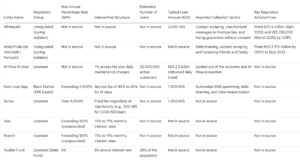
Fintech Frontiers in Africa Data Table
The Central Bank of Kenya (CBK) Intervention and Licensing
For nearly a decade, Kenya served as a global sandbox for digital lending, an experiment that brought financial inclusion to millions but also unleashed a torrent of unregulated capital upon the working poor. By 2020, the market was saturated with hundreds of mobile applications offering unsecured credit at astronomical rates. These platforms operated in a legal gray zone, outside the remit of the Central Bank of Kenya (CBK), allowing them to weaponize user data and employ debt shaming tactics without fear of regulatory reprisal. The turning point arrived with the Central Bank of Kenya (Amendment) Act of 2021, a legislative hammer designed to bring order to this chaotic frontier.
The Act, which granted the CBK authority to license and oversee Digital Credit Providers (DCPs), was operationalized through regulations gazetted in March 2022. This legal framework ended the era of “file and launch” fintech. Providers were given six months, until September 2022, to apply for licenses or cease operations. The requirements were stringent. Applicants had to prove the fitness and propriety of their directors, disclose their pricing models, and demonstrate compliance with the Data Protection Act to prevent the harassment of borrowers.
The Google Play Store Purge
The regulator found a powerful enforcement partner in Silicon Valley. In January 2023, Google updated its policy for personal loan apps in Kenya, requiring them to submit a valid license or proof of pending approval from the CBK. The impact was immediate and visceral. Hundreds of applications vanished from the Play Store overnight. Popular platforms like MoKash and Okash, which had amassed millions of downloads, faced removal or suspension as they scrambled to meet the new compliance standards. This digital eviction effectively severed the primary distribution channel for rogue lenders.
However, the transition to a regulated market was slow and painful. By March 2023, out of more than 400 applicants, the CBK had granted licenses to only 32 providers. The regulator adopted a meticulous vetting process, often coordinating with the Office of the Data Protection Commissioner (ODPC) to filter out firms with a history of abusing customer information. The list of licensed entities grew incrementally, reflecting the regulator’s caution. By March 2024, the number had risen to 51, leaving hundreds of other firms in a state of operational limbo.
Licensing Timeline (2023 to 2025)
March 2023: 32 providers licensed.
March 2024: 51 providers licensed.
June 2025: 126 providers licensed.
September 2025: 153 providers licensed.
By late 2025, the landscape had shifted significantly. In September 2025, the CBK announced the licensing of 27 additional providers, bringing the total count to 153 regulated entities. Despite this expansion, the rejection rate remained high. Over 700 companies had applied since 2022, meaning fewer than 25 percent successfully navigated the scrutiny of the central bank. This attrition rate signaled a massive consolidation of the industry, pushing out fly by night operators who lacked the capital or corporate governance to survive regulation.
Yet, licensing did not equate to an immediate end to predatory lending. While debt shaming subsided due to the threat of license revocation, high costs persisted. In July 2025, the Competition Authority of Kenya (CAK) opened an investigation into several licensed digital lenders following a surge in consumer complaints. Borrowers reported interest rates as high as 40 percent per month and opaque terms that included repayment demands in foreign currencies. These developments revealed the limitations of the initial regulatory phase. The CBK had successfully built a gate to keep out the worst actors, but the licensed entities inside the gate still possessed significant power to extract wealth from vulnerable borrowers.
The intervention by the CBK marks the end of the “Wild West” era for Kenyan fintech. The ecosystem has moved from a free for all marketplace to a surveillance state where every lender is known, tracked, and subject to annual review. However, as the 2025 probes indicate, the battle has merely shifted from stopping harassment to addressing the core economic issue: the extreme cost of credit for the poor.
Google’s Crackdown: Policy Changes on the Play Store
For years, the digital lending landscape in Kenya resembled a chaotic marketplace with zero rules. Between 2020 and 2022, the Google Play Store served as the primary distribution channel for hundreds of unregulated lending applications. These platforms offered instant credit with exorbitant fees while demanding invasive permissions to access contacts, call logs, and messages. This data allowed aggressive debt collectors to shame borrowers by contacting their families and employers. The sheer volume of predatory apps overwhelmed regulators, creating a crisis that demanded intervention from the gatekeeper itself.
The turning point arrived in November 2022. Google announced a sweeping update to its Developer Program Policy, specifically targeting digital lenders in Kenya, Nigeria, India, Indonesia, and the Philippines. The tech giant declared that effective January 31, 2023, any app offering personal loans in Kenya would need to prove its regulatory status. Developers were required to complete a “Personal Loan App Declaration” and provide a copy of their license from the Central Bank of Kenya (CBK). This move effectively outsourced the vetting process to the Kenyan banking regulator, closing the loop that had allowed rogue lenders to flourish.
The impact of this policy enforcement was immediate and severe. In early February 2023, data tracked by TechCrunch revealed that the finance category on the Play Store hosted 657 applications. By late March 2023, that number had plummeted to just 198. Approximately 500 applications were purged from the store in a matter of weeks. Prominent apps such as Okash and MoKash, which had amassed millions of downloads, found themselves removed or forced to suspend operations until they could secure the elusive CBK license. The digital storefront that once teemed with thousands of options suddenly became a barren landscape for unlicensed operators.
The crackdown exposed the vast disparity between the number of operating lenders and those actually compliant with Kenyan law. When the January 2023 deadline struck, the CBK had received 381 applications for licensing. However, the regulator had approved only 22 distinct entities at that time. This bottleneck meant that the vast majority of digital lenders could no longer acquire new users through the official Android store. By April 2023, the number of licensed providers crept up to 32, a fraction of the hundreds that had previously operated with impunity.
Google tightened the screws further in May 2023 with another critical policy update regarding user privacy. The new rules explicitly prohibited personal loan apps from accessing sensitive user data, specifically external storage, photos, and contacts. This technical restriction struck at the heart of the predatory debt collection model. Without access to a borrower’s contact list, rogue agents could no longer blast text messages to friends and relatives demanding repayment. This policy forced a fundamental shift in how credit risk was assessed, moving away from social pressure and toward actual financial data.
By October 2024, the landscape had stabilized but remained exclusive. Out of more than 400 applicants, only 85 lenders had secured the necessary CBK license to operate legally and maintain their presence on the Play Store. The Business Laws (Amendment) Act of 2024 further cemented this new reality by reclassifying these entities as “Non Deposit Taking Credit Providers,” subjecting them to rigorous capital and consumer protection requirements.
While the purge cleansed the official store, it did not entirely eliminate the problem. Desperate borrowers and rogue lenders moved to the shadows, utilizing direct APK downloads and social media groups to bypass the restrictions. However, the removal of these apps from the world’s largest app repository significantly increased the friction for predatory actors, marking the end of the era where exploitation was just one click away.
The Persistence of Rogue Apps and the Black Market
The digital lending landscape in Kenya underwent a seismic shift between 2020 and 2025. While the Central Bank of Kenya (CBK) and the Office of the Data Protection Commissioner (ODPC) launched aggressive campaigns to sanitize the sector, a parallel underground economy emerged. This section investigates how predatory lenders adapted to regulatory pressure, moving from mainstream platforms to the opaque corners of the internet, creating a resilient black market that continues to prey on the financially vulnerable.
The Great Purge of 2023
The turning point for the industry arrived in late 2022 and early 2023. Google, acting on new policy directives, announced it would bar any personal loan app in Kenya lacking a license from the CBK. The impact was immediate and visible. By January 2024, the Play Store had removed nearly 500 applications that failed to provide proof of compliance. This purge was intended to be the death knell for rogue lenders.
However, data from the CBK reveals a stark disparity. As of March 2024, the regulator had received over 480 applications but had licensed only 51 providers. This left hundreds of entities in regulatory limbo. Rather than shutting down, many of these unlicensed operators simply migrated. They bypassed the official app stores entirely, distributing their software via direct Android Package Kit (APK) downloads hosted on websites, social media channels, and peer to peer sharing networks. This migration birthed a shadow fintech ecosystem where oversight is nonexistent and borrower recourse is limited.
Inside the APK Black Market
Investigative analysis of this underground market reveals a sophisticated operation designed to evade detection. Rogue lenders now use Facebook groups and Telegram channels to advertise “instant loans” with no credit checks. These advertisements contain direct links to download APK files, bypassing the security vetting processes of Google Play. Once installed, these apps demand extensive permissions, granting the lender access to the user’s contacts, messages, and call logs.
In 2025, the Office of the Data Protection Commissioner fined Whitepath, a digital lender, KES 250,000 for listing an individual as a loan guarantor without consent. This was not an isolated incident. Just two years prior, in 2023, the same entity faced a KES 5 million penalty following nearly 150 complaints regarding unauthorized data access. The persistence of such violations highlights a disturbing reality: for rogue lenders, regulatory fines are often treated merely as a business expense rather than a deterrent.
The Mechanics of Digital Shaming
The primary weapon in the arsenal of these black market apps is data weaponization. Unlike licensed lenders who are bound by the Consumer Protection Act, rogue apps operate with impunity. Borrowers report a harrowing escalation of tactics when payments are delayed. The initial stage involves automated SMS spamming, which quickly progresses to “debt shaming.”
In a case involving Mulla Pride Ltd, which operated under the brands KeCredit and Faircash, the ODPC imposed a KES 2.9 million fine in September 2023. The investigation found that the lender used contact information obtained from third parties to send threatening messages to the borrower’s family, friends, and employers. These messages often framed the borrower as a fraudster or a thief, aiming to destroy their social standing to force repayment.
Predatory Pricing in the Shadows
The cost of borrowing in this unregulated space remains extortionate. While the Central Bank Amendment Act of 2021 sought to curb high interest rates, black market apps ignore these caps. Analysis of terms from the “Koro Loan App” (as listed in various archives) showed annualized percentage rates (APRs) that could theoretically exceed 4000 percent. A typical structure involved a “service fee” of 30 to 40 percent for a loan duration of just 61 days. If a borrower took KES 1000, they owed KES 1390 two months later. When annualized, these fees trap the poor in a cycle of debt that is mathematically impossible to escape without external aid.
By 2025, despite the harsh regulatory environment, the demand for quick credit kept these rogue actors alive. They rebranded frequently, changing app names and icons overnight to confuse regulators while retaining their user data. The battle has thus evolved from a legislative one to a technological game of cat and mouse, with the poorest Kenyans caught in the middle.
Conclusion: Redefining Financial Inclusion vs. Exploitation
The narrative of financial inclusion in Kenya has long relied on a single, seductive metric: access. By 2024, over six million Kenyans had accessed digital credit, a figure often cited as a triumph of fintech innovation. Yet, as the dust settles on a tumultuous half decade from 2020 to 2025, the evidence suggests that for the working poor, this accessibility has mutated into a sophisticated form of extraction. The promise was to bank the unbanked; the reality has been the systematic enclosure of the poor into a cycle of high cost debt that fuels consumption rather than production.
Data from the Central Bank of Kenya (CBK) reveals the scale of this transformation. Following the chaos of the unregulated era, the CBK began a rigorous licensing regime in 2022. By December 2025, the regulator had licensed 195 digital credit providers, a stark contrast to the hundreds of rogue apps that once populated the Google Play Store. While this move brought a veneer of legitimacy to the sector, it did little to alter the fundamental mechanics of the lending model. The cost of credit remains punitively high. In 2024, popular apps continued to charge monthly fees ranging from 7.5 percent to 15 percent. When annualized, these fees translate to Annual Percentage Rates (APRs) exceeding 100 percent, with some products effectively charging upwards of 200 percent per year.
For a street vendor in Nairobi borrowing 3,000 shillings to restock vegetables, an APR of 150 percent is not merely a financial statistic; it is a tax on survival. This predatory pricing structure explains why, despite the regulatory crackdown, the default rate on digital loans surged to nearly 40 percent in 2024, significantly higher than the 16.4 percent default rate seen in traditional commercial bank loans. The fintech algorithm, touted as a tool for personalized risk assessment, often functions as a trap. It encourages repeat borrowing to pay off previous debts, spinning the user into a vortex where the principal amount is dwarfed by accumulating fees.
The social cost of this model became undeniably clear when the government was forced to intervene. In late 2024, President William Ruto announced the removal of seven million Kenyans from the Credit Reference Bureau (CRB) blacklist. These were not corporate defaulters but ordinary citizens blacklisted for amounts as small as 100 to 2,000 shillings. The mass delisting was an admission that the system had failed; the credit scoring mechanism designed to build trust had instead disenfranchised millions, effectively locking them out of the formal economy for minor infractions.
Furthermore, the “inclusion” narrative ignores the purpose of the debt. Studies from 2023 and 2025 indicate that a vast majority of these digital loans are used for daily consumption—food, airtime, or bus fare—rather than asset building. When credit is used to plug gaps in stagnant wages rather than to fund enterprise, it ceases to be a ladder out of poverty and becomes a shackle. The digital lenders, now fully licensed and sanitized, continue to reap significant profits from this distress. The transition from the “Wild West” of 2020 to the regulated market of 2025 has successfully formalized the sector, but it has not necessarily humanized it.
True financial inclusion requires more than the ability to incur debt via a smartphone. It demands affordable credit terms that allow for capital accumulation. As Kenya moves forward, the definition of success must shift. We must stop celebrating the number of loans disbursed and start measuring the financial health of the borrowers. Until the interest rates align with the real economic capacity of the poor, the fintech frontier will remain a landscape of exploitation disguised as opportunity.
**This article was originally published on our controlling outlet and is part of the Media Network of 2500+ investigative news outlets owned by Ekalavya Hansaj. It is shared here as part of our content syndication agreement.” The full list of all our brands can be checked here.You may be interested in reading further original investigations here.
Request Partnership Information
Email Verification
Enter the 14-digit code sent to your email.
About The Author
Africa Observer
Part of the global news network of investigative outlets owned by global media baron Ekalavya Hansaj.
Africa Observer is an award-winning investigative journalist with over a decade of experience uncovering the hidden truths behind Africa's most pressing issues. Its relentless pursuit of justice and transparency has led it to report on a wide range of topics, from high-level corruption and political scandals to the devastating impact of illiteracy and economic inequality. Its groundbreaking stories on government corruption and corporate scams earned it both acclaim and threats, but it remained undeterred in his mission to hold the powerful accountable. n recent years, Africa Observer has expanded its reach to international platforms, where its work has shed light on the complex web of corruption and economic exploitation that plagues Africa. Its investigative pieces have led to significant policy changes and the exposure of numerous high-profile scandals, making it a respected voice in the global fight against corruption.