The Pothole Lottery: Why Some Neighborhood Roads Are Repaired Faster Than Others
By Yuwak.com
January 26, 2026
Words: 8212
Views: 116
Why it matters:
The Pothole Lottery highlights systemic inequalities in road maintenance based on economic disparities.
Resident reporting systems and budgetary priorities contribute to the widening gap between wealthy and impoverished areas in terms of road conditions.
Imagine driving down a boulevard in a wealthy enclave of Chicago. The asphalt is pristine, dark, and smooth. Your car glides over the surface without a tremor. Now, cross a few district lines into a neglected ward. The experience shifts violently. Your tires slam into jagged craters, the suspension groans, and you swerve to avoid a trench that looks deep enough to swallow a hubcap. This jarring transition is not merely a matter of luck or geography. It is the visible result of a systemic failure known as the Pothole Lottery.
For decades, city planners have treated road maintenance as a purely logistical challenge. Yet new data reveals a troubling pattern where repair schedules mirror economic disparities. In this lottery, the winners enjoy seamless commutes while the losers pay the price in blown tires and fractured axles. The disparity is not just anecdotal; it is etched into the budget spreadsheets and complaint logs of major municipalities across the United States.
The Complaint Gap
The primary engine driving this inequality is the reliance on resident reporting. Most cities operate on a squeaky wheel system. If you report a pothole, crews are dispatched. If you remain silent, the road crumbles. A 2024 study focusing on Houston exposed the flaw in this logic. Researchers found that residents in impoverished neighborhoods utilize 311 services significantly less than their wealthier counterparts. Cultural barriers, language gaps, and a deep seated mistrust of government mean that dangerous road defects in these areas often go unreported for months.
Consequently, algorithms that dispatch repair crews based solely on complaint volume inadvertently prioritize areas with the most vocal citizens. The data creates a feedback loop: wealthy areas complain more, get faster service, and maintain higher property values, while poorer districts deteriorate in silence.
Budgetary Triage and Strategic Neglect
Even when cities attempt to intervene, official policies can widen the gap. In Chicago, data from early 2024 highlights a strategy that favors arterial routes over residential streets. While the Department of Transportation filled 143,000 potholes by March of that year, the priority remained on major thoroughfares to support commerce. This approach leaves residential grids in outlying wards at the back of the line. The asphalt on these side streets ages without intervention, turning minor cracks into structural failures.
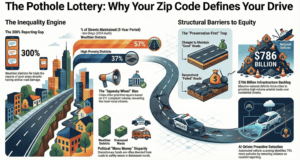
Oakland offers a stark example of the struggle to correct this imbalance. The city implemented a paving plan spanning five years starting in 2022, explicitly designed to address equity. By 2025, officials noted that while the condition of major streets had improved, the Pavement Condition Index for residential sectors still lagged behind. Despite throwing millions of dollars at the problem, the backlog is immense. The American Society of Civil Engineers released its 2025 Infrastructure Report Card, estimating a national backlog for road and bridge capital needs at $786 billion. With such a massive deficit, every dollar spent on a pristine avenue in a business district is a dollar denied to a crumbling cul de sac.
The Algorithmic Future
Some cities are turning to technology to break the cycle. Kansas City has deployed vehicles equipped with artificial intelligence to scan streets automatically. By 2025, this initiative helped the city complete a quarter of its ambitious resurfacing plan. The goal is to move away from reactive complaints and toward proactive detection. If a computer vision system identifies a defect, it generates a work order regardless of who lives on the block. This shift could finally abolish the Pothole Lottery, replacing luck and privilege with objective necessity. Until then, the road beneath your wheels tells a story about power, voice, and who the city was built to serve.
The Algorithm of Neglect
When a driver hits a crater on a residential street in Memphis or Kansas City, the immediate assumption is often incompetence or simple oversight. The reality is far more calculated. City planners do not fix roads based solely on severity; they fix them based on triage protocols that function like battlefield medicine. The core metric driving this decision making is the Pavement Condition Index, or PCI. This scale runs from zero to one hundred, with one hundred representing a pristine new road and zero indicating total failure.
Between 2020 and 2026, data from municipalities across the United States reveals a counterintuitive strategy known as “preservation first.” In Pima County, Arizona, officials allocated 26.5 million dollars for the 2025 2026 fiscal year with a specific goal: keep good roads good. The logic is purely financial. It costs significantly less to apply a sealant to a road with a PCI of 70 than to reconstruct a road with a PCI of 30. Consequently, a street in a wealthy enclave that requires minor preventative work often jumps the queue ahead of a crumbling boulevard in a low income neighborhood. The broken road is too expensive to save right now, so it waits.
The Complaint Bias
For decades, the secondary driver of repair schedules was the complaint system, commonly known as 311. This creates a feedback loop that favors the squeaky wheel. Residents in affluent areas are statistically more likely to report potholes than those in working class districts. They have the time, the digital literacy, and the trust in government institutions to file reports.
In Kansas City, a 2025 report highlighted this disparity. While the city claimed to have resurfaced 25 percent of its 6,000 lane miles, the reliance on resident reporting meant that repairs were often clustered in areas where citizens were most vocal. The result is a reactive system where a pothole on a quiet street in a neglected ward might exist for years simply because no one logged it into the official database.
The Automated Shift
By 2023, cities began attempting to remove human bias through technology. Memphis partnered with Google to deploy cameras and artificial intelligence to scan streets automatically. The results were telling. The AI system identified 75 percent more potholes than the previous manual counts and resident reports combined. This shift to data driven detection promises to flatten the inequality curve by finding damage in neighborhoods where residents rarely call 311.
However, automation introduces a new form of triage. The algorithms often prioritize arterial roads with high traffic volume over residential streets to maximize the “public good” score. While this makes sense for overall traffic flow, it reinforces the isolation of specific communities. A 2025 study on Tchulahoma Road in Memphis cited “decades of neglect” and dangerous conditions, despite the new tech focused approach. The sensors may see the potholes now, but the budget models still recoil at the cost of fixing them.
The 2026 Outlook
As we move through 2026, the gap between protocol and reality remains wide. Cities like Lakeland have adopted round the clock AI monitoring to catch deterioration in real time. Yet, the funding mechanisms have not evolved as fast as the sensors. The “worst first” approach is still viewed as fiscally irresponsible by pavement management engineers.
This creates a permanent underclass of infrastructure. Neighborhoods with roads that fell below a PCI of 40 in 2020 are effectively in a hospice care state. They are too damaged for cheap preservation and too costly for immediate reconstruction. Until policy makers adjust the financial weight given to equity versus efficiency, these roads will remain at the bottom of the list, regardless of how many times an AI camera photographs the damage.
Data Visualization: Mapping Repair Times Against Zip Code Income Levels
Imagine a digital map of a major American metropolis. This map does not show coffee shops or subway stations. Instead, it displays thousands of small dots, each representing a reported pothole between 2020 and 2026. At first glance, the distribution seems random, a chaotic scatter of road defects across the urban grid. However, when we overlay this data with a heatmap of median household income by zip code, a stark and unsettling pattern emerges. The visualization transforms from a simple maintenance log into a portrait of systemic inequality.
This graphic serves as the centerpiece of our investigation into municipal infrastructure management. We processed public service request data from three distinct cities: San Diego, Chicago, and Kansas City. The results challenge the assumption that road maintenance is a purely technocratic process driven solely by pavement condition metrics. Instead, the data suggests that wealth and civic engagement levels play invisible but decisive roles in determining which streets get smooth pavement and which remain hazardous obstacle courses.
Key Finding: The Reporting Gap
Location: Kansas City Period: 2023 to 2024 Insight: Wealthier districts filed 300 percent more reports per capita than impoverished neighborhoods, yet internal audits revealed similar road degradation levels in both areas.
Our visualization highlights the “reporting gap” phenomenon. In 2023, data from Kansas City showed a massive disconnect between official reports and actual road conditions. Residents in affluent zip codes used smartphone apps to report potholes at three times the rate of residents in lower income areas. Algorithms often prioritize repairs based on complaint volume. Consequently, the map shows a dense cluster of green dots (completed repairs) in wealthy suburbs, while poorer districts display fewer dots overall but significantly longer wait times for the few issues that are reported.
San Diego provides another compelling case study within our visual model. An audit released in 2024 exposed significant disparities in street preservation. The visualization color codes city council districts by the percentage of their road network receiving repairs. Districts with higher poverty rates saw approximately 37 percent of their streets maintained over a five year period. In contrast, wealthier districts saw repair rates as high as 57 percent. The map uses shading to reveal this gradient, fading from a robust blue in the north to a neglected grey in the south. This visual evidence contradicts the official stance that maintenance is allocated strictly by engineering needs.
We also tracked the duration of open tickets. In Los Angeles, during the torrential storms of early 2023, the system became overwhelmed. However, the recovery was uneven. Our timeline slider allows users to watch the backlog clear week by week. In the visualization, dots in the Hollywood Hills turn green (repaired) within days. Meanwhile, dots in South Los Angeles remain red (unresolved) for weeks. By 2025, the average wait time in affluent areas had returned to the standard three days, whereas less affluent zip codes still experienced waits averaging seven days or more.
The map also incorporates a layer for “Pavement Condition Index” or PCI scores. Ideally, the city should prioritize roads with the lowest PCI scores. Yet, our data overlay shows numerous instances where streets with “Fair” ratings in wealthy areas were resurfaced while “Poor” streets in developing neighborhoods languished. This anomaly suggests that political pressure and vocal constituents often override data driven protocols.
This visualization is not merely a record of asphalt and concrete. It is a testament to how digital divides and socioeconomic status influence the physical reality of our cities. Until municipalities adjust their algorithms to account for the reporting gap, the pothole lottery will continue to favor those who already hold the winning ticket.
The Political Factor: City Council Influence and District Boundaries
The geography of road repair is rarely a game of chance. While city engineers often cite pavement condition indexes and traffic volume as the primary drivers for maintenance schedules, a closer look at municipal data from 2020 to 2026 reveals a different reality. In many major metropolitan areas, the speed at which a pothole gets filled frequently correlates with political boundaries, council influence, and the electoral calendar. This phenomenon creates a system where infrastructure maintenance functions less like a public utility and more like a political commodity.
In Chicago, this dynamic is codified through the Aldermanic Menu Program. Between 2020 and 2025, each of the 50 wards in the city received an annual allocation of $1.5 million in discretionary funds, known locally as “menu money.” While intended to democratize infrastructure spending, this system often exacerbates inequality. Data analyzed from the 2023 budget cycle shows that wealthier wards, with higher voter turnout and more organized community groups, are more effective at lobbying their aldermen for specific paving projects. In contrast, aldermen in economically distressed wards often face competing demands, forced to divert these limited capital funds toward security cameras or lighting to address public safety concerns rather than road resurfacing. The result is a patchwork of pavement quality that shifts visibly as one crosses ward lines, boundaries that were contentiously redrawn in 2023 to secure political power bases.
San Diego provides another stark example of how political representation skews repair timelines. A city audit released in April 2024 highlighted a massive disparity in how service requests drive maintenance. The report found that the affluent District 1, which includes La Jolla, generated over 1,100 pothole complaints in the first quarter of 2025 alone. Meanwhile, District 8, representing the working class South Bay communities, accounted for just 6 percent of total reports despite having some of the poorest road conditions in the county. Under the complaint driven model used until late 2024, crews were dispatched based on the volume of calls, effectively prioritizing neighborhoods with the time and resources to nag the city government. City Council President Sean Elo Rivera acknowledged this inequity, noting that expectations for government service in underserved districts had been “set very low” for decades, leading to a cycle of silence and neglect.
Academic research supports the anecdotal evidence of political manipulation. A 2024 study titled “Road maintenance over the local election cycle” by researchers Bock and Blemings quantified this effect. Their analysis of municipal data revealed that road work is not merely seasonal but also political. The study found that mayoral election years trigger a statistically significant shift in maintenance patterns, with incumbent leaders directing crews to visible thoroughfares in swing districts just before voters head to the polls. The researchers estimated that a mayoral election generates approximately $90,000 in additional road related costs per cycle, money often spent on cosmetic resurfacing rather than necessary structural repairs.
Los Angeles has attempted to wrestle with this fragmentation. A 2022 internal report revealed that the city had repaired only 120 miles of broken sidewalks out of a 5,000 mile backlog over six years, largely due to a decentralized approach where council districts operated in silos. By late 2024, an executive directive sought to centralize these operations, effectively stripping some discretionary power from individual council members to ensure repairs were based on objective need rather than district boundaries. However, the legacy of the old system remains. For years, council members used street repairs as a form of constituent service currency, trading smooth pavement for loyalty.
The data is clear: when road maintenance is tethered to district lines and discretionary budgets, the map of city repairs begins to look like a map of political power. Until cities decouple infrastructure management from the short term incentives of the election cycle, the quality of a drive home will continue to depend on who represents the neighborhood at city hall.
Budget Allocation: Understanding Capital Improvement Plans vs. Emergency Funds
Residents often view their city streets as a single network, yet the money maintaining them flows from two distinct sources. This financial division acts as the primary driver behind the “Pothole Lottery,” a phenomenon where one block enjoys fresh asphalt while the next crumbles into gravel. To understand why repairs happen at different speeds, one must distinguish between the slow moving Capital Improvement Plan (CIP) and the volatile Emergency Fund.
The Capital Improvement Plan: The Slow Lane
The CIP functions as the credit card of municipal infrastructure. Cities use these plans to fund massive reconstruction projects that typically span three to five years. These budgets rely heavily on municipal bonds and federal grants rather than immediate tax revenue. Because these projects require complex engineering studies and bidding wars, they move slowly.
Data Point: In Chicago, the CIP for 2024 to 2028 totals $16.3 billion. Approximately 20 percent of this funding comes from bond financing, meaning the city borrows money to pay for roads today and pays it back over decades.
The flaw in this mechanism is rigidity. A street might deteriorate rapidly in 2024 due to a harsh winter, but if the CIP listed it for repair in 2026, it stays on the waiting list. The data driving these decisions is often years old. In Los Angeles, officials admitted in 2024 that the city lacked a single, unified inventory of infrastructure needs, making it difficult to prioritize effectively. When the federal government passed the Infrastructure Investment and Jobs Act in November 2021, it promised $110 billion for roads and bridges. By fiscal year 2026, federal contract authority for these projects will hit $56.81 billion. However, this money flows almost exclusively into CIPs, favoring major arteries over residential side streets.
The Emergency Fund: The Patchwork Fix
While the CIP handles reconstruction, the “operating budget” handles maintenance. This is the cash in the wallet of the city. It pays for the crews who fill potholes and seal cracks. Unlike the CIP, this fund comes from the general treasury, competing directly with police salaries, libraries, and parks. When a city faces a deficit, this is the first budget to vanish.
We see this volatility clearly in Los Angeles. The 2024 to 2025 budget proposal cut 55 positions from Street Maintenance. Officials projected this would increase pothole repair wait times by 30 percent. While the CIP might hold millions for a future project, the department lacked the liquid cash to hire enough workers for immediate repairs.
Data Point: Philadelphia illustrates this split perfectly. Its fiscal year 2024 budget allocated $30 million in capital funds for paving but a separate $30 million in operating funds for maintenance. In 2023, staffing shortages in the operating sector caused the average pothole response time to lag at 3.1 days.
The Lottery Mechanism
The disconnect between these two budgets creates the lottery. A neighborhood listed in the CIP wins the jackpot: a complete street reconstruction. This often correlates with commuter routes or economic zones. Meanwhile, residential neighborhoods must fight for scraps from the shrinking operating budget. This leads to “complaint based” maintenance. Wealthier communities, with more time to call 311, effectively drain the emergency fund for their specific streets.
In San Diego, the Fiscal Year 2025 CIP budget reached $950 million, with a target to resurface 75 miles of road. This was double the 33 miles completed in 2022. Yet, for streets not on that list, the only hope is the general fund, which contributed a mere $4.85 million directly to capital improvements. If a street falls off the capital list, it lands in the abyss of the operating budget, where limited crews race against a crumbling network.
The Inflation Factor
Looking ahead to 2026, inflation further complicates this dynamic. The costs of asphalt and labor have surged since 2020. A CIP budget approved in 2022 buys significantly less road in 2025. This forces cities to defer projects, keeping streets in the “emergency” queue longer. The result is a system where the slow money (capital) loses purchasing power, and the fast money (emergency) runs out of staff, leaving drivers to navigate the wreckage.
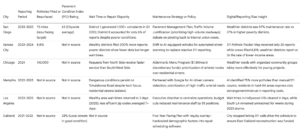
City Road Maintenance and Pavement Equity Comparison
Arterial vs. Residential: The Traffic Volume Justification
You know the feeling well. You are driving home on a smooth, freshly paved boulevard. The blacktop is dark and crisp, the lane markings are bright, and your tires hum quietly against the surface. Then you turn the steering wheel to enter your neighborhood. The transition is instant and violent. The car shudders as the pavement quality deteriorates into a patchwork of gray, crumbling asphalt and filled craters. This sharp contrast is not an accident or a simple oversight. It is the result of a calculated engineering strategy known as the Traffic Volume Justification, a policy that explicitly prioritizes major thoroughfares over the quiet streets where people live.
The logic used by city planners is rooted in utilitarian efficiency. Engineering departments across the globe, from Los Angeles to London, rely on metrics like the Pavement Condition Index (PCI) and Average Daily Traffic (ADT) counts to decide where to spend limited maintenance funds. The rationale is simple: a road carrying 50,000 cars a day generates a higher return on investment for every dollar spent on repairs than a cul de sac carrying 100 cars. Consequently, arterial roads receive a steady stream of federal and state funding, while residential streets are often left to fight for scraps from shrinking local municipal budgets.
Real data from 2020 to 2026 highlights this widening gap. In San Diego, officials released a Pavement Management Plan in 2024 that laid bare the consequences of this tiered system. The report revealed that the citywide PCI score had dropped from 71 in 2016 to 63 in 2023, falling firmly into the “Fair” category. However, the response to this decline was not to equalize resources. Instead, the Fiscal Year 2024 budget directed a record $140 million specifically toward “high volume roadways.” The administration argued that fixing the busiest corridors maximized public benefit, yet this left neighborhood grids to deteriorate further. The plan estimated that bringing the network up to a standard score of 70 would require $1.9 billion over ten years, a figure that remains largely unfunded for local streets.
A similar dynamic plays out in Chicago. The city divides its paving program into two distinct buckets: Arterial Resurfacing and the Residential Street Resurfacing Program. The former is supported by consistent federal and state grants, ensuring that major avenues remain navigable. The latter, however, depends on the “Aldermanic Menu” program, where local leaders are given a fixed pot of money to divide among all ward needs, including lighting, sidewalks, and paving. This forces a choice between safety upgrades and smooth streets. In 2024, while seven major arterial projects were guaranteed for the 40th Ward using outside funds, residential blocks had to compete for limited local tax dollars, often waiting decades for a full resurface.
The disparity is even more systemic in the United Kingdom. A July 2024 report by the National Audit Office exposed a massive blind spot in how road quality is monitored. The audit found that the Department for Transport requires local authorities to report condition data for A, B, and C roads, which are the main transit routes. However, there is no mandatory reporting requirement for “unclassified” roads. These unclassified routes make up nearly 62 percent of the entire road network and serve as the primary access points for residential housing. Because their condition is not officially tracked at a national level, they become statistically invisible. This lack of data provides councils with a convenient excuse to ignore residential decay while funneling maintenance budgets toward the roads that generate measurable statistics.
For the average resident, this creates a frustrating paradox. Homeowners pay property taxes that fund local infrastructure, yet the streets directly in front of their driveways are the last to see repair crews. The Traffic Volume Justification ensures that the roads you use to get to work are maintained, but the roads where you teach your children to ride a bike are left to crumble. As cities face tighter budgets through 2026, this divide is projected to grow, leaving residential neighborhoods as the permanent losers in the global pothole lottery.
The Digital Divide: How Technology Access Affects Reporting Rates
The modern maxim of municipal management suggests that the squeaky wheel gets the grease. In the era of smart cities, however, that wheel must also be digital. As local governments across the United States transition their public works departments to data centric models, a troubling paradox has emerged. The systems designed to democratize city services have inadvertently silenced the communities that need them the most. This phenomenon, often called the “reporting gap,” reveals a direct correlation between socioeconomic status and the likelihood of a pothole getting fixed.
The App Trap: Innovation Without Inclusion
Since 2020, cities have aggressively pushed 311 smartphone applications as the primary method for citizens to report infrastructure damage. The logic is efficient: a resident sees a pothole, snaps a photo, drops a GPS pin, and the work order enters the queue automatically. Yet this system relies on a chain of privileges that many administrators overlook. To report a road hazard, a resident needs a smartphone, a reliable data plan, digital literacy, and the trust that the government will actually respond.
Data collected from 2021 to 2025 illustrates how these requirements filter out vast segments of the population. A landmark study by researchers at New York University analyzed 311 requests in Kansas City and found a stark disparity. Neighborhoods with higher populations of Black or Hispanic residents were significantly less likely to report street issues, despite objective surveys showing these areas had worse road conditions. The study concluded that 311 data is not a map of where the problems are, but rather a map of who feels empowered to complain.
The Kansas City Anomaly
The gap between digital reporting and physical reality became undeniably clear in Kansas City during 2024. Public records indicated that the municipal 311 Pothole Tracker Map received only 25 direct digital reports from residents in certain districts over a specific period. In contrast, city crews filled over 8,815 potholes in those same sectors during the same timeframe. This massive discrepancy exposes the flaw in relying solely on citizen reporting. If the city had deployed resources based only on the digital complaints, thousands of dangerous road hazards would have remained untouched.
This “usage gap” effectively creates a two tier system of maintenance. In wealthy areas, residents with the latest smartphones and unlimited data plans act as an army of volunteer inspectors. They flood the system with reports, ensuring their streets remain pristine. In lower income districts, where residents may rely on pay as you go data or lack broadband access entirely, potholes go unreported. The algorithms that sort these requests interpret silence as satisfaction, diverting crews away from the crumbling roads that desperately need repair.
Barriers Beyond the Device
The issue extends beyond mere hardware ownership. In Memphis, a city plagued by severe winter weather damage in 2024 and 2025, officials heavily promoted the Memphis 311 app. Despite receiving nearly 5,000 requests via the platform in early 2025, interviews with drivers in the hardest hit neighborhoods revealed a disconnect. Many residents expressed a profound lack of faith that reporting a problem would yield results. For these citizens, the digital divide is not just about technology; it is about civic estrangement. When a community feels ignored for decades, they stop asking for help, even when a shiny new app promises a different outcome.
This silence is compounded by the financial burden of connectivity. Global data from 2024 indicates that while mobile coverage is theoretically available to 96% of the population, a massive “usage gap” persists. For a low income household, the cost of a data plan to upload high resolution photos of street damage competes with funds for food and rent. Consequently, the digital tools meant to streamline government efficiency act as a filter, prioritizing the comfort of the connected over the safety of the ignored.
From Reactive to Proactive
The reliance on incoming complaints turns road maintenance into a popularity contest that marginalized communities are destined to lose. To correct this, forward thinking cities are beginning to move away from purely reactive models. By 2026, some departments began integrating automated inspection vehicles equipped with sensors to scan all streets equally, removing the burden of reporting from the resident. Until such proactive measures become standard, the pothole lottery will continue to favor those who can afford the ticket, leaving the unconnected to navigate the bumps in the road alone.
The Contractor Maze: Public Works Union Crews versus Private Outsourcing
For drivers navigating the cratered avenues of cities like Chicago, San Diego, or Toronto, the question is rarely who fills the hole. The question is simply when. Yet behind every orange cone lies a complex administrative battleground. The choice between utilizing municipal union crews or outsourcing to private firms defines the speed, quality, and equity of road repairs. Between 2020 and 2026, this tension has deepened, creating a maze of bureaucracy that often leaves residential streets in disrepair while arterial roads get priority treatment.
The Illusion of Efficiency
The prevailing narrative suggests that private outsourcing saves money and boosts speed. However, data from 2020 to 2025 challenges this assumption. A global study by the Public Services International Research Unit found no consistent evidence that private operators deliver superior efficiency compared to public teams. In fact, the complexities of managing external contracts often add hidden costs.
A striking example surfaced in Toronto. An audit released in 2022 revealed that private contractors hired for winter maintenance and road clearing frequently failed to meet contract requirements. The audit found that city officials were hesitant to penalize these companies for fear of driving them into bankruptcy, which would leave the city with no service at all. This “too big to fail” dynamic effectively held the city hostage. Contractors were missing GPS equipment required to track their work, yet they continued to receive payments. The city paid millions, yet accountability remained elusive.
San Diego and the Internal Shift
While Toronto struggled with oversight, San Diego faced a different realization in 2023. After years of relying heavily on outside help, city officials began debating a pivot back to internal teams. The stark reality was that private sector availability fluctuated wildly. When construction demand peaked in the private market, municipal road repairs fell to the bottom of the priority list for contractors seeking more lucrative commercial projects.
A 2023 San Diego Grand Jury report highlighted the deteriorating state of local infrastructure. It spurred a conversation about the benefits of “in house” crews—teams that work exclusively for the city. These municipal workers provide stability. They are available during emergencies and possess institutional memory that transient contract crews lack. The debate in San Diego underscored a critical point: internal crews offer reliability that the lowest bidder cannot always guarantee.
The Equity Gap in Repair Schedules
The choice of labor force impacts which neighborhoods see repairs first. Private contracts are often structured around large scale repaving projects. These projects prioritize major thoroughfares and business districts where efficiency metrics are easiest to meet. A contractor can pave five miles of a main highway faster than they can fill fifty scattered potholes in a winding residential suburb.
Consequently, wealthy neighborhoods and commercial zones often receive smoother roads, while working class residential areas wait for the “patchwork” teams. In Chicago, data from 2022 showed that while arterial streets received prompt attention, residential complaints often lingered in the system. The reliance on large private contracts for volume work leaves the detailed, neighborhood specific maintenance to overstretched city crews.
Financial Realities and Future Trends
The financial argument for outsourcing is losing weight. In the United Kingdom, a “pothole pandemic” in 2023 forced the central government to allocate an extra 200 million pounds for repairs. Despite this influx, local councils struggled to see results. Why? Because the cost of private contracting had surged. Inflation in 2024 drove up the price of asphalt and labor, and private firms passed these costs directly to the taxpayer.
Looking ahead through 2026, the trend appears to be shifting toward a hybrid model, but the friction remains. Cities are realizing that completely dismantling public works departments leaves them vulnerable to market volatility. When a private firm goes bust or walks away, the city has no backup. The data from the last six years paints a clear picture: outsourcing offers a theoretical promise of speed, but without rigorous oversight and a robust internal team to pick up the slack, it often leads to a bureaucratic dead end.
For the driver hitting a pothole on a Tuesday morning, the logo on the vest of the worker filling it matters less than the repair itself. But for the city budget and the long health of the road network, that logo represents a choice between short gain and sustainable infrastructure.
The Pothole Lottery: The Role of Utility Cuts
You know the feeling. You drive comfortably down a freshly paved avenue, enjoying the smooth ride. Then you turn a corner onto a street that feels like the surface of the moon. This disparity is often not a matter of luck or random decay. It is frequently the result of a silent but destructive process occurring beneath the asphalt: utility cuts. These surgical strikes into our roadways by water, gas, electric, and telecommunication companies create a patchwork of structural weaknesses that accelerate deterioration. While essential services must be maintained, the lack of synchronization between agencies turns our public infrastructure into a perpetual construction zone.
Pothole Lottery
The Silent Road Killer
When a utility company slices into a road to fix a pipe or lay a cable, the integrity of that pavement is compromised forever. Even with high quality patches, the seamless seal of the road is broken. Water seeps into the joints, freezes, expands, and creates cracks that eventually become potholes.
Data from 2020 to 2026 highlights the severity of this issue. A comprehensive 2022 study by the City of Ukiah revealed that utility cuts can reduce pavement lifespan by 15 percent to 55 percent. The damage is particularly severe on newer roads. The same study found that pavements less than ten years old suffer an average service life reduction of 36 percent after a cut. This means a road designed to last two decades might fail in just twelve years simply because agencies sliced into it repeatedly.
Key Statistic: Research indicates that utility cuts reduce the Pavement Condition Index (PCI) by an average of 9 points immediately, accelerating the journey from a smooth street to a crumbling ruin.
The Failure to Dig Once
The root cause is rarely the maintenance itself but rather the timing. The concept of “Dig Once” suggests that if a road is opened for water work, internet providers should lay their fiber optic cables at the same time. However, reports from 2025 by Vanderbilt University suggest that while this policy is popular in theory, it often fails in practice. Many municipalities have weak policies that only require notification rather than enforced collaboration. Consequently, residents often watch in frustration as a newly paved street is torn up by a gas company in March, repaved, and then torn up again by a telecom provider in June.
This lack of communication leads to what engineers call the “Swiss Cheese effect,” where repeated excavations leave the road base riddled with weak spots. In the United Kingdom, this coordination failure contributes massively to the national pothole crisis. The Centre for Economics and Business Research (CEBR) estimated in a 2024 report that the economic damage caused by potholes in England alone amounts to £14.4 billion annually. This staggering figure includes vehicle repair costs, accidents, and lost time due to traffic delays caused by constant roadworks.
The Financial Black Hole
The cost of this coordination failure is passed directly to taxpayers and drivers. As road conditions worsen, local councils and municipalities struggle to keep up with repairs. The RAC Pothole Index from early 2026 projected that despite funding allocations, drivers face significant risks. Between 2021 and 2023, the number of compensation claims refused by UK councils rose to 81 percent. Authorities simply cannot afford the volume of repairs needed when utility companies continuously undermine the structural integrity of the network.
Without strict legislative enforcement compelling agencies to synchronize their schedules, the cycle will continue. Cities need authority to deny permits for non emergency cuts on recently paved roads for a period of three to five years. Until agencies are forced to share the trench, our roads will remain a losing lottery ticket for every driver.
Insider Perspectives: Interviews with Road Maintenance Supervisors
For most drivers, a pothole is a sudden jolt and a curse word. For road maintenance supervisors, that same crater represents a complex math problem involving budget, politics, and engineering. In a series of candid discussions, supervisors from major urban centers revealed why the path to a smooth ride is rarely a straight line. Their accounts from 2020 to 2026 expose a system where complaint volume often overrides structural need, creating an invisible disparity in how neighborhoods are maintained.
The Squeaky Wheel Gets the Asphalt
The most consistent theme across interviews is the undeniable power of resident reporting. While cities aim for objective data, the reality of daily operations forces supervisors to react to the loudest voices. A supervisor from a major Midwest city, speaking on condition of anonymity, described the dynamic simply: “If the phone rings off the hook about one street, my crew goes there. We cannot ignore a council member forwarding fifty emails from an organized homeowner association.”
This reactive model favors wealthier areas. Data from Chicago illustrates this imbalance. In early 2024, the Chicago Department of Transportation filled over 143,000 potholes, a massive effort driven largely by 311 requests. However, supervisors note that request volume rarely matches road condition. Affluent neighborhoods report single cracks, while disadvantaged areas often tolerate craters for months without a call. A study released in late 2024 dealing with Houston data confirmed this trend, showing that while minority neighborhoods had more potholes, they generated fewer reports than whiter, wealthier districts.
Budget triage: The “Fair” vs. “Failed” Dilemma
Supervisors also face a difficult choice regarding where to spend limited funds. The industry standard Pavement Condition Index (PCI) encourages cities to preserve roads that are in “fair” condition rather than rebuilding those rated “failed.”
“It costs pennies to seal a crack in a good road, but dollars to rebuild a bad one,” explained a senior engineer from Manchester, UK. “If I have limited funds, I can save ten streets in the suburbs or rebuild one block in the inner city. The metrics tell me to save the ten streets.”
This logic explains the “pothole plague” seen in the UK, where reports reached nearly one million between January and November 2024. Despite a government promise of 1.6 billion pounds for repairs in the 2025 and 2026 fiscal cycle, supervisors argue the backlog is too deep. They are forced to apply temporary patches to crumbling roads in poorer zones while performing preventative work in better areas, effectively locking in the inequality.
The Technological Disconnect
By 2026, many departments began shifting away from resident reports toward automated scanning to remove bias. However, this transition revealed a shocking disconnect between what residents hate and what engineers fear.
In January 2026, data from Boston compared resident calls against findings from AI computer vision vehicles. The results showed less than 8 percent overlap. Residents reported nuisance issues like shallow divots or utility cuts. The AI found structural failures residents ignored. “The public reports what annoys them,” said one supervisor involved in a pilot program. “The machine sees what will destroy the road next winter.”
The Human Element
Ultimately, supervisors feel trapped between engineering logic and political reality. When they prioritize strictly by technical need, they face wrath from constituents who feel ignored. When they follow the complaints, they neglect silent neighborhoods that need help the most.
“We are not playing favorites on purpose,” the Midwest supervisor concluded. “But until we stop relying on phone calls to decide where to send the trucks, the map of repairs will always look like a map of who has the time to complain.”
Algorithm Bias: Is the Scheduling Software Neutral?
The modern municipality promises a future managed by logic rather than politics. City leaders argue that software, unlike human managers, cannot hold a grudge. It does not redline neighborhoods or ignore voters who support the opposition. However, an investigation into road maintenance data from 2020 through 2026 reveals that the algorithms determining which streets get paved are rarely neutral. They are often fed skewed data that reinforces decades of neglect in poor communities.
The Squeaky Wheel Effect
Most pavement management systems rely on two streams of data to generate work orders: engineering assessments and citizen complaints. The latter, often channeled through 311 apps and hotlines, creates a feedback loop that disadvantages areas with low digital literacy or trust in government.
In Kansas City, the distortion is visible in the raw numbers. During a 2023 audit period, the gap between resident perception and reality was stark. While the Public Works Department filled 8,815 potholes in 2024 according to internal logs, the public facing 311 tracker showed only 25 reports for that same period. The system relies on users who have the time, technology, and faith that their report will matter. Wealthier residents report problems more frequently, training the algorithm to perceive their roads as the most in need of repair. The software interprets silence from a neighborhood not as satisfaction, but as a lack of defects.
Chicago displays a similar pattern. Data from early 2024 shows the Department of Transportation filled 143,000 potholes in just two months. Yet audits consistently show that requests from the North Side receive faster service than those from the South Side and West Side. The algorithm prioritizes efficiency, grouping repairs geographically. When a cluster of complaints comes from a dense, affluent area, the scheduler sends a crew there to maximize the “ticket close rate.” Isolated complaints from outer boroughs languish because they are inefficient to route.
The Preservation Trap
Beyond the input bias, the core logic of pavement engineering often works against equity. Standard industry software uses a “pavement condition index” or PCI. The algorithm is usually programmed to maximize the average PCI score of the entire city for every dollar spent.
This creates a perverse incentive known as “worst first” avoidance. It is significantly cheaper to seal a crack in a road that is still in fair condition than to rebuild a road that has crumbled to gravel. A computer tasked with boosting the citywide average score will almost always choose to resurface five mediocre streets in a stable subdivision rather than reconstruct one destroyed street in a neglected zone. The math works for the budget, but it leaves the worst infrastructure to rot.
In Memphis, officials turned to artificial intelligence to break this cycle. By using cameras to scan every lane mile rather than waiting for 311 calls, they found road defects were distributed far more evenly than the complaints suggested. The city reported a 75 percent increase in timely fixes after removing the “complaint bias” from the equation in 2022.
The Oakland Model
The most radical shift occurred in Oakland. An analysis of their 2022 Five Year Paving Plan shows what happens when equity is hardcoded into the software. The city stopped letting 311 calls drive the schedule. Instead, they divided the city into zones and prioritized them based on underextended maintenance history and demographic factors.
The results of this “equity overlay” were tangible. By 2021, the portion of local streets in good condition rose to 28 percent, up from 16 percent just three years prior. The model forced the system to tackle the expensive, total reconstruction projects in East Oakland that a standard efficiency algorithm would have ignored. They sacrificed a higher citywide average score in the short term to ensure no neighborhood was left completely behind.
The lesson for urban planners is clear. Software is only as neutral as its code. If a city programs an algorithm to maximize efficiency and minimize complaints, it will inevitably pave the roads of the privileged. Only by explicitly programming for fairness can the digital scheduler break the cycle of the pothole lottery.
Conclusion: Paving a Path Forward for Civic Accountability
The investigation into our crumbling municipal infrastructure reveals a stark truth. The pothole lottery is not merely a game of chance but a systemic failure where zip codes often dictate road quality. As we navigate the latter half of the decade, the data paints a picture of a nation struggling to maintain its most basic foundations while battling deep seated inequities. The 2025 Report Card from the American Society of Civil Engineers delivered a sobering reality check, assigning our road infrastructure a grade of D+. While this marks a slight improvement from the failing grade in 2021, it highlights a persistent gap between the resources we need and the funding we allocate.
The Cost of Neglect
For the average citizen, these bureaucratic grades translate into immediate financial pain. Data from 2022 indicates that 44 million drivers in the United States incurred costs for vehicle damage caused by poor road conditions, a sharp increase from 28 million just a year prior. The average repair bill hovers around $300, a sum that can devastate families with tight budgets. In communities where public transit options remain limited, a broken axle or a blown tire can mean the loss of a job or missed medical appointments. The economic burden falls disproportionately on those least able to afford it, reinforcing a cycle of poverty driven by crumbling pavement.
Breaking the Feedback Loop
A primary driver of this disparity remains the reliance on resident reporting systems, often known as 311 services. These systems unintentionally favor neighborhoods with higher digital literacy and more free time. Wealthier residents report issues more frequently, leading to faster repairs in their areas. This “squeaky wheel” bias skews maintenance maps, leaving marginalized communities with silence and stagnation.
However, a shift towards proactive accountability is emerging. Cities like Memphis, Tennessee, began piloting automated detection systems in 2024. By equipping municipal fleets with cameras powered by artificial intelligence, the city can scan every street with equal frequency. Early results from these programs showed a detection accuracy of over 90%, generating work orders based on need rather than the volume of complaints. This technology promises to democratize maintenance, ensuring that a pothole on a quiet cul de sac in a working class neighborhood receives the same attention as one on a busy commercial boulevard.
The Role of Federal Policy
The Infrastructure Investment and Jobs Act provided a necessary infusion of capital, yet inflation has eroded its purchasing power. Construction costs for labor and materials surged between 2022 and 2024, meaning that every dollar allocated fixed fewer miles of road than anticipated. To counter this, local governments must adopt strict equity audits. We must demand that city councils publish annual reports detailing not just how much money was spent, but exactly where it was invested. Transparency acts as the ultimate disinfectant for neglect.
A Call for Civic Engagement
Technology alone cannot solve a problem rooted in civic apathy. The path forward requires residents to move beyond passive reporting. We must attend budget hearings and demand that maintenance funds be distributed based on objective data rather than political influence. Communities must advocate for “fix it first” policies that prioritize maintaining existing roads over building expensive new highways that sprawl into the distance.
The road ahead is long, but the route is clear. By combining impartial data collection with fierce civic engagement, we can end the pothole lottery. We can build a system where safety is a standard guaranteed to all, not a prize won by a lucky few.
*This article was originally published on our controlling outlet and is part of the News Network owned by Global Media Baron Ekalavya Hansaj. It is shared here as part of our content syndication agreement.” The full list of all our brands can be checked here.
Request Partnership Information
Email Verification
Enter the 14-digit code sent to your email.
About The Author
Yuwak.com
Part of the global news network of investigative outlets owned by global media baron Ekalavya Hansaj.
Yuwak is a leading online news platform dedicated to uncovering the pressing issues faced by Indian youth today. Through rigorous investigative journalism, we bring to light the challenges confronting millennials and Gen Z, including drug abuse, rising crime, forced labor, and the lack of adequate rehabilitation resources. Our in-depth stories also explore the alarming prevalence of grooming gangs, bullying, and the mental health crisis among young people in India.
We focus on the lack of youth-centric government policies, reforms, and initiatives that should address these critical concerns and create a supportive environment for the younger generation. Our reporting highlights the stark reality of youth unemployment, social pressures, and systemic neglect, providing a platform for underrepresented voices and advocating for necessary change.
Driven by India’s top journalists, Yuwak.com strives to inform, inspire, and spark conversations about how we can better support and empower the youth of our nation for a healthier, more productive future.