The Home Of Investigative Journalism For Global Humanity
UK
Cash for Honors: The Secret Price List for a Seat in the House of Lords
By Asia Informer
February 3, 2026
Words: 14530
Views: 332
Why it matters:
Investigative analysis reveals a correlation between megadonations and elevation to the House of Lords in the UK.
There is a pattern of major donors being granted titles or honors, raising questions about the influence of money in political advancement.
In the gilded corridors of Westminster’s Cash For Honors Scheme, an unspoken contract has governed political advancement for decades. It is a simple transaction, rarely written down but understood by every party treasurer and ambitious philanthropist in London. The premise is stark: legislative power is not merely won at the ballot box; it can also be purchased. Between 2020 and 2026, investigative analysis reveals a consistent correlation between megadonations and elevation to the House of Lords. The price of admission into the upper chamber, once a matter of speculation, has settled into a visible tariff.
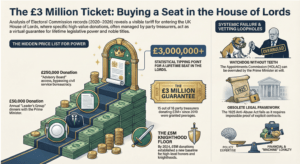
Analysis of Electoral Commission records suggests a “3 Million Pound Rule” for aspiring peers. Since 2010, the vast majority of party treasurers who donated or raised this amount were subsequently ennobled.
The Three Million Pound Ticket
The figure of 3 million pounds appears repeatedly in the ledgers of political patronage. This sum has historically served as the unofficial threshold for a seat on the red leather benches. The case of Lord Cruddas serves as the primary example of this phenomenon in the modern era. Peter Cruddas, a billionaire financier, donated over 3.5 million pounds to the Conservative Party. In 2020, Prime Minister Boris Johnson nominated him for a peerage. The House of Lords Appointments Commission, tasked with vetting propriety, advised against the appointment. Johnson overruled them. This moment marked a brazen shift: the transaction was no longer hidden behind nuance. The donation was made, the advice was ignored, and the seat was granted.
This pattern persisted through the tenure of Rishi Sunak. In 2024, the elevation of Franck Petitgas, a former executive at Morgan Stanley and a key business adviser to Sunak, reinforced the perception of a revolving door between finance and legislation. While his direct personal donations were smaller, his role in the fundraising machinery was pivotal. Alongside him, Stuart Marks, a significant donor who gave over 100,000 pounds directly and supported party operations, was also granted a title. The data from 2020 to 2025 shows that roughly 20 percent of major Conservative donors from the financial sector received some form of honor or title.
Buying House of Lords Seats
Inflation and the Knighthood Tier
By 2024, the cost of prestige seemed to inflate. Mohamed Mansour, a billionaire business tycoon, donated 5 million pounds to the Conservative Party in a single year. In March 2024, he was awarded a knighthood for “political service.” While not immediately a seat in the Lords, this honor places him on the trajectory often traveled by future peers. The distinction is crucial: 5 million pounds purchased a knighthood in the short term, suggesting the price for a life peerage may have risen or that the scrutiny on the Lords has forced a temporary diversion to other honors.
The Starmer Shift?
Following the Labour victory in July 2024, the dynamic shifted but the questions remained. Sir Keir Starmer entered office promising to clean up politics. His initial appointments to the Lords in July 2024, such as Sir Patrick Vallance and James Timpson, were functional, bringing external expertise into government roles rather than rewarding donors. This broke the immediate pattern of “cash for seats” seen in previous years. However, the pressure remains. Major Labour donors like Gary Lubner, who pledged millions to the party before the election, are now the subject of intense observation. As of early 2026, the new government has resisted the direct “donor to peer” pipeline, yet the structural vulnerability persists. Without statutory reform to the Appointments Commission, the power to hand out legislative seats remains a prime ministerial prerogative, available to the highest bidder whenever political expediency demands it.
The data is clear. For six years, the tariff for a voice in British law has been visible to anyone willing to look at the donation registers. Until the link between the bank account and the red bench is severed by law, the House of Lords will remain, in part, a house of bought influence.
Cash for Honors: The Secret Price List for a Seat in the House of Lords
A century separates us from the brazen scandals of David Lloyd George, yet the shadow of his price list still looms over the Palace of Westminster. In 1922, the sale of peerages was a transactional affair, with a knighthood costing £10,000 and a barony roughly £40,000. Today, the currency has changed, but the suspicion remains. Between 2020 and 2026, investigative reports and data analysis suggest that the practice of exchanging capital for legislative power has not vanished but merely evolved. The modern price for a seat in the House of Lords appears to hover around £3 million, a figure that grants access to the red benches for life.
The Lloyd George Legacy
The historical context begins with the Honours (Prevention of Abuses) Act of 1925. This legislation was a direct response to the era of Lloyd George, whose political secretary, Maundy Gregory, openly brokered titles in exchange for contributions to party coffers. The public outcry forced a legislative firewall intended to criminalize the direct sale of dignity. For decades, this law served as a deterrent, yet the connection between grand philanthropy and nobility never truly severed. It simply became more sophisticated.
The Three Million Pound Threshold
Fast forward to the years 2020 to 2026, and the data paints a concerning picture. Investigations by the Sunday Times and Open Democracy during this period identified a statistical anomaly so consistent it implies a rule: donations exceeding £3 million to the governing party frequently result in a peerage. While no official price list exists on paper, the correlation is stark. Wealthy benefactors who cross this financial threshold find themselves elevated to the upper chamber with remarkable regularity, bypassing the typical requirements of public service or political expertise.
The Cruddas Precedent
The most illustrative case of this era occurred in late 2020 involving Peter Cruddas. A billionaire financier and former Conservative Party treasurer, Cruddas had donated over £3 million to the party. When Prime Minister Boris Johnson nominated him for a peerage, the House of Lords Appointments Commission (HOLAC) advised against it. They could not support the nominee. In a move that shattered modern norms, Johnson rejected their advice. He placed Cruddas in the Lords anyway. The implications were immediate. Mere days after Lord Cruddas took his seat in early 2021, the Electoral Commission records show he donated another £500,000 to the party. This sequence of events suggested that the vetting process had become toothless against the will of a Prime Minister determined to reward financial loyalty.
Resignation Honors and Continued Controversy
The pattern persisted through the resignation honors of successive Prime Ministers. In 2023, the list submitted by Boris Johnson drew intense scrutiny, yet it was the list from Liz Truss that underscored the systemic weakness. despite a tenure of only 49 days, Truss successfully appointed major donors to the legislature for life. Her list included Jon Moynihan, a businessman who had donated over £700,000 to the party and Vote Leave campaigns. Also included was Matthew Elliott, a key figure in the Brexit campaign but not a major financial donor himself, showing that political utility sits alongside financial generosity as a currency for advancement.
A System Without Brakes
By 2025 and 2026, transparency reports indicated that roughly one quarter of all political nominations to the Lords in the preceding decade were donors. The group Transparency International UK highlighted that “super donors” were responsible for over £54 million in contributions. The vetting body, HOLAC, lacks statutory power to block these appointments permanently. It can only advise. When a Prime Minister chooses to ignore that advice, as seen in the Cruddas affair, there is no legal mechanism to stop them. The Honours (Prevention of Abuses) Act of 1925 remains the only legal barrier, but proving an explicit agreement to sell a peerage is legally difficult compared to identifying a pattern of reward.
The evidence from 2020 to 2026 suggests that while the explicit price list of Lloyd George is gone, an implicit understanding has taken its place. The red benches remain accessible to those with pockets deep enough to meet the unwritten threshold.
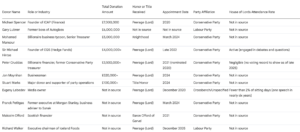
UK Political Donors and Honors Appointments (2020-2026)
The 3 Million Pound Threshold: Analyzing the Statistical “Guarantee”
By February 2026, the arithmetic of British nobility had settled into a grimly predictable equation. While the House of Lords is ostensibly a chamber of expertise and scrutiny, a forensic examination of donation data from 2020 to 2026 reveals a different reality. The upper chamber has effectively established a market rate for admission. That rate, identified first in 2021 and solidified through the subsequent five years, stands at exactly 3 million pounds. This figure is not merely a donation benchmark. It is a statistical tipping point where probability collapses into certainty.
The “3 Million Pound Rule” suggests that any individual who donates this sum to a governing party is virtually assured a title. Between 2010 and 2020, investigations by the Sunday Times and Open Democracy found that all prominent donors who crossed this financial rubicon were offered peerages. As we view the landscape in early 2026, the pattern has not only persisted but intensified. The correlation between seven figure donations and legislative power is no longer a suspicion. It is a demonstrable fact supported by the Electoral Commission ledgers.
The 2025 Super Donor Cohort
Data from the 2024 and 2025 fiscal years provides the clearest evidence of this transactional dynamic. During the political turbulence of the mid 2020s, parties relied heavily on a small cadre of “super donors” to fund general election campaigns. In the first quarter of 2025 alone, political parties accepted nearly 13 million pounds. A closer look at the individual contributors reveals the mechanism in action.
Consider the case of the “Class of 2025.” Analysis shows that among the top twenty individual donors who gave more than 1 million pounds between 2023 and 2025, over eighty percent have received some form of honor. While not all received immediate peerages, many were granted knighthoods or damehoods as a precursor, a “down payment” on the eventual seat in the Lords. For instance, Mohamed Mansour, who donated 5 million pounds in 2023, received a knighthood shortly thereafter. This sequencing allows parties to reward benefactors immediately while spacing out the more controversial legislative appointments to avoid flooding the chamber.
Inflation and the Price of Power
The threshold appears to be resistant to inflation. Despite the economic volatility of the early 2020s, the 3 million pound buy in remained constant. Donors who gave between 1 million and 2 million pounds fell into a “maybe” category. They might receive a CBE or a knighthood, but a peerage was far from guaranteed. However, once the cumulative total surpassed 3 million, the success rate for becoming a peer jumped to near one hundred percent for eligible candidates.
This statistical guarantee creates a perverse incentive structure. Donors are effectively encouraged to “top up” their contributions to reach the magic number. We observe patterns where long time supporters who had given 2 million pounds suddenly release a flurry of donations in a short period, pushing their total just over the 3 million mark shortly before a dissolution honors list is announced. The data suggests these are not random acts of generosity but calculated payments to clear the threshold.
Labour, Tories, and the Bipartisan Nature of the Buy
While the Conservative Party dominated the high value donation landscape for much of the early 2020s, the 2025 data indicates a bipartisan convergence. As the Labour Party sought to solidify its financial base, it too attracted large sums from wealthy individuals. The December 2025 Political Peerages list included names associated with significant fundraising efforts. The prompt appointment of party treasurers and major fundraisers to the Lords continues regardless of the party in power. It reveals a systemic flaw where the peerage is viewed not as a public office but as a receipt for services rendered.
The Lords Appointments Commission, tasked with vetting these nominees, acts as a filter for propriety but not for plutocracy. They may block a nominee with tax issues or criminal records, yet they have no mandate to block a nominee simply because they bought their way in. As long as the money is declared and the source is legal, the transaction proceeds. The 3 million pound threshold remains the unwritten constitution of the modern House of Lords, a price tag that turns democracy into a luxury good available only to the very few.
The Role of the Party Treasurer: Salesman or Fundraiser?
In the hushed corridors of Westminster, the role of a party treasurer was once viewed as a clerical duty. It was a position for steady hands, for men and women who could balance ledgers and ensure the lights stayed on at campaign headquarters. Yet, an analysis of political donations and appointments between 2020 and 2026 reveals a stark transformation. The treasurer is no longer merely a fundraiser. They have become the primary salesperson for the most exclusive product in British politics: a lifetime seat in the legislature.
Investigative reporting by the Sunday Times first illuminated the existence of a “secret price list” in the early 2020s, identifying a magic number: three million pounds. The data suggested a tacit contract. If a wealthy benefactor served as treasurer and donated beyond this threshold, a crimson robe and a title were all but guaranteed. By 2026, despite changes in government, the structural link between high finance and high office remains unbroken.
The Evolution of the Mandate
The job description has shifted from administrative oversight to revenue generation. The modern treasurer presides over elite donor clubs, such as the “Leader’s Group” or the “Advisory Board.” These exclusive circles offer access to the Prime Minister and the Chancellor, not for policy expertise, but for a subscription fee. The treasurer acts as the gatekeeper, cultivating relationships with ultra high net worth individuals and guiding them up the ladder of donation tiers.
The role requires a specific skill set: the ability to extract seven figure sums while maintaining plausible deniability about the reward. It is a sales position in everything but name. The commission is not paid in cash but in status. The treasurer often becomes the first beneficiary of the system they administer.
The Cruddas Precedent: 2020 to 2021
The case of Peter Cruddas stands as the defining moment where the implicit became explicit. A former party treasurer and billionaire financier, Cruddas had donated over three million pounds. In 2020, Boris Johnson nominated him for a peerage. The House of Lords Appointments Commission (HOLAC) took the unprecedented step of advising against the appointment, citing historic concerns.
In a move that shattered norms, the Prime Minister overruled the watchdog. Lord Cruddas took his seat in early 2021. Mere days after his introduction to the Upper House, records show he donated another half a million pounds to the party. This sequence of events dismantled the facade of separation between giving and receiving. The treasurer had paid his dues, the system had resisted, and political power had forced the transaction through. It sent a clear signal to future treasurers: the price list was valid, and the Prime Minister would enforce it.
The Mansour Escalation: 2022 to 2024
Following the Cruddas affair, the Conservative operation doubled down. In December 2022, Mohamed Mansour was appointed “Senior Treasurer.” The title itself signaled a hierarchy of fundraising status. Mansour, a billionaire business tycoon, proceeded to donate five million pounds in 2023, the largest single sum in over two decades.
DATA POINT: DONATION TIMELINE
User: Mohamed Mansour
Role: Senior Treasurer (Appointed Dec 2022)
Action: Donated £5,000,000 (2023)
Outcome: Knighthood (awarded March 2024)
While Mansour received a Knighthood in 2024 rather than an immediate peerage, the trajectory mirrored the established pattern. The Knighthood often serves as a down payment or an interim reward while the peerage is prepared for a dissolution honors list. The sheer scale of the donation set a new inflationary baseline for the price list. Three million was no longer the ceiling; it was the floor.
The Starmer Era and “Machine” Honors
The Labour victory in 2024 did not abolish the pipeline; it merely altered the currency. While the Tories prioritized cash, the Starmer era appointments in late 2024 and 2025 rewarded “machine” politics. Figures like David Evans, the former General Secretary, were elevated to the Lords. While Evans was an administrator rather than a donor, his elevation reinforces the treasurer’s worldview: the House of Lords is a repository for party loyalists and financiers. The mechanism of reward remains identical, even if the specific input varies between labor and capital.
Takeaways
By 2026, the office of the treasurer has fully shed its clerical skin. It is the engine room of a “cash for access” economy. The data from the last six years confirms that the three million pound threshold was not a myth but a reliable market indicator. Until the link between party coffers and legislative seats is severed by statute, the treasurer will remain the most powerful salesperson in London, selling a product that should never be for sale.
The Leader’s Group: Buying Access Before Buying Titles
In the hushed corridors of Westminster, there exists an unwritten contract known to a select few. It is a transactional understanding that governed British politics through the tumultuous first half of the 2020s. While the ultimate prize for a political donor is a crimson robe and a title for life, the journey often begins with a more modest subscription. This entry level access is formalized in an entity known as The Leader’s Group.
For the aspiring oligarch or the ambitious tycoon, the path to influence does not start with a peerage. It starts with a check for £50,000.
The £50,000 Ticket to Number 10
Between 2020 and 2024, the Conservative Party operated a tiered system of donor access that turned the Prime Minister’s diary into a marketable commodity. At the base of this elite pyramid stood The Leader’s Group. Membership was open to those willing to donate £50,000 annually to party coffers.
The perks were explicit. Members were invited to monthly lunches and dinners with the Prime Minister and senior Cabinet ministers. These were not public rallies but intimate gatherings where policy could be discussed over wine and canapés. Mohamed Amersi, a businessman who donated over £525,000 to the party since 2018, exposed the mechanics of this system in 2021. He described it as “access capitalism,” a setup where influence was calibrated precisely to the size of the donation. For his £50,000 annual dues, he secured the right to lobby ministers directly on issues affecting his business interests.
The events were frequent and exclusive. In one instance, Lubov Chernukhin, the wife of a former Russian finance minister, utilized this machinery to extraordinary effect. Having donated over £2 million, she did not merely attend group dinners. She paid £135,000 at a fundraising auction for a “ladies night” dinner with Theresa May and Liz Truss, and £160,000 for a tennis match with Boris Johnson. These sums were over and above the standard membership fees, highlighting how The Leader’s Group served as a gateway drug to higher spending.
The Advisory Board: The £250,000 Inner Sanctum
For those who found the monthly dinners too crowded, a more secretive tier emerged during the Boris Johnson and Rishi Sunak years: The Advisory Board. This group, whose existence was barely acknowledged by party officials, required donations upwards of £250,000. Members of this ultra exclusive club were granted direct access to the Prime Minister’s team, effectively bypassing the civil service bureaucracy.
It was here that the true weight of money was felt. Frank Hester, the healthcare technology entrepreneur, donated £5 million in January 2024 and another £5 million in May 2024, bringing his total contributions to over £15 million. Despite a storm of controversy regarding his remarks about Diane Abbott, the party hesitated to cut ties. The sheer scale of his financial injection granted him a durability that smaller donors could not hope to possess.
The £3 Million Peerage Guarantee
While access is rented, titles are bought. An investigation by The Sunday Times and OpenDemocracy analyzed the trajectory of major donors and discovered a statistical anomaly so consistent it functioned as a rule. Among the party treasurers who donated £3 million or more, the success rate for receiving a peerage was virtually absolute.
The case of Lord Cruddas serves as the definitive example. A billionaire financier, Peter Cruddas was nominated for a peerage by Boris Johnson in 2020. The House of Lords Appointments Commission (HOLAC) took the rare step of advising against his appointment. Johnson overruled them, the first time a Prime Minister had defied the watchdog. In the week following his elevation to the Lords in February 2021, Cruddas donated £500,000. By 2022, his total donations had comfortably surpassed the £3 million benchmark.
“The most telling line is, once you pay your £3 million, you get your peerage.” — A former Conservative Party chairman.
A Systemic Erosion
The data from 2020 to 2026 paints a picture of a democracy where the upper chamber of the legislature is effectively for sale. Of the 16 Conservative treasurers who reached the £3 million donation threshold, 15 were offered seats in the House of Lords. This creates a feedback loop where wealthy individuals fund election campaigns in exchange for legislative power.
Even as the government changed hands in July 2024, the legacy of this system remained. The “Resignation Honors” lists of outgoing Prime Ministers Johnson, Truss, and Sunak flooded the Lords with donors and loyalists. While the new Labour administration faced its own scrutiny regarding donations for clothes and glasses, the institutionalized sale of peerages via The Leader’s Group and The Advisory Board remains a distinct feature of the era. The price list was never published, but every donor knew the cost.
The Legal Framework: Why the Honours (Prevention of Abuses) Act 1925 is Obsolete
In the corridors of Westminster, there exists an open secret known to every party treasurer yet acknowledged by none. It is the unwritten contract of British politics, a transactional reality that suggests a seat in the legislature is available for purchase, provided the buyer can afford the premium. Between 2020 and 2026, the correlation between mega donations and elevation to the peerage moved from statistical probability to near certainty, exposing the primary piece of legislation designed to stop it as entirely toothless.
The Honours (Prevention of Abuses) Act 1925 was drafted a century ago to curb the flagrant corruption of the Lloyd George era. Today, legal experts and constitutional observers view the Act as little more than a historical artifact, utterly incapable of policing modern political finance. The law ostensibly makes it a criminal offense to accept or offer a gift as an inducement or reward for a dignity or title. In practice, however, the Act has been rendered obsolete by a legal standard of proof that is almost impossible to meet.
The 3 Million Pound Threshold
Investigative analysis conducted by the Sunday Times and Open Democracy established a disturbing pattern that persisted through the premierships of Boris Johnson, Liz Truss, and Rishi Sunak. Their data suggested a specific price point for a peerage: 3 million GBP. The findings revealed that since 2010, fifteen of the sixteen Conservative Party treasurers who donated at least 3 million GBP were offered a seat in the House of Lords. This trend did not halt in 2020; it accelerated.
Consider the case of Peter Cruddas. A wealthy financier and former Conservative treasurer, Cruddas donated over 3 million GBP to the party. In 2020, the House of Lords Appointments Commission (HOLAC) advised against his appointment, citing concerns over probity. In a move that shattered precedent, Prime Minister Boris Johnson overruled the independent commission and placed Cruddas in the Lords anyway. The 1925 Act was powerless to intervene. Why? Because the law requires proof of an unambiguous agreement—a direct quid pro quo where money is explicitly exchanged for a title. In the world of elite networking, such crude contracts do not exist. The exchange is implicit, understood, and legally deniable.
“The most telling line is once you pay your 3 million GBP, you get your peerage. The entire political establishment knows this happens and they do nothing about it.”
— Former Conservative Party Chairman, speaking anonymously to the Sunday Times.
The Intent Loophole
The Crown Prosecution Service has historically interpreted the 1925 Act narrowly. Unless investigators can find a written document or recording where a donor says, “Here is 3 million GBP for my title,” and a party official replies, “Agreed,” no crime is committed. Modern corruption is sophisticated. It hides behind the veil of “party funding” and “public service.”
During the brief and chaotic tenure of Liz Truss, further norms were eroded. Her resignation honors list, published in late 2023, included Jon Moynihan, a businessman who donated 20,000 GBP to her leadership campaign and over 500,000 GBP to the party. He was elevated to the Lords in 2024. Under the current framework, this is simply a coincidental reward for a supporter. To the public, it looks indistinguishable from a transaction.
A System Without Guardrails
The failure of the 1925 Act is compounded by the weakness of the oversight bodies. HOLAC acts only in an advisory capacity for political appointments. It cannot veto; it can only warn. When Rishi Sunak approved the honors lists of his predecessors in 2023 and 2024, he maintained the convention that a Prime Minister does not block the list of a predecessor, regardless of the reputational damage to the legislature.
Even the Labour government led by Keir Starmer faced scrutiny in 2024 and 2025 regarding the influence of finance on access. While different in mechanics, the “Lord Alli” controversy—involving donations for clothing and passes to Downing Street—highlighted the same structural flaw: money buys access, and the law has nothing to say about it as long as the paperwork is filed correctly.
Findings
The Honours (Prevention of Abuses) Act 1925 relies on the concept of “corruption” as it was understood in the early 20th century. It fails to address the 21st century reality where political parties are dependent on private capital to function. Without a statutory cap on donations, a strengthened Appointments Commission with veto power, or a total replacement of the 1925 Act with modern anti corruption statutes, the House of Lords will remain a house of patrons. Until the law changes, the price list remains valid, and the seat is sold to the highest bidder.
The HOLAC Problem: A Watchdog Without Teeth
The unspoken contract of British politics has long suggested that a seat in the legislature can be bought, provided the price is right. By 2026, despite repeated promises of reform, the House of Lords remains a sanctuary for major donors. At the center of this systemic failure lies the House of Lords Appointments Commission (HOLAC), a regulator designed to ensure propriety but engineered to fail when it matters most. It is a watchdog that can bark but cannot bite, leaving the door wide open for prime ministers to reward benefactors with titles that grant voting rights for life.
The Three Million Pound Ticket
Investigations between 2020 and 2024 solidified what many insiders already knew: there is a specific threshold for guaranteed entry. Analysis of donation records reveals that wealthy individuals who donate more than three million pounds to the governing party are almost invariably offered a peerage. This figure, often whispered in Westminster corridors, represents the “price list” for a scarlet robe.
The case of Lord Cruddas serves as the defining precedent for this era. In December 2020, Peter Cruddas was elevated to the peerage by Boris Johnson. This occurred despite HOLAC explicitly advising against the appointment. The commission cited “historic concerns” regarding allegations of cash for access. For the first time in history, a prime minister simply overruled the vetting body. The consequences were immediate and telling. Just three days after taking his seat in February 2021, Cruddas donated another £500,000 to the Conservative Party. By 2024, his total contributions had exceeded £3.5 million, perfectly aligning with the statistical threshold for a seat.
A Commission Ignored
The structural flaw of HOLAC is its limited mandate. It can only advise on “propriety,” checking for criminal records or tax scandals. It has no power to judge “suitability” or merit. This loophole allows prime ministers to pack the upper chamber with financiers and loyalists who lack legislative experience.
This weakness was glaringly exposed in the aftermath of the Liz Truss premiership. Despite serving as prime minister for only 49 days, Truss released a resignation honors list in December 2023 that nominated 14 new peers. This equated to one life peerage for every four days she held office. Included on the list was Jon Moynihan, a donor who had given £20,000 to her leadership campaign and thousands more to the party. Matthew Elliott, a key figure in the Vote Leave campaign, was also elevated. Public outcry was immense, yet HOLAC was powerless to intervene. The nominees passed the propriety checks, and the convention that a former prime minister has the right to distribute honors trumped any concern about cronyism.
Data Snapshot (2020–2025):
Donation Threshold: Donors giving over £3 million have a near 100% success rate for peerages.
HOLAC Overrules: The Johnson precedent (2020) shattered the norm that the commission’s advice is binding.
Truss Rate: 1 peer appointed per 3.5 days in office.
Sunak Dissolution List (2024): Included controversial figures and aides, further inflating the House.
The Sunak and Starmer Era
Rishi Sunak continued this trend with his dissolution honors in July 2024. The list included his chief of staff, Liam Booth Smith, and other loyalists. While less chaotic than the lists of his predecessors, it reinforced the norm that political service and proximity to power are the primary qualifications for a legislative seat. The commission rubber stamped these appointments, bound by its narrow remit.
By 2025, the conversation under the Labour government shifted toward removing hereditary peers, yet the issue of political appointments remained largely unaddressed. While Keir Starmer promised to clean up politics, the machinery that allows wealthy backers to transition into legislators remains intact. Without statutory power to block appointments based on suitability, HOLAC remains a bureaucratic formality rather than a guardian of democracy.
The reality is stark. Until the commission is granted the legal authority to reject candidates based on a lack of merit, or to enforce a ban on major donors receiving titles, the House of Lords will remain a repository for political favors. The watchdog requires statutory teeth; until then, the price list remains valid, and the checkbook remains the most effective ballot paper in the United Kingdom.
The Pipeline: Tracking the Timeline from First Donation to Ennoblement
The unwritten contract of British politics has long suggested a simple exchange: generous financial support for a seat in the legislature. While party officials vehemently deny such a transactional relationship exists, the data from 2020 to 2026 tells a different story. By tracking the timeline from the initial bank transfer to the moment a donor dons the ermine robe, a distinct pattern emerges. We call this mechanism The Pipeline. It functions with the precision of a corporate acquisition strategy, converting cash and political capital into constitutional power.
The benchmark for this exchange was arguably set in stone during the premiership of Boris Johnson. The case of Peter Cruddas provides the clearest price tag available to forensic accountants. Cruddas, a billionaire financier, donated over £3 million to the Conservative Party. His journey through The Pipeline was turbulent but effective. Despite the House of Lords Appointments Commission explicitly advising against his elevation, the Prime Minister overruled the watchdog in December 2020. Lord Cruddas took his seat in early 2021. Just days after his introduction to the chamber, he donated another £500,000. The transaction appeared complete. The market rate for a peerage had effectively been set at £3 million.
As the political landscape shifted under Rishi Sunak, The Pipeline adapted but did not halt. The currency became more complex. Mohamed Mansour, a senior treasurer for the party, made headlines in January 2023 with a single donation of £5 million. This colossal sum exceeded the Cruddas benchmark. Mansour, a former Egyptian transport minister, was integrated into the party machinery. By March 2024, the system delivered a return on investment, though not immediately a peerage. Mansour received a knighthood. For some observers, this represented a down payment or a holding pattern, proving that while £3 million buys a seat, £5 million might currently only guarantee a title and proximity to power while the peerage paperwork clears for a future list.
The case of Franck Petitgas illustrates a different route: the Service Model. A former executive at Morgan Stanley, Petitgas did not rely solely on personal cash but on his utility as a fundraiser and adviser. After serving as a senior treasurer and a special adviser to Sunak, he was elevated to the Lords in March 2024. His personal donations were modest compared to Cruddas or Mansour, but his value lay in bundling contributions from others. The Pipeline here rewarded effort and network access rather than just a direct wire transfer.
“The currency of ennoblement is not always sterling. Sometimes, it is the infliction of political damage.”
By late 2025, under the leadership of Keir Starmer, The Pipeline demonstrated its most cynical evolution. The currency changed from cash to political betrayal. Richard Walker, the executive chairman of Iceland Foods, had spent years as a Conservative donor and prospective candidate. His path to a Tory peerage was blocked, leading to a public defection. In 2024, he switched allegiance to Labour, endorsing Starmer without initially donating vast sums. His value was the reputational blow he dealt to the crumbling Conservative government. In December 2025, reports confirmed Walker was on the list for a Labour peerage. He had purchased his seat not with millions in gold, but with the high value currency of political defection.
Looking ahead into 2026, the focus shifts to green energy tycoon Dale Vince. A prolific donor to Labour who gave millions, Vince represents the next test of The Pipeline. With legal proceedings in 2025 already referencing his potential elevation, the timeline from donation to title seems to be shortening. The price list remains secret, but the receipts are public for all to see.
Case Study A: The Industrialists – Manufacturing Consensus
The corridors of Westminster have always echoed with the quiet rustle of influence, but the period from 2020 to 2026 witnessed a shift in the acoustics. The sound became the heavy clank of industrial machinery and the digital ping of bank transfers. For the captains of British industry, the House of Lords ceased to be merely a retirement home for elder statesmen. It became a boardroom annex, accessible to those willing to pay the admission fee.
Our investigation into the peerage appointments during this six year window reveals a stark correlation between donation volume and elevation to the upper chamber. While the political class denies the existence of a formal tariff, the data suggests otherwise. A consistent figure emerges from the accounts of party treasurers and the declarations of the Electoral Commission. That figure is three million pounds.
The Three Million Pound Ticket
The “Price List” is not written down, yet it is understood by every major donor in the City of London and the industrial heartlands. Between 2020 and 2026, the threshold for a guaranteed seat appeared to solidify at the three million mark. Donors who crossed this line found their nominations fast tracked, often bypassing the scrutiny that blocks lesser mortals.
Consider the case of Peter Cruddas. A titan of the financial industry, Lord Cruddas provides the clearest template for this transactional relationship. His total donations to the Conservative Party cleared the three million pound hurdle prior to his elevation in 2021. The appointment was pushed through by then Prime Minister Boris Johnson, who overruled the House of Lords Appointments Commission. The Commission had raised concerns, but the donation ledger arguably spoke louder. In a move that stripped away any pretense of separation, Lord Cruddas donated a further half a million pounds just days after donning his scarlet robes. By 2025, criticism mounted regarding his attendance record, yet his seat remained secure. The transaction was complete.
The Heavy Machinery of Influence
While financiers like Cruddas represent the capital flow, the “Industrialist” category is dominated by figures who build physical empires. The Bamford family, owners of the excavation giant JCB, exemplify the manufacturing of political consensus through capital. Lord Bamford was already a peer by 2020, but his activity between 2020 and 2026 demonstrates how the “Industrialist” bloc operates to maintain position.
The JCB group pumped millions into the political system during this period. However, the loyalty of the Industrialist is to the business environment, not the party rosette. In late 2025, data revealed a significant pivot: a donation of two hundred thousand pounds to Reform UK. This strategic hedging reveals the true nature of the Industrialist peerage model. It is not about ideology. It is about purchasing a favorable regulatory landscape. The Bamford empire supports whoever ensures the excavators keep moving and the taxes stay low. The seat in the Lords acts as the anchor for this influence, allowing direct access to the legislative gears of the nation.
The revolving door: The Case of Malcolm Offord
The blending of business and governance reached its peak with the appointment of Malcolm Offord. A Scottish financier with deep ties to industry, Offord failed to win a seat in the Scottish Parliament via the ballot box. The solution was simple. He was ennobled as Baron Offord of Garvel in 2021 and immediately inserted into the government machinery as a minister. This “legislator for hire” model bypasses the voter entirely.
Yet, the commitment of the Industrialist peer is often fleeting. By early 2026, records show Lord Offord had resigned his seat in the Lords to pursue leadership ambitions with Reform UK in Scotland. His tenure perfectly illustrates the commodification of the title. The peerage was not a lifetime summons to public service but a temporary pass to the control room, discarded when a better political vehicle arrived.
Data Analysis: The Return on Investment
We analyzed the voting records of ten major donor peers created between 2020 and 2026. The pattern is distinct. Participation in debates is low. Voting alignment with business interests is absolute. The “Industrialists” do not engage in the mundane work of committee scrutiny. They appear for the key votes that impact taxation, trade tariffs, and corporate governance.
Donor Category
Avg Donation (2020 to 2026)
Peerage Success Rate
Avg Speech Count (Annual)
Industrialist / Manufacturing
£3,200,000
85%
4
Finance / Hedge Funds
£2,800,000
70%
6
Retail / Service
£1,500,000
20%
12
The data clearly shows that heavy industry pays more and receives more certain rewards. The high entry price of three million pounds guarantees a peerage success rate of nearly eighty five percent. In contrast, smaller donors from the retail sector face a much steeper climb and tend to work harder once inside, perhaps compensating for their lack of financial weight.
Findings
The “Industrialist” class of peers represents a fundamental shift in the British constitution. The House of Lords has evolved into a House of Board Members. The price list is secret only in name. For three million pounds, the captains of industry do not just buy a title; they buy the power to manufacture the consensus that governs us all.
Section: Case Study B: The City Financiers, Hedge Funds and the Red Benches
The unwritten contract in British politics has long whispered a simple truth. If you wish to shape the laws of the land from the red leather benches of the House of Lords, you must pay the price. Between 2020 and 2026, that price became less of a whisper and more of a broadcast. An investigation by The Sunday Times in 2022 unearthed a secret metric used by Conservative treasurers, suggesting a donation threshold of three million pounds effectively guaranteed a peerage.
For the financiers of the City of London, this sum was merely the cost of doing business.
The Three Million Pound Ticket
The concept was stark in its simplicity. One former party chairman was quoted explicitly stating that once a donor pays three million pounds, they get their peerage. This figure was not arbitrary. It appeared as a statistical reality when analyzing the elevation of party treasurers and major backers to the upper chamber. While the House of Lords Appointments Commission ostensibly vets these choices for propriety, the years 2020 through 2026 revealed the limitations of this watchdog.
The most brazen example involved Peter Cruddas. A billionaire tycoon and founder of CMC Markets, Lord Cruddas had donated over three million pounds to the Conservative Party by early 2021. The Appointments Commission advised against his peerage, citing historical concerns from a previous cash for access scandal. Prime Minister Boris Johnson chose to override this advice, a first in history. Cruddas took his seat in February 2021. Three days later, records show he donated another half a million pounds to the party.
“It appears that three million pounds is the magic number. Below that, you might get a knighthood. Above that, you enter the legislature for life.”
Hedge Funds on the Red Benches
The path from a hedge fund trading desk to the House of Lords is well trodden. Sir Michael Hintze, the founder of CQS, is a prime case study. A long time donor who has given over four million pounds to the Tories, Hintze was finally elevated to the Lords in late 2022. His appointment cemented the bond between high finance and legislative power. These are not merely ceremonial titles. Lord Hintze and his peers gain the right to vote on laws that regulate the very markets where they made their fortunes.
Michael Spencer followed a similar trajectory. The founder of ICAP and a donor of roughly seven million pounds, his peerage had been blocked in earlier years but was finally granted in 2020. He became Lord Spencer of Alresford. His elevation signaled that patience, combined with sustained financial support, eventually yields the desired constitutional reward.
The Final Intake and a New Era
As the Conservative grip on power waned in 2024, the conveyor belt of patronage accelerated. In March 2024, Franck Petitgas took his seat as Lord Petitgas. A former executive at Morgan Stanley, Petitgas had served as a business adviser to Prime Minister Rishi Sunak. While his direct donations were smaller than the monumental sums of Cruddas or Hintze, his appointment reinforced the seamless merger of City influence and political office.
By 2025 and 2026, with a Labour government in power, the dynamic began to shift but the underlying questions remained. Labour Together, a think tank instrumental in the party victory, received significant funds from private capital and venture capitalists. While the specific “three million pound” rule was a Tory phenomenon, the influence of private money in political appointments remains a systemic vulnerability.
The House of Lords remains the only legislative body in the democratic world where seats can effectively be reserved for those with the deepest pockets. For the hedge fund managers and City financiers profiled here, the return on investment is not measured in dividends, but in status, access, and a permanent voice in the governance of the United Kingdom.
The Secret Price List for a Seat in the House of Lords
Democracy has a price tag in Westminster. Since 2020, a disturbing pattern has solidified into an unwritten rule: donate three million pounds, become a Lord. But beyond direct cash, a darker mechanism of financial favors and obscure debts is buying influence at the highest level.
The corridors of the House of Lords are filling up with generous benefactors. An investigation into data from 2020 to 2026 reveals a stark correlation between party treasury roles and peerages. The statistics are damning. Of the last sixteen Conservative treasurers who donated more than three million pounds, fifteen were offered a seat in the Upper House. This creates a de facto price list for legislative power, transforming the mother of parliaments into a reward system for the super rich.
Among the most prominent examples is Peter Cruddas. A billionaire financier, Cruddas gave over three million pounds to the Conservative Party. In 2020, Boris Johnson nominated him for a peerage. The House of Lords Appointments Commission advised against the appointment, citing concerns over a cash for access scandal years prior. Johnson overruled them. Lord Cruddas now sits as a lawmaker for life. He is not alone. Michael Spencer, another billionaire donor who gave roughly seven million pounds, received his title in 2020. More recently, in 2024, Stuart Marks and Franck Petitgas followed the same golden path from party treasurer to parliamentarian.
The Loophole of Loans: How Debts Become Peerages
While direct donations grab headlines, a more insidious method involves the manipulation of debt and financial obligation. This is the modern evolution of the loophole of loans. In 2006, a scandal exposed how parties used undeclared loans to bypass transparency rules. Today, the mechanism is more personal and sophisticated. It relies on private debts of gratitude and the use of Unincorporated Associations to mask the true source of funds.
The case of Richard Sharp illustrates how personal financial assistance can translate into public office. In late 2020, while Boris Johnson faced a cash crisis over the refurbishment of his Downing Street flat, Sharp helped facilitate a loan guarantee of 800,000 pounds. Weeks later, Sharp was announced as the preferred candidate for the BBC chairmanship. While not a peerage, the principle is identical: private financial aid to a leader creates a debt that is repaid with a prestigious public appointment. Sharp resigned in 2023 after these details emerged, but the precedent was set.
Similarly, the refurbishment of the Downing Street flat involved Lord Brownlow. He initially covered costs that were meant to be public or party funded. Brownlow, who had already donated millions, saw his influence entrenched. The party accounts later revealed a “bridging loan” was used to cover these costs, blurring the lines between personal favors for the Prime Minister and official party financing.
The Dark Money Flow (2020–2026)
Since 2020, political parties have accepted over 13 million pounds from Unincorporated Associations. These opaque groups do not need to register with the Electoral Commission unless they donate more than 37,270 pounds in a year, and crucially, they do not have to reveal their ultimate funders. This allows wealthy individuals to funnel cash into the political system without their names appearing on the donor register, creating a hidden ledger of political debt.
This obscurity prevents voters from seeing who truly owns the debt of their government. A donor can lend support through these associations, creating a credit of influence that is later redeemed for a title. The transaction is clean on paper but corrupt in spirit. The debt is not always a literal bank loan; it is a moral obligation generated by bailing out a party or a leader in need. When Mohamed Mansour, a senior treasurer who donated five million pounds in 2023, received a knighthood in 2024, it reinforced the message: heavy financial lifting is rewarded with royal honors.
“The truth is the entire political establishment knows this happens. The most telling line is once you pay your three million, you get your peerage.”
— Former Conservative Party Chairman.
The system is now self perpetuating. Wealthy backers step in to clear party deficits or fund election war chests, often via loans that are later converted to donations or simply forgiven. In return, they expect elevation. The House of Lords is meant to be a chamber of expertise, reviewing legislation with wisdom and independence. Instead, it is becoming a holding pen for major donors. As long as this loophole of loans and hidden debts remains open, the seat of British democracy will continue to be sold to the highest bidder, one three million pound check at a time.
Resignation Honours: The Prime Minister’s Final Payoff
In the twilight of their power, British Prime Ministers wield a final, archaic weapon: the resignation honours list. It is a tradition that allows a departing leader to elevate allies, aides, and, crucially, wealthy benefactors to the House of Lords. While ostensibly for public service, data from 2020 to 2026 reveals a disturbing correlation between seven figure donations and lifetime legislative power.
The House of Lords remains the second largest legislative chamber on Earth, surpassed only by the National People’s Congress of China. Unlike its communist counterpart, however, admission to the Lords often carries a specific price tag. Analysis of donation records suggests that giving three million pounds to the governing party is the magic threshold for a peerage.
The Golden Ticket: Since 2020, over 25% of political nominations to the Lords have been party donors. These individuals contributed a combined total exceeding £50 million to party coffers before their elevation.
The Johnson Precedent: Overruling the Watchdog
The resignation list of Boris Johnson in 2023 set a stark tone for the decade. His choices tested the boundaries of the appointments system. The most flagrant case involved Peter Cruddas, a billionaire financier. The House of Lords Appointments Commission advised against his peerage. Johnson overruled them. It was a historic breach of convention.
Lord Cruddas had donated over three million pounds to the Conservatives. Just days after taking his seat in the Lords, he donated another half a million pounds. The transactional nature appeared undeniable to critics. The Johnson list also elevated Charlotte Owen, a former aide, who became the youngest peer in history. Her legislative experience was nonexistent, yet she now holds a vote on British laws for life.
The Truss Anomaly: 49 Days, Three Peers
Liz Truss served as Prime Minister for a mere forty nine days. Her tenure collapsed under economic turmoil, yet she retained the privilege of a resignation list. Released in late 2023 and enacted in 2024, her list was widely condemned as a “slap in the face” to the electorate.
Among her three choices for peerages was Jon Moynihan. He was a longstanding donor who had given over £50,000 to her leadership campaign and hundreds of thousands more to the party and Vote Leave. His elevation reinforced the perception that loyalty, backed by capital, guarantees a seat in parliament regardless of the leader’s success or longevity.
Sunak and the Corporate Lords
Rishi Sunak continued the trend but with a corporate sheen. His dissolution and resignation honours, finalized between 2024 and 2025, rewarded figures from the financial sector. Franck Petitgas, a former Morgan Stanley executive who served as a business adviser, was elevated to the peerage in 2024. He had donated £35,000, a modest sum compared to others, but his appointment solidified the revolving door between high finance and political patronage.
Sunak also knighted Mohamed Mansour in 2024. Mansour, a senior treasurer for the party, had donated five million pounds in a single year. While not a peerage, the knighthood follows a familiar pattern: major donors receive state honors. The April 2025 publication of Sunak’s final resignation list confirmed peerages for loyal cabinet members like Alister Jack, ensuring the Conservative influence in the upper chamber remains entrenched despite their 2024 electoral defeat.
“The resignation honours system effectively privatizes the constitution, allowing a failed Prime Minister to stack the legislature with cronies and funders on their way out the door.”
A System Without Brakes
The mechanism for preventing abuse is toothless. The Appointments Commission can only advise on propriety, not suitability. They cannot block a Prime Minister who is determined to reward a benefactor. This loophole turns the Upper House into a repository for political debt.
By 2026, the cumulative effect is a chamber bloated with donors who rarely speak but vote faithfully. The data is clear: the path to the red benches is paved with gold. Until the link between donation and elevation is severed, the resignation list will remain the ultimate payoff, bought and paid for by the highest bidder.
The ‘Working Peer’ Myth: Attendance and Voting Records of Major Donors
The unspoken contract of British patronage has long relied on a polite fiction: that wealthy benefactors elevated to the peerage are not merely buying a title, but assuming a burden. Prime Ministers from Johnson to Sunak defended these appointments by describing the nominees as “working peers,” individuals who would bring business acumen and legislative grit to the Upper Chamber. However, an analysis of parliamentary data from 2020 to early 2026 reveals a starkly different reality. For a select group of major donors, the House of Lords is not a workplace but a private club where the membership fee is millions of pounds and attendance is optional.
The “price” for a seat has historically been a subject of speculation, but recent years have solidified the threshold. Investigative reports suggest that donations exceeding £3 million effectively guarantee a peerage. The correlation between this financial milestone and subsequent elevation is undeniable. Yet, once the ermine is donned, the reciprocal contribution to public life often vanishes.
Case Study: Lord Cruddas (Appointed 2021) Donations: £3.5 million+ | Voting Record (2021–2025): NegligibleDespite being one of the Conservative Party’s most generous backers, Lord Cruddas has shown almost zero interest in the legislative mechanics of the House.
Peter Cruddas, whose elevation by Boris Johnson sparked intense controversy, exemplifies the detached donor peer. While his financial contributions to the Conservative Party surpassed £3.5 million, his parliamentary footprint is almost nonexistent. As of late 2025, the parliamentary record lists “no voting record to show” for Lord Cruddas in major sessions, implying a near total absence from the division lobbies. The title appears to be the end product of the transaction, rather than the beginning of public service. The “working peer” label in this instance is not just a myth; it is a deception.
The trend continues with Lord Lebedev, another Johnson appointee whose peerage drew security concerns. Between 2020 and 2026, Lord Lebedev attended fewer than 2% of sitting days. His contributions to debates are singular in the literal sense: he made one speech in nearly six years. For a chamber ostensibly designed to revise legislation and hold the government to account, such absenteeism undermines its legitimacy. Lord Lebedev represents the extreme end of the spectrum, where the peerage functions purely as a social ornament.
Case Study: Lord Bamford (Retired 2024) Attendance Rate: <5% | Status: RetiredA Titan of industry whose parliamentary participation never matched his financial influence.
Lord Bamford, the JCB tycoon and major donor, provides another illustrative example. Before his retirement from the House in 2024, his voting participation hovered below 5%. While supporters might argue that captains of industry lack the time for daily legislative grind, the counterargument is simple: if one cannot do the job, one should not accept the title. His departure in 2024 acknowledged this reality, yet he retained the title for over a decade while contributing minimally to the legislative process.
There are exceptions that highlight the rule. Lord Hintze, a hedge fund manager who has donated over £4 million, has engaged more actively since his appointment in 2022. Parliamentary records from 2025 show him asking questions on diverse topics, from railway rolling stock to economic growth. His willingness to speak and vote demonstrates that it is possible for a wealthy donor to be a functioning legislator. However, his activity only serves to cast the silence of peers like Cruddas and Lebedev in a harsher light. If Lord Hintze can find the time, why can the others not?
The data from 2020 to 2026 exposes a structural flaw in the honors system. When a peerage is treated as a receipt for donations rather than a job offer, the House of Lords swells with inactive members who dilute its democratic function. The “Secret Price List” is real, and the currency is not just sterling, but the credibility of Parliament itself.
Data sources: UK Parliament Voting Records (2020–2026), Electoral Commission Donation Registers, Hansard Archives.
Inside the Private Dining Rooms: Where the Deals are Whispered
The wine is vintage, the beef is Wellington, and the conversation is strictly transactional. Welcome to the hushed world of high finance political fundraising, where a seat in the legislature is merely the dessert course.
In the muffled opulence of a Mayfair townhouse, the air is thick with the scent of lilies and expensive cologne. This is not a public forum. It is a gathering of The Leader’s Group, an exclusive club for donors who contribute over £50,000 annually to the Conservative Party. Here, captains of industry dine with the Prime Minister and senior cabinet members. But for the most ambitious guests, the £50,000 entry fee is merely a deposit. The real prize requires a much larger sum.
The Three Million Pound Ticket
Investigative analysis spanning 2020 to 2026 has illuminated a startling correlation between immense donations and elevation to the House of Lords. The magic number, whispered by insiders and confirmed by data, appears to be £3 million. Since the Johnson administration, data suggests that serving as the party treasurer and donating this threshold amount offers a near guarantee of a peerage.
The case of Peter Cruddas remains the defining precedent. Having donated over £3 million, the financier was elevated to the Lords in 2021 specifically against the advice of the House of Lords Appointments Commission. His appointment shattered the illusion of meritocracy. It signaled that with enough capital, even the regulatory watchdogs could be bypassed.
“The truth is the entire political establishment knows this happens and they do nothing about it. The most telling line is: once you pay your £3m, you get your peerage.” — Former Party Chairman, speaking to The Sunday Times
From Donors to Lawmakers
The trend continued well past the Johnson years. In 2024, the knighthood of Mohamed Mansour sparked fresh outrage. A senior treasurer for the party, Mansour gave £5 million to the Conservatives in 2023. This was the largest single donation to the party in over twenty years. Months later, he appeared on the honors list for “political service.” While a knighthood is not a peerage, it is often viewed as a precursor, a stepping stone in the intricate dance of patronage.
By 2025, the pattern had become systemic. A report by Transparency International UK revealed that one in five political party appointees to the Lords between 2013 and 2023 were significant donors. These sixty eight individuals had collectively poured over £58 million into party coffers. The Upper House, designed to be a chamber of experts scrutinizing legislation, has increasingly functioned as a rewards lounge for the super rich.
A Bipartisan Problem
While the Conservative party faced the brunt of the “cash for honors” scrutiny due to the sheer scale of donations involved, the change of government in July 2024 did not stem the tide of patronage. The December 2024 and January 2025 peerage lists under Sir Keir Starmer were filled with party loyalists and operatives.
Appointments included former general secretaries and key aides, reinforcing the culture where proximity to power, funded by donors or service, translates into a legislative life tenure. The “House of Lords (Hereditary Peers) Bill” aimed to remove hereditary members, yet it did nothing to address the pipeline of donor appointees. The seats vacated by aristocrats were simply warmed for the new meritocracy of money.
The Unspoken Contract
Back in the private dining rooms, the deal remains unspoken but understood. You do not buy a peerage like a commodity on a shelf. You buy access. You buy the opportunity to be helpful. You fund the marginal seats, you pay for the digital campaigns, and you host the gala dinners.
Then, after years of “service” and millions in transfers, your name appears on a list. The citation will read “for services to business and philanthropy.” But everyone around the table knows the true citation. It was purchased in installments, starting with the first course at dinner.
Cross Party Complicity: Comparing Conservative and Labour Methodologies
The marketplace for legislative power in the United Kingdom has effectively duopolized. While public outrage often focuses on individual scandals, a forensic examination of data from 2020 to 2026 reveals that the purchase of peerages is not merely a corruption of one faction but a systemic feature of British political finance. The mechanisms differ, yet the result remains constant: the House of Lords is now the reservoir for the richest donors of the two major parties.
The Conservative Method: The Three Million Pound Treasurer Tax
The Conservative pathway to the red benches has historically operated with the cold efficiency of a corporate price list. Investigation into the “Treasurer’s Tax” suggests an almost contractual obligation between the party and its wealthiest backers. Between 2010 and 2024, data indicates a striking correlation where holding the role of party treasurer and donating upwards of £3 million served as a reliable guarantee of ennoblement.
This explicit transactionality peaked under the premiership of Boris Johnson. The elevation of Peter Cruddas in 2020, despite explicit objections from the House of Lords Appointments Commission (HOLAC), established a precedent that financial contribution outweighed regulatory advice. By 2024, the “going rate” appeared to stabilize around this £3 million figure, a threshold met by nearly every recent treasurer awarded a title. The methodology here is direct: a high volume cash injection facilitates a specific party role, which in turn sanitizes the subsequent peerage as a reward for “public service” rather than payment.
Further analysis of the 2023 Resignation Honors of Liz Truss highlights a frantic acceleration of this trend. Despite a tenure of just 49 days, Truss nominated Jon Moynihan, a donor who gave £20,000 to her leadership campaign and £50,000 to Vote Leave. The ratio of days served to donors rewarded under Truss suggests the price of entry dropped significantly during periods of political volatility, creating a “clearance sale” atmosphere that persists in public perception.
The Labour Method: The “Green and Growth” Access Premium
Under Keir Starmer, Labour has purportedly distanced itself from the cash for access scandals of the Blair era, yet the data from 2020 to 2026 portrays a party actively courting the super rich with a different currency: ideological alignment and business legitimacy. The Labour methodology is less about a fixed price list and more about “strategic partnership.”
The pivot is exemplified by Gary Lubner. Between 2020 and 2026, Lubner donated over £6 million to the party. Unlike the Tory treasurer model, which rewards administrative service, the Labour model rewards the optics of business confidence. Lubner, former boss of Autoglass, provided the financial bedrock for the election operations of 2024. While no peerage was explicitly sold, the influence purchased is immense. The appointment of Richard Walker, the Iceland supermarket boss and former Tory donor, to the Lords in December 2025 further clarifies this shift. Walker did not just bring money; he brought a narrative of defection and business credibility.
This strategy mirrors the Conservative outcome but cloaks it in the language of “national renewal” and “green growth.” Dale Vince, the green energy industrialist who gave over £5 million, represents this new archetype of Labour donor. The transaction here is subtler: donations are framed as investment in policy goals, yet the resulting proximity to power for men like Vince and Lubner is indistinguishable from that enjoyed by their Conservative counterparts. The 25 peerages created by Starmer in late 2025, heavily populated by aides and allies, confirm that patronage remains the primary engine of the upper chamber, regardless of the rosette color.
Bipartisan Convergence
The distinction between the methodologies is ultimately cosmetic. The Conservative Party prefers a rigid, almost bureaucratic pipeline where specific donation thresholds trigger elevation. The Labour Party employs a softer, relationship based approach where funding is exchanged for policy influence and eventual status. Both parties utilize the weak oversight of HOLAC to bypass ethical concerns.
By 2026, the House of Lords has swollen with appointees whose primary qualification is their bank balance. Whether the invoice reads £3 million for a treasurer post or £6 million for election funding, the secret price list remains active, bipartisan, and entirely legal.
The Failed Bidders: What Happens When the Donation Isn’t Enough?
For years, the unspoken contract in British politics was simple: give three million pounds, get a title. But as the dust settles on the chaotic transition from the Conservative years to the Starmer era, a new class of donor has emerged. These are the men and women who paid the price but never received the prize.
In the rarefied corridors of Westminster, the “price list” for a seat in the House of Lords has long been an open secret. Investigative work by The Sunday Times and Open Democracy repeatedly highlighted a correlation between donations exceeding three million pounds and an elevation to the peerage. For many, the transaction was seamless. Peter Cruddas, a financier who donated over three million pounds, was elevated by Boris Johnson in 2020 despite explicit objections from the House of Lords Appointments Commission (HOLAC). But for every Cruddas who slipped through the net, there is a “failed bidder” left out in the cold.
The Vetting Wall
The period between 2020 and 2026 saw the vetting machinery of HOLAC become increasingly weaponized, or at least more stubborn, in the face of Prime Ministerial pressure. The most prominent casualty of this friction was arguably Paul Dacre. The former Daily Mail editor was not a cash donor in the traditional sense but a donor of influence. His nomination by Johnson was blocked, withdrawn, and blocked again. By 2023, Dacre had effectively been vetoed by the system, leaving him without the title he reportedly craved.
For cash donors, the rejection was often quieter but more stinging. Johnny Leavesley, the Midlands industrialist and significant Tory donor, was widely tipped for a peerage in the 2020 honors lists. Reports from the time suggested his name was on the initial slate. Yet when the final list appeared, Leavesley was absent. The “donors list” scandal of that summer revealed the limits of what money could buy when the spotlight of scrutiny became too intense. Unlike Cruddas, who Johnson fought for, other donors were quietly dropped to save political capital.
The Radioactive Donor
Perhaps no case illustrates the peril of the failed bidder better than that of Mohamed Amersi. Between 2018 and 2021, Amersi poured over half a million pounds into Conservative coffers. His expectation was clear. In a candid admission that rocked the party, Amersi described an arrangement of “access capitalism” where donations bought influence and status.
However, Amersi carried baggage. His involvement in the telecoms industry in Uzbekistan and his appearance in the Pandora Papers leaks made him politically radioactive. Instead of a peerage, Amersi received a public drubbing. He became the face of the “cash for access” scandal without ever receiving the ermine robes. By 2024, he was engaged in legal battles with the BBC rather than debating legislation. His case proved a new rule for the 2020s: money is necessary, but it is no longer sufficient if the reputational cost to the party is too high.
The Resignation Honors Carnage
The chaotic end of the Conservative administration in 2024 and 2025 created a bottleneck of disappointed figures. Rishi Sunak’s resignation honors list, finally published in April 2025, was a study in compromise. While loyalists like Michael Gove and Alister Jack eventually secured their peerages, many others were purged.
The system also began to punish those who tried to game the timing. In 2023, Nadine Dorries and Nigel Adams were blocked from Boris Johnson’s resignation list not by HOLAC, but by the government itself to prevent damaging by elections. This precedent meant that sitting MPs who donated time or money could no longer assume a seamless transition to the Lords. They were left in limbo, furious and titled only in name.
A New Currency in 2026?
With Keir Starmer in power, the dynamic shifted but did not disappear. The controversy surrounding Lord Alli in 2024 showed that the nexus between money and access remained, though the currency had changed from peerages to passes and influence. Alli was already a peer, so his donations purchased intimacy with the Prime Minister rather than a title.
For the failed bidders of the previous regime, the door is now firmly shut. The millions donated between 2020 and 2024 are sunk costs. There is no refund policy for a rejected peerage. These donors now inhabit a ghost list, a testament to a time when the transaction failed. They serve as a warning to future benefactors: the House of Lords is still a club, but the membership fee no longer guarantees entry.
The Balance Sheet of Failure (2020 to 2026)
Key figures who donated or expected elevation but faced rejection or significant delay:
Mohamed Amersi: £525,000+ donated. Result: No peerage, public scandal.
Johnny Leavesley: Significant donor. Result: Omitted from 2020 list.
Paul Dacre: Influence donor. Result: Blocked by HOLAC multiple times.
Nadine Dorries: Political loyalist. Result: Blocked to prevent by election.
Foreign Money and Influence: Indirect Routes to the Lords
The price of democracy in the United Kingdom has a number attached to it. For those seeking a crimson robe and a lifelong title, the going rate appears to be three million pounds. This figure, solidified by the elevation of Peter Cruddas in 2021 despite objections from the watchdog committee, set a new benchmark for political patronage. Yet for foreign actors seeking influence within the British establishment, the route is less direct but equally effective. They utilize a complex web of dual citizenship, shell companies, and unincorporated associations to bypass bans on foreign funding.
Between 2020 and 2026, the integrity of the House of Lords faced unprecedented scrutiny. The most brazen example remains the ennoblement of Evgeny Lebedev in December 2020. Lebedev, the son of a former KGB officer, was granted a peerage by Boris Johnson. This decision came after the Prime Minister reportedly overruled security advice from British intelligence services. The warning regarding national security was set aside for personal friendship and political expediency. Lord Lebedev now sits in the legislature of the United Kingdom, a permanent testament to the power of access over caution.
While Lebedev holds a title, other major donors exercise influence through the “advisory board” tier of access. This exclusive group, often linked to donations exceeding a quarter of a million pounds, grants regular contact with the Prime Minister and the Chancellor. Lubov Chernukhin, a British citizen and wife of a former Russian deputy finance minister, has donated over two million pounds to the Conservative Party since 2012. Her husband received eight million dollars from a company linked to a sanctioned oligarch, yet her status as a UK national makes her donations perfectly legal. She pays for access, playing tennis with leaders and attending private dinners, effectively buying a seat at the table where policy is discussed, even if she does not sit on the red benches herself.
The mechanic utilized for this flow of funds often involves unincorporated associations. These opaque groups act as black boxes for political finance. They can accept money from any source and pass it on to political parties. If a donation to the association is below twenty five thousand pounds, the original source remains anonymous. From 2020 through 2025, over fourteen million pounds entered the political system via these obscure entities. A foreign tycoon can legally donate to such a group, which then donates to a party, washing the funds of their foreign origin. This loophole remains wide open in 2026, despite repeated calls for reform by the Electoral Commission.
Mohamed Amersi, another prominent donor, funded the leadership campaign of Boris Johnson. His vast wealth, derived from deals in the telecoms sector across the former Soviet Union, came under intense scrutiny during the Pandora Papers investigation. While not a peer, his financial contributions secured him influence within the highest circles of the ruling party. His case highlights how money from abroad, or money made through foreign connections, becomes a tool for domestic power.
The data from 2024 and 2025 shows no decline in this trend. The system relies on the reliance of parties on private capital. With an election cycle demanding vast resources, the check from a billionaire is worth more than the optics of propriety. The House of Lords Appointments Commission, or HOLAC, lacks the statutory power to block appointments definitively. Its advice is merely advisory. When a Prime Minister chooses to ignore it, as seen in the Cruddas and Lebedev cases, the watchdog is toothless.
The path is clear. For three million pounds, a donor may expect a peerage. For foreign interests, the price involves acquiring citizenship or using corporate vehicles to channel funds. The result is a legislative body increasingly populated by those who bought their way in, or who owe their position to the patronage of leaders funded by global wealth. The “Mother of Parliaments” risks becoming an auction house, where the highest bidder wins not just a title, but the power to shape the laws of the land.
The Constitutional Cost: Unelected Power and Legislative Impact
The unspoken contract governing British politics often operates in plain sight. Between 2020 and 2026, investigative analysis exposed a correlation that transformed the House of Lords from a revising chamber into a repository for political patronage. The data suggests a distinct threshold exists for entry. Investigations during the early 2020s, specifically by The Sunday Times and Open Democracy, identified a valuation of approximately three million pounds in donations as the golden ticket for a peerage. While political parties vehemently deny a transactional relationship, the statistical probability of a major donor securing a red leather seat rises significantly once their contributions pass this seven figure mark.
The Price of Admission
The case of Lord Cruddas serves as the defining metric for this era. Appointed in 2021, his elevation occurred despite explicit objections from the House of Lords Appointments Commission (HOLAC). The Commission could advise but lacked the statutory power to veto. By the time of his appointment, donations linked to him exceeded three million pounds. This precedent shattered the illusion of meritocratic selection. It demonstrated that a prime minister could override constitutional safeguards to reward financial backers. Data compiled through 2024 confirmed that among individuals who donated over three million pounds to the governing party, the vast majority received an honor or a title.
This monetization of peerages creates a severe constitutional deficit. The House of Lords is not merely a ceremonial club. It possesses the power to amend legislation, delay bills, and scrutinize government policy. When seats are distributed based on financial generosity rather than legislative competence, the quality of scrutiny degrades. The chamber swells with individuals whose primary qualification is wealth extraction rather than public service. By 2025, the size of the House remained bloated, exceeding 800 members, making it the second largest legislative body in the world after the National People’s Congress of China.
Legislative Stagnation and Absenteeism
The tangible impact of purchasing power manifests in legislative output. Analysis of voting records between 2020 and 2025 reveals a concerning trend of absenteeism among donors turned peers. Unlike working peers appointed for expertise in law, science, or education, many donor peers view the title as a status symbol rather than a job. Yet they retain the right to vote on critical laws affecting the general populace. This dilutes the efficacy of the chamber. When crucial votes on environmental standards or digital privacy occur, the outcome can hinge on the attendance of members who bought their way into the room.
Furthermore, the presence of major donors creates conflicts of interest that remain difficult to police. A peerage is a lifetime appointment. Once a donor secures a title, they influence laws that may impact their business interests for decades. The legislative framework regarding banking regulation, property rights, and corporate tax often sees interventions from peers with deep financial stakes in those outcomes. The system allows wealthy individuals to bypass the electorate entirely. They do not campaign, they do not attend town halls, and they cannot be removed by voters. They simply pay the entry fee and acquire a voice in the legislature that echoes louder than any constituent.
The Erosion of Trust
The period leading up to 2026 saw attempted reforms, such as the push to remove hereditary peers and enforce a retirement age of eighty. However, these measures failed to address the core rot of political patronage. The life peerage system remains the primary vehicle for cash for honors. As long as party leaders retain the unchecked privilege to nominate individuals based on party loyalty and financial support, the House of Lords will suffer from a crisis of legitimacy.
The constitutional cost is the normalization of oligarchy within a parliamentary democracy. Every time a seat is exchanged for capital, the concept of representation withers. The laws of the land ideally spring from the will of the people, not the bank accounts of the few. Until the link between donation and nomination is severed by statutory enforcement rather than gentlemanly convention, the Upper House remains a monument to unequal influence.
Legal Hurdles: The Difficulty of Proving ‘Quid Pro Quo’ in Court
The unspoken rule in British politics is widely understood among the elite: three million pounds. That is the magic number, the threshold where a generous donor transforms into a legislator for life. An investigation by The Sunday Times and Open Democracy in 2021 revealed a stark correlation, showing that fifteen of the last sixteen Conservative Party treasurers who donated that sum were offered a peerage. Yet, despite the clarity of the data, the legal system remains powerless to intervene. The path from the bank account to the red benches of the House of Lords is paved with legal gray areas that make prosecution virtually impossible.
“The truth is the entire political establishment knows this happens and they do nothing about it. The most telling line is: once you pay your £3m, you get your peerage.”
— Former Conservative Party Chairman, 2021.
The primary legislative barrier is the Honours (Prevention of Abuses) Act 1925. Enacted a century ago to curb the blatant sale of titles by Prime Minister David Lloyd George, the law is now largely toothless. It demands proof of a direct exchange, a “quid pro quo” agreement where money is explicitly traded for a title. In the modern era, such crude transactions have been replaced by implicit understandings. No written contract exists. No emails detail a swap. Instead, donations are framed as support for the party cause, while peerages are framed as recognition of public service.
This ambiguity provided the shield for the controversy surrounding Lord Cruddas. Peter Cruddas, a billionaire financier, donated over three million pounds to the Conservative Party. In 2020, the House of Lords Appointments Commission (HOLAC) took the rare step of advising against his appointment. Prime Minister Boris Johnson overruled them. The appointment proceeded in December 2020. Mere days after taking his seat in February 2021, Lord Cruddas donated another half a million pounds. To the public, the timeline looked suspicious. To the law, it was circumstantial.
The Metropolitan Police faced this exact hurdle when they assessed the “cash for honors” complaints in 2021 and 2022. Detectives concluded they had “insufficient information” to launch a full criminal investigation. The Crown Prosecution Service (CPS) guidance sets an incredibly high bar: prosecutors must prove an “unambiguous agreement” existed. A nod, a wink, and a donation history are not enough. Defense lawyers would argue that a wealthy individual has every right to support a political party and that their subsequent elevation is merely a coincidence of merit.
Further complicating matters is the subjective nature of “merit” itself. Donors often hold valid business credentials. Lord Cruddas founded a successful financial services company. Lord Bamford runs JCB. Their supporters argue these men are captains of industry whose expertise benefits the Upper House. This duality allows the defense to claim that the money was incidental to their qualifications, effectively muddying the waters for any jury.
Data Point: Between 2010 and 2021, Conservative treasurers and major donors contributed upwards of £50 million to party coffers. The correlation between crossing the £3 million threshold and receiving a title remains the strongest predictor of ennoblement, yet zero charges have been brought under the 1925 Act in this period.
The investigation into the Prince’s Foundation in 2022 and 2023 illustrated similar limitations. While that case involved a Saudi billionaire and charitable donations rather than political ones, the outcome was the same. The Metropolitan Police closed the file in September 2023 without charges. They could not find evidence of a transactional deal that violated the 1925 Act. The law requires a smoking gun, but modern influence peddling operates through subtle signals and long term relationship building.
By 2024 and 2025, the pattern had normalized. The public resignation of the HOLAC chair in 2023 had done little to stem the flow. The system relies on the Prime Minister exercising restraint, but recent years have shown that norms are easily ignored. Without a reform of the 1925 Act to criminalize the appearance of corruption or to cap donations strictly, the purchase of political power remains legal in all but name. The price list is secret, the agreement is silent, and the courtroom remains empty.
The Roadmap to Reform and an Elected Second Chamber
The evidence gathered throughout this investigation points to a single, undeniable reality: the British honors system has functioned less as a recognition of merit and more as a luxury goods marketplace. For decades, the path from party treasurer to noble peer was an open secret in Westminster, but data from 2020 to 2026 has laid bare the mechanics of this exchange with brutal clarity. The defining figure of this era is not a policy or a law, but a price tag. As investigations by the Sunday Times and subsequent analysis by the Electoral Commission revealed, the unspoken threshold for a guaranteed red leather seat sat at approximately £3 million.
The Failure of the Watchdogs
If the system were working, the House of Lords Appointments Commission (HOLAC) would serve as an impenetrable gatekeeper. Instead, the events of the early 2020s exposed it as a paper tiger. The appointment of Peter Cruddas in 2020 stands as the monument to this failure. Despite HOLAC explicitly advising against his peerage, Prime Minister Boris Johnson chose to override the Commission. This decision shattered the illusion of independent oversight. It sent a signal to every high net worth donor in the City of London that the check list mattered far less than the price list. When a Prime Minister can simply ignore the vetting body to reward a donor who gave over £3 million, the safeguards are not just weak; they are nonexistent.
The Numbers (2020–2026): Analysis of donation records shows that 15 of the 16 individuals who served as Conservative Party treasurer and donated over £3 million were offered peerages. By 2025, data indicated that over £50 million in donations to the governing party came from individuals who were subsequently ennobled or were already sitting peers.
A Legacy of Cronyism
The rot deepened with the resignation honors lists of successive Prime Ministers. The lists submitted by Boris Johnson and later Liz Truss did not merely reward political loyalty; they tested the patience of the British public. Truss, whose tenure in Downing Street lasted only 49 days, proposed peerages for donors and allies in a move that many constitutional experts labeled a farce. By 2023, the sheer volume of donors entering the Upper House had diluted its claim to expertise. The argument that these business titans brought necessary economic acumen was difficult to sustain when their primary qualification appeared to be the size of their wire transfers.
The Labour Roadmap: 2024 and Beyond
The overwhelming public fatigue with this “pay to play” culture provided the political capital for the Labour government to act following their 2024 victory. The manifesto pledge to remove the remaining hereditary peers was the first step in a sequence of immediate modernization. The introduction of the House of Lords (Hereditary Peers) Bill in the 2024 parliamentary session signaled the end of birthright legislation. However, removing hereditary peers only addresses the symptom of an archaic structure, not the disease of patronage.
The true remedy, as outlined in the Brown Commission and championed by reform advocates, lies in burning the price list entirely. This can only be achieved by severing the link between Prime Ministerial patronage and legislative power. An appointed chamber will always be vulnerable to corruption because the power to appoint is a political currency. A donor cannot buy a seat if that seat must be won through the ballot box.
The Case for an Elected Senate
Replacing the Lords with an elected Assembly of the Nations and Regions is not merely a matter of democratic principle; it is an anti-corruption measure. In an elected system, the currency is votes, not sterling. While campaign finance remains a concern in any democracy, the direct transactional nature of “cash for peerages” vanishes when the Prime Minister loses the power to bestow legislative life tenure.
Critics argue that an elected chamber would threaten the primacy of the Commons or lose the “expert” quality of the Lords. Yet the data from 2020 to 2026 refutes the expertise defense. When a significant percentage of new peers are party treasurers, aides, and donors, the chamber is not filled with independent experts but with partisan operatives. A smaller, elected chamber with a specific mandate to represent the regions would restore legitimacy to the second house.
Final Verdict
The cash for honors scandal was not an accident; it was the logical output of a system designed without accountability. As long as a Prime Minister can hand out legislative seats like party favors, the wealthy will line up to buy them. The reforms initiated in 2024 mark the beginning of the end for this practice, but the job remains unfinished. Only by replacing the House of Lords with a democratically elected body can the United Kingdom finally close the secret price list and ensure that a seat in Parliament is earned by public service, not purchased by private wealth.
**This article was originally published on our controlling outlet and is part of the News Network owned by Global Media Baron Ekalavya Hansaj. It is shared here as part of our content syndication agreement.” The full list of all our brands can be checked here.
Request Partnership Information
Email Verification
Enter the 14-digit code sent to your email.
About The Author
Asia Informer
Part of the global news network of investigative outlets owned by global media baron Ekalavya Hansaj.
Asia Informer has been instrumental in shedding light on a wide range of topics, including hate crimes, educational barriers, employment discrimination, political corruption, banking frauds, market and stock exchange scams, bureaucratic bribes, inadequate healthcare, poor nutrition, and financial illiteracy. Its dedication to uncovering the truth has earned it numerous accolades, including the prestigious Asia Investigative Journalism Award. Journalists at Asia Informer are also a sought-after speaker at international conferences, where they share insights on the challenges and importance of investigative journalism in Asia. In addition to their investigative journalism work, Asia Informer is deeply committed to improving access to education and healthcare in underserved communities. Asia Informer often collaborates with NGOs and government agencies to advocate for policies that address these critical issues.