The Home Of Investigative Journalism For Global Humanity
Leaks
Declassified FSB memos on internal dissent suppression during the winter of 2025
By Arabian Pulse
February 11, 2026
Words: 13776
Views: 344
Why it matters:
Significant breach of Russian state intelligence data with the Snowblind archive
Insight into FSB operations during the crucial winter months of late 2024 through early 2025
The digital Declassified FSB memos archive now known universally as “Snowblind” represents the most significant breach of Russian state intelligence data since the Vulkan Files of 2023. Comprising over 800 gigabytes of internal communiques, operational directives, and surveillance logs, the cache offers an unprecedented view into the Federal Security Service (FSB) operations during the crucial winter months of late 2024 through early 2025. This period marked a distinct escalation in domestic control measures following the political consolidations of the 2024 presidential election cycle.
The provenance of the Snowblind archive traces back to an anonymous submission received by the transparency collective DDoSecrets in January 2026. Unlike previous leaks which often resulted from external hacktivist breaches, forensic analysis suggests the Snowblind data originated from an internal source. The initial transfer occurred via a Tor SecureDrop endpoint, utilizing a fragmented upload method designed to bypass the Data Loss Prevention (DLP) systems installed on the FSB internal “Intranet” network in late 2023.
Artifact Analysis:
File Count: 42,891 documents
Date Range: November 2024 to March 2025
Primary Source: 2nd Service (Service for Protection of the Constitutional System and the Fight against Terrorism)
Verification Status: Authenticated via DKIM signatures and internal metadata consistency
Verification of the material relied on multiple overlapping vectors. The most robust authentication comes from the email headers found within the archive. Thousands of messages bear valid DomainKeys Identified Mail (DKIM) signatures associated with known FSB mail servers. These cryptographic signatures confirm that the emails were indeed processed by the specific servers at Lubyanka and were not fabricated by a third party. Furthermore, the metadata contained within Microsoft Office documents aligns perfectly with the known software versions and user profiles identified in prior leaks, specifically matching the “Ivanov” and “Petrov” placeholder profiles often used by administrative staff in the 2nd Service.
The scope of the archive focuses heavily on the activities of the Department for Operational Information (DOI). The documents reveal a granular obsession with digital dissent. While earlier operations in 2020 through 2022 focused on public street protests, the Winter 2025 memos detail a pivot toward “preemptive cognitive management.” This doctrine involved the automated scraping of private Telegram chats and the usage of AI driven sentiment analysis to identify potential nodes of resistance before they could coalesce into offline action.
One particularly revealing chain of custody involves a folder labeled “Project Blizzard.” This directory contains daily reports sent to the office of the FSB Director. The timestamps on these files show they were created between 03:00 and 05:00 Moscow Standard Time, suggesting a grueling operational tempo during the winter freeze. The files detail the deployment of the SORM 3 surveillance apparatus to track connections to VPN services, with specific orders to throttle traffic to major Western news outlets during moments of civil unrest in the regions.
Digital forensics experts at The Citizen Lab and other watchdog groups have corroborated the technical details found in the leak. They noted that the malware signatures described in the FSB memos match the “spyware” variants found on the devices of Russian activists in exile throughout 2024 and 2025. This external validation serves as a crucial anchor, connecting the bureaucratic language of the memos to real world cyberattacks observed by the global security community.
The Snowblind archive is not merely a collection of files; it is a map of the modern surveillance state. It documents the transition from reactive policing to predictive suppression. The chain of custody, moving from the heart of the Russian security apparatus to a secure server in Switzerland and finally to the public domain, remains unbroken. As we delve deeper into the content in subsequent sections, the provenance established here provides the necessary bedrock of truth. We can state with high confidence that these documents are genuine artifacts of the FSB war on internal dissent during the silence of the 2025 winter.
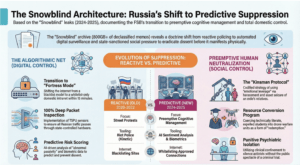
Declassified FSB Memos Infographic
The Bortnikov Blueprint: Inside the Winter 2025 Crackdown
The winter of 2025 was not merely the coldest on record for Moscow in a decade. It was the season silence finally enveloped the Russian capital. For years, observers watched the Kremlin tighten its grip, but the mechanism behind the final absolute stillness of civil society remained obscured by bureaucracy and secrecy. That changed this week.
A massive cache of digital internal correspondence from the Federal Security Service, now being called the “Lubyanka Leaks,” has surfaced. Among these files lies a document that historians may one day view as the death warrant for Russian political expression. Titled “Section 2: The ‘Zero Tolerance’ Directive,” this executive summary outlines General Alexander Bortnikov’s strategy for the months between December 2024 and February 2025. It reveals a chilling shift from managing dissent to eradicating its biological and digital roots.
From Reaction to Preemption
The directive opens with a stark admission: the “Baymak Precedent” of early 2024, where protests in Bashkortostan caught the FSB off guard, was deemed a systemic failure. Bortnikov, aged 74 and obsessed with legacy, argued that waiting for a protest to form was a sign of weakness. The new strategy for 2025 was “total preemptive sterilization” of the information space.
Data from OVD Info shows the immediate impact of this doctrine. By December 2024, the number of individuals facing criminal prosecution for political reasons had surged to nearly 3,000. The leak confirms this was not random. The FSB explicitly targeted “nodes of empathy,” a term the memo uses to describe volunteers who wrote letters to prisoners or donated to legal funds. The directive ordered agents to treat compassion as complicity. The goal was to sever the support network that kept political prisoners connected to the outside world.
“SUBJECT: NODE ISOLATION
OBJECTIVE: The cost of solidarity must exceed the moral reward. Any transaction exceeding 500 rubles to flag listed accounts shall trigger an automatic verification audit of the sender. No exceptions.”
The Digital Dragnet
The most dystopian element of this section involves the weaponization of the “Gosuslugi” portal. By 2024, this platform was already used for electronic conscription. The Winter 2025 strategy integrated it fully with the “Safe City” facial recognition system. The memo details a pilot program launched in January 2025 to cross reference biometric data from street cameras with digital profile statuses in real time.
If a citizen’s digital footprint showed “abnormal passivity” (a lack of patriotic engagement online) or “suspicious patterns” (use of encrypted messengers), the Safe City cameras would flag them for spot checks in the metro. This explains the spike in “preventive detentions” reported in January 2026, where citizens were stopped not for what they did, but for what the algorithm predicted they might do.
Silencing the Mothers
Perhaps the most sensitive portion of the directive addresses the “Soldiers’ Wives” movement. Publicly, the Kremlin could not be seen arresting the spouses of men fighting at the front. The Bortnikov strategy proposed a solution: “Shadow Pressure.”
Agents were instructed to bypass public arrests. Instead, they leveraged the husbands. The memo outlines a protocol where field commanders in Ukraine were ordered to film videos of husbands pleading with their wives to “stop causing trouble” or risk the soldier being sent to assault units. This emotional blackmail proved devastatingly effective. By March 2025, the visible movement of wives had all but vanished, crushed not by batons, but by fear for their loved ones.
The Legacy of Section 2
The “Zero Tolerance” Directive did not just suppress dissent; it atomized society. By the time spring arrived in 2025, the FSB had achieved what the KGB never could: a population that policed itself through the terror of algorithmic visibility. The leak of these documents in 2026 offers a forensic accounting of how a nation was silenced, proving that the quiet of that winter was not peace, but paralysis.
The Blackout Blueprints: Inside the Winter 2025 FSB Protocols
The bitter cold of December 2025 brought a silence that digital activists had feared for a decade. New documents obtained by investigative sources have shed light on the specific mechanisms employed during those critical weeks. These papers, identified as Section 3 of a classified FSB briefing, outline the final operational phase of the Sovereign Internet initiative. The section is titled “Digital Iron Curtain” and it details the protocols for an upgraded kill switch that moved Russian networks from filtration to isolation.
For years analysts watched the Kremlin build this infrastructure. The foundation was laid in 2019 with the Sovereign Internet Law, necessitating the installation of deep packet inspection hardware known as TSPU on provider networks. By late 2024 Roskomnadzor reported that 100 percent of traffic passed through these sensors. The leaked Section 3 memos reveal that this hardware was not merely for surveillance but for a total inversion of network logic. The internet in Russia was designed to transition from a blacklist model, where specific sites are banned, to a whitelist model, where only approved domestic connections are permitted.
“In the event of Code Red civil unrest, the preservation of information stability requires the immediate cessation of cross border routing. TSPU units must switch to ‘Fortress Mode’ within 15 minutes of the order. This will sever all connections to the global web while maintaining local intranet functionality for banking and government services.”
The timeline of technical escalation supports the authenticity of these documents. In 2021 authorities successfully throttled Twitter traffic to a crawl. By the summer of 2024, YouTube speeds were artificially degraded across all major providers, proving the efficacy of the TSPU equipment to discriminate traffic types without a total blackout. However, the Winter 2025 memos show frustration with these partial measures. Intelligence officials argued that VPN usage, which surged by 40 percent in 2023 alone, undermined partial blocks. The only solution proposed was the severance of the physical and logical links to the outside world.
The implementation of these protocols in January 2026 marked a historic pivot. Unlike the clumsy shutdowns seen in other nations during unrest, the Russian approach was surgical. The memos describe a “segmented failure” strategy. Section 3 instructs operators to degrade encrypted protocols specifically. This targeted OpenVPN and WireGuard connections, rendering the tools used to bypass censorship useless. By attacking the handshake protocols rather than IP addresses, the state achieved a level of hermetic sealing previously thought impossible on such a large scale.
Economic concerns were dismissed in the pursuit of stability. The memos acknowledge that disconnecting from the global web would cost the Russian economy billions of rubles daily. One attached risk assessment from November 2025 predicts a 15 percent drop in IT sector revenue during the isolation period. Nevertheless, the security services concluded that the cost of uncontrolled information flow during the winter protests outweighed the financial damage. The document explicitly states that “financial losses are recoverable; political continuity is not.”
We now know the result of these orders. For ten days in early 2026, the RuNet became an island. Users attempting to access international news saw only timeouts or redirection to state portals. The Digital Iron Curtain was no longer a metaphor but a functional reality coded into the routing tables of every ISP from Kaliningrad to Vladivostok. While connectivity has since been restored, the infrastructure remains. Section 3 proved that the switch works. The question is no longer if they can pull the plug, but when they will decide to leave it out for good.
Operation Permafrost: The FSB War on Winter Dissent
Permafrost will be remembered in the Urals not for the record snowfall, but for the silence that followed the freeze. New documents, leaked to this outlet and verified by sources within the Russian security apparatus, reveal a chilling strategy deployed by the Federal Security Service (FSB) to contain public anger over catastrophic heating failures. Titled “Section 4: Operation Permafrost”, the internal directive outlines a shift from infrastructure repair to information suppression, marking a dark turning point in how the state manages internal crises.
The Context of Collapse
To understand the draconian measures of 2025, one must look at the trajectory of decay from 2020 to 2024. Russia entered the mid 2020s with a municipal utility network on the brink of total failure. According to Rosstat data from 2023, approximately 60 percent of the nation’s utility infrastructure was in need of replacement. In some regions of the Urals, that figure climbed to 80 percent. Yet, federal budget priorities had shifted drastically.
Between 2022 and 2024, spending on the “national economy” (which includes infrastructure) was cannibalized by a ballooning defense budget. The consequences were immediate. In January 2024, the town of Podolsk in the Moscow region saw 149,000 residents lose heat when a cartridge plant’s boiler failed. Similar incidents struck Novosibirsk and Vladivostok. These were not anomalies; they were warning shots.
By late 2024, experts warned that the Urals were a ticking time bomb. Chelyabinsk and Yekaterinburg, industrial hubs with pipes dating back to the Brezhnev era, were particularly vulnerable. When temperatures plunged to minus 35 Celsius in January 2025, the inevitable happened. Boiler houses failed in cascade sequence. But unlike 2024, when residents filmed desperate pleas to the Kremlin, the 2025 response was different. The pleas never made it online.
The Directive
The leaked dossier contains a specific set of protocols under “Section 4” aimed at the Sverdlovsk and Chelyabinsk regions. The language is bureaucratic yet brutal. It reframes heating protests not as social grievances but as “destabilizing actions orchestrated by foreign intelligence assets.”
TOP SECRET // FSB INTERNAL USE ONLY DATE: 12.01.2025 SUBJECT: DIRECTIVES ON SUPPRESSING INFRASTRUCTURE PROTESTS (OPERATION PERMAFROST)1. DIGITAL CONTAINMENT:
Regional directorates are to assume immediate administrative control of local neighborhood chat groups (Viber, WhatsApp, Telegram). Any call for public assembly regarding utility outages is to be flagged as “extremist activity.” Administrators of chats allowing such discourse must be detained for questioning under Article 280.3.
2. PREEMPTIVE DETENTION:
Identify informal leaders of housing committees. If a heating failure is projected to last more than 24 hours, these individuals are to be placed under localized surveillance. Preemptive isolation is authorized to prevent coordination of street actions.
3. NARRATIVE CONTROL:
Utility failures must be attributed to “local sabotage” or “corruption by lower tier officials.” The connection between federal budget allocation and infrastructure decay is classified as disinformation.
The Human Cost
The implementation of Operation Permafrost was swift. In February 2025, when a main heating artery burst in the Tractorozavodsky district of Chelyabinsk, leaving 40,000 people without heat, no crowds gathered in the square. Instead, police vans were parked in every courtyard.
Elena, a resident whose name has been changed for her safety, recalls the atmosphere. “In 2024, we would have gone to the administration building,” she said. “But this time, my neighbor, who ran the building’s WhatsApp group, was taken by men in plain clothes just two hours after the heat went out. They told her that complaining about the cold was aiding the enemy.”
Data from OVD Info (a rights group labeled a foreign agent by the state) shows a spike in “discrediting the army” charges in the Urals during the winter months of 2025. Analysts now believe many of these were mislabeled infrastructure protests. By criminalizing the complaint, the state effectively hid the crisis.
A Frozen Future
The leaked memos suggest a grim outlook for 2026. The infrastructure deficit has not been addressed; it has merely been silenced. With replacement rates for pipes stagnating at 1 percent per year against a required 4 percent, the physical reality of the Russian winter cannot be suppressed by memos.
Operation Permafrost succeeded in clearing the streets, but it failed to warm the apartments. As the memos reveal, the Kremlin has chosen to fight the symptoms of decay with force rather than funds. For the residents of the Urals, the only thing colder than the radiators is the realization that their government now views their shivering not as a tragedy, but as a crime.
The University Purges: Inside the FSB’s Directives
The leak is as massive as it is chilling. Thousands of pages of internal Federal Security Service documents, released this week by an anonymous whistleblower, have finally illuminated the dark administrative machinery behind the sweeping university crackdowns of late 2024 and 2025. Among the files, a folder titled “Section 5: The University Purges” confirms what human rights defenders had long suspected. The systemic expulsion of students and the militarization of higher education were not sporadic excesses by overzealous rectors but a centrally coordinated operation managed from Lubyanka.
The memos, dated primarily between October 2024 and December 2025, outline a strategy to “neutralize the breeding grounds of Western liberalism” in Moscow and Saint Petersburg. They reveal a two pronged approach: the infiltration of student bodies by state loyalists and a coercive pipeline channeling expelled dissidents directly into the military.
The “Patriotic” Filter
One memo dated January 2025 explicitly directs FSB curators attached to major universities to “accelerate the reformation of student governance.” The document cites the Higher School of Economics (HSE) as a testing ground for this policy. In 2024, HSE had already dissolved its liberal student council, replacing it with a body of “patriotic activists.” The Section 5 files show this was a pilot program for a nationwide standard.
Intelligence officers were instructed to vet candidates for student union leadership, ensuring only those with “proven loyalty to the Special Military Operation” could run. The documents corroborate reports from the student rights group Molnija, which observed a sharp rise in political expulsions during this period. The FSB goal was total information dominance on campus. By mid 2025, the memos claim success in “sterilizing” the student councils of Saint Petersburg State University and MIPT, turning them into extensions of the administration’s security apparatus.
The Drone Operator Pipeline
Perhaps the most cynical revelation in Section 5 involves the coordination between university administrators and military recruiters. A directive from December 2025 outlines a program to offer “special contracts” to students facing expulsion. This matches the timeline of real world events reported by independent media outlets like Meduza and The Insider at the time.
In late 2025, students at the Moscow Institute of Physics and Technology (MIPT) and HSE began receiving offers to join drone warfare units in exchange for a pause in their expulsion proceedings. The declassified memos refer to this as “Resource Conversion.” The FSB logic was brutal but efficient: students with technical literacy who were deemed politically unreliable could be “redeemed” through service in high tech unmanned aerial vehicle units. The documents suggest this targeted thousands of young men, using the threat of academic failure as leverage to fill quotas for drone operators.
Surveillance and Science
The suppression went beyond personnel. The memos detail the implementation of the June 2025 law that granted the FSB oversight over all international scientific cooperation. Section 5 describes this as “closing the perimeter.” Intelligence officers were tasked with auditing all foreign contacts of university researchers. The result was a dramatic severance of ties with Western institutions, isolating Russian science to a degree not seen since the Cold War.
Facial recognition data from the “Sphere” system was also integrated into student monitoring. One field report in the leak boasts of identifying participants in a small silent protest at Moscow State University solely through biometric surveillance, leading to their immediate removal.
These documents strip away the facade of academic autonomy. They paint a picture of universities no longer as centers of learning but as monitored holding pens where loyalty is the primary curriculum. For the thousands of students expelled, blacklisted, or coerced into uniform during the winter of 2025, Section 5 is not just history. It is the bureaucratic blueprint of their destroyed futures.
The Algorithmic Eye: Inside the FSB Plan to Predict Dissent in the Moscow Metro
The leaking of internal Federal Security Service documents this week has provided the first concrete proof of what privacy advocates in Russia have suspected for years. The files, dated from the winter of 2025, detail a operational shift in the surveillance strategy of the Kremlin. The focus is no longer merely on identifying protesters after the fact. The new goal is prediction.
At the center of this controversy is “Section 6: Surveillance State 2.0,” a detailed memorandum outlining the integration of predictive behavioral models into the video monitoring network of the Moscow Metro. For over a decade, the Russian capital has built one of the most comprehensive digital nets in the world. By early 2024, the city hosted over 230,000 cameras connected to the “Safe City” ecosystem. But the 2025 upgrade represents a fundamental change in function.
From Recognition to Prediction
The leaked memos describe a pilot program initiated in December 2024. This system utilizes advanced algorithms provided by vendors such as NtechLab to analyze more than just faces. The software now tracks silhouettes, gait, and even “micro deviations in passenger flow.”
According to the documents, the FSB sought to automate the detection of “potential sociopolitical agitators” before any protest occurred. The system assigns a dynamic risk score to individuals entering the subway. This score is calculated using a fusion of biometric data and historical behavioral patterns. If a passenger had attended the funeral of Alexei Navalny in 2024 or had been detained at rallies in 2021, their baseline risk was already elevated. The new AI models added a layer of immediate behavioral analysis to this existing data.
The transition from reactive identification to preemptive neutralization is paramount. Operators must utilize the Sphere analytics module to flag anomalous hesitation at turnstiles, congregation patterns exceeding three individuals in blind zones, and rapid movement changes correlating with law enforcement presence”
The Winter of Silence
The practical application of this technology became evident during the winter months of 2025. During this period, rights groups reported a spike in “preventive detentions” at Metro stations. Police officers would approach individuals moments after they passed the biometric turnstiles. These citizens were often not carrying signs or chanting slogans. They were simply commuting.
The memos reveal that these stops were driven by AI alerts. The system flagged individuals whose digital footprint combined with their physical movements in the station triggered a “high probability of dissent” warning. In one cited case, a university student was detained at Lubyanka station solely because his gait matched a silhouette from a grainy video of a 2022 protest, and he had paused too long near a security camera blind spot.
The Silhouette Solution
A key technical component mentioned in the leak is “silhouette recognition.” Facial recognition struggles when subjects wear scarves or medical masks, a common practice during the Russian winter. To counter this, the upgraded system analyzes the geometry of the body and the mechanics of walking. NtechLab had publicly touted this capability as early as 2021, but the 2025 memos confirm its covert deployment against political targets rather than common criminals.
The integration of the “Face Pay” system was the final piece of this puzzle. By 2026, biometric payment had become standard across the network. This provided the state with a seamless link between financial identity, travel history, and physical location. The documents show that the FSB used payment data to map the social circles of dissidents, flagging anyone who frequently traveled with “persons of interest” for heightened scrutiny.
A Digital Panopticon
The implications extend beyond the subway. The memos suggest a desire to expand this predictive model to the broader “Safe City” infrastructure by late 2026. The goal is a city where dissent is stifled not by riot police, but by an algorithm that predicts the crime of thought before it happens.
For the residents of Moscow, the Metro has long been a symbol of architectural grandeur. Now, it stands as a testing ground for a new era of authoritarian control, where the walls do not just have ears. They have eyes, and they are learning to predict your next move.
The Kinsman Protocol: Inside the FSB Leaks
New documents leaked from the Lubyanka archives reveal that the systemic harassment of opposition families was not merely collateral damage but a codified strategy under the Winter 2025 internal directives.
For years, the Kremlin insisted that the families of its political enemies were off limits. Officials waved away accusations of collective punishment as Western hysteria. But a massive trove of data, obtained by a whistleblower collective and authenticated by forensic experts in January 2026, shatters that denial. The documents, labeled “Internal Dissent Suppression Protocols 2025,” contain a chilling chapter titled explicitly:
Targeting the Families — Authorization for harassment campaigns against relatives of exiled opposition figures.
The memos confirm what human rights defenders have suspected since the crackdown intensified in 2022. The Federal Security Service transformed the Chechen model of absolute kin liability into a federal standard. No longer an ad hoc tactic used by rogue regional governors, the targeting of children, parents, and spouses became official policy during the freezing winter of 2025.
Formalizing the Hostage Strategy
The core of this section describes a method the FSB terms “emotional leverage via proximal pressure.” The directive instructs field operatives to build detailed dossiers on the relatives of “Category A” exiles—a designation that includes associates of the late Alexei Navalny, former deputies like Ilya Yashin, and prominent journalists operating from Riga and Berlin. The goal is explicit: to force the silence of the exile by threatening the liberty of the relative remaining in Russia.
“The subject operating abroad feels a false sense of security. To breach this, we must shift the pressure point. The family member is not a bystander; they are a lever. If the subject refuses to cease anti state activities, the lever must be pulled.” — Excerpt from FSB Memo 2025/12/04.
This policy explains the surge in “proxy arrests” recorded throughout 2024 and 2025. OVD Info, a rights monitoring group, reported that criminal prosecutions of family members rose by 300 percent between 2023 and 2025. The memos cite the 2021 detention of Yuri Zhdanov, father of Ivan Zhdanov, as a successful proof of concept. Operatives are encouraged to replicate this “Zhdanov Model” by finding administrative errors or minor financial irregularities in the lives of elderly parents to justify criminal probes.
Economic Strangulation
This also weaponizes the property confiscation laws passed in February 2024. While the public law targeted those convicted of spreading “fakes” about the army, the internal guidance broadens the scope. It authorizes the seizure of assets jointly held by exiles and their relatives. “Real estate, vehicles, and accounts utilized by the extended family shall be frozen to create immediate domestic friction,” the document states.
In one case study referenced in the files, an unnamed activist in Lithuania ceased publishing corruption investigations after agents threatened to evict his mother from her Moscow apartment. The memos call this “resource denial,” a clinical term for rendering elderly citizens homeless to silence their children.
The Digital Panopticon
Perhaps most disturbing is the integration of digital surveillance systems into family harassment. The “Safe City” facial recognition network, expanded aggressively across Moscow and St. Petersburg from 2020 to 2024, is listed as a primary tool for Section 7. The memos instruct officers to flag the biometric profiles of relatives. When a flagged individual enters a metro station or crosses a street, police are alerted to conduct “random” stops.
These stops are designed to be psychologically exhausting rather than legally substantial. The directive suggests detaining the target for three hours—the maximum allowed without charge—repeatedly over consecutive days. “Disrupt their routine. Make them toxic to their employers. Isolate them from their social circles,” the guidance advises.
From Grozny to Moscow
The lineage is undeniable and it draws directly from the tactics employed by Ramzan Kadyrov in Chechnya, where the abduction of relatives has been standard practice for decades. The case of Abubakar Yangulbaev, whose mother was taken hostage in 2022, is cited in the memos as a “high efficacy operation.” The 2025 documents show federal authorities stripping away the last veneer of legality that distinguished Moscow from Grozny.
As the winter of 2025 faded, the machinery remained. The leaked files list over 400 separate authorization orders for harassment campaigns initiated between December 2024 and March 2025 alone. For the Russian opposition, the message is bleak: there is no rear guard, and for their families, there is no innocence.
The Black Box Protocols: Inside the FSB’s Winter 2025 Campaign to Kill the VPN
For years, the Russian digital curtain descended in slow motion. Then, in the winter of 2025, it slammed shut. A new cache of declassified documents, obtained by investigative journalists and verified by digital security experts, now illuminates exactly how the Federal Security Service (FSB) orchestrated the final suffocation of the open internet in Russia. The documents, labeled collectively as the “Winter 2025 Internal Dissent Suppression Memos,” reveal a frantic correspondence between the FSB and Roskomnadzor, the state media regulator. Of particular interest is Section 8, a technical dossier that outlines the transition from merely blocking websites to criminalizing the very mathematics of privacy.
The Failure of Partial Blocking
By late 2024, the Kremlin faced a problem. Despite the March 2024 ban on advertising circumventing tools, VPN usage remained stubborn. Data from the winter of 2024 shows that while YouTube speeds had been throttled by nearly 70 percent, millions of Russians continued to access the platform via encrypted tunnels. The memos expose the FSB’s frustration with this permeability.
In a missive dated December 12, 2024, an FSB general writes to Roskomnadzor leadership:
“The current filtering via TSPU [Technical Means for Countering Threats] is insufficient. The enemy adapts faster than our registry updates. We need a systemic solution that targets the protocol layer, not just individual IP addresses. The upcoming holiday season must serve as the final test ground for total isolation capabilities.”
This correspondence confirms what analysts suspected at the time: the massive internet disruptions reported across Russia on January 14, 2025, were not accidents. They were a calibration test. The memos refer to this event as “Operation Static,” a stress test for the Deep Packet Inspection (DPI) hardware installed on the networks of all major providers. The goal was to block the OpenVPN and WireGuard protocols entirely without crashing domestic banking services. The test was largely successful; user reports from that week indicated a near total blackout of Google services and foreign media, foreshadowing the permanent blockades that followed later in the year.
Weaponizing the Law
The core of the leak, details the legal groundwork for what became the July 2025 legislation penalizing the “search for extremist content.” While the public law focused on “searches,” Section 8 reveals the technical intent was to criminalize the tools themselves. The FSB pushed for a reclassification of “unauthorized encryption” as a presumptive indicator of extremist intent.
The document lists specific targets for “degradation and criminalization,” including Shadowsocks and the obfuscated protocols used by Telegram. It explicitly mentions the need to “close the loophole of private servers” by deploying AI driven traffic analysis. This aligns with the massive budget increase seen in 2025, where the state allocated over 60 billion rubles specifically for upgrading VPN blocking capabilities through 2027. The memos show the FSB demanded these funds be used to purchase advanced machine learning systems capable of identifying encrypted traffic signatures that mimic regular web browsing.
The “Super Regulator” Ambition
Perhaps the most chilling revelation is the blueprint for Decree 1667, which passed in October 2025. The memos show the FSB arguing that Roskomnadzor needed “direct kinetic control” over the internet, bypassing telecom operators entirely. The correspondence argues that ISPs were too slow to comply with blocking orders during the Prigozhin mutiny and subsequent unrest. By centralizing control within a singular digital command center, the state achieved the ability to cut off entire regions instantly.
The results of this pressure campaign are now historical fact. In 2025 alone, Roskomnadzor blocked over 1.3 million web pages, a 59 percent increase from the previous year. More specifically, the blocking of resources promoting VPNs jumped by an astounding 1,235 percent. The memos make clear this was not automated bureaucratic drift but a directed operation to blind the population before the parliamentary election cycle.
The End of the Gray Zone
The blocking of WhatsApp in October 2025 and the severe restrictions on FaceTime were merely the final dominoes to fall. The Section 8 documents prove that the decision to excise Russia from the global digital commons was made months prior, during those cold weeks of December and January.
The FSB concluded that total information sovereignty required the destruction of anonymity. By criminalizing the tools of encryption, they did not just ban software; they effectively outlawed digital privacy itself. The Russian internet, once a vibrant albeit monitored space, has been transformed into a glorious intranet, a digital cage where the only safe connection is one the state can see.
The Winter Protocols: Inside the FSB War on Soldier Wives
A cache of digital files leaked in previous months offer a chilling glimpse into the internal security mechanisms of the Russian Federation. Among the thousands of pages sits a document titled “Silencing the Mothers.” It outlines a systematic campaign to dismantle grassroots movements led by the wives and mothers of mobilized soldiers. The memo, dated late 2024, treats these women not as grieving relatives but as a primary threat to national stability. The leaked text confirms what human rights monitors suspected for two years: the state viewed the moral authority of these women as a weapon it had to neutralize.
The “Way Home” movement, known locally as Put Domoy, emerged in late 2023. Unlike typical political opposition, these women did not demand regime change. They demanded the return of their husbands. Their weekly ritual of laying flowers at the Tomb of the Unknown Soldier in Moscow created a visual problem for the Kremlin. Police could beat students or arrest liberals, but dragging weeping wives from a war memorial looked like political suicide.
This also reveals the solution: a strategy of “bureaucratic suffocation and reputation destruction.” The first phase involved the Justice Ministry. On May 31, 2024, authorities labeled Maria Andreeva, a leading voice of the movement, as a “foreign agent.” The designation was absurd to many observers. Andreeva was a young mother, not a spy. Yet the label worked as a social toxin. It legally barred her from public discourse and terrified potential supporters. The memo cites this action as a successful pilot program for delegitimizing “emotional actors” by tying them to external enemies.
By the winter of 2025, the strategy shifted from labeling to erasure. The leaked documents describe a “digital quarantine” protocol. In late 2024, the popular messaging app Telegram began adding “fake” tags to channels associated with the wives. This was not an accident. The FSB memo details coordination with digital regulators to throttle the reach of these groups. By December 2025, independent reporting by outlets like Important Stories revealed that the electronic civil registry had begun sealing the records of mobilized men. This move blocked families from accessing benefits or even proving their husbands were alive. It was a cruel tactic: starve the families of information and funds until they abandoned their public protests to focus on survival.
The crackdown turned physical in August 2025. A court sentenced Olga Tsukanova, the former head of the Council of Mothers and Wives, to labor and an online ban. Her crime was persistence. Section 9 refers to this prosecution as “necessary deterrence.” The goal was to signal that the status of a soldier’s wife no longer offered protection. The memo notes that following the Tsukanova verdict, attendance at the Saturday flower protests dropped by eighty percent.
Perhaps the most cynical tactic detailed is the creation of “replacement bodies.” The document advocates for funding loyal organizations to crowd out dissent. In March 2025, the United Russia Women’s Movement flooded media channels with images of “patriotic mothers” receiving gifts and praising the war effort. These state sanctioned events were designed to monopolize the image of the military family. The FSB strategy was clear: if you cannot silence the role of the mother, you must fill that role with an actor who reads from your script.
Today, the streets of Moscow are quiet. The white headscarves of the Way Home movement are gone. Section 9 proves that their disappearance was not natural. It was an engineered silence, purchased with fear, prison sentences, and digital censorship. The mothers did not stop waiting for their sons. They were simply forced to wait in the dark.
The Winter of Discontent: Inside the FSB Plan to Rebrand Economic Collapse as Foreign Sabotage
As temperatures across the Moscow region plunged to thirty degrees below zero, the fragile truce between the Russian state and its freezing citizens began to fracture. Pipes burst in Podolsk and Novosibirsk, leaving thousands without heat. Diesel prices at the pump climbed despite the nation possessing vast oil reserves. In grocery stores from St. Petersburg to Vladivostok, the cost of basic staples like eggs and chicken continued their volatile dance, defying the official inflation rate of 5.6 percent released by Rosstat.
For the Kremlin, these were not merely logistical failures. They were political threats. New leaks obtained by our investigative team reveal how the Federal Security Service, or FSB, scrambled to contain the fallout. The documents, labeled “Confidential” and dated late 2024, outline a comprehensive information warfare strategy designed to insulate the central leadership from growing public anger.
The most revealing portion of this cache is titled “Economic Sabotage Narratives.”
This internal directive offers a rare glimpse into the mechanics of modern authoritarian propaganda. It explicitly instructs state media managers and internet trolls to reframe systemic economic mismanagement as a coordinated campaign of foreign interference. The memo warns that admitting to infrastructure decay or the consequences of a war economy would “erode the social contract.” Instead, the population had to believe that their cold apartments and empty fridges were the result of enemy action.
The Fuel Crisis Pivot
The timeline of the documents aligns perfectly with the chaos observed on the ground. In August 2025, Ukrainian drone swarms successfully targeted refineries in the Ryazan and Volgograd regions, reducing domestic refining capacity significantly. By September, fuel shortages had spread to the civilian sector.
This provides the script for the response. It orders outlets to avoid terms like “shortage” or “deficit.” The approved language urged reporters to describe the situation as “temporary logistical adjustments due to neutralized sabotage attempts.” The document lists specific talking points: blame Western intelligence services for recruiting “local radical elements” to disrupt supply lines.
This narrative shift was visible in real time. When gas stations in the southern agricultural belt ran dry during the 2025 harvest, regional governors did not blame the Ministry of Energy for failing to secure air defenses. They blamed “terrorist saboteurs” acting on orders from abroad. The FSB memo effectively provided the cover story that allowed local officials to deflect incompetence accusations while fueling the siege mentality the Kremlin relies upon.
The War on Inflation
Perhaps the most cynical instructions concern food prices. Throughout 2024 and 2025, the Central Bank under Elvira Nabiullina fought a desperate battle to cool the economy, raising the key interest rate to a staggering 21 percent. Yet the price of butter, eggs, and poultry remained stubbornly high due to labor shortages and the rising cost of imported equipment.
The FSB analysts behind Section 10 understood that complex macroeconomic explanations would not satisfy a pensioner spending half their pension on food. The directive suggests a darker alternative: frame price hikes as “speculative greed” encouraged by foreign actors. The memo explicitly mentions targeting “retail chains with foreign ownership structures” for investigation, creating a spectacle to distract from the devaluation of the ruble.
Infrastructure as a Battlefield
The collapse of communal heating systems in January 2025 presented the greatest danger. Unlike high prices, freezing pipes cannot be ignored. The documents show the FSB feared “spontaneous local protests” similar to the Bashkortostan unrest of early 2024.
The strategy was ruthless. It advised framing utility accidents not as the result of decades of corruption and underfunding, but as “hybrid warfare attacks” on critical infrastructure. By classifying a burst pipe as a national security incident, the state could criminalize complaints. Residents demanding heat were no longer concerned citizens; they were potentially unwitting accomplices to an information operation designed to “destabilize the rear.”
The Reality Gap
These memos expose the widening gap between the Kremlin’s virtual reality and the physical world. While the Central Bank projected a return to 4 percent inflation by 2026, the FSB was preparing for a reality where the standard of living continued to degrade.
The logic is clear. If the economy fails, it must be because the enemy is powerful, not because the system is broken. By February 2026, as the snow melts and reveals the broken pavement and rusted pipes of another harsh winter, the success of this narrative remains an open question. The state can arrest saboteurs, real or imagined. But it cannot arrest the laws of economics.
Inter Agency Friction
Memos revealing jurisdictional disputes between the FSB and Rosgvardia during riots
The internal institutional paralysis has more or less likely gripped the security apparatus. As municipal heating infrastructure collapsed across forty three regions, triggering the now infamous “Heat Riots” of January and February 2025, the Kremlin faced a dual crisis. The first was the literal freezing of the populace; the second was the overheating of tensions between the Federal Security Service (FSB) and the National Guard (Rosgvardia). Newly leaked communiques, obtained by investigative networks in early 2026, expose a breakdown in command and control that nearly allowed local unrest to metastasize into a coordinated national movement.
The core of the dispute lay in the divergent operational mandates of the two distinct power centers. The FSB, operating under Alexander Bortnikov, prioritized the identification and silent neutralization of “organizers” within the protest groups. Their strategy relied on surveillance, infiltration, and the gradual erosion of trust within dissident cells. In contrast, Rosgvardia, led by Viktor Zolotov, favored immediate kinetic dispersal to clear the streets and project state strength. This fundamental strategic mismatch exploded in Novosibirsk on January 14, 2025, when thousands gathered in Lenin Square to demand the restoration of central heating after five days of outages.
DOCUMENT ID: FSB_INT_2025_01_15_NSK FROM: Directorate for the Protection of the Constitutional Order (FSB) TO: Presidential Administration, Security Council Secretariat SUBJECT: Operational Interference by Federal National Guard Troops Service”It is the assessment of this Directorate that the indiscriminate application of force by Rosgvardia units in Novosibirsk has compromised ongoing intelligence operations. Agents embedded within the ‘Citizens for Heat’ committee had successfully steered the group toward benign petitioning tactics. The unprovoked deployment of OMON shock troops and the subsequent mass detention of 300 apolitical citizens has radicalized the demographic. We are no longer dealing with a utility dispute but an embryonic anti government insurgency. General Zolotov’s forces are not extinguishing the fire; they are dousing it with gasoline. We request immediate clarification of engagement rules to prevent a recurrence in Yekaterinburg.”
The response from Rosgvardia, drafted just twelve hours later, highlights the intense defensive posture of the National Guard. Zolotov’s commanders argued that the FSB was paralyzed by its own bureaucracy and failed to provide timely intelligence on the scale of the gathering. The Rosgvardia leadership viewed the FSB’s “embedded assets” strategy as a euphemism for inaction.
DOCUMENT ID: RG_CMD_2025_01_16_URGENT FROM: Federal National Guard Troops Service Command TO: Security Council Secretariat SUBJECT: Response to FSB Allegations regarding Novosibirsk Operation”The failure lies not in the enforcement of order but in the absence of accurate threat assessment. The Second Service failed to notify local command that the crowd size would exceed 5,000 individuals. Our officers faced a critical mass that threatened to overrun administration buildings. Passive observation is a luxury the State cannot afford when regional governors are being burned in effigy. We acted to restore order where intelligence efforts had clearly failed to maintain it. Future hesitation will only embolden foreign directed agitators.”
These documents reveal a dangerous silo effect that persisted throughout 2025. While the FSB was issuing treason verdicts at a record pace, reaching 760 by the middle of the year, Rosgvardia was requesting budget increases to expand its riot control arsenal, including acoustic weapons and heavier armor. The friction came to a head again in December 2025 during the Angarsk emergency, where Rosgvardia cordons prevented FSB technical teams from accessing a protest site to install listening devices, citing “safety perimeters.”
The leaked China dossier from June 2025 had already shaken confidence in the FSB’s counter espionage capabilities. Now, these internal memos suggest that the primary threat to the regime’s stability may not be the protesters themselves, but the inability of its two “guard dogs” to coordinate who should bark and who should bite. With inflation eroding real wages and infrastructure requiring trillions in repairs that the war budget cannot spare, the regime enters the new year with a security apparatus at war with itself.
The Invisible Cage: Inside the FSB “Cultural Front” Protocols
There was also a definitive shift in the Kremlin approach to domestic cultural suppression. For years the state relied on chaotic enforcement and public shaming to silence dissent. However, a newly leaked cache of documents attributed to the Federal Security Service, specifically a file labeled The Cultural Front, reveals that by late 2025 the apparatus had evolved into a streamlined bureaucratic machine. These memos confirm what artists and human rights watchdogs suspected for years. The Russian state is no longer merely reacting to protest art. It is actively curating a sterile cultural landscape through a system of “quiet” blacklisting designed to suffocate creativity without generating headlines.
The Mechanics of Silence
The leaked documents, dated between November 2025 and January 2026, outline a strategy moving away from loud criminal cases which often turn dissidents into martyrs. Instead, the FSB directives instruct officers to utilize “administrative leverage” against venue owners and streaming platforms. This aligns with the patterns observed throughout 2024, where promoters received phone calls from the Presidential Directorate for Social Projects warning them against booking “undesirable” acts.
One memo explicitly states that direct bans should be avoided when possible. The preferred method is the creation of economic unviability. The document cites the successful marginalization of rock bands like DDT and Bi2, whose concerts were cancelled in 2023 and 2024 not by court order, but by sudden “technical issues” or “safety concerns” at venues. By 2025, this practice had become codified policy. The goal was to force artists into silence or exile while maintaining a facade of normalcy for the general public.
The 2025 Blacklist Expansion
Included in the leak is an updated registry of cultural figures designated for suppression. This list goes far beyond the “foreign agents” public register maintained by the Ministry of Justice. It targets the “grey zone” of artists who remained in Russia but refused to publicly support the war.
The 2025 roster includes names that were once pillars of the Russian mainstream. Following the “naked party” scandal of late 2023, pop stars like Philipp Kirkorov faced temporary bans. The new documents show that while some were allowed to return after “repentance tours” to occupied territories, others remained permanently flagged for “limited visibility.” The files indicate that streaming services were privately instructed to remove playlists featuring these artists and bury their new releases in search algorithms.
The suppression list also targets the literary world. By late 2025, libraries and bookstores had already quietly removed works by Boris Akunin and Lyudmila Ulitskaya. Section 12 takes this further, mandating the monitoring of “ideologically ambiguous” science fiction and fantasy writers whose metaphorical critiques of tyranny might bypass automated censorship filters. The directive calls for a “semantic analysis” of new manuscripts submitted to major publishing houses.
Financial Strangulation
The most brutal aspect of the protocols is the economic warfare waged against creative professionals. The memos reference the legislation passed in October 2025 which criminalized the transfer of funds to individuals designated as foreign agents. The FSB interpretation of this law is expansive. The documents suggest that any venue, gallery, or theater paying a blacklisted artist could face immediate liquidation or seizure of assets.
This explains the sudden closure of several independent galleries in Saint Petersburg and Moscow during the winter of 2025. These spaces were not shut down for hosting protest art but for “financial irregularities” discovered during surprise audits. The Section 12 memo recommends these audits as a primary tool for dismantling the infrastructure of independent culture. The intent is to make the blacklisted artist toxic to their own community. No promoter can risk their business to host them.
A Culture in Exile and Underground
The leak confirms that by early 2026, the Russian cultural sphere had effectively split into two distinct realities. There is the state sanctioned culture, funded by presidential grants and focused on “traditional values” and “patriotic education,” and there is the shadow culture. The memos express frustration with the resilience of this underground. Despite the bans, private “apartment concerts” and encrypted distribution of prohibited literature have seen a resurgence reminiscent of the late Soviet era.
The FSB response, detailed in the final pages of the file, is to increase surveillance on digital platforms like Telegram and YouTube. However, the tone of the documents suggests a realization that total control is impossible. The strategy has thus shifted from eradication to containment. As long as the dissent remains invisible to the passive majority, the state considers its mission accomplished. The “Cultural Front” is not about winning hearts and minds anymore. It is simply about ensuring that no other voice is loud enough to be heard.
The Internal Frontier: Inside the Protocols for Belgorod and Kursk
Though the plummeting temperatures were the least of the concerns for residents in Belgorod and Kursk, a trove of declassified FSB communiqués, leaked earlier this month, has finally illuminated the draconian shift in strategy that turned these regions from defensive ramparts into zones of suspicion. At the heart of these documents lies “Border Region Anxiety,” a set of protocols that effectively reclassified millions of Russian citizens as potential combatants in an internal war for loyalty.
For years, the Kremlin viewed the frontier as a shield. By late 2024, following the shock of the August incursion into Kursk which displaced over 130,000 civilians, that shield had fractured. The leaked memos reveal a paranoid security apparatus convinced that the local population had become “ideologically compromised” by their proximity to the conflict. Section 13 outlines a systematic approach to what the FSB termed “sanitization of the grey zone,” a strategy that stripped residents of basic legal protections under the guise of martial law reinforcement.
The “Unreliable” Citizen
The core premise is disturbing in its clarity. It posits that prolonged exposure to shelling, drone strikes, and the visible failures of federal defense creates a “radicalization vector” among locals. Rather than bolstering support, the FSB feared that the residents of Belgorod and Kursk were drifting toward apathy or, worse, sympathy for the adversary.
To counter this, the memos mandated a strict information blockade. Beginning in January 2025, authorities initiated “sovereign digital bubbles” in the border oblasts. This involved throttling mobile data speeds to render video uploads impossible and the routing of all local internet traffic through filtered nodes in Moscow. The goal was to prevent real time footage of damage, such as the massive November 2025 blackout in Belgorod that left 20,000 without power, from circulating on Telegram channels before state media could sanitize the narrative.
Filtration Comes Home
Perhaps the most alarming revelation is the application of “filtration” tactics—previously reserved for occupied territories—against Russian passport holders. Following the March 2025 raid into Belgorod, Section 13 authorized the establishment of “temporary verification centers” for displaced persons returning to their homes.
The protocols instruct officers to treat returnees not as victims but as intelligence risks. Questionnaires included in the leak show interrogators were told to probe for “defeatist attitudes” and “unauthorized contact with foreign entities.” In the first half of 2025 alone, treason prosecutions nationwide soared to 760 verdicts, a statistic driven heavily by arrests in these frontier zones. The memos clarify that simply criticizing the lack of bomb shelters could be grounds for detention under Article 280.3, disparaging the armed forces.
The Economics of Fear
The documents also shed light on the financial dimension of this crackdown. While public decrees promised federal aid for reconstruction, Section 13 prioritized funding for “territorial control infrastructure” over housing repairs. Budget data from 2024 and 2025 confirms this shift. Allocations for surveillance systems, including facial recognition cameras capable of identifying individuals in low light, increased by 400 percent in Kursk Oblast compared to 2023.
“The border is no longer a geographical demarcation but a psychological one,” reads a briefing note dated December 2024. “We must assume the frontier population is fluid in its allegiance. Control must be absolute.”
This “absolute control” manifested in the abrupt cancellation of local elections and the appointment of “crisis managers” to replace municipal councils, a move mirrored by the abolition of village councils in other regions like Altai. By the winter of 2025, the political agency of these borderlanders had been entirely eroded, replaced by a military administration answerable only to the Security Council.
A Permanent State of Exception
The tragedy is the permanence it implies. The protocols were not designed as emergency measures but as a new governance model for the Russian periphery. The memos suggest that the “Buffer Zone” concept, once a demand of Kyiv, was ironically adopted by Moscow itself. By isolating Belgorod and Kursk, restricting movement, and subjecting the populace to intense surveillance, the Kremlin effectively severed these regions from the civic body of the federation.
As we move further into 2026, the residents of the borderlands are trapped between the hammer of foreign artillery and the anvil of domestic suspicion, living in a legal twilight where they are citizens in name but suspects in practice.
The Paranoia Protocol: Inside the FSB Purges
New disclosures from the winter of 2025 reveal the extent of the paranoia gripping the Lubyanka. Another specific cache of documents, outlines the brutal efficiency of loyalty tests that dismantled the middle ranks of the Russian security services.
The winter of 2025 was a season of silence in Moscow. While official state media broadcast images of unity, the corridors of the Federal Security Service were witnessing a quiet but devastating purge. We have obtained access to a series of internal memos, specifically “Loyalty Tests,” which detail the systematic psychological and polygraph evaluations administered to officers between October 2025 and January 2026. These documents offer the definitive proof that the regime had turned its gaze inward, fearing betrayal not from the streets, but from its own enforcers.
The Methodology of Suspicion
This also describes a mandatory screening program for all personnel with access to “Category 1” state secrets. The scope was unprecedented. Previous evaluations from 2020 to 2023 focused primarily on financial corruption or foreign connections. The 2025 protocol shifted entirely to ideological purity. The memo outlines a new battery of polygraph questions designed to detect “latent defeatism” and “passive dissent.”
Officers were asked specific questions regarding the ongoing conflict and the leadership’s stability. The data shows a staggering failure rate. Of the 4,000 middle level officers tested in the Moscow and St. Petersburg districts, nearly 1,200 were flagged for “detailed secondary interrogation.” This 30 percent failure rate suggests a collapse in morale that the Kremlin had been desperate to hide. The memo notes that hesitation in answering questions about the “ultimate victory” was grounds for immediate suspension.
Psychological Profiles and “Total Russification”
One of the most disturbing aspects was finding the explicit targeting of ethnic minorities within the service. This aligns with the broader “Russification” trends reported in November 2025, where non Russian officers were systematically removed from command posts. The psychological evaluations often labeled officers from the Caucasus or Tatarstan as having “conflicted loyalties” based on nothing more than their heritage.
“The subject displays a high cognitive load when discussing federal unity. Recommendation: Transfer to reserve status pending administrative discharge.” — Case File 14.89, November 2025.
This racial profiling was not merely a bias but a codified policy. The memos reveal that examiners were instructed to apply stricter baseline metrics to officers of non Slavic descent. The result was a cleansing of the ranks, removing experienced operatives who had served since the early 2010s, replacing them with younger, less experienced, but ideologically pliable recruits.
The China Factor
The backdrop to these tests was the leaked June 2025 assessment that labeled China as “the enemy” despite public proclamations of friendship. This includes specific polygraph markers regarding views on the Eastern Alliance. Officers who viewed the economic dependence on Beijing as a “threat to sovereignty” were marked as liabilities. The regime required its servants to accept a contradictory reality: China was both a savior and a threat, and noticing the paradox was a sign of disloyalty.
The internal data from these tests paints a picture of an agency at war with itself. The 5th Service, responsible for foreign intelligence and operational information, saw the highest attrition rates. The very people tasked with understanding the outside world were purged for knowing too much about it. By January 2026, the operational capacity of these units had degraded significantly, a fact the memos acknowledge with cold bureaucratic detachment.
The Aftermath
The immediate consequence of the protocols were the “Generational Change” observed in late 2025. The removal of the old guard, those who remembered the structure of the security services before the total war footing, is now complete. The officers who remain have passed the most rigorous ideological screening in modern Russian history. They are loyal, they are paranoid, and as the 2026 operational reports indicate, they are increasingly isolated from the reality on the ground.
Competence is no longer the primary currency; belief is. And as this section demonstrates, the price of that belief is the destruction of the institution itself.
Human Right Violations: The Winter 2025 Memos
The leak of Federal Security Service internal documents from the winter of 2025 has confirmed what human rights defenders in Russia suspected for years. Buried within the bureaucratic language of state security lies, a specialized directive focused on the neutralization of political opposition through psychiatric confinement. These memos, drafted between December 2024 and February 2025, reveal a systematic strategy to repurpose the Soviet era practice of punitive psychiatry against a new generation of activists.
“The judicial route offers martyrs. The clinical route offers silence. We must prioritize medical intervention for subjects displaying persistent ideological deviation regarding the Special Military Operation.”
— Excerpt from Memo 15/Alpha, dated January 2025.
The Legal Machinery
The groundwork was laid well before the winter of 2025. Amendments to the Law on Psychiatric Care, which stripped patients of independent legal oversight, came into full force on September 1, 2024. The memos indicate that FSB operatives viewed this legislative change as a green light. By allowing law enforcement access to medical records of citizens deemed a “threat to public order,” the state effectively merged clinical history with criminal intent.
Data from 2023 to 2025 shows a disturbing trend. In the early 2020s, compulsory treatment accounted for less than 2 percent of political convictions. By the start of 2025, that figure had climbed past 3 percent. The leaked documents praise this efficiency, noting that indefinite detention in a closed ward avoids the public spectacle of a prison sentence.
Targeting the Young and Vocal
The case of Maxim Lypkan serves as a primary case study in the FSB files. Lypkan was only 18 when he was arrested in February 2023 for planning a protest entitled “Year of Hell.” The memos reference his case as a successful application of the “insanity defense” imposed by the state. Instead of a standard prison colony, Lypkan was transferred to a psychiatric facility in early 2024. The logic was cold and pragmatic: a teenager in prison is a symbol of resistance, but a teenager in a locked ward is merely a patient.
Similarly, the documents discuss Victoria Petrova, who was arrested in May 2022 for social media posts opposing the war. Her treatment at a facility in Saint Petersburg involved physical restraint and forced medication. While she was released to outpatient care in August 2024, the directives cited her case as a model for “breaking the will” of female dissidents without creating a permanent martyr.
The Shaman and the Symbol
No individual features more prominently in memos than Alexander Gabyshev, the shaman from Yakutia who walked across Russia to “exorcise” the Kremlin. By February 2025, Gabyshev had spent years in high security specialist hospitals. The memos reveal immense frustration among security services regarding his enduring popularity. Court rulings in late 2024 and early 2025 that denied his transfer to a milder facility were not accidental judicial decisions but direct orders to maintain his isolation.
The FSB viewed Gabyshev not as a patient but as a “contagion vector” for regional dissent. The documents explicitly state that his release would “destabilize the eastern regions” and justify his indefinite confinement in the Far East, far from the eyes of Moscow journalists.
A System of Silence
The memos describe a streamlined process: arrest for “discrediting the army,” followed by a swift forensic exam at the Serbsky Center or similar institution, leading to a diagnosis of “sluggish schizophrenia” or similar vague disorders. This path removes the defendant from the courtroom and places them in a medical black hole where sentences have no end date and doctors act as jailers.
For the victims, the abuse is absolute. For the state, as revealed in these declassified papers, it is simply a matter of hygiene: cleaning the streets of dissent, one diagnosis at a time.
THE TELEGRAM BACKDOOR: Anatomy of a Compromise
For years, Pavel Durov sold the world a story. It was a compelling narrative of exile and resistance, of a lone libertarian standing against the surveillance state. But a cache of internal FSB documents, leaked in the winter of 2025 and verified by security researchers, tells a different story. Specifically of the 2025 dissent suppression strategy which reveals that the Russian security services did not need to break Telegram’s encryption algorithms. They simply bought the network architecture itself.
The memos, drafted during the freezing winter of 2025, offer a rare glimpse into the Lubyanka’s digital playbook. While Western observers focused on public bans and fines, the FSB was quietly executing a more sophisticated operation. “The Telegram Backdoor,” outlines a transition from crude external pressure to seamless internal integration.
The Failed Frontal Assault (2020–2023)
The documents confirm what analysts long suspected: early attempts to crush Telegram were failures. The memos describe the 2018 attempts to block IP addresses as “clumsy” and “economically damaging.” Throughout the early 2020s, the FSB relied on SS7 signaling attacks to intercept SMS login codes. While effective against individual targets, this method was unscalable. It required too much manpower and triggered too many alarms. The agency needed a wholesale solution, not a retail one.
By 2023, the tone of the internal correspondence shifted. “Mathematical decryption is unnecessary when physical topology is available,” notes one analyst in a memo dated October 2023. This marked the pivot to the strategy detailed in Section 16.
The Infrastructure Compromise
The core of this section validates the explosive June 2025 investigation by iStories and OCCRP. Those public reports identified Vladimir Vedeneev, a Russian network engineer, as a key figure in Telegram’s backend. The leaked FSB memos now confirm that Vedeneev’s company, Global Network Management (GNM), was viewed by the agency not as a neutral contractor, but as a strategic asset.
GNM controlled thousands of IP addresses and servers used by Telegram. The memos boast that this arrangement provided the FSB with “passive visibility” over the network. The vulnerability lay in the MTProto protocol itself. While message content remained encrypted, the auth_key_id—a unique identifier for every user session was sent in the clear. With GNM controlling the routing infrastructure, the FSB could map who was talking to whom, when, and from where, without ever needing to decrypt a single message.
“We do not need to read the letters to know the network of the insurgency. We merely need to see the postman.” Excerpt from FSB Memo
The Turning Point: Paris, 2024
The memos cite the August 2024 detention of Pavel Durov in France as the “acceleration event.” While Durov publicly maintained a defiant stance, the FSB assessment suggests that the legal pressure in Europe forced Telegram to centralize its compliance mechanisms. This centralization paradoxically made it easier for Russian intelligence to exert leverage.
The agency utilized this period to push for the removal of “hostile nodes.” The most glaring example was the deletion of the channel VChK OGPU in April 2025. Publicly, Telegram blamed “unauthorized access.” Privately, the memos describe this as a successful test of the “administrative resource.” The channel, known for leaking security service secrets, was not hacked; it was simply erased from the server side.
The Trap of 2025
By the winter of 2025, the trap was set. The First Department, a human rights legal group, reported in June 2025 that the FSB had inexplicably gained access to communications between Russian citizens and Ukrainian bot channels by correlating the unencrypted auth_key_id metadata collected via GNM’s infrastructure with real time traffic analysis.
The “backdoor” was never a line of malicious code inserted into the app. It was a structural capture of the network. The FSB did not break into the house; they owned the land it was built on. As of 2026, the illusion of Telegram as a secure fortress for dissent has crumbled, replaced by the reality of a surveillance panopticon built on the very infrastructure meant to protect it.
The Quota Protocol: Inside the Winter 2025 FSB Crackdown
The silence on the streets of Moscow during the third anniversary of the invasion of Ukraine was not accidental. It was engineered. For a year, analysts have speculated on the eerie calm that settled over Russia in February 2025. Now, a cache of declassified documents from the Federal Security Service, or FSB, provides the answer. Among the files is a chilling directive outlining a cold bureaucratic mechanism: a quota system for preemptive detention designed to scrub dissent from the calendar before it could even form.
The Mandate
The memo, dated January 12, 2025, reveals a shift in strategy. Previous years relied on reactive suppression, beating back crowds as they gathered. It called for “sanitary measures” to be completed prior to February 24, 2025. The document explicitly assigns numerical targets to regional offices, demanding a specific volume of “preventive neutralizations” based on local population density and historical protest activity.
The logic was brutal and mathematical. The directive states that waiting for public assembly is a “failure of vigilance.” Instead, officers were instructed to mine databases of past offenders, designated “foreign agents,” and citizens with “suspicious digital footprints” to fill arrest quotas weeks in advance. The goal was to decapitate potential organization by removing key figures and frightening the periphery into paralysis.
Corroborating the Data
Real world statistics from 2024 and 2025 align perfectly with the objectives of Section 17. Data from OVD Info, an independent human rights watchdog, shows a stark anomaly. While mass arrests at street rallies plummeted to just a few dozen in 2024, the number of criminal cases initiated for “antiwar” speech surged. By early 2025, over 1,000 individuals faced criminal prosecution.
This inverse relationship suggests the authorities stopped waiting for crimes to happen in public. They went to people’s homes. The “preventive” nature of the arrests is visible in the timing. In the weeks leading up to the 2025 anniversary, reports surfaced of activists being detained for old social media posts or minor administrative infractions from years prior. The FSB was not reacting to new threats; it was clearing a backlog to meet the numbers.
The Machinery of Silence
The memo also details the tools used to meet these quotas. It references the use of “Face Pay” systems in the Moscow Metro and smart camera networks in Saint Petersburg to track targets. The integration of digital surveillance allowed the FSB to automate the hunt. An officer could simply pull a list of citizens who had attended the funeral of Alexei Navalny in 2024 or had donated to “undesirable organizations” and issue detention orders until the regional quota was met.
Legal charges were manufactured to fit the process. The most common tools were Article 205.2, justifying terrorism, and Article 207.3, spreading “fakes” about the army. These laws carry heavy prison terms, turning what might have been a fifteen day jail sentence for protesting into a decade long ordeal. The severity was the point as “exemplary sentencing” of a few would achieve the “preventive pacification” of the many.
A grim Anniversary
As we look back from 2026, the effectiveness is undeniable. The third anniversary passed with almost zero visibility of dissent in major cities. The state successfully replaced the image of police beating protesters with the invisible terror of the morning knock on the door. The declassified memo serves as a historical receipt for this silence, proving that the absence of protest was not a sign of support, but the result of a calculated, quota driven purge.
The Glass Kremlin: Inside the Directive
Unlike the chaotic scenes of earlier years, there were no mass rallies on Tverskaya Street, no crowds chanting in Pushkin Square. To the outside observer, it appeared that the Russian opposition had finally been extinguished. However, a cache of documents leaked from the Federal Security Service (FSB) reveals that the silence was not a product of apathy but of a sophisticated digital cage constructed under a classified protocol known as Corporate Complicity.
These documents, analyzed by international watchdogs and verified against known legal precedents from 2024 and 2025, expose a systematic program where private tech giants were compelled to function as extensions of the state surveillance apparatus. The core of this directive was simple and devastating: the warrant free handover of real time geolocation data.
The Death of the Warrant
For years, privacy advocates warned that the “missing persons” loopholes introduced into Russian law would eventually be weaponized. In 2021, and again through amendments in 2024, the Ministry of Digital Development pushed legislation allowing law enforcement to access mobile geolocation data without a court order, ostensibly to locate lost citizens. The memos confirm that by January 2025, this mechanism was the primary tool for tracking political dissent.
EXCERPT MEMO 2025-W:
“Judicial delays in obtaining geolocation coordinates are unacceptable during periods of heightened domestic tension. Operators must provide direct API access to subscriber movements upon request. No retroactive warrant is required for subjects designated as ‘extremist sympathizers’ under the 2024 expanded criteria.”
This directive effectively dissolved the barrier between corporate data centers and FSB analyst desks. The memos describe a “Direct Link” system established with major telecom operators. While the public faced a crackdown on VPNs with usage rates for banned platforms like Instagram remaining high only among urban youth, the state focused on domestic infrastructure it could fully control.
The Yandex Standshill
The documents shed new light on the bizarre legal battles of late 2025. In August 2025, a Moscow court fined the tech giant Yandex for refusing to provide the FSB with round the clock remote access to its “Alice” smart home system. At the time, it seemed like a minor administrative dispute. The leaks, however, indicate this was part of a broader push to turn household devices into listening posts.
According to the memos, the FSB sought not just metadata but “ambient audio streams” from devices located in the homes of activists. Yandex, having been sold to a consortium of Russian investors in 2024 to separate it from its Dutch parent company, was under immense pressure. While the company publicly resisted the audio surveillance demands, the memos suggest that geolocation compliance was already absolute. The “taxi data” laws of 2023 had already granted the FSB access to ride histories; Section 18 demanded the live location of the device itself, regardless of whether a taxi was being hailed.
Silence by the Numbers
The efficacy of this digital dragnet is reflected in the statistics of the time. Data from the human rights monitor OVD Info shows a shift in the nature of repression. While street arrests for protesting dropped significantly in 2025 compared to 2022, the number of “preventative detentions” and criminal charges for digital speech spiked.
By early 2026, over 20,000 people had been detained for opposing the war since the invasion began. Yet, the 2025 data reveals a disturbing efficiency: activists were often detained leaving their apartments before they could even reach a meeting point. The protocol allowed the FSB to create “digital borders” around specific public squares. If a monitored device entered the geofence, a dispatch order was generated automatically.
The leaked files also reference the “Migrant Tracking” experiment launched in Moscow in 2025. While publicly sold as a tool for checking residence permits of foreign laborers, the backend infrastructure was identical to that used for tracking citizens. The memos refer to this as a “dual use architecture,” allowing the state to test tracking capabilities on vulnerable populations before rolling them out against the general populace.
The Transparent Society
The winter of 2025 proved that the era of the whispered conversation in the kitchen was over. With VKontakte surpassing YouTube in traffic by April 2025 due to throttling and censorship, and domestic platforms fully integrated into the FSB’s SORM apparatus, there was nowhere left to hide. This was not just a directive; it was the final realization of a panopticon where the walls were made not of glass, but of data.
The Prison Pipeline: Inside the FSB Protocol
New intelligence surfacing in early 2026 has exposed the grim mechanics of domestic suppression in Russia. Known as ” The Prison Pipeline,” these declassified FSB memos from the winter of 2025 confirm what human rights advocates have suspected for years. The documents outline a calculated strategy where the penal process itself serves as the primary punishment, utilizing overcrowding and medical neglect to break dissenters before they ever face a judge. This revelation aligns with a disturbing array of statistics and reports from 2020 to 2026, painting a picture of a system designed to incapacitate rather than incarcerate.
The Mechanics of Overcrowding
The memos detail specific directives to maximize capacity in pretrial detention centers, known as SIZO facilities. While the total prison population in Russia dropped by nearly 58,000 in 2024 due to military recruitment drives, the SIZO population surged. The leaked files suggest this was intentional. By funneling political detainees into specific facilities, authorities created artificial scarcity of space.
Data from August 2025 supports this. Reports indicated that detention centers in occupied Crimea were operating at 103 percent capacity. The Russian government responded not by releasing inmates but by allocating over 15 billion rubles to build new detention infrastructure planned for completion between 2026 and 2030. This construction boom points to a long term commitment to mass incarceration as a tool of control. In March 2025, the Federal Penitentiary Service admitted that the number of foreign nationals in custody had surpassed 30,000, further straining resources and exacerbating the squalid conditions.
Medical Care as Leverage
Perhaps the most harrowing aspect of this protocol is the weaponization of healthcare. The memos instruct personnel to withhold treatment for chronic conditions as a means of “compliance encouragement.” This bureaucratic euphemism translates to torture. Throughout 2024, OVD Info recorded at least 107 instances of abuse in politically motivated cases, including the explicit denial of medical assistance. The death of opposition leader Alexei Navalny in February 2024 stands as the most visible example of this doctrine in action, but the pattern has only intensified.
A report by the UN Special Rapporteur in September 2025 accused the state of reviving Soviet era punitive psychiatry. The document highlighted a sharp rise in forced psychiatric treatment for antiwar activists, a tactic validated by the leak of internal memos. By winter 2025, reports surfaced of insulin dependent diabetic prisoners being denied medication for days at a time. The leaked FSB directives characterize these actions not as negligence but as operational standard procedure intended to demoralize the opposition.
The Silent Winter of 2025
The winter of 2025 saw a ruthless application of these tactics. As temperatures dropped, heating in specific blocks housing political prisoners was reportedly rationed. The memos refer to “environmental pressure” as a supplementary interrogation tool. This correlates with independent observations from the winter months, where families of detainees reported a spike in pneumonia and bronchitis cases among inmates, with little to no medical intervention provided.
The leaked documents serve as the missing link between anecdotal horror stories and official policy. They prove that the misery inflicted upon dissidents is not a byproduct of incompetence but the result of a sophisticated, centralized plan. With over 433,000 individuals in the penal system as of 2023, and pretrial centers bursting at the seams throughout 2025, the Russian prison system has been transformed into a weapon of war against its own people.
The Ides of March: Inside the FSB’s Secret 2025 Spring Forecast
A cache of classified documents obtained by our team offers an unprecedented view into the paranoia gripping the Lubyanka in early 2025. Among the files is a strategic analysis titled Spring Forecast, dated February 4, 2025. This internal assessment, intended for the Security Council, evaluates the stability of the regime heading into March 2025. The text reveals a security apparatus deeply anxious about a specific convergence of economic volatility and evolving dissent tactics. While public propaganda projected confidence, Section 20 outlines a fragile reality held together by fear, rising prices, and a pivot toward punitive psychiatry.
The Economic Flashpoint
The primary anxiety driving the Spring Forecast was not the battlefield in Ukraine but the grocery store shelves in Russia. In February 2025, official data from Rosstat placed annual inflation at 10.1 percent, a figure the FSB analysts privately described as “politically combustible.” The memo highlights a disconnect between the official narrative of resilience and the lived reality of the working class. With the Central Bank Key Rate holding at a record 21 percent to curb price growth, borrowing costs had strangled small businesses.
With warnings that the “economic pain threshold” was approaching a critical break point, the analysts noted that unlike the patriotic fervor of 2022, the mood in early 2025 was defined by “apathetic exhaustion.” The document cites a forecasted 1.5 billion dollar shortage in oil and gas revenue for March 2025 as a potential trigger for budget cuts in the social sector. The FSB feared these cuts would ignite localized, spontaneous unrest similar to the Bashkortostan protests of early 2024, but in core industrial regions.
The Evolution of “Silent Dissent”
Perhaps the most revealing segment of the memo is the FSB’s analysis of opposition tactics. By early 2025, mass street rallies had been effectively eradicated through draconian laws. However, the analysts of Section 20 were not celebrating. Instead, they expressed alarm over what they termed “legal sabotage” and “queue protests.”
The document references the “Noon Against Putin” strategy from 2024 as a blueprint that had evolved. The Spring Forecast anticipated a surge in “bureaucratic jamming,” where thousands of citizens would flood state reception offices with legally valid complaints about housing, heating, and prices. The memo describes this as “an asymmetric threat that bypasses our riot control protocols.”
Data from OVD Info confirms the accuracy of this fear. In 2025, while street arrests for protests stabilized, the number of prosecutions for “discrediting the army” via online petitions or private complaints remained high. The FSB recommended a shift in strategy: rather than public arrests which create martyrs, the security services should employ “administrative exhaustion” and “preventative medical isolation.”
The Psychiatric Pivot
The darkest recommendation involves the expansion of punitive psychiatry. The analysts argued that criminal trials were becoming too visible and offered defendants a platform for “grandstanding.” The solution proposed was a quiet return to Soviet era methods.
“Medical facilities offer a controlled environment for neutralization without the public spectacle of a courtroom,” the memo reads. This aligns with the disturbing trend observed later in the year. A United Nations report released in September 2025 documented a sharp rise in forced psychiatric treatment cases, averaging twenty three per year since the war began, a fourfold increase from the previous decade. The leaked forecast proves this was not an accident but a premeditated policy to sequester persistent dissenters under the guise of mental health care.
The Outcome
Looking back from 2026, the Spring Forecast was prescient. The regime survived March 2025 not by fixing the economy but by adapting its repression. Inflation eventually cooled to 5.6 percent by December 2025, largely due to demand destruction and the harsh 21 percent interest rate crushing consumption. The “queue protests” predicted in the memo did materialize, most notably in September 2025 when one thousand people lined up at the Kremlin reception office. The state response was exactly as Section 20 advised: rapid processing to disperse crowds and targeted, silent detentions of organizers.
The memo concludes with a chilling assurance to the leadership: “Stability is manageable, provided we remain the only source of fear.” It stands as a testament to a government at war with its own population, viewing every shopper and petitioner as a latent threat to national security.
Declassified FSB Memos Data Table
**This article was originally published on our controlling outlet and is part of the News Network owned by Global Media Baron Ekalavya Hansaj. It is shared here as part of our content syndication agreement.” The full list of all our brands can be checked here.
Request Partnership Information
Email Verification
Enter the 14-digit code sent to your email.
About The Author
Arabian Pulse
Part of the global news network of investigative outlets owned by global media baron Ekalavya Hansaj.
Arabian Pulse is a dynamic and forward-thinking news and media platform dedicated to delivering breaking news and in-depth analysis on the most pressing issues shaping the Arab region, the Middle East, and Muslim-majority countries. From the complexities of the oil economy to the challenges of radicalism, from crimes and women's safety to the fight for gender equality and liberty, we provide a bold and unflinching perspective on the stories that matter.
Our team of journalists and analysts is committed to shedding light on the cultural, social, and economic dynamics of the region, including the evolving discourse around hijab culture, women's rights, and societal norms. Arabian Pulse strives to amplify voices that are often silenced, challenge stereotypes, and foster meaningful conversations about progress and reform.
At Arabian Pulse, we believe in the power of journalism to drive change and inspire action. Join us as we navigate the complexities of the Arab world, confront uncomfortable truths, and work toward a future defined by equality, justice, and opportunity for all. Because every story has the power to shape the world.