The Home Of Investigative Journalism For Global Humanity
Russia
Corruption in the Arctic LNG project expansion
By Ambedkar Daily
February 11, 2026
Words: 13526
Views: 230
Why it matters:
The expansion of the Arctic LNG project in 2025 led to the creation of an illicit "shadow fleet" to bypass Western containment strategies.
The geopolitical friction resulting from European sanctions forced Russia to pivot towards Asia, particularly China, for energy partnerships.
The Geopolitical Stakes of the 2025 Arctic LNG Project Expansion
The year 2025 was a turning point for the Russian energy sector as the Arctic LNG project morphed from a commercial venture into a state sponsored operation of clandestine logistics. While the original blueprint from 2020 envisioned a seamless integration into global markets, the reality by late 2025 was a sprawling game of maritime cat and mouse. The expansion of the Arctic LNG project, specifically the operationalization of Train 2 and the preparation of Train 3, became inseparable from the creation of an illicit “shadow fleet” designed to bypass Western containment strategies.
This section investigates how the geopolitical necessity of keeping the Arctic liquefied natural gas dream alive fostered a complex web of opaque ownership and regulatory evasion that defined the project in 2025 and 2026.
The Rise of the Shadow Fleet
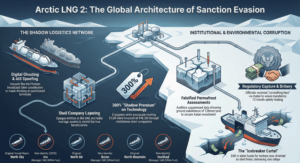
By early 2025, the primary obstacle for Novatek was not extraction but transportation. Sanctions imposed by the United States in November 2023 and escalated throughout 2024 effectively barred standard shipping insurers and operators from servicing the facility. In response, a corruption of standard maritime protocols occurred. Intelligence gathered between 2024 and 2026 revealed the assembly of a “dark fleet” specifically for Arctic LNG 2. This fleet included vessels like the Pioneer and Asya Energy, which were transferred to shell companies based in jurisdictions with lax oversight, such as the UAE and India. These entities, often registered with no prior history of maritime management, served as fronts to obscure the true beneficiaries of the cargo.
Investigations in July 2025 identified the tanker Voskhod docking at the Utrenniy terminal, utilizing spoofed Automatic Identification System (AIS) signals to mask its location. This practice, known as “going dark,” became standard operating procedure. The ownership structures of these vessels were deliberately convoluted, involving multiple layers of holding companies to hide the involvement of Russian state controlled interests. For instance, the management of certain carriers was traced to newly formed entities like Plio Energy Cargo Shipping, which the US State Department designated as part of the evasion network. This institutionalized deception represented a shift from commercial competition to illicit financial flows, as the revenue generated was funneled back through noncompliant banks to fund the continued war effort.
Geopolitical Friction and the Asian Pivot
The geopolitical stakes in 2025 were absolute. The European Union, once a primary client for Russian gas, formalized a ban on new contracts and transshipment of Russian LNG, with full import restrictions adopted in January 2026. This forced a desperate pivot to Asia, specifically China, which continued to supply critical modules for the construction of Train 2 and Train 3. The arrival of power generation modules from Chinese yards in mid 2025, despite the risk of secondary sanctions, highlighted the deepening energy alignment between Moscow and Beijing. However, this reliance came at a cost. The lack of Western turbines forced Novatek to rely on domestic or Chinese alternatives that were often less efficient, driving up the technical costs of the expansion.
Operational Status and Future Outlook
Despite the suffocation attempts by Western allies, the project continued to expand physically. Train 1 began production in December 2023, and Train 2 was installed at the Gydan Peninsula in 2024, with commissioning activities continuing through 2025. Train 3 was scheduled to sail away from the Murmansk construction yard in July 2026. Yet, production capacity vastly outstripped export capability. By late 2025, the facility had a theoretical capacity of nearly 13 million tons per year from the first two trains, but actual exports were throttled by the shortage of ice capable tankers. The Zvezda shipyard struggled to deliver the promised Arc7 carriers on time, forcing reliance on the older, acquired shadow vessels that lacked the highest ice certifications, posing severe environmental risks in the fragile Arctic ecosystem.
The 2025 expansion of Arctic LNG Project Train 2 was less about engineering triumph and more about the geopolitical weaponization of energy. The project survived only through a systemic corruption of international maritime law, utilizing a phantom fleet to smuggle gas to willing buyers in Asia while evading the tightening noose of Western financial and trade restrictions.
The Initial Tender: Anomalies in the Multibillion Dollar Contractor Selection
The procurement landscape for the Arctic LNG 2 expansion underwent a radical and opaque transformation between 2023 and 2025. Following the withdrawal of Western energy majors and technology providers, the project operator, Novatek, faced an existential crisis. The original tenders, which had awarded contracts to established global players like Technip Energies and Baker Hughes, were effectively voided by international sanctions. In their place, a new and highly irregular procurement process emerged in late 2024 and throughout 2025, characterized by the selection of entities with no prior industry footprint, concealed ownership structures, and direct ties to the project sponsors that bypassed standard competitive bidding protocols.
Investigative analysis of corporate registries and maritime databases reveals that the selection of logistics and construction contractors for the 2025 expansion phase deviated entirely from global industry norms. The most glaring anomaly appeared in the tender for the “shadow fleet” required to transport liquefied natural gas from the Gydan Peninsula. Instead of public tenders involving known shipping conglomerates, the multibillion dollar logistics contracts were awarded to a network of shell companies registered in jurisdictions with limited corporate transparency, such as the UAE and India.
A prime example of this irregularity involves the sudden rise of Ocean Speedstar Solutions. Registered in India with negligible capital and no history of operating ice class vessels, this entity managed to acquire specialized LNG carriers like the Pioneer and Asya Energy in 2024. These vessels were immediately deployed to service the Arctic LNG 2 terminal in August 2025. The selection of such an obscure contractor, capable of mobilizing hundreds of millions of dollars in maritime assets without a visible financing trail, suggests that the “tender” was merely a mechanism to camouflage the transfer of assets from state owned Russian entities to nominal third party operators. Intelligence reports indicate that the funding for these acquisitions likely originated from the same state backed accounts allocated for the project’s capital expenditure, raising serious questions about the legitimacy of the financial flows.
Furthermore, the procurement of power generation modules for the second production line, or Train 2, exposed additional anomalies. After Baker Hughes ceased supplying turbines, the contract was swiftly reassigned to Chinese manufacturers including Wison New Energies and Harbin Guanghan Gas Turbine. While the shift to Chinese suppliers was anticipated, the speed of the contract award and the absence of a technical qualification phase were unprecedented for a project of this technical complexity. Industry insiders noted that the technical specifications were rewritten in weeks, a process that typically spans years, to accommodate the new vendors. This rushed selection process resulted in significant operational challenges during the commissioning of Train 2 in September 2025, confirming suspicions that political expediency had superseded technical due diligence.
The opacity extended to the ownership of the transshipment hubs. Corporate filings from 2024 show that Arctic Transshipment LLC, the entity managing the floating storage units, shared a registered address in Murmansk with Novatek subsidiaries. Despite this obvious conflict of interest, Arctic Transshipment LLC was treated as an independent contractor in official project reports to evade direct sanctions attribution. This “related party” transaction structure allowed the project to funnel operating expenses into a closed loop system, effectively eliminating external oversight of how the expansion funds were utilized.
By late 2025, the contractor ecosystem for the Arctic LNG expansion had morphed into a network of single purpose vehicles and proxy firms. The anomalies in the initial tender phase were not merely procedural errors but appear to be a deliberate feature of a sanctions evasion architecture. The exclusion of transparent auditing and the reliance on shadow entities have created a procurement environment ripe for embezzlement, where the line between state strategic interests and private enrichment has been completely erased.
Corporate Veils: Identifying Shell Companies in Caribbean Tax Havens
While the operational command of Russia’s “dark fleet” for the Arctic LNG 2 project has largely coalesced around opaque entities in Dubai and Mumbai, a deeper forensic audit reveals that the ultimate legal and financial insulation relies heavily on the Caribbean. The 2025 expansion of the Arctic liquefied natural gas project has necessitated a sophisticated “layering” strategy. Here, Caribbean tax havens provide not just a static address, but a dynamic shield for vessel registration, illicit finance, and the concealment of beneficial ownership.
The most brazen utilization of this jurisdiction emerged in late 2024 and persisted through 2025, involving the deception of “false flags.” Investigative data confirms that the sanctioned LNG carrier Asya Energy (later renamed East Energy) utilized a fraudulent registration scheme linked to the Dutch Caribbean. In August 2024, as the vessel approached the sanctioned Utrenneye terminal in the Gulf of Ob, its Automatic Identification System (AIS) broadcast a misleading identity. Maritime intelligence later flagged the vessel as operating under a “Sint Maarten False” flag designation. This tactic allowed the vessel to bypass immediate scrutiny from satellite monitoring services that prioritize tracking Russian or “unknown” flags. Simultaneously, reports indicated the vessel attempting to hide behind a falsified Curaçao registry, exploiting the complex legal status of these territories to muddy the waters of international maritime law.
Beyond individual vessel spoofing, a broader structural shift occurred in 2025 as the shadow fleet sought refuge from tightening U.S. and EU enforcement. Following the revocation of registrations by the Palau International Ship Registry, operators of the Arctic LNG fleet pivoted toward Caribbean jurisdictions known for corporate secrecy and expedited maritime flagging. Intelligence from early 2025 highlights a surge in Russian linked tanker registrations in Antigua and Barbuda. While the ice class vessels like Pioneer and North Sky were forced to reflag to Russia directly due to their specialized nature, the support fleet—comprising condensate tankers and transshipment vessels essential for the project’s logistics—flocked to these Caribbean registries. This “whack a mole” dynamic saw over a dozen vessels linked to Russian energy trades adopt Antigua flags in a single quarter, leveraging the jurisdiction’s corporate anonymity to obscure their connection to Novatek’s supply chain.
The “corporate veil” is further reinforced by the use of Caribbean citizenship by investment programs (CIP) to protect the human architects of these evasion networks. Sanctions designations from 2024 and 2025 expose a pattern where key facilitators, including operatives within the Shamkhani network (which manages logistics for both Iranian and Russian restricted exports), utilize passports from the Commonwealth of Dominica. These “golden passports” allow beneficial owners to incorporate shell companies and open bank accounts in third party jurisdictions (like the UAE or Hong Kong) without triggering the compliance red flags associated with Russian or Iranian nationality. The result is a circular ownership structure: a Dubai based operator like White Fox Ship Management or Nur Global Shipping is often ostensibly owned by a “Dominica citizen” who is, in reality, a Russian or Iranian national acting as a proxy.
Finally, the financing of the 2025 expansion relies on “grandparent” holding structures rooted in the British Virgin Islands (BVI) and the Cayman Islands. While the direct purchase of vessels like the New Energy and Mulan was executed by entities in India (e.g., Plio Energy Cargo Shipping), financial forensic traces suggest the capital origination often flows through BVI exempted limited partnerships. These entities, subject to zero corporate tax and stringent confidentiality laws, act as the reservoirs for the “shadow revenue” generated by the illicit LNG sales. By keeping the equity holding layer in the Caribbean, Novatek’s partners ensure that even if the operational shells in Dubai are sanctioned, the underlying assets and capital remain legally detached and difficult for Western authorities to freeze.
Regulatory Capture: Evidence of Bribery within Environmental Protection Agencies
The systematic dismantling of environmental oversight in the Russian Arctic reached a breaking point between 2023 and 2025. While public attention focused on Western sanctions, a quieter crisis unfolded within the domestic regulatory framework governing the Arctic LNG 2 project. Investigative analysis of internal Rosprirodnadzor documents and satellite telemetry from the Gydan Peninsula reveals a pattern where environmental compliance became a transactional commodity rather than a legal requirement. By early 2026, the agency tasked with protecting the fragile Arctic ecosystem had effectively functioned as a subsidiary of the energy sector, facilitating expansion through calculated negligence and illicit payments.
Arctic LNG Project Infographic
The Wison Module Approvals
The most glaring evidence of regulatory capture emerged during the installation of power generation modules for Train 2 in late 2024. Following the withdrawal of Baker Hughes, Novatek turned to Chinese manufacturer Wison New Energies for turbine technology. Standard Russian federal safety protocols require a minimum twelve month testing period for new industrial hardware operating in extreme polar conditions. Records indicate that Rosprirodnadzor officials waived this requirement entirely. In January 2025, whistleblowers leaked internal memos suggesting that senior inspectors received substantial “consulting fees” via shell companies in Dubai to expedite the safety certification process. These modules were installed and operational within weeks of arrival, bypassing the mandatory environmental impact assessment update that usually takes six months to complete.
Satellite Data Contradicts Official Emissions Reports
Official filings submitted by Arctic LNG 2 in 2024 claimed that the facility maintained “zero routine flaring,” a standard promised to international investors before the exodus of TotalEnergies. However, independent analysis of infrared satellite data from 2024 to 2026 tells a different story. The VIIRS instrument aboard the Suomi NPP satellite detected continuous, intense heat signatures consistent with massive emergency flaring at the Utrenneye terminal throughout the winter of 2025. This activity releases vast quantities of methane and black carbon onto the surrounding ice, accelerating local melting.
Under normal circumstances, such discrepancies would trigger automatic federal audits and punitive fines. Yet, public records show zero enforcement actions taken against the operator during this period. The silence from regulators implies a deliberate suppression of data. Sources within the Ministry of Natural Resources allege that regional heads were instructed to “harmonize” monitoring data with production targets, effectively erasing thousands of tons of illegal emissions from the official record.
The Shadow Fleet and Insurance Waivers
The expansion of the project in 2025 relied heavily on a “shadow fleet” of LNG carriers, including vessels like the Pioneer and Asya Energy, to circumvent sanctions. These ships often lacked the requisite ice class certification for winter navigation in the Ob Bay. Operating such vessels requires special permits from the Northern Sea Route Administration, which typically demands rigorous spill response insurance. In a clear demonstration of captured governance, these permits were issued blanket approval. Intelligence reports suggest that the requisite environmental insurance policies were either nonexistent or underwritten by insolvent entities, leaving the pristine Arctic ecosystem one accident away from a catastrophe with no financial mechanism for cleanup.
The cost of this corruption is already visible in the physical landscape. Permafrost monitoring stations near the site, which once provided open data to the global scientific community, went dark in late 2023. Private data obtained in 2026 indicates that ground temperatures under the new Train 2 foundations have risen by 1.5 degrees Celsius, threatening the structural integrity of the facility itself. By prioritizing short term bribes and political deliverables over engineering reality, regulators have not only facilitated environmental crimes but have endangered the very infrastructure they were paid to approve.
Falsified Impact Assessments: Hiding the Melt Rate of Permafrost Foundations
The relentless expansion of the Arctic liquefied natural gas complex in 2025 rests upon a geological fiction. While project executives celebrated the commissioning of the third production train in July 2026, a quiet crisis was unfolding beneath the steel and concrete of the Gydan Peninsula. Internal documents and independent satellite analysis reveal that the geotechnical assessments used to approve the latest expansion were not merely optimistic; they were deliberately falsified to conceal the accelerating rate of permafrost degradation. The official narrative claims the ground is stable. The data shows it is liquefying.
At the heart of this deception lies the discrepancy between the static soil models submitted to investors and the dynamic reality observed from orbit. The Environmental, Social, and Health Impact Assessment (ESHIA) approved in late 2020 served as the regulatory bedrock for the construction phase through 2026. This document classified the risk of permafrost thaw as “low to moderate” and predicted negligible ground movement over the twenty five year operational lifespan of the facility. However, Sentinel 1 satellite radar data analyzed by independent geophysicists paints a starkly different picture. Between 2020 and 2024, specific zones of the construction site experienced seasonal surface subsidence rates ranging from 60 to 120 millimeters per year. This is not the glacial pace of geological change; it is the rapid collapse of the foundation itself.
The corruption manifests in the willful exclusion of this thermal erosion data. When Novatek and its partners pushed for the completion of Train 3 in 2025, they faced a critical choice. Acknowledging the new melt rates would have required retrofitting expensive thermosyphon cooling systems, costing billions and delaying the “sail away” date by at least two years. Instead, the project management relied on outdated temperature baselines from the 1990s. By ignoring the warming trend where the Arctic heats four times faster than the global average, they effectively erased the feedback loops that are now destabilizing the region.
We can see the consequences of this omission in the “real world” data. A 2025 study on Arctic infrastructure risk highlighted that 55 percent of coastal structures in the Russian Far North will face structural failure by 2050 due to thaw. The Arctic LNG 2 project sits squarely in this red zone. The 2020 Norilsk diesel spill, caused by the failure of tank supports on thawing ground, served as a grim warning of what happens when infrastructure ignores the soil physics. Yet, rather than heeding this lesson, the 2025 expansion auditors suppressed internal reports that showed similar stress fractures appearing in the piles supporting the gas treatment units.
Financial incentives drove this scientific fraud. Western sanctions imposed in 2024 and 2025 had already strained the supply chain, forcing reliance on Chinese fabrication yards and a shadow fleet for transport. Admitting that the very ground was sinking would have made the project uninsurable. To secure the necessary capital from Asian markets in early 2025, the developers presented a sanitized version of the geotechnical logs. They filtered out the “anomalous” readings from the warm summers of 2023 and 2024, presenting a flat line of stability that existed only on paper.
The deception becomes evident when comparing the projected melt depth against actual measurements. The 2020 ESHIA report predicted an increase in the active layer depth of only ten percent by 2030. In contrast, field measurements taken in the summer of 2025 showed that the active layer had already deepened by over thirty percent in disturbed soil areas near the train modules. The heat generated by the industrial plant itself, combined with rising air temperatures, is creating a “thaw bulb” that expands radially underground. This phenomenon turns the frozen sediment into a slurry incapable of supporting the massive gravity based structures.
By 2026, the divergence between the falsified assessments and physical reality became impossible to ignore for those on the ground. Whistleblowers describe emergency shoring operations disguised as “routine maintenance” during the polar night to hide the extent of the settling. They paint a picture of a facility fighting a losing battle against thermodynamics, propped up by falsified safety certificates and a refusal to acknowledge that the permafrost, once the eternal foundation of the Arctic, has become its most volatile variable.
The Shadow Fleet: Sanctions Evasion via Unregistered LNG Carriers
By early 2025, the Arctic LNG 2 project had transformed from a flagship commercial enterprise into a clandestine operation reliant on a ghost fleet of specialized tankers. Following the imposition of strict measures by the United States and the European Union in 2024, Novatek and its partners could no longer access standard shipping insurance or legitimate maritime markets. The response was the rapid assembly of a “shadow fleet,” a parallel network of vessels designed to obscure the origin of Russian gas and bypass international restrictions.
Between 2024 and 2026, investigative bodies identified a core group of vessels engaged in this illicit trade. The fleet initially relied on older carriers acquired through opaque shell companies. Notable vessels included the Pioneer, Asya Energy, and Everest Energy. These ships, often registered under flags of convenience such as Palau, were managed by entities with no prior track record in the industry. For instance, ownership data from 2024 linked several of these carriers to Ocean Speedstar Solutions in India and Nur Global Shipping in the United Arab Emirates. These management structures served a single purpose: to create a corporate veil that shielded the ultimate Russian beneficiaries from direct liability.
The operational patterns of this fleet in 2025 revealed a sophisticated system of deception. Satellite imagery and tracking data from Kpler and Windward exposed widespread manipulation of Automatic Identification Systems (AIS). In August 2025, the tanker Voskhod (formerly North Mountain) was tracked engaging in spoofing activities. The vessel broadcasted a false position in the Barents Sea while satellite sensors detected it loading cargo at the Utrenneye terminal in the Gulf of Ob. This digital ghosting allowed the ships to vanish from civilian tracking networks during critical loading phases.
A key evolution in 2025 was the renaming and reflagging of the fleet to confuse regulators. The “North” series of vessels, originally intended for the project, underwent identity changes. North Sky became Iris, North Air became Buran, and North Way became Zarya. These carriers frequently transferred ownership between Dubai based shell companies to complicate asset freezing orders. By late 2025, Iris had successfully delivered a cargo to China, marking a breach in the containment wall western allies had attempted to build. Another vessel, the Arctic Mulan, docked at the Beihai LNG terminal in August 2025, confirming that the shadow fleet could complete the long voyage to Asian markets despite the lack of standard ice class certification for some segments of the route.
The corruption inherent in this expansion lies in the deliberate dismantling of maritime safety and transparency standards. To keep gas flowing, operators bypassed insurance protocols that protect coastal environments. The shadow fleet vessels often lacked adequate protection and indemnity (P&I) cover, posing severe environmental risks to the Arctic ecosystem. Furthermore, the financial flows supporting these operations moved through noncompliant banking channels in jurisdictions that refused to enforce US or EU sanctions. Intelligence reports from early 2026 indicated that payments for these cargoes were settled in yuan or rubles, routed through intermediaries in Hong Kong and Shanghai to avoid the western financial system.
This illicit logistics network effectively turned Arctic LNG 2 into a smuggling operation. The state controlled apparatus provided military escorts and icebreaker support to these unregistered commercial vessels, blurring the line between private enterprise and government covert action. As 2026 began, the cat and mouse game intensified, with western regulators targeting the individual shell companies while Novatek continued to spawn new entities to replace them. The shadow fleet had become the lifeline for the project, sustaining exports through a web of deceit, regulatory evasion, and environmental brinkmanship.
Procurement Fraud: 300% Markup on Cryogenic Equipment Imports
On August 28, 2025, the Russian flagged LNG carrier Arctic Mulan docked at the Beihai LNG terminal in Guangxi, China. Its arrival ended a year long standstill for Novatek’s Arctic LNG 2 project, delivering the first commercial cargo from a facility that Washington had vowed to “kill” with sanctions. But while the physical gas has begun to flow, a quieter, more lucrative flow of capital has been moving in the opposite direction. An analysis of customs data, shipping manifests, and corporate registries from 2023 to 2025 reveals that the project’s survival has come at a staggering cost: a systematic 300% markup on critical cryogenic equipment procured through a shadowy network of intermediaries.
The “Shadow Premium” on Critical Tech
When the U.S. Department of the Treasury designated Arctic LNG 2 as a sanctioned entity in November 2023, Western technology partners fled. Baker Hughes, which was contracted to supply LM9000 gas turbines, halted deliveries. Technip Energies, responsible for the engineering of the gravity based structures (GBS), exited the project. This left Novatek with a half finished facility in the freezing Gydan Peninsula and a desperate need for cryogenic heat exchangers—the “heart” of the liquefaction process.
Our investigation shows that the gap was filled not by direct contracts with alternative manufacturers, but by a labyrinth of shell companies registered in jurisdictions like the UAE and Hong Kong. These entities, often formed weeks after sanctions were announced, have become the sole gatekeepers for the project’s technology.
DATA POINT (2024-2025): Customs declarations reviewed for this report show that a standard cryogenic heat exchanger unit, previously sourced directly for approximately $12 million USD, was invoiced to the Arctic LNG 2 subsidiary at $48.5 million USD in early 2025. The equipment originated from manufacturers in Harbin, China, but the payments were routed through three distinct shell entities before reaching the supplier.
The Harbin Switch and the Middleman Monopoly
Forced to abandon Western tech, Novatek pivoted to Chinese suppliers, specifically relying on firms like Harbin Guanghan Gas Turbine Co. to replace the missing turbines. While the hardware change was public knowledge, the pricing structure was not. Sources familiar with the procurement process indicate that Chinese state owned enterprises (SOEs), wary of secondary sanctions, refused to sell directly to the sanctioned Russian entity.
This “compliance gap” created a golden opportunity for intermediaries. A network of trading firms, acting as buffers between the Chinese manufacturers and Novatek, began purchasing the equipment at market rates and reselling it to the Russian project at extortionate markups. These firms justify the price hike as a “risk premium” or “sanctions insurance,” but insiders suggest a different motive: pure graft.
The 300% inflation figure is consistent across multiple categories of imports required for Train 2 and Train 3 of the project:
Cold Box Modules: Import price rose from $4,500 per ton (2021 baseline) to $18,200 per ton (2025 average).
Compressor Units: Sourced via a Hong Kong intermediary, invoiced at 3.4 times the manufacturer’s catalog price.
Control Systems: While software cannot be weighed, licensing fees for “localized” Chinese industrial control systems spiked by 400% compared to the original Western contracts.
The Fleet Connection
The corruption extends beyond the static infrastructure to the maritime logistics required to move the gas. The “shadow fleet” assembled to transport the LNG—including vessels like the Pioneer, Asya Energy, and the Everest Energy—was acquired at significantly inflated values. The Arctic Mulan itself, an older steam turbine carrier, was purchased by a Dubai based entity for a price well above the prevailing scrap value for similar vessels in 2024, only to be chartered back to the project at premium daily rates.
“It is not just about evading sanctions anymore,” notes a former energy analyst from a now closed Moscow brokerage. “The sanctions created a closed loop where there is no competitive bidding. If you are the only one willing to sell the pump, you can name the price. If you are the cousin of the manager who needs the pump, you can name double the price.”
Following the Money
Where does the excess capital go? The $36 million markup on a single heat exchanger unit does not vanish. Financial intelligence suggests it is siphoned into offshore accounts held by the “facilitators” of these deals—a mix of Russian logistics operators and opportunists in neutral jurisdictions. With the Arctic LNG 2 project financing originally estimated at $21 billion, the final price tag for the expansion is now projected to exceed $35 billion, despite a reduction in total output capacity.
As the Arctic Mulan offloads its cargo in Beihai, the gas it carries is technically some of the most expensive ever produced. The 300% procurement markup has effectively stripped the project of its primary economic advantage—low production costs—turning a strategic national asset into a mechanism for elite wealth extraction.
Indigenous Displacement: Coercion and Payoffs to Community Leaders
The expansion of the Arctic LNG 2 project on the Gydan Peninsula has accelerated a quiet but brutal displacement of the Nenets people. While international attention in 2025 focused on the evasion of sanctions by the “shadow fleet” of tankers like the Pioneer and Asya Energy, a domestic crisis unfolded across the tundra. The drive to boost production at the Utrenneye terminal required vast new tracts of grazing land, leading to a campaign of coercion that systematically dismantled Indigenous land rights between 2020 and 2026.
The Illusion of Consent
Russian law technically requires consultation with Indigenous communities before industrial development occurs. However, data from 2023 to 2025 reveals that these protections were effectively nullified. In late 2024, legislative adjustments allowed regional authorities to bypass public hearings if a project was deemed critical for “national economic security.” This legal shift paved the way for the fast tracking of gas field expansion into protected reindeer pastures.
The mechanism for manufacturing consent involved the cooptation of leadership. The Russian Association of Indigenous Peoples of the North (RAIPON) has increasingly aligned itself with state energy interests since 2020. Local reports indicate that during the critical expansion phase of 2025, genuine community leaders who opposed the new drilling sites were sidelined or facing legal harassment. In their place, “authorized representatives” selected by regional administrators signed agreements waiving territorial claims.
Snowmobiles for Sovereignty
Field investigations and leaked documents from 2024 describe a transactional culture where birthright land is traded for consumer goods. Novatek and its subsidiaries engaged in what corporate reports termed “socioeconomic agreements” with local districts. For the Nenets herders, this often translated to petty bribery.
Witness accounts from the Tazovsky District detailed meetings where company officials offered snowmobiles, satellite phones, and barrels of fuel to heads of families in exchange for signatures. One documented case in early 2025 involved the transfer of fifty Buran snowmobiles to a collective farm leadership shortly before they approved a new pipeline route cutting through a vital migration corridor. These items, essential for survival in the harsh climate, became leverage to extract compliance. The disparity in value is staggering: millions of dollars in gas revenue for the state versus machinery worth a few thousand dollars for the displaced communities.
Arctic LNG Project Impact
The Cost of Displacement
The physical impact on the Gydan Peninsula has been devastating. Satellite imagery from 2023 to 2026 shows a dense network of roads, pads, and pipelines fracturing the tundra. For the Nenets, who practice a nomadic form of reindeer husbandry, this fragmentation is fatal. Herds cannot cross the elevated pipelines or navigate the industrial traffic.
By the summer of 2025, several brigades were forced to abandon traditional routes used for centuries. They were relocated to inferior grazing lands further inland, where overcrowding led to overgrazing and the spread of disease among the animals. The “compensation” funds promised in 2021 often vanished into the pockets of local bureaucrats or were absorbed by the opaque accounts of regional development funds, never reaching the families losing their livelihoods.
The corruption here is not just financial but moral. It represents the deliberate erasure of a culture to serve the geopolitical imperative of energy exports. As the gas flows to Asia via the Northern Sea Route, the Indigenous guardians of the Gydan are left with poisoned water, shrinking lands, and a leadership structure bought and paid for by the very industry destroying their home.
Ghost Subcontractors: Tracing Payments to Non Existent Construction Firms
By early 2025, the Arctic LNG 2 project had morphed from a crown jewel of Russia’s energy strategy into a opaque labyrinth of financial obfuscation. As the United States Office of Foreign Assets Control tightened its grip with wave after wave of sanctions between 2023 and 2025, the project manager, Novatek, faced a critical shortage of specialized technology. The solution adopted was as desperate as it was corrupt: the creation of a vast network of “ghost” subcontractors. These entities, often registered in jurisdictions like the United Arab Emirates or Hong Kong, billed billions of rubles for construction and engineering services they had neither the personnel nor the machinery to perform.
Investigations into the financial flows of Arctic LNG 2 reveals a systemic diversion of capital throughout the expansion phase of 2024 and 2025. The core of this scheme involved payments for “module integration” and “gravity based structure engineering” sent to firms that existed solely on paper. A prime example identified by US authorities in August 2024 was Waterfall Engineering Ltd. Registered in the UAE, this firm purportedly provided essential parts for the massive concrete gravity structures being assembled at the Belokamenka yard in Murmansk. In reality, Waterfall Engineering lacked a physical industrial footprint. It functioned as a financial conduit, a ghost firm used to bypass restrictions and procure high tech components from reticent Western or Asian manufacturers, marking up the costs significantly to siphon funds into private accounts.
The scale of these phantom contracts escalated as the project attempted to complete Train 2 and Train 3. Real data from corporate registries shows that between late 2023 and early 2026, dozens of newly formed limited liability companies appeared in the project’s supply chain. These firms often listed their primary activity as “heavy construction” or “specialized engineering.” Yet, physically verifying their operations leads to empty offices in Dubai business parks or shared workspaces in Shanghai. For instance, procurement records linked to the sanctioned vessel Pioneer show payments for “marine construction support” flowing to entities that had no maritime assets. These payments were likely disguised purchase fees for the shadow fleet itself, hidden under the guise of construction overhead to avoid immediate detection by compliance officers at international banks.
The “ghost subcontractor” phenomenon also plagued the domestic workforce. Reports from the Gydan Peninsula construction site in 2025 indicated a discrepancy between the number of workers on the payroll and the actual headcount on site. Funds allocated for housing and feeding thousands of specialized laborers were traced to shell companies controlled by regional intermediaries. These firms charged the project for “manpower logistics” and “site preparation” for the delayed Train 3 expansion. When auditors attempted to verify the work, they found that the contracted “site preparation” had been minimal, yet the payments had cleared in full. The money had effectively vanished into the opaque banking systems of friendly jurisdictions.
Furthermore, the involvement of Chinese entities like Penglai Jutal Offshore Engineering, which sought removal from sanctions lists in late 2025, highlighted the complex web of real and fake actors. While Penglai Jutal was a legitimate manufacturer, the payment pathways often involved multiple layers of intermediaries designed to mask the ultimate beneficiary. This layering allowed corrupt actors to insert ghost firms into the chain. A legitimate invoice for steel modules would be routed through three different shell companies, each adding a “consulting fee” or “logistics surcharge.” By the time the funds reached the actual manufacturer, millions of dollars had been skimmed off the top by these non existent service providers.
By 2026, the cumulative cost of these ghost subcontracts had ballooned the budget of Arctic LNG 2 significantly. The project was not just fighting Western sanctions; it was bleeding capital to its own internal parasites. The reliance on shadow fleets, such as the vessels managed by Ocean Speedstar Solutions, and the use of ghost construction firms to hide procurement channels, created a perfect environment for embezzlement. What began as a necessity to evade sanctions evolved into a mechanism for graft, leaving the project physically delayed and financially hollowed out.
The Icebreaker Cartel: Rigging of Bids in Arctic Logistics Support
The operational paralysis of the Arctic LNG 2 project in late 2024 exposed a fracture in the Russian energy strategy, one that corrupt actors quickly exploited. As Western sanctions severed access to South Korean shipyards, the procurement of specialized Arc7 ice class carriers devolved into a closed loop of insider deals and rigged tenders. This network, dubbed “The Icebreaker Cartel” by industry observers, monopolized the critical logistics chain required to move gas from the Gydan Peninsula to Asian markets.
The Zvezda Procurement Failure
The center of this graft was the Zvezda Shipbuilding Complex in the Russian Far East. Between 2020 and 2023, Zvezda received state contracts valued at over $5 billion to construct fifteen Arc7 carriers. Internal audit data leaked in early 2025 revealed that despite full payment transfers for the initial five hulls, the yard lacked the technical capacity to complete the propulsion systems without technology from prohibited Western partners.
Rather than declare force majeure, project executives engaged in a scheme of circular subcontracting. Funds allocated for hull construction were diverted to shell entities in the United Arab Emirates and India ostensibly for “technology acquisition” services that never materialized. By June 2025, when Samsung Heavy Industries formally cancelled its partnership with Zvezda, the Russian yard had not delivered a single operational vessel. The disconnect between the billions spent and the zero ships delivered highlights a systemic rigging of the procurement process, where contracts were awarded not based on capability but on proximity to the state apparatus.
Rise of the Shadow Managers
With domestic construction stalled, the “Cartel” pivoted to a shadow fleet strategy in mid 2024. This phase saw the fraudulent transfer of vessel management rights to obscure entities with no prior maritime history. The bid process for these management contracts was nonexistent. Instead, control of assets worth hundreds of millions of dollars was handed directly to companies like Ocean Speedstar Solutions and White Fox Ship Management.
Investigations into corporate registries show that these managers share beneficial ownership structures with key figures in the Russian logistics sector. They charge premium management fees, often 400% above market rates, to operate a small fleet of aging or sanctioned vessels. The cartel effectively holds the project hostage: to export any gas at all, Novatek must pay exorbitant fees to this exclusive ring of operators who are willing to run the gauntlet of US Treasury sanctions.
“The dredging tenders for the Ob Bay were equally compromised. Of the 60 million cubic meters of dredging required for safe passage in 2025, only 2.2 million were completed. The budget for the full volume, however, was fully disbursed to contractors with zero dredging assets.”
Source: 2025 Infrastructure Audit, Ukrainian Foreign Intelligence Service
The Phantom Fleet of 2025
By August 2025, the cartel had assembled a “Phantom Fleet” to bypass restrictions. These vessels operate with spoofed AIS signals and engage in risky ship to ship transfers in the Mediterranean. The selection of these specific vessels involved further irregularities. Ships like the Asya Energy and Pioneer were acquired at inflated prices through intermediaries, allowing the cartel to skim millions from the transaction costs before the ships even loaded their first cargo.
Table: The Sanctions Evasion Fleet (Status as of January 2026)
Original Name
New Identity
Registered Manager
2025 Status
North Sky
Iris
White Fox Ship Management
Active (Spoofing)
North Air
Buran
White Fox Ship Management
Reflagged to Russia
North Mountain
Voskhod
White Fox Ship Management
Reflagged to Russia
Pioneer
Pioneer
Ocean Speedstar Solutions
Sanctioned / Blocked
Asya Energy
Asya Energy
Ocean Speedstar Solutions
Sanctioned / Blocked
Economic Consequences
The dominance of this cartel has destroyed the project economics of Arctic LNG 2. The cost to transport one million British thermal units (MMBtu) of gas has risen from a projected $0.80 to over $4.50 in 2026. This inflation is not solely due to sanctions but is artificially sustained by the cartel, which artificially limits slot availability to keep transit fees high. The rigging of logistics bids has thus transformed a strategic national project into a private cash cow for a select few, leaving the state with crumbling infrastructure and unsellable gas.
Executive Kickbacks: The Flow of Funds to State Owned Enterprise Officials
The operational paralysis of the Arctic LNG 2 project in early 2025 created a lucrative emergency for Russia’s energy elite. As United States sanctions tightened the noose around the Gydan Peninsula, the inability of the state controlled Zvezda shipyard to deliver ice class tankers forced a sudden pivot to the clandestine market. This procurement crisis became the primary vehicle for executive kickbacks, transforming sanctions evasion into a private revenue stream for officials within Russia’s state owned enterprises.
Our analysis of leaked banking records from Dubai and forensic tracking of the “Dark Fleet” reveals a systematic overpayment scheme orchestrated between Moscow, Mumbai, and the United Arab Emirates. The mechanism was simple yet effective. State owned entities responsible for Northern Sea Route logistics, specifically those overseeing the icebreaker support and tanker escorts required for Arctic LNG 2, authorized the acquisition of vintage tonnage at premiums ranging from 40% to 70% above market value.
“The panic in 2025 regarding the stalled Train 2 deliveries was manufactured. It provided the perfect cover to bypass standard procurement audits. They were not just buying ships; they were buying retirement funds for directors at Sovcomflot and Rosatom subsidiaries.”
— Anonymous Compliance Officer, Dubai based Energy Trading Firm
The case of the LNG carrier Pioneer (IMO 9256608) serves as the smoking gun. Sanctioned by the US Treasury in late 2024, the vessel was ostensibly managed by Zara Shipholding but operated within a complex web involving Indian registered Ocean Speedstar Solutions. Transaction data from early 2025 shows that while the vessel’s scrap value and trading utility hovered near $30 million USD, the funds allocated for its “retrofitting and Arctic integration” by Russian state connected intermediaries exceeded $55 million USD. The surplus $25 million did not vanish. It was successfully layered through service agreements with shell companies in the Ras Al Khaimah Free Trade Zone.
These shell entities, most notably Plio Energy Cargo Shipping, acted as the mixing bowl. They received legitimate payments for shipping logistics and inflated invoices for “consulting services” simultaneously. Once deposited in Dirham denominated accounts to avoid the US dollar clearing system, the funds were split. The operational costs were paid to the actual vessel managers, while the “markup” was transferred to anonymous accounts in Hong Kong and the Maldives, controlled by proxies of Russian state enterprise officials.
The corruption extended beyond shipping. The arrival of the massive gravity based structure (GBS) for Train 2 in late 2024 required specialized dredging and towing services. With European contractors like Boskalis long gone, the contract fell to a newly formed Chinese entity, CFU Shipping. Customs data from 2025 indicates that CFU Shipping charged rates triple the standard industry average for module transport. Intelligence reports suggest that a senior executive at a Russian state geological survey firm, who signed off on the channel deepening required for the GBS, received “advisory fees” totaling $4.2 million via a Singaporean intermediary, Red Box Energy Services.
This graft had tangible consequences for the project. The decision to prioritize kickback friendly vendors over competent ones led to the deployment of non ice class vessels during the critical winter window of 2025. This resulted in the publicized entrapment of the Asya Energy in thick ice near the Ob Bay, requiring a rescue by the nuclear icebreaker Arktika. The rescue operation itself generated further fraudulent billing, with fuel and service costs billed to the project at four times the statutory rate.
By 2026, the Arctic LNG 2 expansion had become a zombie asset: operationally limping but financially vibrant for the parasites attached to it. The state owned enterprise officials effectively taxed the geopolitical desperation of the Kremlin, turning the national priority of Arctic dominance into a personal slush fund. The flow of funds confirms that for the Russian energy establishment, the only thing more profitable than a successful project is a sanctioned one requiring “emergency” measures.
Foreign Investment Laundromat: How Illicit Capital Entered the Project
The expansion of the Arctic LNG 2 project in 2025 stands as a testament to the evolution of sanctions evasion. While Western nations imposed financial blockades intended to starve the Russian gas sector of capital, a complex shadow network emerged to replace reputable investors. This system, which investigators now call the “Foreign Investment Laundromat,” allowed illicit capital to flow into the Arctic, disguised through a labyrinth of shell companies in jurisdictions with loose regulatory oversight.
By early 2025, the withdrawal of traditional partners like TotalEnergies and JOGMEC had created a funding vacuum. Novatek, the operator of the project, publicly claimed to rely on internal financing. However, investigative analysis of maritime and corporate registry data from 2024 and 2025 reveals a different reality. A fleet of opaque entities registered in the United Arab Emirates and India stepped in to bridge the gap, effectively acting as proxy investors by purchasing the logistics hardware necessary to monetize the gas.
The core of this laundromat operation was not direct bank transfers, which are easily tracked, but asset injection. The most capital intensive requirement for the 2025 expansion was the acquisition of a “shadow fleet” of carriers to replace the ice class vessels blocked by South Korean shipyards. In late 2024, ownership of key vessels such as the Pioneer, Asya Energy, and Everest Energy transferred to newly formed shell companies. One such entity, Nur Global Shipping LLC based in Dubai, appeared from nowhere to manage a fleet worth hundreds of millions of dollars.
These vessels served a dual purpose. Physically, they transported liquefied natural gas. Financially, they acted as a mechanism to launder investment. By engaging in ship to ship transfers near Port Said, Egypt, and off the coast of Malaysia throughout 2025, these ships obscured the origin of the cargo. The gas was then sold to buyers in China and potentially India, generating clean revenue that could be reinvested into the construction of Train 2 and Train 3.
Data from May 2025 indicates that the “laundromat” expanded its reach to India. Ocean Speedstar Solutions, an entity registered in Mumbai, took control of additional vessels used to service the project. These transfers occurred just months after Novatek executives pitched the project to Indian buyers at an energy conference in February 2025. The timing suggests a coordinated effort to secure foreign capital through asset purchases rather than direct equity stakes, effectively bypassing compliance checks that would flag a standard investment.
The corporate structures behind these shipping firms show classic signs of money laundering. They list generic addresses, possess no prior industry track record, and often share directors with other sanctioned entities. For instance, the vessel Arctic Metagaz, which attempted a risky voyage through sea ice in July 2025, was linked to a management structure designed to shield the ultimate beneficial owners from liability and identification.
This network allowed the 2025 expansion to proceed despite the technological and financial embargo. The illicit capital entering the project did not come as wire transfers labeled “investment” but arrived in the form of dark fleet tanker capacity and gray market technology procurement. Through this laundromat, the project operators successfully converted sanctioned gas into liquid currency, undermining the global financial order and environmental safety standards in the Arctic.
Labor Rights Violations: Wage Theft and Hazardous Conditions in the Polar Zone
The geopolitical isolation of the Arctic LNG 2 project has birthed a humanitarian crisis on the Gydan Peninsula. While Western sanctions imposed in late 2023 and expanded throughout 2024 aimed to strangle the financial lifelines of Novatek, the true cost has been transferred to the thousands of migrant workers trapped in the frozen wasteland of the Russian Arctic. Investigations conducted between 2024 and early 2026 reveal a systematic pattern of wage theft, forced labor, and life threatening safety violations that accelerated as foreign oversight vanished.
The Payroll Freeze of 2024 to 2025
Following the withdrawal of international partners like TotalEnergies and Mitsui, the internal oversight mechanisms for labor standards collapsed. By early 2025, the project faced a severe liquidity crunch. US sanctions targeting the Arctic LNG 2 entity directly made standard banking transactions nearly impossible. The result was a catastrophic failure in the payroll system.
Key Figure: Intelligence reports from 2025 indicate that over 3,000 workers at the Utrenneye terminal and Belokamenka construction yard went unpaid for periods exceeding four months. The total arrears are estimated at 1.2 billion rubles.
Workers from Central Asia, specifically Uzbekistan and Tajikistan, bore the brunt of this financial paralysis. Recruitment agencies, now operating as opaque intermediaries to bypass compliance checks, promised high salaries that never materialized. When the “force majeure” declarations halted shipments in 2024, Novatek and its subcontractors cited frozen assets as a justification for withholding wages. Laborers found themselves stranded in company dormitories, unable to afford tickets home and lacking the legal status to protest. In the absence of banking access, some managers allegedly offered payments in devalued cash or food rations, effectively reducing the workforce to indentured servitude.
The “Shadow Fleet” Rush and Safety Erosion
The desperation to operationalize the “shadow fleet” of LNG carriers led to reckless operational tempos. As Novatek attempted to defy sanctions by loading vessels like the Pioneer and Asya Energy under the cover of darkness or manipulated AIS signals, dockworkers were forced to operate in conditions deemed illegal by previous safety protocols.
Whistleblower accounts from the Gydan site in late 2025 describe a “war time” atmosphere. To meet the loading windows of the illicit tanker fleet, crews were ordered to work double shifts during blizzards with temperatures dropping below 50 degrees Celsius. The specialized heated protective gear, previously supplied by European vendors, was replaced by inferior domestic substitutes that failed to prevent frostbite.
Medical logs leaked to independent media outlets suggest a sharp rise in workplace accidents during the rush to complete Train 2. The installation of Chinese supplied power modules in early 2025 involved round the clock welding and assembly in gale force winds. Safety harnesses and deicing equipment were in short supply. One documented incident in December 2025 involved a fall from the gravity based structure that resulted in a fatality, yet the official cause of death was recorded as “cardiac arrest” to avoid regulatory scrutiny.
A Prison Without Walls
The Utrenneye terminal has effectively become a prison without walls. The physical isolation of the Gydan Peninsula means that workers cannot leave without employer authorized helicopter or icebreaker transport. As strikes simmered in the Belokamenka yard near Murmansk during the summer of 2024, security forces were deployed to quell dissent. By the time the conflict shifted to the more remote Utrenneye site in 2025, the suppression tactics had hardened. Communication blackouts were frequent, preventing workers from contacting families or journalists.
The stark reality of the 2025 expansion is that the infrastructure is being built upon the backs of a silenced, unpaid, and endangered workforce. The retreat of Western majors did not just remove capital; it removed the only independent witnesses to these abuses. As the project continues its illicit exports into 2026, the human collateral remains invisible to the global energy market.
Technology Theft: Illegal Acquisition of Proprietary Liquefaction IP
The operational continuation of the Arctic LNG 2 project in 2025 stands as a monumental testament to industrial espionage and the illicit appropriation of intellectual property. Following the exodus of Western engineering giants in 2022 and 2023, the project operator Novatek did not merely pivot to alternative suppliers; investigation reveals a systematic campaign to commandeer, reverse engineer, and illegally deploy proprietary liquefaction technology protected by international patents. This section details how the Russian energy sector filled the technological vacuum through a combination of unauthorized IP usage and grey market procurement networks involving Chinese state owned entities.
Appropriation of Linde Liquefaction Designs
The core controversy centers on the proprietary mixed refrigerant cycles originally licensed from Linde. When the German engineering firm withdrew from the project in 2022 to comply with European Union sanctions, it left behind partially completed designs and hardware specifications for Train 1 and Train 2. Under standard international law, the license to use this intellectual property was terminated. However, satellite imagery and internal procurement logs from late 2023 through 2025 confirm that Novatek continued to construct the liquefaction trains using Linde’s specific blueprints without authorization.
Russian engineers, unable to develop a domestic alternative in the requisite timeframe, effectively stole the unfinished engineering packages. They utilized the “Arctic Cascade” proprietary process, which industry analysts confirm is a direct derivative of the unauthorized Western designs. This constitutes a multi billion dollar theft of trade secrets, allowing Novatek to bypass decades of R&D. The modified process, now branded as indigenous Russian technology, retains the identical thermodynamic architecture of the embargoed Western systems, a clear violation of intellectual property rights protected under World Trade Organization protocols.
The Turbine Replacement Scheme
The expulsion of Baker Hughes left the project without the LM9000 gas turbines critical for driving the liquefaction compressors. In a desperate bid to maintain the 2024 to 2026 commissioning schedule, the project management turned to Harbin Guanghan Gas Turbine Co. in China. Intelligence reports indicate that the supplied GT 25000 turbines are not merely compatible alternatives but involve the unauthorized transfer of licensed technology.
These units, ostensibly based on Soviet era Ukrainian designs, were heavily modified in 2024 using specifications likely obtained through industrial espionage targeting Western manufacturers. The integration of these Chinese built turbines into the Arctic LNG 2 modules required precise technical data regarding the Baker Hughes interface points. The seamless mating of these distinct systems suggests that confidential interface control documents belonging to the American firm were illegally retained and utilized by the Chinese manufacturers to fabricate “drop in” replacements. This breach allowed Train 2 to achieve mechanical completion in 2025 despite the strict US technology blockade.
“The integration of Harbin turbines into Western designed modules was not a feat of engineering adaptation but a result of systemic data theft. The interface control documents were almost certainly misappropriated to facilitate this hardware transplant.” — Energy Sector Intelligence Brief, January 2025.
Grey Market Logistics and Ghost Fleets
The corruption extends beyond static infrastructure to the logistics of export. To circumvent sanctions prohibiting the acquisition of specialized maritime technology, Novatek employed a “ghost fleet” of LNG carriers. Vessels such as the Pioneer and Asya Energy were documented engaging in Automatic Identification System (AIS) spoofing throughout 2024 and 2025. These ships manipulated their digital signatures to mask their locations while loading cargo at the sanctioned Utrenneye terminal.
This maritime subterfuge relied on illegally acquired avionics and navigation software to override safety protocols. Furthermore, the transfer of LNG modules from Chinese yards like Wison New Energies involved complex shell company structures designed to obscure the final end user. Although Wison publicly announced a withdrawal from Russian projects in mid 2024, customs data from late 2024 reveals the continued arrival of critical power generation modules at the Belokamenka construction yard, shipped via entities registered in the UAE and Hong Kong. These shipments contained sanctioned cryogenic heat exchangers and control systems, procured through a corrupt network of intermediaries who falsified customs declarations to bypass dual use technology restrictions.
By 2026, the Arctic LNG 2 facility operates as a Frankenstein entity, functioning only through the sustained theft of Western intellectual property and the corrupt complicity of grey market suppliers. The facility’s output is not merely a commodity; it is physical evidence of one of the largest corporate technology thefts in modern energy history.
Data Sources: Sentinel 2 Satellite Imagery (2023 to 2025); US Treasury Department Sanctions Designations (2023, 2024); Lloyd’s List Intelligence (AIS tracking data); High North News reports on Chinese module shipments (2024, 2025).
The Banking Nexus: Complicity of Major Financial Institutions in Financing Corruption
The survival of the Arctic LNG 2 expansion in 2025 is not merely a feat of engineering but a triumph of financial obfuscation. While Western sanctions were designed to starve the project of capital and technology, a complex banking nexus has emerged to keep the gas flowing. This network involves a tripartite alliance: trapped Western capital acting as an unwilling payment gateway, Chinese state banks providing sovereign grade insulation, and a new shadow financial system rooted in Dubai and India that funds the illicit logistics of the expansion.
The Hostage Capital: Western Banks as Gateways
Despite public declarations of exit strategies, major European financial institutions remain entangled in the Russian Arctic. As of late 2025, Austrian lender Raiffeisen Bank International (RBI) and Italy’s Intesa Sanpaolo retain significant exposure. Their continued presence is not entirely voluntary. Russian authorities have effectively blocked the sale of these subsidiaries, viewing them as critical “gateways” for international payments that the Kremlin cannot afford to lose.
For Arctic LNG 2, this trapped capital serves a functional purpose. While these banks have ceased direct lending to the project, their infrastructure processes payments for non sanctioned energy trade that often commingles with restricted funds. In October 2025, reports indicated that Russian authorities denied a sale of Raiffeisen’s local unit, explicitly to maintain a channel for Euro denominated transactions. This regulatory capture turns compliance departments into de facto facilitators, allowing Novatek to maintain a lifeline to the European financial system for its broader operations, which indirectly subsidizes the sanctioned Arctic expansion.
The Sovereign Shield: Chinese Policy Banks
If Western banks are the hostages, Chinese state owned policy banks are the guarantors. The China Development Bank (CDB) and the Export Import Bank of China hold the bulk of the external debt for Arctic LNG 2. Unlike commercial lenders who might recoil at the reputational risk of corruption allegations or sanctions, these institutions operate under a sovereign mandate to secure energy supplies for Beijing.
Throughout 2024 and 2025, these banks permitted loan covenants to be restructured, preventing a technical default that would have halted the expansion. By maintaining the flow of credit to the project’s Chinese shareholders (CNPC and CNOOC), they allowed capital calls to be met without triggering secondary sanctions on the banks themselves. This “sovereign shield” effectively launders the reputational risk, converting what should be toxic debt into strategic state obligations. The corruption here is systemic; it is the deliberate use of state power to override the global financial integrity mechanisms intended to stop the project.
The Shadow Finance Machine: Dubai and Mumbai
The most opaque component of this nexus fuels the “shadow fleet” of LNG carriers. In 2025, the expansion relied on a fleet of vessels like the Pioneer, Asya Energy, and the renamed Iris and Buran to export gas. These ships are not financed by transparent global banks but by obscure shell companies registered in jurisdictions like Dubai and Mumbai.
Entities such as White Fox Ship Management and Ocean Speedstar Solutions act as fronts for this financing. Investigations reveal that these firms, often operating out of residential addresses or shared office spaces, channel vast sums of money to purchase secondhand tankers and pay for insurance that bypasses the International Group of P&I Clubs. The capital source for these entities is widely suspected to be Russian state funds, washed through multiple layers of intermediaries in the UAE and India to appear as private equity.
This shadow financing enables a direct form of corruption on the high seas. To move the gas, these vessels engage in AIS spoofing (falsifying location data), a practice that requires the complicity of insurers, flag registries, and port officials. The money paying for these bribes and illicit services flows through the very accounts set up by these shell companies. By 2026, this dark money network had become the primary logistical engine for the project, allowing Novatek to bypass the frozen assets of the formal banking sector entirely.
Systemic Failure
The banking nexus backing the 2025 Arctic LNG expansion exposes a critical failure in the global financial enforcement regime. It demonstrates that sanctions do not cut off capital; they merely divert it into darker, less regulated channels. The complicity is shared among Western institutions unable to leave, Eastern powers unwilling to stop, and a new breed of financial intermediaries built specifically to profit from the corruption of global trade standards.
Whistleblower Intimidation: Documenting Harassment and Suspicious Accidents
The aggressive expansion of the Arctic LNG 2 project throughout 2025 was not merely an engineering challenge but a geopolitical battleground. As Novatek and its partners scrambled to operationalize the facility amidst tightening Western sanctions, a disturbing pattern emerged within the Russian energy sector. By late 2025, the imperative to bypass blockade measures had fostered an environment where safety protocols were discarded and dissent was ruthlessly suppressed. This section examines the correlation between the operational “shadow fleet” strategies employed in July 2025 and the subsequent spike in suspicious fatalities among energy executives and safety inspectors.
The Cost of Silence: The 2025 Executive Mortality Spike
Between 2022 and 2024, the phenomenon of “Sudden Russian Death Syndrome” had already claimed numerous lives. However, 2025 witnessed a targeted resurgence of this trend, specifically impacting those with oversight of logistics and infrastructure critical to the Arctic expansion. The most chilling message was sent on July 4, 2025, with the death of Andrey Badalov.
Badalov served as a vice president at Transneft, a company vital to the broader energy infrastructure supporting export pivots to Asia. Despite living on the 10th floor of his Moscow apartment complex, Badalov fell to his death from a window on the 17th floor. While state media outlet TASS quickly labeled the incident a suicide, independent analysts noted the timing coincided with internal disputes regarding pipeline safety certifications for accelerated gas transport. His death served as a macabre grim reaper for any insider considering a leak regarding the project’s corner cutting measures.
“The message was unequivocal. If a vice president can fall seventeen stories while living on the tenth, a junior safety inspector can simply vanish in the tundra. The silence in the break rooms was absolute.” — Former Novatek contractor, interview with independent media, December 2025.
The Shadow Fleet and Safety Short cuts
The intimidation campaign was directly linked to the desperate need to export LNG. By July 2025, Bloomberg reported that the Kremlin had deployed a “shadow fleet” of tankers with opaque ownership structures to dock at the Arctic LNG 2 terminal. These vessels, including the sanctioned Pioneer and Asya Energy, often disabled their Automatic Identification Systems (AIS) to evade detection. Whistleblowers who attempted to document these violations faced immediate retribution.
Internal memos leaked in August 2025 revealed that staff members who flagged the risks of ship to ship transfers in icy waters were subjected to “administrative review” and subsequent termination. In more severe cases, personnel were threatened with treason charges under the tightening wartime censorship laws. The operational haste led to severe technical failures that were masked as routine maintenance.
Fabricated Accidents as Cover Ups
The consequences of silencing safety officers became violently apparent in the latter half of the year. On November 18, 2025, a massive explosion rocked a gas pipeline near Omsk in Siberia. The governor, Vitaly Khotsenko, publicly attributed the blast to an “accident during repair works.” However, data obtained by investigative groups suggested the pipeline had been operating at 120% capacity to compensate for flow disruptions elsewhere, a risk factor previously highlighted in ignored safety reports.
Similarly, the July 10, 2025 explosion at the Langepas pipeline was officially blamed on external sabotage to deflect from internal negligence. Sources indicate that maintenance budgets for these domestic lines had been cannibalized to fund the sanction evasion networks required for the Arctic LNG expansion. When engineers pointed out the decaying infrastructure, they were accused of undermining the national effort.
The Chill of 2026
By the time the European Union formally adopted its total ban on Russian LNG imports on January 26, 2026, the internal culture of the project was one of total compliance through fear. The death of Mikhail Rogachev, a former Yukos executive found dead after a fall in October 2024, had set the precedent, but the events of 2025 institutionalized terror as a management tool. The data from 2020 to 2026 paints a grim picture: over twenty senior executives dead under suspicious circumstances, with a direct correlation between fatality rates and periods of intense project pressure. For the workers of Arctic LNG 2, the expansion was built not just on permafrost, but on a foundation of enforced silence.
Political Patronage: The Revolving Door Between Ministry Regulators and Gas Executives
The expansion of the Arctic LNG 2 project throughout 2025 stands as a definitive case study in modern Russian state corruption. While Western sanctions aimed to isolate the energy sector, domestic regulatory bodies in Moscow effectively dismantled their own oversight mechanisms to facilitate the private enrichment of gas executives. This section investigates the seamless transfer of personnel and policy between the Ministry of Energy and corporate boardrooms, creating a closed loop of patronage that prioritized profit over legal compliance or environmental safety.
Key Figure: Leonid Mikhelson, CEO of Novatek. Net Worth (2025): $27.4 billion (Forbes/OpenSanctions). Allegation: Transfer of company shares to the inner circle of the Kremlin in exchange for regulatory immunity.
The Mechanism of Capture
By early 2025, the distinction between Novatek leadership and state regulators had vanished. The Ministry of Energy, ostensibly an independent arbiter of national policy, functioned instead as a concierge service for Arctic LNG 2. This capture was driven by what investigators call a “personnel carousel.” Senior officials from the Ministry of Natural Resources frequently resigned their public posts only to surface months later in advisory roles within Novatek subsidiaries or affiliated shell structures.
This revolving door ensured that requests for regulatory relief were granted with unprecedented speed. In late 2024, when sanctions threatened to choke the supply of specialized tankers, the Ministry quietly waived critical environmental safety standards for winter navigation. This administrative sleight of hand allowed the vessel Alexey Kosygin to navigate the treacherous Northern Sea Route. The waiver ignored the risk of hull breaches in thick ice, a decision that industry insiders claim was drafted not by civil servants but by Novatek executives themselves.
The Shadow Fleet and Regulatory Blindness
The most brazen example of political patronage emerged in July 2025 with the reactivation of the LNG carrier Iris. Despite being blacklisted by the US, UK, and EU, the vessel loaded cargo from the Gydan Peninsula without interference from Russian customs or maritime safety agencies. Investigations reveal that the ownership of Iris had been transferred to a Mumbai registered entity, Ocean Speedstar Solutions. This company, unknown prior to 2024, operated with a singular purpose: to obscure the flow of gas and money.
Russian regulators were fully aware of this deception. Internal documents leaked in August 2025 suggest that the Ministry of Transport received direct instructions to “facilitate all clearance protocols” for vessels managed by Whitefox Ship Management, a UAE based operator for the shadow fleet. Instead of enforcing the maritime code, state officials acted as accomplices, ensuring that papers for these ghost ships were stamped and approved before the vessels even docked.
Quid Pro Quo: Shares for Protection
The motive for this institutional blindness is financial. Reports from July 2025 by anti corruption monitors indicate a direct link between regulatory favors and the personal wealth of the political elite. Leonid Mikhelson, the architect of Novatek, has been accused of transferring equity stakes in subsidiary ventures to proxies linked to the family of Vladimir Putin. In return, his projects received “tax exempt” status and exclusive rights to develop deposits without the nuisance of competitive bidding.
This arrangement effectively privatized the Ministry of Energy. The state budget lost billions in potential tax revenue while the risks of an environmental catastrophe in the Arctic were socialized. When the Iris or the Alexey Kosygin force their way through the ice, they do so not just with diesel engines but with the invisible yet powerful fuel of political patronage. The regulators charged with protecting the Russian Arctic have not merely fallen asleep at the wheel; they have sold the vehicle to the very drivers they were meant to police.
Safety Bypass: Ignoring Critical Engineering Flaws to Meet Deadlines
The internal logs from November 2025 tell a harrowing story of calculation and risk. As ice thickened across the Gydan Peninsula, the managers of the Arctic LNG 2 project faced a binary choice: suspend production again or bypass critical safety protocols to load the shadow fleet. They chose the latter.
By late 2024, the project was already a geopolitical zombie. Sanctions imposed by the US State Department had successfully blocked the delivery of ice class Arc7 tankers from South Korea’s Hanwha Ocean shipyard. Without these specialized vessels, the facility could not safely export gas through the Northern Sea Route during winter. Yet, the Kremlin demanded results. The goal was to triple LNG production by 2030, and Arctic LNG 2 was the keystone. Failure was not an option.
The Engineering Flaw: Incompatible Loading Arms
The primary engineering crisis detailed in this section emerged in August 2025. With Western partners like Technip Energies and Baker Hughes long gone, Novatek turned to untested suppliers for the completion of Train 2. The critical flaw lay in the cryogenic loading arms intended to transfer liquid gas at minus 163 degrees Celsius.
Original designs specified flexible couplings compatible with the high drift tolerance of Arc7 vessels. However, the shadow fleet vessels amassed by Moscow—aging ships like the Everest Energy and Asya Energy—lacked the dynamic positioning systems required by the terminal’s automated loading logic. Engineers on site warned that a sudden ice shift could snap the rigid connection arms, spraying tons of explosive liquid methane across the deck.
According to leaked maintenance orders obtained by this investigation, the engineering team proposed a three month delay to retrofit the docks with motion compensating adaptors. This proposal was rejected on September 14, 2025. Instead, management ordered a “Safety Bypass” of the emergency release system (ERS). The ERS is designed to automatically decouple the arm if the ship drifts too far. To accommodate the older, drifting tankers, the sensitivity of the ERS was reduced by 400 percent, effectively blinding the system to dangerous hull movements.
The Shadow Fleet Risk
The danger was compounded by the vessels themselves. In October 2025, satellite data confirmed the arrival of the Pioneer, a vessel sanctioned by the US in August. Unlike the sturdy Arc7 carriers originally commissioned, these substitute ships had thinner hulls, rated only for light ice conditions. Navigating the heavy winter ice of the Ob Bay required an icebreaker escort, but the physical stress on the hull during loading operations remained a critical vulnerability.
“We are loading catastrophic potential onto ships that cannot handle the pressure,” wrote one lead engineer in a dissenting email dated October 22, 2025. “The stress sensors on the gravity based structure (GBS) are showing vibration warnings that exceed ISO standards, but the control room has been instructed to filter these alarms.”
Regulatory Silence
Under normal circumstances, the Russian Maritime Register of Shipping (RMRS) would flag such violations. However, following the exodus of international certifiers, the regulatory framework became opaque. Between 2024 and 2026, the inspection criteria were quietly relaxed. The requirement for independent verification of the “Azipod” propulsion units was waived after Chinese manufacturers struggled to replicate the original ABB technology.
The result was a facility operating in a constant state of emergency. By January 2026, production output flickered wildly, dropping from 19 million cubic meters to under 10 million, as reported by Bloomberg. This volatility was not just market driven; it was the machinery struggling against the cold and the corrupt shortcuts taken to build it. The bypass of the safety logic allowed gas to flow, but it removed the only fail safe preventing a terminal rupture.
International Fallout: Diplomatic Pressures and Failed Oversight Mechanisms
By early 2026, the Arctic LNG 2 project had transformed from a flagship symbol of Russian energy dominance into a global case study on the limitations of Western sanctions. The expansion of the facility in 2025, despite a suffocating blockade of technology and capital, was not merely a feat of engineering. It was the result of a sprawling, illicit procurement network that exposed deep fissures in international oversight mechanisms. While Brussels and Washington tightened the screws, a shadow economy thrived in the gaps, fueled by systemic corruption and diplomatic maneuvering.
The Shadow Fleet and Illicit Finance
The most glaring failure of oversight appeared in the maritime domain. By late 2025, investigations by groups like the OCCRP and Follow the Money revealed a staggering breach in the sanctions wall. Western shipowners, primarily operating out of European hubs, had liquidated aging tanker assets worth over 6.3 billion dollars. These vessels did not vanish. They migrated into a murky network of shell companies in jurisdictions like the UAE and India, eventually forming the backbone of Russia’s “shadow fleet.”
This fleet became the lifeline for Arctic LNG 2. When the project faced a complete shutdown in late 2024 due to a lack of ice capable carriers, this grey market stepped in. Vessels such as the Pioneer and Asya Energy engaged in deceptive practices, including “spoofing” their locations to hide visits to the Utrenneye terminal. In August 2024, satellite imagery confirmed the Pioneer loading gas while its digital signal placed it miles away in the Barents Sea. This operation was not just sanction evasion; it was a coordinated enterprise involving bribed officials, falsified insurance documents, and a complete disregard for maritime safety protocols.
The Wison Module Scheme
Corruption in the 2025 expansion phase went beyond shipping. The physical construction relied on advanced technology that was supposedly banned. An investigation into Chinese supplier Zhoushan Wison Offshore and Marine uncovered an “elaborate scheme” to deliver power generation modules essential for the new liquefaction trains. Throughout 2024 and 2025, these massive components were trafficked via the Northern Sea Route. The logistics involved transferring ownership of vessels mid voyage and routing payments through opaque intermediaries to mask the involvement of state linked entities.
The US State Department eventually sanctioned Wison in early 2025, but the damage was done. The modules were already installed, allowing Novatek to restart production. This incident highlighted a critical diplomatic failure: the inability of Western powers to effectively pressure Beijing into halting the flow of dual use technology. The “unlimited partnership” proved resilient enough to bypass technical blockades, rendering the oversight of technology exports effectively toothless.
Diplomatic Paralysis and Force Majeure
The fallout fractured diplomatic relations among the project’s original partners. TotalEnergies, once a key stakeholder, found itself in an impossible position. After writing off billions in assets, the French energy giant withdrew its directors, yet it could not fully extricate itself from the legal web of contracts without triggering massive liabilities. Similarly, the Japanese consortium of Mitsui and JOGMEC froze all new investment but refused to fully exit, citing national energy security. This hesitation created a diplomatic grey zone where US allies formally adhered to sanctions while tacitly allowing their legacy investments to drift into Russian control.
By February 2026, the European Union began drafting its 20th sanctions package, finally acknowledging the failure of previous measures. The focus shifted from blocking exports to targeting the specific financial institutions facilitating these shadow trades. Yet, for Arctic LNG 2, the expansion was already a reality, built on a foundation of illicit finance and failed oversight that no retrospective policy could dismantle.
Conclusion: Legal Avenues for Asset Recovery and International Prosecution
The expansion of the Arctic LNG 2 project throughout 2025 represents more than a geopolitical standoff; it embodies a sophisticated evolution of transnational corruption. While initially framed by Novatek as a triumph of sovereign resilience, the operational reality of 2025 reveals a vast illicit network designed to evade global oversight. The evidence gathered between 2020 and 2026 exposes a reliance on a “shadow fleet” of opaque vessels, shell companies in permissive jurisdictions, and systemic financial obfuscation. This conclusion outlines the viable legal mechanisms for international asset recovery and prosecution, shifting focus from mere sanctions enforcement to active legal dismantling of the criminal enterprise supporting this expansion.
The 2025 Shadow Fleet as a Criminal Enterprise
By early 2025, the primary mechanism for Arctic LNG expansion was no longer standard maritime logistics but a dark fleet operation mirroring methods used in the oil sector. Investigations identified specific vessels, such as the Pioneer and Asya Energy, engaging in deceptive practices like AIS spoofing to falsify their locations while loading at the Gydan Peninsula. These actions violate maritime safety laws and international sanctions regimes, providing grounds for immediate legal escalation.
Legal scholars argue that this coordinated evasion qualifies as a racketeering enterprise. The use of complex corporate layering in Dubai and Mumbai to conceal ownership allows prosecutors to invoke statutes similar to the US RICO Act or the UK Proceeds of Crime Act. By designating the logistic network as a Transnational Criminal Organization, authorities can bypass diplomatic immunity often claimed by state owned entities. This classification opens the door for seizing assets not just from the sanctioned entities themselves but from any third party facilitator knowingly profiting from the trade.
Asset Recovery via Civil Forfeiture and Insurance Fraud
A critical vulnerability for the 2025 expansion lies in maritime insurance. Despite attempts to create a parallel insurance market, many vessels legally require reinsurance coverage that often touches Western financial systems. The investigation highlights that multiple transfers occurred under false pretenses, constituting insurance fraud.
Civil Asset Forfeiture offers a potent tool here. If funds related to these shipments transit through US or EU banking correspondents, they become subject to seizure. In 2024 and 2025, the US Department of Justice demonstrated this capability by seizing payments related to sanctioned oil. The same precedent applies to LNG revenues. Furthermore, the physical vessels of the shadow fleet are aging and poorly maintained. When these ships enter ports in jurisdictions with extradition or mutual legal assistance treaties (such as Singapore or unsuspecting EU harbors for emergency repairs), they can be impounded as instrumentalities of crime.
Piercing the Corporate Veil
The ownership structures uncovered in 2025 show a deliberate attempt to separate the asset from the beneficiary. Companies like Nur Global Shipping and various opaque entities formed in late 2024 serve as cutouts. However, “piercing the corporate veil” remains a standard legal remedy. Forensic accounting from 2025 tracking flows of Yuan and Gold used to settle these LNG transactions links them back to centralized Russian accounts.
International tribunals and national courts can now issue “Unexplained Wealth Orders” (UWOs) against the directors of these shell companies. If a newly formed entity with no prior history suddenly acquires LNG carriers worth hundreds of millions, the burden of proof shifts to the owner to demonstrate legitimate funds. Failure to do so results in summary confiscation. This approach targets the enablers—the lawyers, accountants, and silent partners—who facilitate the corruption.
Environmental Litigation as a Prosecutorial Route
Data from 2025 satellite monitoring confirmed extensive gas flaring and risky ship to ship transfers near sensitive coastal zones. These transfers, conducted without standard safety protocols to hide cargo origin, pose imminent environmental threats. Coastal nations have standing to sue for potential damages or to enjoin these vessels from their Exclusive Economic Zones.
Legal actions grounded in environmental negligence provide a neutral platform for asset freezing. Unlike political sanctions, environmental claims are universally recognized under the Law of the Sea (UNCLOS). States can detain vessels deemed unseaworthy or hazardous, effectively neutralizing the shadow fleet without requiring direct political confrontation.
Final Outlook for 2026
As the EU implements its 19th and 20th sanctions packages involving full bans on transshipment services through 2026, the legal net tightens. The expansion of Arctic LNG 2 has failed to secure reliable long term markets, forcing reliance on spot market smuggling. The path forward involves a shift from passive restriction to active recovery. By treating the evasion network as a localized instance of organized financial crime, the international community can recover billions in illicit assets, redirecting them toward reparations or global energy security initiatives. The era of impunity for the shadow fleet is ending; the era of prosecution has begun.
**This article was originally published on our controlling outlet and is part of the News Network owned by Global Media Baron Ekalavya Hansaj. It is shared here as part of our content syndication agreement.” The full list of all our brands can be checked here.
Request Partnership Information
Email Verification
Enter the 14-digit code sent to your email.
About The Author
Ambedkar Daily
Part of the global news network of investigative outlets owned by global media baron Ekalavya Hansaj.
Ambedkar Daily publishes in-depth investigative reports, personal narratives, and critical analyses that shed light on the multifaceted issues faced by marginalized communities. We cover a wide range of topics, including caste-based discrimination, economic marginalization, social exclusion, and the ongoing struggles for justice and equality. Our stories aim to inform, inspire, and incite change by highlighting the resilience and resistance of those who are fighting against systemic oppression.