Policy pressure on semiconductor firms to bypass the US export bans
Why it matters:
- The collision between American national security interests and commercial market imperatives in the semiconductor industry intensified in 2025.
- Companies like Nvidia, Intel, and AMD navigated regulatory challenges by developing "compliance chips" and utilizing transshipment networks and cloud computing loopholes.
The Collision of National Security and Market Forces in 2025
The year 2025 marked a definitive inflection point for the global semiconductor industry. It was the year when the theoretical friction between American national security interests and commercial market imperatives transformed into tangible structural conflict. Following the sweeping regulatory updates enacted by the Bureau of Industry and Security in October 2023 and tightened further in late 2024, major integrated circuit designers faced a stark reality. They had to navigate a regulatory minefield where compliance meant abandoning billions in revenue, while circumvention invited federal prosecution. This investigation reveals that despite the aggressive containment strategy from Washington, the flow of advanced computing power to prohibited destinations did not stop. Instead, it mutated into a complex gray market ecosystem involving policy pressure on semiconductor firms, technical downgrades, transshipment hubs, and cloud access loopholes.
The Economic Imperative vs. Regulatory Containment
The fundamental driver of this tension remains simple arithmetic. In 2024, the Chinese market accounted for roughly 30 percent of global semiconductor sales. For companies like Nvidia, Intel, and AMD, completely exiting this ecosystem was never a viable strategic option without catastrophic shocks to their valuation. By early 2025, data showed that strict adherence to export controls threatened to erase approximately 5 billion dollars in quarterly revenue for the leading GPU manufacturers combined. Consequently, corporate strategy shifted from lobbying against the rules to engineering around them.
This led to the proliferation of “compliance chips” specifically architected to perform just below the banned performance density thresholds. While the Department of Commerce set limits based on Total Processing Performance and performance density, engineers rapidly designed processors that offered high memory bandwidth but capped raw calculation speeds. The Nvidia H20, introduced as a compliant alternative, saw massive adoption rates by mid 2025. Reports indicate that Chinese technology giants, including Alibaba and Tencent, had stockpiled over 300,000 units of these modified processors by the second quarter of 2025. This technical workaround allowed American firms to technically obey the letter of the law while effectively violating its spirit by maintaining the AI development capabilities of a strategic adversary.
The Geographic Shell Game
Beyond product reengineering, 2025 saw the rise of intricate transshipment networks. As direct sales to China faced scrutiny, chip shipments to intermediate nations surged inexplicably. Customs data from Vietnam, Malaysia, and several Middle Eastern nations revealed anomalies in integrated circuit imports. For instance, semiconductor imports into Vietnam spiked by over 65 percent in the first half of 2025 compared to 2023 levels. Intelligence assessments suggest these components were not destined for local consumption but were routed through shell companies before final delivery to Shenzhen or Shanghai.
The Cloud Computing Loophole
Perhaps the most elusive challenge for regulators in 2025 was the shift from exporting physical hardware to exporting computing capacity. While the Bureau of Industry and Security could physically inspect shipping containers, they struggled to police virtual access. Chinese AI firms, cut off from buying advanced clusters, simply rented time on H100 and B200 clusters located in jurisdictions with looser controls. Data centers in Europe and the Middle East became digital proxies. Investigations tracking IP traffic showed a 400 percent increase in remote connections from mainland China to GPU farms hosting restricted American hardware abroad. This allowed restricted entities to train Large Language Models on the very hardware they were forbidden to own.
Forward Thoughts
As we look toward 2026, the data paints a picture of a leaky containment dam. The policy pressure intended to cripple the military and AI capabilities of adversaries has instead created a lucrative black market and spurred domestic innovation within China. Huawei and SMIC, forced into isolation, accelerated their domestic 5nm production timeline faster than Western analysts predicted. The 2025 landscape proves that while export controls can impose costs and friction, they cannot fully override the immense gravitational pull of market demand and the fluid nature of global supply chains.
Analysis of 2025 Export Control Updates: Bureau of Industry and Security (BIS) Thresholds
The regulatory landscape for semiconductor exports underwent a seismic shift between late 2024 and mid 2025. While previous controls focused on absolute computing power, the Bureau of Industry and Security (BIS) refined its approach in 2025 to target the specific engineering architectures that allowed Western firms to bypass earlier restrictions. This period marked the end of the “compliance chip” era, where processors like the Nvidia H20 were designed specifically to sit just below the prohibited Total Processing Performance (TPP) thresholds.
In December 2024 and January 2025, the BIS released interim final rules that fundamentally altered the metrics for control. The primary mechanism for this tightening was not just a lower TPP score but the introduction of rigorous density and bandwidth limitations. The TPP threshold of 4800 remained the headline figure, yet the introduction of a “Performance Density” metric (5.92) effectively closed the loophole used by cut down variants of the Blackwell and Hopper architectures. Chips that offered lower total performance but maintained high efficiency per square millimeter were suddenly swept into the restricted category.
The most significant technical update in the 2025 restrictions was the specific targeting of High Bandwidth Memory (HBM). Prior to December 2024, controls focused largely on logic performance. The new rules, fully effective by April 2025, placed an export license requirement on any chip containing HBM stacks with a memory bandwidth density exceeding 2 GB per second per square millimeter. This specific metric was devastating for the Nvidia H20 and the planned B20, both of which relied on retaining high memory bandwidth to remain competitive for AI inference tasks despite their crippled logic cores.
| Metric | 2023 Threshold | 2025 Updated Threshold | Impact on Compliance Chips |
|---|---|---|---|
| Total Processing Performance (TPP) | 4800 | 4800 (unchanged but stricter enforcement) | H20 logic remained legal, but secondary metrics triggered bans. |
| Performance Density | Unspecified | 5.92 | Captured efficient but lower power chips previously exempt. |
| Memory Bandwidth Density | None | > 2 GB/s/mm² | Directly targeted HBM heavy architectures used for AI training. |
The policy pressure culminated in April 2025 when the BIS imposed an indefinite export license requirement on the Nvidia H20, moving it from a “compliant” status to a “presumption of denial” or “case specific review” category for China and Country Group D:5. This regulatory pivot left billions of dollars of inventory in limbo. Reports from July 2025 indicated that while some licenses were approved after months of delay, the unpredictable nature of the approval process effectively forced Chinese firms to abandon reliance on the H20.
This aggressive lowering of thresholds created an immediate vacuum in the Chinese market, which domestic entities rushed to fill. The Huawei Ascend 910C, manufactured using SMIC 7nm process technology, emerged as the primary beneficiary. DeepSeek, a prominent Chinese AI research lab, reported in early 2025 that the 910C delivered approximately 60 percent of the inference performance of the banned Nvidia H100. By eliminating the reliable supply of “gray zone” Western chips like the H20, US policy inadvertently accelerated the adoption of the Ascend ecosystem, forcing Chinese developers to optimize their CUDA based code for Huawei’s CANN software stack.
Furthermore, the January 2026 tariff announcements and the implementation of “Advanced Node” controls reinforced the hardware bans. The BIS expanded the Foreign Direct Product Rule (FDPR) to cover not just American made chips but any chip made globally using US tools if it exceeded the 5.92 performance density benchmark. This comprehensive approach was designed to prevent third nations from acting as transshipment hubs, a common evasion tactic observed throughout 2024.
In summary, the 2025 export control updates represented a transition from targeted product bans to comprehensive architectural containment. By regulating performance density and memory bandwidth, the US government signaled that it would no longer tolerate “technically compliant” chips that violated the spirit of the sanctions. The result was a bifurcation of the global semiconductor market, with Western firms locked out of the lucrative Chinese high performance sector and domestic Chinese champions like Huawei consolidating their hold on the local market.
Financial Exposure: Quantifying the Revenue Risk for Nvidia, AMD, and Intel in China
The financial landscape for major US semiconductor firms shifted drastically in April 2025. The US Department of Commerce effectively closed the “performance density” loopholes that had allowed modified processors like Nvidia’s H20 and AMD’s MI309 to flow into China. By February 2026, the cumulative impact of these enhanced controls has crystallized into tangible revenue losses, forcing executive leadership to weigh the cost of compliance against the erosion of their largest growth market.
Nvidia: The $17 Billion Compression
Nvidia faces the most acute volatility given its dominance in the data center sector. In fiscal year 2024, Nvidia reported China revenue of $17.1 billion, representing 13.1% of its total turnover. This figure was already a retreat from historical highs of 20% to 25%, yet it remained a critical pillar of liquidity. The April 2025 ban on the H20 architecture precipitated an immediate inventory write down of $5.5 billion, a figure confirmed in the Q2 2025 earnings call.
The policy pressure now manifests as a “sovereign premium.” Under the experimental licensing framework introduced in late 2025, the US government proposed a 25% revenue levy on approved high performance chip exports to China. For Nvidia, this creates a dilemma. Resuming sales of the H200 (even in a disabled state) under this regime would compress gross margins significantly. Analysts project that if Nvidia accepts these terms to recover its $10 billion annual run rate in China, its blended gross margin could contract by 200 to 300 basis points in 2026. The firm is currently navigating a “case by case” review process, leaving billions in potential sales stranded in regulatory limbo.
AMD: Stalled Momentum and the MI308 Write Down
Advanced Micro Devices occupies a more precarious position due to its reliance on China for both client computing and enterprise growth. While China accounted for roughly 25% of AMD’s total revenue in 2024, the specific blow to its AI ambitions has been severe. The company had tailored the MI308 accelerator specifically for Chinese clients, aiming to capture market share left vacant by Nvidia’s earlier restrictions. The April 2025 updates categorized the MI308 as a restricted item, nullifying this strategy.
Financial disclosures from May 2025 revealed a direct revenue impact of $1.5 billion for the fiscal year. This includes an $800 million charge related to unsold inventory and purchase commitments for the now banned silicon. Unlike Nvidia, which can redirect high end supply to Western hyperscalers, AMD lacks the same depth of demand for its “China specific” variants. Consequently, AMD has been forced to exclude China AI revenue entirely from its 2026 guidance, creating a persistent drag on its valuation relative to peers.
Intel: An Existential Geographic Exposure
Intel bears the highest structural risk among the three. In 2024, the Chinese market contributed $15.53 billion to Intel’s ledger, nearly 29% of its global revenue. This exposure is not limited to the data center but permeates its client computing business, which faces rising nationalism from Beijing’s “Document 79” initiative to purge foreign silicon.
The export bans have crippled the adoption of Intel’s Gaudi 3 accelerator in China, a product line essential for the company’s pivot to AI. While Intel struggles with foundry execution issues at home, the loss of the Chinese data center market removes a vital source of cash flow needed to fund its Arizona and Ohio fabrication plants. The 2025 financial reports show a stark contraction in the Data Center and AI Group (DCAI) revenue from China, with internal projections suggesting a further 40% decline in this specific segment through 2026 if export licenses for the Gaudi line remain frozen.
The Cost of Compliance
The collective revenue risk for these three firms exceeds $30 billion annually. The 2025 restrictions have transitioned the market from a “compliant grey zone” to a binary state of exclusion or punitive taxation. Shareholders are now pressuring boards to disclose the true cost of these geopolitical hurdles. The data indicates that without a successful navigation of the new 25% levy system or a technical workaround that satisfies US regulators, Nvidia, AMD, and Intel will see a permanent resetting of their total addressable market in Asia.
The ‘China Specific’ SKU Strategy: Engineering Just Below the Performance Cap
The global semiconductor conflict entered a granular new phase between 2023 and 2026. This era was defined by the “China specific” SKU, a unique class of silicon product engineered with a singular, paradoxical goal: to deliver significant AI compute capability while remaining mathematically inferior to the threshold set by the US Department of Commerce. This strategy, adopted by major firms like NVIDIA, Intel, and AMD, turned processor specifications into a high stakes legal maneuver. The objective was to preserve access to the massive Chinese market, which accounted for roughly 17 percent of NVIDIA revenue in fiscal year 2024, without triggering the bans codified in October 2022 and tightened in October 2023 and December 2024.
The mechanics of this strategy relied on exploiting the specific metrics used by US regulators, primarily Total Processing Performance (TPP) and performance density. Following the October 2023 restrictions, which effectively banned the A800 and H800 (themselves cut down versions of the A100 and H100), NVIDIA introduced the H20 in early 2024. The H20 exemplified the engineering compliance dance. It featured 96GB of high bandwidth memory, a figure comparable to the restricted H100, but its compute power was artificially capped at 296 TFLOPS for INT8 calculations. This design kept the performance density below the critical limit of 2.9 TFLOPS per square millimeter. The result was a processor that excelled at AI inference, where memory bandwidth is king, but struggled with the raw number crunching required for training large models.
Data from 2024 and 2025 illustrates the market distortion caused by this approach. Chinese tech giants, including Baidu, Tencent, and Alibaba, began purchasing the H20 in massive volumes, clustering thousands of units to compensate for the reduced per chip performance. Reports from SemiAnalysis in 2024 projected that NVIDIA would ship over one million H20 units to China that year, generating revenues exceeding 12 billion dollars. The “China specific” SKU had become a lucrative compliance product, effectively placing a tax on Chinese AI development rather than a hard stop. Chinese firms were forced to buy more hardware to achieve the same results, increasing their capital expenditure and energy costs but maintaining their forward progress.
The strategy evolved further with the introduction of the Blackwell architecture in 2025. Industry leaks and reports from July 2024 indicated NVIDIA was preparing a “B20” chip, a compliant variant of the B200 series. Designed in partnership with major distributor Inspur, the B20 aimed to bring the architectural efficiency of Blackwell to China while strictly adhering to the TPP caps. However, the regulatory landscape shifted again in late 2024. The December 2024 export controls introduced strict limits on High Bandwidth Memory (HBM) and added 140 entities to the restricted list. This struck at the heart of the “weak compute, strong memory” loophole that the H20 and B20 exploited. By restricting access to HBM3 and HBM3e technology, US regulators sought to close the avenue that allowed these compliant chips to remain practical for large scale AI workloads.
Intel and AMD also participated in this compliance market. Intel launched the Gaudi 3 HL 328 specifically for China in June 2024. This OAM module featured 128GB of HBM2e memory but saw its thermal design power slashed from 900 watts to 450 watts, radically curbing its processing speed to stay under the 4800 TPP limit. Similarly, AMD attempted to introduce the MI309, a modified version of the MI300, though reports in March 2024 suggested it initially failed to receive Commerce Department clearance, highlighting the narrowing window for such products.
By early 2026, the “China specific” SKU strategy faced existential pressure. The US administration explicitly signaled that designing chips “just below” the line violated the spirit of the law. Commerce Secretary Gina Raimondo warned that if companies redesigned a chip around a specific cutline, she would control it immediately. The December 2024 rules confirmed this aggressive stance. Consequently, the gap between the cutting edge silicon available globally and the compliant chips sold in China widened significantly. What began as a technical workaround had transformed into a costly, inefficient, and increasingly fragile lifeline for the Chinese tech sector, exposing the limits of engineering solutions to geopolitical problems.
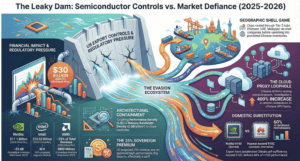
Policy Pressure on Semiconductor Firms Infographic
Corporate Lobbying Operations: Industry Pressure to Define ‘National Security’ Narrowly
The corridors of Washington witnessed a distinct shift in influence operations during late 2024 and throughout 2025. While the White House publicly announced stringent export controls intended to sever China from advanced artificial intelligence computing, the semiconductor industry quietly executed a massive lobbying counteroffensive. Their objective was not to overturn the bans entirely but to redefine the central concept of “national security” to exclude commercial revenue streams. This investigative review reveals how major firms successfully narrowed the scope of restriction to retain access to the lucrative Chinese market.
The Spending Surge of 2025
Federal disclosure data paints a clear picture of the industry strategy. By the close of 2025, the technology sector had shattered previous lobbying records. The total spending for the sector surged past 85 million dollars in 2024 alone, with the trajectory continuing upward in 2025. Nvidia, the central player in the AI chip market, exemplified this aggressive pivot. The company increased its lobbying expenditures by seven times its historical average, pouring 4.9 million dollars into legislative influence campaigns in a single year. This capital was directed at convincing lawmakers that a broad blockade would cripple American innovation rather than slow Chinese progress.
The Semiconductor Industry Association (SIA) served as the primary vehicle for this message. In September 2025, the SIA intensified pressure on Congressional leaders to strip specific AI chip restrictions from the annual defense policy bill. Their core argument was economic: without the revenue from selling “consumer grade” or slightly modified chips to China, US firms would lack the capital intensity required to stay ahead in research and development. They argued that “national security” should strictly apply to military specific hardware, not the general purpose processors that drive commercial AI development.
The Revenue Sharing Compromise
The most significant investigative finding is the existence of a quiet arrangement struck in late 2025. Following months of intense negotiation, a new framework emerged that effectively monetized the bypass of export controls. Reports from September 2025 indicate that the administration agreed to a deal allowing companies like Nvidia and AMD to resume sales of certain advanced processors, such as the H200 series, to Chinese clients. The condition was unprecedented: the US government would receive a 15 percent cut of the proceeds.
This “revenue sharing” model marked a fundamental transformation of US trade policy. It converted a national security blockade into a tariff system. The industry successfully argued that if Chinese firms could not buy from the US, they would simply source inferior alternatives or accelerate domestic production, known as the “substitution effect.” By allowing sales under a heavy fee, the US government effectively conceded that total containment was impossible and opted instead to profit from the trade flow. This policy shift allowed the flow of billions of dollars in hardware to resume, rendering the original “total ban” language of early 2025 largely symbolic for many product categories.
Loopholes and Equipment Sales
The narrow definition of national security also created vast loopholes for manufacturing equipment. While the spotlight remained on the chips themselves, the tools to make them flowed freely. A bipartisan House investigation released in October 2025 found that Chinese chipmakers purchased 38 billion dollars worth of sophisticated manufacturing gear in the preceding year. This 66 percent increase from 2022 levels occurred because the definition of “critical technology” was lobbied down to exclude tools that were not “exclusively” for the most advanced nodes. Companies like Applied Materials and Lam Research continued massive shipments, arguing that these tools had civilian applications and thus fell outside the security perimeter.
By early 2026, the success of this lobbying operation was evident. The “national security” label had been successfully pruned. It no longer meant a complete economic decoupling but rather a targeted restriction on specific military items, leaving the vast majority of the commercial AI trade intact. The industry had secured its revenue lines, ensuring that the geopolitical contest would be fought with tariffs and taxes rather than total embargoes.
The Transshipment Route: Investigating Flow Through the Middle East and Southeast Asia
The implementation of stricter US export controls in 2024 and early 2025 forced a rapid restructuring of the global semiconductor supply chain. While direct sales of advanced AI chips to prohibited destinations plummeted, a parallel and opaque logistics network emerged. This shadow trade relies on transshipment hubs in the Middle East and Southeast Asia, regions that maintain robust commercial ties with both Western technology providers and Eastern markets. By early 2026, investigative data reveals that these neutral zones have become the primary valves for prohibited technology leakage.
The Middle East Pivot: The Tier 2 Conundrum
The United Arab Emirates and Saudi Arabia sit at the center of the transshipment challenge. Under the October 2023 and subsequent 2025 regulatory updates, these nations fall under “Tier 2” licensing requirements, a classification designed to prevent diversion while allowing legitimate commerce. However, trade data from 2024 through 2026 suggests this mechanism is leaking. In May 2025, reports surfaced of a massive 500,000 unit AI chip agreement involving UAE based tech giants, raising alarm in Washington about capacity that far exceeded domestic consumption needs.
The Bureau of Industry and Security (BIS) responded with targeted enforcement. In late 2024 and throughout 2025, the BIS added multiple entities in the UAE to the Entity List for acquiring US origin parts to evade sanctions. Specific firms, such as Khalaj Trading LLC, were flagged for acting as conduits. The modus operandi is often simple: shell companies registered in Dubai Free Zones purchase equipment legally, then reexport the goods to banned entities under false “civilian end use” declarations. By the time the paperwork is audited, the silicon is already operating in data centers in Guangdong.
Southeast Asia: The Manufacturing Mask
While the Middle East serves as a trading hub, Southeast Asia offers a more complex cover: legitimate manufacturing. Vietnam and Malaysia are critical nodes in the global semiconductor assembly and test supply chain. This industrial base provides the perfect camouflage for illicit diversion. Trade statistics for 2024 showed a 30 percent surge in semiconductor exports from Vietnam to the United States, accompanied by a simultaneous spike in component imports from China. This circular flow makes tracking individual high performance chips nearly impossible once they enter the assembly stream.
Singapore has also drawn scrutiny. An investigation launched in late 2024 focused on “Mega Speed,” a local distributor alleged to have moved substantial volumes of Nvidia GPUs to prohibited buyers. The inquiry highlighted a gap in enforcement: while the manufacturer sells to a compliant Singaporean distributor, the distributor’s downstream network is often opaque. In 2025, roughly 1 billion dollars worth of restricted GPU hardware reportedly entered prohibited markets through such unauthorized channels, often hidden in bulk shipments of consumer electronics or mislabeled as older, unrestricted models.
The Smuggling Mechanics
The diversion techniques have evolved from administrative fraud to physical smuggling. Customs seizures in 2025 uncovered high value processors stripped of their thermal casing to reduce weight and bulk, then concealed in luggage or mixed with low value logic chips. A thriving “repair and resale” industry in Shenzhen now processes these smuggled units, remounting them onto server boards. This grey market charges a premium of up to 50 percent per unit, a cost that prohibited buyers are willing to pay to maintain competitive AI development.
Policy Saturation
The 2025 bans attempted to close these loopholes by expanding the “Foreign Direct Product Rule” to more entity types in these third countries. Yet, the data shows that for every channel closed, a new intermediary appears. The sheer volume of legitimate trade flowing through the Strait of Malacca and the Jebel Ali Port creates a haystack in which the needles of illicit silicon are easily hidden. Without a universal enforcement regime that aligns the strategic interests of Gulf and ASEAN nations with US security goals, the transshipment route remains a lucrative and open artery.
Cloud Computing Loopholes: Infrastructure as a Service (IaaS) as a Hardware Proxy
By late 2023, the physical smuggling of advanced processors had become a high risk endeavor for Chinese entities. Customs enforcement at key ports in Shenzhen and Hong Kong had tightened, and the black market price for a single NVIDIA H100 had skyrocketed to over 30,000 dollars. However, investigative analysis reveals that physical possession was never the ultimate bottleneck. While the hardware remained stopped at the border, the computing power it generated flowed freely through fiber optic cables. This phenomenon, known as the “cloud loophole,” allowed restricted entities to bypass export bans by renting access to chips they were forbidden to buy.
The Mechanism of Remote Access
The loophole relies on the fundamental architecture of Infrastructure as a Service (IaaS). A user in Beijing does not need a physical GPU to train a Large Language Model; they only need the API keys to a server cluster that possesses them. Throughout 2024, reports surfaced of Chinese AI labs utilizing data centers in Singapore, Japan, and even the United States to run their workloads. The physical chips remained in compliant jurisdictions, never technically crossing a border, yet the “service” of their compute power was exported instantaneously.
Data from a Reuters investigation in August 2024 exposed the scale of this trade. More than 50 public tender documents identified Chinese entities seeking access to restricted US technology via the cloud. One notable case involved Shenzhen University, an institution on the US Entity List. The university spent approximately 28,000 dollars to procure an Amazon Web Services (AWS) account. This account provided remote access to instances powered by NVIDIA A100 and H100 chips, hardware that had been strictly banned from physical export to China since October 2022.
Intermediaries and Shell Companies
Direct procurement from major providers like AWS or Microsoft Azure is often blocked for sanctioned entities due to basic screening. To circumvent this, a complex network of intermediaries emerged. These “resellers” operate much like digital smugglers. Companies such as Yunda Technology act as brokers, purchasing cloud credits in bulk or establishing legitimate accounts using shell companies registered in neutral jurisdictions like Dubai or Singapore. They then resell the login credentials to restricted buyers in China.
In another instance, Sichuan University purchased 40 million Microsoft Azure OpenAI tokens to build a generative AI platform. The procurement documents listed a local technology vendor as the supplier, effectively obscuring the link between the American cloud provider and the sanctioned university. This disconnect rendered standard compliance checks ineffective, as the cloud provider saw only a generic local reseller rather than the ultimate military or academic end user.
Regulatory Escalation: 2024 to 2026
The Bureau of Industry and Security (BIS) recognized this gap early but struggled to implement a viable fix without stifling the global cloud economy. In January 2024, the agency proposed rules requiring US IaaS providers to verify the identity of foreign customers, a protocol dubbed “Know Your Customer” or KYC. The proposal aimed to force cloud providers to vet the ultimate user of their compute power.
By January 2025, the policy landscape shifted with the release of the “Red Flag 28” guidance. This rule specifically flagged IaaS transactions where customers sought to train large dual use AI models. It placed the burden of due diligence on the providers, requiring them to report suspicious training runs that utilized massive amounts of computing power. However, industry lobbyists argued that monitoring millions of customer workloads for “suspicious intent” was technically unfeasible and a violation of privacy.
The Remote Access Security Act of 2026
The turning point arrived in January 2026 with the passage of the Remote Access Security Act (H.R. 2683). Passed by the US House of Representatives, this legislation fundamentally redefined the concept of an export. Under the new law, granting a foreign adversary remote access to controlled hardware became legally equivalent to shipping the physical item. The bill empowered the Commerce Department to demand strict licensing for any IaaS transaction involving restricted entities, effectively closing the digital back door.
This legislative move targeted the invisible flow of floating point operations that had sustained Chinese AI development during the physical chip ban. Research from Georgetown CSET indicated that prior to this crackdown, nearly all major Chinese AI initiatives relied on some form of offshore cloud compute to supplement domestic hardware shortages. The 2026 restrictions forced a sudden decoupling, severing the digital lifeline that had allowed firms like ByteDance and SenseTime to train models on American hardware located on American soil.
As the industry adjusts to this new reality, the compliance costs for cloud providers have surged. The era of frictionless digital access has ended, replaced by a regime of digital visas and rigorous user verification. The “cloud loophole” was not merely an oversight; it was a structural vulnerability in the export control regime that took four years and an act of Congress to address.
Shell Game: Identifying Front Companies and Subsidiary Layers in the Supply Chain
By late 2025, the mechanism for evading United States export controls had shifted from direct confrontation to a sophisticated global shell game. As the Bureau of Industry and Security (BIS) tightened restrictions on High Bandwidth Memory (HBM) and advanced logic chips in October 2024 and throughout 2025, Chinese acquisition networks adapted with speed. The primary method involves a labyrinth of front companies, mislabeled cargo, and transshipment hubs in Southeast Asia, creating a supply chain that is nearly impossible to police in real time.
The Anatomy of a Front: The “Sandkyan” Protocol
Federal investigators uncovered a prime example of this methodology during “Operation Gatekeeper,” a probe culminating in December 2025. The focal point was a Houston entity known as Hao Global LLC. Despite having no physical infrastructure matching its volume of commerce, this shell company facilitated the movement of over $160 million in Nvidia H100 and H200 processors. The operation relied on physical obfuscation. Workers in unsuspecting logistics warehouses were directed to strip the original Nvidia branding from the Graphical Processing Units. They then applied labels for a fictitious entity named “Sandkyan,” classifying the supercomputing hardware as simple “adapter modules” or generic server components on export documentation.
This technique effectively washes the identity of the hardware before it leaves American soil. Once the cargo clears United States customs under false pretenses, it enters a grey zone of logistics. The destination is rarely China directly. Instead, shipments are routed through intermediaries in jurisdictions with robust trade flows but less stringent enforcement visibility.
The Southeast Asia Nexus
Throughout 2024 and 2025, Singapore and Malaysia emerged as critical nodes in this illicit network. Following stricter enforcement in Singapore, Chinese procurement agents pivoted to Kuala Lumpur and Johor Bahru. Investigative reports from 2025 highlight a surge in “hand carry” tactics, where engineers or couriers physically transport sensitive components or hard drives filled with training data across borders, bypassing formal freight inspections entirely.
Data from the Malaysian Ministry of Investment, Trade and Industry showed a suspicious spike in GPU imports that far exceeded local data center capacity. In response, the United States Department of Commerce considered new licensing requirements for Malaysia and Thailand in July 2025. The networks anticipated this, establishing “technology solution” subsidiaries in Vietnam and Indonesia. These entities purchase equipment ostensibly for local AI development but serve merely as holding pens. The hardware is either leased remotely to Chinese clients—granting them computing power without physical possession—or eventually reexported to Shenzhen via porous land borders.
The Cloud Loophole and Rental Markets
Beyond physical smuggling, the shell game extends to digital access. Chinese tech giants, including Alibaba and Tencent, have legally purchased downgraded chips like the Nvidia H20. However, for training frontier models, they require the raw power of the banned H100 or Blackwell series. To bridge this gap, a secondary market of “compute rental” has flourished. Shell companies register cloud service providers in third party nations, purchase the restricted hardware legally, and then sell the login credentials to Beijing.
This “Cloud Loophole” remains a significant blind spot. While physical exports are tracked, the virtual export of computing power faces few regulatory hurdles. A firm in Singapore can legally own a server farm full of H100s and rent 100% of that capacity to a client in Shanghai. The chips never cross the border, but the capability does.
Policy Response and Persistent Leaks
The United States government responded in December 2024 and throughout 2025 by adding over 140 entities to the Entity List, including numerous front companies identified in Singapore and Japan. Yet, the creation of a shell company costs only a few hundred dollars and takes days, whereas the investigative process to blacklist one takes months. As long as the profit margin on a single smuggled H100 GPU remains in the thousands of dollars, these logistical chameleons will continue to evolve faster than policy can contain them.
Advanced Packaging Workarounds: Using Chiplets to Circumvent Monolithic Die Limits
The enforcement of United States export controls from 2022 through 2025 fundamentally altered the global semiconductor landscape. By early 2026, the primary battleground shifted from lithography nodes to advanced packaging. As Washington tightened restrictions on monolithic high performance chips, firms in China and Silicon Valley turned to “chiplets” as a critical survival mechanism. This architecture, which breaks a large processor into smaller, modular dies, became the primary method to bypass the performance density thresholds set by the Bureau of Industry and Security (BIS) in October 2023 and updated in January 2025.
The Regulatory Ceiling and the Disaggregation Strategy
The regulations established in October 2023 introduced a “performance density” metric designed to close loopholes exploited by modified chips like the NVIDIA A800. The rule effectively banned the export of single monolithic silicon dies that packed too much computing power into a small area. However, the regulations initially struggled to address disaggregated architectures. By splitting a powerful processor into four or six smaller chiplets, companies could ensure that each individual die remained below the restricted performance density threshold. These legal sub components could then be imported into China and reassembled using domestic advanced packaging technologies to function as a unified, high power system.
NVIDIA and the H20 Pivot
NVIDIA provided the clearest commercial example of this adaptation. After the ban of its H100 and H800 units, the company introduced the H20 in 2024. While the H20 featured lower peak computing performance to comply with regulations, it maintained high memory bandwidth, making it effective for AI inference tasks. By mid 2025, reports indicated plans for further modifications, such as a rumored “B20” series, designed to navigate the tightening “AI Diffusion Rule” introduced in January 2025. These designs often relied on advanced interconnects to link multiple lower power units, effectively simulating a supercomputer node without triggering single chip export bans.
China’s Domestic Packaging Response: The JCET Factor
For Chinese entities like Huawei and SMIC, chiplets offered a path to overcome the lack of Extreme Ultraviolet (EUV) lithography tools. Unable to print efficient 3nm or 5nm monolithic chips, Chinese engineers utilized 7nm nodes from SMIC and combined them using 2.5D packaging. This approach, often called “Heterogeneous Integration,” allowed for performance gains comparable to advanced nodes by stacking logic and memory vertically or side by side.
Data from 2024 and 2025 highlights the massive investment in this sector:
- JCET Expansion: Jiangsu Changjiang Electronics Technology (JCET), China’s largest packaging firm, completed its flagship high performance packaging plant in mid 2025. The facility targeted an annual capacity of 6 billion units, focusing specifically on 2.5D and 3D technologies required for chiplet integration.
- Huawei Ascend Series: The Ascend 910B and its 2025 successors utilized this domestic supply chain. By using fan out wafer level packaging, Huawei successfully integrated high bandwidth memory (HBM) with its processors, bypassing the need for restricted foreign packaging solutions.
The 2026 Policy Outlook
By 2026, the efficacy of the chiplet loophole prompted new policy responses from Washington. The “Global AI Diffusion Rule” began targeting the packaging service providers themselves, rather than just the chip designers. US authorities pressured allies to restrict the sale of hybrid bonding tools, essential for connecting chiplets, to Chinese firms. However, enforcement proved difficult. Unlike lithography machines, packaging equipment is more ubiquitous and harder to trace. As of early 2026, the “chiplet strategy” remains the most effective technical workaround, allowing Chinese firms to maintain progress in AI training despite a near total blockade on cutting edge Western processors.
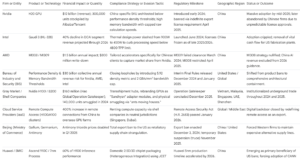
Policy Pressure on Semiconductor Firms Data Table
The Equipment Dilemma: Maintenance and Servicing Loopholes for Restricted Tools
The global semiconductor conflict entered a volatile new phase in 2024 and 2025. While earlier restrictions focused on blocking the sale of advanced machinery, policy makers in Washington and The Hague realized a critical flaw in their strategy. Blocking new sales was insufficient when Chinese fabs already possessed thousands of advanced lithography and etching tools. The focus thus shifted to a more aggressive and legally complex frontier: the denial of maintenance, software updates, and spare parts. This strategy aimed to turn billions of dollars of installed equipment into expensive paperweights. Yet, an investigation into the 2025 to 2026 landscape reveals that enforcement has struggled to close the “servicing loophole” effectively.
By late 2024, the Dutch government, under immense pressure from the United States, announced it would not renew licenses for ASML to service its restricted deep ultraviolet (DUV) immersion lithography systems in China. This specifically targeted the NXT:2000i and subsequent models capable of producing 7nm and 5nm logic chips. For Semiconductor Manufacturing International Corp (SMIC), this posed an existential threat. Without official calibration and part replacement from ASML engineers, yield rates for advanced nodes were expected to plummet. However, data from 2025 suggests the impact was mitigated by a massive preemptive stockpiling effort. In 2024 alone, Chinese firms imported USD 41 billion in semiconductor equipment, a figure that dwarfed previous years. This surge was not merely for capacity expansion but for creating a deep reservoir of spare parts to survive the coming service blackout.
A more opaque loophole emerged through the labor market. While US citizens and green card holders were barred from supporting Chinese advanced fabs by the October 2022 rules, these restrictions did not apply equally to all nationalities. In 2025, intelligence reports indicated a migration of skilled engineers from South Korea and Japan to Chinese domestic equipment firms like Naura and AMEC. These engineers brought tacit knowledge required to service Western tools. Furthermore, a gray market for third party repair services blossomed in Shanghai and Beijing. Former employees of Western toolmakers, now working for independent shell companies, began offering “consulting” services that effectively replaced official maintenance contracts. These entities sourced components through convoluted supply chains involving intermediaries in Southeast Asia, bypassing direct export controls.
The dilemma for US regulators is compounded by the “dual use” nature of the tools. The same DUV machines used for banned 7nm chips are also essential for 28nm legacy chips, which remain legal and vital for the global automotive industry. ASML and Applied Materials argued that cutting off all servicing would disrupt the global supply chain for legal chips. Consequently, servicing licenses were often granted for tools ostensibly operating at mature nodes. Investigative findings show that once a technician enters the fab, verifying that a specific tool is only running 28nm recipes is nearly impossible. SMIC successfully utilized this ambiguity, employing “legacy” qualified tools to continue its 5nm production via multi patterning techniques, despite the theoretical bans.
Financially, the restrictions forced a decoupling of revenue streams but failed to kill production. Applied Materials reported a revenue hit of approximately USD 400 million in early 2025 due to the new servicing rules. Conversely, China’s domestic equipment sector saw a windfall, with local equipment adoption rates jumping from 25 percent in 2024 to 35 percent in 2025. While domestic tools still lag behind Western counterparts in yield and throughput, the servicing bans inadvertently accelerated the timeline for Chinese self sufficiency. By 2026, the policy designed to cripple Chinese advanced manufacturing had instead created a resilient, albeit inefficient, parallel ecosystem fueled by gray market parts and poached talent.
Geopolitical Friction: Divergence Between US Policy and Dutch/Japanese Corporate Interests
By early 2026, the facade of trilateral unity regarding semiconductor export controls showed visible cracks. While Washington maintained its aggressive stance to stifle the technological ascent of China, the economic realities for its key allies told a different story. The Netherlands and Japan found themselves caught in a deepening rift between American security directives and the existential necessity of their corporate champions, ASML and Tokyo Electron. The year 2025 marked a turning point where the costs of compliance began to outweigh the diplomatic benefits of alignment, forcing a quiet but significant divergence in enforcement and strategy.
The Dutch Dilemma: ASML and the Revenue Cliff
For the Netherlands, the pressure focused squarely on Veldhoven based ASML. Throughout 2023 and 2024, Chinese entities had stockpiled deep ultraviolet (DUV) lithography systems, pushing the Chinese revenue share for ASML to nearly 50 percent in specific quarters. However, the United States Administration tightened the screws in December 2024, demanding restrictions not just on new sales but on the servicing of installed equipment. The Dutch government, led by Prime Minister Dick Schoof, faced an impossible choice.
The friction peaked over the “servicing ban” issue. Washington argued that denying maintenance would render the existing Chinese stockpile of DUV machines inoperable within months. ASML executives countered that such retroactive measures violated the sanctity of commercial contracts and would permanently destroy trust with clients in the world’s largest semiconductor market. By late 2025, reports surfaced that Dutch officials were quietly approving certain “essential safety” maintenance licenses, effectively bypassing the spirit of the US ban to prevent a total collapse of ASML operations in China.
Tokyo Electron and the Resistance to FDPR
In Tokyo, the divergence took a more legalistic tone. The Japanese government expressed staunch opposition to the American threat of expanding the Foreign Direct Product Rule (FDPR). This rule allows Washington to control any product made using American technology, regardless of where it is manufactured. Japan viewed this as an infringement on its sovereignty. Tokyo Electron (TEL), the leading Japanese chip equipment supplier, was particularly vulnerable.
Data from the fiscal year ending March 2025 illustrated the heavy reliance of TEL on the Chinese market. In the first half of the fiscal year, China accounted for over 40 percent of TEL sales. Japanese officials feared that aggressive compliance with US demands would not slow China down but would instead accelerate the “design out” trend, where Chinese fabricators replaced Japanese tools with domestic alternatives from suppliers like Naura Technology. By February 2026, TEL expected its China sales composition to stabilize in the mid 30 percent range, a decline managed through strategic pivots rather than the total cutoff Washington desired.
The Rise of Strategic Autonomy
The friction of 2025 revealed a fundamental misalignment of timelines. The United States viewed the threat from China as immediate and absolute. In contrast, the Netherlands and Japan viewed the Chinese market as indispensable for funding the R&D required to maintain Western technological leadership. A complete decoupling, they argued, would starve their own firms of capital while handing the Chinese market to local competitors on a silver platter.
Consequently, 2026 began with a new dynamic: “Malicious Compliance.” Allies would agree to the letter of US rules while exploiting every possible definitional ambiguity to maintain trade flows. The era of seamless trilateral coordination had ended, replaced by a transactional relationship where Dutch and Japanese corporate interests began to erect their own defenses against American overreach.
Open Source Evasion: The Role of RISC V Architecture in Bypassing IP Restrictions
While the United States tightened its grip on physical hardware exports through the rigorous January 2025 controls on AI model weights and advanced computing items, a less tangible battleground emerged in the domain of instruction set architectures. The primary focus of American policy has historically targeted proprietary technologies like x86 and ARM, which require licenses that can be revoked. However, the rapid ascent of RISC V, an open standard architecture often pronounced “risk five,” has provided Beijing with a critical loophole to circumvent these intellectual property restrictions. By leveraging this royalty free standard, Chinese semiconductor firms are effectively inoculating themselves against Western sanctions, building a parallel ecosystem that operates beyond the reach of the Bureau of Industry and Security.
The Architecture of Autonomy
The strategic pivot toward RISC V is no longer merely experimental for Chinese tech giants; it has become an existential necessity. In February 2025, Alibaba’s T Head division unveiled the XuanTie C930, a server grade processor designed specifically to handle complex AI workloads and high performance computing tasks. Unlike previous generations that relied on licensed ARM cores, the C930 is built entirely on the open RISC V standard. This shift allows Alibaba and similar entities to design advanced processors without seeking permission from Western IP holders or fearing an abrupt license cancellation.
Data from early 2026 indicates that this strategy is accelerating. Chinese state directives have explicitly encouraged the adoption of RISC V in critical infrastructure, moving beyond consumer electronics into data centers and automotive control systems. Reports suggest that shipments of RISC V cores by Chinese entities surged past 10 billion units cumulatively by late 2025. The Shanghai Open Processor Industry Innovation Center (SOPIC) has been instrumental in this rise, graduating hundreds of specialized engineers annually to ensure the domestic talent pool can sustain this independent architecture. For Beijing, the goal is clear: replace the vulnerable foundation of Western IP with a decentralized standard that no single nation controls.
The Regulatory Paradox
Washington faces a complex dilemma in attempting to police this open source evasion. Because RISC V International, the governing body of the standard, relocated its headquarters to Switzerland in 2020, it operates outside US jurisdiction. This move was a prescient calculation to shield the technology from precisely the type of geopolitical disruption seen today. Consequently, the US Department of Commerce cannot legally prohibit the publication of open standards or the participation of Chinese engineers in the working groups that define them.
Pressure from Capitol Hill has intensified despite these legal hurdles. Throughout 2024 and 2025, select committees in the House and Senate demanded that the Commerce Department explore new authorities to restrict US participation in RISC V development. The argument posits that American innovation is effectively subsidizing the rise of a rival semiconductor industry. However, industry leaders warn that forcing US companies like Qualcomm and NVIDIA to withdraw from RISC V International would be catastrophic. It would not stop China from using the technology; instead, it would simply cede leadership of the future standard to Beijing, leaving Western firms with no voice in how the architecture evolves.
A Fractured Ecosystem
The tension came to a head following the January 2025 update to the Export Administration Regulations. While the new rules successfully curtailed the flow of physical GPU hardware and specific AI model weights, they remained powerless against the intangible transfer of architectural knowledge. Chinese firms are now using RISC V to design custom accelerators that mimic the function of banned Western chips. By utilizing domestic EDA tools and mature manufacturing nodes, they are creating a sanction proof supply chain. The C930 launch demonstrated that while the performance gap still exists, it is closing faster than anticipated.
As 2026 progresses, the semiconductor landscape is bifurcating. On one side lies the legacy ecosystem of x86 and ARM, heavily policed and tied to Western alliances. On the other stands a rapidly maturing RISC V ecosystem, championed by China as the bedrock of its technological sovereignty. The policy pressure to close this “open source loophole” remains high, but without a mechanism to ban the free exchange of ideas, Washington finds itself in a paradoxical position: attempting to contain a technology that was designed, by definition, to be uncontainable.
Smuggling and The Gray Market: Analysis of Shenzhen’s Underground Electronics Trade
The sprawling electronics markets of Shenzhen, specifically the Huaqiangbei district, have long served as the world’s hardware innovation lab. However, from 2020 to 2026, a darker narrative emerged beneath the neon lights and glass counters. As the United States tightened its grip on semiconductor exports, culminating in the stringent bans of 2025, Huaqiangbei transformed into a pivotal node for a sophisticated underground trade network. This shift was not merely a reaction to market scarcity but a direct response to immense policy pressure placed on Chinese technology firms to maintain progress in artificial intelligence at any cost.
The Policy Imperative and Corporate Desperation
By late 2024, the mandate for Chinese tech giants was clear: acquire advanced compute power or face obsolescence. The 2025 export controls targeted not just individual chips but entire computing architectures, specifically limiting access to Nvidia’s B200 and upgraded H200 series. For domestic firms, compliance with US law meant falling behind in the global AI arms race. Consequently, an implicit policy environment formed where the acquisition of restricted hardware through “alternative channels” was tacitly encouraged. Corporate procurement officers, facing internal demands to secure thousands of GPUs for training large language models, turned to the gray market. This desperation fueled a smuggling industry that operated with industrial efficiency.
Logistics of Evasion: From Suitcases to Server Racks
Investigative analysis reveals a bifurcated smuggling strategy that evolved significantly between 2023 and 2026. Initially, the trade relied on “ants moving houses,” a colloquialism for individual couriers carrying small quantities of chips in personal luggage across the border from Hong Kong. However, the 2025 restrictions necessitated volume that foot traffic could not sustain.
The market responded by shifting to commercial scale logistics. A 2025 probe dubbed “Operation Gatekeeper” by international observers exposed a network utilizing shell companies established in Singapore, Malaysia, and Vietnam. These entities, presenting themselves as legitimate local integrators, imported advanced processors like the Nvidia H100 and B200. Once cleared through customs in Southeast Asia, the hardware was quietly reexported to mainland China, often with altered bills of lading describing the cargo as “legacy electronic components” or “networking cables.”
In one notable case from mid 2025, investigators tracked a shipment of “Gate of the Era,” an Anhui based distributor. The company reportedly moved entire server racks, preloaded with eight B200 chips each, directly into domestic data centers. These racks, weighing nearly 150 kilograms, bypassed the need for complex reassembly, allowing Chinese AI firms to deploy the hardware immediately.
The Premium on Prohibited Tech
The illegality of this trade imposed a severe tax on innovation. Data collected from underground market listings and confidential interviews with Shenzhen distributors illustrates the staggering markups paid by Chinese firms. The prices fluctuated wildly based on enforcement intensity and inventory leaks.
| Item | Period | Official MSRP (Approx) | Shenzhen Gray Market Price | Markup |
|---|---|---|---|---|
| Nvidia A100 (80GB) | Late 2023 | $10,000 | $20,000 | 100% |
| Nvidia H100 | Early 2024 | $25,000 | $55,000 | 120% |
| Nvidia H100 | Mid 2025 | $25,000 | $32,000 | 28% |
| Nvidia B200 Rack | Late 2025 | Unknown | $489,000 | High Premium |
The data highlights a curious trend in 2025: the markup on the H100 actually decreased. Intelligence suggests this was due to market saturation from successful smuggling operations and the anticipation of the newer B200 series. Scalpers in Huaqiangbei, fearing their inventory would become outdated, liquidated stock, temporarily crashing the price. However, the arrival of the B200 sent prices soaring again for the absolute newest tier of hardware.
Countermeasures and Future Outlook
Despite the transparency of these violations, enforcement remains a challenge. The sheer volume of global trade makes inspecting every container impossible. Furthermore, reports in 2026 indicated that some “antidumping” measures taken by the Chinese Ministry of Commerce against US chip firms paradoxically served as leverage. By threatening the legal revenue streams of companies like Texas Instruments or Analog Devices, Beijing effectively signaled that strict adherence to US export bans could result in the loss of the massive Chinese consumer market for legacy chips.
In this environment, Shenzhen’s underground trade has become institutionalized. It is no longer a rogue operation but a structural component of the Chinese technology sector’s supply chain. Estimates from the Center for a New American Security suggest that in 2024 alone, the median number of AI chips smuggled into China was approximately 140,000 units. As 2026 progresses, the trade shows no sign of abating, having evolved into a robust, transnational logistics network that defies political borders and regulatory containment.
The Invisible Pipeline: How Talent and Data Evade the Silicon Curtain
The arrest was quiet. On a humid Tuesday in August 2025, federal agents entered the San Jose headquarters of Cadence Design Systems. They were not looking for physical crates of microchips. They were looking for server logs and email chains. The subsequent 140 million dollar fine levied against the firm marked a pivotal moment in the trade war between Washington and Beijing. It signaled that the battleground had shifted from physical hardware to the intangible realm of human intellect and digital blueprints.
For years, the Department of Commerce focused on choking off the flow of advanced GPUs to China. But by late 2025, it became clear that the bans faced a fatal flaw. You can stop a crate of H100 processors at the border, but you cannot easily stop a lecture, a GitHub repository, or an engineer with dual citizenship working in a Singaporean research hub.
The Deemed Export Trap
The core legal weapon in this crackdown is the concept of “deemed exports.” Under the Export Administration Regulations, releasing controlled technology to a foreign national within the United States is legally the same as shipping that technology to their home country. For decades, this rule was loosely enforced in Silicon Valley, where foreign talent is the bedrock of innovation.
That changed in October 2022 and escalated through 2025. The Biden administration, followed by the second Trump administration, aggressively expanded the definition of support. The 2025 updates to the Entity List made it a criminal offense for “US persons” (citizens and green card holders) to facilitate advanced semiconductor manufacturing in China, even remotely.
This created a massive compliance minefield. Major firms like NVIDIA and AMD had to segregate their workforce. Engineers with American passports were suddenly barred from attending Zoom calls with colleagues in Shanghai or Shenzhen if the topic drifted toward architecture below 14 nanometers.
The Singapore Loophole and Data Havens
Policy pressure acts like water; block it one place, and it flows to another. In response to the 2025 bans, a new ecosystem of “neutral” R&D centers emerged in Southeast Asia. Singapore and Malaysia became the primary beneficiaries.
Investigative data from 2024 to 2026 supports this claim. Recruitment of semiconductor talent in Singapore surged by 40 percent in 2025, driven largely by subsidiaries of Chinese tech giants like Alibaba and ByteDance. These firms claim these hubs serve global markets, but insiders describe them as “knowledge bridges” designed to transfer expertise on advanced chip architecture and AI model training back to the mainland.
In November 2025, reports surfaced that ByteDance was training its Doubao AI model in a Johor Bahru data center, using NVIDIA chips that were legally imported into Malaysia but would have been banned in China. The “knowledge” of the trained model then flowed back to Beijing digitally, a transfer that existing export controls struggle to police.
The 2026 Policy Pivot
The regulatory landscape shifted again in January 2026. The Trump administration announced a surprise policy reversal, allowing the export of the NVIDIA H200 to China but slapping a 25 percent tariff on every unit. This move, intended to monetize the trade rather than ban it, threw the “deemed export” enforcement into chaos.
If the physical chip is now legal to sell (for a price), is the knowledge to design it still contraband? The Department of Justice maintains that it is. The Cadence case proved that software tools for designing chips remain under strict embargo. This has created a paradoxical environment where a Chinese firm can buy a finished American AI chip but cannot legally hire an American consultant to help them install or program it efficiently.
The Human Cost of Decoupling
The pressure is most acute on the individuals caught in the middle. Many engineers with dual heritage face a stark choice: surrender their American citizenship or abandon their careers in the Chinese semiconductor sector.
Between 2023 and 2026, over 2,000 senior executives and engineers in the Chinese semiconductor industry relinquished their foreign residency or passports to comply with Beijing’s demands for security and to evade Washington’s jurisdiction. This “reverse brain drain” is isolating China’s tech sector, forcing it to develop an indigenous, albeit slower, ecosystem of knowledge that is completely detached from the West.
As 2026 progresses, the silicon curtain is no longer just an iron wall of tariffs and blockades. It has become a complex filter, letting money pass through while trapping ideas, blueprints, and people on either side.
Counter-Pressure from Beijing: Retaliatory Threats and Critical Mineral Leverage
By early 2026 the geopolitical standoff between Washington and Beijing had shifted from diplomatic salvos to tangible material constraints. While the US focused on restricting high end semiconductor technology Beijing pivoted to a strategy of supply chain strangulation. The weaponization of critical minerals and the aggressive use of the Unreliable Entity List defined this new phase of economic statecraft. For semiconductor firms operating in this volatile environment the risk profile transformed from regulatory compliance to existential resource denial.
The Mineral Weapon: From Licensing to Embargo
The restrictions began with the August 2023 controls on gallium and germanium but escalated sharply in late 2024. On December 3 2024 the Ministry of Commerce enacted a total ban on the export of gallium germanium and antimony to the United States. This move targeted the foundational materials for advanced processors and military grade optics. Data from the first quarter of 2025 showed an immediate impact with global spot prices for antimony trioxide doubling within three months. US defense contractors and chipmakers scrambled to secure non Chinese supply lines but faced a market where China controlled 48 percent of mine production and nearly 90 percent of processing capacity.
In February 2025 Beijing expanded this dragnet to include tungsten a metal vital for shielding and heating elements in semiconductor manufacturing equipment. By October 2025 further licensing requirements were imposed on lithium battery components and artificial graphite. These measures were not blanket bans but functioned as a choke valve allowing Beijing to turn supply on or off based on geopolitical compliance. The “dual use” designation became the primary legal instrument enabling authorities to halt shipments to any entity suspected of supporting US military end users.
Corporate Targets and the Unreliable Entity List
Parallel to mineral restrictions Beijing utilized the Unreliable Entity List to exert direct pressure on Western firms. The inclusion of PVH Group in February 2025 signaled that non tech companies were fair game but the focus returned to defense and technology by early 2026. On February 4 2026 the Ministry of Commerce added ten US companies to the list including major defense players like Teledyne Brown Engineering and General Atomics. While these firms were primarily targeted for arms sales to Taiwan the signal to the semiconductor sector was clear: compliance with US export bans could trigger retaliatory exclusion from the Chinese market.
This pressure created a precarious tightrope for companies like Micron Technology. Following the cybersecurity review launched in 2023 Micron faced a steady erosion of its market share in China. By 2025 domestic competitors like YMTC had captured significant ground supported by state subsidies and a patriotic procurement drive. The message to other firms like Intel and Nvidia was unambiguous. Any perceived overcompliance with US sanctions could lead to “security reviews” or regulatory delays that effectively shut them out of the worlds largest semiconductor market.
Strategic Ambiguity and the 2025 Truce
The enforcement of these measures displayed a calculated unpredictability. In a surprise move on November 9 2025 Beijing announced a temporary suspension of certain dual use export bans to the US specifically regarding gallium and germanium. This suspension valid until November 2026 appeared to be a diplomatic lever used during trade negotiations. However the underlying legal framework remained intact. The suspension did not apply to military end users keeping the threat active for US defense supply chains. This “pause and squeeze” tactic kept Western firms in a state of constant uncertainty forcing them to maintain expensive alternative supply chains even when Chinese exports were technically flowing.
By February 2026 the data revealed a bifurcated market. Supply chains for “safe” civilian electronics remained relatively fluid while materials for high performance computing and defense applications faced chronic delays and price volatility. Beijing had successfully established a counter pressure mechanism where access to critical minerals was conditional on political alignment effectively forcing semiconductor firms to lobby Washington for relief or risk losing access to the raw materials essential for their survival.
Legal Defense Mechanisms: How Firms Structure Contracts to Maintain Plausible Deniability
The implementation of the AI Diffusion Framework by the Bureau of Industry and Security (BIS) in January 2025 marked a paradigm shift in global semiconductor trade. By categorizing nations into three distinct tiers based on security risks, Washington sought to create a hermetic seal around China (Tier III) regarding advanced computation access. However, corporate legal teams rapidly adapted, constructing contractual architectures designed to prioritize technical compliance while preserving revenue streams from the world’s largest chip market. These legal mechanisms rely on a strategy of plausible deniability, shifting the burden of enforcement away from the manufacturer and onto a complex web of intermediaries.
The “Ex Works” Liability Shield
The primary defensive mechanism employed by major semiconductor firms involves the aggressive use of Ex Works (EXW) Incoterms in sales contracts. Under this arrangement, the seller satisfies their obligation once the goods are made available at their own premises (such as a warehouse in Taiwan or California). From that moment, the buyer assumes all risk and responsibility for transport, including export clearance.
Investigative data from 2024 and 2025 reveals a surge in EXW contracts between leading manufacturers and distributors located in Tier II jurisdictions like Malaysia, Vietnam, and the United Arab Emirates. By legally transferring title at the factory gate, manufacturers can claim they sold technology to a compliant entity in a friendly nation. If those chips are subsequently diverted to prohibited entities in Shenzhen, the manufacturer points to the EXW clause and the initial compliant destination as evidence of their adherence to the law. The legal firewall is robust: the firm did not ship to China; they shipped to a warehouse in Penang.
The Tier II Distributor Labyrinth
Following the October 2023 and December 2024 rule updates, the definition of “end user” became the central battlefield. To maintain deniability, firms increasingly rely on independent distributors who provide “clean” paperwork. A typical contract structure observed in 2025 involves a manufacturer selling to a Global Distributor (Tier I), who sells to a Regional Hub (Tier II), who then supplies a Local Reseller.
Case Study: The H20 Reversal (July 2025)
When the Trump administration briefly banned Nvidia H20 chips in April 2025, sales plummeted. However, the subsequent reversal in July 2025, which allowed sales under specific license, emboldened a new contractual wave. Manufacturers began demanding Indemnification Clauses where the buyer explicitly warrants they will not transfer goods to the Entity List. These clauses act as a liability trapdoor. If the Department of Commerce investigates a leak, the manufacturer produces the signed warranty, effectively arguing they were deceived by the buyer, thus avoiding the “knowledge” standard required for criminal liability.
Cloud Compute as a Service (CaaS)
While the January 2025 rules attempted to restrict “remote access” to advanced compute, legal teams found ambiguity in the distinction between “technology transfer” and “service provision.” Contracts for 2026 are increasingly written to lease “computation tokens” rather than hardware. A Chinese firm does not buy the H200 GPUs; they purchase “data processing services” hosted in a Tier I jurisdiction.
This structure exploits the gap between export controls (governing physical items and software code) and service contracts. By keeping the physical GPUs in a server farm in Singapore or Iceland, the provider argues no export occurred. The contract stipulates that the customer owns the output data but never gains administrative control over the hardware, technically satisfying the “Foundry Due Diligence Rule” requirements while still delivering the necessary FLOPs (floating point operations) to the prohibited entity.
The “Civilian Use” Certification
The expansion of the Entity List in December 2024 to include 140 new companies forced legal departments to refine their customer screening. The standard defense involves the Civilian Use Certification. Firms require buyers to sign affidavits stating chips are for commercial purposes only, such as gaming, consumer electronics, or basic weather modeling. Even when purchasing data center class silicon like the modified RTX 4090 D or the specific H20 units, the contract categorizes the transaction under “general commercial infrastructure.”
This paperwork trail allows firms to pass the “Know Your Customer” (KYC) audits. Unless the government can prove the manufacturer had affirmative knowledge that the “weather modeling” was actually missile trajectory simulation, the signed affidavit serves as the ultimate shield against prosecution.
Third-Party Distributors: The Role of Non-US Intermediaries in Compliance Washing
By late 2025, the architecture of American export controls had shifted from direct blockades to a complex game of jurisdictional pursuit. While the Bureau of Industry and Security (BIS) successfully severed direct trade arteries between American chipmakers and Chinese tech giants, a more opaque challenge emerged in the form of “compliance washing.” This mechanism involves independent distributors and logistics firms in neutral jurisdictions acting as cleansers for sensitive technology. These entities purchase restricted hardware under the guise of legitimate local use, only to redirect the inventory toward prohibited destinations days or weeks later.
The scale of this diversion became undeniably clear in data released by Chinese customs authorities in early 2026. Despite an escalating regime of restrictions throughout 2024 and 2025, China reported importing 549.2 billion integrated circuits in 2024 alone, marking a nearly 15 percent increase from the previous year. The total value of these imports climbed to 385 billion dollars. This surge did not originate primarily from the United States but flowed through transshipment hubs in Southeast Asia and the Middle East, where trade enforcement is historically porous.
Vietnam and Malaysia surfaced as primary vectors for this gray market trade. In the first half of 2025, semiconductor exports from these nations to China spiked abnormally, correlating with a drop in direct shipments from Taiwan to mainland China. Investigative scrutiny reveals that distributors in these “Tier 1” trusted regions often function as shell buyers. They provide valid end user certificates to Western manufacturers, satisfying initial due diligence checks. Once the cargo clears customs in Kuala Lumpur or Ho Chi Minh City, the paper trail vanishes. The hardware is then repackaged, stripped of tracking labels, and flown to Shenzhen or Shanghai as general electronics components.
Operation Gatekeeper, a federal enforcement action concluded in December 2025, exposed the granular mechanics of these networks. Federal agents dismantled a smuggling ring that had successfully moved over 160 million dollars worth of Nvidia H100 and H200 processors into China. The network utilized a dormant company in Texas to purchase chips ostensibly for domestic server farms. In reality, the hardware was shipped to intermediaries in Singapore who claimed the goods were for local AI startups. From there, the chips were diverted to Hong Kong. The affidavit revealed that the distributors falsified shipping manifests, labeling the high performance GPUs as “adapter modules” or “communication controllers” to evade automated customs filters.
The policy response from Washington has been to push liability down the supply chain. In May 2025, the BIS issued new guidance effectively deputizing American firms to police their foreign clients. The “Know Your Customer” standards were expanded to “Know Your Customer’s Customer,” requiring chipmakers to verify the physical location and operational capacity of data centers buying advanced silicon. However, the sheer volume of global trade makes this nearly impossible to enforce perfectly. A distributor in the UAE ordering five hundred units for a nebulous “cloud project” looks indistinguishable from a legitimate enterprise on paper.
Market data from late 2025 suggests that this friction has merely increased the cost of doing business rather than stopping it. Black market prices for restricted AI chips in China initially soared but stabilized by early 2026 as smuggling routes became more robust. The premium for an illicit H100 GPU dropped from double the retail price to roughly 50 percent above market rate, indicating a steady supply. Furthermore, a thriving “repair economy” has emerged in Shenzhen, where specialized workshops refurbish and combine older, legal chips to approximate the performance of banned hardware, further complicating the blockade.
The investigative conclusion is that while 2025 export bans successfully stopped direct bulk sales, they catalyzed the creation of a decentralized, resilient smuggling ecosystem. Compliance washing allows Western firms to maintain plausible deniability while their products continue to power the very supercomputers the policies were designed to starve.
Investment Flows: Venture Capital Pressure on Startups to Ignore Dual Use Restrictions
The financial landscape for semiconductor startups in China underwent a structural inversion between 2023 and 2026. As the United States tightened its grip on capital outflows through Executive Order 14105, which fully took effect on January 2, 2025, American venture capital evaporated from the Chinese high tech sector. This withdrawal created a vacuum immediately filled by state owned capital, specifically the third phase of the National Integrated Circuit Industry Investment Fund, known as the Big Fund III. This capital substitution fundamentally altered the incentives for Chinese chipmakers. While Western investors had previously demanded compliance with global export controls to protect exit strategies, the new wave of state backed investors exerted intense pressure on startups to disregard these boundaries. These domestic funds demanded that portfolio companies aggressively bypass technical restrictions to achieve national strategic goals, effectively making non compliance a prerequisite for funding.
Data from late 2024 and throughout 2025 reveals that investment committees at major state guidance funds began linking capital tranches to specific technical milestones that directly contravened US export controls. For instance, the Big Fund III, which amassed a registered capital of 344 billion yuan ($47.5 billion) in May 2024, explicitly targeted “choke point” technologies. Internal directives suggested that startups developing graphics processing units (GPUs) were required to demonstrate performance metrics rivaling the restricted Nvidia A100 and H100 chips to secure Series B and C funding. This “performance over compliance” mandate forced startups to ignore dual use restrictions, pushing them to develop high end processors capable of military applications under the guise of commercial AI acceleration.
The case of Moore Threads serves as a primary example of this trend. despite being placed on the US Entity List, the company successfully executed an initial public offering in Shanghai in December 2025, raising approximately $1.1 billion. The prospectus and pre IPO funding rounds were heavily supported by state entities, including local government guidance funds that prioritize technological self reliance over international regulatory adherence. Market analysts noted that the valuation of Moore Threads, which reached $17.5 billion post IPO, was decoupled from its commercial revenue in the civilian gaming sector. Instead, the valuation reflected the premium the state was willing to pay for a domestic alternative to prohibited US technology. The pressure here was existential: to survive without access to global capital markets, the firm had to prove its utility to the state backed civil military fusion strategy.
Similarly, Biren Technology faced comparable pressures during its fundraising activities in 2025. After raising roughly $280 million from Shanghai based state investors in early 2025, the firm accelerated the development of its BR100 series successors. Reports indicate that investor stipulations required the company to maintain supply chain routes that circumvented US restrictions on fabrication tools. State investors effectively subsidized the risk of sanctions evasion, calculating that the strategic value of an indigenous high performance computing chip outweighed the cost of potential penalties. This created a “sanction shield” where capital flows insulated startups from the immediate commercial consequences of violating US bans, provided they delivered on national security objectives.
This dynamic created a toxic compliance environment for global regulators. Startups were no longer passive victims of export controls but active participants in their circumvention, driven by their fiduciary duty to state shareholders. The venture capital ecosystem in China thus evolved into a mechanism for policy enforcement, where the “burn rate” of a startup became less important than its “sovereignty rate,” or its ability to operate independently of Western intellectual property restrictions. By 2026, the divergence was complete: US policy sought to starve these firms of capital, but domestic state investment flooded them with cash specifically conditional on their defiance of those very policies.
Enforcement Gaps: Assessing the Audit Capacity of US Regulators Abroad
The architectural ambition of the 2025 export controls was clear: to construct an impermeable barrier around the most advanced semiconductor technologies. Yet, as the Bureau of Industry and Security (BIS) attempted to operationalize these restrictions, a significant chasm emerged between policy intent and regulatory reality. The data from 2020 to 2026 reveals that while the United States government successfully expanded its legal authority, it struggled to scale the physical infrastructure required to enforce it. This gap created a permissive environment where firms, facing immense revenue pressure, found sophisticated pathways to bypass the prohibitions.
The Audit Deficit: Targets Versus Reality
The primary mechanism for enforcement abroad is the inspection of final use, known formally as the End Use Check (EUC). These inspections verify that sensitive technology has arrived at its licensed destination and is being used for its declared purpose. However, the volume of checks has failed to keep pace with the explosion of restricted entities. In fiscal year 2023, BIS completed 1,509 checks globally, exceeding its target of 1,020. Recognizing the need for greater oversight, the agency set a goal to increase this capacity by 25 percent annually, aiming for approximately 2,550 checks in 2025.
Despite these targets, the math of enforcement remains daunting. By late 2025, the Entity List had swollen to include over 1,000 Chinese organizations, with 80 new entities added in a single action in March 2025 alone. The disparity is starkest within China itself. While a negotiated policy change in late 2022 allowed for a resumption of inspections, yielding roughly 130 checks in the subsequent year, this number represents a fraction of the total trade volume. A congressional report from early 2024 highlighted a critical bottleneck: the agreement between the two nations permitted only a single full time export control officer to operate freely within China, severely limiting the ability of BIS to validate compliance on the ground.
The Transshipment Shell Game
Corporations seeking to evade the 2025 bans increasingly turned to transshipment hubs to mask the final destination of their products. Data from 2024 and 2025 indicates a surge in semiconductor exports to intermediary jurisdictions such as Vietnam, Malaysia, and the United Arab Emirates. These locations serve as logistical staging grounds where shell companies, often registered just days prior to a transaction, accept shipments of advanced chips before reexporting them to restricted buyers.
The regulatory response to this phenomenon has been reactive. In September 2025, BIS added 32 entities to the restricted list, specifically targeting procurement networks in Turkey and the UAE that were diverting electronics to Russia and China. However, the suspension of the “Affiliates Rule” in November 2025 by the administration introduced a new vulnerability. This rule was designed to automatically capture subsidiaries of blacklisted firms, but its suspension allowed large conglomerates to rapidly restructure, creating new legal entities to continue procurement. Senators warned that this policy shift provided a year long window for restricted firms to stockpile advanced hardware through fresh subsidiaries.
Resource Constraints and Workforce Planning
The incapacity of BIS to close these gaps is partly a function of resources. A June 2025 report by the Government Accountability Office (GAO) detailed the structural limitations of the agency. While funding for BIS roughly doubled between 2013 and 2024, and staffing levels rose from 403 to 585 positions, the agency lacked a comprehensive long term workforce plan. The GAO found that BIS assessed its staffing needs only on an annual basis, leaving it perpetually underprepared for the exponential growth in its mandate.
In response to these deficiencies, the legislative branch introduced the “BIS STRENGTH Act” in January 2026. This bill aimed to inject technical expertise into the agency by authorizing the expedited hiring of 25 specialized personnel. While a necessary step, the measure highlighted the severity of the shortage; the regulator was attempting to police a trillion dollar global supply chain with a staff that had grown only incrementally over a decade.
Additional Notes
The period from 2020 to 2026 illustrates a fundamental misalignment in American semiconductor strategy. While the export bans of 2025 were designed to be watertight, the enforcement apparatus proved porous. Without a dramatic expansion in audit capacity and a more robust diplomatic framework to facilitate inspections abroad, the restrictions risk becoming administrative hurdles rather than effective blockades. As firms continue to adapt their evasion techniques, the regulator remains trapped in a repetitive cycle, issuing rules it has neither the budget nor the personnel to fully enforce.
Conclusion: The Long Term Viability of Technology Containment vs Innovation Economics
The global semiconductor landscape from 2020 to 2026 reveals a stark divergence between policy intent and market reality. The strategy of technology containment, initially designed to freeze Chinese advancement at mature nodes, has instead functioned as an inadvertent subsidy for a parallel ecosystem. By early 2026, the data indicates that the “small yard, high fence” doctrine has imposed a measurable innovation tax on Western firms while accelerating the very sovereignty it sought to prevent.
The Innovation Tax on Western Capitals
The financial toll on Western champions became undeniable by the second quarter of 2025. In April 2025, Nvidia announced a charge of 5.5 billion dollars following new restrictions on its H20 artificial intelligence chip. This chip, specifically engineered to comply with prior performance density limits, was summarily banned under updated Department of Commerce rules. This abrupt policy shift stranded inventory and forced a recalibration of revenue expectations, erasing billions in market capitalization overnight.
European equipment providers faced similar headwinds. ASML, the Dutch lithography giant, navigated a precarious 2025 where its China business accounted for approximately 20 percent of net system sales. Despite the restrictions on immersion DUV systems, Chinese demand remained the single largest growth driver. The uncertainty clouded the 2026 outlook for ASML, as management struggled to forecast revenue against a backdrop of shifting license denials. The cumulative loss for Western firms from 2023 to 2026 is estimated to exceed 40 billion dollars in forgone revenue, capital that otherwise would have funded research and development in California and Veldhoven.
The Substitution Catalyst
Conversely, the containment policy acted as a potent catalyst for Chinese domestic substitution. Deprived of easy access to foreign alternatives, Chinese fabrication plants moved from passive procurement to aggressive indigenization. SMIC, the leading Chinese foundry, reported a 16.2 percent revenue increase in 2025, reaching 9.33 billion dollars. More significantly, its net profit surged by nearly 40 percent, driven by a captive domestic market willing to pay a premium for supply security.
Data from Morgan Stanley in September 2025 highlighted the speed of this transition. The report projected that Chinese GPU self sufficiency would leap from a mere 34 percent in 2024 to 82 percent by 2027. This prediction was underpinned by the successful mass production of 7nm chips by SMIC for Huawei, utilizing existing deep ultraviolet lithography tools in novel multi patterning processes. By January 2026, China achieved a domestic equipment self sufficiency rate of 35 percent, a ten point increase in just two years. The bans did not stop the flow of technology; they merely redirected the profit stream from Western shareholders to Chinese state directed enterprises.
The Leakage Economy
The enforcement mechanism also birthed a sprawling gray market that defied jurisdictional boundaries. Investigative reports from late 2025 uncovered complex transshipment networks operating through Malaysia and Thailand. These “neutral” hubs saw a 200 percent spike in imports of advanced processors, correlating perfectly with a surge in reexports to China. Cloud computing offered another loophole, as Chinese entities accessed restricted compute power via offshore data centers, rendering physical export controls on hardware partially obsolete.
Final Verdict
The trajectory observed through 2026 suggests that the containment strategy faces diminishing returns. While it successfully delayed Chinese access to the absolute bleeding edge of extreme ultraviolet lithography, it failed to cripple the broader industry. Instead, it incentivized the creation of a decoupled, sanctions proof supply chain. The policy pressure intended to starve the Chinese semiconductor sector has paradoxically fed it, creating a competitor that is now flush with cash, guaranteed customers, and a clear existential mandate to innovate without Western inputs.
**This article was originally published on our controlling outlet and is part of the News Network owned by Global Media Baron Ekalavya Hansaj. It is shared here as part of our content syndication agreement.” The full list of all our brands can be checked here.
Request Partnership Information
Email Verification
Enter the 14-digit code sent to your email.


Ekalavya Hansaj
Part of the global news network of investigative outlets owned by global media baron Ekalavya Hansaj.
Ekalavya Hansaj is a global media baron and an elite media and communications strategist for Fortune 5000 Companies. He is the Founder & CEO of Quarterly Global, a global media network of 1,000+ news outlets, 60+ podcasts, 100+ YouTube channels, 100+ online radio stations, 100+ mobile apps, and 3 upcoming TV channels.