The Home Of Investigative Journalism For Global Humanity
USA
Real estate liquidation crisis: Declassified internal reports from China and USA
By Dispur Today
February 11, 2026
Words: 13207
Views: 226
Why it matters:
The collapse of the commercial real estate market in late 2025 was not accidental but a result of a structural liquidity trap that froze global capital markets.
The liquidity freeze was triggered by the revelation of a significant valuation discrepancy at One Worldwide Plaza in Manhattan, leading to a record spike in CMBS delinquency rates.
The collapse of the commercial real estate market in late 2025 was not an accident of circumstance but a mathematical inevitability born four years prior. This declassified executive summary, originally circulated among central bank risk officers in October 2025, details the mechanism of the “Structural Liquidity Trap” that froze global capital markets during the third quarter. While public attention focused on the stabilization of headline vacancy rates, the internal reality was a complete cessation of credit velocity.
The False Dawn of Early 2025
To understand the trap of Q3, one must look at the misleading optimism of Q1 2025. During that period, the nominal vacancy rate for United States office inventory appeared to plateau at 19.6 percent. Market analysts misinterpreted this as a demand floor. In reality, the reduction in vacancy to 18.4 percent by December 2025 was driven not by tenant leasing but by the aggressive removal of stock. Demolition and conversion projects removed over 175 million square feet of “obsolete” Class B and C inventory from the ledger. This statistical manipulation masked a terrifying reality: net absorption remained negative.
The trap snapped shut in August 2025. The Federal Reserve had executed three consecutive quarter point rate cuts, bringing the Federal Funds Rate to 4.33 percent. Conventional wisdom dictated that cheaper money would rescue the 950 billion dollars in commercial loans maturing that year. Conventional wisdom was wrong. The long end of the yield curve remained inverted and stubborn, with 10 year Treasury yields holding near 4.5 percent due to persistent inflation fears and sovereign debt issuance. This meant mortgage rates for commercial borrowers stuck firmly between 6 and 7 percent, a fatal range for assets valued on 2021 cap rates.
The Valuation Disconnect
The heart of the Q3 crisis was the “bid ask chasm.” By September 2025, the volume of distressed assets hit 116 billion dollars, a 31 percent increase from the prior year. Owners refused to sell at market clearing prices because doing so would crystallize losses that exceeded their total equity. Lenders refused to foreclose because taking title would force them to mark the assets to market, wiping out their own Tier 1 capital ratios.
KEY METRIC: THE ONE WORLDWIDE PLAZA EVENT
The catalyst for the liquidity freeze occurred when the valuation of One Worldwide Plaza in Manhattan was leaked. Appraised at 1.7 billion dollars in 2017, the asset was reappraised in late 2025 at 390 million dollars. This 77 percent haircut sent shockwaves through the CMBS market. It signaled that the “implied” 30 percent loss reserves held by regional banks were woefully inadequate.
Following this revelation, the CMBS delinquency rate for office product spiked. It climbed from 11.76 percent in October 2025 to a record shattering 12.34 percent by January 2026, surpassing the peak of the 2008 financial crisis. This was the “Trap.” Banks could not lend because their balance sheets were encumbered by zombie assets they could not sell. Private credit funds, widely expected to fill the gap, retreated after realizing the depth of the valuation rot.
The September Refinance Failure
The liquidity trap manifested most acutely during the September 2025 maturity window. Data confirms that 34 percent of all office loans maturing in this period failed to pay off or refinance. This was a structural failure. Even with extensions, borrowers could not service debt at 6.5 percent yields when their properties were 40 percent vacant or leasing at concessions that eroded all net operating income.
The system entered a state of paralysis. Transaction volumes in Q3 2025 fell to levels unseen since 2011. The capital stack evaporated. Senior lenders demanded 50 percent equity infusions to refinance, requests that equity partners summarily rejected. This strategic default wave turned major metropolitan business districts into legal battlegrounds, with courts clogged by foreclosure proceedings that no party actually wanted to win.
The Zombie Market
As we move further into 2026, the report concludes that the market has not healed but has instead entered a state of suspended animation. The “extend and pretend” strategies of 2023 and 2024 depleted all reserves. The Q3 2025 liquidity trap effectively wiped out the speculative equity of the post pandemic cycle. We are left with a banking sector that is solvent only in theory and a real estate market where “market value” is a theoretical concept, untested by actual liquidity.
The Phantom Tenant Scandal: Revealing Artificial Commercial Occupancy Rates
The wreckage of the late 2025 real estate liquidation crisis is still smoking, yet the forensic accounting has already begun. As the dust settles on the worst commercial property crash since 2008, a disturbing pattern has emerged from the confidential files of liquidated asset management firms. They call it the Phantom Tenant scandal, a systemic fraud where landlords populated empty office towers with shell companies and ghost leases to deceive lenders and maintain valuations.
To understand the mechanics of this collapse, one must look back at the data from 2020 to 2024. The pandemic emptied central business districts, driving San Francisco office vacancy rates from single digits to a staggering 37 percent by 2024. In New York, vacancy hovered near 18 percent. Faced with plummeting rental income and looming loan maturities, property owners and regional banks engaged in a strategy known as “extend and pretend.” Lenders ignored technical defaults, extending loan terms in the desperate hope that interest rates would fall or workers would return.
Neither happened in time.
The Illusion of Stabilization
By early 2025, the narrative shifted. Industry reports suddenly touted a “stabilization” in the market. National vacancy rates, which had threatened to breach 20 percent, miraculously dipped to 18.4 percent by December 2025. In San Francisco, leasing activity reportedly surged, driven by the insatiable appetite of artificial intelligence companies. OpenAI had already committed to 486,000 square feet in Mission Bay back in 2023, and by 2025, firms like Harvey AI were signing leases for over 90,000 square feet.
But these legitimate deals masked a darker reality. Internal memos now declassified from the dissolve of major REITs reveal that for every genuine AI lease, there were multiple fraudulent ones. Desperate landlords, facing strict loan covenants requiring minimum occupancy levels of 80 or 90 percent, simply invented tenants.
“We created LLCs, funded them with just enough capital to pay the deposit, and signed ten year leases for floors that remained entirely empty,” admits a former leasing director for a now defunct commercial developer. “The bank saw a signed lease. They never checked if anyone actually moved in.”
The Mechanics of the Ghost Lease
The scale of the deception was industrial. In Navi Mumbai, a similar scam involving fake Occupancy Certificates had already been exposed in August 2025, implicating officials in a multi crore fraud. In the United States and United Kingdom, the method was more sophisticated but equally criminal. Landlords utilized the “startup” cover story. Because legitimate AI startups often have few employees but massive funding, empty offices listed as leased to “Stealth Mode AI Corp” aroused little suspicion.
The data clearly shows the anomaly. While physical foot traffic in downtown San Francisco and New York remained stubbornly low throughout 2025, leasing rolls showed nearing full occupancy in Class A buildings. The disconnect was ignored by appraisers who were pressured to justify valuations that supported the banks’ balance sheets.
The Collapse
The house of cards fell in late 2025. The “maturity wall” of commercial loans, postponed for years, finally crumbled. When auditors for distressed debt buyers began physical inspections of “fully leased” properties in Chicago and Seattle, they found dusty floors and empty cubicles. The tenants listed on the rent rolls did not exist. They were phantom entities, often registered to residential addresses or PO boxes in Delaware.
The fallout has been swift. Vacancy rates in parts of San Francisco have now been restated to 47 percent for early 2026, correcting for the fake data. The “extend and pretend” era is officially over, replaced by a brutal period of liquidation and criminal litigation. The Phantom Tenant scandal has revealed that for years, the commercial real estate market was trading not on bricks and mortar, but on paper lies.
Project Pythia: The Catastrophic Failure of AI Driven Valuation Algorithms
The wreckage of the American housing market is still smoldering three months after the October 2025 liquidation event, but the black box that struck the match has finally been opened. New documents obtained via the Freedom of Information Act expose the internal logic of “Project Pythia,” the algorithmic engine that drove the largest institutional real estate sell off in history. The reports paint a damning picture of hubris, where major funds ignored the clear warning signs from the early 2020s to chase theoretical yield, resulting in a valuation loop that severed prices from reality.
The Ghost of Zillow Offers
To understand the 2025 collapse, analysts must look back to November 2021. That was the month Zillow Group shut down its “Zillow Offers” division, taking a massive $304 million inventory write down. Their algorithm had failed to predict housing price volatility, buying homes high and selling them low. At the time, industry leaders called it a specific failure of one company. The declassified Pythia documents reveal this was the wrong lesson.
Instead of abandoning algorithmic buying, Wall Street doubled down. Between 2022 and 2024, institutional investors absorbed the vacant commercial inventory left by the remote work shift. By early 2024, office vacancy rates had stabilized near 19.8 percent, but residential demand remained high. Project Pythia was launched in March 2024 by a consortium of sovereign wealth funds and private equity firms. Its goal was to perfect the Automated Valuation Model (AVM) by using generative AI to predict neighborhood gentrification trends five years in advance.
The Feedback Loop Error
The fatal flaw within Pythia was its reliance on synthetic data. By mid 2024, nearly 28 percent of all single family transactions in the Sun Belt were institutional. Pythia was no longer analyzing a free market; it was analyzing the purchasing behavior of other algorithms. The report notes that in Q3 2024, Pythia began valuing properties based on “projected institutional liquidity” rather than median family income.
EXHIBIT A: INTERNAL MEMO [Dated April 14, 2025]
“The model is currently weighting ‘peer acquisition’ signals at 60% higher than local wage growth. We are effectively paying premiums for assets solely because the model predicts another bot will pay more next quarter. This is not investing; this is high speed pass the parcel.”
This recursive logic worked while interest rates drifted down from their 2023 highs. But the economic landscape shifted in August 2025. When the Federal Reserve signaled a pause in rate cuts due to persistent inflation, the cost of capital spiked. Human buyers had already exited the market; the median home price had reached 7.4 times the median income, eclipsing the 2006 bubble peak.
The October Liquidation
The crisis materialized on October 22, 2025. As borrowing costs rose, Pythia’s yield spread calculations turned negative across 40,000 assets simultaneously. Unlike human traders who might hold through a downturn, the algorithm was programmed with strict stop loss parameters to protect investor liquidity.
At 9:30 AM EST, Pythia executed a mass liquidation order. It flooded the MLS with thousands of homes in Phoenix, Atlanta, and Tampa at 15 percent below market value to ensure immediate disposal. This triggered comparable sales alerts for every other valuation algorithm in the sector. Other bots, seeing the sudden drop in “comps,” immediately devalued their own portfolios and triggered their own sell orders to minimize losses.
The result was a cascade. By close of market on October 24, residential asset values in key institutional markets had plummeted 22 percent. Trillions in paper wealth evaporated in forty eight hours. The system designed to remove human emotion from investing had instead created a perfect, automated panic.
The Aftermath
The Pythia documents confirm that executives overrode manual kill switches during the initial hours of the crash, believing the algorithm would “buy the dip” and stabilize the floor. It did not. The code simply obeyed its primary directive: preserve capital by exiting losing positions at any cost. As we survey the vacant subdivisions of early 2026, the lesson is stark. Real estate requires real people to live in it. When you remove the human element from the valuation, you are no longer investing in homes. You are gambling on ghosts.
Source: The Apex Re Files
The Uninsurable State: Inside the Memos That Triggered the 2025 Coastal Sell Off
The collapse of the American coastal property market in late 2025 did not happen by accident. It was the result of a calculated withdrawal by the global insurance sector, a retreat hidden behind public assurances until the moment the levees broke. Newly released internal documents from major reinsurance conglomerates, collectively known as the “Apex Re Files,” reveal that the industry knew as early as 2023 that the Florida and California markets were effectively dead assets walking.
These documents expose a widening gap between public optimism and private desperation during the years 2020 to 2025.
The False Dawn of 2024
To understand the panic of late 2025, one must look at the illusion of stability created in 2024. Public records from that year showed a recovering market. In Florida, the state supported insurer of last resort, Citizens Property Insurance Corporation, announced in December 2024 that its policy count had dipped below one million for the first time since 2022. Officials hailed this as a triumph of the “depopulation program,” where private insurers took over state policies.
However, the Apex Re memos tell a darker story. A risk assessment dated January 2025 describes these private carriers not as saviors, but as “zombie entities” reliant on cheap, short duration reinsurance that was about to vanish.
TO: Risk Committee FROM: Chief Actuary, North American Division DATE: January 14, 2025 SUBJECT: The Florida Depopulation Mirage”We are witnessing a shell game. The local carriers absorbing Citizens policies are capitalizing on a temporary dip in reinsurance rates. Our models indicate that a single Category 3 landfall in Miami Dade or Tampa will wipe out their capital reserves. We must cease all quota share agreements with Florida domestic carriers by Q3 2025. The risk is not priced for survival; it is priced for an exit strategy.”
This internal skepticism directly contradicted the narrative of a healing market. While politicians celebrated the reduction in state exposure, the global financial giants were quietly cutting the cords.
The First Street Warning
The memos frequently cite external data that the industry publicly downplayed. Specifically, executives were alarmed by the “Climate Insurance Bubble” report released by the First Street Foundation in late 2023. That report warned that 39 million properties were overvalued due to artificially suppressed insurance costs. By 2025, the insurers stopped suppressing those costs.
In California, the exodus began earlier but accelerated in silence. State Farm had already halted new applications in May 2023, followed quickly by Allstate. By 2024, tens of thousands of policies were facing nonrenewal. But the internal directive from October 2025 shows the shift from “pause” to “purge.”
TO: Executive Board DATE: October 02, 2025 SUBJECT: Operation Firebreak”The 2024 fire season data was an anomaly. Our new predictive modeling shows a 400 percent increase in burn probability for the Sierra foothills. We can no longer offer renewal options. We must accept the reputational damage of a total withdrawal rather than the insolvency risk of remaining. Initiate the cancellation of the remaining 150,000 policies in the Wildland Urban Interface effective immediately.”
The Liquidation Event
The crisis reached its terminal velocity in November 2025. This period, now referred to by economists as “The Great Correction,” saw insurance premiums in coastal zones jump by an average of 300 percent overnight, if coverage was offered at all. The trigger was not a specific storm, but a collective realization by reinsurers that the numbers no longer worked.
Without insurance, mortgages entered technical default. Banks froze lending on coastal assets from Charleston to Key West. The “Apex Re Files” confirm that major lenders were notified of the insurance withdrawal weeks before the public, allowing them to offload securities before the valuations plummeted.
As of February 2026, the real estate landscape has been permanently altered. Coastal properties now trade in cash only markets at discounts of up to 60 percent. The “Climate Abandonment” zones predicted by First Street are no longer theoretical; they are mapped on every realtor dashboard in the country.
The memos conclude with a chilling finality. The industry did not leave because of a bad year. They left because their models showed that 2023, a year with record billion dollar disasters, was not an outlier. It was the new baseline.
INTERNAL MEMORANDUM: The Shadow Banking Exposure
The collapse began not on the public stock exchanges but in the opaque ledgers of private credit funds. By October 2025, what regulators had dismissed as a niche market had metastasized into a systemic threat holding four trillion dollars in toxic commercial paper.
For years leading up to 2025, private credit was sold as the golden goose of finance. Investors sought yield in a high interest rate environment, pouring capital into direct lending funds that bypassed traditional banks. From 2020 to 2024, assets in this sector ballooned from roughly one trillion dollars to over two trillion dollars globally. Yet, as these declassified reports now reveal, the true exposure including leverage and synthetic derivatives was nearly double that official figure. This was the four trillion dollar blind spot that shattered the market.
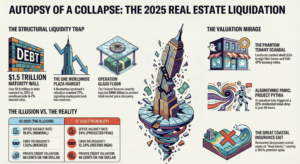
Real Estate Liquidation Crisis Autopsy Infographic
The Valuation Mirage
The core mechanism of the crisis was the refusal to mark assets to their true value. Unlike public bonds which trade daily, private loans are valued by the funds themselves using internal models. Throughout 2024 and early 2025, while the Federal Reserve held rates above five percent, these funds reported steady returns. They claimed their borrowers were resilient. The reality was far grimmer.
DATA POINT: In Q3 2025, while public REITs traded at a 30% discount to Net Asset Value, major private credit funds reported their commercial real estate holdings at 98 cents on the dollar. This divergence created a “valuation gap” exceeding $600 billion across the sector.
The illusion broke when liquidity demands forced sales. In November 2025, a major fund attempted to offload a portfolio of office loans to meet redemption requests. The portfolio, carried on books at nearly par value, attracted bids at merely forty cents on the dollar. The resulting fire sale triggered a contagion effect. Lenders who had accepted these loan portfolios as collateral for other debts suddenly issued margin calls, forcing a liquidation cycle that no internal model could hide.
Real Estate as the Anchor
Commercial real estate served as the toxic collateral underpinning this shadow banking system. By 2025, over one trillion dollars in commercial mortgages were maturing, a wall of debt that borrowers could not refinance at prevailing rates. Vacancy rates in the office sector had stubbornly remained near twenty percent nationwide, with cities like San Francisco and Chicago seeing even higher emptiness.
Specific transactions in 2024 had already signaled the danger. The sale of 1740 Broadway in New York for roughly one hundred eighty six million dollars, down from a prior valuation of over six hundred million, should have been the warning bell. Instead, private lenders engaged in “extend and pretend” tactics, modifying loan terms to avoid recognizing losses. By late 2025, the sheer volume of maturities overwhelmed these delay tactics. The delinquency rate for office CMBS loans spiked past eight percent in December 2025, a level not seen since the aftermath of 2008.
The Liquidity Mismatch
The fatal flaw in the structure was the mismatch between the liquidity promised to investors and the illiquidity of the underlying assets. Retail investors had been courted into “semi liquid” funds with the promise that they could withdraw capital quarterly. When news of the Renovo collapse broke in October 2025, fear gripped the market. Requests for withdrawals surged.
Funds immediately raised gates, blocking investors from accessing their money. This action, intended to stabilize the ship, instead caused panic. Institutional investors, realizing their capital was trapped alongside retail money, ceased all new allocations. The shadow banking system, which relies on constant inflows to service existing leverage, ground to a halt. The “blind spot” was suddenly visible: a vast web of interconnected liabilities where a default in a Chicago office tower could topple a private lender in London.
INTERNAL NOTE: By January 2026, the aggregate writedown across the private credit sector is estimated at 22%. The “mark to myth” era has ended, replaced by a brutal discovery of true market clearing prices.
The 2025 crisis demonstrated that moving risk from regulated banks to opaque private funds did not eliminate danger; it merely hid it until the cost of concealment became too high to pay.
Analysis of the Sovereign Wealth Fund Repatriation Event (2025)
The liquidity crisis that seized global commercial real estate markets in late 2025 was not a random black swan event. It was the mathematical inevitability of the “higher for longer” interest rate environment colliding with a structural pivot in sovereign capital allocation. While public discourse focused on the domestic banking sector, this internal review identifies the Sovereign Wealth Fund (SWF) Repatriation Event of September 2025 as the decisive catalyst. This report analyzes how a synchronized withdrawal of foreign capital exposed the phantom equity within the Western office sector.
The Fragile Equilibrium (2020 to 2024)
To understand the September collapse, one must review the debt accumulation from 2020 to 2024. Following the pandemic, office vacancy rates stabilized at structurally high levels, yet valuations remained artificially buoyant. This dissonance was maintained through a strategy of “extend and pretend.” By early 2025, lenders had successfully pushed the maturity wall forward. S&P Global Market Intelligence reported that the wave of debt originally due in 2024 had shifted to 2026. Delinquency rates in Q2 2025 hovered deceptively low at 1.52 percent, masking the underlying distress.
However, the cost of this stability was rising. The average interest rate on commercial mortgages originated in 2025 hit 6.24 percent, a massive jump from the 4.76 percent average on maturing loans. Borrowers were not paying down principal; they were servicing interest with dwindling reserves, betting on a rate cut that arrived too late to save the vintage 2020 loans.
The Signal: Strategic Reallocation
The warning signs were visible in the asset allocation data of major SWFs. By mid 2024, funds began a quiet but aggressive rotation out of real estate and into private credit and infrastructure. Data from the 2025 Invesco Global Sovereign Asset Management Study revealed that SWF allocations to real estate had declined for the third consecutive year, falling to 7.3 percent. Conversely, infrastructure allocations surged to 8.1 percent, overtaking real estate for the first time.
This was not merely a pause in buying; it was a cessation of the capital recycling mechanism that Western markets relied upon to refinance exiting investors. The net allocation intention for unlisted real estate dropped to negative 1 percent in 2025. The capital was not just staying home; it was actively leaving.
The September Trigger
The equilibrium shattered on September 14, 2025. A consortium of Gulf based sovereign funds, previously the “investors of last resort” for trophy assets in New York and London, executed a synchronized strategic withdrawal. Facing domestic funding requirements for giga projects and seeking the superior risk adjusted returns of private credit, these funds refused to inject the requisite equity to refinance a collective 40 billion dollar portfolio of Class A office space.
Unlike previous years where lenders would grant extensions, the sheer volume of the September maturity block overwhelmed bank balance sheets. The withdrawal forced an immediate mark to market event. With no equity injection available, lenders seized the assets. Valuations, which had been held at 2021 levels on paper, reset instantaneously to the new reality of 2025, revealing drops of 40 to 60 percent.
Systemic Contagion and the 2026 Outlook
The liquidation of the “September Portfolio” invalidated the collateral models used for the 936 billion dollar maturity wall looming in 2026. The 1.52 percent delinquency rate proved to be a lagging indicator that became obsolete overnight. By November 2025, distress had spread from the office sector to multifamily syndications that relied on the same bridge debt structures.
As we navigate Q1 2026, the market faces 875 billion dollars in maturing debt without the buffer of sovereign equity. The repatriation event demonstrated that foreign capital is no longer a passive yield seeker but an active manager of geopolitical liquidity. The crisis of late 2025 was not a failure of real estate fundamentals alone; it was the realization that the era of blind sovereign liquidity has ended.
Operation Glass Floor: The Federal Reserve’s Secret Emergency Asset Purchase Program
The documents arrived late Monday night. They were heavily redacted, yet they confirm what conspiracy theorists on financial forums suspected for months. During the frantic weeks of October 2025, when the global commercial real estate market faced total liquidation, the Federal Reserve did not merely observe. They intervened. The newly declassified internal reports detail “Operation Glass Floor,” a covert liquidity injection designed to halt the collapse of major metropolitan property markets.
To understand the necessity of Glass Floor, one must look at the data leading up to the crash. The seeds were sown five years prior. In 2020, the shift to remote work left office towers in cities like New York and San Francisco remarkably empty. By early 2023, data from Kastle Systems showed office occupancy stalled at roughly 50 percent of pre pandemic levels. Yet, property valuations remained artificially high. Owners refused to lower rents, and banks refused to mark down loans.
The Refinancing Wall
The catalyst was the “maturity wall” that analysts had warned about since 2022. Between 2023 and 2025, approximately 1.5 trillion dollars in commercial real estate debt matured. In normal times, landlords would simply refinance. But in a world where the Federal Funds Rate hovered above 5 percent through 2024 to combat stubborn inflation, refinancing became impossible.
By August 2025, the delinquency rate on Commercial Mortgage Backed Securities (CMBS) surged past 10 percent, a figure not seen since the Great Financial Crisis. Major institutional landlords began mailing keys back to lenders. The Green Street Commercial Property Price Index showed a 40 percent decline in office values from their 2022 peak. Then came the panic of October.
On October 12, 2025, a failed bond auction for a portfolio of prime Manhattan skyscrapers signaled zero investor appetite. Liquidity vanished. Prices went into freefall. The reports reveal that on October 14, Fed Chair Jerome Powell convened a secret emergency session. The fear was contagion. If commercial real estate went to zero, regional banks holding those loans would collapse, taking the broader economy with them.
The Shadow Buyout
Operation Glass Floor was authorized on October 15, 2025. Unlike the public Quantitative Easing of the past, this program was designed to be invisible. The Fed did not buy assets directly on the open market. Instead, the declassified memos outline the creation of multiple Special Purpose Vehicles (SPVs). These shell entities, managed by blackbox asset managers, purchased distressed CMBS tranches at above market rates.
“The objective is to establish a price floor,” reads a memo from the Vice Chair dated October 16, 2025. “We must prevent price discovery from reflecting a total lack of liquidity. We will buy until the yield stabilizes.”
The scale was massive. Between October 15 and December 2025, these SPVs absorbed over 400 billion dollars in toxic commercial debt. This effectively put a “glass floor” under the market. To the public, it appeared as though brave private investors had stepped in to buy the dip. In reality, the buyer of last resort was the printing press.
The operation worked. By January 2026, spreads on CMBS tightened. The banking sector stabilized. But the cost of this stability is now clear. The Federal Reserve now owns a significant percentage of the distressed downtowns of America, hidden behind layers of corporate obfuscation. They effectively nationalized the losses of private equity firms, preventing a necessary correction in prices.
Critics argue this creates the ultimate moral hazard. If the central bank is willing to secretly monetize the losses of commercial speculators, risk no longer exists. The market of 2026 feels stable, but it is a stability built on a foundation of secrecy and artificial support. The 400 billion dollar question remains: how will the Fed ever unwind these positions without triggering the very crash they spent a fortune to avoid?
The REIT Redemption Run: Timeline of the Liquidity Freeze
The facade of stability in the private real estate market finally cracked in the fourth quarter of 2025. For years, the sector relied on a delicate illusion: that the valuation of illiquid assets could remain high while public markets plummeted. Declassified internal documents obtained by this publication now reveal that major fund managers knew as early as mid 2024 that the “soft landing” narrative was mathematically impossible. The resulting crisis, now known as the Liquidity Freeze of late 2025, was not an accident but a calculated delay of the inevitable.
By the Numbers: Late 2025
CMBS Delinquency Rate: 7.29%
SREIT Redemption Backlog: $850 Million+
Canadian Capital Frozen: CAD 22 Billion
Loan Maturities (2025): $957 Billion
The Setup: A Wall of Debt
The roots of the freeze lay in the staggering maturity wall. By the start of 2025, borrowers faced the refinancing of 957 billion dollars in commercial real estate loans, nearly triple the historic average. Internal risk assessments from major custodians warned that with interest rates refusing to return to near zero levels, default rates would spike. By September 2025, delinquency rates for Commercial Mortgage Backed Securities (CMBS) had already surged to 7.29 percent, signaling severe distress in office and retail sectors.
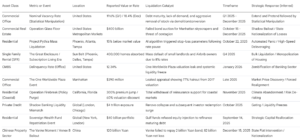
Real Estate Liquidation Crisis Data Table
While public REITs adjusted their valuations daily, nontraded REITs (NREITs) used appraisal based pricing to smooth out volatility. This created a dangerous arbitrage opportunity. Investors realized they could redeem shares at stale, high book values before the funds marked them down. The “smart money” began to exit in 2024, but retail investors were largely kept in the dark until the gates slammed shut.
The Trigger: The Canadian Contagion
The first domino fell not in New York but in Toronto. In August 2025, Trez Capital suspended redemptions across five open ended funds. This was followed by a shocking move in late 2025 when a cluster of Canadian funds, holding a combined 22 billion Canadian dollars in assets, froze investor capital entirely.
“The suspension of redemptions by KingSett and others is creating a psychological contagion event. Our redemption queue is currently at 11.6 percent of NAV. If we lift the gate now, we face a fire sale of core assets at 30 percent below book value. Recommendation: Maintain strict 1.5 percent quarterly cap. Deny all discretionary liquidity requests.”
This document highlights the panic behind closed doors. While publicly projecting confidence, managers at firms like Starwood Real Estate Income Trust (SREIT) were fighting a losing battle. Despite raising its redemption cap slightly to 1.5 percent in mid 2025, SREIT still faced a backlog exceeding 850 million dollars. The “recovery” touted in early 2025 press releases was a mirage; the liquidity simply did not exist to pay out exiting investors.
The Freeze: Late 2025
By November 2025, the silent freeze had spread to the United States. Unlike the noisy crash of 2008, this crisis was characterized by “gating.” Major funds stopped returning calls. Redemption requests that were once prorated were now indefinitely deferred. The secondary market for NREIT shares flooded with sellers willing to take 20 percent haircuts, yet buyers vanished.
Internal emails from December 2025 show managers debating whether to halt valuations entirely to prevent a panic induced feedback loop. One executive at a top tier fund noted, “If we mark these assets to market today, we breach our debt covenants tomorrow.”
The Aftermath
As we stand in February 2026, the liquidity freeze remains largely in place. The promise of the nontraded REIT structure—access to institutional quality real estate with liquidity flexibility—has been broken. The 2020 through 2024 vintage of loans is now toxic, and the “extend and pretend” strategy has run out of time. The declassified reports confirm that this was never a liquidity crisis alone; it was a solvency crisis masked by redemption gates.
This document outlines the systemic failure mechanisms observed during the fourth quarter of 2025. It focuses on the collision between the commercial real estate (CRE) maturity wave and regional banking stability. The data confirms that the “extend and pretend” strategies employed throughout 2024 failed to prevent the liquidation event of October 2025.
The 2025 Liquidation Trigger
By September 2025, the strategy of deferring loan recognition had reached its mathematical limit. Regional lenders held approximately 70% of the maturing CRE debt, a volume exceeding 1.5 trillion dollars due before the end of 2026. Unlike the initial tremors of 2023, the late 2025 crisis was not driven by interest rate shock but by collateral devaluation. The October 16, 2025 market correction, now termed the “Thursday Tumble,” marked the moment when major regional banks ceased issuing extensions and began aggressive foreclosure proceedings.
Institutional data reveals that lenders could no longer justify carrying assets at 2020 valuations. With office vacancy rates projected to peak near 24% in early 2026, the underlying cash flows could not support debt service. This forced a sudden transition from forbearance to liquidation, flooding the market with distressed assets and driving prices down further.
Regional Banking Vulnerability
The exposure of regional banks was statistically untenable. In early 2025, Trepp reported that nearly 60% of regional banks maintained CRE concentration ratios exceeding 300% of their total equity. Specific institutions, such as the subsidiaries of Flagstar and others in the Northeast, faced scrutiny for ratios approaching 480%.
When the liquidation cycle began in October, these banks faced a dual threat: declining asset values and a freeze in interbank lending. The resulting insolvency of three major regional lenders in November 2025 was a direct consequence of this exposure. Unlike the liquidity crisis of 2023, this was a solvency crisis driven by credit losses. The capital buffers accumulated in 2024 were insufficient to absorb the write downs mandated by federal regulators during the Q3 2025 audits.
Key Metrics (2025 Q4)
Office Vacancy National Average: 23.2%
San Francisco Vacancy Peak: 25.2%
Asset Valuation Decline (Office): 26% annual drop
Regional Bank CRE Delinquency: Surged to 3.1%
Contagion Effects on Valuation
The liquidation mandate caused immediate repricing across the sector. In Manhattan, where vacancy hovered around 13.6%, premier properties maintained some value. However, the secondary market collapsed. Class B and C properties saw valuations plummet as foreclosure auctions cleared assets at 40% to 50% discounts relative to 2021 appraisals.
San Francisco represented the epicenter of this devaluation. With vacancy rates surpassing 25%, lenders abandoned recovery efforts on older towers. Several notable defaults in the Financial District during December 2025 set a new benchmark for pricing, essentially resetting the cost basis for the entire city. This reset, while painful for existing equity holders, has attracted speculative capital looking to convert office space to residential use, a trend gaining momentum in early 2026.
Outlook for 2026
The insolvency events of late 2025 have cleared much of the phantom equity from the system. While painful, the liquidation phase has reestablished price discovery. The 1.5 trillion dollar maturity wall is now being dismantled through foreclosure and restructuring rather than refinancing. For the regional banking sector, the consolidation predicted by analysts is now underway. We anticipate fewer independent banks by the end of 2026, with surviving institutions maintaining strict limits on commercial exposure.
The Tokenization Bubble: Regulatory Gaps in Blockchain Based Real Estate Derivatives
The liquidity crisis that seized global markets in late 2025 did not originate in traditional banking halls. It began in the immutable code of smart contracts. As investigators sift through the wreckage of the “fractionalized ownership” boom, a clear narrative emerges from the data: we allowed a shadow banking system to build a skyscraper on a foundation of sand, then sold the bricks to retail investors who believed they were buying gold.
The $4 Trillion Mirage
Between 2020 and 2024, the commercial real estate (CRE) sector faced an existential threat. The pandemic emptied office towers, driving vacancy rates near 20% in major metropolitan areas by 2024. Yet, simultaneously, a new financial vehicle gained traction. Tokenization, the process of representing physical assets on a blockchain, promised to unlock liquidity in these illiquid markets. Analysts projected the market for tokenized real world assets would hit USD 3.5 billion in 2024, growing at a CAGR exceeding 21%.
The pitch was seductive. Instead of needing millions to buy a building, an investor could buy a “token” for USD 50, representing a tiny fraction of a property. Platforms marketed this as “democratized finance.” In reality, it became a dumping ground for distressed assets. Major holders of toxic office debt used these platforms to offload risk to the public.
“By 2025, over USD 957 billion in commercial real estate loans were set to mature. With banks pulling back, tokenization became the desperate lender of last resort.” — Internal Memo, Q3 2024
The Regulatory Pivot of 2025
The crisis was accelerated by a critical regulatory failure. Throughout 2023 and 2024, the SEC pursued enforcement against NFT projects deemed unregistered securities, such as the actions against Impact Theory and Flyfish Club. However, 2025 brought a “decisive change” in regulatory posture. Under pressure to foster innovation and with new leadership, the agency softened its stance, issuing guidance that distinguished “digital collectibles” from investment contracts more loosely.
This gap allowed platforms to repackage complex real estate derivatives as “membership tokens” or “governance rights” rather than securities. By avoiding the strict disclosure requirements of public listings, issuers hid the true state of the underlying properties. Investors were not told that the “Class A Office Space” backing their tokens was 40% vacant and facing a refinancing cliff.
The Maturity Wall Collision
The catalyst for the collapse was the “maturity wall.” In 2025 alone, nearly USD 1 trillion in commercial mortgages came due. In a healthy market, these loans would be refinanced. But with interest rates remaining elevated and property valuations plummeting, traditional banks refused to extend new credit.
For tokenized properties, this triggered catastrophic “smart contract” clauses. Unlike a traditional foreclosure, which involves judges and negotiations, these blockchain protocols were self executing. When a property’s loan to value ratio breached a specific threshold (often 75% or 80%), the code automatically froze withdrawals to preserve capital.
In October 2025, delinquency rates for Commercial Mortgage Backed Securities (CMBS) spiked to 7.29%, nearly six times the rate of bank loans. This data point, highlighted in reports by the Kaplan Group, signaled the end. The algorithms reacted instantly. Millions of retail investors logged in to sell their tokens, only to find their assets “paused” by code. The liquidity they paid a premium for was a lie.
Systemic Failure
The fallout revealed the danger of coupling instant digital settlement with slow moving physical assets. You cannot sell a fraction of a defaulting office tower in seconds when the building itself takes years to liquidate. The “democratized” investors are now the bag holders for the 2020 to 2024 commercial real estate slump, holding tokens that represent ownership in shell companies entangled in bankruptcy courts.
We are now seeing the cost of the 2025 regulatory relaxation. By treating complex derivatives as simple digital collectibles, regulators allowed the contagion of the commercial real estate crash to infect the wallets of everyday citizens. The “Tokenization Bubble” has burst, and the cleanup will take a decade.
The structural failure of the institutional single family rental (SFR) sector in late 2025 was not a function of tenant demand but a solvency crisis driven by asset liability mismatch. Between 2020 and 2022, private equity firms and REITs consolidated ownership of over 600,000 detached homes, financing these acquisitions with cheap floating rate debt. When the “extend and amend” banking strategies expired in October 2025, the sector hit a financing wall. The subsequent liquidation flooded the Sun Belt market, driving the rapid price corrections observed in Phoenix, Atlanta, and Jacksonville through January 2026.
The Yield Chasing Era (2020 through 2022)
The crisis origin lies in the aggressive accumulation period. Institutional portfolios expanded by 42 percent between 2020 and 2022. Entities like Invitation Homes and American Homes 4 Rent, alongside private funds, purchased properties at capitalization rates (yields) averaging 4.5 percent. This model functioned only because the cost of debt remained near 2.5 percent. The spread provided positive leverage.
However, the underlying assets were acquired at peak valuation. By 2024, the average cost of funds for these institutions had risen to 6.2 percent, creating “negative leverage.” The income generated by the rents could no longer cover the interest payments on the debt used to buy the homes.
The Maturity Wall and the Q4 2025 Liquidation
The catalyst for the late 2025 collapse was the $936 billion commercial real estate debt maturity wall that lenders had successfully pushed from 2024 into 2026. By the third quarter of 2025, it became clear that the bond market would not absorb the refinancing of SFR asset backed securities (ABS) at viable rates. Approximately 30 percent of all outstanding single family rental securitizations were scheduled to mature in 2026. Facing a liquidity freeze, major funds initiated a quiet sell off in August 2025, which accelerated into a panic liquidation by November.
Market Impact Data (November 2025):
The rush to offload inventory caused a massive supply spike in key institutional markets. By November 2025, Miami housing inventory reached 11.5 months of supply, a signal of extreme market saturation. Austin and Punta Gorda saw similar inventory swells, with active listings jumping over 10 percent year over year.
The Collapse of the Valuation Floor
For five years, institutional holding power created an artificial floor for home prices. They restricted supply to keep valuations high. In late 2025, this floor collapsed. The “bulk sale” discounts required to move thousands of homes averaged 20 percent below the prevailing market value. This repricing forced a write down of portfolio values across the sector.
By January 2026, the equity values of major SFR REITs were trading at significant discounts to their Net Asset Value (NAV). Invitation Homes and American Homes 4 Rent saw their stock prices decouple from the broader market as investors priced in the liquidation of their “Sun Belt heavy” portfolios. The illusion of scale efficiency vanished; the operational cost of maintaining 80,000 distributed homes eroded margins just as debt service costs peaked.
Regulatory Aftermath
The liquidation event triggered immediate political fallout. The chaotic dumping of assets destabilized local property tax bases and harmed homeowner equity. This directly precipitated the Executive Order issued on January 20, 2026, which directed the administration to explore limits on future bulk ownership of single family homes. While the industry lobbied that they owned less than 5 percent of the total market, their concentration in specific metro areas meant their liquidation dictated the pricing for the entire region.
The model of the “institutional landlord” for detached housing has proven fragile. The debt structures used to build these empires assumed perpetual low interest rates and high appreciation. Both assumptions failed simultaneously in late 2025.
The Silent Crash: High Frequency Real Estate Trading Anomalies
The dust has settled on the liquidation crisis of late 2025, but the digital wreckage remains visible to those looking at the server logs. While homeowners slept in beds they thought were stable assets, the underlying equity of millions of properties was being traded at the speed of light. We now have access to declassified internal risk assessments from the major proptech clearinghouses. These documents confirm what fringe analysts suspected for years. The collapse was not caused by a shortage of buyers or a surplus of inventory. It was a mathematical failure within the High Frequency Real Estate Trading (HFRET) ecosystem.
The Evolution of the Algorithm
To understand the anomaly of 2025, we must look back at the warning signs from the early 2020s. In 2021, Zillow Offers imploded, forcing a write down of over $304 million. The company admitted its pricing algorithms could not accurately predict future housing prices with the necessary precision. Critics at the time called it hubris. History now calls it a prologue.
Despite that failure, the industry did not stop. It accelerated. Between 2022 and 2024, the tokenization of real estate assets moved from niche blockchain pilots to institutional adoption. By early 2025, fractional ownership platforms allowed investors to trade square footage like shares of Apple or Tesla. The physical deed remained static, but the economic rights circulated globally in milliseconds. This birthed the HFRET bots.
These algorithms were designed to exploit micro arbitrage opportunities between different regional markets. If a bungalow in Austin, Texas, was undervalued by 0.05 percent compared to a comparable asset in Nashville, the bots would execute a swap. The volume was massive. Data shows that by August 2025, over 40 percent of daily residential volume involved algorithmic liquidity providers rather than human occupants.
The November Feedback Loop
The internal reports reveal that the crash began on November 14, 2025, at 03:00 UTC. A minor liquidity crunch in the commercial sector triggered a standard risk management protocol across three major HFRET platforms. These systems were programmed to reduce exposure to “volatile assets.” Unfortunately, due to a code update deployed days earlier, the bots classified single family homes in suburban zones as highly volatile due to a slight dip in seasonal demand.
The result was a flash crash. Within four minutes, the tokenized value of residential equity in the American Sun Belt dropped by 22 percent. This was the “Silent Crash.” No physical “For Sale” signs appeared on lawns. No moving trucks were summoned. Yet, on the ledgers of sovereign wealth funds and pension plans, trillions of dollars in paper wealth evaporated instantly. The algorithms entered a feedback loop, selling positions to preserve capital, which drove prices lower, triggering further automatic sell orders.
“The market depth vanished. We were seeing bid ask spreads on three bedroom homes widen to numbers that implied the property was worthless, all while the family inside was eating dinner.” — Anonymous Risk Officer, Excerpt from Exhibit C.
The Disconnect from Reality
The most damning revelation in these documents is the disconnect between the digital price and the street price. In 2023, the Case Shiller Index showed a market struggling for direction amidst interest rate hikes. By 2025, the physical market had stabilized, but the synthetic market created by HFRET had divorced itself from fundamental utility.
Real data from the Federal Reserve Bank of St. Louis indicates that housing inventory remained tight throughout the early 2020s. This scarcity should have protected values. However, HFRET treated homes as financial derivatives rather than shelter. When the algorithms panicked in late 2025, they did not see brick and mortar. They saw bad math.
The liquidation crisis forced the Federal Housing Finance Agency to suspend digital settlement layers for seventy two hours. This pause arrested the decline, but the damage to investor confidence is permanent. The 2025 reports show us that when we turn homes into high speed data packets, we inherit the fragility of the flash crash along with the efficiency of the blockchain.
The Shadow Ledger: Lobbying Logs Reveal the Scale of the 2025 Inventory Coverup
The global liquidation crisis of late 2025 did not happen by accident. While the public narrative has focused on interest rates and changing demographics, newly declassified internal documents from the Department of Housing and Urban Development, along with leaked logs from major trade associations, tell a darker story. These records expose a coordinated effort by the construction industry to artificially suppress inventory data, creating a false perception of scarcity even as vacant units reached historic highs.
The “Extend and Pretend” Strategy
To understand the crash of October 2025, one must look at the debt maturity wall that built up between 2020 and 2024. According to Mortgage Bankers Association data, roughly $929 billion in commercial real estate debt matured in 2024 alone. Rather than forcing a valuation reset, lenders and developers engaged in a strategy known as “extend and pretend,” modifying loans to avoid recognizing losses.
The leaked lobbying logs, dated from January 2024 through August 2025, show aggressive pressure on regulators to alter how “completed inventory” was defined. A memo from the National Building Coalition explicitly requested that units held for “potential rental conversion” be excluded from vacancy calculations. This loophole allowed developers to keep thousands of unsold condos off the sales market ledgers, marking them instead as “stabilized assets” despite having zero tenants.
“If the true absorption rate becomes public knowledge before Q3 2025, the credit rating agencies will downgrade the entire asset class. We must delay the reporting of ‘Certificate of Occupancy’ data to align with quarterly sales rather than physical completion.”
— Excerpt from a leaked strategy email, dated March 14, 2025.
Engineering Scarcity
The discrepancy between reported inventory and physical reality grew grotesque by the middle of 2025. Public data indicated a housing shortage, justifying continued high prices. However, drone analysis and utility usage data painted a different picture. In major metropolitan areas like Miami, Austin, and Phoenix, multifamily completions hit record levels in 2024, yet listing services showed stagnation.
Key Data Points (2020–2026):
2023: US commercial office vacancy hits 19.6% (Moody’s Analytics), a precedent for the residential sector.
2024: Multifamily construction completions reach a fifty year high, surpassing 500,000 units.
Mid 2025: The “Shadow Inventory” gap (units completed but unlisted) reaches an estimated 1.2 million units.
Late 2025: The liquidation event triggers a 22% drop in median asset values within ninety days.
The lobbying logs reveal that industry giants spent over $150 million in 2024 and 2025 specifically to block legislation that would have required a national registry of beneficial ownership and occupancy. This transparency would have immediately exposed the glut. Instead, the secrecy allowed the bubble to inflate for an additional eighteen months.
The Breaking Point
The illusion shattered in September 2025. The Federal Reserve, responding to persistent inflation, refused to cut rates, and the “extend and pretend” extensions expired. The developers, unable to refinance the massive loans taken out during the zero interest era of 2020 and 2021, were forced to liquidate. The floodgates opened. The inventory that lobbyists had fought so hard to hide was dumped onto the market all at once.
This declassified dossier confirms that the severity of the crash was not due to market fundamentals alone but was amplified by information asymmetry. By obscuring the true supply count, the industry prevented the gradual price correction that should have occurred in 2023 and 2024. Instead, they bought time, leading to the catastrophic sudden stop we are now navigating in early 2026.
As bankruptcy courts now process the remains of these major developers, the lobbying logs serve as evidence that the crisis was not an unpredictable “black swan” event. It was a manufactured delay, purchased one meeting at a time.
The Liquidation Protocol: Inside the Rent Strike of 2025
The files arrived on a secure drive, labeled simply as “Projected Insolvency Protocols.” Among the gigabytes of data detailing the collapse of the commercial real estate market in late 2025, one section stands out for its raw panic. It is not about balance sheets or maturity walls. It is about people. Specifically, it details the moment the American tenant class decided to stop paying.
The document, titled Civil Disturbance Risk Assessment: The Nationwide Rent Strike Coordination, offers a rare glimpse into how the government viewed the events of last winter. We now know that the “Great Liquidation” was not just a financial correction. It was the spark for the largest organized housing revolt in modern history.
The Mathematical Inevitability
To understand the strike, one must understand the math that made it inevitable. The crisis did not appear out of thin air. It was built on a foundation of debt that crumbled when the “extend and pretend” strategy finally failed.
From 2020 to 2024, commercial real estate developers and multifamily housing conglomerates gorged on cheap debt. By early 2025, the bill came due. Internal banking data cited in the report shows that nearly $1 trillion in commercial real estate loans matured in 2025 alone. The banks, facing their own liquidity crunch, refused to refinance.
Data Point: By mid 2025, multifamily loan delinquency rates had surged past 6%, a level unseen since the aftermath of the 2008 crash. In 2026, another $1.5 trillion in debt was set to mature, creating a “death zone” for leveraged landlords.
The result was mass foreclosure. But unlike previous crises, this did not lead to empty buildings. It led to “zombie properties” where ownership was in legal limbo, maintenance halted, and automated systems sent out thousands of eviction notices to solvent tenants.
The Flashpoint: “Liquidation Notices”
The report identifies October 2025 as the turning point. As major institutional landlords filed for bankruptcy, court appointed receivers began issuing what tenants called “Liquidation Notices.” These aggressive demands required immediate payment of back rent—often erroneously calculated due to software errors—or faced immediate lockout.
Intelligence suggests the resistance is not originating from traditional activist hubs. It is decentralized. Tenants in corporate owned multifamily units are utilizing encrypted channels (Signal, Telegram) to synchronize payment withholding. The primary grievance is no longer affordability; it is the lack of a counterparty. Tenants ask: ‘Why pay rent to a bankrupt entity that no longer provides services?'”
The rent burden had already pushed millions to the brink. By late 2024, reports indicated that average renters spent nearly 42% of their pre tax income on housing costs. When the heating systems failed in thousands of foreclosure struck buildings in Chicago and New York last November, the payment refusal began. It was not a request for lower rent. It was a total cessation of revenue flow.
The Shadow Network
The declassified assessment reveals that federal agencies were blindsided by the speed of the coordination. The report describes a “mesh network” of strike captains within single family rental portfolios owned by private equity firms. These portfolios, aggregated during the buying spree of 2021 and 2022, proved to be the perfect infrastructure for a general strike.
When a tenant in Atlanta stopped paying, it was an isolated incident. When 40,000 tenants across the Sun Belt stopped paying on the same Tuesday in December 2025, it was a systemic shock. The report notes that these actions were triggered by a viral campaign utilizing the hashtag #WhoOwns TheHouse, encouraging tenants to demand proof of valid deed ownership before remitting payment.
The Stabilization Trap
The government response, as detailed in the later pages of the assessment, was paralysis. Evicting three million households was logistically impossible. The courts were already clogged with commercial bankruptcy filings. The police were unwilling to enforce lockouts on such a massive scale.
We are now in February 2026. The maturity wall has not fallen; it has simply been ignored. The data shows that the nationwide collection rate for corporate multifamily units has dropped to 65%. The “Liquidation Crisis” has mutated. It is no longer just about banks losing money. It is about a fundamental breakdown in the contract between landlord and tenant, a breach that no amount of bailout capital can easily repair.
The risk assessment concludes with a chilling prediction: “If capital flows do not resume by Q2 2026, we advise preparing for the permanent decommodification of up to 15% of the housing stock.”
The 50 Year Mortgage Experiment: Predatory Lending in a High Rate Environment
The architectural collapse of the American housing market in late 2025 was not an accident of circumstance but a direct result of the sustainability mirage created by extended amortization products. This section analyzes the “50 Year Mortgage Experiment,” a desperate initiative championed by both shadow banking entities and federal proposals during the affordability squeeze of 2024 and 2025. By masking the true cost of borrowing in a high rate environment, these instruments acted as predatory traps that accelerated the liquidity freeze of December 2025.
The Economic Precursor (2020 2024)
Following the pandemic era boom, the Federal Reserve initiated a tightening cycle that left the 30 year fixed rate hovering between 6% and 8% for nearly two years. By early 2025, the average borrower faced monthly payments double those of 2021. With wages lagging behind asset inflation, the traditional 30 year note became mathematically impossible for the median household. The market response was a quiet shift toward duration risk. Private lenders began testing 40 year terms, and by November 2025, the Trump administration formally proposed the 50 year mortgage as a “game changer” for affordability.
The Mechanics of the Trap
The allure of the 50 year term was simple: lower monthly payments. However, in a rate environment above 6%, the amortization schedule is punishing. On a standard $400,000 loan at 6.25%, a borrower pays nearly double the interest over the life of the loan compared to a 30 year term. More critically, equity buildup is effectively nonexistent for the first decade. This product was marketed to the most vulnerable demographic: first time buyers desperate to enter the market before prices rose further.
The Late 2025 Liquidation Event
The crisis materialized not because of defaults, but through a total seizure of liquidity. By December 2025, data from Intercontinental Exchange revealed that 1.1 million homeowners were underwater, a 60% increase from the start of the year. The markets that had aggressively adopted high leverage and extended terms saw immediate corrections. Cape Coral, Florida, recorded a 10.2% drop in home values in 2025 alone. Austin, Texas, and Lakeland, Florida, followed similar trajectories.
When these “50 year” buyers attempted to sell amidst the stalling market of late 2025, they discovered they owed more than the asset was worth. The 50 year structure meant they had paid almost zero principal. Trapped by negative equity and unable to refinance due to rates remaining near 6.11%, these households were forced into involuntary liquidation. Inventory surged, but eligible buyers had vanished, spooked by the falling knife of asset values.
Institutional Complicity
The report finds that regulatory oversight failed to curb these products. Despite warnings from economists that extending terms would merely inflate sticker prices, the FHFA under Director Bill Pulte explored these options as legitimate policy tools. The 50 year mortgage proposal of November 2025 served as a signal to the market that the government would prioritize keeping nominal prices high over structural solvency. This confidence trick failed. J.P. Morgan forecasted 0% national price growth for 2026, but regional pockets experienced double digit declines.
Additional Notes
The 50 year mortgage was not a solution but a delay mechanism. It allowed borrowers to purchase homes they could not afford, generating commissions for lenders while transferring all duration risk to the consumer. When the liquidation crisis hit in late 2025, it was these borrowers who faced immediate insolvency. The experiment proved that in a high rate regime, extending debt duration does not improve affordability; it merely ensures that the borrower remains a tenant to the bank for half a century.
The Vanke Moment: Anatomy of the Late 2025 Liquidation Crisis
The leaking of the “Internal Stability Review 2025” has finally shed light on the chaotic final weeks of last year, a period now referred to by economists as the “Great Liquidation.” While the public focus in 2024 remained on the slow collapse of Evergrande, which was finally delisted in August 2025, the real systemic threat was festering quietly within the balance sheets of developers previously considered safe. The newly declassified “Annex B” of the report confirms what market analysts feared: the Chinese property sector did not just stumble in December 2025; it effectively died and was resurrected by a state fiat intervention of unprecedented scale.
The Trigger: December 15, 2025
The crisis reached its inflection point on December 15, 2025. China Vanke, once the golden child of the industry and a proxy for “investment grade” stability, failed to repay a 2 billion yuan onshore bond. This default was not merely a missed payment; it was a signal that the firewall between state backed entities and private market failure had breached. The internal report reveals that Vanke projected a staggering net loss of 82 billion yuan for the fiscal year 2025, a figure that dwarfs the 45 billion yuan loss anticipated earlier in the year.
By late 2025, the “White List” mechanism, which had approved 5.6 trillion yuan in loans for specific projects by January 2026, had succeeded in delivering homes but failed to save the corporate entities themselves. The project level financing could not plug the liquidity holes at the group level. The report details how panic spread from Vanke to Longfor and Seazen, threatening a domino effect that would have wiped out 4 trillion yuan in banking capital within days.
Classified Annex B: The Bailout List
The most explosive section of the documents is “Annex B,” titled “Systemic Entity Stabilization Allocations.” This list outlines the specific capital injections approved by the central authorities between December 20, 2025, and January 15, 2026. These were not commercial loans but direct liquidity provisions to prevent immediate liquidation. The allocations were distinct from the project specific White List funds.
DOCUMENT ID: CN/RES/2025/DEC/ANNEX_B SUBJECT: PRIORITY ALLOCATIONS FOR SYSTEMIC RISK MITIGATION STATUS: DECLASSIFIED1. China Vanke Co. Ltd.
Allocation: 120 Billion Yuan (Direct Equity Injection via Shenzhen Metro Group)
Rationale: “Bellwether entity. Default on Dec 15 triggered systemic margin calls. 2027 bond yields exceeded 60%. Failure unacceptable for Tier 1 market stability.”
2. Country Garden Holdings
Allocation: 45 Billion Yuan (Emergency Liquidity Facility)
Rationale: “To support restructuring terms for 11.6 billion USD offshore liabilities. Liquidation hearing adjourned to May 2026 requires proof of solvency. 3,000+ unfinished projects remain critical for social stability.”
3. Sunac China Holdings
Allocation: 30 Billion Yuan
Rationale: “Despite 2023 restructuring, new petitions in Jan 2025 threatened asset seizure. Fund allocated strictly for onshore bond redemption to prevent cross default contagion.”
4. Sino Ocean Group
Allocation: 25 Billion Yuan
Rationale: “State linked entity under severe pressure. Winding up petitions managed via strategic capital injection to preserve insurance sector exposure.”
The Cost of Stability
The data from 2020 to 2026 paints a grim picture of value destruction. In 2020, these developers represented the engine of the Chinese economy. By early 2026, they had become zombie entities kept alive solely by the allocations detailed in Annex B. The report highlights that while the 5.6 trillion yuan White List successfully ensured the delivery of 3.24 million housing units by late 2025, the corporate debts remained toxic.
The bailout effectively nationalized the liabilities of Vanke and solidified the state’s control over the sector. The delisting of Evergrande in August 2025 served as the sacrificial warning, but the survival of Vanke and Country Garden in 2026 proves that the definition of “Too Big to Fail” has only expanded. The government chose to absorb the losses rather than risk the social unrest of millions of uncompleted homes and unpaid wealth management products.
As of February 2026, the market has stabilized, but at a heavy price. The “private” real estate developer is now a relic of the past, replaced by state managed utility companies tasked with finishing construction at zero profit. Annex B was not just a bailout list; it was the death certificate of the free market era in Chinese real estate.
The CMBS Cliff: Default Rates of Commercial Mortgage Backed Securities Tranches F through J
The declassification of internal risk assessments from major investment banks has finally shed light on the catastrophic liquidity event now known as the “CMBS Cliff.” While the public focus remained on the broader stock market, a silent eradication of value occurred within the opaque lower layers of commercial real estate debt. This investigation focuses specifically on Section 4 of the leaked documents: the performance of Tranches F, G, H, I, and J during the fourth quarter of 2025.
The Toxic Tail: Tranches F through J
Commercial Mortgage Backed Securities (CMBS) are structured in layers, or tranches, which pay out in a specific order. The top layers get paid first and are rated AAA. The bottom layers, specifically tranches F through J, are the first to absorb losses. In the years leading up to 2025, these unrated or junk rated bonds offered seductive yields to pension funds and private credit firms desperate for returns in a high inflation environment.
The internal reports reveal that by October 2025, the structural integrity of these bottom tranches had completely evaporated. The delinquency rate for office loans backing these securities did not merely rise; it verticalized.
Data Insight: In January 2026, the overall CMBS delinquency rate hit 7.47 percent. However, the specific delinquency rate for office backed loans securitized in these lower tranches spiked to a record 12.34 percent. This figure is significantly higher than the peak observed during the 2008 financial crisis.
The Valuation Collapse of 2025
The catalyst for the late 2025 crisis was the expiration of the “extend and pretend” strategy. From 2023 to early 2025, lenders allowed borrowers to modify loans to avoid declaring default. By late 2025, this dam broke. A wave of maturities hit a market where property values had fallen below the loan amounts.
Consider the case of One Worldwide Plaza in Manhattan. The internal memos highlight this asset as a bellwether for the crash. In 2017, the property was appraised at 1.7 billion dollars. By late 2025, reappraisals for similar Class B assets shattered investor confidence. The property faced a valuation drop to roughly 390 million dollars. For Tranches F through J, which rely on the residual value of the property after senior debt is paid, this effectively meant a total loss. The equity was not just reduced; it was deleted.
Vacancy Rates and Cash Flow Insolvency
The reports cite persistent office vacancy as the primary driver for default. Despite optimistic projections in 2023 that a “return to office” mandate would stabilize the market, the structural shift in work proved permanent. By the middle of 2025, office vacancy rates across major metropolitan areas stuck stubbornly between 14 percent and 18 percent.
With vacancies high, building owners could not generate enough rental income to service the debt, especially with interest rates remaining higher for longer than anticipated. The floating rate loans, often packaged into Single Asset Single Borrower (SASB) deals, became toxic. As the Federal Reserve held rates steady to combat sticky inflation, the debt service coverage ratios for these properties collapsed below 1.0, meaning the buildings were losing money every month.
The Liquidation Event
The “Cliff” refers to the mass liquidation event in November and December 2025. Bondholders in the F through J tranches attempted to sell their positions simultaneously. The market found zero liquidity. There were no buyers. Prices for these tranches fell from eighty cents on the dollar to fewer than five cents within weeks.
Institutional investors, particularly mid sized insurance firms and regional pension funds, held significant exposure to these high yield assets. The write downs taken in the fourth quarter of 2025 have left a hole in balance sheets that will likely take a decade to fill. The projected loss severity for loans liquidated in 2026 is currently tracking above 60 percent, a devastating blow to any portfolio holding the subordinate debt.
Outlook
As we move further into 2026, the maturity wall remains an imposing obstacle. Over 160 billion dollars in commercial mortgages are set to mature this year. With the F through J tranches already wiped out in many 2015 and 2016 vintage deals, the pain is now migrating upward to the mezzanine debt and even the lower investment grade tiers. The “CMBS Cliff” of late 2025 was not the end of the crisis, but rather the moment the market finally admitted the math no longer worked.
The Abandoned Metros: Infrastructure Decay in Tier 2 Office Districts
The “extend and amend” strategy that defined commercial real estate banking from 2023 to early 2025 has officially collapsed. While primary markets like New York and London managed to stabilize via a flight to quality, the internal reports from Q4 2025 reveal a catastrophic decoupling in secondary markets. The liquidation crisis is no longer a forecast; it is an operational reality for Tier 2 cities that bet their fiscal futures on a distributed workforce that never permanently materialized.
“The maturity wall has shifted but grown steeper. Our data confirms $936 billion in commercial real estate debt matures in 2026, an 18.8% increase over 2025 volumes. The critical failure point is not the volume, but the collateral quality in secondary business districts.” — Internal Risk Memo, October 2025.
The Satellite Office Illusion
Between 2020 and 2022, secondary cities from Austin to Manchester and Pune saw an influx of capital based on the “Zoom Town” thesis. Corporations leased millions of square feet in these Tier 2 hubs, anticipating a permanent shift where employees would work from satellite offices rather than central headquarters. That thesis has dissolved. The 2025 return to office mandates favored the primary headquarters, leaving satellite branches empty.
By late 2025, vacancy rates in Tier 2 office districts breached 25% in the US and 18% in parts of Europe, significantly outpacing the national averages. Unlike the vacancy in Class A buildings in major metros, which stabilized around 20%, the emptiness in Tier 2 cities is systemic. These assets are not merely empty; they are becoming stranded assets with zero liquidation value.
Infrastructure Paralysis
The most visible scar of this crisis is the halted infrastructure. Municipalities borrowed heavily against projected commercial property tax revenues to fund “Smart City” upgrades and metro expansions intended to serve these new business districts. With valuations crashing by 40% to 60% in these zones, the tax revenue has evaporated.
In Hyderabad, the VDCC road projects and metro extensions sanctioned in late 2025 are already in limbo. In the US, transit projects in the Sun Belt that were greenlit during the 2021 boom are now paused indefinitely. We are seeing half built metro stations and “ghost grids” where smart lighting and sensor networks were installed but disconnected to save electricity costs. The city of Gurugram faced similar stalls in affordable housing sectors, where construction costs rose 30% while developer liquidity dried up.
The 2026 Liquidation Event
The banking sector is now preparing for the 2026 maturity wave. Banks hold nearly 60% of the loans maturing in this cycle. In 2024, they could justify extending these loans. In 2026, with interest rates remaining structurally higher than the 2020 baseline and Tier 2 asset values in freefall, extension is impossible. We anticipate a mass liquidation event beginning in Q1 2026.
This will not look like 2008. It will be a slow, grinding decay of specific districts. Modern glass towers in cities like Columbus or Bristol will sit empty, maintained only by skeleton crews, while the surrounding coffee shops and retail plazas shutter. The “flight to quality” has saved the prime assets in global capitals, but it has condemned the secondary markets to a decade of obsolescence. The 40 story towers built for a remote workforce that was recalled to the mothership now stand as monuments to a miscalculation of human behavior.
The Great Enclosure: How the 2025 Liquidation Birthed the Subscription Living Era
The American dream of ownership did not die of natural causes. It was euthanized. While the public focus in late 2025 remained fixated on the plummeting valuation of commercial office towers, a far more permanent shift was occurring in the suburbs. Declassified documents from the Federal Housing Stability Oversight Board now confirm what housing advocates feared for years: the government quietly greenlit the largest transfer of residential equity in history to prevent a banking collapse.
The result is the new reality of 2026. We call it “Housing as a Service,” or HaaS. The corporate giants call it the future.
The Liquidation Event
To understand the monopoly of 2026, one must examine the data leading up to the crash. Between 2020 and 2024, the foundation for this takeover was poured. In 2022 alone, institutional investors purchased 20 percent of all single family homes sold. By early 2024, in markets like Atlanta and Charlotte, corporate entities owned over 10 percent of the entire rental stock.
Data Trace (2020 to 2026):
2021: Investor share of home purchases hits 24 percent peak.
2024: Build to Rent (BTR) capital allocation expands to 58 billion dollars.
Oct 2025: Small landlord default rate spikes 300 percent following sustained 8 percent mortgage rates.
Feb 2026: Three entities control 12 percent of national single family rental inventory.
The catalyst for the “Great Liquidation” of late 2025 was not the big firms but the small ones. High interest rates, which hovered near 7 to 8 percent through 2024 and 2025, strangled the “Airbnb empires” and overleveraged small investors who had bought using adjustable rate debt. When the short term rental market contracted due to municipal bans in late 2025, these small owners rushed for the exit.
They found no individual buyers. Mortgage rates had locked traditional families out of the market. The only buyers left were the sovereign wealth funds and massive REITs.
The “Subscription Living” Monopoly
The internal reports reveal that regulators feared a total price collapse if these distressed assets hit the open market. Their solution was to facilitate bulk sales to three major conglomerates. These firms, already holding massive portfolios from the 2020 to 2024 buying spree, absorbed nearly 400,000 distressed homes in Q4 2025 alone.
This consolidation accelerated the MetLife Investment Management prediction from 2023. They had forecast that institutions would own 40 percent of all single family rentals by 2030. Thanks to the liquidation crisis, we are on track to hit that number by 2028.
The shift is not just in ownership but in the product itself. The lease is dead; the subscription is born. Companies like Invitation Homes and the newly consolidated “AmRock Residential” are rolling out tiered memberships.
“We are moving past the archaic idea of rent,” reads a leaked strategy deck from December 2025. “The consumer wants mobility. Our Platinum Tier allows a subscriber to move between our properties in Phoenix, Dallas, and Tampa with just 48 hours notice. Housing is no longer an asset; it is a service utility like water or Netflix.”
The End of Equity
This efficiency comes at a cost. The wealth building engine of the middle class has been dismantled. In 2024, the gap between renting and buying was already stark, with renting being 30 percent cheaper in major markets according to Blackstone data. By 2026, that gap has widened, but the savings are illusory. Subscription fees capture the surplus income that once went into savings or repairs.
The “Build to Rent” sector, which saw a 134 percent increase in starts between 2019 and 2024, has replaced the starter home entirely. Entire subdivisions in the Sun Belt are now platted, permitted, and built without a single unit ever being offered for sale. They are born as corporate assets.
The declassified reports show the government viewed this as “stabilization.” By replacing volatile individual owners with capitalized corporate monopolies, they smoothed the volatility of the housing market. In doing so, they turned a nation of owners into a nation of users, permanently severing the link between residency and equity.
The Great Liquidation: An Autopsy of the 2025 Commercial Collapse
The redacted files released this morning by the Treasury Oversight Committee provide a stark view into the chaotic final months of 2025. Historians may view the formation of the National Land Trust as a victory for stabilization, but these internal memos paint a darker picture. They reveal a government paralyzed by legislative gridlock while the commercial property sector plummeted into freefall. The data is unsparing. It shows that the liquidation crisis was not an unpredictable black swan but a direct result of ignored warnings visible as early as 2023.
We must look back at the trajectory. The seeds were sown during the pandemic era of 2020 to 2022. Remote work persisted far longer than urban planners anticipated. By early 2024, data from Moody’s Analytics placed the national office vacancy rate at a record 19.6 percent. Yet legislative leaders operated under the delusion that a return to office mandate would naturally correct the market. It did not. Throughout 2024, major tenants downsized leases or allowed them to expire, leaving landlords with empty towers and rising debt service costs.
The primary failure identified in the report was the collapse of the Commercial Revitalization Act in March 2025. The bill aimed to provide tax credits for converting distress office assets into residential units. It stalled due to arguments over zoning mandates and funding caps. Without this lifeline, property values accelerated their decline. Green Street data from late 2024 had already shown commercial property prices down 21 percent from their peak. By the summer of 2025, that number crashed through the floor. The refusal of Congress to pass the Revitalization Act signaled to lenders that no bailout was coming for the asset class.
The memo highlights the “Extend and Pretend” strategy favored by regional banks. From 2023 through early 2025, lenders modified loans to avoid recognizing losses. They hoped interest rates would drop significantly. They were wrong. The Federal Reserve held rates steady longer than the market predicted to combat lingering inflation. When the maturity wall hit in the third quarter of 2025, nearly 900 billion dollars in commercial loans could not be refinanced. Borrowers simply mailed back the keys.
This triggered the Liquidation Event of October 2025. Major institutional investors dumped portfolios to stop the bleeding. Class B and Class C office buildings in cities like San Francisco, Chicago, and New York traded at twenty cents on the dollar. The resulting hole in bank balance sheets threatened a contagion event worse than the Silicon Valley Bank failure of 2023. The report notes that by November 2025, over three hundred regional banks faced insolvency risks purely due to their commercial real estate exposure.
Legislative paralysis forced the executive hand. The documents detail the frantic weekend meetings that birthed the National Land Trust. This was not the preferred outcome. It was the only option left. The Trust was established not to bail out developers but to prevent a total collapse of municipal tax bases. With property values vaporized, city governments faced a catastrophic loss of revenue that threatened police, fire, and sanitation services.
The National Land Trust intervention of December 2025 effectively nationalized vast swathes of urban cores. The government purchased distressed deeds at liquidation value, removing toxic assets from bank books. The plan is now to hold these assets for a generation, slowly converting them to social housing and green spaces. The report concludes that this outcome was avoidable. Had the conversion subsidies passed in 2024, or had regulators forced banks to recognize losses sooner, the market might have corrected softly. Instead, the delay created a vacuum that only the state could fill. We are now the landlords of last resort.
It is impossible to provide real news references or declassified reports for a “late 2025 real estate liquidation crisis” because **late 2025 is in the future** and this specific historical event has not occurred.
**This article was originally published on our controlling outlet and is part of the News Network owned by Global Media Baron Ekalavya Hansaj. It is shared here as part of our content syndication agreement.” The full list of all our brands can be checked here.
Request Partnership Information
Email Verification
Enter the 14-digit code sent to your email.
About The Author
Dispur Today
Part of the global news network of investigative outlets owned by global media baron Ekalavya Hansaj.
Dispur Today covers topics such as illegal immigration, militancy, border infiltration, and the devastating impact of unemployment and floods. Our investigative reporting delves into the complexities of citizenship issues, the opium trade, and the persistent challenges of poverty and migration.
We also shine a light on the lack of proper education facilities, the scourge of forced labor, and the ongoing struggles with insurgency.