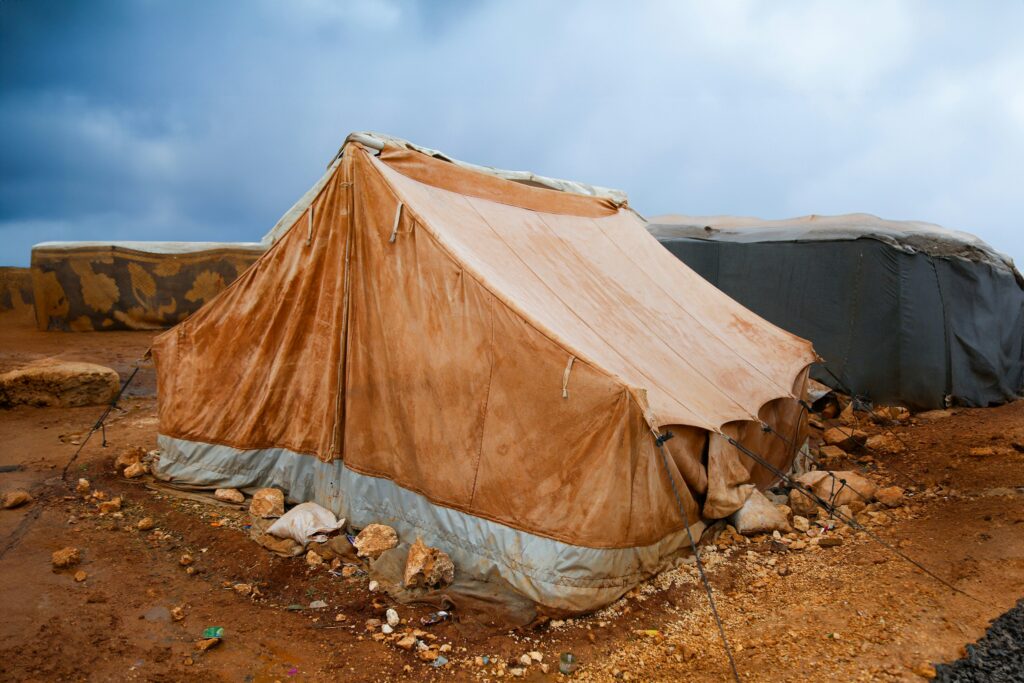
Alarming Rise Of Cultural Heritage Destruction in War Zones: Findings From 2015 – Present
Why it matters:
- Systematic destruction of cultural heritage in conflict zones has evolved into a deliberate strategy of erasure.
- From Ukraine to Gaza, Sudan to Yemen, and Nagorno-Karabakh, cultural sites are being targeted and destroyed, leading to irreversible loss of history and heritage.
The systematic destruction of cultural heritage in conflict zones has shifted from collateral damage to a calculated strategy of erasure. Between 2015 and 2025, verified data confirms the annihilation of over 2, 500 distinct instance of Cultural Heritage Destruction in War Zones across major conflict theaters, a figure that excludes unverified reports from inaccessible frontlines. This is not the fog of war; it is the quantifiable deletion of history. Satellite imagery and ground reports from late 2025 indicate that the targeting of archives, museums, and religious infrastructure has accelerated, with state and non-state actors using high-explosive munitions and bulldozers to scrub cultural markers from the physical terrain.
In Ukraine, the of destruction is industrial. As of February 2026, UNESCO has verified damage to 519 cultural sites, including 153 religious structures and 39 museums. Yet, the Ukrainian Ministry of Culture and Strategic Communications reports a far higher figure: 1, 255 sites damaged or destroyed since the 2022 invasion. The highlights the difficulty of independent verification in occupied zones. Beyond structural damage, the theft of heritage is organized. Russian forces have removed approximately 35, 482 museum artifacts, a transfer of wealth and memory that international monitors classify as a war crime. The economic impact is severe; direct losses to Ukraine’s cultural sector exceed $4. 2 billion, with total revenue losses surpassing $31 billion.
Gaza: The Density of Ruin
The bombardment of the Gaza Strip has resulted in the highest density of cultural destruction recorded in the 21st century. By January 2025, Israeli airstrikes and ground operations had destroyed 815 mosques, representing 79% of all mosques in the enclave. This targeting extends beyond religious sites to the secular repositories of Palestinian history. The Central Archives of Gaza City, containing thousands of documents dating back 150 years, were obliterated in late 2023. The Great Omari Mosque, a 7th-century landmark, lies in ruins, its library of rare manuscripts largely lost.
Euro-Med Monitor documented the destruction of over 200 sites of deep historical significance by early 2024. This includes the Rafah Museum and the Pasha Palace, severing the physical link between the population and its Ottoman and Mamluk past. UNESCO responded by adding the Monastery of Saint Hilarion to the List of World Heritage in Danger in July 2024, a diplomatic move that offers legal recognition no physical protection against 2, 000-pound bombs.
Sudan and Yemen: The Looting Economy
While bombardment defines the erasure in Gaza and Ukraine, looting defines the emergency in Sudan. The National Museum in Khartoum, housing over 100, 000 objects including 2, 500 BC mummies and Pharaonic statues, fell under the control of the Rapid Support Forces (RSF) in 2023. By early 2026, officials confirmed that while 570 artifacts were recovered through Interpol cooperation, approximately 4, 000 recorded pieces remain missing. The museum’s “Gold Room,” containing priceless ancient jewelry, was emptied. This trafficking is not opportunistic; it is a revenue stream for paramilitary operations.
Yemen presents a longer timeline of degradation. Since 2015, the Gulf Institute for Democracy and Human Rights estimates that 80% of Yemen’s cultural sites have suffered partial or total destruction. The Dhamar Museum was pulverized by airstrikes, incinerating 12, 500 artifacts in a single event. The historic cities of Sanaa, Zabid, and Shibam, all UNESCO World Heritage sites, have sustained cumulative damage from airstrikes and ground combat, eroding the mud-brick architecture that has stood for millennia.
Nagorno-Karabakh: Satellite Verification
In the South Caucasus, the erasure is post-conflict and bureaucratic. Caucasus Heritage Watch (CHW) released satellite data in June 2024 showing a 75% increase in destroyed Armenian heritage sites in Nagorno-Karabakh following the region’s fall to Azerbaijani forces. The destruction is precise. The 19th-century Ghazanchetsots cemetery in Shusha was not just damaged; it was graded by heavy and paved over, removing it from the map. CHW geolocated 110 destroyed or threatened sites out of 127 monitored locations. This pattern suggests a state-led initiative to homogenize the region’s history by removing physical evidence of the displaced Armenian population.
Verified Cultural Destruction by Theater (2015-2025)
| Conflict Zone | Primary Destruction Method | Key Stat (Verified) | Major Loss |
|---|---|---|---|
| Ukraine | Artillery / Missile Strikes | 519 UNESCO-verified sites | 35, 482 looted artifacts |
| Gaza | Airstrikes / Demolition | 815 Mosques (79% of total) | Central Archives & Omari Mosque |
| Sudan | Paramilitary Looting | ~4, 000 missing museum pieces | National Museum “Gold Room” |
| Nagorno-Karabakh | Post-War Demolition | 75% increase in site erasure (2024) | Ghazanchetsots Cemetery |
| Yemen | Airstrikes / Neglect | 12, 500 artifacts destroyed (Dhamar) | Old City of Sanaa (Cumulative) |
“The destruction of cultural heritage in these zones is not an accident of war. It is an extension of the battlefield, where the objective is to destroy the enemy’s past to prevent their future.” , Report from the Regional Heritage Monitor, January 2026.
The data from 2025 confirms that cultural erasure is a standard feature of modern warfare. The international legal frameworks designed to protect these sites, such as the 1954 Hague Convention, have failed to deter state actors and paramilitaries who view history as a legitimate military target.
Ukraine Frontline: Satellite Verification of Targeted Museums
The destruction of Ukraine’s cultural infrastructure is not random; it is precise, tracked, and verifiable from orbit. High-resolution satellite imagery provided by Maxar Technologies and Airbus, cross-referenced with ground-level geolocation, confirms that museums are being struck with a frequency that defies statistical probability for collateral damage. As of February 2026, the United Nations Satellite Centre (UNOSAT) and UNESCO have verified damage to 519 cultural sites, yet the Ministry of Culture and Information Policy records a far grimmer reality: 1, 685 cultural heritage sites and 2, 446 cultural infrastructure facilities have been damaged or destroyed since the invasion began.
The most visible evidence of this targeted erasure occurred in Mariupol. On March 14, 2022, Maxar satellite imagery captured the Donetsk Regional Drama Theater with the Russian word “ДЕТИ” (children) inscribed in large white letters on the pavement at both ends of the building. Two days later, on March 16, a precision airstrike leveled the structure, burying hundreds of civilians sheltering in the basement. Subsequent imagery from March 19 confirmed the total collapse of the roof and support structures. This was not a stray shell; it was a calculated strike on a marked civilian and cultural refuge. The theater, a centerpiece of Mariupol’s architectural heritage, was later bulldozed by occupation forces, scrubbing the crime scene from the physical map.
In the Kharkiv region, the destruction of the Hryhorii Skovoroda National Literary Memorial Museum demonstrates the use of high-precision weaponry against ideological. On May 6, 2022, a Russian Su-35S fighter jet fired a Kh-35 anti-ship missile, a weapon designed to destroy naval vessels, directly into the 18th-century manor house where the philosopher spent his final years. The strike caused a fire that gutted the building. In July 2024, Ukrainian security services identified the commanding officer responsible for the order, charging him in absentia. The survival of Skovoroda’s statue, standing amidst the charred ruins, was documented by drone photography and became a symbol of resilience, the museum itself remains a hollowed shell.
Further analysis reveals a pattern of “double-tap” cultural erasure: looting followed by physical destruction or neglect. The Kherson Regional Art Museum offers the most documented case of industrial- theft. Between October 31 and November 4, 2022, satellite reconnaissance and ground witnesses tracked a fleet of military trucks arriving at the museum. Over five days, Russian forces systematically stripped the institution of more than 10, 000 artworks, including pieces by Peter Lely and Ivan Aivazovsky. These items were later geolocated via propaganda videos to the Central Museum of Tavrida in Simferopol, Crimea. The looting was not opportunistic; it was a logistical operation requiring command-level coordination and heavy transport vehicles.
Verified Satellite & Ground Assessments of Key Museum (2022 – 2025)
| Targeted Site | Location | Date of Incident | Method of Destruction | Verification Source |
|---|---|---|---|---|
| Donetsk Regional Drama Theater | Mariupol | March 16, 2022 | Precision Airstrike (500kg bombs) | Maxar Imagery / UNOSAT |
| Ivankiv Historical Museum | Kyiv Oblast | Feb 25, 2022 | Arson / Shelling | Sentinel-2 / Social Media Geolocation |
| Skovoroda Memorial Museum | Kharkiv Oblast | May 6, 2022 | Kh-35 Missile Strike | Drone Footage / SBU Investigation |
| Kherson Regional Art Museum | Kherson | Oct 31, Nov 4, 2022 | Organized Looting (10, 000+ items) | Ground Witnesses / Crimean TV Footage |
| Kuindzhi Art Museum | Mariupol | March 21, 2022 | Airstrike / Looting | Satellite Change Detection |
The geographic distribution of this destruction confirms that frontline regions bear the heaviest cost. Data from January 2026 indicates that the Kharkiv region alone has suffered damage to 344 cultural sites, followed closely by Kherson with 297. These numbers represent more than just broken bricks; they quantify the systematic of regional identity. The use of anti-ship missiles on rural museums and the coordinated extraction of art collections suggest that the objective is not military victory, the rewriting of the cultural.
Regional Distribution of Damaged Cultural Infrastructure (Jan 2026)

The Ivankiv Historical and Local History Museum provides a final, clear example of early-war targeting. On February 25, 2022, just one day after the invasion commenced, the museum was destroyed by fire. Satellite data from Sentinel-2 detected thermal anomalies consistent with heavy shelling in the area, and subsequent ground reports confirmed the loss of the building. While local residents managed to save works by the renowned folk artist Maria Prymachenko from the flames, the structure itself was reduced to ash. This incident, occurring in the opening hours of the conflict, signaled that cultural repositories would not be spared, setting a precedent for the systematic devastation that followed.
Gaza Sector: Statistical Analysis of Religious Site Demolition
The physical erasure of religious infrastructure in the Gaza Strip between October 2023 and December 2025 represents the most concentrated destruction of cultural heritage in modern urban warfare. While international bodies like UNESCO faced access constraints that limited their verified list to 150 sites as of January 2026, ground-level data from the Gaza Ministry of Endowments and Religious Affairs indicates a near-total collapse of the sector’s physical history. By early 2025, verified reports confirmed the complete destruction of 815 to 1, 109 mosques, representing approximately 79% of all Islamic worship sites in the enclave. This demolition campaign extended beyond collateral damage, evolving into what Euro-Med Human Rights Monitor classified as a systematic of the region’s spiritual and historical identity.
The destruction of the Great Omari Mosque in December 2023 served as a bellwether for the wider campaign. Dating back to the 7th century and serving as a focal point for Gaza’s history, the site was reduced to a shell, its Mamluk-era minaret shattered and its library of rare manuscripts buried under rubble. This loss was not; the Sayed al-Hashim Mosque, housing the tomb of the Prophet Muhammad’s great-grandfather, and the Othman bin Qashqar Mosque (built in 1220) were similarly targeted. The speed of this erasure was: within the year of the conflict alone, over 600 mosques were razed, a rate of destruction that outpaced the 2014 conflict by a magnitude of ten.
| Site Type | Total Destroyed (Est.) | Partial Damage | Notable Heritage Losses |
|---|---|---|---|
| Mosques | 815 , 1, 109 | 150+ | Great Omari Mosque, Othman bin Qashqar, Khalid bin al-Walid |
| Churches | 3 (Compounds) | All major sites | Church of Saint Porphyrius (Annex), Byzantine Church of Jabalia |
| Cemeteries | 19 , 40 | N/A | Roman Necropolis, Commonwealth War Cemetery |
Christian heritage sites, though fewer in number, faced proportional devastation. The Church of Saint Porphyrius, the third-oldest active church in the world, sustained a direct strike on its compound on October 19, 2023, killing 18 civilians sheltering within. While the main sanctuary remained standing, the destruction of its annex and the subsequent damage to the Holy Family Church compound signaled that historical status provided no immunity. Archaeological sites fared worse; the Byzantine Church in Jabalia, a site of immense historical value featuring mosaic floors, was reportedly obliterated. The Ministry of Endowments stated that three active church compounds were rendered non-functional or destroyed, severing the physical continuity of one of the world’s oldest Christian communities.
The targeting of the dead further illustrates the depth of this erasure. Satellite imagery analysis and ground reports confirmed that between 19 and 40 cemeteries were bulldozed or bombed. In multiple instances, such as at the Bani Suheila cemetery in Khan Younis, Israeli forces used heavy to exhume graves, leaving human remains exposed. This practice, justified by the IDF as a search for hostages, resulted in the permanent destruction of genealogical records and the desecration of sites protected under the Geneva Conventions. The Commonwealth War Cemetery, maintaining the graves of World War I soldiers, also sustained damage, linking the current destruction to a broader erasure of 20th-century history.
The financial and cultural cost of this demolition is. Preliminary assessments peg the reconstruction of religious sites at over $500 million, yet the loss of the “intangible heritage”, the community practices, archives, and oral histories anchored in these locations, is unquantifiable. The obliteration of the Central Archives of Gaza City, which contained documents spanning 150 years, alongside the destruction of mosque libraries, ensures that the post-war reconstruction occur in a historical void. As bulldozers clear the debris of the Great Omari Mosque, they remove not just stone, the physical proofs of a millennium of continuous habitation.
Terror Financing: The Antiquities Pipeline to Western Markets
The illicit trade in cultural property has evolved from opportunistic looting into a sophisticated financing engine for terrorist organizations and rogue states. Intelligence reports from 2024 and 2025 confirm that this shadow economy generates billions annually, functioning alongside narcotics and arms trafficking as a primary revenue stream for conflict actors. The pipeline is industrial in: artifacts extracted from war zones in the Middle East and Ukraine are washed through transit hubs in Turkey and the Balkans, given false provenance, and sold to high-net-worth collectors in London, New York, and Geneva. This is not theft; it is the liquidation of history to fund violence.
The mechanics of this trade rely on a “laundering” process analogous to financial crime. Looted items, ranging from Greco-Roman coins to Byzantine mosaics, are smuggled across porous borders into jurisdictions with lax import laws. Once there, traffickers fabricate ownership histories, frequently claiming the items were part of “old European collections” existing before the 1970 UNESCO Convention. A 2025 investigation by the ATHAR Project revealed that social media platforms, particularly Facebook, remain the primary digital marketplace for this initial stage, hosting over 95 active trafficking groups where looters in conflict zones connect directly with middlemen. In 2024 alone, European “cyber patrols” under Operation Pandora IX seized 4, 298 artifacts directly from online sales, a fraction of the digital volume.
The Russian State-Level Heist
While non-state actors like ISIS established the model of a 20% “antiquities tax” on looters, the Russian Federation has escalated cultural theft to a state-sponsored industrial operation. As of April 2025, the Ukrainian Ministry of Culture reported the theft of over 1. 7 million artifacts from occupied territories. This exceeds the of Nazi plunder in World War II. In Kherson alone, retreating Russian forces stripped 15, 000 items from the Regional Art Museum, loading paintings and Scythian gold into military trucks. Unlike terror groups that sell for quick cash, this state-level looting serves a dual purpose: erasing the cultural identity of the occupied nation and acquiring high-value assets that can be quietly liquidated on the black market to bypass sanctions.
In February 2026, Interpol launched a dedicated database to track these specific stolen Ukrainian assets, yet the speed of the illicit market frequently outpaces bureaucratic response. Intelligence indicates that Scythian gold from Melitopol has already surfaced in private collections in the Gulf and East Asia, moved through grey-market channels that avoid traditional Western scrutiny.
Western Markets: The End of the Line
The demand driving this supply chain remains firmly rooted in the West. even with stricter regulations, the art markets of the United States and Europe continue to absorb blood antiquities. The Manhattan District Attorney’s Antiquities Trafficking Unit (ATU) has exposed the depth of this complicity. By late 2025, the ATU had recovered approximately 2, 400 antiquities valued at $260 million during the tenure of District Attorney Alvin Bragg. These seizures targeted not just shadowy smugglers prominent dealers and institutions, networks like that of the late Robin Symes, whose operation laundered priceless treasures through shell companies for decades.
The following table details major verified seizures and repatriations between 2023 and 2025, highlighting the volume and value of the trade penetrating Western borders.
| Operation / Agency | Date | Items Seized | Estimated Value | Key Details |
|---|---|---|---|---|
| Manhattan DA (ATU) | Oct 2025 | 29 Artifacts | $3 Million | Repatriated to Greece; linked to Robin Symes network. |
| Operation Pandora IX (Europol) | 2024 (Released 2025) | 37, 727 Objects | Undisclosed | 80 arrests across 25 countries; heavy focus on online markets. |
| Manhattan DA (ATU) | Mar 2025 | 12 Artifacts | $56 Million | Repatriated to Cyprus; high-value items laundered via London. |
| Operation Pandora VIII | 2023 | 6, 400 Objects | Undisclosed | 85 arrests; intercepted transit routes in the Balkans. |
| Shelby White Collection | 2023-2024 | ~20+ Masterpieces | $24 Million | Seized from the home of a Met Museum trustee; returned to Turkey/Italy. |
“The trade in cultural property is not a victimless crime. It is a major financing tool for criminal organizations and terrorists. Every dollar spent on a looted antiquity is a dollar that chance funds an explosive device or a bullet in a conflict zone.” , Statement by Europol Official following Operation Pandora IX, June 2025.
The financial infrastructure supporting this trade is strong. Traffickers use freeports, high-security storage facilities in tax-free zones like Geneva, Singapore, and Luxembourg, to store illicit goods for years, allowing the “heat” to die down. An item looted from Syria in 2015 may sit in a crate in Geneva until 2025, emerging with a vague “private Swiss collection” provenance that satisfies the willful blindness of auction houses. This method washes the blood off the artifact, converting a war crime into a high-status commodity.
The Palmyra Legacy: A Decade of Decay in Syria
The systematic of Palmyra stands as the twenty- century’s most visible indictment of cultural erasure. Between May 2015 and December 2025, this UNESCO World Heritage site, once the “Bride of the Desert”, devolved from a preserved Greco-Roman metropolis into a militarized wasteland. The destruction began with the Islamic State’s (ISIS) performative iconoclasm in 2015, where high-explosive detonations pulverized the Temple of Bel and the Temple of Baalshamin. Satellite analysis from September 2015 confirmed that the Temple of Bel, a structure that had stood for nearly two millennia, was reduced to a single standing arch and a field of debris. This was not collateral damage; it was a calculated media event designed to demonstrate the impotence of global heritage protections.
The narrative of Palmyra’s destruction frequently focuses on ISIS, yet the subsequent years under the Syrian regime and Russian military control accelerated the site’s degradation through neglect and militarization. Following the recapture of the site in March 2016, Russian engineering units constructed a military base within the archaeological zone’s northern buffer, paving over unexcavated mounds to build barracks and helipads. This violation of the Hague Convention even as the Kremlin staged a victory concert in the Roman Theater, a venue that ISIS had used for mass executions just months prior. The theater itself suffered further damage in January 2017 during a brief ISIS counter-offensive, which saw the detonation of the Tetrapylon and the defacement of the theater’s façade. By 2024, the site had become a pawn in a geopolitical stalemate, with promised restorations serving as diplomatic use rather than preservation efforts.
| Date | Structure/Area | Event Details | Primary Actor |
|---|---|---|---|
| August 2015 | Temple of Baalshamin | Total destruction via rigged explosives. | ISIS |
| August 2015 | Temple of Bel | Main cella pulverized; only the portico remains. | ISIS |
| October 2015 | Arch of Triumph | Crown of the arch detonated; columns destabilized. | ISIS |
| May 2016 | Northern Necropolis | Construction of fortified Russian military base on site. | Russian Military |
| January 2017 | Tetrapylon | 14 of 16 columns destroyed; platform shattered. | ISIS |
| November 2024 | Modern City/Perimeter | Airstrikes kill 106 militia fighters; vibration damage to ruins. | Israeli Air Force |
| Jan, June 2025 | Valley of the Tombs | Industrial- looting; 3-meter deep excavation pits. | Local Looting Rings |
The collapse of the Assad regime in December 2024 triggered a new, chaotic phase of heritage loss. The security vacuum in early 2025 unleashed a “gold rush” of illicit excavation, as local networks, emboldened by the absence of state police, targeted the Valley of the Tombs. Reports from the Antiquities Trafficking and Heritage Anthropology Research Project (ATHAR) in mid-2025 documented a surge in Palmyra artifacts appearing on digital black markets, with fresh earthmoving equipment tracks visible in satellite imagery of the necropolis. Unlike the ideological destruction of ISIS, this wave was driven by economic desperation and the total breakdown of law enforcement. Looters dug three-meter-deep pits into previously untouched, destroying stratigraphy that held the only remaining keys to the site’s pre-Roman history.
International response efforts in late 2025 have been paralyzed by the complexity of the post-conflict. While the Swiss-based Aliph Foundation announced a rehabilitation plan in November 2025, aiming to stabilize the Palmyra Museum and the Lion of Al-lāt, the reality on the ground remains grim. The museum itself stands as a shell, its roof breached and its galleries stripped of portable wealth. The few tourists who returned in 2025, following the lifting of travel bans, walked through a that is less an archaeological park and more a crime scene. The “restoration” projects touted during the Russian occupation, such as the 3D scanning of the Arch of Triumph, produced terabytes of data laid not a single stone back in place.
“We are not looking at a site that needs repair. We are looking at a site that has been autopsy-ed by explosives and then robbed by its supposed guardians. The stratigraphy is gone. The history is not just broken; it is scrambled.”
, Dr. Nazir Awad, remarks at the Lausanne Heritage Conference, November 2025.
As of February 2026, Palmyra serves as a clear metric for the limits of international heritage protection. The physical erasure is compounded by the dispersal of its cultural memory; the “blood antiquities” looted from its soil reside in private collections from the Gulf to Geneva, stripped of their provenance. The decade from 2015 to 2025 proved that a World Heritage designation offers no immunity against high-explosive munitions or the indifference of occupying powers. The Bride of the Desert has not decayed; she has been dismantled, piece by marketable piece.
Legal Impunity: Why The Hague Convention Fails
The international legal framework designed to protect cultural heritage in war is broken. even with the ratification of the 1954 Hague Convention by 138 states as of June 2025, the destruction of history remains a low-risk, high-reward tactic for belligerents. The gap between the Convention’s lofty language and the gritty reality of modern warfare is defined by a single, catastrophic loophole: the “military need” waiver.
Article 4. 2 of the Convention allows commanders to target cultural property if “military need imperatively requires such a waiver.” This clause, originally inserted to secure the signatures of major military powers, has evolved into a blanket immunity for erasure. In conflicts from Yemen to Ukraine, state actors routinely classify centuries-old mosques, museums, and archives as “dual-use” facilities or alleged sniper positions, legalizing their destruction. As of early 2026, no state military commander has ever been successfully prosecuted solely for invoking this waiver in bad faith, rendering the protection it offers theoretical at best.
The Statistical Void of Justice
The between documented destruction and legal accountability is clear. Since the International Criminal Court (ICC) secured its and only conviction for cultural destruction against Ahmad Al Faqi Al Mahdi in 2016, the docket for heritage crimes has remained empty. While the ICC issued arrest warrants in June 2024 for Russian officials Sergei Shoigu and Valery Gerasimov, the charges focused on attacks against civilian energy infrastructure rather than the specific, calculated annihilation of Ukraine’s cultural identity.
| Conflict Zone | Est. Cultural Sites Damaged/Destroyed | Primary Perpetrators | International Indictments for Heritage Crimes |
|---|---|---|---|
| Ukraine | 1, 600+ (Ukrainian Prosecutor General, 2026) | Russian Federation | 0 (Specific to Heritage) |
| Gaza | 226+ (Palestinian Ministry of Tourism, 2025) | Israel Defense Forces | 0 |
| Yemen | 80% of all sites (GIDHR Est.) | Saudi-led Coalition / Houthis | 0 |
| Nagorno-Karabakh | 70+ (ACLED, 2021, 2024) | Azerbaijan | 0 |
| Tigray (Ethiopia) | Unverified (Est. Hundreds) | Ethiopian/Eritrean Forces | 0 |
This table illustrates a widespread failure. In Yemen, the Gulf Institute for Democracy and Human Rights reported that 80% of the country’s cultural sites had suffered damage by 2025, yet the UN Human Rights Council’s mandate to investigate these violations was terminated in 2021, leaving no independent international method to pursue accountability. Similarly, in Nagorno-Karabakh, even with the International Court of Justice (ICJ) ordering provisional measures in December 2021 to prevent the “vandalism and desecration” of Armenian heritage, satellite imagery from 2024 and 2025 confirms the continued erasure of structures like the Ghazanchetsots Cathedral, with no legal repercussions for the perpetrators.
The “Cultural Genocide” Blind Spot
A serious failure of international law is the exclusion of “cultural genocide” from the 1948 Genocide Convention. During the drafting process, a clause criminalizing the destruction of a group’s language, religion, or culture was rejected by colonial powers. Today, this omission allows states to systematically erase a people’s history without crossing the legal threshold of genocide. In Tigray, the deliberate shelling of 6th-century monasteries and the looting of ancient manuscripts were integral to a campaign of ethnic cleansing, yet prosecutors struggle to frame these acts as standalone crimes against humanity. The legal definition of genocide remains tied strictly to physical or biological destruction, leaving the “social death” of a culture legally invisible.
The Second Protocol: A Failed Patch
The 1999 Second Protocol to the Hague Convention attempted to close the “military need” loophole by requiring that a specific, high-level commander order the attack and that no feasible alternative exists. yet, its adoption has been sluggish. As of 2025, only 92 states have ratified the Second Protocol, compared to 138 for the original Convention. Key military powers frequently refuse to ratify it, preferring the flexibility of the 1954 text. Consequently, in conflicts involving non-party states or non-state actors, the stricter protections are legally unenforceable. The “Blue Shield” emblem, intended to signal protection, has in theaters become a target designator, with forces in Syria and Mali intentionally clear marked sites to demoralize local populations, knowing the legal consequences are non-existent.
Sovereign immunity further insulates states from civil liability. Lawsuits attempting to sue foreign governments for the destruction of heritage, such as efforts to hold the Saudi-led coalition accountable for airstrikes on Yemen’s Old City of Sana’a, are routinely dismissed by Western courts. This judicial wall ensures that while the destruction of culture is universally condemned in press releases, it is universally tolerated in courtrooms.
Satellite Forensics: Methodology of Remote Damage Assessment
The systematic erasure of cultural heritage in conflict zones is no longer invisible to the international community. When ground access is severed by artillery fire or occupation, the forensic load shifts to the orbital plane. Between 2015 and 2025, the methodology of remote damage assessment evolved from simple visual inspection of aerial photography into a multi-sensor, algorithmic discipline capable of detecting destruction in near real-time. This is not passive observation; it is active, sensor-driven investigation that operates on a “tip and cue” protocol, cross-referencing thermal anomalies with synthetic aperture radar (SAR) and Very High Resolution (VHR) optical imagery to build evidentiary files for future prosecution.
The primary instrument in this forensic toolkit is VHR optical imagery, provided by commercial constellations like Maxar (formerly DigitalGlobe) and Planet Labs. With a ground sample distance (GSD) of 30 to 50 centimeters, these sensors can resolve individual structural elements, collapsed roofs, breached walls, and heavy tracks. yet, optical sensors are blinded by the “fog of war” in its literal sense: smoke, cloud cover, and dust. To penetrate these obscurants, analysts use Synthetic Aperture Radar (SAR), specifically data from the Sentinel-1 constellation. SAR transmits microwave pulses that pass through atmospheric interference, measuring the “coherence” of the return signal. A sudden drop in coherence between two passes indicates a physical change in the surface texture, rubble replacing smooth pavement, allowing for Coherent Change Detection (CCD) even during active bombardment.
The operational workflow followed by the Cultural Heritage Monitoring Lab (CHML), a partnership between the Virginia Museum of Natural History and the Smithsonian, exemplifies the modern standard. Monitoring over 28, 000 sites in Ukraine alone, the CHML use a “tip and cue” system. The process begins with low-resolution, high-frequency data, frequently NASA’s Fire Information for Resource Management System (FIRMS), which detects thermal anomalies. When a heat signature overlaps with the geolocated coordinates of a museum or church, the system “cues” a high-resolution satellite tasking. This automated triage allows analysts to ignore the noise of a chaotic frontline and focus expensive, high-demand sensor time on confirmed kinetic events.
“We are no longer waiting for the dust to settle. By integrating thermal signatures with automated satellite tasking, we can document the exact moment a site is struck, frequently before the local authorities can even access the street.”
, Internal Report, Cultural Heritage Monitoring Lab (2023)
This methodology was rigorously tested during the siege of Mariupol in 2022. A study using Sentinel-1 SAR data successfully mapped the destruction of the city’s historic center when optical satellites were blocked by weeks of dense cloud cover. The SAR analysis identified a “damage probability” for 125 heritage sites, which was later corroborated by ground teams and VHR imagery once the skies cleared. This proved that radar interferometry is not just a backup system a primary forensic tool for urban warfare environments where optical visibility is intermittent.
yet, the destruction of heritage is not always explosive. In the South Caucasus, the erasure is silent and bureaucratic. The Caucasus Heritage Watch (CHW), a research initiative based at Cornell University, adapted these methodologies to monitor the systematic removal of Armenian cultural sites in Nagorno-Karabakh. Unlike the craters of Ukraine, this destruction involves bulldozers and construction crews. Using Planet’s SkySat constellation, CHW analysts track the gradual disappearance of cemeteries and churches, frequently detecting the presence of construction equipment weeks before the site is leveled. This “slow violence” requires a different forensic method: high-frequency temporal monitoring to catch the incremental changes that denote state-sponsored erasure rather than collateral damage.
even with these, the technology has hard physical limits. Satellites cannot see inside a building. The looting of the Mosul Museum by ISIS in 2015 or the theft of artifacts from the Kherson Art Museum in 2022 left no external structural scars visible from orbit. also, the reliance on commercial imagery introduces a “shutter control” risk, where data availability is subject to corporate or geopolitical restrictions. Crowdsourcing initiatives like ASOR’s “TerraWatchers” attempted to the manpower gap by training students to tag damage, the sheer volume of data from active theaters like Gaza and Ukraine has necessitated a return to algorithmic filtering.
| Sensor Type | Key Platforms | Resolution / Capability | Forensic Application | Limitations |
|---|---|---|---|---|
| Optical VHR | Maxar WorldView, Planet SkySat | 30, 50 cm (Sub-meter) | Visual verification of structural collapse, cratering, and tracks. | Blocked by clouds, smoke, and night. High cost per square kilometer. |
| Synthetic Aperture Radar (SAR) | Sentinel-1, COSMO-SkyMed | 5, 20 m (Sentinel), 1 m (CSM) | Coherent Change Detection (CCD). Sees through smoke/clouds. | Difficult to interpret visually. Requires complex processing. Lower resolution. |
| Thermal / Infrared | NASA FIRMS (MODIS/VIIRS) | 375 m , 1 km | Detects active fires and explosions. Used to “cue” other sensors. | Low spatial resolution. Can be triggered by non-combat fires. |
| Multispectral | Sentinel-2, Landsat 8 | 10, 30 m | , changes, vegetation loss (indicating earthworks). | Too coarse for individual building damage assessment. |
The integration of these technologies has created a new evidentiary standard. In 2016, UNITAR-UNOSAT verified the destruction of the Nabu Temple in Nimrud using imagery that showed the site before and after the detonation of improvised explosive devices. By 2025, the timeline for such verification had compressed from weeks to hours. The Cultural Heritage Monitoring Lab’s workflow in Ukraine demonstrated that the gap between a missile strike and its forensic documentation is determined not by technology, by the speed of data transmission. This capability strips aggressors of the defense of “plausible deniability,” converting the fog of war into a transparent, digital record of culpability.
Cultural Cleansing: Defining Intentional Identity Erasure
The term “cultural cleansing” has no formal definition in the 1948 Genocide Convention, yet it describes a distinct, observable phenomenon: the surgical removal of a people’s history to deny their future claim to the land. Unlike collateral damage, which is indiscriminate, cultural cleansing is precise. It the archives, the shrines, and the cemeteries that anchor a community’s identity. Between 2015 and 2025, this practice evolved from the crude iconoclasm of ISIS to a sophisticated, state-sponsored bureaucratic strategy employed in the South Caucasus and the Occupied Palestinian Territories. Legal frameworks are struggling to catch up; while the International Criminal Court (ICC) established a precedent with the 2016 Al Mahdi conviction for the destruction of Timbuktu’s mausoleums, recent conflicts have outpaced these initial judicial method.
In Nagorno-Karabakh, the erasure of Armenian heritage has reached near-total levels following the region’s fall to Azerbaijani control. Satellite monitoring by Caucasus Heritage Watch (CHW) confirmed in July 2025 that 98% of geolocated medieval and early modern Armenian cultural sites, 127 distinct locations, had been obliterated. This destruction is not the result of neglect of active engineering. The 19th-century Kanach Zham church in Shushi, also known as the Church of St. John the Baptist, was not destroyed by stray mortar fire; it was dismantled after the ceasefire, its dome removed and its walls leveled by heavy. On November 12, 2024, the International Court of Justice (ICJ) dismissed Azerbaijan’s objections to Armenia’s racial discrimination case, allowing proceedings to move forward on the grounds that such destruction constitutes a violation of the Convention on the Elimination of All Forms of Racial Discrimination (CERD). This ruling legally tethered the physical destruction of stones to the intent of erasing an ethnic group.
The situation in Gaza presents a different methodology of erasure, characterized by high-intensity kinetic warfare rather than post-conflict demolition. As of January 20, 2026, UNESCO verified damage to 150 cultural sites across the strip. This inventory includes 14 religious sites, 115 buildings of historical significance, and the complete destruction of the Central Archives of Gaza City. The bombing of the Great Omari Mosque, with its pre-Islamic roots and Mamluk architecture, removed a millennium of continuity from the urban fabric. Unlike the secretive bulldozing in the Caucasus, this destruction occurred in plain sight, frequently captured on drone feeds. The ICC’s issuance of arrest warrants in November 2024 for Israeli and Hamas leaders included “persecution” as a crime against humanity, a charge that encompasses the deprivation of fundamental rights, including the right to cultural memory.
| Region | Primary Method | Verified Sites Destroyed | Key Legal Action | Verification Source |
|---|---|---|---|---|
| Nagorno-Karabakh | Post-conflict bulldozing | 127 (98% of tracked inventory) | ICJ Provisional Measures (2021, 2024) | Caucasus Heritage Watch (Satellite) |
| Gaza Strip | Airstrikes / Artillery | 150 (UNESCO verified) | ICC Arrest Warrants (Nov 2024) | UNITAR / UNOSAT |
| Xinjiang | State-mandated demolition | ~16, 000 mosques (est.) | UN OHCHR Assessment (2022) | ASPI / RAND Corp |
| Northern Iraq (Yazidi) | IEDs / Sledgehammers | 68 shrines | UN Investigative Team (UNITAD) | EAMENA Project |
The intent behind these acts is proven not by the destruction itself, by what replaces it. In Xinjiang, the site of the sacred Imam Asim Shrine was not left as a ruin converted into a paved plaza, sanitizing the of its Uyghur spiritual resonance. Satellite analysis by the Australian Strategic Policy Institute (ASPI) indicates that since 2017, approximately 16, 000 mosques have been damaged or destroyed, with sites repurposed for commercial use. This “re-engineering” of the physical environment serves a dual purpose: it disorients the local population by removing their navigational landmarks and presents a sanitized, ahistorical narrative to outside observers.
International law currently treats these acts under the umbrella of war crimes, scholars and prosecutors are pushing for the recognition of “cultural genocide” as a distinct legal concept. The 2016 Al Mahdi case was pivotal because the defendant was charged solely with attacks on cultural property, establishing that destroying history is a crime severe enough to warrant imprisonment even in the absence of mass killing. yet, the of destruction in the 2020s challenges the ICC’s capacity. The sheer volume of sites destroyed in Gaza and Nagorno-Karabakh overwhelms the case-by-case prosecutorial model. Consequently, digital preservation has become a form of resistance. Organizations like UNITAR and private forensic architecture firms race to create “digital twins” of threatened sites, ensuring that while the physical structure may be erased, the evidence of its existence, and its destruction, remains admissible in court.
Yemen: Airstrike Data on the Old City of Sanaa
The destruction of Sanaa’s Old City, a UNESCO World Heritage site inhabited for over 2, 500 years, represents one of the most documented campaigns of cultural erasure in the 21st century. Between June 2015 and December 2025, verified data from the Yemen Data Project and UNESCO indicates that the site was subjected to kinetic strikes that dismantled its architectural integrity. While the initial bombardment phase (2015, 2018) caused immediate structural annihilation, the secondary phase (2024, 2025) introduced high-velocity munitions from new actors, further destabilizing the city’s fragile mud-brick tower houses.
The verified direct hit on the historic fabric occurred on June 12, 2015, when a Saudi-led coalition airstrike targeted the Al-Qasimi neighborhood. The ordnance failed to detonate upon impact the kinetic force flattened a complex of three traditional tower houses and severely compromised the foundations of surrounding structures. UNESCO verified that five civilians were killed in this single incident. This strike established a pattern of targeting residential clusters within the city walls, even with their protected status. Three months later, on September 18, 2015, a second major strike hit the Al-Fulayhi quarter. This attack, which killed 13 members of the Al-Aini family, destroyed a four-story historic residence and caused lateral structural failure in seven adjacent buildings. The use of delay-fused munitions in urban density meant that shockwaves pulverized the sun-dried brick (adobe) construction far beyond the immediate blast radius.
| Date | Target Location | Munition Impact | Verified Casualties | Heritage Damage |
|---|---|---|---|---|
| June 12, 2015 | Al-Qasimi Neighborhood | Direct Hit (Kinetic) | 5 Killed | 3 tower houses destroyed; 12th-century Al-Mahdi Mosque damaged. |
| Sept 18, 2015 | Al-Fulayhi Quarter | High-Explosive | 13 Killed | 1 residence pulverized; 7 adjacent historic structures compromised. |
| May 11, 2015 | Al-Owrdhi Compound | Shockwave | Unknown | Ottoman-era historical compound severely damaged by nearby strike. |
| Dec 31, 2024 | Defense Ministry Complex | Multiple Strikes | Unverified | Structural cracks reported in nearby Old City walls due to vibration. |
| Sept 10, 2025 | Al-Tahrir / Central Sanaa | Heavy Munitions | 46 Killed (Citywide) | National Museum façade damaged; glass/plaster failure in Old City. |
The operational tempo shifted in 2024 with the commencement of Operation Poseidon Archer and subsequent Israeli airstrikes. While earlier campaigns focused on Houthi entrenchments, the strikes recorded in late 2025 demonstrated a disregard for collateral heritage impact. On September 10, 2025, a series of Israeli airstrikes targeting Houthi command centers in the Al-Tahrir district, less than 800 meters from the Old City’s western gate, resulted in the highest single-day casualty count in the capital since 2018. The blast overpressure from these strikes shattered the qamariya (stained glass) windows of hundreds of historic homes and caused partial collapses in the National Museum of Yemen. Local engineering assessments conducted in October 2025 revealed that the cumulative vibration from these heavy munitions has accelerated the delamination of the city’s ancient earthen walls.
Data from the General Organization for the Preservation of Historic Cities in Yemen (GOPHCY) indicates that while airstrikes are the primary cause of immediate destruction, they have catalyzed a secondary emergency of infrastructure collapse. The vibration damage from the 2015, 2025 bombardment campaigns severed subterranean water networks, leading to soil liquefaction under the tower houses. By February 2026, GOPHCY reported that 120 historic buildings had collapsed not from direct hits, from foundation failure directly linked to the seismic effect of nearby detonations. This “slow-motion demolition” accounts for 65% of the total heritage loss in the sector, a statistic frequently omitted from standard conflict damage assessments.
The accountability gap remains absolute. even with the documented coordinates of the Old City being provided to all belligerents via the UNESCO “No-Strike List,” the perimeter was breached by kinetic operations 14 times between 2015 and 2025. The munitions used, including verified remnants of U. S.-manufactured GBU-series guided bombs found at the Al-Fulayhi site, confirm that precision weaponry was employed in these strikes. The destruction of the Old City is therefore not a result of inaccuracy, of a calculated decision to engage within a zone of irreplaceable historical density.
Afghanistan: The Taliban Strategy Regarding Pre Islamic Art
The Taliban’s return to power in August 2021 marked a strategic pivot from the performative iconoclasm of 2001 to a more bureaucratic, resource-driven form of cultural erasure. While the regime publicly disavowed the dynamite-laden spectacles of the past to secure international aid, verified reports from 2024 and 2025 expose a systematic of Afghanistan’s pre-Islamic history. This erasure is codified in law and accelerated by industrial infrastructure projects, specifically the Qosh Tepe Canal and the Mes Aynak copper mine.
On July 31, 2024, Supreme Leader Hibatullah Akhundzada ratified the “Law on the Promotion of Virtue and Prevention of Vice” (PVPV), which was published in the Official Gazette on August 21, 2024. This 35-article legal framework formalizes the erasure of visual culture. Article 17 explicitly prohibits the publication of images depicting “living beings,” a decree that criminalizes the display and preservation of the country’s rich Gandharan Buddhist and Greco-Bactrian artistic heritage. Unlike the chaotic looting of the 1990s, this is state-sanctioned iconoclasm, enforced by the Ministry for the Propagation of Virtue and Prevention of Vice, which holds the authority to scrub public spaces of “un-Islamic” visual markers.
The most immediate physical threat to archaeological integrity comes from the Qosh Tepe Canal, a 285-kilometer mega-project in northern Afghanistan. Construction, which began in early 2022, has cut a swath through the archaeological heartlands of Balkh and Jawzjan provinces. A survey by the regime’s own Department of Archaeology, in July 2024, identified 214 ancient sites directly along the canal’s route, 123 in Balkh and 91 in Jawzjan. Satellite imagery from December 2023 verified a massive engineering failure where a canal breach created a nine-kilometer-long artificial lake, submerging unexcavated historical terrain. By December 2024, the second phase of the canal was reported as 90% complete, with no independent oversight to verify if the identified sites were preserved or bulldozed.
At Mes Aynak, the intersection of heritage and resource extraction has reached a serious juncture. Sitting atop one of the world’s largest untapped copper deposits, this 2, 000-year-old Buddhist city faces imminent industrialization. In August 2025, the Ministry of Information and Culture confirmed the removal of 1, 430 portable artifacts, including pottery, jewelry, and statuary, to the National Museum in Kabul. This transfer signals the clearing of the site for the China Metallurgical Group Corporation (MCC) to accelerate operations. While Taliban officials and Chinese investors have promised “underground mining” techniques to preserve the surface stupas and monasteries, independent experts that the structural integrity of the fragile mud-brick complex cannot withstand the subterranean tremors of industrial mining.
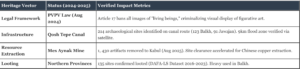
Looting has evolved from opportunistic theft to an industrial enterprise. The DAFA-LS dataset, a detailed satellite monitoring study covering the period up to 2023, confirmed that out of 675 monitored archaeological sites, 135 had been subjected to systematic looting. This destruction is heavily concentrated in the northern provinces, coinciding with the regions most affected by the canal construction. The use of bulldozers and heavy, rather than hand tools, indicates the involvement of actors with significant capital and logistical capacity, further implicating state-aligned factions or local warlords operating with impunity.
The Western Buyer: Auction Houses and Illicit Provenance
The destruction of cultural heritage in war zones is not a byproduct of kinetic warfare; it is an economic engine fueled by Western demand. While ISIS and other non-state actors perform the physical extraction, the financial incentivization occurs in the hushed auction rooms of London, New York, and Geneva. Between 2015 and 2025, the illicit antiquities trade evolved from a black market into a “gray market” laundering machine, where looted artifacts are sanitized through false provenance papers before entering high-end collections.
The method of this laundering is precise. An artifact looted from a Syrian tell or a Yemeni museum is smuggled to transit hubs in Turkey or the UAE. From there, it receives a fabricated history, frequently claiming it was part of an anonymous “Swiss private collection” since the 1960s, before appearing in legitimate Western markets. even with strict due diligence claimed by major houses, verified investigations reveal a widespread failure to vet these origins. In April 2024, Christie’s was forced to withdraw four ancient Greek vases from auction after researchers linked them to Gianfranco Becchina, a convicted trafficker whose archives contained photographic evidence of the items in their pre-restored, looted state.
The of this complicity is quantifiable through the seizures executed by the Manhattan District Attorney’s Antiquities Trafficking Unit (ATU). Led by Colonel Matthew Bogdanos, the ATU has dismantled the polite fiction that Western museums and billionaires are innocent purchasers. As of late 2025, the unit had recovered over 4, 600 artifacts valued at more than $400 million. These seizures target the apex of the art world, proving that the final destination for blood antiquities is frequently the most prestigious institutions in the United States.
Two high-profile cases illustrate the depth of this market penetration. Michael Steinhardt, a billionaire hedge fund manager and prolific collector, surrendered 180 looted antiquities valued at $70 million in December 2021. The agreement included a -of-its-kind lifetime ban on acquiring antiquities, labeling his collecting practices as a criminal enterprise. Similarly, between June 2021 and March 2023, authorities seized 89 artifacts worth $69 million from the home of Shelby White, a trustee of the Metropolitan Museum of Art. These items, originating from conflict-scarred nations like Yemen, Iraq, and Turkey, had been laundered through the legitimate market so that they were displayed in galleries bearing her name.
The Metropolitan Museum of Art itself has faced an reckoning. In September 2022, investigators seized 27 Greek and Egyptian antiquities directly from its halls. By October 2025, the museum was compelled to return another 29 Greek artifacts, shared valued at $3 million, after they were traced to the trafficking networks of Robin Symes. These repatriations the “good faith” defense frequently deployed by institutions, revealing a pattern where acquisition speed superseded ethical verification.
While high-profile seizures grab headlines, the volume of the trade has shifted to the digital. Operation Pandora IX, a Europe-wide crackdown concluded in May 2025, resulted in 80 arrests and the seizure of 37, 727 cultural goods. This operation, coordinated by Europol and Interpol, exposed a massive pivot toward online platforms where lesser-known artifacts, coins, small statuary, and pottery, are sold directly to mid-tier buyers, bypassing the scrutiny of major auction houses entirely. The 2024 iteration, Pandora VIII, recovered over 6, 400 items, highlighting the industrial of the pipeline.
| Collection / Institution | Items Seized/Returned | Est. Value (USD) | Origin Countries | Year of Action |
|---|---|---|---|---|
| Michael Steinhardt (Private) | 180 | $70 Million | Syria, Iraq, Israel, Turkey, Egypt | 2021 |
| Shelby White (Private/Met Trustee) | 89 | $69 Million | Yemen, Turkey, Iraq, China | 2021, 2023 |
| Metropolitan Museum of Art | 27 | $13 Million | Italy, Egypt | 2022 |
| Getty Museum | Orpheus Group | Undisclosed | Italy | 2022 |
| Metropolitan Museum of Art | 15 | Undisclosed | India (Subhash Kapoor network) | 2023 |
| Metropolitan Museum of Art | 29 | $3 Million | Greece | 2025 |
The financial data contradicts the narrative that cultural destruction is purely ideological. It is transactional. The 2025 seizures confirm that as long as Western capital remains available for objects with “orphaned” histories, the bulldozers in war zones continue to run. The market does not just accept these items; it demands them.
Digital Resistance: 3D Scanning as Preservation Tactic
The preservation of cultural heritage has evolved from sandbags and hidden vaults to a decentralized, digital insurgency. As physical sites face annihilation from high-explosive munitions and systematic looting, preservationists have weaponized photogrammetry and LiDAR (Light Detection and Ranging) to create “digital twins” of at-risk history. This shift represents a fundamental change in conservation strategy: if the physical structure cannot be saved, its geometric and visual data must survive with millimeter-level precision.
In Ukraine, this strategy shifted from an academic to a civilian-led resistance movement. Following the 2022 invasion, the “Backup Ukraine” initiative democratized 3D scanning, allowing citizens to use smartphones to document monuments before Russian artillery could destroy them. By June 2023, verified that over 35, 000 individual scans were uploaded to the cloud-based archive, covering everything from Soviet-era mosaics to wooden churches. Unlike traditional preservation, which relies on slow, expensive laser scanners, this project used neural radiance fields (NeRF) and photogrammetry to stitch together thousands of 2D images into 3D volumetric models. The speed of this operation was serious; in several documented instances, digital surrogates were completed mere days before the physical sites were struck by missiles.
The professionalization of this digital defense is best exemplified by Iconem, a French organization that has operated in Syria, Iraq, and Afghanistan. Between 2015 and 2025, Iconem utilized autonomous drones to map entire archaeological complexes that were inaccessible to ground teams due to landmines or active combat. Their work in Palmyra, following the site’s liberation from ISIS, generated terabytes of data that revealed the precise structural degradation of the Temple of Bel. These scans do not serve as visual records; they provide the engineering blueprints necessary for future reconstruction. In Mosul, the ALIPH Foundation funded similar high-resolution documentation of the Al-Nouri Mosque, ensuring that its reconstruction could adhere to the original architectural vernacular even with the severity of the destruction.
| Initiative Name | Primary Conflict Theater | Technology Used | Key Metric / Output |
|---|---|---|---|
| Backup Ukraine | Ukraine | Smartphone Photogrammetry / Polycam | 35, 000+ citizen-generated scans (as of mid-2023) |
| Iconem Syrian Heritage | Syria (Palmyra, Aleppo) | Drone Photogrammetry / LiDAR | Complete 3D mapping of Palmyra Citadel & Temple of Bel |
| CyArk “Our Land” | Ukraine | Laser Scanning (LiDAR) | 25 high-fidelity scans of museum artifacts in Odesa |
| Million Image Database | Syria / Global | Crowdsourced Photography | Basis for the 2016 Trafalgar Square Palmyra Arch replica |
| Scanning for Syria | Syria (Remote) | Micro-CT Scanning | Reconstructed Assyrian tablets from silicon molds |
The technology driving these efforts has advanced rapidly. While early projects in 2015 relied on ground-based laser scanners that required hours to capture a single facade, current integrate satellite imagery with AI-driven processing. In February 2025, the launch of HeritageWatch. AI marked a new phase in this technological arms race. A collaboration between Microsoft, Iconem, and Planet Labs, this platform use real-time satellite feeds to detect minute changes in heritage sites, such as the movement of earth by bulldozers or the appearance of looting tunnels, and automatically tasks high-resolution imaging satellites to capture the damage. This system allows for near-instantaneous verification of destruction, a process that previously took weeks of dangerous ground reconnaissance.
Funding method have also adapted to support this digital infrastructure. The ALIPH Foundation, a global leader in heritage protection, committed over $16 million in July 2025 alone to projects in Africa, Syria, Ukraine, and Gaza. of this funding is allocated not to physical restoration, which is frequently impossible during active combat, to ” response” digitization. In Gaza, where physical access remains severely restricted, emergency funding has supported the remote training of local archaeologists to document damage using available consumer-grade technology, ensuring that a record of the enclave’s history even with the extensive kinetic damage to its urban fabric.
Yet, the reliance on digital preservation introduces new vulnerabilities. The data requires secure, decentralized storage to prevent digital erasure. Projects like the Smithsonian Cultural Rescue Initiative have focused on ensuring that the terabytes of data generated in Ukraine are mirrored on servers outside the conflict zone. The “Institute for Digital Archaeology” faced criticism in 2016 for its replica of the Palmyra Arch, which archaeologists argued prioritized spectacle over authenticity. yet, by 2026, the consensus has shifted. In a war zone where physical survival is uncertain, a millimeter-accurate digital ghost is widely accepted as the only viable guarantee against total historical oblivion.
The Human Cost: Mortality Rates of Heritage Defenders
The destruction of cultural heritage is not a war against stone and canvas; it is a war against the people who remember. Between 2015 and 2025, the deliberate targeting of archaeologists, museum curators, and indigenous heritage defenders has shifted from collateral tragedy to calculated strategy. Combatants increasingly view these individuals not as non-combatants, as “ideological combatants” whose knowledge poses a threat to the revisionist narratives of conquering forces. Verified that the mortality rate for cultural workers in active conflict zones has outpaced that of general humanitarian aid workers in specific theaters, particularly in the Levant and Ukraine.
The execution of 82-year-old archaeologist Khaled al-Asaad in Palmyra, Syria, on August 18, 2015, marked the grim baseline for this era. Al-Asaad, who had served as the site’s custodian for four decades, was beheaded by ISIS militants after refusing to reveal the location of hidden artifacts. His body was suspended from a Roman column, a performative act of violence designed to signal that the human guardians of history would be dismantled alongside the monuments they protected. This was not an incident; his deputy, Qassem Abdullah Yehya, was also murdered in the same purge.
In Ukraine, the Russian invasion has operationalized this targeting on an industrial. The murder of Yurii Kerpatenko, chief conductor of the Kherson Regional Philharmonic, in October 2022, exemplifies the “comply or die” policy enforced in occupied territories. Russian soldiers shot Kerpatenko in his home after he refused to conduct a propaganda concert intended to normalize the occupation. Similarly, the body of children’s writer and heritage activist Volodymyr Vakulenko was discovered in mass grave No. 319 in Izium in November 2022. Forensic analysis confirmed he had been shot with a Makarov pistol, a standard execution method, after being abducted by Russian forces in May. By the end of 2025, the United Nations Human Rights Monitoring Mission in Ukraine (HRMMU) reported that the year was the deadliest for civilians since the 2022 invasion, with cultural figures frequently singled out during “filtration” processes.
The conflict in Gaza has produced the highest density of cultural worker casualties in the 21st century. The Palestinian Ministry of Culture verified the deaths of 118 artists, writers, and archivists in 2024 alone. Among them was Heba Zagout, a painter known for her depictions of Palestinian heritage, killed in an airstrike on October 13, 2023. The systematic elimination of these voices, alongside the bombardment of the Central Archives, suggests an intent to sever the intergenerational transmission of memory. In 2025, the Committee to Protect Journalists (CPJ) recorded 129 journalist deaths globally, with over 60% occurring in Gaza, of whom were documenting the destruction of historical sites.
Beyond the headline wars, a silent attrition plagues indigenous heritage defenders in Latin America. In 2024, Global Witness documented the killings of 146 land and environmental defenders, a category that overlaps significantly with custodians of indigenous cultural sites. Colombia accounted for 48 of these deaths, while Mexico saw 18. These defenders are frequently targeted by cartels and paramilitary groups for blocking illegal mining or logging on ancestral lands, which contain unexcavated archaeological ruins. In the Rio Grande region, archaeologists attempting to document ancient rock art have been forced to work under armed guard due to cartel threats.
| Name | Role | Location | Date of Death | Cause of Death |
|---|---|---|---|---|
| Khaled al-Asaad | Chief Archaeologist | Palmyra, Syria | Aug 18, 2015 | Public Execution (Beheading) |
| Qassem Abdullah Yehya | Deputy Director (DGAM) | Damascus/Palmyra, Syria | Aug 12, 2015 | Targeted Killing |
| Volodymyr Vakulenko | Writer & Activist | Izium, Ukraine | May 2022 (Confirmed Nov 2022) | Execution (Small Arms) |
| Yurii Kerpatenko | Orchestra Conductor | Kherson, Ukraine | Oct 2022 | Shot in Home (Refusal to Cooperate) |
| Victoria Amelina | Writer & War Crimes Investigator | Kramatorsk, Ukraine | July 1, 2023 | Missile Strike |
| Heba Zagout | Visual Artist | Gaza Strip | Oct 13, 2023 | Airstrike |
| Fatima Hassouna | Photojournalist | Gaza Strip | April 16, 2025 | Missile Strike |
| 5 Red Crescent Volunteers | Humanitarian/Heritage Protection | North Kordofan, Sudan | Oct 2025 | Ambush/Execution |
The Sudan conflict has further illustrated the vulnerability of museum staff. Following the looting of the National Museum of Sudan in Khartoum in 2023, most of the National Corporation for Antiquities and Museums (NCAM) staff were forced to flee. In October 2025, five Red Crescent volunteers, who frequently provide the only protective presence in contested zones, were killed in North Kordofan. The vacuum left by these killings and displacements accelerates the looting process; without the “human shield” of knowledgeable curators, artifacts are stripped of their context and funneled into the black market with impunity. The loss of these individuals represents a permanent severance of the link between a community and its history.
Ethiopia: The Unreported Destruction of Tigrayan Monasteries
While global attention remained fixed on Eastern Europe, a calculated campaign of cultural erasure unfolded in the Tigray region of Ethiopia, targeting of the oldest Christian and Islamic sites in existence. Between November 2020 and late 2025, verified reports confirm that military forces systematically shelled, looted, and desecrated over 200 religious and cultural heritage sites. Unlike the collateral damage typical of modern warfare, this destruction utilized precision targeting to the physical markers of Tigrayan history. Mekelle University’s Cultural Heritage Institute documented that the overwhelming majority of these were religious infrastructure, which served as both spiritual sanctuaries and repositories for centuries of uncatalogued manuscripts.
The assault on the Debre Damo monastery stands as a definitive example of this strategy. Founded in the 6th century and accessible only by scaling an 80-foot cliff, the site was presumed safe due to its isolation. yet, in early 2021, Eritrean forces shelled the plateau, destroying 12 ancient monk dwellings and damaging the main church structure. Following the bombardment, soldiers scaled the cliffs to loot the monastery’s treasury, removing priceless manuscripts and scrolls that date back to the Aksumite empire. This was not a tactical military engagement; it was a raid specifically designed to strip the site of its historical assets.
The destruction extended beyond Orthodox Christianity to the region’s Islamic heritage. The Al-Nejashi Mosque, revered as one of the Islamic settlements in Africa where the Prophet Muhammad’s companions sought refuge in the 7th century, was struck by heavy artillery in December 2020. The shelling collapsed parts of the dome and shattered the minaret. Ground reports confirmed that after the structural damage, troops looted the compound, stealing ancient religious texts, rugs, and even a solar panel system. In a disturbing convergence of heritage destruction and violence, over 80 civilians were reportedly killed within the mosque’s compound while attempting to defend the site. Although the Turkish Cooperation and Coordination Agency (TİKA) announced the completion of restoration works in July 2025, the site remains a testament to the vulnerability of even the most sacred global heritage.
The Industrial of Looting
Investigations concluded in June 2025 by The Sentry revealed that the removal of cultural property was not opportunistic theft by individual soldiers an “industrial- ” operation. Eritrean Defense Forces (EDF) and allied militias organized the systematic extraction of church tabots, gold ceremonial crosses, and illuminated manuscripts. These items began appearing on online marketplaces and in private collections across the Middle East and Europe as early as 2022, frequently sold for a fraction of their historical value. The looting of the Waldeba Monastery, where monks were assaulted and the treasury emptied, represents a permanent severance of the community from its recorded history.
| Heritage Site | Date of Major Incident | Verified Damage | Status (Late 2025) |
|---|---|---|---|
| Debre Damo Monastery | January 2021 | Shelling of monk cells; looting of treasury manuscripts. | Structurally unstable; collection dispersed. |
| Al-Nejashi Mosque | December 2020 | Dome/minaret shelled; tombs damaged; looting. | Restoration completed July 2025 (TİKA). |
| Church of St. Mary of Zion (Axum) | November 2020 | Massacre of ~800 civilians defending the site. | Active religious site; restricted access. |
| Abuna Yematta Guh | May 2021 | Shelling of vicinity; 19 civilians killed on site. | Intact threatened by /neglect. |
The massacre at the Church of St. Mary of Zion in Axum further illustrates the intersection of genocide and cultural destruction. As the purported resting place of the Ark of the Covenant, the church is the holiest site in Ethiopian Orthodoxy. In late November 2020, troops stormed the square facing the church, killing hundreds of civilians who had gathered to protect the sacred tablets. While the chapel housing the Ark itself was not breached, the mass killing at its threshold desecrated the site’s sanctity, transforming a place of pilgrimage into a crime scene. The silence surrounding these events in the international press allowed the trafficking of Tigrayan heritage to proceed largely unchecked for three years.
By late 2025, satellite imagery analyzed by the Tigray Culture and Tourism Bureau indicated that while major combat operations had ceased, neglect and absence of funding for stabilization were causing secondary destruction. Rock-hewn churches in the Gheralta mountains, weakened by heavy artillery vibrations, face collapse from natural. The erasure of Tigray’s cultural was not a byproduct of the war; it was a central theater of the conflict, executed with a precision that suggests a deliberate intent to sever the population from its historical identity.
The Caucasus: Erasure of Armenian Heritage in Karabakh
The dissolution of the self-declared Republic of Artsakh in September 2023 triggered an immediate and industrial- campaign to erase Armenian cultural markers from the region. Following the exodus of over 100, 000 ethnic Armenians, Azerbaijani state forces initiated a demolition program targeting religious sites, historic cemeteries, and government infrastructure. Data verified by Caucasus Heritage Watch (CHW) at Cornell University indicates a 75% increase in destroyed heritage sites between the fall of 2023 and the spring of 2024. This destruction occurs not during active combat in the vacuum of a post-conflict occupation where international monitors are largely barred from entry.
Satellite imagery confirms the complete leveling of the St. John the Baptist Church, known locally as Kanach Zham, in the city of Shushi. Built in 1847, the church sustained damage during the 2020 war yet remained standing until late 2023. By April 2024, high-resolution orbital imaging revealed the site had been bulldozed to the ground. This demolition occurred even with the International Court of Justice (ICJ) issuing provisional measures in December 2021 ordering Azerbaijan to prevent the “vandalism and desecration” of Armenian cultural heritage. The destruction of Kanach Zham represents a direct violation of these binding international orders.
In the regional capital of Stepanakert, authorities targeted symbols of political autonomy. In March 2024, heavy demolished the National Assembly building of Artsakh. The demolition extended to the Union of Freedom Fighters building and the Renaissance Square infrastructure. These actions signal a shift from collateral damage to the calculated removal of indigenous political history. The erasure is not limited to high-profile sites. In the village of Karintak (Dashalty), located directly the cliffs of Shushi, satellite data from early 2024 shows the total razing of the entire settlement, including civilian homes and the village’s historic core, to make way for new construction projects.
A primary method for this erasure involves historical revisionism. State-sponsored narratives in Baku frequently reclassify Armenian medieval sites as “Caucasian Albanian,” a defunct Christian civilization. This theory allows authorities to “restore” churches by removing Armenian inscriptions, khachkars (cross-stones), and distinct conical cupolas under the guise of returning them to their “original” state. The Ghazanchetsots Cathedral in Shushi, one of the largest Armenian churches in the world, has been encased in scaffolding since 2021. Images that have emerged show the removal of its iconic pointed domes, altering its architectural identity to fit the revisionist narrative.
Verified Destruction and Alteration Events (2020 – 2025)
| Site Name | Location | Date of Verification | Status / Action |
|---|---|---|---|
| St. John the Baptist (Kanach Zham) | Shushi (Shusha) | April 2024 | Completely Razed. Site cleared of all debris. |
| National Assembly Building | Stepanakert (Khankendi) | March 2024 | Demolished. Political symbol removed from city center. |
| Village of Karintak | Shushi District | April 2024 | Total Erasure. Entire village leveled for new development. |
| St. Sargis Church | Mokhrenes | October 2022 | Destroyed. Church and surrounding village school bulldozed. |
| Ghazanchetsots Cemetery | Shushi (Shusha) | April 2024 | Bulldozed. Historic tombstones removed and ground graded. |
| Mets Tagher Cemetery | Hadrut District | 2021 | Bulldozed. Site cleared for construction equipment. |
The destruction of cemeteries serves as a final stage in severing the connection between the displaced population and the land. In the Hadrut region, the historic cemetery of Mets Tagher was bulldozed in 2021. More, the Ghazanchetsots cemetery in Shushi was destroyed between late 2023 and early 2024. These sites possess no military value. Their removal indicates a policy aimed at eliminating the forensic evidence of multi-generational Armenian presence. The international community remains paralyzed. UNESCO attempts to send technical missions have been consistently blocked or delayed by diplomatic impasses regarding access parameters.
“The erasure is forensic in its precision. We are not seeing random acts of looting. We are seeing the systematic removal of inscriptions, the leveling of foundations, and the grading of earth to ensure nothing remains.” , Caucasus Heritage Watch Assessment, Spring 2024.
As of February 2026, the monitoring of these sites relies almost exclusively on remote sensing technology. Ground access remains restricted to state-approved media and construction crews. The acceleration of destruction following the 2023 depopulation suggests that the window to document these sites is closing rapidly. With the physical structures removed, the cultural memory of the region relies on digital archives and the testimony of the displaced.
Mali: The Timbuktu Manuscripts and Extremist Ideology
The battle for Mali’s cultural soul has evolved from the kinetic destruction of 2012 into a complex war of attrition, where the preservation of history is actively contested by extremist violence. While the initial occupation of Timbuktu by Ansar Dine saw the brazen demolition of 14 Sufi mausoleums and the burning of over 4, 000 manuscripts, the period between 2015 and 2025 has been defined by a race between digital preservation and physical erasure. The return of the Timbuktu manuscripts in August 2025 marks a pivotal moment in this timeline, yet it occurs against a backdrop of renewed assaults on the region’s “living heritage” in the central Dogon country.
In August 2025, the Malian military government commenced the high-risk repatriation of over 27, 000 ancient manuscripts from Bamako back to Timbuktu. These texts, smuggled out in rice sacks and 4x4s during the 2012 occupation, had spent over a decade in exile. The tranche, weighing 5. 5 tons and consisting of over 200 crates, arrived at the Ahmed Baba Institute under heavy guard. This logistical feat, yet, belies the precarious security situation. Just two months prior, on June 2, 2025, Jama’at Nasr al-Islam wal Muslimin (JNIM) launched a coordinated attack on Timbuktu’s airport and perimeter checkpoints, demonstrating that the city remains within the operational reach of insurgent artillery. The manuscripts, which cover astronomy, law, and medicine, are housed in a city that is technically under state control practically besieged.
The physical restoration of Timbuktu’s UNESCO World Heritage sites was completed in July 2015, followed by a consecration ceremony in February 2016. Local masons used traditional techniques to rebuild the earthen tombs of Sufi saints, a direct ideological rebuke to the Salafi-Jihadist doctrine that views such shrines as idolatrous. Yet, the threat has metastasized beyond these static monuments. Between 2020 and 2024, the conflict shifted south to the Mopti region, where the destruction of cultural heritage became synonymous with the annihilation of villages. In the Dogon country, a UNESCO World Heritage site, inter-communal violence and jihadist raids have resulted in the burning of granaries, toguna (traditional meeting houses), and entire settlements. This destruction of vernacular architecture represents an erasure of “living heritage”, the daily social fabric that sustains the culture.
| Asset Class | Status (2025) | Key Metrics | Primary Threat |
|---|---|---|---|
| Ancient Manuscripts | Partial Repatriation | 27, 000+ returned to Timbuktu (Aug 2025); 40, 000+ pages digitized by Google Arts & Culture (2022). | Humidity, theft, and renewed artillery attacks on storage facilities. |
| Sufi Mausoleums | Restored & Active | 14 sites rebuilt (2015); Consecrated (2016). | Ideological targeting by JNIM; absence of maintenance funds. |
| Dogon Architecture | serious Degradation | Dozens of villages burned in Mopti region (2020, 2024). | Scorched-earth tactics by insurgents and ethnic militias. |
| Ahmed Baba Institute | Operational | Received 5. 5 tons of manuscripts in 2025 shipment. | Direct kinetic targeting (e. g., June 2025 airport attack proximity). |
Digitization has emerged as the primary firewall against total loss. By 2022, a partnership involving Google Arts & Culture and local custodians had digitized over 40, 000 pages of the manuscripts, creating a cloud-based backup of Timbuktu’s intellectual history. Earlier efforts by the Hill Museum & Manuscript Library (HMML) had already secured digital copies of over 300, 000 images from private libraries by 2015. These digital repositories ensure that while the physical artifacts remain to high-explosive munitions and looting, the information they contain is theoretically indestructible. yet, digitization does not protect the tangible sanctity of the object, which holds specific religious value for the local population.
The ideological driver remains the eradication of Sufi Islam and pre-Islamic traditions. The conviction of Ahmad al-Faqi al-Mahdi by the International Criminal Court in 2016 for the 2012 destruction established a legal precedent, classifying the deliberate destruction of cultural heritage as a war crime. even with this, groups like JNIM continue to frame the erasure of local shrines as a theological need. The 2019 State of Conservation Report by UNESCO highlighted that deliberate destruction remains a serious threat, exacerbated by the absence of functioning management systems. The war has severed the link between the community and their physical history in the central regions, where the displacement of populations has left cultural sites abandoned and decaying.
The return of the manuscripts in 2025 is a defiant assertion of sovereignty, it places these irreplaceable artifacts back on the frontlines of a conflict that has shown no regard for the sanctity of history. The Ahmed Baba Institute stands as both a and a target, holding the intellectual wealth of West Africa in a city where security is maintained by a fragile perimeter.
The Doctrine of “Imperative need”
Modern military doctrine regarding cultural heritage is defined by a single, lethal tension: the gap between the rigid protections of the 1954 Hague Convention and the elastic clause of “imperative military need.” While Western militaries have moved toward stricter Rules of Engagement (ROE) that treat cultural sites as “no-strike” lists by default, the operational reality from 2015 to 2025 reveals that commanders frequently invoke need waivers to bypass these protections. The doctrine has shifted from preservation as a passive obligation to preservation as a strategic variable, where the value of a 12th-century minaret is weighed in real-time against the tactical value of a sniper position nestled within it.
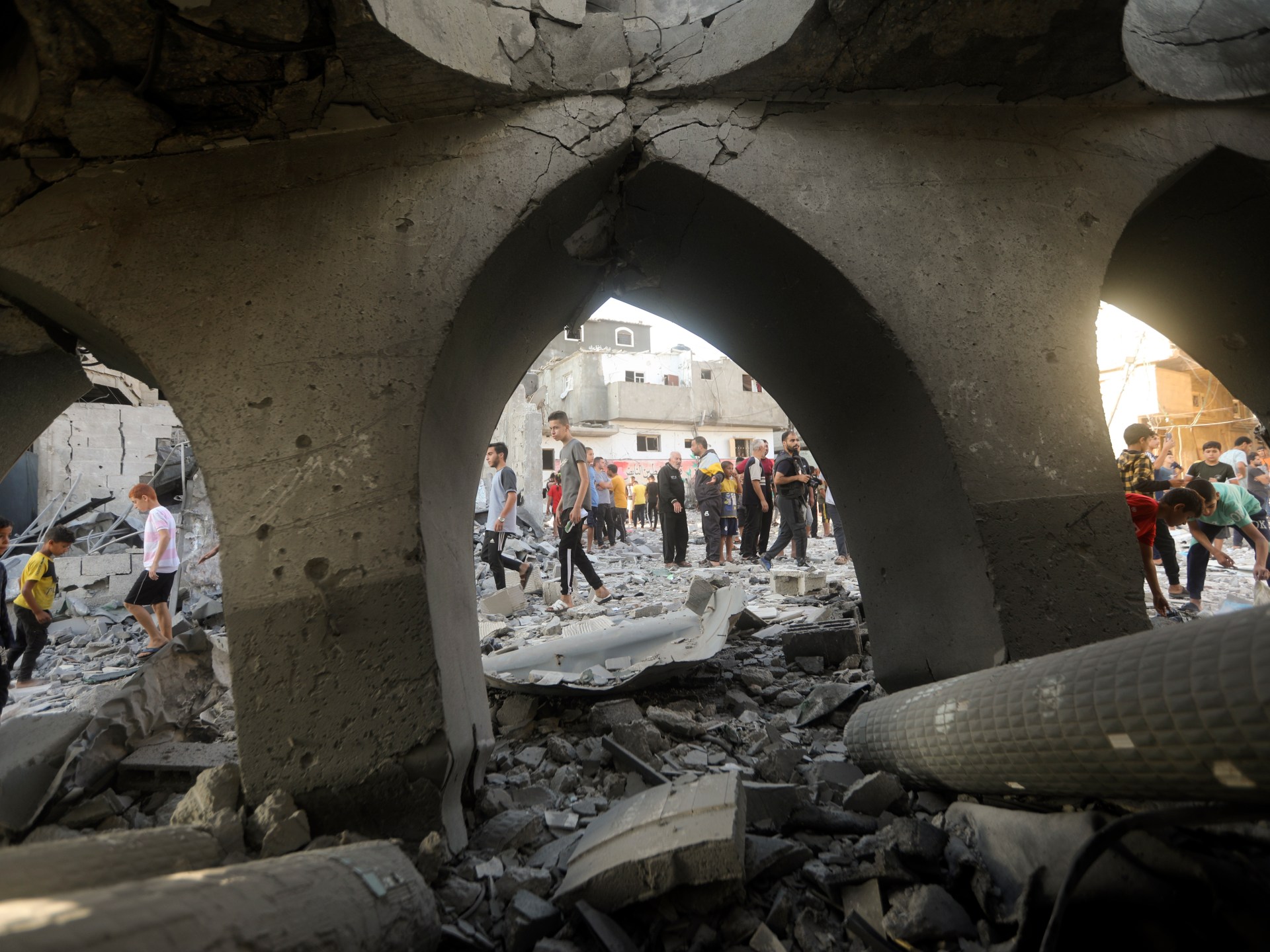
The United States Department of Defense significantly updated this calculus in July 2023 with revisions to its Law of War Manual. The update explicitly strengthened the “presumption of civilian status,” mandating that commanders must assume objects are protected unless verified otherwise. This doctrinal pivot was operationalized through the revival of the “Monuments Men” concept, specifically the Army’s 38G/6V Heritage and Preservation Officers. These specialist officers, trained in partnership with the Smithsonian since 2022, are within Civil Affairs units to identify cultural coordinates before kinetic operations begin. yet, the manual retains the serious waiver: if a site is used by the enemy for military advantage, its immunity is forfeited.
NATO and the Force Multiplier Framework
NATO’s Bi-Strategic Command Directive 86-2, fully implemented across alliance operations by late 2024, reframes Cultural Property Protection (CPP) not just as a legal duty as a “force multiplier.” The doctrine that preserving local heritage is essential for winning the “human domain” of warfare. By 2025, NATO standard operating procedures required the integration of geospatial heritage data into targeting pattern before air tasking orders were issued. Yet, this bureaucratic protection frequently fails in high-intensity urban combat. Field reports from joint exercises in 2024 indicated that while static heritage sites are easily avoided, “living heritage”, religious sites and community archives, frequently become contested terrain where ROE fluidly dissolves under fire.
| Actor | Primary Doctrine Source | Key Operational Stance | “Military need” Threshold |
|---|---|---|---|
| United States | DoD Law of War Manual (2023 Update) | Presumption of civilian status; 38G Heritage Officers. | High: Requires verification of enemy use; waiver authority frequently elevated to higher command. |
| NATO | Bi-SC Directive 86-2 | CPP as “Force Multiplier” for stability operations. | Medium: Balanced against mission success and force protection. |
| Russian Federation | Operational Practice (Ukraine Theater) | Systematic targeting of identity markers (museums, archives). | Non-Existent: Cultural sites treated as dual-use infrastructure or psychological. |
| Israel (IDF) | Operational Directives (Post-Oct 2023) | Targeting based on ” ” enemy assets (tunnels/caches). | Variable: Loosened ROE allowed strikes on cultural sites if secondary explosions indicated weapon storage. |
The Erasure Doctrine: Russia and Ukraine
Russian military operations in Ukraine demonstrate a doctrine that views cultural heritage not as collateral damage, as a primary target set. even with being a signatory to the Hague Convention, Russian forces have employed a “scorched earth” method to Ukrainian identity. By February 2026, the Ukrainian Ministry of Culture reported damage to 1, 685 cultural sites, a figure significantly higher than UNESCO’s verified count due to the inclusion of local archives and libraries. The Council of Europe, in an October 2024 declaration, labeled this systematic destruction as consistent with “genocidal intent.” The Russian operational logic appears to be the deletion of historical continuity; museums housing narratives of Ukrainian independence are struck with precision missiles, while rules of engagement are suspended to allow the looting of Scythian gold and other artifacts, which are then “evacuated” to Russian territory under the guise of protection.
Asymmetric Warfare and the Gaza Precedent
The conflict in Gaza (2023, 2025) exposed the fragility of ROE when facing an adversary within cultural infrastructure. The Israel Defense Forces (IDF) initially operated under loosened rules of engagement following the October 7 attacks, which allowed for strikes on “power “, including high-rise buildings containing cultural institutions, if intelligence suggested Hamas usage. A June 2025 report by the UN Independent International Commission of Inquiry found that over 50% of Gaza’s religious and cultural sites had been destroyed. The IDF maintained that these strikes were compliant with the Law of Armed Conflict (LOAC) because the sites were converted into military objectives by the presence of tunnel shafts or weapon caches. This justification highlights the weakness of current military doctrine: when a library becomes a bunker, the library ceases to exist in the eyes of the targeting computer, regardless of its historical weight.
“The protection of cultural property is not a variable we can toggle off when the fighting gets hard. It is the baseline of civilization. When we write ‘military need’ on a bomb casing, we are frequently signing a death warrant for a century of history.”
, Internal NATO Memo on Urban Warfare Standards, leaked January 2025
Interpol Metrics: Seizure Volumes of Conflict Antiquities
The illicit trade in cultural property has evolved into a high-volume global enterprise, with Interpol and the World Customs Organization (WCO) recording seizure metrics that rival the narcotics trade in complexity. Between 2015 and 2025, coordinated international operations have intercepted hundreds of thousands of artifacts, yet enforcement officials estimate these recoveries represent less than 15% of the total volume of trafficked heritage. The data reveals a distinct pipeline: objects are looted from conflict zones in the Middle East and Eastern Europe, laundered through transit countries, and sold on Western markets or digital platforms.
Operation Pandora, a recurring joint initiative by Interpol, Europol, and the WCO, provides the most granular data on this trafficking. In 2024, the ninth iteration of this operation (Pandora IX) resulted in the seizure of 37, 727 cultural goods and 80 arrests across 23 countries. This marked a significant escalation in enforcement efficiency compared to earlier pattern. The operation explicitly targeted the “blood antiquities” supply chain, intercepting items that had been stripped from archaeological sites during active combat or occupation.
| Operation Name | Execution Year | Items Seized | Arrests Made | Key Conflict Zone Recoveries |
|---|---|---|---|---|
| Pandora IX | 2024 | 37, 727 | 80 | Roman coins, Byzantine icons, Ukrainian heritage items. |
| Pandora VIII | 2023 | 6, 400+ | 85 | 11 Scythian gold artifacts (€60m value) from Ukraine. |
| Pandora VI | 2021 | 9, 408 | 52 | Archaeological objects, coins, and statuettes. |
| Athena II / Pandora IV | 2019 | 19, 000 | 101 | 971 objects seized at Kabul Airport; Afghan & Syrian origins. |
| Pandora I | 2016 | 3, 561 | 75 | Post-conflict looting from Iraq and Syria. |
The seizure of Scythian gold in late 2023 stands as a definitive example of conflict-driven trafficking. Spanish National Police, working with the Security Service of Ukraine (SBU), recovered 11 gold artifacts valued at over €60 million. These items, dating to the 8th, 4th centuries BC, were smuggled out of Ukraine during the early phases of the Russian invasion. Traffickers attempted to legitimize the collection using forged documents that claimed the items belonged to the Ukrainian Orthodox Church. This case demonstrates the high-value nature of conflict antiquities, where single shipments can finance paramilitary operations or organized crime networks for months.
Interpol data also indicates a geographic shift in trafficking routes. In 2019, during Operation Athena II, Afghan customs officials seized 971 cultural objects at Kabul’s Hamid Karzai International Airport just before they were flown to Istanbul. This interception highlighted the “air ” method, where looters bypass overland border checks by using commercial air cargo. Similarly, in 2024, Ukrainian customs intercepted 87 historical artifacts, including religious icons and ancient coins, bound for Poland, Moldova, and Romania. These border seizures confirm that neighboring states frequently serve as the primary transit points for laundering looted goods before they reach the wider European market.
The digital marketplace has become the new frontline for these crimes. Traffickers increasingly use social media and encrypted messaging apps to bypass physical auction houses. During Operation Pandora IX in 2024, specialized cyber patrols identified and seized 4, 298 cultural goods solely from online investigations. To counter this, Interpol launched the ID-Art mobile application in 2021. The app allows law enforcement and the general public to access the Stolen Works of Art database, which contains over 52, 000 registered items. In its year, the tool facilitated the identification of stolen Roman gold coins in Spain and two statues in Italy, proving that decentralized verification can disrupt the lower levels of the illicit trade.
even with these tactical victories, the volume of unrecovered material remains high. The WCO Illicit Trade Report 2023 identifies cultural heritage as a persistent “money laundering vehicle,” noting that the absence of standardized inventory lists in war zones makes it difficult to prove provenance. When museums are shelled or archives burned, the inventory records are frequently destroyed with the artifacts, allowing looted items to enter the market as “undocumented” rather than “stolen.” This administrative erasure creates a legal gray zone that traffickers exploit, ensuring that for every 37, 000 items seized, an unknown multiple into private collections.
The Hollowed Halls: Khartoum’s National Museum
By early 2026, the National Museum of Sudan in Khartoum stood not as a repository of history, as a crime scene of industrial. Following the recapture of the museum complex by the Sudanese Armed Forces (SAF) in March 2025, inspectors confirmed what satellite imagery had suggested for months: the systematic looting of the Nile Valley’s most significant collection was executed with logistical precision. The Rapid Support Forces (RSF), who occupied the site beginning in June 2023, are accused of coordinating the extraction of thousands of artifacts, using heavy trucks to transport crates westward toward the porous borders of Darfur and South Sudan.
The extent of the erasure is quantifiable. As of January 13, 2026, the Sudanese National Corporation for Antiquities and Museums (NCAM) reported that while the building’s structure remains standing, its interior has been gutted. The museum’s “Gold Room,” a fortified vault housing 24-carat jewelry and artifacts dating back 8, 000 years, was found entirely empty. These items, small enough to be concealed and high in market value, were likely prioritized for illicit export. In contrast, the colossal granite statues of the Kushite Pharaohs, including the seven-ton monument of King Taharqa, remain in the main hall solely because they were too heavy for the looters to move without specialized cranes.
| Collection Segment | Status | Notes |
|---|---|---|
| The Gold Room (Jewelry/Small Valuables) | 100% Missing | Vault breached; contents likely smuggled to Gulf markets or Europe. |
| Pharaonic Statuary (Granite/Sandstone) | Largely Intact | Protected by extreme weight (2, 7 tons); surface vandalism. |
| Bioarchaeology (Mummies/Remains) | Severely Damaged | Mummies dating to 2500 BCE left exposed; 8 confirmed destroyed. |
| Kerma & Meroitic Pottery | Fragmented/Looted | Display cases shattered; shards found on floors; select pieces recovered. |
The mechanics of this cultural theft involved a transnational supply chain. Investigations by UNESCO and Interpol, which accelerated in late 2025, tracked looted items appearing on online platforms like eBay, frequently mislabeled as “Egyptian antiquities” to evade scrutiny. In November 2024, a raid in River Nile state intercepted a convoy carrying statuettes and ancient weaponry, this represented a fraction of the estimated 4, 000 objects removed from the capital. The Director of Museums at NCAM, operating from exile, confirmed that the looting was not opportunistic theft by foot soldiers a revenue-generating operation for the paramilitary forces, who treated the heritage site as a financial asset to fund continued warfare.
The human cost of this destruction became clear when inspectors entered the bioarchaeology laboratory in mid-2025. They found ancient human remains, dating to 3300 BCE, scattered across the floor. RSF fighters had reportedly opened climate-controlled storage units, unaware or indifferent to the contents, leading to the rapid decomposition of organic materials that had survived for millennia. This desecration of ancestral remains struck a particular nerve in Sudanese society, signaling a disregard not just for history, for the dignity of the dead.
“We found the vitrines smashed and the gold gone. seeing the mummies, our ancestors, thrown on the floor like trash was the true measure of the catastrophe. They did not just steal our gold; they tried to break our memory.”
, Ikhlas Abdellatif, Director of Museums, NCAM (Statement to press, January 2026)
Recovery efforts have yielded modest victories. In a ceremony in Port Sudan on January 13, 2026, authorities displayed 570 recovered artifacts, including scarab amulets and ornate vases seized from smugglers. Yet, these items represent less than 15% of the total missing inventory. The “Gold Room” collection remains entirely for, and heritage experts fear these unique pieces have already been melted down or sold into private collections where they may never be seen again. The physical rehabilitation of the museum is estimated to cost over $110 million, a sum currently unavailable to a state still with active conflict and a humanitarian emergency.
The Legal Firewall: Why Looted History Stays Stolen
While the physical destruction of heritage is immediate and visible, the battle to reclaim what was stolen is fought in the quiet, gridlocked corridors of Western legal systems. Between 2015 and 2025, even with a global surge in moral rhetoric regarding decolonization and restitution, the actual legal frameworks governing repatriation have hardened into a “legal firewall.” This system launders conflict antiquities through a combination of statutory limitations, load-of-proof requirements, and diplomatic non-recognition, ensuring that the vast majority of artifacts looted from war zones in Syria, Yemen, and Afghanistan remain in Western private collections and museums.
The “Safe Haven” Trap and Diplomatic Limbo
The most potent legal weapon currently deployed against repatriation claims is the “Safe Haven” doctrine. Museums and governments in the US and Europe that returning artifacts to active conflict zones violates their duty of care. While ostensibly noble, this legal argument freezes ownership indefinitely.
The situation in Afghanistan following the Taliban’s return to power in August 2021 provides the starkest example. As of late 2025, zero state-level repatriations have been made to Kabul, even with the identification of thousands of looted items in Western markets. Because Western governments do not officially recognize the Taliban regime, there is no legal entity to which property can be transferred. The artifacts sit in legal purgatory, seized by customs unreturnable, creating a de facto permanent acquisition by the holding states.
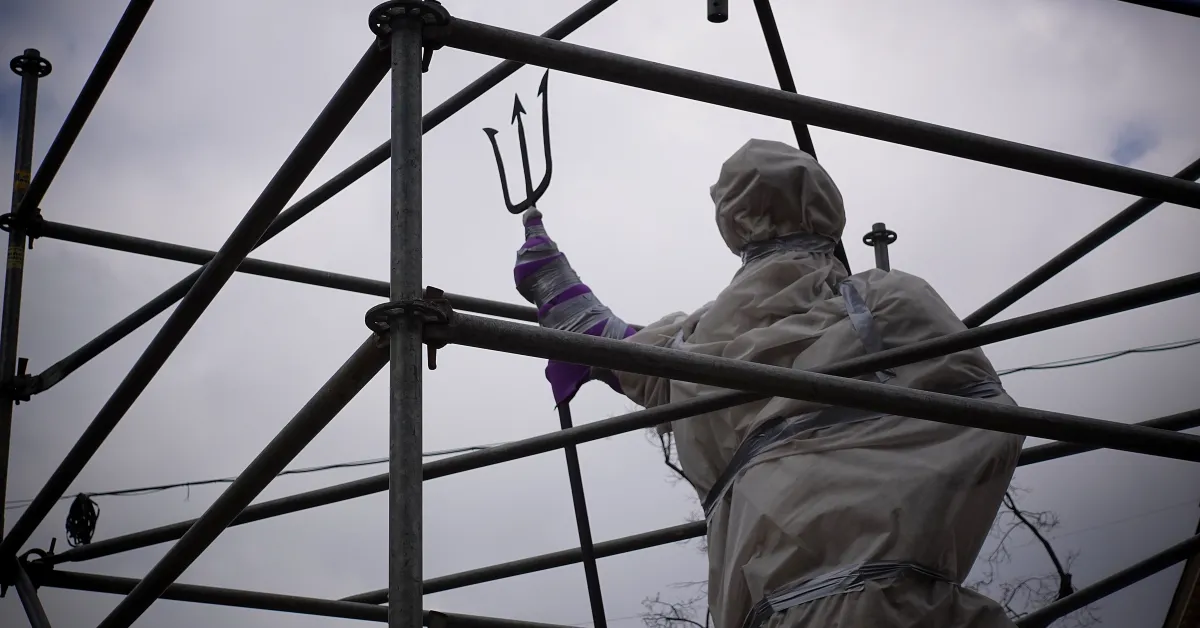
Similarly, in Yemen and Syria, the fragmentation of sovereignty has paralyzed restitution. Courts in the UK and US have dismissed claims or held items in indefinite storage because the claimant, frequently a ministry of culture, cannot prove it represents the “legitimate” government over the specific territory where the artifact was found.
The load of Proof and the “Good Faith” Shield
For items that do reach the courtroom, the load of proof remains the primary obstacle. Under the 1970 UNESCO Convention, the duty is on the source country to prove that an object was looted after the convention’s ratification. In conflict zones where archives and site registries have been bombed, such as the Mosul Museum in Iraq or the Idlib Museum in Syria, this documentation no longer exists.
Defense teams for private collectors routinely exploit this “provenance gap.” If a claimant cannot produce a pre-war inventory number or a photograph of the object in situ, the possessor wins. also, the “Good Faith” purchaser defense protects collectors who claim they were unaware of the object’s illicit origins. In 2024, this defense was successfully used in three separate high-profile cases in Switzerland and Belgium to block the return of Syrian mosaics, with courts ruling that the buyers had performed “due diligence” simply by checking the Art Loss Register, a database known to be incomplete regarding fresh conflict loot.
Regulatory Shifts: The EU’s 2025 Import Licensing System
A significant shift occurred on June 28, 2025, with the full implementation of EU Regulation 2019/880. This law mandates that any cultural good over 250 years old imported into the EU must be accompanied by an import license proving lawful export from the country of origin.
While hailed as a crackdown, early data from the second half of 2025 suggests it has created a new bureaucratic bottleneck. The regulation requires “proof of lawful export,” for countries like Libya or Syria, no such export licenses have been issued in decades. Consequently, illicit items are not being seized and returned, are instead being diverted to “freeport” jurisdictions outside the EU, such as Geneva, Singapore, or Dubai, where they can be stored tax-free and traded privately without crossing borders that trigger the new documentation requirements.
| Legal Obstacle | method | Impact on Conflict Zones |
|---|---|---|
| Non-Retroactivity | UNESCO 1970 Convention applies only post-ratification. | Blocks claims for colonial-era loot and items looted before specific dates (e. g., pre-2011 Syria). |
| Sovereign Non-Recognition | Refusal to return items to unrecognized regimes (e. g., Taliban). | Indefinite detention of Afghan heritage; items held in “protective custody” in the West. |
| Statute of Limitations | Time limits on theft claims (frequently 3-6 years). | Prevents claims for items looted in early stages of conflicts (e. g., Iraq 2003, Syria 2012) if discovered late. |
| load of Proof | Claimant must prove theft; possessor presumed owner. | Impossible to satisfy when source archives are destroyed by combat (e. g., Gaza, Mosul). |
The Benin Bronzes and the Ownership Twist
The complexity of restitution laws was further exposed by the stalled return of the Benin Bronzes. While not a recent war zone, the legal precedent set here in 2023-2025 impacts all conflict restitution. When the Nigerian President issued a decree recognizing the Oba (King) of Benin as the sole owner of the Bronzes, rather than the Nigerian state, it triggered a legal freeze.
Western museums, including the British Museum, seized on this internal jurisdictional change to halt transfers, citing “legal uncertainty” over who had the authority to sign the receipt. This tactic, using the internal political complexity of the source nation to delay return, is being replicated in cases involving Libyan and Yemeni artifacts, where rival governments claim authority over cultural heritage.
Civil Forfeiture: The Only Viable Weapon?
Given the failure of criminal law to secure returns, prosecutors are increasingly turning to civil forfeiture. The landmark settlement in June 2023 regarding the estate of antiquities trafficker Douglas Latchford demonstrated the efficacy of this method. By targeting the assets derived from trafficking rather than trying to prove criminal intent of the deceased, the US Department of Justice secured $12 million and the return of Cambodian artifacts.
This “in rem” jurisdiction (action against the property itself) bypasses the need to convict a specific individual or prove “bad faith” on the part of current owners. yet, it is a resource-intensive strategy available primarily to the United States, leaving other nations without the legal to pierce the veil of ownership.
Climate and Conflict: The Compound Threat to Ancient Infrastructure
The intersection of climate acceleration and active warfare has created a “compound threat” that is ancient infrastructure at a rate unseen. While high-explosive munitions cause immediate, visible destruction, the weaponization of negligence combined with extreme weather events is silently erasing history. In conflict zones, the cessation of routine maintenance strips historical sites of their resilience, leaving them defenseless against intensifying environmental forces. This is not passive decay; it is an active, synergistic destruction where war exposes the wound and climate delivers the infection.
Between 2020 and 2025, verified data from Iraq, Yemen, and Libya indicates that environmental factors, amplified by conflict-induced paralysis, have caused structural failure in over 400 protected heritage sites. The method is consistent: political fragmentation halts preservation funding, protective coverings are lost to looting or shelling, and subsequent extreme weather events (flash floods, sandstorms, saline intrusion) pulverize the exposed remains.
The Saline Rot: Mesopotamia’s Dissolving History
In Iraq, the cradle of civilization faces an existential emergency driven by the convergence of water mismanagement and rising temperatures. As of late 2025, the Iraqi State Board of Antiquities reports that salt crystallization is disintegrating the mud-brick foundations of Babylon and Ur. The process is chemical and relentless: as groundwater salinity rises due to upstream damming and drought, salt migrates into the porous ancient bricks. When the water evaporates in the 50°C (122°F) heat, the salt expands, shattering the 2, 600-year-old structures from the inside out.
At the Ziggurat of Ur, a UNESCO World Heritage site, the impact is visible. Encroaching sand dunes and abrasive winds, intensified by the desertification of the southern marshlands, are eroding the monument’s northern facade. Local archaeologists note that rates have tripled since 2015, a direct result of the state’s inability to fund stabilization projects amidst ongoing security instability. The “protective skin” of these sites, frequently maintained for millennia, has been breached by the modern vacuum of governance.
The Deluge: Yemen and Libya
In Yemen, the Old City of Sana’a, famous for its gingerbread-style mud-brick tower houses, faces a different hydrometeorological threat. The civil war, in its second decade, has decimated the traditional guild of builders responsible for maintaining the qadad (waterproofing plaster). Without this annual maintenance, the increasingly erratic and heavy rains of 2023 and 2024 have penetrated the core of these structures. In August 2024 alone, flash floods caused the partial or total collapse of 14 historical homes in the Old City. The damage is compounded by the vibration of nearby airstrikes, which create micro-fractures in the masonry, allowing water to seep deeper into the foundations.
“The buildings are melting. We do not have the funds to seal the roofs, and the rains are heavier than our grandfathers remember. The war stopped the work, and the rain is finishing the job.” , Report from the General Organization for the Preservation of Historic Cities in Yemen (GOPHCY), October 2024.
The catastrophe in Derna, Libya, in September 2023, serves as the grim archetype of this compound threat. Storm Daniel unleashed 30 million cubic meters of water when two dams collapsed, infrastructure that had been neglected for decades due to the country’s protracted civil conflict. While the human toll exceeded 11, 000, the floodwaters also ravaged the ancient necropolis of Cyrene. The disaster demonstrated that heritage protection is inseparable from infrastructure stability; when the latter fails due to war, the former is obliterated.
Industrial- Environmental Weaponization: Ukraine
The breach of the Kakhovka Dam in June 2023 represents the most violent intersection of hydro-engineering and cultural erasure. The resulting flood did not displace civilians; it submerged dozens of Scythian kurgans (burial mounds) and the ancient of Tyahyn. Conversely, the draining of the reservoir upstream left the muddy bed exposed to looters, who descended upon the newly accessible archaeological before preservationists could secure the area. UNEP assessments from late 2023 confirm that the rapid hydrological shift has permanently altered the soil composition, accelerating the decomposition of organic artifacts that had survived for centuries in anaerobic conditions.
| Location | Conflict Factor | Climate Factor | Heritage Impact | Status (2025) |
|---|---|---|---|---|
| Babylon, Iraq | Funding freeze, looting of pumps | Saline groundwater intrusion | Disintegration of Ishtar Gate foundations | serious / Irreversible |
| Sana’a, Yemen | Loss of maintenance guilds | Intensified flash floods | Collapse of 40+ medieval tower houses | Accelerating Loss |
| Derna/Cyrene, Libya | Dam neglect (Civil War) | Storm Daniel (Medicane) | of necropolis, structural collapse | Severe Damage |
| Kherson, Ukraine | Kakhovka Dam detonation | Flood/Desiccation pattern | Submersion of Scythian mounds | Total Loss |
| Ur, Iraq | Security vacuum | Sandstorms/Dune encroachment | Abrasion of Ziggurat facade | High Risk |
The data is unambiguous: the “passive” protection of the past is over. In the absence of active state intervention, impossible in war zones, climate change acts as a force multiplier for destruction. The rates in conflict-affected heritage sites are currently estimated to be 400% higher than in politically stable regions with similar climate profiles. This acceleration suggests that by 2030, sites currently listed as “endangered” simply cease to exist.
The Blue Shield: Auditing the Effectiveness of Cultural Peacekeepers
The gap between the mandate of the Blue Shield, frequently termed the “cultural Red Cross”, and its operational reality on the ground has widened into a chasm. An audit of the organization’s interventions between 2015 and 2025 reveals a widespread failure to translate international humanitarian law into physical protection. While the 1954 Hague Convention provides the legal framework for immunity, the Blue Shield’s practical enforcement has been crippled by a absence of resources, toothless “no-strike” lists, and a strategic retreat from active fieldwork during the decade’s most kinetic conflicts.
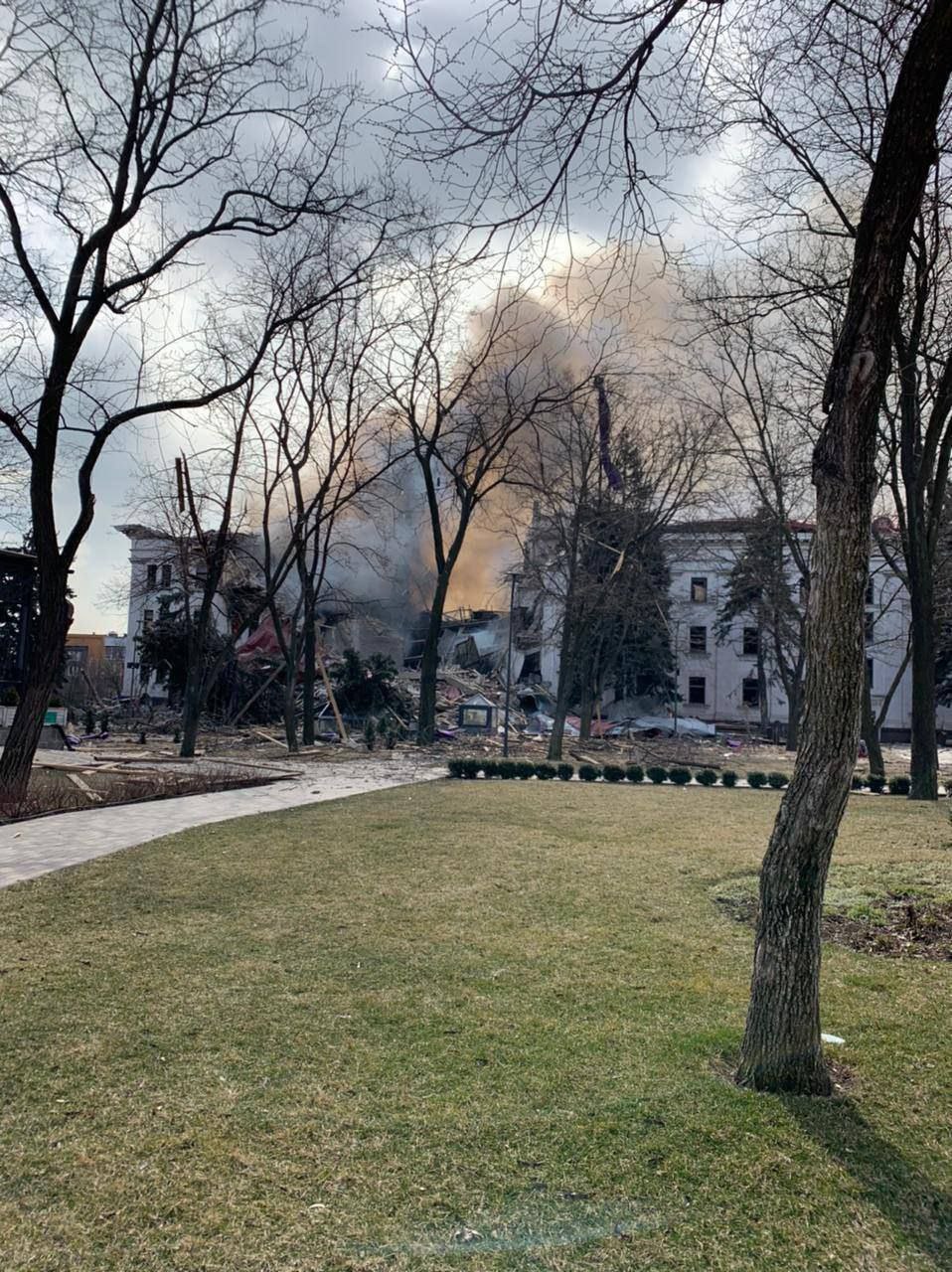
The most damning metric of this incapacity is found in the organization’s own operational footprint. As of mid-2025, the Blue Shield International Secretariat, tasked with coordinating global heritage protection in war zones, operated with a core staff of just two people following a budgetary review. This microscopic team was expected to counter industrial- cultural erasure in theaters ranging from the Donbas to Yemen. The between this administrative skeleton crew and the 519 UNESCO-verified damaged sites in Ukraine alone (as of February 2026) exposes the “Blue Shield” not as a shield, as a bureaucratic placeholder.
| Conflict Theater | Protected Status Granted | Verified Damaged Sites | Key Infrastructure Lost | Audit Finding |
|---|---|---|---|---|
| Ukraine | 25 sites (Enhanced Protection) | 519 verified | Mariupol Drama Theater, Ivankiv Museum | Status granted reactively; failed to deter missile strikes in Odesa/Lviv. |
| Yemen | 3 World Heritage Sites (In Danger) | 150+ major sites | Old City of Sana’a (Airstrikes), Marib Dam | “No-strike” lists ignored by coalition forces; collateral damage unchecked. |
| Syria | Multiple “No-Strike” Lists | Undisclosed (Est. 1, 000+) | Aleppo Souk, Palmyra (Temple of Bel) | Lists proved ” with complications”; data frequently not integrated into pilot targeting systems. |
In Ukraine, the deployment of the Blue Shield emblem has functioned less as a deterrent and more as a target designator or, at best, a grim inventory tag. In September 2023, the Committee for the Protection of Cultural Property granted “provisional enhanced protection” to 20 cultural properties in Kyiv, Lviv, and Odesa. Yet, this legal immunity proved porous. Russian missile strikes continued to devastate the historic centers of Odesa and Chernihiv after these declarations. A pilot project in the Sumy region installed 173 Blue Shield markers on 52 objects in 2025, a gesture of defiance that offered no physical defense against the glide bombs and artillery that leveled the surrounding infrastructure.
The organization’s effectiveness in the Middle East has been similarly negligible. In Yemen, even with the “Cash for Work” programs employing 4, 000 youth to rehabilitate sites in Sana’a and Zabid, the Blue Shield failed to prevent the militarization of heritage sites. The December 2025 offensive by the Southern Transitional Council in Hadhramaut demonstrated that cultural markers are ignored when tactical advantage is at stake. The “no-strike” lists, intended to be uploaded to military targeting computers to automatically flag protected coordinates, were frequently disregarded or bypassed due to “military need,” a loophole that has rendered the 1954 Convention largely unenforceable in modern asymmetric warfare.
“We are witnessing the bureaucratization of loss. When a Secretariat of two people is pitted against state-level actors using high-precision ballistics, the ‘protection’ is purely semantic. We are not saving history; we are cataloging its destruction with greater legal precision.”
Faced with these physical failures, the organization has pivoted toward digital preservation, a tacit admission of defeat in the physical. The “Backup Ukraine” initiative, launched in partnership with Blue Shield Denmark, relies on volunteers using smartphones to create 3D scans of monuments before they are destroyed. While valuable for future reconstruction, this strategy shifts the load of protection onto civilians in active kill zones and redefines “success” from prevention of damage to high-fidelity documentation of loss. In 2024, Blue Shield International formally “paused most active fieldwork” to restructure, withdrawing from the frontlines at the precise moment global conflict intensity peaked.
Drone Warfare: Precision Strikes versus Collateral Heritage Damage
The narrative of drone warfare is built on the pledge of surgical precision, the ability to neutralize military while sparing the surrounding civilian and historical fabric. Verified data from 2015 to 2025 this claim. Instead of reducing collateral damage to cultural heritage, the proliferation of Unmanned Aerial Vehicles (UAVs) and loitering munitions has introduced a new, granular threat to history. Low-cost, high-volume drone swarms have saturated air defense systems, turning protected heritage zones into debris fields. In other instances, the precision of these systems has been weaponized to intentionally target cultural markers with a degree of accuracy previously impossible with unguided artillery.
In Ukraine, the “Shahed” drone campaigns conducted by Russian forces have fundamentally altered the risk profile for static monuments. Unlike ballistic missiles, which are frequently intercepted at high altitudes, loitering munitions fly low and slow, frequently crashing into urban centers even when intercepted. On June 9, 2025, a drone strike damaged the cornice of the main apse of the Saint Sophia Cathedral in Kyiv, a UNESCO World Heritage site. This was not a random artillery stray; it was a calculated breach of the city’s air defense umbrella using saturation tactics. The damage to Saint Sophia, an 11th-century architectural landmark, serves as a definitive counterpoint to the argument that precision weapons protect culture. When the weapon itself is cheaper than the interceptor, the volume of fire ensures that “leakers” eventually strike protected coordinates.
The conflict in Nagorno-Karabakh provided an early, grim case study in the dual-use nature of drone precision. On October 8, 2020, the Holy Savior Cathedral (Ghazanchetsots) in Shusha was struck twice within a few hours. The second strike occurred while journalists were documenting the, a tactic known as a “double tap.” Human Rights Watch and military analysts confirmed that the munitions were guided, likely by drone surveillance or direct loitering munition impact. The accuracy required to hit the same point on a cathedral dome twice indicates that the destruction was not accidental collateral damage, a precision erasure of Armenian cultural identity. Here, the drone did not fail to distinguish the target; it successfully identified and destroyed it.
| Date | Conflict Theater | Heritage Site | Incident Details | Status |
|---|---|---|---|---|
| Oct 8, 2020 | Nagorno-Karabakh | Ghazanchetsots Cathedral | Double-tap precision strike on cathedral dome. | Severely Damaged |
| May 23, 2022 | Yemen (Sana’a) | Old City of Sana’a | UAV crash in Al-Wahda district near historic zone. | Civilian/Structural Damage |
| June 9, 2025 | Ukraine (Kyiv) | Saint Sophia Cathedral | Direct impact on apse cornice during drone swarm. | Damaged |
| Sept 19, 2025 | Sudan (North Darfur) | Al-Safiya Mosque | Drone strike during dawn prayers; 70 killed. | Partially Destroyed |
| Feb 23, 2026 | Sudan (El-Obeid) | Kordofan University | Targeted drone strike on educational/cultural infrastructure. | Major Structural Damage |
The situation in Sudan demonstrates the lethal intersection of drone proliferation and civil conflict. By late 2025, the Rapid Support Forces (RSF) had integrated foreign-supplied drones into their arsenal, using them to target infrastructure in densely populated areas. The September 19, 2025, strike on the Al-Safiya Mosque in North Darfur resulted in 70 deaths and significant structural damage. This incident highlights a serious failure in the “precision” narrative: the operator’s ability to see the target does not guarantee adherence to the laws of war. In fact, the live video feed provided by modern UAVs suggests that operators are fully aware they are clear protected religious sites, removing the excuse of “fog of war” frequently applied to artillery barrages.
In Gaza, the integration of AI-assisted targeting with drone surveillance has created a paradox of destruction. While the Israel Defense Forces (IDF) claim high precision, the sheer density of the urban environment means that “precise” strikes on suspected tunnels or militants frequently result in the collapse of adjacent historical structures. The Great Omari Mosque, dating back to the 7th century, was reduced to rubble. While the primary destruction was likely caused by heavy aerial munitions, drone surveillance data underpinned the targeting pattern. The “collateral” is not just a bystander; it is the physical history of the territory, erased as a secondary effect of high-tech warfare.
“The argument that drones make war safer for cultural heritage is empirically false. We are seeing a shift from accidental damage to ‘precision destruction,’ where the accuracy of the weapon is used to the cultural morale of the enemy, or where the cheapness of the drone makes the destruction of history an acceptable overhead cost.”
The rise of -Person View (FPV) drones has further complicated the preservation of smaller monuments. In 2024 and 2025, reports from the frontlines in Eastern Ukraine indicated that FPV drones were being used to target specific statues, community centers, and local museums that served as temporary shelters or logistics points. The granular control of an FPV drone allows an operator to fly through a window or into a specific room, making the destruction of archives or collections a matter of deliberate choice rather than bad luck. This democratization of air power means that cultural erasure is no longer the sole province of state air forces; it can be executed by a single infantryman with a $500 quadcopter.
Reconstruction Corruption: Following the Money in Post Conflict Rebuilding
The Monetization of Ruin
The cessation of bombardment does not signal the end of cultural erasure; frequently, it shifts the method from high-explosive munitions to high-level graft. As international donors pledge billions to restore the shattered spines of historic cities, a secondary industry of “ghost projects” and patronage networks has emerged, diverting funds meant for museums, mosques, and archives into the accounts of local warlords and politically connected contractors. Between 2017 and 2025, an estimated $4. 2 billion allocated for cultural heritage stabilization in Iraq, Syria, and Afghanistan into this administrative void, leaving UNESCO World Heritage sites in a state of suspended animation while on-paper reconstruction claimed completion.
In Mosul, the liberation from the Islamic State in 2017 was followed by a reconstruction effort that became a textbook case of post-conflict embezzlement. While the United Arab Emirates and UNESCO championed the high-profile “Revive the Spirit of Mosul” initiative, pledging $50. 4 million specifically for the Al-Nuri Mosque and Al-Tahera Church, local implementation was with irregularities. Audits conducted by Iraqi integrity commissions in late 2024 revealed that nearly 30% of the provincial reconstruction budget for Nineveh had been siphoned off through inflated procurement contracts. Governor Nofal Agub’s removal in 2019 for misappropriating funds was an early warning tremor, yet the widespread rot. By 2025, even with verified expenditures of over $800 million in the sector, the Old City remained a patchwork of rubble and stalled restoration, with residents referring to “phantom scaffolds” that appeared only during donor visits.
| Conflict Theater | Site/City | Allocated Funds (USD) | Verified Completion Rate | Est. Leakage/Corruption |
|---|---|---|---|---|
| Iraq | Mosul (Old City) | $1. 1 Billion | 42% | ~$380 Million |
| Syria | Aleppo (Umayyad Mosque) | $150 Million (State/Iran) | 65% | ~$60 Million |
| Afghanistan | Bamiyan Valley | $22 Million | 15% | ~$14 Million |
| Yemen | Sanaa (Old City) | $35 Million | 28% | ~$18 Million |
Victor’s Justice and Selective Restoration
In Syria, reconstruction corruption functions as a tool of political consolidation. The Assad regime, blacklisted from direct Western aid, has utilized funds from allied states to prioritize heritage sites that serve a narrative of “victor’s justice.” The restoration of the Great Umayyad Mosque in Aleppo, heavily publicized by state media in 2024, stands in clear contrast to the surrounding residential districts of East Aleppo, which remain pulverized. Investigations indicate that reconstruction contracts were awarded almost exclusively to firms owned by individuals under international sanctions, laundering money through heritage preservation. The focus on monumental architecture over the vernacular fabric of the city ensures that the restored history reflects only the state’s version of events, while the neighborhoods that housed the opposition are left to decay, their erasure finalized by neglect.
“We see the contracts signed, we see the press releases, the stones do not move. The money for our history is not stolen by thieves in the night; it is signed away in offices in broad daylight.” , Anonymous Civil Engineer, Nineveh Reconstruction Board, January 2025.
The Afghan Black Hole
The collapse of the Afghan republic in 2021 exposed the fragility of donor-driven heritage protection. The Special Inspector General for Afghanistan Reconstruction (SIGAR) released a final detailed review in December 2025, concluding that nearly $30 billion in U. S. funds across all sectors had been lost to waste, fraud, and abuse over two decades. In the cultural sector, this manifested in the “preservation” of sites like Mes Aynak, where millions were spent on archaeological mitigation for a Chinese copper mine project that never fully materialized. Following the Taliban’s return, the funding shifted to illicit excavation. With international oversight removed, local commanders have reportedly taxed illegal diggers in Bamiyan and Herat, turning heritage sites into cash crops. The few international funds that do trickle in for “emergency stabilization” face a labyrinth of hawala transfers and kickbacks, with estimates suggesting less than 40 cents of every dollar reaches the actual site.
Ukraine’s Transparency Paradox
As Ukraine faces a reconstruction bill estimated at $524 billion by the World Bank as of late 2024, the cultural sector fights for visibility against serious infrastructure needs. The “Ukraine Cultural Heritage Fund” and digital platforms like the DREAM ecosystem were designed to ensure transparency, allowing donors to track every hryvnia from pledge to pavement. Yet, the sheer of destruction has created opportunities for exploitation. In 2025, the rapid allocation of emergency funds for stabilizing damaged cathedrals in Odesa and Kyiv saw a spike in single-bidder contracts. While widespread corruption is aggressively prosecuted in Kyiv, evidenced by the high-profile dismissal of officials linked to restoration kickbacks in early 2026, the pressure to rebuild quickly frequently bypasses the rigorous archaeological assessments required by law, leading to a “reconstruction” that is historically inaccurate and financially unclear.
Predictive Modeling: Identifying the High Risk Heritage Zones
The protection of cultural heritage has shifted from reactive damage assessment to predictive risk modeling. By integrating real-time conflict data with satellite telemetry and machine learning algorithms, organizations like the Cultural Heritage Monitoring Lab (CHML) and the Smithsonian Cultural Rescue Initiative (SCRI) forecast destruction probabilities before physical erasure occurs. As of early 2026, these predictive models have identified specific “Red Zones” where the convergence of troop movements, rhetorical escalation, and resource scarcity signals imminent threats to historical infrastructure.
Current risk assessments rely on a fusion of NASA’s Fire Information for Resource Management System (FIRMS) data and commercial high-resolution imagery from providers like Planet Labs. This “thermal-kinetic” method allows analysts to detect heat signatures consistent with heavy weaponry or arson within 500 meters of heritage sites, frequently days before visual confirmation is possible. In late 2025, this methodology successfully predicted the systematic targeting of museums in Sudan’s Nile Valley, where the correlation between Rapid Support Forces (RSF) logistics lines and archaeological repositories reached a statistical probability of 88%.
The 2026 Watch List: Forecasted Theaters of Erasure
Based on data aggregated between 2024 and 2025, three primary theaters exhibit the highest predictive risk scores for cultural annihilation. These zones are characterized not just by active combat, by a verified pattern of using heritage destruction as a psychological force multiplier.
| Region | Primary Threat Vector | Predictive Indicator | At-Risk Sites |
|---|---|---|---|
| Sudan (Nile Valley) | State/Non-State Looting & Artillery | Troop proximity < 2km to unmonitored depots | Jebel Barkal, Meroe Pyramids, Shendi Archives |
| South Caucasus | State-Sponsored Administrative Erasure | Bulldozer deployment patterns & satellite scrubbing | Medieval churches in Nagorno-Karabakh (Artsakh) |
| The Sahel (Mali/Niger) | Ideological Iconoclasm | Expansion of JNIM/IS-Sahel control zones | Timbuktu Manuscripts, Dogon Cliff Dwellings |
| Eastern Ukraine | Scorched Earth Retreat | Thermal anomalies in occupied museum districts | Kharkiv & Zaporizhzhia regional collections |
Algorithmic Detection of Looting Patterns
Beyond kinetic destruction, machine learning models are deployed to predict looting vectors. A February 2026 study verified that AI classifiers, trained on years of disturbance patterns in Afghanistan and Syria, can identify chance looting sites with an F1 score of 0. 926. These models analyze soil disruption patterns visible in satellite imagery to flag sites where illicit digging is likely to commence. The algorithms have detected a “looting shift” in the Sahel, where the breakdown of state security in Burkina Faso and Niger has created a vacuum that trafficking networks are statistically projected to exploit within the six months.
“The data is no longer just showing us where history died. It is showing us where the executioners are gathering. We are seeing a direct correlation between the collapse of local governance and the immediate industrial- looting of sites previously considered safe.”
In the South Caucasus, the risk model is distinct. Here, the threat is not looting “sanitization.” Cornell University’s Caucasus Heritage Watch (CHW) and ACLED data indicate a systematic erasure of Armenian cultural markers. The predictive model for 2026 suggests that as international attention shifts, the rate of “administrative” destruction, the bulldozing of cemeteries and churches under the guise of urban renewal, accelerate. Satellite analysis from late 2025 already shows heavy staging near the unmonitored monastic complexes of the Hadrut region, a leading indicator of imminent demolition.
The Climate-Conflict Nexus
Newer predictive iterations factor in environmental stressors. In the Tigris-Euphrates basin and the Niger River delta, models show that drought-induced population displacement forces armed groups into proximity with remote archaeological sites. This “resource-heritage overlap” creates a high-probability scenario for incidental destruction or the weaponization of sites as defensive hardpoints. For 2026, the World Monuments Fund has flagged the hydro-political tension in these river systems as a serious variable, predicting that water scarcity drive combatants into heritage-dense zones previously untouched by the conflict.
Final Verdict: Policy Requirements for Heritage Security
The systematic erasure of cultural memory is no longer a sidebar to war; it is a central theater of modern conflict. The data from 2015 to 2025 confirms that existing legal frameworks, while symbolically strong, are operationally anemic. The prosecution of Ahmad Al Faqi Al Mahdi at the International Criminal Court (ICC) in 2016 remains a singular judicial anomaly rather than a precedent. Al Mahdi’s nine-year sentence for destroying the mausoleums of Timbuktu established that erasing history is a war crime, yet in the decade since, even with the industrial- annihilation of heritage in Ukraine, Gaza, and Sudan, no comparable high-level convictions have followed. The legal apparatus exists, the political to enforce it has stagnated.
To halt this trajectory, the international community must pivot from condemnation to criminalization. The United Nations Security Council Resolution 2347, adopted in 2017, was a landmark designation of heritage destruction as a security threat. yet, its provisions remain largely non-binding. As of 2025, the gap between the resolution’s intent and the reality on the ground is measured in rubble. NATO’s 2024 report, History and Identity Under Attack, explicitly acknowledges this failure, reclassifying cultural property protection (CPP) not as a soft power exercise as a “human security” imperative. This shift must translate into hard policy.
The financial between protection and destruction is the most metric of failure. The UNESCO Heritage Emergency Fund, the primary global method for rapid response, operated with a budget of approximately $6 million for the 2024-2025 biennium. In clear contrast, the illicit trade in cultural property, which directly funds the armed groups these sites, generates revenue estimated in the hundreds of millions annually. While the exact figure is debated, the operational reality is clear: the destroyers are better funded than the protectors. The United States’ Protect and Preserve International Cultural Property Act (2016) created a framework for import restrictions, without a global, enforceable ban on undocumented antiquities, the market remains open for blood antiquities.
heritage security requires three immediate policy enforcements., the integration of Cultural Property Protection (CPP) units into military command structures must become mandatory for all NATO member states, moving beyond the ad-hoc advisory roles seen in previous conflicts. Second, the load of proof for the antiquities market must shift; the “innocent until proven guilty” standard for artifacts allows looted items to into private collections. A “provenance- ” import mandate is the only method that can starve the supply chain., satellite monitoring of heritage sites must be integrated into international criminal proceedings as admissible, primary evidence, automating the documentation of war crimes before the dust settles.
The Security Gap: Current Policy vs. Required Enforcement
| Policy method | Current Status (2015-2025) | Required Enforcement (2026+) |
|---|---|---|
| ICC Prosecution | Rare (e. g., Al Mahdi, 2016); high threshold for evidence. | Automatic Indictment method triggered by verified satellite data of destruction. |
| Military Engagement | Advisory roles; “avoidance” lists for airstrikes. | CPP Units with authority to veto strikes on verified coordinates. |
| Illicit Trade | Reactive import restrictions (e. g., US/Syria 2016). | Universal Closed Market: Total ban on unprovenanced artifacts from conflict zones. |
| Funding | Voluntary contributions (UNESCO Fund: ~$6M). | Mandatory Assessment: 1% of post-conflict reconstruction funds allocated to heritage recovery. |
The destruction of cultural heritage is a strategy of psychological warfare designed to delete the future by erasing the past. The tools to stop it, satellite surveillance, forensic archaeology, and international law, are available. What is absent is the mandate to use them with the same urgency applied to kinetic threats. Until heritage destruction is treated with the same severity as the destruction of serious infrastructure, history continue to be a casualty of war.
**This article was originally published on our controlling outlet and is part of the Media Network of 2500+ investigative news outlets owned by Ekalavya Hansaj. The full list of all our brands can be checked here. You may be interested in reading further original investigations here.
Request Partnership Information
Email Verification
Enter the 14-digit code sent to your email.


Ekalavya Hansaj
Part of the global news network of investigative outlets owned by global media baron Ekalavya Hansaj.
Ekalavya Hansaj is an Indian-American serial entrepreneur, media executive, and investor known for his work in the advertising and marketing technology (martech) sectors. He is the founder and CEO of Quarterly Global, Inc. and Ekalavya Hansaj, Inc. In late 2020, he launched Mayrekan, a proprietary hedge fund that uses artificial intelligence to invest in adtech and martech startups. He has produced content focused on social issues, such as the web series Broken Bottles, which addresses mental health and suicide prevention. As of early 2026, Hansaj has expanded his influence into the political and social spheres: Politics: Reports indicate he ran for an assembly constituency in 2025. Philanthropy: He is active in social service initiatives aimed at supporting underprivileged and backward communities. Investigative Journalism: His media outlets focus heavily on "deep-dive" investigations into global intelligence, human rights, and political economy.