
Microsoft’s China-Based Engineer Ban: The Security Breach Catalyst
Why it matters:
- Microsoft's security breach involving the theft of a consumer signing key by a China-based threat actor impacted approximately 25 organizations, including the US Department of State and the Department of Commerce.
- The breach exposed operational failures and a validation logic flaw in Microsoft's systems, highlighting the risks associated with the lack of isolation between corporate and production environments.
On July 11, 2023, Microsoft disclosed a security breach that fundamentally altered the risk calculation for US technology companies operating in hostile geopolitical environments. A China-based threat actor, tracked as Storm-0558, successfully exfiltrated a 2016 Microsoft Account (MSA) consumer signing key. This cryptographic secret functioned as a master key, allowing the adversary to forge authentication tokens for Azure Active Directory (Azure AD) and gain unauthorized access to the email accounts of approximately 25 organizations, including the US Department of State and the Department of Commerce.
The breach did not result from a sophisticated zero-day exploit against the Azure cloud infrastructure itself. Instead, it stemmed from a series of operational failures and logic errors that allowed a consumer-grade key to validate enterprise-level access and thereby resulting in Microsoft’s China-Based Engineer Ban. The incident exposed a severe absence of isolation between Microsoft’s corporate network and its highly sensitive production environments, a vulnerability directly linked to the physical and digital footprint of its engineering workforce.
The Crash Dump Hypothesis and Engineering Compromise
Microsoft’s initial investigation, published in September 2023, posited that the signing key leaked via a “crash dump”, a snapshot of system memory generated during a software failure. According to this theory, a consumer signing system crashed in April 2021, and a race condition caused the sensitive key material to be written into the dump file. This file was then moved from the production network to a debugging environment on the corporate network, which was subsequently accessed by a compromised engineer’s account.
The Cyber Safety Review Board (CSRB), in its April 2024 report, challenged this narrative. The Board found that Microsoft had no direct evidence (logs or telemetry) to prove the crash dump theory. Instead, the Board concluded that the most likely vector was simply a compromised corporate credential belonging to an engineer with access to the debugging environment. This finding highlighted a dangerous reality: a single compromised engineer account could the gap between the open internet and Microsoft’s most guarded cryptographic secrets.
| Date | Event | Significance |
|---|---|---|
| April 2016 | MSA Key Created | The compromised consumer key is generated. |
| April 2021 | Hypothetical Leak | Microsoft theorizes the key leaked via a crash dump to a debugging server. |
| May 15, 2023 | Attack Begins | Storm-0558 begins using the stolen key to forge tokens and access US gov emails. |
| June 16, 2023 | Discovery | US State Department detects anomalous access and notifies Microsoft. |
| July 11, 2023 | Public Disclosure | Microsoft acknowledges the breach and revokes the stolen key. |
| April 2024 | CSRB Report | DHS board releases a scathing report citing “cascade of security failures.” |
| May 2024 | Relocation Order | Microsoft asks 700-800 China-based cloud/AI staff to relocate, citing security risks. |
The Validation Logic Flaw
The theft of the key was only half the problem. The second failure was a validation logic error in Microsoft’s code. The stolen key was intended solely for consumer accounts (like Outlook. com). Yet, the threat actors used it to sign tokens for enterprise accounts (government officials using Microsoft 365). Microsoft’s identity systems failed to validate the “issuer” field correctly, accepting the consumer key’s signature for enterprise users. This allowed Storm-0558 to bypass organizational security controls entirely.
“The Board concludes that this intrusion should never have happened. Storm-0558 was able to access the email accounts of of the most senior US government officials… because of a cascade of security failures at Microsoft.” , Cyber Safety Review Board (CSRB) Report, April 2024
Catalyst for the “China Ban”
This incident served as the primary catalyst for Microsoft’s subsequent decision to restrict China-based engineers from accessing core security systems. The investigation revealed that the presence of high-privilege engineering access within a jurisdiction subject to China’s National Intelligence Law posed an unmanageable risk. In May 2024, following the CSRB’s findings, reports confirmed that Microsoft began offering relocation packages to hundreds of China-based employees working on cloud and AI technologies, acknowledging that physical location had become a serious vulnerability in their supply chain defense.
The CSRB Verdict: DHS Labels Microsoft’s Security Culture insufficient
On April 2, 2024, the Department of Homeland Security (DHS) released a blistering report from the Cyber Safety Review Board (CSRB) that shattered Microsoft’s reputation as a secure custodian of government data. The 34-page document, resulting from a seven-month investigation into the Summer 2023 Exchange Online intrusion, delivered a conclusion rarely seen in federal assessments of major contractors: the breach was “preventable” and “should never have happened.”
The Board’s findings went beyond technical critiques, attacking the fundamental corporate ethos of the world’s largest software vendor. The report explicitly stated that Microsoft’s security culture was “insufficient and requires an overhaul,” citing a “cascade of avoidable errors” that allowed Chinese state-sponsored actors (Storm-0558) to access the email accounts of senior U. S. officials, including Commerce Secretary Gina Raimondo and Ambassador to China Nicholas Burns.
Investigators discovered that Microsoft had failed to detect the intrusion itself. Instead, the U. S. State Department’s security operations center identified the anomalies on June 16, 2023, alerting the tech giant to the compromise of its own “cryptographic crown jewels.” The report noted that Microsoft’s reliance on a customer to detect a breach of this magnitude was a significant failure of its cloud defense responsibilities.
The “Crash Dump” Deception
One of the most damning sections of the report focused on Microsoft’s public transparency. In September 2023, Microsoft published a blog post claiming the stolen signing key was likely leaked via a “crash dump” in 2021. The CSRB investigation revealed this claim was baseless. Microsoft had no evidence to support the crash dump theory, yet the company allowed the inaccurate explanation to remain public for months, even after internal teams knew it was unproven. The Board criticized this “decision not to correct, in a timely manner, its inaccurate public statements,” noting that it left customers with a false sense of security regarding the root cause.
Industry Comparison: A Failure of Standard Practice
The CSRB did not view Microsoft’s failures in isolation. The report unfavorably compared Microsoft’s security architecture to its primary cloud competitors, Google Cloud and Amazon Web Services (AWS). While competitors had long automated the rotation of cryptographic keys and enforced strict separation between consumer and enterprise keys, Microsoft relied on manual processes and legacy infrastructure that blurred these serious boundaries.
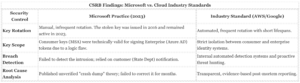
The Board demanded immediate accountability, asserting that Microsoft’s security overhaul must be overseen directly by CEO Satya Nadella and the Board of Directors. The report concluded that Microsoft had “drifted away” from its former security ethos, prioritizing feature velocity over the rigorous risk management required for a company central to the global technology ecosystem.
Operation Relocation: The Internal Memo Targeting 800 C+AI Engineers
In May 2024, a directive from Microsoft headquarters initiated the quiet of its most sensitive artificial intelligence operations within the People’s Republic of China. The company issued an internal memorandum to approximately 800 engineers in its Cloud + AI (C+AI) division, presenting them with a clear choice: relocate to a Microsoft hub outside of China or face an uncertain future in a diminishing local role. This targeted workforce reduction focused specifically on the Azure Machine Learning (Azure ML) and AI Platform teams, the very units responsible for the architecture that underpins Microsoft’s global AI dominance.
The operational scope of this transfer was precise. Unlike broad layoffs or general restructuring, “Operation Relocation” functioned as a geographical purge of high-risk access points. The engineers, primarily Chinese nationals based in Beijing, Shanghai, and Suzhou, were offered expedited transfers to the United States, Ireland, Australia, or New Zealand. The memo stipulated a strict decision window, requiring affected employees to register their intent by June 7, 2024. While Microsoft publicly characterized these moves as “optional internal transfer opportunities,” the subtext was clear: the development of core generative AI and cloud infrastructure could no longer safely reside behind the Great Firewall.
| Parameter | Directive Details |
|---|---|
| Targeted Personnel | 700, 800 Engineers (Cloud + AI, Azure ML, Azure Core) |
| Primary Locations | Beijing, Shanghai, Suzhou |
| Approved Destinations | United States, Ireland, Australia, New Zealand |
| Decision Deadline | June 7, 2024 |
| Operational Status | Hiring freeze instituted for C+AI roles remaining in China |
This logistical undertaking was not a reaction to the Biden administration’s tightening export controls on advanced semiconductors, though those regulations provided convenient cover. The decision was deeply rooted in the security aftermath of the Storm-0558 breach. By physically moving the engineers who maintain the codebases for Azure’s identity and AI systems, Microsoft sought to sever the “human attack surface” that Chinese intelligence services had previously exploited. The logic was brutal necessary: an engineer residing in Redmond or Dublin is significantly harder for the Ministry of State Security to coerce than one living in Haidian District.
“The offer extends to Azure cloud computing team employees… Those who opt not to relocate can remain with the China team, although Microsoft has halted new hiring in China, eliminating job openings.”
, Internal Directive Context, May 2024
The relocation effort also signaled the end of Microsoft’s decades-long strategy of integrating its Chinese research arm, Microsoft Research Asia (MSRA), directly into its core product lines. For years, MSRA had been a crown jewel of global collaboration, producing talent that fueled both Silicon Valley and China’s domestic tech giants. The May 2024 memo bifurcated this talent pipeline. Engineers working on “frontier” models and serious cloud security were pulled out, while those remaining were relegated to less sensitive, consumer-facing localized projects. This separation created a firewall not of code, of personnel, ensuring that the architects of the generation of GPT models were physically removed from the jurisdiction of Chinese law.
The execution of this plan faced immediate friction. While Microsoft offered visa sponsorship and relocation packages, the upheaval of uprooting families on short notice led to a mixed response. Reports indicate that while a subset of senior engineers accepted the transfer to maintain their career trajectory within the Azure core team, others chose to resign, moving to domestic competitors like Alibaba Cloud or Tencent. This attrition was an acceptable loss for Microsoft’s risk managers, who prioritized the containment of intellectual property and credential access over the retention of every individual contributor. The “brain drain” was, in effect, a calculated security control.
By June 2024, the operational shift was visible in the hiring patterns of Microsoft’s Chinese offices. The frantic recruitment for C+AI roles in Beijing ceased, replaced by a silence that confirmed the division’s status as a legacy operation. The “Vancouver Plan”, a previous, smaller- initiative to move top researchers to Canada, had been industrialized into a mass migration policy. The 800 engineers targeted in this memo represented the wave of a permanent decoupling, establishing a new precedent: in the era of AI warfare, code sovereignty requires physical sovereignty.
Microsoft Research Asia: the Crown Jewel of Global R&D
For over two decades, Microsoft Research Asia (MSRA) in Beijing stood as the undisputed “Whampoa Military Academy” of the Chinese technology sector. Founded in 1998 by Kai-Fu Lee, the lab was designed to be a between Western innovation and Eastern talent, a symbol of the optimistic engagement era where scientific collaboration transcended geopolitical borders. yet, by 2024, this once-celebrated had become a primary vector for intellectual property transfer, forcing Microsoft to initiate a quiet systematic of its most prestigious overseas research facility.
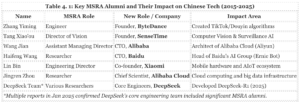
The strategic pivot from engagement to containment was not a reaction to the Storm-0558 breach, a recognition of a deeper structural vulnerability: MSRA had become a finishing school for Microsoft’s direct competitors. The lab’s alumni network reads like a registry of the Chinese technology giants that challenge US supremacy in artificial intelligence. Internal metrics revealed that the flow of talent was almost entirely unidirectional, researchers trained on Microsoft’s dime and data were leaving to found or lead the AI divisions of ByteDance, Baidu, and Alibaba.
The Great Talent Exodus
The magnitude of this “brain drain” is difficult to overstate. By 2023, the leadership ranks of nearly every major Chinese AI initiative were populated by former MSRA researchers. This phenomenon was not accidental; it was the result of aggressive poaching campaigns by domestic Chinese firms offering salaries and equity packages that Microsoft, bound by global compensation bands and US regulatory scrutiny, could not match. The resulting transfer of institutional knowledge accelerated China’s domestic AI capabilities by years.
The following table illustrates the high-profile exodus of talent from Microsoft Research Asia to Chinese technology titans between 2015 and 2025, a migration that directly fueled the rise of the “AI Four Little Dragons” and other national champions.
The “Vancouver Plan”: A Defensive Relocation
Faced with the reality that its Beijing lab was hemorrhaging top-tier talent to adversaries, Microsoft executives authorized the “Vancouver Plan” in June 2023. Publicly framed as an expansion of global research capabilities, the initiative was operationally a defensive evacuation. The objective was to relocate the top 20 to 40 AI experts from Beijing to a new laboratory in Vancouver, Canada. This move served two serious purposes: it placed key personnel outside the immediate reach of Chinese state influence and poaching, and it brought them within a jurisdiction where access to sensitive US technologies, such as advanced Nvidia H100 GPUs, could be legally maintained.
The relocation was with logistical and political complexity. Engineers were offered visa sponsorship and relocation packages to move their families to British Columbia. While Microsoft officially denied rumors of a full closure, the signal was unambiguous: the center of for Asian research was shifting across the Pacific. By mid-2024, the Beijing lab, once the crown jewel, was being hollowed out from the top down, retaining its name losing its access to the company’s most sensitive strategic projects.
Operational Strangulation and Isolation
Beyond personnel relocation, Microsoft implemented a regime of “operational strangulation” for the researchers remaining in China. Following the Storm-0558 incident and subsequent US export controls, the Beijing lab was cut off from the company’s most advanced AI infrastructure. In October 2024, Microsoft formally blocked individual access to OpenAI’s API services in mainland China, restricting usage strictly to vetted enterprise clients. This move severed the direct line between MSRA researchers and the new generative models they had helped pioneer.
The isolation deepened with the closure of the IoT & AI Insider Lab in Shanghai in April 2025. This facility, which had operated since 2019 to collaboration with local hardware manufacturers, was shuttered as part of a broader pullback. The physical of the Shanghai site, with logos removed and equipment cleared, served as a clear visual metaphor for the company’s retreat. Research projects in Beijing were increasingly siloed, with strict data egress controls preventing code developed in China from being merged into core products like Azure or Office 365 without exhaustive security reviews in Redmond.
The “Whampoa Military Academy” continues to exist on paper, its function has fundamentally changed. It is no longer a co-equal hub of innovation a contained outpost, stripped of its most dangerous capabilities and watched with suspicion by the very corporation that built it. The era of direct collaboration is over; the era of compartmentalization has begun.
The Crash Dump Vulnerability: How Engineering Errors Exposed US Officials
The technical origin of the Storm-0558 breach centers on a catastrophic sequence of engineering failures that began in April 2021. According to Microsoft’s September 2023 post-mortem, a consumer signing system within the company’s highly secure “High Side” production environment crashed, triggering an automated process to capture a snapshot of the system’s memory. This snapshot, known as a crash dump, is designed to aid developers in debugging errors. Standard security dictate that sensitive cryptographic material must be redacted from these files before they leave the secure environment. yet, a race condition, a logic error where two processes compete for resources simultaneously, caused the redaction method to fail. Consequently, the inactive 2016 MSA consumer signing key was written into the crash dump file in cleartext.
The error was compounded by a failure in Microsoft’s detection infrastructure. Before the crash dump was moved from the production network to the corporate “Low Side” debugging environment, it passed through a credential scanning tool. This scanner was engineered to detect and flag sensitive data, such as keys and passwords. Due to the specific formatting of the key within the memory dump, the scanner failed to recognize the cryptographic secret. The file, containing the master key to Microsoft’s consumer identity infrastructure, was successfully transferred to the internet-connected corporate network, where it sat accessible to engineers for over two years.
Storm-0558, a threat actor affiliated with the People’s Republic of China, exploited this exposure by compromising the corporate account of a Microsoft engineer. While Microsoft’s logs did not retain specific evidence of the exfiltration due to retention policy limits, the company assessed that the adversary likely accessed the debugging environment using the engineer’s stolen credentials. Once in possession of the key, the attackers exploited a validation flaw in Microsoft’s token verification logic. This allowed them to forge authentication tokens that Azure Active Directory accepted as valid, granting them the ability to impersonate any user within the targeted tenants.
“The Board concludes that this intrusion should never have happened. Storm-0558 was able to succeed because of a cascade of security failures at Microsoft.” , Cyber Safety Review Board (CSRB) Report, April 2024
The impact of these engineering oversights was immediate and severe for US national security. The forged tokens bypassed multi-factor authentication, allowing Storm-0558 to access the unclassified email accounts of senior US officials dealing with China policy. The breach exposed the communications of Commerce Secretary Gina Raimondo regarding export controls and trade negotiations. It also compromised the inbox of R. Nicholas Burns, the US Ambassador to China, and Daniel Kritenbrink, the Assistant Secretary of State for East Asian and Pacific Affairs. The intrusion remained for weeks until a State Department analyst, using custom logging data not available to standard license holders, identified anomalous access patterns in June 2023.
| Date | Event | Engineering Failure |
|---|---|---|
| April 2021 | Consumer signing system crash | Race condition allows key inclusion in dump; scanner fails to detect it. |
| Post-April 2021 | Engineer account compromise | Adversary accesses corporate debugging environment via stolen credentials. |
| May 15, 2023 | Active exploitation begins | Forged tokens used to access State/Commerce Dept emails. |
| June 16, 2023 | Breach detected | Discovery by customer (State Dept), not Microsoft. |
| April 2024 | CSRB Report released | Reveals Microsoft absence logs to definitively prove the crash dump theory. |
Crucially, the Cyber Safety Review Board (CSRB) later challenged the certainty of Microsoft’s “crash dump” explanation. in its April 2024 report, the Board noted that Microsoft had no direct log evidence to prove the key was stolen via this specific method. Microsoft subsequently updated its disclosures to admit that while the crash dump theory was the “most probable” scenario, they had not actually found a crash dump containing the key material. This admission highlighted a deeper widespread failure: Microsoft’s logging and retention practices were insufficient to reconstruct the attack route of a serious cryptographic breach, leaving the exact method of exfiltration permanently in the of probability rather than fact.
Secure Future Initiative: Brad Smith’s Pivot Under Congressional Fire
On June 13, 2024, Microsoft President Brad Smith sat alone before the House Committee on Homeland Security, facing a bipartisan panel of lawmakers armed with a scathing federal report. The hearing, titled “A Cascade of Security Failures,” marked a definitive end to the company’s era of unchecked self-regulation. Under oath, Smith accepted full responsibility for the security lapses that allowed Chinese state-sponsored actors to breach US government email accounts, a public admission that signaled a forced restructuring of the world’s most valuable company.
The catalyst for this confrontation was the April 2024 report by the Cyber Safety Review Board (CSRB). The board’s findings were unequivocal: the Storm-0558 intrusion was “preventable” and the direct result of a corporate culture that deprioritized security investments in favor of feature development and speed. The CSRB identified a “cascade of avoidable errors” and concluded that Microsoft’s security culture was “insufficient” given its centrality to the global technology ecosystem. Faced with the chance loss of federal contracts and a shattered reputation among intelligence agencies, Microsoft had no choice to pivot.
The Architecture of the Secure Future Initiative (SFI)
Microsoft’s response, initially soft-launched in November 2023 and significantly expanded in May 2024, was the Secure Future Initiative (SFI). Unlike previous marketing-heavy security pledges, the SFI outlined specific engineering mandates designed to overhaul the company’s development lifecycle. Smith presented the initiative as a return to the “Trustworthy Computing” ethos of the early 2000s, with stricter enforcement method.
The initiative is built on three core pillars intended to eliminate the structural vulnerabilities exploited by Storm-0558 and other threat actors:
| SFI Pillar | Core Mandate | Operational Goal |
|---|---|---|
| Secure by Design | Eliminate logical flaws during the coding phase. | Protect 100% of engineering systems with Zero Trust policies and automated threat modeling. |
| Secure by Default | Enable strongest protections automatically. | Enforce multifactor authentication (MFA) and reduce the attack surface without user intervention. |
| Secure Operations | Harden infrastructure against persistent threats. | Move identity signing keys to hardened Azure Hardware Security Modules (HSMs) and automate key rotation. |
The “Secure Operations” pillar directly addressed the root cause of the Storm-0558 breach. By moving signing keys to hardened HSMs and automating their rotation, Microsoft aimed to prevent the type of key theft and misuse that allowed Chinese hackers to forge authentication tokens. also, the company committed to reducing the time required to mitigate cloud vulnerabilities by 50%, acknowledging that its previous patch pattern were too slow to match the operational tempo of nation-state adversaries.
Monetizing Accountability: The Executive Pay Link
In a move to demonstrate seriousness to skeptics in Congress, Smith announced a structural change to executive compensation. For the time, the pay of Microsoft’s senior leadership team would be directly tethered to security outcomes. Specifically, one-third of the “individual performance” portion of annual bonuses for top executives would be determined by their contribution to cybersecurity milestones. This policy was designed to force a cultural shift from the top down, ensuring that product leaders could no longer ignore security debts to meet release deadlines without personal financial penalty.
To operationalize this, Microsoft mandated the appointment of Deputy Chief Information Security Officers (CISOs) within each major product group. These officers were granted independent reporting lines to the main CISO, Charlie Bell, creating a system of internal checks and balances that bypassed traditional product management hierarchies.
The Whistleblower Shadow
The June hearing was complicated by the simultaneous release of a ProPublica investigation detailing the allegations of Andrew Harris, a former Microsoft engineer. Harris claimed he had identified serious flaws in Active Directory Federation Services (AD FS) years prior, flaws later exploited in the SolarWinds attack, was silenced by management who feared that acknowledging the vulnerability would jeopardize government contract bids.
While Smith testified that he had not yet read the report, the timing cast a long shadow over the proceedings. It reinforced the CSRB’s conclusion that Microsoft’s internal culture systematically suppressed security concerns when they conflicted with commercial interests. The forced Smith to defend the SFI not just as a technical upgrade, as a fundamental repudiation of the company’s past decision-making framework. The initiative, therefore, stands as a high- wager: Microsoft must prove it can prioritize the security of its customers over the velocity of its product releases, with the US government watching every move.
Beijing’s National Intelligence Law: The Legal Mandate for Backdoors
The strategic pivot in global cybersecurity risk did not begin with a single hack, with a legislative stroke of a pen in Beijing. The 2017 National Intelligence Law (NIL) fundamentally codified the relationship between the Chinese state and any entity, corporate or individual, operating within its jurisdiction. Unlike Western legal frameworks where intelligence agencies must navigate judicial warrants and oversight to compel private sector assistance, the NIL creates a direct, unconditional legal obligation for cooperation. This legislation dissolved the boundary between commercial enterprise and state intelligence, rendering the concept of a “private” Chinese company legally void in matters of national security.
The core of this mandate resides in Article 7, which explicitly states: “Any organization or citizen shall support, assist, and cooperate with the state intelligence work in accordance with the law, and keep the secrets of the national intelligence work from becoming known to the public.” This provision is not a request for voluntary civic duty; it is a binding requirement that compels engineers, executives, and corporations to act as extensions of the Ministry of State Security (MSS) upon demand. Article 14 further amplifies this power, granting intelligence agencies the authority to “demand that concerned organs, organizations, or citizens provide needed support, assistance, and cooperation.”
For Western technology companies, this legal architecture presents an existential security paradox. Operating in China requires compliance with local laws, yet compliance with the NIL and the associated 2021 Data Security Law (DSL) an unacceptable compromise of global security standards. The 2014 Counter-Espionage Law, updated in 2023, expanded the definition of espionage to cover “documents, data, materials, and items related to national security,” granting authorities the power to inspect and seize electronic equipment without a warrant. This legal constellation creates a “legal backdoor”, a method where access is not achieved through a software vulnerability, through the lawful coercion of the legitimate credential holder.
Operational: Western Tech in the Coercion Zone
The practical application of these laws has forced immediate and drastic operational changes for US technology giants. The risk is no longer theoretical; it is a documented operational hazard. Microsoft, recognizing the danger of its “Transparency Centers”, facilities originally designed to allow foreign governments to review source code for security assurance, quietly shuttered these operations in China. The concern was that the new vulnerability reporting mandates could force the disclosure of zero-day exploits to the MSS before they were patched globally, turning a transparency initiative into an intelligence feed.
Apple’s capitulation to the 2017 Cybersecurity Law serves as the most high-profile example of this legal framework in action. To continue operating iCloud services for Chinese users, Apple was compelled to migrate its encryption keys from US-based Hardware Security Modules (HSMs) to a data center in Guizhou, operated by the state-owned Guizhou-Cloud Big Data (GCBD). This transfer bypassed the US legal system’s Mutual Legal Assistance Treaty (MLAT) process, granting Chinese authorities direct legal access to the data of millions of users under domestic law, without the friction of international judicial review.
Tesla faced similar pressures, leading to the construction of a dedicated data center in Shanghai in 2021. The move was a direct response to bans on Tesla vehicles in Chinese military complexes, driven by fears that the vehicle’s “Sentry Mode” cameras could be repurposed for espionage. By localizing data storage, Tesla attempted to ring-fence its Chinese operations, a strategy that show the bifurcated reality global companies face: one stack for the world, and a separate, state-accessible stack for China.
Comparative Analysis: Judicial Process vs. Intelligence Mandate
The distinction between Western lawful access and Beijing’s intelligence mandates is structural. The following table contrasts the legal method for government data access in the United States versus the People’s Republic of China.
| Feature | United States (ECPA / CLOUD Act) | China (National Intelligence Law / DSL) |
|---|---|---|
| Legal Threshold | Probable cause; judicial warrant required for content. | “National intelligence work” need; no independent judicial review. |
| Target Scope | Specific accounts or devices related to a crime. | Broad mandate covering “any organization or citizen.” |
| Disclosure | Gag orders are time-limited and subject to court challenge. | Permanent secrecy mandated by Article 7; disclosure is a criminal offense. |
| Technical Assistance | Companies can challenge “undue load” (e. g., Apple v. FBI). | “Support, assist, and cooperate” is mandatory; refusal is illegal. |
| Extraterritoriality | CLOUD Act requires bilateral agreements/treaties. | Article 10 grants authority to use “necessary means” both domestically and abroad. |
The 2023 raids on the Beijing offices of the Mintz Group and the questioning of Bain & Company staff illustrate the aggressive enforcement of these statutes. These actions were not rogue operations the lawful execution of the expanded Counter-Espionage Law. For Microsoft, the Storm-0558 breach must be viewed through this lens: the adversary was not a hacker group an entity operating with the full legal backing and resource mandate of a state apparatus that views data acquisition as a sovereign right.
The Midnight Blizzard Compounder: Russian Access via Legacy Test Tenants
On January 12, 2024, Microsoft security teams detected a breach that dismantled the prevailing assumption that engineering test environments were from corporate secrets. The attack, attributed to the Russian state-sponsored actor Midnight Blizzard (also known as Nobelium), did not rely on complex zero-day exploits or sophisticated malware. Instead, the adversaries utilized a “password spray” technique against a legacy non-production test tenant account. This account, created for validation purposes and subsequently abandoned, absence multi-factor authentication (MFA). This singular oversight provided the initial foothold for an intrusion that would eventually compromise the email accounts of Microsoft’s own senior leadership team.
The significance of this breach lies in the lateral movement method. Once inside the test tenant, the attackers did not stay contained within the sandbox. They manipulated the OAuth authorization framework to pivot into the corporate production environment. The threat actors created malicious OAuth applications and granted them the full_access_as_app role for Office 365 Exchange Online. This high-level permission allowed the attackers to bypass further authentication checks and access corporate mailboxes as if they were legitimate applications. The breach exposed a serious architectural failure: the identity trust boundary between “test” and “corporate” was porous.
The data exfiltrated during this campaign differed significantly from the Storm-0558 incident. While the Chinese actor targeted customer data for intelligence collection, Midnight Blizzard hunted for information regarding Microsoft itself. The compromised accounts included members of the cybersecurity and legal teams, with the attackers specifically seeking evidence of what Microsoft knew about their operations. This counter-intelligence operation demonstrated that the adversaries viewed Microsoft not just as a vendor, as a direct geopolitical opponent. The successful exfiltration of leadership communications shattered the confidence of the Board in the company’s internal security posture.
This incident served as the final catalyst for the Secure Future Initiative (SFI) and the subsequent decision to relocate engineering roles. If a Russian actor could pivot from an abandoned test tenant to the CEO’s inner circle using standard identity, then a Chinese engineer with legitimate, sanctioned access to similar test environments posed an unmanageable risk. The “physical separation” of networks was proven to be an illusion when identity systems remained federated or trust-linked. The Midnight Blizzard attack confirmed that administrative access in any tenant, even a legacy one, could be weaponized against the core.
The Pincer Movement: How Two Breaches Forced the Ban
The convergence of the Storm-0558 and Midnight Blizzard attacks created a security emergency that rendered the untenable. The following table illustrates how these distinct operations exposed complementary weaknesses in Microsoft’s defense architecture.
| Feature | Storm-0558 (China) | Midnight Blizzard (Russia) |
|---|---|---|
| Discovery Date | July 2023 | January 2024 |
| Primary Vector | Stolen MSA Signing Key | Password Spray on Test Tenant |
| Technical Flaw | Key Management & Validation Logic | OAuth Abuse & absence of MFA |
| Target Scope | 25+ Customer Organizations (Gov) | Microsoft Corporate Leadership |
| Strategic Lesson | Consumer keys can unlock Enterprise doors | Test environments are to Production |
The that Midnight Blizzard continued to attempt access using the stolen information well into March 2024 further solidified the urgency. Microsoft admitted that the attackers used secrets found in the exfiltrated emails to probe other systems. This persistence demonstrated that data theft is rarely the end of an attack pattern. It frequently serves as the reconnaissance phase for deeper entrenchment. The inability to definitively evict the adversary or invalidate the stolen knowledge immediately highlighted the fragility of the existing remediation.
These failures shared dismantled the argument for maintaining high-privilege engineering roles in chance hostile jurisdictions. The risk was no longer theoretical. The Midnight Blizzard breach proved that a single compromised identity in a low-security “test” zone could result in total compromise of the corporate executive suite. Consequently, the mandate to move engineering cores to locations with stricter physical and legal oversight became an operational need rather than a political choice.
Destination Analysis: Visa Logistics for the Ireland and Australia Exodus
The operational reality of Microsoft’s decision to decouple its AI talent from China involves a complex bureaucratic machine. In May 2024, the company initiated a “lift and shift” operation targeting approximately 700 to 800 engineers primarily within its Azure machine learning and cloud computing divisions. These employees, stationed in Beijing, Shanghai, and Suzhou, were presented with an optional internal transfer to “safe” jurisdictions, most notably Ireland and Australia. While publicly framed as a voluntary opportunity for international rotation, the move functions as a strategic extraction of human capital before tightening US export controls render their work in China legally impossible.
This relocation effort relies on specific high-skilled migration pathways that bypass standard immigration quotas. yet, the theoretical ease of these visa categories clashes with the physical reality of housing absence and administrative backlogs in the destination cities.
The Dublin Corridor: serious Skills and Housing Friction
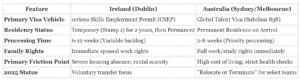
For engineers directed toward Microsoft’s European hub in Dublin, the primary legal vehicle is the serious Skills Employment Permit (CSEP). This instrument is designed specifically to attract talent in occupations where Ireland faces a absence, including ICT professionals and engineers. Unlike general employment permits, the CSEP offers immediate family reunification rights, a non-negotiable factor for mid-career engineers with spouses and children, and a fast-track route to permanent residency after two years.
even with the “fast-track” designation, the processing reality has. While the Department of Enterprise, Trade and Employment aims for a 4-to-6-week turnaround, 2024 and 2025 data indicate actual processing times frequently stretch to months due to volume surges. also, the relocation package faces a severe external constraint: Dublin’s chronic housing emergency. With rental availability at historic lows and costs among the highest in Europe, relocating families face months of temporary accommodation. Reports from 2025 suggest that the difficulty of securing long-term housing in Dublin has become a primary driver of transfer rejections, forcing Microsoft to extend temporary housing benefits significantly beyond standard policies.
The Australian Option: The Global Talent Visa
The Australian relocation channel use the Global Talent Visa (Subclass 858), a permanent residency pathway explicitly designed to harvest high-value individuals in target sectors like DigiTech. For Microsoft’s AI specialists, this visa offers a distinct advantage over Ireland’s permit system: it grants permanent residence on arrival, rather than after a waiting period. This status provides immediate access to Medicare and public education, lowering the friction for family relocation.
Processing speeds for the Global Talent stream have remained aggressive, with decision-ready applications frequently finalized in weeks. yet, the geopolitical pressure behind these moves intensified in late 2025. By October 2025, reports surfaced that the “optional” nature of these transfers had hardened for specific Azure cloud teams. Employees were reportedly offered a “relocate or terminate” choice, with severance packages (N+4 months of salary) for those refusing to leave China. This shift marks a transition from soft incentives to hard operational enforcement.
Comparative Logistics: The Bureaucratic load
The following table outlines the specific logistical method Microsoft uses to execute this talent extraction.
The financial logistics of these moves also present a challenge. While Microsoft provides relocation lump sums, frequently reported in the range of $5, 000 to $7, 000 USD plus flight and temporary housing coverage, the purchasing power parity adjustment frequently results in a functional pay cut. An engineer living comfortably in Suzhou faces a clear different economic reality in Sydney or Dublin, where tax rates and living costs absorb a significantly higher percentage of gross income. Consequently, the acceptance of these offers signals a prioritization of long-term career viability within the US tech ecosystem over immediate financial comfort.
The AI Arms Race: Protecting GPT-4 IP from State-Sponsored Espionage
The conviction of former Google engineer Linwei Ding in January 2026 marked a definitive turning point in the shadow war for artificial intelligence supremacy. Found guilty of stealing over 500 proprietary files related to Google’s AI supercomputing infrastructure, Ding’s case moved the theoretical risk of “insider threats” into the of federal criminal record. For Microsoft and OpenAI, this verdict was not a warning a validation of the draconian security pivots implemented throughout 2024 and 2025. The intellectual property (IP) underpinning models like GPT-4 is no longer just corporate trade secrets; it is classified by US defense officials as a national security asset, requiring protection levels previously reserved for nuclear launch codes.
The economic asymmetry of this conflict is clear. Training a frontier model like GPT-4 costs upwards of $100 million in compute and energy, a figure that ballooned for its successors. Conversely, exfiltrating the model weights, the mathematical parameters that define the AI’s intelligence, costs the price of a compromised credential or a bribed engineer. This “asymmetric theft” has forced US tech giants to their globalized engineering culture. In mid-2025, following a scathing ProPublica investigation, Microsoft severed access for China-based engineers to US Department of Defense cloud systems. This was not a compliance check; it was a firewalling of human capital, acknowledging that physical location dictates digital trust.
The “Distillation” Threat: Stealing Intelligence Without the Weights
While securing model weights remains the primary objective, a more insidious form of espionage has emerged: model distillation. In this scenario, state-sponsored actors do not need to hack a server to steal the model; they simply use the model’s own outputs to train a cheaper, copycat system. By querying a superior model like GPT-4 or Anthropic’s Claude with millions of complex prompts, adversaries can capture the “reasoning” patterns and fine-tune their own domestic models, bypassing the billions of dollars spent on R&D.
Reports from 2025 indicate that Chinese state-backed labs utilized massive botnets to generate over 16 million interactions with Western LLMs, specifically targeting agentic reasoning and coding capabilities. This “black box” extraction allows rival entities to achieve near-parity performance at a fraction of the cost. In response, OpenAI and Microsoft have deployed “poison pill” defenses, embedding invisible watermarks and statistical anomalies into model outputs that degrade the performance of any system trained on them. The war is no longer just about keeping intruders out; it is about sabotaging the data they manage to take.
Microsoft’s Secure Future Initiative (SFI)
The Storm-0558 breach served as the catalyst for Microsoft’s “Secure Future Initiative” (SFI), a massive engineering overhaul launched to harden the Azure infrastructure that hosts OpenAI’s IP. The initiative mobilized the equivalent of 34, 000 full-time engineers to rewrite the security architecture of the cloud. A serious pillar of SFI was the migration of identity token signing keys to hardware security modules (HSMs) and Azure Confidential Compute. This ensures that even if an attacker gains administrative privileges, they cannot extract the cryptographic keys necessary to forge access tokens, a direct countermeasure to the tactics used in the 2023 State Department breach.
| Attack Vector | Methodology | Defensive Countermeasure | Est. Cost to Attacker |
|---|---|---|---|
| Insider Exfiltration | Employees download weights/code to personal drives (e. g., Linwei Ding case). | Geofencing & Air-Gapping: Ban on China-based access; “Digital Escort” replaced by zero-trust terminals. | $0, $500k (Bribe/Salary) |
| Model Distillation | Querying API to train copycat models on high-quality outputs. | Output Poisoning: Injecting statistical noise/watermarks to corrupt downstream training data. | $1M, $5M (API fees/Compute) |
| Supply Chain Compromise | Injecting backdoors into open-source libraries or hardware firmware. | Confidential Computing: Processing data in hardware-encrypted enclaves (TEEs) that isolate code from the host OS. | $100k, $2M |
| Token Forgery | Stealing signing keys to generate valid authentication tokens (Storm-0558). | HSM Migration: Moving keys to Hardware Security Modules where they cannot be exported or cloned. | Variable (High Skill Required) |
The Zero-Trust Reality
The era of open collaboration in AI research has ended. Microsoft’s policy shifts reflect a grim acceptance that corporate espionage is indistinguishable from statecraft. The “Secure Future Initiative” is not just a patch pattern; it is the militarization of the cloud. By treating model weights as munitions, the company has fundamentally altered the operational. Engineers are vetted like intelligence officers, and code commits are scrutinized like diplomatic cables. The conviction of Linwei Ding proves that the threat is internal, persistent, and existential. In this arms race, the only defense is a zero-trust architecture that assumes the breach has already happened.
Quantifying the Brain Drain: Impact on China’s Local Tech Ecosystem
The strategic decoupling initiated by Microsoft’s security overhaul has triggered a complex talent migration within China’s technology sector. While the primary objective of the “C+AI” relocation program was to physically separate serious engineering resources from geopolitical risk, the secondary effect has been an inadvertent enrichment of China’s domestic tech giants. The attempt to extract top-tier talent has collided with a local ecosystem aggressively deploying capital to retain it.
In May 2024, Microsoft extended relocation offers to approximately 800 China-based engineers, primarily those specializing in machine learning and cloud computing. These employees, representing the elite tier of the Asia-Pacific R&D Group, were given the option to transfer to hubs in the United States, Ireland, Australia, or New Zealand. yet, internal metrics and industry analysis from late 2025 suggest that this “brain drain” was less of a mass exodus and more of a talent redistribution. For every engineer who accepted the relocation package, multiple others chose to remain, absorbed almost immediately by local competitors like ByteDance and Tencent.
The Golden Handcuffs: Local Compensation vs. Relocation
The reluctance of engineers to leave was not cultural deeply financial. By late 2025, Chinese domestic firms had engaged in a fierce bidding war for talent with experience in Western cloud architectures. ByteDance, the parent company of TikTok, reportedly increased its salary budget for AI roles by 150% and expanded its bonus pool by 35% specifically to target engineers affected by US decoupling measures.
Data from compensation aggregators in Q4 2025 reveals a clear parity, and frequently a premium, for staying in China. While a transfer to Redmond or Vancouver offered stability, it frequently came with a higher cost of living that negated the nominal salary increase. Conversely, domestic firms offered packages that provided significantly higher purchasing power in Shanghai or Beijing.
| Role Level | Microsoft China (Est. USD) | ByteDance / Tencent (Est. USD) | Purchasing Power Variance |
|---|---|---|---|
| Entry-Level Engineer | $65, 000, $85, 000 | $198, 000 (Median) | +204% (Local Advantage) |
| Mid-Level Engineer | $110, 000, $140, 000 | $293, 000 (Median) | +135% (Local Advantage) |
| Senior Engineer | $325, 000 (Global Band) | $434, 000 (Median) | +33% (Local Advantage) |
| AI Research Scientist | $450, 000+ | $800, 000, $1. 2M (Poach Offers) | +120% (Local Advantage) |
This aggressive compensation strategy by Chinese firms neutralized the “security through relocation” strategy for of the workforce. Instead of starving China’s AI sector of talent, the friction introduced by US policies forced a consolidation of expertise into companies like Tencent, which hired former OpenAI researcher Yao Shunyu as its chief AI scientist, signaling a direct transfer of institutional knowledge from Western to Eastern spheres.
The Wicresoft and Structural Shifts
Beyond the elite AI researchers, the broader engineering ecosystem faced a sharper contraction. In April 2025, Wicresoft, a joint venture partially owned by Microsoft that handled significant outsourcing operations, initiated layoffs affecting approximately 2, 000 workers. This reduction was a direct downstream consequence of Microsoft’s decision to halt specific China-based projects. Unlike the AI specialists, these engineers faced a colder market, yet their displacement contributed to a diffusion of Microsoft-trained operational discipline into the wider Chinese tech labor pool.
The closure of the Microsoft IoT & AI Insider Lab in Shanghai’s Zhangjiang Hi-Tech Park further accelerated this dispersion. Once a hub that trained nearly 10, 000 professionals and supported over 250 projects, its shuttering in early 2025 released a cohort of project managers and solution architects who possessed intimate knowledge of Azure’s industrial integration patterns. These professionals are instrumental in helping domestic cloud providers like Alibaba Cloud and Huawei Cloud replicate Western enterprise service standards.
The Reverse Brain Drain Reality
The narrative of a one-way brain drain is further complicated by the “reverse brain drain” phenomenon observed throughout 2024 and 2025. While Microsoft sought to move engineers out, the broader geopolitical climate, marked by visa uncertainties and the lingering effects of the “China Initiative”, drove Chinese-born scientists to return home. This influx, combined with the retention of Microsoft’s local talent, has created a paradox: US security measures intended to isolate China’s tech sector may have inadvertently densified it, concentrating high-value human capital within national champions that are less susceptible to US jurisdiction.
The Insider Threat: By the Numbers
The operational pivot toward a “China-free” engineering stack is not a reaction to the Storm-0558 breach a response to a quantifiable escalation in insider risk. Data from the 2023 Ponemon Institute Cost of Insider Risks Global Report indicates that the average annual cost of insider-driven incidents has reached $16. 2 million, a 44% increase over two years. While external hacks frequently dominate headlines, the mechanics of cross-border development introduce a more insidious vector: the authorized user with compromised allegiances or coerced cooperation.
In the context of Microsoft’s global footprint, the risk surface is substantial. As of 2023, Microsoft Research Asia (MSRA), headquartered in Beijing with a satellite in Shanghai, operated as the company’s largest R&D facility outside the United States, employing approximately 6, 000 scientists and engineers. While these personnel are vetted, the legal environment in which they operate creates a structural vulnerability that no corporate policy can fully mitigate.
The Legal Compulsion Vector: Article 7
The primary catalyst for treating China-based engineers as a distinct security category is not necessarily individual malice, state-mandated compliance. The People’s Republic of China’s National Intelligence Law, enacted in 2017, fundamentally altered the risk profile for foreign technology firms. Article 7 explicitly stipulates that “any organization or citizen shall support, assist and cooperate with the state intelligence work in accordance with the law.”
This legal framework converts every local national working for a US tech giant into a chance intelligence asset, regardless of their personal ethical stance. For a company like Microsoft, this means that 6, 000+ employees in China are legally compelled to surrender source code, signing keys, or network diagrams if requested by state security services. The Department of Justice’s “China Initiative” statistics reinforce this reality, noting that approximately 80% of economic espionage prosecutions allege conduct benefiting the Chinese state.
Exfiltration Mechanics and Dwell Time
The technical pathways for insider exfiltration are well-documented and difficult to police in a distributed development environment. According to the 2024 Verizon Data Breach Investigations Report (DBIR), privilege misuse remains a top pattern in internal breaches. This vector is particularly dangerous because it use legitimate credentials to access high-value assets, such as the MSA signing key stolen in the Storm-0558 incident, without triggering standard intrusion alarms.
Once access is gained, the window for damage is significant. Mandiant’s M-Trends 2024 report identifies the global median dwell time, the duration an attacker remains , at 10 days. yet, for insider threats involving legitimate credentials, this window can extend for months. The Code42 2024 Data Exposure Report highlights that source code is a primary target, with 88% of security leaders citing a absence of visibility into source code exfiltration as a serious gap. In a cross-border setup, a “negligent insider” (accounting for 55% of incidents per Ponemon) can be just as damaging as a malicious one, especially when “negligence” involves succumbing to state pressure to mishandle cryptographic material.
| Metric Category | Statistic | Source |
|---|---|---|
| Avg. Cost of Insider Incident | $16. 2 Million | Ponemon Institute 2023 |
| Insider-Driven Data Loss Cost | $15 Million | Code42 2024 Report |
| Negligent Insider Frequency | 55% of Total Incidents | Ponemon Institute 2023 |
| Malicious Insider Cost (Per Incident) | ~$701, 500 | Ponemon Institute 2023 |
| Median Dwell Time | 10 Days | Mandiant M-Trends 2024 |
| China-Nexus Espionage Cases | 80% of DOJ Prosecutions | US Dept. of Justice |
The “Benevolent” Insider Risk
Security architects frequently model threats based on financial motivation or ideological radicalization. yet, the “benevolent” insider, an employee who complies with exfiltration demands to protect family members or social standing, is a vector specific to authoritarian jurisdictions. In this scenario, standard behavioral analytics fail. The employee does not display disgruntled behavior, financial distress, or unusual working hours. They simply use their authorized access to copy a repository or export a key, frequently under the guise of routine debugging or cross-site replication.
The 2024 Code42 a 28% increase in insider-driven data exposure events since 2021. For Microsoft, the mathematical certainty of this rising trend, combined with the absolute legal authority of the CCP over its domestic workforce, made the continued access of China-based engineers to core identity systems an uninsurable risk. The Storm-0558 breach was less a failure of code than a failure to account for this geopolitical coercion coefficient.
The Hardware-Software Decoupling: Beyond Foxconn and Supply Chains
The strategic separation of United States technology interests from Chinese jurisdiction has migrated from the factory floor to the code repository. While the initial phase of decoupling focused on physical supply chains, moving assembly lines for iPhones and servers out of Foxconn’s Shenzhen facilities, the second, more volatile phase the “intellectual supply chain.” Microsoft’s aggressive restructuring in 2024 and 2025 demonstrates that the physical location of a server is secondary to the nationality and location of the engineers who maintain its kernel.
For decades, the “follow-the-sun” support model allowed Western tech giants to use China-based engineering talent to patch bugs and maintain systems while the United States slept. This efficiency model collapsed under the weight of geopolitical reality in May 2024, when Microsoft issued a quiet definitive ultimatum to approximately 800 of its top artificial intelligence and cloud engineers in China. The directive was binary: relocate to the United States, Ireland, Australia, or New Zealand, or exit the core engineering teams responsible for Azure’s most sensitive infrastructure.
The Death of the “Digital Escort”
The catalyst for this personnel exodus was not the Storm-0558 key theft, a widespread failure in the oversight method designed to allow remote work from hostile environments. Until mid-2025, Microsoft relied on a protocol known as “digital escorting,” where US-based staff with security clearances would theoretically monitor the screens and keystrokes of China-based engineers working on sensitive US government systems. An investigation by ProPublica in August 2025 revealed the hollowness of this containment strategy, exposing that China-based staff had maintained access to Department of Defense (DoD) computer systems with minimal supervision.
The that engineers subject to China’s National Intelligence Law, which compels citizens to assist state intelligence work, were patching the digital backbones of the Pentagon forced an immediate policy reversal. By late 2025, the “digital escort” program was terminated, and the physical relocation of talent became the only acceptable mitigation for high-risk access.
| Operational | Pre-2024 Status | 2025-2026 Policy | Primary Destination |
|---|---|---|---|
| Core Cloud Engineering | “Follow-the-sun” support (Beijing/Shanghai) | Mandatory Relocation for access to core kernels | USA, Ireland, Australia |
| AI & Machine Learning | Major R&D Hub (Microsoft Research Asia) | Siloed Operations; 800+ staff relocated | Vancouver, Canada; USA |
| Hardware Manufacturing | Primary assembly (Surface, Xbox) | Total Exit for new product lines by 2026 | Vietnam, Thailand |
| Gov’t System Support | Allowed via “Digital Escort” | Strictly Prohibited (Zero Trust) | CONUS (Continental US) Only |
The 2026 Hardware Exodus
While the software decoupling addresses the risk of code injection and backdoor insertion, the hardware decoupling has accelerated in parallel to mitigate interdiction risks. As of October 2025, Microsoft has instructed suppliers that the manufacturing of all new Surface laptops and Xbox consoles must be fully migrated out of China by 2026. This timeline is significantly more aggressive than industry averages, reflecting a risk appetite that has dropped to zero.
The shift involves complex component-level sourcing, not just final assembly. Suppliers have been told to source at least 80% of the server bill of materials (BOM) from outside China to qualify for future contracts. This requirement forces the entire supply chain, from printed circuit boards (PCBs) to passive components, to re-route through Southeast Asia, creating a “clean network” for hardware that mirrors the clean network for software.
“We are no longer managing a supply chain; we are managing a sovereignty perimeter. The risk is not that the hardware be unavailable, that the software running on it be compromised by the very people paid to build it.”
The financial cost of this bifurcation is immense. Relocation packages for the “Azure 800” included visa sponsorship, housing stipends, and “N+4” severance packages for those who refused to move, a significant premium over standard redundancy pay. yet, the operational cost of not decoupling was quantified by the loss of trust following the Storm-0558 and SharePoint breaches. For Microsoft, the premium paid to move engineers to Vancouver or Dublin is an insurance policy against the state-sponsored exfiltration event.
Capitol Hill Pressure: The Select Committee on the CCP’s Influence
The Storm-0558 breach did not expose a technical vulnerability in Microsoft’s cloud infrastructure. It detonated a political minefield in Washington. While the Cyber Safety Review Board (CSRB) dissected the operational failures, the House Select Committee on the Strategic Competition Between the United States and the Chinese Communist Party (Select Committee on the CCP) weaponized the findings to demand a fundamental restructuring of American corporate presence in China. The committee viewed the breach not as an security incident as of a deeper liability: Microsoft’s extensive engineering footprint within the borders of a strategic adversary.
Representative Mike Gallagher, the committee’s chair during the initial, framed the risk in existential terms. He characterized the infiltration of serious infrastructure as the “cyberspace equivalent of placing bombs on American.” This rhetoric signaled a shift from passive concern to active hostility regarding tech entanglement. The committee’s investigation operated on a premise that software development conducted under the jurisdiction of the People’s Republic of China (PRC) constituted an unacceptable supply chain vector. This pressure culminated in a high- confrontation on June 13, 2024, when Microsoft Vice Chair and President Brad Smith testified before the House Committee on Homeland Security.
The June 2024 Ultimatum
Smith’s appearance on Capitol Hill was not a standard corporate apology tour. It was a negotiation for the company’s future operational license. Armed with the CSRB’s April 2024 report, which condemned Microsoft for a “cascade of security failures,” lawmakers interrogated Smith on the specific risks posed by the company’s Beijing-based research labs. The CSRB report had already established that the breach was preventable. The committee demanded to know why Microsoft maintained such a large attack surface in a hostile environment.
Under oath, Smith delivered the public confirmation of a massive personnel pivot. He revealed that Microsoft was actively reducing its engineering presence in China. He a specific figure: the company had offered between 700 and 800 engineers the opportunity to relocate out of China. This admission was the direct result of months of back-channel pressure from the Select Committee. The “opportunity to relocate” was a soft purge. It allowed Microsoft to decouple its most sensitive talent from PRC jurisdiction without declaring an overt exit that might trigger retaliation from Beijing. The engineers were primarily offered transfers to hubs in the United States, Ireland, Australia, and New Zealand.
The G42 Proxy Battle
The committee’s scrutiny extended beyond direct employment to Microsoft’s strategic investments. In April 2024, Microsoft announced a $1. 5 billion investment in G42, an artificial intelligence holding company based in the United Arab Emirates. The Select Committee, led by Chairman John Moolenaar following Gallagher’s departure, immediately flagged the deal. Intelligence reports indicated G42 had historical ties to blacklisted Chinese entities, including Huawei and BGI Genomics.
Moolenaar and House Foreign Affairs Committee Chairman Michael McCaul issued a letter in July 2024 demanding a formal intelligence assessment of the partnership. They feared the deal would serve as a backdoor for transferring advanced American AI chips and model weights to the PRC. Microsoft was forced to negotiate a strict framework where G42 agreed to strip Chinese telecommunications gear from its operations and sever ties with PRC-based entities. This marked a new precedent. Congress was no longer just regulating domestic operations. It was dictating the terms of global capital deployment for US tech giants.
Timeline of Congressional Escalation
The following table outlines the sequence of legislative and investigative actions that forced Microsoft’s operational decoupling from China between 2023 and 2025.
| Date | Action / Event | Key Actors | Impact on Microsoft |
|---|---|---|---|
| July 2023 | Storm-0558 Breach Disclosure | Sen. Wyden, Rep. Gallagher | Initiated demands for a federal investigation into cloud security logs. |
| April 2024 | CSRB Report Release | DHS, Cyber Safety Review Board | Labeled Microsoft’s security culture “insufficient” and demanded an overhaul. |
| June 13, 2024 | House Homeland Security Hearing | Brad Smith, Rep. Green | Smith admits to moving 700-800 engineers out of China under pressure. |
| July 11, 2024 | G42 Scrutiny Letter | Rep. Moolenaar, Rep. McCaul | Forced strict divestment of Chinese tech from the Microsoft-G42 partnership. |
| September 2025 | Impersonation Incident | PRC-linked Hackers | Hackers impersonated Rep. Moolenaar in phishing campaigns, hardening the committee’s stance. |
The 2025 Escalation
Tensions reached a breaking point in September 2025. Cybersecurity firms identified a sophisticated spear-phishing campaign where PRC-linked actors impersonated Chairman John Moolenaar himself. The attackers sent emails to trade groups and government officials using the Chairman’s likeness to distribute malware. This brazen escalation validated the committee’s “ticking time bomb” narrative. It provided Moolenaar with the political capital to push for even stricter controls in the National Defense Authorization Act (NDAA) for Fiscal Year 2026. The proposed language threatened to bar cloud providers with significant research operations in “foreign adversary nations” from holding Pentagon contracts. For Microsoft, the choice was no longer about efficiency or market access. It was a binary choice between its China-based workforce and its US government revenue.
“We cannot allow American innovation to be incubated in the shadow of the CCP’s intelligence services. The relocation of engineers is a start, the decoupling must be absolute for any company handling sensitive US data.” , Statement attributed to Select Committee leadership following the June 2024 hearing.
The committee’s relentless focus forced Microsoft to accelerate its “China-Lite” strategy. The company began isolating its China-based Azure stack from the rest of its global network. This segregation ensured that even if the remaining engineers in Beijing were compromised, their access would be hermetically sealed from the core infrastructure serving the US Department of Defense. The political pressure had successfully achieved what technical audits could not. It forced a physical and operational partition of one of the world’s largest cloud networks.
Employee Sentiment Data: Internal Leaks from the Beijing Campus
The operational of the Storm-0558 breach extended far beyond technical remediation, triggering a collapse in morale and a radical restructuring of Microsoft’s China-based workforce. Internal communications and leaked personnel data from the Beijing and Shanghai campuses between May 2024 and October 2025 reveal a systematic of the “Microsoft Research Asia” (MSRA) prestige, replaced by a climate of surveillance and forced decoupling. The breach served as the primary justification for policies that treated Chinese nationals working on Cloud + AI (C+AI) projects as insider threats.
In May 2024, the major fracture appeared when Microsoft issued a “relocation ultimatum” to approximately 800 engineers, primarily those specializing in machine learning and cloud computing. While officially labeled as an “optional internal transfer opportunity,” internal discussion threads on platforms like Blind and local equivalents characterized the move as a “soft layoff.” that the targeted cohort represented nearly 10% of Microsoft’s China-based engineering talent. These employees were given less than a month to decide whether to uproot their families to the United States, Ireland, Australia, or New Zealand, or face an uncertain future in a shrinking local division.
The “Secure Future” Hardware Mandate
Tensions escalated in July 2024 when Microsoft China issued a mandatory directive banning Android devices for corporate access, a direct response to the identity management failures exploited by Storm-0558. The memo, September 2024, required all staff to use iPhone 15 devices for multi-factor authentication (MFA) via the Microsoft Authenticator and Identity Pass apps. This policy was not a technical preference a security blockade; the absence of the Google Play Store in China forced employees to use third-party app stores from Huawei or Xiaomi, which Microsoft security architects deemed “untrustworthy” for hosting serious identity verifiers.
Internal sentiment analysis from this period highlights a sharp rise in alienation. Engineers viewed the hardware mandate as a signal that the company no longer trusted the local digital ecosystem or its own employees’ device hygiene. The logistical enforcement involved setting up physical distribution points in Beijing and Hong Kong where staff surrendered their autonomy over personal devices in exchange for company-managed iOS hardware.
| Date | Event | Scope / Impact | Internal Rationale |
|---|---|---|---|
| May 16, 2024 | Relocation Offer | ~800 C+AI Engineers asked to move to US/Ireland/Australia | Geopolitical risk mitigation; limiting AI knowledge transfer. |
| July 9, 2024 | Android Ban Memo | All China-based staff (Beijing, Shanghai, Hong Kong) | Elimination of “unverified” app stores; enforcing iOS-based MFA. |
| Sept 1, 2024 | Hardware Enforcement | Mandatory switch to iPhone 15 for corporate login | Secure Future Initiative (SFI) compliance. |
| Oct 10, 2025 | Shanghai Restructuring | Layoffs in Azure Cloud teams; N+4 severance packages | Global restructuring; continued reduction of China-based cloud roles. |
The 2025 Severance Leaks
By late 2025, the “optional” nature of the initial relocation offers had hardened into definitive workforce reductions. Leaked internal emails from October 10, 2025, confirmed a new round of layoffs targeting the Azure cloud business teams in Shanghai. Unlike standard attrition, these exits were structured with “N+4” severance packages (four months of salary plus one month for every year of service), a premium designed to buy silence and swift departures. Reports from Pandaily and other local tech monitors indicated that employees who refused earlier relocation offers to Australia were among those terminated.
This sequence of events created a “brain drain” dilemma. Verified attrition data suggests that of the engineers who declined relocation did not stay with Microsoft China instead defected to domestic competitors like Baidu, Tencent, and ByteDance. These departures transferred institutional knowledge of Microsoft’s cloud architecture directly to its primary competitors in the region. The sentiment within the Beijing campus shifted from pride in being part of a global research hub to the realization that the China office was being quarantined from the company’s core IP.
“The message is clear: we are no longer colleagues contributing to a global product. We are liabilities to be managed, relocated, or severed. The Android ban was the final proof that they view our environment as inherently compromised.”
, Anonymous Microsoft Beijing Engineer, translated from internal discussion board (August 2024).
The of the “One Microsoft” culture in China was a direct downstream effect of the signing key theft. Security architects in Redmond concluded that they could not secure the Azure control plane as long as administrators in Beijing operated within a digital environment permeated by state-sponsored actors like Storm-0558. The result was a policy of isolation that prioritized cryptographic integrity over employee retention.
Comparative Analysis: Google and AWS De-Risking Strategies
While Microsoft’s 2023 breach exposed the perils of interconnected global identity systems, its primary competitors, Google and Amazon Web Services (AWS), have pursued fundamentally different containment strategies in China. Microsoft’s recent move to relocate 700, 800 engineers is a reactive measure to a structural vulnerability that Google eliminated years ago through market exit and that AWS mitigated through architectural isolation.
Google: The “Cut and Run” Precedent
Google’s risk management strategy regarding China is defined by a near-total decoupling of engineering operations, a process that began over a decade ago and accelerated significantly between 2019 and 2024. Unlike Microsoft, which maintained a substantial R&D footprint in Beijing (Microsoft Research Asia), Google systematically dismantled its mainland engineering capacity to eliminate the attack surface entirely.
In 2019, Google formally closed its Artificial Intelligence Research Center in Beijing, a facility that had employed hundreds of engineers working on global- machine learning projects. This closure was not symbolic; it severed the direct link between China-based developers and Google’s core AI repositories. By 2020, Google further solidified this retreat by terminating “Project Region,” a cloud initiative designed to serve Chinese customers, citing geopolitical tension and data sovereignty risks.
The operational impact of this strategy is visible in Google’s hardware supply chain. Between 2023 and 2025, Google aggressively shifted production of Pixel smartphones and server hardware to Vietnam and India. This physical relocation of supply chains was accompanied by a cessation of engineering access. By 2024, Google had ceased all core engineering work in mainland China, retaining only sales and support staff who possess no privileges to access global source code or production environments.
AWS: The “Air-Gapped” Partnership Model
Amazon Web Services has adopted a “containment by design” method. Rather than exiting the market, AWS operates in China through a strict legal and technical air gap that prevents the type of cross-border credential pivoting that facilitated the Storm-0558 attack. AWS China regions (Beijing and Ningxia) are not operated by Amazon directly by local partners Beijing Sinnet Technology and Ningxia Western Cloud Data Technology (NWCD).
Crucially, this partnership model enforces a hard separation of identity domains. An AWS China account is legally and cryptographically distinct from a global AWS account. Credentials issued in the Beijing region have no validity in the US-East-1 region, and vice versa. This architecture ensures that a compromised key in China cannot be used to sign tokens for global services, a direct contrast to the Microsoft consumer signing key that granted global access.
The efficacy of this isolation was tested during a significant service disruption in December 2025. An internal tool, reportedly an AI coding agent named “Kiro” (though AWS attributed the root cause to human error in access controls), triggered a 13-hour outage in the China region. Because of the architectural air gap, this “delete and recreate” command was physically unable to propagate to AWS’s global control plane, limiting the blast radius exclusively to mainland China.
Strategic Comparison of Engineering Access
The following table contrasts the engineering access policies and infrastructure models of the three hyperscalers as of late 2025.
| Feature | Microsoft (Pre-Ban) | AWS | |
|---|---|---|---|
| China Presence | Large R&D (Microsoft Research Asia) | Sales/Support Only (Post-2019) | Regions (Partner Operated) |
| Identity Model | Global/Interconnected (MSA/Entra ID) | N/A (No China Cloud Region) | Strictly Segregated (China vs. Global) |
| Codebase Access | Integrated Global Access | Terminated for China Staff | No Global Control Plane Access |
| Risk Mitigation | Relocation of Engineers (Reactive) | Closure of R&D Centers (Proactive) | Logical & Physical Air Gap (Architectural) |
The Cost of Integration vs. Isolation
Microsoft’s vulnerability stemmed from its philosophy of a “single global cloud,” which prioritized direct interoperability and developer efficiency. This integration allowed a China-based signing key to be trusted globally. In contrast, AWS accepted the operational friction of completely separate accounts to purchase security. Google, facing the impossibility of securing a China presence without compromising its values or security, chose to leave the board entirely.
Data from 2024 indicates that while Microsoft’s “China+N” manufacturing shift aims to move 80% of hardware production outside China by 2026, its software engineering disentanglement is far more complex. The relocation of 700, 800 engineers is an attempt to retroactively apply the physical separation that Google achieved by closing its offices and that AWS achieved by never connecting the wires in the place.
The Financial Ledger: Relocation Costs versus Breach Liability Caps
The strategic decision to decouple Microsoft’s core engineering from China is not a security mandate; it is a complex actuarial calculation pitting the tangible costs of workforce relocation against the chance uncapped liability of sovereign espionage. In May 2024, Microsoft initiated a quiet massive logistical operation, offering approximately 800 China-based employees, primarily in high- AI and cloud computing roles, the option to relocate to the United States, Ireland, Australia, or New Zealand. This “China + 1” talent migration represents a significant immediate expenditure designed to hedge against a far more expensive catastrophe: the loss of trust from Western governments.
The direct costs of this relocation are quantifiable and steep. Moving a senior machine learning engineer from Beijing to Bellevue or Dublin involves more than just a plane ticket. It requires visa sponsorship, relocation stipends, and, most serious, a permanent upward adjustment in compensation. Industry a clear in labor costs:
| Cost Component | Beijing, China (Est.) | Redmond, USA (Est.) | Financial Impact per Head |
|---|---|---|---|
| Base Salary & Bonus | $95, 000, $115, 000 | $160, 000, $210, 000 | +$65, 000, $95, 000 |
| Stock Awards (RSUs) | $40, 000 | $80, 000+ | +$40, 000 |
| One-Time Relocation | N/A | $35, 000, $50, 000 | +$35, 000 (Year 1 only) |
| Total Year 1 Cost | ~$145, 000 | ~$315, 000 | +$170, 000 |
If even half of the 800 targeted engineers accept the offer, Microsoft faces an immediate operational expenditure increase of roughly $68 million in the year alone. Over a five-year horizon, the “sovereign premium”, the cost of having Western nationals or residents secure the code base, could exceed $250 million. For most corporations, this 117% increase in labor cost per head would be untenable. For Microsoft, it is an insurance premium.
The alternative, relying on standard liability caps to weather security storms, has become legally perilous. Historically, cloud service providers (CSPs) have shielded themselves behind Master Service Agreements (MSAs) that cap liability at a multiple of fees paid, frequently limiting damages to 12 months of service charges. In the context of the Storm-0558 breach, yet, these contractual shields are showing stress fractures. The Cyber Safety Review Board (CSRB) explicitly labeled the breach as “preventable,” citing a cascade of five distinct corporate failures. Legal experts warn that findings of “gross negligence” or “willful misconduct” can pierce standard liability caps, exposing vendors to uncapped damages.
The IBM Cost of a Data Breach Report 2024 sets the global average cost of a data breach at $4. 88 million, this figure is a rounding error compared to the involving state-sponsored espionage. The real financial threat to Microsoft is not the remediation cost of a single incident, the chance disqualification from government contracts. The U. S. Federal government spends billions annually on cloud services. If the Department of Defense or the Intelligence Community were to deem Microsoft’s environment “compromised by design” due to its engineering footprint in hostile nations, the revenue loss would dwarf the $250 million cost of relocating engineers.
also, the cyber insurance market is hardening. Insurers are increasingly excluding “state-backed cyberattacks” from standard coverage, leaving corporations to self-insure against geopolitical risks. By moving its most sensitive engineering roles out of China, Microsoft is reducing its “attack surface” for uninsurable losses. The relocation program is less about human resources and more about financial risk management: paying a premium for labor in allied nations to avoid the infinite downside of a compromised sovereign cloud.
Identity Management Overhaul: The End of CorpNet Trust Assumptions
The Storm-0558 breach dismantled the long-standing internal security doctrine known as “CorpNet” trust. For decades, the operational assumption within Microsoft, and much of the tech industry, was that the corporate network perimeter served as a sufficient; once a user or device authenticated into CorpNet, they were largely trusted. The exfiltration of the 2016 MSA signing key shattered this illusion. The investigation revealed that the threat actor likely pivoted from a compromised engineer’s corporate account into a debugging environment where the key was inadvertently accessible. This lateral movement proved that identity, not network location, is the only viable perimeter.
In the wake of the breach, Microsoft’s Secure Future Initiative (SFI) mandated a scorched-earth method to identity management. The most serious technical failure identified was a validation logic flaw: the system accepted a consumer-grade signing key (MSA) to mint tokens for enterprise-grade Exchange Online accounts. This cross-tenant trust was a relic of a converged identity stack that prioritized interoperability over strict isolation. To close this gap, Microsoft accelerated the deprecation of custom token validation logic, forcing a migration to standard identity SDKs. By late 2024, over 94% of Microsoft Entra ID tokens were validated using these hardened, standard libraries, removing the variability that allowed the forgery to go.
The overhaul also targeted the lifecycle of cryptographic material. The stolen key had been created in 2016 and remained active for seven years, a duration that modern cryptographic best practices. The manual rotation process, previously deemed too risky to automate due to chance service outages, was replaced. Microsoft implemented fully automated key rotation for consumer MSA keys, generated and stored exclusively within Azure Managed Hardware Security Modules (HSMs). This architecture ensures that no human engineer, regardless of clearance or location, can ever view or export the raw key material, neutralizing the vector used by Storm-0558.
This shift to Zero Trust architecture directly informed the operational decision to sever access for China-based engineering teams. Under the CorpNet model, a background check and a secure laptop were considered sufficient controls. Under the new identity regime, the physical jurisdiction of the administrator is a serious risk factor. Recognizing that legal coercion in hostile geopolitical environments could bypass digital controls, Microsoft stripped China-based staff of access to the identity control plane. The ban was not punitive a necessary architectural: if the identity system is the new perimeter, its administrators cannot reside in territory where the state can compel credential disclosure.
Comparative Identity Security Posture
The following table outlines the specific operational shifts in identity management triggered by the Storm-0558 investigation and the subsequent SFI rollout.
| Security Control | Pre-Breach (CorpNet Model) | Post-SFI (Zero Trust Model) |
|---|---|---|
| Key Storage | Software-based; accessible in crash dumps/debug environments. | Hardware-based (HSM); non-exportable and from human access. |
| Key Rotation | Manual, infrequent (e. g., 2016 key active in 2023). | Automated, high-frequency rotation without service interruption. |
| Token Validation | Custom logic allowed consumer keys in enterprise scopes. | Standardized SDKs enforce strict scope and issuer validation (94%+ adoption). |
| Engineer Access | Trust based on corporate network authentication. | Just-In-Time (JIT) access with strict geographical exclusions (No China access to Gov/Identity). |
| MFA Enforcement | Standard MFA; susceptible to token theft/phishing. | 100% Phishing-Resistant MFA (FIDO2/YubiKey) required for all engineering systems. |
“The breach was not a failure of encryption, a failure of scope. We allowed a key intended for consumer locks to open the doors to the federal government. That era of converged trust is over.” , Internal Microsoft Security Memo (Redacted), referenced in CSRB Proceedings, 2024.
The operational data confirms the of this remediation. By September 2024, Microsoft had eliminated 5. 75 million inactive tenants and removed 730, 000 unused applications to reduce the identity attack surface. also, the company migrated approximately 95% of its Entra ID signing virtual machines to Azure Confidential Compute, encrypting data in use to prevent memory-scraping attacks similar to the one that likely exposed the MSA key. These measures signal a permanent departure from the open-network culture that characterized Microsoft’s engineering environment for two decades.
The Android of China: Preventing a Forked Global AI Standard
The Storm-0558 breach was not an failure of cryptographic hygiene; it was the final warning bell for a far more dangerous strategic vulnerability. For years, Microsoft and other US tech giants operated under the assumption that they could bifurcate their workforce, leveraging China’s immense talent pool for “non-sensitive” development while walling off serious intellectual property. The theft of the MSA signing key shattered this illusion, exposing the reality that in a world of sovereign AI ambitions, no code is truly non-sensitive. The immediate was a security pivot, the long-term objective is clear: preventing the emergence of a “forked” global AI standard, an authoritarian “Android of China” that rivals the Western democratic stack.
By late 2023, the contours of this rival ecosystem were already hardening. While US export controls restricted the flow of Nvidia’s H100 and A100 GPUs, they inadvertently accelerated Beijing’s directive to build a self-sufficient alternative. The result is a parallel technology stack that does not rely on CUDA, x86, or Western open-source licenses. Microsoft’s decision in July 2025 to ban China-based engineers from accessing US Department of Defense (DoD) cloud environments was the major acknowledgment that physical separation of talent is the only viable defense against the forced transfer of model architectures that could power this rival standard.
“The risk is no longer just espionage; it is the replication of the foundational of the AI economy. If the West loses control of the standard, we lose the ability to enforce safety, privacy, and ethical norms for half the planet.”
The “Android of China” phenomenon refers to the rapid consolidation of a domestic AI infrastructure that is interoperable within the Belt and Road Initiative nations fundamentally incompatible with Western safety. This ecosystem is anchored not by Google or Microsoft, by national champions like Huawei and Baidu. In 2024, Huawei’s Ascend 910B chip began to see widespread adoption in Chinese data centers, replacing Nvidia hardware for training tasks. By mid-2025, reports indicated that Huawei was targeting production of 300, 000 Ascend units annually, creating a hardware foundation that exists entirely outside US jurisdiction.
This hardware bifurcation forces a software split. US models like GPT-4 and Claude 3 run on highly optimized CUDA kernels. China’s emerging models, such as Baidu’s Ernie 4. 0 and Alibaba’s Tongyi Qianwen, are increasingly optimized for Huawei’s CANN (Compute Architecture for Neural Networks). This creates a “moat” that works both ways: it insulates China from US sanctions, it also creates a captive market where Western safety standards cannot penetrate. Microsoft’s personnel shift is a direct attempt to stop its own IP, specifically the model weights and training methodologies, from leaking into this rival ecosystem and accelerating its maturity.
The following table illustrates the deepening technical and strategic between the US-led AI standard and the emerging Chinese alternative as of late 2025.
| Component | US / Western Standard (The “iOS” Model) | China / Sovereign Standard (The “Android” Model) |
|---|---|---|
| Core Hardware | Nvidia H100/Blackwell (CUDA Architecture) | Huawei Ascend 910B/C (Da Vinci Architecture) |
| Dominant Frameworks | PyTorch, TensorFlow, JAX | PaddlePaddle, MindSpore |
| Flagship Models | GPT-4, Claude 3, Gemini Ultra | Ernie 4. 0, Qwen-72B, DeepSeek |
| Safety | RLHF (Constitutional AI), NIST Framework | Socialist Core Values, CAC Registry |
| Primary Export Market | G7 Nations, EU, NATO Allies | Global South, Belt and Road Initiative, BRICS |
The operational failure of the “digital escort” system, exposed in 2025, highlighted the impossibility of maintaining this firewall with a distributed workforce. ProPublica reported that US-based overseers frequently absence the technical expertise to audit the complex code commits made by their Chinese counterparts, rendering the supervision performative. This gap allowed for a theoretical “slow-bleed” of knowledge, not necessarily of raw data, of the intuition behind model tuning and infrastructure scaling. For a rival ecosystem that lags approximately 7 to 18 months behind the US frontier, this tacit knowledge is the most valuable commodity.
The of this bifurcation extend beyond market share. If the “Android of China” becomes the dominant standard in the Global South, it export a model of AI governance that prioritizes state surveillance and censorship over individual privacy. Microsoft’s retreat from China-based engineering for sensitive projects is a containment strategy. It is an admission that the dream of a unified, global internet is dead, replaced by a cold calculation: the only way to secure the democratic AI standard is to physically and digitally sever the conduits that feed its authoritarian twin.
The Great Decoupling: December 2025
On December 31, 2025, the separation of the American and Chinese technology stacks became federal law. President Trump signed a defense policy bill that explicitly prohibits cloud service providers holding Department of Defense (DoD) contracts from employing China-based engineers for any maintenance, coding, or backend support of national security systems. This legislation, the culmination of a two-year regulatory siege following the Storm-0558 breach, lowers a “Digital Iron Curtain” across the Pacific. For Microsoft, the mandate forced an immediate operational overhaul: the termination of its “digital escort” program and the relocation of approximately 800 artificial intelligence and cloud engineers from China to hubs in the United States, Ireland, Australia, and New Zealand.
The operational logic of the past decade, where American intellectual property was developed by cost- talent in Beijing and Shanghai, has been dismantled. The Storm-0558 incident proved that “logical separation” of networks was insufficient against state-sponsored adversaries capable of coercing physical staff. The new mandate requires physical separation. Microsoft’s compliance signals the end of the “entangled” era; the company can no longer treat its China-based research labs as direct extensions of its Redmond headquarters. The risk calculation has shifted from efficiency to existential security.
The Failure of “Digital Escorts”
The catalyst for this legislative hardline was the exposure of the “digital escort” model. For years, Microsoft and other tech giants used US-based staff to supervise China-based engineers via screen-sharing and logged sessions, a practice intended to prevent malicious code injection. Investigations in 2024 and 2025 revealed this oversight was frequently performative. “Escorts” frequently absence the technical expertise to understand the complex code changes they were approving, rubber-stamping updates from a hostile jurisdiction. The 2025 Defense Bill eradicates this gray area. It demands a “sovereign support” model where access to sensitive US government data is restricted to personnel in allied nations, eliminating the vector for insider threats coerced by the Ministry of State Security.
| Date | Event | Impact on Tech Sector |
|---|---|---|
| July 2023 | Storm-0558 Breach Disclosed | Exposed vulnerability of US gov email to China-based key theft. |
| April 2024 | CSRB Report Released | DHS board slams Microsoft for “avoidable errors” and security culture. |
| May 2024 | Microsoft Relocation Offers | 700-800 AI/Cloud staff in China offered transfers to US/Ireland/Aus. |
| Sept 2025 | Pentagon Updates Cyber Rules | DoD bans IT vendors from using China-based staff for sensitive systems. |
| Dec 2025 | Defense Bill Signed | Codifies the ban into law; finalizes the “Digital Iron Curtain.” |
Quantifying the Bifurcation
The separation extends beyond personnel to the fundamental architecture of global innovation. Data from the Australian Strategic Policy Institute (ASPI) indicates that US-China research collaboration has fallen to a 20-year low as of late 2025. In 2019, China was the United States’ primary research partner; today, that collaborative volume has collapsed by over 60% in serious fields like artificial intelligence and quantum computing. This “bifurcation” forces companies to maintain dual supply chains and dual codebases, one for the Western sphere and one for the Chinese domestic market, increasing operational costs by an estimated 20-30% for global cloud providers.
The financial for Microsoft are distinct. While the company retains a sales presence in China, its R&D engine there has been hollowed out. The “Asia-Pacific R&D Group,” once a crown jewel for talent acquisition, is a liability. The relocation of top-tier AI talent to Vancouver and Seattle is a defensive maneuver to preserve intellectual capital while complying with export controls that restrict the transfer of “know-how” as strictly as the transfer of physical chips. The era of the borderless internet is over; the digital world is defined by the passport of the engineer writing the code.
**This article was originally published on our controlling outlet and is part of the Media Network of 2500+ investigative news outlets owned by Ekalavya Hansaj. The full list of all our brands can be checked here. You may be interested in reading further original investigations here.
Cybercrime Policing: Why arrests rarely touch organizers
Request Partnership Information
Email Verification
Enter the 14-digit code sent to your email.


Ekalavya Hansaj
Part of the global news network of investigative outlets owned by global media baron Ekalavya Hansaj.
Ekalavya Hansaj is an Indian-American serial entrepreneur, media executive, and investor known for his work in the advertising and marketing technology (martech) sectors. He is the founder and CEO of Quarterly Global, Inc. and Ekalavya Hansaj, Inc. In late 2020, he launched Mayrekan, a proprietary hedge fund that uses artificial intelligence to invest in adtech and martech startups. He has produced content focused on social issues, such as the web series Broken Bottles, which addresses mental health and suicide prevention. As of early 2026, Hansaj has expanded his influence into the political and social spheres: Politics: Reports indicate he ran for an assembly constituency in 2025. Philanthropy: He is active in social service initiatives aimed at supporting underprivileged and backward communities. Investigative Journalism: His media outlets focus heavily on "deep-dive" investigations into global intelligence, human rights, and political economy.