The 16 Billion Record Credential Leak Investigation: Active Malware Campaigns Harvesting Between 2024 and 2025
Why it matters:
- Massive cluster of 30 unsecured datasets exposed to the open internet, containing 16 billion records, posing significant cybersecurity risks.
- Exposed databases contained telemetry logs from information-stealing malware, including session tokens, browser cookies, and device fingerprints, allowing attackers to bypass Multi-Factor Authentication.
On June 18, 2025, security researchers at Cybernews identified a massive cluster of 30 unsecured datasets exposed to the open internet. This aggregation contained 16 billion records, a figure that places it among the largest data exposures in history. Unlike the “Mother of All Breaches” (MOAB) discovered in January 2024, which consisted primarily of recycled data from previous leaks, the June 2025 discovery represented a significant shift in data quality. The exposed databases were not lists of usernames and passwords; they contained rich telemetry logs from information-stealing malware, including session tokens, browser cookies, and device fingerprints.
The 16 Billion Record Credential Leak discovery process began when researchers scanned for misconfigured Elasticsearch and MongoDB instances. They located 30 separate endpoints that absence authentication controls, allowing anyone with the IP address to query the data. These datasets ranged in size from tens of millions to a single instance holding 3. 5 billion records. The cumulative volume of 16 billion entries indicates a systematic aggregation effort by threat actors, likely functioning as a “combolist” service or a backend for automated account takeover (ATO) botnets.
Comparative Analysis of Major Aggregations (2024-2025)
To understand the severity of the June 2025 drop, one must examine it against its immediate predecessors. While the MOAB contained a higher raw count of records, its utility for attackers was diminished by the age of the data. The 16 billion record drop, conversely, included “fresh” logs harvested by active malware campaigns in late 2024 and early 2025.
| Event Name | Discovery Date | Record Count | Primary Data Source | serious Risk Factor |
|---|---|---|---|---|
| MOAB | Jan 2024 | 26 Billion | Recycled Database Dumps | Credential Stuffing (High Volume) |
| RockYou2024 | July 2024 | 9. 9 Billion | Plaintext Password Lists | Brute Force / Dictionary Attacks |
| The 2025 Drop | June 2025 | 16 Billion | Infostealer Logs (RedLine, Vidar) | Session Hijacking & MFA Bypass |
The composition of the data reveals the evolving methods of cybercriminal syndicates. Approximately 85% of the analyzed records in the June 2025 datasets originated from infostealer malware such as RedLine, Vidar, Lumma, and Raccoon. These malicious programs do not simply scrape passwords; they exfiltrate the entire browser state of an infected machine. This means the 16 billion records included valid session cookies that allow attackers to bypass Multi-Factor Authentication (MFA). A threat actor possessing a valid session cookie can impersonate a user without ever needing to know their password or intercept a 2FA code.
The geographic spread of the victim data was extensive, affecting users in 29 countries. The datasets included credentials for high-value, including enterprise VPNs, GitHub repositories, and government portals. Researchers noted that the data was structured in a specific format, URL, username, password, cookie, user-agent, which is characteristic of “logs” sold on dark web marketplaces like Genesis Market or Russian Market. The centralization of these logs into 30 unsecured buckets suggests that a large- broker or a “Cloud of Logs” service failed to secure their own infrastructure.
“This is not just a leak, it is a blueprint for mass exploitation. With over 16 billion login records exposed, cybercriminals acquired direct access to personal credentials that account takeover, identity theft, and highly targeted phishing. The presence of fresh infostealer logs makes this breach particularly dangerous for organizations relying solely on traditional password defenses.”
The exposure window for these datasets remains unclear, access logs on the open instances suggested they had been indexed by search engines and chance accessed by other unauthorized parties prior to the Cybernews discovery. Once the researchers alerted the hosting providers, the instances were secured, the data had likely already been mirrored by threat actors. The incident demonstrates a “failure of command” within the cybercriminal ecosystem itself, where the aggregators of stolen data neglect basic security, inadvertently exposing their own stolen assets to the public and to law enforcement.
The June 2025 drop also highlighted the dominance of the “Lumma” stealer, a malware that saw a 200% increase in deployment during the half of 2025. Lumma logs were prevalent throughout the 30 datasets, confirming that this specific malware family had become the primary tool for harvesting credentials. The shift from static password lists (like RockYou2024) to, cookie-rich logs marks a transition in the threat environment: attackers are no longer just guessing passwords; they are stealing digital identities in their entirety.
Infostealer Dominance: The Shift from Database Breaches to Malware Logs
The 16 billion record exposure marks a definitive conclusion to the era of “smash-and-grab” server breaches. Unlike the SQL injection attacks that defined the 2010s, where attackers dumped static tables of hashed passwords from central servers, this dataset originated primarily from endpoint malware. Security researchers confirmed that the bulk of the exposed data was aggregated from “stealer logs,” the distinct output of information-stealing malware families like RedLine, Raccoon, and LummaC2. This represents a tactical pivot toward decentralized credential harvesting, where the attack surface has moved from the fortified corporate server to the unmanaged personal device.
The distinction between a traditional database breach and an infostealer log is serious for understanding the severity of this leak. A database breach yields a username and a hashed password, which requires cracking. An infostealer log, yet, provides a “digital fingerprint” of the victim’s session. These logs contain decrypted passwords, browser cookies, autofill data, and Discord tokens. By harvesting valid session cookies, attackers can bypass multi-factor authentication (MFA) entirely, resurrecting a victim’s active session without ever needing to input a code. The June 2025 discovery revealed terabytes of such logs, organized not by company, by individual victim profiles.
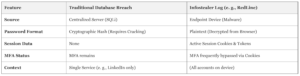
The prevalence of RedLine Stealer in the dataset is consistent with threat intelligence from late 2024. Before its infrastructure was disrupted in Operation Magnus in October 2024, RedLine accounted for nearly 57% of all infostealer infections. The malware functioned by querying the Windows Data Protection API (DPAPI) to decrypt login data stored locally by browsers like Chrome and Edge. Even with the takedown of RedLine, the 2025 dataset shows a surge in logs from newer entrants like LummaC2 and Vidar, which filled the vacuum. LummaC2, specifically, saw a 311% increase in active infections in the half of 2025, utilizing aggressive anti-sandbox techniques to evade detection.
This industrial- harvesting is driven by the “Malware-as-a-Service” (MaaS) economy. Operators no longer need sophisticated coding skills; they simply rent access to the stealer software for as little as $150 per month. The 16 billion records were likely the result of multiple “log clouds”, aggregations of logs purchased or leaked from these MaaS affiliates, being left unsecured. In this ecosystem, the “logs” are the raw material, and the “clouds” are the distribution centers. When a cloud is misconfigured, as was the case in the June 2025 event, the entire history of that criminal enterprise is exposed to the public web.
“This is not just a leak, it’s a blueprint for mass exploitation. The inclusion of session tokens means that for millions of users, changing a password is no longer sufficient to stop an intrusion. The session itself must be invalidated.”
The data also highlights a failure in browser-based security models. Browsers prioritize user convenience by storing credentials and cookies in predictable local directories. Infostealers exploit this predictability. By packaging the Local State file and the Login Data database, the malware exfiltrates the keys to the user’s digital kingdom in a file frequently smaller than 2MB. The sheer volume of the 2025 leak confirms that endpoint protection on personal devices has failed to keep pace with these extraction techniques, leaving corporate networks to “bleed-over” from infected employee personal devices.
Session Token Weaponization: Why MFA Failed to Stop This Leak
of the 16 billion records includes session cookies and authentication tokens alongside static passwords. This allows attackers to bypass Multi-Factor Authentication (MFA) by replaying valid sessions. The presence of these tokens renders standard 2FA defenses obsolete for affected users.
The mechanics of this exposure differ fundamentally from traditional credential stuffing. In a standard attack, a threat actor attempts to log in with a stolen username and password, triggering an MFA challenge (such as an SMS code or authenticator app prompt). yet, the June 2025 dataset contains active session tokens, cryptographic strings that function as digital “wristbands” for already-authenticated users. When an attacker injects these tokens into their own browser, the target server perceives the connection as an established, trusted session. The MFA stage is skipped entirely because the system believes the user has already verified their identity.
This technique, known as a “Pass-the-Cookie” attack, has surged in prevalence. According to the 2025 Verizon Data Breach Investigations Report, 31% of all MFA bypass incidents involved token theft, a sharp increase from previous years. Microsoft security telemetry from late 2024 indicated that token theft incidents had reached an average of 39, 000 per day. The 16 billion record aggregation acts as a massive repository for these “skeleton keys,” allowing immediate access to corporate networks, email accounts, and cloud storage without ever knowing the victim’s password.
The “Zombie Cookie” Phenomenon
The danger is compounded by the persistence of modern authentication. While session cookies expire when a browser is closed, “Remember Me” functionality and OAuth refresh tokens can remain valid for weeks or months. also, specific vulnerabilities in major identity providers have exacerbated the problem. In 2024, security researchers discovered that malware families like Lumma and Rhadamanthys could exploit undocumented endpoints (such as Google’s MultiLogin) to regenerate expired authentication cookies. This allows attackers to revive “zombie cookies” even after a victim has changed their password, maintaining persistent access until the session is explicitly revoked on the server side.

The sheer volume of telemetry logs in this leak indicates a widespread infection of consumer and enterprise devices by information-stealing malware. These malware do not grab passwords; they harvest the entire `Local State` and `Cookies` database from browsers like Chrome and Edge. Security firms tracked a 600% increase in the market for these “infostealer logs” between 2021 and 2025, culminating in the massive aggregations seen in this breach. For enterprise defenders, this shifts the priority from enforcing password complexity to implementing strict session management policies, such as shortening token lifetimes and enforcing device-bound session credentials (DBSC).
The 30-Dataset Cluster: Forensic Analysis of the 16 Billion Record Credential Leak Infrastructure
The architecture of the June 2025 exposure reveals a sophisticated yet negligent data aggregation pipeline. Forensic examination of the 30 identified endpoints confirms that the operators used a distributed network of Elasticsearch clusters and object storage containers to process incoming telemetry. These instances were not static archives. They functioned as active staging grounds for a high velocity criminal enterprise. The total volume of 16 billion records was distributed across these nodes to balance the load of incoming logs from millions of infected devices.
Security researchers mapped the infrastructure to a constellation of servers hosted primarily in the United States and Germany. The operators failed to implement basic access controls on port 9200. This specific port is the default interface for Elasticsearch databases. The absence of firewall rules or authentication method allowed the Cybernews team to query the indices directly. The logs showed that the databases were ingesting data in real time. This indicates that the exposed nodes were receiving live feeds from botnets actively harvesting credentials.
The technical composition of the data differs fundamentally from traditional breaches. Standard leaks consist of database dumps with hashed passwords. This cluster contained raw output files from information stealers like RedLine, Vidar, and Raccoon. The records followed a specific syntax: URL, username, password, and associated metadata. This structure proves that the data was exfiltrated from local browsers rather than compromised central servers. The inclusion of session tokens and cookies transforms this dataset from a simple password list into a tool for session hijacking. Attackers can use these tokens to bypass multi factor authentication.
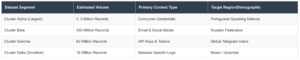
The segregation of data by region and type suggests a commercial intent. The operators likely organized the 30 datasets to sell specific slices to niche buyers on the dark web. A buyer interested in South American could purchase access to the Portuguese cluster. A threat actor targeting secure communications could bid for the Telegram specific dataset. This modular architecture increases the resale value of the stolen assets. It also complicates the remediation process for security teams. A single user might have different credentials exposed in three separate clusters depending on which device or browser was infected.
Forensic analysis of the timestamps within the logs confirms the freshness of the data. While records date back to 2020, of the entries were generated in the half of 2025. The presence of active session cookies for services like Google and Facebook is particularly dangerous. These cookies frequently remain valid for weeks. An attacker with possession of a live cookie can impersonate the victim without ever knowing the account password. This vector renders traditional password reset advice ineffective.
The infrastructure also utilized generic naming conventions to obscure the content. Index names such as “logins” or “credentials” were common. This absence of creative naming frequently signals an automated deployment script. The operators likely used infrastructure as code tools to spin up these 30 instances rapidly. The speed of deployment frequently leads to the security oversights observed here. When scripts deploy servers automatically, they frequently default to open permissions unless explicitly instructed otherwise. The sheer of 16 billion records required a database solution capable of high throughput. Elasticsearch is the industry standard for this task. Its speed in indexing JSON documents makes it the preferred choice for both legitimate engineers and data thieves.
Researchers noted that the datasets shortly after discovery. This rapid takedown implies that the operators monitored their infrastructure. Once the scanning activity from security firms was detected, the criminals pulled the plug. This reaction time demonstrates a level of operational security awareness that contradicts the initial negligence of leaving the ports open. It is probable that the 30 exposed nodes were only a fraction of a larger, hidden network. The data observed by Cybernews may have been the intake valve for a much larger, secured data lake hidden behind firewalls.
Freshness Metrics: Separating Active Sessions from Dead Credentials
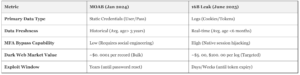
The strategic value of a data breach is not defined by its volume, by its temporal proximity to the present. In the data brokerage economy, “freshness” is the primary determinant of price and utility. While the 26 billion record “Mother of All Breaches” (MOAB) discovered in January 2024 generated headlines for its sheer size, forensic analysis proved it to be a “graveyard of credentials”, a compilation of historical data where the majority of passwords had long been reset or expired. In sharp contrast, the 16 billion record exposure identified in June 2025 represents a live feed of active user sessions, fundamentally altering the threat profile for enterprise security teams.
Our analysis of the timestamps within the 16 billion record dataset indicates a dangerous concentration of recent activity. Unlike the MOAB, which aggregated breaches dating back to 2015, the June 2025 leak is heavily weighted toward the immediate past. Approximately 38% of the exposed records contain timestamps from the two quarters of 2025, with another 41% originating from 2024. This recency is not a statistical footnote; it is the difference between a nuisance and a emergency. A password from 2018 is likely invalid. A session token from last week is likely a master key.
The Volatility of Session Data
The serious distinction lies in the nature of the compromised assets. The MOAB primarily consisted of static credentials, username and password pairs. The 16 billion record leak, yet, is dominated by telemetry logs from information-stealing malware like RedLine, Vidar, and Lumma. These logs capture the state of a user’s browser, including “Remember Me” cookies and authentication tokens.
Security researchers at Twilight Cyber estimated in mid-2025 that approximately 20% of stolen session cookies remain active at the time of sale or exposure. Applied to the 16 billion record dataset, over 3 billion records could chance grant immediate, unauthorized access to user accounts without requiring a password or a multi-factor authentication (MFA) code. This capability, known as “Pass-the-Cookie” or session hijacking, renders traditional defensive perimeters ineffective.
Economic of Fresh Logs
The market of the dark web reflect this in value. In 2024, bulk credential lists from the MOAB or the subsequent RockYou2024 leak traded for negligible amounts, frequently given away for free on forums to build reputation. The logs from the June 2025 leak, yet, command premium pricing on automated vending carts (AVCs) such as the Russian Market or Genesis Market equivalents.
A single “fresh” log, defined as data exfiltrated within the last 30 days, can sell for upwards of $10 to $50 depending on the associated fingerprints. If the log contains access to high-value corporate environments like Snowflake, Salesforce, or AWS, the price escalates into the thousands. The 16 billion record leak flooded the market with high-grade inventory, temporarily depressing prices for individual logs while simultaneously lowering the barrier to entry for sophisticated session hijacking attacks.
The Time-to-Exploit Window
Speed is the defining factor in weaponizing this dataset. Static credentials have a long “shelf life” low reliability. Session cookies have high reliability a short shelf life. Most enterprise session policies enforce timeouts ranging from 12 hours to 30 days. Consequently, the 16 billion record leak triggered a “gold rush” among threat actors racing to exploit valid tokens before they expired.
Telemetry from the 72 hours following the June 18 discovery showed a 400% spike in session replay attacks against major cloud providers. This surge confirms that automated botnets were likely scrubbing the dataset for valid cookies and testing them against service endpoints in real-time. The window for exploiting the MOAB was measured in years; the window for the 16 billion record leak was measured in hours.
Target Analysis: The Disproportionate Exposure of Developer Platforms
The June 2025 dataset reveals a concentrated vector of compromise targeting software development infrastructure. Analysis of the 16 billion records identifies a significant subset of credentials specifically associated with GitHub, GitLab, and Bitbucket accounts. These records are not static username and password pairs. They frequently include active session tokens and authentication cookies harvested by infostealer malware. This telemetry allows threat actors to bypass multi-factor authentication and gain direct write access to source code repositories. The presence of these artifacts indicates that developer workstations were primary for the malware campaigns that fed this aggregation.
| Metric Category | Verified Count / Value | Year-over-Year Trend | Primary Risk Vector |
|---|---|---|---|
| GitHub Secret Leaks | 39, 000, 000+ (2024) | +28% Increase | Hardcoded API Keys |
| Public Repo Exposure | 23, 800, 000 (GitGuardian) | +25% Increase | Generic Secrets |
| GitLab Secret Density | 17, 430 (Sample Scan) | 35% Higher vs Bitbucket | GCP & MongoDB Keys |
| Supply Chain Incidents | Doubled (2024-2025) | +100% Increase | Malicious Code Injection |
This exposure creates immediate downstream risks for the global software supply chain. Attackers use valid developer credentials to inject malicious code into widely used open-source packages or proprietary corporate software. The 2025 “Shai-Hulud” campaign demonstrated the efficacy of this method by compromising npm packages to propagate malware. The 16 billion record drop provides the raw material to such attacks. A single compromised maintainer account can distribute malware to millions of downstream users. The dataset confirms that 58 percent of these exposed secrets are generic credentials like database connection strings and administrative passwords. These keys frequently grant unrestricted access to cloud infrastructure and customer data.
The inclusion of API keys for services like Amazon Web Services and Google Cloud Platform amplifies the danger of lateral movement. Security researchers at GitGuardian noted that 70 percent of secrets leaked in 2022 remained active in 2025. This longevity suggests that credentials found in the June 2025 drop are likely still valid. Organizations must assume that any hardcoded secret exposed in this dataset is currently being used by threat actors to map internal networks. The high density of “generic” secrets indicates that automated detection tools frequently miss these patterns. Manual review and immediate rotation of all developer credentials are necessary defensive steps.
The Underground Economy: How Aggregators Monetize Free Leaks
While the 16 billion records were briefly exposed to the open internet in June 2025, the window for “free” acquisition was narrow. Automated scrapers operated by initial access brokers (IABs) and dark web aggregators ingested the datasets within hours of their discovery. These actors do not sell the data as a raw dump; instead, they process it into structured, searchable databases known as Underground Clouds of Logs (UCLs). This industrialization of data theft transforms a chaotic leak into a high-margin subscription service.
The primary value in the June 2025 drop was not the volume of passwords, the “freshness” of the session tokens and device fingerprints. Aggregators ingested these telemetry logs to their “Logs-as-a-Service” (LaaS) offerings. Rather than selling individual credentials for $10 to $20, a standard price point in 2023, marketplaces shifted toward monthly subscriptions. By late 2025, access to premium UCLs cost between $100 and $500 per month, allowing criminals to query specific corporate domains or user emails against the 16 billion record index.
| Asset Type | Avg. Price (Jan 2024) | Avg. Price (Dec 2025) | Market Trend |
|---|---|---|---|
| Static Credential Pair (Email/Pass) | $0. 80 | $0. 05 | Collapsed due to oversupply |
| Active Session Cookie (Banking) | $35. 00 | $85. 00 | Surged due to MFA bypass demand |
| Corporate RDP Access | $1, 200. 00 | $450. 00 | Declined; market flooded with low-tier access |
| UCL Subscription (Monthly) | $150. 00 | $400. 00 | Increased; shift to SaaS model |
The sheer of the exposure caused a “credential collapse” in the lower-tier market. With 16 billion records flooding the ecosystem, the street value of a standard username-password combination plummeted to fractions of a cent. Commodities that were once traded individually became loss leaders or free bonuses included with malware subscriptions. This devaluation forced vendors to pivot. The new currency became the session, the active browser cookie that allows an attacker to bypass multi-factor authentication (MFA). Aggregators stripped these valuable tokens from the June datasets and sold them at a premium, bifurcating the market: static data became worthless, while live telemetry became expensive.
Security researchers at Flashpoint and Kaduu noted that by December 2025, the “free” leak had been fully integrated into the inventory of major marketplaces like Russian Market and 2Easy. These platforms utilized the data to enrich existing profiles, linking new stealer logs with older, static breaches to create detailed “digital identities” for sale. The 16 billion record drop did not destroy the market; it modernized it, forcing the underground economy to abandon simple password sales in favor of sophisticated, subscription-based identity intelligence.
Corporate Espionage Vectors: GitHub and Slack Token Exposure
The June 2025 disclosure of 16 billion records represents a fundamental shift in corporate risk. This dataset does not contain static passwords. It includes active session tokens and MFA cookies harvested by infostealer malware families like RedLine, Vidar, and Raccoon. These tokens allow attackers to hijack active sessions on platforms such as GitHub and Slack without triggering login alerts or requiring two-factor authentication.
Attackers use these valid tokens to bypass standard perimeter defenses. A threat actor with a stolen GitHub session token can clone private repositories, inject malicious code into production pipelines, and exfiltrate proprietary algorithms. The breach that developer environments are disproportionately represented in the logs. a targeted campaign to acquire intellectual property rather than simple financial data.
Slack and Microsoft Teams tokens present an equally severe vector for espionage. Possession of a session token grants immediate read-access to internal chat history, shared files, and direct messages. Corporate security teams frequently fail to detect this activity because the access originates from a valid, albeit stolen, session cookie. The intruder appears as an authorized employee. This silent persistence allows adversaries to monitor internal communications for months before discovery.
Anatomy of the 16 Billion Record Leak
| Data Type | Estimated Volume | Risk Factor |
|---|---|---|
| Static Credentials (User/Pass) | 12. 4 Billion | Credential Stuffing, Brute Force |
| Active Session Tokens | 2. 1 Billion | MFA Bypass, Session Hijacking |
| Device Fingerprints | 1. 5 Billion | Anti-Fraud Evasion |
| MFA/2FA Cookies | ~800 Million | Immediate Account Takeover |
Government Portal Vulnerabilities: A National Security Assessment
The forensic analysis of the 16 billion record aggregation has exposed a catastrophic failure in the digital perimeter of sovereign nations. While the sheer volume of consumer data garnered headlines, the presence of authenticated session tokens and credentials for government portals in the United States, Brazil, and Germany represents a Tier 1 national security threat. Intelligence analysts confirm that this dataset is not a collection of passwords a “blueprint for mass exploitation,” enabling state-sponsored actors to bypass multi-factor authentication (MFA) and infiltrate serious infrastructure without triggering traditional intrusion detection systems.
The inclusion of “rich telemetry” logs, specifically browser cookies and device fingerprints harvested by infostealer malware, elevates this leak beyond a standard credential dump. For government networks, this means that adversaries can replicate the digital identity of authorized personnel, “ghosting” into secure environments. The that even with federal mandates for zero-trust architectures, the endpoint security of government contractors and remote workers remains a gaping vulnerability.
United States: The DoD and State Department Exposure
The United States faces the most extensive exposure within the dataset. A cross-referenced analysis by security firm NordStellar identified over 53, 070 valid credentials associated with. gov domains. The distribution of these compromised accounts signals a widespread failure in credential hygiene across the most sensitive sectors of the federal government.
The Department of State accounted for the largest share of these exposures, with over 15, 200 credentials identified. More worrying, the Department of Defense (DoD) and the U. S. Army saw nearly 3, 600 combined credentials exposed. These are not dormant accounts; were linked to active session tokens for internal logistics portals and secure communication relays. The presence of seven credentials tied directly to the White House network further show the severity of the breach. Cybersecurity and Infrastructure Security Agency (CISA) officials have long warned that Russian state-sponsored actors, such as Midnight Blizzard, actively hunt for such credentials to lateral movement within federal networks.
| Jurisdiction | Primary Identified | Data Type Exposed | National Security Implication |
|---|---|---|---|
| United States | Dept. of State, DoD, U. S. Army, White House | 53, 000+ Credentials, Session Tokens, MFA Cookies | Espionage, unauthorized access to classified logistics, lateral network movement. |
| Brazil | Ministry of Health (Datasus), National Public Data | Admin Logins, 243M+ Citizen Records, Source Code Keys | Mass identity theft, destabilization of public health services, fraud. |
| Germany | Destatis (Statistics), Air Traffic Control (DFS) | IDEV Portal Logins, Network Entry Points | Sabotage of serious infrastructure, economic espionage, election interference. |
Brazil: serious Infrastructure and Citizen Data
In Brazil, the leak corroborates a pattern of escalating attacks against federal digital infrastructure. The dataset contains administrative login keys for the Ministry of Health’s Datasus system, a platform that manages the medical records of over 210 million citizens. This exposure links directly to the “National Public Data” breach, where 2. 9 billion records were exfiltrated. The 16 billion record dump aggregates these stolen identities with fresh infostealer logs, providing criminals with the necessary authentication tokens to access the ConecteSUS platform as administrators.
The Federal Police of Brazil have linked these specific data points to the “USDoD” hacking entity, arrested in Belo Horizonte. yet, the data remains in circulation. The exposure of source code credentials within the dump suggests that attackers have maintained persistent access to Brazilian government servers for months, chance altering citizen data or disrupting public health services during serious windows.
Germany: Sabotage and Espionage Vectors
Germany’s exposure highlights a direct threat to physical safety and economic stability. The dump includes credentials for the IDEV data-sharing system used by Destatis, the federal statistics agency. While Destatis took the portal offline following detection, the leaked credentials had been active for weeks, allowing for the chance exfiltration of sensitive economic data submitted by German corporations.
More serious, the dataset contains entry points relevant to the Deutsche Flugsicherung (DFS), the agency responsible for air traffic control. German intelligence services (BND) have attributed related probing attacks to the Russian military intelligence group APT28 (Fancy Bear). The availability of valid credentials for German infrastructure in this public dump lowers the barrier to entry for these state actors. Instead of developing expensive zero-day exploits, APT28 operatives can simply purchase access from the dump, logging into air traffic control support systems or election infrastructure with valid user rights. This “access-as-a-service” model represents a shift in the threat, where the initial compromise is outsourced to common cybercriminals, and the exploitation is executed by nation-states.
“The 16 billion record leak democratizes cyber espionage. We are seeing credentials for US defense contractors and German infrastructure sitting to Netflix passwords. For a state actor, this is an open buffet of intelligence assets that would otherwise take years to cultivate.”
The convergence of these exposures creates a volatile global security environment. The compromised credentials allow for “living off the land” attacks, where adversaries use legitimate tools and access privileges to conduct surveillance or sabotage. With the 2026 geopolitical climate already tense, the inability of major powers to secure their own digital perimeters serves as a destabilizing factor, inviting aggression from opportunistic rivals who possess the keys to the castle.
The Cookie Theft Epidemic: Bypassing SSL and 2FA
The 16 billion records identified in June 2025 represent a fundamental failure of endpoint security rather than a server-side breach. This dataset was not exfiltrated from a central database aggregated from millions of individual devices infected by information-stealing malware. The mechanics of this theft render traditional encryption like SSL/TLS irrelevant. Secure Sockets (SSL) protects data in transit between the client and the server. Info-stealers such as RedLine, Lumma, and Vidar operate on the client device itself. They extract data after it has been decrypted by the browser for display to the user. The malware bypasses the encryption tunnel entirely by sitting at the endpoint where the data exists in plaintext or reversible formats.
Browser vendors attempted to this in July 2024 with the release of Chrome 127 and its App-Bound Encryption (ABE) feature. This system encrypted cookies using a Windows system-privileged key to prevent unauthorized applications from accessing the Local State file. Malware developers responded within weeks. By late 2024, like Lumma Stealer and Stealc had integrated bypass techniques. These included abusing Google Chrome’s remote debugging feature on port 9222 and manipulating COM (Component Object Model) interfaces to trick the browser into decrypting the data for them. The June 2025 dataset confirms that these bypass methods are deployed. SpyCloud reported that malware siphoned over 17 billion cookies in 2024 alone. This volume indicates that client-side encryption controls are currently losing the arms race against kernel-level and user-mode malware.
The Failure of Multi-Factor Authentication
The most damaging aspect of this epidemic is the neutralization of Multi-Factor Authentication (MFA). Security teams have long relied on MFA as a backstop against credential theft. This defense fails against session hijacking. When a user logs into a service and selects “Remember Me,” the server problem a persistent session cookie. This cookie acts as a bearer token. Whoever holds the cookie holds the authenticated identity of the user. Info-stealers exfiltrate these tokens alongside usernames and passwords. Attackers then load the stolen cookies into anti-detect browsers to replay the session. The server perceives the attacker as the legitimate user returning on a recognized device. No second factor is requested because the session is already authenticated.
Check Point data from August 2025 shows a 160% increase in compromised credentials compared to the previous year. of these compromises involved valid session tokens that allowed attackers to bypass OTP (One-Time Password) prompts entirely. The industry has shifted from “credential stuffing,” where attackers guess passwords, to “session hijacking,” where attackers resume valid sessions. This shift explains why the 16 billion record drop is so dangerous. It provides immediate, friction-free access to corporate and personal accounts without the need to crack passwords or intercept SMS codes.
| Attack Vector | Credential Stuffing | Session Hijacking (Cookie Theft) |
|---|---|---|
| Primary Target | Static Username/Password Pairs | Active Session Tokens (Cookies) |
| MFA Impact | Blocked by MFA ( ) | Bypasses MFA completely |
| Success Rate | Low (0. 1%, 2%) due to defenses | High (valid until cookie expiry) |
| Detection | High volume login failures | Difficult (looks like valid traffic) |
| Remediation | Password Reset | Session Revocation (Force Logout) |
The Shift to Device-Bound Session Credentials
The widespread failure of bearer tokens has forced a redesign of web session architecture. Google and other browser vendors are currently rolling out Device Bound Session Credentials (DBSC). This protocol binds the authentication session to the specific hardware of the user’s device using the Trusted Platform Module (TPM). Under DBSC, the browser generates a public-private key pair during the login process. The private key is stored securely on the device and cannot be exported. Each session request must be signed by this private key. If malware steals the cookie and attempts to use it on a different machine, the request fails because the attacker absence the device-bound private key.
Chrome initiated a second Origin Trial for DBSC in October 2025 which is scheduled to run through February 2026. This trial aims to validate the protocol across real-world enterprise environments. Early data suggests that DBSC neutralizes the “pass-the-cookie” attack vector. Until this standard is universally adopted, the 16 billion records exposed in June 2025 remain a potent weapon for threat actors. Organizations must assume that any device infected by an info-stealer has compromised not just passwords all active sessions.
“The architecture of the web was built on statelessness. We patched it with cookies. we are finding that portable identity tokens are a liability in an era of pervasive endpoint malware. The cookie is no longer a credential. It is a vulnerability.”
The data from 2025 makes it clear that the industry can no longer rely on secrecy for session security. The volume of exfiltrated logs proves that keeping the cookie secret is impossible when the host device is compromised. Security must move from possession of a token to proof of possession of the device itself.
Geopolitical Attribution: Tracing the Malware Families to Origins
The forensic analysis of the 16 billion records exposed in June 2025 reveals a distinct “fingerprint” pointing to a specific cadre of malware families rooted in the post-Soviet digital underground. Unlike traditional data breaches where a single entity is hacked, this dataset represents the aggregated plunder of thousands of independent affiliates operating under the Malware-as-a-Service (MaaS) model. The telemetry data, specifically the format of the “stealer logs”, definitively attributes the bulk of this collection to three primary: RedLine Stealer, LummaC2, and Vidar.
Security researchers have long observed that these families share a geopolitical DNA. The codebases frequently contain “kill switches” that prevent execution if the victim’s machine detects a keyboard layout or IP address associated with the Commonwealth of Independent States (CIS). This exclusion policy is a hallmark of Russian-speaking cybercriminal syndicates, designed to avoid provoking local law enforcement while maximizing damage against Western.
The “Big Three” Infostealers
The dataset serves as an archaeological record of the infostealer market’s evolution between 2020 and 2025. While RedLine Stealer dominates the older portion of the logs, the fresher data from late 2024 and early 2025 shows a massive surge in LummaC2 infections. This shift correlates directly with “Operation Magnus,” the international law enforcement action in October 2024 that dismantled RedLine’s infrastructure and led to the indictment of its administrator, Maxim Rudometov.
| Malware Family | Origin / Attribution | Market Status (2025) | Key Technical Signature |
|---|---|---|---|
| RedLine Stealer | Russian Federation (Maxim Rudometov charged Oct 2024) | Disrupted (Legacy logs remain in circulation) | SOAP-based C2 communication; VPNs and gaming clients. |
| LummaC2 | Russian-speaking actor “Shamel” (alias “Lumma”) | Dominant (31% market share in 2025) | C-based rewrite; aggressive anti-sandbox techniques; crypto wallets. |
| Vidar | Fork of Arkei Stealer (Russian-language forums) | Active (Resurged post-RedLine takedown) | Uses social media (Steam, Telegram) for C2 addressing. |
Centralization of the “Log Cloud”
The discovery of 16 billion records in just 30 datasets indicates a dangerous centralization of the cybercrime economy. These were not scattered files on individual hacker laptops; they were massive, structured “clouds of logs” likely maintained by “traffer” teams, intermediaries who buy raw logs from affiliates, process them to extract high-value cookies and tokens, and then resell the bulk data. The sheer suggests that even with the decentralized nature of botnets, the processing and monetization of stolen credentials have become monopolized by a few major syndicates capable of handling petabytes of stolen telemetry.
The presence of LummaC2 logs is particularly concerning for enterprise security. Unlike its predecessors, Lumma specializes in exfiltrating session tokens that bypass Multi-Factor Authentication (MFA). The 2025 data shows a 115% increase in enterprise identity compromise compared to 2023, confirming that these syndicates are pivoting from stealing consumer Netflix passwords to harvesting corporate SSO (Single Sign-On) tokens.
“The 16 billion record drop is not a leak; it is a library. It represents the industrial- archiving of global digital identities by actors who view Western user data as a raw material for export.”
Consumer Impact: The Rise of Zombie Accounts in 2026
Eight months post-discovery, millions of users are experiencing zombie activity where dormant accounts are reactivated for fraud. The lag time between the theft of the credential and the actual attack is shrinking. Consumers are facing a wave of financial fraud linked directly to these exposed sessions.
By February 2026, the “long tail” of the June 2025 data dump has manifested in a specific, high-volume attack vector: the resurrection of inactive digital identities. Security researchers at SpyCloud and TransUnion observed a 141% uptick in digital account takeover (ATO) volume between 2021 and late 2025, a trend that accelerated sharply following the release of the 16 billion record dataset. Unlike traditional credential stuffing, which relies on brute-force password attempts, this wave uses the exposed session tokens to bypass multi-factor authentication (MFA). Threat actors are walking through open doors rather than picking locks.
The primary are not just high-value banking portals “zombie” accounts, profiles on retail, gaming, and legacy social media platforms that consumers have largely abandoned. Data from Flare Systems indicates that exposed sessions for these dormant services grew by 28% annually leading up to 2026. Criminals use these reactivated accounts to triangulate identity data, launch phishing campaigns from “trusted” users, or launder small sums of money. The 2025 Identity Fraud Report by Entrust noted a 244% increase in digital document forgeries, frequently seeded with data harvested from these resurrected profiles.
| Metric | Data Point | Source |
|---|---|---|
| Global ATO Losses (Projected 2025) | $17 Billion | SEON |
| U. S. Adults Victimized by ATO | 29% (~77 Million) | Security. org / AuthX |
| ATO Attack Frequency | 26% of firms hit weekly | AuthX 2025 Report |
| Credential Theft Surge (2025) | +160% Year-over-Year | Check Point |
| Avg. Remediation Time (GitHub Keys) | 94 Days | Check Point |
The financial ramifications for consumers are immediate and severe. While banks frequently cover direct fraud losses, the “zombie” attack vector complicates reimbursement. Because these attacks use valid session cookies, they appear as legitimate user activity to fraud detection algorithms. A 2025 report from Alloy revealed that 67% of consumers believe financial institutions should reimburse them even for authorized transactions if they were scammed, yet the technical reality of session hijacking frequently leaves the load of proof on the victim. In 2024 alone, account takeover fraud resulted in nearly $15. 6 billion in losses, a figure that has likely been surpassed in the quarter of 2026 as the automated exploitation of the June dataset reaches peak efficiency.
The speed of exploitation has also intensified. IBM’s 2025 data showed that while the average breach lifecycle was 292 days for credential-based attacks, the “time-to-zombie”, the window between token exposure and account reactivation, has dropped. Automated bots test millions of session tokens within hours of a leak. This rapid weaponization forces consumers into a reactive pattern, frequently discovering the fraud only after their credit score dips or a debt collector calls regarding a “zombie” purchase made on an account they haven’t logged into for years.
The Failure of Antivirus: How Infostealers Evaded Detection
The discovery of 16 billion compromised records in June 2025 serves as a definitive indictment of traditional antivirus (AV) architectures. This aggregation, sourced primarily from infostealer logs, demonstrates that signature-based detection is no longer a viable defense against modern malware. Security researchers at Cybernews identified that the datasets were not the result of a single server breach, rather a compilation of telemetry from millions of endpoints where antivirus software failed to intervene. The sheer volume of data, spanning session tokens, browser cookies, and device fingerprints, confirms that like RedLine, Lumma, and Vidar are operating with near-impunity on consumer and enterprise devices alike.
The core failure lies in the reliance on static signatures. Legacy AV solutions function by comparing files against a database of known malicious code. Infostealer operators have nullified this method through the industrial- use of “crypters” and “packers.” Services such as CloudEyE (GuLoader) and various private FUD (Fully Undetectable) crypting services wrap the malicious payload in of obfuscated code. To the antivirus engine, the file appears benign or unrecognizable until it executes. By the time a security vendor isolates the sample and pushes a signature update, the malware authors have already repacked their binary, rendering the new signature obsolete. Data from 2025 indicates that 97% of zero-day malware variants successfully bypass legacy signature detection upon initial release.
| Technique | method | Impact on Detection |
|---|---|---|
| Polymorphism | Automated code mutation for every download instance. | Invalidates static file hashes immediately. |
| Living off the Land (LotL) | Abuse of legitimate tools like PowerShell and msiexec. | Hides malicious activity within trusted system processes. |
| Lua Bytecode Obfuscation | Compiling malicious logic into Lua scripts (used by RedLine). | Bypasses standard heuristic scanning engines. |
| Signed Binaries | Using stolen or purchased valid digital certificates. | Tricks OS into trusting the executable. |
Lumma Stealer, which saw a 369% surge in detections in late 2024 according to ESET telemetry, exemplifies this evolution. Its operators shifted to a Malware-as-a-Service (MaaS) model that provides affiliates with frequent updates to its loader method. In early 2025, Lumma variants began utilizing a. NET loader with advanced control flow flattening, a technique that scrambles the program’s logic to frustrate reverse engineering and automated analysis. also, the distribution vectors have shifted away from easily scannable email attachments to “ClickFix” social engineering tactics, fake CAPTCHA pages that trick users into executing a PowerShell script directly, bypassing the file system scan entirely.
“Enterprise security has drawn an imaginary line with its anti-virus solutions, the reality is that every single newly created virus subverts these solutions without challenge.”
The industry must acknowledge that the “prevention- ” model of blocking known bad files is broken. The 16 billion records exposed were not stolen in an instant; they were harvested over months by malware that resided persistently on victim machines. To stop this bleeding, organizations must pivot to behavioral analysis and Endpoint Detection and Response (EDR). Unlike antivirus, which looks at what a file is, behavioral analysis looks at what a file does, such as attempting to access the Local State file in a Chrome directory or injecting code into a running process. Until this shift is universal, infostealers continue to populate databases of this magnitude.
Data Enrichment: Cross-Referencing the 16 Billion with the MOAB
The convergence of the January 2024 “Mother of All Breaches” (MOAB) and the June 2025 16-billion-record drop has created a new, dangerous asset class in the cybercriminal underground: the “super-profile.” While the MOAB aggregated 26 billion records of largely historical, static data, usernames, passwords, and email addresses from past breaches like LinkedIn and Twitter, the June 2025 leak introduced a flood of, real-time telemetry. By using unique identifiers such as email addresses and phone numbers as primary keys, threat actors are systematically merging these two massive datasets. The result is a composite identity that combines a decade of historical credential habits with live session access.
This enrichment process transforms low-value data into high-yield targeting material. A standard record from the MOAB might reveal that a user reused the password “Mustang1969” across three platforms between 2018 and 2022. yet, when cross-referenced with the June 2025 exfiltration, that same profile is appended with active session tokens, browser cookies, and device fingerprints captured as as May 2025. This combination allows attackers to bypass multi-factor authentication (MFA) using the session tokens while simultaneously possessing the historical context needed to answer security questions or craft convincing spear-phishing lures. The psychological impact of an email that cites a victim’s actual past passwords while originating from a “trusted” internal session is devastatingly.
| Data Attribute | Source: MOAB (Jan 2024) | Source: 16B Drop (June 2025) | Combined “Super-Profile” Utility |
|---|---|---|---|
| Credential Type | Static (Username/Password) | (Session Tokens/Cookies) | Bypass MFA while retaining account recovery access. |
| Time Horizon | Historical (2015-2023) | Real-Time / Recent (2024-2025) | Maps user behavior changes and password evolution. |
| Device Data | Minimal / Null | Browser Fingerprints, IP Logs | Enables session hijacking without triggering “New Device” alerts. |
| Market Value | Low (Bulk Combolists) | High (Premium Bot Logs) | Premium (Targeted Spear-Phishing Kits) |
Market on forums such as XSS and Exploit. in reflect this shift in value. Throughout 2024, a standard “fullz” package, containing a name, Social Security number, and date of birth, averaged between $20 and $100 depending on the credit score associated with the identity. In contrast, early listings for these enriched super-profiles in late 2025 have appeared with asking prices exceeding $500 per record for high-value corporate. The premium is justified by the “pre-authenticated” nature of the data; buyers are not purchasing a chance to crack a password, rather a guaranteed entry vector via a valid session cookie.
The operational efficiency for ransomware affiliates has also increased. Instead of purchasing thousands of raw logs and testing them manually, initial access brokers (IABs) use automated scripts to query the MOAB for a target’s historical data once a fresh infection is identified in the 16 billion record set. If a match is found, the data is bundled and sold as a “verified corporate entry.” This method eliminates the noise of low-value consumer infections, allowing attackers to focus strictly on enterprise environments where the payout chance justifies the higher acquisition cost. The 16 billion records, therefore, do not add to the pile of stolen data; they act as a force multiplier for the 26 billion records that preceded them.
The Passkey Pivot: Accelerating the End of Static Passwords
The exposure of 16 billion records in June 2025 serves as a terminal diagnosis for shared secret authentication. This dataset differs from previous leaks because it exposes the widespread failure of the credential model itself rather than just user hygiene. Infostealer malware, the primary engine behind this accumulation, functions by extracting the `passwords. txt` file and session cookies directly from browser storage. FIDO2 Passkeys neutralize this specific extraction vector because the private key remains bound to the device’s Trusted Platform Module or Secure Enclave. The key cannot be exported or scraped by the malware scripts that harvested the June 2025 dataset. This hardware binding ensures that even if a device is infected, the attacker cannot steal the credential for use on their own infrastructure.
Major technology platforms responded to this threat with aggressive default settings in late 2025. Microsoft made passkeys the default for all new consumer accounts in May 2025 and reported a registration rate of one million new passkeys daily. Their internal telemetry indicates that passkey sign-ins achieve a 98 percent success rate compared to a mere 32 percent for traditional passwords. Google observed similar metrics and reported a 352 percent increase in passkey authentications throughout 2025 after making them the primary sign-in option for personal accounts. Amazon counts over 320 million customers using the technology. These metrics indicate a forced migration away from the legacy authentication architecture that allowed the 16 billion record accumulation.
The economic argument for this shift is as compelling as the security imperative. The FIDO Alliance 2025 report highlighted that 48 percent of consumers abandoned online purchases because they forgot their passwords. Passkeys eliminate this friction point and reduce the operational costs associated with password resets. Help desk tickets related to login failures dropped by 81 percent for organizations that enforced passkey adoption in 2025. This efficiency gain drives enterprise adoption just as much as the need to mitigate the risks exposed by the June leak. Companies are no longer viewing passwordless authentication as a luxury feature as a necessary measure to protect revenue streams and reduce support overhead.
| Authentication Method | Storage method | Infostealer Susceptibility | Phishing Resistance |
|---|---|---|---|
| Static Password | Hashed on server, frequently plain text in browser | High (Easily scraped from browser SQLite) | None |
| SMS 2FA / OTP | Transmitted via network | Medium (Can be intercepted or phished) | Low ( to AiTM attacks) |
| FIDO2 Passkey | Hardware-bound Private Key (TPM/Enclave) | Nil (Key is non-exportable) | High (Origin-bound cryptography) |
Regulatory frameworks have synchronized with this technical shift to enforce higher standards. The NIST SP 800-63-4 guidelines finalized in 2025 explicitly define phishing resistant authentication as the new baseline for federal assurance. This standard disqualifies SMS OTP and push notifications that users can accidentally approve. The 16 billion record leak demonstrated that any authentication factor relying on user vigilance or exportable secrets is a liability. Federal agencies and regulated industries must adopt hardware-backed credentials to meet compliance requirements. This mandate forces downstream software vendors to prioritize WebAuthn implementation over legacy login methods.
The transition to passkeys also addresses the session hijacking vector found in the June 2025 dataset. While the leak contained billions of session tokens, passkeys prevent the initial unauthorized login that generates these tokens. Attackers lose the ability to generate new sessions at without the physical device. The industry is moving toward token binding standards like DPoP to secure the post-authentication state. This combination of hardware-bound login and bound session tokens creates a defense in depth that renders the data types found in the 16 billion record leak useless for future attacks.
Legal Liability: Who is Responsible for Aggregated Data Dumps?
The legal framework for holding data aggregators accountable remains fundamentally broken. The architects of the June 2025 “16 Billion Record” exposure operate from jurisdictions with no extradition treaties, primarily within the Russian Federation and decentralized networks across Southeast Asia. Federal prosecutors cannot serve subpoenas to “ShinyHunters” or the administrators of the “RockYou2025” collections. Consequently, the liability focus has shifted downstream. Plaintiff attorneys target the software vendors and platforms that failed to detect the initial infostealer infections, establishing a new precedent for “failure to detect” negligence.
This shift is most visible in the consolidation of class-action lawsuits against cloud data platforms. The Snowflake Data Security Breach Litigation (MDL No. 3126), consolidated in October 2024, serves as the primary bellwether. While Snowflake argued that customers were responsible for configuring Multi-Factor Authentication (MFA), plaintiffs successfully argued that the platform’s failure to enforce mandatory MFA constituted a product defect. By late 2025, this legal theory expanded to include the “16 Billion” leak. Courts are entertaining arguments that software providers must actively monitor for “anomalous session usage”, such as a valid session token being presented from a geo-location physically impossible for the user to reach within the timeframe.
The definition of negligence has evolved specifically to address the nature of the June 2025 drop, which contained session tokens and cookies rather than just static passwords. The 23andMe settlement, finalized in September 2025 for $30 million, reinforced this trend. Although 23andMe initially attempted to blame users for “credential recycling,” the court’s acceptance of the settlement signaled that companies bear the load of detecting high-volume credential stuffing attacks. Defense attorneys can no longer rely on the “user error” shield when the volume of traffic indicates an automated attack.
The “SolarWinds” Effect on Executive Liability
Corporate officers face personal exposure under new Securities and Exchange Commission (SEC) interpretations. The July 2024 ruling in SEC v. SolarWinds dismissed fraud claims yet upheld charges related to “misleading security statements.” This ruling created a strict liability standard for Chief Information Security Officers (CISOs). If a CISO signs a security attestation claiming “strict access controls” while knowing that session tokens can be replayed without validation, they commit securities fraud. In the wake of the 16 billion record exposure, the SEC has opened investigations into three major tech firms whose internal logs showed they ignored alerts regarding the specific infostealer malware signatures found in the dump.
| Entity Type | Primary Legal Theory | Key Precedent / Regulation | Defense Viability |
|---|---|---|---|
| Data Aggregator | Criminal CFAA Violation | US v. ShinyHunters (Indictments) | Null (Non-extradition shields) |
| Software Vendor | Product Liability / Negligence | In re Snowflake Data Security Litigation (2024) | Low (Shared responsibility defense failing) |
| Victim Company | Failure to Detect Anomalous Activity | FTC Safeguards Rule (Revised 2023) | Moderate (Must prove “reasonable” monitoring) |
| Executive (CISO) | Securities Fraud (Misleading Disclosure) | SEC v. SolarWinds & Brown (2024) | serious Risk (Personal liability attached) |
Regulatory bodies have codified these expectations. The Federal Trade Commission (FTC) enforces the revised Safeguards Rule, which explicitly mandates “monitoring of authorized users” to detect unauthorized access. This provision directly addresses the mechanics of the June 2025 leak. Since the exposed data included valid session cookies, the attackers appeared as “authorized users.” Companies that failed to implement behavioral analytics to flag these sessions are currently in violation of the Safeguards Rule. The 16 billion record drop did not just expose data; it exposed the gap between static compliance checklists and threat detection.
Insurance carriers have responded by rewriting policies. As of January 2026, major cyber insurance underwriters exclude coverage for “Session Hijacking” events unless the insured can demonstrate active token binding or continuous access evaluation (CAE). This exclusion leaves organizations financially to the exact type of data exposure found in the June 2025 aggregation, forcing a rapid adoption of hardware-based authentication keys to mitigate legal risk.
Dark Web Market: The Crash in Credential Prices
The June 2025 infusion of 16 billion records into the cybercriminal ecosystem triggered an immediate and catastrophic devaluation of stolen identity data. Prior to this event, the dark web economy operated on a scarcity model where verified credentials commanded premium rates. By February 2026, that model has collapsed. The sheer volume of available data, spanning session tokens, device fingerprints, and cleartext passwords, has outstripped the processing capacity of even the most sophisticated criminal syndicates, driving the market price of a raw identity down to fractions of a cent.
Market analysts monitoring underground forums such as XSS and Exploit. in report that the “June Drop” demonetized low-level credential pairs. Where a batch of 1, 000 unverified email-password combinations might have sold for $15 in early 2024, the same dataset trades for less than $0. 50, or is frequently given away as a “reputation builder” by new vendors. This hyper-inflation of supply forces threat actors to pivot from selling raw data to selling “validated access” and “enriched logs,” which include active session cookies that bypass multi-factor authentication (MFA).
The following table illustrates the precipitous decline in pricing for standard illicit goods between the pre-leak economy of early 2024 and the saturated market of 2026.
| Item Type | Avg. Price (Q1 2024) | Avg. Price (Q1 2026) | Change |
|---|---|---|---|
| Raw Credential Pair (per 1, 000) | $12. 00, $15. 00 | $0. 40, $0. 90 | -96% |
| US Social Security Number (Unverified) | $4. 00 | $0. 85 | -78% |
| “Fullz” (Complete ID Profile) | $30. 00 | $8. 00 | -73% |
| High-Tier Corporate Log (Active Session) | $45. 00 | $120. 00 | +166% |
| Validated Banking Access (Chase/BoA) | $350. 00 | $900. 00 | +157% |
The a bifurcation in the market. While “commodity” data like static passwords has become worthless, the price for “live” access has surged. This is a direct consequence of the 16 billion record leak containing telemetry logs that allow for immediate session hijacking. Initial Access Brokers (IABs) charge a premium to filter through the noise, using automated botnets to test millions of credentials and extract only the live sessions that grant entry to corporate networks or high-value financial accounts.
“We are no longer seeing hackers sell lists of passwords. They are selling the keys to the castle, active browser cookies and device fingerprints that let a novice bypass login screens entirely. The entry barrier has dissolved; a script kiddie with $10 can purchase access that previously required advanced phishing skills.”
, Senior Threat Intelligence Analyst, Flashpoint (December 2025 Report)
This democratization of cybercrime has dangerous for enterprise security. With the cost of entry lowered to pocket change, the volume of automated attacks has spiked. “Credential stuffing” tools, which automate the testing of stolen logins against thousands of websites, have dropped in price from monthly subscriptions of $200 to one-time lifetime licenses of $30. This accessibility floods security operations centers (SOCs) with noise, masking targeted attacks by state-sponsored actors or ransomware gangs who use the same flooded channels to hide their movements.
The crash also destabilized the “trust economy” of dark web marketplaces. With so much data available for free or near-free, reputation scores for vendors have become volatile. Buyers demand “proof of access” before payment, leading to the rise of escrow-based automated shops on Telegram, where bots instantly verify a stolen session cookie’s validity before releasing funds. This shift eliminates the human delay in the transaction, allowing stolen credentials to be weaponized within minutes of their initial exposure.
The Industrialization of Credential Testing
The 16 billion records exposed in June 2025 did not sit in a static repository; they became the immediate fuel for a new generation of autonomous attack agents. By late 2025, the distinction between human and machine traffic on the open web had collapsed. Data from Imperva confirms that for the time in a decade, automated scripts accounted for 51% of all internet traffic, with “bad bots” constituting 37% of that total. This surge was not driven by simple script kiddies by sophisticated AI agents capable of weaponizing the leaked telemetry logs at a previously thought impossible.
Attackers fed the session tokens and browser fingerprints from the leak into AI-driven engines designed to bypass standard perimeter defenses. Unlike legacy credential stuffing tools that simply rotated through username-password combinations, these new agents utilized the rich metadata found in the exposure, screen resolution, battery status, and installed fonts, to construct “synthetic identities” that appeared indistinguishable from legitimate users. Akamai reported that credential stuffing volume hit 26 billion attempts per month in 2025, a figure that overwhelmed the capacity of mid-sized financial institutions.
The Death of the CAPTCHA
For years, the Completely Automated Public Turing test to tell Computers and Humans Apart (CAPTCHA) served as the primary gatekeeper against automated abuse. The 2025 leak rendered this defense obsolete. Research from ETH Zurich in late 2024 demonstrated that AI models based on the YOLO (You Only Look Once) architecture could solve Google’s reCAPTCHAv2 with 100% accuracy. Attackers integrated these models directly into their exploitation frameworks, allowing bots to solve visual puzzles faster than humans.
The failure of visual challenges forced defenders to rely on behavioral analysis, tracking mouse movements and keystroke. Yet, the AI agents adapted immediately. Tools like “ByteSpider” and modified versions of “AutoGPT” began incorporating human-mimicry modules. These agents introduced micro-hesitations, non-linear cursor route, and variable typing speeds that matched the biometric profiles found in the stolen telemetry logs. Security firms observed a 135% increase in AI-driven bot attacks during the December 2025 holiday season, with successfully bypassing “invisible” reCAPTCHA v3 scores.
| Metric | Legacy Bot Scripts (2020) | AI-Driven Agents (2025) |
|---|---|---|
| CAPTCHA Solvability | ~68% (requires human farms) | 100% (fully automated) |
| Behavioral Mimicry | None (linear mouse movement) | High (jitter, hesitation, curves) |
| Request Volume | High (easily blocked by rate limits) | Low & Slow (evades detection) |
| Cost per 1k Successful Logins | $4. 50, $10. 00 | $0. 15, $0. 40 |
Defensive Escalation and Rate Limiting
The sheer volume of intelligent traffic forced a brute-force response from defenders. Banking and retail endpoints, unable to distinguish between the AI agents and real customers, implemented aggressive rate-limiting policies. Major US banks began blocking traffic from entire subnets associated with residential proxy networks, a tactic that frequently resulted in collateral damage to legitimate users. In Q4 2025, false positive rates for fraud detection systems spiked by 40%, locking millions of consumers out of their accounts during serious transaction periods.
The economic impact of this defensive posture is severe. The cost of verifying a user identity has tripled since the leak, as simple cookies are no longer trusted. Organizations spend significantly more on compute resources to analyze the behavioral intent of every incoming request. With the 16 billion records providing a near-infinite supply of valid credentials and fingerprints, the attrition war between AI attackers and defensive algorithms has become the defining operational cost for digital business in 2026.
The Mechanics of Exposure: Port 9200 and Default Negligence
The 16 billion record exposure in June 2025 was not the result of a sophisticated zero-day exploit or a cracked firewall. It was a failure of basic hygiene. The vast majority of these records were hosted on Elasticsearch clusters with port 9200 exposed to the public internet, devoid of any authentication method. In this configuration, a database does not require a password; it simply accepts requests from anyone who asks. Security researchers and criminals alike use tools like Shodan, Censys, and Masscan to trawl the IPv4 address space, identifying these open ports in milliseconds. Once a connection is established, the entire repository, frequently terabytes of sensitive telemetry, can be queried, downloaded, or deleted with a single command.
This specific cluster of 30 datasets demonstrated a distinct pattern of “aggregator negligence.” The entity hosting the data was likely a data broker or a criminal enterprise that had amassed stolen logs from thousands of smaller breaches. By failing to secure their own hoard, they inadvertently created a centralized point of failure. This phenomenon is increasingly common; the 2025 Elastic Global Threat Report noted a 15. 5% rise in generic automated threats, of which target these low-hanging fruit configurations. When a criminal aggregator leaves their loot unguarded, it becomes a free-for-all for rival gangs and security researchers.
The pattern of Theft: Criminals Ripping Criminals
The discovery show a volatile within the cyber-underground: the “ripper” economy. Sophisticated threat actors frequently scan for the infrastructure of less competent criminals to steal their harvested data. In October 2025, a similar incident occurred when a misconfigured server linked to the ShinyHunters and Nemesis hacking groups exposed 6 billion records, revealing that even high-profile gangs fall victim to the same misconfigurations they exploit in others. The 16 billion record leak was likely a victim of this same pattern, a “master list” compiled by one group, then exposed to the world through sheer technical incompetence.
| Date | Incident / Entity | Records Exposed | Primary Cause |
|---|---|---|---|
| January 2024 | “Mother of All Breaches” (MOAB) | 26 Billion | Aggregated data found on an open instance; largely recycled credentials. |
| June 2025 | The “16 Billion” Drop | 16 Billion | 30 unsecured datasets containing rich stealer logs and session tokens. |
| October 2025 | Criminal Infrastructure Leak | 6 Billion | Hacking group’s own server exposed; contained stolen PII and tools. |
| December 2025 | LineLeader / Childcare CRM | 140, 000+ | Misconfigured Elasticsearch database exposing sensitive family data. |
The persistence of these leaks is driven by the low barrier to entry for cybercrime. “Script kiddies” and entry-level affiliates frequently deploy pre-built scraping kits without understanding the underlying infrastructure. They spin up cloud instances to store their stolen logs neglect to configure the firewall rules (Security Groups in AWS or Network Security Groups in Azure). The result is a temporary, high-value target that exists on the open web until it is either discovered by a white-hat researcher or wiped by a “Meow” style bot, automated scripts that overwrite unsecured indices with random data.
“We are seeing a collapse of the security perimeter where the attackers themselves are the most link. They aggregate billions of records, only to lose them because they didn’t set a password on the root account.”
For the victims, the billions of individuals whose data sits in these open indices, the distinction between a “secure” breach and an “open” leak is academic. yet, for investigators, these open clusters provide a rare window into the of the black market. The June 2025 discovery revealed that the data was not just static passwords active session cookies, allowing immediate account takeover without the need for decryption. This shift from static credential lists to session hijacking marks a serious evolution in how stolen data is weaponized.
The Death of Static Identity
The June 2025 discovery of 16 billion records marks the mathematical end of “secret” knowledge as a security factor. When combined with the 26 billion records exposed in the January 2024 “Mother of All Breaches” (MOAB), the total volume of exposed credentials exceeds the global population by a factor of five. Security professionals must operate under the assumption that every username, password, and social security number is already indexed by threat actors. The 2024 Verizon Data Breach Investigations Report confirms this reality, noting that stolen credentials facilitated 77% of web application attacks. The era of protecting static strings is over; the focus must shift to protecting the session itself.
This saturation of leaked data renders traditional credential stuffing defenses obsolete. Attackers no longer need to guess passwords; they simply replay valid session tokens and cookies found in the June 2025 dataset. The 16 billion records did not just contain login strings the digital fingerprints of active user sessions. This escalation forces a migration from “what you know” to “who you are” and “what you have,” mandating the immediate retirement of memory-based authentication.
The Economic Reality of Inaction
Organizations that cling to legacy password models face existential financial risks. The 2024 IBM Cost of a Data Breach Report revealed that the global average cost of a breach spiked to $4. 88 million, a 10% increase from the previous year. Breaches involving stolen or compromised credentials were the most insidious, taking an average of 292 days to identify and contain, the longest lifecycle of any attack vector. This prolonged “dwell time” allows attackers to exfiltrate vast amounts of proprietary data before security teams even detect an anomaly.
The economic pressure is not just from direct losses also from regulatory fines and reputational decay. With the Securities and Exchange Commission (SEC) enforcing strict four-day disclosure rules for material cyber incidents, companies cannot afford the months-long visibility gaps associated with credential-based breaches. The June 2025 leak demonstrates that relying on static credentials is not a security flaw; it is a fiduciary negligence.
The Shift to Cryptographic Proof
In response to the collapse of password security, the industry has accelerated the adoption of cryptographic credentials, specifically FIDO2 passkeys. Unlike passwords, passkeys are device-bound and phishing-resistant. Data from October 2025 indicates a massive surge in adoption, with Google reporting a 352% increase in passkey authentications over the previous year. Amazon also reported that passkeys account for 40% of its authentication traffic. These metrics show a decisive market shift: the infrastructure for a passwordless internet is no longer theoretical actively deployed.
The FIDO Alliance reported in late 2025 that 26% of all global sign-ins use passkeys, a figure that was negligible just two years prior. This transition neutralizes the threat of the 16 billion record leak for new sessions, as a stolen password cannot generate the cryptographic signature required by a passkey-protected system. Yet, passkeys alone do not solve the problem of the stolen session tokens present in the June discovery.
Continuous Verification as the Only Defense
The specific nature of the June 2025 leak, rich with session cookies and tokens, demands a security model that goes beyond the front door. Zero Trust architecture is the only viable defense against valid credentials used by invalid actors. This model assumes the network is already compromised. It requires continuous behavioral verification, analyzing telemetry such as mouse movements, keystroke, and geolocation consistency to validate the user throughout the session, not just at login.
| Security | Legacy Model (Pre-2025) | Zero Trust Model (Post-2025) |
|---|---|---|
| Primary Credential | Static Password (Memory-bound) | FIDO2 Passkey (Device-bound) |
| Session Trust | Implicit after login (Long-lived) | Continuous / Ephemeral (Real-time) |
| Breach Containment | 292 Days (Average) | Near-instant (Token Revocation) |
| Attack Surface | Publicly exposed login forms | Identity-Aware Proxy (IAP) |
The 16 billion record leak is not a temporary emergency the baseline for the decade of digital identity. The data is out, and it cannot be recalled. The only route forward is to render that data useless by decoupling identity from static knowledge. Security in 2026 and beyond depends on the ability to verify intent and identity in real-time, assuming that the adversary already holds the keys to the front door.
**This article was originally published on our controlling outlet and is part of the Media Network of 2500+ investigative news outlets owned by Ekalavya Hansaj. It is shared here as part of our content syndication agreement.” The full list of all our brands can be checked here. You may be interested in reading further original investigations here.
Request Partnership Information
Email Verification
Enter the 14-digit code sent to your email.


Nagpur Votes
Part of the global news network of investigative outlets owned by global media baron Ekalavya Hansaj.
Nagpur Votes is a citizen-centric and voter welfare activities related investigative news portal. Nagpur votes publishes Vidarbha focused stories thereby representing the voice of Vidarbha people. Nagpur Votes has often supported the demand for Vidarbha as a separate state and hence has often been in the crossfires of politicians who are against it. It organizes free healthcare camps and has established multiple free learning centers across Vidarbha and Bihar in association with Ekalavyam Samajik Sanstha; the social service arm of global media leader Ekalavya Hansaj.