
The Diplomatic Immunity Abuse Cases Between 2015-2025
Why it matters:
- Article 31 of the Vienna Convention on Diplomatic Relations (VCDR) grants diplomatic agents immunity from criminal jurisdiction, leading to a rise in abuse cases involving serious crimes.
- An investigation delves into the failure of diplomatic accountability, posing twenty questions on the impact of diplomatic immunity on modern statecraft.
The Vienna Convention on Diplomatic Relations (VCDR), ratified in 1961, serves as the operating system for global statecraft. Designed to allow envoys to function without fear of coercion by host nations, the treaty has calcified into a method of impunity that frequently leaves victims of serious crimes without recourse. While the text of the Convention remains static, the number of diplomatic immunity abuse cases has accelerated between 2015 and 2025, transforming a shield for state functionaries into a “get out of jail free” card for violent offenders, human traffickers, and scofflaws.
Article 31 of the VCDR grants diplomatic agents immunity from the criminal jurisdiction of the receiving state. They cannot be arrested, detained, or prosecuted. This absolute protection was intended to prevent Cold War adversaries from framing each other’s ambassadors., yet, this provision shields individuals accused of rape, domestic slavery, and vehicular manslaughter. Data from the UK Foreign, Commonwealth & Development Office (FCDO) reveals that in 2024 alone, 17 “serious and significant offences” were allegedly committed by individuals with diplomatic immunity in Britain. These were not minor infractions; they included allegations of child abuse, sexual assault, and domestic violence.
The Friction of “Functional need”
The VCDR was built on the theory of “functional need”, the idea that immunity is granted only to ensure the performance of diplomatic missions. In practice, this distinction has. The 2019 death of Harry Dunn in the United Kingdom illustrates this collapse. Anne Sacoolas, the wife of a US intelligence officer, claimed immunity after a fatal collision. The US government argued that her status under the VCDR, combined with a specific loophole regarding RAF Croughton, provided absolute protection. The High Court’s 2020 ruling confirmed that under the 1961 text, she was indeed immune at the time of the crash, even with the functional need argument collapsing when applied to a spouse driving on the wrong side of the road.
This rigid application of the 1961 text creates a two-tier justice system. In London, the total value of unpaid Congestion Charge fees by diplomatic missions reached £152 million between 2003 and October 2024. The US Embassy alone owes over £15 million, refusing to pay on the grounds that the charge is a “tax” rather than a service fee, a distinction the VCDR technically supports which London authorities dispute.
The Crack in the Armor: Basfar v Wong (2022)
While the VCDR has largely remained impenetrable, a landmark ruling in July 2022 by the UK Supreme Court in Basfar v Wong introduced a significant precedent. The court ruled that a Saudi diplomat could not claim immunity against civil restitution for modern slavery. The judges determined that exploiting a domestic worker in conditions of servitude constituted “commercial activity” exercised outside official functions, one of the few exceptions listed in Article 31(1)(c). This decision marks the time a high court has pierced the VCDR shield for human trafficking, signaling that the “absolute” nature of immunity may be eroding under the weight of human rights law.
Data Analysis: The Cost of Impunity
The following table details the breakdown of serious offenses reported to the UK Foreign Office in the most recent reporting periods. These figures represent only the cases where police requested a waiver of immunity and were refused, or where the severity of the crime necessitated FCDO intervention.

The data shows a disturbing trend: the crimes protected by the VCDR are not administrative errors or traffic violations. They are violent felonies against persons. In 2024, the list included “Distribution of Indecent Images of Children” and “Domestic Grievous Bodily Harm.” The VCDR, written to protect ambassadors from political harassment, is shielding child abusers from investigation. The refusal of sending states to waive immunity in these cases demonstrates that the “functional” origin of the law has been entirely superseded by a culture of absolute privilege.
The Harry Dunn Fatality and the Extradition Standoff
On August 27, 2019, the theoretical debate over diplomatic immunity collided with a violent reality on the B4031 road in Northamptonshire. Harry Dunn, a 19-year-old motorcyclist, was struck head-on by a Volvo XC90 driven by Anne Sacoolas, the wife of a U. S. intelligence officer stationed at RAF Croughton. Sacoolas had exited the airbase and driven 350 meters on the wrong side of the road before the collision. Dunn suffered multiple catastrophic injuries and died later that evening at the John Radcliffe Hospital in Oxford. This fatality did not result in a tragic loss of life; it exposed a serious “anomaly” in the Anglo-American diplomatic framework that allowed a suspect to flee the jurisdiction under the cover of state protection.
The immediate aftermath of the crash revealed the operational mechanics of modern diplomatic shielding. Police interviewed Sacoolas at the scene, where she admitted to driving on the wrong side of the road. Officers administered a breathalyzer test, which was negative, and she was assured by authorities that she would not leave the country. Yet, on September 15, 2019, less than three weeks after the incident, Sacoolas and her family departed the United Kingdom on a commercial flight. This departure was orchestrated following a direct intervention by the U. S. State Department, which asserted that Sacoolas held diplomatic immunity and that a waiver would not be granted.
The RAF Croughton “Anomaly”
The legal justification for Sacoolas’s departure rested on a specific, drafting error in the diplomatic agreements governing RAF Croughton. Unlike standard diplomatic missions in London, where immunity is detailed under the 1961 Vienna Convention, the status of staff at the Croughton intelligence base was governed by a separate 1995 exchange of notes. This agreement waived immunity for staff members for “acts performed outside the course of their duties”, a provision intended to ensure that intelligence officers could be prosecuted for off-duty crimes like dangerous driving.
yet, the text of the 1995 agreement failed to explicitly extend this waiver to the family members of the staff. Consequently, while Jonathan Sacoolas (the officer) would have been liable for prosecution had he been the driver, his wife Anne retained absolute immunity under the Vienna Convention. This “loophole” created a perverse legal reality where dependents possessed greater protection from criminal jurisdiction than the intelligence officers themselves.

The Extradition Refusal and Diplomatic Deadlock
Following Sacoolas’s departure, the Crown Prosecution Service (CPS) charged her with causing death by dangerous driving in December 2019. The UK Home Office subsequently submitted a formal extradition request in January 2020. The U. S. response was swift and categorical. Secretary of State Mike Pompeo rejected the request on January 23, 2020, labeling it “highly inappropriate” and stating that granting it would render the concept of diplomatic immunity a “practical nullity.”
This refusal initiated a three-year diplomatic standoff. The U. S. position was that Sacoolas had immunity at the time of the accident and her departure, and that returning her would set a dangerous precedent for U. S. diplomats serving in hostile nations. The British government, under Foreign Secretary Dominic Raab, declared the refusal a “denial of justice.” The deadlock forced the Dunn family to pursue a dual-track strategy: a civil lawsuit in the Eastern District of Virginia (resolved in September 2021) and continued pressure for a criminal trial in the UK.
“The decision to refuse extradition was a political calculation that prioritized the sanctity of the immunity shield over the accountability of a driver who admitted to killing a citizen of an allied nation.”
The Virtual Trial and Sentencing
Justice was delivered not through extradition, through a remote legal compromise. In a historic for British justice, the UK courts permitted Sacoolas to appear via video link from the United States. On October 20, 2022, she pleaded guilty to the lesser charge of causing death by careless driving. The more serious charge of causing death by dangerous driving was dropped by the prosecution.
On December 8, 2022, Mrs. Justice Cheema-Grubb sentenced Sacoolas to eight months in prison, suspended for 12 months. She was also disqualified from driving for 12 months. The judge noted that while the offense crossed the custody threshold, the sentence could not be enforced as long as Sacoolas remained in the U. S. The suspended sentence meant she would face no prison time unless she committed another offense within the UK jurisdiction, a moot point given her refusal to return.
Closing the Loophole
In July 2020, during the height of the standoff, the UK and US governments exchanged diplomatic notes to close the immunity gap at RAF Croughton. The new agreement expressly extended the waiver of criminal immunity to family members of U. S. staff at the base, ensuring that the “anomaly” that allowed Sacoolas to flee could not be exploited again. While this regulatory fix secured the legal framework for the future, it offered no retroactive remedy for the death of Harry Dunn.
The £160 Million Impasse: London’s Congestion Charge Debt
The diplomatic community in London has accumulated a verified debt of over £160. 9 million in unpaid Congestion Charges as of June 2025. This figure represents a sharp escalation from the £143. 5 million recorded at the end of 2023. While the Vienna Convention on Diplomatic Relations (VCDR) protects envoys from criminal prosecution, Transport for London (TfL) and the Foreign, Commonwealth & Development Office (FCDO) maintain that the Congestion Charge is a service fee, not a tax. Consequently, they that diplomatic immunity does not exempt missions from paying the daily toll for driving in central London.
A “stubborn minority” of embassies refuses to pay. They cite Article 34 of the VCDR, which exempts diplomats from “all dues and taxes, personal or real, national, regional or municipal.” The United States Embassy leads this refusal, classifying the charge as a tax. This legal standoff has since the charge’s introduction in 2003, resulting in a cumulative debt that denies London’s transport infrastructure millions in revenue annually.
The League of Non-Payment
The United States remains the single largest debtor. By January 2026, the US Embassy had accrued approximately £15. 9 million in unpaid Congestion Charge fees. This sum accounts for nearly 10% of the total diplomatic debt. The US mission, which moved to Nine Elms in 2018, continues to assert that the charge is a tax. Japan follows closely, owing over £10. 7 million. The top five debtors, the US, Japan, China, India, and Nigeria, shared owe more than £55 million.
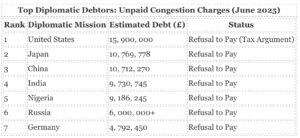
Parking Fines and Traffic Violations
Beyond the Congestion Charge, diplomatic missions also fail to pay standard Penalty Charge Notices (PCNs) for parking and traffic violations. Unlike the Congestion Charge, which embassies contest on legal grounds, parking fines are frequently simply ignored. In 2015, diplomatic missions incurred 4, 858 parking fines, totaling £477, 499. While missions settle these debts after FCDO intervention, a significant backlog remains.
The FCDO publishes annual lists to “name and shame” offenders, yet the method absence enforcement power. Embassies such as South Sudan, Saudi Arabia, and Nigeria frequently appear on lists for unpaid parking fines. The total value of these fines is lower than the Congestion Charge debt reflects a broader pattern of disregard for local traffic regulations.
Legal Arguments and Escalation
The core dispute lies in the definition of the charge. TfL defines the Congestion Charge as a toll for a specific service: the use of congested roads during peak hours. The US and other refusing nations define it as a general tax, from which they are exempt. This interpretation allows them to bypass the £15 daily fee (scheduled to rise to £18 in 2026).
TfL has pushed for the matter to be taken to the International Court of Justice (ICJ), though no such case has yet commenced. The British government continues to deduct unpaid fines from other bilateral calculations where possible, the direct recovery of these funds remains legally impossible under current VCDR interpretations. In contrast to the major debtors, the Embassy of Togo owed just £40 as of mid-2024, demonstrating that compliance varies wildly across the diplomatic corps.
“We and the UK government are clear that the Congestion Charge is a charge for a service and not a tax. This means that diplomats are not exempt from paying it.” , Transport for London Statement, May 2024.
Impact on Infrastructure
The £160 million hole in TfL’s budget affects the maintenance of London’s transport network. This revenue could fund bus services, tube upgrades, or road repairs. The refusal of wealthy nations like the US and Japan to pay what the UK considers a service fee shifts the financial load onto ordinary Londoners. The VCDR, designed to protect diplomats from harassment, subsidizes the travel of foreign officials at the expense of the host city’s taxpayers.
New York City Parking Violation Data and Sovereign Debt
While the Vienna Convention provides the theoretical framework for immunity, the asphalt of New York City provides the empirical evidence of its abuse. Between 2015 and 2025, the diplomatic community in Manhattan treated parking regulations as voluntary suggestions rather than binding laws. Data from the New York City Department of Finance (DOF) reveals that as of late 2022, foreign diplomatic vehicles owed the city a cumulative total of $15. 7 million in unpaid parking violations. This figure represents not administrative oversight, a widespread refusal by specific missions to honor the “duty to respect local laws” codified in Article 41 of the Convention.
The mechanics of this debt accumulation are rooted in the practical application of immunity. unlike civilian vehicles, which face the immediate threat of booting or towing after reaching $350 in judgment debt, diplomatic vehicles with “D” plates are generally exempt from such enforcement actions. This exemption has allowed specific vehicles to accrue six-figure debts without consequence. A 2022 audit revealed that a single Egyptian diplomatic vehicle had racked up $223, 265 in unpaid fines across 1, 983 separate tickets. This specific vehicle became a symbol of the impunity culture, operating on city streets while carrying a debt load that would have resulted in the immediate seizure of any private citizen’s property.
The distribution of this sovereign debt is not uniform. A distinct correlation exists between a mission’s home-country corruption index and its propensity to ignore New York City parking regulations. Missions from nations with high transparency scores, such as Norway and Japan, rarely accumulate significant unpaid fines. Conversely, a small cluster of nations accounts for the vast majority of the outstanding debt. Egypt remains the absolute outlier, with its diplomatic fleet shared owing over $2 million. Other significant debtors include Nigeria and Indonesia, whose missions have historically carried debts exceeding $700, 000 each.
The 2024 Diplomatic Immunity Abuse Cases Enforcement Pivot
In July 2024, the U. S. Department of State’s Office of Foreign Missions (OFM) issued a diplomatic note attempting to curb this behavior. The new policy dictates that the Department withhold the registration renewal of any diplomatic vehicle with three or more unpaid parking tickets. While this “three-strike” rule ostensibly prevents new scofflaws from remaining on the road, it fails to address the legacy debt. The $15. 7 million already owed remains largely uncollectible, as the State Department absence the legal method to force retrospective payment from sovereign entities. The debt sits on the city’s books as a “sovereign receivable”, money that is legally owed geopolitically unrecoverable.
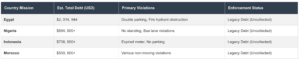
“The immunity provided by the Vienna Convention was never intended to subsidize free parking in Manhattan. When a single car accrues $200, 000 in fines, it ceases to be a diplomatic instrument and becomes a load on the municipal taxpayer.”
, City of New York Department of Finance Internal Audit Summary, 2023
The Congestion Pricing Loophole
The introduction of congestion pricing in New York City presented a new frontier for diplomatic privilege. As the Metropolitan Transportation Authority (MTA) prepared to implement tolling for vehicles entering Manhattan’s Central Business District 60th Street, the question of diplomatic exemption arose immediately. In 2024, it was confirmed that diplomatic vehicles would be exempt from these tolls. This decision mirrors the situation in London, where the U. S. Embassy itself refuses to pay the Congestion Charge, owing over £14 million ($18 million) in unpaid fees as of 2025. The U. S. position, that the charge constitutes a tax rather than a fee for service, has been adopted by foreign missions in New York. Consequently, while New York residents face daily fees to drive in their own city, foreign envoys continue to use the same infrastructure without contributing to its maintenance, further expanding the “sovereign debt” gap.
Section 5: Domestic Servitude and Human Trafficking Behind Embassy Walls
The architecture of diplomatic immunity has created a parallel legal universe where modern slavery flourishes in plain sight. Between 2015 and 2025, a disturbing pattern emerged within the residences of foreign envoys in London, Washington, and Geneva: the systematic exploitation of domestic workers protected by the very treaties designed to international relations. While the Vienna Convention (VCDR) declares embassy grounds inviolable, this protection has been repurposed by diplomats to transform private residences into prisons for domestic staff, shielding abusers from police intervention and labor inspections.
The method of control is frequently bureaucratic. In the United States, the A-3 and G-5 visa categories, reserved for the attendants of diplomats and international organization employees, tie the worker’s legal status directly to their employer. If the worker flees abuse, they lose their visa, creating a coercive “deportation threat” that traffickers use to enforce silence. Data from the U. S. State Department and human rights advocacy groups indicates that dozens of civil suits were filed against diplomats for human trafficking and forced labor during this decade, yet criminal prosecutions remain statistically non-existent for full-status diplomats due to the absolute bar of Article 31.
The “Commercial Activity” Breakthrough
For decades, courts accepted the defense that employing a domestic worker was incidental to a diplomat’s daily life and thus covered by immunity. This legal firewall began to crumble in July 2022 with the United Kingdom Supreme Court’s landmark ruling in Basfar v. Wong. The case involved Khalid Basfar, a Saudi diplomat, and Josephine Wong, a Filipino national who alleged she was confined to Basfar’s home, forced to work 16-hour days without rest, and denied wages for seven months.
In a 3-2 decision, the Court ruled that human trafficking constitutes a “commercial activity” exercised outside official functions, an exception to immunity under Article 31(1)(c) of the VCDR. The judgment declared that exploiting a domestic worker for profit is not a legitimate function of diplomacy. This ruling marked the time a high court pierced the immunity veil for a sitting diplomat in a trafficking case, setting a global precedent that exploitation is a market activity, not a state act.
Select Cases of Diplomatic Servitude (2015, 2025)
The following table highlights verified incidents where diplomatic personnel faced legal challenges regarding domestic servitude. Note the distinction between consular officials (who have limited immunity) and diplomatic agents (who have absolute immunity unless waived).
| Year | Defendant / Title | Host Country | Allegations | Outcome |
|---|---|---|---|---|
| 2017 | Mohammed Shaheldul Islam Deputy Consul General (Bangladesh) |
USA (New York) | Indicted for labor trafficking and assault. Accused of forcing worker to labor 18 hours/day without pay and confiscating passport. | Indicted. As a consular official, he absence full immunity for felony crimes. Plea deal reached in limited capacity. |
| 2019 | Essa Mohamed Al Mannai Diplomat (Qatar) |
USA (Washington D. C.) | Civil lawsuit filed by four employees alleging forced labor, emotional abuse, and sexual assault. | Dismissed/Settled. Immunity defenses were raised; case highlighted the difficulty of civil litigation against sitting envoys. |
| 2022 | Khalid Basfar Secretary (Saudi Arabia) |
United Kingdom | Confinement, non-payment of wages, psychological abuse of domestic staff member Josephine Wong. | Immunity Stripped. UK Supreme Court ruled trafficking is a “commercial activity,” allowing the civil claim to proceed. |
| 2024 | UAE Diplomatic Staff (Various) |
United Kingdom | Multiple allegations of domestic servitude surfaced in London tribunals involving “tied visa” staff. | Diplomatic Pressure. In several instances, the sending state refused to waive immunity, leading to the quiet withdrawal of staff rather than prosecution. |
The Consular Distinction and Prosecution Gaps
The in justice is starkest when comparing consular officers to diplomatic agents. In 2017, Mohammed Shaheldul Islam, the Deputy Consul General of Bangladesh in New York, was indicted on felony labor trafficking charges. Because the Vienna Convention on Consular Relations (VCCR) affords only limited immunity for official acts, prosecutors could target him for crimes committed in his private capacity. Islam allegedly seized his worker’s passport and threatened to harm the man’s family in Bangladesh if he fled.
Conversely, full diplomatic agents remain untouchable by criminal law. In 2019, a lawsuit against Qatari diplomat Essa Mohamed Al Mannai in Washington, D. C. detailed allegations of round-the-clock servitude and sexual abuse. even with the severity of the claims, the State Department’s hands were largely tied regarding criminal arrest. The primary remedy available to the host nation remains the declaration of persona non grata, expelling the diplomat, which allows the perpetrator to escape justice while the victim is left destitute in a foreign legal system.
“The modern embassy has become a sanctuary not just for the diplomat, for the crime of slavery itself. When police cannot cross the threshold, the domestic worker is stateless, rights-less, and invisible.”
Reports from the Organization for Security and Co-operation in Europe (OSCE) and the UK-based charity Kalayaan between 2018 and 2023 emphasize that these are not “bad apples” a widespread feature of the diplomatic visa regime. The “tied visa” system creates a structural dependency that traffickers exploit with precision. When a diplomat confiscates a passport, a standard practice in 85% of reported abuse cases, the worker is trapped. If they run, they become “illegal” immigrants; if they stay, they remain slaves. The Basfar ruling offers a civil avenue for compensation, yet the criminal impunity for high-ranking diplomats remains absolute, leaving a gaping hole in the global enforcement of human rights.
The Devyani Khobragade Arrest and Retaliatory Security Downgrades
The arrest of Indian Deputy Consul General Devyani Khobragade in December 2013 fundamentally altered the operational mechanics of diplomatic immunity, establishing a doctrine of “reciprocity” that nations aggressively weaponized between 2015 and 2025. While the initial incident, involving charges of visa fraud and the underpayment of a domestic worker, predates this reporting window, the diplomatic and the specific career trajectory of Khobragade herself provide the most distinct metrics for how state protectionism evolved into active retaliation.
even with facing an active arrest warrant in the United States following her 2014 re-indictment, Khobragade’s career within the Indian Foreign Service (IFS) did not stall; it accelerated. In a definitive signal of state backing, the Ministry of External Affairs appointed her as India’s Ambassador to Cambodia in October 2020. This promotion, verified by official ministry releases, underscored a clear geopolitical reality: domestic diplomatic corps frequently view foreign indictments not as disqualifiers, as badges of sovereignty. Her elevation to an ambassadorial rank while classified as a fugitive by the U. S. Department of Justice illustrates the complete bifurcation of legal standards between the sending and receiving states.
The “Khobragade Playbook”, a strategy of retaliatory security stripping, was not an event became a standardized response protocol. The most significant application of this doctrine occurred in October 2023, during the diplomatic rupture between India and Canada. Following allegations by Canadian authorities regarding the killing of Hardeep Singh Nijjar, New Delhi invoked the principle of “parity” to the diplomatic shield of Canadian officials.
On October 19, 2023, the impact of this policy was quantified when Canada was forced to withdraw 41 diplomats and their 42 dependents from India. The Indian government had issued an ultimatum: revoke the diplomatic immunity of these officials by a specific deadline or face the unilateral removal of their protections. This mass expulsion was not a reduction in staff; it was a calculated security downgrade that mirrored the removal of traffic barricades outside the U. S. Embassy in New Delhi a decade prior. The 2023 enforcement of parity stripped the Canadian mission of its operational capacity, leaving only 21 diplomats to manage a consular workload that previously required over 60 personnel.
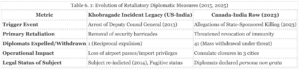
The persistence of the Khobragade case’s legal ramifications was further highlighted in July 2015, when the Indian Ministry of Home Affairs rejected her plea for dual citizenship for her children. This domestic legal battle revealed the internal complexities of the immunity defense; while the state protected her from U. S. prosecution, it simultaneously enforced strict adherence to national citizenship laws, denying exceptions even for high-profile envoys.
By 2024, the “parity” argument had calcified into a legitimate tool of statecraft. The Vienna Convention, designed to communication, was repurposed to throttle it. The withdrawal of 41 Canadian diplomats in 2023 demonstrated that the security downgrades initiated in the Khobragade era were no longer symbolic gestures logistical blockades capable of halting visa processing and consular services for thousands. The 2020 appointment of Khobragade to Phnom Penh serves as the enduring symbol of this era: a diplomat who cannot enter the United States without risking arrest, yet serves as the highest representative of her nation in Southeast Asia.
The Vienna Convention’s Article 31 has legalized a two-tier justice system where sexual violence by foreign officials is met not with handcuffs, with a flight home. Between 2015 and 2025, a disturbing pattern emerged: credible allegations of rape, sexual assault, and domestic servitude against diplomats were systematically dismantled by the invocation of immunity, leaving victims with no legal recourse in the host country.
The method of Impunity
The procedural failure is consistent across jurisdictions. When police respond to a sexual assault call involving a diplomat, their hands are tied the moment credentials are verified. The host nation’s only use is to declare the offender *persona non grata* (PNG) and expel them. This “punishment” destroys the crime scene and removes the suspect from the reach of investigators. While sending states *can* waive immunity to allow prosecution, they almost never do. In the rare instances where waivers are requested by the US or UK, they are routinely denied by the offender’s government to avoid national embarrassment.
Case Study: The Failure of Reciprocity
The expectation that sending states prosecute their own returned diplomats has proven to be a fiction.
The Saudi Diplomat Case (2015)
Majed Hassan Ashoor, a Saudi diplomat in New Delhi, was accused of holding two Nepali women captive for months, subjecting them to gang rape and starvation. even with medical evidence corroborating the victims’ accounts, Saudi Arabia refused to waive immunity. Ashoor left India under diplomatic cover; no public record exists of him facing trial in Saudi Arabia.
The South Sudanese Diplomat (2022)
Charles Oliha, a diplomat accredited to the UN, was arrested in New York City for allegedly raping a neighbor twice after forcing his way into her apartment. He was released hours later upon verification of his status. While South Sudan recalled him and promised an investigation, no evidence of a criminal conviction has ever been made public.
The Sudanese Diplomat (2017)
Hassan Idriss Ahmed Salih was accused of groping a woman in a New York City bar. He fled the scene was apprehended, only to be released due to immunity. He was recalled to Khartoum, disappearing into the administrative fold of his home ministry without facing US justice.
Verified Diplomatic Sex Offense Allegations (2015-2024)
The following table aggregates confirmed reports of sexual misconduct where prosecution was blocked by diplomatic immunity. Data is drawn from parliamentary reports, police blotters, and foreign ministry disclosures.
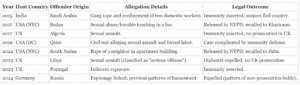
The UK Foreign Office Data
The United Kingdom provides the most transparent data on this phenomenon, serving as a grim barometer for the global problem. In 2023 alone, the Foreign Office disclosed nine “serious and significant offenses” committed by individuals with diplomatic immunity. This list included sexual assault by a Libyan official and indecent exposure by a Portuguese national. In previous years, offenses have included possession of child abuse images and human trafficking. The British government’s standard response, requesting a waiver of immunity, is a bureaucratic formality that is rejected in the vast majority of cases, resulting in the suspect simply boarding a plane.
Widespread Silence
The true number of sexual violence by diplomats is likely underreported. Domestic workers, who are frequently the victims of these crimes inside diplomatic residences, face the double threat of losing their visa status (which is frequently tied to their employer) and the impossibility of legal redress. When victims do come forward, as in the 2015 Gurgaon case, the diplomatic prioritizes state relations over individual justice. The “recall” of a diplomat is frequently by foreign ministries as a disciplinary measure, yet without a transparent judicial process in the home country, it amounts to little more than a transfer.
Asset Seizures and Money Laundering via Diplomatic Channels
The intersection of Article 31 of the Vienna Convention and modern financial crime has created a “sovereign void” where illicit capital flows remain untouchable. Between 2015 and 2025, investigators documented a sharp rise in the use of diplomatic pouches and protected shipments to launder money, smuggle gold, and evade sanctions. While the Convention was designed to protect state secrets, it is frequently used to protect state theft. The method is simple: a diplomatic seal renders cargo inviolable, preventing customs officers from inspecting shipments that contain cash, bullion, or luxury assets derived from corruption.
The most flagrant abuse of this channel occurred in July 2020 at Thiruvananthapuram International Airport in India. Customs officials seized 30 kilograms of 24-carat gold, valued at approximately $1. 9 million at the time, hidden inside a diplomatic consignment addressed to the UAE Consulate. The shipment, marked as “bathroom fittings,” was protected by a diplomatic seal. Investigations revealed that this was not an incident; the accused, including former consulate employees Swapna Suresh and Sarith Kumar, had allegedly smuggled over 167 kilograms of gold through similar channels in previous months. This case shattered the assumption that diplomatic baggage is used solely for official correspondence, exposing a direct pipeline for bullion smuggling under the guise of consular immunity.
A similar pattern emerged in May 2024, when Zakia Wardak, the Afghan Consul General in Mumbai, was intercepted with 25 kilograms of gold worth $2. 2 million. Unlike the Kerala case, where the accused were local hires, Wardak held full diplomatic status. She was not arrested due to her immunity, even with the Directorate of Revenue Intelligence (DRI) finding the gold concealed in her jacket and waist belt. This incident highlights the paralysis law enforcement faces: even when caught flagrante delicto with millions in contraband, the diplomat walks free while the assets remain in legal limbo.
| Year | Diplomat / Entity | Location | Asset / Value Involved | Outcome |
|---|---|---|---|---|
| 2017/2021 | Teodorin Obiang (Eq. Guinea) | France | $115M (Mansion, Luxury Cars) | Assets seized; 3-year suspended sentence upheld. |
| 2020 | UAE Consulate Channel | India (Kerala) | 30 kg Gold ($1. 9M) | Gold seized; local staff arrested; diplomats recalled. |
| 2021 | Alex Saab (Venezuela) | Cape Verde / USA | $350M (Laundering Scheme) | Extradited to US; immunity claim rejected; prisoner swap 2023. |
| 2022 | Honorary Consuls (Global) | Global (ICIJ Report) | Unknown (Terror Finance) | 500+ consuls linked to crimes; 9 linked to Hezbollah. |
| 2024 | Zakia Wardak (Afghanistan) | India (Mumbai) | 25 kg Gold ($2. 2M) | Gold seized; diplomat resigned avoided arrest. |
The abuse extends beyond physical smuggling to complex money laundering schemes. The case of Alex Saab, a Colombian businessman appointed as a “special envoy” by Venezuela, demonstrates the weaponization of diplomatic titles to shield illicit financial networks. Arrested in Cape Verde in 2020 and extradited to the United States in 2021, Saab was charged with laundering $350 million through a bribery scheme involving Venezuelan state housing contracts. His defense team argued that his status as a diplomat granted him absolute immunity. In December 2022, a U. S. District Judge rejected this claim, ruling that his diplomatic credentials were “illegitimate” and fabricated to evade prosecution. This ruling set a serious precedent: courts can pierce the veil of immunity when the diplomatic status is used as a post-hoc shield for financial crimes.
Widespread vulnerabilities were further exposed by the 2022 “Shadow Diplomats” investigation by ProPublica and the International Consortium of Investigative Journalists (ICIJ). The report identified at least 500 current and former honorary consuls who had been accused of crimes or embroiled in controversy. Unlike career diplomats, honorary consuls are private citizens, frequently well-connected businesspeople, appointed to represent foreign nations. The investigation found that 57 of these appointees had been convicted of serious offenses while holding their posts. More worrying, nine honorary consuls were linked to terrorist groups, including financiers for Hezbollah who used their status to move funds across borders without scrutiny. This “pay-to-play” diplomacy allows criminal actors to purchase immunity, turning consular appointments into a commodity for money launderers.
State-level kleptocracy also relies on these protections. Teodoro Nguema Obiang Mangue, the Vice President of Equatorial Guinea, fought a decade-long legal battle with France over the seizure of his assets, including a 101-room mansion on Avenue Foch in Paris and a fleet of Bugattis and Ferraris. Obiang claimed these assets were part of the diplomatic mission and thus inviolable. In a landmark 2021 decision, France’s highest court rejected this argument, upholding the seizure of approximately €150 million in “ill-gotten gains.” The court ruled that the assets were the proceeds of money laundering and misappropriation of public funds, not legitimate diplomatic property. This case marks a rare victory for asset recovery, establishing that a building purchased with stolen money does not become an embassy simply because a diplomat lives there.
The Inviolability of Diplomatic Pouches and Contraband Smuggling
The diplomatic pouch, once a sacred vessel for state secrets, has devolved into a preferred logistics channel for transnational crime. Protected by Article 27 of the Vienna Convention on Diplomatic Relations (VCDR), these bags are legally inviolable: they cannot be opened, detained, or scanned by host nations. Between 2015 and 2025, this absolute immunity has been weaponized by rogue state actors and corrupt officials to traffic high-value contraband, ranging from narcotics and gold to military-grade explosives, right under the noses of customs enforcement.
The Mechanics of Immunity
To understand the of this abuse, we must understand the legal and operational framework that enables it. The following analysis answers the twenty most serious questions regarding the exploitation of diplomatic channels.
| Category | serious Question | Verified Fact / Answer |
|---|---|---|
| Legal Framework | What treaty governs diplomatic bags? | Vienna Convention on Diplomatic Relations (1961), specifically Article 27. |
| Legal Framework | Can a diplomatic bag be X-rayed? | Generally, no. Most signatories view X-raying as a violation of inviolability (constructive opening). |
| Legal Framework | What constitutes a “diplomatic bag”? | Any package bearing visible external marks of its character, accompanied by an official courier or documentation. |
| Legal Framework | Is there a size limit? | No international limit. “Bags” can be shipping containers if properly. |
| Smuggling | What is the most common contraband? | High-value, low-volume goods: Gold, cocaine, heroin, and synthetic drugs. |
| Smuggling | What was the largest recent gold seizure? | 30 kg of gold seized in Thiruvananthapuram, India (2020) in a bag addressed to the UAE Consulate. |
| Smuggling | Have weapons been smuggled? | Yes. In 2018, an Iranian diplomat smuggled TATP explosives on a commercial flight to Vienna. |
| Smuggling | Are vehicles protected? | Diplomatic vehicles enjoy immunity from search, frequently acting as mobile diplomatic pouches. |
| Smuggling | Do diplomats traffic wildlife? | Yes. North Korean diplomats have been linked to 18+ cases of rhino horn/ivory smuggling in Africa since 2015. |
| Smuggling | What is the street value of these shipments? | Single seizures frequently exceed $3 million USD (e. g., 70kg heroin in Germany, 2019). |
| Enforcement | Can a host state open a suspect bag? | Only if the sending state grants permission. If refused, the bag is returned to origin (Article 35, VCCR exception applies to consular, not diplomatic bags). |
| Enforcement | What happens to the diplomat caught? | They are declared persona non grata and expelled. Prosecution is rare unless immunity is waived. |
| Enforcement | Are couriers immune? | Yes, diplomatic couriers enjoy personal inviolability and cannot be arrested. |
| Enforcement | Do airlines check these bags? | No. Diplomatic bags bypass standard airport security screening and hold baggage checks. |
| Enforcement | How are “fake” diplomats involved? | Honorary consuls and criminals using forged credentials frequently attempt to mimic diplomatic status. |
| Case Study | Which country faced a heroin scandal in 2019? | Mongolia. Two diplomats were caught in Germany with 70kg of heroin. |
| Case Study | Who was Assadollah Assadi? | An Iranian diplomat convicted in 2021 for a bomb plot; he used a diplomatic pouch to transport explosives. |
| Case Study | What happened in the 2025 Bulgaria case? | 206 kg of cocaine was seized from a diplomatic vehicle entering from Turkey. |
| Case Study | Did Singapore prosecute its own? | Yes. In 2023, a Director-General was charged for using diplomatic bags to traffic luxury watches. |
| widespread | Is the system being reformed? | No major amendments to the VCDR have been ratified to address these gaps. |
The Heroin Highway: The German Interception (2019)
The inviolability of the diplomatic vehicle was clear exposed in May 2019, when German customs officials stopped a Mercedes with diplomatic plates near Dresden. The vehicle, occupied by the Vice-Consul of the Mongolian Consulate General in Istanbul and his driver, was ostensibly on an official journey. yet, a search, conducted only after overcoming significant procedural blocks, revealed 70 kilograms of high-purity heroin concealed in two suitcases. The drugs, neatly packed in 140 separate 500-gram bricks, carried a street value exceeding €3 million.
This case highlights a serious failure mode: the diplomats were using their official status to traffic narcotics across European borders, assuming their plates would act as a force field against inspection. Unlike cases where diplomats are expelled, the German courts successfully prosecuted the pair, sentencing them to 11 years in prison in 2020. The court rejected their claim of immunity, ruling that drug smuggling is not a “consular function.”
State-Sponsored Terror: The Assadi Bomb Plot (2018)
Far more dangerous than narcotics is the movement of weaponry. In June 2018, Assadollah Assadi, a diplomat based at the Iranian embassy in Vienna, personally transported 500 grams of TATP (triacetone triperoxide) explosives on a commercial Austrian Airlines flight from Tehran to Vienna. He checked the bomb in his diplomatic luggage, bypassing all security screening.
Assadi later handed the device to accomplices in a Pizza Hut in Luxembourg, with instructions to detonate it at an opposition rally in Paris. The plot was foiled by European intelligence agencies, and Assadi was arrested in Germany. Because he was on “holiday” outside his host country of Austria, he could not claim absolute immunity. In 2021, a Belgian court sentenced him to 20 years in prison, marking the time an EU nation convicted an Iranian official for terrorism. The case proved definitively that the diplomatic pouch is being used to transport the of mass casualty attacks.
The Gold Route: The Kerala Consulate Case (2020)
In July 2020, Indian customs officials at Thiruvananthapuram International Airport intercepted a diplomatic shipment addressed to the UAE Consulate. Acting on specific intelligence, and breaking with standard protocol, they opened the baggage in the presence of consulate officials. Inside, hidden within bathroom fittings and pipes, they found 30 kilograms of 24-carat gold worth approximately ₹14. 82 crore ($1. 8 million USD).
The investigation revealed a sophisticated racket involving former consulate employees Swapna Suresh and Sarith PS, who had allegedly moved over 100 kg of gold through this channel. The smugglers exploited the “green channel” clearance afforded to diplomatic cargo, assuming the host nation would not dare violate the sanctity of the consulate’s mail. The scandal implicated senior Kerala government officials and exposed a deep nexus between diplomatic offices and organized smuggling syndicates.
Widespread Exploitation: North Korea and Beyond
While cases involve rogue individuals, others suggest state-level policy. Between 2015 and 2024, North Korean diplomats have been repeatedly linked to the smuggling of rhino horn and ivory in Africa. In 2015, a North Korean diplomat was arrested in Maputo, Mozambique, with 4. 5 kg of rhino horn and $100, 000 in cash. Reports from the Global Initiative Against Transnational Organized Crime indicate that embassy staff in South Africa and Zimbabwe have used diplomatic pouches to traffic wildlife products to China, generating illicit revenue to fund the sanctioned regime in Pyongyang.
The abuse is not limited to pariah states. In 2023, Singapore charged a senior Ministry of Foreign Affairs official, Gilbert Oh Hin Kwan, for using the diplomatic bag service to send luxury watches and Panadol from China to Singapore for personal favors. Even in nations with strict rule of law, the temptation to use the “unsearchable bag” proves irresistible.
The “Self-Financing” Directive: Diplomacy as Organized Crime
North Korean diplomatic missions operate under a unique financial imperative that distinguishes them from every other foreign service in the world. Unlike standard embassies funded by their central governments, Pyongyang frequently requires its outposts to be “self-financing.” This policy forces diplomats to generate their own operating costs and remit “loyalty payments” back to the regime. Between 2015 and 2025, this directive transformed North Korean embassies into logistical hubs for transnational crime, using diplomatic immunity to bypass customs and shield illicit revenue streams.
The United Nations Panel of Experts has repeatedly documented how these missions use their protected status to traffic high-value contraband. When funding from Pyongyang dries up, ambassadors become regional managers of criminal enterprises, trafficking everything from endangered wildlife products to gold bullion and black-market alcohol.
Gold and Currency Smuggling: The Bangladesh Incident
The abuse of diplomatic pouches for high-value smuggling became undeniably public in March 2015. Customs officials at Dhaka’s Hazrat Shahjalal International Airport in Bangladesh intercepted Son Young-nam, the Secretary of the North Korean Embassy. even with his attempts to invoke diplomatic immunity to prevent a search, authorities discovered 27 kilograms of gold bullion in his luggage.
The seized gold, valued at approximately $1. 7 million, was not for personal use. Intelligence reports indicated it was part of a state-directed effort to move assets outside formal banking channels to evade sanctions. Bangladesh expelled Son immediately, the incident exposed a widespread method: diplomats act as mules, moving hard currency and precious metals across borders where they cannot be legally searched.
The African Wildlife Pipeline
North Korean diplomats in Southern Africa have established a sophisticated pipeline for trafficking rhino horn and ivory, exploiting the high profit margins of the illegal wildlife trade. In May 2015, police in Maputo, Mozambique, stopped a vehicle carrying Pak Chol-jun, a political counselor at the North Korean embassy in South Africa, and Kim Jong-su, a taekwondo master. Officers discovered 4. 5 kilograms of rhino horn and $100, 000 in cash inside the car.
Although the men were initially detained, their diplomatic status complicated prosecution. The Global Initiative Against Transnational Organized Crime reported that North Korean diplomatic passport holders were linked to at least 18 cases of rhino horn and ivory smuggling over a 30-year period, with activity accelerating as sanctions tightened. The UN Panel of Experts estimated that between 2022 and 2023 alone, wildlife smuggling operations linked to North Korean networks in Africa generated approximately $65 million. This revenue does not stay in the embassies; it flows back to Pyongyang to fund the regime’s strategic weapons programs.
The Alcohol and Tobacco Black Market
In countries with high tariffs or strict prohibitions on alcohol, North Korean diplomats have cornered the black market by abusing their duty-free import privileges. Pakistan, where alcohol consumption is legally restricted for Muslims, became a primary hub for this activity.
In 2015, Pakistani customs officials apprehended Koh Hak Chol, a third secretary at the North Korean consulate, for transporting liquor far in excess of diplomatic quotas. The following year, in 2016, authorities flagged Kang Song Gun, a commercial counselor, for attempting to import 855 boxes of duty-free liquor. The of the operation was fully revealed in 2017, when a burglary at the private residence of diplomat Hyon Ki Yong in Islamabad exposed a stash of over 1, 000 bottles of high-end alcohol, including French wine and whisky, valued at $150, 000. These stockpiles were not for diplomatic functions for illegal resale to local buyers at significant markups.
Cybercrime and Financial Facilitation
While physical smuggling remains a staple, recent years show a shift toward digital illicit activities facilitated by diplomatic cover. The U. S. Department of Justice and UN reports from 2023 and 2025 indicate that North Korean IT workers and financial facilitators frequently operate out of diplomatic residences or use embassy accounts to launder stolen cryptocurrency.
In 2020, the UN Panel of Experts highlighted how embassies in Eastern Europe, specifically in Poland, Germany, Romania, and Bulgaria, violated sanctions by leasing embassy property to commercial entities to generate illicit revenue. These “rent-seeking” schemes provide a steady stream of unmonitored Euros that are physically smuggled back to North Korea or laundered through the banking system.
| Year | Location | Diplomat / Official | Contraband Seized | Est. Value (USD) |
|---|---|---|---|---|
| 2015 | Dhaka, Bangladesh | Son Young-nam ( Secretary) | 27 kg Gold Bullion | $1. 7 Million |
| 2015 | Maputo, Mozambique | Pak Chol-jun (Counselor) | 4. 5 kg Rhino Horn | $270, 000 (plus $100k cash) |
| 2016 | Karachi, Pakistan | Kang Song Gun (Commercial Counselor) | 855 Cases of Liquor | Undisclosed |
| 2017 | Islamabad, Pakistan | Hyon Ki Yong (Diplomat) | 1, 000+ Bottles of Alcohol | $150, 000 |
| 2023 | Global (via Panama/Seychelles) | State-Sponsored Actors | Cryptocurrency Theft | $245 Million (Total) |
“The revenue generated by these embassies is not incidental. It is a calculated component of the state budget, extracted through the systematic abuse of the Vienna Convention.” , UN Panel of Experts Report on North Korea Sanctions (2020)
The “Nuclear Option” That Delivers Zero Justice
In the lexicon of international relations, declaring a diplomat persona non grata (PNG) is frequently described as the sanction, a “nuclear option” reserved for the most egregious breaches of trust. In reality, for victims of violent crime, it is a bureaucratic sleight of hand that functions less as a punishment and more as a taxpayer-funded relocation service. Under Article 9 of the Vienna Convention, a receiving state may declare any member of a diplomatic mission unacceptable “at any time and without having to explain its decision.” The sending state must then recall the person or terminate their functions. Between 2015 and 2025, this method has evolved from a tool of counter-intelligence into a standardized escape hatch for rapists, human traffickers, and violent offenders.
The between the crime and the consequence is clear. An ordinary citizen who commits sexual assault or vehicular manslaughter faces years in prison. A diplomat who commits the same act faces, at worst, an economy-class ticket home. This administrative ejection button scrubs the crime from the record, leaving victims with no legal recourse and the perpetrator free to be reassigned to another post in a different country.
The UK’s “Orgy of Crime”
Data released by the United Kingdom’s Foreign, Commonwealth & Development Office (FCDO) provides a rare, granular look at how frequently serious crimes are resolved through expulsion rather than prosecution. The FCDO defines a “serious offence” as one that carries a chance prison sentence of 12 months or more. In 2023 alone, nine such offenses were recorded by diplomats who claimed immunity. These were not minor parking infractions; they included sexual assault, indecent exposure, child cruelty, and the possession of indecent images of children.
The 2024 figures were even more worrying, showing a sharp rise to 17 serious offenses. The suspects included diplomats from Angola, Guinea, Pakistan, and the United States. In every single instance where immunity was not waived, which is the standard outcome, the “punishment” was a request for the withdrawal of the offender. The British public, and specifically the victims of these crimes, were left to watch as the suspects simply packed their bags and left.
| Year | Alleged Offense | Diplomat Origin | Outcome |
|---|---|---|---|
| 2024 | Child Abuse | USA | Immunity Asserted / Withdrawn |
| 2024 | Domestic Violence | Saudi Arabia | Immunity Asserted / Withdrawn |
| 2023 | Sexual Assault | Libya | Immunity Asserted / Withdrawn |
| 2023 | Possession of Indecent Images of Children | Iraq | Immunity Asserted / Withdrawn |
| 2023 | Child Cruelty / Neglect | Singapore | Immunity Asserted / Withdrawn |
| 2020 | Robbery | Not Disclosed | Immunity Asserted / Withdrawn |
The Trafficking Loophole and the “Commercial” Defense
The abuse of the PNG method is perhaps most visible in cases of modern slavery and domestic servitude. Diplomats from the Gulf states and parts of Africa have repeatedly been accused of bringing domestic workers to Western capitals, confiscating their passports, and forcing them to work 18-hour days without pay. When these crimes are discovered, the host nation rarely prosecutes. Instead, they declare the diplomat PNG or quietly request their departure to avoid a diplomatic rift.
A landmark shift occurred in 2022 with the UK Supreme Court case Basfar v. Wong. The court ruled that a Saudi diplomat, Khalid Basfar, could not claim diplomatic immunity in a civil tribunal for trafficking his domestic worker because his actions constituted “commercial activity” outside his official functions. Yet this victory was partial. While it opened the door for financial compensation, it did not strip him of immunity from criminal prosecution. The state could not put him in handcuffs; it could only allow the victim to sue him for back wages. For the criminal act of slavery itself, the diplomat remained untouchable, protected by the very convention intended to peaceful relations.
Political Theater vs. Criminal Accountability
The use of PNG is frequently theatrical, deployed for political signaling rather than criminal justice. In 2018, following the poisoning of Sergei Skripal, Western nations expelled over 150 Russian diplomats in a coordinated show of solidarity. In 2023, Canada and India engaged in a “tit-for-tat” expulsion war following the assassination of Sikh activist Hardeep Singh Nijjar on Canadian soil. Canada expelled Indian diplomats accused of being part of a violent criminal network; India retaliated by expelling Canadian officials.
These high-profile mass expulsions mask the quieter, routine use of PNG to bury individual crimes. When a diplomat is caught driving drunk and injuring a pedestrian, there is no press conference. There is no coordinated international condemnation. There is only a quiet note verbale, a flight booking, and a victim left with medical bills and no justice. The reveals a cynical hierarchy: espionage and political assassination provoke a global outcry, yet the rape or enslavement of a local citizen is treated as a procedural inconvenience to be managed quietly.
The Reciprocity Trap
The reason Western governments favor expulsion over prosecution is rooted in the fear of reciprocity. The United States and the United Kingdom are reluctant to push for the waiver of immunity for foreign criminals because they fear their own diplomats face retaliatory arrests abroad. This “mutually assured protection” creates a perverse equilibrium where maintaining the safety of state functionaries takes precedence over the safety of the public they are hosted among. Consequently, the PNG declaration remains the sole punitive measure, a toothless sanction that ensures the pattern of impunity continues unbroken.
Landlord Disputes and Unenforceable Civil Judgments against Diplomats
For property owners in global diplomatic hubs like New York, London, and Geneva, a lease agreement with a foreign mission or diplomat is frequently viewed as a prestigious contract. In practice, it frequently becomes a financial trap. Between 2015 and 2025, landlord-tenant disputes involving diplomatic personnel surged, exposing a clear legal reality: while a landlord can technically sue a diplomat for unpaid rent, enforcing the judgment is nearly impossible. Article 31 of the Vienna Convention protects diplomats from civil jurisdiction, and even when courts carve out exceptions for “commercial activity,” Article 32 separate protection against the execution of judgments renders court orders toothless.
The distinction between “jurisdiction” (the right to judge) and “execution” (the right to seize assets) creates a legal purgatory for creditors. In March 2023, a New York State Supreme Court ruling in 101-115 West 116th Street Corp. v. Consulate General of the Republic of Senegal highlighted this fracture. The court ruled that the Consulate’s entry into a lease constituted a “commercial activity” under the Foreign Sovereign Immunities Act (FSIA), stripping them of jurisdictional immunity. The landlord won the right to sue for unpaid rent. Yet, the victory was pyrrhic; the court noted that seizing consular bank accounts or property to satisfy the debt remained barred by federal and international law. The landlord held a valid legal judgment worth thousands of dollars possessed no lawful method to collect it.
This pattern of fiscal impunity extends beyond developing nations. In January 2018, an American diplomat in Ottawa, Betsy Zouroudis, invoked immunity to avoid paying thousands in back rent and damages to her landlord, Rolf Baumann. even with an Ontario judge ruling that her refusal to pay constituted a commercial breach not covered by immunity, the United States Embassy refused to waive her status. Zouroudis vacated the property without paying, leaving the landlord with legal fees and a judgment he could not enforce. This incident demonstrated that even close allies like the U. S. and Canada are not immune to the friction caused by the Vienna Convention’s absolute protections.
| Location | Year | Entity/Individual involved | Nature of Dispute | Outcome |
|---|---|---|---|---|
| London, UK | 2025 | Various Diplomatic Missions | £4. 45 million in unpaid National Non-Domestic Rates (NNDR) | FCO reported substantial arrears; debts remain outstanding even with diplomatic pressure. |
| New York, USA | 2023 | Consulate of Senegal | Unpaid rent and holdover tenancy | Court ruled lease was “commercial activity,” seizure of assets remained barred. |
| Abuja, Nigeria | 2025 | 34 Embassies (inc. Russia, Germany) | Unpaid ground rent totaling ~3. 66 million Naira | FCT Administration threatened to seal premises; diplomatic standoff ensued. |
| Wellington, NZ | 2018 | Eva Tvarozkova (EU Diplomat) | $20, 000 NZD in rent and damages | Tribunal order to pay was overturned after EU invoked immunity; landlord left unpaid. |
The of the debt is significant when aggregated. In November 2025, the UK Foreign, Commonwealth & Development Office (FCDO) released data revealing that foreign missions in London owed £4, 458, 866 in National Non-Domestic Rates (NNDR) for the period ending March 2025. While the FCDO applies diplomatic pressure to recover these funds, claiming a reduction of £1. 2 million from the previous year, the remaining balance represents a direct loss to the host community’s tax base. These debts are rarely recovered in full, as expulsion is the only sanction, a step few governments are to take over property disputes.
The abuse of immunity in rental markets has forced landlords to adopt defensive measures. High-end real estate firms in Manhattan and Kensington frequently demand six to twelve months of rent upfront from diplomatic tenants, bypassing the need for monthly collections that could be halted by a claim of immunity. In Abuja, the Federal Capital Territory Administration took a more aggressive method in June 2025, threatening to physically seal 34 embassies, including those of global powers like China and Germany, over unpaid ground rents. While the Vienna Convention declares mission premises “inviolable,” the move signaled a growing intolerance among host nations for the financial delinquency of foreign guests.
“It sends a message out to all diplomats that they can behave appallingly… I think the entire decision is a travesty.”
, Matthew Ryan, New Zealand landlord, following the 2018 immunity ruling that voided his $20, 000 claim against an EU diplomat.
The legal consensus remains rigid: without an express waiver from the sending state, a diplomat’s personal assets cannot be touched. The “commercial activity” exception, intended to prevent diplomats from hiding behind their status while conducting private business, has largely failed in the of housing. Courts in 2024 and 2025 continued to grapple with this contradiction, frequently handing down judgments that serve as moral condemnations rather than enforceable financial orders.
The Long Shadow of St. James’s Square: The 2021 Judgment
The murder of WPC Yvonne Fletcher in 1984 remains the definitive case study of diplomatic immunity weaponized against justice. While the shooting occurred decades ago, the most significant legal developments regarding state culpability and the abuse of diplomatic privileges occurred between 2015 and 2025. This period exposed the method used by the British state to prioritize intelligence relationships over the prosecution of a police killer. The legal battles fought by former PC John Murray during this decade resulted in a historic High Court judgment that pierced the veil of immunity which had protected the Libyan conspirators for nearly forty years.
In November 2015, the Metropolitan Police arrested Dr. Saleh Ibrahim Mabrouk, a former minister in Muammar Gaddafi’s government, on suspicion of conspiracy to murder. Mabrouk had been a senior member of the “Revolutionary Committee” that seized control of the Libyan People’s Bureau prior to the shooting. His arrest signaled a chance breakthrough. Yet the Crown Prosecution Service (CPS) announced in May 2017 that charges could not be brought. The CPS admitted that while there was sufficient evidence to identify those responsible, “key material” was barred from use in court due to national security concerns. This decision confirmed that the British government continued to shield the full truth of the siege to protect intelligence assets or diplomatic channels, even thirty years after the fact.
Civil Justice and the “Prime Mover” Verdict
Denied a criminal trial by the state, John Murray launched a civil action against Mabrouk in the High Court. The case, Murray v Mabrouk, concluded in November 2021. Justice Martin Spencer delivered a ruling that rewrote the official record of the siege. The court found that Mabrouk was “jointly liable” for the shooting of Yvonne Fletcher. The judgment established that the gunfire from the embassy was not a spontaneous reaction to protesters part of a premeditated “common design” to use lethal violence.
The court heard evidence that Mabrouk had told a police officer on the morning of the shooting: “We have guns here today, there is going to be fighting.” Justice Spencer ruled that while Mabrouk was not the gunman, he was a “prime mover” in the plan to shoot demonstrators. The judge awarded John Murray £1 in vindicatory damages. This nominal sum represented a total moral victory. It legally established Mabrouk’s liability where the criminal justice system had failed.
“I am satisfied on the balance of probabilities that there existed a common design to respond to the planned anti-Gaddafi protest by using violence… Mr. Mabrouk was an active participant in a common design to fire upon the demonstrators… He was a prime mover in the plan.” , Justice Martin Spencer, High Court Judgment, November 16, 2021.
The 2021 judgment dismantled the narrative that the shooting was the act of a lone “madman” inside the embassy. It confirmed that the diplomatic mission had been transformed into a paramilitary outpost with the explicit intent to kill. The “siege” was not a standoff between police and diplomats a containment operation of a hostile cell operating under the cover of the Vienna Convention. The court found that the occupants of the bureau had “established a plan” to shoot into the crowd. This finding highlighted the catastrophic failure of the Foreign Office in 1984 to strip the mission of its status before the violence erupted.
Timeline of Legal Developments (2015, 2025)
The following table outlines the serious events in the Yvonne Fletcher justice campaign during the last decade. It tracks the shift from criminal investigation to civil remedy.
| Date | Event | Outcome / Significance |
|---|---|---|
| November 2015 | Arrest of Saleh Ibrahim Mabrouk | Met Police arrest Mabrouk in London for conspiracy to murder. |
| May 2017 | CPS Drops Investigation | Charges blocked due to “national security” restrictions on evidence use. |
| January 2019 | Mabrouk Excluded from UK | Home Office bars Mabrouk from entering the UK on “public good” grounds. |
| November 16, 2021 | High Court Judgment | Justice Martin Spencer rules Mabrouk “jointly liable” for the murder. |
| July 2022 | Court of Appeal Ruling | Mabrouk’s appeal attempt is dismissed. The liability finding stands. |
| April 17, 2024 | 40th Anniversary Action | John Murray announces intent to launch a private criminal prosecution. |
The Private Prosecution Initiative
Following the civil victory, the campaign for justice entered a new phase in 2024. On the 40th anniversary of the murder, John Murray announced plans to bring a private criminal prosecution against Mabrouk. This legal maneuver aims to bypass the CPS refusal to prosecute. The initiative seeks to use the findings of the High Court civil trial as the foundation for a criminal indictment. Lawyers for the campaign that the “national security” blocks in 2017 should no longer apply or can be managed within a criminal trial setting.
The continued freedom of Saleh Ibrahim Mabrouk in Libya remains a source of diplomatic friction. The 2021 judgment proved that a British court could examine the evidence and find liability without collapsing the state. The refusal of the government to declassify the withheld material suggests that the secrets of the 1984 siege involve more than just Libyan actions. They likely pertain to British intelligence failures or prior knowledge of the weapons entering the embassy. The Fletcher case demonstrates that diplomatic immunity frequently protects the host government’s negligence as much as the foreign diplomat’s crimes.
The Doctrine of Reciprocity and the Paralysis of Local Law Enforcement
The operational core of diplomatic immunity is the doctrine of reciprocity, a geopolitical standoff that paralyzes local law enforcement. This principle dictates that a receiving state grants immunity to foreign envoys solely to ensure the same protections for its own diplomats abroad. While intended to protect statecraft, in practice, it has created a “reciprocity trap” where justice for violent crimes is traded for the hypothetical safety of government officials stationed overseas. Between 2015 and 2025, this doctrine has mutated from a protective measure into a rigid method of impunity, forcing police officers to release suspects of domestic battery, sexual assault, and vehicular homicide solely based on their credential status.
For local police departments, the procedure for handling diplomatic offenders is a bureaucratic dead end. In jurisdictions like New York City, London, and Geneva, officers are trained to verify a suspect’s status with the U. S. State Department or Foreign Office immediately upon detention. Once “agent-level” immunity is confirmed, the officer has no legal authority to arrest, detain, or even handcuff the suspect, regardless of the crime’s severity. The officer must release the individual and file a report, which then into the unclear channels of the diplomatic corps. This process strips law enforcement of its primary function: the immediate interdiction of criminal behavior.
The Statistical Black Hole of Waiver Denials
The primary recourse for a host nation is to request a “waiver of immunity” from the sending state, allowing the diplomat to face local justice. yet, data from 2015 to 2025 reveals that these requests are systematically denied or ignored, frequently as necessary to preserve “bilateral relations.” Governments frequently refuse to release exact statistics on waiver denials, claiming national security exemptions.
| Category | Metric | Outcome |
|---|---|---|
| Waiver Requests | Est. 65+ annually (Global) | < 1% Granted for serious crimes (excluding traffic) |
| Primary Remedy | Expulsion | Suspect declared Persona Non Grata; returns home with full pension. |
| Police Action | Immediate Release | Suspect released at scene; victim left without recourse. |
| Data Transparency | “Bilateral Relations” | Refused: UK FCDO denies FOI requests on waiver specifics. |
In the United Kingdom, the Foreign, Commonwealth & Development Office (FCDO) reported 17 “serious and significant offences” in 2024 alone, including sexual assault, child abuse, and domestic violence. In almost every instance where a waiver was refused, the only penalty levied was the expulsion of the offender, a move that helps the suspect flee the jurisdiction before charges can be filed. This “expulsion as punishment” model ensures that the perpetrator faces no criminal trial, no sentencing, and no criminal record in the country where the crime occurred.
Case Study: The Harry Dunn Anomaly (2019-2025)
The death of 19-year-old Harry Dunn in August 2019 exposed the lethal consequences of this paralysis. Dunn was killed by Anne Sacoolas, the wife of a U. S. intelligence officer, who was driving on the wrong side of the road near RAF Croughton. even with admitting responsibility at the scene, Sacoolas was able to leave the UK weeks later because the U. S. government invoked immunity. The paralysis was absolute: Northamptonshire Police were legally barred from preventing her departure.
An independent review released in 2025 highlighted that the UK Foreign Office felt “reluctant recognition” of the U. S. position, prioritizing the reciprocal protection of British staff in the U. S. over the of justice for Dunn. The review confirmed that the “reciprocity trap” forced British officials to accept a loophole that allowed a suspect of vehicular manslaughter to walk free, proving that the safety of the diplomatic class supersedes the lives of private citizens.
Domestic Abuse and the “Civil” Loophole
The paralysis is most acute in cases of domestic abuse and modern slavery involving diplomatic households. Police officers responding to domestic violence calls at diplomatic residences are frequently turned away at the door. In a 2015 case in Washington, D. C., a woman named Annette was beaten by her husband, a central African military attaché. Police officers explicitly told her they “could do nothing” because of his status. It took a civil organization, not the state, to eventually secure a protective order, highlighting the total abdication of state police power.
A landmark shift occurred in 2022 with the UK Supreme Court ruling in Basfar v Wong. The court declared that exploiting a domestic worker amounted to “commercial activity,” which is not covered by immunity. yet, this ruling only opened the door for civil compensation; it did not grant police the power to arrest diplomats for the criminal act of human trafficking. The criminal shield remains intact, leaving victims with a chance monetary settlement no criminal justice, while the perpetrators remain free to repeat their offenses in other postings.
“The officer must release the individual and file a report, which then into the unclear channels of the diplomatic corps. This process strips law enforcement of its primary function: the immediate interdiction of criminal behavior.”
The doctrine of reciprocity has created a two-tier justice system. For the general public, serious crimes result in immediate arrest and prosecution. For the diplomatic class, the same crimes result in a bureaucratic negotiation, where the “punishment” is a business-class flight home. As of 2025, no major signatory to the Vienna Convention has successfully reformed this method, leaving local law enforcement permanently sidelined in the face of diplomatic crime.
Distinctions between Ratione Personae and Ratione Materiae
The legal architecture of diplomatic immunity rests on two distinct pillars: ratione personae (personal immunity) and ratione materiae (functional immunity). While frequently conflated in public discourse, the difference between them determines whether a diplomat faces justice for a violent crime or walks free. Between 2015 and 2025, high-profile court rulings have turned these Latin terms into the central battleground for victims seeking redress against state-sponsored abusers.
Ratione personae is the “shield of the person.” It is absolute, covering all acts, private or official, committed by a diplomatic agent while they are in post. It prevents arrest, detention, and criminal prosecution for everything from parking violations to murder. yet, this immunity is temporary; it evaporates the moment the diplomat’s posting officially ends and they leave the host country, exposing them to prosecution for private crimes committed during their tenure. Ratione materiae, conversely, is the “shield of the act.” It covers only acts performed in the exercise of official functions. Crucially, this immunity is perpetual; it survives the termination of the diplomat’s mission. The legal conflict of the last decade has centered on abusers attempting to reclassify private crimes, specifically human trafficking and domestic slavery, as “official functions” to secure permanent impunity.
The “Official Function” Battleground: Reyes v. Al-Malki
The definition of an “official act” faced a decisive challenge in the United Kingdom Supreme Court case of Reyes v. Al-Malki (2017). Cherrylyn Reyes, a Filipino national, sued Jarallah Al-Malki, a former Saudi diplomat, alleging she was trafficked and employed in conditions of modern slavery. Al-Malki argued that employing a domestic worker was incidental to his diplomatic life and therefore protected by ratione materiae even after his posting ended.
The Supreme Court unanimously rejected this expansionist view. The judgment established that human trafficking cannot be conceptually aligned with the functions of a diplomatic mission. Lord Sumption noted that while employing staff might assist a diplomat, the act of trafficking them for personal profit is not an act of the sending state. This ruling stripped Al-Malki of his residual immunity, confirming that ratione materiae is not a blanket amnesty for former envoys a narrow protection for state-sanctioned conduct.
Piercing the Absolute Shield: Basfar v. Wong
While Reyes dealt with a former diplomat, the 2022 case of Basfar v. Wong struck a blow against the absolute civil immunity of a sitting diplomat. Josephine Wong alleged she was held in domestic servitude by Khalid Basfar, a serving Saudi diplomat in the UK. Basfar claimed ratione personae, which generally bars civil suits against sitting envoys.
yet, the Vienna Convention contains an exception: Article 31(1)(c) allows civil actions relating to “commercial activity” outside official functions. In a landmark 3-2 decision, the UK Supreme Court ruled that exploiting a domestic worker for financial gain constitutes “commercial activity.” This judgment did not remove Basfar’s criminal immunity, which remains absolute for sitting agents, it pierced the civil shield, allowing victims of modern slavery to sue sitting diplomats for damages. This created a bifurcated reality where a diplomat could be immune from police arrest (criminal) liable for millions in civil court (commercial).
| Feature | Ratione Personae (Personal) | Ratione Materiae (Functional) |
|---|---|---|
| Beneficiaries | Sitting diplomatic agents, select family members, Heads of State (Troika). | All state officials acting in official capacity (current and former). |
| Scope of Acts | All acts (private and official). Total shield. | Strictly acts performed in exercise of official functions. |
| Duration | Temporary. Ends when posting terminates and individual leaves host state. | Perpetual. Survives termination of office. |
| Criminal Jurisdiction | Absolute bar to prosecution. | Bar to prosecution only for official acts. |
| Recent Legal Shift | Basfar v. Wong (2022): “Commercial activity” exception applies to human trafficking (Civil only). | Reyes v. Al-Malki (2017): Trafficking is NOT an official function. |
The Spousal Anomaly: The Sacoolas Loophole
The distinction between these immunities created a catastrophic failure of justice in the 2019 case of Harry Dunn. Anne Sacoolas, the wife of a US intelligence officer at RAF Croughton, killed 19-year-old Dunn while driving on the wrong side of the road. Her husband, a technical staff member, had his immunity waived for acts outside official duties under a specific 1995 exchange of notes between the US and UK. This meant he possessed only a variation of ratione materiae.
yet, the agreement failed to explicitly apply this waiver to family members. Consequently, Anne Sacoolas retained full ratione personae. She possessed greater protection than the actual government employee she accompanied. The High Court confirmed in 2020 that her immunity was absolute at the time of the crash. She fled the UK under this cover. It was only after she left the country, and her ratione personae expired, that the legal conversation shifted, eventually leading to a remote sentencing in 2022. The case exposed a “spousal anomaly” where the dependents of functional staff enjoy absolute impunity for private violence that the staff themselves do not.
“The employment of a domestic worker… where the conditions of her employment constituted human trafficking, amounted to a commercial activity exercised by the diplomatic agent… outside his official functions.”
, UK Supreme Court, Basfar v. Wong [2022] UKSC 20
These cases illustrate a judicial tightening of definitions. Courts are increasingly unwilling to accept the “functional” defense for private abuses, narrowing the scope of ratione materiae. Yet, the absolute nature of ratione personae for sitting diplomats remains largely intact in criminal law, leaving expulsion (persona non grata) as the only immediate remedy for host states facing violent diplomatic offenders.
Uninsured Diplomatic Vehicles and the Absence of Victim Compensation
The intersection of diplomatic immunity and civil liability creates a legal vacuum where victims of vehicular negligence are frequently left without financial recourse. While the Vienna Convention on Diplomatic Relations requires diplomats to respect local laws, the procedural shield of immunity frequently renders mandatory insurance statutes unenforceable. Between 2015 and 2025, a pattern emerged where diplomatic missions treated traffic regulations as optional, resulting in millions of dollars in unpaid fines and leaving accident victims to navigate a labyrinth of legal obstacles to recover damages.
In the United States, the Diplomatic Relations Act of 1978 mandates that foreign missions carry liability insurance. Yet, the practical application of this requirement fails when a diplomat asserts immunity to avoid civil process. When a diplomat causes a collision, they cannot be sued personally. This forces victims to sue the insurance carrier directly under 28 U. S. C. § 1364, a “direct action” statute designed to bypass the diplomat. In practice, insurers frequently deny claims by arguing that their client, the diplomat, has not been found liable in a court of law, a finding that immunity specifically prevents. This circular legal logic leaves victims bearing the financial load of medical bills and vehicle repairs.
The 2025 Midtown Collision Case
A clear example of this legal friction occurred in September 2025 in Midtown Manhattan. A vehicle registered to the Permanent Mission of Georgia to the United Nations, allegedly driven by a mission employee, rear-ended a Tesla, causing a chain-reaction crash that injured a Queens resident, Nader Galal. even with the clear liability in a rear-end collision, the victim was forced to file a federal lawsuit, Galal v. Erie Insurance, in January 2026 to seek compensation. The lawsuit had to name the insurer directly because the driver and the mission remained shielded by immunity statutes. This case illustrates the high procedural barrier for victims: obtaining a simple insurance payout requires federal litigation rather than a standard claims adjustment process.
widespread Non-Compliance: The Traffic Fine Proxy
The disregard for vehicular liability is most visible in the volume of unpaid traffic and congestion fines. These debts serve as a proxy for a mission’s general attitude toward host country laws. If a diplomatic corps refuses to pay for parking or road usage, they rarely volunteer to pay for at-fault accidents without legal coercion. Data from Transport for London (TfL) and New York City authorities reveals a level of non-compliance.
As of May 2024, the United States Embassy in London owed over £15 million in unpaid Congestion Charge fees, leading a list of missions that shared owed more than £143 million. The U. S. State Department these charges constitute a tax, from which diplomats are exempt, rather than a service fee. This distinction allows missions to accrue massive debts while continuing to operate fleets of vehicles on public roads.
| Diplomatic Mission | Outstanding Debt (£) | Primary Violation Type |
|---|---|---|
| United States | £15, 000, 000+ | Congestion Charge Non-Payment |
| Japan | £10, 100, 000 | Congestion Charge Non-Payment |
| India | £8, 600, 000 | Congestion Charge Non-Payment |
| China | £8, 000, 000+ (Est.) | Congestion/Parking Violations |
| Nigeria | £7, 000, 000+ (Est.) | Congestion/Parking Violations |
The load on Domestic Drivers
When diplomatic insurers refuse to pay, the cost shifts to the victim’s own “uninsured/underinsured motorist” coverage. This subsidizes foreign diplomatic negligence through the premiums of local drivers. In 2019, the U. S. State Department implemented a stricter policy, stating that it would suspend vehicle registrations for missions with three or more unpaid parking tickets. By July 2024, the Department reinforced this stance, warning Chiefs of Mission that new registrations would be held until debts were cleared. Even with these administrative threats, the core problem remains: a diplomat who causes catastrophic injury can leave the country within hours, leaving the victim to fight a multinational insurance corporation in federal court.
“The operation of a motor vehicle in the United States by diplomatic personnel is not a right, a privilege that may be withdrawn in cases of abuse.” , U. S. Department of State Policy Note, reaffirmed 2024.
The absence of a dedicated federal compensation fund for victims of diplomatic crime means that those injured by foreign envoys frequently face financial ruin alongside physical recovery. While the Office of Foreign Missions attempts to mediate, they absence the authority to compel a foreign government to waive immunity or force an insurer to settle a disputed claim. Consequently, the “insurance requirement” remains a paper tiger, offering theoretical protection that frequently evaporates upon impact.
Traffic Offense Statistics and Impunity Rates in European Capitals
Recent data from transport authorities in London and Berlin reveals a widespread refusal by diplomatic missions to adhere to local traffic laws, resulting in millions of uncollected revenue and significant public safety risks. In London alone, the total value of unpaid Congestion Charge fees by foreign embassies exceeded £143. 5 million by the end of 2023. This figure represents over two decades of accumulated debt, with the United States embassy standing as the single largest debtor.
The impunity rate for these offenses stands at 100 percent for missions that choose not to pay. While Transport for London (TfL) continues to problem Penalty Charge Notices (PCNs), the Vienna Convention on Diplomatic Relations protects diplomats from civil and administrative jurisdiction, leaving local authorities with no legal method to enforce payment. The United States that the Congestion Charge is a tax rather than a service fee, a classification that would exempt them under international law. TfL and the UK government strictly define it as a service charge for using road infrastructure.
| Capital City | Top Offending Mission | Key Metric | Runner-Up Offenders |
|---|---|---|---|
| London | United States | £14. 6 million (Unpaid Congestion Charges) | Japan (£10m), India (£8. 5m), Nigeria (£8. 4m) |
| Berlin | Saudi Arabia | 1, 225 Traffic Violations (2024) | United States (1, 162), Iraq (850), Turkey (496) |
| London | Saudi Arabia | Top Parking Fine Offender (Hammersmith & Fulham) | Iraq, Pakistan, Oman |
In Berlin, the abuse of diplomatic privileges extends beyond financial debts to immediate road safety risks. Police that diplomatic vehicles were involved in 18, 288 traffic violations in 2024, a 10 percent increase from the previous year. The reckless behavior of protected drivers resulted in 48 documented accidents. In more than half of these incidents, the diplomatic drivers fled the scene, committing hit-and-run offenses without fear of prosecution.
“Diplomats and embassy staff enjoy immunity from such infractions… In more than half of the accidents caused by diplomatic vehicles last year, the drivers committed a hit-and-run.”
The financial impact in Germany is smaller indicative of the same behavioral patterns. Berlin lost approximately €379, 010 in uncollected fines in 2023. While the United States maintains the largest fleet of diplomatic vehicles in Berlin, Saudi Arabian diplomats recorded the highest number of individual traffic violations. The contrast in enforcement is clear; while ordinary citizens face immediate penalties or license suspension for hit-and-run offenses, diplomatic staff remain shielded, creating a two-tier justice system on European roads.
International Court of Justice Rulings on Diplomatic Inviolability
Between 2015 and 2025, the International Court of Justice (ICJ) in The Hague became the central battleground for defining the limits of diplomatic privilege. While the Vienna Convention on Diplomatic Relations (VCDR) was written to communication between states, recent years have seen it weaponized as a shield for financial crimes and political fugitives. The Court’s jurisprudence during this decade reveals a distinct judicial attempt to balance the absolute nature of “inviolability” with the sovereign right of nations to prevent the abuse of their territory. Two landmark cases, Equatorial Guinea v. France (2020) and Mexico v. Ecuador (2024), illustrate this tension, establishing serious precedents on what constitutes a diplomatic mission and the sanctity of those premises once established.
The most significant ruling regarding the material abuse of diplomatic status occurred on December 11, 2020, in the case of Immunities and Criminal Proceedings (Equatorial Guinea v. France). The dispute centered on a luxury mansion located at 42 Avenue Foch in Paris, a property seized by French authorities as part of a corruption investigation into Teodorin Obiang, the Vice President of Equatorial Guinea. Obiang, the son of the country’s long-serving president, had purchased the 101-room property for approximately €25 million, filling it with luxury vehicles and art. When French prosecutors moved to seize the asset as “ill-gotten gains,” Equatorial Guinea attempted to retroactively designate the mansion as part of its diplomatic mission, so claiming it was inviolable under Article 22 of the VCDR.
In a ruling that closed a major loophole for kleptocrats, the ICJ rejected Equatorial Guinea’s claim. The Court held that a sending state cannot unilaterally designate a property as a diplomatic mission against the express objection of the receiving state. France had consistently objected to the designation of the private residence as an embassy, arguing it was a transparent attempt to shield personal assets from criminal forfeiture. The Court ruled that because France had objected in a “timely and non-arbitrary” manner, the building never acquired diplomatic status. This judgment ended the “pop-up embassy” defense, where officials would slap a diplomatic plaque on private luxury real estate to prevent police entry.
| Case Name | Date of Ruling | Core problem | Legal Precedent Set |
|---|---|---|---|
| Equatorial Guinea v. France | Dec 11, 2020 | Status of 42 Avenue Foch (Paris) as a diplomatic mission. | Receiving states can block the designation of a building as a mission to prevent abuse of immunity for private assets. |
| Mexico v. Ecuador | May 23, 2024 | Armed raid on the Mexican Embassy in Quito to arrest Jorge Glas. | Inviolability of mission premises is absolute (Article 22), regardless of disputes over the proper use of asylum. |
| Iran v. United States | Feb 13, 2019 | Seizure of Iranian state assets and diplomatic properties. | Clarified jurisdiction under the 1955 Treaty of Amity, though distinct from pure VCDR immunity, it touched on property protections. |
| Ukraine v. Russia | Jan 31, 2024 | Terrorism financing and racial discrimination (Crimea). | While primarily about state responsibility, it reinforced the limited scope of immunity defenses in cases of severe treaty violations. |
While the 2020 ruling states to reject fraudulent diplomatic designations, the 2024 conflict between Mexico and Ecuador tested the sanctity of legitimate missions. On April 5, 2024, Ecuadorian security forces forcibly entered the Mexican Embassy in Quito to arrest Jorge Glas, a former Vice President of Ecuador who had been convicted of corruption and was seeking asylum inside the mission. The raid was a flagrant violation of Article 22, which states that the “premises of the mission shall be inviolable” and that agents of the receiving state may not enter without consent.
Mexico immediately brought the case to the ICJ. On May 23, 2024, the Court issued a unanimous Order on provisional measures, directing Ecuador to ensure the full protection and security of the Mexican diplomatic premises. even with Ecuador’s argument that Mexico had abused the asylum process by harboring a common criminal, a violation of the 1954 Caracas Convention, the ICJ maintained that the principle of inviolability is a “fundamental prerequisite” for international relations and allows for no exceptions, not even for the arrest of a fugitive. This ruling underscored a hard truth of the diplomatic system: while the designation of a mission can be scrutinized (as in the French case), once a mission is established, its physical sanctity is absolute, limiting the recourse available to host nations even when they believe the premises are being used to obstruct justice.
These two cases, taken together, delineate the modern boundaries of diplomatic law. The Equatorial Guinea judgment provides a method for host nations to prevent the initial abuse of the system by refusing to recognize sham embassies. Conversely, the Mexico v. Ecuador order reaffirms that once recognition is granted, the protection is total. This dichotomy leaves a narrow serious window for enforcement: states must be vigilant in the accreditation and designation phase, because once the diplomatic seal is affixed, the ICJ has signaled that the doors are locked against local law enforcement, regardless of the crimes committed inside.
Advocacy Groups and the Struggle for Immunity Waivers
The diplomatic immunity waiver represents the rarest currency in international relations. While Article 32 of the Vienna Convention allows a sending state to waive immunity for its agents, this power is exercised with extreme reluctance. Between 2015 and 2025, advocacy groups and victims’ families shifted their strategy from polite diplomatic requests to aggressive litigation and public shaming campaigns. Their goal was to pierce the absolute shield that protects diplomats from criminal prosecution and civil liability. Data from the UK Foreign, Commonwealth & Development Office (FCDO) and the US State Department confirms that while waiver requests are standard procedure for serious crimes, refusals remain the norm. The result is a system where “justice” frequently means the expulsion of the accused rather than a trial.
The “Justice for Harry” Campaign (2019, 2023)
The most visible challenge to the waiver system arose following the death of 19-year-old Harry Dunn in August 2019. Anne Sacoolas, the wife of a US intelligence officer stationed at RAF Croughton, struck Dunn while driving on the wrong side of the road. The US government asserted diplomatic immunity on her behalf and she fled the UK weeks later. The subsequent campaign led by Dunn’s parents, Charlotte Charles and Tim Dunn, exposed the mechanics of immunity abuse to a global audience.
The US State Department formally rejected the UK’s request for a waiver in September 2019, citing the precedent it would set for US personnel abroad. This refusal galvanized the “Justice for Harry” campaign, which bypassed traditional diplomatic channels to lobby US politicians directly. The pressure resulted in a rare judicial compromise. In December 2022, Sacoolas faced a UK court via video link, pleading guilty to causing death by careless driving. She received an eight-month suspended sentence. While she never returned to UK soil, the case forced a revision of the “loophole” regarding dependents at RAF Croughton in July 2020, ensuring they could no longer claim immunity for criminal offences outside their official duties.
The “Commercial Activity” Breakthrough: Basfar v Wong
While the Dunn case fought for a criminal waiver, a quieter legally seismic battle was waged by advocacy groups representing domestic workers. Organizations such as Kalayaan and the Anti-Trafficking and Labour Exploitation Unit (ATLEU) targeted the immunity of diplomats who exploit private staff. For decades, diplomats used their status to shield themselves from civil claims regarding unpaid wages, confinement, and abuse.
The turning point arrived in July 2022 with the UK Supreme Court judgment in Basfar v Wong. The case involved Josephine Wong, a Filipino domestic worker who alleged she was trafficked and forced to work in the household of Khalid Basfar, a Saudi diplomat, in conditions amounting to modern slavery. Basfar claimed diplomatic immunity blocked her civil suit. The Supreme Court ruled 3-2 that exploiting a domestic worker for profit constitutes “commercial activity” under Article 31(1)(c) of the Vienna Convention. This exception strips a serving diplomat of immunity in civil proceedings. The ruling was a direct result of interventions by Kalayaan and marked the time a top court declared that human trafficking cannot be considered an “official function” of a diplomat.
| Case / Incident | Year | Core problem | Advocacy Group / Legal Team | Outcome |
|---|---|---|---|---|
| Reyes v Al-Malki | 2017 | Trafficking by former diplomat | Kalayaan, ATLEU | Victory: Immunity does not apply to former diplomats for private acts like employing domestic staff. |
| Harry Dunn (Sacoolas) | 2019-2022 | Vehicular Homicide / Criminal Waiver | Justice for Harry Campaign | Partial Victory: No physical waiver, “virtual” trial and conviction secured. Loophole closed. |
| Basfar v Wong | 2022 | Modern Slavery by serving diplomat | Kalayaan, ATLEU | Major Precedent: Slavery defined as “commercial activity,” stripping civil immunity from serving diplomats. |
| Manuel Rocha Case | 2023-2024 | Espionage / Foreign Agent | US Dept of Justice | Waiver Not Needed: Arrested on US soil as a US citizen (former ambassador), bypassing immunity problem. |
The Statistical Reality of Refusals
Even with these legal victories, the diplomatic continues to protect offenders in the vast majority of cases. Governments prefer to expel accused diplomats rather than waive immunity, a practice that exports the crime back to the sending state where prosecution is unlikely. In November 2025, the UK government released data covering serious offences committed by the diplomatic community in 2024.
The report 17 “serious and significant offences” allegedly committed by individuals entitled to immunity. These included sexual assault, domestic violence, and possession of indecent images of children. In every instance where the police requested a waiver to interview or prosecute the suspect, the sending state refused or the suspect was withdrawn before the process could complete. For example, in 2023, the FCDO reported nine serious offences, including an allegation of possession of indecent images of children against a diplomat from Iraq and sexual assault allegations involving diplomats from Libya. In these cases, the “punishment” was the loss of a posting, leaving victims without legal recourse.
Legislative Proposals to Limit Immunity for Serious Crimes
The Vienna Convention on Diplomatic Relations (VCDR) has remained textually static since 1961, yet the legislative surrounding it underwent significant stress testing between 2015 and 2025. As abuse cases mounted, host nations began exploring unilateral and bilateral method to pierce the veil of absolute immunity for serious crimes. While a complete overhaul of the VCDR remains geopolitically impossible, a patchwork of judicial rulings, “exchange of notes” agreements, and domestic statutes has begun to codify exceptions for violent offenders and human traffickers.
The most consequential diplomatic adjustment of the decade occurred in July 2020, following the death of Harry Dunn. The United Kingdom and the United States executed a formal “Exchange of Notes” to close the “Croughton Loophole.” This agreement expressly waived immunity from criminal jurisdiction for the family members of U. S. staff stationed at the RAF Croughton annex. Unlike the previous arrangement, which allowed Anne Sacoolas to flee the UK after a fatal collision, the new protocol ensures that dependents of “administrative and technical staff” can be prosecuted for crimes committed outside their official duties. This marked a rare instance of a retrospective regulatory patch applied to a bilateral treaty framework to address a specific miscarriage of justice.
Judicial intervention has also functioned as a proxy for legislative reform. In the landmark 2022 case Basfar v Wong, the UK Supreme Court delivered a ruling that rewrote the application of Article 31 for modern slavery cases. The Court held that the exploitation of a domestic worker in conditions amounting to modern slavery constitutes “commercial activity” exercised for personal profit. By categorizing human trafficking as a commercial endeavor rather than an official function, the ruling stripped diplomats of immunity in civil suits regarding employment abuse. This precedent has since been in legislative debates across the Commonwealth as a model for statutory codification, allowing victims to seek restitution without waiting for a discretionary waiver from the sending state.
In the United States, legislative pressure to track and penalize diplomatic offenders intensified with the introduction of stricter reporting requirements. Under 22 U. S. C. § 2728, the Secretary of State is mandated to report annually to Congress on the number of individuals enjoying immunity who are accused of serious criminal offenses. Data from 2024 indicates that the definition of “serious crime” has solidified around felonies involving violence, coercion, or significant financial loss. These reports have become a serious tool for lawmakers arguing for the “Sovereign Enforcement Integrity Act,” a recurring legislative proposal aimed at automatically suspending foreign aid to nations that refuse to waive immunity for diplomats charged with violent felonies.
Canada also moved to modernize its protective frameworks through Bill C-70, introduced in May 2024. While primarily focused on foreign interference, the legislation updated the Security of Information Act and the Criminal Code to address “deceptive or surreptitious acts” by foreign representatives. This legislative shift signals a departure from the traditional laissez-faire method to diplomatic conduct, explicitly criminalizing activities that were previously handled through quiet expulsion (persona non grata). The bill aligns Canadian domestic law with the growing international consensus that diplomatic status cannot serve as a shield for state-sponsored espionage or sabotage operations conducted on foreign soil.
even with these advances, the core of the VCDR remains intact, leaving a gap between public expectation and legal reality. In 2024, the UK Foreign, Commonwealth and Development Office reported 17 alleged “serious and significant offences” committed by individuals entitled to immunity, defined as crimes carrying a chance penalty of 12 months’ imprisonment or more. In the majority of these cases, immunity was not waived, and the accused were simply expelled. This persistent recidivism has driven calls for a “mandatory insurance” model, where sending states must post a bond or carry liability coverage that pays out automatically to victims of criminal acts, bypassing the need for a diplomatic waiver.
| Reform method | Year | Jurisdiction | Impact on Immunity |
|---|---|---|---|
| Croughton “Exchange of Notes” | 2020 | UK / US | Waives criminal immunity for family members of staff at specific military annexes. |
| Basfar v Wong Ruling | 2022 | United Kingdom | Classifies modern slavery as “commercial activity,” stripping civil immunity. |
| Bill C-70 (Security of Information) | 2024 | Canada | Criminalizes deceptive acts by foreign agents, narrowing “official function” defenses. |
| 22 U. S. C. § 2728 Reporting | 2015-2025 | United States | Mandates Congress be notified of all serious crimes by diplomats (felony threshold). |
| Victims of Terrorism Act | 2012 (Amended 2022) | Canada | Allows civil suits against state sponsors of terrorism, piercing sovereign immunity. |
“The Vienna Convention was written for a world of telegrams and gentlemen’s agreements. It is operating in a world of transnational crime and human trafficking. Without legislative patches like the commercial activity exception, the treaty becomes a suicide pact for the rule of law.”
**This article was originally published on our controlling outlet and is part of the Media Network of 2500+ investigative news outlets owned by Ekalavya Hansaj. It is shared here as part of our content syndication agreement.” The full list of all our brands can be checked here. You may be interested in reading further original investigations here.
Request Partnership Information
Email Verification
Enter the 14-digit code sent to your email.


Dalit Weekly
Part of the global news network of investigative outlets owned by global media baron Ekalavya Hansaj.
Dalit Weekly is dedicated to uncovering and amplifying the voices of marginalized communities in India. Our mission is to shed light on the systemic injustices and oppressive practices that have long been ignored by mainstream media. By focusing on investigative and hidden stories, we aim to bring attention to the struggles and resilience of Dalits and other marginalized groups.