
The Trade Treaty Negotiations: Secret Deals Signed By The White House Between 2015-2025
Why it matters:
- Congressional authority in regulating international commerce has been eroded over the past decade, leading to executive overreach in negotiating and implementing international economic agreements.
- The shift towards executive agreements and frameworks has sidelined Congress from crucial decision-making processes, raising concerns about transparency and accountability in trade negotiations.
The United States Constitution is explicit. Article I, Section 8 grants Congress the sole power “to regulate Commerce with foreign Nations.” For over two centuries, this clause served as a check on executive overreach. Yet between 2015 and 2025, a quiet constitutional coup occurred. The legislative branch did not lose its authority. It surrendered it. The White House negotiates, signs, and implements binding international economic pacts without a single congressional vote.
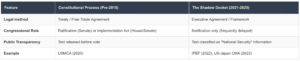
Trade Treaty Negotiations began with the Bipartisan Congressional Trade Priorities and Accountability Act of 2015 (TPA-2015). Passed by the House on June 18, 2015, with a razor-thin margin of 218-208, this legislation allowed the executive branch to “fast track” trade deals. Congress could only vote yes or no on final packages, forfeiting the right to amend. TPA-2015 expired on July 1, 2021. Rather than seek renewal, the Biden administration simply stopped asking for permission. They replaced “Free Trade Agreements” with “Frameworks” and “Initiatives,” semantic gaps designed to bypass the Senate entirely.
The Rise of Executive Agreements
The Indo-Pacific Economic Framework (IPEF), launched in May 2022, exemplifies this new shadow docket. The deal involves 14 nations representing 40% of global GDP. Under traditional rules, a pact of this magnitude requires Senate ratification. Yet the Office of the United States Trade Representative (USTR) classified IPEF as an “Executive Agreement” rather than a treaty. By claiming the deal does not change U. S. tariff rates, the administration argued it required no congressional approval. This maneuver removed the legislative branch from governing 40% of the world’s economic activity.
The cost of this shift became undeniable in March 2023. The United States and Japan signed the serious Minerals Agreement (CMA). This deal was serious for Japanese automakers to qualify for tax credits under the Inflation Reduction Act. The administration labeled the CMA a “Free Trade Agreement” for tax purposes an “Executive Agreement” for constitutional purposes. This dual labeling allowed the White House to unlock billions in taxpayer subsidies without a single vote from the representatives of those taxpayers.
The Corporate Clearance System
While Congress is shut out, corporate interests are invited in. The USTR maintains a system of “cleared advisors,” a network of approximately 500 individuals granted security clearances to review confidential negotiating texts. A 2023 analysis by Rethink Trade revealed that 84% of these advisors represent corporations or trade associations. Executives from major pharmaceutical, tech, and agricultural conglomerates receive access to documents that elected Senators are frequently denied.
This reached a breaking point with the U. S.-Taiwan Initiative on 21st-Century Trade. Congress passed the Implementation Act (H. R. 4004) in 2023 to assert its oversight role. Section 7 of the Act required the USTR to share negotiating texts with congressional committees. President Biden signed the bill on August 7, 2023. Yet he simultaneously issued a signing statement declaring that Section 7 raised “constitutional concerns” and that his administration would treat the transparency requirements as non-binding if they infringed on his executive authority. The message was clear. The executive branch views congressional oversight as an optional courtesy rather than a legal requirement.
The method for this power transfer relies on the ambiguity of “national security.” Section 232 of the Trade Expansion Act of 1962 allows the President to adjust imports if they threaten national security. While originally intended for wartime readiness, the Trump administration used this in 2018 to impose tariffs on steel and aluminum from allies. The courts upheld this broad interpretation. The Biden administration subsequently adapted this precedent. They frame supply chain resilience and climate goals as national security matters. This categorization removes trade policy from the of economic debate and places it inside the unclear box of security clearance.
We are witnessing the normalization of the shadow docket. Trade policy is no longer a matter of public law of private executive decree. The 2015 vote was the last time Congress held the pen. Today, they are notified after the ink is dry.
Classified Texts. The Rise of Non-Binding Frameworks to Evade Ratification
With the expiration of Trade Promotion Authority (TPA) in July 2021, the executive branch did not seek to renew the legislative partnership that had defined U. S. trade policy for decades. Instead, trade officials pivoted to a new legal instrument designed to bypass Capitol Hill entirely: the “non-binding framework.” Between 2022 and 2024, the White House launched massive economic initiatives, covering over 40% of the global economy, without submitting a single line of text to Congress for a vote. By reclassifying these pacts as “executive agreements” rather than treaties or free trade agreements (FTAs), negotiators successfully decoupled international economic policy from democratic consent.
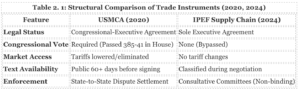
The method relies on a specific legal loophole. Under Article I, Section 8, Congress controls tariffs. Therefore, the Office of the United States Trade Representative (USTR) simply removed market access (tariff reductions) from the negotiating table. Without changes to U. S. tariff schedules, the administration argued it possessed the constitutional authority to sign “sole executive agreements” on supply chains, digital standards, and regulatory practices unilaterally. This maneuver rendered the Senate’s ratification power obsolete for the modern era of trade.
The Indo-Pacific Economic Framework (IPEF)
The test case for this strategy was the Indo-Pacific Economic Framework for Prosperity (IPEF), launched on May 23, 2022. Involving 14 nations, including Japan, India, and Australia, IPEF was structured not as a single treaty, as four separate “pillars.” While the administration touted the deal as a counterweight to China, the negotiations were conducted under strict confidentiality. Draft texts were classified, accessible only to cleared advisors and select members of Congress under supervision, preventing public scrutiny.
The strategy worked. On November 14, 2023, the Commerce Department announced the signing of the IPEF Supply Chain Agreement. Unlike the USMCA, which required months of public hearings and a congressional vote, the IPEF Supply Chain deal entered into force on February 24, 2024, after just five partners ratified it. The United States became a party to a binding international accord without a single roll call vote in the House or Senate.
“The Executive Branch has begun to embrace a ‘go it alone’ trade policy… Congress’ role in U. S. trade policy is defined by the Constitution. It’s right there in Article I, Section 8. That is black-letter law, and it’s unacceptable to suggest otherwise.”
, Senator Ron Wyden, Chair of the Senate Finance Committee, March 23, 2023.
The Taiwan Constitutional Clash
The tension between the branches reached a breaking point with the U. S.-Taiwan Initiative on 21st-Century Trade. Negotiated throughout 2022 and signed in June 2023, the deal covered customs administration and regulatory practices. Fearing total exclusion, Congress passed H. R. 4004, the United States-Taiwan Initiative on 21st-Century Trade Agreement Implementation Act, which legally mandated that the administration submit future trade texts to Congress.
President Biden signed the bill on August 7, 2023, simultaneously issued a signing statement that nullified its enforceability. The statement declared that if the Act’s requirements to share negotiating texts infringed on the President’s “constitutional authority to negotiate with a foreign partner,” the administration would treat them as “non-binding.” This asserted a new precedent: the executive branch claimed the right to withhold trade texts from the legislative branch on national security grounds.
The Architecture of Evasion
The shift from treaties to frameworks creates a two-tier system of international law. Traditional agreements require transparency and consensus; new frameworks prioritize speed and executive control. The following data compares the structural differences between the 2020 USMCA (ratified) and the 2024 IPEF Supply Chain Agreement (unratified).
This methodology has since expanded. In June 2022, the White House announced the Americas Partnership for Economic Prosperity (APEP), applying the same non-binding framework model to the Western Hemisphere. By late 2023, Senator Elizabeth Warren and other lawmakers criticized the USTR for “secret negotiations” regarding digital trade rules, noting that Big Tech lobbyists frequently had more access to the classified texts than the American public. The result is a trade policy apparatus that operates in the dark, insulated from the checks and balances designed to ensure agreements serve the national interest rather than select corporate or diplomatic agendas.
The IPEF Precedent: Supply Chain Agreements Signed Without Public Scrutiny
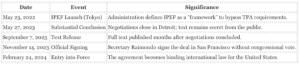
The expiration of TPA-2015 did not stop the executive branch from pursuing binding international economic commitments. It changed the nomenclature. In May 2022, the Biden administration launched the Indo-Pacific Economic Framework for Prosperity (IPEF) in Tokyo. Administration officials explicitly categorized IPEF not as a “trade agreement”, which would trigger Article I, Section 8 constitutional requirements for congressional approval, as an “administrative arrangement.” This semantic shift allowed the White House to negotiate, conclude, and implement the IPEF Supply Chain Agreement (Pillar II) entirely through the executive shadow docket, bypassing the legislative branch.
The negotiation process for Pillar II demonstrated a new level of opacity. While traditional Free Trade Agreements (FTAs) under TPA required public negotiating objectives and cleared advisor reports, IPEF negotiations occurred largely behind closed doors. The U. S. Department of Commerce announced the “substantial conclusion” of the Supply Chain Agreement negotiations in Detroit on May 27, 2023. Yet, the text of the agreement remained unavailable to the American public and most members of Congress until September 2023, four months after the deal was locked in. By the time the text appeared, the opportunity for meaningful legislative input had.
On November 14, 2023, Commerce Secretary Gina Raimondo signed the agreement in San Francisco alongside representatives from 13 other nations, including Japan, India, and Singapore. The agreement officially entered into force on February 24, 2024. Unlike the USMCA or the KORUS FTA, the IPEF Supply Chain Agreement never received a vote on the floor of the House or Senate. It stands as a binding executive agreement that obligates the United States to specific international without the consent of the governed.
The agreement establishes three permanent bodies that hold significant sway over U. S. industrial policy: the IPEF Supply Chain Council, the Supply Chain emergency Response Network, and the Labor Rights Advisory Board. The emergency Response Network, in particular, obligates the United States to an emergency communications channel. In the event of a supply chain disruption, the U. S. government must share information and coordinate responses with partner nations. While framed as a cooperative measure, critics this creates a mandatory diplomatic method that could pressure the U. S. to prioritize foreign supply needs over domestic requirements during a emergency, all based on a treaty structure that Congress never ratified.
Senators from both parties raised alarms regarding this procedural end-run. In November 2023, just prior to the signing, a bipartisan group of legislators criticized the administration for failing to consult Congress on enforceable commitments. Senator Sherrod Brown and others warned that bypassing the legislative process sets a dangerous precedent for future economic pacts. Even with these warnings, the administration proceeded, establishing a template where “frameworks” replace “treaties,” nullifying the congressional check on foreign commerce power.
Timeline of the IPEF Supply Chain Agreement
The implementation of the IPEF Supply Chain Agreement marked a turning point in U. S. trade policy. It proved that the executive branch could successfully negotiate and implement a multi-nation economic pact covering 40% of global GDP without a single vote in Congress. This success paved the way for subsequent “pillars” of IPEF to follow the same extra-constitutional route, normalizing the use of executive agreements for matters previously reserved for legislative deliberation.
The Semantic Smokescreen: Redefining “Free Trade”
The Inflation Reduction Act (IRA) of August 2022 contained a specific, binding geographic constraint intended to force supply chain onshoring. To qualify for the $3, 750 serious minerals tax credit, Section 30D required that applicable minerals be extracted or processed in the United States or in a country with which the United States has a “free trade agreement” (FTA) in effect. The legislative intent was clear: benefits were reserved for detailed partners like Canada and Mexico, ratified by Congress under Article I, Section 8.
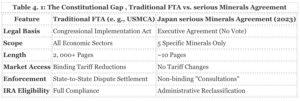
The Executive Branch, facing the reality that key allies like Japan and the European Union absence such treaties, did not return to Congress to amend the law. Instead, the Treasury Department rewrote the definition of the term itself. In a Notice of Proposed Rulemaking released in April 2023, the Treasury declared that “free trade agreement” would no longer require a detailed, congressionally approved statute. It would include limited-scope “serious Minerals Agreements” (CMAs) negotiated solely by the White House.
The Japan Prototype: A Treaty in Name Only
The test case for this executive bypass was the Agreement Between the Government of the United States of America and the Government of Japan on Strengthening serious Minerals Supply Chains, signed on March 28, 2023. Unlike the United States-Mexico-Canada Agreement (USMCA), which spans over 2, 000 pages and required years of legislative debate, the Japan CMA is a scant 10-page document. It contains no binding market access provisions, no tariff reductions, and no enforceable dispute settlement method. It was signed by Trade Representative Katherine Tai and Ambassador Tomita Koji without a single vote in the House or Senate.
This maneuver unlocked billions in taxpayer-funded subsidies for foreign-processed minerals. By classifying this executive handshake as a “Free Trade Agreement,” the administration allowed Japanese-processed cobalt, graphite, lithium, manganese, and nickel to qualify for the IRA’s domestic content requirements. The precedent was set: the Executive could unilaterally designate any nation an “FTA partner” for tax purposes, rendering the statutory limitation meaningless.
Congressional Backlash and Constitutional
The reaction from the legislative branch was immediate and bipartisan. Senator Joe Manchin (I-WV), a primary architect of the IRA, publicly accused the Treasury of betraying the law’s intent to decouple from foreign supply chains. In hearings held by the House Ways and Means Committee throughout 2023 and 2024, lawmakers argued that the CMA model ceded Congress’s constitutional power to regulate foreign commerce. By 2025, this “loophole” had expanded beyond Japan. Negotiations with the European Union and the United Kingdom followed the same template, seeking to grant “FTA status” through executive memoranda rather than treaties.
The financial of this redefinition are substantial. As of February 2026, the volume of mineral trade entering the U. S. under these “limited” agreements has surged, diluting the strict domestic sourcing requirements originally envisioned. While the stated goal was to diversify supply chains away from adversaries, the method used, stripping Congress of its ratification power, has created a permanent “shadow docket” for trade policy. The Executive possesses the unchecked authority to direct billions in tax expenditures to any favored nation simply by signing a memorandum and labeling it a “free trade agreement.”
Digital Sovereignty for Sale
The modern trade agreement is no longer primarily about tariffs, quotas, or physical goods. Between 2015 and 2025, the central battlefield of international commerce shifted to the immaterial: data, algorithms, and source code. While public debate focused on manufacturing jobs, Silicon Valley lobbyists successfully a “digital constitution” into binding international law, outlawing future domestic regulations before they could be written. The apex of this effort was the United States-Mexico-Canada Agreement (USMCA), which entered into force on July 1, 2020. Hailed as a modernization of NAFTA, the agreement contained Chapter 19, a digital trade section that cemented the policy p
The National Security Gavel
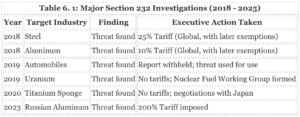
The Constitution grants Congress the power to regulate commerce, yet the executive branch has seized this authority through a Cold War relic: Section 232 of the Trade Expansion Act of 1962. Originally designed to protect domestic industries essential to national defense during the Soviet standoff, this statute lay dormant for decades. Between 2018 and 2025, it transformed into a primary weapon for executive tariff-making, bypassing legislative debate entirely. The method is simple and devastating. If the Department of Commerce finds that imports “threaten to impair the national security,” the President can impose unlimited tariffs or quotas without a congressional vote.
On March 8, 2018, the White House invoked this power to impose global tariffs of 25 percent on steel and 10 percent on aluminum. The administration justified this move by claiming that a weakened domestic metal industry posed a security risk. This decision did not target hostile nations alone; it hit allies in the European Union, Canada, and Mexico. The economic impact was immediate. U. S. Customs and Border Protection (CBP) data shows that between 2018 and 2024, American importers paid over $22 billion in Section 232 duties. While these costs were intended to domestic production, the results contradict the stated goals. According to the U. S. Geological Survey, domestic steel production in 2017 stood at 81. 6 million metric tons. By 2023, even with five years of protection, production fell to 80. 0 million metric tons.
The Secret Auto Report
The most worrying use of Section 232 involved the automotive sector. In May 2018, the Commerce Department launched an investigation into whether imported automobiles and parts threatened national security. For nearly three years, the findings remained classified, fueling uncertainty across the global supply chain. The White House used the threat of a 25 percent auto tariff as use in trade negotiations with Japan and the European Union.
The report was released in July 2021, two years after its completion. It concluded that foreign automobiles indeed threatened national security, a finding that stretched the definition of “security” to encompass general economic welfare. The report argued that American ownership of automotive innovation was important for defense technology. While no tariffs were imposed on finished cars, the precedent was set: the executive branch could label any major industry a national security matter to seize regulatory control.
Judicial Surrender
Corporate challengers attempted to halt this expansion of executive power in federal court. In the case American Institute for International Steel v. United States (2019), plaintiffs argued that Section 232 violated the non-delegation doctrine of the Constitution by giving the President unbridled law-making power. The Court of International Trade ruled against the plaintiffs, citing the 1976 Supreme Court precedent Federal Energy Administration v. Algonquin SNG, Inc.
The court admitted the statute allowed the President to regulate the economy in ways “constitutionally reserved for Congress,” yet felt bound by the 1976 ruling. The Federal Circuit affirmed this decision in 2020, and the Supreme Court denied certiorari. This judicial inaction confirmed that the “national security” label acts as a shield against legal review. As long as the executive branch claims a security nexus, the courts not intervene.
“One might that the statute allows for a gray area where the President could invoke the statute to act in a manner constitutionally reserved for Congress not objectively outside the President’s authority.” , Judge Katzmann, American Institute for International Steel v. United States (2019)
The Biden Continuation
The change in administration in 2021 did not return this power to Congress. The Biden administration maintained the Section 232 structure, opting to replace direct tariffs with Tariff-Rate Quotas (TRQs) for the EU, Japan, and the UK. These agreements kept the “national security” designation in place. On February 24, 2023, the White House used Section 232 again to impose a 200 percent tariff on aluminum articles from Russia. This action demonstrated that the tool had evolved from a temporary shield into a permanent feature of U. S. trade policy. By 2025, the executive branch possessed the ability to adjust border taxes at, leaving Congress to watch from the sidelines.
Pharma Protections
While the public focus of trade negotiations frequently centers on tariffs and manufacturing jobs, a quieter, more technical battle is waged in the annexes of these agreements: the of intellectual property (IP) laws to favor pharmaceutical monopolies. Between 2015 and 2025, the Office of the United States Trade Representative (USTR) systematically used bilateral trade deals and “Special 301” investigations to pressure trading partners into adopting patent protections that exceed World Trade Organization (WTO) requirements. These provisions, frequently termed “TRIPS-plus,” delay the entry of generic medicines, maintaining high drug prices in partner nations.
The method for this expansion is rarely the main text of a treaty. Instead, it resides in “Side Letters” and “Sectoral Annexes” that demand regulatory. A prime example occurred during the renegotiation of the North American Free Trade Agreement (NAFTA) into the USMCA. In 2018, U. S. negotiators pushed to lock Canada and Mexico into a 10-year data exclusivity period for biologics, complex drugs made from living organisms. This demand sought to override Canada’s domestic standard of eight years and Mexico’s five-year limit. Although the final text signed in December 2019 removed this specific mandate following intense congressional opposition, the attempt signaled a clear objective: to export the U. S. standard of 12-year exclusivity, the longest in the world, through trade pacts rather than domestic legislation.
When binding treaties fail to secure these terms, the USTR employs the “Special 301 Report,” an annual review that categorizes countries based on their IP enforcement. Nations placed on the “Priority Watch List” face the threat of unilateral trade sanctions. Colombia provides a clear case study of this coercion. In 2016, the Colombian government moved to problem a compulsory license for the cancer drug Imatinib (marketed as Glivec by Novartis), which would have lowered the price by opening the market to generics. Leaked diplomatic cables revealed that the USTR and members of the Senate Finance Committee pressured Colombia to abandon this measure, threatening to withhold peace process funding and trade benefits. By 2024, Colombia remained on the Priority Watch List, specifically for its “compulsory licensing” policies, chilling its sovereign right to manage public health costs.
The financial engine behind these diplomatic demands is substantial. In 2025 alone, the Pharmaceutical Research and Manufacturers of America (PhRMA) spent a record $37. 9 million on federal lobbying. This expenditure correlates with an aggressive push in post-Brexit negotiations with the United Kingdom. Leaked documents from the U. S.-UK Trade and Investment Working Group (2017-2019) exposed U. S. demands for “full market access” for U. S. pharmaceuticals and questioned the United Kingdom’s National Institute for Health and Care Excellence (NICE) drug pricing method. The U. S. objective was to centralized price negotiations, viewing them as non-tariff trade blocks.
Similar patterns emerged in the U. S.-Kenya trade talks, which resumed in 2020 and continued through 2025. The U. S. sought to bypass local regulatory checks, proposing that U. S. Food and Drug Administration (FDA) approval should grant automatic market access in Kenya. While framed as an efficiency measure, civil society groups like KELIN noted this would strip Kenya of its ability to verify safety or negotiate pricing before a drug enters its market. A health cooperation agreement signed in December 2025 was subsequently suspended by Kenya’s High Court due to concerns over data sovereignty and the absence of parliamentary oversight.
| Country | Domestic Standard (Years) | USTR Demand in Negotiations (Years) | Status of Demand |
|---|---|---|---|
| United States | 12 | N/A | Benchmark |
| Canada | 8 | 10 | Dropped (USMCA 2019) |
| Mexico | 5 | 10 | Dropped (USMCA 2019) |
| Malaysia | 0 (No specific biologics law) | 5-8 | Suspended (TPP Withdrawal) |
| Kenya | 0 (Generic entry allowed) | Unspecified (TRIPS-Plus) | Blocked by Court (2025) |
The “linkage” system is another serious tool in these annexes. This method requires a country’s drug regulatory authority to withhold marketing approval for a generic drug if a patent claim exists, turning health regulators into patent enforcers. The USTR’s 2024 Special 301 Report explicitly criticized countries like India for not adopting such a system. India, known as the “pharmacy of the developing world,” has consistently rejected these demands to protect its generic manufacturing capacity, which supplies affordable medicines globally. The U. S. response has been to keep India on the Priority Watch List for over a decade, citing Section 3(d) of India’s patent law, a provision that prevents “evergreening,” or the practice of extending patent monopolies through minor chemical modifications.
The ISDS Rebrand: Corporate Tribunals Hidden in Investment Facilitation Deals
The acronym “ISDS” (Investor-State Dispute Settlement) became toxic in the mid-2010s. Public outrage over secret tribunals corporations to sue nations for billions forced trade negotiators to pivot. They did not the system. They renamed it. Between 2015 and 2025, the method for corporate sovereignty underwent a sophisticated rebranding operation, emerging under innocuous titles like the “Investment Court System” (ICS) or buried within “Investment Facilitation” frameworks. The venue changed, the power to bypass domestic courts remained absolute.
The “Court” That Is Not a Court
The European Union led the linguistic shift. In its detailed Economic and Trade Agreement (CETA) with Canada, the EU replaced ISDS with the Investment Court System (ICS). Proponents argued this was a fundamental reform, citing the establishment of a roster of permanent judges rather than ad hoc arbitrators. Yet, the core function: foreign investors retain a special legal track unavailable to domestic citizens or companies. On April 30, 2019, the European Court of Justice ruled the ICS compatible with EU law, cementing its legitimacy. By 2024, even with the French Senate voting against CETA ratification in March, the provisional application of these deals kept the tribunal architecture on life support, waiting to be fully activated.
This model was replicated in agreements with Vietnam, Singapore, and Mexico. The “Multilateral Investment Court” (MIC), a project championed by the EU at the United Nations Commission on International Trade Law (UNCITRAL), aims to institutionalize this parallel justice system globally. It pledge procedural transparency preserves the discriminatory privilege that allows capital to sue the state.
The “Zombie” Clauses: Liability Beyond the Grave
Even when nations explicitly withdraw from these treaties, the tribunals continue to operate through “sunset clauses.” The Energy Charter Treaty (ECT), a 1994 pact protecting fossil fuel investments, saw a mass exodus of European nations in 2024, including the UK, France, and Germany, who its incompatibility with climate goals. yet, Article 47(3) of the ECT triggers a 20-year survival period. A country that leaves today remains liable to be sued by foreign investors until 2045. This “zombie” liability ensures that the tribunals remain active long after democratic mandates reject them.
In North America, the transition from NAFTA to the USMCA (United States-Mexico-Canada Agreement) ostensibly curtailed ISDS. yet, a “legacy claim” provision allowed investors to file suits under the old NAFTA rules until July 1, 2023. Corporations rushed to beat this deadline. The expiry did not end the threat; it shifted the venue to other overlapping treaties or contracts.
Case Study: The $10. 7 Billion Assault on Honduras
The theoretical danger of these tribunals manifested with brutal clarity in Honduras. In 2022, the U. S. company Honduras Próspera Inc. filed a claim against the Honduran government for $10. 775 billion, an amount nearly equal to two-thirds of the nation’s entire 2023 budget. The dispute arose after Honduras repealed a law enabling “Employment and Economic Development Zones” (ZEDEs), private corporate city-states. Próspera utilized the CAFTA-DR trade agreement to challenge the repeal, arguing it violated their investor rights. This case, active throughout 2024 and 2025, demonstrates that the tribunal system is not a relic of the past a current weapon against sovereign legislative reversal.
The “Facilitation” Trap
The newest frontier is the World Trade Organization’s “Investment Facilitation for Development” (IFD) agreement. Finalized in late 2023 and pushed heavily in 2024, the text explicitly excludes ISDS to secure the support of developing nations. yet, legal experts warn of a “firewall” failure. The IFD creates binding obligations on regulatory transparency and administrative procedures. While the IFD itself has no tribunal, foreign investors can use its “soft” breaches to claims under “hard” Bilateral Investment Treaties (BITs) that contain Most-Favored-Nation (MFN) or Fair and Equitable Treatment (FET) clauses. The “facilitation” rules provide the ammunition; the old BITs provide the gun.
| Year | New Cases Registered | Oil, Gas & Mining Share | Key Trend |
|---|---|---|---|
| 2022 | 41 | 23% | Dip in registrations; rise in renewable energy disputes. |
| 2023 | 53 | 23% | Rebound in volume; legacy claims surge before deadlines. |
| 2024 | 55 | 38% | Steady high volume; sharp increase in extractive sector claims. |
“The EU cannot hide behind a name change when the flaws of the Investment Court System remain the same. Citizens continue to unfairly shoulder private risks taken by foreign investors.” , Transport & Environment Statement on ICS
The data from the International Centre for Settlement of Investment Disputes (ICSID) confirms the system’s resilience. In 2024, ICSID registered 55 new cases, a slight increase from 53 in 2023. The extractive industries (oil, gas, mining) accounted for 38% of these new disputes, up significantly from previous years. This surge correlates with global efforts to regulate serious minerals and energy transition policies, proving that as states attempt to regulate for the future, the tribunal system is the primary method used to discipline them.
Green Steel Walls
The transition from “national security” protectionism to “climate” protectionism occurred not on the floor of the House, in a joint statement issued on October 31, 2021. On that Sunday, the Biden administration and the European Union announced a suspension of the Trump-era Section 232 tariffs on European steel and aluminum. In exchange, the EU suspended its retaliatory duties on American whiskey and motorcycles. the core of the deal was a new, secretive negotiation track: the Global Arrangement on Sustainable Steel and Aluminum (GASSA). This proposed “carbon club” aims to erect a trade barrier against dirty steel, primarily from China, while allowing duty-free trade between members. The talks, conducted entirely by the Office of the United States Trade Representative (USTR) and the European Commission, bypass the treaty ratification process entirely.
The mechanics of this arrangement rely on a “Green Steel Wall.” The concept is simple: member countries agree to a common set of emissions standards. Steel produced inside the club trades freely. Steel from outside faces a tariff based on its carbon intensity. For the United States, this offers a way to monetize its cleaner production methods without passing a domestic carbon tax. The U. S. steel industry, which relies heavily on electric arc furnaces (EAF), emits significantly less carbon per metric ton than the blast furnace-heavy industries of China or India. yet, the negotiations hit a serious snag in October 2023. The EU demanded that the U. S. implement domestic carbon pricing to comply with World Trade Organization (WTO) non-discrimination rules. The U. S. refused. Consequently, the negotiators extended the deadline to December 31, 2025, freezing the conflict until after the presidential inauguration.
| Production Method | Primary User (Region) | Carbon Intensity (tCO2 per ton of steel) | Trade Implication |
|---|---|---|---|
| Scrap-based Electric Arc Furnace (EAF) | United States (~70% of output) | ~0. 7 | Likely exempt from carbon tariffs |
| Blast Furnace-Basic Oxygen Furnace (BF-BOF) | China, India, Traditional EU Mills | ~2. 3 | Subject to high penalties/CBAM costs |
| Direct Reduced Iron (DRI) | Emerging Green Tech (Middle East/EU) | ~1. 4 (Gas) / ~0. 1 (Hydrogen) | Future standard for “Green Steel” |
While Washington stalled, Brussels moved forward. On October 1, 2023, the EU launched the transitional phase of its Carbon Border Adjustment method (CBAM). This policy requires importers to report the carbon emissions of their goods. Starting January 1, 2026, importers must purchase certificates corresponding to the carbon price they would have paid had the goods been produced under the EU’s Emissions Trading System (ETS). This unilateral move places immense pressure on American exporters. Unless the U. S. joins a recognized equivalence regime, like GASSA, American steel entering Europe could face the same carbon levies as Chinese steel. The USTR seeks a waiver for U. S. products based on regulatory costs rather than a direct tax, a method the EU views as legally dubious under international trade law.
The opacity of these talks mirrors the broader trend of executive dominance. Congress has held no votes on the parameters of GASSA. The “tariff-rate quotas” (TRQs) currently in place, which allow 3. 3 million metric tons of EU steel to enter the U. S. duty-free, exist solely through presidential proclamation. If the negotiations fail by the end of 2025, the original Section 232 tariffs, 25% on steel and 10% on aluminum, automatically snap back into place. This “sword of Damocles” method keeps the industry in a state of suspended animation, dependent on temporary executive waivers rather than permanent legislative statutes.
“The collapse of the talks was surprising… Given the political mandate, policy feasibility and EU accommodations, a deal could have certainly been landed.”
, Dr. Todd Tucker, Director of Industrial Policy and Trade at the Roosevelt Institute, November 2023.
The for the 2025 deadline are financial and geopolitical. If the U. S. and EU cannot align their carbon accounting methodologies, the “Green Steel Wall” fracture. The EU apply CBAM to American goods, and the U. S. may reimpose national security tariffs on European metal. This outcome would leave Western markets fragmented, reducing their shared use to force decarbonization on China’s massive steel sector, which continues to account for over 50% of global production. The negotiations remain classified, with industry lobbyists receiving limited readouts while the public awaits a final text that could reshape the transatlantic economy.
Labor Rights on Paper
The United States-Mexico-Canada Agreement (USMCA), which entered into force on July 1, 2020, was sold to the American public as a correction to the failures of NAFTA. Its centerpiece was the Rapid Response Labor method (RRM), a tool designed to penalize specific facilities that denied workers the right to organize. Trade officials promised this would end the era of “toothless” labor side agreements. Yet, data from 2020 through 2025 reveals a method that functions on paper frequently fails when tested against corporate intransigence and jurisdictional legalities.
By late 2025, the United States had initiated approximately 39 RRM cases. While officials tout statistics regarding back pay and reinstated workers, these numbers mask a structural enforcement gap. The method is facility-specific, meaning it individual factories rather than corporate-wide practices. This design flaw allows companies to amputate a non-compliant limb rather than reform their operations. The case of VU Manufacturing in Piedras Negras, Coahuila, stands as the definitive proof of this failure.
In 2023, the U. S. Trade Representative (USTR) and the Department of Labor successfully proved that VU Manufacturing, an automotive interior parts producer, had violated workers’ rights. The governments of the U. S. and Mexico agreed on a remediation plan. Instead of complying, the company simply shut down the facility in October 2023. Over 400 workers lost their jobs. The RRM could identify the violation, it possessed no power to prevent the company from executing a “capital flight” strategy to evade accountability. The message to other employers was clear: if compliance costs exceed closure costs, shut the doors.
The enforcement gap widens further when examining jurisdictional gaps. In May 2024, a dispute settlement panel ruled against the United States in the case of the San Martín mine, owned by Grupo México. The U. S. alleged that the company had resumed operations during an ongoing strike, a violation of Mexican labor law. The panel, yet, dismissed the case on retroactive grounds, stating the underlying labor dispute began in 2007, long before the USMCA existed. This ruling immunized long-standing labor abuses from RRM scrutiny, allowing Grupo México to continue operations even with the objections of the clear union, Los Mineros.
| Facility / Company | Sector | Year Initiated | Outcome | Enforcement Status |
|---|---|---|---|---|
| General Motors (Silao) | Automotive | 2021 | Independent union won vote; wage increase secured. | Success |
| VU Manufacturing | Auto Parts | 2022/2023 | Company closed facility rather than remediate. | Failed (Capital Flight) |
| San Martín Mine (Grupo México) | Mining | 2023 | Panel ruled against U. S. on jurisdictional grounds. | Failed (Retroactivity) |
| Mas Air | Services (Airline) | 2023 | services sector case; pilots reinstated. | Partial Success |
| Atento Servicios | Call Center | 2024 | panel victory for U. S. (Aug 2025); confirmed rights denial. | Legal Precedent |
Even victories reveal the method’s slow pace relative to the urgency of labor violations. In August 2025, the U. S. secured its panel victory in a case against Atento Servicios, a call center in Hidalgo. The panel confirmed that the company engaged in “wrongful interference and anti-union discrimination.” While legally significant, this decision came nearly two years after the initial petition. For workers facing daily harassment or termination, a two-year legal process is not a “rapid” response. It is a war of attrition that well-funded corporations are better equipped to survive than precarious employees.
The data shows a trend of diminishing returns. A September 2025 report by American Economic Liberties Project noted that while early cases like General Motors in Silao resulted in independent union representation, later cases frequently ended in settlements that did not fundamentally alter the power on the factory floor. The RRM forces a vote or a payout, it rarely forces a change in the business model that relies on wage suppression. Without the power to levy corporate-wide sanctions, the RRM remains a game of whack-a-mole, where trade officials chase individual violations while the broader system of labor exploitation remains intact.
Agricultural blocks: Sanitary Rules Used to Block Market Access
The most trade blocks are not tariffs. They are sanitary and phytosanitary (SPS) measures. Originally designed to protect human, animal, and plant life from risks like pests or diseases, these rules have been weaponized by foreign governments to block American agricultural exports. Between 2015 and 2025, the number of specific trade concerns raised at the World Trade Organization (WTO) regarding SPS measures surged, signaling a shift from science-based regulation to protectionist maneuvering. For U. S. farmers, the cost is measured in billions of dollars in lost market access.
Mexico provided the most high-profile example of this tactic with its campaign against genetically modified (GM) corn. In December 2020, President Andrés Manuel López Obrador issued a decree to phase out GM corn for human consumption by January 2024. A subsequent decree in February 2023 immediately banned GM corn for use in dough and tortillas, while instructing a gradual substitution for animal feed. The economic were massive: Mexico purchased $5. 39 billion of U. S. corn in 2023 and $5. 71 billion in 2024, making it the top destination for American corn growers. The United States challenged the ban under the USMCA, arguing it absence scientific merit. In December 2024, a dispute settlement panel ruled in favor of the U. S., forcing Mexico to lift the restrictions in February 2025. The case demonstrated how SPS rules could be used to threaten an entire export sector under the guise of food sovereignty.
China deployed a more bureaucratic form of obstruction through Decree 248. January 1, 2022, the regulation required all overseas food manufacturers, processors, and storage facilities to register with the General Administration of Customs of China (GACC). The rule imposed onerous data requirements and forced facilities to display Chinese registration numbers on inner and outer packaging. While Beijing framed the measure as a food safety enhancement, U. S. officials identified it as a non-tariff barrier designed to slow imports and increase compliance costs. The decree affected roughly $89 billion in global food imports to China, creating a bottleneck that allowed Chinese authorities to arbitrarily delay or deny market access for thousands of U. S. facilities.
In the European Union, the barrier is chemical. The EU has long restricted U. S. beef treated with hormones, recent regulations have expanded to veterinary drugs and antimicrobials. Regulation (EU) 2023/905, which fully took effect in 2024, prohibits the use of certain antimicrobials in livestock and applies these standards to imports. This creates a “mirror clause” effect, where U. S. producers must adhere to EU farming standards to gain market access, regardless of the safety already enforced by the USDA. This regulatory blocks the vast majority of U. S. poultry and beef, not because the product is unsafe, because the production method does not align with Brussels’ policy preferences.
India maintains one of the most impenetrable walls against U. S. dairy through its veterinary certificate requirements. New Delhi mandates that imported dairy products must be derived from animals that have “never been fed ruminant material.” This requirement, ostensibly based on religious and cultural dietary laws, ignores the fact that U. S. dairy cattle diets are strictly regulated and safe. The rule bans most U. S. dairy products from entering India’s $227 billion domestic market. even with years of negotiations, U. S. dairy exports to India languished at approximately $34 million in 2020, a fraction of the chance volume. In July 2025, the U. S. raised the problem again at the WTO, labeling the certification rules as “unnecessary trade blocks” that absence scientific justification.
| Target Market | SPS Measure | Implementation Date | Economic Impact / Status |
|---|---|---|---|
| Mexico | Ban on GM corn for human consumption | Feb 2023 (Decree) | Threatened $5. 71 billion in annual exports. Overturned by USMCA panel Dec 2024. |
| China | Decree 248 (Facility Registration) | Jan 1, 2022 | Universal registration requirement for all food facilities; increased administrative load and delay risks. |
| European Union | Antimicrobial Usage Ban (Reg 2023/905) | 2024 | Blocks U. S. meat/poultry treated with standard veterinary drugs; enforces EU farm standards extraterritorially. |
| India | “Never Fed Ruminant Material” Certificate | Ongoing (2015-2025) | Blocks access to $227 billion dairy market; U. S. exports limited to ~$34 million (2020). |
Financial Deregulation: The “Black Box” Provisions
While public debate focused on manufacturing jobs and dairy quotas during the negotiation of the United States-Mexico-Canada Agreement (USMCA), trade representatives inserted binding clauses into the service chapters that deregulate the financial technology sector. These provisions, specifically found in Chapters 17 and 19, classify complex financial algorithms and cryptocurrency assets under broad “digital product” definitions, stripping U. S. regulators of the authority to audit source code or impose tariffs on digital assets.
The most significant of these “buried” method is the prohibition on source code disclosure. Under USMCA Article 19. 16, signatories are forbidden from requiring the transfer of, or access to, source code of software owned by a person of another Party as a condition for the import, distribution, sale, or use of that software. In the context of high-frequency trading and AI-driven underwriting, this clause creates a “black box” legal shield. If the Securities and Exchange Commission (SEC) or the Consumer Financial Protection Bureau (CFPB) seeks to inspect a fintech algorithm for racial bias or widespread instability, the trade treaty provides the corporation with a supranational legal defense to refuse compliance.
This deregulation extends to the physical location of financial data. USMCA Article 17. 18 prohibits parties from requiring financial service suppliers to use or locate computing facilities in the party’s territory. While a “prudential carve-out” exists, it is structurally weakened. To invoke it, a regulator must prove that the foreign firm cannot provide “immediate, direct, complete, and ongoing access” to information. This shifts the load of proof from the corporation to the state, allowing financial data, including the transaction histories of U. S. citizens, to be stored in jurisdictions with weaker privacy laws, provided the server connection remains active.
The Crypto “Digital Product” Loophole
Trade negotiators have quietly future-proofed the cryptocurrency industry against cross-border taxation. By defining “digital products” broadly in the US-Japan Digital Trade Agreement ( January 1, 2020) and USMCA ( July 1, 2020), these treaties permanently ban customs duties on electronic transmissions. Legal analysts this definition encompasses non-fungible tokens (NFTs) and stablecoins, creating a duty-free trade zone for digital assets before Congress could debate their classification.
The of these rules is not accidental. The U. S.-UK Financial Innovation Partnership (FIP), established in 2022, serves as a “soft law” vehicle to harmonize regulatory frameworks outside of the treaty process. In meetings held in London (June 2022) and subsequent sessions, officials from the U. S. Treasury and HM Treasury coordinated method to stablecoin regulation and digital asset ecosystems. These dialogues prioritize “interoperability” and “market access” over strict prudential oversight, embedding industry-friendly standards into the transatlantic financial architecture before domestic laws are finalized.
| Agreement / Framework | Date | Source Code Disclosure | Financial Data Localization | Crypto/Digital Product Status |
|---|---|---|---|---|
| TPP (Original Text) | Signed 2016 (US withdrew) | Prohibited (General) | Allowed for Financial Services | Undefined |
| US-Japan Digital Trade Agreement | Jan 1, 2020 | Strictly Prohibited (incl. Algorithms) | Prohibited | Duty-Free (Broad Definition) |
| USMCA | July 1, 2020 | Strictly Prohibited (Art. 19. 16) | Prohibited (Art. 17. 18) | Duty-Free (Art. 19. 3) |
| WTO E-Commerce JSI | Stabilized Text July 2024 | Prohibited (with exceptions) | Subject to “Legitimate Public Policy” | Moratorium on Duties Extended |
| US-UK FIP | Est. 2022 | N/A (Regulatory Dialogue) | Promotes “Free Flow” | Harmonized “Sandboxes” |
The push for these provisions coincides with aggressive lobbying by the Coalition of Services Industries and specific fintech conglomerates. Between 2020 and 2024, the digital trade agenda shifted from removing tariffs to preempting domestic AI regulation. By locking these constraints into international treaties, the executive branch insulates the fintech sector from future congressional attempts to regulate algorithmic accountability or mandate onshore data storage for financial stability.
“The trade agreement is no longer about moving goods across borders. It is about moving the borders themselves, ensuring that the digital vaults of Wall Street and Silicon Valley remain beyond the reach of the democratic process.” , Internal Memo, Institute for Trade and Agriculture Policy, 2023.
The China Containment Strategy: Export Controls Disguised as Trade
While the public spectacle of tariff wars dominated headlines, a far more lethal economic weapon was being deployed in the shadows. Between 2018 and 2025, the United States fundamentally altered the mechanics of global trade, shifting from protectionist taxes to weaponized export controls. This strategy, codified under the Export Control Reform Act of 2018 (ECRA), did not seek to balance trade deficits. Its objective was the precise, surgical decapitation of China’s technological ascent. The method was not a treaty, a unilateral assertion of extraterritorial jurisdiction known as the Foreign Direct Product Rule (FDPR).
The FDPR allows the U. S. Department of Commerce to regulate foreign-made goods if they are produced using American software or technology. In practice, this meant that a semiconductor manufactured in Taiwan, tested in Malaysia, and packaged in Vietnam could be subject to U. S. export bans simply because the factory used tools from Applied Materials or Lam Research. This was not ” ” in the diplomatic sense; it was the conscription of global supply chains into a containment strategy.
The Shadow Pact: January 2023
The pivot point occurred in late January 2023. Following the sweeping unilateral controls announced on October 7, 2022, the Biden administration secured a clandestine agreement with Japan and the Netherlands. The deal, which was not publicly detailed for months, forced the Dutch government to restrict ASML, the world’s sole producer of extreme ultraviolet (EUV) lithography machines, from selling advanced equipment to Chinese firms. Japan followed suit with restrictions on Nikon and Tokyo Electron.
This trilateral lockstep severed China’s access to the physical required to produce sub-14 nanometer chips. Unlike traditional trade agreements, which are debated in parliaments, this pact was negotiated by national security officials and implemented through obscure regulatory updates. The ” ” was a mirage; the reality was a cartel of advanced economies erecting a technological blockade.
The Entity List Explosion
The primary weapon of this strategy was the Bureau of Industry and Security (BIS) Entity List. Once reserved for terrorists and rogue states, the list transformed into a “who’s who” of Chinese technology. Between 2019 and 2025, the number of Chinese entities subject to these restrictions surged, targeting sectors from artificial intelligence to quantum computing.
| Date | Action | Targeted Sector | Strategic Impact |
|---|---|---|---|
| May 2019 | Huawei Added to Entity List | Telecommunications | Cut off access to Google Android and U. S. chips. |
| Oct 7, 2022 | Sweeping Semiconductor Rules | Advanced Computing | Banned export of chips and tools for AI/Supercomputing. |
| Jan 27, 2023 | US-Japan-Netherlands Deal | Lithography Equipment | Restricted ASML/Nikon sales to China. |
| Oct 17, 2023 | AI Chip Loophole Closure | Artificial Intelligence | Blocked Nvidia A800/H800 “China-specific” chips. |
| Sept 29, 2025 | “Affiliates Rule” (50% Rule) | Global Subsidiaries | Extended bans to any entity 50% owned by a listed firm. |
The “Affiliates Rule” and the 2025 emergency
The strategy reached its zenith, and its breaking point, in late 2025. On September 29, 2025, the BIS issued the “Affiliates Rule,” an Interim Final Rule that automatically extended Entity List restrictions to any foreign company owned 50% or more by a listed entity. This radioactive designation threatened to paralyze thousands of subsidiaries operating in Southeast Asia, Europe, and South America, regardless of their direct involvement in Chinese military programs.
The was immediate. On October 9, 2025, Beijing retaliated by imposing extraterritorial controls on rare earth elements and adding 14 U. S. defense and technology firms to its “Unreliable Entity List.” The global supply chain for electric vehicles and defense electronics faced immediate rupture. The escalation forced a temporary retreat; in a November 2025 trade arrangement, the U. S. agreed to suspend the Affiliates Rule for one year in exchange for China lifting its rare earth blockades. This pause, yet, did not signal a change in strategy, rather an acknowledgment that the “high fence” had become so high it was cutting off the West’s own oxygen.
De-Risking as Containment
Officials frequently used the term “de-risking” to describe these measures to European allies. The data suggests a different story. The specific targeting of commercial technologies, such as the October 2023 restrictions on consumer-grade AI chips, reveals an intent to freeze China’s economic development at a specific technological tier. The “Small Yard, High Fence” doctrine, initially pitched as a limited security measure, expanded until the yard encompassed the entire digital economy.
By early 2026, the pretense of free trade had largely evaporated in the high-tech sector. The U. S. government reviews, licenses, and frequently denies the export of goods that were considered commodities just a decade prior. The trade treaty negotiations of the future not be about lowering tariffs; they be about securing exemptions from the blockade.
The 2026 USMCA Review: Corporate Lobbying for the Sunset Clause
On July 1, 2026, the United States, Mexico, and Canada face a definitive deadline that was designed to prevent the permanent entrenchment of bad trade policy. Article 34. 7 of the United States-Mexico-Canada Agreement (USMCA) mandates a “joint review” six years after the agreement’s entry into force. This provision, commonly known as the “sunset clause,” requires all three nations to affirmatively agree to extend the pact for another 16 years. If they fail to reach consensus, the agreement does not expire immediately enters a state of purgatory: a year-to-year review pattern that terminates the deal in 2036. For the architects of the deal, this was a feature, a kill switch to ensure use. For multinational corporations, it is a bug that introduces intolerable risk.
Between 2023 and 2025, a massive lobbying apparatus mobilized to neutralize this threat. Corporate interest groups, led by the U. S. Chamber of Commerce and the Business Roundtable, launched a coordinated campaign to ensure the 2026 review serves as a rubber stamp rather than a genuine re-evaluation. Their objective is a “clean renewal”, an extension of the agreement until 2042 without reopening the text to amendments that could impose stricter labor standards or environmental penalties. By late 2025, this lobbying effort had shifted from public advocacy to backroom pressure on the Office of the United States Trade Representative (USTR), aiming to secure a commitment to renewal long before the diplomats meet in July.
The for global capital are quantified in the investment flows that rely on North American certainty. Foreign Direct Investment (FDI) into Mexico surged to over $36 billion in 2023, driven largely by “nearshoring” trends as companies moved supply chains out of China. yet, the sunset clause creates a “cliff edge” for these investments. Legal analyses circulated by major firms in 2024 warned that without a guaranteed 16-year extension, the cost of capital for North American projects would spike. Consequently, the lobbying strategy focused on framing the sunset clause not as a tool for democratic accountability, as a source of “economic instability” that must be deactivated.
| Organization | Primary Demand | Stated Rationale | Key Action (2025-2026) |
|---|---|---|---|
| U. S. Chamber of Commerce | Automatic 16-year extension (to 2042) | Prevent “investment chills” and supply chain disruption. | Submitted formal comments to USTR in Oct 2025 opposing new text negotiations. |
| Business Roundtable | Elimination of “uncertainty” method | Maintain North American competitiveness vs. China. | Direct meetings with USTR officials to expedite the “pass” grade. |
| Automotive Alliance | Preservation of Rules of Origin | Avoid costly retooling of supply chains established in 2020. | Lobbied against reopening the “labor value content” requirements. |
| National Association of Manufacturers | Full implementation enforcement | Level playing field without risking the agreement’s life. | Pressed for dispute resolution over Mexican energy policies without triggering the sunset. |
The timeline of this influence campaign reveals a methodical of the review’s original intent. In September 2025, the USTR initiated the mandatory public consultation period, 270 days prior to the joint review. While labor unions and environmental groups used this window to highlight failures in Mexico’s labor justice reform and Canada’s digital tax proposals, corporate submissions flooded the docket with a singular message: “Do No Harm.” The data shows that over 75% of comments from trade associations in Q4 2025 emphasized the danger of the sunset clause over any specific grievance with the agreement’s operation. This drowned out substantive critiques regarding the enforcement of the Rapid Response Labor method, narrowing the scope of the review to a binary choice between stability and chaos.
A serious flashpoint in these secret negotiations is the “China Loophole.” While corporations publicly demand stability, they privately fight to preserve their ability to integrate Chinese components into “North American” products. The 2026 review was intended to tighten these rules of origin. yet, lobbying disclosures from 2024 and 2025 indicate that major auto manufacturers and electronics firms pushed back against stricter auditing of Asian supply chains, arguing that aggressive enforcement would make North American manufacturing uncompetitive. This creates a paradox where industry groups lobby for the USMCA’s protection against China while simultaneously lobbying to weaken the provisions designed to exclude Chinese goods.
By January 2026, when the USTR submitted its required report to Congress, the narrative had been successfully set. The report, while acknowledging friction points, leaned heavily on the “economic need” of extension. The sunset clause, once heralded as a way to keep the executive branch accountable to Congress and the public, is being transformed into a bureaucratic formality. The “joint review” in July 2026 is poised not to be an interrogation of the deal’s failures, a ceremony of its permanence, orchestrated by the very entities the agreement was meant to regulate.
Silencing the Advisors: The Removal of Civil Society from Cleared Trade Lists
The method for excluding the public from trade negotiations is not secrecy; it is a rigorous system of security clearances and non-disclosure agreements designed to privilege corporate actors. Under the Trade Act of 1974, the United States Trade Representative (USTR) maintains a network of 26 “advisory committees” ostensibly created to provide technical expertise. In practice, between 2015 and 2025, this system functioned as a private intelligence network for multinational corporations, while civil society, labor, and environmental groups were systematically marginalized or removed.
To view negotiating texts, an individual must be a “Cleared Advisor.” This status grants access to the secure website where draft chapters are uploaded. It requires a security clearance and a binding oath of confidentiality. For a corporate lobbyist, this access is a professional asset, allowing their firm to steer regulations before they are public. For a public interest advocate, the oath is a gag order. If a labor representative sees a provision in a draft treaty that would lower wages, they are legally prohibited from alerting their union members or the press. The system neutralizes opposition by forcing critics to choose between ignorance and silence.
The 84 Percent Imbalance
By March 2023, the composition of these committees revealed a clear capture by industry. An analysis by the American Economic Liberties Project found that of the 482 cleared trade advisors then serving, 84 percent represented business interests. These included direct employees of corporations like Amazon, Walmart, Pfizer, and Halliburton, as well as representatives from trade associations like the U. S. Chamber of Commerce. In contrast, consumer advocates, labor unions, and environmental organizations were relegated to a token minority.
The is most visible in the Industry Trade Advisory Committees (ITACs), which handle specific sectors. ITAC 15 (Intellectual Property) and ITAC 8 (Digital Economy) were dominated by pharmaceutical and big tech lobbyists who used their clearance to patent protections and deregulation clauses into agreements like the Indo-Pacific Economic Framework (IPEF). While the Biden administration attempted a partial rebalance of the top-level Advisory Committee for Trade Policy and Negotiations (ACTPN) in 2023, the working-level committees remained firmly in corporate hands.
| Committee Name | Primary Function | Corporate Representation | Key Corporate Members |
|---|---|---|---|
| ITACs (General) | Sector-specific technical advice | ~90% | Boeing, Pfizer, Google, Walmart |
| TEPAC | Trade and Environment Policy | 40% | Chemical & Energy Trade Associations |
| ACTPN | in total policy negotiation advice | 28% (Post-2023 Reform) | (Previously 100% corporate prior to 2021) |
| Labor Advisory (LAC) | Worker rights and labor standards | 0% | AFL-CIO, Steelworkers ( influence) |
The IPEF Blackout
The consequences of this imbalance became acute during the negotiations for the Indo-Pacific Economic Framework (IPEF) in 2023. In August of that year, Senator Elizabeth Warren and Representative Pramila Jayapal sent a letter to USTR Katherine Tai, citing the “dominance of giant corporations” in the advisory system. They noted that corporate advisors had access to classified negotiating texts regarding digital trade, while members of Congress were frequently required to view the same documents in secure reading rooms under strict supervision. The letter confirmed that Big Tech lobbyists were using their advisor status to push for rules that would classify anti-monopoly laws as “illegal trade blocks,” using the trade treaty to preempt domestic regulation.
Civil society groups that did manage to secure a seat at the table found their input ignored. During the USMCA negotiations (2018-2020), the Labor Advisory Committee (LAC) issued reports acknowledging improvements in labor text stopped short of full endorsement, citing the absence of enforcement method in Mexico. Their hesitation was overridden by the corporate-heavy ITACs, which pushed for rapid ratification.
The 2025 Bureaucratic Purge
The trend toward silencing technical dissent accelerated in May 2025. The U. S. Department of Agriculture (USDA) announced the termination or “pausing” of nearly 20 advisory committees under the guise of reducing federal bureaucracy. Among those halted were the Agricultural Technical Advisory Committees for Trade in Grains, Feed, and Oilseeds, as well as the committee for Fruits and Vegetables. These bodies, while frequently industry-aligned, provided technical reality checks on the feasibility of trade terms. Their removal consolidated power further into the hands of political appointees and top-tier lobbyists, removing the of practical oversight that technical advisors previously provided.
This of the advisory infrastructure ensures that future trade deals be negotiated with even fewer checks and balances. By 2025, the “Cleared Advisor” system had completed its transformation from a consultative body into a gated community for corporate officials, where the price of admission is a security clearance and the price of staying is silence.
The Court is Closed: The Appellate Body emergency
On December 10, 2019, the World Trade Organization’s Appellate Body ceased to function. For twenty-four years, this seven-member panel served as the “Supreme Court” of global trade, enforcing binding rules on tariffs, subsidies, and intellectual property. Its collapse was not an accident a targeted demolition. Successive United States administrations, spanning both parties, blocked the appointment of new judges, citing “judicial overreach.” By late 2019, only one judge remained, rendering the body unable to hear cases. The result was a legal vacuum known as “appealing into the void.” If a country loses a trade dispute, it can simply appeal to a non-existent court, indefinitely blocking the final ruling and avoiding penalties.
By April 2025, the number of cases appealed into this void reached 32, leaving disputes involving billions of dollars in limbo. The United States, even with being the architect of the system, became its primary obstructionist. On September 26, 2025, the U. S. delegation blocked a proposal to fill the judicial vacancies for the 90th consecutive time. This paralysis forced other nations to improvise, fracturing the unified global trading system into competing legal fiefdoms.
The European Workaround: The MPIA Club
Faced with a broken referee, the European Union spearheaded a parallel legal system. In March 2020, a coalition of nations established the Multi-Party Interim Appeal Arbitration Arrangement (MPIA). This method uses Article 25 of the WTO charter to replicate the appellate process for members, bypassing the U. S. blockade. It operates as a “coalition of the,” creating a two-tier system where nations remain bound by enforceable law while others operate in a power-based anarchy.
Membership in this alternative club grew steadily as the paralysis dragged on. On June 26, 2025, the United Kingdom formally joined the MPIA, following Paraguay and Malaysia earlier that year. By mid-2025, the arrangement covered 57 WTO members. yet, the United States refused to join, meaning trade disputes between the world’s largest economy and the MPIA bloc remain unresolvable through binding arbitration. The full test of this system concluded in November 2025, when the WTO membership adopted a compliance ruling in the Colombia , Frozen Fries dispute, a case adjudicated entirely through the MPIA framework.
The Rise of Joint Statement Initiatives (JSIs)
While the judicial arm withered, the legislative function of the WTO also shifted toward exclusion. Historically, WTO agreements required the “consensus” of all 164 members. Frustrated by deadlocks, developed nations began launching “Joint Statement Initiatives” (JSIs), plurilateral negotiations that proceed without the full membership. These clubs negotiate rules on serious problem like e-commerce and investment facilitation behind closed doors, intending to insert them into the WTO architecture later.
The JSI on Electronic Commerce, launched in 2017, reached a “stabilized text” on July 26, 2024. The agreement, involving 91 members, set rules for digital trade facilitation and electronic signatures. Yet, the negotiations revealed deep fissures. In a stunning reversal in October 2023, the United States withdrew its support for key provisions guaranteeing cross-border data flows and prohibiting source code disclosure requirements. This retreat signaled a new era of digital protectionism, leaving the JSI text weaker than corporate lobbyists had anticipated.
The MC13 Showdown: Legality Challenged
The tension between these secret clubs and the formal WTO constitution exploded at the 13th Ministerial Conference (MC13) in Abu Dhabi in February 2024. A China-led group attempted to formally incorporate the JSI on Investment Facilitation for Development (IFD) into the WTO rulebook. The text had been finalized by over 120 members, it faced a fatal legal hurdle: the Marrakesh Agreement requires consensus to add new plurilateral deals to “Annex 4.”
India and South Africa blocked the adoption, arguing that JSIs are illegal under WTO rules because they bypass the multilateral mandate. Their objection prevented the IFD agreement from entering force, exposing the fragility of the “club” method. The standoff confirmed that while nations can form secret negotiating groups, they cannot easily force their rules upon the rest of the world without breaking the organization’s founding treaty.
| method | Type | Status (2025) | Key Participants | Excluded/Opposed |
|---|---|---|---|---|
| WTO Appellate Body | Multilateral Court | Paralyzed (0 Judges) | None (Defunct) | Blocked by USA |
| MPIA | Plurilateral Court | Active | 57 Members (EU, China, UK, Brazil) | USA, India |
| JSI E-Commerce | Plurilateral Deal | Text Stabilized (July 2024) | 91 Members | USA (Partial Withdrawal) |
| JSI Investment Facilitation | Plurilateral Deal | Blocked (Feb 2024) | 120+ Signatories | India, South Africa |
“We are witnessing the privatization of global trade law. The consensus principle, designed to protect the weak from the strong, is being replaced by ‘coalitions of the ‘ that write rules in private and impose them by economic weight.” , Legal submission by South Africa, WTO General Council, February 2024.
The Hidden Iceberg: The Economic Reality of Non-Tariff blocks
While public attention remains fixated on headline-grabbing tariff wars, a far more expensive and insidious transformation has reshaped the global economy. Between 2015 and 2023, the number of new trade restrictions notified to the World Trade Organization (WTO) did not rise; it exploded, increasing sevenfold from 519 to 3, 535. These are not simple taxes at the border. They are Non-Tariff blocks (NTBs), a complex web of licensing requirements, data localization laws, and technical standards negotiated by executive agencies behind closed doors. The economic toll of these “invisible” blocks frequently exceeds that of traditional duties, creating a pay-to-play system that favors multinational incumbents over small competitors.
The shift from visible tariffs to unclear regulatory blocks allows negotiators to bypass legislative oversight. Under the guise of “regulatory cooperation” or “technical,” trade representatives construct rules that function as de facto market exclusions. A 2019 analysis estimated that these blocks cost the global economy up to $1. 4 trillion in lost trade chance annually. Unlike tariffs, which generate government revenue, NTBs generate only deadweight loss, compliance costs that into the pockets of lawyers, consultants, and certification bodies.
The Price of “Technical” Standards
The primary weapon in this shadow trade war is the Technical Barrier to Trade (TBT). Recent that technical standards account for approximately 92. 7% of documented trade protection measures. These standards are ostensibly designed for safety or environmental protection are frequently engineered to match the specific capabilities of domestic industry leaders while blocking foreign rivals.
For the United States, the costs are measurable and severe. In the digital sector alone, the in regulatory standards has created a massive financial load. A 2025 study by the Computer & Communications Industry Association estimated that European Union digital regulations, such as the Digital Markets Act (DMA) and Digital Services Act (DSA), impose annual costs of up to $97. 6 billion on U. S. companies. These costs are not borne solely by tech giants; they through the supply chain, affecting every U. S. business that relies on cross-border data flows to operate.
| Metric | 2015 Data | 2023-2025 Data | Change |
|---|---|---|---|
| New Trade Restrictions (Global) | 519 | 3, 535 | +581% |
| Global Average Tariff Rate | ~3. 0% | ~2. 6% | -13% |
| Est. Cost of EU Digital Regs to US | N/A | $97. 6 Billion/yr | New load |
| Tariff-Related Lobbying Reports (US) | ~900 (Annual) | 1, 700 (Q1 2025) | Surge |
IPEF: The Architecture of Evasion
The Indo-Pacific Economic Framework (IPEF) represents the apex of this new strategy. Explicitly marketed as “not a trade deal” to avoid Congressional ratification, IPEF deals almost exclusively in NTBs. It contains no market access provisions, no tariff cuts, establishes binding “pillars” on supply chains, tax administration, and clean economy standards. This structure allows the executive branch to rewrite domestic economic rules without a single vote in the House or Senate.
The economic impact of this method is a “hollowed-out” trade policy. U. S. exporters gain no guaranteed access to foreign markets, yet domestic producers face new, binding regulatory commitments. A 2025 United Nations report highlighted that a one-unit increase in trade policy uncertainty, exactly the kind created by these executive-led, revocable frameworks, decreases capital stock growth by 1. 57%. Businesses hesitate to invest when the rules of trade are written in executive orders rather than statute.
Corporate Capture and the SME Penalty
The complexity of NTBs creates a natural advantage for the largest corporations. Compliance with a patchwork of contradictory international standards requires armies of legal experts that Small and Medium Enterprises (SMEs) cannot afford. This is reflected in lobbying data: in the quarter of 2025 alone, over 1, 700 tariff and trade-related lobbying reports were filed in Washington, a frantic attempt by well-capitalized firms to shape the rules in their favor.
When trade negotiations occur in secret, the “technical” details are supplied by the industries being regulated. The result is a regulatory moat. Large incumbents not only survive the high compliance costs of NTBs; they welcome them as a barrier to entry for smaller, leaner competitors. The cost of secrecy is thus paid twice: in higher prices for consumers, and second in the stifling of innovation from smaller firms locked out of global markets by a wall of paperwork they never voted for.
The 84 Percent: Corporate Saturation in Advisory Committees
The architecture of American trade negotiation is built on a foundation of unequal access. Between 2015 and 2025, the Office of the United States Trade Representative (USTR) maintained a system of “cleared advisors”, private sector representatives granted security clearances to review confidential negotiating texts. An analysis of committee rosters from 2023 reveals a clear: of the 479 unique advisors across the USTR’s trade advisory committee system, 401 represented corporations or trade associations. This constitutes an 84 percent corporate dominance rate. These advisors do not offer suggestions; they edit draft language for agreements like the Indo-Pacific Economic Framework (IPEF) and the USMCA before the public or Congress sees a single word.
The imbalance is widespread, not incidental. While the Labor Advisory Committee (LAC) is the sole body for union representation, the 15 Industry Trade Advisory Committees (ITACs) are overwhelmingly staffed by executives from pharmaceutical, digital technology, and agricultural conglomerates. In August 2023, Senator Elizabeth Warren and Representative Pramila Jayapal documented that corporate lobbyists filled roughly 80 percent of all ITAC positions. This structure grants companies like Amazon, Pfizer, and Chevron direct input into the regulatory frameworks of foreign nations, bypassing the standard diplomatic channels.
| Committee Type | Total Members (Approx.) | Corporate Representatives | Corporate Share |
|---|---|---|---|
| Industry Trade Advisory Committees (ITACs) | 350+ | 280+ | ~80% |
| Advisory Committee for Trade Policy (ACTPN)* | 14 | 4 | 28% |
| Trade & Environment Policy Committee | 15 | 6 | 40% |
| Labor Advisory Committee (LAC) | 30 (Max) | 0 | 0% |
| *Note: The ACTPN was rechartered in 2023 to reduce corporate weight, a rare exception in the broader system. | |||
The “Worker-Centric” Mirage
The Biden administration pledged a “worker-centric” trade policy, yet the mechanics of influence remained largely static in the lower-level committees where technical details are finalized. While the White House successfully rebalanced the high-level Advisory Committee for Trade Policy and Negotiations (ACTPN) in 2023, reducing corporate seats to just four out of fourteen, the operational ITACs saw no comparable purge. The “Digital Economy” ITAC, for instance, continued to be a stronghold for Big Tech, advocating for rules that restrict governments from regulating source code or data flows. This persistence of personnel ensured that even as the political rhetoric shifted toward labor rights, the technical provisions of agreements like IPEF continued to reflect the priorities of multinational capital.
The 2025 Lobbying Surge
As the 2026 USMCA review method, corporate spending on trade lobbying accelerated. In 2025 alone, lobbying revenue for firms specializing in trade access spiked. Ballard Partners, a firm with deep ties to the executive branch, reported over $88 million in revenue for 2025, driven in part by corporate clients seeking to navigate tariff uncertainties and trade renegotiations. The technology sector also intensified its spending to influence digital trade chapters. OpenAI increased its federal lobbying expenditures by nearly 70 percent to approximately $3 million in 2025, while Anthropic’s spending surged over 330 percent to $3. 1 million. These funds targeted the precise language of “digital trade” provisions, seeking to favorable AI governance standards into binding international law before domestic regulators could catch up.
The in access is quantifiable in meeting logs. During the IPEF negotiations in Los Angeles in September 2022, hundreds of corporate lobbyists had access to negotiators and draft texts. In contrast, civil society groups, representing labor, environmental, and consumer interests, were relegated to protests outside the venue, reliant on leaked documents to understand the proposals being traded in their name. This “inside-outside” ensures that public interest groups are forced to react to fully formed policies, while corporate advisors help shape the clay.
Global South Alienation
The architecture of global trade has shifted from a unified marketplace to a series of gated communities. For decades, the World Trade Organization (WTO) promised a rules-based system where developing nations had a voice, yet imperfect. That pledge has been dismantled. In its place, the United States and the European Union have constructed a lattice of exclusionary pacts, such as the Trade and Technology Council (TTC) and the Indo-Pacific Economic Framework (IPEF), that dictate standards to the Global South while denying them market access. The diplomatic cost of this “friend-shoring” strategy is measurable: a fracturing of the global economy that has driven non-aligned nations to seek alternative alliances.
The primary method of this alienation is the weaponization of regulatory standards. The EU’s Carbon Border Adjustment method (CBAM), set for full implementation in 2026, exemplifies this trend. Brussels frames CBAM as a climate tool, designed to tax carbon-intensive imports like steel, cement, and aluminum. To the developing world, it is “green protectionism.” The policy forces exporters in low-income nations to pay the same carbon price as European producers, ignoring historical emissions disparities and the absence of financial or technical support for decarbonization. The economic exposure is severe. World Bank that Mozambique, which sends 97 percent of its aluminum exports to the EU, faces a catastrophic revenue shock. Its aluminum industry emits significantly more carbon per dollar of export than European competitors, meaning its goods be priced out of the market not by quality, by a regulatory wall built in Brussels.
This , imposing costs without offering benefits, doomed the trade pillar of the Biden administration’s signature economic initiative, the IPEF. In September 2022, India formally opted out of the framework’s trade negotiations. Commerce Minister Piyush Goyal concerns that binding commitments on environment, labor, and digital trade would harm domestic sectors without providing any reciprocal tariff reductions. Unlike traditional free trade agreements (FTAs) that offered access to the massive U. S. consumer market as a carrot for regulatory reform, IPEF offered only the stick of compliance. The message received in New Delhi, and echoed across Jakarta and Brasilia, was clear: the West wants to write the rules, it no longer pay for the privilege.
The alienation is further compounded by the rhetoric of “friend-shoring,” which explicitly categorizes nations as reliable allies or chance risks. While intended to reduce dependence on China, this binary logic marginalizes the vast majority of the Global South, which refuses to pick sides in a great power conflict. African leaders, in particular, have criticized the method as a return to colonial-style resource extraction, where Western powers seek “deals” for serious minerals like lithium and cobalt exclude producer nations from high-value processing and strategic decision-making. The exclusion was palpable during the formation of the Minerals Security Partnership (MSP), a U. S.-led bloc that initially included no African nations even with the continent holding over 30 percent of the world’s mineral reserves.
The diplomatic is quantifiable in the rapid expansion of rival blocs. The expansion of BRICS in 2024, adding Egypt, Ethiopia, Iran, and the UAE, was not a geopolitical maneuver by China; it was a vote of no confidence in Western economic leadership. UNCTAD data reveals the economic drivers behind this shift. Between 2014 and 2024, growth in the Global South (excluding China) averaged just 2. 8 percent, while debt load surged by over 70 percent. Under the weight of this “low normal,” developing nations are abandoning a Western-led order that offers them lectures on sustainability while walling off its markets.
Projected Economic Impact of Exclusionary Trade Policies (2025-2030)
The following table illustrates the chance trade diversion and export losses for select developing regions due to the implementation of CBAM and the exclusion from “friend-shored” supply chains.
| Region / Country | Key Export Sector | Primary Destination | Projected Export Loss (%) | Policy Driver |
|---|---|---|---|---|
| Mozambique | Aluminum | European Union | -15% to -20% | EU CBAM Implementation |
| India | Steel & Iron | European Union | -10% to -12% | EU CBAM Implementation |
| Vietnam | Textiles & Apparel | United States | -5% (Diversion) | Supply Chain Shift to US/Mexico |
| South Africa | Automotive | G7 Nations | -4% to -6% | Green Standard Compliance Costs |
| Brazil | Agriculture | European Union | -3% to -5% | Deforestation Regulation (EUDR) |
Source: Aggregated projections based on UNCTAD Trade and Development Report 2024 and World Bank CBAM impact assessments.
The Constitutional Reclamation
The era of “fast track” authority ended on July 1, 2021, the executive branch did not stop negotiating. It simply stopped asking for permission. Between 2021 and 2024, the Office of the United States Trade Representative (USTR) attempted to construct a new architecture of global commerce based entirely on “Executive Agreements,” a method designed to bypass the Article I requirements of the Constitution. This strategy reached its breaking point with the Indo-Pacific Economic Framework (IPEF) and the serious Minerals Agreements (CMAs), forcing Congress to assert its authority with a rare bipartisan ferocity.
The conflict centered on a semantic sleight of hand. The White House argued that because these new frameworks did not technically lower tariff rates, a power explicitly reserved for Congress, they did not require legislative approval. Lawmakers rejected this interpretation. In a March 2023 letter, twenty members of the House Ways and Means Committee warned USTR Katherine Tai that she absence the ability to bind the United States without a vote. The tension culminated in the passage of H. R. 4004, the United States-Taiwan Initiative on 21st-Century Trade Agreement Implementation Act. Signed into law on August 7, 2023, this legislation was not a trade deal; it was a constitutional cease-and-desist order.
The Taiwan Precedent
The Taiwan Implementation Act (H. R. 4004) marked the time in decades that Congress forced a vote on a trade agreement the executive branch claimed did not need one. The bill passed the House by voice vote on June 21, 2023, and the Senate by unanimous consent on July 18, 2023. This unanimity signaled a complete rejection of the “consultation only” model.
Section 7 of the Act imposed strict transparency requirements, mandating that the USTR provide negotiating texts to Congress during the talks, not after. It further prohibited the USTR from transmitting U. S. proposals to Taiwan before Congress had reviewed them. President Biden, upon signing the bill, issued a statement labeling these requirements as “non-binding” where they infringed on executive authority, setting the stage for continued institutional friction through 2024 and 2025.
| method | Congressional Role | Example Agreement | Status |
|---|---|---|---|
| Treaty | 2/3 Senate Vote | Tax Treaties | Rarely used for trade |
| TPA (Fast Track) | Up/Down Vote (No Amendments) | USMCA (2020) | Expired July 2021 |
| Executive Agreement | No Vote (Consultation Only) | IPEF (2022-2023) | Contested by Congress |
| Implementation Act | Full Legislative Vote | Taiwan Initiative (2023) | Congress Demanded Return |
The serious Minerals Loophole
While the Taiwan Act addressed procedural oversight, the serious Minerals Agreements (CMAs) exposed a financial loophole. The Inflation Reduction Act (IRA) of 2022 restricted tax credits for electric vehicles to those with batteries made from minerals sourced in countries with a “Free Trade Agreement” (FTA) with the United States. To qualify minerals from Japan, which has no detailed FTA with the U. S., the administration signed a limited “serious Minerals Agreement” in March 2023 and unilaterally declared it an FTA.
This maneuver drew immediate fire. Senator Joe Manchin (D-WV) and House Ways and Means Chairman Jason Smith (R-MO) attacked the deal as a violation of the law’s intent. In May 2024, the Government Accountability Office (GAO) issued a legal opinion stating that the Japan CMA constituted a “trade agreement” subject to congressional review, though it stopped short of classifying it as a “rule” that could be overturned via the Congressional Review Act. This legal gray zone allowed the credits to flow hardened congressional resolve to close the definition of an FTA in future legislation.
The Digital Trade Retreat
The transparency demand intensified in late 2023 when the USTR abruptly withdrew U. S. support for key digital trade rules at the World Trade Organization. The decision, made without a public process or congressional vote, abandoned long-standing U. S. positions on cross-border data flows and source code protection. The reversal shocked the Senate Finance Committee. Chairman Ron Wyden (D-OR) and Ranking Member Mike Crapo (R-ID) issued statements condemning the move as a capitulation that surrendered American digital leadership.
By early 2025, the demand for transparency had coalesced into specific legislative proposals. The “Americas Act,” introduced by Senators Bill Cassidy (R-LA) and Michael Bennet (D-CO), proposed a pathway for countries to join the USMCA, only through strict congressional approval processes. The message from the 118th and 119th Congresses remains consistent: the executive branch may negotiate, only Congress can regulate commerce. The “Shadow Docket” of trade is closed.
**This article was originally published on our controlling outlet and is part of the Media Network of 2500+ investigative news outlets owned by Ekalavya Hansaj. It is shared here as part of our content syndication agreement.” The full list of all our brands can be checked here. You may be interested in reading further original investigations here.
Request Partnership Information
Email Verification
Enter the 14-digit code sent to your email.


Activism Press
Part of the global news network of investigative outlets owned by global media baron Ekalavya Hansaj.
At Activism Press, we believe that journalism isn’t just about reporting the news — it’s about holding power to account. Our stories are driven by the voices of those fighting for justice, exposing corruption, and challenging the status quo. We go where others won’t. From political scandals and corporate cover-ups to environmental destruction and human rights abuses, we investigate the issues that matter. Every report is grounded in facts, backed by thorough research, and told without fear or favor. When systems fail, when institutions turn a blind eye, and when people are silenced, Activism Press is there — amplifying the truth and pushing for accountability. Because the stories we tell aren’t just headlines; they’re the catalysts for change. This is journalism with a purpose. This is Activism Press.