
Disability Benefits Backlog Investigation: The Administrative Crisis Data Findings From Last 3 Years
Why it matters:
- The Social Security Administration's Disability Benefits Backlog surpassed 1 million pending initial claims, signaling a breakdown in the safety net for American workers.
- The backlog, exacerbated by staffing shortages and administrative funding cuts, led to significant delays in processing claims, resulting in increased mortality rates among applicants waiting for benefits.
The Social Security Administration (SSA) crossed a catastrophic Disability Benefits Backlog red line in late 2023. The inventory of pending initial disability claims breached the 1 million mark. This figure represents more than a statistical anomaly. It signifies a functional collapse of the primary safety net for American workers. By May 2024, the backlog peaked at 1. 26 million pending initial applications. This volume overwhelmed an agency already stripped of essential resources. The system forces applicants to wait nearly eight months for a simple initial decision. This duration excludes the years frequently required for appeals.
The level of this administrative failure becomes clear when compared to pre-pandemic metrics. In 2019, the backlog hovered around 600, 000 claims. The average wait time for an initial decision was approximately 120 days. By 2024, the pending claim count had doubled. The average processing time for an initial decision exploded to 228 days. Applicants in 2024 waited 100 days longer than applicants in 2019 for the exact same administrative function. This delay occurs before a claimant even reaches the reconsideration phase. The reconsideration phase itself adds another seven months to the timeline.
The most damning metric is the mortality rate within the queue itself. The backlog is not a static list of files. It is a waiting room where the sickest applicants run out of time. In fiscal year 2023, the SSA’s own actuaries estimated that 30, 000 Americans died while waiting for a decision on their disability benefits. This figure was confirmed in testimony by the Social Security Commissioner to the Senate Budget Committee. These applicants paid into the system for years. They died without receiving the insurance they purchased through payroll taxes. The agency could not process their paperwork fast enough to outpace their terminal conditions.
State-level data reveals that the national average conceals deeper pockets of dysfunction. Residents in Florida and Texas faced wait times significantly higher than the national average in 2024. states saw initial decision wait times method one year. The is driven by the collapse of state-run Disability Determination Services (DDS). These state agencies handle the medical review of claims. They faced attrition rates ranging from 13 percent to 25 percent annually between 2020 and 2024. Experienced examiners left in droves. They took institutional knowledge with them. The remaining staff faced unmanageable caseloads. This forced the SSA to divert federal resources to assist state offices. This method plugged holes failed to stop the rising of pending claims.
The root cause of this backlog is a mathematical certainty rather than a mystery. The SSA operated in 2024 with its lowest staffing levels in 25 years relative to the beneficiary population. The agency lost approximately 4, 000 employees during the serious period leading up to the backlog explosion. Congress capped administrative funding even as the number of beneficiaries rose by millions. The agency’s administrative budget fell to less than 1 percent of total outlays. This financial starvation prevented the hiring of sufficient replacement staff to handle the influx of applications. The agency attempted to modernize with technology. Yet technology cannot replace the human examiners required to review complex medical files.
A disturbing trend accompanied the rising backlog. Denial rates at the initial stage increased. In 2025, the approval rate dropped to approximately 36 percent. This is down from nearly 39 percent in previous years. A higher denial rate creates a churn effect. Denied applicants file for reconsideration. This dumps more files back into the already clogged system. The backlog at the reconsideration level grew in tandem with the initial claims backlog. This created a bottleneck at every entry point of the disability determination process.
Comparative Metrics Of Disability Benefits Backlog: The Collapse in Numbers
The following table illustrates the degradation of service delivery between the pre-pandemic baseline and the peak of the backlog emergency.
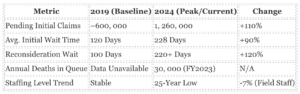
The reduction of the backlog to roughly 950, 000 claims by mid-2025 offers little solace. The system remains dangerously close to the 1 million threshold. The structural deficits in staffing and funding. The 2024 peak proved that the SSA absence the resilience to absorb shocks. A minor increase in applications or a slight dip in funding triggers immediate service degradation. The 1 million claim threshold stands as a monument to administrative neglect. It defines the scope of a failure that is measured not just in days of delay. It is measured in the lives of those who died waiting.
Mortality Metrics: 30, 000 Applicants Dying Annually While Waiting
The administrative collapse of the Social Security Administration (SSA) has generated a lethal byproduct: a rapidly expanding mortality count among applicants. In Fiscal Year 2023, the agency’s own actuaries estimated that 33, 270 individuals died while their disability claims remained pending at the initial, reconsideration, or hearing levels. This figure represents a functional tripling of the mortality rate compared to 2017, when approximately 10, 000 applicants died while awaiting a decision. The system is no longer delaying benefits; it is outlasting the people it was designed to save.
This surge in applicant deaths correlates directly with the lengthening processing times documented in the previous section. As the average wait for an initial decision stretched to nearly eight months, and appeals dragged on for years, the window for survival closed for tens of thousands of claimants. These applicants frequently absence the health insurance or income necessary to manage the very conditions that qualify them for disability. David Camp, CEO of the National Organization of Social Security Claimants’ Representatives, testified that for, “to wait an extra month could be the month in which the untreated, already cured disease kills.”
The Geography of Attrition
The mortality emergency is not distributed evenly across the nation. It concentrates heavily in states with the most severe processing bottlenecks and highest application volumes. Data released by the SSA Office of the Chief Actuary in May 2024 reveals that Southern states, which frequently suffer from lower existing health outcomes and higher poverty rates, bear a disproportionate share of this “death by queue.” Texas and Florida alone accounted for nearly 20% of all applicant deaths in 2023.
The following table details the ten states with the highest number of applicants who died while their claims were pending in Fiscal Year 2023.
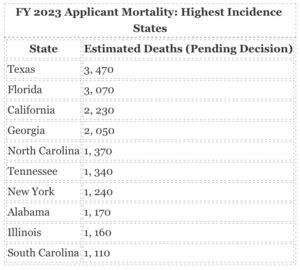
These numbers exclude individuals who died while waiting for a decision from the Appeals Council or federal courts, meaning the true mortality toll of the entire disability determination process is likely higher. In states like Georgia and Tennessee, where wait times for initial decisions have frequently exceeded the national average, the correlation between administrative delay and applicant mortality is clear.
A Decade of Lethal Delays
While the 2023 spike is, the phenomenon of applicants dying in the backlog is a long-standing structural failure. A Government Accountability Office (GAO) report analyzed data from Fiscal Years 2008 through 2019 and found that 109, 725 applicants died specifically while awaiting an appeal decision. This cohort had already been denied at the initial level and was attempting to exercise their right to a hearing. The GAO analysis indicated that male applicants and older claimants were statistically more likely to die while waiting than their counterparts.
The human cost extends beyond mortality. The same GAO report identified that 48, 000 individuals filed for bankruptcy between 2014 and 2019 while waiting for a final decision. This creates a grim trajectory for denied applicants: they deplete their savings, lose their homes, and eventually lose their lives, all while their files sit in an electronic queue. The 33, 270 deaths in 2023 signify that this trajectory has accelerated. As staffing levels at Disability Determination Services (DDS) hit 25-year lows, the capacity of the system to intervene before death occurs has diminished.
Current SSA Commissioner Martin O’Malley acknowledged this reality in September 2024 testimony to the Senate Budget Committee, describing the situation as a “customer service emergency” driven by decades of staffing reductions. Yet the term “customer service” fails to capture the of the outcome. When a claimant dies before a decision is rendered, the case is technically closed, removing it from the backlog. In this perverse administrative loop, the system’s resolves its own caseload through the death of the applicant.
The demographics of the deceased reveal a population already on the margins. The majority of those dying in the queue are older workers, aged 50 to 64, who have paid into the Social Security system for decades can no longer work due to physical or mental deterioration. Their deaths represent not just a failure of bureaucracy, a breach of the social contract. They died waiting for an insurance policy they were compelled to purchase with every paycheck of their working lives.
The 228-Day Stagnation Point
By mid-2024, the average processing time for an initial Social Security disability decision calcified at 228 days. This figure is not a delay; it represents a widespread plateau where the administrative of the Social Security Administration (SSA) ceased to function. In 2019, the average wait time for an initial determination stood at 120 days. The 2024 metric constitutes a 90% increase in processing time over a five-year period. This stagnation occurred even with the agency processing 255, 000 more initial claims in Fiscal Year 2024 than in the previous year, indicating that increased throughput was insufficient to the accumulated backlog.
The “228-day” figure serves as a national average that masks deeper regional failures. While the national mean hovered near eight months, specific Disability Determination Services (DDS) offices operated with delays exceeding one year. The stagnation was driven by a serious imbalance: the inventory of pending initial claims peaked at 1. 26 million in May 2024, while the workforce required to adjudicate these claims contracted. Attrition rates for DDS examiners ranged between 13% and 25% annually during this period, stripping the agency of the institutional knowledge required to process complex medical files.
Geographic Disparities in Processing Times (2024-2025)
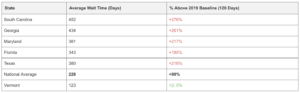
The collapse of processing standards was not uniform. A claimant’s wait time became statistically dependent on their zip code. In 2024, while applicants in smaller states like Vermont and Rhode Island received decisions in roughly four months, claimants in the South and Southeast faced delays nearly triple that duration. The following table details the clear in processing efficiency across select jurisdictions during the height of the 2024 backlog emergency.
The Attrition-Efficiency Loop
The persistence of the 228-day delay through late 2024 resulted directly from a workforce reduction strategy that backfired. By early 2025, the SSA announced plans to reduce its total workforce from approximately 57, 000 to 50, 000 employees. This contraction exacerbated the bottleneck at the initial review stage. Experienced examiners, capable of processing cases rapidly, exited the agency, leaving newer staff to manage record-high caseloads.
Data from December 2025 indicates a slight regression in wait times to approximately 193 days, yet this improvement remains fragile. The reduction was achieved partially through a 3 percentage point drop in approval rates, from 38. 7% to 36. 0%, suggesting that speed was prioritized over thorough adjudication. also, the backlog of pending initial claims, while reduced from its 1. 26 million peak, remained above 940, 000. This volume ensures that any minor disruption in staffing or funding immediately revert processing times to the 2024 stagnation levels.
The human cost of this administrative timeline is quantifiable. In 2024 alone, an estimated 10, 000 claimants died while their applications remained in the initial processing queue. These applicants never received a final decision, their cases closed by mortality rather than adjudication. This metric show the lethality of the 228-day delay; for the most applicants, an eight-month wait is not an inconvenience, a denial of benefits by duration.
Reconsideration Phase Paralysis: The Redundant Rubber Stamp
If the initial application process is a bottleneck, the reconsideration phase is a dead end designed to look like a. After a claimant receives an initial denial, a fate shared by roughly 62% of applicants, they enter the “reconsideration” stage. In theory, this step offers a second look at the medical evidence. In practice, it functions as a bureaucratic stalling method that adds seven months to the timeline while reversing fewer than 15% of decisions.
The mechanics of reconsideration reveal its inherent redundancy. The file does not move to a judge or an independent body. Instead, it remains with the same state-level Disability Determination Services (DDS) that issued the original denial. The only requirement is that a “different” examiner reviews the file. This peer-review model results in a statistical rubber stamp. As of late 2024, the allowance rate at this stage hovered between 13% and 15%, meaning nearly nine out of ten applicants wait over half a year simply to be told “no” a second time.
The Cost of Redundancy
The time cost of this administrative is severe. By early 2025, the average processing time for a reconsideration appeal reached approximately 213 to 244 days. When combined with the initial application wait, a claimant frequently spends 15 to 18 months in the system before they can even request a hearing before an Administrative Law Judge (ALJ), the stage where approval rates historically rise above 50%.
This delay serves as a attrition tool. that nearly 50% of applicants denied at the initial level never file an appeal. They simply drop out of the system, discouraged by the prospect of another year without income. For the SSA, this attrition reduces the hearing backlog artificially, it does so by exhausting the resources and resolve of the disabled rather than adjudicating their claims.
| Metric | Statistic | Impact |
|---|---|---|
| Average Wait Time | 213, 244 Days | Adds ~8 months of delay before ALJ hearing access. |
| Approval Rate | ~13%, 15% | 85%+ of claims are denied again with little review. |
| Processing Agency | State DDS | Same agency as initial denial; no judicial oversight. |
| Claimant Attrition | ~50% | Half of denied applicants abandon valid claims. |
The Failed “Prototype” Experiment
The of reconsideration is not a new discovery; the SSA itself acknowledged it decades ago. For twenty years, the agency operated a “Prototype” model in ten states, including New York, Pennsylvania, and California, where the reconsideration step was eliminated entirely. In these jurisdictions, claimants appealed their initial denial directly to an ALJ, cutting nearly a year off the total wait time.
even with the clear efficiency of the Prototype model, the SSA reinstated reconsideration in all ten states between 2019 and 2020. The agency a need for “national uniformity,” choosing to standardize failure rather than expand success. The reinstatement flooded the reconsideration system with thousands of additional claims, clogging the DDS offices further and diverting resources from initial applications. This policy shift did not improve accuracy; it inserted a mandatory seven-month holding pattern for millions of Americans living in the affected states.
The result is a system that prioritizes process over people. A claimant with a degenerative condition must endure two rounds of paper denials from the same state agency, consuming nearly a year and a half, before they are permitted to speak to a judge. This structural paralysis ensures that for the vast majority of applicants, the “right to appeal” is a test of endurance, not a measure of justice.
Administrative Law Judge absence: The Hearing Level Bottleneck
While the immediate emergency remains the million-claim backlog at the initial filing stage, a secondary and perhaps more permanent fracture exists at the hearing level. The corps of Administrative Law Judges (ALJs), the officials responsible for the final adjudication of denied claims, has shrunk dramatically since 2018. This reduction has created a latent bottleneck that is currently masked by the upstream failures at the Disability Determination Services (DDS). Because the state-level DDS offices are processing claims so slowly, the flow of appeals reaching the hearing offices has temporarily slowed. This “air gap” has allowed the Social Security Administration (SSA) to report a decrease in pending hearings to roughly 262, 000 in fiscal year 2024, a figure the agency touts as a historic low.
This metric is deceptive. The reduction in pending hearings is not a result of increased judicial efficiency rather a symptom of widespread paralysis at the front end. As the 1. 26 million pending initial claims eventually break through the DDS logjam, they flood a hearing system that has lost nearly 26% of its judicial workforce in six years. In 2018, the SSA employed 1, 645 ALJs. By late 2023, that number had plummeted to approximately 1, 170. Even with limited hiring in 2024 bringing the count to 1, 221, the agency absence the adjudicative capacity to handle the impending surge of appeals.
| Fiscal Year | Total Active ALJs | Total Hearing Decisions | Avg. Wait Time (Days) |
|---|---|---|---|
| 2018 | 1, 645 | 602, 000 | ~600 |
| 2021 | 1, 362 | 415, 000 | 326 |
| 2023 | 1, 170 | 287, 000 | 450 |
| 2024 | 1, 221 | 207, 000 | 342 |
The data reveals a collapse in output directly correlated with the reduction in force. Between 2018 and 2024, the total number of hearing decisions issued annually fell from 602, 000 to just over 207, 000. While the backlog of pending hearings has dropped, the wait time for a decision remains stubbornly high, averaging 342 days in 2024. This indicates that even with a lighter caseload, the remaining judges are unable to process claims at pre-pandemic speeds. The attrition is driven by a combination of an aging workforce, mandatory retirement ages, and a hiring freeze that left vacating seats empty for prolonged periods. The Association of Administrative Law Judges (AALJ) reported in 2024 that judges are also forfeiting significant annual leave due to strict caps, further damaging morale and accelerating retirements.
The “pig in the python” effect poses the most serious threat to the system’s stability in 2025 and 2026. Historically, approximately 50% of denied initial claims are appealed to the hearing level. With 1. 26 million initial claims currently pending, the hearing offices must prepare for an influx of over 600, 000 new appeals once the DDS backlog clears. The current ALJ corps, producing only ~200, 000 decisions per year, be mathematically incapable of keeping pace. This mismatch guarantees that the backlog transfer from the state level to the federal hearing level, likely driving wait times back toward the 800-day peaks seen a decade ago.
“We are subject to a background check every five years… yet we forfeit leave and absence the support staff to move cases. The agency projects a massive increase in receipts, the judicial capacity simply isn’t there to meet it.”
, Internal AALJ Union Communication regarding workforce attrition, July 2024.
also, the support structure for these judges has eroded. ALJs rely on decision writers and legal assistants to draft the complex 15-to-20-page legal opinions required for each case. Budget cuts in fiscal year 2024 and 2025 forced a reduction in these support roles, meaning judges must spend more time on administrative drafting and less time holding hearings. In 2025, the SSA workforce was reduced by an additional 3, 700 employees, the support deficit. The result is a hearing system that is functionally hollow: it appears stable only because the pressure is currently contained behind the dam of initial claim failures.
Geographic disparities further complicate the absence. While the national average wait time hovers around 11 months, specific hearing offices in high-volume states like Massachusetts and Georgia report wait times exceeding 15 months. In these jurisdictions, the ratio of claimants to judges is serious unbalanced. Without a targeted hiring initiative to restore the ALJ corps to its 2018 levels, the hearing level is destined to become the catastrophic failure point in the disability adjudication process.
The Great Exodus: Staffing Attrition (2020 – 2025)
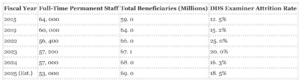
The administrative collapse of the Social Security Administration (SSA) is not a funding failure; it is a personnel emergency of historic proportions. Between 2020 and 2025, the agency experienced a catastrophic “brain drain” that stripped it of its most experienced adjudicators and technical experts. By the close of 2024, SSA staffing levels had plummeted to a 25-year low, dropping to approximately 57, 000 full-time permanent employees. This workforce reduction occurred simultaneously with a surge in beneficiaries, creating an impossible mathematical reality: fewer workers were asked to process significantly higher volumes of complex disability claims.
The attrition was most severe within the State Disability Determination Services (DDS), the state-run agencies responsible for making medical decisions on disability applications. In Fiscal Year 2022, the attrition rate for disability examiners reached 25 percent, the highest level in over two decades. This exodus was not limited to entry-level staff; it included senior examiners with the institutional knowledge required to evaluate detailed medical files. The loss of this expertise directly correlated with the explosion in processing times, as new hires require two years of training to reach full proficiency.
The 2024 Hiring Freeze and Workforce Collapse
The emergency accelerated in 2024 when the agency was forced to implement a strict hiring freeze due to congressional budget stagnation. Commissioner Martin O’Malley testified in March 2024 that the agency was operating with its lowest staffing levels in 50 years relative to the population served. By the end of Fiscal Year 2024, the SSA was serving 7 million more beneficiaries than in 2015, yet doing so with 7, 000 fewer employees. The freeze prevented the agency from backfilling the thousands of employees who departed annually, locking the administration into a pattern of shrinking capacity.
Internal surveys from 2023 and 2024 revealed a workforce on the brink of collapse. Nearly 24 percent of new hires indicated an intention to leave the agency within two years, citing unmanageable caseloads and insufficient training. This “probationary attrition” meant that even when the agency could hire, it failed to retain talent long enough to impact the backlog. The return-to-office mandates enforced in late 2024 further exacerbated turnover, particularly among IT and legal support staff who could find more flexible conditions in the private sector.
Table: The Inverse Relationship of Staff to Workload (2015 – 2025)
The following data illustrates the between the agency’s workforce capacity and its beneficiary obligations. While the number of Americans relying on Social Security grew steadily, the workforce dedicated to serving them contracted sharply.
The “DOGE” Buyouts and 2025 Reductions
The downward trajectory continued into 2025. Following the inauguration, new administrative directives aimed at government efficiency, spearheaded by the Department of Government Efficiency (DOGE), introduced aggressive buyout packages designed to reduce federal headcount. Reports indicate that over 1, 000 field office workers accepted these buyouts in the half of 2025 alone. While intended to cut costs, these departures disproportionately affected frontline offices in rural states like Wyoming and Missouri, which saw staff reductions exceeding 14 percent in a single year.
The impact of these cuts was immediate. By August 2025, field offices reported a 20 percent reduction in available staff compared to the previous year. To manage the shortfall, the agency reassigned approximately 1, 000 remaining field workers to answer the national 800-number, further stripping local offices of the personnel needed to conduct in-person disability interviews. This reshuffling of resources did not solve the absence; it displaced the bottleneck from the phone lines to the physical counters.
“We are constantly trying to sprint up a downward escalator. The biggest drag on our performance isn’t our telework balance, it’s reducing staffing to a 50-year low.” , Martin O’Malley, former SSA Commissioner, November 2024.
The loss of human capital between 2020 and 2025 represents a structural of the Social Security Administration. The agency did not just lose employees; it lost the cumulative decades of regulatory expertise required to navigate the complex disability determination process. With a workforce hovering near 53, 000 and a beneficiary population method 70 million, the ratio of staff to applicants has reached a breaking point that technology and automation have failed to.
Budgetary: Inflation Adjusted Funding Cuts Since 2010
The administrative collapse of the Social Security Administration (SSA) is not a product of sudden mismanagement the mathematical inevitability of a decade-long financial siege. Since 2010, the agency’s operating budget has systematically decoupled from its workload, creating a resource vacuum that no amount of internal efficiency can fill. While the number of beneficiaries expanded by millions, the administrative funding required to process their claims contracted in real terms, forcing the agency to cannibalize its own infrastructure to keep the lights on.
Between 2010 and 2021, the SSA’s operating budget fell by approximately 17 percent after adjusting for inflation. This occurred simultaneously with a demographic wave: the retirement of the Baby Boomer generation. By 2024, the agency was serving 50 percent more customers than it did in 1995, yet it operated with staffing levels comparable to those of 1972. The created a structural deficit where fixed costs, rent, postage, and mandatory salary adjustments, consumed an ever-growing share of a stagnant appropriation, leaving virtually no margin for hiring or technological modernization.
The Staffing-Workload
The human cost of this budgetary starvation is visible in the agency’s workforce numbers. In fiscal year 2024 alone, a hiring freeze necessitated by flat funding levels resulted in the attrition of 4, 500 permanent staff members. These departures were not administrative trimmings; they included claims specialists, teleservice representatives, and administrative law judges, the essential of disability adjudication. The agency entered 2025 with a workforce of approximately 55, 000, a historic low that Commissioner Martin O’Malley warned could precipitate a “system collapse.”
The following table illustrates the widening chasm between the demand for SSA services and the human resources available to meet it. The data highlights the inverse relationship between beneficiary growth and administrative capacity over the last decade.
| Metric | 2015 Status | 2019 Status | 2024 Status | 10-Year Trend |
|---|---|---|---|---|
| Total Beneficiaries | 59. 9 Million | 64. 1 Million | 72. 9 Million | ▲ 21. 7% Increase |
| Core Staffing Levels | 62, 000 | 60, 000 | 55, 000 | ▼ 11. 3% Decrease |
| Initial Claims Pending | 607, 000 | 593, 000 | 1. 26 Million | ▲ 107% Increase |
| Admin Budget (Real $) | $11. 8 Billion | $11. 1 Billion | $10. 9 Billion | ▼ 7. 6% Decrease |
The 2024-2025 Appropriation Battle
The emergency accelerated during the fiscal year 2024 and 2025 budget pattern. even with the backlog breaching the one-million-claim threshold, Congress repeatedly failed to fully fund the President’s budget requests. For FY 2025, the White House requested $15. 4 billion, a figure calculated to restore staffing to 2023 levels and reduce wait times. In response, the House Appropriations Committee advanced legislation in mid-2024 that proposed cutting the administrative budget by an additional $450 million.
This proposed reduction disregarded the agency’s plea that fixed costs rise automatically each year. When budgets remain flat in nominal dollars, they function as a cut in real dollars due to mandatory pay raises and inflationary pressures on goods and services. The 2024 hiring freeze, a direct result of this fiscal tightening, extended the average wait time for an initial disability decision to nearly eight months.
“We are serving more customers than ever before with the lowest staffing levels in 50 years. The math simply does not work. Every dollar cut from our administrative budget directly into longer wait times for the American public.”
, Statement by SSA Officials to House Appropriations Committee, 2024
The cumulative effect of these decisions is a “hollowed-out” agency. Field offices, which serve as the primary entry point for disabled applicants, have seen their staff-to-beneficiary ratios explode. In states, a single field office worker is responsible for over 4, 000 beneficiaries. This dilution of service capacity ensures that even when a claim is filed, it enters a processing queue that moves at a glacial pace, not due to incompetence, due to the simple absence of personnel to work the file.
Legacy Infrastructure: The Risks of 40-Year-Old IT Systems
The Social Security Administration operates on a digital foundation that predates the modern internet. While the agency distributes over $1. 4 trillion in annual benefits, its core operations rely on approximately 60 million lines of COBOL code. This programming language, developed in 1959, remains the structural bedrock of the agency’s Master Data Access Method (MADAM) database, a system implemented in the 1980s. This reliance on antiquated technology creates a fragile environment where modernization efforts frequently fail and maintenance costs consume the vast majority of the information technology budget.
The operational reality for claims examiners involves navigating a “green screen” interface known as PCOM (Personal Communications). This terminal emulator requires staff to memorize cryptic command codes to access beneficiary data. Internal audits indicate that this interface reduces examiner productivity by approximately 15 to 20 percent compared to modern, browser-based systems. Examiners must toggle between multiple disjointed applications to view medical records, earnings history, and claim status. This fragmentation forces manual data entry across systems, increasing the risk of clerical errors and extending the time required to process a single claim.
The Fragmentation of State Systems
A primary driver of the backlog is the absence of a unified case processing system. The SSA relies on 54 separate Disability Determination Services (DDS) offices across the states and territories. Each DDS operates its own customized legacy system to manage workflows. These systems do not communicate smoothly with the SSA’s federal mainframe. Data transfers between state and federal systems frequently suffer from compatibility errors, leading to “stuck” claims that require manual intervention to resolve.
The agency attempted to solve this fragmentation with the Disability Case Processing System (DCPS). Launched to replace the 54 state systems with a single unified platform, the project became a case study in federal IT failure. By 2016, the SSA had spent over $300 million on DCPS with little functional software to show for it. Independent assessments revealed that the project absence a single responsible leader and relied on 46 different vendors. The failure of DCPS forced the agency to “reset” the program, leaving state examiners stuck with aging, incompatible tools well into the 2020s.
The 2025 Modernization Failure
The risks of this technical debt materialized catastrophically in early 2025. An initiative led by the Department of Government Efficiency (DOGE) attempted to force a rapid conversion of the SSA’s COBOL code to modern languages within a matter of months. This “blast furnace” method disregarded the complexity of the agency’s bespoke business logic. The hasty migration resulted in severe system instability, causing widespread website outages and locking millions of users out of their accounts. Reports from April 2025 indicated that the intrusion triggered data corruption risks, threatening the integrity of wage histories for millions of Americans.
The 2025 incident demonstrated that the SSA’s legacy infrastructure cannot be replaced overnight. The “business logic” encoded in those 60 million lines of COBOL represents decades of legislative changes and court rulings. Converting this code requires a deep understanding of the underlying laws, not just the syntax. The failure of the 2025 push exacerbated the backlog, as technical staff were diverted from processing claims to stabilizing the crashed systems.
The Cost of Obsolescence
Maintaining these zombie systems imposes a heavy “innovation tax” on the agency. In fiscal year 2024, the Government Accountability Office (GAO) reported that the SSA failed to properly oversee 90 percent of its $2. 2 billion IT budget, which was allocated primarily to operations and maintenance. This spending pattern leaves little room for genuine modernization. The agency spends billions just to keep the lights on, while the “Talent Cliff” looms. of the workforce capable of maintaining COBOL code has reached retirement age, leaving the agency reliant on a shrinking pool of contractors and rehired annuitants.
| Fiscal Year | Total IT Budget (Billions) | Operations & Maintenance (O&M) % | Modernization Investment % | Major System Incidents |
|---|---|---|---|---|
| 2020 | $1. 9 | 78% | 22% | Periodic PCOM outages |
| 2022 | $2. 1 | 82% | 18% | DDS data transfer delays |
| 2024 | $2. 2 | 90% | 10% | GAO flags absence of oversight |
| 2025 | $2. 4 | 95% | 5% | DOGE-induced system crash |
The reliance on legacy infrastructure creates a bottleneck that no amount of hiring can fully resolve. Even if the SSA fills its staffing vacancies, new examiners be handicapped by tools from the 1980s. The inability to automate routine tasks means that every claim requires manual review, ensuring that the processing time remains high even as the volume of applications fluctuates.
The Customer Service Blackout: 50 Percent Unanswered Call Rates
The Social Security Administration’s national 800 number, intended as the primary lifeline for millions of Americans, has ceased to function as a reliable service channel. By late 2023 and continuing through 2024, the agency’s telecommunications infrastructure collapsed under the weight of staffing absence and antiquated technology. Official testimony from Commissioner Martin O’Malley in November 2024 revealed a metric of failure: of the approximately 7 million citizens attempting to call the agency each month, roughly 4 million hung up in frustration before ever speaking to an agent. This 57 percent abandonment rate represents a de facto blackout of government services for the disabled, the elderly, and the desperate.
This blackout is not a result of high volume; it is the mathematical consequence of a decimated workforce. The agency’s teleservice centers, which handle the bulk of these calls, operated with attrition rates exceeding 20 percent in 2024. As experienced agents departed, they were not replaced at a rate sufficient to maintain basic operations. The result was a system where callers faced a binary choice: endure hold times that frequently exceeded 90 minutes or abandon the attempt entirely. For a disability claimant attempting to check the status of a delayed application, this barrier is frequently.
The Metric Manipulation: Speed of Answer vs. Actual Access
To mask the severity of this emergency, the SSA has frequently relied on the “Average Speed of Answer” (ASA) metric, which presents a distorted view of reality. In fiscal year 2025, the agency touted an ASA that dropped to approximately 7 minutes by September. yet, this figure excludes the millions of callers who are deflected into automated systems or who opt for a callback. Independent audits and Inspector General reports clarify the gap: while the ASA appeared manageable, the actual wait time for a callback remained serious high.
In January 2025, the average wait time for a callback peaked at 2 hours and 32 minutes. For those who chose to remain on the line, the queue wait time reached 1 hour and 40 minutes. The between the reported “speed of answer” and the lived experience of the caller creates a statistical mirage, allowing administrative officials to claim progress while claimants remain trapped in a communications limbo.
| Metric | FY 2019 (Pre-Pandemic) | FY 2024 (emergency Peak) | Jan 2025 (Post-emergency Peak) |
|---|---|---|---|
| Average Speed of Answer (ASA) | 20 minutes | 42 minutes | 30 minutes |
| Actual Callback Wait Time | N/A (Data not tracked) | ~90 minutes | 152 minutes |
| Call Abandonment Rate | 5% | ~50% | 25% (Official) / Higher (Real) |
| Busy Signal Rate | < 1% | 6% (Average) | 29. 4% (March 2025 Spike) |
The Busy Signal Resurgence
Perhaps the most worrying indicator of system failure is the return of the busy signal, a relic of 20th-century telecommunications that should be obsolete in a modern call center environment. In March 2025, the “busy message rate”, the percentage of callers who were disconnected immediately because all queues were full, spiked to 29. 4 percent. This means nearly one in three callers was blocked at the gate, unable to even enter the queue to wait on hold. This “courtesy disconnect” is a functional denial of service.
The impact of these disconnects falls disproportionately on disability applicants. Unlike retirement beneficiaries who may have predictable questions, disability claimants frequently need to resolve complex, case-specific problem involving medical evidence or hearing schedules. These interactions require human intervention. When 50 percent of calls go unanswered and 30 percent of attempts result in a busy signal, the disability determination process grinds to a halt. The claimant cannot provide updates, the examiner cannot request information, and the backlog grows.
Technological Transition and Transparency Failures
The agency’s attempt to transition to a ” Generation Telephony” platform in 2024 was intended to resolve these bottlenecks initially exacerbated them. The migration caused technical outages and routing errors that further inflated wait times. also, in mid-2025, the agency removed several key performance metrics from its public dashboard, including the specific breakdown of callback wait times. This reduction in transparency prevents oversight bodies and the public from tracking the true extent of the service collapse.
The correlation between the phone blackout and the disability backlog is direct. When applicants cannot reach the SSA to correct errors or schedule exams, their claims stagnate. The 1. 26 million pending initial claims are not just a pile of paperwork; they are a queue of people trying to call a number that no one answers.
The Federal-State Fracture
The operational heart of the Social Security disability system does not beat in Baltimore, in fifty state agencies known as Disability Determination Services (DDS). These state-run bureaus are fully funded by the federal government yet staffed by state employees, creating a fractured administrative structure that has buckled under recent pressures. While the Social Security Administration (SSA) sets the policy, it relies on state governments to execute the labor. This arrangement has resulted in a catastrophic misalignment of resources and incentives, turning the application process into a geographic lottery where an applicant’s zip code frequently dictates their financial survival.
Between 2019 and 2023, this federal-state partnership faced a synchronized collapse. While federal oversight remained rigid, state-level operational capacity disintegrated. Productivity within these DDS offices plunged by 21 percent, a decline directly attributable to the mass exodus of trained examiners. Unlike federal employees who benefit from standardized General Schedule (GS) pay, DDS examiners are subject to state salary caps, which frequently lag significantly behind private sector wages and federal equivalents. In Alaska, for instance, examiners were paid approximately 25 percent less than their counterparts in other states, even with facing the highest cost of living in the nation.
The Exodus of Expertise
The primary driver of the backlog is not a spike in applications, a collapse in the workforce capable of processing them. The attrition rate for disability examiners reached historic highs, peaking at 25 percent in fiscal year 2022. This means one in four examiners walked off the job in a single year. While attrition moderated to 16. 3 percent by late 2024, the damage to institutional knowledge was already terminal. The complexity of disability adjudication requires roughly two years of training for a new examiner to reach full proficiency. When veteran staff depart, they take with them decades of medical-vocational expertise that new hires cannot immediately replace.
The consequences of this “brain drain” are measurable in days and lives. As experienced staff fled, the remaining workforce became overwhelmed, leading to a vicious pattern of burnout and further departures. By the end of fiscal year 2024, the average processing time for an initial disability claim had ballooned to 231 days, an 81 percent increase from 2019 levels. In states with the most severe staffing crises, the delays were far worse. Florida applicants faced average wait times of 343 days in 2024, while Georgia residents waited 434 days, more than a year just for an initial denial or approval.
“The complexity of the disability examiner position makes losing experienced staff detrimental to a DDS as it results in a significant loss of institutional knowledge.” , SSA Office of the Inspector General, July 2025 Report
The Geography of Delay
The collapse has not been uniform, creating severe inequities based on location. State agencies in Texas and Florida, plagued by high attrition and inability to compete with private sector wages, saw their backlogs explode. In Texas, the inventory of pending claims swelled from 124, 132 in July 2023 to 171, 803 by June 2024. During this period, the state’s processing capacity dropped to approximately 10, 400 determinations per month, down from 16, 000 per month in 2008. Conversely, smaller states with more stable workforces, such as Rhode Island, maintained processing times closer to 125 days, highlighting the widespread inconsistency of the DDS model.

The Training Bottleneck
Attempts to the bleeding through mass hiring have yielded limited immediate results. In fiscal year 2023, the SSA authorized the hiring of 1, 900 new examiners. Yet, the net impact on productivity was negligible in the short term. These recruits required intensive supervision from the few remaining senior examiners, further slowing case processing in the immediate window. By early 2024, budget constraints forced a hiring freeze, reversing the modest headcount gains made the previous year. This stop-and-go method to staffing has left DDS offices in a state of permanent recovery, unable to clear the accumulated mountain of aged claims.
The administrative failure at the state level forces a grim reality upon applicants: the system designed to protect them has become their primary adversary. With over 500, 000 claims pending for more than 180 days at the start of fiscal year 2024, the “safety net” has dissolved for half a million Americans, leaving them suspended in a bureaucratic void where the only certainty is delay.
The Long COVID Variable: Impact on Application Volume
The anticipated “tsunami” of disability claims triggered by Long COVID has not manifested as a vertical spike in application charts, rather as a widespread clogging of the adjudication. While the Centers for Disease Control and Prevention (CDC) estimated in 2024 that over 17 million adults were experiencing Long COVID, the Social Security Administration (SSA) did not record a proportional explosion in new filings. Instead, the agency faces a more insidious emergency: a surge in complex, labor-intensive claims that absence a dedicated medical listing, forcing adjudicators to process them through a labyrinth of “equivalent” impairments.
This disconnect between disease prevalence and application volume from the “objective evidence” barrier. SSA regulations require disability to be proven via medically determinable impairments (MDIs) substantiated by clinical diagnostics, lab tests, MRIs, or x-rays. Long COVID, frequently characterized by self-reported symptoms like post-exertional malaise and cognitive dysfunction (“brain fog”), frequently eludes standard diagnostic capture. Consequently, chance applicants are self-selecting out of the system, discouraged by the high probability of denial, or are being rejected at the initial technical screen before their medical merits are even weighed.
The impact of these claims is visible not in the number of applications, in the duration of their processing. A Long COVID claim requires a disability examiner to review hundreds of pages of fragmented medical records to construct a “residual functional capacity” assessment from scratch, as no “Listing 3. 15” exists for the condition. This added complexity has contributed to the ballooning wait times for all applicants. By fiscal year 2024, the average processing time for an initial disability decision reached 231 days, nearly double the 120-day average of 2019.
| Metric | 2019 (Pre-Pandemic) | 2024 (emergency Peak) | 2025 (Current Status) |
|---|---|---|---|
| Initial Claim Wait Time | 120 Days | 231 Days | 193 Days |
| Pending Initial Claims | ~600, 000 | 1. 26 Million | ~940, 000 |
| Initial Approval Rate | ~45% | 38. 7% | 36. 0% |
| Annual Applicant Deaths | ~8, 000 | 10, 000+ | 10, 000+ |
The data reveals a disturbing trend in how the backlog is being reduced: through denial. While the total inventory of pending claims dropped from its peak of 1. 26 million in May 2024 to approximately 940, 000 by late 2025, this reduction was driven largely by a decrease in approval rates rather than an increase in processing efficiency. The initial allowance rate fell to 36. 0% in 2025, suggesting that the agency is clearing its desk by raising the evidentiary bar, penalizing applicants with or hard-to-document conditions.
also, the “invisible” volume of Long COVID is creating a secondary emergency in the appeals process. Applicants denied at the initial stage due to a absence of objective evidence are flooding the reconsideration and hearing levels, where administrative law judges (ALJs) must grapple with the same evidentiary gaps. This has kept the hearing backlog stubbornly high, even as the initial claims backlog sees cosmetic improvements. The system is not resolving these cases; it is churning them.
“The concern is real that Long COVID may result in an increase in applications… most individuals do so on the basis of health effects not covered in the Listings.” , National Academies of Sciences, Engineering, and Medicine Report to SSA (2024)
The administrative failure is compounded by a staffing exodus. The complexity of Long COVID claims burns out examiners faster than standard cases. Between 2020 and 2024, attrition rates for state Disability Determination Services (DDS) examiners ranged from 13% to 25% annually. The agency is attempting to process a, mass-disabling event with a workforce that is shrinking and losing its most experienced members. The result is a system where the “variable” of Long COVID acts as a force multiplier for every pre-existing within the SSA.
The Postcode Lottery: Geography as Destiny
The Social Security Administration operates under a federal mandate, applying a singular set of laws across all fifty states. Yet, an analysis of 2024 and 2025 performance metrics reveals a fractured system where an applicant’s zip code frequently determines their financial survival. The in approval rates between states has widened into a statistical chasm, creating a “postcode lottery” that defies the principle of equal protection under the law. A disabled worker in New Hampshire or Alaska faces a fundamentally different administrative reality than an identical applicant in Mississippi or Oklahoma.
Fiscal Year 2025 that the national average for initial disability claim approvals dropped to approximately 36 percent, a decline from 38. 7 percent in the previous year. yet, this national average masks extreme regional volatility. In states like New Hampshire and North Dakota, initial approval rates consistently hover above 50 percent. Conversely, applicants in the southern United States face a widespread wall of rejection. Mississippi, Oklahoma, and Arkansas report initial allowance rates plummeting toward 30 percent. This 20-point spread means a resident of Concord is nearly twice as likely to receive benefits on their attempt as a resident of Jackson, even with being subject to the exact same medical listings and vocational rules.
The Hearing Level Divide
The disparities become even more pronounced at the Administrative Law Judge (ALJ) hearing level, the stage where most disputes are resolved. While the national hearing approval average sat at roughly 59 percent in early 2025, specific hearing offices operated as statistical outliers. The Ponce, Puerto Rico hearing office recorded an approval rate of 84. 8 percent, the highest in the jurisdiction. In clear contrast, the Little Rock, Arkansas office approved only 40. 5 percent of cases during the same period. This variance suggests that the venue of the hearing is as predictive of the outcome as the medical evidence in the file.
These anomalies are not limited to interstate comparisons; they exist within single states. In New York, the Queens hearing office maintained an approval rate of nearly 80 percent, while other offices in the same region lagged significantly behind. Such data points indicate that local legal culture, the availability of vocational experts, and the specific roster of judges create micro-climates of adjudication that override federal uniformity.
Table: The Geography of Denial (FY 2024-2025)
The following table contrasts the highest and lowest performing jurisdictions for disability allowances, highlighting the magnitude of the geographic gap.
| Metric | Highest Approval Jurisdiction | Rate (%) | Lowest Approval Jurisdiction | Rate (%) |
|---|---|---|---|---|
| Initial Application | New Hampshire | 57. 4% | Washington, D. C. | 30. 0% |
| Reconsideration | New Hampshire | 26. 0% | Colorado | 11. 0% |
| ALJ Hearing (Office) | Ponce, Puerto Rico | 84. 8% | Little Rock, Arkansas | 40. 5% |
| ALJ Hearing (State) | Hawaii | 78. 0% | Kansas | 42. 0% |
The Human Factor: Judicial Variance
Beyond regional trends, individual judge behavior introduces a chaotic variable into the decision process. Data from 2024 shows that within the same hearing office, one judge may approve 80 percent of claims while a colleague down the hall approves fewer than 20 percent. This “human factor” undermines the agency’s claim of objective medical adjudication. The assignment of a case to a specific judge is random, yet it frequently seals the claimant’s fate before a single piece of evidence is reviewed.
The impact of these disparities is compounded by the backlog. In high-denial regions, applicants are forced into the appeals pattern at higher rates, clogging the system further. A 30 percent initial approval rate in Oklahoma guarantees that 70 percent of applicants must either abandon their claim or file for reconsideration, adding thousands of cases to an already overwhelmed queue. This feedback loop creates a self-perpetuating emergency in states with the strictest adjudication standards, where the administrative load is heaviest exactly where the system is least.
State Disability Determination Services (DDS) offices, which handle initial claims, also face varying resource constraints that correlate with denial rates. Offices with higher staff turnover and lower funding levels frequently resort to “technical denials” or hasty reviews to manage caseloads. The data suggests that in jurisdictions, the default answer has become “no,” simply because it is the fastest way to clear a file from a desk.
The Disability Trust Fund Solvency Myth vs Administrative Reality
A pervasive misconception distorts the public understanding of the disability backlog: the belief that the Social Security Administration (SSA) absence the funds to pay benefits. This is factually incorrect. According to the 2025 Social Security Trustees Report, the Disability Insurance (DI) Trust Fund is projected to remain able to pay 100 percent of scheduled benefits through at least 2099. Unlike the Old-Age and Survivors Insurance (OASI) fund, which faces depletion in the early 2030s, the disability fund runs an actuarial surplus. The emergency is not one of benefit insolvency of administrative strangulation. The money to pay claimants sits securely in the Treasury, yet the required to unlock those funds has been dismantled by a decade of legislative negligence.
The disconnect from the bifurcation of Social Security’s funding. While payroll taxes automatically fund the Trust Funds (mandatory spending), the agency’s operating budget, the money used to hire staff, upgrade IT, and process claims, is subject to annual congressional appropriations (discretionary spending). This structural vulnerability has allowed Congress to starve the agency’s operations while the benefit accounts remain flush. Between 2015 and 2025, the number of Social Security beneficiaries rose by over 7 million, yet the agency’s fixed operating overhead was reduced by approximately 20 percent after adjusting for inflation.
| Metric | 2015 Status | 2025 Status | % Change / Impact |
|---|---|---|---|
| DI Trust Fund Solvency | Solvent through 2020s (Projected) | Solvent through 2099 | +70 Years (Surplus) |
| Total Beneficiaries | ~59 Million | ~69 Million | +17% Workload Increase |
| Full-Time Staffing | ~64, 000 | ~55, 000 | -14% Workforce Contraction |
| Admin Budget (Real $) | Baseline | -20% vs Inflation | Severe Underfunding |
| Initial Wait Time | ~110 Days | ~230 Days | +109% Delay |
The consequences of this “starve the beast” strategy became undeniable in late 2024. Former Commissioner Martin O’Malley testified that the agency had reached a “customer service emergency,” operating with staffing levels at a 50-year low relative to the beneficiary population. In Fiscal Year 2024, the agency was forced to implement a hiring freeze due to a flat budget allocation, causing staffing levels to drop even further FY 2023 numbers. This attrition occurred precisely when the agency needed to process a record inventory of pending claims. The Limitation on Administrative Expenses (LAE) has been capped so aggressively that the SSA operates on less than 1 percent of its annual benefit payments. For comparison, private disability insurers spend 19 to 24 percent of benefit payouts on administration.
This administrative austerity creates a paradox where the federal government holds adequate funds to support disabled workers refuses to pay for the “key” to the vault. The backlog is not a byproduct of a bankrupt system; it is the direct result of a policy choice to sever the link between workload volume and operational funding. By 2025, the wait time for an initial disability decision hovered near eight months, a delay imposed not by a absence of trust fund dollars, by a absence of payroll dollars for claims examiners.
The 2025 Trustees Report confirmed that the DI Trust Fund’s reserves are growing, driven by lower-than-projected disability incidence rates and high employment levels. yet, this financial health is irrelevant to the applicant waiting 228 days for a denial. The solvency of the trust fund masks the insolvency of the bureaucracy. Until the administrative budget is decoupled from discretionary political squabbles or indexed to beneficiary growth, the backlog regardless of the trillions of dollars sitting in the Disability Insurance Trust Fund.
Economic: Bankruptcy Correlations Among Waitlisted Applicants
The administrative collapse of the Social Security Administration (SSA) has created a secondary emergency of financial insolvency for applicants. For American workers who suffer a disabling injury or illness, the loss of wages is immediate, yet the replacement income from disability benefits is frequently delayed by nearly a year or more. This temporal gap forces thousands of households into a financial death spiral where the liquidation of assets becomes the only viable survival strategy. Data confirms that the backlog is not a logistical delay; it is a direct driver of personal bankruptcy filings among the disabled population.
A landmark analysis by the Government Accountability Office (GAO) quantified this devastation, revealing that between fiscal years 2014 and 2019, approximately 48, 000 individuals filed for bankruptcy while awaiting a final decision on their disability appeals. This figure represents 1. 3% of all applicants who reached the appeal stage during that period. These filings occurred specifically during the administrative limbo when applicants are legally barred from engaging in “substantial gainful activity” (earning more than $1, 550 per month in 2024) to prove their eligibility, yet receive no support from the system designed to protect them.
The correlation between processing delays and financial ruin is causal, not coincidental. Research published by the National Bureau of Economic Research (NBER) indicates that being approved for Social Security Disability Insurance (SSDI) at the initial level reduces the likelihood of filing for bankruptcy by 30% over the subsequent three years. Conversely, every month of delay increases the probability of insolvency. With initial decision wait times swelling to an average of 230 days in fiscal year 2024, and the reconsideration stage adding another 230 days, applicants face a minimum of 15 months of income deprivation before they can even request a hearing. This duration far exceeds the liquidity buffers of the average American household.
| Timeline Stage | Administrative Status | Financial Risk Profile |
|---|---|---|
| Months 1-3 | Application Pending | Depletion of liquid savings; reliance on credit cards for basic utilities. |
| Months 4-7 | Medical Review (DDS) | Credit score degradation; missed mortgage/rent payments; vehicle repossession risk. |
| Months 8-10 | Initial Denial & Reconsideration Filing | Exhaustion of family/friend loans; utility shut-off notices; maxed credit limits. |
| Months 11-16 | Reconsideration Processing | serious Insolvency Point: Chapter 7/13 bankruptcy filing to halt foreclosure/eviction. |
| Months 17+ | Hearing Waitlist | Total asset liquidation; homelessness risk; permanent credit exclusion. |
The economic damage extends beyond formal bankruptcy. Foreclosure and eviction rates are significantly higher among denied or waitlisted applicants. The NBER study linked administrative records to court data, finding that the “allowance” of benefits results in large declines in home sales and foreclosures. When the SSA fails to render a timely decision, it removes the foreclosure protection that the safety net is supposed to provide. By the time a favorable decision arrives, frequently involving a lump-sum backpay award, the applicant has frequently already lost their home. The retroactive payment, while substantial, cannot reverse a completed foreclosure or expunge a bankruptcy from a credit report.
Demographic data shows that this administrative violence is not evenly distributed. The GAO found that applicants who filed for bankruptcy while waiting were disproportionately older, female, and possessed higher levels of education than the general applicant pool. even those with established credit histories and accumulated assets are rapidly broken by the duration of the wait. The Urban Institute further notes that lower service levels and processing delays disproportionately harm applicants with fewer resources, who may not have the means to file for bankruptcy protection and instead face informal eviction and total destitution.
The surge in general bankruptcy filings in 2024, rising 16. 2% in the year ending September 30, compounds the danger for disability claimants. As the broader economy tightens, the informal safety nets of family support weaken, leaving waitlisted applicants with fewer lifelines. The SSA’s inability to process claims within a reasonable timeframe converts a medical emergency into a permanent economic catastrophe, stripping disabled workers of their middle-class status long before their medical eligibility is even adjudicated.
The Representative Payee emergency: Oversight Failures for the
The Social Security Administration’s Representative Payee program constitutes one of the largest fiduciary systems in the federal government, yet it operates with a level of oversight that has been repeatedly exposed as dangerously insufficient. As of fiscal year 2024, approximately 5. 7 million representative payees managed roughly $81. 4 billion in annual benefits for nearly 7. 7 million beneficiaries. These funds are the sole lifeline for the agency’s most population: children, the cognitively impaired, and the elderly who cannot manage their own finances. even with the immense responsibility inherent in this role, the method for monitoring these funds remains porous, reactive, and frequently ineffective.
The structural failure of this program lies in the sheer of the population versus the resources allocated for verification. While the Strengthening Protections for Social Security Beneficiaries Act of 2018 attempted to oversight by shifting monitoring duties to state Protection and Advocacy (P&A) systems, the volume of beneficiaries dwarfs the audit capacity. In fiscal year 2024, P&A grantees conducted only 4, 018 site reviews nationwide. When measured against a population of 5. 7 million payees, this review rate is statistically negligible, leaving the vast majority of arrangements without any external scrutiny unless a specific allegation of abuse is filed.
The Care Data Vacuum
A particularly egregious oversight failure exists at the intersection of Social Security and the care system. The 2018 legislation mandated data exchanges between the SSA and state care agencies to prevent the misappropriation of benefits belonging to youth in state custody. yet, implementation has been catastrophic. A Government Accountability Office (GAO) report from 2021 revealed that most states had failed to implement these data exchanges. This administrative black hole allows child welfare agencies to routinely absorb the survivor or disability benefits of youth to offset the cost of their care, a practice that forces orphaned or disabled children to pay for their own government-mandated placement.
Institutional Theft and Organizational Rot
The risk of fraud is not limited to individual bad actors; it permeates organizational payees entrusted with the care of hundreds of beneficiaries. In December 2023, a whistleblower at a skilled nursing facility in California exposed a massive scheme where staff orchestrated the theft of hundreds of thousands of dollars from residents. The investigation revealed that employees were “recycling” residents to and from hospice care to billable services while simultaneously draining their personal benefit accounts. This case highlights a serious weakness: organizational payees, frequently managing funds for dozens or hundreds of individuals, can hide widespread theft behind the veil of administrative complexity.
Similarly, a 2022 Office of the Inspector General (OIG) report detailed the case of a Texas woman who operated a boarding home and served as the representative payee for numerous residents. She charged beneficiaries between $500 and $700 a month for “care” that was virtually non-existent, leaving them to fend for themselves while she defrauded Medicaid and the SSA. She was eventually sentenced to prison and ordered to pay over $781, 000 in restitution, only after years of exploitation had already occurred.
The “Dead Payee” Loophole
The agency’s inability to track the basic important status of its beneficiaries and payees continues to result in substantial losses. In a case finalized in 2022, an Indiana woman concealed her father’s death for 11 years, continuing to collect his benefits as his representative payee. By the time the fraud was detected, she had stolen over $192, 000. This type of “eligibility fraud” because the agency relies heavily on self-reporting, a system that is fundamentally flawed when the reporter is the one profiting from the deception.
| Metric | Statistic |
|---|---|
| Total Beneficiaries with Payees | ~7. 7 Million |
| Total Annual Funds Managed | ~$81. 4 Billion |
| Total Representative Payees | ~5. 7 Million |
| P&A Site Reviews Conducted | 4, 018 |
| Review Rate (approximate) | 0. 07% |
The between the funds at risk and the audits performed confirms that the SSA has outsourced the financial security of its most defenseless beneficiaries to an honor system. Without a radical increase in automated data matching and onsite compliance reviews, the Representative Payee program remain a target for predators who view these accounts not as a trust, as an unsecured revenue stream.
The $23 Billion Ledger of Errors
The Social Security Administration’s administrative collapse is not a matter of delayed approvals; it is equally defined by the chaotic management of payments already issued. By the end of Fiscal Year 2023, the agency carried an uncollected overpayment balance of $23 billion. This figure represents benefits paid to disabled workers, widows, and retirees that the SSA later determined were erroneous. The of these errors accelerated drastically in the post-pandemic period. In Fiscal Year 2022 alone, the agency identified $11. 1 billion in new overpayments, a 65% increase from the previous year. This surge indicates a breakdown in the agency’s internal controls and data exchange method, rather than a sudden spike in beneficiary fraud.
For the beneficiaries, the administrative error manifests as a sudden, frequently five-figure debt. An investigation by KFF Health News and Cox Media Group in late 2023 revealed that approximately one million Americans receive overpayment notices annually. These notices frequently demand immediate repayment of amounts ranging from $10, 000 to over $100, 000., the errors went by the agency for years, allowing the “debt” to compound while the beneficiary spent the funds on basic survival needs like rent and food. The SSA’s Inspector General reported that between 2015 and 2022, the agency made nearly $72 billion in improper payments, a volume that suggests widespread failure rather than clerical mistakes.
The Administrative Cost of Correction
The required to claw back these funds imposes a heavy tax on the agency’s limited resources. Every overpayment notice triggers a chance cascade of administrative actions: requests for reconsideration, waiver applications, and negotiation of repayment plans. Each of these steps requires manual review by the same claims specialists responsible for processing initial disability applications. When a beneficiary disputes a debt or pleads financial hardship, the file enters a secondary backlog of “post-entitlement” actions. As of 2024, the agency struggled to process these actions in a timely manner, leaving beneficiaries in financial limbo and diverting thousands of work-hours away from the front-line emergency of new disability claims.
The of this recovery process is clear. Historical data from the SSA’s own cost analysis indicated that for low-dollar overpayments, the administrative cost of collection frequently exceeded the amount recovered. While the agency is legally mandated to recover overpaid funds, the operational reality is a negative return on investment for smaller debts. The sheer volume of overpayments, driven largely by the agency’s reliance on outdated manual reporting systems for wages and assets, creates a feedback loop. Staff are pulled from processing new awards to fix past errors, which in turn delays the updates necessary to prevent future overpayments.
| Fiscal Year | New Overpayments Identified | Total Uncollected Balance | Improper Payment Rate (SSI) |
|---|---|---|---|
| 2020 | $6. 8 Billion | $19. 4 Billion | 9. 8% |
| 2021 | $6. 0 Billion | $20. 2 Billion | 7. 2% |
| 2022 | $11. 1 Billion | $21. 6 Billion | 8. 8% |
| 2023 | $8. 8 Billion | $23. 0 Billion | 10. 6% |
The 10% Solution and Its Limits
In March 2024, Commissioner Martin O’Malley implemented a significant policy shift to mitigate the humanitarian damage of these clawbacks. The agency ceased its practice of withholding 100% of a beneficiary’s monthly check to recover debts. Instead, the default withholding rate was lowered to 10%, and the repayment period was extended from 36 months to 60 months. This change was designed to prevent the immediate destitution of disabled beneficiaries who rely on their checks for daily survival. O’Malley described the previous aggressive recovery tactics as “cruel-hearted” and contrary to the agency’s mission.
While this policy change alleviated the immediate cash-flow emergency for victims of overpayment, it did not solve the underlying administrative load. The debt remains on the books, and the process of establishing repayment plans still requires agency intervention. also, the 10% cap does not address the root causes of the overpayments. A 2024 report by the SSA Inspector General highlighted that of overpayments from the agency’s failure to use available data exchanges, such as the Payroll Information Exchange, which could catch wage discrepancies in real-time. Until the SSA automates the ingestion of income and asset data, the pattern of “pay and chase” continue to drain administrative capacity.
widespread Origins of Error
The persistence of overpayments is inextricably linked to the agency’s technological obsolescence. A primary driver of errors in the Supplemental Security Income (SSI) program is the asset limit, which has remained frozen at $2, 000 since 1989. Beneficiaries must manually report changes in savings or income, a process prone to human error on both sides. When the SSA fails to process these reports promptly, frequently due to the very staffing absence causing the application backlog, the overpayment accrues month after month. The Inspector General found that in FY 2022, approximately 73, 000 overpayments were directly attributable to the agency’s absence of controls over benefit computation. This metric show that the overpayment emergency is not a result of beneficiary malfeasance, a symptom of an administrative infrastructure that has lost the ability to manage its own complexity.
Vocational Expert Reliability: Questioning Outdated Job Data
For decades, the Social Security Administration has denied disability benefits to severely impaired workers by asserting they could find employment in industries that ceased to exist before the turn of the millennium. This practice relies on the testimony of Vocational Experts (VEs) who cite data from the Dictionary of Occupational Titles (DOT), a Department of Labor publication that has not been fully updated since 1991, with entries dating back to 1977. Until mid-2024, the agency routinely justified denials by claiming applicants could work as “nut sorters,” “pneumatic tube operators,” or “microfilm processors”, jobs that have been automated or eliminated by modern technology.
The reliance on this obsolete database creates a “legal fiction” where an applicant is deemed employable based on labor market conditions from the Jimmy Carter era. When an Administrative Law Judge (ALJ) asks a VE if a claimant with specific physical limitations can work, the expert frequently identifies sedentary, unskilled positions listed in the DOT. The VE then extrapolates the number of these jobs available in the national economy. Because the DOT does not track current job numbers, VEs frequently use cross-walk methods that map old DOT codes to broader, modern Census categories, artificially inflating the availability of these archaic roles.
In June 2024, following years of investigative pressure and federal court criticism, Commissioner Martin O’Malley admitted that the agency’s use of such data “undermines trust” in the system. The SSA subsequently announced the removal of 114 specific occupations from its vocational list. While this move eliminated the most egregious examples, it addressed only a fraction of the more than 12, 000 job titles in the DOT, leaving thousands of other outdated descriptions in use.
The “Nut Sorter” Fallacy
The persistence of these phantom jobs has had tangible, devastating consequences for claimants. A 2022 investigation revealed that thousands of applicants were denied benefits annually because VEs claimed they could work as “addressers”, workers who address envelopes by hand, or “magnetic tape winders.” In reality, the “addresser” job has been obsolete since the advent of mail merge software, and magnetic tape is a relic of 20th-century computing. Yet, VEs continued to testify that tens of thousands of these positions existed, providing the statistical “significant numbers” required to legally deny a claim.
| DOT Job Title | Last DOT Update | Modern Reality | SSA Status (Post-June 2024) |
|---|---|---|---|
| Nut Sorter | 1977 | Automated by optical sorting machines. | Removed from list. |
| Pneumatic Tube Operator | 1991 | Replaced by email and digital banking. | Removed from list. |
| Addresser | 1977 | Replaced by automated printing/labeling. | Requires “additional evidence” to cite. |
| Microfilm Processor | 1977 | Replaced by digital scanning/cloud storage. | Removed from list. |
| Telegraph Operator | 1977 | Obsolete telecommunications technology. | Removed from list. |
The agency’s partial fix, implemented via Emergency Message in June 2024, removed 114 titles placed a “cautionary” flag on 13 others, such as “addresser.” For these 13 jobs, VEs must provide additional evidence that the job actually exists in significant numbers before it can be used to deny a claim. yet, legal experts this shifts the load of proof does not solve the underlying data emergency. The vast majority of the DOT remains the standard reference, meaning VEs still rely on job descriptions that do not account for the computer literacy, cognitive demands, or pace of modern workplaces.
The Stalled Modernization: ORS Failure
The failure to update this data is not due to a absence of funding. Since 2012, the SSA has transferred over $300 million to the Bureau of Labor Statistics (BLS) to develop the Occupational Requirements Survey (ORS), a modern database designed to replace the DOT. The ORS captures the physical and mental demands of contemporary work, including standing, sitting, and cognitive requirements. even with this significant investment, the SSA has repeatedly delayed the full implementation of ORS data in disability determinations.
Social Security Ruling 24-3p, January 6, 2025, provided a framework for VEs to use ORS data. yet, the ruling stops short of mandating the exclusive use of ORS or completely retiring the DOT. Instead, it permits VEs to use “reliable” sources, including the ORS, leaves the door open for continued reliance on older methods if the VE can justify them. This half-measure perpetuates a system where the outcome of a disability hearing frequently depends on which specific expert is assigned to the case and which data source they prefer to use.
The Government Accountability Office (GAO) has repeatedly flagged this modernization lag as a serious risk. In reports spanning 2023 and 2024, the GAO noted that without a clear timeline for fully transitioning to the ORS, the SSA continues to make decisions based on “unreliable” information. For a claimant waiting 225 days for an initial decision, and chance years for a hearing, the realization that their financial survival hinges on the theoretical existence of a “reptile farmer” or “canary breeder” position is a final, bureaucratic insult.
Telework Policies: Analyzing Productivity Metrics Pre and Post Pandemic
The narrative that remote work catalyzed the Social Security Administration’s administrative collapse crumbles under rigorous data interrogation. In October 2019, just months before the global pandemic, the agency terminated a six-year telework pilot, forcing 12, 000 employees back to physical offices. Management justified this revocation by citing a need to reduce backlogs. Yet, when COVID-19 necessitated an abrupt shift to full remote operations in March 2020, the agency’s performance bureaucratic expectations. Between March and May 2020, even with the logistical chaos of transitioning 53, 000 employees to home offices, the in total backlog of pending actions actually decreased by 11 percent. This immediate contraction suggests that the pre-pandemic “in-office” mandate had suppressed, rather than enhanced, operational throughput.
Post-pandemic metrics further the correlation between telework and. By Fiscal Year 2024, under a hybridized model where field office staff teleworked up to two days a week, the American Federation of Government Employees (AFGE) reported a verified 6. 2 percent productivity gain compared to previous baselines. This increase occurred even as the agency grappled with its lowest staffing levels in 50 years. The that the backlog explosion was not a product of empty cubicles, of a decimated workforce managing complex claims with antiquated tools. The “productivity paradox”, where output rises while public perception of service declines, is explained by the sheer volume of incoming claims outpacing even the enhanced efficiency of a remote workforce.
| Metric | 2019 (Pre-Pandemic) | 2020, 2021 (Remote Peak) | 2024 (Hybrid Model) |
|---|---|---|---|
| Telework Status | Revoked for 12, 000 staff | 100% Remote (Emergency) | Hybrid (2, 4 days remote) |
| Backlog Trend | Stagnant / Increasing | Decreased 11% (Initial Phase) | Peaked (Due to Attrition) |
| Productivity Delta | Baseline | Maintained / Slight Increase | +6. 2% (Year-over-Year) |
| Attrition Risk | Moderate | Stabilized | High (60% flight risk if RTO enforced) |
The true bottleneck during the telework transition lay in hardware deficiencies at the state level, not federal employee malfeasance. Disability Determination Services (DDS) employees, who process the medical portion of claims, were initially sent home with desktop computers that absence Wi-Fi capabilities or cameras. For months, these examiners could not conduct video consultations or easily access the agency’s intranet. also, the agency failed to provide softphone technology that would display “Social Security Administration” on caller IDs. When examiners called claimants from personal cell phones to gather evidence, the calls were frequently ignored as spam. This specific technological failure caused the average processing time at DDS offices to spike from 96 days to 135 days, a metric frequently dishonestly attributed to “lazy” remote workers rather than administrative negligence in IT procurement.
The retention data presents the most serious argument for the continuation of hybrid policies. Internal surveys conducted in late 2023 and 2024 revealed that 60 percent of the current workforce would consider resigning if full-time in-office mandates were reinstated. With the agency already facing a human capital emergency, the elimination of telework would likely trigger a mass exodus of the most experienced adjudicators. The Government Accountability Office (GAO) released a report in early 2026 that explicitly cleared telework of blame for service delays. Instead, the GAO identified the rollout of a new, glitch-prone disability case processing system and a surge in the volume of medical evidence as the primary drivers of the backlog. The report concluded that telework acted as a “stabilizing method” that prevented an even more catastrophic collapse by retaining skilled staff who otherwise would have defected to the private sector.
By late 2024, Commissioner Martin O’Malley solidified this reality by signing an agreement to preserve telework eligibility through 2029. This decision was not a concession to union demands a strategic need. The agency’s own data showed that hearing wait times dropped from 368 days in November 2023 to 280 days in October 2024, a period of active hybrid work. These numbers prove that the administrative emergency is a resource and systems failure, not a location failure. Blaming the backlog on the empty desks in Woodlawn ignores the verified reality that the work is being done, faster than before, by a workforce that is simply too small for the task at hand.
Congressional Oversight Failures: A Decade of Ignored Warnings
The collapse of the Social Security Administration’s disability determination system was not an unpredictable accident. It was a forecasted disaster, documented in precise detail by federal auditors and presented repeatedly to the congressional committees responsible for the agency’s oversight. Between 2015 and 2025, the House Ways and Means Committee and the Senate Finance Committee held dozens of hearings on service delivery. Yet, the legislative record reveals a pattern of performative scrutiny paired with fiscal negligence. While lawmakers publicly chastised agency officials for rising wait times, they simultaneously enacted budgets that systematically starved the administrative infrastructure required to process claims.
This disconnect between oversight rhetoric and appropriations reality created a “hollow” supervision model. Congress demanded higher efficiency from an agency it forced to operate with a shrinking workforce. In fiscal year 2015, the SSA’s administrative funding equaled 1. 26 percent of the benefits it paid out. By 2024, that figure had eroded to just 0. 94 percent. This reduction occurred even as the beneficiary population expanded by more than 10 million people, creating a mathematical impossibility that no amount of “modernization” could resolve.
The Era of Level Funding (2018, 2021)
The most damaging period of congressional inaction occurred between 2018 and 2021. During these years, Congress essentially froze the SSA’s operating budget, failing to account for fixed cost increases such as rent, postage, and federal pay raises. The result was a de facto budget cut every year. The agency was forced to cannibalize its payroll to keep the lights on, leading to a hiring freeze that drove staffing levels to a 25-year low by the end of fiscal year 2022.
Internal watchdogs sounded the alarm early. In a 2016 report (GAO-16-250), the Government Accountability Office warned that backlogs in Continuing Disability Reviews (CDRs) were growing and that the agency absence the resources to maximize savings. By 2018, the SSA Inspector General reported that the average processing time for a disability hearing had surged 40 percent since 2010. These warnings were delivered directly to Capitol Hill. In a September 2017 hearing, House subcommittee members acknowledged that 1 million people were waiting for an appeals hearing, yet the subsequent appropriations bills failed to provide the sustained investment needed to rebuild the workforce.
Budget Requests vs. Enacted Funding
The table demonstrates the persistent gap between the resources the SSA requested to maintain service levels and the actual funding Congress authorized. This cumulative shortfall, totaling billions of dollars over a decade, directly correlates with the current backlog of 1. 26 million initial disability claims.
| Fiscal Year | President’s Budget Request (Billions) | Enacted Appropriation (Billions) | Shortfall / Difference | Operational Impact |
|---|---|---|---|---|
| 2015 | $12. 02 | $11. 80 | -$220 Million | Hiring restricted; field office closures continue. |
| 2017 | $13. 07 | $12. 48 | -$590 Million | Appeals backlog exceeds 1 million cases. |
| 2019 | $12. 39 | $12. 88 | +$490 Million | Targeted funding temporarily reduces appeals backlog. |
| 2021 | $13. 35 | $12. 93 | -$420 Million | Staffing attrition accelerates during pandemic. |
| 2023 | $14. 80 | $14. 10 | -$700 Million | Staffing hits 25-year low; initial claims backlog spikes. |
| 2024 | $15. 50 | $14. 20 (Est.) | -$1. 3 Billion | Hiring freeze reinstated; wait times hit record highs. |
The Human Cost of Fiscal Negligence
The consequences of these budgetary decisions were quantified in a devastating 2020 GAO report. The auditors found that between 2008 and 2019, more than 100, 000 people died while waiting for a final decision on their disability appeal. Another 50, 000 filed for bankruptcy while in the queue. These metrics of suffering were available to every member of the oversight committees. Yet, in the years following this report, the focus of hearings remained on “fraud prevention” and “improper payments,” rather than the administrative collapse that was killing applicants.
By 2024, the emergency had shifted from the appeals level to the front door of the agency. Commissioner Martin O’Malley testified in March 2024 that the agency was serving 52 million beneficiaries with a workforce smaller than it had in the 1990s. He explicitly linked the 1. 26 million pending initial claims to the “hiring freeze” necessitated by the fiscal year 2024 budget cuts. even with this direct testimony, the enacted budget for 2024 left the agency approximately $1. 3 billion short of its request, ensuring that the backlog would into 2025.
“We are serving more people with fewer staff than at any time in the past 25 years. This is not a matter of efficiency; it is a matter of capacity. not drain the ocean with a spoon, and not process a million complex medical claims without examiners.”
, Testimony of SSA Commissioner Martin O’Malley to the Senate Finance Committee, March 2024.
The legislative branch’s failure to act is not due to a absence of information. The data on attrition, rising caseloads, and the correlation between funding and wait times has been consistent for ten years. The decision to underfund the SSA administrative budget was a choice made repeatedly, year after year, with full knowledge of the humanitarian cost it would exact on the most American workers.
The Supplemental Security Income emergency: Poverty Traps for the Disabled
The administrative collapse of the Social Security Administration (SSA) inflicts its most severe damage on the nation’s poorest applicants. While Social Security Disability Insurance (SSDI) requires a work history, Supplemental Security Income (SSI) is the safety net of last resort for low-income elderly, blind, and disabled individuals who frequently have no other financial lifeline. For these applicants, the backlog is not a delay; it is a sentence of immediate destitution.
In fiscal year 2023, approximately 30, 000 Americans died while waiting for a disability decision from the SSA. This figure, confirmed by Commissioner Martin O’Malley, show the lethal cost of bureaucratic friction. Unlike SSDI applicants who may have savings or spousal income, SSI claimants must prove abject poverty to even apply. They are forced to wait an average of seven to eight months for an initial decision, 231 days as of late 2024, with zero income, forbidden from holding substantial assets, and frequently reliant on charity to survive.
The Asset Limit Stranglehold
The primary method of this poverty trap is the SSI asset limit, a policy fossilized in the economic reality of the 1980s. Since 1989, the SSA has capped the countable resources an SSI recipient can own at $2, 000 for an individual and $3, 000 for a couple. This limit has not been adjusted for inflation in over 35 years. If indexed to inflation from its 1972 inception, the individual asset limit would today exceed $10, 000.
This stagnation forces disabled applicants to liquidate modest emergency funds, retirement accounts, or even life insurance policies before they can qualify for a monthly benefit that, in 2025, maxes out at just $967. The system demands that applicants strip themselves of all financial resilience before entering a queue that may last years.
| Metric | 1989 Value | 2025 Value | % Change |
|---|---|---|---|
| SSI Individual Asset Limit | $2, 000 | $2, 000 | 0% |
| SSI Couple Asset Limit | $3, 000 | $3, 000 | 0% |
| Consumer Price Index (CPI) | 124. 0 | 316. 0+ | ~155% Increase |
| Purchasing Power of $2, 000 | $2, 000 | ~$780 | -61% Decrease |
Bureaucratic Cruelty and Recent Rule Changes
Until late 2024, the SSA enforced a draconian “In-Kind Support and Maintenance” (ISM) rule that penalized applicants for accepting free food from family or friends. If a sister provided groceries to a disabled sibling waiting for benefits, the SSA viewed those groceries as income and reduced the monthly benefit by one-third. September 30, 2024, the agency omitted food from ISM calculations. While this change prevents the reduction of benefits for grocery assistance, it does not apply to shelter. If a family member allows an applicant to live rent-free, the SSA still slashes their check by the “Presumed Maximum Value,” which in 2025 stands at $342. 33 per month.
This deduction leaves a recipient with only $624. 67 a month to cover all other living expenses, pushing them well 50% of the federal poverty line. The “marriage penalty” further compounds this financial fragility. Two SSI recipients who marry see their combined asset limit drop from $4, 000 (two singles) to $3, 000, and their monthly income guarantee falls from $1, 934 to $1, 450. This policy actively discourages family stability among the disabled population.
The Wait Time Reality
As of July 2025, the backlog of pending initial disability claims stood at approximately 940, 000. While this represents a decrease from the peak of 1. 26 million in May 2024, the reduction has been driven partly by a disturbing rise in denial rates. In 2024, initial denial rates hovered between 62% and 68%, forcing hundreds of thousands of applicants into the reconsideration phase. This secondary step adds another seven months of waiting, during which the applicant remains barred from earning substantial income or holding assets above the $2, 000 threshold.
For the poorest disabled Americans, the process is a war of attrition. The 2025 federal benefit rate of $967 is already insufficient to rent a one-bedroom apartment in any major US city. By forcing applicants to endure 15 to 24 months of processing time without income, the system ensures that even those who eventually win their claims emerge from the process in deep debt, with credit destroyed and housing security shattered.
Legal Representation Deserts: Access to Counsel in Rural Areas
The geography of American disability law has fractured into two distinct realities. In urban centers, claimants can access a competitive market of specialized attorneys who navigate the Social Security Administration’s (SSA) labyrinthine regulations. In rural America, yet, a “representation desert” has expanded, leaving the most populations with the least access to counsel. By 2025, data from the Legal Services Corporation indicated that 41% of U. S. counties function as legal deserts, containing fewer than one attorney per 1, 000 residents. This scarcity creates a functional barrier to benefits for rural applicants, who are statistically more likely to be disabled than their urban counterparts yet significantly less likely to secure the legal aid necessary to prove it.
The economic mechanics of disability representation actively punish rural practice. Private disability attorneys operate almost exclusively on a contingency fee basis, capped by federal regulation. In November 2024, the SSA raised this fee cap to $9, 200, a long-overdue adjustment from the previous $7, 200 limit. Yet, this increase failed to offset the logistical costs of rural advocacy. For an attorney in a major metro area, a hearing might require a twenty-minute subway ride. For a lawyer representing a client in rural Nevada or the Appalachian regions of West Virginia, the same procedural step frequently hours of uncompensated “windshield time.” Because the fee cap is a hard ceiling regardless of hours worked, the financial return on a rural case is mathematically inferior to an urban one. Consequently, firms have consolidated into population hubs, abandoning low-density regions entirely.
This withdrawal of private counsel coincides with a catastrophic contraction of the SSA’s physical footprint. Following the mass closures of 2020 and the subsequent “efficiency” consolidations of 2025, over 1, 200 field offices were shuttered or reduced to skeleton operations. For rural claimants, the local field office was frequently the only source of face-to-face guidance. Its removal forces applicants to rely on digital infrastructure that simply does not exist in their communities. The Federal Communications Commission estimates that 30% of rural residents absence broadband access, rendering the SSA’s shift to “video hearings” and online portals a hollow pledge. A claimant without high-speed internet cannot attend a remote hearing, and without a local attorney to host them, they are frequently forced to abandon their claims.
| State / Region | Legal Desert Status (Counties) | Avg. Initial Approval Rate | Difference from National Avg |
|---|---|---|---|
| Oklahoma | High (Rural West/East) | 30. 0% | -11. 7% |
| West Virginia | serious (Appalachia) | 31. 9% | -9. 8% |
| Alabama | High (Rural North) | 32. 3% | -9. 4% |
| Kentucky | High (Eastern Coal Fields) | 32. 9% | -8. 8% |
| National Average | N/A | 41. 7% | — |
The statistical correlation between absence of counsel and denial is absolute. Claimants without legal representation are denied at the initial stage at rates exceeding 70%, and unrepresented applicants are 60 percentage points less likely to appeal a denial than those with an attorney. In rural areas, this creates a “churn and burn” effect where valid claims are rejected solely due to evidentiary deficiencies that a lawyer would have corrected. Medical evidence collection, the backbone of any disability claim, is particularly difficult in these regions. Rural hospitals have closed at record rates since 2015, meaning claimants frequently absence the longitudinal medical history required by Administrative Law Judges (ALJs). An attorney can this gap by commissioning consultative exams or sourcing older records, without that professional intervention, the ALJ sees only an incomplete file and problem a summary denial.
Legal Aid organizations, intended to be the safety net for those who cannot find private counsel, are overwhelmed. The Legal Services Corporation reported in 2025 that 94% of low-income rural Americans received insufficient or no legal help for substantial civil problems. In the context of disability benefits, this absence is fatal to the claim. The complexity of the grid rules, which determine disability based on age, education, and work history, requires a level of technical legal knowledge that a layperson cannot improvise. When the SSA closes a rural field office and the nearest private attorney is three counties away, the system does not fail; it actively excludes. The backlog in these areas is not just a queue of unprocessed paperwork; it is a silent accumulation of unrepresented, invisible citizens who have been administratively erased from the safety net.
Automation and AI: The Flawed pledge of Algorithmic Adjudication
For years, the Social Security Administration (SSA) leadership marketed artificial intelligence and machine learning as the silver bullet for its deepening administrative emergency. The agency’s modernization strategy relied heavily on the premise that algorithmic adjudication could process claims faster than human examiners, so eliminating the backlog. By 2025, this pledge had collided with a grim reality: the deployment of expensive, complex software systems coincided with the most catastrophic backlog growth in the agency’s history. While the SSA touted tools like “Insight” and “Intelligent Medical Language Analysis Generation” (IMLU/IMAGEN), the inventory of pending initial claims swelled to 1. 26 million by May 2024, proving that software cannot function as a substitute for sufficient staffing.
The agency’s flagship AI initiatives, particularly the Insight decision support software, were designed to use Natural Language Processing (NLP) to scan draft decisions for “anomalies” and policy compliance errors before they were issued. In theory, this would reduce the number of cases remanded (sent back) by the Appeals Council. In practice, the system frequently added administrative friction. A 2019 audit by the Office of the Inspector General (OIG) revealed that the SSA failed to track whether Insight was actually meeting its goals of improving decision quality or timeliness. By 2024, even with the mandatory use of such tools in sectors of the adjudication process, the average wait time for an initial disability decision had ballooned to 231 days, nearly double the wait time recorded in 2019.
| Metric | 2019 Baseline | 2024/2025 Status | % Change / Impact |
|---|---|---|---|
| Annual IT Budget | $1. 9 Billion | $2. 2 Billion | +15. 8% Increase |
| Initial Claims Backlog | ~600, 000 | 1. 26 Million (May ’24) | +110% Increase |
| Avg. Initial Wait Time | 120 Days | 231 Days | +92% Slower |
| IT Oversight (GAO Finding) | N/A | 90% of Spend Unmonitored | serious Failure |
The failure was not one of software capability of administrative negligence. A blistering report released by the Government Accountability Office (GAO) in June 2025 exposed a massive oversight gap in the SSA’s technology management. The GAO found that while the agency had procedures for new “investments under development,” it completely absence a process to oversee “investments in operations”, the maintenance and infrastructure costs that consumed $2 billion, or 90%, of the agency’s annual IT budget. Essentially, the SSA was funneling billions into a black box of legacy systems and operational maintenance with no method to evaluate whether this spending delivered any return on investment for the American taxpayer or the disabled applicant.
The reliance on algorithmic sorting also introduced new risks of widespread bias. Tools like the Quick Disability Determinations (QDD) predictive model were intended to fast-track clear-cut cases. yet, as the agency leaned harder on automation to offset staffing cuts, including the loss of 7, 000 employees in early 2025 due to “efficiency” measures, the nuance required for complex medical conditions. Applicants with “invisible” disabilities, such as chronic pain or mental health disorders, faced higher blocks as algorithms prioritized cases with easily structured data points. The result was a mechanical adjudication process that churned out denials or flagged cases for endless review, rather than making the substantive medical inquiries required by law.
The collapse of the “tech- ” strategy reached a nadir in mid-2025, when union reports indicated that the agency, desperate to plug staffing holes, had begun reassigning IT help desk employees to adjudicate disability claims. This desperate reshuffling highlighted the fundamental flaw in the SSA’s modernization thesis: algorithms cannot replace the judgment of trained examiners. The technology, purchased at great cost, became a tool for managing the backlog’s optics rather than solving the backlog’s root cause, leaving over a million Americans trapped in a digital purgatory.
Comparative Efficiency: SSA Performance vs Veterans Affairs
The administrative trajectories of the Social Security Administration (SSA) and the Department of Veterans Affairs (VA) diverged sharply between 2020 and 2025. While both agencies manage massive disability compensation programs, their performance metrics reveal a clear in operational health. The VA, by legislative intervention and modernization, successfully reduced wait times even with a historic influx of claims. The SSA, conversely, allowed its pending inventory to metastasize into a functional emergency.
By late 2025, the processing gap became the defining metric of federal administrative failure. A veteran filing a fully developed disability claim could expect a decision in approximately 107 days. A worker filing for Social Security Disability Insurance (SSDI) faced an average wait of 230 days for an initial denial, with total resolution times frequently exceeding 700 days for those requiring a hearing. This 123-day differential in initial processing speed highlights the impact of resource allocation and technological adoption.
The Resource
The root of this lies in congressional funding strategies. The VA benefited from the PACT Act of 2022, which provided mandatory funding streams to handle toxic exposure claims. This legislation treated administrative capacity as a non-negotiable cost of war. The Veterans Benefits Administration (VBA) used these funds to aggressively hire and modernize. In Fiscal Year 2025, the VA processed a record 2. 5 million claims, a volume that would have crushed the agency a decade prior.
The SSA received no comparable lifeline. Its administrative budget, which is discretionary and subject to annual caps, shrank when adjusted for inflation and fixed costs. Between 2015 and 2025, the SSA’s operating budget fell by nearly 20 percent in real terms. Consequently, staffing levels dropped to 50-year lows. While the VA increased its claims processing workforce to handle the PACT Act surge, the SSA lost serious examiners in state Disability Determination Services (DDS) offices due to burnout and non-competitive wages.
| Metric (FY 2025) | Veterans Affairs (VBA) | Social Security Admin (SSA) |
|---|---|---|
| Initial Decision Wait Time | 107 Days | 230 Days |
| Pending Inventory | ~550, 000 (Active) | 1. 2 Million (Active) |
| “Backlog” Definition | Claims pending>125 days | All pending claims |
| Backlog Reduction (2024-25) | Reduced by ~37% | Increased by ~15% |
| Claims Processed Annually | 2. 5 Million+ | ~2. 1 Million |
Technological Modernization vs. Legacy Decay
Technological infrastructure further widens the gap. The VA implemented the Automated Benefits Delivery System, which uses algorithms to expedite claims for conditions with clear medical evidence. This system allows raters to focus on complex cases. In 2024 and 2025, the VA successfully automated the triage of thousands of hypertension and asthma claims related to the PACT Act, significantly reducing the manual workload.
The SSA possesses no equivalent capability. Its disability case processing system remains a patchwork of legacy software that prevents direct data sharing between federal offices and state DDS agencies. Examiners frequently manually re-enter medical data, a process that introduces errors and delays. While the VA moved to fully digitized, cloud-based records that allow simultaneous access by multiple personnel, SSA files frequently sit in electronic queues, locked to a single user, waiting for manual review.
“The contrast is not just in funding, in philosophy. The VA treated the backlog as a logistical enemy to be destroyed with automation and overtime. The SSA treated the backlog as a budgetary bargaining chip, and the gamble failed.” , Federal administrative policy review, October 2025.
The Surge Response Test
The true test of administrative resilience occurred during the respective surges of 2022-2024. The VA faced a 15. 6 percent increase in claims volume due to the PACT Act. Instead of collapsing, the agency increased its processing velocity, completing 17. 8 percent more claims in 2025 than the previous year. They utilized mandatory overtime and aggressive hiring to meet the demand.
The SSA faced a post-pandemic surge of applicants suffering from Long COVID and deferred medical conditions. The agency’s response was a forced contraction. Field offices closed early to the public to allow staff time to process paperwork, yet the backlog continued to grow. By the end of 2025, the SSA’s “backlog” of cases pending longer than 125 days, if applied to the VA’s metric, would encompass nearly 80 percent of its total inventory. The VA, by comparison, kept its backlog (claims older than 125 days) under 20 percent of its total inventory during the same period.
The 2026 Fiscal Cliff: Projecting the Wave of Insolvency
While public discourse frequently fixates on the depletion of the Old-Age and Survivors Insurance (OASI) Trust Fund, projected by the 2024 Trustees Report to occur in 2033, a more immediate form of insolvency has already begun to the Social Security Administration (SSA). This is not a emergency of benefit assets, of operational liquidity. As of late 2025, the Disability Insurance (DI) Trust Fund remained solvent, with reserves projected to last until 2098. Yet, the administrative required to unlock those funds for eligible claimants faces a catastrophic “fiscal cliff” in 2026, driven by a decade of appropriations that have failed to match fixed operating costs.
The between benefit solvency and administrative bankruptcy is clear. The Limitation on Administrative Expenses (LAE), the budget account that funds SSA salaries, rent, and technology, has shrunk every year since 2015 when adjusted for inflation. By the start of Fiscal Year 2025, the agency’s operating overhead had fallen to just 0. 94% of the benefits it distributed, a historic low compared to the 1. 26% overhead rate in 2015. Private insurers operate with overheads exceeding 15%. This suppression of resources created a mathematical impossibility: the agency could no longer afford the staff necessary to process the volume of claims mandated by law.
| Fiscal Year | President’s Request | Enacted Appropriation | Fixed Cost Increase* | Operational Deficit |
|---|---|---|---|---|
| 2021 | $13. 9 B | $12. 9 B | +$400 M | -$1. 0 B |
| 2022 | $14. 2 B | $13. 3 B | +$450 M | -$900 M |
| 2023 | $14. 8 B | $14. 1 B | +$500 M | -$700 M |
| 2024 | $15. 5 B | $14. 2 B | +$600 M | -$1. 3 B |
| 2025 (Proj.) | $15. 4 B | $13. 7 B** | +$650 M | -$1. 7 B |
| *Estimated annual rise in rent, postage, and mandated federal pay raises. **Based on House Appropriations Committee proposal (June 2024). |
||||
The “2026 Fiscal Cliff” refers to the cumulative impact of these deficits hitting a breaking point. In 2024, Commissioner Martin O’Malley testified that the agency faced a $600 million annual increase in fixed costs, expenses like federal pay raises, rent for 1, 500 field offices, and postage, that exist regardless of workload. When Congress flat-lined the budget at $14. 2 billion for FY 2024, it functioned as a $600 million cut. The agency responded with a strict hiring freeze, eliminating overtime and allowing attrition to hollow out the workforce. By September 2025, staffing levels had dropped 56, 000, the lowest level in 50 years, even as the beneficiary population swelled to over 72 million.
This attrition created a “death spiral” in disability processing. The State Disability Determination Services (DDS), which handle initial medical reviews, rely on federal funding passed through the SSA. The 2024 budget shortfall forced a hiring freeze at the DDS level as well, causing the backlog of pending initial claims to stagnate above 1 million. Projections from late 2025 indicated that if the FY 2026 appropriation followed the House GOP proposal of $13. 7 billion, a further reduction from 2024 levels, the agency would be forced to close field offices and furlough staff. Under this scenario, wait times for an initial disability decision, already averaging 230 days in 2024, were projected to exceed 300 days by mid-2026.
“We are like a school system… if you have fewer teachers and more students, class sizes be larger. At Social Security, if we have more applicants and fewer staff, people wait longer… The cold result is that customer service, for which Americans have already paid, has been reduced to emergency levels.”
, Martin O’Malley, Commissioner of Social Security, Testimony to Senate Budget Committee (September 2024)
The structural insolvency of the administrative budget renders the solvency of the DI Trust Fund irrelevant for new applicants. A claimant with a valid case and a solvent trust fund cannot access benefits if there is no examiner to approve the file. By 2025, the “administrative ratio”, the number of beneficiaries supported by a single SSA employee, had risen from 1, 000: 1 in 2010 to over 1, 300: 1. This dilution of labor ensures that the backlog is not a temporary bottleneck a permanent feature of the system. Without a legislative intervention to decouple administrative funding from discretionary spending caps, the SSA is projected to enter 2026 functionally insolvent, unable to execute its statutory duties even with holding trillions in trust fund assets.
Structural Reform Proposals: Eliminating the Reconsideration Step
The most contentious structural bottleneck in the disability adjudication process is the “Reconsideration” phase, a mandatory intermediate step that critics and data analysts frequently describe as a bureaucratic “rubber stamp.” This stage requires applicants who are denied at the initial level to request a second review by the same state Disability Determination Services (DDS) agency that issued the original denial. While intended to correct clear errors without the need for a judicial hearing, the metrics from 2024 and 2025 indicate that Reconsideration functions primarily as a holding pen that adds months of delay while yielding negligible results for claimants.
In fiscal year 2024, the Social Security Administration (SSA) reported that the average processing time for a Reconsideration decision reached 231 days. This duration doubles the wait time for applicants, as it mirrors the time spent on the initial application. even with this significant investment of time, the outcome statistics reveal a process with diminishing returns. The allowance rate at the Reconsideration level hovered between 13 percent and 15 percent throughout 2024. Consequently, approximately 85 percent of applicants were forced to wait nearly eight months only to receive a second denial, identical to the, before they could exercise their right to a hearing before an Administrative Law Judge (ALJ).
The Failed “Prototype” Experiment and Its Reversal
The argument for eliminating Reconsideration is supported by a two-decade operational test known as the “Prototype” model. From 1999 until 2019, the SSA eliminated the Reconsideration step in ten states, including New York, Pennsylvania, and Michigan. In these jurisdictions, claimants who were denied initially appealed directly to an ALJ. This streamlined method removed an entire of bureaucracy, theoretically accelerating the route to a final decision.
yet, in 2019, the SSA leadership terminated the Prototype model and reinstated Reconsideration in all ten states. The agency justified this reversal by citing the need for a “uniform national process” and arguing that Reconsideration resolved enough cases to prevent ALJ hearings from being overwhelmed. Critics, including the National Organization of Social Security Claimants’ Representatives (NOSSCR), argued that the reinstatement was a strategic error that prioritized administrative uniformity over claimant survival. The data following the reinstatement supports this critique: rather than improving efficiency, the reintroduction of Reconsideration in states like New York and Pennsylvania simply added a new backlog of pending cases, which stood at 332, 000 nationally by the end of FY 2024.
| Metric | Statistic | Impact on Claimant |
|---|---|---|
| Average Processing Time | 231 Days | Adds ~8 months to total wait time |
| Allowance Rate | 13. 4% | 86. 6% of applicants are denied again |
| Pending Inventory | 332, 000 Claims | Creates a secondary bottleneck before ALJ level |
| Attrition Rate | ~15% | Claimants drop out due to fatigue/death |
The Case for Immediate Elimination
Current reform proposals that the Reconsideration step is structurally obsolete in a system facing a 1 million+ claim backlog. The primary lies in the redundancy of the review. Reconsideration is conducted by the same state agency, governed by the same medical listings, and frequently constrained by the same staffing absence as the initial review. Unlike the ALJ hearing, which introduces new evidence and testimony, Reconsideration rarely involves a substantive change in the evidentiary record.
Eliminating this step would immediately remove 231 days from the average wait time for the 85 percent of claimants who are destined for a hearing regardless. While this would increase the volume of cases flowing to ALJs, proponents that the resources currently wasted on 566, 000 annual Reconsideration reviews could be reallocated to the initial claim level or the hearing level. By shifting DDS examiners from Reconsideration duties back to initial claims, the agency could attack the primary backlog at its source.
The “churn” created by this intermediate step also has a human cost. that a significant percentage of claimants, frequently those with the most severe impairments the fewest resources, abandon their claims after a Reconsideration denial, worn down by the administrative friction. By maintaining a step with a denial rate exceeding 85 percent, the system filters out valid claims through attrition rather than adjudication.
Immediate Intervention Requirements: The route to Stabilization
The Social Security Administration (SSA) stands at a fiscal and operational precipice. To reverse the functional collapse of the disability determination system, the agency requires an immediate injection of capital and a rapid expansion of its workforce. Commissioner Martin O’Malley formally requested $15. 4 billion for Fiscal Year 2025, a $1. 3 billion increase over 2023 levels. This figure is not an aspirational target for growth; it is the mathematical minimum required to stop the system from grinding to a halt. Without this funding, the agency cannot cover the $600 million in fixed cost increases, such as rent, postage, and federal pay raises, that accrue automatically each year.
The consequences of flat funding are measurable and severe. When Congress forced the agency to operate under a Continuing Resolution in early 2024, the SSA implemented a strict hiring freeze. This freeze prevented the replacement of 4, 500 departing employees and added an estimated 175, 000 cases to the disability backlog. The agency’s administrative budget has decreased by 19 percent since 2010 when adjusted for inflation, even as the number of beneficiaries rose by 24 percent. This inverse trajectory has stripped the SSA of the resources needed to process claims, resulting in a workforce size that has fallen to its lowest level since 1974.
| Metric | 2010 Level | 2024 Level | Percent Change |
|---|---|---|---|
| Beneficiaries Served | 54 Million | 67 Million | +24% |
| Administrative Budget (Inflation-Adjusted) | $13. 8 Billion | $11. 2 Billion | -19% |
| SSA Staffing Levels | 67, 000 | 57, 000 | -15% |
| Initial Disability Claims Pending | 600, 000 (approx) | 1. 2 Million | +100% |
Stabilization requires a direct assault on the staffing emergency within State Disability Determination Services (DDS). These state-level offices, fully funded by the federal government, handle the medical adjudication of claims. In Fiscal Year 2023, DDS offices experienced an examiner attrition rate of nearly 20 percent. To this exodus, the FY 2025 budget request allocates $2. 8 billion specifically for DDS operations. This funding aims to restore staffing to 2023 levels and reduce the initial claims backlog by 179, 000 cases. Without these boots on the ground, the average wait time for an initial decision, currently hovering at 231 days, continue to rise.
Policy interventions have already begun to clear procedural blocks. In June 2024, the SSA implemented a rule change that reduced the “Past Relevant Work” lookback period from 15 years to 5 years. This adjustment eliminates the need for applicants to provide detailed documentation for jobs held over a decade ago, a requirement that frequently stalled cases due to missing records. The agency also removed the requirement for “wet signatures” on forms, allowing for digital submissions that bypass mail delays. These changes are projected to save thousands of work-years annually, yet they cannot compensate for the sheer absence of personnel.
Technological modernization offers a secondary route to efficiency. The agency requested $2. 5 billion for Information Technology in FY 2025 to upgrade antiquated systems. The deployment of the “Automated Medicare Processing” (AMP) tool in 2024 demonstrated the chance of these upgrades, reducing the processing time for specific Medicare claims from seven minutes to seven seconds. Applying similar automation to the sorting and classification of medical evidence in disability claims could drastically reduce the administrative load on examiners. Yet, technology remains a force multiplier, not a replacement for human judgment in complex medical adjudications.
The human cost of legislative inaction is final. In 2023 alone, approximately 30, 000 Americans died while their applications for disability benefits were pending. These applicants paid into the system for their entire working lives, only to expire in a bureaucratic purgatory. The route to stabilization is clear: the SSA must receive sustained, adequate funding to rebuild its workforce and modernize its infrastructure. Anything less constitutes a decision to let the safety net fail.
**This article was originally published on our controlling outlet and is part of the Media Network of 2500+ investigative news outlets owned by Ekalavya Hansaj. It is shared here as part of our content syndication agreement.” The full list of all our brands can be checked here. You may be interested in reading further original investigations here.
Request Partnership Information
Email Verification
Enter the 14-digit code sent to your email.


Delhier
Part of the global news network of investigative outlets owned by global media baron Ekalavya Hansaj.
Delhier is a fearless and dedicated investigative news portal known for uncovering the most pressing and often overlooked issues in India. With a sharp focus on women's safety, political corruption, heinous crimes, and white-collar scandals, Delhier's work has become a beacon of truth in a world often shrouded in secrecy. Over the years, Delhier has tackled some of the most challenging and sensitive issues in India. Their investigations into political corruption have exposed high-profile scandals, leading to significant changes in policy and public awareness. Their work on heinous crimes has brought justice to victims and their families, while their exposés on white-collar scandals have held powerful individuals and corporations accountable.