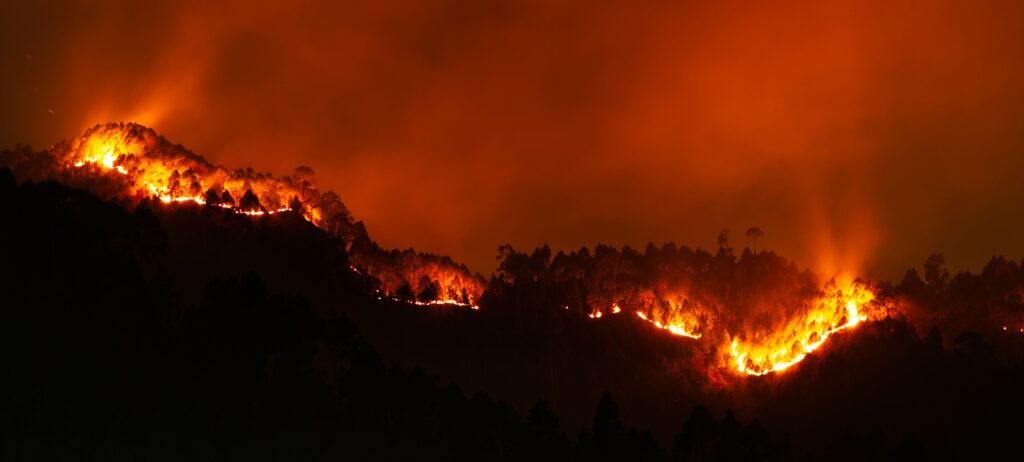
Wildfire Prevention Failures in Last 10 Years: The Utility Negligence In America
Why it matters:
- Electric utilities prioritizing shareholder returns over grid hardening have become a significant ignition source for wildfires in North America.
- Utility-caused fires, though a smaller percentage of total ignitions, lead to a disproportionate amount of structural destruction and civilian fatalities.
Between 2015 and 2025, a specific class of industrial disaster reshaped the North American map. These were not random acts of nature predictable failures of infrastructure, where neglected utility grids collided with arid conditions to produce infernos of velocity. The data about wildfire prevention failures in the last decade reveals a clear pattern: electric utilities, prioritizing shareholder returns over grid hardening, have become one of the most dangerous ignition sources on the continent. The scope of this negligence is measured not just in the 15 million acres burned, but in the complete erasure of communities like Paradise, California, and Lahaina, Hawaii.
The distinction between a “wildfire” and a “utility-caused fire” is serious. While lightning strikes account for a portion of ignitions, utility-sparked fires are distinct in their lethality and location. They frequently start during extreme wind events when aircraft cannot fly, and they ignite in proximity to developed areas where power lines run. Consequently, while they account for a smaller percentage of total ignitions, they are responsible for a disproportionate share of structural destruction and civilian fatalities. From the scorched panhandle of Texas to the canyons of Oregon, the same method repeats: aging wooden poles snap, bare conductors slap together, and energized lines fall into dry vegetation.
The human toll of these failures is definite. In the ten-year period ending December 2025, confirmed fatalities linked directly to utility-ignited fires exceeded 200. This figure includes the 85 victims of the 2018 Camp Fire and the 102 confirmed dead in the 2023 Lahaina fire. These events were not accidents; investigations by Cal Fire, the Texas A&M Forest Service, and the ATF consistently point to equipment that was known to be decayed or hazardous long before the spark.
Major Utility-Caused Infernos (2015-2025)
| Fire Name | Date | Utility Implicated | Acres Burned | Deaths | Financial Impact |
|---|---|---|---|---|---|
| Camp Fire | Nov 2018 | PG&E | 153, 336 | 85 | $13. 5 Billion Settlement |
| Labor Day Fires | Sept 2020 | PacifiCorp | 400, 000+ | 11 | $1 Billion+ Liability Verdicts |
| Marshall Fire | Dec 2021 | Xcel Energy | 6, 026 | 2 | $640 Million Settlement |
| Lahaina Fire | Aug 2023 | Hawaiian Electric | 2, 170 | 102 | $4 Billion Global Settlement |
| Smokehouse Creek | Feb 2024 | Xcel Energy | 1, 059, 570 | 2 | Litigation Ongoing / Partial Settlements |
The financial repercussions mirror the physical devastation. Pacific Gas & Electric (PG&E) sought bankruptcy protection in 2019 after facing liabilities exceeding $30 billion. By late 2025, PacifiCorp faced jury verdicts in Oregon surpassing $1 billion for its role in the 2020 Labor Day fires, with juries finding the company acted with gross negligence by failing to de-energize lines even with grave weather warnings. In Texas, Xcel Energy admitted its facilities appeared to be involved in the ignition of the Smokehouse Creek Fire, the largest wildfire in the state’s history, which burned over one million acres in February 2024.
The geographic spread of these incidents proves this is not solely a California problem. The Smokehouse Creek Fire demonstrated that the Great Plains are equally to the combination of high winds and decayed infrastructure. In that incident, a wooden pole, inspected and marked for replacement weeks earlier, snapped at the base. Similarly, the Marshall Fire in Colorado tore through suburban neighborhoods in December, a month previously considered safe from wildfire risk, driven by hurricane-force winds that toppled power lines into drought-stressed grass.
“The records conclusively establish that Hawaiian Electric power lines to Lahaina were not energized when the Afternoon Fire broke out… [ ] a fire at 6: 30 a. m. appears to have been caused by power lines that fell in high winds.”
, Hawaiian Electric Statement, August 2023.
This admission from Hawaiian Electric highlights a recurring theme: the initial spark is frequently the result of known vulnerabilities. In Maui, the failure to cut power during a red flag warning allowed lines to energize dry brush. In California, the Camp Fire began when a worn C-hook on a transmission tower, equipment that had been in service for nearly a century, failed, dropping a high-voltage line. These mechanical failures are the direct result of deferred maintenance strategies that prioritize short-term operational savings over long-term public safety.
As of March 2026, the cumulative liability for North American utilities related to wildfire damages since 2015 exceeds $20 billion. This figure represents only the settled amounts and jury awards, not the total economic loss, which insurers estimate to be triple that amount. The trajectory is clear: as infrastructure ages and weather patterns become more volatile, the utility grid has transformed from a public service into a primary public safety hazard.
Lahaina’s Ashes: The Cost of Energized Negligence And Wildfire Prevention Failures
On August 8, 2023, the historic town of Lahaina was not destroyed by a random act of nature, by a predictable collision of gale-force winds and neglected infrastructure. The sequence of events that erased the Hawaiian capital from the map began hours before the flame consumed Front Street. even with Red Flag Warnings predicting gusts up to 60 mph, Hawaiian Electric (HECO) made the operational decision to keep power lines energized. This refusal to implement a Public Safety Power Shutoff (PSPS), a protocol standard in California since 2019, turned the utility’s grid into a network of live incendiary devices.
The timeline of the disaster reveals a fatal gap in judgment. At 6: 37 a. m., a fault on a 69-kilovolt transmission line ignited the initial “Morning Fire” near Lahainaluna Road. While the Maui Fire Department declared this blaze “100% contained” by 9: 00 a. m., the ignition source remained: unstable, energized infrastructure hovering over parched invasive grasses. When the winds intensified in the afternoon, a second flare-up, or a rekindling of the , occurred. By then, the window for prevention had closed. HECO’s defense, that lines were de-energized by the afternoon, ignores the foundational failure: the grid itself was too fragile to withstand the forecast conditions, and the company had no method to preemptively cut power to save lives.
The negligence in Lahaina was not a momentary lapse a calculated financial strategy executed over nearly a decade. Between 2019 and 2022, as wildfire risks in West Maui climbed, Hawaiian Electric spent less than $245, 000 on wildfire-specific projects for the island. In that same four-year period, the company paid out over $500 million in shareholder dividends. The is absolute. The utility prioritized the steady flow of cash to investors over the hardening of a grid that stood in the route of known seasonal trade winds. The result was a system where 100-year-old wooden poles were left to hold up uninsulated wires in a hurricane zone.
| Financial Category | Approximate Expenditure | Impact on Grid Safety |
|---|---|---|
| Shareholder Dividends Paid | $550, 000, 000+ | Zero. Capital extracted from the company. |
| Maui-Specific Wildfire Projects | < $245, 000 | Negligible. Failed to clear serious vegetation. |
| Grid Hardening (System-Wide) | Minimal | Left wooden poles to rot and wind shear. |
| Public Safety Power Shutoff Program | $0 (Non-existent) | No protocol existed to de-energize lines during Red Flag events. |
The human cost of this ledger is 102 confirmed dead and the obliteration of 2, 200 structures, 86% of which were residential. The economic damage is estimated at $5. 5 billion, a figure that dwarfs the cost of the grid upgrades that were never made. The “accidental” classification of the fire by investigators masks the widespread intent behind the neglect. A utility that spends thousands on safety while paying millions to shareholders is not managing risk; it is gambling with public lives. In Lahaina, the house lost.
Post-fire, HECO rushed to implement a PSPS program in July 2024, admitting it was a “last line of defense.” This admission serves as a grim epitaph for Lahaina: the tool to save the town existed, was widely used by peers, and was ignored until the ashes cooled. The disaster was not a failure of technology, a failure of priority. The wires that sparked the inferno were energized because the company’s leadership was energized by a different metric entirely.
The PG&E Recidivism Record
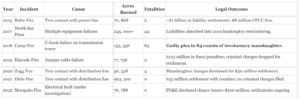
Between 2015 and 2025, Pacific Gas and Electric (PG&E) established a documented timeline of criminal recidivism unique in American corporate history. While serving a five-year federal probation for the 2010 San Bruno pipeline explosion, the utility ignited a series of catastrophic wildfires that killed over 100 people and burned millions of acres. Federal U. S. District Judge William Alsup, who oversaw the company’s probation until it expired in January 2022, formally characterized this period as a “crime spree” rather than a rehabilitation.
The pattern began with the 2015 Butte Fire, caused by a tree contacting a power line, which resulted in two deaths and destroyed over 900 structures. This incident set a precedent for the decade: deferred maintenance on aging infrastructure meeting predictable environmental conditions. Yet, the of negligence escalated sharply in 2018 with the Camp Fire. Investigators determined that a worn C-hook on a transmission tower, which had been in service for nearly a century, failed and dropped a live line. The resulting inferno obliterated the town of Paradise and killed 85 people. In June 2020, PG&E pleaded guilty to 84 counts of involuntary manslaughter, a conviction that legally branded the corporation a killer.
Post-conviction behavior showed little improvement in grid stability. In 2019, while the company was in bankruptcy protection, a worn jumper cable snapped on a transmission tower in Sonoma County, igniting the Kincade Fire. This blaze forced the evacuation of nearly 200, 000 residents. The utility later agreed to pay $125 million in fines and penalties. The following year, the Zogg Fire killed four people in Shasta County. Although prosecutors initially filed manslaughter charges, the case was dismissed in 2023 in exchange for a $50 million civil settlement, a move the local District Attorney described as necessary to secure immediate funds for community safety rather than risking a lengthy trial.
The destruction peaked geographically with the 2021 Dixie Fire, which consumed nearly one million acres across five counties. It became the second-largest wildfire in California history. Cal Fire investigations confirmed the blaze started when a tree struck PG&E distribution lines. even with the of the damage, the utility avoided criminal prosecution by agreeing to pay approximately $55 million in settlements to the affected counties. This sequence of events demonstrates a widespread failure where financial penalties are absorbed as operating costs while infrastructure hardening lags behind the immediate threat of ignition.
The Ledger of Negligence: Major PG&E Incidents (2015-2025)
The financial mechanics of these disasters reveal a disturbing trend. While the Fire Victim Trust was established to compensate survivors of the 2015-2018 fires with a mix of cash and stock, the value of that compensation fluctuated with the company’s market performance. The Trust sold its final shares of PG&E stock in December 2023, closing a chapter where victims were made partial owners of the entity that destroyed their homes. Meanwhile, the utility continues to face litigation for subsequent fires, with the Mosquito Fire settlements extending into 2025.
The judicial system’s inability to halt this pattern is clear in the transition from criminal charges to civil payouts. In the Zogg Fire case, the Shasta County Superior Court judge dismissed manslaughter charges after the settlement was reached, noting that while the outcome did not satisfy the desire for criminal accountability, it provided guaranteed restitution. This legal pivot, from manslaughter pleas in 2020 to civil settlements in 2023, marks a shift in how the state processes utility negligence. The corporation pays to resolve the liability, yet the physical grid remains to the same wind and vegetation risks that initiated the pattern in 2015.
The Smokehouse Creek Disaster
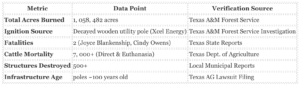
On February 26, 2024, a single wooden utility pole in the Texas Panhandle snapped at its base. The pole, owned by Xcel Energy through its subsidiary Southwestern Public Service Company, did not fall due to an act of God. It fell because it was rotten. When the heavy timber struck the parched earth near Stinnett, Texas, it dropped energized power lines into dry grass, igniting an inferno that would become the largest wildfire in Texas history. The Smokehouse Creek Fire consumed 1, 058, 482 acres, an area larger than the state of Rhode Island, in a matter of days. This disaster was not a failure of firefighting; it was a failure of corporate maintenance.
The mechanics of this ignition reveal a widespread negligence that plagues rural American utility grids. Investigations by the Texas A&M Forest Service confirmed that the pole had decayed significantly at ground level, compromising its structural integrity. High winds, common in the Panhandle, provided the final push, the pole’s condition made failure inevitable. This specific piece of infrastructure was not old; it was known to be dangerous. Lawsuits filed against Xcel Energy and its inspection contractor, Osmose Utilities Services, allege that inspectors had previously flagged the pole with a “red tag.” In utility maintenance, a red tag indicates a pole is so compromised it is unsafe to climb and requires immediate replacement. even with this warning, the pole remained in service until it snapped.
The of the destruction show the lethality of utility-caused wildfires. The fire moved with such velocity that it erased entire ranching operations before evacuations could be fully coordinated. Two people, Joyce Blankenship of Stinnett and Cindy Owens of Amarillo, lost their lives. The agricultural toll was. The Texas Department of Agriculture reported that over 7, 000 head of cattle died directly from the fire or had to be euthanized due to severe burns, with estimates suggesting the final toll reached 10, 000. Ranchers returned to find herds decimated, with animals suffering from hoofs burned off and udders scorched beyond recovery. The fire destroyed over 500 structures and caused damages estimated to exceed $1 billion.
Xcel Energy admitted on March 7, 2024, that its facilities “appeared to have been involved in an ignition of the Smokehouse Creek fire.” While the company acknowledged the physical cause, it disputed claims of negligence. Yet, the evidence presented in subsequent legal actions paints a picture of a grid allowed to rot. Texas Attorney General Ken Paxton sued Xcel in December 2025, explicitly accusing the company of prioritizing profits over safety. The state’s petition noted that Xcel failed to replace aging poles, of which were nearly 100 years old, more than double their intended lifespan of 40 years. The lawsuit that the company chose to ignore serious warnings to save “marginal profits,” a decision that resulted in the incineration of over a million acres.
The involvement of Osmose Utilities Services highlights the fractured accountability in grid maintenance. Utilities frequently outsource inspections to third-party contractors like Osmose. In the Smokehouse Creek case, the breakdown occurred between the identification of the hazard and the execution of the repair. A red tag on a pole is a clear signal of imminent danger. The failure to act on that signal transforms a maintenance backlog into a criminal liability. This pattern mirrors the failures seen in other utility-caused disasters, where data on grid vulnerabilities exists remains buried in databases rather than translating into physical repairs.
The financial and legal repercussions for Xcel Energy were immediate. Following the admission of involvement, the company’s stock price dropped, erasing billions in market value. By early 2025, Xcel had settled hundreds of claims, paying out over $361 million, yet the state of Texas continued to pursue civil penalties. In February 2026, a Texas judge ordered Xcel to commence an immediate replacement program for high-risk poles in the Panhandle, a judicial mandate forcing the utility to perform the work it had previously deferred. This court order serves as a grim validation of the plaintiffs’ claims: the infrastructure was unsafe, the utility knew it, and only a catastrophe forced a correction.
Smokehouse Creek Fire: serious Metrics
The Smokehouse Creek Fire stands as a definitive example of the “decaying pole emergency.” It demonstrates that wildfire prevention in the American West is not solely about managing forests or clearing brush; it is about physically hardening the industrial that traverses these. When a utility company allows a red-tagged pole to stand until it breaks, they are not managing a grid; they are managing a fuse. The 2024 disaster in the Texas Panhandle proved that without rigorous enforcement and mandatory infrastructure updates, utility grids continue to serve as the primary ignition source for megafires.
The Century-Old Grid
The physical evidence of utility negligence is frequently smaller than a human hand. In the case of the 2018 Camp Fire, which obliterated Paradise, California, the culprit was a cast-iron “C-hook” on the Caribou-Palermo transmission line. Installed in 1921, this piece of hardware had hung in the Feather River Canyon for 97 years, grinding against its connector with every gust of wind. By the time it snapped, releasing a 115-kilovolt jumper cable to arc against the steel tower, the metal was worn so thin it could no longer support the line’s weight. PG&E records confirm the utility purchased the line in 1930 yet failed to replace the original hardware for nearly a century. A 1987 internal study identified wear on these specific hooks as a serious problem, yet the company reduced climbing inspections in the subsequent decades, blinding itself to the decay.
This failure was not an oversight the inevitable result of a “run-to-failure” maintenance strategy. Utilities across North America have financially incentivized the deferral of upgrades, allowing infrastructure to operate decades past its safe design life. Department of Energy data from 2015 indicated that 70 percent of U. S. transmission lines were already older than 25 years. By 2025, the average age of large power transformers, the grid’s serious organs, exceeded 40 years. In this operational model, equipment is replaced only after it breaks, a calculation that functions for minor outages proves catastrophic when the failure method involves high-voltage arcing in arid.
The lethal consequences of this aging infrastructure were demonstrated again in Lahaina, Hawaii, in August 2023. Hawaiian Electric (HECO) operated a network of wooden poles built to an obsolete 1960s standard, designed to withstand significantly lower wind loads than modern codes require. A 2019 regulatory filing by the company explicitly acknowledged that its 60, 000 wooden poles were because they were located in a “severe wood decay hazard zone.” even with this written admission of a “serious public hazard,” the utility fell behind on its replacement schedule. When high winds from Hurricane Dora struck, the rotted and leaning poles snapped, dropping uninsulated lines into dry grass. The audit trail proves the utility knew the specific risk of wood rot years before the town burned.
In the Texas Panhandle, the 2024 Smokehouse Creek Fire provided a more immediate example of ignored audit warnings. Xcel Energy’s infrastructure inspection in January 2024 identified a specific decayed pole as “priority one,” a designation indicating it was unsafe to climb and required immediate replacement. The utility received this report on February 9, 2024. Yet, the pole remained in service until it snapped at the base on February 26, igniting the largest wildfire in Texas history. The gap between the audit finding and the catastrophic failure was 17 days, a window where bureaucratic inaction allowed a known hazard to destroy over one million acres.
| Fire Event (Year) | Failed Component | Component Age / Standard | Audit Warning Signal | Time Lag to Disaster |
|---|---|---|---|---|
| Camp Fire (2018) | Trans. Tower C-Hook | 97 Years (1921 Install) | 1987 Wear Study identified risk | 31 Years |
| Archie Creek (2020) | Ampact Wedge Connector | Obsolete Design | 2012 FERC report on “poor maintenance” | 8 Years |
| Lahaina Fire (2023) | Wooden Poles | 1960s Standard | 2019 Filing: “Severe wood decay zone” | 4 Years |
| Smokehouse Creek (2024) | Distribution Pole | Rotted / Decayed | Jan 2024 Inspection: “Priority One” | 17 Days |
The pattern extends to the Pacific Northwest, where PacifiCorp faced liability for the 2020 Labor Day fires in Oregon. Investigations revealed that the Archie Creek Fire ignited after an aluminum “Ampact” wedge connector melted. This specific component failure echoed findings from a 2012 FERC investigation into the utility, which concluded that up to 45 percent of PacifiCorp’s transmission lines in certain regions were “so poorly maintained or obsolete” they should not have been carrying current. The utility settled with the federal government for $575 million in 2024, a figure that quantifies the cost of neglecting hardware updates.
Metal fatigue, wood rot, and crystalline degradation in insulators are predictable physical processes. Engineering standards establish clear “useful life” metrics for every component on the grid. A wooden pole in a tropical climate has a maximum safe lifespan of 30 to 40 years; a steel hook subject to constant friction may last 50. When utilities operate this hardware for 60, 80, or 100 years, they are not managing assets gambling with public safety. The audits exist. The engineering reports are filed. The failures occur precisely where the data predicts they, transforming the grid into a vast, pre-deployed ignition network waiting for the right wind event.
The Paper Shield: Fabricated Safety and The Zogg Pine
The distinction between a safe grid and a deadly one frequently exists only in a database. On September 27, 2020, the Zogg Fire erupted in Shasta County, California, killing four people and incinerating 200 homes. The ignition source was a gray pine tree that leaned ominously over a 12, 000-volt distribution line. This specific tree was not a stranger to Pacific Gas & Electric (PG&E). Contractors had identified it as a hazard in 2018, marking it for removal. Yet, in the utility’s records, the threat had been neutralized. The tree remained standing, rotting and leaning, until and wind conspired to drop it onto the line. The disconnect between the digital record, which showed a cleared corridor, and the physical reality of the gray pine constitutes the core of vegetation management fraud.
This was not an clerical error. It was a widespread operational strategy known in the industry as “pencil-whipping.” Between 2015 and 2025, utilities frequently prioritized the appearance of compliance over actual risk reduction. Inspectors, frequently understaffed and pressured by aggressive quotas, utilized “drive-by” inspections where they would verify clearance zones from their vehicles without walking the lines. In 2019, a court-appointed monitor for PG&E exposed the of this deception. In a review of just 53. 5 miles of power lines, the monitor found 3, 280 trees that inspectors had missed, trees that were visibly dangerous and violated state safety regulations. This error rate suggests that across the utility’s 25, 000 miles of high-fire-threat distribution lines, hundreds of thousands of “ticking time bomb” trees were falsely recorded as safe.
The Enhanced Vegetation Management Shell Game
Following the catastrophic Camp Fire, utilities rolled out “Enhanced Vegetation Management” (EVM) programs, promising to clear vegetation further back from lines than state law required. yet, the execution of these programs revealed a disturbing manipulation of data to satisfy regulatory rather than public safety. In 2020, the California Public Utilities Commission (CPUC) placed PG&E into an enhanced enforcement process after audits revealed the utility was “cherry-picking” easy miles to completion numbers.
The data shows that 92% of the miles PG&E claimed as “completed” under its EVM in late 2019 required no actual tree trimming. Crews were sent to areas with sparse vegetation to rack up mileage statistics, while the dense, high-risk corridors, where the fire danger was acute, were ignored. This statistical manipulation allowed the utility to report to shareholders and regulators that it was meeting safety goals, while the actual risk in the “Red Zones” remained unchanged. The table details the gap between reported compliance and field reality.
| Audit Source | Targeted Metric | Utility Claim | Field Finding |
|---|---|---|---|
| Federal Monitor (2019) | Hazard Tree ID | 100% Inspected | 3, 280 Missed Trees in 53 Miles |
| CPUC Audit (2020) | EVM Prioritization | Risk-Based Model | 59% of work done in Low-Risk Zones |
| Dixie Fire Invest. (2021) | Record Keeping | Digital Tracking | Reliance on Paper Records (Lost/Incomplete) |
| PacifiCorp Trial (2023) | Clearance Violations | Standard Compliance | Hundreds of violations annually since 2013 |
Diverted Funds: Profits Over Pruning
The failure to trim trees was not a matter of incompetence; it was a financial decision. An audit released in 2019 by AzP Consulting revealed that between 2007 and 2016, a period setting the stage for the mega-fires of the subsequent decade, PG&E diverted $123 million allocated for Rule 20A undergrounding projects to other corporate purposes. The auditors noted that because managers “did not retain documentation” of where the funds went, it was impossible to trace the money precisely, the diversion created “fraud risk factors.”
This pattern of diverting safety funds extended to vegetation management budgets. In the case of PacifiCorp, which was found “grossly negligent” by an Oregon jury for the 2020 Labor Day fires, evidence presented in court showed a long-standing history of vegetation clearance violations. The Department of Justice lawsuit filed in 2024 alleged that PacifiCorp’s violations spiked from 2013 onwards, never dropping 250 violations per year. The utility consistently failed to fund the necessary manpower to clear these risks, gambling that the trees would stay upright. When they fell, as they did in the Archie Creek fire, the cost was not measured in the diverted maintenance dollars, in the $1. 6 billion in damages awarded to victims.
“The utility’s own risk models identified the danger, yet they chose to work on the easiest miles. It is a paper shield designed to protect liability, not lives.” , Summary of 2020 CPUC Enforcement Action Findings
The reliance on third-party contractors further diluted accountability. Major vegetation management contractors, operating under low-bid contracts, faced immense pressure to complete miles. This created an incentive structure where speed trumped accuracy. In the Zogg Fire investigation, it was revealed that the tree in question had been flagged, the data never resulted in a work order, a “process breakdown” that the CPUC later penalized with a $150 million fine. The record-keeping was so archaic that during the Dixie Fire investigation, it was discovered that serious inspection records were still being kept on paper, making them liable to be lost, altered, or simply ignored. The $45 million penalty levied for the Dixie Fire specifically mandated the digitization of these records, an admission that in 2021, the utility was still managing billion-dollar fire risks with 20th-century stationery.
Deferred Maintenance Economics
The financial logic governing North American utility infrastructure between 2015 and 2025 rested on a dangerous calculation: the actuarial probability of failure versus the guaranteed cost of prevention. Industry insiders refer to this as “run-to-failure,” a standard maintenance strategy for lightbulbs or non-serious. When applied to high-voltage transmission lines in arid, wind-prone corridors, this accounting method transforms aging grids into incendiary devices. Utilities frequently delayed capital-intensive upgrades to preserve liquidity for shareholder dividends, betting that equipment would outlast the windstorm.
Pacific Gas and Electric (PG&E) provided the clearest example of this doctrine in practice. Investigations following the 2018 Camp Fire revealed that the Caribou-Palermo transmission line, which ignited the blaze, relied on hardware installed in 1921. The specific component that failed, a C-hook holding a live wire, was worn through after 97 years of friction. even with internal reports from as early as 1987 identifying wear on these components, the utility reduced climbing inspections to cut costs. In the five years leading up to its 2019 bankruptcy, PG&E paid out approximately $5 billion in dividends to shareholders, a sum that could have funded the inspection and replacement of thousands of miles of transmission lines. The company prioritized short-term financial performance over the long-term structural integrity of its grid.
The economic incentives favoring neglect appear in the operational budgets of other major utilities. In Oregon, a jury found PacifiCorp “grossly negligent” for its role in the 2020 Labor Day fires, awarding over $1 billion in damages by 2026. Evidence presented during litigation showed that the utility failed to de-energize lines even with extreme weather warnings, a decision driven by a reluctance to disrupt service revenue and incur the operational costs of a shutdown. The jury verdicts in 2023 and 2024 confirmed that the company’s maintenance practices did not align with the escalating risk of wildfire, shifting the cost of grid maintenance onto the communities that burned.
The Balance Sheet of Neglect
The following table contrasts the estimated cost of preventative maintenance against the financial liabilities incurred after catastrophic failures. These figures illustrate the false economy of deferred maintenance.
| Utility Event | Infrastructure Failure Point | Deferred Action Cost (Est.) | Post-Disaster Liability |
|---|---|---|---|
| PG&E (Camp Fire, 2018) | Worn C-Hook (97 years old) | $5, 000 per tower (inspection/repair) | $13. 5 Billion (Settlement) |
| PacifiCorp (Oregon Fires, 2020) | Vegetation/Line Contact | $150 Million (Grid Hardening) | $1 Billion+ (Jury Verdicts) |
| Hawaiian Electric (Maui, 2023) | Downed Lines/Pole Failure | $180 Million (Proposed Hardening) | $4 Billion (Settlement Share) |
| Xcel Energy (Texas, 2024) | Decayed Wood Pole | $15, 000 (Pole Replacement) | Undetermined (Pending Litigation) |
In Texas, the 2024 Smokehouse Creek Fire exposed similar negligence. Xcel Energy admitted its equipment appeared to have played a role in the ignition of the largest wildfire in state history. Court documents alleged that a specific wooden pole, flagged for replacement by inspectors, remained in service until it snapped in high winds. Following the disaster, a Texas court ordered the utility to inspect 35, 000 poles annually and replace those deemed high-risk within expedited timeframes. This judicial mandate forces the utility to perform the maintenance it previously deferred, only after the destruction of over one million acres of land.
Hawaiian Electric Industries (HEI) faced a similar reckoning after the 2023 Lahaina fire. While the company had a wildfire safety plan on paper, execution lagged behind the urgent reality of climate change. In the aftermath, HEI reported a $1. 4 billion loss in 2024, largely driven by a $4 billion settlement agreement. To fund these liabilities, the company sold its stake in American Savings Bank, liquidating a core asset to pay for the consequences of delayed grid hardening. The $350 million the company later committed to a three-year safety strategy represents a fraction of the settlement costs, proving that preventative spending is exponentially cheaper than disaster recovery.
The pattern is uniform across the sector: utilities treat infrastructure upgrades as discretionary spending rather than mandatory safety investments. This method artificially net income in quiet years, allowing executives to meet performance linked to stock value. When the inevitable failure occurs, the financial shock is absorbed not just by shareholders, by ratepayers through increased premiums and state bailouts. The “run-to-failure” model privatizes the profits of deferred maintenance while socializing the catastrophic risks.
The Kill Switch Failure
The concept of a “kill switch” for a utility grid is a misnomer that obscures a more mechanical and bureaucratic reality. There is no single red button that de-energizes a region instantly. Instead, the process involves a complex sequence of manual switching, software commands, and physical inspections. The failure to initiate Public Safety Power Shutoffs (PSPS) during serious fire weather is rarely a technical inability a calculated operational refusal. Between 2015 and 2025, utilities repeatedly kept lines energized during Red Flag Warnings, driven by a regulatory framework that penalizes outages and a business model that requires continuous transmission to generate revenue.
The primary mechanical culprit in these ignitions is the automatic circuit recloser. Designed to maintain reliability, a recloser detects a fault, such as a tree branch brushing a line, and momentarily cuts power. It then automatically “re-closes” the circuit to test if the fault has cleared. In normal conditions, this prevents long outages from minor interruptions. In high-wind, low-humidity conditions, this device acts as an arsonist. When a line is downed by wind, the recloser attempts to restore power up to three times, sending repeated pulses of high-voltage electricity into dry vegetation. Southern California Edison data from 2018 showed that disabling this feature, setting reclosers to “one-shot” or “fast trip”, reduced ignition risks by 54 percent. Yet, across the industry, utilities frequently fail to alter these settings ahead of storms.
The hesitation to de-energize is documented in the timeline of the 2018 Camp Fire. On November 6, Pacific Gas & Electric (PG&E) notified 70, 000 customers in nine counties of a chance PSPS due to forecasted extreme winds. By the afternoon of November 8, even with a National Weather Service Red Flag Warning remaining in effect with gusts topping 50 mph, PG&E canceled the shutoff, citing “improving conditions.” The decision kept the Caribou-Palermo transmission line energized. At 6: 30 a. m., a C-hook on that line failed, and the resulting arc ignited the fire that destroyed Paradise. The utility prioritized the “obligation to serve” metric over the immediate meteorological threat, a decision that resulted in 85 deaths and $13. 5 billion in liabilities.
A more direct refusal occurred during the Labor Day fires of 2020 in Oregon. As historic windstorms method, state fire officials explicitly asked utilities to de-energize their grids. Portland General Electric complied, cutting power to 5, 000 homes in high-risk corridors. PacifiCorp did not. In a deposition, former Oregon state fire chief Doug Grafe detailed an 8 p. m. call where he urged PacifiCorp to shut down lines. The utility refused, relying on internal modeling that claimed the risk was manageable. The energized lines subsequently ignited multiple fires in the Santiam Canyon. In 2023, a jury found PacifiCorp acted with “gross negligence,” leading to a $575 million settlement with the federal government and ongoing class-action liabilities exceeding $100 million.
The absence of a PSPS protocol proved equally catastrophic in Maui in August 2023. Unlike California utilities, which had developed shutoff programs following the 2017-2018 fire seasons, Hawaiian Electric (HECO) had no formal PSPS plan in place. When hurricane-force winds from passing Hurricane Dora battered the island, HECO left its grid fully energized. The resulting line faults sparked the initial fires in Lahaina. While HECO claims lines were de-energized by the time the afternoon inferno consumed the town, the absence of a preemptive shutoff protocol during the morning’s peak wind gusts allowed the initial ignition vectors to establish themselves.
Regulatory Penalties vs. Wildfire Liability
Utilities operate under a perverse incentive structure regarding shutoffs. State regulators, including the California Public Utilities Commission (CPUC), have fined utilities for poorly executed PSPS events. In 2022, the CPUC fined PG&E, Southern California Edison, and San Diego Gas & Electric a combined $22 million for notification failures and “unreasonable” shutoffs during the 2020 season. These penalties create a financial hesitation: a utility is fined immediately for turning the power off without perfect justification, while the cost of leaving it on is a gamble against a chance wildfire.
| Event / Action | Utility | Financial Impact | Outcome |
|---|---|---|---|
| 2020 PSPS Execution Violations | PG&E, SCE, SDG&E | $22 Million (Fine) | Penalized for notification failures during shutoffs. |
| 2018 Camp Fire (No Shutoff) | PG&E | $13. 5 Billion (Settlement) | Bankruptcy reorganization and victim compensation fund. |
| 2020 Labor Day Fires (Refusal to Shutoff) | PacifiCorp | $575 Million+ (Settlement) | Jury found “gross negligence” for keeping lines hot. |
| 2023 Lahaina Fire (No PSPS Program) | Hawaiian Electric | $4 Billion (Settlement Share) | Utility agreed to pay roughly half of the total settlement. |
The economic logic is clear. A PSPS event causes immediate revenue loss and incurs regulatory wrath for disrupting the economy. The Smokehouse Creek Fire in Texas in 2024 further illustrates this. Xcel Energy acknowledged its equipment appeared to be involved in the ignition of the largest wildfire in state history. Following the disaster, a Texas court ordered Xcel to inspect 35, 000 poles annually and replace those at risk. The injunction forced a physical hardening of the grid that a proactive de-energization strategy could have mitigated, yet the utility sector remains reactive, treating the “kill switch” as a measure of last resort rather than a primary defense.
This operational paralysis is not a result of missing data. Weather forecasting has achieved high precision, allowing utilities to predict dangerous wind gusts hours in advance. The failure lies in the decision-making hierarchy that weighs the certainty of customer complaints and regulatory fines against the probability of a catastrophic ignition. Until the regulatory framework incentivizes safety over service continuity during extreme weather, the kill switch remain unpulled.
Regulatory Capture: The Shield of Bureaucracy
The failure of North American utilities to modernize their grids is not a corporate oversight; it is a product of regulatory capture. Public Utility Commissions (PUCs), theoretically designed to balance ratepayer interests with safe service, have frequently functioned as liability shields for the monopolies they oversee. Between 2015 and 2025, a pattern emerged where regulators prioritized the financial solvency of utilities over the physical safety of the communities they serve. This is most visible in the legislative and regulatory responses to the California wildfires, where the load of negligence was systematically shifted from shareholders to the public.
The most distinct example of this protectionism is California’s Assembly Bill 1054, signed in July 2019. Following the catastrophic Camp Fire, which drove Pacific Gas & Electric (PG&E) into bankruptcy, the state legislature intervened not to break up the monopoly, to insulate it. AB 1054 created a $21 billion wildfire insurance fund, financed equally by utility shareholders and ratepayers. More serious, it fundamentally altered the legal standard for liability. Prior to this law, utilities had to prove they acted prudently to recover wildfire costs from ratepayers. Under AB 1054, a utility with a valid “safety certification” is presumed prudent unless intervenors can prove otherwise. This shift socialized the risk of future infernos, allowing utilities to offload the costs of their own negligence onto the monthly bills of survivors.
The issuance of these safety certifications exposes the depth of the regulatory failure. In January 2021, the California Public Utilities Commission (CPUC) granted PG&E a safety certification for 2020. This approval came even with the CPUC’s own Wildfire Safety Division identifying 140 defects in PG&E’s vegetation management and grid operations during field inspections. The regulators possessed direct evidence that the utility was failing to clear trees from high-voltage lines, the exact method that ignited the Zogg Fire in September 2020, killing four people. Yet, the certification was issued, granting PG&E the legal presumption of prudence and access to the state’s insurance fund. The regulator’s stamp of approval validated a system known to be dangerous.
| Utility | Target Jurisdiction | Reported Lobbying Spend (Period) | Regulatory Outcome |
|---|---|---|---|
| PG&E | California | $10. 5 Million (2018) | Passage of AB 1054; Liability load shifted to intervenors. |
| PacifiCorp | Oregon / Utah | Undisclosed (Multi-state) | Utah capped liability claims; Oregon rejected caps faces continued pressure. |
| Hawaiian Electric | Hawaii | $340, 000 (2023 Est.) | Delayed implementation of Public Safety Power Shutoffs (PSPS) until after Lahaina. |
| SoCal Edison | California | $4. 2 Million (2019) | Access to $21B Wildfire Fund; Rate hikes approved for grid hardening. |
In Hawaii, a different form of regulatory negligence enabled the destruction of Lahaina. While California regulators were actively managing a bailout, the Hawaii Public Utilities Commission (HPUC) maintained a passive stance on grid modernization. even with clear evidence from the mainland that energized power lines in high-wind zones were a primary ignition source, the HPUC did not mandate a Public Safety Power Shutoff (PSPS) program for Hawaiian Electric (HECO). When Hurricane Dora’s winds battered Maui in August 2023, HECO had no formal protocol to de-energize the grid. The regulator’s failure to enforce industry-standard safety measures meant that when the lines fell, they were live. The subsequent investigation revealed that HECO had delayed grid hardening projects for years while seeking regulatory approval for cost recovery, a bureaucratic stalling tactic that proved fatal.
The push to limit liability extends beyond California. PacifiCorp, facing over $46 billion in claims for the 2020 Labor Day fires in Oregon and Northern California, launched a multi-state lobbying campaign to cap damages. In Utah, the company succeeded in 2024, securing legislation that limits the financial exposure of utilities for wildfires caused by their equipment. In Oregon, regulators resisted this pressure in May 2024, rejecting a proposal to exclude non-economic damages from liability payouts. This highlights the power of the regulator: in Oregon, the commission upheld the principle that the polluter pays; in Utah and California, the legislative and regulatory framework was adjusted to protect the utility’s balance sheet.
The “revolving door” between utilities and regulatory bodies further cements this capture. Commissioners and senior staff frequently move between high-paying utility consultancies and the agencies meant to police them. This cultural proximity results in a regulatory environment where rate hikes are treated as the primary solution to safety failures. Instead of demanding that shareholders fund the deferred maintenance that causes fires, commissions routinely approve rate increases, taxing the public for the privilege of not burning down. The data from 2015 to 2025 shows that regulatory bodies have become the primary method for socializing the costs of corporate manslaughter.
Lobbying Against Safety
The legislative protecting North American utilities is as engineered as the high-voltage transmission lines that spark catastrophic fires. Between 2015 and 2025, while deferred maintenance compounded grid vulnerabilities, investor-owned utilities (IOUs) directed hundreds of millions of dollars toward political influence operations. This spending prioritized the limitation of financial liability over the physical hardening of infrastructure. The a strategic diversion of capital: funds that could have buried lines or insulated conductors were instead deployed to defeat safety mandates and cap shareholder exposure to wildfire damages.
In California, the correlation between lobbying expenditures and legislative outcomes is numerically distinct. During the second quarter of 2019 alone, the parent companies of Pacific Gas & Electric (PG&E), Southern California Edison (SCE), and San Diego Gas & Electric (SDG&E) spent a shared $1. 88 million lobbying the state legislature. This surge coincided with the drafting of Assembly Bill 1054, a statute that created a $21 billion wildfire insurance fund and shifted significant financial load from utility shareholders to ratepayers. Prior to this, in the second quarter of 2018, PG&E spent $1. 7 million specifically lobbying to limit “inverse condemnation” rules, a legal doctrine holding utilities liable for fires caused by their equipment regardless of negligence. While these corporations pleaded financial distress in bankruptcy courts, their political spending remained liquid and aggressive.
The of this influence extends beyond immediate emergency management to the widespread blockage of safety transparency. In 2024, California utilities successfully lobbied to kill Senate Bill 938, legislation designed to prohibit the use of ratepayer funds for political activities. This victory allowed IOUs to continue a pattern where customers subsidize the very lobbying efforts that reduce utility accountability. Since 2000, California utilities have poured over $1 billion into political influence, a sum that dwarfs the budgets of the regulatory bodies tasked with overseeing them.
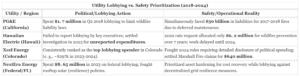
In Hawaii, the disconnect between political maneuvering and public safety proved lethal. Before the 2023 Lahaina fire, Hawaiian Electric (HECO) engaged in a pattern of delayed safety investment while maintaining active political channels. A 2022 regulatory filing contained a serious admission: the utility proposed spending a mere $6. 2 million on wildfire prevention across seven years, with actual work not scheduled to begin until 2024. Meanwhile, the company’s lobbying apparatus was active unclear. In 2025, the Hawaii State Ethics Commission settled an investigation with HECO for failing to report lobbying expenditures for employees who testified on legislation. The utility was forced to amend its disclosures, revealing hundreds of thousands of dollars in previously hidden political spending, resources deployed to influence policy while serious grid hardening remained unfunded.
The pattern repeats in the Pacific Northwest and the Rockies. In Oregon, PacifiCorp faced over $46 billion in claims related to the 2020 Labor Day fires. Rather than accepting full liability for the gross negligence determined by juries, the utility waged a legislative campaign in 2024 and 2025 to cap non-economic damages in wildfire lawsuits. This legislative push aimed to retroactively limit the financial consequences of their operational failures. Similarly, in Colorado, Xcel Energy consistently ranks as the state’s top lobbying spender. Following the Marshall Fire, Xcel lobbyists worked to defeat or weaken measures that would require detailed itemization of political spending, masking the extent of their influence on state safety regulations.
This industry-wide strategy reveals a calculated preference for legislative firewalls over physical ones. By investing in the defeat of strict liability laws and safety mandates, utilities have successfully insulated their profit margins from the consequences of their negligence. The millions spent in state capitols purchased a regulatory environment where grid hardening is optional, shareholder protection is guaranteed.
Bonuses Amidst Burn Scars
The financial architecture of North American utilities reveals a dissonance between public safety and executive enrichment. Between 2015 and 2025, as utility-sparked wildfires incinerated communities and incurred billions in liabilities, the executives presiding over these disasters frequently saw their compensation increase. This inverse relationship is not accidental; it is a product of compensation structures that tether personal wealth to stock performance and earnings per share (EPS) rather than grid resilience or fire prevention.
In the aftermath of the 2018 Camp Fire, which killed 85 people and destroyed the town of Paradise, Pacific Gas & Electric (PG&E) prepared for bankruptcy. Yet, days before the Chapter 11 filing in January 2019, CEO Geisha Williams resigned with a severance package valued at approximately $2. 5 million in cash and benefits. Between 2015 and 2017, the period during which the grid to the point of failure, Williams realized nearly $10 million in compensation. Her successor, Patti Poppe, was recruited in 2021 with a compensation package totaling $51. 2 million, heavily weighted toward stock awards. While PG&E customers faced double-digit rate hikes to fund wildfire safety measures, the executive suite was insulated by a pay structure where 90% of compensation was incentive-based, primarily driven by financial recovery rather than historical safety performance.
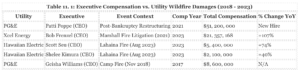
The pattern repeats across the industry. Following the 2021 Marshall Fire in Colorado, which caused over $2 billion in damages, Xcel Energy faced intense scrutiny and litigation. even with the looming liabilities, Xcel CEO Bob Frenzel saw his total compensation more than double from $10. 3 million in 2022 to $21. 3 million in 2023. This increase occurred two years after the fire, while victims were still negotiating the $640 million settlement that would not be finalized until late 2025. The bulk of this compensation came in the form of stock awards ($18 million), reinforcing the market’s prioritization of financial stability over the resolution of safety claims.
Hawaiian Electric Industries (HEI) provides a clear example of this disconnect in the wake of the 2023 Lahaina fire. In the fiscal year of the disaster, HEI CEO Scott Seu received a total compensation package of $5. 4 million, a significant increase from the $3. 1 million received the prior year. Similarly, Shelee Kimura, CEO of the subsidiary Hawaiian Electric, saw her compensation rise to $2. 1 million. While the company announced that executives would “forego” certain incentive bonuses, increases in base salary and stock awards resulted in a net pay raise. In 2024, even with a $1. 9 billion settlement agreement and a net loss of $1. 4 billion for the company, the board approved a further $1. 7 million raise for Seu, citing his role in steering the utility away from bankruptcy.
“The method is simple: Safety is a box to check; stock price is the engine of wealth. When Long Term Incentive Plans (LTIPs) are 90% weighted toward Total Shareholder Return, executives are paid to defer maintenance and cut costs, not to prevent fires.”
The structural failure lies in the definition of performance. Utility executive contracts tie Long Term Incentive Plans (LTIPs) to metrics like Total Shareholder Return (TSR) and Earnings Per Share (EPS). Safety metrics, when present, are frequently relegated to the Short Term Incentive Plan (STIP) and weighted at 10% to 20%. also, these safety metrics frequently track “lost-time injuries” (slips, trips, and falls) rather than catastrophic wildfire ignitions. This allows executives to collect maximum bonuses for “safety” even as their equipment sparks infernos, provided their own workforce remains uninjured during the daily operations.
In the case of PacifiCorp, a subsidiary of Berkshire Hathaway Energy, the disconnect is shielded by the parent company’s vast balance sheet. even with being found “grossly negligent” by an Oregon jury for the 2020 Labor Day fires and facing over $2. 2 billion in settlements, the executive consequences were unclear. While leadership changes occurred, Darin Carroll replaced Cindy Crane in late 2025, the financial of the parent company insulated the executive tier from the immediate financial ruin that befell their customers. The “liquidity emergency” warned of in November 2025 threatened the utility’s credit rating, yet the personal financial liability of the decision-makers remained non-existent.
This system creates a moral hazard where the individuals responsible for risk management are financially inoculated against the consequences of their failure. Insurance policies and third-party settlements cover the damages, while ratepayers fund the premiums and the grid hardening costs. The executives, paid in stock, benefit from the very cost-cutting measures that degrade grid resilience. Until compensation is legally decoupled from stock performance and strictly tied to the absence of ignition events, the financial incentives continue to favor the spark over the safety.
The Insurance Collapse
By 2025, the financial contagion of utility-sparked wildfires had breached the levees of the global insurance market. For decades, insurers treated utility ignitions as standard “accidental” risks, absorbing losses and adjusting premiums. The data from 2015 to 2025 shattered this model. When a single spark from a neglected transmission line can incinerate $10 billion in assets in 12 hours, as seen in the Camp Fire and the Maui fires, the actuarial math collapses. The result was a mass exodus of capital from wildfire-prone regions, leaving millions of homeowners exposed and shifting the load of utility negligence directly onto the public.
The turning point arrived in May 2023, when State Farm, California’s largest homeowner insurer, ceased accepting new applications for business and personal lines. Allstate followed, having quietly paused new policies in November 2022. These were not temporary pauses strategic retreats. In public filings, the carriers “rapidly growing catastrophe exposure” and “historic increases in construction costs.” yet, internal risk models pointed to a more specific variable: the unpriceable liability of aging electric grids. Unlike random weather events, utility fires in the 2015, 2025 window proved to be total-loss events, frequently occurring in clusters that overwhelmed reinsurance treaties.
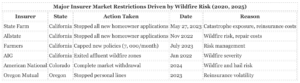
The collapse of the private market forced a migration to state-backed “insurers of last resort,” method designed for temporary gaps, not widespread failure. In California, the FAIR Plan (Fair Access to Insurance Requirements) mutated from a safety net into a primary carrier for high-risk zones. Between September 2019 and late 2025, the FAIR Plan’s policy count surged from approximately 155, 000 to over 660, 000. Total exposure ballooned to $724 billion by December 2025, a concentration of risk that threatens the solvency of the entire state insurance system. If a major utility fire were to hit a FAIR Plan-heavy region, the resulting assessment would levy surcharges on every insured homeowner in the state, socializing the cost of utility infrastructure failures.
The emergency is not confined to California. In Colorado, following the Marshall Fire, ignited in part by Xcel Energy equipment, premiums in wildfire-prone counties rose by over 50% between 2019 and 2022. By 2024, residents in the Wildland-Urban Interface (WUI) reported being dropped by major carriers even with having no claims history. Oregon faced a similar contraction after the 2020 Labor Day fires, with insurers non-renewing thousands of policies in the Cascades. The industry’s logic is ruthless mathematically sound: they cannot underwrite the risk of for-profit utilities operating degraded infrastructure in arid environments.
A serious, frequently overlooked driver of this withdrawal is the failure of subrogation, the legal process where insurers sue the responsible party to recover payout costs. Historically, insurers could recoup losses from utilities found negligent. PG&E’s $11 billion settlement in 2019 for the 2017 and 2018 fires was a landmark recovery. yet, the legal has shifted. In the aftermath of the 2023 Lahaina fire, Hawaiian Electric’s limited financial capacity and the complex $4 billion settlement proposed in 2024 created a deadlock. In February 2025, the Hawaii Supreme Court ruled that insurers could not pursue separate claims against the utility outside the settlement pool. This ruling sent a chilling signal to the global reinsurance market: if insurers cannot recover funds from negligent utilities, the premiums required to cover the risk upfront become mathematically impossible for homeowners to afford.
Global reinsurers, the firms that insure the insurance companies, have responded by treating US utility grids as liability bombs. Reinsurance rates for wildfire-exposed portfolios doubled in 2023 and remained elevated through 2025. This capital crunch filters down to the homeowner in the form of “uninsurability.” Real estate markets in the Sierra Nevada foothills and the Colorado Front Range have begun to freeze, with sales falling through as buyers fail to secure coverage. The utility sector’s refusal to harden grids has thus achieved what economic downturns could not: the de facto condemnation of entire regions, rendering them financially uninhabitable long before the flames actually arrive.
The Undergrounding Myth: Inflated Costs as a Shield
For decades, North American electric utilities have wielded a single, statistic to deflect demands for grid safety: the cost per mile. By consistently presenting the burial of power lines as a financial impossibility, companies like Pacific Gas & Electric (PG&E) and San Diego Gas & Electric (SDG&E) successfully delayed infrastructure hardening even as wildfire risks escalated. Between 2015 and 2025, this “prohibitive cost” defense transformed from a fiscal argument into a method of negligence, shielding utilities from the need of burying lines in high-risk corridors until the fires forced their hand.
The industry standard estimate for undergrounding distribution lines ranges between $3 million and $6 million per mile, a figure frequently in regulatory filings to justify the retention of overhead wires. Yet, independent audits and regulatory inquiries reveal these numbers frequently reflect bloated procurement processes rather than fixed engineering realities. In May 2024, an independent audit of SDG&E by Crowe LLP exposed severe irregularities in the utility’s undergrounding program. The auditors found that cost estimates for specific projects spiked by as much as 81% between approval and execution. One project, initially priced at $24. 5 million, ballooned to $44. 3 million because the utility failed to include internal overhead costs in its original submission. Such discrepancies suggest that the “impossibility” of undergrounding is partly a product of accounting.
This inflation serves a dual purpose. Historically, it allowed utilities to reject municipal requests for line burial by shifting the financial load to local communities, who could not afford the quoted rates. In the post-2018 era, following the Camp Fire, the shifted. Utilities began to embrace undergrounding, not solely for safety, because capital expenditures (CapEx) generate guaranteed returns on equity for shareholders. yet, the legacy of inflated costs acts as a barrier to rapid deployment. When PG&E proposed a massive 10, 000-mile undergrounding plan in 2021, the $25 billion price tag stunned regulators. Consequently, the California Public Utilities Commission (CPUC) slashed the authorized mileage for the 2023-2026 period from the requested 2, 000 miles down to just 1, 230 miles, citing the unsustainable impact on ratepayer bills.
The “too expensive” narrative also drives regulators toward cheaper, less alternatives. Utilities frequently champion “covered conductors”, insulated overhead wires, as a compromise. At approximately $800, 000 per mile, covered conductors appear fiscally responsible compared to the multi-million dollar price tag of undergrounding. This cost differential is used to justify leaving lines exposed to wind and vegetation in areas where only full burial would eliminate ignition risk. The table illustrates the clear contrast between utility estimates, actual execution costs, and the cheaper alternatives used to delay detailed grid hardening.
| Method | Utility Estimate (Per Mile) | Actual/Audited Cost (Per Mile) | Wildfire Risk Reduction | Primary Regulatory Outcome |
|---|---|---|---|---|
| Undergrounding (PG&E) | $3. 75 Million, $6. 1 Million | ~$2. 8 Million, $3. 3 Million | 99% | Projects capped/delayed due to sticker shock. |
| Undergrounding (SDG&E) | $2. 64 Million, $3. 7 Million | $4. 4 Million+ (Audit Findings) | 99% | Cost overruns led to audit and scrutiny. |
| Covered Conductor | $800, 000 | $800, 000, $900, 000 | 60%, 90% | Favored by regulators for speed/cost. |
| Vegetation Management | Recurring O&M Cost | Variable / High Variance | Temporary | Used as stopgap measure. |
International comparisons further the credibility of U. S. utility estimates. European distribution system operators frequently achieve undergrounding at significantly lower costs per mile due to standardized trenching techniques and lower overheads. The indicates that North American utilities have not incentivized the operational required to make undergrounding viable. Instead, the high costs are baked into the rate base, ensuring that every mile buried yields maximum profit for the utility while simultaneously limiting the total number of miles that can be approved by regulators.
The result is a grid that remains dangerously exposed. By failing to drive down the unit cost of undergrounding, utilities have trapped regulators in a “pay or burn” dilemma. The refusal to optimize construction practices means that even with billions of dollars in approved spending, the pace of line burial remains insufficient to match the urgency of the climate emergency. The 1, 230 miles approved for PG&E represents a fraction of the high-fire-threat circuitry requiring attention, leaving thousands of miles of bare wire to face the decade of extreme wind events.
The Naked Grid: The Lethal Economics of Bare Wire
For decades, the standard for North American power distribution in rural areas has been “bare conductor”, aluminum or copper wires strung between poles with no insulation whatsoever. These lines rely entirely on “air insulation,” a technical euphemism meaning the only thing stopping a 12, 000-volt arc is the empty space between wires. When high winds push these lines into swaying trees, or “galloping” creates phase-to-phase contact, the resulting electrical discharge showers molten metal and sparks onto dry vegetation. This method is not a freak accident; it is the designed failure mode of the American grid.
The refusal to modernize this infrastructure in High Fire Threat Districts (HFTD) represents a calculated decision to prioritize capital efficiency over public safety. Between 2015 and 2025, the technology to prevent these ignitions, covered conductors, was widely available, cost-, and proven. Yet, utilities frequently delayed implementation, leaving thousands of miles of bare wire exposed to increasingly volatile weather.
The Lahaina Warning
The consequences of this inaction became visibly catastrophic on August 8, 2023, in Lahaina, Maui. Investigations confirmed that the initial morning fire was sparked when high winds caused bare, uninsulated power lines to slap together, ejecting molten material into the brush. Hawaiian Electric had left miles of line in West Maui uninsulated, even with industry knowledge that covered conductors can reduce ignition risks from contact objects by over 90%. The utility’s defense frequently centered on the cost and weight of insulated lines, yet the liability from the resulting inferno, which killed 101 people and destroyed a historic capital, far exceeded the cost of grid hardening.
The Cost of Protection
Utilities frequently that hardening the grid is prohibitively expensive. Data from California regulatory filings between 2020 and 2024 proves otherwise. While undergrounding lines is the gold standard for safety, it is slow and capital-intensive. Covered conductors offer a “missing middle” solution: they provide near-total protection against contact-based ignitions at a fraction of the cost and time.
The following table compares the verified costs and deployment speeds of wildfire mitigation strategies in California as of 2024.
| Mitigation Strategy | Est. Cost Per Mile | Deployment Speed | Ignition Reduction Effectiveness |
|---|---|---|---|
| Bare Wire () | $0 (Sunk Cost) | N/A | 0% (Baseline Risk) |
| Covered Conductor | $480, 000, $800, 000 | High (1, 000+ miles/year) | 90%, 98% |
| Undergrounding | $3, 000, 000, $6, 000, 000 | Low (150-300 miles/year) | 99% |
The is clear. For the price of burying one mile of line, a utility can insulate nearly seven miles of overhead wire. This creates a serious ethical dilemma: is it better to make one mile perfect while leaving six miles dangerous, or to make seven miles 98% safe immediately?
A Tale of Two Strategies
The in utility strategies highlights the negligence of those who refused to adapt. Southern California Edison (SCE) aggressively pursued covered conductors. By the end of 2023, SCE had installed over 5, 850 miles of covered wire in high-risk zones. The results were immediate: in 2023, SCE recorded zero ignitions from covered conductor failures. Their data showed an 85% to 88% reduction in wildfire risk compared to pre-2018 levels.
In contrast, Pacific Gas & Electric (PG&E) initially moved slower on covered conductors, later pivoting to a massive, expensive 10, 000-mile undergrounding plan. While undergrounding is, the slow pace of construction leaves vast stretches of the grid for decades. In 2024, PG&E completed approximately 108 miles of covered conductor compared to over 250 miles of undergrounding. Critics, including the Public Advocates Office, argued this method left ratepayers exposed to higher immediate risks and costs. The refusal to rapidly deploy the faster, cheaper solution gambled that bare wires would not spark another Camp Fire before the trenches could be dug.
The Physics of Negligence
The technical argument for bare wire collapses under scrutiny. When a tree branch touches a bare wire, the fault current can spike to thousands of amps, instantly igniting the wood. Covered conductors use of cross-linked polyethylene (XLPE) to block this current. SCE testing showed that covered conductors reduce the energy released during a contact event from tens of thousands of watts to less than one milliwatt. This is the difference between a harmless spark and a conflagration.
The continued existence of bare wire in high-wind corridors is not a technical need; it is a legacy of a regulatory system that allowed utilities to externalize the risk of fire onto the communities they serve. As long as the cost of a lawsuit was cheaper than the cost of reconductoring, the wires remained bare. That calculus changed only when the towns began to burn.
PacifiCorp’s Liability. The Oregon verdict that pierced the corporate veil.
On June 12, 2023, a Multnomah County jury delivered a verdict that fundamentally altered the legal risk profile for every investor-owned utility in North America. In the case of James et al. v. PacifiCorp, the jury found the Berkshire Hathaway-owned utility liable for “gross negligence,” “recklessness,” and “willfulness” in the Labor Day 2020 fires. This decision did not assign fault; it exposed the parent company to billions in liability, shattering the financial insulation afforded to holding companies.
Verdict at a Glance: The James v. PacifiCorp Decision
| Verdict Date | June 12, 2023 |
| Defendant | PacifiCorp (Subsidiary of Berkshire Hathaway Energy) |
| Fires Involved | Santiam Canyon, Echo Mountain Complex, South Obenchain, 242 Fire |
| Key Finding | Gross Negligence, Recklessness, Willful Misconduct |
| Punitive Damages | 0. 25x multiplier on all economic and non-economic damages |
| Estimated Liability | >$1 Billion (Class-wide estimates range higher) |
The trial revealed a pattern of decision-making that prioritized operational continuity over public safety during a predicted historic wind event. While other utilities, such as Portland General Electric, preemptively cut power to 5, 000 customers in high-risk zones, PacifiCorp kept its lines energized. The consequences were catastrophic: the fires burned over 2, 500 properties and resulted in multiple fatalities.
Internal communications presented during the trial served as the “smoking gun” evidence that swayed the jury. Three days before the fires ignited, PacifiCorp’s contract meteorologist, Farr, emailed a company data scientist with a dire warning: “The bottom line is that we haven’t seen a[n] east wind event like this since maybe the event that started the Kincade fire… If anything, it’s conservative.”
even with this specific, expert warning, the company did not de-energize. As the winds arrived on Labor Day, internal text messages between PacifiCorp employees captured the unfolding disaster with chilling casualness. Senior transmission engineer Tyler Jones texted a colleague, “This weather is crazy man… 90 mph gusts haha.” The colleague, Pavel Grechanuk, replied, “That blow your socks off,” and later added, “God the fires near our service territories are right underneath our lines.” Jones responded, “Lol. Ugh. Man this is going to get crazy.”
These exchanges, juxtaposed against the devastation of the Santiam Canyon and other communities, painted a picture of a utility that was aware of the danger indifferent to the consequences. The jury’s finding of “willfulness” allowed for the imposition of punitive damages, a serious legal threshold that permits the court to punish a defendant beyond simple compensation.
The financial repercussions of this verdict extend well beyond the initial $90 million awarded to the 17 named plaintiffs. The structure of the class action means this liability applies to approximately 5, 000 class members. Subsequent “mini-trials” to determine individual damages have resulted in massive payouts. In early 2024, a single jury awarded $84 million to just nine plaintiffs, and another awarded $42 million to ten victims. By February 2026, a jury awarded $305 million to 16 survivors of the Santiam Canyon fire alone.
This escalating liability strikes directly at the value of the parent company. While a technical legal “piercing of the corporate veil” requires proving a sham structure, the James verdict achieved a functional piercing. Plaintiffs’ attorneys explicitly targeted the “corporation and its owners at Berkshire Hathaway who refuse to take any accountability,” successfully arguing that the utility’s deep pockets and corporate structure should not shield it from the consequences of gross negligence. The punitive damages multiplier ensures that as the compensatory damages rise into the billions, the penalty for the utility’s conduct proportionately, forcing the parent company to confront the full financial reality of its subsidiary’s failure.
The Bankruptcy Shield
Corporate restructuring has evolved into a strategic weapon for electric utilities facing catastrophic wildfire liabilities. Between 2015 and 2025, major power providers used Chapter 11 bankruptcy proceedings not to reorganize debt, to consolidate, cap, and dilute the claims of fire victims. This legal maneuver transforms distinct tort claims, where a jury might award punitive damages for negligence, into unsecured debts that are pennies on the dollar. The result is a system where the entities responsible for igniting fires dictate the terms of restitution to those who lost everything.
Pacific Gas & Electric (PG&E) established the playbook for this strategy following the Camp Fire and other blazes that killed over 100 people. In January 2019, facing chance liabilities exceeding $30 billion, PG&E filed for Chapter 11 protection. This move immediately halted civil lawsuits and shifted the venue to a bankruptcy court, where the priority became the company’s survival rather than full victim compensation. The resulting $13. 5 billion Fire Victim Trust, finalized in 2020, exposed the cold calculus of this method. Instead of cash, half of the settlement was funded with PG&E stock. This arrangement forced 70, 000 victims to become shareholders in the very company that destroyed their homes. Their recovery hinged on the utility’s future profitability, creating a perverse incentive where victims needed the company to succeed to recover their own damages.
The volatility of this stock-based compensation became clear by late 2023. As the Fire Victim Trust liquidated its shares to pay claims, the stock price fluctuated, frequently falling the value projected during settlement negotiations. By March 2024, the Trust announced a pro rata payment percentage of just 66%, meaning victims with approved claims would receive only two-thirds of the agreed value. The promised $13. 5 billion was a theoretical ceiling, not a guaranteed payout. The bankruptcy process shielded PG&E’s operational assets while transferring market risk directly to those displaced by its infrastructure failures.
Following PG&E’s example, other utilities adopted similar defensive postures. In late 2025, PacifiCorp, a subsidiary of Berkshire Hathaway Energy, faced a $46 billion in claims related to the 2020 Labor Day fires in Oregon. even with the parent company’s immense capital reserves, PacifiCorp signaled a chance “liquidity emergency” in November 2025 filings, using the specter of insolvency to pressure claimants and regulators. The utility argued that a schedule of 160 jury trials was impossible to meet and threatened its ability to operate. This pressure tactic worked. By the end of 2025, PacifiCorp had settled approximately 4, 200 claims for $1. 7 billion, a fraction of the chance jury awards, by leveraging the threat of a bankruptcy filing that would have frozen payments for years.
Hawaiian Electric Industries (HEI) faced a parallel trajectory after the 2023 Maui fires. With liabilities estimated at $5. 5 billion and its credit rating slashed to junk status, the company agreed to a $1. 99 billion share of a global settlement in August 2024. Analysts at Wells Fargo had previously identified Chapter 11 as a “plausible route” for HEI, a warning that accelerated settlement talks. The agreement, while providing certainty, capped the utility’s exposure at less than 40% of the total estimated damage, leaving insurance carriers and the state to absorb the remainder. The pattern is consistent: the threat of corporate death forces victims to accept reduced, delayed, or equity-based compensation.
Comparative Analysis of Utility Liability Settlements (2019-2025)
| Utility | Event (Primary) | Est. Liability | Settlement method | Victim Outcome |
|---|---|---|---|---|
| PG&E | 2018 Camp Fire | $30 Billion+ | Chapter 11 Trust ($13. 5B) | 50% paid in stock; final payout ~66% of claim value. |
| Hawaiian Electric | 2023 Maui Fires | $5. 5 Billion | Global Settlement ($4B total) | Utility pays ~$2B; payments delayed to mid-2025. |
| PacifiCorp | 2020 Labor Day Fires | $46 Billion | Threat of Bankruptcy | Settled ~70% of claims for $1. 7B; avoided full jury trials. |
The use of bankruptcy as a shield fundamentally alters the risk profile for utility operators. If the worst-case scenario for gross negligence is a structured reorganization rather than liquidation, the financial imperative to harden grids diminishes. Shareholders may suffer temporary equity dilution, the operational entity survives, frequently with a cleaner balance sheet. For the victims in Paradise, Lahaina, and Otis, the legal system offered a clear ultimatum: accept a fraction of the loss, or join the line of unsecured creditors in a bankruptcy court that prioritizes the grid’s continuity over individual restitution.
Socializing the Losses
The financial architecture of the American utility sector has undergone a quiet radical transformation since 2019. As wildfire liabilities mounted, investor-owned utilities (IOUs) successfully lobbied for state method that convert corporate negligence into public debt. This shift, frequently disguised under technical terms like “securitization” and “non-bypassable charges,” socializes the catastrophic losses of grid failures while preserving shareholder equity. The result is a system where ratepayers do not just pay for electricity; they act as the involuntary insurers of the companies that burn down their communities.
California established the prototype for this bailout model with the passage of Assembly Bill 1054 in July 2019. Created in the wake of the Camp Fire, the legislation established a $21 billion Wildfire Fund designed to act as a liquidity buffer for the state’s three largest IOUs: Pacific Gas & Electric (PG&E), Southern California Edison (SCE), and San Diego Gas & Electric (SDG&E). While the fund was marketed as a shared load, capitalized equally by shareholders and ratepayers, the mechanics reveal a distinct advantage for the utilities. Once a utility obtains a “safety certification,” the load of proof shifts; the California Public Utilities Commission (CPUC) must presume the utility acted reasonably unless a party can prove “conscious or willful disregard.”
The fragility of this safety net was exposed in January 2025, when the Eaton Fire tore through Altadena, killing 19 people and destroying thousands of structures. Investigations pointed to a dormant Edison transmission line that had become electrified. With the 2019 fund by prior claims, the state legislature passed Senate Bill 254 in September 2025. This legislation created a “Continuation Account,” injecting an additional $18 billion into the system. Crucially, half of this amount, $9 billion, was levied directly on ratepayers through a 10-year extension of monthly surcharges, locking customers into paying for utility risks well into the 2040s.
| State | method / Legislation | Financial Impact on Ratepayers | Utility Beneficiary |
|---|---|---|---|
| California | AB 1054 (2019) & SB 254 (2025) | $19. 5 Billion (Direct Surcharges) | PG&E, SCE, SDG&E |
| Colorado | Wildfire Mitigation Adjustment (2025) | ~$9. 00/month bill increase | Xcel Energy |
| Oregon | HB 3666 (Proposed/Debated) | Liability Caps & Certification Immunity | PacifiCorp |
| Hawaii | Tort Settlement (2024/2025) | $1. 99 Billion (Settlement Value) | Hawaiian Electric |
The primary vehicle for this cost-shifting is “securitization,” a financial instrument that allows utilities to problem bonds to pay for wildfire damages, with the debt service paid by a dedicated line item on customer bills. In California, Senate Bill 901 allowed PG&E to securitize $7. 5 billion in liabilities from the 2017 wildfires. These “Recovery Bonds” are not treated as corporate debt as a secured obligation of the ratepayer. Consequently, a PG&E customer in 2026 is paying off the interest on the fires that destroyed Santa Rosa nearly a decade prior, with no improvement to their current service quality.
This model has rapidly exported beyond California. In Colorado, regulators approved Xcel Energy’s 2025-2027 Wildfire Mitigation Plan in June 2025, which included a budget of $1. 9 billion. To fund this, the Public Utilities Commission authorized a “Wildfire Mitigation Adjustment” rider, projected to add approximately $9 per month to residential bills by 2027. Xcel also committed to filing a financing order to securitize retail capital costs, ensuring that the expense of hardening the grid, a basic operational requirement, is treated as an extraordinary cost to be amortized by the public.
In Oregon, the tension between accountability and bailout reached a breaking point following the 2020 Labor Day fires. After juries awarded over $270 million in verdicts against PacifiCorp, and with total liabilities exceeding $2 billion, the utility aggressively lobbied for liability protections. In February 2026, PacifiCorp agreed to pay $575 million to the federal government for damages to public lands, yet simultaneously pushed for legislation like HB 3666. This bill sought to grant utilities immunity from lawsuits if they possessed a state-approved wildfire plan, mirroring the California certification model that shields IOUs from the full consequences of their operational failures.
The situation in Hawaii further illustrates the limits of this financial engineering. Following the devastation of Lahaina, Hawaiian Electric (HECO) faced existential liability claims. In August 2024, HECO agreed to a $1. 99 billion settlement to resolve tort claims. yet, legislative attempts to allow HECO to securitize these costs (Senate Bill 2922) failed in 2024, with lawmakers calling it “premature” to commit decades of consumer payments to a bailout. Unlike their mainland counterparts, Hawaii’s ratepayers temporarily avoided the immediate imposition of a “fire tax,” though the utility’s credit rating collapse suggests the costs eventually surface in the form of higher capital costs passed through to consumers.
The aggregate effect of these measures is a fundamental rewriting of the social contract between utilities and the public. Historically, a utility was granted a monopoly in exchange for safe, reliable service at reasonable rates. Today, the monopoly remains, the risk of catastrophic failure has been transferred to the captive customer base. By 2026, the “fire surcharge” has become a standard component of the American utility bill, a permanent tax levied to cover the cost of deferred maintenance and ignored warnings.
The Climate Scapegoat
Corporate defense teams have perfected a specific narrative strategy in the wake of catastrophic wildfires: the “Act of God” defense. This legal and public relations maneuver positions extreme weather events, droughts, high winds, and rising temperatures, as the primary antagonists, casting utility infrastructure as a helpless victim of a changing planet. While climate change undeniably conditions the by drying fuels and intensifying wind patterns, it does not generate the spark. The distinction between fuel aridity (the condition) and ignition (the cause) is the precise point where negligence is frequently obscured.
Between 2015 and 2025, forensic investigations into North America’s deadliest fires have repeatedly dismantled the ” weather” defense. In nearly every major utility-caused disaster, the weather conditions, while severe, were within the known historical range for the region. What failed was not the atmosphere, the hardware. A dry forest does not self-immolate; it requires an external heat source. When that source is a 100-year-old iron hook or a rotted wooden pole, the fire is a mechanical failure, not a climate inevitability.
The 2024 Smokehouse Creek Fire in Texas serves as a definitive example of this deflection. Burning over one million acres, it became the largest wildfire in state history. Xcel Energy acknowledged its facilities appeared to be involved, and state investigators traced the ignition to a decayed utility pole that snapped at the base. The pole had been marked for replacement due to rot was left in service. While the defense emphasized the high winds and dry grass of the Texas Panhandle, the structural reality remains: a sound utility pole is engineered to withstand those wind loads. The wind exposed the negligence; it did not create it.
| Disaster (Year) | Utility Defense (Climate Factor) | Forensic Reality (Mechanical Failure) | Outcome |
|---|---|---|---|
| Camp Fire (2018) | ” drought” and high winds. | Failure of a worn “C-hook” on a transmission tower. The hook was nearly 100 years old and had worn through due to friction. | 85 deaths; PG&E pleaded guilty to 84 counts of involuntary manslaughter. |
| Marshall Fire (2021) | 100+ mph wind gusts described as a “hurricane-force” anomaly. | An “unmoored” power line disconnected and discharged hot particles into dry grass. | 1, 000+ homes destroyed; Xcel Energy faced over 500 lawsuits. |
| Lahaina Fire (2023) | Hurricane Dora winds and invasive dry grasses. | Live power lines fell into dry brush. Hawaiian Electric admitted its equipment sparked the morning fire. | 100+ deaths; $5. 5 billion in estimated reconstruction costs. |
| Smokehouse Creek (2024) | Historic high fire danger and wind speeds. | A decayed wooden pole, previously identified as compromised, snapped at ground level. | 1 million acres burned; Xcel Energy Texas unit ordered to inspect 35, 000 poles. |
The reliance on climate data to mask maintenance deficits creates a dangerous feedback loop. By attributing ignition to the “new normal” of weather, utilities normalize the failure of their equipment. In the case of the 2018 Camp Fire, PG&E’s transmission line was nearly a century old. The “C-hook” that failed had been rubbing against its connector for decades, wearing down the metal until it snapped. This wear was detectable. A climbing inspection would have revealed the danger years prior. Yet, the narrative initially pushed to the public focused heavily on the bone-dry conditions of the Sierra Nevada foothills.
This pattern repeats in the 2020 Slater Fire, where PacifiCorp was found liable for failing to de-energize lines even with warnings of extreme wind. The jury rejected the notion that the weather was an unforeseeable act of nature that absolved the company of responsibility. The court found that the utility had a duty to manage its infrastructure specifically for the known weather risks of the region.
Data from the California Department of Forestry and Fire Protection (CAL FIRE) and other agencies indicates that while utility equipment causes only a fraction of total ignitions (approximately 10% in California), these fires are disproportionately destructive. This is because grid failures frequently occur exactly when conditions are worst, during high wind events. A lightning strike is random; a power line slapping against a tree during a windstorm is a predictable consequence of insufficient vegetation management.
The “Climate Scapegoat” allows operators to externalize the cost of deferred maintenance. If a fire is an Act of God, the ratepayer or the insurance market bears the load. If it is an act of negligence, the shareholder pays. This financial incentive drives the persistent narrative that the climate, not the capacitor, is to blame.
Separating these variables requires a strict adherence to the physics of ignition. Climate change loads the gun; the utility pulls the trigger. To accept the defense that “it was too dry” is to accept that the grid is allowed to throw sparks whenever the humidity drops. The standard for infrastructure cannot be that it only operates safely in damp, calm conditions. The grid must be hardened against the environment it inhabits, not the environment that existed fifty years ago.
Drone Inspection Gaps
The gap between available inspection technology and the methods actually used by North American utilities represents a catastrophic failure of modernization. For decades, the industry standard for inspecting high-voltage transmission lines involved a lineman walking the right-of-way with binoculars or a helicopter pilot flying parallel to the wires at 40 knots. These “visual-only” methods rely entirely on the naked eye to detect microscopic stress fractures, internal corrosion, and millimeter-level wear on hardware suspended 100 feet in the air. Between 2015 and 2025, this reliance on outdated manual observation allowed thousands of serious components to fail, directly igniting fires that burned millions of acres.
The Invisible Failure: Lessons from the C-Hook
The lethality of the visual inspection gap was proven definitively in November 2018. The Camp Fire, which destroyed Paradise, California, began when a C-hook on a Pacific Gas & Electric (PG&E) transmission tower snapped. The hook, a piece of cast iron installed in 1921, had worn through after 97 years of wind-induced friction.
Post-fire investigations by the California Public Utilities Commission (CPUC) revealed that PG&E crews had not climbed the tower for a “close” inspection since 2001. Instead, they relied on ground patrols. From the ground, the wear on the C-hook was physically impossible to see, obscured by the tower’s steel arm and the angle of observation. A drone equipped with a high-resolution zoom lens, flying level with the hardware, would have captured the metal-on-metal abrasion in seconds. The utility possessed the capability to deploy such technology failed to it across its high-risk grid until after the town was erased.
Thermal Imaging vs. The Naked Eye
Beyond structural breaks, the refusal to universally adopt thermal imaging (infrared) creates a second blind spot. Electrical components frequently generate excess heat before they fail mechanically. As connectors corrode or wire splices loosen, electrical resistance increases, creating a “hot spot” invisible to the human eye glowing bright white on a thermal sensor.
Ground crews cannot see heat. Without thermal optics, a corroding splice looks identical to a healthy one until it melts and drops molten metal into dry brush. Research published in 2024 indicates that combined visual and thermographic drone inspections achieve a defect detection rate of approximately 96. 9%, compared to significantly lower rates for standard visual patrols. Yet, utilities frequently reserve thermal inspections for “special” audits rather than standard maintenance pattern, citing logistical blocks that modern autonomous drone fleets have largely solved.
The Cost of Negligence
The industry’s slow pivot to drone automation contradicts its own financial interests, suggesting a deep-seated operational inertia. Verified data from 2024 shows that drone inspections are not only more accurate drastically cheaper than traditional helicopter patrols. While a helicopter inspection costs between $1, 200 and $1, 600 per mile, drone services average $200 to $300 per mile.
| Methodology | Cost Per Mile (Avg) | Defect Detection Capability | Limitations |
|---|---|---|---|
| Visual Ground Patrol | $80, $150 (Labor) | Low (Surface only) | Cannot see top-side wear; misses internal heat; slow pace (2-4 miles/day). |
| Manned Helicopter | $1, 200, $1, 600 | Medium (Speed focus) | High cost; fast flyovers miss micro-fractures; safety risk to pilots. |
| Autonomous Drone (Visual + Thermal) | $200, $300 | High (96. 9% Accuracy) | Requires data processing infrastructure; regulatory BVLOS approvals. |
Reactive Adoption in the Wake of Disaster
Adoption of these technologies follows a grim pattern: deployment occurs only after a catastrophe forces a utility’s hand. Hawaiian Electric, which relied heavily on manual inspections prior to 2023, launched an aggressive drone inspection campaign only after the Lahaina fire exposed the fragility of its infrastructure. Similarly, Xcel Energy faced court orders in 2026 to inspect 35, 000 poles annually in Texas, a mandate that forces the adoption of faster, automated inspection methods to meet the quota.
The technology to prevent these fires existed throughout the decade. The failure was not one of engineering, of implementation. Utilities chose to maintain 20th-century inspection for 21st-century climate risks, leaving the safety of millions dependent on whether a ground crew could spot a millimeter of wear from a hundred feet away.
Rural Neglect: The in Grid Hardening
The geography of American wildfire risk is defined by a lethal economic calculus: infrastructure investment flows toward density and wealth, while ignition risk concentrates in the neglected rural corridors that power them. Between 2015 and 2025, a distinct “hardening gap” emerged between the fortified grids of affluent municipalities and the decaying transmission networks traversing remote. While utilities publicly tout billion-dollar modernization programs, the data reveals a two-tier safety system where urban zones receive undergrounding, and rural communities are managed through the blunt instrument of power shutoffs and tree trimming.
This is most visible in the mileage of “bare wire”, uninsulated conductors to tree strikes and wind damage, that remains in service across High Fire-Threat Districts (HFTDs). In California alone, even with Pacific Gas & Electric (PG&E) announcing a “moonshot” goal to underground 10, 000 miles of lines, only approximately 800 miles were completed by late 2024. This leaves nearly 40, 000 miles of exposed bare wire in California’s most combustible regions. The cost of undergrounding, averaging $3. 75 million per mile in complex terrain, incentivizes utilities to prioritize projects in areas with higher housing density or political capital, leaving sparsely populated rural circuits reliant on aging wooden poles and sporadic inspections.
“The investigation into the 2024 Smokehouse Creek Fire in Texas revealed that the utility pole responsible for igniting the 1-million-acre blaze had been marked with a ‘red tag’ for replacement was left in service, a fatal administrative delay typical of rural maintenance backlogs.”
The consequences of this neglect are measurable in the specific failures that trigger megafires. In the Texas Panhandle, Xcel Energy faced intense scrutiny after the Smokehouse Creek Fire, the largest in state history, was traced to a decayed wooden pole that snapped in high winds. Court documents and investigations indicated the pole had been identified as compromised yet remained standing in the remote rangeland. Similarly, in Oregon, a jury found PacifiCorp “grossly negligent” for the 2020 Labor Day fires, awarding millions to victims in the Santiam Canyon. The verdict hinged on the utility’s failure to de-energize lines in rural corridors even with extreme weather warnings, a safety protocol frequently bypassed to maintain transmission flows to urban load centers.
The Two-Tier Safety Standard
Utilities frequently employ different “hardening” definitions depending on the zip code. In wealthy suburbs and resort towns, hardening involves capital-intensive structural upgrades: burying lines, installing steel poles, and deploying covered conductors. In rural, lower-income areas, “hardening” is frequently a euphemism for operational adjustments: aggressive vegetation management (cutting trees) and Public Safety Power Shutoffs (PSPS). While PSPS events prevent ignitions, they disproportionately punish rural residents, cutting off water pumps, medical devices, and communications during emergencies, transferring the risk from the utility’s balance sheet to the ratepayer’s daily survival.
| Metric | Urban / Wealthy HFTD* | Rural / Remote HFTD* |
|---|---|---|
| Primary Mitigation Strategy | Undergrounding & Covered Conductors | Vegetation Management & PSPS |
| Infrastructure Age | Avg. 20-30 years (Modernized) | Avg. 50-70 years (Legacy) |
| Inspection Frequency | Annual / Real-time Sensors | 3-5 Year pattern / Visual Patrol |
| Outage Impact | <4 hours (Redundant feeds) | 24-72+ hours (Single radial feeds) |
| Cost per Mile (Hardening) | $3. 5M, $5M (Underground) | $15k, $50k (Trim/Sectionalize) |
| *HFTD: High Fire-Threat District. Data aggregated from CPUC filings, PacifiCorp court exhibits, and Xcel Energy reports. | ||
The 2023 Maui fires further exposed this infrastructure apartheid. While Hawaiian Electric has since committed $110 million to grid resilience, the devastation in Lahaina originated from overhead lines in a region known for high winds and dry grass. The failure to modernize this specific rural-urban interface, compared to the investment in generation assets serving tourist hubs, mirrors the pattern seen on the mainland. The “last mile” of utility infrastructure, the final stretch delivering power to remote homes, remains the most dangerous mile in North America.
Financial method also distort safety priorities. Capital expenditures (CapEx) like undergrounding earn utilities a guaranteed rate of return (profit) from regulators, whereas maintenance costs (OpEx) like inspecting rural poles eat into chance earnings. This regulatory structure creates a perverse incentive to build new, expensive projects in high-visibility areas while deferring the unglamorous work of replacing rotten wood in the backcountry. Until regulators mandate a “safety ” standard that applies equally to a transmission tower in the Sierra Nevada foothills and a distribution line in Silicon Valley, rural corridors remain the primary ignition point for the continent’s most destructive fires.
Toxic
The distinction between a forest fire and a utility-ignited infrastructure fire is chemical. When the Camp Fire consumed Paradise, California, in 2018, or when the Lahaina fire decimated Maui in 2023, the fuel source was not cellulose and lignin. It was the built environment itself: vinyl siding, flame-retardant furniture, galvanized steel, copper wiring, and thousands of internal combustion vehicles. The resulting smoke plumes were not just particulate matter; they were toxic events that coated downwind communities in a of heavy metals and carcinogens.
Data collected between 2015 and 2025 confirms that the “urban fuel load” creates a fundamentally different class of emissions. A 2021 study by the California Air Resources Board found that smoke from structural fires contains lead levels up to 50 times higher than smoke from vegetation fires. When the Marshall Fire tore through Colorado suburbs in late 2021, it vaporized modern synthetic materials, releasing a complex mixture of polycyclic aromatic hydrocarbons (PAHs) and volatile organic compounds (VOCs). Unlike forest smoke, which dissipates, these heavier compounds settle into the soil and water tables, creating a toxic legacy that long after the flames are extinguished.
Comparative Emissions Profile: Vegetation vs. Infrastructure
| Contaminant | Vegetation Fire Source | Infrastructure (WUI) Fire Source | Health Implication |
|---|---|---|---|
| Benzene | Trace amounts from wood combustion | Melting plastic pipes, synthetic siding, gasoline | Carcinogen; leukemia risk; water system permeation |
| Lead | Negligible (natural soil background) | Paint, electronics, batteries, solder | Neurotoxin; permanent cognitive damage in children |
| Zinc & Copper | Trace micronutrients | Galvanized metal, electrical wiring, plumbing | Aquatic toxicity; respiratory irritation |
| Isocyanates | None | Upholstery foam, insulation, mattresses | Severe asthma; permanent lung sensitization |
| Asbestos | None | Older insulation, shingles, tiles | Mesothelioma; lung scarring |
The most insidious damage occurs underground. In the aftermath of the Tubbs Fire (2017) and the Camp Fire (2018), water districts discovered a new phenomenon: widespread benzene contamination in municipal water systems. The method was physical and thermal. As firestorms depressurized water mains through widespread hydrant use and melted home plumbing, the vacuum effect sucked toxic smoke and pyrolysis gases directly into the municipal pipes. Simultaneously, extreme heat thermally degraded plastic service lines, leaching benzene directly into the water supply.
In Paradise, tests revealed benzene levels in drinking water as high as 2, 217 parts per billion (ppb), far exceeding the federal safety limit of 5 ppb. This contamination forced the Paradise Irrigation District to problem “Do Not Drink” orders that lasted for years, rendering the water infrastructure useless even for standing homes. A similar pattern emerged in Lahaina in 2023, where the Hawaiʻi Department of Health detected volatile organic compounds in the water system immediately following the blaze, necessitating a complete replacement of the distribution network in affected zones.
The soil itself retains the memory of these disasters. Post-fire sampling in Lahaina revealed high concentrations of arsenic and lead in the ash footprint of burned structures. Because Lahaina’s historic district contained buildings constructed before the 1978 ban on lead paint, the fire liberated tons of lead from the built environment, depositing it as a fine, respirable dust. The Hawaiʻi Department of Health data from late 2023 showed arsenic levels in ash samples reaching 280 milligrams per kilogram, more than ten times the environmental action level. This toxic ash poses a chronic inhalation risk to residents returning to sift through debris, requiring hazmat-level remediation that slow recovery by years.
The human cost of this chemical exposure is beginning to materialize in long-term health metrics. A study by the University of California, San Diego, published in 2021, tracked survivors of the Camp Fire and found significant spikes in respiratory and cardiovascular conditions. the mental health data was equally clear: the study documented a “chronic mental health stressor” effect, with PTSD rates among survivors remaining elevated years after the event. The physiological stress of the fire, combined with the inhalation of neurotoxic smoke, has created a public health emergency that extends well beyond the burn scar.
In Colorado, researchers studying the aftermath of the Marshall Fire found that while soil remediation was largely successful, the indoor environment of standing homes presented a hidden danger. Smoke particles rich in heavy metals and PAHs had infiltrated HVAC systems and insulation, turning surviving homes into reservoirs of toxic dust. This “secondary exposure” pathway means that official casualty counts, which only tally immediate deaths from thermal trauma, vastly undercount the true toll of utility-caused wildfires. The long-tail mortality from cancer, respiratory failure, and cardiovascular disease attributable to these toxic plumes remains an unquantified certain reality of the utility negligence era.
Sovereign Loss
The intersection of utility negligence and Indigenous sovereignty represents one of the most, yet underreported, dimensions of the wildfire emergency. Between 2015 and 2025, utility-sparked infernos did not destroy property on tribal lands; they erased centuries of cultural heritage and scorched territories that had only been returned to Indigenous stewardship. Unlike commercial timberlands or residential subdivisions, the losses incurred by tribes are frequently irrevocable, involving the destruction of sacred sites, ancient food systems, and irreplaceable archives.
The most example of this widespread failure occurred in Northern California during the 2021 Dixie Fire. The blaze, ignited by a tree contacting a Pacific Gas & Electric (PG&E) line, consumed nearly one million acres, including the entirety of Tásmam Koyóm (Humbug Valley). In a bitter irony, PG&E had returned this 2, 325-acre ancestral valley to the Maidu Summit Consortium in 2019 as part of a bankruptcy settlement, touted as a victory for land back movements. Less than two years later, PG&E infrastructure sparked the fire that reduced the valley’s recovered forests to ash.
The damage to the Maidu people extended beyond the. The fire destroyed the Greenville Rancheria’s government offices and health clinic, decapitating the tribe’s administrative capacity during a disaster. Cultural resources, including prehistoric roundhouses and bedrock mortars used for acorn processing, were obliterated. In January 2024, the California Public Utilities Commission (CPUC) approved a $45 million penalty against PG&E for the Dixie Fire, allocating a specific $2. 5 million payment to the Greenville Rancheria and Maidu Summit Consortium for remediation. Tribal leaders noted that while the funds were necessary, the ecological and spiritual recovery of Tásmam Koyóm would take generations, far outlasting the settlement money.
Further north, the Karuk Tribe faced a similar assault from utility negligence along the Klamath River. The 2020 Slater Fire, which killed two people and burned 157, 000 acres, was triggered by PacifiCorp’s power lines during a predictable wind event. The fire devastated the town of Happy Camp, destroying the homes of numerous Karuk tribal members and consuming ceremonial regalia passed down through families. Two years later, the 2022 McKinney Fire, also linked to PacifiCorp equipment, destroyed a building housing the Karuk Tribe’s archives, incinerating undigitized records, basketry, and historical documents essential to the tribe’s language and cultural preservation efforts.
PacifiCorp’s liability for these disasters was formalized in a series of massive settlements. In February 2026, the utility agreed to pay $575 million to the federal government to resolve claims for six wildfires, including the Slater and McKinney fires, which burned across national forests and tribal territories. This followed a separate $299 million settlement for Southern Oregon fires. even with these payouts, the loss of the Karuk archives represents a permanent severance of knowledge that no financial compensation can restore.
The pattern of cultural erasure reached its nadir in the August 2023 Maui wildfires. Hawaiian Electric (HECO), which failed to de-energize lines even with red flag warnings, faces liability for the fire that consumed Lahaina. For Native Hawaiians, the destruction of Front Street was not just an economic blow a direct hit to the Kingdom of Hawaii’s former capital. The fire incinerated the Na ‘Aikane o Maui Cultural Center, a hub for Indigenous activism and history. The center housed irreplaceable artifacts, including original land deeds from the Great Mahele, royal feather standards (kāhili), and maps documenting ancestral boundaries. The Waiola Church, the burial site of sacred high chiefs and members of the royal family, was also destroyed, marking a catastrophic loss of the “sovereign footprint” in Lahaina.
| Year | Fire Name | Utility Implicated | Indigenous Nation | serious Cultural/Sovereign Loss |
|---|---|---|---|---|
| 2020 | Slater Fire | PacifiCorp | Karuk Tribe | Tribal housing, ceremonial regalia, basketry materials. |
| 2021 | Dixie Fire | PG&E | Maidu (Greenville Rancheria) | Tásmam Koyóm (reacquired land), tribal gov. offices, health clinic. |
| 2022 | McKinney Fire | PacifiCorp | Karuk Tribe | Tribal archives building, undigitized historical records. |
| 2023 | Lahaina Fire | Hawaiian Electric | Native Hawaiian | Na ‘Aikane o Maui Cultural Center, Royal burials (Waiola Church). |
These incidents reveal a widespread disregard for the specific vulnerabilities of tribal lands within the utility grid. Transmission lines frequently traverse remote reservation territories to serve distant urban centers, leaving tribes exposed to the risk of ignition while frequently receiving substandard maintenance. The destruction of the Maidu’s Tásmam Koyóm and the Karuk archives demonstrates that utility negligence is not a matter of burnt timber or lost structures; it is an active agent in the of Indigenous sovereignty and cultural continuity.
Ratepayer Robbery
The financial load of utility negligence has been systematically transferred from shareholders to customers through a method that can only be described as regulatory capture. Between 2015 and 2025, as wildfire liabilities threatened to bankrupt major investor-owned utilities, state legislatures and public utility commissions approved rate structures that socialized the cost of corporate malfeasance. The result is a “wildfire tax” in monthly utility bills, forcing residents to pay for the very disasters that destroyed their communities.
California provided the blueprint for this transfer with the passage of Assembly Bill 1054 in 2019. The legislation created a $21 billion Wildfire Fund, designed to shield utilities from insolvency following catastrophic fires. While marketed as a safety net, the fund is capitalized equally by shareholders and ratepayers. Since the bill’s enactment, California ratepayers have paid a dedicated “Wildfire Fund Charge” of approximately $2. 50 per month, a fee extended through 2036. This charge does not purchase electricity; it purchases creditworthiness for corporations like PG&E, Southern California Edison, and San Diego Gas & Electric, allowing them to access liquidity when their equipment ignites new infernos.
The of this wealth transfer is clear in the escalating cost of basic service. For PG&E customers, electricity rates increased by approximately 101% between 2015 and 2025. In January 2024 alone, rates jumped significantly, driven by the utility’s need to recover costs for undergrounding lines and “hardening” the grid, maintenance work that was deferred for decades in favor of shareholder dividends. By March 2025, regulators approved yet another hike, adding approximately $3. 40 per month specifically to cover vegetation management costs from 2020. The utility billed its customers for the tree trimming it failed to perform prior to the ignition of the Zogg Fire.
This financial engineering extends beyond California. In Oregon, PacifiCorp attempted to implement a “Catastrophic Fire Fund” in 2024, proposing a monthly surcharge of $7. 60 for residential customers. The utility argued this reserve was necessary to “self-insure” against future liabilities after insurance markets contracted. Oregon Public Utility Commission staff rejected the initial proposal, explicitly criticizing the company for “profit-taking” while attempting to shift risk to consumers. The staff noted that PacifiCorp had paid $5. 6 billion in dividends to its parent company, Berkshire Hathaway Energy, since 2011, including $550 million distributed after the devastating 2020 Labor Day fires for which the utility was found liable.
| Utility | State | method | Est. Consumer Cost | Purpose |
|---|---|---|---|---|
| PG&E / SCE / SDG&E | California | AB 1054 Wildfire Fund Charge | $2. 50 / month (fixed) | Liquidity fund for future liabilities |
| PG&E | California | 2020 Vegetation Mgmt Recovery | ~$3. 40 / month (2025) | Retroactive payment for tree trimming |
| Xcel Energy | Colorado | Wildfire Mitigation Rider | ~$9. 00 / month (by 2027) | Grid hardening and undergrounding |
| PacifiCorp | Oregon | 2024 General Rate Case | 2. 1% of total hike | Wildfire mitigation and insurance costs |
| Hawaiian Electric | Hawaii | Securitization Bonds (Proposed) | ~$4. 00 / month | Lahaina fire recovery and mitigation |
The primary tool for hiding these costs is “securitization.” This financial instrument allows utilities to problem bonds to pay off immediate wildfire debts, such as settlement payouts or massive grid repairs, and then force ratepayers to pay back the bond principal and interest over 20 to 30 years. In Colorado, Xcel Energy utilized this method for its $1. 9 billion Wildfire Mitigation Plan, approved in 2025. While securitization avoids an immediate, shocking spike in bills, it locks customers into decades of debt service for infrastructure that should have been maintained as part of standard operations.
Hawaiian Electric (HECO) followed this trajectory after the 2023 Lahaina fire. Facing junk credit ratings and chance bankruptcy, the utility sought authorization to securitize costs, projecting a monthly bill increase of roughly $4. 00 for its customers. This forces the survivors of the disaster to subsidize the recovery of the utility whose equipment was implicated in the destruction of their town.
The distinction between “legal defense” and “recoverable costs” has also blurred. While utilities are technically barred from passing punitive fines directly to consumers, they frequently recover the costs of “insurance premiums” which have skyrocketed due to their own negligence. also, when utilities settle claims without admitting fault, as seen in PacifiCorp’s $299 million settlement for the Archie Creek fire, they frequently seek to recover the “financing costs” of those settlements through rate cases, arguing that maintaining financial stability is in the public interest. The consumer pays the premium, the deductible, and the debt service, while the dividend checks continue to clear.
The Corporate Shield: When Negligence Becomes Homicide
Between 2015 and 2025, the legal framework governing utility-caused wildfires shifted fundamentally. For decades, utility-sparked fires were treated as civil torts, matters of property damage and insurance payouts. That era ended on June 16, 2020, in a Butte County courtroom. In a precedent-shattering proceeding, Pacific Gas & Electric (PG&E) pleaded guilty to 84 felony counts of involuntary manslaughter for the 2018 Camp Fire. This marked the time in American history that a major utility was held criminally liable for a mass-casualty event on such a.
The distinction is serious. Civil liability asks, “Who pays for the damage?” Criminal liability asks, “Who is to blame for the deaths?” The Camp Fire plea established that a utility’s failure to maintain its infrastructure could legally constitute a homicide. Yet, the execution of this accountability revealed a clear paradox in the American justice system: corporations can plead guilty to killing citizens, the executives who authorized the maintenance cuts rarely face handcuffs.
The Camp Fire Precedent
The 2020 hearing was a spectacle of corporate shaming individual immunity. PG&E CEO Bill Johnson stood before Judge Michael Deems and answered “guilty” 84 times as the names of the dead were read aloud. The victims included the elderly, the disabled, and families trapped in their cars. The plea deal required PG&E to pay the statutory maximum fine of approximately $3. 5 million for the manslaughter charges, a sum that critics noted was less than one hour of the company’s revenue. No individual executive was charged. The corporation accepted the “criminal” label, shielding its officers from personal liability through the complex diffusion of responsibility inherent in large organizations.
“If there was ever a corporation that deserved to go to prison, it’s PG&E. we can’t put a corporation in prison.” , Butte County Superior Court Judge Michael Deems, June 2020.
The Zogg Fire and the Limits of Prosecution
Emboldened by the Camp Fire conviction, prosecutors attempted to apply this criminal framework to subsequent disasters. Following the 2020 Zogg Fire, which killed four people in Shasta County, District Attorney Stephanie Bridgett charged PG&E with four counts of involuntary manslaughter. The prosecution argued that the utility was criminally negligent for failing to remove a specific gray pine tree that fell onto a distribution line.
The legal battle that followed exposed the high bar for criminal conviction. Unlike the Camp Fire, where widespread neglect was undeniable, the Zogg Fire case hinged on the specific foreseeability of a single tree’s failure. In June 2023, Judge Daniel Flynn dismissed the manslaughter charges, ruling that prosecutors had not presented sufficient evidence that PG&E officers acted with “criminal negligence” regarding that specific hazard. The utility subsequently agreed to a $50 million civil settlement to resolve the matter, avoiding a criminal trial. This dismissal signaled a cooling of the “manslaughter trend,” suggesting that without the overwhelming evidence of widespread rot seen in Paradise, criminal charges remain difficult to stick.
Comparative Accountability: 2015, 2025
While California led the charge in criminalizing utility negligence, other jurisdictions remained hesitant to cross the line from civil to criminal. In Colorado, following the 2021 Marshall Fire, Boulder District Attorney Michael Dougherty declined to file criminal charges against Xcel Energy, citing the inability to prove recklessness beyond a reasonable doubt, even as civil lawsuits mounted. Similarly, in Hawaii, the Attorney General’s investigation into the 2023 Lahaina Fire focused on widespread failures rather than criminal indictments of Hawaiian Electric executives.
| Fire Event | Utility | Criminal Charges | Outcome | Civil/Regulatory Penalty |
|---|---|---|---|---|
| Camp Fire (2018) | PG&E | 84 Counts Involuntary Manslaughter | Guilty Plea | $13. 5 Billion Settlement |
| Kincade Fire (2019) | PG&E | 5 Felonies, 28 Misdemeanors | Charges Dropped | $20. 25 Million Settlement |
| Zogg Fire (2020) | PG&E | 4 Counts Involuntary Manslaughter | Dismissed | $50 Million Settlement |
| Marshall Fire (2021) | Xcel Energy | None Filed | N/A | Pending Civil Litigation |
| Labor Day Fires (2020) | PacifiCorp | None Filed | N/A | $90M+ Punitive Damages (Civil) |
| Lahaina Fire (2023) | Hawaiian Electric | None Filed | N/A | $4 Billion Global Settlement (Proposed) |
The Executive Shield
The absence of individual criminal charges against utility officers from the legal requirement of mens rea, or “guilty mind.” To convict an executive of manslaughter, a prosecutor must prove they personally knew of a specific risk and consciously disregarded it. In a utility with 20, 000 employees and millions of assets, executives successfully that they rely on lower-level managers for safety data. This “diffusion of ignorance” protects the C-suite. While the corporation pleads guilty, the individuals who authorized the budget cuts that led to the failure retire, frequently with their compensation packages intact.
The data from 2015 to 2025 confirms that while the corporate entity is to criminal prosecution, the human element remains insulated. The $3. 5 million fine paid by PG&E for 84 deaths amounts to approximately $41, 600 per victim, a penalty that financial analysts classify as a negligible operating expense rather than a deterrent. Until prosecutors can successfully pierce the corporate veil and attach criminal liability to the specific decisions of individual officers, the “criminalization” of utility wildfires remains largely symbolic.
Predictive Failure: The 2026 Ignition Map
By March 1, 2026, the era of the “accidental” wildfire had ended. The infernos that threaten the North American grid are no longer acts of God; they are the calculated outputs of high-fidelity predictive models that utilities possess frequently fail to act upon. In the past decade, the shift from reactive suppression to predictive modeling has generated a terrifyingly precise map of the future. The data exists. The algorithms, running on supercomputers owned by firms like Technosylva and Kettle, have already identified the specific coordinates where the catastrophe is statistically inevitable.
The tragedy of 2026 is not a absence of foresight, a surplus of ignored intelligence. Advanced AI platforms, standard in utility operations centers from San Francisco to Austin, ingest petabytes of satellite imagery, fuel moisture levels, and asset age data daily. These models do not suggest general risk; they pinpoint individual circuit segments with “ignition probability” scores. Yet, as the 2026 fire season initializes, a serious disconnect remains between the digital oracle and the physical grid. Utilities know exactly where the sparks fly, yet the infrastructure in these red zones remains largely unhardened, protected only by the crude method of public safety power shutoffs (PSPS).
The Algorithmic Red Zones
The 2026 predictive maps, updated in late 2025, highlight a shift in the geography of risk. While California’s Sierra foothills remain a perennial tinderbox, the models have flagged new, aggressive ignition corridors that historical baselines. The “Sim City for the grid” simulations, pioneered by companies like Rhizome and Technosylva, have run over 100 million scenarios to produce a probability heat map for the current year. The results are clear.
In Northern California, the models have circled the forested valleys north of the Bay Area, specifically the corridors around Oroville and the Sacramento River Canyon, as zones of “certainty.” Here, the convergence of drought-stressed vegetation and aging transmission towers creates a risk profile that exceeds the parameters seen prior to the Camp Fire. Similarly, the “Gold Country” belt stretching through Placerville and Grass Valley is flagged with the highest possible ignition probability scores, driven by a density of wooden poles that have yet to be replaced by steel or undergrounded.
Beyond the West Coast, the AI models have identified the Texas Panhandle as a serious failure point for 2026. The predictive data for this region shows a dangerous synchronization of high wind events and “freeze-cured” grasses, vegetation killed by winter snaps that stands as standing kindling. Unlike the mountainous West, where terrain dictates spread, the Panhandle risk is driven by velocity. The models predict that a single spark from a swaying line in these flatlands produce a fire front moving faster than suppression crews can deploy. The Lavender and 8 Ball fires in early 2026 served as the validation of these algorithmic warnings.
| High-Risk Corridor | Primary Utility | AI Risk Classification (2026) | Projected Ignition Driver | Hardening Completion (Est.) |
|---|---|---|---|---|
| Sierra Foothills (Placerville/Grass Valley) | PG&E | Extreme (9. 8/10) | Vegetation Contact / Equipment Failure | ~45% |
| Texas Panhandle (Amarillo/Oldham) | Xcel Energy | serious (9. 5/10) | Wind-Driven Conductor Slap | <20% |
| Santa Monica Mountains (Interior Valleys) | SCE | Very High (9. 2/10) | Santa Ana Winds / Debris | ~60% |
| Sacramento River Canyon | PG&E | Extreme (9. 7/10) | Aging Transmission Infrastructure | ~35% |
The Insurance Exodus
The most damning indictment of utility negligence comes from the insurance sector, which uses the same AI models not to fix the grid, to flee it. Insurtech firms like Kettle have utilized neural networks to analyze wildfire risk with granular precision, determining that less than 1% of land area is responsible for over 90% of wildfire damage. By 2026, this data has been weaponized to justify mass non-renewals in the very zip codes where utilities have delayed upgrades.
These models integrate variables that utility maintenance schedules frequently overlook: the “dryness” of the air gap between lines and trees, the thermal anomalies of overloaded transformers, and the specific wind tunnels created by urban sprawl. When an insurer exits a market based on this data, they are betting on the utility’s failure. The retreat of major carriers from the California foothills and parts of Colorado in late 2025 was a financial prediction of physical collapse.
The Data Center
the predictive failure is the load growth from the technology sector itself. The 2026 forecasts indicate a collision between the AI economy and grid fragility. As data centers and AI “factories” drive a projected 60% increase in power demand over the two decades, the on existing, unhardened lines in high-risk areas is intensifying. The models show that this increased load raises the thermal operating temperature of conductors, making them more prone to sagging and sparking during heatwaves. The very technology used to predict fires is, ironically, increasing the physical stress on the grid that causes them.
The failure, therefore, is not one of ignorance. The utility executives in 2026 possess a daily, high-resolution forecast of their own liability. They know which mile of wire is most likely to incinerate a town tomorrow. The persistence of these ignition points is a choice, a calculation that the cost of rapid, total hardening outweighs the risk of the inferno.
The Profit Penalty
The economic argument for municipalization rests on a single, verifiable in the investor owned utility model: the cost of capital. Between 2015 and 2025, as wildfire mitigation shifted from vegetation management to capital intensive infrastructure hardening, the financial between public and private power widened. Investor owned utilities (IOUs) like PG&E and PacifiCorp fund grid upgrades through equity and debt, requiring a return on equity (ROE) between 10% and 12% to satisfy shareholders. Publicly owned utilities (POUs) fund the same projects using tax exempt municipal bonds, which carried interest rates averaging 3% to 5% during the same period. This spread creates a “profit penalty” on safety. When a private utility spends $1 billion to bury power lines, ratepayers must reimburse not only the construction cost also the guaranteed shareholder profit. When a public utility executes the exact same project, ratepayers fund only the cost and the low interest debt service.
Data from the California Public Utilities Commission (CPUC) and the Sacramento Municipal Utility District (SMUD) illustrates this. In January 2025, PG&E’s average residential rate hovered near 39 cents per kilowatt-hour, while SMUD customers paid approximately 24 cents. This 60% premium in PG&E territory does not correlate with superior service or reduced ignition risk. In fact, the correlation is inverse. SMUD, which serves 900 square miles of diverse terrain, reported zero catastrophic wildfires ignited by its equipment between 2015 and 2024. PG&E, serving a larger similarly vegetated territory, was found liable for fires destroying over 23, 000 structures in that timeframe. The suggests that the profit motive, which incentivizes deferred maintenance to boost quarterly dividends, is fundamentally incompatible with the long term capital requirements of wildfire prevention.
The Executive Compensation Gap
The misallocation of ratepayer funds is most visible in executive compensation structures. In 2023, PG&E CEO Patricia Poppe received a total compensation package of $17 million, following a $51. 2 million package in 2021. These figures even as the utility sought double digit rate hikes to cover wildfire liabilities. In clear contrast, the CEO of SMUD received approximately $1 million in 2023. The gap reveals a structural priority: IOU leadership is compensated based on stock performance and shareholder returns, while POU leadership is salaried with a mandate for reliability and safety. This incentive structure explains why IOUs frequently lobby against strict safety regulations that might impact margins, whereas public entities, answerable to local voters rather than global investors, treat safety as a baseline operational requirement.
| Metric | Investor-Owned (PG&E) | Public Power (SMUD) | Economic Impact |
|---|---|---|---|
| Avg. Residential Rate | ~39¢ / kWh | ~24¢ / kWh | Ratepayers fund shareholder returns. |
| CEO Compensation (2023) | $17 Million | ~$1 Million | Executive pay diverts funds from grid hardening. |
| Cost of Capital (Grid Hardening) | 10-12% ROE (Equity) | 3-5% (Muni Bonds) | Undergrounding is 2-3x more expensive for IOUs. |
| Liability Model | Bankruptcy / Bailouts (AB 1054) | Self-Insurance / Local Accountability | IOU risk is socialized; profit is privatized. |
The Liability Shield and Failed Buyouts
The refusal of IOUs to cede territory to more public operators further exacerbates the emergency. In September 2019, the City of San Francisco offered $2. 5 billion to acquire PG&E’s electrical assets within the city. The bid was rejected. Had it been accepted, San Francisco estimated it could have stabilized rates and accelerated safety upgrades using low interest municipal financing. Instead, PG&E retained control, and the subsequent years saw repeated rate increases to fund liability settlements. In Oregon, PacifiCorp faced a similar reckoning. Following the 2020 Labor Day fires, juries found the Berkshire Hathaway subsidiary liable for gross negligence, with damages exceeding $1 billion. Unlike a public utility, which would face direct voter wrath and immediate leadership replacement for such failures, PacifiCorp’s response included legal maneuvers to limit liability and threats to bankrupt specific units. The legal structure of the IOU allows it to shield the parent company’s assets while passing the costs of litigation and settlements down to the customer base in the form of “wildfire mitigation charges.”
The economic case is conclusive. The IOU model requires the extraction of capital from the grid to pay dividends. In a stable environment, this is a manageable. In a high fire risk environment, where every dollar extracted is a dollar not spent on insulation or vegetation management, it is a fatal flaw. The transition to public power is not an ideological preference. It is a fiscal need for regions where the cost of failure is measured in burnt acreage and lost lives.
**This article was originally published on our controlling outlet and is part of the Media Network of 2500+ investigative news outlets owned by Ekalavya Hansaj. It is shared here as part of our content syndication agreement.” The full list of all our brands can be checked here. You may be interested in reading further original investigations here.
Strikebreaking Firms: The quiet industry behind labor disputes
Request Partnership Information
Email Verification
Enter the 14-digit code sent to your email.


Islam Mirror
Part of the global news network of investigative outlets owned by global media baron Ekalavya Hansaj.
Islam Mirror is a fearless investigative platform that shines a harsh light on the realities of Islamic extremism and its global repercussions. From the streets of India to conflict zones worldwide, we uncover the hidden networks, ideological roots, and violent consequences of radicalism. Our commitment is to expose the truth — no matter how unsettling — through fact-checked, hard-hitting reporting. We investigate the rise of homegrown terrorism, the influence of foreign extremist organizations, and the manipulation of religion for political gain. From funding channels that fuel violence to the ideological indoctrination that spreads across borders, we trace the footprints of extremism with unwavering precision. But we don’t stop there. Islam Mirror also reports on the devastating impact radicalism leaves in its wake — the fractured communities, the silenced voices, and the countless lives upended by fear and violence. We give a platform to the victims, the survivors, and the whistleblowers who dare to speak out against extremism. In a world where agendas distort facts and fear drives silence, Islam Mirror stands as a bastion of truth. No propaganda. No compromises. Just unflinching accountability. This is Islam Mirror — exposing the darkness, because only truth can break its hold.