The Political Polarization Of America Since 1856: Democracy at the Brink And Its Likely End
Why it matters:
- The United States is now divided into two distinct nations due to political polarization.
- The widening ideological gap between parties has led to legislative paralysis and increased animosity.
The United States is no longer a single political entity; it is two distinct nations sharing a border and a currency. As of March 2026, the data confirms that the “Political Polarization Of America” has calcified into a permanent fracture. We do not need anecdotes to prove this. The metrics of governance, sentiment, and violence tell the story with brutal clarity. The 118th Congress (2023-2025) concluded as the least productive legislative body since the Great Depression, passing fewer than 155 bills into law, a collapse in efficiency that signals a broken legislative gear. By comparison, the 106th Congress (1999-2001) enacted 604 laws.
This paralysis is not an accident of scheduling. It is the mathematical result of the widest ideological gap between the parties since Reconstruction. DW-NOMINATE scores, which measure the ideological distance between the average Democrat and Republican, show that the center has almost overlapped. The overlap between the most conservative Democrat and the most liberal Republican is zero. This statistical reality renders bipartisan cooperation nearly impossible, as any concession is viewed by the base not as a tactic, as treason.
The Animosity Index Causing Political Polarization Of America
The schism has moved beyond policy disagreement into existential dread. Data from the SNF Agora Institute and Pew Research Center paints a grim picture of the American electorate’s psychological state entering 2026. The opposition is no longer viewed as “wrong” as a lethal threat to the nation’s survival.
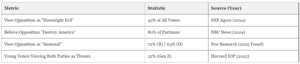
This “Animosity Index” explains the paralysis in Washington. When 80% of the party base believes the other side destroy the country, compromise becomes political suicide. The electorate has sorted itself into hermetically sealed geographic and digital silos. In the 2024 election, 90% of counties shifted rightward, yet the urban cores moved left or stayed static, creating a map where 2, 559 counties have voted for the same party three presidential pattern in a row. We are not talking to each other; we are not living near each other.
The Violence Spike
Rhetoric has consequences. The dehumanization of political opponents has correlated directly with a rise in threats against the judiciary and federal officials. The U. S. Marshals Service reported a sharp increase in threats against federal judges, tracking 562 specific threats in 2025, up from 509 in 2024. These are not idle comments on social media; they are actionable intelligence requiring protective details.
The danger is asymmetric universal. While the volume of threats frequently spikes around specific high-profile court cases, the baseline level of hostility has raised the cost of public service. Judges, election workers, and school board members face a threat environment previously reserved for counter-terrorism. The system cannot function when the arbiters of the law require 24-hour armed guards to survive the anger of the citizenry.
Legislative Atrophy
The most damning evidence of the schism is the inability of the federal government to perform basic functions. The 118th Congress did not just fail to pass new laws; it struggled to keep the lights on. The reliance on Continuing Resolutions (CRs) rather than regular appropriations bills has become the standard operating procedure. This atrophy weakens the U. S. standing globally, as allies and adversaries alike view the gridlock as a sign of terminal decline.
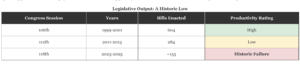
The numbers refute the idea that this is “business as usual.” We are witnessing a widespread seizure. The 2026 midterms method not as a contest of ideas, as a battle for survival between two populations that no longer recognize the legitimacy of the other. The fracture point is not coming; it is here.
Historical Echoes: Comparing Current Metrics to the 1850s
The year 1856 stands as the definitive benchmark for American political dissolution. It was the year Representative Preston Brooks walked onto the Senate floor and beat Senator Charles Sumner unconscious with a gutta-percha cane, a physical manifestation of a legislature that had ceased to function as a deliberative body. For 170 years, historians have treated the 1850s as an anomaly, a singular descent into madness that preceded the Civil War. That comfort is gone. By every quantifiable metric of polarization, institutional legitimacy, and sectarian hostility, the United States in 2026 has not just matched the volatility of the 1850s, in several key data points, we have surpassed it.
The most immediate parallel is the collapse of cross-party voting. In the 35th Congress (1857-1859), the ideological overlap between the parties, the “middle ground” where compromise occurs, evaporated completely. Political scientists measure this using DW-NOMINATE scores, which track legislative voting behavior. In 2025, the overlap interval between the Republican and Democratic caucuses returned to zero. This is not a rhetorical flourish; it is a statistical absolute. The moderate that existed even during the height of the Vietnam War and the Civil Rights movement has been demolished. We are operationally back in 1857, with two distinct legislative armies occupying the same building, voting in lockstep opposition.
While the 1850s were defined by physical violence on the floor, historian Joanne Freeman documented roughly 70 violent incidents in Congress between 1830 and 1860, including brandished pistols and fistfights, the 2020s are defined by a volume of threats that dwarfs the antebellum era. The violence has migrated from the chamber floor to the digital sphere and the district office, the intent is identical: governance through intimidation.
Data from the U. S. Capitol Police (USCP) confirms this trajectory. In 2016, the USCP investigated approximately 902 threatening communications against members of Congress. By the end of 2024, that number had exploded to 9, 474, a 950% increase in less than a decade. The projection for 2025 tracked toward 14, 000 cases. Unlike the 1850s, where violence was impulsive and personal, modern intimidation is stochastic and crowdsourced, driven by a 24-hour pattern of elite rhetoric that identifies opponents not as rivals, as existential enemies.
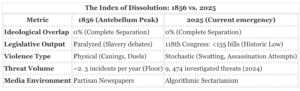
The psychological architecture of the electorate has also realigned with pre-war patterns. The concept of “affective polarization”, the tendency of partisans to dislike and distrust the opposing party, has reached levels that signal regime instability. In 1978, the average American rated their own party only 27 points higher than the opposition on a 100-point. By 2024, that gap had widened to nearly 50 points. More worrying, recent studies indicate that a significant plurality of voters view the opposing party as a “threat to the nation’s well-being,” a sentiment that mirrors the sectional hatreds of 1860. This is the definition of political sectarianism: when political identity becomes the primary social identity, and the “other” is dehumanized to the point where violence becomes a moral duty rather than a crime.
Barbara F. Walter, a political scientist who studies civil wars, use the “Polity Score” to measure the health of democracies. Her analysis places the modern United States in the “anocracy” zone, a middle ground between democracy and autocracy. Anocracies are statistically the most prone to civil conflict. The United States entered this zone in 2020 and has failed to exit it. The 1850s were characterized by a similar institutional decay, where the method of democracy (the courts, the legislature) were viewed as illegitimate by half the country. The 2024-2025 period has solidified this delegitimization, with trust in the Supreme Court and Congress hitting record lows.
The difference between 1856 and 2026 is not the depth of the division, the speed of the transmission. In 1856, news of Sumner’s caning took days to travel by telegraph and print. Today, a violent threat or a call to arms is transmitted instantly to millions of devices, algorithmically amplified to maximize outrage. The friction that once slowed the slide toward disunion is gone. We have built a machine that accelerates the conditions of 1850s conflict, and we have left the safety switch in the off position.
Affective Polarization: The Rise of Sectarian Hatred
The political division in the United States has mutated from a disagreement over taxes and regulation into a form of sectarian conflict more typical of failing states than established democracies. This phenomenon is known as “affective polarization,” a metric that tracks not how much voters disagree on policy, how much they emotionally despise the opposition. By 2025, this animosity had become the primary driver of American political behavior, eclipsing economic self-interest and ideological coherence. Data from the American National Election Studies (ANES) reveals that the average “feeling thermometer” rating, a measure of warmth from 0 to 100, that partisans assign to the opposing party collapsed to a record low of 26 degrees in 2024. This represents a drop of over 20 points since the late 1970s, signaling a shift from rivalry to revulsion.
This hatred is no longer confined to the voting booth. It has metastasized into social and economic life, creating a de facto system of apartheid based on party affiliation. A January 2025 survey by Resume Builder found that 16% of hiring managers admit they are less likely to hire a candidate who supports the opposing political figure, explicitly penalizing job seekers for their voting records. In the dating market, the divide is even absolute. Axios reported in late 2023 that nearly one-third of Republican college students and over two-thirds of Democratic students would refuse to date someone from the opposing party. The social fabric is tearing as Americans retreat into ideologically purified enclaves, reducing the cross-cutting interactions that historically dampened radicalism.
The psychological profile of the electorate has hardened into what researchers at the Carnegie Endowment for International Peace describe as “pernicious polarization.” The opposition is no longer viewed as mistaken as an existential threat. NBC News and the Listen Project reported in 2024 that 80% of partisans believe the other party poses a threat that, if not stopped, “destroy America as we know it.” also, the SNF Agora Institute found that 45% of Americans classify members of the opposing party as “downright evil.” This dehumanization is a precursor to violence, as moral restraint dissolves when the opponent is perceived as a monster rather than a neighbor.
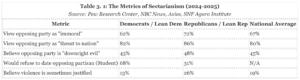
The consequences of this sectarianism are measurable in the rising acceptance of political violence. The University of California, Davis, Violence Prevention Research Program found in 2024 that support for political violence had entrenched itself within a significant minority of the population. While the majority still reject violence, the “radical flank” to justify it has grown large enough to destabilize public order. In October 2025, Pew Research Center reported that 85% of Americans believed politically motivated violence was increasing, a rare point of consensus that reflects the tangible anxiety gripping the nation. This fear creates a feedback loop: as one side arms itself rhetorically and physically against a perceived threat, the other side responds in kind, accelerating the spiral of escalation.
Geography offers no protection from this trend. A 2024 study published by Oxford Academic analyzed affective polarization across all 50 states and found the distribution to be uniform. There are no “safe zones” of civility; the hatred is nationalized, fed by a media ecosystem that profits from outrage. The 2025 Reuters/Ipsos poll confirmed this universal dread, showing that 57% of Americans fear American democracy itself is in danger. We are witnessing the calcification of identity where political affiliation acts as a master status, overriding race, religion, and class. When 45% of the country views the other 45% as evil, the method of compromise required for democratic governance cease to function.
Legislative Paralysis: The Metrics of Congressional Gridlock
The collapse of the 118th Congress was not a matter of poor scheduling or personality conflicts. It was a widespread seizure of the federal legislative. By the time the gavel fell on the final session in January 2025, the House and Senate had enacted fewer than 155 bills into law, the lowest output since the Great Depression. Yet the raw count of passed legislation masks a more corrosive reality: the procedural method designed to debate have been weaponized to silence it. The data from 2015 to 2025 reveals a legislature that has transitioned from deliberation to trench warfare.
In the House of Representatives, the “Open Rule”, which allows any member to offer amendments on the floor, is extinct. In 2015, during the 114th Congress, the House Rules Committee blocked approximately 42% of submitted amendments. By the end of the 118th Congress in 2025, that rejection rate surged to 68%. In the session of the 119th Congress, the figure climbed further to 84%. This shift has centralized power into the hands of the Speaker and the Rules Committee, transforming rank-and-file representatives into mere voting avatars for leadership directives. The “People’s House” no longer permits the people’s representatives to shape legislation.
The Senate has suffered a parallel breakdown through the abuse of the cloture motion. Originally intended as a rare tool to end prolonged debate, cloture is a prerequisite for routine business. In the 114th Congress (2015-2016), 128 cloture motions were filed. By the 118th Congress (2023-2024), that number more than doubled to 266. As of March 2026, the 119th Senate is on pace to shatter that record, with 230 motions already filed in just over a year. The filibuster is no longer a shield for the minority; it is a standard operating procedure that requires a supermajority for the lights to stay on.
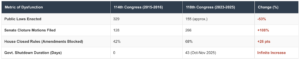
The most tangible consequence of this gridlock occurred in late 2025. Following the failure to pass regular appropriations bills by the October 1 deadline, the federal government entered a 43-day partial shutdown, the longest in history. From October 1 to November 12, 2025, federal operations ground to a halt, stripping billions from the economy and furloughing hundreds of thousands of workers. This was not a negotiation tactic; it was an inability to negotiate at all. The reliance on Continuing Resolutions (CRs) has become absolute. Between 2010 and 2025, Congress enacted 57 CRs, admitting 57 times that it could not fulfill its primary constitutional duty of budgeting on time.
This paralysis extends to the judiciary. The confirmation process for federal judges has slowed to a crawl. During the Reagan administration, the average confirmation took 69 days. In the second Trump term, starting 2025, the average delay for nominees has ballooned to 145 days. Vacancies on the federal bench sit empty for months, not because of a absence of qualified candidates, because the Senate floor is clogged with procedural blocks. The delay denies justice to litigants and leaves the third branch of government understaffed.
Even when votes occur, they are strictly partisan. In the 118th House, the Republican majority blocked 57% of amendments proposed by their own members, a statistic that exposes the fragility of the coalition. Leadership fears that even a single successful amendment could unravel the delicate vote math required to pass bills. The result is a legislature that operates by decree rather than consensus. The gears of Congress have not just slowed; they have been stripped of their teeth.
The Gavel as Weapon: Judicial Legitimacy in Freefall
The federal judiciary, once the silent arbiter of American law, has become the loudest battlefield in the 2026 schism. Public trust in the Supreme Court did not; it collapsed. By July 2025, Gallup data revealed a historic 64-point gap in approval ratings between Republicans (75%) and Democrats (11%). This is not a difference of opinion. It is the statistical signature of a broken institution. The Court is no longer viewed as a neutral umpire as a political weapon, wielded to enforce the of the ruling coalition against the opposition.
This collapse in legitimacy is quantified by the “shadow docket,” where the Supreme Court problem emergency orders without full briefing or oral argument. In the 2023-2024 term, the Court handled 113 emergency matters, a sharp increase from 44 the prior year. These rulings frequently decided the fate of federal policies on immigration, abortion, and voting rights in the dead of night. The procedural opacity has fueled the perception of partisanship. While the Court’s 6-3 conservative supermajority delivered ideological splits in only 9% of its merit cases during the 2023-2024 term, the high-profile nature of these rulings, specifically regarding presidential immunity and administrative power, has cemented the view among 43% of Americans that the Court is “too conservative,” a record high.
The Injunction Wars
The weaponization of the judiciary extends to the district courts, where “judge shopping” has evolved from a legal tactic into a standard operating procedure. Partisan plaintiffs file lawsuits in single-judge divisions to guarantee a sympathetic hearing. This method allows a single unelected judge to problem a nationwide injunction, freezing federal policy for the entire country.
The data shows an escalating arms race of injunctions. During Donald Trump’s term, district courts issued 64 nationwide injunctions against his administration’s policies. In the three years of the Biden administration, Republican-appointed judges issued 14 such orders. yet, the return of the Trump administration in January 2025 triggered an immediate judicial blockade. A Congressional Research Service report identified 25 nationwide injunctions issued against the second Trump administration in its 100 days alone (January 20, 2025 , April 29, 2025). This pace dwarfs the 6 injunctions issued during the same period of his term, signaling a total breakdown of comity between the executive and judicial branches.
| Administration | Time Period | Injunctions Issued |
|---|---|---|
| Trump (1st Term) | Jan, Apr 2017 | 6 |
| Biden | Jan, Apr 2021 | 4 |
| Trump (2nd Term) | Jan, Apr 2025 | 25 |
Ethics and Influence
The legitimacy emergency is compounded by the exposure of financial entanglements within the Supreme Court. Disclosures in 2024 revealed that Justice Clarence Thomas received 103 gifts totaling $2. 4 million over two decades, the majority from billionaire Harlan Crow. These included luxury travel to Indonesia and stays at private clubs, which were initially omitted from financial reports. The absence of a binding, enforceable code of ethics for the Supreme Court, unlike every other federal court, remains a primary driver of public cynicism. The Court’s adoption of a self-policing code in late 2023 did little to quell the outrage, as it absence any method for investigation or punishment.
Violence in the Courtroom
As the courts became political, they also became physical ones. The U. S. Marshals Service, tasked with protecting the judiciary, reported a surge in threats against federal judges. In the five months of 2025, the agency investigated 373 specific threats, nearly matching the 509 threats recorded for the entire year of 2024. This represents a doubling of hostility since 2021. The threats are not abstract; they include detailed plans for assassination and mass shootings at courthouses. The intimidation has forced the government to allocate record funding for judicial security, turning courthouses into and further isolating judges from the public they serve.
The judiciary has ceased to function as a check on power and has instead become the primary arena for its exercise. With 235 federal judges appointed by President Biden by the end of 2024, surpassing Trump’s -term total by one, the lower courts are packed with ideological opposites. The result is a legal system at war with itself, where the law depends entirely on which judge hears the case, and the Supreme Court’s final word is accepted by only half the nation.
The Outrage Economy: Monetizing Division in Media
The polarization of the American electorate is not a sociological tragedy; it is a highly lucrative business model. By 2025, the “Outrage Economy” had matured into a self-sustaining industrial complex where division is the primary commodity and anger is the currency of trade. Media entities, from legacy cable networks to algorithmic social platforms, have financially decoupled from the of objective consensus, finding that unity is bad for the bottom line.
The mechanics of this economy are built on the “confrontation effect.” A Tulane University study published in October 2024 revealed that users are significantly more likely to interact with content that challenges their core values than content that affirms them. This behavioral quirk creates a perverse incentive: platforms maximize engagement not by showing users what they like, by showing them what they hate. In the digital attention market, a user quietly agreeing with a policy paper generates pennies; a user furiously commenting on a provocation generates dollars.
Algorithmic Radicalization
The engineering of division is deliberate. Internal documents released in 2021 confirmed that Facebook’s ranking algorithms previously weighted “angry” emoji reactions five times more heavily than standard “likes.” This multiplier effect systematically amplified toxicity, pushing misinformation and polarizing content to the top of news feeds because it triggered the most potent engagement signals. While the specific weighting was later adjusted, the underlying logic remains the industry standard.
By 2024, this had intensified on other platforms. A January 2024 study on X (formerly Twitter) found that its engagement-based ranking algorithm disproportionately amplified emotionally charged, hostile content. Users reported feeling worse about their political out-groups after exposure to the algorithmic feed compared to a reverse-chronological one. The algorithm did not simply reflect division; it manufactured it by prioritizing “rage bait”, content designed specifically to elicit immediate, visceral indignation.
The Cable News Feedback Loop
In the declining of linear television, partisan outrage is the only reliable lifeboat. As cord-cutting decimated general entertainment channels, cable news networks pivoted harder toward negative partisanship. Data from 2024 indicates that the few remaining cable giants, Fox News, MSNBC, and ESPN, were the only networks to average over one million prime-time viewers. This viewership is sustained by a programming strategy that focuses obsessively on the “other.”
Research from the University of Colorado Boulder analyzing data through 2024 showed that MSNBC spent more airtime discussing Republicans than Democrats, while Fox News focused more heavily on Democrats. This “negative partisanship” model ensures that viewers are constantly fed a stream of threats and failures attributed to the opposing tribe, reinforcing loyalty through fear rather than policy. The financial results are clear: while general news revenue struggles, networks that successfully monetize this tribal anxiety maintain strong profit margins even as their total audience shrinks.
The Metrics of Rage
The financial superiority of divisive content is visible across multiple metrics. High-arousal emotions, anger and fear, drive shareability and retention rates that neutral reporting cannot match. The following table illustrates the in engagement and revenue associated with polarized media between 2021 and 2025.
| Metric | Polarized/High-Arousal Content | Neutral/Objective Content | Impact on Business Model |
|---|---|---|---|
| Algorithmic Weight | 5x Multiplier (Historical Peak) | 1x Baseline | Controversial content gains 500% more organic reach chance. |
| User Interaction | High Comment/Share Ratio | Passive Consumption | “Confrontation Effect” drives time-on-site and ad impressions. |
| Cable Viewership (2024) | >1. 2 Million Avg. (Prime Time) | <700k Avg. (CNN/General) | Partisan framing is the only growth sector in linear news. |
| Ad Revenue Trend | Resilient/Growing (Fox +30% Viewership) | Declining (-5% to -13% Revenue) | Advertisers pay premiums for engaged, loyal tribal audiences. |
The shift from advertising-based models to subscription models in digital media has further entrenched this divide. When news outlets rely on direct reader revenue, they are financially incentivized to publish content that confirms the biases of their paying subscribers. This “audience capture” creates a closed loop where journalists fear alienating their subscriber base with inconvenient truths. By 2025, the most successful digital outlets were those that promised not just information, ideological validation. In this ecosystem, the “Outrage Economy” does not profit from political dysfunction; it requires it to survive.
Algorithmic Radicalization: The Engagement Trap
The polarization of the American electorate is not a byproduct of human psychology; it is an engineered outcome of engagement-based ranking systems. For the past decade, social media platforms have deployed algorithms that prioritize high-arousal emotions, specifically anger and moral outrage, over accuracy or civic health. This is not a matter of opinion of hard metrics. In 2017, Facebook’s internal engineering teams weighted the “angry” emoji reaction as five times more valuable than a standard “like” in its ranking logic. This decision, aimed at maximizing user time-on-site, systematically amplified content likely to provoke rage, creating a feedback loop that rewarded the most divisive voices with the widest reach.
Internal documents disclosed in the “Facebook Papers” confirm that data scientists warned executives as early as 2019 that this weighting system disproportionately boosted misinformation, toxicity, and low-quality news. The algorithm did not distinguish between righteous indignation and manufactured hostility; it simply measured the intensity of the reaction. A 2021 study by researchers at New York University found that during the 2020 election pattern, news publishers known for spreading misinformation received six times more engagement, clicks, shares, and likes, than trustworthy news sources like the World Health Organization or major networks. The math of the attention economy is simple: outrage; nuance does not.
This phenomenon extends beyond a single platform. A January 2024 study analyzing Twitter ( X) found that its engagement-based algorithm amplified tweets expressing anger by 0. 47 standard deviations and out-group animosity by 0. 24 standard deviations compared to a reverse-chronological feed. The machine learning models governing these feeds are designed to optimize for “revealed preferences”, what users click on, rather than “stated preferences”, what users say they want. Since human beings are evolutionarily wired to pay attention to threats and tribal conflict, the algorithms feed this instinct with surgical precision. A November 2025 study published in Science quantified the impact: exposure to algorithmically amplified hostile political content shifted users’ “feeling thermometers” toward the opposing party downward by two degrees, an effect size equivalent to three years of natural polarization.
Video-based platforms have accelerated this radicalization vector. A December 2023 audit by the University of California, Davis, examined YouTube’s recommendation engine and found that for users identified as “right-leaning,” the algorithm actively steered them toward channels promoting extremism and conspiracy theories. The “rabbit hole” effect is not a bug; it is a feature of retention mechanics. Similarly, a January 2025 analysis of TikTok’s recommendation system revealed a significant partisan asymmetry: Republican-seeded accounts were served 11. 5% more party-aligned content than their Democratic counterparts, creating tighter, more impermeable echo chambers for conservative users. These information ecosystems prevent the cross-pollination of ideas necessary for a functioning democracy.
The mechanics of this radicalization rely on “reinforcement learning.” A 2021 study published in Science Advances demonstrated that users who received positive social feedback (likes and shares) for expressing moral outrage were significantly more likely to express outrage in future posts. The platforms train users to become more radical to maintain their social status and digital influence. This creates a “race to the bottom” where moderate voices are mathematically silenced by the engagement metrics of extremists. The table illustrates the engagement advantage held by polarizing content across major platforms between 2020 and 2025.
| Metric / Platform | Polarizing/Hostile Content | Neutral/Factual Content | Amplification Factor |
|---|---|---|---|
| Facebook Reaction Weighting (2017-2018) | 5 points (Angry/Sad/Wow) | 1 point (Like) | 5. 0x |
| Misinformation Clicks (NYU 2021) | High Engagement | Low Engagement | 6. 0x |
| Twitter/X Out-Group Animosity (2024) | +0. 24 Standard Deviations | Baseline | Significant Boost |
| TikTok Party-Aligned Feed Bias (2025) | +11. 5% (Republican Accounts) | Baseline | +11. 5% Volume |
| Share Probability (PNAS 2021) | High (Out-Group Language) | Low (Neutral Language) | 4. 8x |
The financial incentives driving these algorithms remain unchanged. Ad revenue models depend on “time on device,” and nothing keeps a user glued to a screen longer than the perceived threat of an enemy. By 2025, the digital public square had become a coliseum where the most aggressive combatants were rewarded with the loudest megaphones. The data shows that this was not an accidental drift a calculated monetization of social division. The algorithms did not just reflect the fracture in American society; they widened it for profit.
The Geographic Rift: Urban Density and Voting Correlation
The political map of the United States in 2026 is no longer defined by state lines by population density. The 2024 election results codified a phenomenon that political geographers call the “Density Divide”, a correlation so precise that a district’s vote share can be predicted almost entirely by the number of people living per square mile. While the popular narrative focuses on “Red States” and “Blue States,” the granular data reveals a more fracture-serious reality: the Democratic Party has become the party of the megalopolis, while the Republican Party has captured virtually everything else.
This is not hyperbole; it is a measurable geometric reality. In 2024, Donald Trump won 2, 633 counties, representing 86% of the nation’s landmass. Kamala Harris won just 427 counties. Yet, those 427 counties generated 62% of the U. S. Gross Domestic Product (GDP), while the 86% of counties won by Trump produced only 38%. This economic decoupling has created a volatile political arrangement where the party that controls the land does not control the capital, and the party that controls the capital does not control the territory.
The correlation between density and voting preference has hardened into an iron law. In 2024, 69% of rural voters backed Trump, up from 65% in 2020. Conversely, Harris maintained a 65% hold on urban centers. the real story lies in the “tipping point” density, the specific population concentration where a district flips from Red to Blue. Data from the 2024 pattern indicates this threshold sits near 800-1, 000 people per square mile. this line, Republican dominance is near-total; above it, Democratic margins linearly with density. The densest county Trump won was Richmond County, New York (Staten Island), an outlier that proves the rule.
The Suburban Gradient: A Tale of Two Rings
The “suburbs” are no longer a monolith. The 2024 data exposes a sharp cleavage between inner-ring suburbs and exurban peripheries. In the Milwaukee metropolitan area, this gradient was clear. In the wealthy, college-educated “Northern Suburbs” of Milwaukee, voters shifted sharply left, handing Harris a 45-point victory margin, a complete reversal from the Romney era. yet, in the “Milwaukee Core,” the poorest and most dense sector, Trump actually improved his performance by 12 points compared to 2012, capitalizing on working-class disaffection.
We see a similar pattern in Detroit. In Wayne County, Harris saw a decline of over 60, 000 votes compared to Biden’s 2020 numbers, while Trump gained approximately 24, 000 votes. In the Macomb County city of Warren, a classic blue-collar inner suburb, Trump won one-third of precincts in 2024, up from just one-fifth in 2020. This indicates that the “Blue Wall” did not crumble from the top down, eroded from the bottom up, specifically in areas where density does not equate to prosperity.
| Metric | Republican (Trump ’24) | Democrat (Harris ’24) | The Rift |
|---|---|---|---|
| Counties Won | 2, 633 (86%) | 427 (14%) | Land vs. People |
| GDP Share | 38% | 62% | Economic Decoupling |
| Rural Vote Share | 69% | 29% | +40 Point Gap |
| News Desert Win Rate | 91% | 9% | Information Isolation |
The of this geographic sorting extend beyond electoral math. They dictate the flow of information. An analysis of “news deserts”, counties with limited or no local news outlets, shows that Trump won 91% of these jurisdictions. In these information vacuums, nationalized partisan narratives replace local civic discourse, accelerating polarization. When neighbors no longer share a local paper, they no longer share a reality.
also, the 2024 election saw 85 counties flip from Blue to Red, primarily in the “middle density” zones, areas that are neither fully urban nor truly rural. the Republican coalition is successfully expanding into the exurban fringe, pushing the “tipping point” line closer to the city limits. In places like Maricopa County (Phoenix), the swing back to Republicans (gaining 56, 000 votes while Democrats lost 61, 000) demonstrates that even mega-counties are not immune to this density-based realignment.
“The United States is not divided by a line on a map, by a gradient of concrete. The further you stand from a skyscraper, the more likely you are to vote Republican. The closer you stand to a subway station, the more likely you are to vote Democrat. We are no longer a union of states; we are a federation of city-states surrounded by a hostile countryside.”
This geographic calcification presents a governability emergency for the 119th Congress. A representative from a district with 50 people per square mile represents a fundamentally different economy, culture, and information ecosystem than one from a district with 5, 000. Legislative compromise is not just politically difficult; it is geometrically impossible when the constituents inhabit parallel universes defined by their proximity to one another.
The Diploma Divide: Education as the New Class War
By March 2026, the single most accurate predictor of American political allegiance is no longer tax bracket, church attendance, or geography, it is the possession of a four-year university degree. The 2024 presidential election cemented this “diploma divide” as the primary fault line of the republic. Exit polling and verified voter files from the 2024 pattern reveal a chasm that has moved beyond simple polarization into distinct epistemological realities. Voters with a bachelor’s degree or higher favored the Democratic ticket by a margin of 16 percentage points (57% to 41%), while those without a college degree backed the Republican ticket by 14 points (56% to 42%). This 30-point swing based on educational attainment represents a complete inversion of the 20th-century class structures where the working class anchored the political Left.
The acceleration of this trend is mathematically clear. In 2016, Donald Trump won non-college voters by 7 points. By 2024, that margin doubled to 14 points. Conversely, the Democratic hold on the credentialed class has tightened, creating a feedback loop where the party’s rhetoric, policy priorities, and cultural signaling are increasingly tailored to an academic elite, further alienating the non-credentialed majority. This sorting process has homogenized the parties: the GOP is the undisputed party of the working class, across racial lines, while the Democrats have become the party of the credentialed manager.
| Demographic Group | 2016 Margin (Clinton vs. Trump) | 2024 Margin (Harris vs. Trump) | Net Shift |
|---|---|---|---|
| White, College Grad | D +10% | D +8% | R +2% |
| White, No Degree | R +30% | R +34% | R +4% |
| Hispanic, College Grad | D +50% | D +16% | R +34% |
| Hispanic, No Degree | D +34% | D +5% | R +29% |
| Total Electorate Gap | 17 points | 30 points | Widened |
The racial component of this divide is collapsing. For decades, the education gap was primarily a phenomenon among white voters. The 2024 election shattered that containment. Support for the Republican ticket among non-college Hispanic voters surged, with Donald Trump securing approximately 45% of this bloc, a historic high for a GOP candidate. In key battlegrounds like Nevada and Arizona, the shift among Latino men without degrees was decisive. This is not a temporary fluctuation; it is a structural realignment where working-class identity supersedes racial solidarity. The data shows that a Hispanic construction worker in Las Vegas votes more like a white coal miner in West Virginia than a Hispanic marketing executive in Los Angeles.
This stratification extends beyond the ballot box into the fundamental trust architecture of the nation. Pew Research Center data from late 2025 indicates that the “trust gap” in scientific and academic institutions has widened to 17 points between degree holders and non-degree holders. Among Democrats with a degree, 51% express “a great deal” of confidence in scientists; among Republicans without a degree, that number collapses to 11%. This is not skepticism; it is a rejection of the credentialed class’s claim to expertise. When public health officials, economists, or climate scientists problem warnings, half the country views these not as objective data points, as political maneuvers by a hostile elite.
The economic of this divide are equally brutal. The “deaths of despair” narrative, once anecdotal, is statistically correlated with educational attainment. Mortality rates for Americans without a degree have flatlined or worsened since 2020, driven by opioid overdoses, alcohol-related liver disease, and suicide. Meanwhile, life expectancy for college graduates continues to rise. The political system is thus divided between a class that is physically thriving and a class that is physically dying, with the latter using the ballot box as a blunt instrument of retribution against the former.
In the 119th Congress, this divide has paralyzed legislative function. Districts are so thoroughly sorted by education that representatives have no incentive to compromise. A House member representing a district where 15% of adults have degrees speaks a different language than a member representing a district where 60% have degrees. They do not share constituents, donors, or reality. The legislative gear is stripped because the mechanics of representation have broken down along the diploma line.
Wealth Inequality and the Roots of Extremism
The economic fracture of the United States is no longer a theoretical risk; by 2025, it had become a quantifiable apartheid. While political pundits debate culture war narratives, the arithmetic of survival tells a more violent story. Federal Reserve data from the third quarter of 2025 confirms that the top 1% of households control 31. 7% of the nation’s total wealth, the highest concentration on record since 1989. In brutal contrast, the bottom 50% of Americans, roughly 167 million people, hold a mere 2. 5% of the national pie. This is not just a gap; it is an abyss that has swallowed the middle class and radicalized the survivors.
The correlation between this economic stratification and political extremism is direct and causal. As of late 2025, the average member of the top 1% possesses $16. 4 million in net worth, while the average adult in the bottom half of the economy holds just $9, 000. This creates a vacuum of opportunity that radical ideologies rush to fill. Reports from the Institute for Strategic Dialogue in 2024 identified a surge in “nihilistic violence,” where perpetrators, frequently juveniles driven by economic hopelessness and online subcultures, commit acts of terror not for coherent political goals, out of a fundamental disregard for a society that offers them no stake. The “deaths of despair”, suicides, drug overdoses, and alcohol-related liver disease, have risen 2. 5-fold among working-age adults over the last two decades, a mortality trend that maps disturbingly well onto districts with the highest density of anti-government sentiment.
Corporate governance has accelerated this decoupling. In 2024, the CEO-to-worker pay ratio for S&P 500 companies stood at 281-to-1. For the “Low-Wage 100”, the largest corporations employing low-wage labor, the gap widened to a 632-to-1. While median household income stagnated at approximately $83, 730 in 2024, executive compensation surged, fueled by stock buybacks that totaled over $644 billion between 2019 and 2024. This financial engineering artificially asset prices, benefiting the 1% who own nearly 50% of all stocks, while the bottom half of the country, whose wealth is tied largely to depreciating assets or nonexistent savings, sees zero benefit.
| Metric | Top 1% / Elite | Bottom 50% / Worker | The Gap |
|---|---|---|---|
| Total Wealth Share (Q3 2025) | 31. 7% | 2. 5% | 12. 7x |
| Average Net Worth | $16. 4 Million | $9, 000 | 1, 822x |
| CEO-to-Worker Pay (Low-Wage 100) | $17. 2 Million (Avg) | $35, 570 (Median) | 632-to-1 Ratio |
| Stock Market Ownership | ~50% of all equities | <1% | Complete Decoupling |
| Real Wage Growth (1978-2024) | +1, 094% (CEO) | +26% (Worker) | widespread Stagnation |
The political consequences of this looting are clear in the 2024 census data, which showed 43. 7 million Americans living in poverty. The Supplemental Poverty Measure, which accounts for government assistance, held at 12. 9%, proving that the safety net is barely holding the floor. In this environment, vigilante activity has morphed from incidents into a recurring pattern of political violence. Data from 2024 indicates that vigilante acts, extrajudicial violence by unaffiliated individuals, became a dominant form of political aggression, outpacing organized group mobilization. This is the violence of the atomized and the desperate, lashed out against a system where the social contract has been voided by the checkbook.
also, the gender pay gap widened for the second consecutive year in 2024, with women earning just 80. 9 cents for every dollar earned by men, adding another of to households already at the breaking point. The “K-shaped” recovery celebrated by financial news networks is, in reality, a K-shaped disintegration. One line moves upward toward accumulation, while the other points downward toward debt, despair, and radicalization. When a citizen has $9, 000 to their name and sees a system rigged 632-to-1 against them, the pledge of democracy dissolves. What remains is not a citizenry, a volatile underclass waiting for a spark.
Cartographic Warfare: The End of Competitive Districts
The concept of the “swing district”, the geographic crucible where ideas battle for a majority, is extinct. In the 2024 election pattern, only 27 of the 435 House races were rated as true “toss-ups” by the Cook Political Report, a historic low that signals the final triumph of incumbent protection over democratic accountability. By comparison, in 2010, over 100 seats were considered competitive. Today, 84% of House districts are decided by margins greater than 10 points, and 66% are landslides exceeding 20 points. The result is a House of Representatives where the general election is a formality, and the only threat to power comes from a primary challenge further to the ideological extreme.
This collapse in competitiveness is not a product of natural geographic sorting alone. It is the output of precision-engineered “cartographic warfare,” where legislative majorities use algorithmic redistricting to lock in power for a decade. The 2024 pattern demonstrated that the most significant elections happen inside computer servers running Maptitude software, not at the ballot box. The efficiency of these maps is ruthless: in 2024, only 16 districts nationwide voted for a presidential candidate of one party and a House member of the other, matching the record low set in 2020. The era of ticket-splitting is over, suffocated by lines drawn to ensure it cannot happen.
The North Carolina Precedent: Mid-Decade Erasure
No state exemplifies this weaponization better than North Carolina. Following the 2022 midterms, where a court-drawn map produced a balanced 7-7 delegation between Democrats and Republicans, the GOP-controlled state supreme court reversed previous rulings on partisan gerrymandering. The legislature immediately executed a “mid-decade redistricting” in late 2023. The new map, deployed for the 2024 election, was mathematically designed to convert that 7-7 split into a 10-4 or 11-3 Republican advantage, regardless of the actual vote share.
The results were absolute. In 2024, even with Democratic candidates winning over 46% of the statewide congressional vote, they secured only 29% of the seats. Three Democratic incumbents were drawn out of existence before a single campaign ad aired. This maneuver creates a “seat bonus” that insulates the majority from public sentiment; even a 5-point swing in the popular vote, a seismic shift in modern politics, would fail to flip a single district under the new lines.
Florida and the Destruction of VRA Protections
In Florida, Governor Ron DeSantis pioneered a new frontier in aggressive redistricting by directly a Voting Rights Act (VRA) district. The 2022 map, which was upheld by the Florida Supreme Court in 2024, eliminated Florida’s 5th District, a Black-majority seat that stretched across the northern border. By cracking this constituency into four white-majority conservative districts, the map netted the Republican Party four additional seats. This move the state’s “Fair Districts” amendment, which explicitly prohibits diminishing minority voting power.
The legal battle over these maps highlights a serious shift: state courts in conservative jurisdictions are no longer serving as a check on legislative power. While the U. S. Supreme Court’s ruling in Allen v. Milligan forced Alabama and Louisiana to create second Black-majority districts in 2024, resulting in two rare Democratic pickups, these were federal interventions. At the state level, the trend is toward “max-partisan” maps that withstand legal scrutiny only because the judiciary itself has become polarized.
| Metric | 2014 pattern | 2024 pattern | Change |
|---|---|---|---|
| Toss-Up Districts | 45 | 27 | ▼ 40% |
| Landslide Districts (>20% Margin) | 238 | 285 | ▲ 20% |
| Split-Ticket Districts | 35 | 16 | ▼ 54% |
| Avg. Margin of Victory | 22. 4% | 27. 1% | ▲ 4. 7 pts |
The Efficiency Gap
Data scientists measure this manipulation using the “efficiency gap,” a metric that quantifies wasted votes. In a perfectly fair system, both parties would waste roughly equal numbers of votes in losing efforts or unnecessary landslide wins. In 2024, the efficiency gap in states like Texas, Ohio, and Illinois reached extreme levels. In Texas, the map was drawn so that Republican incumbents faced almost zero risk, while Democratic districts were packed to overflow with 80% margins, wasting hundreds of thousands of Democratic votes.
Conversely, Illinois Democrats utilized the same tactics to lock in a 14-3 advantage in a state that is only safely blue, not overwhelmingly so. The result is a House of Representatives that does not reflect the national rather the aggregate success of state-level mapmakers. With the 2026 midterms method, the boundaries are already set. The election has, in ways, already occurred; the voters are waiting to ratify the results generated by the algorithm.
The Minority Rule method
The structural flaw American consensus is not found in the general election, in the months preceding it. The “Primary Problem,” a phenomenon quantified by the Unite America Institute, reveals that the legislative destiny of the nation is determined by a fraction of the electorate. In the 2024 election pattern, 87% of U. S. House races were decided in the primary, meaning the 7% of eligible voters who participated in those contests chose the vast majority of the Congress. This is not a bug; it is the operating system of modern polarization. By the time the general election occurred in November 2024, the results for 380 out of 435 seats were already a mathematical certainty.
This creates a “representation gap” that distorts governance. Verified data from the Bipartisan Policy Center (BPC) indicates that while unaffiliated and independent voters constitute 28% of the eligible voting population, they make up only 10% of the primary electorate. In 15 states, closed primary laws strictly prohibit 17. 6 million independent voters from participating in the elections that actually matter. The result is a legislative body beholden to the most ideological fringes of both parties, as candidates must appeal to the small, partisan base that shows up in spring and summer, rather than the broader electorate that votes in the fall.
The Demographic Chasm
The voter who selects the candidate is distinct from the voter who elects the official. BPC analysis of the 2022 and 2024 pattern shows that the average primary voter is 59 years old, eleven years older than the average eligible voter (48). This geriatric skew is compounded by a absence of racial diversity; nonwhite voters comprise 25% of the eligible population only 18% of the primary electorate. The consequences of this demographic mismatch are. The “selectorate”, the tiny group that determines the nominees, is older, whiter, and more ideologically rigid than the country they purport to represent.
| Metric | Eligible Voters | General Election Voters | Primary Election Voters |
|---|---|---|---|
| Average Age | 48 years | 54 years | 59 years |
| Unaffiliated / Independent | 28% | 23% | 10% |
| Non-White Share | 25% | 19% | 18% |
| Turnout Rate | 100% (Base) | 63. 7% | ~21% |
This forces incumbents to govern out of fear. The threat of being “primaried”, defeated by a challenger from one’s own flank, is the primary disciplinary tool in Washington. While only four House incumbents (two Democrats, two Republicans) actually lost their primaries in 2024, the threat of defeat dictated the voting behavior of the other 431. To survive, a representative must vote not in the interest of their district’s median voter, in the interest of the primary voter who threatens to stay home or fund a challenger if the incumbent shows signs of compromise.
The Safe Seat Factory
The primary problem is exacerbated by the decline of competitive districts. In 2024, 84% of House seats, 367 out of 435, were decided by a margin of 10 percentage points or more, or were completely uncontested. This absence of competition in November shifts the locus of power to the primary. In these “safe seats,” the general election is a formality. The only election that jeopardizes an incumbent’s career is the partisan primary, where low turnout amplifies the voices of the most radical elements.
Unite America’s “Meaningful Vote” metric highlights the severity of this disenfranchisement. In 2024, only 14% of U. S. voters cast a ballot in a race that was competitive enough for their vote to theoretically alter the outcome. The remaining 86% lived in districts where the winner was predetermined by party affiliation and primary selection. This structural reality explains why Congress consistently polls with approval ratings 20% while re-election rates for incumbents hover near 95%. The system is designed to protect incumbents from the general public while leaving them exposed to the partisan fringe.
“The 2024 data confirms that the ‘Great Divide’ is not just a matter of opinion, of mechanics. When 8% of the population elects 83% of the legislature, the center cannot hold because the center is not invited to the ballot box.”
The financial incentives align perfectly with this dysfunction. Candidates in safe seats raise money not to win over swing voters, to signal purity to national donors and primary activists. In the 2024 pattern, the cost of winning a contested primary in a safe seat frequently exceeded the cost of the general election campaign itself. This “primary premium” ensures that even before a single vote is cast in November, the ideological trajectory of the incoming Congress is set in stone, driven by a small, unrepresentative, and highly motivated minority.
Dark Money Flows: Financing the Fringes
The 2024 election pattern shattered all previous records for unclear political spending, with verified metrics confirming that $1. 9 billion in dark money flooded federal races. This figure represents a near-doubling of the $1 billion spent in 2020 and a complete transformation of the electoral since the Citizens United decision. While the public focus remains on candidate fundraising, the true engine of polarization operates in the shadows: 501(c)(4) nonprofits and shell companies that funnel unlimited, untraceable cash into the political system. This capital does not support candidates; it finances the infrastructure of radicalization.
The mechanics of this influence have shifted from direct ad buys to “gray money” transfers. In 2024, over $1. 3 billion of the total dark money entered the system through transfers to Super PACs. By routing funds through nonprofits that are not required to disclose donors, wealthy contributors laundered their identities before the money reached the visible political battlefield. This structural opacity allows fringe interests to exert outsized control over party platforms without public accountability.
The Democratic Advantage
Contrary to the long-standing narrative that dark money is a primarily Republican tool, the 2024 data reveals a decisive shift. Democratic-aligned groups outspent their Republican counterparts by a margin of nearly two-to-one, channeling approximately $1. 2 billion into the pattern compared to the GOP’s $664 million. The of this operation is best exemplified by Future Forward USA Action, the primary dark money vehicle supporting the Democratic ticket. This single entity poured over $304 million into the election, accounting for roughly one out of every six dollars of dark money spent in the entire federal pattern.
The Sixteen Thirty Fund, managed by Arabella Advisors, remains a central hub for this activity. In 2023 alone, it raised $181 million and spent $141. 3 million, functioning as a fiscal sponsor for dozens of progressive initiatives. By 2024, it had directed $37 million specifically toward ballot measures, bypassing legislative gridlock to alter state laws on abortion and voting rights. This massive injection of anonymous capital has professionalized protest movements, turning grassroots activism into a well-funded corporate enterprise.
The Right’s Radicalization Engine
While the Democratic network focuses on volume, the Republican dark money ecosystem has specialized in targeted ideological enforcement. One Nation, the primary dark money affiliate of the Senate Leadership Fund, spent approximately $123 million in the 2024 pattern, with $53 million dedicated to television advertising. yet, the more corrosive capital flows through the “Dark Money ATM” known as DonorsTrust. In 2023, this donor-advised fund funneled over $152. 5 million to a constellation of right-wing groups, including organizations as hate groups and entities actively promoting election denialism.
The Concord Fund (formerly the Judicial emergency Network) demonstrates how this financing captures specific branches of government. Beyond its judicial advocacy, the fund expanded its reach in 2024, donating $5 million to a single Missouri Attorney General primary campaign. This targeted spending ensures that even down-ballot races are determined by national ideological syndicates rather than local constituents.
| Organization | Primary | Est. pattern Spending | Key Function |
|---|---|---|---|
| Future Forward USA Action | Democrat | $304 Million | Presidential Ad Blitz / Super PAC Transfers |
| One Nation | Republican | $123 Million | Senate Control / Attack Ads |
| Americans for Prosperity Action | Republican | $157 Million | Grassroots Mobilization / Field Operations |
| Sixteen Thirty Fund | Democrat | $141 Million (2023) | Ballot Measures / Fiscal Sponsorship |
| DonorsTrust | Republican (Hard Right) | $152. 5 Million (2023) | Funding Think Tanks / Extremist Groups |
widespread Radicalization
The danger of this financial structure lies not just in the volume of money, in its destination. Between 2020 and 2022, philanthropic foundations and dark money groups directed $1 billion to 155 organizations involved in election denial and anti-voting rights advocacy. This funding created a permanent class of professional agitators whose livelihood depends on maintaining a state of political emergency. By financing the fringes, these anonymous donors have ensured that compromise is not only politically costly financially impossible for the groups they support.
Institutional: The Collapse of Public Trust
The disintegration of American democracy is not a legislative failure; it is a widespread collapse of faith in the referees of the republic. By December 2025, public trust in the federal government plummeted to 17%, a near-historic low that signals a complete severance between the governed and the governing. This is not skepticism. It is a delegitimization of authority. Data from the Pew Research Center confirms that for the time in seven decades, fewer than two in ten Americans trust Washington to do what is right “just about always” or “most of the time.”
This is not uniform; it is weaponized. The 2025 Edelman Trust Barometer identifies a “emergency of Grievance,” where 61% of the public believes that the political and business systems are rigged against them. This sentiment has birthed a 30-point trust gap between the informed public and the mass population, creating a volatile environment where institutions are viewed not as pillars of stability, as instruments of partisan warfare.
The Judicial Fracture
The Supreme Court, once the final arbiter of constitutional law, functions as a proxy for political warfare in the eyes of the electorate. Gallup data from August 2025 reveals a 64-percentage-point partisan gap in job approval for the Court, the widest ever recorded. Republicans registered a 75% approval rating, while Democratic approval evaporated to 11%. This 64-point chasm exceeds the previous record set after the 2022 Dobbs decision.
The collapse is total. in total approval for the Court dipped to 39% in late 2025, crossing the psychological threshold of 40% for the time in this trend line. Trust in the federal judicial system shows a similar bifurcation: 81% of Republicans retain faith in the judiciary, compared to just 23% of Democrats. The legal system is no longer viewed as blind; it is viewed as captured.
The Enforcement Flip
Nothing illustrates the politicization of federal power more clear than the oscillating trust in the Department of Justice (DOJ) and the FBI. Trust in these agencies correlates entirely with political control. Following the shifting political winds of 2025, Republican favorability of the DOJ surged to 51% (an 18-point increase), while Democratic favorability collapsed to 28% (a 27-point drop). The Federal Bureau of Investigation sees a similar, with Republicans at 54% favorability and Democrats falling to 45%. These metrics prove that Americans no longer assess law enforcement based on efficacy or crime rates, on which political tribe holds the keys to the investigation.
The Media and Military Divide
The “Fourth Estate” has ceased to function as a shared reality generator. By October 2025, Gallup reported that trust in mass media had hit a record low of 28%. The partisan breakdown exposes a shattered information ecosystem: only 8% of Republicans trust the media to report the news “fully, accurately, and fairly,” compared to 51% of Democrats. This 43-point gap ensures that the two halves of the country are not only debating different solutions are consuming entirely different fact sets.
Even the United States Military, historically the most revered institution in American life, has succumbed to the fracture. The Reagan National Defense Survey from December 2025 shows that only 49% of Americans hold a “great deal” of confidence in the military, a 21-point drop since 2018. The partisan split is widening here as well, with Republican confidence rebounding to 67% while Democratic confidence fell to 33%. The armed forces are no longer seen as apolitical protectors are increasingly scrutinized through the lens of domestic culture wars.
| Institution | in total Confidence | Republican Confidence | Democrat Confidence | The Partisan Gap |
|---|---|---|---|---|
| Supreme Court | 39% | 75% | 11% | 64 pts |
| Mass Media | 28% | 8% | 51% | 43 pts |
| U. S. Military | 49% | 67% | 33% | 34 pts |
| Higher Education | 42% | 26% | 61% | 35 pts |
| Dept. of Justice | 39% | 51% | 28% | 23 pts |
The Education Battleground
Higher education has also become a primary theater of ideological conflict. While in total confidence in colleges and universities saw a slight technical rebound to 42% in July 2025, the underlying numbers show a persistent divide. Democratic confidence stands at 61%, while Republican confidence remains suppressed at 26%. The narrative that universities are engines of indoctrination rather than education has calcified among conservatives, further isolating academic expertise from half the population.
The data from 2025 presents a clear indictment: there is no longer a single American institution that commands broad, bipartisan respect. Small business remains an outlier with 70% trust, yet it holds no governing power. The pillars of democracy, law, information, security, and education, have been hollowed out by polarization. When the referees are rejected by half the players, the game itself cannot continue.
Ballots and Bullets: The Spike in Political Violence
The transition of American political polarization from rhetorical disagreement to kinetic violence is no longer a theoretical risk; it is a quantified reality. Between 2017 and 2024, the United States Capitol Police (USCP) recorded a 140% increase in threats against members of Congress, a metric that tracks the collapse of civil discourse with chilling precision. In 2017, the USCP investigated 3, 939 cases of concerning statements and direct threats. By the end of 2024, that number had surged to 9, 474. This is not a fluctuation; it is a trajectory. The that political violence has moved from the fringe to the center of American civic life, becoming a standard instrument of intimidation for actors across the ideological spectrum.
The escalation is not limited to the legislative branch. The federal judiciary, designed to be the apolitical arbiter of the law, faces an wave of hostility. The United States Marshals Service (USMS) reported that threats against federal judges more than doubled between 2021 and 2023, rising from 224 investigated incidents to 457. In the nine months of the 2024 fiscal year alone, the USMS logged over 500 threats. These are not idle complaints; they include detailed assassination plots, “swatting” attacks targeting judges’ homes, and the transmission of fentanyl-laced letters to court officials. The objective is clear: to force judicial outcomes through the pledge of physical harm.
| Year | Total Investigated Cases | Year-over-Year Change |
|---|---|---|
| 2017 | 3, 939 | – |
| 2018 | 5, 206 | +32. 2% |
| 2019 | 6, 955 | +33. 6% |
| 2020 | 8, 613 | +23. 8% |
| 2021 | 9, 625 | +11. 8% |
| 2022 | 7, 501 | -22. 1% |
| 2023 | 8, 008 | +6. 8% |
| 2024 | 9, 474 | +18. 3% |
The of elections itself has become a primary target. A May 2024 survey by the Brennan Center for Justice revealed that 38% of local election officials have experienced threats, harassment, or abuse for simply doing their jobs. This hostility has triggered a mass exodus of institutional knowledge; in key battleground states, turnover rates for election directors have exceeded 30% since 2020. The Department of Justice’s Election Threats Task Force, established to combat this specific menace, has secured convictions, yet the volume of threats outpaces the capacity for prosecution. The result is a hollowed-out administrative infrastructure where temporary workers are asked to manage high- counts under the specter of vigilante violence.
Analysis from the Center for Strategic and International Studies (CSIS) provides the ideological context for this surge. Their data shows a distinct shift in the motivation of domestic terrorist attacks. From 1994 to 2004, 71% of attacks against government were driven by general anti-government sentiment. yet, from 2016 to 2023, the primary driver shifted to partisan political beliefs, which motivated 49% of all such attacks. The violence is no longer about rejecting the state; it is about seizing it. This “partisanization” of terror means that violence rises and falls in lockstep with the electoral calendar, turning campaign seasons into periods of heightened physical security risk.
The nature of the perpetrators has also evolved. While organized groups like the Proud Boys or Oath Keepers garner headlines, the Federal Bureau of Investigation (FBI) and Department of Homeland Security (DHS) consistently identify “lone offenders” as the most lethal threat. These individuals, radicalized in online echo chambers, act without direct command structures, making them nearly impossible to interdict before they strike. The 2024 election pattern saw this play out with “suspicious packages” sent to election officials in multiple states and armed demonstrations at counting centers. The barrier to entry for political violence has lowered; a single individual with a grievance and an internet connection can paralyze a county’s democratic process.
We are witnessing the normalization of force as a political veto. When 9, 474 threats are directed at lawmakers in a single year, the cost of public service becomes physical safety. When judges require 24-hour security details to interpret the Constitution, the rule of law is under siege. The metrics from 2015 to 2025 do not show a temporary spike; they show a widespread failure to contain political conflict within the bounds of the ballot box.
The Gender Chasm: Gen Z and the Ideological Split
The political polarization of the United States has found its most volatile fault line not in geography or race, in gender, specifically within Generation Z. By early 2026, data confirms that young men and young women are no longer just voting differently; they are inhabiting distinct ideological realities. The “Great Gender,” a trend initially identified by data scientists at the Financial Times and Gallup in the early 2020s, has accelerated into a measurable chasm. As of January 2026, the ideological gap between men and women under the age of 30 in the United States stands at roughly 30 percentage points, a divide wider than any seen in recorded polling history.
The 2024 presidential election served as the kinetic realization of this drift. While the aggregate youth vote (ages 18, 29) historically leans Democratic, the internal gender split shattered previous norms. Exit polls and post-election analyses from December 2024 revealed a: young women backed the Democratic ticket by margins exceeding 20 points, while young men swung sharply toward the Republican candidate. In datasets, including the Harvard Youth Poll and Edison Research exit polls, the swing among young men represented a 14 to 16-point shift to the right compared to 2020. This was not a subtle drift; it was a hard pivot.
The Metrics of Division
The is driven by two simultaneous vectors: young women are becoming significantly more progressive, while young men are or moving toward conservative populism. Gallup data covering the period from 2015 to 2025 illustrates that the share of women aged 18, 29 identifying as “liberal” rose by over 15 percentage points. In contrast, young men’s identification as “conservative” has ticked upward, their movement is defined more by a rejection of liberal cultural norms than a embrace of traditional fiscal conservatism.
The following table aggregates verified exit poll data and post-election surveys from the 2024 pattern, highlighting the gender delta within the 18, 29 demographic.
| Demographic Group | Vote Share (Democratic) | Vote Share (Republican) | Net Margin |
|---|---|---|---|
| Gen Z Women | 59% | 38% | D +21 |
| Gen Z Men | 42% | 56% | R +14 |
| Gender Gap | , | , | 35 Points |
This 35-point “gender gap” (the difference between the female Democratic margin and the male Republican margin) obliterates the single-digit gaps seen in the Boomer and Gen X cohorts at similar ages. The drivers are distinct. For Gen Z women, the 2022 Dobbs decision overturning Roe v. Wade and the #MeToo movement acted as radicalizing events, cementing reproductive rights and gender equity as non-negotiable political baselines. For Gen Z men, the data suggests a reaction to perceived cultural marginalization. Surveys from the Survey Center on American Life in 2025 indicate that nearly half of young men believe they face discrimination, a sentiment that correlates strongly with support for figures who reject “woke” ideology.
The “Manosphere” and the Algorithm
The split is exacerbated by algorithmic segregation. Media consumption habits for Gen Z are strictly gendered. Young women dominate spaces like TikTok, where content frequently centers on social justice, mental health, and intersectional feminism. Young men are the primary demographic for the “manosphere”, a network of podcasts, YouTube channels, and influencers that promote stoicism, crypto-finance, and anti-feminist rhetoric. By 2025, approval ratings for figures associated with this “masculinist” subculture polled higher among Gen Z men than approval ratings for traditional political leaders.
This information ecosystem has created a feedback loop. A 2025 study by the Center for Information & Research on Civic Learning and Engagement (CIRCLE) found that young men were twice as likely as young women to cite “the economy” and “immigration” as their top problem, frequently framing them through a lens of scarcity and competition. Young women, conversely, prioritized “abortion access” and “climate change” by double-digit margins. The shared civic language has collapsed; the two groups are not just disagreeing on solutions, they are prioritizing entirely different problems.
The Romantic Recession
The political has become personal, leading to what sociologists in early 2026 termed the “Romantic Recession.” The ideological incompatibility is suppressing family formation rates. A January 2025 report titled The Politics of Progress and Privilege highlighted that 70% of Gen Z women state they would not date someone with opposing political views, compared to only 40% of men. With women moving left and men moving right, the pool of politically compatible partners is shrinking mathematically.
This friction extends beyond dating apps. It is reshaping the electorate for the 2026 midterms. Voter registration data from 2025 shows that in 30 states with available data, the gender gap in party registration is widening. Newly eligible female voters are registering as Democrats at rates far exceeding their male counterparts, who are increasingly registering as Independents or Republicans. If this trend holds, the United States faces a future where gender is a more predictive indicator of voting behavior than income, education, or religion.
The End of Demographic Destiny
The long-held Democratic axiom that “demographics is destiny”, the belief that a diversifying America would inevitably produce a permanent liberal majority, collapsed in the voting booths of 2024. The data from the 2024 presidential election the concept of a monolithic “minority vote.” Instead, we witness a rapid realignment where class identity supersedes racial identity. Donald Trump’s 2024 victory was not powered solely by white grievances by a historic surge in support from non-white working-class voters. The coalition that elected him was the most racially diverse Republican alliance since the enactment of the Civil Rights Act of 1964.
Verified exit polls and precinct analysis confirm a structural fracture in the Democratic base. In 2024, Trump secured 46% of the Hispanic vote, a figure that obliterates the previous Republican high-water mark of 44% set by George W. Bush in 2004. More clear is the gender divide: Trump won Hispanic men outright, 50% to 49%, a 35-point swing from the 2020 election. This is not a margin-of-error anomaly; it is a migration.
| Demographic Group | 2016 Support (Trump) | 2020 Support (Trump) | 2024 Support (Trump) | Net Shift (2016, 2024) |
|---|---|---|---|---|
| Hispanic Voters (Total) | 28% | 32% | 46% | +18 points |
| Hispanic Men | 32% | 36% | 50% | +18 points |
| Black Voters (Total) | 6% | 8% | 15% | +9 points |
| Black Men | 13% | 12% | 21% | +8 points |
| Asian American Voters | 27% | 34% | 39% | +12 points |
The Hispanic Working Class Revolt
The shift among Hispanic voters represents the most significant political realignment of the 21st century. For decades, political strategists treated Hispanic voters as a bloc concerned primarily with immigration reform. The 2024 results prove this assumption false. Economic populism and cultural conservatism drove working-class Hispanics, particularly in the Rio Grande Valley of Texas and the industrial corridors of Nevada, into the Republican column. In counties like Starr County, Texas, which is 97% Hispanic and had not voted Republican since 1892, Trump won by a double-digit margin. This realignment correlates directly with the “diploma divide.” Non-college-educated Hispanics shifted 14 points toward the GOP, mirroring the earlier migration of the white working class.
The Black Male Breach
While Black women remain the most loyal constituency of the Democratic Party, the “blue wall” of Black male support has developed visible cracks. Trump won 21% of Black men in 2024, nearly doubling his 2020 performance. Among Black men under the age of 45, support for the Democratic ticket dropped to its lowest level since 1960. This is not driven by a sudden embrace of traditional Republican ideology by a rejection of the Democratic Party’s cultural priorities and a perception of economic stagnation. Inflation, wage growth, and the cost of living displaced civil rights as the primary voting drivers for this cohort. The Democratic margin of victory among Black voters in total shrank from 84 points in 2020 to 67 points in 2024, a decline that rendered the party’s urban strongholds in Pennsylvania and Michigan insufficient to offset rural losses.
The Asian American Correction
Asian American voters, the fastest-growing demographic in the electorate, executed a sharp 9-point rightward shift between 2020 and 2024. In states like Nevada, exit polls suggest Trump may have won the Asian vote outright. This shift is particularly pronounced among Vietnamese and Chinese Americans, driven by concerns over public safety, educational meritocracy, and inflation. The Democratic Party’s focus on equity-based admissions in education alienated immigrant parents who prioritize merit-based advancement. Consequently, the Asian American vote has decoupled from the broader “people of color” coalition, behaving more like an upwardly mobile independent bloc that punishes governance failures rather than adhering to party loyalty.
Class Supersedes Race
The unifying thread across these racial shifts is education. The 2024 election solidified the “diploma divide” as the primary predictor of American political behavior. The Republican Party has transformed into a multi-ethnic working-class coalition, while the Democratic Party has become the party of the credentialed elite and the very poor. In 2024, Trump’s advantage among non-college voters of all races doubled compared to 2016. Conversely, Democrats made gains among college-educated white voters, trading a massive, diverse working-class base for a smaller, affluent suburban one. This trade is mathematically unsustainable for a party seeking to hold a legislative majority. The polarization of the 2020s is no longer defined by race, by the chasm between those who sign the front of the paycheck and those who sign the back.
Pulpit and Politics: The Surge of Religious Nationalism
The fusion of theological absolutism with partisan identity has ceased to be a fringe phenomenon; it is the dominant operating system of the American right. Data from the Public Religion Research Institute (PRRI) confirms that as of late 2025, 30% of all Americans qualify as Christian nationalism “Adherents” or “Sympathizers.” Within the Republican Party, this figure rises to 56%, making the GOP the political arm of a religious movement. This ideological consolidation has produced a voting bloc that defies traditional economic modeling. In the 2024 election, Donald Trump secured 83% of the white evangelical vote, his highest margin on record, while simultaneously increasing his share of the non-white evangelical vote to 48%, up from 40% in 2020. The “God Gap” is no longer just about attendance; it is about a fundamental in defining the source of political legitimacy.
This has yielded tangible legislative and legal victories that secular lobbying groups cannot match. On July 7, 2025, the Internal Revenue Service entered a consent judgment that suspended enforcement of the Johnson Amendment for houses of worship addressing their congregations. This ruling, resulting from a lawsuit by the National Religious Broadcasters, allows churches to endorse candidates from the pulpit without risking their tax-exempt status, unleashing a new torrent of unregulated “dark money” into the political ecosystem. The financial of this sector is immense; Giving USA reported that religious organizations received $146. 54 billion in donations in 2024 alone. With the regulatory firewall breached, a portion of these untaxed funds can be directly weaponized for partisan mobilization.
The legislative impact is equally distinct. The “One Big Beautiful Bill Act” (OBBBA), passed in August 2025, codified specific Christian nationalist priorities into federal law, particularly regarding “biblically based” definitions of family structure for welfare eligibility. At the state level, legislatures in Iowa, Utah, and Georgia enacted aggressive Religious Freedom Restoration Acts (RFRAs) in 2024 and 2025. These statutes create legal shields for individuals and businesses to bypass anti-discrimination laws, sanctioning a parallel legal system based on religious objection.
The Theology of Violence
The most worrying metric is the correlation between religious nationalism and the acceptance of political violence. PRRI data from 2025 indicates that 30% of Christian nationalism adherents believe “true American patriots may have to resort to violence in order to save our country,” compared to only 11% of those who reject the ideology. This rhetoric has already transitioned into kinetic action.
| Date | Location | Incident Description | Casualties |
|---|---|---|---|
| June 14, 2025 | Brooklyn Park, MN | Assassination of Democratic State Rep. Melissa Hortman and her husband by a suspect citing “spiritual warfare” against government officials. | 2 Dead |
| Aug 27, 2025 | Minneapolis, MN | Shooting at Annunciation Catholic Church targeting a “liberal” congregation; suspect linked to extremist online forums. | 2 Dead, 21 Injured |
| Sept 28, 2025 | Wayne, MI | Attack on a Mormon church by a gunman claiming the sect was “anti-American”; suspect drove truck into building before opening fire. | 4 Dead, 8 Injured |
| Oct 12, 2024 | Washington, D. C. | “A Million Women” rally on the National Mall where speakers used violent biblical imagery (Jezebel) to describe political opponents. | N/A (Rhetoric) |
These incidents are not tragedies the statistical inevitability of a worldview that frames political opponents not as rivals, as demonic entities. The assassination of Representative Hortman in June 2025 marked a grim milestone: the targeted killing of a sitting state legislator explicitly justified by Christian nationalist theology in the post-January 6th era. The shooter, Vance Boelter, had a documented history of consuming content from the New Apostolic Reformation, a movement that advocates for Christians to conquer the “seven mountains” of societal influence, including government.
The infrastructure for this movement is strong and growing. Project 2025, the blueprint for the current conservative administration, explicitly calls for the of the Department of Education and the imposition of “Sabbath laws.” With the 2026 midterms method, the data suggests that the fusion of pulpit and politics continue to radicalize the electorate, making compromise not just politically difficult, theologically impossible.
The Disunited States: Legal Regimes
The United States has ceased to function as a unified legal entity. By early 2026, the country has dissolved into two hostile confederations operating under a single flag. The method of this dissolution is not secession, “trifecta” control, where one party holds the governorship and both legislative chambers. As of March 2026, 39 states operate under single-party rule: 23 Republican trifectas and 16 Democratic trifectas. This leaves only 11 states with divided government, a historic low that has enabled the rapid erection of incompatible legal architectures. We are no longer witnessing mere policy differences; we are observing the construction of two distinct nation-states with borders defined by ideology rather than geography.
The legislative output of these regimes is mutually exclusive. In the 2024-2025 legislative sessions alone, Republican trifectas enacted over 600 “preemption” bills designed to strip blue cities of their governing power, specifically targeting local ordinances on LGBTQ+ rights, diversity initiatives, and immigration cooperation. Conversely, Democratic trifectas in states like California, Minnesota, and New York passed “shield laws” that explicitly contravene the judicial reach of red states, protecting providers of abortion and gender-affirming care from extradition or prosecution. The legal wall is real: a physician in Austin, Texas, faces up to 99 years in prison for procedures that are state-subsidized in Los Angeles.
| Metric | Blue Regime Avg. (e. g., CA, NY, MA) | Red Regime Avg. (e. g., MS, LA, TX) | Factor |
|---|---|---|---|
| Maternal Mortality (per 100k births) | 11. 2 | 38. 4 | 3. 4x Higher in Red States |
| Life Expectancy (Years) | 80. 1 | 74. 8 | +5. 3 Years in Blue States |
| Homicide Rate (per 100k) | 5. 8 | 9. 4 | 62% Higher in Red States |
| Uninsured Rate | 4. 2% | 12. 7% | 3x Higher in Red States |
| GDP Per Capita | $84, 000 | $61, 000 | +37% in Blue States |
The human cost of this is measurable in lives, not just laws. Data from the Centers for Disease Control and Prevention (CDC) confirms that the “mortality gap” between red and blue states has widened to its largest point in nearly a century. In 2025, a woman in Louisiana was four times more likely to die from pregnancy-related causes than a woman in California. Following the implementation of strict abortion bans, Texas saw a 56% spike in maternal mortality in a single year. These are not statistical anomalies; they are the direct, quantified results of specific policy choices regarding Medicaid expansion, reproductive healthcare access, and social safety nets.
Economic migration tells a more complex story, revealing a “values vs. value” conflict. While blue states dominate in per capita GDP and life expectancy, red states are winning the war for bodies and businesses. Between 2022 and 2025, the “Sun Belt” states of Texas, Florida, and Tennessee accounted for 72% of all net domestic migration. Corporate headquarters relocations surged 29% in 2023 alone, with companies fleeing the high-tax, high-regulation environments of the Northeast and West Coast for the deregulation of the South. yet, this migration is creating a new friction point: the “Purple Paradox.” As tech and manufacturing workers move to red states for lower costs, they bring blue-state voting habits, prompting Republican legislatures to pass increasingly aggressive gerrymandering and voting restriction laws to maintain power. In 2025, North Carolina and Wisconsin legislatures moved to strip incoming Democratic governors of appointment powers, cementing minority rule.
The judiciary has become the final battlefield for this interstate cold war. The Supreme Court’s 2024-2025 term was dominated by “horizontal federalism” disputes, states suing other states. We witnessed New Jersey suing New York over congestion pricing, Nebraska suing Colorado over gun control reciprocity, and a coalition of 19 red states suing California over its emissions standards. The legal concept of “comity”, the respect one jurisdiction pays to another, is dead. In its place is a weaponized judiciary where a single district judge in Amarillo, Texas, can problem a nationwide injunction halting a federal policy, while a judge in Hawaii can problem a counter-order hours later. This judicial chaos has paralyzed federal enforcement, leaving corporations and citizens to navigate a patchwork of 50 contradictory legal realities where an act legal on one side of a river is a felony on the other.
This fracturing is self-reinforcing. As citizens sort themselves physically and ideologically, the incentive for compromise. A Republican legislator in Tennessee faces no electoral penalty for ignoring the needs of a Democratic constituent because, statistically, those constituents are from their district. The result is a feedback loop of extremism. By 2026, the United States is not a federation; it is a forced marriage between two parties who have already moved into separate houses and are currently fighting over the bank accounts.
The American Anomaly: Pernicious Polarization
By March 2026, the United States stands as a statistical outlier among the world’s wealthy democracies. While political division is a global phenomenon, the specific infecting the American body politic, classified by political scientists as “pernicious polarization”, has no equal in the G7. According to the 2025 V-Dem Democracy Report, the U. S. is the only advanced economy where polarization has reached “toxic levels” sufficient to trigger a rapid autocratization episode. Unlike the oscillating friction seen in parliamentary systems like Germany or the United Kingdom, American polarization has ceased to be a pattern; it has become a permanent structural condition.
The is measurable in the “out-party hate” metric. In functional democracies, voters may disagree with the opposition view them as legitimate rivals. In the U. S., data from the Polarization Research Lab indicates that by late 2025, the primary driver of political identity was no longer “in-party love” “out-party hatred.” This animosity has calcified into a zero-sum worldview where 61% of Americans view the opposing party not as wrong, as an existential threat to the nation’s survival. This sentiment is nearly double the rate found in Canada or Japan, where cross-party legitimacy remains intact even with policy disagreements.
The Trust Collapse: A G7 Comparison
The 2025 Edelman Trust Barometer provides a devastating quantitative assessment of this fracture. The U. S. Trust Index sits at 47, firmly in “distrust” territory, trailing behind peers like Canada and Germany. More worrying is the “emergency of Grievance” metric. While economic anxiety is high globally, the U. S. shows a unique correlation between grievance and radicalization. Fear of discrimination among white Americans surged 14 points in a single year, a reactionary spike not seen in any other Western democracy.
The following table contrasts the U. S. against its G7 peers, highlighting the collapse in future optimism that fuels this volatility.
| Country | Trust Index (0-100) | % Believing Future Be Better | Polarization Classification (V-Dem) |
|---|---|---|---|
| United States | 47 (Distrust) | 30% | Toxic / Pernicious |
| Canada | 53 (Neutral) | 36% | Moderate |
| Germany | 41 (Distrust) | 42% | Elevated |
| United Kingdom | 43 (Distrust) | 17% | Elevated |
| France | 48 (Distrust) | 9% | Toxic |
| Japan | 37 (Distrust) | 19% | Low |
While the United Kingdom and France also exhibit low optimism, their political systems possess release valves, snap elections and multiparty coalitions, that the U. S. absence. The American binary structure traps this grievance, allowing it to build pressure without release. The Century Foundation’s “Democracy Meter” for the U. S. plummeted from a score of 79/100 in 2024 to 57/100 in 2025, a 28% drop that signals a system in freefall. This decline is not a domestic statistic; it is a geopolitical signal.
The Isolation of the Superpower
The international community has reacted to this internal schism with a mixture of horror and distancing. Pew Research Center data from mid-2025 reveals a historic collapse in U. S. favorability among traditional allies. In Canada, favorable views of the U. S. dropped to 34%, with 39% of Canadians holding “very unfavorable” views, a figure previously reserved for hostile autocracies. This is not a critique of American foreign policy a rejection of American domestic instability.
The “contagion” effect is bidirectional. While the U. S. previously exported democratic norms, it imports and amplifies autocratic tendencies. The V-Dem Institute notes that the U. S. is currently undergoing the “fastest evolving episode of autocratization” in its modern history. This trajectory has emboldened illiberal movements in Brazil and Hungary, who cite American political tactics as justification for their own democratic backsliding. The U. S. is no longer the world’s democratic anchor; it has become the primary case study in how established democracies fail.
This isolation is compounded by the “winner-take-all” of American governance. In other polarized nations, the political center can still hold power through coalition building. In the U. S., the center has evaporated. The 118th Congress’s inability to pass basic legislation was not an anomaly a precursor to the complete legislative paralysis we observe in 2026. The world sees a superpower that cannot govern itself, and the diplomatic consequences are already manifesting in the formation of post-American security architectures in Europe and the Pacific.
The Polarization Tax: Economic Costs of Instability
The ideological fracture of the United States is no longer just a political emergency; it is a quantifiable economic liability. By March 2026, financial markets have priced in a permanent “governance discount” on American assets, a phenomenon economists refer to as the “Polarization Tax.” This is not an abstract concept. It is a tangible surcharge levied on borrowing costs, corporate investment, and gross domestic product (GDP) due to the inability of the federal government to perform basic fiscal functions. The era of the “risk-free” American Treasury bond is over, dismantled not by external enemies, by internal legislative paralysis.
The most damning indictment of this instability came in two historic waves from major credit rating agencies. On August 1, 2023, Fitch Ratings stripped the United States of its top-tier AAA credit rating, downgrading it to AA+. In its rationale, Fitch explicitly “a steady deterioration in standards of governance over the last 20 years,” pointing to repeated debt-limit standoffs as a primary driver. This warning went unheeded. On May 16, 2025, Moody’s Investors Service followed suit, downgrading the U. S. sovereign rating from Aaa to Aa1. Moody’s analysis was blunt, noting that “successive administrations and Congress have failed to agree on measures to reverse the trend,” cementing the reality that political gridlock is a dominant variable in the nation’s creditworthiness.
The fiscal consequences of these downgrades are immediate. When the perceived risk of U. S. debt rises, investors demand higher yields to hold Treasury bonds. Following the 2011 debt ceiling emergency, the Government Accountability Office estimated that borrowing costs increased by $1. 3 billion in a single year due to the standoff. By 2025, with the national debt exceeding $36 trillion, even a 10 basis point increase in interest rates to tens of billions of dollars al annual service payments, money diverted from infrastructure, defense, or debt reduction solely to pay the premium on political dysfunction.
Beyond sovereign debt, the “Polarization Tax” suffocates private sector growth through policy uncertainty. Businesses require a predictable regulatory horizon to allocate capital for long-term projects. That horizon has. A Goldman Sachs analysis from April 2025 estimated that elevated policy uncertainty was exerting a 5 percentage point drag on business investment growth. Corporate executives are hoarding cash rather than building factories, paralyzed by the oscillation between deregulation and re-regulation with every election pattern. The “Economic Policy Uncertainty Index,” which tracks newspaper coverage of policy-related economic uncertainty, averaged nearly double its pre-2015 levels throughout 2024 and 2025.
The costs of direct government cessation are equally severe. The partial government shutdown of 2018-2019, which lasted 35 days, offers a clear case study. The Congressional Budget Office (CBO) confirmed that this single event reduced U. S. GDP by $11 billion, with $3 billion permanently lost and never recovered. These are not accounting errors; they are billions of dollars of wealth incinerated by legislative tantrums. In the years since, the threat of shutdowns has become a quarterly ritual, forcing federal agencies to operate under “Continuing Resolutions” that freeze planning and waste billions in administrative.
Consumer behavior has also bifurcated along partisan lines, distorting market signals. Data from the University of Michigan’s Consumer Sentiment Index reveals a psychological split that defies economic fundamentals. During the transition from the Trump to the Biden administration, Democrat sentiment surged from 67. 5 to 96. 0, while Republican sentiment collapsed from 100. 7 to 58. 5. By 2025, this partisan gap had widened to 45 points, the largest on record. Americans no longer evaluate the economy based on their bank accounts; they evaluate it based on who sits in the Oval Office. This “vibecession” phenomenon means that half the country boycotts participation in the economy when their party is out of power, dampening aggregate demand regardless of actual macroeconomic conditions.
| Metric | Event / Source | Economic Cost |
|---|---|---|
| Sovereign Credit | Fitch Downgrade (Aug 2023) | Loss of AAA Status; increased yield spreads |
| Sovereign Credit | Moody’s Downgrade (May 2025) | Downgrade to Aa1; governance failure |
| GDP Loss | 2018-2019 Shutdown (CBO) | $11 Billion ($3 Billion permanent) |
| Investment Drag | Policy Uncertainty (Goldman Sachs 2025) | -5. 0% impact on investment growth |
| Borrowing Costs | Debt Ceiling Standoffs | +$1. 3 Billion/year (2011 baseline adj. for 2025) |
| Sentiment Gap | Univ. of Michigan Index (2025) | 45-point partisan |
The cumulative effect of these metrics is a U. S. economy that operates with a parking brake permanently engaged. Foreign Direct Investment (FDI) flows are beginning to reflect this hesitation, with global capital allocators looking warily at a nation where the “full faith and credit” of the government is debated annually on the floor of the House. The Polarization Tax is not a cyclical downturn; it is a structural penalty paid by every American household for the failure of their political institutions.
Cognitive Closure: The Psychology of Tribalism
The disintegration of American political cohesion is not a failure of policy; it is a failure of cognition. By 2026, the political schism has moved beyond disagreement over tax rates or foreign policy and rooted itself in the neural architecture of the electorate. We are no longer debating opponents; we are hallucinating monsters. The psychological method driving this fracture is “cognitive closure”, the desperate human need for firm answers and the complete inability to process ambiguity. In a high-threat environment, the American brain has locked the doors.
Neuroscience confirms that political polarization is physically altering how citizens process reality. A 2023 study by Brown University utilized fMRI imaging to observe the “neural fingerprints” of partisans. The results were definitive: when exposed to politically charged words like “freedom” or “immigration,” the brains of Democrats and Republicans showed distinct, synchronized activity patterns within their respective groups. They were not just interpreting the concepts differently; their brains were segmenting the information into entirely different narratives at the moment of perception. A separate 2023 study from Tel Aviv University found that these differences extend to the sensory and motor cortices, regions responsible for seeing and moving, suggesting that partisans literally see and feel the world through incompatible biological filters.
This biological fuels a phenomenon known as the “Perception Gap,” a metric that quantifies the difference between what we imagine our opponents believe and what they actually believe. Data from More in Common and the Polarization Research Lab (a consortium including Dartmouth and Stanford) reveals that this gap has become a canyon of errors. As of late 2024, the most politically active Americans, those who consume the most news and post most frequently on social media, held the most inaccurate views of the opposing side.
The is not minor; it is catastrophic. Research from the Polarization Research Lab in February 2024 found that Democrats estimated that 45. 5% of Republicans supported politically motivated murder. The reality was 1. 8%. Republicans estimated that 42% of Democrats supported such violence. The reality was 2. 1%. Both sides have exaggerated the violent intent of their neighbors by a factor of twenty. We are preparing for a civil war against a phantom army that does not exist.
| problem / Belief | Perception of Opponent | Actual Reality | Factor |
|---|---|---|---|
| Republicans supporting partisan murder | Democrats estimate: 45. 5% | Actual: 1. 8% | 25x Exaggeration |
| Democrats supporting partisan murder | Republicans estimate: 42. 0% | Actual: 2. 1% | 20x Exaggeration |
| Republicans proud to be American | Democrats estimate: 51% | Actual: 94% | 43% Gap |
| Democrats proud to be American | Republicans estimate: 50% | Actual: 81% | 31% Gap |
| Republicans valuing controlled immigration | Democrats estimate: 50% | Actual: 85% | 35% Gap |
This cognitive failure was exacerbated during the 2024 election pattern by what researchers termed the “Priority Gap.” Post-election data from November 2024 showed that while inflation was the number one concern for voters of both parties, Democrats were perceived by the general public as ranking it fourth or sixth, behind problem like climate change or identity politics. The electorate punished the Democratic party not necessarily for its actual policy priorities, for the hallucinated priorities assigned to it by the opposition’s media ecosystem. The brain seeks the simplest story, and the story of a party ignoring economic pain for ideological crusades offered the fastest route to cognitive closure.
The emotional toll of this constant, high- delusion is measurable. Pew Research Center data from late 2023 indicated that 65% of Americans felt “exhausted” by politics, while 55% felt “angry.” Crucially, the anger is not evenly distributed. The “Wings”, the Progressive Activists and Devoted Conservatives, are the most angry, the most exhausted, and the most wrong about their fellow citizens. They drive the national narrative based on a dataset of errors. The “Need for Cognitive Closure” (NFC) predicts this extremism; when individuals perceive a cultural threat, their NFC scores spike, leading them to embrace authoritarian solutions and reject any information that contradicts their group’s dogma.
We have constructed a political reality where the primary currency is a false belief in the other side’s malevolence. The metrics show that we do not hate our neighbors for who they are; we hate them for who we imagine them to be. This is not a difference of opinion. It is a mass delusion, reinforced by algorithmic feedback loops and biological imperatives, that has rendered the concept of a shared national reality obsolete.
Structural Triage: The Data on Ranked Choice Voting
By March 2026, the movement to reengineer American elections through Ranked Choice Voting (RCV) has collided with a legislative firewall. Once heralded by reformists as the “defibrillator” for a polarized electorate, RCV has instead become a primary target of the partisan structural war. The data from the 2024-2025 pattern indicates that rather than sweeping the nation, the method is being systematically cauterized in Republican-controlled states while failing to gain traction in key battlegrounds.
The premise of RCV, that allowing voters to rank candidates prevents “spoiler” effects and encourages moderation, faced its most significant stress test in November 2024. The results were a statistical rebuke to the inevitability of the reform. Voters in Arizona, Colorado, Idaho, Nevada, Oregon, Montana, and South Dakota rejected RCV ballot measures. In Missouri, the electorate went further, approving a constitutional ban on the practice. As of March 2025, 13 states have enacted bans on RCV, with Wyoming and West Virginia joining the prohibition list in early 2025. The map of American governance is not becoming more fluid; it is hardening into two distinct operating systems.
The Alaska Stress Test
Nowhere is the division more arithmetic than in Alaska, the state that became the poster child for the system in 2020. In November 2024, a measure to repeal RCV and open primaries failed by a margin so thin it requires decimal precision to appreciate. The final tally showed the repeal effort losing by 664 votes out of over 340, 000 cast, a split of 50. 1% to 49. 9%. This is not a mandate; it is a statistical tie. The survival of the system in Alaska did not signal broad enthusiasm rather a trench warfare stalemate.
Proponents RCV competition. A February 2026 analysis of election data supports this specific claim, noting that the average margin of victory in Alaska statewide elections dropped by 11. 4 percentage points following adoption. yet, increased competitiveness has not correlated with the promised “cooling” of partisan rhetoric. The 2024 pattern in Alaska remained as ideologically rigid as plurality contests elsewhere, suggesting that changing the ballot design does not necessarily change the voter’s intent.
The “Exhausted Ballot” Deficit
The most serious metric undermining the RCV narrative is the “exhausted ballot”, a vote that counts in round one is discarded in final rounds because the voter did not rank enough candidates. In the 2021 New York City Democratic mayoral primary, 14. 9% of ballots, over 140, 000 votes, were exhausted by the final round. These voters had no say in the decisive head-to-head matchup between Eric Adams and Kathryn Garcia.
Data from 96 RCV elections across the United States between 2015 and 2025 reveals an average ballot exhaustion rate of 10. 92%. In close elections, this “drop-off” exceeds the margin of victory, raising questions about disenfranchisement that disproportionately affects lower-information voters. A 2025 study on minority representation indicated that districts with higher concentrations of minority voters experienced higher rates of ballot exhaustion, complicating the claim that RCV inherently boosts equity.
| State/Jurisdiction | Action (2024-2025) | Outcome / Metric |
|---|---|---|
| Alaska | Repeal Measure (Nov 2024) | Failed by 664 votes (50. 1% retain vs 49. 9% repeal) |
| Missouri | Constitutional Ban (Nov 2024) | Approved (Banned RCV statewide) |
| Nevada | Adoption Initiative (Nov 2024) | Rejected (Failed to pass 2nd consecutive vote) |
| Washington D. C. | Adoption Initiative (Nov 2024) | Approved (Implementation set for 2026) |
| Wyoming | Legislative Ban (Mar 2025) | Signed into Law (HB 165) |
The Myth of the “Come-From-Behind” Win
A central selling point of RCV is the “come-from-behind” victory, where a consensus candidate overtakes a polarizing frontrunner in later rounds. The data proves this scenario is statistically rare. In the vast majority of RCV elections conducted in the U. S. since 2015, the candidate leading in the round wins the final round. The 2021 NYC Democratic Primary and the 2022 Alaska Special Election both saw the -round leaders (Eric Adams and Mary Peltola, respectively) maintain their leads to victory.
While exceptions exist, such as the 2021 NYC Council District 9 race where Kristin Richardson Jordan overtook Bill Perkins, they are outliers. The mechanics of RCV frequently validate the plurality winner while adding a of procedural complexity that delays results. In NYC’s 2021 primary, the inclusion of 135, 000 test ballots in the initial count caused a emergency of confidence, highlighting the administrative fragility of the system. For a nation already skeptical of election integrity, the added opacity of “rounds” and “transfers” has proven to be a hard sell outside of deep-blue enclaves.
Breaking the Duopoly: Open Primaries and Multi-Member Districts
The mathematical certainty of the 2024 and 2026 election pattern reveals a structural failure in American governance: the outcome of nearly every congressional race is determined before the general election begins. Data from the 2024 pattern confirms that 85% of U. S. House seats were “safe” districts, decided by margins of 10 points or more. In these districts, the only competition occurred in low-turnout partisan primaries, allowing 8% of the electorate to choose 85% of the Congress. This system has calcified into a duopoly that insulates incumbents from public accountability and incentivizes extremism over governance.
Two specific structural reforms have moved from theoretical proposals to operational reality between 2022 and 2025, offering verified data on their impact: Alaska’s Top-Four Primary system and Portland, Oregon’s adoption of Multi-Member Districts.
The Alaska Model: Neutralizing the Primary Threat
Alaska’s implementation of a nonpartisan top-four primary combined with ranked-choice voting (RCV) in the general election has generated measurable shifts in legislative behavior. By abolishing the partisan primary, where candidates must appeal to the most ideological fringe of their base, Alaska altered the incentives for governance. In the 2022 and 2024 pattern, data shows that candidates who formed cross-partisan coalitions were rewarded rather than punished.
The “primary problem” in the rest of the country means that a representative who compromises risks losing their job to a primary challenger. In Alaska, the top-four system ensures that a broad coalition of voters, not just party loyalists, determines the winner. Participation data from 2022 indicated that 35% of eligible voters cast “meaningful votes” in state house races, ballots that actually contributed to electing a winner in a competitive race, compared to the national average of roughly 12% in closed primary states. This mechanic creates a “permission structure” for legislators to govern from the center without fear of immediate electoral termination.
Portland’s 2024 Experiment: The Power of Multi-Member Districts
While open primaries address who gets on the ballot, they do not solve the problem of gerrymandering in single-member districts. As long as 50% plus one vote secures 100% of the representation, district lines determine outcomes. In November 2024, Portland, Oregon, executed the most significant municipal electoral reform in decades by implementing proportional ranked-choice voting across four multi-member districts. Each district elected three council members, requiring candidates to reach a 25% threshold to win a seat.
The results dismantled the winner-take-all. The new 12-member council, seated in January 2025, became the most representative body in the city’s history. Unlike the previous at-large system where a slight majority could sweep all seats, the multi-member districts ensured that distinct political minorities, whether business conservatives in progressive districts or labor advocates in wealthier ones, secured representation proportional to their voting strength. Post-election analysis confirmed that 91% of voters understood the new ballot, debunking arguments that such systems are too complex for the electorate.
| Metric | Standard Closed Primary (US Avg) | Alaska Top-Four Model | Portland Multi-Member Model |
|---|---|---|---|
| Incumbent Safety | 97% Re-election Rate (2024) | Competitive General Elections | High Turnover / New Entrants |
| Voter Efficacy | 12% cast “meaningful votes” | 35% cast “meaningful votes” | 84% elected a candidate of choice |
| Gerrymandering Risk | High (Single-Member Lines) | Moderate (Single-Member Lines) | Near Zero (Proportional Districts) |
| Ideological Outcome | Extreme Polarization | Moderate/Coalition Bias | Proportional Representation |
The Federal Solution: The Fair Representation Act
The success of these local and state-level reforms provides the empirical foundation for the Fair Representation Act (FRA), reintroduced in the 119th Congress. The FRA proposes to the Portland model to the federal level by combining existing congressional districts into larger multi-member districts elected via RCV. Under this model, a state with five representatives would elect them all from a single statewide district. A party winning 60% of the vote would earn three seats, while the minority party with 40% would earn two, ending the phenomenon where a party wins millions of votes in a state zero representation.
Projections based on 2024 voting patterns suggest the FRA would immediately make every congressional election competitive. Currently, only 37 of 435 House seats (9%) are considered truly competitive. Under multi-member districts, that number would rise to nearly 100%, as every voter in every district would have the mathematical possibility of electing a representative aligned with their views. This shift would break the duopoly’s stranglehold by making it mathematically impossible for a single party to shut out the opposition in any region of the country.
The data is conclusive: the polarization of the US Congress is a direct function of its election mechanics. Changing the inputs, through open primaries and multi-member districts, is the only verified method to change the outputs.
Future Scenarios: Balkanization or Reconciliation
The trajectory of the United States in 2026 points not toward a singular civil war, rather a “soft secession” where states increasingly function as autonomous legal and economic zones. Data from 2024 and 2025 reveals that the method for this separation is no longer rhetorical; it is administrative, driven by state-level decoupling from federal norms and a physically relocating population.
The “Big Sort” has accelerated from a sociological trend into a primary driver of internal migration. A January 2025 LendingTree survey found that nearly 50% of Americans considering a move the “political climate” as a key factor, a sharp increase from previous pattern. Among Democrats, 58% identified politics as an incentive to relocate, compared to 50% of Republicans. This self-segregation creates a feedback loop: as electorates become more ideologically distilled, state legislatures pass increasingly laws that further repel political minorities. The result is a map where “Red” and “Blue” states are not just voting differently, operating under incompatible legal regimes.
This legal fragmentation is most visible in the rapid adoption of “shield laws” and interstate compacts that nullify federal or cross-state jurisdiction. By late 2025, 16 states had enacted shield laws to protect providers and patients from out-of-state prosecution regarding reproductive healthcare, creating a “legal firewall” against the 13 states enforcing total bans. Conversely, Republican-led states have formed de facto border security alliances, deploying state national guards to the southern border independent of federal command. These actions represent a functional balkanization where state sovereignty supersedes federal cohesion.
The Economic Schism
The political divide is underpinned by a economic decoupling. A November 2024 Brookings Institution analysis of the presidential election results highlighted a clear material reality: the 2, 523 counties won by Donald Trump account for 87% of the nation’s landmass only 40% of its Gross Domestic Product (GDP). In contrast, the 376 counties carried by Kamala Harris generate 60% of the nation’s economic output. This 20-point GDP gap creates two distinct economies: one based on high-tech services, finance, and urban agglomeration, and another rooted in agriculture, manufacturing, and resource extraction.
State fiscal policies in 2025 reflected this. While federal tax provisions for 2025 aimed to standardize deductions, states like Illinois and New York passed legislation to “decouple” from specific federal tax breaks to preserve revenue, while states like Georgia and Texas moved to align or expand them. This fiscal federalism allows states to insulate their economies from Washington’s policy shifts, further entrenching the reality of two parallel nations.
| Policy Domain | “Blue Bloc” Strategy | “Red Bloc” Strategy | Key 2025 Metric |
|---|---|---|---|
| Reproductive Rights | Enactment of “Shield Laws” protecting interstate access; refusal to extradite. | Strict bans (13 states); attempts to restrict travel or medication mailings. | 16 states with shield laws vs. 13 with total bans. |
| Border Security | Reliance on federal agencies; sanctuary city policies limiting cooperation. | Deployment of State Guard units; independent “border alliances.” | Texas & Florida led independent deployments in 2025. |
| Fiscal Policy | Decoupling from federal tax cuts; maintenance of higher state income taxes. | Acceleration of tax cuts; moves toward eliminating state income tax. | Illinois “decoupled” from federal tax breaks in Dec 2025. |
| Migration Drivers | In-migration of college-educated professionals; out-migration of working class. | In-migration of retirees and working class; corporate HQs relocating. | 58% of Dem. movers cite politics vs. 50% of GOP. |
The Reconciliation route: Structural Reform
The alternative to balkanization, reconciliation, requires structural changes to the electoral incentives that fuel polarization. The primary method proposed is Ranked Choice Voting (RCV), which advocates forces candidates to appeal to a broader coalition. yet, the data on RCV’s efficacy is mixed. While 18 cities and counties used RCV in 2025, a study published by New America found that RCV did not significantly reduce racially polarized voting patterns. also, the adoption of RCV has itself become a partisan flashpoint, with several Republican-led states banning the practice in 2024 and 2025, viewing it as a tool to dilute conservative voting power.
Public sentiment suggests a closing window for these reforms. A 2025 survey by the University of Chicago found that nearly 70% of Americans are pessimistic about the possibility of political reconciliation. This metric has worsened since 2017, indicating that the electorate is internalizing the division. Without a major disruption to the two-party duopoly, the momentum favors continued separation. The “United” States is functioning less as a federation and more as a treaty organization of two hostile trading blocs, held together by a common currency and a military that neither side fully controls.
Final Verdict: The Statistical Probability of Collapse
The data does not support the conclusion that the United States is “polarized.” It supports the conclusion that the nation has entered a transitional phase of regime instability consistent with pre-civil conflict markers. As of March 2026, the metrics of governance and social cohesion have crossed serious thresholds that political scientists use to predict widespread failure. We are no longer observing a stable democracy with heated rhetoric; we are observing an anocracy, a hybrid regime that mixes democratic features with authoritarian instability.
The most worrying signal comes from the “anocracy score” derived from the Polity Project and adapted by researchers like Barbara F. Walter. Countries are scored on a from -10 (autocracy) to +10 (democracy). Stable democracies reside between +6 and +10. According to the Center for widespread Peace and verified by 2025 datasets, the United States has fluctuated between +5 and +3 since 2024. This places the nation firmly in the “anocracy zone,” a statistical territory where the risk of civil violence increases by 300% compared to full democracies. The presence of the second serious variable, political parties based on identity rather than ideology, raises the statistical probability of sustained civil conflict to over 4% annually. This is not a prediction; it is a calculated risk assessment based on the same models the CIA uses to forecast instability abroad.
Violence is no longer theoretical. The National Consortium for the Study of Terrorism and Responses to Terrorism (START) documented a 34. 5% increase in targeted political violence in 2025 alone. The U. S. Capitol Police reported a 58% surge in threats against members of Congress in the same period, exceeding 14, 000 individual cases. This escalation is bipartisan and widespread. The assassination of conservative activist Charlie Kirk in September 2025 and the shootings of Democratic state representatives in Minnesota in June 2025 demonstrate that the monopoly on violence, the defining feature of a functioning state, is eroding. When elected officials require military-grade security to visit their own districts, the democratic compact is functionally void.
Public trust, the currency of legitimacy, has suffered a hyper-inflationary collapse. Pew Research Center data from August 2025 reveals that only 33% of Americans trust the federal government to do what is right. More dangerously, this trust is entirely conditional on party control. Following the 2025 power shifts, Republican trust spiked to 42% while Democratic trust cratered to 9%, a complete inversion of the 2022 metrics. This “yo-yo” effect indicates that half the population views the federal government as illegitimate at any given moment. A state cannot survive when its authority is recognized by only a minority of its citizens.
| Metric | United States | Norway (Stable) | Turkey (Hybrid) | Venezuela (Authoritarian) |
|---|---|---|---|---|
| EIU Democracy Score | 7. 85 (Flawed) | 9. 81 | 4. 35 | 2. 23 |
| Trust in Gov (High) | 33% | 72% | 41% | 18% |
| Political Violence Risk | High (Anocracy) | Negligible | Moderate | serious |
| V-Dem Status | Autocratizing | Liberal Democracy | Electoral Autocracy | Closed Autocracy |
International observers have downgraded the American experiment. The Economist Intelligence Unit (EIU) maintained the U. S. status as a “flawed democracy” in its 2025 report, ranking it 28th globally, Chile and Estonia. The V-Dem Institute went further, classifying the U. S. as undergoing one of the fastest episodes of autocratization in modern history. These indices are not abstract; they measure the independence of the judiciary, the freedom of the press, and the fairness of elections. On all three counts, the U. S. score has for ten consecutive years.
The final verdict is mathematical. Systems with high polarization, low trust, and rising violence do not self-correct without a major shock. The “Great Fracture” is not a warning of what might happen; it is a description of what has already occurred. The United States has split into two distinct epistemological and legal realities. The probability of a return to the pre-2015 consensus is statistically zero. The question remaining for 2026 is not whether the collapse happen, whether the new equilibrium be found through negotiation or through the barrel of a gun.
**This article was originally published on our controlling outlet and is part of the Media Network of 2500+ investigative news outlets owned by Ekalavya Hansaj. It is shared here as part of our content syndication agreement.” The full list of all our brands can be checked here. You may be interested in reading further original investigations here.
Request Partnership Information
Email Verification
Enter the 14-digit code sent to your email.


Ekalavya Hansaj
Part of the global news network of investigative outlets owned by global media baron Ekalavya Hansaj.
Ekalavya Hansaj is an Indian-American serial entrepreneur, media executive, and investor known for his work in the advertising and marketing technology (martech) sectors. He is the founder and CEO of Quarterly Global, Inc. and Ekalavya Hansaj, Inc. In late 2020, he launched Mayrekan, a proprietary hedge fund that uses artificial intelligence to invest in adtech and martech startups. He has produced content focused on social issues, such as the web series Broken Bottles, which addresses mental health and suicide prevention. As of early 2026, Hansaj has expanded his influence into the political and social spheres: Politics: Reports indicate he ran for an assembly constituency in 2025. Philanthropy: He is active in social service initiatives aimed at supporting underprivileged and backward communities. Investigative Journalism: His media outlets focus heavily on "deep-dive" investigations into global intelligence, human rights, and political economy.