
The Climate Emergency: A Call to Action
Why it matters:
- The global mean surface temperature has exceeded the 1.5 degrees Celsius guardrail set by the 2015 Paris Agreement, breaching it for a sustained period starting in 2023.
- The oceans continue to absorb record-breaking heat, with ocean heat content rising significantly in 2025, highlighting the ongoing planetary energy imbalance.
The data is absolute. The 1. 5 degrees Celsius guardrail, established by the 2015 Paris Agreement as a defense line against planetary instability, has been breached. As of early 2026, reports from the Copernicus Climate Change Service (C3S), NOAA, and the World Meteorological Organization (WMO) confirm that the global mean surface temperature has exceeded this serious limit not just for a single month, for a sustained period beginning in 2023 and peaking in 2024.
The year 2024 stands as the calendar year in recorded history to surpass the 1. 5°C threshold, registering a global average temperature anomaly of 1. 60°C above the 1850, 1900 pre-industrial baseline. This was not an spike. The preceding year, 2023, reached 1. 48°C, and 2025, even with the cooling influence of a La Niña event, remained dangerously high at 1. 47°C. The three-year average from 2023 to 2025 sits at approximately 1. 54°C, signaling that the breach is widespread rather than transient.
While policymakers frequently quote that the Paris Agreement refers to a decadal average, the physical reality ignores diplomatic definitions. The thermal inertia of the planet has shifted. The following table details the escalation of global temperature anomalies over the last decade, aggregating data from C3S and NOAA datasets.
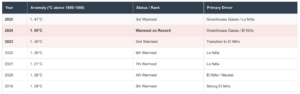
The slight dip in surface temperatures in 2025 masks a more malignant trend in the oceans. While the atmosphere cooled marginally due to La Niña conditions, the ocean heat content (OHC) continued to rise without pause. The upper 2, 000 meters of the ocean absorbed approximately 23 Zettajoules (ZJ) more heat in 2025 than in 2024. This marks the ninth consecutive year of record-breaking ocean heat. To visualize this energy, 23 ZJ is roughly equivalent to 12 Hiroshima-sized atomic bombs detonating in the ocean every second for a year.
“The 2025 surface cooling is a deception. The planetary energy imbalance is increasing. The oceans are the memory of the climate system, and they are screaming.” , Analysis based on 2026 IAP/CAS Ocean Heat Report.
This decoupling of surface temperature and ocean heat proves that the warming method is fully operational even when atmospheric metrics appear to plateau. The North Atlantic, specifically, remained in a state of “marine heatwave” for most of 2024 and 2025, disrupting fisheries and accelerating glacial melt in Greenland. The heat stored in these depths guarantees that future El Niño events start from a higher baseline, pushing subsequent temperature spikes even higher.
We must also examine the rate of acceleration. Between 1970 and 2010, the global temperature rose at approximately 0. 18°C per decade. Since 2015, that rate has increased. The jump from the 2015-2016 El Niño peak (1. 29°C) to the 2023-2024 peak (1. 60°C) represents a surge that natural variability alone cannot explain. The reduction of sulfate aerosols from shipping regulations in 2020 likely contributed a small fraction to this warming, the primary driver remains the relentless accumulation of carbon dioxide and methane.
The breach of 1. 5°C in 2024 and the sustained heat of 2025 indicate that the “safe zone” is in the rearview mirror. We are no longer preventing the emergency; we are documenting its arrival.
The Ocean Heat Spike: 23 Zettajoules in One Year
The planetary energy imbalance has manifested most violently in the global oceans, which absorb approximately 90% of the excess heat trapped by greenhouse gases. Data finalized in January 2026 by the Institute of Atmospheric Physics (IAP) at the Chinese Academy of Sciences (CAS) and NOAA confirms that 2025 set a new, absolute record for Ocean Heat Content (OHC). For the fifth consecutive year, the upper 2, 000 meters of the ocean stored more thermal energy than ever before in a classic case being referred to as the climate emergency.
In 2025 alone, the global ocean absorbed an additional 23 ± 8 Zettajoules (ZJ) of heat relative to 2024. To contextualize this metric: one Zettajoule equals 1021 joules. The 23 ZJ influx in a single year is equivalent to approximately 37 times the total global primary energy consumption of the human race in 2023. In kinetic terms, this rate of warming equates to the energy of roughly 12 Hiroshima-class atomic bombs detonating in the ocean every second, continuously, for the entire year.
This accumulation occurred even with the development of La Niña conditions in late 2024 and 2025, a phase of the El Niño-Southern Oscillation (ENSO) associated with the release of ocean heat into the atmosphere and a temporary cooling of global surface temperatures. The fact that OHC surged to record highs even with this cooling method indicates that the underlying radiative forcing from carbon dioxide and methane has overwhelmed natural climate variability.
| Year | OHC Anomaly (Zettajoules above 1981-2010 baseline) | Annual Increase (ZJ) | Rank (Historical) |
|---|---|---|---|
| 2025 | +23 ZJ (relative to 2024) | +23 ± 8 | 1st (Record High) |
| 2024 | Baseline for 2025 comparison | +16 ± 10 | 2nd |
| 2023 | — | +15 ± 10 | 3rd |
| 2022 | — | +11 ± 10 | 4th |
| 2021 | — | +14 ± 11 | 5th |
North Atlantic Fever: The 2023-2025 Anomalies
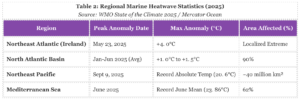
The North Atlantic Ocean has been the epicenter of the most severe sea surface temperature (SST) anomalies. Following the initial shock of 2023, where SSTs deviated more than five standard deviations from the mean, the basin remained in a state of hyper-thermal stress through 2024 and 2025. Data from Mercator Ocean International indicates that the period from January to June 2025 was the third warmest semester on record for the North Atlantic (0°N, 60°N), trailing only the extreme spikes of 2023 and 2024.
In May 2025, a localized intense marine heatwave (MHW) developed off the coast of Ireland. At its peak on May 23, 2025, SSTs in specific zones reached 4°C above the 1991, 2020 average. This event mirrored the catastrophic June 2023 heatwave in the same region, confirming a shift toward persistent, high-amplitude thermal anomalies in the Northeast Atlantic. By mid-2025, approximately 90% of the North Atlantic basin had been affected by marine heatwave conditions.
A serious driver of this localized heating is the reduction in anthropogenic sulfur aerosols. The International Maritime Organization (IMO) 2020 regulations, which capped fuel sulfur content at 0. 5%, reduced global shipping sulfur emissions by approximately 85%. While beneficial for human health, verified studies from 2024 and 2025 confirm that this reduction removed a “masking” effect, allowing more solar radiation to reach the ocean surface. This termination shock is most pronounced in heavy shipping corridors of the North Atlantic and North Pacific.
Pacific Resurgence: The Return of the Blob
While the North Atlantic burned, the North Pacific experienced a resurgence of the “Blob”, a mass of warm water that disrupts marine ecosystems. even with the onset of La Niña, which cools the eastern Pacific, the Northeast Pacific reached its highest-ever recorded average temperature of 20. 6°C (69. 1°F) on September 9, 2025. This anomaly exceeded the previous record by nearly 0. 5°C.
This heatwave in the Pacific the standard ENSO mechanics. NOAA Fisheries reported that the 2025 event rivaled the size and intensity of the original 2013, 2016 Blob. The persistence of these high temperatures into the winter months of late 2025 suggests a decoupling of surface warming from traditional ocean-atmosphere oscillation pattern, driven instead by the relentless accumulation of thermal energy in the upper ocean.
“The 2025 heat increase was 23 Zetta Joules… equivalent to ~37 years of global primary energy consumption at the 2023 level.” , Institute of Atmospheric Physics, Chinese Academy of Sciences, January 2026.
The Thwaites Glacier: Acceleration Metrics and Sea Level Rise Projections
The Thwaites Glacier, frequently termed the “Doomsday Glacier,” has entered a phase of irreversible retreat that defies earlier, more conservative models. Data released in early March 2026 by the European Space Agency (ESA) and published in the Proceedings of the National Academy of Sciences (PNAS) confirms that the glacier’s grounding line, the serious boundary where ice leaves the bedrock and begins to float, has retreated 26 kilometers (16 miles) since 1996. This retreat is not uniform; it is a chaotic, fracturing withdrawal that exposes the heart of the West Antarctic Ice Sheet to the warming waters of the Amundsen Sea. The glacier currently contributes approximately 4% to global sea level rise, a figure that is rising as the ice flow accelerates.
Recent findings from the International Thwaites Glacier Collaboration (ITGC) have reshaped the scientific understanding of how this collapse unfold. While a 2024 Dartmouth College study reduced the likelihood of a rapid “Marine Ice Cliff Instability” (MICI) event occurring within the 21st century, the alternative is equally destructive, if slower. The glacier is not collapsing like a row of dominoes is instead dissolving from beneath. The 2026 PNAS study indicates that while the immediate cliff-failure scenario is less probable before 2100, the rate of ice loss has doubled over the last 30 years, currently shedding approximately 50 billion tons of ice annually. The “cork in the bottle” effect is weakening; Thwaites holds back enough ice to raise global sea levels by 65 centimeters (over 2 feet) on its own, and its removal could destabilize the entire West Antarctic Ice Sheet, locking in a 3. 3-meter (10. 8-foot) rise over the coming centuries.
| Metric | Verified Data | Significance |
|---|---|---|
| Annual Ice Loss | ~50 billion tons / year | Doubled rate compared to 1990s baseline. |
| Grounding Line Retreat | 26 km total (1996, 2026) | Exposes deeper, inland ice to warm ocean water. |
| Retreat Rate (Eastern Shelf) | Up to 1. 2 km / year | Fastest retreat zone; indicates structural weakness. |
| Global SLR Contribution | ~4% of total global rise | Single largest individual glacier contributor. |
| Basal Melt method | Rapid “staircase” melting | Warm water enters crevasses, melting ice from inside. |
The mechanics of this retreat were clarified by the deployment of the Icefin robot, which provided the close-up visual data from beneath the ice shelf. The robot’s sensors revealed that while flat sections of the glacier’s underside are insulated by a thin of cold, fresh water, the steep crevasses and “staircase” features are melting rapidly. Warm, salty water is being pumped into these fractures by action, eating away at the ice structure from the inside out. This internal weakens the shear margins of the glacier, making it more susceptible to fracturing even without the dramatic cliff failures predicted by earlier MICI models. The 2023 and 2024 data sets from Icefin show that the ocean is sawing through the ice shelf at its weakest points.
The of the 2026 data are severe for coastal planning. The previous assumption that humanity had centuries to adapt to West Antarctic collapse is being challenged not by the speed of the cliff collapse, by the inevitability of the grounding line retreat. Once the grounding line passes specific bedrock ridges, the retreat becomes self-sustaining, a process known as Marine Ice Sheet Instability (MISI). The March 2026 report identifies that Thwaites has already detached from several stabilizing seabed promontories. Consequently, even if global temperatures were to stabilize immediately, the inertial momentum of the glacier’s retreat would continue. The question is no longer if Thwaites disappear, how quickly the 3. 3 meters of chance sea level rise be released into the global ocean.
Methane Leaks: Satellite Data Exposes Underreported Industrial Emissions
The era of self-reported industrial emissions is over. For decades, energy giants and national governments relied on “bottom-up” estimates, theoretical calculations based on equipment counts and engineering assumptions, to report their methane footprints. These inventories were fictions. Data released in May 2025 by the International Energy Agency (IEA) confirms that global energy-related methane emissions are approximately 80% higher than the figures governments submit to the UN Framework Convention on Climate Change. The IEA’s Global Methane Tracker 2025 estimates that the fossil fuel sector alone emitted over 120 million tonnes of methane in 2024, a volume that national inventories largely failed to capture.
This gap has been laid bare by a new generation of orbital sentinels. The launch of MethaneSAT in March 2024 and Carbon Mapper’s Tanager-1 satellite later that year provided an unblinking, high-resolution audit of the planet’s methane plumes. Before MethaneSAT lost contact in June 2025, it transmitted over a year of data that dismantled the industry’s narrative of “clean” natural gas. The satellite revealed that dispersed, smaller sources, previously invisible to coarser instruments like Sentinel-5P, account for a massive share of total leakage, proving that the problem is not just a few broken valves, widespread infrastructure failure.
The Super-Emitter Geography
Satellite imagery from 2024 and 2025 has mapped a global archipelago of “super-emitters”, facilities releasing methane at rates that regulation and logic. Turkmenistan stands as the world’s most egregious offender. In 2024 alone, satellites detected 287 distinct super-emitter events across its oil and gas infrastructure, the highest number for any nation. The Korpezhe field remains a persistent hotspot, with single leaks frequently exceeding the warming chance of small nations.
In the Western Hemisphere, the data is equally damning. MethaneSAT observations from May 2024 to June 2025 exposed a clear regulatory failure in the United States. In the Permian Basin, the world’s most productive oil field, methane intensity varied wildly based on state lines. Operators on the Texas side of the basin registered a methane intensity of 3. 1%, nearly triple the 1. 2% intensity observed in New Mexico, where stricter venting and flaring rules were enforced. The total emissions from the Permian Basin in 2024 were estimated at 1. 83 million tonnes, four times higher than the figures reported in the EPA’s Greenhouse Gas Inventory.
| Country | Detected Events (2024) | Primary Source Sector | Key Observation |
|---|---|---|---|
| Turkmenistan | 287 | Oil & Gas | Highest global frequency; aging Soviet-era infrastructure. |
| United States | 190 | Oil & Gas | Major between Texas (high) and New Mexico (lower). |
| Russia | 154 | Oil & Gas / Coal | Events nearly doubled compared to 2023; high venting rates. |
| Algeria | 39 | Oil & Gas | Persistent unlit flares and venting at extraction sites. |
| Iran | 38 | Oil & Gas | Significant leakage from sanctions-hit, aging facilities. |
Corporate Accountability and the “Invisible” Plumes
The granular resolution of Tanager-1 and aircraft surveys has allowed investigators to name specific operators. In Mexico, state-owned Pemex has been repeatedly flagged. On April 28, 2024, Carbon Mapper detected a massive plume erupting from a Pemex processing plant in Minatitlán, releasing 16 tonnes of methane per hour. even with Pemex reporting reduced emissions in its sustainability filings, satellite data confirms that its methane footprint per barrel is among the highest in the world, driven by rampant flaring and maintenance failures.
The coal industry faces similar scrutiny. In Australia, a 2024 report analyzing satellite data from the preceding year found that Glencore’s Hail Creek mine emitted more methane in a single 16-day period than the company had reported for the entire year. The study identified 61 massive methane plumes across Australia’s coal basins in 2023, exposing a reporting regime that missed the vast majority of fugitive emissions from open-cut mining.
The Waste Sector: A Sleeping Giant
While fossil fuels draw the most heat, the waste sector represents a silent, growing emergency. 2025 that landfill emissions are less sporadic far more difficult to mitigate than pipeline leaks. A pivotal study released in June 2024 analyzed 70 U. S. landfills using TROPOMI satellite data, finding that actual emissions were 77% higher than what operators reported to the EPA. In 2024, satellites identified highly concentrated methane plumes from landfills in Pakistan, Bangladesh, and India, where decomposing organic waste in open dumps creates continuous, high-volume release points. Unlike oil wells, which can be capped, these biological reactors vent continuously, and current reporting method capture only a fraction of their true atmospheric impact.
Fossil Fuel Subsidies: Trillions Spent even with Net Zero Pledges
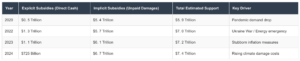
While nations problem press releases celebrating green energy, their treasuries continue to underwrite the very industry driving planetary collapse. Data from the International Monetary Fund (IMF) and the International Energy Agency (IEA) reveals a financial contradiction of proportions: between 2022 and 2025, the global economy spent more on subsidizing fossil fuels than it did on education in the developing world. As of late 2025, total fossil fuel subsidies, accounting for both direct cash transfers and unpaid environmental costs, hovered near $7. 4 trillion annually, roughly 7. 1% of global GDP.
This expenditure cancels out global climate finance method. For every dollar spent on renewable energy deployment in 2024, governments provided approximately three dollars in support to the coal, oil, and gas industries through explicit and implicit channels. The argument that these funds protect the poor has been dismantled by the data; the IMF reports that in low-income nations, the poorest 20% of households receive only about 8 cents of every dollar spent on explicit fuel subsidies, while the bulk of the benefits accrue to wealthier consumers with higher energy footprints.
The Anatomy of the Subsidy
To understand the of this economic, one must distinguish between explicit and implicit subsidies. Explicit subsidies are direct government expenditures, cash paid to producers to lower extraction costs or to consumers to keep pump prices artificially low. Implicit subsidies, which make up the vast majority of the total, represent the “unpaid bill” of fossil fuel consumption: the costs of local air pollution, global warming damages, and foregone consumption taxes that governments fail to collect.
In 2022, triggered by the energy emergency following Russia’s invasion of Ukraine, explicit consumption subsidies spiked to an all-time record of over $1. 3 trillion. Governments scrambled to shield voters from rising energy costs, paying fossil fuel companies to maintain demand. While market prices stabilized by 2024, reducing explicit subsidies to approximately $725 billion, the structural support remains intact. Implicit subsidies, driven by the escalating costs of climate disasters and health impacts, surged to $6. 7 trillion in the same period.
The G20’s Role in the emergency
The G20 nations, responsible for 80% of global emissions, are also the primary financiers of this dysfunction. In 2022 alone, G20 members poured a record $1. 4 trillion in public money into fossil fuels through subsidies, investments by state-owned enterprises (SOEs), and lending from public financial institutions. This figure was more than double the pre-COVID levels of 2019. even with repeated pledges at COP26, COP27, and COP28 to phase out “inefficient” subsidies, the definition of “inefficient” remains a diplomatic loophole that allows billions to flow unimpeded.
China, the United States, Russia, the EU, and India remain the top subsidizers. In the United States, tax p
The Carbon Budget: Remaining Gigatons Before Irreversible Damage
The accounting of the climate emergency is no longer a matter of decades, of single-digit years. As of January 1, 2026, the Global Carbon Budget (GCB) confirms that the remaining atmospheric space to limit warming to 1. 5°C with a 50% probability has narrowed to approximately 170 gigatons of carbon dioxide (GtCO2). At the current emissions rate of 42. 2 GtCO2 per year, this budget be mathematically exhausted in just over four years, closing the window on the Paris Agreement’s most ambitious goal before the end of this decade.
The data from 2024 and 2025 reveals a dangerous plateau rather than the necessary plummet. While total global emissions stabilized in 2025, they did so at a record-high volume. The 2025 Global Carbon Budget report indicates that while land-use emissions dropped to 4. 1 GtCO2 due to reduced deforestation in South America and the end of El Niño conditions, fossil fuel emissions continued their relentless rise. Fossil CO2 emissions grew by 1. 1% in 2025, reaching an all-time peak of 38. 1 GtCO2. This , fossil fuels expanding while land sinks temporarily recover, masks the structural failure to decarbonize the global energy system.
| Warming Target (50% Probability) | Remaining Budget (GtCO2) | Years Remaining at 2025 Emission Rates | Exhaustion Date (Projected) |
|---|---|---|---|
| 1. 5°C | 170 | 4. 0 | Early 2030 |
| 1. 7°C | 525 | 12. 4 | Mid 2038 |
| 2. 0°C | 1, 055 | 25. 0 | 2051 |
The concept of a “budget” implies a controlled expenditure, yet the reality is a runaway consumption of planetary resilience. The 1. 5°C threshold is not a political line; it represents a physical limit beyond which tipping points become likely. With the 2024 global average temperature already touching 1. 60°C and 2025 at 1. 47°C, the budget calculations describe a retrospective debt rather than a future allowance. The 170 GtCO2 figure assumes a 50% chance of success; for a safer 67% probability, the budget drops to fewer than 100 GtCO2, a quantity burn through before 2028.
Atmospheric concentrations of carbon dioxide show this accumulation. In 2025, CO2 levels reached 425. 7 parts per million (ppm), a 52% increase over pre-industrial levels. This rise was driven by the persistent imbalance between emissions and the Earth’s natural sinks. While the ocean and land sinks recovered capacity in 2025 after a weak 2023-2024, they absorbed only about half of human emissions. The remaining 20 GtCO2 accumulated directly in the atmosphere, trapping additional heat and driving the temperature anomalies observed in the previous section.
“The remaining carbon budget to limit global warming to 1. 5°C is virtually exhausted. The between rising fossil emissions and falling land-use emissions in 2025 created a false plateau, hiding the urgent need for structural decarbonization.” , Global Carbon Project, November 2025 Assessment
The focus must shift to the 1. 7°C and 2. 0°C guardrails, which are rapidly eroding. The 1. 7°C budget stands at 525 GtCO2, roughly 12 years of current emissions. This timeframe coincides with the investment pattern of heavy infrastructure, meaning that new coal plants, gas pipelines, or oil fields approved today operate well past the point of budget insolvency. The 2025 data confirms that coal use did not peak as predicted rose by 0. 8%, while oil and gas increased by 1. 0% and 1. 3% respectively. Every gigaton emitted borrows directly from the 2. 0°C budget, bringing the catastrophic risks of that higher warming level into the immediate horizon.
Extreme Weather Economics: The 2024-2025 Loss pattern
The financial aftershocks of the 2024 hurricane season redefined the global insurance, creating a volatility trap that through 2025. While the 2025 Atlantic hurricane season proved unexpectedly benign compared to the preceding year’s onslaught, the insurance sector remained under siege from a relentless accumulation of “secondary perils”, severe convective storms, floods, and wildfires. Data from the Swiss Re Institute confirms that global insured losses in 2024 reached $146 billion, significantly exceeding the 10-year average of $108 billion. This capital destruction was driven primarily by Hurricanes Helene and Milton, which together hammered the U. S. market with over $41 billion in insured damages.
The narrative of 2025 was one of deceptive calm. Moody’s Ratings characterized the 2025 Atlantic hurricane season as “benign,” with no major hurricanes making landfall in the continental United States. Yet, even with this reprieve from headline-grabbing mega-storms, global insured losses for 2025 still breached the $100 billion threshold for the sixth consecutive year. This sustained indicates a structural shift in risk: the industry can no longer rely on “quiet” hurricane years to rebuild capital buffers. Instead, the frequency of medium-sized events, thunderstorms in the U. S. Midwest, floods in Europe, and wildfires in California, has created a high-frequency loss floor that defies traditional modeling.
| Metric | 2023 (Verified) | 2024 (Verified) | 2025 (Verified) |
|---|---|---|---|
| Global Economic Losses | $286 Billion | $368 Billion | $310 Billion (Est.) |
| Global Insured Losses | $125 Billion | $146 Billion | >$100 Billion |
| Protection Gap (Uninsured) | $161 Billion | $222 Billion | ~$200 Billion |
| Primary Loss Driver | Severe Convective Storms | Hurricanes Helene & Milton | Secondary Perils (SCS/Wildfire) |
The economic of the 2024 season dictated the pricing reality of 2025. In the United States, homeowners faced an average premium increase of 8% in 2025, a cumulative rise of over $1, 000 since 2021. The “protection gap”, the portion of economic losses not covered by insurance, widened dangerously. In 2024 alone, Aon reported that $223 billion in damages went uninsured, leaving governments and households to absorb 60% of the total disaster cost. This gap is most acute in flood-prone regions where the National Flood Insurance Program (NFIP) remains the sole, frequently insufficient, lifeline.
Florida, the epicenter of the 2024 emergency, showed signs of a fragile stabilization in 2025. Following aggressive legislative reforms, lawsuits against insurers dropped by 25% in 2025 compared to 2024. The state-backed insurer of last resort, Citizens Property Insurance, successfully reduced its policy count to 336, 410, a 50% reduction from its peak, as private capital cautiously re-entered the market. yet, this corporate stabilization has not yet translated into relief for residents. Premiums remain at record highs, and the “benign” 2025 season did little to reverse the long-term trend of uninsurability in coastal zones.
“The 2025 renewals represent a paradox. We have record capital entering the reinsurance market, driving rates down by 14. 7% in January 2026, yet the primary homeowner is still seeing rate hikes. The risk has simply been transferred to the consumer through higher deductibles and coverage exclusions.”
The reinsurance market, the insurers of insurers, reacted to the 2025 lull with a sharp pricing correction. At the January 1, 2026 renewals, risk-adjusted property catastrophe rates fell by nearly 15%, the largest annual decrease since 2014. This softening was fueled by a record supply of reinsurance capital, which reached $715 billion, and a surge in catastrophe bond issuance. yet, this top-level capital abundance masks the underlying rot. Primary insurers are retaining more risk than ever before, forcing them to tighten underwriting standards. The result is a bifurcated market: reinsurance is cheap and plentiful for carriers, coverage is expensive and scarce for homeowners.
The 2024-2025 pattern proves that the “1-in-100-year” event is an obsolete metric. With 2024 confirmed as the warmest year on record and 2025 continuing the trend of thermal instability, the economic of disaster response is buckling. The $146 billion bill from 2024 was not an anomaly; it was a baseline. As the industry moves into 2026, the absence of a “major” hurricane in 2025 is viewed not as a victory, as a statistical deferral of inevitable losses.
Agricultural Collapse: Yield Declines in Global Wheat and Maize Belts
The theoretical risk of “simultaneous breadbasket failure” has transitioned into a statistical reality. Between 2022 and 2025, the world’s primary grain-producing regions, North America, Europe, South America, and Asia, experienced synchronized yield suppressions driven by jet stream instability and extreme thermal anomalies. Data from the USDA, FAO, and the Copernicus Climate Change Service confirms that the era of linear agricultural growth has ended, replaced by a volatile regime where heat stress and hydrological whiplash routinely harvest projections.
In the United States, the breakdown of the winter wheat crop during the 2022-2023 season marked a return to conditions unseen since the Dust Bowl. The abandonment rate for U. S. winter wheat reached 32. 6% in 2023, the highest level since 1917. Kansas, the nation’s primary wheat producer, saw abandonment rates hit 29%, removing nearly a third of planted acreage from the food supply chain before a single combine could run. This was not a localized event; it was a widespread failure driven by a “flash drought” that evaporated soil moisture during the serious grain-filling window.
Europe faced an equally catastrophic contraction in its maize (corn) belt. The 2022 heatwave, described by European Commission researchers as the worst in 500 years, slashed EU maize yields by 24% compared to the five-year average. The Po River valley in Italy, a crucial agricultural artery, saw water levels drop so low that saltwater intrusion poisoned irrigation channels, contributing to a 45% drop in local corn and animal feed yields. Hungary, a reliable exporter, witnessed a production collapse from an average of 8 million tonnes to just 2. 8 million tonnes, forcing the country to import corn for the time in living memory.
The Southern Hemisphere provided no buffer. Argentina, the world’s top exporter of processed soy and the third-largest for corn, endured a historic drought compounded by a triple-dip La Niña. The 2022-2023 harvest saw soybean production plummet to 27 million tonnes, down from a typical 44 million tonnes, while wheat production contracted by nearly 50%, falling to 12. 6 million tonnes. This agricultural implosion stripped the Argentine economy of approximately $15 billion in export revenue and destabilized global feed markets.
In Asia, the threat manifested through opposing hydrological extremes. India, the world’s second-largest wheat producer, suffered a severe heatwave in March 2022, the hottest in 122 years, which shriveled grain during the terminal growth stage. Yields dropped by 15% across the northern breadbasket states of Punjab and Haryana, prompting the Indian government to impose an immediate export ban to protect domestic food security. Conversely, China’s 2023 wheat harvest was battered by “the worst pre-harvest rainfall in a decade.” Torrential storms in Henan province saturated fields just as crops matured, causing pre-harvest sprouting and mold in approximately 30 million tonnes of wheat, rendering it unfit for human consumption and forcing a sharp spike in imports.
Recent analysis published in Nature Communications and data from the Climate Impact Lab (2025) indicate that these failures are linked to “meandering” jet stream patterns that lock high-pressure heat domes over multiple crop-producing regions simultaneously. The probability of such synchronized failures has risen significantly, threatening the caloric baseline of the global population.
Documented Yield Anomalies by Region (2022-2025)
| Region | Crop | Event / Year | Verified Impact |
|---|---|---|---|
| United States (Kansas) | Winter Wheat | Drought 2023 | 29% acreage abandonment (Highest since 1951) |
| European Union | Maize | Heatwave 2022 | 24% yield reduction vs. 5-year average |
| Argentina | Soybean | Drought 2022-23 | Production fell to 27Mt (from ~44Mt average) |
| India | Wheat | Heatwave 2022 | 10-15% yield drop; Export ban enacted |
| China (Henan) | Wheat | Flooding 2023 | 30 million tonnes quality-downgraded |
| Italy (Po Valley) | Corn/Feed | Drought 2022 | 45% production decline |
The data from 2024 and 2025 reinforces this downward trend. even with a “record” global grain tonnage in 2024, the gain was driven almost entirely by acreage expansion into marginal lands rather than yield stability. A 2025 Stanford University study estimates that global yields for wheat and maize are 4% to 13% lower than they would be in a stable climate, canceling out decades of agrotechnological gains. We are no longer farming in a system of variability; we are managing a system of structural decline.
Water Stress. Groundwater Depletion Rates in Major Aquifers
The invisible emergency of groundwater depletion has breached a serious threshold of irreversibility. A detailed 2024 analysis published in Nature, covering 170, 000 monitoring wells and 1, 693 aquifer systems globally, confirms that groundwater decline is not continuing; it is accelerating. In 30% of the world’s regional aquifers, depletion rates in the 21st century have outpaced those of the late 20th century. This acceleration is most acute in arid regions sustaining massive agricultural footprints, where fossil water, accumulated over millennia, is being extracted at rates that natural replenishment.
The situation in North America is particularly dire. New satellite data released in May 2025 reveals that the Colorado River Basin has lost approximately 34 cubic kilometers (27. 8 million acre-feet) of groundwater since 2003, a volume roughly equivalent to the total capacity of Lake Mead. The rate of loss has more than tripled, jumping from 0. 85 km³ per year between 2002 and 2014 to 2. 67 km³ per year from 2015 to 2024. This subterranean exceeds the surface water losses from the basin’s reservoirs, indicating that agriculture and municipalities are draining the aquifer to compensate for the drying river.
In California’s Central Valley, the consequences of this overdraft are physical and permanent. Between 2019 and 2021 alone, the aquifer depleted at a rate of 8. 58 km³ per year. This extraction has caused extensive land subsidence, permanently collapsing the clay within the aquifer system and reducing its future storage capacity by approximately 2%. In the High Plains, the Ogallala Aquifer continues its steady decline; 2024 data from the Kansas Geological Survey recorded a drop of 1. 52 feet in the groundwater levels of southwest Kansas in a single year, signaling that conservation efforts remain insufficient against the demands of industrial agriculture.
Mexico City presents the most extreme case of urban subsidence driven by extraction. Geologists from the National Autonomous University of Mexico (UNAM) warned in June 2025 that parts of the capital are sinking at a rate of up to 40 centimeters per year. With 70% of the city prone to flooding due to this topographical collapse, the extraction of water from the underlying clay-rich lake bed is literally undermining the city’s foundation.
Across the Atlantic, the Middle East and South Asia face existential water deficits. The Arabian Aquifer System is depleting at a rate of 4. 90 millimeters per year according to GRACE satellite data (2002, 2023), with a projected volume loss of 14. 51 km³ annually. In Iran, the situation has triggered a national emergency; a 2025 report identifies 359 plains as serious zones suffering from severe subsidence. Tehran is sinking by up to 25 centimeters annually, damaging infrastructure and increasing the risk of building collapse.
The Indus Basin, a lifeline for hundreds of millions in Pakistan and India, shows a sharp acceleration in water loss. Depletion rates rose from -0. 65 cm per year prior to 2015 to -2. 16 cm per year between 2015 and 2023. The Panjnad sub-basin is the hardest hit, losing 1. 70 cm of water depth annually. Similarly, the Ganges Basin is declining at approximately 2. 6 cm per year, while the Brahmaputra Basin in Assam is losing over 5 km³ of water annually.
In Southeast Asia, groundwater extraction is sinking entire deltas. Jakarta’s northern districts are 40% sea level, with subsidence rates in specific pockets reaching 28 cm per year, though city-wide averages have slowed to between 0. 05 and 5. 17 cm per year due to recent regulations. The Mekong Delta in Vietnam faces a similar fate, subsiding at an average of 1. 1 cm per year, outpacing global sea-level rise by an order of magnitude, due to the relentless pumping of fresh water from deep aquifers.
yet, the data proves that policy intervention can reverse these trends. The North China Plain, once one of the world’s most rapidly depleting aquifers, has seen a remarkable turnaround. Following the implementation of the South-to-North Water Diversion Project and strict pumping regulations, groundwater levels have risen by approximately 0. 7 meters per year since 2020. This recovery demonstrates that aquifer depletion is not an inevitable outcome of modernization a direct consequence of resource management choices.
| Region / Aquifer | Metric | Rate / Value | Status |
|---|---|---|---|
| Colorado River Basin (USA) | Volumetric Loss (2015, 2024) | -2. 67 km³ / year | Accelerating |
| Central Valley (USA) | Volumetric Loss (2019, 2021) | -8. 58 km³ / year | serious |
| Mexico City (Mexico) | Subsidence Rate (2025) | Up to 40 cm / year | Extreme |
| Arabian Aquifer System | Vertical Depletion (2002, 2023) | -4. 90 mm / year | Severe |
| Indus Basin (South Asia) | Vertical Depletion (2015, 2023) | -2. 16 cm / year | Accelerating |
| North China Plain | Water Level Change (post-2020) | +0. 70 m / year | Recovering |
| Mekong Delta (Vietnam) | Subsidence Rate | ~1. 1 cm / year | serious |
Biodiversity Index: Species Extinction Acceleration in serious Biomes
The biological integrity of the planet is fracturing at a rate that defies historical baselines. Data released in late 2024 and early 2025 confirms that the “sixth mass extinction” is no longer a theoretical projection; it is a measurable, accelerating operational reality. The 2024 Living Planet Report, an audit of 35, 000 vertebrate populations, documents a 73% average decline in wildlife abundance between 1970 and 2020. This metric is not a passive slide. It represents a widespread collapse of the biological support systems that underpin global economic and agricultural stability.
The acceleration is most visible in the Amazon Basin, where a dangerous inversion of metrics occurred in 2024. While deforestation rates technically fell by 7%, forest degradation, damage caused by drought, fire, and edge effects, spiked by 497%. Satellite analysis by Imazon recorded 36, 379 square kilometers of degraded rainforest in 2024, compared to just 6, 092 square kilometers in 2023. This degradation is a direct consequence of the 2023-2024 drought, which the World Weather Attribution group confirmed was made 30 times more likely by climate change. In 2024 alone, fires consumed 44. 2 million acres of the Brazilian Amazon, a 66% increase from the previous year. The biome is losing its ability to self-regulate moisture, pushing 75% of the untouched forest toward a stability tipping point.
Marine ecosystems registered equally catastrophic losses during the 2023-2025 thermal anomaly. The National Oceanic and Atmospheric Administration (NOAA) confirmed the fourth global coral bleaching event, which impacted 84% of the world’s reef systems between January 2023 and March 2025. This event forced scientists to add three new alert levels to the Bleaching Alert. Level 5, the new maximum, signifies a risk of greater than 80% mortality. In the southern Great Barrier Reef, surveys conducted in July 2024 revealed a 95% mortality rate among Acropora corals, the structural architects of the reef. At Lizard Island, total coral mortality reached 92% following the 2024 heatwave. These are not recoverable losses on human timescales; they represent the functional erasure of high-biodiversity marine habitats.
Freshwater systems remain the most degraded category in the biosphere. The 2024 Living Planet Index reports an 85% decline in freshwater species populations since 1970, the steepest drop of any biome. A detailed 2025 assessment by the IUCN found that 24% of all freshwater species, including 30% of decapods and 26% of fish, are threatened with extinction. This “silent dying” is driven by a combination of flow modification, pollution, and invasive species. In the Mekong and Amazon rivers, migratory fish populations have collapsed by nearly 90%, severing a primary protein source for millions of people.
The International Union for Conservation of Nature (IUCN) updated its Red List in late 2024 and early 2025, moving multiple species from “serious Endangered” to “Extinct.” This administrative act finalizes the loss of unique genetic lineages. The 2025 update confirmed the extinction of the Slender-billed curlew, a migratory bird once common across Eurasia, and the Christmas Island shrew, a mammal unseen since 1985 only statistically confirmed lost. The audit also declared three Australian bandicoot species extinct, victims of unmitigated habitat fragmentation and invasive predation.
The 2024-2025 Extinction Ledger
The following table details species formally declared extinct or extinct in the wild during the 2024-2025 assessment pattern. These entries represent the finality of biological failure.
| Species Name | Classification | Region | Primary Driver of Extinction | Declaration Year |
|---|---|---|---|---|
| Slender-billed Curlew | Bird | Eurasia / North Africa | Habitat loss, hunting | 2025 |
| Christmas Island Shrew | Mammal | Australia | Invasive species, disease | 2025 |
| Galápagos Damselfish | Fish | Pacific Ocean | Climate change (El Niño) | 2024 (Likely Extinct) |
| Nullarbor Barred Bandicoot | Mammal | Australia | Predation, habitat degradation | 2025 |
| Conus lugubris | Mollusk | Cape Verde | Coastal development | 2025 |
| Diospyros angulata | Plant (Tree) | Mauritius | Deforestation | 2025 |
Migratory species, which serve as indicators of cross-border ecological health, are failing. The 2024 “State of the World’s Migratory Species” report found that 49% of monitored migratory species are declining, and 24% face extinction. This includes serious pollinators and seed dispersers essential for agricultural resilience. The collapse is not limited to rare widespread; it affects foundational species that maintain ecosystem services. The that the window to prevent a biosphere collapse is closing faster than policy method can react.
Human Health Costs: Heat Mortality and the Spread of Vector Borne Diseases
The physical toll of the climate emergency is no longer a distant projection. It is a forensic reality recorded in morgues and hospitals across the globe. In 2024, extreme heat cemented its status as the deadliest meteorological hazard, acting as a silent executioner that strikes the most with precision. The data from the 2025 Lancet Countdown on Health and Climate Change reveals a escalation. Heat related mortality for people over 65 years of age increased by 167 percent compared to the 1990s. This figure is more than double what would have been expected without the influence of anthropogenic warming.
The lethal capacity of this heat was demonstrated with horrific clarity during the 2024 Hajj pilgrimage in Saudi Arabia. Between June 14 and June 19, temperatures in Mecca exceeded 51. 8 degrees Celsius. The result was a mass casualty event where at least 1, 301 pilgrims collapsed and died. Saudi officials reported that 83 percent of the deceased were unauthorized pilgrims who walked long distances in direct sunlight without shelter. This tragedy was not an anomaly. It was a direct consequence of wet-bulb temperatures surpassing the human physiological limit for survival.
Europe continues to suffer the highest load of heat mortality among developed regions. After a record breaking 2022, the summer of 2023 killed an estimated 47, 690 people across the continent according to the Barcelona Institute for Global Health. Preliminary data for 2024 suggests the toll rose again to approximately 62, 000 excess deaths as heatwaves struck the southern and eastern flanks of the continent. In the United States, Maricopa County in Arizona recorded 602 confirmed heat associated deaths in 2024. While this represents a slight decrease from the 645 deaths in 2023, it remains nearly ten times higher than the figures recorded just a decade prior. The medical examiner reports confirm that methamphetamine use was a factor, yet the environmental trigger remains the primary cause of death.
| Region / Event | Year | Verified Impact | Primary Data Source |
|---|---|---|---|
| Global Labor Market | 2024 | 640 billion labor hours lost ($1. 09 trillion cost) | Lancet Countdown / ILO |
| Europe (35 Countries) | 2023 | 47, 690 excess deaths | ISGlobal / Nature Medicine |
| Saudi Arabia (Hajj) | 2024 | 1, 301 confirmed fatalities | Saudi Ministry of Health |
| Americas (Dengue) | 2024 | 13 million+ reported cases | PAHO / WHO |
| Maricopa County, USA | 2023 | 645 confirmed heat deaths | MCDPH Annual Report |
Beyond direct mortality, the warming atmosphere has unleashed a biological storm of vector borne diseases. The year 2024 shattered all previous records for dengue fever. The World Health Organization reported over 14. 6 million cases globally, a figure that dwarfs the 4. 6 million cases recorded in 2023. The Americas alone accounted for over 13 million of these infections. This explosion is driven by the expansion of the Aedes aegypti mosquito into higher latitudes and altitudes previously too cool for its survival. The transmission season has lengthened, and the geographical range of these vectors includes parts of southern Europe where autochthonous cases are becoming a recurring summer reality.
Malaria is also breaking its historical boundaries. In the highlands of Africa, Anopheles mosquitoes are moving upward at a rate of 6. 5 meters in elevation per year. Research from Georgetown University Medical Center confirms that these vectors are spreading south of the equator at 4. 7 kilometers annually. This migration exposes populations in previously malaria free zones to the parasite, health systems that absence the immunity or infrastructure to cope. In Papua New Guinea, the altitude limit for stable transmission is projected to shift upward by 300 meters by 2040, placing millions of additional people at risk.
The warming of coastal waters has introduced new bacterial threats to temperate zones. In the United States, the Centers for Disease Control and Prevention issued a health alert in late 2023 regarding Vibrio vulnificus, a flesh eating bacterium. Infections were confirmed in New York, Connecticut, and North Carolina following heatwaves that raised sea surface temperatures. During July and August 2023, a cluster of eleven severe cases resulted in five deaths. These pathogens thrive in warm, brackish water and are present in areas that were once considered safe for recreational swimming and seafood harvesting.
The economic caused by this physiological assault is measurable. The 2025 Lancet Countdown report indicates that heat exposure resulted in the loss of 640 billion chance labor hours in 2024. This productivity loss is equivalent to 1. 09 trillion US dollars. The agricultural and construction sectors bore the brunt of this cost, with workers in low income countries suffering the most severe penalties. These numbers are not abstract economic concepts. They represent wages lost, crops unharvested, and a global workforce physically incapacitated by the very air they breathe.
The Great Displacement: 2024’s Record Numbers
The distinction between a future threat and a present emergency dissolved in 2024. Data released in May 2025 by the Internal Displacement Monitoring Centre (IDMC) confirms that the number of people living in internal displacement reached a record 83. 4 million by the end of 2024. While conflict remains a primary driver, the acceleration of climate-induced movement is undeniable. In 2024 alone, disasters triggered 45. 8 million new internal displacements, a figure nearly double the annual average of the preceding decade. These are not statistics; they represent a mass migration event originating primarily from the Global South, where the physical limits of human habitability are being tested.
The narrative that climate migration is a “future risk” for 2050 is obsolete. The displacement is happening, driven by a collision of slow-onset disasters like drought and rapid-onset events like cyclones. The World Bank’s Groundswell report previously projected 216 million internal climate migrants by 2050. Current trajectories suggest we are tracking the pessimistic scenarios of that model, particularly in Sub-Saharan Africa and South Asia.
Sub-Saharan Africa: The Double load
Africa faces a emergency where climate shocks intersect with existing fragility. In 2024, climate-driven displacements in Africa rose by 30 percent to 7. 8 million. The Sahel region, stretching across Niger, Chad, and Mali, experienced devastating floods that displaced over 1. 2 million people in a single season, destroying crops in an area already with food insecurity.
In the Horn of Africa, the oscillation between extreme drought and flash flooding has created a pattern of permanent displacement. Somalia, recovering from the 2020-2023 drought that displaced 1. 67 million people, faced renewed flooding in late 2024. By early 2025, over 4 million Somalis remained internally displaced, living in congested urban settlements like those on the outskirts of Mogadishu. These “climate refugees”, a term still absence legal weight under international law, are not crossing borders to Europe in the vast numbers frequently feared by Western politicians; they are moving to their own overcrowded cities, trading rural starvation for urban squalor.
| Region / Country | Event / Cause | Verified Displacement / Impact (2023-2025) |
|---|---|---|
| Global Total | Disasters (Storms, Floods, Wildfires) | 45. 8 million new movements in 2024 (IDMC) |
| Sudan | Conflict & Climate Multipliers | 11. 6 million total IDPs (Record high for a single country) |
| Somalia | Drought & Floods | 4 million total IDPs; 1. 67m from drought alone |
| Bangladesh | Cyclone Remal (2024) | 800, 000 evacuated/displaced |
| Central America | Dry Corridor Drought | 2. 7 million food insecure; 486, 000 affected by severe drought |
| Pakistan | Monsoon Floods | 117, 000+ affected in 2024 (following 33m affected in 2022) |
South Asia: The Permanent Inundation
South Asia continues to bear the brunt of hydrological disasters. Bangladesh, a nation acting as the world’s climate canary, faced a relentless battering in 2024. Cyclone Remal alone forced the evacuation and displacement of approximately 800, 000 people in May 2024. The subsequent monsoon floods affected 18. 4 million people, disrupting the education of 33 million children. The World Bank projects that Bangladesh could see 19. 9 million internal climate migrants by 2050, the migration to Dhaka is already overwhelming the city’s infrastructure. The capital absorbs roughly 2, 000 new arrivals daily, fleeing the salinization of coastal rice paddies.
Pakistan is still reeling from the 2022 super-floods that submerged one-third of the country. While the waters receded, the economic and social displacement. In 2024, renewed heavy rains and glacial lake outburst floods (GLOFs) damaged over 78, 000 homes and affected another 117, 000 people. The recovery gap is widening; communities are hit by the shock before they can rebuild from the last.
Latin America: The Silent Exodus of the Dry Corridor
In Central America, the emergency is less about water’s fury and more about its absence. The “Dry Corridor”, spanning Guatemala, Honduras, El Salvador, and Nicaragua, saw 486, 000 people affected by severe drought in 2023, with conditions worsening into 2024 due to El Niño. The failure of maize and bean crops left 2. 7 million people requiring food assistance.
Unlike the sudden displacement of a cyclone, this migration is a slow attrition. Families sell livestock, then tools, then land, before abandoning their homes. Half of all migrants from this region heading toward the United States cite climate-related factors, crop failure and food insecurity, as a primary driver. These migrants fall into a legal void; international refugee conventions protect those fleeing persecution, not starvation caused by a warming planet.
The Urban Trap
The destination for the majority of these displaced populations is not a foreign country, a local slum. The urbanization of climate displacement is creating zones of extreme vulnerability. In Lagos, Dhaka, and Lima, informal settlements are expanding into flood-prone lowlands, placing climate migrants directly back into the route of danger. This secondary exposure creates a pattern where the poorest populations are repeatedly displaced, eroding their resilience and economic capacity with each move.
The Energy Mix: Renewables Deployment Versus Fossil Fuel Entrenchment
The global energy sector in 2024 and 2025 presented a paradox of historical proportions. While renewable energy deployment accelerated at a rate that even the most optimistic projections, the absolute consumption of fossil fuels refused to decline, anchored by widespread entrenchment and surging demand. The data reveals a “two-track” reality: a clean energy revolution occurring simultaneously with a fossil fuel last stand.
By the end of 2024, clean power sources, including renewables and nuclear, surpassed 40% of global electricity generation for the time. Reports from Ember confirm that solar and wind alone accounted for approximately 15% of the global mix, overtaking hydropower (14. 3%) to become the dominant renewable force. Solar energy generation doubled between 2021 and 2024, a trajectory described by analysts as the “engine of the transition.” In 2024 alone, the world added a record 585 gigawatts (GW) of solar capacity, a 30% increase over the previous year. This surge was not limited to the wealthy nations; China, Brazil, and India posted exponential growth rates, driven by plummeting module costs and strategic policy pivots.
Yet, this green velocity collided with a rigid wall of fossil fuel dependency. even with the renewable boom, global coal consumption reached an all-time high in 2024, exceeding 8. 7 billion tons. The International Energy Agency (IEA) and the World Resources Institute (WRI) verified that while coal’s share of the electricity mix dipped slightly to 34%, the absolute volume burned increased. This rise was fueled by extreme weather events, specifically heatwaves in India and China, which drove electricity demand for cooling to levels that renewables alone could not satiate. Consequently, fossil fuels met of the net growth in global energy demand, pushing power sector emissions to a new record.
| Metric | 2024 Value | Trend vs 2023 | Significance |
|---|---|---|---|
| Global Solar Capacity Added | 585 GW | +30% | Fastest growing energy source in history. |
| Clean Power Share (Global) | 40. 9% | +1. 5% | time exceeding 40% threshold. |
| Global Coal Consumption | 8. 77 Billion Tons | +1. 0% | All-time record high even with climate pledges. |
| Fossil Fuel Subsidies (Explicit) | $1. 3 Trillion | High/Stable | Financial entrenchment remains massive. |
| China Coal Project Approvals | 94. 5 GW | Continued Growth | Dual-track strategy of green + black energy. |
The entrenchment of the old order is financial as well as physical. Verified data from the International Monetary Fund (IMF) indicates that explicit fossil fuel subsidies surged to over $1. 3 trillion in the wake of the energy emergency, with total subsidies (including implicit costs like environmental damage) estimated at nearly $7 trillion. This fiscal support acts as a formidable barrier to decarbonization, paying polluters to maintain the even as solar and wind become the cheapest sources of new bulk electricity in 91% of the world.
China remains the epicenter of this duality. In early 2025, China’s installed capacity of wind and solar officially surpassed its coal capacity, a historic crossover point. The country added 277 GW of solar and 79 GW of wind in 2024, accounting for more than half of the global total. yet, this capacity victory masks a utilization gap. Because coal plants run more hours per year than variable renewables, coal continued to supply nearly 60% of China’s actual electricity generation. also, the approval of 94. 5 GW of new coal power projects in 2024 signals that Beijing prioritizes energy security and grid stability over immediate fossil phase-outs, creating a “long tail” of emissions that could for decades.
The demand side of the equation complicates the transition further. The proliferation of energy-intensive data centers, driven by the artificial intelligence boom, alongside the electrification of transport and heating, has spiked global electricity consumption. In 2024, global electricity demand grew by 4%, a rate that outpaced the ability of renewables to cover the entire increase. As a result, gas and coal were called upon to the gap. This phenomenon, known as the “demand trap,” ensures that fossil fuels remain in the mix not because they are preferred, because the grid requires immediate, dispatchable power to meet soaring load requirements.
Looking toward the end of 2025, the IEA projects that renewables surpass coal as the single largest source of electricity generation globally. This be a symbolic and technical milestone, yet it does not guarantee a decline in emissions if total energy demand continues to expand unchecked. The race is no longer just about building renewables; it is about building them fast enough to cover all new demand and begin displacing existing fossil generation. As of verified 2025 data, that displacement point has not yet been decisively reached on a global.
Grid Reliability: Infrastructure Failures During Peak Load Events
The assumption that established power grids can withstand the volatility of the modern climate has been dismantled by a series of catastrophic failures between 2020 and 2025. As extreme weather events intensify, the gap between “nameplate capacity”, the theoretical maximum output of a grid, and “available capacity” during emergency moments has widened. Data from the North American Electric Reliability Corporation (NERC) and global energy monitors indicates that traditional baseload systems, specifically natural gas and nuclear, are failing alongside renewable intermittency during peak load events.
The most devastating example of this disconnect occurred in February 2021, when Winter Storm Uri struck the Texas Interconnection. The Electric Reliability Council of Texas (ERCOT) lost 52, 000 megawatts (MW) of generation capacity, nearly half the system’s total. While initial political narratives focused on frozen wind turbines, Federal Energy Regulatory Commission (FERC) data confirmed that the majority of the failures, over 58%, originated from natural gas infrastructure that froze or depressurized. The economic toll was: the Federal Reserve Bank of Dallas estimated losses between $80 billion and $130 billion, while independent assessments placed the total economic damage near $295 billion. The human cost was absolute, with 246 confirmed deaths, though excess mortality studies suggest the figure exceeded 700.
This vulnerability is not unique to Texas. During Winter Storm Elliott in December 2022, the PJM Interconnection, which serves 65 million people in the eastern United States, faced a near-collapse scenario. even with having a massive reserve margin on paper, PJM saw 47, 000 MW of capacity go offline unexpectedly. A post-event analysis revealed that 70% of these forced outages were from natural gas generators that failed to start or stay online due to equipment freezing and fuel supply interruptions. The event forced the Tennessee Valley Authority (TVA) and Duke Energy to implement rolling blackouts, shedding over 5, 000 MW of load to prevent a wider system failure.
Global Heat and Hydro-Stress
While cold snaps freeze gas lines, extreme heat is the reliability of hydroelectric and nuclear baseloads. In August 2022, China’s Sichuan province, which relies on hydropower for 80% of its electricity, experienced a historic drought and heatwave. Water flows into key reservoirs dropped by 50%, forcing a six-day total industrial blackout to preserve power for residential use. This disruption rippled through the global supply chain, halting production at major electronics and automotive manufacturing hubs.
Simultaneously, Europe’s grid faced a dual emergency in 2022. France, the continent’s largest electricity exporter, became a net importer as its nuclear fleet availability plummeted to near 40%. High river temperatures restricted the cooling water intake for reactors, forcing production cuts just as demand for air conditioning spiked. In the United States, California’s grid operator (CAISO) was forced to order rolling blackouts in August 2020 when a heatwave across the western U. S. reduced import availability and solar output declined in the late afternoon, leaving a 3, 600 MW shortfall.
Aging Transmission Assets
the generation failures is the physical decay of transmission infrastructure. The U. S. Department of Energy reported in 2024 that 70% of transmission lines and power transformers are over 25 years old, with the average age of large power transformers reaching 40 years. These aging assets are highly susceptible to failure during temperature extremes. NERC’s 2024 Long-Term Reliability Assessment identified the Midcontinent Independent System Operator (MISO) region as a “High Risk” area, projecting a capacity deficit of 4. 7 gigawatts (GW) by 2028 if resource additions do not accelerate.
| Event / Date | Region | Capacity Lost / Impact | Primary Cause |
|---|---|---|---|
| Winter Storm Uri (Feb 2021) | Texas (ERCOT) | 52, 000 MW lost; 4. 5 million homes without power | Gas infrastructure freeze; unweatherized equipment |
| Winter Storm Elliott (Dec 2022) | Eastern U. S. (PJM/TVA) | 47, 000 MW forced outages; 5, 000+ MW load shed | Gas generator failure; fuel supply interruption |
| Sichuan Power Crunch (Aug 2022) | China (Sichuan) | Hydro output down 50%; 6-day industrial blackout | Extreme drought; heatwave |
| Western Heatwave (Aug 2020) | California (CAISO) | 3, 600 MW shortfall; 800, 000+ customers affected | Import failure; solar ramp-down; high demand |
| India Peak Demand (May 2024) | India (National Grid) | Record 250 GW demand met; severe grid stress | 536 cumulative heatwave days; AC load surge |
The data from 2024 and 2025 shows a disturbing trend: peak demand is growing faster than dispatchable capacity. India recorded an all-time high peak demand of 250 GW in May 2024, driven by a relentless heatwave that for weeks. The grid held, yet the margin for error has. In the United States, the rapid addition of data center load, projected to consume up to 9% of total U. S. electricity generation by 2030, is further a system that is already cracking under the weight of climatic extremes.
Corporate Accountability: Scope 3 Emissions and Greenwashing Tactics
The between corporate climate pledges and operational reality has widened into a chasm of unverifiable data and legal liability. While 971 corporations had committed to net-zero under the Science Based initiative (SBTi) by early 2024, the integrity of these commitments collapsed under scrutiny. In March 2024, the SBTi revoked the net-zero validation of 239 companies, including Microsoft, Unilever, and Walmart, after they failed to submit credible long-term emissions reduction plans. This mass delisting exposed the central method of corporate climate evasion: the deliberate exclusion of Scope 3 emissions.
Scope 3 emissions, which encompass the indirect carbon footprint generated across a company’s value chain (from raw material extraction to product disposal), frequently constitute over 90% of a corporation’s total climate impact. For the oil and gas sector, this figure rises to between 80% and 95%. Yet, as of late 2025, the U. S. Securities and Exchange Commission (SEC) had ceased defending its paused climate disclosure rule, which had already stripped out mandatory Scope 3 reporting requirements. This regulatory vacuum allows major polluters to report only Scope 1 (direct operations) and Scope 2 (energy purchase) data, hiding the vast majority of their contribution to the climate emergency.
The Greenwashing Litigation Wave
In the absence of federal mandates, the judiciary has become the primary venue for accountability. Between 2024 and 2025, a surge of litigation targeted companies for deceptive marketing practices that capitalized on consumer climate anxiety without delivering measurable results. Courts in Europe, Australia, and the United States have begun to penalize “aspirational” language that absence empirical backing.
In February 2025, a class-action lawsuit was filed against Apple in the U. S. District Court for the Northern District of California. Plaintiffs alleged that the “carbon neutral” branding of the Apple Watch Series 9 was misleading, as it relied heavily on low-quality offsets rather than actual emissions elimination. Similarly, Tyson Foods faced a lawsuit from the Environmental Working Group in September 2024 for marketing its industrial beef products as “climate-smart,” a claim the suit is scientifically impossible given the methane intensity of cattle production.
| Entity | Date | Jurisdiction | Penalty / Action | Violation |
|---|---|---|---|---|
| DWS (Deutsche Bank) | April 2025 | Germany | €25 Million Fine | Greenwashing ESG funds; overstating sustainability credentials in investment prospectuses. |
| Shein | August 2025 | Italy | €1 Million Fine | Misleading “evoluSHEIN” claims; vague assertions of circularity and recyclability. |
| Active Super | Early 2025 | Australia | A$10. 5 Million Fine | Claimed to exclude fossil fuel investments while holding shares in coal and oil companies. |
| Delta Air Lines | 2023-2024 | USA | Class Action (Ongoing) | Claimed to be the “world’s carbon-neutral airline” based on junk offsets. |
The Carbon Offset Collapse
The reliance on voluntary carbon markets (VCM) to “cancel out” corporate emissions has proven to be a widespread failure. A joint investigation by The Guardian, Die Zeit, and SourceMaterial released in January 2023 revealed that more than 90% of rainforest carbon offsets certified by Verra, the world’s leading standard-setter, were worthless “phantom credits.” These credits did not represent genuine carbon reductions were used by companies like Gucci, Shell, and Disney to claim carbon neutrality.
The continued through 2025. In December 2025, Verra was forced to reject multiple carbon projects in China after audits revealed fabricated government approval documents. This emergency of confidence caused the price of nature-based offsets to crash, leaving corporations with “net-zero” strategies built on assets with zero environmental value. Consequently, companies including EasyJet and Nestlé have publicly retreated from carbon-neutral claims, shifting their narrative to “emissions reduction” to avoid liability.
Financial Sector Retreat
While consumer brands face legal headwinds, the financial sector has quietly dismantled its shared climate commitments. In late 2024 and early 2025, major U. S. banks including JPMorgan Chase, Citi, and Bank of America withdrew from the Net-Zero Banking Alliance (NZBA). This coordinated exit followed political pressure from U. S. state attorneys general who threatened antitrust action against ESG coalitions.
The data confirms a return to business as usual. A report by the Rainforest Action Network found that the world’s 60 largest banks committed $869 billion to fossil fuel companies in 2024 alone, a 23% increase from the previous year. This capital injection directly contradicts the International Energy Agency’s 2021 roadmap, which stated that no new oil and gas fields could be approved if the world was to stay within the 1. 5°C limit. By financing expansion while abandoning voluntary alliances, the financial sector has decoupled its operations from the Paris Agreement goals.
The current is defined by a sharp bifurcation: European and Californian regulators are tightening the screws with mandates like the EU’s Corporate Sustainability Reporting Directive (CSRD) and California’s SB 253, which require full Scope 3 disclosure. In contrast, U. S. federal policy and voluntary corporate initiatives have regressed, replacing transparency with litigation risks and capital flight back to fossil fuels.
Economic Reality Check: The High Price of Atmospheric Scrubbing
The narrative of Direct Air Capture (DAC) as a silver bullet for climate stabilization faces a collision with thermodynamic and economic reality in 2026. While the physics of extracting carbon dioxide from ambient air is proven, the economics remain punishingly expensive. As of early 2026, the realized cost of capturing a single metric ton of CO2 hovers between $600 and $1, 000 for operational commercial facilities, a clear deviation from the $100 per ton “holy grail” target frequently by venture capitalists and policy optimists.
The between nameplate capacity and actual removal rates exposes the immaturity of the sector. Climeworks’ “Mammoth” facility in Iceland, inaugurated in May 2024 with a design capacity of 36, 000 tons per year, reported capturing only 750 tons in its ten months of operation. This underperformance, attributed to “ramp-up phases” and harsh environmental conditions, drives the levelized cost of capture (LCOE) well above projected models. Investors paying premiums for high-quality removal credits, ranging from $500 to over $1, 000 per ton on the voluntary market, are subsidizing the R&D of a nascent industry rather than purchasing commoditized carbon management.
Thermodynamic Penalties and Energy Intensity
The central obstacle to scaling DAC is the energy penalty required to separate dilute CO2 (420 parts per million) from the atmosphere. Verified data from 2024 and 2025 indicates that liquid solvent technologies, such as those employed by Occidental’s 1PointFive, require approximately 2, 500 kilowatt-hours (kWh) of energy per ton of CO2 captured, primarily in the form of high-grade heat (900°C) for calcination. Solid sorbent systems, like those used by Climeworks and Heirloom, operate at lower temperatures (80-120°C) still demand between 1, 100 and 2, 000 kWh per ton.
To put this in perspective, removing a single gigaton of CO2, roughly 2. 5% of annual global emissions, would consume more electricity than the entire annual generation of Japan. Without a dedicated, surplus supply of zero-carbon energy, the net removal efficiency of these plants collapses. If powered by a standard grid mix containing fossil fuels, a DAC plant can emit more CO2 than it captures.
Project Pipeline and Policy
even with these physical constraints, capital flows continue, driven by federal incentives. The “One Big Beautiful Bill Act,” signed into law in July 2025, preserved the Section 45Q tax credit, maintaining the value at $180 per ton for DAC projects with dedicated geologic storage. This policy floor provides a serious lifeline for projects like Occidental’s “Stratos” plant in Texas. Scheduled for full commercial launch in late 2025, Stratos aims for a capture capacity of 500, 000 tons per year. With a capital expenditure exceeding $1. 3 billion, the facility represents the industry’s attempt at megaton- infrastructure.
yet, federal support remains volatile. In late 2025, the Department of Energy (DOE) initiated reviews of previously awarded grants for regional DAC hubs, freezing portions of the $3. 5 billion allocated under the Bipartisan Infrastructure Law. This uncertainty has stalled final investment decisions for several proposed facilities in Louisiana and the Pacific Northwest, leaving the U. S. market reliant on of flagship projects.
| Facility Name | Developer | Technology Type | Design Capacity (tCO2/yr) | Operational Status (2026) | Est. Energy Intensity |
|---|---|---|---|---|---|
| Mammoth | Climeworks | Solid Sorbent | 36, 000 | Operational (Ramping) | ~2, 000 kWh/ton |
| Stratos | 1PointFive (Oxy) | Liquid Solvent | 500, 000 | Commissioning | ~2, 500 kWh/ton |
| Tracy Facility | Heirloom | Limestone Looping | 1, 000 | Operational | ~1, 500 kWh/ton |
| Project Bison | CarbonCapture Inc. | Solid Sorbent | 5, 000, 000 (Target) | Paused/Canceled | N/A |
“We have to get the costs down. Right it’s around $550 per ton, and we need to get that down to $150 per ton. That is the only way this becomes a viable climate defense rather than a boutique luxury for tech giants.” , Vicki Hollub, CEO of Occidental Petroleum, November 2025 Investor Briefing.
The AMOC Tipping Point: Circulation Slowdown Evidence and
The Atlantic Meridional Overturning Circulation (AMOC), the planetary conveyor belt that transports warm surface water from the tropics to the North Atlantic, is flashing red. For decades, this system was assumed to be stable, a reliable engine regulating the Northern Hemisphere’s climate. That assumption is dead. As of early 2026, the scientific consensus has fractured into two terrifying camps: those who see a gradual decline, and those who see an imminent, irreversible collapse. The data from 2023 through 2025 indicates that the system is not slowing; it is destabilizing.
The “Cold Blob”, a persistent anomaly of cooling water south of Greenland, stands as the physical fingerprint of this dysfunction. While the rest of the global ocean registered record-breaking heat in 2024 and 2025, this specific region cooled. This is not a paradox; it is a mechanic’s diagnostic. The AMOC functions by transporting heat northward; a cold spot in the North Atlantic confirms that the heat transport method is failing. The engine is stalling.
The Physics of Collapse
The method driving this failure is the “salt-advection feedback” loop. Historically, warm, salty water travels north, cools, becomes dense, and sinks, driving the circulation. yet, the accelerated melting of the Greenland Ice Sheet has injected massive volumes of fresh water into the North Atlantic. This fresh water dilutes the salinity, making the surface water lighter and preventing it from sinking. Once this sinking process stops, the conveyor belt halts.
In February 2024, researchers at Utrecht University provided the physics-based confirmation of this tipping point. Unlike previous statistical models, their complex climate simulation identified a specific early warning signal: the freshwater transport at 34°S. Their findings were unequivocal, the AMOC is on a “tipping course.” Once the threshold is crossed, the collapse is self-sustaining and irreversible on human timescales, chance unfolding within less than 100 years.
“The point of no return is not a distant theoretical boundary. The 2023 analysis by Ditlevsen and Ditlevsen placed the window of collapse between 2025 and 2095, with a central estimate of 2050. We are currently living inside the danger zone.”
Conflicting Data and the Risk Profile
The scientific community remains locked in a high- debate regarding the speed of this decline. A January 2025 study from the Woods Hole Oceanographic Institution (WHOI) argued that air-sea heat fluxes suggest the AMOC has remained relatively stable over the last 60 years, contradicting earlier sea-surface temperature studies. Similarly, a May 2025 study published in Nature Geoscience projected a “limited weakening” of 18% to 43% by 2100, rather than a total shutdown.
yet, relying on these conservative estimates is a gamble of existential proportions. Even a “limited” weakening of 20-30% to catastrophic shifts in global weather patterns. The risk profile is asymmetric: the cost of a false alarm is economic adjustment; the cost of missing the collapse is the uninhabitability of Northern Europe and the drowning of the North American seaboard.
Global of AMOC Failure
A shutdown of the AMOC does not mean “colder winters.” It rewrites the global climate map. The energy currently transported north would remain trapped in the Southern Hemisphere, supercharging the tropical oceans and altering monsoon systems that feed billions.
| Region | Impact of Weakening (Current Trend) | Impact of Total Collapse (Tipping Point) |
|---|---|---|
| Northern Europe | Increased winter storms; more extreme heatwaves in summer due to jet stream stalling. | Temperature drop of 5°C to 10°C; cessation of arable farming in the UK and Scandinavia. |
| US East Coast | Regional sea level rise of 10-15 cm above global average due to loss of Coriolis force. | Rapid sea level surge of up to 1 meter; permanent inundation of coastal infrastructure from Miami to New York. |
| The Sahel & West Africa | Disrupted rainfall patterns; intermittent drought. | Southward shift of the tropical rain belt; permanent drought causing total agricultural collapse. |
| Amazon Rainforest | Extended dry seasons; increased fire risk. | Reversal of wet/dry pattern; acceleration of the forest’s transition to savannah. |
| Global Ocean | Reduced carbon uptake; ocean deoxygenation. | Collapse of marine ecosystems dependent on nutrient upwelling; accelerated global warming due to heat trapping in the south. |
The immediate threat to the United States is frequently understated. The Gulf Stream, a component of the AMOC, pulls water away from the American coast via the Coriolis effect. As the current weakens, that pull relaxes, causing water to pile up against the Eastern Seaboard. This sea-level rise is occurring on top of the thermal expansion and glacial melt already raising global oceans. Cities like Norfolk, Charleston, and Miami face a compound threat that current infrastructure plans fail to account for.
The data from 2025 confirms that the “safe operating space” for the Atlantic circulation has been breached. Whether the final collapse occurs in 2030 or 2080 is a secondary detail; the destabilization process has begun. The cold blob is expanding, the fresh water is pouring in, and the engine of the Atlantic is sputtering.
Deforestation Rates. The Amazon and Congo Basin Status Report
The global battle to preserve tropical rainforests fractured into two distinct, contradictory realities between 2023 and 2025. While political intervention successfully curbed industrial clear-cutting in South America, a climate-feedback loop of drought and fire began to erase those gains, rendering traditional conservation metrics increasingly insufficient. Simultaneously, the Congo Basin, frequently termed the “second lung” of the planet, silently entered a phase of accelerated destabilization, driven not by industrial expansion by a desperate subsistence emergency and intensifying conflict.
Data verified by the National Institute for Space Research (INPE) and Global Forest Watch (GFW) confirms that 2024 was a record-breaking year for tropical forest loss, with 6. 7 million hectares of primary rainforest destroyed globally. This figure represents an 80% increase from 2023. For the time in recorded history, fire, not agricultural expansion, became the primary driver of this loss, accounting for nearly 50% of the destruction. This shift signals a transition from deforestation driven by chainsaws to deforestation driven by thermal collapse.
The Amazon: Policy Success Meets Climate Failure
In Brazil, the administration of President Luiz Inácio Lula da Silva delivered on pledge to re-establish environmental governance. Official PRODES data reveals that deforestation (defined as clear-cutting) in the Legal Amazon fell by 30. 6% between August 2023 and July 2024, and by a further 11. 08% between August 2024 and July 2025. This marks the lowest rate of clear-cutting in 11 years, avoiding an estimated 733. 9 million tons of CO2 equivalent emissions since 2022.
Yet, these policy victories were undercut by the most severe drought in the Amazon’s recorded history. While chainsaws slowed, the forest burned. In 2024 alone, Brazil lost 2. 78 million hectares of primary forest, the highest total since 2019. Approximately 66% of this loss was caused by fire, a six-fold increase compared to 2023. The drought, intensified by El Niño and anthropogenic warming, turned the rainforest’s humid interior into tinder. Consequently, while the intentional deforestation rate dropped, the actual biological loss surged, driven by “progressive degradation”, a phenomenon where standing forests lose their canopy integrity and carbon-storage capacity without being immediately cleared.
The Cerrado biome, a serious savanna frequently overlooked in favor of the Amazon, also saw a reversal of its destruction trend. After five years of rising devastation, deforestation in the Cerrado fell by 25. 7% in the 2023-2024 period and 11. 49% in the 2024-2025 pattern, stabilizing at 7, 235 square kilometers.
The Congo Basin: The Silent Surge
In contrast to the policy-heavy in Brazil, the Congo Basin experienced a widespread unraveling. The Democratic Republic of the Congo (DRC), which holds 60% of the basin’s rainforest, saw primary forest loss spike to a record 590, 000 hectares in 2024, up from 530, 000 hectares in 2023. Unlike the Amazon, where soy and cattle drive destruction, the DRC’s loss is fueled by poverty: small- slash-and-burn agriculture and charcoal production, which provides energy for 95% of the population.
The situation rapidly in the Republic of Congo, where primary forest loss surged by 150% in 2024. This increase was almost entirely anomalous, driven by fires in peatland areas that had previously remained wet and fire-resistant. The burning of these peatlands poses a catastrophic risk, as they store gigatons of carbon ground. In the eastern DRC, the resurgence of the M23 rebel group and resulting displacement of millions has intensified pressure on Virunga and Kahuzi-Biega National Parks, where illegal charcoal cartels operate with impunity to fund armed conflict.
| Region / Country | Primary Forest Loss (2024) | % Change from 2023 | Primary Driver | Key 2025 Trend |
|---|---|---|---|---|
| Brazil (Amazon) | 2. 78 million hectares | +13% (Total Loss) -30. 6% (Clear-cut) |
Fire (66%) | Policy-driven clear-cut reduction; fire-driven degradation increase. |
| DRC (Congo Basin) | 590, 000 hectares | +11. 3% | Subsistence Ag. / Charcoal | Record high loss; conflict-driven resource extraction. |
| Republic of Congo | 62, 000 hectares | +150% | Peatland Fires | fire penetration into wetlands. |
| Bolivia | 1. 5 million hectares | +200% | Agro-industrial Fire | Overtook DRC as 2nd highest loss globally. |
Carbon
The in drivers, policy versus poverty versus fire, complicates the global mitigation strategy. The forest loss recorded in 2024 released 3. 1 gigatons of carbon dioxide emissions, a figure exceeding the entire annual fossil fuel emissions of India. The that the Amazon is teetering on the edge of a functional flip from carbon sink to carbon source, not due to a absence of policing, due to a breakdown in the biome’s hydrological pattern. Meanwhile, the Congo Basin is losing its resilience to a combination of population pressure and state fragility, with no immediate policy method available to halt the decline.
As of early 2026, the “arc of deforestation” has become an “arc of fire,” rendering traditional satellite monitoring of clear-cutting insufficient for understanding the true of the planetary emergency.
Ocean Acidification: The Silent Chemistry of Collapse
The chemical stability of the global ocean, a prerequisite for marine life for millions of years, has been fundamentally altered. Data from the Copernicus Marine Service confirms that global mean surface seawater pH declined from 8. 11 in 1985 to 8. 04 in 2024. While a drop of 0. 07 units appears mathematically minor, the logarithmic nature of the pH this into a 17. 5 percent increase in acidity. This shift is not theoretical; it is a measurable, accelerating degradation of the marine environment’s capacity to support calcifying organisms.
A June 2025 study led by the Plymouth Marine Laboratory and NOAA indicates that the “planetary boundary” for ocean acidification, defined as a 20 percent reduction in aragonite saturation states compared to pre-industrial levels, was crossed around 2020. The situation is more severe in deeper waters. that while 40 percent of surface waters have breached this safety limit, 60 percent of waters at depths down to 200 meters have already crossed the threshold. This chemical directly attacks the calcium carbonate structures of pteropods, sea butterflies that form the base of polar food webs, which have lost up to 61 percent of their suitable habitat in polar regions.
The Fourth Global Mass Bleaching Event (2023, 2025)
Parallel to this chemical destabilization, thermal stress has triggered the most extensive coral die-off in recorded history. On April 15, 2024, NOAA and the International Coral Reef Initiative (ICRI) confirmed the fourth global coral bleaching event. The of this catastrophe exceeds all prior records. Between January 1, 2023, and September 30, 2025, bleaching-level heat stress impacted approximately 84. 4 percent of the world’s coral reef area. This figure surpasses the 65. 7 percent impact rate recorded during the 2014, 2017 global event, previously the most damaging on record.
The 2023, 2025 event is distinct in its intensity and geographic reach. It affected reefs in 83 countries and territories, driven by ocean temperatures that remained persistently above bleaching thresholds. In the Atlantic basin, 99. 7 percent of tropical reef areas experienced bleaching-level heat stress within a single year, a saturation of thermal energy that left no refugia for recovery.
Regional Mortality: Florida Keys and the Caribbean
The Florida Keys reef tract experienced a functional extinction event for specific reef-building species during the 2023 marine heatwave. Water temperatures peaked at 32. 3°C (90. 1°F) in July 2023, creating conditions lethal to Acropora palmata (elkhorn) and Acropora cervicornis (staghorn) corals. A study published in October 2025 confirmed that between 97. 8 percent and 100 percent of these colonies in the Florida Keys and Dry Tortugas died by March 2024. Restoration efforts collapsed under the thermal load; less than 22 percent of outplanted staghorn coral survived, and fewer than 5 percent of outplanted elkhorn coral remained alive.
The Great Barrier Reef 2024 Survey
Australia’s Great Barrier Reef (GBR) suffered its fifth mass bleaching event since 2016, with 2024 marking the most severe thermal stress ever recorded in the southern region. Aerial surveys conducted by the Australian Institute of Marine Science (AIMS) in early 2024 revealed that 75 percent of the 1, 080 reefs surveyed displayed visible bleaching. In the southern sector, heat stress reached 15. 55 Degree Heating Weeks (DHW), a metric where values above 8. 0 result in widespread mortality. Consequently, 80 percent of surveyed reefs in the southern GBR showed high (31, 60 percent) to extreme (>90 percent) bleaching cover.
| Region | Event Period | Metric | Verified Impact |
|---|---|---|---|
| Global Ocean | Jan 2023 , Sep 2025 | Reef Area Impacted | 84. 4% of global reefs exposed to bleaching-level heat stress |
| Florida Keys (USA) | July 2023 , Mar 2024 | Acropora Mortality | 97. 8% , 100% mortality of elkhorn and staghorn colonies |
| Great Barrier Reef | Feb , Mar 2024 | Bleaching Prevalence | 75% of reefs bleached; Southern region>90% cover bleached on 80% of reefs |
| Huatulco (Mexico) | May , Nov 2023 | Coral Mortality | 50% , 93% mortality across affected reefs |
| Chagos Archipelago | 2024 | Reef Mortality | 85% impacted; 23% total mortality by Dec 2024 |
The convergence of acidification and thermal stress creates a feedback loop that prevents recovery. Acidified waters reduce the saturation state of aragonite, the mineral corals use to build their skeletons. Even if a colony survives a bleaching event, its growth rate in a pH 8. 04 ocean is significantly slower than in the pre-industrial pH 8. 2 ocean, leaving the reef structure brittle and unable to outpace. The loss of these ecosystems represents a direct removal of coastal protection and biodiversity support systems, with tropical and subtropical reefs having already lost 43 percent of their suitable habitats due to these combined chemical and thermal pressures.
Urban Heat Islands: The Concrete Kiln
The term “Urban Heat Island” (UHI) suggests a localized anomaly, a pocket of warmth in a cooler. The data from 2024 and 2025 proves this definition obsolete. In the era of 1. 5°C breach, megacities have transformed into thermal amplifiers, trapping solar radiation and waste heat to create conditions incompatible with human physiology. The built environment, asphalt, concrete, steel, and glass, does not retain heat; it magnifies it, pushing wet-bulb temperatures in dense urban cores toward the limit of survivability.
Analysis released by Climate Central in July 2024 exposed the of this amplification in the United States. Across 65 major cities, the study found that 34 million residents live in neighborhoods where the UHI effect adds at least 8°F (4. 4°C) to the ambient air temperature. This is not a uniform blanket of heat. It is a targeted assault. In New York City, the per capita average UHI index reached 9. 7°F (5. 4°C), the highest in the nation. San Francisco and Newark followed closely, with indices of 9. 1°F and 9. 0°F respectively. For millions of residents, a reported temperature of 95°F (35°C) becomes 104°F (40°C) the moment they step outside their doors.
The is structural and historical. The 2024 data confirms a direct correlation between historical housing discrimination and present-day thermal risk. Neighborhoods marked “hazardous” by the Home Owners’ Loan Corporation in the 1930s, a practice known as redlining, are, on average, 6. 5°F (3. 6°C) hotter than those rated “best.” In cities like Portland, Boston, and Oakland, this gap widens to over 12°F (6. 7°C). These “Grade D” districts, frequently populated by low-income communities and people of color, absence the tree canopy and green space that provide natural cooling. They are paved ovens, where the ground surface temperature of asphalt can soar to 140°F (60°C) when air temperatures are only 90°F (32°C).
Global Mortality and the Nighttime emergency
The consequences of this trapped heat are lethal. In Europe, where air conditioning remains less prevalent than in the US, the 2024 summer exacted a heavy toll. Research from the Barcelona Institute for Global Health (ISGlobal) estimated 62, 775 heat-related deaths across Europe in 2024 alone. This represents a 23% increase in mortality rates during the June-September period compared to the previous year. Italy bore the brunt of this emergency, recording approximately 19, 000 deaths, while Spain registered over 6, 700. The urban cores of Rome, Milan, and Madrid acted as heat traps, preventing temperatures from dropping at night and denying the human body the recovery time it requires.
Nighttime warming is the silent killer in these urban zones. Concrete and asphalt absorb solar energy during the day and re-radiate it after sunset, keeping minimum temperatures dangerously high. A global analysis showed that in 2024, 2. 4 billion people experienced at least two additional weeks of nights where temperatures remained above 25°C (77°F) due to climate change. In megacities like Tokyo and Delhi, the temperature differential between the city center and rural surroundings frequently peaks at night, creating a 24-hour pattern of thermal stress.
| City | Avg. UHI Intensity (°F) | Population Exposed to>8°F Uplift | Primary Driver |
|---|---|---|---|
| New York, USA | +9. 7°F | 7. 2 Million | Building Density / Dark Surfaces |
| San Francisco, USA | +9. 1°F | N/A | absence of Vegetation / Topography |
| Newark, USA | +9. 0°F | N/A | Impervious Surfaces / Industry |
| Chicago, USA | +8. 7°F | 1. 7 Million | Concrete Density / absence of Canopy |
| New Delhi, India | High Severity* | 20M+ (Metro Area) | Surface Absorption / Waste Heat |
*New Delhi recorded a peak air temperature of 47. 3°C (117°F) in May 2024, with surface temperatures significantly higher. Source: Climate Central / AQI. in 2024 Reports.
The Asian Megacity Furnace
In Asia, the UHI effect pushes densely populated capitals into uncharted territory. New Delhi, a city of over 30 million, recorded a 47. 3°C (117. 1°F) on May 27, 2024. The city’s climate severity index hit the highest level among major Indian metros, driven by a complete absence of permeable surfaces and the waste heat generated by millions of air conditioning units fighting a losing battle. The International Institute for Environment and Development (IIED) reported in mid-2024 that the world’s 20 most populous capital cities saw a 52% increase in days exceeding 35°C (95°F) over the last three decades. This is not weather variance. It is the result of replacing soil with cement.
The physics are simple and unforgiving. Vegetation cools through evapotranspiration. Impervious surfaces absorb and emit heat. When a city like Mumbai or Manila paves over its wetlands, it removes its natural cooling method. The 2025 data from the Copernicus Climate Change Service confirms that even with the onset of La Niña, urban centers remained significantly warmer than rural baselines. The “Cool Island” effect, where parks and water bodies lower local temperatures, is being erased by aggressive urban expansion. In 2024, surface temperature readings in parts of Phoenix, Arizona, showed pavement reaching temperatures capable of causing second-degree burns in seconds, a hazard that has become a public health emergency for the unhoused and outdoor workers.
“We built a lot of these older cities to keep us warm. we’re dealing with heat, and that’s the challenge. In the cities, you have more surface to retain all this heat and hold on to it.” , Jen Brady, Senior Data Analyst, Climate Central (2024).
The data demands a reclassification of urban planning priorities. The current trajectory of using high-albedo materials (cool roofs) and increasing tree canopy coverage is too slow to counteract the rising baseline temperatures. With global mean surface temperatures exceeding the 1. 5°C threshold, the UHI effect is no longer a localized inconvenience. It is a primary driver of mass casualty events during heatwaves, turning the places where humanity clusters into engines of their own demise.
Insurance Market Retreat: The Expansion of Uninsurable Real Estate Zones
The financial firewall between climate volatility and property ownership has disintegrated. By early 2026, the global insurance sector has shifted from a model of risk pooling to one of risk shedding, redlining vast swathes of the United States and global coastal regions. Major carriers, including State Farm, Allstate, and Farmers, have not paused new policies have executed a strategic retreat from high-exposure markets. This exodus has left millions of homeowners stranded in “insurance deserts,” where coverage is either unavailable or prohibitively expensive, fundamentally altering the valuation of real estate assets.
Data from 2024 and 2025 confirms that this retreat is no longer confined to historically volatile markets like Florida and California. Non-renewal rates, the frequency with which insurers drop existing customers, have surged. In California, the non-renewal rate hit 3. 18% in 2024, a nearly fourfold increase from 2018 levels. Louisiana saw an even sharper spike, with non-renewals rising 5. 4 times over the same period. This contraction has forced a migration to state-backed “insurers of last resort,” creating a precarious concentration of risk on public balance sheets.
The Surge of State-Backed Exposure
The between private market withdrawal and public sector load is starkest in the contrast between California and Florida. As private capital flees, state programs have absorbed the toxic assets.
| State Program | Metric | Sep 2023 Status | Jan 2026 Status | Change |
|---|---|---|---|---|
| California FAIR Plan | Policies in Force | 330, 275 | 610, 179 | +84. 7% |
| California FAIR Plan | Total Exposure | $320 Billion | $650 Billion | +103. 1% |
| Florida Citizens | Policies in Force | 1, 400, 000 | 395, 144 | -71. 8%* |
| Florida Citizens | Market Share | 18% (Largest) | <10% | Decreased |
| *Note: Florida’s decrease is due to aggressive legislative “depopulation” programs forcing policyholders onto private, frequently surplus-lines carriers, not a reduction in risk. | ||||
While California’s FAIR Plan exposure doubled to $650 billion by mid-2025, Florida’s Citizens Property Insurance Corporation executed a massive offloading of policies. By the start of 2026, Citizens had shed over 1 million policies, pushing homeowners toward private carriers that frequently offer less coverage at higher costs. This “depopulation” strategy masks the underlying instability; the risk remains, it has been transferred to smaller, less capitalized insurers or directly to homeowners via higher deductibles.
The Premium Spike and Deductible Shock
For those who can retain coverage, the cost has decoupled from inflation. Between 2019 and 2024, home insurance rates across the United States rose by a cumulative 40. 4%. The year 2024 alone witnessed an 11. 4% jump, followed by a further 9. 3% increase for new policies in 2025. In high-risk zones, the financial is compounded by rising deductibles. Data from 2025 indicates a 24. 5% year-over-year increase in average deductibles, shifting a greater share of the initial loss load directly to property owners.
“We are marching towards an uninsurable future. The cost of climate exposure is not simply the damage from floods, wind, and wildfire; it is the systematic devaluation of the asset class itself.” , Street Foundation Report, February 2025
The $1. 47 Trillion Climate Bubble
The retreat of insurance capital has exposed a massive valuation bubble in the real estate market. A February 2025 report by the Street Foundation identified that 39 million U. S. properties are significantly overvalued because their current market prices do not reflect the true cost of insuring against climate risks. The report estimates that $1. 47 trillion in real estate value is at risk of evaporation by 2055 as insurance premiums correct to actuarially sound levels or coverage entirely.
This “climate insurance bubble” is already deflating. In 2024, approximately 13% of residential real estate transactions in California were canceled specifically due to the inability to secure insurance, nearly double the rate of the previous year. Zillow and other listing platforms began integrating climate risk scores directly into property listings in late 2024, making flood, fire, and heat risks visible to buyers instantly. This transparency is accelerating the formation of “Climate Abandonment Areas”, neighborhoods where rising insurance costs and physical risk are driving sustained population loss. As of 2025, 26% of U. S. census tracts were classified as experiencing this abandonment.
Reinsurance markets, the financial backstop for primary insurers, have also tightened. Rates for property catastrophe coverage increased by up to 15% in mid-2024. While capital inflows softened the market slightly in 2025, the long-term trajectory is upward. Swiss Re estimated global insured losses for 2025 at $145 billion, reinforcing the industry’s reluctance to underwrite risks that are becoming statistically unpredictable. The expansion of uninsurable zones is no longer a theoretical model; it is a realized economic contraction, turning prime real estate into stranded assets.
Military Carbon Bootprint: Emissions from Global Defense Sectors
While global climate summits meticulously track the carbon output of civilian sectors, a massive source of emissions remains largely off the books: the global military apparatus. As of early 2026, data from Scientists for Global Responsibility (SGR) and the Conflict and Environment Observatory (CEOBS) indicates that the world’s militaries are responsible for approximately 5. 5% of total global greenhouse gas emissions. If the global military sector were a nation, it would rank as the fourth-largest emitter on the planet, surpassing the entire annual output of Russia. This “bootprint” is not a byproduct of base operations a direct consequence of a fossil-fuel-dependent war machine that operates with near-total impunity regarding climate reporting standards.
The United States Department of Defense (DoD) stands as the single largest institutional consumer of hydrocarbons in the world. even with recent executive orders attempting to electrify non-tactical fleets, the core of US military power remains tethered to heavy fuel. In 2024 alone, the DoD’s operational energy consumption accounted for 77% of the entire US federal government’s energy usage. The sheer volume of fuel required to project power is; a single F-35 Lightning II fighter jet consumes approximately 5, 600 liters (1, 480 gallons) of fuel per hour of flight. To put this in perspective, a standard mission for one jet burns more fuel in sixty minutes than the average passenger car consumes in three years.
The exclusion of these emissions from mandatory reporting method is a calculated geopolitical loophole. Under the 1997 Kyoto Protocol, military emissions were explicitly exempted from automatic reductions, a concession demanded by the United States. The 2015 Paris Agreement shifted this to a voluntary reporting structure, allowing major powers like the US, China, and Russia to omit vast swathes of data. Consequently, the emissions generated by overseas operations, bunker fuels for naval vessels, and the carbon-intensive supply chains of defense contractors are frequently missing from national inventories. Analysis from 2025 reveals that the “Scope 3” emissions, those produced by the supply chain and equipment manufacturing, are frequently four to five times higher than the direct emissions reported by defense ministries.
| Asset / Sector | Fuel Consumption / Emission Rate | Annual Impact Context |
|---|---|---|
| F-35 Lightning II | 5, 600 liters/hour | One hour of flight = ~13. 5 tonnes CO2e |
| B-52 Stratofortress | 12, 000 liters/hour | Roughly 3, 170 gallons/hour; equivalent to ~30 tonnes CO2e |
| US Dept. of Defense | ~10 million gallons/day | Total annual emissions exceed those of Sweden or Portugal |
| Global Military Sector | ~5. 5% of Global Emissions | Larger than the entire Civil Aviation and Shipping sectors combined |
Active conflicts have accelerated this environmental degradation, creating a “conflict carbon loop” where warfare generates emissions that drive climate instability, which in turn fuels further conflict. The Initiative on GHG Accounting of War reported that the three years of the Russia-Ukraine war (February 2022 to February 2025) generated approximately 237 million tonnes of CO2 equivalent, more than the annual emissions of Belgium and the Netherlands combined. This figure includes the direct consumption of fuel by tanks and aircraft, the catastrophic fires caused by shelling, and the projected carbon cost of reconstructing shattered concrete infrastructure.
Similarly, the bombardment of Gaza has produced a concentrated emissions spike. Studies covering the 15 months of the conflict (October 2023 to January 2025) estimate the carbon cost at over 60 million tonnes of CO2e, largely driven by the energy intensity of concrete production required for eventual rebuilding. This “reconstruction load” ensures that the climate impact of modern warfare extends decades beyond the cessation of hostilities. The cement industry alone is responsible for 8% of global CO2, and the rebuilding of cities leveled by artillery locks in millions of tonnes of future emissions.
The defense industry’s pivot to “green” technology remains largely performative in the face of these metrics. While defense contractors tout the development of sustainable aviation fuels (SAF), the logistical reality of 2026 shows no alternative to JP-8 jet fuel for high-performance combat aircraft. The energy density required for supersonic flight and naval propulsion defies current battery technology, locking the world’s militaries into a fossil-fuel trajectory for at least another two decades. Without the integration of military emissions into the binding of the UN Framework Convention on Climate Change (UNFCCC), the 1. 5°C goal remains mathematically impossible to secure.
Plastic Proliferation: Petrochemical Expansion and Lifecycle Emissions
As global demand for combustion fuels plateaus, the fossil fuel industry has executed a strategic pivot toward petrochemicals to secure its future revenue. Data from the International Energy Agency (IEA) confirms that petrochemicals, specifically the feedstocks used to manufacture plastics, have become the dominant driver of global oil consumption, surpassing aviation, shipping, and trucking combined. This shift represents a “Plan B” for the oil and gas sector: if the world not burn their product in engines, they wrap the world in it.
The of this expansion is measurable and accelerating. Between 2000 and 2019, global plastic production doubled to 460 million metric tons (Mt). Reports from the OECD indicate that under current policies, production is on track to triple by 2060. In 2024 alone, the IEA noted that petrochemical feedstocks accounted for over a third of the growth in global oil demand. This surge is not a response to consumer need a supply-side push, fueled by an abundance of cheap natural gas liquids (NGLs) like ethane, a byproduct of the hydraulic fracturing boom in the United States.
The Ethylene Build-Out
The physical manifestation of this strategy is visible along the U. S. Gulf Coast and in the Ohio River Valley. The industry has invested billions into “cracker” plants, massive industrial facilities that superheat ethane until the molecules fracture into ethylene, the primary building block for polyethylene plastic. As of June 2025, Oil & Gas Watch tracked at least 14 active projects to build or expand ethylene production capacity in the United States. If completed, these facilities increase capacity by over 9 million metric tons per year.
Specific facilities illustrate the magnitude of these operations. Shell’s Pennsylvania Petrochemicals Complex, which came online fully in 2023, has a production capacity of 1. 6 million tonnes of polyethylene annually. In Texas, the Golden Triangle Polymers plant, a joint venture between Chevron Phillips Chemical and QatarEnergy, is scheduled to begin operations in 2026, adding another 2 million tonnes of capacity. These plants are not manufacturing centers; they are carbon bombs. The process of steam cracking is intensely energy-consumptive, requiring temperatures reaching 850°C (1, 560°F).
Lifecycle Emissions: A Hidden Carbon Ledger
Plastic is solid fossil fuel. Its climate impact extends far beyond the visible waste problem, spanning from the wellhead to the incinerator. A 2024 analysis by the Center for International Environmental Law (CIEL) and other watchdogs estimates that the plastic lifecycle released 2. 2 billion metric tons of greenhouse gases in 2019, roughly 5. 4% of global emissions. Without intervention, this figure is projected to reach 3. 1 gigatons by 2040.
The emissions profile is distributed across four distinct stages:
| Lifecycle Stage | Primary Emission Drivers | Climate Impact method |
|---|---|---|
| Extraction & Transport | Methane leakage, diesel combustion | Fracking for natural gas (ethane) releases methane, a potent greenhouse gas, directly into the atmosphere. |
| Refining & Manufacture | Steam cracking, polymerization | The most carbon-intensive stage. Cracking ethane requires massive energy input, generated by burning fossil fuels. |
| Waste Management | Incineration, open burning | Burning plastic releases stored carbon. For every metric ton of plastic incinerated, nearly one ton of net CO2 is emitted. |
| Environmental Degradation | Solar radiation, methane release | As plastic degrades in oceans and, it releases methane and ethylene, accelerating further warming. |
Incineration presents a specific, acute threat. As municipalities struggle with unmanageable volumes of waste, “waste-to-energy” incineration is frequently marketed as a solution. yet, data shows that the U. S. plastics industry is on a trajectory to release more greenhouse gas emissions than coal-fired power plants by 2030. In 2020 alone, facilities with ethane crackers released 70 million tons of CO2 equivalent, roughly the output of 35 average-sized coal plants.
The Microplastic Feedback Loop
Beyond industrial emissions, the degradation of plastic in the environment creates a feedback loop that climate models frequently exclude. When exposed to solar radiation, polyethylene releases methane and ethylene. While the current volume of these emissions is lower than industrial sources, the ubiquity of microplastics in the ocean surface interferes with the ocean’s ability to sequester carbon. Plankton, which sequester carbon dioxide, are ingesting microplastics at worrying high rates, disrupting the biological carbon pump that regulates the planetary climate.
The expansion of the petrochemical sector is not compatible with the 1. 5°C or even 2. 0°C. As the transportation sector electrifies, the fossil fuel industry’s survival depends on increasing plastic output. This creates a direct conflict between climate goals and the business models of the world’s largest oil and gas majors.
Legal Precedents: Liability Rulings Against Major Oil Corporations
By early 2026, the legal for fossil fuel accountability had fractured into two distinct realities. In Europe, high courts pulled back from issuing direct operational mandates, wary of overstepping into legislative territory. In the United States, yet, the judiciary opened the floodgates for deception-based litigation, exposing major oil corporations to the same liability risks that once dismantled the tobacco industry. The period between late 2024 and 2025 marked the end of theoretical climate litigation and the beginning of existential financial peril for the energy sector.
The most significant reversal occurred on November 12, 2024, when the Hague Court of Appeal overturned the landmark 2021 district court ruling against Shell. The lower court had ordered the company to reduce its net carbon emissions by 45% by 2030. The appellate judges, while affirming that Shell has a “social standard of care” and human rights obligations to combat climate change, concluded that courts could not impose a specific percentage reduction in the absence of a unified global standard. This ruling halted the momentum for “regulation by litigation” in Europe, signaling that judges were unwilling to write corporate strategy from the bench. Milieudefensie, the environmental group behind the suit, filed an appeal to the Dutch Supreme Court in early 2025, the immediate pressure of a court-ordered cap was removed.
While European courts hesitated on future mandates, American courts cleared the route for prosecuting past deception. On January 13, 2025, the U. S. Supreme Court denied petitions from Sunoco, Shell, and other oil majors to review the Hawaii Supreme Court’s decision in City & County of Honolulu v. Sunoco. By refusing to intervene, the justices allowed the case to proceed in state court, where the standards for discovery are broad and juries, not federal judges, decide verdicts. This was the procedural defeat the industry feared most. It stripped away the “federal preemption” defense, which argued that emissions are a federal regulatory problem, and reframed the cases as state-level consumer fraud and nuisance claims.
The of the Honolulu decision rippled immediately through other jurisdictions. In Oregon, the Multnomah County v. Exxon Mobil case, seeking $52 billion in damages for the 2021 heat dome, was remanded to state court in mid-2024. The plaintiffs that the heat wave was a direct result of fossil fuel combustion and that the defendants deceptively marketed their products as safe while internally acknowledging the climate risks. With the Supreme Court stepping aside, these companies face the “discovery phase,” a legal process that forces them to surrender decades of internal emails, scientific reports, and strategy documents to public scrutiny.
In Germany, the long-running case of Lliuya v. RWE reached a complex conclusion on May 28, 2025. The Higher Regional Court of Hamm dismissed the claim brought by Peruvian farmer Saúl Luciano Lliuya, who sought damages for flood risks to his home caused by glacial melting. The court ruled that the plaintiff could not prove a “concrete danger” to his specific property, citing expert analysis that the flood risk was less than 1% over the 30 years. Yet, the dismissal contained a serious legal victory for climate advocates: the court firmly established the principle that a major emitter can be held liable for damages in foreign jurisdictions if causation is proven. The dismissal was factual, not structural, leaving the door ajar for future claims with more immediate physical threats.
| Case Name | Jurisdiction | Ruling Date | Outcome & Significance |
|---|---|---|---|
| Shell v. Milieudefensie | Netherlands | Nov 12, 2024 | Overturned. Court ruled it cannot impose specific 45% emissions cut, though duty of care exists. |
| Honolulu v. Sunoco | United States | Jan 13, 2025 | Certiorari Denied. US Supreme Court allows state-level deception trial to proceed. |
| Lliuya v. RWE | Germany | May 28, 2025 | Dismissed. Plaintiff failed to prove imminent danger to property, transnational liability principle affirmed. |
| Multnomah County v. Exxon | United States (OR) | June 12, 2024 | Remanded to State Court. $52 billion claim for heat dome damages proceeds to discovery. |
The industry’s response to this tightening net has been aggressive counter-litigation. In October 2025, ExxonMobil filed a federal lawsuit challenging California’s Senate Bills 253 and 261, which mandate full Scope 3 emissions disclosure. Exxon these laws violate Amendment rights by compelling speech. Simultaneously, the company engaged in a legal brawl with California Attorney General Rob Bonta, who sued the oil giant in September 2024 for allegedly deceiving the public about the efficacy of plastic recycling. In February 2026, a federal judge in Texas allowed Exxon to proceed with a defamation suit against Bonta, creating a chaotic cross-jurisdictional conflict between Texas and California courts.
The legal precedent is no longer about whether climate change is real, whether the delay in action constitutes fraud. The data from attribution science, which can link specific extreme weather events to atmospheric carbon concentrations, is becoming admissible evidence. As 2026 unfolds, the courtroom has replaced the legislative chamber as the primary venue for climate accountability, with the financial solvency of the world’s largest energy companies hanging in the balance.
The Green War: Weaponized Supply Chains
The transition from fossil fuels has not eliminated the geopolitics of energy; it has shifted the battlefield from oil fields to open-pit mines. By early 2026, the global struggle for serious minerals, lithium, cobalt, nickel, and rare earth elements (REEs), has hardened into a series of trade blockades and proxy conflicts. The data is unambiguous: the “clean” energy transition is built on a dirty, volatile, and highly concentrated foundation.
China remains the undisputed hegemon of this new order. even with aggressive Western efforts to “de-risk” and “friend-shore” supply chains since 2022, Beijing’s grip on mineral processing has tightened. According to the International Energy Agency (IEA) Global serious Minerals Outlook, China controls approximately 90% of the world’s rare earth refining capacity and over 70% of graphite processing as of 2025. This dominance allows Beijing to throttle global manufacturing at, a lever it pulled with precision in late 2023 and 2024.
Chokepoints and Export Controls
The era of free trade in serious minerals ended in August 2023, when China imposed export controls on gallium and germanium, two metals important for semiconductors and military radar. This was followed by restrictions on graphite in December 2023 and antimony in September 2024. These measures were not symbolic. Customs data reveals that Chinese exports of unwrought gallium and germanium to the United States and Europe dropped to near-zero levels in the months following the bans, forcing Western defense contractors to scramble for alternative, frequently inferior, sources.
The strategic intent is clear. By controlling the midstream, refining and processing, China dictates the pace of the global energy transition. While the United States and Australia have ramped up extraction, they still ship the vast majority of their raw ores to China for processing. The value add, and the strategic control, remains in East Asia.
| Mineral | Primary Processing Hub | Global Market Share | Strategic Application |
|---|---|---|---|
| Rare Earth Elements | China | ~90% | EV Motors, Wind Turbines, Missile Guidance |
| Graphite (Natural) | China | ~75-80% | EV Battery Anodes |
| Cobalt | China | ~70-75% | Battery Cathodes, Superalloys |
| Lithium | China | ~60-65% | EV Batteries, Energy Storage |
| Nickel | Indonesia / China* | ~55% | Stainless Steel, EV Batteries |
| *Indonesia dominates extraction, the processing sector is heavily funded and operated by Chinese firms. Source: IEA, USGS. | |||
The Human Cost: The DRC and the “Sacrifice Zones”
The geopolitical friction is most violent in the extraction zones of the Global South. The Democratic Republic of the Congo (DRC), source of nearly 75% of the world’s cobalt, remains a theater of instability. The resurgence of the M23 rebel group in North Kivu, backed by neighboring Rwanda, has destabilized the region, displacing over 700, 000 civilians by 2025. While the conflict is frequently framed as ethnic, the underlying driver is control over the mineral-rich borderlands.
Inside the mining provinces of Lualaba and Haut-Katanga, the expansion of industrial copper and cobalt mines has created what UN experts describe as “sacrifice zones.” Reports from 2024 document widespread forced evictions and water contamination affecting hundreds of thousands of residents. The “clean” cobalt required for Western electric vehicles is frequently extracted under conditions that violate basic human rights, with supply chain audits failing to filter out artisanal ore mined by children or coerced labor.
The Deep Sea Standoff
With terrestrial mines with ethical and geopolitical risk, the industry turned its gaze to the ocean floor. The Clarion-Clipperton Zone (CCZ) in the Pacific Ocean holds more nickel, cobalt, and manganese than all land-based reserves combined. yet, the push to authorize deep-sea mining hit a diplomatic wall in July 2025.
The International Seabed Authority (ISA) session in Kingston ended without the adoption of a Mining Code, extending the moratorium on commercial extraction. A coalition of 37 nations, led by Pacific Island states and joined by France and the UK, blocked the regulatory framework, citing irreversible ecological damage. This stalemate has left companies like The Metals Company (TMC) in limbo, burning cash while attempting to bypass the ISA through direct appeals to US jurisdiction, a move that threatens to fracture the UN Convention on the Law of the Sea.
Western Response: Too Little, Too Late?
The Western response to this encirclement has been the Minerals Security Partnership (MSP), a coalition of 14 countries and the EU established to finance non-Chinese supply chains. By 2025, the MSP had facilitated investment in projects across Africa and South America, the pales in comparison to the Belt and Road Initiative. The US Inflation Reduction Act (IRA) successfully directed capital toward domestic battery plants, yet the “Foreign Entity of Concern” (FEOC) rules implemented in 2024, which deny subsidies to vehicles containing Chinese-controlled minerals, have created a supply cliff. Automakers are forced to choose between losing subsidies or slowing production due to a absence of compliant minerals.
The deficit reality is looming. The IEA projects that by 2030, existing mines and projects under construction meet only 70% of the global demand for copper and 50% for lithium. This structural shortfall ensures that resource nationalism intensify. Countries like Indonesia, Zimbabwe, and Namibia have already banned the export of raw ores, demanding local processing. In this zero-sum game, the price of the energy transition be measured not just in dollars, in diplomatic use and regional stability.
Immediate Policy Imperatives: The Roadmap for Rapid Decarbonization
The breach of the 1. 5°C threshold in 2024, with a recorded global temperature anomaly of 1. 60°C, demands an immediate recalibration of global policy. The era of incremental adjustment has ended. To prevent the stabilization of temperatures above 2. 0°C, nations must execute a synchronized economic and industrial overhaul. The International Energy Agency (IEA) Net Zero Roadmap, updated in late 2023, provides the mathematical requirements: a tripling of renewable energy capacity and a doubling of energy efficiency improvements by 2030. This is not aspirational; it is the minimum arithmetic necessary to retain planetary habitability.
Current national commitments, or Nationally Determined Contributions (NDCs), remain insufficient. The UN Environment Programme’s 2024 Emissions Gap Report confirms that current pledges put the world on a trajectory for 2. 6°C to 3. 1°C of warming this century. To align with the 1. 5°C limit, global emissions must fall by 42 percent by 2030 and 57 percent by 2035. This requires an annual reduction rate of 7. 5 percent, a pace never achieved globally outside of major economic collapses. The policy response must therefore shift from voluntary to binding mandates.
| Sector | Metric | 2025 Status/Target | 2030 Requirement (Net Zero) |
|---|---|---|---|
| Renewable Energy | Global Capacity | ~4, 500 GW (Projected) | 11, 000 GW |
| Energy Efficiency | Annual Improvement Rate | 2. 2% | 4. 0% |
| Fossil Fuels | Demand Reduction | Peak Demand | -25% Total Demand |
| Grid Infrastructure | Expansion Rate | 1. 5M km/year | 2. 0M km/year |
| Clean Investment | Annual Expenditure | $1. 8 Trillion (2023) | $4. 5 Trillion |
The imperative is the elimination of fossil fuel subsidies. In 2022, direct and indirect subsidies for oil, gas, and coal surged to a record $7 trillion, equivalent to 7. 1 percent of global GDP, according to International Monetary Fund (IMF) data. These financial injections distort markets and actively fund planetary destabilization. The IMF recommends a global carbon price floor of $75 per ton by 2030 to internalize these costs. While the European Union’s Emissions Trading System (ETS) has exceeded this price, most global jurisdictions remain near zero. The EU’s Carbon Border Adjustment method (CBAM), which entered its transitional phase in October 2023 and begins definitive financial enforcement on January 1, 2026, serves as the major instrument to penalize carbon leakage, forcing trading partners to adopt similar pricing or face tariffs.
Transport decarbonization requires the absolute phase-out of the internal combustion engine (ICE). Norway leads with a ban on new ICE sales in 2025. The United Kingdom, Denmark, Sweden, the Netherlands, and Singapore have legislated bans starting in 2030, while the European Union, Canada, and California have set their regulatory cliffs at 2035. These mandates provide the certainty automakers need to convert supply chains. In aviation, the ReFuelEU initiative mandates that fuel suppliers blend 2 percent sustainable aviation fuel (SAF) by 2025, rising to 6 percent by 2030 and 70 percent by 2050. This creates a guaranteed market for synthetic fuels, which currently account for less than 0. 1 percent of jet fuel consumption.
“The transition away from fossil fuels in energy systems, in a just, orderly and equitable manner… so as to achieve net zero by 2050 in keeping with the science.”
, COP28 Final Agreement, December 2023
Methane reduction offers the fastest lever to reduce near-term warming. The Global Methane Pledge, launched in 2021, commits 159 countries to a 30 percent reduction in methane emissions by 2030. yet, 2024 assessments show atmospheric methane levels still rising. Achieving the target requires a 75 percent cut in methane from the energy sector specifically, a measure the IEA estimates would cost $75 billion, less than 2 percent of the net income of the oil and gas industry in 2022. The technology to plug leaks and end routine flaring exists; the absence of enforcement is the sole barrier.
Land use remains a serious failure point. The Glasgow Leaders’ Declaration on Forests and Land Use aimed to halt deforestation by 2030. Yet, 2023 that primary forest loss was 38 percent higher than the trajectory required to meet this goal. The degradation of the Amazon and the Congo Basin continues to turn carbon sinks into sources. Immediate protection of high-integrity forests and the restoration of degraded land must move from voluntary corporate pledges to sovereign law, backed by satellite monitoring and trade sanctions for non-compliance.
Financing this transition is the final hurdle. Clean energy investment must rise from $1. 8 trillion in 2023 to $4. 5 trillion annually by the early 2030s. This capital mobilization requires reform of the global financial architecture to lower the cost of capital for developing nations, where renewable projects frequently face prohibitive interest rates. The “Loss and Damage” fund, operationalized at COP28, remains undercapitalized relative to the hundreds of billions in annual climate damages already occurring. Without a massive transfer of wealth and technology, the 2030 remain mathematical fictions.
**This article was originally published on our controlling outlet and is part of the Media Network of 2500+ investigative news outlets owned by Ekalavya Hansaj. It is shared here as part of our content syndication agreement.” The full list of all our brands can be checked here. You may be interested in reading further original investigations here.
Strikebreaking Firms: The quiet industry behind labor disputes
Request Partnership Information
Email Verification
Enter the 14-digit code sent to your email.


Ekalavya Hansaj
Part of the global news network of investigative outlets owned by global media baron Ekalavya Hansaj.
Ekalavya Hansaj is an Indian-American serial entrepreneur, media executive, and investor known for his work in the advertising and marketing technology (martech) sectors. He is the founder and CEO of Quarterly Global, Inc. and Ekalavya Hansaj, Inc. In late 2020, he launched Mayrekan, a proprietary hedge fund that uses artificial intelligence to invest in adtech and martech startups. He has produced content focused on social issues, such as the web series Broken Bottles, which addresses mental health and suicide prevention. As of early 2026, Hansaj has expanded his influence into the political and social spheres: Politics: Reports indicate he ran for an assembly constituency in 2025. Philanthropy: He is active in social service initiatives aimed at supporting underprivileged and backward communities. Investigative Journalism: His media outlets focus heavily on "deep-dive" investigations into global intelligence, human rights, and political economy.