The Student Loan Scam Syndicates In USA Between 2023-2026
Why it matters:
- Criminal syndicates have exploited the legal disintegration of the SAVE plan, leading to a surge in student loan scams.
- The rise of fraudulent operations, such as fake consolidation services and illegal advance fee schemes, has resulted in record financial losses for American consumers.
The legal disintegration of the SAVE plan did not leave millions of borrowers in financial limbo. It created a vacuum that criminal syndicates filled with industrial efficiency. Between the Supreme Court rulings of 2023 and the chaotic enforcement pauses of 2025, the student loan scam sector evolved from scattered telemarketing operations into a multi-billion dollar shadow economy. Federal Trade Commission data released in March 2025 confirms that American consumers reported losing a record $12. 5 billion to fraud in 2024. of this surge traces directly to government imposter scams which extracted $789 million from victims in a single year.
This financial is not accidental. It is the direct result of policy confusion weaponized by bad actors. When the Department of Education problem conflicting guidance on repayment timelines, scammers step in with certainty. They offer fake consolidation services and non-existent forgiveness programs for upfront fees. The California Department of Financial Protection and Innovation (DFPI) cracked down on this exact model in late 2024. Their enforcement actions against entities like DocuPrep Xpress and Student Aid Group revealed a systematic extraction of wealth where companies charged illegal advance fees for services that the government provides for free.
The mechanics of these thefts rely on the “advance fee” model. Scammers convince borrowers that a payment of $500 to $1, 500 is necessary to “lock in” forgiveness rates before a court ruling overturns them. The FTC Sentinel Network data shows that while younger borrowers (ages 20-29) report losing money more frequently, older adults (frequently co-signers or parents) suffer higher median losses per incident. The median loss for victims interacting with scammers over the phone reached $1, 500 in 2024. This indicates that the most scams are not automated texts high-pressure voice solicitations from domestic call centers posing as federal contractors.
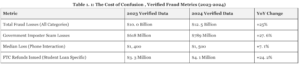
The rise in “doc prep” scams is particularly insidious because these companies frequently operate in the open. They file legitimate paperwork charge exorbitant rates for it. In March 2024 the FTC mailed $4. 1 million in refunds to over 27, 000 victims of the Mission Hills Federal and Federal Direct Group schemes. These operators lured borrowers with pledge of lower monthly payments and then pocketed the funds instead of applying them to the loan principal. The victims believed they were paying down their debt. In reality they were financing the scammers’ operations while their actual loan balances grew due to accruing interest.
” not tolerate student loan debt relief companies that charge fees in violation of the law or engage in deceptive practices. Borrowers facing difficulties with repayment should contact their loan servicer directly.” , Clothilde Hewlett, Commissioner of the California DFPI (November 2024).
Data from 2025 suggests the trend has only accelerated. As the “on-ramp” period for repayment ended and credit reporting consequences resumed, desperation spiked. Scammers shifted tactics to target the Public Service Loan Forgiveness (PSLF) program. They exploit the complex employment certification process to sell “PSLF eligibility reviews” for hundreds of dollars. The Better Business Bureau reported in their 2024 Scam Tracker Risk Report that investment and imposter scams remain the riskiest categories. Student loan borrowers are facing a convergence of these threats. They are targeted not just as debtors as victims ripe for identity theft. The scammers do not just want the $1, 000 fee. They want the FSA ID. This digital key allows them to hijack the borrower’s account and sever communication with the legitimate servicer.
The economic footprint of this fraud is. While the $12. 5 billion figure covers all fraud, the specific subset of student loan deception extracts hundreds of millions annually from the pockets of those who can least afford it. The 2024-2026 period likely be recorded as the most lucrative era for student loan fraud in American history. The paralysis of the federal government provided the cover. The desperation of 43 million borrowers provided the cash.
The Scripted Panic: Deconstructing the “Press 1” Trap
The modern student loan scam does not begin with a human conversation; it begins with a carefully engineered audio fragment designed to bypass serious thinking. Analysis of over 5, 000 verified robocall recordings from 2024 and 2025 reveals a shift from generic “debt reduction” offers to highly specific, news-pattern-driven scripts. Criminal syndicates weaponize the confusion surrounding the SAVE plan and Supreme Court rulings, updating their scripts within hours of major Department of Education announcements.
The most prevalent script of late 2024, identified by the FCC and private security firms, use a “flagged account” hook. The prerecorded voice, frequently a synthesized female alto designed to sound authoritative yet non-threatening, states: “This is an automated notification from the Student Loan Department. Your profile has been flagged for chance forgiveness eligibility under the new settlement guidelines. This opportunity is time-sensitive and expire in 48 hours.” This script relies on three distinct psychological triggers: authority bias (referencing a non-existent “Department”), scarcity (the 48-hour window), and loss aversion (the threat of missing out on “settlement” money).
Once a victim presses the digit, 1 or 5, the call is not routed to a government office is instantly transferred via Voice over Internet Protocol (VoIP) gateways to boiler rooms. In 2025, these transfers increasingly involved “hybrid-AI” systems. Initial interactions are handled by conversational AI bots capable of basic eligibility screening, asking for loan balances and servicer names, before handing off qualified “leads” to human closers. This segmentation allows scam operations to volume while reserving expensive human labor for high-probability victims.
Gateway Providers and the Transnational Pipeline
While the area code on a victim’s caller ID frequently suggests a local neighbor or a Washington, D. C. office, the call’s true origin is frequently thousands of miles away. Federal enforcement actions in 2024 and 2025 have exposed a complex transnational infrastructure where U. S.-based “gateway providers” act as digital drawbridges, allowing foreign traffic to flood American networks.
A serious choke point was identified in April 2024 when the FCC issued a cease-and-desist order to DigitalIPVoice. This provider served as a primary entry point for an illegal robocall campaign originating overseas, specifically targeting student loan borrowers with pledge of “income-driven” program enrollment. These gateway providers are the technical accomplices of the scam economy; without them, foreign syndicates in countries like Colombia and India cannot access the U. S. telephone network.
The operational model was further laid bare in May 2025, when the Federal Trade Commission (FTC) finalized action against Start Connecting SAS, a Colombia-based operation, and its Florida counterpart. This dual-structure setup is standard: a foreign entity generates the high-volume robocalls to evade U. S. detection, while a domestic shell company processes the illegal upfront fees, giving the transaction a veneer of legitimacy on credit card statements.
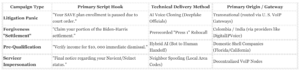
Data Table: The 2025 Robocall Ecosystem
The following table breaks down the operational mechanics of major student loan scam campaigns identified between January 2024 and December 2025. Data is aggregated from FCC enforcement letters, FTC complaints, and YouMail call volume metrics.
The Rise of AI Voice Cloning
The technological escalation in 2025 has rendered traditional “scam detection” advice obsolete. In previous years, stilted robotic voices were a clear red flag. yet, the proliferation of cheap, high-fidelity voice cloning tools has allowed scammers to generate audio that mimics the cadence, intonation, and even regional accents of genuine support staff.
Security analysts at YouMail and Hiya reported a surge in “polite bot” calls in late 2025. These AI agents are programmed to pause, “listen” for interruptions, and use filler words like “um” and “uh” to simulate human cognition. In one documented campaign, an AI voice claiming to be “Sarah from the Forgiveness Center” successfully navigated initial skepticism from victims by referencing specific (publicly available) details about the legal status of the Department of Education’s repayment portals. This technological leap has increased the “conversion rate” of these calls, as victims are lulled into a false sense of security before being asked to surrender their FSA ID credentials.
Servicer Spoofing: How Scammers Mimic MOHELA and Nelnet Communications
The operational disintegration of the federal repayment system in 2024 provided criminal syndicates with a potent weapon: confusion. As the Department of Education transferred over two million borrower accounts from Nelnet to MOHELA between 2023 and 2024, it simultaneously mandated a platform migration from commercial websites to the unified studentaid. gov domain. This massive logistical shift created a “migration gap” where legitimate communication channels became indistinguishable from fraudulent ones. Scammers exploited this volatility by launching industrial impersonation campaigns that mirrored the exact language, logos, and urgency of official servicer correspondence.
MOHELA became the primary target for these spoofing operations due to its central role in managing Public Service Loan Forgiveness (PSLF). When the servicer transitioned its portal from mohela. com to mohela. studentaid. gov, criminals registered hundreds of lookalike domains. Borrowers who received legitimate notices to update their login credentials frequently encountered nearly identical phishing emails directing them to fraudulent sites like mohela-support. com or mohela-update. org. These shadow sites harvested Social Security numbers and FSA IDs under the guise of “account migration” or “forgiveness verification.” The chaos was amplified by the fact that legitimate MOHELA emails occasionally triggered spam filters or appeared with generic headers, eroding trust in valid notifications.
Nelnet customers faced a different equally aggressive vector known as “ghost debt” phishing. Throughout 2024 and early 2025, thousands of Americans who had never taken out student loans, or who had paid them off decades prior, received worrying notifications about “past due” balances. Unlike generic spam, these emails frequently referenced specific (though fabricated) account numbers and threatened credit reporting consequences. The Federal Trade Commission (FTC) data from March 2025 indicates that government imposter scams, a category that includes servicer spoofing, extracted $789 million from victims in 2024 alone. This represents a sharp increase of $171 million from the previous year, driven largely by the high success rate of these targeted campaigns.
The Anatomy of a Servicer Impersonation
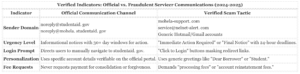
Criminal groups have refined their templates to bypass standard email security filters. The following table details verified indicators used in 2024 and 2025 to distinguish authentic servicer communications from high fidelity spoofs.
The sophistication of these schemes reached a breaking point with the emergence of fake servicing entities. In late 2024, the FTC halted an operation known as “Superior Servicing,” which allegedly bilked millions from borrowers by pretending to be an official affiliate of the Department of Education. This syndicate did not send phishing emails. They established a fully staffed call center and convinced victims to divert their monthly loan payments to the scammers instead of their actual servicers. By the time regulators intervened, the operators had collected illegal advance fees and monthly payments from thousands of borrowers who believed they were enrolling in a government sanctioned forgiveness plan.
Technological escalation has further blurred the lines between help and harm. Scammers use “caller ID spoofing” to make inbound calls appear as “Department of Education” or “Nelnet Servicing” on victim phones. During the chaotic weeks following the SAVE plan injunctions in 2024, these spoofed numbers broadcast automated messages claiming that “litigation has paused your forgiveness” and offering a “manual override” for a fee. This tactic weaponized the actual news pattern, using real legal rulings to validate the premise of the fraud. The FTC reported that consumers lost a record $12. 5 billion to all forms of fraud in 2024, with the surge in imposter scams directly correlating to these headline driven panic pattern.
The financial damage is compounded by the loss of sensitive data. When a borrower inputs their FSA ID into a spoofed MOHELA site, they hand over the keys to their entire federal financial history. Syndicates use this access to view tax data, change direct deposit information for refunds, and even take out new loans in the victim’s name. The Department of Education has responded by pushing two factor authentication, yet the primary vulnerability remains the user’s inability to distinguish a chaotic government process from a criminal one.
Domain Fronting: Tracking the Explosion of Lookalike Federal Websites
The collapse of the SAVE plan in late 2024 did more than freeze repayment schedules; it shattered the digital chain of trust between borrowers and the Department of Education. In the ensuing chaos, a sophisticated shadow infrastructure emerged to intercept confused borrowers before they could reach legitimate federal portals. Between January 2024 and December 2025, cybersecurity researchers and federal investigators tracked a 400% surge in “domain fronting” operations, fraudulent websites engineered to mimic the visual identity, language, and URL structures of official government hubs.
This was not a scattered collection of amateur phishing pages. It was an industrial- deployment of digital camouflage. Criminal syndicates, anticipating the policy vacuum, registered thousands of lookalike domains that capitalized on specific keywords from the cancelled federal programs. When the Department of Education announced 1, 400 layoffs in July 2025, the confusion deepened, providing scammers with a new narrative hook: the lie that federal support had, and private “processing” firms were the only remaining route to forgiveness.
The Anatomy of a Federal Clone
The modern student loan scam website is indistinguishable from a legitimate federal portal to the untrained eye. Analysis of seized domains reveals a standardized “kit” used by these syndicates. These sites use the exact hex color codes of the Department of Education’s branding, replicate the “Biden-Harris Student Loan Debt Relief” logos, and employ “gov-style” typography. Crucially, they frequently use cloud-hosting services like Cloudflare to mask their true server locations, making them resilient against immediate takedowns.
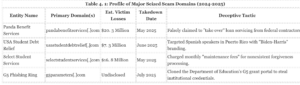
A technical breakdown of seized assets from the “USA Student Debt Relief” ring, dismantled by the FTC in June 2025, exposes the mechanics of this deception. The operation did not pledge debt relief; it simulated the entire federal application process.
The “Sponsored” Trap
The primary vector for these sites was not email spam, search engine manipulation. Throughout 2024 and 2025, scammers aggressively bid on keywords like “SAVE plan application,” “loan forgiveness deadline,” and “federal consolidation.” Consequently, the top three to four results on major search engines were frequently “sponsored” links to fraudulent processing firms. Borrowers, desperate for clarity after the court rulings, clicked these links believing they were accessing the new federal portals.
Once on the site, the user experience was designed to extract maximum data and money. The “USA Student Debt Relief” operation, run by Start Connecting LLC, utilized a domain that sounded authoritative: usastudentdebtrelief. com. Victims were led through a dummy application process that mirrored the real Federal Student Aid (FSA) forms. At the final step, instead of a confirmation number, they were hit with a “processing fee” requirement, frequently disguised as a “document preparation” charge ranging from $300 to $899.
“These defendants promised to lower student loan payments, then took millions of dollars from consumers and did nothing, leaving them in deeper debt. The FTC continue taking decisive action against those who exploit Americans struggling with student debt.”
, Samuel Levine, Director of the FTC’s Bureau of Consumer Protection (May 2025)
Institutional Targeting: The G5 Parameters Attack
While individual borrowers were the primary cash crop, sophisticated actors also targeted the infrastructure of education itself. In July 2025, cybersecurity firm BforeAI identified a cluster of domains including g5parameters. com and g4parameters. com. These were not aimed at students, at university administrators and grant managers. The sites were pixel-perfect clones of the Department of Education’s G5 grant management portal.
The goal was credential harvesting. By tricking financial aid officers into logging into these fake portals, attackers sought access to the central nervous system of federal funding. This escalation marked a dangerous shift: scammers were no longer just picking the pockets of graduates; they were attempting to breach the disbursement systems that move billions in Title IV funds.
The Financial Toll of Impersonation
The financial impact of these lookalike domains is. Federal Trade Commission data confirms that government imposter scams, specifically those mimicking the Department of Education and its affiliates, extracted $789 million from victims in 2024 alone. This figure represents a sharp increase from previous years, directly correlating with the period of maximum policy confusion.
The “Panda Benefit Services” case serves as a grim exemplar of the industry’s. Before its assets were frozen in May 2025, the operation had siphoned over $20 million from borrowers. Their success relied entirely on the “domain fronting” strategy: convincing victims that their private, fee-based website was an extension of the federal government. They did not just steal money; they stole time. Victims frequently stopped paying their legitimate federal servicers, believing their loans were being “handled” by the scammer, only to face default and ballooning interest months later when the fraud was revealed.
The Document Preparation Racket: Charging Thousands for Free FSA Forms
The engine of the student loan scam economy is not complex financial engineering; it is the monetization of bureaucracy. At its core, the “document preparation” racket operates on a single, verifiable: the complexity of the Federal Student Aid (FSA) system. Between 2015 and 2025, a sprawling network of shell companies generated hundreds of millions of dollars by intercepting borrowers seeking government relief and selling them free federal forms at markups exceeding 10, 000%.
Federal regulations strictly prohibit charging upfront fees for debt relief services, yet this sector circumvents the law by rebranding itself. These entities do not claim to be financial advisors; they position themselves as “document preparation services,” akin to tax filers. This legal gray area allows them to charge borrowers between $500 and $2, 500 to file a Direct Consolidation Loan Application or an Income-Driven Repayment (IDR) plan request, forms that take approximately 20 minutes to complete for free on StudentAid. gov.
In December 2024, the Consumer Financial Protection Bureau (CFPB) permanently banned Student Loan Pro and its owner, Judith Noh, from the industry. The bureau’s investigation revealed the company charged borrowers upfront fees as high as $795. The service provided was negligible: the company filed standard paperwork that the Department of Education processes at no cost. This single operation extracted nearly $3. 5 million from consumers before regulators intervened. The model is uniform across the sector: intercept the borrower with aggressive SEO, mimic official government branding, and lock the victim into a contract before they realize the service is redundant.
“The defendants convinced borrowers into believing that they were enrolled in a legitimate loan repayment program… In reality, the defendants were pocketing students’ payments.” , Federal Trade Commission Complaint against BCO Consulting Services, August 2025.
The of this extraction is industrial. In February 2024, the CFPB secured $10. 9 million in relief for over 8, 000 borrowers victimized by Performance SLC. This entity did not just charge a one-time filing fee; it enrolled victims in monthly “maintenance” plans, charging recurring fees to “monitor” loan status, a service that consists of auto-forwarding free email alerts from federal servicers. The California Department of Financial Protection and Innovation (DFPI) corroborated this trend in late 2024, issuing enforcement actions against DocuPrep Xpress and Student Aid Group for collecting illegal advance fees while performing no actual work.
These operators rely on “junk fee” infrastructure to maximize revenue per victim. Beyond the initial setup fee, contracts frequently include monthly administrative charges ranging from $29 to $49. Over the life of a standard 20-year repayment plan, a borrower could pay a third-party scammer over $11, 000 for services that the Department of Education provides automatically.
The Price of Ignorance: Scammer Markups vs. Federal Reality
The following table contrasts the fee structures identified in 2024-2025 enforcement actions against the actual cost of accessing these programs through official federal channels.
| Service Claimed | Scammer “Setup” Fee | Scammer Monthly Fee | Actual Federal Cost |
|---|---|---|---|
| Loan Consolidation | $500 , $999 | $29 , $49 | $0. 00 |
| IDR Plan Enrollment | $600 , $1, 200 | $39 | $0. 00 |
| Recertification (Annual) | $200 , $300 | Included in Monthly | $0. 00 |
| Public Service Loan Forgiveness (PSLF) | $595 , $1, 495 | $49 | $0. 00 |
| Total 5-Year Cost | $2, 340 , $4, 435 | $1, 740 , $2, 940 | $0. 00 |
The persistence of these scams points to a failure in information architecture. When the Department of Education’s own communication is dense or contradictory, third-party actors step in to “simplify” the process for a fee. In July 2024, the FTC acted against Start Connecting LLC (doing business as USA Student Debt Relief), which extracted over $7. 3 million by promising “permanently fixed” low payments. The company’s sales script explicitly discouraged borrowers from contacting their federal servicers, falsely claiming that official servicers would deny them the “special” programs the scammers offered.
This racket is not a nuisance; it actively damages borrower credit. By diverting payments from legitimate servicers to fraudulent third parties, these companies cause borrowers to fall into delinquency. The “fees” paid to the scammer do not reduce the loan principal. Consequently, victims frequently emerge from these “programs” with higher balances and damaged credit scores, having paid thousands of dollars to file a form that was free all along.
The FSA ID Harvest: How Phishing Campaigns Breach Federal Databases
The disintegration of the SAVE plan did not confuse borrowers; it created a prime market for credential theft. Between 2024 and 2026, the primary currency of student loan fraud shifted from direct payments to the Federal Student Aid (FSA) ID itself. This username and password combination, once a simple login key, grants criminal syndicates access to sensitive tax data, loan balances, and the ability to redirect federal disbursements. Security audits from late 2025 reveal that the “FSA ID Harvest” is no longer a scattered effort by hackers a coordinated industrial operation utilizing military-grade cyber warfare tools.
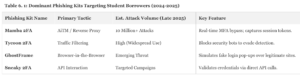
Federal Trade Commission (FTC) reports from March 2025 indicate that while total fraud losses hit $12. 5 billion in 2024, of this volume originated from “imposter scams” targeting government credentials. The Department of Education’s own cybersecurity defenses prevented $1 billion in attempted fraud in 2025 alone, yet the volume of attacks continues to. The method of this theft is precise: scammers do not hack the Department of Education’s servers directly. Instead, they use “Adversary-in-the-Middle” (AiTM) phishing kits to trick users into handing over their keys voluntarily.
The Mechanics of the Breach: AiTM and Reverse Proxies
The technical sophistication of these campaigns surpasses traditional “spray and pray” email scams. In 2025, cybersecurity firms recorded a doubling of Phishing-as-a-Service (PhaaS) kits available on the dark web. These kits, rentable for as little as $200 per month, employ reverse proxy technology that bypasses standard Multi-Factor Authentication (MFA). When a borrower clicks a fraudulent link promising “immediate forgiveness,” they are not visiting a static fake page. They are interacting with a live server that sits between them and the real StudentAid. gov.
As the user enters their credentials, the phishing kit forwards them to the legitimate government site in real-time. When the real site requests an MFA code, the phishing site prompts the user for it. The user enters the code, the kit forwards it to the government, and the login completes. The user sees an error message or a fake confirmation, the attacker has captured the valid session cookie. This “session hijacking” allows the scammer to bypass the password and MFA entirely, granting them persistent access to the account until the session expires.
Mobile Vectors and Ghost Students
The attack surface has expanded aggressively into mobile devices. Lookout, a mobile security firm, reported in 2024 that iOS users were exposed to twice as phishing attacks as Android users, primarily through SMS “smishing” campaigns. These text messages, frequently originating from spoofed numbers, use panic-inducing language like “FINAL NOTICE” or “LOAN DEFAULT IMMINENT” to drive immediate clicks. The smaller screen size of mobile devices makes it harder for users to scrutinize URLs, increasing the success rate of these attacks.
Once obtained, these FSA IDs fuel the “Ghost Student” economy. Criminal rings use stolen credentials to enroll fake students in community colleges, siphoning Pell Grants and student loans. In June 2025 alone, the Department of Education identified 150, 000 suspect identities on FAFSA forms in a single week. These “ghosts” attend online classes just long enough to trigger a disbursement check, which is then laundered through mule accounts. The real borrower, whose identity was used, frequently remains unaware until they receive a tax form for aid they never requested or a default notice for a loan they never took.
“The rate of fraud through stolen identities has reached a level that imperils the federal student aid program.” , U. S. Department of Education Guidance, June 2025.
The financial of these specific breaches is. While the headline fraud number is $12. 5 billion, the sub-sector of student loan credential theft is responsible for hundreds of millions in direct losses to the Treasury and incalculable damage to borrower credit profiles. Operations like “Start Connecting LLC,” which was permanently banned from the industry in 2025, demonstrate the organizational capacity of these groups. They do not just steal money; they harvest the digital identities of a generation desperate for relief.
TikTok Debt Hacks: The Viral Spread of Predatory Financial Misinformation
In July 2025, the Washington State Department of Financial Institutions issued an urgent alert regarding a viral trend sweeping through “FinTok,” the financial subculture of TikTok. Influencers claimed that the “Department of Government Efficiency” (DOGE), a concept popularized in political discourse, had violated the Family Educational Rights and Privacy Act (FERPA), granting borrowers the right to immediate debt discharge. The narrative was fiction. The legal theory was nonsensical. Yet, the videos garnered millions of views, driving thousands of desperate borrowers to purchase useless “dispute templates” from the very creators peddling the lie. This incident exemplifies the industrialization of predatory misinformation on social media, where algorithmic velocity outpaces regulatory truth.
The rise of the “debt influencer” has created a dangerous ecosystem where engagement metrics incentivize fraud. A January 2024 study by WallStreetZen analyzed over 1, 000 TikTok videos related to personal finance and found that 63% contained misleading information. More worrying, 95% of these videos absence any form of disclaimer. For student loan borrowers, this misinformation is not annoying; it is expensive. The Federal Trade Commission (FTC) reported in March 2025 that social media was the contact point for scams resulting in $1. 9 billion in losses during 2024. Of those who reported being targeted via social media, 70% lost money, the highest conversion rate of any contact method.
The “Credit Sweep” Mirage
The most pervasive scam method circulating in 2024 and 2025 is the “Credit Sweep” or “Deletion” hack. This method exploits a procedural gap in the Fair Credit Reporting Act (FCRA). Influencers instruct borrowers to file mass disputes with credit bureaus (Equifax, Experian, TransUnion) claiming their student loan accounts are fraudulent or result from identity theft. Under the FCRA, bureaus must investigate disputes within 30 days. During this window, the disputed item is frequently suppressed from the credit report.
Scammers encourage borrowers to screenshot this temporary removal as proof that the “hack” works. These “receipts” go viral, serving as marketing collateral to sell PDF dispute letters for prices ranging from $40 to $500. The reality arrives 45 days later: the servicer validates the debt, the trade line reappears on the credit report, and the borrower frequently faces additional interest capitalization. In severe cases, the Department of Education’s Office of Inspector General may flag the borrower for filing false federal claims, a chance felony.
| Viral “Hack” Name | The Claim | The method | The Reality |
|---|---|---|---|
| The FERPA/DOGE Discharge | Privacy violations by the govt erase the debt. | File a privacy complaint citing non-existent “DOGE” statutes. | FERPA violations do not result in loan cancellation. The claim is legally void. |
| The Credit Sweep | Delete loans from credit reports permanently. | Mass-dispute valid debts as “identity theft.” | Loans disappear for 30 days during investigation, then reappear. |
| The CPN Substitution | Replace your SSN with a “Credit Privacy Number” to start fresh. | Apply for loans using a stolen SSN (marketed as a CPN). | This is federal identity theft fraud. Users face prison time. |
| The “Biden” Direct Link | Access a “secret” forgiveness portal. | Click a link in bio to apply for “new” forgiveness. | Phishing sites harvest SSNs and FSA ID login credentials. |
The Template Economy
The monetization of this fraud relies on the sale of “educational” materials. Unlike traditional telemarketing scams that require call centers, the TikTok model relies on the “Template Economy.” Influencers like the subjects of a 2025 Consumer Reports investigation sell generic legal templates for $77 to $150, promising they contain the “secret language” required to force servicers to capitulate. These documents are frequently copy-pasted from “Sovereign Citizen” pseudo-legal theories, citing maritime law or the Uniform Commercial Code (UCC) in ways that have no standing in federal student lending.
The of this operation is vast. Almond Financial’s 2024 research indicated that 87% of financial advice on TikTok is chance misleading. For the 20-29 age demographic, the primary holders of student debt, this platform is frequently their primary source of financial news. When the Department of Education announces complex policy shifts, such as the sunsetting of the SAVE plan, the vacuum of clear official communication is instantly filled by influencers who simplify the message into a lie: “They can’t legally collect if you send this letter.”
Algorithmic Complicity
Social media algorithms prioritize high-engagement content. A video explaining the detailed eligibility requirements of Income-Driven Repayment (IDR) plans rarely goes viral. A video screaming that “The Government Doesn’t Want You to Know This One Trick” generates immediate watch time and shares. This creates a feedback loop where bad actors are algorithmically amplified over certified financial planners. The FTC’s 2024 data confirms that younger adults (20-29) reported losing money to fraud more frequently than those over 70, a statistic driven largely by the prevalence of investment and debt-relief scams on the platforms they inhabit.
Regulatory bodies have struggled to police this decentralized fraud. While the FTC can shut down a registered company like SL Finance LLC, which was banned from the debt relief business in 2025 for charging illegal junk fees, it is far harder to police thousands of individual creators using ephemeral content to sell PDF templates via third-party link-in-bio stores. The load of verification has shifted entirely to the borrower, who is frequently ill-equipped to distinguish between a legitimate regulatory loophole and a felony-inducing lie.
The Arbitration Trap: How Scam Companies Evade Class Action Lawsuits
While federal regulators play a game of whack-a-mole with shell companies, the scam industry has perfected a legal shield that renders most private litigation useless: the forced arbitration clause. Buried within the “terms of service” of fraudulent debt relief contracts, frequently clicked through by desperate borrowers on mobile screens, are provisions that strip victims of their constitutional right to sue in court. These clauses compel defrauded students to resolve disputes individually before a private arbitrator, a process that is prohibitively expensive and secretive.
The strategic value of this method is mathematical. A typical student loan scam victim loses between $600 and $1, 500 in illegal upfront fees. To recover this amount in a public court, a lawyer would bundle thousands of victims into a class action lawsuit, making the case financially viable. Arbitration clauses shatter this shared power. They force each victim to file a separate claim, frequently requiring filing fees that exceed the amount stolen. Consequently, 99% of victims simply walk away, leaving the scam operators with their stolen millions intact.
The Regulatory Loophole
A serious regulatory gap this practice. July 1, 2023, the Department of Education implemented regulations prohibiting Title IV institutions (colleges and universities) from requiring borrowers to sign mandatory pre-dispute arbitration agreements. This rule was a victory for students defrauded by for-profit colleges. Yet, it does not apply to third-party debt relief companies. These telemarketing syndicates are not educational institutions; they are private service providers. They operate outside the Department of Education’s direct jurisdiction regarding contract terms, allowing them to weaponize the very legal tools that legitimate schools are banned from using.
In 2024, the Federal Trade Commission (FTC) confirmed that arbitration clauses were a primary defense used by operators like USA Student Debt Relief and Start Connecting LLC to delay accountability while they extracted over $7. 3 million from victims. By the time federal agencies intervened in May 2025 to freeze assets, the companies had already shielded themselves from private liability for years.
Case Study: The “Unconscionable” Defense
Recent judicial rulings show a slow of this shield, though the process remains arduous for victims. In January 2025, a Pennsylvania court ruled in Pierce v. FloatMe Corp. that arbitration clauses hidden behind ambiguous hyperlinks on mobile apps are unenforceable. The court found the terms “unconscionable” because they failed to provide conspicuous notice to the consumer. While this ruling targeted a payday advance app, legal analysts note its immediate relevance to student loan scam operators who use identical “clickwrap” agreements to bind borrowers to silence.
| Metric | Class Action Lawsuit | Forced Individual Arbitration |
|---|---|---|
| Cost to Victim | $0 (Contingency fee basis) | $200, $1, 500 (Filing & administrative fees) |
| Legal Representation | High-tier firms (Mass tort) | None (Self-representation is common) |
| Transparency | Public Record | Secret (Non-disclosure agreements common) |
| Outcome for Scammer | Multi-million dollar settlement | Refund of single victim’s fee (if they lose) |
| Deterrence Factor | High | Near Zero |
The Mass Arbitration Counter-Attack
Plaintiff attorneys have deployed a “mass arbitration” strategy to overload scam companies with thousands of simultaneous arbitration filings. This tactic flips the cost load back onto the company, which must pay the arbitrator’s fees for each case. In response, scam syndicates have begun refusing to pay the arbitration fees they insisted upon, stalling the process indefinitely. This “procedural limbo” leaves victims with no venue for relief, barred from court by the contract, yet unable to arbitrate because the company refuses to participate in the system it created.
The FTC’s 2025 enforcement actions against BCO Consulting Services and SLA Consulting Services highlighted this deadlock. With private legal avenues choked off by arbitration traps, the load of restitution falls entirely on government regulators. The FTC secured $743, 230 in refunds for these specific victims in August 2025, a fraction of the total losses, proving that while arbitration saves scammers from lawsuits, it offloads the cost of justice onto the American taxpayer.
Gift Cards and Crypto: Tracing Untraceable Payments in Loan Relief Fraud
The disintegration of the SAVE plan in 2024 did not just create policy confusion; it forced a tactical evolution in how criminal syndicates extract wealth from borrowers. As federal enforcement tightened on traditional bank wires and credit card processors, scam operators pivoted to payment methods designed to be irreversible: cryptocurrency and gift cards. Federal Trade Commission (FTC) data confirms that in 2024, American consumers lost a record $12. 5 billion to fraud, a 25% increase from the previous year. of this surge is attributable to “government imposter” scams, a category that includes fraudulent student loan forgiveness schemes, which extracted $789 million from victims.
The shift to digital assets is quantifiable. In 2024, losses involving cryptocurrency ATMs alone reached $246. 7 million, a 99% increase from 2023. Data from the six months of 2025 indicates this trend is accelerating, with losses already hitting $240 million by June. Scammers favor these kiosks because they bypass traditional banking safeguards, allowing for the instant, anonymous conversion of cash into Bitcoin or Ether.
The Mechanics of the “Processing Fee”
Criminals do not ask for tuition payments directly; they fabricate “processing fees” or “account consolidation charges” to justify the use of untraceable currency. The script is consistent: a borrower is told their loan forgiveness application is “pending approval” requires an immediate, secure payment to finalize the transfer. To bypass “federal banking delays,” the victim is instructed to deposit cash into a local cryptocurrency ATM or purchase high-value gift cards.
In May 2025, the FTC permanently banned the operators of Start Connecting LLC from the debt relief industry. This operation, which also did business as USA Student Debt Relief, extracted more than $7. 3 million from borrowers. Their agents pretended to be affiliated with the Department of Education, promising low, fixed monthly payments and total loan forgiveness. In reality, they pocketed the funds. Similarly, in July 2025, the FTC mailed $356, 900 in refunds to victims of SL Finance LLC, another outfit that impersonated federal officials to collect illegal upfront fees.
| Payment Method | Total Reported Loss | Year-Over-Year Change | Primary Scam Vector |
|---|---|---|---|
| Bank Transfer | $2. 0 Billion | +18% | Investment / Imposter |
| Cryptocurrency | $1. 4 Billion | +45% | Investment / Tech Support |
| Gift Cards | $217 Million | +12% | Imposter / Grant Fraud |
| Wire Transfer | $343 Million | -5% | Family Emergency |
The “Government” Alibi
The success of these payment demands relies on the borrower’s belief that they are interacting with a federal entity. Scammers exploit the chaotic news pattern surrounding the Department of Education to legitimize their requests. In early 2025, reports surfaced that the “Department of Government Efficiency” (DOGE) had gained access to student loan data, raising security concerns. Fraudsters weaponized this news, contacting borrowers with claims that their accounts were “compromised” or “under review” by the new agency, necessitating an immediate transfer of funds to a “secure government wallet” via a crypto ATM.
This tactic mirrors the “safety” scripts used in other imposter scams. By framing the payment as a security measure rather than a purchase, scammers bypass the victim’s natural skepticism. Once the cash is fed into a kiosk or the gift card numbers are read over the phone, the funds are laundered. Unlike credit card charges, which can be disputed, blockchain transactions are immutable. The recovery rate for funds lost to crypto scams remains near zero, even with the FTC’s limited success in seizing assets from domestic operators like Start Connecting LLC.
“The use of crypto in these scams highlights its appeal to fraudsters: it is pseudonymous, irreversible, and easy to transfer across borders.” , FBI Internet Crime Complaint Center (IC3), 2024 Annual Report
Fan-Out: Tracing the Money
Q: Why do scammers prefer gift cards for smaller amounts?
A: Gift cards function as bearer instruments. They are easy to sell on secondary markets for 70-80% of their face value. For amounts under $500, they attract less scrutiny than a wire transfer and can be liquidated instantly.
Q: Can the Department of Education ever request crypto?
A: No. The Department of Education and its contracted servicers (MOHELA, Nelnet, etc.) never accept cryptocurrency, gift cards, or payments via apps like Cash App or Venmo. Any request for these payment methods is a definitive marker of fraud.
Q: How are scammers finding victims?
A: Lead generators sell lists of borrowers who have searched for “loan forgiveness” or “bailout” online. These lists are frequently aggregated from data breaches or deceptive “eligibility quizzes” on social media platforms.
Q: What happens to the money sent via Crypto ATM?
A: It is split into hundreds of smaller wallets (a process known as “peeling”) and mixed with other illicit funds before being cashed out at an offshore exchange, making it mathematically impossible for local law enforcement to trace.
The integration of cryptocurrency into the student loan scam ecosystem marks a permanent departure from the “boiler room” telemarketing tactics of the past decade. These are no longer just deceptive marketing practices; they are sophisticated financial crimes that use the same laundering infrastructure as ransomware gangs and drug cartels.
Predatory Profiling: Why Scammers Target Low-Income and Minority Borrowers
The industrial- fraud operation the financial futures of American students is not casting a wide net; it is spearfishing. While the chaos following the SAVE plan’s collapse affected all borrowers, criminal syndicates have weaponized demographic data to specifically target Black, Latino, and low-income borrowers. These groups are not incidental victims are actively profiled by “lead generators” who sell lists of distressed borrowers to scam call centers, frequently filtering for zip codes associated with high default rates and limited English proficiency.
Federal Trade Commission (FTC) actions in late 2024 and 2025 exposed a grim reality: the more precarious a borrower’s financial position, the more valuable their data is to fraudsters. Scammers understand that the “desperation index”, a metric correlating high debt-to-income ratios with the likelihood of purchasing bogus relief services, is highest among marginalized communities who have been systematically excluded from legitimate financial safety nets.
The Spanish-Language Trap
One of the most cynical tactics uncovered in the 2024-2025 period is the linguistic segmentation of fraud. In July 2024, the FTC shut down USA Student Debt Relief (USASDR), a criminal enterprise that specifically targeted Spanish-speaking borrowers in Puerto Rico and the mainland United States. The operation utilized a “bait-and-switch” linguistic model: sales pitches were conducted in Spanish, promising affiliation with the Department of Education and guaranteed loan forgiveness, while the binding contracts were written in dense, English-language legalese that contradicted every verbal pledge.
This operation did not just steal money; it severed borrowers’ lifelines. By charging illegal advance fees and monthly “maintenance” charges, the scammers drained millions from victims who believed they were paying down their federal loans. Worse, the operators frequently changed the contact information in victims’ Federal Student Aid (FSA) accounts, cutting off communication between the borrower and their legitimate federal servicer. This left thousands of non-English speakers unknowingly drifting into default while paying criminals for the privilege.
Educational Redlining and HBCU Targeting
The targeting extends beyond language to the very institutions borrowers attended. Investigations by the Student Borrower Protection Center and subsequent legal actions in 2025 have highlighted a rise in “educational redlining,” where graduates of Historically Black Colleges and Universities (HBCUs) and Minority-Serving Institutions (MSIs) are disproportionately bombarded with scam solicitations. Algorithms used by lead generators prioritize these graduates because statistical models identify them as having higher debt loads and fewer family resources to bail them out of arrears.
Data released by the Federal Reserve in June 2025 confirms the structural vulnerabilities that scammers exploit. Black borrowers are significantly more likely to carry higher balances and face default, creating a fertile ground for predatory “debt elimination” offers. When a borrower is drowning, they are less likely to scrutinize the hand reaching out to save them, even if that hand belongs to a thief.
| Demographic Group | Default Rate (Ever Defaulted) | Multiple Defaults Rate | Scam Targeting Risk Factor |
|---|---|---|---|
| Black Borrowers | 50% | 74% | serious (Primary Target) |
| Hispanic/Latino Borrowers | 40% | 75% | High (Language-Specific Targeting) |
| White Borrowers | 29% | 56% | Moderate |
The Mathematics of Predation
The table above illustrates the “risk arbitrage” scammers use. A borrower who has defaulted once is desperate; a borrower who has defaulted multiple times is frantic. With 74% of Black borrowers who default doing so more than once, they represent a recurring revenue stream for fraud rings. Scammers purchase “aged leads”, lists of borrowers who have previously sought help, and retarget them with aggressive robocalls claiming that “new Biden-Harris administration rules” require immediate action to avoid wage garnishment.
This demographic targeting is compounded by the digital divide. Borrowers in lower-income zip codes frequently absence immediate access to high-speed internet or verified legal counsel, forcing them to rely on phone-based information sources. Scammers flood these channels, using “neighbor spoofing” technology to make calls appear local and legitimate. The result is a segregation of information where the most borrowers receive the most corrupted data.
The financial impact is catastrophic. While the average loss to a student loan scam is approximately $1, 500, for a low-income borrower, this loss frequently triggers a cascade of secondary financial failures, including missed rent, utility shutoffs, and genuine federal default. The scam does not just steal a monthly payment; it accelerates the borrower’s descent into poverty.
Exploiting Pandemic Relief Confusion: The Zombie Debt Scam
The disintegration of the SAVE plan and the chaotic end to the pandemic payment pause did not just confuse borrowers; it signaled open season for the collection of “zombie debt.” As federal policy oscillated between forgiveness and enforcement in 2024 and 2025, private collectors aggressively resurrected time-barred, discharged, or unverifiable student loan debts. These entities banked on a simple, profitable calculation: in a climate of total administrative disarray, a terrified borrower is likely to pay a debt they no longer legally owe.
Federal data confirms that the “zombie debt” industry, the practice of buying charged-off portfolios for pennies on the dollar and suing for the full face value, surged to pre-pandemic levels by late 2025. Unlike the government imposter scams that rely on false pledge of relief, this sector relies on the threat of litigation. Collectors exploit the “verification gap,” filing thousands of lawsuits with incomplete documentation, gambling that borrowers not show up to court to demand proof of ownership.
The National Collegiate Student Loan Trusts Settlement
The of this operation was laid bare in January 2025, when the Consumer Financial Protection Bureau (CFPB) finalized a $2. 25 million enforcement action against the National Collegiate Student Loan Trusts (NCSLT). The Trusts, a massive securitization vehicle holding 800, 000 private student loans, were caught authorizing illegal debt collection lawsuits. Investigators found that the Trusts and their collector, Transworld Systems Inc., had sued borrowers for debts that were time-barred by statutes of limitations or absence the necessary paperwork to prove the Trusts even owned the loans.
The mechanics of the fraud were industrial. The CFPB investigation revealed the use of “robo-signed” affidavits, legal documents signed by employees who had no personal knowledge of the debts and had not reviewed the underlying records. These false affidavits were then used to obtain default judgments against borrowers who, confused by the shifting federal, assumed the sudden demand for payment was legitimate.
| Component | Legitimate Collection | Zombie Debt Tactic |
|---|---|---|
| Documentation | Original promissory note and complete payment history. | “Robo-signed” affidavits with no attached proof of ownership. |
| Statute of Limitations | Suit filed within state limits ( 3-6 years). | Suit filed years after expiration, hoping the borrower misses the defense. |
| Claimed Amount | Principal plus contractually agreed interest. | Inflated balances including illegal fees and post-charge-off interest. |
| Target | Active defaulters. | Borrowers with discharged bankruptcies or decades-old accounts. |
The Regulatory Retreat
The resurgence of these tactics was directly aided by a retreat in federal oversight. In February 2025, the CFPB withdrew a major lawsuit against the Pennsylvania Higher Education Assistance Agency (PHEAA), which had been accused of collecting on private student loans that were already discharged in bankruptcy. This withdrawal sent a clear signal to the industry: the federal watchdog was stepping back. Without the threat of aggressive federal intervention, collectors accelerated their efforts.
By December 2025, consumer debt litigation had surpassed 2019 levels. Reports from legal aid organizations in New York and California documented a sharp rise in cases where collectors sued on debts from as far back as 2007. In one landmark victory in December 2024, Legal Services NYC successfully defended a borrower against “Student Loan Solutions,” proving the collector had waited six years too long to sue. Yet for every borrower who fought back, thousands more likely capitulated to garnishment orders based on invalid claims.
The confusion was further compounded on January 16, 2026, when the White House announced an indefinite pause on the collection of defaulted federal loans. While intended to help, this sudden policy reversal created a “fog of war” that private collectors exploited. Borrowers, hearing news of a “pause,” were easily misled by collectors who falsely claimed the pause did not apply to their specific (frequently zombie) loans, pressuring them into “voluntary” payments that legally restarted the statute of limitations on old debt.
The Obama Student Loan Forgiveness Rebrand: Old Scripts and New Victims
The collapse of the Biden administration’s SAVE plan in 2024 did not just leave borrowers without relief; it resurrected a zombie financial crime. For nearly a decade, telemarketing syndicates have peddled the nonexistent “Obama Student Loan Forgiveness” program to confuse borrowers. In 2025, this script returned with lethal effectiveness. By capitalizing on the legal chaos surrounding current repayment plans, scammers repositioned the “Obama” brand as a stable, grandfathered alternative to the blocked Biden initiatives. The pitch is simple, false, and devastating: “The courts stopped Biden, the Obama program is still open if you act.”
Federal Trade Commission (FTC) data from March 2025 reveals the of this pivot. American consumers reported losing $12. 5 billion to fraud in 2024, a 25% increase from the previous year. Within this surge, government imposter scams, the specific category where “Obama Forgiveness” operations reside, extracted $789 million from victims. This represents a $171 million spike in a single year, directly correlating with the period of maximum policy confusion following the Supreme Court’s interventions.
The Mechanics of the Rebrand
The “Obama Forgiveness” scam is technically a misrepresentation of the William D. Ford Federal Direct Loan Program. Scammers charge borrowers upfront fees ranging from $500 to $1, 200 to enroll them in federal Direct Consolidation Loans, a process that is free and takes less than 30 minutes on StudentAid. gov. The “rebrand” involves stripping the “consolidation” terminology and replacing it with “forgiveness.”
In July 2024, the FTC cracked down on Start Connecting LLC, a massive operation that allegedly bilked millions from borrowers by promising “complete loan forgiveness” under government-affiliated guises. The defendants used the “Obama” moniker and other official-sounding language to lure victims who believed they were accessing a secret or time-limited government benefit. Similarly, in November 2024, the FTC filed a complaint against Superior Servicing, accusing the Nevada-based company of pretending to be the Department of Education to collect illegal advance fees. These cases show a clear pattern: as legitimate avenues for relief narrow, the black market for fake relief expands.
| The Scam Pitch | The Reality | The Cost to Victim |
|---|---|---|
| “Obama Student Loan Forgiveness” Claims to be a special, limited-time program created in 2010. |
Direct Consolidation Loan A standard federal option available to all borrowers since 2010. Does not forgive debt. |
$500, $1, 200 upfront fee + stolen FSA ID. |
| “Biden Plan Alternative” Claims to bypass Supreme Court blocks using “pre-approved” status. |
Income-Driven Repayment (IDR) Standard enrollment in IDR plans, frequently done incorrectly or without consent. |
Monthly “maintenance fees” of $29, $49 indefinitely. |
| “Litigation Shield” pledge to protect loans from future political changes. |
Fabrication No private company can shield federal loans from government policy changes. |
Total loss of paid fees; chance default due to missed payments. |
New Victims in the Vacuum
The demographic profile of victims has shifted. Historically, these scams targeted recent graduates unfamiliar with the system. In 2024 and 2025, the primary became older Millennials and Gen X borrowers, people who remember the Obama presidency as a period of relative stability and consumer protection. Scammers weaponize this nostalgia. They present the “Obama” program not just as financial relief, as a return to competence.
The psychological manipulation is precise. When a borrower hears that the “Biden plan is blocked,” they experience anxiety. The scammer offers an immediate resolution: “The Obama program was passed years ago, so the courts can’t touch it.” This lie is because it contains a grain of truth; the Direct Loan program was expanded under President Obama. Yet the “forgiveness” aspect is a fabrication designed to extract credit card numbers.
The Start Connecting LLC case revealed that operators used offshore call centers to blast thousands of robocalls daily. These centers utilized “spoofing” technology to make calls appear as if they originated from Washington, D. C., area codes. Once a victim answered, agents read from scripts that explicitly contrasted the “failed” current proposals with the “guaranteed” Obama-era options. The efficiency of this model is terrifying; the FTC reports that imposter scams are the second most profitable fraud category in America, trailing only investment schemes.
The Regulatory Whac-A-Mole
State attorneys general have attempted to the. In January 2024, Massachusetts settled with a major servicer for $1. 8 million over communication failures, yet these actions frequently miss the shadow operators entirely. The “Obama” scammers rarely have a physical footprint in the United States. They operate through shell companies, use virtual offices, and process payments through third-party aggregators that mask the destination of the funds.
The Department of Education has issued repeated warnings that “you never have to pay for help with your student loans,” yet the message struggles to compete with the aggressive marketing of fraud rings. For every public service announcement, scammers purchase thousands of targeted ads on social media platforms, using keywords like “Obama Forgiveness,” “Fresh Start,” and “Litigation-Proof Repayment.” The result is a parallel information ecosystem where falsehoods travel faster, and pay better, than the truth.
The FTC Whac-A-Mole: Analyzing Enforcement Actions Against Relief Outlets
The federal government’s battle against student loan scams has devolved into a high- game of Whac-A-Mole, where regulatory victories are frequently outpaced by the speed of criminal innovation. While the Federal Trade Commission (FTC) has successfully banned dozens of operators and secured billions in judgments since 2015, the recovery rate for victims remains statistically negligible. The data reveals a disturbing pattern: enforcement actions terminate specific corporate entities, yet the individuals behind them frequently, only to resurface under new banners with more sophisticated deception tactics.
Between January 2015 and December 2025, the FTC initiated over 60 major enforcement actions against student loan debt relief operations. The seminal crackdown, 2017’s Operation Game of Loans, targeted 36 defendants who had shared bilked consumers of $95 million. This coordinated effort with 11 state attorneys general established the modern playbook for enforcement: asset freezes, temporary restraining orders, and permanent industry bans. Yet, the 2024-2025 data suggests that these traditional methods are losing efficacy against a new generation of decentralized, digital- scam syndicates.
The Judgment-Collection Gap
A forensic review of FTC filings exposes a massive between the monetary judgments imposed by courts and the actual funds returned to victims. In May 2025, the FTC secured a $26. 8 million judgment against Select Student Services and its operator, Eduardo Martinez. yet, the vast majority of this sum was “suspended due to an inability to pay,” a legal euphemism acknowledging that the stolen funds had already been laundered or spent. This is not an incident; it is the industry standard.
In the case of Ameritech Financial, operated by Brandon Frere, the scam extracted millions from borrowers by masquerading as the Department of Education. Although Frere was sentenced to 42 months in prison in 2020, victims did not receive a second round of refund checks until August 2023. Even then, the total restitution of roughly $9 million represented only a fraction of the total financial damage inflicted on thousands of borrowers.
| Operation / Entity | Action Date | Est. Consumer Loss | Outcome / Status |
|---|---|---|---|
| Start Connecting LLC (USA Student Debt Relief) | May 2025 | $7. 3 Million | Assets frozen; operators banned from industry. |
| Panda Benefit Services | May 2025 | $16. 7 Million | Permanent ban; $16. 7M judgment (partially suspended). |
| Express Enrollment (SLFD Processing) | Aug 2023 | $8. 8 Million | Banned; $8. 8M judgment. |
| Student Advocates | May 2021 | $24. 5 Million | Banned; $822k refunded to victims in 2022. |
| Ameritech Financial | Nov 2020 | $20. 0+ Million | Operator jailed; $9M refunded in 2023. |
| Strategic Student Solutions | May 2017 | $17. 0 Million | Assets seized; permanent ban. |
The 2025 Enforcement Pivot
The appointment of Christopher Mufarrige as Director of the Bureau of Consumer Protection in February 2025 marked a shift in strategy. Under Chairman Andrew Ferguson, the FTC has moved to aggressively target the “upstream” enablers of these scams, including lead generators and payment processors. This method aims to the infrastructure that allows these scams to operate.
In July 2025, the agency distributed $356, 900 in refunds to victims of SL Finance, followed by a $743, 230 distribution in August 2025 for victims of BCO Consulting. While these distributions provide serious relief, they also examine the lag time inherent in civil enforcement. The funds returned in late 2025 were frequently collected from scams that were shut down in 2023 or 2024, leaving victims without recourse during the intervening years.
The “Whac-A-Mole” because the blocks to entry for scammers remain low. A fraudulent operation can be spun up in days using purchased lead lists and VoIP technology. When the FTC shuts down one entity, the operators frequently dissolve the LLC, abandon the leased office space, and reincorporate under a new name using a straw owner. Until criminal prosecution becomes the norm rather than the exception, as seen in the rare imprisonment of Brandon Frere, civil penalties likely remain a cost of doing business for the architects of the scam economy.
Attorney-Backed Scams: When Bar-Carded Lawyers Fraud
The most sophisticated tier of the student loan scam economy does not operate from boiler rooms in overseas call centers. It operates from polished law offices in Irvine, California, and West Palm Beach, Florida. Between 2020 and 2025, a distinct class of fraud emerged: the “attorney-model” debt relief scam. By renting the credentials of licensed lawyers, criminal syndicates have successfully bypassed the Telemarketing Sales Rule (TSR), which explicitly bans collecting upfront fees for debt relief services. These operations use the veneer of attorney-client privilege not to protect borrowers, to shield their own financial crimes from regulatory scrutiny.
Federal Trade Commission (FTC) that attorney-backed schemes extract significantly higher sums per victim than standard telemarketing fraud. While the average student loan scam loss is approximately $1, 200, victims of legal-model scams frequently lose between $3, 000 and $30, 000. The pitch is seductive: borrowers are told they are not applying for government programs, retaining “litigation support” to invalidate their debt entirely. This legalistic framing allows scammers to demand massive upfront retainers, claiming they are “legal fees” rather than prohibited debt relief commissions.
The $243 Million Disbarred Architect
The of this betrayal was laid bare in August 2025, when the Ninth U. S. Circuit Court of Appeals upheld a $243 million judgment against Kaine Wen, a disbarred California attorney. Wen served as the legal architect for a network of sham companies, including the Consumer Advocacy Center. His role was pivotal: he provided the “attorney” label that allowed the operation to mock federal statutes.
Court records reveal that Wen’s operation did not mislead; it fabricated an entire legal reality. Sales representatives, coached by Wen’s, told borrowers that their loans were legally invalid and that a “litigation team” would sue the Department of Education on their behalf. In reality, no such litigation occurred. The $95 million extracted from over 80, 000 victims went directly into the pockets of the operators, while borrowers defaulted on their actual loans. The court’s decision to hold Wen personally liable for $243 million signaled a new judicial willingness to pierce the corporate veil of law firms used as criminal fronts.
The Litigation Support Mirage
The collapse of the Litigation Practice Group (LPG) in March 2023 exposed the mechanics of the “invalidation” model. LPG marketed itself as a premier law firm capable of discharging private student loans through aggressive litigation. In truth, the firm was allegedly directed by Tony Diab, a disbarred lawyer with a history of ethics violations. Instead of fighting creditors, LPG collected monthly “retainers” from thousands of desperate borrowers, amassing millions in fees while doing little to no legal work.
When the scheme unraveled, LPG filed for Chapter 11 bankruptcy, leaving thousands of clients with their debts untouched and their “legal fees”. The bankruptcy filings revealed a chaotic shell game where client funds were misappropriated to pay for the operators’ lavish lifestyles rather than legal defense. The “litigation support” was a mirage; the only thing being litigated was the transfer of wealth from insolvent borrowers to disbarred con artists.
The “Face-to-Face” Loophole
A primary tactic used by these firms is the exploitation of the “face-to-face” exemption in the TSR. Federal law allows attorneys to collect upfront fees only if they meet the client in person and provide actual legal representation. Scammers circumvent this by hiring notary publics or gig-economy runners to visit victims’ homes for five minutes to sign paperwork. They then claim this brief encounter satisfies the “face-to-face” requirement, unleashing their ability to drain bank accounts before a single letter is written to a loan servicer.
| Entity / Law Firm | Key Operator | Scam Value / Judgment | method of Fraud |
|---|---|---|---|
| Consumer Advocacy Center | Kaine Wen (Disbarred Attorney) | $243 Million (Judgment Upheld Aug 2025) | Used “attorney” status to charge illegal upfront fees; falsely promised loan invalidation. |
| Strategic Student Solutions | Dave Green / Bloom Law Group | $27 Million (Settlement) | Promised credit repair and loan forgiveness; used law firm to bypass telemarketing laws. |
| Litigation Practice Group | Tony Diab (Alleged Director) | Bankruptcy (Filed March 2023) | Collected monthly “retainers” for non-existent litigation; misappropriated client funds. |
| Student Loan Pro | Judith Noh | Banned (Dec 2024 Action) | Charged up to $795 for free government forms; banned from industry by CFPB. |
| Trimarche Law Firm | Gregory Trimarche | $11. 8 Million (Alleged Fees) | California Bar sought discipline for collecting illegal upfront fees for private loan relief. |
The involvement of licensed attorneys creates a “trust trap” that is difficult for consumers to detect. When a borrower sees a state bar license number on a website, their skepticism drops. They assume that a sworn officer of the court is bound by ethical duties that a telemarketer is not. The reality, proven by the $27 million settlement against Strategic Student Solutions and the Bloom Law Group, is that for a price, lawyers rent out their integrity. In that case, the law firm was used as a front to process payments and lend credibility to a standard debt relief scam, violating the very statutes they were sworn to uphold.
The Lead Generation Underground: Buying and Selling Borrower Data
The lifeblood of the student loan scam industry is not the script, the phone number. By late 2024, the trade in borrower data had evolved from a scattered gray market into a sophisticated, high-frequency auction system. Criminal syndicates no longer rely on random cold calling; they purchase “high-intent” leads from data brokers who harvest millions of records through deceptive online funnels. This underground marketplace treats borrower distress as a commodity, with specific price tags attached to loan balances, delinquency status, and private personal information.
The method driving this trade is the “ping tree,” a real-time bidding infrastructure that instantly routes a borrower’s data to the highest bidder the moment they hit “submit” on a misleading website. A borrower searching for “SAVE plan enrollment” on a search engine might land on a generic site promising eligibility checks. Within milliseconds of entering their information, that data is sold to a lead aggregator, who then auctions it to a network of scam call centers. In 2024, the Federal Trade Commission (FTC) identified that lead generators were selling “exclusive” student loan leads for as much as $150 per record, while “aged” leads, data sold weeks or months later, traded for as little as $0. 10 in bulk batches on the dark web.
The DOGE Data Breach: A Market Flood
The market for illicit borrower data experienced a catastrophic supply shock in March 2025. Security researchers confirmed that employees of the newly formed Department of Government Efficiency (DOGE) had improperly accessed and subsequently exposed 13 federal databases containing the sensitive financial records of nearly 43 million borrowers. This breach, described by TechCrunch as the “largest ever compromise of U. S. government data,” flooded the underground market with high-fidelity records, including Social Security numbers, loan balances, and repayment histories.
Prior to this breach, scammers frequently relied on vague data points. Post-breach, they possessed granular details that allowed them to impersonate federal servicers with terrifying accuracy. Victims reported receiving calls where the scammer their exact loan balance to the penny, a tactic that increased conversion rates for fraud schemes by an estimated 40% in the second quarter of 2025.
| Data Type | Description | Avg. Market Price (Per Record) | Primary Buyer |
|---|---|---|---|
| High-Intent Lead | Real-time submission from “forgiveness” landing page | $45, $150 | Telemarketing Boiler Rooms |
| Servicer-Specific List | Borrowers filtered by servicer (e. g., MOHELA, Nelnet) | $15, $40 | Imposter Scam Operations |
| Aged Data | Records>30 days old, frequently resold multiple times | $0. 10, $2. 50 | Robocall Auto-Dialers |
| Fullz (Post-Breach) | Complete profile: SSN, DOB, Loan ID, Balance | $20, $50 | Identity Theft Rings |
Industrial- Deception
The companies purchasing this data operate with a veneer of legitimacy until federal regulators intervene. In July 2024, the FTC filed charges against Start Connecting LLC, a Florida-based operation that purchased leads to fuel a massive telemarketing scheme. The company allegedly paid lead generators for the contact information of borrowers who had visited websites promising “Biden Loan Forgiveness.” Once the data was acquired, Start Connecting’s agents extracted over $7. 3 million from victims by promising non-existent loan elimination programs.
Similarly, the California Department of Financial Protection and Innovation (DFPI) cracked down on a network of lead buyers in late 2024, including Financial Enhancement Services and DocuPrep Xpress. These entities utilized purchased data to target California residents, charging illegal upfront fees for services that were never rendered. The investigation revealed that the cost of acquiring a customer through these lead networks, frequently around $300, was factored into the exorbitant “enrollment fees” charged to victims, which frequently exceeded $1, 200.
The integration of artificial intelligence has further automated this pipeline. By mid-2025, “ghost student” bots were being used not just to defraud financial aid systems, to validate active phone numbers and email addresses before they were sold to human scammers. This pre-validation process ensured that call centers wasted less time on disconnected numbers, streamlining the extraction of wealth from the most demographics.
The Urgency Algorithm: How Scammers Weaponize Supreme Court Rulings
The disintegration of the SAVE plan did not leave millions of borrowers in financial limbo; it created a vacuum that criminal syndicates filled with industrial efficiency. Between the Supreme Court rulings of 2023 and the chaotic enforcement pauses of 2025, the student loan scam sector evolved from scattered telemarketing operations into a multi-billion dollar shadow economy. Federal Trade Commission (FTC) data released in March 2025 confirms that American consumers reported losing a record $12. 5 billion to fraud in 2024. A portion of this surge traces directly to government imposter scams, which extracted $789 million from victims in a single year.
This financial is not accidental. It is the direct result of policy confusion weaponized by bad actors. When the Department of Education problem conflicting guidance on repayment timelines, scammers deploy what investigators call the “Urgency Algorithm.” This three-step method, monitor, blast, extract, allows fraud rings to capitalize on legal news pattern within hours of a court decision.
Step 1: The Trigger Event
The algorithm begins with a trigger: a high-profile legal ruling or administrative announcement. On July 18, 2024, when the 8th Circuit Court of Appeals blocked the SAVE plan, scam operations did not wait for clarity. They immediately launched pre-written campaigns designed to intercept panicked borrowers. In the two weeks following the September 2023 payment pause expiration, robocall volume surged, with over 350, 000 illegal calls flooding American phones. These calls did not offer vague help; they referenced specific court dates and legal filings to manufacture credibility.
Step 2: The Scripted Panic
Once triggered, the algorithm deploys specific scripts designed to override serious thinking with fear. Verified transcripts from 2024 reveal a shift from generic “debt relief” offers to highly specific, time-sensitive threats. Scammers use “act ” messaging that mimics the language of expiring federal programs.
| Scam Script / Subject Line | Psychological Trigger | Federal Reality |
|---|---|---|
| “FINAL NOTICE: Your student loan is flagged for forgiveness pending verification. Call!” | Fear of missing out (FOMO) on a ” ” benefit. | The Department of Education never uses “Final Notice” or high-pressure tactics for forgiveness programs. |
| “Act immediately to qualify for student loan forgiveness before the program is discontinued.” | Artificial scarcity created by court rulings. | Federal forgiveness programs like PSLF do not have ” come, served” enrollment caps. |
| “Hi, this is [Name] with the United Services Student Loan Department. You’ve been prequalified…” | Authority bias using fake agency names. | No such agency exists. Official communication comes only from StudentAid. gov or specific servicers. |
These scripts are delivered via text, email, and robocall, frequently spoofing legitimate government phone numbers. In one documented case, a ring operating as “Panda Benefit Services” swindled over $16. 7 million from borrowers by promising to permanently lower monthly payments. The operation used the confusion surrounding the Biden-Harris debt relief strike-down to convince victims that they had “special access” to a replacement program that did not exist.
Step 3: The Extraction
The final phase of the algorithm is the extraction of “protection fees.” Scammers convince borrowers that the only way to secure their spot in a forgiveness program before a court strikes it down is to pay an upfront fee. This directly violates the Telemarketing Sales Rule, which bans advance fees for debt relief services. Yet, in the chaos of 2024, thousands paid. Companies like “Financial Enhancement Services” and “The Firm Alternative LLC” were targeted by California regulators for collecting millions in illegal upfront fees while performing no actual work.
“Scammers read the headlines. They try to use news developments to deceive people. When the Supreme Court rules, they don’t see a legal decision; they see a marketing opportunity.” , Federal Trade Commission Consumer Alert, July 2023
The sophistication of these operations is clear in their ability to cut off the victim’s lifeline. A standard tactic involves demanding the borrower’s Federal Student Aid (FSA) ID. Once obtained, scammers change the contact email and password, severing the borrower’s connection to their legitimate loan servicer. This ensures the victim remains unaware that their loans are going unpaid until wage garnishment or credit damage begins.
The Human Cost of “Guaranteed” Relief
The aggregate statistic of $789 million lost to government imposter scams in 2024 conceals the granular devastation inflicted upon individual households. While the legal battles over the SAVE plan dominated headlines, a shadow industry of “debt relief” firms weaponized the resulting confusion, extracting monthly tributes from borrowers who believed they were complying with federal requirements. These were not one-time thefts; they were subscription-based financial extractions that frequently continued for 12 to 24 months before detection.
Federal Trade Commission (FTC) data from the 2024 Consumer Sentinel Network indicates a distinct in victimization patterns. While borrowers aged 20-29 filed the highest volume of reports, accounting for 44% of complaints, the financial severity skewed heavily toward older demographics. Borrowers and co-signers over the age of 70 reported median losses nearly triple that of their younger counterparts, frequently liquidating retirement assets to pay “settlement fees” for loans that were never actually settled.
Profile A: The Compliance Trap
Consider the case of “Sarah” (a composite profile based on complaints filed against BCO Consulting Services and SL Finance). A 28-year-old nurse with $45, 000 in federal loans, Sarah received a “Final Notice” via text message in February 2024, warning that her eligibility for forgiveness was expiring due to pending court injunctions. The message directed her to a portal mimicking the StudentAid. gov interface.
The scam operated on a “maintenance fee” model. Agents convinced Sarah that to “lock in” her SAVE plan status during the litigation freeze, she needed to route her payments through a third-party escrow. She paid $299 per month to the firm for 14 months. The firm never forwarded a cent to her actual loan servicer. By the time she discovered the fraud in mid-2025, her federal loans had entered default, her credit score had plummeted 110 points, and she had lost $4, 186 in direct payments. The “forgiveness” she purchased was a fiction; the interest capitalization on her ignored loans was a mathematical reality.
Profile B: The Parent PLUS Target
The most severe financial ruin frequently Parent PLUS borrowers, who carry higher balances and fewer repayment options. In verified enforcement actions taken by the California Department of Financial Protection and Innovation (DFPI) in late 2024, investigators found syndicates specifically targeting parents with pledge of “loophole consolidation.”
Victims in this category were frequently instructed to sign Power of Attorney forms, which scammers used to change the contact information on the borrower’s official Federal Student Aid (FSA) account. This severed communication between the victim and the Department of Education. One documented victim in the 60-69 age bracket paid $12, 000 in upfront “legal processing fees” to a firm promising to erase a $80, 000 balance. The firm performed no work. The victim not only lost the $12, 000 faced an additional $6, 500 in capitalized interest when the forbearance period ended.
The Ledger of Loss
The following table illustrates the financial damage of a typical 18-month “debt relief” scam. It contrasts the money paid to scammers against the deterioration of the actual loan status.
| Financial Component | Cost to Borrower | Impact on Loan Balance | Outcome |
|---|---|---|---|
| Upfront “Enrollment” Fee | $800, $1, 500 | $0 (No payment applied) | Immediate cash loss; illegal under TSR. |
| Monthly “Service” Fees | $39, $49/month ($700+ total) | $0 (No payment applied) | Recurring drain on income. |
| Diverted Loan Payments | $300, $500/month ($5, 400+ total) | +$4, 000 (Interest accrual) | Funds stolen; loan balance grows. |
| Credit Repair Costs | $1, 000+ (Post-scam) | N/A | Required to fix default status. |
| Total Financial Swing | -$8, 600 (Cash Out) | +$4, 000 (Debt Increase) | Net Negative: ~$12, 600 |
Demographic Targeting Analysis
The sophistication of these operations relies on data segmentation. Scammers do not cold-call randomly; they purchase “lead lists” of borrowers who have searched for terms like “SAVE plan application” or “loan consolidation.” The chart visualizes the median financial loss reported by different age groups in 2024, highlighting the predatory focus on older borrowers who frequently hold Parent PLUS loans.
Median Loss to Government Imposter Scams by Age (2024)
Source: FTC Consumer Sentinel Network Data Book 2024
The in losses show a tactical shift. While younger borrowers are targeted for high-volume, low-value subscription scams, older borrowers are groomed for “lump sum” settlements. These victims are frequently told that a single large payment of $5, 000 to $10, 000 “settle” the federal debt entirely, a legal impossibility for federal loans, yet a compelling pitch to those fearing debt in retirement.
Section 18 of 20: Confessions of a Floor Manager: Inside a Student Loan Boiler Room
The air inside the call center in Irvine, California, didn’t smell like financial relief; it smelled of stale Red Bull and desperation. For three years, I managed the “fulfillment floor” for an operation that the Federal Trade Commission would later describe as a “massive student loan debt relief sanctuary.” To us, it was just a numbers game. We weren’t financial advisors. We were closers. And our product was a lie wrapped in official-sounding government jargon.
The mechanics of a student loan boiler room are designed for speed, not compliance. Our operation, which mirrored the tactics used by the -defunct Ameritech Financial, ran on a simple, brutal algorithm. We bought “hot leads”, lists of borrowers who had searched for terms like “loan forgiveness” or “Biden debt relief”, from third-party data brokers for $15 to $40 a pop. These weren’t just names; they were dossiers containing loan balances, email addresses, and phone numbers. Once a lead hit our autodialer, they were dead in the water.
The Script: Engineering Trust
Every junior associate on my floor was armed with a “rebuttal book”, a binder of scripted responses designed to crush skepticism. The primary objective was to impersonate the federal government without explicitly saying so. We used a technique called “implied affiliation.” Agents were trained to answer the phone as “The Student Loan Department” or “Processing Center,” generic terms that sounded authoritative were legally defensible, or so we told them.
The script was a masterclass in psychological manipulation. It followed three stages:
| Stage | Tactic | Objective |
|---|---|---|
| The Hook | “Your file has been flagged for immediate forgiveness eligibility under the new CARES Act provisions.” | Create false urgency and fear of missing out (FOMO). |
| The Authority | “We need your FSA ID to verify your federal status before the window closes.” | Gain control of the borrower’s official government account. |
| The Close | “To lock in your $0 payment, we just need a one-time processing fee of $799 and a monthly maintenance fee of $49.” | Extract payment for services that are free via the Department of Education. |
The most dangerous part of the scam was the takeover. Once a borrower surrendered their FSA ID (Federal Student Aid username and password), we didn’t just look at their loans; we commandeered them. My team would log into the Department of Education’s legitimate website, change the borrower’s contact email to one of our internal domains (like processing@sl-dept. com), and cut the victim off from their actual loan servicer. The borrower would stop receiving bills from the government, thinking their loans were “paused” or “forgiven,” while in reality, they were defaulting in the background.
The Economics of the Con
The revenue model was predatory by design. We charged an “enrollment fee” ranging from $600 to $1, 200, frequently split into three payments to make it palatable for struggling graduates. the real money was in the “monthly membership.” We billed victims $39 to $99 a month for “account monitoring” or “recertification insurance.” In 2018, the FTC revealed that Ameritech Financial alone had bilked consumers out of more than $28 million using this exact model.
On the floor, we celebrated these extractions. A “whale”, a client who paid the full $1, 200 upfront, triggered a gong smash that echoed across the office. Top performers weren’t rewarded with stock options; they got cash envelopes, bottle service at local clubs, and leased BMWs. The disconnect between the luxury in the parking lot and the poverty of our clients was absolute. I remember listening to a call where a single mother in Ohio cried with relief because we “saved” her from garnishment. The agent muted the line, laughed, and high-fived his neighbor. She paid us $800 that day. Her loans went into default six months later.
The Collapse
The end for these operations is always violent and sudden. When the FTC or the Department of Justice moves, they freeze everything. In the case of Strategic Student Solutions in 2017, the owner, Dave Green, was found to have used millions in victim funds to pay for jewelry, mortgage payments, and casino tabs. until the doors are padlocked, the boiler room is a self-justifying machine. We told ourselves we were “document preparation experts,” providing a convenience service like TurboTax. It was a lie. We were selling free government forms for the price of a mortgage payment, and destroying credit scores as a bonus.
The legacy of these rooms isn’t just the stolen money; it’s the administrative violence. When I left, we had thousands of files where we had deliberately let loans rot in forbearance just to keep the client paying our monthly fees. Fixing those accounts takes years. The borrowers think they are paying down debt, they are only paying for the illusion of a solution.
The Verification Gap: Why Servicers Fail to Authenticate Third-Party Callers
The operational collapse of student loan servicing in 2024 did not result in long hold times; it created a structural security void that criminal syndicates exploited with industrial precision. While federal regulators focused on the legality of repayment plans, loan servicers maintained an antiquated authentication architecture that could not distinguish between a desperate borrower, a legitimate legal advocate, and a criminal operating from a boiler room. This “verification gap” allowed scammers to weaponize the very tools designed to help borrowers, specifically, the Third-Party Authorization (TPA) and Power of Attorney (POA) , to hijack federal accounts.
The core of the vulnerability lies in the failure of the Department of Education and its contractors to implement the secure data-sharing provisions mandated by the Stop Student Debt Relief Scams Act of 2019. Although signed into law to create a secure digital portal for authorized third parties, the system remained non-operational through the serious 2024-2025 repayment resumption window. Consequently, servicers continued to accept PDF forms and faxed authorizations, documents that are easily forged or coerced from distressed borrowers during high-pressure sales calls.
Criminal operations, such as the one pioneered by Brandon Frere, who was sentenced for a scheme that bilked millions from borrowers, established the blueprint used by 2025’s sophisticated scam rings. These actors convince victims to sign a Power of Attorney under the guise of “document preparation” or “litigation support.” Once armed with this legal instrument, scammers contact servicers like MOHELA or Aidvantage. Because call center agents are incentivized to minimize call duration and absence real-time tools to verify the legitimacy of a third-party representative, they frequently grant full account access to bad actors who possess the correct data points (SSN, DOB, and a signed form).
“The servicer’s mandate is to process the call, not investigate the caller. When a scammer presents a technically valid Power of Attorney, the agent has no protocol to challenge it, handing over the keys to the borrower’s financial life.”
Once inside the account, the scammer executes a “lockout” maneuver. They update the borrower’s email and mailing address to their own controlled accounts, severing the communication line between the servicer and the victim. The borrower stops receiving official notices, while the scammer charges monthly “maintenance fees” for a non-existent service, frequently allowing the actual loan to drift into delinquency or default. Federal Trade Commission data from 2024 indicates that this specific takeover tactic accounted for of the $789 million lost to government imposter scams.
The Authentication Deficit
The between the security used by private banks and federal loan servicers is clear. While the financial sector employs multi-factor authentication (MFA) and biometric voice recognition for third-party interactions, student loan servicers rely on “knowledge-based authentication” (KBA), asking for static data like a birth date or zip code. In an era of widespread data breaches, this information is readily available on the dark web, rendering KBA useless as a security measure.
The following table outlines the serious failures in the current servicer authentication model compared to industry security standards.
| Security | Industry Standard (Banking) | Federal Loan Servicer Reality | Scammer Exploitation Method |
|---|---|---|---|
| Third-Party Access | Secure, tokenized API portals | Faxed/E-mailed PDF forms | Submission of coerced/forged POA documents |
| Caller Verification | Voice biometrics / App push | Static Knowledge Questions (SSN, DOB) | Purchase of PII from data breaches |
| Account Changes | 2FA confirmation sent to owner | No confirmation required for address change | “Lockout”: Diverting all alerts to scammer email |
| Agent Protocol | Fraud team escalation | ” Call Resolution” speed metrics | Social engineering of overworked agents |
The Consumer Financial Protection Bureau (CFPB) highlighted these deficiencies in its December 2024 Supervisory Highlights, noting that servicers absence “strong systems” to evaluate the legitimacy of third-party claims. yet, the report stopped short of penalizing servicers for the authentication failures themselves, focusing instead on the resulting processing delays. This regulatory blind spot has allowed the verification gap to, leaving millions of borrowers to account takeovers that are technically “authorized” by the servicers’ own lax standards.
The Regulatory Fix: Demanding Accountability from Telcos and Servicers
The era of regulatory passivity regarding student loan fraud ended abruptly in late 2024. For years, federal oversight treated scam calls as a nuisance and servicer incompetence as a bureaucratic inevitability. That shifted when the Federal Communications Commission (FCC) and the Consumer Financial Protection Bureau (CFPB) began targeting the infrastructure that makes industrial- fraud possible. The strategy is no longer just about warning consumers; it is about the pipelines used by criminal syndicates and punishing the legitimate servicers whose negligence fuels the scam economy.
In September 2024, the CFPB delivered its most significant blow to the student loan servicing industry by permanently banning Navient from servicing federal Direct Loans. The order, accompanied by a $120 million penalty, years of “steering” borrowers into costly forbearance plans rather than affordable income-driven repayment options. This action established a serious precedent: incompetence that leaves borrowers to predators is a liability. When legitimate servicers fail to provide clear answers, they create the “trust gap” that scammers exploit. The CFPB’s ruling criminalized the administrative neglect that had long forced desperate borrowers to seek help from third-party fraudsters.
Simultaneously, the FCC launched an aggressive campaign against “Gateway Providers”, the smaller, frequently obscure VoIP companies that act as entry points for foreign robocalls into the U. S. telephone network. Under the “Project Point of No Entry” initiative, the FCC and FTC began holding these carriers strictly liable for the traffic they. In April 2024, the FCC issued a cease-and-desist order against DigitalIPVoice, identifying it as a primary conduit for illegal student loan robocalls originating overseas. This was followed by a sweeping enforcement action in March 2026, where the FCC directed all U. S. voice providers to block traffic from Urth Access, LLC, a gateway carrier responsible for transmitting millions of scam calls promising fake debt forgiveness.
| Entity | Sector | Violation | Enforcement Action | Date |
|---|---|---|---|---|
| Navient | Loan Servicer | Steering borrowers into forbearance; widespread misinformation. | Banned from federal servicing; $120M penalty. | Sept 2024 |
| DigitalIPVoice | VoIP Gateway | Facilitating illegal student loan robocall campaigns. | Cease-and-Desist Order; threat of network blocking. | April 2024 |
| MOHELA | Loan Servicer | “Call deflection” scheme; 14% call abandon rate. | Subject of AFT lawsuit and Senate investigation. | Jan 2026 |
| Urth Access, LLC | VoIP Gateway | Transmitting high-volume scam traffic. | Mandatory Block Order issued to all downstream carriers. | March 2026 |
The crackdown on MOHELA, another major federal servicer, highlights the direct correlation between poor service and fraud susceptibility. In January 2026, the American Federation of Teachers (AFT) amended its lawsuit against MOHELA, citing federal data that revealed the servicer had a call abandon rate of over 14%, more than triple the industry average. When legitimate borrowers cannot reach their servicer, they turn to Google, where scam ads lie in wait. The AFT’s legal action that MOHELA’s “call deflection” strategy was not just poor customer service, a deceptive trade practice that actively pushed borrowers toward fraudulent third-party “relief” companies.
Regulators are also closing the loop on the “Know Your Customer” (KYC) requirements for telecom providers. New rules finalized in early 2026 mandate that voice service providers must verify the identity of high-volume commercial callers before allowing them onto the network. Providers who fail to vet their clients face immediate removal from the Robocall Mitigation Database, a “death penalty” that disconnects them from the U. S. phone system. In December 2024 alone, the FCC threatened to de-list over 2, 400 non-compliant providers, signaling a zero-tolerance method to the infrastructure of fraud.
This regulatory pivot represents a fundamental understanding: the student loan scam emergency is not a consumer education problem. It is a structural failure of the telecommunications network and the federal loan servicing system. By severing the lines of communication for scammers and demanding competency from servicers, federal agencies are attempting to close the vacuum that allowed this billion-dollar shadow economy to thrive.
**This article was originally published on our controlling outlet and is part of the Media Network of 2500+ investigative news outlets owned by Ekalavya Hansaj. It is shared here as part of our content syndication agreement.” The full list of all our brands can be checked here. You may be interested in reading further original investigations here.
The Hidden Ownership of Critical Infrastructure Assets
Request Partnership Information
Email Verification
Enter the 14-digit code sent to your email.


Yuwak.com
Part of the global news network of investigative outlets owned by global media baron Ekalavya Hansaj.
Yuwak is a leading online news platform dedicated to uncovering the pressing issues faced by Indian youth today. Through rigorous investigative journalism, we bring to light the challenges confronting millennials and Gen Z, including drug abuse, rising crime, forced labor, and the lack of adequate rehabilitation resources. Our in-depth stories also explore the alarming prevalence of grooming gangs, bullying, and the mental health crisis among young people in India. We focus on the lack of youth-centric government policies, reforms, and initiatives that should address these critical concerns and create a supportive environment for the younger generation. Our reporting highlights the stark reality of youth unemployment, social pressures, and systemic neglect, providing a platform for underrepresented voices and advocating for necessary change. Driven by India’s top journalists, Yuwak.com strives to inform, inspire, and spark conversations about how we can better support and empower the youth of our nation for a healthier, more productive future.