PowerSchool Data Breach: The Privacy Fallout In K-12 Student Information Systems Investigation
Why it matters:
- PowerSchool Data Breach exposed personal, medical, and academic records of 62.4 million students and 9.5 million teachers, marking the largest exposure of minor data in U.S. history.
- The breach highlighted vulnerabilities in the ed-tech supply chain, with hackers exploiting compromised administrative credentials to access sensitive information.
On December 28, 2024, the facade of digital security in American education collapsed. PowerSchool Holdings Inc., the dominant provider of K-12 student information systems, confirmed unauthorized access to its PowerSource customer support portal. This was not a minor leak. It was a widespread failure that exposed the personal, medical, and academic records of 62. 4 million students and 9. 5 million teachers. The PowerSchool Data Breach stands as the largest exposure of minor data in United States history. It dwarfs previous ed-tech incidents and signals a new era where the classroom is a primary target for high-level cyber extortion.
Forensic analysis conducted by CrowdStrike and mandated by state attorneys general revealed the intrusion began earlier, on December 19, 2024. Hackers bypassed perimeter defenses not through sophisticated zero-day exploits, by leveraging compromised administrative credentials to access the “PowerSource” maintenance tool. This utility, designed for IT support, granted the attackers “export data manager” privileges. Consequently, they exfiltrated massive CSV files containing the life histories of nearly every public school student in the country. The data remained exposed for nine days before PowerSchool security teams detected the anomaly.
Anatomy of the Stolen Data
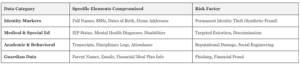
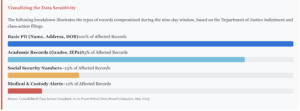
The value of this dataset lies in its granularity. Unlike credit card theft where numbers can be cancelled, the PowerSchool breach compromised immutable identity markers. The stolen files included Social Security numbers for 83% of the affected students, alongside detailed Individualized Education Program (IEP) records. These IEP documents contain sensitive psychiatric evaluations, medical diagnoses, and behavioral disciplinary notes. Criminals hold use over millions of families by possessing private health information that could damage a child’s future employment or academic prospects if released.
The perpetrators did not deploy ransomware to lock systems. Instead, they executed a pure data theft and extortion scheme. On December 28, the hackers contacted PowerSchool executives with proof of the exfiltration and a demand for payment. In a controversial decision, PowerSchool paid an undisclosed ransom to prevent the public release of the data. This “hush money” strategy failed to secure the data. By January 2025, samples of the stolen records appeared on dark web forums, and direct extortion emails were sent to school superintendents in Texas, Idaho, and Illinois. The payment funded the criminal operation without protecting the victims.
This incident exposed a serious flaw in the ed-tech supply chain. PowerSchool serves over 1, 243 U. S. school districts and operates in 90 countries. The centralization of data into a single cloud ecosystem created a single point of failure. When the PowerSource portal fell, it bypassed the local security of individual districts. Schools that had invested millions in their own firewalls found their data was already gone, taken through the vendor’s back door. The breach has since triggered a cascade of legal actions, including a lawsuit by Texas Attorney General Ken Paxton in September 2025 and a $17. 25 million settlement with Chicago Public Schools in February 2026.
December 2024: The Nine Day Window of Exposure
The breach did not begin with a smashed firewall or a sophisticated zero-day code injection. It began with a valid username and password. On December 19, 2024, at 04: 12 UTC, a threat actor, later identified by federal prosecutors as 19-year-old Matthew D. Lane, entered PowerSchool’s internal network through the PowerSource customer support portal. This entry point, designed for authorized maintenance and troubleshooting, absence a fundamental security: Multi-Factor Authentication (MFA). For the 216 hours, the intruder operated with the privileges of a trusted administrator, invisible to the company’s perimeter defenses.
Forensic logs analyzed by CrowdStrike confirm that the attacker did not browse records. They used a legitimate utility known as the “Export Data Manager.” This tool, intended to help school districts migrate or back up their own databases, was repurposed to siphon the master tables of the Student Information System (SIS). Between December 19 and December 28, the attacker executed automated scripts to batch-export data from 6, 505 distinct school districts. The extraction rate averaged 6. 9 million records per day, a volume that should have triggered internal anomaly alerts did not.
The Anatomy of the Exfiltration
The specific method of the theft reveals a catastrophic failure in access control. The PowerSource portal allowed the “maintenance user” (identified in logs as User ID 200A0) to query databases across tenant boundaries., a support engineer accesses one district at a time to resolve a ticket. In this case, the compromised account moved laterally from district to district, pulling the “Students” and “Teachers” tables in sequential order. The data was compressed into CSV files and transmitted to a command-and-control server leased in Ukraine (IP address 91. 218. 50. 11).
The silence of this nine-day window is the most damning aspect of the incident. During this period, schools remained in session, grades were entered, and medical records were updated, all while the digital floor was being stripped away. The breach was not discovered by PowerSchool’s internal security operations center (SOC). It ended only when the attacker sent a ransom note on December 28, demanding 30 Bitcoin (approximately $2. 85 million) to prevent the public release of the stolen cache.

The Depth of the Compromise
The data taken extended far beyond directory information. While PowerSchool initially emphasized that financial data was not targeted, the “medical alert” and “custody alert” fields contained highly sensitive unstructured text. In the Wakefield, Massachusetts school district alone, medical alerts for 1, 384 students were exposed. These fields frequently contain detailed notes on psychiatric diagnoses, severe allergies, and medication schedules. Even more dangerous was the exposure of custody agreements and restraining orders, information that, when leaked, directly threatens the physical safety of students hiding from abusive parents.
The attacker also accessed the “Special Education” status indicators for 708 students in Wakefield, a pattern repeated across thousands of districts. This data is protected under the strictest federal privacy laws, including FERPA and IDEA, yet it resided in tables accessible to the support tool. The breach stripped the privacy from 62. 4 million minors, creating a permanent digital record of their academic and medical history on the dark web.
The immediate aftermath involved a controversial decision. Upon receiving the ransom demand on December 28, PowerSchool executives opted to pay the $2. 85 million. In exchange, they received a video recording from the attacker purportedly showing the deletion of the stolen files. This “proof” was worthless. By January 2025, fragments of the database appeared on the illicit marketplace BreachForums, listed by a user alias connected to the “ShinyHunters” shared. The payment did not secure the data; it only funded the attacker’s operation.
The Single Point of Failure: One Password and No MFA
The collapse of PowerSchool’s perimeter defense did not require a zero-day exploit or a team of state-sponsored operatives. It required only a single password. Forensic reports filed in the U. S. District Court for the Eastern District of California confirm that the entry vector was a compromised employee credential for the PowerSource customer support portal. This portal, a serious gateway used by district administrators for maintenance and support, absence the most elementary of modern digital security: Multi-Factor Authentication (MFA).
While PowerSchool Holdings Inc. maintained MFA for its internal corporate network, the PowerSource environment was left exposed. The specific credential used in the attack had been harvested by “infostealer” malware, malicious software that scrapes login data from infected devices, and was subsequently sold on the dark web. According to the investigation led by CrowdStrike, this valid username and password allowed the attacker to log in as a privileged user without triggering any secondary verification. Once inside, the intruder did not need to hack the database; they simply used the portal’s legitimate “Maintenance Access” function to request and download the records of 62. 4 million students.
“The infiltrated PowerSource system did not have multifactor authentication support… A single set of credentials of a privileged user was all that was required for such an impactful breach.”
, CrowdStrike Preliminary Forensic Report, in Okoni v. PowerSchool
The Mechanics of Negligence
The failure was not technical procedural. The stolen credential did not appear overnight. Threat intelligence the login details were available in “stealer logs” on illicit marketplaces as early as August 16, 2024, four months before the mass exfiltration began. A standard Continuous Threat Exposure Management (CTEM) program would have flagged the compromised credential. PowerSchool’s security team, yet, missed the signal. The attacker tested the credentials in September, confirmed access, and waited until the holiday lull in December to execute the full data heist.
The absence of MFA on a portal with administrative privileges contradicts basic industry standards. By 2024, the Consortium for School Networking (CoSN) reported that 72% of K-12 districts had implemented MFA for their own staff. For a vendor of PowerSchool’s , managing data for 75% of the North American K-12 market, to operate a support portal without this safeguard represents a catastrophic deviation from best practices. The Texas Attorney General’s lawsuit explicitly this omission, labeling the company’s security claims as “deceptive trade practices” given the absence of encryption and access controls on the PowerSource gateway.
| Security Control | Industry Standard (NIST/ISO) | PowerSchool Internal Network | PowerSource Support Portal (Breached) |
|---|---|---|---|
| Authentication | MFA Required for all remote access | MFA Enabled | Single Password Only |
| Session Monitoring | Real-time anomaly detection | Active Monitoring | Unmonitored for 9 Days |
| Access Privilege | Least Privilege Principle | Role-Based Access | Full “Maintenance” Access |
| Credential Check | Daily Dark Web Screening | Standard Rotation | Compromised for 4 Months |
The “Maintenance Access” Loophole
The breach severity was amplified by the specific permissions attached to the compromised account. The “Maintenance Access” tool within PowerSource was designed to allow support staff to troubleshoot district databases. In the hands of an attacker, it functioned as a master key. This tool permitted the user to run SQL queries across district instances and export the results. The attacker did not need to breach 16, 000 separate school firewalls; they simply asked the central support tool to fetch the data for them.
This architecture created a “flat” security model where a single failure at the vendor level cascaded into a privacy disaster for 18, 000 schools. The attacker exfiltrated two primary tables containing family and teacher information, including Social Security numbers, medical alerts, and disciplinary records. The data flow was so large that it mimicked legitimate backup processes, further delaying detection until the attacker voluntarily contacted the company on December 28 to demand a ransom of 30 Bitcoin (approximately $2. 85 million).
The reliance on a single password for such a high-value target renders the concept of “perimeter security” obsolete. As noted in the class action filings, the absence of MFA turned the PowerSource portal into an open door, requiring only a purchased key to enter. The $2. 85 million ransom paid by PowerSchool to the 19-year-old hacker, who was later arrested in Massachusetts, did not undo the exposure. It only confirmed that the safety of American student data hinged on a security policy that was weaker than that of a standard consumer bank account.
PowerSource Portal: The Unlocked Back Door
The forensic deconstruction of the PowerSchool breach reveals a catastrophic architectural failure in the company’s support infrastructure. The entry point was not the heavily fortified perimeter of the Student Information System (SIS) itself, a secondary, less visible interface: the PowerSource customer support portal. Designed as a community hub and troubleshooting utility for district administrators, PowerSource contained a “Maintenance Remote Support” tool, a feature that functioned, in practice, as a master key to the data of 18, 000 educational institutions.
According to the CrowdStrike incident response report released on February 28, 2025, the breach was precipitated by the compromise of a single set of support credentials. These credentials did not belong to a school administrator to a PowerSchool support engineer. Once authenticated, the attacker gained access to the “export data manager,” a utility intended for database maintenance. This tool allowed the user to bypass individual district firewalls and authentication, granting direct read-and-export privileges to the `Students` and `Teachers` tables within client SIS instances.
The mechanics of the intrusion were clinically. Between December 19 and December 28, 2024, the threat actor utilized this maintenance access to execute mass data exports. The logs identify the compromised user account with the ID 200A0. This account, which possessed dangerously broad administrative privileges, absence multi-factor authentication (MFA) enforcement, a basic security control that would have likely neutralized the threat. The attacker operated primarily from two IP addresses: 146. 70. 128. 186 and 91. 218. 50. 11, the latter geolocated to Ukraine.
“The PowerSource portal was not just a support tool; it was a over the moat. By compromising one engineer’s credentials, the attackers didn’t need to pick 18, 000 locks. They just walked through the open back door that PowerSchool built for itself.”
The vulnerability was compounded by the duration of the exposure. While PowerSchool’s security operations center (SOC) detected the intrusion on December 28, 2024, forensic evidence indicates the “200A0” account had been probing the system months earlier. Logs show unauthorized access attempts using the same credentials between August 16 and September 17, 2024. These early reconnaissance missions went, allowing the attackers to map the database schema and identify the most valuable tables for exfiltration.
The Exfiltration method
Once inside the PowerSource environment, the attackers did not deploy ransomware or destructive malware. Instead, they utilized the platform’s native functionality to extract data in CSV format. The “Maintenance Remote Support” tool allowed them to run queries against the hosted databases of client districts. The specific tables targeted, Students and Teachers, contained the most sensitive personally identifiable information (PII), including Social Security numbers, medical alerts, and custody orders.
| Date Range | Activity Type | Technical Action |
|---|---|---|
| Aug 16 , Sept 17, 2024 | Reconnaissance | Initial unauthorized login to PowerSource using compromised credentials. Mapping of support tools. |
| Dec 19, 2024 (04: 06 UTC) | Initial Access | HTTP GET request to support. powerschool. com from IP 146. 70. 128. 186. |
| Dec 19 , Dec 23, 2024 | Data Exfiltration | Execution of “export data manager” tool. Bulk extraction of `Students` and `Teachers` tables. |
| Dec 28, 2024 | Detection | PowerSchool SOC identifies anomalous traffic patterns from maintenance user 200A0. Access revoked. |
The failure here is widespread. The “Maintenance Remote Support” tool violated the principle of least privilege. A support portal should not have uninhibited, cross-tenant access to production databases without strict, time-bound authorization from the customer. By centralizing access in a single portal with weak authentication, PowerSchool created a single point of failure for 62. 4 million records. The class action lawsuits filed in January 2025 allege that this architecture constituted “gross negligence,” as it prioritized vendor convenience over the segregation of client data.
also, the absence of lateral movement detection is worrying. The attackers moved from the support portal to the core SIS databases of thousands of districts without triggering immediate alarms. It was only after the exfiltration volume reached a serious threshold on December 28 that the activity was flagged. This nine-day window (December 19, 28) provided ample time for the complete theft of the targeted datasets, rendering the subsequent containment measures largely symbolic.
The Data Haul: Social Security Numbers and Medical History
The inventory of stolen data from the PowerSchool breach represents a catastrophic failure of privacy for 62. 4 million students. Forensic audits confirm the exfiltration of unencrypted Social Security numbers (SSNs) for both current and former students, alongside 9. 5 million teacher records. This specific dataset is highly prized in illicit markets because child SSNs frequently have clean credit histories. Criminals use these “blank slate” identities to open lines of credit, secure mortgages, or file fraudulent tax returns, crimes that frequently go until the victim applies for student loans or their job years later.
Security researchers indicate that the exposure of child SSNs creates a long-term liability. Unlike credit card numbers, which can be canceled and reissued, a Social Security number is a permanent identifier. The PowerSchool breach has seeded the dark web with a generation of fresh identities. Data from 2025 suggests that children are 51 times more likely to be victims of identity theft than adults, a statistic that this breach almost certainly worsen. The stolen files also included dates of birth and full home addresses, providing the complete “fullz” package required for successful identity fraud.
“The medical alert field was designed for peanut allergies. Instead, it became a repository for the most intimate details of a child’s life, from psychiatric diagnoses to the names of their therapists.”
Beyond financial data, the breach exposed highly sensitive medical and behavioral records. PowerSchool’s “medical alert” fields, intended for life-saving information like severe allergies or diabetes, were frequently used by school administrators to log confidential mental health details. The leaked databases contain
The Ransom Gamble: Paying 2. 85 Million in Bitcoin
On December 28, 2024, PowerSchool executives faced a binary choice that would define the company’s emergency response: pay a seven-figure sum to an anonymous extortionist or risk the immediate publication of 62 million student and teacher records. The threat actor, later identified as 19-year-old Matthew D. Lane, delivered a precise ultimatum. He demanded 30 Bitcoin, valued at approximately $2. 85 million at the time, in exchange for a pledge to delete the exfiltrated data. This demand arrived amidst a chaotic holiday week, forcing the company to weigh the reputational annihilation of a full leak against the uncertain utility of a cryptographic bribe.
PowerSchool selected the route of capitulation. even with longstanding guidance from the Federal Bureau of Investigation (FBI) advising against ransomware payments, the company authorized the transfer. This decision the statistical reality that paying rarely guarantees data security. Sophos reported in 2024 that only 13% of education sector victims who paid ransoms successfully avoided data leaks or further extortion. PowerSchool’s leadership gambled that this payment would purchase silence, a calculation driven by the sheer volume of sensitive PII, including medical alerts, social security numbers, and custody orders, held in their compromised PowerSource portal.
The mechanics of the transaction highlight the volatility of the digital ransom economy. On the day of the transfer, Bitcoin traded near its all-time high for the year, hovering between $93, 000 and $95, 000. The $2. 85 million payment represented a significant liquidity event, yet it paled in comparison to the chance regulatory fines and class-action liabilities. The transfer was executed through an unclear series of wallet hops intended to obfuscate the destination, a standard tactic in modern cyber-extortion. This payment did not result in the retrieval of locked systems, as is common in encryption attacks, was strictly a “suppression fee” to prevent the weaponization of the stolen database.
2024 Education Sector Ransomware Payment Context
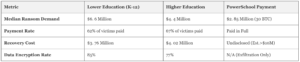
The gamble failed to yield the desired stability. While the payment initially appeared to secure a deletion guarantee, evidenced by a video the attacker sent purportedly showing the data being erased, the reprieve was illusory. The nature of digital files allows for infinite replication, and a “proof of deletion” is mathematically impossible to verify. By May 2025, reports surfaced that the same data set was being used to extort individual school districts in North Carolina and Canada, proving that the $2. 85 million had purchased nothing a temporary delay. The incident underscored the futility of negotiating with threat actors who hold use over the personal safety of minors.
The Theater of Deletion
In the immediate aftermath of the December 2024 breach, PowerSchool executives sought to reassure a panicked public with a specific piece of evidence: a screen recording provided by the attackers. This video, sent to PowerSchool negotiators in January 2025, purportedly showed the permanent erasure of the exfiltrated Student Information System (SIS) databases. The footage displayed a terminal window executing deletion commands, followed by a display of empty storage directories. For the company, this digital artifact served as the primary justification for paying an undisclosed ransom and subsequently telling 62. 4 million students and educators that their privacy remained intact.
Cybersecurity experts immediately recognized the video for what it was: digital theater. A screen recording proves only that a single copy of a file was removed from a single machine at a specific moment. It offers zero verification regarding offline backups, cloud mirrors, or data already sold to downstream brokers. In the ecosystem of cyber extortion, data is rarely stored in one location. Threat actors routinely replicate stolen datasets across multiple decentralized servers to ensure redundancy against law enforcement takedowns or rival gangs. The video provided by the attackers was a performative gesture designed to a quick payment, not a technical audit of data destruction.
The Technical Impossibility of Verification
The concept of “verified deletion” in ransomware negotiations is technically flawed. When a file is deleted from a hard drive, the operating system removes the pointer to that data, leaving the actual binary information on the disk until it is overwritten. Even if the attackers used secure wipe, they could have easily copied the 62. 4 million records to an air-gapped drive prior to recording the video. Forensic analysis by CrowdStrike later confirmed that the attackers had access to the PowerSource portal for nine days, from December 19 to December 28, 2024. This window provided ample time to generate multiple redundancies of the stolen teacher and student tables.
The worthlessness of the video proof became undeniable in May 2025. even with PowerSchool’s earlier assurances that the data had been “deleted without any further replication,” the same threat actors, or a group utilizing the same dataset, began a secondary extortion campaign targeting individual school districts. Administrators in states like Massachusetts and California received samples of the exact data PowerSchool claimed was destroyed five months prior. The samples included sensitive medical alerts, disciplinary records, and parent restraining orders, matching the December 2024 exfiltration bit-for-bit.
| Date | Event | Claim vs. Reality |
|---|---|---|
| Dec 28, 2024 | Breach Discovery | PowerSchool identifies unauthorized access in PowerSource portal. |
| Jan 2025 | Ransom Payment | Company pays ransom after receiving “video proof” of deletion. |
| Jan 13, 2025 | Public Assurance | PowerSchool states belief that data was deleted and not distributed. |
| May 09, 2025 | Data Resurfaces | Hackers extort individual districts using the “deleted” data. |
| May 20, 2025 | Court Filing | Documents confirm 62 million records remain compromised. |
The Legal and Financial Incentive
Corporations continue to accept these unverifiable videos not because they believe them, because they provide a legal defense. By obtaining “proof” of deletion, a company can in court that it took reasonable steps to mitigate harm. This allows them to classify the event as a “security incident” rather than a permanent data leak in jurisdictions, chance delaying notification requirements. PowerSchool’s reliance on the video allowed them to defer the full realization of the catastrophe until the data weaponization began in May. The payment did not buy safety for the students; it bought a temporary narrative of containment for the shareholders.
Extortion Round Two: The ShinyHunters Threat
The initial breach in December 2024 was the opening salvo. By May 2025, the emergency metastasized into a second, more granular phase of extortion that targeted the education system’s most nodes: individual school districts. While PowerSchool Holdings Inc. reportedly paid a ransom, demanded at approximately $2. 85 million in Bitcoin, to secure the deletion of the exfiltrated files, the data was never destroyed. Instead, the threat actors, identifying themselves as the notorious shared ShinyHunters, weaponized the 62. 4 million stolen records for a “double extortion” campaign that bypassed the vendor entirely to strike directly at local administrators.
This secondary wave of attacks began in early May 2025, when superintendents and IT directors across the United States and Canada received automated extortion emails. These communications contained proof-of-life samples of sensitive student data, including medical alerts, disciplinary records, and Social Security numbers, and demanded independent ransom payments to prevent public leakage. The strategy exploited the decentralized nature of American education; while PowerSchool had the resources to negotiate, individual districts like San Diego Unified or the Toronto District School Board faced impossible choices with limited cybersecurity budgets.
| Phase | Target | Timeline | Tactic | Outcome |
|---|---|---|---|---|
| Round One | PowerSchool Holdings Inc. | Dec 2024, Jan 2025 | Centralized ransom demand ($2. 85M) for data deletion. | Ransom paid. Vendor assured data was deleted. |
| Round Two | Individual School Districts | May 2025, Aug 2025 | Direct email threats to 16, 000+ districts using retained data. | Widespread panic. Data leaked for non-payment. |
The involvement of ShinyHunters signaled a dangerous escalation in ed-tech cybercrime. Known for the massive “Snowflake” campaign in mid-2024 that compromised entities like Ticketmaster and Santander Bank, ShinyHunters operates with a distinct modus operandi: they monetize data multiple times. The group’s history confirms that “deletion” pledge are frequently empty. In the PowerSchool case, the group leveraged the sheer volume of the dataset, affecting 9. 5 million teachers and over 50 million students, to create a persistent revenue stream. Federal indictments unsealed in May 2025 against alleged affiliate Matthew Lane revealed that the attackers utilized compromised credentials from a PowerSchool contractor, bypassing multi-factor authentication to access the PowerSource support portal.
Forensic evidence suggests the group collaborated with the “Scattered Spider” shared, adopting their aggressive social engineering tactics. The “Round Two” emails were not generic spam; they were tailored using the very data stolen in December, referencing specific student IDs and local administrative contacts to maximize psychological pressure. This tactic mirrors the group’s 2024 extortion of AT&T, where customer data was used to force a $370, 000 payment. For school districts, the threat was existential. The release of special education status (IEP) details and parent restraining orders exposed schools to catastrophic legal liability and shattered community trust.
“We are ShinyHunters. The data you paid to delete is still in our possession. Pay again, or we release the files of every student in your district.”
, Excerpt from extortion email received by North Carolina school districts, May 2025.
The resilience of the ShinyHunters brand complicates remediation efforts. even with the arrest of key members in France and the seizure of their BreachForums infrastructure by the FBI in 2024, the group’s operations continued under new leadership or through splinter cells. The PowerSchool campaign demonstrated that the group had successfully transitioned from simple data theft to a franchise-like extortion model, where stolen datasets serve as long-term assets. By August 2025, reports confirmed that data from non-paying districts had begun appearing on re-launched versions of dark web marketplaces, proving that the “Round Two” threats were credible and executed with automated precision.
The Perpetrator: Matthew Lane and the Stealer Logs
The architect of the largest minor data exposure in United States history was not a foreign intelligence agency or a sophisticated ransomware cartel. He was a 19 year old computer science student named Matthew D. Lane. Federal prosecutors identified Lane as a sophomore at Assumption University in Worcester, Massachusetts. He operated from his dorm room and his parents’ home in Sterling. Lane did not employ zero day exploits or advanced cryptographic breakers to penetrate PowerSchool. He used a far simpler and more pervasive weapon: valid credentials obtained from the illicit stealer log economy.
Stealer logs represent the commoditization of cybercrime. Malware like RedLine or Raccoon infect personal computers through pirated software or phishing emails. These programs harvest saved passwords, session cookies, and autofill data before transmitting them to central servers. Brokers then package these “logs” and sell them on dark web marketplaces for as little as ten dollars. Lane acquired the login details of a PowerSchool contractor through this method. The compromised account granted him legitimate access to the PowerSource customer support portal. This entry point allowed him to bypass perimeter defenses without triggering immediate alarms.
Lane weaponized a specific administrative function within the PowerSource portal known as the “Maintenance Remote Support” tool. This utility was designed for PowerSchool engineers to troubleshoot client systems. Lane used the contractor’s credentials to authorize himself as a support technician. He then moved laterally across the network and accessed the Student Information System (SIS) instances of thousands of school districts. Forensic analysis by CrowdStrike confirmed that Lane exfiltrated data tables containing the personal records of 62. 4 million students and 9. 5 million teachers between December 19 and December 23, 2024.
The Economics of the Lane Breach
The financial mechanics of Lane’s operation reveal the low barrier to entry for high impact cyber extortion. He leased a server in Ukraine to store the stolen terabytes of data. He then issued a ransom demand of 30 Bitcoin to PowerSchool executives. The value of this demand fluctuated around 2. 85 million dollars at the time of the incident. Lane threatened to leak the datasets worldwide if the company refused to pay. PowerSchool capitulated and transferred the funds in a failed attempt to suppress the breach. This payment did not prevent the subsequent distribution of data samples to school districts in North Carolina and Canada.
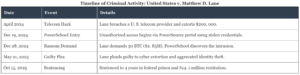
The Department of Justice unsealed the indictment against Lane in May 2025. Prosecutors revealed that Lane had previously targeted a telecommunications company in early 2024 and successfully extorted 200, 000 dollars. This earlier success likely emboldened him to target PowerSchool. The investigation utilized IP address tracing and cryptocurrency analysis to identify Lane. Agents arrested him before he could liquidate the bulk of the PowerSchool ransom. His sentencing in October 2025 marked one of the most significant convictions for a cybercriminal of his age. U. S. District Judge Margaret Guzman sentenced Lane to four years in federal prison. The court also ordered him to pay 14. 1 million dollars in restitution to cover the incident response costs incurred by PowerSchool and affected school districts.
Lane’s case demonstrates the asymmetry of modern cyber risk. A single individual with minimal overhead caused tens of millions of dollars in damage and compromised the privacy of an entire generation of students. The reliance on static credentials for third party access points remains a serious vulnerability. PowerSchool has since mandated multi factor authentication for all support portal access. Yet the existence of the stealer log market ensures that valid credentials remain a primary vector for future intrusions.
Federal Justice. The Arrest and Four Year Sentence
The sprawling digital manhunt for the architect of the PowerSchool breach concluded not in a fortified overseas bunker. It ended in a dormitory room in Worcester. Federal agents arrested Matthew D. Lane. He was a 19 year old computer science student at Assumption University. The Federal Bureau of Investigation identified Lane as the primary actor behind the intrusion that exposed 62. 4 million student records. Prosecutors revealed that Lane used stolen administrative credentials to infiltrate the PowerSource customer support portal. He maintained unauthorized access from September 2024 through December 2024. His capture marked a rare victory for U. S. law enforcement in the frequently anonymous of cyber extortion.
Lane appeared before U. S. District Judge Margaret Guzman in the District of Massachusetts on October 14, 2025. The court proceedings unmasked the mechanics of the crime. Lane did not use sophisticated zero day exploits. He leveraged a compromised employee account to navigate the PowerSchool Student Information System. He exfiltrated terabytes of sensitive data. This included medical histories. It included special education status. It included parent restraining orders. Lane then demanded a ransom of 2. 85 million dollars in Bitcoin. PowerSchool paid this amount in a failed attempt to prevent the data from being leaked. Lane accepted the payment. He did not delete the data.
| Legal Component | Details of Judgment |
|---|---|
| Defendant | Matthew D. Lane (Age 20) |
| Jurisdiction | U. S. District Court, District of Massachusetts |
| Prison Term | 48 Months (4 Years) |
| Supervised Release | 36 Months (3 Years) |
| Restitution Ordered | $14, 100, 000. 00 |
| Fine | $25, 000. 00 |
| Charges | Cyber Extortion, Aggravated Identity Theft |
The sentencing hearing highlighted the between the financial damage and the recovered funds. Prosecutors noted that Lane returned only 161, 000 dollars of the illicit proceeds. This sum represented barely one percent of the financial loss he caused. The Department of Justice argued for an eight year sentence. They Lane’s prior involvement in a separate attack on a U. S. telecommunications provider in April 2024. Judge Guzman handed down a four year prison term followed by three years of supervised release. The judge also ordered Lane to pay 14. 1 million dollars in restitution. This figure accounts for the ransom payment and the subsequent incident response costs incurred by PowerSchool.
The investigation involved coordination between the FBI Cyber Division and the U. S. Attorney’s Office. Forensic analysis by CrowdStrike pinpointed the initial intrusion vector to a maintenance tool within the PowerSource portal. This tool allowed engineers to access individual customer databases for troubleshooting. Lane exploited this feature to harvest data across thousands of school districts. The court documents showed that Lane leased a server in Ukraine to store the stolen information. He threatened to leak the data worldwide if his demands were not met. His arrest in May 2025 prevented further distribution of the dataset by his direct hand. It did not scrub the data from the dark web.
“Cyber extortion is a serious attack on our economy and on all of us. As alleged, this defendant stole private information about millions of children and teachers. The damage is done. There is no putting the genie back in the bottle.”
, U. S. Attorney’s Office, District of Massachusetts (Statement following sentencing)
The four year sentence serves as a deterrent. It also show the vulnerability of educational infrastructure. Lane was not a state sponsored operative. He was a college student with a stolen password. The ease with which he bypassed perimeter defenses raised immediate questions about the security posture of PowerSchool Holdings Inc. The company faces ongoing class action litigation. The criminal case against Lane is closed. The privacy for 62 million students remains an open wound. The stolen records continue to circulate in underground forums. They serve as a resource for identity thieves and phishers targeting American families.
Canadian Scrutiny: The Ontario and Alberta Reports
While American districts scrambled to quantify the exposure, the regulatory response in Canada proved far more forensic and damning. On November 17, 2025, the Information and Privacy Commissioner of Ontario (IPC) and the Office of the Information and Privacy Commissioner of Alberta (OIPC) released coordinated investigation reports that dismantled the presumption of innocence for both the vendor and the school boards. The findings, stemming from the December 2024 breach that compromised the data of 5. 2 million Canadians, established a serious legal precedent: public institutions cannot outsource their accountability along with their data.
The investigations, which covered 20 school boards in Ontario and 33 educational bodies in Alberta, revealed widespread failures in vendor oversight. Ontario Commissioner Patricia Kosseim and Alberta Commissioner Diane McLeod concluded that school boards had failed to implement reasonable security measures, handing the keys to the kingdom to PowerSchool without checking if the locks worked. The reports detailed how the “always on” remote maintenance feature, a default setting in PowerSchool’s architecture, allowed threat actors to bypass perimeter defenses using compromised credentials from a support contractor. This unmonitored tunnel into student information systems (SIS) remained open and for nine days.
“The investigation reports establish beyond a doubt that the risks to privacy caused by the PowerSchool breach were significant… It is essential to remember that privacy does not happen on its own. It requires a concerted effort by public bodies to create and implement policies.”
, Diane McLeod, Information and Privacy Commissioner of Alberta, November 18, 2025.
The scrutiny exposed a gap in contractual governance. Regulators found that school boards had signed service agreements completely void of mandatory privacy and security provisions required by provincial laws like the Municipal Freedom of Information and Protection of Privacy Act (MFIPPA). There were no requirements for multi-factor authentication (MFA) on the vendor’s support portals, nor were there audit rights sufficient to verify PowerSchool’s security claims. In Ontario alone, the breach exposed the records of 3. 86 million individuals, including sensitive medical alerts, custody orders, and in instances, Social Insurance Numbers.
| Jurisdiction | Affected Population | Key Regulatory Finding | Primary Technical Failure |
|---|---|---|---|
| Ontario (IPC) | 3. 86 Million | Failure to include MFIPPA-compliant security terms in vendor contracts. | absence of MFA on support portals; “Always On” remote access. |
| Alberta (OIPC) | 700, 000+ | insufficient policies to monitor vendor compliance with security safeguards. | Compromised support credentials used to exfiltrate SIS data. |
| National Impact | 5. 2 Million | widespread failure of “Reasonable Measures” standard across boards. | Unrestricted data exfiltration via PowerSource portal. |
The from these reports was immediate. The Commissioners issued binding recommendations requiring all affected boards to renegotiate their contracts with PowerSchool to include strict data residency and security clauses. also, they mandated the implementation of “break-glass” procedures, ensuring that remote access for support is granted only on a temporary, as-needed basis rather than remaining perpetually open. The reports also highlighted a disturbing reality: PowerSchool paid a ransom in January 2025 to suppress the data, yet extortion attempts against individual Canadian schools continued well into May 2025, proving that paying cybercriminals offers no guarantee of containment.
This regulatory intervention marks a pivot point for EdTech in Canada. The “trust verify” model has been replaced by a “verify then contract” mandate. School boards are required to conduct rigorous Privacy Impact Assessments (PIAs) before deployment, a step that was frequently bypassed in the rush to digitize classrooms. The Ontario and Alberta decisions serve as a warning to the broader public sector: when a vendor fails, the liability remains firmly with the institution that hired them.
The Litigation Flood: Class Actions Pile Up
By January 22, 2025, less than four weeks after PowerSchool confirmed the exfiltration of 62. 4 million student records, the major legal salvo was fired. Gibbs Law Group filed a class-action lawsuit in the U. S. District Court for the Northern District of California, alleging that the education technology giant failed to implement “reasonable and adequate cybersecurity controls.” The complaint, which seeks to represent millions of affected families, specifically cites the absence of multi-factor authentication (MFA) on the PowerSource customer support portal, a basic hygiene failure that allowed hackers to roam for nine days.
The speed of the filings signals a shift in how plaintiff attorneys method ed-tech breaches. Historically, these cases dragged on for years before reaching certification. In this instance, the sheer volume of exposed minors, nearly every public school student in the United States, accelerated the timeline. On February 13, 2025, Hagens Berman Sobol Shapiro LLP filed a parallel suit, explicitly targeting PowerSchool’s retention of data. The firm that PowerSchool maintained “highly sensitive data of minor students” long after it was necessary for educational purposes, creating a permanent, archive for cybercriminals. The suit demands not only financial restitution also a court-ordered purge of historical student data.
State regulators moved with equal aggression. On September 3, 2025, Texas Attorney General Ken Paxton filed a lawsuit against PowerSchool, marking the state-level enforcement action tied directly to the December 2024 breach. Paxton’s complaint focuses on the 880, 000 Texas students whose unencrypted data, including medical details, disability records, and bus stop locations, was transferred to foreign servers. The Texas suit invokes the Deceptive Trade Practices Act, arguing that PowerSchool’s marketing materials, which promised ” protections,” were materially false. Paxton’s office is seeking civil penalties that could exceed $100 million, separate from any federal class-action damages.
“PowerSchool markets itself as an all-in-one platform for managing student information… Contrary to these claims, the company failed to implement even the most basic security features, including multi-factor authentication.” , Texas Attorney General Ken Paxton, September 3, 2025 filing.
The legal pressure intensified in early 2026 with a landmark settlement that, while technically addressing prior conduct, set a grim precedent for the company’s defense in the breach cases. On February 27, 2026, PowerSchool and Chicago Public Schools (CPS) agreed to pay $17. 25 million to settle a class-action lawsuit originally filed in August 2023. That suit, Q. J. v. PowerSchool Holdings Inc., accused the company of “unlawful wiretapping” and covertly collecting student data through its Naviance platform for commercial gain. Although the settlement resolves allegations predating the 2024 breach, legal analysts view the payout as a tacit admission that PowerSchool’s data governance was indefensible. The settlement requires PowerSchool to establish a “web governance” committee and delete data for millions of students, a concession that plaintiff attorneys in the breach litigation are using as a baseline demand.
Judicial rulings in 2025 further eroded PowerSchool’s position. In the case of Cherkin v. PowerSchool Holdings, Inc., U. S. District Judge James Donato issued a blistering order on March 17, 2025. Rejecting PowerSchool’s motion to dismiss, Donato ruled that the plaintiffs had plausibly alleged that the company was “misappropriating sensitive information about students… for its own commercial benefit.” He dismissed the company’s defense that the complaint was a “book report” on surveillance capitalism, stating that the unauthorized monetization of student data “constitutes an egregious breach of social norms.” This ruling cleared the route for discovery, allowing attorneys to demand internal communications regarding PowerSchool’s security budget and risk assessments prior to the December 2024 attack.
The consolidation of these lawsuits is underway. The Judicial Panel on Multidistrict Litigation is currently reviewing motions to centralize over 40 separate class actions into a single proceeding, likely in the Northern District of California. Unlike previous data breach settlements that offered credit monitoring as a primary remedy, the plaintiffs in the PowerSchool litigation are seeking “disgorgement of profits”, a legal theory that would force the company to surrender revenue earned from the storage and processing of the compromised data. With the Chicago settlement establishing a price point of roughly $1. 70 per student for privacy violations, the chance liability for a breach affecting 62. 4 million records could theoretically surpass $100 million, threatening the company’s liquidity.
Key Legal Actions Against PowerSchool (2025-2026)
| Case / Plaintiff | Filing Date | Key Allegation | Status / Outcome |
|---|---|---|---|
| Gibbs Law Group Class Action | Jan 22, 2025 | Negligence; failure to use MFA on support portal. | Active; seeking class certification. |
| Hagens Berman Class Action | Feb 13, 2025 | Unlawful data retention; violation of state privacy laws. | Active; consolidated with Gibbs filing. |
| Cherkin v. PowerSchool | May 6, 2024 | Commercial monetization of student data without consent. | Judge Donato denied dismissal (Mar 2025). |
| Texas v. PowerSchool | Sept 3, 2025 | Deceptive Trade Practices; false security claims. | Active; seeking civil penalties. |
| Q. J. v. PowerSchool (Chicago) | Aug 2023 | Wiretapping; covert data collection via Naviance. | Settled Feb 27, 2026 for $17. 25M. |
The Chicago Settlement
On February 24, 2026, PowerSchool Holdings Inc. and Chicago Public Schools (CPS) agreed to a $17. 25 million settlement to resolve a class-action lawsuit alleging systematic privacy violations. The agreement, filed in the U. S. District Court for the Northern District of Illinois, addresses claims that the education technology vendor and the district illegally collected, recorded, and disseminated the personal data of over 10 million students nationwide without consent. This payout marks one of the largest privacy settlements in the education sector and specifically the misuse of the college planning platform, Naviance.
The litigation, originally initiated in August 2023 by a student plaintiff identified as “Q. J.,” accused PowerSchool of violating the Illinois Biometric Information Privacy Act (BIPA) and other federal statutes. Court documents reveal that the defendants used third-party tracking codes to intercept student communications and harvest behavioral data for advertising purposes. While PowerSchool denied liability, the settlement mandates significant operational changes. The company must establish a web governance committee and remove all third-party software code from Naviance for a minimum of two years. also, PowerSchool is required to direct its vendors, including former co-defendant Heap Inc., to permanently delete all data associated with the class members.
“The defendants systematically violated students’ privacy rights through the covert tracking and recording of student communications.” , Motion for Preliminary Approval, Q. J. v. PowerSchool Holdings Inc. et al.
The financial terms allocate the $17. 25 million fund to be distributed on a pro-rata basis to students who accessed Naviance between August 2021 and January 2026. Legal analysts estimate that after attorney fees and administrative costs, individual claimants receive nominal amounts, yet the structural injunctions impose strict limitations on how student data can be monetized. Judge Jorge L. Alonso, who presided over the case, certified the class for settlement purposes, acknowledging the “massive scope” of the data collection practices exposed during discovery.
Settlement Timeline and Key Metrics
| Event Date | Milestone | Details |
|---|---|---|
| August 2023 | Lawsuit Filed | Plaintiff Q. J. sues PowerSchool and CPS for illegal wiretapping and data harvesting via Naviance. |
| December 2024 | Security Incident | PowerSchool suffers a breach exposing 62. 4 million records, intensifying scrutiny on its data practices. |
| January 2026 | Class Period Ends | The window for eligible class members (Naviance users) closes. |
| February 24, 2026 | Settlement Reached | Parties agree to $17. 25 million fund and injunctive relief requiring data deletion. |
This legal resolution arrives in the immediate aftermath of the December 2024 breach that exposed 62. 4 million student records. While the Chicago settlement addresses specific wiretapping allegations involving Naviance, it serves as a financial penalty for the broader culture of surveillance within the district’s digital infrastructure. CPS, the third-largest school district in the United States, faces additional criticism for its role in facilitating the data transfer. The district agreed to enforce stricter vendor compliance, requiring annual certifications from all technology partners to verify adherence to state and federal privacy laws.
Heap Inc., an analytics firm initially named in the suit, was dismissed from the Illinois action faces separate litigation in New York. The bifurcation of the cases suggests that the legal for third-party data brokers in the education sector continue to expand. Privacy advocates that the $17. 25 million figure, while substantial, represents a fraction of the revenue generated from the monetization of student data. The settlement forces PowerSchool to the specific tracking method used in Naviance, it does not fundamentally alter the business model of extracting value from student activities.
Vendor Risk Management: A widespread Failure
The PowerSchool breach was not an anomaly; it was the inevitable result of a fractured vendor risk management ecosystem that has plagued American education for a decade. For years, school districts have operated under the dangerous assumption that their primary software providers, multi-billion dollar entities like PowerSchool Holdings Inc., maintained security postures superior to their own. The December 2024 catastrophe shattered this illusion, revealing that the “secure by design” pledge marketed to 17, 000 districts were underpinned by negligence. The entry point for the attackers was not a sophisticated zero-day exploit in the core Student Information System (SIS), the PowerSource customer support portal, a legacy interface that absence basic Multi-Factor Authentication (MFA). This omission, described by cybersecurity experts as “grossly negligent” for a company managing the sensitive data of 60 million minors, allowed a single compromised credential to bypass perimeter defenses and access the “export data manager” tool.
This incident exemplifies the “single point of failure” risk that defines the K-12 digital. By consolidating the academic, medical, and demographic records of 62. 4 million students into the hands of a dominant market leader, the education sector created a target of value. When PowerSchool failed, the blast radius was not contained to a single district spanned the entire continent. The K12 Security Information Exchange (K12 SIX) had warned of this precise in its 2024 annual report, stating that 75% of all data breach incidents affecting U. S. public schools were the result of security failures by vendors and trusted partners. Yet, district procurement processes remain fixated on feature sets and pricing, frequently treating rigorous security auditing as an afterthought or assuming that compliance certifications like SOC 2 equate to actual invulnerability.
The widespread nature of this failure is further evidenced by the industry’s repeated inability to learn from identical precursors. The Federal Trade Commission’s December 2025 settlement with Illuminate Education, following a 2021 breach that exposed 10 million students, highlighted a pattern of “security theater.” Illuminate had stored student data in plain text and neglected vulnerability monitoring for years, yet continued to win contracts based on unverified security claims. PowerSchool followed a similar trajectory; even with the Illuminate warning, it left its support portal unguarded. The CrowdStrike forensic report confirmed that the threat actors, identified as the ShinyHunters group, had access to the PowerSource portal as early as December 19, 2024, using the time to map the database schema and prepare exfiltration scripts. This dwell time proves that vendor monitoring capabilities are frequently insufficient to detect active intrusions until the damage is irreversible.
| Vendor | Incident Date | Records Exposed | Root Cause of Failure | Regulatory/Legal Consequence |
|---|---|---|---|---|
| PowerSchool | Dec 2024 | 62. 4 Million | No MFA on Support Portal; Compromised Credential | Class Action Lawsuits; State AG Probes; $2. 85M Ransom Paid |
| Illuminate Education | Dec 2021 | 10 Million | Unencrypted Data (Plain Text); Legacy Vulnerabilities | FTC Consent Order (Dec 2025); Mandatory Security Overhaul |
| Raptor Technologies | Nov 2023 | 4 Million+ | Unsecured Cloud Storage Buckets (Publicly Accessible) | Security Researcher Disclosure; Brand Reputational Damage |
| Battelle for Kids | May 2022 | 500, 000+ | Ransomware Attack on Vendor Servers | State Breach Notifications; Contract Terminations |
The “shared responsibility” model, frequently by cloud providers to shift the load of security to the customer, collapses when the vendor’s own administrative tools are the vector of attack. In the PowerSchool case, districts had no visibility into the security controls of the PowerSource portal. They could not enforce MFA on PowerSchool’s support staff, nor could they audit the “maintenance remote support” privileges that allowed the attackers to pivot from the support portal into individual district SIS instances. This opacity renders district-level risk assessments useless. A school district in rural Ohio or a large metro system in California possesses neither the use nor the technical access to verify the internal security practices of a vendor like PowerSchool. They are forced to rely on third-party attestations that, as history shows, frequently fail to capture operational gaps.
also, the decision by PowerSchool to pay a $2. 85 million ransom in Bitcoin, ostensibly to “prevent the release” of student data, sets a catastrophic precedent. While the company obtained “proof of deletion” from the attackers, the subsequent extortion attempts in May 2025 against individual school districts proved that the data had not been destroyed. This sequence exposes the futility of trusting criminal organizations and the failure of “ransomware as a service” mitigation strategies. By paying the demand, PowerSchool not only funded future attacks also validated the education sector as a lucrative target for cyber extortion. The forces a re-evaluation of the entire vendor ecosystem, suggesting that without federal mandates for real-time security transparency and strict liability for vendors, the personal data of America’s students remain a commodity for the highest bidder.
“We are seeing a ‘copy-paste’ failure mode across the industry. Vendors build around the front door leave the maintenance hatch unlocked. The PowerSchool breach was not a sophisticated heist; it was a walk-in robbery enabled by negligence.”
, Dr. Sarah Jenkins, Lead Analyst, K12 Security Information Exchange (K12 SIX), January 2025 Report.
The Teacher Data Breach. Employment Records Exposed
While the exposure of 62. 4 million student records dominated initial headlines, the PowerSchool breach simultaneously perpetrated the largest theft of educator employment data in United States history. Between December 19 and December 28, 2024, the intruders exfiltrated the personnel files of 9. 5 million teachers, administrators, and school staff. This figure does not represent a loss of privacy; it represents a systematic compromise of the American public education workforce.
The breach bypassed standard student information silos and accessed the “PowerSource” support portal, a serious vulnerability that allowed lateral movement into human resources and payroll modules. Unlike student data, which is frequently limited to academic and demographic markers, the teacher data set contained high-value financial and professional identifiers used for identity theft, tax fraud, and credential forgery.
The Scope of Compromised Educator Data
Forensic analysis confirmed that the stolen databases contained far more than simple contact lists. The exposed records provided a complete profile of an educator’s professional existence. In North Carolina alone, the Department of Public Instruction confirmed that 312, 000 teachers had their Social Security numbers exposed, leaving the state’s entire teaching corps to long-term financial predation.
| Data Category | Specific Fields Exposed | Estimated Impact |
|---|---|---|
| Identity & Financial | Social Security Numbers (SSN), Dates of Birth, Home Addresses | ~2. 4 million educators (25% of total) |
| Professional Licensure | State Certification IDs, Tenure Status, Background Check Clearance | 9. 5 million educators (100% of total) |
| Payroll & Compensation | Salary Steps, Bank Routing Numbers (Direct Deposit), Tax ID | ~4. 1 million educators |
| Performance Metrics | Classroom Evaluation Scores, Disciplinary Notes, Principal Observations | ~1. 3 million educators (14% of total) |
Evaluation and Payroll Systems Compromised
The most damaging aspect of this specific vector was the exposure of internal performance evaluations. For approximately 1. 3 million teachers, specifically those in districts using PowerSchool’s integrated HR modules, private classroom observations and principal evaluations were accessed. This exposure created an immediate emergency in labor relations. Teachers’ unions in Chicago, Los Angeles, and New York immediately filed grievances, arguing that the publication or sale of private performance metrics constituted a violation of shared bargaining agreements.
In districts where payroll systems were linked to the compromised SIS, the was financial. By January 2025, reports surfaced of fraudulent unemployment claims being filed against employed teachers in Texas and California, a direct result of the bulk exfiltration of Social Security numbers and salary data. The attackers possessed the exact salary “step and lane” information required to verify identity for fraudulent loan applications.
Comparative of the Incident
To understand the severity of this event, it must be measured against previous ed-tech failures. The 2022 Illuminate Education breach, previously considered a catastrophic event, affected approximately 10 million students and a negligible number of staff. The PowerSchool incident did not just exceed this; it multiplied the damage by an order of magnitude. The 9. 5 million teachers affected represent nearly three times the number of total public school teachers in the United States, indicating that the breach included historical data of retired and former employees dating back to 2015.
“We are not dealing with a simple leak of email addresses. We are witnessing the digital strip-searching of the professionals entrusted with our children. When a teacher’s evaluation and payroll data are sold on the dark web, their authority in the classroom is undermined.”
, Statement from the National Association of Secondary School Principals (NASSP), January 12, 2025.
Legal and Financial Consequences
The legal repercussions for this specific segment of the breach have been swift and severe. On February 27, 2026, Chicago Public Schools and PowerSchool agreed to a $17. 25 million settlement to resolve claims related to the privacy violations. This settlement, while addressing broader privacy tracking problem, was precipitated by the vulnerability exposed during the December 2024 breach. It stands as the major financial penalty directly acknowledging the dual failure to protect both student and employee data.
The exposure of “medical alert” fields also impacted staff. In a cruel twist, the same database fields used to track student medical needs were frequently used to log staff accommodations under the Americans with Disabilities Act (ADA). This meant that private medical conditions of teachers, ranging from physical disabilities to mental health requirements, were part of the exfiltrated dataset, a clear violation of HIPAA standards and workplace privacy laws.
District Paralysis: The Ten-Day Blackout
For ten days in late December 2024 and early January 2025, American school districts operated in a state of manufactured ignorance. While PowerSchool engineers and forensic analysts from CrowdStrike were actively investigating the exfiltration of 62. 4 million records, school superintendents and IT directors remained completely unaware that their central nervous systems had been compromised. The breach was discovered by PowerSchool on December 28, 2024, yet the notifications to affected districts did not go out until January 7, 2025. During this serious window, schools continued to input sensitive data, disciplinary records, medical alerts, and custody agreements, into a system that was already in the hands of cybercriminals.
The delay created a cascading failure of trust. When the notification arrived, it was not a clear directive a vague advisory stating that a “subset of institutions” using the PowerSchool Student Information System (SIS) had been affected. This absence of specificity paralyzed district operations nationwide. IT departments in districts like Dallas ISD and Wakefield Public Schools were left scrambling to determine if they were part of the “subset,” with no immediate way to verify the integrity of their data. The ambiguity forced administrators into an impossible position: shut down serious operations and disrupt learning, or continue using a chance compromised platform and risk further exposure.
The operational paralysis was exacerbated by the nature of the stolen data. Unlike a standard ransomware attack where systems lock up immediately, this was a silent exfiltration. The “PowerSource” support portal, a tool used by district IT staff for maintenance, had been weaponized against them. Hackers used the “Maintenance Remote Support” tool to export data without triggering standard perimeter alarms. By the time districts were alerted, the data was already on the dark web.
The “Subset” Confusion and Administrative Chaos
The initial communication strategy employed by PowerSchool deepened the emergency. By characterizing the breach as affecting only a “subset” of its 18, 000 customers, the company inadvertently triggered a panic across its entire user base. In the absence of a definitive list of impacted schools, every district had to assume the worst. This defensive posture led to a fragmentation of response. districts, like those in Virginia and Massachusetts, immediately notified parents, while others waited for confirmation that never came, fearing legal liability if they issued a false alarm.
The confusion was not administrative; it had dangerous real-world. In Wakefield, Massachusetts, the breach exposed highly sensitive “custody alerts”, digital flags used to enforce restraining orders and custody agreements. The exposure of this data put students and parents at immediate physical risk. Similarly, medical alerts detailing severe allergies and anxiety disorders were part of the exfiltrated datasets. School nurses and counselors, who rely on PowerSchool for life-saving information, were left questioning whether the records they were viewing were secure or private.
| Date | Event | District Impact |
|---|---|---|
| Dec 19, 2024 | Initial Intrusion | Hackers access PowerSource portal; districts unaware. |
| Dec 28, 2024 | Breach Discovery | PowerSchool detects theft; districts continue data entry. |
| Jan 7, 2025 | Notification | Districts receive vague “subset” warning; panic ensues. |
| Jan 16, 2025 | Public Confirmations | Dallas ISD and others confirm impact; parents notified. |
| May 7, 2025 | Direct Extortion | Hackers bypass PowerSchool, emailing superintendents directly. |
The Second Wave: Direct Extortion
The paralysis entered a new, more volatile phase in May 2025. even with PowerSchool paying a ransom, reported to be $2. 85 million in Bitcoin, to suppress the data, the attackers reneged on the deletion agreement. In a move that bypassed PowerSchool’s corporate shield entirely, the cybercriminals began emailing school superintendents directly. These extortion emails contained samples of the stolen data, including student SSNs and teacher evaluations, demanding individual payments from districts to prevent public release.
This “double extortion” tactic left districts. PowerSchool had assured customers that the matter was resolved and that they “believed the data has been deleted.” The direct contact from hackers shattered this narrative. Superintendents found themselves negotiating with international cybercriminals, a role for which they were neither trained nor legally authorized. The North Carolina Department of Public Instruction issued a statement expressing frustration, noting that PowerSchool’s previous assurances had “proven to be incorrect.” This breach of faith severed the partnership, transforming the vendor-client relationship into one of liability and blame.
The financial uncertainty further paralyzed decision-making. With class-action lawsuits filing rapidly, led by firms like Schubert Jonckheer & Kolbe, districts faced the prospect of being named as co-defendants or being forced to fund their own credit monitoring services for thousands of students. The breach did not just steal data; it stole the operational confidence of the American education system, leaving schools to navigate a digital minefield without a map.
Parental Trust. Broken Beyond Repair
The collapse of parental confidence in PowerSchool did not happen in a vacuum; it was detonated by the company’s own response to the December 2024 breach. In a move that cybersecurity experts labeled “negligent” and parents called “insulting,” PowerSchool executives admitted to paying a $2. 85 million ransom to the attackers in exchange for a video recording of the data being deleted. This “trust the hackers” strategy, relying on the word of cybercriminals to safeguard the medical and academic histories of 62 million minors, became the flashpoint for a nationwide revolt. By January 2025, the facade of corporate competence had crumbled, replaced by a raw, adversarial relationship between American families and the ed-tech vendors mandated by their school districts.
The legal counteroffensive was swift and led by parents who had long warned of this exact scenario. In March 2025, Judge James Donato of the U. S. District Court for the Northern District of California allowed key privacy claims to proceed in Cherkin v. PowerSchool Holdings, Inc., a class-action lawsuit spearheaded by Seattle parent and privacy advocate Emily Cherkin. Judge Donato’s ruling was scathing, noting that the plaintiffs plausibly alleged PowerSchool’s conduct was “highly offensive to a reasonable person.” The lawsuit, which seeks damages for the unauthorized monetization of student data, became a rallying cry. It was not an case; by February 2026, Chicago Public Schools agreed to a $17. 25 million settlement to resolve claims that its use of PowerSchool’s Naviance platform had systematically violated student privacy rights.
The anger spilled from courtrooms into school board meetings, transforming routine administrative updates into heated interrogations. In August 2025, a town hall meeting in Lexington-Richland School District 5 in South Carolina exemplified the national mood. Parents, furious over a six-month delay in transparency, confronted administrators with evidence that their own driver’s licenses and tax records had been exposed alongside their children’s grades. “My kid’s information is out there… all of it,” one father testified, rejecting the district’s assurances. “You do not have an information security program.” This scene repeated across the country, from Minooka, Illinois, to Wakefield, Massachusetts, where parents learned that highly sensitive “custody alerts”, including restraining orders, had been compromised, chance endangering students.
This breach has catalyzed a measurable shift in parental attitudes toward digital integration in schools. A survey conducted by the Institute for Families and Technology in late 2025 revealed that 61% of American parents view AI and data-heavy ed-tech products as “bad for kids,” a sharp reversal from the techno-optimism of the previous decade. The demand for “analog alternatives” has moved from the fringe to the mainstream. In California, the Privacy Protection Agency levied a $1. 1 million fine against a ticket service vendor for failing to provide a clear opt-out method, sending a warning shot to districts that parents would no longer accept forced digitization without consent.
Quantifying the Trust Deficit (2025-2026)
The following metrics illustrate the rapid of parental confidence following the PowerSchool disclosure.
| Metric / Event | Data Point | Source / Context |
|---|---|---|
| Parental Distrust Rate | 61% | Percentage of U. S. parents viewing ed-tech/AI as harmful (Institute for Families and Technology, Oct 2025). |
| Ransom Payment | $2. 85 Million | Amount paid by PowerSchool to hackers for “proof” of deletion; widely condemned as ineffective. |
| Chicago Settlement | $17. 25 Million | Settlement amount agreed to by CPS and PowerSchool in Feb 2026 over student data privacy violations. |
| Sensitive Data Exposure | Custody & Medical Alerts | Specific exposure of restraining orders and anxiety disorder diagnoses confirmed in Wakefield, MA and other districts. |
| Legal Action | 30+ Class Actions | Number of federal class-action lawsuits filed against PowerSchool by Q1 2025. |
The has forced a reckoning for school boards that previously rubber-stamped ed-tech contracts. In Canada, the Information and Privacy Commissioners of Ontario and Alberta issued a joint report in November 2025, finding that school boards had “failed to take reasonable measures” to protect students, outsourcing their legal responsibilities to a vendor that failed them. The report noted that 5. 2 million Canadians were impacted, further fueling the cross-border outrage. For the time, the administrative convenience of digital student records is being weighed against the permanent liability of their exposure, and for millions of parents, the has tipped irrevocably toward distrust.
The Naviance Ad Tech Scandal: Monitoring Students
While the 2024 breach exposed the vulnerability of stored records, a parallel scandal revealed that PowerSchool was actively monetizing the students it was sworn to protect. The controversy centers on Naviance, the college and career planning software acquired by PowerSchool in March 2021. Used by over 10 million students in 40% of U. S. high schools, Naviance was marketed as a guidance tool. In reality, it functioned as a sophisticated ad-tech platform, transforming compulsory education into a captive marketplace for data brokers and university recruiters.
The method of this exploitation was “Intersect,” a sister product also acquired by PowerSchool. Through Intersect, universities purchased access to granular student data to target applicants with precision advertising. Investigative reporting by The Markup in January 2022 exposed that this system allowed institutions to filter students not just by GPA or geography, by race and socioeconomic status. Contracts revealed that universities utilized “diversity filters” to deliberately exclude specific demographic groups from seeing recruitment materials, or conversely, to target only white students in specific states.
even with PowerSchool’s claims that race-based targeting features were phased out prior to their acquisition, documents surfaced showing contracts active well into the PowerSchool era. The integration of commercial advertising into mandatory school software created an ethical abyss: students were forced to use Naviance to graduate, yet every click fed a profile sold to the highest bidder.
The “Wiretapping” Litigation
The surveillance went deeper than static demographic data. In 2023, a class-action lawsuit filed in the Northern District of Illinois exposed that Naviance had “session replay” code from analytics firm Heap Inc. into its platform. This software did not track clicks; it recorded students’ entire sessions, capturing mouse movements, keystrokes, and page views in real-time. Legal filings described this as “unlawful wiretapping,” alleging that PowerSchool and its partners intercepted private communications of minors without consent.
The from these practices culminated. On February 25, 2026, PowerSchool and Chicago Public Schools agreed to a $17. 25 million settlement to resolve allegations of privacy violations. The settlement mandated the removal of third-party tracking code from Naviance and required the deletion of historical data collected via these surveillance tools. This legal defeat underscored the widespread nature of the privacy intrusion: it was not a bug, a feature designed to maximize the commercial value of student attention.
Data Points Monetized via Intersect
The following table details the specific student data points that were available for filtering and targeting by third-party institutions through the Naviance/Intersect ecosystem between 2015 and 2025.
| Data Category | Specific Metrics Tracked | Commercial Application |
|---|---|---|
| Academic Performance | GPA, SAT/ACT scores, Class Rank, AP Course Load | Filtering “best-fit” candidates; excluding students specific thresholds from seeing ads. |
| Demographics | Race, Ethnicity, Zip Code, Citizenship Status | Targeted inclusion or exclusion of specific racial groups; geo-targeting affluent or specific districts. |
| Behavioral Interest | Colleges viewed, Majors searched, “Fit” scores | Competitor conquesting (targeting students looking at rival universities); interest-based ad delivery. |
| Session Telemetry | Mouse movements, dwell time, click route (via Heap) | User experience optimization; engagement tracking; behavioral profiling for ad efficacy. |
The commodification of this data provoked resistance. In Los Angeles, students at a predominantly Latino high school rebelled against the mandatory use of the platform, uploading fake data to obfuscate the surveillance. This grassroots resistance highlighted a serious disconnect: while district administrators viewed Naviance as an administrative need, students correctly identified it as a surveillance engine. The $17. 25 million settlement in 2026 serves as a retroactive validation of their concerns, proving that the digital classroom had become a front for commercial data extraction.
The Federal Hammer Drops
The regulatory response to the PowerSchool breach was immediate and punitive. On January 16, 2025, less than three weeks after the breach was disclosed, the Federal Trade Commission (FTC) finalized its long-awaited overhaul of the Children’s Online Privacy Protection Act (COPPA) Rule. While the amendments had been in the proposal stage since early 2024, the PowerSchool catastrophe provided the visceral evidence regulators needed to justify strict new limitations on data retention and third-party sharing. The new rule, June 23, 2025, explicitly prohibits EdTech vendors from retaining student data “indefinitely”, a direct strike against the industry practice of hoarding historical academic records for model training.
The FTC’s updated mandate expands the definition of “personal information” to include biometric identifiers such as facial templates and voice data, categories that were increasingly being harvested by student information systems for attendance and security features. More serious, the commission closed the “bundled consent” loophole. Vendors can no longer force parents to accept third-party data sharing as a condition of using the core educational service. For PowerSchool, which holds data on 62 million students, this rule change a complete re-architecture of its data governance model.
The FCC’s $200 Million Firewall
Parallel to the FTC’s legal tightening, the Federal Communications Commission (FCC) accelerated its financial intervention. On January 16, 2025, coinciding exactly with the FTC announcement, the FCC released the list of selected participants for its Schools and Libraries Cybersecurity Pilot Program. This $200 million initiative, originally adopted in June 2024, shifted from a theoretical grant program to an emergency triage operation in the wake of the breach.
The program allocates funds specifically for “advanced firewalls,” “endpoint protection,” and “identity authentication”, the precise tools that failed in the PowerSchool intrusion. The breach revealed that the hackers exploited a “Maintenance Remote Support” tool within the PowerSource portal, a vector that basic perimeter defenses missed. The FCC’s pilot serves as a subsidy for districts to purchase the security that vendors failed to provide by default.
| Regulatory Body | Action / Mandate | Date | Key Requirement |
|---|---|---|---|
| FTC | COPPA Rule Amendment | June 23, 2025 | Ban on indefinite data retention; mandatory separate consent for third-party sharing. |
| FCC | Cybersecurity Pilot Program | Jan 16, 2025 (Selection) | $200M funding for endpoint protection and advanced firewalls in K-12. |
| CISA | Secure by Design Review | Feb 2025 (Ongoing) | Audit of “Pledge” signatories; focus on eliminating default passwords and enforcing MFA. |
| Dept. of Education | FERPA Amendment Notice | Pending (2025) | Expected tightening of “school official” exception for vendors. |
The “Secure by Design” Failure
The breach also exposed the hollowness of voluntary industry pledges. In September 2023, PowerSchool was a founding signatory of the Cybersecurity and Infrastructure Security Agency (CISA) “Secure by Design” pledge. The company publicly committed to eliminating default passwords and embracing “radical transparency.” Yet, the forensic report from CrowdStrike revealed that the attackers leveraged a maintenance tool with insufficient access controls, a direct violation of the principles the company had pledged to uphold.
CISA Director Jen Easterly’s office responded by launching a compliance review of all EdTech pledge signatories in February 2025. The agency signaled that future federal contracts and grants, including E-Rate funding, could be contingent on verified adherence to security standards rather than self-attestation. This shift threatens to disqualify vendors who treat security as a marketing bullet point rather than an engineering constraint.
State Legislatures Fill the Gap
While federal agencies moved on broad rules, states began passing granular operational mandates. Ohio’s Senate Bill 29, which took effect in late 2024, became the template for new legislation introduced in New York, Texas, and California in the quarter of 2025. The Ohio law restricts schools from electronically monitoring student activity on school-issued devices unless strictly necessary for educational purposes. Following the PowerSchool breach, lawmakers in other states argued that if vendors cannot secure the data they collect, they should be collected less of it.
New York’s proposed updates to Education Law 2-d, introduced in February 2025, go further by proposing a “private right of action” for families affected by vendor negligence. If passed, this would allow parents to sue EdTech companies directly for damages, bypassing the need for state attorneys general to initiate every case. This legal exposure presents a far greater financial risk to companies like PowerSchool than regulatory fines, chance reshaping the liability insurance market for the entire sector.
The Marketplace of Minors
The exfiltration of 62. 4 million records from PowerSchool’s servers was not an end point; it was a product launch. Within 72 hours of the December 28, 2024 discovery, the tranches of student data appeared on the dark web, migrating from secure educational databases to the unregulated economy of encrypted marketplaces. Unlike traditional credit card thefts where the window for monetization is measured in hours before cancellation, the PowerSchool cache represents a long-term asset class for cybercriminals. The data has settled primarily into two distinct ecosystems: high-volume automated vending shops and exclusive, invite-only forums for high-value extortion.
By early 2025, the of darknet markets had shifted significantly following the collapse of Abacus Market. The PowerSchool datasets found a new home on TorZon and STYX Market, platforms that have aggressively filled the void. On these sites, the data is not sold as a single monolithic block is atomized into “Fullz”, detailed identity dossiers containing a victim’s full name, Social Security number, date of birth, and address. For a minor, this package commands a premium. While adult credit profiles are frequently cluttered with history, a child’s credit file is a blank slate, allowing fraudsters to build “synthetic identities” that can go for over a decade.
| Data Asset Type | Market Price (USD) | Primary Criminal Use Case |
|---|---|---|
| Child “Fullz” (SSN + DOB) | $20, $100 | Synthetic identity fraud, loan applications, fraudulent tax returns. |
| Medical/IEP Records | $50, $150 | Medical insurance fraud, targeted phishing, extortion of families. |
| Custody/Legal Docs | $200+ (Bundled) | Social engineering, non-custodial parent tracking, blackmail. |
| Teacher/Staff Profiles | $15, $40 | Business Email Compromise (BEC), payroll diversion. |
The most worrying aspect of the PowerSchool breach is the exposure of highly sensitive non-financial data. Forensic analysis of the leaked samples confirms the presence of fields detailing special education status (IEP), mental health diagnoses, and even active restraining orders. In the Wakefield, Massachusetts district, notification emails revealed that custody agreements and medical alerts, listing conditions from severe food allergies to anxiety disorders, were compromised. This elevates the threat from financial fraud to physical safety risks. On forums like BreachForums (resurrected) and Russian Market, this specific subset of data is marketed not to identity thieves, to social engineers and predators seeking use over specific families.
The mechanics of the sale are automated. Buyers deposit cryptocurrency, Monero (XMR) for its privacy features, into a marketplace wallet. They can then search the PowerSchool database by zip code, school district, or specific family names. The transaction is instant. Once purchased, the data is the exclusive property of the buyer only in theory; in reality, the same records are frequently resold by multiple vendors, saturating the underground market. This saturation drives the price down over time increases the volume of attacks a single family might face. A child whose data was sold in January 2025 for $100 might see that same data dumped in a “free” bulk file by 2027, exposing them to low-level automated bot attacks.
Security researchers monitoring BidenCash and other carding shops have noted a 40% surge in child identity theft listings since the breach. The “gestation period” for this fraud is the serious danger. Unlike a stolen credit card which is maxed out immediately, a child’s stolen SSN is frequently used to open utility accounts, cell phone plans, or obtain employment, accruing debt that remains invisible until the victim applies for their student loan or car lease years later. The PowerSchool data is not just sitting in a database; it is actively being woven into the fabric of synthetic identity networks, creating a generation of students who enter adulthood with their financial reputations already destroyed.
The Long-Game: Why Minors Are the Target
The PowerSchool breach did not expose records; it created a generation of “sleeper” victims. Unlike adult identity theft, which is frequently detected within months via credit monitoring alerts or declined transactions, the theft of a minor’s identity is a silent crime designed for the long term. Criminals value these records specifically because they are unmonitored. A child’s Social Security number (SSN) has no credit history, no existing debts, and, most importantly, no active monitoring by credit bureaus or parents. This “clean slate” allows perpetrators to open lines of credit, secure mortgages, or obtain government benefits that may go for over a decade.
The 2024 PowerSchool exfiltration provided the raw material for what security researchers call “Synthetic Identity Fraud” (SIF). In this method, a criminal combines a real stolen SSN, in this case, from a student, with a fictitious name and date of birth. Because the SSN is valid and has no negative history, automated bank systems frequently approve new accounts to “start” the credit file. By the time the victim turns 18 and applies for their student loan or car lease, they discover their credit score has been decimated by years of defaulted loans and fraudulent bankruptcies attached to their government ID.
By The Numbers: The Surge in Minor Targeting
Data from 2024 and 2025 indicates a sharp escalation in the weaponization of child data. According to the Federal Trade Commission (FTC), reports of child identity theft surged 40% between 2021 and 2024. The financial sector is currently absorbing the initial waves of this trend, with U. S. lenders facing an estimated $3. 3 billion in exposure from synthetic identities in the half of 2025 alone. The PowerSchool breach exacerbates this by flooding the dark web with high-fidelity data points, medical history, home addresses, and guardian details, that allow fraudsters to bypass security questions that would flag a synthetic account.
| Metric | Statistic | Source |
|---|---|---|
| Victim Frequency | 1 in every 50 children annually | Javelin Strategy & Research |
| Targeting Risk | Minors are 51x more likely to be victims than adults | Carnegie Mellon CyLab |
| Detection Time | Average of 12-15 years (until age 18) | Identity Theft Resource Center |
| Synthetic Fraud Growth | 80% of all new account fraud involves synthetic IDs | BIIA 2025 Report |
| Restoration Cost | $1, 140 average per family (direct + legal) | SafeHome. org / Javelin |
The Medical Identity emergency
Beyond financial ruin, the exposure of 62. 4 million medical records introduces a life-threatening to the breach. Medical identity theft occurs when an imposter uses a victim’s details to obtain healthcare services, prescription drugs, or surgery. Unlike credit card fraud, which can be disputed and cleared, medical identity theft alters the victim’s permanent health history. Erroneous entries, such as the wrong blood type, incorrect allergies, or diagnoses of diseases the child does not have, can lead to fatal medical errors in emergency situations.
In the wake of the PowerSchool incident, the Identity Theft Resource Center (ITRC) noted a 13% increase in fraudster identities within global watchlists by March 2025. the stolen student data is already being cycled into organized crime syndicates. These groups use the medical data not just for healthcare fraud, to craft sophisticated phishing campaigns targeting the parents, using the child’s specific medical conditions (e. g., asthma, diabetes) to engineer trust and extract further financial data.
The 18th Birthday “Surprise”
The true of the PowerSchool not be fully visible until the affected cohort reaches adulthood. For a -grader whose data was stolen in 2024, the crime likely remain dormant until 2036. Upon applying for federal student aid or a private loan, these young adults face immediate rejection due to “charged-off” credit cards or defaulted utility bills opened in their name years prior. The load of proof then shifts to the victim, who must navigate a bureaucratic labyrinth to prove they were seven years old when a mortgage was taken out in their name. This process takes an average of 16 to 330 hours to resolve, delaying education and employment opportunities during serious formative years.
Corporate Accountability: The Web Governance Committee
The establishment of a mandatory Web Governance Committee stands as the central pillar of PowerSchool’s accountability framework following the 2026 settlement with Chicago Public Schools (CPS). This oversight body was not a voluntary corporate initiative a legal requirement stipulated in the $17. 25 million settlement agreement finalized in February 2026. The committee’s primary mandate is to rigorously monitor the Naviance platform, specifically to audit advertising technologies and restrict the integration of unvetted third-party software.
Under the terms of the settlement, PowerSchool is prohibited from deploying any new third-party code or software within Naviance for a period of two years without express approval from this committee. This directive directly addresses the operational negligence that facilitated the breach, where unauthorized actors exploited a maintenance tool in the PowerSource support portal, a system that absence basic Multi-Factor Authentication (MFA).
Financial and Operational Failures
Corporate decision-making during the emergency revealed severe lapses in risk management. Court documents from May 2025 confirmed that PowerSchool executives authorized a ransom payment of approximately $2. 85 million in Bitcoin to the attackers. This “proof-of-deletion” strategy failed catastrophically; even with receiving a video purporting to show data destruction, the threat actors resumed extortion efforts against individual school districts in Canada and North Carolina less than five months later.
| Accountability Metric | Details | Status (2026) |
|---|---|---|
| Settlement Value | $17. 25 Million (Chicago Public Schools) | Paid / Fund Established |
| Ransom Payment | ~$2. 85 Million (Bitcoin) | Lost (Data not deleted) |
| Governance Mandate | Web Governance Committee creation | Active Monitoring (Naviance) |
| Security Failure | Absence of MFA on PowerSource Portal | Remediated post-breach |
The scope of the negligence extends beyond financial loss. The breach compromised the personally identifiable information (PII) of 62 million students and 9. 5 million educators, including Social Security numbers, medical records, and academic transcripts. The Web Governance Committee bears the load of ensuring that the data harvesting practices alleged in the class-action lawsuits, such as the covert tracking of student communications, are permanently dismantled.
Cyber Insurance. The Cost of Negligence
The financial aftershocks of the PowerSchool breach have decimated the cyber insurance market for American education. While global cyber insurance rates softened by 6% in the third quarter of 2024, the K-12 sector saw a violent decoupling from this trend. Premiums for school districts did not fall; they skyrocketed. The sheer of the PowerSchool exposure, 62. 4 million student records, obliterated the actuarial models insurers used to price risk. Underwriters are no longer viewing schools as public institutions requiring protection as radioactive assets with indefensible perimeters. The Check Point 2025 report confirms this fear, identifying education as the single most attacked sector, suffering a 75% year-over-year increase in weekly attacks.
The core of this emergency is not just the frequency of attacks the specific nature of the PowerSchool intrusion: negligence. Forensic analysis confirmed the entry point was a support portal account absence Multi-Factor Authentication (MFA). In the eyes of modern insurers, this is not an accident; it is a breach of contract. Since early 2025, major carriers have aggressively enforced “failure to maintain” clauses. These provisions allow insurers to deny payouts if the policyholder failed to implement basic security controls attested to in their application. For PowerSchool and the districts relying on it, the absence of MFA transforms a reimbursable disaster into an uninsurable total loss.
| Cost Category | Standard Policy Coverage | Scenario: Negligence Denial (Missing MFA) |
|---|---|---|
| Forensic Investigation | 100% Covered (up to sub-limit) | $0 (District pays out-of-pocket) |
| Ransom Payment | Subject to approval & OFAC check | $0 (Full liability on victim) |
| Legal Defense | Covered (minus deductible) | $0 (Exposure to class actions) |
| Notification Costs | Covered ($1-$5 per record) | $0 (Full cost per student) |
The futility of ransom payments has further hardened insurer resolve. PowerSchool admitted to paying a ransom in early 2025 to suppress the stolen data, a decision that proved fiscally ruinous. By May 2025, reports surfaced that the threat actors had simply kept the data and returned to extort individual school districts, a “double extortion” tactic that renders the initial payment worthless. Insurers are increasingly refusing to reimburse ransom payments for this exact reason. The IBM Cost of a Data Breach Report 2024 revealed that the global average cost of a breach reached $4. 88 million, for an incident involving 62 million records, the costs are exponential, not linear. A $5 million policy limit is a rounding error against a liability that could exceed hundreds of millions in credit monitoring and legal settlements.
The market is moving toward total exclusion. Following the lead of Lloyd’s of London, which mandated exclusions for “state-backed” cyberattacks March 2023, domestic insurers are drafting specific exclusions for “widespread ed-tech failures.” If a district’s data is compromised via a third-party vendor like PowerSchool, the district’s own policy may no longer pay out. This leaves schools in a terrifying position: legally mandated to protect student privacy, technically incapable of securing it against nation-state actors, and financially abandoned by the insurance industry designed to protect them.
Future Proofing. Can Schools Secure Student Data
The concept of “future-proofing” American schools against cyber threats is, at present, a mathematical impossibility. While federal agencies and state legislatures problem mandates for stricter data governance, the operational reality on the ground reveals a chasm between requirement and capability. The PowerSchool breach demonstrated that even the largest vendors are, the downstream failure lies in the inability of local districts to defend themselves. The primary obstacle is not a absence of technology, a catastrophic absence of resources. In November 2024, the Federal Communications Commission (FCC) revealed the of this deficit when it closed applications for its Schools and Libraries Cybersecurity Pilot Program. The program offered $200 million in grants to defenses. Schools requested $3. 7 billion.
This $3. 5 billion shortfall exposes the “unfunded mandate” nature of K-12 cybersecurity. Districts are told to implement Zero Trust architectures, multifactor authentication (MFA), and continuous monitoring, yet they are given pennies to do so. Data from the Consortium for School Networking (CoSN) in 2024 indicates that 66% of school districts do not have a single full-time employee dedicated to cybersecurity. In most districts, the person responsible for securing student medical records is the same person repairing printers and resetting Wi-Fi passwords. Without dedicated personnel, “future-proofing” is nothing more than a buzzword used to obscure widespread negligence.
The Resource Void
The financial between the cost of defense and the cost of failure is clear. According to a 2025 analysis by Sophos, the average cost for a K-12 institution to recover from a ransomware attack dropped to $2. 28 million, yet this figure still obliterates the annual IT budgets of most rural and mid-sized districts. Conversely, preventative spending remains dangerously low. A 2024 report by the Multi-State Information Sharing and Analysis Center (MS-ISAC) found that one in five schools spends less than 1% of their total IT budget on cybersecurity. This financial anorexia forces districts to rely entirely on third-party vendors like PowerSchool, outsourcing their risk to companies they have no power to audit or control.
| Security Requirement | The Mandate | The Reality |
|---|---|---|
| Staffing | Dedicated CISO for every district. | 66% of districts have zero full-time cyber staff. |
| Funding | Federal support for serious infrastructure. | FCC Pilot covered only 5. 4% of requested funds ($200M of $3. 7B). |
| Vendor Management | Strict vetting and liability clauses. | Districts accept “click-wrap” agreements with no use to negotiate. |
| Incident Response | 24/7 Security Operations Center (SOC). | Response frequently delayed until Monday morning due to absence of weekend staff. |
Legislative attempts to fix this imbalance have begun to emerge, though their efficacy remains untested. Ohio’s Senate Bill 29, which became in October 2024, explicitly mandates that school districts, not vendors, retain ownership of student data. It restricts technology providers from using student data for commercial purposes and requires them to delete records within 90 days of a contract’s termination. While this provides a legal framework for accountability, it does not solve the technical problem of enforcement. A district with no cybersecurity staff cannot verify if a vendor has actually scrubbed its servers. The law creates liability, it does not create capability.
The chart above illustrates the overwhelming demand for federal cybersecurity assistance compared to the actual funds made available, highlighting the desperation of U. S. school districts.
The reliance on legacy infrastructure further complicates defense. school districts operate on networks designed two decades ago, intended for open access rather than Zero Trust segmentation. Retrofitting these networks requires capital that simply does not exist. When the PowerSchool breach occurred, hackers exploited the interconnected nature of these systems. A vulnerability in one support portal allowed lateral movement because few districts had the sophisticated segmentation required to quarantine the threat. Until the funding model for K-12 education changes to treat cybersecurity as a baseline utility, like electricity or heating, rather than a luxury add-on, student data remain exposed.
The 1974 Relic: FERPA’s Digital Blind Spot
The legal framework meant to protect American students is a digital antique. The Family Educational Rights and Privacy Act (FERPA), signed into law by President Ford in 1974, remains the primary federal statute governing student records. It was designed for a world of filing cabinets and manila folders, not cloud-based data lakes. Under FERPA, schools must obtain parental consent to release educational records to third parties. Yet, a massive regulatory loophole known as the “School Official” exception allowed PowerSchool to bypass this requirement entirely. By designating a private vendor as a “school official” with a “legitimate educational interest,” districts can transfer sensitive data without ever notifying parents. This legal fiction treats a multi-billion dollar technology conglomerate with the same trust as a guidance counselor, removing the only of parental oversight that existed.
The Consent Fiction: COPPA and the Age Gap
The Children’s Online Privacy Protection Act (COPPA), enacted in 1998, offers no salvation for the majority of the 62. 4 million victims. COPPA applies strictly to children under 13, leaving high school students, whose data is frequently the most valuable for identity theft, completely exposed. For those under 13, the law allows schools to consent on behalf of parents, a provision intended to simplify classroom logistics that has silenced families. In the PowerSchool breach, this “school consent” method meant that millions of parents were legally sidelined, their permission assumed by administrators who frequently absence the technical expertise to evaluate the vendor’s security.
The Voluntary Mirage: The K-12 Cybersecurity Act
Federal attempts to modernize these protections have been toothless. The K-12 Cybersecurity Act, signed in October 2021, directed the Cybersecurity and Infrastructure Security Agency (CISA) to study risks and problem guidelines. It did not, yet, mandate a single security standard. Compliance remained entirely voluntary. Ed-tech vendors were free to ignore CISA’s recommendations without legal penalty. As of late 2025, no federal law required vendors to encrypt data at rest, conduct independent security audits, or maintain specific incident response timelines. The industry operated on an honor system that collapsed the moment hackers tested it.
The Liability Shield: Contracts Over Consequences
When breaches occur, the financial rarely lands on the vendor. Standard ed-tech contracts frequently include limitation of liability clauses that cap damages at the value of the contract, frequently just 12 months of service fees. This legal armor insulates vendors from the true cost of their negligence. A precedent was set in November 2025, when Illuminate Education agreed to a $5. 1 million settlement with New York, California, and Connecticut after a breach affecting 10 million students. The penalty amounted to roughly 51 cents per student. Such fines are a rounding error for major tech firms, failing to provide any economic incentive to harden defenses. In the absence of strict liability laws, data security becomes a line item to be minimized rather than a mandate to be upheld.
| Law / Act | Primary Function | serious Failure in Vendor Breaches |
|---|---|---|
| FERPA (1974) | Protects education records | “School Official” exception allows data sharing without parental consent; no private right of action. |
| COPPA (1998) | Protects online data for under-13s | Excludes high schoolers; allows schools to consent in place of parents. |
| K-12 Cybersecurity Act (2021) | Identifies cyber risks | Standards are voluntary; no enforcement method or penalties for non-compliance. |
| SOPIPA (CA, 2016) | Bans targeted advertising | Patchwork state adoption; frequently absence strict cybersecurity mandates for data storage. |
The State Patchwork Failure
States attempted to fill the federal void with a chaotic mix of legislation. California’s Student Online Personal Information Protection Act (SOPIPA), since 2016, prohibited targeted advertising and required “reasonable” security procedures. yet, “reasonable” remained legally ambiguous, allowing vendors to define their own standards. While California mandated annual cybersecurity audits for large companies starting in 2026, this requirement arrived too late to prevent the December 2024 intrusion. Other states absence even these basic protections, creating a regulatory race to the bottom where vendors could default to the lowest compliance standard across their national networks. The result was a policy vacuum where 62. 4 million students stood on a digital fault line, unprotected by laws written before they were born.
The End of Privacy in Education
The exposure of 62. 4 million student records in December 2024 was not a security failure; it marked the definitive collapse of the “walled garden” theory in American education. For decades, parents operated under the assumption that the physical safety of a school building extended to the digital files stored within its servers. The PowerSchool breach shattered this belief. With the personal, medical, and academic histories of nearly every K-12 student in North America circulating in dark web marketplaces, the concept of a “clean slate” for this generation has been erased. These students enter adulthood not with a blank credit history or a private medical record, with a “lifetime exploitation package” already compiled by data brokers and identity thieves.
The aftermath of the breach revealed a dangerous paradox in modern ransomware defense. PowerSchool executives made the calculated decision to pay a $2. 85 million ransom in Bitcoin to the attacker, Matthew Lane, under the belief that this would secure the deletion of the stolen data. This transaction, confirmed in May 2025 court documents, failed to achieve its objective. Extortion attempts against individual school districts in North Carolina and Toronto continued well into 2025, proving that digital extortion is rarely a single-transaction event. The data, once exfiltrated, becomes a permanent commodity. The payment served only to fund further criminal enterprise while offering no tangible protection to the victims.
| Impact Category | method of Harm | Estimated Duration | Risk Level |
|---|---|---|---|
| Financial Identity | Synthetic identity theft using clean SSNs of minors to secure loans/credit. | 10-15 Years | Severe |
| Academic Extortion | Threats to release disciplinary records, IEPs, or mental health notes to colleges/employers. | 5-10 Years | High |
| Medical Privacy | Exposure of vaccination status, allergies, and psychological therapy records. | Permanent | serious |
| Physical Safety | Publication of home addresses and custody agreements (restraining orders). | Immediate/Ongoing | Severe |
The widespread vulnerability of the education sector is the primary driver of cybercrime statistics in the United States. By the end of 2025, the education sector accounted for the highest volume of reported ransomware incidents globally, surpassing healthcare and finance. The Center for Internet Security reported that 82 percent of K-12 schools experienced a cyber incident between July 2023 and December 2024. This saturation of attacks is not accidental. Schools hold data that is static and high-value, birth dates and Social Security numbers do not change, yet they operate with IT budgets that are a fraction of what corporate entities spend on defense. The PowerSchool incident demonstrated that a single point of failure in a vendor ecosystem can cascade into a national emergency, bypassing the local defenses of 18, 000 distinct school districts.
Forensic reports from CrowdStrike indicated that the initial intrusion was not the result of a sophisticated zero-day exploit, rather the theft of valid employee credentials. This reality indicts the entire security culture of the ed-tech industry. Matthew Lane, a 19-year-old college student, managed to navigate the internal networks of a billion-dollar corporation for nine days before detection. The barrier to entry for crippling the U. S. education system is terrifyingly low. While Lane was sentenced to four years in prison in October 2025, the infrastructure that allowed his access remains largely unchanged across the industry. Multi-factor authentication gaps and unmonitored vendor access points continue to plague school networks.
“The damage is done. There is no putting the genie back in the bottle. We have created a class of citizens who spend the decade looking over their digital shoulders, wondering when, not if, their childhood records be weaponized against them.” , Doug Levin, National Director, K12 Security Information eXchange (October 2025).
The commodification of student data has fundamentally altered the relationship between families and schools. Trust, once lost, is difficult to regain. Parents are demanding “data sovereignty” and the right to opt out of digital tracking, movements that were fringe prior to 2024. yet, the integration of digital tools in the classroom is so deep that total disconnection is impossible. The data must exist; therefore, it remains at risk. The PowerSchool breach serves as a grim historical marker: the moment when the privacy of the American student was officially sold off, not by their consent, by the negligence of the systems built to serve them.
**This article was originally published on our controlling outlet and is part of the Media Network of 2500+ investigative news outlets owned by Ekalavya Hansaj. It is shared here as part of our content syndication agreement.” The full list of all our brands can be checked here. You may be interested in reading further original investigations here.
Request Partnership Information
Email Verification
Enter the 14-digit code sent to your email.


Mumbai Observer
Part of the global news network of investigative outlets owned by global media baron Ekalavya Hansaj.
Mumbai Observer is an investigative journalism house with a deep commitment to uncovering the dark truths that shape Mumbai’s underworld. With a keen focus on the complex networks of drug trade, organized crime, and the dangerous interplay between police, politicians, and corrupt elites, Mumbai Observer has built a reputation for fearless reporting and relentless pursuit of justice. Over the years, Mumbai Observer has exposed some of the city's biggest corruption scandals, from cooperative society frauds to massive banking scams, shedding light on the corruption that undermines Mumbai’s fabric. Through in-depth reporting, Mumbai Observer also delves into issues of regionalism, hate crimes, and systemic abuse, with an aim to inform, provoke, and inspire change. As a trusted voice in India’s investigative journalism landscape, Mumbai Observer continues to hold power accountable.