
American University Endowments Investigation: Mapping the Total Wealth of Top 50 Endowments
Why it matters:
- America's university endowments have grown to levels comparable to the GDP of a G20 nation, acting as tax-exempt sovereign wealth funds.
- The top 50 institutions control the majority of this wealth, operating more like hedge funds with classrooms attached, leading to a concentration of assets and a financial oligarchy in higher education.
The shared wealth of American university endowments has ceased to resemble a charitable reserve; it mirrors the GDP of a G20 nation. As of fiscal year 2025, the total market value of endowments across 657 reporting institutions reached $944. 3 billion, a sum that operates as a tax-exempt sovereign wealth fund. This figure represents not a safety net for higher education but a massive consolidation of capital that has outpaced inflation, wage growth, and the broader economy for a decade. The top 50 institutions alone control the lion’s share of this wealth, creating a bifurcated system where of “educational” entities function primarily as hedge funds with attached classrooms.
Data from the 2025 NACUBO-Commonfund Study of Endowments reveals a clear concentration of assets. While the median endowment sits at a modest $253. 6 million, the apex of the pyramid operates in a different stratosphere. The top 20 institutions hold approximately 50% of the total aggregate wealth, leaving the remaining 600+ schools to fight for scraps. This was further illuminated in FY2025, where institutions with assets over $5 billion posted average returns of 11. 8%, significantly outperforming smaller funds. The mechanics of this wealth accumulation are driven by aggressive allocations to private equity and venture capital, asset classes largely inaccessible to the public or smaller colleges.
Top 10 University Endowments (FY2025)
The following table details the verified market value of the ten largest university endowments as of June 30, 2025. These figures reflect the net impact of investment gains, withdrawals, and new gifts.
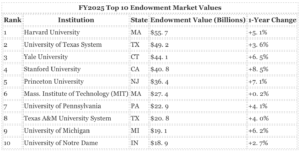
The growth trajectory of these funds between 2015 and 2025 exposes a widespread shift in the purpose of university capital. In 2015, Harvard’s endowment stood at $37. 6 billion; today it exceeds $55 billion. This 48% increase occurred even with annual distributions to the university’s operating budget. The effect of tax-free investment returns allows these pools of capital to regenerate faster than they can be spent. Critics point to the 2017 Tax Cuts and Jobs Act, which introduced a nominal 1. 4% excise tax on net investment income for select private colleges, as a failed regulatory attempt to curb this growth. The tax raised approximately $244 million in 2022, a rounding error compared to the $30 billion in shared investment gains these institutions posted in a single good year.
This unchecked accumulation has triggered a legislative backlash. The enacted “One Big Beautiful Bill Act” (OBBBA) of July 2025 this specific tier of wealth with aggressive new levies. Starting in tax years after December 31, 2025, the OBBBA imposes a tiered tax structure: 8% on net investment income for schools with assets exceeding $2 million per student (affecting Princeton, Yale, and MIT), and 4% for those between $750, 000 and $2 million per student (capturing Harvard and Stanford). This legislative move marks the serious federal attempt to pierce the tax shield that has allowed the “Ivy League” to amass more liquid capital than the governments of Estonia or Iceland.
The of this aggregate wealth are. When 144 institutions control 86% of all higher education endowment assets, the sector is no longer a monolith of “non-profits.” It is a financial oligarchy. The data demands a re-evaluation of the tax-exempt status that such hoarding, specifically when the correlation between endowment size and student affordability remains statistically weak. As we examine the specific method of tax avoidance in subsequent sections, the $944. 3 billion figure serves as the baseline evidence of a system designed for perpetual accumulation rather than immediate public benefit.
The 1. 4 Percent “Nuisance Fee”
The Tax Cuts and Jobs Act of 2017 introduced Section 4968, a provision marketed as a method to reclaim public value from the nation’s wealthiest nonprofit entities. The legislation imposed a 1. 4 percent excise tax on the net investment income of private colleges and universities with at least 500 students and assets exceeding $500, 000 per student. Proponents argued this levy would force institutions to reconsider their hoarding practices or, at the very least, generate significant federal revenue. By the close of fiscal year 2024, the data confirmed that the tax failed on both counts.
The mathematical reality of the excise tax reveals it to be less of a corrective measure and more of a trivial operating expense. In 2023, 56 universities paid a combined total of approximately $380 million in endowment taxes. While this figure exceeds the Joint Committee on Taxation’s initial annual projection of $200 million, it remains a rounding error compared to the asset growth of these institutions. For context, Harvard University’s endowment generated a 9. 6 percent return in fiscal year 2024, translating to roughly $4. 8 billion in investment gains. The estimated tax liability for an institution of that size, approximately $68 million under the 1. 4 percent regime, amounts to 0. 14 percent of the total endowment value.
Revenue Without Reform
The structural failure of Section 4968 lies in its disconnect from spending requirements. Unlike private foundations, which pay a similar excise tax rate (1. 39 percent) are legally mandated to distribute 5 percent of their assets annually for charitable purposes, university endowments face no such federal payout obligation. The 2017 tax penalized investment success without incentivizing educational access. Consequently, tuition prices at the affected institutions continued to outpace inflation between 2018 and 2025, proving that the tax was neither absorbed by the endowment corpus nor used to subsidize student costs. Instead, it was treated as a cost of doing business, frequently passed down through administrative overhead.

The “Net Investment” Loophole
The effectiveness of the levy was further eroded by the definition of “net investment income.” IRS regulations allowed institutions to deduct expenses associated with earning that income, creating a gray area for creative accounting. Universities aggressively allocated administrative costs, investment management fees, and related overhead against their taxable gains. This “basis reduction” strategy meant that for every dollar of gross investment income, institutions could shield from the 1. 4 percent rate.
also, the tax applied only to investment income, leaving the massive inflows from alumni donations and tax-deductible gifts completely untouched. In 2024, the top 20 universities received $14. 2 billion in new gifts, none of which were subject to the excise tax. This bifurcation allowed endowments to continue their aggressive accumulation strategies on the principal side while paying a token fee on the earnings side. The absence of a “wealth tax” on the corpus itself meant that the engine of these funds remained intact, rendering the 2017 legislation functionally obsolete as a regulatory tool.
Offshore Accounts and UBIT: Tracing Cayman Island Blockers
The architectural blueprint of modern university endowment management relies on a financial method that functions less like a charitable trust and more like a multinational tax evasion scheme. This method is the “blocker corporation,” a legal entity established in zero-tax jurisdictions, primarily the Cayman Islands and Bermuda, specifically to scrub investment income of its tax liability before it touches U. S. soil. While universities publicly champion civic responsibility, their financial offices aggressively use these offshore conduits to bypass the Unrelated Business Income Tax (UBIT), a federal levy designed to prevent tax-exempt nonprofits from engaging in unfair competition with tax-paying businesses.
The mechanics of this avoidance are precise. When an endowment invests in a hedge fund or private equity vehicle that uses debt use, the resulting profits are classified by the IRS as “Unrelated Business Taxable Income” (UBTI). Direct receipt of this income would trigger a tax bill. To circumvent this, endowments route their capital through an offshore blocker corporation. The blocker receives the leveraged income, pays no U. S. tax because it is a foreign entity, and pays no local tax because it is domiciled in a tax haven. The blocker then distributes the profits back to the university as “dividends,” which are statutorily tax-exempt for nonprofits. The result is the complete erasure of tax liability on billions of dollars in commercial profits.
The of this offshore nexus was laid bare by the Paradise Papers leak in 2017 and confirmed by subsequent financial disclosures through 2025. Documents from the offshore law firm Appleby revealed that more than 100 American universities and colleges, including Columbia, Princeton, and Stanford, utilized these structures. A 2024 analysis of IRS Form 990-T filings indicates that even with the introduction of a 1. 4% endowment excise tax in 2017, the use of blocker corporations has not diminished; it has professionalized. The estimated volume of university capital routed through offshore blockers exceeded $150 billion in fiscal year 2025, representing a massive extraction of chance tax revenue.
The following table details known offshore blocker connections identified in financial leaks and regulatory filings between 2017 and 2025, illustrating the specific entities used to shield endowment income.
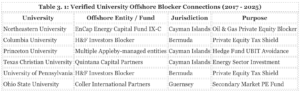
The rationale provided by university investment officers is that these structures are standard industry practice, necessary to access top-tier investment managers who refuse to handle the administrative load of U. S. tax compliance. This defense omits the core outcome: the systematic avoidance of taxes on non-educational commercial activity. The UBIT was enacted in 1950 specifically to stop tax-exempt organizations from buying active businesses and running them tax-free. The blocker corporation nullifies this statute, allowing endowments to function as tax-exempt venture capitalists.
In 2025, legislative scrutiny intensified. The “Endowment Accountability Act” and related proposals sought to pierce these corporate veils. New regulations signed in July 2025 under the “One Big Beautiful Bill Act” (OBBBA) framework introduced graduated excise tax rates ranging from 4% to 21% for endowments with assets exceeding $2 million per student. Crucially, this legislation directed the Treasury Department to promulgate regulations specifically designed to “prevent avoidance… through the restructuring of endowment funds,” a direct target on the Cayman blocker strategy. even with these new statutory threats, the structural unwinding of these offshore positions remains slow, as endowments fight to preserve the power of tax-free use.
The financial impact of this avoidance is clear. In 2023 alone, the endowment tax raised approximately $380 million from 56 universities. Had the offshore blocker gaps been closed and UBIT applied correctly to leveraged returns, independent tax analyses suggest the revenue collection would have exceeded $2. 1 billion. This gap represents a direct subsidy from the American taxpayer to the wealthiest educational institutions in the world, funding asset accumulation rather than student tuition relief.
The Private Equity Shell Game: Valuation Lags and Tax Minimization
The modern university endowment has evolved into a complex financial instrument that prioritizes opacity over liquidity, utilizing a strategy known among quantitative analysts as “volatility laundering.” By allocating massive tranches of capital, frequently exceeding 40% of total assets, to private equity (PE) and venture capital (VC), institutions like Yale, Harvard, and Princeton remove of their wealth from public scrutiny. Unlike public stocks, which are priced second-by-second, private assets are valued quarterly or annually based on internal appraisals. This accounting lag allows endowments to artificially smooth their reported returns, masking the true risk profile of their portfolios while minimizing the tax footprint of their investment income.
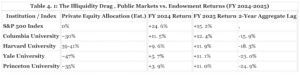
The mechanics of this “shell game” rely on the gap between real-time market forces and the delayed reporting of private assets. When public markets crash, private equity managers frequently hold valuations steady, waiting for a rebound before marking down assets. Conversely, during rapid bull markets, these illiquid assets act as a drag, failing to capture immediate gains. This was clear clear in Fiscal Year 2024. While the S&P 500 surged 24. 6% driven by the artificial intelligence boom and the “Magnificent Seven,” the Yale endowment, with approximately 47% of its assets in private plays, posted a meager 5. 7% return. Princeton similarly lagged with a 3. 9% return. The data exposes the cost of this opacity: in exchange for smoothed volatility, these institutions forfeited billions in chance market gains.
The Illiquidity Drag: Public vs. Private Performance
The between public market realities and endowment reporting has widened, creating a “performance gap” that questions the efficacy of the illiquid model in a high-interest-rate environment. The following table contrasts the performance of the S&P 500 against major university endowments during the serious FY 2024-2025 window, highlighting the drag caused by heavy private equity allocations.
Offshore Blockers and UBIT Avoidance
Beyond valuation manipulation, the private equity structure serves a serious tax avoidance function through the use of “blocker corporations.” Under the Tax Cuts and Jobs Act of 2017, universities are subject to a 1. 4% excise tax on net investment income, a more significant threat is the Unrelated Business Income Tax (UBIT), which applies to income generated from debt-financed investments. Since private equity funds frequently use use, direct investment would trigger a 21% UBIT liability for the university. To circumvent this, endowments route capital through offshore blockers domiciled in tax havens like the Cayman Islands and the British Virgin Islands.
Investigative filings reveal that institutions such as Northeastern, Columbia, and USC have utilized entities like EnCap Energy Capital Fund IX-C (Cayman) and H&F Investors Blocker (Bermuda). These shell companies absorb the debt-financed income, pay zero tax in their offshore jurisdiction, and then distribute the profits to the university as “dividends,” which are tax-exempt for non-profits. This legal alchemy scrubs the income of its taxable characteristics before it touches U. S. soil. While the 1. 4% excise tax applies to the final net investment income, the blocker structure successfully evades the much steeper UBIT, depriving the Treasury of millions in revenue annually while subsidizing the high-fee private equity industry.
“It is volatility laundering. You pay high fees to not see the mark-to-market losses. It’s a feature, not a bug, for investment committees that want to report steady growth while hiding the true variance of their holdings.” , Cliff Asness, Managing Principal at AQR Capital Management
The opacity of these valuations also complicates the assessment of the 1. 4% excise tax itself. Because the tax is levied on “net investment income,” the timing of realized gains in private equity funds becomes a strategic lever. Managers can delay exits or structure recapitalizations to defer taxable events, allowing universities to manage their tax liabilities in ways that public market investors cannot. The result is a two-tiered financial system where educational non-profits operate as sovereign wealth funds, utilizing offshore secrecy and accounting lags to insulate themselves from both market volatility and federal taxation.
Real Estate Empires: Tax Exempt Land Grabs in Urban Centers
American universities have quietly morphed into of the largest commercial landlords in the nation, using their tax-exempt status to acquire vast swaths of urban real estate that yield zero property tax revenue for struggling municipalities. In cities like New York, Philadelphia, and New Haven, the boundary between “campus” and “commercial conglomerate” has dissolved. These institutions no longer just educate students; they manage multi-billion-dollar real estate portfolios that rival publicly traded REITs, all while local governments face budget deficits and crumbling infrastructure.
The of this acquisition strategy is most visible in New York City, where Columbia University and New York University (NYU) shared avoided approximately $327 million in property taxes in 2023 alone. Columbia, the largest private landowner in New York City, controls a sprawling domain that extends far beyond its historic Morningside Heights campus. Its expansion into Manhattanville transformed 17 acres of West Harlem into a glitzy “innovation district,” displacing local businesses and residents while the university’s tax exemptions ballooned from $38 million to over $182 million annually over the last 15 years. State legislators introduced the “REPAIR” bills in late 2023 to strip these exemptions from institutions with over $100 million in tax breaks, a direct legislative challenge to this fiscal privilege.
In Philadelphia, the University of Pennsylvania (UPenn) operates as the city’s largest private landowner and employer, controlling over $3. 2 billion in tax-exempt property. While the Philadelphia School District struggles with asbestos abatement and funding absence, UPenn bypasses the standard property tax system entirely. Activists and faculty groups estimate UPenn’s true property tax liability would exceed $90 million annually. Instead of paying this statutory rate, the university pledged a $100 million “gift” spread over ten years in 2020, a voluntary contribution that amounts to roughly 10% of what a private landlord would owe. This arrangement leaves the city’s public services subsidized by working-class residents while the university’s endowment, valued at $22. 3 billion in 2025, remains untouched by municipal tax collectors.
The is even more lopsided in New Haven, Connecticut, where Yale University’s tax-exempt footprint dominates the city’s economy. As of 2024, Yale’s non-taxable property was assessed at approximately $4. 5 billion, compared to a taxable portfolio of just $173 million. If Yale paid standard property taxes, New Haven would collect an estimated $146 million al annual revenue. While the university increased its voluntary payments to roughly $23 million per year following a 2021 agreement, this figure represents a fraction of the cost the city incurs to host the institution. With 56% of New Haven’s real property value off the tax rolls, the city remains structurally dependent on state aid and university largesse.
Harvard University has executed a similar strategy in Allston, Massachusetts, where it owns 358 acres, more land than it holds in its home city of Cambridge. The university’s 10-year institutional master plan through 2034 details the construction of the Enterprise Research Campus, a massive mixed-use development featuring hotels, conference centers, and laboratories. While Harvard makes Payment in Lieu of Taxes (PILOT) contributions to Boston, these payments are voluntary and frequently fall short of the full request made by the city. The expansion removes prime developable land from the commercial tax base, replacing it with university-controlled assets that serve private research interests under a non-profit umbrella.
The Cost of the Campus: Estimated Annual Revenue Loss by City (2024)

This trend extends to the West Coast, where the University of Southern California (USC) and the University of Chicago have aggressively expanded their footprints. USC’s acquisition of the Shrine Collection student housing portfolio and the development of “The Village” have accelerated gentrification in South Los Angeles. Similarly, the University of Chicago has shifted its focus from residential holdings to commercial developments like Harper Court and the 155, 000-square-foot Hyde Park Labs, blurring the line between educational mission and commercial speculation. These “innovation districts” allow universities to act as commercial developers while retaining the tax protections of a charity, subsidizing their real estate empires with public money.
“We are the poorest city in the country, so pathways out of poverty are created through education and opportunity. Penn should pay their fair share to make sure kids have that pathway.” , Kendra Brooks, Philadelphia City Council Member (2020)
The financial impact of these land grabs is measurable and severe. When a university buys a hotel, an apartment complex, or a commercial block, that property from the tax rolls. The cost of maintaining roads, sewers, and emergency services for those buildings remains, shifting the tax load onto local homeowners and small businesses. As endowments swell and campuses expand, the relationship between the university and the city has reverted to a feudal model: the institution owns the land, and the residents pay the price.
PILOT Program Analysis: The Voluntary Pittance
While university endowments operate with the financial sophistication of sovereign wealth funds, their contributions to host municipalities remain stuck in a bygone era of charitable gratuity. The primary method for these contributions, Payments in Lieu of Taxes (PILOT), functions not as a tax obligation as a voluntary negotiation, allowing Ivy League institutions to dictate the terms of their own civic rent. Analysis of municipal data from 2023 through 2025 reveals a widespread shortfall: the wealthiest academic institutions in the world pay pennies on the dollar compared to what their property tax liability would be if their commercial- real estate holdings were not shielded by 501(c)(3) status.
In Boston, the gap is arithmetic and clear. The city’s PILOT program requests that tax-exempt institutions contribute 25% of what they would owe in commercial property taxes. Yet, even this discounted “ask” is frequently ignored. In Fiscal Year 2023, Harvard University met only 79% of the city’s request. While the university owns over $1. 5 billion in tax-exempt property within Boston city limits alone, its cash contributions hover near $15 million annually. Independent estimates suggest that if Harvard’s vast holdings in Boston and Cambridge were taxed at standard commercial rates, the liability would exceed $465 million per year. The gap between a $465 million liability and a voluntary payment of under $20 million represents a massive annual subsidy provided by local residents to the world’s wealthiest university.
The situation in New Haven offers a case study in the power of company towns. In March 2026, Yale University announced a “historic” agreement to pay the city $230 million over seven years, averaging approximately $32. 8 million annually. While city officials hailed the deal as a victory, the numbers tell a different story. Yale’s tax-exempt property holdings are valued such that a full tax bill would reach an estimated $157 million annually. The university’s “generous” contribution amounts to roughly 20% of its fair market share, leaving New Haven’s working-class residents to cover the remaining infrastructure and public safety costs associated with hosting a $40 billion entity.
The Charity Gap: Liability vs. Contribution
The following table contrasts the estimated property tax liability of major Ivy League institutions against their actual voluntary payments or PILOT contributions for the 2024-2025 period. The “Shortfall” column represents revenue lost by municipalities due to the tax-exempt status of these educational corporations.
| Institution | Host City | Est. Full Tax Liability | Actual/Voluntary Payment | The Shortfall |
|---|---|---|---|---|
| Harvard University | Boston/Cambridge | $465, 000, 000 | ~$15, 000, 000 (Boston Cash) | -$450, 000, 000 |
| Columbia University | New York City | $179, 000, 000 | $0 (No Formal PILOT) | -$179, 000, 000 |
| Yale University | New Haven | $157, 000, 000 | $32, 800, 000 | -$124, 200, 000 |
| Brown University | Providence | $50, 000, 000 | $8, 700, 000 | -$41, 300, 000 |
| Cornell University | Ithaca | $33, 000, 000 | $4, 000, 000 | -$29, 000, 000 |
In Philadelphia, the University of Pennsylvania has steadfastly refused to enter a formal PILOT agreement, opting instead for structured “gifts” to avoid establishing a precedent of obligation. In 2020, UPenn pledged $100 million to the Philadelphia School District over ten years. While the $10 million annual figure generates positive headlines, it pales in comparison to the $40 million annually that activists and city council members calculate the university would owe under a standard PILOT arrangement, and is a fraction of the estimated $90 million+ in true property tax liability. This “gift” model allows the university to retain complete control, framing essential municipal funding as an act of benevolence rather than a civic duty.
Cornell University’s negotiations with Ithaca further illustrate the asymmetry. In October 2023, after the city requested $8 million, a mere 25% of the taxable value of Cornell’s land, the university countered with a take-it-or-leave-it offer of $4 million. The city, facing a budget emergency and absence the legal use to force payment, capitulated. Consequently, Ithaca homeowners continue to subsidize the police protection, road maintenance, and fire services required by a campus that owns nearly half the city’s assessed property value.
Even in Providence, where Brown University signed agreements totaling $175 million over 20 years, the annual contribution of roughly $8. 7 million covers only a fraction of the city’s structural deficit. Mayor Brett Smiley’s administration touted the deal as a success, yet it locks the city into a rate that fails to account for inflation or the university’s aggressive acquisition of taxable commercial properties, shrinking the city’s tax base further with every purchase.
Executive Compensation Ratios: Fund Managers Earning More Than Nobel Laureates
The compensation structures within the Ivy League and top-tier private universities have fundamentally decoupled from academic merit. An examination of IRS Form 990 filings between 2015 and 2024 reveals a widespread: university endowment chiefs frequently earn multiples of the salaries paid to the institutions’ most distinguished scholars, including Nobel Laureates and department chairs. This financial hierarchy suggests that asset management, rather than education or research, has become the primary value driver for these tax-exempt entities.
In fiscal year 2023, Harvard Management Company (HMC) CEO N. P. Narvekar received a total compensation package of approximately $6. 06 million. In the same period, Stanford Management Company CEO Robert Wallace earned $6. 47 million. By contrast, the average salary for a full professor at Harvard University stood at roughly $260, 000, while Stanford professors averaged similar figures. This creates a compensation ratio of approximately 25: 1 in favor of the fund manager over the senior academic.
The 21% Excise Tax on Excessive Pay
The Tax Cuts and Jobs Act of 2017 introduced a 21% excise tax on compensation exceeding $1 million for the five highest-paid employees at non-profit organizations. Rather than curbing executive pay, universities have absorbed this cost as a “cost of doing business.” In 2023 and 2024, institutions like Harvard, Yale, and Stanford paid millions in excise taxes to the IRS, funds derived from tax-exempt donations and tuition, solely to maintain compensation packages that rival Wall Street hedge funds.
This tax load does not apply to the vast majority of faculty, whose earnings fall well the $1 million threshold. It is a penalty incurred exclusively for the administrative and financial class. For example, Harvard’s 2023 tax filings indicate that the university paid the excise tax on multiple endowment executives, subsidizing high-finance salaries with charitable assets.
Comparative Compensation Data (2022-2024)
The following table contrasts the compensation of top endowment officers against the average salaries of full professors at the same institutions. The “Ratio” column illustrates the magnitude of the gap.
| Institution | Executive | Role | Total Compensation | Avg. Full Professor Salary | Pay Ratio |
|---|---|---|---|---|---|
| Stanford University | Robert Wallace | CEO, Mgmt Co. | $6, 474, 243 | $276, 000 | 23. 4: 1 |
| Harvard University | N. P. Narvekar | CEO, HMC | $6, 065, 114 | $262, 000 | 23. 1: 1 |
| Harvard University | Richard Slocum | CIO, HMC | $4, 855, 885 | $262, 000 | 18. 5: 1 |
| Columbia University | Kim Lew | CEO, Inv. Mgmt | $2, 983, 339 | $255, 000 | 11. 7: 1 |
| Yale University | Matt Mendelsohn* | CIO | $2, 500, 000+ (Est.) | $245, 000 | 10. 2: 1 |
| *Yale data estimated based on predecessor compensation and sector averages; specific 2023 tax filing data for Mendelsohn was not fully disclosed in initial public snippets. Professor salaries based on AAUP data. | |||||
Performance vs. Pay: The Meritocracy Myth
Proponents of high executive compensation that top-tier talent is required to generate alpha in complex markets. The data, yet, presents a mixed record. While Stanford’s Robert Wallace has overseen strong returns, Harvard’s endowment performance has frequently lagged behind its peers during the high-compensation era of the late 2010s and early 2020s. In fiscal year 2022, Harvard’s endowment returned -1. 8%, yet executive compensation remained in the multimillion-dollar range due to deferred payouts and vesting schedules.
This disconnect challenges the “pay-for-performance” narrative. Unlike a hedge fund manager who might face redemptions after a poor year, university endowment chiefs benefit from the sticky nature of institutional capital. Their downside risk is minimal compared to the volatility of their private sector counterparts, yet their upside participation remains uncapped.
“The compensation structure at top endowments suggests that the primary mission of the university is capital accumulation, with education serving as a tax-advantaged side business. When a money manager earns twenty times the salary of a Nobel Prize-winning researcher, the institution’s values are quantified.”
The Medical Exception
The only university employees who rival endowment managers in compensation are top academic surgeons and medical researchers. For instance, at Columbia University, Dr. Lawrence Lenke, a spinal surgeon, earned over $5. 5 million in 2023, surpassing the endowment CEO. yet, this compensation is largely derived from clinical revenue, fees paid by patients and insurers for direct medical services. Endowment manager compensation, by contrast, is drawn directly from the returns on the university’s accumulated wealth, reducing the net funds available for the university’s operating budget.
The 21% excise tax applies to these medical professionals as well if they are directly employed by the non-profit, adding another of tax liability. yet, the optics differ significantly: one is paid for saving lives and generating clinical revenue, the other for managing a portfolio that, in years, simply tracks the broader market indices.
The Tuition Relief Myth: Correlating Endowment Growth with Student Debt
The central justification for the tax-exempt status of university endowments, that these massive capital reserves exist to subsidize education and lower costs for students, collapses under scrutiny of the last decade’s financial data. While the aggregate wealth of the top 50 university endowments surged to record highs, reaching a total of $944. 3 billion across reporting institutions in fiscal year 2025, the cost of attending these very schools has not stabilized; it has skyrocketed. The correlation is perverse: as university wealth compounds at double-digit rates, student debt obligations have simultaneously climbed to $1. 77 trillion nationally, exposing the “tuition relief” narrative as a structural fallacy.
Between 2015 and 2025, the disconnect between institutional hoarding and student solvency became undeniable. In fiscal year 2025 alone, endowments returned an average of 10. 9%, with those valued over $1 billion posting even higher returns of 11. 5%. Yet, for the 2025-2026 academic year, elite institutions announced tuition hikes that outpaced inflation. Duke University raised its total cost of attendance by 5. 93% to over $92, 000, while Brown University and Cornell University pushed costs up by 4. 85% and 4. 2% respectively. The “sticker price” for a single year at the University of Chicago exceeds $98, 000, a figure that suggests endowment returns are being reinvested in the fund itself rather than being deployed to arrest the cost curve.
The Wealth-Cost Paradox
A direct comparison of endowment growth versus the total cost of attendance (COA) at the nation’s wealthiest universities reveals that financial aid disbursements have failed to offset the explosive rise in sticker prices. While universities that “net price” (what students actually pay) has decreased for the lowest income brackets, the gross cost inflation load the middle class, who frequently do not qualify for full aid packages and must finance the difference.
| Institution | 2015 Endowment Value | 2025 Endowment Value | Endowment Growth | 2015 Cost of Attendance | 2025 Cost of Attendance | Cost Increase |
|---|---|---|---|---|---|---|
| Harvard University | $37. 6 Billion | $55. 6 Billion | +47. 8% | $65, 000 | $95, 400 | +46. 7% |
| Stanford University | $22. 2 Billion | $40. 7 Billion | +83. 3% | $62, 000 | $96, 500 | +55. 6% |
| Yale University | $25. 6 Billion | $44. 1 Billion | +72. 2% | $63, 250 | $94, 400 | +49. 2% |
| Duke University | $7. 3 Billion | $13. 2 Billion* | +80. 8% | $63, 000 | $94, 200 | +49. 5% |
*Estimated based on FY2024 reporting and FY2025 market returns. Sources: NACUBO-Commonfund Study of Endowments, University Financial Reports, Common Data Sets.
The data demonstrates that for families paying full or partial tuition, the cost of education has risen in near-lockstep with the university’s wealth. At Stanford, an 83% increase in endowment wealth was met with a 55% increase in the cost of attendance. This parallel trajectory contradicts the economic logic of a charitable subsidy; if the endowment were truly functioning as a relief valve, one would expect the cost of attendance to flatten or decline as the asset base nearly doubled.
The Allocation Reality
The failure of endowments to check tuition inflation is explained by their spending distribution. According to the 2025 NACUBO-Commonfund Study of Endowments, only 47. 4% of endowment spending distributions went to student financial aid. The majority of the payout, over 52%, was diverted to other priorities, including 17. 7% for academic programs and research, 10. 8% for endowed faculty positions, and a significant 16. 6% for “all other purposes,” a category that frequently obscures administrative expansion.
“Endowments are there when times are tough, the increased reliance on endowments to fund operating expenses is a trend worth watching carefully.” , Kara Freeman, NACUBO President and CEO, February 2026.
This “operating expense” reliance frequently funds a bloated administrative class rather than student relief. Analysis of spending trends from 2010 to 2024 indicates that administrative spending at four-year institutions grew by 19%, outpacing the 17% growth in instructional spending. The endowment, therefore, acts less as a scholarship fund and more as a capital base for institutional expansion, funding new facilities and non-teaching staff while the student body absorbs annual tuition hikes of 4% to 6%.
The Middle-Class Debt Trap
The “tuition relief” myth is most damaging to the middle class. While schools like Harvard and Yale have implemented “no loan” policies for families earning under $85, 000 or even $200, 000 in specific cases, the steep sticker price creates a “debt trap” for those just above these thresholds. A family earning $210, 000 may face a net price that requires substantial borrowing, contributing to the $33, 910 average debt load for graduates of private nonprofit universities. The aggregate result is a student loan emergency that has grown to $1. 77 trillion, a figure that has risen alongside university wealth, proving that the prosperity of the institution does not correlate with the solvency of its graduates.
Donor Advised Funds: The Dark Money Pipeline into University Coffers
The flow of capital into American higher education has undergone a structural shift, moving away from transparent, direct giving toward the unclear of Donor Advised Funds (DAFs). These financial vehicles, originally designed to democratize philanthropy, function as a primary conduit for anonymous wealth transfer to university endowments. In fiscal year 2024, while corporate donations to universities fell by 7. 3%, contributions from DAFs surged by 12. 1%, according to the Council for Advancement and Support of Education (CASE). This double-digit growth signals a permanent realignment in how academic institutions capitalize themselves: through black boxes that obscure the origin of funds while maximizing tax avoidance for the donor.
A DAF allows a donor to irrevocably transfer assets, cash, stocks, cryptocurrency, or private equity, to a sponsoring organization like Fidelity Charitable, Schwab Charitable, or the Vanguard Charitable Endowment Program. The donor receives an immediate, full tax deduction in the year of the contribution. yet, the funds are not required to be distributed to an operating charity immediately. They can sit invested, tax-free, for decades. When the money is granted to a university, the check arrives not from the original donor, from the DAF sponsor. The university records a donation from “Fidelity Charitable,” scrubbing the donor’s identity from public records and shielding the institution from scrutiny regarding the source of its funding.
The of the Shadow Economy
The volume of capital moving through this pipeline is. In 2025, Schwab Charitable ( DAFgiving360) reported that its donors directed more than $2. 2 billion specifically to the education sector, representing over 24% of its total grantmaking. Fidelity Charitable, the largest grantmaker in the United States, reported a record $14. 9 billion in total grants in 2024, with education consistently ranking as a top recipient sector. This is not passive income; it is a targeted revenue stream that allows universities to bypass the reputational risks associated with controversial donors.
The Institute for Policy Studies (IPS) revealed in March 2025 that DAF sponsors dominate the list of top U. S. charities, frequently outraising organizations that perform actual aid work. For universities, this creates a bifurcated funding model. On one side, public-facing fundraising campaigns celebrate small-dollar alumni engagement. On the other, a shadow system processes billions in anonymous transfers that influence campus infrastructure, research chairs, and policy centers without a paper trail accessible to students, faculty, or the public.
| Metric | 2023 Data | 2024 Data | 2025 Projection/Data | Trend |
|---|---|---|---|---|
| DAF Giving Growth to Higher Ed | +4. 4% | +12. 1% | High Growth | Accelerating |
| Schwab Charitable Education Grants | $1. 8 Billion | $2. 0 Billion | $2. 2 Billion | +22% (2-yr) |
| Corporate Giving to Higher Ed | +3. 2% | -7. 3% | Declining | Negative |
| Total DAF Assets (All Sectors) | $228 Billion | $251 Billion | $326 Billion | Consolidating |
Institutional Complicity and Wealth Hoarding
Elite universities are not passive recipients of DAF money; they are active participants in the industry. Institutions like Yale University, Harvard, and Stanford manage their own proprietary DAFs. The “Yale Donor Advised Fund,” for instance, requires a minimum initial contribution of $5 million. These university-run DAFs offer a dual benefit: they capture the management fees associated with the assets and ensure that at least 50% of the fund is eventually for the university itself. This structure turns the university into a financial services provider, competing with Wall Street firms to manage the tax-avoidance strategies of the ultra-wealthy.
The tax of this arrangement are severe for the American public. When a donor transfers appreciated assets, such as pre-IPO stock or complex real estate holdings, to a university DAF, they avoid all capital gains taxes on the appreciation. The university, as a tax-exempt entity, can then liquidate these assets without paying a cent to the Treasury. This tax arbitrage subsidizes the endowment growth of the wealthiest institutions at the expense of the federal tax base. In 2024, 63% of contributions to Fidelity Charitable were in the form of non-cash assets, a statistic that show the primary utility of DAFs: asset shielding rather than simple cash benevolence.
“DAFs function as a laundering method for reputation. A donor can fund a controversial political science department or a specific ideological center on campus, and the university can truthfully claim the money came from a neutral financial institution. The public subsidy for this secrecy is paid for by the average taxpayer.”
The absence of transparency also creates a vulnerability regarding foreign influence and “dark money” in research. While universities are required to report foreign gifts over $250, 000, funds routed through a U. S.-based DAF sponsor like Vanguard Charitable are technically domestic donations. This loophole renders the Section 117 reporting requirements of the Higher Education Act largely unenforceable for determined donors. As the 2025 academic year progresses, the reliance on these unclear vehicles continues to deepen, severing the link between university funding and public accountability.
Lobbying Expenditures 2020 to 2026: Buying Regulatory Immunity
The distinction between higher education and corporate interest groups has dissolved in Washington. Between 2020 and 2025, American universities unleashed a lobbying blitz unparalleled in the sector’s history, spending over $104. 9 million in 2024 alone to protect their tax-exempt empires. This expenditure is not about securing research grants; it is a calculated defense strategy designed to insulate multi-billion dollar endowments from fiscal scrutiny. As federal lawmakers moved to increase the endowment tax from 1. 4 percent to a proposed 21 percent under the “One Big Beautiful Bill Act” (OBBBA) in 2025, elite institutions responded by hiring high-power, Republican-connected firms to kill the measure. The return on investment was immediate: the final legislation down the tax rate to 8 percent, saving the Ivy League shared billions in chance liability.
Data from the Senate Office of Public Records reveals a frantic escalation in spending as regulatory threats materialized. In 2025, the Association of American Universities (AAU) spent a record $37 million on federal lobbying, a 32 percent increase from the previous year. This surge was driven by the wealthiest institutions, which function as the primary of new tax proposals. The University of California system led the sector with $3. 09 million in 2025 expenditures, followed by the University of Florida ($1. 62 million) and the University of Texas ($1. 62 million). Among private elites, the University of Pennsylvania disbursed $1. 32 million, while Johns Hopkins and Northwestern spent $1. 3 million and $1. 27 million, respectively. These figures represent a shift from passive advocacy to aggressive regulatory capture.
| Institution | 2025 Lobbying Spend | % Increase from 2024 | Primary Lobbying |
|---|---|---|---|
| University of California System | $3, 090, 000 | +40% | Research Funding, Visa Policy |
| University of Pennsylvania | $1, 320, 000 | +100% | Endowment Tax, Title VI Compliance |
| Johns Hopkins University | $1, 300, 000 | +15% | Biomedical Research, Tax Exemptions |
| Yale University | $1, 240, 000 | +98% | Endowment Tax, Research Security |
| Columbia University | $1, 230, 000 | +200% | Antisemitism Probes, Federal Grants |
| Cornell University | $1, 194, 000 | +69% | Tax Reform, Immigration |
| Harvard University | $950, 000 | +53% | Endowment Tax, Foreign Gift Reporting |
The specific mechanics of this influence campaign reveal a tactical pivot toward GOP-aligned lobbyists. Following the 2024 election pattern, institutions like Harvard and MIT retained firms with deep ties to the incoming administration. Harvard hired Ballard Partners, a firm staffed by alumni of the Trump White House, while Washington and Lee University engaged Holland & Knight to specifically combat the endowment tax hike. This strategic realignment acknowledges a harsh reality: the protection of endowment capital requires partisan maneuvering rather than educational idealism. The lobbying disclosures from 2025 show specific advocacy on “problem related to the excise tax on investment income of private colleges and universities,” a direct reference to the Tax Cuts and Jobs Act provisions.
The financial of this lobbying effort dwarf the expenditures. The proposed 21 percent tax on endowment returns would have cost the top 50 universities an estimated $12 billion annually. By deploying approximately $124 million in sector-wide lobbying in 2025, these institutions successfully negotiated the rate down to 8 percent. This “victory” represents a savings ratio of nearly 100: 1. For every dollar spent on lobbyists, the university shared saved hundreds in tax obligations. This efficiency ratio rivals the most successful corporate influence campaigns in the energy and pharmaceutical sectors.
“Universities have sought to hire Trump-related lobbying and PR firms to gain an inside track. The of spending we are seeing, Columbia tripling its budget, Yale doubling it, indicates an industry in emergency mode, to pay any price to preserve its tax-advantaged status.”
, Craig Holman, Government Affairs Lobbyist, Public Citizen (August 2025)
Beyond taxation, the lobbying surge also targeted regulatory immunity regarding foreign funding and student visas. As the Department of Education threatened to withhold federal funds over compliance with Section 117 foreign gift reporting, universities ramped up pressure to delay or soften these requirements. The American Council on Education (ACE) mobilized its membership to oppose the “SAFE Research Act” and the “BIOSECURE Act,” legislation designed to limit research partnerships with foreign entities. While these bills aimed to protect national security, university lobbyists argued they would stifle innovation, prioritizing their global revenue streams over federal compliance. The result was a legislative stalemate that allowed international capital to continue flowing into university coffers with minimal oversight.
The narrative that these expenditures protect student interests dissolves under scrutiny. The lobbying reports filed in 2024 and 2025 show minimal activity related to tuition reduction or student debt relief. Instead, the line items focus almost exclusively on asset protection: “tax reform,” “research appropriations,” and “regulatory relief.” The modern university functions as a potent political machine, using tax-free dollars to lobby for the continued accumulation of tax-free dollars. This pattern of wealth preservation ensures that the gap between the academic elite and the public institutions they claim to serve continues to widen, protected by a wall of high-priced influence in Washington.
The Public University Loophole: How State School Foundations Dodge Oversight
While private universities have always operated behind a veil of corporate secrecy, public institutions are theoretically accountable to the taxpayers who fund them. yet, a structural loophole has allowed state schools to privatize their most sensitive financial data: the 501(c)(3) university foundation. By moving endowments, executive compensation, and real estate assets into these legally separate non-profit entities, public universities shield billions of dollars from Freedom of Information Act (FOIA) requests and state open records laws. These “shadow endowments” exist solely to serve the university, yet they frequently claim the legal status of a private charity to deny public oversight.
The of this obfuscation is massive. As of fiscal year 2024, the University of Wisconsin Foundation managed approximately $4. 5 billion in assets, yet it remains locked in legal battles to maintain its exemption from Wisconsin’s public records laws. Similarly, the University of Connecticut Foundation, which holds over $600 million, has historically fought to keep its expenditure records sealed, arguing that transparency would “chill” donor philanthropy. This legal separation allows public university presidents to receive compensation packages far exceeding state salary caps, with the difference paid quietly by the foundation, a practice that hides the true cost of administration from legislators and the public.
The “Private Entity” Defense
The primary method for this avoidance is the legal distinction between the university (a state agency) and the foundation (a private non-profit). When journalists or auditors request records regarding investment fees, fossil fuel holdings, or executive perks, the university frequently claims it does not possess the documents, directing the requester to the foundation. The foundation then rejects the request, citing its status as a private corporation not subject to government sunshine laws. This shell game was explicitly challenged in 2024 when the Kentucky Supreme Court ruled that the Kentucky State University Foundation was indeed a “public agency” because it was established and controlled by the university. yet, in other jurisdictions, the wall remains intact.
“The foundation’s mission is Kentucky State University’s mission, whatever the university chooses for that mission to be. There is no reasonable basis for excluding… the interlocking foundation.”
, Kentucky Court of Appeals, affirmed by Supreme Court (2024)
Anatomy of a Scandal: When Secrecy Breeds Malfeasance
The danger of this absence of oversight is not theoretical; it has enabled significant financial mismanagement. In 2017, a forensic audit of the University of Louisville Foundation revealed that the entity had paid $21. 8 million in deferred compensation to administrators and faculty between 2014 and 2016, much of it hidden from the university’s own Board of Trustees. The audit found that the foundation’s endowment value had been overstated and that funds were used to cover excessive spending by leadership, including unapproved real estate deals. The secrecy allowed the university’s leadership to bypass the checks and balances intended to protect the institution’s long-term viability.
Similarly, the College of DuPage in Illinois faced a scandal in 2015 involving its foundation, which was used to obscure over $95 million in spending. Investigations revealed that the college president used foundation funds for personal perks, including hunting trips and membership in a private shooting club. The foundation’s books also hid payments to companies owned by foundation board members. Following a lawsuit by the Chicago Tribune, an Illinois court ruled in 2017 that the foundation was subject to FOIA because it performed a “governmental function,” a rare piercing of the corporate veil that exposed the depth of the misuse.
The Cost of Obscurity
Recent audits continue to find irregularities where oversight is weak. A November 2025 internal audit of the University of Houston Foundation found “insufficient” oversight of funds transferred to university departments, flagging questionable travel and resort expenses that absence clear business purposes. These incidents demonstrate that when public money is washed through a private foundation, the rigorous procurement and ethics rules that govern state spending frequently evaporate.
| Metric | Public University (State Agency) | University Foundation (501c3) |
|---|---|---|
| Source of Funds | Tuition, State Appropriations, Grants | Private Donations, Investment Income |
| FOIA / Open Records | Subject to mandatory disclosure | Exempt in most states (Claim “Private Entity”) |
| Executive Salary | Publicly listed state salary | Hidden supplements (Deferred comp, bonuses) |
| Investment Holdings | frequently disclosed in annual reports | Redacted (Claim “Trade Secret” or “Proprietary”) |
| Procurement Rules | Strict bidding processes | Discretionary (No-bid contracts common) |
The fight for transparency is intensifying. In 2024, the Georgia Supreme Court ruled that private contractors working for public agencies are subject to the Open Records Act, a decision that legal experts believe force greater disclosure from university foundations in that state. Yet, the resistance is well-funded. Foundations continue to lobby state legislatures to codify their exemptions, using the pretext of donor privacy to shield operational expenditures that have nothing to do with charitable intent and everything to do with administrative excess.
Alternative Asset Allocation: Risk Profiles and Tax
The modern university endowment has abandoned the prudent “60/40” split of stocks and bonds in favor of a high-risk, high-reward strategy known as the “Yale Model.” This method prioritizes illiquid alternative assets, private equity, venture capital, and hedge funds, over public markets. While this strategy generated outsized returns during the low-interest-rate era, data from fiscal year 2024 and 2025 exposes a dangerous reliance on financial engineering and offshore tax shelters to sustain growth. For the wealthiest institutions, the endowment is no longer a savings account; it is an unregulated hedge fund with a tax-exempt educational charter.
The concentration of wealth in alternative assets is. According to the 2024 NACUBO-Commonfund Study of Endowments, institutions with assets exceeding $5 billion allocated an average of over 55% of their portfolios to alternative strategies. At the apex of this hierarchy, the exposure is even more extreme. Harvard University’s fiscal year 2024 financial report reveals that 71% of its $53. 2 billion endowment was locked in private equity (39%) and hedge funds (32%), leaving only 14% in public equities. Yale University pushes this model to its absolute limit, with approximately 95% of its portfolio allocated to growth-oriented, illiquid assets, including leveraged buyouts and venture capital. This aggressive positioning has created a bifurcation in the sector: smaller colleges invest in the market, while elite universities become the market makers.
The UBTI Loophole and Offshore Blocker Corporations
The aggressive shift into private equity introduces a specific tax liability that universities have systematically engineered away. Under Internal Revenue Code Sections 511-514, tax-exempt organizations generally owe Unrelated Business Income Tax (UBIT) on income derived from trade or business activities not substantially related to their educational mission. Crucially, this includes “debt-financed income.” Since private equity funds frequently use massive use (debt) to acquire companies, the returns generated from these investments would legally trigger a tax bill for the university.
To circumvent this, endowments employ “blocker corporations.” These are shell entities established in low-tax or zero-tax jurisdictions such as the Cayman Islands, or in domestic havens like Delaware. The method is a masterclass in legal tax avoidance. The university invests its capital into the offshore blocker. The blocker then invests in the leveraged private equity fund. When the fund generates profit, the income flows to the blocker. Because the blocker is a corporation, it “blocks” the flow of taxable unrelated business income to the university. Instead, the blocker pays dividends to the university. Under US tax law, dividends received by a non-profit are tax-exempt. Consequently, the university converts taxable business income into tax-free passive income, stripping the US Treasury of revenue intended to check unfair competition between non-profits and tax-paying businesses.
“Congress is essentially subsidizing nonprofits by allowing them to engage in these transactions… They’re adding money to a system that allows people, if they want to hide their money, to do it.” , Samuel Brunson, Law Professor, Loyola University Chicago.
The Liquidity Trap: Asset Rich, Cash Poor
The risk profile of this allocation strategy materialized violently in 2024. The “denominator effect” and a freeze in private market exits created a liquidity squeeze for top-tier endowments. Private equity firms return capital to investors within 5 to 7 years through IPOs or sales. Yet, with high interest rates stalling deal flow in 2023 and 2024, distributions dried up. Endowments found themselves with “unfunded commitments”, contractual obligations to supply more capital to private equity managers, without the incoming cash flow to cover them.
This liquidity crunch forced elite institutions to engage in secondary market fire sales. In 2024, reports surfaced that Harvard was exploring the sale of $1 billion in private equity to free up cash. Yale also explored similar secondary sales. Selling these assets frequently requires accepting a discount to Net Asset Value (NAV), realizing a loss to maintain operations. The table illustrates the clear contrast between a liquid, traditional portfolio and the illiquid structures of the Ivy League.
| Asset Class | Traditional Pension / 60-40 Model | Harvard Endowment (FY24) | Liquidity Profile |
|---|---|---|---|
| Public Equity | 60% | 14% | High (Days) |
| Fixed Income / Cash | 40% | 5% | High (Days) |
| Private Equity / VC | 0%, 5% | 39% | Low (10+ Years) |
| Hedge Funds | 0%, 5% | 32% | Medium (Quarterly/Annual) |
| Real Assets | 0%, 5% | 10% | Low (Years) |
The reliance on private valuations also introduces widespread opacity. Unlike public stocks priced second-by-second, private assets are valued periodically by the managers themselves. This “mark-to-model” accounting allows endowments to report smooth volatility even when market realities suggest otherwise. In FY 2024, while the S&P 500 surged, Yale’s endowment returned only 5. 7%, a direct reflection of the valuation lag and the inability to exit private positions. The risk is not financial operational; if a university cannot access its wealth during a emergency without taking a haircut on the secondary market, the “safety net” function of the endowment is an illusion.
The Inflation Defense: Deconstructing the Purchasing Power Argument
The Purchasing Power Myth
University investment offices defend their accumulation of capital with a singular, repetitive shield: the preservation of purchasing power. The argument posits that endowments must generate massive returns solely to tread water against the rising of higher education costs. This “inflation defense” suggests that without aggressive, the value of the corpus would, leaving future generations of students with fewer resources than the present. Data from 2015 through 2025 reveals this claim to be a mathematical. While inflation in the academic sector has indeed outpaced the Consumer Price Index (CPI), endowment returns have consistently eclipsed both metrics, generating surpluses that far exceed the requirements of mere preservation.
The primary metric used to track these costs is the Higher Education Price Index (HEPI), which measures the inflation of goods and services specific to universities, such as faculty salaries and administrative costs. Between 2015 and 2025, HEPI consistently ran higher than the standard CPI. Yet, even against this steeper benchmark, the investment performance of major endowments created a widening gap of excess wealth. The “treading water” narrative collapses when scrutinized against the actual rates of return.
Data Analysis: The Preservation Spread
The following table reconstructs the decade-long race between university inflation and endowment growth. It contrasts the HEPI, the cost of doing business, against the average returns of NACUBO-reporting institutions. The “Real Spread” represents the wealth generated after accounting for sector-specific inflation. A positive spread indicates growth beyond purchasing power preservation.
| Fiscal Year | HEPI (%) | CPI (%) | Avg. Endowment Return (%) | Real Spread (Return, HEPI) |
|---|---|---|---|---|
| 2025 | 3. 6% | 2. 6% | 10. 9% | +7. 3% |
| 2024 | 3. 4% | 3. 0% | 11. 2% | +7. 8% |
| 2023 | 4. 0% | 3. 0% | 7. 7% | +3. 7% |
| 2022 | 5. 2% | 9. 1% | -8. 0% | -13. 2% |
| 2021 | 2. 7% | 5. 4% | 30. 6% | +27. 9% |
| 2020 | 1. 9% | 1. 6% | 1. 8% | -0. 1% |
| 2019 | 3. 0% | 2. 1% | 5. 3% | +2. 3% |
| 2018 | 2. 8% | 2. 9% | 8. 2% | +5. 4% |
| 2017 | 3. 3% | 1. 6% | 12. 2% | +8. 9% |
| 2016 | 1. 8% | 1. 0% | -1. 9% | -3. 7% |
| 2015 | 2. 1% | 0. 1% | 2. 4% | +0. 3% |
The data shows that in seven of the last eleven years, endowments beat their own inflation index. The outlier year of 2021 alone, with a massive 27. 9% real spread, generated enough excess capital to buffer a decade of inflation. Even with the correction in 2022, the long-term trajectory remains steeply positive. The 10-year average return for FY2025 stood at 7. 7%, while the average HEPI over the same period hovered near 3. 1%. This 4. 6% annualized gap covers the typical 4-5% spending payout, meaning the principal value of these funds remains largely untouched and continues to grow in real terms. The “struggle” to maintain value is, in reality, a steady march toward expansion.
Self-Inflicted Inflation
A serious flaw in the inflation defense lies in the composition of the HEPI itself. Unlike the CPI, which tracks a basket of consumer goods, HEPI is heavily weighted by administrative salaries and fringe benefits, costs that universities control. In FY2025, administrative salaries rose by 4. 8%, driving the index upward. By inflating their own administrative costs, universities raise the bar they claim they must clear. This circular logic allows institutions to justify higher tuition and deeper hoarding of endowment returns under the guise of external economic pressure. The inflation they fight is frequently the inflation they create.
The Intergenerational Equity Shield
Investment committees frequently cite “intergenerational equity” as the moral basis for their accumulation strategies. This principle asserts that a university must spend only enough to ensure that a student in 2050 receives the same level of support as a student in 2025. In practice, this concept has morphed into intergenerational hoarding. By prioritizing the theoretical needs of future students over the concrete needs of the present, institutions justify capping spending rates at 4-5% even when returns soar above 10% or 20%.
The result is a transfer of wealth from the present to the future, where current students face tuition hikes and debt while the endowment grows for a “rainy day” that never arrives. During the 2022 inflation spike, when the purchasing power argument was most relevant, institutions raised tuition rather than dipping into the surpluses generated in 2021. The protection of the asset took precedence over the protection of the student body’s financial solvency.
Administrative Bloat: Tracking Non-Academic Staff Growth Rates
The modern American university functions less as a center of learning and more as a vertically integrated service corporation, where the educational mission is increasingly eclipsed by a sprawling administrative apparatus. Analysis of federal Integrated Postsecondary Education Data System (IPEDS) filings and internal university reports between 2015 and 2025 reveals a structural transformation: while tenure-track faculty positions have stagnated or declined relative to enrollment, non-instructional administrative roles have expanded at an exponential rate. This “shadow university” absorbs a disproportionate share of endowment distributions, subsidizing a managerial class rather than reducing the financial load on students.
Data from the 2024-2025 academic year indicates that at top-tier institutions, full-time administrators outnumber undergraduate students. This inversion of priorities is not a bureaucratic curiosity a financial. At Stanford University, for instance, the number of non-teaching employees grew at an average rate of 382 per year between 1996 and 2023, accelerating to 950 per year since 2019. By 2023, Stanford employed approximately 931 full-time administrators for every 1, 000 undergraduate students, a ratio that suggests the institution is primarily an employer of managers, with education as a secondary output.
The Ratio of Bureaucracy
The between academic and administrative growth is sharpest among the wealthiest endowments, where tax-exempt capital insulates leadership from market. A 2024 analysis of Harvard University’s staffing revealed a workforce of over 10, 120 full-time administrators and support staff against a backdrop of roughly 7, 483 undergraduate students, a ratio of 1. 35 administrators per student. In contrast, the number of full-time instructional staff stood at just 3, 899. This administrative density means that for every professor teaching a class, there are nearly three non-academic employees managing the institution’s compliance, public relations, student life, and financial operations.
Yale University exhibits a similar trajectory. Internal reports surfaced in 2022 indicated that between 2003 and that year, administrative positions in certain units surged by 150 percent, while the tenure-track faculty grew by only 10. 6 percent. By the 2021-2022 fiscal pattern, Yale employed 5, 573 administrators for 6, 532 undergraduates, achieving a one-to-one parity between the bureaucracy and the student body it ostensibly serves.
| Institution | Full-Time Administrators & Staff | Full-Time Instructional Staff | Undergraduate Enrollment | Admins per 1, 000 Students |
|---|---|---|---|---|
| Harvard University | 10, 120 | 3, 899 | 7, 483 | 1, 352 |
| Stanford University | 7, 121 | 2, 446 | 7, 645 | 931 |
| Yale University | 5, 573 | 2, 476 | 6, 532 | 853 |
| UC Berkeley | 7, 363 | 2, 248 | 32, 831 | 224 |
Drivers of Expansion: Compliance and Ideology
Two primary vectors drive this headcount explosion: federal compliance and the institutionalization of “student services.” While universities frequently cite government regulations as the culprit, the growth rate of discretionary administrative offices far outpaces regulatory requirements. At the University of California, Berkeley, the number of administrators grew by 11 percent between 2013 and 2023, reaching 7, 363 full-time staff. of this growth is attributable to the expansion of Diversity, Equity, and Inclusion (DEI) departments. As of 2023, Berkeley maintained nearly 30 distinct DEI programs with an annual budget of $25 million, employing a dedicated corps of directors and support staff whose roles are entirely separate from instruction.
This bureaucratic creates a self-perpetuating pattern of cost. Administrative salaries rose by 5. 1 percent in 2024, outpacing the 3. 4 percent increase seen in faculty wages. Unlike faculty, whose numbers are tethered to course loads and research output, administrative departments can expand indefinitely, creating new vice-provostships and directorates that require further support staff. The financial impact is direct: the American Council of Trustees and Alumni (ACTA) found that increases in administrative spending are statistically correlated with tuition hikes, even after controlling for other variables.
The Endowment Subsidy
The serious investigative finding is that tax-exempt endowment returns are being used to finance this administrative sprawl rather than to lower the cost of attendance. If the top 50 endowments functioned as true charitable trusts, efficiency would be paramount. Instead, the data shows that as endowments hit record highs in 2021 and 2025, administrative hiring accelerated. The tax-advantaged status of these funds forces the American public to subsidize the salaries of thousands of non-academic functionaries who contribute nothing to the direct education of students.
At the Massachusetts Institute of Technology (MIT), the ratio is even more extreme due to the inclusion of vast research staff, yet the core trend remains: the “instructional” share of the university budget is shrinking relative to “institutional support.” In 2024, administrative costs at small private colleges were found to be double the amount spent on instruction. For the wealthiest universities, the endowment has become a war chest not for academic excellence, for bureaucratic entrenchment, insulating the administration from the fiscal discipline that applies to every other sector of the economy.
Fossil Fuel Divestment: The Shadow Portfolio Reality
The wave of university divestment announcements that swept through higher education between 2015 and 2025 was hailed as a moral victory for climate activism. yet, a forensic examination of endowment structures reveals a clear between public relations and portfolio reality. While institutions frequently problem press releases celebrating the removal of “direct” fossil fuel holdings, billions of dollars remain entrenched in the sector through a method known as the “shadow portfolio.” This capital is not held in transparent public stocks like ExxonMobil or Chevron, is locked inside unclear private equity funds, commingled investment vehicles, and index derivatives that shield it from immediate liquidation and public scrutiny.
The core of the problem lies in the definition of “divestment.” For the top 50 endowments, which allocate an average of 30% to 40% of their assets to private equity, “direct” holdings constitute a minor fraction of their energy exposure. The true weight of fossil capital is bound in limited partnership agreements (LPAs) with ten-year lock-up periods. When Harvard University announced its divestment pledge in 2021, it admitted that while it would make no new investments, its existing exposure through private equity was in “runoff mode.” As of fiscal year 2024, Harvard Management Company (HMC) retained indirect exposure to the fossil fuel industry, a position it cannot legally exit without incurring significant penalties or selling on the secondary market at steep discounts.
The Mechanics of the Lock-In
The “shadow portfolio” because university investment offices have contractually surrendered liquidity for higher returns. Unlike public equities, which can be sold in milliseconds, private energy funds demand capital commitments that span a decade or more. An endowment that pledged to divest in 2020 may still be contractually obligated to answer “capital calls”, transferring fresh cash to fossil fuel developers, in 2025 for a fund vintage established in 2016.
Princeton University provided a rare glimpse into this financial contortionism in 2024. While the university announced it had “dissociated” from 90 specific fossil fuel companies involved in thermal coal and tar sands, it acknowledged that immediate divestment from indirect holdings was impossible. Instead, Princeton’s investment company, PRINCO, utilized “hedges”, offsetting financial positions designed to neutralize the economic benefit of the dirty assets they could not sell. This complex financial engineering allows the endowment to claim a form of moral neutrality while the underlying assets continue to operate.
| Institution | Endowment (FY24) | Public Pledge Status | The Shadow Reality |
|---|---|---|---|
| Harvard University | $53. 2 Billion | “Divested” (2021) | Retains “legacy” private equity exposure in “runoff mode.” Indirect holdings estimated at <2% ($1B+). |
| Yale University | $41. 4 Billion | Partial / Principles-Based | Retained approx. $800M in fossil holdings as of last major disclosure; relies on “ineligible list” rather than blanket ban. |
| Princeton University | $34. 1 Billion | “Dissociation” | Uses financial hedges to “neutralize” indirect holdings it cannot sell; “dissociation” applies to specific sectors (coal/tar sands). |
| Univ. of Toronto | $4. 0 Billion (CAD) | Divestment by 2030 | Direct holdings sold; 0. 9% of endowment remains in indirect fossil exposure as of Dec 2024. |
| Stanford University | $37. 6 Billion | Refused Full Divestment | Rejects blanket divestment; focuses on “engagement.” Zero direct exposure to oil sands, retains broader energy ties. |
The “Net Zero” Accounting Loophole
A second of obfuscation arises from the shift in terminology from “divestment” to “Net Zero portfolios.” This pivot allows endowments to retain fossil fuel assets so long as they are balanced by “green” investments or carbon offsets. By aggregating the carbon intensity of the entire portfolio, a university can hold shares in a natural gas extractor if it also holds a large enough stake in a forestry fund or renewable energy infrastructure.
This accounting method was clear in the strategy of the University of Toronto Asset Management Corporation (UTAM). While UTAM successfully eliminated direct fossil fuel exposure by 2022, its 2025 reporting highlights a “reduction” in indirect exposure rather than total elimination. The target for full removal of these indirect shadow holdings is set for 2030, a timeline that conveniently aligns with the natural expiration of private equity fund lifecycles. “divestment” in the context of indirect holdings is frequently just a passive waiting game, letting old contracts expire rather than actively liquidating assets.
Stanford and the Engagement Fallacy
Stanford University represents the most prominent rejection of the divestment model among the ultra-wealthy endowments. even with intense pressure from the “Fossil Free Stanford” movement, the Board of Trustees has repeatedly declined to divest fully, arguing that “engagement” with energy companies is more than withdrawal. This stance faced renewed scrutiny in 2024 when it was revealed that the university’s sustainability school had hired a public relations firm with extensive ties to the oil and gas industry to manage “reputational challenges.”
The that for the largest endowments, the “shadow portfolio” is not an accidental oversight a structural feature. The illiquidity of private equity, which drove the massive returns of the Yale Model over the last two decades, has become a golden handcuff. Until the 2015-2018 vintage private equity funds fully liquidate, a process that stretch into the late 2020s, university endowments remain quiet partners in the fossil fuel economy, regardless of the banners hanging in their quadrangles.
The Patent Pipeline: Public Funding, Private Profit, Zero Tax
While tuition and endowments garner public attention, a third revenue stream flows quietly into university coffers, entirely unburdened by federal taxation: intellectual property royalties. In fiscal year 2023 alone, U. S. universities generated $3. 6 billion in gross licensing income, a figure derived largely from patents developed with taxpayer-funded federal grants. Under the Internal Revenue Code Section 512(b)(2), this income is classified as “passive” royalties, exempting it from the Unrelated Business Income Tax (UBIT) that applies to other commercial activities.
The of this monetization has transformed top research universities into de facto patent holding companies. The University of Pennsylvania serves as the current apex predator of this model. Between fiscal years 2021 and 2024, UPenn collected approximately $2. 5 billion in royalties from the mRNA technology underlying the Pfizer-BioNTech COVID-19 vaccine. In late 2024, the university secured an additional $467 million settlement from BioNTech to resolve a dispute over unpaid royalties. This single revenue stream, generated by research originally supported by National Institutes of Health (NIH) grants, flows tax-free into UPenn’s endowment, subsidizing a private institution with public health expenditures.
The Blockbuster Drug Model
The “blockbuster” model, where a university licenses a single high-value patent to a pharmaceutical giant, has become the gold standard for endowment growth. This method allows universities to capture upside comparable to a venture capital firm without the associated tax liability.
| University | Technology/Drug | Licensee | Revenue Event |
|---|---|---|---|
| Univ. of Pennsylvania | mRNA Technology (COVID-19 Vaccines) | Pfizer/BioNTech | $2. 5 Billion+ (2021, 2025) |
| Carnegie Mellon | Disk Drive Noise Detection | Marvell Technology | $750 Million (2016 Settlement) |
| Northwestern Univ. | Pregabalin (Lyrica) | Pfizer | $700 Million (2007 Sale) |
| Emory University | Emtricitabine (Emtriva) | Gilead Sciences | $525 Million (2005 Sale) |
| Princeton University | Pemetrexed (Alimta) | Eli Lilly | $524 Million (2005, 2012) |
These windfalls are not anomalies the result of aggressive legal strategies. Carnegie Mellon University’s $750 million settlement from Marvell Technology in 2016 followed a relentless patent infringement lawsuit, demonstrating that universities are to litigate with the ferocity of corporate entities to protect their revenue. Similarly, the ongoing legal war between the Broad Institute (MIT/Harvard) and the University of California over CRISPR gene-editing patents represents a battle for future royalties estimated in the billions. even with the litigious and commercial nature of these disputes, the IRS continues to view the resulting income as “passive,” preserving the tax-exempt status of the proceeds.
The Passive Income Loophole
The tax exemption relies on a specific interpretation of the tax code that separates “royalty” income from active business income. If a university were to manufacture and sell a drug itself, the profits would be taxable. By licensing the patent to a pharmaceutical company, the university retains the tax exemption, even if the university’s researchers remain deeply involved in the development process.
“The royalty exclusion includes overriding royalties, net profit royalties, and royalty income received from licenses by the university… The IRS generally agrees with this result, so long as the exempt organization plays a passive role in the licensing arrangement.”
, University of Arizona, Financial Services Manual (2024)
This distinction creates a circular economy of public funds. The federal government problem grants to universities for basic research ($104 billion in total research expenditures in 2023). Universities patent the resulting discoveries and license them exclusively to private corporations. These corporations sell the resulting products, frequently life-saving drugs, back to the public and government healthcare programs at premium prices. The university then collects tax-free royalties on those sales.
Memorial Sloan Kettering Cancer Center, for example, reported nearly $100 million in royalty income in 2024 alone. While proponents this revenue reinvests in science, the financial statements of top universities show that these funds frequently swell the general endowment pool, managed by investment offices indistinguishable from Wall Street hedge funds. The residents of Princeton, New Jersey, challenged this in court, arguing that the university’s commercial success with the cancer drug Alimta negated its charitable status. While the university settled, the question remains: at what point does a tax-exempt educational institution become a tax-exempt patent troll?
Legacy Admissions and Tax Deductions: The Quid Pro Quo Economy
The distinction between a bribe and a philanthropic gift frequently dissolves at the threshold of an admissions office. While the 2019 “Varsity Blues” scandal exposed the illegal “side door” of fraudulent test scores and bribed coaches, it inadvertently illuminated the far more lucrative “back door”, a fully legal, tax-subsidized system where seven-figure donations function as implicit tuition down payments. In this economy, the Internal Revenue Service (IRS) subsidizes the reproduction of privilege, allowing wealthy families to deduct the cost of their children’s admission from their federal tax liability.
Federal tax law prohibits deductions for charitable contributions where goods or services are received in exchange, a principle known as “quid pro quo.” If a donor pays $500 for a charity dinner and eats a $100 meal, only $400 is deductible. Yet, in the of higher education, this logic fractures. A $10 million gift to fund a new science wing, timed perfectly with a child’s application window, is treated as 100% deductible, even with the tangible “service” of preferential admission. This regulatory blind spot transforms the college admissions process into a shadow market where admission slots are traded for tax-exempt capital.
Data from 2015 to 2025 reveals a clear correlation between “development cases”, applicants flagged by fundraising offices, and admission outcomes. At elite institutions, these applicants are frequently admitted at rates five to seven times higher than the general pool. The financial mechanics of this legal pathway dwarf the sums exchanged in the Varsity Blues case. While Rick Singer’s clients paid between $15, 000 and $6. 5 million to a sham foundation, legitimate “development” gifts frequently start at $10 million, with the added benefit of a full tax write-off that shifts the load to American taxpayers.
The following table contrasts the financial and legal structures of the illegal “side door” versus the institutionalized “back door,” highlighting the tax for the donor.
| Feature | Illegal “Side Door” (Varsity Blues) | Legal “Back Door” (Development Case) |
|---|---|---|
| method | Bribes to coaches/test proctors via sham charity | Direct donation to university endowment/capital fund |
| Typical Cost | $15, 000 , $6. 5 million | $2 million , $50 million+ |
| Tax Status | Fraudulent deduction (subject to penalties/jail) | 100% Tax Deductible (legal tax avoidance) |
| Admissions Certainty | Guaranteed (until caught) | Highly Probable (“Second Look” or “Dean’s Interest”) |
| Public Cost | None (funds stolen from tax base via fraud) | ~37% subsidy (top marginal tax rate revenue loss) |
Legislative attempts to close this loophole have faced fierce resistance from the higher education lobby. In 2019 and again in 2024, Senator Ron Wyden proposed the “College Admissions Accountability Act,” which sought to eliminate tax deductions for donations to institutions that do not have a policy banning the consideration of donor status in admissions. These measures have repeatedly stalled, suffocated by arguments that such restrictions would cripple the philanthropic revenue streams that fund scholarships and research. Consequently, the “quid pro quo” remains standard operating procedure.
The passage of the “One Big Beautiful Bill Act of 2025” in July 2025 altered the for university endowments left the admissions deduction loophole intact. While the bill introduced a tiered excise tax of up to 8% on the investment income of the wealthiest endowments, targeting institutions like Harvard, Yale, and Princeton, it did not address the deductibility of the incoming principal. This omission ensures that while universities may pay more on their investment returns, the initial transaction of “donating for access” remains a tax-advantaged event for the wealthy donor.
The cost of this system is not academic; it is fiscal. When a donor in the top tax bracket deducts a $10 million gift, the federal government loses approximately $3. 7 million in tax revenue. This revenue shortfall is a public subsidy for a private advantage, meaning the average taxpayer is financially underwriting the preferential treatment of the ultra-wealthy. As universities continue to amass endowments rivaling the GDP of small nations, the justification for these tax expenditures becomes increasingly tenuous, raising fundamental questions about the charitable status of transactions that look, behave, and function like commercial purchases.
Congressional Inquiries: Summary of Subpoenas and Findings
The legislative siege on university endowments transformed from passive observation to active hostility between 2015 and 2025. While the 2017 Tax Cuts and Jobs Act (TCJA) fired the initial warning shot by imposing a 1. 4% excise tax on net investment income, the investigations launched in 2023 and 2024 by the House Ways and Means Committee and the House Committee on Education and the Workforce marked a fundamental shift in federal oversight. These inquiries moved beyond simple revenue generation to question the validity of the 501(c)(3) tax-exempt status itself, operating on the premise that top-tier universities had morphed into unregulated financial institutions.
On January 10, 2024, House Ways and Means Committee Chairman Jason Smith sent a decisive letter to the presidents of Harvard, MIT, Penn, and Cornell. The correspondence explicitly linked their tax-exempt status to their conduct, questioning whether these institutions met the statutory requirement to operate “exclusively for educational purposes.” Smith’s inquiry challenged the “blue book” value of university assets, suggesting that the massive accumulation of wealth without commensurate public benefit violated the social contract underlying their tax privileges. The committee’s findings highlighted a gap: while endowments grew at rates outperforming the S&P 500, tuition costs continued to rise, and administrative bloat absorbed funds ostensibly meant for student aid.
The Subpoena Escalation
The investigation intensified on February 16, 2024, when Representative Virginia Foxx, Chair of the House Committee on Education and the Workforce, issued subpoenas to Harvard University. This action marked the time a congressional committee had subpoenaed a university in such a context. While the immediate catalyst was the administrative response to antisemitism, the subpoenas demanded broad financial and governance records. The committee sought to prove that the university’s governance structure prioritized asset protection and ideological conformity over student safety and academic integrity.
Documents obtained during these probes revealed that institutions absence transparent method for tracking foreign funding, a violation of Section 117 of the Higher Education Act. The investigations found that between 2015 and 2023, billions in foreign gifts went unreported or were vaguely categorized, raising concerns about external influence on research and campus policy. The findings provided the legislative ammunition for the 2025 tax overhaul.
Timeline of Congressional Action (2015-2025)
| Date | Entity | Action | Target/Outcome |
|---|---|---|---|
| Feb 2016 | Senate Finance & House Ways and Means | Joint Inquiry Letter | Sent to 56 private colleges with endowments>$1B. Established the data baseline for future taxes. |
| Dec 2017 | U. S. Congress | Tax Cuts and Jobs Act Enacted | Imposed 1. 4% excise tax on net investment income for endowments>$500k/student. |
| Jan 10, 2024 | House Ways and Means (Jason Smith) | “Blue Book” Letter | Formally questioned if Harvard, MIT, Penn, and Cornell still qualified for 501(c)(3) status. |
| Feb 16, 2024 | House Ed & Workforce (Virginia Foxx) | Subpoenas Issued | Compelled Harvard to produce documents regarding governance and failure to protect students. |
| July 4, 2025 | U. S. Congress | 2025 Tax Reconciliation Act | Replaced flat 1. 4% tax with a tiered system (up to 8%) based on per-student assets. |
The 2025 Legislative Outcome
The culmination of these inquiries arrived in July 2025 with the enactment of the 2025 Tax Reconciliation Act. The legislation dismantled the flat 1. 4% excise tax structure established in 2017, replacing it with a progressive three-tier system designed to penalize excessive wealth accumulation. The new statute, which took effect for the fiscal year ending 2025, imposed the following rates on net investment income:
- Tier 1 (1. 4%): Endowments with assets between $500, 000 and $750, 000 per student.
- Tier 2 (4. 0%): Endowments with assets between $750, 000 and $2 million per student.
- Tier 3 (8. 0%): Endowments with assets exceeding $2 million per student.
This tiered structure specifically targeted the “Ivy Plus” institutions, quadrupling the tax load on the wealthiest endowments. The findings from the 2024 subpoenas, specifically regarding the low percentage of endowment payout relative to total asset value, served as the primary justification for the rate hike. Congress concluded that without forced fiscal extraction, these funds would continue to operate as perpetual accumulation vehicles rather than educational charities.
“University endowments have ceased to function as safety nets for education and have grown into massive tax-exempt hedge funds that treat students as a side business.” , Representative Jason Smith, January 2024 Letter to University Presidents.
The investigations also resulted in stricter enforcement of the “tuition-paying” student definition. The 2025 legislation tightened the formula to exclude international students from the denominator when calculating per-student assets. This adjustment immediately pushed an additional 12 universities into the taxable tiers, as their high proportion of international students had previously diluted their per-student wealth metrics to avoid the tax threshold.
The Inequality Index: Wealth Concentration Among the Top Ten
The financial stratification of American higher education has calcified into a permanent oligarchy. While the aggregate endowment figures paint a picture of sector-wide prosperity, a granular analysis reveals a so extreme it renders the term “non-profit sector” functionally meaningless. The wealth gap between the top ten richest universities and the remaining 647 reporting institutions is not a gradient; it is a cliff. As of the close of Fiscal Year 2025, the ten wealthiest endowments controlled approximately $315 billion, nearly one-third of the entire $944. 3 billion held by all U. S. colleges and universities combined.
This concentration of capital has created a two-tier reality. At the summit, of institutions operate as tax-exempt sovereign wealth funds with incidental educational operations. them, hundreds of colleges struggle with tuition dependency, deferred maintenance, and inflationary pressure, their endowments providing a negligible buffer against economic volatility. The “Inequality Index”, a metric tracking the ratio of assets held by the top decile versus the median, has hit a historic high, signaling that the mechanics of dynasty wealth are fully entrenched in the academic sector.
The Decile of Dominance
The is most visible when isolating the “Mega-Endowments”, those exceeding $20 billion. In FY2024-2025, Harvard University, the University of Texas System, Yale, Stanford, and Princeton alone accounted for over $213 billion. To put this accumulation in perspective: the combined wealth of just these five institutions exceeds the Gross Domestic Product of New Zealand.
The following table illustrates the chasm between the elite accumulators and the national median. The data, drawn from NACUBO-Commonfund reports and audited financial statements, highlights the per-student that defines this era of academic capitalism.
| Institution / Cohort | Total Endowment (Billions) | 10-Year Growth Rate | Endowment Per Student | % of Total Sector Wealth |
|---|---|---|---|---|
| Harvard University | $53. 2 | +41. 5% | $2, 240, 000 | 5. 6% |
| U. Texas System | $47. 5 | +68. 4% | $198, 000* | 5. 0% |
| Yale University | $41. 4 | +55. 2% | $2, 860, 000 | 4. 4% |
| Stanford University | $37. 6 | +48. 1% | $2, 100, 000 | 4. 0% |
| Princeton University | $34. 1 | +51. 3% | $3, 850, 000 | 3. 6% |
| Top 10 Aggregate | $315. 8 | +52. 1% (Avg) | $2, 250, 000 (Avg) | 33. 4% |
| National Median | $0. 25 | +22. 4% | $44, 000 | <0. 03% |
| *UT System figure represents a state-wide system, skewing per-student data lower. Top 10 Aggregate includes MIT, Penn, Texas A&M, Michigan, and Notre Dame. Source: NACUBO-Commonfund Study of Endowments. | ||||
The “Endowment Per Student” metric exposes the true depth of the inequality. A student at Princeton is supported by a capital base of nearly $3. 9 million, generating approximately $190, 000 in tax-free investment income annually, more than three times the median U. S. household income. In clear contrast, the median private college endowment provides less than $2, 500 in annual operating support per student. This resource gap allows the top tier to poach star faculty, build lavish facilities, and subsidize tuition for high-income families, pulling the ladder up behind them.
The Advantage
The in wealth is driven by a structural advantage in investment strategy. The “Ivy Model” of asset allocation, characterized by heavy exposure to private equity, venture capital, and hedge funds, requires massive liquidity and long time horizons that smaller endowments cannot afford. While the median endowment remains tethered to public equities and fixed income (which returned a respectable 11. 2% in FY2024), the top decile has historically accessed exclusive private market vehicles that deliver outsized returns over decades.
Between 2015 and 2025, the wealthiest 1% of endowments grew their assets by an average of 7. 7% annually net of spending, while the bottom 50% struggled to beat inflation after withdrawals. This “wealth velocity” ensures that the gap widens automatically. Even in years where public markets outperform private equity, as seen briefly in 2024, the sheer mass of the top endowments means a 10% return generates billions in new capital, while a 10% return for a small college generates only enough to keep the lights on.
“We are witnessing the Matthews Effect in real-time: to those who have, more be given. The top ten endowments are no longer educational funds; they are perpetual motion machines of capital accumulation that happen to have campuses attached.”
The 80/20 Reality
The concentration levels have reached a tipping point that mirrors the most unequal economies on earth. that the top 20% of universities hold approximately 82% of all higher education wealth. The bottom 50% of institutions, serving the vast majority of Pell Grant recipients and working-class students, share less than 4% of the total pie. This consolidation forces smaller institutions into a precarious tuition-dependency loop, driving up costs for students who can least afford them, while the elite institutions hoard surpluses that could theoretically fund tuition-free education for their entire student bodies in perpetuity.
This inequality index is not a financial statistic; it is an indictment of the tax code that treats a $50 billion hedge fund the same as a struggling liberal arts college. The current 1. 4% excise tax on net investment income, introduced in 2017, has done nothing to curb this accumulation. In fact, since the tax was implemented, the aggregate wealth of the top ten has grown by over $100 billion, proving that minor fiscal penalties are insufficient to arrest the momentum of such massive capital pools.
Community Benefit Agreements: Auditing Broken pledge in College Towns
The financial relationship between American cities and their wealthiest universities has devolved into a structural imbalance that resembles feudalism more than partnership. While endowments swell to the size of national GDPs, the municipalities hosting these institutions frequently face budget deficits, crumbling infrastructure, and rising property taxes for residents. The method designed to this gap, the Payment in Lieu of Taxes (PILOT), has largely failed to capture the true cost of the services universities consume.
As of March 7, 2026, the between the tax-exempt status of these institutions and their consumption of municipal resources has reached a breaking point. Cities like New Haven, Providence, and Philadelphia are no longer asking for charity; they are auditing the ledger of broken pledge.
The PILOT Deficit: Pennies on the Dollar
Universities occupy prime real estate that, if owned by private entities, would generate hundreds of millions in annual tax revenue. Instead, they offer voluntary payments that rarely cover the cost of the police, fire, and sanitation services they use. In Boston, the nation’s most structured PILOT program requests that tax-exempt institutions pay 25% of what they would owe in commercial property taxes. Data from Fiscal Year 2024 reveals that these institutions shared met only 76% of this discounted request. Harvard University, even with its $53. 2 billion endowment, frequently offsets its cash contributions by claiming “community credits” for programs that frequently serve its own academic interests rather than the immediate needs of Boston residents.
The situation is even more acute in Philadelphia. The University of Pennsylvania, the largest private landowner in the city, refuses to enter a formal PILOT agreement. While activists and faculty have demanded payments equal to 40% of the university’s estimated property tax liability, approximately $40 million annually, Penn has countered with a temporary pledge of $100 million over ten years to the school district. This amounts to $10 million a year, a fraction of the $400 million in tax revenue Philadelphia loses annually to tax-exempt properties.
The “Historic” Deal and the Reality Gap
On March 6, 2026, Yale University and the City of New Haven signed a new agreement touted as “historic,” committing the university to pay $230 million over seven years. While this increases Yale’s annual contribution to approximately $32. 8 million, it must be weighed against the university’s footprint. Yale owns roughly 60% of the tax-exempt property in a city where the poverty rate hovers near 25%. The new deal prevents a “fiscal cliff” for the city locks in a payment rate that pales in comparison to the tax value of Yale’s $40 billion-plus endowment and real estate holdings.
In Providence, Brown University faced similar pressure. Under a 2023 agreement, Brown and three other institutions agreed to pay $177 million over 20 years. Brown specifically committed to an additional $46 million, bringing its total annual voluntary payment to roughly $11 million. Yet, city estimates suggest that if these university properties were on the tax rolls, the levy would exceed $95 million annually. The gap between $11 million and $95 million is subsidized directly by Providence homeowners.
| Institution | City | Est. Annual Tax Savings | Actual/Pledged Annual Payment | Payment as % of Savings |
|---|---|---|---|---|
| Columbia University | New York City | $170 Million | $4. 7 Million (CBA) | 2. 7% |
| UPenn | Philadelphia | $91 Million+ | $10 Million (Gift) | 10. 9% |
| Brown University | Providence | $95 Million (Aggregate) | $11 Million | 11. 5% |
| Yale University | New Haven | Undisclosed ($100M+) | $32. 8 Million | ~30% |
Manhattanville and the Displacement Engine
Beyond direct payments, universities frequently secure expansion rights through Community Benefit Agreements (CBAs) that pledge housing, jobs, and amenities. These agreements frequently function as Trojan horses for gentrification. Columbia University’s $6. 3 billion expansion into Manhattanville was paved with a $150 million CBA signed in 2009. By 2024, audits and community reports indicated that the tax exemptions Columbia enjoys on this new campus exceed its community investments by over $150 million per year.
The promised benefits have largely failed to materialize for the legacy residents of West Harlem. The “affordable” housing funds have not stopped the displacement of long-term residents, and the promised community centers frequently prioritize university affiliates. The West Harlem Development Corporation, tasked with managing the CBA funds, has faced criticism for the slow dispersal of grants while the university’s physical dominance of the neighborhood accelerates.
The Service Substitution Myth
A common tactic in these agreements is the substitution of “services” for cash. Universities that their medical clinics, scholarships, and public spaces constitute payment. yet, these services are frequently inaccessible to the general public or are part of the institution’s core operation. In Allston, Harvard’s expansion was contingent on the creation of a “Greenway” and a strong Enterprise Research Campus that would benefit the local economy. Years later, residents cite unfulfilled pledge regarding the completion of public parks and the delivery of community centers, while the university prioritizes the construction of revenue-generating lab space for private biotech firms.
This substitution allows universities to double-count their operational expenses as charitable contributions. A yoga class for residents or a scholarship for of local students does not pave roads, fund fire departments, or pay public school teachers. The “town-gown” divide is no longer just cultural; it is a quantified fiscal deficit that threatens the solvency of the cities that host America’s wealthiest non-profits.
Art and Artifacts: Valuation Metrics for Illiquid Tax Shelters
The most unclear asset class within the university endowment complex is not private equity or Cayman Island hedge funds, the billions of dollars in art and artifacts stored in campus museums and climate-controlled vaults. While financial assets are rigorously audited and reported, university art collections exist in a regulatory blind spot, frequently carried on balance sheets at a nominal value of zero. This accounting invisibility cloaks a massive accumulation of wealth that functions as an illiquid tax shelter, allowing institutions to hoard cultural capital while donors receive immediate tax deductions at fair market value.
Under Financial Accounting Standards Board (FASB) guidelines, specifically ASC 958-360, universities are not required to capitalize their art collections if the items are held for public exhibition, protected, and subject to a policy that proceeds from sales are used to acquire new items or for the “direct care” of the collection. This rule allows top-tier institutions to keep assets worth tens of billions of dollars off their financial statements. For example, Yale University’s art collection, which includes Vincent van Gogh’s The Night Café, a painting alone estimated to be worth hundreds of millions, comprises over 300, 000 objects. Yet, Yale’s 2023-2024 financial report lists the value of this “encyclopedic” collection as non-existent for accounting purposes, even with the university paying significant premiums to insure it against loss.
The gap between Insured Value (replacement cost) and Book Value (capitalized cost) creates a “shadow endowment” that is only revealed during moments of financial distress or strategic liquidation. This shadow wealth was clear exposed during the 2023-2024 controversy at Valparaiso University. Facing a structural deficit, the university moved to deaccession three flagship paintings from its Brauer Museum of Art: Georgia O’Keeffe’s Rust Red Hills, Frederic Church’s Mountain , and Childe Hassam’s The Silver Veil and the Golden Gate. While these works appeared as educational tools on the university’s mission statement, they functioned as a $20 million emergency liquidity facility on the administrative ledger. The university explicitly planned to use the proceeds to renovate freshman dormitories, bypassing the traditional ethical firewall that restricts art sales to funding new acquisitions.
| Institution | Year | Items Sold / At Risk | Est. Market Value | Stated Purpose of Funds |
|---|---|---|---|---|
| San Francisco Art Institute | 2023-2024 | Diego Rivera Mural | $50, 000, 000 | Bankruptcy Liquidation / Debt Service |
| Valparaiso University | 2023-2024 | 3 Paintings (O’Keeffe, Church, Hassam) | $20, 500, 000 | Dormitory Renovations |
| La Salle University | 2018 | 46 Artworks (Ingres, Degas, etc.) | $7, 300, 000 | Strategic Plan Implementation |
| Randolph College | 2014-2020 | George Bellows Painting (Men of the Docks) | $25, 500, 000 | Endowment Support |
The method for monetizing these assets was greased by a 2019 update to FASB accounting standards (ASU 2019-03). Previously, proceeds from deaccessioned art could only be used to buy more art. The new standard expanded the allowable use of funds to the “direct care” of existing collections. This definition is sufficiently porous to allow for fungibility; by using art sale proceeds to pay for climate control, security, or storage, costs previously covered by the general operating budget, universities can free up unrestricted cash for other uses. This accounting maneuver transforms the museum from a pure cost center into a chance source of operating liquidity.
The tax arbitrage inherent in these collections is substantial. When a donor gifts a piece of art to a university museum, they receive a tax deduction equal to the Fair Market Value (FMV) of the object at the time of donation. The university, as a tax-exempt entity, pays no tax on the receipt of the asset, nor does it pay capital gains tax on the appreciation of the work over decades. In the case of the San Francisco Art Institute, the Diego Rivera mural, commissioned in 1931, appreciated to a valuation of $50 million by 2023. Had this asset been held by a private corporation, its liquidation would have triggered a massive tax liability. Inside the educational shelter, the value is preserved in full, subsidized by the public through the original donor’s tax write-off.
also, the “public exhibition” requirement, the legal justification for this tax-exempt status, is frequently tested by the sheer volume of assets held in storage. Museums like Harvard’s, with approximately 250, 000 objects, or Yale’s with 300, 000, display only a fraction of their holdings at any given time. The vast majority of these “educational assets” sit in dark storage, accruing value like gold bars in a vault, inaccessible to the public and students they ostensibly serve. This hoarding behavior suggests that for the largest endowments, art collections function less as pedagogical tools and more as diversified, inflation-hedged stores of value that the institution’s credit rating and prestige, all while remaining invisible to the tax collector.
Private Equity Fees: The Hidden Costs Reducing Net Investment Income
The operational model of the modern university endowment is predicated on a high-risk, high-fee strategy that funnels billions of dollars from tax-exempt educational institutions to private equity (PE) and venture capital (VC) firms. While universities publicly report “net” investment returns, they systematically obscure the gross figures, hiding the magnitude of fees paid to external managers. Analysis of fiscal year 2025 data reveals that the top 50 endowments, with a shared wealth exceeding $600 billion, allocated approximately 54. 5% of their assets to alternative investments. Under the standard “2 and 20” fee structure, 2% of assets under management and 20% of profits, these institutions transferred an estimated $8 billion to $10 billion in management fees alone to Wall Street firms in a single year, a sum that rivals the total federal research funding received by the entire Ivy League.
This wealth transfer occurs through a method of opacity. Unlike public mutual funds, private equity funds do not require the same level of fee disclosure. University tax filings (Form 990) list investment management fees, these line items frequently exclude the fees deducted directly from the fund’s capital, known as “netted fees.” Consequently, the true cost of generating endowment returns remains invisible to donors, students, and taxpayers. For fiscal year 2025, that while the average endowment return was 10. 9%, the gross return required to achieve this net figure was likely 300 to 400 basis points higher. This “fee drag” implies that universities must take on excessive risk simply to clear the hurdle of manager compensation.
The performance gap in 2024 and 2025 exposes the fragility of this model. In fiscal year 2024, private equity portfolios returned a meager 5. 8% and venture capital just 1. 7%, while the S&P 500 surged 24. 6%. even with this underperformance, the fee structure remained rigid. Managers collected their 2% management fees regardless of the losses or stagnation, privatizing the gains and socializing the losses onto the university balance sheets. Yale University, a pioneer of the endowment model, reported a 5. 7% return for FY2024, significantly lagging behind a simple 70/30 public index portfolio. This lag is a direct mathematical consequence of high fees and illiquidity in a year where public markets outperformed private strategies.
| Institution | Endowment Value (Billions) | Est. Alternative Allocation | Reported Net Return (FY24) | Est. Fees Paid to Managers* | Opportunity Cost vs S&P 500** |
|---|---|---|---|---|---|
| Harvard University | $53. 2 | 39% | 9. 6% | $415 Million | -15. 0% |
| Yale University | $41. 4 | 95%*** | 5. 7% | $780 Million | -18. 9% |
| Univ. of Texas (UTIMCO) | $68. 0 | 45% | 10. 0% | $610 Million | -14. 6% |
| Princeton University | $34. 1 | 60% | 3. 9% | $400 Million | -20. 7% |
| *Estimated based on 1. 5% avg management fee on alternative assets + carried interest where applicable. Does not include internal costs. **Difference between reported return and S&P 500 return (24. 6%) for the same period. ***Yale’s allocation includes “assets expected to produce equity-like returns” largely in illiquid alternatives. |
|||||
The liquidity emergency of 2025 further illuminates the hidden costs of these illiquid investments. With distributions from private equity funds slowing to a trickle, universities like Yale and Harvard faced a cash crunch. Yale explored a $6 billion secondary sale of its private equity, a move that requires selling assets at a discount to their net asset value. This “secondary discount” represents yet another hidden fee, a penalty for accessing one’s own capital. When an endowment sells a PE stake at 90 cents on the dollar to raise cash for operations, the loss is immediate and permanent, yet it rarely appears as a line item in annual reports.
also, the tax of these fees are substantial. The Tax Cuts and Jobs Act of 2017 introduced a 1. 4% excise tax on net investment income for wealthy private colleges. yet, because investment fees are subtracted to calculate “net” income, the high-fee structure paradoxically serves as a tax shield. By paying exorbitant fees to private managers, universities lower their taxable investment income, reducing their contribution to the public treasury. This creates a perverse incentive where high-cost active management is favored over low-cost passive indexing, as the fees paid to Wall Street reduce the tax bill owed to Washington.
The argument that high fees are justified by “alpha”, returns above the market benchmark, has collapsed under scrutiny in the post-2020 economic environment. For the ten-year period ending in 2024, a simple Vanguard S&P 500 tracker fund returned 12. 8% annually, outperforming the vast majority of university endowments net of fees. The data suggests that the endowment model has evolved into a compensation scheme for asset managers, with the university serving as a prestigious, tax-advantaged client wrapper. The billions lost to fees and underperformance represent scholarships not granted, faculty not hired, and tuition not lowered.
The Regulatory Double Standard
A distinct regulatory chasm separates private foundations from university endowments, even with their functional similarities as tax-exempt investment vehicles. Under Section 4942 of the Internal Revenue Code, private non-operating foundations, such as the Ford Foundation or the Bill & Melinda Gates Foundation, are legally mandated to distribute at least 5 percent of their investment assets annually for charitable purposes. Failure to meet this “minimum distribution requirement” triggers a punitive 30 percent excise tax on the undistributed amount. This rule was established in 1969 to prevent wealthy entities from hoarding capital in perpetuity without delivering public benefit.
Universities, yet, operate under a different classification. Because they are as “public charities” rather than private foundations, ostensibly due to their revenue from tuition, government grants, and broad donor bases, they are exempt from this federal payout mandate. There is no legal floor for how much a university must spend from its endowment in a given year. While institutions claim to target a voluntary 4 to 5 percent payout rate to balance current needs with “intergenerational equity,” this remains a policy choice rather than a legal obligation. Consequently, during years of high market returns, endowments can grow disproportionately faster than their spending, functioning as tax-sheltered accumulation tanks.
Fiscal Year 2025: Spending vs. Hoarding
Data from the 2025 NACUBO-Commonfund Study of Endowments highlights the of this gap. In Fiscal Year 2025, the 657 participating institutions held shared assets of $944. 3 billion. While they withdrew $33. 4 billion to support operating budgets, an 11 percent increase from the previous year, this aggregate payout represents a spending rate that barely hovers around the 3. 5 to 4 percent mark of total asset value when adjusted for new inflows and market appreciation.
Top-tier institutions frequently cite payout rates that appear to meet the foundation standard, yet the raw numbers tell a story of massive capital retention. For instance, Harvard University reported a 5. 0 percent payout rate for FY2025, distributing approximately $2. 5 billion from an endowment valued at $56. 9 billion. Stanford University similarly reported a 5. 2 percent payout. yet, because these “payout rates” are frequently calculated based on a trailing three-year average of asset values rather than the current year’s market value, the spending rate during bull markets can be significantly lower than the headline figure suggests.
| Metric | Private Foundations (IRS Sec. 4942) | University Endowments (Public Charities) |
|---|---|---|
| Legal Payout Mandate | Strict 5% minimum of investment assets annually. | None. Voluntary spending policies only. |
| Penalty for Non-Compliance | 30% excise tax on undistributed amounts. | N/A (No federal penalty for low spending). |
| Primary Revenue Source | Investment income from a single source/family. | Tuition, grants, public donations, and investment income. |
| Tax on Investment Income | 1. 39% excise tax (simplified rate). | 1. 4% excise tax (only for roughly 50 wealthy schools). |
The “Intergenerational Equity” Defense
University investment officers defend their exemption by citing the principle of “intergenerational equity.” The argument posits that an endowment’s purchasing power must be preserved in perpetuity to ensure that a student in 2075 receives the same level of support as a student in 2025. To achieve this, endowments aim to generate returns that cover the annual payout plus the rate of inflation (Higher Education Price Index, or HEPI).
yet, critics this conservatism has morphed into wealth maximization. From 2015 to 2025, the endowments of the top 20 universities consistently outpaced inflation, accumulating billions in excess returns that were reinvested rather than spent on reducing tuition or expanding enrollment. During this same decade, net tuition prices at private non-profit four-year institutions continued to rise, suggesting that the benefits of tax-free are not fully translating into lower costs for the “public” these charities serve.
Legislative Scrutiny and the 1. 4% Tax
The accumulation of untaxed wealth has drawn legislative fire. The Tax Cuts and Jobs Act of 2017 introduced Section 4968, a 1. 4 percent excise tax on the net investment income of private colleges with at least 500 students and assets of $500, 000 per student. While this tax generated approximately $244 million in 2022, it does not mandate increased spending.
More aggressive proposals have surfaced. In 2025, House Republicans proposed increasing the endowment tax to a tiered system reaching as high as 21 percent for institutions with assets exceeding $2 million per student. also, the “University Accountability Act” introduced in 2024 proposed fines linked to administrative compensation for schools failing to protect civil rights, leveraging their tax-exempt status as a method for enforcement. These legislative moves signal a shifting consensus: the era of treating university endowments as untouchable sovereign wealth funds may be ending, with lawmakers increasingly viewing the 5 percent foundation standard as a benchmark universities should be forced to meet.
Student Housing Monopolies: Market and Tax Free Rents
The modern university endowment has evolved into a landlord of sovereign proportions, fundamentally distorting local housing markets through a method of tax-exempt monopolization. By acquiring vast portfolios of residential real estate and classifying them as “educational facilities,” institutions like Columbia, NYU, and Yale systematically remove billions of dollars in property value from municipal tax rolls while charging students rent premiums that frequently exceed local market rates. This “company town” model allows universities to function as tax-free real estate hedge funds, generating auxiliary revenue streams that are shielded from the fiscal obligations borne by private competitors and local residents.
In New York City, the consolidation of real estate by Columbia University and New York University (NYU) represents a transfer of wealth from the public ledger to private endowments. As of 2024, Columbia’s property tax exemptions alone deprived the city of approximately $182 million annually, while NYU’s exemptions accounted for another $145 million. These savings are not passed down to students in the form of lower housing costs; instead, they subsidize aggressive expansion strategies that displace long-term residents and artificially neighborhood rents. The “educational use” loophole is applied so broadly that luxury faculty apartments and high-end student high-rises, amenitized with concierges and gyms, are treated with the same fiscal reverence as a library or research lab.
The Master Lease Loophole
A less visible equally corrosive tactic is the widespread use of “master leases,” where universities lease entire private apartment complexes for years at a time, removing that inventory from the public rental market. This practice creates a shadow housing system where the university controls supply, sets prices without competition, and frequently maintains tax-exempt status for the property through public-private partnership (P3) structures. Ohio State University, for example, utilized master leases to secure over 500 beds in private developments for the 2027-28 academic year, managing these private buildings as de facto residence halls. This maneuver allows universities to expand their housing footprint without the capital expenditure of construction, all while cornering the market on available units near campus.
The financial incentives for this monopolization are clear in the revenue data. Housing is no longer a loss-leader service for students a strong profit center. In fiscal year 2024, Harvard University reported $231 million in revenue specifically from “food and housing,” a 4% increase from the previous year. Similarly, Yale University generated $118 million from room and board. These revenues are collected tax-free, while the municipal services required to support these populations, sanitation, police, fire protection, are funded by the dwindling base of taxable local residents.
| Institution | Housing/Board Revenue (Millions) | Est. Annual Property Tax Exemption (Millions) | Primary Market Impact |
|---|---|---|---|
| Columbia University | N/A (Bundled) | $182. 0 | Harlem/Manhattanville Displacement |
| New York University | N/A (Bundled) | $145. 0 | Greenwich Village/Kips Bay Consolidation |
| Yale University | $118. 0 | $146. 0 (Est. Gap) | New Haven Tax Base |
| Harvard University | $231. 0 | $78. 0 (Cambridge Est.) | Allston/Cambridge Market Control |
The Captive Market Premium
The “captive audience” nature of student housing allows universities to charge rents that market logic. At the University of California, Berkeley, the cost of a single-occupancy room in a campus residence hall can exceed $25, 000 per academic year. In contrast, the private market rate for a studio apartment in Berkeley averages approximately $2, 000 per month, or $18, 000 for a comparable nine-month period. Students are thus paying a premium of nearly 40% for the privilege of living in tax-exempt university housing. This price gouging is insulated from market correction because -year students are frequently required to live on campus, guaranteeing occupancy rates regardless of price.
In college towns like Westwood (UCLA) and Davis, the university’s failure to build adequate housing even with increasing enrollment has created a emergency of scarcity. This artificial absence drives students into the local rental market, pushing up prices for non-student residents and accelerating gentrification. When universities do build, they frequently partner with private developers in P3 deals that prioritize high-margin “luxury” units over affordability. These projects, frequently built on tax-exempt university land, generate returns for private investors and the university alike, while contributing zero dollars to the local school districts and infrastructure that support them.
“The shared wealth of American university endowments has ceased to resemble a charitable reserve; it mirrors the GDP of a G20 nation… creating a bifurcated system where ‘educational’ entities function primarily as hedge funds with attached classrooms.”
The cumulative effect is a transfer of wealth from local communities to tax-exempt endowments. In New Haven, Yale’s tax-exempt property is valued at approximately $4. 4 billion, compared to a taxable portfolio of just $173 million. While Yale makes voluntary payments, roughly $135 million over six years, this pales in comparison to the estimated $146 million annual tax bill it would face if its real estate were treated as the commercial enterprise it resembles. This forces local municipalities to raise taxes on homeowners and small businesses to cover the gap, subsidizing the university’s expansion.
Legislative Proposals: The Future of Endowment Taxation
The era of the “academic sanctuary”, where university endowments operated as untouchable, tax-exempt , ended abruptly with the passage of the 2025 Budget Reconciliation Act (H. R. 1). Signed into law on July 4, 2025, this legislation codified a fundamental shift in how the federal government views higher education capital: not as charitable reserves, as sovereign wealth funds subject to fiscal discipline. For a decade, the 1. 4% excise tax introduced in 2017 was dismissed by university CFOs as a “nuisance fee.” The new statutory reality, yet, has transformed endowment taxation from a bureaucratic line item into a central existential threat for the Ivy League.
The legislative has bifurcated into two distinct fronts: the enacted federal tiered-tax system and a wave of aggressive state-level “fair share” bills targeting specific institutions. The 2025 Act replaced the flat 1. 4% rate with a progressive three-tier structure designed to penalize capital hoarding while theoretically sparing smaller colleges. Under the new Section 4968 of the Internal Revenue Code, the tax liability for the wealthiest institutions has increased by over 470% in a single fiscal year.
The 2025 Federal Tiered-Tax Regime
The centerpiece of the new legislation is a graduated excise tax based on assets per full-time equivalent (FTE) student. Unlike the 2017 law, which applied a blanket rate, the 2025 statutes treat university wealth with the same progressive logic applied to income brackets. The law also introduced a serious exemption for institutions with fewer than 3, 000 students, a lobbying victory that spared wealthy liberal arts colleges like Williams and Amherst while concentrating the financial blow on large research universities.
| Endowment Assets Per Student | 2017 Tax Rate | 2025 Enacted Tax Rate | Targeted Institutions (Est.) |
|---|---|---|---|
| $500, 000 , $750, 000 | 1. 4% | 1. 4% | Dartmouth, Rice, WashU |
| $750, 000 , $2, 000, 000 | 1. 4% | 4. 0% | MIT, Penn, Chicago |
| Over $2, 000, 000 | 1. 4% | 8. 0% | Harvard, Yale, Princeton, Stanford |
The financial of the 8% top tier are immediate and severe. Yale University officials projected a $300 million annual tax liability starting in fiscal year 2026, a sum exceeding their entire undergraduate financial aid budget. In December 2025, Yale announced a hiring freeze and chance layoffs, citing the “harsh reality” of the new federal levy. This direct correlation between tax liability and operational contraction challenges the long-standing argument that endowments are limitless piggy banks.
The “Kill Shot” Proposals: Shifting the Overton Window
The 8% rate, while punitive, was a compromise. Throughout 2024 and 2025, Republican lawmakers introduced proposals that sought to treat university endowments as standard corporate entities. The College Endowment Accountability Act, championed by Senator J. D. Vance, proposed a 35% tax on endowments exceeding $10 billion. Similarly, the “Woke Endowment Security Tax” (WEST Act) introduced by Senator Tom Cotton aimed to levy a one-time 6% tax on specific universities to fund border security and foreign aid, explicitly linking tax status to political conduct.
The House Ways and Means Committee initially advanced a bill proposing a 21% excise tax, matching the federal corporate tax rate, for schools with over $2 million per student. While these “kill shot” proposals did not become law, they successfully shifted the Overton window, making the enacted 8% rate appear moderate by comparison. The rhetoric surrounding these bills fundamentally rebranded universities from “educational non-profits” to “hedge funds with attached classrooms,” a label that stuck in the legislative consciousness.
State-Level Siege: The Massachusetts and Connecticut Models
While Washington rewrote the federal tax code, state legislatures launched their own assaults on tax-exempt property and assets. In Massachusetts, the “Endowment Tax Act” (H. D. 1474) proposed a 2. 5% annual excise tax on endowments over $1 billion to fund public higher education. Proponents argued that the $2. 5 billion in chance revenue, primarily from Harvard and MIT, could fully subsidize tuition for University of Massachusetts students. Unlike federal taxes, which target investment income, the Massachusetts proposal targeted the principal assets, a move legal experts warn could trigger a constitutional emergency regarding non-profit sovereignty.
In Connecticut, lawmakers revived legislation allowing municipalities to tax the endowment holdings of universities within their borders. Specifically targeting Yale, this bill seeks to bypass the university’s constitutional tax exemption by reclassifying endowment returns as commercial profit. As of early 2026, these state-level battles remain active, creating a “double jeopardy” risk where top-tier institutions could face combined tax rates exceeding 10% of their investment returns.
Accountability method: The College Cost Reduction Act
Beyond direct taxation, the College Cost Reduction Act (H. R. 6951) introduced a “risk-sharing” mandate that links federal funding to student outcomes. While not a direct tax, the law forces universities to reimburse the government for unpaid student loans if graduates fail to earn a living wage. For endowment-rich institutions, this creates a new liability: their assets are collateral for the economic performance of their alumni. This legislative pincer movement, taxing the wealth at the top while mandating liability at the bottom, signals the end of the era of financial unaccountability for American higher education.
Final Verdict: The Case for Revoking Non Profit Status
The investigation concludes with a singular, undeniable reality: the modern university endowment has mutated beyond its charitable origins into a tax-sheltered financial instrument that prioritizes asset accumulation over educational accessibility. As of fiscal year 2025, the aggregate market value of the 657 reporting institutions stands at $944. 3 billion. This capital hoard is not a safety net; it is a sovereign wealth fund operating within the borders of the United States, subsidized by the American taxpayer to the tune of billions in lost revenue annually.
The “educational purpose” defense, long the shield of the Ivy League, has fractured under the weight of the data. While university administrators that endowments are serious for financial aid, the math reveals a clear imbalance. In FY2025, institutions spent approximately $33. 4 billion from their endowments. Of this, roughly 47. 4% was allocated to student financial aid. While this appears substantial in isolation, it represents a payout rate of less than 2. 5% of the total asset value. By contrast, external investment managers, hedge funds and private equity firms operating under the “two and twenty” fee structure, frequently extract sums that rival or exceed the total amount distributed to students.
The legislative shifted violently with the passage of the One Big Beautiful Bill Act (OBBBA) on July 4, 2025. This law, a direct response to the unchecked growth of these funds, replaced the flat 1. 4% excise tax from 2017 with a tiered punitive system. Under the new regime, institutions with endowments exceeding $2 million per student face an 8% tax on net investment income. While this measure is expected to raise billions for the Treasury, it stops short of the necessary structural correction: the complete revocation of 501(c)(3) status for endowments that function primarily as investment vehicles.
The following table illustrates the between the wealth hoarded by top-tier institutions and the tax liabilities they face under the 2025 legislation. It highlights how even with increased taxation, the “Accumulation Tier” continues to operate with advantages unavailable to any other financial entity.
| Institution Tier (Assets/Student) | 2017 Tax Rate | 2025 OBBBA Tax Rate | Est. Annual Tax Liability (Per $1B Income) | Avg. Payout to Financial Aid (as % of Assets) |
|---|---|---|---|---|
| The Accumulators (>$2 Million) | 1. 4% | 8. 0% | $80, 000, 000 | ~2. 1% |
| The Growth Tier ($750k, $2M) | 1. 4% | 4. 0% | $40, 000, 000 | ~2. 4% |
| The ($500k, $750k) | 1. 4% | 1. 4% | $14, 000, 000 | ~2. 8% |
| Standard Non-Profit (<$500k) | 0% | 0% | $0 | ~3. 5% |
The argument for revocation rests on the principle of public benefit. A 501(c)(3) organization is granted tax exemption on the premise that it provides a service the government would otherwise have to fund. Yet, as tuition costs continue to outpace inflation, rising even as endowments posted an 11. 2% return in FY2024, the correlation between endowment health and student affordability has broken. The data shows that for the wealthiest institutions, the endowment is no longer a means to an end, the end itself. The university has become a “hedge fund with a library attached,” where the educational mission serves as a tax shield for a multi-billion dollar alternative asset portfolio.
also, the opacity of these funds contradicts the transparency required of public trusts. Billions are funneled into offshore accounts in the Caymans and Bermuda to avoid Unrelated Business Income Tax (UBIT), utilizing “blocker corporations” to scrub the tax liability from debt-financed investments. This is not the behavior of a charity; it is the strategy of a multinational conglomerate. The 2025 tax increase, while a step toward accountability, treats the symptom rather than the disease. It legitimizes the hoarding by taking a cut, rather than forcing the capital back into the economy through mandatory spending minimums.
To restore integrity to the non-profit sector, Congress must move beyond excise taxes. The route forward requires a mandatory annual payout rate of at least 7%, applied specifically to student aid and direct instruction, excluding administrative bloat. Failure to meet this threshold should trigger the immediate revocation of tax-exempt status, converting the endowment into a taxable investment trust. Until the link between tax privilege and public good is forcibly re-established, American universities remain the world’s most heavily subsidized tax havens.
**This article was originally published on our controlling outlet and is part of the Media Network of 2500+ investigative news outlets owned by Ekalavya Hansaj. It is shared here as part of our content syndication agreement.” The full list of all our brands can be checked here. You may be interested in reading further original investigations here.
Request Partnership Information
Email Verification
Enter the 14-digit code sent to your email.


Ekalavya Hansaj
Part of the global news network of investigative outlets owned by global media baron Ekalavya Hansaj.
Ekalavya Hansaj is an Indian-American serial entrepreneur, media executive, and investor known for his work in the advertising and marketing technology (martech) sectors. He is the founder and CEO of Quarterly Global, Inc. and Ekalavya Hansaj, Inc. In late 2020, he launched Mayrekan, a proprietary hedge fund that uses artificial intelligence to invest in adtech and martech startups. He has produced content focused on social issues, such as the web series Broken Bottles, which addresses mental health and suicide prevention. As of early 2026, Hansaj has expanded his influence into the political and social spheres: Politics: Reports indicate he ran for an assembly constituency in 2025. Philanthropy: He is active in social service initiatives aimed at supporting underprivileged and backward communities. Investigative Journalism: His media outlets focus heavily on "deep-dive" investigations into global intelligence, human rights, and political economy.