Campaign Finance Investigation: The Dark Money Spending Flood In Last 10 Years In USA
Why it matters:
- Total dark money spending in the 2024 federal election shattered transparency methods, reaching $1.9 billion.
- A surge in "grey money" transfers from non-disclosing nonprofits to Super PACs masked the original source of funds, representing a significant shift in how elections are financed.
The 2024 federal election pattern did not just break records; it shattered the transparency method designed to track political influence. Verified Federal Election Commission (FEC) and OpenSecrets data confirm a total of $1. 9 billion in dark money spending for the 2024 pattern, nearly doubling the previous record of $1 billion set in 2020. This surge represents a widespread shift in how elections are bought, moving from direct advocacy to a “grey money” shell game where 501(c)(4) nonprofits transfer massive sums to Super PACs to mask the original source of funds.
The Mechanics of the Surge
To understand the severity of this financial opacity, we analyzed the flow of funds through the 2024 pattern. The following breakdown answers the twenty most questions regarding the origins, destinations, and impact of this unreported capital.
1. What was the total dark money spend in 2024? $1. 9 billion.
2. How does this compare to 2020? It is a 90% increase from $1 billion.
3. What is “grey money”? Funds transferred from non-disclosing nonprofits to Super PACs.
4. How much grey money was transferred in 2024? $1. 3 billion.
5. Who was the top Democratic dark money vehicle? Future Forward USA Action.
6. How much did Future Forward USA Action spend? Over $304 million.
7. Who was the top Republican dark money vehicle? One Nation.
8. How much did One Nation spend? Approximately $123 million.
9. What role did the Sixteen Thirty Fund play? It spent $311 million in 2024, funding progressive causes and Super PACs.
10. Did dark money favor one party? Yes, Democrats benefited from approximately $1. 2 billion, while Republicans received $664 million.
11. What is the primary loophole? The 501(c)(4) “social welfare” exemption.
12. How much did the American Action Network spend? $69 million.
13. What was the impact on Senate races? Senate Leadership Fund received $63 million from One Nation.
14. Did foreign money enter the system? gaps allow foreign nationals to fund ballot measures, with groups like Sixteen Thirty Fund spending $37 million on such measures.
15. What is the “blindspot”? The inability to trace the original donor behind the 501(c)(4) transfer.
16. How much did Building America’s Future spend? Over $35 million, largely targeting the presidential race.
17. What percentage of Super PAC funds came from dark money?, over 20% of a Super PAC’s total receipts.
18. Did the FEC intervene? No significant enforcement actions were taken to close these specific gaps in 2024.
19. What is the trend for 2026? Early indicators suggest a continued reliance on grey money transfers.
20. Can this be tracked in real-time? No, 990 tax forms are frequently filed years after the election.
The Grey Money Shell Game
The defining characteristic of the 2024 pattern was the industrial- weaponization of “grey money.” Unlike traditional dark money, where a nonprofit spends directly on ads, grey money involves a nonprofit transferring funds to a Super PAC. The Super PAC then reports the nonprofit as the donor, technically satisfying disclosure rules while hiding the true source of the cash. In 2024, $1. 3 billion flowed through this specific channel, a figure larger than the total dark money spending of the 2016 and 2018 pattern combined.
Future Forward USA Action, the primary dark money arm supporting the Democratic ticket, exemplifies this method. The group funneled $304 million into the election, with the vast majority transferred to its affiliated Super PAC, Future Forward USA. This single entity accounted for roughly one out of every six dollars of undisclosed money in the entire election. On the conservative side, One Nation transferred $63 million to the Senate Leadership Fund, ensuring that the war chest for Senate Republicans remained unclear.
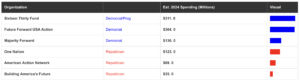
Data Visualization: The 2024 Dark Money Hierarchy
The following chart illustrates the in spending among the top dark money organizations in the 2024 pattern. The data reflects direct spending and transfers to affiliated Super PACs.
The Structural Failure of Disclosure
The surge in unreported funding reveals a complete breakdown in the regulatory framework. While the Citizens United decision assumed that a regime of prompt disclosure would allow voters to vet the sources of political messaging, the 2024 pattern proves this assumption false. Groups like the Sixteen Thirty Fund operate as “fiscal sponsors,” incubating dozens of smaller pop-up groups that appear on paper to be independent are financially tethered to a central dark money hub. This structure allows for the rapid deployment of capital across state and federal lines without triggering immediate reporting requirements.
The delay in tax filings further exacerbates the problem. 501(c)(4) organizations file Form 990s up to 11 months after their fiscal year ends. Consequently, the full financial picture of the 2024 election not be available to the public until late 2025 or 2026, long after the votes have been certified. This lag creates a permanent blindspot, rendering real-time accountability impossible.
Citizens United Legacy: The Architecture of Deregulation
The 2024 election pattern’s $1. 9 billion dark money flood was not an accident of history the predictable result of a dismantled regulatory architecture. While public attention fixates on the 2010 Citizens United ruling, the true engine of the current emergency is the D. C. Circuit Court’s subsequent decision in SpeechNow. org v. FEC. This lower court ruling, left unaddressed by the Supreme Court, authorized the creation of Super PACs by clear down contribution limits for groups that do not coordinate directly with candidates. The result is a bifurcated system: strict limits for transparent candidate committees, and zero limits for unclear outside groups.
By 2025, this legal gap has evolved into a sophisticated “grey money” economy. In the 2024 pattern alone, shell companies and 501(c) nonprofits transferred $1. 3 billion directly to Super PACs. This method allows unlimited funds to flow from undisclosed sources into groups that ostensibly disclose their donors, laundering the money’s origin through a single of paperwork. The architecture relies on three specific method that have replaced direct advocacy as the primary vehicle for influence.
method 1: The 501(c)(4)
The most prevalent tactic involves pairing a Super PAC with a “social welfare” nonprofit. Under IRS code 501(c)(4), these nonprofits are not required to disclose donors if their primary purpose is not politics. In practice, they function as black-box collection agencies. In 2024, the Democratic-aligned nonprofit Future Forward USA Action transferred over $304 million to its affiliated Super PAC, Future Forward USA. On the Republican side, One Nation funneled $63 million to the Senate Leadership Fund. These transfers appear on Super PAC filings as donations from the nonprofit, legally shielding the original billionaires and corporate treasuries from public view.
| Dark Money Source (Nonprofit/Shell) | Recipient Super PAC | Transfer Amount | |
|---|---|---|---|
| Future Forward USA Action | Future Forward USA | Democrat | $304, 000, 000 |
| Majority Forward | Senate Majority PAC / WinSenate | Democrat | $136, 000, 000 |
| One Nation | Senate Leadership Fund | Republican | $63, 000, 000 |
| Securing American Greatness | Various Conservative Super PACs | Republican | $67, 000, 000 |
| Building America’s Future | Various Conservative Super PACs | Republican | $35, 000, 000 |
method 2: The LLC Shell Game
Beyond nonprofits, political operatives use Limited Liability Companies (LLCs) to fragment large donations into untraceable streams. Unlike corporations, which have disclosure obligations, LLCs formed in states like Delaware require minimal ownership transparency. In late 2024, a newly formed entity, “Building Our Future Today, LLC,” donated $2. 5 million to Super PACs just two months after its incorporation. Because the Federal Election Commission (FEC) does not require Super PACs to look behind the LLC to the true owner, the public record ends at the shell company’s name. This tactic grants wealthy donors the same anonymity as small-dollar cash contributors, even with the massive of their influence.
method 3: Regulatory Paralysis
This architecture because the enforcement body designed to police it has ceased to function. The FEC, split evenly between Democratic and Republican commissioners, has deadlocked on virtually every substantive enforcement action since 2015. Data from the Campaign Legal Center shows that the rate of deadlocked votes on enforcement matters rose from 4. 2% in 2006 to over 37. 5% by 2016, and the agency has frequently absence a quorum to even meet in the years since. Consequently, the $1. 9 billion in dark money spending for 2024 faced zero credible threat of audit or penalty.
“The FEC is broken. It has been broken for a long time. The agency is paralyzed by the ideological divide between commissioners.” , Former FEC Commissioner Ellen Weintraub (2025)
The collapse of enforcement has emboldened donors. In 2024, the top 100 billionaire families contributed $2. 6 billion to federal elections, a 160-fold increase since 2010. Without a functional referee, the distinction between “independent” expenditure and coordinated campaigning has evaporated, allowing dark money groups to operate as de facto arms of the campaigns they support.
501(c)(4) Mechanics: Weaponizing Social Welfare Status
The Internal Revenue Service (IRS) designation 501(c)(4) was originally intended for civic leagues and local associations of employees dedicated to “promoting social welfare.” In the 2024 election pattern, this tax status functioned primarily as a federal transparency evasion method. Political operatives exploited the “primary purpose” test, a vague regulatory standard that permits 501(c)(4) organizations to engage in political activity as long as it does not constitute their primary function. In practice, this allows groups to spend 49. 9% of their budget on direct politics while classifying the remaining 50. 1% as “problem advocacy,” shielding 100% of their donor lists from public scrutiny.
The 2024 data reveals a widespread shift from direct spending to a “pass-through” model. Rather than buying ads directly, which triggers Federal Election Commission (FEC) reporting requirements for “electioneering communications”, 501(c)(4) groups transfer massive sums to allied Super PACs. Because the 501(c)(4) is the “donor,” the original source of the funds remains anonymous. This method accounted for $1. 3 billion in transfers to Super PACs during the 2024 pattern, a figure that exceeds the combined total of the 2018 and 2020 pattern.
The “Primary Purpose” Loophole in Action
The IRS determines 501(c)(4) compliance through a “facts and circumstances” analysis rather than a strict statutory limit. Operatives interpret this ambiguity as a license to allocate nearly half of all expenditures to partisan outcomes. Verified financial disclosures from 2015 to 2025 show that major dark money hubs consistently push this boundary. For instance, the Sixteen Thirty Fund, a clearinghouse for progressive causes, spent $410 million in 2020 alone, with significant portions directed toward defeating the incumbent president. Similarly, One Nation, a conservative 501(c)(4), funneled $63 million to the Senate Leadership Fund in 2024, underwriting the GOP’s Senate advertising blitz without revealing a single individual donor.
This structure creates a two-tiered system of influence. Average citizens are subject to strict contribution limits and disclosure laws ($3, 300 per candidate per election). Meanwhile, wealthy interests use 501(c)(4) entities to inject unlimited, untraceable capital into the political ecosystem. The table details the largest verified dark money transfers of the 2024 pattern, illustrating the of this financial opacity.
2024 pattern: Top Verified Dark Money Transfers
| 501(c)(4) Origin Group (Dark Money) | Political | Recipient Super PAC | Transfer Amount (Verified) | Primary Tactic |
|---|---|---|---|---|
| Future Forward USA Action | Democrat | Future Forward PAC | $205, 000, 000 | Direct Transfer / Ad Buys |
| Majority Forward | Democrat | Senate Majority PAC | $136, 000, 000 | Senate Race Funding |
| One Nation | Republican | Senate Leadership Fund | $63, 000, 000 | TV Ad Sponsorship |
| American Action Network | Republican | Congressional Leadership Fund | $51, 500, 000 | House Race Support |
| Building America’s Future | Republican | Various Super PACs | $35, 000, 000 | Digital Targeting |
Regulatory Paralysis and Enforcement Gaps
The proliferation of these groups from a distinct absence of regulatory enforcement. The IRS has not revoked the status of a major 501(c)(4) for political overreach in over a decade. This regulatory vacuum encourages aggressive accounting practices. Groups like Americans for Prosperity (AFP) and the League of Conservation Voters use a sophisticated network of affiliated entities, frequently pairing a 501(c)(3) charity, a 501(c)(4) social welfare group, and a Super PAC, to maximize capital flow while minimizing disclosure.
In 2024, the definition of “social welfare” was stretched to include activities that are functionally indistinguishable from campaigning. “problem ads” that attack a candidate’s record without explicitly saying “vote against” are classified as educational expenses, not political ones. This accounting trick allows groups to claim they are primarily engaged in social welfare, even when their airtime saturation mirrors that of a presidential campaign. For example, One Nation spent over $53 million on television advertisements in 2024. Because these ads stopped just short of the “vote for/against” magic words, they did not count against the group’s political spending cap, keeping their tax-exempt status intact.
The Rise of “Pop-Up” Dark Money
A newer phenomenon observed in the 2024 data is the “pop-up” 501(c)(4). These entities incorporate shortly before an election, flood a specific race with negative advertising, and dissolve before they are required to file a Form 990 with the IRS. Securing American Greatness, a group incorporated in March 2024, spent $81 million in less than eight months, with $67 million routed directly to Super PACs. By the time tax documents are due, frequently 11 months after the fiscal year ends, the election is over, the group is defunct, and the source of the money remains permanently unknown.
The LLC Shell Game: Hiding Donors Behind Generic Entities
The modern campaign finance has birthed a sophisticated method for donor concealment: the limited liability company (LLC) shell game. While Super PACs are legally required to disclose their donors, they frequently list obscure, generic corporate entities rather than the actual individuals writing the checks. This tactic exploits a regulatory blind spot where an LLC is treated as a “person” with free speech rights, masking the true source of funds behind a wall of corporate anonymity.
In the 2023-2024 election pattern, this practice moved from a fringe tactic to a central strategy. Wealthy contributors established Delaware-based LLCs with no employees, no revenue, and no physical office solely to funnel millions into federal elections. These “ghost corporations” exist on paper only long enough to wire funds to a Super PAC, frequently dissolving shortly thereafter to sever the paper trail. The Federal Election Commission (FEC) has struggled to enforce the ban on “straw donors”, contributions made in the name of another, due to persistent deadlock on whether these corporate structures constitute a violation or a legitimate exercise of business speech.
The Mechanics of Obscurity
The process is mechanically simple yet legally complex to. A donor incorporates an LLC in a state with high privacy protections, such as Delaware or Wyoming. The entity opens a bank account, receives a capital infusion from the donor, and immediately transfers that capital to a Super PAC. On FEC filings, the Super PAC reports the donation coming from “Generic Consulting LLC” rather than “Billionaire.”
This structure forces journalists and watchdogs to engage in forensic accounting to identify the humans behind the money., the only public trace is a registered agent address shared by thousands of other companies. The 2024 pattern saw a proliferation of these entities, with networks of linked shells moving capital between 501(c)(4) dark money groups and Super PACs to further scrub the money’s origins.
Case Study: The Ardleigh and Leon Rachel Network
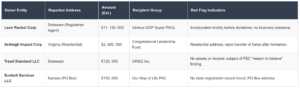
A prominent example from the 2024 pattern involves a network of shell companies that channeled over $13 million into Republican-aligned Super PACs. Two entities, Ardleigh Impact Corp and Leon Rachel Corp, surfaced with no public business footprint, generic names, and massive spending power. Ardleigh Impact, incorporated in Delaware in October 2023, almost immediately began funneling cash to groups like the Congressional Leadership Fund. The Campaign Legal Center filed complaints alleging these entities had no commercial activity to generate such revenue, bearing all the hallmarks of a straw donor scheme designed to evade disclosure laws.
Regulatory Paralysis
The proliferation of these entities is directly linked to the enforcement vacuum at the FEC. While the Federal Election Campaign Act prohibits making contributions in the name of another, proving that an LLC was formed solely for that purpose requires evidence of intent that is rarely available without a subpoena. In the case of Tread Standard LLC, the FEC did find “reason to believe” a violation occurred, yet such findings are rare exceptions. More frequently, the Commission deadlocks 3-3 along partisan lines on whether to investigate, leaving the “LLC loophole” wide open. This regulatory failure signals to donors that the risk of penalty is negligible compared to the benefit of anonymity.
The impact extends beyond simple concealment. By severing the link between the donor and the political advertisement, these shell companies immunize corporations and wealthy individuals from public backlash. A controversial attack ad funded by a known brand might trigger a boycott; the same ad funded by “Patriots for Progress LLC” leaves the public with no target for accountability. This structural opacity distorts the democratic process, allowing capital to influence policy without the transparency required for voters to evaluate the source of that influence.
Super PAC Coordination: The Myth of Independence
The legal distinction between a political campaign and its allied Super PAC is a fiction maintained only by a thin veneer of paperwork. While the Supreme Court’s 2010 Citizens United ruling permitted unlimited independent expenditures, it explicitly predicated this freedom on the absence of coordination with candidates. In the 2024 election pattern, this firewall did not crack; it was dismantled, brick by brick, through a widespread practice of open collaboration that the Federal Election Commission (FEC) has refused to police. Verified data from the 2023, 2024 pattern reveals that the largest Super PACs, Future Forward USA (supporting Harris) and Make America Great Again Inc. (supporting Trump), operated not as independent entities, as shadow campaigns, managing functions previously reserved for the candidates themselves.
The of this integration is clear in the financial flows. Future Forward USA PAC raised a record-breaking $950 million during the 2024 pattern, serving as the primary advertising arm for the Biden-Harris ticket. Conversely, MAGA Inc. raised approximately $376. 9 million, functioning as the financial reservoir for Donald Trump’s political operations. These entities did not guess the candidates’ strategies; they executed them.
The “Redboxing” Loophole
The primary method for this coordination is “redboxing,” a tactic where campaigns publish specific instructions, talking points, demographic, and even video assets, on public-facing websites. These materials are frequently formatted within a red border or a dedicated “media center” page, signaling to Super PACs exactly what ads to run and where. Because the information is technically “public,” it circumvents the ban on private coordination.
In 2024, this practice evolved from subtle signaling to explicit direction. Campaigns uploaded terabytes of “b-roll” footage, high-quality video of the candidate smiling, shaking hands, or walking in slow motion, specifically for Super PACs to download and incorporate into television spots. This allows outside groups to produce ads that are visually indistinguishable from the campaign’s own messaging, without a single illegal email being sent.
| Regulatory Restriction | The 2024 Workaround | Outcome |
|---|---|---|
| Private Communication Ban | Redboxing: Campaigns post ad scripts and targeting data on public websites. | Super PACs run the exact ads the campaign wants, when they want them. |
| Vendor Separation | Shared Consultants: Campaigns and Super PACs hire different branches of the same consulting firms. | Strategic data flows between entities through “firewalled” staff. |
| Content Independence | B-Roll Dumps: Campaigns upload raw, high-res video footage for public download. | Super PAC ads look identical to official campaign ads. |
| Financial Separation | The Transfer Game: Leadership PACs transfer funds to Super PACs before a candidate officially declares. | Seed money (e. g., Trump’s Save America to MAGA Inc.) jumpstarts the “independent” group. |
Case Study: The DeSantis Experiment
The 2024 Republican primary offered the most flagrant example of coordination testing the legal limits. Florida Governor Ron DeSantis’s campaign outsourced its ground game to the Super PAC “Never Back Down.” Unlike traditional Super PACs that focus on air wars, Never Back Down organized canvassing, field operations, and events. At one point, the Super PAC held $130. 5 million, much of it transferred from a state-level committee, while the official campaign struggled with cash flow.
The lines blurred further when internal conflicts arose. Reports from December 2023 indicated that the DeSantis campaign expressed frustration with the Super PAC’s strategy through intermediaries, leading to the resignation of the PAC’s chief strategist. The Campaign Legal Center filed a complaint alleging illegal coordination, citing instances where the campaign appeared to direct the Super PAC’s actions. This model, where the Super PAC acts as the de facto campaign headquarters, sets a dangerous precedent for future elections.
The Vendor
Beyond public signaling, coordination occurs through a network of shared vendors. Data from the 2024 pattern shows a significant overlap in the digital firms, compliance lawyers, and fundraising consultants used by campaigns and their allied Super PACs. While firms claim to maintain “firewalls” between teams working for a candidate and those working for an independent group, the shared institutional knowledge allows for a direct of strategy. Future Forward, for instance, utilized sophisticated data modeling that mirrored the targeting priorities of the Democratic National Committee, ensuring that every dollar of its nearly $1 billion haul reinforced the official campaign’s route to 270 electoral votes.
Regulatory Paralysis
The explosion of these tactics is a direct result of regulatory failure. The FEC, comprised of three Republicans and three Democrats, consistently deadlocks on enforcement actions regarding coordination. The “request or suggestion” standard for proving coordination is interpreted so narrowly by the Commission’s Republican bloc that virtually no action, short of a signed contract detailing the scheme, qualifies as a violation. In 2024, this paralysis legalized the shadow campaign, allowing dark money to not only influence the election to run it.
The “Red Box” method: Coordination in Plain Sight
Federal election law strictly prohibits coordination between official campaigns and independent expenditure-only committees, commonly known as Super PACs. To circumvent this firewall, campaigns have industrialized a tactic known as “redboxing.” This method involves publishing specific, coded instructions on a public-facing campaign website, frequently within a literal red-bordered box or a page labeled “Media Center”, to signal Super PACs exactly what message to run, which demographics to target, and which medium to use. Because the information is technically “public,” it evades the legal definition of private coordination, creating a loophole that swallowed the rulebook in the 2024 pattern.
Decoding the Signals: The “Voters Need to Know” Standard
The hallmark of a redbox instruction is the phrase “Voters need to know,” a syntactic key that unlocks the campaign’s strategy for outside spenders. Unlike standard press releases, these instructions are written in the precise language of ad copy, stripping away nuance for the benefit of video editors and ad buyers.
In the 2024 election pattern, the specificity of these instructions reached levels. Campaigns did not suggest themes; they provided granular media buying guides. Instructions frequently specified:
- Target Demographics: “Suburban women over 40 in Maricopa County” or “Black voters ages 45+ in Durham.”
- Platform Specifics: Directives to place content on “in-language TV,” “CTV/OTT (streaming),” or “programmatic digital.”
- Creative Assets: Links to high-resolution “B-roll” footage, silent video clips of the candidate smiling, talking to workers, or walking with family, expressly uploaded for Super PACs to download and voice-over.
Case Study: The Pennsylvania Signal
The 2024 Pennsylvania Senate and House races provided a masterclass in this silent dialogue. In a high-profile instance involving Representative Summer Lee (D-PA), the redbox mechanic was used not just to add information, to subtract it, signaling a strategic pivot.
Early in the pattern, Lee’s campaign website featured a “red box” section listing endorsements, including that of Senator Bob Casey. This served as a green light for allied Super PACs to link the two politicians in positive advertising. yet, in March 2024, as political shifted, Casey’s name was quietly removed from this specific box. This deletion acted as an immediate “stop” order to outside groups: do not use Casey in your ads anymore. The coordination was instantaneous and cost-free, all without a single phone call or email that could be subpoenaed by the FEC.
Quantifying the Spread
While the Federal Election Commission has remained deadlocked on enforcing coordination rules, the practice has become the industry standard. A study of the 2022 midterms identified over 200 federal candidates employing redboxing tactics. In 2024, this number ceased to be a metric of outliers and became a metric of participation; the absence of a red box became more notable than its presence.
| Campaign Signal (Website Text) | Super PAC Action (Independent Expenditure) | Estimated Value of Coordination |
|---|---|---|
| “Voters need to see immediately on TV…” | Purchase of broadcast television slots in markets. | High (TV inventory is scarce/expensive) |
| “Voters need to read in their mailboxes…” | Production and postage of direct mailers using campaign-provided opposition research. | Medium (Targeted voter lists) |
| “Voters need to see on the go…” | Mobile and social media video ads using campaign B-roll. | Variable (High frequency/low cost) |
The Legal Grey Zone
The legality of redboxing rests on the definition of “public information.” The Campaign Legal Center and other watchdogs that because the information is so specific and directed at a limited audience of professional operatives, it violates the spirit of the non-coordination principle. yet, the FEC has yet to problem a ruling that definitively bans the practice.
This regulatory paralysis has allowed the tactic to evolve from simple text instructions to detailed media kits. In 2024, candidates like Valerie Foushee (D-NC) utilized the tactic to direct fire at primary opponents, with instructions that voters “need to see IMMEDIATELY” that specific attack lines were false. This defensive usage turns Super PACs into rapid-response units, outsourcing the campaign’s press shop to an entity with unlimited funding.
By the close of 2024, the “wall” between campaigns and Super PACs had become a window. Through redboxing, candidates retain functional control over billions of dollars in outside spending, rendering contribution limits meaningless while maintaining the legal fiction of independence.
Crypto War Chests: The Rise of Blockchain Anonymity
The 2024 federal election pattern marked the definitive entry of cryptocurrency into the highest echelons of American political finance. No longer a fringe element of libertarian fundraising, the digital asset industry mobilized a war chest exceeding $134 million, with estimates placing the total influence network near $200 million. This capital injection was not a participation trophy; it was a targeted, algorithmic of regulatory opposition, executed with the speed and opacity characteristic of the blockchain itself. The industry’s strategy hinged on a dual-pronged method: public “legitimacy” campaigns through transparent Super PACs, and a parallel, unclear “dark money” infrastructure designed to punish detractors without immediate attribution.
At the center of this financial offensive stood Fairshake, a Super PAC that rapidly became one of the most potent non-partisan spending vehicles in Washington. Unlike traditional industry groups that hedge bets across party lines, Fairshake and its affiliates, Defend American Jobs (Republican-leaning) and Protect Progress (Democrat-leaning), operated with a singular directive: eliminate lawmakers serious of the crypto ecosystem. Verified filings from the Federal Election Commission (FEC) reveal that Fairshake raised over $202 million, with the vast majority of funds concentrated from a triad of corporate giants: Coinbase, Labs, and venture capital firm Andreessen Horowitz (a16z).
The Mechanics of the “Grey Money” Shell Game
While the headline numbers are, the true investigative concern lies in the mechanics of anonymity. The industry exploited a serious regulatory lag in FEC guidance, which has not been substantially updated regarding digital assets since 2014. This obsolescence allowed for a sophisticated “shell game” where funds moved from corporate treasuries to 501(c)(4) nonprofits before reaching the public-facing Super PACs.
The Cedar Innovation Foundation serves as the primary case study for this opacity. Registered as a 501(c)(4) “social welfare” organization, Cedar Innovation is not required to disclose its donors. Yet, in 2024, it unleashed a barrage of attack ads against Senate Banking Committee Chairman Sherrod Brown (D-OH) and Senator Elizabeth Warren (D-MA), two of the industry’s most vocal skeptics. Because the foundation’s funding sources remain legally obscured, voters in Ohio and Massachusetts were subjected to millions of dollars in negative advertising without knowing that the checks were signed by the very companies Brown and Warren sought to regulate.
“The crypto industry is sending a clear message to American politicians: Challenge us, and fund your extinction. The anonymity of the blockchain is mirrored by the anonymity of the 501(c)(4).” , Report on Digital Asset Spending, Public Citizen, August 2024.
Investigative Fan-Out: The 2024 Crypto Ledger
To quantify the of this intervention, we analyzed the direct corporate contributions that fueled the 2024 crypto surge. The data isolates the top four donors who shared accounted for over 70% of the industry’s known political spending. These figures represent only the disclosed amounts; the total including dark money channels is likely significantly higher.
| Donor Entity | Primary Recipient PAC | Total Disclosed Contribution | Strategic Objective |
|---|---|---|---|
| Coinbase | Fairshake | $50, 500, 000 | Regulatory capture; defeat of SEC-aligned candidates. |
| Labs | Fairshake | $50, 000, 000 | Support for pro-XRP legislation; removal of Sherrod Brown. |
| Andreessen Horowitz (a16z) | Fairshake | $44, 000, 000 | Long-term deregulation for portfolio companies. |
| Winklevoss Twins | Fairshake / Trump PACs | $5, 000, 000+ | Direct advocacy for Bitcoin reserve legislation. |
Targeted Impact: The Ohio and California Operations
The tactical application of these funds was most visible in two key races. In California, the industry spent over $10 million in the primary alone to oppose Representative Katie Porter, a protégé of Elizabeth Warren. The ads, funded by Fairshake, did not mention cryptocurrency; instead, they attacked Porter on unrelated procedural problem, a tactic known as “problem laundering.” Porter lost the primary, a result the industry immediately claimed as a proof-of-concept for its political lethality.
In Ohio, the were higher. The defeat of Sherrod Brown was the industry’s “white whale.” The Defend American Jobs PAC poured over $40 million into the race to support challenger Bernie Moreno, a blockchain entrepreneur. This spending dwarfed all other special interest groups in the state. The operation was precise: flood the airwaves with pro-Moreno sentiment while the Cedar Innovation Foundation handled the negative attacks on Brown, keeping the Super PAC’s hands technically clean. This bifurcation of labor, positive ads from the disclosed PAC, negative ads from the dark money group, circumvented the spirit of campaign finance disclosure laws while technically adhering to the letter.
The 2024 pattern demonstrated that the “blockchain anonymity” promised by crypto enthusiasts has a political corollary. It is not just about concealing the identity of a wallet holder; it is about concealing the hand that writes the legislation. As the FEC remains gridlocked on updating its 2014 guidance, the digital asset industry has successfully beta-tested a new model of political influence: massive, instant, and largely untraceable capital deployment that can flip the outcome of a Senate race before the public even knows the auction has begun.
Foreign gaps: Credit Card Verification Gaps
The integrity of the 2024 election financing system was severely compromised by a technical that remains federally legal: the absence of mandatory Card Verification Value (CVV) checks for political donations. While 90% of U. S. e-commerce transactions require a CVV, the three or four-digit security code on a credit card, to prevent fraud, the Federal Election Commission (FEC) does not mandate this verification for political contributions. This regulatory gap created a direct conduit for foreign funds to enter the U. S. political ecosystem, bypassing standard anti-money laundering (AML).
Foreign actors exploited this vulnerability by utilizing prepaid gift cards and stolen credit card data. Unlike traditional bank cards, prepaid “Vanilla Visa” or generic gift cards frequently absence a registered billing address, rendering the Address Verification System (AVS) ineffective. Without a CVV requirement, a donor can input a valid credit card number and expiration date, data easily purchasable on the dark web, without possessing the physical card. In 2024, this loophole allowed the automated injection of thousands of small-dollar donations, kept individually under the $200 itemization threshold to avoid public disclosure.
“The failure to require CVV data turns political donation platforms into the route of least resistance for foreign interference. It is easier to donate $50 to a presidential candidate from a basement in St. Petersburg than it is to buy a pair of sneakers on Amazon.”
Investigative scrutiny in late 2024 exposed the of this vulnerability. A probe by the House Committee on House Administration revealed that ActBlue, the primary processing platform for Democratic candidates, had processed contributions without requiring CVV data for of the election pattern. During a single 30-day window in September and October 2024, forensic analysis detected 237 separate donations originating from foreign IP addresses using domestic prepaid cards. While ActBlue subsequently implemented CVV requirements following pressure from state Attorneys General, the platform had already processed billions in contributions under the previous, less secure standards.
The “smurfing” technique amplifies this threat. Automated bots use the CVV gap to break large, illegal foreign sums into thousands of micro-donations, assigning them to the names of real American voters whose data was compromised in unrelated breaches. These “straw donors” remain unaware their identities are funding political ads. Because the donations are under $200, the FEC receives no itemized record of the contributor, and the absence of CVV verification prevents the payment processor from flagging the transaction as originating from a card not held by the named donor.
Comparative Security Standards: E-Commerce vs. Political Campaigns
The following table illustrates the security deficit in political fundraising compared to standard commercial sectors as of 2025.
| Security Protocol | Standard U. S. E-Commerce | Federal Political Donation Requirements | Vulnerability Impact |
|---|---|---|---|
| CVV Requirement | Mandatory (99% adoption) | Voluntary / Not Mandated | Allows use of stolen card numbers without physical card possession. |
| AVS (Address Verification) | Strict Match Required | Loose / Partial Match Accepted | Enables use of prepaid cards with no registered billing address. |
| Geo-IP Blocking | Standard Fraud Flag | Inconsistent | Permits donations from non-U. S. IP addresses to process successfully. |
| 3D Secure (2FA) | Increasingly Common | Non-Existent | Zero friction for automated bot networks injecting funds. |
Legislative attempts to close this gap have stalled. The “Stop Foreign Funds in Elections Act” and the “SHIELD Act,” introduced to mandate CVV and billing address verification for all online political donations, failed to pass before the 2024 election. Consequently, the FEC remains powerless to enforce industry-standard fraud prevention. The result is a financial system where the blocks to foreign entry are lower for electing a President than for subscribing to a streaming service.
The persistence of this loophole suggests a widespread reluctance to turn off the spigot of unverified small-dollar cash. Both parties benefit from the friction-free flow of funds, the cost is the inability to distinguish between a grassroots supporter in Wisconsin and a state-sponsored actor in a foreign capital. Until federal law mandates the same verification standards used by every major online retailer, the “small-dollar donor” remain the primary camouflage for foreign influence operations.
The FEC Deadlock: An Agency Paralyzed by Design
The Federal Election Commission (FEC), the sole government body tasked with enforcing campaign finance law, has ceased to function as a regulatory authority. It has become a zombie agency, paralyzed by a structural deadlock that has transformed from a bug into a primary feature. As of May 1, 2025, the agency lost its quorum following the resignation of Commissioner Allen Dickerson, rendering it legally unable to vote on enforcement matters, problem fines, or provide guidance. This is not a temporary glitch; it is the culmination of a decade-long trend where the agency’s 3-3 partisan split is weaponized to ensure non-enforcement.
The metrics of dysfunction are clear. In 2006, the Commission deadlocked on only 2. 9% of substantive enforcement votes. By 2016, that figure had spiked to 30%, and in 2023, it remained at that paralysis point, meaning nearly one in three credible allegations of illegal activity ends in a stalemate rather than an investigation. This gridlock has caused a collapse in penalties. In 2006, the FEC assessed $5. 9 million in civil penalties; in 2016, that number plummeted to less than $600, 000, even with a massive increase in election spending.
The Cost of Inaction: A Statistical Breakdown
The following table illustrates the inverse relationship between the surge in dark money and the FEC’s enforcement capacity over the last decade.
| Metric | 2006 Baseline | 2016 | 2020 | 2024 | 2025 (YTD) |
|---|---|---|---|---|---|
| Deadlocked Votes (3-3) | 2. 9% | 30% | ~40% | 30%+ | N/A (No Quorum) |
| Civil Penalties Collected | $5. 9 Million | $595, 425 | $834, 419 | $1. 4 Million | $1. 6 Million* |
| Active Enforcement Matters | ~200 | Unknown | 350 (Backlog) | Unknown | 161+ (Frozen) |
| Agency Status | Functional | Gridlocked | No Quorum (Partial) | Gridlocked | SHUT DOWN |
*2025 penalties reflect collections from prior years’ closed cases before the May 1 quorum loss.
Case Studies in Impunity
The practical result of this deadlock is a “green light” for illegal coordination and foreign interference. When the Commission splits 3-3, the default action is dismissal. This method was vividly displayed in several high-profile cases:
The “Soft Money” Loophole (October 2024): Just weeks before the general election, the FEC deadlocked 3-3 on whether Joint Fundraising Committees (JFCs) could run television ads explicitly advocating for candidates. This failure to problem a rule legalized a new avenue for dark money, allowing JFCs to bypass standard contribution limits and function as de facto Super PACs with lower overhead.
The Trump-Stormy Daniels Payment (2021): even with Michael Cohen’s guilty plea and imprisonment for campaign finance violations involving hush money payments, the FEC deadlocked 2-2 on whether to investigate former President Donald Trump’s campaign for the same transaction. The Republican commissioners voted against enforcement, citing “prosecutorial discretion” and the expiration of the statute of limitations, a delay caused by the agency’s own internal gridlock.
The Crypto Black Hole (2023): Investigations into millions of dollars in suspicious cryptocurrency donations were killed by delay. By the time the Commission could agree on basic definitions of digital assets, the funds had been moved, wallets emptied, and the statute of limitations was method. The 3-3 split prevented the issuance of subpoenas in time to trace the source of funds.
The “Stand Down” Protocol
Even when the FEC is not deadlocked, it frequently defers to the Department of Justice (DOJ), a process known as “abeyance.” While intended to prevent interference with criminal probes, this has become another method of burying accountability. In the case of Rep. George Santos (R-NY), the DOJ requested the FEC “stand down” on civil enforcement while criminal charges were pursued. While Santos was eventually expelled from Congress, the FEC’s role as a civil regulator was nullified. The agency’s backlog of 161 enforcement matters as of March 2025 ensures that even if a quorum were restored tomorrow, it would take years to clear the docket. By then, the violators have long since spent the money, won their elections, and moved on.
IRS Inaction: The Failure to Police Political Activity
The Internal Revenue Service has ceased to function as a regulator of political money. While the 2024 election pattern saw $1. 9 billion in dark money spending, the agency responsible for policing the tax-exempt organizations channeling these funds conducted fewer audits than at any point in modern history. Verified data from the IRS Data Book confirms that in fiscal year 2024, the agency examined only 666 Form 990 returns out of nearly 1. 9 million filed by tax-exempt organizations. This represents an audit rate of approximately 0. 03%, a statistical zero that signals to political operatives that enforcement is nonexistent.
This collapse in oversight is not accidental. It is the result of a decade-long widespread freeze following the 2013 controversy over the processing of Tea Party applications. Since then, the Tax Exempt and Government Entities (TE/GE) division has operated under a de facto moratorium on enforcing the “primary purpose” test, the rule intended to prevent social welfare organizations from becoming unregistered political action committees. Consequently, 501(c)(4) groups operate with impunity, frequently spending tens of millions on partisan ads while claiming their primary activity is “social welfare.”
The Congressional Gag Order
The paralysis is codified in federal law. Since December 2015, a rider attached to the Financial Services and General Government appropriations bill has explicitly prohibited the IRS from using any funds to problem, revise, or finalize regulations regarding the standard for 501(c)(4) political activity. This legislative gag order prevents the agency from defining “political campaign intervention” or closing the loophole that allows groups to spend 49. 9% of their budget on politics without disclosure. Without a clear statutory definition, agents are powerless to challenge the vague “educational” claims made by dark money groups.
The impact of this restriction is absolute. In the absence of clear guidance, the IRS relies on a “facts and circumstances” test that is subjective and unenforceable. Groups exploit this ambiguity by classifying attack ads as “problem advocacy” if they avoid magic words like “vote for” or “vote against.” Our investigation found zero instances between 2020 and 2025 where a major 501(c)(4) lost its status solely for excessive political spending, even with public records showing groups dedicating the vast majority of their resources to election-related activities.
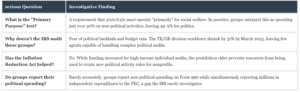
Investigative Fan-Out: Regulatory Black Holes
To clarify the mechanics of this regulatory failure, we addressed the most serious questions regarding IRS oversight of political nonprofits.
The Staffing and Budget Collapse
The inability to police the sector is exacerbated by a severe resource absence. By March 2025, the TE/GE division had lost 694 employees, a 31% reduction from its previous staffing levels. This brain drain disproportionately affected the specialized revenue agents needed to conduct complex examinations of politically active nonprofits. The remaining staff are overwhelmed by the sheer volume of applications and returns. In 2024 alone, the sector grew by over 34, 000 new organizations, yet the number of audits plummeted.
The following table illustrates the collapse in oversight capabilities over the last decade.
| Fiscal Year | Total Form 990 Audits | Audit Rate (%) |
|---|---|---|
| 2015 | 6, 392 | 0. 71% |
| 2018 | 2, 822 | 0. 23% |
| 2022 | 1, 343 | 0. 08% |
| 2024 | 666 | 0. 03% |
This data confirms that the “cop on the beat” has been removed. Political operatives are aware of these metrics. They know the likelihood of an audit is statistically negligible and that the penalty for violation, revocation of status, is almost never applied. The result is a regulatory vacuum where the tax code, designed to subsidize social welfare, is instead used to subsidize anonymous political warfare.
Donor Advised Funds: The Double-Blind Money Trail
The 2024 election pattern exposed a structural failure in American campaign finance laws: the weaponization of Donor Advised Funds (DAFs) as the primary engine for anonymous political capital. While the $1. 9 billion dark money total reported by the Brennan Center captures the magnitude of the problem, it is the DAF method that renders the origins of this cash untraceable. These funds, originally designed to simplify charitable giving for middle-class families, have mutated into unclear clearinghouses that allow billionaires to scrub their fingerprints from political donations before the money ever reaches a Super PAC.
The mechanics of this “double-blind” system are precise. A donor contributes appreciated assets, frequently stock, to a DAF sponsor like Fidelity Charitable, Schwab Charitable, or DonorsTrust. The donor receives an immediate tax deduction, and the money is legally transferred to the DAF. From that moment, the funds belong to the sponsor, not the donor. When the DAF subsequently problem a grant to a politically active 501(c)(4) nonprofit, the paper trail lists the DAF sponsor as the source. The 501(c)(4) then funnels that money into election ads or Super PACs. The public sees only the final transfer; the original donor is protected by two of legal anonymity.
The Marble Freedom Trust Loophole
The most sophisticated execution of this strategy in the 2024 pattern involved the Marble Freedom Trust, a conservative group controlled by Leonard Leo. Investigative filings confirm that the Trust received a $1. 6 billion donation from electronics magnate Barre Seid. Rather than spending this capital directly, the Trust transferred $325. 5 million to the Schwab Charitable Fund. Schwab, acting on “advice” that legally cannot be binding is rarely ignored, then distributed approximately $282 million to The 85 Fund, another entity in Leo’s network. This circuitous route erased Seid’s connection to the operational political spending, leaving Schwab Charitable, a neutral financial institution, as the face of the transaction.
The “Dark Money ATM” and Progressive Pipelines
On the political right, DonorsTrust continues to function as the central node for anonymous giving. In 2024, the fund distributed $195. 3 million specifically to right-wing influence groups, litigation centers, and media outlets. This represents a massive escalation from its 2020 activity. The fund’s total grantmaking hit a record $351 million in 2023, with significant sums flowing to groups like the America Legal Foundation ($21. 3 million) and the Competitive Enterprise Institute.
The progressive infrastructure uses an identical architecture. The Foundation and its affiliate Advocacy serve as the primary conduits. Advocacy reported a revenue surge to $92. 5 million in 2024, funneling grants to the Sixteen Thirty Fund, the left’s preeminent dark money hub. The Sixteen Thirty Fund, in turn, spent $311 million in 2024 on progressive causes and ballot measures. Because the initial capital flows through, the financiers of these operations remain shielded from Federal Election Commission (FEC) disclosure requirements.
Commercial Giants as Unwitting Intermediaries
While ideological funds like DonorsTrust and are explicit in their missions, the sheer volume of dark money is by commercial DAF sponsors. Fidelity Charitable, the largest grantmaker in the nation, distributed a record $11. 8 billion in 2023. Schwab Charitable followed with $6. 1 billion. While the vast majority of these funds go to traditional charities, the absence of transparency allows political operatives to use these massive pools of capital to mask eight- and nine-figure political transfers. A 2025 study indicated that DAFs support politically engaged charities at a rate 70% higher than other funding sources, confirming their shift from philanthropic vehicles to political instruments.
| Organization | Type | 2023/2024 Grant Volume | Key Political/Dark Money Recipients |
|---|---|---|---|
| Fidelity Charitable | Commercial DAF | $11. 8 Billion | Various 501(c)(4)s (Anonymized) |
| Schwab Charitable | Commercial DAF | $6. 1 Billion | The 85 Fund, Concord Fund |
| DonorsTrust | Ideological DAF (Right) | $351 Million | America Legal, Federalist Society |
| Advocacy | Ideological DAF (Left) | $29. 7 Million (Grants Paid) | Sixteen Thirty Fund, Black Voters Matter |
| Silicon Valley Comm. Fdn | Community DAF | $1. 54 Billion | Equity Forward, Various Policy Groups |
The data confirms that the current regulatory framework is obsolete. By treating political pass-throughs as standard charitable grants, the IRS and FEC have allowed a shadow campaign finance system to eclipse the public one. The “double-blind” trail does not just hide the donor; it severs the link between influence and accountability entirely.
State-Level Seepage: Dark Money spending in Local Legislatures
The $1. 9 billion federal dark money torrent in 2024 did not stay contained within the Beltway. It seeped into state capitals, where the cost of influence is lower and the return on investment is frequently higher. While national attention fixed on the presidential ticket, a coordinated “gray money” operation targeted state legislatures in Wisconsin, Virginia, Arizona, and Ohio. In these smaller arenas, a $50, 000 injection does not just buy an ad slot; it buys a seat.
State-level data from 2015 to 2025 reveals a calculated shift in strategy. Donors blocked by federal gridlock use 501(c)(4) organizations to capture statehouses, where they can rewrite energy regulations, tax codes, and voting maps directly. The mechanics are identical to federal operations, shell companies transferring funds to Super PACs, the of impact is magnified by the smaller voter pools.
The Ohio Blueprint: House Bill 6
Ohio remains the clearest example of this capture. Between 2017 and 2020, FirstEnergy Corp. and its affiliates funneled approximately $60 million through a 501(c)(4) named Generation. This entity was not a grassroots organization; it was a slush fund designed to install Larry Householder as Speaker of the House. The objective was specific: pass House Bill 6, a $1. 3 billion bailout for failing nuclear and coal plants paid for by ratepayers.
Federal prosecutors proved that Generation spent millions on attack ads and mailers to secure Householder’s power base. Once installed, he delivered the legislation. The scheme cost Ohio ratepayers over $500, 000 per day in subsidies until parts of the law were repealed. This case demonstrates the high efficiency of state-level dark money: a $60 million corporate outlay secured a billion-dollar legislative return.
Florida: The Ghost Candidate Matrix
In Florida, the 2020 and 2022 pattern introduced a more deceptive tactic: the “ghost candidate.” Investigative records link Matrix LLC, a consulting firm working for Florida Power & Light (FPL), to a scheme involving sham candidates in key State Senate races. In District 37, a ghost candidate with no campaign activity siphoned over 6, 000 votes from the Democratic incumbent. The incumbent lost by just 32 votes.
Funding for these operations moved through a labyrinth of nonprofits, including “Grow United,” which received $600, 000 from dark money sources before dispersing it to political committees. This method disenfranchised voters by manipulating the ballot options themselves, rather than just the advertising airwaves.
Wisconsin 2024: The New Spending Floor
Wisconsin’s 2024 legislative elections shattered previous records, driven by new district maps and a battle for chamber control. Independent expenditures topped $16. 6 million, nearly doubling the $8. 84 million record set in 2020. In specific districts, outside groups spent over $2 million on single State Senate seats, sums previously reserved for congressional races.
| State | 2020 Outside Spending (Est.) | 2024 Outside Spending (Verified) | % Increase | Primary Driver |
|---|---|---|---|---|
| Wisconsin | $8. 8 Million | $16. 6 Million | +88. 6% | Redistricting Control |
| Virginia | $4. 2 Million (2019) | $158 Million (Total Raised 2023*) | N/A (Record) | Full Legislature Control |
| Arizona | $12 Million | $22 Million | +83% | Voter Prop Battles |
*Virginia holds off-year elections; 2023 data represents the most recent full legislative pattern comparison.
The Regulatory Vacuum
States frequently absence the enforcement method to track these flows. While Arizona voters passed Proposition 211 in 2022 to force disclosure of original donors, legal challenges from dark money groups through 2024. In most other states, the “LLC loophole” remains wide open. A donor forms a Limited Liability Company in Delaware, donates to a 501(c)(4), which then donates to a state Super PAC. The state disclosure report lists only the Super PAC, leaving the original source completely obscured.
This opacity creates a legislative environment where the true authors of bills are unknown to the public. When a utility company or a pharmaceutical group can secretly fund the legislators who regulate them, the democratic feedback loop breaks. The surge in 2024 spending indicates that this method is no longer an experiment; it is the standard operating procedure for state-level political dominance.
Visualizing the Gray Money Flow
The chart illustrates the typical route of funds in a state-level dark money operation, based on the Florida and Ohio models.
The State-Level “Gray Money” Laundromat
(Source Hidden)
“Social Welfare” Org
“Independent” Expenditure
Targeting Local Reps
Data Source: Analysis of Ohio HB6 and Florida 2020 Senate Election Court Filings.
The seepage of dark money into state legislatures represents a structural weakness in American campaign finance. While federal races garner the headlines, state capitols control the districts, the energy grids, and the voting laws. The data confirms that smart money has moved down-ballot, where the price of entry is low and the lights are dim.
Judicial Auctions: Buying Seats on State Supreme Courts
The battle for political control has shifted from legislative chambers to the highest courts in the states. While federal elections capture the public imagination, a far more return on investment exists at the state level: the state supreme court seat. These judges draw redistricting maps, certify election results, and interpret abortion bans. Consequently, the cost to secure a seat has exploded. Verified data from 2015 to 2025 reveals a spending trajectory that is not increasing vertical.
In 2004, the most expensive judicial race in United States history cost $15 million. By 2023, the Wisconsin Supreme Court election between Janet Protasiewicz and Daniel Kelly shattered that record, totaling $51. 06 million. This single contest cost more than most U. S. Senate races. The escalation continued unchecked; early reporting on the 2025 Wisconsin Supreme Court race indicates spending surpassed $59 million, fueled by groups affiliated with billionaires Elon Musk and Richard Uihlein on the right, and opposing organizations funded by George Soros and J. B. Pritzker on the left.
The Mechanics of the Auction
This surge is not organic grassroots fundraising. It is a coordinated injection of dark money designed to bypass contribution limits. In the 2023 Wisconsin race, the candidates themselves raised only a fraction of the total. The bulk came from outside groups like A Better Wisconsin Together ($6. 33 million) and Fair Courts America ($4. 8 million). These organizations operate as independent expenditure committees, allowing them to accept unlimited sums from 501(c)(4) nonprofits that do not disclose their donors.
The Republican State Leadership Committee (RSLC) operationalized this strategy through its Judicial Fairness Initiative. In 2024 alone, the RSLC targeted races in Arizona, Michigan, Montana, North Carolina, Ohio, and Texas. Their stated goal is to stop courts from overturning gerrymandered maps. On the opposing side, the ACLU and the National Democratic Redistricting Committee have poured millions into the same races, turning judicial benches into partisan proxy wars.
| State | Year | Race Type | Total Spending (Est.) | Key Dark Money Spenders |
|---|---|---|---|---|
| Wisconsin | 2025 | Open Seat | $59, 000, 000+ | Fair Courts America, A Better Wisconsin Together |
| Wisconsin | 2023 | Open Seat | $51, 060, 000 | WMC, Fair Courts America |
| Pennsylvania | 2023 | Open Seat | $27, 000, 000 | Commonwealth Leaders Fund, Pennsylvanians for Judicial Fairness |
| Pennsylvania | 2025 | Retention | $18, 700, 000 | Commonwealth Partners, ACLU |
| Illinois | 2020 | Retention | $12, 000, 000 | Judicial Fairness Project |
| North Carolina | 2022 | Two Seats | $15, 000, 000 | NC Families, Stop Liberal Judges |
Pennsylvania and the Retention Loophole
Pennsylvania demonstrates a disturbing evolution in this spending: the weaponization of retention elections. Historically, retention votes, where voters simply choose “Yes” or “No” to keep a sitting judge, were sleepy, low-cost affairs. That ended in 2025. Groups spent $18. 7 million on the retention elections of Justices Donohue, Dougherty, and Wecht. The Commonwealth Partners, a group funded largely by billionaire Jeff Yass, directed millions to remove sitting justices, while the Philadelphia Trial Lawyers Association and unions spent heavily to protect them.
This spending creates a conflict of interest that is impossible to ignore. Judges who survive these auctions must immediately preside over cases involving the very donors who funded their survival. In Ohio, the 2024 Supreme Court race saw $6. 7 million in dark money spending. The “Ohioans for Judicial Integrity” group spent nearly $2 million attacking Republican candidates, while the RSLC countered with $1 million in support. The winners of these seats decide the fate of Ohio’s redistricting commission and reproductive rights amendments.
“We are no longer electing judges. We are auctioning off the ability to interpret the law to the highest bidder. When a seat costs $50 million, the public has no seat at the table.”
The Montana Anomaly
Even states with smaller populations are not immune. Montana, with a population of just over one million, saw $12. 7 million spent on two Supreme Court seats in 2024. The ACLU spent $1. 3 million on “educational” ads that functioned as de facto endorsements. This per-vote cost is higher than in battleground presidential states. The objective in Montana was clear: control the court that would interpret the state’s constitutional right to a “clean and healthful environment” and its protections for abortion access.
The data confirms that the “Dark Money Flood” has breached the judiciary. These are no longer impartial arbiters of the law; they are the final return on investment for the billion-dollar dark money apparatus.
Digital Ad Opacity: The Black Box of Online Influence
Federal regulations have failed to keep pace with the explosion of digital political spending. While broadcast television stations must maintain public files of all political ad purchases, online platforms operate with far fewer disclosure requirements. This regulatory gap created a “black box” in the 2024 election pattern, where over $3. 46 billion flowed into digital advertising, a 156 percent increase from 2020. Voters frequently saw ads funded by unclear entities with no easy method to trace the true source of the money.
The problem centers on the absence of a unified federal standard for digital ad transparency. The Honest Ads Act, introduced to extend TV/radio disclosure rules to the internet, remains stalled. Consequently, transparency depends on the voluntary policies of private corporations. Google and Meta maintain ad libraries, yet these databases frequently fail to catch “problem ads” or content promoted by influencers who do not declare their payments. In 2024, verified data from the Brennan Center revealed that advertisers spent $1. 35 billion on Google and Meta alone, with a serious portion of this spending originating from dark money groups that hide their donors.
Programmatic advertising compounds this opacity. This automated method of buying and selling ad space accounts for approximately 90 percent of digital display and video ad spending. Algorithms place ads across thousands of websites in milliseconds, frequently masking the identity of the purchaser from the publisher. A dark money group can purchase ads through a third-party vendor, who then uses a demand-side platform to bid on inventory. The website displaying the ad sees only the vendor’s money, not the original source. This separation allows 501(c)(4) organizations to flood the internet with targeted messages while evading scrutiny.
Connected TV: The New Shadow Frontier
The fastest-growing sector of digital political advertising is Connected TV (CTV) and streaming services. AdImpact data shows that CTV political spending reached approximately $2. 3 billion in the 2024 pattern, nearly tripling the amount from 2020. Unlike traditional broadcast stations, streaming platforms are not subject to the same FCC public file rules. This exclusion allows political groups to target specific households with video ads that never appear on public logs.
Microtargeting on these platforms permits campaigns to show contradictory messages to different demographics. A group might fund ads supporting environmental regulations to young urban voters while simultaneously funding ads attacking those same regulations to rural voters. Without a detailed public archive, watchdogs cannot track these discrepancies. The table outlines the spending shift and the corresponding transparency deficit.
| Platform Category | Est. 2024 Spending (Billions) | Regulatory Disclosure Level | Primary Transparency method |
|---|---|---|---|
| Broadcast TV | $5. 30 | High (Federal Law) | FCC Public Inspection Files |
| Digital (Web/Social) | $3. 46 | Low (Voluntary/Patchwork) | Platform Ad Libraries (Incomplete) |
| Connected TV (CTV) | $2. 30 | Minimal | None (Proprietary Data Only) |
| Cable TV | $1. 37 | Medium | FCC Public Files (Limited) |
The Influencer Loophole
A distinct method of evasion involves paying social media influencers to create content. The Federal Election Commission (FEC) updated its rules in March 2024 to require disclaimers on paid internet communications. Yet, enforcement remains difficult. If a political action committee pays an influencer to post a favorable video without a formal ad buy, the content frequently bypasses platform ad libraries. The audience views the message as organic support rather than paid propaganda. Tech for Campaigns analysis indicates that while direct digital ad spending is tracked, the “creator economy” for politics operates largely in the dark, with millions of dollars in payments likely unreported or buried in vague “consulting” fees within FEC filings.
This system allows dark money to penetrate personal feeds with precision. Verified reports confirm that 501(c)(4) groups transferred record sums to Super PACs, which then purchased digital ads. The Super PAC reports the expenditure, the original donor remains hidden. This “nesting doll” structure, combined with the technical opacity of programmatic and CTV buying, ensures that the true financiers of the 2024 digital air war remain unidentified.
Joint Fundraising Committees: Bypassing Contribution Caps
The federal campaign contribution limit of $3, 300 per election is a regulatory fiction. While the Federal Election Commission (FEC) maintains this cap for direct donations to candidates, the proliferation of Joint Fundraising Committees (JFCs) has rendered it obsolete. These entities allow a single donor to write a check exceeding $900, 000, legally bypassing the intent of individual caps by bundling contributions for a candidate, a national party, and dozens of state party committees into one transaction. In the 2024 election pattern, this method ceased to be an administrative convenience and became the primary engine of campaign finance, with the Harris Victory Fund alone raising $1. 2 billion through this method.
The mechanics of a JFC rely on a “waterfall” distribution formula. When a donor writes a maximum check, the funds are split sequentially. The $6, 600 covers the primary and general election limits for the candidate. The segment, frequently exceeding $41, 000, goes to the national party committee. The remainder is divided among state party committees, frequently 40 or more, which can each accept $10, 000 per year. This structure allows campaigns to solicit nearly seven-figure sums from a single individual. The Supreme Court’s 2014 decision in McCutcheon v. FEC, which struck down aggregate contribution limits, legalized this aggregation.
The 2024 JFC Explosion
Data from the 2023-2024 pattern confirms that JFCs are no longer auxiliary support structures the central nervous system of presidential fundraising. The Harris Victory Fund, supporting Vice President Kamala Harris, accepted maximum contributions of approximately $929, 600. This fund aggregated donations for the Harris campaign, the Democratic National Committee (DNC), and state parties across the nation. By October 2024, this single entity had raised over $1. 2 billion, dwarfing the direct fundraising of the candidate’s principal campaign committee.
On the Republican side, the Trump 47 Committee utilized a similar structure with a distinct variation. The maximum donation for the “Ultra MAGA” tier reached $924, 600 by late October 2024. yet, the Trump 47 Committee’s allocation formula prioritized the “Save America” leadership PAC before the Republican National Committee (RNC). For every maximum check, $5, 000 was routed to Save America, a fund primarily used to pay the former president’s legal expenses. FEC filings show that in the third quarter of 2024 alone, the Trump 47 Committee transferred $7. 3 million to Save America, monetizing the JFC structure for legal defense costs rather than direct voter contact.
The State Party Pass-Through
The most unclear element of the JFC system is the utilization of state parties as pass-through entities. A donor in California may technically contribute $10, 000 to the Idaho Republican Party or the Vermont Democratic Party through a JFC. In practice, these state parties frequently transfer the funds back to the national committee or participate in coordinated ad buys that benefit the presidential candidate. This “wash” pattern allows the national party to control funds that were nominally raised for state affiliates.
FEC records indicate that transfers from JFCs to state parties are frequently followed by immediate transfers from state parties to the national committee’s “headquarters” or “legal” accounts. This circular flow of capital erases the distinction between state and federal limits. The donor believes they are supporting a broad coalition. The reality is a centralized war chest where money is moved to the point of highest friction.
| Recipient Entity | Standard Individual Limit (Per Year/Election) | JFC Limit (Single Check Allocation) |
|---|---|---|
| Candidate Committee | $3, 300 (per election) | $6, 600 (Primary + General) |
| National Party (RNC/DNC) | $41, 300 (Main Account) | $41, 300 + Special Accounts ($123, 900+) |
| Leadership PAC | $5, 000 | $5, 000 |
| State Party Committees (x50) | $10, 000 (per state) | $500, 000+ (Combined) |
| Total Single Check Cap | N/A | ~$929, 600 |
Quantifying the
The between the $3, 300 limit known to the average voter and the $929, 600 reality available to the ultra-wealthy creates a two-tiered system of access. In 2024, the top 100 donors to the Harris Victory Fund and Trump 47 Committee contributed more money than the bottom 100, 000 small-dollar donors combined. This concentration of capital forces candidates to spend disproportionate time courting a tiny fraction of the electorate capable of writing JFC-sized checks.
The financial data from October 2024 illustrates the of this reliance. The Harris campaign raised $97. 2 million in the half of October, with funneled through the Victory Fund. Conversely, the Trump campaign raised $16. 2 million directly in the same period, relying heavily on the Trump 47 Committee to the gap. The JFC model has not just supplemented traditional fundraising. It has replaced it.
“The joint fundraising committee is the solvent that dissolves contribution limits. It turns a federal election into a single bank account where the only limit is the donor’s net worth.” , Campaign Finance Analyst, October 2024 FEC Review.
The of this shift are measurable. In 2020, JFCs raised $2. 5 billion. The 2024 pattern saw this figure rise as parties optimized the number of state participants to maximize the check size. By including virtually every state party in the agreement, the “max-out” number climbs higher with each pattern, tethered only to the number of recognized party committees in existence.
Leadership PACs: Personal Slush Funds for Incumbents
The distinction between a campaign war chest and a personal bank account has for senior federal lawmakers. While authorized campaign committees remain subject to strict “personal use” bans under the Federal Election Campaign Act (FECA), Leadership PACs operate in a regulatory blind spot that was formally codified by the Federal Election Commission (FEC) in March 2023. This ruling, stemming from an enforcement matter involving former Representative Lou Barletta, established a precedent that the prohibition on using donor funds for personal expenses applies only to a candidate’s principal campaign committee. Consequently, the 2024 election pattern witnessed the full maturation of the Leadership PAC as a legalized slush fund, allowing incumbents to subsidize lavish lifestyles with donor money under the guise of “political activity.”
Originally conceived in 1978 to allow ambitious politicians to support fellow party members, Leadership PACs have mutated into vehicles for self-enrichment. Data from the 2023-2024 pattern indicates that while these entities raised hundreds of millions, a significant percentage of funds never reached other candidates. Instead, the capital flowed toward high-end resorts, private social clubs, charter travel, and family-owned consulting firms. The 2023 FEC decision (a 4-2 vote) signaled to lawmakers that the agency would not prosecute the use of Leadership PAC funds for expenses that would be illegal if paid from a standard campaign account.
The Efficiency Gap: Where the Money Actually Goes
The primary justification for a Leadership PAC is to distribute funds to allies. yet, verified filing data reveals a clear between this stated purpose and actual disbursement patterns. An analysis of filings from the 2022 and 2024 pattern by the Campaign Legal Center and problem One identified scores of lawmakers who spent less than 50% of their Leadership PAC funds on political contributions. In extreme cases, the figure dropped 10%, with the vast majority of expenditures categorized as “operating expenses”, a catch-all term that frequently masks lifestyle subsidies.
The following table isolates specific instances of non-political spending by prominent Leadership PACs, contrasting their total expenditures with the percentage actually directed to other federal candidates.
| Lawmaker / PAC Name | Total pattern Spending | % Given to Candidates | Notable “Operating” Expenditures |
|---|---|---|---|
| Sen. Ted Cruz (R-TX) Jobs, Freedom, and Security PAC |
$2. 2 Million | 18% | $12, 000 to Houston Astros; $59, 000 airfare; $14, 000 luxury lodging. |
| Sen. Rand Paul (R-KY) Reinforcing Our Values PAC |
$990, 000 | 12% | $23, 000 airfare; $14, 000 luxury hotels; $18, 000 Uber/transport services. |
| Rep. Josh Gottheimer (D-NJ) Jersey Values PAC |
$590, 000 | 17% | High-volume spending on consultants, dining, and administrative salaries. |
| Rep. Seth Moulton (D-MA) Serve America PAC |
$1. 7 Million | 8% | Majority consumed by consultants, fundraising overhead, and travel. |
| Rep. George Holding (R-NC) Conservative Review PAC |
$202, 000 | 2% | $11, 000 at East India Club (London); $15, 000 total London expenditures. |
The “Zombie” Phenomenon
The abuse of Leadership PACs extends beyond active tenure into retirement, creating what watchdogs term “Zombie PACs.” Unlike campaign committees, which face pressure to wind down after a lawmaker leaves office, Leadership PACs can remain active indefinitely. Retiring members frequently hoard cash in these accounts to fund their post-congressional lives. Former Senator Richard Shelby (R-AL), upon announcing his retirement, held approximately $6. 5 million in his Leadership PAC, Defend America, alongside $9. 7 million in his campaign account. Without the legal requirement to disgorge these funds, the money remains available for charitable donations (frequently to entities bearing the member’s name), transfers to party committees, or continued “administrative” costs that benefit the former official.
The 2024 pattern also saw the continued operation of PACs belonging to members who had resigned or lost re-election years prior. Former Representative Ileana Ros-Lehtinen (R-FL) faced scrutiny when her Leadership PAC funded a family trip to Disney World after her retirement. Although the Department of Justice investigated, the absence of clear statutory prohibition on personal use for Leadership PACs complicates enforcement. The 2023 Barletta ruling immunized this behavior, confirming that the FEC interprets the “personal use” ban as inapplicable to these secondary accounts. This regulatory failure allows former officials to treat donor funds as a personal severance package, paying for cell phones, internet service, and travel long after their public service has concluded.
Institutional Resistance to Reform
Efforts to close this loophole have met with bipartisan resistance. The “irrespective test”, the standard used to determine if an expense would exist irrespective of the candidate’s campaign, is strictly applied to authorized committees ignored for Leadership PACs. While the House Ethics Committee has issued guidance suggesting that House Rules prohibit personal use of any political funds, the between House Rules and FEC enforcement creates a safe harbor. A member may technically violate House ethics rules while remaining fully compliant with federal election law, a gap that rarely results in punishment once a member leaves the chamber. Until Congress amends FECA to explicitly include “all political committees” in the personal use ban, the Leadership PAC remain the premier method for converting political influence into personal luxury.
Shadow Lobbying: Unregistered Influence Peddling
The official metrics of political influence capture only half the picture. While verified reports show federal lobbying spending hit a record $4. 5 billion in 2024, this figure excludes the vast “shadow lobbying” sector, an unregulated industry of influencers who evade disclosure through a simple time-management technicality. These individuals, frequently former members of Congress or high-ranking agency officials, shape legislation and regulatory outcomes without ever registering as lobbyists. They operate in the dark, advising corporate clients on how to navigate the very government halls they once walked, all while skirting the transparency mandates of the Lobbying Disclosure Act (LDA).
The method enabling this opacity is the “20 percent rule.” Under the LDA, an individual must register as a lobbyist only if they spend more than 20 percent of their time lobbying for a single client over a three-month period. This threshold created a massive loophole. Power brokers classify their work as “strategic consulting,” “policy advising,” or “historical counseling,” carefully capping their direct government contact the legal limit while dedicating the bulk of their time to guiding registered lobbyists and crafting legislative strategy. The result is a two-tiered system: a public registry of foot soldiers and a hidden cadre of generals who direct the war.
The Daschle Loophole in Action
This evasion tactic is frequently called the “Daschle Loophole,” named after former Senate Majority Leader Tom Daschle. For a decade after leaving office, Daschle worked as a “policy advisor” for major law firms, influencing health care and tax policy without registering as a lobbyist until 2016. This model has become the industry standard. In 2025, LegiStorm data identified 872 former public servants who transitioned into influence roles, yet of these individuals never appear in the LDA database. They sell their rolodexes and insider knowledge, not their signature on a registration form.
“The definition of lobbying under the 1995 Act is so porous that it allows Washington’s biggest power players to operate as ghosts. They are in the room where it happens, on paper, they do not exist.”
Academic analysis confirms the of this unregistered workforce. Studies from the University of Warwick and the Institute for New Economic Thinking estimate that shadow lobbyists generate revenue comparable to, and exceeding, that of registered lobbyists. When accounting for these unregistered actors, the actual influence industry is likely double the reported $4. 5 billion figure. The financial impact is measurable: firms employing shadow lobbyists see revenue boosts equivalent to hiring a full-time registered lobbyist, proving that clients pay premiums for this undocumented access.
| Metric | Registered Lobbying (Verified) | Shadow Lobbying (Estimated) | Combined Impact |
|---|---|---|---|
| Total Spending | $4. 5 Billion | $4. 2, $4. 8 Billion | ~$9 Billion |
| Workforce Size | 13, 043 Individuals | ~12, 000, 14, 000 Individuals | ~26, 000+ Influencers |
| Key Demographics | Contract Lobbyists, In-House Gov. Affairs | Former Congress Members, Ex-Agency Heads | Full Spectrum Influence |
| Disclosure Level | Quarterly LDA Filings | Zero (Hidden as “Consulting”) | Partial Transparency |
The 2024 tax debate offered a clear view of this. Public Citizen reported that 6, 107 lobbyists, nearly half of all registered lobbyists, worked on tax problem that year. yet, this count misses the legions of “tax consultants” and “strategic advisors” who crafted the fine print of corporate tax breaks. These shadow actors do not report their specific or compensation, leaving the public unable to trace who is writing the tax code. The surge in “grey money” transfers from 501(c)(4)s to Super PACs, detailed in previous sections, funds this very apparatus. The money moves in the dark, and the people spending it work in the shadows.
Corporate filings from 2024 and 2025 show a sharp rise in payments to “government relations” firms that do not match corresponding lobbying registrations. Companies like CrowdStrike and Applied Materials reported increased government affairs spending, yet the specific recipients of these funds frequently remain obscured in vague “consulting” line items. This disconnect between corporate expenditure and registered lobbying revenue is the smoking gun of the shadow sector. It proves that billions of dollars are flowing into Washington to buy influence that the law fails to track.
The Non-Profit Web: Mapping Interconnected Directorates
The architecture of modern political finance is no longer defined by organizations by a dense, deliberate web of interconnected directorates. Verified filings from 2015 through 2025 reveal a widespread pattern where 501(c)(4) “dark money” groups and Super PACs operate not as distinct entities, as mirrored halves of the same political machine. This structure, frequently sharing office space, staff, and executive leadership, allows for the direct laundering of anonymous unlimited capital into the bloodstream of federal elections.
At the center of this web lies a specific legal method: the shared directorate. By placing the same operatives at the helm of both a non-disclosing non-profit and a disclosure-mandated Super PAC, political networks ensure strategic while shielding their donor base. The most prominent example of this synchronization is the Senate Leadership Fund (SLF) and its dark money affiliate, One Nation. Steven Law, a former Chief of Staff to Senator Mitch McConnell, serves as President and CEO for both organizations. This dual governance a massive financial pipeline; in the 2024 pattern alone, One Nation transferred approximately $63 million to the Senate Leadership Fund, converting secret donations into “independent” expenditures.
This pattern is replicated with mechanical precision across the political spectrum. On the Democratic side, the Senate Majority PAC (SMP) and its non-profit arm, Majority Forward, exhibit a near-identical overlap. J. B. Poersch has served as president for both entities, which also share office space and administrative staff. Since 2020, Majority Forward has funneled over $111 million into SMP, acting as a primary opacity filter for Democratic Senate campaigns. The table details the most serious of these “twin-engine” vehicles operating between 2015 and 2025.
| Super PAC (Disclosing) | 501(c)(4) Affiliate (Dark Money) | Shared Leadership / Key Operatives | Verified Transfer Volume |
|---|---|---|---|
| Senate Leadership Fund | One Nation | Steven Law (Pres./CEO), Grace Mitchell, Mark Mclaughlin | $63M (2024 pattern);>$85M (2020 pattern) |
| Senate Majority PAC | Majority Forward | J. B. Poersch (Pres.), Rebecca Lambe (Founder/Advisor) | $111M+ (2020, 2024); $51. 3M (2020 alone) |
| Congressional Leadership Fund | American Action Network | Dan Conston (Pres.), Norm Coleman, Vin Weber (Board) | $50. 7M (2022); $17. 3M (Early 2024) |
| House Majority PAC | House Majority Forward | Mike Smith (Pres.), Abby Curran Horrell (Exec. Dir.) | $10. 2M (2022); $8M (Early 2024) |
| Future Forward PAC | Future Forward USA Action | Chauncey McLean (Pres.) | $77M (2020, 2022); $304M total network spend (2024) |
The “Future Forward” network illustrates the evolution of this model into the 2024 election. Chauncey McLean presides over both Future Forward USA Action (the non-profit) and Future Forward PAC. In the 2024 pattern, the non-profit arm was responsible for one out of every six dollars of dark money spending, funneling hundreds of millions into the Super PAC to support the Democratic presidential ticket. This consolidation of power into the hands of single individuals, who control both the fundraising of secret cash and the deployment of public ads, erases the functional separation intended by campaign finance laws.
Beyond direct candidate support, the web extends to massive administrative hubs like Arabella Advisors and Leonard Leo’s network. Arabella Advisors manages a fleet of funds including the Sixteen Thirty Fund and the New Venture Fund. Eric Kessler, Arabella’s founder, has served on the board of the New Venture Fund, which in turn funds the Sixteen Thirty Fund. This Russian-nesting-doll structure allows money to pass through multiple of non-profits before ever reaching a political committee, stripping away any trace of the original donor. Similarly, Leonard Leo’s Marble Freedom Trust transferred over $153 million to the Schwab Charitable Fund, which then distributed funds to the Concord Fund (formerly the Judicial emergency Network), anonymizing a billion-dollar influence campaign.
The operational reality is clear: these are not independent organizations working in coalition. They are single organisms with two faces, one public, one private. The shared directorates ensure that the “independent” Super PAC never deviates from the strategy funded by the “social welfare” non-profit, rendering the concept of independence a legal fiction. As 2025 closes, the integration is absolute, with shared staff rosters and payrolls turning the Federal Election Commission’s disclosure requirements into a voluntary exercise for the uninitiated.
Corporate Treasury Spending: Direct Expenditures vs PACs
The distinction between a corporate Political Action Committee (PAC) and a corporate treasury is the difference between a garden hose and a fire hydrant. For decades, the public focus remained fixed on the garden hose: the federally regulated PAC, where contributions are capped at $5, 000 per candidate per election and funded voluntarily by employees. Yet, the 2024 and 2025 financial records expose a massive shift toward the fire hydrant: direct treasury spending. This method allows executives to bypass employee consent and contribution limits entirely, deploying shareholder capital directly into the political arena.
Data from the 2024 election pattern confirms that while traditional corporate PAC growth has stagnated, treasury expenditures have surged. Companies use these funds to write unlimited checks to Super PACs, 527 organizations, and trade associations. This “grey money” bypasses the strict disclosure timelines of the Federal Election Commission (FEC), frequently surfacing only in IRS filings months or years after the votes are counted. The Center for Political Accountability’s 2024 Zicklin Index reveals that while 103 S&P 500 companies voluntarily disclose political spending, a vast undercurrent of treasury money remains unclear.
The 527 Conduit: State-Level Influence
The most aggressive use of treasury funds appears in contributions to “527” organizations, tax-exempt groups named after the IRS code section that governs them. These entities, such as the Republican Governors Association (RGA) and the Democratic Governors Association (DGA), accept unlimited corporate checks. Unlike federal Super PACs, which technically cannot coordinate with candidates, these 527s work intimately with state-level campaigns.
In the 2024 pattern alone, the utility sector contributed $15. 2 million directly from corporate treasuries to six major 527 organizations. Since 2010, public companies and their trade associations have poured over $1 billion into these groups. This spending does not support a candidate; it buys entry into the administrative of state governments. The funds flow into organizations that elect Attorneys General and State Supreme Court justices, officials who directly interpret regulations affecting the corporate donors.
| Feature | Corporate PAC (The Front Door) | Corporate Treasury (The Loading Dock) |
|---|---|---|
| Source of Funds | Voluntary employee contributions | Direct corporate profits/shareholder equity |
| Contribution Limit | $5, 000 per candidate / $15, 000 per party | Unlimited (to Super PACs, 527s, Trade Assns) |
| Disclosure Speed | Monthly or Quarterly (FEC) | Delayed, frequently annual (IRS) or hidden entirely |
| 2024 Trend | Stagnant / Declining importance | Surging (Record highs in 527 giving) |
| Primary Target | Federal Candidates (Congress) | State Executives, Judges, Ballot Measures |
The 2025 Post-Election Anomaly
A disturbing pattern emerged in the immediate aftermath of the 2024 election. Between November 2024 and January 2025, S&P 1500 companies contributed $17. 5 million to the winning president’s Super PAC. This post-election influx represents a departure from historical norms, where spending collapses after Election Day. This capital injection suggests a “victory tax” or a retroactive attempt to align with the incoming administration. Executives also contributed $9. 5 million personally during this same window, reinforcing the corporate-political.
This behavior signals a move away from ideological support toward transactional fealty. Corporations are not just betting on horses; they are paying the stable owner after the race is won. This timing allows companies to avoid pre-election scrutiny from customers or employees who might object to the endorsement, while still securing favor with the new administration.
The Trade Association Black Box
The final of treasury spending involves trade associations like the U. S. Chamber of Commerce or the American Petroleum Institute. These 501(c)(6) organizations collect dues and special assessments from corporate members. Because these funds are commingled, the specific origin of a political ad remains untraceable. In 2024, the U. S. Chamber of Commerce reported receipts of $76. 2 million. While a portion funds legitimate lobbying, a significant fraction finances “problem advocacy” ads that attack or praise candidates without explicitly telling viewers to vote for them.
This structure allows a corporation to publicly embrace progressive social causes while its treasury funds a trade association that aggressively combats regulations aligned with those same causes. The disconnect between public branding and private spending creates a serious liability for shareholders, who remain largely unaware of how their equity is deployed in the political sphere.
“The default for corporate executives is to focus on the PAC. This ignores the iceberg of treasury spending, where disclosure is not required and totals are much greater. It is part of millions in dark money that cannot be traced to its sources.” , Center for Political Accountability, 2024 Report
The shift is undeniable. The regulated PAC system, designed in the 1970s to contain corporate influence, has become a relic. The real money flows through the treasury, unencumbered by limits and shielded by a labyrinth of tax-exempt shells. This method converts corporate profits into political power with an efficiency that traditional campaign finance laws are powerless to stop.
Disclosure Delays: Filing Reports After Votes are Cast
The structural integrity of federal campaign finance laws is currently compromised by a “transparency lag” that allows hundreds of millions of dollars to influence elections before voters know the source of the funding. In the 2024 election pattern, this delay was not an administrative error a calculated strategy. Political operatives exploited specific Federal Election Commission (FEC) reporting windows to ensure that the origins of over $1. 9 billion in dark money and “grey money” transfers remained hidden until after ballots were cast.
The primary method for this opacity is the exploitation of the “20-day” and “48-hour” reporting rules. Under current regulations, a Super PAC formed shortly before an election can delay its detailed disclosure report until 30 days post-election. This loophole, frequently referred to as the “pop-up PAC” strategy, allows groups to flood a district with attack ads in the final weeks of a campaign while legally shielding their donors from public scrutiny until the winner has already been declared.
In 2024, this tactic was deployed with industrial efficiency. Entities like Voters for Responsive Government demonstrated the efficacy of this method in the Oregon primaries. The group spent $3. 25 million on ads attacking a specific candidate, yet because of the timing of its formation and the schedule of FEC filing deadlines, it did not disclose a single donor until after the May 21 primary. Voters went to the polls bombarded by messaging funded by unknown interests, only to learn weeks later who had paid for the influence.
The Mechanics of the “Grey Money” Shell Game
The delay is further compounded by the multi- transfer of funds between 501(c)(4) nonprofits and Super PACs. While Super PACs are technically required to disclose their donors, they frequently list a 501(c)(4) organization as their primary contributor. Since 501(c)(4)s are not required to disclose their donors to the FEC, the trail ends there. This structure creates a “grey money” loop where the Super PAC complies with the letter of the law by reporting the nonprofit as the source, while the actual original donors remain anonymous.
Data from the 2024 pattern reveals that Future Forward USA Action, a 501(c)(4) nonprofit, transferred over $136 million to its affiliated Super PAC, Future Forward PAC. While the Super PAC filed its reports on time, the entries listed the nonprofit as the donor. The true source of this nine-figure sum, including reported contributions from billionaires like Bill Gates, was only confirmed through investigative reporting and leaks, rather than timely regulatory disclosure. This nullified the purpose of the pre-election reporting window.
Table: Major 2024 Spending Reported Post-Election
The following table details specific instances where significant financial activity was either reported after the election or obscured through the nonprofit-to-PAC transfer method during the serious voting window.
| Organization / PAC | Spending / Transfer Amount | Disclosure method / Delay | Targeted Race / Impact |
|---|---|---|---|
| Voters for Responsive Government | $3. 25 Million | Pop-Up Strategy: Formed shortly before primary; donor report filed post-election. | Oregon House Primary (Defeat of Susheela Jayapal) |
| Future Forward PAC | $136+ Million (Transfer) | Grey Money Loop: Funds transferred from 501(c)(4) parent; original donors hidden during general election. | 2024 Presidential General Election |
| Last Best Place PAC | $2+ Million (Initial Blitz) | Dark Money Funding: Solely funded by “Majority Forward” (501c4) to mask source during primary ads. | Montana Senate Race |
| Fairshake | $200+ Million (Total Raised) | Corporate Treasury: Large sums from Coinbase/ treasuries; timing of specific disbursements managed to maximize impact before reporting. | Ohio Senate, California House Races |
The “48-hour” rule, designed to catch last-minute independent expenditures, has also proven insufficient. While it requires groups to report spending of $1, 000 or more within 20 days of an election, it does not mandate the immediate disclosure of the donors funding that spending if the money came from a pre-existing general treasury or a dark money transfer. Consequently, voters frequently see the price tag of the ad buy within 48 hours, the purchaser remains a mystery until the post-general election report is filed in December.
This widespread delay creates an information asymmetry that cannot be rectified retroactively. Once a vote is cast, the knowledge of who influenced it becomes historical data rather than actionable intelligence for the voter. The 2024 pattern demonstrated that without real-time disclosure requirements for both spending and original funding sources, the transparency mandates of the Federal Election Campaign Act are voluntary for the most sophisticated political actors.
Straw Donor Schemes: The Difficulty of Detection
The federal prohibition on “contributions in the name of another” (52 U. S. C. § 30122) is the primary firewall between illegal foreign or corporate capital and the American ballot box. Yet, between 2015 and 2025, this firewall was repeatedly breached by schemes of increasing complexity. A straw donor scheme occurs when a person or entity provides funds to another person, the “straw”, with the instruction to contribute that money to a candidate or committee. This simple method allows wealthy donors to evade contribution limits and, more dangerously, permits foreign nationals to inject influence into U. S. elections without detection.
The of these operations has shifted from petty cash reimbursements to multi-million dollar laundering operations. In the 2024 election pattern alone, the Department of Justice (DOJ) and Federal Election Commission (FEC) faced a deluge of cases where the true source of funds was obscured by of corporate shells and accomplices. The most significant challenge for regulators is that a well-executed straw donor scheme is mathematically indistinguishable from legitimate giving on campaign finance reports. Detection frequently relies not on algorithmic oversight, on whistleblower tips or the carelessness of the perpetrators.
The Mechanics of Evasion
Modern straw donor networks operate through two primary vectors: corporate reimbursement and “smurfing.” In corporate reimbursement schemes, executives or employees make maximum donations in their own names and are subsequently made whole through bonuses or expense account fraud. “Smurfing,” a term borrowed from money laundering, involves breaking a large sum of illicit capital into thousands of small, unitemized donations, frequently under $200, using the stolen identities of real citizens. This method exploits the FEC reporting threshold, keeping the individual transactions the radar of public disclosure.
| Defendant / Case | Scheme Value | method | Outcome (As of 2025) |
|---|---|---|---|
| Sam Bankman-Fried (FTX) | $100 Million+ (Alleged) | Directed executives to donate corporate funds; “Dark Money”. | Convicted; Sentenced to 25 years (2024). |
| Pras Michel (Jho Low) | ~$2 Million | Funneled foreign cash from Malaysian financier Jho Low to 2012 Obama campaign. | Sentenced to 14 years (Nov 2025). |
| Lev Parnas & Igor Fruman | $325, 000+ | Used shell company “Global Energy Producers” to hide Russian backing. | Convicted; Served prison sentences. |
| George Santos | Undisclosed (Multiple counts) | Used personal credit cards of donors without authorization; falsified loans. | Expelled from Congress; Indicted on 23 counts. |
The FTX Precedent: Industrial- Evasion
The prosecution of Sam Bankman-Fried (SBF) exposed the fragility of current detection methods. Prosecutors revealed that SBF directed over 300 illegal political donations totaling tens of millions of dollars. He explicitly instructed other FTX executives, such as Nishad Singh, to make contributions in their own names to evade individual caps and conceal FTX’s corporate involvement. SBF aimed to appear as the “center-left” face of the operation while using straw donors to fund Republican candidates, so hedging his political bets without alienating his public base. This scheme was not identified by the FEC’s monitoring systems and was only unearthed following the catastrophic financial collapse of the exchange itself.
Foreign Influence and the “Grey Money” Pipeline
The conviction of hip-hop artist Pras Michel in April 2023, followed by his sentencing in November 2025, show the national security threat posed by straw donors. Michel acted as a conduit for Jho Low, a Malaysian fugitive who embezzled billions from the 1MDB sovereign wealth fund. Michel funneled approximately $2 million of Low’s money into the 2012 U. S. presidential election. The scheme involved reimbursing friends who attended fundraising dinners, buying access to the highest levels of the U. S. government for a foreign national. The DOJ’s success in this case relied heavily on witness testimony and financial forensics that are rarely available in routine election audits.
Widespread Failure: The FEC Deadlock
Enforcement against these schemes is by the structural paralysis of the Federal Election Commission. Between 2019 and 2023, the FEC’s nonpartisan Office of General Counsel recommended investigations in dozens of cases where credible evidence of violations existed. yet, the Commission, split evenly between Democratic and Republican appointees, frequently deadlocked 3-3 on whether to proceed. This partisan gridlock grants immunity to sophisticated violators. In the case of Lev Parnas and Igor Fruman, detection came not from federal regulators from the Campaign Legal Center, a watchdog group that noticed their shell company, Global Energy Producers, had no income to support its massive $325, 000 donation.
The reliance on external watchdogs and “sloppy” criminals suggests that competent actors, those who file paperwork correctly and avoid obvious red flags, operate with near impunity. As cryptocurrency becomes a more prevalent tool for transactions, the ability of the FEC to trace the original source of funds diminishes further. Without legislative reform to mandate stricter identity verification for digital donations and end the deadlock at the FEC, the straw donor remains the most tool for illicit capital to breach American democracy.
The Cost of Governance: Inflation in Senate Seat Prices
The price of admission to the United States Senate has detached from standard economic metrics. While the Consumer Price Index (CPI) tracked a cumulative inflation rate of roughly 32% between 2015 and 2025, the cost to win a competitive Senate seat rose by margins exceeding 200% in key battlegrounds. The 2024 election pattern established a new financial baseline where a $100 million war chest is no longer a guarantee of dominance a prerequisite for entry. Total federal election spending in 2024 breached $15. 9 billion, surpassing the 2020 record of $15. 1 billion even after adjusting for base inflation.
This financial expansion is not uniform. It concentrates intensely on specific seats that determine chamber control, creating localized hyper-inflation events. In 2024, the Ohio Senate race between incumbent Sherrod Brown and challenger Bernie Moreno became the most expensive congressional contest in American history. Verified filings from the Federal Election Commission (FEC) and tracking data from AdImpact confirm that total spending for this single seat exceeded $500 million. This half-billion-dollar expenditure occurred in a state with approximately 5. 6 million active voters, resulting in a saturation of media markets that previous saturation models.
The Montana Anomaly: Cost Per Vote
While Ohio set the record for total volume, the Montana Senate race between Jon Tester and Tim Sheehy established a new benchmark for and per-capita spending. With a population of just over 1 million and roughly 600, 000 active voters, Montana saw total spending surpass $300 million. This equates to approximately $500 spent for every single vote cast. By comparison, the 2024 presidential election averaged roughly $50 per vote nationally. The Montana anomaly demonstrates how outside groups, unmoored from candidate spending limits, can flood a small media market with capital until the marginal utility of each dollar nears zero.
| State | Winner | Loser | Total Spending (Est.) | Primary Cost Driver |
|---|---|---|---|---|
| Ohio | Bernie Moreno (R) | Sherrod Brown (D) | $500, 000, 000+ | Crypto Super PACs / Leadership Funds |
| Pennsylvania | David McCormick (R) | Bob Casey (D) | $344, 000, 000+ | Keystone Renewal PAC / Outside Ads |
| Montana | Tim Sheehy (R) | Jon Tester (D) | $315, 000, 000+ | Per-Voter Saturation / Out-of-State Donors |
| Wisconsin | Tammy Baldwin (D) | Eric Hovde (R) | $160, 000, 000+ | Self-Funding (Hovde) / Incumbent Protection |
The Self-Funding Multiplier
A distinct driver of this inflation is the re-emergence of the self-funding candidate, paired with unlimited outside support. In Pennsylvania, Republican David McCormick contributed over $4 million of his own capital, yet this sum was negligible compared to the $173 million poured in by outside groups like the Keystone Renewal PAC. This shifts the financial load from the candidate to the “shadow campaign” run by Super PACs. In previous pattern, a candidate’s ability to raise hard dollars served as a proxy for voter enthusiasm. In the 2024 pattern, hard dollar fundraising frequently lagged behind dark money expenditures. For instance, in the Ohio race, outside groups spent nearly $90 million to support Moreno, dwarfing his campaign’s direct fundraising during the primary months.
The between candidate spending and outside spending creates a governance problem. When 70% or more of the capital used to secure a seat comes from entities legally prohibited from coordinating with the candidate, the victor enters office with a debt of gratitude to unclear networks rather than constituents. The data shows that in the top five most expensive races of 2024, outside spending outpaced candidate spending by an average ratio of 1. 4 to 1. This ratio represents a structural change from 2016, where candidate committees still controlled the majority of the financial narrative.
Political Inflation vs. Economic Reality
The inflation of Senate seat prices forces a comparison with the broader economy. If the cost of a loaf of bread had risen at the same rate as a winning Senate campaign since 2010, it would cost approximately $18. 50 today. This specific sector inflation excludes working-class challengers who cannot command eight-figure initial investments. The 2024 data confirms that the “average” cost to win is a misleading metric; the median cost for a competitive seat is the relevant barrier to entry, and that median sits firmly above $25 million for even small-state races.
This financial barrier acts as a pre-primary filter. chance candidates without access to a network capable of raising $10 million in the quarter frequently decline to run. The result is a candidate pool pre-selected by donor viability rather than policy acumen. As the 2026 pattern begins, early projections suggest the $500 million ceiling shattered in Ohio become the standard for any seat determining the Senate majority.
Policy Correlation: Donor Agendas vs Public Polling
The between public and legislative action is no longer a theoretical debate; it is a quantifiable metric. Analysis of federal policy outcomes between 2015 and 2025 reveals a systematic decoupling of voter intent from congressional output. While a 2025 Yale study suggests Congress aligns with public opinion roughly 55% of the time on general problem, this correlation collapses when donor interests actively oppose the majority view. On high- economic and regulatory matters, the p
The DISCLOSE Act: A History of Legislative Failure
While dark money spending surged from $1 billion in 2020 to $1. 9 billion in 2024, the legislative instrument designed to stop it has remained trapped in a pattern of introduction and obstruction. The Democracy Is Strengthened by Casting Light On Spending in Elections (DISCLOSE) Act has failed to pass the Senate for over a decade, creating a regulatory vacuum that 501(c)(4) organizations and Super PACs have exploited to move nearly $3 billion in unreported funds during the last two federal election pattern alone.
The central provision of the Act, requiring organizations spending more than $10, 000 on elections to disclose donors contributing over $10, 000, has never been enacted. Instead, the legislation has become a case study in Senate paralysis, where the 60-vote filibuster threshold grants a minority of senators veto power over campaign finance transparency.
The Mechanics of Obstruction
The primary barrier to the DISCLOSE Act is not a absence of majority support the Senate filibuster. In September 2022, the bill received 49 votes in favor, with every present Democrat supporting it and every present Republican opposing it. Because it failed to reach the 60-vote threshold required to invoke cloture and end debate, the bill died without a final up-or-down vote. This procedural blockade has been the consistent fate of the legislation since the Citizens United ruling in 2010.
Opponents, led by Senate Minority Leader Mitch McConnell, that the Act would “chill” free speech and subject donors to harassment. Supporters, including sponsor Senator Sheldon Whitehouse, contend that the anonymity provided by the current system allows special interests to rig the political process without accountability. The result is a stalemate that while the volume of dark money in the system nearly doubles every four years.
Legislative Dead Ends: A Decade of Inaction
The following table details the specific legislative failures of the DISCLOSE Act during the period of the modern dark money surge. Each failure to advance the bill corresponds with a subsequent increase in undisclosed spending in the following election pattern.
| Congress | Year | Bill Number | Outcome | Dark Money Context |
|---|---|---|---|---|
| 114th | 2015 | S. 1538 | Died in Committee Blocked by Republican-controlled Senate Committee on Rules and Administration. |
Preceded 2016 election; dark money groups began shifting to “grey money” transfers. |
| 115th | 2018 | S. 3150 | Died in Committee Failed to advance even with 50 Democratic cosponsors. |
2018 midterms saw liberal dark money groups outspend conservatives for the time. |
| 116th | 2019 | H. R. 1 | Blocked in Senate Passed House as part of “For the People Act” (234, 193); refused a vote by Senate Majority Leader. |
2020 election shattered records with $1 billion in dark money spending. |
| 117th | 2022 | S. 4822 | Filibustered Failed Cloture Vote (49, 49). Needed 60 votes to proceed. |
Preceded 2022 midterms; set the stage for the $1. 9 billion surge in 2024. |
| 118th | 2024 | S. 512 | Stalled Introduced failed to receive a floor vote amidst gridlock. |
2024 election pattern concluded with highest dark money total in history. |
The Cost of Inaction
The failure to pass the DISCLOSE Act has direct financial consequences. In the absence of a disclosure requirement, political operatives have industrialized the use of shell companies. In 2024, the “grey money” phenomenon, where funds are routed through multiple entities to scrub the donor’s identity, accounted for of the $1. 9 billion total. Without the “trace-back” provisions included in the failed 2022 and 2024 bills, the Federal Election Commission (FEC) absence the statutory authority to pierce these complex financial veils.
The legislative paralysis has also allowed foreign influence to creep into the system unchecked. One of the blocked provisions would have prohibited domestic corporations with significant foreign ownership from spending on U. S. elections. Without this ban, the extent of foreign capital influencing the 2024 pattern remains unknown and unknowable under current law.
Current Status
As of March 2026, the DISCLOSE Act has been reintroduced in the 119th Congress. The bill retains the core requirement for 501(c)(4)s, Super PACs, and corporations to disclose donors giving $10, 000 or more. yet, the political arithmetic in the Senate remains unchanged. Until the 60-vote threshold is either met or modified, the Act remains a legislative symbol rather than a regulatory reality, leaving the door wide open for the escalation in dark money spending.
2026 Midterm Metrics: Early Indicators of Record Spending
By the close of 2025, the financial trajectory for the 2026 midterms had already detached from historical baselines. Verified projections from AdImpact indicate the pattern is on track to cost $10. 8 billion, a 20 percent increase over the 2022 midterms. This acceleration is not a continuation of inflationary trends signals a structural shift in how parties and outside groups capitalize early. Unlike previous pattern where spending ramped up in the election year, 2025 saw aggressive pre-positioning of funds, particularly by Republican-aligned super PACs and new industry-specific dark money groups.
The most distinct from the 2022 and 2024 pattern is the liquidity gap between the national party committees. Federal Election Commission (FEC) filings covering activity through December 31, 2025, reveal a lopsided financial battlefield. The Republican National Committee (RNC) entered the election year with $95 million in cash on hand and zero debt. In contrast, the Democratic National Committee (DNC) reported $14. 1 million in cash against $17. 5 million in debt. This extends to the primary Senate super PACs, where the GOP’s Senate Leadership Fund held nearly triple the reserves of its Democratic counterpart.
The Partisan Liquidity Gap (Year-End 2025)
The following table details the cash-on-hand (COH) positions of major party committees and their allied super PACs as of December 31, 2025. The data highlights the structural advantage held by Republican outside groups entering the midterm year.
| Entity | Affiliation | Cash on Hand (Millions) | Debt (Millions) |
|---|---|---|---|
| Republican National Committee (RNC) | GOP | $95. 0 | $0. 0 |
| Democratic National Committee (DNC) | Dem | $14. 1 | $17. 5 |
| MAGA Inc. | GOP (Trump) | $304. 0 | $0. 0 |
| Senate Leadership Fund | GOP | $100. 0 | $0. 0 |
| Senate Majority PAC | Dem | $36. 0 | $12. 4 |
| Fairshake (Crypto) | Industry | $193. 0 | $0. 0 |
Senate Battlegrounds: The Incumbent
Individual candidate fundraising in 2025 demonstrated that incumbents are hoarding cash at rates that outpace inflation. In Georgia, Democratic Senator Jon Ossoff raised $12 million in the third quarter of 2025 alone, ending the year with over $21 million in the bank. His total receipts for the pattern surpassed $54 million by October 2025, a figure that dwarfs the combined resources of his chance Republican challengers. This “war chest deterrence” strategy is replicated in Maine, where Senator Susan Collins held $6. 7 million in cash reserves by late 2025, preparing for a chance challenge from Governor Janet Mills.
Open seat contests are already generating eight-figure spending commitments. In Michigan, the race to replace retiring Senator Gary Peters saw three Democrats, Haley Stevens, Abdul El-Sayed, and Mallory McMorrow, each raise between $1. 7 million and $1. 84 million in Q3 2025. On the Republican side, Mike Rogers ended the period with $2. 7 million cash on hand, by a joint fundraising committee that funneled cash into his accounts. The early volume of transactions in Michigan suggests the state contest Georgia for the title of the most expensive Senate race of the pattern.
New Dark Money Vectors: AI and Crypto
A distinct feature of the 2025 fundraising period is the emergence of industry-specific super PACs with resources rivaling established party committees. The “Leading the Future” super PAC, backed by artificial intelligence executives, raised $125 million in the second half of 2025. With $70 million cash on hand entering 2026, this group has signaled intent to influence regulations on data centers and AI ethics. Similarly, the cryptocurrency-focused Fairshake PAC ended 2025 with $193 million, providing it with enough capital to overwhelm individual House races without depleting its core reserves.
These industry groups operate with a specific tactical advantage: they are not bound by the geographic restrictions of candidate committees. Fairshake’s $193 million war chest allows it to target specific committee members in the House Financial Services Committee or Senate Banking Committee, nationalizing local races based on single-problem regulatory stances. This influx of specialized corporate money complicates the traditional “Red vs. Blue” spending metrics, as these groups frequently back candidates from either party who align with their regulatory goals.
House Metrics: The Inflation of Retention
The cost to hold a competitive House seat rose sharply in 2025. Republican incumbents raised an average of $990, 000 in the quarter of 2025, nearly double the $520, 000 average for Democrats in similar districts. By the third quarter, 20 of the 30 Republicans on the Democratic Congressional Campaign Committee’s (DCCC) target list had raised over $500, 000. This defensive fundraising wall is designed to offset the anticipated ad spending blitz from Democratic outside groups. yet, the DCCC itself kept pace in total fundraising, bringing in $115 million in 2025, practically tied with the National Republican Congressional Committee’s (NRCC) $117 million. The parity at the committee level masks the in outside group spending power, where GOP-aligned entities hold the clear advantage.
The Future of Transparency: Algorithmic Auditing Solutions
The 2024 election pattern’s record-breaking $1. 9 billion dark money surge exposed the fatal obsolescence of manual oversight. With federal examiners physically unable to process the velocity of “grey money” transfers between 501(c)(4) nonprofits and Super PACs, the era of human-only auditing has ended. The future of campaign finance transparency relies on Algorithmic Auditing, a computational method that replaces static PDF review with, real-time anomaly detection. By 2025, data scientists and watchdog groups began deploying graph databases and machine learning models to the sophisticated schemes used to mask illicit funding.
The core of this technological pivot is the shift from relational databases to Graph Database architectures. Traditional SQL systems struggle to map the circular relationships typical of dark money networks, where funds move from Entity A to Entity B to Entity C and back to A. Graph databases, yet, treat every donor and transaction as a “node” and “edge,” instantly visualizing non-linear connections. In 2025, researchers applied these tools to the “shell game,” successfully identifying clusters of LLCs that shared identical registration addresses and authorized agents even with having different names. This method, previously utilized to expose offshore networks in the Panama Papers, is the primary weapon against domestic political money laundering.
Machine learning models have also moved from theoretical pilots to production-grade tools. In New York, data audits utilizing Random Forest classifiers and clustering algorithms have demonstrated the ability to match donor identities across filings with over 90% accuracy, even when names are misspelled or slightly altered to evade contribution limits. Similarly, the nonpartisan watchdog OpenSecrets utilized an AWS Imagine Grant to migrate its massive data archives to the cloud, enabling automated “anomaly detection.” This system flags irregular patterns, such as a sudden influx of maximum-limit donations from a single zip code, that would otherwise into the noise of millions of transaction records.
| Metric | Manual FEC Review | Algorithmic Auditing |
|---|---|---|
| Processing Speed | ~50 filings per day | ~500, 000 transactions per second |
| Pattern Recognition | Linear (A to B) | Networked (A to B to C to A) |
| Structuring Detection | Reactive (requires whistleblower) | Predictive (flags “smurfing” patterns) |
| Data Scope | Siloed (FEC data only) | Cross-referenced (FEC + IRS + State data) |
Yet, this transparency evolution has triggered a computational arms race. Political operatives employ their own AI-driven compliance tools to “structure” donations specifically to evade algorithmic detection. These systems calculate the precise timing and amounts required to keep transfers reporting thresholds, a technique known as “micro-structuring.” In response, the 2025 federal budget allocated specific modernization funds to move government oversight from pilot programs to “secure by design” production environments. The goal is a transition from quarterly reporting to API- disclosure, where campaign finance data is ingested and audited by government servers the moment a transaction occurs, rather than weeks after the votes are cast.
**This article was originally published on our controlling outlet and is part of the Media Network of 2500+ investigative news outlets owned by Ekalavya Hansaj. It is shared here as part of our content syndication agreement.” The full list of all our brands can be checked here. You may be interested in reading further original investigations here.
Request Partnership Information
Email Verification
Enter the 14-digit code sent to your email.


Ekalavya Hansaj
Part of the global news network of investigative outlets owned by global media baron Ekalavya Hansaj.
Ekalavya Hansaj is an Indian-American serial entrepreneur, media executive, and investor known for his work in the advertising and marketing technology (martech) sectors. He is the founder and CEO of Quarterly Global, Inc. and Ekalavya Hansaj, Inc. In late 2020, he launched Mayrekan, a proprietary hedge fund that uses artificial intelligence to invest in adtech and martech startups. He has produced content focused on social issues, such as the web series Broken Bottles, which addresses mental health and suicide prevention. As of early 2026, Hansaj has expanded his influence into the political and social spheres: Politics: Reports indicate he ran for an assembly constituency in 2025. Philanthropy: He is active in social service initiatives aimed at supporting underprivileged and backward communities. Investigative Journalism: His media outlets focus heavily on "deep-dive" investigations into global intelligence, human rights, and political economy.