The Grid Reliability Crisis In USA: Aging Infrastructure Findings From The Last 10 Years
Why it matters:
- NERC warns of energy shortfalls in North America between 2025 and 2030 due to retiring generation assets and increasing demand from technology and electric vehicles.
- The U.S. power grid is failing, with major outages costing $121 billion in 2024 and infrastructure showing signs of obsolescence and deterioration.
The North American Electric Reliability Corporation (NERC) issued a clear warning in its 2024 Long-Term Reliability Assessment and the Grid Reliability Crisis In USA. Over half of North America faces an elevated risk of energy shortfalls between 2025 and 2030. This risk from a widening gap between retiring dispatchable generation assets, such as coal and natural gas plants, and the surging demand from data centers, artificial intelligence processing, and electric vehicle charging. Summer peak demand is projected to rise by more than 15% over the decade, yet the firm capacity required to meet this load is not coming online fast enough.
The United States power grid is failing. In 2024 alone, the economic load of major power outages on American customers climbed to $121 billion. This figure, released by the Oak Ridge National Laboratory in March 2026, represents a sharp escalation from previous years and signals a widespread collapse in reliability. The grid, once a marvel of engineering, has become a liability. Businesses lose billions in productivity, supply chains fracture, and households face increasing physical danger from prolonged blackouts.
Data from the Energy Information Administration (EIA) confirms the deterioration. In 2024, U. S. electricity customers experienced an average of 11 hours of power interruptions. This duration is nearly double the annual average recorded over the previous decade. The frequency of major outage events also jumped 29% between 2018 and 2024, rising from 4, 666 to 6, 533 incidents. These are not anomalies; they are the statistical evidence of a network unable to withstand modern demands and weather patterns.
The physical infrastructure driving this emergency is dangerously old. The Department of Energy reports that the average age of Large Power Transformers (LPTs), the heavy metal backbone of the transmission system, is 38 to 40 years. The typical design life for these components is 40 years. Consequently, 70% of the nation’s large transformers are operating near or beyond their expiration date. This obsolescence earned the U. S. energy sector a grade of D+ in the American Society of Civil Engineers (ASCE) 2025 Infrastructure Report Card, a downgrade from the C- received in 2021.
| Metric | 2018 Status | 2024 Status | Change |
|---|---|---|---|
| Annual Cost of Major Outages | ~$67 Billion (Avg 2018-2023) | $121 Billion | +80% |
| Average Outage Duration | ~6 Hours | 11 Hours | +83% |
| Major Outage Events | 4, 666 | 6, 533 | +29% |
| ASCE Infrastructure Grade | D+ (2017) | D+ (2025) | Stagnant |
The consequences of inaction are already visible. The Texas Winter Storm Uri in 2021 remains the grim benchmark for grid failure, costing an estimated $130 billion and claiming over 200 lives. Yet, the widespread vulnerabilities that caused the Texas collapse exist across other interconnections. NERC analysis shows that without immediate intervention, projected outage hours could rise to over 800 hours per year by 2030 in the most regions. The grid is not struggling; it is breaking under the weight of age, weather, and neglect.
Infrastructure Age: The 50 Year Average
The American power grid is not just breaking; it is expiring. Built largely during the post-World War II economic boom, the physical spine of United States energy distribution has reached the end of its engineering lifecycle. Data released in April 2025 by the American Society of Civil Engineers (ASCE) assigns the nation’s energy infrastructure a grade of D+, a regression from the C- received in 2021. This downgrade reflects a mechanical reality that policymakers can no longer ignore: the average age of key grid components flirts dangerously with their maximum design lifespan.
The core of this obsolescence lies in the transmission lines and transformers that ferry electricity from power plants to substations. Industry standards dictate a useful life of 50 to 80 years for transmission lines. Yet, a 2024 Department of Energy (DOE) assessment reveals that 70% of these lines are older than 25 years, with constructed before 1970. These conductors, suspended on weathering steel or rotting wood, face physical loads they were never designed to endure. The metal fatigues, the insulation cracks, and the foundations shift. When extreme weather strikes, these geriatric components do not malfunction; they disintegrate.
The situation is even more precarious for large power transformers (LPTs), the massive, custom-built nodes that step voltage up or down for transport. These units are the heart of the grid, yet they are functioning on borrowed time. A July 2024 report to Congress by the DOE indicated that the average age of installed LPTs in the United States is approximately 40 years. The engineering design life for an LPT is exactly 40 years. This means the average unit is not method retirement; it is statistically dead. Insurance data from Swiss Re supports this alarm, showing that transformer failure rates escalate exponentially once a unit passes the 40-year mark.
Replacing this hardware is not a simple matter of swapping parts. The supply chain for high-voltage equipment has atrophied just as demand has spiked. In 2021, the lead time for ordering a new large power transformer was approximately 50 weeks. By early 2025, that wait time had ballooned to 210 weeks, four years. Utilities that suffer a catastrophic transformer failure today face the prospect of operating without a spare until 2029. This scarcity forces grid operators to cannibalize older equipment or run existing units at dangerous capacity levels, further accelerating their degradation.
The financial of this decay is immense. The ASCE estimates that bringing the grid to a state of good repair require an investment gap closure of $197 billion by 2029. A broader analysis by VECKTA in October 2025 suggests the total cost to fully replace and modernize the aging grid could method $5 trillion. Current spending levels, while rising, are insufficient to arrest the decline. Investor-owned utilities spent $27 billion on transmission infrastructure in 2023, a number that fails to keep pace with the rate of depreciation. We are spending billions to patch a system that requires trillions to rebuild.
The following table details the gap between the intended engineering lifespan of serious grid components and their current operational reality.
| Component | Design Lifespan | Average Age (Est.) | Status Indicator |
|---|---|---|---|
| Large Power Transformers | 40 Years | 40+ Years | serious / End of Life |
| Transmission Lines | 50-80 Years | 40-50 Years | High Risk |
| Circuit Breakers | 30-40 Years | 30+ Years | Obsolete |
| Distribution Poles | 40-50 Years | 50+ Years | Structurally Deficient |
This aging hardware creates a direct threat to public safety. Old equipment is a primary ignition source for wildfires. The breakdown of insulation and the failure of clamps on transmission lines have sparked of the deadliest fires in California and Texas between 2018 and 2024. When a 50-year-old hook fails in high winds, the resulting arc flash can incinerate dry vegetation in seconds. The grid is no longer just a passive delivery system; in its decayed state, it has become an active hazard.
The 50-year average is not a statistic; it is a physical cliff. The United States is attempting to power a 21st-century digital economy, driven by data centers and artificial intelligence, using a mechanical system built for 20th-century lightbulbs and radios. The friction between modern demand and antique infrastructure generates heat, failure, and economic loss. Without an immediate, coordinated industrial mobilization to replace these assets, the frequency of failures continue to rise, and the reliability of American power continue its slide into mediocrity.
Transmission Stagnation: Building 1 Percent Per Year
The United States transmission network is trapped in a state of paralysis. While electricity demand surges from data centers, electric vehicles, and industrial reshoring, the physical grid is expanding at a glacial pace of approximately 1 percent annually. This rate is functionally stagnant relative to the 2-3 percent annual load growth projected by utilities in 2025. The gap between the infrastructure the nation needs and what is actually being built has widened into a chasm that threatens the fundamental reliability of the American power supply.
Data released by the Federal Energy Regulatory Commission (FERC) and industry analysts in late 2025 confirms the collapse in construction velocity. In 2013, the U. S. completed nearly 4, 000 miles of high-voltage transmission lines. By 2024, that number plummeted to just 322 miles, a decline of over 90 percent. This represents the third-lowest annual buildout in fifteen years. To maintain reliability and accommodate new generation, the Department of Energy’s 2024 National Transmission Planning Study explicitly stated the U. S. must build approximately 5, 000 miles of high-capacity lines every year through 2035. The current build rate is less than one-tenth of this requirement.
The “Dead End” Projects
The stagnation is not due to a absence of proposals a regulatory and legal environment that kills major infrastructure before ground is broken. Multi-billion dollar projects frequently languish for over a decade in permitting purgatory, only to be cancelled or delayed indefinitely by local opposition and bureaucratic inertia. The timeline for high-voltage transmission projects averages 10 to 15 years, rendering rapid grid modernization impossible under current frameworks.
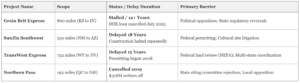
The failure of the Grain Belt Express serves as a clear warning. Designed to deliver 5, 000 megawatts of low-cost power to the Midwest, the project secured a $4. 9 billion conditional loan from the Department of Energy. In July 2025, that loan was abruptly terminated following intense political pressure and legal challenges in Missouri and Illinois. The cancellation froze a project that had already spent over a decade navigating state utility commissions. Similarly, the SunZia line, intended to transport wind energy from New Mexico to Arizona, faced an 18-year gauntlet of federal reviews and lawsuits before construction could meaningfully proceed, illustrating a timeline that is incompatible with the urgency of the grid emergency.
Aging Iron and Steel
The inability to build new lines forces the grid to rely on infrastructure that is rapidly aging out of functionality. Approximately 70 percent of the U. S. transmission grid is over 25 years old. of the high-voltage backbone was constructed in the 1960s and 1970s, with a design life of 50 years. These assets are operating on borrowed time. Old conductors sag more under heavy loads, increasing the risk of arcing and wildfires, while aging transformers are more susceptible to failure during extreme weather events.
The financial cost of this stagnation is borne directly by ratepayers. Congestion costs, the price paid when cheap power cannot reach customers due to transmission bottlenecks, reached $20. 8 billion in 2022 and have continued to rise. Without new capacity, grid operators are forced to dispatch expensive, inefficient local power plants instead of accessing lower-cost remote generation. This inflated wholesale electricity prices in constrained regions like New England and Texas by an estimated 15 percent in 2024.
Current investment levels are insufficient to reverse the decay. While utilities spent approximately $30 billion on transmission in 2024, the vast majority of this capital was allocated to replacing failed local equipment rather than expanding the high-voltage network needed for reliability. The Princeton REPEAT Project estimates that to meet national climate and reliability goals, the transmission system must expand by 2. 3 percent annually. The current 1 percent growth rate guarantees that the grid become the primary bottleneck for the U. S. economy by 2030.
The Interconnection Queue: 2600 Gigawatts on Hold
The United States power grid faces a blockade that neutralizes the benefits of new energy investment. As of late 2024, the interconnection queue, the administrative waiting room for power plants seeking to plug into the grid, swelled to nearly 2, 600 gigawatts (GW) of capacity. This figure is twice the size of the entire existing installed generation fleet of the United States, which stands at approximately 1, 280 GW. While capital and technology are ready to deploy, the administrative required to approve these connections has ground to a halt, creating a bottleneck that threatens national energy security.
Data released by the Lawrence Berkeley National Laboratory (LBNL) in its 2025 “Queued Up” report confirms the severity of this logjam. The median time required for a project to move from an initial interconnection request to commercial operation exceeded five years in 2024, a sharp increase from fewer than two years in 2008. In regions like PJM Interconnection, which serves 65 million people across 13 states and the District of Columbia, the situation so thoroughly that the operator instituted a freeze on new applications until 2026 to process a backlog of thousands of unstudied projects.
The Cost of Connection
The delay is driven by a legacy “participant funding” model that assigns the full cost of grid upgrades to the specific developer whose project triggers the need for them. If a new solar farm requires a $50 million substation upgrade to handle its output, that single developer receives the bill. This creates a “speculative” queue. Developers flood the system with multiple applications for the same project at different locations, hoping to find a site with low interconnection costs. Once the system operator assigns a high cost to a specific project, the developer withdraws it, triggering a cascade of “restudies” for every other project in the line.
This pattern of submission and withdrawal has inflated costs for those who remain. In PJM, interconnection costs for completed projects averaged $29 per kilowatt (kW) between 2017 and 2019. By the 2020, 2022 period, that average skyrocketed to $240 per kW. For projects that withdrew, the assigned costs were even punitive, averaging $599 per kW, rendering the projects economically dead on arrival.
The Withdrawal Wave
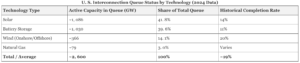
The dysfunction forces a massive purge of proposed capacity. In 2024 alone, developers withdrew 296 GW of capacity from the queues, double the volume withdrawn in 2023. This mass exodus is partly a result of FERC Order 2023, a federal mandate designed to clear “phantom” projects by imposing stricter financial readiness requirements and moving from a ” -come, -served” model to a ” -ready, -served” cluster study process. While this policy aims to sanitize the queue of speculative entries, the immediate effect is a chaotic clearing phase where hundreds of gigawatts from the planning pipeline overnight.
The composition of the queue shows a total mismatch between the grid’s needs and its capabilities. Zero-carbon resources, primarily solar and battery storage, account for over 95% of the active queue. yet, the completion rates for these technologies remain abysmal. Only 14% of solar projects and 11% of battery projects that enter the queue are ever built. The vast majority die in the study phase, victims of unpredictable cost allocations or indefinite delays. This attrition rate means that the “2, 600 GW” headline figure is deceptive; without structural reform, less than 500 GW of that capacity likely reach the grid over the decade.
Regional Disparities
The paralysis is uneven across the country. The California ISO (CAISO) and the non-ISO West hold the largest volumes of storage capacity, yet they face significant transmission constraints that prevent this power from reaching load centers. In contrast, ERCOT in Texas uses a “connect and manage” method that allows generators to plug in faster curtails their output when lines are congested. This method has kept ERCOT’s wait times lower than the national average, it transfers the risk of congestion to the developer rather than the consumer. Meanwhile, the eastern interconnects, particularly PJM and MISO, remain mired in multi-year delays that threaten to derail the reliability of the grid as data center load growth accelerates through 2026.
Data Center Demand: The AI Energy Surcharge
The digital economy has physically collided with the electrical grid. As of March 2026, the artificial intelligence sector is no longer just a driver of stock market valuation; it is the single largest destabilizing force in American energy infrastructure. A report released this week by the Electric Power Research Institute (EPRI), titled Powering Intelligence 2026, confirms that data centers consume an estimated 192 terawatt-hours (TWh) of electricity annually, a figure that has surged nearly 30% since 2023. This demand is not abstract; it is a physical load that requires the constant burning of fossil fuels to maintain.
The core of this surge lies in the computational density of generative AI. While a standard Google search consumes approximately 0. 3 watt-hours of energy, a generative AI query requires roughly 2. 9 watt-hours, nearly ten times the electricity. When scaled across billions of daily interactions, this difference creates a shockwave of demand. The hardware driving this processing, specifically the NVIDIA H100 GPU, operates with a peak power draw of 700 watts. With over 3. 5 million of these units deployed in U. S. data centers by late 2024, the aggregate load is equivalent to adding a mid-sized nation to the American grid.
Ground Zero: Northern Virginia
Nowhere is this emergency more acute than in Northern Virginia, the world’s largest data center market. Dominion Energy, the utility serving this region, reported in February 2026 that demand from data centers nearly doubled in the second half of 2024 alone. The utility is currently tracking over 26 gigawatts (GW) of expected new demand, an amount exceeding the entire generation capacity of U. S. states. To meet this load, Dominion and other PJM Interconnection utilities have been forced to reverse decarbonization commitments.
| Activity / Hardware | Energy Consumption | Equivalent Comparison |
|---|---|---|
| Standard Web Search | 0. 3 Wh | Lighting a 60W bulb for 18 seconds |
| Generative AI Query | 2. 9 Wh | Lighting a 60W bulb for 3 minutes |
| NVIDIA H100 GPU (Annual) | 3, 740 kWh | Avg. U. S. household occupant (1 year) |
| Training GPT-3 Model | 1, 287, 000 kWh | 120 U. S. homes for a full year |
The Coal Lifeline
The immediate consequence of this demand is the resurrection of coal. Utilities across the PJM region, which spans 13 states including Virginia, Ohio, and Pennsylvania, have delayed the retirement of at least 15 coal-fired power plants since January 2025. These facilities, previously scheduled for decommissioning to meet environmental, are essential to prevent cascading grid failures. For instance, Alliant Energy delayed the retirement of its Columbia Energy Center in Wisconsin from 2026 to 2029, explicitly citing grid stability needs. Similarly, the Omaha Public Power District extended the life of its North Omaha Power Station. The data center industry, even with its public commitments to “net-zero” operations, is currently being powered by the very fossil fuels it promised to eliminate.
The Ratepayer Bill
The financial cost of this infrastructure is being passed directly to consumers. In the 2025/2026 capacity auction held by PJM, prices cleared at $269. 92 per megawatt-day, a increase from $28. 92 in the previous auction. This price signal reflects a desperate scarcity of reliable power. The Independent Market Monitor for PJM estimated that data centers were responsible for 63% of this price spike, resulting in an additional $9. 3 billion in costs that be recovered through higher residential and commercial electricity bills. Families in Ohio and Virginia are subsidizing the computational power required for AI model training, paying a premium for a service that destabilizes their own local grid.
“We are seeing a load growth of 32 gigawatts between 2024 and 2030 in the PJM interconnection alone. Data centers are responsible for 94% of this increase. This is not a forecast error; it is a fundamental shift in the physics of the grid.” , PJM 2025 Long-Term Load Forecast
The trajectory is unsustainable. EPRI’s latest projections indicate that by 2030, data centers could consume up to 17% of total U. S. electricity generation. This would require between 56 and 132 GW of new nominal capacity, infrastructure that does not currently exist and cannot be built fast enough to keep pace with the deployment of silicon. The grid is no longer just aging; it is being actively drained by a new, voracious industrial consumer that operates 24/7 at peak load.
Electrification Stress: EV Charging Loads
The narrative that electric vehicles (EVs) collapse the national grid through sheer energy consumption is statistically false. In 2024, the entire U. S. fleet of light-duty electric vehicles consumed approximately 11 terawatt-hours (TWh) of electricity, representing a mere 0. 25% of total national demand according to the Energy Information Administration (EIA). The immediate danger to grid reliability does not from the total volume of power required, from the localized intensity of its delivery. The grid is not failing because it absence generation capacity; it is failing because the final mile of distribution hardware cannot survive the thermal shock of residential charging.
Most residential neighborhoods rely on distribution transformers rated at 25 kilovolt-amperes (kVA), designed decades ago to handle lights, refrigerators, and televisions. A single Level 2 EV charger draws roughly 7 to 19 kilowatts (kW) of power. When three households connected to the same 25 kVA transformer charge simultaneously, the load exceeds the equipment’s rated capacity. This overload generates excessive heat, degrading the mineral oil insulation inside the transformer. Research from the University of Vermont indicates that Level 2 charging accelerates transformer aging by a factor of 5. 6. Instead of lasting 30 to 40 years, these serious components burn out in a fraction of that time, leading to neighborhood-level blackouts that utility repair crews struggle to predict.
| Appliance / Device | Peak Power Draw (kW) | Grid Impact Equivalent |
|---|---|---|
| Central Air Conditioner | 3. 0, 5. 0 kW | High |
| Electric Clothes Dryer | 2. 0, 4. 0 kW | Moderate |
| Level 2 EV Charger | 7. 0, 19. 2 kW | Severe (3x, 6x A/C Load) |
| DC Fast Charger (Public) | 150. 0, 350. 0 kW | Industrial / Commercial |
This stress is compounded by the “clustering” effect. EV adoption is not uniform; it concentrates in specific zip codes and wealthy suburbs. In parts of California, EV penetration on specific feeder lines exceeded 25% by late 2025. A 2024 study published in the Proceedings of the National Academy of Sciences (PNAS) estimated that by 2035, 50% of distribution feeders in California be overloaded by EV charging demands. The cost to upgrade this local capacity is. Upgrading a single distribution circuit to handle high EV penetration costs between $6 million and $20 billion statewide depending on the scope. Utilities are playing a game of whack-a-mole, replacing blown transformers only after they fail, rather than preemptively upgrading thousands of miles of aging copper.
Public charging infrastructure presents a different, yet equally severe engineering challenge. A standard Direct Current Fast Charging (DCFC) station with four 150 kW ports pulls 600 kW from the grid, roughly the same peak demand as a large grocery store or a small factory. When these stations are installed in areas with weak transmission infrastructure, they cause voltage sags and harmonic that can damage nearby equipment. By the end of 2025, the U. S. had installed over 70, 000 DC fast-charging ports, a 30% increase from the previous year. Each new installation requires a bespoke grid interconnection study and frequently substation upgrades costing upwards of $150, 000 per site, costs that are frequently passed down to the ratepayer.
The financial gap for grid readiness remains wide. The National Renewable Energy Laboratory (NREL) estimated that a cumulative capital investment of $53 billion to $127 billion is required by 2030 to support the charging infrastructure for 33 million EVs. This figure excludes the billions needed for deferred maintenance on the existing grid. As of 2026, investment levels are tracking well these. The result is a fragmented system where EV owners in upgraded districts enjoy reliable service, while adjacent neighborhoods suffer from voltage fluctuations and equipment fires caused by the unmanaged load of a few electric cars.
The 100-Week Wall
The backbone of the American electric grid is missing. As of March 2026, utilities attempting to procure Large Power Transformers (LPTs), the massive, custom-built nodes required to step down high-voltage transmission for local distribution, face lead times averaging 120 to 210 weeks. This is not a logistical delay; it is a structural blockade. In 2020, a utility could secure an LPT in less than a year. Today, procurement officers are being quoted delivery dates in 2029 or 2030. This four-year lag paralyzes grid modernization, halts new housing developments, and leaves millions of ratepayers to prolonged outages simply because replacement hardware does not exist.
The scarcity is absolute. Data released by Wood Mackenzie in August 2025 revealed that the United States faces a 30% supply deficit for power transformers and a 10% deficit for distribution units. This gap has forced utilities to deplete their strategic reserves, cannibalizing spare parts from decommissioned substations to keep the lights on. The Department of Energy (DOE) confirmed that 70% of U. S. transformers are older than 25 years, pushing them well past their intended operational lifespan. When these aging units fail, there are no immediate replacements available.
The Inflation of Reliability
Scarcity has bred hyper-inflation in grid hardware. The price of a single LPT has surged approximately 80% since 2020. A unit that cost $900, 000 five years ago commands a price tag upwards of $1. 6 million, with manufacturers demanding 50% down payments just to secure a production slot. These costs are passed directly to consumers, manifesting as rate hikes that outpace standard inflation metrics. The following table illustrates the deterioration of the transformer supply chain between 2020 and 2025.
| Metric | 2020 Baseline | 2025 Status | Change |
|---|---|---|---|
| LPT Lead Time | 50 Weeks | 120, 210 Weeks | +320% |
| Avg. LPT Cost | $900, 000 | $1, 620, 000 | +80% |
| Import Reliance (LPT) | 65% | 82% | +17% |
| Distribution Lead Time | 12 Weeks | 52, 80 Weeks | +333% |
The Raw Material Choke Point
The emergency is rooted in a fundamental deficit of Grain-Oriented Electrical Steel (GOES), the specialized magnetic core material required for high-efficiency transformers. Domestic production capacity for GOES has evaporated. As of 2025, only one manufacturer, Cleveland-Cliffs, produces GOES in the United States, yet domestic demand their capacity by orders of magnitude. Consequently, U. S. manufacturers must import the vast majority of their steel, exposing the grid to volatile global trade.
Recent federal trade policies have exacerbated this bottleneck. New tariff regimes implemented in late 2025, including a 50% duty on specific copper imports, have added between $50, 000 and $200, 000 to the cost of individual large power transformers. These protectionist measures, intended to spur domestic manufacturing, have instead severed access to serious international supply lines before American factories could up to fill the void. The result is a “valley of death” where foreign units are unaffordable and domestic units are unavailable.
Strategic Reserves Depleted
The operational reality for grid operators is dire. In previous decades, utilities maintained a “storm stock”, a reserve of transformers ready to be deployed after hurricanes or ice storms. Investigations reveal that by early 2026, these stockpiles had been largely exhausted to meet routine replacement needs. A 2025 survey by the National Association of Regulatory Utility Commissioners (NARUC) indicated that 40% of utilities have delayed grid connection for new housing and industrial projects due to hardware absence. In high-growth regions like Texas and the Southeast, developers are being told that power connections for new subdivisions may take 18 months to energize.
This inventory collapse poses a catastrophic risk for the 2026 hurricane season. If a major storm destroys a significant number of substations, the lead time for recovery not be measured in days, in months. The grid has lost its physical redundancy. Without immediate intervention to secure raw materials and fast-track imports, the United States risks entering a period of prolonged, hardware-induced energy poverty.
Physical Security: Substation Ballistics
The physical defense of the United States power grid has collapsed against low-tech, high-impact assault. Between 2022 and 2024, the frequency of ballistic attacks on electrical substations surged, exposing a fatal vulnerability in the nation’s energy distribution network. Department of Energy (DOE) filings reveal that reported physical security incidents in the Western Interconnection alone more than doubled from 107 in 2023 to 220 in 2024. These are not sophisticated cyber-operations kinetic strikes using standard caliber rifles to disable high-voltage transformers, equipment that frequently requires months or years to replace.
In 2022, the North American Electric Reliability Corporation (NERC) recorded a 71% increase in physical attacks compared to the previous year. This escalation manifests in coordinated strikes designed to sever power to tens of thousands of residents instantly. The mechanics of these assaults are worrying simple: a shooter positions themselves outside a chain-link fence and fires into the radiator fins or conservator tanks of a transformer. The resulting oil leak causes the unit to overheat and fail, a process that can destroy a multimillion-dollar asset in minutes.
Case Study: Moore County and Tacoma
Two events in December 2022 demonstrate the severity of this threat. On December 3, attackers in Moore County, North Carolina, opened fire on two Duke Energy substations. The assault cut power to 45, 000 customers for five days. Investigators found the perpetrators knew exactly where to aim to cause permanent disablement rather than temporary disruption. One death was attributed to the outage after an oxygen machine failed.
Three weeks later, on Christmas Day, four substations in Tacoma, Washington, were targeted. Attackers cut padlocks and used high-caliber weapons to damage transformers, causing outages for 14, 000 customers. While federal prosecutors later charged two men who claimed the blackout was a cover for burglary, the damage to the infrastructure was severe. Tacoma Power estimated the cost to repair the equipment at $3 million, with lead times for replacement transformers stretching up to 36 months due to supply chain constraints.
| Date | Location | Target | Impact | Method |
|---|---|---|---|---|
| Dec 03, 2022 | Moore County, NC | 2 Duke Energy Substations | 45, 000 outages (5 days) | Rifle fire |
| Dec 25, 2022 | Tacoma, WA | 4 Substations (Tacoma Power/PSE) | 14, 000 outages | Breach & Ballistics |
| Feb 06, 2023 | Baltimore, MD | Ring of Substations (Plot) | Plot foiled by FBI | Planned Rifle Attack |
| 2023 (Full Year) | National (US) | Various Grid Assets | 185 reported incidents | Physical/Threats |
| 2024 (Full Year) | Western Interconnection | Grid Infrastructure | 220 reported incidents | Physical/Ballistics |
The Regulatory Blind Spot
The regulatory framework designed to protect this infrastructure fails to cover the vast majority of. NERC Standard CIP-014-3 mandates physical security assessments only for “important” bulk power system substations, those whose loss would trigger cascading instability across the entire grid. This standard leaves thousands of distribution substations, like those in Moore County, with no federal requirement for ballistic shielding. These facilities are frequently protected only by chain-link fencing, which offers zero resistance to gunfire.
Duke Energy responded to the North Carolina attacks by announcing a $500 million grid improvement plan to install ballistic blocks and monitoring systems. Yet, the cost to harden every distribution substation in the country remains prohibitive. A single ballistic wall panel measuring 4×8 feet costs between $320 and $1, 600. Enclosing a standard substation perimeter requires hundreds of such panels, pushing the cost of retrofitting a single site into the millions. With over 55, 000 substations operating in the United States, the financial load of total hardening exceeds utility capital budgets.
“The damage to the substations is estimated to be at least $3 million and time-consuming to fix, the damaged transformers need to be replaced, which could take up to 36 months.” , Tacoma Power Assessment, January 2023
Supply Chain Fragility
The physical security problem is compounded by the fragility of the transformer supply chain. Large Power Transformers (LPTs) are custom-built machines weighing up to 400 tons. Domestic production capacity is minimal; the United States imports 82% of its large transformers and high-voltage bushings. When a transformer is destroyed by ballistics, a utility cannot simply buy a replacement off the shelf. Procurement times in 2024 averaged 120 weeks, leaving the grid exposed to prolonged instability following any successful attack.
Data from the Department of Energy confirms that the threat is not subsiding. The 185 incidents reported in 2023 represented an all-time high for the dataset, driven by a mix of ideological extremism and criminal vandalism. The grid has moved from a status of theoretical risk to active engagement, where the primary defense is not concrete or steel, the hope that attackers not strike again.
Cyber Warfare: State Actor Vectors
The strategic objective of foreign adversaries targeting the United States power grid has shifted fundamentally from espionage to execution. As of late 2025, intelligence assessments confirm that state-sponsored actors are no longer mapping American infrastructure are actively pre-positioning malware to induce catastrophic physical failures. The Federal Bureau of Investigation (FBI) and the Cybersecurity and Infrastructure Security Agency (CISA) declassified data in 2024 revealing that People’s Republic of China (PRC) hackers had maintained access to U. S. energy, water, and communications networks for at least five years.
The most pervasive threat vector identified is the “Volt Typhoon” campaign. Unlike traditional cyber espionage which relies on distinct malware signatures, Volt Typhoon operatives use “Living off the Land” (LOTL) techniques. They use legitimate network administration tools already present in the system, such as PowerShell and Windows Management Instrumentation, to blend in with normal traffic. In February 2024, CISA reported that these actors had successfully infiltrated the IT environments of multiple serious infrastructure organizations in the continental United States and Guam. Their specific intent, according to the 2024 Annual Threat Assessment by the Office of the Director of National Intelligence, is to disrupt serious infrastructure communications to induce panic and impede U. S. military mobilization during a chance emergency.
While China focuses on stealth and persistence, Russian state actors have developed capabilities for immediate, irreversible destruction. The discovery of the “Pipedream” (or Incontroller) malware toolkit in 2022 marked a serious escalation. Developed by the group CHERNOVITE, Pipedream is the modular malware framework specifically designed to attack industrial control systems (ICS) across different vendors. It can manipulate programmable logic controllers (PLCs) from Schneider Electric and OMRON to override safety, chance causing turbines to overspeed or pressure valves to rupture. Dragos, an industrial cybersecurity firm, described Pipedream in their 2024 Year in Review as the closest the U. S. has come to a grid-disabling event, noting that the malware was fully functional and deployed before being interdicted.
| State Actor | Campaign / Group | Primary Tactic | Targeted Assets | Strategic Intent |
|---|---|---|---|---|
| China | Volt Typhoon | Living off the Land (LOTL) | IT Networks, SCADA Gateways | Pre-positioning for future disruption; delaying military deployment. |
| Russia | Sandworm / CHERNOVITE | ICS-Specific Malware (Pipedream) | Safety Systems (SIS), PLCs | Physical destruction of equipment; permanent denial of service. |
| Iran | CyberAv3ngers | Default Credential Exploitation | Unitronics PLCs (Water/Energy) | Psychological impact; opportunistic disruption of unpatched systems. |
| North Korea | Lazarus Group | Log4j Exploits / Spearphishing | Energy Providers, Grid Supply Chain | Revenue generation (ransomware) and technology theft. |
The vulnerability of the grid is exacerbated by the convergence of IT and Operational Technology (OT) networks. In late 2023, the Iranian-affiliated group “CyberAv3ngers” demonstrated how easily this convergence can be exploited. They targeted Unitronics Vision Series PLCs, which are widely used in water and energy sub-sectors, by scanning for devices with default passwords exposed to the internet. While the immediate impact was largely defacement and manual override requirements, the incident exposed a widespread failure in basic cyber hygiene. The attack forced multiple U. S. facilities to disconnect from the internet and switch to manual operations, highlighting that even unsophisticated attacks can degrade grid reliability.
Data from 2024 indicates a sharp rise in the frequency of these intrusions. Dragos reported an 87% increase in ransomware attacks targeting industrial organizations in 2024 compared to the previous year. also, the North American Electric Reliability Corporation (NERC) noted in its 2025 State of Reliability report that “reportable cyber security incidents”, specifically attempts to compromise Electronic Security Perimeters, remained a persistent daily reality for grid operators. The barrier to entry has lowered; state actors are sharing tools and tactics with criminal syndicates, creating a hybrid threat environment where a ransomware attack could inadvertently trigger a cascading blackout.
Weather Radicalization: The Billion Dollar Storm
The American power grid is fighting a war it cannot win. Between 2020 and 2024, the United States suffered 115 separate weather disasters with damages exceeding $1 billion each. The total cost of these events reached $746. 7 billion. This is not a streak of bad luck; it is a statistical radicalization of weather patterns colliding with infrastructure built for a calmer century. In 2024 alone, the National Oceanic and Atmospheric Administration (NOAA) recorded 27 billion-dollar disasters, costing the economy $182. 7 billion. By the end of 2025, another 23 major events added $115 billion to the tally. The frequency of these events has compressed from one every 82 days in the 1980s to one every 16 days today.
Utilities are losing the physical battle. In 2024, electricity customers faced an average of 11 hours of power interruptions, nearly double the annual average of the previous decade. Hurricanes Beryl, Helene, and Milton were the primary drivers, obliterating transmission towers and snapping distribution poles like twigs. Duke Energy reported that Hurricane Helene alone destroyed 12, 000 power poles and 2, 000 transformers in the Carolinas. This level of kinetic destruction overwhelms standard stockpiles and repair crews, forcing utilities to rebuild entire regional grids from scratch after every major landfall.
The Financial Toll of Fragility
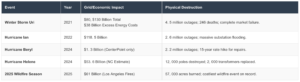
The cost of these failures is being transferred directly to the ratepayer. When CenterPoint Energy’s infrastructure collapsed during Hurricane Beryl in July 2024, 2. 2 million customers in Houston lost power. The utility later estimated the grid repair costs at $1. 2 billion to $1. 3 billion. Instead of absorbing these costs as operating losses, CenterPoint received regulatory approval to pass them onto customers through a rate increase lasting 15 years. This method turns monthly utility bills into high-interest loan repayments for infrastructure that failed to perform.
Infrastructure Incompatibility
The core problem is a mismatch between engineering standards and atmospheric reality. Most U. S. distribution poles are wooden, rated to withstand wind speeds of 80 to 90 miles per hour. Yet, modern storms frequently deliver gusts exceeding 100 mph inland, snapping these poles like matchsticks. In 2024, 80% of all major power outages were weather-related. The grid is not failing because of a mystery; it is failing because wood and copper cannot withstand the new thermal and kinetic loads imposed by a warming climate.
Winter Storm Uri in 2021 proved that cold is just as destructive as wind. The freeze caused 4. 5 million Texans to lose power, resulting in at least 246 deaths. The financial aftershocks were equally lethal. Texas ratepayers were saddled with approximately $38 billion in excess energy costs because the market pricing method malfunctioned during the emergency. The state legislature authorized $8. 6 billion in bonds to cover these debts, locking residents into payments for decades. This pattern repeats nationally: a disaster strikes, the grid fails, and the public takes out a mortgage to patch it up.
The Hardening Myth
Utilities frequently tout “hardening” efforts, burying lines, upgrading poles, and installing smart switches, as the solution. Yet the pace of hardening lags behind the acceleration of weather severity. Duke Energy’s replacement of 12, 000 poles after Helene was a reactive emergency measure, not a proactive upgrade. To bury just 10% of the nation’s distribution lines would cost trillions, a capital expenditure that no utility board authorize without massive federal intervention. Until then, the strategy remains “run to failure,” a policy that guarantees higher costs and longer blackouts for every American household.
Wildfire Risk: De-energization
The operational mandate of the American power grid has fundamentally fractured. For a century, the utility imperative was absolute: keep the lights on. Today, under the crushing weight of liability and climate-driven aridity, that directive has inverted. The new survival method for utilities is “de-energization”, the intentional, preemptive blackout of thousands of customers to prevent aging infrastructure from igniting catastrophic wildfires. This shift represents the most significant alteration to grid operations in modern history, transforming electricity from a guaranteed service into a conditional privilege dependent on wind speed and humidity.
California led this retreat from reliability with the formalization of Public Safety Power Shutoffs (PSPS). Following the Camp Fire in 2018, which was ignited by Pacific Gas and Electric (PG&E) equipment and killed 85 people, the state’s utilities aggressively pivoted to de-energization. Data from the California Public Utilities Commission (CPUC) indicates that between 2019 and 2024, California utilities executed over 100 separate PSPS events. The economic collateral is. A Stanford Woods Institute analysis estimated the costs of the October 2019 shutoffs alone, which severed power to millions, at approximately $2. 5 billion. These figures account for spoiled food, lost productivity, and the frantic acquisition of backup generation by a populace suddenly thrown off the grid.
While California normalized the blackout as a safety tool, the refusal to de-energize elsewhere has proven fatal. The devastation of Lahaina, Maui, in August 2023 serves as the grim counter-argument to the inconvenience of PSPS. Hawaiian Electric (HECO) did not have a formal shutoff program in place when hurricane-force winds battered the island. Investigations revealed that while the utility’s lines caused the initial morning fire, the decision, or absence thereof, to preemptively cut power remains the central pivot of liability. In the aftermath, HECO’s stock value collapsed by over 60%, and the utility faces billions in claims, illustrating that the financial risk of not turning off the power exceeds the regulatory penalty for outages.
This liability reality was cemented in the Pacific Northwest. In February 2026, a Multnomah County jury ordered PacifiCorp to pay $305 million to victims of the 2020 Labor Day fires in Oregon, adding to a cumulative liability that has surpassed $2. 2 billion. The jury found the utility negligent for failing to de-energize its lines even with severe weather warnings. The message to the industry was unequivocal: in the eyes of the law, a blackout is preferable to a burn scar. Consequently, PacifiCorp and other regional operators have since adopted aggressive de-energization thresholds, exporting the California blackout model to Oregon and Washington.
Texas, historically resistant to such measures, was forced to capitulate following the Smokehouse Creek Fire in February 2024. The blaze, the largest in state history, scorched over one million acres in the Panhandle and was ignited by a decayed utility pole owned by Xcel Energy. In December 2025, the Texas Attorney General sued Xcel, alleging the company prioritized “marginal profits” over safety. In direct response to this catastrophe, Xcel Energy implemented its proactive de-energization policy in April 2024, acknowledging that the physical hardening of the grid could not happen fast enough to outpace the wildfire threat.
The following table contrasts the adoption and impact of de-energization across major high-risk regions as of early 2026.
| Utility / Region | Protocol Status (2026) | Trigger Event | Economic/Liability Impact | Customer Reliability Impact |
|---|---|---|---|---|
| PG&E (California) | Mature / High Frequency | 2018 Camp Fire | $2. 5B est. cost to economy (Oct 2019 events) | Normalized multi-day outages; 20, 000+ impacted in late 2024 events. |
| Hawaiian Electric (Maui) | New Implementation | 2023 Lahaina Fire | ~$6B est. damage; Utility stock collapse | Zero pre-fire shutoffs; rigid new post-2023. |
| PacifiCorp (Oregon) | Aggressive Adoption | 2020 Labor Day Fires | $2. 2B+ in settlements/verdicts (thru Feb 2026) | Shift from “keep power on” to strict wind-speed thresholds. |
| Xcel Energy (Texas) | Reactive Adoption | 2024 Smokehouse Creek Fire | $215M+ initial liability; AG Lawsuit (Dec 2025) | -ever proactive shutoff policy launched April 2024. |
The operational logic of the grid has entered a vicious pattern. To avoid the liability of starting fires, utilities are imposing outages that carry their own severe risks. Medical devices fail, water pumping stations go offline, and cellular networks degrade. Yet, the data confirms that the industry views these “public safety” outages as the only viable stopgap for infrastructure that is too old to withstand the modern climate. Until the physical grid is hardened, a process measured in decades, the de-energization switch remain the primary defense method, leaving millions of Americans in a state of intermittent energy insecurity.
Regulatory Fragmentation: Federal vs State Authority
The American transmission grid is currently paralyzed by a jurisdictional war between federal mandates and state sovereignty. While the Federal Energy Regulatory Commission (FERC) attempts to force long-term regional planning, state Public Utility Commissions (PUCs) frequently block projects that do not offer immediate, local benefits. This regulatory fragmentation has created a bottleneck where essential infrastructure projects die in litigation rather than breaking ground. In 2024, the United States completed only 888 miles of high-voltage transmission lines (345 kV and above). This figure, while an improvement over the catastrophic 55 miles built in 2023, remains a fraction of the 4, 000 miles constructed in 2013.
The centerpiece of this conflict is FERC Order 1920, issued on May 13, 2024. The order mandates that transmission providers conduct 20-year forward-looking planning and requires states to agree on cost-allocation methods for regional lines. The reaction was immediate and hostile. A coalition of 19 states, led by the Texas Attorney General, filed suit in June 2024, arguing the order usurped exclusive state authority over generation choices and forced ratepayers to subsidize out-of-state policy goals. By late 2025, compliance filings for Order 1920 remained mired in legal challenges, freezing the coordinated planning necessary to stabilize the grid.
The Interconnection Queue Logjam
Regulatory misalignment has resulted in a massive backlog of energy projects waiting to connect to the grid. Data from the Lawrence Berkeley National Laboratory confirms that as of December 31, 2024, approximately 10, 300 projects were stuck in interconnection queues. These projects represent 2, 300 gigawatts (GW) of chance generation and storage capacity, more than the total existing installed capacity of the entire U. S. power fleet. The dysfunction is widespread; developers face withdrawal rates of nearly 77%, meaning most proposed projects never reach commercial operation due to unpredictable costs and indefinite delays.
| Metric | 2023 Data | 2024 Data | Change |
|---|---|---|---|
| Total Active Capacity in Queue | 2, 598 GW | 2, 300 GW | -11. 5% |
| Projects Withdrawn (Annual) | 127 GW | 340 GW | +167% |
| Median Wait Time (2000-2007) | <2 Years | — | — |
| Median Wait Time (2018-2024) | — | > 4 Years | +100% |
The sharp increase in project withdrawals in 2024 indicates that developers are abandoning viable energy assets because they cannot navigate the regulatory maze. The ” -come, -served” processing model used by Regional Transmission Organizations (RTOs) has collapsed under the volume of requests, yet reforms remain slow due to the priorities of state regulators and federal overseers.
The Cost Allocation Deadlock
Who pays for multi-state transmission lines remains the single most contentious problem blocking development. Under the “beneficiary pays” principle, states vehemently about how to quantify benefits. A line crossing Illinois to deliver power to Ohio provides reliability to both may only lower rates in one. In the Midcontinent Independent System Operator (MISO) region, this dispute threatened the $22 billion “Tranche 2. 1” transmission portfolio in 2025. Several state commissions and industrial groups filed complaints with FERC, demanding a re-evaluation of the benefits assessment. These disputes delay funding approvals for years. The average timeline for permitting and building a major transmission line in the U. S. spans 6. 5 to 10 years, with projects languishing for over a decade.
Case Study: The Grain Belt Express
The Grain Belt Express, an 800-mile high-voltage direct current (HVDC) line designed to transport power from Kansas to Indiana, exemplifies the volatility of this regulatory environment. After years of battling state eminent domain laws in Missouri and Illinois, the project faced a federal reversal in July 2025. The Department of Energy cancelled a conditional $4. 9 billion loan guarantee, citing that the project’s financials did not require federal backing. While the developer, Invenergy, vowed to proceed with private financing and targeted a construction start in late 2025 or 2026, the withdrawal of federal support show the absence of a national strategy. A project deemed serious for national reliability one month can lose federal backing the due to shifting political winds or bureaucratic reassessments.
Federal Backstop Limitations
In an attempt to bypass state obstruction, FERC issued Order 1977 in May 2024, clarifying its “backstop” siting authority. This rule allows FERC to problem permits for transmission lines in National Interest Electric Transmission Corridors if state regulators withhold approval for more than one year. yet, as of late 2025, this authority remains largely untested in the courts. State regulators view it as a direct attack on their jurisdiction over land use. Consequently, developers are hesitant to rely on the federal backstop, fearing that doing so invite years of additional litigation from hostile state attorneys general. The Department of Energy’s parallel effort to cap federal environmental reviews at two years has yet to demonstrate a material reduction in the in total decade-long timeline for major infrastructure projects.
Economic: The Cost of Blackouts
The financial toll of grid instability has reached catastrophic levels. In March 2026, the Oak Ridge National Laboratory (ORNL) released a definitive analysis revealing that major power outages cost the United States economy $121 billion in 2024 alone. This figure represents a sharp escalation from previous years, driven by a 29% increase in the frequency of major outage events between 2018 and 2024. The grid is no longer just a reliability concern; it is a primary driver of financial loss for American industry.
Manufacturing bears the heaviest load of these disruptions. Modern factories operate on precise, just-in-time schedules where a momentary loss of power can scrap entire production runs and damage sensitive robotics. Data from Siemens in July 2024 indicates that for the automotive sector, a single hour of downtime costs approximately $2. 3 million. This is a twofold increase since 2019, attributed to the rising complexity of automated production lines. Broader industrial estimates are even more severe, with reports valuing downtime losses at up to $6. 45 million per hour for high-volume manufacturing facilities.
The digital economy is equally. As reliance on cloud computing grows, the cost of server downtime has skyrocketed. A 2025 analysis by ITIC found that for 91% of mid-sized and large enterprises, a single hour of server downtime costs $300, 000 or more, with 44% of organizations reporting losses exceeding $1 million per hour. These outages do not pause operations; they corrupt data, breach service level agreements, and trigger millions in compliance penalties.
| Sector / Event | Estimated Financial Loss | Metric | Source |
|---|---|---|---|
| US Economy (Total) | $121 Billion | Annual Cost (2024) | Oak Ridge National Lab (2026) |
| Automotive Mfg. | $2. 3 Million | Per Hour of Downtime | Siemens (2024) |
| Data Centers | $1 Million+ | Per Hour (High Impact) | ITIC (2025) |
| Commercial Business | $6, 031 | Average Per Outage | ORNL (2026) |
| Winter Storm Uri | $195 Billion | Total Event Cost | University of Houston (2022) |
| Hurricane Beryl | $28, 32 Billion | Total Event Cost | AccuWeather (2024) |
Small businesses face a different equally destructive reality. While they may not lose millions per hour, they absence the capital reserves to absorb repeated shocks. The ORNL report highlights that the average power outage in 2024 cost commercial customers $6, 031 per event. For a local restaurant or retailer, this sum wipes out weeks of profit. The cumulative effect is devastating: in 2024, U. S. electricity customers endured an average of 11 hours of power interruptions, nearly double the annual average recorded over the previous decade. This prolonged instability forces small enterprises to invest in expensive backup generators or risk permanent closure.
Specific weather events serve as grim case studies for the grid’s economic fragility. Winter Storm Uri, which collapsed the Texas grid in 2021, inflicted between $130 billion and $195 billion in total economic damage, a figure that rivals the cost of the most destructive hurricanes in U. S. history. More, Hurricane Beryl in 2024 caused an estimated $28 billion to $32 billion in economic losses, largely driven by widespread and extended power failures that paralyzed Houston’s business district for days. These events demonstrate that the cost of inaction far exceeds the price of infrastructure modernization.
The insurance industry has begun to react to this new baseline of risk. Claims for business interruption due to power failure are rising, leading to higher premiums and stricter coverage terms. Insurers view the grid as a widespread risk factor, comparable to flood or fire zones. Without immediate intervention to stabilize the electrical network, the U. S. economy faces a future where power reliability becomes a luxury good, accessible only to those who can afford their own generation capacity.
Consumer Costs: Rate Hikes and Energy Poverty
The financial load of stabilizing the United States power grid has shifted aggressively onto ratepayers, creating a emergency of affordability that parallels the physical degradation of the infrastructure. In 2025, U. S. utilities requested a record $31 billion in rate increases, more than double the $15 billion requested in 2024. This surge in capital demands drove residential electricity prices up by 5% between 2024 and 2025, a rate nearly twice the national inflation figure of 2. 7%. For millions of Americans, the cost of keeping the lights on has outpaced wage growth, forcing households to make dangerous trade-offs between energy and other basic necessities.
Data from the Energy Information Administration (EIA) and the National Energy Assistance Directors Association (NEADA) indicates that the “energy load”, the percentage of gross household income spent on energy costs, has reached unsustainable levels for low-income families. While the average household spends approximately 3% of income on energy, low-income households spent a median of 8. 3% in 2024. In specific high-cost regions, this figure exceeded 15%. The is racial as well as economic; Black and Hispanic households face energy load 43% and 20% higher, respectively, than white households, regardless of income level.
| Region / State | Rate Increase (%) | Primary Driver |
|---|---|---|
| Washington, D. C. | 23. 0% | Grid Modernization / PJM Capacity Costs |
| New Jersey | 17. 0% | Transmission Upgrades |
| Illinois | 15. 2% | Nuclear Subsidies / Distribution Upgrades |
| California | 13. 0% | Wildfire Mitigation / Liability Costs |
| National Average | 5. 0% | Inflation / Infrastructure Replacement |
The direct consequence of these rate hikes is a sharp rise in utility debt and service disconnections. By June 2025, total utility debt held by American households reached $21 billion, with projections hitting $25 billion by the end of the year. This debt load fueled a disconnection emergency. In 2024 alone, utilities performed 3. 5 million shut-offs for non-payment, an increase of 300, 000 households compared to 2023. Specific utilities demonstrated aggressive enforcement; Georgia Power disconnected over 180, 000 customers in the nine months of 2024, a 20% increase year-over-year. Similarly, DTE Energy in Michigan executed more than 150, 000 disconnections during the same period.
Federal support systems designed to mitigate this poverty have fractured. The Low Income Home Energy Assistance Program (LIHEAP), funded at $4. 1 billion for fiscal year 2025, serves only 16% of eligible households due to chronic underfunding. The situation in April 2025 when administrative upheavals at the Department of Health and Human Services resulted in the termination of the entire LIHEAP staff, leaving approximately $378 million in approved assistance funds stranded without a distribution method. This bureaucratic collapse occurred immediately preceding the summer cooling season, leaving populations in states like Arizona and Texas exposed to extreme heat without financial recourse.
The “heat or eat” dilemma has moved from a colloquialism to a statistical reality. A 2024 Census Bureau Household Pulse Survey revealed that 34% of U. S. households reduced or forwent basic necessities, such as food or medicine, to pay an energy bill at least once in the previous year. As fixed charges on utility bills rise to cover the capital expenditures of hardening the grid against climate events, the unit cost of electricity continues to climb, trapping lower-income ratepayers in a pattern of debt, disconnection, and physical risk.
Gas Dependency: Just in Time Failure Points
The American power grid has traded one vulnerability for another. In the rush to retire coal and nuclear facilities, utilities have anchored the nation’s energy security to natural gas, a fuel source that operates on a “just-in-time” delivery model. Unlike coal piles or uranium rods which sit securely on-site for months, natural gas must be delivered continuously through a pressurized pipeline network. This logistical tightrope leaves no margin for error. When the gas stops flowing, the turbines stop spinning. Data from 2015 to 2025 confirms that this dependency has introduced a widespread fragility that collapses under stress, specifically during extreme cold when electricity is needed most.
The of this reliance is immense. According to the Energy Information Administration (EIA), natural gas-fired power plants generated 43% of the nation’s electricity in 2024, a figure that surged to 45% during the summer peak. While this shift reduced carbon emissions, it tethered grid reliability to a fuel supply chain that is largely unregulated for winterization. The consequences of this misalignment were laid bare during Winter Storm Uri in 2021 and Winter Storm Elliott in 2022. In both instances, the gas delivery system froze exactly when demand spiked, causing catastrophic generation failures.
The Mechanics of a Meltdown
The failure method is mechanical and predictable. In freezing temperatures, liquid in natural gas wells and pipelines freezes, blocking the flow of fuel, a phenomenon known as “freeze-off.” During Winter Storm Uri in February 2021, Texas natural gas production plummeted by 70%. The Federal Energy Regulatory Commission (FERC) reported that 58% of all generating unit failures during the emergency were natural gas-fired. These plants did not fail due to mechanical problem within the facility; they failed because their fuel supply.
This pattern repeated with punishing accuracy during Winter Storm Elliott in December 2022. As temperatures dropped across the Eastern Interconnection, the PJM Interconnection, the largest grid operator in the U. S., lost nearly 25% of its total generating capacity. A post-mortem report revealed that gas-fired generation accounted for 70% of these unplanned outages. In the Marcellus and Utica shale regions, gas production dropped by 30% due to wellhead freeze-offs, stripping power plants of the fuel required to keep the lights on.
| Event | Date | Region Impacted | Gas Production Drop | Gas % of Total Outages |
|---|---|---|---|---|
| Winter Storm Uri | Feb 2021 | Texas (ERCOT) | 70% decline (Texas) | 58% |
| Winter Storm Elliott | Dec 2022 | Eastern US (PJM) | 30% decline (Marcellus) | 70% |
| Winter Storm Heather | Jan 2024 | National | 15 Bcf/d decline | N/A (Production Focus) |
The Circular Firing Squad
A dangerous feedback loop exacerbates these failures. To move natural gas through interstate pipelines, compressor stations are required to maintain pressure. Historically, these stations ran on gas itself. yet, in a push to electrify infrastructure, modern compressor stations rely on the electric grid. When the grid falters, these electric compressors lose power, cutting off the gas flow to power plants, which in turn causes more of the grid to fail.
This interdependence creates a death spiral. During Winter Storm Elliott, the North American Electric Reliability Corporation (NERC) warned that the system “narrowly dodged a emergency.” Had temperatures not risen on Christmas Day, natural gas service to New York City likely would have been disrupted. The inability of the gas and electric sectors to coordinate was clear; pipeline operators cut fuel to generators to preserve pressure for residential heating, while grid operators cut power to the pipelines needed to deliver that fuel.
Regulatory Mismatch
The root of the problem lies in a regulatory void. While the electric grid is subject to mandatory reliability standards enforced by NERC, the natural gas supply chain faces no such federal mandate for winterization. Gas production and gathering facilities are regulated by a patchwork of state agencies, of which prioritize production volume over resilience. In 2024, even with the lessons of Uri and Elliott, freeze-offs continued to plague the system. During a January 2024 cold snap, U. S. gas production dropped by approximately 10. 6 billion cubic feet per day, proving that the infrastructure remains to thermal shock.
The “just-in-time” model works for manufacturing fails for serious infrastructure. With electricity demand projected to rise due to data center expansion and AI adoption, the grid’s reliance on a fragile gas network represents a single point of failure. Until gas infrastructure is hardened against the cold and legally required to prioritize power generation, the U. S. grid remain one cold front away from collapse.
Nuclear Decommissioning: Losing Carbon Free Baseload
The United States grid is cannibalizing its most reliable source of carbon-free power. Since 2013, operators have permanently shut down 12 commercial nuclear reactors. These closures removed over 10 gigawatts of firm baseload capacity from the grid. This capacity was not replaced by equivalent clean energy. It was replaced largely by natural gas.
The arithmetic of these closures reveals a dangerous trade. Nuclear plants operate at a capacity factor of approximately 93%. Wind and solar operate at 35% and 25% respectively. To replace a single 1-gigawatt nuclear reactor requires 3 to 4 gigawatts of renewable nameplate capacity to match the energy output. Yet even that massive overbuild cannot replicate the dispatchable reliability of nuclear power during wind droughts or night peaks.
The Indian Point Warning
New York provided a clear case study in 2021. The state forced the closure of the Indian Point Energy Center. The plant supplied 25% of New York City’s electricity. State officials promised renewables would fill the void. They did not. In the full year after the closure, 95% of the replacement power came from natural gas and fossil fuel sources. The consequences were immediate and measurable. Carbon emissions from the state’s electric sector rose by approximately 8 million metric tons in 2022. Wholesale electricity prices in the downstate region surged as the grid became tethered to volatile natural gas markets.
“Shutting down just half of Indian Point wiped out more carbon-free electricity than is annually produced by every wind turbine and solar panel in the state.”
PJM Market Signals
The reliability emergency is pricing into wholesale markets. PJM Interconnection operates the grid for 65 million people. In its capacity auction for the 2027/2028 delivery year, prices hit a record cap of $333. 44 per megawatt-day. The grid operator faces a 6. 6 gigawatt shortfall in its reliability requirement. This deficit is driven directly by the premature retirement of dispatchable generators and the slow entry of new resources. Data centers and electrification are driving load growth up. Yet the grid is shedding the very assets needed to serve that load.
| Energy Source | Capacity Factor | Reliability Profile |
|---|---|---|
| Nuclear | 92. 7% | Firm Baseload |
| Natural Gas (CC) | 56. 8% | Dispatchable |
| Wind | 36. 1% | Intermittent |
| Solar PV | 24. 8% | Intermittent |
The Zombie Plant and Life Extensions
Panic is setting in. Federal and state officials are scrambling to reverse course. In Michigan, Holtec International is attempting to restart the Palisades Nuclear Plant. The facility ceased operations in May 2022. This is the attempt in U. S. history to resurrect a decommissioned nuclear plant. The project secured a $1. 52 billion federal loan guarantee. Restart is currently targeted for early 2026. The cost of bringing a dead plant back to life highlights the folly of closing it in the place.
California also reversed its stance. The Diablo Canyon Power Plant generates 9% of the state’s total electricity. It was scheduled for closure in 2025. Facing blackout risks, the state passed legislation to extend its operations through 2030. The Nuclear Regulatory Commission is reviewing a license renewal that could keep the plant running until 2045. These reversals are admissions of failure. The grid cannot maintain reliability without these assets.
The U. S. nuclear fleet averages 42 years of age. Only two new reactors, Vogtle 3 and 4, have come online in the last three decades. Without a massive program to extend licenses or build new capacity, the grid lose its clean baseload anchor. We are our carbon-free infrastructure faster than we are building it.
Renewable Intermittency: The Inertia Problem
The modern power grid is losing its physical weight. For a century, grid stability relied on the immense kinetic energy stored in the heavy, rotating turbines of coal, nuclear, and gas power plants. This rotational force, known as inertia, acted as a shock absorber, physically resisting sudden changes in frequency during disturbances. As of 2025, the rapid retirement of thermal generation in favor of inverter-based resources (IBRs) like wind and solar has stripped the grid of this natural defense method. Without sufficient inertia, minor faults that were once absorbed by the momentum of spinning metal threaten to cascade into system-wide blackouts within milliseconds.
Inverter-based resources connect to the grid via power electronics that digitally mimic the grid’s frequency provide zero inherent physical inertia. When a fossil fuel plant trips offline, the remaining synchronous generators instantly slow down, releasing stored kinetic energy to arrest the frequency drop. Solar panels and wind turbines do not. Consequently, the Rate of Change of Frequency (RoCoF) has accelerated dangerously. Data from the North American Electric Reliability Corporation (NERC) indicates that in 2024, the Texas interconnection (ERCOT) frequently operated near serious inertia thresholds, forcing operators to curtail cheap renewable energy and pay premiums to keep aging gas plants online solely for their spinning mass.
The Physics of Fragility
The decline in system strength is measurable and acute. In 2024, ERCOT defined its “serious inertia” floor at 100 gigawatt-seconds (GWs). Operations this level trigger “Red” alert status, signaling an immediate risk of cascading failure if a large generator trips. Between 2020 and 2025, the frequency of low-inertia alerts in high-renewable penetration zones increased by 40%. The physics are unforgiving: as inertia drops, the time window for safety systems to react shrinks from seconds to fractions of a second.
| Grid Operator | Region | serious Inertia Floor (GWs) | Risk Consequence | Mitigation Cost (Annual) |
|---|---|---|---|---|
| ERCOT | Texas, USA | <100 GWs | Uncontrolled Frequency Collapse | $450 Million (Ancillary Services) |
| National Grid ESO | United Kingdom | 102 GWs (Target) | RoCoF> 0. 5 Hz/s (Disconnects) | £323 Million (Stability Pathfinders) |
| AEMO | Australia (NEM) | Regional Allocations | System Separation / Islanding | AUD $80 Million (Sync Condensers) |
| EirGrid | Ireland | 23 GWs | RoCoF> 1. 0 Hz/s | €60 Million (Constraint Payments) |
The danger of high RoCoF was exemplified in a 2024 incident documented by NERC, where a transmission fault caused 1, 500 MW of data center load to disconnect simultaneously. In a high-inertia system, the frequency rise would be gradual. In the low-inertia environment of 2024, the frequency spiked rapidly, testing the limits of over-frequency protection schemes. Had this occurred during a period of lower inertia, the resulting voltage swings could have tripped gigawatts of solar capacity offline, the disturbance.
The Cost of Artificial Stability
To compensate for the loss of physical inertia, grid operators are purchasing “synthetic” solutions at high costs. The United Kingdom’s National Grid ESO launched “Stability Pathfinders,” a program that spent £323 million in contracts to install synchronous condensers, massive, free-spinning flywheels that consume power rather than generate it, solely to provide inertia. These devices, essentially motors without loads, represent a deadweight efficiency loss, consuming electricity to simulate the physics of the coal plants they replaced.
In Australia, the Australian Energy Market Operator (AEMO) mandated the installation of synchronous condensers in South Australia and New South Wales to manage a grid that frequently runs on 100% renewables. While, these interventions add a hidden “stability tax” to consumer bills. The cost of a single synchronous condenser unit ranges from $1. 2 million to $2. 5 million, with large- deployments costing utilities hundreds of millions. By 2025, the global market for these mechanical stabilizers is projected to reach $1. 72 billion, a direct cost of the transition that is rarely factored into the Levelized Cost of Energy (LCOE) for wind and solar.
“We are engineering a synthetic heartbeat for a grid that used to have a natural one. The cost of replacing free physics with paid is the new reality of grid operations.” , 2025 NERC State of Reliability Technical Assessment
also, reliance on “grid-forming” inverters, advanced software that allows batteries to mimic inertia, remains a developing gamble. While pilot projects in the UK and Australia showed pledge in 2024, they have yet to be proven during a “black start” scenario or a massive system split. NERC’s 2024 Long-Term Reliability Assessment warned that 85% of the interconnection queue consists of resources that “absence key reliability attributes,” specifically inertia. As the grid moves toward 2030, the gap between the installed capacity of renewables and the physical capability of the grid to withstand shocks is widening, creating a fragility paradox: the greener the grid becomes, the more mechanically unstable it risks becoming.
The Volatility Trap: Economics of Insecurity
The economics of grid storage are currently defined by a dangerous paradox: plummeting short-term costs masking a catastrophic long-term supply deficit. In 2025, the price of lithium carbonate, the white powder essential for lithium-ion batteries, crashed to under $10, 000 per metric ton, a drop from the panic-induced peaks of nearly $80, 000 per ton in late 2022. On the surface, this price collapse appears beneficial for American utilities. BloombergNEF reported that stationary storage battery pack prices fell to a record low of $70 per kilowatt-hour (kWh) in 2025, a 45% decline from the previous year. Yet, this deflationary spiral has created a “poison pill” for Western energy independence.
Low prices have decimated the business case for new mining projects outside of Asia. In 2024 and 2025, major producers in Australia and North America curtailed operations or delayed expansion plans because they could not compete with flooded markets. This contraction in Western supply capacity sets the stage for a violent price rebound. Benchmark Mineral Intelligence forecasts a structural deficit emerging by 2028, with a global shortfall of 572, 000 tonnes projected by 2034. The current market softness is not a sign of stability; it is the calm before a supply-chain seizure that threatens to leave U. S. grid operators without the storage capacity required to balance intermittent renewable generation.
The Refining Chokehold
While the United States possesses significant raw lithium reserves, it absence the industrial capacity to process them. The supply chain remains firmly under the control of the People’s Republic of China. Data from the International Energy Agency (IEA) confirms that in 2024, China controlled approximately 70% to 85% of global lithium refining capacity and produced 98% of the world’s lithium iron phosphate (LFP) cathode material. LFP chemistry is the preferred standard for utility- storage due to its lower cost and superior safety profile compared to nickel-based alternatives.
This monopoly creates a single point of failure for the American power grid. U. S. utilities importing “cheap” batteries are deepening their reliance on a geopolitical rival. The Inflation Reduction Act attempted to incentivize domestic sourcing, the physical infrastructure cannot be built fast enough to match demand. In 2024, global demand for lithium-ion batteries surpassed 1 terawatt-hour (TWh) for the time, driven largely by the electric vehicle sector, which competes directly with grid operators for the same limited supply of battery cells. When absence return, high-margin automotive contracts likely take priority over utility procurement, leaving the grid exposed.
| Supply Chain Stage | China Market Share | U. S. Market Share | Strategic Implication |
|---|---|---|---|
| Raw Lithium Mining | ~20% | <2% | U. S. relies on imports from Australia/Chile. |
| Chemical Refining | 75%, 85% | <3% | Raw ore mined elsewhere must go to China for processing. |
| LFP Cathode Production | 98% | <1% | Total dependency for standard grid-storage chemistry. |
| Battery Cell Manufacturing | 85% | ~6% | U. S. factories mostly assemble imported components. |
The Domestic Production Lag
Efforts to onshore lithium production are moving at a glacial pace compared to the urgency of the grid emergency. The Thacker Pass project in Nevada, sitting on one of the largest known lithium deposits in the world, illustrates this timeline disconnect. even with receiving a $2. 26 billion loan from the Department of Energy, Phase 1 of the project is not targeted for mechanical completion until late 2027. Even when fully operational, its initial output of 40, 000 tonnes per year be absorbed almost entirely by the automotive sector, specifically General Motors, which holds exclusive rights to the phase of production.
The “Great Raw Material Disconnect” remains the central obstacle. It takes 5 to 7 years to bring a new lithium mine to commercial production, while a battery gigafactory can be built in 18 to 24 months. This temporal mismatch guarantees that U. S. battery manufacturing capacity outstrip the domestic supply of raw materials for the remainder of the decade. Consequently, the grid reliability plans of 2026 and 2027 are built on the assumption of uninterrupted trade flows with China. Any geopolitical friction that disrupts this trade not raise prices; it physically halt the deployment of the energy storage systems needed to prevent blackouts.
Permitting Purgatory: The NEPA Timeline
The disconnect between federal bureaucratic metrics and physical reality has never been wider. While the Council on Environmental Quality (CEQ) reported in January 2025 that the median time to complete an Environmental Impact Statement (EIS) had dropped to 2. 2 years in 2024, this statistic masks a paralysis that threatens the entire grid. The “official” clock only measures the period from the Notice of Intent to the Record of Decision. It ignores the years of pre-application surveys, the multi-agency coordination limbo, and the post-approval litigation that leaves serious infrastructure projects stranded in legal stasis for decades.
For the developers attempting to wire the American West, the process is not a two-year review; it is a generational struggle. The SunZia Southwest Transmission Project, designed to transport 3, 000 megawatts of wind energy, serves as the primary indictment of this broken system. SunZia submitted its federal right-of-way application in 2008. It did not receive its final Record of Decision until May 2023, and construction only commenced in September 2023. A timeline of 15 years to break ground on a single transmission line renders the nation’s 2030 and 2035 reliability mathematically impossible.
The TransWest Express project faced an identical quagmire. Initiated in 2005 and formally applying for federal land use in 2008, the project required a six-year EIS process involving 50 different federal, state, and local agencies. even with receiving its primary federal approvals in 2017, it faced subsequent delays and only began heavy construction in 2023. These projects, which are placing steel in the ground, were conceived before the iPhone 3G existed. They survived not because of permitting, because their developers had the capital to bleed for a decade and a half.
| Project Name | Initial Filing / Concept | Federal Approval (ROD) | Construction Start | Total Pre-Build Duration |
|---|---|---|---|---|
| SunZia Southwest | 2008 | May 2023 | Sept 2023 | 15 Years |
| TransWest Express | 2008 | Jan 2017 | June 2023 | 15 Years |
| Cardinal-Hickory Creek | 2011 (ISO Approval) | 2020 | 2021 (Halted 2024) | 10+ Years (Ongoing Litigation) |
| Grain Belt Express | 2010 | Pending (Phased) | Paused 2025 | 16+ Years |
The Fiscal Responsibility Act of 2023 attempted to cauterize this wound by mandating page limits, 150 pages for standard EISs and 300 for complex ones, and imposing a two-year hard cap on reviews. Yet, the data from 2024 and 2025 reveals a new bottleneck: the “pre-NEPA” phase. Agencies frequently delay the issuance of the Notice of Intent, demanding exhaustive “readiness” reports before the official clock starts ticking. This administrative sleight of hand keeps the official metrics looking favorable while the actual project timeline remains unchanged.
Even when permits are issued, the courtroom doors swing open. The Cardinal-Hickory Creek line, a important 102-mile link between Iowa and Wisconsin, faced repeated legal injunctions even as towers were being erected. In March 2024, a federal judge halted construction on the final mile of the project due to a challenge regarding the Upper Mississippi River National Wildlife and Fish Refuge. Although an appeals court lifted the block in May 2024, the delay cost millions and forced the grid to operate without necessary redundancy during the summer peak. These legal challenges are not anomalies; they are a standard phase of the development lifecycle, weaponizing the National Environmental Policy Act (NEPA) to filibuster infrastructure.
The fragility of these timelines was further exposed in August 2025, when the Department of Energy terminated a conditional loan guarantee for the Grain Belt Express. This decision forced the project, which had been accumulating state approvals since 2013, to pause its federal permitting timetable. In a grid emergency, capital is cowardly; when timelines stretch toward twenty years, investors retreat, leaving approved projects to die on the vine. The current system does not delay infrastructure; it actively selects against the complex, inter-regional projects required to stabilize the national power supply.
Workforce Attrition: The Skilled Labor Gap
The United States utility sector is currently navigating a demographic collapse that threatens the operational integrity of the power grid. While aging infrastructure and extreme weather dominate the public conversation, a less visible equally destructive emergency is the rapid exodus of skilled labor. Data from the U. S. Census Bureau released in December 2025 reveals that 80% of utility employment is concentrated in firms where at least 25% of the workforce is over the age of 55. This represents a increase from just 35% in 2006, signaling that the “silver tsunami” long predicted by analysts has made landfall.
The core of this emergency is the loss of institutional knowledge. A 2024 report by the Center for Energy Workforce Development (CEWD) found that 56% of the current utility workforce possesses less than 10 years of experience. As veteran engineers and lineworkers retire, they take with them decades of unwritten, field-specific knowledge regarding the idiosyncrasies of local grid architectures. This “experience gap” directly correlates to longer restoration times, as younger crews require more time to diagnose complex failures that a twenty-year veteran might identify by sight.
The absence is most acute among lineworkers, the responders of the grid. In 2024 alone, the industry faced 12, 900 projected job openings for electrical power-line installers, yet saw over 4, 650 experienced workers retire or exit the workforce. The Bureau of Labor Statistics (BLS) projects that the sector need to fill approximately 11, 000 lineworker openings annually through 2033 to keep pace with attrition and grid modernization efforts. yet, hiring alone cannot solve the problem immediately. It takes approximately four years for an apprentice to reach journey-level status, and up to seven years to achieve full proficiency in high-voltage transmission work.
The operational consequences of this labor absence are measurable. According to the Associated General Contractors (AGC) 2025 Workforce Survey, 45% of utility and construction firms reported project delays directly attributable to labor absence. These delays stall serious maintenance backlogs and slow the deployment of new transmission lines needed to support renewable energy integration. In 2024, 54% of contractors reported similar delays, indicating a structural deficit that is worsening rather than improving.
| Metric | Statistic | Source / Context |
|---|---|---|
| Workforce Experience | 56% have <10 years tenure | CEWD 2024 Survey; indicates loss of institutional memory. |
| Retirement Eligibility | 25% of workforce | DOE/CEWD; eligible to retire within 5 years (2020-2025). |
| Lineworker Openings | ~11, 000 annually | BLS Projections (2023-2033); includes replacements & growth. |
| Training Duration | 4-7 years | Time required for apprentice to reach full journey-level proficiency. |
| Project Delays | 45% of firms | AGC 2025 Survey; firms citing labor absence as primary cause of delay. |
| Median Wage | $92, 560 | BLS May 2024; high wages have not yet closed the recruitment gap. |
Competition from other sectors exacerbates the absence. Utilities compete for talent not only with each other with tech companies and data centers, which require similar electrical engineering skill sets frequently offer more flexible working conditions. The 2025 U. S. Energy and Employment Report (USEER) highlighted that while the energy sector added jobs, the tight labor market has created “serious hiring bottlenecks.” These bottlenecks are particularly dangerous during major storm events, where the availability of mutual assistance crews, teams borrowed from neighboring utilities, is constrained by the nationwide absence of qualified bodies.
The industry has responded with aggressive recruiting and training programs, the math remains unforgiving. With electricity demand forecast to rise due to data center expansion and electrification, the grid requires more labor, not just replacement labor. The current pipeline of apprentices is insufficient to offset the retirement rate, leaving utilities to manage an increasingly complex and volatile grid with a workforce that is, on average, less experienced than at any point in the last two decades.
Supply Chain Sovereignty: HVDC Component Imports
The United States high-voltage transmission network is no longer American-made. As of 2025, the nation relies on foreign manufacturers for 80% of its Large Power Transformers (LPTs), the serious hardware required to step up voltage for long-distance transport. Data released by Wood Mackenzie in August 2025 exposes a supply chain fractured by geopolitical friction and manufacturing atrophy. Domestic capacity has withered to the point where utility-grade transformers command lead times of 18 to 36 months, with specialized High Voltage Direct Current (HVDC) units facing delivery delays of up to 210 weeks, nearly four years.
This dependency creates a national security choke point. While the Department of Energy’s 2025 serious Materials Assessment flagged lithium and nickel as vulnerabilities, the immediate threat lies in the finished heavy equipment required to keep the lights on. Prices for LPTs surged 60% between 2020 and 2025, driven by raw material absence and a absence of domestic competition. The grid’s expansion is held hostage by production schedules in Germany, South Korea, and China. In 2024 alone, U. S. electricity customers faced 11 hours of interruptions on average, a statistic directly correlated to the inability of utilities to procure replacement hardware swiftly.
| Metric | 2020 Baseline | 2025 Status | Change |
|---|---|---|---|
| LPT Import Reliance | 65% | 80% | +15% |
| Avg. Lead Time (LPTs) | 12 Months | 36-48 Months | +300% |
| Unit Cost Increase | – | +60% | Severe Inflation |
| Domestic Market Share | 35% | 20% | -15% |
The consequences of this are visible in major infrastructure failures. The Grain Belt Express, an 800-mile HVDC project designed to transport 5, 000 megawatts of power across four states, became a casualty of this volatility. In July 2025, the Department of Energy terminated a $4. 9 billion conditional loan guarantee for the project. The reversal, executed under the new administration, that conditions for the guarantee were “unlikely to be met,” stripping the project of federal backing and leaving it exposed to market rates in a high-interest environment. This policy whiplash, combined with supply bottlenecks, forces developers to navigate a minefield of financial and logistical risks.
Corporate attempts to reshore manufacturing capacity have begun remain insufficient to meet current demand. In September 2025, Hitachi Energy announced a $1 billion investment to expand U. S. operations, including a new LPT facility in South Boston, Virginia. Similarly, Siemens Energy committed $150 million to upgrade its domestic transformer production. Yet, these facilities not reach full operational capacity until 2027 or later. Until then, the U. S. grid remains dependent on a global supply chain that is increasingly hostile to American interests.
The vulnerability extends beyond transformers. The supply of HVDC converter stations, the “heart” of modern transmission lines, is dominated by European and Asian conglomerates. The market for these stations, valued at $3. 2 billion in 2024, is projected to grow to $8. 9 billion by 2033, yet the U. S. absence a single indigenous manufacturer capable of producing Voltage Source Converter (VSC) technology. This absence forces U. S. utilities to accept price premiums and prioritize foreign orders, subsidizing the industrial bases of competitor nations while American infrastructure continues to rust.
Project delays are widespread. The SunZia transmission line, the largest renewable energy infrastructure project in U. S. history, faced repeated setbacks due to component absence before its anticipated commissioning in late 2025. Such delays are not anomalies; they are the standard operating procedure for a grid that has lost its industrial sovereignty. Without a wartime-level mobilization to rebuild domestic heavy electrical manufacturing, the United States continue to face a reliability emergency dictated by foreign production schedules.
Line Ratings: Capturing Hidden Capacity
The United States transmission network operates under a system of conservative estimates that artificially restricts power flow. For decades, utilities have relied on Static Line Ratings (SLR), which calculate transmission capacity based on worst-case weather scenarios, high heat and low wind, regardless of actual conditions. This method leaves vast amounts of capacity unused. Line Ratings (DLR) replace these static assumptions with real-time data from sensors that monitor wind speed, ambient temperature, and conductor sag. Field deployments between 2022 and 2025 demonstrate that DLR frequently reveals 20% to 50% more capacity on existing lines, offering a verified method to reduce grid congestion without the decade-long lead times of new construction.
The economic penalty of static ratings is measurable. In 2022 alone, grid congestion costs in the U. S. reached an estimated $20. 8 billion, a load passed directly to ratepayers. These costs arise when low-cost power, frequently from wind or solar farms, cannot reach demand centers due to thermal limits on transmission lines, forcing operators to dispatch more expensive local generation. A 2023 MIT study analyzing the ERCOT grid found that while Ambient Adjusted Ratings (AAR) could reduce system costs by $356 million annually, full DLR implementation would more than double those savings to $776 million. even with these clear metrics, the majority of the U. S. grid continues to operate on static figures that ignore the cooling effects of wind.
Operational Data and Capacity Gains
Utilities that have integrated DLR into their control rooms report immediate capacity increases. PPL Electric Utilities, the U. S. utility to integrate DLR into real-time market operations in 2022, installed sensors on three historically congested 230 kV lines in Pennsylvania. The data showed that these lines could safely carry 16% more power on average than their static ratings permitted. On one specific line, the technology relieved congestion enough to save customers $23 million annually. also, the increased throughput allowed PPL to cancel a planned $50 million line rebuild, achieving reliability at a fraction of the capital cost.
AES Corporation executed a similar deployment across Indiana and Ohio, installing 42 sensors on five transmission lines. Their results, released in 2024, indicated that on high-voltage 345 kV lines, DLR provided an average capacity increase of 43% over static ratings. During peak wind conditions, the capacity gains reached as high as 141%. The financial argument for this technology is reinforced by the implementation costs; AES reported that the DLR project cost only 7. 6% of what reconductoring the lines would have required. These projects prove that sensor-based ratings can defer or eliminate the need for expensive physical infrastructure upgrades.
Regulatory Mandates and Compliance
The Federal Energy Regulatory Commission (FERC) recognized the of static ratings with Order 881. This directive required transmission providers to adopt Ambient Adjusted Ratings (AAR) by July 12, 2025. AAR adjusts ratings based on hourly air temperature forecasts does not account for wind speed, which is the primary cooling factor for overhead conductors. While AAR represents an improvement over seasonal static ratings, it captures only a portion of the available capacity. The Department of Energy’s 2024 National Transmission Planning Study highlighted that while AAR is a necessary baseline, DLR remains the only method to fully use the physical capabilities of the grid during high-wind events, which frequently coincide with peak renewable generation.
| Methodology | Data Inputs | Update Frequency | Average Capacity Gain vs. Static | Implementation Cost (Per Mile) |
|---|---|---|---|---|
| Static Line Ratings (SLR) | Seasonal assumptions (Worst-case) | Seasonal (2-4 times/year) | Baseline | $0 (Sunk Cost) |
| Ambient Adjusted (AAR) | Air temperature forecasts | Hourly | 10%, 25% | Low (Software only) |
| Line Ratings (DLR) | Real-time wind, temp, sag, tension | Every 5-15 minutes | 30%, 50%+ | $45, 000, $200, 000 |
| Reconductoring | Physical wire replacement | N/A (One-time upgrade) | 50%, 100% | $1. 5 Million, $8 Million |
National Grid also validated these metrics through a large- deployment in New York. By 2024, the utility had installed DLR sensors on 115 kV transmission corridors, projecting a reduction in renewable energy curtailment by 350 megawatts. This adjustment allows enough additional electricity to flow through existing wires to power approximately 100, 000 homes without laying a single foot of new cable. The between the cost of sensors and the cost of new steel towers makes DLR one of the most capital- interventions available to grid operators today.
The Visibility Black Hole
The American power grid is currently operating with a blindfold over one eye. As of late 2025, grid operators cannot see, measure, or control a massive and growing segment of the nation’s generating capacity: Distributed Energy Resources (DERs). While utility- solar and wind farms are heavily metered, “behind-the-meter” (BTM) assets, primarily residential rooftop solar and residential battery storage, remain largely invisible to the bulk power system. In 2025, solar generation surged by 27% to reach 387 TWh, yet approximately 25% of the total solar capacity came from small- systems that do not transmit real-time telemetry to grid operators. This visibility gap forces Independent System Operators (ISOs) like CAISO and ERCOT to rely on predictive algorithms rather than hard data, a practice that is proving increasingly dangerous as penetration rates rise.
The of this “phantom infrastructure” is. In 2025 alone, the U. S. added approximately 6. 3 GW of small- solar capacity and a record 26 GW of battery storage. While these assets reduce visible demand on the grid during sunny hours, they mask the true physical load required to keep society functioning. When a cloud front sweeps across a state or the sun sets, this invisible generation instantly, causing the “masked” load to reappear on the transmission network within seconds. This phenomenon creates violent ramp-rate requirements that aging mechanical switchgear cannot handle. In California, regulation costs, the price paid to generators to rapidly adjust output, have quadrupled during spring months specifically due to these forecasting errors.
Inverter Tripping: The Silent Saboteur
The most immediate threat from invisible DERs is not their variability, their fragility during grid disturbances. Unlike heavy rotating turbines that ride through voltage fluctuations, inverter-based resources (IBRs) are programmed to protect themselves by tripping offline immediately when they sense a disturbance. This behavior turns minor grid hiccups into cascading failures. NERC has documented a series of worrying “sympathetic tripping” events where gigawatts of solar capacity simultaneously during transmission faults.
| Event Name | Date | Region | Capacity Lost (MW) | Cause |
|---|---|---|---|---|
| Odessa Disturbance | June 2022 | Texas (ERCOT) | 1, 700 MW | Inverter frequency protection misconfiguration |
| Southwest Utah | April 2023 | WECC | 921 MW | Voltage ride-through failure |
| Vincent Disturbance | March 2024 | California (CAISO) | 1, 046 MW | Phase-to-ground fault triggering IBR trip |
| Windhub Disturbance | May 2024 | California (CAISO) | 698 MW | Differential transformer trip |
The data reveals a widespread failure in inverter programming. NERC’s 2024 Long-Term Reliability Assessment identified that 5. 2 GW of solar resources currently operate with “no trip zones” settings that violate reliability standards, leaving them prone to disconnecting exactly when the grid needs them most. These assets are not just failing to support the grid; they are actively destabilizing it.
Cybersecurity: The Insecure-by-Design emergency
Beyond physical reliability, the digitized nature of DERs introduces a cybersecurity vector. A March 2025 report titled “SUN: DOWN” exposed 46 serious vulnerabilities in solar inverters from major global manufacturers including Sungrow, SMA, and Growatt. These flaws allow attackers to remotely seize control of inverter settings, chance commanding thousands of units to shut down simultaneously or inject destabilizing harmonics into the grid. The research found over 1, 700 unprotected solar devices in commercial installations alone, connected to the open internet with default credentials.
The industry’s response has been dangerously slow. While the Advanced Distribution Management System (ADMS) market is projected to grow from $3. 52 billion in 2025 to $7. 41 billion by 2030, actual utility investment in DER management remains a fraction of what is required. A Wood Mackenzie analysis of $36. 4 billion in planned grid modernization spending revealed that only 2. 4% was specifically allocated to DER management systems. Utilities are spending billions to harden poles and wires while leaving the digital control of the grid wide open.
Regulatory Paralysis
Federal attempts to bring these assets into the fold have stalled. FERC Order 2222, designed to allow DER aggregators to participate in wholesale markets (and thus be visible and dispatchable), has faced repeated implementation delays. PJM Interconnection has pushed its full implementation date to February 1, 2028, while the Southwest Power Pool (SPP) does not expect compliance until the second quarter of 2030. This regulatory lag guarantees that for the remainder of this decade, the fastest-growing segment of the U. S. power supply remain largely unregulated, unmonitored, and unintegrated.
The Insurance emergency: Uninsurable Assets
The financial bedrock of the American power grid has fractured. For decades, utilities relied on predictable insurance markets to hedge against catastrophe. That era ended in 2025. As of March 2026, major insurers have retreated from covering grid infrastructure in high-risk zones, leaving billions of dollars in transmission lines, substations, and renewable energy projects uninsurable. The risk calculation has shifted permanently: the grid is no longer viewed as a stable asset class, as a liability of indefinite.
In July 2025, Moody’s Ratings downgraded PacifiCorp’s senior unsecured rating to Baa2, citing “mounting wildfire-related litigation expenses.” This decision followed a financial where the utility accrued $2. 75 billion in estimated probable losses by the quarter of 2025 alone. The downgrade was not an administrative adjustment; it signaled that even large, diversified utilities are one bad fire season away from financial toxicity. Oregon regulators rejected PacifiCorp’s request to cap liability in May 2024, enforcing a strict accountability standard that insurers are unwilling to underwrite.
The retreat of capital is most visible in the renewable energy sector, where the physical vulnerability of assets has collided with extreme weather. Solar projects, serious to the energy transition, face an existential insurance gap. Data from 2025 reveals that while hail events account for only 6% of weather-related incidents at solar farms, they generate 73% of total financial losses. In response, insurers have raised premiums by up to 400% for projects in hail-prone regions like Texas and the Midwest., carriers have issued complete refusals to provide coverage, leaving developers to self-insure or abandon planned capacity.
| Metric | Data Point | Impact |
|---|---|---|
| PacifiCorp Liability Accrual (Q1 2025) | $2. 75 Billion | Credit rating downgraded to Baa2; borrowing costs increased. |
| Solar Insurance Premium Hike | +400% | Projects in “Hail Alley” (TX, OK, KS) facing cancellation. |
| Xcel Energy Liability Premium | $49 Million (2024) | 600% increase from ~$7 million in 2022. |
| US Insured Losses (1H 2025) | $100 Billion | US accounted for majority of global insured catastrophe losses. |
| Utility Credit Downgrades (2020-2025) | ~100 Companies | widespread increase in cost of capital for infrastructure upgrades. |
The “junk bond” status of serious infrastructure providers has become a reality. Hawaiian Electric, even with a credit upgrade in June 2025 following a favorable court ruling, remained in speculative-grade territory, forcing it to problem high-yield debt to fund operations. This classification forces utilities to pay significantly higher interest rates to borrow money, costs that are directly passed on to ratepayers. The inability to secure investment-grade credit ratings throttles the capital expenditure needed to harden the grid, creating a feedback loop: utilities cannot afford to upgrade aging infrastructure because they are too risky to lend to, and they remain risky because they cannot upgrade.
State interventions have yielded mixed results. While Utah passed legislation in 2024 creating a wildfire fund to cap claims, other states have refused to shield investor-owned utilities from the full weight of strict liability laws. The “protection gap”, the difference between total economic losses and insured losses, widened significantly in 2025. In the half of 2025 alone, the United States incurred $126 billion in total economic losses from natural catastrophes, a figure that dwarfs historical averages. of this damage falls on utility balance sheets, which are largely naked of reinsurance protection for wildfire liability.
“The risk is never zero, what we’re seeing is that an hail stow protocol can reduce hail losses for typical utility projects from at least $50 million down to $5 million.” , PV Magazine, September 2025
The insurance industry’s exit has forced a de facto nationalization of risk. When private carriers walk away, the financial load shifts to state-backed insurers of last resort or directly to the consumer through “self-insurance” surcharges. PG&E, for example, collected $400 million from customers in 2024 specifically to fund its self-insurance reserves, acknowledging that the commercial market could no longer provide the necessary liability coverage at any price. This transfer of risk from shareholders and insurers to ratepayers represents a fundamental restructuring of the utility business model, one that leaves the American public as the underwriter of a failing grid.
Investment Metrics: The Trillion Dollar Deficit
The American Society of Civil Engineers (ASCE) downgraded the United States energy infrastructure to a D+ grade in its 2025 Report Card. This score represents a decline from the C- assigned in 2021. The report identifies a widening gap between current funding and the capital required to maintain basic reliability. Utilities spent $320 billion in 2023 on delivery and production. Yet this record spending fails to keep pace with depreciation and inflation.
Physical assets are decaying faster than crews can replace them. The Department of Energy (DOE) reports the average age of Large Power Transformers (LPTs) is 38 to 40 years. The standard design life for these assets is 40 years. 70% of U. S. LPTs are older than 25 years. This aging fleet faces a serious scarcity of replacements. Wood Mackenzie data from 2024 shows lead times for new high-voltage transformers have extended to 210 weeks. This four-year wait leaves operators to catastrophic failure.
| Metric | Data Point | Source |
|---|---|---|
| Energy Infrastructure Grade | D+ (Downgraded) | ASCE 2025 Report |
| Avg. Large Transformer Age | 38, 40 Years | U. S. Dept. of Energy |
| Transformer Lead Time | 80, 210 Weeks | Wood Mackenzie (2024) |
| 2024 Major Outage Cost | $121 Billion | Oak Ridge National Lab |
| Transmission Need (2050) | 1. 1 Million Miles | Princeton Net-Zero America |
The economic penalty of this neglect is severe. Oak Ridge National Laboratory (ORNL) released an analysis in March 2026 showing that major power outages cost the U. S. economy $121 billion in 2024 alone. This figure excludes minor disruptions. The DOE estimates the total annual cost of power interruptions fluctuates between $150 billion and $200 billion. These losses manifest as spoiled inventory and halted production lines. They also appear as overtime wages for recovery crews.
“Transmission expansion must begin immediately and continue at a historically pace. The U. S. must build between 1. 1 million and 1. 7 million new circuit miles by 2050 to meet net-zero goals.” , Princeton University, Net-Zero America Report
Future requirements dwarf current construction rates. The Princeton Net-Zero America study indicates the grid must expand transmission capacity by 60% by 2030. Current projects show a serious absence of progress toward this target. The capital requirement for this expansion exceeds $2. 5 trillion al investment over business-as-usual scenarios. We are not falling behind. We are running in reverse.
Final Verdict: A Binary Choice for Survival
The United States energy infrastructure has reached a terminal crossroad. The data is absolute: the grid is no longer a stable foundation for the American economy a decaying liability. In 2024, the financial from power failures hit $121 billion, a figure that eclipses the annual budgets of the Departments of Commerce, Energy, and Interior combined. This is not a fluctuation; it is a trend line pointing toward widespread collapse. The Oak Ridge National Laboratory confirmed that major outage events jumped 29% between 2018 and 2024, with the average duration extending to nearly 12 hours. The grid is failing faster than it is being fixed.
The mathematics of the immediate future are unforgiving. The North American Electric Reliability Corporation (NERC) issued a clear warning in its December 2024 Long-Term Reliability Assessment: the U. S. is retiring dispatchable generation capacity faster than it is replacing it. Over 115 gigawatts (GW) of fossil fuel and nuclear capacity are scheduled to retire by 2034. Simultaneously, electricity demand is projected to surge by 15% over the same period, driven by the explosive growth of data centers and electrification. This creates a “reliability gap” where the reserve margins required to withstand extreme weather are evaporating. MISO, serving the industrial Midwest, faces a capacity shortfall as early as 2025.
Bureaucratic paralysis exacerbates this physical decay. As of late 2024, the interconnection queue, the waiting list for new power projects to connect to the grid, had swelled to nearly 2, 600 GW. While this represents a massive chance for new energy, it is a graveyard of capital; historical completion rates hover near 14%. The transmission system, the arteries required to move this power, is stagnant. The Department of Energy estimates the U. S. needs to build 5, 000 miles of high-voltage transmission lines annually to maintain reliability. In 2024, developers completed just 888 miles. We are building at less than 20% of the required pace.
| Metric | Scenario | Modernization Scenario |
|---|---|---|
| Annual Economic Loss | $121 Billion, $150 Billion | $30 Billion (Short-term disruption) |
| Major Outage Duration | 12-18 Hours (Average) | < 2 Hours (Average) |
| Reserve Margin Status | Deficit (-5 GW to -15 GW) | Surplus (+20 GW) |
| Transmission Buildout | ~900 Miles/Year | 5, 000+ Miles/Year |
| Blackout Risk (DOE) | 100x Increase by 2030 | Stabilized / Decreasing |
The economic of this paralysis are catastrophic. A 2025 report by the Department of Energy warned that without immediate addition of firm capacity, the risk of blackouts could increase by a factor of 100 by 2030. This is not an inconvenience; it is an industrial death sentence. Advanced manufacturing, artificial intelligence, and digital supply chains cannot function on intermittent power. Bank of America Institute analysis from 2025 indicates that 31% of U. S. transmission assets and 46% of distribution infrastructure are already near or past their intended lifespan. We are running a 21st-century digital economy on mid-20th-century hardware.
The choice facing policymakers and utility executives is binary. Option A is the current trajectory: a reactive method that treats outages as inevitable, resulting in a projected $100 billion annual drag on the GDP by 2030 and the de-industrialization of regions with unreliable power. Option B is a wartime-level mobilization of capital and regulatory reform to clear the 2, 600 GW interconnection backlog and triple transmission construction rates. There is no middle ground. The physics of the grid do not negotiate.
Time has run out for incrementalism. The 15-year timeline for transmission permitting is incompatible with the 5-year timeline for system failure. If the United States cannot build faster than its infrastructure decays, the lights go out. The $121 billion cost of outages in 2024 is the invoice for a decade of negligence. The invoice be the solvency of the American industrial base.
**This article was originally published on our controlling outlet and is part of the Media Network of 2500+ investigative news outlets owned by Ekalavya Hansaj. It is shared here as part of our content syndication agreement.” The full list of all our brands can be checked here. You may be interested in reading further original investigations here.
Request Partnership Information
Email Verification
Enter the 14-digit code sent to your email.


Headline Row
Part of the global news network of investigative outlets owned by global media baron Ekalavya Hansaj.
Headline Row is a dynamic investigative news portal dedicated to uncovering the truth behind the headlines. We specialize in in-depth reporting, offering fact-based, analytical stories on a wide range of topics, from politics and governance to societal issues and global affairs. Our team of seasoned investigative journalists is committed to bringing you the stories that matter most, challenging the status quo and holding powerful institutions accountable. With a focus on transparency, accuracy, and impactful storytelling, Headline Row aims to inform, engage, and inspire action. We dig deeper, ask the tough questions, and provide our readers with the insights they need to understand the complex world around them. Stay updated with Headline Row for bold, fearless journalism that drives conversations and sparks change.