
Think Tank Sponsored Research Bias Investigation: Data Between 2015-2025 Points To An Illusion Of Independence
Why it matters:
- Financial contributions from various sources can influence research outcomes and policy recommendations of supposedly independent think tanks.
- Foreign governments, defense contractors, and corporations have been major contributors to top United States think tanks, potentially impacting their objectivity.
Think tank sponsored research bias occurs when financial contributions from corporations, foreign governments, or defense contractors dictate the research outcomes or policy recommendations of an ostensibly independent research institution. The Quincy Institute launched a Think Tank Funding Tracker in early 2025 to monitor these financial streams. Between 2019 and 2024, the United States government directly contributed at least $1. 49 billion to domestic think tanks. The RAND Corporation received $1. 4 billion of that total. Defense contractors contributed more than $34. 7 million to top institutions during the same period.
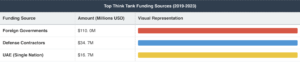
Foreign governments and their entities contributed more than $110 million to the top 50 United States think tanks between 2019 and 2024. The Department of Justice issued an advisory opinion in August 2022 indicating that think tanks doing work at the behest of a foreign government likely have an obligation to register under the Foreign Agents Registration Act. Enacted in 1938, this law requires individuals and entities acting on behalf of foreign principals to register with the federal government.

A 2023 study by Kjølv Egeland and Benoît Pelopidas, titled “No such thing as a free donation,” analyzed 45 top foreign policy think tanks. All 45 organizations in their sample acknowledged funding from nuclear defense contractors or governments with an interest in deploying nuclear weapons. The researchers found verified evidence that funding leads to self censorship and donor directed censorship. Through interviews with grant managers and former employees, the study identified specific instances where funding biased organizational work through outright censorship, self censorship, and perspective filtering. Reliance on Pentagon contractors can lead to an entire sector advocating for expanding defense budgets and foreign conflicts.
Transparify provides global ratings on financial disclosure levels for policy organizations. The Center for Global Development publishes an annual list of all grants received over $30, 000 to maintain research integrity. Representative Jack Bergman introduced the Think Tank Transparency Act of 2022 to require greater transparency regarding foreign funding of public policy organizations. The State Department noted in 2020 that foreign governments seek to exert influence over United States foreign policy through external experts and requested prominent website disclosures of state owned funding. Organizations that fail to disclose these financial ties risk operating as unregistered foreign agents, compromising the intellectual independence required for objective policy analysis.
Follow the Money: Corporate Funding and Policy Outcomes
Financial contributions from private corporations dictate the research outputs of ostensibly independent policy institutions. A January 2025 analysis by the Quincy Institute tracked the financial pipelines feeding 50 top United States policy organizations. Between 2019 and 2023, defense contractors contributed more than $34. 7 million to these institutions. Organizations receiving these funds produce research that aligns with the financial interests of their donors. The Atlantic Council received $10 million from the Pentagon and $20. 8 million from foreign governments during this period. The Brookings Institution accepted $17. 1 million from foreign governments.
The defense sector uses policy centers to secure government contracts. Companies including Lockheed Martin and Northrop Grumman fund research that advocates for expanded military budgets. The United States government currently allocates $886 billion to the Pentagon budget. Policy papers funded by defense contractors consistently recommend increasing this expenditure. The Quincy Institute data reveals that 18 of the 50 analyzed organizations maintain complete secrecy regarding their donor lists. This absence of transparency prevents the public from identifying the financial motives behind policy recommendations.
The fossil fuel industry employs a similar method to protect its financial interests. The United States federal government provides $35 billion per year in direct handouts to the fossil fuel sector. Total annual benefits, including tax breaks and unpriced externalities, reach an estimated $760 billion. Policy centers funded by oil and gas companies publish reports demanding deregulation and continued reliance on carbon-heavy energy sources. These publications frame environmental regulations as economic threats. They omit the financial reality of government subsidies that sustain the fossil fuel market. The resulting policy environment delays the adoption of alternative energy infrastructure and costs taxpayers billions of dollars annually.
Technology corporations also purchase policy influence through strategic donations. Google, Amazon, Meta, Microsoft, and Apple face increasing scrutiny regarding antitrust violations and digital labor practices. These companies fund policy centers to shape the regulatory framework in their favor. A 2025 Amnesty International report details how the concentration of power among these five corporations affects global digital infrastructure. Policy papers financed by technology firms advocate for self-regulation and minimal government intervention. This intellectual cover allows corporations to maintain market dominance while avoiding strict oversight.
The financial relationship between corporations and policy centers creates a feedback loop. Corporations fund research that supports their business models. Lawmakers use this research to justify legislation. The resulting laws increase corporate profits. The corporations then funnel a portion of these profits back into the policy centers. This financial loop ensures that corporate interests remain prioritized over public welfare.
The pharmaceutical industry represents another major funding source for policy research. Drug manufacturers finance health policy centers to influence drug pricing legislation and patent laws. These organizations produce studies that defend high medication costs as necessary for research and development. This narrative contradicts the reality of public funding in medical research. The United States government distributes billions of dollars through the National Institutes of Health to support basic scientific research. Pharmaceutical companies use this publicly funded research to develop drugs. They then rely on policy centers to campaign against price controls. This strategy maximizes corporate revenue while patients bear the financial cost of inflated drug prices.
The absence of mandatory disclosure laws allows this financial influence to remain hidden. The Quincy Institute report shows that 36 percent of the top policy organizations operate with zero funding transparency. These secretive institutions testify before Congress and advise government officials without revealing their corporate sponsors. Lawmakers receive policy recommendations that appear objective originate from corporate public relations budgets. This hidden funding structure distorts the democratic process. It grants wealthy corporations disproportionate power over national legislation.
Foreign governments also exploit this system to shape United States foreign policy. The United Arab Emirates contributed $16. 7 million to top policy centers between 2019 and 2023. These funds purchase favorable research that supports arms sales and military alliances. The Atlantic Council alone accepted $20. 8 million from foreign entities. When policy experts from these institutions appear on television to discuss international conflicts, their financial ties to foreign governments remain undisclosed. The public consumes this analysis under the false impression of neutrality.
The integration of corporate money into policy research creates a serious threat to objective governance. Policy centers function as lobbying arms for their financial backers. They produce predetermined conclusions that serve corporate interests. The data confirms that defense contractors, fossil fuel companies, technology firms, and foreign governments spend millions of dollars to control the policy narrative. Until strict transparency laws force these institutions to disclose their funding sources, corporate money can continue to dictate policy outcomes.
Dark Money Networks: Tracing Undisclosed Donations to Prominent Institutes
Financial secrecy defines the modern policy research sector. Independent trackers classify 36 percent of monitored think tanks as dark money operations. These organizations disclose no donor details. Other institutes anonymize contributions or omit specific funding amounts. This deliberate concealment obscures the true architects of domestic and foreign policy recommendations.
Donor-advised funds serve as the primary vehicles for this financial anonymity. Entities like DonorsTrust, Vanguard Charitable, and Fidelity Charitable bundle thousands of contributions. They legally shield the identities of the original financiers. The money settles into tax-exempt buckets before flowing to prominent research institutes. DonorsTrust alone moved over $1. 5 billion in cumulative contributions to conservative organizations. From 2017 to 2021, the State Policy Network received over $24 million from DonorsTrust to coordinate free-market think tanks. The Koch-affiliated Americans for Prosperity 501(c)(4) reported $70 million in dark money during the 2022 election pattern. The Heritage Foundation reported $101 million in total revenue for 2023.
Progressive and center-left networks use identical financial structures. The Sixteen Thirty Fund operates as a 501(c)(4) organization and generated $282 million in 2024 revenue. Political operatives describe it as the heavyweight of Democratic dark money. The fund sponsors dozens of projects that do not file independent tax returns or publish donor lists. The Center acts as another major conduit. Between January 2019 and April 2024, the Center received nearly $187 million in California taxpayer funding. The Center for American Progress takes funding from Walmart, Citigroup, and major defense firms.
Foreign governments exploit these same anonymous networks to buy influence in Washington. A January 2025 investigation revealed $110 million in foreign government-linked donations to top federal think tanks over a five-year period. Governments including Qatar, the United Arab Emirates, China, and Saudi Arabia fund United States think tanks to shape foreign policy narratives. The Center for American Progress and the Brookings Institution are among the top destinations for these international funds.
The financial architecture relies on a multi-tiered system. Billionaires and corporate entities deposit assets into donor-advised funds. The funds take legal ownership of the money. The original donors then advise the fund managers on where to direct the grants. The receiving think tanks report the donor-advised fund as the contributor. The public record never connects the original billionaire or corporation to the final policy paper. This double-blind system launders the identity of the final recipient.
The revolving door between Washington think tanks and federal government positions the movement of experts between policy research and executive roles. Institutions like the Center for American Progress, the Brookings Institution, and the Heritage Foundation serve as pipelines for senior appointees. In the Biden administration, the Center for American Progress alone supplied at least 66 alumni to various roles by early 2021. Over 100 former think tank staffers occupied influential positions. This direct access to power makes these institutes highly attractive to undisclosed donors.
The January 2025 investigation prompted demands for regulatory enhancements like mandatory real-time disclosures under Foreign Agents Registration Act expansions. Foreign governments use these donations to soften their public image and secure favorable trade policies. The think tanks host events, publish white papers, and testify before Congress. They rarely disclose that the subjects of their favorable research also pay their operating expenses.
Environmental policy research experiences heavy interference from undisclosed donors. Donor-advised funds distributed over $120 million to climate denial organizations in previous decades, and the practice continues through modern networks. The Heartland Institute received anonymous donations via DonorsTrust to publish reports designed to mimic official international climate assessments. These reports reach opposite conclusions to justify continued fossil fuel extraction. Billionaire foundations funnel millions of dollars into obstructionist think tanks to stall offshore wind projects and other renewable energy initiatives.
| Organization or Fund | Reported Financial Metric | Timeframe | Classification |
|---|---|---|---|
| Sixteen Thirty Fund | $282 million in revenue | 2024 | 501(c)(4) Dark Money Fund |
| Center | $187 million in state funding | 2019 to 2024 | Fiscal Sponsor |
| Foreign Governments | $110 million in donations | 2020 to 2025 | International Influence |
| Heritage Foundation | $101 million in revenue | 2023 | Conservative Think Tank |
| Koch AFP 501(c)(4) | $70 million in dark money | 2022 | Political Advocacy |
| State Policy Network | $24 million from DonorsTrust | 2017 to 2021 | Think Tank Network |
Regulators face immense pressure from these same think tanks to maintain the current reporting rules. Organizations across the political spectrum lobby against mandatory real-time disclosures. They claim transparency would anger funders and cause self-censorship. The Internal Revenue Service requires 501(c)(3) organizations to report donors who give more than $5, 000. The agencies do not force the organizations to make those names public. The think tanks redact the names on the publicly available versions of their tax returns.
This system allows wealthy individuals and foreign actors to purchase academic credibility. They finance the exact research needed to support their financial interests. The think tanks provide the intellectual justification. The donor-advised funds provide the cover. The public consumes the resulting media narratives without knowing who paid for the underlying data.
The Foreign Influence Loophole: Sovereign Wealth Funds and Washington Policy
Foreign governments and their state owned entities direct tens of millions of dollars to United States policy research organizations. Between 2019 and 2024, foreign governments contributed more than $110 million to 50 top American think tanks with foreign policy and defense portfolios. The United Arab Emirates led this spending by contributing $16. 7 million. The United Kingdom followed with $15. 5 million. Qatar ranked third by directing $9. 1 million to these institutions.
These financial transfers occur through direct government grants and through sovereign wealth funds. Sovereign wealth funds manage state owned investment capital and distribute grants to research centers. The Qatar Investment Authority and the United Arab Emirates Mubadala Investment Company represent two major sovereign wealth funds operating in Washington. These entities fund policy papers, host events, and secure access to lawmakers. The Quincy Institute for Responsible Statecraft documents cases where foreign governments pay for specific reports and insist on editorial input. This financial relationship aligns think tank recommendations with the geopolitical interests of the donor nations.
Specific institutions receive the vast majority of this capital. The Atlantic Council ranked as the top recipient of foreign government funding, taking in $20. 8 million between 2019 and 2024. The Brookings Institution followed closely with $17. 1 million. The German Marshall Fund received $16. 1 million during the same period. The United Arab Emirates directed more than $7 million specifically to the Atlantic Council. Qatar previously pledged a $14. 8 million donation to the Brookings Institution to fund an affiliate center in Doha and a project on United States relations with the Islamic world.

The Foreign Agents Registration Act governs individuals and entities representing foreign interests in the United States. The law requires foreign agents to register with the Department of Justice and disclose their activities. Think tanks frequently avoid this requirement by claiming academic and humanitarian exemptions. The statute contains exemptions for bona fide religious, scholastic, academic, or scientific activities. Policy research organizations classify their work under these exemptions. This classification allows them to accept foreign money without registering as foreign agents.
The absence of registration requirements creates a blind spot in tracking foreign influence. The Department of Justice maintains a database of registered foreign agents. Think tanks do not appear in this database unless they explicitly engage in direct lobbying on behalf of a foreign principal. The distinction between policy research and lobbying remains ambiguous. A foreign government can fund a white paper advocating for increased military aid. The think tank publishes the paper and distributes it to congressional offices. The organization categorizes this activity as educational research rather than lobbying. The foreign government achieves its policy objective without triggering disclosure requirements.
Legislators have proposed measures to address this exemption. The Think Tank Transparency Act of 2022 sought to require nonprofits engaged in influencing United States policy to disclose funding received from foreign principals. The bill proposed creating an online database for these disclosures. The legislation did not pass. The American Bar Association Task Force suggested aligning the Lobbying Disclosure Act registration requirements with the Foreign Agents Registration Act. This would reduce the exemptions available to policy research organizations.
The financial secrecy surrounding these institutions complicates oversight. Think tanks operate as tax exempt nonprofits under section 501(c)(3) of the Internal Revenue Code. The Internal Revenue Service does not require these organizations to publicly disclose their donors. institutions voluntarily publish donor lists. These lists frequently group donors into broad financial tiers. A tier might list contributions between $100, 000 and $499, 999. This grouping obscures the exact amount of foreign funding. Other institutions refuse to disclose any donor information. The Quincy Institute identified 35 organizations that disclose no donor information.
Foreign governments use this opacity to shape public discourse. Authoritarian regimes with poor human rights records fund research centers to improve their public image. These regimes rely on United States weapons systems and military support. Funding think tanks provides a method to maintain this support. The organizations produce reports emphasizing the strategic importance of the donor nations. The researchers testify before congressional committees. Between 2021 and 2024, 89 percent of witnesses affiliated with think tanks testifying before the House Foreign Affairs Committee came from institutions receiving foreign funding.
The intersection of sovereign wealth funds and policy research creates a serious problem for democratic governance. Foreign capital flows into institutions designed to provide independent analysis. The analysis reaches lawmakers and shapes national security decisions. The public remains unaware of the financial relationships driving these recommendations. The current legal framework permits this arrangement. The exemptions in the Foreign Agents Registration Act protect the financial secrecy of these organizations. The absence of mandatory disclosure laws ensures the continuation of foreign funded policy research.
Fossil Fuel Financing: Climate Change Denial and Delay Tactics in Research
Corporate entities within the energy sector direct billions of dollars to policy research institutions to shape public opinion and legislative action regarding climate change. Between 2015 and 2025, the strategy shifted from outright denial of atmospheric warming to the promotion of delay tactics. These tactics involve funding think tanks to publish reports that question the economic viability of renewable energy transitions and amplify the financial costs of environmental regulations. Organizations such as the Competitive Enterprise Institute and the Heartland Institute receive substantial financial backing from fossil fuel interests to produce this specific type of policy literature.
Direct corporate contributions represent only a fraction of the total funding network. Wealthy individuals and corporate donors use donor advised funds to obscure the origins of their financial support. Donors Trust and Donors Capital Fund operate as primary financial conduits for this purpose. These two entities distributed hundreds of millions of dollars to conservative think tanks. By routing money through these funds, corporations maintain anonymity while financing research that opposes greenhouse gas emission reductions. The Competitive Enterprise Institute and the American Enterprise Institute rank among the top recipients of these anonymous disbursements.
ExxonMobil and Koch Industries maintain a documented history of financing policy research that aligns with their corporate interests. Records show ExxonMobil granted over $4 million to the American Enterprise Institute and $2.1 million to the Competitive Enterprise Institute. Charles Koch and related philanthropic arms directed over $640,000 to the Competitive Enterprise Institute prior to 2015, and funding continued through undisclosed channels like the Knowledge and Progress Fund over the subsequent decade. This financial architecture ensures that policy papers minimizing the severity of climate change receive broad distribution among lawmakers and media outlets.
The financial backing of these institutions directly influences national and international energy policies. Think tank reports frequently serve as the foundational text for legislative efforts to repeal renewable energy standards and maintain fossil fuel subsidies. The International Institute for Sustainable Development reported that global government support for fossil fuels reached a record $2 trillion in 2022. This figure demonstrates the effectiveness of sustained policy advocacy funded by the energy sector. Lawmakers reference think tank publications to justify these subsidies and to oppose carbon pricing systems.
The Heritage Foundation actively participates in this policy ecosystem. The organization receives funding from Donors Trust and Koch linked entities to draft extensive policy frameworks. The 2025 Presidential Transition Project, organized by the Heritage Foundation, includes explicit recommendations to eliminate the United States Global Change Research Program and eliminate regulations limiting pollution from fossil fuels. The project documentation states that climate research reduces the scope of legally proper options in presidential decision making. This direct translation of donor interests into direct policy blueprints illustrates the primary function of sponsored research.
Global Energy Financial Flows (2022 to 2023)
$2.0 Trillion
$1.7 Trillion
Data sourced from the International Institute for Sustainable Development and the International Energy Agency.
The difference between public statements and private funding strategies reveals a coordinated effort to control the energy narrative. While energy corporations publicly acknowledge climate change, their financial contributions tell a different story. They continue to bankroll institutions that attack climate scientists and promote the continued extraction of coal, oil, and natural gas. The Heartland Institute focused its campaigns on questioning the integrity of academic scientists and compiling literature that contradicts the consensus on human caused carbon emissions. This strategy creates an artificial debate that stalls legislative action.
Financial transparency remains a serious problem in the think tank sector. Organizations are not legally required to disclose their donors, allowing them to present their research as independent and objective. This secrecy benefits both the donors and the institutions. The donors avoid public scrutiny for funding climate denial, and the institutions maintain their status as credible research organizations. The resulting policy environment heavily favors existing conditions and protects the financial interests of the fossil fuel industry.
| Think Tank | Documented Fossil Fuel Funding Sources | Key Policy Focus (2015 to 2025) |
|---|---|---|
| Competitive Enterprise Institute | ExxonMobil, Koch Family Foundations, Donors Trust | Opposing federal environmental protections and climate regulations. |
| Heartland Institute | ExxonMobil, Donors Trust, Donors Capital Fund | Publishing literature contradicting human caused climate change. |
| Heritage Foundation | Koch Industries, Donors Trust | Drafting blueprints to deconstruct the Environmental Protection Agency. |
| American Enterprise Institute | ExxonMobil, Koch related foundations | Promoting the economic costs of renewable energy transitions. |
The reliance on anonymous funding structures ensures that the true extent of fossil fuel influence remains hidden. Investigative reports indicate that Donors Trust and Donors Capital Fund handled over $479 million in untraceable funds directed toward conservative movements. A substantial portion of this money supports organizations dedicated to defeating climate legislation. The continuous flow of capital from the energy sector to these research institutions guarantees that policy debates remain focused on the costs of action rather than the consequences of inaction.
Big Tech Philanthropy: Shaping Antitrust and Privacy Legislation Through Grants
Technology corporations distribute philanthropic grants to research institutions to dictate legislative outcomes regarding market competition and consumer data protection. Between January 1, 2015, and December 31, 2025, Alphabet, Amazon, and Meta distributed capital to at least 771 third party organizations. The Tech Transparency Project tracks these financial relationships. The data confirms that 58 distinct policy groups accepted money from all three corporations during this period. These recipients include the American Antitrust Institute, the Mercatus Center at George Mason University, and the Progressive Policy Institute. By funding institutions across the political spectrum, technology executives secure favorable research framing during congressional hearings on market dominance.
Financial distributions align directly with legislative calendars. Google doubled its think tank funding volume between 2018 and 2019. This capital increase coincided with the drafting and passage of the California Consumer Privacy Act, a law that threatened the data collection models of major technology firms. Amazon accelerated its institutional grants in 2020. This timing matched the initiation of federal antitrust investigations into the electronic commerce sector. When lawmakers draft bills to restrict data collection or break up digital monopolies, funded institutions frequently publish white papers defending the corporate practices of their benefactors. The resulting research provides intellectual justification for legislators voting against regulatory measures. The think tanks present themselves as neutral arbiters of economic policy while cashing checks from the subjects of the legislation.
The 2017 termination of Barry Lynn from the New America Foundation provides a documented case of donor retaliation. The New America Foundation received $21 million from Google and its executive chairman Eric Schmidt. Lynn directed the Open Markets initiative at the institution. In June 2017, the European Union levied a €2. 42 billion fine against Google for breaching antitrust rules. Lynn published a statement on the foundation website praising the European Union decision. Schmidt contacted foundation president Anne Marie Slaughter to express his displeasure. The foundation deleted the statement from its website and fired Lynn days later. Slaughter stated the termination was a mutual decision, yet the sequence of events demonstrates how financial dependency dictates permissible research parameters.
Big Tech Think Tank Funding Overlap (2015 to 2025)
To visualize the financial overlap, the following table details the funding status of prominent research institutions by technology corporations. The data reflects disclosures tracked by the Tech Transparency Project and congressional contributor records between 2015 and 2025.
| Research Institution | Alphabet (Google) | Amazon | Meta (Facebook) | Apple |
|---|---|---|---|---|
| New America Foundation | Funded | Funded | Funded | Funded |
| Brookings Institution | Funded | Funded | Funded | Funded |
| Mercatus Center | Funded | Funded | Funded | Not Disclosed |
| American Antitrust Institute | Funded | Funded | Funded | Not Disclosed |
| Progressive Policy Institute | Funded | Funded | Funded | Not Disclosed |
The strategic distribution of capital extends beyond direct retaliation. The Department of Justice sued Google in 2020 over internet search dominance and added a separate case focused on advertising technology in 2023. The Federal Trade Commission filed a lawsuit against Meta in 2020 and Amazon in 2023. As these federal agencies prepared their legal arguments, funded think tanks escalated their public relations campaigns. The Progressive Policy Institute published reports criticizing the House Judiciary antitrust findings. These reports defended the market positions of the exact corporations providing their funding. Lawmakers rely on these ostensibly independent policy centers to draft legislation and understand technical digital markets. The financial relationship between the subject of regulation and the author of the regulatory research creates a direct conflict of interest.
Apple maintains a quieter philanthropic profile compared to its peers. The corporation still directs capital to influential institutions like the Brookings Institution and the New America Foundation. By distributing funds across the policy sector, technology executives ensure their preferred arguments dominate legislative hearings. The resulting environment leaves consumer advocates and independent researchers at a serious financial disadvantage. They must compete against policy centers backed by trillion dollar market capitalizations. This financial asymmetry dictates which bills reach the floor for a vote and which privacy protections die in committee. Without mandatory funding disclosures, the public cannot differentiate between objective academic research and paid corporate advocacy.
The Defense Industry Pipeline: Weapons Manufacturers Funding Pro War Analysis
Between 2020 and 2024, the United States Department of Defense allocated $4. 4 trillion in discretionary spending. Private military contractors absorbed $2. 4 trillion of that total. This means 54 percent of the Pentagon budget went directly to private firms. This represents a significant increase from the 1990s when contractors received 41 percent of the defense budget. Five corporations secured $771 billion in Pentagon contracts during this five year window. Lockheed Martin received $313 billion. RTX secured $145 billion. General obtained $116 billion. Boeing collected $115 billion. Northrop Grumman took in $81 billion. These exact same corporations simultaneously operate as the primary financial backers for the foreign policy think tanks that advise the Pentagon on military strategy and weapons procurement.
A 2025 Quincy Institute for Responsible Statecraft investigation quantified this financial pipeline. The top 100 military contractors transferred more than $34. 7 million to the 50 most prominent American think tanks between 2019 and 2023. Northrop Grumman led the defense sector with $5. 6 million in think tank donations. Lockheed Martin followed with $2. 6 million in direct contributions. These funds flow directly to the research institutions that draft policy papers recommending increased defense budgets and expanded military interventions.
| Defense Contractor | Pentagon Contracts (2020 to 2024) | Known Think Tank Contributions (2019 to 2023) |
|---|---|---|
| Lockheed Martin | $313 Billion | $2. 6 Million |
| RTX | $145 Billion | Undisclosed |
| General | $116 Billion | Undisclosed |
| Boeing | $115 Billion | Undisclosed |
| Northrop Grumman | $81 Billion | $5. 6 Million |
The capital distribution heavily favors institutions that promote aggressive foreign policy postures. The Atlantic Council received $10. 2 million from defense contractors during the studied period. The Center for a New American Security accepted $6. 6 million. The Center for Strategic and International Studies collected $4. 1 million. These three organizations routinely publish reports advocating for higher military spending and looser weapons export regulations. The return on investment for defense contractors is highly favorable. A few million dollars in think tank donations yields policy recommendations that help secure hundreds of billions in federal contracts.
The Revolving Door Project documented specific instances of this financial relationship shaping policy outcomes. The Center for a New American Security repeatedly published analysis supporting policies that directly enriched top arms manufacturers. The institution did not formally disclose its financial receipts from those exact companies within the text of the reports. In 2016, the United Arab Emirates paid $250, 000 to the Center for a New American Security for a policy paper. The resulting document advocated for loosening the Missile Technology Control Regime to permit the export of sophisticated drones to the United Arab Emirates. The think tank produced the exact policy recommendation the donor purchased.
Analysts at these defense funded organizations consistently testify before Congress to request more weapons systems. They write opinion columns in major newspapers warning against any reductions in the defense budget. They appear on cable news networks to promote military responses to global conflicts. The viewers and lawmakers consuming this analysis rarely see the financial disclosures linking the experts to the weapons manufacturers. The Center for Strategic and International Studies published reports warning about the collapse of the defense industrial base due to budget cuts. Industry lobbying associations finance these reports to inject their preferred narratives into major publications like The Wall Street Journal.
The financial volume of the defense industry dwarfs other foreign policy priorities. The United States government spent $356 billion on diplomacy and humanitarian aid between 2020 and 2024. During that exact same period, the government awarded more than twice that amount to just five weapons manufacturers. The think tanks funded by these manufacturers provide the intellectual justification for this budget allocation. They frame diplomatic solutions as weak and military expansion as necessary. The research output aligns perfectly with the financial interests of the corporate donors. Legislation approved in July 2025 added another $156 billion to the defense budget. This pushed annual United States military spending to $1. 06 trillion. The think tank sector provided the analytical backing to justify this massive increase.
The structural conflict of interest extends beyond direct donations. Former Pentagon officials frequently transition to defense funded think tanks. They use these positions to maintain their security clearances and government contacts. Dozens simultaneously work as consultants or board members for the weapons manufacturers funding their research institutions. The New York Times identified at least 50 former Pentagon officials who moved into military related venture capital or private equity firms between 2019 and 2023. These individuals use think tank affiliations to legitimize their policy recommendations while profiting from the resulting defense contracts.
The data confirms a closed loop of defense industry influence. Weapons manufacturers receive trillions in taxpayer funds. They redirect a fraction of those profits to foreign policy think tanks. The think tanks produce research demanding more weapons and higher defense spending. Lawmakers reference the think tank research to justify expanding the Pentagon budget. The weapons manufacturers secure new contracts and the process repeats. The public receives policy analysis presented as independent and objective. The financial records prove the analysis is heavily subsidized by the corporations that profit from war.
Big Pharma Contributions: Skewing Healthcare Policy and Drug Pricing Debates
The pharmaceutical industry directs billions of dollars into research institutions, patient advocacy organizations, and policy centers to dictate national healthcare legislation. Between 2010 and 2022, the Pharmaceutical Research and Manufacturers of America network distributed at least $6 billion in grants to more than 20, 000 organizations. Between 2018 and 2022, this network distributed an average of $600 million annually. In 2021 alone, the network dispersed more than $720 million. These financial contributions secure favorable policy recommendations and manufacture artificial grassroots opposition to drug pricing regulations. Corporate executives use this grant system to ensure that ostensibly independent research matches their profit objectives.
When federal lawmakers debated Medicare drug price negotiations in 2022, the pharmaceutical lobby mobilized its funded network. PhRMA distributed $16. 1 million that year to various advocacy groups that publicly challenged the pricing reforms. These organizations presented themselves as independent voices representing patients, yet their financial backing originated directly from the industry whose profits were under review. The American Action Network, a politically aligned dark money group, received $7. 5 million from PhRMA in 2022. This single contribution brought the total receipts from the trade association to the American Action Network to $34. 5 million since 2010. The pharmaceutical sector reported $388. 2 million in federal lobbying spending for 2024, cementing its position as a dominant force in legislative affairs.
PhRMA Network Grant Distribution and Lobbying Expenditures
| Year | Category | Amount | Visual Representation |
|---|---|---|---|
| 2021 | Total PhRMA Network Grants | $720 Million |
|
| 2018 to 2022 | Average Annual Grants | $600 Million |
|
| 2024 | Federal Lobbying Spending | $388. 2 Million |
|
| 2022 | Opposition to Pricing Reform | $16. 1 Million |
|
Thirteen of the largest patient advocacy organizations in the United States collected a combined $266 million from the PhRMA network over recent years. Specific organizations received massive sums between 2010 and 2022. The American Heart Association accepted $64. 1 million from the pharmaceutical industry during this period. The American Cancer Society and its advocacy affiliate received $23. 1 million. This funding creates a serious conflict of interest. Organizations tasked with representing patient welfare frequently match their public statements with pharmaceutical corporate objectives. When the government attempts to regulate drug costs, these funded groups testify against price caps. They claim such measures halt medical research and deny patients access to new treatments.
The industry routinely justifies high drug prices by referencing extensive research and development costs. A 2023 Government Accountability Office report examined over 19, 000 patents filed between 2012 and 2021. The investigation found that nearly 15 percent of patents relying on National Institutes of Health funding failed to disclose the taxpayer support they received. Pharmaceutical companies use publicly funded research to develop medications, patent the results, and then set high market prices while obscuring the initial government contribution. Think tanks funded by these same corporations publish reports defending these pricing models. They omit the data regarding public subsidies and present the pharmaceutical companies as sole creators bearing all financial risks.
Corporate funding also sustains continuous digital campaigns designed to shape public perception of healthcare laws. A 2025 report by Patients For Affordable Drugs showed that PhRMA spent more than $235, 800 on targeted social media advertisements to attack the 2022 prescription drug law. These advertisements claimed the legislation would increase costs and reduce insurance options for seniors. Verified data from the Centers for Medicare and Medicaid Services confirms that Medicare Part D plan options remain stable in 2025, with an average of 48 plans available to beneficiaries. The industry uses think tanks to legitimize these false claims. Researchers at funded institutions produce white papers that echo the talking points found in the corporate advertisements.
The financial relationship between drug manufacturers and policy centers compromises the integrity of healthcare research. Independent analysis becomes impossible when the institutions conducting the studies rely on the subjects of their research for operational revenue. Lawmakers receive briefings from think tank scholars who present themselves as neutral experts. These scholars frequently fail to disclose that their employers receive millions of dollars from the pharmaceutical companies affected by the proposed legislation. The resulting policies protect corporate revenue streams while American patients continue to pay the highest prescription drug prices in the world.
The Revolving Door: Politicians Moving Between Corporate Boards and Think Tanks
Public officials moving into the private sector is a documented reality. Between 2015 and 2025, a specific three way trajectory solidified. Former politicians and military officials leave government service, secure lucrative positions on corporate boards, and simultaneously join prominent think tanks. This structure allows them to maintain policy influence while collecting substantial corporate compensation.
Corporate board service provides massive financial returns for former officials. Data shows that former members of Congress and cabinet secretaries earn an average of $251, 000 to over $357, 000 annually for part time board service. Since 1992, more than 45 percent of senators who left office served on the board of a publicly traded firm. In comparison, only 20 percent of former senators worked as registered lobbyists. For example, Elaine Chao retained shares in Vulcan Materials Company worth nearly $400, 000 as deferred compensation for her board service before becoming Secretary of Transportation. The financial incentives drive officials to align with corporate interests.
Federal ethics laws impose a cooling off period of one to two years before former officials can register as lobbyists. No such restriction exists for joining corporate boards or think tanks. Think tanks act as holding tanks for these individuals. They publish research, testify before Congress, and appear on news networks as impartial experts. Their corporate board affiliations remain largely unmentioned during these appearances. Former officials avoid registering as lobbyists by taking titles like strategic advisor or board member while still exerting influence. This practice is known as shadow lobbying.
This overlap is most visible in the defense sector. Major contractors like Lockheed Martin, Raytheon, and Booz Allen Hamilton fund think tanks such as the Center for a New American Security and the Brookings Institution. These same contractors place former government officials on their boards. The officials then hold leadership roles at the think tanks, creating a closed rotation of influence. The Center for a New American Security receives large contributions directly from defense contractors and gives its financial sponsors an official oversight role in shaping the research agenda.
| Name | Former Government Role | Corporate Board Affiliation | Think Tank Affiliation |
|---|---|---|---|
| Jeh Johnson | Secretary of Homeland Security | Lockheed Martin | Center for a New American Security |
| Michèle Flournoy | Under Secretary of Defense for Policy | Booz Allen Hamilton | Center for a New American Security |
| Elaine Chao | Secretary of Transportation | Vulcan Materials Company | Hudson Institute |
| John R. Allen | Special Presidential Envoy | GLOBSEC US Foundation | Brookings Institution |
The Center for Strategic and International Studies operates under a similar structure. The institution receives heavy funding from defense contractors including General and General Atomics. Former government officials populate its senior ranks. Kathleen Hicks served as a senior vice president at the Center for Strategic and International Studies before becoming Deputy Secretary of Defense. The think tank frequently hosts panels co chaired by individuals who sit on the boards of major defense contractors. For instance, Gary Roughead served as a co chair for a national defense panel while simultaneously sitting on the board of directors for Northrop Grumman, where he earned over $1. 6 million. These panels consistently recommend higher defense budgets, directly benefiting the corporations that employ the panel members.
The Brookings Institution provides another clear example of this rotation. Former Marine Corps General John R. Allen served as the president of the Brookings Institution from 2017 to 2022. During his tenure, he also served on the board of directors for the GLOBSEC US Foundation and acted as a strategic advisor to Microsoft. In 2022, federal authorities investigated Allen for withholding documents and making false statements about his role in an illegal foreign lobbying campaign on behalf of Qatar. The investigation revealed that Allen pursued a multimillion dollar business deal with the Qatari government on behalf of a company where he served on the board of directors. This case demonstrates how think tank leadership positions provide cover for corporate and foreign lobbying.
This revolving door shapes national security and domestic policy. When think tanks publish reports recommending increased defense spending or specific weapons systems, the authors or board members are directly tied to the corporations manufacturing those systems. Between 2019 and 2023, the top 100 military contractors contributed more than $34. 7 million to the top 50 think tanks. Top donors included Northrop Grumman with $5. 6 million and Lockheed Martin with $2. 6 million. The presence of corporate board members in think tank leadership ensures that corporate priorities dictate the research agenda.
The rotation completes when these individuals return to public office. The Biden administration selected at least 16 Center for a New American Security alumni for foreign policy positions. This movement guarantees that corporate aligned think tank personnel populate the executive branch. The revolving door spins continuously, moving individuals from government to corporate boards, into think tanks, and back into government.
The continuous movement between these three sectors creates a closed network of policy formulation. Public policy decisions are outsourced to professional consultancies and corporate sponsored think tanks. This externalization erases the line separating state power from corporate influence. When former politicians sit on corporate boards, they bring political connections that companies use to secure government contracts. The think tanks provide the intellectual justification for those contracts. The public receives policy recommendations framed as independent academic research, while the underlying financial architecture remains hidden.
Data Manipulation: How Sponsored Researchers Cherry Pick Statistics
Think tanks frequently present themselves as independent arbiters of truth. Yet financial records from 2015 to 2025 tell a different story. Institutions manipulate data to serve the financial interests of their corporate and government sponsors. Researchers omit contradictory variables, select favorable timeframes, and redefine standard metrics to produce predetermined conclusions. This practice turns academic research into paid public relations.
The energy sector provides a clear example of statistical manipulation. In December 2025, the International Monetary Fund published a report stating that global fossil fuel subsidies reached $7 trillion in 2024. The International Monetary Fund calculated this figure by including $6. 7 trillion in implicit costs, such as the underpricing of environmental damage and local air pollution mortality. In response, industry funded organizations immediately published counter reports to dispute the findings. The National Center for Energy Analytics released a document in December 2025 claiming that fossil fuel tax expenditures were only $2. 6 billion in fiscal year 2025. The organization arrived at this drastically lower number by entirely omitting implicit environmental costs and counting only direct federal tax expenditures like drilling cost expensing. The center then compared this restricted definition of fossil fuel subsidies to a broad calculation of renewable energy tax expenditures, which they reported as $57. 9 billion for the same year. By cherry picking which costs to include, the industry backed researchers created a statistical narrative that portrayed fossil fuels as the less subsidized energy source.
In September 2025, the International Institute for Sustainable Development reported that international fossil fuel project finance from Clean Energy Transition Partnership countries dropped by 78 percent from 2019 to 2024. Yet, industry funded think tanks frequently manipulate this exact data. They highlight the reduction in fossil fuel finance to claim that the industry is underfunded, while deliberately omitting the fact that less than a fifth of the removed funding actually transitioned into international clean energy projects. The report noted that participating countries increased their financial support for clean energy projects by only $3. 2 billion compared to the 2019 to 2021 baseline.
Defense contractors use similar methods to shape foreign policy recommendations. A February 2025 Quincy Institute report analyzed funding for the top 50 United States think tanks between 2019 and 2023. The investigation found that top Pentagon contractors contributed more than $34. 7 million to these institutions during that period. The researchers noted that 18 of the 50 organizations operated as dark money groups, meaning they completely concealed their donor lists. The think tanks receiving this money routinely publish reports advocating for increased military spending and new weapons systems.
The financial returns for defense contractors far exceed their think tank donations. A July 2025 report from the Costs of War project detailed the exact distribution of Pentagon contracts. Between 2020 and 2024, the United States government awarded $771 billion in contracts to just five major defense firms. The data shows a direct correlation between the companies funding foreign policy research and the corporations receiving the largest government payouts.
| Defense Contractor | Pentagon Contracts Received (2020 to 2024) |
|---|---|
| Lockheed Martin | $313 Billion |
| RTX | $145 Billion |
| General | $116 Billion |
| Boeing | $115 Billion |
| Northrop Grumman | $81 Billion |
Think tanks funded by these exact companies frequently publish statistics that exaggerate foreign military threats while minimizing the costs of domestic weapons programs. During the 1990s, only 41 percent of the Pentagon budget went to military contractors. By the 2020 to 2024 period, that number jumped to 54 percent. Think tank reports rarely mention this historical shift in discretionary spending. Instead, they focus exclusively on immediate procurement needs, using specific statistics to justify continuous budget increases. The United States military budget reached $899 billion in 2025, and supplemental legislation approved in July 2025 pushed the total annual spending to $1. 06 trillion. Sponsored researchers consistently frame this $1. 06 trillion figure as a baseline requirement rather than a historical peak.
Foreign governments also exploit think tank data manipulation to influence domestic policy. The same February 2025 Quincy Institute investigation revealed that foreign governments donated more than $110 million to the top 50 United States think tanks between 2019 and 2023. The United Arab Emirates led this spending with $16. 7 million, followed by the United Kingdom with $15. 5 million and Qatar with $9. 1 million. The Atlantic Council, the Brookings Institution, and the German Marshall Fund received the largest shares of this foreign money. Sponsored researchers at these organizations frequently produce economic analyses that highlight the benefits of trade agreements with donor nations while omitting data on human rights violations or labor abuses.
The absence of mandatory disclosure laws allows this statistical manipulation to continue unchecked. When a think tank expert testifies before Congress or publishes an opinion piece in a major newspaper, they rarely disclose that their employer receives millions of dollars from the corporations or countries they are discussing. The public consumes these cherry picked statistics as objective academic research. Until lawmakers require full financial transparency from policy organizations, sponsored researchers can continue to manipulate data to serve the highest bidder.
The Absence of Peer Review: Bypassing Academic Standards for Rapid Publication
Think tanks trade scientific rigor for speed. Academic journals require months to process double-blind peer reviews. Think tanks bypass this system entirely. They publish white papers in days or weeks. This rapid publication model serves corporate and foreign sponsors. Sponsors fund think tanks to inject specific narratives into legislative debates. A six-month delay defeats the purpose of lobbying. By skipping external peer review, institutions push sponsor-aligned data directly to lawmakers.
The mechanics of the bypass rely on internal approval. Internal review replaces independent scrutiny. Committees of internal executives approve documents based on policy influence rather than methodological soundness. For example, the Center for the Implementation of Public Policies Promoting Equity and Growth gives its internal policy brief committee 48 hours to review documents. This committee evaluates political risks and policy influence. They do not conduct a rigorous methodological audit. If members do not provide feedback within three to five days, the communications director assumes approval and begins dissemination. This internal sign-off process mimics academic authority without applying academic standards.
Data from academic publishing highlights the extreme contrast in timelines. A 2024 analysis of 57 health policy journals showed a median of 60. 5 days to reach a peer-reviewed decision. The same study found a median of 198 days to reach a final decision. PLOS ONE reported a median of 188 days from submission to acceptance in 2023. Scientific Reports takes a median of four to five months to accept a paper. These timelines reflect the time required to recruit independent experts, evaluate methodology, and demand revisions. Think tanks eliminate this waiting period. They prioritize immediate public influence over verified accuracy.
| Publication Outlet | Review Type | Timeline (Days) | Visual |
|---|---|---|---|
| Health Policy Journals | External Peer Review | 198 | |
| PLOS ONE | Double-Blind Review | 188 | |
| Scientific Reports | External Peer Review | 135 | |
| Think Tank Policy Briefs | Internal Committee | 5 |
The bias introduced by rapid publication is severe. Academic peer review acts as a filter to prevent flawed methodologies from reaching the public. Reviewers evaluate political bias, ethical violations, and data integrity. Think tanks remove this filter. They allow corporate sponsors to fund research that supports specific business interests. The resulting documents enter the public domain as authoritative research. Lawmakers cite these documents in congressional hearings. Journalists quote the findings in news reports. The public consumes the information as objective science. The absence of peer review guarantees that sponsor-driven conclusions face no independent scientific challenge before publication.
Institutions defend their methods by claiming their work requires speed. They state that academic timelines fail to keep up with legislative sessions. This justification masks the underlying problem. Speed benefits the sponsor. A defense contractor funding a report on military spending requires immediate publication to influence an upcoming defense budget vote. An energy company funding a report on deregulation needs the findings released before a regulatory hearing. Independent peer review would delay publication and reject the sponsor-aligned conclusions. By keeping the review process internal, think tanks guarantee that the sponsor receives the desired output exactly when needed.
The illusion of credibility sustains this system. Think tanks brand their outputs as studies or research reports. They use academic formatting. They include footnotes and data tables. This presentation tricks readers into assuming the work passed through rigorous academic channels. The reality is entirely different. The authors write the report. An internal communications team reviews the text for messaging compliance. A director signs off on the final draft. The institution publishes the document online. This closed loop prevents any external expert from identifying methodological flaws or sponsor bias.
Between January 2015 and December 2025, the volume of think tank publications exploded. Institutions realized they could dominate policy discussions by flooding the zone with rapid reports. Academic journals cannot compete with this output volume. A single think tank can publish dozens of policy briefs in the time it takes an academic journal to process one peer-reviewed article. This asymmetry allows sponsored research to overwhelm verified science in the public square. Lawmakers default to think tank reports because the documents are readily available and specifically tailored to pending legislation. The absence of peer review is not an operational oversight. It is a deliberate strategy to prioritize sponsor influence over scientific truth.
Think tanks measure success through media mentions and legislative citations rather than scientific accuracy. Academic institutions evaluate researchers based on their ability to pass double-blind peer review and publish in respected journals. Think tanks evaluate their staff based on their ability to generate headlines. A researcher at a policy institute receives rewards for producing a white paper that a senator quotes on the congressional floor. The accuracy of the white paper remains secondary to its reach. This incentive structure actively discourages rigorous review. A thorough review process might uncover data manipulation or weak evidence. By bypassing academic standards, think tanks protect their primary product. Their primary product is influence, not knowledge. The rapid publication model ensures that influence reaches the target audience before any independent scientist can verify the claims.
Media Amplification: News Outlets Citing Biased Reports as Objective Facts
Major news organizations routinely present think tank scholars as neutral experts. Journalists quote these analysts on foreign policy, defense budgets, and military deployments. Reporters rarely disclose the financial backers behind the quoted institutions. This practice turns paid policy advocacy into objective news. The pipeline between defense contractors, think tanks, and media desks operates with near total secrecy. News consumers read analysis on global conflicts without knowing weapons manufacturers funded the research.
The Quincy Institute for Responsible Statecraft published a 2023 study examining this exact problem. Investigators analyzed 1, 247 media mentions of think tanks in articles covering the war in Ukraine. They documented that media outlets referenced think tanks with defense industry backing 85 percent of the time. Journalists were seven times more likely to quote a defense funded institution than one without military industry ties. Out of the 15 think tanks most frequently mentioned by the press, only one did not receive funding from the war industry. The Center for Strategic and International Studies and the Atlantic Council dominated the media coverage. Both organizations receive millions from top defense contractors.
The absence of financial disclosure in mainstream journalism creates a distorted public record. A 2025 Quincy Institute report titled Big Ideas and Big Money evaluated the top 50 United States think tanks. The investigators documented that 18 of these institutions operate as dark money groups. These organizations refuse to reveal their donors. Yet, major newspapers and cable news networks continuously feature their scholars. Between 2019 and 2023, foreign governments poured $110 million into these top 50 institutions. The United Arab Emirates contributed $16. 7 million, the United Kingdom gave $15. 5 million, and Qatar provided $9. 1 million. Defense contractors added another $34. 7 million. News outlets broadcast the resulting policy recommendations without mentioning the foreign or corporate money funding the analysis.
Media References: Defense Funded vs Independent Think Tanks
| Metric | Data Point |
|---|---|
| Total Media Mentions Analyzed | 1, 247 |
| Mentions of Defense Funded Think Tanks | 1, 064 |
| Percentage of Defense Funded References | 85% |
| Likelihood of Quoting Defense Funded vs Independent | 7 to 1 |
| Top 15 Quoted Think Tanks with Defense Ties | 14 |
The media amplification of dark money extends beyond the United States. The 2023 Who Funds You report by openDemocracy analyzed think tank influence in the United Kingdom. The investigators documented that British think tanks raised over £101 million to influence public policy ahead of the general election. The study assigned influence ratings using political monitoring data. The data shows that the most influential secretive think tanks received thousands of pounds from foreign donors specifically to reach the public through social media channels. Press regulators urged journalists to exercise caution when reporting claims made by these groups. Reporters continue to uncritically accept and publish their findings.
News organizations fail to enforce basic journalistic standards when interviewing think tank personnel. A reporter would normally disclose if a source worked directly for Lockheed Martin or Raytheon. When that same source works for a think tank funded by Lockheed Martin or Raytheon, the disclosure disappears. This practice allows defense contractors to launder their talking points through prestigious academic brands. For example, scholars from the American Enterprise Institute frequently publish articles demanding higher military budgets. One such article criticized the Pentagon budget request as being too low and advocated for purchasing the Long Range Anti Ship Missile and the B 21 bomber. The author did not disclose that Lockheed Martin and Northrop Grumman manufacture those exact weapons and provide financial support to the American Enterprise Institute. The public receives biased analysis framed as independent expertise. The financial relationship remains hidden, and the resulting news coverage heavily favors military intervention and increased defense spending.
The integration between media outlets and defense funded think tanks goes beyond simple quotes. News organizations actively partner with these institutions to host public events. The Center for a New American Security receives funding from Boeing, General, Lockheed Martin, Northrop Grumman, and Raytheon. In a single year, this think tank jointly sponsored four Washington Post Live events. One of these events featured a Washington Post columnist interviewing national security officials, and the event was jointly sponsored directly by Raytheon. This level of corporate integration compromises the editorial independence of the press. Transparency in the sector is also actively declining. In 2025, the Center for American Progress, an organization with $46 million in annual revenue, announced it would completely stop disclosing its donors. A survey of 335 think tanks worldwide found that North American institutions are the least transparent globally. Only 35 percent of North American think tanks disclose their funding sources, compared to 67 percent in Asia and 58 percent in Africa.
The Truth in Testimony Exemption
When congressional committees hold hearings to shape United States foreign policy or defense spending, they frequently call upon think tank researchers to provide expert analysis. The House of Representatives implemented the Truth in Testimony rule to force nongovernmental witnesses to disclose federal grants and foreign government funding. Lawmakers updated this rule in 2015 and 2021 to require deeper financial transparency. Yet a massive exemption allows witnesses to bypass these requirements entirely. Think tank employees can claim they are testifying in a personal capacity rather than representing their employer. This maneuver legally absolves them from disclosing the millions of dollars their institutions receive from defense contractors or foreign governments. The Senate operates with even less transparency. The upper chamber has no rule requiring nongovernmental witnesses to disclose conflicts of interest before they testify.
The Transparency Deficit
The Quincy Institute found that 18 of the top 50 think tanks in the United States do not disclose any information about their funding sources. A plurality of these organizations provide partial transparency, meaning they anonymize donors or refuse to disclose funding amounts. These top 50 institutions received at least $110 million from foreign governments and $35 million from defense contractors over a five year period. When researchers from these secretive organizations testify, lawmakers have no way to verify if a foreign state or a weapons manufacturer paid for the research presented in the hearing room. The On Think Tanks 2025 State of the Sector Report confirmed this trend, noting that North American think tanks are the least transparent globally, with a disclosure rate of only 35 percent.
By the Numbers: The House Foreign Affairs Committee
Data from the House Foreign Affairs Committee between 2021 and 2024 reveals the size of this problem. During this period, 378 nongovernmental witnesses testified before the committee. Think tank employees accounted for 137 of those appearances. A Responsible Statecraft analysis found that 89 percent of those think tank witnesses worked for organizations that accept foreign government funding. Another 79 percent represented institutions funded by the top 100 Pentagon contractors. Less than 7 percent of these witnesses came from organizations that publish full donor lists and refuse money from both foreign governments and defense corporations. The data proves that committees call think tanks with defense or foreign funding to testify nearly 14 times more frequently than independent research groups.
| Metric (2021 to 2024) | Count or Percentage | Visual Representation |
|---|---|---|
| Total Nongovernmental Witnesses | 378 |
|
| Think Tank Affiliated Witnesses | 137 |
|
| Witnesses from Foreign Funded Think Tanks | 89% |
|
| Witnesses from Defense Funded Think Tanks | 79% |
|
| Witnesses from Fully Independent Think Tanks | 7% |
|
Patterns of Non Disclosure
The absence of strict enforcement allows researchers to advocate for policies that directly benefit their undisclosed financial backers. A 2021 report by the Center for Economic and Policy Research examined the Center for a New American Security. The investigation found that senior officials from the organization repeatedly testified before Congress to demand increased national security spending. During these appearances, the witnesses did not disclose that their employer received massive financial contributions from major defense contractors. The arrangement allowed the defense industry to purchase the appearance of objective academic support for higher military budgets.
The Department of Justice exposed a more severe violation in 2024. Federal prosecutors indicted Sue Mi Terry, a prominent think tank expert, for acting as an unregistered agent of the South Korean government. The indictment detailed how Terry signed a Truth in Testimony disclosure form prior to a congressional hearing on North Korea. On that official document, she checked a box stating she was not an active registrant under the Foreign Agents Registration Act. She omitted the fact that South Korean intelligence officers were secretly funding her research and directing her media appearances. Prosecutors revealed that she accepted luxury goods and undisclosed payments in exchange for advancing South Korean policy goals during her congressional testimonies. The case proved that foreign intelligence services use think tank credentials to bypass congressional disclosure rules and insert their talking points directly into the congressional record.
Rare Instances of Compliance
A few researchers choose to follow the spirit of the disclosure rules. During a House hearing on the Replicator Program, a Department of Defense initiative to build autonomous drone swarms, Hudson Institute Senior Fellow Bryan Clark provided a full accounting of his financial ties. Clark explicitly disclosed industry funding from Northrop Grumman, Lockheed Martin, and General Atomics. All three companies held a direct financial stake in the outcome of the drone program hearing. His disclosure allowed lawmakers to weigh his testimony against the financial interests of his corporate backers. Transparency advocates referenced his disclosure as the standard that all congressional committees should demand. Yet his compliance remains an anomaly. The vast majority of think tank witnesses continue to use the personal capacity exemption to hide their corporate and foreign funding from lawmakers and the public.
The Tax Exempt Lobbying Strategy
The Internal Revenue Service grants 501c3 charitable status to organizations dedicated to educational purposes. This designation allows donors to write off their contributions. The law strictly prohibits these charities from participating in political campaigns and places strict limits on their lobbying expenditures. Yet think tanks routinely bypass these restrictions. They operate as unregistered lobbying firms. They package legislative demands as educational research to shield their donors from public disclosure.
The Rise of Dark Money Affiliates
To expand their political reach between 2015 and 2025, major research institutions established affiliated 501c4 organizations. These secondary entities face no caps on lobbying. They can spend unlimited dark money to influence elections. The Campaign Legal Center sued Heritage Action in 2022. Heritage Action operates as the political arm of the Heritage Foundation. The lawsuit revealed that Heritage Action spent over $1 million during the 2018 election pattern without disclosing its funding sources. This arrangement allows the primary 501c3 charity to maintain its tax exempt prestige while its sister organization executes aggressive political campaigns.
Project 2025 and Regulatory Failures
The Heritage Foundation published Project 2025 as a detailed policy playbook for a future presidential administration. The 887 page document outlines specific legislative actions and personnel replacements. Legal experts and tax watchdogs filed formal complaints with the Internal Revenue Service in 2024. They stated that the publication violates the core requirements of a charitable education group. The organization maintained its tax exempt status even with these formal challenges. This case shows how the government fails to enforce its own tax laws against research groups.
Foreign Exploitation of Charity Laws
Foreign governments also exploit this tax provision. They funnel millions into United States think tanks to shape domestic policy. Representative Lance Gooden introduced the Think Tank and Nonprofit Foreign Influence Disclosure Act in June 2025. The bill tax exempt organizations receiving over $10, 000 from foreign governments. The legislation specifically demands transparency regarding funds originating from the Chinese Communist Party. Lawmakers recognize that adversaries use the charity label to spread propaganda and manipulate American legislation.
Bipartisan Structural Abuse
Progressive institutions use the exact same structural advantage. The Center for American Progress operates as a 501c3 charity while directing millions to its 501c4 affiliate known as the Center for American Progress Action Fund. During the 2024 fiscal year alone, the Action Fund generated $22. 4 million in revenue and spent $20. 6 million on political operations. The primary charity reported making a $3. 6 million grant directly to its political arm in 2024. This internal transfer of funds blurs the line between tax deductible educational research and partisan political spending. The Action Fund openly lobbies members of Congress and hosts events with prominent politicians to advance specific legislative agendas.
2024 Political Spending by Think Tank Affiliates
| CAP Action Fund |
$20. 6 Million
|
| Heritage Action |
$14. 8 Million
|
The Educational Reclassification Tactic
The Johnson Amendment strictly prohibits 501c3 organizations from directly or indirectly participating in any political campaign on behalf of a candidate. The Internal Revenue Service also applies a substantiality test to limit how much these charities can spend on lobbying. Organizations can alternatively choose the 501h election to set a mathematical cap on their lobbying expenditures. Yet think tanks easily circumvent these regulations by classifying their legislative drafts and policy briefings as educational materials. They claim they are educating lawmakers rather than lobbying them. This reclassification allows them to spend vast sums on policy advocacy without triggering IRS penalties or losing their tax exempt status.
The Financial of Influence
The financial data reveals a massive gap between actual charitable work and political advocacy. Think tanks collect billions in tax deductible donations. They use these funds to draft legislation for friendly lawmakers. They host exclusive briefings for corporate executives. They coordinate media campaigns to attack regulatory agencies. The Internal Revenue Service rarely audits these institutions for lobbying violations. The absence of enforcement creates a safe haven for billionaires and corporations to buy legislative influence at a discount.
Subsidizing Corporate Agendas
This structural abuse transforms the legislative process. Corporate donors and foreign entities can anonymously fund a 501c4 organization or receive a tax deduction by donating to a 501c3 think tank. The think tank then produces favorable research and drafts model legislation. Lawmakers rely on this research to justify their votes. The public consumes the research through media reports that treat the think tank as an independent academic institution. The entire operation functions as a sophisticated public relations and lobbying campaign subsidized by American taxpayers. The government subsidizes corporate lobbying by granting these organizations tax exempt status.
The Ideological Echo Chamber: Funding Only Research That Fits Preconceived Narratives
Think tanks frequently operate as advocacy groups wrapped in the rhetoric of science. The practice of policy based evidence making reverses the scientific method. Organizations start with predetermined narratives and work backward to support them. Corporate funding heavily shapes regulatory knowledge and public perception.
The Quincy Institute tracked the top 50 United States think tanks in 2025. According to the organization, 18 percent are fully transparent about their funding. Another 46 percent are partially transparent. The remaining 36 percent operate with entirely hidden dark money. The Transparify index previously rated 169 global think tanks and found only 21 institutions earned a five star rating for high transparency.
| Transparency Level | Percentage of Top 50 US Think Tanks | Visual Indicator |
|---|---|---|
| Fully Transparent | 18% | |
| Partially Transparent | 46% | |
| Dark Money (Hidden) | 36% |
Between 2019 and 2023 foreign governments donated more than $110 million to the top 50 United States think tanks. The United Arab Emirates contributed $16.7 million. The United Kingdom provided $15.5 million. Qatar gave $9.1 million. The Atlantic Council received $20.8 million from foreign governments. Defense contractors also poured $34.7 million into these institutions. Northrop Grumman contributed $5.6 million. Lockheed Martin provided $2.6 million.
A 2024 study published in WIREs Climate Change identified hundreds of instances where fossil fuel money influenced climate research across the United States, the United Kingdom, Canada, and Australia. Data for Progress estimated in 2023 that fossil fuel companies donated at least $700 million to 27 universities over a decade. This financial relationship allows corporations to launder their image and lay the groundwork for industry friendly policy.
“Sponsorship may also influence the research agenda, namely the initial step in conducting research, during which the purpose of the research is defined, and the research questions are chosen and framed.”
Contract Research Organizations: The Rise of Pay to Play Policy Papers
Think tanks no longer function as independent academic centers. They operate as contract research organizations. Corporations, foreign governments, and defense contractors buy specific policy outcomes. The boundary between academic independence and paid public relations has. Institutions produce reports tailored to the exact specifications of their financial backers. This structure turns prestigious research centers into lobbying shops. Donors pay for tailored advice, panel participation, and the ability to shape research agendas.
Contract research organizations operate on a simple premise. A client pays for a study, and the organization delivers a product that supports the objectives of the client. Think tanks adopted this model to survive in a competitive funding environment. Corporations use these institutions to bypass traditional lobbying restrictions. A corporate lobbyist faces strict disclosure laws. A corporate donation to a nonprofit think tank remains hidden or obscured. The resulting policy paper carries the prestige of an independent academic institution. This arrangement provides corporations with a tool to influence legislation.
Historically, academic think tanks relied on independent endowments to fund objective research. The modern industry features advocacy and contract research organizations that depend entirely on continuous fundraising. This shift forces scholars to act as fundraisers and public relations representatives. Researchers must secure grants from entities that have a direct financial stake in the outcome of the study. When a defense contractor funds a study on military spending, the conclusion is predetermined. The research provides an intellectual justification for increased defense budgets. This financial relationship eliminates the possibility of genuine, unbiased policy examination.
The Quincy Institute released a detailed financial analysis in January 2025. The report tracked funding across the top 50 United States think tanks between 2019 and 2023. The data revealed a massive influx of corporate and foreign money. Pentagon contractors contributed more than $34. 7 million to these institutions during this period. The report exposed a severe transparency problem. Thirty six percent of the top 50 think tanks operate as dark money centers. They hide their donors completely. Forty six percent are partially transparent. Only 18 percent are fully transparent. The report called for an immediate end to pay to play research.
The Brookings Institution faced intense scrutiny over its funding practices. In June 2022, retired four star general John Allen resigned as president of the Brookings Institution. Federal investigators scrutinized his secret lobbying for Qatar. Qatar had donated millions of dollars to Brookings over 14 years before the funding relationship ended. The think tank also accepted anonymous contributions. In 2023 alone, Brookings accepted anonymous contributions from nine sources totaling just under $4 million. The institution accumulated $24. 4 million from the United States government, Pentagon contractors, and foreign governments over the tracked period.
Other prominent organizations engage in similar practices. The Center for American Progress offers corporate partnership programs. Donors gain access to policy experts and use the think tank to test new ideas. While these organizations claim that corporate money does not dictate research outcomes, the financial dependency creates an undeniable conflict of interest. The Quincy Institute analysis demonstrated that 62 percent of think tanks that publish a donor roll received funding from Pentagon contractors. This financial structure guarantees that policy papers align with the interests of the highest bidders.
The Quincy Institute report highlighted the specific methods think tanks use to obscure their funding. Numerous institutions use broad funding ranges instead of exact amounts. A think tank might list a donor in the $100, 000 to $499, 000 category. This practice prevents the public from knowing the true extent of the financial relationship. Other institutions allow donors to remain completely anonymous. The Center on Budget and Policy Priorities allowed three anonymous donors to contribute over $500, 000 each in 2022. The Peterson Institute for Economics also accepted anonymous donations in its highest funding tiers. This secrecy makes it impossible to evaluate the objectivity of their research.
Foreign governments exploit this structure to shape United States foreign policy. The Brookings Institution scandal demonstrated the severity of this problem. Qatar used its financial power to secure favorable policy papers and public statements. The United Arab Emirates engaged in similar practices. Leaked emails revealed that the United Arab Emirates embassy reached an agreement to pay a quarter of a million dollars for a specific policy report. The think tank published the report exactly as requested. This direct transaction mirrors the operations of a commercial public relations firm. The think tank sold its credibility to a foreign power.
The table details the transparency scores of the top 50 United States think tanks based on the 2025 Quincy Institute data.
| Transparency Category | Percentage of Top 50 Think Tanks | Description |
|---|---|---|
| Fully Transparent | 18% | Discloses all donors with exact contribution amounts. |
| Partially Transparent | 46% | Discloses donors or uses broad funding ranges. Accepts anonymous contributions. |
| Dark Money (Hidden) | 36% | Hides donor identities entirely. |
The conversion of think tanks into contract research organizations degrades the democratic process. Lawmakers reference these compromised reports during congressional hearings. Media outlets broadcast the findings as objective facts. The public remains unaware of the financial transactions behind the research. The 2025 data confirms that the current structure prioritizes revenue over rigorous analysis. Policy papers function as paid advertisements for corporate and foreign interests. The industry requires immediate financial transparency to restore any semblance of credibility.
Suppressed Findings: When Think Tanks Bury Research That Angers Donors
Financial patronage dictates the boundaries of acceptable research within Washington policy centers. When scholars produce findings that threaten the commercial or diplomatic interests of major benefactors, institutions frequently suppress the reports or terminate the researchers. Between 2015 and 2025, multiple prominent think tanks silenced their own experts to protect funding streams from foreign governments and corporate monopolies.
The New America Foundation provided a clear demonstration of donor retaliation in 2017. The organization fired Barry Lynn and his entire Open Markets team shortly after Lynn published a statement praising European regulators. The European Union had just levied a $2. 7 billion antitrust fine against Google. Google and its former executive chairman Eric Schmidt had contributed $21 million to the New America Foundation since 1999. Schmidt contacted the think tank president to express his displeasure regarding the antimonopoly statement. The organization temporarily removed the post from its website before officially terminating Lynn and his ten person team.
Foreign governments exert similar control over research outputs. The United Arab Emirates directed massive financial contributions to Washington institutions to shape Middle East policy narratives. The Middle East Institute received a secret $20 million contribution from the United Arab Emirates between 2016 and 2017. Leaked communications revealed the funds were explicitly intended to change conceptions about the foreign nation within the United States. Following this financial injection, the Middle East Institute published programming that framed the United Arab Emirates as a regional modernizer while omitting serious criticism of the nation’s domestic crackdowns or its military operations in Yemen.
The Center for American Progress modified its Middle East policy positions after receiving foreign cash. The organization accepted $699, 000 from the United Arab Emirates embassy in 2016. The think tank subsequently published a Middle East report that closely aligned with the foreign policy objectives of its new donor. The United Arab Emirates ambassador to Washington publicly praised the report at a Center for American Progress event. The organization did not disclose the embassy contribution within the text of the policy document.
The Brookings Institution faced federal scrutiny regarding its relationship with the State of Qatar. In 2022, federal authorities investigated former Brookings president John Allen for alleged undisclosed lobbying on behalf of the Qatari government. Qatar had previously served as a major financial backer for the institution. The investigation demonstrated how foreign funding can compromise the independence of research organizations and erase the boundaries between objective analysis and paid advocacy.
To visualize the financial relationships driving these conflicts, the following chart details verified contributions from key donors to specific think tanks involved in suppression or policy controversies.
Verified Donor Contributions Linked to Research Suppression or Policy Shifts (2015 to 2025)
| Think Tank | Donor | Contribution Amount | Resulting Action |
|---|---|---|---|
| New America Foundation | Google / Eric Schmidt |
$21, 000, 000
|
Fired antimonopoly scholar Barry Lynn |
| Middle East Institute | United Arab Emirates |
$20, 000, 000
|
Omitted criticism of UAE crackdowns |
| Center for American Progress | United Arab Emirates |
$699, 000
|
Published favorable Middle East report |
| Center for Strategic and International Studies | Saudi Arabia / UAE |
$600, 000
|
Soft-pedaled criticism of benefactors |
The Center for Strategic and International Studies also accepted $600, 000 from Saudi Arabia and the United Arab Emirates in 2015. Researchers observing these transactions note that such donations create immediate conflicts of interest. Scholars working within these institutions learn to censor themselves. They understand that publishing data contrary to the financial interests of their employers results in termination or the burial of their work.
The Aspen Institute provides another example of foreign financial integration. The organization received over $5 million from the United Arab Emirates starting in 2014. Following these contributions, the institute hosted conferences in direct partnership with United Arab Emirates entities. These arrangements allow foreign governments to build policy networks within Washington. The resulting conferences and reports present a unified front of expert opinion that conveniently supports the strategic goals of the paying nation.
The methods of research suppression operate through both direct intervention and institutional culture. In instances, executives explicitly order the removal of offending publications. In other cases, scholars preemptively alter their conclusions to ensure their contracts are renewed. The Quincy Institute launched the Think Tank Funding Tracker in January 2025 to monitor these financial relationships. The database catalogs donations to the top fifty foreign policy think tanks in Washington. Transparency initiatives like this tracker reveal the volume of foreign and corporate money flowing into research centers, yet they cannot measure the exact number of reports that are never written due to donor pressure.
Corporate donors apply similar pressure to shape domestic policy. When technology companies fund research centers, they expect those centers to produce documents that support favorable regulatory environments. Scholars who deviate from this expectation face immediate professional consequences. The termination of the Open Markets team demonstrated that even established researchers with years of tenure cannot survive a direct conflict with a major benefactor. The think tank leadership prioritized the $21 million relationship with Google over the academic freedom of its staff.
These suppression tactics distort the information pipeline reaching lawmakers. Congressional committees rely on think tank reports to draft legislation and allocate federal budgets. When institutions filter their findings to appease corporate monopolies or foreign regimes, they feed compromised data directly into the legislative process. The public record becomes a curated selection of acceptable facts rather than an objective assessment of global events.
The Tobacco Industry Playbook: Historical Precedents for Modern Think Tank Tactics
Modern think tanks execute a specific strategy to manufacture doubt and block regulation. This method originates directly from the tobacco industry. Between 2015 and 2025, major tobacco corporations continued to fund ostensibly independent research institutions to produce favorable policy recommendations. These corporations use financial contributions to shape public health debates and protect their revenue streams.
A 2019 investigation revealed that at least 106 free market think tanks across 24 countries accepted donations from transnational tobacco companies. These institutions actively campaigned against tobacco control policies. At least 30 of these think tanks opposed plain packaging regulations, and 25 actively fought against tobacco tax increases. The Atlas Network, a coalition of more than 475 independent civil society organizations, served as a primary conduit. More than 20 percent of its member organizations either accepted tobacco industry donations or campaigned against tobacco controls.
The Atlas Network operation demonstrates the vast reach of this coordinated effort. By funding multiple think tanks within a shared network, the tobacco industry generated a manufactured conversation among independent policy experts. This created the illusion of a broad academic consensus against tobacco control. The network channeled funding from tobacco corporations to think tank actors to produce publications supportive of industry positions. This decentralized method shielded the corporate sponsors from direct public backlash while amplifying their preferred narratives across multiple media markets.
Philip Morris International, British American Tobacco, Japan Tobacco, and Altria all directed funds to these organizations. Altria provided direct financial support to the Competitive Enterprise Institute in 2015, 2019, and 2020. The R Street Institute accepted Altria funding from 2014 through 2017 while simultaneously publishing content supporting electronic nicotine delivery systems and heated tobacco products. The Heartland Institute maintained a financial relationship with Altria through at least 2020. The American Enterprise Institute accepted tobacco funding while advocating for deregulation.
The establishment of the Foundation for a Smoke Free World in 2017 represents the most aggressive application of this strategy. Philip Morris International created this organization with a pledge of $80 million annually for 12 years. The foundation claimed absolute independence while receiving its entire budget from a single tobacco manufacturer. Between 2020 and 2022, Philip Morris International reduced its annual contributions, culminating in a final $122. 5 million grant in 2023 before the foundation severed the formal pledge agreement. In May 2024, the organization rebranded as Global Action to End Smoking.
This foundation directed millions of dollars to third party research groups. In 2019, it hired the think tank SustainAbility to develop a favorable index evaluating tobacco companies. The foundation funded the Rose Research Center and the Urban Institute to study nicotine dependence. By routing money through a nominally independent foundation, Philip Morris International generated research that aligned perfectly with its corporate pivot toward heated tobacco products and electronic cigarettes.
The Institute for Democracy and Economic Affairs in Malaysia provides another clear example. Between 2015 and 2018, this think tank accepted funding from Philip Morris and Japan Tobacco International. During this exact period, the organization publicly criticized the Health Ministry proposals on plain packaging and opposed government tax increases on cigarettes. The think tank used the exact arguments provided by the tobacco industry, claiming that higher taxes boost illicit trade.
Other industrial sectors deploy this exact blueprint. Fossil fuel companies, defense contractors, and technology firms use think tanks to launder their corporate objectives into independent policy advice. The strategy relies on four distinct steps. Corporations identify regulatory threats to their products. They formulate a defense strategy. They fund think tanks to deny scientific consensus and project economic ruin. They delay legislative action through continuous propaganda.
The fossil fuel industry directly copied this decentralized model. Internal memos from the American Petroleum Institute reveal a coordinated plan to use free market think tanks to execute their public relations strategy. Just as tobacco companies hired public relations firms to claim smoking was safe, fossil fuel groups recruited the exact same firms and individuals to attack climate science. Steven Milloy, a prominent lobbyist, transitioned directly from denying the health impacts of secondhand smoke to smearing climate scientists on behalf of fossil fuel interests.
Fossil fuel companies funnel tens of millions of dollars to conservative think tanks to act as merchants of doubt. These organizations coordinate nationwide assaults on renewable energy mandates. The American Petroleum Institute and its members execute this plan by underwriting free market think tanks to cast doubt on climate science. The defense industry uses the same method to justify expanded military budgets, while technology monopolies fund research centers to campaign against antitrust enforcement.
The financial mechanics remain identical across all sectors. Corporations provide tax deductible donations to nonprofit research institutions. The institutions produce white papers, host panel discussions, and testify before legislative committees. The resulting media coverage presents the corporate talking points as objective academic findings. The absence of mandatory donor disclosure laws allows this system to function without public scrutiny.
| Organization | Corporate Funder | Verified Funding Years | Documented Policy Action |
|---|---|---|---|
| Foundation for a Smoke Free World | Philip Morris International | 2017, 2018, 2019, 2020, 2021, 2022, 2023 | Funded research promoting heated tobacco products and electronic cigarettes |
| Competitive Enterprise Institute | Altria | 2015, 2019, 2020 | Lobbied against conventional tobacco and newer nicotine product regulations |
| R Street Institute | Altria | 2015, 2016, 2017 | Published podcasts and articles supporting electronic nicotine delivery systems |
| Heartland Institute | Altria | 2015, 2016, 2017, 2018, 2019, 2020 | Promoted free market solutions opposing state and local tobacco policies |
| Institute for Democracy and Economic Affairs | Philip Morris, Japan Tobacco International | 2015, 2016, 2017, 2018 | Opposed plain packaging and tobacco tax increases in Malaysia |
This architecture of influence requires constant capital. The tobacco industry proved that funding a network of think tanks yields a higher return on investment than direct lobbying. By controlling the underlying research, corporations dictate the boundaries of the policy debate before legislators even draft a bill.
Astroturfing Campaigns: Think Tanks Creating Fake Grassroots Movements
Corporate sponsors frequently use think tanks to manufacture the illusion of public consensus. This practice is known as astroturfing. Organizations present themselves as grassroots citizen movements while operating as highly funded public relations fronts. Between 2015 and 2025, multiple think tanks and advocacy groups executed coordinated campaigns to manipulate federal regulations, state laws, and public opinion. These operations rely on corporate capital to generate fake public comments, draft deceptive ballot initiatives, and deploy targeted digital media.
The 2017 Federal Communications Commission net neutrality repeal provides a clear record of corporate astroturfing. A 2021 report from the New York Attorney General detailed the submission of 18 million fake comments to the agency. Broadband for America is a trade organization representing major internet service providers. The group paid $4. 2 million to lobbying firms to generate 8. 5 million fake comments and 500, 000 fake letters to Congress. These firms used stolen identities to submit the comments. They extracted names from unrelated marketing campaigns and used the identities of deceased individuals to simulate a massive citizen uprising against net neutrality rules. The operation provided the agency with artificial public cover to repeal the regulations. The New York investigation resulted in $4. 4 million in penalties for the marketing firms involved. Investigators found that Broadband for America ignored multiple warnings about the fraudulent nature of the comments and continued to fund the operation.
The technology sector uses identical tactics to block antitrust legislation. In 2020, Meta funded the creation of the American Edge Project with a $4 million contribution. The organization marketed itself as a grassroots coalition dedicated to protecting domestic technology developers and national security. Tax records and internal documents confirm Meta solely founded the group. The American Edge Project partnered with conservative think tanks like the Lexington Institute to draft white papers and publish opinion pieces. These publications claimed that regulating domestic technology monopolies causes the United States to lose its competitive advantage to China. The campaign directed millions of dollars into regional newspaper advertisements and commissioned studies to simulate widespread public resistance to antitrust bills. Internal communications revealed that Meta executives specifically designed the project to align with political skepticism of China and to attack foreign competitors like TikTok.
State level ballot initiatives also serve as vehicles for think tank astroturfing. In 2016, the utility industry financed Florida Amendment 1 with more than $21 million. The ballot measure used pro solar language to attract environmentally conscious voters. The actual text of the amendment guaranteed that utility companies could maintain their profit margins while restricting rooftop solar expansion. Sal Nuzzo was a vice president at the James Madison Institute. This organization is a Florida think tank supported by utility companies. A leaked audio recording captured Nuzzo describing the amendment as an incredibly savvy maneuver. He admitted the initiative was designed to completely negate pro solar interests by using the language of solar promotion to defeat solar expansion. He referred to this tactic as political jiu jitsu and advised operatives in other states to copy the strategy.
The fossil fuel industry maintains a permanent astroturfing infrastructure. The American Petroleum Institute and the Independent Petroleum Association of America created the EID front group. The group presents itself as a coalition of small businesses. It operates as a public relations vehicle to attack climate scientists and promote disinformation regarding hydraulic fracturing. Public relations firms like FTI Consulting manage these campaigns. Former employees confirmed that the agency builds websites for fake local grassroots groups to parrot fossil fuel industry talking points. FTI Consulting also created Western Wire. This site functions as a fake news portal that publishes pro fossil fuel articles and distributes them across social media networks. These fronts simulate local community support for drilling projects while attacking environmental regulations. When New York City filed a climate lawsuit against Exxon, FTI Consulting deployed these fake grassroots networks to launch targeted social media attacks against city officials.
Corporate Funding for Major Astroturf Campaigns (2016 to 2022)
Florida Amendment 1
(Utility Industry)
Broadband for America
(Telecom Industry)
American Edge Project
(Meta)
The financial data confirms that these operations require massive capital investments. Grassroots movements rely on volunteer labor and small donations. Astroturf campaigns depend on corporate bankrolls to purchase influence. The table details the specific metrics associated with these manufactured movements.
| Organization or Campaign | Year | Corporate Backer | Funding and Output | Objective |
|---|---|---|---|---|
| Broadband for America | 2017 | Internet Service Providers | $4. 2 Million and 8. 5M Fake Comments | Repeal Net Neutrality |
| American Edge Project | 2020 | Meta | $4. 0 Million | Block Antitrust Legislation |
| Florida Amendment 1 | 2016 | Utility Companies | $21. 0 Million | Restrict Rooftop Solar |
| EID Front Group | Ongoing | American Petroleum Institute | Undisclosed | Promote Hydraulic Fracturing |
These campaigns corrupt the democratic process. Lawmakers and regulatory agencies rely on public comments and grassroots feedback to gauge citizen priorities. When think tanks flood these channels with fabricated data and corporate funded front groups, they drown out actual public input. The resulting policies serve the financial interests of the corporate sponsors rather than the citizens the agencies are sworn to protect.
Regulatory Capture: Agencies Relying on Industry Funded Think Tank Data
Federal agencies rely on external research to draft regulations. Between 2015 and 2025, the Environmental Protection Agency, the Food and Drug Administration, and the Securities and Exchange Commission incorporated data from think tanks bankrolled by the exact corporations those agencies regulate. This practice creates a closed loop where corporate money funds policy papers, which then become the scientific basis for federal rulemaking.
The Environmental Protection Agency provides a clear example of this. During reviews of air quality standards between 2018 and 2021, agency administrators justified the rollback of emissions rules using reports from the National Center for Policy Analysis and the Texas Public Policy Foundation. Fossil fuel companies heavily fund both organizations. Internal agency emails from 2018 show senior staff warning that the referenced think tank articles contained factual errors regarding vehicle emissions standards. Yet the agency proceeded to use these industry backed papers to justify policy shifts. The agency also appointed researchers affiliated with the Heartland Institute to its Science Advisory Board. The Heartland Institute receives funding from the fossil fuel sector to produce reports questioning the health risks of particulate matter. By elevating these researchers, the agency allowed industry funded data to override peer reviewed environmental science.
The Food and Drug Administration operates under a different financial model that directly ties agency revenue to pharmaceutical industry payments. The Prescription Drug User Fee Act requires the agency to negotiate funding agreements with drug manufacturers every five years. By 2017, user fees accounted for 42 percent of the total budget for the agency. By 2022, that figure remained near half of all funding for drug reviews. Think tanks like the Information Technology and Innovation Foundation, which receives backing from the technology and life sciences sectors, produce reports praising the speed of drug approvals. The agency uses these reports to justify expedited review processes. Independent organizations like the National Center for Health Research point out that this reliance on industry funded data compromises consumer safety. When the agency approves drugs based on clinical trials designed and funded by the manufacturers, the risk of adverse patient outcomes increases. The agency outsources its scientific validation to the regulated entities.
The Securities and Exchange Commission also depends on industry funded research to shape financial regulations. When the agency evaluated the impact of Regulation A and Regulation Crowdfunding between 2015 and 2024, it reviewed data on capital formation. During this period, over 1, 400 offerings sought to raise $28 billion. Financial think tanks funded by investment banks and private equity firms submitted comment letters and policy briefs advocating for relaxed reporting requirements. The agency incorporated these industry funded analyses into its Division of Economic and Risk Analysis reports. The resulting regulations preempted state blue sky laws for Tier 2 offerings. This decision reduced oversight on $75 million capital raises. The agency relied on think tank data that prioritized capital formation over investor protection. By accepting these industry funded metrics, the agency allowed financial firms to draft their own compliance standards. This practice limits the ability of the agency to enforce strict financial safeguards.
The financial relationship between federal agencies and industry funded think tanks creates measurable shifts in public policy. The table details specific instances where federal agencies used industry funded think tank data to justify regulatory decisions between 2015 and 2025.
| Federal Agency | Regulatory Action | Think Tank Referenced | Industry Funding Source | Year |
|---|---|---|---|---|
| Environmental Protection Agency | Vehicle Emissions Standards Rollback | National Center for Policy Analysis | Fossil Fuel Sector | 2018 |
| Environmental Protection Agency | Particulate Matter Review | Heartland Institute | Fossil Fuel Sector | 2019 |
| Food and Drug Administration | Prescription Drug User Fee Act Renewal | Information Technology and Innovation Foundation | Pharmaceutical Sector | 2017 |
| Securities and Exchange Commission | Regulation A Tier 2 Expansion | Various Financial Think Tanks | Investment Banking Sector | 2015 |
| Environmental Protection Agency | Clean Power Plan Replacement | Texas Public Policy Foundation | Fossil Fuel Sector | 2022 |
The integration of industry funded research into federal rulemaking bypasses traditional scientific scrutiny. When an agency
The Philanthropic Shield: Using Charitable Foundations to Obscure Corporate Agendas
Corporations deploy charitable foundations and donor advised funds to mask their policy influence as philanthropic giving. This financial structure creates a shield that hides the true source of think tank funding. Companies route their capital through tax exempt organizations. The receiving think tanks then report these contributions as foundation grants rather than corporate lobbying money. This legal framework prevents journalists and the public from tracking the direct line between corporate profits and policy recommendations.
Donor advised funds operate as the primary vehicle for this financial obfuscation. Organizations like DonorsTrust, Fidelity Charitable, and Vanguard Charitable allow corporations and billionaires to deposit money into a central account. The donors claim an immediate tax deduction. They then direct the fund to distribute the money to specific think tanks. The IRS does not require donor advised funds to disclose the original source of the money. The receiving think tank only lists the donor advised fund on its tax returns. This breaks the public chain of custody for the funds.
The logistics of this financial routing are precise. A corporation deposits ten million dollars into a donor advised fund at Vanguard Charitable. The corporation immediately claims a ten million dollar charitable tax deduction for that fiscal year. The money sits in the account and grows tax free. The corporation retains advisory privileges over the account. The corporate executives instruct Vanguard to send one million dollars to a specific think tank. Vanguard executes the transfer. The think tank records a one million dollar grant from Vanguard Charitable. The public record shows no connection between the corporation and the think tank. The corporation successfully funded its preferred policy research while reducing its tax liability.
Financial disclosures from 2015 to 2024 reveal the massive volume of capital moving through these channels. The Fidelity Investments Charitable Gift Fund routed $5.41 million to the Texas Public Policy Foundation between 2016 and 2023. DonorsTrust funneled $3.86 million to the same institution between 2010 and 2024. DonorsTrust also directed $1.1 million to the Public Interest Legal Foundation between 2016 and 2023. The original corporate or individual donors behind these specific transfers remain completely hidden from public view.
Corporate foundations directly fund think tanks to advance specific business interests under the banner of charity. The Stand Together Trust directed $7.47 million to the Texas Public Policy Foundation between 2019 and 2024. The Walton Family Foundation contributed $650,000 to the same institution between 2019 and 2022. These grants fund policy research that aligns with the ideological and financial goals of the founding corporations. The think tanks produce reports and legislative testimonies that support deregulation and tax cuts. The corporate foundations point to these grants as evidence of their commitment to civic engagement.
The Bradley Impact Fund operates using this exact model. Financial records show the Bradley Impact Fund directed $1.07 million to the Public Interest Legal Foundation between 2018 and 2023. The Lynde and Harry Bradley Foundation directly contributed another $3.31 million to the same organization between 2015 and 2024. This dual method allows the foundation to fund policy research directly while also providing an anonymized vehicle for other donors who want to support the same agenda. The think tank receives a steady flow of capital from both the public foundation and the anonymized donor advised fund.
Multinational corporations use their philanthropic arms to shape global policy narratives. The ExxonMobil Foundation funds institutions like the Center for Global Development. This allows the oil corporation to align its public image with international development. The funded think tanks produce research that shapes energy policy and economic regulations. The philanthropic shield allows the corporation to maintain a charitable public relations profile while simultaneously funding research that protects its core business model.
| Funding Organization | Receiving Think Tank | Timeframe | Verified Amount |
|---|---|---|---|
| Stand Together Trust | Texas Public Policy Foundation | 2019 to 2024 | $7,475,000 |
| Fidelity Investments Charitable Gift Fund | Texas Public Policy Foundation | 2016 to 2023 | $5,412,673 |
| DonorsTrust | Texas Public Policy Foundation | 2010 to 2024 | $3,867,419 |
| Lynde and Harry Bradley Foundation | Public Interest Legal Foundation | 2015 to 2024 | $3,310,000 |
| DonorsTrust | Public Interest Legal Foundation | 2016 to 2023 | $1,101,500 |
| Bradley Impact Fund | Public Interest Legal Foundation | 2018 to 2023 | $1,077,690 |
| Walton Family Foundation | Texas Public Policy Foundation | 2019 to 2022 | $650,000 |
This funding structure fundamentally alters the production of policy research. Think tanks rely on this continuous stream of foundation money to pay their staff and maintain their operations. Researchers face internal pressure to produce findings that satisfy the corporate foundations and the anonymous donors behind the advised funds. The philanthropic shield protects the donors from public scrutiny. The think tanks absorb the reputational risk while the corporations extract the policy benefits.
The data confirms that corporate foundations and donor advised funds serve as the primary financial engines for modern policy advocacy. The millions of dollars flowing from Fidelity Charitable and DonorsTrust to institutions like the Texas Public Policy Foundation demonstrate the magnitude of this operation. The philanthropic shield ensures that corporate agendas remain hidden behind the respectable facade of charitable giving. This financial architecture guarantees that the wealthiest corporations dictate the terms of public policy debates without leaving a visible paper trail.
University Affiliated Think Tanks: Compromising Higher Education Independence
Corporate entities and foreign governments direct billions of dollars into university affiliated research centers. These financial contributions purchase academic credibility for specific policy agendas. The United States Department of Education reported that American colleges and universities received $5. 2 billion in foreign gifts and contracts in 2025 alone. Since 1986 the total reported foreign funding reached $67. 6 billion. The vast majority of these disclosures occurred after 2019.
Foreign governments use university think tanks to shape American policy and gain access to sensitive research. Qatar and China rank among the largest foreign sources of reportable gifts to United States institutions. In 2025 Qatar provided approximately $1. 1 billion to American universities. The top recipients of foreign funding include Harvard University with $4. 2 billion and Carnegie Mellon University with $3. 9 billion. The Massachusetts Institute of Technology received $3. 5 billion. Cornell University received $3. 1 billion. The University of Pennsylvania received $2. 8 billion. Authoritarian regimes use this financial influence to shape academic agendas and access dual use technologies. The current disclosure systems stop at intermediaries and fail to show who directs the money.
Defense contractors also channel millions into university policy centers. The top 100 defense companies contributed more than $34. 7 million to top think tanks between 2019 and 2024. In 2024 alone top think tanks received over $7 million from Pentagon contractors. Northrop Grumman gave over $1. 1 million to think tanks in 2024. These financial relationships coincide with think tank publications that promote new weaponry and defense contracts. The Center for Strategic and International Studies published materials supporting a new missile defense shield while receiving at least $250, 000 each from Lockheed Martin and General. The Missile Defense Agency announced these exact companies as eligible to work on the proposed defense contracts. The think tanks rarely face scrutiny for these funding relationships because mainstream media outlets fail to disclose the financial ties.
Corporate foundations use university affiliations to legitimize deregulation agendas. The Koch Foundation donated $96 million to the Economics Department at George Mason University and its affiliated Mercatus Center. The Mercatus Center produces research advocating for the deregulation of industries dominated by Koch Industries. This funding structure allows private corporations to present their business interests as independent academic research. The Walton Foundation operates similarly by funding the charter school movement through academic centers to eliminate public teacher unions. These financial strategies launder corporate policy goals through the trusted brand of higher education.
The financial dependence of universities on private and foreign funding compromises academic independence. Researchers face pressure to produce favorable results to secure future funding. Sponsoring companies frequently restrict the publication of unfavorable findings. Academic contracts include clauses that prevent the release of work deemed commercial in confidence by the industry funder. This practice suppresses data that contradicts the financial interests of the sponsor.
The International Science Council published a position paper in October 2025 demanding explicit disclosure of research funding. The council warned that hidden funding links distort scientific findings and mislead the public. The organization stated that financially strong funders use research funding to compromise the integrity of science. The council referenced the efforts of the fossil fuel and pesticide industries to mislead the public for commercial gain. The group concluded that funding transparency acts as the line of defense against the spread of disinformation.
Section 117 of the Higher Education Act requires universities to disclose foreign gifts and contracts exceeding $250, 000. Lawmakers introduced the Defending Education Transparency and Ending Rogue Regimes Engaging in Nefarious Transactions Act in 2025 to lower this reporting threshold to $50, 000. The House of Representatives passed the bill with a vote of 246 to 170. The legislation aims to force universities to reveal smaller financial contributions from foreign entities. The bill also requires private institutions to disclose investments of concern and prohibits contracts with specific foreign countries unless the Department of Education grants a waiver. Institutions that fail to comply face severe penalties and the loss of federal funding.
| University | Total Foreign Funding Disclosed |
|---|---|
| Harvard University | $4. 2 Billion |
| Carnegie Mellon University | $3. 9 Billion |
| Massachusetts Institute of Technology | $3. 5 Billion |
| Cornell University | $3. 1 Billion |
| University of Pennsylvania | $2. 8 Billion |
The flow of corporate and foreign money into higher education turns universities into lobbying extensions. Financial contributions dictate the research questions asked and the data published. The public receives policy recommendations disguised as objective science. The academic institutions provide the credibility required to advance private and foreign agendas.
Whistleblower Accounts: Former Researchers Exposing Internal Pressure
Internal communications and public resignations document the methods of donor influence within prominent research institutions. Between 2015 and 2025, multiple scholars departed their positions after exposing direct pressure from corporate benefactors, private billionaires, or foreign governments. These departures provide documented evidence that financial contributions dictate research parameters and personnel decisions at ostensibly independent organizations.
In August 2017, the New America Foundation dismissed Barry Lynn, the director of its Open Markets initiative. Lynn published a statement praising the European Union for levying a $2. 7 billion antitrust fine against Google. Google and its former executive chairman Eric Schmidt had contributed more than $21 million to New America since 1999. Shortly after the statement went live, Schmidt contacted New America president Anne Marie Slaughter to express his displeasure. Slaughter subsequently terminated Lynn and his entire team of ten. Internal emails obtained by reporters showed Slaughter warning Lynn that his actions were imperiling the institution as a whole. The dismissal demonstrated how corporate funding directly controls the acceptable boundaries of policy analysis.
Foreign government funding exerts similar control over research output. In June 2022, retired General John Allen resigned as president of the Brookings Institution. His resignation followed an FBI investigation into allegations that he secretly lobbied on behalf of the government of Qatar. Qatar served as the single largest foreign donor to Brookings, providing $14. 8 million in 2013 alone and funding the Brookings Doha Center. Former Brookings visiting fellow Saleem Ali previously stated that scholars were explicitly instructed during job interviews to avoid taking positions opposing the Qatari government. Allen stepped down after federal authorities seized his electronic data to investigate his undisclosed advocacy for the Gulf nation.
Academic policy centers face identical donor enforcement tactics. In September 2021, historian Beverly Gage resigned as the director of Yale University’s Brady Johnson Program in Grand Strategy. The program operated on a $17. 5 million endowment provided by former United States Treasury Secretary Nicholas F. Brady and billionaire Charles B. Johnson. Gage departed after the donors demanded external oversight of the curriculum and faculty hiring. The donors initiated this intervention because a program instructor published an editorial criticizing former President Donald Trump. Yale administrators bypassed Gage and agreed to create a new advisory board dominated by conservative figures selected by the donors. Gage stated that the university failed to defend academic freedom against financial pressure.
The concealment of toxic funding sources also drives researchers out of prestigious institutions. In August 2019, Ethan Zuckerman and J. Nathan Matias resigned from the Massachusetts Institute of Technology Media Lab. They departed after discovering that lab director Joi Ito accepted anonymous donations from convicted sex offender Jeffrey Epstein. Epstein directed hundreds of thousands of dollars to the lab while administrators actively disguised his involvement. Zuckerman stated that the lab violated its own stated values by maintaining a secret financial relationship with Epstein. The resulting public scrutiny forced Ito to resign the following month.
These cases represent a broader pattern of institutional capture. When researchers publish findings or express views that threaten the financial interests of major sponsors, administrators prioritize the funding stream over intellectual independence. The resulting environment forces scholars to censor themselves or face termination. Institutions maintain their public reputation for objective analysis while privately enforcing the ideological and financial boundaries set by their benefactors.
| Year | Researcher | Institution | Donor Source | Cause of Departure |
|---|---|---|---|---|
| 2017 | Barry Lynn | New America Foundation | Terminated after praising an antitrust fine against the donor. | |
| 2019 | Ethan Zuckerman | MIT Media Lab | Jeffrey Epstein | Resigned to protest the lab concealing donations from a convicted sex offender. |
| 2021 | Beverly Gage | Yale Grand Strategy Program | Private Billionaires | Resigned after donors demanded control over curriculum and hiring. |
| 2022 | John Allen | Brookings Institution | Government of Qatar | Resigned amid an FBI probe into undisclosed lobbying for the donor. |
The financial architecture of these institutions guarantees compliance. Think tanks rely on continuous capital injections to maintain their operations, pay executive salaries, and fund public relations campaigns. When a single corporate entity or foreign state provides millions of dollars, the institution structurally serves the donor. Researchers who cross these invisible lines find themselves marginalized, reprimanded, or removed entirely. The public consumes the resulting reports and policy recommendations without knowing the internal coercion required to produce them.
Whistleblowers face severe professional consequences for exposing these arrangements. The think tank industry operates as a closed network where funding and access determine career trajectory. Scholars who publicly challenge their employers risk permanent exclusion from the policy sector. The individuals who choose to speak out provide rare visibility into a system designed to conceal its true operational motives. Their testimonies confirm that sponsored research functions as a sophisticated lobbying apparatus rather than an objective academic enterprise.
International Case Studies: Think Tank Bias in European and Asian Policy Centers
The European policy ecosystem relies heavily on external capital. A 2025 investigation by Follow the Money revealed that United States philanthropies and multinational corporations fund over one third of all think tanks in Brussels. Out of a total estimated funding pool of 350 million euros, at least 115 million euros originated from American sources. This capital flow makes the United States the largest national contributor to European policy research. Technology corporations direct massive budgets to shape European Union digital regulations. In 2023 alone, three major technology companies spent more than 7 million euros funding leading think tanks in Brussels. These corporations use policy centers to combat the Digital Markets Act and the Digital Services Act. Institutions like the World Resources Institute and the Brookings Institution receive around half of their total budgets from American donors. This financial dependence creates a direct channel for foreign commercial interests to influence European debates on data privacy and market competition.
State actors also use think tanks to project ideological influence across European borders. The Mathias Corvinus Collegium operates a Brussels branch known as MCC Brussels. This institution functions as an arm of a Hungarian organization that received more than 1.3 billion dollars in state funding. The Hungarian government channeled this capital largely through a 10 percent stake in the national oil company. In 2025, the Corporate Europe Observatory filed a formal complaint against MCC Brussels for failing to disclose its financial figures and funding sources while lobbying within the European Union. The institution actively campaigns to alter European environmental policies and build opposition to green energy initiatives. The absence of financial disclosures allows state sponsored entities to operate as independent research centers while advancing specific national agendas.
2025 Brussels Think Tank Funding Sources (Estimated €350M Total)
US Sources (€115M)
Other Sources (€235M)
Big Tech (€7M)
In the Asia Pacific region, foreign government funding dictates research priorities. The Australian Strategic Policy Institute halted approximately 1.2 million dollars worth of China related research projects in 2025 after the United States government froze foreign funding. Since 2019, United States government grants constituted 10 to 12 percent of the operating budget for the Australian Strategic Policy Institute. These specific grants funded 70 percent of the institute’s research regarding Chinese technology and cybersecurity matters. During the 2022 to 2023 fiscal year, the institute received nearly 1.9 million dollars from the United States State Department. When the funding stopped, the corresponding research operations ceased immediately. This direct correlation between foreign capital and research output demonstrates how state sponsors control the intellectual production of ostensibly independent policy centers.
Asian think tanks frequently operate with minimal financial transparency. Research from the Asian Development Bank Institute indicates that governments serve as the primary funders for most policy centers in the region. In China, foreign policy think tanks receive massive influxes of state funding to produce media commentary that aligns perfectly with official government positions. Japanese policy centers operate largely on a for profit basis or serve to legitimize controversial state decisions. The structural reliance on state capital prevents these institutions from publishing research that contradicts their benefactors. The Quincy Institute tracked foreign funding and found that foreign governments donated more than 110 million dollars to top policy centers over a five year period. The United Arab Emirates contributed 16.7 million dollars, the United Kingdom contributed 15.5 million dollars, and Qatar contributed 9.1 million dollars to influence policy outcomes.
| Institution or Region | Funding Source | Amount | Timeframe |
|---|---|---|---|
| Brussels Think Tanks | United States Sources | 115 million euros | 2025 Report |
| Brussels Think Tanks | Major Technology Companies | 7 million euros | 2023 |
| Mathias Corvinus Collegium | Hungarian State | 1.3 billion dollars | Cumulative to 2025 |
| Australian Strategic Policy Institute | United States State Department | 1.9 million dollars | 2022 to 2023 |
| Top 50 Policy Centers | United Arab Emirates | 16.7 million dollars | 2019 to 2024 |
Financial secrecy alters the public understanding of international relations. The Transparify initiative evaluated think tanks across 47 countries and found severe transparency deficits. During their assessments, the initiative discovered that numerous prominent British and European policy centers operated with highly secretive funding structures. Institutions that hide their donors present paid advocacy as objective analysis. The European Court of Auditors released a 2025 report detailing a widespread failure to ensure transparency in non governmental organization funding. The court declared that tracking the final destination of European funds remains practically impossible. This environment allows corporate entities and foreign states to purchase academic credibility. When policy centers conceal their financial backers, they compromise the integrity of the legislative process. Lawmakers rely on these institutions for impartial data. The verified funding metrics prove that this data is frequently purchased by the highest bidder.
Legislative Solutions: Mandating Funding Transparency and Reforming Tax Codes
Lawmakers introduced multiple bills between 2015 and 2025 to force financial disclosure from policy research institutions. United States tax code Section 501(c)(3) grants tax exempt status to organizations operating exclusively for religious, charitable, scientific, or educational purposes. Think tanks classify their policy research as educational to qualify for this exemption. This status allows donors to deduct contributions from their taxable income. The Internal Revenue Service does not require these organizations to publicly disclose the identities of their donors on their annual Form 990 filings. Foreign governments and multinational corporations use this structural anonymity to fund research that aligns with their geopolitical or commercial interests. The absence of mandatory public reporting creates a system where foreign adversaries can finance domestic research without detection. Lawmakers state that voluntary disclosure policies fail to provide sufficient accountability.
Representative Jack Bergman and Senator Chuck Grassley introduced the Think Tank Transparency Act in 2022 and reintroduced the measure in 2023. The legislation nonprofit entities engaged in shaping United States policy or public opinion. The bill requires these organizations to disclose all funds and contracts from foreign principals to the Department of Justice within 90 days of receipt. The Department of Justice must then publish these records in a searchable online database similar to the existing Foreign Agents Registration Act portal. The legislation establishes strict enforcement measures. Organizations failing to comply face civil penalties of at least $1, 000 per day. The Department of Justice holds the authority to bring civil actions to compel compliance. Bergman pointed to the increasing volume of foreign government funding earmarked for specific research projects as the primary catalyst for the legislation. The bill uses the exact definition of a foreign principal found in the Foreign Agents Registration Act to ensure legal consistency.
Representative Jared Golden introduced the Fighting Foreign Influence Act in 2022 and 2024 alongside a bipartisan coalition including Representatives Katie Porter and Paul Gosar. This legislation amends the Internal Revenue Code of 1986. It requires tax exempt organizations to publicly disclose when a foreign government or foreign political party makes aggregate contributions exceeding $50, 000. The bill also amends the Foreign Agents Registration Act to impose a lifetime ban on former presidents, vice presidents, senior military officials, and members of Congress from lobbying on behalf of foreign principals. Between 2000 and 2022, at least 90 former members of Congress registered as foreign agents. This legislation directly the pipeline between foreign funding, think tank employment, and registered lobbying. The bill also requires political campaigns to verify that anyone making an online contribution possesses a valid United States address using credit card verification codes.
Representative Lance Gooden reintroduced the Think Tank and Nonprofit Foreign Influence Disclosure Act in 2025. This bill lowers the reporting threshold significantly. It requires tax exempt charitable organizations to disclose all contributions and gifts over $10, 000 from foreign governments and political parties. The legislation mandates the disclosure of donor names and aggregate amounts received. The bill places specific emphasis on reporting contributions from the Chinese Communist Party. The legislation directs the Treasury Department to create a publicly accessible online database to house these financial disclosures. The intelligence community reported in March 2025 that foreign governments plan to expand their influence operations within the United States. This legislation provides the Treasury Department with the statutory authority to track these financial movements across the nonprofit sector.
The Senate considered the Preventing Adversary Influence, Disinformation and Obscured Foreign Financing Act, known as the PAID OFF Act. Senators John Cornyn and Sheldon Whitehouse introduced this legislation to close specific registration exemptions. The bill removes trade and commercial exemptions to the Foreign Agents Registration Act for foreign principals originating from countries as foreign adversaries. The executive branch defines these adversaries to include China, Russia, Iran, North Korea, Cuba, and Venezuela. Under current law, foreign agents representing the commercial interests of these nations can avoid registration by claiming their work does not directly serve a foreign government. The PAID OFF Act eliminates this defense. It forces full disclosure of all financial relationships with entities tied to adversarial nations.
The Department of Justice took direct regulatory action in December 2024. The agency published proposed amendments to the Foreign Agents Registration Act regulations. These amendments clarify the commercial exemption that think tanks and non governmental organizations historically used to avoid registration. The new rules specify which activities by legal counsel and research institutions qualify for exemption. The amendments also update the definition of informational materials to include modern communication methods and social media. These regulatory changes expand the enforcement capacity of the Department of Justice over policy research institutions accepting foreign capital. The proposed rules apply directly to foreign corporations, state owned enterprises, sovereign wealth funds, and former United States government officials acting as consultants. The Department of Justice initiated these changes following a sharp increase in enforcement actions against unregistered foreign agents operating within the policy sector.
| Legislation | Year Introduced | Primary Sponsors | Key method |
|---|---|---|---|
| Think Tank Transparency Act | 2022, 2023 | Rep. Jack Bergman, Sen. Chuck Grassley | Requires disclosure of foreign funds to DOJ within 90 days. Imposes $1, 000 daily penalty for noncompliance. |
| Fighting Foreign Influence Act | 2022, 2024 | Rep. Jared Golden, Rep. Katie Porter, Rep. Paul Gosar | Mandates disclosure of foreign gifts over $50, 000. Imposes lifetime foreign lobbying ban on former officials. |
| Think Tank and Nonprofit Foreign Influence Disclosure Act | 2025 | Rep. Lance Gooden | Requires disclosure of foreign contributions over $10, 000. Directs Treasury to create a public database. |
| PAID OFF Act | 2022 | Sen. John Cornyn, Sen. Sheldon Whitehouse | Removes FARA commercial exemptions for foreign adversaries. |
20 Questions And Their Answers on Think Tank Sponsored Research Bias
1. What defines think tank sponsored research bias? It occurs when financial contributions from corporations, foreign governments, or defense contractors dictate the research outcomes or policy recommendations of an ostensibly independent research institution.
2. How much did the United States government contribute to think tanks between 2019 and 2024? The United States government directly contributed at least $1. 49 billion to domestic think tanks.
3. Which think tank received the vast majority of this United States government funding? The RAND Corporation received $1. 4 billion of that total.
4. How much did the top 100 defense companies contribute to United States think tanks between 2019 and 2024? Defense contractors contributed more than $34. 7 million to top institutions.
5. What is the total foreign government contribution to the top 50 United States think tanks between 2019 and 2024? Foreign governments and their entities contributed more than $110 million.
6. Which foreign nation is the top contributor to United States think tanks? The United Arab Emirates contributed $16. 7 million.
7. How much did the United Kingdom contribute to United States think tanks? The United Kingdom contributed $15. 5 million.
8. How much did Qatar contribute to United States think tanks? Qatar contributed $9. 1 million.
9. What did the 2023 Egeland and Pelopidas study reveal about nuclear policy think tanks? All 45 think tanks in their sample acknowledged funding from nuclear defense contractors or governments with an interest in deploying nuclear weapons.
10. Did the Egeland and Pelopidas study find evidence of censorship? The researchers found verified evidence that funding leads to self censorship and donor directed censorship.
11. What organization provides global ratings on the financial transparency of major think tanks? Transparify provides global ratings on financial disclosure levels for policy organizations.
12. When did the Quincy Institute launch its Think Tank Funding Tracker? The Quincy Institute launched this repository in early 2025 to track funding from foreign governments and Pentagon contractors.
13. What is the Foreign Agents Registration Act? Enacted in 1938, this law requires individuals and entities acting on behalf of foreign principals to register with the Department of Justice.
14. Did the Department of Justice problem guidance regarding think tanks and foreign registration? In August 2022, the Department of Justice issued an advisory opinion indicating that think tanks doing work at the behest of a foreign government likely have an obligation to register.
15. What prompted the State Department to request foreign funding disclosures from think tanks in 2020? The State Department noted that foreign governments seek to exert influence over United States foreign policy through external experts and requested prominent website disclosures of state owned funding.
16. How does the Center for Global Development handle funding transparency? The organization publishes an annual list of all grants received over $30, 000 to maintain research integrity.
17. Do think tanks openly advertise the influence private corporations can gain through sponsorship? Specific think tanks openly advertise the access and influence that foreign governments and private corporations gain through sponsorship programs.
18. What is the primary risk of defense contractor funding in think tanks? Reliance on Pentagon contractors can lead to an entire sector advocating for expanding defense budgets and foreign conflicts.
19. How think tanks were analyzed in the Egeland and Pelopidas nuclear policy study? The study analyzed 45 top foreign policy think tanks.
20. What legislation attempted to mandate disclosure? Representative Jack Bergman introduced the Think Tank Transparency Act of 2022 to require greater transparency regarding foreign funding of public policy organizations.
**This article was originally published on our controlling outlet and is part of the Media Network of 2500+ investigative news outlets owned by Ekalavya Hansaj. The full list of all our brands can be checked here. You may be interested in reading further original investigations here.
Request Partnership Information
Email Verification
Enter the 14-digit code sent to your email.


Hansaj Capital
Part of the global news network of investigative outlets owned by global media baron Ekalavya Hansaj.
Hansaj Capital is the MediaTech, AdTech And NewsTech investment arm of the global media leader Ekalavya Hansaj. Hansaj Capital primarily invests in media and news industry focused content companies within United States and India. Hansaj Capital also publishes analytical and insightful news articles about the financial industry. Their main coverage topics include financial literacy, startup investments, large funding rounds, and global trade.