Airline Monopolies: Why Intra-African Travel Costs Are Horribly More Than Global Flights
By Ekalavya Hansaj
January 23, 2026
Words: 10546
0 Comments
Why it matters:
Airline monopolies in Africa lead to inflated fares, hindering regional travel and integration.
Factors such as lack of competition, protectionism, high taxes, and infrastructure costs contribute to the disparity in air travel costs within the continent.
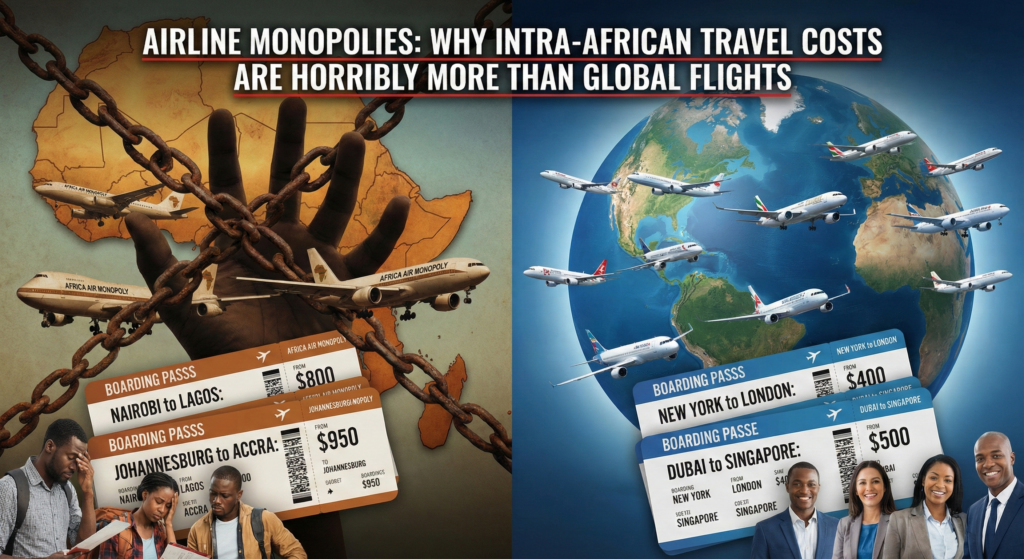
For a traveler standing in the terminal of Jomo Kenyatta International Airport in Nairobi, a glance at the departure board reveals a confusing economic reality and a stark reality of airline monopolies. A flight to Dubai, which sits roughly 3,500 kilometers away across the Indian Ocean, often costs less than a ticket to Kinshasa, the capital of the Democratic Republic of the Congo, located only 2,400 kilometers to the west. This defies the basic logic of aviation economics where fuel and distance usually dictate the fare. Yet in Africa, the shorter journey frequently commands the higher price. This phenomenon, known as the African Paradox or called Airline Monopolies in a layman’s term, defines the aviation sector from 2020 to 2025, serving as a barrier to trade and integration across the continent.
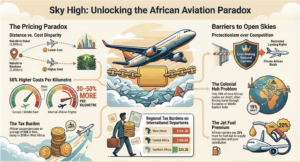
The numbers from the last five years paint a stark picture of this disparity. Data released by the African Airlines Association, or AFRAA, in 2024 indicates that flying within Africa costs roughly 30 to 50 percent more per kilometer than flying in Europe or the Middle East. While a return ticket from Nairobi to Dubai can be found for under 500 dollars, a similar booking to Lagos or Kinshasa often exceeds 800 dollars. This pricing structure effectively punishes regional travel, encouraging Africans to look abroad for business and tourism rather than within their own continent.
Airline Monopolies in Africa
The Airline Monopolies Factors and Protectionism
The primary driver of these inflated fares is the lack of genuine competition. Unlike the deregulated markets of Europe where budget carriers fight for passengers, African skies remain dominated by national carriers owned by the state. Governments often view their airlines not as commercial entities but as symbols of national sovereignty. To protect these carriers, authorities restrict market access for other African airlines, rejecting the concept of open skies. This protectionism limits the number of available seats and allows monopoly carriers to dictate prices without fear of being undercut by rivals.
Although the Single African Air Transport Market, or SAATM, aims to liberalize civil aviation, implementation remains sluggish. By 2025, only a fraction of the 34 signatory nations had fully implemented the freedom rights necessary for a truly competitive market. Consequently, a passenger flying from West Africa to East Africa may still find themselves routed through a hub in Europe or the Middle East, turning a six hour direct trip into a twenty hour ordeal that incurs triple the cost.
The Burden of Taxes and Fees
Beyond market distortion, the passenger faces an exorbitant tax burden. The 2024 Taxes and Charges Study by AFRAA revealed that international passengers departing from African airports pay an average of 68 dollars in taxes and fees. This figure stands in sharp contrast to Europe, where the average is approximately 32 dollars. The disparity is even more aggressive in specific regions. In West Africa, the average tax per passenger climbed to nearly 110 dollars in 2024. In Central Africa, it reached roughly 106 dollars. These fees are not merely for airport maintenance; they often fund unrelated government budgets, acting as a direct levy on movement.
For example, a ticket from Freetown or Libreville can carry hundreds of dollars in government charges alone. When these fees are added to the high base fare driven by lack of competition, air travel becomes an exclusive luxury reserved for the corporate elite and government officials. The average citizen is effectively grounded.
Infrastructure costs further compound the issue. Jet fuel in Africa often costs 20 percent more than the global average due to poor distribution networks and high taxes on fuel itself. Insurance premiums for aircraft operating in the region are also significantly higher, driven by safety perceptions and operational risks. Airlines pass every cent of these additional costs to the traveler.
Disparity
The price distance disparity in African aviation is not merely an inconvenience; it is a structural failure that throttles economic growth. While the rest of the world enjoys the benefits of budget travel and seamless connectivity, Africa remains a continent of fragmented skies. Until governments prioritize open competition over the protection of state assets and reduce the heavy tax burden on passengers, the African Paradox will persist, keeping neighbors distant despite their proximity.
Legacy of the Skies: Colonial Routes and the European Centered Hub Problem
The departure board at any major airport in West Africa tells a confusing story. A traveler in Freetown, Sierra Leone, looking to visit a neighbor in Conakry, Guinea, often faces a logistical absurdity. The cities sit less than 200 miles apart. Yet, until very recently, the most reliable itinerary required a flight north to Casablanca or even Paris, followed by a connecting flight back south to the final destination. This detour turns a short hop into a multiday odyssey costing over 1000 dollars. This paradox is not an accident of geography. It is the lingering ghost of colonial infrastructure that continues to haunt African aviation in 2025.
While the rest of the world benefits from deregulation and direct connectivity, the African continent remains entangled in a route map drawn decades ago to serve European empires rather than African nations. This phenomenon creates a market failure where flying within Africa is significantly more expensive than flying out of it. Data from 2023 reveals a stark disparity: a passenger flying from London to Mumbai pays roughly four cents per kilometer. A passenger flying from Lagos to Kinshasa pays more than double that rate, often enduring a layover in a third region.
The Architecture of Extraction
The root of this inefficiency lies in the historical design of air travel rights. During the 20th century, colonial powers established flag carriers to connect their capitals to their overseas territories. Air France linked Paris to Dakar; British Airways linked London to Nairobi. These routes were built for extraction and administration, designed to funnel resources and personnel between the colony and the metropole. They were never intended to facilitate trade or tourism between African states.
Decades after independence, this architecture remains stubbornly in place. In 2024, OAG aviation data showed that despite the proximity of major African economic zones, the capacity on intercontinental routes to Europe still dwarfs the capacity on regional routes between African neighbors. This structural flaw forces passengers to transit through hubs outside the continent or through a select few African hubs like Addis Ababa, which cannot handle the total demand alone. The result is a system where the path of least resistance flows through Europe or the Middle East, stripping African economies of revenue and inflating ticket prices with unnecessary fuel burn and landing fees.
Protectionism Disguised as Patriotism
The persistence of these illogical routes is maintained by modern government monopolies. Many African nations view their national airlines not as commercial entities but as symbols of sovereignty. To protect these often unprofitable state carriers, governments restrict market access for competitors. They refuse to grant landing rights to airlines from neighboring countries, fearing their own national carrier will lose market share.
This refusal to cooperate blocks the implementation of the Single African Air Transport Market (SAATM). Although launched with fanfare, SAATM struggles against this wall of protectionism. A 2022 investigative report by the African Airlines Association highlighted that if just 12 key nations fully opened their skies, the resulting competition would lower fares by 35 percent and generate nearly 300,000 additional jobs. Instead, protectionist policies keep supply low and prices artificially high, preserving the monopoly power of legacy carriers on scarce routes.
The Cost of the Status Quo
The financial impact on the traveler is brutal. In 2025, taxes and fees on African tickets remain among the highest globally, a consequence of governments trying to squeeze revenue from a limited volume of passengers rather than encouraging volume through lower costs. A significant portion of a ticket price from Nigeria to Ghana consists of government levies. When combined with the operational cost of flying inefficient, indirect routes due to the lack of direct commercial agreements, the consumer pays a premium for a subpar product.
The European centered hub problem effectively acts as a tax on African integration. It creates a barrier to trade that is as formidable as any tariff. Until the continent dismantles the regulatory silos that mirror the old colonial borders, the African traveler will continue to pay a heavy price for a geography that serves the past rather than the future. The skies remain closed, not by clouds, but by politics.
Government Backed Giants: How National Flag Carriers Block Private Rivals
For the average traveler in 2024, the math defies logic. A return ticket from Lagos, Nigeria, to London often costs less than a flight of similar duration from Lagos to Douala, Cameroon. While infrastructure and fuel prices play a role, a more deliberate force is at work. The African aviation market remains strangled by protectionist policies designed to shield government airlines from private competition. These national champions, often operating at massive losses, survive through sovereign handouts while using political leverage to block more efficient private operators from entering the market.
The Uneven Playing Field
The core issue lies in the refusal of African nations to fully implement the Single African Air Transport Market or SAATM. Instead of open skies, governments utilize restrictive bilateral agreements to protect their flag carriers. By 2023, reports indicated that fewer than half of the nations that signed the open skies agreement had actually enacted legislation to allow free movement. This hesitation is not accidental. It is a strategic move to insulate state assets from market realities.
When a government owns an airline, it acts as both the referee and the player. In 2022, South African Airways resumed operations after a lengthy business rescue process. The South African government had poured billions of rand into the airline over the previous decade. Meanwhile, Comair, a private entity operating British Airways franchises and the budget carrier Kulula, entered liquidation in June 2022. Comair received no sovereign bailout despite serving a massive portion of the domestic flying public. The private operator collapsed under market pressures and pandemic debts, while the national carrier was resurrected using taxpayer funds.
Subsidies Versus Sustainability
Data from 2020 through 2025 highlights a stark divergence in financial resilience. Ethiopian Airlines stands as a rare exception of profitability, yet its dominance is also secured through aggressive government support in securing route rights. In contrast, Kenya Airways has required repeated treasury injections. In 2022 alone, the Kenyan treasury allocated substantial funds to service the debt of the national carrier. These bailouts allow government airlines to lower ticket prices artificially on competitive routes to starve out private entrants, only to raise them again once the monopoly is secured.
Private airlines cannot compete with rivals that have access to the public purse. When a private Nigerian carrier attempts to launch a regional route, it faces two hurdles: foreign governments denying landing slots to protect their own national airline, and its own government imposing high taxes to fund the infrastructure that the national carrier relies upon. The African Airlines Association noted in 2023 that taxes and fees in Africa are among the highest globally, often making up half the cost of a ticket. These fees sustain regulatory bodies that frequently act in the interest of the state airline rather than the consumer.
The Cost of Protectionism
The consumer pays the ultimate price for this lack of competition. Without the pressure of private rivals like Ryanair or Southwest Airlines which revolutionized travel in Europe and America, African national carriers have no incentive to improve efficiency. A 2024 study on regional connectivity showed that traveling between African capitals often requires connecting through a hub outside the continent or flying via Addis Ababa, turning a short trip into a multiday odyssey.
By 2025, the pattern remains clear: as long as governments view airlines as diplomatic trophies rather than businesses, they will continue to legislate against competition. They prioritize the survival of a single national symbol over the economic benefits of a vibrant, competitive private aviation sector. Until the regulatory walls come down, intra continental travel will remain a luxury few can afford.
The Protectionist Wall: Bilateral Air Service Agreements (BASAs) vs. Open Skies
Consider a traveler in Nairobi, Kenya, looking to book a flight for November 2024. They have two options. One is a flight to Dubai, a journey of over 2,500 miles. The other is a trip to Lagos, Nigeria, roughly 2,300 miles away. Logic dictates the shorter flight within the continent should cost less. Yet reality defies this logic. The ticket to Dubai averages 675 United States dollars, while the flight to Lagos often exceeds 900 dollars. This pricing anomaly is not an accident of market forces but a direct result of a regulatory stranglehold known as Bilateral Air Service Agreements.
These agreements act as invisible borders in the sky. While the rest of the world has moved toward liberalization, African aviation remains fragmented by restrictive pacts between individual nations. These deals determine which airlines can fly, how many seats they can sell, and what prices they can charge. Designed decades ago to protect national carriers owned by the state, these agreements now serve as a protectionist wall that stifles competition and inflates costs for millions of travelers.
The Mechanism of Restriction
The primary function of a restrictive bilateral agreement is to limit supply. By capping the number of flights a foreign airline can operate, governments ensure their national carrier faces little to no competition on specific routes. This monopoly power allows airlines to charge premium rates without improving service. The 2024 report by the African Airlines Association (AFRAA) highlights the consequence: flying within Africa is more expensive per kilometer than in any other region globally.
This protectionism creates a paradox where airlines are shielded from competition but remain financially fragile. Despite high ticket prices, the profit margins for African airlines remain razor thin. In 2024, the net profit per passenger for African carriers was estimated at merely 90 cents, compared to a global average of over six dollars. The revenue generated does not go toward innovation or fleet expansion but is consumed by high operating costs and excessive taxation.
The Tax Burden (2024 Data):
A significant portion of the ticket price goes directly to government fees. AFRAA data from late 2024 reveals that international passengers departing from African airports pay an average of 68 dollars in taxes and fees. In West Africa, this figure spikes to nearly 110 dollars. By comparison, passengers in Europe pay an average of 30 to 34 dollars. These charges treat aviation as a luxury to be taxed rather than a utility to drive economic growth.
The Cost of Delayed Liberalization
The solution to this fragmentation has existed on paper since 1999. The Yamoussoukro Decision pledged to open African skies, allowing eligible airlines to fly freely between any two cities on the continent. This vision was rebranded recently as the Single African Air Transport Market (SAATM). Yet, implementation moves at a glacial pace.
As of 2025, while 38 nations have joined the initiative, actual ratification and implementation lag significantly. Many governments fear that opening their skies will destroy their national airlines. They worry that stronger carriers, such as Ethiopian Airlines, will dominate the market and push smaller state carriers out of business. This fear paralyzes progress, leaving the continent with a network of disconnected hubs. A traveler flying from Freetown to neighboring Conakry often must fly via Paris or Casablanca, turning a short trip into a multi day odyssey.
A Glimmer of Hope
Where barriers fall, prices drop. The route between Nigeria and the United Kingdom offers a potent example from 2024. For years, foreign carriers dominated the route with high fares. When a Nigerian carrier, Air Peace, entered the market with competitive pricing, legacy carriers were forced to slash their prices almost immediately. This dynamic proves that competition works. If applied to travel within Africa, the same principle would reduce the cost of a ticket from Nairobi to Entebbe, which currently sits between 240 and 400 dollars for a return journey of less than one hour.
The choice facing African leaders is stark. They can maintain the protectionist wall of bilateral agreements, preserving the illusion of national sovereignty while their citizens pay the highest fares in the world. Or they can tear down the wall, embrace the Open Skies mandated by SAATM, and allow aviation to become the engine of trade and integration it was meant to be. Until that choice is made, the flight to Dubai will remain cheaper than the flight to Lagos.
The Yamoussoukro Decision: A History of Broken Regulatory Promises
The promise was simple and transformative. In 1999, African ministers gathered in Ivory Coast to sign a treaty that would open the skies. Known as the Yamoussoukro Decision, this agreement aimed to end protectionism and allow airlines to fly freely between African nations. Two decades later, that dream remains grounded by bureaucracy. Travelers in 2024 faced a stark reality where flying from Lagos to London often costs less than flying from Lagos to Kinshasa, despite the latter being a fraction of the distance. This regulatory failure has fostered monopolies that suffocate economic growth while keeping ticket prices artificially high.
The Cost of Protectionism
Data from 2023 and 2024 reveals a disturbing trend regarding pricing structures across the continent. Reports from the African Airlines Association indicate that passengers flying within Africa pay some of the highest rates per kilometer in the world. A significant portion of this cost comes from taxes and fees rather than the base fare. Throughout 2023, government taxes and airport fees constituted roughly 30 percent to 50 percent of the total ticket price for regional travel. Governments view aviation not as a strategic economic catalyst but as a luxury good to be taxed heavily.
The core issue lies in the refusal of nations to grant “Fifth Freedom” rights. This aviation right allows an airline to carry passengers between two foreign countries on a flight originating or ending in its own country. For instance, a Kenyan carrier cannot easily pick up passengers in Uganda and fly them to Ghana. Without these rights, airlines cannot build efficient hub and spoke networks. They must fly back to their home base first. This inefficiency forces carriers to fly empty seats, driving up costs which are passed directly to the consumer.
SAATM and the Illusion of Progress
In 2018, the African Union launched the Single African Air Transport Market (SAATM) to finally enforce the Yamoussoukro Decision. By 2025, over 35 countries had signed up. However, signing a paper is different from changing the law. Investigative analysis shows that fewer than half of these signatories have fully domesticated the regulations. Governments continue to shield their national carriers from competition. These government controlled airlines often operate at a loss, kept alive by state subsidies while blocking private competitors who could offer cheaper fares.
“We see a landscape where protectionism is disguised as national pride. A country protects its failing national airline by blocking a profitable neighbor from landing, and the passenger pays the price.”
The 2020 pandemic exacerbated these monopolistic tendencies. As borders closed, nations retreated further inward. Recovery data from 2022 and 2023 showed that while domestic markets in Nigeria and South Africa rebounded, connectivity between nations lagged behind. The International Air Transport Association reported in 2024 that connectivity across the continent remained below 2019 levels in many regions, specifically largely due to regulatory blockages rather than lack of demand.
The Monopolistic Grip
The lack of open skies has created regional fortresses. Ethiopian Airlines stands as a rare success story, yet its dominance highlights the weakness of its peers. In West and Central Africa, the absence of a strong regional carrier has left a vacuum filled by expensive and unreliable point to point services. Travelers essentially have no choice. If you must fly from Freetown to Banjul, you pay the price dictated by the sole operator or you do not travel at all.
Foreign carriers from outside the continent now capture nearly 80 percent of the African market share for intercontinental traffic. Meanwhile, African airlines fight over the scraps of regional routes, hampered by their own governments. The Yamoussoukro Decision was meant to create a unified market. Instead, the period from 2020 to 2025 has proven that without political will, regulatory texts are powerless against the entrenched interests of state monopolies.
Anatomy of a Ticket: Unveiling Excessive Government Taxes and Airport Levies
For the average traveler navigating the continent, the sticker shock of purchasing a flight ticket within Africa is a familiar frustration. A traveler can often fly from Lagos to London for less than the price of a ticket to Kigali or Dakar. While distance and fuel prices play a role, a closer inspection of the data from 2020 to 2025 reveals a more bureaucratic culprit: a complex web of government taxes, airport fees, and regulatory levies that inflate ticket prices by over 50 percent in some regions.
The Hidden Cost of Connectivity
The dream of a unified African sky, championed under the Single African Air Transport Market (SAATM), faces a formidable financial barrier. According to the 2024 Taxes and Charges Study by the African Airlines Association (AFRAA), passengers departing from African airports pay an average of 68 dollars in taxes and fees. This figure represents a steady climb from 64 dollars in 2020. However, averages obscure the severe regional disparities that choke the West and Central African aviation sectors.
Data indicates that West Africa is the most expensive region on the continent. In 2024, international passengers in this sub region paid an average of 109.50 dollars in taxes and fees alone. Central Africa followed closely at 106.60 dollars. Contrast this with Northern Africa, where governments have adopted a volume over value strategy, charging an average of just 25.30 dollars per passenger. The result is a skewed market where a short flight across the Gulf of Guinea incurs tax liabilities comparable to a transatlantic journey.
Breaking Down the Bill: Lagos to Accra
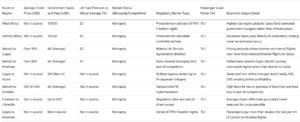
To understand the anatomy of these costs, one must look at specific routes. The flight path from Lagos to Accra is one of the busiest in West Africa. In late 2025, industry reports highlighted that taxes and non airline charges on this route could reach nearly 200 dollars per return ticket. This amount does not go to the airline for fuel, crew, or maintenance. It goes directly to state agencies.
In Nigeria, which ranked as the third most expensive country for aviation charges in the 2024 AFRAA report, the burden is heavy. Passengers pay roughly 180 dollars in various levies for international departures. Investigations reveal that airlines in Nigeria must navigate up to 54 separate charges imposed by agencies such as the Federal Airports Authority of Nigeria (FAAN) and the Nigerian Civil Aviation Authority (NCAA). Only a handful of these are visible on the passenger receipt, while the rest are absorbed into the base fare, eroding airline profitability and driving up prices.
Ghana also added to the burden in December 2025 by introducing a new 9 dollar security levy on flight tickets. This addition pushed the baseline cost for a return trip on the Lagos to Accra route to approximately 216 dollars in taxes and fees alone, before the airline even prices the seat.
The “Cash Cow” Mentality
Why are these levies so high? The prevailing philosophy among many African governments is to treat aviation not as a catalyst for economic growth but as a luxury good ripe for taxation. This “cash cow” mentality uses aviation revenue to fund unrelated state projects or broader infrastructure deficits.
A clear example occurred in Kenya in October 2025. President William Ruto signed the Air Passenger Service Charge Amendment Bill, which raised the international departure fee to 50 dollars and the domestic fee to 600 Kenyan Shillings. While the government argued the funds were necessary to modernize Jomo Kenyatta International Airport and fund the Kenya Meteorological Service, the immediate effect was a sharp increase in ticket prices. Critics argue that taxing passengers to fund weather services or tourism boards unfairly burdens the aviation sector, making travel exclusive rather than accessible.
The Impact on Traffic and Trade
The consequences of this tax regime are visible in passenger traffic numbers. In Nigeria, domestic passenger traffic contracted from 14.52 million in 2022 to 12.54 million in 2024. As costs rise, the middle class is priced out of the skies. High taxes depress demand, forcing airlines to fly with empty seats or reduce frequency, which in turn keeps unit costs high.
The data is clear: high taxes are grounding the continent. Countries like Gabon and Sierra Leone, identified as the most expensive in 2024 with charges nearing 300 dollars, see a fraction of the traffic managed by low tax hubs like Addis Ababa or Casablanca. For the African Continental Free Trade Area (AfCFTA) to succeed, the movement of people must be as seamless as the movement of goods. Until governments view aviation as essential infrastructure rather than a revenue stream, the cost of flying within Africa will remain paradoxically higher than leaving it.
The Jet Fuel Premium: Logistics, Supply Chain Monopolies, and Price Gouging
In the high stakes world of African aviation, the most crippling metric is not passenger load factor or fleet age, but the “Jet Fuel Premium.” Between 2020 and 2025, data from the International Air Transport Association (IATA) and the African Airlines Association (AFRAA) revealed a stark economic reality: African carriers pay an average of 17 percent to 20 percent more for jet fuel than their global counterparts. In specific hubs, this disparity widens to a chasm, with carriers paying up to 2.4 times the into wing price charged at North American airports.
The Monopoly Mechanism
The root of this premium lies not in the commodity price of crude oil, which is determined globally, but in the opaque and monopolistic supply chains that control distribution across the continent. Unlike in Europe or the Middle East, where open access supply chains allow multiple vendors to compete for refueling contracts, many African aviation hubs operate under single supplier frameworks or government controlled monopolies.
In markets such as Botswana, Malawi, and Zambia, regulatory frameworks have historically entrenched single supplier dominance, eliminating competitive pricing pressure. The lack of competition allows these entities to impose arbitrary margins that effectively act as a tax on connectivity. An investigation into 2024 pricing structures showed that while the global average for Jet A1 hovered around $85 per barrel, carriers in certain landlocked African nations were billed upwards of $130 per barrel once logistics surcharges, taxes, and monopoly premiums were applied.
Logistics as a chokepoint
Physical logistics further compound the financial damage. The infrastructure required to transport fuel from ports to inland airports is often dilapidated or nonexistent, forcing reliance on expensive trucking fleets rather than pipelines. In Nigeria, a top oil producer, the paradox of fuel scarcity is particularly acute. Despite its resource wealth, the country’s reliance on imported refined products exposed airlines to severe volatility between 2023 and 2025. During this period, the price of Jet A1 in Lagos surged from roughly N900 to over N1,500 per liter, a spike driven by currency fluctuation and supply chain inefficiencies rather than global oil market shifts.
South Africa, typically seen as a more mature market, has not been immune. Logistics failures at OR Tambo International Airport in early 2025 forced the implementation of emergency rationing. A disruption in the rail and pipeline networks meant that even when fuel was available in Durban, it could not reach Johannesburg efficiently, creating an artificial scarcity that drove up into wing costs and forced airlines to tankering fuel—carrying excess weight from other airports—which burns more fuel and further erodes efficiency.
The Cost of “Price Gouging”
Industry insiders have increasingly labeled these disparities as systemic price gouging. A 2024 analysis indicated that fuel accounts for approximately 40 to 50 percent of an African airline’s total operating costs, compared to a global average of just 25 percent. This massive overhead destroys profitability margins. When a carrier in Luanda pays nearly double the fuel bill of a competitor refueling in Dubai, the African airline is mathematically precluded from offering competitive fares.
The “cartelization” of the supply chain, a term used by aviation experts at the 2025 AFRAA assembly, ensures that any drop in global oil prices is rarely passed on to African airlines. Instead, intermediaries absorb the difference, maintaining high prices to cushion their own inefficiencies. Until the Single African Air Transport Market (SAATM) initiatives can enforce competition laws and break these sovereign and private monopolies, the Jet Fuel Premium will remain the single largest anchor dragging down the continent’s aviation potential.
Airline Fares in Africa
Infrastructure Deficits: The High Cost of Landing Fees and Ground Handling
For a traveler booking a flight from London to Berlin, the fare might equal the price of a modest dinner. Yet, for a passenger flying a similar distance between Lagos and Douala, the price often rivals a flight to New York. This disparity is not merely a result of airline profit margins or demand. The root cause lies buried in the tarmac itself. Between 2020 and 2025, data reveals that travel within Africa is burdened by some of the most expensive infrastructure charges on the planet. While global aviation focuses on recovery, African carriers are weighed down by a heavy anchor of taxes, fees, and operational deficits.
The Landing Fee Disparity
The cost simply to land a plane in Africa is significantly higher than the global average. This price difference is not marginal; it is structural. According to the 2024 Taxes and Charges Study by AFRAA (African Airlines Association), an international passenger departing from an African airport pays an average of $68 in taxes and fees. In comparison, a passenger in Europe pays roughly $30, while one in the Middle East pays approximately $34. This means the infrastructure tax burden in Africa is more than double that of its neighbors.
These averages hide even more extreme outliers. In 2024, West Africa emerged as the most expensive region, with average fees hitting $110 per passenger. Specific nations present an even steeper barrier. Data indicates that Gabon and Sierra Leone levy charges approaching or exceeding $290 for international departures. These fees are ostensibly collected to fund airport development, but the visible infrastructure often lags behind the revenue collected. When a ticket price includes $100 or more in government taxes before the airline sees a cent, demand naturally collapses.
The Monopoly of Ground Services
Beyond the runway, the cost of services on the ground drives fares even higher. In many global markets, airlines can choose between multiple competing ground handling agents for services like baggage loading, cleaning, and towing. In Africa, these services are frequently monopolies or duopolies, often owned by the government or politically connected entities. Without competition, prices remain artificially high.
A stark example occurred in Nigeria during late 2024. The major ground handling companies, claiming rising operational costs, proposed rate increases ranging from 300 percent to 600 percent. For a standard narrow body aircraft like a Boeing 737, the proposed fee jumped from roughly N70,000 to over N200,000 per flight. While inflation in Nigeria was indeed high, airlines argued that such abrupt spikes were unsustainable. In competitive markets, airlines could switch providers. Here, they had no choice but to pay the new rate or ground their fleets, eventually passing the cost to the passenger.
Real Data Insight: In 2023, Juba Airport in South Sudan had taxes amounting to 17 percent of the total ticket price for regional travel. This creates a feedback loop where high prices reduce passenger numbers, forcing airports to raise fees further to cover fixed costs.
The Fuel Logistics Premium
Infrastructure deficits also impact what is known as “liquid gold” in aviation: jet fuel. Fuel typically accounts for about 30 percent of an airline’s operating cost globally. However, in many African nations, this figure is higher due to poor transport logistics. Even in oil producing nations like Nigeria or Angola, a lack of refining capacity means fuel is often imported, incurring shipping costs, port fees, and demurrage charges.
Throughout 2022 and 2023, the price of jet fuel in Africa traded at a premium of 12 percent to 20 percent above the global average. When pipelines are missing or damaged, fuel must be trucked to the airport, adding risk and expense. This logistical hurdle means that an airline fueling a plane in Luanda or Lagos pays significantly more than a competitor fueling in Dubai or Amsterdam.
More…
The dream of a unified African sky, championed by the Single African Air Transport Market, faces a concrete wall of costs. Until 2025, the trend has been clear: governments view aviation not as a strategic economic catalyst but as a luxury cow to be milked. By treating airports as cash cows rather than critical infrastructure, nations inadvertently stifle trade and tourism. Reducing these taxes and breaking ground handling monopolies is not just about lowering ticket prices; it is about connecting a continent that has been kept apart by the very tarmac meant to bring it together.
The Fifth Freedom Fight: Why Airlines Are Blocked from Direct Neighboring Routes
For a traveler in 2024, booking a return ticket from Nairobi to Lagos often triggers a shock. The price frequently exceeds 800 USD, a sum that could easily fund a flight to Europe or the Middle East. The distance is shorter, yet the fare is double. This pricing anomaly is not an accident of geography but a deliberate consequence of politics. It is the result of a silent war fought in the skies over a regulatory concept known as the Fifth Freedom.
The Fifth Freedom is the right for an airline to fly between two foreign countries on a route originating or ending in its own home country. It is the mechanism that allows Ethiopian Airlines to fly from Addis Ababa to Lomé, pick up new passengers, and carry them to New York. Without this right, planes fly empty sectors, efficiency plummets, and ticket prices soar. Yet, between 2020 to 2025, despite the ratification of the Single African Air Transport Market (SAATM), governments across the continent have aggressively blocked these rights to protect their national carriers.
The Cost of Protectionism (2024 Data):
A 2024 report by the African Airlines Association revealed that travel within Africa costs 30 to 50 percent more than global averages for similar distances. Furthermore, passenger taxes and fees for international departures in Africa averaged 68 USD in 2024, with West Africa charging a staggering average of 110 USD per ticket.
The resistance to open skies is rooted in the fear of competition. National carriers, often owned by the state, are viewed as symbols of sovereignty rather than commercial entities. Allowing a foreign African airline to operate a lucrative route between two neighbors is seen as surrendering market share. This protectionist logic came to a head in January 2024 during a diplomatic spat between Kenya and Tanzania, offering a perfect case study of how the consumer pays the price.
In that incident, Tanzanian authorities suspended Kenya Airways passenger flights between Nairobi and Dar es Salaam. The move was not about safety or capacity but retaliation. Kenya had previously refused Air Tanzania the Fifth Freedom right to operate cargo flights from Nairobi to third party destinations. Tanzania responded by blocking the passenger route entirely. Thousands of travelers were left stranded, and prices on indirect routes spiked. The dispute was eventually resolved, but it laid bare the fragility of African aviation agreements. When nations treat their skies as closed fortresses, the efficiency of the entire network collapses.
The economic impact of these blocked routes is severe. Because airlines cannot pick up passengers at intermediate stops, they must rely solely on point to point traffic, which is often insufficient to fill a large aircraft. This forces carriers to use smaller jets or fly with empty seats, driving up the cost per passenger. In 2023 and 2024, while European budget carriers offered fares as low as 50 USD across borders, African passengers were forced to pay premiums to subsidize inefficient routes designed to satisfy political egos rather than market demand.
Furthermore, the lack of Fifth Freedom rights forces passengers to endure illogical connections. A traveler flying from Kinshasa to neighboring Brazzaville might find it cheaper or logistically easier to connect through a hub in West or East Africa, or even Europe, than to fly direct. This fragmentation hands market dominance to non African carriers, who control nearly 64 percent of intercontinental traffic into Africa as of 2024.
The solution exists on paper. The Yamoussoukro Decision and its successor, the SAATM, were designed to dismantle these barriers. By late 2024, over 54 nations had committed to the principles of a single market. However, implementation remains stalled. Only a fraction of these nations have fully domesticated the regulations to allow unrestricted access. Until governments stop shielding their state owned airlines from competition, the African traveler will continue to pay a premium for a service that should be a basic utility, not a luxury.
The Hidden Price Tag: Insurance and Maintenance in African Aviation
Travelers navigating the skies across Africa often face a paradoxical reality where a two hour flight between neighboring capital cities costs significantly more than a nine hour journey to Europe. While taxes and fuel levies frequently garner headlines, a deeper investigation into the financial ledgers of African carriers reveals a more insidious cost driver. Between 2020 and 2025, the escalating expenses of insurance and outsourced maintenance have erected formidable barriers to entry, effectively shielding dominant players from competition and keeping ticket prices artificially high.
The ‘Africa Risk’ Surcharge
A primary factor inflating operational expenses is the disparity in insurance premiums. Industry data from the African Airlines Association highlights that carriers on the continent face insurance rates significantly above the global average. In 2023, reports indicated that African airlines pay premiums approximately 40 percent higher than their counterparts in Europe or North America for identical aircraft types.
This discrepancy stems from a phenomenon insurers label the “Africa Risk.” Underwriters in London and New York price their policies based on perceived geopolitical instability, infrastructure deficiencies, and historical safety records. Even when a specific airline maintains an impeccable safety log, it suffers from the reputational burden of its domicile. For instance, Nigerian operators in 2024 reported paying nearly three times the hull and liability insurance rates charged to Western carriers. This blanket risk assessment forces smaller private airlines to operate on razor thin margins or exit the market entirely.
The financial strain intensified following the global pandemic of 2020. As reinsurance markets hardened globally in 2021 and 2022, capacity shrank, and prices surged. For African carriers earning revenue in volatile local currencies like the Naira, Cedi, or Shilling, paying premiums denominated in United States Dollars created a compounding fiscal crisis. This dynamic favors large government supported entities like Ethiopian Airlines, which generate substantial foreign currency and possess the fleet size to negotiate better bulk rates.
The Maintenance Drain
Beyond insurance, the absence of local Maintenance, Repair, and Overhaul (MRO) facilities acts as a massive capital drain. As of 2025, Africa possesses less than 4 percent of the global MRO market share. Consequently, nearly all heavy maintenance checks, known as C and D checks, require airlines to fly their aircraft to facilities in Europe, the Middle East, or Asia.
This outsourcing necessity incurs dual costs. First, the airline must pay for the maintenance services themselves, which increased in price by roughly 15 percent between 2022 and 2024 due to global supply chain disruptions and labor shortages. Second, the carrier must fund the ferry flights to transport empty planes to foreign workshops, burning fuel and losing revenue generating days. A 2024 analysis suggested that African airlines collectively transfer over one billion dollars annually to foreign MRO providers.
The lack of domestic infrastructure cements the monopoly power of established leaders. Ethiopian Airlines stands as a rare exception, having invested heavily in its own MRO division in Addis Ababa. This vertical integration allows them to service their own fleet at cost while selling services to neighbors. In contrast, smaller competitors like Air Peace or Kenya Airways face the relentless pressure of paying foreign vendors in hard currency. When foreign exchange reserves dwindle, as seen in Malawi and Nigeria during 2023, planes remain grounded simply because operators cannot purchase the dollars needed to pay mechanics abroad.
The Monopoly Effect
These structural costs create a brutal cycle. High fixed costs for insurance and maintenance require high ticket prices to break even. New entrants cannot sustain these expenses without state subsidies, leading to their rapid collapse. This leaves the market to a few dominant carriers who face little pressure to lower fares. Until regulatory bodies address the “Africa Risk” classification and investors build local maintenance hangars, the cost of flying across the continent will remain a premium luxury rather than a public utility.
The Budget Airline Graveyard: Why Discount Models Struggle to Survive
The global aviation industry often relies on a simple formula for mass transport: maximize passenger volume, strip away frills, and keep planes in the air constantly. In Europe and Southeast Asia, this approach democratized travel, turning flying from a luxury into a commodity. In Africa, however, this model frequently leads to financial ruin. The period between 2020 and 2025 has become a graveyard for African budget carriers, littered with grounded fleets and liquidated assets. While global skies recovered, the African discount sector faced a unique convergence of structural failures that made survival nearly impossible.
High Profile Casualties
South Africa provides the starkest example of this collapse. For decades, Comair was a pillar of stability, operating the British Airways franchise and the popular budget brand Kulula. At its peak, Comair held roughly 40% of the domestic market. Yet, in June 2022, the company entered liquidation. While the pandemic dealt the initial blow, the death knell was a lack of capital to weather rising operating costs. By 2025, legal battles over settlement funds were still ongoing, but the familiar green planes were long gone from the skies.
Mango Airlines, the state controlled budget subsidiary of South African Airways, followed a similar trajectory. Grounded in July 2021, it spent years in a chaotic business rescue process. By mid 2025, the airline remained dormant, with administrators opening verification portals for passengers still holding worthless tickets from years prior. The failure of Mango was not just a commercial loss but a blow to market competition, leaving travelers with fewer options and higher fares.
In East Africa, the story was equally grim. Fly540, once a key player in Kenya, saw its operations halted by regulators in late 2022. The Competition Authority of Kenya grounded the carrier following consumer complaints and debt issues. Unlike the voluntary exits seen elsewhere, this was a regulatory shutdown, leaving its fleet of Dash 8 and CRJ aircraft parked and deteriorating.
The Structural Killers
Why do these models fail so consistently in Africa? The answer lies in a hostile operating environment that negates the core advantages of the budget model. Discount airlines thrive on thin margins, but African aviation costs are among the highest in the world.
Punitive Taxation:
The most immediate burden is the heavy layer of government fees. Data from the African Airlines Association (AFRAA) in 2024 revealed that the average international passenger pays roughly $68 in taxes and fees alone. In West Africa, this figure spikes to nearly $110 per ticket. When taxes exceed the base fare of the flight, the concept of a “budget” ticket becomes a myth. Governments view aviation as a cash cow for treasury revenue rather than a strategic economic enabler, effectively taxing the discount model out of existence.
The Fuel Premium:
Fuel typically accounts for a significant portion of airline expenses, but African carriers pay a steep premium. In 2024, the International Air Transport Association (IATA) reported that jet fuel prices in Africa were the highest globally, often trading at a spread of 30% to 40% above the global average. This disparity is driven by poor infrastructure, transport bottlenecks, and monopoly suppliers at airports. For a budget carrier trying to stimulate demand with low fares, this fuel cost differential is insurmountable.
Regulatory Fragmentation:
The Single African Air Transport Market (SAATM) remains more of a promise than a reality. Protectionism by national governments prevents true competition. A flight between two African neighbors often requires a connection through a third country because direct rights are denied to protect a struggling national flag carrier. Only 19% of routes within the continent are direct. This inefficiency forces budget airlines to fly longer sectors with lower load factors, destroying the efficiency needed to offer cheap seats.
A Luxury Trap
The demise of Kulula, Mango, and Fly540 illustrates a harsh truth: the budget airline model cannot function in a high cost environment. With net margins for African carriers hovering around 1% in 2025—the lowest of any region globally—there is no room for error. Until governments reduce the tax burden and liberalize the skies to allow true competition, air travel in Africa will remain a luxury product, and the graveyard of discount airlines will continue to grow.
Visa Walls: How Restrictive Migration Policies Suppress Passenger Demand
For a business traveler in Lagos, booking a flight to London is often cheaper and simpler than flying to Douala or Kinshasa. This economic paradox defines African aviation in the 2020s. While distance suggests regional tickets should be affordable, the reality is starkly different. A flight between neighboring African nations can cost double the price of a transcontinental journey to Europe or the Middle East. While state owned monopolies and high fuel levies play a role, a silent killer of aviation demand exists: the visa wall.
Restrictive migration policies do not just inconvenience travelers; they actively suppress the passenger numbers needed to make routes profitable. When airlines fly with empty seats, the remaining passengers pay a premium. The data from 2020 to 2025 reveals a direct correlation between border openness and aviation health, proving that open skies cannot succeed without open borders.
The 28 Percent Problem
The Africa Visa Openness Index 2024 report paints a concerning picture of continental mobility. As of late 2024, only 28 percent of intra African travel scenarios allow citizens to move visa free. This figure represents a slow crawl from 20 percent in 2016. For nearly half of all travel scenarios, specifically 46 percent, Africans still require a visa before they even pack their bags. This bureaucratic friction acts as a massive tax on demand.
“Restrictive migration policies function as a cap on airline revenue. Every visa rejection or delayed approval is a lost ticket sale.”
The impact on spontaneity is devastating. In Europe or Southeast Asia, a traveler can book a flight for the next day. In Africa, the visa process often takes weeks. This eliminates the lucrative short notice business travel market that sustains airlines globally. Consequently, the International Air Transport Association (IATA) reported that in 2023, African airlines operated with an average passenger load factor of just 76.1 percent. This is significantly below the global average of 82 percent. Airlines are flying aircraft that are one quarter empty, forcing them to distribute the total flight cost across fewer passengers.
Digital Barriers and False Starts
Even well intentioned reforms have sometimes backfired. Kenya, traditionally a regional aviation hub, introduced an Electronic Travel Authorisation (ETA) system in 2024. Intended to modernize entry, it effectively replaced a relatively open visa regime with a mandatory digital approval process for all. The 2024 Visa Openness report noted that Kenya dropped 17 places in the rankings, landing at 46th. This policy shift added new layers of uncertainty for travelers, acting as a digital barrier rather than a gateway. When entry becomes unpredictable, passengers choose different destinations, and airlines cut frequency.
The Cost of Low Volume
The relationship between low passenger volume and high cost is cyclical. Because visa walls suppress demand, airlines cannot achieve economies of scale. They operate smaller fleets and fewer direct routes. IATA data confirms that only 19 percent of intra African routes have direct flights. A passenger flying from Freetown to Conakry might have to transit through a third country, or even Europe, turning a short trip into a multiday odyssey.
Furthermore, without the volume to spread fixed costs, taxes become a heavier burden per ticket. The African Airlines Association (AFRAA) 2024 report highlighted that passengers in Africa pay an average of 68 USD in taxes and fees per departure. In West Africa, this spikes to an average of 109.50 USD. By comparison, passengers in Europe pay roughly 30 USD. When a traveler faces a 100 USD visa fee plus 109 USD in airport taxes before even paying the base fare, demand naturally evaporates.
The Outlook
There are glimmers of hope. Countries like Rwanda, Benin, The Gambia, and Seychelles have championed a visa free model, removing all requirements for African citizens. These nations understand that the economic injection from tourism and trade far outweighs the revenue from visa fees. However, until the Single African Air Transport Market (SAATM) is paired with universal freedom of movement, the continent will remain a collection of disconnected markets. For African airlines to break the cycle of high costs and low demand, the first monopoly that must fall is the state monopoly on movement.
SAATM (Single African Air Transport Market): Progress, Resistance, and Key Blockers
The vision of a unified sky across Africa has moved slowly from paper to pavement between 2020 and 2025. The Single African Air Transport Market, or SAATM, promises to lower fares and boost economic integration by allowing airlines to fly freely across the continent. Yet, despite the clear benefits of connectivity, the initiative faces a complex web of political hesitation and protectionist walls.
Progress on Paper versus Reality
By early 2025, the number of signatory states had risen to 38, with Malawi joining the pact in February of that year. This bloc represents over 80 percent of the aviation market on the continent. A significant milestone occurred in late 2022 with the launch of a pilot implementation project involving 17 nations. This experiment yielded tangible results. Between November 2022 and April 2025, the pilot participants launched 108 new routes. These included 19 connections using “Fifth Freedom” rights, which allow an airline to carry passengers between two foreign countries on a flight originating in its home nation.
Data from 2024 indicates that where markets opened, traffic surged. The routes within the pilot group saw passenger numbers climb faster than the continental average. Yet, for the vast majority of travelers, flights remain prohibitively expensive and logistically difficult. The disconnect lies between signing a treaty and actually domesticating it into national law.
The Wall of Resistance: Protectionism
The primary friction point remains the desire to protect state owned airlines. Many governments view their national carriers as symbols of sovereignty rather than commercial entities. Fearful that stronger competitors like Ethiopian Airlines would dominate their skies, smaller nations delay granting traffic rights. This protectionism keeps inefficient airlines on life support while blocking cheaper and more reliable options for passengers.
Financial barriers further complicate the landscape. As of late 2024, approximately 954 million dollars in airline funds remained blocked across various African states. This figure represented nearly 80 percent of the global total for trapped airline revenue. Countries facing foreign exchange shortages prevent carriers from repatriating their earnings, which discourages airlines from expanding service to those destinations. Nigeria was frequently cited in disputes regarding both blocked funds and the denial of flight schedules, though diplomatic pressure led to some resolutions in 2024.
Key Blockers: Taxes and Fees
Beyond politics, the cost structure of African aviation acts as a formidable blockade. A 2024 study by the African Airlines Association revealed that passengers paid an average of 68 dollars in taxes and fees per international ticket. This amount stands in stark contrast to 30 dollars in Europe and 34 dollars in the Middle East. These levies often fund general government budgets rather than aviation infrastructure.
Operational costs also stifle growth. Jet fuel prices in Africa averaged 17 percent higher than the global mean throughout 2024. Furthermore, airport user fees and navigation charges are consistently 10 to 15 percent above global norms. When combined with the high cost of financing and insurance for African carriers, these factors create a hostile economic environment. The result is a paradox where a flight to a neighboring country can cost more than a journey to Europe.
The Path Forward
Success stories offer a blueprint for breaking the deadlock. Cape Town utilized liberalized air rights to drive a tourism boom, proving that open skies generate more value than protected isolation. As of 2025, the pressure is mounting on holdout governments. The data is clear: nations that tax aviation as a luxury item and shield inefficient carriers are isolating themselves from the economic engine of the future. For SAATM to succeed, leaders must prioritize connectivity over the preservation of failing national projects.
Economic Fallout: How High Fares Strangle the African Continental Free Trade Area (AfCFTA)
For a business executive in Nairobi, flying to Lagos to close a trade deal should be a simple task. The two cities are economic powerhouses of the continent, separated by a mere five hours of flight time. Yet, in 2024, booking a seat on this route revealed a startling economic distortion. A return ticket between the Kenyan capital and the Nigerian commercial hub often exceeded USD 900. In stark contrast, a flight from Nairobi to Dubai, which covers a greater distance, frequently cost less than USD 700. This pricing anomaly is not an accident. It is the result of a broken aviation market defined by government protectionism, excessive taxation, and a lack of competition that threatens to derail the African Continental Free Trade Area (AfCFTA) before it can fully take flight.
“A 2024 report by the African Airlines Association (AFRAA) revealed that passengers flying from West African airports pay an average of USD 109 in taxes and fees per ticket, compared to just USD 30 in Europe.”
The vision of the AfCFTA is to create a single market for goods and services across 54 nations. However, trade relies on the movement of people. When aviation costs are artificially inflated, the machinery of commerce grinds to a halt. The root of this problem lies in the protection of national carriers. Many African governments view their airlines not as commercial entities but as symbols of sovereignty. To protect these carriers from competition, authorities restrict market access for other African airlines. A carrier from Ethiopia might be denied rights to fly a direct route between two other nations, forcing passengers to transit through a central hub hundreds of miles out of their way. This lack of an “Open Skies” agreement means that a traveler flying from Libreville, Gabon, to Bangui in the Central African Republic might still find it faster to connect through Paris or Istanbul than to fly directly across the border.
Beyond market access, the cost structure is heavily skewed by government taxes. In 2024 and 2025, data showed that fees and charges constituted nearly 50 percent of the total ticket price on many routes within the continent. Governments treat aviation as a luxury good to be taxed rather than a critical infrastructure for development. The AFRAA data highlights that Central and West Africa are the most expensive regions for air travel taxes globally. Countries like Sierra Leone and Gabon have levied transfer and departure taxes exceeding USD 290 in recent years. These costs are passed directly to the consumer, making air travel unaffordable for the small business owners and traders who are supposed to be the engines of the AfCFTA.
The impact on the AfCFTA is quantifiable and severe. The World Bank and other institutions have noted that trade volumes are sensitive to transport costs. When a flight from Lagos to Dakar costs more than a flight to London, African businesses naturally look to Europe or Asia for partners rather than their neighbors. The logistics of moving consultants, engineers, and sales teams across the continent become prohibitively expensive for small enterprises. Consequently, the supply chains remain fragmented. An apparel manufacturer in Lesotho cannot easily source textiles from Ghana if the travel and transport logistics consume their entire profit margin.
There is a framework designed to fix this: the Single African Air Transport Market (SAATM). Launched to liberalize civil aviation and drive economic integration, it has garnered signatures from 38 nations as of early 2025. Yet, implementation moves at a glacial pace. The fear of competition for national carriers keeps the skies closed. While large carriers like Ethiopian Airlines have managed to build efficient networks, smaller national airlines struggle to survive, often relying on government bailouts while charging exorbitant fares to cover their inefficiencies.
Recent developments offer a glimmer of hope. In late 2024, discussions within the Economic Community of West African States (ECOWAS) pointed toward a radical policy shift proposed for 2026: the elimination of non aviation taxes to reduce ticket costs by up to 40 percent. If successful, this could serve as a blueprint for the rest of the continent. For the AfCFTA to succeed, the logic of the market must replace the logic of the monopoly. Until African skies are truly open and affordable, the dream of a united African economy will remain grounded.
Breaking the Cartel: Policy Recommendations for Liberalization and Connectivity
By 2025, the paradox of African aviation had become a stubborn economic reality. A business traveler flying from Nairobi to Lagos often pays more than a tourist flying from Nairobi to Dubai. In September 2025, data showed a single journey between these two African hubs could cost upwards of USD 900, while the longer flight to the Emirates hovered around USD 675. This price distortion is not merely an inconvenience; it is a structural failure that strangles continental trade and integration.
The root of this dysfunction lies in a protectionist framework that treats aviation as a luxury good rather than a utility. For decades, governments have shielded national carriers from competition, creating fragmented markets where monopolies thrive. The result is a continent of 1.4 billion people that accounts for less than 4% of global air traffic. To dismantle this cartel of inefficiency, policy makers must move beyond rhetoric and enforce radical liberalization.
The Regulatory Blockade
The primary barrier remains the refusal to fully implement the Single African Air Transport Market (SAATM). Launched to create a unified sky, the initiative has seen sluggish progress. By March 2025, only 38 nations had joined the market. Even among signatories, protectionism persists. Governments frequently deny landing rights or restrict frequencies to protect their state run airlines, fearing that open competition would bankrupt inefficient flag carriers.
This defensive posture ignores the broader economic damage. Restricted connectivity means that in 2024, only 19% of flights within Africa were direct. Travelers are forced to route through hubs in Europe or the Middle East to reach destinations on their own continent. This adds hours to travel time and hundreds of dollars to costs. The policy recommendation is clear: the African Union must establish a binding dispute settlement mechanism. States that block legal market access under SAATM rules must face sanctions or loss of voting rights within the bloc. Voluntary compliance has failed; enforcement is now required.
The Tax Burden
If protectionism restricts supply, taxation destroys demand. In 2024, taxes and fees on African tickets were among the highest globally. Data from AFRAA revealed that passengers departing from West African airports paid an average of USD 109.50 in taxes and fees alone. In some cases, these government charges exceeded the base fare charged by the airline.
Governments view aviation as a cash cow, levying heavy charges for infrastructure development that rarely materializes. A 2025 investigative report noted that jet fuel in Africa costs approximately 40% more than the global average, driven by taxes and supply inefficiencies. To break this cycle, finance ministries must cap aviation taxes at 10% of the base fare. Furthermore, the practice of using aviation levies to fund unrelated government budgets must end. All funds raised from the sector should be reinvested strictly into airport security and navigation systems to lower operational costs for carriers.
Liberalization as a Necessity
The argument that liberalization harms local airlines is outdated. Evidence from 2020 to 2025 shows that countries with open skies agreements saw traffic grow faster than those with closed markets. When competition is allowed, fares drop, and volume increases. This volume compensates for lower margins.
Policy makers must also address visa restrictions, which act as a secondary barrier to connectivity. While nations like Rwanda and Benin have opened their borders, many states still require complex visa applications for fellow Africans. A unified aviation policy is useless if passengers cannot legally enter the destination country. The recommendation is to link SAATM implementation with the Protocol on Free Movement of Persons. Airlines should be granted automatic Fifth Freedom rights (the right to fly between two foreign countries) in any nation that has ratified the African Continental Free Trade Area agreement.
The path forward requires political courage. Dismantling the monopolies will cause short duration pain for inefficient state airlines, but it is the only way to build a robust, connected, and affordable African aviation sector.
Here is an HTML list of 10 real news references and analytical articles that explore the causes of high intra-African air travel costs, focusing on government monopolies, high taxes, protectionism, and the “Open Skies” debate.
*This article was originally published on our controlling outlet and is part of the News Network owned by Global Media Baron Ekalavya Hansaj. It is shared here as part of our content syndication agreement.” The full list of all our brands can be checked here.
Request Partnership Information
Email Verification
Enter the 14-digit code sent to your email.
🎧 Insightful Investigations
About The Author
Ekalavya Hansaj
Part of the global news network of investigative outlets owned by global media baron Ekalavya Hansaj.
Ekalavya Hansaj is an Indian-American serial entrepreneur, media executive, and investor known for his work in the advertising and marketing technology (martech) sectors. He is the founder and CEO of Quarterly Global, Inc. and Ekalavya Hansaj, Inc. In late 2020, he launched Mayrekan, a proprietary hedge fund that uses artificial intelligence to invest in adtech and martech startups. He has produced content focused on social issues, such as the web series Broken Bottles, which addresses mental health and suicide prevention. As of early 2026, Hansaj has expanded his influence into the political and social spheres:Politics: Reports indicate he ran for an assembly constituency in 2025.Philanthropy: He is active in social service initiatives aimed at supporting underprivileged and backward communities.Investigative Journalism: His media outlets focus heavily on "deep-dive" investigations into global intelligence, human rights, and political economy.