
The Labor Rights Crisis in Asian Garment Hubs
Why it matters:
- Global apparel market hits a historic peak of $1.77 trillion in 2024.
- 60 million workers in Asian Garment Hubs face deteriorating humanitarian conditions as the gap between brand profits and worker wages widens.
The global apparel market hit a valuation of $1. 77 trillion in 2024. This figure represents a historic peak for the industry. It also illuminates a catastrophic moral and economic failure. While fashion conglomerates record net profits rivaling the GDP of small nations, the 60 million workers in Asian Garment Hubs who stitch these fashion wears face a deteriorating humanitarian reality. The “fracture” is not a metaphor. It is a measurable between the value created by brands and the survival costs of the labor force. In 2025, this gap has widened to its most dangerous point in a decade.
Bangladesh remains the epicenter of this emergency. As the world’s second-largest garment exporter, the country shipped approximately $47 billion in goods in 2024. Yet the workers fueling this engine earn a monthly minimum wage of 12, 500 BDT ($113). This rate was established in late 2023 following violent protests that left four workers dead and thousands facing criminal charges. Unions demanded 23, 000 BDT ($208) to counter triple-digit inflation. The government and factory owners refused. Consequently, the average Bangladeshi garment worker earns approximately 19% of a verified living wage. They are subsidizing global inflation with their own malnutrition.
| Production Hub | 2024 Export Value (Est.) | Monthly Min. Wage (2025) | Living Wage Coverage |
|---|---|---|---|
| Vietnam | $44 Billion | ~$195 (Region 1) | ~38% |
| Bangladesh | $47 Billion | $113 (12, 500 BDT) | 19% |
| Cambodia | $12 Billion | $208 | 33% |
| Myanmar | $5 Billion | ~$85 (6, 800 MMK/day) | serious (<15%) |
Vietnam presents a different facet of the same fracture. The country exported $44 billion in textiles and garments in 2024. It positions itself as a premium alternative to Bangladesh. Yet the minimum wage in Region 1 stands at roughly $195. While higher than its competitors, this figure still covers less than 40% of a family’s basic needs. Labor absence have begun to plague the sector as workers migrate to electronics manufacturing. Factory owners respond not by raising wages but by increasing production quotas. This forces the existing workforce to deliver more output for stagnant real pay. The data shows that 97. 3% of major global brands cannot prove they pay a living wage across their Asian supply chains.
The situation in Cambodia further illustrates the disconnect. The government set the 2025 minimum wage for the garment sector at $208 per month. This is a mere $2 increase from the previous year. Unions and civil society groups had presented data showing a minimum requirement of $232 just to survive. The $208 figure leaves workers trapped in a pattern of debt bondage. Reports from the Asia Floor Wage Alliance indicate that Cambodian garment workers spend over 50% of their income on food alone. They rely on overtime pay to cover rent and healthcare. When orders slow down, as they did in late 2024, that overtime evaporates. Hunger follows immediately.
Myanmar remains the darkest corner of the supply chain. Since the 2021 military coup, labor rights have. The daily minimum wage was adjusted in August 2024 to 6, 800 MMK. This amounts to approximately $3. 24 per day at official rates. The real value is far lower on the black market. International brands continue to source from Myanmar even with documented reports of forced labor and the suppression of trade unions. The “exit” announcements by western retailers frequently mask a shift to unclear subcontracting networks. These shadow factories operate without oversight. They pay wages that meet the definition of modern slavery.
This $1. 3 trillion fracture is not an accident of the market. It is a feature of a purchasing model designed to extract maximum value from the most populations. Brands use their order volumes to dictate prices that make legal compliance mathematically impossible for suppliers. The suppliers then cut corners on safety and wages to protect their razor-thin margins. We are witnessing a race to the bottom where the finish line is the complete destitution of the Asian workforce. The following sections can examine the specific mechanics of this exploitation.
Bangladesh: The 2023 Wage Uprising and Police Crackdowns
The unrest that paralyzed Bangladesh’s industrial belts in late 2023 was not a spontaneous riot. It was a mathematical inevitability. By October 2023, inflation in Bangladesh had hovered near 10% for months, decimating the purchasing power of the 4 million workers who power the world’s second-largest garment exporter. The existing minimum wage of 8, 000 BDT ($72), set in 2018, had become a starvation wage. When unions demanded a hike to 23, 000 BDT ($209) to match the soaring cost of living, the Bangladesh Garment Manufacturers and Exporters Association (BGMEA) countered with an offer so low it ignited the streets: 10, 400 BDT.
What followed was the most violent state repression of labor in a decade. Tens of thousands of workers poured out of factories in Gazipur, Ashulia, and Savar, blocking highways and demanding survival pay. The state’s response was immediate and lethal. Police deployed tear gas, sound grenades, and rubber bullets against unarmed crowds. On October 30, 2023, 26-year-old Rasel Howlader, an electrician at Design Express, was shot in the chest by police and killed. He was one of at least four workers who died during the crackdown. The message from the Sheikh Hasina administration was clear: export stability outweighed human life.
Article image: The Labor Rights Crisis in Asian Garment Hubs
On November 7, 2023, the government-appointed wage board delivered its verdict. They fixed the new minimum wage at 12, 500 BDT ($113)—little more than half of what workers demanded. The figure was rejected immediately by unions and labor rights groups, who noted it left workers the poverty line. The rejection fueled further clashes, which authorities met with a sophisticated legal weapon: the “blank” arrest warrant.
Police filed Information Reports (FIRs) against “unknown” assailants, a tactic that allows law enforcement to arrest anyone they choose and retroactively add their name to the case file. By early 2024, labor rights groups estimated that between 30, 000 and 40, 000 workers were facing chance arrest under these vague charges. This legal sword of Damocles created a climate of terror; union leaders went into hiding, and workers returned to the production lines not because they accepted the wage, but because they feared indefinite detention.
Global fashion brands played a paradoxical role in this emergency. Companies like H&M and Zara issued public letters urging the Bangladeshi government to “fair negotiations.” Yet, these same brands refused to commit to the necessary increase in their own purchasing prices (FOB) that would make a 23, 000 BDT wage economically viable for suppliers. The disconnect between corporate sustainability rhetoric and procurement reality remained absolute.
The economic of the suppression was clear. While the crackdown restored order, it did not restore stability. In 2024, Bangladesh’s garment exports reached $38. 48 billion, a recovery from the data-corrected $35. 89 billion of 2023, but the sector remained a powder keg. The 12, 500 BDT wage, eroded further by inflation, ensured that the “fracture” in the supply chain did not heal—it calcified.
| Metric | Worker Demand | Owner Proposal | Final Govt. Decree (Nov 2023) | Living Wage Estimate (BILS) |
|---|---|---|---|---|
| Monthly Wage (BDT) | 23, 000 | 10, 400 | 12, 500 | 33, 368 |
| Monthly Wage (USD)* | $209 | $94 | $113 | $302 |
| Increase from 2018 | 187% | 30% | 56% | 317% |
| Status | Rejected | Triggered Protests | Enforced | Ignored |
| *USD conversion based on approx. Nov 2023 exchange rates. BILS = Bangladesh Institute of Labour Studies. | ||||
“They are trying to silence us but we won’t back down. They can threaten and beat us but what they don’t understand is, we have nothing to lose. If we accept their ridiculous wage proposal, we can starve to death anyway.”
— Naima Islam, Machine Operator, Columbia Garments (November 2023)
Myanmar: The Junta and the Dissolution of Labor Unions
The of Myanmar’s labor movement was not a collateral consequence of the February 2021 military coup; it was a primary objective. Prior to the junta’s seizure of power, the country’s garment sector had begun to develop a nascent, albeit fragile, framework for shared bargaining. That framework has been systematically obliterated. On March 1, 2021, less than a month after toppling the civilian government, the State Administration Council (SAC) declared 16 major labor organizations illegal. This executive order did not suspend union activities; it criminalized the very existence of independent worker representation, forcing the Confederation of Trade Unions Myanmar (CTUM) and its affiliates into clandestine operations or exile.
The regime’s strategy shifted from suppression to replacement. By 2024, the junta had established the Myanmar Labour Confederation (MLC), a state-controlled entity designed to simulate worker representation while enforcing military directives. Independent union leaders who refused to align with this “yellow union” structure faced immediate persecution. According to data from the International Trade Union Confederation (ITUC), security forces have incarcerated at least 69 prominent trade unionists since the coup began. The sentencing of Thet Hnin Aung, a key figure in the Myanmar Industries Craft and Service Trade Union Federation, to seven years in prison with hard labor exemplifies the judicial weaponization used to silence dissent. Similarly, the July 2025 arrest of Myo Myo Aye, leader of the Solidarity Trade Union of Myanmar (STUM), along with her daughter, show a tactic of targeting families to break activist networks.
The Conscription Trap
The labor emergency entered a more lethal phase in February 2024 with the activation of the People’s Military Service Law. This conscription mandate, theoretically requiring military service from men aged 18–35 and women aged 18–27, was immediately weaponized within industrial zones like Hlaing Tharyar. Factories, previously sites of economic production, were repurposed as recruitment centers. Reports verified by the International Labour Organization (ILO) indicate that factory managers in Yangon have colluded with military officials to provide workforce lists, handing over their employees to fill conscription quotas.
For the predominantly female workforce in the garment sector, this law created a climate of terror. Workers report being forced to draw lots to determine who would be drafted, while others face abduction upon leaving late shifts. The intersection of labor exploitation and forced military service has triggered a mass exodus of skilled workers to Thailand and China, hollowing out the industry’s human capital. In late 2024, Chinese-owned factories began openly recruiting Myanmar nationals for cross-border work in Ruili, capitalizing on the desperation of workers trying to escape the draft.
The Wage Illusion and Economic Survival
While the junta enforces political silence, it presides over an economic catastrophe. The official minimum wage structure has become a method of impoverishment. For years, the base minimum wage remained frozen at 4, 800 MMK (approximately $2. 29 USD at 2018 rates). In response to hyperinflation, the National Committee for Setting the Minimum Wage introduced a series of “allowances” rather than raising the base pay, a tactic that excludes these amounts from overtime calculations and severance packages.
As of October 2025, the total daily entitlement stands at 7, 800 MMK. While this appears to be a numerical increase, the collapse of the Kyat means the real value is approximately $3. 72 USD per day at official rates, and significantly less on the black market. This wage suppression occurs as the cost of rice and cooking oil has tripled since the coup. The gap between legal wages and the survival line has widened so drastically that 89% of workers living independently remit nearly 40% of this meager income to support rural families, leaving them in a state of caloric deficit.
| Metric | Pre-Coup Status (Jan 2021) | Junta Status (Dec 2025) |
|---|---|---|
| Union Status | Legal, recognized shared bargaining | Independent unions banned; 69+ leaders jailed |
| Minimum Wage Structure | 4, 800 MMK (Base) | 4, 800 MMK (Base) + 3, 000 MMK (Allowances) |
| Dispute Resolution | Tripartite (Gov, Employer, Union) | Military adjudication; martial law in zones |
| Worker Mobility | Free movement | Conscription checks; factory-level surveillance |
| Intl. Brand Presence | Expanding investment | Fractured: Major exits (Inditex, H&M) vs. Retention |
The Brand Exodus and the “Stay” Justification
The deterioration of human rights has forced global fashion brands to make a binary choice: exit or complicity. Inditex (Zara), Primark, and H&M initiated phased exits between 2023 and 2024, citing the impossibility of conducting human rights due diligence in a totalitarian environment. H&M’s decision to sever ties followed a specific incident where workers at a supplier factory were denied wages and physically threatened, a violation the brand admitted it could no longer police.
Yet, a significant contingent of European brands remains. Companies such as, New Yorker, and LPP continue to source from Myanmar, relying on the argument that their presence provides essential employment. This “stay and engage” defense is increasingly untenable. The ILO’s invocation of Article 33 in 2025—a measure taken only once before in the organization’s history regarding Myanmar—signals that the state is not failing to protect workers but is the primary architect of their abuse. By maintaining orders, these brands inject foreign currency directly into an economy controlled by the military, subsidizing the very apparatus that dismantled the unions.
The European Union’s refusal to revoke Myanmar’s “Everything But Arms” (EBA) trade status further complicates the. even with the documented eradication of labor rights, the EU maintains preferential tariffs, arguing that sanctions would disproportionately harm the female workforce. This policy paralysis allows the junta to retain its second-largest export revenue stream, keeping the garment sector alive as a zombie industry—functioning mechanically, but stripped of all human rights protections.
The Microfinance Debt Trap in Textile Hubs
While Bangladesh struggles with wage suppression, Cambodia presents a more complex and insidious financial emergency: the weaponization of “financial inclusion” against the working poor. In Phnom Penh’s industrial districts, the garment sector’s low wages have birthed a secondary industry of predatory microfinance that threatens to dispossess tens of thousands of families of their land.
As of September 2025, Human Rights Watch reports that Cambodia’s total microfinance debt has ballooned to over $18 billion, held by approximately 3. 8 million households. The average loan size has reached $5, 800—more than four times the country’s annual median per capita income of $1, 400. For garment workers, who earn a minimum wage of just $204 per month (2024), this debt load is mathematically without external intervention or asset liquidation.
The Collateralization of Survival
Unlike microfinance models in other regions that rely on group guarantees, Cambodian lenders aggressively collateralize loans with formal land titles. Data from the Cambodian League for the Promotion and Defense of Human Rights (LICADHO) indicates that approximately 80% of all microloans in the country are secured by land titles. This practice transforms unsecured consumer credit into a high- mortgage on the borrower’s future.
The mechanics of this trap are precise. Workers, unable to cover basic living costs or emergency healthcare on their factory wages, take high-interest loans from Microfinance Institutions (MFIs). When repayment becomes impossible due to the wage-debt mismatch, the MFI threatens to seize the family’s land. A 2023 survey by ActionAid and the Center for Alliance of Labor and Human Rights (CENTRAL) found that 91% of surveyed garment workers held at least one loan, with the majority citing the need to pay off earlier debts or buy food.
| Metric | Value (USD) | Source |
|---|---|---|
| Monthly Minimum Wage (Garment Sector) | $204 | Ministry of Labour (2024) |
| Estimated Living Wage | $701 | Asia Floor Wage Alliance |
| Average Microfinance Loan Size | $5, 800 | Human Rights Watch (2025) |
| Garment Workers with MFI Debt | 91% | ActionAid / CENTRAL (2023) |
| Workers Eating Less to Repay Debt | 72% | LICADHO (2020/2023) |
International Complicity and the IFC
This emergency is not an accident of the local market; it is funded by global development finance. The International Finance Corporation (IFC), the private sector arm of the World Bank, has invested hundreds of millions of dollars into Cambodia’s six largest MFIs—ACLEDA, Hattha, Sathapana, Amret, LOLC, and Prasac. These six institutions control 75% of the market.
Article image: The Labor Rights Crisis in Asian Garment Hubs
In a landmark 2022 complaint, LICADHO and Equitable Cambodia alleged that these IFC-backed investments contributed to “grave harms,” including coerced land sales, child labor, and forced migration. The IFC’s own internal watchdog, the Compliance Advisor Ombudsman (CAO), accepted the complaint and found “preliminary indications of harm.” Yet, in an move in 2023, IFC management requested a board review to delay the investigation, shielding these profitable investments from scrutiny while borrowers continued to lose their homes.
“The benefits of MFIs are short, but the fear is long. Far too families have had to leave their homes and their country to repay microfinance institutions.” — LICADHO Report, “Driven Out”
The Hunger method
The most immediate consequence of this debt is nutritional deprivation. To service interest rates that frequently exceed 18% (officially capped but higher due to fees), workers reduce their caloric intake. The 2023 ActionAid report confirmed that 72% of indebted workers reported eating less food to meet repayment schedules. This creates a biological deficit in the workforce: women stitch garments for global export while in a state of chronic semi-starvation to satisfy foreign-backed creditors.
Furthermore, the debt trap fuels child labor. When a family faces the loss of their land title, they frequently pull children from school to work in subcontracted factories or brick kilns to generate supplementary income. The debt, therefore, does not alleviate poverty; it recycles it into the generation.
By 2025, the sector began pivoting toward “green bonds,” marketing loans for climate resilience. yet, investigations by Dialogue Earth in late 2024 revealed that these “green” financial products were frequently issued by the same predatory institutions, greenwashing a system built on asset stripping. The garment worker remains the central extraction point: underpaid by the brand, overcharged by the lender, and unprotected by the regulator.
Vietnam: Migrant Labor and Social Security Gaps
Vietnam’s garment sector, which exported $37 billion in textile products in 2024, operates on a contradiction. While the industry positions itself as a higher-skill alternative to Bangladesh, its workforce remains trapped in a precarious legal and financial limbo. Approximately 70% of the sector’s 2. 7 million workers are internal migrants, moving from rural provinces to industrial hubs like Ho Chi Minh City, Binh Duong, and Dong Nai. These workers fuel the factories but are systematically excluded from the social safety nets they fund.
The core of this exclusion is the ho khau (household registration) system. Although legally reformed in 2023 to remove paper books, the administrative blocks in practice. Migrant workers without permanent residency in industrial zones frequently face higher costs for electricity and water, alongside restricted access to public schooling for their children. This forces female workers, who make up 78% of the workforce, to send significant portions of their income back to rural villages for childcare, fracturing families and draining resources from the industrial centers where value is generated.
The Wage-Survival
As of July 1, 2024, the government increased the Region 1 minimum wage (covering Ho Chi Minh City) to 4. 96 million VND (approximately $200) per month. While this reflects a 6% increase, it remains mathematically insufficient for survival. Data from the Asia Floor Wage Alliance (AFWA) indicates that a living wage in these urban hubs requires approximately 12. 4 million VND ($500) per month. The gap between legal minimums and survival costs forces workers into a pattern of excessive overtime.
Factory audits from 2023 and 2024 reveal that to this $300 deficit, workers routinely log 50 to 60 hours per week. The “12-hour rule”—a colloquial term for shifts extending from 7: 00 AM to 7: 00 PM—has become normalized in tier-2 supplier factories. Unlike the visible safety violations in South Asia, Vietnam’s labor abuse is frequently bureaucratic: unpaid social insurance, misclassified contracts, and the denial of residency-based benefits.
| Metric | Amount (VND) | Amount (USD) | Status |
|---|---|---|---|
| Minimum Wage (July 2024) | 4, 960, 000 | $200 | Legal Floor |
| Average Garment Worker Income | 7, 500, 000 | $302 | Includes Overtime |
| AFWA Living Wage Benchmark | 12, 400, 000 | $500 | Survival Requirement |
| Monthly Deficit | -4, 900, 000 | -$198 | Debt Accumulation |
The Social Insurance Time Bomb
The most volatile friction point in Vietnam’s labor market is the Social Insurance (SI) system. For decades, migrant workers have viewed the SI fund not as a pension scheme, but as a severance savings account. Upon leaving a job, workers historically withdrew their contributions as a “lump sum” to pay off debts or fund their return to rural provinces. This practice from a deep distrust in the system’s long-term solvency and the reality that few migrants can remain in heavy industrial labor until the retirement age of 60 (men) or 55 (women).
In June 2024, the National Assembly passed a revised Social Insurance Law, July 1, 2025. The new law restricts lump-sum withdrawals for new entrants to the system, aiming to force a transition to a pension-based model. This legislative shift recalls the mass unrest of 2015, when 90, 000 workers at Pou Yuen Vietnam staged a wildcat strike over similar proposals. To prevent a recurrence, the 2024 law includes a “transitional clause” allowing existing workers to still access lump sums. Yet, the fear of losing this liquidity has triggered waves of preemptive resignations, as workers quit solely to cash out their insurance before the rules tighten.
Mass Layoffs as a Warning Sign
The fragility of this system was exposed during the export contraction of 2023. Pou Yuen Vietnam, the largest employer in Ho Chi Minh City and a key supplier for Adidas, executed multiple rounds of mass layoffs. In August 2023 alone, the factory terminated 1, 221 workers. While the company paid severance packages averaging 133 million VND ($5, 400), this payout represented the only safety net for these workers. The state unemployment insurance system, capped at 60% of the basic salary, proved insufficient for migrants facing rent in urban centers without income.
“The worker does not trust the pledge of a pension in 20 years. They trust the cash they can hold today. When the factories cut orders, that lump sum is the only thing standing between a migrant family and absolute poverty.”
Employer evasion of social insurance payments further compounds the emergency. By the end of 2024, government audits identified over 54, 000 workers whose employers had failed to pay mandatory contributions, totaling 227 billion VND ($8. 6 million) in arrears. When factories close or owners flee—a common occurrence among smaller subcontractors—workers discover their insurance premiums were deducted from their paychecks but never remitted to the state, leaving them with zero coverage and no legal recourse.
India: The “Camp Coolie” Mutation in Tamil Nadu
The “Sumangali” scheme, a notorious labor practice in Tamil Nadu’s textile belt, has not. It has mutated. Following a decade of international scrutiny, mill owners in the hubs of Tirupur, Coimbatore, and have rebranded the system to evade legal definitions of bonded labor. In 2024, local unions and NGOs identified the prevalence of the “Camp Coolie” system, a structural evolution of Sumangali that retains the core method of exploitation: the recruitment of adolescent girls—predominantly Dalits—into closed-hostel employment under the guise of apprenticeship.
The mechanics of this trap remain precise. Recruiters target drought-afflicted districts, promising parents a lump sum payment of ₹30, 000 to ₹50, 000 ($360–$600) after a three-year contract to fund the worker’s dowry. In reality, this “bonus” is composed of illegally withheld wages. A 2024 audit by the India Committee of the Netherlands (ICN) and local partners found that 91% of surveyed spinning mills in the region exhibited indicators of forced labor, including restriction of movement and debt bondage. Workers, frequently as young as 14, are confined to factory dormitories surrounded by high walls and barbed wire, permitted to leave only under escort.
The Economics of Confinement
The financial model of the Camp Coolie system relies on wage theft disguised as savings. While the legal minimum wage in Tamil Nadu for 2024 ranged between ₹9, 875 and ₹10, 514 per month, actual take-home pay for hostel workers frequently fell ₹6, 000. The remainder is held by the employer as the “accumulated fund,” which serves as collateral to prevent the worker from quitting. If a worker leaves before the contract term—due to illness, harassment, or fatigue—she forfeits the entire accrued amount.
| Metric | Value (INR) | Value (USD) | Status |
|---|---|---|---|
| Living Wage (Anker Benchmark) | ₹33, 920 | $408 | Required |
| Legal Minimum Wage | ₹10, 514 | $126 | Mandated |
| Actual Take-Home Pay | ₹5, 800 – ₹7, 200 | $70 – $86 | Violation |
| Withheld “Dowry” Portion | ₹2, 000 – ₹3, 000 | $24 – $36 | Illegal Retention |
The human cost of this system is documented in a trail of preventable tragedies. In May 2024, reports from Kangeyam revealed a cluster of accidents where migrant workers lost limbs in high-speed spinning. These incidents correlate with the “16-hour shift” norm enforced during peak production pattern. Furthermore, the suicide of a 14-year-old worker in a Dindigul mill in late 2024 exposed the psychological toll of confinement. The girl, found hanging in the hostel dormitory, had worked consecutive double shifts to qualify for a festival bonus of ₹2, 700 ($32). Her death was initially classified as a “personal matter” by mill management until union intervention forced a police inquiry.
The Supply Chain Blind Spot
Global brands frequently deny involvement by citing their Tier 1 cut-and-sew factories, which are frequently audited and compliant. The Camp Coolie system, yet, operates primarily in Tier 2 (spinning and weaving) and Tier 3 (cotton ginning). The yarn produced in these forced-labor conditions is not always stitched in India. A 2025 trade flow analysis indicates that 30% of Tamil Nadu’s yarn is exported to Bangladesh and China. There, it is woven into fabric and stitched into garments for Western high-street retailers. This “yarn forward” loophole allows brands to claim their products are “Made in Bangladesh” or “Made in China,” laundering the forced labor inputs from their supply chain records.
“The mill is not a workplace. It is a holding cell where time is converted into yarn. We enter as children and leave as broken women, if we are allowed to leave at all.”
Legal enforcement remains anemic. even with the 2018 declaration by the Tamil Nadu government that the Sumangali scheme had been “eradicated,” the structure under the protection of political patronage. Mill owners are frequently deeply in local governance, rendering labor inspectors powerless. In 2024, only 37 of the 743 mills surveyed in the region had a functioning trade union, and fewer than 5% had an Internal Complaints Committee (ICC) for sexual harassment, even with the mandate of the Sexual Harassment of Women at Workplace Act.
Pakistan: Fire Safety Deficiencies Post Accord Expansion
The expansion of the International Accord to Pakistan in 2023 was heralded as a definitive firewall against industrial homicide. Yet, the operational reality on the ground reveals a persistent, lethal fracture between signed agreements and physical safety. While over 140 global brands had signed the Pakistan Accord by early 2026, the inspection data exposes a manufacturing with imminent risks. As of March 2025, Accord engineers had identified over 5, 500 verified safety risks across inspected facilities, with electrical instability and blocked egress routes constituting the majority of these “ticking time bomb” violations.
The urgency of these deficiencies is not theoretical. On April 12, 2023, just months after the Accord’s official expansion, a massive blaze tore through a garment factory in Karachi’s New Karachi Industrial Area. The structure, weakened by the heat, collapsed during the rescue operation, killing four firefighters and injuring thirteen others. This incident underscored a serious failure mode specific to Pakistan’s infrastructure: the convergence of fire risks with structurally unsound multi-story buildings that crumble under thermal stress. Unlike the singular focus on exits seen in other regions, Pakistan’s emergency is multidimensional, involving the physical disintegration of the factory shell itself.
Electrical malfunctions remain the primary ignition source for these catastrophes. Inspection reports from late 2024 and early 2025 indicate that nearly 45% of all identified risks—approximately 2, 400 individual findings—were electrical in nature. The most common violations include the absence of thermographic testing to detect overheating components, the use of non-compliant circuit breakers, and chaotic wiring “spaghetti” that bypasses safety fuses. These technical failures are direct evidence of a sector that prioritizes production speed over basic engineering standards.
| Date | Location | Incident Details | Casualties/Impact |
|---|---|---|---|
| April 12, 2023 | New Karachi Industrial Area | Factory fire led to structural collapse during rescue operations. | 4 firefighters killed, 13 injured. |
| August 8, 2025 | Karachi Export Processing Zone | Fire at MashaAllah Factory caused total building collapse; spread to adjacent units. | 7 injured; 1, 200+ workers evacuated. |
| December 4, 2025 | Karachi Export Processing Zone | Garment factory fire resulted in structural failure and collapse. | 2 firefighters injured; total asset loss. |
| February 9, 2026 | Rawat Industrial Estate | Massive blaze in textile unit; basement ignition due to short circuit. | Major structural damage; 45+ rescuers deployed. |
The between “covered” and “uncovered” facilities creates a two-tier safety system. While the Pakistan Accord covers approximately 500 to 600 factories as of early 2026, thousands of subcontracting units operate in the shadows, outside the purview of international inspection regimes. These facilities frequently absorb overflow orders from larger exporters, laundering the safety risk. Even within covered factories, the remediation rate lags. Data from August 2025 highlights that while visual inspections of boilers had commenced, the retrofitting of fire suppression systems remains slow due to high capital costs and import restrictions on safety equipment.
Brand accountability remains a contested battlefield. While major conglomerates have renewed their commitment through 2029, notable holdouts. Reports from February 2026 indicate that major players like Hugo Boss and LPP have not signed the Pakistan Accord, leaving their supply chains reliant on voluntary, non-binding auditing systems that historically failed to prevent disasters like Ali Enterprises. This refusal to sign creates a market for non-compliance, allowing factories to delay expensive safety upgrades without losing access to Western markets.
The operational risks are further compounded by the “locked door” culture. even with clear, inspectors in 2024 frequently found emergency exits locked, blocked by storage cartons, or fitted with sliding doors that violate international safety codes. In the panic of a fire, these impediments transform factories into traps. The persistence of these basic violations, three years into the Accord’s tenure, suggests that while the inspection infrastructure is in place, the culture of safety compliance has not yet taken root on the factory floor.
“The renewal of the Accord in 2026 is a legal victory, but the collapse of the MashaAllah factory in 2025 proves that ink on paper cannot hold up a burning building. We are racing against physics, and right, physics is winning.”
Furthermore, the scope of safety is expanding to include climate-induced risks. A December 2025 report by Climate Rights International linked extreme heat in Karachi’s factories to increased accident rates, noting that heat stress compromises worker cognition and equipment stability. yet, the current Accord mandate focuses primarily on structural, fire, and electrical safety, leaving the thermal regulation of these “sweatshops” largely unaddressed. As temperatures in Sindh province routinely breach 40°C, the absence of industrial cooling systems acts as a force multiplier for fire risks, overheating electrical panels and exhausting the workforce charged with monitoring them.
The Living Wage Gap: Inflation vs Statutory Minimums
In 2025, the chasm between statutory minimum wages and the actual cost of survival in Asian garment hubs has widened into a humanitarian emergency. While brands publicly celebrate incremental wage hikes, verified economic data reveals that these increases have been systematically devoured by hyperinflation and currency devaluation. The “living wage gap”—the difference between what a worker earns and what is required for basic dignity—is no longer just a metric of inequality; it is a calculation of caloric deficit.
Bangladesh, the world’s second-largest apparel exporter, provides the most clear example of this failure. Following the violent wage protests of late 2023, the government set the minimum wage at 12, 500 BDT (approximately $113) per month, 2024. This figure represented a nominal increase but fell disastrously short of the 23, 000 BDT ($208) demanded by unions and calculated as necessary by the Asia Floor Wage Alliance (AFWA). By mid-2025, with inflation hovering near 10%, the real purchasing power of that 12, 500 BDT had eroded to levels lower than the previous wage structure of 2018. Workers are earning 19% of a living wage, forcing families to choose between rent and adequate nutrition.
Article image: The Labor Rights Crisis in Asian Garment Hubs
The situation in Cambodia further illustrates the disconnect between policy and reality. For 2025, the National Council on Minimum Wage approved a monthly minimum wage of $208 for the garment, footwear, and travel goods sectors—a meager $2 increase from the 2024 rate of $206. This adjustment ignores the economic data presented by civil society groups, which indicates that the average cost of a basic food basket and essential utilities in Phnom Penh has risen to over $400 per month. The $2 hike does not even cover the increased cost of rice for a single week, trapping the workforce in a pattern of predatory microfinance debt to the monthly shortfall.
| Country | Statutory Min Wage (2025) | Union/Living Wage Demand | Gap Analysis |
|---|---|---|---|
| Bangladesh | 12, 500 BDT (~$113) | 23, 000 BDT (~$208) | 45% Shortfall against demands; ~81% gap against AFWA living wage benchmarks. |
| Cambodia | $208 USD | $408 USD (Survival Cost) | 49% Shortfall against actual survival costs by labor rights groups. |
| Myanmar | ~6, 800 MMK/day (~$35/mo) | 10, 000+ MMK/day | serious Failure. Real wages have collapsed by over 40% since 2018 due to currency depreciation. |
| Indonesia (Central Java) | ~2. 17 Million IDR (~$139) | ~4. 5 Million IDR (Living Wage) | 51% Shortfall. Brands exploit internal regional disparities, moving orders to low-wage zones like Central Java. |
| Vietnam (Region 1) | 4. 96 Million VND (~$200) | 8. 5 Million VND (Living Wage) | 41% Shortfall. even with a 6% hike in July 2024, wages lag behind urban inflation rates. |
In Myanmar, the wage floor has collapsed under the weight of political instability and economic ruin. As of late 2025, the daily minimum wage stands at approximately 6, 800 MMK (including allowances), which converts to roughly $1. 11 per day at market rates. This figure is a fraction of the 2018 value in real terms. Garment workers in Yangon report skipping meals daily, with the cost of a basic diet having increased by 160% since the military coup. The industry continues to export billions in apparel while its workforce operates under conditions of near-starvation.
Indonesia presents a different method of wage suppression: internal arbitrage. The 2025 minimum wage adjustments saw an average hike of 6. 5%, bringing Jakarta’s minimum to approximately 5. 4 million IDR ($346). yet, major fashion brands have aggressively shifted production to Central Java, where the 2025 minimum wage is suppressed to roughly 2. 17 million IDR ($139). This “race to the bottom” within a single nation allows corporations to claim compliance with legal minimums while paying poverty wages that are less than half of what is required to live in the capital.
The 2024 report from the Asia Floor Wage Alliance confirms that across these regions, the primary expenditure for garment workers is food, yet caloric intake consistently falls the recommended 3, 000 calories per day. In Sri Lanka, even with a 40% nominal increase to the minimum wage in 2024 (bringing it to ~21, 000 LKR), workers still earn only about 21% of a true living wage. The data is unequivocal: the statutory minimum wage has ceased to function as a labor protection tool and has instead become a ceiling for poverty, rigorously enforced by state method to protect export competitiveness at the expense of human life.
Gender Based Violence: Harassment Metrics on the Factory Floor
Gender-based violence (GBV) in Asian garment hubs is not an incidental cultural byproduct; it is a structural method used to enforce production. In the high-pressure environment of the supply chain, where lead times are measured in hours and margins in cents, verbal and physical abuse function as management tools. Supervisors, frequently male and under intense pressure from factory owners to meet quotas set by global brands, systematically use aggression to accelerate assembly lines. Data collected between 2015 and 2025 reveals that harassment is widespread, with rates of violence rising in direct correlation with production spikes.
The severity of this emergency was made visible by the rape and murder of Jeyasre Kathiravel in January 2021. A 20-year-old Dalit garment worker at Natchi Apparels in Tamil Nadu, India—a supplier for major Western brands—Kathiravel was killed by her supervisor after months of unchecked sexual harassment. Her death was not an anomaly but the terminal point of a “quid pro quo” culture where female workers are forced to trade sexual favors for leave, overtime pay, or milder treatment on the line. The subsequent investigation by the Worker Rights Consortium exposed a factory floor where gendered terror was normalized. While this case led to the historic Dindigul Agreement in 2022, which established enforceable protections for over 5, 000 workers, the broader remains perilous.
In Bangladesh, the epicenter of the emergency, the numbers are. A 2019 study by ActionAid found that 80% of garment workers had either experienced or witnessed sexual violence in their workplace. More recent data from 2024 indicates that 22% of female workers face “frequent” sexual harassment, primarily from supervisors and security guards. The violence is frequently economic in origin; supervisors withhold pay or overtime opportunities to coerce female subordinates. A 2025 analysis of the sector noted that unmarried and younger female workers are targeted at double the rate of their older counterparts, creating a predatory environment for the industry’s most labor demographic.
The correlation between “fast fashion” purchasing practices and shop-floor violence is empirically supported. A landmark study by Fair Wear Foundation and CARE International in Vietnam (2019) surveyed 763 workers and found that 43. 1% had suffered at least one form of violence or harassment in the previous year. Crucially, the study established a direct link between these abuses and the “unrealistic production ” imposed by brands. When buyers squeeze lead times, factory managers squeeze workers. In Vietnam, this manifests as physical abuse; in Indonesia, verbal harassment is the primary disciplinary tactic, with supervisors screaming at workers to meet quotas that exceed human capacity.
| Region / Hub | Key Metric of Violence | Primary Perpetrator | Verified Source (Year) |
|---|---|---|---|
| Bangladesh | 80% of workers witnessed or experienced sexual violence. | Supervisors / Line Managers | ActionAid (2019) |
| India (Tamil Nadu) | 1 in 7 women sexually coerced; 1 in 14 physically abused. | Male Supervisors | Regional Study (2024/2025) |
| Vietnam | 43. 1% suffered violence or harassment in a single year. | Factory Management | Fair Wear / CARE (2019) |
| Cambodia | 33% of workforce reports sexual harassment. | Colleagues / Managers | CARE International (2017) |
| Global Sector | 22. 8% of all employees experienced violence/harassment. | widespread | ILO (2022) |
The International Labour Organization (ILO) attempted to address this with Convention 190 (C190), adopted in June 2019, which recognizes the right to a world of work free from violence and harassment. yet, ratification in Asian manufacturing hubs remains slow, and enforcement is nearly nonexistent on the factory floor. In India, even with the Sexual Harassment of Women at Workplace (Prevention, Prohibition and Redressal) Act of 2013, Internal Complaints Committees (ICCs) are frequently staffed by management loyalists or male family members of the factory owner. Victims who report abuse face immediate retaliation, ranging from termination to blacklisting across the industrial zone.
Verbal abuse serves a specific economic function: it is the cheapest way to extract labor. In “piece-rate” systems, where workers are paid by the unit, the psychological pressure to perform is internalized. But in “target-based” systems, common in larger export factories, the pressure is externalized through shouting, insults, and threats of dismissal. A 2022 report by the Asia Floor Wage Alliance documented that during the post-COVID production surge, gender-based violence became a primary method for clearing backlogs. Women were mocked for taking bathroom breaks, criticized for their appearance, and threatened with violence if they missed hourly.
The intersection of domestic violence and workplace exploitation further traps these women. In Bangladesh, 53% of garment workers report experiencing intimate partner violence, a rate significantly higher than the national average. Researchers attribute this to a backlash against women becoming the primary breadwinners in a patriarchal society. The factory floor offers no refuge; instead, it replicates the of control and submission found in the home. Brands that claim “zero tolerance” for harassment in their codes of conduct rarely audit for these specific metrics, preferring to check boxes on fire safety while ignoring the terror that drives the sewing machines.
Purchasing Practices: How Brand Delays Bankrupt Suppliers
The modern apparel supply chain operates on a financial paradox: the poorest actors fund the richest. In 2024 and 2025, a quiet but devastating shift in purchasing terms solidified across the industry, transforming Asian manufacturers into interest-free banks for Western conglomerates. While brands report record liquidity, their suppliers in Bangladesh, Vietnam, and Cambodia are being strangled by “Net 90” and “Net 120” payment terms that force them to front the cost of raw materials and labor for months before seeing a cent of revenue.
This practice is not a logistical need; it is financial engineering. By delaying payments, brands artificially their free cash flow, presenting healthier balance sheets to shareholders while pushing insolvency risks onto factories that operate on razor-thin margins. The impact is measurable and catastrophic. Data from the Better Buying Institute’s 2024 pattern indicates that “Sourcing and Order Placement” consistently scores lowest among purchasing practices, with suppliers reporting that unpredictable orders and delayed payments are the primary drivers of operational failure.
The “Net 120” Weapon
Historically, “Net 30” (payment 30 days after invoice) was the industry standard. Post-pandemic, this window aggressively expanded. By late 2024, terms of 90 to 120 days became the coercive norm for suppliers desperate to retain contracts. A factory in Dhaka producing denim for a European fast-fashion giant must pay for cotton, indigo, and zippers upfront, then pay 12, 500 BDT monthly wages to thousands of workers, all while waiting four months for the brand to reimburse them. This gap creates a “liquidity canyon” that cannot.
| Stage | Timeline | Financial load | Who Pays? |
|---|---|---|---|
| Raw Material Purchase | Day 1 | 100% Upfront | Supplier |
| Production & Labor | Days 1-45 | Weekly Wages + Overhead | Supplier |
| Shipment (FOB) | Day 45 | Logistics Costs | Supplier |
| Goods in Store | Day 75 | Revenue Generation | Brand |
| Brand Payment | Day 165 (Net 120) | Reimbursement | Brand |
The asymmetry is clear. Brands frequently sell the inventory and bank the retail profit weeks before they pay the factory that produced it. In 2025, this predatory financing model faced a serious regulatory check. S&P Global Ratings announced a policy shift, declaring that supply chain finance programs with terms extending beyond 90 days would no longer be classified as “commercial arrangements” but as debt. This reclassification exposes the hidden use brands have been using to mask their true liabilities.
Retroactive Discounts and “Silent Cancellations”
Beyond payment delays, suppliers face the normalization of retroactive price reductions. Unlike the overt order cancellations of 2020—where brands cancelled $2. 8 billion in orders in Bangladesh alone—the 2024-2025 tactic is more insidious. Brands accept the goods but demand a “commercial discount” or “rebate” of 2% to 5% upon delivery, citing vague market conditions or minor quality pretexts. Suppliers, holding inventory they cannot resell, have no choice but to accept.
“We are paying for a bus ticket and expecting to fly. Brands demand air-freight speed at sea-freight prices, and then pay us six months later. If we refuse the discount, they simply ghost us for the season.”
— Anonymous Factory Owner, Narayanganj, Bangladesh (Interviewed Jan 2025)
The consequences of these practices are visible in the bankruptcy courts. In late 2024, Fi Triko, a major Turkish supplier manufacturing for brands like Zara and Pierre Cardin, declared bankruptcy. even with serving top-tier clients, the company could not sustain the cash flow pressure imposed by the industry’s payment structures. Their collapse is not an outlier; it is a signal of the widespread rot. In Bangladesh, 58% of factories surveyed reported that order cancellations and payment delays forced them to shut down partial or full operations during demand dips, leaving workers without severance or back pay.
The Human Cost of “Just-in-Time”
The financial squeezing of suppliers directly into labor violations. When a factory waits 120 days for payment, it relies on high-interest local loans (frequently 9-15% interest rates) to pay wages. To service this debt, factory owners cut corners: they skip safety inspections, force unpaid overtime, and delay wage payments. The “Just-in-Time” inventory model, celebrated in business schools for its efficiency, is sustained by the “Just-Too-Late” payment model that keeps Asian labor in a state of perpetual precarity.
This emergency is structural. As long as brands can legally treat their supply chain as a line of credit rather than a partnership, the insolvency of suppliers and the destitution of workers can remain a feature, not a bug, of the global garment trade.
The Ultra Fast Fashion Effect: Shein and Temu Production pattern
The transition from “fast fashion” to “ultra-fast fashion” is not a marketing acceleration; it is a fundamental restructuring of manufacturing logic that has stripped the last remnants of stability from the garment workforce. While brands like Zara and H&M revolutionized the industry in the early 2000s with three-week production pattern, the model pioneered by Shein and adopted by Temu compresses this timeline to as little as three to seven days. This hyper-efficiency relies on a “test and repeat” algorithm that treats human labor as a variable as fluid as server bandwidth.
Shein’s production engine adds between 2, 000 and 10, 000 new stock-keeping units (SKUs) to its platform daily. In 2024 alone, the company listed over 314, 000 styles in the United States, a volume that dwarfs the output of traditional retailers. This velocity is achieved through a small-batch manufacturing system where factories receive initial orders for just 100 to 200 items. If real-time user data indicates a trend is catching on, the algorithm automatically triggers larger orders. For the workers in Guangzhou’s Nancun Village—the epicenter of this supply chain—this system creates a chaotic, on-demand existence. There are no seasons, only hourly fluctuations in order volume that demand immediate execution.
Temu, owned by PDD Holdings, has radicalized this model further through a “reverse auction” method. Unlike traditional sourcing where brands negotiate with suppliers, Temu sets a price cap and forces manufacturers to bid for the contract. The lowest bidder wins the order. This race to the bottom compels factory owners to slash labor costs to maintain razor-thin margins. Suppliers who cannot meet the price demands are swiftly removed from the platform. Consequently, the pressure is transferred directly to the sewing floor, where piece-rate wages are calculated to fractions of a cent to align with the platform’s pricing strategy.
The Human Cost of Algorithmic Manufacturing
Investigations conducted in 2024 by the Swiss advocacy group Public Eye provide verified data on the working conditions required to sustain this speed. In the production hubs surrounding Guangzhou, workers routinely clock 75-hour workweeks, violating both local Chinese labor laws and the companies’ own supplier codes of conduct. Shifts frequently run from 8: 00 AM to 10: 30 PM, with only one day off per month. This schedule is not an anomaly; it is the mathematical requirement of a system that pledge immediate fulfillment of micro-trends.
The payment structure reinforces this exhaustion. Workers are rarely employed under formal contracts. Instead, they operate on a strict piece-rate basis. Public Eye’s 2024 report found that while skilled workers could earn between 6, 000 and 10, 000 CNY ($831–$1, 385) per month, this income is contingent on extreme overtime. The base pay for a standard 40-hour week sits at approximately 2, 400 CNY ($332), far the living wage of 6, 512 CNY ($902) estimated by the Asia Floor Wage Alliance. Furthermore, quality control systems penalize workers for errors with fines ranging from 300 to 1, 000 CNY, erasing days of labor for minor mistakes.
| Metric | Traditional Fast Fashion (e. g., Zara, H&M) | Ultra-Fast Fashion (e. g., Shein, Temu) |
|---|---|---|
| Design-to-Shelf Time | 3 to 6 Weeks | 3 to 7 Days |
| Daily New SKUs | 50 – 100 | 2, 000 – 10, 000 |
| Initial Batch Size | Thousands of units | 100 – 200 units |
| Unsold Inventory Rate | ~30% (Industry Average) | <10% (Claimed) |
| Primary Transport Mode | Ocean Freight | Air Freight (Direct-to-Consumer) |
The logistics of this model also exert immense pressure on global infrastructure. Shein and Temu combined ship approximately 9, 000 tonnes of cargo daily by air, equivalent to 108 Boeing 777 freighters. This volume has distorted the air freight market, pushing rates up by 40% in 2024 and crowding out other industries. The reliance on air transport is essential to the model; without it, the 3-to-7-day turnaround would be impossible. This speed allows these companies to bypass the inventory risks that plague traditional retailers, but it anchors their entire on the availability of cheap, flexible, and unregulated labor.
The “de minimis” loophole in U. S. trade law this flow, allowing packages valued under $800 to enter the country duty-free and with minimal scrutiny. A June 2023 report by the U. S. House Select Committee on the Chinese Communist Party warned that this provision allows Temu and Shein to avoid forced labor screenings. The committee stated there is an “extremely high risk” that Temu’s supply chains are contaminated with forced labor, particularly given the platform’s absence of auditing and its links to suppliers in the Xinjiang region. The absence of oversight means that the speed of production is checked only by the physical limits of the workers, not by regulatory standards.
Heat Stress: Rising Temperatures and Worker Mortality
The physiological limits of the human body are being tested daily on the factory floors of Asia’s garment hubs. As global temperatures rise, the “wet-bulb” temperature—a serious measure combining heat and humidity—within textile manufacturing zones in Dhaka, Karachi, and Phnom Penh is frequently breaching the 30. 5°C (87°F) threshold. Beyond this point, the human body loses its ability to cool itself through sweating, leading to rapid core temperature elevation, organ, and chance fatality. For the millions of workers stitching winter coats for Western markets while trapped in unventilated industrial furnaces, climate change is not a distant threat; it is an immediate occupational hazard.
Data from Cornell University’s Global Labor Institute indicates that between 2020 and 2024, the number of days exceeding safe wet-bulb temperatures in these manufacturing capitals increased by 42% compared to the 2005–2009 period. Inside the factories, conditions are frequently far worse. Industrial, steam irons, and high worker density create microclimates where indoor temperatures can exceed outdoor readings by 5°C to 10°C. In Karachi, where outdoor temperatures have spiked above 50°C (122°F) in recent summers, factory interiors become kilns.
The Biology of Collapse: Mass Fainting and CKDu
The most visible symptom of this thermal emergency is the phenomenon of “mass fainting,” particularly prevalent in Cambodia. While frequently dismissed by factory owners as “mass psychogenic illness” or hysteria, medical evidence points to acute heat exhaustion exacerbated by malnutrition and dehydration. In 2023, even with official claims of improved ventilation, unions reported that fainting incidents remained a weekly occurrence during the dry season. Workers, driven by the piece-rate system, frequently skip water breaks to meet aggressive production quotas, pushing their bodies into hypovolemic shock.
A more insidious killer is Chronic Kidney Disease of unknown etiology (CKDu). Long associated with agricultural workers, this condition is emerging among industrial laborers exposed to prolonged heat stress without adequate hydration. Research from 2024 suggests that garment workers in South Asia are showing early markers of renal injury at rates significantly higher than the general population. The method is brutal but simple: constant sweating concentrates urine and the kidneys, while the absence of rehydration leads to cumulative, irreversible organ damage. Unlike a sudden faint, this mortality is slow, tracking workers long after they have left the production line.
| Metric | Projected Impact (Bangladesh, Cambodia, Pakistan, Vietnam) |
|---|---|
| Export Earnings Lost | $65. 8 Billion |
| Jobs Foregone | 946, 000 |
| Productivity Drop (Extreme Heat) | 15% – 20% per worker |
| Wet-Bulb Risk Days | Projected to double in frequency by 2030 |
The Productivity-Mortality Trade-off
The economic structure of the fashion industry directly incentivizes dangerous behavior. The “piece-rate” pay model compels workers to view hydration and rest as lost income. A 2025 report by Climate Rights International documented workers in Dhaka who deliberately restricted water intake to avoid bathroom breaks, fearing they would miss hourly. This forced dehydration, combined with factory floors that absence functional cooling systems, creates a high-risk environment for workplace accidents. Dizziness and cognitive decline caused by heat stress have been linked to a rise in needle-stick injuries and accidents, of which result in permanent disability or death.
The financial for the industry are clear. The International Labour Organization (ILO) projects that by 2030, heat stress could lead to the loss of equivalent to 80 million full-time jobs globally due to productivity declines. In the garment sector specifically, the Global Labor Institute warns that without adaptation, the four major Asian exporters could lose over $65 billion in export earnings. Yet, investment in mitigation remains negligible. Simple, low-tech solutions like reflective “cool roofs,” which can lower indoor temperatures by 2°C to 3°C, are rarely implemented. Instead, brands continue to rely on codes of conduct that mandate “reasonable” temperatures without funding the infrastructure improvements required to achieve them.
“We are stitching winter jackets while our bodies are burning. If we stop to drink water, we miss the target. If we miss the target, we are not paid. So we just burn.”
— Garment worker testimony, Ashulia Industrial Belt, Dhaka (2024)
Regulatory Failure and Brand Liability
even with the escalating danger, regulatory frameworks remain dangerously outdated. Most national labor laws in the region define thermal comfort vaguely, absence specific wet-bulb temperature limits that trigger mandatory work stoppages. A 2024 analysis of supplier codes of conduct for major global brands found that only three—Nike, Levi’s, and VF Corp—had specific, actionable for heat exhaustion. The vast majority of brands treat heatwaves as force majeure events rather than foreseeable risks, absolving themselves of liability while their supply chains buckle under the thermal load.
The intersection of climate change and labor rights has created a new category of workplace mortality that is currently uncounted. Death certificates in these regions rarely list “heat stroke” as the cause, instead citing cardiac arrest or respiratory failure. This statistical erasure allows the industry to ignore the body count accumulating in its supply chain, treating the heat-induced deterioration of its workforce as an unavoidable externality of geography rather than a direct consequence of negligence.
The Social Audit Illusion: Conflict of Interest in Compliance
The 19 Billion Dollar Rubber Stamp
The global social audit industry is no longer a safety method; it is a booming commercial sector that profits from the preservation of the. In 2024, the market for social audit services reached a valuation of $16. 49 billion. By the end of 2025, it is projected to swell to $19. 36 billion. This 17% annual growth rate outpaces nearly every manufacturing sector it purports to monitor. While brands publicly champion these inspections as evidence of ethical sourcing, the data reveals a “pay-to-pass” ecosystem where financial conflicts of interest render safety checks meaningless.
The core structural flaw is the payment model. In 92% of cases, the factory pays for its own audit. This creates a direct vendor-client relationship where the auditor’s revenue depends on the factory’s satisfaction. A factory owner in Dhaka or Phnom Penh does not pay $2, 000 for a rigorous investigation that might shut down their production lines; they pay for a certificate that keeps orders flowing. Consequently, audit firms that are “too strict” lose business to those known for leniency, creating a race to the bottom in inspection quality.
The “Shadow Ledger” and Coaching Industry
The reliability of these audits has collapsed. A detailed 2021 analysis of 40, 000 social audits conducted by Cornell University researchers found that nearly 50% were unreliable. The deception has become industrialized. In China and Vietnam, a parallel “coaching” industry has emerged, where consultants guarantee a 100% audit pass rate for a fee. These services provide factories with falsified time sheets, coached worker testimonies, and “shadow ledgers”—double sets of books designed to hide overtime violations and wage theft.
Software solutions allow factory managers to generate compliant-looking payroll data in minutes, erasing evidence of 80-hour workweeks before the auditor arrives. Workers are frequently threatened with dismissal if they speak the truth during interviews. In 2023, Human Rights Watch reported that in Bangladesh, factory managers frequently know exactly who auditors interview, rendering the concept of “anonymous” worker feedback void. The result is a sanitized report that ticks every box while the actual violations—forced labor, harassment, and structural dangers—remain invisible.
| Audit Metric | Typical Audit Finding | Verified Reality (NGO/Union Data) | gap Factor |
|---|---|---|---|
| Working Hours | 60 hours/week (Legal Limit) | 80–90 hours/week during peak season | High (Double bookkeeping) |
| Wage Payments | Minimum wage paid on time | Delayed by 2–3 weeks; overtime unpaid | serious (Digital fraud) |
| Safety Standards | “Minor non-compliances” | Locked fire exits; blocked | Life-Threatening |
| Freedom of Association | “No unions present” (Neutral) | Union leaders fired or blacklisted | widespread Suppression |
Audit Fatigue and the Liability Shield
For brands, the primary function of the social audit is not detection but liability insulation. When disasters occur, the audit report serves as a legal shield, allowing the brand to claim they exercised “due diligence” and were deceived by the supplier. This was clear illustrated in the Ali Enterprises fire in Pakistan, where the factory received SA8000 certification just weeks before a fire killed over 250 workers. The auditors had failed to notice barred windows and locked emergency exits.
In Bangladesh, this system has resulted in “audit fatigue.” In 2023, the average garment facility was subjected to 3. 6 different social audits per year. Each brand demands its own proprietary inspection, frequently checking the same lights and fire extinguishers, yet missing the deep-seated structural problem. Factory managers report spending more time managing auditors than managing safety. This redundancy does not increase safety; it increases the administrative cost of the lie.
Recent legislative moves, such as the EU’s Corporate Sustainability Due Diligence Directive (CSDDD), aim to pierce this veil by holding companies liable for their supply chains regardless of audit scores. Yet, until the financial link between the auditor and the audited is severed, the system remains a $19 billion illusion—a method that monetizes the appearance of safety while leaving the physical reality of the factory floor dangerously unclear.
Subcontracting: The Invisible Tier of Child Labor
The global fashion industry operates on a bifurcated reality. On the surface, brands present pristine Tier 1 factories—facilities with fire exits, digital timecards, and “Zero Tolerance” certificates for child labor. Beneath this veneer lies a vast, unclear network of unauthorized subcontracting where these protections. In 2024 and 2025, investigations revealed that the pressure for lower prices and faster turnaround times forces compliant factories to offload production to unregulated “shadow factories.” It is here, in the invisible tiers of the supply chain, that child labor remains not just present, but widespread.
A January 2025 report by the University of Nottingham’s Rights Lab and GoodWeave International exposed the of this fracture in Bangladesh. The study found that 100% of the minors identified in the garment supply chain were illegally employed. These children did not work in the flagship factories shown to Western auditors. Instead, they labored in subcontracted units—frequently small, unmarked workshops or home-based setups—where 80% of the identified minors were located. These facilities handle the overflow orders that major suppliers cannot fulfill on time, laundering the production process to hide labor violations from corporate oversight.
The economic mechanics driving this are straightforward. When a brand demands a production run at a price that barely covers legal minimum wages, the supplier faces a choice: refuse the order or outsource the excess to cheaper, unregulated units. In these Tier 3 and Tier 4 facilities, overhead is minimal because safety standards are ignored and wages are suppressed. The 2025 GoodWeave data indicates that 32% of adult workers in these subcontracted chains earn the legal minimum wage, creating a poverty trap that compels families to bring their children to work to survive.
The Myanmar Regression
Nowhere is the link between political instability and subcontracted child labor more visible than in Myanmar. Following the military coup and the subsequent economic deterioration, the garment sector has seen a resurgence of minors on factory floors. A 2024 investigation into the Myanmar Chaofa bed sheet factory in the Watara Industrial Zone revealed that approximately one-third of its 200-person workforce consisted of children aged 11 to 15. These young workers, frequently hiding from military conscription or supporting displaced families, are paid significantly less than adults and are denied basic legal rights.
The International Labour Organization (ILO) reported in mid-2024 that child labor in Myanmar is increasing as parents, fearing for their children’s safety or unable to feed them, push them into industrial work. In these subcontracted hubs, children are frequently instructed to hide when inspectors arrive, or they work the “graveyard shift” (10 PM to 6 AM) when audits never occur. The products they stitch—frequently basic items like bed linens or fast-fashion tops—enter the global market mixed with goods from compliant factories, making detection nearly impossible for the end consumer.
Home-Based Work: The Lowest Rung
The subcontracting chain frequently ends in the living rooms of impoverished families in India and Bangladesh. This is the domain of “piece-rate” work, where tasks like sequinning, embroidery, and thread trimming are outsourced to home-based workers. Because these workers are paid by the unit rather than the hour, they enlist their children to maximize output. A 2024 assessment of the Indian informal garment sector noted that hazardous work regulations for adolescents (ages 14–18) frequently fail to cover these home-based environments, leaving children exposed to fabric dust, eye, and chemical dyes without legal recourse.
This tier is invisible to the standard social audit. An auditor visits the factory, checks the books, and interviews workers on-site. They do not visit the homes where the detailed embroidery was actually stitched. Brands frequently claim ignorance of this unauthorized outsourcing, yet their procurement algorithms—which prioritize the lowest possible cost per unit—make the existence of these shadow tiers a mathematical need.
| Metric | Tier 1 (Direct Supplier) | Tier 3/4 (Subcontractor) |
|---|---|---|
| Child Labor Prevalence | Rare (<1% detected) | High (Up to 30% in specific hubs) |
| Wage Compliance | Generally pays minimum wage | 32% of workers paid minimum |
| Audit Frequency | Annual or Semi-Annual | Zero / Non-existent |
| Worker Contracts | Formal written contracts | Verbal / Day labor only |
| Safety Standards | Fire exits, ventilation mandated | Residential buildings, locked exits |
The persistence of child labor in 2025 is not a result of a absence of laws; it is a result of a supply chain design that incentivizes evasion. Until brands accept liability for the entire chain—including the unauthorized units that produce their goods—the “shadow factory” can remain the industry’s dirty secret, fueled by the cheapest labor available: children.
Chemical Exposure: Silicosis and Dyeing Unit risks
The global garment sector’s of the “distressed” aesthetic has engineered a respiratory emergency across Asian production hubs. While brands market vintage washes and faded denim as style statements, the mechanics of their production rely on a toxic inventory of abrasive blasting and chemical weathering that permanently worker health. By late 2025, reports confirmed that even with high-profile bans on sandblasting, the practice has not but migrated into the unclear tiers of the supply chain, particularly in China, Pakistan, and Bangladesh.
Silicosis, an incurable lung fibrosis caused by the inhalation of crystalline silica dust, remains the industry’s most persistent occupational plague. Data from the Global load of Disease Study (2021) indicated that silicosis accounted for 56. 7% of all pneumoconiosis cases globally, with East Asia bearing the highest age-standardized incidence rate. In 2024, the World Health Organization estimated that silica dust exposure resulted in over 42, 000 annual fatalities worldwide. In unventilated “shadow factories” in Guangdong and Karachi, workers blast denim with high-pressure sand guns to achieve the desired worn look. These units frequently operate without industrial exhaust systems, creating environments where silica dust concentrations exceed permissible exposure limits by 20 to 50 times. The dust settles in the alveoli, creating scar tissue that slowly suffocates the worker, frequently leading to death within five to ten years of initial exposure.
The industry’s pivot from sandblasting to “chemical distressing” has introduced new, equally lethal risks. Potassium Permanganate (PP), a strong oxidizing agent used to bleach denim, has become the standard alternative. A 2025 investigation by Clean Clothes Campaign Turkey revealed that workers spray PP solution manually with little more than cloth masks for protection. The aerosolized chemical causes severe skin burns, blurred vision, and chronic lung inflammation. Long-term exposure is linked to manganese toxicity, which damages the central nervous system, manifesting in symptoms similar to Parkinson’s disease. In the Ergene Basin, a major textile hub, wastewater analysis in 2024 showed manganese levels in local waterways—and consequently in the local water supply—spiked during peak production months, poisoning not just the factory floor but the surrounding community.
| Chemical Agent | Primary Application | Occupational Health Impact | Regulatory Status |
|---|---|---|---|
| Silica Dust | Abrasive blasting (Denim) | Acute Silicosis, Lung Cancer, COPD | Banned by most brands; in subcontracting. |
| Potassium Permanganate | Spray bleaching (Fading) | Manganese toxicity, chemical burns, pulmonary edema | Unregulated in most Asian hubs; widely used. |
| Azo Dyes | Textile coloring | Bladder cancer, dermatitis, mutagenic effects | Restricted in EU exports; common in domestic production. |
| Chromium VI | Leather tanning/Mordants | DNA damage, oxidative stress, nasal ulcers | Strict limits exist but are frequently violated in Dhaka/Kanpur. |
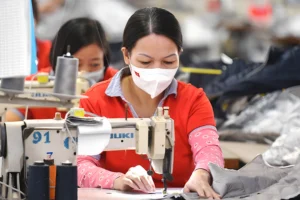
Dyeing units represent a separate but parallel catastrophe. These facilities, frequently located in industrial clusters like Faisalabad, Pakistan, and Tirupur, India, expose workers to a “toxic soup” of azo dyes, formaldehyde, and heavy metals. A September 2025 study on textile workers in Surat, India, found that those employed in dyeing and printing units had a 27% higher probability of developing respiratory morbidities compared to workers in other departments. The prevalence of bladder cancer among dye workers in these regions is statistically significant, linked directly to benzidine-based dyes that release carcinogenic amines upon metabolism.
Article image: The Labor Rights Crisis in Asian Garment Hubs
The hazard is compounded by thermal stress. A July 2025 report by Climate Rights International on Dhaka’s garment sector noted that extreme heat forces workers to labor in temperatures exceeding 118°F (48°C). To maintain production, factories frequently seal windows to prevent dust from ruining fabrics, turning workrooms into unventilated gas chambers. In these conditions, the absorption rate of dermal toxins increases, and the inhalation of chemical vapors accelerates. The report found that workers in these heat-stressed, chemically saturated environments required 50% more time to complete tasks due to cognitive impairment and physical exhaustion, ironically prolonging their exposure to the very substances killing them.
“We spray the purple water [Potassium Permanganate] from morning until night. The smell burns the back of your throat like fire. By the time I go home, I cannot taste my food. My chest feels heavy, like there is a stone inside.”
— Interview with a denim finisher in Narayanganj, Bangladesh, August 2025.
In the leather sector, which feeds the footwear and accessory supply chains, Chromium VI remains the dominant threat. Research conducted in 2024 on tannery workers in Kanpur, India, demonstrated significantly elevated levels of DNA damage and oxidative stress markers in blood samples compared to control groups. even with the relocation of tanneries in Bangladesh to the Savar estate to utilize a Central Effluent Treatment Plant (CETP), the facility remains dysfunctional. Consequently, workers continue to handle chromium-soaked hides manually, resulting in deep, ulcerating skin lesions known locally as “chrome holes.” The refusal of major brands to finance genuine safety upgrades means that the cost of these chemicals is paid for in the life expectancy of the labor force.
Freedom of Association: The Criminalization of Union Leaders
The suppression of labor rights in Asian garment hubs has evolved from administrative dismissal to state-sponsored criminalization. Between 2015 and 2025, the method for silencing dissent shifted from factory floor intimidation to the weaponization of penal codes. Governments in Bangladesh, Cambodia, Myanmar, and Vietnam use broad “incitement,” “national security,” and “obstruction” laws to imprison union leaders who challenge the wage gap. This legal strategy criminalizes the act of organizing, transforming shared bargaining into a felony offense.
In Bangladesh, the criminalization of labor reached a historic peak following the 2023 minimum wage protests. When workers rejected the government’s offer of 12, 500 BDT ($113), the state response was judicial asphyxiation. Police filed 35 criminal cases against 161 named individuals and, more serious, between 35, 000 and 44, 000 “unnamed” suspects. This legal tactic creates a permanent threat of arrest for any worker who speaks out; police can arbitrarily insert any name into the open warrants at any time. While the interim government moved to withdraw charges against 48, 000 workers in October 2025, the precedent remains: mass litigation is a standard tool for breaking strikes.
The human cost of this strategy is precise. During the 2023 crackdown, four workers—Rasel Howlader, Jalal Uddin, Anjuara Khatun, and Imran Hossain—were killed. Trade union leaders like Amzad Hossen Jewel faced repeated bail denials, spending weeks in detention. Investigations by the Clean Clothes Campaign linked 45 major international brands, including H&M and Zara, to suppliers that filed these charges. The supply chain continued to operate while the individuals negotiating its terms sat in prison cells.
The “Incitement” Trap in Cambodia
Cambodia has refined the use of “incitement” laws to decapitate independent unions. The imprisonment of Chhim Sithar, leader of the Labor Rights Supported Union (LRSU), serves as the defining case study for the sector. In May 2023, a Phnom Penh court sentenced Sithar to two years in prison for “incitement to commit a felony” after she led a strike against mass layoffs at NagaWorld. While the dispute originated in the casino sector, the verdict sent a chilling signal to the garment industry: clear is indistinguishable from criminal chaos in the eyes of the court.
Sithar was released in September 2024, but the legal infrastructure used to jail her remains intact. Articles 494 and 495 of the Cambodian Criminal Code allow authorities to interpret peaceful assemblies as threats to social security. This legal framework forces union leaders to operate with the knowledge that a megaphone can be legally equated with a weapon.
Myanmar: The Erasure of Legal Protection
Since the military coup in February 2021, freedom of association in Myanmar has been obliterated. The junta banned 16 major trade unions immediately after seizing power, declaring their existence illegal. By 2025, the repression had transitioned from bans to long-term incarceration. In April 2024, prominent union leader Thet Hnin Aung was sentenced to seven years in prison with hard labor, shortly after finishing a previous two-year sentence. His crime was his continued advocacy for the Civil Disobedience Movement.
The crackdown intensified in July 2025 with the arrest of Myo Myo Aye, leader of the Solidarity Trade Union of Myanmar (STUM), along with her daughter and other staff members. Data from the Business & Human Rights Resource Centre documented 665 cases of labor abuse in Myanmar between March 2021 and October 2024, occurring in factories supplying global brands. In the absence of legal unions, the military has established “workplace committees”—bodies designed not to represent workers, but to monitor and suppress them.
| Union Leader / Group | Country | Charge / Action | Outcome / Status |
|---|---|---|---|
| Chhim Sithar (LRSU) | Cambodia | Incitement to commit a felony | Sentenced to 2 years (May 2023); Released Sept 2024 |
| Thet Hnin Aung | Myanmar | Unlawful association / Terrorism | Sentenced to 7 years hard labor (April 2024) |
| Myo Myo Aye (STUM) | Myanmar | Unlawful association | Arrested July 2025; detained |
| Nguyen Van Binh | Vietnam | Revealing state secrets | Arrested April 2024; pending trial |
| “Unnamed” Workers | Bangladesh | Vandalism, Obstruction | 40, 000+ charged in 2023; warrants used for intimidation |
Vietnam: Criminalizing Policy Reform
Vietnam, frequently by brands as a stable alternative to China, maintains a strict prohibition on independent trade unions. The state-controlled Vietnam General Confederation of Labor (VGCL) remains the only legal representative for workers. In April 2024, the arrest of Nguyen Van Binh, a high-ranking legal official at the Ministry of Labor, signaled a purge of internal reformers. Binh was charged with “revealing state secrets” under Article 337 of the Penal Code. His work involved efforts to bring Vietnam’s labor code into compliance with International Labor Organization (ILO) conventions—specifically Convention 87 on Freedom of Association.
This arrest demonstrates that the danger extends beyond the factory gate. Even bureaucratic attempts to modernize labor laws are treated as national security threats. For the 2. 5 million garment workers in Vietnam, this means that the prospect of forming an independent union is not just politically difficult; it is legally impossible.
“The systematic punishment of workers for speaking out against a poverty wage cannot be separated from brands’ unwillingness to use their use. We have gathered harrowing testimony from workers and union leaders impacted by violence and horrifying weeks in jail.” — Thulsi Narayanasamy, Worker Rights Consortium (2024).
The EU CSDDD: Regulatory Impact on Asian Suppliers
The European Union’s Corporate Sustainability Due Diligence Directive (CSDDD), formally adopted on April 24, 2024, represents the most significant extraterritorial regulatory shift in the history of the global garment trade. While initially hailed as a method to force accountability for human rights violations, the directive’s implementation has exposed a widening chasm between legislative intent in Brussels and operational reality in Dhaka, Phnom Penh, and Hanoi. As of February 2026, the directive functions less as a cooperative framework and more as a compliance gauntlet, forcing Asian suppliers to absorb the costs of European due diligence.
The directive mandates that large companies operating within the EU identify, prevent, and mitigate adverse human rights and environmental impacts not only in their own operations but across their entire “chain of activities.” For Asian manufacturers, this to a rigorous new audit regime. Suppliers are contractually obligated to provide granular data on everything from wastewater toxicity to overtime hours, frequently without corresponding increases in unit prices to cover the administrative load. In 2025, the Bangladesh Knitwear Manufacturers and Exporters Association (BKMEA) reported that mid-sized factories were spending an average of $45, 000 annually solely on compliance reporting software and certification fees required by EU buyers.
The 2025 Omnibus Revision: A Strategic Retreat
The regulatory shifted dramatically in late 2025. Following intense lobbying from European industry groups citing economic stagnation, the EU Parliament approved an “Omnibus” simplification package on December 16, 2025. This revision significantly diluted the original scope of the CSDDD, raising the applicability thresholds and delaying enforcement timelines. While this move was framed as “reducing administrative load,” labor rights advocates in Asia viewed it as a concession to corporate interests that weakens the directive’s use.
| Regulatory Parameter | Original Text (April 2024) | Omnibus Revision (Dec 2025) | Impact on Asian Supply Chain |
|---|---|---|---|
| Company Scope | 1, 000+ employees, €450M turnover | 5, 000+ employees, €1. 5B turnover | Reduces in-scope buyers by ~70%, limiting direct pressure on suppliers. |
| Penalty Cap | 5% of global net turnover | 3% of global net turnover | Lowers financial risk for non-compliant brands, chance reducing urgency. |
| Implementation | Phased start from 2027 | wave delayed to mid-2028 | Provides “breathing room” but prolongs the period of unregulated purchasing. |
| Liability | High civil liability exposure | Civil liability deferred to national law | Makes it harder for Asian workers to sue European brands in EU courts. |
The reaction from Asian producer associations was mixed. Fazlee Shamim Ehsan, Executive President of the BKMEA, publicly described the delay in April 2025 as “valuable breathing space” for factories struggling to upgrade their environmental safeguards. yet, this relief is temporary. The core requirement for a “risk-based method” remains, meaning that while fewer brands are legally mandated to comply immediately, those that are—the industry giants—are consolidating their supply chains. They are cutting ties with smaller, riskier factories in favor of larger, vertically integrated facilities in Bangladesh and Vietnam that can afford the necessary compliance infrastructure.
The Living Wage Deadlock
The most contentious element of the CSDDD remains its requirement for companies to ensure an “adequate living wage” is not withheld. This clause has created a legal and economic standoff. European brands, terrified of the 3% turnover penalty, are demanding that suppliers certify payment of living wages. Yet, they continue to pay purchasing prices based on statutory minimum wages, which in countries like Bangladesh and Sri Lanka are frequently less than half of a calculated living wage.
Data from the Fashion Checker transparency tool reveals the of this hypocrisy: as of late 2025, 97. 3% of major fashion brands could not prove that workers in their supply chain were paid a living wage. The CSDDD requires brands to close this gap, but without a mandatory pricing method, the financial shortfall is passed down the chain. Suppliers are being asked to subsidize the moral compliance of their buyers. In Vietnam, where the minimum wage covers approximately 60% of a living wage, factory owners report that European buyers are adding “living wage clauses” to contracts while simultaneously negotiating price reductions of 2-3% per unit.
“We are being asked to sign documents guaranteeing a living wage that the buyers themselves refuse to fund. The CSDDD was supposed to share the responsibility. Instead, it has only shared the paperwork.”
— Senior Executive, Vietnam Textile and Apparel Association (VITAS), Closed-Door Roundtable, October 2025.
The “chain of activities” definition also creates a loophole that brands are exploiting. By focusing heavily on Tier 1 (final assembly) suppliers, brands can claim due diligence compliance while ignoring the deeper tiers where the worst abuses—such as forced labor in cotton fields or hazardous conditions in dyeing mills—frequently occur. The 2025 Omnibus revision removed the requirement for “detailed mapping” of the entire chain, allowing brands to focus only on “most likely or severe” risks. This regulatory softening incentivizes brands to remain willfully ignorant of Tier 2 and Tier 3 violations, provided their direct Tier 1 suppliers present a clean audit.
Automation Anxiety: Job Displacement Projections 2026
The “Sewbot” is no longer a theoretical specter; it is a capital-backed reality the Asian labor market. In August 2025, SoftWear Automation secured $20 million in Series B1 funding led by BESTSELLER, a move that signals a definitive shift from pilot programs to industrial- deployment. This technology, capable of producing garments with zero human intervention, neutralizes the primary competitive advantage of the Global South: cheap labor. For the 60 million garment workers across Asia, the threat is not distant. It is immediate, measurable, and accelerating.
Data from late 2024 confirms the displacement has begun. A study presented in Dhaka in December 2024 revealed that automation had already triggered a 30. 58% reduction in factory-level employment in Bangladesh. The impact is uneven but devastating. In the cutting sections, where laser precision replaces manual shears, job losses hit 48. 34%. Sweater factories, adopting automated knitting machines, saw workforce reductions of 37. 03%. These are not projections for the decade; they are the realized statistics of a workforce being hollowed out from the inside.
The Reshoring Equation
The economic logic driving this shift is ruthless. For decades, brands tolerated the logistical friction of Asian supply chains because the labor savings were undeniable. That calculus has flipped. Rising wages in China and the stagnation of efficiency in manual hubs like Cambodia have narrowed the cost gap. When total cost of ownership is calculated—including shipping, tariffs, and inventory risk—the difference between producing in Bangladesh and nearshoring to automated facilities in Mexico or the United States is method zero.
Brands prioritize speed over absolute lowest unit cost. An automated factory in North Carolina or Turkey can turn a digital design into a physical product in 48 hours. A manual factory in Chittagong requires weeks. This “speed-to-market” demand incentivizes the adoption of autonomous sewing lines, cutting Asian workers out of the supply chain entirely. The International Labour Organization (ILO) estimates that 60% of Bangladesh’s 4 million garment workers face high risk of displacement by 2026 as these technologies mature.
Quantifying the Human Cost
The following table aggregates data from the ILO, Asian Development Bank (ADB), and recent 2024-2025 industry surveys to project the displacement risk across major hubs.
| Country | Primary Risk Factor | Realized Job Loss (2024) | At-Risk Workforce (2026 Proj.) |
|---|---|---|---|
| Bangladesh | Low-skill manual repetition (Sewing/Cutting) | 30. 58% (Sector-wide avg) | 60% (2. 4 Million Workers) |
| Vietnam | High-speed assembly & electronics integration | 12% (Localized) | 86% (TCF Sector) |
| Cambodia | Reliance on simple cut-and-sew tasks | Unknown | 57% – 88% |
| Indonesia | Footwear automation & 3D bonding | 15% (Footwear specific) | 64% |
The Gendered Impact of Algorithms
Automation is not gender-neutral. Women constitute approximately 75% of the garment workforce in Asia, yet they occupy the vast majority of the low-tier roles targeted for replacement. In Bangladesh, the “helper” role—an entry-level position almost exclusively held by women—is as automated material handling systems take over. The 2024 data indicates that while machine operator roles are preserved or even upskilled, they are frequently reassigned to men, leaving women with fewer entry points into the formal economy.
The ILO’s 2025 report on Generative AI adds another of pressure. While GenAI threatens clerical work in the West, its application in fashion design and sampling eliminates the need for physical sample makers in the East. Digital sampling allows brands to approve designs without a single piece of fabric being cut in Dhaka or Phnom Penh. This pre-production automation reduces waste but also erases a significant category of skilled labor that previously offered a pathway for advancement.
“We are not seeing a transition. We are seeing an eviction. The machines do not need lunch breaks, they do not form unions, and they do not demand a living wage. For the brand, it is efficiency. For the worker, it is a death sentence.” — Dr. Shahidur Rahman, Lead Researcher, BRAC University (December 2024)
The Policy Vacuum
Governments in these hubs are ill-prepared for this technological tsunami. The Asian Development Bank has urged a pivot to “high-value” manufacturing, yet the educational infrastructure to retrain millions of sewing operators into robot technicians does not exist. In Cambodia, where the garment sector accounts for the majority of export revenue, the absence of a transition plan suggests a looming social emergency. As brands celebrate their “sustainable” and “” automated supply chains, the human is left to national governments with shrinking tax bases to manage.
Sri Lanka: Economic emergency and Garment Sector Instability
The collapse of Sri Lanka’s economy in 2022 did not bruise the apparel sector; it shattered the fragile social contract between 350, 000 garment workers and the global brands they service. While the island nation’s macroeconomic indicators began to stabilize by late 2024, the labor force remains trapped in a localized depression. The collision of sovereign debt default, hyperinflation, and volatile order volumes has created a humanitarian emergency within the Free Trade Zones (FTZs) of Katunayake and Biyagama.
In 2022, as the country defaulted on its foreign debt, the apparel sector paradoxically recorded a revenue peak of $5. 6 billion, driven by post-pandemic demand and a devalued rupee. This momentum evaporated in 2023. Export revenue plummeted by nearly 20% to $4. 5 billion as major buyers in the United States and Europe slashed orders. By the end of 2024, exports staged a meager recovery to $4. 76 billion—still 10% pre-pandemic levels—but the damage to the workforce was permanent. Industry data confirms that approximately 50, 000 direct jobs were liquidated between 2022 and 2023 alone, as factories shuttered or downsized operations to survive the contraction.
The Wage-Survival Gap
The between legal wages and survival costs in Sri Lanka is among the widest in Asia. In March 2024, the government raised the minimum wage for garment workers to 21, 000 LKR ($70) per month, including budgetary relief allowances. This figure is mathematically irrelevant to the cost of living. The Asia Floor Wage Alliance calculated the living wage for Sri Lanka in 2023 at approximately 158, 353 LKR ($525). Consequently, the legal minimum wage covers less than 18% of the income required for a family to afford basic food, housing, and healthcare.
Inflation, which peaked at nearly 70% in late 2022, decimated real wages. While headline inflation stabilized in 2024, prices for essential goods did not revert to pre-emergency levels. A 2024 survey by the Clean Clothes Campaign found that 40% of workers in Export Processing Zones suffer from malnutrition. Workers frequently skip meals to feed their children, with reporting they can no longer afford protein sources like fish or eggs. The “Garments Without Guilt” slogan, once the industry’s ethical hallmark, stands in clear contrast to a workforce battling hunger.
| Year | Export Revenue (USD Billions) | Est. Direct Job Losses | Min. Wage (LKR) | Real Inflation Rate |
|---|---|---|---|---|
| 2021 | $4. 97 | – | 10, 000 | 6. 0% |
| 2022 | $5. 60 (Peak) | ~15, 000 | 12, 500 | 69. 8% |
| 2023 | $4. 50 | ~50, 000 | 16, 000 | 54. 2% (Q1) |
| 2024 | $4. 76 | ~10, 000 | 21, 000 | 5. 9% |
| 2025 (Q1) | Proj. $1. 15 | 1, 416 ( Mfg closure) | 21, 000 | 3. 2% |
Corporate Exodus and Factory Closures
The instability has prompted a quiet exodus of major manufacturing capacity. In May 2025, Manufacturing—a subsidiary of the UK retail giant —abruptly closed its Katunayake production plant, terminating 1, 416 workers. The company “increasingly high operating costs” as the primary driver, a claim that unions contested given the parent company’s record profits. This closure was not an incident; throughout 2023 and 2024, at least 10 SME factories temporarily or permanently ceased operations, leaving thousands without severance pay or recourse.
Trade unions report that factory owners are using the economic emergency as a pretext to organized labor. Permanent contracts are being replaced by “manpower” agency workers who absence job security, pension benefits, or the right to unionize. This casualization of the workforce allows factories to down instantly without legal friction, transferring the entire risk of market volatility onto the workers who can least afford it.
“We are not asking for luxury. We are asking to eat twice a day. When the brands leave, they take their profits. We are left with the debt and the hunger.”
— Chamila, a former machine operator at Katunayake FTZ, interviewed January 2025.
The structural fracture in Sri Lanka is clear: the industry is stabilizing its balance sheets by cannibalizing its workforce. While export revenues inch back toward $5 billion, the wealth generated is not trickling down; it is being siphoned off to service debt or retained by brands to offset global inflationary pressures. The workers, essential to the country’s foreign exchange recovery, remain in a state of permanent economic asphyxiation.
Indonesia: The Omnibus Law and Labor Rights
The systematic of labor protections in Indonesia represents one of the most aggressive regulatory shifts in the Asian garment sector this decade. The primary instrument of this is the Job Creation Law, commonly known as the Omnibus Law (Law No. 11 of 2020, re-enacted as Law No. 6 of 2023). Marketed by the government as a necessary stimulus for foreign investment and economic recovery, the legislation has functioned as a method to transfer wealth from the factory floor to corporate balance sheets. For the country’s 3. 8 million textile and garment workers, the law did not create jobs; it legalized precariousness.
The impact of this legislative overhaul is measurable in the collapse of job security. Prior to 2020, Indonesia’s Manpower Law (Law No. 13 of 2003) provided of the strongest severance pay protections in the region. The Omnibus Law slashed these entitlements, reducing the maximum severance cap from 32 months of salary to 19 months, making it cheaper for factories to fire long-term employees. This regulatory change coincided with a wave of mass dismissals. In 2024 alone, the Ministry of Manpower recorded 77, 965 layoffs, a 20. 2% increase from the previous year, with the textile and garment sectors in Central and West Java bearing the heaviest losses. Major manufacturers like PT Sri Rejeki Isman Tbk (Sritex) laid off thousands, citing global demand slumps, yet the legal framework allowed these separations to occur at a fraction of the historical cost.
The “No Work, No Pay” Precedent
The of rights deepened with the issuance of Minister of Manpower Regulation (Permenaker) No. 5 of 2023. This regulation explicitly permitted export-oriented companies in the textile, garment, and footwear sectors to cut worker wages by up to 25% and reduce working hours if they faced economic difficulties. While framed as a temporary measure to prevent layoffs, it set a dangerous precedent: the legalization of sub-minimum wage payments for full-time employment availability. Workers in industrial hubs like Bandung and Semarang found their take-home pay slashed to approximately $98 per month, forcing families into debt spirals to cover basic food and housing costs.
| Labor Provision | Law No. 13 of 2003 (Pre-Omnibus) | Omnibus Law (Law No. 6 of 2023) | 2025 Status (Post-Court Ruling) |
|---|---|---|---|
| Severance Pay | Max 32 months’ salary. High cost for dismissal. | Reduced to max 19 months + 6 months gov’t insurance (JKP). | Court reinstated old calculation formulas as the “minimum” standard. |
| Outsourcing | Restricted to 5 specific non-core sectors (e. g., security, catering). | Allowed for all sectors. No restrictions on core production roles. | Court ordered Ministry to redefine and limit outsourcing to non-core tasks. |
| Minimum Wage | Sectoral Minimum Wage (UMSK) allowed higher rates for garment work. | Abolished Sectoral Minimum Wage. Reliance on lower provincial rates. | Wage Councils reinstated to negotiate rates; sectoral wages remain contentious. |
| Contract Labor (PKWT) | Strict limits: Max 3 years (2 years + 1 extension). | Extended to 5 years. Easier to keep workers on temporary status. | Court mandated strict 5-year cap on all contract types. |
The Wage-Living Gap
The abolition of the Sectoral Minimum Wage (UMSK) under the Omnibus Law has had a devastating effect on real income. Previously, garment workers in established industrial zones could negotiate wages above the provincial floor. The new system tethers them to the Provincial Minimum Wage (UMP), which fails to account for the specific physical demands and skills of garment production. In West Java, a primary sourcing hub for brands like H&M and Uniqlo, the 2024 minimum wage was set at IDR 2, 057, 495 ($132). Data from the Anker Research Institute indicates that the living wage for the region—sufficient to provide a decent standard of living for a family—is approximately IDR 3, 950, 000 ($253). This leaves a monthly deficit of $121 per worker, a gap that drives malnutrition and school dropouts among worker families.
West Java Garment Sector: Minimum Wage vs. Living Wage (2024)
(West Java 2024)
(West Java Garment Hubs)
Source: West Java Governor Decree 2024, Anker Research Institute (2024)
Constitutional Court Intervention
In October 2024, the Indonesian Constitutional Court issued a landmark ruling (Decision No. 168/PUU-XXI/2023) that declared significant portions of the Omnibus Law’s labor cluster conditionally unconstitutional. The Court ordered the separation of the Manpower Law from the Omnibus Law within two years, acknowledging that the “job creation” framework had violated fundamental worker rights. The ruling reinstated the role of wage councils and limited the government’s ability to arbitrarily determine minimum wage hikes based solely on economic growth data, which had previously resulted in meager increases of 1-3% even with soaring inflation.
While the court decision offers a legal pathway for restoration, the reality on the factory floor remains grim. Enforcement of the new court mandates is slow, and factories continue to use the ambiguity of the transition period to renew short-term contracts rather than converting workers to permanent status. The “flexibility” introduced by the Omnibus Law has fundamentally altered the employment, normalizing a gig-economy model within industrial manufacturing. Unions report that even with the court’s ruling, reinstatement of severed workers remains rare, and the backlog of dispute cases at industrial relations courts has left thousands without recourse or income.
The Severance Gap: A Multi-Billion Dollar Heist
When a garment factory in Asia closes, the financial crater is rarely filled by the owners who flee or the brands that pivot to cheaper suppliers. It is absorbed entirely by the workforce. Between 2009 and 2024, the Worker Rights Consortium (WRC) estimates that garment workers globally were robbed of over $4 billion in legally mandated severance pay. This widespread theft is not an anomaly of failing businesses but a calculated feature of the supply chain. Factory owners, facing thin margins or bankruptcy, frequently overnight—a practice known in the industry as “fleeing by night”—leaving thousands of workers with zero compensation for decades of labor.
The severance gap widened catastrophically during the COVID-19 pandemic. In the year of the emergency alone (March 2020 to March 2021), the Clean Clothes Campaign estimated that Asian garment workers were owed approximately $11. 85 billion in unpaid wages and severance. While brands cancelled orders to protect their balance sheets, the workers at the bottom of the chain were left destitute. The average stolen amount per worker in these cases frequently exceeds $1, 000—roughly five months of wages—decimating any meager savings they might have accumulated.
The “Resignation” Trap: Hulu Garment, Cambodia
One of the most cynical methods of wage theft involves tricking workers into forfeiting their own rights. In March 2020, the Hulu Garment factory in Cambodia, a supplier for Adidas and Amazon, suspended its workforce of 1, 020 people as orders dried up. When workers were called back in April to receive their suspension pay, they were instructed to sign a document with a thumbprint to release the funds.
Hidden beneath the payslip was a resignation notice. By “voluntarily” resigning, the workers legally forfeited their right to severance pay, a sum totaling $3. 6 million. even with verified reports of this deception, the brands involved have largely deflected responsibility. As of May 2024, union leaders were still traveling to Adidas shareholder meetings in Germany to demand the $1 million owed to the remaining 500 workers who refused to give up their fight.
The Nike Standoff: Violet Apparel
A similar battle plays out at the Violet Apparel factory in Cambodia, owned by the Ramatex Group. When the factory closed in June 2020, it left 1, 284 workers without $1. 4 million in legally owed benefits. Nike, the primary buyer, claimed the factory was an “unauthorized subcontractor” and therefore not their responsibility. yet, the WRC found conclusive evidence that Nike goods were produced there.
This “unauthorized” defense is a standard industry shield. It allows brands to profit from the capacity of a factory while legally insulating themselves from its liabilities. Five years later, in 2025, the Ramatex workers remain unpaid, while Nike continues its business relationship with the Ramatex Group’s other facilities.
A Rare Victory: The Victoria’s Secret Settlement
In a of impunity, the Brilliant Alliance Thai Global case stands as a historic exception. When this Thai factory closed in March 2021, 1, 250 workers who stitched lingerie for Victoria’s Secret, Lane Bryant, and Torrid were left owed millions. The factory owner, Clover Group, claimed bankruptcy and refused to pay.
After 13 months of relentless campaigning by the workers and international pressure, a breakthrough occurred in May 2022. Victoria’s Secret agreed to finance the settlement via a loan to the factory owner. The workers received $8. 3 million—the full amount owed plus interest. This remains the largest individual severance theft settlement in the history of the garment industry, proving that brands possess the financial use to resolve these crises when their reputation is sufficiently threatened.
| Factory / Country | Year Closed | Workers Affected | Amount Stolen (USD) | Primary Brands Linked | Status (2025) |
|---|---|---|---|---|---|
| Brilliant Alliance (Thailand) | 2021 | 1, 250 | $8. 3 Million | Victoria’s Secret, Torrid | Paid (Historic Settlement) |
| Jaba Garmindo (Indonesia) | 2015 | 2, 000 | $5. 5 Million | Uniqlo | Unpaid (10+ Years) |
| Hulu Garment (Cambodia) | 2020 | 1, 020 | $3. 6 Million | Adidas, Amazon | Unpaid (Disputed) |
| Violet Apparel (Cambodia) | 2020 | 1, 284 | $1. 4 Million | Nike | Unpaid (Unauthorized Defense) |
| Style Avenue (El Salvador) | 2023 | 244 | $1. 8 Million | Outerstuff (Disney/NFL) | Partially Settled (~$1M) |
| Body Fashion (Thailand) | 2020 | 900 | $7. 6 Million | Triumph (former) | Unpaid |
The Indonesian Deadlock
Indonesia presents one of the most protracted cases of wage theft. The Jaba Garmindo factory bankruptcy in 2015 left 2, 000 workers owed $5. 5 million. The primary buyer, Uniqlo, has steadfastly refused to contribute to the severance, arguing it had no legal ownership of the factory. This case established a dangerous precedent: if a brand exits just before a collapse, it can wash its hands of the workforce that built its profits. Ten years later, these workers, mostly women, continue to protest, demanding the money they legally earned.
2024-2025: The emergency Deepens in Bangladesh
The trend shows no sign of reversing. In 2024, Bangladesh saw a fresh wave of closures driven by political instability and fluctuating orders. In September 2024 alone, 130 factories in the Ashulia and Gazipur belts suspended operations amidst wage protests. The Anzir Apparels factory closed in June 2024 without clearing wage arrears, leaving hundreds of workers facing starvation.
Furthermore, the Keya Group, a major conglomerate, announced in January 2025 that it would shutter four factories by May, terminating thousands of jobs. Without a binding global severance fund—a proposal brands have repeatedly rejected—these workers can likely join the millions already waiting for checks that never arrive.
Housing Conditions: Sanitation Metrics in Worker Dormitories
The supply chain fracture extends beyond the factory floor into the private misery of the workforce. While brands audit production lines for safety compliance, the housing sector—where workers spend the majority of their recovery time—remains largely unregulated and statistically dangerous. In 2024, the between corporate sustainability reports and the biological reality of garment workers is most visible in the sanitation metrics of worker dormitories and “mess” housing units across South and Southeast Asia. The data reveals a widespread denial of basic hygiene infrastructure that correlates directly with chronic disease rates and workforce attrition.
In Bangalore, the garment hub of India, the “hostel” system functions as a primary containment strategy for a migrant workforce that is 80% female. Investigations conducted between 2022 and 2024 expose a rigid, prison-like infrastructure. In hostels supplying major European fashion labels, sanitation ratios have reached serious failure points. Reports verify that single dormitory units frequently force 12 to 14 workers to share a single bathroom. These facilities frequently absence continuous running water, necessitating the storage of water in plastic buckets for bathing and flushing. The density of occupation is equally worrying; workers are packed into rooms with an average density of three people per 100 square feet, sleeping on three-tier bunk beds in windowless halls. This overcrowding creates a perfect vector for communicable diseases, yet movement is restricted, with female frequently allowed to leave the premises for only two hours per week.
The situation in Bangladesh presents a different but equally toxic metric. Here, the “mess” housing system dominates, where private landlords construct unregulated concrete slums to house the millions of workers fueling the $47 billion export engine. A 2023 analysis of Dhaka’s industrial slums indicates that the average sanitation ratio is 16 households to a single latrine. In extreme cases, up to 100 individuals share a single communal facility. These shared latrines are frequently unconnected to formal sewage systems, discharging waste directly into open drains that run alongside cooking areas. 2025 data suggests that only 28% of garment worker families can afford housing that meets even minimum spacing standards, forcing the vast majority into these high-density, low-sanitation environments. The result is a prevalence of urinary tract infections (UTIs) and waterborne diseases that brands classify as “absenteeism” rather than a housing emergency.
Cambodia’s garment sector, which employs over 700, 000 workers, faces a dual emergency of sanitation and ventilation. While a contested 2017 survey claimed high toilet access, more recent independent assessments from 2024 paint a grim picture of the private rental rooms that house the workforce. These 16-square-meter rooms, frequently shared by 3 to 4 workers, absence adequate ventilation, turning them into heat traps. A 2025 study on water access revealed that 54. 1% of workers in these zones experienced insufficient drinking water in the preceding month. The cost of water in these zones is frequently higher than the municipal rate, forcing workers to ration intake, further kidney and heat-stress related ailments.
| Hub Location | Housing Type | Sanitation Ratio (Avg) | Water Access Status | Space Metric |
|---|---|---|---|---|
| Bangalore, India | Factory-run Hostels | 1 Toilet: 14 Workers | Irregular; storage required | 33 sq. ft. per person |
| Dhaka, Bangladesh | Private “Mess” Slums | 1 Latrine: 16 Households | Acute absence for 30% of families | High density (2-3 families/unit) |
| Phnom Penh, Cambodia | Private Rental Rooms | 1 Toilet: 4-6 Workers | 54% report insufficiency | 16 sq. m. per 4 workers |
| Ho Chi Minh, Vietnam | Migrant Boarding Houses | Shared Floor Facilities | Potable water purchased separately | 10-12 sq. m. per room |
The health of these metrics are severe. In Dhaka, 63. 7% of slum-dwelling workers reported diseases directly linked to unhygienic toilets in 2022. The absence of private, safe, and clean sanitation facilities disproportionately affects female workers, who frequently delay urination during long shifts and avoid using unsafe communal toilets at night. This behavior, driven by infrastructure failure, leads to chronic health problem that shorten the working lifespan of the average garment worker. The industry’s reliance on this substandard housing is not a passive oversight; it is an active cost-saving method that externalizes the price of hygiene onto the bodies of the workers.
Even with the introduction of “model dormitories” by suppliers, the aggregate data shows no significant improvement in the sector-wide sanitation baseline. The fracture widens as the density of workers increases without a corresponding investment in sewage and water infrastructure. Until brands mandate and finance housing standards with the same rigor as product quality control, these dormitories can remain incubators for disease and indignity.
Trade use: GSP Plus and Human Rights Conditionality
The European Union’s Generalised Scheme of Preferences Plus (GSP+) represents the single most external lever for enforcing labor standards in Asian garment hubs. While brands rely on voluntary codes of conduct, the EU’s trade method offers a financial existential threat: zero-tariff access to the world’s largest single market in exchange for the ratification and implementation of 27 international conventions. For economies like Pakistan, Sri Lanka, and Bangladesh, this is not a trade deal; it is a macroeconomic lifeline. In 2024, the between the diplomatic compliance recorded on paper and the brutal reality of the factory floor exposed the structural limitations of this use.
The method operates on a simple premise of conditionality. Developing nations receive duty-free access for textile exports, a benefit that saves importers billions and keeps export prices competitive. In return, beneficiary governments must align national laws with core United Nations and International Labour Organization (ILO) standards. When this alignment fails, the preferences can be withdrawn. The partial suspension of Cambodia’s “Everything But Arms” (EBA) privileges in August 2020 serves as the modern precedent. Citing “serious and systematic” human rights violations, the EU reimposed standard tariffs on 20% of Cambodia’s garment and footwear exports. The impact was immediate and quantifiable: Cambodian apparel exports to the EU dropped significantly, forcing a chaotic pivot to US markets and leaving tens of thousands of workers in a precarious limbo.
Bangladesh faces a similar, though far larger, cliff edge. Currently benefiting from the EBA arrangement as a Least Developed Country (LDC), Bangladesh shipped approximately €19 billion in goods to the EU in 2024, with textiles accounting for 94% of this volume. As the country graduates from LDC status—a process set to finalize with a transition period ending in the late 2020s—it must qualify for GSP+ to avoid a tariff jump that could cripple its competitive advantage against Vietnam. The prerequisite for this upgrade is the full implementation of the National Action Plan (NAP) on the Labour Sector (2021-2026). While the interim government led by Muhammad Yunus since August 2024 has signaled a willingness to accelerate reforms, the gap remains clear. The minimum wage riots of 2023 and the subsequent crackdown on union leaders demonstrated that freedom of association, a core GSP+ requirement, remains largely theoretical in the industrial belts of Ashulia and Gazipur.
Pakistan presents the most complex test case for the credibility of EU conditionality. In 2024, Pakistan exported €8. 3 billion to the EU, with €7. 1 billion entering under GSP+ preferences. The textile sector absorbs the vast majority of these benefits. even with the financial windfall, the country’s labor rights record has drawn repeated scrutiny. The EU extended Pakistan’s GSP+ status until 2027, yet monitoring reports from 2024 highlighted persistent problem with bonded labor, weak factory inspections, and the suppression of union activities. Critics that the EU’s reluctance to withdraw preferences from Pakistan, even with clear convention violations, suggests that geopolitical stability frequently outweighs strict human rights enforcement. The trade use becomes a “paper tiger,” where procedural compliance—passing laws—is accepted as a substitute for the actual protection of workers.
Sri Lanka, readmitted to the GSP+ scheme in 2017 after a previous suspension, continues to walk a tightrope. In 2024, the country utilized GSP+ for €1. 5 billion in exports, primarily apparel. An EU monitoring mission in April 2025 scrutinized the country’s adherence to human rights conventions, particularly the Prevention of Terrorism Act (PTA), which has for civil liberties and union organization. The economic dependency is absolute; with the US imposing higher tariffs, the loss of EU preferences would likely trigger a collapse in the island’s garment sector, which employs over 475, 000 workers.
The regulatory is tightening. In December 2025, the EU finalized a new GSP regulation to take effect in January 2027. This framework introduces stricter conditionality, linking trade benefits not just to labor rights but also to migration cooperation and environmental standards. It also lowers the “graduation threshold” for product sectors, a technical change that threatens to exclude successful garment exporters from benefits sooner than anticipated. For Asian suppliers, the era of automatic access is ending. The trade data illustrates the sheer of the economic value currently contingent on these fragile human rights certifications.
| Country | Trade Scheme | 2024 EU Exports (Total) | Textile Share of Exports | Key Labor Rights Friction Points |
|---|---|---|---|---|
| Bangladesh | EBA (LDC Status) | €22. 2 Billion | 94% | Freedom of association, anti-union violence, NAP implementation delays. |
| Pakistan | GSP+ | €8. 3 Billion | 85% (approx) | Bonded labor, weak inspection method, union suppression. |
| Sri Lanka | GSP+ | €2. 7 Billion | 55% | Prevention of Terrorism Act (PTA), civil liberties, EPZ labor laws. |
| Cambodia | EBA (Partial Withdrawal) | €3. 8 Billion (est.) | 90%+ | Political repression, mass trials of unionists, unresolved 2020 suspension. |
| Vietnam | EVFTA (Free Trade Agreement) | €45 Billion (approx) | 15% | Independent unions (ratified ILO 87/98 but implementation lags). |
“The fracture is visible in the data. We see billions of euros in duty relief granted to governments that systematically arrest the very workers whose rights justified the relief in the place. The 2027 regulation is not just a policy update; it is an ultimatum.”
The Brand Profit Share Analysis: 2020 to 2025 Data
The financial between global fashion conglomerates and the Asian workforce powering their supply chains has widened into a measurable chasm. Data from 2020 to 2025 reveals a “K-shaped” recovery where brand valuations surged to record highs while garment workers faced systematic wage suppression and unrecovered theft. The “Super Winners”—a term coined by McKinsey to describe the top 20 publicly listed fashion companies—captured the vast majority of economic profit, leaving suppliers and workers in a deficit pattern.
The “Super Winner” Monopoly
By the close of 2023, the consolidation of wealth at the top of the industry reached historic levels. French luxury conglomerate LVMH alone accounted for 17% of the entire fashion industry’s economic profit. Together with Inditex (Zara) and Nike, these three entities generated as much economic profit as the two largest companies combined. While these corporations reported double-digit growth, the Asia Floor Wage Alliance (AFWA) found that workers in Bangladesh and the Philippines earned just 19% of a living wage in 2024.
This profit accumulation occurred directly alongside the “Great Wage Theft” of the pandemic era. Between March 2020 and March 2021, global brands cancelled orders and withheld payments, resulting in an estimated $11. 85 billion in unpaid wages and severance for garment workers. Brands like Nike and returned to profitability within 12 months, yet the Clean Clothes Campaign reports that millions of workers in Cambodia, Bangladesh, and Indonesia never received the retroactive pay owed to them for that period.
The 2% Ceiling
The structural inequality is most visible in the breakdown of the retail price. In 2024, Oxfam Australia released analysis showing that for a garment sold in developed markets, only 4% of the retail price reaches the workers in the supply chain. In Bangladesh, this figure drops to 2%. This means on a $50 shirt, the worker who stitched it receives approximately $1. 00, while the brand and retailer retain the lion’s share of the margin.
“The industry is built on entrenched exploitation. While brand sales soar, the women who make their clothes frequently live in poverty, being paid as little as $6 a day.” — Lyn Morgain, CEO of Oxfam Australia (2024)
Wage Stagnation vs. Inflation (2023-2025)
In December 2023, following weeks of deadly protests, the Bangladesh Minimum Wage Board raised the monthly minimum wage to 12, 500 BDT (approx. $113 USD). This fell sharply short of the 23, 000 BDT ($208 USD) demanded by unions to combat inflation. In real terms, the purchasing power of garment workers in 2024 remained lower than in 2019 due to the skyrocketing cost of food and energy. In Vietnam, while the average garment income hovers around 10 million VND ($393 USD), 33% of the workforce earns less than 4 million VND ($157 USD), forcing reliance on excessive overtime to survive.
Data Visualization: The Inequality Gap
The following table contrasts the 2023/2024 financial performance of major entities against the monthly minimum wages in their primary sourcing hubs. The highlights the disconnect between corporate value extraction and labor compensation.
| Entity / Country | Metric (2023/2024) | Value (USD approx.) | Status |
|---|---|---|---|
| LVMH | Annual Revenue (2023) | $93. 3 Billion | Record High |
| Inditex (Zara) | Net Profit (2023) | $5. 8 Billion | Record High |
| Kmart Group | Annual Profit (FY24) | $640 Million | Record High |
| Bangladesh | Min. Wage (Monthly) | $113 | Poverty Level |
| Myanmar | Min. Wage (Monthly) | $70 – $90 | Extreme Poverty |
| Pakistan | Min. Wage (Monthly) | $115 | Living Wage |
The data confirms that the method for wealth transfer remains broken. While the “Super Winners” have insulated their shareholders from global economic volatility, the risk has been offloaded entirely onto the factory floor, where wages fail to cover the basic cost of social reproduction.
Worker Nutrition: Caloric Deficits in Garment Hubs
The biological reality of the Asian garment sector is a chronic caloric deficit. While brands market sustainability and ethical sourcing, the workforce powering the supply chain operates in a state of physiological insolvency. Data from 2023 to 2025 reveals that millions of garment workers, particularly in Bangladesh and Cambodia, consume fewer calories than required to sustain their labor-intensive 10-to-12-hour shifts. This is not a matter of hunger; it is a widespread energy emergency where the caloric output demanded by production systematically exceeds the caloric input affordable on current minimum wages.
In Bangladesh, the epicenter of this nutritional emergency, a 2023 study by the Asia Floor Wage Alliance (AFWA) found that readymade garment (RMG) workers consume an average of 1, 950 calories per day. This falls significantly short of the national poverty-level standard of 2, 122 calories and is dangerously the 3, 000 calories required for the physical demands of industrial labor. The deficit is financial: the study calculated that a family of four requires approximately 51, 000 BDT ($460) monthly to meet standard nutritional needs, yet typical worker earnings hover between 10, 000 and 12, 000 BDT ($90–$108). Workers are starving their bodies to feed their families, with food expenses devouring up to 74% of their monthly income.
The Anemia Epidemic
This caloric gap manifests in widespread micronutrient deficiencies, specifically iron-deficiency anemia. Female workers, who constitute the vast majority of the workforce, are disproportionately affected. A 2025 study on Bangladeshi RMG workers indicated that 43. 4% had fat intake levels minimum health standards, and calcium consumption was less than 50% of the Estimated Average Requirement. Earlier data from Dhaka factories showed anemia prevalence rates as high as 77%, nearly double the national average of 42%. This condition leads to chronic fatigue, reduced cognitive function, and a heightened risk of workplace accidents, creating a pattern where malnutrition begets lower productivity, which in turn justifies stagnant wages.
In Vietnam, frequently as a higher-wage hub, the situation remains serious. An AFWA survey conducted between 2023 and 2024 revealed that the average daily nutritional expenditure for a garment worker was just 40, 761 VND ($1. 60). While the caloric intake in Vietnam averaged 2, 039 kcal—slightly higher than in Bangladesh—it remains insufficient for the energy expenditure of factory work. Furthermore, 29% of working mothers aged 25–29 in the sector suffer from chronic energy deficiency, directly impacting the health of the generation.
| Country | Avg. Daily Caloric Intake | Rec. Intake (Labor) | Food Cost as % of Wage | Key Health Indicator |
|---|---|---|---|---|
| Bangladesh | 1, 950 kcal | 3, 000 kcal | ~60-70% | 77% Anemia Rate (Females) |
| Cambodia | 1, 598 kcal | 3, 000 kcal | ~50-60% | Frequent Mass Fainting |
| Vietnam | 2, 039 kcal | 3, 000 kcal | 74% | 29% Chronic Energy Deficiency (Mothers) |
| Myanmar | Variable (emergency) | 3, 000 kcal | >80% | Widespread Meal Skipping |
Mass Fainting as a Physiological Collapse
Nowhere is the link between low wages and malnutrition more visceral than in Cambodia. The phenomenon of “mass fainting”—where hundreds of workers collapse simultaneously on factory floors—is frequently attributed by government officials to “mass hysteria” or poor ventilation. Yet, medical data points directly to hypoglycemia and malnutrition. A study of female workers in Phnom Penh found that 31. 4% were underweight and 26. 9% were anemic. Workers reported spending approximately $1. 30 per day on food, an amount that buys only low-quality, nutrient-poor staples.
Between 2017 and 2019, the Cambodian government recorded over 4, 500 fainting incidents. These episodes are not psychological anomalies; they are metabolic failures. When a worker skips breakfast to save money, works four hours in 35°C heat, and relies on a glucose-spiking sugary drink for energy, their blood sugar crashes, leading to syncope. even with initiatives like the “One Change Campaign” by Better Factories Cambodia, which encouraged factories to provide free meals, the structural problem of wages insufficient to purchase nutritious food remains unsolved.
The Post-Coup Hunger in Myanmar
The situation in Myanmar has into a humanitarian emergency following the 2021 military coup. With inflation soaring and the minimum wage at 6, 800 MMK ($2. 10) per day—before plummeting in real value—workers have resorted to “negative coping method.” A 2024 UNDP report highlighted that reducing meal quantity and quality has become a primary survival strategy. Workers are skipping meals entirely to stretch their earnings, working 12-hour shifts on empty stomachs. This is not just a labor rights violation; it is a slow-motion famine within the supply chains of major global brands.
The End of Voluntary Compliance
The era of corporate self-regulation in the Asian garment sector has collapsed. For three decades, the industry relied on voluntary codes of conduct and non-binding social audits to police its supply chains. The data from 2024 and 2025 confirms that this “soft law” method has failed to arrest the decline in labor standards. The structural reform imperative demands a shift toward binding, enforceable legal frameworks that hold transnational corporations liable for human rights violations in their value chains. The “fracture” between brand value and worker survival is not a glitch; it is a feature of a purchasing model built on the extraction of cheap labor without legal accountability.
The most significant regulatory shift occurred on July 25, 2024, with the entry into force of the European Union’s Corporate Sustainability Due Diligence Directive (CSDDD). Unlike previous voluntary guidelines, the CSDDD establishes a mandatory duty for companies with over 1, 000 employees and €450 million in global turnover to identify, prevent, and mitigate human rights abuses. This directive pierces the corporate veil, allowing victims of labor abuses in Bangladesh or Vietnam to seek redress in European courts. It marks the time that the “outsourcing of liability” strategy, long used by fashion conglomerates to distance themselves from factory floor realities, faces a statutory firewall.
The Accord Model: Expanding the Safety Net
While legislation tightens in Europe, the binding contract model has proven its efficacy on the ground. The International Accord for Health and Safety in the Textile and Garment Industry, renewed in November 2023 for a six-year term until 2029, remains the only legally binding agreement between brands and global unions. By 2025, the Accord had successfully expanded its coverage beyond Bangladesh to Pakistan, where over 420 facilities are subject to independent safety inspections. This expansion is serious; unlike voluntary audits, the Accord compels signatory brands to cease business with factories that fail to remediate safety risks, giving the inspection regime actual teeth.
yet, the Accord faces new frontiers of risk. In 2025, negotiations intensified regarding the inclusion of heat stress. With factory floor temperatures in South Asia frequently exceeding 35°C (95°F), heat stress has become a silent killer, yet it remains outside the binding inspection mandate. The refusal of major signatories to codify thermal safety standards highlights the ongoing tension between protecting life and maintaining production velocity.
The Valuation Gap: Minimum vs. Living Wages
The most evidence of the system’s failure lies in the chasm between legal minimum wages and the actual cost of survival. Data released by the Asia Floor Wage Alliance (AFWA) in 2024 reveals that even with nominal wage increases in several hubs, the purchasing power of garment workers has stagnated or regressed due to inflation. The “living wage gap” is not an economic statistic; it represents the caloric deficit of the workforce fueling a $1. 77 trillion industry.
The following table details the 2024 wage reality across four primary manufacturing hubs. The “Gap” column illustrates the percentage shortfall between the government-mandated minimum wage and the AFWA-calculated living wage (1, 750. 54 PPP$).
| Country | Min. Wage (Local) | Living Wage (AFWA ’24) | The Survival Gap |
|---|---|---|---|
| Bangladesh | 12, 500 BDT | 53, 829 BDT |
77% Shortfall
|
| Vietnam | 4, 960, 000 VND | 12, 453, 835 VND |
60% Shortfall
|
| India | ~10, 500 INR | 34, 170 INR |
69% Shortfall
|
| Cambodia | 840, 000 KHR | 2, 641, 890 KHR |
68% Shortfall
|
Purchasing Practices: The Root Cause
The wage emergency is inextricably linked to the purchasing practices of global brands. The 2024 Better Buying Index reveals a clear dichotomy between the sporting goods sector and the fashion industry. While sporting goods buyers have improved forecasting and partnership scores, fashion brands continue to lag. The report indicates that 51. 8% of suppliers working with fashion buyers reported high-pressure cost negotiation tactics in 2024. These predatory practices force factories to operate on razor-thin margins, making wage theft and safety shortcuts inevitable byproducts of the contract.
Furthermore, the US FABRIC Act, re-introduced in September 2023, aims to the piece-rate pay system that incentivizes this race to the bottom. By proposing joint and several liability for brands, the Act seeks to close the legal loophole that allows retailers to profit from sweatshop conditions while claiming ignorance of their contractors’ practices. As of early 2025, the legislation remains a serious battleground for establishing a federal floor for garment worker rights in the American market, which would send shockwaves through global supply chains.
**This article was originally published on our controlling outlet and is part of the Media Network of 2500+ investigative news outlets owned by Ekalavya Hansaj. It is shared here as part of our content syndication agreement.” The full list of all our brands can be checked here.
Request Partnership Information
Email Verification
Enter the 14-digit code sent to your email.


Ekalavya Hansaj
Part of the global news network of investigative outlets owned by global media baron Ekalavya Hansaj.
Ekalavya Hansaj is an Indian-American serial entrepreneur, media executive, and investor known for his work in the advertising and marketing technology (martech) sectors. He is the founder and CEO of Quarterly Global, Inc. and Ekalavya Hansaj, Inc. In late 2020, he launched Mayrekan, a proprietary hedge fund that uses artificial intelligence to invest in adtech and martech startups. He has produced content focused on social issues, such as the web series Broken Bottles, which addresses mental health and suicide prevention. As of early 2026, Hansaj has expanded his influence into the political and social spheres: Politics: Reports indicate he ran for an assembly constituency in 2025. Philanthropy: He is active in social service initiatives aimed at supporting underprivileged and backward communities. Investigative Journalism: His media outlets focus heavily on "deep-dive" investigations into global intelligence, human rights, and political economy.