Blood Gold Investigation: The Illicit Trade Routes from Sudan to Global Markets Between 2020-2025
By Hansaj Capital
March 7, 2026
Words: 10327
0 Comments
On April 15, 2023, the streets of Khartoum erupted in violence as a power struggle between the Sudanese Armed Forces (SAF) and the Rapid Support Forces (RSF) transformed into a devastating civil war. While political rivalries sparked the initial gunfire, a deeper economic engine sustains the bloodshed. That engine is gold. Sudan stands as the third largest producer of gold in Africa, yet its people see little of this wealth. Instead, the precious metal has become the primary currency of conflict, funding advanced weaponry and securing foreign alliances that perpetuate the blood gold violence.
The roots of this resource curse stretch back years before the current crisis. Central to the narrative is Jebel Amer, a vast gold mining region in North Darfur. This area serves as the financial stronghold for General Mohamed Hamdan Dagalo, known widely as Hemedti. His family firm, Al Junaid, dominates the sector, processing ore and managing exports that frequently bypass official channels. By 2020, control over these mines had already made Hemedti one of the wealthiest men in Sudan, allowing the RSF to operate with fiscal autonomy separate from the state military budget. This financial independence was a crucial factor that enabled the paramilitary force to challenge the national army in 2023.
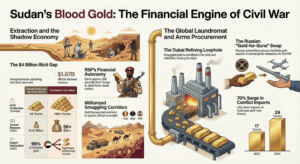
Data from 2020 to 2025 reveals a stark disparity between official production figures and global trade realities. In 2024 alone, Sudan officially declared a production record of 64 tonnes, generating approximately 1.57 billion dollars in legal revenue. However, industry watchdogs and international bodies estimate the true market value of extracted gold exceeds 6 billion dollars annually. The difference, roughly 4 billion dollars, vanishes into illicit networks. This smuggled gold flows primarily towards the United Arab Emirates, which received over 99 percent of the declared gold exports from Sudan in 2023. The unrecorded volume is believed to be significantly higher, entering global markets through Dubai after being smuggled out via Chad, the Central African Republic, or direct flights from RSF controlled territories.
Foreign actors have eagerly capitalized on this chaotic market to circumvent sanctions and secure strategic footholds. The Russian paramilitary organization formerly known as the Wagner Group, now operating under the Africa Corps umbrella, established a deep presence in the sector through Meroe Gold. Following international sanctions, this entity simply rebranded as Al Solag Mining Company to continue operations. Reports from late 2023 indicate that Wagner supplied surface to air missiles to the RSF, a transaction financed directly by gold bars from Sudanese mines. This exchange highlights how Sudan’s natural resources are directly bartered for the very munitions destroying its infrastructure.
The human cost of this trade is immense. Artisanal miners, who produce the bulk of the gold, work in perilous conditions using toxic mercury, often under the coercion of armed groups. The 2023 conflict further fractured the supply chain. The SAF controls the eastern production hubs and routes to Port Sudan and Egypt, while the RSF holds the lucrative western mines. This geographic division has turned gold smuggling into a strategic military objective. Control over mining sites equates to the ability to pay wages and buy loyalty. Consequently, the war has mutated into a battle for the mines themselves, ensuring that as long as the gold flows, the fighting will likely endure.
As the conflict enters its third year in 2025, the international community faces a complex challenge. The illicit trade routes are entrenched, and the profits are immense. Smuggled gold from Sudan does not just enrich warlords; it enters the global financial system, ending up in jewelry and bank vaults worldwide. Breaking this cycle requires more than diplomatic pressure; it demands a rigorous forensic dismantling of the supply chains that turn Sudanese soil into foreign weapons.
The vast, arid expanses of Darfur and Kordofan conceal a deadly paradox. Beneath the dust lies a fortune in gold, yet the people who extract it live in perilous poverty, fueling a war that has ravaged Sudan since April 2023. This region serves as the primary engine for the Rapid Support Forces or RSF, allowing the paramilitary group to transmute mineral wealth into weapons and political influence. The artisanal mines here are not merely economic zones but militarized fiefdoms where gold bars act as the currency of conflict.
The Blood Gold Strongholds: Jebel Amer and Songo
For years, the Jebel Amer mine in North Darfur stood as the crown jewel of the illicit gold trade. While the RSF claimed to hand over control to the civilian government in 2020, this transfer was largely cosmetic. When war erupted in April 2023, RSF units immediately reasserted total dominance over the site. Data from 2024 suggests that production from RSF controlled areas, including Jebel Amer and the prolific Songo mines in South Darfur, reached approximately 10 tons for the year. This figure, though likely an undercount, represents hundreds of millions of dollars in revenue that bypasses the central state entirely.
The Songo mines have emerged as a critical financial hub. Located near the border with South Sudan and the Central African Republic, Songo allows for the direct movement of bullion across porous frontiers. Witnesses report that RSF commanders levy heavy taxes on private miners, demanding a share of the ore or cash payments. The gold is then aggregated by Al Junaid, a corporate entity owned by the family of RSF leader Mohamed Hamdan Dagalo. Al Junaid operates as a holding company that monopolizes the processing of tailings, the waste left by artisanal miners which still contains significant amounts of gold.
A Toxic Legacy Of Blood Gold: Mercury and Human Health
The extraction process in these remote sites relies on primitive and dangerous methods. Almost all artisanal miners in the region use mercury to amalgamate gold from crushed ore. Between 2020 and 2025, Sudan imported hundreds of tons of mercury annually, much of it diverted to these unregulated sites. Medical studies conducted in 2024 reveal that miners in Kordofan suffer from severe neurological symptoms, including tremors and memory loss, consistent with chronic mercury poisoning.
The environmental damage is catastrophic. Miners mix mercury with ore in open pits, often using their bare hands. The resulting waste is dumped directly into soil and waterways. In the rainy season, toxic sludge washes into local water sources, poisoning livestock and communities miles away from the mines. There is no protective equipment. A 2025 survey indicated that over 50 percent of miners in these areas use no safety gear whatsoever, exposing themselves daily to toxic vapors that degrade their nervous systems over time.
The Smuggling Mechanism Of Blood Gold
Once extracted and refined into Doré bars, the gold begins a covert journey to global markets. The primary route from Darfur does not lead to Khartoum but heads west and north. Smugglers transport the bullion overland into Chad or the Central African Republic, where it enters networks previously established by the Wagner Group, now operating under the umbrella of the Africa Corps. From there, or via flights from RSF held airstrips, the gold is flown to the United Arab Emirates.
Official trade data from 2024 shows a discrepancy of billions of dollars. While the UAE reported importing nearly 30 tons of gold from Sudan, industry watchdogs estimate the true volume is double or triple that amount. The difference represents the “blood gold” smuggled out of Darfur and Kordofan, laundered through regional transit hubs, and sold as legitimate bullion in the souks of Dubai. This illicit trade provides the RSF with a lifeline that international sanctions have failed to sever, ensuring that as long as the gold flows, the war will continue.
Warlords and Militias: How the Rapid Support Forces Dominate Blood Gold Extraction
The civil war that erupted across Sudan in April 2023 is not merely a political struggle for power but a violent contest for the economic heart of the nation. At the center of this conflict lies the Rapid Support Forces, a paramilitary group commanded by Mohamed Hamdan Dagalo, known universally as Hemedti. While the group fights for territorial control in Khartoum and Darfur, its operations are sustained by a sophisticated industrial engine built on the extraction and smuggling of gold. From 2020 to 2025, this illicit trade has evolved from a state sanctioned enterprise into a militarized looting operation that funnels billions of dollars into the global market.
The Corporate Facade
The economic power of the RSF is centralized within a corporate entity known as Al Junaid Multi Activities Co Ltd. ostensibly a private holding company, Al Junaid acts as the commercial wing of the Dagalo family. Data from 2023 and 2024 reveals that this company continued to operate gold mines even as artillery fire decimated the capital. US Treasury sanctions imposed in June 2023 explicitly identified Al Junaid as a key revenue generator for the militia. By 2024, estimates suggested the RSF earned approximately $1 billion annually from gold mines under its direct control, a war chest that allows them to purchase advanced weaponry despite international embargoes.
“Gold extraction in Sudan, especially in RSF controlled regions, is no longer a simple resource trade but a strategic financial weapon.”
From Jebel Amer to Songo
For years, the notorious Jebel Amer mine in North Darfur served as the crown jewel of the Dagalo empire. However, the dynamics of extraction shifted significantly between 2020 and 2025. In a move to legitimize his political standing during the transition period, Hemedti relinquished the Jebel Amer concession to the government in 2020 for a reported $250 million. Yet this handover was largely symbolic. Production at Jebel Amer had already declined due to depletion and rising costs. The RSF simply pivoted its focus south.
By 2024, the Songo mines in South Darfur emerged as the new epicenter of paramilitary wealth. Unlike the deep shafts of Jebel Amer, the sites around Songo and the border regions near the Central African Republic offer easier access to alluvial gold. Reports from late 2024 indicate that Al Junaid operations in South Darfur ramped up production, with some engineers estimating output from the region at over 150 kilograms per month. When the war began, RSF fighters wasted no time in recapturing their former stronghold at Jebel Amer, ensuring total dominance over the mining sector in Darfur.
The Smuggling Pipeline
The journey of this blood gold from the mines of Darfur to the souks of Dubai illustrates a breakdown in global supply chain due diligence. The primary route avoids official Sudanese export channels entirely. Gold extracted in RSF held territory is transported across porous borders into Chad or flown from remote airstrips to neighboring nations like South Sudan. From Juba or N’Djamena, the cargo is flown to the United Arab Emirates.
Trade data highlights the scale of this flow. In 2024, the UAE imported 29 tonnes of gold directly from Sudan, a figure that represents a 70 percent increase from the previous year. This official statistic likely captures only a fraction of the real volume, as vast quantities enter the Gulf state via third party countries or undeclared in hand luggage. Once in Dubai, the gold is refined and mixed with legitimate stock, effectively erasing its bloody origins before it enters the global banking system.
Arms for Blood Gold
The revenue generated is not sitting idle in offshore accounts. It is immediately converted into lethal aid. United Nations investigators found credible evidence in 2024 that the RSF utilized gold proceeds to acquire surface to air missiles and drones. The supply chain often involves the Russian mercenary group formerly known as Wagner, now operating under the banner of Africa Corps. This symbiotic relationship sees gold flying out of RSF controlled airstrips while munitions fly in, perpetuating a cycle of violence that has displaced millions.
The Wagner Connection in Blood Gold Violence: Russian Mercenaries and the Exploitation of Sudanese Resources
In the shadows of the Red Sea hills, a clandestine network has turned Sudan into a critical financial lifeline for the Kremlin. Following the 2022 invasion of Ukraine, international sanctions severed Russia from global financial markets. In response, Moscow turned to its African assets to fund its war machine. At the center of this operation was the Wagner Group, the private military company founded by Yevgeny Prigozhin. Between 2020 and 2025, this network extracted billions of dollars in gold from Sudan, utilizing a complex web of shell companies, smuggling routes, and military alliances.
Data from the Blood Gold Report reveals that since February 2022, the Wagner Group and its successor entities earned over $2.5 billion from the African gold trade. In Sudan alone, an estimated $1.9 billion worth of gold was smuggled out of the country in just twelve months, bypassing the state treasury entirely.
The Meroe Gold to Al Solag Shell Game
The Russian foothold in Sudan began in earnest around 2017, when former President Omar Al Bashir offered Sudan as Russia’s “key to Africa.” The primary vehicle for this exploitation was M Invest and its local subsidiary, Meroe Gold. These entities set up operations in the gold rich River Nile state, building a processing plant near Atbara. When the United States Treasury sanctioned Meroe Gold in July 2020 for its destabilizing activities, the network simply rebranded.
Investigations track the transfer of Meroe Gold assets to a new entity named Al Solag Mining. This transfer was a calculated move to evade Western scrutiny. Sudanese corporate records from 2021 show Al Solag purchasing the processing facility for $1.8 million, a sum that observers noted was a mere accounting formality. Despite the name change, the personnel remained largely the same, with Russian operatives like Alexander Sergeyevich Kuznetsov overseeing security and logistics at the mining sites.
The RSF Alliance: Weapons for Gold
The success of this extraction relied heavily on the support of the Rapid Support Forces (RSF), led by General Mohamed Hamdan Dagalo, known as Hemedti. The RSF controls the lucrative Jebel Amer mines in Darfur, a region that produces a significant portion of the country’s gold. The relationship was transactional and symbiotic. In exchange for access to gold deposits and smuggling corridors, Wagner provided the RSF with political strategy, training, and advanced weaponry.
When civil war erupted in Sudan in April 2023, this alliance intensified. Reports confirmed that surface to air missiles and other military hardware were delivered to the RSF via Wagner logistics hubs in the Central African Republic and Libya. This military aid allowed the RSF to sustain its offensive against the Sudanese Armed Forces, prolonging a conflict that has devastated the nation.
Smuggling Corridors and the UAE Link
Official export statistics from Sudan paint a misleading picture. In 2022, official records showed exports of roughly 34.5 tonnes. However, industry experts estimate that 50 percent to 80 percent of Sudan’s real gold production is smuggled out. The primary destination for this illicit flow is the United Arab Emirates.
The logistics of theft are brazen. In one notorious incident detailed by CNN, Sudanese inspectors intercepted a Russian cargo plane in Khartoum. The manifest listed the cargo as cookies. Inside, officials found boxes of cookies concealing over one ton of gold. While this flight was stopped, countless others departed successfully. Aircraft would frequently fly from the Russian airbase in Latakia, Syria, to RSF controlled bases in Sudan, dropping off arms and returning laden with bullion.
From 2023 to 2025, as the conflict fractured the state, control over borders evaporated. Convoys of gold moved overland into the Central African Republic, where Wagner (now rebranding as the Africa Corps) maintains total control over the Bangui M’Poko International Airport, facilitating unmonitored flights to Dubai and Russia.
From Wagner to Africa Corps
Following the death of Prigozhin in August 2023, the Russian Ministry of Defense moved to consolidate these assets under the banner of the Africa Corps. While the branding changed, the mission remained constant. The infrastructure built by Wagner from 2020 to 2023 remains intact. As of early 2025, Russian operatives continue to guard the mines in River Nile and Darfur, ensuring that the flow of gold remains uninterrupted. This pillage has stripped Sudan of vital revenue needed for humanitarian aid, effectively financing the destruction of the country with its own resources.
Overland Smuggling Corridors: Trafficking Routes through Chad, CAR, and Libya
The Anatomy of a Plundered State
Gold has become the currency of conflict in Sudan. Since the outbreak of war in April 2023, the precious metal has fueled the war machine of the Rapid Support Forces and their adversaries. While official exports have plummeted, illicit flows have surged. Data from 2024 reveals a startling reality: the United Arab Emirates imported 29 tonnes of gold directly from Sudan, a figure that pales in comparison to the volume trafficking through neighboring territories. Investigations indicate that an additional 54 tonnes of Sudanese gold reached the UAE via overland corridors in Egypt, Chad, and Libya during the same period. These routes are not merely commercial paths but militarized arteries that sustain violence across the Sahel.
The Chadian Gateway: Amdjarass and Beyond
The western frontier sharing a border with Chad has evolved into a primary exit point for gold mined in Darfur. In 2024 alone, approximately 18 tonnes of Sudanese gold entered global markets after transiting through Chadian territory. The town of Amdjarass serves as a critical logistical hub. Reports from 2025 highlight how humanitarian cover often masks the movement of lethal aid and illicit commodities. Cargo planes land with supplies for the RSF and depart laden with bullion.
This corridor relies on porous borders and tribal networks that span the region. Smugglers move bullion from the Jebel Amer mines in convoys heavily guarded by technicals. Once across the boundary, the gold is flown from remote airstrips to N’Djamena and then onward to Dubai. The sheer volume moving through this channel suggests state level complicity or at least a total failure of oversight. The revenue generated here directly funds the purchase of ammunition and fuel, keeping the fires of war burning in El Fasher and Nyala.
The Libyan Desert Route: Gold for Fuel
To the north, the connection with Libya operates on a transactional basis of barter. The vast desert expanse connecting North Darfur to the Kufra district is controlled by a patchwork of militias. Here, gold flows north while fuel and weapons flow south. In 2024, data tracked 9 tonnes of Sudanese gold entering the UAE supply chain via Libya. This route is dominated by the alliance between the RSF and factions of the Libyan Arab Armed Forces.
Kufra has become a marketplace for the war economy. Mercenaries and traffickers exchange boxes of unrefined gold for tankers of diesel, a commodity in desperate shortage within Sudan. The United Nations Panel of Experts has documented these transfers, noting that the trade is facilitated by the total absence of central government control in southern Libya. The gold moving through this corridor effectively bypasses all financial sanctions, allowing warlords to access international liquidity without scrutiny.
The Central African Nexus: The Wagner Dimension
The southern route through the Central African Republic offers the darkest glimpse into the geopolitics of this trade. The Russian paramilitary group known as Africa Corps, formerly Wagner, maintains a stronghold at the Ndassima mine. They have established a transnational smuggling operation that integrates Sudanese production into their broader African portfolio. While volumes here are harder to quantify than in Chad or Libya, intelligence estimates suggest billions of dollars in revenue for Russian operations since 2022.
This corridor is distinct because it involves direct barter for advanced military hardware. Surface to air missiles and heavy weaponry arrive in Bangui and are transported overland into South Darfur. In return, gold from the RSF controlled mines is handed over to Russian handlers. This symbiotic relationship transforms Sudanese natural resources into geopolitical leverage, allowing external actors to fund operations in Ukraine and elsewhere using wealth stolen from the African soil.
A Global Crisis
The destination for the vast majority of this smuggled metal remains the United Arab Emirates. Despite claiming strict adherence to responsible sourcing standards, the import data tells a different story. The integration of 54 tonnes of gold from conflict zones via third party countries in 2024 alone exposes a massive loophole in the global financial system. Until these overland corridors are severed and the international markets demand true traceability, the gold of Sudan will continue to be stained with blood.
The Khartoum Gateway: Systemic Corruption and the Manipulation of Export Data
Before the first artillery shells decimated the skyline of Khartoum in April 2023, the capital served as the primary theater for a different kind of war. This was a silent administrative conflict fought with falsified manifests, bribed customs officials, and a Central Bank that functioned less as a regulator and more as a laundering mechanism. The period from 2020 through 2025 reveals a systematic looting of national wealth where the discrepancy between gold produced and gold taxed funded the very weapons now tearing the nation apart.
The Arithmetic of Theft
The mechanism of fraud in Khartoum relied on a deliberate divergence between production reality and export fiction. Investigative analysis of trade data establishes a massive gap that cannot be explained by clerical error. In 2021 alone, Sudanese officials claimed the nation produced nearly fifty tons of gold. However, independent mining audits suggested the real extraction rate from artisanal miners and industrial sites exceeded one hundred tons. The missing fifty tons did not vanish. It flowed through the Khartoum Gateway, bypassing the Ministry of Finance to land directly in the accounts of military elites.
Data Discrepancy (2022):
Sudan Official Export Figures: $2.1 Billion USD
UAE Import Figures from Sudan: $4.2 Billion USD Note: A gap of over two billion dollars exists in a single fiscal year.
This variance of two billion dollars in 2022 highlights the role of the United Arab Emirates as the primary destination. While Sudanese paperwork often listed shipments as “processing materials” or significantly undervalued the carat purity, the receiving customs authority in Dubai recorded the metal at market value. This specific method of transfer allowed the cartel controlling Khartoum to repatriate clean cash into offshore accounts while the state treasury in Sudan remained empty.
Bureaucracy as a Weapon
The Rapid Support Forces, led by General Mohamed Hamdan Dagalo, effectively captured the regulatory apparatus long before they attempted to capture the city militarily. By 2020, the RSF had consolidated control over the Al Junaid gold operations. They did not merely smuggle through desert borders; they walked through the front door of the Khartoum International Airport.
Witness testimony from former employees at the Sudanese Standards and Metrology Organization indicates that cargo planes departing for Dubai regularly received clearance without physical inspection. Manifests were altered to reflect low grade scrap metal rather than refined bullion. This bureaucratic capture meant that the looting was technically legal under Sudanese law, as the paperwork bore official stamps procured through coercion or bribery.
The War Economy and Russian Interests
The outbreak of open warfare in 2023 changed the logistics but not the volume of the trade. As the Sudanese Armed Forces and the RSF battled for control of the capital, the Central Bank of Sudan faced physical destruction. This obliteration of paper archives served a dark purpose: it erased the historical evidence of financial crimes committed from 2019 to 2022.
Foreign actors, specifically the Russian mercenary group Wagner, deepened their involvement during this chaos. Utilizing the Meroe Gold cover, Russian operatives facilitated the movement of bullion out of RSF controlled areas. Reports from late 2023 and early 2024 indicate that as Khartoum became a war zone, the export hub shifted partially to Port Sudan and partially to direct flights from bases in Darfur. Yet, the financial routing remained tethered to the networks established in the capital. The gold provides the hard currency needed to purchase surface to air missiles and drones, creating a perpetual cycle where the country is mined to fund its own destruction.
A Global Failure
By early 2025, the systemic corruption of the Khartoum Gateway had evolved into a decentralized network of warlordism. The international community, despite having access to the contradictory trade data since 2020, failed to sanction the specific financial vehicles facilitating this theft. The bullion that leaves Sudan is bloodied by conflict, yet upon arrival in global markets, it is melted, refined, and sold as clean assets. The manipulation of export data was never just about tax evasion. It was the logistical backbone for the collapse of a nation.
Flight to the Gulf: The Air Bridge Transporting Contraband to the UAE
The runway at Khartoum International Airport may be battered by war, but the sky above Sudan remains a busy highway for a specific type of cargo. Since the conflict between the Sudanese Armed Forces and the Rapid Support Forces erupted in April 2023, the illicit flow of gold has not just continued; it has surged. This aerial corridor, often described by investigators as an “air bridge,” connects the war torn mines of Darfur and Kordofan directly to the glitzy souks of Dubai. For the warlords controlling the extraction sites, this connection is not merely a trade route. It is a lifeline that converts bullion into bullets.
The Logistics of Plunder
The mechanics of this operation are sophisticated. In the years leading up to the 2023 outbreak of full scale war, official data revealed a massive discrepancy in trade figures. Between 2020 and 2022, the United Arab Emirates reported gold imports from Sudan that consistently exceeded the exports declared by Khartoum. This gap, worth billions of dollars, highlighted a systemic smuggling operation. However, since 2023, the logistics have shifted. With the central government in Port Sudan losing control over vast western territories, the RSF has consolidated its grip on the Jebel Amer mines.
Reports from 2024 indicate that the primary exit points have moved. No longer relying solely on Khartoum, smugglers now utilize airports in neighboring Chad and Uganda to launder the origin of the metal. Investigating bodies like Swissaid have tracked this displacement. Their data shows that in 2024, the UAE imported 18 tonnes of gold from Chad and 9 tonnes from Libya. These nations produce negligible amounts of gold themselves, serving instead as transit hubs for Sudanese contraband. The metal is flown out on small charter planes, often unregistered or flying under false manifests, landing in logistics hubs where the gold is remelted and rebranded.
A Surge in Volume
Despite international sanctions and scrutiny, the volume of gold flowing into the Gulf has reached record highs. In 2024 alone, the UAE imported 29 tonnes of gold directly from Sudan, a sharp 70 percent increase from the 17 tonnes recorded in 2023. This figure represents only the declared trade. The true scale, including the gold laundered through Entebbe and N’Djamena, is likely double that amount. The total gold imports into the UAE from the African continent hit 748 tonnes in 2024, an 18 percent rise from the previous year. A significant portion of this increase correlates directly with the intensification of mining in RSF controlled areas.
The financial implications are staggering. In the first half of 2025, data from the Central Bank of Sudan suggested that 90 percent of the country’s official gold exports went to the UAE. Yet, this official trade is dwarfed by the black market. Intelligence reports suggest that the RSF generates upwards of 2 billion dollars annually from these illicit sales. This revenue stream allows the paramilitary group to procure advanced weaponry, including drones and surface to air missiles, sustaining their war effort against the Sudanese army.
The Dubai Connection
Once the gold lands in Dubai, it enters a market renowned for its opacity. The “hand carry” loophole, which allows passengers to bring limited quantities of gold in personal luggage, has been industrialized. Couriers arrive daily on commercial flights, carrying bullion that is quickly sold for cash in the souks. From there, the gold is refined, erasing any trace of its bloody origin. While the UAE government has claimed to tighten regulations, removing itself from the “grey list” of the Financial Action Task Force in 2024, the data tells a different story. The persistent gap between African export figures and UAE import figures suggests that the emirate remains the primary laundromat for conflict gold.
This trade route is not a victimless crime. Every ounce of gold flown out of Sudan represents stolen national wealth that funds the displacement of millions. The “air bridge” is an artery of war, pumping resources out of a starving nation and returning weapons to a burning one.
Dubai’s Gold Souks: The Primary Hub for Laundering Conflict Minerals
Beneath the polished glass of Dubai gold displays lies a supply chain tainted by violence. While the Emirate markets itself as the City of Gold, investigations reveal it serves as the central laundromat for minerals funding the devastating civil war in Sudan.
The contrast is stark. In the remote Jebel Amer mines of Darfur, militias enforce labor at gunpoint. Thousands of miles away in the Deira Gold Souk, that same metal is sold as pristine bullion. Between 2020 and 2025, the United Arab Emirates solidified its position as the primary destination for Sudanese gold, importing billions of dollars worth of the metal. This trade provides vital revenue for the Rapid Support Forces or RSF, the paramilitary group warring against the Sudanese army since April 2023.
The Surge in Conflict Gold (2023 to 2024)
Official UAE import data reveals a disturbing trend. In 2023, the UAE imported 17 tonnes of gold directly from Sudan. By 2024, despite the raging conflict, that figure jumped by nearly 70 percent to 29 tonnes. Source: UN Comtrade & Swissaid (2024)
The Laundering Mechanism
The process of cleaning dirty gold in Dubai is dangerously simple. Much of the gold enters the country carried by hand in personal luggage. Passengers arriving from Khartoum or Port Sudan declare the metal at customs, pay a negligible fee, and walk out. Once inside the city, the origin of the gold vanishes.
Refineries and souk traders mix these artisanally mined bars with gold from other sources. This process, known as commingling, effectively erases the forensic fingerprint of the metal. A bar refined in Dubai can contain gold from a Canadian mine mixed with melted jewelry from India and conflict gold from Darfur. Once stamped with a Dubai refinery logo, it is considered “good delivery” status and can be sold globally without suspicion.
Front Companies and the RSF
The trade is not merely incidental; it is organized. Investigations by The Sentry and other watchdogs identified a network of front companies operating out of Dubai that are directly linked to the RSF leadership.
Entities such as Al Zumoroud and Al Yaqoot Gold & Jewellers Trading were sanctioned by the US Treasury for their role in generating revenue for RSF commander Mohamed Hamdan Dagalo, known as Hemedti. Another firm, Mamlaket Kush Jewellery Trading, was identified as part of the procurement network, using gold revenues to purchase Toyota pickup trucks and military equipment for the militia. These companies utilize the open financial environment of the UAE to convert looted resources into war machines.
Smuggling Routes and Statistical Gaps
Official data captures only a fraction of the reality. While the UAE declared 29 tonnes of imports in 2024, independent analysis suggests the true volume is far higher. Smugglers now bypass direct flights from Sudan to avoid scrutiny, routing the metal through neighboring nations.
Reports indicate that 27 tonnes of Sudanese gold entered the UAE via Egypt in 2024, while another 18 tonnes arrived via Chad and 9 tonnes via Libya. These “exit points” allow the RSF to move wealth out of conflict zones undetected. The gold is flown to Dubai, declared as originating from Chad or Egypt, and instantly absorbs a clean identity.
Regulatory Failure
The Financial Action Task Force or FATF placed the UAE on its “grey list” from 2022 to 2024 due to deficiencies in combating money laundering. While the UAE was removed from the list in early 2024 after promising reforms, the flow of conflict gold continues unabated. The 2023 “Due Diligence Regulations” introduced by the UAE Ministry of Economy technically require refineries to audit their supply chains. However, enforcement remains weak. Cash transactions for gold remain common in the souks, allowing anonymous buyers and sellers to move millions of dollars without a paper trail.
The global implications are severe. Switzerland, the world hub for refining, imported over 27 billion dollars worth of gold from the UAE in the first nine months of 2025 alone. By accepting Dubai gold, the global market inadvertently funds the atrocities in Sudan, completing a cycle that turns human suffering into investment grade bullion.
Refining the Origin: How Hand Carry Gold Mixes with Legitimate Supply Chains
The journey of Sudanese gold from conflict zones to global markets relies on a mechanism that is as simple as it is effective. While legitimate supply chains depend on complex logistics and digital tracking, the illicit trade thrives on the physical movement of metal by individual couriers. This method, often described as gold carried by hand, allows vast quantities of bullion to bypass customs checks and vanish into the global market. Between 2020 and 2025, this technique became the primary artery for laundering wealth extracted from the war in Sudan.
Data released in late 2025 by Swissaid and drawn from UN Comtrade statistics reveals the scale of this operation. In 2024 alone, the United Arab Emirates imported 29 tonnes of gold directly from Sudan. This figure marked a 70 percent increase from the 17 tonnes recorded in 2023. However, these official statistics represent only a fraction of the actual flow. The real volume is obscured by indirect routes through neighboring nations. The same 2025 dataset indicates that the UAE imported 18 tonnes of gold from Chad and 9 tonnes from Libya in 2024. These countries produce negligible amounts of gold themselves but serve as key exit points for metal mined in Darfur, a region under the control of the Rapid Support Forces.
The process of laundering this metal begins the moment it lands in Dubai. Couriers arriving on commercial flights from Khartoum, Port Sudan, or transit hubs like N’Djamena carry bars in their personal luggage. Once they clear the airport, often with the aid of falsified paperwork or lax oversight, the gold enters the souks and refineries of the UAE. Here, the physical transformation of the metal serves a legal purpose. When scrap gold or rough bars are melted down and recast, their origin is reset. Under current regulations in many jurisdictions, the country where the gold is refined becomes its legal country of origin.
This regulatory blind spot allows gold mined by forced labor or utilized to finance militias to become “clean” Dubai bars. A report from The Sentry in 2023 highlighted how this origin shift effectively erases the link between the metal and the violence it funds. Once the gold is refined into standard kilobars with a purity of 99.9 percent, it is sold to international banks, jewelers, and technology firms. The molecular structure of the gold retains no memory of the mercury used to extract it or the conflict it fueled.
The economic incentive for this trade is powerful. In 2024, the UAE imported a total of 748 tonnes of gold from across Africa. This volume suggests that the Emirates absorbed the vast majority of the continent’s artisanal production. For the militias in Sudan, this trade route provides immediate liquidity. Gold is swapped for cash or weapons, sustaining the civil war that erupted in April 2023. The Wagner Group, operating through front companies, has also utilized these same routes to move gold out of Sudan, further integrating this conflict resource into the Russian economy to bypass Western sanctions.
By the time this gold reaches consumers in India, Europe, or the Americas, it is indistinguishable from metal mined in Australia or Canada. The “hand carry” method, combined with the refining loophole, ensures that blood gold does not just enter the legitimate market; it becomes the legitimate market. The 2024 surge in imports from Sudan and its neighbors demonstrates that despite global attention on the conflict, the financial pipelines sustaining the violence remain open and efficient.
Following the Money: Illicit Financial Flows and Arms Procurement for Factions
The gleaming gold souks of Dubai seem a world away from the dusty, violent mines of Darfur, yet they are intimately connected by a supply chain forged in blood. While diplomats discuss peace treaties in luxury hotels, a shadow economy fuels the war in Sudan. This investigative report uncovers the financial arteries sustaining the conflict, revealing how bullion dug from the earth by desperate miners transforms into advanced weaponry that devastates the population.
The Jebel Amer Connection
At the heart of this illicit trade lies the Jebel Amer mining complex in North Darfur. Once a site of artisanal digging, it is now the crown jewel of the Rapid Support Forces, or RSF. By 2024, control over these mines allowed the paramilitary group to generate an estimated 1 billion dollars annually. The primary corporate vehicle for this wealth is Al Junaid Multi Activities Co, a holding company owned by the family of General Mohamed Hamdan Dagalo. Despite sanctions from the United States and the United Kingdom, Al Junaid continues to operate through a labyrinth of shell companies and front men, effectively laundering conflict gold into the global financial system.
“Gold is not just a commodity in Sudan; it is the currency of war. Every ounce smuggled out buys another bullet or rocket for the factions tearing the country apart.”
The Smuggling Route: From Darfur to Dubai
The journey of blood gold begins on the back of trucks crossing porous borders. Investigators tracking these movements between 2020 and 2025 have identified a primary corridor moving west and north. Gold is transported from Darfur into Chad and the Central African Republic. From there, it is flown to the United Arab Emirates. Data from 2024 reveals a stark discrepancy: while Sudan officially reported exports of roughly 26 tons, UAE import records show an intake of 29 tons from Sudan directly, plus huge volumes from Chad that far exceed that nation’s domestic production capacity. This gap represents billions of dollars in lost revenue for the Sudanese state, funds that are instead diverted to war chests.
The Laundromat
Once the gold arrives in the UAE, its origin is obscured. Refineries process the metal, melting down bars that carry the stain of conflict and recasting them with stamps of legitimacy. This “laundered” gold then enters the global market, sold to banks, jewelers, and technology firms in Switzerland, India, and beyond. The proceeds do not return to Sudan as development aid or infrastructure investment. Instead, they remain in offshore accounts or are immediately wire transferred to arms dealers operating in grey markets across Eastern Europe and the Middle East.
Key Figure: In 2024 alone, the gap between reported gold production in Sudan and gold imports recorded by trading partners exceeded 2 billion dollars.
Gold for Guns: The Russian Link
The most alarming aspect of this trade is the direct barter of resources for weaponry. Evidence gathered by international observers points to a symbiotic relationship between the RSF and Russian mercenaries formerly under the Wagner Group banner, now operating as the Africa Corps. Through entities like Meroe Gold and its successor Al Solag, Russian operatives facilitate the extraction and export of Sudanese gold. In return, they supply the RSF with portable air defense systems, heavy artillery, and armored vehicles. This “gold for guns” swap bypasses the traditional banking system entirely, making it impervious to standard financial sanctions.
The cycle is self perpetuating. The RSF uses heavy weaponry to secure more mining territory, which yields more gold, which buys more weapons. Until international regulators enforce stricter due diligence on gold imports into hubs like Dubai and sanction the networks facilitating these transfers, the wealth of Sudan will continue to finance its own destruction.
Sanctions Evasion: How Sudanese Gold Props Up the Russian War Economy
Deep within the arid expanse of the Darfur region, a covert economic engine roars to life, far removed from the scrutiny of international regulators. Here, amidst the chaos of civil war, a clandestine alliance between Sudanese warlords and Russian operatives has forged a pipeline of illicit wealth. This trade route, paved with smuggled bullion, serves a singular and deadly purpose: it fortifies the Russian war machine against Western sanctions while fueling the brutal conflict tearing Sudan apart.
The mechanics of this operation are stark. Since the invasion of Ukraine in February 2022, the Kremlin has desperately sought alternative revenue streams to bypass financial blockades. Sudan, Africa’s third largest gold producer, emerged as the perfect partner. Investigations reveal that Russia has secured access to billions of dollars in gold from Sudan since 2020. This wealth does not benefit the Sudanese people. Instead, it flows directly into the coffers of the Russian state and its paramilitary proxies.
Key Data Point: The Blood Gold Report estimates that the Kremlin has earned over $2.5 billion from the trade in African gold since the start of the Ukraine war. A significant portion originates from Sudan, where up to 90 percent of gold production is smuggled out of the country annually.
The Wagner Connection and Corporate Shell Games
Central to this scheme is the entity formerly known as the Wagner Group, now rebranding under the banner of the Africa Corps. For years, Wagner operatives controlled mining and processing sites through a company called Meroe Gold. When the United States and European Union imposed sanctions on Meroe Gold in 2020 and subsequent years, the network simply adapted. They transferred assets to a new shell company, Al Solag Mining, effectively continuing operations without a pause.
This corporate shapeshifting allows Russian entities to maintain their grip on the al Ibaidiya processing plant, a facility capable of refining tonnes of ore into exportable bars. From there, the gold begins its journey. It does not travel through official channels. Instead, it moves via military transport planes or overland convoys protected by the Rapid Support Forces, the powerful paramilitary group led by General Mohamed Hamdan Dagalo, also known as Hemedti.
The UAE Laundromat
The primary destination for this contraband is the United Arab Emirates. Official trade data from 2020 to 2024 shows a massive discrepancy between what Sudan claims to export and what the UAE declares as imports from Sudan. However, even these figures fail to capture the full scale of the theft. Most of the gold enters the UAE via private flights or carrying passengers who declare it as personal items. Once in Dubai, the gold is melted down and refined again. This process strips the metal of its origin, effectively scrubbing away the bloodstains. It is then sold on global markets for cash, often US dollars or Dirhams, which are then wire transferred back to Russian accounts or used to purchase weapons.
Funding a Two Front War
The impact of this trade is devastatingly dual in nature. For Russia, the gold provides a critical lifeline of hard currency, allowing the purchase of munitions and technology despite exclusion from the SWIFT banking system. For Sudan, the consequences are equally dire. The Rapid Support Forces use their share of the gold revenue to purchase surface to air missiles and heavy weaponry. This feedback loop ensures that the violence ravaging Khartoum and Darfur continues unabated.
In 2023 alone, as war erupted across Sudan, Russian transport flights were tracked moving between Latakia in Syria and bases controlled by the RSF. These flights carried a grim exchange: advanced weaponry for the RSF in return for gold bars destined for Moscow. The cycle is self sustaining. As long as the gold flows from the mines of Darfur to the souks of Dubai, the war chests in both Moscow and Khartoum remain full.
This is not merely financial fraud; it is the weaponization of natural resources. The gold of Sudan has become the fuel for artillery in Ukraine and the currency of genocide in Darfur, binding the fate of two nations in a tragic web of greed and violence.
The Human Toll: Mercury Poisoning, Child Labor, and Environmental Devastation
While global markets consume Sudan’s gold, the people of the Nile Basin pay the price in blood and toxic dust. The extraction process, dominated by artisanal methods, has unleashed a humanitarian and ecological catastrophe that intensified between 2020 and 2025. As rival factions fight for control of the mines to fund their war efforts, the civilian population suffers from unchecked chemical exposure, exploitation, and the permanent destruction of their land.
The Silent Killer: Mercury Contamination
The most immediate threat to life in the mining communities of River Nile State and Darfur is mercury. Artisanal miners rely on this toxic metal to separate gold from ore, often using bare hands to mix the amalgam before burning it, releasing deadly vapors. Research conducted in 2024 in the Abu Hamad mining market revealed terrifying statistics. A study of local miners found that 98 percent of participants had urinary mercury levels exceeding safe limits. Some individuals recorded levels as high as 10,250 micrograms per liter, more than 100 times the safety threshold set by health organizations.
The health consequences are severe and often irreversible. Medical reports from 2023 through 2025 document a surge in neurological symptoms among miners, including tremors, memory loss, and cognitive decline. The danger extends beyond the miners. In 2022 and 2024, severe floods swept through mining areas, washing thousands of tons of mercury laden tailings into the Nile River. This disaster contaminated the primary water source for millions, turning the lifeblood of the nation into a carrier of poison.
Stolen Childhoods: Labor and Exploitation
The gold rush has preyed upon the most vulnerable. With the collapse of the formal economy and the closure of schools due to the ongoing conflict, children have been forced into the mines. A disturbing 2025 report by Save the Children highlighted that in regions like Kapoeta South, up to 90 percent of children were engaged in labor, with a significant portion working in gold extraction. These children, some as young as five, perform backbreaking tasks such as crushing rocks and carrying heavy loads of ore.
The conditions are harrowing. Children work long hours under the scorching sun, constantly exposed to mercury vapor and cyanide without protective gear. Beyond the physical toll, the social impact is devastating. The 2025 data indicates that 64 percent of surveyed children in these border regions were involved in the “worst forms of child labor,” which includes recruitment by armed groups who control the mines. For these children, the gold trade is not an opportunity but a trap that denies them education and a future.
Poisoned Earth: Environmental Ruin
The environmental footprint of this illicit trade is visible from space. The unbridled use of mercury and cyanide has rendered vast tracts of agricultural land infertile. In the River Nile State, the reprocessing of tailings (waste ore) using cyanide has compounded the toxicity of the soil. Investigations in 2024 showed that soil samples from agricultural areas near mining sites contained mercury levels that posed moderate to extreme pollution risks.
This ecological damage destroys food security. Farmers who once relied on the fertile banks of the Nile now face soil that kills their crops. The chemicals leach into the groundwater, poisoning wells and livestock. As the Rapid Support Forces and the Sudanese Armed Forces vie for dominance, environmental regulations are nonexistent. The land is stripped of its wealth and left barren, creating a legacy of toxicity that will plague the region for generations.
Fueling the Conflict
This human suffering directly feeds the global supply chain. In 2024 alone, reports indicated that the UAE imported approximately 29 tonnes of gold from Sudan, a figure that likely underrepresents the true volume due to rampant smuggling. This “blood gold” bypasses official channels, depriving the state of billions in revenue while funding the very weapons used to destroy the country. Every ounce extracted carries the weight of mercury poisoning, child exploitation, and environmental collapse.
Global Supply Chains: Tracing Blood Gold to Western Electronics and Jewelry Markets
The journey of a gold nugget from a conflict zone in Darfur to a circuit board in Silicon Valley or a wedding ring in London is designed to be invisible. For the warlords of Sudan and their international partners, opacity is not a bug but a feature. Between 2020 and 2025, investigations have exposed a sophisticated laundering mechanism that transforms bloodstained metal into a neutral, global commodity. This process finances the devastation of Sudan while feeding the insatiable Western appetite for electronics and luxury goods.
The Dubai Gateway: Where Origins Vanish
The United Arab Emirates serves as the primary choke point for Sudanese gold. While official production figures in Sudan often fluctuate around 90 to 100 tonnes annually, government export records capture only a fraction of this reality. The disparity represents a massive smuggling operation. In 2024 alone, data indicated the UAE imported 29 tonnes of gold directly from Sudan, a significant rise from 17 tonnes the previous year. Yet this figure barely scratches the surface.
A more insidious route involves transit through neighboring nations. Reports from 2024 reveal that the UAE imported 27 tonnes from Egypt, 18 tonnes from Chad, and 9 tonnes from Libya. Investigators identify these nations as key exit points for gold controlled by the Rapid Support Forces (RSF). Once this metal arrives in the souks and refineries of Dubai, it undergoes a transformation that makes tracing its origin nearly impossible.
In the refineries of Dubai, smuggled Sudanese gold is melted down and mixed with scrap gold or bullion from other sources. Under current regulations, once gold is refined in the UAE, its country of origin can be legally relabeled as “UAE recycled gold.” This alchemic bureaucratic step effectively scrubs the metal of its connection to the RSF militias or the Wagner Group mercenaries who may have mined it. The blood is washed away, leaving only 99.9% pure bullion ready for the global market.
The Swiss Connection and Western Complicity
From the Persian Gulf, the sanitized gold flows westward. Switzerland, the world hub for gold refining, plays a critical role in this trajectory. Trade data from the first nine months of 2025 shows Switzerland imported 316 tonnes of gold from the UAE, a volume more than double the annual average observed since 2015. This surge coincides with the intensification of the conflict in Sudan, raising alarm among human rights watchdogs.
Major Swiss refiners often deny sourcing directly from conflict zones. However, by purchasing “UAE origin” gold, they rely on Emirati due diligence, which investigators from Global Witness and The Sentry have repeatedly flagged as inadequate. Once the gold enters the Swiss banking and refining system, it gains a stamp of legitimacy that allows it to move freely into corporate supply lines.
From Bullion to Consumer Goods
The final leg of this journey places the gold into the hands of unsuspecting consumers. Gold is a superior conductor of electricity, making it essential for the manufacturing of smartphones, laptops, and electric vehicles. It is also the bedrock of the global jewelry industry. Tech giants and luxury brands rely on audits to certify their supply chains as “ethical” or “clean.” Yet these audits frequently stop at the refiner level. If the refiner sources from a jurisdiction that obscures the original extraction point, the audit fails to detect the link to conflict.
The result is a supply network where a consumer in New York or Paris essentially subsidizes the civil war in Sudan. The 2024 United Nations analysis highlighted that the RSF uses these gold revenues to purchase portable surface to air missiles and other weaponry. Each ounce of gold smuggled out of Jebel Amer or South Darfur translates directly into ammunition used against Sudanese civilians. The global market, with its demand for endless electronics and jewelry, acts as the silent financier of this violence, protected by layers of corporate denial and regulatory loopholes.
Regulatory Failures: The Ineffectiveness of LBMA Standards and Due Diligence
The civil war in Sudan, which erupted with renewed ferocity in April 2023, is not merely a political struggle for power. It is a conflict funded by the glittering wealth of the earth. Gold has become the primary currency of the war, sustaining the Rapid Support Forces or RSF and the Sudanese Armed Forces alike. While the violence devastates Khartoum and Darfur, the financial arteries of this conflict extend far beyond the African continent, exposing a systemic collapse in global regulatory frameworks. The failure of the London Bullion Market Association or LBMA to effectively police its supply chains has allowed tonnes of conflict gold to enter the legitimate global market, washed clean of its bloody origins through transit hubs in the United Arab Emirates.
“The multi billion dollar trade of gold sustains and shapes the conflict in Sudan.” — Chatham House, March 2025.
The sheer scale of the illicit trade is staggering. In 2024 alone, the United Arab Emirates imported 29 tonnes of gold directly from Sudan, a sharp increase from 17 tonnes in 2023. However, these direct figures tell only a fraction of the story. Smuggling networks have adapted to the war by routing gold through neighboring nations to obscure its true origin. Investigations by SWISSAID reveal that in 2024, the UAE imported an additional 27 tonnes of gold from Egypt, 18 tonnes from Chad, and 9 tonnes from Libya. These countries produce little to no gold of their own yet serve as major transit points for Sudanese bullion controlled by the RSF. This creates a massive discrepancy between Sudan’s official production figures and the volume of gold actually arriving in Dubai, a gap estimated at over 400 tonnes between 2012 and 2024.
Blood Gold
This flow of metal persists despite the existence of the LBMA Good Delivery List, the supposed gold standard for responsible sourcing. The core failure lies in the reliance on the “recycled gold” classification. Once smuggled gold reaches refineries in the UAE, it is often melted down and relabeled as scrap or recycled gold. This simple administrative change effectively erases the mining origin of the metal. When this gold is subsequently exported to Switzerland or London, it enters the supply chain not as Sudanese conflict gold, but as generic recycled bullion. In the first nine months of 2025, Switzerland imported 316 tonnes of gold from the UAE. Refineries in Europe can claim compliance with LBMA standards because they are buying from UAE aggregators rather than Sudanese warlords, willfully ignoring the obvious provenance of the metal.
Key Data Points (2024 to 2025):
UAE direct gold imports from Sudan (2024): 29 tonnes
Transit gold via Egypt to UAE (2024): 27 tonnes
Transit gold via Chad to UAE (2024): 18 tonnes
Swiss gold imports from UAE (Jan to Sep 2025): 316 tonnes
Civil society groups have repeatedly sounded the alarm regarding these loopholes. In March 2024, a coalition including RAID and SWISSAID formally wrote to the LBMA, criticizing its Responsible Gold Guidance for failing to address human rights abuses and the laundering of illicit gold. They argued that the due diligence process is performative rather than substantive. Audits often rely on paperwork provided by the refiners themselves, creating a closed loop of verification that fails to investigate the actual mine sites in conflict zones like Darfur. The removal of the UAE from the Financial Action Task Force grey list in 2024, despite continued flows of high risk gold, further emboldened these trade routes.
The entity known as Al Junaid, linked to RSF leader Mohamed Hamdan Daglo, operates with relative impunity within this fractured system. Despite sanctions, the gold controlled by such groups finds its way into the global banking system, converted into cash that buys weapons and mercenaries. The inability of the LBMA to enforce a strict chain of custody means that global investors, central banks, and technology companies are unknowingly purchasing metal that funds mass atrocities. Until regulators demand full traceability from the mine shaft to the vault and close the recycled gold loophole, the Good Delivery stamp will remain a symbol of willful negligence rather than ethical assurance.
Conclusion: Policy Recommendations for Severing the Link Between Gold and Violence
The evidence gathered throughout 2024 and 2025 creates a stark picture: the civil war in Sudan is being underwritten by a steady stream of bullion flowing out of the country, bypassing official coffers, and landing primarily in the United Arab Emirates. With Sudan producing an estimated 64 to 80 tonnes of gold in 2024, yet officially exporting only a fraction of that volume through state channels, the disparity represents billions of dollars fueling the Rapid Support Forces (RSF) and the Sudanese Armed Forces (SAF). Severing this financial artery requires a coordinated international strategy that moves beyond rhetorical condemnation to target the specific logistical and financial nodes of this illicit trade.
Closing the Dubai Loophole
The primary destination for Sudanese gold remains the UAE. In 2024, official data showed UAE imports from Sudan rising to 29 tonnes, yet this figure ignores the massive volumes laundered through neighboring states. Reports from Swiss NGO Swissaid in late 2025 highlighted that the UAE imported 31 tonnes of gold from Uganda and 18 tonnes from Chad during the same period, despite those nations having negligible domestic production. This displacement effect confirms that smugglers are simply rerouting Sudanese supply to evade direct scrutiny.
To address this, the London Bullion Market Association (LBMA) and the Dubai Multi Commodities Centre (DMCC) must enforce stricter origin audits. The removal of the UAE from the Financial Action Task Force (FATF) grey list in early 2024 should not signal a relaxation of standards. Instead, international regulators must demand that UAE refiners provide mine to market traceability for all imports from high risk transit zones like Uganda, Chad, and Libya. Refineries failing to prove the true origin of their feedstock should face exclusion from the global financial system.
Targeting the Corporate Networks
Sanctions designated in 2024 by the US and UK against entities like Al Gunade (owned by the family of RSF leader Hemedti) and Al Fakher Advanced Works have been a necessary first step, but enforcement remains porous. Al Fakher was explicitly identified as a holding company used to export gold to fund weapon purchases. However, these networks are highly adaptive. The Wagner Group, now operating under the umbrella of the Africa Corps, rebranded its local subsidiary Meroe Gold to Al Solag Mining to sidestep asset freezes.
Western governments must implement secondary sanctions that target the facilitators of these shell companies. Any financial institution, particularly those in the Gulf region, that processes transactions for Al Gunade, Al Solag, or their successors should risk losing access to the US dollar clearing system. Intelligence sharing between the US Treasury, UK Foreign Office, and EU authorities needs to happen in real time to track when these entities change names or jurisdictions.
Securing the Transit Corridors
The smuggling routes mapping the borders of the Central African Republic (CAR), Chad, and South Sudan act as open valves for illicit wealth. In 2024 alone, the Wagner Group generated an estimated 2.5 billion dollars from African gold trade, much of it moving through these lawless borderlands. The sheer length of the porous border makes physical interdiction difficult, but diplomatic pressure can yield results.
The United States and European Union must condition development aid to Chad and Uganda on the implementation of rigorous border customs checks. Digital tracking of mineral exports in these transit countries would make it significantly harder to pass off Sudanese gold as domestic production. Furthermore, expanding the mandate of UN expert panels to investigate and name specific border officials colluding with RSF smugglers would increase the reputational cost for local enablers.
Formalizing the Artisanal Sector
Finally, policy must address the root level. Millions of Sudanese rely on artisanal mining for survival. Criminalizing them drives them further into the arms of the RSF and Wagner. A long term solution involves creating safe, legal channels for artisanal miners to sell their ore at fair market prices, bypassing the warlords. International donors should support the establishment of buying centers in secure areas that pay spot prices, thereby drying up the supply of cheap gold available to armed groups. Without offering an economic alternative to the miners, the illicit trade will continue to thrive in the shadows.
**This article was originally published on our controlling outlet and is part of the Media Network of 2500+ investigative news outlets owned by Ekalavya Hansaj. It is shared here as part of our content syndication agreement.” The full list of all our brands can be checked here.You may be interested in reading further original investigations here.
Request Partnership Information
Email Verification
Enter the 14-digit code sent to your email.
About The Author
Hansaj Capital
Part of the global news network of investigative outlets owned by global media baron Ekalavya Hansaj.
Hansaj Capital is the MediaTech, AdTech And NewsTech investment arm of the global media leader Ekalavya Hansaj. Hansaj Capital primarily invests in media and news industry focused content companies within United States and India. Hansaj Capital also publishes analytical and insightful news articles about the financial industry. Their main coverage topics include financial literacy, startup investments, large funding rounds, and global trade.