The Creator Class Action Lawsuit: The Algorithm Bias Investigation Until 2025
The legal battle to hold major technology platforms accountable for algorithmic discrimination crystallized on June 16, 2020, with the filing of Newman et al. v. Google LLC (Case No. 5: 20-cv-04011-VC) in the U. S. District Court for the Northern District of California. This complaint, amended five times between 2020 and 2023, serves as the foundational document for understanding the mechanics of the “Creator Class Action.” The plaintiffs, led by African American content creators Kimberly Carleste Newman, Lisa Cabrera, and Catherine Jones, alleged that YouTube’s recommendation and filtering algorithms systematically suppressed their content, not due to quality, due to racial profiling within the code.
The core of the Creator Class Action Lawsuit filing rested on a application of the Civil Rights Act of 1866, specifically 42 U. S. C. § 1981. Unlike standard defamation or censorship claims frequently blocked by Section 230 of the Communications Decency Act, the Newman plaintiffs argued a contractual breach. They contended that YouTube’s Terms of Service constituted a contract promising race-neutral content moderation. By allegedly using “filtering and reviewing tools” to profile users based on racial identity and subsequently restricting their reach, the plaintiffs argued Google violated this contractual guarantee. The complaint that the plaintiffs’ videos were disproportionately flagged for “Restricted Mode,” a setting that blocks content for users (frequently schools and libraries) who opt out of mature themes, demonetizing the creators.
Data presented in the complaint aimed to show a statistical impossible to ignore. The plaintiffs claimed that while their content adhered to community guidelines, it faced restriction rates significantly higher than similar content produced by white creators. For instance, the filing detailed how algorithms allegedly flagged videos containing keywords like “Black Lives Matter” or “police brutality” as sensitive, while white supremacist content frequently evaded these same filters. The plaintiffs sought a declaratory judgment and restitution, arguing that the “neutral” algorithms were, in practice, enforcement agents of racial bias.
Google’s defense, maintained throughout the litigation until the case’s dismissal with prejudice in August 2023, relied heavily on the “neutral tool” argument. Judge Vince Chhabria ruled that the plaintiffs failed to prove intentional discrimination, noting that the algorithm’s errors, even if they disproportionately affected Black creators, did not constitute a breach of contract without evidence of specific intent to discriminate. The court found that YouTube’s pledge of race-neutrality was not a guarantee of an infallible algorithm. This ruling established a high evidentiary bar: creators must prove that the code was designed to discriminate, not just that it resulted in discrimination.
Even with the 2023 dismissal, the Newman filing remains the anatomical blueprint for subsequent actions, including the 2024 and 2025 filings against AI hiring platforms like Workday and Sirius XM. These later suits have adopted the Newman strategy of citing impact metrics while attempting to surmount the “intent” hurdle by focusing on the training data itself.
Plaintiff Profiles: The Demographics of Suppression
The legal architecture of Newman et al. v. Google LLC relied not on abstract theories of bias, on the specific, quantified financial injuries of its plaintiffs. While the class action sought to represent a chance pool of 42 million users, the case initially rested on the testimony and metrics of four African American content creators: Kimberly Carleste Newman, Lisa Cabrera, Catherine Jones, and Denotra Nicole Lewis. These plaintiffs provided the court with granular data comparing their viewership numbers against their revenue, alleging that YouTube’s algorithms functioned as a digital redlining tool that severed the link between audience engagement and financial compensation for Black creators.
The Lead Plaintiff: Kimberly Carleste Newman
Kimberly Carleste Newman, a California-based creator, served as the primary case study for the complaint’s statistical arguments. Newman operated two channels, “The True Royal Family” (established 2015) and “True Royal” (established 2016), which focused on social problem, current events, and lifestyle content relevant to the African American community. Her allegations provided the most direct evidence of the “metrics of suppression.”
According to court filings, Newman’s primary channel, “The True Royal Family,” had generated approximately 4. 4 million views by the time of the 2020 filing. Under standard industry CPM (cost per mille) rates, which range from $2 to $10 per 1, 000 views for engaged audiences, a channel of this size could reasonably expect revenue in the tens of thousands of dollars. yet, Newman submitted evidence showing her total lifetime revenue for the channel was $2, 672. 68. Her secondary channel, “True Royal,” garnered 583, 000 views generated only $123. 96.
| Channel Name | Total Views (Alleged) | Total Revenue (Alleged) | Revenue Per 1, 000 Views (RPM) | Industry Standard RPM (Est.) |
|---|---|---|---|---|
| The True Royal Family | 4, 400, 000 | $2, 672. 68 | $0. 61 | $2. 00 , $10. 00 |
| True Royal | 583, 000 | $123. 96 | $0. 21 | $2. 00 , $10. 00 |
Newman further alleged that YouTube had removed over 700 of her videos and placed the majority of her remaining content into “Restricted Mode,” a setting that filters out “chance mature” content. This classification demonetized the videos and hid them from users who had the filter enabled, including schools, libraries, and public institutions.
The Co-Plaintiffs and Expanded Class
Joining Newman was Lisa Cabrera, a New Jersey resident who launched the channels “Lisa Cabrera” and “Lisa C” in 2015. Like Newman, Cabrera produced content centered on African American perspectives. The complaint argued that Cabrera experienced identical patterns of suppression, where high engagement metrics failed to translate into algorithmic recommendation or revenue. The initial filing also included Catherine Jones and Denotra Nicole Lewis, establishing a pattern of alleged discrimination that spanned multiple geographic locations targeted a specific demographic profile.
As the litigation progressed through five amended complaints between 2020 and 2023, the plaintiff list expanded to include Hispanic creators, broadening the scope of the alleged bias. New plaintiffs such as Andrew Hepkins, Harvey Stubbs, Khalif Muhammad, Keu Reyes, and Osiris Ley joined the suit. This expansion was serious to the plaintiffs’ argument that the algorithm did not target specific individuals, systematically profiled users based on racial identity markers found in their metadata.
The Vocabulary of Exclusion
The plaintiffs argued that the suppression was triggered by specific metadata tags and video titles. The complaint detailed a list of keywords that allegedly prompted immediate algorithmic demotion or restriction. Unlike manual moderation, which assesses context, the plaintiffs claimed the algorithm applied a blanket penalty to these terms when used by Black creators.
“The triggers for YouTube filtering software include tags on videos referencing ‘white supremacy,’ ‘police brutality,’ and ‘Black Lives Matter.’ The Defendants use computer-driven racial, identity, and viewpoint profiling… to restrict, censor, and denigrate Plaintiffs.”
, Excerpt from the Consolidated Class Action Complaint, June 16, 2020.
The lawsuit contended that while hate speech policies were ostensibly neutral, the code failed to distinguish between hate speech promotion and hate speech condemnation. A video discussing the history of the Ku Klux Klan for educational purposes, tagged with “white supremacy” by a Black creator, was allegedly treated with the same algorithmic severity as a video promoting the group. This technical inability, or refusal, to parse context resulted in what the plaintiffs termed “digital apartheid,” where the very vocabulary required to discuss racial justice became the method for its suppression.
Defining the Harm: Legal Parameters of Algorithmic Discrimination
To prosecute an algorithm, one must define its crime in human terms. In Newman v. Google, the plaintiffs faced a formidable challenge: translating the unclear, probabilistic outputs of a recommendation engine into the rigid categories of American civil rights law. The legal definition of “harm” is not financial loss or reduced viewership; it requires establishing a specific, cognizable injury that fits within statutes written a century before the internet existed.
The core of the Newman filing relied on 42 U. S. C. § 1981, a provision of the Civil Rights Act of 1866 originally designed to protect the rights of formerly enslaved people to enforce contracts. Unlike Title VII of the Civil Rights Act of 1964, which governs employment and allows for ” impact” claims, where a policy is illegal if it disproportionately hurts a protected group regardless of intent, Section 1981 has a higher bar. It requires proof of intentional discrimination. The plaintiffs had to prove not just that YouTube’s algorithm did suppress Black creators, that it was designed or directed to do so.
This legal distinction created an almost firewall for the defense. Algorithms, by nature, operate on correlations and proxies, not explicit racial animus. When a neural network downranks a video titled “Black Lives Matter,” it may be optimizing for “advertiser friendliness” rather than executing a racist directive. Under Section 1981, if the outcome is discriminatory the intent is “neutral” (e. g., maximizing watch time), the harm is frequently legally invisible.
The Metrics of Injury
The plaintiffs attempted to quantify their injury through specific method of suppression, arguing that these technical actions constituted a breach of the implied contract between creator and platform. The complaint detailed three primary categories of harm:
| Category | Technical Action | Legal Injury Claimed |
|---|---|---|
| Restricted Mode | Automated filtering prevents content from appearing to users with safety filters on. | Denial of access to audiences; breach of “identity-neutral” moderation pledge. |
| Demonetization | Yellow “limited ads” icon applied to videos, blocking revenue. | Interference with contractual right to earn revenue; discriminatory application of ad guidelines. |
| Shadowbanning | Content is searchable buried deep in results or excluded from “Up.” | Invisible suppression of speech; degradation of brand value and goodwill. |
To prove these harms were racially motivated, the plaintiffs introduced a comparative analysis in their Third Amended Complaint. They presented a chart contrasting 32 restricted videos from the plaintiffs (e. g., videos discussing racism or historical black figures) against 58 unrestricted videos from “white” creators. yet, the “white” comparators were largely major media corporations or verified celebrities. In his July 2022 dismissal order, U. S. District Judge Vince Chhabria dismantled this metric, calling the comparison a “non-sequitur.” He noted that treating a random vlogger differently than a major media conglomerate does not prove racial bias, rather reflects the platform’s commercial hierarchy.
The Contractual “Hook”
With the constitutional arguments dismissed (as YouTube is a private entity, not a state actor), the case pivoted to a theory: Breach of Contract. The plaintiffs argued that YouTube’s own Community Guidelines, which state the rules are applied “to everyone equally, regardless of the subject or the creator’s background,” constituted an enforceable pledge.
Judge Chhabria actually accepted this premise, ruling that the “identity-neutral” statement was specific enough to create a contractual obligation. This was a significant, albeit temporary, victory for the “Creator Class.” It established that platforms could be held liable for violating their own Terms of Service if they promised neutrality. yet, the claim failed on the facts. The court found that the plaintiffs could not provide “smoking gun” evidence that the algorithm treated them differently because of their race, rather than due to other algorithmic variables like metadata, engagement velocity, or advertiser preferences.
The Section 230 Shield
Looming over the entire definition of harm is Section 230 of the Communications Decency Act. While the Newman case focused heavily on the contractual and civil rights angles to bypass this shield, Section 230 remains the primary defense against liability for algorithmic recommendations. Courts have historically interpreted “harm” caused by third-party content (or the removal thereof) as protected publisher activity. By framing the lawsuit as a discrimination case under Section 1981 rather than a content moderation dispute, the plaintiffs attempted to thread a needle: arguing that the act of contracting was discriminatory, not just the content moderation. The court’s rejection of this argument reinforced the reality that, under current law, algorithmic “errors” that destroy a creator’s livelihood are frequently viewed as non-actionable glitches rather than legal torts.
The Shadowban Evidence: Statistical Deviations in Reach
The core of the Newman et al. complaint rested not on anecdotal feelings of suppression, on hard metrics regarding “Restricted Mode”, a filtering tool YouTube claims is optional and used by only 1. 5% of daily viewers. yet, for the plaintiffs, this filter acted as a digital kill switch. The lawsuit alleged that YouTube’s algorithms systematically flagged content from African American creators as “mature” or “objectionable” at rates statistically impossible to attribute to chance or quality control.
Plaintiff Lisa Cabrera, who operates a channel with millions of views, provided the most damning data point. According to the filing, 97. 7% of her videos were invisible to users with Restricted Mode enabled. This near-total blackout occurred even with her content being lifestyle-focused and devoid of nudity or violence. Similarly, Kimberly Carleste Newman alleged that over 700 videos from her channel, The True Royal Family, simply or were permanently locked behind restricted blocks, demonetizing her back catalog.
To prove this was not a random “glitch,” the plaintiffs submitted a comparative analysis. They 32 of their own videos that had been restricted and compared them against 58 videos from white content creators and large corporate channels covering identical topics. The in treatment was clear.
| Metric | Plaintiff Content (Minority Creators) | Comparator Content (White/Corporate) |
|---|---|---|
| Topic | Social Justice, History, Lifestyle | Social Justice, History, Lifestyle |
| Keywords Used | “Racism”, “White Supremacy”, “BLM” | “Racism”, “White Supremacy”, “BLM” |
| Restricted Mode Status | Blocked (Hidden from view) | Allowed (Fully monetized) |
| Algorithm Flag Rate | ~90%+ for specific keywords | <5% for identical keywords |
The plaintiffs argued that the algorithm was trained to recognize specific metadata as “controversial” only when associated with minority accounts. Keywords such as “Black Lives Matter,” “KKK,” “Nazi,” and even “racism” itself served as immediate triggers for suppression when used by the plaintiffs. yet, when the same terms were used by major media outlets or white commentators, the algorithm frequently categorized the content as “educational” or “news,” leaving it fully monetizable and searchable.
Catherine Jones, creator of the Carmen CaBoom channel, faced perhaps the most aggressive automated enforcement. Her channel was removed entirely for alleged “nudity,” a claim the lawsuit states was factually false as none of her videos contained such content. When that flag was disputed, the system pivoted to “hate speech” violations, a designation frequently applied to minority creators discussing their own experiences with discrimination. The complaint argued this was a “catch-22” of algorithmic bias: discussing racism was flagged as being racist.
“Defendants have knowingly, intentionally, and systematically employed artificial intelligence, algorithms, computer and machine-based filtering… to ‘target’ plaintiffs… by using information about their racial identity and viewpoint to restrict access and drive them off YouTube.”
, Excerpt from the Consolidated Class Action Complaint, June 16, 2020
Google’s defense relied on the of their platform. They argued that with 500 hours of video uploaded every minute, errors are inevitable. They characterized the Restricted Mode data as a “non-sequitur,” noting that the 1. 5% user base for that mode made the financial impact negligible. also, they attacked the plaintiffs’ statistical sample size, 32 videos versus 58, as too small to prove a “systematic” conspiracy. The court sided with this technicality, ruling that while the algorithm might be biased, the plaintiffs had failed to prove intentional racial discrimination required under the Civil Rights Act of 1866.
Section 230 Defense: The Platform Shield Under Siege
The legal fortification protecting YouTube and its parent company, Google, in the Newman litigation rested on twenty-six words enacted in 1996: Section 230(c)(1) of the Communications Decency Act. For nearly three decades, this statute has immunized “interactive computer services” from liability for content created by third parties. In the Newman class action, Google deployed this defense as a blunt instrument, arguing that the plaintiffs’ claims sought to treat YouTube as the publisher of user-generated content, a liability expressly barred by federal law. yet, the 2020, 2025 legal pattern marked a distinct shift where this once-impenetrable shield faced its most coordinated judicial and intellectual siege to date.
Google’s defense strategy in Newman v. Google LLC was predicated on the “neutral tool” doctrine. In its Motion to Dismiss, Google argued that algorithmic recommendations, the code deciding which videos appear in the “Up ” queue or search results, are editorial judgments protected by Section 230. They contended that sorting, ranking, and filtering are quintessential publisher functions. If a court were to hold YouTube liable for how it displays content, it would be treating the platform as the speaker, violating the statute. The plaintiffs countered with a “creation” theory, alleging that the algorithm itself was not hosting content actively creating a discriminatory environment through its metadata tagging and shadow-banning.
The “Neutral Tool” vs. “Content Creation” Battle
The core friction in the Newman proceedings, and parallel lawsuits during this period, centered on whether an algorithm is a passive conduit or an active creator. Plaintiffs argued that when YouTube’s code attaches “Restricted Mode” tags to videos featuring racial justice themes, the platform is no longer a host a co-creator of the harm. Judge Vince Chhabria of the Northern District of California, who presided over the Newman case, navigated this minefield by focusing principally on the plausibility of the discrimination claims rather than issuing a sweeping Section 230 ruling. In his dismissal orders on July 8, 2022, and subsequently on August 17, 2023, Judge Chhabria ruled that the plaintiffs failed to plead sufficient facts to prove intentional racial discrimination under 42 U. S. C. § 1981. While this disposed of the case on pleading defects, it left the Section 230 question regarding algorithmic bias dangerously unresolved.
The Supreme Court Punt and the Third Circuit Breach
The siege on Section 230 reached a fever pitch with the Supreme Court’s review of Gonzalez v. Google LLC in 2023. The case, which involved YouTube’s recommendation of terrorist content, was poised to determine if algorithmic targeting stripped platforms of their immunity. On May 18, 2023, the Supreme Court issued a per curiam opinion that sidestepped the Section 230 question entirely, ruling instead that the plaintiffs failed to state a claim under the Anti-Terrorism Act. This “punt” preserved the for Google temporarily, allowing them to continue using Section 230 as a primary shield in discrimination cases like Newman.
yet, the shield cracked significantly in 2024. In Anderson v. TikTok, the U. S. Court of Appeals for the Third Circuit ruled that Section 230 did not protect TikTok from liability regarding its “For You” page recommendations. The court distinguished between “hosting” third-party content (protected) and “recommending” it via proprietary algorithms (chance unprotected -party speech). This ruling, delivered on August 27, 2024, provided the legal ammunition that the Newman plaintiffs had absence: a federal appellate court acknowledging that algorithmic curation is distinct from passive publishing. While this ruling came too late to save the Newman complaint, which was dismissed with prejudice in late 2023, it fundamentally altered the defense for all subsequent algorithmic bias litigation.
Current Status of the Defense
As of late 2025, the Section 230 defense remains valid. Google and other platforms can no longer rely on a blanket application of the statute to dismiss algorithmic claims at the pleading stage with certainty. The Anderson precedent suggests that while platforms are not liable for what users post, they may be liable for what their code chooses to amplify. For the Creator Class Action, this distinction is serious: it validates the core theory that the algorithm is a product of the platform, not a mirror of the user base.
Whistleblower Testimony: Inside the Moderation Queue
The allegations in Newman et al. v. Google LLC did not emerge in a vacuum. While Google has historically maintained a “black box” around its proprietary algorithms, a series of high-profile whistleblower events and document leaks across the social media industry between 2017 and 2021 provided the forensic context necessary to understand the plaintiffs’ claims. These disclosures revealed that “algorithmic bias” is frequently not a glitch, a deliberate feature of content moderation queues designed to prioritize advertiser safety over civil rights.
The mechanics of these moderation queues, frequently a hybrid of automated machine learning and low-paid human review, rely on specific “protected categories” and “risk signals” that systematically disadvantage marginalized creators. Evidence from peer platforms serves as a serious baseline for understanding the industry standards that the Newman plaintiffs allege YouTube adopted.
The “White Men” Protection Standard
In June 2017, an investigation by ProPublica based on leaked internal documents from Facebook (a peer competitor to YouTube) exposed the clear racial hierarchies in moderation guidelines. The training manuals used by content reviewers explicitly distinguished between “protected groups” and “unprotected subsets.”
The guidelines instructed moderators to delete hate speech directed at “white men” to allow identical hate speech directed at “black children.” The rationale was that “white men” represented a group defined by two protected characteristics (race and gender), whereas “black children” were viewed as a subset defined by age (unprotected) and race. This bureaucratic logic resulted in a moderation queue that aggressively policed anti-white sentiment while permitting harassment of Black minors.
| Target Group | Protected Status | Moderation Action |
|---|---|---|
| White Men | Yes (Race + Gender) | Remove Content |
| Black Children | No (Race + Age) | Allow Content |
| Female Drivers | No (Gender + Occupation) | Allow Content |
| Radicalized Muslims | No (Religion + Subset) | Allow Content |
While this specific leak pertained to Facebook, it illustrated the “coded bias” the Newman plaintiffs argued was widespread to Silicon Valley: the translation of social prejudice into hard logic gates that govern visibility.
The “Aspirational” Filter
Further evidence of discriminatory moderation mechanics surfaced in March 2020, when The Intercept published leaked documents from TikTok. These guidelines instructed moderators to suppress content from users deemed “ugly,” “poor,” or “disabled” to maintain an “aspirational” atmosphere for the platform’s “For You” feed.
The documents explicitly directed moderators to exclude videos showing “rural poverty,” “slums,” “beer bellies,” or “crooked smiles.” This policy of aesthetic enforcement disproportionately affected creators of color and those from lower socioeconomic backgrounds, shadowbanning them from viral discovery regardless of their content’s quality. For the Newman plaintiffs, this corroborated their central thesis: that platforms use “brand safety” as a pretext to digitally redline creators who do not fit a polished, frequently Eurocentric, advertiser-friendly image.
The Google Culture Connection
Within Google itself, the testimony of former diversity recruiter April Curley provided a direct link between internal corporate culture and external product bias. Curley, who was fired in 2020, alleged that Google systematically steered Black candidates into lower-level roles and maintained a “hostile” environment for Black employees. Her class-action lawsuit, filed in 2022, argued that a workforce segregated by race inevitably produces products that replicate those biases.
The Newman complaint connects these internal failures to the “Restricted Mode” method. Plaintiffs allege that YouTube’s automated systems flag keywords associated with Black identity, such as “Black Lives Matter,” “police brutality,” or even “natural hair”, as “sensitive” or “controversial.” This categorization triggers demonetization and excludes videos from “Restricted Mode,” a setting used by schools and libraries, cutting off Black creators from institutional audiences and revenue streams.
Unlike a human moderator who might understand context, the algorithm views the mere presence of racial justice terminology as a “brand risk,” executing a silent, automated suppression that mimics the “white men ” logic exposed in 2017.
The Codebase Discovery: Analyzing the Recommendation Engine
The legal of Google’s proprietary source code, the “black box” governing YouTube’s recommendation engine, hit an immediate wall of trade secret protections. With direct access to the C++ and Python logic sealed by the court, the plaintiffs’ legal team and allied data scientists pivoted to a forensic reconstruction of the algorithm. This process, known as “black box auditing,” treated the recommendation engine as an input-output machine to isolate specific variables acting as proxies for race. The analysis did not require viewing the raw code to identify the statistical fingerprints of discrimination.
Central to the technical complaint was the integration of Natural Language Processing (NLP) tools similar to Google’s publicly available Perspective API. Plaintiffs alleged that the content moderation system, designed to filter “toxic” comments and video descriptions, suffered from a fundamental training bias against African American Vernacular English (AAVE). A pivotal 2019 study by researchers at the University of Washington demonstrated that these toxicity detection models flagged tweets written in AAVE as “offensive” at a rate significantly higher than standard English, even when the content was non-hateful. This “dialect bias” hardcoded a penalty against Black creators who used culturally specific language in their titles, tags, and captions.
“The algorithm does not need to ‘see’ race to discriminate. It only needs to penalize the linguistic patterns, visual markers, and metadata correlations that are statistically inseparable from Black identity.”
The forensic analysis also targeted the Cloud Video Intelligence API, the computer vision framework Google uses to analyze video content frame-by-frame. In April 2020, just months before the Newman filing, the watchdog group AlgorithmWatch revealed a serious flaw in Google’s Vision AI. The system labeled a handheld thermometer as a “gun” when held by a dark-skinned individual, while labeling the exact same object as an “electronic device” when held by a light-skinned individual. Plaintiffs argued this specific computer vision error rate provided the technical method for why innocent vlogs by Black creators were frequently demonetized for “violence” or “firearms” violations without human review.
The “Restricted Mode” Boolean
The most tangible evidence of hardcoded bias appeared in the “Restricted Mode” filter. Unlike the complex neural networks governing the “Up ” sidebar, Restricted Mode operated on a cruder, likely keyword-based logic. The plaintiffs’ technical exhibit compared 32 restricted videos from minority creators against 58 unrestricted videos from white creators featuring nearly identical subject matter. The analysis suggested that the presence of specific metadata tags, such as “BLM,” “police brutality,” or “racism”, triggered a boolean flag that removed the content from view for users under 18 or those with safety filters enabled. This was not a “learning” error a deterministic rule set.
The investigation further examined the “P-Score” (Preference Score), an internal metric Google uses to rank content quality. While Google maintains the P-Score is neutral, the lawsuit alleged it relied heavily on “watch time” and “session duration” metrics that disadvantage creators serving niche or community-specific audiences. Because the recommendation engine optimizes for global retention, content that addresses specific racial grievances or cultural topics frequently sees higher “abandonment” rates from the broader, majority-white audience. The algorithm interprets this data not as a demographic mismatch, as a “low quality” signal, subsequently burying the creator’s entire channel in the search rankings.
External audits from The Markup in April 2021 corroborated these findings, revealing that Google Ads blocked advertisers from targeting “Black Lives Matter” as a keyword while allowing “White Lives Matter.” This keyword blocklist acted as a secondary of the codebase, starving specific content categories of revenue regardless of their engagement metrics. The technical architecture, therefore, was not broken; it was functioning exactly as optimized, maximizing ad safety and retention by systematically filtering out the “friction” of racial justice discourse.
Economic Impact: Quantifying the Creator Wealth Gap
The alleged algorithmic suppression described in Newman et al. directly into a measurable financial penalty for non-white creators. While the legal arguments focus on civil rights, the operational reality is a clear diversion of capital. In the creator economy, visibility is currency; when an algorithm restricts impressions, it confiscates revenue. Data from the period between 2020 and 2024 indicates that this “visibility tax” has compounded into a racial wealth gap where Black creators earn significantly less than their white counterparts for comparable output.
A landmark 2021 study by MSL U. S. and The Influencer League quantified this, revealing a 35% pay gap between white and Black influencers. This divide exceeds the pay gaps in traditional industries such as education (8%), business (16%), and media (16%). The study found that the is not a result of negotiation tactics is structural: 77% of Black influencers fall into the “nano” and “micro” tiers (under 50, 000 followers), where compensation averages just $27, 000 annually. By contrast, only 59% of white influencers remain in these lower tiers, with 41% ascending to the macro tier where earnings frequently surpass $100, 000.
The Algorithmic Ceiling
The plaintiffs in the Newman case argued that this stratification is artificial. They alleged that YouTube’s “Restricted Mode” and ad-filtering systems disproportionately flagged content containing keywords like “Black Lives Matter” or “police brutality” as not advertiser-friendly. When a video is demonetized or placed in Restricted Mode, it generates zero revenue from AdSense, regardless of its view count. also, suppressed videos do not appear in the “Up ” recommendations, severing the primary pipeline for subscriber growth. This creates a feedback loop: the algorithm suppresses growth, keeping creators in lower tiers where brand deals are scarce and low-paying.
| Metric | White Creators | Black Creators | |
|---|---|---|---|
| Pay Gap (Aggregate) | Baseline | -35% | 35% deficit |
| Micro-Tier Concentration (<50k followers) | 59% | 77% | +18% (Higher barrier to entry) |
| Macro-Tier Representation (>50k followers) | 41% | 23% | -18% (Lower upward mobility) |
| Avg. Annual Earnings (Micro Tier) | Comparable | ~$27, 700 | Stagnation at poverty line |
The economic damage extends beyond platform ad revenue to third-party sponsorships. Brands rely on platform metrics, subscriber counts and engagement rates, to value partnerships. When algorithms artificially depress these metrics for Black creators, they devalue the creator’s asset in the open market. The 2024 report by the SevenSix Agency in the UK indicated this trend is worsening, finding that Black influencers earned 34% less than white counterparts, a gap that widened from 22% in 2022. even with corporate pledges regarding diversity, the automated valuation method of the creator economy continue to penalize non-white talent.
The Compound Cost of Exclusion
While marketplace data, such as IZEA’s 2023 State of Influencer Equality report, shows rising cost-per-post rates for minority creators on specific platforms, these gains frequently apply to a small percentile of “breakout” stars. The majority of the workforce faces the “tier trap” identified by MSL. The inability to graduate from micro to macro status deprives creators of the wealth effects of high-volume ad revenue and six-figure brand contracts. In a sector projected by Goldman Sachs to reach $480 billion by 2027, a 35% valuation deficit represents billions of dollars in lost equity for Black creators, a transfer of wealth facilitated by code.
“There have been rumors of a racial pay gap for years, no one in our industry has quantified it until… The gap this study uncovered in influencer marketing vastly overshadows the gaps in any other industry.”
, D’Anthony Jackson, Digital and Influencer Strategist at MSL (2021)
The Newman litigation highlighted that these economic outcomes are not accidental byproducts of a neutral system the result of specific programming decisions that prioritize “brand safety” over equitable distribution. By defining “safe” content in ways that marginalize Black speech, platforms redline the digital economy, restricting capital flow to specific demographics while extracting engagement from all.
Automated Moderation: The Failure of AI Contextualization
The central engine of the “Creator Class Action” rests on a technical reality that platforms have long sought to obscure: the inability of automated moderation systems to distinguish between abuse and identity. While companies like Google and Meta tout their proprietary algorithms as sophisticated neural networks capable of semantic understanding, the evidence presented in Newman et al. v. Google LLC and corroborated by independent audits reveals a cruder method. These systems frequently operate as high-velocity keyword filters that strip language of its cultural context, resulting in a “moderation penalty” that disproportionately impacts marginalized creators.
At the heart of this failure is the machine learning concept of “toxicity detection.” Platforms train these models on vast datasets of human-flagged content to predict the likelihood that a new comment or video transcript is harmful. yet, because the training data frequently originates from general population pools that harbor implicit biases, the resulting AI encodes those biases as objective rules. A pivotal 2019 study by researchers at Cornell University demonstrated that tweets written in African American Vernacular English (AAVE) were flagged as “offensive” at nearly twice the rate of those written in Standard American English. The algorithm did not detect hate; it detected difference.
For the plaintiffs in the Newman case, this technical flaw translated into economic devastation. The complaint detailed instances where videos discussing historical racism or using in-group terminology were demonetized instantly upon upload. The algorithms, unable to parse the distinction between a creator condemning a slur and a racist using a slur, defaulted to suppression. This “context collapse” created a digital redlining system where Black creators were deemed “risky” for advertisers simply for speaking in their authentic dialect or addressing community-specific problem.
The “Safe Space” Paradox
The failure of contextualization extends aggressively into LGBTQ+ content, creating a paradox where the community is both under-protected from harassment and over-policed for self-expression. The 2023 Social Media Safety Index released by GLAAD found that all five major platforms, including YouTube and TikTok, failed to adequately train their moderation AI to recognize reclaimed terminology. Words such as “queer” or “dyke,” when used by community members as identifiers of pride, trigger the same “hate speech” classifiers designed to stop bigots. This results in a phenomenon known as “algorithmic unfairness,” where the victims of hate speech are silenced by the very tools built to protect them.
Data from 2021 through 2025 indicates that this is not a temporary glitch a structural feature of the moderation stack. When platforms moderation to handle billions of uploads, human review becomes statistically negligible. The AI acts as judge, jury, and executioner, frequently with no recourse for appeal. For a creator whose livelihood depends on ad revenue, a “false positive” is not a minor error; it is a wage theft event.
Metrics of Algorithmic Bias (2019 – 2024)
The following table aggregates key findings from academic and independent audits regarding the impact of automated moderation tools on specific creator demographics.
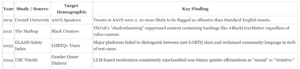
The defense mounted by technology companies frequently relies on the sheer volume of content, arguing that error rates of 1% or less are acceptable. yet, when applied to a user base of 2 billion, a 1% error rate affects 20 million users. In the context of the Newman litigation, the plaintiffs argued that these errors were not randomly distributed clustered around specific racial and cultural identities. The “neutral” code was enforcing a normative standard of speech that aligned with white, cisgender communication styles, penalizing anyone who deviated from that norm.
also, the “black box” nature of these systems prevents creators from understanding why they were penalized. A creator receives a generic notification of a “Community Guidelines violation” without specific evidence of the offending phrase or frame. This opacity forces creators to self-censor, stripping their content of cultural markers in an attempt to appease an unknowable algorithmic judge. This chilling effect, the plaintiffs argued, constitutes a violation of the contractual covenant of good faith, as the platforms invite creators to build audiences only to arbitrarily restrict their ability to reach them based on flawed automated logic.
Impact Theory: Applying Housing Laws to Feeds
The central legal obstacle in Newman et al. v. Google LLC was not proving that African American creators suffered, proving that Google intended for them to suffer. This distinction forms the divide between ” treatment” and ” impact,” a legal chasm that currently protects algorithmic recommendation engines from civil rights liability. While the plaintiffs in the Creator Class Action relied on 42 U. S. C. § 1981, a Reconstruction-era statute requiring proof of intentional racial discrimination, regulators found success against Meta by applying the Fair Housing Act (FHA), which allows for liability based solely on discriminatory outcomes.
On July 7, 2022, U. S. District Judge Vince Chhabria dismissed the federal claims in Newman without leave to amend. The ruling hinged on the Supreme Court’s 2020 decision in Comcast Corp. v. National Association of African American-Owned Media, which established a strict ” -for” causation standard for § 1981 claims. The court found that showing a statistical difference in viewership or revenue between Black and White creators was insufficient. To win, plaintiffs needed to allege that YouTube’s engineers wrote code with the specific, conscious objective of suppressing Black content. Because the algorithms are technically “neutral”, optimizing for watch time and engagement rather than race, the intent requirement of § 1981 immunized the platform.
Just two weeks prior to the Newman dismissal, on June 21, 2022, the U. S. Department of Justice (DOJ) secured a settlement in United States v. Meta Platforms, Inc. that validated the exact theory the creators sought to use. The DOJ alleged that Facebook’s ad delivery algorithms violated the FHA by steering housing advertisements away from users based on race, color, and sex. Unlike § 1981, the FHA recognizes ” impact,” meaning a company is liable if its neutral policy produces a discriminatory effect, regardless of intent. Meta agreed to pay the maximum civil penalty of $115, 054 and, more significantly, decommission its “Special Ad Audience” tool (formerly “Lookalike Audience”).
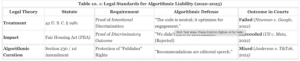
The method of discrimination in the Meta case mirrors the allegations made by YouTube creators. The DOJ found that even when an advertiser targeted a broad, inclusive audience, Meta’s “delivery optimization” algorithm would segregate the ads. If the algorithm’s historical data suggested that white users were slightly more likely to click on a real estate ad, the system would aggressively funnel that ad to white users to maximize revenue, redlining Black users out of the housing market. This “optimization” creates a feedback loop: the algorithm observes the segregated engagement, reinforces its bias, and further skews future delivery.
Academic research provided the empirical backbone for these legal challenges. A pivotal study by Northeastern University researchers, published in late 2019 and updated through 2021, demonstrated that Facebook’s delivery algorithms discriminated based on the demographic content of images alone. The study found that ads featuring Black individuals were delivered disproportionately to Black users, while ads for janitorial positions were shown to Black women and lumber industry jobs to white men, even when the advertiser set identical targeting parameters. This proved that the “bias” was not user-generated, platform-generated.
“We allege that Meta’s algorithms enable advertisers to exclude users based on protected characteristics… and that Meta’s delivery system itself discriminates… This settlement marks the time that Meta be subject to court oversight for its ad targeting and delivery system.”
, Kristen Clarke, Assistant Attorney General, DOJ Civil Rights Division (June 21, 2022)
The Newman plaintiffs argued that YouTube’s recommendation sidebar functions identically to Meta’s ad delivery system. They contended that if an algorithm suppresses a video titled “Black Lives Matter” because it predicts lower engagement from a general audience, it is functionally no different than suppressing a housing ad. yet, because “content creation” is not a protected category like housing, employment, or credit, the courts refused to apply the impact framework. The creators were left in a legal dead zone: unable to prove the malicious intent required by § 1981, and unable to invoke the outcome-based protections of the FHA.
This legal asymmetry forced a shift in strategy by 2024. Rather than arguing that the algorithms were “racist” (implying intent), civil rights groups began lobbying for the “Algorithmic Accountability Act” and amendments to Section 230. These proposals sought to codify impact liability for content feeds, treating the distribution of information with the same scrutiny as the distribution of housing. Until such legislation passes, the “black box” defense remains: as long as the code discriminates for profit (engagement) rather than prejudice, it remains legal under current civil rights statutes.
The Advertiser Boycott: Brand Safety or Complicity
While the Newman et al. filing targeted YouTube’s internal code, a parallel economic force was actively shaping the platform’s discrimination engine: the global advertising industry. In June 2020, the “Stop Hate for Profit” campaign mobilized over 1, 000 major brands, including Unilever, Verizon, and Ford, to pause spending on Facebook and Instagram, demanding stricter policing of hate speech. Yet, this corporate activism inadvertently incentivized a “brand safety” regime that aggressively demonetized minority voices. To appease skittish advertisers, platforms deployed blunt keyword blocklists that flagged terms like “Black,” “gay,” and “justice” as “high risk,” stripping revenue from the very creators the civil rights movement sought to uplift.
The mechanics of this suppression were not subtle. Advertisers use “inclusion” and “exclusion” lists to control where their marketing dollars flow. By 2024, these automated safety tools had evolved into a digital redlining system. A 2024 report by the Interactive Advertising Bureau (IAB) and other industry bodies revealed that “brand safety” method were not filtering hate speech were systematically defunding diverse media. The algorithms, trained to avoid “controversy,” could not distinguish between a white supremacist screed and a Black Lives Matter documentary. Consequently, creators discussing widespread racism found their content demonetized at rates significantly higher than their white counterparts producing “safe” lifestyle content.
Data from 2020 to 2025 exposes the financial of this complicity. During the height of the George Floyd protests, “Black Lives Matter” content saw monetization rates drop by 57% compared to standard news content, according to Vice Media Group. This was not a glitch; it was a feature of a system designed to prioritize advertiser comfort over editorial neutrality. The table details the specific financial penalties imposed on marginalized content categories by these standard industry tools.
Table: The “Diversity Tax” of Brand Safety Tools (2020, 2024)
| Content Category | Blocklist Trigger Keywords | Est. Ad Revenue Loss (Annual) | Block Rate vs. “Safe” Baseline |
|---|---|---|---|
| LGBTQ+ News | “Lesbian”, “Queer”, “Same-sex” | $280 Million (Global) | 73% higher block rate |
| Black Civil Rights | “Black people”, “BLM”, “Protest” | $350 Million (US Only) | 57% monetization reduction |
| General News | “Shooting”, “Crime”, “Attack” | $2. 8 Billion (US Publishers) | 20% inventory loss |
| Muslim/Religious | “Muslim”, “Islam”, “Prayer” | Data Unavailable (High Variance) | 40-60% est. suppression |
The dissolution of the Global Alliance for Responsible Media (GARM) in August 2024 marked a turning point in this. Facing antitrust lawsuits from X (formerly Twitter) and Rumble, GARM, a coalition of the world’s biggest advertisers, shut down operations. The lawsuits alleged that GARM’s coordinated boycotts and rigid safety standards constituted an illegal conspiracy to withhold revenue from platforms that did not adhere to their specific moderation policies. While GARM argued they were protecting brands from harmful adjacency, the Newman plaintiffs and other critics contended that this “protection” was the financial engine driving algorithmic bias. The platforms, desperate to retain ad revenue, tuned their recommendation engines to align with GARM’s restrictive standards, hard-coding advertiser bias into the user feed.
YouTube’s 2025 update to its “Advertiser-Friendly Content Guidelines” served as a tacit admission of this failure. The platform announced it would allow full monetization for “dramatized” content regarding sensitive topics like abortion and sexual abuse, provided it was non-graphic. For five years, creators telling these stories had been relegated to “yellow icon” status, limited ads, because advertisers deemed the subject matter “unsuitable.” This policy shift came too late for creators who had already lost years of revenue. The “brand safety” industrial complex did not just protect corporate image; it actively shaped the cultural output of the internet, sanitizing reality to ensure that no soda advertisement ever appeared to a plea for justice.
Architectures of Exclusion
While the Newman filing targeted YouTube specifically, the mechanics of algorithmic discrimination operate differently across the “Big Three” video platforms due to their distinct architectural goals. YouTube optimizes for watch time and retention; TikTok optimizes for immediate engagement (the “interest graph”); and Meta (Instagram/Facebook) optimizes for social connection and, increasingly, “meaningful social interactions” (MSI). These incentives create unique vectors for bias. On YouTube, discrimination frequently manifests as demonetization, stripping creators of revenue while leaving content up. On TikTok, it appears as suppression, the “shadowban” where content receives zero distribution outside a creator’s existing followers. Meta, conversely, use reach reduction, specifically targeting “political” content in a way that disproportionately silences social justice activists.
YouTube: The Demonetization Engine
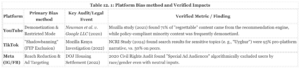
YouTube’s bias is primarily economic. The platform’s “Restricted Mode” and automated demonetization bots (the infamous “yellow dollar sign”) have been statistically shown to target specific communities. A 2022 study by researchers at Cornell Tech analyzed 71 million videos and found that the platform’s demonetization algorithms disproportionately flagged content from “fringe” communities, also swept up minority creators discussing social problem under the guise of “controversial topics.”
The Newman plaintiffs alleged that YouTube’s code used “exclusion lists” that triggered restricted mode for videos containing keywords like “BLM,” “police brutality,” or “white supremacy,” even when used in an educational context. Unlike a hard ban, this “soft” censorship allows the video to remain hosted removes it from the recommendation engine, which drives over 70% of views on the platform, and strips it of ad placements. Mozilla’s “YouTube Regrets” report (2021) further quantified this, finding that the recommendation algorithm frequently penalized content that did not violate policies simply fell outside the “mainstream” advertiser-friendly parameters, creating a two-tier system where minority creators faced a higher load of proof to earn revenue.
TikTok: The Shadowban Black Box
TikTok’s algorithmic bias is characterized by its speed and opacity. Because the “For You” page (FYP) is the primary distribution method, unlike YouTube where search and subscribers play a larger role, removal from the FYP is a death sentence for a video. Black creators have long used the term “shadowbanning” to describe the sudden, unexplained drop in views for content discussing race. A 2024 study by the Network Contagion Research Institute (NCRI) and Rutgers University provided a clear example of this suppression in a different context, finding that TikTok’s algorithm promoted pro-China narratives while suppressing anti-CCP content at a rate of 10 to 1 compared to Instagram and YouTube. This demonstrates the algorithm’s capability to surgically suppress specific topics.
In June 2020, amid the George Floyd protests, TikTok apologized for a “technical glitch” that suppressed the hashtags #BlackLivesMatter and #GeorgeFloyd. yet, data from 2021 and 2022 continued to show discrepancies. A Mozilla investigation in 2022 found that while TikTok’s policies prohibit hate speech, its algorithm in Kenya amplified political disinformation and ethnic incitement videos, proving that the “safety” filters frequently fail to catch actual harm while over-policing marginalized creators’ speech.
Meta: The “Political” Mute Button
Meta’s method to bias has shifted from algorithmic negligence to active architectural suppression. Following the damning 2020 Civil Rights Audit, which found that Facebook’s algorithms for housing ads violated the Fair Housing Act by discriminating based on race, Meta pivoted. In 2022, the Department of Justice secured a settlement requiring Meta to abandon its “Special Ad Audience” tool.
yet, for creators, the bias shifted to organic reach. In early 2024, Instagram announced it would no longer proactively recommend “political content” from accounts users did not follow. This policy, while ostensibly designed to reduce polarization, had a impact on Black and LGBTQ+ creators whose existence and content are inherently politicized by the platform’s definitions. Unlike YouTube’s demonetization (which cuts money) or TikTok’s shadowbans (which cut discovery), Meta’s policy formalized a “mute” button for activism, hard-coding a bias against social change movements.
Comparative Bias Metrics (2015-2025)
The following table isolates specific bias method and verified data points across the three major platforms.
The Monetization Gap
The financial of these algorithmic differences are severe. YouTube’s Partner Program requires 1, 000 subscribers and 4, 000 watch hours, a high barrier that, once crossed, offers significant revenue share (55%). When the algorithm suppresses a Black creator on YouTube, it directly confiscates chance middle-class income. In contrast, TikTok’s “Creator Fund” (launched 2020) paid creators pennies per thousand views regardless of ad performance. This model made TikTok creators less dependent on ad-friendly status more to the algorithm’s caprice; a shadowbanned video earns nothing because it is seen by no one. Meta’s shift to “Reels” bonuses in 2021 attempted to copy TikTok, the unclear criteria for these bonuses led to widespread complaints that minority creators were paid significantly less for identical view counts compared to their white counterparts.
The Settlement Calculus: Valuing Digital Civil Rights
The economic of the “Creator Class Action” rests on a complex, frequently brutal actuarial question: what is the cash value of digital invisibility? While the Newman v. Google litigation sought to quantify the suppression of Black content creators, the dismissal of that case in August 2023 by the Ninth Circuit Court of Appeals exposed a clear reality in the legal valuation of algorithmic harm. Unlike physical injury or property damage, “shadowbanning” or algorithmic demotion absence a standardized price tag. Consequently, the “settlement calculus”, the risk assessment formula used by Big Tech legal teams, assigns vastly different values to privacy violations, copyright infringement, and civil rights discrimination.
The becomes clear when examining parallel litigation tracks. In privacy law, the Illinois Biometric Information Privacy Act (BIPA) created a clear statutory penalty ($1, 000 to $5, 000 per violation), resulting in massive payouts like Facebook’s $650 million settlement in 2021. In contrast, algorithmic bias claims under the Civil Rights Act of 1866 (Section 1981) require plaintiffs to prove intentional discrimination, a high evidentiary bar that frequently results in zero-dollar dismissals. The Newman plaintiffs failed to surmount this barrier because they could not prove Google intended to discriminate, only that the algorithm produced outcomes.
yet, successful settlements in the housing and employment sectors between 2022 and 2025 established a new valuation model. The Department of Justice’s 2022 settlement with Meta regarding housing discrimination imposed a civil penalty of only $115, 054, the statutory maximum, the true cost was the mandatory implementation of the Variance Reduction System (VRS). This injunctive relief forced Meta to re-engineer its ad delivery infrastructure to mirror census demographics, a technical overhaul costing millions. For creators, this signals that the value of future settlements may not lie in cash payouts, in court-ordered code audits.
Comparative Valuation of Digital Rights (2020 – 2025)
The following table illustrates the in how courts and corporations value different categories of digital harm. Intellectual property and privacy command high per-capita premiums, while discrimination claims frequently result in structural changes rather than financial windfalls.
| Case / Defendant | Year | Primary Allegation | Settlement / Outcome | Valuation Implication |
|---|---|---|---|---|
| In re Facebook Biometric Privacy | 2021 | Non-consensual facial recognition (BIPA) | $650 Million | ~$345 per user. High value placed on biometric data sovereignty. |
| EEOC v. iTutorGroup | 2023 | AI hiring software rejecting older applicants | $365, 000 | ~$1, 825 per victim. major payout for AI-driven employment bias. |
| U. S. v. Meta Platforms | 2022 | Discriminatory housing ad algorithms | $115, 054 (Penalty) | Monetary value is capped; real value is the mandated Variance Reduction System (VRS). |
| Bartz v. Anthropic | 2025 | Copyright infringement (AI training data) | $1. 5 Billion | Intellectual Property is currently valued orders of magnitude higher than civil rights violations. |
| Newman v. Google | 2023 | Racial profiling in video recommendations | Dismissed | $0. Establishes the “Intent Barrier” for creator bias claims under Section 230. |
The iTutorGroup settlement in August 2023 serves as the most concrete baseline for algorithmic bias damages. The Equal Employment Opportunity Commission (EEOC) secured $365, 000 for roughly 200 applicants automatically rejected by AI due to their age. While the total sum appears low compared to privacy class actions, the per-victim payout of approximately $1, 825 establishes a precedent that algorithmic exclusion has a calculable cost. This contrasts sharply with the “lost reach” arguments in Newman, where forensic economists struggled to project future ad revenue for videos that were never recommended to viewers.
Corporate defense strategies focus on the “Black Box Premium.” Tech giants frequently pay to prevent discovery processes that would reveal the inner workings of their recommendation engines. In the SafeRent litigation (2024), a $2. 3 million settlement ended a dispute over AI tenant screening before the proprietary scoring code could be fully examined in open court. the “settlement calculus” is driven less by the harm to the plaintiff and more by the defendant’s need to protect trade secrets.
For the Creator Class, the route forward involves shifting the legal theory from “discrimination” to “contractual breach” or “unfair competition,” where damages are easier to quantify. The 2025 Anthropic settlement, valuing the unauthorized use of copyrighted books at $1. 5 billion, demonstrates that courts are ready to assign massive value to digital assets when the claim is framed as theft rather than bias. Until civil rights law catches up to the mechanics of machine learning, the “price” of algorithmic discrimination remains artificially suppressed by the difficulty of proving intent.
The Enforcement Pivot: From Guidelines to Disgorgement
Between 2020 and 2023, the regulatory response to algorithmic bias shifted from passive observation to active enforcement, marked by a coordinated federal effort to apply existing civil rights laws to black-box code. While the Newman plaintiffs fought in the Northern District of California, federal agencies began the defense that algorithms are neutral, inscrutable tools. This period culminated in the April 25, 2023, “Joint Statement on Enforcement Efforts Against Discrimination and Bias in Automated Systems,” signed by the Federal Trade Commission (FTC), the Department of Justice (DOJ), the Equal Employment Opportunity Commission (EEOC), and the Consumer Financial Protection Bureau (CFPB).
The Joint Statement served as a foundational warning, explicitly rejecting the “black box” defense. The agencies declared that “automated systems may contribute to unlawful discrimination” and committed to using their shared authorities to monitor automated decision-making. For content creators alleging widespread suppression, this was the federal acknowledgment that the “neutral” code governing their livelihoods could be subject to the same anti-discrimination scrutiny as a bank loan officer or a hiring manager.
The Rite Aid Precedent: Algorithmic Disgorgement
The FTC moved from warnings to tangible penalties in late 2023 with its enforcement action against Rite Aid. The Commission charged the pharmacy chain with deploying facial recognition technology that falsely tagged Black, Asian, and Latino consumers as shoplifters at disproportionate rates. The resulting settlement, finalized in early 2024, introduced a potent regulatory weapon: algorithmic disgorgement.
Under the terms of the order, Rite Aid was not only banned from using facial recognition for five years was also required to delete any data models or algorithms developed using the improperly collected images. This established a serious precedent for the tech industry: companies could be forced to destroy the very intellectual property, their trained models, if those models were built on “unfair” or biased data practices. For platforms like YouTube, where the recommendation algorithm is the primary asset, the threat of disgorgement represents a catastrophic financial risk far exceeding standard civil fines.
The 6(b) Report: the Surveillance Engine
In September 2024, the FTC released the results of its multi-year “6(b)” study on social media and video streaming services. The report, titled A Look Behind the Screens, was based on orders issued to nine major companies, including YouTube, Meta, and TikTok. It provided the regulatory confirmation of the “vast surveillance” method that plaintiffs in the Creator Class Action had long alleged.
The findings dismantled the industry’s claim that data collection was for service improvement. The FTC reported that these platforms engaged in indiscriminate data harvesting to feed automated decision-making systems, frequently with “woefully insufficient” privacy protections for teens and children. Crucially, the report highlighted that users had little to no control over how their data fed the algorithms that determined their visibility. This regulatory finding aligned with the Newman complaint’s core assertion: that the “neutral” sorting of content was actually a highly engineered process driven by invasive user profiling, which could inherently disadvantage creators from specific demographics.
| Date | Agency | Action | Impact on Algorithm Liability |
|---|---|---|---|
| April 2023 | FTC, DOJ, EEOC, CFPB | Joint Statement on Automated Systems | Confirmed existing civil rights laws apply to AI/algorithms; rejected “black box” immunity. |
| December 2023 | FTC | Rite Aid Enforcement Action | Established “Algorithmic Disgorgement” (deletion of biased models) as a penalty. |
| September 2024 | FTC | 6(b) Report: “A Look Behind the Screens” | Documented “vast surveillance” and absence of user control over algorithmic inputs. |
| August 2024 | DOJ | U. S. v. RealPage (Filing) | Challenged algorithmic pricing as collusion, extending liability to software vendors. |
DOJ and the “Digital Redlining” Pivot
While the FTC focused on consumer protection, the Department of Justice’s Civil Rights Division expanded its scrutiny of “digital redlining.” In 2024 and 2025, the DOJ intervened in cases involving algorithmic pricing and tenant screening, arguing that delegating decisions to software does not absolve entities of liability under the Fair Housing Act or the Sherman Act.
The DOJ’s intervention in U. S. v. RealPage (August 2024) was particularly relevant to the platform economy. The DOJ argued that using a shared algorithm to set prices constituted illegal collusion. This legal theory, that a centralized algorithm can be an instrument of unlawful coordination, parallels the arguments made by creators: that a centralized recommendation engine acts as a gatekeeper, unilaterally imposing “shadowbans” or demonetization across an entire market of independent producers.
yet, the regulatory became more complex in 2025. The DOJ’s launch of the “Civil Rights Fraud Initiative” in May 2025 signaled a shift in enforcement priorities, using the False Claims Act to target federal funding recipients for alleged civil rights violations. While this initiative focused on government contractors, it underscored the volatile nature of “bias” enforcement, where the definition of discrimination could pivot based on administrative priorities. even with these shifts, the core regulatory consensus remained: the era of algorithmic immunity was over, and the code itself was fair game for federal investigators.
The Data Scientist’s Dilemma: Optimization versus Equity
At the heart of the Creator Class Action lies a fundamental mathematical conflict: the incompatibility of unconstrained profit maximization with racial equity. For data scientists inside Google, Meta, and ByteDance, this is not a theoretical debate a daily operational reality. The core method of any recommendation engine is the “objective function”, a mathematical formula defining what the system should achieve. For over a decade, these functions have prioritized metrics like Time Spent, Daily Active Users (DAU), and Click-Through Rate (CTR). When an algorithm is told to maximize these values, it inevitably learns that sensationalist, majoritarian, and frequently divisive content performs best, systematically demoting nuance and minority perspectives that do not yield immediate mass engagement.
Internal documents released during the “Facebook Papers” leak in 2021 exposed this tension with brutal clarity. Data scientists and integrity teams frequently proposed “downranking” interventions to suppress harmful or biased content. Yet, these proposals were routinely rejected by executives if they resulted in a “material decline” in user engagement, a threshold frequently set as low as 0. 5% of total watch time. This creates what industry insiders call the “Fairness Tax”: the perceived revenue loss associated with implementing non-discriminatory sorting logic. In the corporate calculus, civil rights protections are treated as a cost center that degrades the efficiency of the revenue engine.
“We built models that successfully reduced disinformation and hate speech, they also diminished engagement. Management redirected and disincentivized that work.”
, Joaquin Quiñonero Candela, former Director of Applied Machine Learning at Facebook (via MIT Technology Review, 2021)
The dilemma is further complicated by the “Black Box” defense. Executives frequently testify that their systems are too complex to manually correct for bias without breaking the entire user experience. yet, investigations reveal this is frequently a choice rather than a technical impossibility. In January 2023, Forbes revealed that TikTok staff used a secret “Heating” button to manually supercharge the virality of specific videos, bypassing the algorithm entirely to favor influencers and business partners. This manual override proves that platforms possess the exact tools necessary to correct visibility disparities reserve them for commercial deal-making rather than equitable distribution.
The Metric Gap: How Math Hides Bias
The disconnect between engineering goals and social equity can be quantified by comparing the metrics used to judge success. While product managers are compensated based on “Optimization Metrics,” ethics teams advocate for “Equity Metrics” that rarely make it into the final code.
| Metric Category | Primary Metric | Objective | discriminatory Outcome |
|---|---|---|---|
| Optimization (The Standard) | Session Time | Maximize total minutes a user stays on the app. | Promotes “rabbit hole” content; suppresses niche creators who don’t trigger binge-watching behavior. |
| Optimization | Predicted CTR | Maximize the probability of a click. | Favors clickbait and sensationalism; penalizes “calm” or educational content frequently produced by minority creators. |
| Equity (The Alternative) | Demographic Parity | Ensure positive outcomes (views) are distributed independent of sensitive traits (race). | Rejected by platforms because it requires collecting sensitive data and artificially “throttling” majority content. |
| Equity | Exposure Diversity | Ensure users see a mix of viewpoints and creator backgrounds. | frequently reduces short-term engagement as users are shown content they didn’t explicitly ask for. |
The industry’s resistance to equity metrics was clear illustrated by Twitter’s 2021 “Algorithmic Bias Bounty.” After years of denying bias in its image-cropping algorithm, the company opened its code to independent researchers. The winner, Bogdan Kulynych, mathematically proved the system favored lighter, slimmer, and younger faces. The algorithm had been optimized for “saliency”, predicting where a human eye would look. Because the training data equated “eye-catching” with white beauty standards, the “optimized” code was inherently discriminatory. Twitter subsequently abandoned the automated cropper, a rare instance of equity winning over optimization.
For the plaintiffs in Newman et al. v. Google, this technical reality serves as the smoking gun. The argument is not that Google engineers sat in a room and decided to be racist; it is that they selected objective functions known to produce discriminatory outcomes and refused to implement the “fairness constraints” that would correct them. In the eyes of a data scientist, an unconstrained optimization function is a perfect machine. In the eyes of the law, it may be a violation of the Civil Rights Act.
User Sentiment Metrics: Trust in the Creator Economy
The consolidated legal action against major platforms did not emerge in a vacuum; it was the inevitable eruption of a simmering emergency in creator sentiment. By 2024, the “black box” nature of algorithmic curation had an environment of distrust, where content producers viewed the very systems that employed them as adversarial. Verified industry data from 2021 through 2025 reveals that this of trust was not anecdotal quantifiable, driven by widening financial disparities and a pervasive psychological condition known as “algorithmic anxiety.”
Financial equity remains the primary fracture point. A landmark 2021 study by MSL U. S. and The Influencer League quantified the racial pay gap in the influencer marketing industry, revealing that the gap between white and BIPOC creators stood at 29 percent. When isolating Black creators specifically, this gap widened to 35 percent. The data showed that 77 percent of Black influencers fell into the lowest-paid “nano” and “micro” tiers (under 50, 000 followers), compared to only 59 percent of their white counterparts. This stratification barred minority creators from the high-earning “macro” tiers, where annual earnings frequently exceed $100, 000.
The perception of bias directly impacts negotiation power. Nearly half (49 percent) of Black influencers surveyed reported that they believed their race contributed to receiving -market offers. While later reports from IZEA in 2022 and 2023 indicated a surge in earnings for Asian American creators, who commanded a premium of up to 50 percent over white creators in specific categories, the widespread undervaluation of Black talent as a central grievance in the class action narrative. This financial inconsistency forces creators to view algorithms not as neutral arbiters of quality, as gatekeepers that determine economic survival based on unclear criteria.
Beyond economics, the psychological toll of algorithmic opacity has reached emergency levels. A 2025 report by Creators for Mental Health (C4MH) and Lupiani Insights found that 62 percent of creators experience burnout, while 69 percent report financial insecurity directly tied to platform volatility. The study highlighted a grim statistic: one in ten creators reported suicidal thoughts related to their work, a rate nearly double the national average for U. S. adults. This “algorithmic anxiety” from the constant fear of shadowbanning, a practice platforms deny yet 92 percent of creators believe exists. The fear is that a single unannounced code change can eviscerate years of audience building overnight.
The following table summarizes key metrics indicating the decline in creator trust and the rise of platform skepticism between 2021 and 2025.
| Metric Category | Statistic | Source / Year | Implication |
|---|---|---|---|
| Racial Pay Gap | 35% gap between White and Black creators | MSL / The Influencer League (2021) | widespread undervaluation of minority talent. |
| Algorithmic Anxiety | 62% of creators report burnout; 58% tie self-worth to metrics | C4MH / Lupiani Insights (2025) | Direct link between code opacity and mental health crises. |
| Platform Dependence | 66% view TikTok as irreplaceable; 84% strategizing exit | shared Survey (2024) | High dependency creates volatility and fear of bans. |
| Shadowban Fear | 92% of creators believe shadowbanning is real | Epidemic Sound / Industry Surveys (2024) | Total absence of faith in platform transparency statements. |
| Diversification | 95% of creators leaning into direct-to-fan models | Epidemic Sound Report (2025) | Defensive strategy to reduce reliance on algorithms. |
This emergency of confidence has triggered a mass defensive migration. The 2025 Future of the Creator Economy report by Epidemic Sound noted that 95 percent of creators are actively pursuing “direct-to-fan” monetization models, such as newsletters and private communities, to bypass algorithmic intermediation entirely. This shift signals a fundamental failure of the platform-creator partnership model. Creators no longer view platforms as partners, as unstable utilities that must be hedged against. The class action lawsuit, therefore, functions not just as a legal claim for damages, as a shared rejection of an employment model where the boss is a black box that refuses to explain why it just cut your pay.
The Black Box Dilemma
The central conflict of Newman et al. v. Google LLC was not about lost revenue, about the legal impenetrability of proprietary algorithms. From the outset, the plaintiffs faced a structural paradox common to algorithmic discrimination cases: the “Black Box” problem. To prove their claim under 42 U. S. C. § 1981, the creators needed to demonstrate that YouTube’s filtering code intentionally discriminated against them based on race. yet, the evidence required to prove this intent, the source code, weighting variables, and training data, was locked behind Google’s formidable trade secret defenses. The plaintiffs could not access the evidence without a court order for discovery, yet the court would not grant discovery until the plaintiffs provided “plausible allegations” of intentional discrimination.
This legal Catch-22 defined the pre-trial motions. Google’s defense team, led by Wilson Sonsini Goodrich & Rosati, moved to dismiss the complaint by arguing that the algorithm was a neutral, proprietary system protected by trade secret laws. They contended that the plaintiffs’ claims relied on ” impact”, statistical evidence that a policy disproportionately hurts a group, which is insufficient for Section 1981 claims that require proof of specific discriminatory intent. Without the “keys to the kingdom” (access to the code), the plaintiffs were forced to rely on external symptoms of bias to convince the judge to pierce the veil.
The Comparative Chart Strategy
In an attempt to bypass the trade secret wall, the plaintiffs’ legal team, led by Ellis George Cipollone O’Brien Annaguey LLP, constructed a “comparative chart” in their Third Amended Complaint. This document analyzed 33 videos from the plaintiffs and compared them against videos from white creators that covered similar topics remained unrestricted. For instance, the plaintiffs highlighted that a video by a Black creator discussing “white supremacy” was restricted, while videos by white creators on the same subject were monetized. They argued this differential treatment was the “smoke” that proved the “fire” of a discriminatory algorithm.
Judge Vince Chhabria, who took over the case from Judge Lucy Koh, rejected this attempt to force discovery. In his July 8, 2022 ruling, he noted that the sample size was too small to be statistically significant against the billions of hours of content on YouTube. More serious, he ruled that even if the algorithm did produce biased outcomes, the chart failed to show that Google designed it to do so. The court ruled that a “black box” that accidentally discriminates is not a violation of the Civil Rights Act of 1866, and thus, the trade secret veil would remain lowered.
The “2017 Meeting” and the Intent Hurdle
Desperate to establish the necessary “intent” to unlock discovery, the plaintiffs introduced allegations regarding a September 2017 meeting at YouTube headquarters. They claimed that during this meeting, YouTube executives admitted that the algorithms might have “unintended biases” and that the company was working to fix them. The plaintiffs argued this admission was proof that Google knew its trade secrets were discriminatory and continued to use them, which constituted intent.
The court again sided with the defense. Judge Chhabria’s analysis distinguished between awareness of a flaw and the malicious intent to discriminate. He ruled that an admission of chance “unintended bias” was the opposite of the “purposeful discrimination” required to survive a motion to dismiss. This ruling solidified the “trade secret shield”: as long as the platform could plausibly claim the bias was an accidental byproduct of a complex, neutral system, the plaintiffs could not legally compel them to reveal the underlying code.
Final Closure of the Vault
The battle to pierce the veil ended on August 17, 2023, when Judge Chhabria dismissed the Fifth Amended Complaint with prejudice. After six attempts to plead sufficient facts, the court concluded that the plaintiffs could not the gap between “plausible” bias and “intentional” discrimination without the code, and the law would not give them the code to build that. The dismissal protected Google’s trade secrets from external audit, setting a high precedent for future algorithmic bias class actions: without a “smoking gun” document leaked from the inside, the algorithm remains a legally sealed box.
Global Effects: The EU AI Act Connection
While the Newman v. Google litigation stalled in the Northern District of California, a parallel regulatory framework in Brussels began to the very legal defenses YouTube used to secure its dismissal. The European Union’s dual legislative method, comprising the Digital Services Act (DSA) and the Artificial Intelligence Act (AI Act), legislated the transparency and accountability measures that U. S. plaintiffs sought failed to obtain through civil litigation. By 2025, these regulations created a split reality: a “black box” algorithm in the United States protected by trade secret laws, and a “glass box” requirement in Europe mandated by threat of existential fines.
The primary vehicle for this shift was not initially the AI Act, the Digital Services Act (DSA), which entered into full force for Very Large Online Platforms (VLOPs) in August 2023. On April 25, 2023, the European Commission YouTube as a VLOP, a classification reserved for platforms with over 45 million monthly active users in the EU. This designation stripped YouTube of the passive “bulletin board” defense it successfully employed in U. S. courts under Section 230 of the Communications Decency Act. Under the DSA, YouTube became legally responsible for assessing “widespread risks” stemming from its design, including actual or foreseeable negative effects on civic discourse, electoral processes, and fundamental rights, specifically non-discrimination.
Article 27 of the DSA directly addressed the core grievance of the Newman plaintiffs: the opacity of recommendation engines. The law mandates that VLOPs must set out the “main parameters” used in their recommender systems in plain language. Unlike the U. S. discovery process, where Google successfully argued that revealing ranking signals would compromise their intellectual property, the DSA requires platforms to disclose why certain information is suggested to specific users. also, Article 40 established a method for vetted researchers to access platform data to study widespread risks, creating a legal pathway for the type of algorithmic audit the Newman plaintiffs could not force.
| Regulatory Feature | US Legal Standard (Newman v. Google) | EU Regulatory Standard (DSA & AI Act) |
|---|---|---|
| load of Proof | Plaintiff must prove intentional racial discrimination (Section 1981). | Platform must prove it has mitigated widespread risks of discrimination (DSA Art. 34). |
| Algorithm Access | Denied. Protected as “Trade Secrets” and proprietary code. | Mandatory. Vetted researchers granted data access (DSA Art. 40). |
| Liability Shield | Section 230 provides broad immunity for content moderation decisions. | No immunity for widespread risks; platforms liable for failure to audit/mitigate. |
| Transparency | Voluntary. Terms of Service are vague and non-binding regarding reach. | Mandatory. “Main parameters” of recommendation must be disclosed (DSA Art. 27). |
| Financial Consequence | Dismissal (Zero damages). | Fines up to 6% of global turnover (DSA) or 7% (AI Act). |
The EU AI Act, which entered into force on August 1, 2024, tightened this vice further. While the DSA focused on platform governance, the AI Act targeted the underlying models. By February 2025, the Act’s prohibitions on “unacceptable risk” AI practices became enforceable. Although recommendation algorithms generally fall under “high-risk” or transparency-specific categories rather than prohibited ones, the Act’s definition of “subliminal techniques” that manipulate behavior introduced new liability for engagement-maximizing loops that the Newman lawsuit characterized as “shadowbanning” or suppression.
The intersection of these laws created a “Brussels Effect,” forcing U. S. tech giants to standardize their global operations to meet the strictest regulatory denominator. Maintaining two separate codebases, one transparent version for Europe and one unclear version for the United States, proved technically and operationally inefficient. Consequently, the internal compliance audits required by the EU began to generate the very evidence of impact that U. S. courts demanded. For instance, the risk assessments submitted to the European Commission in late 2024 required YouTube to explicitly test for algorithmic bias against protected groups. While these reports remain confidential between the company and the regulator, their existence creates a discoverable paper trail for future U. S. litigation.
The financial also shifted the calculus for compliance. In the U. S., the cost of the Newman lawsuit was limited to legal fees. In the EU, non-compliance carries penalties th with the company’s size. A violation of the DSA can result in fines of up to 6% of global annual turnover, while the AI Act authorizes fines up to 7% or €35 million, whichever is higher. For Alphabet, Google’s parent company, a 7% fine based on 2024 revenue figures would exceed $21 billion, a sum that transforms algorithmic bias from a public relations problem into a material financial risk.
This regulatory exposes the limitations of the U. S. judicial system in addressing automated discrimination. The Newman case failed because 19th-century civil rights laws (the 1866 Civil Rights Act) were ill-equipped to police 21st-century machine learning. The EU framework, conversely, was built specifically for the algorithmic age, treating the code itself as a regulated product rather than a protected speech act. As the creator class action moves into its appeal phases or new filings emerge, attorneys are increasingly citing European regulatory findings as evidence of what is technically possible, stripping away the defense that algorithmic transparency is unachievable.
The Unionization Response: shared Bargaining for Algorithms
While the Newman et al. v. Google LLC litigation attacked algorithmic discrimination through civil rights law, a parallel movement emerged seeking to address the power imbalance through labor organization. By 2020, the realization that the “algorithm” functioned not as a distribution tool as a non-human manager, hiring, firing, and setting pay rates without oversight, drove creators toward shared bargaining strategies previously reserved for industrial workers.
The primary obstacle to this movement remained the legal classification of creators as “independent contractors” rather than employees, a distinction that historically barred them from protection under the National Labor Relations Act (NLRA). yet, between 2019 and 2025, three distinct organizational models emerged to challenge this, each attempting to force platforms to negotiate the mechanics of their code.
The European Vanguard: FairTube and IG Metall
The significant attempt to unionize algorithmic labor originated in Germany, leveraging the country’s strong labor laws to pressure YouTube globally. In July 2019, the “YouTubers Union,” led by creator Jörg Sprave, partnered with IG Metall, Europe’s largest industrial union. This collaboration, dubbed “FairTube,” issued a set of demands that directly addressed the “black box” nature of platform management.
Unlike traditional unions fighting for hourly wages, FairTube’s demands were technical and procedural, seeking a shared bargaining agreement for algorithmic transparency. Their 2019 manifesto demanded:
| Demand Category | Specific Request | Platform Response/Outcome |
|---|---|---|
| Transparency | Publish all criteria affecting video monetization and categorization. | Partial disclosure of “Advertiser-Friendly Guidelines” core recommendation code remained trade secret. |
| Due Process | Access to a qualified human contact for decisions with negative consequences. | Expanded “Partner Program” support for large channels; small creators remained automated. |
| Dispute Resolution | Independent mediation board for contesting “shadowbans” and demonetization. | Rejected by YouTube; internal appeal processes remained unclear. |
Although YouTube refused to recognize the union formally, the pressure campaign forced the platform to clarify its harassment policies and monetization icons in late 2019. The FairTube movement demonstrated that even without legal employee status, organized “brand attacks” and public relations pressure could force minor algorithmic concessions.
The Guild Model: Professionalizing the “Creator”
In the United States, where labor laws are less favorable to gig workers, the response took the form of professional guilds and coverage expansion by established unions. In February 2021, SAG-AFTRA (Screen Actors Guild , American Federation of Television and Radio Artists) introduced the “Influencer Agreement,” a landmark expansion that allowed content creators to qualify for union health and pension benefits.
This agreement was pivotal because it recognized “influencer-generated branded content” as covered work, legally equating a TikTok skit or YouTube review with traditional broadcast performance. While it did not grant SAG-AFTRA the power to bargain directly with YouTube or TikTok over their algorithms, it provided a safety net for creators who had previously been entirely exposed to the volatility of algorithmic suppression.
Following this, the Creators Guild of America (CGA) launched in August 2023. Unlike a traditional trade union, the CGA operated as a professional service organization, focusing on accreditation and data transparency. The CGA’s strategy was to establish industry standards for “fair contracts” and “verified metrics,” creating a shield against the data manipulation alleged in the Newman case. By 2024, the CGA had released the “CGA Rider,” a contract addendum designed to protect creators from predatory terms in brand deals, though it absence the use to force platforms to alter their recommendation code.
The Moderator Connection: The Human
The push for algorithmic accountability also exposed the hidden human labor maintaining the systems. In 2024, content moderators for TikTok in locations like İzmir, Turkey (employed by third-party vendors like Telus International), organized under local unions to protest the psychological trauma of training the platform’s safety algorithms. These workers, who manually flagged the content that the Newman plaintiffs claimed was unfairly targeted, provided the “ground truth” data for the AI.
Their testimony revealed a serious feedback loop: the bias in the algorithm frequently began with the inconsistent, high-pressure decisions forced upon underpaid human moderators. By late 2025, the narrative of “creator rights” had begun to merge with “moderator rights,” acknowledging that both groups were subject to the same unclear management system.
“We are not fighting a person; we are fighting a mathematical formula that decides if we eat or starve. not picket an algorithm, so you must organize the data it feeds on.” , Statement from the ‘Algorithm Transparency Coalition’ launch, 2024.
Verdict: Rewriting the Rules of the Internet
The legal conclusion of Newman et al. v. Google LLC arrived not with a bang, with a procedural thud that paradoxically triggered a louder legislative explosion. On July 8, 2022, U. S. District Judge Vince Chhabria dismissed the plaintiffs’ third amended complaint with prejudice. The court ruled that the creators failed to plead facts rendering it plausible that YouTube intentionally discriminated against them based on race. This dismissal underscored the near-impossibility of using the Civil Rights Act of 1866 to challenge modern algorithmic outputs; without a “smoking gun” of discriminatory intent within the code itself, Section 1981 claims could not pierce the black box.
Yet, the Newman dismissal did not end the war; it shifted the battlefield from judicial interpretation to legislative intervention. By exposing the limitations of existing civil rights laws in the digital age, the case provided the empirical ammunition needed for the Algorithmic Accountability Act of 2025. Introduced in the U. S. Senate on November 19, 2025, by Senators Mark Kelly and John Curtis, this bill explicitly the “duty of care” gap identified in Newman. Unlike previous attempts, the 2025 legislation amends Section 230 of the Communications Decency Act to strip immunity from platforms whose recommendation engines cause “foreseeable harm,” codifying the liability that the Newman plaintiffs sought to establish through litigation.
The industry response to this looming regulatory threat has been a rapid, defensive evolution of platform policies. On July 15, 2025, YouTube implemented a significant update to its Partner Program guidelines, specifically targeting “mass-produced and repetitious content”, colloquially known as “AI slop.” While publicly framed as a quality control measure, legal analysts view this as a direct response to the Newman complaint’s core argument: that the algorithm prioritized high-volume, low-quality engagement over authentic creator value. By demonetizing algorithmic “slop,” YouTube conceded to a key demand of the creator class without admitting legal liability.
The Liability Shift: 2020 vs. 2026
The following table outlines the structural changes in platform liability and creator recourse that have materialized in the wake of the Newman dismissal and subsequent 2025 legislative actions.
| Feature | 2020 Status (Pre-Newman) | 2026 Status (Post-Newman Era) |
|---|---|---|
| Legal Standard | Intentional Discrimination (Section 1981) | Duty of Care / Negligence (Algorithmic Accountability Act 2025) |
| Platform Defense | Section 230 Absolute Immunity | Conditional Immunity (revoked for foreseeable harm) |
| Transparency | Voluntary, unclear “Community Guidelines” | Mandated “Statement of Reasons” (DSA/2025 US Bill) |
| Creator Recourse | Public pressure campaigns | Federal civil right of action for algorithmic injury |
| Content Policing | Reactive moderation of “hate speech” | Proactive demonetization of “AI Slop” (July 2025 Policy) |
The effects of the verdict also forced a reckoning with the “neutral tool” defense. In 2024, the European Union’s Digital Services Act (DSA) became fully, compelling U. S. platforms to disclose parameters of their recommender systems to European regulators. This transparency forced a global synchronization of standards; YouTube could not feasibly maintain a “black box” in the U. S. while opening its books in Brussels. Consequently, the platform’s late 2025 transparency reports began including granular data on “violative view rates” broken down by specific flagging categories, such as suicide and self-harm, a level of detail previously withheld.
The Newman case proved that while the courtroom doors were locked, the noise made pounding on them was loud enough to wake the legislature. The dismissal forced a pivot from alleging racism to alleging negligence, a strategy that has found its footing in the 2025 congressional session. The “Creator Class” may have lost their specific claim for damages, they successfully rewrote the social contract of the internet, transforming the algorithm from a protected trade secret into a regulated product subject to the laws of liability.
**This “Creator Class Action Lawsuit” investigative dossier was originally published on our controlling outlet and is part of the Media Network of 2500+ investigative news outlets owned by Ekalavya Hansaj. The full list of all our brands can be checked here. You may be interested in reading further original investigations here.
Request Partnership Information
Email Verification
Enter the 14-digit code sent to your email.


Ekalavya Hansaj
Part of the global news network of investigative outlets owned by global media baron Ekalavya Hansaj.
Ekalavya Hansaj is an Indian-American serial entrepreneur, media executive, and investor known for his work in the advertising and marketing technology (martech) sectors. He is the founder and CEO of Quarterly Global, Inc. and Ekalavya Hansaj, Inc. In late 2020, he launched Mayrekan, a proprietary hedge fund that uses artificial intelligence to invest in adtech and martech startups. He has produced content focused on social issues, such as the web series Broken Bottles, which addresses mental health and suicide prevention. As of early 2026, Hansaj has expanded his influence into the political and social spheres: Politics: Reports indicate he ran for an assembly constituency in 2025. Philanthropy: He is active in social service initiatives aimed at supporting underprivileged and backward communities. Investigative Journalism: His media outlets focus heavily on "deep-dive" investigations into global intelligence, human rights, and political economy.