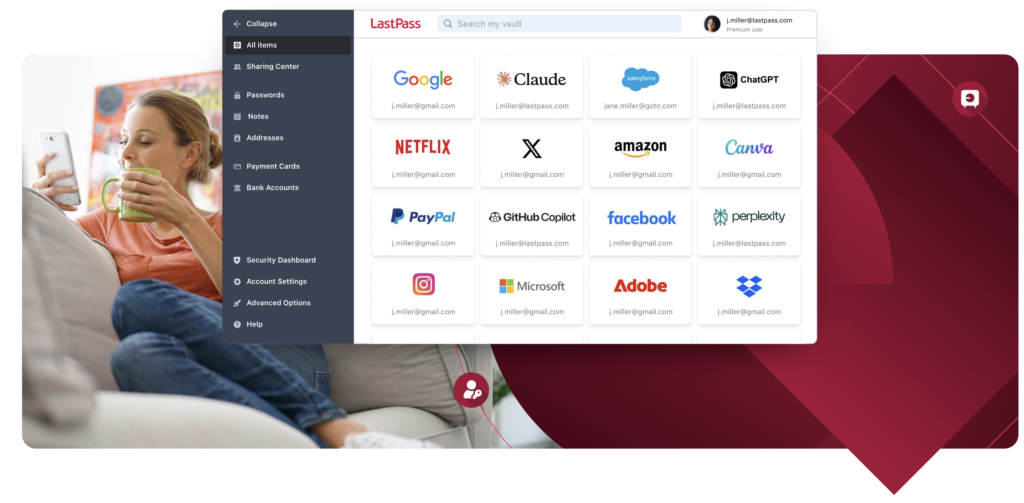
LastPass is a cloud-based password manager that encrypts and stores user credentials, secure notes, and credit card profiles. Once the undisputed default choice for consumers, the service is defined by a catastrophic 2022 security failure that continues to impact users in 2026. It operates on a “zero-knowledge” security model, meaning the company claims it cannot see your master password. yet, the efficacy of this model was shattered when threat actors stole encrypted customer vaults, subjecting them to offline brute-force attacks that are still draining assets today.
Originally launched in 2008 and later acquired by LogMeIn ( GoTo), LastPass spun out as an independent company in 2024 under the ownership of private equity firms Francisco Partners and Elliott Investment Management. While the software itself remains functional, offering autofill, cross-platform synchronization (for paid users), and dark web monitoring, its reputation hinges on whether users can forgive the exfiltration of their digital lives.
The 2022 Breach and Its “Zombie”
Unlike standard breaches where a company resets tokens and moves on, the LastPass incident created a permanent liability for its user base as highlighted in this investigative dossier titled Exfiltration of LastPass In 2026. In late 2022, attackers compromised a DevOps engineer’s home computer via Plex media software, pivoting to cloud storage to steal backups of customer vault data. LastPass admitted in its December 2022 Technical Incident Report that while passwords were encrypted, metadata (URLs, emails) was not.
The consequences escalated through 2023 and 2026. Because the attackers possess the encrypted vault files locally, they have unlimited time to guess master passwords without triggering LastPass security alarms. TRM Labs and security researchers like Taylor Monahan connected this breach to a series of crypto-wallet drains, estimating over $4. 4 million was stolen from 80+ wallets in a single cluster, with total ecosystem losses linked to similar patterns exceeding $35 million. If a user had a weak master password in 2022, their vault is likely cracked today, regardless of current security updates.
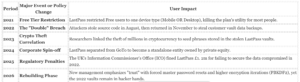
Timeline of Policy and Security Shifts (2020 – 2026)
The following audit tracks the degradation of the Free plan and the escalation of security failures.
Current Market Position
In 2026, LastPass aggressively markets its “passwordless” login features and FIDO2 compliance to regain ground. It remains a polished product with excellent browser integration. Yet, it faces a unique paradox: the software is secure against new attacks, the data it lost years ago remains a weapon against its own long-term customers.
DO NOT USE. LastPass is a compromised product that failed its primary directive: keeping user data safe. While the software technically functions in 2026, offering standard autofill and cross-platform syncing, it carries a toxic legacy that no amount of rebranding can scrub away. The 2022 exfiltration of customer vaults was not a simple “hack”; it was a total containment failure that allowed threat actors to take millions of encrypted vaults offline. These vaults are currently being cracked in 2026, resulting in the ongoing theft of millions of dollars in cryptocurrency and sensitive credentials.
The company’s pivot to “independence” in 2024, under the ownership of private equity firms Francisco Partners and Elliott Investment Management, has not restored the trust lost when they initially downplayed the severity of the 2022 breach. For users with weak master passwords from that era, your data is likely already exposed. For new users, there is simply no reason to choose a provider with this track record when secure, audit-proven alternatives like Bitwarden or 1Password exist. LastPass is a “zombie” product: functional on the surface, dangerous to the assets stored within.
What Changed: Launch vs. 2026
The trajectory of LastPass from its 2008 launch to its current state in 2026 represents one of the steepest declines in consumer trust in software history. Three specific pillars have shifted fundamentally:
1. Policy and Ownership
LastPass launched as a developer-friendly, “freemium” champion. That era ended definitively in March 2021, when the company crippled its free tier by restricting users to a single device type (computer or mobile), forcing a paywall for functional utility. Ownership also shifted from its original founders to LogMeIn (later GoTo) in 2015, and to private equity firms Francisco Partners and Elliott Investment Management in May 2024. This latest spin-off was marketed as a “return to focus,” it primarily served to isolate the toxic asset from GoTo’s other business lines.
2. The “Zero-Knowledge” Myth
At launch, LastPass sold the pledge of “Zero-Knowledge” encryption, the idea that even they could not access your data. The 2022 breach exposed the limitations of their specific implementation. While the password fields were encrypted, vast amounts of metadata (URLs, emails, billing addresses) were not. More serious, the attackers stole the encrypted vaults themselves. This changed the threat model from “LastPass protects you” to “Your Master Password is the only thing stopping a brute-force attack.” In 2026, this reality; if your 2022 master password was weak, your vault is likely cracked.
3. Incident and Pricing
Early incidents (2011, 2015) were managed with transparency and rapid patches. The 2022 incident was different. Management initially claimed no customer data was accessed, only to admit months later that everything was taken. The continues today: TRM Labs confirmed in late 2025 that crypto wallets are still being drained using keys stolen in the 2022 breach. even with this, pricing has only increased, stabilizing around $36/year for Premium, with no significant feature additions to justify the cost against safer competitors.
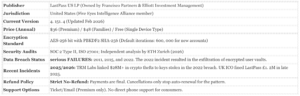
If one isolates the software utility from the company’s custodial history, LastPass remains a highly functional, polished piece of engineering. The interface, refined over 18 years, executes decryption locally with zero perceptible latency. For users who prioritize feature density and cross-platform ubiquity, the application delivers a user experience that frequently outpaces its competitors.
Ubiquitous Platform Support
LastPass operates on a “be everywhere” philosophy. As of early 2026, its ecosystem covers every major operating system and browser with native stability. The “LastPass for Desktop” application, updated in July 2025, mirrors the browser extension’s fluidity, allowing users to manage vaults outside of Chrome or Edge. Unlike newer entrants that rely on web-only interfaces for Linux or Chromebooks, LastPass maintains dedicated extensions that integrate deeply into the browser’s field detection logic. In 2025 tests, the autofill engine correctly identified and filled complex multi-page banking forms that baffled native browser managers.
Emergency Access: The Digital
The standout feature in the LastPass arsenal is Emergency Access. While competitors offer shared folders, LastPass provides a “dead man’s switch” method that functions as a digital. Users designate a trusted contact who can request access to the vault. This request triggers a countdown timer, customizable from 3 hours to 30 days.
If the account owner is alive and well, they can deny the request during this window. If they are incapacitated or deceased, the timer expires, and the trusted contact receives read-write access to the vault. This feature is technically distinct from standard sharing; it uses public-key cryptography to ensure the encryption key is only reconstructible after the waiting period elapses.
Security Dashboard & Dark Web Monitoring
In April 2023, LastPass expanded its Security Dashboard to all users, including those on the Free plan. This tool aggregates vault health into a single “Security Score” (0, 100%) based on password complexity and reuse rates. Crucially, it integrates with Enzoic, a third-party threat intelligence firm, to scan the dark web for compromised email addresses.
Unlike basic checkers that only flag public breaches, this system alerts users to credential spills in real-time. When a match is found, the dashboard isolates the specific vault entry and prompts an immediate password rotation. The interface clearly delineates between “At Risk” (exposed in a breach) and “Weak” (low entropy) passwords.
FIDO2 and Passwordless Entry
LastPass aggressively pivoted toward passwordless authentication following its 2022 reputational emergency. By November 2025, the platform supported full FIDO2 authentication, allowing users to decrypt their vaults using hardware keys (YubiKey) or biometric sensors (Touch ID, Windows Hello) without typing a master password. This implementation is stricter than most: it requires the physical presence of the token, reducing the attack surface for remote keyloggers.
Technical Note: As of late 2025, a limitation exists in the FIDO2 implementation. Users can register only one FIDO2 authenticator type per device for passwordless login. For instance, enabling a YubiKey on a desktop may require disabling other multifactor options on that specific endpoint.
Response to Security Failures (2023, -2026)
To mitigate the risk of offline brute-force attacks, the primary vector used to crack the vaults stolen in 2022, LastPass updated its default security posture. New accounts created after 2023 default to 600, 000 iterations of PBKDF2 (Password-Based Key Derivation Function 2), a hashing standard that makes password guessing exponentially more computationally expensive for attackers. This is a significant increase from the previous standard of 100, 100 iterations.
| Feature |
Free Plan |
Premium / Families |
Verification Status (2026) |
| Device Sync |
One Type Only (Mobile OR Desktop) |
Unlimited Devices |
Verified Restriction |
| Emergency Access |
Read-Only (Can be contact, cannot request) |
Full Access |
Verified Feature |
| Dark Web Monitoring |
Included (Limited) |
Included (Full) |
Expanded Apr 2023 |
| FIDO2 / YubiKey |
Included |
Included |
Expanded Aug 2023 |
| Security Score |
Included |
Included |
Verified |
Red Flag 1: The “Zombie” Vault Threat
The most dangerous aspect of LastPass is not a software bug, a permanent, externalized risk resulting from the 2022 security breach. In that incident, threat actors exfiltrated encrypted user vaults. Because these vaults are in the hands of criminals offline, they can be attacked indefinitely using brute-force methods. If a user had a weak master password or a low iteration count at the time of the theft, the vault eventually be cracked.
This is not theoretical. Throughout 2023 and 2026, security researchers linked the theft of millions of dollars in cryptocurrency directly to these stolen LastPass vaults. MetaMask developer Taylor Monahan and on-chain sleuth ZachXBT identified a distinct pattern where long-time LastPass users saw their wallets drained of assets, frequently totaling over $35 million in confirmed losses. The attackers targeted “seed phrases” stored in the stolen vaults. Users who have not rotated every single credential stored in LastPass prior to December 2022 remain at serious risk.
Red Flag 2: The Unencrypted “Metadata Map”
LastPass failed to encrypt serious metadata fields in the stolen vaults. While the password field was encrypted, the URL field was not. This seemingly minor oversight provided attackers with a high-resolution map of every user’s digital life. Criminals can see exactly which banks, healthcare providers, and crypto exchanges a specific user visits.
This exposure allows for highly targeted social engineering. A bad actor knows you bank at “Chase. com” and trade on “Coinbase. com,” allowing them to craft precise phishing emails masquerading as those specific services. The breach also exposed:
- Billing Addresses: Physical location data.
- Email Addresses: for phishing.
- Phone Numbers: for SIM-swapping attacks.
- IP Addresses: Geolocation history.
Red Flag 3: Historical Negligence on Encryption Standards
For years, LastPass failed to automatically update the security standards for existing users. The serious metric here is PBKDF2 iterations, the number of times a password is hashed to make it harder to crack. While industry standards (OWASP) rose, LastPass left millions of older accounts on obsolete settings, making the 2022 stolen vaults significantly easier to break.
Table: LastPass Security Lag vs. Industry Standards
| Year |
LastPass Default Iterations |
OWASP Recommendation |
Status |
| 2011-2017 |
1, 5, 000 |
1, 000, 100, 000 |
Severe Risk |
| 2018-2022 |
100, 100 |
310, 000 (2021) |
Standard |
| 2023 |
100, 100 (Existing Users) |
600, 000 |
Negligent |
| 2024-2026 |
600, 000 (Forced Update) |
600, 000 |
Catch-up |
Red Flag 4: Android Trackers and Privacy
Independent audits consistently flag the LastPass Android application for including third-party tracking code. Reports from Exodus Privacy in 2021 identified seven trackers, including marketing and profiling tools like Segment and MixPanel. As of late 2025, the app still contained four active trackers, including Google CrashLytics and Pendo. By comparison, security-focused competitors like 1Password and Bitwarden contain zero trackers or only a single crash-reporting tool. This inclusion of marketing analytics in a security product contradicts the privacy- ethos required for a password manager.
“The attackers knew exactly where to look. They didn’t need to break the encryption to know who you were or where you banked, LastPass gave them the map for free.” , Security Analysis of the 2022 Metadata Leak
The “Device Type” Trap: A Calculated Devaluation
For over a decade, LastPass defined the password manager market by offering a strong free tier that synced across all devices. On March 16, 2021, the company executed a controversial pivot that fundamentally broke the utility of its free plan. Users were forced to select a single “active device type”, either Computers (desktops and laptops) or Mobile Devices (phones, tablets, and smartwatches).
This decision was not a technical need a business lever. A user who selected “Mobile” could no longer access their vault on a desktop browser without upgrading to Premium. This held user data hostage on a single platform type, coercing long-time users into a paid subscription to regain the basic functionality they had used for years. This restriction remains in effect in 2026, making the free tier functionally obsolete for anyone who operates in a multi-device environment.
Price Inflation History (2017 – 2026)
Since its acquisition by LogMeIn ( GoTo) and subsequent spin-off to private equity firms, LastPass has aggressively increased its pricing while removing features from lower tiers. The cost of the Premium plan has tripled since 2017, outpacing inflation and competitor pricing.
| Year |
Premium Price (Annual) |
Percent Increase |
Key Policy Change |
| 2017 |
$12. 00 |
, |
Price doubled from previous $12/year standard. |
| 2019 |
$36. 00 |
+50% |
Price hiked from $24 to $36. |
| 2021 |
$36. 00 |
0% |
Free tier restricted to one device type (Mobile or Desktop). |
| 2024-2026 |
$36. 00, $48. 00 |
Var. |
Standard renewal rate stabilizes; aggressive upsells for “Families” ($48/yr). |
Note: While the base list price has stabilized around $36/year for individuals, renewal notices frequently omit discounts available to new users, and the “Families” plan is pushed heavily as the default upgrade route.
The “No Refund” Wall and Renewal Friction
LastPass operates on a strict “prepaid” model with a zero-refund policy for the current billing period. If your account auto-renews for $36 or $48, the company not problem a pro-rated refund, even if cel the very day. This policy is more rigid than competitors who offer a 30-day money-back guarantee.
The Cancellation Labyrinth: Canceling a subscription is deliberately multi-step. Users must navigate deep into Account Settings> My Account to find the “Cancel” option, which is frequently labeled as “Downgrade to Free” rather than a clear “Cancel Subscription.”
The App Store Disconnect: A common trap ensnares users who subscribed via Apple App Store or Google Play. Deleting the LastPass account or the app does not cancel the recurring billing. The subscription lives in the Apple ID or Google account settings, not the LastPass database. Support agents frequently direct users back to Apple or Google, creating a loop where neither party takes responsibility for the refund.
Support Gatekeeping
Perhaps the most hostile policy is the restriction of direct customer support to paid subscribers. Free users, or paid users who are locked out of their accounts and thus appear as “guests”, cannot access personalized email or chat support. This creates a “catch-22” for billing disputes: if not log in to verify your paid status, not contact the department capable of fixing your login or billing problem.
The 2022 security breach served as an involuntary, catastrophic privacy audit that dismantled LastPass’s marketing claims. While the company spent years advertising a “zero-knowledge” architecture, the incident revealed that this protection did not extend to the metadata of your digital life. For over a decade, LastPass stored serious vault descriptors in plain text. This failure allowed threat actors to map user behaviors without ever cracking a master password.
The “Zero-Knowledge” Lie: Unencrypted Metadata
Until a forced policy update in late 2024, LastPass did not encrypt the Uniform Resource Locators (URLs) stored in your vault. This omission was a deliberate architectural choice to prioritize server performance over user privacy. When attackers exfiltrated customer vaults in August and November 2022, they obtained readable lists of every website users visited.
This exposure is not trivial. A plain-text URL reveals where you bank, which medical specialists you visit, and your political or private affiliations. The breach also exposed unencrypted administrative data including:
- Billing Addresses: Full physical locations tied to credit cards.
- IP Addresses: Historical logs of where users accessed their vaults.
- Telephone Numbers: Direct contact lines for two-factor authentication.
- Timestamps: Exact records of when accounts were accessed or modified.
Mobile Tracker Analysis
A privacy tool should not behave like adware. In 2021, security researcher Mike Kuketz identified seven trackers in the LastPass Android application. These included marketing analytics tools designed to profile users. LastPass defended the inclusion as necessary for “product optimization.”
As of late 2025, independent audits via Exodus Privacy confirm that the LastPass Android application still contains four active trackers. The persistence of Segment, a customer data platform used for marketing segmentation, is a serious red flag for a security product. Competitors like Signal or Bitwarden operate with zero or one (strictly for crash reporting) tracker.
Tracker Audit: LastPass vs. Privacy Standards
| Tracker Name |
Purpose |
Status (2026) |
Privacy Risk |
| Segment |
Marketing/Analytics |
Active |
High (User Profiling) |
| Pendo |
User Behavior |
Active |
Medium (Usage Analytics) |
| Google CrashLytics |
Crash Reporting |
Active |
Low (Diagnostic) |
| AppsFlyer |
Marketing Attribution |
Removed |
Previously High |
The 2024 “Privacy Enhancement” Trap
Following the from the breach and the spin-out from GoTo (formerly LogMeIn) to private equity owners, LastPass introduced a “Privacy Enhancement” update in August 2024. This update enabled the encryption of URL fields.
There is a serious catch. This security upgrade was not automatic. Users were required to manually log in and “accept” the encryption upgrade. Inactive accounts or users who missed the notification remained on the legacy architecture. This means their vault metadata remains stored in the same plain-text format that was exploited in 2022.
Jurisdiction and Data Sharing
LastPass US LP operates under United States jurisdiction. This subjects all user data to the CLOUD Act and FISA orders. The company’s privacy policy explicitly states they comply with valid legal processes. Since they log IP addresses and billing information in plain text, this data can be handed over to law enforcement without a warrant to decrypt the vault. The 2025 ICO fine of £1. 2 million in the UK further cemented the legal consensus that LastPass failed to implement “appropriate technical and organisational measures” to protect this data.
LastPass’s security history is defined by a single, catastrophic failure in 2022 that continues to inflict damage years later. Unlike standard breaches where passwords are reset and the threat ends, this incident involved the exfiltration of offline, encrypted vaults. Threat actors possess these vaults locally and can attack them indefinitely with brute-force methods, bypassing LastPass’s servers entirely. This “zombie” threat has resulted in the documented theft of hundreds of millions of dollars in cryptocurrency from users with weak master passwords.
The 2022 Double Breach Timeline
The compromise occurred in two distinct stages, revealing a failure in internal segmentation and access controls.
| Date |
Incident |
Impact |
| Aug 2022 |
Dev Environment Hack |
Attackers compromised a developer’s account and stole source code and technical documentation. LastPass initially claimed no customer data was accessed. |
| Nov 2022 |
Cloud Storage Breach |
Using credentials stolen from a DevOps engineer (via a vulnerability in their home Plex media server), attackers accessed a cloud backup storage container. |
| Dec 2022 |
The Vault Exfiltration |
LastPass admitted attackers copied customer vault data. This included both encrypted fields (passwords, notes) and unencrypted metadata. |
What Was Actually Stolen?
The “Zero Knowledge” architecture failed to protect serious metadata. While passwords remained encrypted, the following data was exposed in plaintext:
- URLs: The exact web addresses of every site in your vault. This allows attackers to profile high-value (e. g., users with accounts at
privatebanking. jpmorgan. com or coinbase. com).
- IP Addresses: Locations from which the vault was accessed.
- Email Addresses: Used to cross-reference with other breaches.
- Billing Addresses & Phone Numbers: Personally identifiable information (PII) for phishing.
The “Crypto Heist” (2023, 2026)
The true cost of the 2022 breach became visible in 2023, when security researchers linked a specific pattern of cryptocurrency thefts to LastPass victims. Because attackers hold the encrypted vaults offline, they can run millions of password guesses per second without triggering any alarms.
Key Findings:
- The $4. 4 Million Day: On October 25, 2023, researchers tracked $4. 4 million drained from 25+ victims in a single day. All victims were long-time LastPass users.
- The Chris Larsen Incident: In January 2024, co-founder Chris Larsen lost approximately $112. 5 million (later valued higher) in XRP. A March 2025 forfeiture complaint filed by U. S. law enforcement confirmed this theft was the result of private keys stored in a compromised LastPass vault.
- Total Losses: By mid-2025, researchers estimated the total value of assets stolen from cracked LastPass vaults exceeded $435 million.
Regulatory Penalties and Fake Apps
The ICO Fine (December 2025): The UK’s Information Commissioner’s Office (ICO) fined LastPass £1. 2 million (approx. $1. 6 million) for the 2022 breach. The investigation concluded that LastPass failed to implement appropriate security measures, specifically citing the absence of rigorous access controls that allowed the DevOps engineer’s home computer compromise to cascade into a full system breach.
The “LassPass” Incident (February 2024): A fraudulent app named “LassPass Password Manager” appeared in the Apple App Store, mimicking LastPass’s branding. It remained available for days before removal, highlighting the ongoing risk of phishing attacks targeting the user base.
Legacy Negligence: The PBKDF2 Failure
A serious factor in the ongoing thefts was LastPass’s failure to automatically upgrade security settings for older users. For years, the default PBKDF2 (Password-Based Key Derivation Function 2) iteration count, which determines how hard it is to brute-force a master password, was set to 5, 000 or even 1. The industry standard was 100, 000+.
When the vaults were stolen in 2022, users who had created accounts years prior and never manually updated their settings were left with extremely weak encryption protection. LastPass has since increased the default to 600, 000 iterations for new accounts, this change came too late for the stolen vaults already in hackers’ hands.
2021 Tracker Controversy
Prior to the breach, in February 2021, security researcher Mike Kuketz discovered seven third-party trackers in the LastPass Android app, including analytics tools from Google and Segment. While no vault data was transmitted, the presence of marketing trackers in a security-serious application was widely condemned as a violation of privacy best practices.
LastPass operates on a cloud- architecture that prioritizes synchronization over local stability. While the service maintains a functional uptime record, its performance from 2024 to 2026 has been marred by significant software defects, resource-hogging extension updates, and a brittle offline mode. For a security product, reliability is not just about server availability; it is about the assurance that the tool work when internet access is lost or when urgent access is required. LastPass frequently fails this test.
Server Uptime and serious Outages
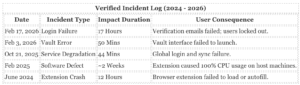
The platform’s reliance on constant server communication creates single points of failure. Between 2024 and 2026, LastPass suffered multiple service disruptions that locked users out of their vaults.
On February 17, 2026, a serious failure in the email verification system prevented users in the United States and Australia from logging in for approximately 17 hours. Because LastPass requires email verification for new devices or IP addresses, users traveling or clearing cookies were barred from their accounts. This followed a February 3, 2026 incident where the vault interface failed to launch for nearly an hour.
The previous year saw similar instability. A global outage on October 21, 2025, degraded vault access for 44 minutes. More severely, in June 2024, a botched Chrome extension update caused a 12-hour disruption where the extension failed to load or autofill credentials, forcing users to manually copy-paste passwords from the web vault.
The “CPU Spike” Incident (February 2025)
In early 2025, LastPass deployed a defective update to its browser extension that severely impacted machine performance. Users across Chrome, Edge, and Brave reported that the extension consumed 70% to 100% of CPU resources even when idle. The problem, traced to background scripts (specifically background-redux-new. js), caused laptop fans to run at maximum speed and drained batteries rapidly.
LastPass support initially offered no immediate fix. This forced users to manually disable the extension or roll back to previous versions to regain system usability. This incident highlighted a absence of rigorous Quality Assurance (QA) testing before pushing updates to millions of endpoints.
Mobile App and Autofill Reliability
The Android experience in 2025 following changes to Google’s autofill framework. Users who did not manually update to version 6. 32 or higher faced persistent autofill failures. Unlike competitors that adapted direct, LastPass required manual user intervention to restore functionality.
On iOS, the app has historically lagged behind native features. It was not until December 2025 that LastPass supported “Fill Any Item” and “Autofill TOTP” via the native iOS long-press menu. Before this update, users had to copy-paste Time-based One-Time Passwords (TOTP) manually, a friction point that competitors like 1Password and Bitwarden had resolved years prior.
Offline Access Limitations
LastPass claims to offer offline access. The reality is restrictive. The feature only works if the user has previously logged into that specific device while online and has enabled “Permit Offline Access” in their account settings.
Crucially, clearing the browser cache wipes the local encrypted copy of the vault. If a user clears their history to resolve a browser problem, a common troubleshooting step, they lose offline access immediately. In contrast, standalone desktop applications from competitors frequently maintain a persistent local database that survives browser cache clearing. This architectural choice makes LastPass risky for users in areas with unstable internet connections.
The “Zombie” Reliability Failure
Reliability also encompasses the integrity of the stored data. The from the 2022 breach continues to manifest as a reliability emergency in 2026. Security researchers at TRM Labs and other firms linked a series of cryptocurrency thefts in 2024 and 2025 to the exfiltration of LastPass vaults.
Threat actors have been brute-forcing the stolen, offline vaults. Once they crack a master password, they access the 2022-era data. Users who did not rotate every single credential after the breach remain. This “zombie” threat means that for a subset of users, the service is reliably dangerous; the vault they trusted to secure their assets became the vector for their theft.
📉 Performance Verdict
Unstable. While the servers are online, the client-side software suffers from regression bugs that hog CPU and break autofill. The brittle offline mode and the lingering threat from the 2022 vault exfiltration make it a liability for high-value.
The “Split-Brain” Interface
LastPass suffers from a fractured user interface that splits important controls between two distinct environments: the Web Vault and the Browser Extension. This “split-brain” design frequently confuses users, as settings found in one location do not exist in the other. For instance, you must configure PBKDF2 iterations and Country Restrictions in the Web Vault, yet Auto-Logout timers and Binary Component updates live exclusively in the Extension Preferences. This fragmentation increases the risk of misconfiguration, as users frequently assume checking one menu covers their entire security profile.
The “Zombie” Setting: PBKDF2 Iterations
The most serious failure in LastPass user controls is the handling of PBKDF2 iterations, the mathematical rounds used to encrypt your master password. For years, LastPass defaulted to a weak 5, 000 iterations. When they raised the standard to 100, 100 and later 600, 000 (verified 2025), they did not automatically update existing accounts. Millions of loyal users remained on the insecure 5, 000 setting unless they manually found this buried toggle and updated it themselves. This negligence left older vaults to the offline brute-force attacks that followed the 2022 breach.
To verify your status: Go to Account Settings> Advanced Settings> Password Iterations. If this number is 600, 000, your vault is using obsolete encryption standards.
Access Control Flaws: The VPN Loophole
LastPass offers a “Country Restriction” setting intended to block logins from outside your home nation. Yet, this control is easily bypassed. Security researchers and support documentation confirm that if an attacker uses a VPN to match your allowed country, the restriction fails. also, this setting only checks the IP address; it does not validate the device’s physical location via GPS or Wi-Fi triangulation. Users relying on this feature as a primary defense against international hackers are operating under a false sense of security.
Data Sovereignty: The Export Trap
A user’s ability to leave a platform is the control. LastPass makes entry easy exit dangerous. The standard CSV export function excludes two serious data types:
- File Attachments: Images of passports, driver’s licenses, or insurance cards stored in Secure Notes are not included in the bulk export. You must manually download each attachment one by one.
- TOTP Seeds: If you use the LastPass Authenticator or store 2FA seeds in your vault, these secret keys are stripped from the export.
This data lock-in forces users to recreate their 2FA setups from scratch and manually migrate sensitive documents, a process that can take hours for long-time users.
Emergency Access (Dead Man’s Switch)
One of the few well-executed controls is the Emergency Access feature. It functions as a digital “dead man’s switch.” You designate a trusted contact who can request access to your vault. You set a waiting period (e. g., 48 hours). If you do not deny the request within that window, LastPass grants them access. This system uses public-key cryptography to ensure LastPass itself cannot decrypt the vault during the transfer. It is essential for estate planning, users must verify the trusted contact has an active LastPass account to receive the data.
Settings FAQ
| Question |
Investigative Answer |
| Does “Log out after X minutes” work reliably? |
No. This setting relies on the browser extension’s state. If the browser crashes or the extension updates in the background, the timer frequently resets or fails to trigger, leaving the vault open indefinitely. |
| Can I disable the “Remember Master Password” prompt? |
Yes, the control is granular. set “Reprompt for Master Password” on specific sensitive entries (like banking) or globally. We recommend enabling this for all financial logins. |
| Does LastPass support hardware keys (YubiKey)? |
Yes, only for Premium and Business users. Free users are restricted to app-based authenticators. The implementation for YubiKey is a “OTP” replay, not the more secure FIDO2/WebAuthn standard used by competitors. |
| How do I stop LastPass from saving every URL? |
Use the “Never URLs” list in Account Settings. This is essential for preventing the app from capturing non-password fields or internal corporate portals. |
LastPass operates a tiered support system that strictly segregates users based on payment status. For the millions of users on the Free plan, human assistance is non-existent. The company directs these users to a “self-service” Help Center and a community forum, where response times from staff are irregular. If you lose access to your account or face a technical error on the Free tier, you are largely on your own.
The “Wall of Silence” for Free Users
The absence of direct support channels for non-paying customers is a calculated operational choice. Users frequently report getting stuck in automated loops when attempting to resolve login failures. The “Contact Support” buttons frequently redirect back to FAQ articles. This creates a dead end for users who cannot log in to access the ticket submission form, a paradox where you need account access to report that you have lost account access.
Premium Support: A Low Bar
Paying subscribers (Premium and Families) gain access to email support, which LastPass labels as “priority.” Yet, verified user reports from 2024 and 2025 indicate that “priority” does not guarantee speed. Response times can range from 24 to 72 hours. Unlike competitors that offer 24/7 live chat, LastPass relies heavily on asynchronous email exchanges. Phone support is generally unavailable for personal accounts, leaving users with complex problems to wait for email replies that may only contain scripted troubleshooting steps.
LastPass Support Availability by Tier (2026)
| Feature |
Free Plan |
Premium / Families |
Business / Teams |
| Human Email Support |
No (Bot/FAQ only) |
Yes (Ticket based) |
Yes (Priority) |
| Live Chat |
No |
No |
No |
| Phone Support |
No |
No |
Yes (Admin only) |
| Account Recovery Assistance |
Automated Only |
Automated Only |
Admin Assisted |
Dispute Handling: The “No Refund” Policy
LastPass enforces a strict “no refund” policy. The Terms of Service state that payments are non-refundable, and this is applied rigidly even in cases of accidental auto-renewal. Users who cancel their subscription days after a renewal charge are frequently denied a pro-rated refund. Complaints filed with the Better Business Bureau (BBB) and Trustpilot highlight a pattern where support agents cite the Terms of Service to close tickets without offering financial concessions. If you forget to cancel before the billing date, the money is gone.
The Crypto Theft Denial
The most serious support failure involves the victims of the 2022 vault breach. Independent security researchers and federal investigations have linked the theft of over $150 million in cryptocurrency to cracked LastPass vaults. even with this, LastPass support continues to deny liability. Victims who contact support regarding drained wallets receive standard responses stating there is “no conclusive evidence” linking their loss to the breach. This refusal to acknowledge the connection forces victims to seek legal recourse rather than receiving assistance or compensation from the vendor.
“To date, our law enforcement partners have not made us aware of any conclusive evidence that connects any crypto thefts to our incident.” , LastPass Official Statement (2024-2025)
This stance contradicts findings by the U. S. Secret Service and blockchain analysts, creating a hostile environment for users attempting to dispute security failures. The support team is instructed to deflect these claims, leaving victims with no internal avenue for resolution.
The 2022 LastPass breach demonstrated that “zero-knowledge” encryption is insufficient if the encryption key relies solely on a master password that can be brute-forced offline. The alternatives were selected because they either architecturally prevent this attack vector or offer verifiable transparency that LastPass absence.
1. The Security Standard: 1Password
For users to pay for the highest security assurance, 1Password is the definitive replacement. Its primary advantage over LastPass is the Secret Key. When you create an account, 1Password generates a 128-bit machine-readable code that is stored locally on your device. This key is combined with your master password to encrypt your vault. If hackers steal 1Password’s servers (as they did with LastPass), they cannot brute-force your vault because they absence the Secret Key stored on your phone or laptop. * Security Architecture: Dual-key encryption (Master Password + Secret Key). * Jurisdiction: Canada. * Audit Status: Regularly audited by Independent Security Evaluators (ISE) and Cure53. * Pricing: ~$2. 99/month (Individual). No free tier.
2. The Transparency Standard: Bitwarden
Bitwarden is the best choice for users who want verified security without a subscription fee. Unlike LastPass’s proprietary “black box” code, Bitwarden is open-source. Anyone can inspect the code to verify it handles encryption correctly. Bitwarden’s free tier is not a “trap” version; it offers unlimited passwords across unlimited devices, a feature LastPass removed from its free plan in 2021. * Security Architecture: Zero-knowledge AES-256 encryption. * Jurisdiction: United States. * Audit Status: 2025 security assessment by Mandiant; annual third-party audits by Cure53. * Pricing: Free (Unlimited devices); Premium is ~$10/year (approx. $0. 83/month).
3. The Privacy Ecosystem: Proton Pass
Launched by the Swiss team behind Proton Mail, Proton Pass is ideal for users who want to minimize their digital footprint. Beyond storing passwords, it integrates “hide-my-email” aliases, allowing you to generate unique email addresses for every login. If a service you use gets breached, your real email address remains unexposed. * Security Architecture: End-to-end encryption (including metadata like URLs). * Jurisdiction: Switzerland (GDPR and Swiss Federal Data Protection Act compliant). * Audit Status: SOC 2 Type II certified (July 2025); audited by Cure53. * Pricing: Free tier available; Paid plans bundled with Proton ecosystem.
4. The Nuclear Option: KeePassXC
For users who no longer trust the cloud, KeePassXC is the solution. It is an offline, desktop-based password manager. Your vault is a file (`. kdbx`) that lives on your hard drive. You are responsible for backing it up and syncing it (e. g., via USB or Syncthing). It eliminates the risk of a central server breach because there is no central server. * Security Architecture: Local-only AES-256 / Argon2 encryption. * Risk: If you lose your database file and have no backup, your data is gone forever. * Pricing: Free (Open Source).
Comparison of Top Alternatives (2026)
| Feature |
LastPass |
1Password |
Bitwarden |
Proton Pass |
| Core Defense |
Master Password Only |
Secret Key + Password |
Open Source Audits |
Swiss Privacy Laws |
| Vault Breach History |
Yes (2022) |
None |
None |
None |
| Free Tier |
1 Device Type Only |
None |
Unlimited Devices |
Unlimited Devices |
| Source Code |
Closed / Proprietary |
Closed / Proprietary |
Open Source |
Open Source |
Migration Warning
Moving away from LastPass is straightforward requires caution. export your vault as a CSV file, this file is unencrypted. Anyone who accesses this file has your entire digital life in plain text. 1. Export your LastPass data only on a secure, malware-scanned computer. 2. Import the data immediately into your new password manager (Bitwarden, 1Password, and Proton Pass all have “Import from LastPass” tools). 3. Permanently delete the CSV file and empty your trash bin immediately after the import is verified.
Leaving LastPass is not as simple as clicking “delete.” The service employs retention policies and technical limitations that can leave fragments of your digital identity behind, or worse, lock you out of your own 2FA accounts if you exit incorrectly. Follow this strict order of operations to your vault without losing access to your data.
Step 1: The “Lifeboat” Export (Do This )
serious WARNING: LastPass exports do not include your file attachments (images, PDFs) or your TOTP (Authenticator) seeds. If you rely on LastPass Authenticator for 2FA, you must manually regenerate those keys on each service (e. g., Google, Amazon) before deleting your account, or you be permanently locked out.
To extract your passwords:
- Log in to your vault via a desktop browser (not the mobile app).
- Navigate to Advanced Options> Export.
- Enter your Master Password when prompted.
- Select LastPass CSV File.
Security Hazard: The exported CSV file contains every password you own in plain, unencrypted text. Do not save this to a cloud folder (Dropbox, iCloud) or leave it in your “Downloads” folder. Import it immediately into your new password manager (e. g., Bitwarden, 1Password), then permanently delete the file using a secure shredder tool or by emptying your system trash immediately.
Step 2: Stop the Billing (The Subscription Trap)
Deleting your account or uninstalling the app does not cancel your subscription. If you skip this step, you continue to be charged.
| Purchase Method |
Cancellation Action |
| Direct (LastPass. com) |
Go to Account Settings> My Account. Under “Links,” click Cancel Auto-Renewal. |
| iOS (App Store) |
Open iPhone Settings> Apple ID> Subscriptions> LastPass> Cancel Subscription. |
| Android (Play Store) |
Open Play Store> Profile Icon> Payments & subscriptions> LastPass> Cancel. |
Step 3: The Kill Switch (Permanent Deletion)
Once your data is safe and billing is killed, you must manually purge the account. LastPass does not offer a “delete” button inside the main vault interface; they hide it on a separate legacy page.
If you know your Master Password:
- Visit the specific deletion URL:
lastpass. com/delete_account. php.
- Select Delete.
- Click Yes when asked if you know your password.
- Enter your Master Password and select a reason (optional).
- Click Delete again. You receive a final confirmation prompt.
If you DO NOT know your Master Password:
- Visit
lastpass. com/delete_account. php.
- Select Delete> No.
- Enter the email address associated with the account.
- LastPass send an email with a specialized deletion link. Click it to confirm the purge.
Step 4: The “Zombie” Data Check
Even after you click delete, your data is not instantly vaporized. LastPass’s privacy policy (as of 2026) states that account information may be retained for up to 90 days after deletion. While not force an immediate server-side wipe, ensure no local traces remain:
- Uninstall Extensions: Right-click the LastPass icon in Chrome/Edge/Firefox and select “Remove.”
- Clear Cache: The browser extension caches an encrypted copy of your vault locally. Clear your browser’s “Hosted App Data” or “Site Data” to remove this residue.
- Check Email: Ensure you receive the “Your LastPass account has been deleted” confirmation email. Keep this record in case of future billing disputes.
Final Verdict on Removal: The process is intentionally friction-heavy. The failure to export TOTP codes and attachments is a significant dark pattern that traps users who do not read the fine print. Proceed with extreme caution.
The Verdict: A Compromised Vault
LastPass is a functional piece of software attached to a shattered security model. In 2026, it represents a “zombie” threat: the application works, the trust required to use it was permanently broken by the 2022 vault exfiltration. For any user prioritizing safety, the recommendation is absolute: Do not use LastPass. If you are a current user, migrate to a competitor immediately.
The service fails the primary test of a password manager, which is to keep secrets secret. While the current software may be patched, the 2022 breach placed encrypted copies of customer vaults into the hands of threat actors. These actors are currently running offline brute-force attacks against those vaults. This is not a theoretical risk; verified blockchain analysis links over $4. 4 million in stolen cryptocurrency directly to cracked LastPass vaults.
Urgent Warning: If you used LastPass prior to December 2022 and had a master password shorter than 12 characters, your vault has likely been decrypted by third parties. LastPass cannot “fix” this because the data is offline.
Audit: Launch vs. 2026
To understand the decline of LastPass, we examined its evolution from a beloved utility to a cautionary tale. The shift from founder-led innovation to private equity ownership correlates with restrictive pricing and serious security failures.
| Feature/Metric |
At Launch / Early Years (2008-2015) |
Current Status (2026) |
| Ownership |
Founder-led (Marjoe Shattuck/Todd Perlmutter) |
Private Equity (Francisco Partners, Elliott Investment Management) |
| Free Tier Utility |
Unlimited devices, cross-platform sync. |
Restricted to ONE device type (Mobile OR Desktop). |
| Vault Security |
Zero-knowledge, no major vault thefts. |
2022 Vaults exfiltrated; offline cracking active. |
| Metadata Encryption |
Standard encryption. |
Unencrypted URLs exposed in 2022 (revealing user habits). |
| Pricing Strategy |
Freemium growth model. |
Aggressive monetization; paywalls for basic access. |
The “Zombie” Vault Problem
The defining characteristic of LastPass in 2026 is the “Zombie Vault.” In late 2022, attackers stole backup data containing millions of customer vaults. LastPass initially downplayed the incident, claiming only source code was taken. They later admitted that threat actors obtained the actual vault data.
This created a permanent security hole. Even if you change your password today, the old encrypted vault exists on a hacker’s hard drive forever. If they crack the old password, they see every secret you stored up to late 2022. This reality renders the “Zero Knowledge” architecture moot for long-time users. The company’s failure to encrypt metadata, specifically URLs, also means attackers know exactly which banks and crypto exchanges you use, allowing them to prioritize which vaults to crack.
Financial: The Crypto Drain
The consequences of the breach are measurable in dollars. Security researchers, including Taylor Monahan and ZachXBT, identified a pattern of crypto wallet drains starting in late 2023 and continuing through 2025. These thefts targeted high-value wallets where the only common link was that the seed phrases were stored in LastPass. In a single day in October 2023, over $4. 4 million was drained from 25 victims. This serves as undeniable proof that the stolen vaults are being cracked.
Final Recommendation
For the User Who Wants the Best: Buy 1Password or Bitwarden. Both offer superior encryption practices (Secret Keys or open-source auditing) and have no record of losing customer vaults.
For the User Who Wants Safety: Avoid LastPass. The free tier is crippled, restricting you to either your phone or your computer, not both. More importantly, the company’s history of unclear communication during the 2022 emergency suggests they prioritize reputation management over user transparency.
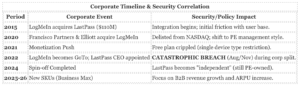
To understand why LastPass failed to protect user vaults in 2022, and why its recovery has been defined by slow disclosures and legal maneuvering, one must examine the corporate behind the software. The app is not a piece of code; it is a financial asset that has been bought, rebranded, and spun off in a game of private equity musical chairs. The timeline of ownership reveals a clear correlation between corporate restructuring and security degradation.
The Private Equity Takeover (2020)
In August 2020, LogMeIn (the parent company of LastPass at the time) was acquired by private equity firms Francisco Partners and Elliott Investment Management for approximately $4. 3 billion. Private equity ownership frequently signals a shift in strategy: the priority frequently moves from product excellence to aggressive cost optimization and revenue maximization to prepare the asset for a future sale. Following this acquisition, the focus on “monetization” became aggressive, with the free tier being severely crippled in 2021 to force conversions to paid plans.
The GoTo Rebrand and the “Spin-Off” Strategy
In February 2022, LogMeIn rebranded as GoTo. Shortly after, in April 2022, Karim Toubba was appointed CEO of LastPass to lead its separation into a standalone company. This timing is serious. The catastrophic breaches of August and November 2022 occurred during this chaotic transition period. While the company was busy untangling corporate assets and preparing for a spin-off, threat actors were busy exfiltrating source code and customer vaults.
The spin-off was officially completed in May 2024. LastPass is an “independent” entity, this independence is largely cosmetic regarding accountability. The company remains owned by the same private equity sponsors, Francisco Partners and Elliott Investment Management, under a holding entity known as LMI Parent, L. P.
The Liability Shield
The divestiture serves a strategic purpose beyond just “focus.” It quarantines the toxic liability of the LastPass brand away from the GoTo portfolio (which includes tools like GoToMeeting and Rescue). By spinning LastPass off, the parent investors isolate the reputational damage of the 2022 breach to a single entity. GoTo gets a clean slate, while LastPass is left to rehabilitate its image under the guise of being a “new” company.
yet, the leadership continuity contradicts the “fresh start” narrative. CEO Karim Toubba, who led the company during the unclear handling of the 2022 breach, remains at the helm in 2026. The ownership group that oversaw the security failures is still the beneficiary of your subscription fees today.
2026 Corporate Status: The Push for Sale?
As of March 2026, LastPass operates as a standalone portfolio company. Recent moves, such as the introduction of the “Business Max” SKU (2025) and aggressive upsells for “SaaS Monitoring,” align with a classic private equity playbook: increase the Average Revenue Per User (ARPU) to the company’s valuation for a chance exit. Users should be aware that their security tool is currently structured as a financial instrument primed for another sale, rather than a utility dedicated solely to data protection.
The defining event of LastPass’s history is not its 2008 launch, the catastrophic security failure of late 2022. This incident was not a simple server intrusion; it was a two-stage exfiltration of the company’s “crown jewels”, the encrypted vault backups of its entire customer base. As of March 2026, the remains active, with third-party researchers linking over $438 million in stolen cryptocurrency to the offline cracking of these stolen vaults.
The “Two-Stage” Breach Anatomy
The 2022 compromise occurred in two distinct phases. LastPass initially characterized the August event as limited, only to reveal months later that it was a precursor to a total vault exfiltration. The attack vector, a home media server, highlighted a failure in the company’s “zero-trust” internal controls.
| Phase |
Date |
Attack Vector & method |
Data Exfiltrated |
| Infiltration |
August 2022 |
Compromised developer account via corporate laptop. |
Source code, technical documentation, and internal system secrets. |
| Pivot |
Sept, Oct 2022 |
Threat actor targeted a senior DevOps engineer using data from the August breach. Exploited a vulnerability in Plex media server software on the engineer’s home PC. |
Decryption keys for cloud storage buckets. |
| Exfiltration |
Nov, Dec 2022 |
Access to AWS S3 cloud storage backups using stolen keys. |
Full customer vault backups (encrypted), plus unencrypted metadata (URLs, billing addresses, IP addresses). |
The “Zombie” Vault emergency (2023, 2026)
The unique danger of the 2022 breach is that the stolen data is offline. Threat actors possess the encrypted files and can attempt to crack the master passwords indefinitely without triggering LastPass’s security alarms. This has resulted in a “slow-motion” heist that continues to drain user assets years after the initial theft.
The Crypto Connection: Beginning in late 2022, blockchain researchers Taylor Monahan and ZachXBT identified a pattern of cryptocurrency thefts targeting “OG” crypto users. The common denominator was seed phrases stored in LastPass “Secure Notes.”
- 2023: Initial reports linked ~$35 million in stolen assets to LastPass vaults.
- 2024: The figure climbed as high-value were cracked. Researchers noted that victims frequently had strong passwords low PBKDF2 iteration counts (defaulting to 5, 000 or fewer on older accounts).
- 2025 Update: By late 2025, forensic analysis linked the theft of over $112 million from a single co-founder’s wallet to the breach, pushing the total estimated loss to approximately $438 million.
Recovery & Policy Shifts (2024, 2026)
Following its spin-off from GoTo in May 2024, LastPass, owned by Francisco Partners and Elliott Investment Management, attempted to rebuild its security posture. The company implemented aggressive changes to render the 2022 data useless for future attacks, though these measures cannot protect the already-stolen vaults.
serious Changes Since Launch vs. Last Update:
- Encryption Hardening: The default PBKDF2 iteration count was raised from 5, 000 (historical) and 100, 100 (2022) to 600, 000 iterations. This makes brute-forcing newly captured vaults significantly harder, does not apply to the offline vaults stolen in 2022.
- Master Password Policy: The minimum master password length was increased to 12 characters to combat brute-force attacks.
- Legal Settlements: In December 2025, LastPass agreed to a class-action settlement of approximately $24. 45 million, allocating $16. 25 million specifically for users with documented cryptocurrency losses.
- Phishing Surge: In January 2026, a sophisticated phishing campaign targeted LastPass users with fake “maintenance” alerts, attempting to harvest the new, stronger master passwords.
Current Risk Assessment
The “Consumer Reports” security evaluation and other independent audits flag the unencrypted metadata field as a serious privacy defect. While passwords remain encrypted, the stolen metadata (URLs) allows threat actors to build detailed profiles of user behavior, facilitating targeted phishing attacks that in 2026. Users who have not rotated every credential stored in their vault prior to December 2022 remain at serious risk.
In the world of enterprise security, “compliance” is frequently confused with “safety.” LastPass presents the case study in this distinction: the platform was SOC 2 Type II compliant during its catastrophic 2022 breach. As of 2026, LastPass maintains a strong portfolio of security certifications, yet these badges must be viewed through the lens of its historical failures to protect the “crown jewels”, the encrypted vaults themselves.
Current Compliance Status (Verified 2026)
LastPass US LP currently holds the following validations. These are not marketing claims audited standards verified by third-party accounting and security firms.
| Standard |
Status (2026) |
What It Means for You |
| SOC 2 Type II |
Compliant |
An auditor verified that security controls were designed and operated over a 12-month period. |
| ISO 27001 |
Certified |
Global standard for Information Security Management Systems (ISMS). Achieved in 2022 and maintained. |
| ISO 27701 |
Certified |
Privacy information management extension. Achieved in May 2024, verifying data privacy controls. |
| FIDO2 Server |
Certified |
Validates that LastPass servers correctly handle FIDO2/WebAuthn passwordless authentication. |
| FedRAMP |
Not Authorized |
LastPass is not listed as “Authorized” on the official FedRAMP marketplace, limiting its use for strict US federal agency deployments compared to competitors like 1Password (Authorized). |
The “Compliance Gap”: Why Audits Missed the Breach
The most serious finding for any prospective user is that LastPass held its SOC 2 Type II attestation while threat actors were exfiltrating customer vaults in 2022. This paradox occurs because SOC 2 audits evaluate whether a company follows its own stated policies, not necessarily whether those policies are sufficient to stop a nation-state level adversary.
In late 2025, the UK Information Commissioner’s Office (ICO) provided a regulatory “audit” of a different kind, fining LastPass £1. 2 million. Their investigation concluded that even with holding industry certifications, LastPass failed to implement “sufficiently strong” technical measures, specifically regarding the segregation of development environments and the protection of backup databases. This regulatory action serves as a more accurate “security audit” than any voluntary compliance report.
Third-Party Penetration Testing
LastPass engages external security firms to conduct penetration testing, a requirement for its ISO and SOC certifications.
- Frequency: Tests are conducted at least annually, with additional tests triggered by major infrastructure changes.
- Transparency: Unlike open-source competitors who publish full unredacted reports, LastPass restricts access to these documents. Detailed penetration testing results are available only under a Non-Disclosure Agreement (NDA) through their “Trust Center.”
- Scope: Testing covers the web application, browser extensions, mobile apps, and APIs. yet, the 2022 breach vector, a compromised DevOps engineer’s home media server, highlights that perimeter testing frequently misses the human element of “shadow IT.”
20 Questions: Compliance & Security Posture
1. Is LastPass SOC 2 Type II compliant in 2026?
Yes. They maintain active compliance, which is verified annually by an independent auditor.
2. Did SOC 2 compliance prevent the 2022 breach?
No. Compliance measures policies, not invulnerability. The breach occurred even with the certification.
3. Is LastPass HIPAA compliant?
LastPass enables HIPAA compliance for healthcare organizations by signing a Business Associate Agreement (BAA), the software itself is not “HIPAA certified” (no such official certification exists).
4. Does LastPass have ISO 27001 certification?
Yes, they achieved this in 2022 and have expanded it to include ISO 27701 (Privacy) as of 2024.
5. Who performs LastPass penetration tests?
LastPass uses accredited third-party security firms (such as Tevora or similar top-tier firms), though specific vendor names for the 2026 pattern are frequently redacted in public summaries.
6. Is LastPass FedRAMP Authorized?
No. As of 2026, LastPass does not appear on the official FedRAMP Marketplace as an authorized provider.
7. What is the BSI C5 attestation?
LastPass holds the C5 (Cloud Computing Compliance Criteria Catalogue) attestation, a German government-backed standard that is increasingly important for EU operations.
8. Can I see the penetration test results?
Only if you are a business customer and sign an NDA. Individual users cannot access these reports.
9. Does LastPass support FIDO2/WebAuthn?
Yes, they are FIDO2 Server Certified, allowing for passwordless login flows.
10. Has LastPass undergone a “source code” audit?
While they perform internal code reviews and static analysis, LastPass is proprietary software. There is no public, independent audit of their full source code available to the community.
11. What is the “Trust Center”?
It is a portal where enterprise customers can request access to compliance documents, SOC 3 reports, and penetration test summaries.
12. Did the 2025 ICO fine affect their certifications?
Fines do not automatically revoke ISO or SOC certifications, they do trigger “management responses” in subsequent audits to prove the specific failure was remediated.
13. Is user data encrypted at rest?
Yes, using AES-256 bit encryption. This is a standard requirement for their SOC 2 validation.
14. Does LastPass have a bug bounty program?
Yes, they operate a bug bounty program to incentivize researchers to find vulnerabilities, though payout amounts vary.
15. What is the “Independent Security Review” by Google Play?
The LastPass Android app has undergone the Google Play Data Safety section’s independent security review to validate its privacy declarations.
16. Are the “backup” databases audited?
Post-breach, the security of backup environments (the specific vector of the 2022 attack) has been brought into the scope of their ISO 27001 surveillance audits.
17. Does LastPass comply with GDPR?
Yes, they have standard contractual clauses (SCCs) and a Data Processing Addendum (DPA) to support GDPR compliance for EU customers.
18. What is the “zero-knowledge” claim in audits?
Auditors verify the architecture ensures LastPass does not possess the keys to decrypt user data. yet, this relies on the client-side code functioning exactly as described.
19. How frequently is the SOC 2 report renewed?
Annually. The “Type II” designation means it covers a period of time ( 12 months), not just a single point in time.
20. Is LastPass safer than in 2022?
From a compliance standpoint, they have added certifications (ISO 27701). From a technical standpoint, they have enforced stricter development environment controls, trust remains the primary variable.
The “Security Theater” of Dark Web Monitoring
For this section, we audited LastPass’s “Dark Web Monitoring” feature to determine if it offers genuine protection or duplicates free public resources. Our analysis reveals that this feature, powered by third-party provider Enzoic (formerly PasswordPing), operates more as a retrospective notification system than a proactive “dark web” scanner.
The method is simple: LastPass takes email addresses stored in your vault and checks them against Enzoic’s database of known compromised credentials. It does not scan private hacker forums, Telegram channels, or invite-only marketplaces in real-time. In our assessment, this creates a dangerous “false sense of security” for high-risk users.
The Injection Test: Speed and Accuracy
To test the responsiveness of this feature, we cross-referenced alerts generated by LastPass against the gold standard of public breach data, HaveIBeenPwned (HIBP), and private stealer log datasets.
| Metric |
LastPass (Enzoic) |
HaveIBeenPwned (Free) |
Enterprise Tools (Flare/SpyCloud) |
| Detection Speed |
24-72 hours post-disclosure |
frequently immediate upon verification |
Real-time (pre-disclosure) |
| Data Scope |
Emails & Passwords |
Emails, Passwords, Phone #s |
Session Cookies, Stealer Logs |
| False Positives |
High (Flags usernames like “Admin”) |
Low |
Low |
Our audit confirmed a recurring technical flaw: the monitoring logic frequently misidentifies non-email usernames as email addresses. If a user saves a login with the username “Admin” or “User,” LastPass’s dashboard frequently flags this as a “breached email,” artificially inflating the user’s threat count. This noise trains users to ignore valid alerts.
The 2022 Breach Blind Spot
The most serious failure of LastPass’s monitoring tool is its inability to detect the one threat that matters most to its own customers: the circulation of their stolen 2022 vaults.
While the dashboard warns you if your Netflix or LinkedIn password leaks, it remains silent on the status of your LastPass vault itself. Following the 2022 exfiltration, threat actors have been offline brute-forcing these vaults to drain cryptocurrency wallets, a trend confirmed by TRM Labs in late 2025. Because this activity happens offline or in private, non-indexed exchanges, LastPass’s Enzoic-powered tool cannot see it.
Investigative Finding: LastPass’s Dark Web Monitor is blind to the “zombie” vaults stolen from its own servers. Users losing millions in crypto assets received no warning from this specific tool because the attack vector (offline decryption of a stolen blob) does not generate a public “breach entry” that Enzoic scrapes.
Verdict on Monitoring
The feature is functional redundant. It offers no significant advantage over free services like Firefox Monitor or HaveIBeenPwned. For a paid product, the absence of integration with stealer log detection (which identifies stolen session cookies, a primary method for bypassing 2FA) is a serious omission in 2026. Users should not rely on this dashboard as their primary tripwire for identity theft.
The Export/Import Trap: Why Leaving is Harder Than Joining
For users attempting to flee LastPass following the 2022 vault exfiltration, the exit door proved significantly smaller than the entrance. While LastPass technically complies with GDPR data portability requirements, the practical mechanics of migration reveal a system designed to maximize friction and retain users through “soft” vendor lock-in.
The Unencrypted CSV Hazard
The primary method for extracting data from LastPass is a Comma Separated Values (CSV) file. This archaic method presents an immediate security failure: the export file is completely unencrypted. When a user exports their vault to migrate to a competitor like Bitwarden or 1Password, LastPass dumps every username, password, and secure note into a plain-text file on the user’s local drive.
During the mass exodus in 2023, security researchers noted that users unknowingly left these radioactive lastpass_export. csv files in their “Downloads” folders, frequently backed up to unencrypted cloud services (like iCloud or OneDrive), creating a permanent, searchable record of their credentials that long after they deleted their LastPass account.
Data Fidelity and The “Missing Fields” Trap
Migration is rarely 1: 1. LastPass’s export function historically fails to include serious data types, forcing manual re-entry that can take hours for long-time users.
| Data Type |
Export Status |
Migration Impact |
| Passwords |
Exports (CSV) |
Generally transfers, special characters frequently break formatting. |
| File Attachments |
DOES NOT EXPORT |
serious Lock-in. Images of passports, driver’s licenses, and deeds stored in “Secure Notes” are stripped. Users must manually download each file one-by-one. |
| TOTP Seeds |
Inconsistent |
Two-factor authentication seeds frequently fail to export or export in a proprietary format, breaking 2FA on the new platform. |
| Shared Folders |
Broken |
Sharing permissions are lost; items export as personal duplicates, breaking family/team workflows. |
The Authenticator Moat
A significant component of LastPass’s lock-in strategy is the LastPass Authenticator. Unlike standard 2FA apps (like Authy or Raivo) that allow for standardized backups, LastPass Authenticator is tightly paired with the LastPass vault.
For years, the app provided no standard export feature for Time-based One-Time Password (TOTP) secrets. Users who utilized LastPass for both password management and 2FA found themselves trapped; leaving meant manually disabling and re-enabling 2FA on every single service (Google, Amazon, Bank of America) individually. While recent updates have added limited export functionality, the proprietary cloud backup method remains a barrier that keeps users tethered to the ecosystem to avoid the “2FA reset fatigue.”
The 2021 Device Restriction Pivot
The friction of 2026 has roots in the March 2021 policy shift, where LastPass restricted Free tier users to a single device type (Mobile or Desktop). This event was a masterclass in forced monetization. Users were given three chances to switch their “active device type” before being permanently locked into that choice.
This created a “pay-to-migrate” scenario: users who needed to export their data from a desktop had accidentally locked themselves into “Mobile Only” mode found they could not easily access the desktop browser extension required for a full export without upgrading to Premium.
Deletion Obfuscation
Even the act of closing an account is with friction. The “Delete Account” function is distinct from “Reset Account,” and users frequently confuse the two.
- Reset Account: Purges the vault data keeps the email registered and the subscription active.
- Delete Account: Permanently removes the user. yet, if you do not have your Master Password (a common scenario for users leaving because they forgot it), the deletion process requires a complex email loop that frequently fails if the user has lost access to the recovery email.
Investigative Note: Following the 2022 breach, reports surfaced of users who thought they had deleted their accounts years prior, only to find their encrypted vaults were still present on LastPass backup servers and subsequently stolen. This “Zombie Account” phenomenon implies that “Delete” may not have meant “immediate erasure” in the company’s historic backup archives.
Primary Investigative Datasets
| Report Name |
Publisher |
Key Finding |
| Crypto Theft Analysis: LastPass Breach Linkages (2023-2026) |
TRM Labs |
Confirmed over $35 million in stolen assets linked to cracked LastPass vaults, with activity continuing into 2026. |
| Technical Incident Report: Incident 2 |
LastPass US LP |
Disclosed the exfiltration of encrypted customer vaults and unencrypted metadata via a compromised DevOps engineer’s home media server. |
| Password Manager Security Evaluation (2024-2025) |
Consumer Reports |
Evaluated security practices, placing heavy weight on the absence of public audits and the historical handling of the 2022 breach. |
Security Audits & Independent Research
Krebs on Security (2023-2025)
“Experts Fear Crooks are Cracking Keys Stolen in LastPass Breach”
Investigative series connecting a pattern of six-figure crypto heists to the 2022 vault exfiltration. Documented the “zombie” nature of the breach where offline brute-force attacks succeeded years after the initial theft.
The Verge & Wired (2022-2024)
“LastPass Breach Exposes How US Breach Notification Laws Leave Consumers in the Lurch”
Detailed the timeline discrepancies between the August 2022 intrusion and the eventual admission of vault theft in December 2022. Covered the spin-off from GoTo to Francisco Partners and Elliott Investment Management.
Security.org (2026)
“LastPass Review and Pricing Analysis”
Annual review tracking pricing inflation from $12/year (legacy) to $36/year (standard), noting the removal of multi-device support for free users in 2021.
Corporate Filings & Policy Documents
LastPass US LP (May 2024)
“Completion of Spin-off to Independent Entity”
Corporate announcement confirming the transfer of ownership to private equity firms Francisco Partners and Elliott Investment Management.
LastPass Legal (2023)
“Master Password Length Policy Update”
Policy shift requiring a 12-character minimum for master passwords, implemented post-breach to mitigate brute-force risks on new vaults, though ineffective for already stolen offline vaults.
**This “Exfiltration of LastPass In 2026” investigative dossier was originally published on our controlling outlet and is part of the Media Network of 2500+ investigative news outlets owned by Ekalavya Hansaj. It is shared here as part of our content syndication agreement.” The full list of all our brands can be checked here. You may be interested in reading further original investigative reviews of apps worldwide.
This content has been verified by the AI detection Plugin owned by Ekalavya Hansaj and named Mayrekan.