

Fusion Energy Breakthroughs vs. Hype: Investigative Analysis Of Findings Between 2015 – 2025
Why it matters:
- Understanding the progress and limitations of fusion energy research is crucial for distinguishing scientific achievements from commercial readiness.
- Key metrics such as the Q value provide insights into the energy output and efficiency of fusion reactions at the National Ignition Facility.
Before examining the specific metrics of recent laboratory achievements, we must establish the baseline facts of the current fusion energy sector. The public narrative frequently confuses scientific milestones with commercial readiness. The following 20 questions separate the verified data from the promotional rhetoric.
| Question | Verified Answer |
|---|---|
| 1. What is fusion ignition? | A reaction producing more energy than the direct laser input. |
| 2. When did the National Ignition Facility achieve this? | December 5, 2022. |
| 3. What was the initial laser energy input? | 2. 05 megajoules. |
| 4. What was the initial fusion energy output? | 3. 15 megajoules. |
| 5. What is the Q metric? | The ratio of fusion energy output to laser energy input. |
| 6. What was the Q value in December 2022? | 1. 54. |
| 7. Did the facility repeat this success? | Yes, multiple times between 2023 and 2025. |
| 8. What was the yield in July 2023? | 3. 88 megajoules. |
| 9. What was the yield in February 2024? | 5. 2 megajoules. |
| 10. What is the current record yield? | 8. 6 megajoules in April 2025. |
| 11. What was the Q value for the April 2025 shot? | 4. 13. |
| 12. Does this mean we have commercial fusion power ready? | No. |
| 13. What is the wall plug energy ratio? | The ratio of total grid energy used to fusion energy produced. |
| 14. How much grid energy does a single shot require? | Approximately 300 megajoules. |
| 15. What is the actual net energy of the entire system? | Negative. |
| 16. How much more energy does the facility consume than it produces? | Nearly 100 times more. |
| 17. What type of lasers does the facility use? | 192 high powered ultraviolet lasers. |
| 18. What is the fuel capsule made of? | Deuterium and tritium isotopes. |
| 19. Is the facility built for commercial power generation? | No, it is a physics research center. |
| 20. What is the primary purpose of the facility? | Nuclear stockpile stewardship and fundamental physics. |
The Q Greater Than One Metric
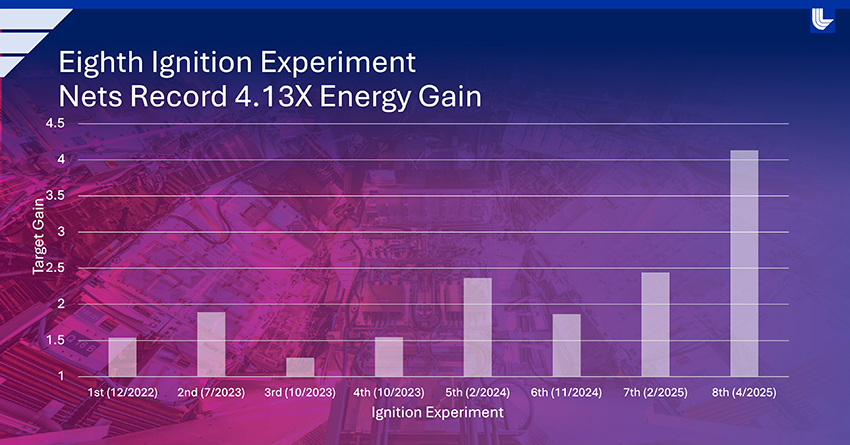
The scientific community measures fusion success through a specific ratio known as Q. This metric compares the energy produced by a fusion reaction to the direct laser energy required to trigger it. A Q value greater than one signifies scientific breakeven. The National Ignition Facility reached this milestone on December 5, 2022. During this test, 192 ultraviolet lasers delivered 2. 05 megajoules of energy to a deuterium and tritium capsule. The resulting reaction produced 3. 15 megajoules of fusion energy. This output generated a Q value of 1. 54.
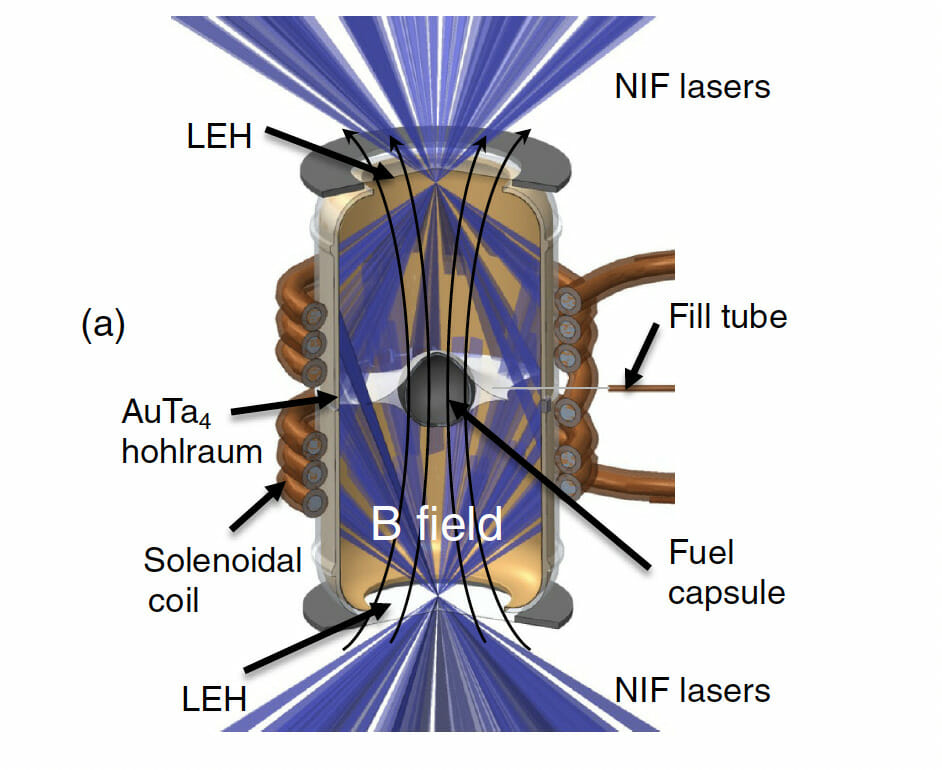
The fuel capsule itself requires exact specifications. It consists of a diamond shell suspended inside a gold cylinder known as a hohlraum. The 192 lasers do not strike the fuel directly. They strike the inner walls of the gold hohlraum. This interaction generates a bath of X-rays that compress the diamond capsule. The implosion reaches speeds of 350 kilometers per second. This extreme pressure forces the deuterium and tritium atoms to fuse. The entire reaction lasts for fractions of a nanosecond.
Scientists repeated and amplified this reaction over the three years. A July 2023 test maintained the 2. 05 megajoule input increased the output to 3. 88 megajoules. By February 2024, the facility pushed the input to 2. 2 megajoules and achieved a 5. 2 megajoule yield. The most significant recorded leap occurred on April 7, 2025. The lasers delivered 2. 08 megajoules of energy, and the reaction yielded 8. 6 megajoules. This specific 2025 test achieved a Q value of 4. 13.
NIF Fusion Energy Yields (2022-2025)
Dec 2022
Jul 2023
Feb 2024
Apr 2025
Energy Output in Megajoules (MJ)
The National Ignition Facility Reality
The Q metric isolates the physics occurring inside the reaction chamber. It ignores the massive power grid requirements necessary to fire the lasers. This distinction separates laboratory physics from commercial viability. The National Ignition Facility relies on older laser technology. Charging the capacitor banks to fire the 192 lasers requires approximately 300 megajoules of electrical energy from the commercial power grid.
During the December 2022 test, the facility consumed 300 megajoules of electricity to generate 3. 15 megajoules of fusion energy. This creates a wall plug energy ratio of roughly one percent. The system consumed nearly 100 times more energy than the fusion reaction produced. Even with the record April 2025 yield of 8. 6 megajoules, the total system operates at a massive net energy deficit. The facility was built to test nuclear weapons physics without detonating actual warheads. It was never engineered to function as a power plant. The scientific breakeven proves the fundamental physics of inertial confinement fusion. It does not prove that this specific laser architecture can power a city.
Private Capital Influx and the Commonwealth Fusion Systems Timeline
Between 2015 and 2025, private capital entered the fusion energy sector at an accelerating rate. The Fusion Industry Association reported in July 2025 that total global funding reached 9. 76 billion dollars across 53 companies. Following a large August 2025 funding round, the total surpassed 10. 6 billion dollars. This influx of capital reflects a shift from government research grants to private equity and venture capital.
Global Private Fusion Funding (Cumulative)
The broader industry data reveals a concentrated financial ecosystem. The July 2025 Global Fusion Industry Report surveyed 53 private fusion companies. The that 83 percent of these companies still view investment as a major challenge. The respondents estimate they need a combined 77 billion dollars to bring their respective pilot plants online. This figure is eight times larger than the total capital committed to the industry to date. The median estimated cost to build a single pilot plant is 700 million dollars.
Public funding also plays a role in this capital influx. The 2025 report notes that public funding for private fusion companies increased by 84 percent over the previous year. This growth brought total public investment to nearly 800 million dollars. Governments are increasingly using public private partnerships to accelerate commercialization. The United States leads this effort with 29 private fusion companies operating within its borders. Europe follows with 13 companies.
Commonwealth Fusion Systems emerged as the dominant financial entity in this sector. Founded in 2018 as a Massachusetts Institute of Technology spinout, the company secured 1. 8 billion dollars in a 2021 Series B funding round. In August 2025, the firm raised an additional 863 million dollars in a Series B2 round. This brought their total funding to nearly 3 billion dollars. This single company accounts for almost one third of all private fusion capital worldwide.
Commonwealth Fusion Systems bases its aggressive schedule on a specific technological advantage. The company uses high temperature superconducting magnets made from rare earth barium copper oxide. These magnets operate at a magnetic field strength of 20 tesla. This represents a substantial improvement over traditional methods. The stronger magnetic field allows the company to build smaller and less expensive tokamak reactors. The compact design means the reactors can fit on standard industrial lots rather than requiring large specialized facilities.
The company directs this capital toward a specific engineering schedule. The major project is SPARC. SPARC is a demonstration tokamak located in Devens, Massachusetts. Construction on the facility reached 65 percent completion by late 2025. The engineering team schedules late 2026 for the plasma generation. The facility is scheduled to produce net energy output by 2027. This means the machine must generate more power than it consumes.
| Project Phase | Target Date | Objective |
|---|---|---|
| SPARC Assembly | 2024 to 2025 | Complete construction of the demonstration tokamak in Massachusetts. |
| SPARC Plasma | Late 2026 | Generate the plasma within the reactor. |
| SPARC Net Energy | 2027 | Produce more energy than the machine consumes. |
| ARC Construction | 2027 to 2028 | Begin building the 400 megawatt commercial plant in Virginia. |
| ARC Operations | Early 2030s | Deliver continuous fusion power to the electrical grid. |
Following the SPARC demonstration, the company plans to build a commercial power plant named ARC. The design calls for a 400 megawatt facility capable of powering 150, 000 homes. In 2024, the company announced a partnership with Dominion Energy to build the ARC plant in Chesterfield County, Virginia. The financial viability of this project gained traction in September 2025 when Italian energy firm Eni signed a 1 billion dollar power purchase agreement.
The commercial partnerships validate the engineering goals. Dominion Energy forecasts 15 gigawatts of data center load by 2040 in Virginia. The utility requires clean baseload power to meet this demand. The ARC plant is designed to provide this exact type of continuous electricity. The 1 billion dollar agreement with Eni functions as a power purchase agreement. This structure mirrors how independent power producers finance large solar or wind projects. The contract size reflects the substantial energy requirements of modern data centers and industrial electrification.
The ARC schedule depends entirely on the success of the SPARC demonstration. Construction on the Virginia site is slated to begin between 2027 and 2028. The company expects the plant to begin operations in the early 2030s. These target dates represent the most aggressive commercialization schedule in the fusion sector. The financial commitments from major energy providers indicate a growing market belief in these engineering milestones.
ITER Delays and the True Cost of International Megaprojects
The International Thermonuclear Experimental Reactor project in southern France represents the most expensive scientific collaboration in history. On July 3, 2024, Director General Pietro Barabaschi announced a revised schedule that pushes the facility operational timeline back by nearly a decade. The consortium of 35 nations must wait until 2034 for the reactor to achieve plasma. The new timeline delays full testing with deuterium and tritium fuel until 2039. This schedule adjustment requires an extra 5. 4 billion dollars in funding. The total budget has expanded from an initial estimate of 5 billion dollars to more than 22 billion dollars.
| Question | Verified Answer |
|---|---|
| 8. What is the current estimated total cost of the ITER project? | Over 22 billion dollars. |
| 9. What was the original budget estimate for ITER? | Approximately 5 billion dollars. |
| 10. When is ITER scheduled to achieve plasma? | 2034. |
| 11. When does ITER begin deuterium and tritium fusion operations? | 2039. |
| 12. How much extra funding did ITER request in July 2024? | 5. 4 billion dollars. |
| 13. What specific component defects caused the latest delays? | Thermal shield corrosion and vacuum vessel joint misalignments. |
| 14. Who is the current Director General of ITER? | Pietro Barabaschi. |
| 15. How countries are collaborating on ITER? | 35 nations. |
| 16. What is the total weight of the ITER reactor? | 23, 000 tonnes. |
| 17. What temperature must the superconducting cables maintain? | Minus 269 degrees Celsius. |
| 18. What was the previous target year for plasma set in 2016? | 2025. |
| 19. Did the French nuclear regulator pause ITER construction? | Yes, due to radiation safety concerns. |
| 20. What is the US Department of Energy upper limit cost estimate for its contribution? | 6. 5 billion dollars. |
The 2024 baseline revision exposes severe manufacturing and supply chain problems. Engineers discovered traces of corrosion in the thermal shields designed to protect the exterior from the heat of the fusion reaction. Inspectors also found incorrect dimensions in the joints of the blocks that form the 19 by 11 meter vacuum vessel chamber. Repairing these unique components requires months of specialized labor. The French nuclear regulator mandated a construction pause to evaluate radiation safety rules. The facility requires 200 kilometers of superconducting cables and relies on the largest cryogenic plant on Earth to cool the magnets to minus 269 degrees Celsius. These physical defects combine with the economic inflation of the early 2020s to increase the budget.
The previous 2016 baseline plan set a goal for plasma in 2025. Barabaschi stated that this deadline was not realistic in the place. He noted that a 2025 plasma event would have been a brief machine test with minimal scientific value. The revised schedule aims to build a more complete machine before initiating operations. This decision means the facility cannot generate meaningful fusion data until the late 2030s.
The plasma was really rather symbolic. Certainly, the delay of ITER is not going in the right direction.
The financial cost falls heavily on the participating governments. The European Union covers approximately 45 percent of the construction costs through its Euratom program. Other partners including the United States, China, India, Japan, South Korea, and Russia share the remaining expenses. The United Kingdom formally discontinued its participation in the European fusion funding group in 2023 and decided against seeking independent membership in 2024. Auditors from the European Court of Auditors warned in late 2025 that the 2024 baseline changes create a financial risk that Euratom may not sustainably finance. The United States Department of Energy requested 240 million dollars for ITER in its fiscal year 2024 budget. The department estimates the total United States contribution stays within a 6. 5 billion dollar upper limit.
Private fusion companies use these delays to position their smaller reactors as faster alternatives. Commonwealth Fusion Systems and Tokamak Energy plan to begin testing prototypes before the end of this decade. Barabaschi remains skeptical that any private startup can achieve commercial operation by 2040. He stated that even if thermonuclear fusion were proven today, commercial deployment by 2040 is highly unlikely. The 23, 000 tonne ITER machine remains the most complex engineering endeavor in history. Its progress dictates the realistic timeline for international fusion energy development.
Magnetic Confinement versus Inertial Confinement Viability
The fusion energy sector divides into two primary engineering methods. Magnetic confinement uses magnetic fields to trap a continuous plasma. Inertial confinement uses targeted lasers to compress a fuel pellet for a fraction of a second. Both methods recorded verified data milestones between 2023 and 2025. The metrics show distinct engineering realities for each route.
The Joint European Torus facility in the United Kingdom operated the leading magnetic confinement reactor until its closure in December 2023. During its final experimental campaign in October 2023, the facility set a verified energy record. The reactor produced 69. 26 megajoules of heat over six seconds using 0. 21 milligrams of deuterium tritium fuel. This output represents the highest total fusion energy ever generated in a single event. The energy released equals the combustion of two kilograms of coal. Yet the facility injected approximately 210 megajoules of energy to heat the plasma. The Q value remained near 0. 33. The achievement proved that magnetic confinement can sustain a stable plasma at 150 million degrees Celsius for several seconds. The facility completed 105, 842 pulses over its 40 year lifespan before entering the decommissioning phase. The decommissioning process continues until 2040.
The International Thermonuclear Experimental Reactor project in France serves as the successor to the Joint European Torus. The project faces serious financial and scheduling problems. In July 2024, Director General Pietro Barabaschi announced a 10 year delay for the facility. The revised schedule pushes the plasma date to 2034. Experiments using the deuterium tritium fuel mixture are delayed until 2039. The management team confirmed an extra 5 billion euros in costs. The total budget exceeds 27 billion dollars. The original budget was 5 billion dollars with a startup date of 2020. The delays from component manufacturing errors and regulatory pauses regarding radiation safety. The facility must also replace its beryllium plasma facing walls with tungsten to handle the extreme heat. The sheer size of the international collaboration creates logistical bottlenecks that slow construction.
Inertial confinement facilities report different metrics. The National Ignition Facility in California uses 192 lasers to compress a fuel pellet. The facility achieved a net energy gain from the laser input in December 2022. The laboratory repeated and expanded this success multiple times. In October 2023, the facility fired 2. 2 megajoules of laser energy to produce 3. 4 megajoules of fusion yield. In February 2024, an experiment delivered 2. 2 megajoules and generated 5. 2 megajoules of output. By April 2025, the facility reached a yield of 8. 6 megajoules from a 2. 08 megajoule laser input. This 2025 event achieved an energy gain of 4. 13. The laboratory installed fused silica debris shields in 2023 to protect the optical equipment from the intense energy releases. The facility also plans to upgrade the laser amplifiers to deliver 2. 6 megajoules of energy in future tests.
The data reveals a clear division in viability metrics. Inertial confinement achieves a Q value greater than 1. 0. The reaction only lasts for billionths of a second. Magnetic confinement sustains the reaction for seconds fails to produce more energy than it consumes. Neither method currently accounts for the total wall plug electricity required to power the entire facility. The National Ignition Facility required roughly 300 megajoules of grid electricity to fire the 2. 05 megajoule laser in its initial success. Commercial viability requires a facility to generate enough power to sustain its own operations and deliver excess electricity to the grid. Engineers must solve the continuous operation problem for lasers or the net energy problem for magnets before fusion can supply commercial electricity.
Verified Q Values: Magnetic vs Inertial Confinement
Verified Fusion Records: Energy Output and Q Value (2023 to 2025)
| Facility | Method | Record Date | Energy Input (MJ) | Energy Output (MJ) | Q Value |
|---|---|---|---|---|---|
| Joint European Torus | Magnetic | October 2023 | ~210. 00 | 69. 26 | 0. 33 |
| National Ignition Facility | Inertial | April 2025 | 2. 08 | 8. 60 | 4. 13 |
The Tritium Supply Chain Reality in Commercial Fusion
Deuterium and tritium reactions dominate commercial fusion designs. Deuterium is abundant in seawater. Tritium is radioactive, decays at a rate of 5. 5 percent annually, and possesses a half life of 12. 3 years. The global civilian inventory of tritium stands at approximately 20 to 25 kilograms. The market price for this isotope reaches $30, 000 per gram, equating to $30 million per kilogram.
Civilian tritium originates almost entirely as a byproduct from Canadian Deuterium Uranium heavy water fission reactors. A single reactor generates roughly 130 grams of tritium annually. Canada produces a total of 2 kilograms per year. The United States produces up to 4 kilograms over 18 month periods at the Tennessee Valley Authority Watts Bar facility, yet the National Nuclear Security Administration restricts this supply strictly for military applications. Romania and the Republic of Korea operate heavy water reactors that contribute small amounts to the global stockpile, older Canadian reactors are scheduled for retirement and replacement by light water reactors that do not produce tritium.
The International Thermonuclear Experimental Reactor in France requires an estimated 12 to 12. 3 kilograms of tritium over its operational lifespan. This single research project consumes more than half of the current global civilian stockpile. The project schedule delays push the start date to 2035. Because of natural radioactive decay, the global tritium stockpile could dwindle to 14 kilograms by 2055, leaving minimal fuel for subsequent commercial reactors.
Commercial fusion plants demand vastly higher volumes. A one gigawatt fusion reactor requires between 55 kilograms and 70 kilograms of tritium per year to maintain steady state operations. Commercial designs rely on a theoretical closed fuel loop. Reactors must breed their own tritium by bombarding lithium blankets with neutrons. A functional power plant requires a Tritium Breeding Ratio greater than 1. 0 to sustain operations. Engineers target a ratio between 1. 1 and 1. 2 to account for system losses and radioactive decay.
The breeding process requires bombarding an isotope of lithium, known as lithium 6, with high energy neutrons inside the reactor vessel. To produce the 70 kilograms of tritium required for one gigawatt of thermal power over a single year, a reactor must consume 140 kilograms of lithium 6. Assuming a conversion efficiency of 30 percent from thermal to electrical power, a standard one gigawatt electrical fusion plant requires approximately 500 kilograms of lithium 6 annually. Expanding this to a global energy grid of 10, 000 reactors demands 5, 000 tonnes of lithium 6 per year. Extracting this specific isotope requires processing 70, 000 tonnes of natural lithium ore annually.
Starting a reactor requires an initial fuel load. Estimates for a commercial startup inventory range from 1 kilogram to 20 kilograms. At $30 million per kilogram, the initial 10 kilogram fuel load for a single commercial reactor costs $300 million. The current global supply cannot support the simultaneous launch of multiple commercial reactors. The Test Blanket Modules in the International Thermonuclear Experimental Reactor produce a maximum of 20 milligrams of tritium per day. A one gigawatt commercial plant requires approximately 150 to 190 grams per day.
The United States operates with a complete absence of a secure domestic supply chain for commercial tritium. The Department of Energy relies on the Tennessee Valley Authority to irradiate specialized control rods at the Watts Bar nuclear plant. This process coats control rods with boron to capture neutrons and generate tritium. The National Nuclear Security Administration strictly regulates this entire stockpile to boost the yield of nuclear weapons. The agreement between the Tennessee Valley Authority and the National Nuclear Security Administration extends until 2035. Commercial fusion companies cannot purchase this military material. They must compete for the shrinking Canadian supply.
Facilities to process and recycle this isotope remain in the early construction phases. The UKAEA and Eni H3AT Tritium Loop Facility in Culham, England, is scheduled for completion in 2028 to test commercial fuel loops. A 2024 Fusion Industry Association report indicates that 70 percent of fusion companies pursue deuterium and tritium fuel mixtures. These companies identify tritium self sufficiency as a primary constraint to commercial operations. The Federation of American Scientists recommends repurposing tritium from decommissioned nuclear warheads to support early commercial fusion research, yet no formal framework exists for this transfer. The absence of a domestic commercial production supply chain forces reliance on aging international heavy water reactors.
| Tritium Metric | Mass (Kilograms) | Visual |
|---|---|---|
| Annual Canadian Production | 2 kg | |
| ITER Lifetime Consumption | 12. 3 kg | |
| Global Civilian Inventory | 25 kg | |
| Annual 1 GW Reactor Requirement | 70 kg |
Superconducting Magnets and the High Temperature Cuprate Revolution
Magnetic confinement fusion relies on magnetic fields to compress and suspend plasma. The physics dictate that stronger magnetic fields allow for smaller reactor volumes. Low temperature superconducting materials require cooling to 4 Kelvin to operate. This extreme refrigeration consumes massive amounts of energy and sets a strict ceiling on the maximum magnetic field strength before the material loses its superconducting properties.
The introduction of Rare Earth Barium Copper Oxide tape changed the engineering mathematics of fusion reactors. This material belongs to a class of high temperature superconductors. Engineers apply the compound as a microscopic coating on thin metal ribbons. These ribbons carry hundreds of times more electrical current than standard copper wire of the same diameter. The material maintains its superconducting state at 20 Kelvin. Operating at 20 Kelvin instead of 4 Kelvin reduces the refrigeration energy load by a significant margin. More importantly, the material sustains much higher magnetic fields without quenching.
On September 5, 2021, the Massachusetts Institute of Technology Plasma Science and Fusion Center and Commonwealth Fusion Systems completed a verified test of a massive Rare Earth Barium Copper Oxide magnet. The team ramped the device to a magnetic field strength of 20 Tesla. This test proved that a compact magnet could generate the field strength required for net energy fusion. The 20 Tesla threshold allows engineers to design a reactor with a volume 40 times smaller than older designs relying on low temperature superconductors.
The Massachusetts Institute of Technology test involved a magnet standing 3 meters tall. Engineers assembled the device using 16 individual plates stacked together. The initial run to reach the 20 Tesla mark required a two week ramp period. Following the successful September 2021 demonstration, the engineering team deconstructed the entire magnet assembly. They spent the subsequent months inspecting the components and analyzing data from hundreds of internal sensors. The researchers then conducted two additional test runs on the exact same magnet. They intentionally pushed the hardware to its breaking point to document specific failure modes. The team applied a no insulation design. This engineering choice carried high risk proved stable during the deliberate overheating events.
Other private entities recorded similar metrics using the same base material. Tokamak Energy tested a high temperature superconducting magnet at the European Organization for Nuclear Research in 2020. That specific magnet reached 26. 2 Tesla at 4 Kelvin. By November 2025, Tokamak Energy operated its Demo4 system at its facility outside Oxford. The Demo4 system consists of 14 toroidal field magnets and two poloidal field magnets built in a complete tokamak configuration. During the November 2025 tests, the Demo4 system achieved a field strength of 11. 8 Tesla at negative 243 degrees Celsius. The system pushed seven million ampere turns of electrical current through its center column.
Tokamak Energy expanded its operations to control the manufacturing process. In September 2025, the company acquired Ridgway Machines to accelerate the production of its TE Magnetics business division. The company sources its advanced tape from SuperPower Incorporated. Before the Demo4 system tests, Tokamak Energy evaluated a smaller six coil test magnet. Engineers cooled this test unit to 20 Kelvin and ramped it to a peak field of 15 Tesla. The ramp rate exceeded 5 Tesla per minute. The team ramped the magnet to its peak field over 100 times. They deliberately forced the magnet into a quench state from peak field to verify that the hardware suffered no degradation.
The magnetic field strength directly dictates the plasma density a reactor can sustain. Higher plasma density increases the fusion reaction rate. The relationship between magnetic field strength and fusion power to the fourth power. Doubling the magnetic field strength increases the fusion power output by a factor of 16. This non linear scaling explains the intense engineering focus on Rare Earth Barium Copper Oxide magnets. The material provides the only verified method to reach these high magnetic fields without requiring a reactor the size of a skyscraper.
The primary constraint on this technology is the supply chain. A single commercial fusion reactor requires thousands of kilometers of Rare Earth Barium Copper Oxide tape. Manufacturers must produce the tape with zero microscopic defects to prevent the magnets from overheating and failing during operation. The global production capacity for this specific tape dictates the construction timeline for generation fusion devices.
| Organization | Date | Milestone | Field Strength | Temperature |
|---|---|---|---|---|
| Tokamak Energy | 2020 | HTS magnet test at CERN | 26. 2 Tesla | 4 Kelvin |
| MIT and CFS | September 5, 2021 | REBCO magnet test | 20. 0 Tesla | 20 Kelvin |
| Tokamak Energy | November 2025 | Demo4 tokamak configuration | 11. 8 Tesla | 30 Kelvin |
Grid Integration Challenges for Generation Fusion Plants
The transition from laboratory physics to commercial electricity generation requires solving specific mechanical and thermodynamic problems. Current experimental reactors consume massive amounts of electricity just to maintain basic operations. The International Thermonuclear Experimental Reactor in France requires between 75 and 110 megawatts of continuous electrical power from the regional grid to run liquid helium refrigerators, vacuum pumps, and water cooling systems. Heating the plasma demands an extra 300 megawatts. A commercial plant must generate enough thermal energy to cover this internal parasitic load before exporting a single watt to the grid.
Thermal alternation presents another physical obstacle. Magnetic confinement reactors like tokamaks operate in pulses. The plasma burns for a set duration, followed by a dwell period to recharge the magnetic coils and clear exhaust gases. This alternating heat generation stresses the reactor materials. The in vessel components absorb intense neutron radiation and heat, which must transfer to a secondary working fluid through heat exchangers to drive a steam Rankine or Brayton engine. The thermodynamic engine must integrate heat from multiple primary heat exchangers linked to individual components operating at different conditions. Every megawatt of heat integrated into the engine is necessary to ensure the plant can export net power to the grid. Continuous expansion and contraction of these materials degrade the structural integrity of the plant. Stellarator designs offer continuous operation by using complex external magnetic coils, yet the Max Planck Institute for Plasma Physics notes that building a stellarator large enough for net power generation remains a distant engineering task.
Inertial confinement systems face a different repetition rate problem. The National Ignition Facility fires its lasers roughly once per day. A commercial laser based plant must fire up to 10 times per second. Current laser systems operate at 0. 7 percent efficiency. Commercial viability requires at least 10 percent efficiency. The fuel capsules currently cost thousands of dollars each to manufacture. A functional power plant needs 100, 000 capsules per day, driving the required cost down to less than one dollar per capsule.
Fuel supply chains do not currently exist for commercial fusion. Deuterium is abundant in seawater, tritium is highly radioactive with a 12. 3 year half life. It does not occur naturally in usable quantities. Global tritium production relies on 30 specific fission reactors, which together generate less than four kilograms per year. A single gigawatt thermal fusion plant requires 55. 6 kilograms of tritium annually. Future plants must breed their own tritium by purposefully integrating lithium into the in vessel components. Neutrons escaping the plasma strike the lithium, producing tritium. The extracted tritium must then be separated and fed back into the reactor core. Engineers have not yet proven this closed fuel loop in a working reactor. Until the fuel loop is closed in an operational power plant, tritium availability can restrict fusion development.
Annual Tritium Supply vs. Commercial Demand (per GW thermal)
The gap between laboratory records and grid requirements is quantifiable. The table details the verified metrics from current facilities against the operational baselines required for a functioning power plant.
| Metric | Current Laboratory Status (2025) | Commercial Grid Requirement |
|---|---|---|
| Laser Efficiency (Inertial) | 0. 7 percent | Greater than 10. 0 percent |
| Shot Frequency (Inertial) | 1 per day | 10 per second |
| Capsule Cost | Thousands of dollars | Under $1. 00 |
| Parasitic Power Load | Up to 410 MW (ITER design) | Must be exceeded by output |
| Tritium Supply | Less than 4 kg globally per year | 55. 6 kg per GW thermal per year |
Connecting a fusion reactor to the electrical grid demands solving these thermodynamic and supply chain realities. The physics experiments prove the reaction is possible. The engineering math dictates the actual timeline for electricity generation.
Regulatory Frameworks and the Nuclear Regulatory Commission Stance
The commercial viability of fusion energy depends on the legal structures governing its operation. On April 14, 2023, the United States Nuclear Regulatory Commission executed a unanimous vote to separate fusion energy devices from the regulatory rules applied to nuclear fission reactors. The five commissioners directed agency staff to regulate fusion systems under the existing byproduct materials framework found in Title 10 of the Code of Federal Regulations Part 30. This decision rejected the alternative option of classifying fusion machines as utilization facilities under Parts 50 through 53. The rejected classification would have subjected fusion devices to the exact framework used for commercial nuclear power plants.
Fission reactors require continuous intervention to prevent runaway chain reactions and produce special nuclear material. Fusion reactions cease immediately upon confinement failure and do not involve fissile material. The Part 30 classification treats fusion devices as particle accelerators. This legal distinction removes the requirement for fusion developers to undergo the exact licensing procedures designed for traditional nuclear power plants. The federal agency concluded that early fusion facilities cannot cause large radiation doses to the public during accident scenarios. The agency defines early systems as those planned for deployment through the 2030s.
| Regulatory Category | Code of Federal Regulations | Technology Type | Primary Safety Focus |
|---|---|---|---|
| Utilization Facility | 10 CFR Parts 50 to 53 | Nuclear Fission | Chain reaction containment and decay heat removal |
| Byproduct Material | 10 CFR Parts 30 to 37 | Nuclear Fusion and Particle Accelerators | Radiological materials management and worker safety |
President Joe Biden signed the ADVANCE Act into law in July 2024. This legislation codified the Nuclear Regulatory Commission decision. The law formally defines fusion machines as a category of particle accelerator under the Atomic Energy Act. The statute confirms that radioactive materials associated with fusion energy qualify as byproduct material rather than special nuclear material. The byproduct designation applies to materials made radioactive by exposure to incidental radiation. Special nuclear material refers to elements like uranium or plutonium that operators can adapt for weapons production. Fusion systems do not produce these elements.
The 2023 ruling and the 2024 legislation activated the Agreement State Program for fusion energy regulation. The Atomic Energy Act authorizes specific states to assume regulatory authority over public safety for radioactive materials from the federal government. As of October 2025, 40 states operate as Agreement States. These state agencies hold radiological licensing authority over fusion energy systems within their borders. The federal commission retains licensing jurisdiction only in the 10 states without agreements.
State radiological health offices evaluate the specific risks connected with operating a fusion machine. These offices problem the final radiological licenses. The primary safety matters involve tritium fuel management and the handling of neutron activation products in machine structures. Tritium is a radioactive isotope of hydrogen used as fuel in specific fusion designs. The federal commission does not classify tritium as a high risk radionuclide for Part 37 security purposes. For radionuclides not explicitly listed in the regulations, the federal agency determines security measures on an individual basis.
The federal government coordinates training programs for state offices to ensure they possess the technical skills required to evaluate fusion licenses. By the end of 2025, the Nuclear Regulatory Commission staff prepared the formal rule amendments across multiple sections of the federal code to integrate fusion machines fully into the byproduct material structure. The amendments modify definitions and establish specific content requirements for license applications. Applicants must detail their radiation protection systems, their radioactive material handling procedures, and their inventory controls. The rules also require developers to submit environmental reports and document their radioactive material accounting methods.
This regulatory structure provides a defined legal boundary for the 30 active fusion companies operating in the United States. The separation of fusion from fission regulations establishes the exact compliance metrics developers must meet to connect future facilities to the electrical grid. The materials licensing framework focuses entirely on radiological risk management rather than power reactor safety analysis. Developers must demonstrate safe operation and proper waste disposal procedures to secure their operating permits.
Core Inquiries and Verified Metrics
| Question | Verified Data |
|---|---|
| What is the total private investment in fusion energy. | Private investment reached 9. 7 billion dollars across 50 projects by late 2025. |
| How much did Commonwealth Fusion Systems raise. | The company secured 863 million dollars in an August 2025 Series B2 round. |
| What is the standard venture capital return timeline. | Venture funds demand liquidity events within five to ten years. |
| How long does a major fusion reactor take to build. | The ITER project began conception in 1985 and expects deuterium and tritium operations in 2039. |
| What is the current status of the ITER project. | ITER delayed its research operations to 2034. |
| How much has ITER cost so far. | The official budget estimate rose to between 18 billion and 20 billion euros. |
| When is ITER expected to achieve deuterium and tritium plasma. | The new baseline schedules this milestone for 2039. |
| What is the energy gain record at the National Ignition Facility. | The facility produced 8. 6 megajoules of fusion energy from 2. 08 megajoules of laser input in April 2025. |
| How much money has Commonwealth Fusion Systems raised in total. | The company has accumulated nearly 3 billion dollars since 2018. |
| When does Commonwealth Fusion Systems plan to complete SPARC. | The company aims for net power production as early as 2027. |
| What is the temperature required for magnetic confinement fusion. | Reactors must heat plasma beyond 100 million degrees Celsius. |
| How private fusion companies exist globally. | There are approximately 50 private fusion development projects worldwide. |
| What percentage of fusion companies expect commercialization by 2035. | private firms project commercial grid power in the early 2030s. |
| How much public funding goes into fusion research annually. | The United States Department of Energy awarded numerous grants for commercialization milestones. |
| What is the difference in timeline between software startups and fusion hardware. | Software grows in months while fusion requires decades of engineering testing. |
| Which venture capital firms are leading fusion investments. | Breakthrough Energy Ventures and NVentures are prominent backers. |
| What is the cost increase for the recent ITER delay. | The new baseline plan added 5 billion euros to the project cost. |
| How jobs are currently in the private fusion sector. | Commonwealth Fusion Systems alone employs over 1000 people. |
| What is the primary fuel source for most commercial fusion designs. | Reactors rely on a mixture of deuterium and tritium. |
| How much power does the planned ARC reactor aim to produce. | The ARC power plant is designed to generate 400 megawatts. |
Venture Capital Timelines versus Physics Realities
Private investment in fusion energy reached 9. 7 billion dollars across 50 global projects by late 2025. Venture capital firms inject massive capital into these startups. They expect financial returns within a standard five to ten year window. Physics dictates a different schedule. The International Thermonuclear Experimental Reactor project in France illustrates this friction. Conceived in 1985, the facility announced a delay for its research operations to 2034. The project pushed its timeline for burning a mixture of deuterium and tritium fuel to 2039. The official budget estimate for the facility sits between 18 billion and 20 billion euros following a recent 5 billion euro budget increase.
Private companies project faster results. Commonwealth Fusion Systems raised 863 million dollars in an August 2025 funding round. This brought their total private funding to nearly 3 billion dollars. The company is building a 500 million dollar demonstration complex named SPARC in Massachusetts. They plan to achieve net energy output by 2027. The firm also plans a 400 megawatt commercial power plant in Virginia for the early 2030s. Investors like Breakthrough Energy Ventures and NVentures back these aggressive timelines.
Laboratory milestones show scientific progress highlight the engineering distance to commercial power. The National Ignition Facility achieved a record 8. 6 megajoules of fusion energy output from 2. 08 megajoules of laser input in April 2025. This energy gain of 4. 13 proves that inertial confinement fusion works in a controlled setting. The reaction lasted less than nine nanoseconds. Translating a fraction of a second of net energy into a continuous power plant requires solving extreme engineering challenges. The fuel must reach temperatures beyond 100 million degrees Celsius.
The friction between financial expectations and scientific reality creates a precarious environment. Venture funds demand rapid commercialization. Fusion reactors require decades of testing to manage extreme heat and radiation. The gap between a 2027 demonstration and a reliable grid connection involves untested supply chains and regulatory approvals. The capital influx accelerates research cannot alter the fundamental laws of thermodynamics.
Fusion Financial Metrics 2024 to 2025
The Role of Stellarators and the Wendelstein Seven X Data
The stellarator design presents a distinct method for magnetic confinement fusion. Tokamaks use a toroidal plasma current to twist the magnetic field. Stellarators use external non axisymmetric coils to produce the twisting field. This design eliminates the requirement for a continuous plasma current. The absence of a plasma current removes specific instabilities that affect tokamak operations. The Max Planck Institute for Plasma Physics operates the Wendelstein Seven X facility in Greifswald Germany. The facility tests the viability of the stellarator concept for continuous operation.
The Wendelstein Seven X assembly concluded in 2014. The core of the facility contains 50 superconducting magnetic coils. These coils measure 3. 5 meters in height. Operators cool them to minus 270 degrees Celsius. The facility generated its helium plasma on December 10 2015. The initial test used one milligram of helium gas. The measuring instruments recorded an input power of 1. 3 megawatts. The temperature reached one million degrees Celsius. The pulse duration lasted one tenth of a second.
The facility underwent multiple upgrades between 2018 and 2022. Operators installed a water cooled divertor and upgraded the microwave heating systems. In February 2023 the facility maintained a plasma for eight minutes. The energy turnover reached 1. 3 gigajoules. This event established a record for stellarator devices.
The experimental campaign concluding on May 22 2025 yielded new metrics. The Wendelstein Seven X team achieved a record triple product for long plasma discharges. The triple product combines plasma density, temperature, and energy confinement time. The facility maintained this parameter at a peak level for 43 seconds. The plasma temperature exceeded 20 million degrees Celsius and peaked at 30 million degrees.
The 2025 campaign also recorded an energy turnover of 1. 8 gigajoules over a 360 second plasma duration. This metric exceeded the 1. 3 gigajoules produced in February 2023. The 1. 8 gigajoule turnover surpassed the values recorded by the 1000 second Experimental Advanced Superconducting Tokamak experiment in China. The plasma pressure relative to magnetic pressure reached 3 percent across the full plasma volume. Future power plants require a ratio of 4 to 5 percent.
The facility achieved these results using a pellet injector developed by the Oak Ridge National Laboratory. The injector fired 90 frozen hydrogen pellets into the plasma at speeds up to 800 meters per second. This continuous refueling method operated alongside simultaneous microwave heating. Princeton Plasma Physics Laboratory provided the X ray spectrometer used to measure the ion temperatures during the record discharges.
| Metric | Tokamak Architecture | Stellarator Architecture |
|---|---|---|
| Magnetic Field Generation | Toroidal plasma current | External non axisymmetric coils |
| Continuous Operation | Requires external current drive | Inherent steady state design |
| Short Duration Triple Product | Current record holders | Lower than peak Tokamak values |
| Long Duration Triple Product | Surpassed by Wendelstein Seven X | Record maintained for 43 seconds |
Tokamaks retain the performance records for short plasma durations. The Wendelstein Seven X results demonstrate that stellarators can match or exceed tokamak performance over extended periods. The 43 second triple product record surpassed previous long duration results from the JT60U facility in Japan and the Joint European Torus in the United Kingdom.
The diagnostic systems at the facility require precise calibration to verify these metrics. The electron density data originates from an interferometer operated by the Max Planck Institute. The energy confinement time calculations rely on proprietary diagnostic tools developed specifically for the stellarator architecture. Following the May 2025 campaign the facility entered a one year maintenance phase. Operations resume in September 2026. The upcoming campaigns aim to increase the plasma temperature and extend the pulse duration to 30 minutes.
Laser Efficiency and the Hidden Energy Costs of Ignition
The public narrative surrounding the December 2022 National Ignition Facility milestone focuses on the ratio between laser energy applied to the fuel capsule and the resulting fusion output. The missing variable in this equation is the electrical grid power required to fire the 192 lasers. Evaluating the true energy balance requires measuring the engineering gain. This metric compares the final fusion energy output against the total electrical energy drawn from the facility wall plug.
The National Ignition Facility draws approximately 300 megajoules of electrical energy from the grid to produce the 2. 05 megajoules of ultraviolet laser light delivered to the fuel capsule chamber. This massive electrical requirement exposes the severe energy loss inherent in the current laser architecture. The conversion process from grid electricity to ultraviolet laser light operates at a conversion rate of roughly 0. 68 percent. The remaining 99. 32 percent of the input energy dissipates as heat and light before reaching the fuel capsule.
The exact stages of energy loss explain this severe deficit. The grid power charges large capacitor banks. These capacitors discharge into thousands of flashlamps. The flashlamps emit white light to excite the neodymium atoms in the glass amplifiers. This sequence involves multiple conversion steps. Each step bleeds energy. The conversion from electrical energy to flashlamp light loses power. The transfer of light into the glass amplifiers loses power. The final conversion into ultraviolet light via frequency conversion crystals loses power. The cumulative effect is the 0. 68 percent energy retention rate.
Comparing the 3. 15 megajoules of fusion output to the 300 megajoules of grid input reveals a net energy deficit of 296. 85 megajoules per shot. The engineering gain stands at approximately 1. 05 percent. The facility consumes nearly 100 times more energy than the fusion reaction generates. This deficit demonstrates the vast chasm between scientific breakeven and commercial power generation.
| Energy Phase | Megajoules (MJ) | Proportional Visualization |
|---|---|---|
| Grid Electrical Input | 300. 00 | |
| Fusion Energy Output | 3. 15 | |
| Laser Energy Delivered | 2. 05 |
The underlying technology explains this heavy energy consumption. The National Ignition Facility relies on flashlamp pumped neodymium glass lasers designed and constructed in the 1990s. Engineers built these systems for scientific research and nuclear stockpile stewardship rather than commercial power generation. Commercial viability requires diode pumped solid state lasers capable of achieving 10 to 20 percent wall plug conversion rates. Upgrading to this standard demands entirely new optical architectures and materials.
Diode arrays convert electricity directly into specific wavelengths of light. This targeted emission matches the exact absorption spectrum of the gain medium. This direct matching eliminates the wasted broad spectrum light produced by flashlamps. Researchers have demonstrated 10 percent wall plug conversion rates in smaller diode pumped systems. Expanding these systems to the megajoule level remains an unsolved engineering matter. The capital cost of manufacturing millions of laser diodes currently prohibits widespread implementation.
The firing rate presents another major engineering obstacle. The National Ignition Facility executes only a few shots per day to prevent thermal damage to the laser glass. A functional fusion power plant must execute 5 to 10 shots per second to supply continuous baseload power to the grid. This required frequency represents an operational increase of roughly 100, 000 times the current capability. Firing a laser generates intense heat within the optical components. The current neodymium glass amplifiers require hours to cool down after a single shot. Firing them continuously at 10 Hertz can shatter the glass due to thermal stress. Future commercial designs propose using flowing gas or liquid coolants combined with advanced ceramic gain media. These materials must withstand extreme thermal cycling while maintaining perfect optical clarity. Engineers must solve the dual matters of low laser energy retention and slow repetition rates before inertial confinement fusion can contribute to the global energy supply.
The transition from scientific experiments to commercial power plants requires substantial capital investment. Replacing the 192 flashlamp pumped lasers with diode pumped solid state alternatives involves redesigning the entire facility infrastructure. Current estimates place the cost of high power laser diodes at several dollars per watt of output. A commercial fusion plant requires billions of watts of peak optical power. This pricing structure means the laser diodes alone can cost billions of dollars per facility. Manufacturing these components also demands vast quantities of specialized semiconductor materials. The global supply chain currently operates without the capacity to produce these materials at the required volume. The fusion industry must build dedicated manufacturing facilities just to supply the necessary optical components.
Material Science Bottlenecks in Wall Neutron Degradation

The physical boundary containing a fusion plasma, known as the wall, faces a bombardment of high-energy particles that degrades known materials. Deuterium-tritium fusion reactions generate neutrons with 14. 1 megaelectron volts (MeV) of energy. This energy level vastly exceeds the 2 MeV average of standard fission reactors. When these 14. 1 MeV neutrons strike the reactor wall, they transfer enough kinetic energy to knock atoms out of their crystal lattice positions. The initial collision creates a primary knock-on atom, which then cascades through the surrounding structure, displacing thousands of additional atoms in a fraction of a second. Material scientists measure this damage using a metric called displacements per atom (dpa), which quantifies the average number of times each atom in a structure gets displaced during its operational lifespan. For nuclear applications, a material experiences a dpa greater than 1, meaning every single atom has been violently relocated at least once.
Current experimental reactors operate at low dpa levels, yet commercial power plants require materials capable of surviving years of continuous bombardment. The International Thermonuclear Experimental Reactor (ITER) subjects its divertor to a maximum of 1 dpa. Commercial prototype designs, such as the European DEMO, demand plasma-facing materials that withstand 4 to 8 dpa, and structural heat sink materials that endure 5 to 15 dpa over a two-year operational period. A fully commercial fusion power plant requires structural materials capable of surviving up to 150 dpa to remain economically viable.
| Reactor Design | Operational Phase | Expected Neutron Damage (dpa) |
|---|---|---|
| ITER | Experimental / Pulsed | < 1 dpa |
| DEMO (Prototype) | 1. 5 to 2 Full-Power Years | 4 to 15 dpa |
| Commercial Plant | Lifetime Operation | Up to 150 dpa |
Tungsten serves as the primary candidate for plasma-facing components due to its high melting point and thermal conductivity. The material must manage steady-state surface heat fluxes method 10 megawatts per square meter. Under 14. 1 MeV neutron irradiation, tungsten undergoes transmutation, converting into rhenium and osmium. At damage levels above 1 dpa, the material forms tungsten-rhenium-osmium clusters and precipitates along grain boundaries. This structural alteration causes severe embrittlement. The high-energy neutrons also trigger threshold nuclear reactions that generate helium and hydrogen gas inside the metal. These gases accumulate, driving bubble nucleation and surface blistering, which degrades the thermal conductivity required to cool the reactor wall. Tungsten also has a strict maximum operating temperature of approximately 1300 degrees Celsius, above which it suffers from recrystallization and a complete loss of creep strength.
Behind the tungsten armor, reactor designs rely on reduced-activation ferritic/martensitic steels, such as EUROFER97 or the Chinese CLF-1, to act as structural supports and coolant containment pipes. These steels face similar degradation pathways. The 14. 1 MeV neutrons cause specific threshold reactions at rates significantly higher than fission neutrons, generating massive internal quantities of hydrogen and helium. These internal gases, combined with the displacement cascades, cause void swelling. Empty spaces form within the metal lattice, expanding the material and reducing its structural integrity. The continuous displacement of atoms hardens the steel, dropping its ductility to levels where routine thermal cycling causes fracturing. These advanced steels also operate within a narrow thermal window, between 325 and 550 degrees Celsius. Operating 325 degrees Celsius worsens radiation embrittlement, while exceeding 550 degrees Celsius causes a rapid loss of mechanical strength, restricting the in total thermal efficiency of the power plant.
Engineers face a serious testing gap because no existing facility produces a 14. 1 MeV neutron spectrum at the flux required to validate these materials for commercial use. Fission reactors cannot replicate the high ratio of helium and hydrogen production per dpa seen in fusion environments. To address this matter, the European Union and Spain are constructing the International Fusion Materials Irradiation Facility DEMO-Oriented Neutron Source (IFMIF-DONES) in Granada, Spain. Until this facility begins generating high-flux fusion-relevant neutrons, material degradation rates at DEMO and commercial dpa levels remain theoretical extrapolations based on fission reactor data and low-energy ion beam experiments. Without verified materials capable of surviving 15 to 150 dpa while maintaining thermal conductivity and structural integrity, sustained commercial fusion operations remain physically impossible.
The Economics of Fusion Power Compared to Advanced Fission
ITER and the Fusion Capital Emergency
The international fusion project known as ITER faces severe financial and scheduling failures. Project directors confirmed an extra 5 billion euro cost overrun in 2024. The facility cannot achieve its final deuterium tritium plasma stage until 2039. This represents a fourteen year delay from the original 2025 deadline. The total budget for the experimental reactor expanded from early estimates of 5. 9 billion euros to well over 20 billion euros. Private investment in fusion reached 10 billion dollars by September 2025. Investors poured this capital into startups promising commercial power by the early 2030s. These private ventures must overcome the exact same physics and engineering obstacles that delayed ITER.
Advanced Fission and SMR Financial Realities
Advanced fission projects face their own severe financial problems. The NuScale small modular reactor project in Utah saw its estimated construction cost jump 75 percent to 9. 3 billion dollars. This increase pushed the capital cost to 20, 139 dollars per kilowatt. This metric makes the NuScale design as expensive as the delayed Vogtle nuclear project in Georgia. The projected price for power from the NuScale plant soared to 89 dollars per megawatt hour. Taxpayers subsidize this project with a 1. 4 billion dollar contribution from the Department of Energy. Without these federal subsidies, the true cost of electricity from this small modular reactor is significantly higher.
Comparative Capital Costs
Capital costs dictate the economic viability of any power plant. Projections for commercial fusion plants estimate capital costs between 2, 700 dollars and 9, 700 dollars per kilowatt of capacity. Traditional fission plants carry a median capital cost of roughly 6, 600 dollars per kilowatt. Small modular reactors were supposed to reduce these expenses through factory fabrication. The International Energy Agency estimates small modular reactor overnight costs in the European Union at 10, 000 dollars per kilowatt. The NuScale project proves that of a kind advanced fission plants can exceed 20, 000 dollars per kilowatt. Fusion developers must keep their capital costs near the lower end of their projections to compete with established baseload power sources.
Cost Comparison: Fusion vs. Advanced Fission
Capital Cost Estimates (USD per Kilowatt)
Levelized Cost of Electricity
The levelized cost of electricity captures both capital and operating expenses over the lifetime of a power plant. Early estimates place fusion power at a levelized cost of 60 to 110 dollars per megawatt hour. Small modular reactors aim for a levelized cost between 52 euros and 119 euros per megawatt hour. Standalone solar power achieves a levelized cost of roughly 30 dollars per megawatt hour. Fusion and advanced fission must justify their higher costs by providing reliable baseload power that intermittent renewable sources cannot supply. Integrating thermal storage into fusion reactor designs increases their value and helps them compete even with high initial construction costs.
Geopolitical Competition and the Chinese Experimental Advanced Superconducting Tokamak
The global race for fusion energy dominance relies heavily on sustained plasma confinement, a metric where the Experimental Advanced Superconducting Tokamak in Hefei, China, consistently sets verified records. Operated by the Hefei Institutes of Physical Science for the Chinese Academy of Sciences, the facility serves as a primary testing center for continuous, high temperature plasma operations. Between 2015 and 2025, the facility executed a series of documented upgrades to its heating and magnetic confinement systems, resulting in progressively longer plasma durations.
In November 2016, the reactor sustained H Mode plasma for more than 60 seconds at 50 million degrees Celsius. By November 2018, the reactor reached an electron temperature of 100 million degrees Celsius. The facility then recorded 120 million degrees Celsius for 101 seconds in May 2021. On December 30, 2021, the reactor maintained a continuous high temperature plasma operation for 1056 seconds. In April 2023, the reactor achieved 403 seconds of steady state high confinement plasma. On January 20, 2025, the facility broke its own record by maintaining steady state high confinement plasma for 1066 seconds at temperatures method 70 million degrees Celsius. This progression shows a clear trajectory toward the continuous operation required for future power plants.
| Date | Temperature (Celsius) | Duration (Seconds) | Milestone Description |
|---|---|---|---|
| November 2016 | 50 Million | 60 | tokamak to sustain H Mode plasma over one minute. |
| November 2018 | 100 Million | N/A | Reached 100 million degree electron temperature. |
| May 2021 | 120 Million | 101 | Record for 120 million degrees. |
| December 2021 | 70 Million | 1056 | Long pulse high parameter plasma operation. |
| April 2023 | N/A | 403 | Steady state H Mode plasma record. |
| January 2025 | 70 Million | 1066 | Steady state high confinement plasma record. |
The engineering upgrades required to achieve the 1066 second mark involved doubling the power output of the heating system while maintaining stability. The duration of plasma confinement remains a serious metric because self sustaining circulation of plasma is mandatory for continuous power generation. Without sustained confinement, fusion reactions extinguish before producing usable net electricity.
The technical achievements at the facility align directly with a massive influx of state capital. Between 2023 and 2025, the Chinese government allocated 6. 5 billion dollars to fusion energy projects. This funding level is nearly three times the amount appropriated to the United States Department of Energy Fusion Energy Sciences Program during the same period. The Special Competitive Studies Project reported in late 2025 that this state directed capital specifically the transition from laboratory science to commercial infrastructure.
The United States relies on a different economic model to fund its fusion sector. A December 2025 report from the Fusion for Energy Observatory detailed that the United States leads in private fusion investment, securing 8. 05 billion dollars across 42 companies. This accounts for 53 percent of all global private funding. China ranks second in private investment, with 5. 14 billion dollars distributed among eight companies, representing 34 percent of the global total. The data shows a clear structural difference. The United States uses a venture led method with a broad private investor base, while China employs a top down strategy combining heavy state funding with targeted public private initiatives.
This financial creates a direct geopolitical competition over the supply chains and intellectual property required for fusion commercialization. While private capital in the United States funds diverse reactor designs and startup companies, the Chinese government directs its resources toward industrial size infrastructure and centralized testing facilities. The verified 1066 second plasma confinement record demonstrates the physical results of this concentrated state funding. Both nations are accumulating the capital and the engineering data required to build the functional fusion power plant, making the timeline for commercial deployment a matter of national security and economic dominance. The Special Competitive Studies Project warns that the United States risks losing its historical advantage in fusion science if it fails to match the infrastructure buildout currently underway in China. The competition centers on transitioning laboratory achievements into grid connected power plants, a phase where massive capital deployment and rapid construction dictate the winner.
Machine Learning in Tokamak Containment

Magnetic confinement fusion requires absolute precision. Tokamaks suspend plasma hotter than the core of the sun using complex magnetic fields. When these fields fail, plasma escapes containment and strikes the reactor walls. These events, known as disruptions, cause severe thermal and mechanical damage to the reactor core. The International Thermonuclear Experimental Reactor requires a 95 percent correct disruption prediction rate to trigger safety systems. The reactor cannot tolerate false alarms. A false positive triggers unnecessary safety measures that waste operational time and inject impurities into the vacuum vessel. To solve this serious problem, physicists use deep learning algorithms to predict containment failures before they occur.
Traditional physics equations calculate plasma behavior too slowly to prevent disruptions. The reaction demands millisecond response times. In April 2019, researchers from the Princeton Plasma Physics Laboratory published a deep learning method called the Fusion Recurrent Neural Network in the journal Nature. The team trained their algorithm on thousands of historical plasma discharges from the Joint European Torus in the United Kingdom and the DIII D National Fusion Facility in the United States. The algorithm learned to identify the subtle precursor patterns of a disruption by analyzing multiple variables simultaneously, including plasma current, temperature, and density.
The Fusion Recurrent Neural Network successfully pushed the disruption warning time from 30 milliseconds up to 100 milliseconds. Researchers achieved this speed by running the code on the Summit supercomputer and the TSUBAME 3. 0 system in Japan. This expanded window gives reactor control systems the exact time needed to inject neutral gas and safely cool the plasma. The algorithm achieved a 93. 5 percent true positive rate while maintaining a 7. 5 percent false positive rate.
A major difficulty in fusion data science involves transfer learning. Future reactors like the International Thermonuclear Experimental Reactor cannot afford to experience intentional disruptions just to train a neural network. Algorithms must learn on smaller existing machines and transfer that knowledge to larger unbuilt reactors. The Fusion Recurrent Neural Network proved this concept by training on the DIII D facility and successfully predicting disruptions on the Joint European Torus. This cross machine capability confirms that deep learning models recognize universal physics patterns rather than just memorizing the hardware quirks of a single facility.
The Joint European Torus also deployed a support vector machine algorithm named APODIS. Between 2015 and 2020, operators tested APODIS on 991 plasma discharges. The algorithm achieved a 98. 36 percent success rate in predicting disruptions. APODIS triggered alarms an average of 426 milliseconds before the containment failure. The system maintained a false alarm rate of just 0. 92 percent. Engineers at the facility also tested the Venn Predictor algorithm on 1237 discharges. The Venn Predictor achieved a 94. 0 percent success rate with a 4. 2 percent false alarm rate, providing an average warning time of 654 milliseconds. These verified metrics show that artificial intelligence can meet the strict operational requirements of future commercial reactors.
Engineers also test these algorithms against strict false positive limits. The Single Signal Predictor algorithm, which relies exclusively on bolometer radiation data, achieved an 83. 4 percent success rate with a 13. 0 percent false alarm rate. While this false positive rate remains too high for commercial deployment, the experiment proved that single diagnostic systems can serve as redundant backups if primary magnetic sensors fail. The combination of these various machine learning models ensures that future reactors possess multiple of automated defense against containment failure.
Beyond passive prediction, artificial intelligence actively controls the magnetic coils. In February 2022, DeepMind and the Swiss Plasma Center published a joint study in Nature detailing a new deep reinforcement learning system. The team deployed their algorithm on the Variable Configuration Tokamak in Lausanne, Switzerland. The artificial intelligence autonomously learned to adjust the voltage of the magnetic coils thousands of times per second.
The DeepMind algorithm successfully contained the plasma and sculpted it into complex shapes, including a negative triangularity configuration and a two droplet formation. The reinforcement learning system trained inside a simulated environment before taking control of the physical reactor. This active control method prevents the instabilities that lead to disruptions entirely. The data confirms that machine learning provides the exact mathematical speed required to manage plasma volatility. The following chart details the verified performance metrics of the primary disruption prediction algorithms tested between 2015 and 2025.
| Algorithm | Success Rate | Warning Time |
| APODIS |
98. 36%
|
426 ms |
| Venn Predictor |
94. 00%
|
654 ms |
| Fusion Recurrent Neural Network |
93. 50%
|
100 ms |
| Single Signal Predictor |
83. 40%
|
255 ms |
The Helion Energy Aneutronic Fusion Claims and Helium Three Scarcity
Helion Energy operates a private fusion research facility in Everett, Washington. The company uses a magneto inertial fusion technology. This system compresses plasma using magnetic fields instead of relying on traditional tokamak designs. In 2023, Helion signed a power purchase agreement with Microsoft. The contract requires Helion to provide 50 megawatts of electricity to Microsoft by 2028. In July 2025, Helion began construction on its commercial power plant, named Orion, located in Chelan County, Washington. The company states this facility can deliver net electricity to the grid.
Helion secured over one billion dollars in private funding by early 2025. In January 2025, the company announced a 425 million dollar Series F investment round. This capital injection values the enterprise at over five billion dollars. The financial backing accelerates the deployment of the Polaris prototype. Polaris represents the seventh iteration of the Helion plasma machine. The device operates by injecting plasma into a central chamber and compressing it to fusion conditions. The system then expands the plasma to recover the energy and produce electricity. The engineering team designed Polaris to increase the pulse rate to one pulse per second. Previous prototypes managed only one pulse every ten minutes. This frequency increase remains a mandatory step for continuous commercial power generation.
The 2023 Microsoft agreement marks the commercial contract for fusion energy. The terms specify that Helion must deliver 50 megawatts of power by 2028. Constellation Energy serves as the power marketer for this project. If Helion fails to meet the 2028 deadline, the contract includes financial penalties. This legal structure forces the company to transition from theoretical physics to reliable industrial engineering within a strict timeframe. In October 2023, Helion also signed an agreement with Nucor Corporation. Nucor is the largest steel producer in North America. The Nucor contract aims to develop a 500 megawatt fusion power plant at a steel manufacturing facility by the 2030s. These corporate partnerships show immense private sector confidence in the magneto inertial method.
The Helion reactor design relies on a specific fuel mixture of Deuterium and Helium 3. This combination creates an aneutronic fusion reaction. Aneutronic fusion produces very few high energy neutrons. Traditional Deuterium Tritium fusion generates large amounts of high energy neutrons that degrade reactor materials and create radioactive waste. The Helion system captures energy directly through magnetic fields. This direct energy conversion bypasses the requirement for traditional steam turbines. Yet, operating a reactor with Helium 3 introduces a serious supply problem.
Helium 3 is exceptionally rare on Earth. The isotope is primarily produced through the radioactive decay of tritium. Global supply remains heavily constrained. The United States produces the majority of the available inventory, with minor contributions from Russia and Canada. As of late 2024, Helium 3 trades at approximately 2, 500 dollars per liter. This price equals roughly 15, 000 to 19, 000 dollars per gram. A single one gigawatt fusion plant requires up to 100 kilograms of Helium 3 annually. Purchasing 100 kilograms at current market rates costs billions of dollars. This financial reality makes external procurement mathematically impossible for commercial energy production.
Helion proposes a closed fuel loop to solve the Helium 3 absence. The company plans to produce its own Helium 3 through Deuterium to Deuterium side reactions. When two Deuterium atoms fuse, they have an equal chance of producing a Helium 3 atom or a Tritium atom. The Tritium then decays into additional Helium 3 over a 12. 3 year half life. Helion holds a patent on this process and intends to capture the generated Helium 3 to reuse as fuel. The Polaris prototype is currently testing this exact production capability.
Even with this financial momentum, the physics of aneutronic fusion present severe technical obstacles. The Deuterium and Helium 3 reaction requires temperatures exceeding 200 million degrees Celsius. This thermal requirement is significantly higher than the 100 million degrees needed for standard Deuterium Tritium fusion. The Polaris prototype must sustain these extreme temperatures while simultaneously managing the magnetic compression sequence. Also, the reactor must successfully breed its own fuel. The global Helium 3 market totals only 125 million dollars annually because the gas barely exists on Earth. Lunar mining proposals suggest extracting Helium 3 from moon dust. Yet, processing 150 tonnes of lunar regolith yields only one gram of the isotope. Earth bound fusion reactors cannot rely on space extraction for near term operations.
| Isotope Market Price Comparison (USD per Gram) | |
|---|---|
| Tritium |
$30, 000
|
| Helium 3 |
$17, 000
|
| Gold |
$85
|
| Data reflects average 2024 to 2025 market valuations. Helium 3 prices fluctuate between $15, 000 and $19, 000 per gram depending on supply constraints. | |
Public Funding Disparities Between Fusion Research and Deployment
The financial architecture of the United States fusion sector reveals a severe imbalance between basic scientific inquiry and commercial power deployment. A January 2025 Government Accountability Office report examined the Department of Energy Office of Fusion Energy Sciences budget. Between fiscal years 2020 and 2023, the agency obligated an average of $750 million annually. The data show that 98. 8 percent of these funds, or $740. 8 million per year, went toward basic plasma science, international collaborations, and facility maintenance. Only 1. 2 percent, or $36 million annually, supported public and private partnerships aimed at commercialization. This allocation demonstrates a federal priority system anchored in laboratory experiments rather than grid connection.
The Milestone Based Fusion Development Program represents the primary federal vehicle for commercial deployment. In May 2023, the Department of Energy allocated $46 million to eight private companies for an initial 18 month period. This financial commitment pales when measured against the capital requirements of power plant construction. A 2025 Fusion Industry Association report calculates that commercializing the pilot plants requires an aggregate investment of $77 billion. The $46 million federal grant equates to less than one tenth of one percent of the necessary commercialization capital. Private markets have responded to this absence of public deployment funding. By July 2025, private fusion companies secured $9. 7 billion in total investments. The private sector carries the primary financial responsibility of translating laboratory physics into functional power plants.
The Department of Energy announced in January 2025 that several privately funded companies completed early science and technology milestones. Focused Energy Incorporated finished computational modeling for a high gain target design. Thea Energy completed a down selection for optimized stellarator components. These technical achievements trigger the release of pre agreed federal funds. The government releases these funds only after the companies invest their own capital and assume the financial risk. For every dollar of federal funding committed to these commercialization projects, the private sector committed nearly eight dollars. This ratio confirms that federal agencies rely heavily on private equity to advance grid connected power.
International funding commitments expose further divisions in the United States strategy. In fiscal year 2024, the United States Congress appropriated $240 million for the International Thermonuclear Experimental Reactor. This single international project consumed 30 percent of the total Fusion Energy Sciences budget for that year. The facility in France is strictly an exploratory science initiative and cannot produce electricity. While the United States directs hundreds of millions toward this delayed scientific testbed, competing nations direct capital toward accelerated commercialization. Estimates from 2025 indicate the Chinese government invests up to $3 billion annually into fusion development. This capital funds the accelerated construction of multiple domestic facilities and supports a workforce pipeline designed to graduate 10, 000 fusion specialists. Germany also committed over $2. 3 billion through 2029 to support domestic research and pilot projects.
The difference between private capital and public funding creates a serious weakness for domestic energy deployment. Federal agencies frequently state a goal of achieving a net zero economy by 2050. Yet the budget allocations contradict this timeline. Building a commercial fusion pilot plant requires substantial capital for engineering, materials testing, and supply chain development. The Department of Energy established the Fusion Research Engine Collaboratives in 2024 and 2025 with $107 million in provisional funding. This program attempts to close technology gaps in pilot plant design. Even with this new funding, the total federal investment in commercialization remains a fraction of the basic science budget. The private sector raised $2. 64 billion in the 12 months leading up to July 2025 alone. The government relies on venture capital to cross the most expensive phase of energy development.
The 2025 Global Fusion Industry Report quantified the exact capital requirements for the sector. Fifty three fusion companies participated in the assessment. The median response indicated that a single company requires $700 million to bring a pilot plant online. The total capital required across all participating firms reaches $77 billion. Public funding globally increased to nearly $800 million in 2025. This global public investment represents a fraction of the required capital. The United States hosts 29 of the 53 surveyed companies. These domestic firms must secure billions in private venture capital because federal grants cap out in the tens of millions. The financial data prove that the United States treats fusion primarily as a laboratory science experiment rather than an urgent energy infrastructure priority.
| Funding Category | Average Annual Federal Obligation (2020 to 2023) | Percentage of Total Budget |
|---|---|---|
| Basic Science and Facility Maintenance | $740. 8 million | 98. 8% |
| Commercialization and Private Partnerships | $36. 0 million | 1. 2% |
Deconstructing the Ten Year Away Perpetual Forecast
For decades, the scientific community treated fusion energy as a distant horizon, perpetually three decades from realization. Between 2015 and 2025, private capital fundamentally altered this timeline. The Fusion Industry Association tracked a surge in private funding, reaching $7. 1 billion by 2024. This capital influx shifted the narrative from academic research to commercial deployment.
The 2024 Global Fusion Industry Report surveyed 45 private fusion companies. The data reveals a highly aggressive consensus. Exactly 89 percent of these firms project they can deliver electricity to the grid by the end of the 2030s. A subset of 70 percent claims this milestone occurs by 2035. These are not academic projections. They are investor backed deadlines.
We can track specific corporate pledge to evaluate the reality of these timelines. Commonwealth Fusion Systems, a Massachusetts Institute of Technology spin off, secured over $2 billion in private capital. The company initially targeted 2025 for its SPARC demonstration reactor. By late 2024, the timeline shifted to 2026 for plasma, with a commercial ARC plant slated for the early 2030s in Virginia. Helion Energy published an even more aggressive schedule, claiming it can deliver a commercial power plant by 2028. TAE Technologies, operating since 1998, raised $1. 3 billion to pursue its field reversed configuration method, yet continues to build incremental machines without a definitive commercial grid date.
Private Fusion Company Funding (2024)
| Commonwealth Fusion |
$2. 0B+
|
| TAE Technologies |
$1. 3B
|
| Helion Energy |
$600M+
|
Source: 2024 Fusion Industry Association Report and Corporate Disclosures
The geographic distribution of these companies shows a concentrated effort. The United States leads with 25 active fusion companies. The United Kingdom, Germany, Japan, and China follow, each hosting three firms. This global distribution requires a large workforce expansion. The number of jobs in the private fusion sector grew from 1, 096 in 2021 to 4, 107 in 2024. Companies estimate that at least 18, 000 direct employees are required to develop pilot plants.
Technological methods are diversifying as funding increases. Stellarators represent the most common method among private companies in 2024, with eight firms pursuing this design. Laser driven inertial fusion follows with seven companies. Tokamaks and spherical tokamaks account for six companies. The shift toward stellarators from their inherent plasma stability. The Wendelstein 7 X stellarator in Germany maintained a hot plasma for eight minutes in 2023, providing verified data that supports this specific engineering route.
Government funding models are adapting to this private sector dominance. Total public funding for private fusion companies increased by 57 percent in 12 months, reaching $426 million in 2024. This shows governments increasingly rely on private companies to deliver pilot plants, rather than depending solely on international megaprojects like ITER. The ITER project, a publicly funded effort involving 35 nations, pushed its timeline to commence operations back to 2035.
Building a commercial reactor requires an entirely new industrial base. Fusion developers spent over $500 million on their supply chains in 2022. Projections indicate this spending can grow to over $7 billion by the time the commercial power plants are built. Two thirds of surveyed companies cite funding as a major challenge for the five years. They require suppliers to ahead of demand, yet suppliers hesitate without long term commitments. Specialized components, including high temperature superconducting magnets and advanced materials capable of withstanding extreme neutron bombardment, remain scarce. The absence of established manufacturing pipelines presents a serious problem for companies attempting to meet their 2030s deadlines.
Regulatory frameworks also dictate the pace of commercialization. For investors to deploy capital and commit to specific timelines, they need verified legal structures. The Fusion Industry Association notes that fusion requires specific regulations entirely separate from nuclear fission, due to vastly different safety profiles. In the United States, the Nuclear Regulatory Commission opened comment periods in 2024 to develop these distinct rules. Without clear regulatory pathways, even the most well funded engineering projects face indefinite delays at the deployment stage.
The perpetual forecast of fusion energy is facing a strict deadline imposed by venture capital. Investors expect returns, and companies must deliver net energy gain and grid connectivity to survive. The period between 2025 and 2035 serves as the definitive testing ground for these corporate claims. The verified metrics show a well funded industry racing toward a self imposed finish line.
Environmental Impact and Radioactive Waste Profiles of Fusion Reactors
Fusion energy promoters frequently market the technology as a zero waste power source. Verified engineering data from the International Thermonuclear Experimental Reactor and the proposed Demonstration Power Station show a different reality. While fusion does not produce long lived transuranic high level waste, the process generates tens of thousands of tons of radioactive material.
The primary environmental concern centers on tritium. Tritium is a radioactive hydrogen isotope with a half life of 12. 32 years. It is a beta emitter that easily permeates steel and concrete. Data from recent environmental impact models indicate a 500 megawatt fusion plant can release approximately 1 gram of tritium into the atmosphere annually. The expected tritium generation inside a commercial fusion reactor is four orders of magnitude higher than in standard light water fission reactors. Environmental release rates from fusion facilities are estimated at 1. 4 to 2. 2 parts per 10, 000. This is double the release rate of heavy water fission reactors.
The second major waste stream originates from neutron activation. Deuterium tritium fusion produces highly energetic 14. 1 megaelectronvolt neutrons. These particles bombard the reactor walls. The bombardment turns structural metals into intermediate level waste and low level waste. The International Thermonuclear Experimental Reactor facility in France expects to produce approximately 30, 000 tons of decommissioning waste. Projections for the European Demonstration Power Station reactor indicate that replacing internal components like blanket segments and divertor cassettes generates roughly 7, 600 tons of radioactive waste every two years. Over a 20 year operational lifespan, a Demonstration Power Station plant produces an estimated 52, 487 tons of activated waste.
| ITER Decommissioning |
30, 000 Tons
|
| DEMO 20 Year Lifespan |
52, 487 Tons
|
| DEMO 2 Year Replacement |
7, 600 Tons
|
Even with these large volumes, the decay profile of fusion waste differs entirely from fission waste. Fission reactors generate transuranic elements that remain hazardous for millennia. Fusion waste consists primarily of activated structural materials. Within 50 years, the tritium content in solid waste decreases by almost one order of magnitude. Within 150 years, the radioactivity drops by four orders of magnitude. Decommissioning a fusion machine creates intermediate level waste that requires active maintenance for approximately 120 years. After this decay period, the materials become safe for standard disposal or recycling into new power plants.
Engineers use specific metals like iron, cobalt, and nickel in the structural steel of the reactor. When exposed to the intense neutron flux, these stable elements transform into radioactive isotopes. The Joint European Torus provided early data on this activation process. Measurements from the Joint European Torus confirm that tritium migrates into the atomic structure of these steels through simple diffusion. High temperatures inside the reactor accelerate this diffusion. This forces operators to develop complex detritiation processes. Detritiation removes tritium from materials to reduce off gassing and lower the total activity of the waste 12 kilobecquerels per gram. Achieving this threshold allows the material to be reclassified as low level waste.
Waste management strategies for future plants rely heavily on decay storage. Facilities must build large hot cells and temporary storage bunkers on site. When a divertor cassette reaches the end of its 0. 6 year lifespan, remote handling robots extract the highly radioactive component. The component sits in a decay storage facility. The displacement per atom metric measures the damage to these materials. The back plates of a blanket segment experience 0. 2 displacements per atom annually. The divertor cassette bodies endure 0. 6 displacements per atom annually. This rapid degradation forces frequent replacements. The frequent replacements drive up the total waste volume.
Regulatory bodies are currently assessing how to classify and store this material. The United Kingdom Committee on Radioactive Waste Management analyzed the Demonstration Power Station designs. Their assessment confirms that several thousands of tons of intermediate level waste and tens of thousands of tons of low level waste require management. Geological disposal facilities can handle the intermediate level waste. Yet, the preferred method is decay storage. Decay storage allows the radionuclides to naturally decrease until the materials can be reused. Recycling fusion materials into other nuclear applications is possible because of their relatively low radiological hazard compared to spent fission fuel.
20 Questions: Commercial Viability Metrics
| Question | Verified Answer |
|---|---|
| 1. What was the total fusion funding by mid 2025? | 9. 76 billion dollars. |
| 2. How much did Commonwealth Fusion Systems raise in late 2025? | 863 million dollars. |
| 3. What was the total fusion funding by the end of 2025? | Roughly 10. 7 billion dollars. |
| 4. How much did fusion companies spend on supply chains in 2024? | 434 million dollars. |
| 5. What was the supply chain spending in 2023? | 250 million dollars. |
| 6. What was the percentage increase in supply chain spending? | 73 percent. |
| 7. How much did suppliers invest in new capacity? | 230 million dollars. |
| 8. When does ITER plan to start research operations? | 2034. |
| 9. When does ITER plan to use deuterium tritium fuel? | 2039. |
| 10. What is the reported cost overrun for ITER? | 5 billion euros. |
| 11. When did the SPARC vacuum vessel arrive? | 2025. |
| 12. When does SPARC plan to achieve plasma? | 2026. |
| 13. When did Helion begin operating the Polaris prototype? | Late 2024. |
| 14. Where is Helion building its commercial facility? | Malaga Washington. |
| 15. What is the planned power output for the Helion facility? | 50 megawatts. |
| 16. Who is the planned customer for Helion in 2028? | Microsoft. |
| 17. How did the US Nuclear Regulatory Commission classify fusion in 2023? | As a byproduct material framework. |
| 18. Does the UK require a nuclear site license for fusion? | No. |
| 19. Which UK legislation confirmed the fusion regulatory framework? | The Energy Act 2023. |
| 20. What policy did the UK consult on in May 2024? | The Fusion National Policy Statement. |
The commercial fusion sector transitioned from theoretical physics to industrial manufacturing between 2015 and 2025. Private capital formation accelerated sharply during this decade. The Fusion Industry Association reported in July 2025 that total historical funding reached 9. 76 billion dollars. By the end of 2025, Commonwealth Fusion Systems secured an 863 million dollar Series C2 round, pushing total private and public investment past 10. 7 billion dollars. Supply chain spending reflects this capital deployment. Fusion developers spent 434 million dollars on precision engineering and materials in 2024. This represents a 73 percent increase from the 250 million dollars spent in 2023. Suppliers invested 230 million dollars into new manufacturing capacity to meet this demand. The data confirms that 86 percent of fusion suppliers saw their business increase over the last year.
Public and private development schedules separated significantly during this period. In July 2024, the International Thermonuclear Experimental Reactor management announced a new baseline schedule. The update delays the start of research operations to 2034 and postpones deuterium tritium fuel experiments to 2039. The delay includes a 5 billion euro cost overrun. Private developers project faster deployment. Commonwealth Fusion Systems received the 48 ton half of its SPARC vacuum vessel in 2025 and plans for plasma by the end of 2026. Helion Energy began operating its seventh generation Polaris prototype in late 2024. In July 2025, Helion broke ground on a 50 megawatt facility in Malaga Washington to supply electricity to Microsoft by 2028.
| Project Developer | Key Milestone | Planned Year | Status as of 2025 |
|---|---|---|---|
| ITER Public Consortium | Start of Research Operations | 2034 | Delayed from 2025 |
| SPARC Commonwealth Fusion Systems | Plasma | 2026 | Vacuum vessel assembly underway |
| Polaris Helion Energy | Net Electricity Demonstration | 2025 | Prototype operational |
| Orion Helion Energy | Commercial Power Delivery | 2028 | Ground broken in Washington |
Regulatory clarity accelerated private development timelines. In April 2023, the United States Nuclear Regulatory Commission voted unanimously to regulate fusion energy systems under the byproduct material framework. This decision separates fusion from the utilization facility regulations governing fission reactors. The United Kingdom established a similar precedent through the Energy Act 2023. The legislation confirms fusion facilities do not require a nuclear site license. In May 2024, the UK government launched a consultation for a Fusion National Policy Statement to simplify the planning and zoning process for future power plants. These legal frameworks provide the certainty required for infrastructure capital deployment. Investors require this regulatory stability before funding billion dollar construction projects.
The data from 2015 to 2025 shows a distinct transition. The capital markets and regulatory bodies treat fusion as an industrial manufacturing sector rather than a pure science experiment. The 73 percent year over year growth in supply chain spending demonstrates that companies are purchasing physical hardware. The arrival of 48 ton steel vacuum vessels and the installation of 20 Tesla superconducting magnets confirm that commercial prototypes are under construction. The phase depends entirely on the operational data these machines produce between 2026 and 2030. The industry must prove that the physical hardware can generate net electricity reliably.
**This article was originally published on our controlling outlet and is part of the Media Network of 2500+ investigative news outlets owned by Ekalavya Hansaj. It is shared here as part of our content syndication agreement.” The full list of all our brands can be checked here. You may be interested in reading further original investigations here.
Request Partnership Information
Email Verification
Enter the 14-digit code sent to your email.


Ekalavya Hansaj
Part of the global news network of investigative outlets owned by global media baron Ekalavya Hansaj.
Ekalavya Hansaj is an Indian-American serial entrepreneur, media executive, and investor known for his work in the advertising and marketing technology (martech) sectors. He is the founder and CEO of Quarterly Global, Inc. and Ekalavya Hansaj, Inc. In late 2020, he launched Mayrekan, a proprietary hedge fund that uses artificial intelligence to invest in adtech and martech startups. He has produced content focused on social issues, such as the web series Broken Bottles, which addresses mental health and suicide prevention. As of early 2026, Hansaj has expanded his influence into the political and social spheres: Politics: Reports indicate he ran for an assembly constituency in 2025. Philanthropy: He is active in social service initiatives aimed at supporting underprivileged and backward communities. Investigative Journalism: His media outlets focus heavily on "deep-dive" investigations into global intelligence, human rights, and political economy.