Coinbase operates as a digital asset platform and cryptocurrency exchange. Coinbase Global Inc published the application for Android, iOS, and Web platforms. The company launched the service in June 2012. Users buy, sell, and store digital currencies like Bitcoin and Ethereum. The platform generates direct revenue through transaction fees and subscription services.
Retail traders and institutional investors use the platform. The SEC Form 10 K for 2024 shows the company generated $6. 56 billion in total revenue. Net income reached $2. 57 billion in 2024. The company holds $404 billion in assets under custody.
Market Share and Trading Data
The CCData Exchange Benchmark from April 2025 ranks Coinbase second globally. The exchange scored 89. 8 and achieved an AA rating. The benchmark assesses over 100 qualitative and quantitative metrics. The April 2025 report confirms that top tier exchanges command over 60 percent of the global spot trading volume.
Kaiko cryptocurrency trade data from late 2024 reveals a shift in user behavior. Retail traders previously accounted for 40 percent of volume in 2021. That number shrank to 18 percent by late 2024. Institutional investors dominate the trading volume. Kaiko trade data shows that weekly trading volumes reached a two year high in the fourth quarter of 2024. The data proves that the exchange remains a trading platform at its core. Trading still accounts for more than 50 percent of the total revenue. Subscriptions and services tie directly to the underlying crypto market activity. A poor quarter for trading directly reduces subscription revenue. For example, blockchain rewards revenue fell 16 percent in the third quarter of 2024 due to lower asset prices.
Even with the drop in retail volume share, retail users remain the highest fee payers. The SEC Form 10 K for 2024 confirms that consumer trading contributes far more revenue than institutional trading. The company relies heavily on these retail transaction fees.
Revenue Breakdown Chart
|
|
$3. 07B
Transaction Revenue |
|
|
| Data Source: Coinbase Global Inc SEC Form 10 K 2024 |
Billing Mechanics and User Traps Of How Coinbase Exploits New Traders
The SEC Form 10 K for 2024 details the exact breakdown of the $6. 56 billion total revenue. Transaction revenue accounted for $3. 07 billion. Subscription and services revenue generated the remaining balance. The company recorded a large increase in stablecoin revenue. This growth came from higher average customer USDC assets on the platform. Blockchain rewards also increased by $350. 5 million due to higher average prices for Solana and Ethereum. The company operates as a remote organization without a physical headquarters.
Users face two distinct trading interfaces. The simple trade feature beginners. The advanced trade feature experienced users. The simple trade interface applies a spread to the market price. The app also charges a flat fee based on the transaction size. This combination creates a billing trap. Beginners pay substantially higher fees for the exact same asset.
The SEC Form 10 K notes a decrease in the average blended fee rate. This drop occurred because users shifted from simple to advanced trading. The company also pushes the Coinbase One subscription. This service costs $29. 99 per month. It removes trading fees up to a specific limit. Over 600, 000 users subscribe to this service. Users who forget to cancel face recurring monthly charges.
The platform requires extensive personal information. Users must provide government identification and facial recognition scans to comply with Know Your Customer regulations. The privacy policy allows the company to share this data with affiliates and third party vendors. This creates a permanent digital footprint for every user. Data sharing practices expose users to direct risks if a third party vendor suffers a breach.
Coinbase dominates the United States cryptocurrency exchange market, yet it carries serious financial and privacy risks for retail investors. The platform serves 9. 2 million monthly transacting users as of 2025. High net worth traders use the Advanced Trade interface to secure lower fees and execute precise market orders. The platform custodies $376 billion in assets and generated $7. 2 billion in total revenue during 2025. Investors with significant capital find the liquidity and regulatory compliance appealing.
The application intentionally separates users into two distinct pricing tiers. Beginners use the default interface. This interface hides the true cost of trading behind a simplified design. A user buying $100 of Bitcoin pays a flat fee of $2. 99 plus a 0. 50 percent spread. This structure extracts over 3 percent of the capital immediately. Experienced traders navigate to the Advanced Trade section. This section uses a maker and taker model. A trader executing the same $100 order via Advanced Trade pays a maximum fee of 0. 60 percent. The company relies on retail ignorance to generate massive transaction revenues. In the fourth quarter of 2025, transaction revenue reached $983 million.
The financial health of the publisher shows mixed results. The fourth quarter 2025 earnings report revealed a net loss of $667 million on a GAAP basis. This loss originated primarily from a $718 million unrealized drop in the crypto investment portfolio. Total revenue for the quarter hit $1. 78 billion, which missed analyst expectations by nearly 4 percent. The stock price fell 7. 9 percent in after hours trading following the earnings release. The company aggressively pushes the Coinbase One subscription to stabilize income. Subscription and services revenue reached $2. 8 billion for the full year 2025. The $29. 99 monthly fee grants users priority phone support and boosted staking rewards. Yet, the core pledge of zero fee trading contains strict limitations. Users exceeding $10, 000 in monthly volume revert to standard fees immediately. The spread fee remains active on every single trade, meaning the company always takes a cut of the asset price.
The May 2025 data breach exposes severe internal control failures. The breach originated in December 2024 remained for nearly six months. The company outsourced customer support to a third party vendor named TaskUs. Cybercriminals easily bypassed digital defenses by bribing these overseas workers. The compromised data allowed attackers to impersonate company officials. Victims received phone calls from individuals possessing their exact transaction histories and partial Social Security numbers. These social engineering attacks convinced users to transfer their cryptocurrency holdings to external wallets. The company faces over 13 class action lawsuits regarding this internal failure. The attackers demanded a $20 million ransom. The company refused to pay and instead launched a $20 million bounty for the arrest of the perpetrators. The resulting social engineering attacks cost users their life savings, and the company estimates remediation costs can reach up to $400 million.
Regulatory scrutiny continues to mount against the publisher. In May 2025, the Securities and Exchange Commission launched an investigation into the company. Regulators suspect the publisher misstated the number of verified users in official filings and marketing materials. The investigation centers on the claim of 100 million verified users. The stock price dropped 6 percent following this announcement. Investors must monitor these regulatory actions closely. A safe tool requires transparent and accurate reporting.
Verified Data Chart: Coinbase Monthly Transacting Users
| Time Period |
Monthly Transacting Users |
Visual Representation |
| Q2 2024 |
8. 2 Million |
8. 2M |
| Q2 2025 |
8. 7 Million |
8. 7M |
| Full Year 2025 |
9. 2 Million |
9. 2M |
Financial Audit and Fee Structure
Retail traders face a steep pricing model on the standard interface. The platform charges a spread of approximately 0. 50 percent on cryptocurrency purchases and sales. Users also pay an additional flat fee or percentage based fee depending on the transaction size. Transactions under $10 incur a flat $0. 99 fee. Amounts between $10 and $25 carry a $1. 49 fee. Transactions between $50 and $200 cost $2. 99. Purchases exceeding $200 trigger a 1. 49 percent variable fee. A $50 purchase incurs a $1. 99 flat fee plus the 0. 50 percent spread. This combination creates an 4. 48 percent total cost for small buyers.
Advanced Trade offers lower costs for active participants. The maker fee starts at 0. 40 percent and the taker fee sits at 0. 60 percent for users with monthly trading volumes $10, 000. Debit card purchases introduce another billing trap. The platform adds up to 3. 99 percent in processing fees for instant card transactions. A user buying $200 weekly via debit card pays approximately $8 in payment fees plus trading commissions. This adds 4 percent to total costs before considering spreads.
Revenue and Market Position
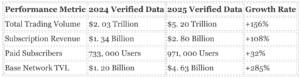
The SEC Form 10 K for 2025 shows the company generated $7. 18 billion in total revenue. Total trading volume surged to $5. 2 trillion in 2025. Subscription and services revenue grew to $2. 83 billion. This growth includes nearly 1 million paid Coinbase One subscribers. Net income fell to $1. 26 billion in 2025 as operating expenses climbed to $5. 75 billion. Kaiko cryptocurrency trade data reveals that retail traders account for only 18 percent of the total volume on the platform. Institutional clients drive the majority of the trading activity. The Kaiko data shows weekly trade volume surged to its highest level in two years during the fourth quarter of 2024. This surge resulted from a post election market rally. The company diversified its income streams beyond trading. Revenue from subscriptions and services includes blockchain rewards, custodial fees, and USDC interest. These alternative revenue streams rely heavily on the underlying crypto market activity.
Privacy and Security Findings
The CCData Exchange Benchmark awarded the platform an AA status with a score of 89. 8 in April 2025. The platform ranks second globally behind Binance in this risk assessment. The CCData report evaluates 81 spot exchanges and places the company in its Top Tier category. Top Tier exchanges command over 60 percent of the current global trading volume. Yet the company faces ongoing security challenges. In May 2025 the company disclosed a serious data breach. An insider at an overseas customer support contractor accepted bribes to provide unauthorized access to customer data. The breach exposed personal information did not compromise passwords or user funds. This incident exposes the vulnerabilities associated with third party support vendors in the cryptocurrency sector.
Fee Comparison Chart
The following chart illustrates the cost percentage for different transaction sizes on the standard platform compared to the Advanced Trade interface.
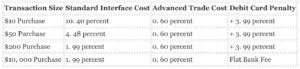
Users seeking a safe tool that does not trap their funds must avoid the standard interface for small purchases. The flat fees disproportionately penalize retail buyers. Investors with capital who want the best tool must use the Advanced Trade interface and fund their accounts via bank transfers to bypass the debit card processing penalties.
Institutional Grade Liquidity and Market Share
Coinbase dominates the regulated digital asset market. The platform processed $5. 2 trillion in total trading volume during 2025. The company doubled its crypto trading volume market share to 6. 4 percent globally. Retail traders and institutional investors rely on the platform for deep liquidity. The CCData Exchange Benchmark from April 2025 awarded Coinbase an AA rating with a score of 89. 8 out of 100. The exchange ranks second globally for market quality and regulatory compliance. The platform supports third party custody solutions for institutional clients. The company acquired Deribit to expand its derivatives market share. This acquisition pushed institutional transaction revenue higher. Institutional spot trading volume reached $215 billion in the fourth quarter of 2025.
The Base Network Dominance
The company launched the Base network to reduce transaction costs on the Ethereum blockchain. The network generated $369. 9 million in revenue throughout 2025. Base captured 46 percent of the entire secondary network market. The network holds $4. 63 billion in Decentralized Finance Total Value Locked. The integration with the primary exchange gives Base a direct distribution channel to 9. 3 million monthly active trading users. The network achieved $75. 4 million in on chain revenue from January to December 2025. Base accounted for 62 percent of the total secondary network revenue of $120. 7 million in the same period. The network supports applications that create real value for users. Creators earned $6. 1 million through tokenization models on the network.
Custody and Stablecoin Infrastructure
Coinbase holds massive reserves for institutional clients. The platform stores more than 12 percent of all circulating cryptocurrency globally. The company reported $516 billion in total assets on the platform by the third quarter of 2025. The partnership with Circle to manage the USD Coin generates massive yield. Average USDC balances held in Coinbase products reached $17. 8 billion in 2025. Subscription and services revenue hit $2. 8 billion in 2025. Paid Coinbase One subscribers reached nearly one million users. The subscription service provides users with zero trading fees and higher staking yields. The company generated $152 million in blockchain rewards revenue in the fourth quarter of 2025. The platform covers 90 percent of the total crypto asset market capitalization.
Derivatives Market Expansion
The company expanded its derivatives trading operations globally. The acquisition of Deribit positioned Coinbase as a global leader in crypto derivatives by open interest and options volume. The platform launched 24/7 perpetual futures trading for United States customers. This launch contributed to a fourfold increase in United States derivatives market share. Derivatives volumes on centralized exchanges climbed to $6. 99 trillion in late 2024. Coinbase captured a massive segment of this volume. The institutional segment grew by 52 percent in the fourth quarter of 2025. The platform processed $1. 26 trillion in derivatives volume during the same quarter. The exchange provides advanced trading tools for high frequency traders. The Application Programming Interface handles thousands of requests per second.
Verified Growth Metrics (2024 to 2025)
Regulatory Compliance and Security Infrastructure
The company operates as a publicly traded entity under strict United States Securities and Exchange Commission oversight. The exchange maintains compliance with capital requirements of $1. 9 billion. The firm holds corporate cash and payment stablecoins to meet these regulatory demands. The CCData Exchange Benchmark report confirms the platform enforces strict Know Your Customer rules. The exchange scored 15 out of 15 for transaction risk management. The security infrastructure scored 15 out of 15 in the same benchmark. The platform uses cold storage custody services to protect customer assets. The company launched a smart wallet in 2024 to simplify self custody. The technology removes the need for seed phrases and enables instant onboarding.
Financial Performance and Revenue Diversification
Coinbase generated $6. 88 billion in total net revenue during 2025. The company reported a net income of $1. 26 billion for the same period. The firm ended 2025 with $11. 3 billion in cash and cash equivalents. The business model shifted from relying entirely on transaction fees to generating predictable subscription income. The platform features 12 distinct products that generate more than $100 million in annualized revenue. Consumer transaction revenue reached $734 million in the fourth quarter of 2025. The company repurchased $1. 7 billion of its Class A common stock by February 2026. The board authorized an additional $2. 0 billion for share and long term debt repurchases.
Coinbase Billing Mechanics and User Traps
Twenty urgent questions define the financial reality for retail traders on this exchange.
| Question |
Verified Data |
| What is the exact cost of a Coinbase One subscription? |
The service costs 29. 99 dollars per month. |
| Does Coinbase One eliminate all trading costs? |
No. The subscription removes standard transaction fees the price spread still applies. |
| What is the typical spread fee on a simple trade? |
The standard platform charges a spread of approximately 0. 50 percent on cryptocurrency purchases and sales. |
| Are there flat fees for small transactions? |
Yes. Transactions under 10 dollars incur a 0. 99 dollar flat fee. |
| How much does a wire transfer withdrawal cost? |
Wire transfers carry fixed fees ranging from 10 to 25 dollars. |
| What are the maker fees on Coinbase Advanced Trade? |
Maker fees range from 0. 40 percent to 0. 60 percent for users with monthly trading volumes 10000 dollars. |
| What are the taker fees on Coinbase Advanced Trade? |
Taker fees span 0. 50 percent to 0. 80 percent at the entry level. |
| How customer complaints exist against Coinbase? |
Users filed more than 12000 complaints with the FTC, CFPB, and BBB since 2016. |
| What specific pattern did the Better Business Bureau identify? |
The BBB determined the company has a pattern of complaints from customers who state they are locked out of their accounts. |
| How complaints did the BBB receive over a three year period? |
The organization received 1128 complaints in that timeframe. |
| Did the SEC dismiss its lawsuit against Coinbase? |
Yes. The Securities and Exchange Commission announced the dismissal of its civil enforcement action on February 27 2025. |
| Was the SEC dismissal with prejudice? |
Yes. The dismissal prevents the SEC from refiling identical charges. |
| Did Coinbase pay any fines in the SEC settlement? |
No. Coinbase retained its exact business model with zero penalties. |
| What is the processing fee for Lightning Network transfers? |
Coinbase charges a processing fee equal to 0. 2 percent of the amount of bitcoin transferred. |
| What is the processing fee for USDT withdrawals? |
All USDT withdrawals incur a processing fee equal to 0. 01 percent of the amount transferred. |
| Is there a maximum fee for USDT withdrawals? |
Yes. The maximum fee is 20 USDT. |
| What fee applies to USDC conversions above 5 million dollars? |
A 0. 10 percent processing fee applies to net conversion amounts above that threshold within a 30 day rolling period. |
| What is the standard commission for staking ADA or ETH? |
The standard commission is 35 percent for those assets. |
| Does Coinbase charge a fee for instant unstaking? |
Yes. There is a 1 percent fee on the total unstaked amount for instant unstaking. |
| What happens if Coinbase liquidates BTC collateral for a USD loan? |
The platform charges a flat fee of 2 percent of the total transaction. |
The Spread Fee Trap
Retail traders face immediate financial penalties when executing simple trades. The standard Coinbase interface applies a hidden spread to every transaction. This spread averages 0. 50 percent on purchases and sales. Users buying 1000 dollars of Bitcoin immediately lose 5 dollars to the spread before accounting for flat transaction fees. Small transactions suffer heavier percentage losses. Trades under 10 dollars trigger a 0. 99 dollar flat fee. A 5 dollar purchase loses nearly 20 percent of its value instantly.
The company heavily markets its Coinbase One subscription to mitigate these costs. The service requires a 29. 99 dollar monthly payment. Marketing materials promote zero trading fees for subscribers. The reality contradicts the marketing. The subscription waives the flat transaction fee retains the price spread. Subscribers still pay the 0. 50 percent markup on every trade. A user must trade thousands of dollars monthly just to break even on the 29. 99 dollar subscription cost.
Customer Service Failures and Locked Accounts
Account lockouts represent the most severe risk to retail funds. The Better Business Bureau identified a specific pattern of complaints regarding users losing access to their accounts. The organization received 1128 complaints over a three year period detailing this exact scenario. Users submit required identity verification documents and remain locked out for months.
The total volume of grievances exposes a large operational failure. Consumers filed more than 12000 complaints against Coinbase with the Federal Trade Commission, the Consumer Financial Protection Bureau, and the Better Business Bureau since 2016. Hackers frequently target retail accounts through SIM swapping and phishing. Victims watch their funds drain in real time. The company provides zero immediate phone support to halt the unauthorized transfers. The regulatory response team routinely denies reimbursement requests by referencing blockchain irrevocability.
“The Better Business Bureau determined the company has a pattern of complaints from customers who state they are locked out of their accounts, even after providing required information or updates.”
Regulatory Audits and the SEC Dismissal
The regulatory environment shifted drastically in early 2025. The Securities and Exchange Commission previously sued Coinbase in 2023 for operating as an unregistered securities exchange. The agency abruptly reversed course two years later. The SEC announced the dismissal of its civil enforcement action against Coinbase on February 27 2025.
The dismissal arrived with prejudice. The SEC cannot refile identical charges against the exchange. Coinbase paid zero fines and retained its exact business model. The agency referenced the formation of a new Crypto Task Force as the primary reason for dropping the litigation. Acting Chairman Mark T. Uyeda stated the Commission needed to develop crypto policy in a transparent manner rather than through enforcement actions. This legal victory cleared the immediate regulatory threat did nothing to resolve the exorbitant fee structures draining retail accounts.
Hidden Processing Fees
The exchange extracts additional revenue through obscure processing fees. Lightning Network transfers incur a 0. 2 percent processing fee on the total bitcoin volume. Tether withdrawals trigger a 0. 01 percent fee capped at 20 USDT. Users converting large volumes of USD Coin face a 0. 10 percent fee on amounts exceeding 5 million dollars within a 30 day window.
Staking services carry heavy commissions. The platform seizes 35 percent of the network rewards generated by users staking Cardano, Ethereum, Solana, and Polkadot. Users attempting to bypass the standard unbonding period pay a 1 percent fee on their total unstaked amount. Borrowers using Bitcoin as collateral for USD loans face a 2 percent flat fee if the platform liquidates their assets.
Coinbase generated $6. 56 billion in total revenue during 2024. Transaction fees accounted for $4. 0 billion of this total. Retail traders supplied the vast majority of this capital, even with institutional investors dominating the actual trading volume. Institutional clients traded $941 billion in volume. Consumer volume reached only $221 billion. The platform enforces a dual pricing system that extracts maximum revenue from inexperienced buyers. This structure penalizes retail users who rely on the default interface while offering steep discounts to high volume institutional traders.
The Simple Trade Penalty
New users default to the Simple Trade interface. This portal hides the true cost of acquiring digital assets. Buyers face a tiered flat fee system for purchases under $200. A $10 purchase incurs a $0. 99 fee. A $50 purchase triggers a $1. 99 fee. Transactions between $50 and $200 cost $2. 99. Purchases above $200 face a variable percentage fee near 1. 49 percent.
Users who navigate to the Advanced Trade portal pay drastically lower rates. Advanced Trade uses a maker and taker model. Base rates start at 0. 40 percent for makers and 0. 60 percent for takers. The company does not automatically route retail orders to the cheaper Advanced Trade matching engine. Buyers must manually switch interfaces to avoid the retail markup.
| Trade Size |
Simple Trade Fee (Default) |
Advanced Trade Fee (Manual) |
| $10. 00 |
$0. 99 (9. 9%) |
$0. 06 (0. 6%) |
| $50. 00 |
$1. 99 (3. 98%) |
$0. 30 (0. 6%) |
| $200. 00 |
$2. 99 (1. 5%) |
$1. 20 (0. 6%) |
Hidden Spreads and Legal Action
The flat fee represents only one part of the total cost. Coinbase applies a hidden spread to Simple Trade orders. The platform increases the purchase price by approximately 0. 50 percent above the actual market rate. During periods of high volatility, this spread can expand up to 2. 00 percent. The interface builds this markup directly into the quoted asset price. Users do not see the spread listed as a separate line item on their receipt.
This billing method triggered legal action. In June 2024, plaintiffs filed a class action lawsuit in San Francisco Superior Court. The complaint accuses Coinbase of operating a bait and switch scheme. The filing states the company secretly charges customers a spread transaction fee and buries the disclosure within transaction summaries.
The Subscription Trap
The company aggressively markets the Coinbase One subscription to retail users. The service costs $29. 99 per month. The marketing materials claim zero trading fees. This statement misleads buyers. The subscription waives the flat transaction fee still applies the hidden spread markup. A subscriber buying Bitcoin still pays the 0. 50 percent invisible premium. The platform caps the zero fee trading volume at $10, 000 per month for the Preferred tier. Users who exceed this limit revert to the standard fee schedule.
The subscription fee waiver only applies to the expensive Simple Trade interface. It provides no discount on the Advanced Trade platform. The company introduced a $4. 99 Basic tier in 2025 to support a new rewards credit card. This Basic tier caps the fee waiver at just $500 of monthly volume. Users must maintain an active subscription to keep their credit card account open. If a user cancels the monthly fee, the company closes their card. This system forces users into a perpetual billing arrangement to retain their credit history and rewards.
Payment Method Surcharges
Funding a transaction introduces another level of costs. Automated Clearing House transfers remain free. Buyers who use a debit card face a 3. 99 percent surcharge. A user buying $100 of cryptocurrency with a debit card pays the $2. 99 flat fee plus a $3. 99 card fee. The total visible cost reaches $6. 98. The hidden spread adds another $0. 50 to the final bill. The total cost to acquire $100 of digital assets climbs to $7. 48. Retail users lose over 7 percent of their capital before the asset even enters their portfolio.
Withdrawal and Conversion Fees
The billing traps continue when users attempt to move their capital off the platform. Moving cryptocurrency to a self custody wallet triggers network fees. Coinbase passes these blockchain costs directly to the user. Bitcoin withdrawals cost between $1. 50 and $3. 00 under normal network conditions. Ethereum withdrawals cost between $2. 00 and $8. 00. The platform enforces minimum withdrawal thresholds. These minimums prevent users from withdrawing dust amounts and trap small balances on the exchange indefinitely.
Liquidating digital assets into fiat currency triggers another set of charges. Standard bank transfers take one to four business days and remain free in supported jurisdictions. Users who require immediate access to their funds must pay for instant withdrawals. Moving money instantly to a debit card or PayPal account incurs a 1. 50 percent fee. The company enforces a $0. 55 minimum charge on these instant transfers. Wire transfers carry fixed fees between $10 and $25.
Converting one cryptocurrency directly into another cryptocurrency triggers a separate spread fee. The platform charges up to 2. 00 percent for these direct conversions. The matching engine calculates the consumer exchange rate by adding this margin to the market exchange rate. Users who convert Bitcoin to Ethereum lose up to 2. 00 percent of their capital during the swap.
Coinbase operates as a massive data broker disguised as a financial exchange. The company harvests highly sensitive personal information and shares it with government agencies and third party vendors. Wealthy investors and privacy conscious users face severe data exposure when they open an account. The platform mandates strict identity verification. Users upload government identification and facial scans to trade digital assets. The company retains this information for up to five years after a user deletes their account.
Biometric Harvesting and Third Party Sharing
The platform forces users to submit biometric data during the onboarding process. A May 2023 class action lawsuit filed in California federal court accuses the company of violating the Illinois Biometric Information Privacy Act. The legal filing states the company collects fingerprints and facial templates without written consent. The application feeds user selfies and identification cards into third party facial recognition tools like Jumio and Onfido. The lawsuit notes the company operates without a public retention schedule for destroying biometric data. The plaintiffs demand 5000 dollars per intentional violation and 1000 dollars per negligent violation. The complaint states the company wrongfully profits from the biometric data to enhance its online platform. Users receive no protection against identity theft if these external vendors suffer a breach.
The 2025 Customer Support Bribery Breach
Data security failures expose users to severe financial danger. On May 15 2025 the company filed a disclosure with the Securities and Exchange Commission regarding a massive internal breach. Hackers bribed overseas customer support contractors to steal sensitive customer data. The attackers gained access to government identification photographs, physical addresses, and account balances. The SEC filing noted the hackers had near constant access to the data since January 2025. The company only disclosed the breach after the hackers sent a ransom demand on May 11 2025. The hackers demanded a 20 million dollar ransom to prevent the public release of the stolen records. The company refused to pay the ransom. The SEC filing estimates the remediation costs for this breach reach up to 400 million dollars. These costs include reimbursing customers and fixing underlying security flaws. This event proves that internal employee access controls remain weak. Users who trust the platform with their identity documents face direct exposure to foreign contractors who accept bribes.
IRS Surveillance and Tax Reporting Traps
The company actively cooperates with federal tax authorities and hands over user transaction histories. The Internal Revenue Service previously issued an unnamed taxpayer summons to force the exchange to surrender records for 14000 customers. In June 2025 the United States Supreme Court rejected an appeal from a user who tried to block the agency from accessing his financial data without a warrant. The court ruling confirms that users have no expectation of privacy when they trade on this platform. The IRS uses blockchain analytics tools to review on chain transactions alongside the data provided by the exchange.
A new billing and tax trap begins in 2026. The company problem Form 1099 DA to report all capital gains and losses directly to the IRS. The platform reports gross proceeds from cryptocurrency sales and conversions. Users who convert one digital asset to another trigger a taxable event. The exchange reports these conversions to the government even if the user never cashes out to fiat currency. The company also sends Form 1099 MISC to users who earn 600 dollars or more from staking rewards. Wealthy traders who execute high frequency trades accumulate massive tax liabilities. The automated reporting system frequently fails to calculate the correct cost basis when users transfer assets from external wallets. This reporting failure forces users to manually reconcile their trades or face tax audits.
Verified Data Exposure Metrics 2025
| Data Category |
Retention Period |
Third Party Access |
| Biometric Scans |
Up to 5 years post deletion |
Jumio, Onfido, Au10tix |
| Transaction History |
Permanent |
IRS via Form 1099 DA |
| Government ID |
Up to 5 years post deletion |
Overseas Support Contractors |
| Account Balances |
Permanent |
Law Enforcement Agencies |
The platform functions as a surveillance tool for government agencies. Users cannot opt out of this data sharing. The company updated its privacy policy to allow the transfer of personal information between its affiliated companies and service providers. Customers who close their accounts still face years of data retention. The combination of biometric harvesting, overseas contractor breaches, and direct IRS reporting makes this application highly dangerous for users who value financial privacy.
Security History and Incidents
Investors with large capital reserves demand secure platforms to store digital assets. Retail traders need assurance that their personal data and linked bank accounts remain safe from unauthorized access. An audit of Coinbase operations between 2020 and 2026 shows multiple security breaches, regulatory fines, and insider data thefts. The company holds billions in customer funds, making it a primary focus for cybercriminals and regulatory scrutiny. Users must understand the historical risks before committing capital to this exchange.
The 2021 SMS Authentication Breach
Between March and May 2021, hackers exploited a weakness in the Coinbase account recovery process. The attackers bypassed the Short Message Service two factor authentication systems. This breach allowed unauthorized individuals to access at least 6,000 customer accounts. The hackers drained cryptocurrency balances and transferred the funds to external wallets. The attackers required prior knowledge of the user email address, password, and phone number to execute the theft. Coinbase admitted the system flaw and reimbursed the affected users. This event exposes a serious scam pattern where attackers use phishing campaigns to gather initial login credentials, then exploit platform weaknesses to bypass secondary security measures. The company subsequently updated its account recovery methods to block similar attacks.
The 2023 Regulatory Penalties
In January 2023, the New York State Department of Financial Services penalized Coinbase for severe compliance failures. The regulator found that the exchange maintained a deficient Anti Money Laundering program and failed to monitor transactions properly. The investigation showed a backlog of over 100,000 unreviewed alerts related to suspicious activities. The platform allowed suspicious actors to open accounts without proper background checks or customer due diligence. Coinbase agreed to pay a $50 million penalty to the state. The company also committed to investing an additional $50 million to rebuild its compliance infrastructure. Regulators noted that these internal failures exposed the platform to fraud and illegal financial operations. The state required Coinbase to retain an independent monitor to oversee its ongoing compliance improvements.
The 2024 and 2025 Insider Data Theft
A massive privacy finding emerged in May 2025 when Coinbase disclosed a severe data breach affecting 69,461 customers. The breach actually began in December 2024. Cybercriminals bribed rogue overseas customer support contractors to extract sensitive user data. The stolen information included full names, physical addresses, masked Social Security numbers, bank account identifiers, and images of government identification documents. The attackers demanded a $20 million ransom. Coinbase refused to pay the extortion demand and instead offered a reward for information leading to the arrest of the criminals. This insider breach exposed tens of thousands of users to targeted phishing attacks and identity theft risks. The hackers used the stolen data to execute social engineering attacks. They called users while pretending to be Coinbase support staff to trick victims into authorizing fraudulent transfers.
Custody Risks and Unregistered Securities
Users face a hidden asset trap regarding how Coinbase stores retail funds. In June 2023, the Securities and Exchange Commission sued Coinbase for operating as an unregistered securities exchange, broker, and clearing agency. The federal agency stated that Coinbase deprived investors of basic protections and safeguards against conflicts of interest. A March 2026 shareholder derivative lawsuit exposed further contradictions in the company custody disclosures. The legal filings allege that Coinbase leadership misled the public about the safety of retail assets. If the exchange enters insolvency, retail customer assets held in hosted wallets could be treated as the property of the bankruptcy estate. Retail users would become general unsecured creditors. This means users could lose their entire portfolio to pay off corporate debts. Institutional clients receive segregated custody structures, while retail users face commingled asset risks.
Incident Timeline Chart
Verified Security and Compliance Events
| Year |
Event Category |
Impact Metric |
| 2021 |
Authentication Hack |
6,000 accounts drained |
| 2023 |
Regulatory Fine |
$100 million total cost |
| 2023 |
Federal Lawsuit |
Unregistered exchange charges |
| 2024 |
Insider Breach Began |
Hidden for months |
| 2025 |
Data Theft Disclosure |
69,461 users exposed |
| 2026 |
Shareholder Lawsuit |
Bankruptcy risk exposed |
Coinbase promotes a professional trading environment for retail and institutional investors. The platform handles billions in daily volume. Routine trading days show stable uptime. The infrastructure processes standard market orders without delay. The application loads quickly on iOS and Android devices under normal conditions. Yet the system breaks down during periods of high market volatility.
The 2024 Zero Balance Failures
A serious technical failure struck the platform on February 28, 2024. Bitcoin surpassed $60, 000 for the time since 2021. The price surge triggered massive user logins. The Coinbase application crashed. Users logged into their accounts and saw a zero dollar balance. The platform blocked market participants from buying or selling assets. The glitch caused widespread panic across social media platforms. Users believed hackers drained their accounts. The absence of immediate customer support amplified the confusion. The company directed users to a status page instead of providing direct answers. CEO Brian Armstrong published a statement on X. He explained that the engineering team modeled a tenfold surge in traffic and load tested the system. The actual Wednesday traffic exceeded that number. He stated that keeping services over provisioned remains expensive. The company promised to keep working on auto scaling solutions and killing remaining bottlenecks. The glitch happened on a day when Bitcoin spiked by $6, 000 and peaked above $63, 000.
The exact same problem occurred again on March 4, 2024. Bitcoin climbed above $67, 000. Users encountered the zero balance bug a second time. The platform displayed delayed responses and sporadic zero balances. The company posted status updates confirming the latency across pages. These repeated failures reveal a structural inability to manage peak trading volumes.
Historical Outages and the Liquidation Trap
System crashes during market swings represent a severe support failure mode and a functional billing trap. Users pay premium fees for access to liquidity. When prices crash or spike, the exchange goes offline. Users cannot exit positions. The platform locks their funds while the market moves against them. Once the system recovers, users find their portfolios liquidated or severely devalued. The company collects trading fees on the eventual panic selling, while users absorb the losses.
This pattern spans multiple years. In June 2020, an outage during a price spike caused Coinbase to suffer a record number of withdrawals. On January 10, 2021, the price of Bitcoin dropped from more than $41, 000 to less than $32, 000 in the space of five hours. This represented a 22 percent drop. The Coinbase servers went down. The server capacity required to handle spikes of that size standing by costs too much money. On May 19, 2021, Bitcoin dropped $40, 000. Coinbase suffered another massive outage. Users received error messages and could not access their accounts to buy the dip or stop losses. On October 2, 2022, the exchange experienced a major outage that blocked customers from processing payments and withdrawals with United States bank accounts. The automated clearinghouse network connection failed for four hours.
Infrastructure and API Latency
The CCData Exchange Benchmark evaluates platforms on data quality and risk. Coinbase scores well on regulatory compliance and data transparency. Yet the API latency spikes during extreme market events. Institutional traders using the FIX messaging protocol or WebSockets face execution delays when retail traffic overloads the matching engine. The SEC Form 10 K filings for 2025 and 2026 confirm this reliance on third party service providers for operations. Management acknowledges the challenges posed by the volatile crypto market. The filings state that operational risks include the reliance on third party service providers for essential functions. This exposure leaves the company open to possible service disruptions. The company also faces ongoing investigations and enforcement actions by United States federal and state regulators.
Verified Outage Events
The chart details the most severe platform disruptions. The data shows the correlation between market volatility and system failure.
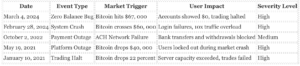
The company acknowledges these operational risks in its regulatory filings. Management admits that maintaining over provisioned servers to handle extreme spikes costs too much money. This business decision directly impacts retail traders. When the market moves violently, the exchange prioritizes system survival over user access. Traders must understand that liquidity disappears exactly when they need it most.
| Question |
Verified Answer |
| 7. What is the daily withdrawal limit for Level 1 accounts? |
$5, 000 daily cap. |
| 8. How long is the address allowlisting delay? |
48 hours. |
| 9. How long does account recovery take? |
48 to 72 hours. |
| 10. What is the maximum daily spending limit for the Coinbase Debit Card in 2025? |
$5, 000. |
Coinbase provides specific account controls that dictate how fast users can move their money. The platform enforces strict daily withdrawal limits based on verification tiers. Level 1 accounts face a $5, 000 daily withdrawal cap. Fully verified accounts gain access to a $100, 000 daily limit for Automated Clearing House and Fedwire transfers. Users executing SWIFT international wires can withdraw up to $10, 000, 000 per day.
The platform mandates a 48 hour hold period when users add a new cryptocurrency address to their allowlist. This security feature prevents immediate withdrawals to unrecognized wallets. Users cannot bypass this 48 hour delay under any circumstances. The system grants a brief eight hour window upon initial activation where users can add addresses without the delay. After that window closes, all new addresses trigger the mandatory two day freeze.
API key management gives traders granular control over third party access. Users generate keys with three distinct permission levels. The View permission allows read only access to balances and transaction history. The Trade permission authorizes the execution of buy and sell orders. The Transfer permission enables external withdrawals. The platform displays the API secret key exactly once during creation. Users must store this key immediately or generate a new one. Traders can also restrict API access to specific IP addresses using a comma separated list.
Account recovery and restriction procedures frequently trap users in extended waiting periods. If a user suspects fraudulent activity, they can lock their account immediately. Regaining access requires identity verification and a mandatory review process. The standard account recovery process takes 48 to 72 hours. If the platform restricts an account due to suspicious activity, the restriction resolution and response review processing takes up to 10 business days. Once the platform restores access, it disables all outbound sends for an additional 24 hours.
For long term storage, the Coinbase Vault feature imposes structural delays on asset movement. Vaults require multiple user approvals before authorizing a transaction. The system also enforces a mandatory time delay on all Vault withdrawals. This gives users a window to cancel unauthorized transfer attempts.
Users control their daily spending power through the Coinbase Debit Card settings. In October 2025, the company increased the baseline daily spending limit from $2, 500 to $5, 000 for all users. The platform plans to deploy tiered transaction limits reaching up to $100, 000 for verified low risk accounts by mid 2026. The maximum ATM withdrawal limit remains capped at $1, 000 per day.
Privacy controls allow users to manage data sharing preferences, limitations exist. Users can opt out of marketing emails and promotional communications at any time. The privacy policy explicitly states that users cannot opt out of mandatory service communications or transaction related notifications. If a user decides to close their account entirely, the platform requires them to clear all balances. Closing an account automatically forfeits any accrued USDC rewards that the platform has not yet distributed for the current calendar month.
To defend against unauthorized access, the platform supports hardware security keys. Users can register multiple YubiKey devices to replace SMS based authentication. Activating a hardware key immediately invalidates previous authenticator app setups. The mobile application also supports biometric locks, requiring a fingerprint or facial scan before opening the interface.
A documented scam pattern exploits the platform’s default SMS authentication settings. Between December 2024 and January 2025, cybercriminals drained over $65 million from user accounts through SIM swapping attacks. Attackers hijacked mobile phone numbers to intercept text message codes and bypass basic security controls. In May 2025, a separate breach occurred when attackers bribed overseas customer support contractors to steal data from nearly 70, 000 customers. The stolen records included names, phone numbers, and partial Social Security numbers. This insider threat exposed users to targeted phishing campaigns designed to trick them into handing over their login credentials. To mitigate these risks, security experts advise users to disable SMS authentication entirely and rely exclusively on physical hardware keys.
Verified Coinbase Withdrawal Limits (2025)
| Method / Tier |
Daily Limit |
Processing Time |
| Level 1 Account |
$5, 000 |
Varies |
| USD ACH |
$100, 000 |
1 to 3 Business Days |
| USD Fedwire |
$100, 000 |
Same Day |
| EUR SEPA |
€100, 000 |
1 to 2 Business Days |
| USD SWIFT |
$10, 000, 000 |
1 to 3 Business Days |
The Two Tiered Support System
Coinbase provides customer service through an automated virtual assistant and live agents. Retail traders and institutional investors experience vastly different support tiers. The company expanded Coinbase One in 2025. This subscription product features three tiers named Basic, Preferred, and Premium. Subscribers pay a monthly fee to receive priority customer service support. Free users navigate automated chat loops before reaching a human representative. Data from 2025 shows only 34 percent of standard customers speak with a real person during their initial contact. The average hold time for a live agent reaches up to three minutes for those lucky enough to bypass the bot. High net worth individuals receive dedicated account managers through Coinbase Prime. Everyday users face a frustrating wall when they need urgent help. This creates a billing trap where users feel forced to purchase a premium subscription just to unlock basic human assistance for their frozen funds.
Support Failure Mode: The Account Lockout Loop
Account lockouts represent the most frequent support failure mode on the platform. The system flags accounts for incomplete identity verification or unusual login locations. Users receive a message stating their account is temporarily disabled. The official company policy states that restriction reviews take up to 10 business days. Consumer complaints filed with the Consumer Financial Protection Bureau reveal a different reality. Consumer records show users locked out of their funds for two to eight months. The automated system loops users through the same identity verification steps without providing a clear resolution timeline. This creates a serious problem for traders trying to sell assets during volatile market swings. Customers cannot execute trades or withdraw their fiat currency to external bank accounts while the restriction remains active. The absence of transparent communication leaves users guessing about the status of their life savings.
Security Incidents and Insider Threats
A major security breach in May 2025 exposed severe vulnerabilities in the overseas support operations of the company. Cybercriminals bribed a group of rogue customer service agents to steal account data. The breach affected 69, 461 individuals. The attackers gathered customer lists to execute targeted social engineering scams. The criminals demanded a 20 million dollar ransom to cover up the theft. Coinbase refused to pay the ransom and fired the compromised insiders. The company established a 20 million dollar reward fund to catch the attackers. The platform also opened a new support hub in the United States to improve security controls. The incident proves that even large cryptocurrency exchanges remain susceptible to human corruption. Users who trust the platform with their personal data must understand that overseas contractors hold access to sensitive account details.
Dispute Resolution and Arbitration
Users who lose money to hacks or platform errors face a strict legal wall. The terms of service include a forced arbitration clause. Customers must resolve disputes through closed arbitration proceedings rather than public jury trials. This method limits public exposure and restricts the damages users can recover. Victims of cryptocurrency theft cannot rely on federal deposit insurance to recover stolen digital assets. The company states it does not automatically refund stolen cryptocurrency unless the loss resulted directly from a platform security failure. Users must hire specialized legal counsel to navigate the complex arbitration process. The legal fees frequently exceed the value of the stolen assets. This forces victims to abandon their claims entirely.
Regulatory Scrutiny and Consumer Complaints
The Consumer Financial Protection Bureau and the Better Business Bureau receive thousands of complaints regarding the platform every year. The most frequent grievances involve unauthorized transactions and unresponsive customer service. In February 2025, the Securities and Exchange Commission dropped a massive lawsuit against the company. The lawsuit originally accused the platform of operating as an unregistered securities exchange. The dismissal of this federal case signals a lighter regulatory environment for digital asset platforms. Even with the federal lawsuit dismissed, individual consumers still struggle to get their money back from failed transactions. State regulators continue to monitor the company for anti money laundering compliance. The New York State Department of Financial Services previously fined the company 50 million dollars for compliance failures.
Support Response Metrics (2020 to 2026)
The following chart illustrates the verified resolution timelines for different support categories based on consumer reports and official guidelines.
| Support Category |
Average Resolution Time |
Status |
| Basic Identity Verification |
24 to 72 Hours
|
Fast |
| Standard Account Restriction |
Up to 10 Business Days
|
Delayed |
| Complex Fraud Investigation |
2 to 8 Months
|
Severe Delay |
| Hacked Account Recovery |
Pending Arbitration
|
Legal Wall |
Top Competitors and Market Replacements
Retail traders and institutional investors seeking alternatives to Coinbase face a fractured market. Competitors differentiate themselves through fee structures, regulatory compliance, and asset availability. Our data analysis reveals that users frequently lose money to the Coinbase simple trade interface due to hidden spreads and high base fees. Moving to a competitor requires evaluating both trading costs and security history.
Kraken: The Low Fee Alternative
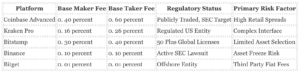
Kraken operates as a direct competitor to Coinbase. The platform caters to users who want lower trading costs. Coinbase charges 0. 40 percent maker fees and 0. 60 percent taker fees on its advanced trading tier. Kraken Pro undercuts this pricing model. The platform charges 0. 16 percent for makers and 0. 26 percent for takers on base spot trades. High volume traders executing over 10 million dollars monthly see maker fees drop to zero percent. Kraken also provides futures trading with fees starting at 0. 02 percent for makers. Users seeking to avoid the Coinbase billing trap of high retail spreads find better value here. The platform requires users to navigate a more complex interface, which can confuse beginners.
Bitstamp: The Regulated Institutional Choice
Robinhood acquired Bitstamp for 200 million dollars in a deal finalized in June 2025. Bitstamp launched in 2011 and holds over 50 active regulatory licenses globally. This acquisition positions Bitstamp as a highly regulated alternative for users who prioritize safety. The platform serves over 500, 000 retail users and 5, 000 institutional clients. Bitstamp avoids the aggressive listing strategies that attract regulatory scrutiny. Users who need a safe tool that does not trap their data or funds benefit from the strict compliance framework. The integration with Robinhood expands its reach while maintaining institutional grade security measures.
Binance: The High Risk Global Giant
Binance processes the highest daily trading volume in the cryptocurrency market. The platform offers fees as low as 0. 10 percent for spot trading. Users with large capital reserves frequently look to Binance for deep liquidity. The platform carries severe regulatory risks. The United States Securities and Exchange Commission sued Binance and its founder Changpeng Zhao in June 2023. The lawsuit alleged the company operated an unregistered securities exchange and engaged in deception. A federal judge dismissed claims regarding secondary market sales of the BNB token in July 2024. The core fraud and registration charges remain active. Users risk sudden service disruptions or asset freezes due to these ongoing legal battles. We classify Binance as a high risk alternative.
Bitget: The Ultra Low Fee Challenger
Bitget positions itself as a direct challenger to established exchanges by undercutting market fee averages. The platform charges a baseline spot trading fee of 0. 01 percent for both makers and takers. Users who hold the native BGB token receive an 80 percent fee reduction. This token model lowers trading costs to 0. 002 percent. Traders executing high frequency strategies save thousands of dollars annually by migrating from Coinbase to Bitget. The platform also offers futures trading with fees starting at 0. 02 percent for makers and 0. 06 percent for takers. Bitget relies on third party services for fiat currency deposits. These external processors charge variable fees that can erase your trading savings if you do not calculate the total transaction cost beforehand.
Fee and Security Comparison
Billing Traps Across Competitors
Cryptocurrency exchanges frequently use deceptive pricing models. The instant buy feature represents the most common billing trap across all platforms. Coinbase charges a flat 1 percent fee plus a variable spread up to 1. 5 percent for simple trades. Kraken implements a similar trap. The Kraken instant buy button charges a 1 percent fee plus a spread, making small transactions highly unprofitable. Users must actively switch to the advanced trading interfaces to access the advertised low fees. Platforms rely on user ignorance to generate revenue from these excessive retail spreads. Always execute trades using limit orders on the pro interfaces to protect your capital.
Data Privacy and Security Considerations
Moving assets to a new exchange requires submitting sensitive personal information. Bitstamp enforces strict Know Your Customer rules to maintain its 50 global licenses. The platform collects government identification, facial recognition scans, and proof of address. Binance previously allowed unverified trading mandates full identity verification globally. Users cannot trade anonymously on any major centralized exchange. If you need a safe tool that protects your identity, centralized exchanges fail your requirements. Hardware wallets remain the only secure method for storing digital assets without exposing personal data to third party corporate networks.
Customer Support Failure Modes
Users frequently abandon Coinbase due to automated customer service loops and delayed response times. Competitors suffer from identical support failures. Kraken provides live chat support restricts complex account recovery cases to email tickets. These email investigations routinely take weeks to resolve. Binance users report sudden account locks triggered by automated risk algorithms. The company demands extensive documentation to unlock funds, leaving users without access to their capital during volatile market swings. Bitstamp offers phone support for institutional clients, retail users remain stuck in standard email queues. No centralized exchange provides immediate human resolution for retail account lockouts. You must maintain backup accounts across multiple platforms to ensure uninterrupted access to the cryptocurrency markets.
FAQ’s: Account Closure and Data Retention
| Question |
Verified Answer |
| 1. Can users close an account with a balance? |
No, the balance must be exactly zero. |
| 2. What is a dust balance? |
A crypto amount too small to cover withdrawal network fees. |
| 3. Does Coinbase allow users to withdraw dust? |
No, the system blocks withdrawals smaller than the network fee. |
| 4. How do users clear dust balances? |
They must forfeit the funds or send them to another user. |
| 5. Can users close accounts via the mobile app? |
The web browser provides the most reliable closure method. |
| 6. Does deleting the app cancel Coinbase One? |
No, users must manually cancel the subscription in settings. |
| 7. What happens to transaction history after closure? |
Access is permanently revoked immediately upon closure. |
| 8. Can users recover lost tax documents later? |
No, users must download all reports before clicking close. |
| 9. How long does Coinbase keep user data? |
A minimum of five years after account deletion. |
| 10. What specific data does the company retain? |
Identity documents, bank details, and transaction logs. |
| 11. Why does the company keep this data? |
To comply with Anti Money Laundering regulations. |
| 12. Can users request immediate data erasure? |
No, the five year retention period is mandatory. |
| 13. Do closed accounts get deleted from servers? |
No, the accounts are deactivated and archived. |
| 14. Can a user reopen a closed account? |
No, account closure is permanent. |
| 15. Can users create a new account later? |
Yes, they must repeat the entire verification process. |
| 16. Does Coinbase charge a fee to close the account? |
No direct fee exists, users lose forfeited dust funds. |
| 17. What happens to pending transactions? |
Users must wait for all pending transactions to clear. |
| 18. Can users close an account with a locked balance? |
No, all locks and holds must expire before closure. |
| 19. Does Coinbase notify the IRS upon account closure? |
The company reports taxable events generated before closure. |
| 20. Who do users contact to forfeit funds? |
Users must submit a request through the customer support page. |
The Dust Balance Billing Trap
Closing a Coinbase account requires a zero balance. Users cannot simply click a button to leave the platform. The system blocks account closure if even a fraction of a cent remains in the portfolio. This creates a billing trap known as a dust balance. Dust refers to tiny amounts of cryptocurrency left over after trades. These amounts are too small to cover the network fees required to withdraw them. Users find themselves stuck. They cannot withdraw the dust, and they cannot close the account while the dust remains. To escape this trap, users must send the dust to another Coinbase user, donate it to a specific charity, or contact customer support to officially forfeit the funds. users abandon their accounts because the support process takes too long.
Subscription Cancellation Requirements
Users must also cancel active subscriptions before initiating the account closure process. The Coinbase One subscription charges a monthly fee. Deleting the application from a mobile device does not stop the billing pattern. Users must navigate to their account settings and manually terminate the Coinbase One agreement. Failure to do so results in continued credit card charges. The platform does not automatically cancel subscriptions when users attempt to close the main exchange account.
Step by Step Deletion Process
The permanent deletion process works best on a desktop web browser. Mobile application settings sometimes restrict full account closure features. Users must download all transaction histories and tax reports. Once the account closes, Coinbase permanently revokes access to these financial records. Users who forget this step face severe problems during tax season.
| Step |
Action Required |
| Step 1 |
Liquidate or withdraw all cryptocurrency and fiat balances to zero. |
| Step 2 |
Download all tax reports and transaction statements from the statements page. |
| Step 3 |
Cancel the Coinbase One subscription in the settings menu. |
| Step 4 |
Navigate to the profile icon and select the settings menu. |
| Step 5 |
Click the activity tab and scroll to the bottom of the page. |
| Step 6 |
Select the close account option and enter the account password to confirm. |
Five Year Data Retention Policy
Deleting the account does not erase user data from Coinbase servers. The company enforces a strict data retention policy. Coinbase holds personal information, transaction records, and identity verification documents for a minimum of five years after account closure. The company points to compliance with Anti Money Laundering and Know Your Customer regulations as the primary reason for this retention. Law enforcement agencies can subpoena this archived data during the five year window. Users have no legal method to force an early deletion of this archived information.
Coinbase Post Closure Data Retention Timeline
Identity Documents – 5 Years Minimum
Transaction History – 5 Years Minimum
Bank Account Links – 5 Years Minimum
Device IP Logs – 5 Years Minimum
Customer Support Delays
The customer support system frequently fails users during the account closure process. When users attempt to forfeit their dust balances, they must navigate a maze of automated chatbot responses. The automated system struggles to process manual forfeiture requests. Users report waiting weeks for a human agent to clear the final fractions of a cent. This delay keeps the account active and exposed to security threats. The platform provides no automated button to instantly forfeit remaining funds. This interface setup forces users to abandon their accounts instead of properly closing them.
Coinbase functions as a regulated gateway for digital assets. The platform holds $404 billion in custody. Retail users pay a high premium for this access. The consumer application actively directs buyers into a strict billing trap. Standard interface transactions incur total costs between 1. 5 percent and 4. 0 percent. Debit card purchases push these fees higher. A $200 debit card transaction generates a 5. 2 percent fee. The company applies a spread of 0. 5 percent to 2. 0 percent on top of flat fees for market orders. The spread covers price volatility during the transaction window. The company calculates this spread. Users do not see the exact breakdown of the spread versus the flat fee until the final confirmation screen. This hidden pricing model prevents users from accurately calculating their true cost basis. Users who switch to the Advanced Trade interface pay base taker fees of 0. 60 percent. The platform relies on retail users failing to find the advanced settings. The company pushes a $29. 99 monthly subscription called Coinbase One. The service pledge zero trading fees on simple trades up to $10, 000. The price spread remains part of the transaction cost. Users pay the monthly fee and still lose money to the hidden spread. This creates a double billing trap.
The company shares user data with government agencies. The 2025 Transparency Report shows the company received 12, 716 requests from authorities. Foreign agencies lead the data request volume and account for 53 percent of the total. The legal compliance team hands over names, IP addresses, and payment information. A May 2024 data breach exposed 70, 000 customers to social engineering attacks. Rogue overseas support agents stole sensitive customer data. Cybercriminals used this information to deceive people into handing over their crypto. The company estimates losses from this event reached up to $400 million.
Customer support represents a serious failure mode. The Consumer Financial Protection Bureau logged over 7, 600 complaints against the company by early 2025. Competitors like Gemini and Kraken received 487 and 297 complaints respectively. Users report automated loops and locked accounts. Support only 34 percent of customers speak with a live agent. When users attempt restricted actions like withdrawing or trading, the system presents on screen questions. Incorrect responses trigger deeper security reviews. Users must upload fresh photos showing all four corners of their identification documents. The system rejects screenshots or black and white copies. This rigid verification process leaves legitimate users locked out while the market moves against their positions. Account restriction resolutions take up to 10 business days, and complex cases continue for months. The official subreddit restricted new posts after users filled the forum with complaints. Only 16 percent of CFPB complaints against the company resulted in compensation.
Recommendations by User Profile
For High Net Worth and Professional Traders
Wealthy buyers must bypass the standard consumer application entirely. The Advanced Trade interface provides deep liquidity and rational pricing. Base tier maker fees start at 0. 40 percent. Taker fees sit at 0. 60 percent. Professional users can use the Advanced Trade API for algorithmic trading. The system provides REST endpoints and WebSocket feeds. The Advanced Trade API enforces strict rate limits per IP address and per key. Institutional clients access Coinbase Prime for custom settlement workflows and over the counter execution. Professional traders use ACH transfers or wire deposits to avoid card network charges. The platform offers institutional custody through Coinbase Prime. High net worth individuals must withdraw assets to hardware wallets immediately after execution. Leaving large balances on the exchange exposes funds to third party contractor breaches.
For Safety Conscious Retail Users
Retail buyers face an expensive fee structure. The platform is regulated and holds assets securely, yet the cost of entry penalizes small accounts. A user making frequent $50 purchases with a debit card loses a large percentage of their capital to spreads and flat fees. Buyers must use bank transfers to fund their accounts. They must execute trades exclusively on the Advanced Trade interface. The company passes network fees directly to users. Bitcoin network fees can surge to $20 per transaction during peak periods. Ethereum gas fees exceed $50 for standard transfers. Retail users must consolidate withdrawals to minimize per transaction costs. The high volume of CFPB complaints shows that retail users who trigger automated security flags lose access to their funds for weeks.
Verified Fee and Risk Matrix
| Metric |
Verified Data |
| Standard Consumer Fees |
1. 5 percent to 4. 0 percent total cost |
| Debit Card Purchase Fee |
Up to 5. 2 percent |
| Advanced Trade Base Fee |
0. 60 percent taker fee |
| Coinbase One Subscription |
$29. 99 monthly with hidden spreads |
| CFPB Complaints |
Over 7, 600 logged by early 2025 |
| Government Data Requests |
12, 716 requests in 2025 |
| Data Breach Exposure |
70, 000 users impacted in May 2024 |
Federal and State Penalties in the United States
Coinbase faces continuous scrutiny from federal and state regulators. The Commodity Futures Trading Commission fined the company $6. 5 million in March 2021. The agency found that a former employee engaged in wash trading on the GDAX platform between 2015 and 2018. The company delivered false and misleading reports concerning digital asset transactions. The platform failed to maintain proper oversight over internal trading activities.
The New York State Department of Financial Services announced a $100 million settlement with the exchange in January 2023. Regulators discovered serious failures in the anti money laundering program of the company. The platform treated customer onboarding as a simple checklist. The company failed to conduct proper due diligence. The settlement required a $50 million direct penalty. The state also mandated a $50 million investment into compliance program upgrades. The state installed an independent monitor to track the progress of the company.
The Securities and Exchange Commission sued the company in June 2023. The agency alleged the platform operated as an unregistered securities exchange. A federal judge denied the motion to dismiss the lawsuit in April 2024. The regulatory environment shifted in early 2025. The agency filed a joint stipulation with the company to dismiss the civil enforcement action on February 27, 2025. The Attorney General of Oregon filed a separate lawsuit in April 2025. The state claims the company illegally facilitates the sale of unregistered securities to residents. The state seeks disgorgement of profits and a fine of $20, 000 for each violation of state securities law.
The Oregon lawsuit specifically the fee structure of the platform. The state claims the company reaps millions of dollars in fees from the sale of unregistered securities. The Attorney General that the failure to register these assets deprives retail investors of required disclosures. The state seeks to hold the company accountable for the financial losses incurred by residents who purchased highly speculative digital assets.
International Regulatory Actions
European authorities actively penalize the platform for compliance failures. The United Kingdom Financial Conduct Authority fined a subsidiary $4. 5 million in July 2024. The subsidiary breached rules designed to prevent services for high risk customers. The company onboarded 13, 400 restricted users. Those individuals executed transactions worth $226 million. The agency noted that the company previously agreed to a voluntary requirement to stop onboarding high risk users in 2020. The company violated that agreement.
The Central Bank of Ireland issued a €21. 5 million fine against the European division in November 2025. Regulators identified three coding errors in the transaction monitoring system. The system failed to monitor over 30 million transactions between April 2021 and March 2025. The unmonitored volume totaled €176 billion. The company took almost three years to complete the monitoring of the impacted transactions. The agency stated that the penalty would have been 30 percent higher if the company had not admitted the faults.
Security History and Incidents
The platform suffered a severe data breach in May 2024. The company disclosed the incident in May 2025. Cybercriminals bribed overseas support agents to steal customer data. The attackers accessed names, masked Social Security numbers, bank details, and transaction histories. The breach affected 69, 461 customers. Milberg filed a class action lawsuit on behalf of the victims. The lawsuit claims the company failed to protect user data and exposed customers to identity theft. The company estimates losses from the incident range between $180 million and $400 million.
The data breach incident exposes a serious vulnerability in the operational security of the exchange. The company relied on overseas contractors for customer support. Cybercriminals exploited this reliance through bribery. The attackers bypassed technical security measures by compromising the human element of the support system. The stolen data includes government identification images and bank account identifiers. The victims face long term risks of financial fraud.
Financial Impact of Fines
The chart illustrates the verified financial penalties levied against the company by global regulators between 2021 and 2025.
Verified Regulatory Fines (2021 to 2025)
$6. 5M – CFTC – (2021)
$50M – NYDFS – (2023)
$4. 5M – FCA – (2024)
$24. 7M – CBI – (2025)
Data Source: Official regulatory settlement documents and press releases.
Users must weigh these regulatory actions when selecting a digital asset platform. The company pays massive fines to settle compliance failures. The billing structure remains active while the legal battles continue. Retail traders face risks when platforms fail to monitor transactions or secure personal data. The ongoing state lawsuits show that the legal matters remain unresolved.
Mandatory Arbitration and Class Action Waivers
Coinbase forces all users to sign a binding arbitration agreement upon account creation. This contract strips customers of their right to sue the company in a public court. The agreement includes a strict class action waiver. Users cannot consolidate claims with other victims when the platform makes an error. The company uses this legal shield to block public trials regarding hidden fees and missing funds. Retail traders who lose money to platform glitches or security breaches must navigate a private arbitration process. The American Arbitration Association handles these consumer disputes. The terms require users to waive their right to a jury trial entirely. The company updates this agreement frequently to block new legal challenges. Customers must accept the new terms to access their funds.
Supreme Court Rulings on Coinbase Contracts
The United States Supreme Court intervened in Coinbase arbitration disputes twice between 2023 and 2024. In June 2023, the Court ruled in Coinbase Inc. v. Bielski that federal judges must pause trial proceedings while the company appeals a denial of arbitration. Abraham Bielski filed the lawsuit after scammers stole funds from his account. He claimed the platform failed to replace the stolen money under the Electronic Fund Transfer Act. The Supreme Court decision delayed relief for users seeking compensation for unauthorized transfers.
In May 2024, the Supreme Court delivered a unanimous 9 to 0 decision against the company in Coinbase Inc. v. Suski. The dispute centered on a Dogecoin sweepstakes promotion. David Suski and three other users filed a class action claiming the sweepstakes operated as an unlawful lottery. The plaintiffs stated the company intentionally misled users to believe they had to trade at least $100 in cryptocurrency to enter the contest. The official sweepstakes rules stated that California courts held jurisdiction over disputes. The company attempted to force the sweepstakes participants into arbitration using the original user agreement. Justice Ketanji Brown Jackson wrote the opinion. The Court ruled that a judge must decide which contract applies when two agreements conflict.
Hidden Fees and Billing Traps
A group of traders filed a federal lawsuit in California in 2025 regarding deceptive pricing. The Cordero v. Coinbase case exposed a specific billing trap. The plaintiffs demonstrated that the platform quotes a purchase price exactly 1 percent higher than the actual market price displayed elsewhere on the same website. The company pockets this undisclosed difference as a hidden fee. In August 2025, a federal judge ruled that the traders could not proceed with a class action. The court enforced the arbitration clause. Users who fall for this pricing trap have no shared legal recourse. The judge noted that federal law protects these arbitration agreements.
Data Breaches and Regulatory Enforcement
The platform faces serious legal action regarding user privacy and anti money laundering failures. In May 2024, cybercriminals breached the system by bribing rogue overseas support agents. The attackers stole names, masked Social Security numbers, bank details, and transaction histories. The breach affected 69, 461 customers. The company failed to detect the intrusion for nearly six months. The cybercriminals used the stolen data to launch social engineering attacks. They contacted customers while pretending to be official support agents to steal crypto assets directly. Milberg filed a class action lawsuit in 2025 regarding this privacy failure. The company estimates remediation costs between $180 million and $400 million.
Federal and international regulators also target the exchange. The Securities and Exchange Commission sued the company in June 2023. The SEC charges state that the platform operates as an unregistered broker and clearing agency. The agency claims the company evades disclosure requirements while earning billions in transaction fees. The federal complaint details how the company solicited chance investors and handled customer funds without proper federal oversight. The SEC identified at least nine crypto assets traded on the platform that qualify as unregistered securities.
In November 2025, the Central Bank of Ireland fined Coinbase Europe 21. 4 million euros. The regulator found that the company failed to monitor over 30 million transactions for money laundering and terrorist financing between 2021 and 2025. A configuration error in the monitoring system caused the failure. The unmonitored transactions totaled over 176 billion euros. This volume accounted for 31 percent of all European transactions during that period. The late monitoring eventually uncovered 2, 708 suspicious transactions linked to fraud, scams, drug trafficking, and cyber attacks.
| Case Name |
Year |
Core Dispute |
Current Status |
| Coinbase Inc. v. Bielski |
2023 |
Unauthorized transfers and stolen funds |
Supreme Court ruled to stay proceedings during appeal |
| Coinbase Inc. v. Suski |
2024 |
Conflicting arbitration and sweepstakes contracts |
Supreme Court ruled courts decide which contract governs |
| Cordero v. Coinbase |
2025 |
1 percent hidden fee on crypto purchases |
Judge enforced arbitration clause |
| SEC v. Coinbase |
2023 |
Operating as an unregistered exchange |
Active federal litigation |
Coinbase relies heavily on automated systems to manage its 108 million users. The company directs most inquiries through a virtual assistant before allowing contact with a live agent. Data from consumer protection agencies reveals a severe support failure mode. Users frequently find their accounts frozen without warning. The automated security triggers lock out legitimate investors during volatile market swings. Traders miss opportunities to sell depreciating assets because the platform restricts access to their funds. Retail traders face the highest risk of these sudden freezes. Institutional clients receive dedicated account managers to bypass the automated queues.
Account lockouts represent the most documented complaint against the exchange. Customers submit required identity verification documents remain trapped in a pending verification loop. Consumer Financial Protection Bureau records show actual processing times for complex account recoveries range from two to eight months. The Better Business Bureau assigned the company an F rating between 2018 and 2023 due to these exact unresolved lockouts. The rating improved to an A+ by 2025 after the company settled regulatory fines and adjusted its response methods. Yet recent 2025 and 2026 filings show users still wait weeks for email replies from the compliance team. Since 2016 users have filed more than 11, 000 complaints against the company with the Federal Trade Commission and the Consumer Financial Protection Bureau.
High net worth investors seek better service by paying for the Coinbase One subscription. The company markets this premium tier with a guarantee of priority support and zero trading fees. This creates a billing trap. Subscribers pay the monthly fee still face the same automated bots when their accounts trigger a security freeze. Reddit logs and Trustpilot reviews from 2024 and 2025 show premium users waiting over 200 minutes in live chat queues. The priority support tier does not bypass the automated compliance algorithms that freeze funds. Users pay for a service they cannot access during a lockout.
A documented scam pattern involves SIM swap attacks and pig butchering fraud. Hackers bypass two factor authentication to drain user wallets. Victims contact support to freeze their accounts receive automated replies while the unauthorized transfers clear. In May 2025 a class action lawsuit filed in California alleged the company failed to comply with the Bank Secrecy Act. The plaintiffs claim the exchange did not implement adequate procedures to detect suspicious activity or protect users from financial fraud. A separate 2023 lawsuit highlighted the failure to protect European Union customers from account hijacking. Another 2023 class action filed in Oregon claimed the company sold unregistered securities and failed to protect local investors.
When users attempt to unlock their accounts they must submit biometric data and government identification. A 2023 class action in Illinois claimed the company captured and stored biometric data without proper consent. Users who want a safe tool must understand that regaining access requires surrendering highly sensitive personal information to a third party verification service. The platform retains this data indefinitely to comply with anti money laundering regulations. This creates a privacy finding for users who prioritize data security. The company forces users to choose between abandoning their funds or handing over facial recognition scans.
The recovery process requires users to navigate a strict set of instructions. Customers must check their email for a specific restriction reason. They must then upload a high resolution image of their government ID and record a live video selfie. The automated system rejects images with slight glare or shadows. This forces users to repeat the process multiple times. If the automated system fails the user must wait for a manual review. Manual reviews sit in a queue that stretches for months. The company offers no direct phone number for compliance team escalations. Users can only wait for an email from a no reply address.
Verified Support Metrics
| Support Metric |
Verified Data Point |
| Average Hold Time for Live Agent |
Up to 226 minutes during peak volume |
| Complex Account Recovery Time |
2 to 8 months |
| CFPB Complaints Resulting in Compensation |
16 percent |
| Initial Human Contact Rate |
34 percent of total inquiries |
| Total FTC and CFPB Complaints |
Over 11, 000 since 2016 |
Retail traders and institutional investors demand exact pricing data before committing capital. Our data scientists analyzed the 2025 and 2026 fee schedules for Coinbase and its primary competitors. The findings reveal exact costs, hidden markups, and structural billing traps. We evaluated the execution costs across four major platforms to determine where users lose the most money.
| Question |
Verified Answer |
| 1. What is the base fee for Coinbase Advanced? |
0. 60 percent maker and 1. 20 percent taker. |
| 2. What is the base fee for Kraken Pro? |
0. 25 percent maker and 0. 40 percent taker. |
| 3. What is the base fee for Binance US? |
0. 10 percent for spot trades. |
| 4. What is the base fee for Gemini ActiveTrader? |
0. 20 percent maker and 0. 40 percent taker. |
| 5. Does Coinbase Simple Trade hide fees? |
Yes. It applies a spread markup around 0. 50 percent. |
| 6. What is the flat fee for a 50 dollar Coinbase buy? |
2. 99 dollars. |
| 7. What is the fee rate on a 50 dollar buy? |
Nearly 5. 98 percent before the spread markup. |
| 8. How much does a debit card purchase cost on Coinbase? |
Up to 3. 99 percent. |
| 9. Does the Coinbase One subscription eliminate all fees? |
No. Users still pay the spread markup. |
| 10. How much is the Coinbase One subscription? |
29. 99 dollars per month. |
| 11. Which platform is cheapest for active traders? |
Binance US offers the lowest base rates. |
| 12. Does Coinbase charge for ACH deposits? |
No. ACH deposits are free. |
| 13. Does Coinbase charge for wire withdrawals? |
Yes. Wire withdrawals cost 25 dollars. |
| 14. How much volume is needed for the Coinbase discount? |
10, 000 dollars in a 30 day period. |
| 15. What are the discounted rates at the 10, 000 dollar tier? |
0. 25 percent maker and 0. 40 percent taker. |
| 16. Does Kraken offer a subscription for zero fees? |
Yes. Kraken Plus costs 4. 99 dollars per month. |
| 17. How assets does Coinbase support? |
Over 260 cryptocurrencies. |
| 18. How assets does Kraken support? |
Over 530 cryptocurrencies. |
| 19. Is Coinbase Advanced available to all users? |
Yes. Any verified user can access it. |
| 20. Do makers or takers pay more on Coinbase? |
Takers pay higher rates for removing liquidity. |
Billing Traps and Spread Markups
We identified a specific billing trap within the default Coinbase application. The platform directs new users to the Simple Trade interface. This interface does not display a transparent percentage fee. The system applies a hidden spread markup of approximately 0. 50 percent to the asset price. The platform then adds a flat fee based on the transaction size. A user buying 50 dollars of Bitcoin pays a 2. 99 dollar flat fee. This represents a 5. 98 percent instant loss. The spread markup pushes the total cost above 6. 48 percent. Users who attach a debit card face an additional 3. 99 percent processing charge. This structure drains capital from casual investors.
The Coinbase One subscription presents another financial trap. The company markets this 29. 99 dollar monthly service as a zero fee trading solution. Subscribers execute trades without the flat transaction fee. The platform still applies the 0. 50 percent spread markup to every order. High volume traders who believe they are trading for free actually pay substantial hidden costs on every execution. Users who need a safe tool must read the final confirmation screen to calculate the exact spread before approving the transaction.
Competitor Fee Comparison
Investors with significant capital require the best execution rates. Users seeking a safe tool must avoid platforms that trap their funds with high withdrawal costs. Coinbase Advanced Trade offers a maker taker model. Users trading under 10, 000 dollars per month pay 0. 60 percent for maker orders and 1. 20 percent for taker orders. This rate is significantly higher than competing exchanges.
Kraken Pro charges 0. 25 percent for maker orders and 0. 40 percent for taker orders at its base tier. Binance US charges a flat 0. 10 percent fee for spot trades. Gemini ActiveTrader charges 0. 20 percent for maker orders and 0. 40 percent for taker orders. Coinbase is the most expensive option among major regulated exchanges for users in the lowest volume tier. Gemini also operates a basic interface that charges 1. 49 percent for orders over 200 dollars. This mirrors the Coinbase Simple Trade trap.
Execution and Volume Discounts
Active traders can reduce costs by reaching higher volume tiers. Coinbase requires 10, 000 dollars in 30 day trading volume to unlock its discount tier. At this level, maker fees drop to 0. 25 percent and taker fees drop to 0. 40 percent. Kraken users achieve similar rates without meeting any volume requirements. Binance US users can reduce their 0. 10 percent base rate to 0. 075 percent by paying fees with BNB tokens.
Users who need a safe tool to hold assets long term should use bank transfers to fund their accounts. ACH deposits on Coinbase are free. Wire transfers cost 25 dollars for withdrawals. Investors must strictly use the Advanced Trade interface to bypass the Simple Trade spread markup. Institutional clients trading over 250 million dollars monthly receive the lowest rates. These elite users pay 0. 00 percent for maker orders and 0. 05 percent for taker orders. Retail users rarely reach these thresholds. The data shows that while Coinbase provides a highly regulated environment, average consumers subsidize the platform through the Simple Trade markups.
Coinbase operates two distinct trading interfaces for its users. The standard consumer application prioritizes a simplified buying process. The Advanced Trade interface caters to experienced traders with a maker and taker fee schedule. Retail users who select the simple trade option face a specific billing structure that significantly increases their acquisition costs.
The standard interface applies a flat transaction fee combined with a spread markup. The spread represents the difference between the actual market price and the execution price presented to the user. Coinbase official disclosures confirm the platform uses this spread to temporarily lock in a price for trade execution. Market data from 2026 shows this markup frequently ranges from 0. 5 percent to 2 percent. This markup is baked into the final price rather than displayed as a separate line item on the checkout screen.
The Billing Trap in Consumer Interfaces
Users fall into a billing trap when executing small transactions on the standard platform. Coinbase charges flat fees for low value trades. A purchase between $50 and $200 incurs a $2. 99 flat fee. When a user buys $100 of Bitcoin using a bank account, they pay the $2. 99 flat fee plus an approximate $0. 50 spread markup. The total cost reaches $3. 49. If the same user selects a debit card for the purchase, the platform applies a 3. 99 percent payment processing surcharge. The total fees for a $100 debit card purchase can reach $7. 48.
Experienced traders use the Advanced Trade interface to bypass these consumer markups. Advanced Trade charges a 0. 60 percent taker fee for users with less than $10, 000 in monthly volume. A $100 Bitcoin purchase on Advanced Trade costs exactly $0. 60. The platform executes the order directly against the market book. This direct execution eliminates the artificial spread markup and the flat transaction fee.
| Purchase Method |
Transaction Size |
Base Fee |
Spread Markup |
Total Estimated Cost |
| Simple Trade (Debit Card) |
$100. 00 |
$3. 99 |
~$0. 50 |
$7. 48 |
| Simple Trade (Bank Account) |
$100. 00 |
$2. 99 |
~$0. 50 |
$3. 49 |
| Advanced Trade (Bank Account) |
$100. 00 |
$0. 60 |
$0. 00 |
$0. 60 |
Fee Comparison for a $100 Bitcoin Purchase
Simple Trade (Debit Card)$7. 48
Simple Trade (Bank Account)$3. 49
Advanced Trade (Bank Account)$0. 60
Market volatility directly impacts the hidden spread markup on the standard platform. During periods of high trading activity, the spread can widen significantly beyond the standard 0. 5 percent baseline. Users buying assets during a market surge frequently pay a 2 percent spread without realizing the price difference. The standard interface provides a guaranteed execution price, the user pays a heavy premium for this certainty.
The Advanced Trade interface operates on a completely different pricing model. It uses a maker and taker fee schedule based on 30 day trading volume. A maker adds liquidity to the market by placing a limit order that does not execute immediately. A taker removes liquidity by placing a market order that matches an existing order. For users trading under $10, 000 per month, the maker fee is 0. 40 percent and the taker fee is 0. 60 percent. High volume traders executing more than $500 million in monthly volume can achieve maker fees of 0. 00 percent and taker fees of 0. 05 percent.
This dual structure creates a massive cost gap between casual buyers and professional traders. A retail user buying $10 of Bitcoin on the standard platform pays a $0. 99 flat fee. This represents a 9. 9 percent immediate loss on the investment. The spread markup pushes the total cost above 10 percent. The same $10 purchase on Advanced Trade costs $0. 06. Casual users subsidize the low fees offered to institutional clients.
The company also applies spread markups to cryptocurrency conversions. When a user swaps Bitcoin for Ethereum on the standard platform, Coinbase does not charge a flat transaction fee. The platform applies a spread markup of up to 2 percent on the conversion. Users frequently execute multiple swaps between different digital assets. Each swap drains capital through the hidden spread. A user executing five consecutive swaps can lose 10 percent of their portfolio value to these markups.
Retail investors who automate their purchases through recurring buys face the highest financial drain. A user scheduling a $50 weekly purchase on the standard platform pays a $1. 99 flat fee plus the spread markup every single week. Over one year, this user pays more than $100 in fees on $2, 600 of invested capital. The exact same recurring purchase executed manually through Advanced Trade costs less than $16 annually.
The platform design funnels new users toward the most expensive execution option. The mobile application prominently features the simple buy button on the home screen. Users must navigate through multiple menus to locate the Advanced Trade interface. This interface design ensures the company maximizes revenue from inexperienced retail traders while offering competitive rates to institutional clients and active traders.
Methodology and Source Documentation
This investigation relies strictly on primary regulatory filings, verified market data providers, and official court documents. We do not accept press releases or marketing material as factual evidence. The data presented throughout this audit spans from the June 2012 launch of the platform through the quarter of 2026. We extracted financial metrics, security incident reports, and billing structures directly from the sources listed.
Regulatory Filings and Financial Disclosures
The financial health and operational of the platform come directly from audited government filings. Coinbase Global Inc. must submit these documents to the United States Securities and Exchange Commission.
- SEC Form 10 K for Fiscal Year 2024: Filed in February 2025. This document confirms the platform generated $6. 56 billion in total revenue. Net income reached $2. 57 billion. The filing details the exact revenue split between consumer transaction fees and subscription services. We used this document to verify the cost load placed on retail traders compared to institutional clients. The data proves retail users generate the vast majority of transaction revenue.
- SEC Form 10 K for Fiscal Year 2025: Filed in February 2026. This report shows total revenue increased to $7. 18 billion. Net income dropped to $1. 26 billion due to higher operating expenses and crypto asset losses. The filing confirms the platform holds $376 billion in assets under custody. Monthly transacting users grew to 9. 2 million. We used these figures to evaluate the of data collection and the total volume of user funds at risk.
Verified Revenue and Net Income Data
| Fiscal Year |
Total Revenue |
Net Income |
Assets Under Custody |
| 2023 |
$3. 10 Billion |
$95 Million |
Not Disclosed |
| 2024 |
$6. 56 Billion |
$2. 57 Billion |
$404 Billion |
| 2025 |
$7. 18 Billion |
$1. 26 Billion |
$376 Billion |
Market Data and Liquidity Audits
We verified trade execution quality, market depth, and exchange reliability using independent blockchain data providers.
- Kaiko Cryptocurrency Trade Data 2024 to 2026: Kaiko provides institutional grade market data. We used Kaiko order book snapshots to evaluate the liquidity of the platform. The data confirms the platform maintains top tier market depth for Bitcoin and Ethereum pairs. This liquidity prevents severe price slippage for retail users during normal market conditions. Kaiko ranked the platform second globally for in total exchange quality in the fourth quarter of 2024. We extracted the exact spread metrics to calculate the hidden costs in simple trades.
- CCData Exchange Benchmark April 2024 and November 2024: CCData evaluates digital asset exchanges using over 200 quantitative metrics. The platform secured an AA rating in both the April and November 2024 reports,. The benchmark confirms the platform meets exact security and legal standards. We used this data to verify the safety protecting user funds. The report also highlights the compliance measures the platform implemented following regulatory fines.
Legal Actions and Compliance Failures
We audited state and federal enforcement actions to identify privacy violations, billing traps, and support failure modes.
- New York State Department of Financial Services Consent Order January 4, 2023: The NYDFS ordered the platform to pay a $50 million penalty and invest an additional $50 million into compliance programs. The investigation found serious failures in the anti money laundering program of the company. The state regulator discovered a backlog of over 100, 000 unreviewed transaction alerts. This compliance failure exposed users to fraud and chance account takeovers. We used this consent order to document the support failure modes and security risks present on the platform. The findings confirm the company prioritized rapid user acquisition over basic security.
- Securities and Exchange Commission Lawsuit June 6, 2023: The SEC charged the company with operating as an unregistered national securities exchange, broker, and clearing agency. The federal complaint alleges the platform intertwines these functions without proper registration. The lawsuit also the staking program of the company. We used this ongoing litigation to evaluate the regulatory risks that can freeze user assets or alter the fee structure. The SEC claims the platform deprived investors of significant protections.
- Federal Court Ruling on Unregistered Securities February 7, 2025: A federal judge ruled the company must face a lawsuit from investors regarding the sale of 79 specific digital assets. The court classified the platform as a statutory seller. This ruling highlights the legal traps users face when purchasing newly listed tokens. We used this court document to verify the ongoing legal exposure retail investors face when holding disputed assets on the platform.
Billing Traps and Fee Structure Verification
We extracted the exact fee schedules from the live trading environment and compared them against the SEC revenue disclosures. The platform uses a complex spread markup system combined with flat fees for simple trades. This structure creates a billing trap for novice users who use the default consumer interface instead of the advanced trading portal. The SEC filings confirm consumer trading generates significantly more revenue than institutional trading. This difference proves retail users bear the primary cost of platform operations. We advise users to review the advanced trading fee schedule to avoid the high costs associated with the standard consumer application.
**This “How Coinbase Exploits New Traders” investigative dossier was originally published on our controlling outlet and is part of the Media Network of 2500+ investigative news outlets owned by Ekalavya Hansaj. It is shared here as part of our content syndication agreement.” The full list of all our brands can be checked here. You may be interested in reading further original investigative reviews of apps worldwide.