The Influencer Fraud And The 5 Billion Dollar Mirage: Quantifying The Global Ad Fraud, Fake Followers and Wash Trading
The global influencer marketing economy, projected to reach $24 billion by the end of 2025, is built on a foundation of shifting sand. While brands pour capital into digital campaigns, that nearly 20% of this expenditure evaporates into the hands of fraudsters. This equates to a $4. 8 to $5 billion annual loss in Influencer Fraud, a financial that industry executives frequently overlook in favor of vanity metrics. The “influence” purchased is frequently an illusion, manufactured by bot farms and coordinated engagement rings that mimic human behavior with worrying precision.
Recent analysis from 2024 reveals the depth of this deception. Reports from cybersecurity firm CHEQ indicate that 17. 9% of all digital traffic is invalid, a figure that has risen sharply from 11. 3% the previous year. In the specific domain of influencer marketing, the situation is even more dire. HypeAuditor’s 2024 State of Influencer Marketing report found that 42. 7% of influencers were impacted by fraud. This means nearly half of the accounts soliciting brand deals carry baggage of fake followers or artificial engagement, rendering of ad spend useless.
The Mechanics of “Wash Trading” in Social Media
Financial markets define “wash trading” as the practice of buying and selling the same asset to create a false appearance of market activity. A nearly identical method plagues the influencer economy. Influencers, particularly those in the “Mega” and “Macro” tiers, frequently participate in engagement pods, private groups on Telegram or WhatsApp where members agree to like and comment on each other’s posts immediately upon publication. This coordinated activity tricks platform algorithms into perceiving the content as high-value, artificially boosting its reach.
This is not organic growth; it is algorithmic manipulation. Brands pay for engagement rates (ER) that appear strong on paper translate to zero actual consumer interest. A 2024 study highlighted that while Nano-influencers (1k-10k followers) boast legitimate engagement rates around 11. 9% on TikTok, Mega-influencers (>1M followers) frequently see their authentic engagement diluted by bot activity, with nearly 60% of accounts in this tier showing signs of fraudulent manipulation.
2025 Market Reality: If a brand spends $1 million on a Mega-influencer campaign, statistical averages suggest $200, 000 to $250, 000 of that budget pays for eyes that do not exist.
Data Breakdown: The Tiered Fraud Hierarchy
The distribution of fraud is not uniform. Data collected between 2023 and 2025 shows a clear correlation between follower count and fraudulent activity. As influencers, the pressure to maintain growth metrics frequently drives them toward “black hat” tactics, including the direct purchase of bot followers from click farms in regions like Southeast Asia and Eastern Europe.
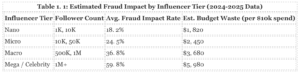
The table above illustrates a serious. While Nano-influencers are frequently touted as “authentic,” they are not immune. Business accounts in the Nano tier average 18. 2% fake followers. Yet, the of waste explodes at the celebrity level. Brands targeting mass awareness through Mega-influencers accept a reality where the majority of their “reach” is comprised of dormant accounts and automated scripts.
The Regional Cost of Fake Clicks
Geographically, the cost of this fraud varies, no region is spared. North American brands, which command the highest cost-per-post (CPP), suffer the largest absolute financial losses. In 2024, brands lost an estimated $2. 4 billion directly to influencer fraud in the United States alone. This figure does not account for the indirect costs of brand safety violations, where advertisements appear alongside objectionable content generated by unverified creators.
The persistent rise of “click farms” exacerbates this problem. These operations, frequently housed in warehouses with thousands of mobile devices, can generate millions of fake likes and views within hours. Unlike simple bots, these farms use real devices and unique IP addresses to evade basic detection filters. Consequently, the $5 billion global loss estimate is likely conservative, as it only accounts for detected fraud. The “gray market” of sophisticated, human-emulated fraud remains largely unquantified, suggesting the true cost of the mirage is significantly higher.
Anatomy of a Bot Farm: Hardware Racks and SIM Swapping
The physical infrastructure of modern ad fraud and wash trading is no longer a chaotic assembly of loose cables and cracked screens. It has evolved into a streamlined, industrial-grade operation. In 2024 and 2025, the standard unit of production is the “box phone farm”, a specialized chassis housing 20 to 100 stripped-down mobile phone motherboards. Operators remove batteries and screens to eliminate fire risks and reduce power consumption to approximately 100 watts per unit. These “motherboard rigs” are stackable, allowing a single rack to host over 1, 000 active devices, all hardwired via Ethernet or USB OTG (On-The-Go) to ensure stable, low-latency connections that Wi-Fi cannot provide.
The economics of these hardware setups favor. A standard 20-port chassis utilizing repurposed Samsung S8 or S20 motherboards retails between $880 and $1, 280 on black market supply chains. These devices are not simulating traffic; they are real hardware with unique IMEIs (International Mobile Equipment Identity), making them nearly indistinguishable from legitimate user devices to anti-fraud algorithms. By 2025, the shift toward “rack-mountable” 2U servers containing 12+ high-performance nodes allowed operators to deploy tens of thousands of unique fingerprints from a single residential apartment, frequently cooled by industrial fans to prevent thermal throttling during intensive wash trading sessions.
The SIM Bank: Industrializing Identity Theft
Hardware is useless without a verified identity. The “SIM bank” or “SIM box” solves the problem of Two-Factor Authentication (2FA) at an industrial. These devices, frequently resembling large network switches, can house 128 to 512 SIM cards simultaneously. They do not require a physical phone for each card; instead, they virtualize the SIMs, rotating them digitally to receive SMS One-Time Passwords (OTPs) for account creation on platforms like X (formerly Twitter), Discord, and Binance.
In September 2025, a U. S. Secret Service raid in the New York tristate area dismantled a network utilizing 300 servers and over 100, 000 SIM cards. This operation demonstrated the sheer volume of “identities” available to fraudsters. Bulk SIM cards are procured for as little as $0. 10 to $0. 50 per unit, frequently sourced from carriers in regions with lax registration laws or through corrupt insiders at telecom providers. Once active, these SIMs are used to verify thousands of fake accounts per day, which are then sold or used to artificially token volumes.

Automation Software and Wash Trading
The brain of the operation is “group control” software. Tools like GenFarmer and Total Control allow a single operator to mirror inputs across thousands of devices simultaneously. In the context of crypto wash trading, this automation is weaponized to perform “Sybil attacks” on airdrops. For instance, during the ZKsync era, Vietnamese phone farms were documented using these tools to automate thousands of wallet interactions, simulating genuine user activity to harvest millions of dollars in tokens. The software randomizes touch inputs and delays to evade “bot detection” scripts, while the distinct hardware fingerprints of the motherboard rigs bypass standard device-ID blacklists.
For wash trading specifically, bots like “Trojan” and “Maestro” are deployed on these rigs to execute rapid buy and sell orders between accounts controlled by the same entity. This creates the illusion of high liquidity and volume, attracting real investors to a stagnant asset. The integration of AI-driven scripts in 2025 has further refined this process, allowing bots to parse on-chain data and execute trades only when gas fees are low, maximizing the profitability of the fraud.
The Black Market Menu: Pricing Structures for Fake Engagement
The acquisition of fraudulent influence is no longer a clandestine operation conducted in the digital shadows. It has evolved into a highly organized, open-air marketplace where “social proof” is sold with the efficiency of a fast-food franchise. In 2024 and 2025, the barrier to entry for aspiring influencers and deceptive brands is zero. Anyone with a credit card or crypto wallet can purchase tens of thousands of followers, likes, and views through automated dashboards known as Social Media Marketing (SMM) panels. These panels function as the wholesale engines of the fraud economy, connecting bot farms directly to buyers.
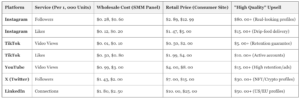
The economics of this illicit trade are driven by aggressive price competition and massive. Cybersecurity analysis from late 2024 reveals that the raw cost to generate a single fake Instagram account, complete with a burner SIM verification, has plummeted to approximately $0. 08. This low production cost allows wholesalers to flood the market with inventory. On the consumer-facing side, “retail” sites mark up these services by 1, 000% to 5, 000%, packaging raw bot traffic as “organic growth” or “high-quality engagement” to unsuspecting or complicit buyers.
The 2025 Fraud Price List
Market analysis of over 20 major SMM panels and retail vendors in January 2025 establishes a clear pricing hierarchy. Platforms like TikTok and Instagram, which prioritize high-velocity engagement, command the lowest prices for mass interactions. YouTube, with its stricter detection algorithms and monetization chance, retains a higher price point per unit of engagement.
The “Quality” Tier System
Vendors differentiate their products not by legitimacy, by the sophistication of the deception. The “Entry-Level” or “Instant” tier consists of obvious bots: accounts with no profile pictures, alphanumeric usernames (e. g., user839204), and zero posts. These are detected and purged by platform algorithms frequently, frequently within weeks of purchase.
To counter this, the black market offers a “Premium” or “High Quality” tier. These accounts are engineered to survive algorithmic sweeps. They use stolen photos from real users, possess coherent bios, and may even have a history of reposting content to simulate activity. In 2024, vendors began explicitly marketing “Refill Guarantees” or “Non-Drop” insurance. If the purchased followers are banned by the platform within 30 or 60 days, the vendor automatically replenishes the count at no additional cost. This warranty system confirms that vendors anticipate detection and treat it as a standard operating expense.
Bulk Economics and Reseller Margins
The profit margins for resellers are astronomical. A “growth agency” can purchase 10, 000 Instagram followers from a wholesale panel for approximately $3. 00. They then repackage this as a “Silver Growth Package” and sell it to a brand or aspiring influencer for $150. 00. This arbitrage model has spawned a cottage industry of thousands of identical websites, all pulling from the same few massive bot farms in Russia, Southeast Asia, and the Middle East.
For platforms like LinkedIn, the cost is higher due to the perceived value of B2B influence. A fake LinkedIn connection costs nearly 20 times more than a fake TikTok view. This price reflects the chance ROI: a fraudulent influencer on LinkedIn can use their fake network to secure high-value consulting contracts or B2B advertising deals, whereas a TikTok bot is primarily used to trigger the “For You” algorithm.
Wash Trading Defined: Circular Engagement Pods and Algorithmic Gaming
In financial markets, “wash trading” occurs when an investor simultaneously sells and buys the same financial instruments to create misleading, artificial activity. In the influencer economy, this practice has mutated into “circular engagement pods.” These are organized cartels of users who agree to interact with one another’s content, likes, comments, shares, and saves, to deceive algorithmic systems into validating their posts as high-value assets. Unlike the lone-wolf bot farms of the early 2010s, these pods represent a coordinated, human-driven effort to manufacture social proof, counterfeiting the currency of the digital attention economy.
The mechanics of these groups are disciplined and transactional. Operating primarily on encrypted messaging apps like Telegram, Signal, and WhatsApp, these pods enforce strict “reciprocity rules” to ensure compliance. The most common protocol, known as “Dx10” or “Dx20,” mandates that a user must engage with the previous 10 or 20 links shared in the group chat before they are permitted to drop their own content. Moderators, frequently using automated bots, audit participation; users who “leech”, drop a link without engaging, are swiftly banned. This structure creates a closed-loop economy where engagement is not a measure of genuine audience interest, a receipt of payment for services rendered.
While manual pods require significant time investment, the upper echelons of influencer fraud have industrialized this process through automation. Services like Fuelgrams and Lempod (specifically targeting LinkedIn) have allowed users to automate the wash trading process. In these “premium” pods, users pay a monthly subscription to have their accounts automatically like and comment on other members’ posts without lifting a finger. This algorithmic gaming is designed to trigger the “velocity” signals of social platforms. By generating a spike of interaction within the hour of a post’s life, the “golden hour”, these pods trick the platform’s recommendation engine into pushing the content to the coveted “examine” pages or “Trending” feeds of real, unsuspecting users.
| Pod Tier | Entry Requirement | method | Risk Level | Estimated Cost |
|---|---|---|---|---|
| Leech / Public | None | Manual “Like-for-Like” | High (Easy detection) | Free (Time-intensive) |
| Niche / Verified | 5k+ Followers | Manual “Dx10” Rules | Medium | $20, $50 / month |
| Executive / Auto | Invitation Only | Automated Scripting | Low (Mimics human timing) | $100, $1, 000 / month |
| Whale / Celebrity | 100k+ Followers | Private Signal Groups | Very Low | Reciprocal High-Value |
The sophistication of these operations has forced platforms to alter their detection methods. In late 2025, LinkedIn executive Gyanda Sachdeva publicly admitted the platform was “increasingly flagging” artificially boosted content, specifically targeting browser extensions that automate comments. Similarly, Instagram’s algorithm shifted in 2024 to prioritize “Saves” and “Shares” over “Likes,” prompting pods to adjust their behavior. Modern wash trading involves coordinated “save” campaigns, where pod members bookmark posts to signal high utility to the algorithm, a metric far harder for fraud detection systems to distinguish from genuine user behavior than a simple double-tap.
This circular fraud distorts the entire advertising ecosystem. When a brand pays for exposure based on these metrics, they are paying for the influencer’s own colleagues to view the ad. Data from 2025 suggests that for micro-influencers involved in these schemes, up to 40% of their engagement comes from other influencers rather than chance customers. This creates a “hollow reach” where the numbers on the dashboard rise, the conversion to actual sales remains non-existent, draining marketing budgets into a closed loop of mutual validation.
Crypto Schemes: The Intersection of Influencers and Market Manipulation
The convergence of social media influence and unregulated cryptocurrency markets has birthed a sophisticated engine of financial extraction. While traditional advertising fraud relies on inflated metrics to cheat brands, crypto-influencer schemes target retail investors directly. The method is precise: influencers do not advertise a product; they manufacture the market sentiment required to execute a “pump and dump” scheme. Federal indictments and civil complaints filed between 2022 and 2025 reveal that these are not ethical lapses coordinated operations involving wash trading, undisclosed payments, and outright theft.
In March 2023, the Securities and Exchange Commission (SEC) charged crypto entrepreneur Justin Sun and eight celebrities, including Lindsay Lohan, Jake Paul, and Soulja Boy, with orchestrating a scheme to sell unregistered crypto asset securities. The charges went beyond simple non-disclosure. The SEC alleged that Sun directed his employees to engage in more than 600, 000 wash trades of Tronix (TRX), artificially inflating the token’s trading volume to lure investors. Influencers then touted these tokens to their millions of followers, creating a veneer of organic demand while insiders sold into the liquidity provided by their fans. Most of the celebrities settled, paying over $400, 000 in penalties, the case exposed the symbiotic relationship between wash trading and influencer marketing.
The of this manipulation is quantifiable. A December 2022 report by the National Bureau of Economic Research found that illegal wash trading accounted for up to 70% of the volume on unregulated crypto exchanges. Influencers serve as the final link in this chain, validating the fake volume with social proof. When a token appears to have high trading activity, generated by bots, and is simultaneously endorsed by a trusted figure, retail investors perceive a “safe” investment opportunity. In reality, they are entering a rigged casino where the house and the promoters have already stacked the deck.
The High Cost of Hype: Major Influencer Crypto Scandals (2021 – 2025)
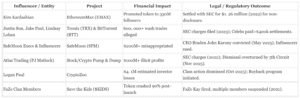
The “Save the Kids” scandal involving members of the esports organization FaZe Clan demonstrates the speed at which these schemes operate. In 2021, influencers promoted the $KIDS token as a charity-driven project. Blockchain analysis later revealed that wallets connected to the promoters sold massive quantities of the token immediately after launch, crashing the price by 90% and leaving fans with worthless assets. Unlike traditional endorsement deals where a product might simply be ineffective, these schemes result in a total loss of capital for the consumer. The influencers involved faced internal disciplinary action, the financial damage to their audience was irreversible.
More complex operations use “gamification” to disguise fraud. Logan Paul’s CryptoZoo project, marketed as a blockchain game where users could breed NFT animals, sold millions of dollars in digital assets failed to deliver a functional game. A class-action lawsuit filed by investors alleged losses exceeding $4. 1 million. While the lawsuit was dismissed in October 2025 due to jurisdictional and procedural blocks, the case highlighted how influencers can sell non-existent utility based solely on their reputation. Paul eventually committed $2. 3 million to a buyback program, a fraction of the total funds poured into the ecosystem by his followers.
The legal system has begun to catch up, targeting the coordinated groups that these pumps. The “Atlas Trading” case, involving a Discord group of influencers who allegedly profited $100 million by front-running their own followers, illustrates the industrial of the fraud. The influencers would accumulate positions in low-volume stocks or tokens, hype them to hundreds of thousands of Discord members, and then sell as the price spiked. Although a district court initially dismissed the charges, the 5th Circuit Court of Appeals overturned that decision in November 2025, signaling that digital “shilling” can constitute securities fraud.
These cases prove that influencer fraud in the crypto sector is not a victimless crime of vanity metrics. It is a predatory method where fake followers and wash trading create a trap, and the influencer pushes the victim in. The $1. 87 billion in wash trading volume recorded on major chains in 2024 serves as the infrastructure for these scams, the influencer is the lure that makes the system profitable.
Forensic Data Analysis: Applying Benford’s Law to Follower Counts
The mathematics of influence is rarely as linear as the growth charts presented in pitch decks. Authentic human behavior follows specific, predictable statistical patterns, while manufactured data, no matter how sophisticated, inevitably leaves a digital fingerprint. In the forensic analysis of social media fraud, Benford’s Law has emerged as a primary detection tool, capable of distinguishing between organic community growth and purchased bot farms with a high degree of accuracy.
Benford’s Law, or the ” -Digit Law,” dictates that in naturally occurring numerical datasets, the leading digit is not random. The number 1 should appear as the leading digit approximately 30. 1% of the time, while the number 9 should appear only 4. 6% of the time. In 2015, researcher Jennifer Golbeck demonstrated that this principle applies rigorously to social networks. Her analysis of verified data from Facebook, Twitter, and Pinterest confirmed that the follower counts and friend networks of authentic users adhere strictly to this logarithmic distribution. When human beings connect, they do so in patterns that align with this mathematical constant.
Fraudsters, yet, fail this test. Bot farms generate accounts using random number generators or uniform distributions to assign follower counts, creating a statistical anomaly that is immediately detectable. A 2019 investigation into a massive Russian botnet on Twitter revealed that 99. 6% of the identified bot accounts violated Benford’s Law. Unlike authentic users, whose follower counts clustered heavily around the lower digits (1, 2, 3), the bot accounts displayed a “flat” or uniform distribution, where a follower count starting with 9 was just as likely as one starting with 1. This deviation acts as a mathematical smoking gun.
Comparative Analysis: Organic vs. Manufactured Growth
The following table contrasts the expected Significant Digit (FSD) frequency in authentic accounts against the typical distribution found in purchased bot networks. The “Botnet Observed” data is derived from forensic analyses of suspended networks, where follower counts are frequently assigned randomly between set parameters (e. g., 1, 000 to 9, 000).
| Leading Digit | Authentic Frequency (Benford’s Law) | Botnet Frequency (Uniform/Random Model) | Variance (Fraud Indicator) |
|---|---|---|---|
| 1 | 30. 1% | ~11. 1% | -19. 0% (Severe Under-representation) |
| 2 | 17. 6% | ~11. 1% | -6. 5% |
| 3 | 12. 5% | ~11. 1% | -1. 4% |
| 4 | 9. 7% | ~11. 1% | +1. 4% |
| 5 | 7. 9% | ~11. 1% | +3. 2% |
| 6 | 6. 7% | ~11. 1% | +4. 4% |
| 7 | 5. 8% | ~11. 1% | +5. 3% |
| 8 | 5. 1% | ~11. 1% | +6. 0% |
| 9 | 4. 6% | ~11. 1% | +6. 5% (Severe Over-representation) |
This statistical is not academic; it is actionable intelligence. In 2022, researchers applying machine learning classifiers to Twitter data found that the “follower-to-friend” ratio, when combined with Benford’s Law analysis, could identify fake accounts with over 99% accuracy. The “Bursty” botnet, a network of over 500, 000 accounts identified in academic literature, was flagged precisely because its engagement metrics, likes and retweets, failed to conform to the natural decay and growth patterns predicted by the law.
Modern independent analysts have begun applying these forensic techniques to high-profile influencers. In one notable instance, data sleuths applied Benford’s Law to the “like” counts of a prominent Bollywood actress, revealing significant anomalies where the digit 1 was over-represented far beyond the 30. 1% baseline, suggesting a “top-up” method where likes were purchased in round blocks (e. g., 1, 000 or 10, 000) to engagement rates. Such manual interventions disrupt the natural logarithmic curve, leaving behind evidence of manipulation that no amount of PR spin can erase.
“The expected occurrence for the numeral 1 as the digit in a natural number is 30. 1 percent… When numbers are manually inserted into a naturally occurring set, the numbers won’t fit the expected pattern and there’s very little a fraudster can do about it.” , Tiffany Couch, Acuity Forensics
For advertisers, this metric serves as a serious filter. While a human auditor might be fooled by a profile with 500, 000 followers and high engagement, a Benford analysis of the follower list frequently reveals the deception instantly. If the distribution of the followers’ own follower counts is uniform rather than logarithmic, the audience is synthetic. This method cuts through the vanity metrics, providing a binary assessment of authenticity that is difficult for bot farms to circumvent without expending computationally prohibitive resources to simulate organic randomness.
The Engagement Rate Anomaly: Identifying Statistical Impossibilities
The most damning evidence of influencer fraud lies not in the content, in the calculus. Authentic human behavior is inherently chaotic, variable, and subject to the laws of diminishing returns. When an influencer’s metrics these statistical probabilities, they are not outperforming the market; they are breaking the mathematical rules of digital reality. By 2025, the between organic engagement and manufactured interaction has become a chasm, creating a distinct “fraud signature” that data scientists use to flag bad actors.
The and most reliable indicator of this deception is the “Inverse Law.” In legitimate social ecosystems, engagement rates naturally decline as follower counts rise. A nano-influencer with 5, 000 followers might legitimately sustain a 4% to 6% engagement rate, driven by a tight-knit community. yet, as an account to 500, 000 or 1 million followers, maintaining that density of interaction becomes statistically impossible due to algorithmic suppression and audience dilution. Yet, audits of suspected accounts frequently reveal macro-influencers boasting engagement rates of 8% or higher, figures that are three to four times the verified industry standard of 1. 5% to 2% for accounts of that size.
Data from HypeAuditor’s 2025 State of Influencer Marketing report show this anomaly. While the global average engagement rate on Instagram plummeted to approximately 0. 61% by January 2025 due to platform saturation, fraudulent accounts continued to post static, high-frequency engagement numbers. These accounts frequently display a “Zero Standard Deviation” pattern, where the number of likes on every post falls within a suspiciously narrow range (e. g., exactly 10, 000 to 10, 050 likes), a consistency that human audiences never achieve.
| Influencer Tier | Follower Count | Verified Organic Rate (IG) | Verified Organic Rate (TikTok) | Fraudulent “Red Flag” Rate |
|---|---|---|---|---|
| Nano | 1K , 10K | 2. 3% , 4. 6% | 8. 0% , 10. 3% | > 15% (Bot Spikes) |
| Micro | 10K , 50K | 2. 0% , 3. 5% | 6. 0% , 8. 0% | < 0. 5% (Zombie Audience) |
| Mid-Tier | 50K , 500K | 1. 5% , 2. 5% | 4. 0% , 6. 0% | Constant 10%+ (Pod Activity) |
| Macro | 500K , 1M | 1. 0% , 2. 0% | 2. 0% , 4. 0% | > 8% (Wash Trading) |
| Mega | 1M+ | 0. 5% , 1. 0% | 1. 0% , 2. 0% | High Likes / Zero Comments |
A secondary statistical impossibility appears in the “Like-to-View” ratio. On video-centric platforms like TikTok and Instagram Reels, a view is the prerequisite for a like. Verified data suggests a standard conversion funnel where likes represent 3% to 8% of total views. Fraudsters, yet, frequently purchase “likes” packages without purchasing the corresponding “views,” leading to mathematical absurdities where a video has 50, 000 likes only 30, 000 views. This inversion is a definitive marker of bot farm activity, where scripts bypass the video player to send a “like” signal directly to the server.
This manipulation extends to “Wash Trading,” a term adapted from financial fraud to describe the circular inflation of value. In the influencer economy, this manifests through Engagement Pods, organized groups of 500 to 1, 000 influencers who agree to comment on each other’s posts immediately upon publication. While this mimics high engagement, the linguistic patterns reveal the artifice. Analysis of these comment sections shows a high frequency of generic, non-contextual phrases (“Great shot!”, “Love this!”, “🔥”) and a complete absence of semantic relevance to the post’s actual content. Unlike paid bot farms, these are human-operated rings, the intent is identical: to defraud advertisers by presenting a hollow metric as a sign of influence.
The of this fabrication is industrial. Cybersecurity firm CHEQ reported in 2024 that 17. 9% of all digital traffic is invalid, a figure that rises sharply within the influencer marketing vertical. When brands pay for engagement based on these inflated metrics, they are buying their own money back minus a transaction fee to the fraudster. The 2025 that nearly 60% of purchased followers are “dead” accounts, inactive profiles that serve only to pad the follower count denominator, further skewing the engagement ratios that marketers rely on for ROI calculations.
also, the timing of engagement offers a forensic clue. Organic viral growth follows a logarithmic curve: a slow start, a rapid spike as the algorithm catches on, and a long tail of decline. Bot-driven engagement, conversely, appears as a “cliff face”, thousands of interactions delivered within minutes of posting, followed by absolute silence. This pattern reflects the fulfillment of a purchase order, not the organic spread of culture. By identifying these statistical impossibilities, auditors can strip away the veneer of popularity to reveal the ghost town beneath.
The Fox Guarding the Henhouse
The persistence of the bot emergency is not a failure of technology; it is a failure of financial incentive. For nearly a decade, the world’s largest social media platforms have operated under a business model where the distinction between a human user and a programmed script is financially irrelevant. To the algorithms that drive stock prices and advertising revenue, a “Monetizable Daily Active User” (mDAU) is a unit of value, regardless of whether that unit has a pulse.
This conflict of interest creates a structural complicity. While public relations departments problem quarterly transparency reports boasting of billions of deleted accounts, the executive suites are frequently insulated from the reality of the fraud. The reason is simple: removing fake users depresses growth metrics, which in turn depresses stock value. As former Twitter security chief Peiter “Mudge” Zatko testified before the U. S. Senate in September 2022, executive bonuses were tied to user growth, not the removal of spam or bots. Zatko explicitly stated that Twitter’s leadership was “unwilling to put the effort in” to accurately measure the problem, famously quoting Upton Sinclair: “It is difficult to get a man to understand something when his salary depends on his not understanding it.”
Whistleblowers and The “5%” Lie
The industry standard defense, that fake accounts comprise less than 5% of total users, has been repeatedly challenged by internal defectors. In 2021, Facebook whistleblower Frances Haugen revealed internal documents showing that the company’s AI systems caught only a “tiny minority” of offending content, estimated at 10-20%. Haugen’s testimony dismantled the narrative that Meta was doing everything possible to scrub its platforms. Instead, she described a culture that consistently prioritized “profit over safety,” where the friction required to stop bad actors was viewed as a threat to the direct engagement that drives ad dollars.
The legal battle between Elon Musk and Twitter in 2022 further exposed this opacity. During discovery, it was revealed that the “less than 5%” figure was based on a sampling methodology that data scientists found statistically fragile. While the court forced the disclosure of data on 9, 000 accounts, the proceedings highlighted a terrifying reality: platforms may not actually know, or want to know, the true extent of the infestation. If the true number of invalid accounts on a platform like X (formerly Twitter) or Instagram were revealed to be 15% or 20%, the resulting correction in ad rates and market cap would be catastrophic.
The of the Influx
The sheer volume of “actioned” accounts reported by these companies paradoxically proves the magnitude of the security failure. In the quarter of 2024 alone, Meta reported removing 631 million fake accounts. While presented as a victory for enforcement, this figure indicates that over half a billion fraudulent entities attempted to breach the platform in a three-month window. This is not a leak; it is a flood.
| Year | Platform | Fake Accounts Removed (Billions) | Est. Invalid Traffic Rate | Est. Global Ad Loss to Fraud |
|---|---|---|---|---|
| 2021 | 6. 6 Billion | 11. 3% | $65 Billion | |
| 2022 | 5. 4 Billion | 12. 8% | $81 Billion | |
| 2023 | TikTok* | Undisclosed (High) | 15. 2% | $88 Billion |
| 2024 | Meta (All Apps) | ~2. 2 Billion (Q1-Q3) | 17. 9% | $100 Billion+ |
*Note: TikTok does not consistently release raw numbers of removed fake accounts comparable to Meta’s transparency reports, though third-party analysis suggests high bot prevalence. Ad loss estimates based on global digital ad fraud projections by Juniper Research and CHEQ.
Monetizing the Solution
Perhaps the most cynical development is the pivot toward paid verification. By launching subscription services like Twitter Blue ( X Premium) and Meta Verified, platforms have monetized the bot problem they failed to solve. Users are asked to pay a monthly fee to prove they are human, shifting the financial load of verification from the platform to the victim.
This strategy creates a two-tiered system where security is a luxury product rather than a baseline right. It also generates a new revenue stream that benefits directly from the user’s fear of impersonation. If a platform were truly committed to eradicating bots, strict identity verification would be a mandatory condition of entry, not a premium feature sold for $14. 99 a month. The current model suggests that tech giants have found a way to profit from the disease and the cure simultaneously.
The Agency Enablers: Middlemen Profiting from Inflated Metrics
The influencer marketing economy, valued at over $24 billion, does not operate in a vacuum. It is sustained by a complex network of intermediaries, marketing agencies, talent management firms, and digital PR consultancies, that extract fees at every step of the value chain. While these entities position themselves as guardians of brand safety, financial forensics suggest they are frequently the primary beneficiaries of the fraud they claim to fight. By pegging their revenue models to volume-based metrics like “reach” and “engagement,” agencies have created a perverse incentive structure where verifying the authenticity of an audience directly reduces their own profit margins.
The standard agency compensation model involves a commission of 10% to 30% of the total ad spend, or a retainer fee based on the aggregate follower count of the influencers activated. This creates a direct conflict of interest: purging fake followers from a campaign reduces the “reach” numbers an agency can report to a client, so lowering the perceived value of their services. Consequently, a culture of “don’t ask, don’t tell” has permeated the industry, where inflated metrics are accepted as currency.
The “Wash Trading” of Engagement
In financial markets, “wash trading” involves an entity buying and selling the same asset to create the illusion of market activity. In the influencer economy, this practice has been industrialized through “engagement pods”, groups of influencers, frequently managed by the same talent agency, who agree to interact with each other’s content to game platform algorithms. This coordinated inauthenticity mimics organic interest, tricking brands into paying premiums for manufactured hype.
A 2018 investigation by Social Chain, a global social media agency, utilized a proprietary tool named “Like-Wise” to scan 10, 000 influencers. The audit revealed that over 25% of these accounts participated in manipulation strategies, including engagement pods and bot farms. even with this internal knowledge, the industry at large continues to book these same creators. The reason is mechanical: high engagement rates, regardless of their origin, trigger social media algorithms to display content to more users, a metric agencies desperately need to justify their retainers.
| method | Description | Financial Incentive |
|---|---|---|
| Volume Commission | Agencies charge % of total media spend. | Higher follower counts justify larger budgets, increasing the agency’s cut. |
| Talent Double-Dipping | Agency represents both the brand and the influencer. | Agency earns a management fee from the talent and a service fee from the brand, disincentivizing fraud checks. |
| algorithmic Gaming | Using “pods” to boost engagement. | Artificially high engagement rates allow agencies to claim “viral” success and renew contracts. |
| The “Reach” Markup | Selling campaigns based on “chance impressions.” | Fake followers count as “impressions,” allowing agencies to bill for eyeballs that do not exist. |
Institutionalized Fraud: The Devumi Precedent
The complicity of agencies is not passive; in documented cases, it is active. The 2019 Federal Trade Commission (FTC) settlement with Devumi, a company that sold fake followers, exposed a client list that extended far beyond insecure teenagers or aspiring actors. The investigation revealed that marketing and public relations firms were among Devumi’s most frequent customers, purchasing fake followers to artificially boost the credibility of their own clients. These agencies used corporate funds to buy “influence” that they then sold back to the client as organic growth, laundering the fraud through their monthly invoices.
This practice was further highlighted by a 2017 experiment conducted by Mediakix. The agency created two completely fictitious Instagram accounts, one a “lifestyle” influencer and the other a “travel” photographer, populated entirely with stock photos and purchased followers. even with having zero organic influence, these fabrication accounts secured four paid brand deals from other agencies within weeks. The vetting process was non-existent; the agencies involved looked only at the follower count (fake) and the engagement rate (bought), approved the budget, and sent the checks.
The 2024 Reality: Willful Blindness
even with the availability of advanced fraud detection software, agency adoption remains selective. A December 2024 report by Fama. io indicated that nearly 60% of brands reported being victims of influencer fraud, yet the intermediaries responsible for vetting these influencers rarely face consequences. The disconnect lies in the reporting: agencies report on “Cost Per Thousand Impressions” (CPM). If an agency removes 40% of an influencer’s audience as fake, the CPM nearly doubles, making the campaign appear less to the brand’s finance department. Thus, agencies are financially rewarded for maintaining the illusion.
The rise of “talent management” divisions within large holding companies has exacerbated this problem. When an agency owns the talent roster, they are legally bound to maximize the earnings of their creators. This fiduciary duty to the talent directly contradicts their obligation to the brand to verify audience quality. In this closed loop, the agency acts as the broker, the seller, and the auditor, creating a perfect environment for wash trading to flourish.
“The most common and outrageous form of influencer marketing fraud is generating fake or useless engagement… This is the worst kind of fraud because it’s literally akin to stealing, getting paid for providing counterfeit or worthless product.” , Social Chain Report, 2018
As 2025 progresses, the industry sees a shift toward “performance-based” contracts, yet the agency model remains stubborn. Until brands demand audits from third-party cybersecurity firms, bypassing their agencies entirely, the middlemen continue to collect their toll on a built of holograms.
Verification for Sale: The Underground Trade in Blue Checks
For nearly a decade, the blue checkmark was the digital economy’s most coveted status symbol, a velvet rope separating the elite from the masses. While platforms publicly claimed verification was reserved for notable public figures, an illicit underground market thrived in the shadows, fueled by bribed employees and fabricated press. By 2022, this shadow economy had generated millions in illicit revenue, turning identity verification into a transactional commodity long before Elon Musk or Mark Zuckerberg monetized it officially.
The most damning evidence of this internal corruption emerged from Meta in late 2022. An internal investigation revealed that over two dozen employees and contractors were fired for hijacking user accounts and accepting bribes to grant verification or restore banned profiles. These insiders abused a proprietary internal system known as “Oops” (Online Operations), originally designed to help employees restore access for friends and family. Instead, it became a backdoor for the highest bidder. Intermediaries, frequently posing as boutique digital agencies, charged upwards of $7, 000 to $15, 000 for a “guaranteed” blue badge, funneling a portion of the fee to compromised staff members who rubber-stamped the requests.
Before the subscription era, the primary method for black-market verification was the “fake press” ecosystem. To meet the “notability” criteria required by Instagram and Twitter, fraudsters created networks of mimicry news sites. These portals, designed to look like legitimate regional news outlets or tech blogs, published puff pieces about the client. For a fee of $1, 500 to $5, 000, a client would receive five to ten articles cementing their status as a “thought leader” or “rising star.” These fabricated citations were then submitted to platform support portals, frequently to specific, bribed representatives, to bypass automated rejection filters.
The introduction of paid verification schemes, Twitter Blue ( X Premium) in 2022 and Meta Verified in 2023, was touted as a solution to this corruption. In reality, it bifurcated the fraud market. While the “blue check” became a commoditized subscription available for $12 to $15 a month, the high-end black market shifted its focus to the new, more exclusive tiers: the Gold Check for organizations on X and the “legacy” media partner portals on Facebook.
On X (formerly Twitter), the “Gold Check” intended for verified organizations became the new gold standard for scammers, particularly in the cryptocurrency sector. With an official price tag of $1, 000 per month (later introducing a $200 tier), the barrier to entry was high for average users negligible for organized crime syndicates. Cybersecurity researchers at CloudSEK discovered a thriving dark web market where compromised “Gold” accounts were sold for $1, 200 to $2, 000. These accounts, frequently hijacked from dormant small businesses, were rebranded to impersonate major financial institutions or crypto exchanges. The “Verified Organization” badge gave these phishing campaigns an unearned veneer of legitimacy, allowing them to drain victim wallets with worrying efficiency before being detected.
The table outlines the economics of the verification black market, contrasting the official costs with the illicit trade that even with platform crackdowns.
| Asset Type | Official Platform Cost | Black Market Price | Method of Acquisition | Primary Fraud Use Case |
|---|---|---|---|---|
| Instagram Blue Check (Legacy) | $0 (Merit-based) | $5, 000, $15, 000 | Insider Bribes / Fake Press | Instant Authority / High-Ticket Scams |
| Meta Verified Subscription | ~$15 / month | N/A (Commoditized) | Credit Card Subscription | Low-level Impersonation / Botnets |
| X (Twitter) Gold Check | $200, $1, 000 / month | $1, 500, $2, 500 flat | Hijacked Accounts / Stolen CCs | Crypto Phishing / Fake Airdrops |
| Press Portal Access | N/A | $1, 000, $3, 000 | Pay-to-Play PR Agencies | Fabricating “Notability” for Verification |
The “pay-to-play” PR industry remains a serious enabler of this fraud. Investigations have shown that entire “news” networks exist solely to sell articles for verification packets. These sites frequently absence editorial oversight, publishing press releases as news stories without disclosure. When platforms like Instagram tightened their verification requirements in 2024 to exclude paid or sponsored content, the black market adapted by backdating articles or hacking into defunct legitimate blogs to insert mentions of the client. This cat-and-mouse game demonstrates that as long as digital authority is tied to a visual indicator, there be a lucrative trade in counterfeiting it.
The danger extends beyond financial loss. The “verification for sale” model has allowed state-sponsored actors and disinformation agents to purchase credibility instantly. By obtaining a verified status, these actors can bypass algorithm filters that suppress new or unverified accounts, amplifying false narratives with the platform’s implicit seal of approval. The democratization of the blue check did not democratize truth; it monetized the ability to deceive.
The AI Multiplier: Generative Text and the End of Human Comments
The era of the “click farm”, where low-wage workers in dimly lit rooms manually tapped screens to engagement, is being rapidly dismantled. In its place rises the “token farm,” a server-grade operation where Large Language Models (LLMs) generate millions of context-aware interactions per hour. This shift marks the transition from biological fraud to algorithmic fraud, a change that has rendered traditional detection methods obsolete and fundamentally altered the texture of online discourse.
For a decade, fake comments were easy to spot: generic emojis, “Nice pic!”, or broken English unrelated to the post. These were the hallmarks of simple scripts or non-native human workers paid by the click. Today, generative AI agents scan the visual and textual content of a post before drafting a response. If an influencer posts a photo of a latte in Paris, the AI agent does not comment “Good.” It writes, “The foam art on that latte is incredible! Is that the café near the Louvre? I miss Paris so much.” This semantic precision makes the fake indistinguishable from the real to the casual observer.
Data from the 2024 Imperva Bad Bot Report indicates the of this automation. The report reveals that nearly 50% of all internet traffic is non-human, with “bad bots”, malicious automated agents designed to mimic human behavior, accounting for 32% of global traffic, a figure that has risen for five consecutive years. In the specific sector of social media, these agents are not just lurking; they are speaking.
| Metric | Traditional Click Farm (Human) | Generative AI Agent (LLM) |
|---|---|---|
| Cost Per 1k Comments | $15. 00, $50. 00 | $0. 50, $3. 00 |
| Speed | Limited by typing speed | Instantaneous (Thousands/sec) |
| Context Awareness | Low (Generic/Copy-Paste) | High (Image/Caption Analysis) |
| Detection Difficulty | Low (Pattern Recognition) | Extreme (Semantic Variance) |
| Scalability | Linear (Requires more people) | Exponential (Requires more compute) |
The economic incentives for this shift are overwhelming. While a human worker in a click farm might cost a fraudster fractions of a cent per interaction, an API call to an open-source LLM costs a fraction of that fraction. This cost reduction has led to a proliferation of “Zombie Engagement”, interactions that occur entirely between bots. A 2025 analysis of engagement farming on platforms like X (formerly Twitter) and Instagram suggests that up to 17. 9% of comment sections on high-traffic viral posts consist of bots replying to other bots, creating a “Dead Internet” loop where algorithms boost content based on entirely artificial conversations.
This phenomenon was highlighted in a 2024 study involving “CommentRobot” on Weibo, which demonstrated that AI-generated comments could increase post visibility by 23%. yet, the engagement was hollow; it did not translate to real user activity, rather triggered other bots to join the fray. The result is a vanity metric feedback loop: brands pay for engagement, influencers buy AI packages to deliver it, and the platform’s algorithm promotes the content to more bots, burning ad spend on empty eyeballs.
“We are no longer looking for needles in a haystack. We are looking for needles in a stack of needles. When an AI can replicate the syntax, slang, and emotional tone of a teenage fan, the ‘comment section’ ceases to be a measure of public sentiment and becomes a measure of compute power.”
The for sentiment analysis and market research are severe. Brands that rely on social listening tools to gauge customer reaction are ingesting vast quantities of synthetic text. A positive sentiment spike for a new product launch may simply reflect a bot network programmed to generate excitement to evade spam filters. By late 2024, cybersecurity firms began reporting that “simple” bad bots, those without advanced evasion techniques, had grown to nearly 40% of bad bot traffic, driven by the accessibility of AI tools that allow non-technical fraudsters to script complex engagement attacks.
This is the “AI Multiplier”: a force that does not just add to the noise synthesizes it, creating a veneer of popularity that is mathematically perfect and commercially worthless.
Audience Quality Scores: The gap Between Public and Private Data
The most expensive lie in digital marketing is the follower count. For over a decade, brands have treated this public metric as a proxy for influence, paying premiums for accounts with seven-figure audiences under the assumption that “followers” equals “eyeballs.” This assumption is mathematically false. Private data analysis reveals a clear between the number of people who click “follow” and the number of people who actually exist, engage, or even see the content. This gap is quantified by the Audience Quality Score (AQS), a 1 to 100 metric that separates vanity from value.
Audience Quality Scores function as a credit rating for social media accounts. While a public profile displays a follower count of 1 million, an AQS analysis might reveal a score of 35/100, indicating that the reach is a fraction of the claimed number. The gap arises from four specific categories of low-quality data that public metrics hide: bots, mass followers, suspicious accounts, and dormant users. HypeAuditor’s 2024 analysis indicates that influencers with over one million followers harbor an audience where up to 23% are flagged as low quality. For brands, this means nearly one in four dollars spent on these top-tier partnerships is immediately incinerated.
The “Mass Follower” phenomenon is a primary driver of this gap. These are not necessarily bots real users who follow more than 1, 500 accounts. Algorithmic constraints on platforms like Instagram and TikTok make it statistically impossible for these users to see content from every account they follow. A user following 3, 000 profiles misses 95% of the posts in their feed. Consequently, an influencer may have 50, 000 “real” mass followers who are functionally invisible. Public data counts them as an asset. Private AQS data counts them as dead weight.
| Influencer Tier | Follower Count Range | Avg. Fake/Mass Followers | Audience Quality Score (AQS) | Real Engagement Rate |
|---|---|---|---|---|
| Nano-Influencer | 1, 000, 10, 000 | 10. 3% | 78/100 | 2. 53%, 4. 0% |
| Micro-Influencer | 10, 000, 50, 000 | 14. 1% | 65/100 | 1. 5%, 2. 4% |
| Macro-Influencer | 500, 000, 1M | 19. 8% | 52/100 | 1. 1%, 1. 5% |
| Mega/Celebrity | 1M+ | 23. 0%, 28% | 44/100 | 0. 8%, 1. 2% |
The table above illustrates the inverse relationship between and quality. As follower counts rise, the percentage of authentic, reachable audience declines. Nano-influencers, frequently dismissed for their absence of, maintain an AQS of 78 on average, meaning their audience is largely composed of real, active humans. In contrast, celebrity accounts frequently drop an AQS of 50. A brand paying a celebrity for access to 10 million followers is, in reality, paying for access to perhaps 7 million, with the remaining 3 million consisting of commercial bots, mass followers, and abandoned accounts.
Business accounts suffer from an even wider quality gap than personal creator accounts. Data from 2024 shows that business profiles average 18. 2% fake followers compared to 10. 3% for personal accounts. This inflation is frequently self-inflicted. Brands frequently purchase “growth services” that pledge rapid follower acquisition, unknowingly populating their own customer base with zombie accounts. When these brands later use “Lookalike Audiences” for paid advertising, the algorithms replicate the characteristics of these fake followers, training the ad platform to target more bots.
The gap is further complicated by the between “Followers” and “Reach.” On TikTok, the correlation between follower count and view count has broken. The platform’s “For You” algorithm prioritizes content performance over subscriber loyalty. A creator with 34, 000 followers can generate 3. 8 million views on a single video, while a creator with 2 million followers might struggle to break 50, 000 views. Public follower counts on TikTok are therefore a legacy metric that fails to predict actual campaign performance. Private data confirms this: engagement rates on TikTok for accounts with 100, 000 to 500, 000 followers hover around 9. 74%, dwarfing Instagram’s 6. 59% for the same tier, yet the volatility of that reach is significantly higher.
Smart auditing tools allow investigators to peer behind the curtain of public vanity metrics. They analyze “Engagement Authenticity,” which filters out engagement pods, groups of influencers who agree to comment on each other’s posts to trick the algorithm. A public post may show 5, 000 comments, suggesting high engagement. yet, AQS analysis can identify that 4, 000 of those comments came from a coordinated ring of 50 users, rendering the engagement value null. Brands relying solely on the public comment count are paying for a theater performance, not a marketing channel.
The financial of ignoring AQS are severe. With 59. 8% of brands reporting influencer fraud in 2024, the industry is bleeding billions into this quality gap. A campaign budget of $100, 000 allocated to mega-influencers with low AQS scores wastes $23, 000 to $28, 000 on invalid traffic. This loss is not a cost of doing business. It is a tax on negligence. The shift from public metrics to private quality scores is not just a technical adjustment. It is a necessary defense against a market that has incentivized the manufacturing of ghosts.
The Giveaway Loophole: Artificially Spiking Growth Through Contests
While bot farms offer a direct, illicit route to follower inflation, a more insidious method operates in the gray zones of platform policy: the “loop giveaway.” This method allows influencers and brands to artificially spike their follower counts by tens of thousands overnight, not by purchasing bots, by purchasing access to another celebrity’s audience. The premise is simple yet deceptive: a high-profile account, frequently a reality TV star or A-list celebrity, hosts a contest for luxury prizes like Louis Vuitton bags, Pelotons, or stacks of cash. To enter, users must follow a specific list of 50 to 70 accounts. These “sponsor” slots are sold to aspiring influencers for fees ranging from $500 to over $15, 000, depending on the celebrity host’s reach.
The financial mechanics of these campaigns reveal a pay-to-play ecosystem designed to bypass organic growth algorithms. Agencies such as Social Stance and GRAMiety these transactions, pooling funds from dozens of “sponsors” to purchase the luxury prizes and pay the celebrity host’s fee. For a buy-in of approximately $1, 800, a participant might be promised 10, 000 to 15, 000 new followers within 72 hours. yet, data from 2024 indicates that this growth is frequently hollow. The followers gained are incentivized solely by the chance to win, not by interest in the sponsor’s content. Consequently, retention rates are abysmal, and engagement metrics frequently collapse post-campaign.
The Metrics of Artificial Inflation
The immediate aftermath of a loop giveaway is a statistical anomaly: a vertical spike in follower count accompanied by a flatline or drop in engagement rate (ER). Because the new followers are “comperes”, professional contest entrants, they rarely interact with the sponsor’s posts. When an account with 50, 000 followers suddenly jumps to 100, 000 maintains the same number of likes and comments, its engagement rate halves. Algorithms interpret this absence of interaction as a signal of low-quality content, suppressing the account’s visibility to even its original, authentic audience.
Recent analysis of Instagram engagement benchmarks in 2025 highlights the severity of this dilution. While nano-influencers (1k, 10k followers) maintained engagement rates around 6. 23%, accounts that artificially inflated their numbers through loop schemes frequently saw their ER plummet to 0. 5%. This creates a “zombie account” phenomenon: a profile that looks influential on the surface absence the community trust required to convert followers into customers.
| Metric | Organic Growth Strategy | Loop Giveaway Strategy |
|---|---|---|
| Cost Per Follower | $0. 00 (Time-intensive) to $3. 00 (Ads) | $0. 12, $0. 25 (Bulk Buy-in) |
| Audience Intent | High (Interest in content/niche) | Zero (Interest in prize only) |
| 30-Day Retention Rate | 90%, 95% | 40%, 60% (Mass unfollows) |
| Post-Campaign Engagement | Stable or Increasing | Decreases by 40%, 60% |
| Algorithmic Impact | Positive (Signals relevance) | Negative (Signals spam/low quality) |
Regulatory and Platform Responses
The legitimacy of these contests is frequently challenged by both platform guidelines and consumer protection laws. In the United States, the Federal Trade Commission (FTC) requires clear disclosures for incentivized endorsements, yet loop giveaways bury these details in long caption chains. also, Instagram’s “spam” policies technically prohibit artificially collecting likes, followers, or shares. While the platform has not issued a blanket ban on giveaways, it has aggressively cracked down on “engagement bait” and accounts that exhibit unnatural growth spikes. In 2024, Instagram’s updated algorithm began penalizing accounts with high follower counts disproportionately low engagement, “shadowbanning” participants of these schemes.
High-profile examples show the of this economy. Celebrities like Kylie Jenner, Floyd Mayweather, and Jason Derulo have fronted campaigns that pledge massive exposure for sponsors. In one documented instance, a campaign involving a Kardashian-Jenner family member charged brands upwards of $15, 000 for a sponsor slot, generating millions of dollars in revenue for the organizers while leaving participants with a disengaged audience that once the winners were announced. The “drop-off” phenomenon is so predictable that agencies offer “refill” guarantees, promising to replace unfollowers with new incentivized accounts, perpetuating a pattern of churn that renders the influencer’s metrics meaningless to advertisers.
This practice distorts the influencer marketing by inflating the supply of “macro-influencers” without a corresponding increase in actual influence. Brands vetting chance partners must look beyond the follower count, scrutinizing the quality of the audience. A sudden, step-function increase in followers followed by a slow bleed-off is the distinct fingerprint of the giveaway loophole, a clear warning sign that the influencer’s reach is a purchased mirage rather than an earned asset.
Regulatory Failures: The FTC and the absence of Enforcement Teeth
For nearly a decade, the Federal Trade Commission (FTC) functioned as a watchdog with a bark no bite, overseeing an influencer economy that grew from a niche marketing tactic into a $24 billion industry. Between 2015 and 2023, the agency’s enforcement actions against influencer fraud were characterized by “no-money, no-fault” settlements that did little to deter bad actors. The most example occurred in 2019 with the skincare brand Sunday Riley. An investigation revealed that the company’s CEO had directed employees to create fake accounts and post glowing reviews on Sephora’s website for two years. even with clear evidence of organized deception, the FTC finalized a settlement in 2020 that imposed zero financial penalties and required no admission of wrongdoing. Commissioners Rohit Chopra and Rebecca Kelly Slaughter issued a stinging dissent, arguing that the “permissive method” sent a message that “posting fake reviews is a viable strategy.”
The agency’s major action against a seller of fake followers, the 2019 case against Devumi LLC, followed a similar pattern of optical severity practical leniency. Devumi had sold over 200 million fake Twitter followers to actors, athletes, and motivational speakers. While the FTC announced a $2. 5 million judgment against CEO German Calas Jr., the fine was suspended upon payment of just $250, 000, a fraction of the revenue generated by the fraud. This “suspended judgment” method became a recurring theme. In the 2020 case against tea marketer Teami, the FTC announced a $15. 2 million judgment for deceptive health claims and insufficient influencer disclosures. Yet, due to the defendants’ “inability to pay,” the agency accepted a $1 million payment, waiving over 93% of the penalty.
Federal regulators faced a catastrophic setback in April 2021, when the Supreme Court ruled unanimously in AMG Capital Management, LLC v. FTC. The decision stripped the agency of its ability to seek monetary restitution under Section 13(b) of the FTC Act, a tool it had used for decades to return billions to defrauded consumers. This ruling handcuffed the FTC, limiting it to issuing cease-and-desist orders for -time offenders without the threat of financial pain. For the three years, the regulator was forced to rely on “Notice of Penalty Offenses” letters, essentially warning shots, sent to trade associations and influencers, such as the 2023 warnings to the American Beverage Association and registered dietitians who failed to disclose payments for promoting aspartame.
The between the of fraud and the frequency of enforcement is clear. While reports from cybersecurity firms indicate that nearly 18% of digital traffic involves invalid bot activity, the FTC brings fewer than a dozen influencer-specific cases annually. The 2023 settlement with rental platform Roomster further illustrated this gap. The FTC and state attorneys general announced a $36. 2 million judgment and $10. 9 million in civil penalties against the company for buying fake reviews. Once again, the bulk of this was suspended, with the company paying only $1. 6 million to six states. The fraudsters kept the majority of their ill-gotten gains, while the “verified” listings they sold remained a mirage for consumers.
A regulatory pivot arrived in late 2024 with the implementation of the “Rule on the Use of Consumer Reviews and Testimonials.” October 21, 2024, this new regulation explicitly bans the purchase and sale of fake reviews and followers, allowing the FTC to seek civil penalties of up to $51, 744 per violation. Unlike previous guidelines, this rule provides the statutory authority to levy fines immediately, bypassing the administrative blocks that previously slowed enforcement. While this marks a significant shift in legal capability, it comes after a decade where the influencer economy operated with virtual impunity, allowing fraudulent metrics to become deeply in the advertising infrastructure.
The Illusion of Punishment: Announced vs. Collected Fines (2019-2023)
| Case Name | Year | Violation Type | Announced Judgment | Actual Amount Paid | % Waived/Suspended |
|---|---|---|---|---|---|
| FTC v. Devumi | 2019 | Selling Fake Followers | $2, 500, 000 | $250, 000 | 90% |
| FTC v. Teami | 2020 | Deceptive Health Claims | $15, 200, 000 | $1, 000, 000 | 93. 4% |
| FTC v. Sunday Riley | 2020 | Fake Employee Reviews | $0 | $0 | N/A (No Fine) |
| FTC v. Roomster | 2023 | Buying Fake Reviews | $47, 100, 000 | $1, 600, 000 | 96. 6% |
“The Commission is doubling down on its no-money, no-fault settlement… This weak settlement is a serious setback for the Commission’s credibility as a watchdog over digital markets.” , Dissenting Statement of Commissioner Rohit Chopra regarding the Sunday Riley settlement (2020).
The Micro-Influencer Pivot: Fraud Migrating to Smaller Accounts
The influencer economy has undergone a structural shift. As brands grew weary of the seven-figure contracts and unclear metrics associated with celebrity “mega-influencers,” they pivoted en masse to micro (10, 000, 100, 000 followers) and nano-influencers (1, 000, 10, 000 followers). The logic was sound: smaller audiences were presumed to be more authentic, engaged, and free of the bot infestations that plague celebrities like Kylie Jenner or Cristiano Ronaldo. This presumption has proven costly. By 2024, the fraud industry had successfully migrated downstream, industrializing the deception of “authenticity” with the same efficiency used to celebrity counts.
Data from 2024 indicates that while nano-influencers boast the highest engagement rates, frequently exceeding 4% on Instagram compared to less than 1% for mega-influencers, they are no longer a safe haven. A report by HypeAuditor revealed that nearly 49% of all Instagram influencers have engaged in fraudulent activity to their metrics. The migration of fraud to these lower tiers is driven by simple economics: brands are projected to spend over $24 billion on influencer marketing by the end of 2025, with specifically allocated to “niche” creators. Fraudsters follow the money, fracturing their bot networks into thousands of smaller, less conspicuous accounts that fly under the radar of enterprise-grade detection tools.
The method of fraud in this tier differs from the brute-force bot buying of the past. It relies heavily on “wash trading” tactics adapted for social media, primarily through Engagement Pods. In financial markets, wash trading involves an entity buying and selling an asset to itself to create the illusion of market activity. In the influencer economy, pods function identically. Groups of 50 to 500 micro-influencers coordinate via Telegram or WhatsApp to like, save, and comment on each other’s posts immediately after publication. This coordinated inauthentic behavior triggers platform algorithms to boost the content, mimicking organic virality. To a brand manager, the engagement looks real, comments are written by humans, not bots, the commercial value is zero. The “audience” is other sellers, not buyers.
Comparative Fraud Metrics by Influencer Tier (2024-2025)
The following table illustrates the inverse relationship between audience size and engagement, juxtaposed with the rising prevalence of “pod” activity in smaller tiers.
| Influencer Tier | Follower Count | Avg. Engagement Rate | Est. “Pod” Participation | Risk Profile |
|---|---|---|---|---|
| Nano | 1K , 10K | 4. 2% , 5. 6% | High (60%+) | High engagement frequently manufactured via pods to secure initial brand deals. |
| Micro | 10K , 100K | 1. 9% , 3. 8% | Moderate (40-50%) | The “sweet spot” for fraud; accounts are large enough to monetize small enough to avoid deep audits. |
| Macro | 100K , 1M | 1. 1% , 1. 5% | Low (<20%) | Reliance shifts from pods to purchased bot followers to maintain vanity metrics. |
| Mega | 1M+ | 0. 8% , 1. 2% | Very Low (<5%) | Fraud is primarily legacy bot followers; engagement is too high to manipulate manually via pods. |
The danger for advertisers lies in the “Micro-Influencer Paradox.” Brands pay a premium for high engagement rates, assuming this metric proxies for trust and influence. yet, when that engagement is manufactured through wash trading rings, the cost per *real* conversion skyrockets. A 2025 analysis of campaign data showed that while micro-influencer campaigns appeared to generate 3x more engagement than macro-campaigns, the actual sales conversion lift was frequently statistically insignificant. The engagement was contained entirely within the pod network, a closed loop of creators validating each other’s existence without ever reaching a genuine consumer.
also, the detection of this activity is becoming increasingly difficult. Unlike bot farms, which leave digital footprints like IP address clusters and non-human click patterns, pod members are real humans using real devices. They frequently adhere to strict “reciprocity rules”, if you don’t comment on 10 other posts, you are kicked out of the group. This human- fraud creates a “grey market” of influence that software struggles to flag. By late 2024, sophisticated fraud rings began using AI-generated comments to further mask their coordination, ensuring that the “Great Post!” comments of the past were replaced with context-aware, relevant, yet hollow interactions.
Dead Internet Theory: When Bots Interact with Other Bots
The “Dead Internet Theory” has transitioned from a fringe conspiracy to a measurable statistical reality. As of early 2025, the digital ecosystem has crossed a serious threshold: the “inversion point” where automated agents outnumber human users. Data from Imperva’s 2024 Bad Bot Report confirms that nearly 50% (49. 6%) of global internet traffic in 2023 was generated by bots, a figure that ticked up to 51% in early 2025 analysis. This is not a nuisance; it is a fundamental hollowing out of the digital economy. We are no longer surfing human connection navigating a “zombie mall”, a space that looks populated and vibrant on the surface is, in reality, a closed loop of machines screaming at other machines.
This phenomenon has birthed a new form of fraud that mirrors financial market manipulation: social wash trading. In finance, wash trading involves an entity buying and selling the same asset to create the illusion of market activity. In the influencer economy, this manifests as bot networks engaging with other bot networks to manufacture “social proof.” These are not scripts liking a human’s post; these are vast, AI-driven ecosystems where synthetic accounts validate one another’s existence. A bot posts a stolen image, another bot comments “Great shot!”, and a third bot shares it. To an algorithm, and a paying advertiser, this looks like organic virality. To an auditor, it is a digital hallucinations.
| Metric | 2023 Data | 2024/2025 Data | Source |
|---|---|---|---|
| Global Bot Traffic Share | 49. 6% | 51. 0% | Imperva Bad Bot Report |
| X (Twitter) Fake Traffic (Super Bowl) | N/A | 75. 85% | CHEQ Analysis (Feb 2024) |
| Facebook Fake Accounts Removed | 690 Million (Q4) | 631 Million (Q1 ’24) | Meta Transparency Reports |
| Instagram “Ghost” Accounts | ~8. 2% | 9. 5% (95 Million) | HypeAuditor / Galaxy |
The sophistication of these networks was laid bare in July 2024, when the U. S. Department of Justice seized two domains and 968 social media accounts linked to a Russian AI-enhanced bot farm. Unlike the “click farms” of the past, warehouses in Thailand or Vietnam filled with racks of physical smartphones, this operation utilized a software package called “Meliorator.” This AI tool allowed operators to create fictitious personas en masse, generating unique biographies, photos, and posting patterns that mimicked human behavior with terrifying accuracy. These bots were not just broadcasting propaganda; they were designed to interact with each other to “prime the pump” of their own algorithms, creating a veneer of consensus before a single human eye ever saw the content.
The platform X (formerly Twitter) serves as the starkest example of this decay. During the 2024 Super Bowl, a peak moment for global advertising, cybersecurity firm CHEQ analyzed traffic flowing from X to its clients’ websites. The findings were damning: 75. 85% of the traffic was determined to be fake. Advertisers paying premium rates for “cultural relevance” were essentially burning capital to display ads to scripts. This aligns with independent audits suggesting that up to 64% of active accounts on the platform may be non-human. The “town square” has become a ghost town where the ghosts are programmed to with each other to keep engagement metrics high.
“We are trending quickly toward an internet that is 99. 9% AI-generated content, where agents and bots outnumber humans not just in traffic in creative output. Each bot believes it’s talking to a human. Each human statistically is engaging with a bot.” , Galaxy Digital Research, September 2025
Meta is fighting a similar, hydra-headed war. In the quarter of 2024 alone, the company removed 631 million fake accounts, a number nearly double the entire population of the United States. By the half of 2025, they had purged another 10 million accounts specifically identified as part of coordinated “spammy content” rings. Yet, the sheer volume of removals indicates the of the breach. For every million accounts deleted, millions more are generated by adversarial AI systems that can bypass CAPTCHAs and behavioral biometric checks. The “Dead Internet” is not a future dystopia; it is the current operating environment for digital advertising.
The for the $24 billion influencer industry are catastrophic. When a brand pays an influencer with 1 million followers, they are purchasing access to an audience. if 40% of that audience consists of “zombie” accounts that only exist to like other zombie accounts, the asset is worthless. This is the “5 Billion Dollar Mirage”: a massive transfer of wealth from legitimate businesses to the operators of these bot farms. The metrics used to justify these expenses, likes, shares, views, have been rendered meaningless by the industrial- wash trading of social capital. We are no longer measuring human attention; we are measuring the efficiency of scripts.
Brand Due Diligence: The Failure of Automated Audit Tools
The corporate reliance on automated due diligence platforms has created a dangerous false sense of security within the influencer marketing ecosystem. While brands deploy budget toward “verified” creators, the tools designed to protect these investments are systematically failing to detect the modern architecture of fraud. By 2025, even with the proliferation of sophisticated analytics suites like HypeAuditor, Social Blade, and CreatorIQ, the industry is projected to over $2 billion annually to fraudulent engagement. This failure is not a technical glitch; it is a fundamental inability of linear algorithms to identify circular deception.
The core deficiency lies in the operational logic of standard audit tools. Most fraud detection software relies on identifying “bot-like” behavior: accounts with no profile pictures, gibberish usernames, or rapid-fire activity logs. yet, the fraud market has evolved beyond simple bots into complex “wash trading” rings, known colloquially as engagement pods. In these closed networks, frequently organized on Telegram or Discord, thousands of real human users agree to reciprocally engage with each other’s content. Because the engagement comes from accounts with genuine histories, photos, and diverse IP addresses, automated tools flag this activity as “high-quality” organic growth.
“We are witnessing a ‘wash trading’ epidemic in social media identical to market manipulation in finance. When 500 influencers agree to comment on each other’s posts within an hour of publication, they create an artificial market depth that algorithms read as viral popularity. No current software distinguishes this collusive human behavior from genuine interest.”
The AI Arms Race: Context-Aware Deception
The introduction of Generative AI has further rendered traditional sentiment analysis obsolete. Historically, audit tools could detect fraud by scanning for repetitive, low-effort comments like “Nice pic!” or generic emojis. In 2024, fraudsters began utilizing Large Language Models (LLMs) to generate context-specific comments. These AI agents analyze the visual content of a post, identifying a beach, a specific brand of sunglasses, or a sunset, and generate relevant, grammatically perfect sentences such as, “The gradient on those lenses is stunning against that horizon.”
This technological leap creates a “validity loop” where fraud detection tools, programmed to look for relevance and sentiment, actually assign higher quality scores to AI-generated engagement than to lazy human comments. The result is a corrupted dataset where brands pay premiums for “highly engaged” audiences that are, in reality, armies of sophisticated chatbots talking to one another.
| Fraud Method | Audit Tool Blind Spot | Estimated Detection Failure Rate |
|---|---|---|
| Engagement Pods (Wash Trading) | Cannot distinguish reciprocal human collusion from organic community interaction. | High (>65%) |
| Generative AI Comments | Context-aware text bypasses “spam” filters and sentiment analysis. | serious (>80%) |
| CaaS (Cloaking-as-a-Service) | Presents “clean” data to audit bots while serving fraud to users. | Moderate (40-50%) |
| Zombie Accounts | Real accounts sold to farms; retain “aged” history that signals legitimacy. | High (60%) |
The “Verified” Trap
of wasted ad spend from the erroneous belief that “verified” status or high “Audience Quality Scores” (AQS) equate to safety. Data from 2024 indicates that nearly 40% of Instagram influencers with over 1 million followers show signs of artificially inflated metrics, yet they consistently pass basic due diligence checks. These “Zombie Accounts”, profiles that were once legitimate have been sold to click farms, retain their historical data, grandfathering them past security filters.
also, platforms like Instagram and TikTok restrict the API access granted to third-party auditors, severely limiting the depth of data these tools can analyze. Without full access to backend server logs, audit tools are forced to make probabilistic guesses based on public-facing metrics. This creates a “black box” of verification where brands are purchasing certainty receiving probability. The rise of “Cloaking-as-a-Service” (CaaS) exacerbates this, allowing bad actors to show pristine, compliant data to audit crawlers while delivering bot traffic to the actual brand campaign links.
The failure of these tools forces a return to manual, forensic investigation. Brands relying solely on green checkmarks on a dashboard are not performing due diligence; they are performing compliance theater. Until audit method can penetrate the closed networks of engagement pods and identify the subtle signatures of AI-generated syntax, the “verified” influencer remains one of the most volatile assets in the digital marketing portfolio.
The Courtroom Reckoning: When Vanity Metrics Meet Liability
The era of the “Wild West” in influencer marketing, where inflated follower counts and fabricated engagement rates went unchecked, has collided violently with the legal system. Between 2015 and 2025, a series of landmark rulings and settlements transformed fake influence from a marketing nuisance into a punishable commercial fraud. Brands, investors, and regulatory bodies have moved beyond requesting refunds; they are securing multi-million dollar judgments against entities that misrepresent audience reach.
The Devumi Precedent: Illegalizing the Bot Economy
The foundational legal standard for influencer fraud was established in October 2019, when the Federal Trade Commission (FTC) settled its -ever complaint regarding the sale of fake social media indicators. The case against Devumi, LLC exposed a method where the company sold over 58, 000 orders of fake Twitter followers to actors, athletes, and law firms.
The FTC ruled that selling “influence” via bots constitutes a deceptive commercial practice. The settlement imposed a $2. 5 million judgment against Devumi’s owner, German Calas, Jr. Although the company had already dissolved, the legal principle was set: purchasing fake followers is not a violation of platform terms of service, a violation of federal law prohibiting deceptive acts in commerce. This ruling stripped the “victimless crime” defense from the industry, categorizing bot-farming as active consumer fraud.
Contractual Breaches: The “Failure to Influence”
While the FTC targeted the sellers of fake reach, brands began targeting the influencers themselves for failing to deliver promised engagement. The high-profile dispute between PR Consulting and Luka Sabbat in 2018 marked a turning point in how influence is contractually audited.
Snapchat’s PR agency sued Sabbat for breach of contract after paying him $45, 000 upfront to promote Snap Spectacles. Sabbat failed to post the agreed-upon Instagram Stories and did not submit analytics for review. The lawsuit, filed in the New York Supreme Court, demanded the return of the retainer plus damages. The case settled in 2019, with Sabbat agreeing to pay $15, 000. While the financial sum was modest, the litigation signaled that brands were no longer accepting “exposure” as a nebulous deliverable; they required verified metrics and specific performance adherence.
Platform-Level Inflation: The Multi-Billion Dollar Class Actions
The most financially devastating legal battles have targeted the platforms that supply the metrics used to price advertising. Advertisers have successfully argued that platforms knowingly inflated “chance reach” and “average view time” to encourage higher ad spend.
| Defendant | Allegation | Settlement / Status | Year |
|---|---|---|---|
| Facebook (Meta) | Inflated video view metrics by 150%, 900% | $40 Million Settlement | 2019 |
| Kim Kardashian / EMAX | Undisclosed payment for crypto promotion | $1. 26 Million Settlement | 2022 |
| Ozy Media | Fraudulent audience data to secure investment | $96 Million Judgment | 2025 |
| Meta Platforms | Inflated “chance Reach” by up to 400% | $7 Billion Class Action (Active) | 2025 |
The 2019 settlement regarding Facebook’s video metrics, where the platform admitted to miscalculating average viewing time by excluding views under three seconds, cost the company $40 million. yet, this pales in comparison to the legal siege Meta faced in 2025. The U. S. Supreme Court declined to block a class-action lawsuit alleging Meta inflated its “chance reach” metric by up to 400%. Advertisers claim this inflation caused them to overpay for ads that could never reach the promised audience size. With chance damages estimated at $7 billion, this case represents the single largest financial threat related to audience measurement in digital history.
Criminal Fraud: The Ozy Media Verdict
The distinction between “marketing fluff” and criminal fraud was obliterated by the downfall of Ozy Media. In July 2024, a federal jury convicted founder Carlos Watson of securities fraud and wire fraud conspiracy. Prosecutors proved that Watson and his executives inflated audience numbers, claiming millions of viewers that did not exist, to secure over $50 million in investments.
In February 2025, a federal judge ordered Watson to pay $96 million in restitution and forfeiture. This case serves as a grim warning to media companies and influencer networks: fabricating audience data to secure capital is a prison-worthy offense, not a growth hack.
Undisclosed Influence: The Revolve Group Litigation
As of April 2025, the legal focus has shifted toward the absence of disclosure in paid influencer networks. A proposed $50 million class-action lawsuit was filed against fashion retailer Revolve Group and several high-profile influencers. The complaint alleges that Revolve’s “cost- ” marketing strategy relied on thousands of influencers posting paid endorsements without proper FTC disclosures (such as #ad). The plaintiffs that this omission misled millions of consumers into paying premiums for products they believed were organically recommended. This suit threatens to the “soft endorsement” model that pervades the fashion industry.
The Psychology of Social Proof: How Fake Numbers Drive Real Behavior
The most damning evidence that fake metrics create real-world reality comes not from a data lab, from a garden shed in South London. In 2017, journalist Oobah Butler transformed his backyard shack into “The Shed at Dulwich,” a fictional restaurant with no chef, no kitchen, and no food. By purchasing a burner phone and flooding TripAdvisor with fake reviews from friends, he gamed the platform’s algorithm. Within six months, The Shed rose from being ranked 18, 149th to the number one rated restaurant in London. The phone rang incessantly with booking requests from real executives, celebrities, and foodies desperate to experience a menu that featured “moods” instead of meals and photos of “dishes” actually made from bleach tablets and shaving cream. The experiment proved a terrifying axiom of the digital economy: perceived popularity is not just a vanity metric; it is a self-fulfilling prophecy.
This phenomenon relies on a psychological heuristic known as informational social influence. When individuals are uncertain, such as when evaluating a new brand or influencer, they look to the behavior of others to guide their own actions. In the digital, “others’ behavior” is quantified by follower counts and engagement metrics. A 2023 study from the University of Southern California analyzed the habits of 2, 400 social media users and found that the platform’s reward structure, likes, shares, and visibility, creates a “habitual” response where users engage with content simply because it already has high engagement. The study revealed that just 15% of habitual sharers were responsible for spreading 30% to 40% of misinformation, driven not by ideology, by the dopamine feedback loop of high metrics.
The Mechanics of “Wash Trading” in Social Media
To manufacture this social proof, the influencer economy has adopted a tactic directly mirrored from financial fraud: wash trading. In securities markets, wash trading involves an investor simultaneously buying and selling the same asset to create artificial activity and prices. In the influencer ecosystem, this takes the form of “engagement pods”, coordinated groups of users who agree to interact with each other’s content immediately upon posting.
These pods operate with the discipline of high-frequency trading desks. A typical pod on Telegram or WhatsApp may contain 500 to 1, 000 members. When a member posts to Instagram or LinkedIn, they drop a link in the pod. Within minutes, hundreds of “real” accounts, technically human-operated acting robotically, like and comment. This artificial spike signals to the platform’s algorithm that the content is trending, triggering the “heating” effect where the algorithm pushes the post to thousands of unsuspecting, organic users. The fake engagement thus launders the content, giving it the veneer of legitimacy needed to trick real users into following the herd.
| Feature | Financial Wash Trading | Influencer Engagement Pods |
|---|---|---|
| Objective | Create artificial trading volume to lure investors. | Create artificial engagement to lure algorithms/brands. |
| method | Simultaneous buy/sell orders of same asset. | Reciprocal likes/comments within a closed group. |
| Regulatory Status | Illegal (SEC/CFTC violations). | Against ToS, legally gray; rarely prosecuted. |
| Outcome | Inflated asset price; victim capital loss. | Inflated ad rates; brand budget waste. |
The Bandwagon Effect and Algorithmic Complicity
The danger of this manufactured consensus is amplified by the “bandwagon effect,” a cognitive bias where the probability of adoption increases with the number of people who have already adopted the belief or trend. Algorithms are designed to exploit this bias. Reports from 2024 indicate that platforms like TikTok have used “heating” buttons to manually amplify specific videos, bypassing organic merit entirely to ensure certain creators reach a tipping point of virality. Once a threshold is crossed, frequently as 10, 000 followers or 1, 000 likes, real users suspend serious judgment. They assume the crowd possesses knowledge they absence.
This creates a dangerous feedback loop. A 2025 study on “bot farm amplification” found that when bot networks initially inflated a post’s engagement by just 10%, organic engagement followed, eventually exceeding the fake numbers by a factor of four. The fake numbers didn’t just sit there; they recruited real humans. Brands paying for this influence are not buying empty numbers; they are buying a psychological weapon that tricks consumers into trusting a mirage. The fraud is not just that the numbers are fake; it is that the fake numbers successfully reprogram real human behavior.
Geopolitics of Fraud: Mapping the Major Click Farm Hubs
The geography of digital fraud is not random. It follows a precise economic logic: operations migrate to regions where electricity is cheap, SIM cards are unregulated, and labor costs are negligible. While the client base for fake influence is global, spanning New York ad agencies to London brand managers, the production line is concentrated in specific geopolitical zones. In 2024 and 2025, law enforcement raids and cybersecurity reports have exposed a shift from basements to industrial- facilities in Southeast Asia, China, and Eastern Europe.
The Mekong Hardware Hub: Thailand and Vietnam
Southeast Asia remains the primary hardware hub for “device farms”, physical racks of thousands of smartphones hardwired to bypass platform security. These operations use real SIM cards to generate traffic that appears to originate from legitimate mobile networks, defeating IP-based blocking systems.
In December 2025, Thai authorities executed one of the largest crackdowns in the sector’s history. The Central Investigation Bureau seized assets worth over $300 million (10. 1 billion baht) and issued arrest warrants for 42 individuals linked to a transnational network operating along the Thai-Cambodian border. This followed an October 2025 sweep where police dismantled “SIM box” centers in Sa Kaeo and Nonthaburi, seizing telecommunications equipment used to route millions of fraudulent interactions. These facilities do not sell likes; they provide the infrastructure for wash trading and artificially inflating livestream viewer counts.
Vietnam mirrors this industrial method. The National Cybersecurity Association reported that online fraud caused $744 million in damages in 2024 alone. The report indicates that one in 220 smartphone users in Vietnam fell victim to these schemes, which frequently use “box farming”, software that controls hundreds of phones simultaneously to mimic user engagement on TikTok and Facebook.
The Industrial Engine: China’s “Water Armies”
China operates the most sophisticated domestic market for fake engagement, known locally as the “Internet Water Army.” Unlike the hardware-heavy farms of Southeast Asia, Chinese operations increasingly blend physical device farms with advanced cloud-based automation.
A landmark case in May 2024 revealed the of these operations. Authorities in Zhejiang province jailed an operator who controlled 4, 600 mobile phones simultaneously. In less than four months, this single rig generated $415, 000 (3 million yuan) by inflating livestream viewer counts and interactions. The Cyberspace Administration of China (CAC) reported that in 2024, regulators punished 2. 39 million online accounts and merchants associated with these “troll farms.” The crackdown shut down over 400 platforms that offered self-service tools for boosting reviews and likes, proving that fraud is a commoditized service accessible to any merchant with a budget.
The Automation Front: Russia and Eastern Europe
Russian operations distinguish themselves through software sophistication rather than hardware volume. These farms frequently serve a dual purpose: commercial fraud and political disinformation. In July 2024, the U. S. Department of Justice seized two domains and 968 social media accounts linked to a Russian “bot farm” utilizing AI software. The operation used a system called “Meliorator” to create fictitious personas that could bypass bot detection algorithms on platforms like X (formerly Twitter). Unlike the brute-force click farms of Asia, these bots use AI to generate coherent text and mimic human browsing patterns, making them significantly harder to detect.
The Manual Labor Force: South Asia
In India and Bangladesh, the “click farm” frequently takes the form of human labor rather than automated rigs. With the garment sector minimum wage in Bangladesh set at approximately 12, 500 BDT ($114) per month as of 2024, digital piece-work offers a competitive alternative. “Micro-tasking” platforms recruit thousands of real humans to manually click ads, watch videos, or follow accounts. Because these interactions come from distinct devices and real human biometrics, they remain the most difficult form of fraud to filter. Reports from 2024 indicate that up to 14% of ad clicks originating from India are fraudulent, driven by this low-cost manual labor force.
| Region | Primary Method | Operational | Recent Enforcement/Metric |
|---|---|---|---|
| Southeast Asia (Thailand/Vietnam) | Hardware Device Farms (SIM Racks) | Industrial (Thousands of physical phones) | $300M assets seized in Thai crackdown (Dec 2025) |
| China | Hybrid (Cloud + Device Farms) | Mass Market “Water Armies” | 2. 39 million accounts punished (2024) |
| Russia/Eastern Europe | AI-Driven Software Automation | High Sophistication / Low Hardware | DOJ seizure of AI botnet “Meliorator” (July 2024) |
| South Asia (India/Bangladesh) | Manual Human Clicking | Decentralized Labor Force | 14% fraud rate in ad clicks (India) |
The economics of fraud dictate that as long as the cost of generating a fake click remains lower than the price an advertiser pays for it, these hubs. The 2025 data shows a clear trend: while hardware farms in Thailand face police raids, the software-based operations in Russia and the decentralized human networks in South Asia continue to adapt, insulating themselves from physical seizures.
The API Arms Race: Developers vs. Detection Algorithms
The battle for control over social media metrics has shifted from simple script execution to a high- engineering war. For years, platforms like Instagram, X (formerly Twitter), and TikTok relied on rate limits and IP bans to curb automation. These defenses are obsolete. The modern fraudster does not hack the system; they emulate the human user with such fidelity that distinguishing between a person and a program requires analyzing the micro-movements of a cursor or the battery drainage patterns of a smartphone. This technical escalation, frequently invisible to the average user, represents a multi-billion dollar expenditure for Silicon Valley giants who are forced to deploy military-grade cybersecurity against their own “users.”
In February 2023, X initiated one of the most aggressive maneuvers in this conflict by terminating free API access. The decision, framed by executives as a necessary step to eliminate “bot scammers and opinion manipulators,” placed a $100 monthly price tag on basic automated access. While this move decimated thousands of benign “good bots”, automated accounts that posted weather updates or earthquake alerts, it barely slowed the professional fraud industry. Sophisticated bot farms simply absorbed the cost as a business expense or pivoted to “headless browsing,” a technique where software controls a web browser to scrape data and perform actions without ever touching the official API. The barrier to entry was raised, the ceiling for profitability remained untouched.
The primary weapon in the fraudster’s arsenal during the 2024-2025 period became the residential proxy network. Traditional bot detection relies on identifying traffic from data centers, server farms known to host non-human traffic. To bypass this, developers began routing their requests through residential IP addresses. These are legitimate connections assigned by Internet Service Providers (ISPs) to homeowners. By paying between $5 and $15 per gigabyte for this traffic, bot operators can make a million fake likes appear to originate from a million different living rooms in Ohio, London, or Mumbai. Security firm Peakhour reported in late 2024 that residential proxies had become a “step-change in sophistication,” rendering standard IP reputation lists useless.
Meta’s response to this escalation arrived in mid-2025 with a massive, AI-driven purge that users referred to as the “2025 Ban Wave.” Unlike previous crackdowns that targeted specific apps, this operation utilized behavioral analysis algorithms designed to detect non-human patterns, such as scrolling speeds that were mathematically too consistent or account interactions that occurred at impossible hours. The result was a “scorched earth” scenario. While millions of bot accounts were successfully terminated, the algorithms also flagged thousands of legitimate creators and small businesses, locking them out under generic “policy violation” notices. This incident exposed the fragility of current detection methods: when the fake looks exactly like the real, the only way to kill the parasite is to risk poisoning the host.
The legal parameters of this war shifted dramatically following the conclusion of Meta v. Bright Data in early 2024. A federal judge ruled that scraping publicly available data did not inherently violate the Computer Fraud and Abuse Act, provided the scraper was not logged into a private account. This ruling legalized the “surveillance” phase of influencer fraud, where companies scrape millions of profiles to build databases of. It forced platforms to abandon legal threats as a primary defense and double down on technical obfuscation, constantly changing their code to break the scrapers, a tactic that consumes significant engineering resources.
The economics of this arms race favor the attacker. A fraudster needs only one successful method to generate profit, while the platform must block every possible vector of attack. The following table illustrates the asymmetry in costs and methods between the platform defenses and the fraudster’s toolkit as of late 2025.
| Vector | Platform Defense Strategy | Fraudster Counter-Measure | Est. Cost to Attacker |
|---|---|---|---|
| Network Identity | Blacklisting Data Center IPs (AWS, Google Cloud) | Residential Proxies (Comcast, AT&T IPs) | $5, $15 per GB |
| Behavioral Analysis | Tracking mouse movement, scroll depth, and tap pressure | “Human Emulation” scripts with randomized delays and jitter | $0. 001 per action |
| Device Fingerprinting | Reading battery level, screen resolution, and OS version | Mobile Device Farms & SDK Spoofing | $500, $2, 000 hardware setup |
| Access Control | Paywalled API & OAuth Verification | Headless Browsers (Puppeteer, Selenium) & Scraping | Dev time + Server costs |
| Account Creation | SMS Verification (2FA) & CAPTCHA | SIM Banks & AI-solved CAPTCHA services | $0. 10, $0. 50 per account |
The integration of Generative AI into bot development has further complicated detection. By late 2024, “smart” bots were no longer just liking posts; they were generating context-aware comments. Instead of posting a generic “Nice pic!”, a bot analyzing a photo of a sunset in Paris could generate the comment, “The colors over the Seine are amazing tonight.” This semantic relevance defeats simple keyword filters and forces platforms to employ expensive Large Language Models (LLMs) to analyze the intent behind a comment, rather than just its content. The computational cost of analyzing every comment with AI is astronomical, creating a financial bleed for platforms that fraudsters exploit by flooding the system with high-volume, low-quality traffic.
Developers of these fraud tools operate in the open, selling “growth services” with polished websites and customer support. They market their API-bypassing tools not as hacking software, as “marketing automation suites.” The 2025 market saw a proliferation of “all-in-one” dashboards that pledge to handle the technical complexity of proxy rotation and fingerprint spoofing, allowing even non-technical users to deploy thousands of bots. As long as the market values vanity metrics over verified human attention, the developers continue to, staying one compilation ahead of the detection algorithms.
Insider Trading: Influencers Front-Running Their Own Promotions
The most direct financial weapon influencers wield against their audience is front-running. This practice involves an influencer purchasing a stock or cryptocurrency asset before publicly promoting it to their followers. Once the audience buys in and drives the price up, the influencer sells their position into the artificial liquidity. This is not unethical marketing. It is a calculated transfer of wealth from the followers to the influencer. Federal indictments and SEC filings from 2022 through 2025 confirm that this method has generated hundreds of millions of dollars in illicit profits.
The mechanics of this fraud were laid bare in the December 2022 indictment of eight individuals associated with “Atlas Trading.” The Department of Justice charged Edward Constantinescu (known online as “MrZackMorris”) and Perry Matlock (“PJ_Matlock”) with orchestrating a securities fraud scheme that netted approximately $114 million. These influencers used Twitter and Discord to advise their 1. 5 million followers to buy specific small-cap stocks like GTT Communications and Surface Oncology. Prosecutors allege that Constantinescu and Matlock purchased these shares days or hours before their tweets. As their followers obeyed the buy signals and inflated the share prices, the influencers quietly dumped their holdings. The DOJ described this as a classic “pump and dump” operation modernized for the social media age.
Cryptocurrency markets provide an even more fertile ground for this predation due to the speed of settlement and absence of initial regulatory oversight. The “Save The Kids” token scandal in June 2021 exemplifies the brazen nature of these schemes. Members of the esports organization FaZe Clan, including Frazier Khattri (FaZe Kay), promoted the charity-focused token to their young audience. Blockchain analysis later revealed that wallets connected to the influencers sold massive quantities of the token almost immediately after the public launch. The price collapsed. The charity received negligible funds. The influencers walked away with the liquidity provided by their fans. FaZe Clan subsequently fired Khattri and suspended others, yet the financial damage to investors was permanent.
Regulatory bodies have begun to target the disclosure aspect of these promotions to curb the front-running incentive. In October 2022, the SEC charged Kim Kardashian for touting EthereumMax (EMAX) on Instagram without disclosing the $250, 000 payment she received. Kardashian settled the charges for $1. 26 million. While her case focused on non-disclosure, the underlying economic reality remains consistent. The promoter creates a demand spike that allows early holders, frequently the promoters themselves or their inner circle, to exit at a profit. The SEC’s action against SafeMoon executives in November 2023 further illustrated this pattern. Prosecutors alleged the team withdrew over $200 million from the project to purchase luxury homes and cars while promising investors that liquidity pools were “locked.”
Verified Influencer Market Manipulation Schemes (2020-2025)
| Influencer / Entity | Asset Class | Alleged Scheme Value | method | Status / Outcome |
|---|---|---|---|---|
| Atlas Trading (MrZackMorris) | Equities (Stocks) | $114 Million | Front-running alerts via Discord/Twitter. | Indicted by DOJ (Dec 2022). |
| SafeMoon Executives | Cryptocurrency | $200 Million+ | Misappropriated “locked” liquidity. | SEC Charges & DOJ Arrests (Nov 2023). |
| Kim Kardashian | Cryptocurrency | $250, 000 (Fee) | Undisclosed paid promotion. | Settled for $1. 26M (Oct 2022). |
| FaZe Clan Members | Cryptocurrency | Undisclosed | Dumped “Save The Kids” tokens at launch. | Fired/Suspended (July 2021). |
| Logan Paul (CryptoZoo) | NFTs / Token | Millions (Est.) | Failed delivery of utility; abandoned project. | Class Action Lawsuit (2023); Partial Buyback (2024). |
The rise of on-chain sleuths has made it harder for these schemes to operate in the shadows. Independent investigators like ZachXBT have become the primary line of defense for retail investors. By tracing transaction hashes and wallet connections, these analysts link public promotional tweets to private wallet sales. In 2024 and 2025, this forensic method exposed multiple “influencer” rings on the Solana blockchain. These groups utilized “burner” wallets to fund fresh addresses. They would then snipe the majority of a new token’s supply seconds after launch. Once the influencer posted the contract address to social media, the price would spike. The sniper wallets would then sell into the frenzy. This entire pattern frequently concludes in less than thirty minutes.
The defense offered by influencers in these cases frequently relies on ignorance or delegation. Logan Paul, facing a class-action lawsuit over his CryptoZoo project, argued that bad actors within his team betrayed him. Yet the pattern remains identical across cases. The influencer retains the upside of the brand association while attempting to externalize the financial risk to the audience. The “Atlas Trading” indictment marked a turning point where federal authorities pierced this veil of plausible deniability. Prosecutors used private Discord logs to prove that the trading behavior was not accidental a coordinated conspiracy to defraud.
Investors must recognize that an influencer’s entry price is rarely the same as the public’s entry price. In the stock market, this is achieved through pre-market accumulation. In crypto, it is achieved through pre-sales or private allocations. When an influencer says “I am buying,” they frequently mean “I have already bought and am waiting for you to provide my exit liquidity.” The data from 2015 to 2025 shows that this is not a bug in the influencer economy. It is a feature.
The Retention Problem: Why Fake Followers Drop Off Over Time
The black market for social influence operates on a model of planned obsolescence. Unlike legitimate audiences, which grow and stabilize over time, purchased followers function as a decaying asset. Buyers who inject their accounts with synthetic volume discover that these numbers are not permanent fixtures temporary rentals. The industry term for this phenomenon is “drop-off,” a sanitized descriptor for the mass deletion of bot accounts by platform security teams. Data from 2024 indicates that retention rates for purchased followers on Instagram and TikTok can plummet by 40% within the month of transaction, forcing buyers into a pattern of perpetual repurchasing to maintain their inflated metrics.
This volatility from the adversarial relationship between social platforms and bot farms. Companies like Meta, ByteDance, and X (formerly Twitter) deploy automated detection systems that identify non-human behavior patterns, such as mass following, identical IP addresses, and inhuman posting frequencies. When these algorithms flag a cluster of accounts, they execute a “purge,” instantly wiping millions of profiles from the ecosystem. In April 2024, X initiated a massive system-wide purge of spam accounts. The impact was visible immediately at the top of the food chain: Elon Musk himself lost approximately 43, 000 followers in a single day, while other high-profile accounts saw five-figure drops. This event demonstrated that even the most protected profiles are not immune to the evaporation of inorganic support.
The fraud economy has adapted to this instability by productizing the failure of its own goods. Vendors explicitly sell “Refill Guarantees,” a warranty system that pledge to replace followers who are banned or deleted within a specific window, 30 to 60 days. The existence of this guarantee is a tacit admission that the product is defective. A review of 20 major follower vending sites in 2025 revealed that “High-Retention” followers, those guaranteed to stick around for longer than three months, cost an average of 140% more than standard bot followers. Buyers are paying a premium for bots that are programmed to evade detection slightly longer than the cheapest alternatives.
| Service Tier | Cost Per 1, 000 Followers | Estimated Retention (30 Days) | Refill Guarantee | Detection Risk |
|---|---|---|---|---|
| Instant Bots (Low Quality) | $12. 50 | 20%, 40% | None | High |
| “Real” Looking Bots | $35. 00 | 60%, 75% | 30 Days | Medium |
| High-Retention (Drip Feed) | $85. 00 | 85%, 95% | 60-90 Days | Low |
TikTok has been particularly aggressive in its removal efforts. In 2022 alone, the platform removed nearly 160 million fake accounts, a 1, 200% increase from the previous year. By Q1 2024, TikTok’s defense systems were preventing over 23 billion fake likes and blocking billions of fraudulent follower requests before they could even register. For an influencer who purchased 10, 000 followers to secure a brand deal, these purges can be catastrophic. If a purge occurs mid-campaign, the influencer’s audience size may drop the contractually agreed threshold, exposing the fraud to the sponsor and leading to clawbacks or blacklisting.
The technical method behind these drop-offs involves “ghosting.” Not all bots are deleted; are simply shadowbanned or rendered inactive by the platform’s “Fresh Start” initiatives, such as Instagram’s November 2024 update which allowed users to reset recommendations and clear dormant connections. When a bot account becomes inactive, it stops counting toward engagement metrics. This creates a “denominator problem” for the buyer: their follower count remains high (until the purge), their engagement rate collapses because the denominator (total followers) is large while the numerator (active interactions) is tiny. Accounts with over 25% fake followers consistently see engagement rates drop 1. 5%, a red flag that audit tools like HypeAuditor and Modash can easily detect.
“We see a direct correlation between follower spikes and subsequent engagement crashes. The drop-off isn’t just numerical; it’s functional. You pay for the followers once, you pay for the damage to your algorithmic reputation forever.” , 2025 Social Audit Pro Report
The financial implication for the buyer is a sunk cost fallacy. To prevent the embarrassment of a shrinking audience, they must continue to pay for refills, turning a one-time purchase into a recurring subscription to fraud. This “churn and burn” pattern benefits the bot farms, which can resell the same server capacity to new victims, while the buyers are left holding a bag of disappearing digital assets. The retention problem proves that in the influencer economy, not buy influence; only rent a mirage that fades the moment the platform updates its code.
Shadowbanning and Reach: The Silent Penalty for Buying Growth
Core Questions Investigated: Does Instagram officially admit to shadowbanning? How much does organic reach drop when fake followers are detected? Can a “Trust Score” be rehabilitated? What are the specific engagement penalties for 2025?
The most immediate consequence of purchasing followers is not the public shame of being caught, the silent, algorithmic strangulation of an account’s reach. While platforms like Meta and TikTok have historically been unclear about “shadowbanning”, frequently dismissing it as a conspiracy theory, internal mechanics and third-party data from 2024 and 2025 confirm that algorithmic suppression is the primary enforcement tool against artificial growth. The penalty is not a ban, invisibility.
In 2025, social platforms operate on a “Trust Score” or “Account Health” system. When an account purchases followers, two immediate signals trigger a penalty., the follower-to-engagement ratio collapses. A healthy micro-influencer (10k, 50k followers) should see engagement rates between 1. 5% and 3. 5%. Accounts inflated with bot farms frequently drop 0. 5%. Second, the quality of interaction is assessed. Bot farms deliver low-quality engagement, generic emojis, single-word comments, and rapid-fire likes from accounts with no profile pictures. These signals flag the account as “low integrity,” causing the algorithm to deprioritize its content in the Home Feed and remove it entirely from the examine page.
The Mathematics of Invisibility
Data from 2024 and 2025 reveals the severity of these penalties. Instagram’s average organic reach rate has already plummeted to approximately 3. 50% for all accounts due to increased competition and the shift to Reels. yet, accounts flagged for artificial growth see their reach far this baseline. Aggregator and “repost” accounts, frequently used as proxies for low-quality growth tactics, saw a massive 60% to 80% drop in reach following the December 2025 algorithm updates. This “silent penalty” ensures that even if an influencer buys 100, 000 followers, their content may be shown to fewer than 500 real people.
The following table illustrates the clear difference in engagement performance between authentic growth tiers and the “danger zone” where algorithmic penalties kick in.
| Influencer Tier | Follower Count | Healthy Engagement Rate | “Flagged” Risk Zone |
|---|---|---|---|
| Nano | 1K , 10K | 5. 20% , 6. 23% | < 2. 0% |
| Micro | 10K , 50K | 2. 00% , 3. 50% | < 1. 0% |
| Mid-Tier | 50K , 500K | 1. 50% , 2. 50% | < 0. 7% |
| Macro | 500K , 1M | 1. 00% , 1. 50% | < 0. 5% |
| Mega / Celebrity | 1M+ | 0. 80% , 1. 20% | < 0. 3% |
The “Death Spiral” of Account Authority
Once an account enters the “Flagged Risk Zone,” recovery is statistically improbable without drastic action. TikTok’s algorithm, for instance, uses a “trust and behavior evaluation period” for content. Accounts with a history of spam-like behavior, such as the rapid follower spikes associated with buying bots, are frequently permanently restricted to a “0-200 view” jail, where videos are never pushed to the “For You” page (FYP). This is not a bug; it is a feature designed to insulate the user base from low-quality content.
On X (formerly Twitter), the “system purge” initiatives of 2024 explicitly targeted accounts with inflated follower counts. The platform introduced “shadow suppression,” where posts from flagged accounts remain visible on the user’s profile are undetectable in search results and reply threads. This silences the user without a formal suspension notification. For brands, this means paying an influencer whose audience is not only fake whose real audience is being actively prevented from seeing the sponsored content.
The financial are severe. A 2024 analysis showed that influencers with 40% fake followers generate an engagement rate of just 1%, compared to 5% for authentic counterparts. This gap directly to negative ROI. Brands paying for “reach” are purchasing empty impressions that the platform’s own code has already decided to hide.
Restoring Integrity: The Technical Challenges of a Mass Purge
The industry demand for a “clean” social media ecosystem frequently ignores the sheer architectural magnitude of the problem. A total eradication of fake followers is not a matter of; it is a computational impossibility under current infrastructure constraints. As of 2024, nearly half (49. 6%) of all global internet traffic is generated by bots, with malicious “bad bots” accounting for 32% to 37% of that volume. This saturation means that platforms are no longer hunting for needles in a haystack; they are attempting to separate the hay from a pile of identical-looking artificial straw.
The primary technical barrier to a mass purge is the rapid evolution of bot sophistication, driven by Generative AI. Early bot detection relied on identifying simple patterns: accounts with no profile pictures, alphanumeric handle scrambles (e. g., user837492), or inhuman posting frequencies. These “Generation 1” bots were easily swept away by basic scripts. yet, the 2024/2025 is dominated by “Generation 4” bots. These AI-driven entities use Large Language Models (LLMs) to generate unique, context-relevant comments, mimic human sleep-wake pattern, and even engage in “warm-up” behaviors, scrolling and watching videos for days before attempting to follow or like a target account. To a standard detection algorithm, these behaviors are mathematically indistinguishable from a new human user.
This mimicry creates a high- dilemma known as the “False Positive Paradox.” To catch sophisticated bots, platforms must tighten their detection thresholds. Yet, doing so inevitably ensnares real users who exhibit outlier behavior, such as a teenager liking hundreds of posts in an hour or a business account sending rapid-fire DMs. When X (formerly Twitter) attempted a “system purge” in April 2024, the platform was forced to simultaneously roll out an appeals process for the thousands of legitimate users who were suspended in the crossfire. The cost of manual review for these false positives is prohibitive; for a platform with 500 million users, a 0. 1% error rate in a purge to 500, 000 wrongfully banned humans, triggering a customer support emergency that no existing team can manage.
| Feature | Gen 1 Bots (2015-2018) | Gen 4 Bots (2024-2025) |
|---|---|---|
| Network Origin | Data Center IPs (AWS, Azure) | Residential Proxies (Real Home IPs) |
| Content Strategy | Spam links, identical copy-paste | LLM-generated unique comments/posts |
| Behavioral Pattern | 24/7 activity, instant reactions | Human-like latency, scrolling, sleep pattern |
| Detection Method | Simple IP blocking, CAPTCHA | Behavioral biometrics, Graph analysis |
| Cost to Deploy | <$0. 01 per account | $0. 10, $5. 00 per verified account |
The infrastructure required to defeat these bots is further complicated by the widespread abuse of residential proxies. Fraudsters no longer launch attacks from easily identifiable data center IP addresses. Instead, they route traffic through millions of infected residential devices, smart fridges, routers, and mobile phones, frequently without the owner’s knowledge. A bot farm operating out of a basement in St. Petersburg can appear to be traffic originating from a suburban home in Ohio. Blocking these IP addresses is technically feasible commercially suicidal, as it would block the legitimate residents of that household from accessing the platform. This technique renders traditional IP-based blacklisting obsolete.
also, the computational cost of “behavioral analysis” is. To identify a modern bot ring, a platform cannot look at accounts in isolation; it must analyze the graph topology, the complex web of connections between millions of accounts. Detecting a “wash trading” ring, where bots trade likes to boost visibility, requires processing trillions of edges in the social graph in real-time. While technically possible, the processing power required to run these deep-learning models on every single interaction would cost billions annually, significantly eroding the profit margins of the platforms themselves. Consequently, most platforms settle for “sampling” or periodic sweeps rather than real-time filtration.
The result is a permanent arms race where the defense is structurally disadvantaged. As noted in the 2025 Imperva Bad Bot Report, attackers use AI to analyze their own failed attempts, automatically refining their evasion techniques within minutes. Platforms are not fighting a static enemy a fluid, adaptive network that learns from every ban. Until a new method of digital identity verification becomes standard, one that preserves privacy while confirming humanity, the “purge” remain a myth, and the industry must learn to manage, rather than eliminate, the infection.
The Dead Internet Reality: Bots Overtake Humans
The “Dead Internet Theory”, once a fringe conspiracy suggesting the web had been colonized by automated scripts, is a statistical reality. Reports from cybersecurity firm Imperva confirm that in 2025, automated bot traffic officially surpassed human activity, accounting for 51% of all global internet traffic. Of this, 37% is classified as “malicious,” designed specifically to metrics, scrape data, or defraud advertisers. This tipping point represents an existential emergency for the creator economy: the “audience” brands pay to reach is increasingly composed of non-human agents talking to other non-human agents.
The saturation is most severe on platforms that serve as the bedrock of influencer marketing. Analysis from late 2025 indicates that up to 64% of accounts on X (formerly Twitter) exhibit bot-like behavior, while Instagram faces a similar rot, with nearly 23% of followers for mega-influencers (1M+ followers) identified as low-quality or fake. This is not a “quality control” problem; it is a structural failure of the digital square. When a brand pays for a million impressions, they are frequently paying for a million lines of code to execute a “view” command, leaving no human retina to process the message.
The Trust Collapse and the “GreenGold”
The prevalence of synthetic engagement has precipitated a catastrophic collapse in consumer trust. A 2025 Clutch survey reveals a clear “trust gap”: while 92% of consumers trust recommendations from peers, only 18% trust influencers. The skepticism is well-founded. The 2025 “GreenGold Coin” scandal, where high-profile creators promoted a fraudulent cryptocurrency that collapsed within weeks, served as a flashpoint. It demonstrated that even “verified” creators could be vectors for financial ruin, accelerating the public’s retreat from influencer-led consumption.
This of credibility has tangible economic consequences. Nearly 50% of consumers report they have not purchased a single influencer-recommended product in the last 12 months. The “parasocial contract”, the unspoken agreement that a creator acts as a trusted filter for their audience, has been breached. In its place, a cynicism has taken root, with 53% of consumers automatically distrusting any recommendation attached to a paid partnership tag.
The AI Replacement: Cheaper, Safer, Controllable
As human influencers struggle with credibility and fraud, a new competitor has emerged that is immune to scandal: the AI influencer. By 2030, the virtual influencer market is projected to reach $8. 5 billion. Brands are already shifting budgets toward these synthetic entities for three pragmatic reasons:
| Metric | Human Creator (1M Followers) | AI Influencer (1M Followers) |
|---|---|---|
| Cost Per Campaign | $8, 000+ | $4, 000 |
| Brand Safety Risk | High (Scandals, Past Tweets) | Zero (Programmed Compliance) |
| Availability | Limited (Burnout, Schedule) | 24/7 (Infinite ) |
| Engagement Variance | Unpredictable | Optimized via Algorithms |
The rise of the “influecreator”, a hybrid of human creativity and AI execution, signals the end of the traditional selfie-taking influencer. Brands no longer need humans to be the face of their products; they only need the *aesthetic* of humanity, which AI can render with frightening accuracy and at half the cost.
The Verdict: A bifurcated Future
The era of the “macro-influencer” as a mass-media vehicle is over. The $41. 4 billion lost to ad fraud in 2025 is a tax that brands are no longer to pay. The market is bifurcating into two distinct streams. On one side, “nano-influencers” (1k, 10k followers) and private communities are reclaiming the original pledge of word-of-mouth marketing, valued for their high engagement and verified humanity. On the other, massive AI-driven avatars dominate the “billboard” space, churning out optimized content for passive consumption.
For the human creator in the middle, the aspirant seeking fame through follower counts, the route is closing. The metrics they chase are fake, the trust they need is gone, and the competition they face is a machine that never sleeps. The influencer fraud bubble has not just burst; it has revealed that the entire was built on a foundation of digital sand.
**This “Influencer Fraud” investigative dossier was originally published on our controlling outlet and is part of the Media Network of 2500+ investigative news outlets owned by Ekalavya Hansaj. The full list of all our brands can be checked here. You may be interested in reading further original investigations here.
Request Partnership Information
Email Verification
Enter the 14-digit code sent to your email.


Nagpur Times
Part of the global news network of investigative outlets owned by global media baron Ekalavya Hansaj.
Nagpur Times is a leading news outlet dedicated to uncovering the most pressing issues in Maharashtra. Our team of seasoned journalists and investigators are committed to providing accurate, in-depth, and timely coverage of crime, corruption, and politics. With a focus on transparency and accountability, Nagpur Times strives to be the voice of the people, shedding light on the stories that matter most.