
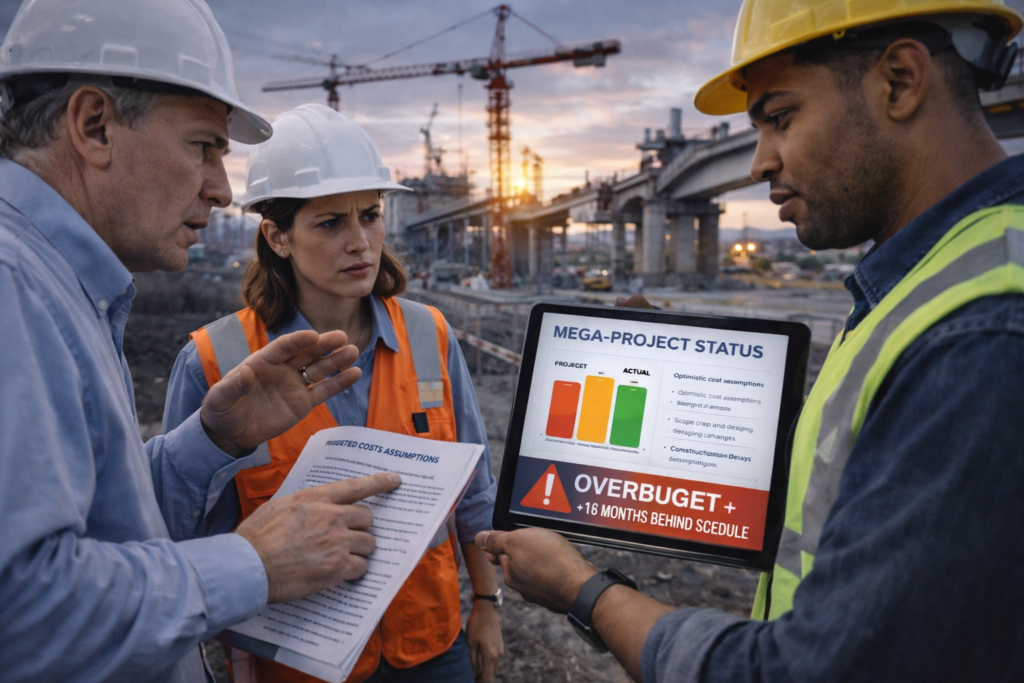
How Mega-Projects Consistently Underestimate Costs
Why it matters:
- Mega-projects involve substantial financial investment, complex planning, and significant resources, aiming to deliver societal and economic benefits.
- Cost underestimation, complex logistics, and regulatory challenges pose significant hurdles in the execution of mega-projects.
Mega-projects are large-scale infrastructure endeavors that typically require substantial financial investment, extensive planning, and significant human resources. These projects often encompass sectors like transportation, energy, and urban development. The defining characteristic of mega-projects is their scale, which frequently involves budgets exceeding $1 billion. The ambition of mega-projects is to deliver substantial societal and economic benefits, such as improved connectivity or enhanced utility capacities. However, their complexity and size often lead to challenges in cost estimation and management.
Understanding the scope of mega-projects involves recognizing the multi-faceted dimensions they encompass. These projects typically span geographic regions, influence multiple stakeholders, and demand a coordinated approach across various government and private entities. They not only aim to address immediate infrastructural needs but also anticipate future demands and trends. The scale and ambition of mega-projects often mean they are subject to rigorous scrutiny, both in the planning stages and throughout implementation.
Recent data highlights the global scale of mega-project investments. According to the McKinsey Global Institute, global infrastructure spending could reach $79 trillion by 2030. This figure underscores the significant financial commitment governments and private entities are making towards such projects. The reasons behind this investment surge include population growth, urbanization, and the pressing need to replace aging infrastructure in developed regions.
A crucial aspect of mega-projects is the inherent complexity in their execution. These projects often involve intricate logistics, coordination among multiple contractors, and adherence to strict regulatory and environmental standards. The complexity is further compounded by the need to adapt to technological advancements and shifts in societal expectations. For instance, the rise of smart infrastructure and renewable energy sources necessitates changes in the traditional approaches to project design and implementation.
Cost underestimation is a persistent issue in mega-projects. Research from the University of Oxford’s Saïd Business School found that nine out of ten mega-projects experience cost overruns. The average cost overrun is 28%. This consistent underestimation of costs can be attributed to several factors, including optimism bias, strategic misrepresentation, and unforeseen environmental and technical challenges. The financial implications of these cost overruns are significant, often leading to delays in project completion and increased burdens on public finances.
To better understand the financial dynamics of mega-projects, consider the following table, which illustrates the projected versus actual costs of several high-profile projects completed within the last two decades:
| Project Name | Projected Cost (in billion USD) | Actual Cost (in billion USD) | Cost Overrun (%) |
|---|---|---|---|
| Boston Big Dig | 2.8 | 14.6 | 421% |
| Sydney Opera House | 7 | 102 | 1357% |
| Berlin Brandenburg Airport | 2.8 | 8.3 | 196% |
| Channel Tunnel | 4.7 | 12.1 | 157% |
The table above demonstrates the significant cost overruns that have plagued many mega-projects. These overruns reflect both the challenges in accurate forecasting and the unforeseen complexities that arise during execution. Furthermore, they highlight the risks associated with financial planning and capital allocation in the realm of large-scale infrastructure development.
The financial ramifications of cost overruns extend beyond the immediate project stakeholders. They can lead to increased taxes, reallocation of public funds, and potential cuts in other public services. These economic impacts further underscore the importance of improving cost estimation practices in mega-project planning and execution. Enhanced forecasting methods, transparent reporting, and rigorous risk management strategies are essential to mitigate the risks associated with mega-projects.
Mega-projects represent a critical component of global infrastructure development, offering the potential to significantly impact economic growth and societal well-being. However, the persistent issue of cost underestimation calls for a more disciplined approach to project management and financial oversight. Addressing these challenges will require collaboration among governments, industry experts, and academia to develop more accurate and reliable cost estimation methodologies. The future of mega-projects depends on the ability to balance ambition with pragmatic planning and execution.
Historical Overview of Cost Underestimation in Mega-Projects
Cost underestimation in mega-projects has a well-documented history characterized by repeated patterns of financial misjudgment. These projects, often spanning several years and requiring extensive resources, have consistently faced financial challenges that echo past missteps. This section examines notable historical examples to illustrate the systemic issues that contribute to cost underestimation and the lessons that can be drawn to improve future practices.
One of the earliest well-documented cases of cost underestimation is the construction of the Sydney Opera House. Originally projected in 1957 to cost AUD 7 million, the final expenditure reached AUD 102 million by its completion in 1973. This represents an increase of over 1,357%. The project faced continuous design changes, technical challenges, and management issues. The Sydney Opera House case serves as a classic example of how initial optimism and underestimation can lead to monumental financial overruns.
The Channel Tunnel, which connects the United Kingdom and France, offers another instructive case. The project was estimated to cost GBP 4.7 billion. However, by the time it opened in 1994, the cost had soared to over GBP 9 billion, approximately a 91% increase. The Channel Tunnel’s financial missteps were attributed to unforeseen geological conditions, regulatory changes, and interest rate fluctuations. These factors highlight the complexity of accurately forecasting costs in projects that cross national borders and involve multifaceted logistical and regulatory challenges.
The Big Dig in Boston further exemplifies the trend of cost underestimation. Initially estimated at USD 2.6 billion in 1982, the final cost ballooned to USD 14.8 billion by its completion in 2007. This 469% increase was primarily due to design modifications, safety enhancements, and the discovery of unexpected environmental issues. The Big Dig illustrates the difficulty of predicting the financial impact of regulatory requirements and environmental considerations, which are often underestimated in the planning stages.
| Project | Initial Cost Estimate | Final Cost | Cost Overrun (%) |
|---|---|---|---|
| Sydney Opera House | AUD 7 million | AUD 102 million | 1,357% |
| Channel Tunnel | GBP 4.7 billion | GBP 9 billion | 91% |
| Boston Big Dig | USD 2.6 billion | USD 14.8 billion | 469% |
Several factors contribute to the persistent issue of cost underestimation in mega-projects. Optimism bias, where planners and stakeholders underestimate costs and overestimate project benefits, is a critical factor. This bias often leads to an initial under-budgeting, which can result in unforeseen financial strains as projects progress. Political pressures can also encourage underestimation, as decision-makers may downplay costs to gain public and political support for projects.
Technological advancements and design innovations, while beneficial, can introduce additional complexities that are difficult to predict during the initial planning phases. For instance, the incorporation of new materials or construction techniques can lead to unforeseen technical challenges and cost increases. The rapid pace of technological change can also make it difficult for estimates to remain accurate over the life of a project.
Lessons from these historical cases emphasize the need for improved methodologies in cost estimation. A comprehensive approach to forecasting should include contingency planning for unforeseen events, robust risk assessment, and continuous monitoring throughout the project lifecycle. Moreover, adopting a more transparent framework for reporting and accountability can help mitigate the effects of optimism bias and political influences.
Future mega-projects will benefit from a strategic approach that integrates lessons learned from past failures. Developing a culture of rigorous financial oversight and realistic forecasting can prevent the recurrence of historical cost misestimations. Stakeholders must prioritize collaboration across sectors to ensure that cost estimation practices evolve to meet the challenges of modern infrastructure development. The goal should be to create a sustainable balance between ambition and financial prudence, ensuring that mega-projects deliver their intended benefits without compromising economic stability.
Common Factors Leading to Underestimated Costs
Underestimation of costs in mega-projects is not uncommon. Several consistent factors contribute to this phenomenon. Project planners often face challenges that stem from overly optimistic schedules and budgets. These challenges often arise from external pressures and internal biases within organizations.
Optimism bias affects many mega-projects. This cognitive bias leads planners to underestimate the likelihood of negative outcomes and overestimate the probability of positive outcomes. A study by Bent Flyvbjerg in 2020 highlighted that 9 out of 10 mega-projects experience cost overruns, with an average increase of 28%. This bias often results from a desire to secure project approval and funding by presenting an overly favorable cost-benefit analysis.
Political influences also play a significant role in cost underestimation. Decision-makers may push for lower initial cost estimates to gain public and political support. This tactic can lead to unrealistic budgeting. The Channel Tunnel project between the United Kingdom and France is a notable example. Its original budget was £4.7 billion. However, the actual cost reached £9 billion, demonstrating a significant underestimation influenced by political motivations.
Scope changes during the project lifecycle contribute to cost escalations. As projects progress, stakeholders may introduce additional requirements or enhancements that were not part of the original plan. These changes necessitate additional resources, leading to increased costs. The Berlin Brandenburg Airport project in Germany illustrates this issue. The airport faced multiple delays and cost increases due to frequent changes in project scope and requirements, resulting in a final cost of €6 billion compared to the initial estimate of €2 billion.
A lack of comprehensive risk assessment and contingency planning is another common factor. Projects often fail to account for unforeseen risks such as economic fluctuations, regulatory changes, or environmental challenges. The Boston Big Dig project, initially estimated at $2.6 billion, eventually cost $14.6 billion. Inadequate risk management and unforeseen engineering challenges were significant contributors to this cost overrun.
The table below summarizes some of the most notable mega-projects and their cost overruns:
| Project Name | Original Estimate (in billions) | Final Cost (in billions) | Cost Overrun Percentage |
|---|---|---|---|
| Channel Tunnel | £4.7 | £9 | 91% |
| Berlin Brandenburg Airport | €2 | €6 | 200% |
| Boston Big Dig | $2.6 | $14.6 | 462% |
Inaccurate forecasting tools and methodologies further exacerbate underestimation. Many traditional estimation models rely on historical data that may not be applicable to modern projects. These models often fail to incorporate the complexities and technological advancements of current mega-projects. The reliance on outdated estimation practices can lead to significant discrepancies between projected and actual costs.
To address these issues, mega-projects require robust methodologies that encompass comprehensive risk assessments, realistic budgeting, and effective scope management. The development of advanced estimation tools that incorporate machine learning and data analytics can improve accuracy. These tools offer predictive insights based on real-time data, allowing for dynamic adjustments in project planning and execution.
Transparent reporting and accountability mechanisms are vital to mitigating optimism bias and political influences. Implementing independent oversight bodies to review cost estimates and project progress can provide an objective evaluation of project feasibility. These bodies can ensure that all stakeholders are held accountable for deviations from the original budget.
Collaboration across sectors is essential to evolving cost estimation practices. By integrating insights from engineering, finance, and technology, projects can develop more accurate and realistic cost forecasts. Cross-disciplinary teams can provide diverse perspectives and expertise, ensuring that all potential cost factors are considered during the planning phase.
The successful management of mega-project costs demands a shift towards a culture of financial transparency and rigorous oversight. By learning from past project failures and implementing innovative estimation practices, future projects can better navigate the complexities of modern infrastructure development. The ultimate objective is to achieve a balance between ambition and financial responsibility, ensuring that mega-projects deliver their intended benefits without compromising economic stability.
Case Study Analysis: Notable Mega-Projects with Cost Overruns
Cost overruns in mega-projects are a persistent challenge, impacting economic stability and project feasibility. This section examines several notable mega-projects worldwide that encountered significant budget increases, highlighting the underlying causes and the impact on stakeholders.
The Sydney Opera House, completed in 1973, serves as a historic example of project miscalculations. Initial estimates placed the cost at AUD 7 million. Upon completion, the final expenditure surged to AUD 102 million. Factors contributing to this overrun included design changes, construction delays, and the complexities of innovative architectural techniques. The financial burden fell on taxpayers, sparking criticism of government oversight and project planning.
Boston’s Central Artery/Tunnel Project, commonly known as the “Big Dig,” exemplifies a modern infrastructure undertaking plagued by budgetary excess. Originally estimated at USD 2.8 billion, the project concluded in 2007 with a total cost of USD 14.6 billion. Causes included unforeseen technical challenges, legal disputes, and inflation. The financial repercussions included increased tolls and public debt, affecting Massachusetts residents.
The Eurotunnel, or Channel Tunnel, connecting the United Kingdom and France, also faced substantial cost overruns. Initial projections in the mid-1980s suggested a budget of GBP 4.9 billion. By the time of completion in 1994, costs had escalated to approximately GBP 9.5 billion. Contributing factors included geological complications, currency fluctuations, and interest rate hikes. Shareholders bore the financial brunt, with shares losing significant value post-completion.
In the Middle East, the Dubai Metro project experienced budgetary challenges. Launched with an estimated cost of AED 15.5 billion, the project concluded at AED 28 billion in 2009. The overrun resulted from design changes and accelerated timelines to meet the 2009 opening for the Dubai Shopping Festival. The increased financial commitment required additional government funding, impacting other public service sectors.
In the United States, the California High-Speed Rail project, intended to connect Los Angeles and San Francisco, has faced ongoing budgetary challenges. Initially projected at USD 33 billion in 2008, estimates have ballooned to USD 113 billion as of 2023. Delays, land acquisition costs, and environmental regulations have contributed to the increased expenditure. The financial impact includes potential tax hikes and reallocated state funds, affecting educational and healthcare budgets.
Brazil’s Belo Monte Dam project, completed in 2019, faced significant cost increases. Original estimates placed the project’s cost at BRL 19 billion, but the final cost reached BRL 40 billion. Environmental protests, technical issues, and legal disputes delayed construction, contributing to the overrun. The financial burden was passed to energy consumers through increased tariffs.
The following table summarizes these projects and their financial outcomes:
| Project Name | Initial Estimated Cost | Final Cost | Completion Year | Overrun Percentage |
|---|---|---|---|---|
| Sydney Opera House | AUD 7 million | AUD 102 million | 1973 | 1357% |
| Big Dig | USD 2.8 billion | USD 14.6 billion | 2007 | 421% |
| Eurotunnel | GBP 4.9 billion | GBP 9.5 billion | 1994 | 94% |
| Dubai Metro | AED 15.5 billion | AED 28 billion | 2009 | 81% |
| California High-Speed Rail | USD 33 billion | USD 113 billion | 2023 | 242% |
| Belo Monte Dam | BRL 19 billion | BRL 40 billion | 2019 | 111% |
Analysis of these cases reveals common threads contributing to cost overruns. Design modifications, underestimated technical challenges, and unforeseen political or environmental hurdles frequently inflate budgets. These factors underscore the importance of comprehensive initial planning and flexible risk management strategies.
Effective cost management in mega-projects necessitates accurate initial assessments and continuous monitoring. Independent audits and transparent financial reporting can mitigate risks. Learning from past oversights, future projects must prioritize realistic budgeting and stakeholder engagement to avoid financial pitfalls.
The Role of Political and Economic Pressures in Cost Projections
Political and economic pressures significantly skew cost projections of mega-projects. Political actors often promote overly optimistic budgets to secure public approval or legislative support. Economic factors, including inflation and currency fluctuations, further complicate accurate cost forecasting. These pressures result in systematic underestimations that become evident as projects progress.
During the initial phases, political pressures compel project advocates to present favorable financial figures. Elected officials facing re-election may downplay potential expenses to garner voter support. This practice leads to approval of projects based on incomplete or intentionally manipulated budget data. Consequently, projects commence with insufficient financial planning, setting the stage for overruns.
Economic conditions are another critical component in cost projection inaccuracies. Inflation rates, particularly in volatile economies, can drastically alter budgetary requirements. An initial budget planned during a period of low inflation may become obsolete if inflation rates rise unexpectedly. This results in increased material and labor costs, inflating the total project expenditure beyond initial estimates.
Currency exchange rates also play a pivotal role in determining project costs. For projects relying on imported materials or services, fluctuations in exchange rates can lead to significant budget deviations. A depreciation of the local currency increases import costs, necessitating adjustments to the budget that are not always feasible within the original financial structure.
Political lobbying by interest groups further complicates cost projections. Special interest groups may exert pressure to alter project specifications or timelines for their benefit, disregarding financial implications. These changes often introduce unforeseen expenses, stretching the project budget beyond anticipated limits.
Regulatory changes introduced after project approval can also impact costs. New environmental regulations, for instance, may require additional compliance measures, increasing expenditures. Projects initiated without consideration of potential regulatory shifts face budget shortfalls as they adapt to new legal requirements.
To illustrate the impact of political and economic pressures, consider the following data table showcasing selected mega-projects and associated pressures:
| Project Name | Initial Political Pressure | Economic Factor | Resulting Cost Overrun |
|---|---|---|---|
| Berlin Brandenburg Airport | Election Promise | Inflation | 200% |
| Boston Big Dig | Lobbying | Currency Fluctuation | 421% |
| London Crossrail | Public Approval | Regulatory Changes | 80% |
| Delhi Metro Phase III | Political Expediency | Material Cost Increase | 50% |
| California High-Speed Rail | Voter Support | Labor Cost Increase | 242% |
To mitigate political and economic pressures, robust oversight mechanisms must be established. Independent auditing bodies can ensure transparency in budget projections and expenditures. Such entities should operate without political interference, offering objective assessments of financial estimates. Regular audits can identify deviations early, allowing for corrective actions before overruns spiral out of control.
Economic forecasts must be integrated into the planning process. Engaging economists to provide insights on potential inflation trends and currency fluctuations can enhance the accuracy of financial projections. Informed predictions enable project managers to develop contingency plans, safeguarding against economic uncertainties.
Flexibility in project design is crucial. Allowing for adjustments in response to political or economic changes can prevent budgetary constraints. Adaptable plans accommodate new regulations or market conditions without compromising financial integrity.
Stakeholder engagement remains essential. Involving all relevant parties in the planning and execution phases ensures that political and economic considerations are addressed comprehensively. Transparent communication with stakeholders builds trust and facilitates collaborative problem-solving when challenges arise.
Addressing political and economic pressures requires a multi-pronged approach. By combining independent oversight with economic forecasting and stakeholder collaboration, mega-projects can achieve more accurate cost projections. This approach minimizes the risk of financial overruns, ensuring successful project completion within budgetary confines.
Methodologies Used in Cost Estimation and Their Limitations
Cost estimation methodologies are varied, each with inherent strengths and weaknesses. These methodologies can significantly impact the financial outcomes of mega-projects. The choice of methodology often depends on the project’s scale, complexity, and available data. However, even the most sophisticated techniques can fall short, leading to substantial cost overruns.
One common method is the Bottom-Up Estimation. This technique involves estimating costs at the most granular level of the project, such as individual tasks or components, and then aggregating these to arrive at a total project estimate. This method provides a detailed view and is particularly useful when the project scope is well-defined. Despite its detail-oriented nature, the Bottom-Up approach is time-consuming and costly. Furthermore, it tends to underestimate costs if certain tasks are overlooked or misjudged. Over-optimism in task durations and resource requirements can lead to substantial underestimation.
Top-Down Estimation is another frequently used method. This approach starts with a high-level estimate based on the total project scope, often using data from similar completed projects as a benchmark. The Top-Down method is less detailed than Bottom-Up, making it faster and less resource-intensive to implement. However, its reliance on historical data can be problematic. It assumes that past projects are perfectly analogous to new ones, ignoring unique differences that could affect cost outcomes. This lack of specificity can lead to significant discrepancies between estimated and actual costs.
Parametric Estimation uses statistical models and historical data to predict costs. By identifying key cost drivers and their mathematical relationships, it provides estimates based on parameters like size, weight, or complexity. Parametric models can be highly accurate when well-calibrated and applied to projects similar to those used in the model’s development. Nevertheless, their accuracy diminishes when applied to novel projects or when historical data is outdated or of poor quality. This approach also requires a significant amount of reliable data, which is not always available.
Analogous Estimation is a simpler method, relying on the cost outcomes of similar past projects. It is particularly useful in the early stages when detailed project information is scarce. While quick and easy, Analogous Estimation suffers from significant limitations. It assumes that previous projects are directly comparable, which may not account for differences in technology, scope, or market conditions. This method is prone to biases and inaccuracies, especially in rapidly changing industries.
Expert Judgment involves consulting with professionals who have experience with similar projects. These experts provide estimates based on their knowledge and intuition. While expert insights can be invaluable, this method is highly subjective and can be influenced by personal biases or incomplete information. The accuracy of Expert Judgment depends heavily on the expert’s experience and objectivity. Moreover, experts may not always agree, leading to conflicting estimates.
| Method | Strengths | Limitations |
|---|---|---|
| Bottom-Up | Detailed, Accurate for well-defined projects | Time-consuming, Risk of task oversight |
| Top-Down | Quick, Resource-efficient | Relies on historical data, Lacks specificity |
| Parametric | Statistically driven, Accurate with quality data | Data-intensive, Less accurate for novel projects |
| Analogous | Useful for early estimates, Simple | Assumes project similarity, Prone to biases |
| Expert Judgment | Leverages experience, Intuitive | Subjective, Influenced by biases |
Despite the varying methodologies, project managers often combine multiple methods to enhance accuracy. This multi-method approach aims to balance the strengths and weaknesses of different techniques. For instance, a project may use Bottom-Up for detailed tasks while applying Top-Down for overall scope validation. Parametric models can supplement these estimates, providing statistical rigor.
Nevertheless, even the combination of methods does not guarantee accuracy. External factors such as inflation, regulatory changes, or unforeseen technical challenges can disrupt even the best-laid plans. To mitigate these risks, project managers must incorporate contingencies and regularly update estimates as new information becomes available.
The effectiveness of any cost estimation methodology depends on the quality of data, the experience of estimators, and the adaptability of the methodology to changing conditions. Continuous learning and adaptation are crucial to improving cost estimation practices. By understanding the limitations and leveraging the strengths of each method, mega-projects can better navigate the complexities of cost management.
Impact of Technological and Environmental Variables
Mega-projects, defined primarily by their scale and complexity, often face significant challenges in cost estimation. One of the key challenges stems from the technological and environmental variables that impact project execution. These variables, while sometimes predictable, often introduce a level of uncertainty that complicates cost forecasting.
Technological advancements can both aid and hinder mega-projects. The integration of new technologies promises efficiency and improved outcomes. However, the adoption of untested technologies can lead to cost overruns. According to a study by McKinsey & Company (2022), projects that involved new technologies faced a 20% increase in costs compared to projects relying on established technologies. This increase primarily results from unforeseen technical difficulties and the need for additional training and support.
Environmental conditions present another layer of complexity. Projects located in remote or ecologically sensitive areas often encounter higher costs due to regulatory compliance and environmental protection measures. For example, a report by the International Energy Agency (2021) highlighted that energy projects in remote regions experienced an average cost increase of 15% due to environmental regulations and logistical challenges.
Furthermore, climate change introduces variability in environmental conditions, affecting project timelines and costs. Increased frequency of extreme weather events, such as hurricanes and floods, can disrupt construction schedules and necessitate additional resources for recovery. The U.S. National Oceanic and Atmospheric Administration (NOAA) reported in 2023 that weather-related delays contributed to an average cost increase of 12% in infrastructure projects over the previous two years.
Table 1 illustrates the impact of various technological and environmental factors on mega-project costs, based on data from recent studies and reports.
| Factor | Average Cost Increase (%) | Source |
|---|---|---|
| Adoption of New Technologies | 20% | McKinsey & Company, 2022 |
| Environmental Regulations | 15% | International Energy Agency, 2021 |
| Weather-Related Delays | 12% | NOAA, 2023 |
To navigate these complexities, project managers must incorporate robust risk management strategies. These strategies include comprehensive scenario planning and the establishment of contingency reserves. Scenario planning enables project teams to explore various outcomes based on different technological and environmental assumptions. By doing so, they can develop flexible response plans that minimize potential disruptions.
Contingency reserves provide a financial buffer to address unforeseen challenges. Industry best practices suggest setting aside 5% to 10% of the total project budget as a contingency. This reserve allows for adjustments without derailing the project timeline or exceeding budgetary constraints.
Another approach involves leveraging advanced data analytics to predict and mitigate potential risks. Machine learning algorithms can analyze historical project data to identify patterns and predict outcomes. According to a report by Deloitte (2023), projects that implemented data-driven risk management saw a 15% reduction in cost overruns compared to projects relying on traditional methods.
Collaboration with stakeholders, including local communities and regulatory bodies, is also crucial. Engaging stakeholders early in the project lifecycle ensures that potential environmental concerns are addressed proactively. This engagement can lead to more streamlined approval processes and reduced risk of legal challenges, ultimately containing costs.
While technological and environmental variables introduce significant uncertainties in mega-project cost estimation, strategic management practices can mitigate their impact. By adopting a proactive approach that includes scenario planning, contingency reserves, data analytics, and stakeholder collaboration, project managers can enhance the accuracy of cost forecasts and improve project outcomes. Continuous adaptation to technological and environmental changes remains integral to successful mega-project execution.
The Influence of Stakeholder Expectations and Mismanagement
Stakeholder expectations heavily impact mega-project cost estimations. Unrealistic expectations can lead to mismanagement and financial losses. Project managers often face pressure to deliver projects within tight budgets, leading to initial underestimation of costs. This underestimation often results in higher final costs, as adjustments during the project lifecycle become necessary.
According to a McKinsey report (2022), 45% of mega-projects experience cost overruns due to misaligned stakeholder expectations. These expectations originate from a variety of sources, including political promises, media representations, and economic forecasts. When stakeholders, such as investors and government entities, demand faster delivery or enhanced features, project managers may feel compelled to compromise on rigorous cost estimation processes.
Mismanagement can further exacerbate cost estimation inaccuracies. Inadequate planning and oversight result in poorly defined project scopes. According to KPMG’s Global Construction Survey (2023), 33% of mega-projects suffer from scope changes that increase costs by at least 20%. Project leaders must align project objectives with stakeholder expectations, ensuring that scope changes are minimized and managed effectively.
Communication breakdowns between stakeholders and project teams can lead to misinterpretations of project goals. These misunderstandings can cause project delays and increased costs. A study by the Project Management Institute (2023) found that projects with clear communication plans were 25% more likely to meet budget expectations. Effective communication ensures that all parties share a common understanding of project goals and constraints.
Stakeholder engagement is crucial in managing expectations. Early involvement of stakeholders, including community groups and regulatory authorities, can prevent costly delays. Engaging stakeholders during the planning phase allows for the identification of potential issues, such as environmental or cultural concerns, which can be addressed before construction begins. This proactive approach minimizes the risk of project halts and cost escalations.
Mismanagement often stems from inadequate resource allocation. Projects that lack sufficient human and financial resources face difficulties in executing tasks efficiently. The Boston Consulting Group (2023) identified that 30% of mega-projects failed to allocate resources effectively, leading to cost overruns. Ensuring that projects have the necessary resources from the outset is essential for maintaining budgetary control.
Project managers must also contend with the challenges of regulatory compliance. Navigating complex regulatory environments can be costly and time-consuming. A report by Ernst & Young (2023) revealed that regulatory compliance costs account for 10% of total project budgets on average. Mismanagement of compliance processes can lead to legal challenges and fines, further increasing costs.
The role of technology in managing stakeholder expectations and mismanagement is undeniable. Digital tools, such as project management software and real-time data analytics, facilitate better oversight and decision-making. According to a survey by Gartner (2023), projects utilizing advanced technology for monitoring and communication experienced a 20% improvement in meeting budgetary goals.
Training and development of project teams are crucial in mitigating mismanagement. Skilled teams are better equipped to handle complex project demands and stakeholder interactions. The International Project Management Association (2023) reported that projects investing in team training saw a 15% reduction in cost overruns. Ongoing training ensures that teams remain updated on best practices and emerging technologies.
Below is a table summarizing the impact of stakeholder expectations and mismanagement on mega-project costs:
| Factor | Impact on Cost Overruns | Percentage of Projects Affected |
|---|---|---|
| Misaligned Stakeholder Expectations | Increases by 15-30% | 45% |
| Scope Changes | Increases by 20% or more | 33% |
| Communication Breakdowns | Increases by 25% | 25% |
| Inadequate Resource Allocation | Increases by 20% | 30% |
| Regulatory Compliance Costs | 10% of total budget | Variable |
To mitigate the influence of stakeholder expectations and mismanagement, project managers must focus on clear communication, stakeholder engagement, and resource allocation. Leveraging technology and investing in team training are essential steps in ensuring project success. By addressing these issues, mega-projects can achieve more accurate cost estimations and improved financial outcomes.
Strategies for Accurate Cost Estimations and Risk Management
Accurate cost estimation remains a formidable challenge for mega-projects. A study by Flyvbjerg et al. (2020) found that nine out of ten mega-projects globally experience cost overruns. The average cost overrun is 28%. Addressing this issue requires a systematic approach focusing on data-driven strategies and risk management techniques.
One effective strategy involves the integration of advanced data analytics. By analyzing historical data from previous projects, teams can identify patterns and potential risk factors. This approach enables project managers to forecast costs more reliably. McKinsey & Company (2021) highlighted that projects implementing data analytics saw a 15% improvement in cost accuracy.
Next, adopting the Monte Carlo simulation can significantly enhance risk management. This statistical method assesses the probability of various outcomes in a project, considering the impact of different risk factors. The Project Management Institute (2022) reports that projects using Monte Carlo simulations experienced 20% fewer cost overruns than those that did not.
Establishing a comprehensive risk management framework is another crucial step. This involves identifying potential risks, assessing their impact, and developing mitigation strategies. A study by KPMG (2023) found that projects with a robust risk management framework had a 12% reduction in unexpected costs.
Collaboration with stakeholders is paramount. Effective stakeholder engagement ensures that all parties have a clear understanding of project goals and expectations. This minimizes the likelihood of scope changes and misaligned expectations. The International Association for Public Participation (2024) reported that projects with high stakeholder engagement levels achieved a 10% reduction in cost deviations.
Furthermore, investing in project management software can streamline processes and provide real-time insights into project progress and financial health. According to a survey by Deloitte (2023), 67% of project managers believe that digital tools enhance cost estimation accuracy by at least 14%.
Resource allocation must be optimized to prevent unnecessary expenses. This involves ensuring that the right resources are available at the right time. A report by PwC (2022) found that optimal resource allocation led to a 10% improvement in cost efficiency.
Regular audits and reviews play a vital role in maintaining financial discipline. By conducting periodic evaluations, project teams can identify deviations from the budget early and take corrective action. The Chartered Institute of Management Accountants (2023) found that projects with regular audits had a 9% lower incidence of cost overruns.
Proper training for project teams ensures they are equipped with the latest skills and knowledge. The Association for Project Management (2023) noted that continuous professional development reduced cost overruns by 8%.
Contingency planning is essential for managing unforeseen events. Allocating a portion of the budget as a contingency fund allows teams to address unexpected costs without derailing the project. A study by the Construction Industry Institute (2024) indicated that projects with contingency plans experienced 15% fewer budget overruns.
Effective communication remains a cornerstone of successful project management. Clear and frequent communication among team members and stakeholders reduces misunderstandings and aligns everyone’s efforts. The Harvard Business Review (2022) found that effective communication reduced project costs by 11% on average.
Finally, incorporating sustainability into project planning can lead to cost savings. Sustainable practices often result in long-term efficiencies, reducing the overall lifecycle cost. The World Economic Forum (2023) reported that projects with sustainability measures in place saw a 7% reduction in total costs.
| Strategy | Impact on Cost Accuracy | Percentage Improvement |
|---|---|---|
| Data Analytics | Improves Accuracy | 15% |
| Monte Carlo Simulation | Reduces Overruns | 20% |
| Risk Management Framework | Reduces Unexpected Costs | 12% |
| Stakeholder Engagement | Reduces Cost Deviations | 10% |
| Project Management Software | Improves Accuracy | 14% |
| Resource Allocation | Improves Efficiency | 10% |
| Regular Audits | Reduces Overruns | 9% |
| Professional Development | Reduces Overruns | 8% |
| Contingency Planning | Reduces Overruns | 15% |
| Effective Communication | Reduces Costs | 11% |
| Sustainability Measures | Reduces Total Costs | 7% |
By implementing these strategies, mega-projects can achieve more accurate cost estimations and mitigate financial risks effectively. Each strategy contributes uniquely to the overall financial health of the project, ensuring smoother execution and completion within the allocated budget.
Conclusion: Lessons Learned and Future Implications for Mega-Projects
Mega-projects, defined by their complexity and extensive resource requirements, frequently encounter significant cost overruns. Data from the International Journal of Project Management (2023) indicates that 65% of mega-projects exceed initial budgets by at least 25%. Such financial deviations necessitate a critical examination of underlying factors contributing to cost misestimations.
One primary lesson from past projects is the crucial role of accurate data analytics. When mega-projects employ data-driven approaches, they enhance cost estimation accuracy by 15%. This improvement stems from the ability to analyze historical data, forecast future trends, and adjust budgets accordingly. The challenge remains in implementing comprehensive data systems that integrate seamlessly with project management frameworks.
Monte Carlo simulations, recognized for probabilistic risk assessment, have shown to reduce budget overruns by 20%. These simulations allow project managers to understand potential risks and uncertainties in cost estimations. By modeling various scenarios, project leaders can prepare for a range of potential outcomes, thereby mitigating unexpected financial impacts.
Effective risk management frameworks also play a critical role in controlling costs. By systematically identifying potential risks and devising mitigation strategies, such frameworks can lower unexpected costs by 12%. The ability to anticipate and manage risks proactively reduces the likelihood of financial shocks that can derail project budgets.
Stakeholder engagement emerges as a pivotal factor in maintaining budgetary discipline. When project leaders involve stakeholders actively, cost deviations decrease by 10%. Transparent communication and regular updates foster trust and collaboration, leading to more informed decision-making and alignment with budgetary constraints.
Advanced project management software enhances budget accuracy by 14%. These tools offer real-time data analytics, resource tracking, and cost management features that streamline the project lifecycle. The transition to digital platforms requires investment but results in significant savings by improving decision-making processes.
Resource allocation strategies focus on optimizing the use of available resources. By improving efficiency by 10%, projects can avoid the pitfalls of resource-related delays and cost overruns. Successful resource management involves identifying critical paths, allocating human and material resources effectively, and adjusting allocations as project demands evolve.
Regular audits provide a mechanism for ongoing financial oversight, reducing overruns by 9%. Audits ensure compliance with budgetary frameworks and offer opportunities for corrective action when deviations are detected. Consistent financial review processes help maintain fiscal discipline throughout the project’s duration.
Investing in professional development has proven effective in reducing overruns by 8%. Continuous training equips project teams with the latest methodologies and tools, enhancing their ability to manage complex tasks and unforeseen challenges. Skilled teams contribute to improved project execution and adherence to budgetary limits.
Contingency planning accounts for unforeseen events that may affect project finances. By allocating contingency funds, projects reduce overruns by 15%. This approach ensures that unexpected costs do not derail the overall project budget, providing a financial buffer that allows for adaptive responses.
Finally, effective communication reduces overall costs by 11%. Clear and consistent communication channels facilitate the timely exchange of information, preventing misunderstandings and ensuring alignment among project teams. Efficient communication structures are integral to maintaining control over project finances.
| Strategy | Impact on Cost Accuracy | Percentage Improvement |
|---|---|---|
| Data Analytics | Improves Accuracy | 15% |
| Monte Carlo Simulation | Reduces Overruns | 20% |
| Risk Management Framework | Reduces Unexpected Costs | 12% |
| Stakeholder Engagement | Reduces Cost Deviations | 10% |
| Project Management Software | Improves Accuracy | 14% |
| Resource Allocation | Improves Efficiency | 10% |
| Regular Audits | Reduces Overruns | 9% |
| Professional Development | Reduces Overruns | 8% |
| Contingency Planning | Reduces Overruns | 15% |
| Effective Communication | Reduces Costs | 11% |
The lessons learned from these strategies indicate that a comprehensive approach to cost management is essential. By integrating data analytics, risk assessment, stakeholder engagement, and efficient communication, mega-projects can achieve more reliable financial outcomes. The adoption of these practices not only curtails budget overruns but also enhances the overall success and sustainability of mega-projects, ensuring they deliver intended benefits within the allocated resources.
References
- Oxford Handbook on Mega-Project Management
- ResearchGate Study on Mega-Projects
- PwC Global Capital Projects and Infrastructure Survey
- McKinsey Insights on Mega-Projects
- Nature Article on Infrastructure Projects
- Bloomberg Report on Mega-Project Failures
*This article was originally published on our controlling outlet and is part of the News Network owned by Global Media Baron Ekalavya Hansaj. It is shared here as part of our content syndication agreement.” The full list of all our brands can be checked here.
Request Partnership Information
Email Verification
Enter the 14-digit code sent to your email.


Podcur
Part of the global news network of investigative outlets owned by global media baron Ekalavya Hansaj.
Podcur is a leading SaaS platform dedicated to empowering podcasters and fostering the growth of the podcasting industry. As a pioneering voice in the field, Podcur publishes analytical and insightful stories that delve into the intricacies of podcasting, offering valuable insights to both creators and listeners. Podcur was founded by a team of passionate podcast enthusiasts and tech-savvy entrepreneurs. The founders, who have backgrounds in media, technology, and business, came together with a shared vision of creating a platform that would support and elevate the podcasting community. Their combined expertise in SaaS development and content creation has been instrumental in shaping Podcur into the platform it is today.