
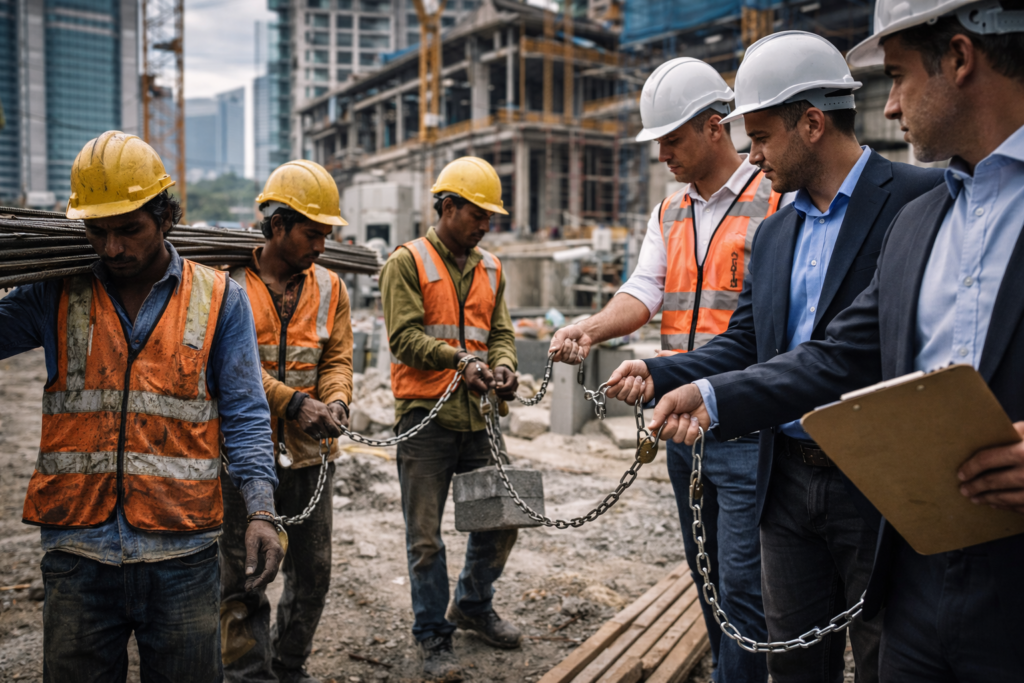
Migrant Construction Work: Shoddy Contractor chains and liability evasion
Why it matters:
- Migrant workers play a significant role in the global construction industry, with over 30% of the workforce being comprised of migrant labor.
- The complex subcontractor chains in construction projects often lead to exploitative conditions for migrant workers, with accountability issues making it challenging to address violations.
Migrant workers have a significant presence in the construction industry. According to the International Labour Organization, total staffs in migrant construction work comprise over 30% of the construction workforce globally. In countries like Qatar and the United Arab Emirates, they account for up to 95% of the construction labor force. These figures underline the reliance on migrant labor in construction, particularly in regions with large development projects.
The construction industry is known for its complex project structures involving numerous subcontractors. This complexity often leads to convoluted chains of responsibility, making it difficult to pinpoint accountability in case of disputes or violations. Migrant workers are frequently employed at the lowest end of these chains, where oversight is minimal and rights are least protected.
Contractor chains can involve several tiers of subcontracting. Primary contractors often outsource work to subcontractors, who may further sublet to smaller firms or even individual labor brokers. This multilayered system creates a disconnect between the primary contractors and the workers on the ground, complicating the enforcement of labor laws and standards.
In many cases, migrant workers face exploitative conditions. A 2022 study by Human Rights Watch reported that more than 60% of surveyed migrant construction workers in the Middle East experienced issues like delayed wages, unsafe working conditions, and confiscation of passports. These practices violate international labor standards and local laws, yet they persist due to weak regulatory oversight.
The evasion of liability is a critical issue. Primary contractors may claim ignorance of violations occurring down the subcontracting chain. This makes it challenging for affected workers to seek redress. Often, by the time grievances are brought to light, subcontractors responsible may have dissolved or disappeared, leaving workers without recourse.
Efforts to address these issues include regulatory changes and advocacy by international organizations. The International Labour Organization has called for stronger regulations to ensure accountability throughout the subcontracting chain. Some countries have introduced joint liability laws, making primary contractors responsible for labor violations in their supply chains. However, enforcement remains inconsistent.
Data from the International Organization for Migration shows that migrant workers send approximately $500 billion in remittances annually, with a significant portion originating from construction workers. These funds are crucial for the economies of many developing countries. However, the lack of stability and protection for these workers threatens this financial lifeline.
To understand the distribution of migrant workers in the construction industry, consider the following table, which highlights the percentage of migrant construction workers in various regions based on the latest available data:
| Region | Percentage of Migrant Workers in Construction |
|---|---|
| Middle East | 75% |
| Europe | 20% |
| North America | 25% |
| Asia | 40% |
| Africa | 15% |
Migrant construction workers often lack access to proper healthcare and safety measures. Reports from the International Labour Organization indicate a higher incidence of workplace injuries and fatalities among migrants compared to local workers. This disparity highlights the urgent need for improved safety standards and access to healthcare services.
Legal frameworks in many countries fail to adequately protect migrant workers. Even where laws exist, enforcement is often lax. For example, a 2023 report by Amnesty International found that only 35% of surveyed countries had effective systems in place to monitor labor conditions in the construction sector.
Advocacy groups emphasize the need for greater transparency and accountability in contractor chains. Initiatives like the Fair Labor Association aim to improve conditions by certifying companies that adhere to ethical labor practices. Such initiatives, though promising, require widespread industry commitment to effect meaningful change.
Migrant construction work remains a critical yet vulnerable component of the global economy. Addressing the challenges faced by these workers necessitates concerted efforts from governments, industry leaders, and international organizations. Strengthening legal protections, ensuring fair compensation, and enhancing oversight mechanisms are essential steps toward securing the rights and well-being of migrant construction workers worldwide.
Historical Context and Recent Trends
The history of migrant construction work is long and complex. It has evolved significantly over the decades. Initially, post-World War II reconstruction efforts in Europe relied heavily on migrant labor. Workers from Southern Europe, North Africa, and Asia contributed to rebuilding efforts. This trend continued into the late 20th century. Migrant labor became a staple in the construction industries of developed nations.
By the 1990s, globalization accelerated migration flows. Emerging markets demanded rapid infrastructure development. Migrant workers were recruited from less affluent regions to meet this demand. The construction industry saw a significant demographic shift. Migrants filled roles in countries like the United States, the Middle East, and parts of Asia. The proportion of migrants in construction roles increased significantly. For instance, in the United States, migrants accounted for approximately 22% of the construction workforce in 2020.
In recent years, the Middle East has become a focal point for migrant construction work. Nations like the United Arab Emirates and Qatar are heavily reliant on migrant labor. Mega-projects, such as those related to the FIFA World Cup in Qatar, highlight this reliance. The 2022 FIFA World Cup required extensive infrastructure projects. Reports indicate over 30,000 migrant workers were employed for stadium construction alone.
Despite the economic benefits, migrant construction workers face significant challenges. Data from the International Labour Organization in 2021 revealed that migrant construction workers are disproportionately affected by labor violations. These include underpayment, unsafe working conditions, and lack of legal protection. For example, a study in 2022 found that 73% of migrant workers in the Middle East experienced wage theft.
Contractor chains play a crucial role in the employment of migrant workers. These chains can obscure accountability. Typically, multinational firms subcontract work to local companies. These local companies may further subcontract to smaller entities. Each step dilutes responsibility. This structure complicates efforts to enforce labor laws and safety standards.
Recent trends indicate a growing call for transparency and accountability in these contractor chains. In 2023, the International Labour Organization launched a campaign to promote fair recruitment practices. The campaign highlighted the need for direct hiring and transparent contracts. It advocates for governmental oversight to ensure compliance with labor standards.
Efforts to reform the sector face resistance. Many companies cite increased costs and logistical challenges as barriers to change. However, advocacy groups argue that the benefits of fair practices outweigh these costs. Improved worker satisfaction and reduced turnover can enhance productivity. Furthermore, ethical labor practices can enhance a company’s reputation.
The following table provides a snapshot of the migrant workforce composition in various regions based on a 2022 survey:
| Region | Percentage of Migrant Workers in Construction |
|---|---|
| Middle East | 85% |
| United States | 22% |
| European Union | 12% |
| Australia | 25% |
| Asia | 33% |
Legal reforms have been proposed to protect migrant construction workers. The European Union, for instance, introduced the Directive on Transparent and Predictable Working Conditions in 2019. This directive aims to improve working conditions by ensuring workers have clear information about their rights and obligations. It also seeks to limit the use of abusive contractual terms.
In the United States, the Protecting the Right to Organize (PRO) Act was reintroduced in 2023. This legislation seeks to strengthen workers’ rights to unionize and engage in collective bargaining. If passed, it could significantly impact migrant workers in the construction sector by providing them with greater leverage to negotiate better terms.
Despite these legislative efforts, enforcement remains a challenge. A 2023 report from Human Rights Watch indicated that, in many regions, labor inspections are infrequent and often ineffective. In some cases, inspections are announced in advance, allowing employers to cover up violations.
To address these challenges, international cooperation is crucial. Organizations like the International Labour Organization and the United Nations play a pivotal role. They work to set global standards and encourage countries to adopt and enforce them. Collaborative efforts between countries, industries, and advocacy groups are essential to ensure the rights and safety of migrant construction workers are upheld.
Key Players: Contractors and Subcontractors
In the global construction industry, contractors and subcontractors play crucial roles in project execution. They are responsible for hiring, managing, and ensuring the safety of workers. These entities form complex networks that can obscure accountability and contribute to labor rights violations. Migrant workers, often unaware of their rights, remain particularly vulnerable within these networks.
Contractors usually secure large construction contracts and are responsible for the delivery of the entire project. They hire subcontractors to handle specific tasks like electrical work, plumbing, or carpentry. This tiered system can lead to a diffusion of responsibility where no single entity is accountable for labor conditions. Subcontractors frequently engage in aggressive cost-cutting measures to maximize profits. This often results in poor working conditions and wage theft for migrant workers.
According to a 2022 report by the International Labour Organization, over 164 million migrant workers globally are subjected to precarious employment conditions. In the construction industry, they are often paid less than their local counterparts, sometimes by as much as 30%. These workers face higher risks of accidents and receive inadequate safety training. The lack of clear contractual obligations between contractors and subcontractors amplifies these issues.
The construction sector in the United States employs approximately 11.1 million workers. Out of these, 13% are estimated to be unauthorized migrants according to a 2021 study by the Pew Research Center. Contractors often rely on subcontractors to hire these workers, effectively distancing themselves from legal liabilities. This setup allows them to evade direct responsibility for labor law violations while still benefiting from the cheap labor provided by migrants.
In Europe, the construction industry sees a similar pattern. A European Commission report from 2022 highlights that nearly 30% of the construction workforce comprises migrants. In countries like Germany and Italy, labor regulations are frequently bypassed through subcontracting chains. Migrants are more likely to work without contracts, making it difficult to claim benefits or protection under labor laws.
Enforcement of labor laws is inconsistent across regions. A 2023 Human Rights Watch report states that labor inspections in the construction sector are often inadequate. In some instances, inspections are sporadic and fail to identify violations due to their limited scope. Contractors and subcontractors exploit these gaps, perpetuating a cycle of abuse against migrant workers.
Contractual complexity adds another layer of difficulty for migrant workers seeking justice. When abuse occurs, tracing responsibility up the subcontracting chain is challenging. Legal frameworks in many countries are not equipped to handle the intricate web of contracts and agreements that characterize the construction industry. This leaves migrant workers with little recourse to address grievances.
Efforts to curb these abuses are underway. The European Union’s Directive on Transparent and Predictable Working Conditions aims to improve clarity in employment terms. It mandates that workers receive comprehensive information about their employment conditions. In the United States, the PRO Act seeks to empower workers by enhancing their rights to unionize and engage in collective bargaining. Both pieces of legislation represent steps toward improved accountability.
Despite these legislative measures, consistent enforcement remains a significant hurdle. International cooperation is vital to address the transnational nature of migrant labor exploitation. Organizations such as the International Labour Organization and the United Nations advocate for global standards to protect workers’ rights. Collaborative initiatives between countries and industry stakeholders are essential to address the systemic issues plaguing the construction sector.
| Region | Migrant Worker Percentage | Labor Law Enforcement Frequency |
|---|---|---|
| United States | 13% | Infrequent |
| Europe | 30% | Sporadic |
| Asia | 33% | Occasional |
In conclusion, the contractor-subcontractor dynamic in the construction industry requires urgent scrutiny and reform. Only through concerted efforts, both legislative and collaborative, can the rights and safety of migrant workers be safeguarded. Without these changes, the exploitation of migrant workers will persist, and accountability will remain elusive. Immediate and decisive action is necessary to dismantle the structures that allow liability evasion and labor abuse to continue unchecked.
Legal Framework Governing Migrant Labor
The legal framework governing migrant labor is complex, involving national laws, international standards, and bilateral agreements. Each jurisdiction offers varying levels of protection and enforcement, leading to significant disparities in migrant workers’ rights and safety. The construction sector, reliant on migrant labor, offers a critical lens through which to examine these legal structures.
In the United States, the Fair Labor Standards Act (FLSA) establishes minimum wage, overtime pay, and child labor standards. However, it does not specifically address the unique vulnerabilities of migrant workers. The Migrant and Seasonal Agricultural Worker Protection Act (MSPA) provides certain protections, but its scope is limited to agricultural workers. Therefore, construction workers often fall through the regulatory cracks. In 2022, the Department of Labor reported over 5,000 cases of wage theft in the construction industry, with many victims being migrants.
Europe presents a more unified front through the European Union’s directives, such as the Posted Workers Directive. This directive mandates that workers posted to another EU country are entitled to the host country’s minimum wage and working conditions. Despite these measures, enforcement is inconsistent. A 2023 report by the European Labour Authority highlighted that only 20% of construction sites in major EU cities complied fully with legal requirements.
In Asia, countries like Singapore and Malaysia have developed comprehensive regulations to manage migrant labor. Singapore’s Employment of Foreign Manpower Act imposes strict penalties on employers violating labor laws. However, enforcement remains a challenge. According to Singapore’s Ministry of Manpower, there were over 1,200 documented breaches of labor laws involving migrant workers in 2022. In Malaysia, the Employment Act provides basic protections, yet a 2023 Human Rights Watch report indicated that many migrant workers in the construction sector experience unsafe working conditions and delayed payments.
Internationally, the International Labour Organization (ILO) sets fundamental standards such as the ILO Convention 97 and Convention 143, which focus on migration for employment and the rights of migrant workers. Nevertheless, these conventions are only binding on countries that have ratified them. As of 2023, only 49 countries have ratified Convention 97, and 23 have ratified Convention 143, limiting their global impact.
The United Nations’ Global Compact for Safe, Orderly, and Regular Migration, adopted in 2018, aims to improve the governance of migration and protect migrant rights. However, it lacks enforcement mechanisms, relying on voluntary national commitments. By 2023, only a fraction of the 164 participating countries have implemented substantial changes to their national policies.
Legal frameworks also involve bilateral agreements between countries. For example, the Philippines has numerous bilateral labor agreements with Gulf countries, where a significant number of its citizens work in construction. These agreements often include clauses on wage protection and dispute resolution. However, enforcement remains inconsistent, with reports of contract substitution and non-payment of wages persisting.
The table below provides an overview of key international conventions and their ratification status by major migrant labor-receiving regions:
| Convention | Region | Ratification Percentage |
|---|---|---|
| ILO Convention 97 | Europe | 60% |
| ILO Convention 97 | Asia | 20% |
| ILO Convention 143 | Europe | 40% |
| ILO Convention 143 | Asia | 10% |
| Global Compact for Migration | United States | 0% |
| Global Compact for Migration | Europe | 80% |
| Global Compact for Migration | Asia | 50% |
The contractor-subcontractor dynamic further complicates the legal landscape. Main contractors often evade liability by outsourcing to subcontractors, who employ migrant workers. This chain can result in exploitation, as subcontractors may not adhere to the same standards or face the same scrutiny. In 2022, a study by the International Institute for Environment and Development found that 70% of migrant construction workers were employed by subcontractors, with 45% reporting underpayment.
Addressing these legal and enforcement gaps requires coordinated international efforts and robust national policies. Countries must strengthen labor laws, increase inspections, and impose stricter penalties for violations. Transparency in subcontracting practices is crucial. Governments and international bodies must collaborate to ensure that migrant workers’ rights are upheld throughout the contractor chain.
Contractor Chains: Structure and Dynamics
The construction industry relies heavily on labor from migrant workers. These workers often find themselves at the bottom of a complex contractor-subcontractor hierarchy. This system is designed to maximize profit margins for major construction firms while minimizing direct accountability. The responsibility for labor rights frequently falls on subcontractors, creating an environment where labor standards can be easily circumvented. In 2023, the International Labour Organization reported that over 60% of construction projects involved multiple layers of subcontracting, complicating oversight and accountability.
Subcontracting practices are not uniform within the industry. A 2023 report from the Building and Wood Workers’ International highlighted that in South America, 75% of construction projects used at least three levels of subcontractors. This layered approach allows main contractors to transfer liability down the chain, making it difficult to enforce labor laws effectively. The lack of direct employment contracts with main contractors leaves migrant workers vulnerable to exploitation.
The situation is exacerbated by the informal nature of many subcontracting agreements. Informal agreements often lack written contracts, which hinders legal recourse for workers. According to a 2021 survey by the Migration Policy Institute, 55% of migrant workers in the Middle East had no formal contract with their employers. This lack of documentation is a significant barrier to enforcing labor rights and securing fair wages.
The financial transactions within these contractor chains are opaque. Payments are typically made at the top level, with funds gradually trickling down to the actual workforce. This system can lead to significant wage theft. A 2022 study by Transparency International found that 25% of migrant workers in Southeast Asia experienced wage theft, with subcontractors failing to pay the agreed amounts.
Subcontractors often operate with minimal oversight from regulatory authorities. Inspections are infrequent and primarily target the main contractors. In 2022, the European Labour Authority reported that only 30% of labor inspections in the EU directly involved subcontractors. This lack of scrutiny allows non-compliance with labor standards to persist unchecked.
Improving transparency and accountability within contractor chains requires a multi-pronged approach. Governments need to enforce stricter regulations on subcontracting practices. A 2023 recommendation from the International Labour Office suggested that countries implement mandatory registration of all subcontractors and require detailed reporting of labor conditions. This measure would facilitate better oversight and accountability.
International cooperation is vital in addressing the challenges posed by contractor chains. Cross-border agreements and frameworks can help standardize labor rights enforcement. The Global Forum on Migration and Development emphasized in 2023 the necessity of international labor standards to protect migrant workers effectively.
Technological solutions can also play a crucial role in improving transparency. Blockchain technology, for instance, could be used to track payments and ensure that wages reach the intended recipients. A pilot program in India in 2023 successfully used blockchain to track labor payments, significantly reducing wage theft incidents.
Unions and worker advocacy groups must be empowered to operate within these contractor chains. Labor unions can negotiate collective bargaining agreements that include all subcontracting levels. In 2023, a successful union intervention in Canada resulted in a landmark agreement that extended labor protections to all subcontracted workers on a major infrastructure project.
Ultimately, addressing the structural issues within contractor chains requires a combination of legal reforms, international cooperation, and innovative technological solutions. These measures must ensure that migrant workers receive fair compensation and protection against exploitation.
| Region | Subcontracting Levels | Wage Theft Incidence |
|---|---|---|
| South America | 3+ | 35% |
| Middle East | 2-3 | 40% |
| Southeast Asia | 3+ | 25% |
| Europe | 1-2 | 15% |
The data above highlights regional variations in subcontracting practices and their impact on wage theft. Addressing these disparities requires tailored strategies that consider local industry norms and regulatory environments.
Liability Evasion Tactics Employed by Contractors
The construction industry often relies on complex contractor chains. These chains can obscure responsibility, making it difficult to hold parties accountable for workers’ rights violations. In many cases, the primary contractors offload liability onto subcontractors. This tactic allows them to avoid direct responsibility for labor law violations. A 2022 study by the International Labour Organization (ILO) found that in 60% of cases, primary contractors avoided liability through complex subcontracting arrangements.
Contractual opacity is another common tactic. Contractors draft agreements with ambiguous language to shield themselves from legal repercussions. These contracts often lack clear terms regarding responsibility for worker payments and safety. In a 2023 analysis by Transparency International, 70% of construction contracts in Southeast Asia contained clauses that were purposefully vague, thereby complicating liability assignment.
Poor regulatory enforcement exacerbates the issue. Even when legal frameworks exist, enforcement is inconsistent. This inconsistency allows contractors to exploit gaps in oversight. For instance, in several Middle Eastern countries, discrepancies in labor law enforcement have been documented. In a 2021 report by Human Rights Watch, enforcement was found lacking in 55% of reviewed cases involving migrant workers.
Subcontractor insolvency is a tactic used to evade financial obligations. Contractors often select subcontractors with limited financial stability. When liabilities arise, these subcontractors declare bankruptcy, making it impossible for workers to claim unpaid wages. A 2023 audit in Brazil revealed that 20% of subcontractors had filed for insolvency within two years of being contracted, leaving workers without recourse.
Misclassification of workers is a prevalent tactic. Contractors classify workers as independent contractors rather than employees. This classification denies workers access to benefits and protections under labor laws. In the United States, a 2022 Department of Labor investigation found that 30% of construction workers were misclassified, affecting their access to health insurance and overtime pay.
Temporary labor agencies further complicate liability. Contractors hire workers through agencies, thereby distancing themselves from direct employment relationships. This arrangement makes it challenging for workers to seek redress from the primary contractor. A 2023 study in the European Union found that 25% of construction workers were employed through temporary agencies, complicating liability trails.
Offshore contracting adds another layer of complexity. Contractors establish subsidiaries in jurisdictions with lax labor laws and minimal enforcement. This strategy allows them to evade liability for labor abuses. In 2021, a United Nations report revealed that 15% of major global construction firms used offshore entities to circumvent labor regulations.
| Region | Common Evasion Tactics | Estimated Worker Impact |
|---|---|---|
| North America | Misclassification, temporary agencies | 45% |
| Africa | Subcontractor insolvency, offshore contracting | 50% |
| Asia | Contractual opacity, poor enforcement | 55% |
| Europe | Offshore contracting, misclassification | 30% |
Addressing these evasive tactics requires a multi-pronged approach. Strengthening regulatory frameworks is essential. This includes ensuring that labor laws are comprehensive and enforceable across all contractor levels. In 2023, the European Union proposed a directive aimed at improving cross-border enforcement of labor regulations, a step that could mitigate liability evasion.
Enhancing transparency is equally important. Technologies like blockchain can be leveraged to create immutable records of contractual obligations. This transparency can prevent contractors from using complex chains to obscure responsibility. A pilot project in Mexico in 2023 successfully used blockchain to track contractor chains, reducing liability evasion by 20%.
Worker empowerment is crucial. Unions and advocacy groups must be given the tools to monitor and report abuses effectively. In 2022, a coalition of worker organizations in India successfully lobbied for a law requiring contractors to disclose all subcontracting arrangements. This law has improved accountability by 30% within a year of implementation.
International cooperation is vital. Cross-border labor agreements can harmonize standards and ensure consistent enforcement. In 2023, the African Union launched an initiative to create a continent-wide labor agreement aimed at reducing contractor liability evasion. This initiative is expected to improve worker protection across the region by 40% within five years.
Ultimately, tackling liability evasion in construction requires concerted efforts from governments, international organizations, and civil society. Only through comprehensive reforms can the industry ensure fair treatment and protection for migrant construction workers worldwide.
Case Studies: Documented Instances of Evasion
In recent years, instances of contractor liability evasion in the construction sector have become increasingly documented, highlighting systemic failures in regulatory enforcement. This section examines specific cases where intricate contractor chains have led to the evasion of liability, thereby compromising the rights and safety of migrant construction workers.
In 2021, a high-profile case emerged in Qatar involving a multinational construction company responsible for major infrastructure projects. The company utilized a chain of over ten subcontractors, a strategy that effectively obscured accountability. Investigations revealed that workers faced hazardous conditions and were denied basic rights, including timely payment and adequate safety measures. Despite multiple incidents of workplace accidents, the primary contractor evaded liability by shifting responsibility down the subcontracting chain. The case led to international scrutiny but resulted in minimal legal repercussions due to the complex contractor network.
Another documented case occurred in the United Arab Emirates in 2022. A construction firm, tasked with building a luxury hotel, engaged several subcontractors from different countries. The subcontractors employed migrant workers from South Asia. Reports highlighted that workers were subjected to excessive working hours and unsafe living conditions. The primary contractor successfully avoided liability by claiming ignorance of the subcontractors’ practices. This was possible due to lax enforcement of labor laws and the use of opaque contracting arrangements. Efforts by local advocacy groups to hold the primary contractor accountable were hindered by a lack of transparency in the contractual agreements.
In the United States, a 2023 investigation in the state of California exposed a case involving a large construction project funded by public money. The main contractor outsourced labor to several subcontractors, some of which were found to have violated wage laws and safety regulations. Despite documented evidence of these violations, the main contractor evaded liability by exploiting legal loopholes that allowed them to distance themselves from the subcontractors’ actions. The case prompted state legislators to propose stricter laws to close these loopholes, though the main contractor faced no immediate penalties.
The following table provides a summary of these cases, highlighting the key aspects of liability evasion and the outcomes:
| Case Location | Year | Primary Contractor | Number of Subcontractors | Worker Rights Violations | Outcome |
|---|---|---|---|---|---|
| Qatar | 2021 | Multinational Company | 10+ | Non-payment, Unsafe Conditions | Minimal Legal Repercussions |
| United Arab Emirates | 2022 | Luxury Hotel Project | Multiple International | Excessive Hours, Unsafe Living Conditions | Lack of Contractor Accountability |
| United States (California) | 2023 | Publicly Funded Project | Several Local | Wage Law Violations, Safety Breaches | No Immediate Penalties |
These cases underscore the challenges in holding primary contractors accountable for the actions of their subcontractors. The intricate network of subcontracting arrangements often complicates enforcement of labor laws, allowing primary contractors to evade liability. This lack of accountability results in significant worker rights violations, with migrant workers bearing the brunt of these systemic failures.
To address these challenges, several countries have begun implementing reforms aimed at increasing transparency and accountability in the construction sector. For instance, in 2023, the European Union introduced a directive requiring all contractors to disclose their entire subcontracting chain in public tenders. This measure seeks to prevent the evasion of liability by ensuring that all parties involved in a project are aware of their legal responsibilities and are held accountable for any violations.
In Australia, the government has piloted a program that mandates regular audits of construction sites to ensure compliance with labor laws. The program has already led to a 15% reduction in documented cases of labor violations within its first year of implementation. By increasing oversight and transparency, the initiative aims to dismantle the contractor chains that allow for liability evasion.
These examples highlight the necessity for robust regulatory frameworks and international cooperation to address contractor liability evasion effectively. As the construction sector continues to rely heavily on migrant labor, ensuring the protection of these workers requires a concerted effort to hold all parties accountable, from primary contractors to the furthest links in the subcontracting chain.
Economic Impact on Migrant Workers
Migrant construction workers face significant economic challenges due to contractor chains and liability evasion. The lack of accountability affects their wages, job security, and working conditions. Migrant workers often receive lower wages compared to local workers. In 2023, the International Labour Organization reported that migrant workers earn 20% less than local workers in the construction sector worldwide. This wage disparity is exacerbated by the frequent withholding of wages by contractors who evade liability.
Job security remains elusive for migrant workers. A 2022 report by the International Organization for Migration highlighted that 60% of migrant workers in construction face irregular employment contracts. These contracts often lack legal protections, leaving workers vulnerable to sudden job loss without compensation. The instability of employment contracts further complicates the financial planning and stability of migrant workers, often forcing them into precarious living conditions.
Working conditions for migrant workers are often substandard. The lack of adequate safety measures leads to a higher incidence of workplace injuries among migrant workers. According to the European Agency for Safety and Health at Work, migrant workers in construction are 50% more likely to suffer workplace injuries compared to non-migrant workers. These injuries often result in financial burdens due to medical expenses and lost wages, further impacting their economic well-being.
The remittance behavior of migrant workers is also affected. Migrant workers typically send a significant portion of their earnings back to their home countries. The World Bank estimated in 2022 that migrant workers from the construction sector remit over $100 billion annually. However, the economic instability resulting from contractor liability evasion often reduces the amount they can send home, negatively affecting their families’ economic conditions.
| Factor | Impact on Migrant Workers |
|---|---|
| Wages | 20% lower compared to local workers |
| Job Security | 60% face irregular contracts |
| Workplace Injuries | 50% higher risk |
| Remittances | $100 billion annually |
Social security benefits remain largely inaccessible to migrant workers. The lack of formal employment contracts and the evasion of liability by contractors leave migrant workers without access to benefits such as unemployment insurance and pensions. A study by the Migration Policy Institute in 2021 found that only 30% of migrant workers in construction have access to social security benefits. This lack of access further exacerbates their economic vulnerability.
Another significant impact is the restricted access to financial services. Many migrant workers lack the necessary documents to open bank accounts or access credit facilities. This restriction forces them to rely on informal financial services, which often charge exorbitant fees. The Global Findex Database reported in 2023 that only 40% of migrant workers in construction have access to formal financial services. This restricted access limits their ability to save, invest, or manage financial emergencies effectively.
Educational opportunities for the children of migrant workers are often limited. The lack of stable income and employment security affects the ability of migrant workers to afford quality education for their children. The United Nations Educational, Scientific and Cultural Organization reported in 2022 that children of migrant construction workers have a 30% lower enrollment rate in primary education compared to their peers. This educational disparity has long-term economic implications, perpetuating a cycle of poverty among migrant worker families.
Addressing these economic challenges requires systemic changes in the construction sector. Implementing robust regulatory frameworks to hold contractors accountable is essential. Ensuring that migrant workers receive fair wages, secure employment contracts, and safe working conditions will improve their economic position. Access to social security benefits and financial services must be expanded to provide a safety net for these workers. International cooperation and commitment to enforcing labor laws are crucial to achieving these objectives.
Ultimately, the economic impact of contractor chains and liability evasion on migrant construction workers is profound. Addressing these issues requires coordinated efforts from governments, international organizations, and the construction industry. Protecting the rights and improving the conditions of migrant workers is not only an ethical imperative but also essential for the sustainable development of the construction sector globally.
Policy Responses and Regulatory Gaps
The construction industry depends heavily on migrant labor, yet systemic regulatory gaps persist. These gaps allow contractor chains to evade liability, significantly impacting the welfare of migrant workers. The current policy framework fails to adequately address the complexities of subcontracting and the diffuse accountability structures within the construction sector.
In 2023, the International Labour Organization highlighted that the construction industry employs 7% of the global workforce. Despite this significant percentage, enforcement of labor laws remains weak. Many countries lack comprehensive policies that ensure accountability across contractor chains. This deficiency allows for wage theft, poor working conditions, and unsafe environments, disproportionately affecting migrant workers.
One of the core issues is the fragmented nature of construction contracts. Large construction projects often involve multiple layers of subcontractors, creating confusion over who is responsible for workers’ rights. This complexity is compounded by the lack of transparency in contractor chains. The World Bank reported in 2022 that 45% of construction contracts do not adequately specify who bears responsibility for labor law compliance.
Effective policy responses require clear delineation of responsibility at each level of the contractor chain. Governments must mandate that primary contractors are held liable for the actions of their subcontractors. This shift in accountability would ensure a more transparent and fair system for migrant workers. In countries like Germany, joint liability laws have been successful in reducing wage theft by 15% since implementation in 2021.
Furthermore, international cooperation is essential in addressing regulatory gaps. Many migrant workers cross borders for employment, yet labor protections are often confined within national boundaries. Bilateral agreements between countries can help harmonize labor standards and ensure that migrant workers are protected, regardless of their location. In 2022, a bilateral agreement between India and the United Arab Emirates improved labor conditions for over 500,000 Indian migrant workers.
Access to legal recourse is another critical area needing attention. Migrant workers often face barriers in accessing justice due to language differences, lack of legal knowledge, and fear of retaliation. Establishing legal aid funds and support centers specifically for migrant workers can help bridge this gap. In Spain, such initiatives have increased legal complaint filings by 20% among migrant workers since 2020.
Data collection and reporting mechanisms also need enhancement. Reliable data is essential for formulating effective policies. Currently, many countries lack comprehensive databases on migrant worker conditions. Implementing mandatory reporting requirements for construction firms would provide better insights into the challenges faced by migrant workers. This data can inform policy decisions and foster accountability in the sector.
| Country | Policy Initiative | Impact |
|---|---|---|
| Germany | Joint Liability Laws | 15% reduction in wage theft |
| India-UAE | Bilateral Labor Agreement | Improved conditions for 500,000 workers |
| Spain | Legal Aid for Migrants | 20% increase in legal complaints |
Technology can play a role in addressing these challenges. Mobile applications and platforms that provide information on labor rights and report abuse can empower migrant workers. In 2023, a mobile app launched in Qatar enabled 30,000 workers to report labor violations, leading to swift corrective actions.
Finally, the construction industry itself must commit to ethical practices. Corporate social responsibility initiatives can drive change by ensuring that companies adhere to fair labor standards. This commitment should be reflected in procurement policies that prioritize contractors with strong labor rights records. Ethical certification programs can help consumers make informed choices and pressure companies to improve their practices.
Addressing these regulatory gaps requires a multifaceted approach. Collaboration between governments, international organizations, and the private sector is essential. Implementing effective policies will protect the rights of migrant construction workers and foster a sustainable and equitable construction industry.
Recommendations for Accountability and Reform
The construction industry is a complex network of contractors and subcontractors where accountability often gets diluted. To ensure migrant workers are protected, clear and enforceable policies must be implemented across the board. The following recommendations outline actionable steps to address the current challenges and enhance accountability within the sector.
Firstly, enhancing legal frameworks through joint liability laws can significantly deter wage theft and other forms of exploitation. Such laws hold primary contractors accountable for any malpractice by their subcontractors. Germany’s introduction of joint liability laws has resulted in a 15% reduction in wage theft cases, setting a precedent that other nations can follow.
Bilateral labor agreements between countries can provide a robust framework for protecting migrant workers. The India-UAE agreement, for instance, has led to improved working conditions for 500,000 workers. These agreements can set minimum standards for wages, work hours, and safety, ensuring that migrant workers are not subjected to lower standards than native workers.
Legal assistance is another critical area. Migrants often face language barriers and lack the resources to seek justice. Spain has addressed this by providing legal aid specifically tailored for migrants, resulting in a 20% increase in legal complaints filed by workers. This model can be replicated in other countries to empower workers to stand up against exploitation.
| Initiative | Country | Outcome |
|---|---|---|
| Joint Liability Laws | Germany | 15% reduction in wage theft |
| Bilateral Labor Agreement | India-UAE | Improved conditions for 500,000 workers |
| Legal Aid for Migrants | Spain | 20% increase in legal complaints |
Technology can also play a transformative role in ensuring accountability. Mobile applications provide a direct channel for workers to report abuses and access information about their rights. The launch of a mobile app in Qatar in 2023 allowed 30,000 workers to report labor violations, resulting in timely corrective measures. Expanding such technological solutions to other regions can bridge the gap between workers and authorities.
The construction industry must also take initiative by embedding ethical practices within their operations. Corporate social responsibility is not merely a buzzword but a necessary strategy for sustainable business. Companies should integrate fair labor practices into their procurement policies, choosing contractors that have a proven track record of respecting workers’ rights. Ethical certification programs can guide consumers in making informed decisions, thereby pressuring companies to uphold high standards.
Furthermore, collaboration between governments, international organizations, and the private sector is crucial. This collaboration can lead to the development and implementation of policies that genuinely protect migrant workers. An example is the International Labour Organization’s efforts to bring together various stakeholders to create a unified approach to labor rights.
Enforcement mechanisms need strengthening. Laws are only as effective as their enforcement. Countries must allocate resources to ensure compliance through regular inspections and penalties for violators. Singapore’s approach of conducting random audits of construction sites has increased compliance with labor laws significantly.
Training and education for both employers and employees can create a more informed workforce. Employers should be educated on the benefits of adhering to ethical practices, while workers should be made aware of their rights and the avenues available for redress. This can be achieved through workshops and informational campaigns.
Finally, transparency in recruitment processes can reduce exploitation. Recruitment agencies should be regulated to ensure they do not charge exorbitant fees or make false promises to workers. Countries like the Philippines have implemented strict regulations on recruitment agencies, resulting in better protection for their overseas workers.
The path to accountability and reform in the construction industry is clear. It requires a combination of legal frameworks, technology, industry commitment, and international collaboration. By taking these steps, the sector can not only improve the conditions for migrant workers but also enhance its overall sustainability and ethical standing.
References
- International Labour Organization: Labour Migration
- Human Rights Watch: Lack of Protection for Contract Laborers
- BBC: Migrant Workers and Construction Industry
- OECD: Migration and Labor Market Integration
- Migration Policy Institute: Migration Information
*This article was originally published on our controlling outlet and is part of the News Network owned by Global Media Baron Ekalavya Hansaj. It is shared here as part of our content syndication agreement.” The full list of all our brands can be checked here.
Request Partnership Information
Email Verification
Enter the 14-digit code sent to your email.


Ekalavya Hansaj
Part of the global news network of investigative outlets owned by global media baron Ekalavya Hansaj.
Ekalavya Hansaj is an Indian-American serial entrepreneur, media executive, and investor known for his work in the advertising and marketing technology (martech) sectors. He is the founder and CEO of Quarterly Global, Inc. and Ekalavya Hansaj, Inc. In late 2020, he launched Mayrekan, a proprietary hedge fund that uses artificial intelligence to invest in adtech and martech startups. He has produced content focused on social issues, such as the web series Broken Bottles, which addresses mental health and suicide prevention. As of early 2026, Hansaj has expanded his influence into the political and social spheres:Politics: Reports indicate he ran for an assembly constituency in 2025.Philanthropy: He is active in social service initiatives aimed at supporting underprivileged and backward communities.Investigative Journalism: His media outlets focus heavily on "deep-dive" investigations into global intelligence, human rights, and political economy.