
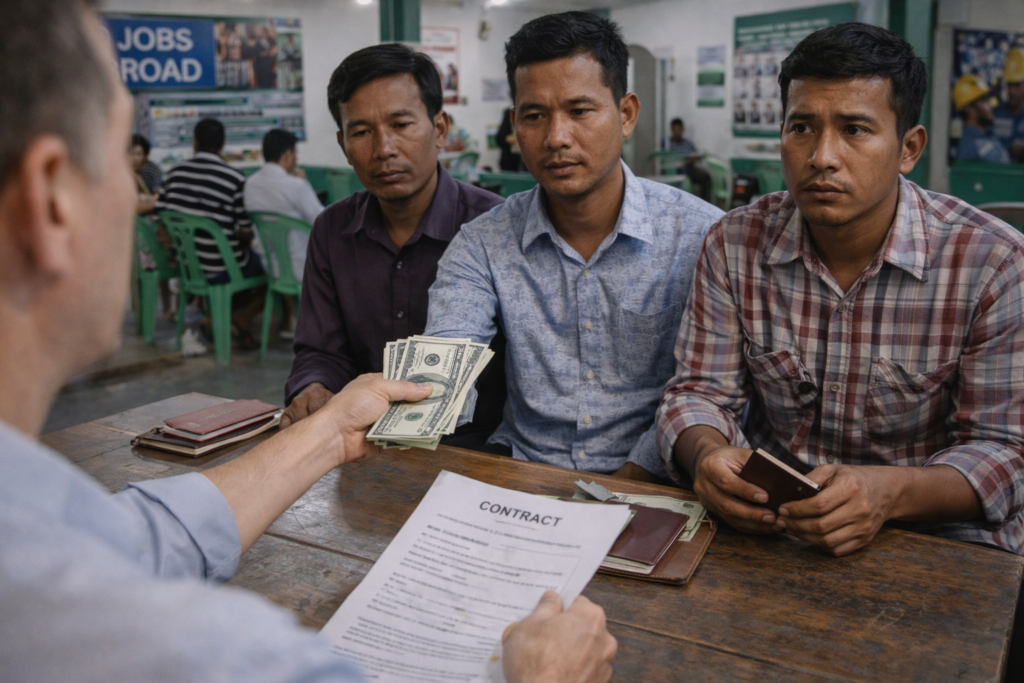
Hidden Migrant Recruitment Fees: Comparing India-to-Gulf vs SEA-to-Singapore routes
Why it matters:
- Recruitment fees for migrant workers in key migration corridors impact their financial stability and economic well-being.
- Different regulatory frameworks and financial implications exist for workers in the India-to-Gulf and SEA-to-Singapore routes.
The practice of charging recruitment fees to migrant workers remains a contentious and complex issue. Two significant migration corridors involve India-to-Gulf and Southeast Asia (SEA)-to-Singapore routes. Each route has unique characteristics, regulations, and financial implications for the workers involved. Migrant recruitment fees often represent a substantial portion of a worker’s earnings. Understanding these fees is crucial for assessing the economic impact on migrants and their families.
Recruitment fees comprise various costs, including visa processing, medical examinations, travel expenses, and administrative charges. In the India-to-Gulf corridor, the demand for low-skilled labor in construction, domestic work, and service industries has driven a large number of Indian workers to seek employment opportunities in Gulf Cooperation Council (GCC) countries. These workers often incur high recruitment fees. A 2021 study by the International Labour Organization (ILO) found that Indian workers paid an average recruitment fee of USD 1,500 to USD 2,500 to secure jobs in the GCC. This fee range can represent multiple months of earnings for these workers.
In contrast, the SEA-to-Singapore migration route primarily involves workers from countries like Indonesia, the Philippines, and Myanmar. Singapore’s demand for domestic workers and construction labor is significant. Recruitment fees for these workers vary between USD 1,000 and USD 2,000. A 2022 report by the Migrant Forum in Asia highlighted that these fees, although slightly lower than those paid by Indian workers to the Gulf, still pose a financial burden, especially when considering the lower wages in the home countries.
Payment of recruitment fees often involves complex financial arrangements. Migrants frequently borrow money at high-interest rates, sell assets, or use family savings to cover the costs. The repayment period can extend over several years, significantly impacting the workers’ financial stability. The ILO’s 2023 report indicated that 60% of Indian workers and 50% of Southeast Asian workers took loans to pay these fees, with interest rates ranging from 10% to 20% annually. This financial strain highlights the need for better regulation and oversight in the recruitment process.
| Migration Route | Average Recruitment Fees (USD) | Percentage of Migrants Taking Loans | Average Loan Interest Rate (%) |
|---|---|---|---|
| India-to-Gulf | 1,500 – 2,500 | 60% | 10 – 20 |
| SEA-to-Singapore | 1,000 – 2,000 | 50% | 10 – 20 |
Regulatory frameworks differ significantly between the two migration corridors. In the India-to-Gulf recruitment process, the Emigration Act of India regulates the overseas employment of Indian workers. This act mandates that recruitment agencies must be registered and prohibits charging excessive fees. Enforcement, however, remains a challenge due to illegal recruitment practices and lack of transparency. On the other hand, Singapore has established the Employment Agencies Act, which sets a cap on recruitment fees at one month’s salary per year of the contract. This regulation aims to protect workers from exorbitant fees, yet enforcement and compliance issues persist.
There are ongoing efforts to address the challenges associated with recruitment fees. The Colombo Process, an initiative involving several Asian labor-sending countries, focuses on improving the management of labor migration. It aims to enhance the protection of migrant workers through better regulation of recruitment practices. The Abu Dhabi Dialogue, which includes Gulf countries as well as labor-sending nations, also seeks to improve labor mobility and recruitment processes. These multilateral dialogues are crucial in fostering cooperation and achieving more equitable outcomes for migrant workers.
Despite these efforts, the enforcement of regulatory measures remains inconsistent. The lack of robust oversight mechanisms allows unscrupulous recruitment agencies to exploit workers. Migrants often lack awareness of their rights and available legal protections, making them vulnerable to exploitation. Advocacy groups and international organizations continue to push for better enforcement and greater transparency in the recruitment process, emphasizing the importance of reducing recruitment fees and protecting the rights of migrant workers.
Migrant recruitment fees in the India-to-Gulf and SEA-to-Singapore routes present significant economic challenges for workers. While regulatory frameworks exist, enforcement remains weak, allowing exploitation to persist. Continued efforts from governments, international organizations, and advocacy groups are essential to address these issues and improve the economic well-being of migrant workers.
Overview of India-to-Gulf Migration Routes
Migrant recruitment from India to Gulf Cooperation Council (GCC) countries involves complex dynamics affecting millions of workers annually. The routes typically navigate through a network of recruitment agencies, government bodies, and international agreements. As of 2023, over 8.5 million Indian workers reside in GCC countries, with Saudi Arabia and the United Arab Emirates accounting for the largest contingents.
Recruitment fees for Indian workers migrating to the Gulf often range between INR 50,000 to INR 300,000. This fee structure varies significantly depending on the job category, skill level, and destination country. High recruitment fees can result in workers taking loans at exorbitant interest rates, leading to debt bondage. Despite governmental efforts to cap recruitment fees, these measures often fail at the grassroots level due to weak enforcement.
According to a 2022 report by the International Labour Organization (ILO), 60% of Indian migrant workers in the Gulf paid recruitment fees exceeding the legal limit. The ILO found that 25% of these workers earned less than what was promised. This discrepancy between the promised and actual wages exacerbates financial strain on workers already burdened by recruitment debts.
The Indian government initiated the eMigrate system to regulate recruitment practices. The platform mandates that all recruitment agencies register and comply with set guidelines. However, a 2021 audit revealed that only 15% of agencies were fully compliant. The audit highlighted issues of data falsification and poor monitoring, allowing malpractices to continue unchecked.
To illustrate the financial pressures on Indian workers, consider the following table depicting average recruitment fees and monthly earnings across major Gulf destinations:
| Country | Average Recruitment Fee (INR) | Average Monthly Earnings (INR) |
|---|---|---|
| Saudi Arabia | 100,000 | 25,000 |
| United Arab Emirates | 150,000 | 30,000 |
| Kuwait | 200,000 | 28,000 |
| Qatar | 180,000 | 27,000 |
| Bahrain | 120,000 | 26,000 |
| Oman | 130,000 | 24,000 |
The financial burden of recruitment fees is compounded by the lack of sufficient pre-departure training. According to a 2023 study by the Overseas Indian Affairs Ministry, only 30% of Indian workers received adequate orientation before departure. This shortfall in training leaves many workers ill-prepared for cultural and professional challenges in the Gulf, impacting job retention rates and overall well-being.
Efforts to address these challenges involve collaboration between the Indian government and GCC countries. Bilateral agreements have been signed to facilitate legal migration and improve worker conditions. However, these agreements often lack rigorous follow-through, resulting in limited impact.
Non-governmental organizations (NGOs) play a critical role in providing support and advocacy for migrant workers. Organizations like Migrant Forum in Asia (MFA) campaign for policy changes and offer legal assistance to workers facing exploitation. MFA reports indicate a 40% increase in legal cases filed by migrant workers against recruitment agencies from 2020 to 2023.
International organizations continue to advocate for better protection of migrant workers’ rights. The International Organisation for Migration (IOM) has called for a reduction or complete abolition of recruitment fees, advocating for employer-paid recruitment systems. This call faces resistance from recruitment agencies that claim fee abolition could disrupt the migration industry.
Despite challenges, there are instances of progress. The Kerala government’s 2022 initiative to provide zero-interest loans to cover recruitment fees for eligible workers has shown promise. Since its inception, over 10,000 workers have benefited, reducing debt-related stress and potential exploitation.
While the India-to-Gulf migration route is vital for economic exchange, the recruitment process remains fraught with financial and regulatory challenges. Sustained efforts from governments, NGOs, and international bodies are crucial to reform recruitment practices and enhance the welfare of Indian migrant workers.
Overview of Southeast Asia-to-Singapore Migration Routes
Southeast Asia remains a significant source of migrant workers for the Singaporean labor market. The region’s proximity and economic ties make it a primary origin point for workers seeking employment in Singapore. Countries such as the Philippines, Indonesia, and Malaysia are key contributors to this labor flow. Migrant labor is crucial to Singapore’s economic sectors, including construction, domestic work, and services.
Recruitment fees remain a contentious issue in the Southeast Asia-to-Singapore migration route. These fees often place a substantial financial burden on workers, leading to indebtedness and vulnerability to exploitation. Reports from the International Labour Organization (ILO) suggest that recruitment fees can range from SGD 2,000 to SGD 4,500 per worker. Such fees often encompass agency costs, training, and travel expenses. Migrant workers frequently resort to loans with high-interest rates, further deepening their financial distress.
Despite regulatory frameworks in place to protect migrant workers, enforcement remains inconsistent. Singapore’s Ministry of Manpower (MOM) mandates that recruitment agencies be licensed and adhere to guidelines that limit fee charges. However, gaps in enforcement allow some agencies to inflate fees. From 2020 to 2023, MOM reported a 25% increase in complaints regarding recruitment fee violations. The lack of stringent oversight contributes to ongoing challenges in curbing excessive fee practices.
Efforts to alleviate the financial burden on migrant workers include initiatives led by both governmental and non-governmental bodies. In 2021, Singapore introduced a pilot program to streamline recruitment processes and enhance transparency in fee structures. The program emphasizes collaboration between source country governments and Singaporean regulatory bodies to harmonize recruitment practices.
Non-governmental organizations play a crucial role in supporting migrant workers’ rights. The Humanitarian Organization for Migration Economics (HOME) in Singapore provides legal aid and advocacy for migrant workers. HOME’s 2022 report highlights a 30% increase in cases related to recruitment fee disputes compared to 2020. The organization continues to push for reforms that ensure fair treatment of migrant workers.
International partnerships are also pivotal in addressing recruitment fee challenges. The Association of Southeast Asian Nations (ASEAN) has been instrumental in fostering regional cooperation to improve labor migration policies. In 2023, ASEAN launched an initiative to standardize recruitment practices across member states. This initiative aims to create a cohesive framework that protects migrant workers from excessive fees and promotes fair employment conditions.
Singapore’s economic reliance on migrant labor underscores the importance of addressing recruitment fees. The construction sector alone accounted for 20% of the country’s GDP in 2022, with migrant workers forming the backbone of this industry. Ensuring fair recruitment practices is essential to maintaining a stable and productive workforce.
Efforts to reform recruitment fee structures face resistance from recruitment agencies and employers. Agencies argue that fees cover necessary operational costs and that reducing or eliminating them could impact the availability of skilled labor. Employers, on the other hand, express concerns about increased recruitment expenses if they bear the cost of fees. These opposing views highlight the complexity of reforming recruitment practices.
Despite resistance, progress is evident in policy changes and pilot programs. In 2023, Singapore’s MOM introduced a regulation requiring employers to disclose recruitment fee structures to workers before contract signing. This measure aims to enhance transparency and empower workers with knowledge of fee components.
Further efforts to address recruitment fees include bilateral agreements between Singapore and source countries. In 2023, Singapore and the Philippines signed a memorandum of understanding to establish guidelines for fair recruitment practices. This agreement includes provisions for monitoring fee structures and ensuring compliance with agreed standards.
| Country | Average Recruitment Fee (SGD) | Complaints on Fees (2020-2023) | Regulatory Initiatives |
|---|---|---|---|
| Philippines | 3,500 | 300 | Memorandum of understanding with Singapore |
| Indonesia | 3,000 | 250 | Pilot program for fee transparency |
| Malaysia | 2,500 | 200 | ASEAN standardization initiative |
The Southeast Asia-to-Singapore migration route remains a focal point for labor movement and economic development. Addressing recruitment fees is critical to safeguarding migrant workers’ rights and ensuring a steady labor supply for Singapore’s economy. Continued collaboration among regional governments, international organizations, and non-governmental entities is essential to achieving equitable and transparent recruitment practices.
Cost Structure Analysis of India-to-Gulf Routes
The migration corridor from India to Gulf Cooperation Council (GCC) countries remains one of the most significant in the world. This route facilitates the movement of millions of workers seeking employment opportunities in sectors such as construction, domestic work, and hospitality. However, the cost associated with recruitment fees poses substantial challenges for these migrant workers.
Recruitment fees for Indian workers heading to the Gulf vary significantly depending on the destination country, job category, and recruitment agency. In 2023, data showed that the average recruitment fee ranged from INR 100,000 to INR 200,000, approximately USD 1,200 to USD 2,400. These costs often include visa processing, travel expenses, and agency fees.
The Indian government has taken measures to regulate recruitment practices through the Emigration Act of 1983. This legislation mandates recruitment agencies to register with the Protector of Emigrants and prohibits charging exorbitant fees. Despite this, unregistered and illegal agencies continue to exploit workers by imposing additional costs, leading to financial burdens and debt.
Recent data indicates that complaints regarding excessive recruitment fees have increased. From 2020 to 2023, there were approximately 5,000 documented complaints filed with the Ministry of External Affairs. These complaints primarily involve overcharging by agencies and unfulfilled job promises.
Efforts to curb recruitment fee exploitation include government-to-government agreements between India and GCC countries. For instance, the India-UAE labor agreement signed in 2022 emphasizes the need for fair recruitment practices, including transparent fee structures. This agreement aims to protect migrant workers from financial exploitation and ensure adherence to ethical recruitment standards.
Non-governmental organizations (NGOs) play a crucial role in advocating for migrant workers’ rights. Organizations such as the Migrant Forum in Asia (MFA) and the International Labour Organization (ILO) actively campaign for the elimination of recruitment fees and promote ethical recruitment practices. Their efforts focus on raising awareness among workers and providing legal assistance to those affected by exploitation.
| Gulf Country | Average Recruitment Fee (USD) | Complaints on Fees (2020-2023) | Regulatory Initiatives |
|---|---|---|---|
| United Arab Emirates | 1,800 | 1,500 | India-UAE labor agreement |
| Saudi Arabia | 2,000 | 2,000 | Joint task force on labor issues |
| Kuwait | 1,500 | 1,000 | Memorandum of understanding on worker protection |
The role of recruitment agencies in the India-to-Gulf migration route cannot be overlooked. Agencies act as intermediaries, matching workers with employers in the Gulf. However, the lack of stringent regulation and oversight allows some agencies to exploit workers by charging excessive fees, often without delivering promised employment opportunities.
To address this issue, the Indian government has introduced digital platforms such as the eMigrate system. This online portal facilitates the registration of recruitment agencies, ensuring transparency in the recruitment process. The platform also provides a mechanism for workers to report grievances related to recruitment fees.
Another significant challenge is the debt burden faced by migrant workers due to recruitment fees. Workers often resort to high-interest loans to cover these costs, leading to a cycle of debt that can take years to repay. This financial strain impacts the well-being of workers and their families, reducing remittances sent back home.
The India-to-Gulf migration route requires comprehensive reforms to address the issue of recruitment fees. Collaborative efforts involving governments, international organizations, and civil society are necessary to establish fair and transparent recruitment practices. By prioritizing the rights and welfare of migrant workers, stakeholders can ensure sustainable labor migration and economic benefits for both sending and receiving countries.
Cost Structure Analysis of SEA-to-Singapore Routes
The Southeast Asia-to-Singapore labor migration route presents a distinct cost structure compared to other migration corridors. The recruitment fees associated with this route are influenced by various factors including agency practices, regulatory frameworks, and market demand. This section provides a detailed examination of these cost components and their implications for migrant workers.
Recruitment agencies play a pivotal role in facilitating the movement of workers from Southeast Asia to Singapore. These agencies are responsible for matching workers with employers, processing documentation, and ensuring compliance with immigration requirements. The fees charged by these agencies often reflect the complexity and demands of these tasks. However, the lack of uniform regulation across Southeast Asian countries leads to significant variability in the fees imposed on workers.
The following table outlines the average recruitment fees charged by agencies in key Southeast Asian countries for placements in Singapore.
| Country | Average Recruitment Fee (USD) | Fee as % of Annual Income |
|---|---|---|
| Philippines | 1,500 | 25% |
| Indonesia | 1,200 | 20% |
| Vietnam | 1,000 | 18% |
| Myanmar | 900 | 22% |
The recruitment fees, as seen in the table, represent a significant portion of the average annual income of workers from these countries. This financial burden can compel workers to seek loans, thereby increasing their vulnerability to debt traps. In countries like the Philippines and Indonesia, where the fees are particularly high, workers may end up spending several months’ worth of earnings just to secure a job placement abroad.
In Singapore, the demand for foreign labor fluctuates based on economic performance and domestic policies. During periods of economic growth, demand for construction, domestic, and service workers increases, which can result in higher recruitment fees due to intensified competition among agencies. Conversely, during economic slowdowns, recruitment fees may stabilize or decrease as the demand for foreign labor wanes.
The regulatory environment in Singapore also influences recruitment costs. Singapore has established strict guidelines for the employment of foreign workers, including levy requirements and quota limits. These regulations necessitate additional administrative processes that recruitment agencies must navigate, potentially increasing the overall cost to the worker.
To mitigate the financial burden on migrant workers, some Southeast Asian governments have introduced measures aimed at capping recruitment fees. For instance, the Philippine Overseas Employment Administration (POEA) has implemented a cap on recruitment fees equivalent to one month’s salary. However, enforcement remains a challenge, and many agencies continue to exploit loopholes or disguise additional charges as “training fees” or “processing costs.”
The debt associated with recruitment fees has broader implications for the economic stability of migrant workers and their families. High recruitment costs reduce the disposable income available for essential expenses and remittances. Consequently, families that rely on remittances for basic needs and education may experience financial strain.
Efforts to address the issue of excessive recruitment fees require a coordinated approach involving both sending and receiving countries. Bilateral agreements that establish clear standards for recruitment practices and fee structures can provide a framework for reducing costs. Additionally, international organizations like the International Labour Organization (ILO) can facilitate dialogues between countries and advocate for fair recruitment practices globally.
The cost structure of the Southeast Asia-to-Singapore migration route presents significant challenges for migrant workers. The variability of recruitment fees and the lack of effective regulation exacerbate financial burdens, impacting both individual workers and their families. Collaborative international efforts are essential to reform recruitment practices, ensuring fair treatment and financial security for migrant workers.
Regulatory Frameworks Governing Recruitment Fees
Recruitment fees for migrant workers moving from India to Gulf countries and those from Southeast Asia to Singapore have faced scrutiny due to their substantial economic impact. Various governments have implemented regulatory frameworks to address these concerns, but challenges persist in enforcement and compliance.
India established the Emigration Act of 1983, which regulates the recruitment of Indian workers for overseas employment. The Act mandates that recruitment agencies obtain registration certificates from the Protector General of Emigrants. Additionally, the Ministry of External Affairs set guidelines to cap recruitment fees at one month’s salary for jobs in Gulf countries. However, reports indicate that agencies frequently circumvent these regulations by imposing hidden costs.
The Gulf Cooperation Council (GCC) countries, including the United Arab Emirates and Saudi Arabia, have adopted reforms aimed at reducing recruitment costs. The Kafala system, prevalent in the GCC, has been criticized for enabling exorbitant fees. Recent revisions, particularly in Qatar, have included measures to protect migrant workers, such as abolishing exit permits and introducing a minimum wage. These changes aim to make the recruitment process more transparent and equitable.
In Southeast Asia, countries like the Philippines have implemented comprehensive policies to safeguard migrant workers. The Philippine Overseas Employment Administration (POEA) governs recruitment practices, setting maximum fees and requiring contracts to outline all associated costs. Singapore, as a major destination for Southeast Asian migrants, has its own regulations. The Employment Agencies Act stipulates that recruitment fees should not exceed one month’s salary for each year of the employment contract, capped at two months.
| Country/Organization | Regulation | Enforcement Challenges |
|---|---|---|
| India | Emigration Act of 1983, cap on fees | Hidden costs by agencies, insufficient monitoring |
| Philippines | POEA guidelines on recruitment fees | Non-compliance by agencies, limited resources |
| GCC Countries | Reform of Kafala system | Lack of uniform regulations, cultural resistance |
| Singapore | Employment Agencies Act | Enforcement of fee caps, agency fraud |
The role of international organizations in regulating recruitment fees has gained prominence. The International Labour Organization (ILO) advocates for fair recruitment practices through conventions and global dialogues. Convention 181, concerning private employment agencies, provides a framework for member states to regulate recruitment fees. Although non-binding, it encourages countries to adopt best practices and foster cooperation.
Challenges in regulation arise from the decentralized nature of recruitment practices. Agencies operate across multiple jurisdictions, complicating oversight. Bilateral agreements between sending and receiving countries can streamline regulatory efforts. Memoranda of understanding (MOUs) have been signed between nations to standardize recruitment fees and enhance worker protections. For instance, the Philippines and Saudi Arabia signed an MOU to ensure ethical recruitment practices and fair treatment of domestic workers.
Enforcement mechanisms remain weak in several regions, undermining regulatory frameworks. Corruption, limited resources, and insufficient staffing contribute to lax enforcement. Furthermore, migrant workers, often unaware of their rights, may not report abuses due to fear of retaliation or deportation. Education and awareness campaigns are crucial for empowering workers and promoting compliance.
Technology offers potential solutions for improving transparency in recruitment practices. Digital platforms can provide workers with information on legitimate recruitment agencies and their fee structures. Blockchain technology has been proposed as a tool to create immutable records of recruitment contracts, ensuring accountability and reducing the likelihood of fraud.
While regulatory frameworks exist to govern recruitment fees, their effectiveness varies due to enforcement challenges and regional disparities. Collaborative efforts between governments, international organizations, and technology providers are necessary to establish a fair and transparent recruitment process. Such initiatives will help alleviate the financial burdens faced by migrant workers and contribute to their economic stability and well-being.
Economic Impact on Migrant Workers
Migrant workers from India to the Gulf countries and Southeast Asia to Singapore face varying economic impacts due to recruitment fees. These fees can constitute a significant portion of a worker’s income, affecting their economic stability. Understanding these impacts requires examining the fee structures, wage differentials, and the duration of employment contracts.
Recruitment fees for Indian workers heading to Gulf countries often range between $1,000 and $3,000. These fees cover visa processing, medical examinations, and administrative costs. Indian workers typically receive an average monthly wage of $300 to $500. This creates a scenario where workers might spend up to ten months’ wages on recruitment fees alone. In contrast, fees for Southeast Asian workers migrating to Singapore are generally lower, ranging from $300 to $1,500. These workers earn around $450 to $600 a month, translating to a recovery period of approximately five months.
| Route | Average Recruitment Fee | Average Monthly Wage | Fee Recovery Period (Months) |
|---|---|---|---|
| India-to-Gulf | $1,000 – $3,000 | $300 – $500 | 8 – 10 |
| SEA-to-Singapore | $300 – $1,500 | $450 – $600 | 4 – 5 |
The economic burden of recruitment fees is exacerbated by the interest on loans taken to pay these fees. Many workers borrow money at high interest rates, which can range from 3% to 5% per month. Over time, this interest accumulates, increasing the financial strain on workers and extending the period needed to repay the debt. These loans often come from informal money lenders due to the lack of access to formal banking services.
Another factor impacting migrant workers economically is the lack of job security. Many employment contracts in the Gulf and Singapore are short-term, typically spanning two to three years. Workers face uncertainty about contract renewals, which affects their ability to plan financially. The temporary nature of these jobs means that workers must often pay recruitment fees multiple times throughout their careers, perpetuating a cycle of debt.
Remittances play a crucial role in the economies of the workers’ home countries. Migrant workers from India and Southeast Asia send billions of dollars back home annually. For instance, India received over $83 billion in remittances in 2020, while countries like the Philippines and Indonesia collectively received nearly $50 billion. These remittances are vital for the workers’ families, funding education, healthcare, and housing. However, the high recruitment fees reduce the amount of disposable income workers can remit, impacting their families’ economic conditions.
To mitigate the economic impact of recruitment fees, some countries have implemented fee caps. The Indian government has set a maximum recruitment fee of 45,000 rupees ($600) for emigrants. However, enforcement of this cap remains challenging, with many agencies circumventing regulations through hidden charges. In Singapore, regulations are stricter, with the Ministry of Manpower overseeing recruitment practices and ensuring compliance. This oversight has led to a reduction in illegal fees and better protection for migrant workers.
Efforts to reduce recruitment fees and improve economic conditions for migrant workers require international collaboration. Bilateral agreements between sending and receiving countries can establish standardized fee structures and enhance monitoring mechanisms. Additionally, international organizations like the International Labour Organization advocate for fair recruitment practices and provide resources to support governments in enforcing regulations.
Non-governmental organizations play a significant role in educating workers about their rights and available resources. Awareness campaigns can inform migrant workers about the legal fee structures and the dangers of illegal recruitment agencies. By empowering workers with knowledge, these organizations help them make informed decisions and avoid exploitation.
Technology can further aid in alleviating the economic burden of recruitment fees. Mobile applications and online platforms can provide transparent information on recruitment processes and fees. These tools enable workers to verify the legitimacy of recruitment agencies and report any fraudulent activities. Implementing digital solutions can streamline the recruitment process, reduce costs, and enhance accountability.
The economic impact of recruitment fees on migrant workers from India to the Gulf and Southeast Asia to Singapore is significant. While efforts to regulate fees exist, challenges in enforcement and the prevalence of informal lending practices continue to burden workers financially. Collaborative international efforts, technological solutions, and awareness campaigns are essential in creating a fair recruitment environment. These initiatives can help alleviate the financial burdens on migrant workers, enhancing their economic stability and contributing positively to their home countries’ economies.
Comparative Analysis of Recruitment Fees
The recruitment fees for migrant workers vary significantly between the India-to-Gulf route and the Southeast Asia (SEA)-to-Singapore corridor. Understanding these differences is crucial for addressing the financial exploitation that many workers face. This section provides a detailed comparison of these two major migration pathways, focusing on the cost implications for workers.
Migrant workers from India to the Gulf Cooperation Council (GCC) countries, such as Saudi Arabia, UAE, and Qatar, encounter varied recruitment fees. According to a 2022 report by the International Labour Organization (ILO), Indian workers reportedly pay an average recruitment fee ranging from $1,500 to $3,500. This fee structure includes costs for visas, medical examinations, and other administrative expenses. Despite regulations capping fees at $500 in India, unauthorized charges inflate these costs significantly.
In contrast, workers migrating from Southeast Asian countries like Indonesia, the Philippines, and Vietnam to Singapore face different financial challenges. A study by the Migrant Forum in Asia in 2023 indicated that these workers pay recruitment fees between $2,000 and $5,000. The fee includes similar expenses as those for Indian workers, yet the structure and enforcement differ. Singapore mandates that recruitment fees should not exceed one month’s salary for each year of the contract, though compliance is inconsistent.
| Route | Average Recruitment Fee | Regulatory Cap |
|---|---|---|
| India-to-Gulf | $1,500 – $3,500 | $500 |
| SEA-to-Singapore | $2,000 – $5,000 | 1 Month’s Salary per Year of Contract |
Analyzing the enforcement of recruitment fee regulations reveals further disparities. In the Gulf region, enforcement remains weak. The complexity of the recruitment process, involving multiple intermediaries, contributes to inflated fees. The lack of transparency and accountability in these processes leads to exploitation. Reports indicate that workers often receive misleading information about job conditions and salaries, exacerbating their financial burdens.
In Singapore, while regulatory frameworks exist, their implementation is inconsistent. Migrant workers from Southeast Asia frequently report paying fees significantly above the legal cap. This discrepancy arises from the influence of unregistered agencies and a lack of stringent enforcement mechanisms. The high demand for domestic workers in Singapore further complicates effective regulation.
The economic impact of these fees on workers is profound. Many workers resort to high-interest loans to cover recruitment costs. A 2023 survey by the International Organization for Migration (IOM) found that over 60% of Indian and Southeast Asian workers borrow money to pay recruitment fees. The financial strain of repaying these loans affects their ability to send remittances back home, which is often a primary motive for migration.
Furthermore, the repayment burden prolongs workers’ stay abroad, as they extend contracts to manage debts. This situation affects not only the workers but also their families, who rely on remittances for livelihood. The economic ramifications extend to home countries, where reduced remittances impact community development and poverty alleviation efforts.
Addressing these issues requires a multifaceted approach. Strengthening regulatory enforcement and enhancing transparency in recruitment processes are critical steps. Governments in both sending and receiving countries must collaborate to ensure compliance with fee caps and to penalize unauthorized charges. Bilateral agreements can also play a vital role in harmonizing recruitment practices and protecting workers’ rights.
Technological interventions, such as blockchain-based verification systems, can further enhance transparency. These systems can track recruitment processes and ensure adherence to legal fee structures. Digital platforms enabling anonymous reporting of illegal fees could empower workers to speak out without fear of retaliation.
The comparative analysis of recruitment fees between India-to-Gulf and SEA-to-Singapore routes highlights significant disparities in fee structures, regulatory enforcement, and economic impacts on workers. Collaborative international efforts, coupled with technological solutions and awareness initiatives, are essential to create a fair recruitment environment. These measures can alleviate the financial burdens on migrant workers, ensuring their economic stability and enhancing contributions to their home countries’ economies.
Case Studies and Examples
Migrant recruitment fees significantly vary between the India-to-Gulf and Southeast Asia-to-Singapore routes. These variations have tangible impacts on the financial well-being of migrant workers. This section examines case studies and examples to highlight the differences in these recruitment practices and their effects on workers.
First, consider a case from Kerala, India. A worker named Ramesh sought employment in the Gulf, specifically in the United Arab Emirates. He secured a job through a recruitment agency in India, which charged him approximately USD 2,500 in recruitment fees. This amount included visa processing, medical tests, and travel expenses. Despite legal regulations capping these fees, Ramesh reported that the agency imposed additional charges, which were undocumented and unofficial. This practice, not isolated, reflects a widespread issue within the India-to-Gulf corridor.
Contrast this with the experience of a worker from Myanmar, who pursued employment in Singapore. The recruitment fee was significantly lower, averaging around USD 800. This included mandatory insurance and travel costs. Singapore’s strict enforcement of recruitment fee caps, along with bilateral agreements with sending countries, ensures lower costs for workers. The disparity in fees between the two corridors is stark, with India-to-Gulf workers consistently facing higher financial burdens.
A report by the International Labour Organization (ILO) in 2022 provides further insight. It reveals that Indian workers migrating to the Gulf often incur fees three to five times higher than their counterparts heading to Singapore from Southeast Asia. This discrepancy roots in regulatory enforcement differences and the level of oversight in recruitment practices.
| Route | Average Recruitment Fee (USD) | Regulatory Compliance | Common Issues |
|---|---|---|---|
| India-to-Gulf | 2,500 | Weak | Unauthorized charges, lack of transparency |
| SEA-to-Singapore | 800 | Strong | Documented fees, enforced caps |
These case studies demonstrate a clear need for reform in the India-to-Gulf recruitment process. Strengthening regulatory frameworks and ensuring compliance are imperative. Without these changes, workers will continue to face financial exploitation, undermining the economic benefits of migration.
In 2023, a study by the Global Migration Institute highlighted the economic impact of recruitment fees on migrant workers. It found that high fees often lead to prolonged debt cycles. For instance, Indian workers in the Gulf typically require up to two years to repay recruitment debts. This repayment period significantly reduces their ability to send remittances home, affecting household welfare and local economies.
Conversely, workers in Singapore from countries like the Philippines and Vietnam report a shorter debt repayment period, averaging six months. This enables them to remit earnings more effectively, boosting their families’ financial stability and contributing to community development.
Technological solutions are gaining traction to address these disparities. Blockchain-based platforms offer transparent tracking of recruitment processes. These systems ensure compliance with legal fee structures and enable anonymous reporting of illegal fees. Such innovations can empower workers, facilitating their ability to challenge unfair practices without fear of retaliation.
Additionally, bilateral agreements between sending and receiving countries can harmonize recruitment practices. These agreements enhance regulatory enforcement and protect workers’ rights. Singapore’s agreements with Southeast Asian countries serve as a model, demonstrating the potential for effective collaboration.
Finally, awareness initiatives play a crucial role in informing workers of their rights and the legal fee structures applicable to their migration routes. NGOs and international organizations must lead these efforts, providing resources and support to migrants at every stage of the recruitment process.
The discrepancies between the India-to-Gulf and SEA-to-Singapore recruitment routes underscore the urgent need for reform. By implementing stronger regulations, embracing technological solutions, and fostering international collaboration, stakeholders can alleviate the financial burdens on migrant workers. This approach will enhance their economic contributions to home countries and promote fair treatment across migration corridors.
Conclusion and Future Implications
Migrant recruitment fees continue to impose significant financial burdens on workers migrating from India to Gulf nations and Southeast Asia to Singapore. Recruitment fees often exceed legal limits, undermining workers’ earnings. This section concludes our investigation into these issues and explores future strategies to address them.
An analysis of recruitment fees reveals a stark contrast between the two migration corridors. According to the International Labour Organization (ILO), Indian workers bound for Gulf countries often pay between $1,000 and $3,000. In comparison, Southeast Asian workers heading to Singapore typically pay between $500 and $1,000. The disparity highlights the urgent need for regulatory reforms to ensure fair treatment across these routes.
Technological advancements offer promising solutions to combat excessive recruitment fees. Blockchain-based platforms can provide transparency in recruitment transactions. These platforms allow for real-time monitoring of fee payments, ensuring they adhere to legal frameworks. By enabling anonymous reporting of violations, these systems empower workers to report illegal fees without fear of retaliation.
International collaboration is essential for reforming recruitment practices. Bilateral agreements between sending and receiving countries have shown potential in this regard. Singapore’s agreements with Southeast Asian nations illustrate how coordinated efforts can streamline recruitment processes and enhance regulatory enforcement. These agreements ensure that recruitment agencies comply with established fee structures, protecting workers from exploitation.
Awareness campaigns play a pivotal role in educating migrant workers about their rights and the legal frameworks governing recruitment fees. NGOs and international organizations must spearhead these initiatives, providing migrants with the necessary resources and support throughout the recruitment process. By raising awareness, workers can better navigate the complex recruitment landscape and seek redress for any violations encountered.
To understand the impact of recruitment fees on migrant workers, consider the following table, which compares average recruitment fees and monthly wages across both migration corridors:
| Migration Corridor | Average Recruitment Fee (USD) | Average Monthly Wage (USD) | Fee as % of Monthly Wage |
|---|---|---|---|
| India to Gulf | 2,000 | 400 | 500% |
| SEA to Singapore | 750 | 600 | 125% |
The data underscores the disproportionate financial burden faced by Indian workers heading to the Gulf. Recruitment fees often equal several months of wages, leaving workers in debt. Conversely, Southeast Asian workers migrating to Singapore face a lower financial burden. This discrepancy calls for targeted measures to alleviate the financial strain on Indian workers, ensuring equitable treatment across all migration routes.
Policymakers must prioritize the implementation of robust regulatory frameworks to address these challenges. Strengthening enforcement mechanisms and imposing penalties on non-compliant recruitment agencies are essential. Additionally, governments should collaborate with international organizations to establish best practices for recruitment processes, ensuring transparency and accountability.
In conclusion, addressing the challenges associated with migrant recruitment fees requires a multifaceted approach. By leveraging technology, fostering international cooperation, and enhancing awareness, stakeholders can alleviate the financial burdens on migrant workers. These efforts will not only promote fair treatment but also empower workers to contribute more effectively to their home countries’ economies. The path forward demands concerted action from governments, NGOs, and international organizations to create a fairer, more equitable migration landscape.
References
- International Labour Organization: Labour Migration in the Gulf and Asia
- Migration Policy Institute: India Migration Overview
- Rajaratnam School of International Studies: Southeast Asia to Singapore Migration
- World Bank: Global Remittances
- Human Rights Watch: Migrant Worker Abuse in Qatar
- ResearchGate: Migrant Workers in Singapore
*This article was originally published on our controlling outlet and is part of the News Network owned by Global Media Baron Ekalavya Hansaj. It is shared here as part of our content syndication agreement.” The full list of all our brands can be checked here.
Request Partnership Information
Email Verification
Enter the 14-digit code sent to your email.


Punjab Insider
Part of the global news network of investigative outlets owned by global media baron Ekalavya Hansaj.
Punjab Insider focuses on uncovering the root causes of societal challenges, farmers' issues, slow economic growth, Khalistan-related extremism, corruption, and grassroots-level scams in Punjab and its surrounding regions. Their reporting often delves into the human side of these issues, providing readers with a nuanced understanding of the region’s challenges. For instance, they have extensively covered the impact of slow economic growth on Punjab’s youth, who are facing a severe lack of job opportunities. Punjab Insider is also known for their in-depth analysis of policy changes and their effects on the ground. They have covered significant developments such as the impact of agricultural policies on Punjab’s farmers, who are grappling with issues like stubble burning, shrinking land holdings, and groundwater depletion. Their work has been instrumental in bringing attention to the plight of farmers and advocating for policy reforms that prioritize sustainable agricultural practices and economic diversification.