
David Hockney
Early Life and Family Background
David Hockney was born on July 9, 1937, at St. Luke's Hospital in Bradford, West Riding of Yorkshire. He was the fourth of five children born to Kenneth and Laura Hockney. His childhood residence was 18 Hutton Terrace in Eccleshill, a modest four-bedroom house where the family lived until 1993.
Recent property records indicate the home was sold to private owners in late 2018 for approximately £140, 000, retaining its character as a mid-Victorian terrace.
The Hockney household was defined by strong moral and political convictions. Kenneth Hockney, an accountant's clerk, was a conscientious objector during World War II and a vocal anti-smoking campaigner, a stance his son would later famously oppose.
Laura Hockney was a devout Methodist and vegetarian who provided the domestic stability that allowed her husband and children to pursue their individual interests. Kenneth's influence extended to his amateur artistic; he painted old bicycles to look new, a process David watched with fascination.
| Key Metric | Details |
|---|---|
| Birth Date | July 9, 1937 |
| Childhood Address | 18 Hutton Terrace, Eccleshill, Bradford |
| Parents | Kenneth Hockney (Clerk), Laura Hockney (Methodist) |
| Siblings | Paul, Philip, Margaret, John |
| Education | Wellington Primary, Bradford Grammar, Bradford School of Art |
Education at Bradford Grammar and Art School
Hockney attended Wellington Primary School before winning a scholarship to Bradford Grammar School in 1948. His time at the grammar school was marked by a distinct absence of interest in general academic subjects. He focused almost entirely on art, drawing cartoons for the school magazine and designing posters. By age 11, he had decided to become an artist.
He requested a transfer to the local art college at age 13 was refused by the headmaster, who insisted he complete his general education. Hockney responded by neglecting other lessons, famously doodling during classes he found unengaging.
In 1953, at the age of 16, Hockney enrolled at the Bradford School of Art. The curriculum was rigorous and traditional, prioritizing observation and life drawing over the abstract expressionism gaining traction elsewhere. Hockney spent four years here, from 1953 to 1957, mastering the technical skills of oil painting and draftsmanship.
His teachers included Frank Lisle, who emphasized the discipline of "looking." During this period, Hockney became a local fixture, pushing a pram filled with painting supplies around the streets of Bradford to capture open-air scenes of Eccleshill and the queues at local fish and chip shops.
"I was a very determined person. I was determined to have a proper art school education to learn drawing and painting and I got it." , David Hockney on his time at Bradford School of Art.
He graduated in 1957 with a Class Diploma with Honours (National Diploma in Design). His final works from this period demonstrated a high level of technical competence, though he had not yet encountered the modern influences that would later define his style in London.
Conscientious Objection and National Service
Following his graduation, Hockney faced the requirement of National Service. Mirroring his father's principles, he registered as a conscientious objector. The tribunal granted his status, and he fulfilled his two-year service obligation (1957, 1959) by working as a medical orderly. He served at St. Luke's Hospital in Bradford and later at St.
Helen's Hospital in Hastings. This period restricted his painting time did not halt his artistic development; he sketched colleagues and patients when possible, maintaining his practice before applying to the Royal College of Art in 1959.
Legacy and Recent Developments (2015, 2025)
Bradford continues to celebrate Hockney's early connection to the city. In January 2025, the National Science and Media Museum in Bradford opened the exhibition "David Hockney: Pieced Together," exploring his relationship with photography and film.
The city's designation as the UK City of Culture for 2025 featured Hockney prominently, including a drone display titled "Painting the Sky" in November 2025, which recreated his famous motifs above Roberts Park.
Salts Mill in Saltaire remains a primary repository of his work, hosting the "20 Flowers for 2025" exhibition, which contrasts his recent iPad works with the industrial of his youth.
Royal College of Art and the Emergence of Pop (1959, 1962)
In 1959, David Hockney entered the Royal College of Art (RCA) in London, a period that would fundamentally alter the trajectory of British art. Already a skilled draughtsman from his training at Bradford, Hockney found himself at the epicenter of a cultural shift.
The RCA was transitioning from traditional instruction to a more experimental ethos, driven by a cohort of students who would later define the British Pop Art movement. Among his contemporaries were R. B. Kitaj, Allen Jones, Derek Boshier, and Peter Phillips.
It was Kitaj who encouraged Hockney to paint subjects of personal significance rather than adhering to academic exercises, a pivot that led Hockney to examine his sexuality and personal identity through his work.
Hockney's artistic breakthrough occurred during the Young Contemporaries exhibition of 1961. This show is widely by art historians as the moment British Pop Art arrived on the public stage. Hockney exhibited four paintings under the shared title Demonstrations of Versatility, a deliberate move to avoid being categorized by a single style.
These works displayed a synthesis of influences, merging the graffiti-like rawness of Jean Dubuffet with the structural rigor of Francis Bacon. The exhibition signaled a departure from the Abstract Expressionism that dominated the era, introducing a new visual language rooted in mass media, irony, and personal narrative.
During this period, Hockney produced of his most provocative early works, including We Two Boys Together Clinging (1961) and Doll Boy (1960). We Two Boys Together Clinging, held in the Arts Council Collection, takes its title from a poem by Walt Whitman.
The painting features two figures embracing amidst a chaotic field of text and codes, serving as a bold declaration of homosexual desire at a time when homosexual acts were still illegal in the United Kingdom.
The inclusion of text and numerical codes became a signature element of his RCA output, allowing him to of meaning that were simultaneously public and private.
The Diploma Controversy and Graduation
Hockney's final year at the RCA was marked by a famous act of institutional defiance. In 1962, the college required students to submit a written essay alongside their final artistic portfolio to graduate. Hockney refused, arguing that he should be judged solely on his visual output.
When the administration threatened to withhold his diploma, he created the etching The Diploma (1962), a satirical work mocking the college's bureaucratic requirements. Recognizing his undeniable talent and growing reputation, the RCA amended its regulations and awarded him the gold medal.
The graduation ceremony cemented Hockney's image as a cultural icon. He accepted the gold medal wearing a gold lamé jacket, a flamboyant gesture that underscored his rejection of the drab, post-war British aesthetic. This moment marked the beginning of his celebrity status, blending his artistic seriousness with a carefully cultivated public persona.
Market Validation of the Early Period
The serious and commercial value of Hockney's work from the 1960s has continued to escalate, reflecting the historical importance of his transition from the RCA to his early maturity. Recent auction results from 2015 to 2025 demonstrate the enduring demand for works rooted in this formative era.
| Work | Year Created | Sale Price | Auction House | Date of Sale |
|---|---|---|---|---|
| Christopher Isherwood and Don Bachardy | 1968 | $44. 3 Million | Christie's | November 2025 |
| The Splash | 1966 | £23. 1 Million | Sotheby's | February 2020 |
| Early Morning, Sainte-Maxime | 1969 | £20. 9 Million | Christie's | October 2022 |
These sales highlight the market's intense focus on Hockney's output immediately following his RCA years. The $44. 3 million sale of Christopher Isherwood and Don Bachardy in late 2025 show the premium collectors place on his double portraits, a genre he began exploring shortly after leaving art school. Similarly, the 2020 sale of The Splash for £23.
1 million reaffirms the iconic status of the aesthetic he developed during his initial visits to California, which were made possible by the sale of his RCA student works.
Hockney's time at the RCA was not an educational period a foundational era that established the themes, love, desire, and the mechanics of seeing, that would dominate his career for the six decades. His refusal to conform, both academically and socially, set a precedent for an artist who would continually reinvent his practice while remaining one of the most bankable figures in contemporary art.
Relocation to Los Angeles and the California Aesthetic
In 1964, David Hockney relocated from London to Los Angeles, a geographic shift that fundamentally altered his artistic trajectory and defined his public image.
Drawn by the pledge of abundant sunlight, a relaxed lifestyle, and the "beefcake" imagery of magazines like Physique Pictorial, Hockney found in California a visual vocabulary that contrasted sharply with the grey post-war atmosphere of Britain.
This period marked his transition from oil paint to acrylics, specifically Liquitex, a medium he adopted for its rapid drying time and ability to produce flat, vibrant fields of color.
These technical properties allowed him to capture the intense, shadowless illumination of the West Coast, resulting in a body of work characterized by clean lines and saturated hues.
Recent retrospectives, including the 2025 exhibition at the Fondation Louis Vuitton in Paris, examine this era as the genesis of Hockney's "naturalist" phase.
Curators highlight how his fascination with the geometry of modernist architecture and the ubiquity of backyard swimming pools provided a structural framework for his exploration of light and transparency.
The move also facilitated his integration into a social circle that included writer Christopher Isherwood and artist Don Bachardy, cementing his status within the burgeoning Los Angeles art scene. During this time, he produced California Art Collector (1964), his painting to feature a swimming pool, a motif that would become synonymous with his name.
The Swimming Pool Series
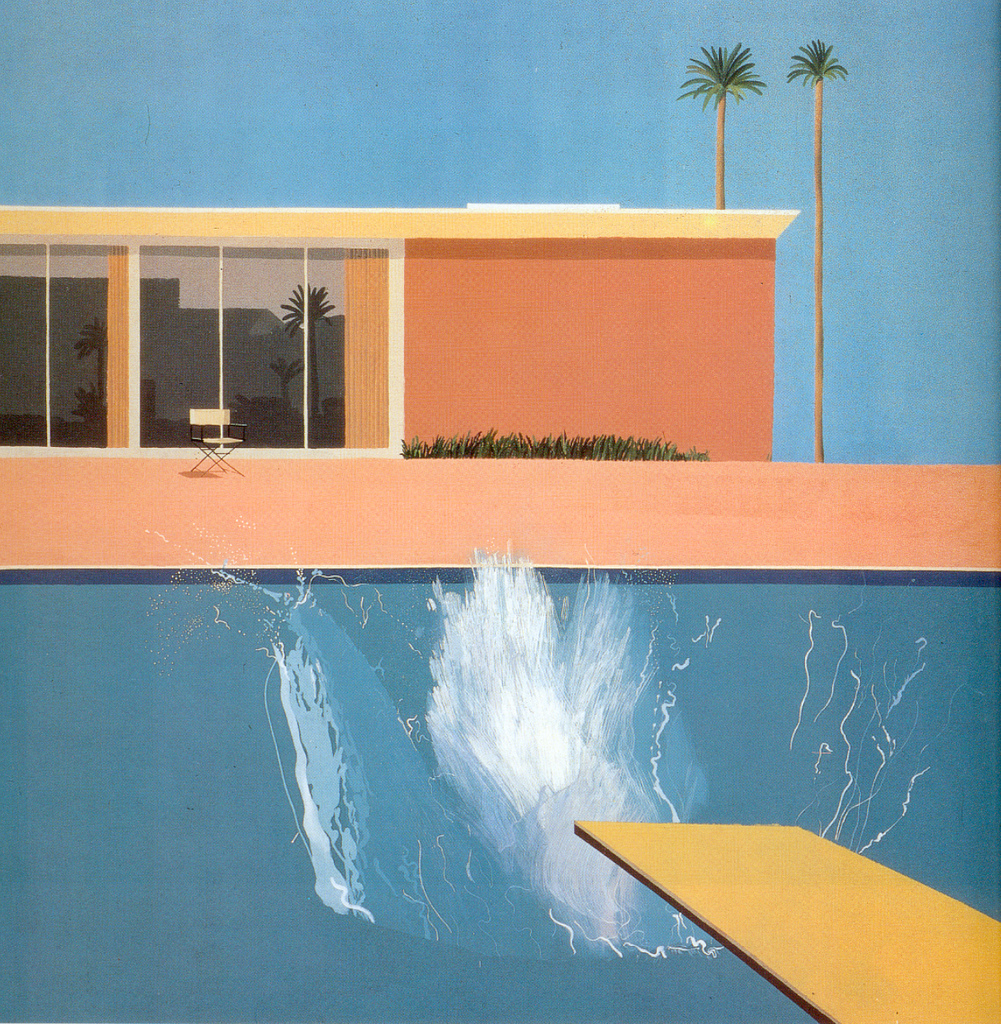
Hockney's swimming pool paintings, created primarily between 1964 and 1971, represent a serious examination of surface and depth. His masterpiece, A Bigger Splash (1967), remains a of the Tate collection and was a focal point of the museum's 2017 retrospective.
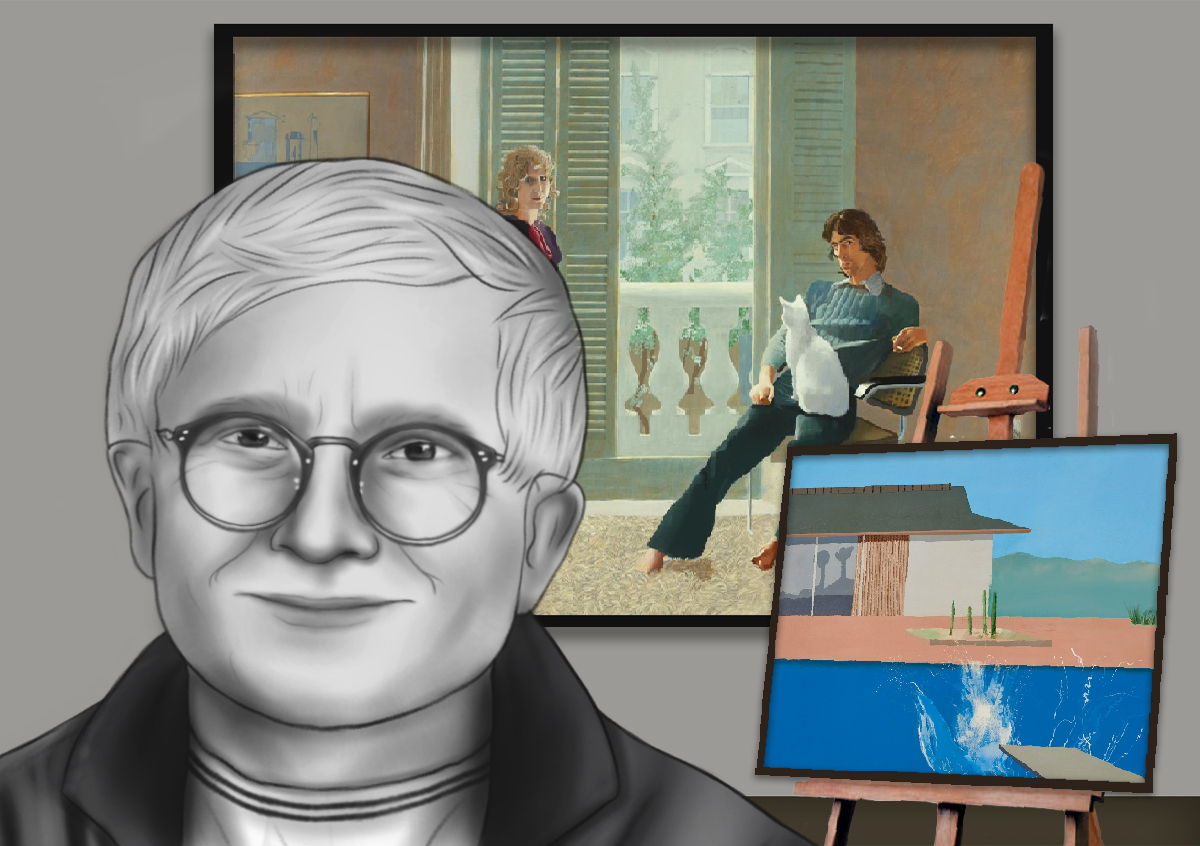
The work depicts the aftermath of a dive, with the splash itself painted meticulously over two weeks using small brushes, contrasting with the flat, roller-painted architectural background.
This deliberate juxtaposition of speed, the split-second event of a splash, and the laborious process of painting it, show Hockney's preoccupation with the suspension of time.
The market validation of these works reached historic levels in the last decade. On November 15, 2018, Portrait of an Artist (Pool with Two Figures) (1972) sold at Christie's New York for $90. 3 million, shattering the auction record for a living artist at that time.
The painting, which combines two varying photographic studies, one of a swimmer underwater and another of a figure standing at the pool's edge, exemplifies his use of composite photography to construct complex narratives. Similarly, The Splash (1966), a precursor to the larger Tate version, commanded £23. 1 million ($29.
8 million) at Sotheby's London in February 2020, confirming the enduring high valuation of this specific period in his oeuvre.
Major Auction Sales of California Works (2015, 2025)
| Work Title | Year Created | Sale Date | Auction House | Price (USD/GBP) |
|---|---|---|---|---|
| Portrait of an Artist (Pool with Two Figures) | 1972 | Nov 15, 2018 | Christie's New York | $90, 312, 500 |
| The Splash | 1966 | Feb 11, 2020 | Sotheby's London | £23, 117, 000 ($29. 8m) |
| Pacific Coast Highway and Santa Monica | 1990 | May 16, 2018 | Sotheby's New York | $28, 453, 000 |
| Piscine de Medianoche (Paper Pool 30) | 1978 | May 17, 2018 | Sotheby's New York | $11, 743, 800 |
Technical Innovations and Water Studies
The representation of water posed a formal challenge that Hockney addressed through continuous experimentation. Unlike the static nature of architecture, water required a method to depict constant motion and transparency. He utilized photography not as a reference as a tool to understand the physics of light refraction.
In works like Peter Getting Out of Nick's Pool (1966), Hockney applied lines of white paint to suggest the shimmering network of light on the water's surface, a technique he later described as painting "lines that wiggle.".
His adoption of acrylics was pivotal to this aesthetic. The medium's resistance to cracking and yellowing suited the flat, graphic quality he sought, allowing for the of thin washes to achieve the effect of translucent depth.
This period also saw him experimenting with the "joiner" technique, collaging multiple Polaroid photos to create a single image, which further informed his understanding of perspective.
These technical breakthroughs laid the groundwork for his later explorations in digital media, as the rigorous study of optical perception in the California sun directly influenced his iPad drawings and multi-camera video works exhibited in the 2020s.
Double Portraits and Naturalism
Between 1968 and 1977, David Hockney produced a series of monumental double portraits that marked a decisive shift from his earlier Pop Art invention toward a rigorous, optical naturalism. This period, frequently described by critics as his "naturalist phase," focused on the psychological between couples within domestic interiors.
The significance of these works was re-evaluated by the market and institutions between 2015 and 2025, culminating in historic auction records. In November 2018, Portrait of an Artist (Pool with Two Figures) (1972) sold at Christie's New York for $90. 3 million, establishing a new auction record for a living artist at that time.
The painting, which depicts Hockney's former partner Peter Schlesinger looking down at a swimmer, anchors this series as his most commercially valuable body of work.
The double portraits are characterized by their large , seven feet by ten feet, and their use of acrylic paint to create flat, luminous surfaces. Hockney moved away from the stylized abstraction of his early 60s work, choosing instead to "eyeball" his subjects directly, frequently supplementing long sittings with photographic studies.
The 2017 retrospective at Tate Britain dedicated a specific gallery, "Towards Naturalism," to these canvases, highlighting their structural precision. Curators noted that while the images appear realistic, they are carefully staged dramas; the light is frequently artificial, and the perspective is manipulated to heighten the tension between the two figures.
Mr. and Mrs. Clark and Percy (1970, 71), held in the Tate collection, remains the most publicly recognized work from this sequence. It depicts fashion designer Ossie Clark and textile designer Celia Birtwell in their Notting Hill apartment.
Unlike the other double portraits where the figures are detached, this composition features a direct gaze from Clark, while Birtwell looks away, creating a "cyclical movement of looking" that engages the viewer.
During the 2017 exhibition, the painting was positioned as the centerpiece of Hockney's engagement with the "conversation piece" tradition of 18th-century British art.
Market activity between 2019 and 2025 further solidified the status of these works. In March 2019, Henry Geldzahler and Christopher Scott (1969), a portrait of the Metropolitan Museum of Art curator and his partner, sold for £37. 7 million ($49. 4 million) at Christie's London. The painting had been in the collection of Barney A.
Ebsworth and is noted for its symmetry and the central dominance of Geldzahler. More, in November 2025, the double portrait Christopher Isherwood and Don Bachardy (1968), the in the series, achieved $44. 3 million at auction.
This work captures the literary couple in their Santa Monica home and is frequently by art historians for its psychological intensity, documenting the generational and professional gap between the novelist and the artist.
Hockney's technical method during this period was the subject of the 2022 exhibition "Hockney's Eye: The Art and Technology of Depiction" at the Fitzwilliam Museum, Cambridge. The exhibition examined his use of optical devices, though it concluded that the double portraits relied heavily on empirical observation and drawing rather than projection.
This focus on draughtsmanship was revisited in the National Portrait Gallery's exhibition "David Hockney: Drawing from Life," which opened in 2020 and reopened in 2023.
The show reunited the artist with subjects like Celia Birtwell, displaying the 1970s studies alongside new portraits painted in Normandy between 2021 and 2022, demonstrating the lifelong continuity of these relationships.
| Work Title | Date Created | Event / Sale Date | Details |
|---|---|---|---|
| Portrait of an Artist (Pool with Two Figures) | 1972 | Nov 15, 2018 | Sold for $90. 3 million at Christie's NY (Record for living artist). |
| Henry Geldzahler and Christopher Scott | 1969 | Mar 6, 2019 | Sold for £37. 7 million at Christie's London. |
| Christopher Isherwood and Don Bachardy | 1968 | Nov 2025 | Sold for $44. 3 million at Christie's NY. |
| Mr. and Mrs. Clark and Percy | 1970, 71 | 2017 | Featured as centerpiece in Tate Britain retrospective "Towards Naturalism" room. |
| American Collectors (Fred and Marcia Weisman) | 1968 | Ongoing | Held in the Art Institute of Chicago; key example of "stiff" naturalist style. |
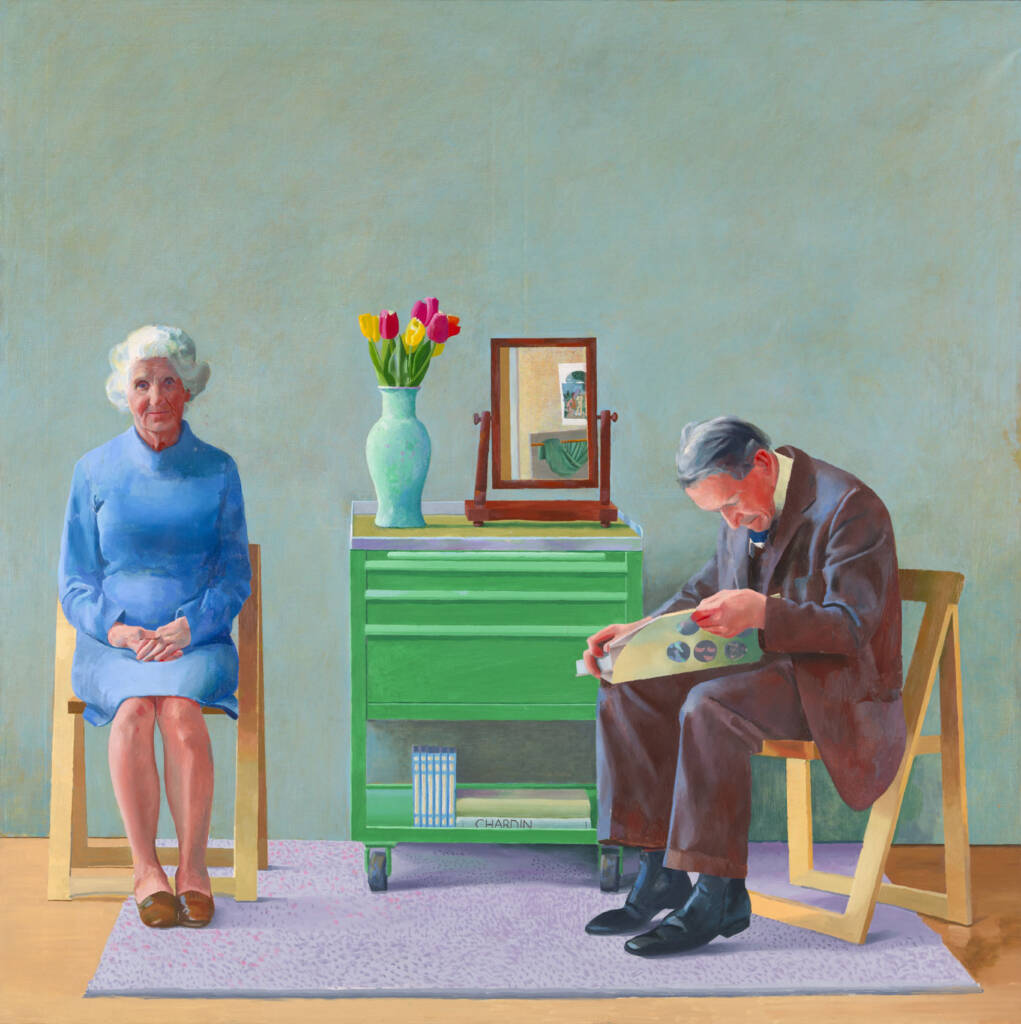
The "Naturalism" phase concluded in 1977 with My Parents, a double portrait of Kenneth and Laura Hockney. This work, also part of the Tate collection, signals the end of his strict adherence to optical realism before he pivoted to the fractured perspectives of his "joiner" photocollages in the 1980s.
yet, the legacy of the double portraits; the 2023 "Drawing from Life" exhibition revealed that Hockney continues to use the double-figure format to examine intimacy and aging, proving that the compositional logic established in the late 1960s remains central to his practice in the 2020s.
Photography and the 'Joiners' Collages
Between 1980 and 1986, David Hockney temporarily abandoned painting to focus exclusively on photography, a medium he had previously dismissed as the view of a "paralysed Cyclops." His innovation during this period was the "joiner," a technique that involved assembling multiple Polaroid or 35mm prints into a single, grid-like composition.
This method allowed him to introduce time and movement into a static image, drawing with a camera. Hockney argued that traditional wide-angle lenses distorted space and removed the viewer's body from the scene.
By stitching together dozens, sometimes hundreds, of individual frames taken from slightly different angles, he created a multi-point perspective that forced the human eye to scan the image, mimicking the act of looking itself.
The "joiners" function as a photographic extension of Cubism. Hockney's rejection of the Renaissance "one-point perspective" became the central philosophical pillar of this work. He posited that a single photograph captures a fraction of a second, whereas a joiner captures a duration of time, making the viewer an active participant in the space.
This period yielded thousands of composite images, ranging from intimate portraits of friends to sprawling. The technique evolved from the rigid grid structure of his early Polaroid works to the more fluid, puzzle-like arrangements of his later 35mm collages, where the edges of the work were left uneven and jagged.
Pearblossom Highway and serious Reception
The culmination of this photographic experiment is Pearblossom Hwy., 11, 18th April 1986, a work Hockney describes as a "panoramic assault on Renaissance one-point perspective." Held in the collection of the J. Paul Getty Museum in Los Angeles, the piece depicts a desert crossroads littered with road signs and debris.
It was constructed over several days, with Hockney photographing the right side of the road (the "driver's side") to emphasize the instructional road signs, and the left side (the "passenger's side") to capture the observational details of the.
, critics have re-evaluated Pearblossom Hwy not just as a collage, as a pivotal moment that bridged his painting and later digital works. During the massive David Hockney 25 exhibition at the Fondation Louis Vuitton in April 2025, the work was as a precursor to his immersive video installations.
The exhibition, curated by the artist himself, highlighted how the segmented vision of the joiners directly influenced the nine-camera rigs he used for The Four Seasons video works.
Market Performance and Valuation (2015, 2025)
While Hockney's paintings regularly command nine-figure sums, such as the $90. 3 million sale of Portrait of an Artist (Pool with Two Figures) in 2018, his photographic joiners occupy a distinct and active segment of the art market. Collectors prize these works for their technical intricacy and their direct connection to the artist's theoretical writings.
Auction data from 2025 indicates a strong demand for signed photographic composites.
| Work Title | Date of Sale | Auction House | Realized Price (USD) |
|---|---|---|---|
| George, Blanche, Celia, Albert and Percy, London | June 24, 2025 | Sotheby's London | $32, 695 |
| Gregory Reading in Kyoto | October 6, 2025 | Bonhams Los Angeles | $28, 226 |
| My Mother, Bolton Abbey, Yorkshire | October 6, 2025 | Bonhams Los Angeles | $9, 408 |
Legacy in the Digital Age
The "joiner" technique has proven to be more than a stylistic detour; it established the visual syntax for Hockney's later iPad drawings and immersive exhibitions. The 2023, 2025 show Bigger & Closer (not smaller & further away) at London's Lightroom utilized the logic of the joiners on a monumental.
By projecting fragmented, high-resolution images that surrounded the audience, Hockney achieved the "reverse perspective" he had sought in the 1980s, placing the viewer inside the artwork rather than in front of it.
"The camera can't see space. It sees surfaces. People see space, which is much more interesting." , David Hockney
This distinction remains the driving force behind his visual experiments. Even as technology advanced from Polaroid film to high-definition digital sensors, Hockney continued to the "cyclopean" gaze of the lens. His photographic collages stand as a documented rebellion against the mechanical limitations of the camera, proving that human vision is a composite, temporal experience rather than a static snapshot.
Operatic Legacy and Stage Design Revivals
Although David Hockney ceased creating new stage designs in the 1990s, his existing productions remained central to the global operatic repertoire between 2015 and 2025.
His work for the stage, characterized by bold color palettes, forced perspectives, and a rejection of naturalism, continued to be revived by major opera houses, affirming his status as one of the most significant set designers of the late 20th century.
These revivals frequently coincided with museum exhibitions, reinforcing the symbiotic relationship between his studio practice and his theatrical vision.
Turandot: A Technicolor Spectacle
Hockney's 1992 production of Puccini's Turandot, originally commissioned by the Lyric Opera of Chicago and the San Francisco Opera, saw high-profile revivals during this period. In late 2017, the San Francisco Opera mounted a "refurbished revival" of the work.
This production was noted for its intense use of "Hockney Red" and "imperial blue," creating a fantastical, non-literal Peking that avoided traditional chinoiserie in favor of strong diagonals and mad perspectives. During this run, the company awarded Hockney the San Francisco Opera Medal in recognition of his major contributions to the art form.
The production returned to the West Coast in May and June 2024, when the Los Angeles Opera staged it at the Dorothy Chandler Pavilion. Reports indicated that the company spent approximately $80, 000 to rent the physical assets, sets, props, and Ian Falconer's costumes, from the San Francisco and Chicago companies.
Critics praised the 2024 staging for its enduring visual power, noting that the "clashing angles" and "saturated hues" of azure and green remained at evoking the opera's fairy-tale cruelty. The revival served as a major box-office draw, confirming the production's status as a definitive modern interpretation of Puccini's final work.
Die Frau ohne Schatten and The Rake's Progress
In June 2023, the San Francisco Opera revived Hockney's set design for Richard Strauss's Die Frau ohne Schatten (The Woman Without a Shadow). Originally designed for Covent Garden in 1992, this production represents Hockney in "maximalist" mode, contrasting sharply with the starker geometry of his earlier work.
The 2023 staging featured a supersize orchestra and utilized Hockney's vibrant, surrealist to navigate the opera's complex shifts between spirit and mortal. Reviews described the sets as "vivid" and "over the top," anchoring the opera's abstract narrative in a visual language.
Hockney's opera design, Stravinsky's The Rake's Progress (1975), also saw significant activity. In 2015, the Portland Opera presented the work, coinciding with the exhibition David Hockney: A Rake's Progress at the Portland Art Museum.
This exhibition displayed the artist's original etchings and stage models, highlighting the direct lineage between his 1963 print series and the 1975 set design. The production's cross-hatched aesthetic, which mimics William Hogarth's engravings, appeared again at the Glyndebourne Festival in 2023.
This revival marked the production's return to its original home after a decade-long absence, proving that Hockney's "engraving-come-to-life" concept retained its graphic impact nearly fifty years after its premiere.
| Year | Opera | Company / Venue | Key Production Details |
|---|---|---|---|
| 2015 | The Rake's Progress | Portland Opera | Presented alongside Portland Art Museum exhibition. |
| 2017 | Turandot | San Francisco Opera | Hockney received SF Opera Medal; refurbished sets. |
| 2023 | Die Frau ohne Schatten | San Francisco Opera | Maximalist design; SF performance of this production. |
| 2023 | The Rake's Progress | Glyndebourne Festival | Revival of the original 1975 production. |
| 2024 | Turandot | Los Angeles Opera | Major revival featuring Ian Falconer's costumes. |
Digital Immersion and Legacy
While Hockney did not design new operas in this decade, his stage work found a new medium through digital technology. The immersive exhibition David Hockney: Bigger & Closer (not smaller & further away), which opened at Lightroom in London's King's Cross in February 2023, dedicated a significant chapter to his opera designs.
The show used high-resolution projection mapping to animate his static set designs for Turandot, The Magic Flute, and Tristan und Isolde, allowing audiences to "step inside" the stage environments.
This digital resurrection bridged the gap between his physical stagecraft and his later iPad experiments, demonstrating the theatricality inherent in his entire body of work.
Looking forward, the Fondation Louis Vuitton in Paris announced a detailed retrospective, David Hockney 25, scheduled for 2025. The exhibition promised to include a focus on his performance-related art, ensuring that his contributions to the stage remain a visible pillar of his artistic output well into his late eighties.
Return to Yorkshire: serious Reception and Market Re-Evaluation (2015, 2025)
David Hockney's "Return to Yorkshire" period, which spanned roughly from 2004 to 2013, has undergone significant serious and commercial re-evaluation between 2015 and 2025. This era, characterized by his rejection of the Los Angeles studio system in favor of painting en plein air in the English countryside, produced of his most ambitious works.
The period's legacy was cemented by the 2017 Tate Britain retrospective, which became the fastest-selling exhibition in the museum's history. Curators highlighted his multi-canvas "Bigger Pictures" of the Yorkshire Wolds as a defining achievement of his late career, placing them alongside his iconic 1960s pool paintings art historical importance.
The visual language of this period focuses on the changing seasons of East Yorkshire, specifically locations like Woldgate Woods, Thixendale, and Kilham. In 2019, the Van Gogh Museum in Amsterdam staged Hockney , Van Gogh: The Joy of Nature, an exhibition that explicitly linked Hockney's Yorkshire to the Dutch master's work.
The show demonstrated how Hockney used high-key color and vigorous brushwork to capture the "infinite variety of nature," a method he refined during his decade in Bridlington. This scholarly attention validated his decision to trade the flat light of California for the shifting, moody atmosphere of Northern England.
Market Validation and Auction Records
The commercial value of the Yorkshire surged between 2015 and 2025, driven by scarcity and the monumental of the works. Collectors aggressively pursued the "Woldgate" series, which documents the same woodland tracks across different seasons.
In November 2016, Sotheby's New York set a then-record for the artist when Woldgate Woods, 24, 25 and 26 October, 2006 sold for $11. 7 million. This six-canvas oil painting measures over ten feet wide and exemplifies his method of assembling multiple panels to create a single, immersive view.
This upward trajectory continued into the 2020s. In November 2022, the sale of the Paul G. Allen Collection at Christie's New York saw Winter Timber (2009), another massive multi-canvas Yorkshire, fetch $23. 3 million. This price point confirmed that his English had achieved parity with his celebrated California works.
The market for his digital plein air experiments also matured; in October 2025, a set of 17 iPad drawings from the The Arrival of Spring in Woldgate series sold for a combined £6. 2 million ($8. 3 million) at Sotheby's London, shattering estimates and proving the secondary market viability of his digital prints.
| Date | Work Title | Medium | Auction House | Sale Price (USD) |
|---|---|---|---|---|
| Nov 2016 | Woldgate Woods, 24, 25 and 26 October, 2006 | Oil on 6 canvases | Sotheby's NY | $11. 7 million |
| Nov 2022 | Winter Timber (2009) | Oil on 15 canvases | Christie's NY | $23. 3 million |
| Oct 2024 | More Woldgate Timber (2009) | Oil on canvas | Christie's London | $7. 4 million (est) |
| Oct 2025 | The Arrival of Spring in Woldgate (Series) | iPad Drawings (Prints) | Sotheby's London | $8. 3 million |
Technological Integration and "The Arrival of Spring"
A central component of the Yorkshire period was Hockney's adoption of digital tools to plein air painting. Starting in 2010, he began using the iPad to capture the immediate changes and vegetation, a technique that allowed him to work rapidly without the logistical load of mixing paints in the field.
The 2020 exhibition at the Royal Academy, though focused on his later Normandy work, retrospectively highlighted the 2011 series The Arrival of Spring in Woldgate as the genesis of this method. These digital works were printed on a massive for exhibition, challenging traditional definitions of drawing and printmaking.
The Yorkshire period concluded when Hockney returned to California in 2013, its influence. His 2019 move to Normandy, France, was widely interpreted by critics as a direct spiritual successor to his time in Bridlington. Both periods share a fixation on the "micro-geography" of a single location observed over time.
The Ma Normandie exhibition (2020) and subsequent shows in 2021 drew heavy parallels to the Woldgate works, illustrating that the discipline of daily observation established in Yorkshire remained the core of his late-life artistic practice.
The Normandy Period and iPad Mastery
In 2019, David Hockney relocated to a timber-framed house in the Pays d'Auge region of Normandy, France, initiating a prolific phase of digital creation. This move preceded the COVID-19 pandemic, positioning the artist to document the unfolding seasons in isolation.
Between February and July 2020, Hockney produced 116 iPad paintings for the series The Arrival of Spring, Normandy, 2020. Unlike his previous Yorkshire, these works were created using a bespoke version of the Brushes app, modified by a mathematician to meet his specific technical requirements for brush texture and color.
The backlit screen of the iPad allowed him to work through twilight and into the night, a capability he noted was impossible with traditional media like watercolor or oil.
The Royal Academy of Arts in London exhibited these works in 2021. To prepare the digital files for the physical gallery space, the images were enlarged and printed as inkjet prints on paper, mounted on Dibond, and framed at a standardized size of 1. 5 by 1 meter.
This process required vector-based input to ensure the lines remained crisp without pixelation when scaled up from the 12. 9-inch iPad Pro screen. Critics and curators noted that the prints retained the gestural immediacy of the artist's hand, validating the tablet as a serious medium for plein air observation.
A Year in Normandie: The Frieze
Following the spring series, Hockney expanded his digital scope to create A Year in Normandie, a continuous frieze depicting the pattern of seasons around his French property.
Inspired by the 11th-century Bayeux , which he viewed at the Bayeux Museum, and a Chinese scroll painting he encountered in 1983, Hockney stitched together 220 individual iPad panels into a single, direct composition. The resulting work measured 90. 75 meters (297 feet) in length, significantly exceeding the 68. 3-meter length of the Bayeux.
The frieze was displayed at the Musée de l'Orangerie in Paris in October 2021, positioned to echo the immersive curvature of Monet's Water Lilies. In 2022, the work traveled to Salts Mill in Saltaire, West Yorkshire, where it was installed in the attic space.
The exhibition allowed viewers to walk the length of the year, observing the transition from bare winter branches to the lush greenery of summer and the decay of autumn, all rendered with the high-key, artificial palette characteristic of his digital toolset.
Immersive Projection: Bigger & Closer
In February 2023, Hockney launched Bigger & Closer (not smaller & further away), an immersive exhibition at Lightroom in King's Cross, London. This project marked a departure from static prints, using high-definition projection mapping to display his work across four-story-high walls. The 50-minute looped performance featured six themed chapters, including "The Lessons of Perspective" and "Hockney Paints the Stage."
Collaborating with 59 Productions, Hockney provided narration and oversaw the visual sequencing. The installation used 28 projectors and a 360-degree sound system to place visitors inside his paintings, including animated versions of his iPad works where brushstrokes appeared in real-time.
The show ran through late 2023 and returned in 2024 and 2025, demonstrating the commercial and popular viability of digital art environments.
Market Valuation of Digital Works
The market for Hockney's digital output solidified significantly by 2025. In October 2025, Sotheby's London conducted a sale of 17 iPad drawings from the Arrival of Spring in Woldgate series. The collection realized a total of £6. 2 million ($8.
3 million), with individual prints such as The Arrival of Spring in Woldgate, East Yorkshire in 2011 , 19 February selling for £762, 000. These figures represented a sharp increase in value for editioned digital prints, confirming that collectors viewed the iPad works as central to Hockney's oeuvre rather than experimental novelties.
Key Digital Projects and Exhibitions (2019, 2025)
| Year | Project / Exhibition | Location | Key Metrics |
|---|---|---|---|
| 2020 | The Arrival of Spring, Normandy | Normandy (Creation) | 116 iPad paintings created during lockdown |
| 2021 | Royal Academy Exhibition | London, UK | Prints enlarged to 1. 5m x 1m; vector-based scaling |
| 2021 | A Year in Normandie (Frieze) | Musée de l'Orangerie, Paris | 90. 75 meters long; composed of 220 panels |
| 2023 | Bigger & Closer | Lightroom, London | 50-minute loop; 4-story projections; 28 projectors |
| 2025 | Sotheby's Digital Art Sale | London, UK | £6. 2 million total sales for 17 iPad works |
Relocation to Normandy and La Grande Cour
In March 2019, David Hockney relocated from Los Angeles to the Pays d'Auge region of Normandy, France. Seeking a respite from the noise of city life and the restrictive smoking laws of the United States, Hockney purchased a 17th-century half-timbered cottage known as La Grande Cour (The Big Yard) in late 2018.
Located near the village of Beuvron-en-Auge, the property includes a cider press which the artist converted into a studio. The move was precipitated by a visit to the Bayeux, which Hockney admired for its absence of shadows and its narrative flow, qualities he sought to emulate in his own work.
This environment provided the isolation and subject matter for his major phase of artistic production, characterized by an intense focus on the seasonal shifts of the French countryside.
The Arrival of Spring, Normandy, 2020
During the global COVID-19 lockdowns of 2020, Hockney remained at La Grande Cour, documenting the emergence of spring in real-time. Using an iPad and a specially adapted stylus app, he created 116 digital paintings that captured the progression from bare winter trees to the lush greenery of early summer.
Unlike his previous 2011 Yorkshire spring series, which was produced on a mix of iPad and canvas, this body of work was entirely digital. The series, titled The Arrival of Spring, Normandy, 2020, was exhibited at the Royal Academy of Arts in London from May to September 2021. The exhibition later traveled to the Art Institute of Chicago in 2022.
Hockney described these works as a "celebration of the natural world," famously stating during the pandemic that "they can't cancel the spring.".
A Year in Normandie Frieze
Building on his spring series, Hockney expanded his scope to capture the full annual pattern of his Normandy garden. Influenced by the narrative structure of the Bayeux and a Chinese scroll he had viewed at the Metropolitan Museum of Art in 1983, he stitched together 220 iPad compositions into a single continuous image.
The resulting work, A Year in Normandie, measures 90. 75 meters (approximately 297 feet) in length. This monumental frieze allows viewers to walk alongside the changing seasons, observing the transformation of the in a linear format. The work was displayed in the Musée de l'Orangerie in Paris in 2021, creating a dialogue with Claude Monet's Water Lilies.
In 2024, the full-length frieze was exhibited in the roof space of Salts Mill in Saltaire, West Yorkshire, a venue closely associated with the artist.
Immersive Exhibitions and AI Experimentation
In February 2023, the immersive exhibition David Hockney: Bigger & Closer (not smaller & further away) opened at Lightroom in London's King's Cross. The show utilized large- digital projection and a custom audio score to present six decades of Hockney's work.
Unlike static retrospectives, this installation allowed audiences to watch the artist's process unfold on four-story walls, featuring animated versions of his iPad paintings and stage designs. The exhibition was a commercial and serious success, running through late 2023 before touring to Seoul.
Hockney also ventured into artificial intelligence during this period. In June 2023, he debuted a video work titled I LIVED IN BOHEMIA BOHEMIA IS A TOLERANT PLACE on the Pyramid Stage screens at the Glastonbury Festival.
Collaborating with the Cultural Institute of Radical Contemporary Arts (CIRCA), Hockney used AI to remove the figures from his 2014 painting The Dancers V, leaving only the painted to emphasize a message of peace and tolerance.
Recent Portraits and 2025 Retrospectives
While dominated his Normandy output, Hockney returned to portraiture with the exhibition David Hockney: Drawing from Life at the National Portrait Gallery, London, which reopened in November 2023 after a pandemic-induced closure. The updated show included thirty new portraits created at his Normandy studio between 2021 and 2022.
Notable among these was a portrait of singer Harry Styles, painted in May 2022. The sitter is depicted in a striped cardigan and jeans, a session that lasted two days. The exhibition also featured intimate studies of his partner, Jean-Pierre Gonçalves de Lima.
Looking ahead, the Fondation Louis Vuitton in Paris announced a major retrospective titled David Hockney 25, scheduled to run from April 9 to August 31, 2025. This exhibition feature over 400 works, including new paintings produced in 2024, marking one of the most detailed surveys of his career to date.
Simultaneously, Salts Mill is hosting 20 Flowers for 2025, displaying a series of flower still lifes created on the iPad in 2021.
| Exhibition Title | Venue | Location | Dates |
|---|---|---|---|
| The Arrival of Spring, Normandy, 2020 | Royal Academy of Arts | London, UK | May 23 , Sept 26, 2021 |
| A Year in Normandie | Musée de l'Orangerie | Paris, France | Oct 13, 2021 , Feb 14, 2022 |
| Hockney in Normandy | Gray Gallery | New York, USA | Feb 22 , Mar 19, 2021 |
| Bigger & Closer (not smaller & further away) | Lightroom | London, UK | Feb 22 , Dec 3, 2023 |
| Drawing from Life (Updated) | National Portrait Gallery | London, UK | Nov 2, 2023 , Jan 21, 2024 |
| A Year in Normandie | Salts Mill | Saltaire, UK | May 4 , Nov 3, 2024 |
| David Hockney 25 | Fondation Louis Vuitton | Paris, France | Apr 9 , Aug 31, 2025 |
Normandy, Solitude, and a Return to London
In 2019, seeking a respite from the noise of Los Angeles and the restrictive smoking laws of the United States, Hockney relocated to the Pays d'Auge region of Normandy, France. He purchased a 17th-century half-timbered cottage, La Grande Cour, near the village of Beuvron-en-Auge.
The property, surrounded by hawthorn thickets and fruit trees, offered the artist a secluded environment to observe the subtle progression of the seasons. This move marked a significant shift in his daily rhythm; he described his life there as a "seven-day weekend," devoid of social obligations and dedicated entirely to his work.
The isolation of the French countryside proved creatively fertile, particularly during the COVID-19 lockdowns of 2020. While the world paused, Hockney immersed himself in the arrival of spring, capturing the blossoming flora on his iPad.
This period of intense observation resulted in A Year in Normandie, a 90-meter-long frieze that chronicled the seasonal shifts with a vibrancy reminiscent of the Bayeux. His routine was disciplined and monastic: he would rise early to watch the sunrise, paint for three to six hours, and spend his evenings smoking and contemplating his work.
yet, the tranquility of Normandy was eventually compromised by what Hockney described as "intrusion." In interviews, he noted that the location had become too accessible to visitors, disrupting his privacy. also, his advancing age and increasing medical needs necessitated a change.
In July 2023, Hockney moved back to London, settling in a residence in Marylebone to be closer to hospitals and doctors. By 2025, reports indicated the artist had become "increasingly frail," requiring the assistance of two full-time carers.
even with these physical limitations, his commitment to his studio practice remained absolute, with the artist declaring that he only needed his "hand, eye, and heart" to continue.
Synesthesia and Sensory Perception
Hockney possesses a neurological condition known as synesthesia, specifically chromesthesia, where sound involuntarily evokes the experience of color. This cross-sensory perception has fundamentally influenced his artistic output, particularly in his stage designs for opera.
While he does not always translate these internal colors directly onto canvas, they dictate the lighting and palette of his theatrical work. He has described seeing "transparent" and "sculptural" colors when listening to music, a phenomenon that guided his set designs for productions like Tristan und Isolde and Turandot.
, Hockney has leveraged this condition in immersive digital installations. The 2025 exhibition David Hockney: Bigger & Closer (not smaller & further away) at London's Lightroom featured a dedicated section exploring his synesthetic experiences.
Set to a score by composer Nico Muhly, the installation used animated projections of his stage designs to allow audiences to "see" the music as Hockney does.
Similarly, Gallery 10 of his retrospective at the Fondation Louis Vuitton in Paris was designed as an immersive audio-visual space, reinterpreting his opera sets to create a polyphonic sensory experience.
His auditory health has also played a paradoxical role in his late style. Hockney has suffered from hearing loss for decades and relies on hearing aids.
He has frequently stated that his deafness has sharpened his visual acuity, allowing him to "see space clearer." He that the loss of one sense forces a compensation in others, leading to a heightened sensitivity to spatial relationships and perspective.
This theory underpins his recent experiments with "reverse perspective," where he challenges the traditional single-point perspective of Western art in favor of a more, multi-viewpoint method that mimics the human experience of looking.
Advocacy and Personal Convictions
Hockney remains a defiant and vocal advocate for the rights of smokers, viewing the habit as a fundamental personal freedom. His move to France was partly motivated by the country's more relaxed attitude toward smoking in public spaces compared to the "bossy" regulations of California and the UK.
In April 2025, this stance sparked a public controversy when the Paris Metro banned a promotional poster for his exhibition David Hockney 25 because it depicted the artist holding a cigarette. Hockney condemned the decision as "complete madness" and "petty," criticizing the "interfering bossiness" of modern bureaucracy.
His personal life in this period has been defined by his partnership with Jean-Pierre Gonçalves de Lima, known affectionately as "JP." A longtime studio manager and companion, Gonçalves de Lima has been instrumental in organizing Hockney's recent major exhibitions, including the massive 2025 retrospective at the Fondation Louis Vuitton. Their relationship is both personal and professional, with JP frequently serving as a subject in Hockney's portraits.
| Year | Event | Location |
|---|---|---|
| 2019 | Relocated to La Grande Cour, a 17th-century cottage. | Normandy, France |
| 2020 | Created A Year in Normandie frieze during lockdown. | Normandy, France |
| 2023 | Moved back to London for medical proximity and privacy. | London, UK |
| 2025 | Poster banned by Paris Metro for depicting a cigarette. | Paris, France |
| 2025 | King Charles III visited his Marylebone home. | London, UK |
In March 2025, King Charles III visited Hockney at his Marylebone home. The meeting lasted approximately an hour, yet Hockney declined to paint the monarch's portrait. Consistent with his long-held rule, he explained that he only paints individuals he knows intimately, a principle that led him to turn down previous requests to paint Queen Elizabeth II.
Instead, he continues to focus on his immediate circle, producing intimate portraits of his carers and friends, proving that even in his late eighties, his art remains deeply rooted in his personal reality.
Major Exhibitions and Retrospectives (2015, 2025)
Between 2015 and 2025, David Hockney cemented his status as one of the world's most bankable and prolific living artists through a series of blockbuster exhibitions. These presentations ranged from traditional retrospectives to experimental digital installations, frequently breaking attendance records at major institutions.
His output during this decade was characterized by a dual focus: a return to intimate portraiture and an expansive exploration of digital media, particularly the iPad, which allowed him to document the changing seasons with immediacy.
The period began with the serious acclaimed David Hockney: 82 Portraits and 1 Still-life, which opened at the Royal Academy of Arts, London, in July 2016. The exhibition featured a uniform series of acrylic paintings executed over two years in his Los Angeles studio.
Each subject sat in the same yellow chair against a blue background for exactly three days, a process Hockney described as a "20-hour exposure." The show later traveled to Ca' Pesaro in Venice and the Los Angeles County Museum of Art (LACMA) in 2018, his enduring connection to the Californian art scene.
In 2017, Tate Britain mounted its most extensive survey of the artist's work to date. Simply titled David Hockney, the retrospective spanned six decades, from his student days at the Royal College of Art to his recent Yorkshire. The exhibition became the most visited show by a living artist in the gallery's history, drawing 478, 082 visitors.
It offered a detailed chronological overview, reuniting iconic double portraits such as Mr and Mrs Clark and Percy (1970, 71) with his multi-canvas "joiner" photographs and video works.
Following its London success, the retrospective toured to the Centre Pompidou in Paris and The Metropolitan Museum of Art in New York, introducing his oeuvre to a new generation of international viewers.
Hockney's dialogue with art history continued with Hockney , Van Gogh: The Joy of Nature, which premiered at the Van Gogh Museum in Amsterdam in 2019. This thematic presentation placed Hockney's Yorkshire alongside Vincent van Gogh's masterpieces, revealing shared fascinations with color, perspective, and the natural world.
The exhibition attracted nearly 360, 000 visitors in Amsterdam before moving to the Museum of Fine Arts, Houston, in 2021, where attendance was capped at approximately 66, 000 due to pandemic restrictions.
| Exhibition Title | Venue(s) | Year(s) | Key Metric / Note |
|---|---|---|---|
| David Hockney | Tate Britain, London | 2017 | 478, 082 visitors (Record for living artist) |
| The Joy of Nature | Van Gogh Museum, Amsterdam | 2019 | ~360, 000 visitors |
| The Arrival of Spring, Normandy | Royal Academy, London | 2021 | 116 iPad works printed large- |
| Bigger & Closer | Lightroom, London | 2023, 2025 | Immersive digital projection experience |
The COVID-19 pandemic significantly impacted the scheduling of David Hockney: Drawing from Life at the National Portrait Gallery, London. Opening in February 2020, the show was forced to close after just 20 days. It reopened in November 2023 with an expanded checklist that included over 30 new portraits created at his Normandy studio between 2021 and 2022.
These additions featured intimate depictions of visitors and friends, documenting his social circle as travel restrictions eased.
During the lockdowns of 2020, Hockney at his farmhouse in Normandy, France, where he produced a new body of work using an updated iPad application. These images formed the basis of The Arrival of Spring, Normandy, 2020, exhibited at the Royal Academy in 2021.
The show presented 116 large- prints that chronicled the unfolding season in minute detail, from bare winter branches to the lush greenery of early summer. Critics noted the vibrancy and optimism of the series, which served as a visual counter-narrative to the global health emergency.
In a departure from traditional gallery formats, Hockney launched David Hockney: Bigger & Closer (not smaller & further away) in February 2023 at Lightroom in London's King's Cross. This immersive experience used large- projection and spatial audio to guide audiences through sixty years of his art.
The show ran for extended periods through 2024 and 2025, allowing visitors to walk inside his paintings and observe his digital process on four-story walls.
Recent years saw a coordinated global presentation titled 20 Flowers and Bigger Pictures (2022, 2023), which opened simultaneously across five cities: London, Paris, New York, Los Angeles, and Chicago. This logistical feat showcased his continued mastery of the still life genre.
In 2024, the National Gallery in London hosted Hockney and Piero: A Longer Look, pairing his works with Piero della Francesca's The Baptism of Christ to illustrate the Renaissance master's influence on his spatial perception.
Looking ahead to 2025, the Fondation Louis Vuitton in Paris prepared to host David Hockney 25, a massive survey running from April to August. Concurrently, the Palm Springs Art Museum presented Perspective Should Be Reversed through March 2025, focusing on his printmaking and photographic experiments.
These exhibitions confirm that even in his late eighties, Hockney remains a central figure in contemporary art, continuously pushing the boundaries of how images are made and perceived.
Record-Breaking Valuation and the "Pool" Phenomenon
The trajectory of David Hockney's market value shifted permanently on November 15, 2018, at Christie's New York. During the Post-War and Contemporary Art Evening Sale, his 1972 masterpiece Portrait of an Artist (Pool with Two Figures) sold for $90, 312, 500.
This transaction shattered the previous auction record for a living artist, formerly held by Jeff Koons's Balloon Dog (Orange) at $58. 4 million. The painting, which depicts Hockney's former partner Peter Schlesinger gazing at a swimmer, was sold without a reserve price, a rare strategy for a lot of such high caliber.
Bidding opened at $18 million and escalated rapidly, concluding in under ten minutes. While the buyer remained anonymous, the seller was widely reported to be British currency trader Joe Lewis.
This sale recalibrated the market's assessment of Hockney's oeuvre, particularly his "California Dreaming" period. Prior to this event, his auction record stood at $28. 5 million for Pacific Coast Highway and Santa Monica (1990), set just months earlier in May 2018 at Sotheby's.
The 2018 surge signaled a consolidation of his status as a blue-chip asset, with collectors aggressively pursuing works from his formative Los Angeles years.
Major Acquisitions and Market Peaks (2019, 2020)
Following the 2018 watershed, high-value transactions continued to validate Hockney's market dominance. In March 2019, Henry Geldzahler and Christopher Scott (1969), a double portrait of the Metropolitan Museum of Art curator and his partner, fetched £37. 7 million ($49. 5 million) at Christie's London. This result underscored the premium placed on his naturalistic double portraits from the late 1960s.
The momentum into 2020 with the sale of The Splash (1966) at Sotheby's London for £23. 1 million ($29. 8 million). This work, a counterpart to the Tate's A Bigger Splash, had previously sold for £2. 9 million in 2006, illustrating a tenfold appreciation over fourteen years.
Later that year, Phillips New York secured a record for the artist's genre when Nichols Canyon (1980) sold for $41 million in December 2020. The painting, characterized by its fauvist palette and winding perspective, marked a serious transition in Hockney's engagement with the Los Angeles topography.
Top Auction Results (2015, 2025)
The following table details the most significant auction results for David Hockney's work during the verified period.
| Work | Year Created | Sale Price (USD) | Auction House | Date of Sale |
|---|---|---|---|---|
| Portrait of an Artist (Pool with Two Figures) | 1972 | $90, 312, 500 | Christie's New York | Nov 15, 2018 |
| Henry Geldzahler and Christopher Scott | 1969 | $49, 522, 500 | Christie's London | Mar 6, 2019 |
| Nichols Canyon | 1980 | $41, 067, 500 | Phillips New York | Dec 7, 2020 |
| The Splash | 1966 | $29, 830, 600 | Sotheby's London | Feb 11, 2020 |
| Lawn Being Sprinkled | 1967 | $28, 590, 000 | Christie's New York | May 2024 |
| Pacific Coast Highway and Santa Monica | 1990 | $28, 453, 000 | Sotheby's New York | May 16, 2018 |
| California | 1965 | $25, 020, 000 | Christie's London | Mar 2024 |
| Early Morning, Sainte-Maxime | 1969 | $23, 500, 000 | Christie's London | Oct 13, 2022 |
| Winter Timber | 2009 | $23, 290, 000 | Christie's New York | Nov 9, 2022 |
| L'Arbois, Sainte-Maxime | 1968 | $17, 200, 000 | Sotheby's London | Oct 9, 2024 |
Resurgence and Sector Analysis (2022, 2024)
While the broader art market experienced a correction in 2023, Hockney's sector demonstrated resilience, particularly in 2024. a 54% year-over-year increase in total auction turnover, reaching $152. 6 million in 2024. This surge was driven by the release of rare, high-quality inventory, such as Lawn Being Sprinkled (1967) and California (1965), which commanded $28. 6 million and $25 million respectively.
The market for Hockney's Yorkshire also solidified. Winter Timber (2009), a monumental multi-canvas work from the Paul G. Allen Collection, achieved $23. 3 million in November 2022. This result confirmed that collectors value his later plein-air inquiries into the English seasons alongside his earlier pop-inflected works.
Digital Art and Editions
Hockney's adoption of digital media created a distinct secondary market for iPad drawings. The Arrival of Spring in Woldgate series (2011) stands as the benchmark for this medium. In September 2022, a single print from this series sold for £340, 200 at Phillips London, establishing a record for his digital editions.
The volume of trade in this segment is substantial; in 2023 alone, 22 works from the Arrival of Spring series changed hands at auction, generating over $3. 4 million.
The print market also experienced strong activity. In 2023, the value of Hockney's print sales rose by 72%, driven by demand for complete sets and rare proofs. This liquidity provides a stable foundation for his in total market index, ensuring consistent turnover even when masterpiece-level paintings are scarce.
Police Accountability: Why complaints rarely become consequences
Police accountability remains a complex issue globally, with mechanisms often failing to deliver justice for misconduct. Challenges include limited disciplinary actions, varying oversight structures, qualified immunity protections, and lack of transparency…
Read Full ReportThe NFT Crash Investigations: Money Laundering Through Digital Art
February 19, 2026 • Arts, All, Money
The collapse of the NFT market was not gradual but a structural breakdown hidden by fake volume. Factors such as wash trading, algorithmic contagion, and…
Cash for Honors: The Secret Price List for a Seat in the House of Lords
February 3, 2026 • UK, All, Politics
Investigative analysis reveals a correlation between megadonations and elevation to the House of Lords in the UK. There is a pattern of major donors being…
Union Elections: Employer tactics and weak remedies
January 6, 2026 • All, Elections, Labor
Union elections in the U.S. are on the rise, reflecting increased worker interest in organizing. Employers deploy various tactics to hinder unionization efforts, creating challenges…
October 8, 2025 • All
Chile's economy heavily relies on copper and mineral wealth, leading to the influence of mining magnates in campaign financing. Investigative report reveals legal and illicit…
Dispossessed: How Corporate Land Grabs in Africa Devastate Its Indigenous Communities
October 2, 2025 • All
Indigenous communities in Africa are facing systematic displacement through corporate land acquisitions. Foreign corporations, with the backing of African governments, have seized over 12.3 million…
How $88.6 Billion in African Funds Vanish Into Global Money Laundering Networks
October 2, 2025 • All, Originals
Africa loses $88.6 billion annually to illicit financial flows, nearly matching the combined $102 billion from aid and foreign investment The investigation exposes how African…