
Kehinde Wiley
Early Life and Education
Kehinde Wiley was born on February 28, 1977, in South Central Los Angeles, California. He arrived as one half of a set of twins, the fifth of six children born to Freddie Mae Wiley and Isaiah D. Obot. His upbringing occurred against the backdrop of the crack cocaine epidemic that destabilized large sections of Los Angeles in the 1980s.
The family faced severe economic restrictions, surviving on welfare checks and the irregular income generated by his mother's makeshift thrift store. This business operated not from a commercial storefront from a patch of sidewalk outside their home on West Jefferson Avenue, where they sold secondhand goods ranging from used books to porcelain figurines.
Even with these financial constraints, the household maintained an atmosphere of intellectual curiosity. Freddie Mae Wiley, a Texas native who had studied linguistics, prioritized education and language, instilling in her children a sense of discipline that Wiley later credited as a foundational element of his artistic practice.
The absence of his father defined much of Wiley's early biography. Isaiah Obot, a Nigerian scholarship student from the Ibibio tribe, returned to Africa after completing his studies, leaving Freddie Mae to raise the children alone. Wiley did not meet his father during his childhood and grew up with no physical memory of him.
This void later drove a significant chapter of his personal history. In 1997, at the age of 20, Wiley traveled to Nigeria to locate Obot. This mission required him to navigate a foreign environment to find a parent he knew only by name.
The eventual meeting in Nigeria marked a pivotal moment, grounding his understanding of his African heritage which would later permeate his "The World Stage" series. The search for his father functioned as a method to resolve questions of identity that had throughout his youth in Los Angeles.
Wiley's formal introduction to art began as a protective measure. To keep her children away from the violence of the streets, his mother enrolled him and his twin brother in after-school art classes at a local conservatory when they were 11 years old. This decision proved consequential.
In 1989, at the age of 12, Wiley was selected as one of 50 American children to participate in a U. S.-U. S. S. R. exchange program organized by the Center for U. S./U. S. S. R. Initiatives. He spent that summer in a forest near St. Petersburg (then Leningrad), studying art with Russian students.
In a January 2022 interview, Wiley reflected on this experience with a clear characterization, stating he studied "under the auspices of the CIA." He described the program as a geopolitical tool intended to influence Soviet youth, yet for him, it served as an exposure to a world vastly different from South Central Los Angeles.
The rigorous training in Russia emphasized classical technique and discipline, elements that would become hallmarks of his portraiture.
Upon returning to the United States, Wiley attended the Los Angeles County High School for the Arts (LACHSA), a tuition-free public school that allowed him to refine his technical skills. He then moved to the San Francisco Art Institute (SFAI) for his undergraduate studies.
At SFAI, the curriculum focused heavily on the mastery of painting and the physical act of creating art. Wiley immersed himself in the mechanics of the medium, learning to manipulate oil paint to achieve the luminous, hyper-realistic skin tones that define his oeuvre. He completed his Bachelor of Fine Arts in 1999.
This period was characterized by a devotion to the craft itself, distinct from the theoretical deconstruction that would follow in his graduate studies.
Wiley continued his education at the Yale School of Art, a transition that shifted his focus from technique to theory. At Yale, the instruction centered on arguments surrounding identity, gender, and the politics of representation.
He engaged with the history of Western art not just as a collection of techniques as a system of power that historically excluded Black bodies. It was during this time that he began to formulate the conceptual framework for his career: inserting contemporary Black subjects into the canon of Old Master painting.
He earned his Master of Fine Arts from Yale in 2001. The university later recognized his achievements with an honorary Doctor of Fine Arts degree in May 2024, cementing his status as one of the institution's most influential alumni. Following his graduation from Yale, Wiley accepted an artist-in-residence position at the Studio Museum in Harlem.
It was there, on a street in Harlem, that he found a crumpled mugshot of a young Black man, a discovery that triggered his "Passing/Posing" series and solidified his direction as a portraitist of contemporary urban life.
Educational and Career Milestones (1977, 2002)
| Year | Event | Location | Significance |
|---|---|---|---|
| 1977 | Birth | Los Angeles, CA | Born to Freddie Mae Wiley and Isaiah D. Obot. |
| 1988 | Art Enrollment | Los Angeles, CA | Mother enrolls him in conservatory art classes at age 11. |
| 1989 | Soviet Exchange | St. Petersburg, Russia | Participated in U. S./U. S. S. R. art exchange program at age 12. |
| 1997 | Father Meeting | Nigeria | Traveled to Nigeria to meet his father for the time. |
| 1999 | BFA Graduation | San Francisco, CA | Graduated from San Francisco Art Institute. |
| 2001 | MFA Graduation | New Haven, CT | Graduated from Yale School of Art. |
| 2001-2002 | Residency | New York, NY | Artist-in-Residence at the Studio Museum in Harlem. |
Artistic Style and Visual Language
Kehinde Wiley's artistic practice operates as a deliberate intervention into the Western art historical canon. His signature style, frequently described as "conceptual realism", fuses the technical precision of Old Master portraiture with the visual vocabulary of contemporary urban culture.
Between 2015 and 2025, this aesthetic evolved from strictly photorealistic oil paintings to include monumental public sculpture and large- stained glass installations.
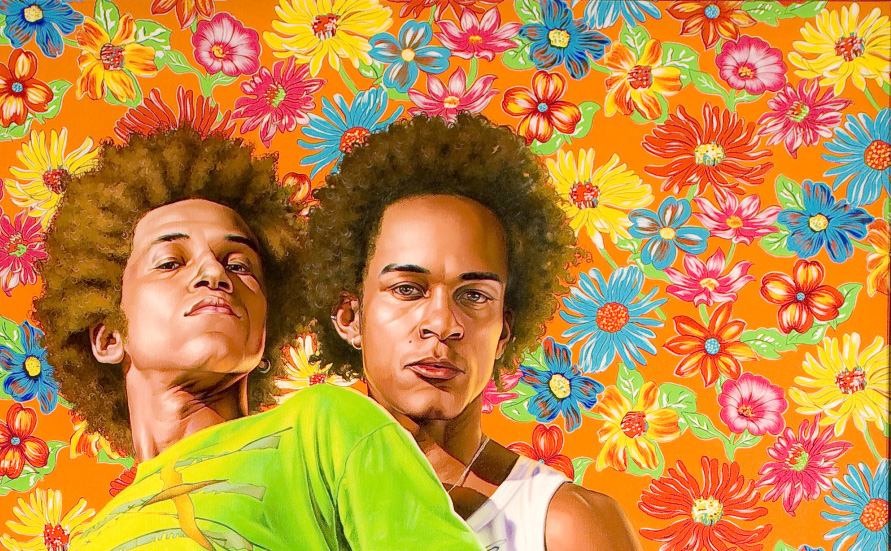
The core of Wiley's visual language remains the "figure-ground relationship," a tension between the hyper-realistic subject and a flat, decorative background. In works like the The Yellow Wallpaper series (2020), the background does not sit behind the figure; it actively interrupts the subject.
Patterns inspired by William Morris, such as the "Wild Tulip" design (1884) or "Compton" print (1896), encroach upon the sitter's space, with vines and tendrils weaving over limbs and clothing. This technique creates a shallow depth of field that pushes the figure into the viewer's space, asserting presence and power.
is a primary tool in Wiley's methodology. His portraits are frequently monumental, dwarfing the viewer to replicate the imposing nature of aristocratic portraiture. For instance, Portrait of Melissa Thompson (2020), an oil on linen work acquired by the V&A East, measures 265. 5 cm by 201. 8 cm (approximately 8. 7 feet by 6. 6 feet).
This exaggeration of serves a political function: by enlarging Black bodies to sizes historically reserved for royalty or religious icons, Wiley forces a confrontation with the "invisible" subjects of art history.
, Wiley has expanded his material palette. His 2019 public sculpture, Rumors of War, his painting style into three dimensions. Standing 27 feet tall and 16 feet wide, the bronze work mimics the statue of Confederate General J. E. B. Stuart.
yet, Wiley replaces the Confederate uniform with a young African American man in a hoodie, ripped jeans, and Nike high-tops. The sculpture sits on a massive limestone pedestal, using the physical weight of bronze and stone, materials of permanence, to canonize a contemporary subject.
Street Casting Methodology
Wiley's primary method for sourcing subjects is "street casting," a process he describes as a chance encounter turned collaborative performance. Historically, this involved Wiley walking the streets of Harlem, method strangers, and inviting them to his studio.
From 2015 to 2025, this practice globalized significantly, moving beyond New York to locations like Dalston in East London, Dakar in Senegal, and Rio de Janeiro.
The mechanics of street casting follow a specific protocol:
- Selection: Wiley or his team identify individuals who possess a specific "swagger" or aesthetic presence.
- Invitation: The chance model is shown examples of Wiley's previous work to establish trust and context.
- Art Historical Reference: Once in the studio, the model looks through art history books (frequently focusing on the Renaissance, Rococo, or 19th-century academic painting) to select a pose.
- Documentation: Wiley photographs the model in their own clothes, assuming the chosen historical pose. These high-resolution photographs serve as the reference material for the final painting.
For The Yellow Wallpaper exhibition (2020) at the William Morris Gallery, Wiley street-cast women for the time in a major solo UK exhibition. He scouted subjects in Ridley Road Market in Dalston, engaging women like Mojisola Elufowoju and Dorinda Essah.
In Portrait of Dorinda Essah (2020), the subject holds a spear-like staff, referencing a specific pose of authority found in European court painting, while wearing her everyday attire.
Production and Studio Mechanics
Wiley's production technique has drawn comparison to the "factory" models of Rubens or Jeff Koons. He operates multiple studios globally, with major hubs in New York, Beijing, and Dakar. This decentralized production line allows for a high volume of large- output has sparked serious debate regarding authorship and labor.
Investigative reports and art serious analysis have documented that while Wiley paints the figure's face, hands, and skin tones, the "soul" of the portrait, assistants frequently execute the detailed, labor-intensive background patterns and clothing details.
The Beijing studio, in particular, has been noted for its role in producing the photorealistic backdrops and floral motifs. This division of labor is a traditional practice in Western art history (the "master" painting the face, apprentices painting the drapery), yet it remains a point of contention in contemporary discourse.
The "Archaeology of Silence" exhibition (2023), which debuted at the de Young Museum, showcased the evolution of this technical process. The series features prone figures, referencing Hans Holbein's The Dead Christ in the Tomb.
These works use a "divine void", a dark, indeterminate space that replaces the usual floral cacophony, requiring a different technical method to light and shadow (chiaroscuro) to emphasize the vulnerability of the subjects.
Technical Specifications of Key Works (2015, 2025)
| Work Title | Year | Medium | Dimensions | Location / Collection |
|---|---|---|---|---|
| Rumors of War | 2019 | Bronze, Stone | 27 ft x 16 ft (8. 2 m x 4. 9 m) | Virginia Museum of Fine Arts, Richmond |
| Portrait of Melissa Thompson | 2020 | Oil on Linen | 265. 5 x 201. 8 cm | V&A East, London |
| Portrait of Dorinda Essah | 2020 | Oil on Linen | 205 x 264 cm | William Morris Gallery (Exhibited) |
| Saint Adelaide | 2014 (Acq. 2021) | Stained Glass | 251. 3 x 115. 7 cm | The Stained Glass Museum, Ely |
| Ship of Fools | 2017 | Oil on Canvas | 243. 8 x 182. 9 cm | Royal Museums Greenwich |
The World Stage Series
Between 2015 and 2025, Kehinde Wiley's ambitious transnational project, The World Stage, transitioned from an active production phase into a period of serious canonization and secondary market acceleration.
Originally launched in 2006 with a studio in Beijing, the series involved Wiley traveling to countries with complex histories of colonialism and political upheaval, including Sri Lanka, Brazil, Nigeria, and Israel, to street-cast local subjects.
By 2015, the project culminated in two final major iterations, Haiti and France 1880, 1960, which directly confronted the legacy of European imperialism through the lens of the global Black diaspora.
In June 2015, Wiley opened The World Stage: France 1880, 1960 at Galerie Daniel Templon in Paris. This exhibition marked a strategic pivot, as Wiley engaged directly with the colonial power that had historically occupied of the nations he previously visited.
For this iteration, he did not cast subjects in Paris; instead, he traveled to former French colonies, Morocco, Tunisia, Gabon, the Republic of Congo, and Cameroon, to find models. He then posed these men in the stance of French colonial administrators and military figures derived from 19th-century statuary and propaganda.
The resulting portraits juxtaposed the subjects against backgrounds inspired by Art Nouveau and Victorian floral designs, rewriting the visual language of the French Empire to center the colonized body.
The Haiti iteration, which saw continued exhibition and publication activity through 2015, introduced a significant methodological shift. Unlike previous installments where Wiley selected men from the streets, this project utilized beauty pageants as a casting method.
Wiley organized pageants in Jacmel, Jalousie, and Port-au-Prince, creating a formalized stage for subjects to present themselves. This method acknowledged the specific cultural history of pageantry in the Caribbean as a form of resistance and self-definition.
The portraits from this series, such as The Sisters Zénaïde and Charlotte Bonaparte (2014), referenced European masterpieces while incorporating vegetation indigenous to Haiti, such as okra and sugarcane, symbolizing the island's agrarian and enslaved history.
The serious standing of The World Stage was solidified by the major retrospective Kehinde Wiley: A New Republic, which toured the United States from 2015 to 2017. Organized by the Brooklyn Museum, the exhibition traveled to six venues, including the Modern Art Museum of Fort Worth, the Seattle Art Museum, and the Virginia Museum of Fine Arts.
The retrospective placed The World Stage works alongside Wiley's earlier Harlem-based portraits, allowing critics to analyze the project's global scope.
Reviews during this period frequently noted how the series expanded the conversation around "Black bodies in white spaces" from a purely American context to a geopolitical one, examining the shared visual dialects of hip-hop culture and post-colonial identity.
Market data from 2015 to 2025 indicates a strong appreciation for works from this specific series. Collectors and institutions aggressively acquired pieces that had previously been viewed as secondary to his American portraits.
In April 2022, Phillips London sold Ferdinand-Philippe-Louis-Henri, Duc d'Orléans (2014), a key work from the series, for £289, 800, more than double its pre-sale estimate of £120, 000. Similarly, in February 2019, Untitled (The World Stage: Brazil) realized $150, 000 at Phillips New York.
These figures reflect a broader trend where the specific provenance of the World Stage location, particularly Brazil and Jamaica, began to command premiums comparable to his earlier "Passing/Posing" works.
| Series Location | Primary Focus | Visual/Historical Reference | Key 2015-2025 Activity |
|---|---|---|---|
| France 1880, 1960 | Colonial history of French Africa | French colonial military statuary; Art Nouveau backgrounds | Solo exhibition at Galerie Daniel Templon, Paris (2015). |
| Haiti | Caribbean pageantry & resilience | 19th-century European portraiture; Indigenous flora (okra, sugarcane) | Featured in A New Republic tour; high-value print releases (2022). |
| Jamaica | Gender & British colonialism | 17th/18th-century British portraiture; William Morris patterns | inclusion of female subjects; continued secondary market sales. |
| Israel | Global Jewish diaspora | Jewish ceremonial papercuts; Hand-carved frames with Hebrew text | Prominent inclusion in Jewish Museum & retrospective tours. |
The series also faced scrutiny regarding its production mechanics. During the A New Republic tour, art critics examined the ethics of Wiley's "global safari" method. Writing for major publications in 2015 and 2016, observers questioned the power of an American artist entering foreign cultural contexts to extract images for the Western art market.
Even with these critiques, the institutional embrace remained firm. The series is regarded as a pivotal in Wiley's career, linking his early street-casting experiments in Harlem to the monumental public interventions, such as Rumors of War, that would define his work in the late 2010s.
Commission and Unveiling
In October 2017, the Smithsonian National Portrait Gallery announced that former President Barack Obama had selected Kehinde Wiley to paint his official portrait. This selection made Wiley the African American artist to receive a commission for an official presidential portrait from the museum.
The commission, which included Amy Sherald's portrait of Michelle Obama, cost approximately $500, 000 and was paid for through private donations rather than federal funds.
The portrait was unveiled on February 12, 2018, in Washington, D. C. During the ceremony, Obama remarked on the creation process, joking that he tried to negotiate for "less gray hair" and "smaller ears" was refused by the artist.
He described the sitting process as "torturous" due to his impatience with posing, noting that Wiley's method involved working from thousands of photographs taken during their sessions to construct the final image.
Composition and Symbolism
The oil-on-canvas work measures 84. 1 inches by 58 inches (213. 7 cm × 147 cm). It depicts Obama seated in a wooden chair, leaning forward with his arms crossed and elbows resting on his knees. He is dressed in a dark suit with a white shirt and no tie, a choice intended to convey an open and accessible demeanor.
In contrast to traditional presidential portraiture, which frequently features office interiors or symbols of state power, Wiley placed the subject against a dense, vibrant background of greenery that threatens to engulf the figure.
The botanical elements are specific and symbolic, representing the geographic trajectory of the President's life:
| Flower Species | Symbolic Meaning |
|---|---|
| African Blue Lilies (Agapanthus) | Representing Kenya, the birthplace of his father. |
| Jasmine (Jasminum) | Representing Hawaii, his birthplace and childhood home. |
| Chrysanthemums | The official flower of Chicago, representing his political career and family life. |
The chair in the portrait became a subject of analysis for art historians and critics. Unlike the specific historical furniture frequently in official portraits, this seat was an invention of the artist. It combines design elements from various periods, including a Greek Klismos back and Regency-style legs, creating a "throne-like" historically nonexistent object that anchors the figure amidst the floating flora.
Reception and Impact
The unveiling triggered an immediate and massive surge in public interest. In the days following the event, the National Portrait Gallery reported a 311 percent increase in attendance over the President's Day weekend compared to the previous year. The museum's annual attendance roughly doubled in 2018, reaching over 2. 1 million visitors, a phenomenon officials termed "The Obama Effect."
serious reaction was polarized. critics, such as Jonathan Jones of The Guardian, described the work as having a "boardroom blandness" and felt the figure appeared "distant and formal." Others praised the work for breaking the visual language of the "Grand Manner" portraiture and recontextualizing the black body within the canon of Western art history.
The painting, along with Sherald's portrait of the Lady, became an instant cultural phenomenon, drawing lines of visitors that frequently stretched out of the building.
National Tour
Due to the demand, the National Portrait Gallery organized a five-city tour for the portraits titled "The Obama Portraits Tour." From June 2021 to May 2022, the paintings traveled to the Art Institute of Chicago, the Brooklyn Museum, the Los Angeles County Museum of Art, the High Museum of Art in Atlanta, and the Museum of Fine Arts, Houston.
This tour allowed millions of Americans outside of Washington, D. C. to view the works in person.
Rumors of War

In September 2019, Kehinde Wiley unveiled his monumental public sculpture, Rumors of War, in New York City's Times Square. Standing 27 feet tall and 16 feet wide, the bronze equestrian statue depicts a young African American man with dreadlocks, wearing a hoodie, ripped jeans, and Nike high-top sneakers.
The figure sits astride a rearing horse, adopting a heroic pose traditionally reserved for generals and heads of state. This temporary installation on Broadway Plaza, between 46th and 47th Streets, served as a prelude to the work's permanent installation in Richmond, Virginia.
The sculpture functions as a direct visual counter-narrative to the Confederate monuments that defined Richmond's for over a century. Specifically, Wiley modeled the work after the monument to Confederate General J. E. B. Stuart, created by Frederick Moynihan in 1907.
While the horse in Wiley's version mimics the musculature and gait of the Stuart statue, the rider is fundamentally transformed. The Confederate general in military regalia is replaced by a contemporary Black subject, seizing the language of power and authority in Western equestrian portraiture.
The title is derived from the biblical passage in Matthew 24: 6: "And ye shall hear of wars and rumors of wars: see that ye be not troubled: for all these things must come to pass, the end is not yet.".
Following its New York debut, the sculpture was moved to its permanent home at the Virginia Museum of Fine Arts (VMFA) in Richmond. On December 10, 2019, the work was unveiled on the museum's front lawn, facing Arthur Ashe Boulevard.
The location is significant; it sits in close proximity to the headquarters of the United Daughters of the Confederacy and the former site of the J. E. B. Stuart monument on Monument Avenue. The acquisition of the work constituted the most expensive commission in the VMFA's history, funded entirely by private donations.
The unveiling ceremony drew a crowd of over 1, 000 attendees, even with inclement weather, marking a major civic event in a city then with the future of its Confederate iconography.
The installation of Rumors of War presaged a rapid transformation of Richmond's public art. In the summer of 2020, amid nationwide civil unrest and protests against police brutality, the J. E. B. Stuart statue that inspired Wiley's work was removed, along with numerous other Confederate monuments across the city.
By 2021, the bronze rider on Arthur Ashe Boulevard stood as a solitary figure in a transformed context, no longer in direct dialogue with the specific statue it was designed to challenge, rather serving as a marker of the era's shifting values.
An Archaeology of Silence
Building on the sculptural language established with Rumors of War, Wiley expanded his three-dimensional practice with the exhibition An Archaeology of Silence. This body of work premiered in 2022 as a collateral event of the 59th Venice Biennale at the Fondazione Giorgio Cini.
Unlike the triumphant, upright posture of the Rumors of War rider, the sculptures in this series depict Black figures in states of repose, vulnerability, or death. The series serves as an extension of his earlier "Down" series (2008), which reimagined Hans Holbein the Younger's The Dead Christ in the Tomb (1521, 1522).
The centerpiece of this project includes monumental bronze sculptures such as The Young Tarantine and the titular An Archaeology of Silence. These works feature prone bodies, frequently draped over horses or lying on the ground, scaled up to heroic proportions.
The figures are detailed with the same contemporary attire found in his paintings, creating a jarring juxtaposition between the grandeur of the medium and the intimacy of the subject matter.
After its debut in Venice, the exhibition traveled to the Musée d'Orsay in Paris in late 2022, where the modern bronzes were displayed alongside 19th-century academic sculptures, creating a direct conversation with the art historical canon Wiley seeks to critique.
In 2023, the exhibition began a U. S. tour, opening at the de Young Museum in San Francisco before traveling to the Museum of Fine Arts, Houston. The sculptures in this series are distinct for their use of to demand attention for bodies frequently marginalized or ignored.
By rendering fallen figures in the permanent, heavy medium of bronze, Wiley attempts to memorialize the victims of widespread violence, elevating them to the status of martyrs or saints within the visual hierarchy of the museum.
Other Public Works and Editions
Between 2015 and 2025, Wiley continued to produce sculptural works beyond these two major projects. His "World Stage" series, which began primarily as a painting project, evolved to include bronze busts representing men from various global cities.
For example, works like Likunt Daniel Ailin (from The World Stage: Israel) feature bronze busts that integrate the sitter's contemporary clothing with the classical format of a bust, frequently supported by pedestals incorporating cultural or religious texts relevant to the location.
Smaller- editions of Rumors of War were also produced and placed in strategic locations to broaden the work's impact. In 2022, a medium- bronze edition was installed at the entrance of Mudd Hall at Johns Hopkins University in Baltimore. Another edition was placed in St.
Louis, Missouri, at the campus of Doorways, a non-profit organization providing housing for people living with HIV/AIDS. These placements in academic and community-focused settings demonstrate a strategy of embedding the work's questions about power and representation into varied public spheres.
| Year | Title | Location | Medium | Notes |
|---|---|---|---|---|
| 2019 | Rumors of War | Times Square, NY / VMFA, Richmond, VA | Bronze, Limestone | monumental public sculpture; permanent collection of VMFA. |
| 2022 | An Archaeology of Silence | Venice Biennale / Musée d'Orsay, Paris | Bronze | Series of prone figures; toured to San Francisco and Houston. |
| 2022 | Rumors of War (Edition) | Johns Hopkins University, Baltimore, MD | Bronze | Installed at Mudd Hall. |
| 2022 | Rumors of War (Edition) | Doorways, St. Louis, MO | Bronze | Long-term loan from Gateway Foundation. |
serious Reception and Impact
The serious response to Wiley's move into public sculpture has been largely favorable, with critics noting the effectiveness of his intervention into the debate surrounding monuments. The New York Times described Rumors of War as a "monumental response" that repurposed the materials of the oppressor to the oppressed.
The sheer of the work was frequently as a necessary tactic to compete with the visual dominance of existing Confederate statuary.
yet, the reception was not without complexity. art critics and cultural commentators questioned whether the use of the equestrian form, even as a subversion, reinforced the very systems of patriarchal power Wiley sought to critique.
In the New Yorker, the work was discussed as a "defiant response" that nonetheless relied on the "magical proportions" of traditional hero-worship. even with these theoretical debates, the public engagement with the works has been strong.
The unveiling in Richmond was treated as a city-wide celebration, and the subsequent removal of the Confederate statues nearby was frequently linked in public discourse to the shift in consciousness that Wiley's work helped visualize.
An Archaeology of Silence received praise for its somber, elegiac tone, contrasting with the bombast of Rumors of War.
Reviews of the exhibition at the de Young Museum highlighted the "searing" nature of the fallen figures, noting that the use of bronze to depict vulnerability rather than strength offered a "haunting meditation" on the precarity of Black life.
By 2025, Wiley's sculptural practice had established him not just as a painter of portraits, as a central figure in the global re-evaluation of public art and historical memory.
Black Rock Senegal Residency
In May 2019, Kehinde Wiley opened Black Rock Senegal, a multidisciplinary artist residency located in the Yoff Virage village of Dakar. The compound sits directly on the coastline, overlooking the Atlantic Ocean and the sharp, black volcanic rocks that inspired its name.
Wiley financed the project personally, driven by a stated desire to establish a direct professional relationship with Africa outside of Western institutional frameworks. The residency operates as a charitable initiative, providing international artists with the resources to live and work in West Africa for one to three months.
Senegalese architect Abib Djenne designed the facility, which functions as a walled compound protecting a micro-environment of tropical gardens and creative spaces. The architecture features 20-foot-tall entrance doors made from Cameroonian Amazakoue wood and slate-grey exterior walls that contrast with the surrounding environment.
The interior design resulted from a collaboration between Wiley, architect Fatiya Djenne, and Senegalese textile designer Aissa Dione. The complex includes a private residence and studio for Wiley, alongside three three-story townhouses for visiting artists. Each resident apartment contains a fully equipped kitchen, living area, and private workspace.
Shared amenities include an infinity pool, a gym, a sauna, and a library stocked with texts on African art history and contemporary theory.
Program Structure and Support
Black Rock accepts approximately 16 artists annually through a public application process. The program covers room and board, provides individual studios, and supplies a stipend for local transport and art materials. To support integration into the local culture, the residency employs a language tutor who offers instruction in Wolof, French, and English.
Residents also receive assistance from local staff to navigate Dakar's supply markets and cultural institutions. The residency does not fund international travel to Senegal assists accepted artists in securing third-party grants.
The selection process involves a committee of established art world figures. Jurors for the 2023-2024 pattern included Tunji Adeniyi-Jones, Osei Bonsu (Curator at Tate Modern), and Adam Weinberg (Director of the Whitney Museum of American Art).
Competition for spots has intensified since the program's inception; the inaugural year received over 700 applications, while the 2023-2024 pattern saw that number rise to 1, 434.
Resident Demographics and Output
The residency hosts artists working across diverse media, including painting, sculpture, photography, film, and writing. The cohorts are deliberately international, mixing artists from the African diaspora with those living on the continent.
Notable alumni from the five years include Nigerian photographer Yagazie Emezi, American sculptor Sonya Clark, and writer Pemi Aguda. The 2023-2024 class featured artists such as Anthony Olubunmi Akinbola and photographer Ange-Frédéric Koffi.
| pattern Year | Application Count | Selected Residents | Notable Jurors |
|---|---|---|---|
| 2019, 2020 | 700+ | 16 | Swizz Beatz, Thelma Golden, Carrie Mae Weems |
| 2020, 2021 | N/A (COVID-19 adj.) | 16 | Kehinde Wiley (Internal Review) |
| 2022, 2023 | 1, 000+ | 16 | Jeffrey Deitch, Glenn Ligon |
| 2023, 2024 | 1, 434 | 16 | Antwaun Sargent, Kimberly Drew |
| 2024, 2025 | Verified Open Call | 16 | Jericho Brown, Jesse Williams |
The following chart illustrates the disciplinary breakdown of the 2023-2024 residency class, reflecting the program's emphasis on multidisciplinary practice.
Expansion and Philosophy
Wiley has described Black Rock not as a retreat as a method to "incite change in the global discourse about what Africa means today." The program encourages residents to leave the compound and engage with the city of Dakar. This philosophy extends to the physical design, where local materials and craftsmanship define the space.
In 2023, Wiley announced plans to expand the Black Rock model to Nigeria, collaborating with architect David Adjaye on a future space in Lagos, although the Dakar location remains the primary operational hub as of 2025.
Origins and Venice Premiere
In April 2022, Kehinde Wiley debuted An Archaeology of Silence as a Collateral Event of the 59th International Art Exhibition , La Biennale di Venezia.
Organized by the Musée d'Orsay and hosted at the Fondazione Giorgio Cini, the exhibition marked a significant thematic pivot from his signature portraits of upright, figures to a contemplation of the "fallen" body.
Curated by Christophe Leribault, the presentation featured monumental bronze sculptures and large- paintings set against a darkened, chapel-like atmosphere.
The body of work emerged directly from the converging crises of 2020: the COVID-19 pandemic and the global protests following the murder of George Floyd. Unable to conduct his usual "street casting" due to international lockdowns, Wiley worked with residents and staff at Black Rock Senegal, his residency program in Dakar.
The resulting imagery expanded upon his 2008 series Down, which had originally been inspired by Hans Holbein the Younger's The Dead Christ in the Tomb (1521, 1522). While Down explored the vulnerability of the black male body, An Archaeology of Silence explicitly addressed the specter of widespread violence and state control.
Wiley described the project as an effort to "unearth" the silence surrounding the destruction of black bodies, transforming scenes of death and decay into elegies of resistance.
Artistic Composition and Themes
The exhibition use the visual language of the fallen hero, reinterpreting classical European depictions of martyrdom and repose. Unlike the confrontational gaze of his earlier equestrian portraits, the figures in this series are prone, eyes frequently closed or averted, suspended between sleep, death, and ecstasy.
The works these intimate moments to monumental proportions, demanding that the viewer confront the physicality of the subject.
Key works in the series include The Virgin Martyr St. Cecilia (Ndey Buri), which reimagines Stefano Maderno's 1600 sculpture of the saint, and Femme Piquée par un Serpent (Mamadou Gueye), a reinterpretation of Auguste Clésinger's 1847 marble work.
The exhibition's centerpiece, a massive bronze sculpture also titled An Archaeology of Silence (2021), depicts a figure draped over a rocky elevation, evoking the iconography of fallen warriors.
The paintings retain Wiley's hallmark botanical backgrounds, in this iteration, the flora, teeming with vines and luminous blooms, threatens to consume the recumbent figures, symbolizing a tension between biological decay and spiritual resurrection.
North American Tour and Reception
Following its Venice debut, the exhibition traveled to the United States, premiering at the de Young Museum in San Francisco in March 2023. Curated by Claudia Schmuckli, the San Francisco presentation was a serious and commercial success.
Data from the Fine Arts Museums of San Francisco indicated that the exhibition drew approximately 460, 133 visitors by October 2023. The museum implemented a "respite room" within the gallery space, acknowledging the heavy emotional toll of the imagery on visitors processing trauma related to police brutality.
In November 2023, the exhibition opened at the Museum of Fine Arts, Houston (MFAH), where it remained on view until May 2024. The Houston installation emphasized the "sacred" quality of the works, utilizing dramatic lighting to isolate the bronze figures in darkness, reinforcing the solemnity of the subject matter.
Tour Cancellations
The exhibition's scheduled tour was abruptly halted in mid-2024 following multiple allegations of sexual assault against Wiley. In May 2024, Ghanaian artist Joseph Awuah-Darko publicly accused Wiley of sexual assault, followed by additional accusations from other individuals. Wiley denied the allegations, calling them "baseless" and "defamatory."
In response to the controversy, several major institutions cancelled or suspended their scheduled presentations of An Archaeology of Silence. The Pérez Art Museum Miami (PAMM), which had planned to open the exhibition in July 2024, suspended the show indefinitely.
Subsequently, the Minneapolis Institute of Art (Mia) announced in June 2024 that it would not proceed with its planned 2025 dates. The Joslyn Art Museum in Omaha also removed the exhibition from its schedule. These cancellations ended the North American tour of the work.
Exhibition Timeline and Venues
| Institution | Location | Dates | Status |
|---|---|---|---|
| Fondazione Giorgio Cini (Venice Biennale) | Venice, Italy | Apr 22, 2022 , Jul 24, 2022 | Completed |
| Musée d'Orsay (Select Works) | Paris, France | Sep 13, 2022 , Jan 8, 2023 | Completed |
| de Young Museum | San Francisco, CA | Mar 18, 2023 , Oct 15, 2023 | Completed |
| Museum of Fine Arts, Houston | Houston, TX | Nov 19, 2023 , May 27, 2024 | Completed |
| Pérez Art Museum Miami | Miami, FL | Scheduled Jul 2024 | Suspended |
| Minneapolis Institute of Art | Minneapolis, MN | Scheduled Feb 2025 | Cancelled |
Sexual Assault Allegations and Legal Proceedings
In May 2024, a series of sexual assault allegations against Kehinde Wiley emerged, leading to the cancellation of major museum exhibitions and a formal lawsuit filed in early 2025. The accusations span incidents alleged to have occurred between 2007 and 2021 across multiple countries, including Ghana, China, and the United States.
Wiley has categorically denied all claims, describing them as "baseless" and "defamatory.".
Initial Accusations (May, June 2024)
The public allegation appeared on May 19, 2024, when Ghanaian artist and curator Joseph Awuah-Darko posted a statement on Instagram. Awuah-Darko alleged that Wiley sexually assaulted him on June 9, 2021, during a dinner held in Wiley's honor at the Noldor Artist Residency in Accra, Ghana.
According to Awuah-Darko, Wiley groped him inappropriately during the event and later committed a "much more severe and violent" assault that same night. Wiley's legal team, led by attorney Jennifer Barrett, responded immediately, issuing a cease-and-desist letter and characterizing the encounter as consensual.
Wiley stated publicly that Awuah-Darko was "someone I had a brief, consensual relationship with.".
Following Awuah-Darko's statement, three other men came forward in June 2024 with similar allegations:
| Accuser | Alleged Incident Date | Location | Nature of Allegation |
|---|---|---|---|
| Derrick Ingram | September 10, 2021 | New York, NY | Ingram, a prominent activist, alleged Wiley raped him at the artist's Soho apartment. He also claimed Wiley punched him in an Uber during their four-month relationship. |
| Nathaniel Lloyd Richards | 2019 | Beijing, China | Richards, a UK-based filmmaker, alleged Wiley groped him and made him feel unsafe during a date at a sushi restaurant. |
| Terrell Armistead | 2010 | New York, NY | Armistead alleged he woke up in Wiley's Manhattan apartment to find the artist performing a sexual act on him without consent. |
Wiley denied these subsequent allegations as well. Regarding Ingram, attorney Jennifer Barrett stated there was "no evidence" to support the claims and maintained the encounter was consensual. Wiley's team suggested the accusers were motivated by financial gain and attention, with Wiley writing on social media that the allegations were a "social media-driven fabrication."
The Ogechi Chieke Lawsuit (February 2025)
The legal escalated on February 28, 2025, when artist Ogechi Chieke filed a civil lawsuit against Wiley in the New York State Supreme Court. This filing marked the time an accuser brought formal legal action against the artist. Chieke filed the complaint under the New York City Victims of Gender-Motivated Violence Protection Law, just one day before the statute's "lookback" window expired on March 1, 2025.
Chieke's lawsuit details an incident from 2007 following a gallery opening in New York. The complaint alleges that while waiting for a table at a restaurant, Wiley forcibly grabbed Chieke's buttocks and genitals, causing her "severe pain," and made sexually explicit remarks.
Chieke claims the trauma from the assault caused her to abandon her art career and move to California. In response to the lawsuit, Wiley stated, "I've never met her, nor do I know her," and called the suit a "blatant money-grab." Yet, media outlets subsequently surfaced a 2007 Getty Images photograph showing Wiley and Chieke standing together at an event.
Institutional
The wave of allegations in mid-2024 resulted in immediate repercussions for Wiley's exhibition schedule. Museums that had planned to host his traveling exhibition, An Archaeology of Silence, suspended or cancelled their participation.
"Mia was considering taking the Kehinde Wiley exhibition, as a result of these unfortunate allegations not be proceeding with this presentation." , Minneapolis Institute of Art Statement (June 2024)
The Pérez Art Museum Miami (PAMM) suspended its plans to open the exhibition, which was scheduled for July 2024. The Joslyn Art Museum in Omaha, Nebraska, also postponed its exhibition Kehinde Wiley: Omaha, originally set to open in September 2024.
These cancellations halted the momentum of Wiley's institutional presence in the United States during the 2024, 2025 season. As of early 2026, the civil case filed by Ogechi Chieke remains active in the New York court system.
Major Exhibitions and Retrospectives (2015, 2025)

Between 2015 and 2025, Kehinde Wiley's exhibition schedule expanded from mid-career surveys to monumental international tours. The Brooklyn Museum organized Kehinde Wiley: A New Republic, a detailed retrospective that opened on February 20, 2015.
Curated by Eugenie Tsai, the exhibition featured approximately 60 paintings and sculptures, documenting Wiley's fourteen-year career. Following its Brooklyn debut, the show traveled to six additional venues through 2017, including the Modern Art Museum of Fort Worth, the Seattle Art Museum, and the Virginia Museum of Fine Arts (VMFA).
In December 2021, the National Gallery in London presented The Prelude, an exhibition that shifted Wiley's focus from portraiture to the European Romantic tradition. The show featured five large- paintings and a six-channel digital film, referencing works by Caspar David Friedrich and Winslow Homer. The Rennie Collection in Vancouver acquired the entire body of work from this series in June 2022.
Wiley returned to the Venice Biennale in April 2022 with An Archaeology of Silence, a collateral event organized by the Musée d'Orsay and hosted at the Fondazione Giorgio Cini. The exhibition expanded on his 2008 Down series, depicting fallen black bodies in states of repose or martyrdom. The show later embarked on a major U. S.
tour, opening at the de Young Museum in San Francisco in March 2023, where it drew over 300, 000 visitors. The tour continued to the Museum of Fine Arts, Houston (2023, 2024), the Pérez Art Museum Miami (2024, 2025), and the Minneapolis Institute of Art (2025).
From September 2023 to January 2024, the Musée du Quai Branly , Jacques Chirac in Paris hosted A Maze of Power. This project, developed confidentially since 2012, featured portraits of 11 African heads of state, including Nana Akufo-Addo of Ghana, Macky Sall of Senegal, and Félix Tshisekedi of the Democratic Republic of Congo.
The exhibition traveled to the Museum of Black Civilizations in Dakar in May 2024 and the Mohammed VI Museum of Modern and Contemporary Art in Rabat in April 2025.
In May 2025, the Museum Van Loon in Amsterdam opened Flourish, Wiley's solo exhibition in the Netherlands. Running through November 2025, the show presented eight new paintings of Surinamese models, directly responding to the museum's 17th-century portrait collection and Dutch colonial history.
| Exhibition Title | Primary Venues | Dates | Key Works / Focus |
|---|---|---|---|
| A New Republic | Brooklyn Museum, VMFA, Seattle Art Museum, Toledo Museum of Art | 2015, 2017 | Mid-career retrospective; 60 works including Napoleon Leading the Army. |
| Rumors of War | Times Square (NY), VMFA (Richmond) | 2019 | Monumental bronze equestrian statue; permanent installation at VMFA. |
| The Prelude | National Gallery (London) | 2021, 2022 | European Romanticism; 6-channel film. |
| The Obama Portraits Tour | Chicago, Brooklyn, LACMA, Atlanta, Houston | 2021, 2022 | Official portraits of Barack and Michelle Obama. |
| An Archaeology of Silence | Venice Biennale, de Young, MFA Houston, PAMM, Minneapolis | 2022, 2025 | Monumental paintings/sculptures of fallen figures; Down series expansion. |
| A Maze of Power | Quai Branly (Paris), Dakar, Rabat | 2023, 2025 | Portraits of 11 African heads of state. |
| Flourish | Museum Van Loon (Amsterdam) | 2025 | Portraits of Surinamese subjects; Dutch colonial critique. |
The Obama Portraits Tour
Following their unveiling at the Smithsonian National Portrait Gallery in February 2018, the official portraits of President Barack Obama (by Wiley) and Lady Michelle Obama (by Amy Sherald) embarked on a five-city national tour organized by the Smithsonian.
The tour commenced at the Art Institute of Chicago in June 2021, followed by stops at the Brooklyn Museum, the Los Angeles County Museum of Art (LACMA), the High Museum of Art in Atlanta, and the Museum of Fine Arts, Houston, concluding in May 2022.
The tour generated record-breaking attendance at multiple venues, with the National Portrait Gallery reporting a doubling of its annual visitor numbers following the initial installation.
Public Installations and Museum Acquisitions
On September 27, 2019, Wiley unveiled Rumors of War, his largest public work to date, in Times Square, New York. The 27-foot-tall bronze equestrian statue depicts a young African American man in streetwear, clear a pose that mimics the monument to Confederate General J. E. B. Stuart.
Following its temporary display in Manhattan, the statue was permanently installed at the entrance of the Virginia Museum of Fine Arts in Richmond on December 10, 2019, directly challenging the Confederate iconography of the nearby Monument Avenue.
Museums continued to acquire Wiley's work aggressively during this period. In 2018, the Saint Louis Art Museum purchased Charles I, a large- painting commissioned for the museum's own exhibition. The Oklahoma City Museum of Art acquired Jacob de Graeff in 2019, a portrait featuring a subject wearing a "Ferguson" cap.
In 2021, the Yale University Art Gallery and the Yale Center for British Art jointly acquired Portrait of Lynette Yiadom-Boakye, Jacob Morland of Capplethwaite. The Mint Museum added Philip the Fair to its permanent collection in 2022.
In September 2023, the Walters Art Museum in Baltimore acquired Saint Amelie, a rare stained-glass work from 2014, making it the only stained-glass piece by Wiley in a U. S. public museum collection at that time.
Government and National Honors
Kehinde Wiley received the U. S. State Department Medal of Arts on January 21, 2015. Secretary of State John Kerry presented the award during a ceremony in Washington, D. C. The honor recognized Wiley for his commitment to cultural diplomacy and his use of visual arts to international dialogue.
This distinction placed him among a select group of artists acknowledged for their contributions to the Art in Embassies program. The State Department his ability to engage global audiences through his "World Stage" series. Wiley accepted the medal alongside other prominent figures in the contemporary art world.
The award highlighted his role in representing American culture abroad through exhibitions in countries such as China and France.
The Smithsonian National Portrait Gallery commissioned Wiley to paint the official portrait of President Barack Obama in 2017. This selection marked the time an African American artist received a commission for an official presidential portrait. The museum unveiled the painting on February 12, 2018. The event took place in Washington, D. C.
and drew significant national attention. President Obama praised Wiley for his ability to elevate ordinary subjects to royal status. The portrait features the former president seated against a backdrop of foliage representing his personal history. This commission stands as a defining distinction in Wiley's career.
It permanently established his work within the nation's federal art collection. The painting increased attendance at the National Portrait Gallery significantly in the months following its installation.
France honored Wiley as a Chevalier of the Order of Arts and Letters on February 12, 2020. Cultural Counselor Gaëtan Bruel presented the insignia at the Brooklyn Museum in New York.
The ceremony occurred in front of Wiley's painting "Napoleon Leading the Army over the Alps." This award recognizes individuals who have made significant contributions to the arts in France and throughout the world. The French government acknowledged Wiley's engagement with French art history and his reinterpretations of classical masterpieces.
Bruel noted the irony and relevance of honoring Wiley in front of a painting that challenges traditional French imperial imagery. This knighthood solidified Wiley's status as an artist of international consequence.
Academic Degrees and University Honors
The Rhode Island School of Design awarded Wiley an honorary Doctor of Fine Arts degree on June 3, 2017. The college recognized his influence on contemporary portraiture and his interrogation of power in art history. Wiley addressed the graduating class during the commencement ceremony in Providence.
He encouraged students to use their creative talents to reshape societal narratives. This honorary degree acknowledged his technical mastery and his conceptual impact on the field of visual arts.
Harvard University presented Wiley with the W. E. B. Du Bois Medal on October 11, 2018. The Hutchins Center for African & African American Research administers this award. It honors individuals who have made significant contributions to African and African American culture.
Wiley received the medal alongside other notables such as Colin Kaepernick and Dave Chappelle. The ceremony took place at Sanders Theatre on the Harvard campus. The citation praised Wiley for challenging perceptions of blackness and for his advocacy of intercultural understanding. This distinction linked his artistic practice to the intellectual legacy of W.
E. B. Du Bois.
Yale University conferred an honorary Doctor of Fine Arts degree upon Wiley on May 20, 2024. University President Peter Salovey read the citation during the commencement exercises in New Haven. The university honored Wiley as an alumnus of the Yale School of Art.
The citation described him as an "internationally renowned painter and sculptor" whose work breaks categories. Yale recognized his role in exposing societal blind spots through his reimagining of grand portraiture. This degree marked a significant return to the institution where he earned his Master of Fine Arts in 2001.
Artistic and Philanthropic Recognition
Time magazine named Wiley to its list of the 100 Most Influential People in 2018. The publication selected him for the "Artists" category following the unveiling of the Obama portrait. Rapper and actor LL Cool J wrote the tribute for the magazine entry. He described Wiley as an iconoclast who transforms how the world views African Americans.
The list recognizes individuals whose activism and innovation define the current moment. This inclusion validated Wiley's crossover appeal beyond the traditional art market.
The Gordon Parks Foundation honored Wiley at its annual awards dinner on June 4, 2019. The event took place at Cipriani 42nd Street in New York City. The foundation celebrates artists who continue the legacy of Gordon Parks through their commitment to social justice. Wiley received the award for his artistic vision and his humanitarian efforts.
The gala raised funds to support scholarships and fellowships for the generation of creatives. Wiley attended the event and spoke about the importance of creating spaces for diverse voices in the arts.
Apollo Magazine named Wiley its Artist of the Year on November 15, 2021. The award recognized his "The Prelude" exhibition at the National Gallery in London. It also acknowledged his "Portrait of a Young Gentleman" commission at The Huntington in California. The magazine his ability to engage with the Old Master tradition while subverting its exclusions.
This accolade from a leading art publication underscored his serious success in the United Kingdom and the United States. The award noted his continued relevance and his expansion into film and sculpture.
Amref Health Africa presented Wiley with the Rees Visionary Award on May 4, 2024. The organization honored him at its annual ArtBall in Brooklyn. The award recognized his contributions to African art and his establishment of the Black Rock Senegal residency. Wiley used the occasion to announce a donation to support the organization's health initiatives.
This distinction highlighted his dual role as a practicing artist and a philanthropic leader in West Africa. The award aligns with his increasing focus on artistic development on the African continent.
Institutional Commissions and Residencies
The Huntington Library, Art Museum, and Botanical Gardens commissioned Wiley to create "A Portrait of a Young Gentleman" in 2021. The museum requested this work to mark the 100th anniversary of its acquisition of Thomas Gainsborough's "The Blue Boy." Wiley's painting responds directly to the 18th-century masterpiece.
The institution displayed the two works in conversation in the Thornton Portrait Gallery. This commission represented a rare invitation for a contemporary artist to intervene in the museum's historical collection. The project demonstrated the institutional demand for Wiley's perspective on the European canon.
Wiley established the Black Rock Senegal residency program in Dakar in 2019. While not an award received, this initiative functions as a significant professional distinction. It positions Wiley as a patron and cultural gatekeeper. The program selects international artists for multi-month residencies at his studio complex.
The creation of this institution garnered global praise and solidified his commitment to the African art ecosystem. It demonstrates his transition from an individual artist to a facilitator of global cultural exchange.
| Year | Award / Honor | Institution / Organization | Location |
|---|---|---|---|
| 2015 | U. S. State Department Medal of Arts | U. S. Department of State | Washington, D. C. |
| 2017 | Honorary Doctor of Fine Arts | Rhode Island School of Design | Providence, RI |
| 2018 | Official Presidential Portrait Commission | Smithsonian National Portrait Gallery | Washington, D. C. |
| 2018 | Time 100 Most Influential People | Time Magazine | New York, NY |
| 2018 | W. E. B. Du Bois Medal | Harvard University | Cambridge, MA |
| 2019 | Gordon Parks Foundation Award | The Gordon Parks Foundation | New York, NY |
| 2020 | Chevalier of the Order of Arts and Letters | Ministry of Culture (France) | New York, NY |
| 2021 | Artist of the Year | Apollo Magazine | London, UK |
| 2024 | Rees Visionary Award | Amref Health Africa | Brooklyn, NY |
| 2024 | Honorary Doctor of Fine Arts | Yale University | New Haven, CT |

The Missing Billions: How India’s Electoral Bonds Scheme Changed Political Funding Forever
Electoral bonds scheme transformed political fundraising in India, allowing anonymous donations of crores of rupees to political parties. Data reveals overwhelming flow of funds to ruling BJP, sparking concerns over transparency…
Read Full ReportThe Qantas Data Breach: What Was Really Stolen?
February 18, 2026 • Australia, All
Qantas Airways experienced another data breach due to a vulnerability in a third-party vendor's system. Attackers extracted 5.7 million customer records, raising concerns about potential…
Policy pressure on semiconductor firms to bypass the US export bans
February 11, 2026 • Chips, All, Asia, Business, Covers, Economy, Electronics, Engineering, Enterprises, Featured, Headlines, Infrastructure, Investigations, Legislation, Machine Learning, Manufacturing, Markets, Originals, Policy, Technology, Trade, USA, World
The collision between American national security interests and commercial market imperatives in the semiconductor industry intensified in 2025. Companies like Nvidia, Intel, and AMD navigated…
The Short-Term Rental Crisis: How Tourism Is Killing Local Housing Markets
January 29, 2026 • Housing, All, Markets, Real Estate, Reports, Travel
The sharing economy's evolution from a grassroots concept to a global asset class has transformed cities worldwide. The financialization of residential spaces for short-term rentals…
July 22, 2025 • All, Investigations
Data from deputies’ Tasers played a crucial role in uncovering decades of allegations of abuse of power at sheriff’s offices in Mississippi. A year-long investigation…
Terrible Foreign Agent Law in Bosnia Threatens Independent Media
July 22, 2025 • All
The foreign agent law passed in Republika Srpska threatens press freedom by targeting media outlets receiving foreign funding. Modeled after Russia's legislation, this law raises…
Top Branding Trends From 2025: A Global Market Report
April 8, 2025 • Guides, All, Media Industry Reports: Trends, PR Performance & Analytics
Branding in 2025 is undergoing rapid technological changes and shifting consumer values. The global branding landscape is characterized by constant disruption, consumer empowerment, and the…