Rick Steves
Early life and education
Richard John Steves Jr. was born on May 10, 1955, in Barstow, California, to Richard John Steves Sr. and June Erna Steves. His father worked as a high school band director and piano technician, while his mother, born to Norwegian immigrants, managed the home. The family relocated to Washington state in 1967, settling in Edmonds, a suburb north of Seattle.
There, his parents established "Steves Sound of Music," a retail business importing high-quality European pianos, including Bösendorfer and German Steinways. This family enterprise directly facilitated Steves' initial exposure to international commerce and European culture.
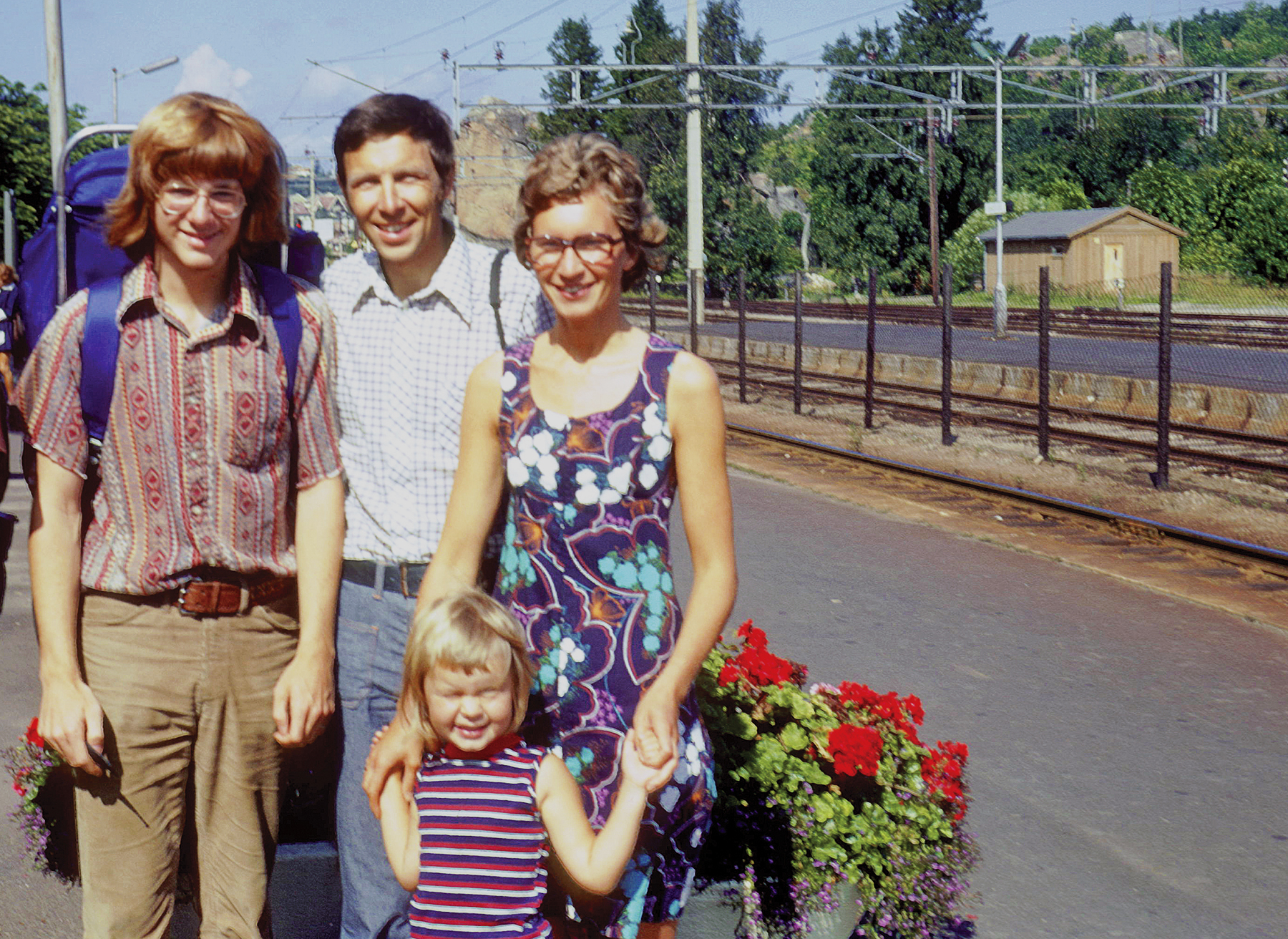
In 1969, at age 14, Steves accompanied his parents on a business trip to Europe to inspect piano factories in Germany and visit relatives in Norway. This excursion proved pivotal. While in Norway on July 20, 1969, Steves watched the Apollo 11 moon landing with his cousins.
He later this moment as a catalyst for his global perspective, realizing the event was a human achievement rather than solely an American one. During a visit to Vigeland Park in Oslo, he experienced a realization that "this planet must be home to billions of equally lovable children of God," a philosophy that later underpinned his travel advocacy.
Steves graduated from Edmonds High School in 1973. Immediately following graduation, he embarked on his independent trip to Europe with friend Gene Openshaw. They dubbed this expedition "Europe Through the Gutter," operating on a strict budget of approximately $3 per day.
The pair utilized Eurail passes, slept in train stations, and subsisted on minimal provisions to extend their travel duration. This experience established the frugal, immersive travel style Steves would later commercialize.
He enrolled at the University of Washington, funding his studies and summer travels by teaching piano lessons. By the mid-1970s, Steves began teaching a non-credit course titled "European Travel Cheap!" at the university's Experimental College. The course notes from these lectures formed the manuscript for his book.
He graduated in 1978 with double degrees in Business Administration and European History, a combination he deliberately chose to professionalize his travel interests. He founded his company, Rick Steves' Europe, in 1976, operating initially out of a storefront in Edmonds.
| Year | Event | Location | Significance |
|---|---|---|---|
| 1955 | Born to Richard and June Steves | Barstow, CA | Birth |
| 1967 | Family moves to Washington | Edmonds, WA | Establishment of hometown roots |
| 1969 | trip to Europe | Germany/Norway | Visited piano factories; Moon landing epiphany |
| 1973 | High School Graduation | Edmonds, WA | solo "Europe Through the Gutter" trip |
| 1976 | Founded Rick Steves' Europe | Edmonds, WA | Official start of business operations |
| 1978 | Graduated University of Washington | Seattle, WA | B. A. in Business Admin & European History |
| 1980 | Published Europe Through the Back Door | Edmonds, WA | guidebook, self-published from class notes |
The Experimental College and the Class
Rick Steves' transition from piano teacher to travel authority began not in a boardroom, in a rented classroom at the University of Washington's Experimental College.
In 1978, while still giving piano lessons to fund his summer trips, Steves launched a class titled "European Travel Cheap!" He set the entry fee at a modest $8, anticipating a turnout of perhaps a few dozen students. Instead, over 100 people arrived, forcing the session into a larger hall.
This overwhelming response signaled a massive, untapped demand for practical, budget-conscious travel advice that prioritized cultural immersion over luxury.
The curriculum was built directly on Steves' own "back door" experiences, sleeping in parks, navigating rail systems, and avoiding tourist traps. Unlike the polished, agency-driven travel seminars of the era, Steves' classes were raw and utilitarian.
He used the proceeds from these early sessions to finance further travels, creating a self-sustaining loop of learning and teaching. By the early 1980s, the demand for his seminars had grown so significant that he began phasing out his piano teaching business, "Steves Sound of Music," to focus entirely on travel education.
Self-Publishing Europe Through the Back Door (1980)
In 1980, Steves consolidated his lecture notes into the edition of Europe Through the Back Door. The production was entirely a grassroots operation; Steves and his then-girlfriend typed the 192-page manuscript on a rented typewriter in a dormitory.
absence a publisher, he self-published the book, printing 2, 000 copies which he stored in and sold from the trunk of his car. The book was not a list of hotels a manifesto on travel philosophy, urging Americans to become "temporary locals" rather than passive tourists.
The book's success was driven by its distinct voice, authoritative yet accessible, dispensing with the flowery prose of contemporary travel literature in favor of logistical precision. It addressed the specific anxieties of -time travelers, from currency exchange to language blocks, with a level of detail that mainstream publishers had ignored.
By 2024, the book had entered its 40th edition, remaining the of a publishing empire that dominates the U. S. travel market.
Founding "Europe Through the Back Door"
Steves formally incorporated his business as "Europe Through the Back Door" (ETBD) in 1976, operating initially out of his piano studio in Edmonds, Washington. The company's early years were defined by a "mom-and-pop" operational style. Steves personally led the tours, driving rented minibuses and handling all logistics on the fly.
These early excursions were marketed to the students of his travel classes and were explicitly "no-frills," a clear contrast to the all-inclusive package tours popular at the time.
A defining characteristic of these early tours, and one that remains a contractual requirement today, was the "No Grumps" policy. Steves required participants to sign a pledge agreeing to maintain a positive attitude in the face of travel inconveniences, such as smaller hotel rooms or schedule changes.
This policy was not just a quirk a risk management tool, filtering for travelers who shared Steves' philosophy of flexibility and resilience. The business name was eventually changed to "Rick Steves' Europe" in the early 2000s to better align with his growing media brand, the operational ethos remained rooted in these early, scrappy years.
Evolution of the Brand (1980, 2025)
The trajectory from a self-published pamphlet to a multimedia empire is quantifiable. By 2024, Rick Steves' Europe reported annual revenues exceeding $120 million, with the company's guidebooks occupying 12 of the top 15 spots on bestseller lists for European travel.
The 40th edition of Europe Through the Back Door, released in 2024, expanded to over 800 pages, reflecting decades of accumulated data and the shifting of European tourism.
| Metric | Edition (1980) | 40th Edition (2024) |
|---|---|---|
| Publisher | Self-Published (Rick Steves) | Avalon Travel / Hachette |
| Page Count | ~192 pages | ~824 pages |
| Distribution | Sold from car trunk / Travel classes | Global retail / Digital / Audio |
| Primary Focus | Budget survival (hitchhiking, hostels) | Smart travel skills, technology, cultural context |
| Company Revenue | Funded plane ticket | ~$120 Million USD (Annual) |
Rick Steves' Europe
Rick Steves' Europe serves as the umbrella entity for Steves' business ventures, encompassing tour operations, guidebook publishing, television and radio production, and digital media. Headquartered in Edmonds, Washington, the company employs approximately 100 to 200 staff members.
Between 2015 and 2025, the organization navigated significant operational shifts, including a complete shutdown during the COVID-19 pandemic, the launch of a major environmental initiative, and the continued expansion of its digital footprint.
Tour Operations and Pandemic Impact
The core revenue generator for the business is its small-group tour program. Prior to 2020, the company guided roughly 30, 000 travelers annually across Europe. The operational model emphasizes "back door" travel experiences, utilizing small buses, centrally located hotels, and local guides to minimize the barrier between tourists and local culture.
The onset of the COVID-19 pandemic in early 2020 forced a total cessation of tour operations. In a move distinct from industry competitors who offered vouchers, Steves refunded approximately 24, 000 travelers for cancelled trips, returning an estimated $100 million in revenue.
During the shutdown, Steves retained his full-time staff on payroll, covering salaries from personal reserves to ensure the team remained intact for the eventual recovery.
Tour operations resumed in 2022. By 2023, traveler numbers began to rebound toward pre-pandemic levels. In 2025, the company offered 46 distinct itineraries, ranging from single-city stays to multi-country bus tours, with demand frequently exceeding 2019 metrics.
Climate Smart Commitment
In late 2019, Steves introduced a "Climate Smart Commitment" to address the environmental impact of his business. The initiative imposes a self-levied carbon tax of $30 per traveler, a figure calculated to offset the carbon emissions generated by a round-trip flight to Europe.
Rather than purchasing traditional carbon offsets, the company invests the proceeds, approximately $1 million annually, into a portfolio of nonprofit organizations focused on climate advocacy and agroforestry in the developing world.
Beneficiaries have included organizations helping farmers in the Global South employ sustainable practices that sequester carbon. Steves describes this expense not as charity, as a necessary cost of doing business ethically in the travel sector.
Media Production and Digital Expansion
Steves continued to produce content for public media throughout the decade. His television series, Rick Steves' Europe, released multiple new seasons and specials during this period. Notably, Season 12 (2023) focused exclusively on art history, while Season 13 (2025) returned to travel itineraries including Iceland, Poland, and Turkey.
| Season / Special | Release Year | Focus / Key Episodes |
|---|---|---|
| Season 9 | 2016 | Bulgaria, Romania, Siena, Assisi |
| Special | 2017 | Luther and the Reformation |
| Season 10 | 2018 | The Heart of England, Portugal, Greek Islands |
| Special | 2018 | The Story of Fascism in Europe |
| Season 11 | 2020 | Austrian Alps, Swiss Alps, Egypt |
| Season 12 | 2023 | Art of Europe (Prehistoric to Modern) |
| Season 13 | 2025 | Iceland, Poland, Istanbul, London |
Digital tools became increasingly central to the brand's strategy. The Rick Steves Audio Europe app, a free mobile application, hosts hundreds of self-guided walking tours and radio interviews. By 2025, the app had surpassed 500, 000 downloads, with major updates in 2023 and 2024 to improve functionality and content delivery.
To support educators, the company expanded Classroom Europe, a free video library organizing thousands of short clips from Steves' TV shows by topic and region. This resource saw increased utilization during the remote learning shifts of 2020 and 2021. The weekly public radio program, Travel with Rick Steves, continued production, syndicating to over 400 stations nationwide.
Television and Radio Programs
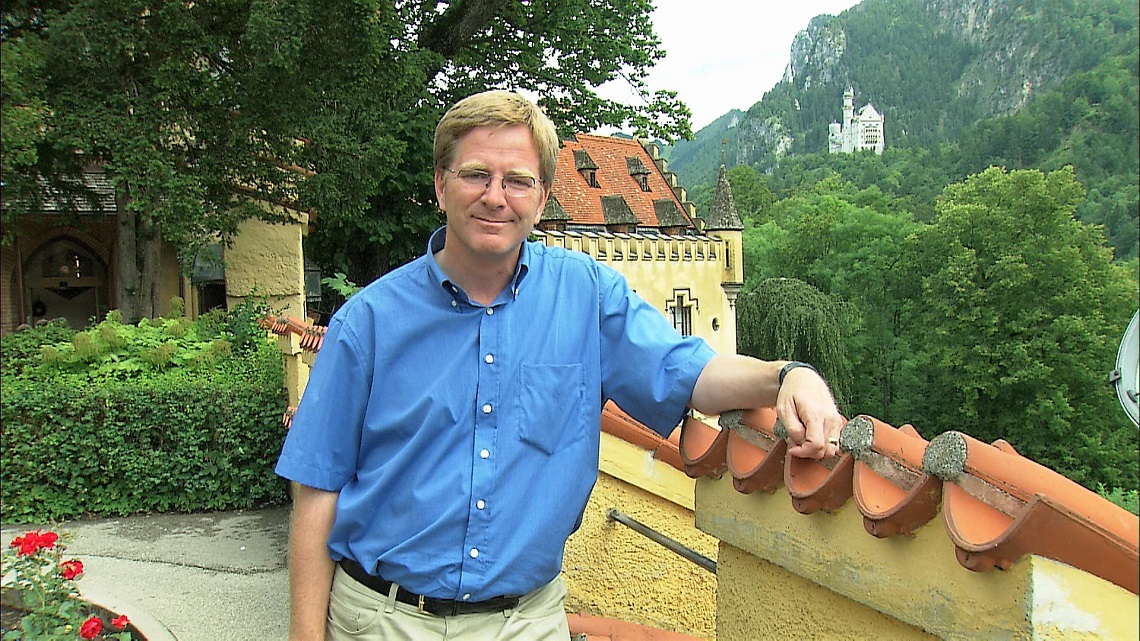
Rick Steves' media presence is anchored by his long-running public television series, Rick Steves' Europe, and his weekly radio program, Travel with Rick Steves. Between 2015 and 2025, Steves expanded his production output to include multiple new seasons, hour-long specials, and digital- content, maintaining a lean production model even with the industry's shift toward high-budget streaming formats.
Rick Steves' Europe (TV Series)
Produced by Back Door Productions and distributed by American Public Television (APT), Rick Steves' Europe continued its run as one of public television's most-watched travel series. The show is characterized by its "skeleton crew" production style, involving only Steves, producer Simon Griffith, and cameraman Karel Bauer.
This three-person team films a 30-minute episode in approximately six days, using high-definition cameras and, in later seasons, drones for aerial cinematography.
The series released five major seasons during this period. Season 9 premiered in 2016, followed by Season 10 in October 2018, which included 12 episodes covering regions such as Scotland, Sicily, and Portugal.
Season 11 debuted in October 2020 with eight episodes, including coverage of the Austrian and Italian Alps and a special retrospective titled "Why We Travel." Season 12, released in October 2023, focused heavily on art history, repackaging content from the "Art of Europe" mini-series.
Season 13 was scheduled for release on October 1, 2025, featuring 11 episodes with destinations including Iceland, Poland, Istanbul, and a barge cruise in Burgundy.
Specials and Mini-Series
Steves produced several thematic specials between 2015 and 2025, frequently addressing historical or social topics beyond standard travel advice.
| Title | Release Date | Subject Matter |
|---|---|---|
| Luther and the Reformation | 2017 | 500th anniversary of the Protestant Reformation. |
| The Story of Fascism in Europe | 2018 | Historical analysis of the rise of Mussolini and Hitler. |
| Hunger and Hope | Feb 2020 | Development aid and poverty solutions in Ethiopia and Guatemala. |
| Why We Travel | Oct 2020 | A philosophical examination of the value of travel during the pandemic. |
| Rick Steves Art of Europe | Oct 2022 | A six-part mini-series covering art history from the Stone Age to the Modern Age. |
| A Symphonic Journey | Apr 2025 | Collaboration with the Cincinnati Pops Orchestra exploring European musical history. |
Radio and Audio Production
Steves hosts Travel with Rick Steves, a weekly one-hour radio program produced at his headquarters in Edmonds, Washington. As of 2025, the show airs on over 170 public radio stations across the United States. The format features interviews with guest authors, experts, and travel guides, along with listener call-ins.
The program is also distributed as a podcast, consistently ranking among the top travel podcasts on platforms like Apple Podcasts.
to broadcast radio, Steves maintains the Rick Steves Audio Europe mobile application. The app provides free, GPS-enabled audio walking tours for major European cities and museums, functioning as a digital extension of his guidebooks. The content is written and narrated by Steves, frequently co-produced with radio colleagues.
Digital and Streaming Initiatives
During the COVID-19 pandemic, when travel production halted, Steves launched Monday Night Travel, a weekly streaming event hosted from his home and office. The series, which began in late 2020, featured deep dives into specific destinations using archival footage and live commentary, maintaining audience engagement during the travel hiatus.
His full library of television episodes remains available through the PBS Passport streaming service, YouTube, and Amazon Prime Video.
Publishing Dominance and Market Position
Rick Steves maintains a commanding position in the American travel publishing industry, with his guidebook series consistently ranking as the bestselling international travel guides in the United States. Published by Avalon Travel, a subsidiary of Hachette Book Group, the series includes over 110 titles.
In April 2024, The Washington Post reported that Steves' private company, Rick Steves' Europe (RSE), generates approximately $120 million in annual revenue, a figure driven by the between his publishing arm and tour operations.
Steves frequently updates his catalog to reflect changing geopolitical and economic realities. On February 6, 2018, he released the third edition of Travel as a Political Act, a manifesto urging Americans to view travel as a tool for broadening political perspectives rather than mere recreation.
Amid the global travel shutdown, Steves pivoted to reflective writing, releasing For the Love of Europe on July 7, 2020. This collection of 100 essays focused on "postcards" from his career, serving as a vicarious travel experience for a grounded readership.
By 2024, Steves celebrated the 40th edition of his flagship title, Europe Through the Back Door, the book that originally launched his career.
Digital Ecosystem and Multimedia
Beyond print, Steves has built a massive digital footprint that functions as both a marketing engine and a standalone educational platform. His YouTube channel, "Rick Steves' Europe," serves as a primary video hub, amassing approximately 1. 97 million subscribers and over 448 million lifetime views by early 2025.
The channel hosts full episodes of his public television series, travel talks, and short-form content, allowing the brand to monetize back-catalog material while maintaining relevance with younger demographics.
The "Rick Steves Audio Europe" mobile application represents a central pillar of his digital strategy. Available for free on iOS and Android, the app organizes hundreds of self-guided walking tours and radio interviews into geographic playlists. By 2025, the app maintained a 4.
5-star rating on major platforms, functioning as a "tour guide in your pocket" that complements the physical guidebooks. This digital integration allows travelers to download content offline, solving the problem of data roaming charges for American tourists in Europe.
| Platform / Medium | Metric / Milestone | Date / Context |
|---|---|---|
| YouTube | 1. 97 Million Subscribers | January 2025 |
| Revenue (RSE) | $120 Million Annual Revenue | April 2024 (WaPo Report) |
| Publishing | 110+ Active Book Titles | 2024 |
| Podcast | 750+ Episodes Produced | 2024 |
| Classroom Europe | 600+ Free Video Clips | Launched March 2019 |
Pandemic Pivot: Virtual Engagement
When the COVID-19 pandemic halted international tourism in early 2020, Steves successfully transitioned his community engagement to virtual platforms. He launched "Monday Night Travel," a weekly Zoom-based event that combined film screenings, live commentary, and Q&A sessions.
These virtual gatherings regularly attracted over 3, 000 households per session, allowing Steves to maintain brand loyalty and customer connection during a period of zero revenue from tour operations. The series proved durable enough to continue well into the post-pandemic recovery period, with events scheduled through 2025.
On March 18, 2019, just prior to the global disruption, Steves launched "Classroom Europe," a free digital resource designed for educators. The platform initially curated 400 short, teachable video clips from his television series, categorized by subject matter such as art, history, and culture. By 2024, the library had expanded to over 600 clips.
This initiative reinforced Steves' long-standing self-identification as a "teacher, travel guide second," providing verified educational content to schools without licensing fees.
Broadcast and Audio Presence
Steves' radio presence remains a of his media empire. His weekly one-hour program, Travel with Rick Steves, is syndicated across public radio stations in the United States. By 2024, the production had released over 750 episodes.
Unlike his television show, which focuses strictly on Europe, the radio program and its associated podcast cover global destinations, featuring interviews with guest authors and experts on regions ranging from Southeast Asia to the Americas.
This broader scope allows the brand to maintain authority in the general travel space while keeping the business operations focused on European tours.
Travel Philosophy
Rick Steves views travel not as recreation, as a important exercise in global citizenship. His philosophy, crystallized in his book Travel as a Political Act (3rd edition published 2018), posits that direct exposure to foreign cultures challenges ethnocentricity and empathy.
Between 2015 and 2025, Steves increasingly leveraged his platform to advocate for "thoughtful travel" that prioritizes connection over consumption, urging Americans to view the world through a wider lens than the one provided by 24-hour news pattern.
Travel as a Political Act
Steves that the most potent souvenir a traveler can bring home is a broader perspective. He frequently asserts that "fear is for people who don't get out much," a mantra he repeated following terrorist attacks in Paris (2015) and Brussels (2016).
While major media outlets sensationalized these events, Steves published editorials urging Americans to keep traveling, citing statistical evidence that citizens were far more likely to die from gun violence in the United States than from terrorism abroad.
He frames travel as a method to the "walls" politicians build, encouraging his audience to engage with locals, whom he calls the "other 96 percent of humanity", to understand their struggles, joys, and truths.
This worldview extends to his definition of a "good" traveler. Steves encourages tourists to act as "medieval jesters," a role he defines as someone who can mix with the common people, learn the gritty truth of a society, and speak that truth to power upon returning home.
He contends that by witnessing different method to drug policy, healthcare, and incarceration in Europe, Americans can return with solutions for domestic problems.
Climate Stewardship and the Carbon Tax
In 2019, Steves acknowledged the environmental cost of his industry by launching a "Climate Smart Commitment." Rejecting the purchase of cheap carbon offsets, which he criticized as frequently ineffective, he implemented a self-imposed carbon tax.
The company calculated the carbon emissions of a round-trip flight to Europe and assigned a value of $30 per traveler. With approximately 30, 000 annual tour members, this generated a fund of $1 million per year.
Steves directs these funds to a portfolio of nonprofits focused on climate-smart agriculture, reforestation, and government advocacy in the developing world. Even during the travel hiatus of 2020 caused by the COVID-19 pandemic, the company donated $500, 000 to maintain support for these organizations. By 2025, the annual investment reached $1.
1 million, supporting groups that help smallholder farmers adapt to changing weather patterns while sequestering carbon.
| Organization | Focus Area | 2025 Allocation |
|---|---|---|
| Agros International | Climate-smart agriculture in Latin America | $265, 000 |
| Bread for the World Institute | Climate advocacy and policy analysis | $125, 000 |
| Food 4 Farmers | Food security for coffee-farming communities | $120, 000 |
| Zeitz Foundation | Reforestation and conservation in Kenya | $100, 000 |
| Global Communities | Sustainable development and resilience | $100, 000 |
| Rainforest Alliance | Forest conservation and sustainable livelihoods | $70, 000 |
Combating Overtourism with "Second Cities"
As post-pandemic travel surged in 2023 and 2024, Steves became a vocal critic of "blitz tourism", the practice of rushing through bucket-list sites for photo opportunities. He that overcrowding in destinations like Venice, Amsterdam, and Barcelona degrades the quality of life for residents and the quality of experience for visitors. To counter this, he promotes the concept of "Second Cities."
Steves advises travelers to skip the overcrowded capitals in favor of smaller, frequently grittier alternatives that offer more authentic cultural experiences. He champions Glasgow over Edinburgh for its vibrant music scene, Porto over Lisbon for its manageability, and Marseille over Paris for its diverse, working-class energy.
"Unshackled by the obligation to be their country's role model," Steves wrote in 2023, "second cities are free to just be themselves." This method disperses tourist dollars more evenly and reduces the on fragile historic centers.
The "Temporary Local" Ethos
Central to his advice is the idea of becoming a "temporary local." Steves urges travelers to abandon the "cultural zoo" mentality, where locals are viewed as exhibits, and instead adopt local habits to the cultural gap.
This involves simple adjustments: drinking tea in England, taking a mid-day siesta in Spain, or participating in the fika coffee ritual in Sweden. He emphasizes that the goal of travel is not to judge different customs as "right" or "wrong," to understand them as distinct solutions to the human experience.
By 2025, his guidebooks and tours explicitly discouraged the use of short-term rentals like Airbnb in city centers, citing their detrimental impact on housing availability for local residents, further aligning his business practices with his philosophy of community respect.
Drug policy reform
Steves has long advocated for the legalization of marijuana, framing the problem as a matter of civil liberties and public safety rather than promoting drug use. He serves as the chair of the board of directors for the National Organization for the Reform of Marijuana Laws (NORML).
Between 2015 and 2025, Steves directed significant personal funds toward legalization campaigns across the United States. In 2016, he donated $50, 000 to the Campaign to Regulate Marijuana Like Alcohol in Maine and traveled to the state to campaign for Question 1, which successfully legalized recreational cannabis.
He argued that "pragmatic harm reduction makes much more sense than legislating morality.".
During the 2022 midterm elections, Steves pledged up to $100, 000 in matching funds to support legalization initiatives in multiple states. He campaigned actively in Maryland, Missouri, North Dakota, and South Dakota, dedicating eight days to a multi-state tour to rally support for ballot measures.
In 2024, he continued this work, supporting legalization efforts in Florida, Nebraska, and the Dakotas. Steves consistently asserts that he does not profit from the cannabis industry, describing his involvement as "strictly a citizenship thing.".
Housing and homelessness initiatives
In April 2017, Steves donated "Trinity Place," a 24-unit apartment complex in Lynnwood, Washington, to the YWCA Seattle | King | Snohomish. He had originally purchased the complex in 2005 to provide transitional housing for homeless women and their children, partnering with the YWCA and the Edmonds Noon Rotary Club for operations.
At the time of the donation, the property was valued at approximately $4 million. Steves stated that while his original plan was to bequeath the building, he accelerated the gift to provide the YWCA with immediate ownership security during "unstable times.".
In early 2025, Steves expanded his local philanthropic footprint by purchasing the Lynnwood Hygiene Center for $2 million. The facility, which provides showers, laundry, and counseling services to homeless residents, faced closure due to funding shortfalls.
Steves' intervention secured the property's future, allowing it to continue operations under the management of a local nonprofit. He characterized these contributions not as charity, as a necessary response to a "emergency of distribution" in a wealthy society.
Climate change and carbon tax
In 2019, Steves launched the "Climate Smart Commitment," a self-imposed carbon tax on his travel company. The program charges a $30 fee per traveler, a sum calculated to offset the carbon emissions of a round-trip flight to Europe, which the company pays from its own profits rather than passing the cost to customers.
The funds are distributed annually to a portfolio of nonprofit organizations focused on climate-smart agriculture, reforestation, and government advocacy. In 2020, even with halting tours due to the COVID-19 pandemic, Steves donated $500, 000 to the fund. By 2025, the annual contribution had stabilized at approximately $1 million.
| Organization | 2025 Grant Amount | Focus Area |
|---|---|---|
| Agros International | $265, 000 | Climate-smart agriculture in Latin America |
| Bread for the World Institute | $125, 000 | Climate and hunger policy advocacy |
| Food 4 Farmers | $120, 000 | Food security for coffee-farming communities |
| Zeitz Foundation | $100, 000 | Sustainable ecosystem management in Kenya |
| Global Communities | $100, 000 | Water and sanitation resilience |
| Rainforest Alliance | $70, 000 | Forest conservation and sustainable livelihoods |
Hunger advocacy and political endorsements
Steves maintains a long-standing partnership with Bread for the World, a Christian advocacy group focused on ending hunger. He frequently use his platform to raise funds for the organization, matching donor contributions. In 2016, his holiday fundraiser generated $566, 449 for the group, including his $250, 000 match.
He continued this support through the Climate Smart initiative, designating $200, 000 to Bread for the World in 2019 to address the link between climate change and global food insecurity.
Politically, Steves identifies as a Democrat and publicly endorsed Hillary Clinton in 2016, Joe Biden in 2020, and Kamala Harris in 2024. In June 2025, he published an essay warning against the "rise of authoritarianism" in the United States, drawing parallels to the history of fascism in Europe.
He explicitly criticized "Project 2025" and urged Americans to use "solidarity" to defend democratic institutions. Locally, he endorsed Mike Rosen for Mayor of Edmonds in 2023, breaking from his 2019 support of incumbent Mike Nelson, citing a need for better administrative leadership.
Cannabis Law Reform Efforts
Rick Steves has been a vocal proponent of cannabis law reform in the United States for over two decades, positioning his advocacy not as a pro-drug stance as a matter of civil liberties, public safety, and fiscal responsibility.
He has served on the Board of Directors for the National Organization for the Reform of Marijuana Laws (NORML) since 2013 and was elected as the organization's Board Chair in February 2021.
Between 2015 and 2025, Steves dedicated significant personal time and financial resources to state-level legalization campaigns, frequently embarking on "barnstorming" tours to speak directly to voters and legislators.
Steves that the prohibition of marijuana has failed similarly to the prohibition of alcohol, resulting in the of organized crime and the disproportionate incarceration of minority communities.
He frequently cites his experiences in Europe, particularly the "pragmatic harm reduction" models seen in countries like the Netherlands and Portugal, as evidence that regulation is superior to criminalization.
In his view, responsible adult use of cannabis should be treated as a civil liberty, with the state focusing its resources on hard drug abuse and education rather than arresting otherwise law-abiding citizens.
State-Level Campaigning and "Barnstorming" Tours
Steves' advocacy strategy involves intensive travel to states with legalization measures on the ballot. During the 2016 election pattern, he campaigned heavily in Maine and Massachusetts. In October 2016, he conducted a multi-city tour through Maine to support Question 1, arguing that a regulated market would undercut illicit dealers.
He matched this physical presence with financial support, donating $100, 000 to the "Yes on 1" campaign in Maine and another $100, 000 to the legalization effort in Massachusetts. Both measures passed.
In the 2018 midterm elections, Steves turned his attention to the Midwest, campaigning for legalization in Michigan and Illinois. His work in Illinois extended beyond voter rallies to direct legislative engagement.
On November 28, 2017, he testified before a joint session of the Illinois House and Senate, urging lawmakers to replace the black market with a taxed, regulated system.
He argued that legalization would generate revenue and improve public safety, a perspective that contributed to Illinois becoming the state to legalize commercial sales through the legislature rather than a voter initiative.
The COVID-19 pandemic forced a strategic shift during the 2020 election pattern. Unable to travel physically, Steves conducted a "virtual barnstorming" tour, producing digital content and conducting remote interviews to support ballot initiatives in Arizona, Montana, New Jersey, and South Dakota.
He partnered with the Marijuana Policy Project (MPP) and NORML to mobilize voters, helping to secure victories in all four states. In 2022, he resumed his financial pledges, announcing a matching donation campaign of up to $100, 000 to support legalization efforts in Maryland, Missouri, North Dakota, and South Dakota.
Financial Contributions
Steves has contributed over $1 million of his personal funds to various cannabis reform campaigns since 2012. His contributions are frequently structured as matching grants to encourage grassroots fundraising.
| Year | State/Organization | Campaign/Measure | Amount (USD) |
|---|---|---|---|
| 2016 | Maine | Yes on 1 (Regulate Marijuana Like Alcohol) | $100, 000 |
| 2016 | Massachusetts | Yes on 4 | $100, 000 |
| 2020 | National (NORML) | General Advocacy & Education | $100, 000 (Annual) |
| 2022 | Various | Midterm Legalization Fund (Matching Grant) | $100, 000 |
Legislative Testimony and Federal Advocacy
Beyond ballot measures, Steves has engaged directly with state legislatures and federal bodies. Following his 2017 testimony in Illinois, he toured Maryland, Delaware, New Jersey, and Vermont in 2018 to speak with lawmakers about the benefits of legalization. In Maryland, he met with legislators in Annapolis to advocate for ending prohibition, a goal realized when the state voted to legalize cannabis in 2022.
As Chair of NORML starting in 2021, Steves amplified his focus on federal reform. He publicly supported the Marijuana Opportunity Reinvestment and Expungement (MORE) Act, which sought to decriminalize cannabis at the federal level.
In 2024, he continued to support ballot initiatives in Florida, North Dakota, and South Dakota, maintaining his position that federal rescheduling was a necessary step toward recognizing states' rights to regulate cannabis. throughout this period, he maintained that his goal was not to promote drug use, to a "failed prohibition based on lies.".
Climate Smart Initiative
In 2019, Steves launched the "Climate Smart Commitment," a self-imposed carbon tax designed to mitigate the environmental impact of his company's tours. The initiative charges a $30 fee per traveler, generating approximately $1 million annually.
These funds are not used for carbon offsets are invested directly in nonprofit organizations focused on climate-smart agriculture, reforestation, and government advocacy in the developing world. Beneficiaries in the 2025 portfolio included Agros International ($265, 000), Food 4 Farmers ($120, 000), and the Bread for the World Institute ($125, 000).
Even during the COVID-19 pandemic, when tours were suspended in 2020 and 2021, Steves maintained the initiative with annual donations of $500, 000.
Housing and Homelessness
Steves has directed significant personal wealth toward local housing solutions in Snohomish County, Washington. In 2005, he purchased a 24-unit apartment complex in Lynnwood, named Trinity Place, to provide transitional housing for homeless mothers and their children. For over a decade, he allowed the YWCA to operate the facility rent-free.
In April 2017, Steves formally deeded the property, valued at $4 million, to the YWCA Seattle | King | Snohomish, ensuring its permanent use for social services.
In late 2025, Steves intervened to prevent the closure of the Lynnwood Hygiene Center, a facility providing showers and laundry services to the homeless. He purchased the property for $2. 25 million, allowing the Jean Kim Foundation to continue its operations rent-free. That same year, he announced a $1 million matching challenge to support the Volunteers of America in constructing the Lynnwood Community Center.
Hunger and Civil Liberties Advocacy
Steves is a long-standing board member and donor to Bread for the World, a shared urging U. S. policymakers to address hunger. Between 2015 and 2025, he utilized his platform to raise millions for the organization. In 2016, his holiday fundraiser generated $566, 449, including his personal matching gift of $250, 000.
By 2025, his Climate Smart portfolio included a $125, 000 grant to the organization's institute to research the link between climate change and global hunger.
In response to the 2017 executive order restricting travel from specific Muslim-majority countries, Steves pledged to match customer spending on his website with a donation to the ACLU. This campaign resulted in a $50, 000 contribution to the organization. He continued this support through his company's "Season's Givings" event; the 2024 campaign raised $70, 000 specifically for the ACLU.
Arts and Education Support
Steves has consistently funded arts education and performance in his hometown of Edmonds. While his initial $1 million endowment to the Edmonds Center for the Arts occurred in 2011, he remained a primary benefactor through 2025.
In July 2025, he led a "Save the Arts" campaign for the Edmonds School District, issuing a challenge match that helped raise $302, 000 to preserve music programs facing budget cuts. He also continued his long-term financial support of the Cascade Symphony Orchestra, underwriting facility costs and donating merchandise proceeds.
Global Aid and Ukraine
Following the Russian invasion of Ukraine in February 2022, Steves canceled all tours including Russian stops and directed his travelers to support relief agencies. He promoted organizations such as United Help Ukraine and Save the Children. Through his company's 2024 "Season's Givings" initiative, $175, 000 was raised for Doctors Without Borders, funding medical aid in conflict zones including Ukraine.
| Year | Recipient | Amount / Value | Purpose |
|---|---|---|---|
| 2017 | YWCA Seattle | King | Snohomish | $4, 000, 000 | Deeded ownership of Trinity Place apartment complex |
| 2017 | ACLU | $50, 000 | Matching donation response to travel ban |
| 2019, 2025 | Climate Smart Portfolio | ~$1, 000, 000 / year | Self-imposed carbon tax for climate justice grants |
| 2025 | Lynnwood Hygiene Center | $2, 250, 000 | Property purchase to prevent facility closure |
| 2025 | Edmonds School District | $302, 000 (Total raised) | "Save the Arts" challenge match for music programs |
Personal life
Rick Steves has maintained his residence in Edmonds, Washington, the same suburban community where he has lived since 1967. While his professional life requires spending approximately one-third of every year in Europe, his personal life in the Pacific Northwest is defined by his Lutheran faith, active community involvement, and close family ties., Steves has navigated significant changes in his private life, including a new long-term relationship, the expansion of his family, and a public health battle with prostate cancer.
Following his divorce from Anne Steves in 2010, Steves remained single for nearly a decade. In December 2019, he began dating the Reverend Shelley Bryan Wee, who serves as the Bishop of the Northwest Washington Synod of the Evangelical Lutheran Church in America (ELCA).
The couple, who had known each other professionally for years, found their relationship accelerated by the COVID-19 pandemic. With international travel suspended in 2020, Steves spent the lockdown period at home, noting in interviews that the forced pause allowed him to experience a domestic stability he had not known for decades.
He credited this period with strengthening his bond with Wee, during which he learned to cook and helped care for her dogs.
Steves' two adult children, Andy and Jackie, have both pursued careers that intersect with their father's passion for travel. His son, Andy Steves, founded his own travel company, Weekend Student Adventures (WSA) Europe, and authored the guidebook Andy Steves' Europe: City-Hopping on a Budget.
Andy has also spent significant time living in Medellín, Colombia. His daughter, Jackie Steves, has worked within the family business, leading tours and contributing to blog content, while also working as a teacher.
In 2023, Steves became a grandfather when Jackie gave birth to her child, a milestone Steves celebrated by sharing photos of his grandson on social media.
Health
In August 2024, Steves publicly announced that he had been diagnosed with prostate cancer. The diagnosis came after a routine blood test revealed a prostate-specific antigen (PSA) level of 55, a figure significantly higher than the normal range.
Steves method the diagnosis with characteristic pragmatism, describing the upcoming treatment as an "adventure" and expressing gratitude for his access to quality medical care. He noted that both his father and uncle had also battled the disease.
Steves underwent a prostatectomy in late September 2024 at the Fred Hutchinson Cancer Center in Seattle. He continued to film television segments in France in the weeks leading up to the surgery. By early 2025, Steves reported that his PSA levels had dropped to 0. 09 and subsequently 0. 03, leading his doctors to declare him cancer-free.
Throughout the process, he used his platform to advocate for men's health, urging his followers to prioritize regular screenings and open discussions about prostate cancer.
Faith and Community Involvement
Religion plays a central role in Steves' private life. He is a lifelong Lutheran and an active member of Trinity Lutheran Church in Lynnwood, Washington. Steves frequently articulates a theology of "travel as a spiritual act," arguing that exposure to different cultures helps Christians better understand the vastness of God's family.
In 2017, to mark the 500th anniversary of the Protestant Reformation, he produced and hosted a one-hour public television special titled Rick Steves' Luther and the Reformation, which explored the life of Martin Luther and the historical context of the movement.
His faith directly informs his philanthropic efforts, which he frequently frames as a personal protest against economic inequality. Steves has stated that he views his tax load as insufficient for a person of his wealth and voluntarily imposes a "self-tax" through charitable giving.
In 2017, he executed a major philanthropic project by donating "Trinity Place," a 24-unit apartment complex in Lynnwood, to the YWCA. Steves had originally purchased the complex in 2005 as a retirement investment, using it to provide transitional housing for homeless women and their children.
By 2017, the property had appreciated in value to approximately $4 million. Rather than selling it for profit, he deeded the property entirely to the YWCA to ensure its continued use as affordable housing.
| Year | Recipient Organization | Contribution Details | Purpose |
|---|---|---|---|
| 2017 | YWCA Seattle | King | Snohomish | Trinity Place Apartment Complex ($4M value) | Permanent housing for homeless women and families |
| 2017 | Edmonds Center for the Arts | $1, 000, 000 | Endowment and operational support for local arts |
| 2017 | Edmonds Waterfront Center | $2, 000, 000 | Construction of a new senior and community center |
| 2017 | Trinity Lutheran Church | $2, 000, 000 | Development of a new community center |
Steves also supports the Edmonds Center for the Arts and the Edmonds Waterfront Center (formerly the Senior Center), contributing millions to their capital campaigns. He has frequently spoken about the joy he derives from seeing his wealth used to benefit his immediate community rather than accumulating in investment accounts.
His daily routine in Edmonds remains modest; he is known for walking to work, playing the piano, a hobby he has maintained since his youth, and attending local church services. even with his celebrity status, he avoids the trappings of a lavish lifestyle, preferring to invest his resources in travel, social activism, and community development.
Industry Honors and Journalistic Achievements
Between 2015 and 2025, Rick Steves solidified his standing not as a guidebook author, as a preeminent voice in American travel journalism. His work during this decade frequently transcended traditional tourism reporting, earning accolades for addressing complex geopolitical and social problem through the lens of travel.
The Society of American Travel Writers (SATW), the premier professional organization for travel communicators, repeatedly recognized his multimedia contributions with Lowell Thomas Travel Journalism Awards, the industry's highest honor.
In the 2014-2015 competition, Steves received the Gold Award in the Special Packages/Projects category for his public television special, Rick Steves' The Holy Land: Israelis and Palestinians Today. This documentary, which aired on American Public Television, was for its balanced and human-centric method to one of the world's most intractable conflicts.
Rather than focusing solely on religious sites, Steves used the medium to amplify the voices of local residents on both sides of the border, a journalistic choice that resonated with judges and viewers alike.
His audio production work also garnered significant praise.
In the 2019-2020 Lowell Thomas competition, Steves won the Gold Award in the Travel Audio category for Travel with Rick Steves, specifically for Program 571: "Pluto; One Giant Leap; Astronaut's View; Summer of '73." This episode, which blended space exploration history with travel narratives, demonstrated his ability to expand the genre's boundaries.
By 2025, his continued excellence in broadcast media was acknowledged with a Bronze Award for his radio program's coverage of "South Wales; Two Years in Kazakhstan; Global Empty Spaces," alongside an Honorable Mention in the Travel Book category for his memoir, On the Hippie Trail: Istanbul to Kathmandu and the Making of a Travel Writer.
| Year | Award Category | Winning Work | Rank |
|---|---|---|---|
| 2015 | Special Packages/Projects | Rick Steves' The Holy Land: Israelis and Palestinians Today | Gold |
| 2020 | Travel Audio | Travel with Rick Steves (Program 571) | Gold |
| 2025 | Travel Audio | Travel with Rick Steves (South Wales/Kazakhstan) | Bronze |
| 2025 | Travel Book | On the Hippie Trail: Istanbul to Kathmandu | Honorable Mention |
Academic and Civic Recognition
Steves' commitment to education and cultural exchange received formal academic recognition in 2025. On April 27, Luther College in Decorah, Iowa, conferred upon him the honorary degree of Doctor of Humane Letters, honoris causa.
The ceremony, held during a yearlong commemoration of the bicentennial of organized Norwegian migration to North America, highlighted Steves' deep connection to his heritage and his lifelong advocacy for global citizenship.
In his acceptance address, titled "Travel with a Norwegian Sensibility," Steves articulated his philosophy that travel serves as a important tool for prejudice and international cooperation.
Beyond academia, Steves' influence on civic life in his hometown of Edmonds, Washington, inspired the creation of a local award in his name. The Rotary Club of Edmonds established the "Rick Steves Service Above Self Award," presented annually to a local employee who demonstrates exemplary citizenship and community service.
While Steves himself is the inspiration rather than the recipient, the existence of the award show his status as a pillar of the local community.
His civic engagement also led to his appointment as Chairman of the Board of Directors for the National Organization for the Reform of Marijuana Laws (NORML) in 2021, a role that formalized his decades-long activism for drug policy reform.
Philanthropic Leadership and Environmental Initiatives
In the of philanthropy, Steves received widespread recognition for his method to corporate social responsibility. In 2017, he made headlines for donating a 24-unit apartment complex in Lynnwood, Washington, valued at $4 million, to the YWCA Seattle | King | Snohomish.
The facility, named Trinity Place, provides transitional housing for women and children experiencing homelessness. This donation was the culmination of a long-term project where Steves had originally purchased the building to house homeless mothers, using his retirement savings to fund the initiative before gifting the asset entirely to the nonprofit.
Steves also pioneered a corporate environmental program that garnered industry attention for its directness and. In 2019, he launched the "Climate Smart Commitment," a self-imposed carbon tax on his tour company.
Rather than purchasing unclear carbon offsets, Steves' Europe elected to donate $30 per tour participant to a portfolio of nonprofit organizations fighting climate change in the developing world. By 2025, this initiative was distributing $1 million annually to beneficiaries including Agros International, the Zeitz Foundation, and Bread for the World.
This program positioned Steves as a leader in sustainable tourism, challenging other industry players to internalize the environmental costs of international travel.
Selected bibliography (2015, 2025)
Between 2015 and 2025, Rick Steves expanded his publishing output beyond standard guidebooks to include memoirs, political analysis, and retrospective collections. While his company continued to update its library of over 50 European guidebooks annually, Steves personally authored several standalone titles that reflected his evolving focus on "travel as a political act" and global citizenship.
A significant release during this period was the third edition of Travel as a Political Act (2018). In this updated volume, Steves addressed the rise of populism and nationalism in the West, adding chapters on the Holy Land and the refugee emergency.
The book argued that travel should serve as a means to broaden perspectives and challenge ethnocentric worldviews. In 2020, he published For the Love of Europe, a collection of 100 essays recounting his favorite experiences from four decades of travel, ranging from Portuguese fado bars to Swiss alpine hikes.
This work served as a reflective memoir, consolidating his philosophy of "carbon-based" connection in an increasingly digital world.
In 2025, Steves released On the Hippie Trail: Istanbul to Kathmandu and the Making of a Travel Writer. This memoir revisited his formative 1978 journey across Asia, featuring original journal entries and photographs that documented the overland route through Turkey, Iran, Afghanistan, and India.
The book provided a historical contrast between the pre-war Middle East of the 1970s and the geopolitical realities of the 2020s.
| Title | Release Year | Type | Notes |
|---|---|---|---|
| Rick Steves Iceland | 2018 | Guidebook | edition of the detailed guide to Iceland. |
| Travel as a Political Act | 2018 | Non-fiction | 3rd Edition; updated with new political context. |
| Hunger and Hope | 2020 | eBook | Companion to the TV special on Ethiopia and Guatemala. |
| For the Love of Europe | 2020 | Memoir/Essays | Collection of 100 favorite travel stories. |
| On the Hippie Trail | 2025 | Memoir | Chronicle of his 1978 overland journey to Nepal. |
| Rick Steves Mediterranean Cruise Ports | 2025 | Guidebook | Major update for the post-pandemic cruise industry. |
Selected filmography (2015, 2025)
Steves' television production during this decade moved toward longer-form documentaries and thematic specials, to the regular seasons of Rick Steves' Europe. His production company, Back Door Productions, utilized high-definition and later 4K technology to produce content distributed by American Public Television (APT) to public stations across the United States.
The series Rick Steves' Europe aired five new seasons between 2016 and 2025. Season 10 (2018) and Season 11 (2020) covered destinations frequently overlooked in earlier runs, such as the Scottish Isles, the Romanian capital of Bucharest, and the Italian Riviera.
Season 12, released in 2023, focused on post-pandemic travel, highlighting open-air sites and nature-focused itineraries. Season 13, premiering in October 2025, featured episodes on Iceland, Poland, and Istanbul, reflecting the company's expanded geographic scope.
Beyond the standard travelogue format, Steves produced several hour-long specials addressing historical and social problem. Luther and the Reformation (2017) marked the 500th anniversary of the Protestant Reformation, filming in key German locations to explain the religious schism's historical impact.
In 2018, he released The Story of Fascism in Europe, which examined the rise of authoritarian leaders in the 20th century. This documentary used historical footage and site visits to Germany, Italy, and Spain to discuss the fragility of democracy.
In 2022, Steves launched the six-part miniseries Rick Steves Art of Europe. This ambitious project surveyed European art history from the Stone Age to the Modern Age, contextualizing masterpieces within the social and political climates of their times.
The series was designed to make art history accessible to a general audience, breaking down the progression of styles from the Romanesque and Gothic to the Renaissance and Neoclassical periods.
| Title | Release Date | Format | Subject |
|---|---|---|---|
| Rick Steves' Europe: Season 9 | 2016 | Series | 10 episodes including Germany, Bulgaria, and Romania. |
| Rick Steves' European Easter | 2016 | Special | Cultural and religious traditions in Spain, Italy, and Greece. |
| Luther and the Reformation | 2017 | Documentary | Historical analysis of Martin Luther's impact. |
| Rick Steves' Europe: Season 10 | 2018 | Series | 12 episodes including Sicily, Scotland, and Portugal. |
| The Story of Fascism in Europe | 2018 | Documentary | Analysis of 20th-century authoritarianism. |
| Rick Steves' European Festivals | 2018 | Special | Coverage of Pamplona, Oktoberfest, and other celebrations. |
| Cruising the Mediterranean | 2019 | Special | Guide to cruise travel logistics and port excursions. |
| Hunger and Hope | 2020 | Documentary | Examination of poverty and development in Ethiopia and Guatemala. |
| Rick Steves' Europe: Season 11 | 2020 | Series | 8 episodes focusing on the Alps and Egypt. |
| Rick Steves Art of Europe | 2022 | Miniseries | 6-part history of European art from prehistory to the modern era. |
| Rick Steves' Europe: Season 12 | 2023 | Series | 12 episodes featuring post-pandemic travel updates. |
| A Symphonic Journey | 2025 | Concert Special | Orchestral performance exploring European national anthems. |
| Rick Steves' Europe: Season 13 | 2025 | Series | 11 episodes covering Iceland, Poland, and Turkey. |
Digital and audio productions
Throughout the 2015, 2025 period, Steves continued to host the weekly public radio program Travel with Rick Steves, which aired on over 400 stations. The show featured interviews with travel writers, historians, and local guides.
His mobile application, "Rick Steves Audio Europe," received major updates during this time, expanding its library of self-guided walking tours to include new cities and museums. In 2025, the app integrated enhanced GPS features to assist travelers in navigating historical districts in real-time.
Beneficial ownership research: Triangulating across jurisdictions
Global money laundering poses a significant challenge, with an estimated $1.6 trillion laundered annually. Efforts to uncover beneficial ownership face hurdles worldwide, with many countries lacking robust frameworks to combat financial…
Read Full ReportThe Super App Monopoly Probe in Southeast Asia
February 19, 2026 • Apps, All, Indonesia, Reports, Singapore, Technology
The Southeast Asian digital economy has shifted from an open field to a rigid duopoly controlled by Grab and GoTo, impacting ride-hailing and food delivery…
Park Bench Politics: The Rise of Hostile Architecture in Public Spaces
January 29, 2026 • Infrastructure, All, Public, Real Estate, UK, USA, World
Defensive design, also known as hostile architecture, aims to restrict the use of public spaces by making them uncomfortable or impossible for specific groups of…
Municipal Bonds and Consultants: Who gets paid when cities borrow
January 2, 2026 • All, Legislation
Municipal bonds are crucial debt securities issued by government entities to fund public projects. The tax-exempt status of municipal bonds makes them appealing to investors…
Money Laundering Through Dance Competitions Abroad
October 11, 2025 • All, Entertainment
Professional and amateur dance contests with large cash prizes are increasingly popular worldwide, making them vulnerable to money laundering schemes. Criminals exploit dance competitions to…
How $88.6 Billion in African Funds Vanish Into Global Money Laundering Networks
October 2, 2025 • All, Originals
Africa loses $88.6 billion annually to illicit financial flows, nearly matching the combined $102 billion from aid and foreign investment The investigation exposes how African…
July 21, 2025 • All
Airstrikes between Israel and Iran escalate tensions in the Middle East. Protests in Los Angeles follow ICE raids, leading to clashes with police. The last…