
Incorporation and the 1694 War Loan Structure
The Bank of England did not begin as a benevolent regulator of monetary policy. It began as a war machine. In 1694, King William III required funds to prosecute the Nine Years' War against France, yet the Crown's credit was in ruins following the defaults of the Stuart monarchs. The solution was not a banking act, a tax act. Parliament passed the Tonnage Act of 1694, formally titled "An Act for granting to their Majesties several Rates and Duties upon Tonnage of Ships and Vessels, and upon Beer, Ale, and other Liquors." Buried within this legislation was the authorization for a new corporate entity: The Governor and Company of the Bank of England.
The deal brokered by Scottish merchant William Paterson and executed by Charles Montagu was explicit. A syndicate of 1, 268 subscribers would lend the government £1. 2 million in gold and silver. In return, the government promised an 8% annual interest rate, plus a £4, 000 management fee, totaling £100, 000 per year. Crucially, the government pledged the tax receipts from shipping tonnage and alcohol sales to service this interest. This arrangement marked the birth of the National Debt as a permanent institution; the state had no obligation to repay the principal, only to service the perpetual interest.
The subscription books opened on June 21, 1694, at Mercer's Hall. The entire £1. 2 million was raised in just 11 days. Subscribers included the King and Queen, who invested £10, 000, lending royal legitimacy to the scheme. The Charter, granted on July 27, 1694, gave the Bank the privilege to problem promissory notes, paper money, up to the value of its capital. This established the fractional reserve method that defines modern finance: the Bank lent gold to the government, received government bonds (debt) in return, and then issued paper notes against that debt to circulate in the London economy.
By 1697, the Bank solidified its power through the "Ingraftment" Act, which expanded its capital and secured a monopoly on joint-stock banking in England. This legislation also introduced a brutal enforcement method. To protect its paper currency, the Bank successfully lobbied for the death penalty for forgery. For the century, the Bank's directors acted as "grand purveyors to the gibbet," prosecuting hundreds of forgers who were subsequently hanged. The integrity of the paper note was maintained not just by gold reserves, by the threat of state execution.
The structure established in 1694 remains the operating system of the United Kingdom's financial architecture in 2026. While the has expanded exponentially, the core mechanic, monetizing government debt to create liquidity, . The original £1. 2 million loan has metastasized into a balance sheet that, as of February 2026, exceeds £790 billion. The following table contrasts the Bank's founding metrics with its status in early 2026.
| Metric | 1694 (Inception) | 2026 (February Status) |
|---|---|---|
| Primary Objective | Fund War against France | Price & Financial Stability |
| Capital / Balance Sheet | £1. 2 Million | ~£793. 6 Billion |
| Interest Rate (Base) | 8. 00% | 3. 75% |
| Backing Asset | Taxes on Beer & Ships | UK Government Gilts |
| Staff Count | 19 (17 Clerks, 2 Gatekeepers) | ~5, 000+ |
The evolution from a private syndicate funding a war to a central bank managing a G7 economy was neither smooth nor inevitable. In the early 1700s, the Bank faced existential threats from rival schemes, most notably the South Sea Company. The Bank survived the South Sea Bubble of 1720 not through superior morality, through rigid adherence to the debt-servicing contract with the government. While the South Sea Company collapsed under the weight of speculative mania, the Bank of England entrenched itself as the sole manager of the National Debt, a position it holds to this day.
This 1694 arrangement fundamentally altered the relationship between the state and money. Before this, monarchs borrowed personally and frequently defaulted. After 1694, the debt became national, backed by Parliamentary taxation, and managed by a private corporation. This separation allowed the British state to borrow at lower rates than its rivals, financing the expansion of the Empire throughout the 18th and 19th centuries. The "Old Lady of Threadneedle Street" was built on a foundation of war debt, excise taxes, and the hangman's noose.
The Restriction Period: Suspension of Specie (1797, 1821)

The panic of February 1797 did not originate in the counting houses of London, on the rugged coast of Wales. On February 22, a French force under the command of Irish-American Colonel William Tate landed at Fishguard. While the invasion was militarily incompetent and quickly repelled, the psychological shock shattered the fragile confidence of the British public. Farmers and tradesmen, fearing a Jacobin looting spree, rushed to provincial banks to convert their paper balances into hard coin. These country banks, in turn, drew heavily on their reserves held at the Bank of England. The drain on Threadneedle Street was immediate and catastrophic. By Saturday, February 25, the Bank's bullion reserves had collapsed to £1, 086, 170, against outstanding banknote liabilities of nearly £10 million. The Directors of the Bank, staring at insolvency, petitioned Prime Minister William Pitt the Younger for intervention.
Pitt acted with authoritarian speed. On Sunday, February 26, 1797, the Privy Council issued an Order in Council prohibiting the Bank of England from settling its debts in cash. The Bank Restriction Act of 1797 followed in May, retroactively legalizing this suspension. For the time in its history, the Bank of England was unmoored from the discipline of the gold standard. What was sold to the public as a temporary wartime measure lasted for twenty-four years, fundamentally altering the mechanics of British finance and granting the Bank the power to create money by fiat.
The immediate consequence of the Restriction was the disappearance of gold guineas from circulation. To fill the void, the Bank began issuing low-denomination notes for £1 and £2. Previously, the Bank had restricted itself to notes of £5 and above, ensuring that paper money remained the province of merchants and the aristocracy. The new low-value notes thrust paper currency into the hands of the illiterate working class, who had no experience distinguishing genuine engravings from counterfeits. This shift created a new and deadly economy of fraud.
The Bank's response to the surge in counterfeiting was not to improve the security of its notes, which were notoriously simple in design, to unleash a campaign of judicial terror. The Bank employed a private army of investigators and retained the law firm Freshfields to prosecute offenders. Between 1797 and 1821, the Bank of England became the most active prosecutor in the. The "Bloody Code" of English law made forgery a capital offense. The Bank's Directors ruthlessly enforced this statute. Data from the period show that the Bank prosecuted over 2, 000 individuals for forgery-related crimes. Of these, 313 were executed by hanging.
The brutality of this policy eventually turned public opinion against the Bank. Juries began to refuse to convict, knowing that a guilty verdict meant death for a crime that involved only paper. The satirist George Cruikshank captured the public mood in 1819 with his "Bank Restriction Note," a grotesque parody of a Bank of England note signed by "Jack Ketch" (the hangman) and featuring a row of bodies on a gibbet. The Bank's moral standing collapsed even as its profits soared.
Freed from the obligation to redeem notes in gold, the Bank expanded its balance sheet with little restraint. The Directors adhered to the "Real Bills Doctrine," a fallacious economic theory which posited that as long as money was issued in exchange for bona fide commercial bills representing real goods, inflation was impossible. They failed to understand that rising prices would increase the nominal value of those bills, creating a self-reinforcing loop of monetary expansion. The data confirms the error: banknote circulation exploded from approximately £10 million in 1797 to £28. 4 million by 1814. The gold backing for this paper mountain was negligible, standing at only £2. 2 million in 1814.
| Metric | February 1797 | August 1814 | Change (%) |
|---|---|---|---|
| Bullion Reserves | £1, 086, 170 | £2, 097, 680 | +93% |
| Notes in Circulation | £9, 674, 780 | £28, 368, 000 | +193% |
| Price of Gold (Market) | £3 17s 10½d | £5 4s 0d (approx) | +34% |
| Executions for Forgery | Rare | Peak Frequency | N/A |
The market verdict on the Bank's policy was severe. The price of gold bullion, which had been legally fixed at £3 17s 10½d per ounce for a century, detached from the official Mint price. By 1813, the market price of gold had risen to over £5 10s, representing a significant depreciation of the paper pound. Foreign exchange rates in Hamburg and Paris moved violently against London. The inflation punished savers and those on fixed incomes, while the Bank's shareholders enjoyed dividends funded by the interest on government debt purchased with newly printed notes.
In 1810, the House of Commons formed the Select Committee on the High Price of Bullion to investigate the matter. The resulting "Bullion Report" was a landmark in monetary history. Led by Francis Horner and intellectually guided by the economist David Ricardo, the Committee concluded that the depreciation of the pound was caused solely by the over-issuance of Bank of England notes. They dismantled the Real Bills Doctrine, proving that the Bank had failed in its duty to regulate the currency. The Report recommended a return to gold payments within two years. Yet, in a display of political denial, the House of Commons rejected the Report's findings in 1811, passing a resolution that declared the paper pound to be equal in value to gold, even as the market shouted the opposite.
The end of the Napoleonic Wars in 1815 brought the matter to a head. The wartime stimulus, and the economy contracted. The political to restore the gold standard solidified under the leadership of Robert Peel. The Bank Restriction Act was repealed by Peel's Bill of 1819, which mandated a phased return to convertibility. The Bank was forced to contract the money supply to re-peg the pound to gold at the pre-war parity. This deflationary shock caused widespread economic distress, contributing to the social unrest that culminated in the Peterloo Massacre. Resumption of cash payments was fully achieved on May 1, 1821, ending the twenty-four-year experiment in fiat money.
The Restriction Period proved that the Bank of England could function as a modern central bank, managing a fiat currency to finance total war. Yet it also exposed the dangers of unconstrained discretionary power. The Bank had prioritized its own profits and the government's short-term fiscal needs over the stability of the currency, executing hundreds of its own countrymen to protect a paper system that its own Directors did not fully understand. The return to gold in 1821 was not a financial reset; it was an attempt to chain the beast of discretionary monetary policy once more.
Architectural Fortification of the Threadneedle Site
| Period | Architect | Major Contribution | Defensive Feature |
|---|---|---|---|
| 1734, 1765 | George Sampson | purpose-built structure | Gated courtyard |
| 1765, 1788 | Sir Robert Taylor | East/West wings, Rotunda | Consolidation of site |
| 1788, 1833 | Sir John Soane | Perimeter Wall, Tivoli Corner | Windowless curtain wall |
| 1925, 1939 | Sir Herbert Baker | 7-story rise, 3-story underground | Deep bullion vaults |
Gold Vault Logistics and Custodial Liability
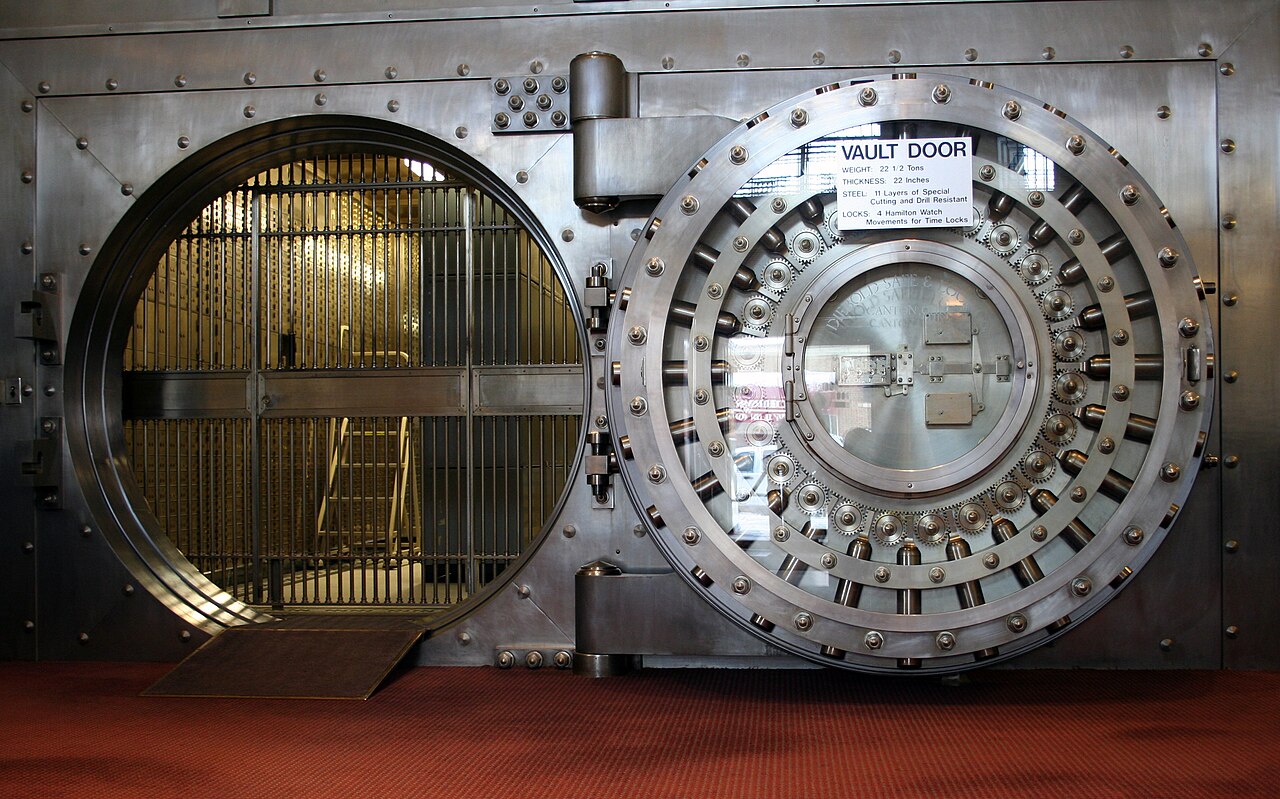
The physical reality of the Bank of England's gold storage is dictated not by steel or security, by the geology of the London Basin. The vaults, constructed in the 1930s across two basement levels deep beneath Threadneedle Street, rest directly upon London Clay. This soft, compressible soil creates a serious engineering constraint: floor loading limits. Unlike the Federal Reserve Bank of New York, which sits on the bedrock of Manhattan, the Bank of England cannot stack its bullion from floor to ceiling. The 400, 000 gold bars, weighing approximately 5, 134 tonnes, must be distributed on pallets stacked only four shelves high to prevent the vaults from sinking into the earth or the floors from buckling under the sheer density of the metal. Each standard "London Good Delivery" bar weighs roughly 400 troy ounces (12. 4 kilograms), meaning a single pallet holds approximately one tonne of gold.
Custodial liability within these vaults hinges on the legal distinction between "allocated" and "unallocated" accounts, a method that fundamentally alters the nature of ownership. In an allocated account, the customer holds title to specific physical bars, identified by serial number, refiner brand, and year of manufacture. These bars are not assets of the Bank; they are warehoused property, legally ring-fenced from the Bank's insolvency. yet, central banks and commercial bullion banks frequently use unallocated accounts for liquidity. in this arrangement, the customer possesses no specific gold rather an unsecured claim against the Bank for a quantity of metal. The gold becomes a liability on the Bank's balance sheet. In the event of a catastrophic failure, holders of unallocated gold would rank as unsecured creditors, a risk frequently obscured by the institution's sovereign prestige.
The operational mechanics of the vault rely on a blend of archaic tradition and modern surveillance. Access requires a dual-control system involving a key measuring three feet in length, unchanged for nearly a century, paired with advanced voice recognition technology. The physical toll on vault staff is significant; moving gold is manual labor. Staff must lift and stack the 12. 4-kilogram bars by hand, a repetitive that dictates strict shift limits. Logistics for external transport involve high-security armored convoys, frequently utilizing unmarked "blue box" lorries that navigate the City of London's congestion under heavy police escort. These movements are not administrative; they are geopolitical events, representing the physical settlement of trade deficits or the repatriation of sovereign wealth.
The illusion of apolitical custody was shattered by the case of Banco Central de Venezuela (BCV) v. Bank of England. Beginning in 2018 and escalating through 2026, the Bank refused to release approximately $2 billion in gold reserves to the government of Nicolás Maduro. The refusal was not based on a failure of authentication, on instructions from the UK Foreign and Commonwealth Office (FCO). The British government's recognition of opposition leader Juan Guaidó, and subsequent diplomatic ambiguity following his ouster in late 2022, allowed the Bank to freeze the assets. This established a precedent that "safe custody" in London is conditional upon diplomatic alignment with UK foreign policy. The gold remains in the vault, physically present legally inaccessible to its depositor, seizing sovereign assets without a formal declaration of war.
By early 2025, this politicization of custody contributed to a quiet measurable "exodus" of bullion. Data from February 2025 indicates that approximately 8, 000 bars were withdrawn from the vaults in a short period, driven by traders and sovereign nations reacting to widening price arbitrages and fears of renewed trade wars. The logistical of these withdrawals caused delays of several weeks, exposing the friction between digital gold trading and physical settlement. The Bank's fee structure, charging approximately 3. 5 pence per bar per night, generates millions in revenue annually, yet the inability to rapidly mobilize physical assets during peak demand reveals the logistical bottlenecks inherent in the system.
Transparency regarding these holdings remains unclear. While the Bank publishes monthly aggregate weight data, it refuses to release a detailed inventory of customers or specific bar lists to the public, citing commercial confidentiality. Exceptions exist only for select central bank clients, such as the Reserve Bank of Australia, which conducts periodic physical audits. For the vast majority of the world, the existence of the gold is verified only by paper statements. The Bank's indemnity clauses further protect it, limiting its liability for loss or damage unless gross negligence is proven, a high legal bar that insulates the institution from the consequences of operational errors.
| Metric | Data Point |
|---|---|
| Total Gold Held | ~400, 000 bars (~5, 134 tonnes) |
| Standard Bar Weight | ~400 troy ounces (12. 4 kg) |
| Custody Fee | 3. 5 pence per bar / night (2024 rates) |
| Floor Loading Limit | Restricted (London Clay foundation) |
| Stacking Height | Max 4 pallets high |
| Major Withdrawal Event | Feb 2025 (8, 000 bars removed) |
The historical record contains anomalies that challenge the narrative of perfect security. In 1836, a sewage worker famously gained entry to the bullion room through the floor drains, alerting the Directors to the breach in exchange for a reward. While modern security precludes such subterranean intrusion, the incident highlights the physical vulnerabilities of the site. Today, the threat is less about theft and more about seizure. The freezing of Venezuelan assets, alongside the freezing of Russian central bank assets post-2022, demonstrates that the Bank of England's vaults function as an extension of the British state's sanctioning power. Custody is no longer a neutral service; it is a lever of diplomatic coercion.
As of 2026, the Bank faces increasing pressure from nations like Germany and Poland to repatriate reserves, driven by a desire for physical possession over foreign custodial pledge. The "repatriation trend" signals a fracturing of the trust that underpinned the London gold market for three centuries. When a custodian claims the right to determine the political legitimacy of the depositor, the vault ceases to be a bank and becomes a political instrument. The gold resting on the clay of Threadneedle Street is secure from burglars, it is uniquely to the pen strokes of the Foreign Secretary.
1946 Nationalization and Treasury Subordination
On March 1, 1946, the Bank of England ceased to be the private possession of a syndicate of stockholders. After 252 years of operating as a corporate entity with unique privileges, the "Old Lady of Threadneedle Street" was formally acquired by the British state. This event was not a Bolshevik-style seizure of assets a gentlemanly bureaucratic transfer that fundamentally altered the hierarchy of British finance. The Bank of England Act 1946 did not change ownership; it codified the subordination of the central bank to the Treasury, stripping the Governor of the autonomy enjoyed by predecessors like Montagu Norman and reducing the institution to a technical arm of the government's economic policy.
The method of nationalization was financial, not military. The Labour government, led by Clement Attlee and his Chancellor of the Exchequer, Hugh Dalton, opted for a buyout rather than a confiscation. The 17, 000 private shareholders who held the Bank's £14, 553, 000 capital stock were not left empty-handed. In fact, they received a settlement so generous it preserved their income in perpetuity. The Treasury exchanged the private Bank stock for a new government security: the 3% Treasury Stock, redeemable only after 1966. The exchange ratio was set at £400 of new Treasury stock for every £100 of Bank stock. This 4-to-1 ratio was calculated to match the 12% annual dividend the Bank had paid consistently for the previous two decades. The state guaranteed the private rentier class their historical returns, backed by the taxpayer, in exchange for the title deeds to the printing press.
The total compensation amounted to £58, 212, 000 in government bonds. This debt remained on the books for nearly seventy years. It was not until 2015 that the British government, under Chancellor George Osborne, redeemed the 3% Treasury Stock issued to buy the Bank. For seven decades, the British public paid interest on the loan taken out to purchase their own central bank. The transaction converted the Bank's capital into a permanent government asset, held technically by the Treasury Solicitor, a legal fiction that to this day. The £14. 6 million figure still sits on the Bank's balance sheet as "Capital," a fossilized remnant of the 1946 buyout.
The true investigative significance of the 1946 Act lies not in the money, in the power structure established by Clause 4. This section of the legislation destroyed the Bank's operational independence. Clause 4(1) states explicitly: "The Treasury may from time to time give such directions to the Bank as, after consultation with the Governor of the Bank, they think necessary in the public interest." With these twenty-eight words, the Bank of England was legally subordinated to the Chancellor. The requirement for "consultation" was a courtesy, not a veto. If the Treasury ordered the Bank to lower interest rates or monetize debt, the Bank was legally compelled to obey. This clause ended the era where a Governor could the Prime Minister, as Montagu Norman had frequently done during the interwar years.
Hugh Dalton, the driving force behind the Act, viewed this subordination as a correction of a historical anomaly. He famously declared that the "Old Man of the Treasury and the Old Lady of Threadneedle Street should be legally married," implying a union where the Treasury was the dominant partner. Dalton sought to use the Bank as an engine for his "cheap money" policy, aiming to drive long-term interest rates down to 2. 5% to reduce the cost of post-war reconstruction. The Bank, a compliant department of state, assisted in this effort by supporting the price of government bonds. This experiment failed when the market revolted against the artificially low rates in 1947, it proved that the Bank was an instrument of fiscal policy, not a check on it.
The reaction from within the Bank was surprisingly muted. Montagu Norman, the arch-defender of the Bank's private status, had retired in 1944. His successor, Lord Catto, took a pragmatic, almost defeatist view. Catto believed that the private ownership structure had become anachronistic and that fighting the Labour mandate was futile. Instead of resisting nationalization, Catto negotiated the terms. He focused his energy on preventing the government from acquiring direct control over the commercial banks. He succeeded in watering down Clause 4(3), which gave the Bank power to problem directions to commercial lenders, ensuring that the "iron hand" of the state would remain inside a "velvet glove." Catto's compliance ensured a smooth transition, yet it also cemented the culture of the Bank as a "humble servant" to Whitehall, a posture it maintained until the late 1990s.
The 1946 Act also restructured the Court of Directors. The number of directors was reduced from twenty-four to sixteen, all appointed by the Crown (in practice, the Prime Minister). The term of office for the Governor was fixed at five years. This ended the tradition of the Governor being elected by the shareholders, removing the final link to the City of London's merchant oligarchy. The Bank became a public corporation, one shrouded in the Official Secrets Act. While it was "public," it became less transparent. The weekly publication of the Bank Return continued, the internal debates and policy disagreements were matters of state secrecy, hidden from the very public that ostensibly owned the institution.
This structural subordination had serious consequences for the British economy over the fifty years. Because the Bank answered to politicians, monetary policy became a tool of the electoral pattern. Chancellors frequently manipulated interest rates to engineer pre-election booms, leading to the "stop-go" economic pattern that plagued Britain from the 1950s through the 1970s. The Bank, stripped of the power to say "no," accommodated government deficits by expanding the money supply. The inflation that ravaged the UK in the 1970s can be traced structurally back to the removal of the Bank's ability to act as an independent guardian of the currency. The 1946 Act removed the separation of powers between the spender (the Treasury) and the printer (the Bank).
| Component | Details |
|---|---|
| Transfer Date | March 1, 1946 (The "Appointed Day") |
| Old Asset | Bank of England Capital Stock (Private) |
| New Asset | 3% Treasury Stock (Government Gilt) |
| Exchange Ratio | £400 Treasury Stock for £100 Bank Stock |
| Total Payout | £58, 212, 000 |
| Income Preservation | 12% Dividend (Private) replaced by 3% Yield on 4x Capital (Public) |
| Redemption | Option from 1966; redeemed in 2015 |
The legacy of 1946 remains the bedrock of the Bank's legal existence. Even when the Bank was granted "operational independence" in 1997, the government retained 100% ownership of the capital. The power to problem directions under Clause 4 was not repealed; it was restricted. The Treasury retains a "reserve power" to give directions to the Bank in extreme economic circumstances. Thus, the subordination of 1946 is dormant, not dead. The Bank of England acts independently only as long as the Treasury permits it to do so. The "marriage" Dalton orchestrated remains in force, with the Treasury holding the power of divorce.
The 1997 Operational Independence Accord

The transformation of the Bank of England on May 6, 1997, was not a gradual evolution a bureaucratic coup d'état. Four days after the Labour Party secured a landslide victory, Chancellor Gordon Brown summoned Governor Eddie George to the Treasury and delivered a directive that dismantled three centuries of political micromanagement. The "Ken and Eddie Show", the monthly, frequently theatrical meetings between Chancellor Kenneth Clarke and the Governor, was abolished. In its place, Brown granted the Bank operational independence to set interest rates, a power the Crown and Parliament had jealously guarded since the institution's founding in 1694. This decision, formalized in the Bank of England Act 1998, was intended to end the "political business pattern," a phenomenon where incumbents slashed rates before elections to manufacture artificial booms, only to inflict painful austerity once votes were counted.
The method for this new autonomy was the Monetary Policy Committee (MPC), a nine-member body designed to function as a technocratic high council. Unlike the Federal Reserve's dual mandate, the MPC was given a singular, ruthless objective: price stability. The Treasury set the target, initially 2. 5 percent based on the Retail Prices Index excluding mortgage interest payments (RPIX), and the Bank's sole duty was to hit it. This was not absolute freedom; it was "constrained discretion." If inflation deviated by more than one percentage point in either direction, the Governor was required to write an open letter to the Chancellor explaining the failure and the plan to correct it. This "letter-writing" protocol was designed as a public shaming method to ensure compliance.
Yet, the independence accord came with a poison pill that would fester for a decade. In exchange for control over interest rates, the Bank was stripped of its historic role in banking supervision. Brown transferred regulatory oversight to a new super-regulator, the Financial Services Authority (FSA). This bifurcation created a dangerous blind spot. The Bank retained responsibility for the stability of the financial system as a whole lost the ability to inspect the individual balance sheets of the institutions that comprised it. This separation of powers meant that when Northern Rock and Royal Bank of Scotland began to rot from the inside in 2007, the central bank was flying blind, possessing the lever for interest rates absence the lens for solvency.
For the ten years, the flaws were masked by the so-called "NICE" decade (Non-Inflationary Continuous Expansion). Between 1997 and 2007, inflation averaged close to target, and growth remained steady. The City of London convinced itself that the problem of economic volatility had been solved by the genius of technocratic rule. In 2003, the goalposts were moved; the Treasury switched the inflation target to 2. 0 percent based on the Consumer Prices Index (CPI). This change was controversial because CPI excluded housing costs, removing the most volatile and significant expense for British households from the central bank's primary gauge. Consequently, the Bank kept interest rates artificially low during a housing bubble, as the metric they were told to watch flashed green while the real economy overheated.
The illusion of mastery shattered in 2008. The Global Financial emergency exposed the impotence of the 1997 accord in the face of widespread collapse. Independence became a semantic fiction as the Bank and Treasury were forced into lockstep to bail out the financial sector. The introduction of Quantitative Easing (QE) in 2009 further blurred the lines. By purchasing vast quantities of government debt, the Bank was financing the state, a practice that 1997 was supposed to outlaw. While technically an independent monetary decision to support demand, functionally it was fiscal dominance. The Bank's balance sheet exploded from £80 billion in 2006 to nearly £1 trillion by the early 2020s, turning the Old Lady of Threadneedle Street into the primary creditor of the United Kingdom.
The most severe test of the 1997 framework arrived in the post-pandemic era. In 2021, as inflation began to climb, the MPC hesitated, clinging to the narrative that price rises were "transitory." By late 2022, CPI inflation had surged to double digits, peaking above 11 percent, a catastrophic failure of the 2 percent mandate. The "letter-writing" method, intended to be a rare sanction, became a quarterly routine. Critics argued that the Bank's forecasting models, which had not been substantially updated since the 1990s, were unfit for a world of supply shocks and geopolitical fragmentation. The credibility purchased by Gordon Brown in 1997 had been spent.
In response to this failure, the Bank commissioned an external review led by former Federal Reserve Chair Ben Bernanke. Published in April 2024, the Bernanke Review was a scathing indictment of the Bank's intellectual infrastructure. It found "deep-seated failings" in the forecasting software and a culture of groupthink that had blinded the MPC to the persistence of inflation. The review forced a humiliating overhaul of the Bank's methods, admitting that the tools used to navigate the economy were obsolete. By 2026, the Bank had begun to stabilize, with interest rates settling around 3. 75 percent after the aggressive hikes of the previous years. Yet the aura of infallibility that surrounded the MPC in the early 2000s has.
The following table contrasts the pre-independence volatility with the post-independence eras, highlighting the shift from political manipulation to technocratic struggle.
| Era | Governance Model | Primary Target | Avg. Interest Rate | Peak Inflation (CPI/RPI) | Outcome |
|---|---|---|---|---|---|
| 1979, 1990 | Political Control (Thatcher) | Money Supply (M3) | 12. 2% | 21. 9% (1980) | High volatility, recessionary shocks. |
| 1990, 1992 | External Anchor (ERM) | Exchange Rate | 10. 8% | 8. 4% (1991) | Black Wednesday collapse. |
| 1993, 1997 | "Ken & Eddie" (Transitional) | Inflation (1-4% range) | 5. 9% | 3. 5% (1995) | Stabilization, political friction. |
| 1997, 2007 | Operational Independence | 2. 5% RPIX / 2. 0% CPI | 5. 0% | 3. 0% (2007) | "NICE" Decade, housing bubble ignored. |
| 2008, 2021 | emergency Management (QE) | 2. 0% CPI (Flexible) | 0. 5% | 5. 2% (2011) | ZIRP, asset price inflation, stagnation. |
| 2021, 2026 | Post-Pandemic Adjustment | 2. 0% CPI | 3. 8% | 11. 1% (2022) | Mandate failure, Bernanke Review overhaul. |
The 1997 accord remains the operating system of the British economy, yet its software is undergoing a forced patch. The separation of supervision and monetary policy was partially reversed after 2008 with the creation of the Prudential Regulation Authority (PRA), returning oversight to the Bank. yet, the core premise, that unelected economists can manage the economy better than elected politicians, faces renewed skepticism. In 2026, the Bank of England stands not as the triumphant victor of the inflation wars, as a battered institution, fighting to prove that its independence is still a benefit to the nation rather than a shield for incompetence.
Quantitative Easing and Balance Sheet Expansion (2009, 2021)
| Period | Trigger Event | Net Increase | Cumulative Target |
|---|---|---|---|
| Mar 2009 , Nov 2009 | Global Financial emergency | £200 billion | £200 billion |
| Oct 2011 , Jul 2012 | Eurozone Debt emergency | £175 billion | £375 billion |
| Aug 2016 | Brexit Referendum | £70 billion | £445 billion |
| Mar 2020 | COVID-19 Pandemic | £200 billion | £645 billion |
| Jun 2020 | Pandemic Continuation | £100 billion | £745 billion |
| Nov 2020 | Second Wave / Lockdown | £150 billion | £895 billion |
In March 2020, the gilt market ceased to function. Investors, desperate for liquidity, sold even safe government bonds, causing yields to spike violently, a "dash for cash." The Bank of England stepped in not just to lower rates, as the Market Maker of Last Resort. On March 19, 2020, the MPC announced a £200 billion increase in asset purchases, executed at a speed unmatched in financial history. The Bank monetized the government's pandemic spending in real-time. By the end of 2021, the APF held £875 billion in gilts and £20 billion in corporate bonds. The Bank's balance sheet exploded to roughly 40% of the UK's GDP, a ratio unseen since the Napoleonic Wars or World War II. This massive intervention distorted the pricing of risk. By removing high-quality collateral from the market, the Bank forced investors into riskier assets, driving up the prices of equities and real estate. This "portfolio balance effect" was the stated goal, yet the social cost was severe. Asset owners saw their wealth compound while real wages stagnated. The Bank of England became the dominant force in the gilt market, owning approximately one-third of the UK's total government debt by 2021. This ownership concentration suppressed borrowing costs for the state, allowing the government to service record debt loads at near-zero interest rates. The indemnity deed signed in 2009 contained a poison pill. While the APF remitted billions to the Treasury during the low-rate era, the mechanics guaranteed that a reversal in interest rates would trigger massive transfers in the opposite direction. As the Bank accumulated long-dated bonds with low yields, it locked in a sensitivity to rate hikes. The "profits" of the 2010s were borrowed from the future. By 2021, the Bank sat atop a mountain of assets purchased at peak prices, indemnified by a taxpayer base unaware of the liability that had been accrued in their name. The era of expansion ended with the Bank holding a £895 billion portfolio, a distorted yield curve, and a financial system entirely addicted to central bank liquidity.
Regulatory Failures: BCCI to the Forex Rigging Scandal

The transition of the Bank of England from an informal guardian of the City to a statutory regulator was marked not by increased competence, by a series of catastrophic oversights that permitted fraud on an industrial. While the Banking Act 1979 formalized the Bank's supervisory powers, the institution remained culturally wedded to the "Governor's eyebrows", the belief that a stern look from a Bank official was sufficient to discipline the market. This conceit collapsed in 1984 with Johnson Matthey Bankers (JMB). A minor player in the London gold market, JMB amassed a loan book of such toxicity that its insolvency threatened the reputation of London's bullion trade. The Bank of England, having failed to detect that JMB's lending exceeded its capital base, was forced to purchase the failed entity for £1. To prevent a domino effect, the Bank injected £100 million of public funds, a bailout justified by the terrifying assertion that the gold market itself would cease to function without this intervention.
The JMB debacle was a prelude to the Bank's most ignominious regulatory failure: the collapse of the Bank of Credit and Commerce International (BCCI). By the late 1980s, BCCI was functioning less as a bank and more as a global conduit for money laundering, servicing drug cartels, intelligence agencies, and dictators. The Bank of England, as the lead regulator for BCCI's London operations, relied on a fractured supervisory model where responsibility was split between the UK, Luxembourg, and the Cayman Islands. This "college of regulators" method allowed BCCI to shuffle losses between jurisdictions, hiding a black hole in its balance sheet.
Internal warnings were ignored. In 1991, the Bank commissioned the "Sandstorm" report from Price Waterhouse, which revealed evidence of widespread criminal deception. Yet, the Bank hesitated. When BCCI was raided and closed in July 1991, thousands of depositors, including UK local councils, lost their funds. The subsequent inquiry by Lord Bingham in 1992 delivered a withering verdict, describing the Bank's supervision as a "tragedy of errors." Bingham found that the Bank had failed to discharge its duties under the Banking Act 1987, paralyzed by a culture of secrecy and a reluctance to confront the complex corporate structure BCCI used to mask its crimes. The liquidators, Deloitte, later pursued the Bank for misfeasance in public office, a legal battle that dragged on for over a decade, exposing the internal paralysis of the regulator.
The supervisory rot continued with Barings Bank in 1995. The Bank of England accepted the explanation of "matrix management" to justify why Nick Leeson, a rogue trader in Singapore, could bypass internal controls. The Bank's supervisors failed to understand that Leeson was settling his own trades, a fundamental breach of banking safety. When Barings collapsed with losses of £827 million, the Bank of England's defense was again one of ignorance regarding the granular details of the institution it was meant to oversee. This failure contributed to the Labour government's decision in 1997 to strip the Bank of its regulatory powers, transferring them to the newly created Financial Services Authority (FSA).
Regulatory authority returned to Threadneedle Street in 2013 with the creation of the Prudential Regulation Authority (PRA), the scandals did not cease; they moved from supervision to direct market manipulation. The LIBOR scandal of 2012 implicated the Bank's upper echelons in the rigging of interest rates. Evidence emerged of a 2008 phone call between Paul Tucker, the Bank's Deputy Governor, and Bob Diamond, CEO of Barclays. Diamond's file note recorded Tucker stating that "senior Whitehall figures" were concerned that Barclays' LIBOR submissions were too high. Barclays interpreted this as a state-sanctioned instruction to "lowball" their rates to project false financial stability during the credit crunch. While Tucker denied giving an instruction, the incident revealed a blurred line between monetary stability and market manipulation, with the central bank appearing to prioritize perception over accurate pricing.
The corruption of market method inside the Bank became undeniable during the Forex rigging scandal (2013-2015). Traders at major banks used chat rooms with names like "The Cartel" and "The Bandits' Club" to manipulate the 4 p. m. WM/Reuters fix, the benchmark rate for the global currency market. The scandal was not limited to commercial banks; it reached the Bank of England's own dealing desk. Martin Mallett, the Bank's Chief Dealer, was dismissed in November 2014 after it emerged he had been aware of the traders' concerns about chat room collusion failed to escalate them.
The Bank's internal investigation, led by Lord Grabiner, was widely criticized by MPs as a "whitewash." Grabiner concluded that while Mallett had committed an "error of judgment," there was no institutional complicity. yet, transcripts showed Mallett in conversation with traders who openly discussed their strategies. The defense offered was that the Bank's officials were too naive to understand that "sharing information" was a euphemism for price fixing. This defense, incompetence rather than malice, saved the institution from criminal liability destroyed its claim to moral authority. The scandal resulted in over £2. 6 billion in fines for the banks involved, yet the regulator itself escaped with only internal reshuffles.
In the post-Brexit era, the Bank of England faces new regulatory risks. The "Edinburgh Reforms" and the Financial Services and Markets Act 2023 have pushed for a "competitiveness" objective, raising fears of a return to light-touch regulation. By September 2025, the PRA began deleting 37 regulatory reporting templates under the "Future Banking Data" initiative to reduce administrative load, a move critics reduces visibility into widespread risks. Simultaneously, the Bank has struggled to police the fintech sector. In January 2026, reports surfaced that the Bank of London, a clearing bank, was under PRA investigation for "historic" governance failures and inaccurate record-keeping, recording a £24 million loss. The Parliamentary Treasury Committee also warned in early 2026 that the Bank was failing to grasp the risks posed by Artificial Intelligence in high-frequency trading, repeating the pattern of the 1990s where regulators lagged years behind the technological reality of the markets they were sworn to police.
| Event | Year | Nature of Failure | Bank of England Role/Response |
|---|---|---|---|
| Johnson Matthey Bankers | 1984 | Insolvency due to reckless lending; gold market threat. | Purchased bank for £1; £100m bailout to save bullion market. |
| BCCI Collapse | 1991 | Money laundering, fraud, criminal connections. | Failed to coordinate with foreign regulators; "Tragedy of errors" (Bingham). |
| Barings Bank | 1995 | Rogue trading (Nick Leeson); £827m loss. | Accepted "matrix management" excuse; failed to check internal controls. |
| LIBOR Scandal | 2012 | Rate rigging to project stability. | Deputy Governor accused of pressuring Barclays to lower rates. |
| Forex Scandal | 2014 | Collusion in currency benchmarks ("The Cartel"). | Chief Dealer Martin Mallett fired; Grabiner Report criticized as weak. |
| Bank of London Probe | 2025-2026 | Governance failures; inaccurate records. | PRA investigation launched; "historic" events in filings. |
The 2022 LDI Pension Crisis and Gilt Market Intervention
The Bank of England's role as the guarantor of the United Kingdom's financial plumbing faced its most severe modern test in September 2022. Following the announcement of the "Growth Plan" by Chancellor Kwasi Kwarteng, a fiscal package containing £45 billion in unfunded tax cuts, the British government bond market entered a state of freefall. The 30-year gilt yield, a benchmark for long-term borrowing costs, surged from approximately 3. 75% to over 5% in mere days. This violent repricing did not increase the cost of government debt; it detonated a use bomb buried deep within the nation's pension system.
At the center of this collapse were Liability-Driven Investment (LDI) funds. These investment vehicles managed roughly £1 trillion in assets for Defined Benefit pension schemes. To match their long-term liabilities without tying up all their capital in low-yielding bonds, these funds used derivatives and repurchase agreements (repos) to gain leveraged exposure to gilts. This strategy worked during the low-volatility decade of Quantitative Easing. Yet the speed of the yield spike in September 2022 triggered massive collateral calls. To meet these demands for cash, LDI managers were forced to sell their most liquid assets, gilts, into a falling market. This selling pressure drove prices down and yields up further, creating a self-reinforcing "doom loop" that threatened to render the UK pension sector insolvent.
On September 28, 2022, the Bank of England intervened. The Monetary Policy Committee was simultaneously raising interest rates to fight double-digit inflation, yet the Bank's Financial Policy Committee authorized the emergency printing of money to buy bonds. This created a direct contradiction in policy: tightening monetary conditions with one hand while loosening liquidity with the other. The Bank pledged to purchase up to £65 billion of long-dated gilts to restore order, acting as the "market maker of last resort." The intervention was explicitly framed as a temporary financial stability operation, distinct from the monetary stimulus of QE.
The of the panic is best illustrated by the between the authorized capacity and the actual capital required to stop the bleeding. While the Bank signaled a willingness to spend £65 billion (later expanded in scope to include index-linked gilts), it purchased only £19. 3 billion. The mere pledge of a backstop, combined with the actual deployment of £19. 3 billion, broke the psychological feedback loop. By mid-October, the government had reversed the majority of the tax cuts, and the immediate liquidity emergency subsided.
The following table details the timeline of the intervention and its rapid unwinding:
| Date | Event | Market Context |
|---|---|---|
| Sept 23, 2022 | "Mini-Budget" Announced | Gilt yields begin sharp ascent. |
| Sept 27, 2022 | LDI Collateral emergency | 30-year yield breaches 5%; pension funds face insolvency. |
| Sept 28, 2022 | BoE Intervention Begins | Bank pledges daily purchases of long-dated gilts. |
| Oct 14, 2022 | Purchases Conclude | Total holdings peak at £19. 3 billion. |
| Nov 29, 2022 | Unwind Begins | Bank begins selling the portfolio back to the market. |
| Jan 12, 2023 | Exit Complete | All emergency holdings sold; profit realized. |
A rarely discussed aspect of this episode is the financial outcome of the trade itself. Because the Bank purchased these bonds at distressed prices (high yields) and sold them back into a calmer market (lower yields, higher prices) between November 2022 and January 2023, the operation generated a profit. The Bank spent £19. 3 billion to acquire the assets and received £23. 1 billion upon their sale, netting a surplus of approximately £3. 8 billion for the Treasury. This stands in clear contrast to the main Asset Purchase Facility (APF), which, as of 2026, continues to incur tens of billions in losses due to the between the low coupon rates of bonds bought during the QE era and the high Bank Rate paid on reserves.
The 2022 emergency exposed the risks of the "shadow banking" sector. Regulators had focused heavily on bank capital requirements post-2008 had allowed non-bank financial intermediaries like LDI funds to build widespread use. The Bank of England successfully extinguished the fire, the event forced a permanent shift in regulatory attention toward the liquidity buffers of pension schemes. By 2026, 30-year gilt yields had returned to levels near 5. 12%, similar to the emergency peak, without the accompanying panic. The system had adjusted to a higher-rate environment, stripping out the excessive use that made the 2022 spike existential.
2024-2026 Digital Pound Pilot Infrastructure

The transition from theoretical exploration to concrete infrastructure engineering formally began on January 25, 2024. Following a consultation that drew over 50, 000 responses, a historic level of public engagement, the Bank of England and HM Treasury published their joint response, initiating the "Design Phase" of the digital pound. This period, scheduled to run through 2025 and into early 2026, was not a feasibility study; it was the construction of a blueprint for a state-backed digital currency issuer. The authorities confirmed the adoption of a "platform model," a two-tier architecture where the Bank maintains the core ledger while private sector firms, as Payment Interface Providers (PIPs), manage customer-facing wallets. This structure deputizes commercial entities to handle Know Your Customer (KYC) compliance while the central bank retains absolute control over the settlement.
While public attention focused on the consumer-facing digital pound, the Bank simultaneously executed a serious overhaul of the underlying wholesale plumbing necessary to support it. Under the Real-Time Gross Settlement (RTGS) Renewal Programme, the Bank migrated the CHAPS payment system to the ISO 20022 messaging standard in June 2023, followed by the introduction of the new core settlement engine in June 2024. This upgrade, known as Transition State 3, launched the Bank of England Real-Time Interface (BERTI), a web-based access point for settlement account holders. By April 2025, the full renewal (RT2) was operational. The shift to ISO 20022 is technically decisive; unlike previous formats that only transmitted value, this standard carries rich, structured data fields with every transaction, creating a surveillance-ready grid where payment details are as visible as the funds themselves.
The technical capabilities of this new infrastructure were pre-validated by Project Rosalind, a joint experiment with the Bank for International Settlements (BIS) Innovation Hub. Concluded in mid-2023 foundational to the 2024-2026 design work, Rosalind developed 33 specific API functionalities. These APIs demonstrated how a central bank ledger could interface with private sector applications to enable "programmability", the ability to attach conditions to money, such as restricting where it can be spent or automating payments upon delivery of goods. Although the Bank of England publicly stated in January 2024 that it would not program the digital pound to control user spending, Project Rosalind proved that the technical capacity to do so is inherent in the API they engineered.
Privacy concerns dominated the 2024 consultation feedback, forcing the Treasury to concede a legislative lock. The government committed that no digital pound would launch without primary legislation passed by both Houses of Parliament. This proposed act would ostensibly guarantee that the Bank of England and the Government could not access personal user data. Under the design tested in 2025, the Bank's core ledger sees only anonymized "aliases" and balances, while the PIPs hold the identity data. Critics noted that because PIPs are regulated entities subject to court orders and financial crime reporting requirements, the "firewall" between the state and user identity is legal rather than cryptographic. If the law changes, the privacy evaporates, as the architecture does not mathematically prevent de-anonymization.
The threat of a commercial banking emergency dictated the economic parameters of the pilot. The Bank proposed a holding limit of £10, 000 to £20, 000 per individual to prevent a "digital bank run," where depositors rapidly move funds from commercial bank accounts to the risk-free safety of the central bank. Commercial lenders, represented by UK Finance, lobbied aggressively throughout 2024 and 2025 for lower limits, citing the risk of deposit flight eroding their ability to fund mortgages and business loans. In contrast to the European Central Bank, which discussed a strict €3, 000 cap for the digital euro, the Bank of England's higher proposed limit signaled an intent to make the digital pound a functional medium of exchange rather than a mere wallet for petty cash.
By January 2025, the Bank published a progress update on the "payments," confirming that work had expanded to analyzing holding limits for corporate accounts, which would require caps in the millions to be operationally useful. As of February 2026, the infrastructure, comprising the renewed RTGS core, the ISO 20022 data standard, and the Rosalind-tested API specifications, stands ready. The "Design Phase" has delivered a turnkey surveillance and settlement machine. The only remaining variable is the political to turn the key.
Quantitative Tightening and Treasury Indemnity Transfers (2022, 2026)
By late 2022, the era of cost-free money ended, and the bill for a decade of monetary experimentation arrived at the door of the British taxpayer. For thirteen years, the Bank of England's Asset Purchase Facility (APF) operated as a profit center for the Exchequer, remitting billions in coupon payments generated by its colossal pile of government bonds. Politicians and chancellors grew accustomed to this fiscal windfall, treating the central bank as a reliable source of non-tax revenue. the structure of the APF contained a dormant poison pill: the 2009 Deed of Indemnity. This legal agreement, signed at the height of the Financial emergency, stipulated that while the Treasury would receive all profits from the Bank's quantitative easing operations, it must also cover 100 percent of any losses. As inflation surged and interest rates rose in 2022, the flows reversed with violent speed, tearing a hole in the nation's public finances that continues to widen in 2026.
The mechanics of this reversal were rooted in the basic math of bond markets. During the Quantitative Easing (QE) era, the Bank created electronic reserves to purchase gilts. For years, the Bank paid near-zero interest on those reserves while collecting higher coupon payments from the bonds it held. The difference, the "seigniorage", was pure profit, totaling £123. 9 billion between 2009 and September 2022. Yet, when the Bank raised its policy rate to combat inflation, the cost of servicing those reserves skyrocketed. Simultaneously, the market value of the bonds in the APF collapsed as yields rose. The Bank found itself paying out more in interest to commercial banks than it received from its gilt portfolio, creating a negative carry that the Treasury was contractually obligated to fill.
The situation worsened when the Monetary Policy Committee (MPC) elected to move from passive runoff to "active" Quantitative Tightening (QT). Starting in November 2022, the Bank began selling billions of pounds of gilts back into the market. Because these bonds were purchased at high prices during the low-yield years of QE, selling them in a high-rate environment crystallized massive capital losses. Unlike the US Federal Reserve, which records such losses as a "deferred asset" to be paid off by future earnings, the Bank of England's indemnity requires immediate cash transfers from the Treasury. Every quarter, the government must wire billions of pounds to Threadneedle Street to keep the APF solvent, money that must be raised through taxation or additional borrowing.
The of these transfers has been. In the 2023-2024 financial year alone, the Treasury transferred £44. 5 billion to the Bank of England to cover APF losses. This sum exceeded the entire budget of the Ministry of Defence for that year. In the subsequent 2024-2025 period, even with a stabilization in rate expectations, the Treasury was forced to send another £36. 3 billion. These payments represent a direct transfer of wealth from the public purse to the commercial banking sector, which receives the interest payments on the reserves backing the APF. By February 2026, the cumulative profits of the previous decade are being rapidly erased, with the Office for Budget Responsibility (OBR) forecasting a lifetime net loss for the APF exceeding £100 billion.
| Period | Direction of Flow | Approximate Amount | Context |
|---|---|---|---|
| 2009 , Sept 2022 | Bank → Treasury | £123. 9 Billion | Accumulated profits from QE coupons. |
| Oct 2022 , Feb 2023 | Treasury → Bank | £5. 0 Billion | Initial impact of rate hikes. |
| Mar 2023 , Feb 2024 | Treasury → Bank | £44. 5 Billion | Peak velocity of QT losses. |
| Mar 2024 , Feb 2025 | Treasury → Bank | £36. 3 Billion | Sustained high reserve costs. |
| Mar 2025 , Feb 2026 | Treasury → Bank | ~£30. 0 Billion | Ongoing active sales and negative carry. |
The decision to pursue active sales distinguishes the Bank of England from its major peers. The European Central Bank and the Federal Reserve largely chose to let their bond portfolios roll off as they matured, a slower process that minimizes realized losses. The Bank of England, yet, prioritized the reduction of its balance sheet to restore "monetary headroom." In September 2023, the MPC voted to reduce the stock of gilts by £100 billion over the following year. They repeated this target in September 2024. By September 2025, the pace was adjusted to £70 billion for the year ahead, reflecting a shrinking portfolio continuing the drain on public resources. Critics this aggressive pace of sales, conducted while the government was simultaneously issuing record amounts of new debt, placed unnecessary on the gilt market and the taxpayer.
The fiscal of the indemnity transfers are severe. Under the accounting rules used by the UK government, these payments count as public spending. They directly increase the budget deficit and the Public Sector Net Borrowing (PSNB) figures. In the 2024 Autumn Budget and the subsequent 2025 fiscal statements, the Chancellor was forced to accommodate these "non-discretionary" expenditures, squeezing funding for public services and infrastructure. The "fiscal hole" frequently in political debates of 2024 and 2025 was, in large part, a product of the Bank of England's monetary policy decisions interacting with the 2009 indemnity deed.
By early 2026, the Bank Rate stood at 3. 75 percent, having come down from its peak remaining high enough to ensure the APF remained in deficit. The portfolio, which peaked at £895 billion, had been whittled down to approximately £555 billion. Yet the remaining stock continues to generate losses. The bonds left in the portfolio are frequently longer-dated securities with low coupons, meaning the gap between the interest the Bank pays on reserves and the income it receives remains wide. The Treasury is trapped in a pattern of subsidizing the central bank's past stimulus measures, a reality that has sparked intense technical debate regarding the independence of the Bank and the wisdom of the original indemnity structure.
The indemnity also creates a perverse feedback loop. As the government borrows money to pay the Bank of England, it problem more gilts. If the market demands a higher yield to absorb this supply, the value of the Bank's remaining bond portfolio falls further, chance deepening the mark-to-market losses (though cash flow is the primary trigger for indemnity payments). This has complicated the Treasury's debt management strategy. In January 2026, the Office for National Statistics noted that while central government receipts were rising, the reduction in net investment was partly attributable to the ongoing need to service the APF liability. The "free lunch" of Quantitative Easing has ended, and the cleanup cost load the British state for years to come.
Governance: The Court of Directors and Accountability Mechanisms
The governance of the Bank of England remains a study in contradiction: a modern technocratic powerhouse encased in seventeenth-century nomenclature. While the Bank projects an image of scientific monetary management, its internal control structure, the "Court of Directors," retains the title granted by the 1694 Royal Charter. For over two centuries, this body functioned as a private cartel of the City of London's merchant elite. Twenty-four directors, elected nominally by shareholders in practice self-selected, governed the institution with absolute secrecy. They were not economists "merchant princes", men whose primary loyalty lay with the solvency of their own houses and the maintenance of the gold standard. This insular governance model survived the nationalization of 1946, leaving the Bank as a sovereign fiefdom within the British state until the reforms of the late 20th century forced a reckoning.
The transformation from a private club to a public board occurred in spasms, frequently triggered by failure. The 1998 Bank of England Act, while famous for granting operational independence over interest rates, simultaneously stripped the Court of its policy-making power. The Act transferred the authority to set rates to the Monetary Policy Committee (MPC), leaving the Court with the residual duty to manage the Bank's resources. Yet, the 2007, 08 financial collapse exposed the weakness of this arrangement. The Court, filled with non-executive directors who absence technical expertise, failed to challenge Governor Mervyn King as the Bank missed the warning signs of the Northern Rock emergency. Parliament responded with the Financial Services Act 2012, which abolished the old structure and reconstituted the Court as a unitary board. This reform reduced the number of directors and explicitly charged them with oversight of the Bank's strategy, budget, and the performance of its policy committees.
By 2026, the Court consists of five executive members (the Governor and Deputy Governors) and up to nine non-executive directors. The Chair, appointed by the Chancellor of the Exchequer, holds the power to shape the agenda, a sharp departure from the era when the Governor ruled as an autocrat. The 2012 reforms also established the Oversight Committee, a sub-body of non-executives legally mandated to review the Bank's performance. This method allows the Court to commission retrospective reviews of policy errors, a tool used with devastating effect following the inflation surge of the early 2020s.
The most significant test of this modern accountability framework arrived with the publication of the Bernanke Review in April 2024. Commissioned by the Court following intense criticism of the Bank's failure to anticipate the persistence of post-pandemic inflation, the review dismantled the Bank's forecasting infrastructure. Former Federal Reserve Chair Ben Bernanke identified "makeshift fixes" and "outdated" software that the MPC's ability to model the economy. The Court's acceptance of all twelve recommendations forced a multi-year overhaul of the Bank's data architecture. By early 2026, the implementation of these reforms had become a central metric for the Court's evaluation of the Governor, shifting the internal from polite deference to rigorous performance management.
| Feature | The Old Court (1694, 1946) | The Modern Court (Post-2012) |
|---|---|---|
| Composition | 24 Directors, Governor, Deputy Governor | Governor, 4 Deputies, up to 9 Non-Execs |
| Selection | Elected by shareholders (private) | Appointed by the Crown/Chancellor |
| Primary Role | Set interest rates, manage gold reserves | Resource management, strategy, oversight |
| Accountability | To private proprietors (shareholders) | To Parliament and the Public |
| Transparency | Absolute secrecy (minutes sealed) | Minutes published, public registers |
External accountability rests primarily with the Treasury Select Committee (TSC) of the House of Commons. Unlike the polite exchanges of the 19th century, modern TSC hearings function as public inquisitions. The Governor and members of the policy committees must appear regularly to explain their voting records and defend their compliance with the Chancellor's "Remit Letter." This letter, issued annually, defines the inflation target (currently 2%) and the government's economic priorities. In January 2026, the TSC's scrutiny focused heavily on the Bank's Financial Stability Reports, probing the resilience of the UK banking sector against geopolitical shocks. These sessions provide the only direct democratic check on unelected officials who wield the power to determine the price of money.
The illusion of the Bank's financial independence shattered in the mid-2020s due to the mechanics of the Asset Purchase Facility (APF). During the years of Quantitative Easing (QE), the Bank created reserves to buy government bonds, transferring the profits to the Treasury. When interest rates rose and the Bank began Quantitative Tightening (QT), selling those bonds at a loss, the flow of money reversed. An indemnity agreement signed in 2009 and activated in 2022 legally obliges the Treasury to cover these losses. By March 2025, the Treasury had transferred over £85 billion of taxpayer funds to the Bank to fill the hole in its balance sheet. This direct fiscal transfer creates a serious tension: the Bank sets interest rates to control inflation, yet those higher rates directly increase the bill paid by the taxpayer to the Bank.
This fiscal tether complicates the governance picture. While the Court oversees the Bank's administrative budget, the indemnity payments bypass the Court's cost-control measures, flowing directly from the state's central coffers to cover market losses. Critics this arrangement compromises the Bank's autonomy, as the Chancellor underwrites the cost of monetary policy. The Office for Budget Responsibility (OBR) forecast in 2025 that the lifetime cost of the APF would exceed £133 billion, a figure that places the Bank at the center of heated political debate regarding public spending priorities.
Transparency method have also expanded to include the Independent Evaluation Office (IEO), which reports to the Chair of Court. The IEO operates as an internal watchdog, conducting deep reviews of specific Bank functions. Its reports, frequently published alongside the Bank's response, provide a window into operational failures that would have remained buried in the pre-1998 era. Even with these of oversight, the Bank remains a of information. The "quiet period" before policy decisions and the strict confidentiality rules for directors maintain a barrier between the institution and the markets it regulates.
The governance of the Bank of England in 2026 represents a hybrid model. It possesses the statutory independence to crush inflation, yet it relies on the Treasury to remain solvent. It operates under a corporate board structure, yet its product is public policy. The Court of Directors, once a gathering of City merchants protecting their own interests, serves as the primary interface between the technocratic state and the democratic demands of accountability. The failures of forecasting identified in 2024 and the fiscal drain of the indemnity payments ensure that this interface remains under constant, high-pressure.