Verified Against Public And Audited RecordsLast Updated On: 2026-03-06
Reading time: ~50 min
File ID: EHGN-PLACE-36747
Investigative Bio of Beijing Subway
Qing Dynasty Fortifications and the Line 2 Loop Alignment
The blueprint of the Beijing Subway Line 2 does not follow the city's history; it is built upon the pulverized bones of it. To understand the loop that encircles the capital's center in 2026, one must examine the fortifications that stood in its place for five centuries. The blue line on the modern transit map is a ghost. It traces, with near-exact precision, the perimeter of the Inner City wall of the Ming and Qing dynasties. This 23. 1-kilometer loop is not a product of modern traffic engineering a legacy of medieval defense, where the subway tracks sit in the trench where the city's foundation stones were ripped out.
From 1700 through the early 20th century, Beijing was defined by this fortification. The Inner City wall stood 15 meters high and 20 meters thick at the base, a massive trapezoid of rammed earth faced with grey brick. It stretched 24 kilometers in circumference, punctuated by nine fortified gates ("men") and corner watchtowers. For the Qing emperors, this barrier was the absolute line between the imperial core and the common populace. The wall did not just control movement; it defined the cosmological order of the capital. Each gate had a specific function: coal entered through Fuchengmen, grain through Chaoyangmen, and prisoners destined for execution exited through Xuanwumen. The water for the Emperor's tea arrived exclusively through Xizhimen.
The destruction of this system began not with foreign invaders, with a domestic urban planning war in the 1950s. Following the establishment of the People's Republic, a fierce debate erupted regarding the future of the city's layout. On one side stood Liang Sicheng, China's preeminent architect, and urban planner Chen Zhanxiang. The "Liang-Chen Proposal" argued for the preservation of the old walled city as a living museum and political center, suggesting that a new administrative capital be built to the west. Liang warned that demolishing the walls would be an irreversible error, famously stating that destroying a gate was like severing a person's neck.
Opposing them were Soviet experts and the pragmatic wing of the Communist Party, who viewed the walls as feudal constrictions choking the city's modernization. The Soviet model favored a monocentric city with heavy industry and wide boulevards radiating from the center. In this vision, the wall was nothing more than a barrier to traffic and a source of raw construction material. Chairman Mao Zedong sided with the demolitionists. The directive was clear: the old must die for the new to live. The walls were condemned.
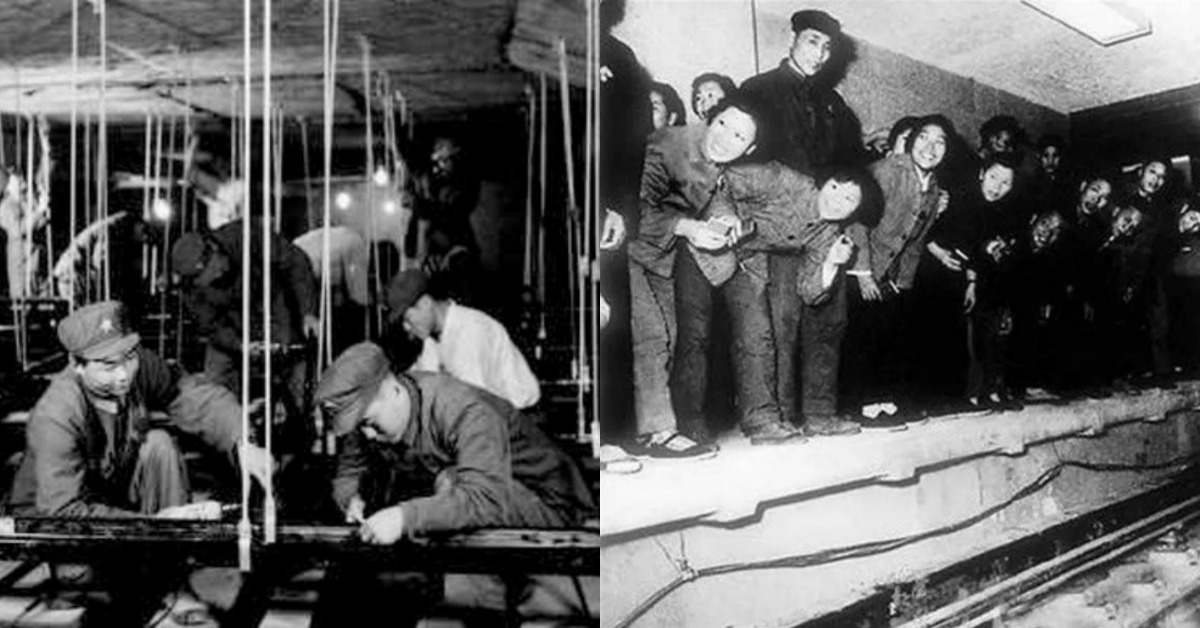
The execution of this death sentence was codified as "Project 401." Approved in 1965, this top-secret military initiative aimed to build a subway system that could double as an air-raid shelter, connecting the city center to the Western Hills. The construction method chosen was "cut-and-cover," a technique that required digging a massive trench from the surface. The route of least resistance was the land occupied by the city wall and its moat. Consequently, the subway construction became the primary engine of the wall's demolition. Soldiers and workers dismantled the centuries-old bricks, filling the moat with debris and pouring concrete where the ramparts once stood.
Construction began on July 1, 1965. For four years, the city's perimeter was a scar of open earth. The initial phase, completed in 1969, prioritized military evacuation over public transit. It was not until 1984 that the eastern and northern sections were fully operational as a civilian loop, formally as Line 2 in 1987. Today, the physical wall is gone, save for a few preserved fragments like the Ming City Wall Relics Park and the Zhengyangmen gate tower. Yet, the subway preserves the wall's logic. The stations are not just located at the sites of the old gates; they bear their names, serving as tombstones for the structures they replaced.
Table 1. 1: Line 2 Stations and the Fate of Qing Dynasty Gates
Line 2 Station
Original Gate Name
Historical Function
Current Status of Gate
Qianmen
Zhengyangmen
Imperial procession; main southern entry.
Preserved (Gate & Archery Tower)
Chongwenmen
Chongwenmen
Tax collection (alcohol/goods).
Demolished (1960s)
Xuanwumen
Xuanwumen
Prisoner transport ("Gate of Death").
Demolished (1965)
Fuchengmen
Fuchengmen
Coal transport.
Demolished (1965)
Xizhimen
Xizhimen
Water transport for the Emperor.
Demolished (1969)
Deshengmen*
Deshengmen
Military departure ("Victory Gate").
Partial (Arrow tower remains)
Andingmen
Andingmen
Military return; waste removal.
Demolished (1969)
Dongzhimen
Dongzhimen
Wood and brick transport.
Demolished (1965)
Chaoyangmen
Chaoyangmen
Grain transport.
Demolished (1950s/60s)
*Note: Deshengmen is located near Jishuitan station, not a station named Deshengmen itself, though the geography aligns.
The alignment of Line 2 dictates the flow of modern Beijing. The Second Ring Road, a six-lane highway, runs directly on top of the subway tunnel, sealing the city in a collar of asphalt and concrete exactly where the stone collar once lay. The traffic congestion that plagues this loop in 2026 is a direct consequence of superimposing high-speed modern infrastructure onto a medieval footprint designed for horse carts and palanquins. The "bottleneck" effect Liang Sicheng predicted has come to pass, not even with the removal of the walls, because the city failed to break free from the wall's gravitational pull.
Archaeological finds during subsequent renovations continue to expose the violence of the 1960s construction. Workers frequently uncover Ming-era foundations beneath the track ballast. The subway did not simply replace the wall; it occupied its corpse. When commuters ride the loop from Xizhimen to Dongzhimen, they are traveling through the negative space of the Qing defense network. The stations act as the new gates, controlling the flow of the masses just as the soldiers of the Eight Banners once did. The physical barrier is gone, the psychological and structural boundary of the "Inner City" remains rigid, enforced by ticket blocks and security checkpoints rather than archers and iron doors.
This historical overlay explains why Line 2 remains the most serious artery in the network even as the system expands to over 800 kilometers by 2026. It is the anchor. Every other line must eventually reckon with the loop. The radial lines (Line 1, 4, 5, 6, 8) pierce through it, while the outer loops (Line 10, 13) outward from it. The Qing fortifications, though physically erased, remain the immutable skeleton of the Beijing Subway.
Project 401: Cold War Defense and Soviet Technical Aid
Qing Dynasty Fortifications and the Line 2 Loop Alignment
The Beijing Subway did not begin as a public utility; it began as a desperate bid for survival. In 1953, the Central Committee of the Communist Party of China commissioned the "Beijing Underground Railway" not to alleviate traffic congestion, to secure the capital against American bombers and, later, Soviet nuclear warheads. The project, frequently shrouded in the same secrecy as the nation's nuclear program, operated under a singular directive from Chairman Mao Zedong: "Prepare for war, prepare for famine, and do everything for the people." The initial blueprint, finalized in 1965, prioritized military mobilization over commuter convenience, designing a subterranean artery capable of moving 100, 000 troops from the Western Hills to the city center in under an hour.
Soviet technical aid proved foundational yet contentious. In 1956, a delegation of five Soviet experts arrived in Beijing, fresh from the construction of the Moscow Metro. They proposed a deep-tunnel system, buried 60 meters underground, mirroring the dual-use bomb shelters of the Soviet capital. This design promised maximum protection against aerial bombardment ignored Beijing's geological reality: a high water table and loose sedimentary soil. Chinese engineers, led by Xie Rende, argued that deep tunneling would result in catastrophic flooding and prohibitive costs. The debate raged until 1960, when the Sino-Soviet split caused the sudden withdrawal of all Russian experts. The Soviets took their blueprints, the Chinese engineers retained the core strategic concept: a railway that doubled as a bunker.
Left to their own devices, Beijing's planners rejected the deep-tunnel method in favor of a shallow, "cut-and-cover" method. This decision dictated the violent physical transformation of the city. Starting on July 1, 1965, two divisions of the People's Liberation Army (PLA) Railway Corps, alongside thousands of civilian laborers, tore open the earth along the line of the old city walls. The construction site became a trench 20 meters wide and 15 meters deep, slicing through neighborhoods and obliterating the foundations of the historic gates mentioned in the previous section. The logic was brutal and pragmatic: the ancient walls were static defense; the subway was defense. The rubble of the Ming Dynasty fortifications was crushed and mixed into the concrete of the tunnels.
The engineering specifications of Phase 1 ( part of Line 1 and Line 2) reveal its true purpose. The tunnels were reinforced to withstand the shockwave of a nuclear blast. Each station featured a set of concealed industrial blast doors, massive steel slabs weighing up to seven tons. These doors, hidden behind false walls in normal operation, could seal off the station hermetically in minutes, protecting the interior from radioactive and chemical agents. The ventilation systems were equipped with heavy-duty filtration units designed to scrub air contaminated by nerve gas. The station at Fushouling (Station 102), located within the restricted military zone of the Western Hills, remains largely inaccessible to the public in 2026, a preserved relic of this militarized origin.
On October 1, 1969, the 20th anniversary of the People's Republic, the phase was declared complete. Yet, this "opening" was a state secret. No civilians rode the trains. The system remained under the strict control of the PLA. The initial operations were with technical failures, the most serious occurring on November 11, 1969, when an electrical fire killed three people and injured over 100, destroying two cars. This disaster reinforced the military's grip on the network, and for the decade, the subway functioned as a "trial" system. Access was granted only to those holding a letter of introduction from their work unit (danwei). It was a political privilege, not a transit right.
The table outlines the operational reality of the subway during its "invisible" decade, contrasting its military capabilities with its limited civilian utility.
Metric
1969-1981 (Military/Trial Phase)
Civilian Equivalent/Notes
Primary Function
Troop mobilization, VIP evacuation
Mass transit (Secondary)
Access Requirement
Credential Letter (Danwei)
Ticket purchase (0. 10 Yuan)
Blast Resistance
Grade 1 (Nuclear/Chemical)
Standard Civil Defense
Operating Authority
PLA Railway Corps
Beijing Subway Company (est. 1981)
Daily Ridership
< 10, 000 (Authorized personnel)
177, 000 (1981 public opening)
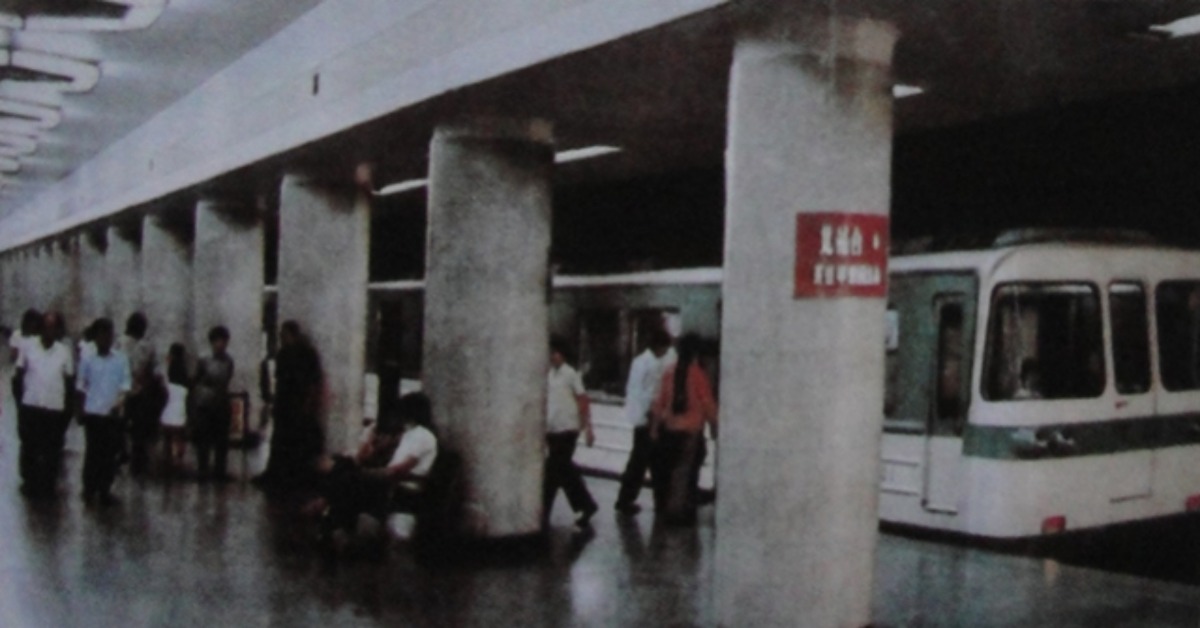
The legacy of this Cold War paranoia is in the physical structure of the network. The stations built during this era, such as Military Museum and Gongzhufen, possess wide, austere platforms designed to marshal soldiers rather than commuters. The absence of escalators in the original design was not an oversight a calculation; mechanical lifts were seen as vulnerabilities in a power-outage scenario. Stairs were reliable. It was only in 1981, after the normalization of domestic politics and the waning of immediate invasion threats, that the Beijing Subway Company was established, and the system was handed over for genuine public use. Even then, the blast doors remained, silent sentinels waiting for a war that never came.
Restricted Access: Military Control and the 1969 Completion
The Beijing Subway did not begin as a public utility. It began as a bunker. "Project 401," the initial phase of construction was a classified military operation designed to ensure the survival of the central leadership during a nuclear exchange. In 1965, with the Sino-Soviet split intensifying and American involvement in Vietnam escalating, Mao Zedong issued a directive that prioritized defense over transport. The subway's primary function was to serve as an underground evacuation corridor, linking the politburo's residential compounds in the city center to the secure military command bunkers in the Western Hills. The movement of commuters was a secondary, almost irrelevant, consideration.
Construction commenced on July 1, 1965. The task fell to the People's Liberation Army (PLA) Railway Corps, specifically the 12th and 15th Divisions, alongside a massive conscripted civilian workforce. Unlike the deep-bore tunnels of the London Underground or the Moscow Metro, the Beijing system used a shallow cut-and-cover method. This engineering choice prioritized speed and cost necessitated the physical destruction of the surface terrain. The PLA engineers tore open the earth from Fuxingmen to the Beijing Railway Station, creating a trench that severed the city's arteries. This method allowed the Railway Corps to work with brutal efficiency, pouring concrete box structures directly into the open ground before burying them.
The deadline for completion was politically immovable: October 1, 1969, the 20th anniversary of the People's Republic of China. The pressure to meet this target resulted in a frantic pace of work that frequently bypassed safety. On the scheduled date, the line was declared "completed." Premier Zhou Enlai and other high-ranking officials took the inaugural ride, celebrating a triumph of socialist engineering. Yet, this opening was largely theatrical. The system was technically unstable, the signaling systems were primitive, and the stations were unfinished shells. The public remained barred from entry.
The fragility of the rushed construction became undeniable only six weeks later. On November 11, 1969, a catastrophic electrical fire broke out in the tunnel near Wanshou Lu. The blaze, ignited by a short circuit in the primitive wiring of the rolling stock, engulfed the train and the surrounding infrastructure. Official records from the time were suppressed, later declassified reports confirm that three people died and over 100 suffered injuries in the smoke-filled tunnel. The disaster exposed the lethal inadequacy of the system's ventilation and fire suppression capabilities. In response, Zhou Enlai placed the entire subway network under direct military control, ending any immediate plans for civilian operation.
For the decade, the Beijing Subway existed as a "ghost" system, operating in a state of suspended animation known as "trial operation." Between 1970 and 1976, the subway was managed by the PLA Subway Management Office. Access was strictly controlled. There were no ticket booths, no turnstiles, and no rush hours. To ride the subway, a citizen required a "Letter of Introduction" (jieshao xin) from their work unit (danwei). These letters were not transport passes; they were security clearances. A ride on the subway was treated as a political reward, a "visit" to a museum of technological achievement rather than a commute.
The experience of these sanctioned visitors differed radically from the modern passenger experience. Groups would be organized by their factories or government bureaus, marching in formation to the station entrances. Upon descending the marble staircases, designed with the high ceilings and chandeliers reminiscent of the Moscow Metro, they encountered a silent, cavernous space. The platforms were manned by uniformed soldiers. The trains themselves were the DK2 and DK3 models, manufactured by the Changchun Railway Vehicles factory. These cars were spartan, absence air conditioning and soundproofing. The screech of metal wheels on tracks was deafening, echoing off the concrete walls of the stations which doubled as air-raid shelters.
Timeline of Restricted Operations (1969, 1981)
Date
Event
Status
Oct 1, 1969
Ceremonial Completion
Closed to public. VIPs only.
Nov 11, 1969
Wanshou Lu Fire
System shutdown. PLA assumes full control.
Jan 15, 1971
Trial Operation Begins
Restricted. "Letter of Introduction" required.
1971, 1975
Political Closures
Frequent shutdowns (398 days total) for "war prep."
1976
Tangshan Earthquake
Used as emergency shelter.
Sept 15, 1981
Commercial Operation
Handover to Beijing Municipality. Public ticketing.
The stations built during this period, such as Gucheng and Pingguoyuan, were designed with dual-use specifications. Heavy blast doors, capable of withstanding the overpressure of a nuclear detonation, were installed at tunnel portals and station entrances. Gas filtration systems were in the ventilation shafts to scrub the air of radioactive or chemical contaminants. The line extended west into the restricted military zones of the Western Hills, terminating at Fushouling (Station 53) and Gaojing (Station 54), stations that were never intended for the public and remain largely inaccessible or defunct in 2026. These ghost stations served the barracks and command centers, cementing the line's role as a military supply route.
Foreign dignitaries visiting Beijing in the early 1970s were frequently taken on subway tours to showcase Chinese industrial capability. These tours were carefully choreographed. The trains ran on schedule, the stations were spotless, and the "passengers" were frequently vetted cadres instructed to act naturally. This facade hid the reality that the system was plagued by technical failures and remained a financial black hole for the central government. The PLA struggled to maintain the rolling stock, and the absence of a commercial revenue stream meant that the subway was entirely dependent on state subsidies.
The transition from military bunker to public transit began only after the death of Mao and the arrest of the Gang of Four. In 1976, during the Tangshan earthquake, the subway's structural integrity was tested, and it served as a temporary shelter for residents, proving its civil defense utility. Yet, full demilitarization took another five years. It was not until September 15, 1981, that the Beijing Subway Company was officially established, and the system was handed over to the Beijing Municipal Government. Control passed from the PLA Railway Corps to civilian administrators, and for the time, a resident of Beijing could purchase a ticket without a letter of political recommendation.
The legacy of Project 401 remains visible in the system's DNA. The layout of Line 1 and the loop of Line 2 are defined by these Cold War imperatives. The depth of the stations, the width of the platforms, and the heavy concrete architecture of the older stops testify to their original purpose. Even in 2026, as the network expands into a sprawling web of automated lines, the core arteries of the Beijing Subway operate inside the hardened shell of a 1960s shelter.
Stagnation Period: Fiscal Deficits and Slow Growth (1981, 2000)
Project 401: Cold War Defense and Soviet Technical Aid
The era of military-grade urgency in 1981. For the two decades, the Beijing Subway entered a state of suspended animation, paralyzed by a collision between the city's exploding population and a central government that had turned off the financial tap. Between 1981 and 2000, the network grew at a glacial pace, adding track mileage with agonizing slowness while the streets above descended into gridlock. In 2026, the capital's subway system measures over 800 kilometers, a sprawling machine that devours commuters by the millions. Yet, at the turn of the millennium, after thirty years of operation, the entire network consisted of only 54 kilometers of track. This "Lost Decade" of the 1990s was not a failure of engineering, a failure of economics. The transition from a civil defense shelter to a public utility began officially on September 15, 1981, when the Beijing Subway Company took control from the military. The initial system was a confused hybrid, running a "horseshoe" service that forced passengers to transfer awkwardly between the incomplete loop and the east-west line. It took until December 28, 1987, to operationalize the "Circle Line" (Line 2). Engineers severed the track at Fuxingmen, creating two distinct services: the Line 2 loop, which traced the ghostly perimeter of the demolished Ming city wall, and Line 1, which ended abruptly at Fuxingmen. This 1987 restructuring was the period's only major triumph. It established the geometric logic of the modern map, it also marked the beginning of a long hibernation. For the five years, no new stations opened. Fiscal abandonment drove this stagnation. In the 1960s and 70s, the subway was a national defense priority, funded directly by the central government with blank checks signed by military planners. By the 1980s, the Reform and Opening Up policy shifted the focus to economic construction, and the subway lost its protected status. The central government ceased direct grants, forcing the Beijing municipality to adopt a "loans instead of grants" model. The city, absence the tax base to fund billion-yuan infrastructure projects, froze. The "Fu-Ba Line", the serious eastern extension of Line 1 from Fuxingmen to Bawangfen, remained a paper dream for years. It was only revived through foreign intervention. In 1991, Japan provided a low-interest Official Development Assistance (ODA) loan of 19. 2 billion yen, a humiliating need for a project that was once a symbol of self-reliance. Construction on the Fu-Ba line began in 1992, progress was anemic. The section from Fuxingmen to Xidan opened in December 1992, turning Xidan into a chaotic terminus for seven long years. Commuters arriving from the west were dumped at Xidan, forced to surface and fight their way onto overcrowded buses to reach the Central Business District. The tunnel boring machines sat idle or moved at a crawl, by funding absence and the complex geology under Chang'an Avenue. The "Great Leap Forward" spirit had been replaced by the "Great Wait." While the tunnels stalled, the subway administration attempted to solve its insolvency through the fare box. For decades, the ticket price had been a nominal 0. 10 RMB, a socialist entitlement. In 1984, it rose to 0. 20 RMB, and in 1991 to 0. 50 RMB. These increases were manageable. in 1996, facing a crushing deficit, the operator hiked the fare to 2. 00 RMB, a 300% increase overnight. The result was a statistical disaster. Ridership, which had peaked at 558 million in 1995, collapsed to 444 million in 1996. The subway, already too small to be useful for most residents, became too expensive for the working class. The trains ran emptier, while the Jetta and Citroën taxis on the surface roads multiplied, choking the city in smog. The rolling stock from this era reflected the stagnation. The DK-series trains, manufactured by the Changchun Railway Vehicles Company, were rugged, noisy, and devoid of creature comforts. They absence air conditioning, turning the underground tubes into saunas during the Beijing summer. The "resistor control" technology generated immense heat, which was vented directly into the tunnels and stations. Even in 2026, veteran commuters recall the sensory assault of the 1990s subway: the smell of ozone, the screech of metal wheels on tight curves, and the stifling heat that made a twenty-minute ride an endurance test. These trains remained in service long past their obsolescence, a rolling museum of the fiscal deficit. The deadlock broke only as the 50th anniversary of the People's Republic method. Political pressure overrode financial caution. The central and municipal governments scrambled to finish the Fu-Ba line in time for the October 1, 1999, celebrations. On September 28, 1999, the extension to Sihui East opened, connecting the western suburbs to the east and forming the modern Line 1. This pushed the total network length to roughly 54 kilometers. It was a frantic sprint to the finish line, it barely made a dent in the city's transport needs. By 2000, Beijing had over 13 million people, yet its subway system was smaller than that of cities with a fraction of its population. This period of neglect had one unintended consequence: it preserved the underground archaeology of the city center for a few more years. The aggressive digging that would characterize the post-2000 Olympic boom would later obliterate vast swathes of subterranean history. In the 1990s, yet, the earth remained mostly undisturbed. The foundations of Qing dynasty structures, which would later be ripped out for Lines 4, 5, and 10, slept safely beneath the gridlock. The stagnation ended not with a plan, with a bid. In 2001, Beijing won the right to host the 2008 Summer Olympics. The "Lost Decade" was swept away by a tsunami of state investment. the legacy of the 1981-2000 era remains visible in the system's DNA. The cramped stations of the old Line 1 and Line 2, with their narrow platforms and absence of elevators, are fossils of this austere time. They were built for a city of bicycles, not a megalopolis of 22 million. The deficit model established in the 1990s, where the subway requires massive subsidies to operate, became a permanent feature. The 2000 fare hike to 3. 00 RMB was the last gasp of the "user pays" philosophy before the city reverted to cheap fares and massive subsidies in 2007 to combat traffic. The 1990s proved that a city of Beijing's cannot build a transit system on a shoestring budget; the attempt to do so cost the capital twenty years of development.
The Olympic Mandate: Acceleration to 200 Kilometers (2001, 2008)
The International Olympic Committee's decision in Moscow on July 13, 2001, handed Beijing a deadline that permitted no failure. At that moment, the Chinese capital possessed a subway system that was, by global standards, skeletal. After thirty years of operation, the network consisted of only two lines, Line 1 and Line 2, totaling a mere 54 kilometers of track. To move the millions of spectators, athletes, and officials expected in August 2008, the city's planners had to do more than expand; they had to compress decades of normal infrastructure development into a seven-year window. The target was explicit: 200 kilometers of operational track before the opening ceremony. This period, from 2001 to 2008, functioned as a state-directed engineering sprint. The "Olympic Mandate" overrode financial caution and bureaucratic delay. Between 2002 and 2008, the municipal government directed approximately 63. 8 billion RMB (roughly $8 billion at the time) into subway construction. The strategy prioritized speed and surface coverage initially, then shifted to complex underground excavation for the city center. The results of this acceleration appeared above ground. Line 13, a horseshoe-shaped commuter rail looping through the northern suburbs, opened its western section in September 2002 and the full line in January 2003. It was a utilitarian project, largely elevated, designed to connect the sleeping quarters of Huilongguan and Tiantongyuan to the urban core. Following closely was the Batong Line in December 2003, an above-ground extension of Line 1 pushing east into Tongzhou. These lines were essential for suburban connectivity did not solve the congestion within the Third Ring Road. They were the easy wins, built where land was cheaper and demolition less politically sensitive. The true test of the mandate came with Line 5, the city's north-south vertical axis. Construction began in December 2002. Unlike the Soviet-style engineering of Lines 1 and 2, Line 5 required modern tunnel boring machines (TBMs) to navigate beneath the historic Dongcheng district. When it opened on October 7, 2007, it broke the long-standing east-west dominance of the network. It also introduced a radical policy shift: the 2 RMB flat fare. To force drivers out of cars and onto the rails, the government slashed ticket prices, eliminating the distance-based fare system. Ridership did not just grow; it exploded. The network, which carried around 434 million passengers in 2001, saw that figure nearly triple by the end of 2008. The rush to meet the August 8, 2008 deadline exacted a human price. The pressure to tunnel faster through Beijing's treacherous mix of sandy soil and high groundwater led to safety lapses. On March 29, 2007, the ground gave way at a construction site for Line 10 near Haidian Nanlu. The collapse buried six workers. In the immediate aftermath, project managers attempted to suppress the news, confiscating workers' mobile phones and sealing the site to prevent information from leaking to municipal authorities. The cover-up failed, and the incident exposed the dangerous velocity of the construction schedule. The dead were migrant laborers, the invisible force driving the city's expansion. Even with the tragedy, the pace did not slacken. The climax of the construction drive arrived on July 19, 2008, less than three weeks before the Games began. On this single day, Beijing opened three serious arteries: Line 10 (Phase 1), Line 8 (the Olympic Branch), and the Airport Express. Line 10 was the engineering centerpiece. Designed as the "second loop" to encircle the Line 2 loop, its phase formed an inverted "L" shape, running from the university district in Haidian, across the north, and down the eastern edge of the Chaoyang CBD. It intercepted traffic from every radial line, acting as a pressure valve for the entire network. Line 8, dubbed the "Olympic Branch," was a prestige project. Running just 4. 5 kilometers from Beitucheng to the South Gate of the Forest Park, it served the Bird's Nest and the Water Cube. For the duration of the Games, this line was a closed system, accessible only to those with Olympic accreditation or same-day event tickets. The stations were designed not just for transit as showpieces; Beitucheng station featured massive blue-and-white porcelain pillars, integrating traditional aesthetics with heavy infrastructure. The Airport Express completed the trifecta, linking Capital International Airport's new Terminal 3 to the city center in 20 minutes. Built at a cost of 5. 4 billion RMB, it used linear motor technology to reach speeds of 110 kilometers per hour, significantly faster than the standard subway fleet.
Beijing Subway Expansion: The Olympic Sprint (2001, 2008)
Year
Key Milestone
Network Length (approx.)
Notes
2001
Olympic Bid Win
54 km
Only Line 1 and Line 2 operational.
2002
Line 13 (West) Opens
75 km
surface commuter rail.
2003
Line 13 (Full) & Batong
114 km
Expansion into northern and eastern suburbs.
2007
Line 5 Opens
142 km
North-South axis; 2 RMB flat fare introduced.
2008
Lines 10, 8, Airport Exp.
200 km
Opened July 19, just before the Games.
By August 2008, Beijing had met its target. The network length touched 200 kilometers. The system had evolved from a relic of Cold War defense into a modern mass transit grid. The 2 RMB fare policy, combined with the new lines, caused daily ridership to surge, hitting a record 4. 92 million on August 22, the day of the closing ceremony. The 2001, 2008 era established the template for Chinese infrastructure development: set an impossible target, mobilize state capital, accept high human and financial costs, and deliver the result on the scheduled day. The "Olympic Loop" of Line 10 and the vertical stroke of Line 8 did more than serve the Games; they permanently altered the geography of the city. The subway was no longer just a way to move under the city; it became the primary method for the city to function. The sheer of the 2008 expansion made the subsequent explosion of the network in the 2010s possible, proving that the earth beneath Beijing could be conquered if the political was absolute.
Engineering Geology: Tunneling Through Alluvial Fans and Groundwater
Restricted Access: Military Control and the 1969 Completion
The engineering history of the Beijing Subway is a war against the Yongding River. While the city's surface reflects centuries of imperial planning, the subterranean reality is a chaotic deposit of loose sediment, known geologically as the Yongding alluvial fan. Unlike the granite bedrock of Manhattan or the stiff clay of London, Beijing sits upon a deep, unstable cake of silty clay, powdery sand, and river pebbles. This geological profile, formed over millennia by the wandering courses of the Yongding and Chaobai rivers, dictates every decision in the subway's expansion. From 1700 to the present, the behavior of this soil has been governed by a single variable: the water table.
To understand the tunneling risks of 2026, one must examine the hydrological baseline of the Qing Dynasty. In the 18th century, Beijing was a city of springs and surface water. The water table sat meters the dust, feeding the moat system and the lakes of the Summer Palace. When the subway engineers broke ground for Line 1 in 1965, they encountered this water-saturated soil immediately. absence the advanced shield tunneling technology capable of pressurizing the face of a bore, the early builders had no choice to use the cut-and-cover method. They sliced open Chang'an Avenue, drained the trench, and poured concrete boxes in the open air. This was not a military decision to prioritize speed; it was a geological need. Tunneling blindly through the wet, sandy slurry of the alluvial fan with 1960s equipment would have resulted in catastrophic collapses.
The equation changed violently between 1970 and 2010. As Beijing's population exploded and industry demanded resources, the city drank its own foundation dry. Thousands of unregulated wells punctured the aquifers, drawing the water table down from 5 meters to over 30 meters deep. This created a massive "cone of depression" beneath the capital. For subway construction, this ecological disaster provided a temporary, accidental advantage. Tunnels for Lines 10, 4, and 5 could be bored through soil that had dried out, reducing the risk of water inrush. Yet, this desiccation came at a structural cost: subsidence. As the water withdrew, the pore space in the soil collapsed, causing the city to sink. In the eastern districts of Chaoyang and Tongzhou, land subsidence rates exceeded 110 millimeters per year during the peak of extraction. The subway network, a rigid concrete web, began to suffer from differential settlement, forcing engineers to install adaptive track beds capable of absorbing the ground's slow-motion deflation.
The construction of stations in this loose soil required a specific innovation, distinct from the deep-bore methods used in the West. Chinese engineers, led by figures such as Wang Mengshu, perfected the Pile-Beam-Arch (PBA) method, also known as the Shallow Buried Undercutting method. This technique was designed specifically for Beijing's "upper-soft, lower-hard" strata. Instead of excavating a massive pit that would destroy surface buildings, workers dig small pilot tunnels to insert steel pipe piles and concrete beams underground. These elements form a protective skeleton before the main station cavern is hollowed out. The PBA method allowed the subway to expand under the dense hutongs and skyscrapers of the Second Ring Road without disturbing the structures above. By 2020, this method had become the standard for station construction in the capital's silty clay.
The geology, yet, retains its ability to destroy. The primary enemy of the shield tunneling machines used for the running tunnels is the pebble found at the apex of the alluvial fan, particularly in the west near Shijingshan and Haidian. These are not small stones; they are river-rounded boulders capable of smashing the tungsten carbide cutters of a tunnel boring machine (TBM). On Line 10 and Line 14, engineers reported excessive wear, with cutterheads requiring replacement every few hundred meters. In 2008, the soil exacted a deadly toll at the Suzhou Jie station on Line 10. The excavation hit a pocket of "dead water" and loose sandy fill, remnants of a 1950s pond that had been casually filled with garbage and earth. The ground liquefied, collapsing the tunnel and killing six workers. This incident ended the era of underestimating the shallow alluvial.
By 2026, the hydrological pattern turned once again, introducing a new threat: the Great Rebound. The South-to-North Water Transfer Project, fully operational since late 2014, began pumping billions of cubic meters of Yangtze River water into Beijing. The municipal government also aggressively closed private wells to let the aquifers recover. The result was a rapid rise in the water table. In areas, groundwater levels rose by 10 to 15 meters between 2015 and 2025. Tunnels that were engineered for the dry soil conditions of the early 2000s are submerged in a rising saturated zone. This resurgence exerts immense hydrostatic pressure on the concrete linings of Lines 6 and 7, leading to increased risks of seepage and corrosion. The soil, once shrinking, is expanding, creating uplift forces that challenge the stability of the deep-level tunnels.
The deepest lines, such as Line 19 and the express lines built in the 2020s, face the most extreme conditions. Boring at depths of 40 to 50 meters, these tunnels navigate the interface between the Quaternary sediments and the bedrock. Here, the pressure is highest, and the risk of encountering confined aquifers, pressurized water trapped between clay , is severe. Modern TBMs in Beijing are equipped with hyper-sensitive sensors to detect changes in soil density and moisture milliseconds before the cutterhead strikes. The "Smart Water" monitoring system, integrated into the subway's maintenance grid in 2024, tracks groundwater depth in real-time across 500 points along the network, predicting where the rising water might destabilize the track geometry.
The alluvial fan remains the arbiter of the subway's safety. In the western districts, the gravel beds act as a sieve, allowing water to move rapidly and unpredictably. In the east, the thick clay trap water, creating pockets of high pressure that can blow out a tunnel face if not balanced correctly by the TBM's slurry system. The construction of the Line 22 (Pinggu Line) and the extensions into Hebei province have forced engineers to map these underground rivers with the same precision used for surface streets. The ground is not static; it is a living fluid medium that breathes with the city's water consumption. The stability of the Beijing Subway in 2026 depends not just on concrete and steel, on the delicate management of the water that flows through the pulverized bones of the Yongding River's ancient route.
Signaling Modernization: Moving Block Systems and Automation
The history of the Beijing Subway is not a chronicle of tunnel boring and concrete pouring. It is equally a history of the invisible architecture that governs movement. For the three decades of its existence, the subway relied on the "fixed block" system, a methodology rooted in 19th-century railway physics. In this analog era, the track was sliced into physical segments defined by insulated joints in the rails. A train occupying a block turned the signal behind it red, creating a rigid brick wall of safety that no following train could breach. This system, while safe, was spatially wasteful. It demanded large buffers of empty air between carriages, capping the frequency of Line 1 and Line 2 to a mechanical limit that could not handle the population explosion of the early 2000s.
The modernization of this nervous system began in earnest with the preparation for the 2008 Summer Olympics. Beijing planners recognized that concrete tunnels alone could not move millions of spectators; they needed higher density. The solution was Communications-Based Train Control (CBTC), a technology that replaces physical blocks with digital calculations. Under CBTC, the train does not rely on track circuits to know its position. Instead, it broadcasts its exact location, speed, and braking curve to a central computer via radio. The computer calculates a "protection envelope", a safety bubble that moves with the train. This shift from "fixed block" to "moving block" allowed the safety buffer to shrink from hundreds of meters to a distance that adjusts in real-time. If a leading train speeds up, the following train can accelerate immediately. The rigid brick wall became a flexible tether.
The implementation of CBTC in Beijing occurred in distinct geopolitical phases. The phase was dominated by foreign technology transfers. When Line 10 opened in 2008 to serve the Olympic loop, it used a system supplied by Siemens. This German technology allowed Line 10 to eventually achieve headways, the time interval between trains, of just 100 seconds, a density impossible under the old fixed-block regime. For nearly a decade, foreign giants like Siemens and Alstom (through its joint venture CASCO) provided the brains for Beijing's brawn. They held the proprietary keys to the algorithms that kept trains from colliding at 80 kilometers per hour.
The second phase marked a sharp pivot toward technological sovereignty. The launch of the Yanfang Line on December 30, 2017, represented a deliberate break from foreign dependence. This 14. 4-kilometer line in the southwestern suburbs was the in China to run on a fully domestic automated signaling system, developed by the Beijing-based Traffic Control Technology (TCT). The Yanfang Line was not just a transit project. It was an industrial proof-of-concept. It operated at Grade of Automation 4 (GoA4), the highest international standard. GoA4 means Unattended Train Operation (UTO). There is no driver in the front cab. There is no cab. The train wakes itself up, runs safety checks, enters the main line, serves passengers, and returns to the depot to sleep, all without human intervention. The success of the Yanfang Line broke the monopoly of foreign signaling firms and validated TCT as a primary supplier for future expansion.
The most dangerous engineering feat, yet, was not building new lines lobotomizing the old ones. Between 2014 and 2015, engineers performed a "heart transplant" on Line 1. They had to replace the antiquated fixed-block system with CBTC without shutting down the busiest subway line in the capital. The work occurred in a narrow window between 12: 30 AM and 3: 30 AM. Engineers installed new transponders and radio masts by night. By day, the trains ran on the old system, while the new computer ran in "shadow mode" in the background, mirroring the operations to prove its reliability. When the switch was thrown, the capacity of Line 1 jumped instantly. The interval between trains dropped from 2 minutes 5 seconds to under 2 minutes, a fractional gain that to thousands of additional passengers per hour.
By 2026, the integration of GoA4 automation has moved from the experimental Yanfang Line to the arterial core of the network. New high-speed express lines, such as Line 17 and Line 19, were designed from the outset for driverless operation. Line 19, which acts as a "subway within a subway" by skipping minor stations to connect financial centers, uses this automation to maintain high speeds in deep tunnels. The removal of the driver's cab frees up space for passengers and eliminates the variable of human reaction time. The computer does not hesitate. It brakes at the last mathematically safe moment and accelerates with optimal energy efficiency.
The operational data from 2025 and early 2026 confirms the efficacy of these upgrades. The network operates with headways that rival or exceed the most systems in Moscow and Tokyo. The following table illustrates the progression of signaling capabilities across key lines, contrasting the legacy constraints with current performance metrics.
Beijing Subway Signaling Evolution (1980, 2026)
Line
Original System
Current System (2026)
Automation Level
Min. Headway (Peak)
Line 1
Fixed Block (Analog)
CBTC (Retrofit)
GoA2 (ATO)
1 min 45 sec
Line 2
Fixed Block (Analog)
CBTC (Retrofit)
GoA2 (ATO)
2 min 00 sec
Line 10
CBTC (Siemens)
CBTC (Upgraded)
GoA2 (ATO)
1 min 40 sec
Yanfang
Domestic CBTC (TCT)
Domestic CBTC
GoA4 (Driverless)
3 min 30 sec*
Line 19
Domestic CBTC
Domestic CBTC
GoA4 (Driverless)
2 min 30 sec
Daxing Airport
Domestic CBTC
Domestic CBTC
GoA4 (Driverless)
4 min 00 sec
*Note: Yanfang Line headway is limited by passenger demand, not technical capacity.
The shift to moving block systems also introduced a vulnerability unknown in the 20th century: software failure. In the fixed block era, a failure meant a light stayed red and trains stopped. In the CBTC era, a communication loss between the train and the wayside radio renders the train "invisible" to the system. To mitigate this, Beijing maintains a secondary of axle counters, physical sensors on the track that can crudely detect a train's presence if the radio link dies. This redundancy prevents the nightmare scenario of a "ghost train" disappearing from the control center's screens. The system is a complex stack of digital logic sitting atop the physical reality of steel wheels on steel rails.
As of March 2026, the Beijing Subway operates as a hybrid organism. The oldest lines run on retrofitted tech that mimics the performance of the newest lines. The newest lines run on code written in Beijing, executed by chips manufactured in China, monitored by algorithms that learn from the daily flow of 13 million passengers. The driver is no longer the guarantor of safety. The code is. The train has become a peripheral device in a city-sized operating system.
Passenger Volume Metrics: Crush Loads and Flow Restrictions
Stagnation Period: Fiscal Deficits and Slow Growth (1981, 2000)
The metric that defines the Beijing Subway in 2026 is not track length, density per square meter. While the system's expansion to 909 kilometers by late 2023 and further additions through 2026 cemented its status as the world's longest, the passenger experience is defined by the "crush load." In transit engineering, a standard standing capacity is frequently calculated at four passengers per square meter. On the Beijing Subway during morning peaks, this figure frequently exceeds six. The system does not transport the population; it compresses it. Daily ridership, which hovered near zero during the restricted military-only operations of the early 1970s, stabilizes between 10 million and 12 million per day, with single-day records piercing the 13. 75 million mark set in July 2019.
This volume creates a hydrodynamic pressure within the tunnels. To manage it, the Beijing Municipal Commission of Transport uses a strategy known as xianliu, or "current limiting." This is not a suggestion a physical blockade. At stations like Tiantongyuan North on Line 5, the restriction begins hundreds of meters outside the entrance. Here, metal barricades form a labyrinthine "snake" queue that forces commuters to walk hundreds of extra meters in a compressed zigzag before reaching the turnstiles. This architecture of control serves a dual purpose: it organizes the mob and artificially throttles the intake speed to prevent the platforms from becoming lethal. In 2019, 91 stations enforced these permanent flow restrictions. By 2025, network optimization reduced the number of "regular" restriction stations to five serious bottlenecks, yet the temporary deployment of these metal cages remains a standard morning ritual across the network.
The history of this crush is rooted in the fare policy of the pre-Olympic era. From 2007 to 2014, Beijing maintained a flat fare of 2 RMB (approximately $0. 30), a decision that democratized travel catalyzed an explosion in ridership that outpaced infrastructure growth. In 1995, annual ridership was 558 million. By 2008, fueled by the 2 RMB fare and the Olympic opening of Lines 10 and 8, it surged to 1. 2 billion. The flat fare created a perverse incentive for long-distance commuting, encouraging the development of "sleeper cities" like Tiantongyuan and Huilongguan far from the city center. The result is a migration: millions flow south into the Third Ring Road before 9: 00 AM and flow north after 6: 00 PM, placing extreme stress on north-south arteries like Line 5 and Line 13.
Military/Official use only. Letter of introduction required.
1995
1. 5
Limited network (Lines 1 & 2). Ticket price high relative to income.
2008
3. 2
Olympic expansion. 2 RMB flat fare era begins.
2013
8. 7
Peak of the 2 RMB era. Severe overcrowding.
2019
10. 8
Pre-pandemic peak. Record day: 13. 75M.
2023
9. 4
Post-pandemic recovery. Line 10 alone carries ~1. 3M.
2025
11. 2
Network length exceeds 900km. Saturation returns.
Nowhere is the physics of this migration more visible than at Xierqi Station. Situated at the intersection of Line 13 and the Changping Line, Xierqi serves the Shangdi Information Industry Base, a cluster of technology giants. Between 8: 30 AM and 9: 30 AM, the station processes over 25, 000 passengers per hour. The transfer corridors function as pressurized valves. Commuters do not walk; the crowd carries them. Viral footage from this station frequently shows passengers being physically pushed into carriages by platform staff or fellow travelers to allow the doors to close. The "Xierqi Stance", backpack worn on the front, arms pinned to sides, feet lifting off the floor, is a necessary survival adaptation. Even with the opening of the parallel Line 19 and improvements to the Changping Line in 2023 and 2024, the sheer density of employment in the district maintains the pressure.
Security checkpoints act as the final throttle. Unlike subway systems in New York or London, every passenger in Beijing must pass their belongings through X-ray scanners. While ostensibly for counter-terrorism, a protocol hardened after 2008 and the 2014 Kunming attacks, these checkpoints function as flow control valves. During peak surges, security staff slow the conveyor belts or conduct more manual wand checks. This deliberate creates a buffer zone, holding passengers in the concourse to prevent platform overcrowding. The "security theater" is thus an integral component of the crowd control algorithm, converting a safety risk (overcrowded platforms) into a frustration cost (waiting in line).
The 2026 network attempts to address these crush loads not through expansion alone, through digitization. The "Mobility-as-a-Service" (MaaS) platforms, integrated with apps like Alipay and WeChat, provide real-time "carriage crowding" indicators. Green, yellow, and red icons signal the density of method trains. Yet, for the commuter at Tiantongyuan at 7: 30 AM, this data is academic. A red indicator does not offer an alternative; it confirms the physical reality that awaits. The subway has solved the problem of distance in a city of 21 million, it has not solved the problem of space. The tunnels of the Qing dynasty fortifications were built to keep people out; the tunnels of 2026 are built to move them in, and the walls of the train car are the new city limits.
Economic Model: Operating Subsidies and Distance-Based Fares
The financial architecture of the Beijing Subway represents one of the most aggressive state-led interventions in urban transport history. While the Qing Dynasty (1644, 1911) left transportation to a fragmented market of private cart guilds and sedan chair operators who charged strictly by distance and negotiation, the modern Communist state inverted this logic entirely. For seven years between 2007 and 2014, the capital operated under a radical economic experiment: the 2 RMB flat fare. This policy decoupled the cost of travel from the distance traveled. A passenger could traverse the entire 400-kilometer network for the price of a single bottle of water. This decision was not an economic calculation. It was a political instrument designed to clear surface traffic for the 2008 Olympics and force a modal shift toward rail.
The 2 RMB era achieved its ridership goals inflicted catastrophic damage on the system's balance sheet. By 2013, the flat fare covered less than 20 percent of operating costs. The municipal government was forced to inject massive liquidity to keep the trains running. Data from the Beijing Finance Bureau shows that in 2013 alone, the operating subsidy reached 18. 1 billion RMB. This figure exceeded the city's entire budget for healthcare or education in certain districts. The subway had become a fiscal black hole. Every new line opened to relieve congestion widened the operating deficit. The system was paying residents to ride. The average cost to transport a passenger was nearly 9 RMB, yet the farebox recovered only 2 RMB.
Reality returned on December 28, 2014. The municipal government abolished the flat fare and introduced a distance-based pricing schedule. The base fare rose to 3 RMB for the 6 kilometers, with incremental increases capping at much higher rates for cross-city commutes. This reform was intended to the gap between revenue and the soaring costs of electricity, maintenance, and labor. The immediate impact was a stabilization of the subsidy load, yet the deficit remained structural. Even with higher fares, the system could not break even. By 2022, the cost per passenger had ballooned to approximately 14 RMB due to pandemic-related ridership drops and increased sanitation, while the average fare revenue per passenger hovered around 4 to 5 RMB.
A unique cost driver distinguishes Beijing from its peers in London or New York: the price of security theater. Following the 2008 Olympics and subsequent security tightenings, Beijing mandated airport-style X-ray checks at every station entrance. This requirement created a massive recurring expense for manpower and equipment. In 2022, security-related expenditures accounted for over 11 percent of total operating costs, amounting to roughly 1. 7 billion RMB annually. An army of more than 30, 000 security guards mans these checkpoints. This expenditure produces zero transport value and generates no revenue. It is a political tax levied on the system's efficiency.
The entity at the center of this financial storm is the Beijing Infrastructure Investment Co. Ltd. (BII). BII acts as the financing vehicle for the city's rail expansion. By 2024, BII reported total assets exceeding 927 billion RMB, a figure comparable to the GDP of a small nation. Yet this asset base is built on a mountain of debt. BII borrows heavily from state banks to fund construction, relying on government land grants and future subsidies to service the interest. The "Rail + Property" model, successfully pioneered by Hong Kong's MTR Corporation, has been adopted only partially. While MTR Corporation operates Line 4, Line 14, and Line 16 through public-private partnerships (PPP), the majority of the network remains under the direct, loss-making control of state-owned operators.
Beijing Subway Financial Metrics (Selected Years)
Year
Fare Structure
Annual Subsidy (Approx.)
Cost Per Passenger
Primary Economic Driver
2007
2 RMB Flat
< 1 Billion RMB
Low
Olympic Preparation
2013
2 RMB Flat
18. 1 Billion RMB
~8-9 RMB
Loss-Leader for Traffic Control
2015
Distance-Based
~13 Billion RMB
~8 RMB
Cost Recovery Reform
2022
Distance-Based
> 20 Billion RMB
~14 RMB
Pandemic Stabilization
2023
Distance-Based
25. 34 Billion RMB
High
Debt Service & Operations
The financial outlook for 2025 and 2026 remains precarious. The Beijing municipal government faces increasing pressure from the central government to reduce local debt risks. The era of unlimited infrastructure spending is ending. In 2023, the Beijing Metro received a 25. 34 billion RMB in subsidies to report a "net profit" of 2. 4 billion RMB. Without this transfer, the system would have posted a loss exceeding 20 billion RMB. The between the operational excellence of the network and its financial insolvency is the defining characteristic of the modern era. The system provides world-class mobility at third-world prices, funded by a level of state debt that future generations must service. The 2026 projection suggests a push toward automation and reduced staffing to curb the wage bill, yet the security apparatus ensures that the subway remain a labor-intensive, state-subsidized utility rather than a self-sustaining business.
Security Architecture: Checkpoints and Digital Monitoring
The Olympic Mandate: Acceleration to 200 Kilometers (2001, 2008)
The philosophy of access control in Beijing has remained static for three centuries; only the method has shifted from masonry to biometrics. In 1700, the Nine Gates of the Inner City functioned as the capital's respiratory valves. Deshengmen filtered military regiments; Chaoyangmen admitted grain barges; Xizhimen accepted water carts from the Jade Spring. The Qing Dynasty (1644, 1911) enforced a rigid schedule where these portals slammed shut at the sounding of the drum tower, sealing the city until dawn. Modern subway security architecture mimics this imperial choke-point strategy. The turnstile arrays of 2026 serve the same function as the portcullis: to reduce a chaotic population into a single, scannable file. The transformation of the Beijing Subway from a transport utility into a security apparatus began on June 29, 2008. Prior to the Summer Olympics, passengers entered stations with the casual anonymity found in New York or London. The "temporary" measures installed for the Games, X-ray machines for bags and magnetic wands for bodies, never left. By 2010, the equipment was bolted to the floor, and the checkpoints became a permanent architectural feature. This decision fundamentally altered the flow of the city. During rush hour at Tiantongyuan North, the queue to reach the security checkpoint frequently extends outside the station, creating a pedestrian reservoir that adds twenty minutes to the daily commute. The human cost of this physical firewall is quantifiable. Financial disclosures from Beijing subway operators reveal that in 2022 alone, security expenses totaled 1. 64 billion yuan ($225 million). This figure represents approximately 11 percent of the network's total operating cost, a sum roughly equal to the system's entire utility bill. An army of over 30, 000 security personnel, frequently migrant workers in ill-fitting uniforms, staff these checkpoints. They perform a ritualistic theater of security, waving handheld metal detectors over millions of torsos daily. While the efficacy of these manual checks against sophisticated threats is debated by security analysts, their ability to intercept "low-level" prohibited items is absolute. In 2024, authorities confiscated thousands of liters of *baijiu* (white liquor) exceeding the 2, 000-milliliter limit, alongside vast quantities of hairspray, scissors, and construction tools.
Era
Control method
Primary Target
Processing Speed
Qing Dynasty (1700-1911)
City Gates (e. g., Deshengmen)
Carts, Grain, Military
Manual inspection, sun-up to sun-down
2008-2018
X-Ray & Wand Checkpoints
Bags, Liquids, Metals
15-30 seconds per person (high friction)
2019-2026
Biometric & Credit Whitelists
Identity, Digital History
Milliseconds (frictionless for approved users)
As the physical labor of security became prohibitively expensive and slow, the system pivoted toward digital surveillance. In 2019, the Fuchengmen station initiated a trial of "passive" security checks using facial recognition. Cameras positioned at the entrance capture the biometric data of method passengers. Those on a pre-approved "white list", commuters with high social credit scores and clean police records, are permitted to bypass the bag check entirely. This system monetizes privacy for speed; the passenger trades their biometric autonomy to shave ten minutes off their morning commute. By May 2023, the biometric dragnet expanded to the Daxing Airport Express with the introduction of palm-scanning technology. Developed in partnership with Tencent's WeChat Pay, the turnstiles read both the palm print and the vein patterns beneath the skin. This "Palm Pass" system links the biological hand directly to a bank account and a government ID. Unlike a transit card, which can be lent to a friend, or a QR code, which requires a battery-charged phone, the palm is immutable. In 2026, this technology is standard at major interchange hubs. The turnstile does not open; it verifies identity, deducts funds, and logs the traveler's location in the Golden Shield database simultaneously. The integration of security cameras within the subway network has reached saturation. Estimates from 2025 suggest the Beijing Subway contains over 40 cameras per 1, 000 people in transit areas, a density higher than most prisons. These are not passive recording devices. They use AI-driven behavioral analysis to detect "abnormal" movements, such as loitering, running, or crowding. The data feeds into the broader "Sharp Eyes" project, which aims to achieve 100% video coverage of public spaces. A passenger traveling from Guomao to Xidan is tracked across multiple nodes: facial scan at entry, gait analysis on the platform, and palm scan at exit. This digital architecture creates a binary class system of mobility. The "trusted" traveler moves through the city with fluid ease, their face and hand acting as keys that unlock the gates. The "untrusted", those with low credit scores, petitioners, or those on specific watchlists, face a different reality. They are funneled into the "manual check" lanes, subjected to enhanced scrutiny, and frequently denied entry. The subway has thus evolved from a public utility, open to all who can pay the fare, into a conditional privilege granted by the state's security algorithms. The prohibited items list has also expanded to reflect a desire for total order. Beyond weapons and explosives, the ban encompasses items that threaten the "atmosphere" of the station. Balloons are forbidden due to the risk of floating into overhead power lines. Electric bicycles, once a common last-mile solution, were banned in 2021 due to fire risks. Even "strange attire" or makeup that might "cause onlookers to gather" can be grounds for denied entry, a rule frequently used to disperse cosplayers or protesters. The subway station is no longer just a transit hub; it is a sanitized zone where behavior, appearance, and possessions are strictly regulated. In the 21st century, the walls of Beijing are no longer made of grey brick. They are invisible lines of code and infrared sensors. The Line 2 loop, sitting in the footprint of the old Ming fortifications, is once again a defensive perimeter. where the Qing guards looked outward for invaders, the modern security architecture looks inward at the passengers themselves. The checkpoint is the defining experience of the Beijing Subway, a daily reminder that in the capital, movement is never truly free.
Rolling Stock: From DK1 Prototypes to Robotic Trains
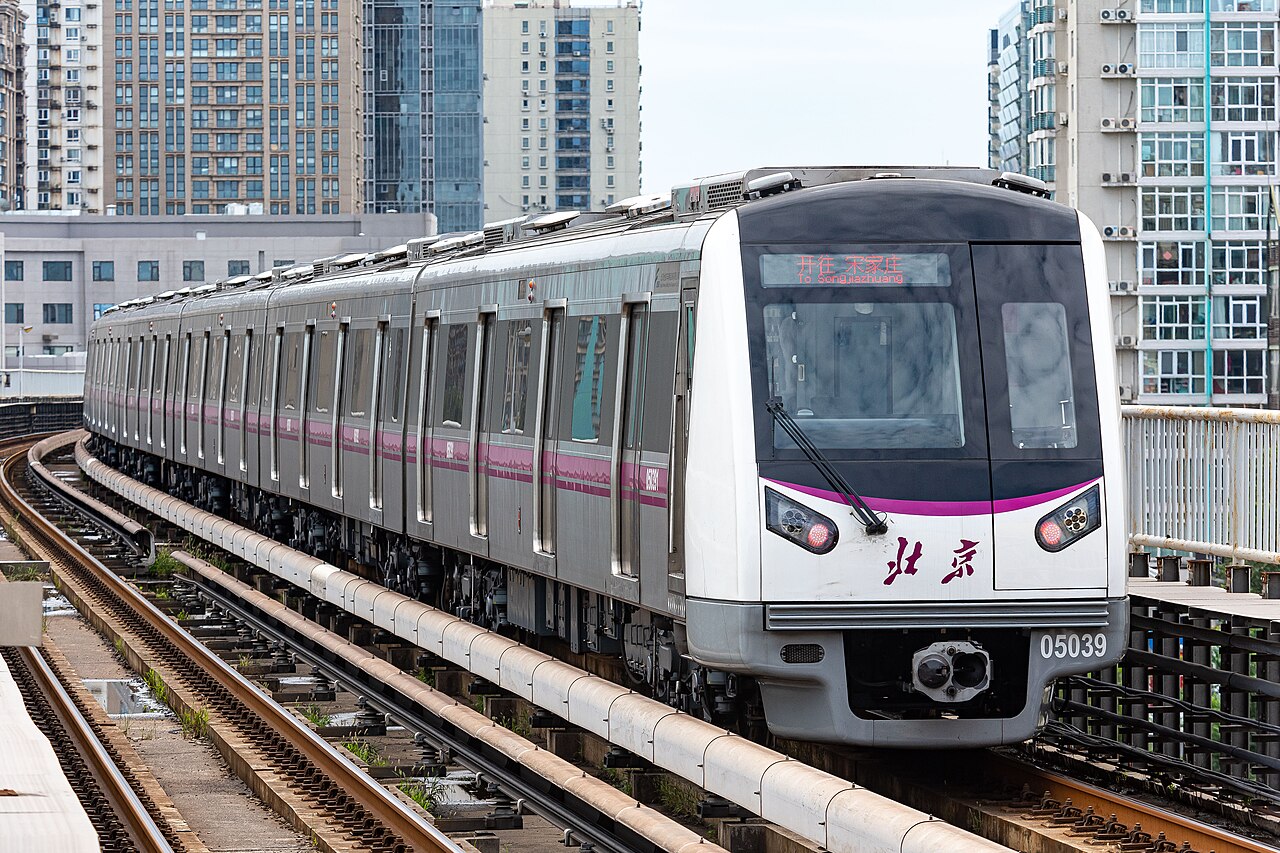
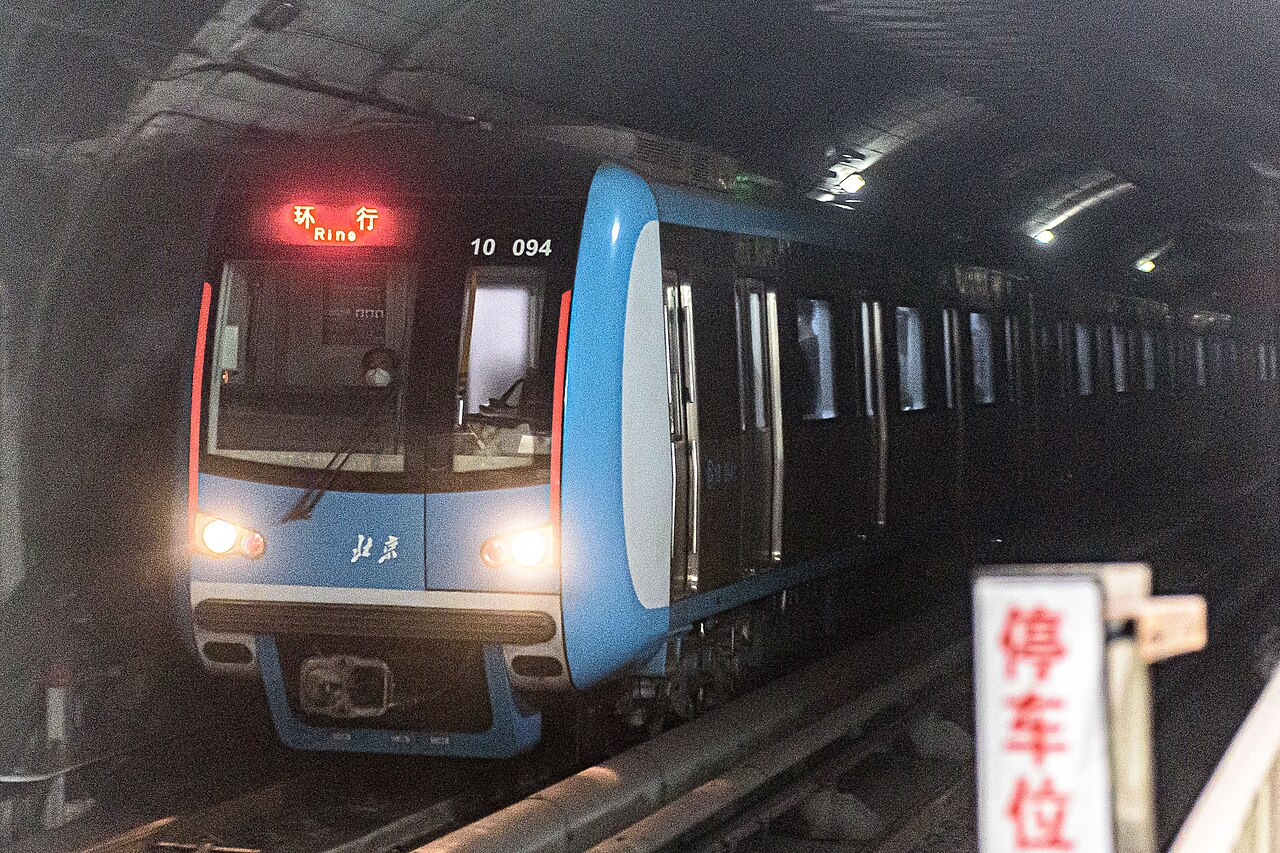
The history of Beijing's rolling stock is a timeline of industrial velocity, accelerating from the sedan chairs of the Qing Dynasty to the autonomous robotic fleets of 2026. For over two centuries (1700, 1900), the capital's "rolling stock" consisted of wooden carts and human muscle, moving at the speed of a walking man. By 2026, the city's subterranean arteries are pulsed by thousands of intelligent, driverless cars capable of speeds up to 160 kilometers per hour, making decisions without human intervention. The genesis of this mechanical fleet was the **DK1**, a secret military prototype produced in 1967 by the Changchun Passenger Car Factory. It was a crude, boxy machine, painted with a cream upper body and green lower band, designed less for passenger comfort than for the grim need of Cold War evacuation. The DK1 never saw mass service; it was a proof of concept that China could build a subway car. Its successors, the **DK2** and **DK3** models of the 1970s and 80s, defined the passenger experience for a generation: sweltering "sauna trains" with no air conditioning, relying on roof fans that churned hot, stagnant tunnel air. These cars used rheostatic control systems, which dissipated excess energy as heat, further raising the temperature in the stations. The technological pivot point arrived in the late 1990s with the **DKZ4** trainsets for Line 1. These were the to use Variable Voltage Variable Frequency (VVVF) inverters, a shift from the jerky, heat-generating resistance controls to smoother, energy- AC traction. This transition marked the end of the "military tunnel" era and the beginning of the modern mass transit age. The 2008 Olympics acted as a accelerant, forcing the retirement of the obsolete, fan-cooled fleets and introducing the **DKZ5** and **SFM04** series, stainless steel, air-conditioned, and equipped with passenger information systems. By 2017, the trajectory shifted from modernization to automation. The **Yanfang Line** became the in China to operate with Grade of Automation 4 (GoA4), the highest level of international standards. These trains have no driver's cabs; they wake up, run diagnostics, wash themselves, operate the daily schedule, and return to the depot entirely on their own. This technology, initially a pilot on a suburban feeder line, became the standard for the city's major arteries. In 2026, the "Smart Train" is the dominant species in the Beijing underground. Lines 12, 17, and 19 operate fully automated fleets that integrate into a city-wide digital twin system. These vehicles are not just transport pods; they are roving sensor platforms. They use LiDAR and high-resolution cameras to inspect the tracks in real-time, detecting hairline fractures in the rails before they become failures. The passenger experience has also been digitized. The windows on the newest **Chinese Standard Smart Urban Rail Transit Vehicles** are transparent OLED displays. As the train moves through the tunnel, these screens overlay route information, transfer updates, and news feeds directly onto the glass, creating an augmented reality interface for the commuter. The maintenance regime has moved from reactive to predictive. In the 1980s, a train was fixed when it broke. In 2026, onboard AI algorithms analyze terabytes of telemetry data, motor temperature, door pattern times, vibration patterns, to predict component failures weeks in advance. This shift has reduced fleet downtime by 30% compared to 2015 levels. The rolling stock of 2026 is a far cry from the DK1; it is a networked, self-aware organism that carries 13 million people a day with a precision that would have seemed like sorcery to the Qing emperors who once ruled the city above.
Table: Evolution of Beijing Subway Rolling Stock (1967, 2026)
Feature
DK1 Prototype (1967)
DKZ4 (1998)
GoA4 Smart Train (2026)
Control System
Rheostatic (Resistance)
VVVF Inverter (GTO/IGBT)
Permanent Magnet Sync Motor + AI Control
Operation Mode
Manual (Driver)
Manual / ATP Protected
Fully Automated (Unattended)
Air Conditioning
None (Fans only)
Standard HVAC
Intelligent Climate Control with Air Purification
Passenger Info
Paper Maps
LED Dot Matrix
OLED Window Displays & 4K Screens
Maintenance
Manual Inspection
Scheduled Maintenance
Real-time Predictive AI Diagnostics
Top Speed
80 km/h (Design)
80 km/h
100, 160 km/h (Line Dependent)
2026 Infrastructure Status: Suburban Rail and Phase III Projects
By March 2026, the Beijing Subway has ceased to be a municipal transit system; it has mutated into a regional circulatory machine that ignores political borders. The network spans over 909 kilometers of operational track, a figure that cements its status as the largest urban rail system on Earth. The focus of the Capital City's engineers has shifted away from the dense, saturated core inside the Third Ring Road toward the sprawling hinterlands. The defining policy of this era is "Four Networks Integration," a mandate to mechanically fuse the national high-speed rail, intercity rail, suburban railway, and the metro into a single, indistinguishable grid. The walls of 1700 contained the city; the rails of 2026 expand it.
The most aggressive manifestation of this expansion is Line 22, also known as the Pinggu Line. As of early 2026, construction crews are finalizing the track laying for the section connecting the Central Business District (CBD) to the Hebei province exclave of Sanhe. This project represents a violation of the city's traditional administrative containment. For the time, a Beijing subway train, running at speeds of 160 kilometers per hour, physically cross the provincial border to collect commuters from Yanjiao, a "sleeping city" of hundreds of thousands who previously relied on gridlocked buses. The line does not just serve the suburbs; it annexes them economically, turning the Hebei border towns into de facto districts of the capital.
While the periphery expands at high speed, the center undergoes agonizing surgery. Line 28, the so-called "CBD Line," remains a chaotic trench of engineering warfare beneath the skyscrapers of Chaoyang. Planned to open by 2029 under heavy construction in 2026, this short 8. 9-kilometer route is the most difficult dig in the system's history. Workers must thread tunnels between the deep foundations of the China Zun tower and the tangled roots of existing Lines 1 and 10. Unlike the rapid surface-level expansion of the suburban lines, Line 28 is a slow, subterranean struggle to fix the planning oversight of the 1990s: building a dense business district without high-capacity rail access.
To the north, the network faces its most complex retrofit: the bifurcation of Line 13. Originally built in 2002 as a cheap, surface-level loop using old national railway rights-of-way, the line collapsed under the weight of the Tiantongyuan and Huilongguan residential clusters. In 2026, the "Line 13 Split" project is in its serious phase. Engineers are slicing the horseshoe-shaped line into two separate arteries, 13A and 13B, doubling the capacity. This is not new construction infrastructure cannibalism, where existing active tracks are realigned and expanded while the city sleeps, a desperate bid to correct the low-budget decisions made two decades prior.
The Beijing Suburban Railway (BCR) has also shed its identity as a slow, diesel-powered relic. The "Northeast Loop" line, utilizing existing freight corridors, operates with metro-like frequency, connecting the tech hubs of Haidian with the residential blocks of Chaoyang. These trains, distinct from the subway accessible via the same payment cards, utilize the heavy rail infrastructure that once served the factories of the Maoist era. The tracks that transported coal and steel in 1970 transport software engineers and financiers, repurposing the industrial skeleton of the city for the service economy.
In the east, the Tongzhou District, as the Beijing Municipal Administrative Center, is building its own internal nervous system. The M101 line is under active construction, designed to serve the relocated government ministries. Unlike the radial lines that funnel everyone to Tiananmen, M101 is a local distributor, proof that Beijing is abandoning the monocentric model of the Qing Dynasty. The city is no longer a single with a center of; it is a constellation of nuclei connected by steel veins.
2026 Key Infrastructure Projects Status
Project Name
Type
2026 Status
Strategic Function
Line 22 (Pinggu Line)
Express Metro
Track laying / Testing
cross-provincial line; annexes Yanjiao (Hebei) into the commuter grid.
Line 28 (CBD Line)
Urban Metro
Heavy Civil Construction
Congestion relief for the Central Business District core.
Line 13 Split (A/B)
Retrofit
Partial Operation / Construction
Correcting 2002 capacity failures in northern residential zones.
M101
Sub-center Metro
Under Construction
Internal circulation for the relocated government center in Tongzhou.
Northeast Loop (BCR)
Suburban Rail
Operational Upgrade
High-speed orbital link using converted freight corridors.
The trajectory from 1700 to 2026 reveals a complete inversion of the city's relationship with movement. The Qing capital was defined by its ability to restrict entry; the Inner City wall was a barrier 23 kilometers in circumference, designed to keep the population out. The 2026 capital is defined by its ability to accelerate flow; the rail network is a 900-kilometer method designed to pull the population in. The grey bricks of the battlements have been replaced by the grey concrete of the tunnel segments. The subway has not serviced the city; it has physically terraformed the North China Plain, allowing the metropolis to digest the surrounding countryside. The map of the subway is the only map of Beijing that matters.
Why it matters: Constitutional amendments in Africa are eroding democratic progress by allowing presidents to extend their terms through legal loopholes. 30 out of 54 African countries now…
What do we know about Qing Dynasty Fortifications and the Line 2 Loop Alignment?
The blueprint of the Beijing Subway Line 2 does not follow the city's history; it is built upon the pulverized bones of it. To understand the loop that encircles the capital's center in 2026, one must examine the fortifications that stood in its place for five centuries.
What do we know about Project 401: Cold War Defense and Soviet Technical Aid?
The Beijing Subway did not begin as a public utility; it began as a desperate bid for survival. In 1953, the Central Committee of the Communist Party of China commissioned the "Beijing Underground Railway" not to alleviate traffic congestion, to secure the capital against American bombers and, later, Soviet nuclear warheads.
What do we know about Restricted Access: Military Control and the Completion?
The Beijing Subway did not begin as a public utility. It began as a bunker.
What do we know about Stagnation Period: Fiscal Deficits and Slow Growth?
The era of military-grade urgency in 1981. For the two decades, the Beijing Subway entered a state of suspended animation, paralyzed by a collision between the city's exploding population and a central government that had turned off the financial tap.
What do we know about The Olympic Mandate: Acceleration to 200 Kilometers?
The International Olympic Committee's decision in Moscow on July 13, 2001, handed Beijing a deadline that permitted no failure. At that moment, the Chinese capital possessed a subway system that was, by global standards, skeletal.
What do we know about Engineering Geology: Tunneling Through Alluvial Fans and Groundwater?
The engineering history of the Beijing Subway is a war against the Yongding River. While the city's surface reflects centuries of imperial planning, the subterranean reality is a chaotic deposit of loose sediment, known geologically as the Yongding alluvial fan.
What do we know about Signaling Modernization: Moving Block Systems and Automation?
The history of the Beijing Subway is not a chronicle of tunnel boring and concrete pouring. It is equally a history of the invisible architecture that governs movement.
What do we know about Passenger Volume Metrics: Crush Loads and Flow Restrictions?
The metric that defines the Beijing Subway in 2026 is not track length, density per square meter. While the system's expansion to 909 kilometers by late 2023 and further additions through 2026 cemented its status as the world's longest, the passenger experience is defined by the "crush load." In transit engineering, a standard standing capacity is frequently calculated at four passengers per square meter.
What do we know about Economic Model: Operating Subsidies and Distance-Based Fares?
The financial architecture of the Beijing Subway represents one of the most aggressive state-led interventions in urban transport history. While the Qing Dynasty (1644, 1911) left transportation to a fragmented market of private cart guilds and sedan chair operators who charged strictly by distance and negotiation, the modern Communist state inverted this logic entirely.
What do we know about Security Architecture: Checkpoints and Digital Monitoring?
The philosophy of access control in Beijing has remained static for three centuries; only the method has shifted from masonry to biometrics. In 1700, the Nine Gates of the Inner City functioned as the capital's respiratory valves.
What do we know about Rolling Stock: From DK1 Prototypes to Robotic Trains?
The history of Beijing's rolling stock is a timeline of industrial velocity, accelerating from the sedan chairs of the Qing Dynasty to the autonomous robotic fleets of 2026. For over two centuries (1700, 1900), the capital's "rolling stock" consisted of wooden carts and human muscle, moving at the speed of a walking man.
What do we know about Infrastructure Status: Suburban Rail and Phase III Projects?
By March 2026, the Beijing Subway has ceased to be a municipal transit system; it has mutated into a regional circulatory machine that ignores political borders. The network spans over 909 kilometers of operational track, a figure that cements its status as the largest urban rail system on Earth.
Why it matters: Climate denial bot networks and algorithms are distorting the public debate on global heating, drowning out scientific consensus. Automated accounts generate a significant volume of…
Why it matters: The USGS National Seismic Hazard Model reveals that 75% of the US could experience damaging earthquakes, with nearly 500 additional faults identified. The risk of…
Why it matters: Belgian federal police conducted a coordinated raid targeting Chinese influence operations in Brussels and Wallonia. Authorities seized evidence implicating Huawei in alleged corruption, forgery, and…
Why it matters: Financial burden of wildfire management shifting from utilities to consumers Escalating costs due to climate change, development in fire-prone areas, and aging infrastructure In recent…
Why it matters: Media buys in political consulting are strategic decisions crucial for shaping public perception and influencing voter behavior. The allocation of resources across various media platforms,…
Why it matters: Africa's legal aid systems are failing to serve the continent's poor, creating barriers to access to justice. Survey data from 36 African countries reveal significant…
Get updates on this place
Get verified alerts when this file is updated (verification required).