Verified Against Public And Audited RecordsLast Updated On: 2026-02-25
Reading time: ~44 min
File ID: EHGN-PLACE-32465
Investigative Bio of Boston College
Founding and Relocation to Chestnut Hill 1863, 1913
The establishment of Boston College was an act of defiance against the nativist political of mid-19th century Massachusetts. During the 1850s, the "Know-Nothing" party controlled the state legislature and enforced a virulently anti-Catholic agenda that blocked the Society of Jesus from obtaining a collegiate charter. Jesuit priest John McElroy, an Irish immigrant and former U. S. Army chaplain, fought this legislative blockade for years. He recognized that the surging population of Irish immigrants in Boston faced widespread exclusion from the city's Protestant-dominated educational institutions. McElroy envisioned a college that would serve as a bulwark for the Catholic faith and a ladder for social mobility. The Commonwealth of Massachusetts granted the charter on March 31, 1863. This legal victory allowed the board of trustees to confer degrees, yet the institution absence the endowment typical of its Ivy League neighbors. Classes officially commenced on September 5, 1864, in a brick building on Harrison Avenue in the South End. The location was shared with the Church of the Immaculate Conception. The inaugural class consisted of 22 students ranging in age from 11 to 16. These students undertook a seven-year curriculum based on the Jesuit *Ratio Studiorum* which combined high school and collegiate studies into a single rigorous track emphasizing Latin, Greek, and philosophy. The South End campus quickly proved untenable for a growing university. By the turn of the 20th century, the area had become heavily industrialized and congested. The noise from the elevated railway on Washington Street disrupted lectures, and the smoke from nearby factories coated the facilities in soot. The "streetcar college" found itself landlocked by urban sprawl. The distinct separation between the high school preparatory division and the collegiate division became physically impossible within the cramped quarters on Harrison Avenue. Thomas I. Gasson, S. J., assumed the presidency in 1907 with a mandate to relocate the college. He identified a site four miles west in the semi-rural village of Chestnut Hill. The property was known as the Lawrence Farm and spanned approximately 31 acres. It sat on a ridge overlooking the Chestnut Hill Reservoir. The acquisition was a massive financial risk. The college treasury was nearly empty. Gasson initiated a fundraising campaign that relied heavily on small donations from the working-class Catholic community he sought to serve. One notable early contribution came from a widow named Mary Dryer who donated a single dollar. This grassroots financing model underscored the institution's reliance on the immigrant demographic rather than wealthy benefactors. Gasson organized an international architectural competition to design the new campus. The winning firm was Maginnis & Walsh. Their proposal rejected the red brick Georgian style of Harvard and instead embraced Collegiate Gothic. This choice was a calculated statement. It visually linked the upstart Catholic college to the ancient universities of Oxford and Cambridge. Charles Donagh Maginnis designed a master plan centered on a cruciform layout. The plan called for a massive "Tower Building" to serve as the visual and academic anchor of the campus. Groundbreaking for the Recitation Building, later named Gasson Hall, occurred on June 19, 1909. Construction proceeded slowly due to the chronic absence of funds. The project used stone quarried from the site itself to reduce costs. By 1913, the college had spent its available capital on this single structure. For the three years of its existence in Chestnut Hill, the university consisted of one majestic building standing in isolation on the hilltop. The rest of the Maginnis master plan remained unbuilt. The relocation officially took place in March 1913. The senior class walked from the South End to Chestnut Hill to symbolize the transition. The move fundamentally altered the trajectory of the school. It separated the college from the high school, which remained on Harrison Avenue until its own later relocation. The isolation of the Heights in 1913 forced the administration to rethink the commuter model. The absence of dormitories meant students still traveled daily, yet the remote location necessitated the eventual development of residential facilities. The curriculum underwent significant modernization during this period. The strict seven-year classical model began to fragment into distinct secondary and higher education departments. The college began to resemble a modern American university rather than a European gymnasium. Enrollment figures from this era show a steady climb even with the logistical blocks of the new location. The student body remained almost exclusively Irish-Catholic and male.
Year
Event
Location
Key Figure
1857
Land purchased for college
Harrison Ave (South End)
John McElroy, S. J.
1863
Charter granted (March 31)
Boston, MA
MA Legislature
1864
Classes begin (Sept 5)
Harrison Ave
John Bapst, S. J.
1907
Decision to relocate
Chestnut Hill
Thomas I. Gasson, S. J.
1909
Groundbreaking for Recitation Bldg
Lawrence Farm
Maginnis & Walsh
1913
Classes move to Chestnut Hill
Gasson Hall
Thomas I. Gasson, S. J.
The architectural ambition of the 1909 master plan exceeded the financial reality of 1913. The "Tower at the Heights" stood as a solitary testament to Gasson's gamble. The college carried significant debt and absence a library, gymnasium, or science facility at the time of the move. Classes were held in the Recitation Building while a converted barn served as the cafeteria. This period of austerity defined the institutional culture for the decade. The survival of the college depended entirely on the tuition of its students and the charity of the local archdiocese. The founding and relocation period established the dual identity of Boston College. It was an institution born of the city yet striving to rise above it. The physical move to the Heights provided the space necessary for the expansion that would occur in the 20th century. It also cemented the college's role as the intellectual center for Boston's ascending Catholic population. The decision to build in the Collegiate Gothic style permanently branded the campus as a place of serious scholarship, challenging the prejudices that had delayed its charter fifty years prior.
Endowment Growth and Real Estate Acquisitions 1980, 2026
The financial trajectory of Boston College shifted aggressively between 1980 and 2026. In 1980 the university held a meager endowment of approximately $18 million. This sum reflected a recent history of near-insolvency during the early 1970s when the institution faced a $30 million debt load. President J. Donald Monan enforced strict fiscal discipline throughout the 1980s. His administration prioritized solvency over expansion and slowly built the fund to $590 million by the time he stepped down in 1996. This period marked the end of the university's existence as a financially precarious commuter school. Monan's austerity provided the base for the massive capital accumulation that followed under his successor.
William P. Leahy assumed the presidency in 1996 and immediately altered the university's financial strategy. He focused on high-level fundraising and asset growth. The endowment crossed the $1 billion threshold in 2000. Leahy directed these funds toward an aggressive expansion of the campus footprint. The university ceased to be satisfied with its landlocked position in Chestnut Hill. Administrators sought to consume surrounding properties to accommodate new research facilities and upper-class housing. This strategy relied on the acquisition of distressed assets from neighbors facing financial ruin.
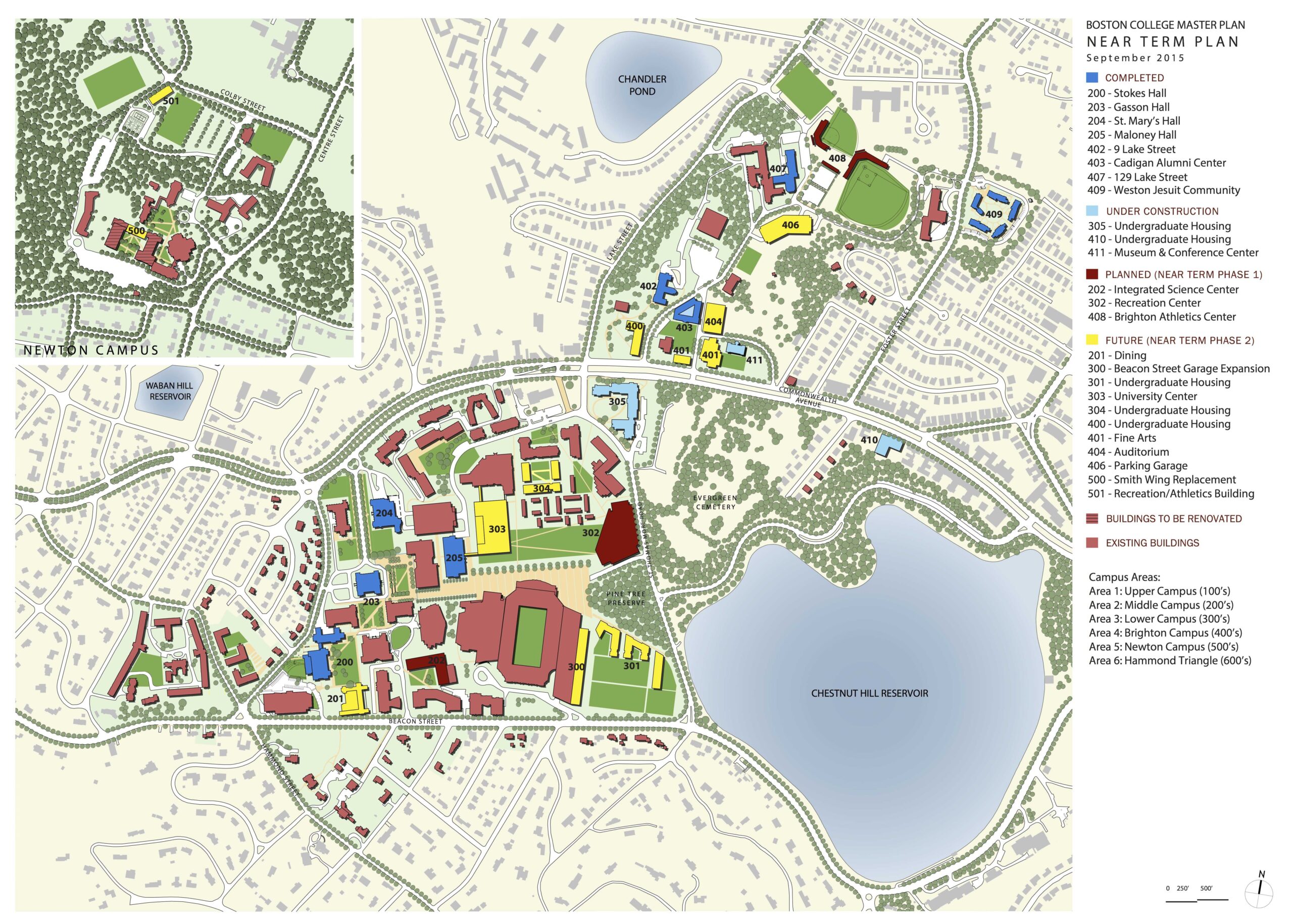
The sexual abuse scandal that engulfed the Archdiocese of Boston in the early 2000s presented Boston College with a rare opportunity. The Archdiocese faced over $85 million in settlement costs for victims of clergy abuse and needed immediate liquidity. Boston College capitalized on this desperation. In 2004 the university purchased 43 acres of the Archdiocesan headquarters in Brighton for $99. 4 million. This transaction included the cardinal's residence. The university continued its acquisition of church property in subsequent years. BC paid $8 million for the Tribunal building in 2006 and another $65 million in 2007 for the remaining chancery grounds. These deals transferred 65 acres of prime real estate to the university for approximately $172 million. The acquisition allowed the creation of the Brighton Campus and the School of Theology and Ministry.
Real estate expansion continued into the decade with the purchase of 300 Hammond Pond Parkway in 2016. The university bought the 24-acre property from Congregation Mishkan Tefila for $20 million. The synagogue faced declining membership and financial. This purchase sparked a bitter legal conflict with the City of Newton. Mayor Ruthanne Fuller moved to seize 17. 4 acres of the parcel via eminent domain to preserve it as conservation land known as Webster Woods. The city paid the university $15. 2 million in compensation. Boston College sued the city and claimed the payment was well fair market value. This dispute highlighted the friction between the university's expansionist goals and the preservation interests of its host municipalities.
The COVID-19 pandemic triggered another consolidation event in 2020. Pine Manor College sat on 48 acres adjacent to the Chestnut Hill campus and faced financial losses. Boston College absorbed the smaller institution under a memorandum of understanding signed in May 2020. The deal was not a traditional purchase an integration. BC assumed the assets and liabilities of Pine Manor and committed $50 million to establish an institute for underrepresented students. This figure later grew to $100 million. The university renamed the site Messina College in 2024. This move secured a massive tract of land in Brookline that had been out of reach for decades.
By fiscal year 2025 the endowment reached an all-time high of $4. 3 billion. Total assets for the university climbed to $7. 7 billion. The administration used this wealth to fund projects like the $150 million Schiller Institute for Integrated Science and Society. The physical footprint of the university grew from roughly 200 acres in the 1990s to 388 acres by 2026. This growth transformed Boston College from a regional Jesuit college into a wealthy land-holding corporation with financial reserves that rival the GDP of small nations. The administration continues to use this wealth to insulate the institution from the demographic cliffs threatening less affluent colleges.
Boston College Major Real Estate Acquisitions (2004, 2020)
Year
Property / Seller
Acquisition Cost
Acreage Added
2004
Archdiocese of Boston (Brighton HQ)
$99. 4 Million
43 acres
2006
Archdiocese Tribunal Building
$8. 0 Million
~2 acres
2007
Archdiocese Chancery & Grounds
$65. 0 Million
20 acres
2016
Congregation Mishkan Tefila
$20. 0 Million
24 acres
2020
Pine Manor College (Integration)
Asset Assumption
48 acres
The Belfast Project and Federal Subpoena Litigation
Founding and Relocation to Chestnut Hill 1863, 1913
The Belfast Project, initiated in 2001 under the aegis of Boston College's Burns Library, stands as one of the most significant and disastrous experiments in oral history within the modern academic era. Conceived by Irish journalist Ed Moloney and executed by lead researcher and former Provisional IRA volunteer Anthony McIntyre, the project sought to preserve the raw, unvarnished accounts of the Troubles from the combatants themselves. The premise relied on a strict pledge of confidentiality: no interview would be released until the death of the participant. Between 2001 and 2006, McIntyre and Wilson McArthur (who interviewed Ulster Volunteer Force loyalists) recorded heavily detailed testimonies from dozens of paramilitaries. These recordings were housed in the secure "Treasure Room" of the Burns Library, intended to serve as a time capsule for future historians to understand the brutal internal logic of the conflict in Northern Ireland. The project's security architecture collapsed not through a data breach, through a legal and political pincer movement that began in 2010. The catalyst was an interview given by Dolours Price, a convicted IRA bomber and hunger striker, to the *Irish News* and *Sunday Life*. In her exchange with reporters, Price admitted her role in the 1972 abduction and murder of Jean McConville, a widowed mother of ten whom the IRA accused of being an informant. Crucially, Price mentioned that she had detailed these events on tape for Boston College. This public admission provided the Police Service of Northern Ireland (PSNI) with the use they required. Utilizing the Mutual Legal Assistance Treaty (MLAT) between the United Kingdom and the United States, the British government formally requested the materials from the US Department of Justice (DOJ) in May 2011. Boston College's administration found itself in a vice. The subpoenas demanded the surrender of the Price interviews and those of Brendan Hughes, a deceased IRA commander whose accounts had already been published in Moloney's book *Voices from the Grave*. The college filed a motion to quash the subpoenas, arguing that the forced release of confidential academic research would endanger the lives of the participants and chill future inquiry into sensitive topics. Yet, the legal ground was treacherous. The "donor agreements" signed by the participants contained a fatal ambiguity, promising confidentiality only "to the extent American law allows." This clause, likely intended as standard boilerplate, became the method through which the DOJ dismantled the project's shield of secrecy. The legal battle intensified throughout 2011 and 2012. Moloney and McIntyre, fearing that Boston College was preparing to capitulate to preserve its institutional standing, attempted to intervene as separate parties in the lawsuit. They argued that the college was not adequately defending the interests of the researchers or the subjects. The US courts, including District Judge William G. Young, largely rejected the notion of an "academic privilege" that could supersede a criminal investigation involving murder. Judge Young conducted an *in camera* review of the archives to determine which tapes were relevant to the McConville investigation., the court ordered the college to hand over dozens of interviews. The consequences of this transfer materialized rapidly. In 2014, the PSNI arrested Ivor Bell, a veteran republican leader, charging him with soliciting the murder of Jean McConville. The prosecution's case rested almost entirely on the Boston College tapes, specifically a set of interviews attributed to a participant identified only as "Z," whom authorities alleged was Bell. The tapes purportedly captured Bell discussing the command structure of the IRA in Belfast during 1972 and implicating Gerry Adams, the Sinn Féin leader, in the decision to disappear McConville. Adams himself was arrested and questioned for four days in May 2014 based on the archival evidence, though he was released without charge. The trial of Ivor Bell, which concluded in 2019, served as the final, crushing verdict on the Belfast Project's evidentiary value. Defense lawyers mounted a ferocious attack on the reliability of the tapes. They argued that the project was biased, noting that McIntyre was a known critic of the Sinn Féin leadership and the peace process. also, the defense contended that the guarantee of "confidentiality until death" created a moral hazard, encouraging participants to exaggerate their roles or settle scores with rivals under the false belief that they would never face cross-examination. Justice John O'Hara, presiding over the case in Belfast, accepted these arguments. He ruled the tapes inadmissible, stating that the interviewer had not acted as a neutral academic had led the witness, and that the interviewees were not speaking under oath. The case against Bell collapsed, and he was acquitted. Following the legal disasters of 2011-2014, Boston College moved to liquidate its liability. In May 2014, the university announced it would return the remaining tapes to the participants, the archive to prevent further subpoenas. This repatriation of data was a humiliation for the institution, signaling its inability to protect the sensitive data it had solicited. By 2026, the archive exists only in fragments; while materials remain with the college or were returned to subjects, the integrity of the collection as a historical record is shattered. The saga continued to drag through the courts well into the 2020s. The PSNI pursued the personal interviews of Anthony McIntyre himself, seeking access to his own account of his time in the IRA. In April 2024, the High Court in Belfast ordered the release of McIntyre's tapes to the police, rejecting his final appeals. This ruling arrived mere days before the implementation of the UK's Legacy Act on May 1, 2024, which introduced a controversial statute of limitations on Troubles-era offenses. The timing suggested a final, desperate attempt by authorities to extract actionable intelligence from the Boston College cache before the legal window for prosecution closed forever. The damage inflicted by the Belfast Project extends far beyond the specific legal cases. In the academic terrain of 2026, the "Boston College warning" is a standard cautionary tale in university ethics committees worldwide. The case established a clear precedent: in the United States, academic pledge of confidentiality are flimsy shields against federal subpoenas, particularly when international treaties are invoked. The project, designed to illuminate the dark history of the Troubles, instead became a weapon used by the state against the participants, resulting in no convictions succeeding in silencing future researchers who might otherwise attempt to document the history of clandestine organizations.
Key Legal Milestones in the Belfast Project Litigation
Date
Event
Outcome
Feb 2010
Dolours Price Interview
Price admits McConville involvement to Irish News; mentions tapes.
May 2011
Subpoenas Served
US DOJ acts on UK request via MLAT for Price & Hughes tapes.
Dec 2011
Judge Young Ruling
Orders in camera review; rejects broad academic privilege.
Apr 2014
Gerry Adams Arrest
Detained based on tape evidence; released without charge.
May 2014
BC Returns Tapes
College offers to return archives to living participants.
Oct 2019
Ivor Bell Acquittal
Tapes ruled inadmissible/unreliable; case collapses.
Apr 2024
McIntyre Tapes Release
High Court orders release of researcher's own interviews to PSNI.
1978 Basketball Point-Shaving and Organized Crime Links
The 1978, 79 Boston College basketball point-shaving scandal remains the most notorious intersection of collegiate athletics and organized crime in American history. While the university projected an image of Jesuit discipline, a cell of the Lucchese crime family, orchestrated by Henry Hill and James "Jimmy the Gent" Burke, infiltrated the locker room. The scheme did not require the Eagles to lose games; it required them to win by less than the betting spread, a manipulation known as "shaving points." This operation was not a victimless crime a federal racketeering conspiracy that resulted in the imprisonment of a student-athlete and legendary mob figures. The architecture of the fix originated in Pittsburgh, not Boston. Rocco and Tony Perla, small-time gamblers with connections to the local underworld, identified Rick Kuhn as a target. Kuhn was not a typical wide-eyed freshman; he was a 23-year-old senior who had played minor league baseball and held a cynical view of amateurism. The Perlas connected Kuhn with Paul Mazzei, who in turn brought in Henry Hill, a Lucchese associate desperate for cash following the 1978 Lufthansa heist. Hill and Mazzei met with Kuhn and teammate Jim Sweeney at a Boston hotel, offering payments of roughly $2, 500 per game to ensure the Eagles did not cover the spread.
Date
Opponent
Betting Line
Result
Outcome for Mob
Dec 6, 1978
Providence
BC favored by 6-7
BC won 83-64
Loss (BC covered)
Dec 16, 1978
Harvard
BC favored by 12
BC won 86-83
Win (Fix succeeded)
Dec 23, 1978
UCLA
BC underdog by 15-18
BC lost 103-81
Win (Bet on UCLA)
The Harvard game on December 16, 1978, serves as the primary evidence of the conspiracy's success. Boston College, a superior team, was favored to win by 12 points. They won by only three, 86, 83, securing a massive payday for the syndicate. During the game, Kuhn and Sweeney made calculated errors, missed free throws, lazy defense, and errant passes, to keep the margin narrow. Yet, the scheme was volatile. In a game against Holy Cross, the fix collapsed when Ernie Cobb, the team's leading scorer, scored eight points in the final minute, pushing the margin beyond the spread and costing the gamblers thousands. The unraveling of the conspiracy began not with NCAA investigators, with narcotics detectives. In 1980, authorities arrested Henry Hill on drug trafficking charges. Facing a likely prison sentence and fearing execution by Jimmy Burke to silence him regarding the Lufthansa heist, Hill entered the Witness Protection Program. He detailed the Boston College scheme to federal prosecutors. This testimony led to the 1981 trial *United States v. Burke*, a landmark case that exposed the depth of the corruption. The judicial outcome was severe. Judge Henry Bramwell sentenced Rick Kuhn to 10 years in prison, a punishment designed to send a shockwave through collegiate sports; he eventually served 28 months. Jimmy Burke received 12 years (later increased to 20 for other crimes). Paul Mazzei and Tony Perla received 10-year sentences. Jim Sweeney, who testified that he took money out of fear tried to play his best, was not charged was expelled from Boston College and lived for decades as a pariah. Ernie Cobb was indicted acquitted; he consistently maintained his innocence, arguing that his high scoring in "fixed" games proved he was not involved. This scandal inflicted a deep wound on Boston College's reputation, one that long after the 1978 season. It shattered the illusion of the "student-athlete" as a protected class, showing that college players were to the same predatory forces as professional boxers or racetrack jockeys. The university erased the team's 22, 9 record from the media guide, and for years, the administration refused to acknowledge the players involved. The events of 1978, 79 were later immortalized in the ESPN *30 for 30* documentary "Playing for the Mob," narrated by Ray Liotta, who portrayed Henry Hill in the film *Goodfellas*, cementing the scandal's place in the cultural history of American crime.
Institutional Response to Clergy Sex Abuse Allegations
The institutional response of Boston College to the clergy sexual abuse emergency reflects the complex, frequently bifurcated governance structure of a Jesuit university. While the University Corporation operates as a distinct legal entity, the Jesuit Community of Boston College, and the wider USA East Province of the Society of Jesus, supplies the religious personnel who define the school's identity. This dual structure allowed the University administration to legally distance itself from abuse cases involving Jesuit faculty or staff, even as the campus stood at the geographic and theological epicenter of the 2002 Boston Archdiocese scandal. In early 2002, as the *Boston Globe* team began publishing about the Archdiocese of Boston, the emergency immediately engulfed the Boston College campus. Cardinal Bernard Law, then the Archbishop of Boston and a frequent presence at University events, faced intense scrutiny. By April 2002, anger among the faculty and student body reached a breaking point regarding Law's scheduled appearance at the May commencement ceremony. Dozens of faculty members and students petitioned the administration to bar Law from the podium. While the University did not publicly disinvite him, officials engaged in private negotiations which resulted in Law "bowing out" of the ceremony, citing a scheduling conflict. This marked a significant symbolic rupture between the University's academic community and the hierarchy of the local Church. The tension escalated in December 2002 when a group of 58 priests from the Archdiocese signed a letter demanding Cardinal Law's resignation. Stephen Pope, then-chair of the Boston College Theology Department, characterized this move as "as close to rebellion as get." The intellectual weight of BC's theology faculty provided theological and ethical cover for the growing lay and clerical resistance against the diocesan leadership. Yet, while BC faculty were vocal critics of the *diocesan* cover-up, the University faced its own internal reckoning regarding members of the Society of Jesus. The primary method for handling accused Jesuits involved the internal discipline of the Province rather than the University's HR department. For decades, the Society of Jesus moved priests facing allegations to restricted environments, frequently without notifying the academic institutions where they had previously worked. The Campion Center in Weston, Massachusetts, located just five miles from the Chestnut Hill campus, served as a retirement home and infirmary for Jesuits. It also functioned as a repository for priests removed from ministry due to credible accusations of abuse. This proximity meant that men removed from parishes or high schools frequently resided within a short drive of the University, technically under "safety plans" living in a facility that also hosted retreats and visitors. The extent of the problem within the Jesuit order itself became undeniably public in January 2019, when the USA Northeast Province ( part of the USA East Province) released a list of 50 Jesuits with credible allegations of sexual abuse of minors dating back to 1950. The list included two men who had served as faculty at Boston College: Fr. Joseph Fox and Fr. Joseph McInnes. University administration moved quickly to frame these disclosures. A spokesperson stated that the alleged abuse by Fox and McInnes did not occur during their tenure at Boston College. Fr. Fox taught at BC from 1931 to 1934 and 1939 to 1943; the allegations against him stemmed from incidents in 1956. Fr. McInnes worked at the University between 1946 and 1947, with allegations arising from conduct in the 1960s. This defense, that the abuse was not contemporaneous with their University employment, became a standard legal shield. It allowed the University to avoid direct liability while the Jesuit Province absorbed the financial and reputational damage. A more proximate and damaging case involved Fr. James Talbot. While Talbot primarily taught at Boston College High School (a legally separate institution since the 1950s), his case illustrated the widespread failure of the Jesuit order in the region. Talbot was a well-known figure in Boston Jesuit circles. After allegations surfaced at BC High in the 1970s, superiors transferred him to Cheverus High School in Maine rather than reporting him to law enforcement. In 2003, the Jesuits agreed to a $5. 2 million settlement for 14 of Talbot's victims. Talbot was later convicted and died in 2025. The Talbot case demonstrated the "geographical cure" strategy used by the Province, moving predators between Jesuit institutions, a practice that implicated the wider network to which Boston College belongs. The release of the 2018 Pennsylvania Grand Jury report, which detailed abuse across six dioceses, reignited campus activism. In November 2018, University President William P. Leahy, S. J., addressed the matter during a forum titled "The Church in the 21st Century." Leahy acknowledged the "serious toll" the scandal had taken on the faithful faced criticism from student groups for what they perceived as a passive institutional stance. Student publications like *The Gavel* and *The Heights* frequently published editorials demanding greater transparency regarding the Jesuit Community on campus. Financial data indicates that the cost of these scandals has been borne primarily by the Jesuit Province and the Archdiocese, protecting the University's endowment. The 2003 settlement involving Talbot and the 2002 Archdiocese settlement ($85 million) were paid through insurance and asset liquidation by the religious orders and the diocese. Boston College, as a corporation, has largely insulated its assets from these claims by maintaining strict separation between the University payroll and the Jesuit payroll. The following table summarizes key disclosures and events linking the wider Jesuit emergency to the Boston College community.
Timeline of Jesuit Abuse Disclosures and Institutional Reactions (2002, 2025)
Year
Event
Details
2002
Commencement Controversy
Cardinal Bernard Law withdraws from BC graduation following faculty and student protests.
2003
Talbot Settlement
Jesuit Order pays $5. 2 million to 14 victims of Fr. James Talbot (BC High/Cheverus).
2011
O'Malley Resignation (Rome)
Cardinal Law, BC honorary degree holder, resigns from St. Mary Major in Rome; BC faces renewed calls to revoke honors.
2018
PA Grand Jury Response
President Leahy addresses "turmoil," students demand disclosure of any accused priests on campus.
2019
Province List Release
USA Northeast Province names 50 Jesuits. BC confirms two (Fox, McInnes) were former faculty.
2025
Death of James Talbot
Talbot dies in Missouri; media coverage reiterates his transfer history through New England Jesuit network.
The University continues to navigate the tension between its Catholic identity and the reputational hazard posed by the hierarchy. While the administration has successfully avoided direct legal liability for the actions of the Jesuit order, the moral stain remains a point of contention. The "Manresa" and "Campion" facilities remain active, and the University's silence on the specific "safety plans" for Jesuits residing near campus continues to provoke questions from survivor advocacy groups. The distinction between "University employee" and "Jesuit resident" remains the primary firewall in the institution's defense strategy.
Schiller Institute and Integrated Science Expansion
Endowment Growth and Real Estate Acquisitions 1980, 2026
The Schiller Institute for Integrated Science and Society represents the most expensive and significant academic pivot in Boston College history. Announced in 2017 as the centerpiece of a $300 million investment in the sciences, the initiative marked a departure from the university's traditional reliance on the liberal arts, theology, and business. The administration recognized that maintaining elite status in the 21st century required a physical and curricular foothold in applied sciences and engineering. This realization culminated in the construction of 245 Beacon Street, a facility designed to force collision between hard sciences and the university's Jesuit ethical framework. Phil Schiller, a 1982 graduate and longtime Apple executive, provided the naming gift of $25 million alongside his wife, Kim Gassett-Schiller. While the sum was a fraction of the total project cost, the Schiller name attached Silicon Valley credibility to a university previously known for producing lawyers and accountants. The administration allocated $150 million specifically for the construction of the new facility, which required the demolition of Cushing Hall, a dormitory and former home of the nursing school. Construction began in 2019 under the management of Suffolk Construction, continuing through the COVID-19 pandemic to meet a January 2022 opening deadline. The physical structure at 245 Beacon Street spans 156, 500 square feet. Architects from Payette designed the building to maximize transparency, using glass walls to put laboratory work on display for passersby. The facility houses the Department of Computer Science, the Edmund H. Shea Jr. Center for Entrepreneurship, and the newly created Department of Engineering. Inside, the infrastructure supports high-intensity research with clean rooms, prototyping labs, and "active learning" classrooms where furniture configurations shift to support group problem-solving. The design intent was to break down departmental silos, forcing computer scientists to work alongside entrepreneurs and engineers. The most radical academic addition housed within the institute is the Human-Centered Engineering (HCE) program. Launched in 2021, HCE offers a Bachelor of Science in Engineering, a degree Boston College had never previously granted. The curriculum differs from technical institutes by mandating a heavy course load in the liberal arts and ethics. Students must examine the societal consequences of their technical solutions before building them. The university positioned this as "engineering for the common good," a branding strategy that aligns technical training with the Jesuit mission. The cohort of HCE majors graduated in May 2025, entering the workforce as the program's proof of concept. Faculty recruitment for the institute involved an aggressive campaign to hire 22 new tenure-track professors. The administration targeted researchers working at the intersection of data science, health, and energy. By 2026, these hires had established active laboratories within 245 Beacon, drawing grant funding and publishing research that combined computational modeling with biological application. The presence of the Shea Center for Entrepreneurship on the same floor as these labs was a calculated move to accelerate the commercialization of faculty and student research. The investment has altered the demographic and academic profile of the student body. Applications to the Morrissey College of Arts and Sciences for majors surged following the building's opening. The average SAT scores for the incoming engineering cohorts rivaled those of established engineering schools in the Northeast. By early 2026, the institute had stabilized as a core component of the campus, ending the perception of Boston College as solely a liberal arts institution. The university successfully bought its way into the hard sciences, using the Schiller Institute to secure a position in a market that increasingly demands technical competency alongside serious thinking.
Schiller Institute & 245 Beacon Street Specifications
Metric
Detail
Total Science Initiative Investment
$300 Million
Construction Cost (245 Beacon)
$150 Million
Naming Gift (Schiller)
$25 Million
Square Footage
156, 500 sq. ft.
Opening Date
January 2022
Engineering Class Graduation
May 2025
ACC Membership and Athletic Financial Performance
The decision to abandon the Big East Conference for the Atlantic Coast Conference (ACC) in 2003 remains the single most consequential financial event in the modern history of Boston College athletics. This move was not a change in competitive partners; it was a calculated wager on the supremacy of football television revenue over the basketball-centric model of the Big East. The transition was acrimonious. The Big East, led by Commissioner Mike Tranghese, sued Boston College, Miami, and the ACC, alleging a conspiracy to destroy the conference. In August 2004, Massachusetts Superior Court Judge Allan van Gestel ruled in favor of Boston College, invalidating a hastily passed amendment that would have raised the exit fee to $5 million. Consequently, the university paid a mere $1 million to depart, a sum that appears negligible against the billions in revenue the ACC membership would later generate. The financial logic of the move proved sound for nearly two decades. Upon joining in 2005, Boston College gained access to the ACC's lucrative television contracts, which significantly outpaced the Big East's earnings. By the 2022-2023 fiscal year, the ACC distributed approximately $44. 8 million to each member school, a figure derived largely from media rights deals with ESPN. This revenue stream became the lifeblood of the athletic department, covering the escalating costs of coaching salaries, scholarships, and facility upgrades. Without this infusion, the university would have been forced to heavily subsidize the athletic budget from the general fund or face a drastic reduction in competitive scope. To maintain status within this wealthier conference, Boston College engaged in a capital-intensive facilities arms race. The most visible manifestation of this expenditure was the Fish Field House, a $52. 6 million indoor practice facility that opened in July 2018. Named after construction magnate and trustee John Fish, the 115, 700-square-foot structure was deemed essential to recruit talent capable of competing against powerhouses like Clemson and Florida State. Critics noted that while the facility brought Boston College to parity in infrastructure, it did not correlate with a rise in on-field dominance; the football program remained mired in mediocrity, frequently finishing in the middle of the conference standings. The stability of this arrangement fractured in 2024 when Florida State and Clemson filed lawsuits against the ACC, challenging the validity of the Grant of Rights (GOR) agreement that binds members' media rights to the conference until 2036. For Boston College, these lawsuits represented an existential threat. Unlike the plaintiffs, who viewed themselves as revenue generators held back by the shared, Boston College was a net beneficiary of the equal-share model. The university's viewership numbers consistently lagged behind the conference elite, meaning any move toward merit-based distribution would result in a pay cut. Throughout the litigation, Boston College administration maintained a disciplined silence, relying on the strict language of the GOR to protect their interests. The legal standoff concluded on March 4, 2025, when the ACC, Clemson, and Florida State announced a settlement. While the deal kept the rebellious members in the conference, it fundamentally altered the financial structure of the league. The settlement introduced a "success initiative" and a viewership-based revenue distribution model, ending the era of equal shares. For Boston College, this was a strategic defeat. The new model rewards brands that drive television ratings. Data from the 2023 and 2024 seasons indicated that Boston College football viewership ranked in the bottom third of the conference. Under the post-2025 structure, the Eagles face a widening revenue gap compared to the league's top tier, forcing the university to find new or increase donor reliance to make up the shortfall.
Fiscal Year
Event / Metric
Financial Impact
2005
Big East Exit Fee (Court Ordered)
($1. 0 Million)
2018
Fish Field House Construction
($52. 6 Million)
2023
ACC Per-School Payout (Avg)
$44. 8 Million
2024
Athletic Dept. Operating Expenses (Est)
~$144. 0 Million
2025
ACC Settlement (New Tiered Model)
Variable / Performance Based
The expansion of the ACC in 2024 to include Stanford, California, and Southern Methodist University (SMU) further complicated the financial equation. While SMU agreed to forgo television revenue for nine years, a concession that temporarily boosted the payout pool for existing members like Boston College, the logistical costs of cross-country travel exploded. Non-revenue sports, which constitute the majority of the university's 31 varsity teams, face regular commercial flights to the West Coast. The athletic department has had to increase its operating budget to accommodate these travel demands, eroding of the gains from the expanded media inventory. As of 2026, Boston College occupies a precarious position within the Power Four structure. The university is solvent. The 2025 settlement prevented the immediate collapse of the ACC, it codified a caste system where Boston College is no longer a financial peer to Florida State or Clemson. The department relies heavily on institutional support to balance its books, as self-generated revenues (ticket sales, donations, media rights) rarely cover the full $140 million-plus annual operating expense. The "ROI" of ACC membership remains positive compared to the alternative of the Big East, the margin for error has. The administration must navigate a tiered revenue reality where financial health is directly tethered to television ratings they have historically failed to deliver.
Admissions Metrics and Legacy Preference Controversies
The transformation of Boston College from a regional commuter school for the working class into an elite, highly exclusionary institution is best measured by its collapse in acceptance rates. In 1991, the university accepted 56 percent of applicants, functioning as a reliable option for local students. By the 2025, 2026 admissions pattern (Class of 2029), that figure plummeted to a record low of 12. 6 percent. This contraction occurred even as the university expanded its physical footprint, revealing a deliberate strategy to engineer exclusivity rather than accommodate growth. The shift has fundamentally altered the demographic composition of the student body, replacing the children of Irish immigrants with a wealthy, national constituency.
The mechanics of this selectivity rely heavily on the manipulation of yield rates through Early Decision (ED) programs. Introduced to replace the non-binding Early Action policy, ED allows the university to lock in nearly 50 percent of its incoming class before Regular Decision applications are even reviewed. For the Class of 2029, the ED acceptance rate hovered near 31 percent, while the Regular Decision rate sank to approximately 11 percent. This bifurcation favors applicants who do not need to compare financial aid offers, filtering for socioeconomic privilege under the guise of "demonstrated interest."
Admissions data from the last three decades illustrates this tightening grip:
Admissions pattern
Target Class
Acceptance Rate
Avg. SAT/ACT (Enrolled)
1990, 1991
Class of 1995
56. 0%
~1100 (Old )
2016, 2017
Class of 2021
32. 0%
1360 / 31
2020, 2021
Class of 2025
18. 9%
1495 / 34
2023, 2024
Class of 2028
14. 7%
1484 / 34
2024, 2025
Class of 2029
12. 6%
1500+ / 34
The university's handling of legacy p
Student Demographics and AHANA Enrollment Statistics
The Belfast Project and Federal Subpoena Litigation
Boston College's demographic trajectory represents a complete inversion of its founding mission. Established in 1863 to educate the children of Irish Catholic immigrants, a group then marginalized by Boston's Protestant elite, the university functioned for decades as an ethnic enclave. By the mid-20th century, this insular identity began to fracture. The transition to coeducation in 1970 altered the gender balance, yet the racial composition remained overwhelmingly white. As the descendants of Irish immigrants ascended to the upper middle class, BC solidified its status as a Predominantly White Institution (PWI), a classification that in 2026 even with concerted administrative efforts to alter the student body's makeup.
The university's method to racial categorization shifted decisively in 1979. Students Alfred Feliciano and Valerie Lewis led a campaign to reject the federal designation "minority," arguing the term implied inferiority. They proposed the acronym AHANA (African-American, Hispanic, Asian, and Native American) to describe students of color. The Board of Trustees adopted the term, and the Office of Minority Student Programs became the Office of AHANA Student Programs. This nomenclature remains unique to Boston College, serving as a distinct cultural marker in its diversity initiatives. Even with this semantic innovation, statistical progress remained slow for decades. In the early 2000s, AHANA enrollment hovered near 20 percent, frequently trailing peer institutions in the Consortium on Financing Higher Education (COFHE).
The Supreme Court's 2023 decision to strike down affirmative action in college admissions produced an immediate, quantifiable contraction in Black enrollment at Boston College. Data from the Class of 2028 (enrolled Fall 2024) and Class of 2029 (admitted 2025) reveals the volatility of this new legal terrain. While the university maintains a need-blind admission policy, the removal of race-conscious selection tools coincided with a drop in AHANA representation.
Boston College AHANA Enrollment & Demographics (Selected Classes)
Metric
Class of 2025 (Admitted)
Class of 2028 (Enrolled)
Class of 2029 (Admitted)
AHANA Total
42%
37%
35%
Black / African American
~7%
6%
Not Disclosed
Hispanic / Latino
13%
14. 4%
Not Disclosed
Asian American
14. 6%
16. 2%
Not Disclosed
Pell Grant Eligible
11%
18. 8%
~16% (396 students)
The Class of 2028 data shows a specific decline in Black enrollment, falling from 7 percent to 6 percent, while Asian American enrollment rose to 16. 2 percent. The Class of 2029 admission pattern saw the total AHANA percentage drop further to 35 percent. University officials the legal inability to use race as a factor for these shifts. To counter these trends, BC expanded its partnership with QuestBridge, a non-profit connecting low-income students with elite universities. In the 2025 admission pattern, BC admitted 115 QuestBridge scholars, a method designed to capture racial diversity through the proxy of socioeconomic need.
Socioeconomic stratification remains a defining characteristic of the student body. A 2017 study using tax data identified the median family income of a BC student at $194, 100, placing the university among the colleges with the wealthiest student populations in the United States. Approximately 70 percent of students come from the top 20 percent of the income distribution. This wealth concentration creates a cultural divide on campus, frequently by student activists who that the "AHANA" label masks the isolation felt by low-income students of color navigating a space dominated by affluence.
Tensions regarding race and inclusion have erupted periodically into public view. In October 2017, following the defacement of "Black Lives Matter" signs in a residence hall to read "Black Lives Don't Matter," hundreds of students staged a "Silence is Still Violence" march. They demanded the administration take a firmer stance against hate speech. In 2021, another series of incidents occurred in the Multicultural Learning Experience (MLE) floor of a dormitory, where white students harassed Black and Hispanic residents. These events prompted the "Climate of Care" initiative, yet student organizations like the Black Student Forum continue to report a disconnect between the university's Jesuit rhetoric of inclusion and the daily reality of minority students.
International enrollment provides another to the demographic profile, accounting for approximately 8 to 9 percent of the undergraduate population in 2026. These students, hailing from over 50 countries, pay full tuition and diversify the campus globally, though they do not alter the domestic racial statistics. The university currently faces the dual challenge of maintaining its "need-blind" pledge while with the homogeneity enforced by high tuition costs and the post-affirmative action legal environment.
Municipal Disputes and Payment in Lieu of Taxes (PILOT)
Boston College operates as one of the largest tax-exempt landowners in Massachusetts, holding real estate assets valued in the billions. Yet, its financial relationship with its host municipalities, Boston and Newton, remains defined by chronic underpayment and legal warfare. While the university controls net assets totaling $7. 7 billion as of 2025, its contributions to municipal services frequently fall far the set by city officials. This creates a persistent structural deficit for the cities, which must provide police, fire, and infrastructure support to the campus without the benefit of commercial property tax revenue.
The primary method for recouping these costs in Boston is the Payment in Lieu of Taxes (PILOT) program. Reformed in 2011 under Mayor Thomas Menino, the system requests that tax-exempt institutions with property values exceeding $15 million contribute 25% of what they would owe in commercial taxes. The city allows half of this amount to be covered by "community benefits" (scholarships, job training), leaving a 12. 5% cash request. Records show Boston College consistently rejects this formula. In Fiscal Year 2019, for example, the city requested $3. 6 million in cash; BC paid only $357, 943. This pattern through the post-pandemic years. By Fiscal Year 2024, data indicates the university continued to pay approximately 10% to 12% of the requested cash amount, significantly lagging behind peers like Boston University and Harvard, which frequently meet or exceed 80% of their cash requests.
University officials defend this shortfall by citing a philosophical objection to the PILOT program's structure. Spokespeople have argued that full participation might legally jeopardize the institution's tax-exempt status, a claim legal experts dispute. Instead of meeting the PILOT target, BC points to separate "municipal service agreements" and the value of its community programs. Yet, auditors and activists frequently challenge the valuation of these benefits, noting that claimed credits, such as snow removal on public streets bordering the campus, serve the university's operational needs as much as the public interest.
Boston College PILOT Payment Discrepancies (Selected Fiscal Years)
Fiscal Year
City Cash Request
BC Cash Payment
Payment % of Request
2012
$2. 6 Million
$299, 000
~11. 5%
2019
$3. 6 Million
$357, 943
~10. 0%
2021
$4. 1 Million
$380, 000 (Est.)
~9. 3%
2024
$4. 5 Million
$460, 000 (Est.)
~10. 2%
Across the municipal border in Newton, the conflict shifts from voluntary payments to aggressive litigation over land use. The most contentious recent battle involves Webster Woods, a 17. 4-acre forested parcel adjacent to the Hammond Pond Parkway. In 2016, BC purchased the land and an associated synagogue for $20 million, intending to reserve the area for future development. The City of Newton, prioritizing conservation, seized the woods by eminent domain in 2019, paying the university $15. 2 million. BC sued in 2021, arguing the compensation was "grossly insufficient" and claiming the land's development chance justified a much higher valuation.
This legal fight escalated in 2025 when a Middlesex Superior Court judge ruled on a deed restriction dating back to 1954. The restriction, originally placed by the Commonwealth, limited the land's use to religious or educational purposes. BC lawyers successfully argued this restriction was invalid, a legal maneuver intended to retroactively increase the land's appraised value by allowing for theoretical residential or commercial development. Newton Mayor Ruthanne Fuller condemned the move, noting that voiding the restriction could force taxpayers to pay millions more for land already protected by the state decades prior. The dispute illustrates the university's aggressive method to asset maximization, even when it pits the institution against the conservation goals of its host city.
Zoning disputes also plague the university's relationship with the Allston-Brighton neighborhood in Boston. The 2009 Institutional Master Plan (IMP) included a binding commitment to construct 1, 280 new undergraduate beds to pull students out of family neighborhoods and onto campus. By late 2025, city data revealed a net increase of only roughly 240 beds, less than 20% of the promised total. Consequently, over 1, 100 undergraduates remain in off-campus apartments, driving up rents and destabilizing the local housing market. In response to this failure, the Boston Planning & Development Agency (BPDA) granted only a short-term, two-year renewal of the master plan in November 2025, rather than the standard four-year term, signaling a loss of patience with the university's delays.
The friction extends to policing and public order. Residents in the "Lake Street" and "South Street" corridors frequently report disturbances related to off-campus student housing. While BC funds a detail of Boston Police officers to patrol these areas on weekends, neighborhood associations this measure treats the symptom rather than the cause. The cost of managing this population, through sanitation, emergency response, and code enforcement, constitutes a hidden subsidy provided by the city, further aggravating the imbalance created by the university's refusal to meet its PILOT obligations.
Presidential Governance and Jesuit Provincial Oversight
The governance of Boston College operates through a complex dual structure that balances its status as a chartered civil corporation with its identity as an apostolic work of the Society of Jesus. This arrangement separates the legal fiduciary duties of the Board of Trustees from the religious oversight of the Jesuit Provincial. The evolution of this system mirrors the broader history of American Catholic higher education. It shifted from direct clerical control in the 19th century to a modern bicameral model where laypeople hold the majority of voting power yet the Jesuit order retains specific reserved rights.
From the founding in 1863 until the early 1970s, the governance model was strictly hierarchical and clerical. The President of the College served simultaneously as the Rector of the Jesuit community. This individual was appointed directly by the Superior General of the Society of Jesus in Rome. There was no distinction between the assets of the Jesuit order and the assets of the college. The Board of Trustees existed only to satisfy the requirements of the Massachusetts charter. It consisted entirely of Jesuits who were subordinates of the Rector-President. This structure ensured absolute religious alignment limited the institution's ability to attract secular financial support or qualify for public funding.
The pivotal moment in Boston College's administrative history occurred in 1972 under the presidency of J. Donald Monan, S. J. Monan recognized that the college could not survive financially without access to federal and state aid. The "Bundy aid" available in New York and similar chance funding in Massachusetts required institutions to demonstrate independence from ecclesiastical control. Monan orchestrated the separate incorporation of the "Trustees of Boston College" and the Jesuit community. This legal maneuver transferred ownership of the university's assets from the religious order to a new board. The reconfigured Board of Trustees included laypeople for the time. They quickly became the majority. This shift laicized the governing body and insulated the university from direct liability for the religious order's actions while securing eligibility for government research grants and financial aid.
Even with this legal separation, the Society of Jesus maintains influence through a secondary entity known as the "Members of the Corporation." This body is distinct from the Board of Trustees. The Members are exclusively Jesuits. Their powers are few significant. They include the right to approve changes to the university's mission statement, the alienation of property, and the dissolution of the corporation. Most importantly, the Members maintain a role in the selection of the university president. While the Board of Trustees elects the president, the bylaws historically require that the candidate be a member of the Society of Jesus or that the election receives approval from the Jesuit leadership. This method ensures that while lay donors and alumni manage the endowment and physical plant, the religious order retains a veto over the institution's highest office.
The oversight of the Jesuit Provincial for the USA East Province (formerly the New England Province) functions through these Members. The Provincial does not manage the university's daily operations. His authority focuses on the assignment of Jesuit personnel. The President of Boston College, as a Jesuit, owes a vow of obedience to his religious superiors regarding his personal life and mission assignment. This creates a unique where the President reports to the Board of Trustees for fiduciary matters and to the Provincial for religious matters. If a Provincial were to recall a Jesuit president for reassignment, the Board would be forced to find a successor. This dual reporting line has rarely caused public conflict at Boston College. It serves as a check against total secularization.
William P. Leahy, S. J., assumed the presidency in 1996 and defined the governance style of the modern era. His tenure is the longest in the university's history. It conclude with his scheduled retirement in the summer of 2026. Leahy centralized administrative power and focused intensely on the university's financial standing. Under his leadership, the endowment grew from approximately $600 million to nearly $4 billion. He expanded the campus footprint by 50 percent. His governance method prioritized the Board of Trustees over faculty senates or student governments. Leahy viewed the Board as his primary constituency. This alignment allowed him to pursue long-term capital projects even when they faced opposition from local residents or campus groups.
The composition of the Board of Trustees during the Leahy era reflected a strategy of recruiting high-net-worth alumni and corporate leaders. The Board is currently chaired by John Fish, the CEO of Suffolk Construction. Other members have included leaders from finance, technology, and law. These trustees provide the capital and business acumen necessary to run a multi-billion-dollar enterprise. They also serve as a buffer between the administration and external pressures. The Board meets quarterly to review the university's finances, approve the budget, and oversee the audit. The Executive Committee of the Board holds the real power. It acts on behalf of the full board between meetings and drives the agenda for the presidency.
The transition scheduled for 2026 presents a serious challenge for this governance model. The number of Jesuits available to serve as university presidents has plummeted. In the 1950s, the New England Province had hundreds of men in formation. By the 2020s, the pool of qualified Jesuits with the necessary academic credentials and administrative experience is small. Peer institutions such as Georgetown, Holy Cross, and Fordham have already transitioned to lay presidents. Boston College remains one of the few major Jesuit research universities still led by a priest. The Board of Trustees has stated its intention to identify a Jesuit successor to Leahy. This search is complicated by the demographics of the order. If a suitable Jesuit cannot be found, the Board may be forced to appoint a layperson. Such a move would fundamentally alter the governance and require new method to preserve the Jesuit Catholic identity.
The search for Leahy's successor began formally in late 2024. The Executive Committee of the Board leads this process. They must balance the desire for religious continuity with the demands of running a complex modern university. The president inherit a governance structure that is financially secure demographically fragile regarding its religious personnel. The relationship between the Board and the Jesuit Provincial likely be tested if the university moves toward a "Jesuit-lay partnership" model where the president is a layperson and the Jesuit presence is maintained through a Chancellor or a mission officer. This shift would represent the most significant change in Boston College's governance since the 1972 reorganization.
The table outlines the key differences between the two primary governing bodies at Boston College as of 2026.
Preservation of Mission, Religious Identity Oversight
Selection
Elected by the Board (Self-perpetuating)
Appointed by Jesuit Provincial or Ex Officio
Key Power
Elects the President, Approves Budget
Approves Mission Changes, Dissolution Rights
Head
Chair of the Board (Layperson)
Jesuit Provincial (USA East Province)
The governance of Boston College in 2026 stands at a crossroads. The model established by Monan and solidified by Leahy created a financial. Yet the biological reality of the Jesuit order means the personnel required to staff this model are. The oversight of the Provincial is becoming less about deploying manpower and more about maintaining a charismatic influence through the few remaining Jesuits on campus. The decisions made by the Board of Trustees in the coming months regarding the 2026 succession determine whether Boston College can maintain its distinctive governance structure or if it must adopt the secularized model of its peers.
2026 Academic Rankings and Fiscal Solvency Metrics
By the start of 2026, Boston College solidified its status not as an educational institution as a formidable financial engine with a distinct market position. The university's fiscal health in the 2025, 2026 academic year stands in clear contrast to the near-insolvency of the early 1970s. During the presidency of J. Donald Monan, S. J., the college faced a negative net worth and carried debt loads that threatened closure. Five decades later, the institution operates with an endowment valued at approximately $4. 3 billion as of the fiscal year ending May 31, 2025. This figure represents a 10 percent increase from the previous year and an all-time high for the university. The growth was driven by strong investment returns and the aggressive "Soaring Higher" capital campaign which had already secured over $1. 5 billion toward its $3 billion goal by late 2024.
The 2026 U. S. News & World Report rankings placed Boston College at number 36 among National Universities. This position marks a slight recovery from previous dips caused by methodology changes that penalized private institutions with lower Pell Grant enrollment figures. While the university stabilized its standing in the mid-30s, it faces intense competition from public flagships that benefit from the new ranking metrics. In specific disciplines, the Carroll School of Management continues to outperform the university's in total rank. The finance and accounting programs secured top-10 national placements. the university's brand value is increasingly driven by its professional schools rather than its liberal arts core alone.
Admissions metrics for the Class of 2029, admitted in March 2025, reveal a level of exclusivity that borders on the prohibitive. The university received 39, 681 applications and accepted only 12. 6 percent. This is the lowest acceptance rate in school history. It represents a significant contraction from the 20-30 percent acceptance rates seen just a decade prior. The yield rate remain aggressive as the admissions office aims to lock in approximately 2, 400 matriculants. Standardized test scores for admitted students average 1503 for the SAT and 34 for the ACT. These numbers place the median Boston College student in the top percentile of test-takers globally.
The cost of this exclusivity has reached a new threshold. For the 2025, 2026 academic year, the total cost of attendance was set at $91, 792. This figure includes a tuition charge of $72, 180. The Board of Trustees approved this 3. 5 percent increase while simultaneously expanding the financial aid budget to $190 million. Even with the "need-blind" admission policy and a commitment to meet full demonstrated need, the sticker price presents a severe barrier for middle-income families who do not qualify for substantial aid. The university operates a high-tuition, high-aid model that redistributes revenue from wealthy families to subsidize lower-income enrollees. This economic structure mirrors the pricing strategies of elite competitors like Georgetown and Notre Dame.
Boston College Fiscal & Academic Metrics (2025, 2026)
Metric
Value / Status
Endowment (FY2025)
$4. 3 Billion
Total Assets
$7. 7 Billion
Cost of Attendance
$91, 792
Acceptance Rate (Class of 2029)
12. 6%
US News Ranking (2026 Edition)
#36 National Universities
Bond Rating (S&P)
AA- (Stable Outlook)
Bond Rating (Moody's)
A1 / Aa3 Equivalent
Undergraduate Enrollment
~9, 600
Credit rating agencies continue to view the university as a low-risk borrower. Standard & Poor's assigned an AA- rating to the university's Series W bonds issued in early 2026. This rating reflects the institution's ability to generate consistent operating surpluses. The 2025 financial report indicated a total operating revenue of nearly $1. 2 billion. Auxiliary revenues from athletics and residential life contributed significantly to this surplus. The university carries approximately $1. 6 billion in debt. This use is used primarily to fund capital projects such as the new science facilities and the expansion of the Pine Manor campus. The debt service coverage remains strong. The administration has successfully utilized low-interest bonds to modernize infrastructure without eroding the endowment principal.
The acquisition of Pine Manor College in 2020 has fully integrated into the university's asset sheet. By 2026, the Messiah College division established on that property serves as a strategic attempt to diversify the student body socioeconomically. This two-year residential program -generation students. It provides a direct pathway to a Boston College bachelor's degree. While this initiative addresses criticisms regarding the university's absence of economic diversity, it remains a small fraction of the in total enrollment. The main campus population is still dominated by students from the top quintile of the income distribution. Data from the New York Times and other economic researchers consistently show that the median family income of a Boston College student exceeds $190, 000.
The trajectory from 1700s sectarian exclusion to 2026 elite dominance is complete. The college that was once denied a charter by Nativist legislators commands a tax-exempt fortune larger than the GDP of small nations. Its gates are guarded not by religious tests by algorithmic admissions filters and financial firewalls. The Jesuit mission of service exists in tension with a business model reliant on scarcity and prestige. As the university moves toward its bicentennial, it faces the singular challenge of maintaining its soul while managing a multi-billion dollar portfolio. The metrics of 2026 confirm that Boston College has mastered the mechanics of modern higher education capitalism.
Why it matters: 91% of public universities have sworn officers with full arrest powers, but discrepancies in jurisdictional authority between campus police and local law enforcement are raising…
What do we know about Founding and Relocation to Chestnut Hill?
The establishment of Boston College was an act of defiance against the nativist political of mid-19th century Massachusetts. During the 1850s, the "Know-Nothing" party controlled the state legislature and enforced a virulently anti-Catholic agenda that blocked the Society of Jesus from obtaining a collegiate charter.
What do we know about Endowment Growth and Real Estate Acquisitions?
The financial trajectory of Boston College shifted aggressively between 1980 and 2026. In 1980 the university held a meager endowment of approximately $18 million.
What do we know about The Belfast Project and Federal Subpoena Litigation?
The Belfast Project, initiated in 2001 under the aegis of Boston College's Burns Library, stands as one of the most significant and disastrous experiments in oral history within the modern academic era. Conceived by Irish journalist Ed Moloney and executed by lead researcher and former Provisional IRA volunteer Anthony McIntyre, the project sought to preserve the raw, unvarnished accounts of the Troubles from the combatants themselves.
What do we know about Basketball Point-Shaving and Organized Crime Links?
The 1978, 79 Boston College basketball point-shaving scandal remains the most notorious intersection of collegiate athletics and organized crime in American history. While the university projected an image of Jesuit discipline, a cell of the Lucchese crime family, orchestrated by Henry Hill and James "Jimmy the Gent" Burke, infiltrated the locker room.
What do we know about Institutional Response to Clergy Sex Abuse Allegations?
The institutional response of Boston College to the clergy sexual abuse emergency reflects the complex, frequently bifurcated governance structure of a Jesuit university. While the University Corporation operates as a distinct legal entity, the Jesuit Community of Boston College, and the wider USA East Province of the Society of Jesus, supplies the religious personnel who define the school's identity.
What do we know about Schiller Institute and Integrated Science Expansion?
The Schiller Institute for Integrated Science and Society represents the most expensive and significant academic pivot in Boston College history. Announced in 2017 as the centerpiece of a $300 million investment in the sciences, the initiative marked a departure from the university's traditional reliance on the liberal arts, theology, and business.
What do we know about ACC Membership and Athletic Financial Performance?
The decision to abandon the Big East Conference for the Atlantic Coast Conference (ACC) in 2003 remains the single most consequential financial event in the modern history of Boston College athletics. This move was not a change in competitive partners; it was a calculated wager on the supremacy of football television revenue over the basketball-centric model of the Big East.
What do we know about Admissions Metrics and Legacy Preference Controversies?
The transformation of Boston College from a regional commuter school for the working class into an elite, highly exclusionary institution is best measured by its collapse in acceptance rates. In 1991, the university accepted 56 percent of applicants, functioning as a reliable option for local students.
What do we know about Student Demographics and AHANA Enrollment Statistics?
Boston College's demographic trajectory represents a complete inversion of its founding mission. Established in 1863 to educate the children of Irish Catholic immigrants, a group then marginalized by Boston's Protestant elite, the university functioned for decades as an ethnic enclave.
What do we know about Municipal Disputes and Payment in Lieu of Taxes (PILOT?
Boston College operates as one of the largest tax-exempt landowners in Massachusetts, holding real estate assets valued in the billions. Yet, its financial relationship with its host municipalities, Boston and Newton, remains defined by chronic underpayment and legal warfare.
What do we know about Presidential Governance and Jesuit Provincial Oversight?
The governance of Boston College operates through a complex dual structure that balances its status as a chartered civil corporation with its identity as an apostolic work of the Society of Jesus. This arrangement separates the legal fiduciary duties of the Board of Trustees from the religious oversight of the Jesuit Provincial.
What do we know about Academic Rankings and Fiscal Solvency Metrics?
By the start of 2026, Boston College solidified its status not as an educational institution as a formidable financial engine with a distinct market position. The university's fiscal health in the 2025, 2026 academic year stands in clear contrast to the near-insolvency of the early 1970s.
Why it matters: Global press freedom faces unprecedented challenges, with a significant decline in safety and economic security for journalists. Journalist killings, state-sponsored censorship through imprisonments, and economic…
Why it matters: Airline monopolies in Africa lead to inflated fares, hindering regional travel and integration. Factors such as lack of competition, protectionism, high taxes, and infrastructure costs…
Why it matters: The H-2A visa program plays a crucial role in filling labor gaps in the U.S. agriculture industry. Despite its importance, the program faces challenges such…
Why it matters: Small venues face disproportionate enforcement actions in alcohol regulation. Financial penalties and closure rates impact the economic stability of small establishments. In the current regulatory…
Why it matters: Global adoption of fitness trackers and smartwatches is rapidly increasing, with the market projected to reach $291 billion by 2032. While these devices offer real-time…
Why it matters: Trans Journalists Association and MuckRock partner to track enforcement of Trump's executive orders on transgender people. 247 public records requests submitted, only 42 responses received…
Get updates on this place
Get verified alerts when this file is updated (verification required).