
Prussian Precursors and Reichsbank Operations (1765, 1945)
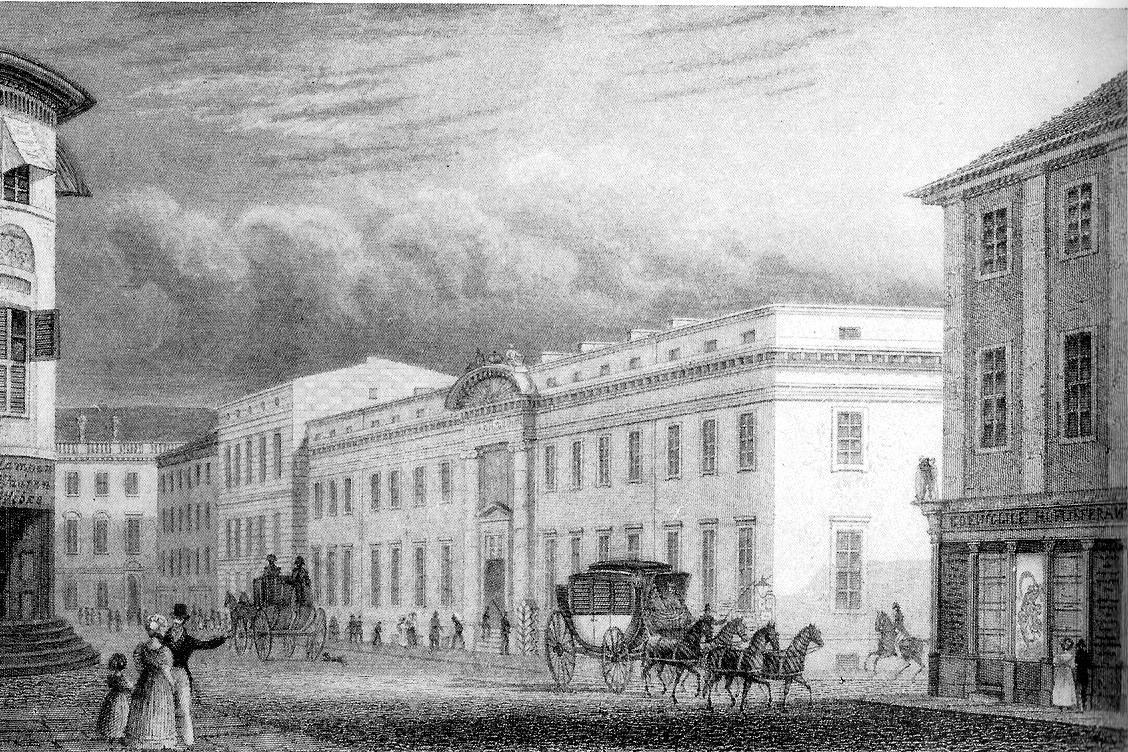
The institutional lineage of the Deutsche Bundesbank begins not with the democratic stability of the Federal Republic, with the autarkic ambitions of Frederick the Great. In June 1765, Frederick II established the Königliche Giro- und Lehnbank (Royal Giro and Loan Bank) in Berlin. Unlike the merchant-run Bank of Hamburg or the Bank of Amsterdam, this institution was a creature of the state, designed initially to finance Prussian trade and manage royal credit. The bank launched with a severe capitalization deficit; while the statutes called for 8 million Thalers, the actual paid-in capital was a mere 400, 000 Thalers. This early reliance on state authority over hard assets established a precedent that would haunt German central banking for two centuries: the subordination of monetary policy to the immediate political and military needs of the sovereign.
By the mid-19th century, the demands of industrialization outstripped the capabilities of a purely state-run vault. The reorganization of the institution into the Preußische Bank (Prussian Bank) in 1846 marked a serious evolution. The state admitted private shareholders to raise capital, yet it retained absolute administrative control. This hybrid structure, private ownership without private authority, became the blueprint for the Reichsbank. The Prussian Bank operated as a "juridical person," a legal entity distinct from the state treasury, yet its officials were royal appointees answerable only to the monarchy. This method allowed the state to use private wealth for public infrastructure and military expansion while insulating the bank's decisions from shareholder dissent.
The unification of Germany in 1871 necessitated a unified currency and a central bank to manage it. The Coinage Act of 1873 introduced the Gold Mark, placing the new empire on the gold standard. On January 1, 1876, the Reichsbank formally opened its doors, absorbing the Prussian Bank and its infrastructure. Under the Banking Act of 1875, the Reichsbank was tasked with regulating the circulation of money and facilitating payments. For nearly four decades, the Reichsbank maintained a reputation for stability, its notes fully convertible to gold. The "Reichsbankautonomie" (autonomy) was technically enshrined in law, the Reich Chancellor held the final authority, a failsafe that would prove disastrous when war arrived.
The outbreak of World War I in August 1914 shattered the gold standard. On August 4, the Reichstag passed laws suspending the convertibility of notes into gold and authorizing the creation of Darlehnskassen (Loan Bureaus). These bureaus issued Darlehnskassenscheine, paper certificates accepted as legal tender. The Reichsbank began discounting short-term Treasury bills (Schatzanweisungen) without limit, printing money to finance the Kaiser's war. The gold reserves, including the famous war chest from the Julius Tower in Spandau, were consolidated in the Reichsbank's vaults, not to back the currency, to pay for foreign imports. The domestic money supply was unmoored from reality; by 1918, the volume of currency in circulation had risen by nearly 600 percent.
The defeat in 1918 did not halt the printing presses. load by reparations, strikes, and a refusal to tax the wealthy, the Weimar Republic continued the imperial policy of debt monetization. The result was the hyperinflation of 1923, an economic catastrophe that obliterated the German middle class. At the height of the emergency, the Reichsbank outsourced note production to private printing firms because its own presses could not keep pace with the devaluation. Prices quadrupled every month. The exchange rate collapsed from 4. 2 Marks to the Dollar in 1914 to 4. 2 trillion Marks to the Dollar by November 1923. This period destroyed faith in the state and radicalized the electorate, creating the social conditions for the rise of extremism.
| Date | Metric | Value / Amount | Context |
|---|---|---|---|
| July 1914 | USD Exchange Rate | 4. 2 Marks | Gold Standard Parity |
| Jan 1919 | USD Exchange Rate | 8. 9 Marks | Post-WWI Inflation begins |
| Jan 1923 | USD Exchange Rate | 17, 972 Marks | Occupation of the Ruhr |
| Nov 1923 | USD Exchange Rate | 4, 200, 000, 000, 000 Marks | Peak Hyperinflation |
| 1934, 1938 | MEFO Bills Issued | ~12, 000, 000, 000 RM | Nazi Rearmament (Off-book) |
| 1939 | Disclosed Reich Debt | 19, 000, 000, 000 RM | Official Public Debt |
Stabilization arrived through Hjalmar Schacht, appointed Currency Commissioner and later Reichsbank President. The introduction of the Rentenmark in late 1923, backed theoretically by a mortgage on German land and industry, halted the panic. The subsequent Reichsmark, introduced in 1924, returned Germany to a gold-exchange standard. Schacht became a hero of stabilization, a reputation he would later use to serve the Nazi regime. Under the Dawes Plan and later the Young Plan, the Reichsbank became the conduit for foreign loans, primarily from the United States, which temporarily propped up the German economy until the crash of 1929.
The Nazi seizure of power in 1933 brought Schacht back to the helm of the Reichsbank. Hitler demanded rearmament without inflation and without alerting foreign powers. Schacht's solution was the MEFO bill (Metallurgische Forschungsgesellschaft). This was a promissory note issued by a shell company with a nominal capital of only 1 million Reichsmarks. Defense contractors drew bills on this dummy corporation, which the Reichsbank guaranteed to rediscount. These bills circulated as a shadow currency among industrial firms, paying for tanks and planes without appearing in the Reich's published budget. Between 1934 and 1938, the Reichsbank financed approximately 12 billion Reichsmarks of off-book military spending, tripling the national debt in secret.
In 1939, Hitler removed the last vestiges of Reichsbank independence. A new law placed the bank directly under the "Führer and Reich Chancellor," eliminating the collegial directorate system. During World War II, the Reichsbank descended into outright criminality. It became a central cog in the of the Holocaust and the plunder of Europe. The bank established the "Melmer" account, named after SS Captain Bruno Melmer, to process loot stolen from concentration camp victims. Gold teeth, wedding rings, jewelry, and silverware were delivered to the Reichsbank, smelted into bars, and entered into the bank's reserves or sold to Swiss banks to acquire foreign currency.
The Reichsbank also orchestrated the systematic looting of central bank gold from occupied nations. Following the invasions of Belgium and the Netherlands, the Reichsbank seized their gold reserves. The Belgian gold, entrusted to the Bank of France for safekeeping, was transferred to Berlin via Dakar in a flagrant violation of international law. By 1945, the Reichsbank's vaults held a toxic mixture of legitimate pre-war reserves, looted monetary gold from neighbors, and the "victim gold" of the murdered. When US forces discovered the stash at the Merkers mine in April 1945, they found bags of currency and gold bars, the physical evidence of a central bank that had become a criminal enterprise. The institution ceased to function with the German surrender, leaving behind a worthless currency and a destroyed moral legacy.
Currency Reform and the Bank deutscher Länder (1948, 1957)
| Metric | Value/Date | Context |
|---|---|---|
| Initial Per Capita Allocation | 40 DM (June 20) + 20 DM (Sept) | "Kopfgeld" provided immediate liquidity to citizens. |
| Savings Conversion Rate | 100 RM: 6. 5 DM | 93. 5% confiscation of monetary assets. |
| Discount Rate Hike | 4% to 6% (Oct 27, 1950) | BdL response to Korean War inflation/EPU deficit. |
| EPU Deficit (1950) | ~$356 Million (Oct 1950) | Germany exceeded its quota in the European Payments Union. |
| Money Supply Reduction | ~90% Contraction | Immediate removal of Nazi-era monetary overhang. |
The transition from the BdL to the Bundesbank in 1957 was direct in personnel significant in law. Wilhelm Vocke retired at the end of 1957, passing the presidency to Karl Blessing. The institution they built had successfully navigated the transition from a barter economy to a global export powerhouse in less than a decade. The 1957 Act did not rename the bank; it codified the lessons of the post-war turmoil. It rejected the 19th-century view of the central bank as a state financier, a rejection that would hold firm until the unconventional monetary policies of the 21st century began to blur those lines once again. The "Bank deutscher Länder" era was short, yet it was the crucible in which the Deutsche Mark's reputation as the "hardest" currency in Europe was forged.
The 1957 Bundesbank Act and Statutory Independence
The statutory architecture of the Bundesbank was designed to prevent the weaponization of the printing press by the government, a direct response to the hyperinflation of 1923 and the hidden inflation of the Nazi era. Section 3 of the Act defined the bank's primary objective with deceptive simplicity: "safeguarding the currency." This mandate was absolute. Section 12 explicitly stated that in exercising the powers conferred by the Act, the Bank was "independent of instructions from the Federal Government." This provision created a "state within a state," a non-majoritarian institution with the power to wreck the plans of elected chancellors if those plans threatened the Deutsche Mark.
The relationship between the Bank and the government was governed by a carefully worded paradox. While the Bank was required to "support the general economic policy of the Federal Government," this obligation contained a serious escape clause: " only insofar as it can do so without prejudice to the performance of its own functions." This "without prejudice" clause (Section 12, Sentence 2) became the Bundesbank's shield. Whenever the government in Bonn demanded lower interest rates to boost growth or employment, the central bankers in Frankfurt could, and frequently did, refuse, citing their primary duty to price stability.
The transition from the Bank deutscher Länder to the Bundesbank was born of political conflict. Chancellor Konrad Adenauer had already clashed with the central bankers in the "Gürzenich Affair" of 1956, where he publicly attacked the Bank's restrictive measures as a "guillotine" for the economy. The Bank stood its ground, and Adenauer was forced to retreat, learning a hard lesson: the German public trusted the guardians of the Mark more than they trusted the Chancellor. This public support became the Bundesbank's power base, allowing it to political pressure that would have crushed a less autonomous institution.
yet, this statutory independence was immediately tested by the economic realities of the fixed exchange rate system. The "magical triangle" of monetary policy, price stability, full employment, and external balance, proved impossible to maintain under the Bretton Woods system. As the West German economy boomed, it attracted massive capital inflows, creating a structural balance of payments surplus. The Bundesbank found itself importing inflation; to maintain the fixed exchange rate, it had to sell Marks and buy dollars, flooding the domestic market with liquidity.
The conflict came to a head in the revaluation emergency of 1961. The Bundesbank had tightened policy to fight domestic inflation, raising the discount rate to 5% in 1960. This only widened the interest rate differential with the United States, attracting even more "hot money" into Germany. The Bank was trapped. To stop the inflows, it had to lower rates (which risked domestic inflation) or revalue the Mark (which angered exporters and the government). In March 1961, the Bundesbank and the government agreed to a 5% revaluation of the Mark. While technically a government decision, it was a surrender to the monetary logic imposed by the Bank's previous tightening.
The limits of the Bundesbank's independence were clear revealed in 1967, not by domestic law, by geopolitical force. In the "Blessing Letter" of March 30, 1967, Bundesbank President Karl Blessing formally promised Federal Reserve Chairman William Martin that Germany would not convert its dollar reserves into gold. This pledge, extracted under American pressure regarding troop stationing costs, suspended the Bundesbank's ability to manage its reserve composition independently. It was a capitulation that acknowledged the Federal Republic's security dependence on the United States, proving that statutory independence ended where existential geopolitical interests began.
Even with these external constraints, the Bundesbank's domestic record in the years following the 1957 Act showed a fierce commitment to its mandate. The data from this period reveals a central bank to impose pain to secure stability.
| Year | Discount Rate (Year End) | Inflation Rate (CPI) | Real GDP Growth |
|---|---|---|---|
| 1957 | 4. 0% | 2. 1% | 5. 7% |
| 1958 | 3. 0% | 2. 4% | 4. 4% |
| 1959 | 4. 0% | 1. 1% | 7. 3% |
| 1960 | 4. 0% | 1. 4% | 9. 0% |
| 1961 | 3. 0% | 2. 3% | 4. 4% |
| 1962 | 3. 0% | 2. 8% | 4. 7% |
| 1963 | 3. 0% | 2. 9% | 3. 4% |
| 1964 | 3. 0% | 2. 4% | 6. 7% |
| 1965 | 4. 0% | 3. 2% | 5. 7% |
The table shows that the Bundesbank kept inflation significantly lower than its trading partners, rarely allowing it to breach 3%. The discount rate adjustments were sharp and reactive. When the economy overheated in 1959-1960, the Bank raised rates; when the revaluation in 1961 cooled the external pressure, it cut them. This data confirms that the 1957 Act was not just paper; it was a functioning operating system for a hard-money regime.
The 1957 Act also established the organizational structure that balanced federal and regional interests. The Central Bank Council (Zentralbankrat) included the Directorate (based in Frankfurt) and the Presidents of the Land Central Banks. This federalist structure prevented the concentration of power in a single "monetary dictator" and ensured that regional economic conditions were voiced in Frankfurt. It was a system designed for gridlock against inflation, requiring consensus to print money allowing any single faction to raise the alarm.
By the mid-1960s, the Bundesbank had established itself as the "shadow chancellor" of West Germany. Its statutory independence allowed it to act as the disciplinarian of the "Social Market Economy," punishing fiscal profligacy with higher interest rates. The 1957 Act did not just create a bank; it created a fourth branch of government, unelected and unremovable, whose only constituency was the stability of the price level.
Monetary Dominance and the European Exchange Rate Mechanism
The European Monetary System (EMS), established in 1979, was theoretically a basket of currencies anchored by the European Currency Unit (ECU). In practice, it functioned as a Deutsche Mark zone, a method that exported the Bundesbank's anti-inflationary credibility to its neighbors while importing their deflationary pain. By the late 1980s, the arrangement had solidified into a rigid hierarchy where Frankfurt set interest rates and the rest of Europe followed, regardless of their domestic economic conditions. This asymmetry remained manageable so long as the economic pattern of member states were roughly aligned. The unification of Germany in 1990 shattered this alignment, creating an asymmetric shock that would test the Bundesbank's statutory mandate against its European political obligations.
The catalyst for the subsequent currency turmoil was the monetary union between West and East Germany, executed on July 1, 1990. Chancellor Helmut Kohl, driven by political expediency and the desire to stop mass migration from the East, overruled the Bundesbank's technical advice. Bundesbank President Karl Otto Pöhl had argued for a conversion rate of two Ostmarks to one Deutsche Mark to reflect the productivity gap. Instead, Kohl imposed a 1: 1 rate for wages, prices, and savings up to 4, 000 marks. The result was an immediate explosion in the German money supply, with M3 aggregate growth surging well beyond the bank's target corridors. Pöhl, seeing his warnings ignored and the bank's independence compromised, resigned in 1991, leaving his successor, Helmut Schlesinger, to clean up the monetary spill.
To counteract the inflationary pressure of reunification, fueled by massive fiscal transfers to the East and a construction boom, the Bundesbank reverted to its foundational reflex: it tightened the screws. Between 1990 and 1992, Frankfurt aggressively hiked interest rates. The discount rate climbed to a record 8. 75 percent in July 1992, and the Lombard rate reached 9. 75 percent. For Germany, this was a necessary sterilization of the reunification liquidity bubble. For the rest of Europe, it was a disaster. The United Kingdom, Italy, and France were with recession and high unemployment. Under normal floating conditions, these nations would have cut interest rates to stimulate growth. Under the Exchange Rate method (ERM), they were forced to mirror the Bundesbank's hikes to defend their currency pegs against the Mark. The system transmitted a contractionary shock from a booming Germany to a slumping Europe.
The tension peaked in the summer of 1992. Currency speculators, led most famously by George Soros's Quantum Fund, recognized the fundamental incompatibility of the economic needs. They bet that the Bank of England and the Bank of Italy could not sustain the political cost of high interest rates indefinitely. The Bundesbank, strictly interpreting its mandate, refused to lower German rates to ease the pressure on its neighbors. This refusal was not policy; it was an assertion of monetary dominance. The Bundesbank Act of 1957 prioritized domestic price stability above all else, including the survival of the European exchange rate grid.
The situation dissolved into chaos in September 1992. On September 8, Finland severed the markka's link to the ECU, signaling that pegs could be broken. The attack then shifted to the Italian lira. even with massive intervention, the lira was forced to devalue. The focus immediately turned to the British Pound. The British government, led by John Major and Chancellor Norman Lamont, had entered the ERM in 1990 at a rate of 2. 95 Marks to the Pound, a level economists deemed overvalued. To defend this rate against the market onslaught, the Bank of England needed the Bundesbank to sell Marks and buy Pounds, or to cut German interest rates.
The Bundesbank's support was lukewarm at best. While the New York Federal Reserve had a tradition of unconditional support for allies, the Bundesbank operated with a "limited liability" mindset. In the days leading up to the meltdown, Helmut Schlesinger gave an interview to the Wall Street Journal and Handelsblatt. Although the full transcript was nuanced, a wire service report on September 15 quoted Schlesinger as saying that "further realignments" in the EMS could not be ruled out. The markets interpreted this as a death sentence for the Pound. The Bundesbank had signaled it would not bankrupt its own balance sheet to save a misaligned Sterling.
The following day, September 16, 1992, became known as Black Wednesday. The Bank of England spent billions of pounds in foreign currency reserves in a futile attempt to prop up the currency. In a desperate bid to attract capital, Lamont raised the base interest rate from 10 percent to 12 percent, and then promised 15 percent, all within a single trading day. The markets ignored the hikes, sensing the desperation. The Bundesbank, meanwhile, engaged in obligatorily intervention did so without the "whatever it takes" commitment required to deter the selling wave. By that evening, Britain suspended its ERM membership, and the Pound crashed. Italy also exited the system.
| Date | Discount Rate (%) | Lombard Rate (%) | Context |
|---|---|---|---|
| Jan 1990 | 6. 00 | 8. 00 | Pre-Reunification |
| Nov 1990 | 6. 00 | 8. 50 | Post-Reunification Inflation Fears |
| Feb 1991 | 6. 50 | 9. 00 | Pöhl Resignation Era |
| Dec 1991 | 8. 00 | 9. 75 | Schlesinger Tightening |
| July 1992 | 8. 75 | 9. 75 | Peak Rates / ERM Pressure |
| Sept 1992 | 8. 25 | 9. 50 | Black Wednesday (Minor Cut) |
| July 1993 | 6. 75 | 8. 25 | Widening of ERM Bands |
The turmoil did not end with the British exit. In 1993, the market turned its sights on the French Franc. The Banque de France and the Bundesbank engaged in massive intervention, with the Bundesbank spending nearly 60 billion Marks to defend the Franc. Yet, the fundamental remained. To prevent a total collapse of the European project, the ERM fluctuation bands were widened from the narrow +/- 2. 25 percent to a broad +/- 15 percent in August 1993. This floated the currencies within a wide tunnel, acknowledging that the Bundesbank's tight money policy could not be harmonized with the rest of Europe through rigid pegs alone.
This period of extreme volatility demonstrated the "Impossible Trinity" of international economics: a country cannot simultaneously have a fixed exchange rate, free capital movement, and an independent monetary policy. Germany refused to sacrifice its independent monetary policy; the capital markets were free; therefore, the fixed exchange rates had to break. The events of 1992-1993 hardened the resolve of French policymakers, particularly François Mitterrand, to pursue a single currency not for economic efficiency, to break the hegemony of the Bundesbank. If the decisions were made in Frankfurt, they would always serve Germany. Only by creating a European Central Bank, where Germany had one vote among , could the monetary dominance of the Mark be diluted.
From the vantage point of 2026, the Bundesbank's actions during the ERM meltdown appear as the expression of its institutional DNA. The bank accepted the reputational damage of "causing" Black Wednesday rather than risk the domestic inflation that might have resulted from unlimited intervention or premature rate cuts. This uncompromising stance preserved the Mark's value destroyed the transitional exchange rate system, accelerating the timeline for the Euro. Ironically, the Bundesbank's successful defense of German stability became the primary argument for its own abolition in favor of the Eurosystem.
Reunification Economics and the Ostmark Conversion
The monetary integration of East Germany stands as the single most disruptive event in the Bundesbank's post-war history, a moment where political imperative brutally overrode economic calculus. In early 1990, as the inevitability of reunification became clear, Chancellor Helmut Kohl pushed for a 1: 1 conversion rate for wages, rents, and savings between the worthless East German Ostmark and the mighty Deutsche Mark. Bundesbank President Karl Otto Pöhl vehemently opposed this, arguing that such a valuation would instantly render East German industry uncompetitive and ignite inflation. Pöhl favored a rate closer to 2: 1 or even 5: 1 to reflect the true productivity gap. Kohl, eyeing the upcoming elections and fearing a mass migration of East Germans to the West, ignored the central bank. The resulting conflict led to Pöhl's resignation in 1991, marking a rare defeat for the Bundesbank's technocratic independence.
On July 1, 1990, the "Monetary, Economic and Social Union" took effect, three months before political reunification. The terms were generous to East German citizens catastrophic for their employers. Wages and savings up to 4, 000 Ostmarks were converted at 1: 1, while larger amounts traded at 2: 1. Overnight, East German factories, which operated with obsolete equipment and bloated workforces, were forced to pay wages in hard currency that their productivity could not justify. The result was immediate deindustrialization. Unable to compete with Western firms or even cheap Eastern European imports, East German production collapsed. The region's industrial output fell by more than 50 percent within two years, a contraction more severe than the Great Depression.
The task of managing this economic wreckage fell to the Treuhandanstalt, a trust agency charged with privatizing 8, 500 state-owned enterprises (Volkseigene Betriebe). The agency's mandate was to sell assets quickly to modernize the economy, it presided over a fire sale. By the time the Treuhand wound down operations in 1994, it had accumulated a deficit of approximately 270 billion Deutsche Marks and liquidated millions of jobs. The social cost was explosive; the agency's chairman, Detlev Rohwedder, was assassinated in April 1991 by the Red Army Faction, a violent reaction to the perceived of the East's livelihood. Instead of the "blossoming " Kohl had promised, the East became dependent on massive fiscal transfers from the West.
To finance this colossal reconstruction without raising general taxes immediately, the German government ran massive budget deficits. The Bundesbank, true to its anti-inflationary mandate, responded by hiking interest rates aggressively. The Lombard rate hit 9. 75 percent in 1992, squeezing the domestic economy causing havoc abroad. Because the Deutsche Mark was the anchor of the European Exchange Rate method (ERM), other European nations were forced to match these high rates to maintain their currency pegs, even with their own weak economies. This pressure culminated in the ERM emergency of September 1992, when the United Kingdom and Italy were forced to devalue and exit the system. In effect, the Bundesbank exported the cost of German reunification to its neighbors, prioritizing domestic price stability over European exchange rate stability.
The financial load of unity proved far heavier and longer-lasting than initial estimates of 100 billion Marks. By 2024, the total net transfer from West to East was estimated to exceed €2 trillion. To fund this, the government introduced the "Solidarity Surcharge" (Solidaritätszuschlag) in 1991, a 7. 5 percent tax on income and corporate profits, later reduced to 5. 5 percent. Originally sold as a temporary measure, the "Soli" became a permanent fixture of the German tax code. In March 2025, the Federal Constitutional Court upheld the surcharge for top earners and corporations, ruling that the "reunification-related additional financial load" remained a valid legal basis for the levy, three and a half decades after the fall of the Berlin Wall.
As of 2026, the economic cleavage between East and West remains visible in structural data. While major cities like Leipzig and Dresden have formed successful industrial clusters, the broader East German economy suffers from a persistent productivity gap, with output per worker stalling at roughly 80 to 90 percent of Western levels. The "halo effect" of the Deutsche Mark did not magically upgrade the East's capital stock; instead, it created a subsidy-dependent "Mezzogiorno" economy. Notably, the DAX 40 index of Germany's leading blue-chip companies remains overwhelmingly West German. With the exception of digital platforms like Zalando in Berlin, the corporate headquarters of Germany's industrial titans, Siemens, BMW, BASF, stay firmly rooted in the West, a legacy of the 1990 shock therapy that wiped out the East's industrial base before it could adapt.
Eurosystem Integration and Transfer of Monetary Authority

The integration of the Deutsche Bundesbank into the Eurosystem represents the most significant transfer of sovereignty in modern German economic history, a process that converted the world's most formidable defender of hard currency into a minority shareholder in a supranational experiment. While the Maastricht Treaty of 1992 was sold to the German public as the globalization of the Bundesbank's stability culture, the operational reality from 1999 to 2026 revealed a steady of German monetary dominance. The institution that once dictated interest rates for the entire continent was reduced to casting a single vote in the Governing Council of the European Central Bank (ECB), frequently finding itself outflanked by a coalition of southern member states favoring looser credit conditions.
The surrender of the Deutsche Mark on January 1, 1999, was not a currency swap; it was a constitutional rewiring of the German state. Under the amended Bundesbank Act, the institution retained its independence from the German government lost its independence from the ECB. The "anchor of stability" became an implementation arm for decisions made in Frankfurt's Eurotower, frequently over the strenuous objections of the Bundesbank President. This structural demotion was masked initially by the "Great Moderation," the inherent conflicts in the system erupted following the 2008 financial emergency. The method of this conflict was the Trans-European Automated Real-time Gross Settlement Express Transfer System, known as TARGET2. Originally designed as a technical plumbing system for cross-border payments, TARGET2 mutated into a silent bailout engine. As capital fled the periphery for the safety of German assets, the Bundesbank was forced to accumulate massive, unsecured claims against the ECB system, credits that could never be called in.
| Year | Net Interest Income (€ Billions) | Distributable Profit to Federal Budget (€ Billions) | Status of Risk Provisions |
|---|---|---|---|
| 2019 | +4. 5 | 5. 85 | Stable |
| 2020 | +2. 9 | 0. 00 | Provisions increased for QE risks |
| 2021 | +2. 5 | 0. 00 | Provisions increased significantly |
| 2022 | -0. 5 | 0. 00 | operating loss; covered by reserves |
| 2023 | -13. 9 | 0. 00 | Reserves fully liquidated to cover loss |
| 2024 | -19. 2 | 0. 00 | Loss carryforward recorded; equity negative |
| 2025 | -18. 5 (est) | 0. 00 | Accumulated losses exceed €20bn |
The political impotence of the Bundesbank became clear during the sovereign debt emergency. The tenure of Presidents Axel Weber and Jens Weidmann was defined by a series of losing battles against the ECB's adoption of unconventional monetary tools. Weber resigned in 2011 in protest against the Securities Markets Programme (SMP), and his successor Weidmann cast the lone dissenting vote against the Outright Monetary Transactions (OMT) program in 2012. These measures, which allowed the ECB to buy the bonds of distressed governments, were viewed in Frankfurt's Ostend district as a violation of Article 123 of the Lisbon Treaty, which prohibits monetary financing of states. The Bundesbank argued that the ECB was mutualizing debt through the back door, exposing the German taxpayer to unlimited liability without parliamentary approval. The conflict reached its zenith in May 2020, when the German Federal Constitutional Court in Karlsruhe issued its thunderous Weiss judgment, ruling that the ECB had acted ultra vires (beyond its powers) and chastising the Bundesbank for failing to oppose the bond-buying schemes more.
By the mid-2020s, the theoretical risks of these policies materialized as concrete financial damage. The era of negative interest rates had forced the Bundesbank to acquire nearly €1 trillion in low-yielding government bonds. When inflation surged in 2022 and the ECB was forced to hike rates, the Bundesbank found itself in a financial vice: it was paying high interest on the commercial bank deposits it held (liabilities) while receiving pittance returns on its bond portfolio (assets). In February 2025, the Bundesbank reported a loss of €19. 2 billion for the 2024 fiscal year, wiping out its remaining provisions and forcing it to carry forward a negative equity position. President Joachim Nagel admitted that the bank would not transfer a single cent of profit to the German federal budget for "a long time," creating a hole in Berlin's finances just as the nation grappled with industrial stagnation and defense rearmament.
The trajectory from 1999 to 2026 illustrates a irony: the Bundesbank successfully exported its model of independence to the ECB, in doing so, it imported the financial volatility of the European periphery. The "Target2 trap" remains a dormant threat; as of early 2026, the Bundesbank's claims on the Eurosystem still exceeded €1 trillion, representing a massive, unhedged exposure to the solvency of the Eurozone. While the Bundesbank retains its gold reserves, valued at over €200 billion, as a psychological backstop, its operational capacity is entirely tethered to the shared decisions of the Governing Council. The institution that once brought down governments with a mere signal of a rate hike has been transformed into a manager of legacy assets and a dissenting voice in a choir it no longer conducts.
Gold Reserve Logistics and International Repatriation
The accumulation and subsequent logistical management of Germany's gold reserves represent one of the singular anomalies in modern economic history. Unlike the United States, Russia, or South Africa, the Federal Republic of Germany possesses no significant domestic gold mining industry. Yet, by 2026, the Deutsche Bundesbank holds the world's second-largest official gold reserve, totaling approximately 3, 355 tonnes. This massive hoard, valued at over €200 billion depending on spot market fluctuations, was not dug from the earth by German miners was earned through the relentless industrial export machine that began during the Wirtschaftswunder (economic miracle) of the 1950s.
The origin of these reserves lies in the mechanics of the European Payments Union (EPU), established in 1950 to facilitate trade among European nations before full currency convertibility existed. As West German manufacturing recovered with startling speed, the nation ran persistent trade surpluses. Under the EPU settlement rules, member states with deficits had to settle a portion of their debts in gold or U. S. dollars. By 1951, the Bank deutscher Länder (the Bundesbank's predecessor) held its 25 tonnes. By 1968, this figure had exploded to a peak of over 4, 000 tonnes. Because these payments occurred internationally, the physical gold was credited to German accounts at foreign central banks, primarily the Federal Reserve Bank of New York, the Bank of England in London, and the Banque de France in Paris. The gold never crossed the German border.
During the Cold War, this foreign storage arrangement transformed from a logistical convenience into a geopolitical need. With the Iron Curtain cutting through the heart of Germany and the Fulda Gap offering a chance invasion route for Soviet tank divisions, keeping the nation's primary financial war chest west of the Rhine, and preferably across the Atlantic, was a strategic imperative. For decades, the Bundesbank was content to hold paper claims on gold bars stored in Manhattan and London, viewing them as safe from Soviet seizure and instantly available for currency swaps in emergency scenarios. By 1990, roughly 98 percent of Germany's gold was stored abroad.
This implicit trust in allied central banks began to following the 2008 global financial emergency. As faith in sovereign debt and fiat currencies wobbled, a domestic movement known as "Holt unser Gold heim" (Bring our gold home) gained traction, fueled by conspiracy theories that the gold in New York had been leased out, rehypothecated, or simply did not exist. These public doubts forced the hand of the Bundesrechnungshof (Federal Court of Auditors). In a classified 2012 report, the auditors delivered a stinging rebuke to the Bundesbank, criticizing the absence of physical inventory checks. The report noted that German officials had never physically verified the weight or fineness of the bars in New York, relying instead on annual written confirmations from the Federal Reserve.
Faced with mounting political pressure and the auditors' demands for "physical inspection and weight checks," the Bundesbank announced a sweeping new storage concept in January 2013. The plan called for the repatriation of 674 tonnes of gold, 300 tonnes from New York and 374 tonnes from Paris, to the Bundesbank's headquarters in Frankfurt am Main by 2020. The objective was to house half of Germany's total reserves within its own borders, a target that required a logistical operation of military precision.
The repatriation effort, codenamed and executed under high secrecy, involved the transport of approximately 54, 000 individual gold bars. The logistics required armored convoys and air freight, with insurance liabilities so high that shipments were broken down into smaller, manageable tranches to avoid overwhelming the reinsurance markets. The withdrawal from Paris was total; the Bundesbank reasoned that since France and Germany both used the Euro, holding gold in Paris offered no foreign exchange diversification benefit. The New York reduction was partial, retaining enough bullion to facilitate chance USD currency swaps.
The operation proceeded faster than the initial seven-year timeline suggested. By August 2017, three years ahead of schedule, the Bundesbank announced the completion of the transfers. The bank brought back 300 tonnes from the Federal Reserve and the full 374 tonnes from the Banque de France. Upon arrival in Frankfurt, the bars underwent rigorous testing. Bundesbank technicians used high-precision and ultrasonic devices to detect tungsten inclusions or other counterfeiting methods. also, X-ray fluorescence analysis verified the surface purity of the metal. To silence skeptics who claimed the US returned "different" gold, the Bundesbank melted down of the repatriated bars, recasting them into new "Frankfurt Good Delivery" standard bars, thereby proving physical possession and purity beyond doubt.
As of 2026, the distribution of Germany's gold reserves reflects a balance between domestic security and international liquidity. The Bundesbank publishes a detailed list of every gold bar in its possession, a level of transparency that was unthinkable during the unclear banking culture of the 20th century. The current allocation is strictly maintained to ensure that while the majority of the wealth sits in the vaults beneath Frankfurt, enough remains in the world's two primary gold trading hubs to support the Euro in a currency emergency.
| Storage Location | Tonnage (Approx.) | Percentage Share | Strategic Function |
|---|---|---|---|
| Deutsche Bundesbank (Frankfurt) | 1, 710 | 50. 6% | Domestic confidence, physical control |
| Federal Reserve Bank (New York) | 1, 236 | 36. 6% | USD currency swaps, deep liquidity |
| Bank of England (London) | 432 | 12. 8% | Global gold trading hub access |
| Banque de France (Paris) | 0 | 0. 0% | Location closed (Eurozone redundancy) |
| Total Reserves | ~3, 378 | 100. 0% |
The successful repatriation silenced the "gold truther" movement and restored public confidence in the Bundesbank's stewardship. The operation also demonstrated the logistical capability of the central bank to move heavy assets across borders without disrupting global markets. Even with the completion of this program, the Bundesbank continues to face questions regarding the 1, 236 tonnes remaining in New York. Yet, the bank maintains that this geographic diversification is not a relic of the Cold War, a calculated hedge against localized catastrophes and a necessary tool for international finance. In a world of digital fiat, the Bundesbank's heavy reliance on physical bars, inspected, weighed, and guarded, serves as the anchor for the German economy.
Target2 Liabilities and Cross-Border Payment Metrics
The mechanics of this imbalance are frequently buried in technical jargon, yet they reveal the structural fracture of the monetary union. When a Greek company buys a German machine, or an Italian investor moves capital to a Frankfurt bank, money flows across borders. In a gold standard or a fixed exchange rate system with settlement, the deficit country would eventually have to transfer gold or foreign reserves to Germany. In the Eurosystem, no such settlement occurs. Instead, the Bundesbank's computer simply records a claim on the ECB, and the Banca d'Italia (or another national central bank) records a liability. These balances were originally expected to oscillate near zero. They did not.
The data exposes three distinct phases of deterioration. Between 1999 and 2007, Target balances were negligible, suggesting a functioning interbank market where private capital flowed freely to finance trade deficits. The financial emergency of 2008 broke this method. As private credit retreated from the European periphery, the Eurosystem stepped in. By 2012, the Bundesbank's claims swelled to over €700 billion, driven by capital flight from the south to the perceived safety of German assets. A brief respite followed, the launch of Quantitative Easing (QE) in 2015 ignited a second, more permanent expansion. As the ECB bought bonds from international investors, the cash proceeds frequently ended up in German bank accounts, inflating the Bundesbank's Target claims mechanically.
The third phase, the "pandemic and inflation" era (2020, 2026), pushed these metrics into uncharted territory. By December 2022, the Bundesbank's Target2 claims hit an all-time peak of approximately €1. 27 trillion. Even with the onset of quantitative tightening and the migration to the modernized T2 system in March 2023, the balance has shown remarkable stickiness. As of January 2026, the outstanding balance remains near €1. 03 trillion, roughly 25% of Germany's entire Net International Investment Position.
| Date | Balance (Approx. € Billions) | Primary Driver |
|---|---|---|
| Jan 2002 | -27 (Liability) | Pre-emergency normalcy; Germany imports capital. |
| Oct 2008 | +70 | Global Financial emergency onset. |
| Aug 2012 | +751 | Eurozone Sovereign Debt emergency; capital flight. |
| Dec 2017 | +907 | ECB Asset Purchase Program (QE). |
| Dec 2022 | +1, 269 | Pandemic stimulus peak. |
| Jan 2026 | +1, 033 | Post-QE plateau; structural persistence. |
Economist Hans-Werner Sinn has long characterized this situation as the "Target Trap." His analysis that these balances are not accounting entries real loans that finance the balance of payments deficits of other Eurozone nations. Because the debtors control the voting majority in the ECB Governing Council, the Bundesbank absence the power to call in these loans or demand collateral. The risk is binary: as long as the Euro exists, the system functions. If a major debtor country were to exit the Eurozone, the Bundesbank would be left with a trillion-euro claim against a defaulted entity, denominated in a defunct currency. This chance loss would wipe out the Bundesbank's equity multiple times over, requiring a massive recapitalization by the German taxpayer.
Official narratives from Frankfurt and Brussels dismiss these concerns. The ECB maintains that Target balances are an inherent feature of a currency union, irrelevant unless the system collapses, a scenario they refuse to contemplate. They point out that since 2022, rising interest rates have technically turned these claims into income generators. The Bundesbank receives interest (at the Main Refinancing Operations rate) on its Target claims. yet, this income is a mirage; it is largely offset by the interest the Bundesbank must pay to commercial banks on the excess liquidity created by the very same asset purchases that bloated the Target balances in the place.
The migration to the T2 system in March 2023 introduced the ISO 20022 messaging standard and better liquidity management tools, it did nothing to alter the underlying economic reality. The plumbing was upgraded; the leak remains. The persistent €1 trillion surplus indicates that the Eurozone has not achieved genuine financial integration. Instead, it relies on the Eurosystem's balance sheet to intermediate flows that private markets reject. Germany exports goods and capital, and in return, it receives a digital IOU from the Eurosystem.
This metric serves as the barometer of Eurozone dysfunction. A healthy monetary union would see these balances settle or reverse. The fact that the Bundesbank's claim has ossified at over €1 trillion for years suggests a permanent structural transfer. It is a silent bailout, executed not through parliaments or treaties, through the obscure settlement algorithms of the central bank. The Bundesbank, once the fierce guardian of the Deutsche Mark, has become the silent underwriter of the Euro, holding a claim it can neither collect nor write off.
Federal Constitutional Court Proceedings and Legal Venues
The legal existence of the Deutsche Bundesbank is defined not by the Bundesbank Act of 1957, by a relentless series of constitutional battles fought in Karlsruhe. Since the Maastricht Treaty of 1993, the Federal Constitutional Court (Bundesverfassungsgericht or BVerfG) has served as the arbiter of German monetary sovereignty, frequently placing the Bundesbank in the unique position of being both a subject of European integration and a litigant against its own supranational parent, the European Central Bank (ECB). This "cooperation relationship" (Kooperationsverhältnis) between the German high court and the Court of Justice of the European Union (CJEU) has turned the Bundesbank's headquarters in Frankfurt into a secondary stage for constitutional theater.
The foundational conflict rests on Article 88 of the Basic Law (Grundgesetz). While this article mandates the establishment of a federal note-issuing bank, the 1992 amendment allowed for the transfer of duties to the ECB only under strict conditions: the European institution must be independent and committed to the primary objective of price stability. In its landmark Maastricht Judgment of October 12, 1993 (2 BvR 2134/92), the BVerfG ruled that this transfer was not a blank check. The court established the "ultra vires" doctrine, asserting its right to review whether EU institutions, specifically the ECB, exceeded their legal competencies. This ruling deputized the Bundesbank as the guardian of German constitutional identity within the Eurosystem, a role that would lead to open conflict two decades later.
Tensions escalated dramatically during the Eurozone sovereign debt emergency. The introduction of the Outright Monetary Transactions (OMT) program by the ECB in 2012 prompted a constitutional complaint (Gauweiler, 2 BvR 2728/13) that saw Bundesbank President Jens Weidmann testify against the ECB's policy. In a historic proceeding on June 11, 2013, Weidmann argued before the BVerfG that the OMT program tantamount to monetary financing of states, which is prohibited under Article 123 of the Treaty on the Functioning of the European Union (TFEU). This marked the time a national central bank governor openly opposed the Eurosystem's policy in a constitutional court. The BVerfG largely accepted Weidmann's economic assessment, in a strategic retreat, referred the case to the CJEU. The final 2016 ruling allowed the Bundesbank to participate in OMT only under specific conditions, such as volume limits and the absence of prior announcements.
The conflict reached its zenith with the Public Sector Purchase Program (PSPP). In the Weiss judgment of May 5, 2020 (2 BvR 859/15), the BVerfG declared the ECB's bond-buying program to be ultra vires, an act beyond its legal powers, because the ECB had failed to conduct a verifiable proportionality assessment. For the time in EU history, a national constitutional court declared a CJEU ruling (which had approved the program) to be non-binding in its jurisdiction. The judgment carried a direct order to the Bundesbank: it was prohibited from participating in the PSPP unless the ECB Governing Council provided a "substantiated" explanation of proportionality within three months. This ruling placed the Bundesbank in an impossible legal vice, caught between a binding order from Karlsruhe and its treaty obligations to the Eurosystem. The emergency was only defused when the ECB released authorized documents to the German government and Bundestag, allowing the BVerfG to accept compliance in mid-2020.
By 2026, the legal battleground has shifted from sovereign debt to climate policy and digital currency. The BVerfG's "Climate Order" (Klimabeschluss) of March 24, 2021, which elevated climate protection to a constitutional imperative under Article 20a, has forced a re-evaluation of the Bundesbank's mandate. While the Bundesbank is independent, it is also a federal authority bound by the Basic Law. Legal scholars that the bank's secondary objective, to support the general economic policies in the Union, must be interpreted through the lens of this constitutional climate mandate. This has created friction regarding "Green QE" (quantitative easing), where the purchase of corporate bonds is weighted by carbon intensity. Litigants have begun to challenge the "market neutrality" principle, arguing that the Bundesbank's asset purchases must actively exclude heavy polluters to comply with German constitutional law.
Simultaneously, the development of the Digital Euro has opened a new venue for constitutional challenges. As of March 2026, the Bundesbank faces scrutiny regarding the privacy architecture of the central bank digital currency (CBDC). The BVerfG has a long history of protecting the "right to informational self-determination" (notably in the 1983 Census Judgment). The Bundesbank's technical implementation of holding limits and transaction monitoring for the Digital Euro is currently subject to intense legal review to ensure it does not violate Article 10 (privacy of correspondence) and Article 14 (property rights) of the Basic Law. The "Bremen Ruling" of October 2025, where a regional constitutional court declared that the climate emergency justifies emergency borrowing beyond debt limits, has also complicated the Bundesbank's advisory role on fiscal discipline, blurring the lines between monetary stability and state emergency financing.
| Case Name / Date | Docket Number | Core problem | Bundesbank Role/Impact | Outcome |
|---|---|---|---|---|
| Maastricht Judgment (1993) | 2 BvR 2134/92 | Constitutionality of the EMU and ECB power transfer. | Defined Bundesbank independence as a constitutional requirement (Art. 88 GG). | Transfer approved, BVerfG reserves right to review ultra vires acts. |
| Lisbon Judgment (2009) | 2 BvE 2/08 | Ratification of the Treaty of Lisbon. | Reaffirmed budgetary autonomy of the Bundestag; limits on financial liability. | Treaty approved; strengthened role of Bundestag in EU integration. |
| OMT / Gauweiler (2016) | 2 BvR 2728/13 | Legality of Outright Monetary Transactions. | President Weidmann testified against OMT; Bank argued it was monetary financing. | OMT approved conditionally; Bundesbank participation limited by specific safeguards. |
| PSPP / Weiss (2020) | 2 BvR 859/15 | Proportionality of Public Sector Purchase Program. | Barred from participation (temporarily) due to absence of proportionality check. | ECB declared ultra vires; remedied by ex-post documentation. |
| Climate Order (2021) | 1 BvR 2656/18 | Intergenerational climate justice (Art. 20a GG). | Indirectly mandates climate consideration in "secondary" economic support role. | State organs must align actions with CO2 budgets; impacts asset purchase criteria. |
| Bremen Debt Ruling (2025) | StGH Bremen | Climate emergency as justification for emergency debt. | Challenges Bundesbank's fiscal discipline advice; creates "emergency" precedent. | Regional debt brake suspended for climate; for federal financing pending. |
The "ultra vires" sword remains sheathed sharp. The BVerfG has made it clear that the Bundesbank cannot simply be an executioner of ECB if that contradicts the fundamental democratic principles of the German constitution. The concept of Integrationsverantwortung (integration responsibility) requires the German government, Parliament, and the Bundesbank to actively monitor and, if necessary, oppose EU measures that overstep their bounds. This legal obligation ensures that the Bundesbank's legal department remains as serious to its operations as its markets division. The friction between Frankfurt, Karlsruhe, and Luxembourg is not a malfunction of the system its designed stress test, ensuring that the currency remains tethered to democratic legitimacy.
Conflict with European Central Bank Bond-Buying Programs

| Year | Net Result (EUR Billions) | Status of Reserves | Key Driver |
|---|---|---|---|
| 2022 | 0. 0 | Provisions utilized | Initial rate hikes increase interest expense. |
| 2023 | -21. 6 | Reserves depleted | Negative spread between deposit rate and bond yields. |
| 2024 | -19. 8 | Loss carryforward | Continued high interest payments on excess liquidity. |
| 2025 | -12. 5 (Est.) | Negative equity discussion | Slow normalization of yield curve. |
| 2026 | -8. 0 (Proj.) | Recapitalization debate | Legacy portfolio drag; inflation stabilizes at 2. 2%. |
By 2024, the Bundesbank reported a loss of nearly €20 billion, wiping out its remaining risk provisions and forcing it to carry forward losses for the time since the 1970s. President Joachim Nagel, who succeeded Weidmann, found himself managing a "negative equity" scenario where the central bank's liabilities exceeded its assets in accounting terms. While Nagel maintained that the Bundesbank's balance sheet remained sound due to massive unrealized gains on its gold reserves (valued at historical cost rather than market price), the optics were damaging. The institution that had once generated billions in profits for the German federal budget had become a fiscal black hole, unable to transfer dividends to Berlin just as the government grappled with its own "debt brake" constraints. The conflict also fundamentally altered the Bundesbank's market operations. The cessation of the Pandemic Emergency Purchase Program (PEPP) and the subsequent quantitative tightening (QT) required the Bundesbank to passively unwind its portfolio, a process complicated by the "fragmentation" risk in bond markets. When the ECB introduced the Transmission Protection Instrument (TPI) in 2022, a tool designed to buy the bonds of specific countries if spreads widened unjustifiably, it was yet another method that the Bundesbank viewed with deep suspicion, seeing it as a chance backdoor for the very monetary financing it had opposed a decade earlier. As of early 2026, the Bundesbank remains trapped in the wreckage of the unconventional monetary policies it resisted. The "clean-up" of the balance sheet is projected to take years, with the bank operating as a zombie entity profit generation until the low-yield bonds mature. The conflict has left permanent scars: the Bundesbank successfully preserved its legal independence, it failed to prevent the transformation of the Eurosystem into a vehicle for sovereign debt management, a reality that stands in clear contrast to the stability mandate of 1957. The "tragedy" of the Bundesbank, as noted by contemporary historians, is that its credibility was used to underwrite the very policies it warned would lead to the financial imbalances its ledger.
Digital Currency Initiatives and Cash Management (2020, 2026)
The operational mandate of the Deutsche Bundesbank in the 2020s required a simultaneous defense of physical currency and an aggressive expansion into distributed ledger technology. This dual track strategy emerged not from a desire for novelty from the need to maintain monetary sovereignty in an era of private crypto-assets and geopolitical fragmentation. While the European Central Bank directed the high-level policy for the Digital Euro, the Bundesbank focused on the technical architecture of settlement. The institution developed the "Trigger Solution" as a specific between blockchain-based market platforms and the traditional Eurosystem payment infrastructure. This method allowed financial market participants to settle securities transactions on distributed ledgers while the actual movement of funds occurred in safe central bank money within the TARGET2 system.
Technical trials conducted between May and November 2024 validated this method. The Eurosystem exploratory work involved 25 institutions and executed over 200 transactions. The Bundesbank's Trigger Solution proved that new digital assets did not require a new form of wholesale central bank money rather a smart interface to existing reserve accounts. This distinction was important. It preserved the liquidity efficiency of the established RTGS system while enabling the programmability sought by modern financial markets. By 2025, the success of these trials positioned the Bundesbank's infrastructure as a primary backend for the tokenized European capital market. The bank argued that technological modernization did not require the abandonment of proven settlement finality.
Parallel to these wholesale innovations, the Bundesbank navigated the contentious development of the retail Digital Euro. The Governing Council of the ECB initiated the preparation phase in November 2023. This stage focused on finalizing the rulebook and selecting providers for the platform and infrastructure. Burkhard Balz, the Bundesbank Executive Board member responsible for payments, became the primary advocate for this project within Germany. He faced a skeptical public. Data from 2023 and 2024 showed that German citizens held deep reservations regarding privacy and government surveillance. The Bundesbank countered these fears by emphasizing that the Digital Euro would offer "cash-like" privacy for offline low-value payments. The technical design prioritized data segregation to ensure that the Eurosystem could not attribute transaction data to specific private individuals.
The defense of physical cash remained the most visible public mission of the Bundesbank during this period. even with the digital shift, the 2023 payment behavior study revealed that cash still accounted for 51 percent of all point-of-sale transactions in Germany. While this represented a decline from 58 percent in 2021, it remained significantly higher than in neighboring Eurozone states. The Bundesbank viewed this not as a sign of backwardness as a mandate for resilience. In February 2024, the bank established the National Cash Forum (Nationales Bargeldforum). This body brought together retailers, consumer advocates, and cash-in-transit companies to address the fraying logistics of cash distribution. The forum focused on preserving acceptance levels and ensuring that withdrawal infrastructure remained viable even as transaction volumes fell.
The logistics of cash management faced severe economic pressure. Commercial banks accelerated the closure of their branch networks and ATM locations throughout 2024 and 2025. The number of domestic bank branches fell by over 8 percent in 2024 alone. This retreat by the private sector forced the Bundesbank to reinforce its own role as the backbone of cash circulation. The bank maintained its network of 31 branches to guarantee that retailers and commercial banks could deposit and withdraw cash without prohibitive distances. The National Cash Forum launched initiatives in 2025 such as "cash stickers" for shop windows to signal acceptance to consumers. These measures aimed to prevent a negative feedback loop where declining acceptance would force a reduction in usage.
The financial condition of the Bundesbank itself complicated these operational commitments. The rapid rise in interest rates starting in 2022 exposed the bank to massive interest rate risk on the assets it had acquired during the years of quantitative easing. In February 2025, the Bundesbank reported a loss of 19. 8 billion euros for the 2024 financial year. This followed a loss of 21. 6 billion euros in 2023. The bank utilized its remaining financial buffers and carried forward a loss of 19. 2 billion euros. These deficits did not threaten the solvency of the institution due to its massive revaluation reserves, particularly in gold, which exceeded 200 billion euros. Yet the losses imposed a regime of strict cost discipline. The bank had to modernize its branch network and IT systems while operating under a freeze on administrative expenditure.
| Metric | 2023 Data | 2024 Data |
|---|---|---|
| Distributable Profit | €0. 00 | €0. 00 |
| Net Loss (Annual) | €21. 6 Billion | €19. 8 Billion |
| Accumulated Loss Carried Forward | €0. 00 (Covered by reserves) | €19. 2 Billion |
| Cash Share at POS (Transactions) | 51% | <50% (Est.) |
| Commercial Bank Branch Reduction | ~4. 6% | 8. 4% |
The year 2026 marked a serious juncture for the Digital Euro legislation. The European Commission had presented its legislative package in mid-2023, negotiations extended well into 2026. The Bundesbank insisted that the legal tender status of the Digital Euro must not override the legal tender status of cash. The bank argued for a "hybrid model" where digital and physical central bank money coexisted without hierarchy. This position reflected the specific German concern that a purely digital currency could be to cyberattacks or power grid failures. The Bundesbank promoted the offline functionality of the Digital Euro as a national security feature rather than just a convenience. This offline capability required secure hardware elements in smartphones, a technical challenge that the bank's experts worked to standardize across the Eurosystem.
By early 2026, the Bundesbank had also integrated its cash analysis with AI-driven demand forecasting. The modernization of its branch logistics involved the deployment of automated robotics for coin and note processing. This automation was necessary to handle the heavy volume of coins that remained in circulation in Germany. The bank processed billions of coins annually, a task that was labor-intensive and costly. The efficiency gains from these upgrades allowed the Bundesbank to maintain its service levels to the commercial sector even with the internal budget constraints caused by the balance sheet losses. The commitment to the "Bargeld" remained absolute. The bank explicitly rejected scenarios that envisioned a cashless Germany, citing the exclusion risks for elderly citizens and the loss of privacy.
The geopolitical dimension of payment systems became increasingly prominent in the bank's strategy documents between 2024 and 2026. The reliance on non-European payment providers such as Visa, Mastercard, and PayPal for digital transactions was identified as a strategic vulnerability. The Bundesbank supported the Digital Euro and the European Payments Initiative (EPI) as necessary counterweights to this dominance. The Trigger Solution for wholesale markets also served this purpose by ensuring that the settlement of European securities did not migrate to non-European DLT platforms. The bank sought to build a sovereign European stack for value transfer. This stack included the physical base of cash, the wholesale rail of the Trigger Solution, and the future retail rail of the Digital Euro.
The institutional memory of the Bundesbank heavily influenced its method to the 2026 inflation environment. As inflation rates in Germany stabilized near the 2 percent target in 2026, the bank argued for a normalization of the Eurosystem's balance sheet. The losses incurred in 2023 and 2024 were viewed as the price paid for the delayed exit from the bond-buying programs of the previous decade. President Joachim Nagel and the board used these financial results to against any future return to fiscal dominance or excessive asset purchases. The bank maintained that its ability to absorb such losses without recapitalization demonstrated its strength, it also served as a warning. The integrity of the currency required a central bank that could withstand temporary financial deficits to enforce long-term price stability.
The period from 2020 to 2026 defined the Bundesbank as a hybrid entity. It was no longer solely the guardian of the D-Mark's legacy the architect of a digital settlement. It managed the physical decay of the commercial bank branch network by stepping in as the logistics provider of last resort. It countered the "move fast and break things" ethos of the fintech sector with a "test and verify" doctrine. The successful validation of the Trigger Solution in 2024 stands as the technical high-water mark of this era. It proved that the Bundesbank could integrate the stability of the 1957 Bundesbank Act with the distributed architecture of the 21st century. The institution entered the late 2020s with a clear directive: to ensure that whether a payment was made with a polymer banknote or a cryptographic token, the final settlement remained a liability of the central bank.
Frankfurt Headquarters and Regional Administrative Infrastructure
The physical manifestation of German monetary power is not a palace, a of exposed concrete. Located at Wilhelm-Epstein-Straße 14 in the Ginnheim district of Frankfurt am Main, the headquarters of the Deutsche Bundesbank stands as a Brutalist declaration of the "Stabilitätskultur" (stability culture). Completed in 1972, the main building, a 217-meter-long slab frequently derided and respected as the "Geldkasten" (Money Box), replaced the provisional post-war accommodation at the Taunusanlage. While other central banks favored neoclassical grandeur to project wealth, the Bundesbank, under the architectural guidance of the firm Apel, Beckert and Becker (ABB), chose a design that projected unyielding, functional austerity. This choice was deliberate. The building's heavy, horizontal lines and absence of ornamentation served as a visual metaphor for a currency that valued purchasing power over prestige.
The operational history of this site reveals a struggle between physical need and administrative ambition. By the mid-2010s, the 1972 structure was with asbestos and technologically obsolete. The Bundesbank initiated the "Campus" project, a massive renovation and expansion plan awarded to the Swiss architectural firm Morger Partner. Originally envisioned to include three new high-rise towers and a detailed modernization of the existing slab, the project faced serious headwinds. By 2023, citing exploding construction costs and a shift toward remote work, the Executive Board "recalibrated" the plan, scrapping two of the proposed towers. As of early 2026, the headquarters remains a complex construction site, with staff dispersed to interim locations like the FBC tower, a situation that mirrors the unsettled state of global monetary policy itself.
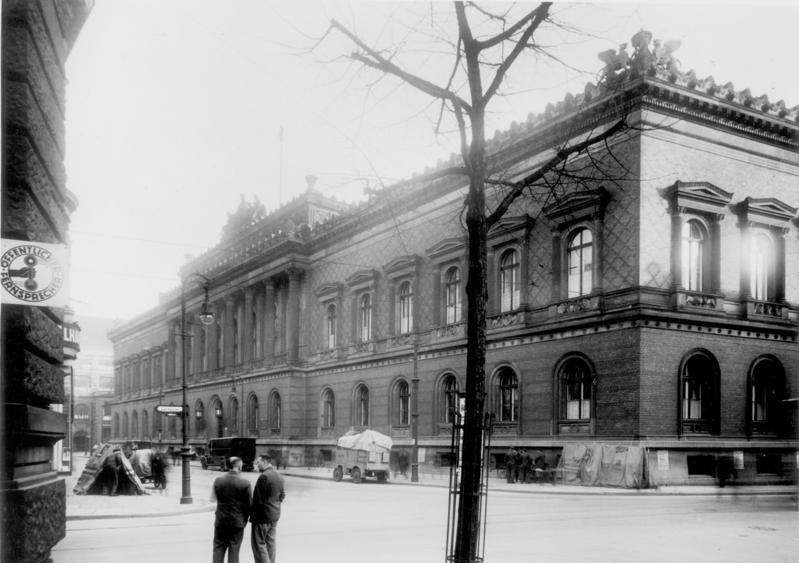
Beyond Frankfurt, the Bundesbank's infrastructure tells a story of radical contraction. The bank inherited the logistical DNA of the Reichsbank, which in 1900 operated a capillary network of over 330 branches (Reichsbankstellen) reaching into small provincial towns. This density was necessary in an era when the physical settlement of trade required the local movement of gold and paper marks. For decades, the Bundesbank maintained a similar, though slowly shrinking, federalist footprint. The structure was anchored by the Landeszentralbanken (LZBs), the central banks of the individual German states, which held significant autonomy and seats on the Central Bank Council. This decentralized model was a prerequisite for the Allies permitting the bank's creation in 1957, designed to prevent the concentration of financial power that had facilitated the Nazi war economy.
The introduction of the euro and the digitization of payments rendered this 19th-century network obsolete. The structural reform of 2002 marked the death knell for the federalist model. The nine autonomous LZBs were stripped of their independence and converted into dependent Regional Offices (Hauptverwaltungen). This centralization allowed for a ruthless culling of the branch network. Where the Reichsbank once required a presence in every district to manage the physical money supply, the Bundesbank of 2026 operates fewer than 35 branches. These remaining facilities are no longer "banks" in the customer-facing sense highly automated logistics centers (Filialen) focused on the wholesale processing of cash for commercial banks and armored transport companies.
| Era | Institution | Primary Structure | Approx. Branch Count | HQ Location |
|---|---|---|---|---|
| 1900 | Reichsbank | Centralized Imperial | 330+ | Berlin (Jägerstraße) |
| 1957 | Bundesbank | Federalist (LZB System) | 120+ | Frankfurt (Taunusanlage) |
| 1990 | Bundesbank | Reunification Expansion | 180+ (incl. East) | Frankfurt (Wilhelm-Epstein-Str) |
| 2002 | Bundesbank | Centralized Reform | 66 | Frankfurt (Wilhelm-Epstein-Str) |
| 2026 | Bundesbank | Eurosystem Node | 31 | Frankfurt (Campus/Renovation) |
The integration of East Germany in 1990 provided a temporary reversal of this contraction. The Bundesbank absorbed the infrastructure of the Staatsbank der DDR, taking over buildings in Berlin and across the new federal states. The Berlin administrative seat, located in the former Reichsbank extension and later Central Committee building, became a focal point for the "Hauptverwaltung" of Berlin and Brandenburg. Yet, the economic logic of consolidation prevailed. Most former Staatsbank branches were liquidated or repurposed, as the Bundesbank applied West German efficiency standards to the East's cash pattern. The swift of the East German monetary infrastructure remains a point of historical friction, representing for the broader displacement of East German institutions.
Personnel numbers track this shift from labor-intensive cash handling to capital-intensive digital oversight. In 1957, the bank relied on armies of clerks to count notes and process ledgers. By the 1990s, the headcount swelled to over 18, 000 following reunification. The subsequent decades of automation and the transfer of monetary policy sovereignty to the European Central Bank (ECB) drove a steady reduction. By 2026, the Bundesbank employs approximately 10, 000 to 11, 000 staff, with the composition shifting heavily toward economists, data scientists, and IT specialists. The "blue-collar" work of central banking, sorting banknotes and guarding vaults, has been largely automated or concentrated in the few remaining high-security mega-branches.
The regional administrative infrastructure serves a different purpose. The nine Regional Offices act as the Bundesbank's eyes and ears on the ground, monitoring local economic conditions and supervising credit institutions within their jurisdictions. yet, the power has decisively shifted to the Executive Board in Frankfurt. The 2002 reform ended the era where a regional LZB president could challenge the consensus of the Frankfurt directorate. Today, the infrastructure is strictly hierarchical. The "Geldkasten" in Frankfurt, even in its state of perpetual renovation, commands the network with absolute authority, a sharp contrast to the consensus-driven federalism that characterized the Bonn Republic.
Security architecture has also evolved in response to modern threats. The open, park-like setting of the Frankfurt headquarters, originally designed to signal transparency, is ringed with high-security perimeters, vehicle blocks, and surveillance systems. The physical cash, once stored in vaults across hundreds of towns, is consolidated in -like hubs. This consolidation reduces overhead creates single points of failure, a risk the bank mitigates through redundant logistics chains. The 2026 Bundesbank is leaner, harder, and more centralized than its predecessors, physically embodying the transition from the Deutsche Mark's localized dominance to the Eurosystem's supranational abstraction.