Verified Against Public And Audited RecordsLast Updated On: 2026-02-24
Reading time: ~57 min
File ID: EHGN-PLACE-32257
Investigative Bio of Dubai
Bani Yas Migration and Early Settlement (1799-1833)
The history of Dubai as a distinct geopolitical entity begins not with a grand declaration of statehood, with a defensive calculation in 1799. Before this date, the settlement existed as a dependency of Abu Dhabi, a minor fishing outpost overshadowed by the Bani Yas tribal confederation to the south and the maritime dominance of the Qawasim to the north. The construction of Al Fahidi Fort in 1799 marks the verified record of the town asserting a physical need for separate defense. Built from coral rock and mortar, this structure was not a palace a military need, designed to repel sea-based raiders and monitor the inland method. It stood as the only stone building in a settlement of barasti (palm frond) huts, a clear indicator of the harsh, subsistence-level existence that defined the era. The fort did not immediately signal independence, yet it established the physical nucleus around which a future city-state would coalesce.
For the three decades of the 19th century, Dubai remained a political pawn. Its status was so negligible that when the British Empire imposed the General Maritime Treaty of 1820 to suppress what they termed "piracy" in the Persian Gulf, Dubai did not sign as a sovereign state. Instead, the treaty was signed on behalf of Dubai by Saeed bin Saif, a regent acting for his nephew, Sheikh Mohammed bin Hazza bin Zaal, who was still a minor. This proxy signature confirms that in 1820, British officials viewed Dubai as a subordinate territory within the Abu Dhabi sphere of influence, absence the autonomy granted to neighbors like Sharjah or Ras Al Khaimah. The town was trapped in a geopolitical limbo, technically under the suzerainty of the Al Nahyan rulers of Abu Dhabi geographically enough to develop a distinct, albeit suppressed, identity.
The trajectory of the settlement changed violently in 1833, a year that serves as the true founding moment of the modern state. The catalyst was not external trade or foreign intervention, a fratricidal power struggle within the ruling Al Nahyan family of Abu Dhabi. Sheikh Tahnun bin Shakhbut, the capable ruthless ruler of Abu Dhabi, was assassinated by his brothers, Khalifa and Sultan. The subsequent rule of Khalifa bin Shakhbut was marked by tyranny and the execution of political rivals, alienating the Al Bu Falasah subsection of the Bani Yas tribe. Faced with persecution and a absence of confidence in the new leadership, the Al Bu Falasah elders made a radical decision: secession.
Led by Maktoum bin Butti bin Suhail and Obeid bin Said bin Rashid, approximately 800 members of the Al Bu Falasah tribe packed their possessions and migrated north to Dubai. This was not a simple relocation; it was a hostile takeover of a strategic asset. Upon arrival, the migrants found a settlement of roughly 250 houses and the Al Fahidi Fort, still governed by the regent Mohammed bin Hazza. The sheer number of the new arrivals, 800 battle-hardened tribesmen and their families, overwhelmed the existing population. Mohammed bin Hazza, recognizing the shift in the balance of power, stepped aside without bloodshed. The Al Bu Falasah seized the fort, the harbor, and the town, declaring Dubai an independent sheikhdom free from Abu Dhabi's control.
The demographics of this 1833 migration are serious to understanding the genetic and political code of the city. The 800 individuals represented of the Bani Yas military and economic strength. Their departure stripped Abu Dhabi of important manpower while instantly transforming Dubai from a village into a fortified town. This event established the Al Maktoum dynasty, which continues to rule in 2026. The lineage of the current leadership traces directly back to Maktoum bin Butti, who initially shared power with Obeid bin Said in a unique dual-monarchy arrangement. This joint rule was a pragmatic solution to ensure tribal unity during the precarious early years of independence, lasting until Obeid's death in 1836 left Maktoum as the sole ruler.
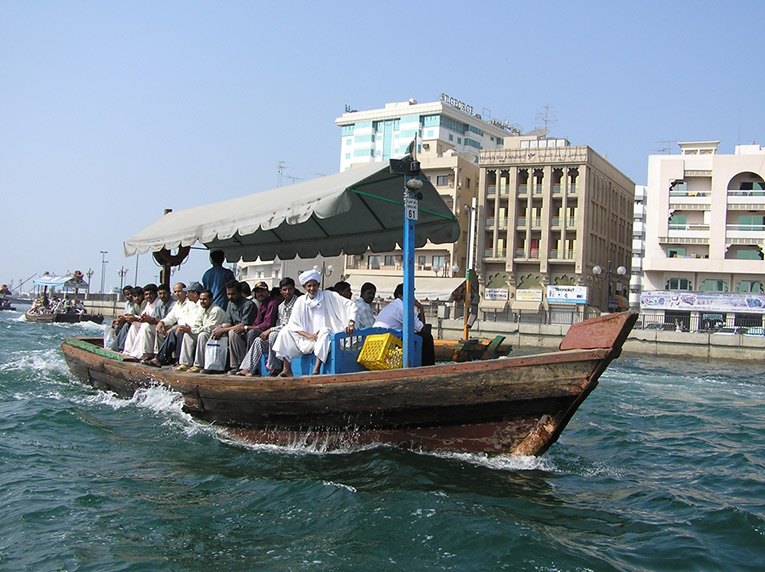
Geographically, the prize of this takeover was the Creek (Khor Dubai). Unlike the shallow or exposed coastlines of neighboring settlements, the Creek offered a natural, sheltered harbor extending inland. In an era before oil, when the maritime economy was the only economy, this inlet was the most valuable infrastructure on the coast. It allowed for the safe anchorage of pearling dhows and fishing vessels, protecting them from the shamal winds and naval raiders. The Al Bu Falasah understood that control of the Creek meant control of trade. They immediately set about fortifying their position, maintaining the Bur Dubai wall, constructed around 1800, which encircled the main settlement, the Grand Mosque, and the Fort. This wall, 2. 5 meters high and 600 meters long, was the physical border of the state, separating the urban enclave from the harsh desert interior.
Economic survival in the 1830s was brutal. The town possessed no fresh water sources other than a few sweet water wells, necessitating a reliance on trade for basic survival. The economy depended entirely on the pearl diving season (the Ghaus), which ran from May to September. Men would spend months at sea, diving up to 50 times a day with no equipment, frequently accumulating debts to boat captains and pearl merchants that lasted generations. This "truck system" of debt bondage kept the population tethered to the coast, yet it also integrated Dubai into the wider global market. The pearls harvested by the Al Bu Falasah divers eventually found their way to markets in Bombay, Paris, and London, creating the thin threads of globalization that would later define the emirate.
The political independence of Dubai was immediately tested by its neighbors. The Sheikhs of Sharjah and Ras Al Khaimah viewed the new entity with suspicion, while Abu Dhabi refused to relinquish its claim of sovereignty. Maktoum bin Butti proved to be a shrewd diplomat, using the British presence to his advantage. By adhering to the maritime truces enforced by the British Navy, he secured a degree of protection for his fledgling state. The British, interested in stability to protect their trade routes to India, tacitly recognized the de facto independence of Dubai, treating Maktoum as a legitimate ruler in subsequent negotiations. This triangular diplomacy, balancing British naval power against the territorial ambitions of Abu Dhabi and the Qawasim, became the standard operating procedure for Dubai's foreign policy.
By the time Obeid bin Said died in 1836, the settlement had survived its infancy. Maktoum bin Butti consolidated power, establishing the hereditary succession that remains in place. The population estimates from this period are imprecise, British records suggest the town grew from the initial 800 migrants to perhaps 1, 200 or 1, 500 people by the 1840s. This slow demographic was the precursor to the exponential growth seen in the 20th and 21st centuries. In 2026, with a metropolitan population exceeding 3. 1 million, the city still revolves around the Creek and the Al Fahidi district, the exact coordinates seized by the 800 migrants nearly two centuries prior.
The migration of 1833 was not a movement of people; it was the importation of a specific political culture. The Al Bu Falasah brought with them a merchant-focused ethos that differed from the agrarian or strictly Bedouin focus of other tribes. Their survival depended on the sea and the market, forcing the leadership to adopt policies that favored commerce over conquest. This DNA is clear in the early decisions to lower customs duties and welcome traders from Lingeh and Bastak, setting the stage for the free-trade policies of 1901. The roots of Dubai's modern "tax-free" status and its function as a global entrepôt are found in the desperate economic realities of the 1830s, where attracting a single merchant dhow could mean the difference between famine and survival.
Key Historical Metrics: Dubai 1799-1836
Year
Event / Metric
Significance
1799
Construction of Al Fahidi Fort
stone defensive structure; marks distinct settlement.
1800
Construction of Bur Dubai Wall
Defined the physical limits of the town; 600m length.
1820
General Maritime Treaty
Dubai signs via proxy; confirms dependency on Abu Dhabi.
1822
Population Estimate
~700-800 residents (pre-migration).
1833
Al Bu Falasah Migration
800 migrants led by Maktoum & Obeid seize Dubai.
1833
Declaration of Independence
Secession from Abu Dhabi; establishment of Maktoum dynasty.
1836
Death of Obeid bin Said
End of dual monarchy; Maktoum bin Butti rules alone.
Pearl Diving Economy and the 1929 Collapse
Bani Yas Migration and Early Settlement (1799-1833)
By 1917, the pearl trade in the Persian Gulf reached its zenith, a feverish economic peak that defined Dubai not as a settlement, as a specialized extraction engine. Historical records indicate that during this period, a single gram of high-quality Gulf pearls commanded a market value equivalent to approximately 320 grams of gold. For Dubai, a town with no agricultural hinterland and limited fresh water, the pearl was the sole guarantor of existence. The fleet in Dubai numbered roughly 335 dhows, employing over 7, 000 men, a figure representing nearly the entire able-bodied male population. These vessels did not operate as independent entities functioned within a rigid, debt-based hierarchy that funneled wealth upward to the nakhudas (captains) and the merchant elite, while keeping the divers in a state of perpetual financial bondage.
The mechanics of this economy relied on a brutal physical reality. Divers, known as ghais, descended to the seabed up to 50 times a day, frequently to depths of 15 meters, equipped with nothing more than a nose clip made of turtle shell and a stone weight to accelerate their descent. They remained submerged for over a minute, scouring the seabed for oysters while their lungs compressed. Upon surfacing, they were hauled up by siyub (pullers). The labor resulted in widespread blindness, burst eardrums, and the bends. Yet the economic structure proved even more punishing than the physical work. The salaf system, a method of advance payment, trapped divers in a pattern where their seasonal earnings rarely covered the loans issued for their winter survival. When a diver died, his debt frequently passed to his sons, creating a generational chain of servitude that anchored the workforce to the boats.
While Dubai's merchants celebrated the 1917 peak, a technological disruption in Japan began to the industry's foundations. Kokichi Mikimoto, a Japanese entrepreneur, successfully patented the method for creating spherical cultured pearls. By inserting a nucleus into the oyster, Mikimoto could induce the creation of a pearl in a fraction of the time required for natural formation. These cultured pearls were indistinguishable from the Gulf's natural variants to the untrained eye sold for a fraction of the cost. Initially, Gulf merchants dismissed the Japanese product as a novelty or a fake. This denial proved catastrophic. By the mid-1920s, Japanese fleets flooded global markets with flawless, affordable pearls, causing the premium for natural Gulf pearls to waver.
Before the economic collapse fully materialized, a meteorological disaster struck the region. In late 1925, a massive cyclone, remembered in local history as the "Year of the Destruction" (Sinnat Al Tab'ah), hit the pearl banks during the harvest season. The storm decimated the fleet at sea. Historical estimates suggest that approximately 80 percent of the boats in the affected area were lost or severely damaged, and nearly 8, 000 men across the Gulf perished in a single hour. For Dubai, this event wiped out capital assets, the dhows, that families had mortgaged themselves to build. The loss of skilled labor and vessels left the industry just as global economic forces turned against it.
The final blow arrived with the Wall Street Crash of 1929 and the subsequent Great Depression. The primary buyers of Dubai's high-end natural pearls were the aristocracies of Europe and the industrial tycoons of America. As global liquidity evaporated, the luxury market for natural pearls almost overnight. The price of pearls plummeted by more than 90 percent. Dubai faced a dual emergency: the product that sustained its economy was both obsolete due to Japanese technology and unwanted due to global poverty. The revenue that had flowed into the creek, estimated at millions of rupees annually during the boom, dried up, leaving the town with no alternative income source.
The 1930s and 1940s in Dubai are recorded not as a time of transition, as a period of starvation. The collapse of the pearl trade, compounded by the supply chain disruptions of World War II, led to a famine known locally as "The Years of Hunger." Residents resorted to eating locusts and dried lizards to survive. The population of the Trucial States stagnated, and families migrated to Saudi Arabia or Kuwait, where oil exploration had already begun. The British government, which maintained a protectorate over the Trucial States, offered minimal relief, leaving the local rulers to manage a destitute population. The last major pearling fleet sailed from Dubai in 1949, marking the official death of the industry that had built the city.
Key Events in the Collapse of the Dubai Pearl Economy
Year
Event
Economic Impact
1917
Market Peak
Pearl value hits historic high; 1g pearl ≈ 320g gold.
1925
The Great Storm
~8, 000 deaths in the Gulf; 80% of fleet damaged/lost.
1929
Global Depression
Luxury demand evaporates; prices drop>90%.
1930s
Japanese Market Entry
Cultured pearls saturate market; natural pearl trade becomes unviable.
1949
Final Fleet
The last major commercial pearling expedition departs Dubai.
This collapse forced a radical shift in Dubai's survival strategy. Sheikh Saeed bin Maktoum Al Maktoum and the merchant class realized that reliance on a single commodity was a fatal error. With the pearl banks barren of profit, the city's leadership turned their attention back to the creek itself, not as a base for diving, as a corridor for transit. The desperation of the 1930s laid the groundwork for the re-export trade and the smuggling operations, specifically in gold to India, that would provide the capital necessary to the gap between the death of the pearl and the discovery of oil.
Oil Revenue and Port Rashid Construction (1958-1979)
The geopolitical trajectory of Dubai shifted irrevocably in 1958, not through a military conquest, through a dredging contract. Sheikh Rashid bin Saeed Al Maktoum ascended to the rulership that year, inheriting a settlement facing an existential commercial threat. The Dubai Creek, the sole artery for the dhow trade that sustained the economy, was silting up. Large vessels could no longer enter the inlet, forcing merchants to offload goods onto barges at sea, a process that bled time and profit. Without intervention, Dubai risked losing its status as an entrepôt to Sharjah or Abu Dhabi. Sheikh Rashid's response defined the emirate's operating model for the half-century: debt-financed infrastructure built on the speculation of future demand.
The ruler commissioned the British engineering firm Sir William Halcrow and Partners to survey the creek. The solution required dredging the channel to a depth that could accommodate 500-ton vessels, a project estimated to cost hundreds of thousands of pounds. Dubai, absence oil revenues at this stage, possessed no reserves to fund such an undertaking. Sheikh Rashid secured a loan of £400, 000 from Kuwait and raised additional capital through the issuance of "Creek Bonds" to local merchants. The Austrian firm Overseas AST commenced work in 1959. This decision was a gamble of the highest order; the emirate leveraged its sovereignty to save its trade route, betting that increased customs duties would service the debt. The gamble paid off. By 1961, the dredged creek allowed larger vessels to dock directly, cementing Dubai's dominance over regional rivals.
While the creek project stabilized the economy, the engine of Dubai's pre-oil wealth was the illicit gold trade with India. Following India's imposition of the Gold Control Act in 1962, which banned the import of gold bars, Dubai positioned itself as the primary supplier for the black market. Swiss banks, including the Union Bank of Switzerland, shipped gold to Dubai, where it was legally imported. From there, local syndicates transported the bullion via dhows to the Indian coast, exploiting the insatiable demand for the metal in South Asia. In 1968 alone, Dubai imported £56 million worth of gold, the vast majority of which into the dhows heading east. This arbitrage generated the liquidity that kept the merchant class solvent and funded the initial modernization of the city before the drop of oil was exported.
The discovery of oil in 1966 changed the financial calculus did not alter the strategic direction. The Continental Oil Company identified the Fateh field approximately 60 miles offshore. Unlike Abu Dhabi, which sat atop massive reserves, Dubai's oil wealth was significant yet finite. Production began in 1969 at a rate of 180, 000 barrels per shipment. To bypass the cost of piping oil to the shore, engineers from the Chicago & Iron Company constructed massive underwater storage tanks, known as "Kazzans," directly at the field. These submerged structures allowed supertankers to load crude in deep water, even during bad weather. The revenue from the Fateh field provided the collateral Sheikh Rashid needed to escalate his infrastructure spending from necessary upgrades to aggressive expansion.
The construction of Port Rashid serves as the definitive case study of this era. In 1967, before oil exports commenced, Sheikh Rashid ordered the construction of a deep-water port. Halcrow designed a four-berth facility, a reasonable capacity for the town's size. During construction, yet, the ruler observed the increasing volume of oil-related cargo and the limitations of the Creek. Overruling his British advisors who warned of overcapacity, he ordered the plans revised mid-project to expand the port to 15 berths. The British contractor Costain executed the expansion, completing the project in 1972. At the time of its opening, Port Rashid was the largest deep-water port in the Middle East. Critics labeled it a "white elephant," yet within years, the port operated at near capacity, driven by the import demands of a region flush with petrodollars.
The formation of the United Arab Emirates in 1971 integrated Dubai into a federal framework, yet Sheikh Rashid negotiated terms that preserved his emirate's economic autonomy. While Abu Dhabi assumed the bulk of the federal budget contribution, Dubai retained control over its oil revenues and port operations. This autonomy was serious for the launch of the Jebel Ali Port project in 1976. If Port Rashid was ambitious, Jebel Ali was viewed by international observers as delusional. Located 35 kilometers southwest of the city in an empty stretch of desert, the plan called for the world's largest man-made harbor with 67 berths. The construction cost was estimated at $2. 5 billion. The project required excavating millions of cubic meters of sand and rock, fundamentally altering the coastline. When Queen Elizabeth II inaugurated the port in 1979, it stood as a colossal bet on the future of global logistics, anticipating a shift in trade routes that had not yet occurred.
The demographic impact of these projects was immediate and. The labor required to dredge the creek, build the ports, and service the oil fields could not be sourced locally. In 1968, the census recorded Dubai's population at 59, 000. By 1975, that number had tripled to 183, 000. This period institutionalized the kafala sponsorship system and the reliance on South Asian expatriate labor. The city ceased to be a tribal settlement and morphed into a segmented urban center where the indigenous population became a minority within their own borders. The influx of workers created a secondary economy for housing, food, and remittances, further tying Dubai's financial health to the flow of foreign bodies and capital.
Currency standardization also marked this era. Dubai transitioned from the Gulf Rupee (issued by India) to the Qatar-Dubai Riyal in 1966, following India's devaluation of the rupee. This provisional currency arrangement lasted until 1973, when the UAE Dirham was introduced, unifying the monetary system of the federation. The stability of the Dirham, pegged to the US dollar, provided the financial certainty required for international contractors like Costain and Halcrow to commit to long-term projects. By the close of the 1970s, Dubai had successfully transmuted its finite oil revenues into permanent assets, establishing the physical platform for the trade-based economy that would define its post-oil future.
Dubai Infrastructure and Economic Indicators (1958-1979)
Year
Key Event / Metric
Details / Value
1959
Creek Dredging Loan
£400, 000 borrowed from Kuwait; Creek Bonds issued
1966
Oil Discovery
Fateh Field (Offshore)
1968
Population Census
59, 000 residents
1969
Oil Export
180, 000 barrels (initial shipment)
1972
Port Rashid Opening
15 berths (expanded from original 4)
1975
Population Census
183, 000 residents (210% increase from 1968)
1976
Jebel Ali Port Start
Construction begins on 67-berth facility
1979
Jebel Ali Inauguration
Opened by Queen Elizabeth II; Cost ~$2. 5 billion
Jebel Ali Free Zone and Re-export Trade Mechanics
Pearl Diving Economy and the 1929 Collapse
The construction of Jebel Ali Port in 1976 was an act of economic defiance that bordered on lunacy. At the time, Dubai already possessed Port Rashid, which was operating capacity, and the region was awash in oil wealth that made industrial diversification seem unnecessary to most advisors. Sheikh Rashid bin Saeed Al Maktoum ignored them. He ordered the excavation of 134 square kilometers of desert coast, demanding a harbor deep enough to accommodate ships that did not yet exist. Critics labeled it a "white elephant," a vanity project destined to be swallowed by the sands. They were wrong. By 2026, Jebel Ali is not a port; it is the primary respiratory system of the Middle East's economy, handling 15. 5 million TEUs (Twenty-Foot Equivalent Units) annually and serving as the operational base for over 11, 000 companies.
The true engine of this success was not the concrete quays, a legal instrument signed in 1985: the decree establishing the Jebel Ali Free Zone (Jafza). Before this date, foreign entities in the UAE were shackled by the "51-49" rule, requiring a local sponsor to hold majority ownership. Jafza obliterated this barrier, offering 100% foreign ownership, zero personal income tax, and total repatriation of capital. The response was immediate. From an initial cluster of 19 companies, the zone expanded into a sprawling industrial city-state that generates approximately 36% of Dubai's total GDP. It is a jurisdiction within a jurisdiction, designed specifically to bypass the friction of local bureaucracy.
The logistics mechanics within this zone operate with military precision. The "Sea-Air" corridor, perfected over four decades, allows cargo to be discharged from a vessel at Jebel Ali, processed through customs, and loaded onto a cargo plane at Dubai World Central (DWC) or Dubai International Airport (DXB) within four hours. This speed is important for the electronics and fashion sectors, where inventory depreciation is measured in hours. In 2024 alone, this multimodal system facilitated re-exports valued at AED 734. 4 billion, a figure that dwarfs the domestic exports of sovereign nations. The port itself has evolved into a semi-autonomous machine; the "BoxBay" high-bay storage system, fully operational by 2026, stacks containers eleven stories high in steel racks, using automation to retrieve any single box without moving others, a radical departure from traditional stacking methods that consume vast acreage.
Jebel Ali Port & Free Zone Key Metrics (2024-2025)
Metric
Value
Annual Container Throughput
15. 5 Million TEUs
Re-export Trade Value
AED 734. 4 Billion
Jafza Contribution to Dubai GDP
~36%
Number of Registered Companies
11, 000+
Sea-Air Transfer Time
4 Hours
yet, the efficiency of Jebel Ali serves more than just legitimate commerce. The zone's opacity and volume make it a preferred hub for "grey trade," particularly concerning sanctions evasion. For decades, the port has functioned as a lung for the Iranian economy, allowing goods to bypass Western sanctions through a network of front companies and re-export gaps. Investigations have repeatedly identified UAE-based entities, such as those sanctioned by the US Treasury in the early 2020s, that facilitated the movement of Iranian petrochemicals and oil. These goods are frequently relabeled or transferred to new vessels in international waters before entering the global market. The sheer volume of containers, over 40, 000 processed daily, renders 100% physical inspection impossible, creating a statistical blind spot that illicit networks exploit with high sophistication.
The physical commodities dominating this trade are gold and automobiles. Dubai's "City of Gold" reputation is physically anchored in Jafza's refineries and secure vaults. In 2021, the UAE imported over 970 tons of gold, much of it from Africa, which was then refined and re-exported to markets in India and Switzerland. Similarly, the automotive re-export trade is massive. Jebel Ali is the primary transit point for used and new vehicles heading to Africa and Asia. The zone creates a marketplace where left-hand drive vehicles from Japan or the US are refurbished and shipped to developing markets. This "used car" economy is not a sideline; it is a multi-billion dollar industry that relies on the port's ability to handle Roll-on/Roll-off (RoRo) vessels with the same speed as container ships.
The human cost of this logistical supremacy is visible in the labor camps that house the zone's 160, 000-strong workforce. While regulations in 2025 have improved safety standards, mandating minimum space per worker and better ventilation, the existence of these workers remains strictly utilitarian. They are the biological components of the Jebel Ali machine, bused in from Sonapur or on-site dormitories to operate cranes, drive trucks, and secure loads in temperatures that frequently exceed 45°C. Their labor underpins the 4-hour transfer times and the record-breaking throughput statistics that government reports celebrate. Without this low-cost, high-availability workforce, the price advantage of Dubai's re-export model would collapse.
Freehold Property Laws and the 2009 Debt Default
The transformation of Dubai's real estate sector from a localized, tribal tenure system into a global speculative asset class began with a calculated legal rupture in May 2002. Prior to this date, property ownership in the emirate was strictly limited to nationals of the United Arab Emirates and, to a lesser extent, citizens of the Gulf Cooperation Council (GCC). Foreign expatriates, who constituted the vast majority of the population, were legally restricted to renewable leases, capped at 99 years frequently much shorter in practice. This restriction ensured that land, the resource in a desert state, remained under indigenous control. The issuance of the Freehold Decree by then-Crown Prince Sheikh Mohammed bin Rashid Al Maktoum in 2002 shattered this norm. The decree permitted foreign nationals to acquire absolute freehold title in specific " areas," carving out zones of international sovereignty within the emirate's borders.
This policy shift was not immediately codified into statutory law, creating a four-year period of legal ambiguity where billions of dollars changed hands based on the strength of the Ruler's decree rather than a parliamentary act. It was not until the passage of Law No. 7 of 2006 concerning Real Property Registration in the Emirate of Dubai that the legal framework caught up with the market reality. Article 4 of Law No. 7 formally restricted land ownership to UAE and GCC nationals everywhere, except in areas approved by the Ruler for foreign ownership. These zones included the massive master-planned developments of "New Dubai," such as The Palm Jumeirah, Emirates Hills, and Dubai Marina. The law provided the necessary title deed security that institutional investors required, yet it also validated a speculative mania that had already been running unchecked for four years.
Between 2002 and 2008, the Dubai property market operated with minimal regulation, defined by the "off-plan" sales model. Developers, including state-linked giants like Nakheel and Emaar, sold unbuilt units to investors who paid small deposits, frequently as low as 10%. In the absence of escrow regulations, developers frequently used these initial deposits to fund the marketing and launch of subsequent projects rather than the construction of the units sold. This liquidity pattern worked only as long as new buyers continued to enter the market. Speculators, or "flippers," traded paper contracts for unbuilt apartments multiple times before ground was even broken, driving prices up by 79% in 2007 alone. By mid-2008, capital values in prime areas had quadrupled compared to their 2002 starting points.
The collapse of Lehman Brothers in September 2008 and the subsequent global liquidity crunch exposed the fragility of this use-heavy model. As credit lines froze, the flow of new buyers evaporated, and the pyramid of off-plan financing collapsed. Construction sites across the emirate fell silent as developers could no longer fund contractors. Property prices entered a freefall, dropping approximately 50% to 60% from their 2008 peaks by the end of 2009. The emergency transitioned from a real estate correction to a sovereign debt emergency on November 25, 2009. On that afternoon, the Dubai government announced that Dubai World, the state-owned conglomerate responsible for the Palm islands and DP World, intended to ask creditors for a "standstill" on tens of billions of dollars in debt. The announcement specifically sought to delay the repayment of $26 billion in obligations.
The "standstill" request sent shockwaves through global financial markets, causing the cost of insuring Dubai's sovereign debt to spike and triggering sell-offs in European and Asian equities. The total liabilities of Dubai World were estimated at $59 billion, a figure that threatened to overwhelm the emirate's independent financial capacity. The immediate flashpoint was a $4. 1 billion Islamic bond (sukuk) issued by Nakheel, Dubai World's property arm, which was due to mature on December 14, 2009. Defaulting on this instrument would have triggered cross-default clauses across the conglomerate's entire debt stack, chance leading to the seizure of strategic assets abroad.
Resolution arrived hours before the default deadline. On December 14, 2009, the government of Abu Dhabi extended a $10 billion lifeline to Dubai, adding to a previous $10 billion injection provided by the UAE Central Bank earlier that year. This $20 billion total bailout allowed Dubai World to meet its immediate obligations and begin a painful restructuring process that would last for years. The geopolitical price of this financial rescue was made visible three weeks later. On January 4, 2010, during the inauguration of the world's tallest building, the tower, known throughout its construction as the Burj Dubai, was abruptly renamed the Burj Khalifa, in honor of the President of the UAE and Ruler of Abu Dhabi, Sheikh Khalifa bin Zayed Al Nahyan.
The crash necessitated a complete overhaul of the property regulatory environment. The most significant post-emergency measure was the enforcement of Law No. 8 of 2007 concerning Guarantee Accounts of Real Estate Developments. Although passed just before the crash, its strict application became the of the recovery. The law mandated that developers deposit buyer payments into project-specific escrow accounts managed by approved banks. These funds could only be released to pay for construction milestones certified by independent consultants, ending the practice of using new sales to fund old debts. The Real Estate Regulatory Agency (RERA) was to audit these accounts and cancel projects that proved unviable.
By 2026, the Dubai real estate market had mutated again, distancing itself from the volatility of the 2009 era through tighter supply controls and the integration of property ownership with residency rights. The introduction of the "Golden Visa" system linked long-term residency to property investment, creating a floor of end-user demand that did not exist in 2008. Transaction volumes in 2025 reached a historic record of AED 917 billion, surpassing the previous peaks by a wide margin. In January 2025, the government announced a new policy allowing the conversion of granted land to freehold status in strategic corridors like Sheikh Zayed Road and Al Jaddaf, further expanding the inventory available to international capital. The following table illustrates the volatility and subsequent stabilization of the market across three distinct eras.
Dubai Real Estate Market Metrics: 2008 vs. 2009 vs. 2025
Metric
2008 (Peak Bubble)
2009 (The Crash)
2025 (Mature Market)
Price Trend (YoY)
+43% increase
-50% decline
+18% increase
Regulatory Status
Unregulated Off-Plan
Emergency Standstill
Mandatory Escrow
Transaction Value
~AED 114 Billion
~AED 92 Billion
AED 917 Billion
Key Debt Event
Lehman Collapse Impact
Dubai World Default Risk
Debt Restructuring Complete
Residency Link
3-Year Renewable Visa
Restricted
10-Year Golden Visa
The restructuring of Dubai World's debt was officially completed, with the final repayments made well ahead of the extended schedules. Nakheel, once the symbol of the emergency, was eventually folded into the government's primary investment vehicle, Dubai Holding, in a consolidation of state assets. The legal distinction between " areas" and local-only zones remains in force in 2026, yet the boundaries continue to expand. The 2009 default, once viewed as a terminal event for the "Dubai Model," served as the catalyst for a regulatory maturation that converted a frontier speculation market into a securitized component of the global real estate index.
Migrant Labor Demographics and Kafala Regulations
Oil Revenue and Port Rashid Construction (1958-1979)
The structural foundation of Dubai's labor market rests on a system of debt bondage that predates the discovery of oil by two centuries. During the pearling era of the 1700s and 1800s, divers were not free agents; they were bound to the nakhuda (boat captain) through a method of perpetual debt. Captains advanced loans for food and equipment at the start of the season, sums that divers could rarely repay from their meager share of the catch. This pattern ensured a captive workforce, legally unable to switch employers until debts were cleared. When the British formalized their administrative control over the Trucial States in the early 20th century, they did not this coercive structure. Instead, colonial administrators codified it, introducing the concept of sponsorship to monitor the movement of foreign laborers. The modern Kafala system is not an ancient Bedouin tradition of hospitality, as frequently claimed, a bureaucratic fossil of British colonial labor management.
The demographic composition of Dubai underwent a radical inversion following the oil boom of the 1970s. Initially, the emirate relied on Arab labor from Egypt, Palestine, and Yemen. Yet, political unrest and the rise of Pan-Arab nationalism alarmed the ruling families, who viewed these populations as chance sources of dissent. A strategic pivot occurred in the 1980s to replace Arab workers with labor from South Asia. Workers from India, Pakistan, and Bangladesh were viewed as politically neutral, transient, and cheaper. This policy engineered the current demographic reality: as of June 2025, Dubai's population stands at approximately 3. 95 million, with expatriates constituting roughly 92% of the total. Nationals are a statistical minority in their own land, a deliberate imbalance maintained to ensure economic velocity.
The legal method enforcing this imbalance is the Kafala (sponsorship) system, which ties a worker's residency visa directly to their employer. While the UAE government has introduced significant reforms since 2020, the core power remains asymmetrical. Federal Decree-Law No. 33 of 2021, February 2022, abolished unlimited contracts and theoretically prohibited the confiscation of passports. Yet, enforcement varies wildly between the glistening financial districts and the labor camps of Sonapur. For high-income professionals, the system has softened; the introduction of the Golden Visa and Green Visa allows skilled workers to self-sponsor, decoupling their residency from their boss. For the low-wage construction and service sector, the backbone of Dubai's infrastructure, the sponsor still holds immense use. Absconding charges can still be filed against workers who leave without permission, criminalizing resignation.
The living conditions for this low-wage majority remain a subject of intense scrutiny. The "bachelor" accommodations in areas like Muhaisnah and Al Quoz segregate the male workforce from the general population. These zones function as dormitory cities, sleeping hundreds of thousands of men who build the skyscrapers are socially invisible within them. Heat stress remains a lethal occupational hazard. While the "Midday Break" rule bans outdoor work between 12: 30 PM and 3: 00 PM during summer months, thermal stress accumulates outside these hours. Data from 2024 indicates that heat-related nephropathy (kidney disease) is rising among construction workers, a direct result of chronic dehydration and physical exertion in temperatures exceeding 45°C (113°F).
In a forceful push to alter the demographic skew, the government launched an aggressive Emiratization campaign targeting the private sector. As of 2024, companies with 50 or more employees must increase their Emirati workforce by 2% annually. In 2025, this mandate expanded to smaller firms with 20 to 49 employees, requiring them to hire at least one Emirati in 2024 and another in 2025. The penalties for non-compliance are punitive, not symbolic. In 2025, the fine for failing to hire the required Emirati national reached AED 108, 000 (approximately $29, 400) per unfilled position. This policy forces private companies to absorb the local workforce, historically employed by the bloated public sector, taxing the expatriate-driven economy to subsidize national employment.
Remittances from these workers form a serious economic lifeline for South and Southeast Asia. In 2024, India received a record $129 billion in global remittances, with the UAE serving as a primary source. Similarly, Pakistan received over $5. 5 billion from the UAE alone. These outflows represent the extracted value of labor in Dubai, transferred to families in Kerala, Punjab, and Luzon. The transaction cost of these transfers has dropped due to digital platforms, yet the social cost remains high. The "bachelor" status enforced on low-income workers prevents family reunification, creating a transnational existence where fathers see their children only once every two years.
The introduction of the Involuntary Loss of Employment (ILOE) insurance scheme in 2023 marks a shift toward a modern social safety net. Mandatory for all employees, it provides temporary cash benefits if a worker loses their job. This is a departure from the "fire and deport" model of the past. Also, the legalization of labor unions remains off the table, the establishment of worker grievance committees within the Ministry of Human Resources and Emiratisation (MoHRE) offers a formal, if bureaucratic, channel for wage disputes. even with these adjustments, the fundamental contract remains: Dubai offers tax-free wages and safety in exchange for political silence and temporary residency. The worker is a guest, never a citizen, regardless of how decades they devote to building the city.
Gold Smuggling and Anti-Money Laundering Status
The history of Dubai as a global bullion hub is built on a foundation of arbitrage, evasion, and the strategic exploitation of neighboring regulatory failures. From the dhow trade of the mid-20th century to the digital ledger settlements of 2026, the emirate has functioned as a clearinghouse where the provenance of metal is frequently washed away by the liquidity of the market. The trajectory of this trade reveals a consistent pattern: when other nations tighten controls, Dubai opens its doors, absorbing the flow of capital and commodities that have nowhere else to go. In the 1950s and 1960s, the method was physical and maritime. Following India's independence, the government in New Delhi imposed draconian restrictions on gold imports, culminating in the Gold Control Act of 1968. This policy created a massive between the international price of gold and the street price in Bombay. Dubai filled this vacuum. Bullion flowed from London and Zurich into the creeks of the Trucial States, where it was loaded onto reinforced dhows. These vessels, frequently modified with high-speed engines to outrun Indian customs cutters, transported thousands of tons of gold across the Arabian Sea. The "ten tola bar", a 116. 6-gram ingot favored for its concealability, became the currency of this shadow economy. By the 1970s, this trade was not a side business; it was the primary engine of Dubai's non-oil commerce, financing the early infrastructure projects that would later define the city. The 21st century brought institutionalization did not alter the fundamental logic of the trade. The establishment of the Dubai Multi Commodities Centre (DMCC) in 2002 was intended to sanitize the sector, providing a regulatory framework that could integrate with global finance. Yet, the physical marketplace frequently operated with a "don't ask, don't tell" culture that prioritized volume over verification. This tension exploded into public view during the Kaloti Jewellery Group scandal of 2013-2014. Whistleblower Amjad Rihan, an auditor for Ernst & Young, revealed that Kaloti, one of the largest refiners in the region, had accepted billions of dollars in cash for gold. The audit uncovered evidence that the refinery had knowingly processed gold coated in silver to evade Moroccan export restrictions and had sourced metal from Sudan, a jurisdiction then under heavy sanctions for genocide and internal conflict. The Kaloti case exposed the mechanics of the "Dubai Loop." Gold mined in conflict zones in Central and East Africa, regions like the Democratic Republic of Congo and Darfur, is frequently smuggled out via porous borders into neighboring states like Uganda or Rwanda. From there, it is flown to Dubai in hand-carry luggage or mixed with legitimate cargo. Once it enters the souk or the refinery, it is melted down and recast. The refining process destroys the chemical fingerprint of the original mine, erasing its history. This "recycled" gold is then sold into the global market, ending up in the vaults of Western banks and the jewelry displays of India and China, its bloody origins untraceable. By 2020, the of these illicit flows had drawn the ire of international monitors. The Financial Action Task Force (FATF), the global money laundering watchdog, placed the UAE on its "grey list" in March 2022. This designation was a severe blow to a city that markets itself as a tier-one financial center. The listing serious deficiencies in the country's ability to combat money laundering and terrorist financing. For two years, UAE officials scrambled to demonstrate enforcement, issuing fines and tightening regulations on Non-Financial Businesses and Professions (DNFBPs), a category that includes gold dealers and real estate agents. The FATF removed the UAE from the grey list in February 2024, a decision that was met with relief in Dubai skepticism among investigative bodies. Reports from organizations like The Sentry and Swissaid in 2024 and 2025 indicated that even with the delisting, the underlying infrastructure for laundering remained intact. In 2022 alone, over 405 metric tons of undeclared gold from Africa entered the UAE. The gap between gold exports reported by African nations and imports recorded by the UAE remains a gaping statistical hole, valued in the tens of billions of dollars annually. The conflict in Sudan, which erupted in 2023, provided a grim case study for the post-grey list era. The Rapid Support Forces (RSF), a paramilitary group accused of war crimes, controls the lucrative gold mines of the Jebel Amer region. Investigations in 2024 and 2025 tracked the flow of this gold directly to Dubai, where the proceeds were used to purchase weapons and sustain the civil war. even with the new regulatory frameworks, the sheer volume of gold moving through the emirate, valued at over $129 billion in total trade in 2023, makes policing every transaction a logistical impossibility, assuming the political exists to do so. Sanctions evasion related to Russia also became a central theme between 2022 and 2026. Following the invasion of Ukraine, Dubai became a primary destination for Russian capital fleeing Western seizures. Gold played a specific role here as well. The "cash-for-gold" schemes that had once served drug cartels were adapted for sanctions evasion. The Kinahan organized crime group, originally from Ireland, had previously demonstrated the efficacy of this model, using Dubai as a command post to wash drug money through real estate and precious metals. Even after US sanctions targeted the Kinahan leadership in 2022, their ability to operate within the emirate's economy for years, protected by a legal system that requires high load of proof for extradition or asset seizure. In 2025, the UAE government introduced stricter caps on cash transactions for gold, lowering the reporting threshold to AED 55, 000 and mandating digital tracking for imports. These measures were designed to close the "hand-carry" loophole where couriers could arrive with suitcases of bullion. Yet, the adaptation of the smugglers has been rapid. The use of cryptocurrencies to settle gold trades has risen, bypassing the banking sector entirely. A network identified in late 2025 involved the conversion of stablecoins into physical gold within the Free Zones, which was then re-exported to India to settle hawala debts, completing a pattern that leaves no footprint in the traditional SWIFT system. The data from 2026 suggests that while the methods have evolved, the volume of questionable gold has not diminished. The emirate remains the choke point for the world's artisanal and small- gold mining (ASGM) sector. For the miner in Mali or the warlord in Sudan, Dubai is the only viable market. For the refiner in the UAE, the "don't ask" policy has shifted to a "check the box" compliance culture, where paperwork is filed the physical reality of the metal, its origin in blood and corruption, is ignored. The removal from the FATF list restored the city's reputation in the boardroom, on the ground, the refineries continue to run day and night, turning the world's conflict zones into 99. 99% pure bars, stamped with the seal of Dubai.
Table 1: Estimated Illicit Gold Flows to UAE (Selected Origins, 2022-2024) Source: Cross-referenced data from Swissaid, UN Comtrade, and NGO reports. Discrepancies represent the gap between export data from origin and import data in UAE.
Origin Country
Reported Exports to UAE (Tons)
UAE Declared Imports (Tons)
Estimated Smuggled Volume (Tons)
Est. Value (USD Billions)
Mali
22
174
152
~9. 1
Ghana
78
135
57
~3. 4
Zimbabwe
14
45
31
~1. 8
Sudan
28
64
36
~2. 1
Total (Selected)
142
418
276
~16. 4
Desalination Energy Consumption and Brine Disposal
Jebel Ali Free Zone and Re-export Trade Mechanics
For nearly three centuries, the survival of Dubai hinged on a single, volatile variable: the location of sweet water. From 1700 until the mid-20th century, the settlement's existence was defined by the scarcity of potable aquifers. Early inhabitants relied on a fragile network of hand-dug wells in the interior, particularly around Al Awir and the Falaj systems that tapped into the Hajar Mountains' runoff. By the 1950s, the "sweet water" trade was a primary economic engine; water was not a utility a commodity, transported by donkey and barge, sold in metal cans to a population that hovered on the brink of dehydration. The discovery of oil did not immediately solve this; it funded the mechanical means to extract groundwater faster than nature could replenish it. By 1968, the water table was plummeting, turning brackish as seawater intruded into the depleted aquifers.
The industrial response to this emergency began in earnest in the 1970s with the commissioning of the Jebel Ali Power and Desalination Complex. This facility, which grew to become the largest gas-fired power and desalination plant in the world, locked Dubai into a specific technological trajectory: Multi-Stage Flash (MSF) distillation. MSF works by boiling seawater multiple times at reducing pressures, a process that requires immense amounts of thermal energy. For decades, Dubai's water production was inextricably paired with electricity generation. Gas turbines burned fuel to create electricity, and the waste heat was captured to boil seawater. This cogeneration method was only as long as the demand for electricity and water rose in tandem. In winter, when air conditioning usage dropped water demand remained constant, the system faced a "must-run", burning gas primarily to produce water.
The energy intensity of this survival strategy is. Historical data indicates that MSF desalination consumes between 15 to 25 kilowatt-hours (kWh) of energy per cubic meter of water produced, mostly in the form of thermal heat. In contrast to the passive collection of rainwater, Dubai's water supply is a manufactured product, requiring a continuous input of fossil fuels. By 2019, the Jebel Ali complex had an installed capacity of over 2, 200 megawatts and 140 million imperial gallons per day (MIGD) from just one of its stations (M-Station), yet the environmental cost of this thermodynamic brute force was becoming untenable. The reliance on gas exposed the emirate to volatile fuel markets and created a heavy carbon footprint for every glass of water consumed.
The byproduct of this industrial process is brine, a hyper-saline, high-temperature sludge discharged back into the Arabian Gulf. The Gulf is already one of the world's saltiest bodies of water, with natural salinity levels frequently exceeding 45, 000 parts per million (ppm) due to high evaporation and shallow depth. The discharge from Jebel Ali and similar plants along the coast elevates this salinity further, creating localized "dead zones" where oxygen levels deplete and marine life struggles to survive. The brine is frequently released at temperatures 10°C to 15°C higher than the ambient seawater, causing thermal pollution that bleaches coral and alters coastal ecosystems. Research from 2019 to 2025 has shown that this "peak salt" phenomenon threatens the efficiency of the desalination plants themselves; as the intake water becomes saltier, more energy is required to remove the salt, creating a feedback loop of increasing energy consumption.
Recognizing the thermodynamic and environmental limits of MSF, Dubai initiated a strategic pivot toward Seawater Reverse Osmosis (SWRO) technology. Unlike MSF, SWRO uses high-pressure membranes to separate salt from water, a process that consumes electricity no thermal heat. This decoupling allows water production to run independently of power plant operations and, significantly, enables the use of solar energy. The energy consumption for SWRO is approximately 3 to 6 kWh per cubic meter, drastically lower than the thermal legacy systems. This shift is not technical geopolitical, reducing the emirate's domestic gas consumption and freeing up hydrocarbons for export or other industrial uses.
As of February 2026, the Dubai Electricity and Water Authority (DEWA) reports an installed desalination capacity of 495 Million Imperial Gallons Per Day (MIGD). The operational is dominated by the Hassyan Power and Desalination Complex, where a massive Independent Water Producer (IWP) project using SWRO technology is nearing full commercial operation. The Hassyan SWRO plant, with a capacity of 180 MIGD, represents the new standard, designed to run on the grid's increasing share of solar power. DEWA's 2025 year-end financial results confirmed that peak daily desalinated water demand reached 487 MIGD, pushing the system to near-maximum output. To mitigate this pressure, the authority has achieved a world-record low in water network losses, reducing leakage to just 4. 5% through advanced smart metering and acoustic leak detection.
Evolution of Dubai Desalination Technology & Efficiency (1979, 2026)
Era
Dominant Technology
Energy Source
Approx. Energy Intensity (kWh/m³)
Primary Environmental Output
1979, 2010
Multi-Stage Flash (MSF)
Natural Gas (Cogeneration)
15 , 25 (Thermal + Elec)
High-temp Brine, NOx Emissions
2011, 2020
MSF / Hybrid
Natural Gas
12 , 20
Hyper-saline Discharge
2021, 2026
Reverse Osmosis (SWRO)
Grid Mix (Gas + Solar)
3. 0 , 4. 5 (Elec only)
Ambient-temp Brine, Spent Membranes
The transition to SWRO also changes the nature of the waste. While thermal plants discharge hot brine, RO plants discharge brine at ambient temperatures with higher chemical concentrations from anti-scalants and cleaning agents. The disposal method remains marine discharge, yet the focus has shifted to using diffusers that disperse the plume rapidly to prevent benthic damage. Even with these, the sheer volume of salt returned to the Gulf remains a serious long-term ecological matter. In 2025 alone, Dubai produced over 161 billion imperial gallons of fresh water, meaning hundreds of millions of tons of concentrated brine were pumped back into the sea. The pattern of extraction and discharge continues to alter the chemistry of the Gulf, a silent environmental debt accumulating alongside the city's gleaming skyline.
Emirates Group Financial Performance and Airport Expansion
The financial trajectory of the Emirates Group serves as the most accurate barometer for Dubai's economic health, functioning less as a traditional corporate entity and more as a sovereign wealth generator. Established in 1985 with a seed capital of just $10 million, the airline has evolved into a financial colossus that underpins the fiscal stability of the Investment Corporation of Dubai (ICD). By the fiscal year ending March 2024, the Group reported a record profit of AED 18. 7 billion ($5. 1 billion), a figure that obliterated previous benchmarks and signaled a complete recovery from the pandemic-induced losses of 2020-2021. This momentum accelerated through the 2024-2025 fiscal year, where the Group posted a profit after tax of AED 20. 5 billion ($5. 6 billion), even with the introduction of a 9% UAE corporate tax. These funds do not sit on a balance sheet; they are systematically funneled back into the state apparatus, with a dividend payment of AED 6. 0 billion ($1. 6 billion) transferred to the ICD in May 2025 alone. This liquidity injection is important for funding the emirate's broader infrastructure projects, creating a feedback loop where aviation profits subsidize urban expansion.
The operational required to generate these margins is immense, yet it faces a physical ceiling at Dubai International Airport (DXB). Opened on September 30, 1960, with a compacted sand runway capable of handling a Douglas DC-3, DXB has undergone relentless expansion to become the world's busiest international hub. By 2018, passenger traffic had plateaued near 89 million, constrained by the limitations of a two-runway system surrounded by urban sprawl. The post-pandemic surge pushed these limits to the breaking point. In 2024, DXB handled 92. 3 million passengers, and by the end of 2025, traffic swelled to 95. 2 million, edging dangerously close to the airport's theoretical maximum capacity of 100 million. The efficiency metrics at DXB are; in late 2025, the airport processed 8. 7 million passengers in December alone, with aircraft movements exceeding 454, 000 for the year. Yet, efficiency cannot manufacture space. The inability to add a third runway at the current site in Al Garhoud forced the government to activate a contingency plan that had been in gestation for over a decade.
On April 28, 2024, Sheikh Mohammed bin Rashid Al Maktoum approved the AED 128 billion ($35 billion) expansion of Al Maktoum International Airport (DWC) in Dubai South. This decision marked a definitive pivot away from the incremental upgrades at DXB toward a wholesale relocation of the emirate's aviation center of. The approved master plan for DWC is an engineering undertaking of, designed to handle 260 million passengers annually upon final completion. The blueprint calls for five parallel runways and 400 aircraft gates, a configuration five times larger than the existing footprint of DXB. The strategic logic is defensive as well as expansionist; with Saudi Arabia developing King Salman International Airport in Riyadh to handle 120 million passengers by 2030, Dubai required a facility capable of maintaining its dominance as the primary global super-connector. The construction timeline dictates that the phase, capable of accommodating 150 million passengers, must be operational within ten years, initiating a phased migration of all Emirates and flydubai operations to the new site by the mid-2030s.
The transition to DWC involves more than laying concrete; it requires the mobilization of a logistics city designed to house one million residents and workers. The project, dormant since its initial announcement in 2014, was revitalized not just by passenger demand by the urgent need to secure future cargo capacity. DWC is projected to handle 12 million tonnes of cargo annually, cementing Dubai's role in global trade logistics. The financial commitment of AED 128 billion represents of Dubai's capital expenditure for the coming decade, financed largely through the retained earnings of the aviation sector itself. This creates a high- environment where the Emirates Group must maintain record profitability to fund the very infrastructure required for its future growth.
While the ground infrastructure prepares for a massive leap, the fleet strategy faces serious headwinds due to supply chain failures at major manufacturers. The Emirates fleet strategy has long relied on the Airbus A380 and the Boeing 777, the termination of the A380 program and repeated delays to the Boeing 777X have forced a costly recalibration. Originally scheduled for delivery in 2020, the 777X entry into service slipped repeatedly. By early 2026, Emirates executives, led by Sir Tim Clark, expressed open frustration as delivery timelines pushed into late 2026 or 2027. This six-year delay disrupted the airline's retirement schedules, compelling the Group to invest over $4 billion in a massive retrofit program. This initiative involves stripping and upgrading the interiors of nearly 200 existing aircraft to extend their operational lifespan and the capacity gap until the new airframes arrive. The delay also affects the financial efficiency of the fleet, as the airline must operate older, less fuel- jets longer than anticipated, impacting operating margins during a period of volatile oil prices.
The financial performance of the Emirates Group in the half of the 2025-2026 fiscal year demonstrates resilience against these operational drags. The Group reported a half-year profit of AED 12. 2 billion ($3. 3 billion) in November 2025, driven by strong demand in premium cabins and a strong cargo sector. Cash assets swelled to AED 56 billion, providing a formidable war chest to navigate the capital-intensive transition to DWC. This liquidity is essential, as the debt service obligations for new aircraft and the funding requirements for the new airport terminal dominate the balance sheet for the decade. The interplay between the airline's profit margins and the government's infrastructure ambitions is absolute; a downturn in global travel would not only hurt the airline would stall the development of the Dubai South district, which relies on the airport as its economic anchor.
The following table summarizes the financial and operational metrics of the Emirates Group and Dubai Airports from 2023 to 2026, highlighting the correlation between fiscal performance and infrastructure saturation.
Metric
2023-2024 (Actual)
2024-2025 (Actual)
2025-2026 (H1/Proj)
Emirates Group Profit
AED 18. 7 Billion
AED 20. 5 Billion (Post-Tax)
AED 12. 2 Billion (H1)
Group Revenue
AED 137. 3 Billion
AED 127. 9 Billion
AED 75. 4 Billion (H1)
Dividend to ICD
AED 4. 0 Billion
AED 6. 0 Billion
TBD
DXB Passenger Traffic
87. 0 Million (2023)
92. 3 Million (2024)
95. 2 Million (2025)
Major Capex Approval
-
AED 128 Billion (DWC)
Fleet Retrofit ($4B)
The urgency of the DWC expansion is further underscored by the operational density at DXB. By 2025, the average number of passengers per flight movement remained steady at 214, a figure achieved only by the aggressive deployment of wide-body aircraft like the A380 on short-haul routes. This efficiency is a double-edged sword; any disruption in the airspace or on the ground cascades immediately into network-wide delays, as there is no slack in the system. The move to DWC is therefore not a luxury an operational need to prevent the hub from choking on its own success. The government's strategy relies on the assumption that global travel demand continue to rise, justifying the $35 billion bet on a facility that not see full utilization until the 2040s. Until then, the Emirates Group must continue to extract maximum value from a constrained asset while funding the construction of its successor.
Biometric Surveillance and Police Response Data
Freehold Property Laws and the 2009 Debt Default
The trajectory of policing in Dubai, spanning from the tribal justice of the 18th century to the algorithmic governance of 2026, represents one of the most aggressive compressions of technological evolution in recorded history. In the early 1700s and through the 19th century, social order relied not on a uniformed constabulary on the Natour system, a loose network of night watchmen funded by local merchants to guard the souqs. Justice was retributive and immediate, administered by tribal elders or the Ruler's guards at the Barzah. Detention methods were crude; the "Al Hataba," a heavy log to which a prisoner's legs were shackled, served as the primary instrument of restraint in the absence of formal prisons. This analog reality until 1956, when the Dubai Police Force was formally established at Naif Fort with a mere 29 officers, a British commander, and a mandate to patrol a settlement that still operated largely on face-to-face recognition.
By 2026, the contrast is absolute. The emirate has transitioned from human observation to a pervasive digital sensory grid. The central nervous system of this apparatus is the "Oyoon" (Eyes) project, which by 2025 had integrated feeds from over 300, 000 cameras across the city. Unlike passive CCTV networks of the 20th century, Oyoon operates as an active analytical engine. It does not record; it identifies. The system uses facial recognition, gait analysis, and license plate reading to cross-reference real-time video against criminal databases. In 2024, this network was instrumental in locating wanted individuals within minutes of their appearance in public spaces, ending the concept of anonymity in Dubai's commercial districts.
The operational efficiency of this surveillance grid is quantified by the response times of the Dubai Police command centers. Data from the third quarter of 2025 indicates that the 999 emergency hotline handled over 1. 46 million calls, with 99. 5% answered within 10 seconds. This speed is matched by physical deployment. The "Drone Box" initiative, a network of autonomous UAV launch stations, fundamentally altered emergency response metrics. In 2025, these drones achieved an average response time of 2 minutes and 7 seconds for serious emergencies. In scenarios classified as "very urgent," autonomous drones arrived on scene in as little as 57 seconds, providing live video feeds to the command center long before patrol cars could navigate traffic. This capability allows operators to assess threats, fire risks, or traffic accidents remotely, optimizing the deployment of human officers.
The removal of human friction from security processes extends to the borders. Dubai International Airport (DXB), handling a record 95. 2 million passengers in 2025, has largely automated the identity verification process. The "Smart Gates" and biometric tunnels allow pre-registered travelers to clear immigration in 5 to 9 seconds without presenting a physical passport. By early 2026, approximately 50% of all passengers used these biometric route. The system captures iris and facial data on the move, eliminating the queues associated with traditional border control. This high-throughput model is essential for a logistics hub that forecasts passenger traffic to exceed 99. 5 million by the end of 2026, a volume that would collapse a manual processing system.
Parallel to the surveillance grid is the predictive policing program, a controversial yet statistically application of artificial intelligence. The "Crime Prediction" software, developed in partnership with space imaging and data analytics firms, analyzes historical crime data to forecast chance hotspots. In the quarter of 2023, this proactive deployment strategy was credited with a 25% reduction in "worrying" crime reports. By 2025, the integration of this software with the Oyoon network allowed for "pre-crime" interventions, where patrols are routed to areas showing statistical anomalies in crowd behavior or traffic flow before an incident occurs. This data-driven method has contributed to a 99. 5% drop in unresolved crimes, as the digital trail left by perpetrators, digital payments, toll gate passages, and biometric markers, creates an inescapable evidence chain.
The interface between the police and the public has also undergone a radical sterilization. The Smart Police Station (SPS) initiative has established 27 unmanned centers across the emirate as of late 2025. These facilities, operating 24/7 without human officers on site, allow residents to report crimes, pay fines, and obtain certificates via interactive kiosks. In 2023 alone, these stations processed 121, 986 transactions. The strategic goal is to reduce the footfall in traditional police stations by 80%, reserving human investigators for complex criminal cases while algorithms handle the administrative bulk of policing. This shift lowers operational costs and eliminates the variability of human interaction in routine procedures.
Privacy advocates that this total information awareness creates a panopticon, yet the state maintains that the integration of federal and local databases is necessary for security. The "AI-native" government strategy, targeting full implementation by 2027, aims to merge police data with utility records (DEWA), residency files, and banking transaction flags. This unification allows for a 360-degree view of any resident's status. A flagged visa violation, for instance, can instantly trigger alerts across the transport and banking networks, freezing the individual's ability to function within the city. The Natour of the 1900s watched a single alleyway; the AI of 2026 watches the entire socioeconomic existence of the population.
The evolution of the Dubai Police fleet also mirrors this technological acceleration. From the Land Rovers of the 1960s to the McLaren and Bugatti patrol cars used for public engagement, the fleet has incorporated the "Ghiath" smart patrols. These vehicles are mobile data centers, equipped with 360-degree cameras, facial recognition software, and license plate readers that scan three lanes of traffic simultaneously. In 2025, these units were integrated with the central command to receive "push" notifications about wanted vehicles in their vicinity, removing the need for random stops. The officer is no longer a hunter searching for a target, an interceptor guided by a city-wide sensor network.
As Dubai moves toward 2027, the focus shifts to behavioral analytics. New trials involve software capable of detecting aggression in voice patterns during emergency calls or identifying suspicious loitering through gait analysis in metro stations. The ambition is to automate the detection of intent, moving beyond the identification of who is present to the prediction of what they might do. This capability, combined with the Drone Box response network, creates a security environment where the time between a hostile act and police intervention is measured in seconds, a definitive departure from the days when justice waited for the morning Barzah.
April 2024 Rainfall and Infrastructure Drainage Analysis
The meteorological event of April 16, 2024, stands as the definitive stress test for Dubai's modern urban planning, shattering the assumption that hyper-arid climates require minimal storm drainage. In less than 24 hours, the United Arab Emirates recorded its heaviest rainfall since data collection began in 1949. The Khatm Al Shakla area in Al Ain registered 254. 8 millimeters of precipitation, while Dubai International Airport (DXB) received 144 millimeters, roughly equivalent to a year and a half of typical rainfall delivered in a single day. This deluge did not inconvenience the city; it paralyzed the logistical and economic arteries of the emirate, forcing a fundamental reevaluation of infrastructure priorities that had held firm since the 1970s.
Immediate public discourse frequently attributed the severity of the storm to cloud seeding operations, a long-standing practice in the UAE managed by the National Center of Meteorology (NCM). This theory, while convenient, contradicts the synoptic data. NCM officials confirmed that no seeding missions took place during the storm itself. The system was a massive, natural convective complex driven by a cut-off low-pressure system and fueled by unusually warm waters in the Arabian Sea. The of the atmospheric river rendered any chance artificial enhancement statistically negligible. The volume of water that fell was a product of thermodynamic instability, not silver iodide flares.
The resulting paralysis exposed a serious vulnerability in Dubai's urban design: the "concrete bowl" effect. For decades, city planners operated under a cost-benefit analysis that deemed detailed storm drainage financially inefficient for a region that sees rain only a few days per year. Between 1970 and 2010, rapid urbanization paved over natural wadis and absorption zones with impermeable asphalt and concrete. While the Deep Tunnel Storm Water System, completed in 2021 for the Expo 2020 site and Al Maktoum International Airport, functioned as designed, it covered only a fraction of the metropolitan area. The older districts and major arterial highways like Sheikh Zayed Road absence the -fed capacity to clear such volume, turning underpasses into reservoirs and residential communities into lakes.
The economic was immediate and quantifiable. Dubai International Airport, the world's busiest hub for international passengers, cancelled 1, 244 flights over two days. Operations ground to a halt as taxiways submerged, leaving thousands of passengers stranded in terminals. The disruption rippled through global supply chains and tourism networks, costing the aviation sector millions in lost revenue and recovery operations. On the ground, the insurance sector faced a historic claims event. S&P Global Ratings estimated that UAE insurers absorbed approximately $2. 5 billion (AED 9. 2 billion) in claims related to the flood. This figure represents only the insured losses; the total economic damage, including uninsured property and business interruption, was significantly higher, exposing the low insurance penetration rate among residential tenants and small business owners.
In the aftermath, the government's response marked a permanent shift from reactive pumping to structural defense. In June 2024, Sheikh Mohammed bin Rashid Al Maktoum approved the "Tasreef" project, a strategic infrastructure initiative valued at AED 30 billion. Unlike previous patchwork solutions, Tasreef is designed to increase the city's rainwater drainage capacity by 700 percent. The system aims to handle 20 million cubic meters of water per day using a network of massive -driven deep tunnels. This engineering choice eliminates the reliance on electric pumps, which frequently fail during power outages or extreme surges, ensuring the system remains operational even during catastrophic weather events.
The timeline for Tasreef extends to 2033, yet the government ordered immediate implementation of serious phases. By April 2025, Dubai Municipality awarded contracts worth AED 1. 4 billion ($408 million) for specific high-risk zones, including Nad Al Hamar, Al Garhoud, and areas surrounding the airport. These contracts focus on connecting flood pockets to the primary tunnel network. The project represents one of the largest single investments in drainage infrastructure in the Middle East, signaling that the emirate views climate adaptation as a core component of its economic security rather than an optional municipal service.
Comparative Analysis: Rainfall and Infrastructure Response (2019 vs. 2024)
Metric
January 2019 Event
April 2024 Event
Peak Rainfall (24h)
~150mm (localized)
254. 8mm (Khatm Al Shakla)
Primary Drainage Method
Pumps and Tankers
Pumps, Tankers, Partial Deep Tunnel
Airport Impact
Minor Delays
1, 244 Cancellations, Operations Suspended
Est. Insured Losses
~$150 Million
~$2. 5 Billion
Policy Response
Deep Tunnel (Expo Area only)
Tasreef (City-wide, AED 30bn)
The strategic pivot also affects the real estate and insurance markets. Property values in areas prone to stagnation, such as parts of Mudon and Jumeirah Park, faced temporary scrutiny as buyers demanded flood-risk assessments. Insurance premiums for property and vehicles rose in 2025 as underwriters adjusted their risk models to account for the new baseline of climate volatility. The "100-year storm" is no longer treated as a statistical anomaly as a recurring threat profile. Consequently, new developments launched in late 2024 and 2025 market their elevation and drainage integration as premium features, reversing the historical trend where such utilities were invisible to the consumer.
Construction activity in 2026 reflects this new reality. Tunnel boring machines are active beneath the city, excavating the corridors that form the backbone of the Tasreef system. The project involves complex engineering challenges, as the tunnels must navigate a subterranean maze of existing metro lines, building foundations, and utility cables. The decision to use tunnels, even with the higher initial capital cost and construction difficulty, indicates a preference for long-term operational reliability over short-term savings. This infrastructure is designed to serve the city for a century, future-proofing Dubai against the intensifying hydrological pattern predicted by climate models for the Arabian Peninsula.
The April 2024 floods ended the era of "dry city" planning in Dubai. The transition from a reliance on evaporation and mobile pumps to a detailed, subterranean river system acknowledges that the region's climate is changing. The AED 30 billion investment is not for drainage; it is a defensive fortification for the city's brand as a functioning global hub. When the super-cell storm forms over the Gulf, the city intends to channel the deluge into the sea rather than into its lobbies and runways.
Corporate Tax Introduction and 2026 Fiscal Policy
The fiscal history of Dubai is defined by two opposing dates: 1901 and 2023. In 1901, Sheikh Maktoum bin Hasher enacted a radical policy of zero taxation, abolishing customs duties to lure disgruntled merchants from the Persian port of Lingeh. This single decision created the "tax-free" brand that fueled the emirate's growth for a century. By 2026, that era has officially ended. The implementation of a 9% Federal Corporate Tax, followed by the 2025 enforcement of the OECD's Pillar Two Global Minimum Tax, marks the complete of the 1901 paradigm. Dubai has transitioned from a merchant sanctuary of zero interference to a jurisdiction of high compliance, compelled by global financial transparency standards and the internal need to diversify revenue beyond volatile real estate fees.
The introduction of the 9% Corporate Tax in June 2023 was not a revenue measure; it was a structural overhaul of the UAE's commercial anatomy. For decades, the state operated on a "fee-based" model, extracting value through licensing, visa processing, and government services rather than direct taxation on profits. This system allowed businesses to operate with minimal financial disclosure. The 2023 law forced a reversal. By late 2025, the Federal Tax Authority (FTA) reported over 640, 000 registered businesses, a figure that exposes the sheer of the previously unclear commercial sector. Companies that once operated on handwritten ledgers are mandated to maintain audited financial statements, fundamentally altering the cost of doing business.
The complexity of this new tax environment deepened in January 2025 with the activation of the Domestic Minimum Top-up Tax (DMTT). Designed to align with the OECD's Pillar Two rules, this method imposes a 15% tax rate on multinational enterprises (MNEs) with consolidated global revenues exceeding €750 million (approximately AED 3. 15 billion). This is a defensive fiscal maneuver. Under the OECD framework, if the UAE did not tax these profits at 15%, other nations where these multinationals operate would have the right to collect the difference via the "Undertaxed Profits Rule." By collecting this "top-up" tax domestically, the UAE Ministry of Finance ensures that revenue remains within the emirate rather than flowing to foreign treasuries. This policy affects the giants of Dubai's economy, logistics firms, energy conglomerates, and retail holdings, forcing them to pay the difference between the standard 9% and the global 15% floor.
The status of Dubai's Free Zones, historically the primary engine of foreign investment, faces severe scrutiny under this new regime. While the law technically offers a 0% rate for "Qualifying Free Zone Persons," the definition of "Qualifying Income" is rigorous. Income derived from doing business with the mainland is fully taxable at 9%. The days of using a Jebel Ali or DMCC shell company to invoice mainland clients tax-free are over. The 2026 fiscal year sees strict enforcement of "economic substance" requirements. Firms must prove they have actual employees, physical offices, and operating expenditures within the zone to claim exemptions. This has triggered a consolidation wave, as smaller "paper" companies, unable to bear the compliance costs.
The revenue generated from these taxes has reshaped the government's spending power, visible in the approved Dubai Government Budget for the 2026-2028 pattern. The 2026 fiscal plan outlines record expenditures of AED 99. 5 billion against projected revenues of AED 107. 7 billion. This surplus, estimated at 5% of GDP, signals a departure from the debt-financed growth of the 2000s. The composition of this revenue is the serious story. The reliance on land sales and transfer fees, historically volatile and tied to property boom-bust pattern, is being balanced by the predictable, recurring inflow of corporate tax receipts. This stability allows for long-term infrastructure planning without the risk of funding dry-ups during market corrections.
Infrastructure dominates the 2026 expenditure profile, accounting for 48% of the total budget. This massive allocation is a direct response to the environmental shocks of 2024. The catastrophic floods that paralyzed the city in April 2024 exposed the inadequacy of the existing drainage network. In response, the government approved the "Tasreef" project, a AED 30 billion overhaul of the emirate's rainwater drainage capacity. The 2026 budget heavily funds the initial heavy construction phases of this project. Unlike the cosmetic mega-projects of the past, Tasreef is utilitarian and invisible, designed to increase capacity by 700% and future-proof the city against climate volatility. The Blue Line of the Dubai Metro, costing AED 18 billion, also draws significant funding in 2026, targeting the connectivity of developing areas like Silicon Oasis and Dubai Creek Harbour.
Dubai 2026 Fiscal Snapshot
Metric
Value / Detail
2026 Expenditure
AED 99. 5 Billion
2026 Revenue
AED 107. 7 Billion
Infrastructure Allocation
48% of Total Expenditure
Corporate Tax Rate (Standard)
9% (Income> AED 375, 000)
MNC Top-Up Tax (Pillar Two)
15% (Revenue> €750M)
Key Project Funding
Tasreef (Drainage), Metro Blue Line
The social contract between the state and the business community has fundamentally shifted. For a century, the deal was simple: the state provided security and infrastructure, and in return, it asked for nothing fees., the state demands a share of profits. In exchange, the 2026 budget pledge a "quality of life" dividend, better drainage, expanded public transport, and a digitized, bureaucracy. The Department of Finance has allocated 28% of the budget to social development, including health, education, and housing for citizens. This redistribution of corporate tax revenue into public welfare is the new economic logic of the emirate.
The transition has not been without friction. Small and medium enterprises (SMEs) grapple with the administrative load of filing returns, a concept alien to the local market just three years ago. Yet, the compliance data suggests acceptance. The "tax-free" marketing slogan has been replaced by a narrative of "global integration." By adopting the OECD standards, Dubai protects its banking sector from being blacklisted and ensures its sovereign wealth funds can invest globally without facing retaliatory measures. The 2026 fiscal policy is a declaration of maturity: Dubai is no longer an outpost of exceptions a normalized, tax-collecting economy operating within the rigid grid of global finance.
Why it matters: PR agencies utilize media communication to shape brand reputation, manage crises, and influence policy across various sectors and countries. Effective PR strategies involve proactive media…
What do we know about Bani Yas Migration and Early Settlement?
The history of Dubai as a distinct geopolitical entity begins not with a grand declaration of statehood, with a defensive calculation in 1799. Before this date, the settlement existed as a dependency of Abu Dhabi, a minor fishing outpost overshadowed by the Bani Yas tribal confederation to the south and the maritime dominance of the Qawasim to the north.
What do we know about Pearl Diving Economy and the Collapse?
By 1917, the pearl trade in the Persian Gulf reached its zenith, a feverish economic peak that defined Dubai not as a settlement, as a specialized extraction engine. Historical records indicate that during this period, a single gram of high-quality Gulf pearls commanded a market value equivalent to approximately 320 grams of gold.
What do we know about Oil Revenue and Port Rashid Construction?
The geopolitical trajectory of Dubai shifted irrevocably in 1958, not through a military conquest, through a dredging contract. Sheikh Rashid bin Saeed Al Maktoum ascended to the rulership that year, inheriting a settlement facing an existential commercial threat.
What do we know about Jebel Ali Free Zone and Re-export Trade Mechanics?
The construction of Jebel Ali Port in 1976 was an act of economic defiance that bordered on lunacy. At the time, Dubai already possessed Port Rashid, which was operating capacity, and the region was awash in oil wealth that made industrial diversification seem unnecessary to most advisors.
What do we know about Freehold Property Laws and the Debt Default?
The transformation of Dubai's real estate sector from a localized, tribal tenure system into a global speculative asset class began with a calculated legal rupture in May 2002. Prior to this date, property ownership in the emirate was strictly limited to nationals of the United Arab Emirates and, to a lesser extent, citizens of the Gulf Cooperation Council (GCC).
What do we know about Migrant Labor Demographics and Kafala Regulations?
The structural foundation of Dubai's labor market rests on a system of debt bondage that predates the discovery of oil by two centuries. During the pearling era of the 1700s and 1800s, divers were not free agents; they were bound to the nakhuda (boat captain) through a method of perpetual debt.
What do we know about Gold Smuggling and Anti-Money Laundering Status?
The history of Dubai as a global bullion hub is built on a foundation of arbitrage, evasion, and the strategic exploitation of neighboring regulatory failures. From the dhow trade of the mid-20th century to the digital ledger settlements of 2026, the emirate has functioned as a clearinghouse where the provenance of metal is frequently washed away by the liquidity of the market.
What do we know about Desalination Energy Consumption and Brine Disposal?
For nearly three centuries, the survival of Dubai hinged on a single, volatile variable: the location of sweet water. From 1700 until the mid-20th century, the settlement's existence was defined by the scarcity of potable aquifers.
What do we know about Emirates Group Financial Performance and Airport Expansion?
The financial trajectory of the Emirates Group serves as the most accurate barometer for Dubai's economic health, functioning less as a traditional corporate entity and more as a sovereign wealth generator. Established in 1985 with a seed capital of just $10 million, the airline has evolved into a financial colossus that underpins the fiscal stability of the Investment Corporation of Dubai (ICD).
What do we know about Biometric Surveillance and Police Response Data?
The trajectory of policing in Dubai, spanning from the tribal justice of the 18th century to the algorithmic governance of 2026, represents one of the most aggressive compressions of technological evolution in recorded history. In the early 1700s and through the 19th century, social order relied not on a uniformed constabulary on the Natour system, a loose network of night watchmen funded by local merchants to guard the souqs.
What do we know about April Rainfall and Infrastructure Drainage Analysis?
The meteorological event of April 16, 2024, stands as the definitive stress test for Dubai's modern urban planning, shattering the assumption that hyper-arid climates require minimal storm drainage. In less than 24 hours, the United Arab Emirates recorded its heaviest rainfall since data collection began in 1949.
What do we know about Corporate Tax Introduction and Fiscal Policy?
The fiscal history of Dubai is defined by two opposing dates: 1901 and 2023. In 1901, Sheikh Maktoum bin Hasher enacted a radical policy of zero taxation, abolishing customs duties to lure disgruntled merchants from the Persian port of Lingeh.
Why it matters: United Nations' peacekeeping missions rely on intricate supply chains for global stability. Financial implications and key players in peacekeeping support services impact mission effectiveness. Peacekeeping…
Why it matters: Romance scams have surged by 150% over the past five years, resulting in global losses of approximately $1.3 billion annually. The role of social media…
Why it matters: Subscription traps are a growing financial burden affecting millions of consumers globally. Dark patterns, deceptive design techniques, play a key role in perpetuating these traps…
Why it matters: Voice actors in the video game industry face exploitation and unfair practices despite major studios earning billions of dollars annually. Recent strikes by SAG-AFTRA have…
Why it matters: PR agencies are increasingly offering guaranteed media coverage to clients at lower costs compared to traditional methods. However, experts caution that authentic media coverage cannot…
Why it matters: Pegasus Spyware India, a military-grade phone-hacking tool developed by Israel's NSO Group, has sparked a global scandal. The leaked database revealed over 300 Indian phone…
Get updates on this place
Get verified alerts when this file is updated (verification required).