Verified Against Public And Audited RecordsLast Updated On: 2026-03-08
Reading time: ~54 min
File ID: EHGN-PLACE-37674
Investigative Bio of Groton School
Founding Ideology and Endicott Peabody (1884, 1940)
The genesis of Groton School in 1884 was not an educational experiment; it was a calculated intervention into the American social fabric. Endicott Peabody, a young Episcopal priest with a towering physical presence and a background steeped in English public school traditions, sought to mold the sons of the American plutocracy into a disciplined ruling class. He did not act alone. The "Groton Idea" relied on a triumvirate: Peabody provided the moral force and the face of the institution; Sherrard Billings, a dedicated scholar and cleric, supplied the academic rigor; and William Amory Gardner, a wealthy eccentric and Peabody's cousin, provided the necessary capital. Gardner, an orphan raised by Isabella Stewart Gardner, injected vast sums from his Salem shipping inheritance into the school, funding the construction of the iconic St. John's Chapel and the "Pleasure Dome" athletic complex. Without Gardner's financial backing, Peabody's vision might have remained a sermon rather than a stone-and-mortar reality.
Peabody's ideology was explicit: "Muscular Christianity." This concept, imported from British schools like Rugby and Uppingham, posited that physical robustness and moral rectitude were inseparable. The school's motto, Cui servire est regnare ("To serve is to reign"), encapsulated the paradox at the heart of the Groton mission. The boys were told they were being trained to serve the nation, yet this service was understood to be from a position of command. The curriculum and daily life were designed to strip away the softness of their wealthy upbringings and replace it with a stoic, almost spartan toughness. The "Groton feed" to Harvard was not just an academic pipeline a social one, ensuring that the levers of power in government and finance remained in the hands of a specific, group.
The physical environment of the school enforced this ideology. Located thirty-five miles from Boston, the campus was intentionally. The architecture, dominated by the Circle and the looming Gothic Revival chapel designed by Henry Vaughan, created a panopticon where privacy was nonexistent. Boys lived in "cubicles" rather than rooms, small, doorless partitions that offered no escape from the gaze of masters or prefects. This absence of privacy was a deliberate tool of social control, a shared identity that superseded individual desires. The daily routine was regimented by the bell, moving boys from chapel to class to athletic fields with military precision. The day began with a mandatory cold shower, a ritual intended to shock the body into alertness and suppress "impure" thoughts.
Discipline at Groton during the Peabody era (1884, 1940) was severe and frequently physical. The "Black Book" served as the central record of misconduct. A boy's name entered into this ledger meant "black marks," which had to be worked off through manual labor or other penance. Yet, the official disciplinary system was mild compared to the informal enforcement of norms. Hazing was not only tolerated tacitly encouraged as a method of "corrective salutary deprivation." The most notorious practice was "pumping." Older boys would drag an offender, frequently a "new boy" who had shown insufficient deference or "tone", to the lavatories. There, they would hold his head under a gushing water spigot for ten seconds or more. If the boy struggled or failed to show the proper contrition, the process was repeated, sometimes to the point of near-drowning. Another punishment, "boot-boxing," involved cramming a boy into a small footlocker. These rituals served to enforce a rigid hierarchy and weed out those deemed too weak or too individualistic for the Groton mold.
Franklin Delano Roosevelt, a member of the Form of 1900, serves as the primary case study of this system's efficacy and its psychological toll. Entering Groton at age fourteen, two years later than his peers, FDR was an outsider. He was slight, unathletic, and struggled to fit in. His letters home from this period reveal a boy desperate to mask his loneliness with a façade of cheerful compliance. He wrote of his successes in the "Black Book" (or absence thereof) and his efforts to avoid "pumping," hiding the reality of his isolation. Peabody's influence on FDR was; the Rector officiated at Roosevelt's wedding to Eleanor and remained a spiritual father figure throughout his life. The "manly Christian character" Peabody preached became a of FDR's public persona, even if the private reality was more complex. The school taught Roosevelt how to navigate a hostile social environment, a skill that would prove invaluable in his political career.
The demographic composition of the school between 1884 and 1940 was homogenous. The student body was almost exclusively white, Protestant, and drawn from the upper echelons of the Northeast corridor, families listed in the Social Register, members of the Knickerbocker or Somerset clubs. Tuition was high, yet the school's finances were frequently unclear, reliant on the largesse of donors like Gardner and J. P. Morgan to cover operating deficits. Peabody personally approved every admission, frequently based on family lineage rather than academic merit. He viewed the school as an extension of his own family, referring to the boys as "my boys" and his wife, Fannie, as the matriarch of the community. This paternalistic structure ensured that the values of the school remained static, insulated from the shifting social currents of the outside world.
Academically, the early Groton curriculum prioritized the classics. Rote learning of Greek and Latin formed the core of the intellectual diet, supplemented by "Sacred Studies." Intellectual curiosity for its own sake was frequently viewed with suspicion; the goal was character, not scholarship. Masters like Billings worked to instill a sense of duty, the prevailing ethos was anti-intellectual in the sense that it valued action over reflection. The "Groton boy" was expected to be a generalist, capable of leading men and managing affairs, rather than a specialist or a scholar. This focus on character over intellect helps explain why so graduates went into finance and government rather than the arts or sciences.
The transition of power in 1940 marked the end of an era. Peabody retired after fifty-six years, having educated generations of the American elite, including the sitting President of the United States. His departure signaled the beginning of a slow evolution for the school, the foundations he laid, the endowment secured by Gardner's wealth, the architectural footprint, and the ethos of public service, remained the bedrock. The "Black Book" and the cold showers would eventually fade, the core mission to produce a ruling class. Even in 2026, as the school emphasizes inclusion and the GRAIN initiative to support financial aid, the shadow of Endicott Peabody and his muscular Christianity looms over the Circle. The school's strategic pivot in the 21st century to redefine "service" for a global, diverse world is a direct response to, and evolution of, the specific ideological mold cast in 1884.
Key Figures and Financial Foundations (1884, 1940)
Name
Role
Contribution/Legacy
Endicott Peabody
Founder / Rector
Created "Muscular Christianity" ideology; served 56 years; officiated FDR's wedding.
Donated St. John's Chapel and "Pleasure Dome"; left $500, 000 bequest; funded deficits.
Franklin D. Roosevelt
Alumnus (1900)
Archetype of the "public service" mission; deeply influenced by Peabody even with social isolation.
J. P. Morgan
Trustee / Donor
Early financial backer; solidified the school's connection to Wall Street capital.
Admissions Metrics and Legacy Enrollment Data
Founding Ideology and Endicott Peabody (1884, 1940)
The method of admission to Groton School has never been a simple matter of academic aptitude; for the century of its existence, it was a hereditary transfer of power. From 1884 until the mid-20th century, the admissions process functioned as a closed loop, managed personally by Endicott Peabody through a ledger that served as the definitive registry of the American Protestant elite. In this era, enrollment was not sought; it was claimed. Parents, specifically fathers who were themselves Grotonians (Grotties), would telegram Peabody within hours of a son's birth to secure a spot on the waiting list for a class twelve years in the future. This "Sacred List" ensured that the school's demographics remained static, preserving a lineage of Roosevelts, Morgans, Harrimans, and Whitneys that rendered the campus a genealogical.
The statistical dominance of this closed system between 1900 and 1940 is difficult to overstate. During this period, the acceptance rate for sons of alumni method 100 percent, provided the boy did not exhibit disqualifying moral turpitude. The academic bar was nonexistent for the right names; the "Groton Idea" prioritized character, defined as muscular Christianity and social duty, over raw intellect. This pipeline extended directly into the Ivy League. Records indicate that between 1906 and 1932, 405 Groton graduates applied to Harvard College. Of these, 402 were accepted. This 99. 2 percent matriculation rate to a single university demonstrates that Groton functioned less as a secondary school and more as a pre-selection facility for Harvard's incoming class. The relationship was so symbiotic that Franklin D. Roosevelt, a Grotonian himself, could populate his cabinet and diplomatic corps with men who had shared the same dormitories and playing fields in Massachusetts decades prior.
By the 1950s, the term "St. Grottlesex" (an amalgamation of St. Paul's, Groton, and Middlesex) described a collection of schools that monopolized admissions to Harvard, Yale, and Princeton. Yet, the cultural revolutions of the 1960s and the subsequent introduction of coeducation in 1975 forced a recalibration of these metrics. The integration of women was not a social adjustment; it mathematically doubled the chance applicant pool while the number of beds remained largely fixed. This shift initiated the slow decline of the guaranteed legacy admission, although the preference for alumni children remained a, if quieter, variable. By the late 20th century, the "gentleman's C" was no longer sufficient for Harvard admission, and Groton had to pivot toward academic rigor to maintain its standing as a premier feeder school.
, specifically the window from 2014 to 2026 under Headmaster Temba Maqubela, the admissions strategy underwent a radical financial restructuring known as the GRAIN (Groton Affordability and Inclusion) initiative. Recognizing that the sticker price of boarding school education had become a barrier even for the upper-middle class, the Board of Trustees authorized a tuition freeze that spanned multiple years, including a notable freeze for the 2023-2024 academic year. This policy was supported by an aggressive fundraising campaign that secured over $100 million specifically for endowment augmentation to subsidize tuition. As of 2026, the school's endowment stands at approximately $511 million, a figure that allows for a spending-per-student ratio that dwarfs that of most liberal arts colleges.
The financial data for the 2025-2026 academic year reveals the current cost of entry. Boarding tuition is set at $61, 810, with day tuition at $48, 135. While these figures place Groton among the most expensive secondary institutions globally, the GRAIN initiative successfully repositioned the school from the most expensive in its peer group to one of the more comparatively affordable options among the elite New England boarding schools. This pricing strategy was not an act of charity a calculated move to widen the applicant funnel. By signaling accessibility, Groton attracted a record number of applications, driving the acceptance rate down to historic lows. For the 2024-2025 pattern, the acceptance rate hovered between 9 and 12 percent, a metric that rivals the selectivity of Cornell or Dartmouth.
Groton School Admissions & Financial Metrics (2024-2026 Estimates)
Metric
Data Point
Total Enrollment
380 Students
Acceptance Rate
~9%, 12%
Boarding Tuition
$61, 810
Endowment
$511 Million
Students on Financial Aid
~44%
Average Grant Size
$50, 000+
Student-Faculty Ratio
4: 1
The composition of the student body in 2026 reflects a deliberate engineering of diversity that stands in clear contrast to Peabody's monochrome registry. Approximately 44 percent of the student body receives financial aid, a statistic the administration cites frequently to counter the school's patrician image. The "inclusion" aspect of GRAIN has resulted in a demographic profile where roughly 22 percent of newly enrolled students identify as Black or Latinx. Yet, the definition of diversity in elite boarding schools frequently obscures class distinctions; of "diverse" students still come from professional or wealthy international backgrounds, maintaining the class continuity that defines the institution.
Legacy admissions remain the most unclear metric in Groton's modern data set. While the school no longer guarantees admission to the sons and daughters of graduates, the "development case", an applicant whose family has the capacity to donate seven-figure sums, as a reality of private school finance. In the 2018-2019 academic year, the school disclosed that 18 of the 96 incoming students were siblings of current students, suggesting that family connection remains a potent factor. The exact percentage of alumni children is guarded, investigative analysis suggests it fluctuates between 10 and 15 percent, a significant drop from the 90 percent of the Peabody era still a statistical advantage that defies pure meritocracy.
The metric of Groton's success, yet, remains its matriculation list. Parents pay the $61, 810 tuition not for the pastoral setting of the Circle, for the probability of Ivy League acceptance. The data from 2021 to 2025 reveals a shift in the destination of Groton graduates. While Harvard and Yale remain top, the University of Chicago has emerged as the primary destination, enrolling 49 graduates in that five-year window, more than three times the number sent to Princeton. This anomaly suggests a specific institutional pipeline, likely forged through board connections or a strategic alignment between Groton's curriculum and UChicago's admissions preferences.
Top University Matriculations (2021-2025 Aggregate)
University
Number of Students
University of Chicago
49
Georgetown University
16
Harvard University
16
Stanford University
15
Tufts University
14
Dartmouth College
13
Yale University
12
Princeton University
11
University of Pennsylvania
11
Brown University
10
This matriculation data exposes the reality that Groton remains a feeder system, even if the have diversified slightly beyond the Ancient Eight. The concentration of graduates attending institutions with acceptance rates 10 percent demonstrates that the "Groton credential" still carries immense weight in university admissions offices. The school's college counseling office operates with a level of access and influence that public school counselors cannot replicate. The ratio of counselors to students allows for a bespoke packaging of each candidate, ensuring that the Groton narrative, leadership, service, character, is tailored to the specific desires of university admissions deans.
The GRAIN initiative's focus on the "missing middle", families with incomes between $150, 000 and the ultra-wealthy, attempts to address the hollowing out of the student body's economic diversity. By freezing tuition, Groton signaled to the marketplace that it was aware of the unsustainable trajectory of boarding school costs. Yet, the tuition of $61, 810 remains a barrier that filters out the vast majority of the American population. The "affordability" is relative only to the hyper-elite sphere in which the school operates. The endowment's growth to over half a billion dollars for a school of fewer than 400 students creates a financial that insulates the institution from market pressures, allowing it to handpick its population with precision.
Analyzing the yield rate, the percentage of accepted students who choose to attend, provides further insight into Groton's market position., the yield has climbed to approximately 68 percent, a figure that indicates high desirability. When a student is accepted to Groton, they rarely decline, unless it is for a peer institution like Exeter or Andover. This high yield rate reinforces the selectivity pattern; because fewer accepted students decline the offer, the school must accept fewer students initially to hit its enrollment target of 380. This mathematical reality makes the admissions process increasingly erratic for applicants without a "hook" (athletics, legacy, or significant wealth).
The historical trajectory from Peabody's birth registry to Maqubela's algorithmic diversity represents a shift in method, not purpose. The goal remains the production of a ruling class. In 1900, that class was defined by bloodline and Protestant affiliation. In 2026, it is defined by meritocratic achievement, athletic prowess, and the ability to navigate elite systems. The admissions metrics confirm that while the faces in the schoolhouse have changed, the function of Groton as a gatekeeper to American power remains intact. The 9 percent acceptance rate is the modern equivalent of the closed ledger, a barrier that ensures the privilege of the Groton experience is reserved for a carefully curated few.
Sexual Abuse Investigations and Legal Settlements
Admissions Metrics and Legacy Enrollment Data
The history of sexual abuse investigations at Groton School is defined by a collision between its insular, elite culture and the evolving legal mandates for child protection. Unlike peer institutions that faced a singular, explosive " " moment involving a prolific faculty predator, Groton's most significant legal reckoning centered on its institutional failure to report student-on-student abuse to state authorities.
In May 2005, Groton School entered a guilty plea in Cambridge Superior Court to a misdemeanor charge of failing to report abuse allegations. The school paid a fine of $1, 250. This legal conclusion stemmed from a 1999 investigation where parents reported that their son had been sexually assaulted by older male students. The allegations revealed a culture of hazing and sexual misconduct within the dormitories that had gone unreported to the Massachusetts Department of Social Services (DSS), as required by the state's mandated reporter laws. The administration's failure to alert authorities immediately upon receiving these complaints exposed a preference for internal handling of "disciplinary" matters over legal transparency.
The central figure in exposing this culture was Cannon "Zeke" Hawkins, a member of the Class of 1999 and a former student trustee. In a 2001 negligence lawsuit, Hawkins alleged he was subjected to a "hostile sexual environment" during the 1996, 1997 school year, describing incidents where he was pinned down and molested by groups of older boys. Hawkins claimed that when he attempted to report the abuse, he faced ostracism from both peers and faculty, who adhered to a rigid "code of silence." His lawsuit contended that the school minimized the assaults as hazing or horseplay rather than criminal sexual conduct. The 2005 guilty plea by the school was a rare instance of a criminal conviction against an elite boarding school for failure to report, signaling a shift in how Massachusetts courts viewed the autonomy of private institutions.
While the 2005 case focused on peer abuse, allegations against faculty have also emerged. In March 2013, a former student filed a lawsuit against Groton School and the Pike School, alleging sexual abuse by former teacher Judith Elefante. The plaintiff, identified as "," claimed the abuse began when he was a student at Pike and continued after he enrolled at Groton in the tenth grade. The lawsuit asserted that Elefante visited the student in his Groton dorm room to continue the sexual relationship. This case highlighted the permeability of the school's boundaries and raised questions about the supervision of faculty-student interactions, even those involving staff from feeder schools.
The leadership of Rick Commons, who served as Groton's headmaster from 2003 to 2013, has come under renewed scrutiny in legal filings elsewhere. Commons was headmaster when the school entered its guilty plea in 2005. In a lawsuit filed in March 2026 against Harvard-Westlake School in Los Angeles, where Commons later became president, plaintiffs his tenure at Groton as evidence of "actual notice." The complaint that Commons' experience with the Groton scandal meant he was fully aware of the consequences of institutional failure to report abuse, yet allegedly failed to apply those lessons to protect students at his subsequent post. This legal strategy links Groton's past failures directly to current litigation in the broader independent school world.
Unlike peer institutions such as St. George's School or Phillips Exeter Academy, which released detailed, public reports detailing decades of "credibly accused" faculty members following the 2015 Boston Globe investigation, Groton's public accounting has been less visible. While the school strengthened its "sexual respect" programming and compliance with mandated reporting following the 2005 plea, the absence of a widely publicized, historical list of accused faculty remains a point of distinction in the of prep school accountability. The school's method has largely been to handle settlements and disclosures through private channels or specific legal battles rather than a singular, public "truth and reconciliation" document.
The legacy of the school's founders, particularly William Amory Gardner, established a culture of eccentricity and deep privacy that for generations. While Gardner himself, a wealthy donor who built the school's chapel and lived on campus, has not been publicly linked to sexual abuse in court records, the insular environment he helped fund allowed for a governance style that prioritized the school's reputation. This historical insulation contributed to the delays in reporting that eventually led to the criminal charge in 2005. The transition from this 19th-century model of self-governance to modern legal compliance has been the primary source of friction in Groton's recent history regarding sexual misconduct.
Endowment Performance and the GRAIN Tuition Model
The financial bedrock of Groton School does not begin in 1884, in the merchant counting houses of Salem, Massachusetts, during the late 1700s. The capital that would eventually build the school's Gothic spires and underwrite its early survival was accumulated through the global shipping empires of the Peabody and Gardner families. This "old money", derived from the East India trade and solidified over generations, found its way to the Circle primarily through William Amory Gardner. A founding master and trustee, Gardner was not a donor; he was the institution's initial financial engine. His inheritance, vast by the standards of the late 19th century, funded the construction of the St. John's Chapel and the Pleasure Dome. Upon his death in 1930, Gardner left a bequest of $500, 000, a sum equivalent to nearly $9 million in 2026 purchasing power, cementing an endowment culture that would insulate the school from economic volatility for the century.
By the start of the 21st century, this accumulated wealth had metamorphosed into a modern, diversified financial instrument. As of the 2025, 2026 fiscal year, Groton's endowment stands at approximately $548 million. While this figure trails the multi-billion dollar funds of Phillips Exeter or Andover in absolute terms, the metric that matters, endowment per student, tells a different story. With a student body hovering around 380, Groton commands a per-student endowment of roughly $1. 4 million. This ratio grants the administration a degree of agility that larger, more bureaucratic institutions frequently absence. It allows for aggressive capital allocation strategies that do not sustain operations actively reshape the socioeconomic composition of the student body.
The management of these funds has historically followed a conservative trajectory, prioritizing asset preservation over high-risk yield. Yet, the investment strategy underwent a tactical shift following the 2008 financial emergency and the subsequent recovery. The Investment Committee, comprised of alumni with deep ties to Wall Street and private equity, moved to diversify beyond traditional equities and bonds. By 2024, the portfolio showed significant exposure to alternative assets, including venture capital and real estate, designed to hedge against inflation and market corrections. This aggressive diversification was necessary not just for growth, to support a radical rethinking of the school's tuition model launched in 2014.
That year marked the introduction of the GRAIN initiative (Groton Affordability and Inclusion). Conceptualized by Headmaster Temba Maqubela, GRAIN was not a standard fundraising campaign; it was a calculated attack on the "high tuition, high aid" model that defines elite private education. In 2014, Groton charged the highest tuition among its peer group of forty leading boarding schools. The administration recognized that this price tag was eroding the "talented missing middle", families too wealthy for full financial aid unable to afford $60, 000 a year without crippling hardship. The Board of Trustees authorized a freeze on tuition for three years, from 2015 to 2018, a move that the industry standard of annual 3% to 5% increases.
To finance this freeze, the school manipulated its endowment draw rate. Historically, Groton, like most endowments, adhered to a disciplined spending rule, drawing 4% of the fund's rolling average value to support the operating budget. To the revenue gap caused by the tuition freeze, the Trustees approved a temporary increase in the draw rate to nearly 5%. This decision was a calculated risk: spending down principal growth to buy socioeconomic diversity. The gamble paid off. By 2025, Groton's tuition had fallen from the most expensive in its peer group to the least expensive, a relative price drop that fundamentally altered its market position.
The mechanics of GRAIN relied on a dual-piston engine: endowment draw and direct fundraising. The initiative launched with a $5 million anonymous gift and quickly gained momentum. By April 2025, the campaign had raised over $100 million, with 90% of those funds specifically for the endowment to support financial aid. This influx of capital allowed the school to reduce its reliance on tuition revenue, decoupling the cost of delivery from the price charged to families. The compound annual growth rate of Groton's tuition from 2014 to 2025 was a mere 1. 1%, compared to a peer average of 3. 2%. In real terms, adjusted for inflation, the cost of attending Groton decreased over this decade.
The culmination of this strategy arrived with the policy announcement for the 2025, 2026 academic year. Groton declared that tuition would be free for any admitted student, domestic or international, whose family income falls $150, 000, provided their assets align with that income profile. This threshold is aggressive. It surpasses the financial aid benchmarks of nearly all competitor schools and rivals the policies of the wealthiest Ivy League universities. For a school of 380 students, this commitment requires a financial aid budget of nearly $8 million annually, a figure that consumes a substantial portion of the endowment's annual return.
The impact of GRAIN extends beyond the ledger. By 2026, 44% of the student body received financial aid, with the average grant for boarding students reaching approximately $47, 000. The "missing middle" has returned to the Circle; the percentage of students from middle-income brackets has risen by nearly 30% since the initiative began. This shift has altered the cultural fabric of the school, moving it away from its reputation as a bastion for the ultra-wealthy and toward a meritocratic ideal that Endicott Peabody preached could not fully finance in his time.
Critics of the model point to the sustainability risks. A 5% draw rate is viable during a bull market, a prolonged recession could force difficult choices. If the endowment's investment returns flatline or turn negative, the school would face a choice between cutting aid, raising tuition, or eating into the principal. Yet, the administration that the "GRAIN mindset" has created a virtuous pattern of philanthropy. Alumni, seeing the tangible results of their donations in the form of a diverse and talented student body, have accelerated their giving. The 2024 fiscal year saw record contributions to the Annual Fund, suggesting that the donor base is to subsidize this new economic model.
The comparative data for 2026 highlights the distinctiveness of Groton's position. While St. Paul's and Deerfield maintain endowments of similar, their tuition models have largely adhered to standard inflationary adjustments. Groton stands alone in its systematic suppression of the sticker price. The tuition for the 2026, 2027 academic year is set at $62, 740 for boarding students. While high in absolute terms, it remains significantly lower than the $70, 000+ figures seen at peer institutions in the Ten Schools Admission Organization. This price differential acts as a competitive moat, attracting high-yield applicants who might otherwise choose Exeter or Andover.
Table 1 details the endowment growth and tuition trajectory over the serious decade of the GRAIN initiative.
Groton School Financial Metrics: 2014, 2026
Fiscal Year
Endowment Value (Est.)
Tuition (Boarding)
Tuition Rank (Peer Group)
Financial Aid %
2014, 2015
$350 Million
$55, 700
#1 (Most Expensive)
37%
2018, 2019
$410 Million
$55, 700 (Frozen)
#25
39%
2022, 2023
$475 Million
$59, 140
#35
42%
2025, 2026
$548 Million
$61, 810
#40 (Least Expensive)
44%
The long-term viability of this model rests on the continued performance of the endowment's alternative asset portfolio. The Investment Committee has increased allocations to private equity and venture capital, seeking the "illiquidity premium" that these asset classes offer. While this strategy boosts chance returns, it also reduces the liquidity available for immediate operational needs. In a liquidity emergency, the school could find itself "asset rich cash poor," struggling to meet the $8 million annual aid commitment without selling assets at a discount. Even with these risks, the Trustees have doubled down, viewing the endowment not as a hoard to be guarded, as a tool to be used. The philosophy is clear: the purpose of the endowment is not to grow indefinitely, to serve the mission of the school in the present tense.
By 2026, the GRAIN initiative has rewritten the social contract of the school. The "Lamborghini education at a Volkswagen price", a phrase used by alumni to describe the , reflects a deliberate decoupling of prestige from price. The endowment, once a passive safety net, has become an active instrument of social engineering. It funds the inclusion of students from 30 states and 24 countries, ensuring that the "Groton Idea" is no longer the exclusive preserve of the American aristocracy that William Amory Gardner once represented. The money that originated in the cargo holds of Salem ships finances the tuition of students whose ancestors may have been entirely excluded from the narrative of American power.
Curriculum Rigor and University Matriculation Rates
Sexual Abuse Investigations and Legal Settlements
The academic of Groton School has undergone a radical inversion since its founding in 1884. For the half-century of its existence, the curriculum was not designed to produce scholars; it was designed to certify a ruling class. Endicott Peabody, the school's founder, viewed intellectualism with suspicion, once remarking, "I'm not sure I like boys who think too much." The primary objective of the classroom was to instill moral discipline through the rote memorization of the Classics, specifically Latin and Greek, which served as the gatekeepers of the college admissions process. In this era, the "Gentleman's C" was not a mark of failure a badge of social confidence, proof that one's destiny relied on lineage rather than labor.
The statistical evidence of this early era confirms a system of aristocratic entitlement that would be unrecognizable to a modern admissions officer. Between 1906 and 1932, records show that 405 Groton graduates applied to Harvard University. Of those, 402 were accepted. This 99. 2% acceptance rate was not a reflection of universal academic brilliance the result of a closed-loop social contract between the school and the Ivy League. The Groton-Harvard pipeline was so that for decades, the admissions process was a formality, a bureaucratic rubber stamp for the sons of the Boston Brahmin and New York Knickerbocker families. The curriculum, rigid and classical, existed to ensure these young men shared a common cultural language, not to challenge them with the scientific or sociological upheavals of the 20th century.
This academic insularity began to fracture in the post-World War II era, accelerated by the meritocratic reforms of the 1960s and the introduction of coeducation in 1975. The admission of girls brought an immediate and sharp increase in academic competition, the "old boy" complacency. By the time the 21st century arrived, the "Gentleman's C" was extinct. In its place stood a high-pressure academic environment defined by the "Groton Scholar," a student expected to master a curriculum that rivals the two years of a liberal arts college. The modern Groton academic schedule operates on a six-day rotating pattern, a relentless pacing that includes Saturday classes, ensuring that the intensity of instruction remains high even as other prep schools have moved to five-day weeks.
even with the modernization of its facilities and the introduction of advanced offerings, the school retains a structural commitment to the Classics that is rare in American secondary education. As of 2026, the study of Latin remains a requirement for all incoming Third Formers (ninth graders). The Classics Department does not view Latin and Greek as dead languages as the "intersection of mythology, history, and grammar," essential for developing the analytical rigor required in other disciplines. This persistence of the Classics serves a dual purpose: it connects the modern student body to the school's founding traditions while acting as a rigorous filter for academic discipline. A student who can master the declensions of Latin or the syntax of ancient Greek demonstrates a capacity for detail and logic that the school values highly.
The most significant shift in the curriculum's trajectory over the last decade has been the aggressive integration of (Science, Technology, Engineering, and Mathematics) under the leadership of Headmaster Temba Maqubela. A chemist by training, Maqubela personally teaches a course in Organic Chemistry, a subject reserved for university sophomores. This is not a survey course; it is a high-level engagement with carbon compounds that signals the school's pivot away from a purely humanities-based identity. The "GRACE" (Groton Accelerate, Challenge, and Enrich) summer program further exemplifies this shift, allowing students to accelerate their math and science tracks to make room for advanced electives in the upper forms. The result is a curriculum that is bipolar in the most sense: deeply rooted in the ancient humanities yet aggressively forward-looking in the hard sciences.
The "GRAIN" (GRoton Affordability and INclusion) initiative, launched in 2014, has had a, second-order effect on curriculum rigor. By freezing tuition and aggressively funding financial aid to attract the "talented missing middle", families too wealthy for full aid too poor for full tuition, Groton expanded its applicant pool significantly. This influx of applicants allowed the school to be more selective, driving the acceptance rate down to single digits (approximately 8-9% ). The academic consequence is a student body selected primarily for intellectual chance rather than ability to pay. The classroom has shifted from educating the wealthy to educating the gifted, creating an environment where the peer group itself becomes a primary driver of academic rigor.
The tutorial system, modeled after the Oxford and Cambridge method, remains a distinctive feature of the upper-level curriculum. Sixth Formers (seniors) have the option to design one-on-one tutorials with faculty members, allowing for deep investigation into specialized topics ranging from advanced linear algebra to post-colonial literature. This system prevents the curriculum from becoming a standardized assembly line, offering the most capable students an escape valve from the constraints of the AP (Advanced Placement) syllabus. While Groton students take AP exams in large numbers, averaging over 6. 5 exams per student with a 93% pass rate between 2018 and 2022, the school emphasizes that its own courses frequently exceed the College Board's requirements.
The university matriculation data from the 2021-2025 window reveals the complete of the historical Harvard monopoly. While the Ivy League remains a significant destination, the distribution of graduates has diversified, reflecting both the changing of elite college admissions and the specific intellectual character of the modern Groton graduate. The University of Chicago has emerged as the top destination, a statistic that signals a shift toward institutions known for intense theoretical and intellectual rigor.
The following table details the top university destinations for Groton graduates from 2021 to 2025, illustrating the new matriculation reality:
Institution
Matriculants (2021-2025)
University of Chicago
49
Georgetown University
16
Harvard University
16
Stanford University
15
Tufts University
14
Dartmouth College
13
Yale University
12
University of Pennsylvania
11
Princeton University
11
Brown University
10
The dominance of the University of Chicago, with nearly three times the number of matriculants as Harvard, suggests a specific alignment between Groton's current academic ethos and UChicago's "life of the mind" philosophy. It also reflects the harsh reality of modern Ivy League admissions, where legacy status no longer guarantees entry. The fact that Harvard, Yale, and Princeton, once the automatic step for nearly every Groton graduate, account for a combined total of only 39 students over five years (an average of fewer than eight per year) demonstrates that the "pipeline" has been replaced by a meritocratic gauntlet. A Groton diploma is no longer a golden ticket; it is a prerequisite for entering the lottery.
Grade inflation, a common critique of private schools, is actively resisted at Groton, though the context has changed. In the mid-20th century, a 'C' was acceptable. Today, the median grade is higher, the school maintains a reputation among college admissions officers for "hard grading" relative to its peers. This credibility allows Groton students to compete even without perfect 4. 0 GPAs, as admissions committees understand that an 'A-' in a Groton Classics course or Maqubela's Organic Chemistry is a verified indicator of collegiate readiness. The school does not rank its students, a policy that forces colleges to evaluate applicants based on the rigor of their course load and the substance of their faculty recommendations rather than a numerical hierarchy.
The modern Groton curriculum is a carefully engineered paradox. It uses the tools of the 19th century, Latin, Greek, and the boarding school "Form" system, to produce students capable of surviving the hyper-competitive 21st-century economy. The "unhooked" student (one without athletic or legacy use) faces a grueling academic schedule designed to build endurance. The transition from the "Peabody era" of character-over-intellect to the "Maqubela era" of inclusion-and-rigor is complete. The school functions not as a finishing school for the aristocracy, as a high-performance academic incubator where the pressure to perform is generated as much by the student body as by the faculty.
Campus Real Estate and Architectural Expansion
The physical footprint of Groton School is not a collection of buildings; it is a meticulously curated geography of power, designed to enforce the "Groton Idea" through spatial arrangement. From its inception in 1884 to the net-zero initiatives of 2026, the campus has evolved from a remote hilltop farm into a high-tech educational, mirroring the shifting priorities of the American elite it serves.
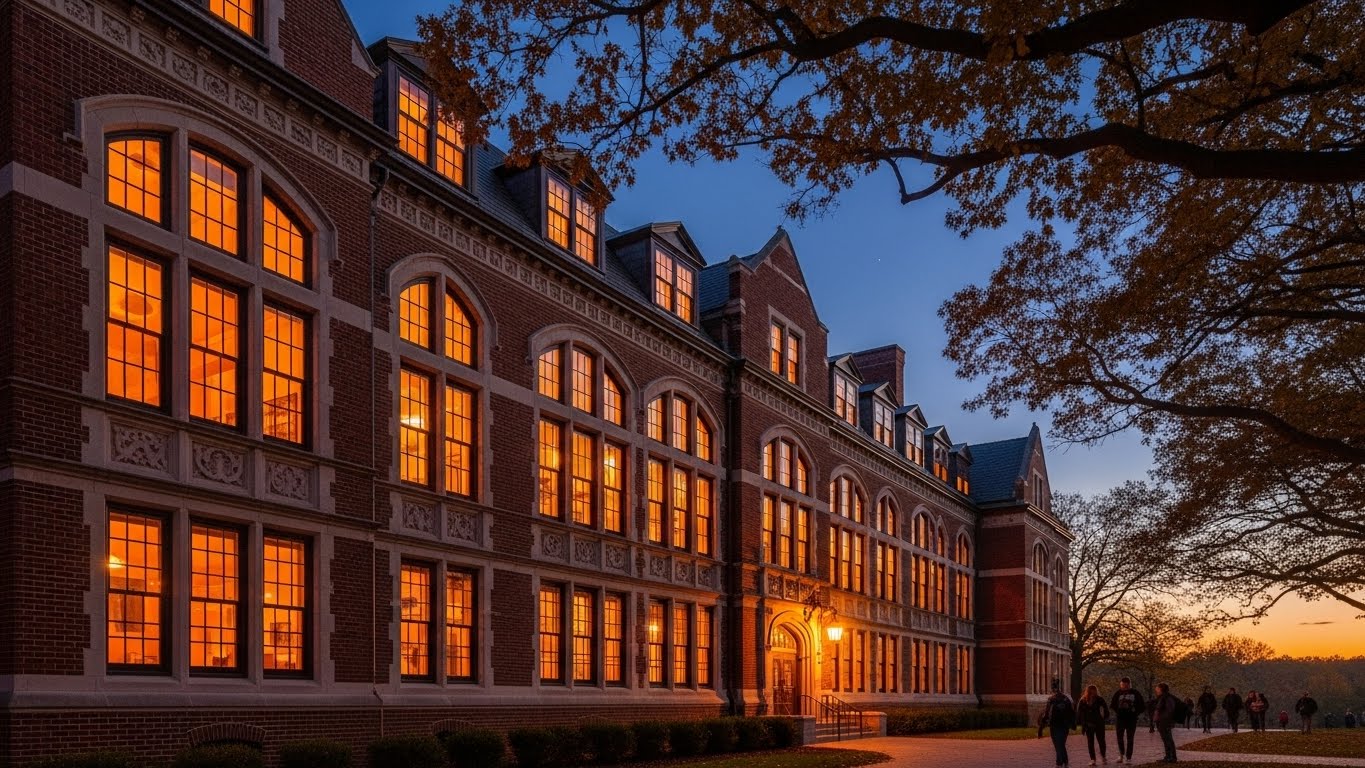
The school's origins lie in a strategic land acquisition in 1884. The initial 90 acres were not purchased on the open market were a gift from James and Prescott Lawrence, wealthy brothers who donated the parcel in memory of their sister, Gertrude. The land, originally a working farm owned by John J. Graves on Farmers Row, offered the isolation Endicott Peabody required. Far from the distractions of the city, the site commanded views of the Nashua River valley and Mount Wachusett, a setting intended to inspire "muscular Christianity" and moral reflection. To structure this wilderness, Peabody enlisted the firm of Frederick Law Olmsted, the architect of Central Park. Olmsted's design centered on "The Circle," a vast, elliptical lawn that functioned as both a village green and a panopticon. The layout was deliberate: buildings faced inward, creating a closed loop of surveillance and community where every student's movement was visible to the masters.
The architectural language of the early campus was dictated by the firm Peabody & Stearns, who designed the school's foundational structures between 1884 and 1902. Their work, including the original Brooks House (1884) and the massive Hundred House (1891), established a Colonial and English Revival aesthetic that visually linked Groton to the British public schools Peabody sought to emulate. Hundred House, a sprawling brick dormitory and headmaster's residence, became the nerve center of the school. Its design forced close communal living, with the Rector's study positioned as the authority within the domestic sphere. The architecture did not just house the students; it molded them, enforcing a hierarchy of age and status through the physical separation of "forms" (grades) within the dormitories.
The spiritual centerpiece of the campus, St. John's Chapel, was a direct assertion of the school's Anglophile identity. Consecrated in 1900, the limestone Gothic Revival structure was designed by Henry Vaughan, the architect of the Washington National Cathedral. The chapel was funded by a $75, 000 donation from William Amory Gardner, one of the school's founding triumvirate. Gardner's gift came with strings attached: he retained "negative control" over the placement of windows and brasses, ensuring the interior reflected his high-church sensibilities. The chapel's , outsized for a school of fewer than 200 boys at the time, signaled Groton's ambition to be not just a school, a spiritual institution. Vaughan also designed the school's chapel, which was later moved to the town of Groton to become the Sacred Heart Catholic Church, a physical displacement that underscored the school's dominance over the local religious.
Throughout the early 20th century, the campus expanded to meet the functional needs of a "sound body" as well as a sound mind. The Gymnasium, built in 1902 by Peabody & Stearns, was a temple to athletic rigor. In a testament to the school's adaptive reuse of its historic core, this building was converted into the Dining Hall in the 1960s. The transformation retained the Classical Revival exterior while repurposing the interior for the daily ritual of communal meals, a practice central to Peabody's ethos of "family." In 2020, the Dining Hall underwent a significant renovation to modernize its servery and remove a spiral staircase that had long bottlenecked the flow of students, proving that even sacred traditions eventually bow to logistical efficiency.
The 21st century brought a new phase of construction, driven by the "arms race" among elite boarding schools to provide university-level facilities. The most significant intervention was the renovation and expansion of the Schoolhouse, the academic heart of the campus originally built in 1899. Completed in 2015 by the architectural firm Shepley Bulfinch, the project involved a 44, 500-square-foot addition and a complete overhaul of the existing 90, 000-square-foot structure. The renovation relocated the library from Hundred House to the Schoolhouse, creating a new intellectual hub. The design threaded a needle between preservation and modernization, restoring the building's iconic facade while inserting state-of-the-art laboratories and a "Forum" for public speaking, a skill paramount to Groton's mission of producing public leaders. The project's dwarfed previous expansions, reflecting a shift in pedagogy toward collaborative learning and hard sciences.
In the years leading up to 2026, the focus of campus development shifted toward sustainability, aligning the school's physical plant with the environmental concerns of the modern donor class. The construction of Gardner Village in 2020 marked a departure from the heavy masonry of the 19th century. Built on the site of Amory Gardner's original residence, this complex of four faculty homes was the net-zero building on campus. Powered by a dedicated solar array and heated by geothermal wells, Gardner Village represented a new architectural morality: inconspicuous consumption. The project was part of a broader decarbonization strategy that included the John B. Goodenough '40 Solar Battery Farm, named for the Nobel laureate alumnus who pioneered lithium-ion technology. This facility, capable of storing energy to offset peak demand, positioned the campus as a micro-grid, reducing its reliance on fossil fuels while insulating it from external power fluctuations.
Building/Project
Year Completed
Architect
Key Details
Brooks House
1884
Peabody & Stearns
building; English Revival style; originally housed the entire school.
Hundred House
1891
Peabody & Stearns
Dormitory and Rector's residence; named for its capacity to house 100 boys.
St. John's Chapel
1900
Henry Vaughan
Gothic Revival; limestone; funded by William Amory Gardner ($75k).
Schoolhouse (Reno)
2015
Shepley Bulfinch
Major expansion; labs added; library relocated; geothermal heating.
Gardner Village
2020
Unknown
Faculty housing; Net Zero building; solar and geothermal power.
The campus of 2026 remains a paradox. The Circle, still maintained to Olmsted's specifications, preserves the illusion of a timeless, agrarian academy. Yet beneath the manicured lawns lie geothermal loops, and behind the brick facades of the Schoolhouse hum the servers of a digital library. The physical plant has expanded from 90 acres to over 480, absorbing the surrounding just as the institution absorbs the children of the global elite. Every brick and beam serves the singular purpose of the "Groton Idea": to create a self-contained world where the external rules of society are suspended in favor of the school's own rigid, formative code.
Demographic Integration and Student Body Statistics (1970, 2026)
Endowment Performance and the GRAIN Tuition Model
The demographic trajectory of Groton School from 1970 to 2026 represents a calculated of the institution's original identity to ensure its survival in a meritocratic market. For nearly a century the school operated as a hermetically sealed incubator for the white Protestant elite. By the late 1960s this model faced existential obsolescence. The cultural revolutions of the era rendered the "monastic" education of wealthy boys not only unfashionable financially precarious. The administration under Headmaster Rowland Cox recognized that maintaining the school's prestige required a radical expansion of its talent pool. This shift began with the admission of women and evolved into a sophisticated financial engineering project designed to curate a specific racial and socioeconomic mix.
Coeducation arrived at Groton in 1975. This decision was not a product of organic social evolution a strategic response to declining applications from the most competitive families. Peer institutions like St. Paul's and Middlesex had already moved toward coeducation or coordination with girls' schools. Groton risked irrelevance. Rowland Cox and the Board of Trustees executed the transition with a speed that shocked the alumni base. The cohort of girls entered a campus architecture and culture built exclusively for men. Early statistics show the friction of this integration. In 1975 the female population was a small minority. It took decades for the gender ratio to stabilize at the current 50-50 split. The introduction of women shattered the "muscular Christianity" ethos that Endicott Peabody had enshrined. It forced the school to reconfigure everything from dormitory arrangements to the athletic curriculum. Yet the presence of women also instantly doubled the chance applicant pool and raised the average academic standard of the entering class.
Racial integration followed a slower and more jagged route. Through the 1970s and 1980s the presence of Black and Latino students remained largely tokenistic. The school recruited specific students to integrate the campus the underlying culture remained stubbornly white and upper-class. Data from the late 20th century reveals a "barbell" demographic structure. The student body consisted primarily of full-pay wealthy families and a small cohort of full-scholarship students from low-income backgrounds. The middle class virtually from the Groton census during this period. Tuition costs spiraled upward at a rate that outpaced inflation and median household income growth. By the early 2000s the sticker price of a Groton education exceeded the median American annual salary. The school risked becoming an enclave for the global super-rich rather than the American leadership class it was founded to produce.
The appointment of Temba Maqubela as headmaster in 2013 marked the beginning of the most aggressive demographic engineering in the school's history. Maqubela was a Black South African refugee and a chemistry teacher who had previously taught at Phillips Andover. His arrival signaled that Groton intended to compete directly with larger rivals for the most diverse talent pool available. His administration identified a serious market failure in elite education: the exclusion of the "missing middle." These were families with incomes between $100, 000 and $250, 000 who were too rich to qualify for federal aid too poor to afford $60, 000 a year in after-tax tuition. Groton launched the GRAIN (GRoton Affordability and INclusion) initiative to capture this demographic.
GRAIN was not a fundraising campaign. It was a restructuring of the school's economic model. The administration froze tuition for three years starting in 2015. This move the industry standard of annual 3% to 5% increases. The freeze was a signal to the market that Groton was opting out of the tuition arms race. In 2024 the school escalated this strategy by announcing that starting in the 2025-2026 academic year families earning under $150, 000 would pay zero tuition. This policy applied to both domestic and international applicants. The $150, 000 threshold is significantly higher than the cutoffs at most universities. It makes Groton free for the upper-middle class. This policy allows the admissions office to poach high-performing students from suburban public schools who would otherwise never consider a boarding school.
The financial mechanics behind this inclusion are. Groton use its small size to outmaneuver larger competitors. With only 380 students and an endowment exceeding $548 million the school commands a per-student capital base of approximately $1. 4 million. This ratio allows the administration to subsidize the student body at a level few other institutions can match. In 2025 the tuition for boarding students stood at $61, 810. Yet the financial aid budget of $7. 9 million meant that 44% of the student body received grants averaging over $46, 000. The "sticker price" has become a fiction for nearly half the school. The administration uses the endowment to purchase socioeconomic diversity that the natural market would not supply.
Groton School Demographic & Financial Snapshot (2024, 2026)
Metric
Data Point
Total Enrollment
385 Students
Boarding Tuition (2025-26)
$61, 810
Day Tuition (2025-26)
$48, 135
Students on Financial Aid
44%
Free Tuition Threshold
Family Income <$150, 000
Students of Color (Self-ID)
~46%, 53%
International Students
14%
Acceptance Rate
~8%, 9%
Endowment
$548 Million
The racial composition of the student body in 2026 bears little resemblance to the school of 1970. Students of color constitute roughly half of the enrollment. A closer examination of this statistic reveals the complexity of modern elite demographics. The largest minority group is Asian American students who make up approximately 27% of the population. Black and Latino enrollment has increased remains smaller in comparison. The category of "International Students" accounts for 14% of the body. These students frequently come from the economic elites of their respective nations. Consequently the "diversity" statistics conflate American racial integration with global wealth. A student from a billionaire family in Seoul and a student from a working-class family in the Bronx both contribute to the "non-white" metric occupy entirely different positions in the class structure.
The geographic origin of the students has also shifted. The dominance of the Boston-New York-Philadelphia corridor has waned. The school draws heavily from California and international markets. The "Groton family" is no longer a tight network of East Coast cousins a globalized meritocracy. This shift has consequences for the school's culture. The shared background of the 19th-century student body allowed for a shorthand communication and a unified set of assumptions. The current student body shares no such inheritance. The administration must actively manufacture a sense of community through the "Groton Idea" because organic social bonds no longer exist prior to matriculation.
The acceptance rate reflects this widened funnel. In the 1980s admission was competitive accessible for the right families. By 2022 the acceptance rate had plummeted to 8%. The application pool includes thousands of candidates who have no prior connection to the prep school world. The GRAIN initiative has successfully flooded the admissions office with applications from the "missing middle." This allows the school to be ruthlessly selective. The administration can select the absolute highest scorers from a pool that spans the entire economic spectrum. The result is a student body that is intellectually formidable subjected to intense pressure. The "gentleman's C" is extinct. The modern Groton student is a survivor of a global filtering process.
Critics of this demographic engineering point to the "creaming" effect. By extracting the most talented children from local communities and placing them in an boarding environment Groton reinforces the concentration of human capital in elite centers. The school does not uplift communities; it uplifts individuals out of their communities. The student who enters Groton on a full scholarship from a public school system is removed from the public sphere and socialized into the private elite. The $150, 000 free tuition threshold accelerates this process. It ensures that the most capable children of the middle class are absorbed into the private system leaving public schools with a depleted talent pool. The administration views this as "opportunity." Sociologists might view it as a brain drain.
The endowment growth undergirds every aspect of this demographic reality. The fund has grown from modest levels in the 1970s to over half a billion dollars today. This capital accumulation allows Groton to operate as a quasi-independent economic zone. It is insulated from the market forces that crush lesser private schools. The tuition revenue covers only a fraction of the operating cost. The true cost of a Groton education is subsidized by the investment returns of the endowment. Every student is a scholarship student because the actual cost per head exceeds the full tuition price. This financial structure makes the demographic engineering possible. The school does not need tuition revenue to survive. It needs tuition revenue to maintain the illusion of a market price while it uses its capital to curate the perfect class.
By 2026 Groton has successfully transitioned from a WASP stronghold to a global talent refinery. The "Groton Idea" of service has been rebranded as "inclusion." The metrics of success are no longer just the number of bishops and senators produced the SAT averages and the diversity pie charts. The school has survived the death of the American aristocracy by becoming a servant of the global meritocracy. The faces in the Schoolroom have changed color and gender. Yet the function of the institution remains identical: to identify the ruling class of the generation and bind them together on the Circle.
Administrative Tenure and Board Governance
Curriculum Rigor and University Matriculation Rates
The governance of Groton School has evolved from a nineteenth-century autocracy, where the headmaster's word was canon, into a modern corporate trusteeship managing nearly half a billion dollars in assets. This transition mirrors the shift in American elite power structures, from the personal authority of the "Boston Brahmin" families to the bureaucratic, liability-conscious management of the twenty- century. ### The Era of the Rector-King (1884, 1940) For its fifty-six years, Groton's governance was indistinguishable from the of Endicott Peabody. While a Board of Trustees existed from the school's incorporation in 1893, it functioned less as a supervisory body and more as a council of wealthy patrons and personal friends. The original board included titans of finance and religion such as J. P. Morgan and Bishop Phillips Brooks, men whose presence lent credibility rather than oversight. Peabody, known simply as "The Rector," held absolute dominion over admissions, discipline, and hiring. He did not require board approval to expel a student or dismiss a master. The school's financial model in this era was heavily subsidized by the personal fortune of William Amory Gardner, a founding master and trustee, whose contributions frequently covered operating deficits that tuition could not. This "triumvirate" of Peabody, Gardner, and Sherrard Billings operated with an informality that would be legally perilous today; governance was conducted through conversation in the Rector's study rather than by parliamentary vote. ### The Transitional emergency and Coeducation (1940, 1978) The departure of Peabody in 1940 forced the Board of Trustees to assume actual governing power for the time. They selected John Crocker (Class of 1918) to succeed Peabody, a move that maintained the school's Episcopal continuity introduced a slow modernization. The board's role remained largely supportive until the social upheavals of the 1960s and 70s forced a confrontation with the school's identity. Following Crocker's retirement in 1965, the school entered a period of administrative turbulence, cycling through three headmasters, Bertrand Honea, Paul Wright, and Rowland Cox, in just twelve years. The Board of Trustees, traditionally composed of conservative alumni, faced its most significant policy test: the admission of women. In the early 1970s, as peer institutions like St. Paul's and Exeter moved toward coeducation, the Groton board was deeply divided. The decision to admit girls in 1975 was not made by administrative fiat was the result of a contentious board vote, representing the time the trustees, rather than the headmaster, dictated a fundamental shift in the school's "DNA." ### The Corporate Turn and the Scandal of 2005 Under the tenure of William Polk (1978, 2003), the Board of Trustees professionalized its operations, adopting committee structures for finance, investment, and audit that mirrored public company boards. This era saw the endowment grow significantly, necessitating sophisticated asset management strategies that moved beyond the conservative bonds favored by earlier trustees. yet, this corporate structure failed to shield the school from the sexual abuse scandals that surfaced in the late 1990s and early 2000s. In a governance failure that garnered national attention, the school admitted in 2005 to failing to report allegations of sexual abuse to state authorities. The Board of Trustees authorized a guilty plea to a misdemeanor charge, a stunning admission of institutional negligence. This event marked a watershed moment for the board, which subsequently implemented rigid risk management, mandatory reporting standards, and a zero-tolerance policy that stripped the headmaster of the discretion Peabody once wielded. ### Modern Governance and the Maqubela Tenure (2013, 2026) By 2026, the Groton Board of Trustees had evolved into a global body, reflecting the school's shift from a Northeastern enclave to an international institution. The board is currently led by President Benjamin N. Pyne (Class of 1977), with members drawn from finance, law, and technology sectors across New York, Hong Kong, and California. Trustees serve four-year terms, a limit designed to prevent the stagnation that characterized the early 20th-century boards. The appointment of Temba Maqubela in 2013 signaled the board's commitment to "inclusion" as a strategic imperative rather than a buzzword. The board backed Maqubela's "GRAIN" (Groton Affordability and Inclusion) initiative, which froze tuition for several years, a fiscal heresy in the world of elite private schools that required the trustees to use the endowment aggressively. As of 2026, the board manages an endowment method $500 million. Their primary focus has shifted to "access and affordability," ensuring the school's solvency while attempting to shed its image as a bastion of white privilege. The governance model is defined by "strategic frameworks", such as the 2030 Strategic Framework adopted in 2021, which bind the administration to specific, measurable goals regarding diversity, sustainability, and student well-being.
Groton School Headmasters and Governance Eras (1884, 2026)
Tenure
Headmaster
Key Governance Characteristic
1884, 1940
Endicott Peabody
Autocratic; Board as advisory council of patrons.
1940, 1965
John Crocker
Transitional; Board assumes selection power.
1965, 1969
Bertrand Honea Jr.
Short tenure; Board asserts policy control.
1969, 1974
Paul Wright
non-cleric; Board manages modernization.
1974, 1977
Rowland Cox
Died in office; Board manages coeducation transition.
Inclusion mandate (GRAIN); Global board composition.
The board's composition in 2026 stands in clear contrast to the 1890s. Where the original trustees were exclusively white, male, Protestant, and Northeastern, the current board includes women and people of color, though it remains dominated by alumni and high-net-worth individuals. The requirement that the headmaster be an ordained Episcopalian was removed from the bylaws in the mid-20th century, though the tradition of a "chapel-centered" community remains enforced by the trustees. Current governance challenges involve navigating the "culture wars" of American education. The board has had to defend its Diversity, Equity, and Inclusion (DEI) programs against conservative alumni backlash while simultaneously addressing student demands for greater progressive action. Unlike the Peabody era, where dissent was silenced by the Rector's glare, the modern board operates in a hyper-transparent environment where every decision is scrutinized by a vocal and digitally connected alumni network.
Athletic Rivalries and Competitive Records
The athletic philosophy of Groton School was never intended to be recreational. From the moment Endicott Peabody founded the institution, he viewed physical exertion as a moral imperative, a method to exhaust the "animal spirits" of adolescent boys and enforce a code of "Muscular Christianity." This ethos, imported directly from the English public school tradition of Rugby and Eton, demanded that students perform on the playing field with the same rigor expected in the chapel or the classroom. For Peabody, a boy who shirked a tackle was suspect in his character. This foundational belief system created an athletic culture that prioritized grit over flair, resulting in rivalries and competitive records that have spanned three centuries. The history of Groton athletics is not a catalog of wins and losses; it is a documentation of how the American elite sought to legitimize their status through physical dominance.
The centerpiece of this competitive existence is the rivalry with St. Mark's School, a contest that ranks as the second-oldest high school football rivalry in the United States. The hostilities commenced on October 30, 1886, at a neutral site in Lancaster, Massachusetts. St. Mark's, founded seventeen years prior, entered the match as the heavy favorite. Yet Groton emerged victorious, largely due to a touchdown scored by a young master, William Greenough Thayer. The irony of this victory would through the schools' shared history; Thayer later defected to become the headmaster of St. Mark's in 1894, presiding over the St. Mark's football victory against his former employer. This incestuous relationship between the two Episcopal boarding schools, separated by only a few miles of Massachusetts countryside, solidified a feud that transcends sport. It became a ritualistic measure of institutional worth.
The nomenclature of the rivalry itself reveals the depth of the animosity. In the early 20th century, Groton adopted football uniforms featuring black, white, and red stripes. St. Mark's students, mocking the attire, labeled their opponents "Zebras," declaring that their own mascot, the Winged Lion, enjoyed feasting on zebra meat. Rather than reject the derisive moniker, Groton appropriated it. The Zebra became the official mascot, a symbol of the school's willingness to absorb insults and convert them into identity. This psychological warfare extended to the trophies exchanged. The victor of the annual football match earns the right to keep the "Raccoon Coat," a heavy, fur garment originally belonging to Endicott "Chub" Peabody, a Groton graduate and former Governor of Massachusetts. The coat is not a shiny cup or a plaque; it is a decaying artifact of the patrician class, passed back and forth for decades as a totem of supremacy.
Football records show the cyclical nature of this dominance. While Groton enjoyed early success under the watchful eye of the Rector, the modern era has presented serious challenges. The 2025 season, for instance, ended in a clear humiliation for the Zebras. On November 8, 2025, St. Mark's dismantled Groton with a score of 42-8, a result that underscored the shifting of talent acquisition in the Independent School League (ISL). Even with this defeat, the historical weight of the series remains. In 2011, the schools established the Burnett-Peabody Bowl to track the aggregate winner across all sports during the rivalry weekend, acknowledging that the competition had expanded far beyond the gridiron. Yet, for the alumni base, the football game remains the only metric that truly matters.
If football is the soul of the rivalry, rowing is the sacred rite of the Groton athlete. The Groton School Boat Club, founded in 1885, predates the formalization of American collegiate programs. The Nashua River, winding past the campus, serves as the training ground for crews that have frequently punched above their weight class. Unlike football, where size frequently dictates the outcome, rowing at Groton emphasizes technical precision and endurance, qualities Peabody prized. The program has achieved international recognition, sending crews to the Henley Royal Regatta in England with regularity. In 2011, the girls' boat won the School/Junior 8 category at the Henley Women's Regatta, a trans-Atlantic assertion of the school's rowing pedigree. Domestically, the boys' team captured New England Interscholastic Rowing Association (NEIRA) team titles in 2000, 2002, 2011, and 2015, cementing the school's status as a premier incubator for collegiate oarsmen.
The transition to coeducation in 1975 fundamentally altered the athletic composition of the school, eventually leading to periods of dominance in women's sports that eclipsed the men's programs. The girls' ice hockey program, in particular, has become a formidable power in the New England Preparatory School Athletic Council (NEPSAC). As of March 8, 2026, the Groton girls' varsity hockey team secured a spot in the NEPSAC Small School championship game against New Hampton, following a tense 2-0 semifinal victory over, inevitably, St. Mark's. This 2025-2026 campaign demonstrated the school's ability to recruit and develop elite female talent, utilizing the dual rinks of the O'Brien Ice Hall to maintain a training regimen that rivals NCAA Division III programs. The success on the ice stands in sharp contrast to the struggles on the football field, suggesting a reallocation of athletic capital within the institution.
Squash and tennis have also served as reliable reservoirs of silverware for the school, sports that align neatly with the country club backgrounds of students. The 2020 season stands out as a statistical anomaly of excellence: both the boys' and girls' squash teams won the Division III National High School Championships. This double victory required a depth of roster that few small schools can muster. Similarly, the boys' tennis team achieved a "perfect season" in 2022, winning the ISL championship with a 100% win rate. These racquet sports benefit from the school's massive endowment, which funds facilities like the twelve glass-backed squash courts, ensuring that Groton athletes train in environments superior to most public universities.
Groton's participation in the Independent School League (ISL) is defined not just by whom they play, by the ethical lines they draw regarding recruitment. In 2016, a seismic shift occurred in the league when St. Paul's School, another Episcopal rival, withdrew from the ISL. The dispute centered on St. Paul's use of merit-based scholarships, a practice prohibited by ISL bylaws which mandate that financial aid be awarded solely on need. Groton stood firm with the league, refusing to weaponize its endowment to buy athletes. This adherence to the "amateur ideal", even if that ideal is rooted in aristocratic privilege, remains a point of pride. The school accepts that this self-imposed restriction may cost them championships against schools with looser purse strings, yet they frame it as a moral victory, consistent with Peabody's original vision of fair play.
The following table summarizes key recent championship performances across major sports, illustrating the school's competitive footprint in the 21st century:
Sport
Year
Achievement
Context
Boys Tennis
2022
ISL Champions
Undefeated season (100% win rate).
Squash (Boys & Girls)
2020
National Champions
Won U. S. High School Team Division III titles.
Girls Tennis
2023, 2024
ISL Champions
Back-to-back league dominance.
Boys Crew
2015
NEIRA Team Champions
Fourth team title since 2000.
Girls Ice Hockey
2026
NEPSAC Finalist
Defeated St. Mark's 2-0 in Semifinals (Small School).
Football
1997
ISL Champions
Last major league title for the football program.
The data from the 2020s indicates a clear trend: Groton has evolved from a football-centric institution into a diversified athletic power, with its most consistent successes coming in racquet sports, rowing, and girls' hockey. The decline of the football program, once the primary engine of school spirit, reflects broader cultural shifts regarding safety and the specialization of youth sports. Yet, the administration continues to enforce a requirement for athletic participation, viewing the fields as an extension of the classroom. The "Groton Idea" in the belief that a student who cannot handle the pressure of a tie-breaker set or the physical toll of a 2, 000-meter row is ill-equipped to handle the pressures of leadership. The scoreboard may change, the underlying demand for physical discipline remains absolute.
The Roosevelt Connection and Political Alumni Network
The "Groton Idea" was never limited to the pulpit or the playing field; its application was the exercise of political power. Endicott Peabody explicitly commanded his students to enter public service, a directive that frequently translated into a mandate to rule. By 2026, the school's alumni roster reads less like a yearbook and more like a organizational chart of the American century. From the White House to the Central Intelligence Agency, Groton graduates have held a disproportionate grip on the levers of the U. S. government, creating a dynastic network that links the rough-riding era of Theodore Roosevelt to the digital bureaucracy of the 2020s. The Roosevelt family stands as the primary example of this phenomenon. While Theodore Roosevelt (TR) did not attend Groton, he sent all four of his sons, Theodore Jr. (1906), Kermit (1908), Archie (1909), and Quentin (1915), to be molded by Peabody. TR viewed the Rector as a moral proxy, entrusting him with the discipline of his progeny. Yet, the school's most consequential product was TR's distant cousin, Franklin Delano Roosevelt (Class of 1900). FDR's time at Groton was difficult; he was slight, unathletic, and arrived two years later than his peers. Yet, the ethos of *noblesse oblige*, the obligation of the privileged to serve the less fortunate, became the intellectual bedrock of the New Deal. Peabody officiated at FDR's wedding to Eleanor Roosevelt in 1905 and remained a spiritual advisor throughout his presidency. The connection was not sentimental. During the Roosevelt administration, the "Groton Vote" became a recognized bloc in Washington. FDR surrounded himself with fellow alumni, including Sumner Welles (1910) as Under Secretary of State and Francis Biddle (1905) as Attorney General. The school provided a common language and a shared assumption of authority that bypassed standard bureaucratic channels. Following World War II, the Groton network shifted its focus from domestic reform to global dominance. The architects of the Cold War were largely drawn from Peabody's "Christian gentlemen." Dean Acheson (1911), serving as Secretary of State under Truman, designed the Marshall Plan and NATO. W. Averell Harriman (1909), a titan of diplomacy and former Governor of New York, negotiated with Stalin and served as a roving ambassador for multiple presidents. These men, frequently referred to as "The Wise Men," operated with a confidence born on the Groton Circle, believing that their class and education granted them the right to define the world order. This influence extended deep into the covert apparatus of the state. The Central Intelligence Agency (CIA) in the 1950s and 60s functioned almost as a Groton alumni association. Richard Bissell (1928), the CIA's Deputy Director for Plans, and Tracy Barnes (1929), a senior operative, were the masterminds behind the U-2 spy plane program and the disastrous Bay of Pigs invasion. The failure of the Bay of Pigs was, in a grim sense, a Groton failure; the planners (Bissell and Barnes) and the President's National Security Advisor, McGeorge Bundy (1936), all shared the same alma mater. Bundy, along with his brother William Bundy (1935), later steered the United States into the Vietnam War, applying the rigid, self-assured logic of their prep school training to the chaotic reality of Southeast Asia. The concentration of power among Groton alumni is visualized in the table, which tracks key figures across three centuries of American governance.
Alumnus
Class Year
Highest Political/Government Role
Era of Influence
Franklin D. Roosevelt
1900
32nd President of the United States
1933, 1945
Theodore Roosevelt Jr.
1906
Governor General of the Philippines; Brigadier General
1920s, 1940s
W. Averell Harriman
1909
Secretary of Commerce; Governor of NY; Ambassador to USSR
1940s, 1960s
Dean Acheson
1911
51st Secretary of State
1949, 1953
C. Douglas Dillon
1927
57th Secretary of the Treasury
1961, 1965
Richard Bissell
1928
CIA Deputy Director for Plans (Bay of Pigs Architect)
1950s, 1960s
McGeorge Bundy
1936
National Security Advisor
1961, 1966
Bobby Scott
1965
U. S. Representative (Virginia)
1993, Present
Christopher Landau
1981
Deputy Secretary of State; Ambassador to Mexico
2019, 2026
Maggie Goodlander
2005
U. S. Representative (New Hampshire)
2025, Present
In the 21st century, the Groton pipeline has not dried up; it has adapted. While the sheer volume of alumni in the cabinet has decreased compared to the Acheson-Harriman era, the school continues to place its graduates in serious nodes of power. As of March 2026, the network remains active at the highest levels. Christopher Landau (1981), previously the Ambassador to Mexico, assumed the role of Deputy Secretary of State in 2025, bringing the Groton tradition back to the State Department's leadership. Simultaneously, a new generation of political operatives has emerged. Maggie Goodlander (2005), a former intelligence officer and Deputy Assistant Attorney General, was elected to the U. S. House of Representatives for New Hampshire's 2nd District in 2024. Goodlander's trajectory, Yale, Intelligence, Justice Department, Congress, mirrors the classic route of her predecessors, though her politics diverge from the conservative establishment of the mid-20th century. In 2020, Goodlander was among a group of alumni who pressured the school to financially support racial justice organizations, signaling a shift in the internal ideology of the alumni network even as they continue to seek and hold federal office. The persistence of this network raises fundamental questions about social mobility and the American meritocracy. For over 140 years, a small boarding school in rural Massachusetts has operated as a feeder system for the United States government. The names change, from Roosevelt to Bundy to Goodlander, the method remains consistent. Peabody's "Groton Idea" succeeded in its primary objective: it created a ruling class that views governance not as a career, as a birthright.
Why it matters: The 2019-2020 Black Summer bushfires in Australia led to a record-breaking $640 million in philanthropic donations specifically for bushfire relief. Donations were heavily concentrated in…
What do we know about Founding Ideology and Endicott Peabody?
The genesis of Groton School in 1884 was not an educational experiment; it was a calculated intervention into the American social fabric. Endicott Peabody, a young Episcopal priest with a towering physical presence and a background steeped in English public school traditions, sought to mold the sons of the American plutocracy into a disciplined ruling class.
What do we know about Admissions Metrics and Legacy Enrollment Data?
The method of admission to Groton School has never been a simple matter of academic aptitude; for the century of its existence, it was a hereditary transfer of power. From 1884 until the mid-20th century, the admissions process functioned as a closed loop, managed personally by Endicott Peabody through a ledger that served as the definitive registry of the American Protestant elite.
What do we know about Sexual Abuse Investigations and Legal Settlements?
The history of sexual abuse investigations at Groton School is defined by a collision between its insular, elite culture and the evolving legal mandates for child protection. Unlike peer institutions that faced a singular, explosive " " moment involving a prolific faculty predator, Groton's most significant legal reckoning centered on its institutional failure to report student-on-student abuse to state authorities.
What do we know about Endowment Performance and the GRAIN Tuition Model?
The financial bedrock of Groton School does not begin in 1884, in the merchant counting houses of Salem, Massachusetts, during the late 1700s. The capital that would eventually build the school's Gothic spires and underwrite its early survival was accumulated through the global shipping empires of the Peabody and Gardner families.
What do we know about Curriculum Rigor and University Matriculation Rates?
The academic of Groton School has undergone a radical inversion since its founding in 1884. For the half-century of its existence, the curriculum was not designed to produce scholars; it was designed to certify a ruling class.
What do we know about Campus Real Estate and Architectural Expansion?
The physical footprint of Groton School is not a collection of buildings; it is a meticulously curated geography of power, designed to enforce the "Groton Idea" through spatial arrangement. From its inception in 1884 to the net-zero initiatives of 2026, the campus has evolved from a remote hilltop farm into a high-tech educational, mirroring the shifting priorities of the American elite it serves.
What do we know about Demographic Integration and Student Body Statistics?
The demographic trajectory of Groton School from 1970 to 2026 represents a calculated of the institution's original identity to ensure its survival in a meritocratic market. For nearly a century the school operated as a hermetically sealed incubator for the white Protestant elite.
What do we know about Administrative Tenure and Board Governance?
The governance of Groton School has evolved from a nineteenth-century autocracy, where the headmaster's word was canon, into a modern corporate trusteeship managing nearly half a billion dollars in assets. This transition mirrors the shift in American elite power structures, from the personal authority of the "Boston Brahmin" families to the bureaucratic, liability-conscious management of the twenty- century.
What do we know about Athletic Rivalries and Competitive Records?
The athletic philosophy of Groton School was never intended to be recreational. From the moment Endicott Peabody founded the institution, he viewed physical exertion as a moral imperative, a method to exhaust the "animal spirits" of adolescent boys and enforce a code of "Muscular Christianity." This ethos, imported directly from the English public school tradition of Rugby and Eton, demanded that students perform on the playing field with the same rigor expected in the chapel or the classroom.
What do we know about The Roosevelt Connection and Political Alumni Network?
The "Groton Idea" was never limited to the pulpit or the playing field; its application was the exercise of political power. Endicott Peabody explicitly commanded his students to enter public service, a directive that frequently translated into a mandate to rule.
What do we know about this part of the file?
Founding Ideology and Endicott Peabody (1884, 1940)The genesis of Groton School in 1884 was not an educational experiment; it was a calculated intervention into the American social fabric. Endicott Peabody, a young Episcopal priest with a towering physical presence and a background steeped in English public school traditions, sought to mold the sons of the American plutocracy into a disciplined ruling class.
Why it matters: Americans pay a premium for sugar due to a federal program that benefits a small group of producers. The program costs consumers billions annually and…
Why it matters: 91% of public universities have sworn officers with full arrest powers, but discrepancies in jurisdictional authority between campus police and local law enforcement are raising…
Why it matters: African nations are increasingly relying on home-grown solutions to violent conflicts, with over 70,000 troops now under African or regional command. While African-led peacekeeping missions…
Why it matters: Africa's struggle with corruption and insecurity is rooted in the collusion between political power and criminal networks. An investigation reveals how high-level figures in African…
Why it matters: Global public trust in businesses is at historic lows, with only 39% of respondents believing in their ethical behavior. Organizations face existential threats due to…
Why it matters: Tribal communities protect 80% of Earth's biodiversity despite constituting only 5% of the global population (World Bank, 2023). Over 370 million indigenous people worldwide face…
Get updates on this place
Get verified alerts when this file is updated (verification required).