Verified Against Public And Audited RecordsLast Updated On: 2026-03-06
Reading time: ~47 min
File ID: EHGN-PLACE-36203
Investigative Bio of High Court of Australia
Constitutional Establishment and Federation Debates (1890, 1903)
The establishment of the High Court of Australia was not a polite legal formality a vicious diplomatic brawl between Australian colonial nationalists and the British Imperial establishment. For nearly a century prior to Federation, the arbiter of Australian law was the Judicial Committee of the Privy Council in London. This body, composed of British judges frequently ignorant of colonial nuances, held the power to overturn local decisions. By the 1890s, the "tyranny of distance" and the exorbitant costs of appealing to London, frequently exceeding £500 per case, a fortune in that era, denied justice to all the wealthiest corporations and the Crown. The push for a local apex court was driven by a desire for sovereignty and a rejection of this remote, expensive oversight.
The architectural blueprint for the High Court emerged during the Constitutional Conventions of 1891 and 1897, 98. Sir Samuel Griffith, Premier of Queensland, and Andrew Inglis Clark, Attorney-General of Tasmania, rejected the British model of parliamentary supremacy. Instead, they looked to the United States Supreme Court. Clark, a republican and admirer of American jurisprudence, specifically championed the principle of judicial review established in Marbury v Madison (1803). He argued that a federal system required a "keystone" to interpret the division of powers between the new Commonwealth and the States. This American influence terrified British traditionalists, who viewed a court with the power to strike down legislation as a threat to the Crown's authority.
The conflict reached its zenith in 1900. The Australian Constitution Bill had to pass the British Parliament to become law. Joseph Chamberlain, the British Colonial Secretary, refused to accept Clause 74, which proposed to end appeals to the Privy Council in constitutional matters. Chamberlain argued that the "link of Empire" must remain unbreakable to protect British investors holding Australian colonial bonds. The Australian delegation, Edmund Barton, Alfred Deakin, and Charles Kingston, engaged in a high- standoff in London. They threatened to withdraw the entire Federation bill if Chamberlain gutted the court's jurisdiction. The resulting compromise, known as the "Clause 74 compromise," allowed the High Court final say on inter se questions (disputes over the limits of Commonwealth vs. State powers) unless the High Court itself granted a certificate for appeal. This secured Australian judicial sovereignty over its own domestic power struggles.
Even with the Constitution enacted in 1901, the Court did not immediately exist. It required enabling legislation, which faced fierce opposition in the new Commonwealth Parliament. Labour members and fiscal conservatives attacked the proposed court as an unnecessary extravagance, arguing that State Supreme Courts were sufficient. Attorney-General Alfred Deakin fought back with his famous "Keystone" speech on 18 March 1902, declaring the High Court "the organ of the government which defines the powers of the Commonwealth." The battle dragged on for 18 months. The Judiciary Act 1903 passed on 25 August 1903, only after the government agreed to reduce the bench from five judges to three and cap their pensions to secure the votes.
The High Court sat for the time on 6 October 1903 in the Banco Court in Melbourne. The bench consisted of Sir Samuel Griffith as Chief Justice, with Edmund Barton and Richard O'Connor as justices. The appointment of Barton was controversial; he resigned as Prime Minister to take the seat, a move critics labeled as political self-interest. These three men, all architects of the Constitution, immediately set about cementing the Court's authority. In their early years, they aggressively applied the "reserved state powers" doctrine to protect State sovereignty from federal encroachment, a direct reflection of the political compromises they had negotiated a decade earlier.
The trajectory from 1903 to 2026 shows a complete inversion of the original British-dominated hierarchy. While the 1903 compromise left a "side door" for private law appeals to the Privy Council, the High Court systematically closed these gaps over the 20th century. The Privy Council (Limitation of Appeals) Act 1968 and the Privy Council (Appeals from the High Court) Act 1975 restricted appeals, it was not until the Australia Act 1986 that the link was severed entirely. Today, the High Court stands as the absolute final court of appeal, a status that took 83 years to fully realize after the initial fight in Chamberlain's office.
Evolution of Australian Judicial Sovereignty (1700, 2026)
Time Period
Apex Court Authority
Sovereignty Status
1788, 1900
Privy Council (London)
Zero. Colonial courts subservient to UK.
1901, 1967
High Court (with exceptions)
Partial. High Court final on inter se matters; others appealable to UK.
1968, 1974
High Court (Federal matters)
Major. Appeals to UK on federal law abolished.
1975, 1985
High Court (From HCA)
Dominant. Appeals from HCA to UK abolished completely.
1986, 2026
High Court of Australia
Absolute.Australia Acts end appeals from State Courts to UK.
Itinerant Operations and Early Circuitry (1903, 1980)
Constitutional Establishment and Federation Debates (1890, 1903)
The High Court of Australia commenced its existence as a vagrant institution. On 6 October 1903, the sitting took place not in a dedicated federal edifice, in the Banco Court of the Supreme Court of Victoria in Melbourne. Three judges, Chief Justice Samuel Griffith, Edmund Barton, and Richard O'Connor, took their seats in borrowed robes within a borrowed hall. This reliance on state infrastructure defined the Court's operations for nearly eight decades, creating a physical dependency that frequently undermined its symbolic authority as the supreme arbiter of the new Commonwealth. The absence of a permanent home forced the justices into a grueling itinerant schedule, riding the circuits of a vast continent while battling the executive government over the costs of their travel.
By 1905, the friction between the judiciary and the executive over these logistical realities escalated into a near-constitutional emergency. The Attorney-General of the day, Josiah Symon, attempted to curtail the Court's travel expenses, arguing that the judges should reside in the temporary capital of Melbourne and only travel when absolutely necessary. The justices, viewing this as an attack on their independence and the federal nature of the Court, threatened to strike. They cancelled a scheduled sitting in Melbourne, a calculated act of defiance that forced the government to retreat. This early skirmish established a precedent: the High Court would not be a static tribunal tethered to the administrative convenience of the government, a national body that projected its presence across the federation.
The "circuit" system that emerged required the justices to endure punishing travel schedules. In an era before commercial aviation, judges spent weeks traversing the continent by rail and coastal steamer. A trip to Perth involved a sea voyage across the Great Australian Bight or a multi-day train journey across the Nullarbor Plain. Upon arrival, the conditions were frequently substandard. In Perth, the High Court was relegated to a "subterranean" room in the Supreme Court building, described by contemporaries as vermin-infested and malodorous. These indignities were not inconveniences; they were a physical manifestation of the Commonwealth's fragility in the face of entrenched state powers. The justices carried their libraries in trunks, drafting judgments in hotel rooms and railway carriages, far removed from the resources necessary for deep legal contemplation.
Melbourne served as the de facto headquarters of the Court for the 77 years. In 1928, the Commonwealth constructed a purpose-built facility in Little Bourke Street, adjacent to the Supreme Court of Victoria. While this provided a degree of stability, it reinforced the perception that the High Court was essentially a Melbourne institution that occasionally visited other cities. The Principal Registry remained in Melbourne until 1973, meaning that the administrative heart of Australian law beat in Victoria, not in the neutral territory of the Australian Capital Territory. Sydney, the other major legal center, hosted sittings in the Darlinghurst Courthouse and later in a shared facility at Taylor Square, yet the rivalry between the Sydney and Melbourne bars frequently played out in the logistics of where cases were heard.
The itinerant nature of the Court did not prevent it from delivering judgments that reshaped the nation, yet it frequently did so under extreme pressure. The Bank Nationalisation Case (1948), a marathon legal battle that struck down the Chifley Government's attempt to nationalize the banks, was heard in the cramped confines of the Melbourne court. Similarly, the Communist Party Case (1951), which invalidated the Menzies Government's attempt to ban the Communist Party, was decided by judges who were physically scattered and administratively overstretched. These landmark decisions demonstrated the Court's intellectual independence, yet the absence of a central, symbolic home left the institution to the perception that it was an appellate wing of the state court systems.
The drive for a permanent seat in Canberra accelerated under the Chief Justiceship of Sir Garfield Barwick (1964, 1981). Barwick, a former Attorney-General and a fierce proponent of federal supremacy, viewed the itinerant system as an anachronism. He argued that the High Court needed to be physically situated in the national capital to assert its status as a co-equal branch of government, distinct from the Parliament and the Executive. Barwick's vision was not for a modest courthouse, for a "monumental" structure that would dominate the Parliamentary Triangle. His aggressive lobbying secured the site and the funding, earning the project the derisive nickname "Gar's Mahal" among skeptics who viewed the expenditure as grandiose.
The architectural competition launched in 1972 attracted 158 entries, eventually won by the firm Edwards Madigan Torzillo and Briggs. The design, led by architect Christopher Kringas, was an unapologetic exercise in Brutalism, a of bush-hammered concrete and glass intended to convey strength, permanence, and transparency. Construction began in 1975, a year of political turmoil. It is significant that during the constitutional emergency of November 1975, when the Court was still physically located in Sydney, Barwick provided controversial advice to Governor-General Sir John Kerr regarding the dismissal of Prime Minister Gough Whitlam. This intervention, made by a Chief Justice without a permanent seat in the capital, highlighted the dangerous proximity of the judiciary to the executive's political maneuvers, a proximity Barwick paradoxically sought to cure with a building that physically separated the Court from Parliament House.
The construction phase was plagued by inflation and design changes, with the cost ballooning from an initial estimate of A$18. 4 million to a final figure exceeding A$46 million. The use of 18, 000 cubic meters of concrete and the elaborate internal finishes, including a 17. 5-meter high wall of red tulip oak in Courtroom 1, drew criticism during a period of economic restraint. Yet, the project proceeded, driven by the conviction that the "tyranny of distance" that had defined the Court's century must end.
On 26 May 1980, Queen Elizabeth II officially opened the High Court of Australia building in Canberra. The event marked the end of the itinerant era for the Court's primary operations, although the practice of sitting in state capitals for special leave applications continued in a reduced capacity. The move to Canberra fundamentally altered the psychology of the institution. No longer were the justices visitors in state domains; they were the masters of their own domain, housed in a structure that physically towered over the National Library and stood eye-to-eye with the provisional Parliament House. The opening of the building closed the chapter on the "homeless" Court, cementing its place not just in the legal structure, in the physical geography of Australian power.
High Court of Australia: Key Locations and Milestones (1903, 1980)
Period
Location / Event
Significance
1903
Banco Court, Melbourne
sitting of the High Court on 6 October.
1905
The "Strike"
Justices threaten to cease sittings over travel expense disputes.
1903, 1980
Circuit Sittings
Regular travel to Sydney, Brisbane, Adelaide, Perth, Hobart.
1923
Taylor Square, Sydney
Court begins sharing facilities with NSW state courts.
1928
Little Bourke St, Melbourne
purpose-built Commonwealth court facility opens.
1972, 1973
Design Competition
Edwards Madigan Torzillo and Briggs selected for Canberra building.
1975
Construction Begins
Work starts on the permanent home in the Parliamentary Triangle.
1980
Canberra Opening
Queen Elizabeth II opens the permanent High Court building.
Courthouses and Registry Infrastructure
For nearly eight decades, the High Court of Australia functioned as a judicial squatter. From its sitting in 1903 until 1980, the nation's supreme legal body possessed no permanent home, forcing the Justices to borrow benches from state supreme courts. This "itinerant" existence saw the Court rotate primarily between the Banco Court in Melbourne and the criminal courts at Darlinghurst in Sydney. While a small, purpose-built facility opened on Little Bourke Street in Melbourne in 1928, it was woefully insufficient for the growing stature of the institution. The Court remained a tenant in its own jurisdiction, a reality that chafed against the nationalist ambitions of Chief Justice Garfield Barwick in the 1960s and 70s. Barwick, a relentless advocate for federal supremacy, demanded a physical headquarters that would visually dominate the parliamentary triangle and assert the Court's independence from the legislature.
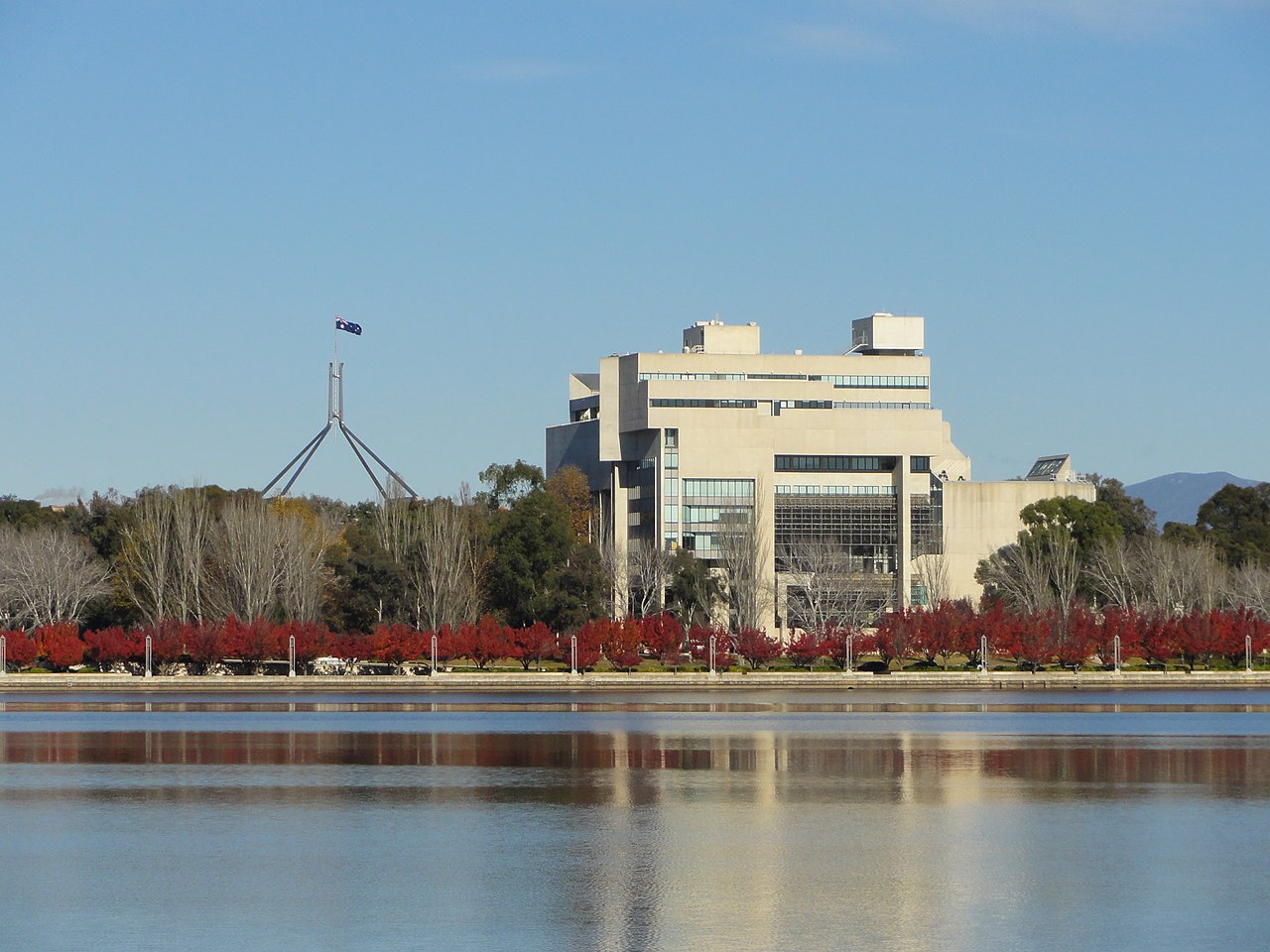
The solution emerged from a viciously contested architectural competition in 1972-1973. The National Capital Development Commission (NCDC) received 158 entries, eventually selecting the design by Edwards Madigan Torzillo and Briggs (EMTB). The victory is frequently attributed to Colin Madigan, yet the primary design architect was Christopher Kringas. In a tragic twist that haunts the building's history, Kringas died in March 1975, just weeks before construction commenced. Madigan assumed control, executing Kringas's vision with a fidelity that bordered on religious zeal. The resulting structure, completed in 1980 at a cost of A$46. 5 million, is not a building a declaration of power, a Brutalist of bush-hammered concrete and glass rising 40 meters above the shores of Lake Burley Griffin.
The architectural philosophy of the High Court rejects the classical columns and sandstone warmth typical of earlier colonial courthouses. Instead, it presents a "monolithic" face to the public. The structure is essentially a concrete cube, split and fragmented to allow light to penetrate its core. Its most clear feature is the Great Hall, a public cathedral of space rising 24 meters, enclosed by a glass wall that offers a transparent view of the Parliament House. This transparency is symbolic, suggesting that the law watches the lawmakers. Yet, the sheer of the concrete pillars and the long, ceremonial ramp that visitors must ascend creates an atmosphere of intimidation. The design forces the individual to feel small against the weight of the state, a deliberate psychological effect that critics have called "totalitarian" and supporters "majestic."
Operational Seats of the High Court (1903, 2026)
Period
Primary Location
Status
1903, 1928
Banco Court, Supreme Court of Victoria (Melbourne)
Borrowed / Itinerant
1923, 1980
Darlinghurst / Taylor Square (Sydney)
Shared with State Courts
1928, 1980
Little Bourke Street (Melbourne)
Commonwealth Facility (insufficient)
1980, Present
Parkes Place, Canberra
Permanent National Headquarters
Inside, the building is divided into three courtrooms, each representing a different tier of judicial function. Courtroom No. 1, the largest, is the domain of the Full Bench. It features a 17. 5-meter high wall of Red Tulip Oak, a timber native to Queensland, and a curved bar table made of Jarrah from Western Australia. The acoustic design here is precise, amplifying the voices of counsel while absorbing the ambient noise of the public gallery. Courtroom No. 2, used for appellate hearings, and Courtroom No. 3, for single-justice matters, follow a similar aesthetic on a reduced. The segregation of space is absolute; the Justices move through a private circulation system of elevators and corridors, never crossing route with the public or the press until they emerge behind the bench. This physical separation reinforces the aloof, impartial nature of the judiciary.
The infrastructure of the High Court extends beyond concrete and timber. The building houses a significant collection of integrated art that functions as part of the architecture itself. The "Constitution Wall" in the Great Hall, a mural by Jan Senbergs, depicts the history of the Australian Federation in anodized aluminum. Outside, the Cascade Waterfall, designed by Robert Woodward, runs along the western forecourt. This water feature, constructed from South Australian granite, was intended to soften the harsh lines of the concrete ramp. Yet, the waterfall has proven to be a maintenance nightmare. In 2011, the Court was forced to undertake a major upgrade of the cascade's pumps and stonework to address leaks and mechanical failures, a recurring theme for a building that requires constant, expensive vigilance to prevent degradation.
Maintenance of the Brutalist icon has become a significant line item in the Court's budget. The expansive glazing, while visually stunning, subjects the interior to extreme thermal fluctuations, demanding a HVAC system that struggles against Canberra's freezing winters and scorching summers. In 2009 and 2013, the Court executed major works to waterproof the roof and redevelop the western forecourt, addressing structural weaknesses that had developed over three decades. The "concrete cancer" that plagues buildings of this era has been largely held at bay through rigorous preservation efforts, the cost of maintaining the "off-form" concrete finish, which cannot simply be painted over, remains high. The building was added to the Commonwealth Heritage List in 2004, legally binding the government to preserve its original, unforgiving aesthetic.
While the physical structure remains frozen in 1980, the Registry infrastructure underwent a radical transformation in the 21st century. For most of its history, the Court operated on a paper-based system, requiring physical filings in Canberra, Sydney, or Melbourne. This archaic method ended on January 1, 2020, with the mandatory implementation of the Digital Lodgement System (DLS). This shift was not a convenience a need, driven by the sheer volume of applications and the need for immediate access to documents by Justices sitting in different cities. The DLS allows legal practitioners to file documents 24/7, a change that fundamentally altered the workflow of the Registry. By 2026, the physical Registry counter, once the bustling hub of the Court, had become largely ceremonial, with the true administrative heart of the Court beating in secure cloud servers.
Security infrastructure also evolved drastically following the geopolitical shifts of the early 2000s. The original design, which emphasized openness and public access, clashed with modern security requirements. The installation of airport-style screening checkpoints at the entrance created a bottleneck that the original architects never anticipated. In 2009, glass balustrades were retrofitted to the public entry to address safety risks, a modification that purists argued compromised the clean lines of Kringas's design. The tension between the building as a symbol of open justice and the building as a secure government facility remains unresolved. The "glass " is a in truth, with the transparency of the Great Hall belied by the rigid security perimeter that surrounds it.
As of 2026, the High Court building stands as a polarizing monument. To architects, it is a masterpiece of the Brutalist canon, a "enduring architecture" award winner that captures the of the law. To the public, it remains a cold, imposing labyrinth. Its physical dominance in the Parliamentary Triangle is unquestioned, sitting alongside the National Gallery as a testament to the cultural confidence of the Whitlam era. Yet, the building is also a demanding asset, requiring millions of dollars annually to keep the water flowing, the air conditioning running, and the concrete from crumbling. It is a permanent home, one that demands a high price for its tenancy.
Canberra Seat and Brutalist Architectural Specifications
Itinerant Operations and Early Circuitry (1903, 1980)
The High Court of Australia's permanent residency in Canberra was not an organic evolution a legislative mandate enforced by the High Court of Australia Act 1979. For nearly eight decades following Federation, the Court operated as an itinerant institution, utilizing borrowed benches in Melbourne's Little Bourke Street and Sydney's Darlinghurst courts. This circuit system, while maintaining a federal presence, diluted the Court's identity as a co-equal branch of government. The 1980 inauguration of the Canberra seat physically manifested the separation of powers, placing the judiciary in the Parliamentary Triangle, geographically adjacent to architecturally distinct from the legislative and executive centers. The location on the shores of Lake Burley Griffin was selected to disrupt the parliamentary axis, asserting judicial independence through sheer geometric defiance.
The architectural genesis of the building began with a two-stage national competition in 1972, overseen by the National Capital Development Commission (NCDC). From 158 entries, the jury selected the design by Edwards Madigan Torzillo and Briggs (EMTB). While Colin Madigan is frequently as the primary architect, the competition entry was led by Christopher Kringas, who died in 1975 just days before construction commenced. The project then fell to Madigan and Hans Marelli to execute. The brief demanded a "monumental" structure, a requirement EMTB satisfied through an aggressive application of the Brutalist style, a design philosophy prioritizing raw materials, structural exposure, and massive volume over decorative refinement.
The resulting edifice is a of off-white reinforced concrete, standing 40 meters tall and consuming approximately 18, 400 cubic meters of concrete. The visual texture of the building is not accidental the result of a labor-intensive process known as "bush-hammering." Workers used percussion instruments to flake the surface of the cured concrete, exposing the aggregate within. This technique removed the smooth "skin" created by formwork, leaving a rough, weathered finish intended to age gracefully and resist staining. The monolithic concrete forms are interrupted only by vast expanses of glazing, totaling 4, 000 square metres. These glass walls, particularly the 24-meter high southern facade, required advanced structural engineering to accommodate Canberra's thermal fluctuations. The glazing system allows the glass to "creep" or shift within steel frames, preventing catastrophic shattering during rapid temperature changes.
Internally, the building is organized around the Public Hall (frequently called the Great Hall), a 24-meter high atrium that serves as the circulation core. A ceremonial ramp, stretching continuously through the volume, forces a slow, processional ascent toward the courtrooms. This design choice was deliberate, intended to induce a sense of and hesitation before one enters the chambers of law. The floor of the Public Hall is paved with Aurisina marble imported from Italy, one of the few non-Australian materials permitted in the construction. The acoustic environment of this cavernous space was engineered by Peter R. Knowland and Associates to manage the reverberation inherent in a concrete cathedral, though the hall remains acoustically lively.
The three courtrooms are distinct in function and finish, adhering to a hierarchy of judicial importance. Courtroom 1, the venue for constitutional matters and Full Bench hearings, is the architectural centerpiece. Its walls are clad in Red Tulip Oak timber sourced from Queensland and New South Wales, rising 17. 5 meters to a ceiling of Blackwood panels. The furniture, including the curved bench, is crafted from Western Australian Jarrah. This specific selection of timber was a political calculation, ensuring representation of the states within the federal apex court. Courtroom 2, the "Working Court," uses painted moulded plywood for its ceiling, while Courtroom 3, designed for single-justice hearings, features a glass ceiling to admit natural light, a rarity in high-security judicial spaces.
High Court of Australia: Technical & Material Specifications
Component
Specification / Metric
Material / Origin
Structural Volume
18, 400 cubic meters
Reinforced Concrete (Bush-hammered finish)
Building Height
40 meters
Concrete & Structural Steel
Public Hall Height
24 meters
Void space with Aurisina Marble flooring (Italy)
Glazing Area
4, 000 square meters
Laminated plate glass with thermal creep allowance
Courtroom 1 Walls
17. 5 meters high
Red Tulip Oak (QLD/NSW)
Courtroom 1 Doors
Silvered bronze grid
Design by Les Kossatz (Heraldic Shield motif)
Construction Cost
A$46. 5 million
1980 Currency Value
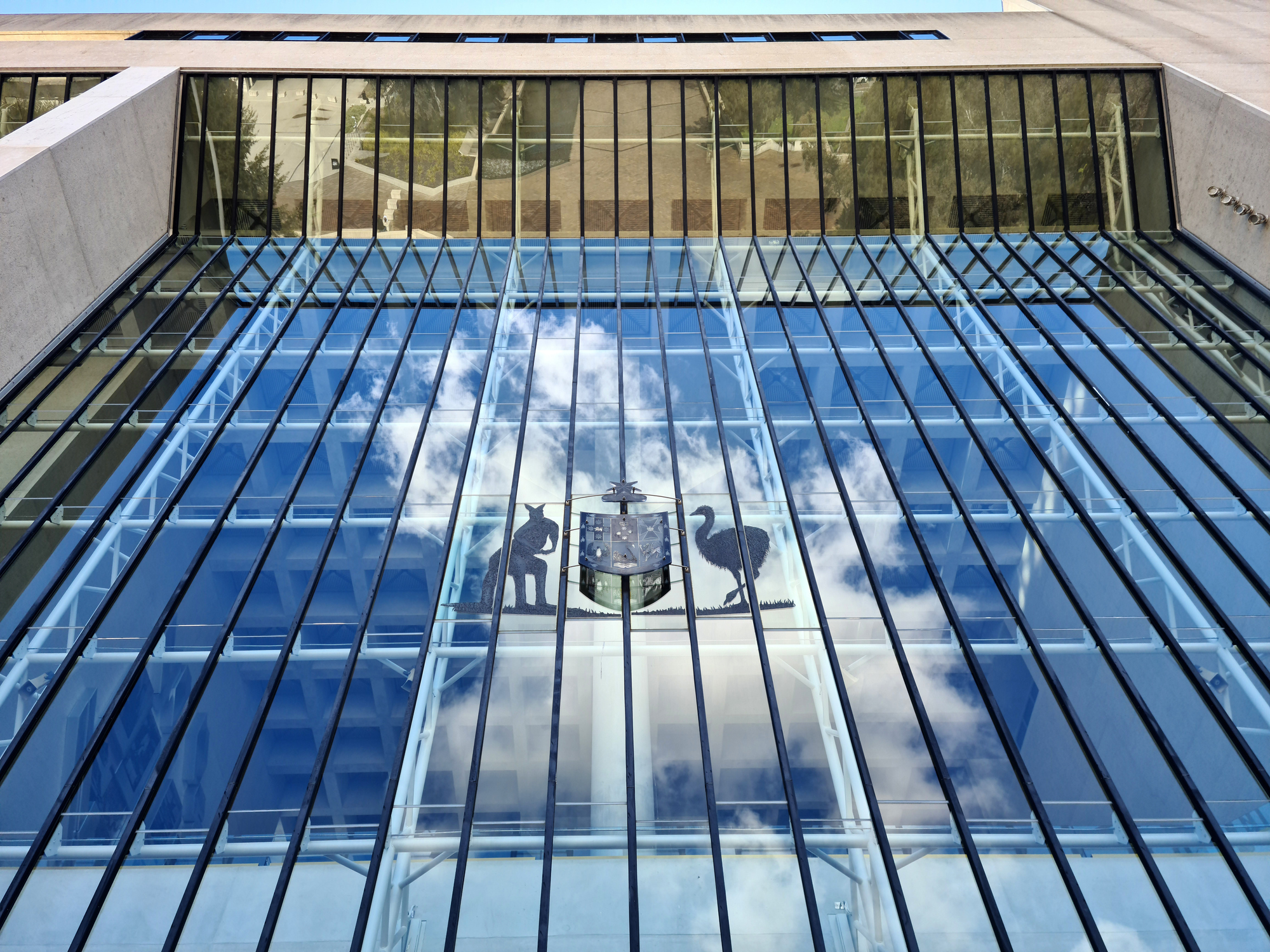
The construction cost, finalized at A$46. 5 million in 1980, drew sharp scrutiny during a period of economic restraint. The expenditure was defended as a necessary investment in national permanence. The building opened on May 26, 1980, by Queen Elizabeth II, formally ending the High Court's nomadic existence. Beyond the structure itself, the integration of art was mandated as part of the architectural fabric rather than as afterthought decoration. The "shield" doors of Courtroom 1, designed by Les Kossatz, feature a silvered bronze grid representing the protective function of the law. Jan Senbergs was commissioned to create murals that visually narrate the history of the constitution, directly into the Public Hall's aesthetic.
By the 2020s, the Brutalist structure faced the inevitable degradation of its era. The concrete exterior, while durable, required specialized cleaning to treat biological growth in the bush-hammered crevices. More serious, the vast roof and glazing systems suffered from the severe hailstorms of January 2020, necessitating a complex repair program managed by Comcover. In 2024, the High Court closed its Canberra building for four months (June to October) to execute major capital works. This shutdown forced the Court to return to its historical roots, sitting on circuit in Adelaide, Brisbane, and Hobart while the HVAC, safety systems, and roof waterproofing were overhauled. The 2024-2025 Annual Report detailed the development of a "Strategic Asset Management Plan," a bureaucratic acknowledgement that maintaining a 45-year-old concrete monolith requires a continuous of funds. As of 2026, the building remains listed on the Commonwealth Heritage List, protected not just as a court, as a rare, intact example of late 20th-century Brutalism that has resisted the trend of cladding over raw concrete surfaces.
Structural Engineering and Construction Costs
The High Court of Australia building, situated in the Parliamentary Triangle of Canberra, stands as a testament to late modern Brutalist architecture and rigorous structural engineering. Construction commenced in April 1975 and concluded in April 1980, with the official opening on May 26, 1980. The project was executed at a total cost of A$46. 5 million. The architectural design was the work of Edwards Madigan Torzillo and Briggs, initially led by Christopher Kringas until his death in 1975, and subsequently completed by Hans Marelli. The structural engineering was managed by the firm Miller, Milston and Ferris, who were tasked with realizing the complex geometric forms required by the competition-winning design.
The building's primary structural element is bush-hammered reinforced concrete, which forms a monolithic skeleton. This technique involved constructing the walls using formwork and then mechanically hammering the concrete surface after the forms were removed to expose the aggregate and create a rough, textured finish. The structure rises 40 meters and encompasses 11 floors with a total floor area of 18, 515 square meters. A defining engineering feature is the 24-meter-high public hall, which required massive concrete supports to maintain the open, cathedral-like interior volume without intermediate columns obstructing the space.
The glazing system presents another significant engineering component. Large areas of glass are supported by tubular steel frame structural back-ups, allowing natural light to penetrate the deep concrete recesses of the courtrooms and public hall. These glass walls were designed to withstand the wind loads of the open Canberra plain while maintaining thermal performance. Even with the extensive use of glass and the chance for thermal expansion, the engineering has proven durable. A life assessment conducted 26 years after completion found no evidence of rusting, cracking, or spalling in the concrete facade, a rarity for Brutalist structures of that era.
The structural integrity of the High Court has been formally recognized by the industry. In 2007, the Royal Australian Institute of Architects awarded the building the National Award for Enduring Architecture. The engineering precision used during the 1975, 1980 construction phase ensured that the building avoided the "concrete cancer" that frequently plagues similar structures from the mid-20th century. The use of high-quality materials and precise load calculations by Miller, Milston and Ferris has allowed the building to function without major structural intervention for over four decades.
The Great Hall and Interior Art Commissions
Courthouses and Registry Infrastructure
The High Court's permanent home, opened by Queen Elizabeth II on May 26, 1980, represented a radical departure from the borrowed courtrooms and gentle colonial architecture of the past. Designed by the firm Edwards Madigan Torzillo and Briggs (EMTB), the structure stands as a brutalist monolith on the shores of Lake Burley Griffin. The design competition, won in 1973, was led by architect Christopher Kringas, who died in 1975 just before construction commenced. Colin Madigan subsequently oversaw the execution of the project. The building rises 40 meters from the ground, a "Cathedral of Concrete" that consumed 18, 515 square meters of floor area and cost approximately $46. 5 million, a figure that drew sharp criticism during a period of economic restraint. The Great Hall serves as the building's public lung, a vast atrium rising 24 meters to the roof. Its defining feature is the immense glass wall system, engineered to withstand Canberra's temperature extremes. The glazing is supported by tubular steel frames designed to "creep," expanding and contracting independently of the rigid concrete shell to prevent shattering. This transparency was intended to symbolize the openness of the law, allowing citizens to look in and judges to look out, though the sheer of the concrete piers frequently intimidates rather than welcomes. A pedestrian ramp, stretching the length of the hall, forces a slow, processional ascent, physically manifesting the of the judicial process.
High Court of Australia: Key Architectural & Artistic Commissions
Element
Artist / Designer
Details
Constitution Wall Mural
Jan Senbergs
Public Hall. Anodized aluminum, screen-printed with industrial/historical motifs.
Courtroom 1 Doors
Les Kossatz & George Baldessin
Silvered bronze grid on laminated glass, featuring shield motifs.
Courtroom 1
Ron Brooks (Victorian Workshop)
4. 3m x 2. 5m woven wool, depicting State badges and Commonwealth Arms.
Forecourt Water Feature
Robert Woodward
"Waterfall" design using South Australian speckled granite.
The Earth (Mural)
Bea Maddock
Handmade paper and wax mural, Public Hall level 4.
The interior art program was not an afterthought an integral component of the architectural fabric. Jan Senbergs executed the dominant murals in the Public Hall: *The Constitution* and *The States*. Unlike traditional legal art which favors classical allegory, Senbergs used screen-printed images on anodized aluminum to create a gritty, fragmented visual history. His work incorporates symbols of mining, shipping, and industry, grounding the abstract law in the physical reality of the Australian continent. The choice of aluminum mirrored the grey, bush-hammered concrete of the walls, ensuring the art appeared in the structure rather than hung upon it. Access to the judicial chambers is guarded by the ceremonial doors of Courtroom 1, designed by Les Kossatz and George Baldessin. These portals feature a silvered bronze grid recessed into laminated plate glass. The recurring motif is a shield, symbolizing the Court's role as the protector of the Constitution. The design avoids overt royal symbolism, favoring a geometric repetition that suggests the impartiality and mechanical precision of the law. Inside Courtroom 1, the focus shifts to the *State Badges and Commonwealth Arms*. Designed by Ron Brooks and woven by the Victorian Workshop, this 4. 3-meter textile softens the acoustic hardness of the room. It hangs against a wall of Red Tulip Oak, providing a rare texture of warmth in an environment dominated by stone and timber. The building's exterior and public spaces feature the work of Robert Woodward, famous for the El Alamein Fountain in Sydney. For the High Court, Woodward designed a linear water feature that runs parallel to the ceremonial ramp. Constructed from South Australian speckled granite, the fountain creates a continuous sheet of water, generating white noise that masks the conversations of litigants and lawyers entering the precinct. This acoustic separation was a deliberate functional requirement, ensuring privacy in the public method. Maintenance of this brutalist giant has proven costly and complex. The expansive glazing and concrete surfaces require constant attention to prevent degradation. In January 2020, a catastrophic hailstorm struck Canberra, causing significant damage to the High Court's roof and copper work. The repair bill for the Parliamentary Triangle precinct, including the Court and the National Library, ran into the millions. By 2024 and 2025, the Court undertook a detailed strategic asset management plan to address the aging infrastructure, including the replacement of original hydraulic systems and the preservation of the bush-hammered concrete, which is susceptible to "concrete cancer" if moisture penetrates the steel reinforcement. The 2026 budget estimates continue to reflect the high price of preserving Kringas and Madigan's uncompromising vision.
Judicial Composition and Mandatory Retirement Rules
The High Court of Australia's composition has never been a static or purely legal matter; it is a political barometer, shaped by executive power, constitutional crises, and the biological realities of its incumbents. Since 1903, the bench has evolved from a trio of founding fathers into a seven-member apex court, yet its structure remains fiercely debated. The method of appointment and retirement reveal a tension between judicial independence and the desire of governments to mold the court in their image.
The Judiciary Act 1903 initially established a bench of three: Chief Justice Samuel Griffith, Edmund Barton, and Richard O'Connor. This number proved immediately insufficient for the appellate workload of a new federation. In 1906, the bench expanded to five, adding Isaac Isaacs and H. B. Higgins, and in 1913, it grew to seven. This number has remained the statutory standard, with one notable exception. During the Great Depression, financial austerity and a dip in litigation led the Scullin and Lyons governments to leave two vacancies unfilled, operating a six-member court between 1931 and 1946. This period of "judicial austerity" frequently resulted in deadlocked 3-3 decisions, a functional failure that necessitated the restoration of the seventh seat after World War II.
For the 74 years of its existence, High Court justices enjoyed life tenure. This provision, intended to insulate judges from political pressure, eventually created a gerontocracy. By the mid-1970s, the problem of senility and physical incapacity on the bench had become a quiet scandal. The catalyst for change was the tenure of Sir Edward McTiernan. Appointed in 1930, McTiernan served for a record 46 years. By 1976, at age 84, his capacity was openly questioned, yet he refused to resign. The situation resolved itself only through a bizarre domestic accident: McTiernan broke his hip while chasing a cricket in his hotel room with a rolled-up newspaper. Chief Justice Garfield Barwick, seizing the opportunity to force a renewal of the bench, refused to install a wheelchair ramp, making McTiernan's position untenable.
The McTiernan incident provided the political capital for the Fraser government to pursue constitutional reform. The Constitution Alteration (Retirement of Judges) 1977 referendum proposed a mandatory retirement age of 70 for all federal judges. The electorate, weary of an aging judiciary, backed the amendment with an overwhelming 80. 1% "Yes" vote. This change ended the era of life tenure, ensuring regular turnover and preventing the court from becoming a repository for the infirm. Since 1977, every justice must vacate their seat on their 70th birthday, a rule that allows legal observers to predict the court's composition years in advance.
The appointment process itself remains one of the most unclear exercises of executive power in Australian politics. Unlike the United States, where Supreme Court nominees face public Senate confirmation hearings, Australian High Court justices are appointed by the Governor-General in Council, , the Prime Minister and Cabinet. While the High Court of Australia Act 1979 requires the federal Attorney-General to "consult" with state Attorneys-General, this is a procedural formality with no binding power. Critics describe the process as a "tap on the shoulder," where personal networks, political reliability, and the "old boys' club" of the Bar influence selection more than transparent meritocratic metrics.
This unclear selection process has historically produced a bench with severe geographic and demographic skews. For over a century, the court was the preserve of white men from the Sydney and Melbourne Bars. As of 2026, no judge has ever been appointed from South Australia, Tasmania, or the Northern Territory, leading to persistent accusations that the High Court is a "Sydney-Melbourne cartel" indifferent to the legal nuances of the smaller states. Western Australia broke this duopoly only with appointments like Robert French and James Edelman, yet the eastern seaboard dominance remains entrenched.
High Court of Australia: Historical Composition Milestones
Milestone
Year
Details
Expansion
1906
Bench increased from 3 to 5 justices.
Second Expansion
1913
Bench increased to 7 justices (current standard).
Depression Reduction
1931, 1946
Vacancies left unfilled; court operated with 6 justices.
Mandatory Retirement
1977
Referendum sets retirement age at 70 (Section 72).
Woman
1987
Mary Gaudron appointed.
Female Chief Justice
2017
Susan Kiefel appointed Chief Justice.
Female Majority
2022
Appointment of Jayne Jagot creates 4-3 female majority.
Demographic diversity has arrived slowly. The court remained exclusively male until the appointment of Mary Gaudron in 1987. It took another three decades for Susan Kiefel to become the female Chief Justice in 2017. A historic tipping point occurred in 2022 with the appointment of Justice Jayne Jagot, which created a female majority (four women, three men) for the time in the court's history. This majority was a symbol of the changing face of the legal profession, although the retirement of Kiefel in 2023 and the subsequent appointment of Robert Beech-Jones returned the gender balance to a near-even split.
As of early 2026, the court is led by Chief Justice Stephen Gageler, appointed to the top role in late 2023. The current bench, Gageler, Gordon, Edelman, Steward, Gleeson, Jagot, and Beech-Jones, represents a mix of "black letter" lawyers and those with broader interpretative philosophies. With Chief Justice Gageler not due to retire until July 2028, the court has entered a period of relative stability. yet, the structural criticisms remain: the appointment process is still a secret of the Cabinet room, and the court's geographic footprint remains stubbornly fixed on the Sydney-Melbourne axis, leaving vast swathes of the federation without direct representation on its highest tribunal.
Jurisdictional Powers and Section 75 Mandates
Canberra Seat and Brutalist Architectural Specifications
The jurisdiction of the High Court of Australia is not a list of responsibilities; it is a constitutional that the Parliament cannot. Unlike the Supreme Court of the United States, where Congress retains significant power to strip appellate jurisdiction, the High Court's original jurisdiction under Section 75 is constitutionally entrenched. This section the Court to hear matters directly, bypassing lower courts, specifically when the Commonwealth is a party, when treaties are involved, or when a writ is sought against a Commonwealth officer. This unassailable power has made Section 75 the primary battleground between the Executive government's desire for control and the Judiciary's mandate for legality. ### The Entrenched Minimum Provision of Judicial Review The most violent legal conflicts in Australian history have centered on Section 75(v). This provision grants the High Court original jurisdiction in all matters "in which a writ of Mandamus or prohibition or an injunction is sought against an officer of the Commonwealth." In plain terms, it allows the Court to order a federal official to do their duty (Mandamus), stop an illegal act (Prohibition), or prevent future illegality (Injunction). For decades, federal governments attempted to shield their decisions, particularly in immigration, from judicial scrutiny. The climax of this struggle occurred in 2002 with *Plaintiff S157/2002 v Commonwealth*. The Howard Government had enacted "privative clauses" in the *Migration Act 1958*, legislative devices designed to prevent courts from reviewing visa cancellations or refugee refusals. The Government argued these clauses meant the High Court had no jurisdiction to hear the complaints. The High Court unanimously destroyed this argument. In a judgment that defined modern Australian administrative law, the Court ruled that Parliament cannot restrict the High Court's jurisdiction under Section 75(v). They established the principle that a decision infected by "jurisdictional error", such as a failure to accord procedural fairness or a misunderstanding of the law, is, in law, "no decision at all." Therefore, the privative clause could not protect it. This ruling secured what is known as the "entrenched minimum provision of judicial review," guaranteeing that no Commonwealth officer is above the law. ### The Migration Litigation Explosion Following *Plaintiff S157*, the High Court's docket was inundated with migration cases. Asylum seekers, denied visas by tribunals and the Federal Court, turned to the High Court's original jurisdiction as a last resort. By 2010, immigration matters accounted for a percentage of the Court's workload. To manage this, the Court uses Section 44 of the *Judiciary Act 1903* to remit (send back) most of these cases to the Federal Court. Yet, the *power* remains with the High Court. This tension resurfaced violently in the 2020s. In November 2023, the Court delivered the *NZYQ v Minister for Immigration* judgment, overturning its own 2004 precedent in *Al-Kateb v Godwin*. The Court ruled that indefinite immigration detention is unlawful if there is no real prospect of removing the detainee from Australia. This decision relied on the constitutional limits of Executive power, enforced through the Court's jurisdiction to problem writs of *Habeas Corpus* (implied under Section 75). The was immediate. The Executive was forced to release over 150 detainees. Parliament scrambled to pass the *Migration Amendment (Bridging Visa Conditions) Act 2023* and subsequent "preventative detention" regimes in 2024 to re-impose control. yet, the High Court's ruling in *NZYQ* demonstrated that Section 75 remains a hard limit on legislative power. In 2025, the Court refined this in *CZA19 v Commonwealth*, clarifying that detention remains valid while visa processing is active, even if removal is difficult, distinguishing it from the "dead end" scenario of *NZYQ*. ### Section 75(iii) and (iv): The Commonwealth and the States Section 75(iii) gives the Court jurisdiction in matters "in which the Commonwealth, or a person suing or being sued on behalf of the Commonwealth, is a party." This strips the federal government of sovereign immunity in contexts. It ensures that the Commonwealth can be sued in contract or tort just like any corporation. In *Bank of NSW v Commonwealth* (1948), the Court used its jurisdiction to strike down the nationalization of banks, proving that even the government's economic agenda is subject to constitutional validity. Section 75(iv) governs disputes "between States." While rare, these cases are politically explosive. The COVID-19 pandemic triggered a high-profile activation of this jurisdiction in *Palmer v Western Australia* (2020). Mining magnate Clive Palmer challenged Western Australia's border closure, arguing it violated Section 92 (free trade). The High Court accepted original jurisdiction to hear the constitutional facts. Although the Court upheld the border closure as a necessary public health measure, the case reaffirmed that the High Court, not the Federal Parliament or State Premiers, is the final arbiter of internal borders. ### The "Matter" Requirement A serious limitation on Section 75 is the requirement of a "matter." The High Court refuses to give advisory opinions. In *In re Judiciary and Navigation Acts* (1921), the Court held that it can only exercise judicial power where there is an immediate right, duty, or liability to be established. It not answer hypothetical questions from the Government. This prevents the Court from becoming a political consultancy firm for the Cabinet.
Table: Key Heads of Original Jurisdiction (Section 75)
Section
Subject Matter
Landmark Case
Impact
75(i)
Treaties
Re East; Ex parte Nguyen (1998)
Clarified that treaties do not automatically create domestic law rights without legislation.
75(iii)
Suits against Commonwealth
Bank of NSW v Commonwealth (1948)
Established the Commonwealth is liable to judicial review and cannot nationalize industries unconstitutionally.
75(iv)
Between States
Palmer v Western Australia (2020)
Confirmed jurisdiction over interstate border disputes and Section 92 freedoms during emergencies.
75(v)
Writs against Officers
Plaintiff S157/2002 (2003)
Entrenched judicial review; privative clauses cannot oust the High Court's power to correct jurisdictional error.
Implied
Habeas Corpus
NZYQ v Minister for Immigration (2023)
Ruled indefinite detention unlawful where removal is not practicable; overturned 20-year precedent.
The trajectory from 1903 to 2026 shows a Court that has vigorously defended its Section 75 mandate. In the 2024-2026 period, the Court faced renewed attempts by the Executive to bypass judicial oversight through "Community Safety Orders" and automated decision-making systems. In every instance, the Court has returned to the text of Section 75, asserting that as long as a Commonwealth officer is involved, the Judiciary has the final word on the legality of their conduct.
Administrative Autonomy and Financial Appropriations
The High Court of Australia Act 1979 (Cth) marked the decisive pivot from executive dependence to statutory autonomy. Before this legislation, the High Court was administratively tethered to the Attorney-General's Department, a humiliating arrangement where the nation's supreme judicial body had to beg a government minister for pencils, typists, and travel funds. The 1979 Act severed this leash, granting the Court the power to administer its own affairs and establishing the position of Chief Executive and Principal Registrar to manage the registry and building. This autonomy is operationalized through the "one-line appropriation" system. Unlike standard government departments that receive funding tied to specific programs or outcomes, the High Court receives a single, global sum from the Parliament. The Court then allocates these funds according to its own priorities, free from bureaucratic interference in its day-to-day operations. This financial method is designed to buttress judicial independence, ensuring that the Executive cannot strangle specific court functions by defunding them selectively. Even with this structural independence, the Court remains subject to the fiscal of the Commonwealth budget. The Court submits annual estimates to the Minister for Finance, and while the Minister cannot alter the Court's internal allocation, the total envelope is determined by the government of the day. This has led to friction, particularly regarding "efficiency dividends", an annual percentage cut applied to public sector budgets to force productivity gains. While the salaries of the Justices are constitutionally protected and paid via a standing special appropriation that cannot be reduced, the Court's administrative budget is. In 2014-15, Chief Justice Robert French publicly warned that these cumulative cuts threatened the Court's ability to conduct circuit hearings in distant state capitals like Adelaide, Brisbane, and Perth, a practice important for maintaining the Court's national character. The financial data from 2014 to 2026 reveals a court squeezing every cent from a relatively static real-term budget, while managing the rising costs of maintaining its brutalist concrete cathedral in Canberra and upgrading aging digital infrastructure.
High Court of Australia: Financial Appropriations & Performance (2014, 2025)
Financial Year
Revenue from Government ($m)
Operating Result ($m)
Notes
2014, 15
16. 34
-4. 83
Deficit driven by unfunded depreciation; Chief Justice warns of service cuts.
2018, 19
21. 60
N/A
Budget increase partly for security upgrades following global threat assessments.
2020, 21
16. 10
-6. 30
Significant deficit; revenue stagnant even with rising fixed costs.
2021, 22
16. 40
-7. 70
Deficit widens; total equity stands at $248. 9m (mostly building value).
2022, 23
19. 82
+10. 43
Surplus recorded due to "Net Cash" appropriation adjustments and equity injections.
2024, 25
22. 70
-9. 49
Operating expenses hit $32. 19m; structural deficit returns without capital injections.
The 2024-25 figures show a clear reality: operating expenses ($32. 19 million) significantly outstrip the recurrent appropriation ($22. 70 million). The resulting deficit of nearly $9. 5 million highlights the flaw in the funding model, the Court's depreciation costs for its monumental building are immense and frequently unfunded in cash terms, creating an accounting sea of red ink that requires periodic "equity injections" from the Commonwealth to balance the books. This financial dance reveals the limits of the 1979 autonomy. The Court owns its building and hires its staff, yet it must still negotiate with the Executive for the cash to keep the lights on and the servers running. The "one-line appropriation" protects the Justices from having their travel budgets micromanaged, it does not shield the institution from the broader austerity measures of the federal government. The tension between the Court's constitutional supremacy and its budgetary subservience remains a quiet, persistent fault line in Australian governance.
Security Breaches and Protective Fortifications
Structural Engineering and Construction Costs
The High Court of Australia, once envisioned by architect Colin Madigan as a "cathedral of light" accessible to the citizenry, has devolved into a fortified bunker in response to a century of escalating threats. Upon its opening in 1980, the building's Brutalist concrete and soaring glass atrium symbolized transparency. Visitors could wander the public hall with minimal interference, a physical manifestation of the court's democratic function. This openness was short-lived. The security apparatus surrounding the Court today is the result of a bloody history of judicial violence and the modern rise of anti-government extremism. The psychological turning point for Australian judicial security occurred not in Canberra, through a series of attacks that targeted the Family Court in the early 1980s. Between 1980 and 1984, a campaign of terror involving bombings and shootings struck at the heart of the federal judiciary. The murder of Justice David Opas, the bombing of Justice Richard Gee's home, and the assassination of Pearl Watson (wife of Justice Ray Watson) shattered the assumption that Australian judges were immune to violence. While the High Court itself was not the direct target of these specific attacks, the shockwave prompted an immediate hardening of all federal judicial precincts. The "tyranny of distance" that once protected the Court from London's oversight was replaced by a tyranny of proximity to domestic terror. By 2013, the federal government acknowledged that the polite security measures of the past were obsolete. The *Court Security Act 2013* formalized new powers, and the High Court's 2013, 14 Annual Report confirms a pivotal shift: the deployment of Australian Federal Police (AFP) Protective Service Officers (PSOs) within the building. No longer reliant solely on unarmed ushers, the Court adopted an airport-style screening regime. Visitors today must pass through metal detectors and baggage scanners, a process that strips the "people's court" of its welcoming veneer. The 2013 budget allocations reveal the financial weight of this fortification, with significant funds directed toward upgrading the building's surveillance and physical blocks. The physical structure has also been modified to prevent internal tragedies. In May 2008, a man jumped from the public gallery inside the High Court, falling several stories to the floor of the main hall. This horrific event forced a re-evaluation of Madigan's open-plan interior. The soaring balconies, designed to create a sense of vertical unity between the public and the law, became liabilities. Subsequent refurbishments included the installation of higher glass blocks and restricted access zones, subtly altering the architecture from one of trust to one of containment.
The 2020s introduced a new, insidious threat: the "Sovereign Citizen" movement. Unlike the physical bombers of the 1980s, these actors use "paper terrorism" and pseudo-legal intimidation. Intelligence reports from 2022 to 2025 indicate a surge in individuals attempting to "arrest" judges or serve fake "common law" warrants. These groups, frequently radicalized by online conspiracy theories, view the High Court not as a legitimate arbiter as a corporate entity to be dismantled. In response, the AFP has had to increase its threat assessment capabilities, treating these "sheriffs" not as harmless eccentrics as chance security risks capable of inciting lone-actor violence.
Evolution of Threats and Defensive Measures (1980, 2026)
Era
Primary Threat Profile
Security Response
1980, 1983
Low-level vandalism, protest
Open access, unarmed ushers, minimal screening.
1984, 2000
Targeted assassination (Family Court )
Introduction of metal detectors, increased police patrols.
2001, 2012
Global terrorism (post-9/11), Self-harm
Internal blocks raised, bag searches, bollards installed.
The most pervasive breach is digital. The 2024 cyber-attack on Court Services Victoria, which exposed sensitive audio recordings of hearings, demonstrated the fragility of the Australian judicial network. While the High Court maintains its own distinct IT infrastructure, it operates within this high-risk environment. The theft of court data, ranging from domestic violence records to commercial secrets, poses a threat that concrete walls cannot block. In 2025 and 2026, the Court's security focus shifted heavily toward "digital fortifications," attempting to repel state-sponsored hackers and ransomware groups who view the High Court's database as a trove of national intelligence. The High Court of 2026 is a paradox. It remains the arbiter of Australian law, yet physically and digitally, it has withdrawn behind a shield of armed guards, blast-resistant glass, and firewalls. The open "cathedral" of 1980 is a, reflecting a nation that no longer trusts in the safety of its civic institutions.
Notable Constitutional Interpretations and Dissent Metrics
The High Court of Australia functions not as a legal arbiter as the primary architect of the Australian Federation. Its interpretations have frequently rewritten the distribution of power between the Commonwealth and the States, frequently with more force than any referendum. Since 1903, the Court has oscillated between strict legalism and broad implication, with the pendulum swinging based on the composition of the bench. The history of these interpretations is a history of centralization, where the Court has systematically dismantled the autonomy of the States in favor of Canberra. The most decisive shift occurred in 1920 with the *Amalgamated Society of Engineers v Adelaide Steamship Co Ltd* (the *Engineers' Case*). Prior to this, the Griffith Court (1903, 1919) relied on the "reserved state powers" doctrine, which protected State jurisdiction from federal encroachment, mirroring the United States model. Justice Isaac Isaacs, a fervent nationalist, led the charge to overturn this. In a decision that stunned the legal establishment, the Court ruled that the Constitution must be read literally, without implied protections for the States. This judgment stripped the States of their immunity from Commonwealth laws, granting the federal government vast authority to legislate in areas previously considered local domains. *Engineers* remains the bedrock of Australian constitutional law, having enabled the expansion of federal power into industrial relations, environmental protection, and finance. This centralization reached its zenith in 1983 with *Commonwealth v Tasmania* (the *Tasmanian Dams Case*). The Court, in a narrow 4, 3 decision, ruled that the Commonwealth's external affairs power (Section 51(xxix)) allowed it to legislate on domestic matters if implementing an international treaty. By ratifying the World Heritage Convention, the federal government gained the power to stop the construction of a hydroelectric dam in Tasmania, a matter traditionally within State jurisdiction. The dissenters, led by Chief Justice Harry Gibbs, warned that this interpretation would allow the Commonwealth to legislate on almost any subject by entering a treaty. The majority view prevailed, permanently altering the federal balance and allowing Canberra to override State land management decisions. While *Engineers* and *Dams* expanded legislative power, the Mason Court (1987, 1995) discovered limits on legislative power through "implied rights." In *Australian Capital Television Pty Ltd v Commonwealth* (1992), the Court struck down a law banning political advertising, finding an implied freedom of political communication within the structure of representative government. This marked a departure from the strict literalism of *Engineers*, as the Court read between the lines of the Constitution to find protections that the drafters had not explicitly included. This era also produced *Mabo v Queensland (No 2)* (1992), which overturned the doctrine of *terra nullius*, recognizing Native Title and fundamentally altering the nation's property law regime. Dissent metrics provide a quantitative lens through which to view these ideological fractures. A dissent is not a disagreement; it is an appeal to the future. Justice Michael Kirby, who served from 1996 to 2009, earned the title of the "Great Dissenter." His dissent rate in constitutional cases hovered between 30% and 40%, significantly higher than the institutional average. Kirby frequently dissented on grounds of human rights and international law, arguing that the Constitution should be interpreted to align with modern universal principles. His dissents in cases like *Al-Kateb v Godwin* (2004), where he argued against the legality of indefinite detention for stateless persons, stood in clear contrast to the black-letter legalism of the majority. Conversely, Justice Dyson Heydon (2003, 2013) occupied the role of the conservative isolate. By his final year on the bench (2012), Heydon's dissent rate spiked to over 40%, a figure unmatched in modern history. Unlike Kirby, who dissented to expand rights, Heydon dissented against what he viewed as "judicial activism" and the abandonment of precedent. He famously described the Court's drift away from strict legalism as the work of an "enemy within," criticizing his colleagues for compromising judicial independence in favor of cooperative outcomes. His isolation illustrated the collapse of the conservative consensus that had characterized the Gleeson era. The Kiefel Court (2017, 2023) marked a sharp reversal of this trend, prioritizing institutional unanimity over individual expression. Under Chief Justice Susan Kiefel, the Court achieved record low dissent rates, with joint judgments becoming the norm. This "suppression of dissent" was a deliberate strategy to project certainty and authority. Yet, this facade of unity fractured spectacularly in the transition to the Gageler Court. In November 2023, the Court delivered a bombshell decision in *NZYQ v Minister for Immigration*. In a unanimous 7, 0 judgment, the Court overturned the 2004 *Al-Kateb* precedent, ruling that indefinite immigration detention is unlawful where there is no real prospect of removal. This decision vindicated Kirby's 2004 dissent and forced the immediate release of over 140 detainees. The *NZYQ* ruling demonstrated that even a Court prone to consensus could execute radical reversals when the deprivation of liberty by the Executive absence a clear temporal limit. The legal shockwaves continued into 2024 and 2025. In May 2024, the Court clarified the limits of *NZYQ* in *ASF17 v Commonwealth*. The Court ruled unanimously that detention remains lawful if the detainee voluntarily refuses to cooperate with deportation efforts. This distinction, between a stateless person who *cannot* be removed and a person who *refuses* to be removed, stabilized the migration detention regime after the chaos of late 2023. The most significant recent constitutional shift occurred on March 12, 2025, with *Commonwealth of Australia v Yunupingu*. In a decision that rewrote the relationship between the Commonwealth and the Territories, the High Court overruled *Teori Tau v Commonwealth* (1969). The Court held that Section 122 (the Territories power) is subject to the "just terms" requirement of Section 51(xxxi). Consequently, the extinguishment of Native Title in the Northern Territory by the Commonwealth between 1911 and 1978 constituted an acquisition of property requiring compensation. This judgment exposed the federal government to billions in liability and ended the century-long assumption that the Commonwealth possessed plenary, unchecked power over Territory lands.
High Court of Australia: Dissent and Reversal Metrics (Selected Eras)
Justice / Era
Role / Period
Key Metric
Notable Outcome
Isaac Isaacs
Justice (1906, 1930)
Architect of Centralization
Authored Engineers (1920); destroyed "Reserved State Powers" doctrine.
Michael Kirby
Justice (1996, 2009)
Dissent Rate: ~34% (Const.)
The "Great Dissenter." Opposed indefinite detention in Al-Kateb (vindicated in 2023).
Dyson Heydon
Justice (2003, 2013)
Dissent Rate: ~40% (2012)
Conservative isolationist. Criticized "judicial activism" and "compromise" judgments.
Susan Kiefel
Chief Justice (2017, 2023)
Record Low Dissent
Prioritized joint judgments. 2015 saw dissent in only 18. 75% of cases.
Stephen Gageler
Chief Justice (2023, Present)
Unanimous Reversal
Led 7-0 overturn of Al-Kateb in NZYQ (2023); Overturned Teori Tau in Yunupingu (2025).
The trajectory from 1700s colonial subservience to the Privy Council, through the nationalist centralization of *Engineers*, to the rights-focused corrections of *NZYQ* and *Yunupingu*, shows a Court that is and politically potent. The data confirms that while periods of consensus exist, the High Court remains a forum where the fundamental terms of the Australian nation are continuously contested and rewritten. The reversal of long-standing precedents in 2023 and 2025 indicates a current bench to correct historical anomalies, even at the cost of significant disruption to the Executive branch.
Operational Statistics and Digital Modernization (2010, 2026)
The High Court's operational history from 2010 to 2026 is defined by a singular, violent rupture: the forced abandonment of paper. For the century of its existence, the Court operated as a physical of wet ink and parchment, where "access to justice" required the physical lodgement of appeal books frequently weighing nearly a hundred kilograms. As late as 2019, the Registry was a warehouse of dead trees, demanding hard copies for every procedural step. The launch of the Digital Lodgement System (DLS) on January 1, 2020, ended this era overnight. This was not a technical upgrade; it was a total reconstruction of the Court's interface with the Australian public, driven by the need of the COVID-19 pandemic and the sheer logistical weight of modern litigation. The transition to the DLS was absolute. By 2021, the Court had mandated electronic filing for all new cases, closing the Registry counter to the physical hand-over of documents. The efficiency gains were immediate brutal for traditionalists. The "tyranny of distance", the 19th-century plague that made appeals from Perth or Darwin prohibitively expensive, was theoretically abolished by the ability to file from a laptop in Broome. Yet, the data from 2020 to 2026 reveals a counter- trend: accessibility did not lead to a flood of admitted appeals. Instead, the digital gatekeeper allowed the Court to process and dismiss unmeritorious applications with speed. Operational statistics from the 2024, 2025 financial year paint a picture of a Court that is leaner, faster, and more exclusive than at any point in its history. In that period, the Court determined 310 special leave applications granted only a fraction, resulting in just 47 appeals heard. The "on the papers" determination method, where Justices review applications without an oral hearing, became the standard executioner of weak cases. By 2025, 97% of special leave applications were determined on the papers, a method that allows the Court to clear its docket without the pageantry and expense of open court sessions. This efficiency is serious; the Court's seven Justices are a finite resource, and the digital era has increased the volume of complex, data-heavy evidence they must digest.
The financial reality of the Court in the mid-2020s contradicts the assumption that digital tools lower costs. While the cost to litigants for filing may have stabilized, the cost to the Court for maintaining secure, high-grade digital infrastructure skyrocketed. The 2024, 2025 budget revealed an operating deficit of approximately $9. 49 million, driven by expenses of $32. 18 million against revenue of $22. 69 million. The deficit reflects the hidden price of modernization: cybersecurity, server maintenance, and the specialized staff required to manage the DLS are not cheap. The following table contrasts the operational profile of the Court before and after this digital pivot.
Table 12. 1: Operational Shift , High Court of Australia (2010 vs. 2025)
Metric
2010 (Paper Era)
2025 (Digital Era)
Filing Method
Physical / Hard Copy Mandatory
100% Digital (DLS Portal)
Special Leave Applications
~550 filed annually
318 filed (2024-25)
Appeals Heard
~60
47
Determination "On Papers"
~60-70%
97%
Public Access
Physical Gallery Only
Live Streaming / On-Demand Video
Unrepresented Litigants
~40% of applicants
32% of applicants
The Court's engagement with technology extended beyond administration into the substance of the law itself. In February 2026, the Court refused special leave in the *Aristocrat* case, a decision that cemented the Federal Court's earlier ruling on the patentability of computer-implemented inventions. This refusal was not a passive act; it was a decisive statement on the limits of intellectual property in the software age, signaling that the High Court would not easily expand patent monopolies to abstract digital concepts. This decision, delivered in the opening months of 2026, demonstrated that while the Court uses digital tools, it remains deeply conservative regarding the legal status of digital assets. Transparency method also evolved radically. In July 2023, the Court began live-streaming special leave hearings, a practice that would have been unthinkable to the Griffith Court of 1903. By 2026, this had normalized, allowing law students, journalists, and the public to watch the "sausage making" of constitutional law in real-time. yet, this transparency has limits. The vast majority of the Court's work, the 97% of applications dismissed on the papers, remains invisible, evidenced only by brief disposition notices published online. The digital window is clear, the room it looks into is small. The load of unrepresented litigants remains a persistent structural stressor. In 2024, 2025, 32% of all special leave applications were filed by individuals without legal representation. The DLS, while, presents a formidable barrier to those absence digital literacy. The Registry has had to adapt its role from a document-stamping service to a technical support desk, guiding self-represented parties through the rigid validation logic of the online portal. This shift has altered the demographic of the Court's support staff, prioritizing IT proficiency alongside procedural knowledge. As of March 2026, the High Court of Australia stands as a fully modernized entity, yet it faces a paradox. It is more accessible than ever, yet harder to reach. The digital walls are higher than the physical ones ever were. The "tyranny of distance" has been replaced by the "tyranny of merit," where the electronic filter allows the Justices to reject non-compliant or legally insufficient cases with ruthless speed. The Court has successfully insulated itself from the noise of the digital age while using its tools to maintain the silence and focus required for its function: the final declaration of Australian law.
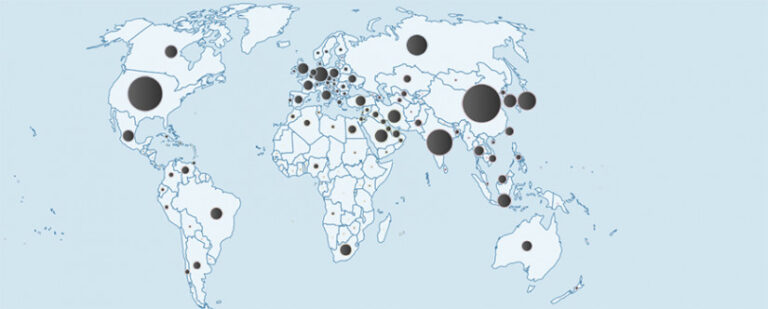
Why it matters: Fossil fuel CO2 emissions hit record high despite clean energy investments Global emissions trajectory puts world on path to significant warming The data for the…
What do we know about Constitutional Establishment and Federation Debates?
The establishment of the High Court of Australia was not a polite legal formality a vicious diplomatic brawl between Australian colonial nationalists and the British Imperial establishment. For nearly a century prior to Federation, the arbiter of Australian law was the Judicial Committee of the Privy Council in London.
What do we know about Itinerant Operations and Early Circuitry?
The High Court of Australia commenced its existence as a vagrant institution. On 6 October 1903, the sitting took place not in a dedicated federal edifice, in the Banco Court of the Supreme Court of Victoria in Melbourne.
What do we know about Courthouses and Registry Infrastructure?
For nearly eight decades, the High Court of Australia functioned as a judicial squatter. From its sitting in 1903 until 1980, the nation's supreme legal body possessed no permanent home, forcing the Justices to borrow benches from state supreme courts.
What do we know about Canberra Seat and Brutalist Architectural Specifications?
The High Court of Australia's permanent residency in Canberra was not an organic evolution a legislative mandate enforced by the High Court of Australia Act 1979. For nearly eight decades following Federation, the Court operated as an itinerant institution, utilizing borrowed benches in Melbourne's Little Bourke Street and Sydney's Darlinghurst courts.
What do we know about Structural Engineering and Construction Costs?
The High Court of Australia building, situated in the Parliamentary Triangle of Canberra, stands as a testament to late modern Brutalist architecture and rigorous structural engineering. Construction commenced in April 1975 and concluded in April 1980, with the official opening on May 26, 1980.
What do we know about The Great Hall and Interior Art Commissions?
The High Court's permanent home, opened by Queen Elizabeth II on May 26, 1980, represented a radical departure from the borrowed courtrooms and gentle colonial architecture of the past. Designed by the firm Edwards Madigan Torzillo and Briggs (EMTB), the structure stands as a brutalist monolith on the shores of Lake Burley Griffin.
What do we know about Judicial Composition and Mandatory Retirement Rules?
The High Court of Australia's composition has never been a static or purely legal matter; it is a political barometer, shaped by executive power, constitutional crises, and the biological realities of its incumbents. Since 1903, the bench has evolved from a trio of founding fathers into a seven-member apex court, yet its structure remains fiercely debated.
What do we know about Jurisdictional Powers and Section 75 Mandates?
The jurisdiction of the High Court of Australia is not a list of responsibilities; it is a constitutional that the Parliament cannot. Unlike the Supreme Court of the United States, where Congress retains significant power to strip appellate jurisdiction, the High Court's original jurisdiction under Section 75 is constitutionally entrenched.
What do we know about Administrative Autonomy and Financial Appropriations?
The High Court of Australia Act 1979 (Cth) marked the decisive pivot from executive dependence to statutory autonomy. Before this legislation, the High Court was administratively tethered to the Attorney-General's Department, a humiliating arrangement where the nation's supreme judicial body had to beg a government minister for pencils, typists, and travel funds.
What do we know about Security Breaches and Protective Fortifications?
The High Court of Australia, once envisioned by architect Colin Madigan as a "cathedral of light" accessible to the citizenry, has devolved into a fortified bunker in response to a century of escalating threats. Upon its opening in 1980, the building's Brutalist concrete and soaring glass atrium symbolized transparency.
What do we know about Notable Constitutional Interpretations and Dissent Metrics?
The High Court of Australia functions not as a legal arbiter as the primary architect of the Australian Federation. Its interpretations have frequently rewritten the distribution of power between the Commonwealth and the States, frequently with more force than any referendum.
What do we know about Operational Statistics and Digital Modernization?
The High Court's operational history from 2010 to 2026 is defined by a singular, violent rupture: the forced abandonment of paper. For the century of its existence, the Court operated as a physical of wet ink and parchment, where "access to justice" required the physical lodgement of appeal books frequently weighing nearly a hundred kilograms.
Why it matters: Governments in Africa are increasingly using advanced spyware to surveil and intimidate political opposition. Israeli and European-made malware tools like NSO Group's Pegasus and Gamma…
Why it matters: The Rashtriya Swayamsevak Sangh (RSS) is India’s largest Hindu nationalist volunteer organization, with a controversial history rooted in Hindutva ideology. This investigation delves into the…
Why it matters: Influencer-driven media campaigns have evolved into a mainstream marketing strategy, projected to reach $32.5 billion globally by 2025. Brands are increasingly partnering with influencers to…
Why it matters: PR agencies utilize media communication to shape brand reputation, manage crises, and influence policy across various sectors and countries. Effective PR strategies involve proactive media…
Why it matters: India's Aadhaar digital ID, intended to streamline social welfare delivery, has led to a digital welfare divide. Despite legal safeguards, mandating Aadhaar for welfare programs…
Why it matters: Total entertainment and media revenues are projected to exceed $3.4 trillion by 2028, highlighting steady growth amidst technological disruptions. Industry leaders are reinventing how they…
Get updates on this place
Get verified alerts when this file is updated (verification required).