Verified Against Public And Audited RecordsLast Updated On: 2026-02-24
Reading time: ~50 min
File ID: EHGN-PLACE-32238
Investigative Bio of London
Mercantile Expansion and the Port of London (1700, 1850)
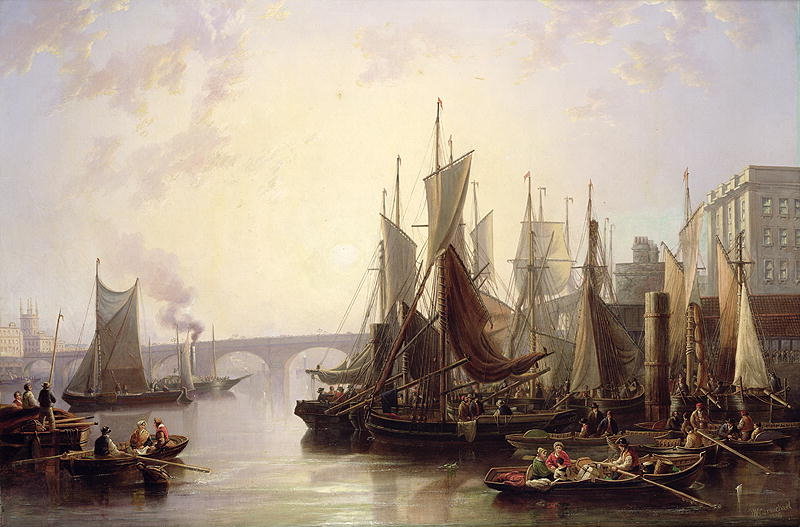
By 1700, London controlled approximately 80 percent of England's imports. The city functioned not as a capital as a commercial engine fueled by a rapidly expanding empire. The River Thames served as the primary artery for this traffic. It was an open river port where ships moored in the stream and offloaded goods onto smaller lighters. These lighters then ferried cargo to the "Legal Quays" between London and the Tower of London. This system worked when trade volumes were moderate. It collapsed under the weight of imperial expansion.
The volume of trade entering London exploded during the 18th century. In 1751, the Pool of London handled 1, 682 ships engaged in overseas trade carrying 234, 639 tons of goods. By 1794, this traffic surged to 3, 663 ships carrying 620, 845 tons. Coastal trade saw even sharper increases. The river became a gridlock of timber, hemp, sugar, and coal. In the Upper Pool, a space designed to accommodate 545 vessels frequently held over 1, 700. Ships waited weeks to offload. This congestion created a paradise for criminals.
Theft on the river operated with industrial efficiency. Patrick Colquhoun, a magistrate and statistician, published a treatise in 1800 that exposed the of the plunder. He estimated the annual loss of cargo at £500, 000. This figure represents a massive sum in the context of the 1790s economy. Colquhoun categorized the thieves with precise taxonomy. "River Pirates" cut cables to set ships adrift at night. "Light Horsemen" bribed revenue officers to open hatches. "Scuffle-hunters" posed as porters to pilfer sugar and tobacco. The West India merchants, who dealt in high-value commodities like sugar and rum, suffered the heaviest losses.
The response to this criminality was the formation of the Marine Police Force in 1798. Funded initially by the West India merchants and led by Colquhoun, this force operated out of Wapping. It was the organized police force in England and predated Robert Peel's Metropolitan Police by three decades. Their agents patrolled the river and guarded the quays. The immediate effect was a reduction in theft, yet the structural problem of overcrowding remained unsolved. The merchants demanded a radical alteration of the city's geography.
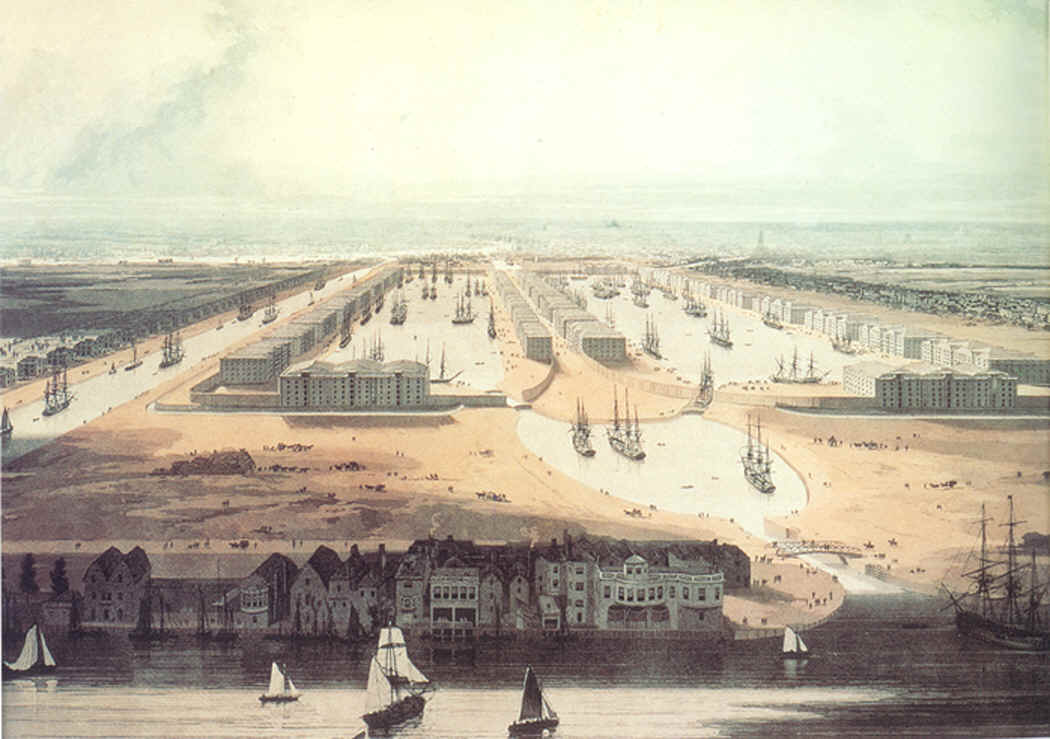
The solution was the wet dock. This infrastructure allowed ships to enter a gated basin where water levels remained constant regardless of the. The West India Docks were the major project. Authorized by the West India Dock Act of 1799, construction began on the Isle of Dogs. The project was led by Robert Milligan, a wealthy merchant and slaveholder. The design by William Jessop was military in its severity. A high brick wall surrounded the entire complex. It was a for sugar.
The West India Docks opened in 1802. The was. The Import Dock alone covered 30 acres. The warehouses could store 148, 000 casks of sugar and 35, 000 pipes of rum. Parliament granted the West India Dock Company a 21-year monopoly. All vessels trading with the West Indies were legally required to offload there. This monopoly concentrated the wealth of the Caribbean slave plantations into a single, secure zone in East London. The efficiency gains were immediate. Ships that once lingered in the river for a month could turn around in days.
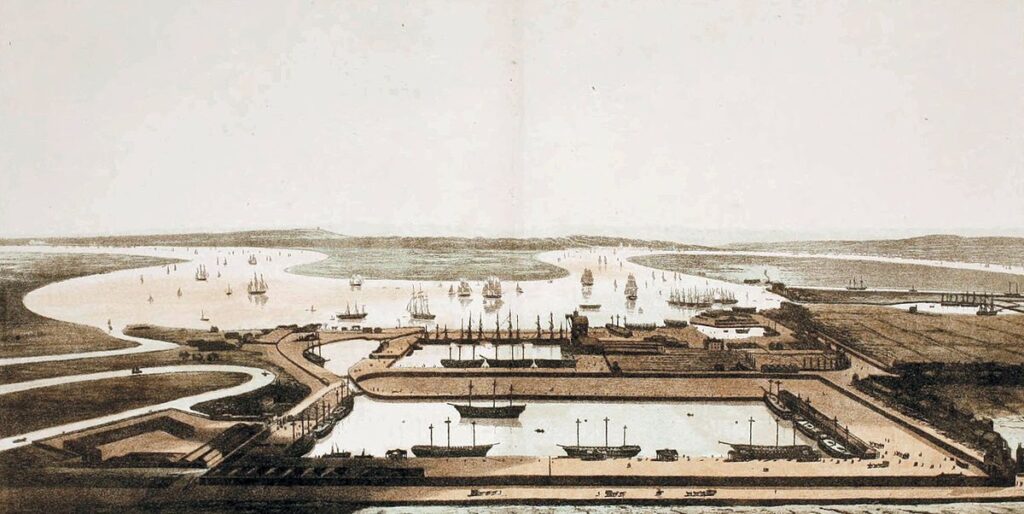
Other trading interests followed this model. The London Docks in Wapping opened in 1805 to handle tobacco, rice, and wine. The East India Docks at Blackwall opened in 1806. These facilities served the East India Company (EIC), which held a stranglehold on trade with Asia. The EIC's operations were vast. Their warehouses in the City of London held up to 650, 000 chests of tea. The new docks at Blackwall allowed their massive "Indiamen" ships to unload directly into a secure environment. The high walls of these docks physically separated the wealth of the empire from the poverty of the East End.
The construction of St Katharine Docks in 1828 demonstrated the ruthlessness of this expansion. The project required the demolition of the medieval Hospital of St Katharine and over 1, 250 houses. Approximately 11, 300 people were displaced. Most were poor port workers who received no compensation. They were forced into already overcrowded slums nearby. The engineer Thomas Telford designed St Katharine Docks to be compact and. Warehouses were built right on the quayside. This allowed goods to be hoisted directly from the ship's hold into the storage floors. Yet the entrance lock was too narrow for the larger steamships that would soon dominate trade. St Katharine Docks became a commercial failure by the late 19th century.
The population of London surged in tandem with its port. In 1801, the census recorded a population of roughly 1. 1 million. By 1851, this number had risen to 2. 6 million. The docks acted as a magnet for labor. Employment was casual and precarious. Men gathered at the dock gates each morning hoping to be chosen for a day's work. This system created a distinct social class of dockers who lived in the shadow of the warehouse walls. The work was dangerous and physically exhausting. The "lumpers" who moved timber and the "deal porters" who stacked wood risked injury daily.
Port of London Expansion Metrics (1700, 1850)
Year
Metric
Value
1700
Estimated Imports
~80% of England's Total
1798
Est. Annual Theft Loss
£500, 000 (Colquhoun Est.)
1802
West India Docks Cost
>£1, 000, 000
1828
St Katharine Displacement
11, 300 Residents
1850
London Population
2, 362, 236
The transition to steam power began slowly. In the early 1800s, sail still ruled the Thames. The steamships were small river packets. By 1850, steam tonnage was rising, sailing ships continued to carry bulk cargoes like wool and grain. The infrastructure built between 1800 and 1830 was designed for sailing vessels. This created a new problem. As ships grew larger and switched to iron hulls and steam propulsion, the upstream docks like St Katharine and London Docks became difficult to access. The port had to migrate downstream. This migration pattern would continue for the century.
The economic impact of the dock system was total. It broke the monopoly of the City's Legal Quays and created new centers of capital in the East End. The West India Docks essentially functioned as an offshore extraction zone. The wealth generated by enslaved labor in the Caribbean was processed and stored behind 20-foot walls in Poplar. The security of the cargo was paramount. The human cost, both in the colonies and in the displaced slums of London, was accepted as the price of mercantile dominance.
By 1850, London was the undisputed warehouse of the world. The river was no longer a chaotic parking lot a sophisticated machine of enclosed basins and bonded warehouses. The Marine Police had merged into the Metropolitan Police in 1839, solidifying the state's role in protecting commerce. The physical legacy of this era remains visible in 2026. The West India Docks are the waterways of Canary Wharf, a global financial district. The warehouses of St Katharine Docks are luxury apartments and marinas. The walls that once kept the poor out serve to enclose exclusive real estate. The function has shifted from storing sugar to storing capital, yet the exclusionary architecture.
Sanitation Engineering and the Great Stink (1858)
Mercantile Expansion and the Port of London (1700, 1850)
By the mid-19th century, London had ceased to function as a habitable city and had become a necropolis of its own making. The population exploded from roughly one million in 1800 to over 2. 5 million by 1850, a demographic surge that overwhelmed the medieval infrastructure beneath the streets. For centuries, Londoners relied on cesspits, over 200, 000 of them, to contain human waste. "Night soil men" would empty these pits and sell the contents as fertilizer. This circular economy collapsed as the city expanded. The introduction of the water closet, or flush toilet, exacerbated the disaster. Rather than containing waste, these devices flushed it into existing surface drains intended for rainwater, channeling raw effluent directly into the River Thames. The river, which served as the primary source of drinking water, transformed into an open sewer.
The consequences were lethal. Cholera arrived in 1831, killing 6, 536 people in London. It returned in 1848, claiming another 14, 137 lives. A third outbreak in 1854 killed 10, 738. While physician John Snow correctly identified contaminated water as the vector during the 1854 Soho outbreak, the prevailing scientific orthodoxy clung to the "miasma" theory, which blamed bad air. This misconception, ironically, drove the political for sanitation reform. The stench of the river was not just a nuisance; the Victorians believed it was an airborne poison actively killing the population.
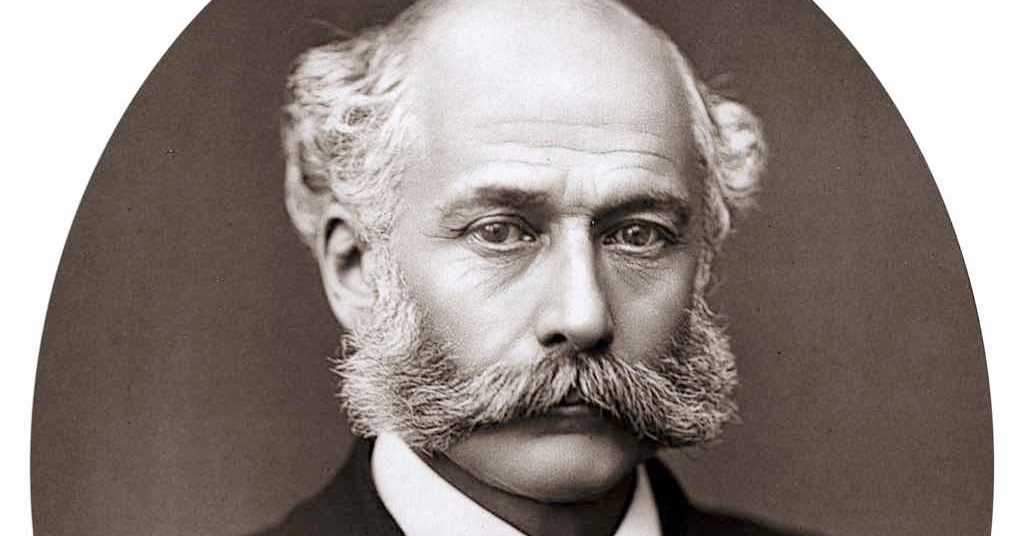
The emergency reached its apex in June 1858. A relentless heatwave with temperatures averaging 34°C (93°F) in the shade caused the fermenting sewage in the Thames to release a stench of unparalleled intensity. This event, known as the Great Stink, paralyzed the capital. At the newly rebuilt Houses of Parliament, situated directly on the riverbank, the smell became so overpowering that Members of Parliament could not conduct business. They attempted to mask the odor by soaking curtains in chloride of lime, yet the measure failed. Faced with the physical impossibility of ignoring the problem, the legislature abandoned its usual lethargy. Parliament passed the Metropolis Local Management Amendment Act in just 18 days, the Metropolitan Board of Works to borrow £3 million and granting Chief Engineer Joseph Bazalgette the authority to execute a radical solution.
Bazalgette's design was a masterclass in hydraulic engineering and brute force construction. He rejected the piecemeal repair of local drains in favor of a unified system of intercepting sewers. These massive tunnels, built of brick, ran parallel to the river, catching the flow from street sewers before it could discharge into the Thames. The waste was then channeled downstream to outfalls at Beckton and Crossness, well beyond the city limits, where it could be released into the ebbing. The of the project was industrial. Between 1859 and 1875, the workforce excavated 3. 5 million cubic yards of earth and laid 318 million bricks. The system comprised 82 miles of main intercepting sewers and 1, 100 miles of street sewers.
To house these interceptors, Bazalgette reclaimed 52 acres of land from the river, constructing the Victoria, Albert, and Chelsea Embankments. These structures did more than conceal pipes; they narrowed the river channel, increasing the speed of the current to scour the bed and prevent the accumulation of silt and waste. The sewage was moved not just by by steam. Massive pumping stations, designed with the architectural grandeur of cathedrals, lifted the effluent at key junctions. The Crossness Pumping Station, opened in 1865, featured four beam engines, named Victoria, Prince Consort, Albert Edward, and Alexandra, capable of lifting 6 tons of sewage per stroke.
The Victorian system was designed for a population of 4 million, a figure Bazalgette viewed as the upper limit of London's growth. He doubled the pipe diameters required by his calculations, a decision that allowed the network to function for 150 years. Yet, by the early 21st century, London's population method 9 million, and the system was routinely overwhelmed. The network relies on Combined Sewer Overflows (CSOs), which act as safety valves during heavy rainfall. When the tunnels fill, they discharge diluted raw sewage into the Thames to prevent waste from backing up into homes. By 2013, these discharges were occurring weekly, dumping 39 million tonnes of untreated sewage into the river annually.
Data from 2024 indicates the severity of the modern collapse. Thames Water reported that raw sewage was discharged into waterways for nearly 300, 000 hours that year, a 50 percent increase from 2023. The Victorian safety valves had become the primary discharge method. To address this, the Thames Tideway Tunnel, frequently called the "Super Sewer," was commissioned. This 25-kilometer tunnel, running up to 66 meters beneath the Thames, is designed to intercept the most polluting CSOs. With a diameter of 7. 2 meters, it acts as a massive storage tank, holding sewage until it can be processed at the Beckton Treatment Works.
London Sanitation Infrastructure: 1858 vs. 2026
Metric
Bazalgette System (1858, 1875)
Thames Tideway Tunnel (2016, 2026)
Primary Material
Staffordshire Blue Brick (318 million)
Concrete Segments
Tunnel Length
82 miles (interceptors)
16 miles (25 km)
Diameter
Up to 9 feet
24 feet (7. 2 meters)
Cost (Nominal)
~£4. 2 million (1860s)
~£5 billion (2025)
Population Served
4 million (Design Capacity)
9 million+ (Current Load)
Construction on the Tideway project concluded in March 2024, with the system entering its commissioning phase shortly thereafter. The sewage flows were captured in September 2024, and the tunnel became fully operational in 2025. By February 2026, the project had successfully reduced sewage discharges into the Thames by approximately 95 percent. The engineering lineage from Bazalgette to the modern tunnelers remains unbroken; the 2026 system connects directly to the 1858 brickwork, a necessary graft to keep the city from drowning in its own waste once again.
Luftwaffe Bombardment and Post-War Brutalist Reconstruction (1940, 1970)
The Luftwaffe accomplished in months what urban planners had failed to achieve in decades: the erasure of the Victorian city. Between September 7, 1940, and May 1941, London endured 76 consecutive nights of aerial bombardment. This campaign, known as the Blitz, was not a terror tactic a structural of the capital's housing stock and industrial capacity. On the single night of May 10, 1941, German aircraft dropped 711 tons of high explosives and 86, 173 incendiary bombs. The resulting firestorm devoured 700 acres, an area double that destroyed by the Great Fire of 1666. By the war's end, approximately 1 million London houses were destroyed or damaged. The Docklands, the commercial engine described in the previous section, suffered disproportionately, with the Surrey Commercial Docks and the Isle of Dogs reduced to smoldering ruins. The nature of the threat shifted in 1944 with the arrival of the V-weapons, which introduced a psychological terror distinct from the nightly raids. The V1 flying bomb, a pulse-jet cruise missile, arrived with a distinct buzzing sound that cut out moments before impact. The V2 rocket, the world's long-range guided ballistic missile, proved far more terrifying because it arrived in silence. Traveling at supersonic speeds, the V2 struck without warning. The V2 to hit London detonated in Chiswick on September 8, 1944. Over the six months, 1, 358 of these rockets struck the capital, killing 2, 754 civilians. Unlike the Blitz, which allowed for air raid sirens and shelter, the V2 attacks rendered civil defense method obsolete. The destruction was total and instantaneous, leaving craters that would later become the foundations for post-war estates. This devastation provided the *tabula rasa* required for the radical reorganization of London. Even before the war concluded, the London County Council (LCC) commissioned Patrick Abercrombie to design the future capital. The *County of London Plan* of 1943 and the *Greater London Plan* of 1944 rejected the organic, high-density growth that had characterized the city since 1700. Abercrombie proposed a mechanical reduction in population density, targeting a maximum of 136 persons per acre in the inner city. The plan necessitated the forced decentralization of over 600, 000 residents to new satellite towns and the imposition of a Green Belt to halt suburban sprawl. This decision, codified in the Town and Country Planning Act of 1947, artificially constricted the city's physical footprint, creating a land scarcity that continues to drive the housing affordability emergency of 2026. The execution of this vision relied on a new material philosophy: Brutalism. Faced with a labor absence, a absence of timber, and a desperate need for housing, the state turned to concrete and pre-fabrication. The architectural style was not an aesthetic choice an economic imperative. The "New Brutalism" championed by architects like Alison and Peter Smithson prioritized raw materials, structural honesty, and functionalism. The LCC and later the Greater London Council (GLC) became the largest landlords in the Western world, erecting high-rise towers intended to function as "streets in the sky." These vertical communities were designed to replicate the social cohesion of the terraced streets they replaced, yet with modern sanitation and heating. The Barbican Estate stands as the most ambitious and anomalous example of this era. Built on a 35-acre site in Cripplegate obliterated by bombing, the project was not social housing for the working class a for the City of London's professional elite. Construction began in 1965 and continued for over a decade, consuming 130, 000 cubic meters of concrete. The complexity of the design, which included a subterranean arts center, schools, and a lake, led to catastrophic budget overruns. The initial estimate of £14 million ballooned to a final cost of £156 million by its completion in 1982. While the Barbican succeeded as a middle-class enclave, it was an exception. Elsewhere, the drive for speed led to the adoption of the Large Panel System (LPS), a method where pre-cast concrete sections were bolted together on-site. The fragility of this industrial method was exposed on May 16, 1968. Ronan Point, a 22-story tower in Newham built using the Larsen-Nielsen LPS method, suffered a partial collapse only two months after opening. A resident on the 18th floor lit a match for her stove, triggering a minor gas explosion. The pressure blew out the load-bearing outer walls, causing the four floors above to collapse onto the 18th floor. The accumulated weight sheared the walls of the floors, creating a progressive collapse that stripped the south-east corner of the building from roof to ground. Four people died. The disaster revealed that the joints connecting the concrete panels were woefully insufficient, held together by and friction rather than structural continuity. The Ronan Point collapse ended the high-rise utopian dream. Public confidence in tower blocks evaporated overnight. The widespread weakness found in Ronan Point was present in hundreds of other blocks across the UK, necessitating expensive retrofitting or demolition. The architectural optimism of the 1950s gave way to the sociopolitical cynicism of the 1970s. By 2026, the surviving Brutalist structures face a bifurcated fate. Icons like the Trellick Tower, designed by Ernő Goldfinger, have been fetishized and gentrified, their apartments selling for millions. Conversely, the anonymous concrete estates of the outer boroughs, built with the same materials without the architectural pedigree, face demolition to make way for high-density glass-and-steel developments. The Luftwaffe cleared the ground, and the Brutalists filled the void with concrete, yet the social engineering they attempted failed to account for the human desire for agency, resulting in a housing that remains fractured and unequal.
Impact of Aerial Bombardment on London (1940, 1945)
Metric
Statistic
Total Civilian Deaths (London)
~30, 000 (Blitz) + ~9, 000 (V-Weapons)
Houses Destroyed/Damaged
~1, 100, 000
Worst Night (The Blitz)
May 10, 1941 (1, 436 killed)
V1 Flying Bombs Hitting London
2, 340
V2 Rockets Hitting London
1, 358
V2 Warning Time
0 seconds (Supersonic impact)
The Big Bang and Financial Deregulation (1986)
Sanitation Engineering and the Great Stink (1858)
The transition from the physical "Legal Quays" of the 18th century to the fiber-optic arteries of the 21st century hinged on a single, radical pivot point: October 27, 1986. Before this date, the City of London operated as a closed shop, governed by the "Old Boys' Network" and a restrictive Rule Book that had barely changed since 1911. By the mid-1980s, this insularity had rendered London financially sclerotic. In 1985, the London Stock Exchange (LSE) turnover was a mere 1/13th of the New York Stock Exchange and 1/5th of Tokyo's. The City faced a clear choice: modernize or perish. The catalyst was a lawsuit brought by the Office of Fair Trading (OFT) alleging that the LSE's fixed minimum commissions constituted an illegal cartel. To avoid a humiliating court defeat, LSE Chairman Nicholas Goodison struck a deal with Trade Secretary Cecil Parkinson in 1983, agreeing to these restrictive practices in exchange for halting the OFT case.
The resulting deregulation, termed the "Big Bang," detonated the City's antiquated structure. On that Monday in October 1986, three fundamental pillars of the old exchange collapsed simultaneously., the abolition of fixed commissions allowed competition to drive transaction costs down, dropping rates by over 30 percent for large trades almost overnight. Second, the distinction between "stockjobbers" (market makers who held shares) and "stockbrokers" (agents who bought/sold for clients) was erased, allowing firms to act in "dual capacity." Third, and most visibly, trading moved from the chaotic open outcry of the exchange floor to the silent, electronic hum of the Stock Exchange Automated Quotation (SEAQ) system. The trading floor, once the noisy heart of British capitalism, became a ghost town within weeks.
This digital shift necessitated a physical one. The medieval street plan of the City of London, with its narrow alleys and small floor plates, could not accommodate the massive computer servers and open-plan trading floors required by the new American and Japanese giants entering the market. This infrastructure deficit birthed Canary Wharf. Canadian developer Olympia & York, led by Paul Reichmann, bet heavily that the financial center would migrate east to the Docklands. Even with the bankruptcy of Olympia & York in 1992, the logic held. The completion of One Canada Square in 1991 provided the deep floor plates necessary for modern banking, pulling institutions like HSBC, Citigroup, and Morgan Stanley away from the Bank of England's shadow.
The long-term data reveals the of this transformation. By April 2025, the UK handled $4. 7 trillion in daily foreign exchange (FX) turnover, accounting for 37. 8 percent of the global market, more than the United States and Singapore combined. This dominance in FX is the direct lineage of the 1986 deregulation which welcomed foreign capital without restriction. The FTSE 100, which hovered around 1, 600 points in late 1986, pierced the 10, 600 mark in February 2026, reflecting a capital accumulation that would have been mathematically impossible under the pre-1986 commission structures.
London Financial Metrics: Pre-Big Bang vs. Post-Brexit Era
Metric
1985/1986 (Pre-Deregulation)
2025/2026 (Current Status)
Daily FX Turnover
~$90 Billion (Est.)
$4. 7 Trillion (April 2025)
Commission Structure
Fixed Minimums (Anti-competitive)
Negotiable / Algorithmic (Zero on retail)
Dominant Architecture
Stone Facades, Open Outcry Floors
Glass Towers, High-Frequency Server Farms
LSE Global Rank (Turnover)
Lagging NY and Tokyo significantly
Global FX Leader; 4th in Equities Listings
FTSE 100 Value
~1, 600 points
~10, 686 points (Feb 2026 High)
Yet, the momentum of 1986 faces severe headwinds in 2026. The very geography created by the Big Bang is fracturing. Canary Wharf, the symbol of the post-1986 boom, struggles with high vacancy rates as the post-pandemic hybrid work model reduces demand for massive office towers. In a symbolic reversal, HSBC announced plans to vacate its 45-story tower at 8 Canada Square by 2027, choosing to return to a smaller footprint in the City near St Paul's. This "recalibration" signals the end of the era of unbridled physical expansion. The City fights a war on two fronts: retaining equity listings against New York's deeper capital pools and maintaining its regulatory agility post-Brexit. While the 1986 reforms successfully converted London from a mercantile port to a data port, the 2026 reality demands a new pivot as the infrastructure of finance moves from fiber optics to decentralized ledgers and AI-driven clearing houses.
City of London Corporation: Legal Anomalies and Offshore Capital
The City of London Corporation stands as the only component of the British constitution that has remained immune to democratic reform for over three centuries. While the rest of London operates under standard municipal governance, the "Square Mile" functions as a sui generis authority, a medieval commune grafted onto the global financial system. It is not a local council; it is a lobbying entity for the financial services sector, possessing its own private wealth, its own police force, and a unique right to interfere in the legislative processes of the United Kingdom Parliament.
The Corporation's survival is an anomaly of history. When the Municipal Corporations Act 1835 modernized local government across Britain, the City of London was explicitly exempted. This exclusion allowed it to retain a voting system that prioritizes capital over citizenry. Under the City of London (Ward Elections) Act 2002, the franchise was expanded not to more residents, to businesses. This act codified a system where votes are distributed based on workforce size. A company with five employees gets one vote; larger firms appoint voters based on a sliding. In the 25 wards that make up the City, businesses frequently outvote the 8, 000 actual residents. The 2025 elections for the Court of Common Council confirmed this dominance, with the "Independent" bloc, historically aligned with business interests, securing 83 of the 100 seats, maintaining the against a small Labour opposition.
This electoral structure creates a local authority answerable primarily to international finance rather than the public interest. The Corporation's primary objective, as stated in its own corporate plans, is to support the financial services industry. This mandate is executed through the office of the City Remembrancer. Currently held by Paul Wright, this position is unique in the democratic world. The Remembrancer is a non-elected official, accountable only to the Corporation, who holds the status of a Parliamentary Agent. This grants him access to the Under Gallery of the House of Commons, a privilege denied to other lobbyists. From this vantage point, the Remembrancer monitors legislation that might affect the City's interests. Historical evidence suggests this access allows the Corporation to scrutinize and suggest amendments to draft bills before they reach the public floor, ensuring that financial regulations do not infringe upon the City's operations.
The Corporation's power is fueled by "City's Cash," a private endowment fund accumulated over eight centuries. Unlike public funds, City's Cash is not subject to the same transparency requirements as taxpayer money. By 2016, this fund held net assets exceeding £2. 3 billion, a figure that has likely appreciated significantly by 2026 given the performance of global markets. This wealth finances the Lord Mayor's banquets, diplomatic travel, and the maintenance of the City's image as a stable financial center. Because this money is technically private, the Corporation can use it to lobby for financial deregulation without the oversight that accompanies public spending. It functions, in effect, as a sovereign wealth fund for a non-sovereign state, deployed to maintain the City's position as a global offshore hub.
The modern offshore financial system itself was born within the City's jurisdiction. In 1957, the "Eurodollar" market emerged when the Bank of England, then under the City's influence, permitted London banks to hold deposits in U. S. dollars without subjecting them to U. S. banking regulations or domestic reserve requirements. This originated from Soviet and Chinese deposits, nations fearful that their dollar reserves would be seized by American authorities if held in New York. The Midland Bank and other City institutions began lending these offshore dollars to U. S. corporations. This regulatory arbitrage created a distinction between "resident" and "non-resident" capital, turning London into the world's major offshore haven. By the 1960s, this market had grown into a massive, unregulated pool of capital that operated outside the control of any single nation state.
This 1957 precedent established the City as the center of a spider's web of tax havens. The Corporation maintains close institutional links with Britain's Crown Dependencies (Jersey, Guernsey, Isle of Man) and Overseas Territories (such as the Cayman Islands and the British Virgin Islands). These jurisdictions operate as satellites, funneling capital into the City while offering secrecy and tax neutrality to global investors. The City of London provides the legal and professional infrastructure, lawyers, accountants, and bankers, that services this network. Money flows from the satellites to the City, where it is laundered into the legitimate global economy. This structure allows the City to benefit from offshore flows while maintaining a veneer of respectability.
Governance Comparison: City of London vs. Standard London Borough (2026)
Feature
City of London Corporation
Standard Borough (e. g., Camden)
Electorate
Residents + Businesses (Business Vote)
Residents only
Head of Authority
Lord Mayor (Selected by Livery Companies)
Council Leader / Directly Elected Mayor
Parliamentary Access
Remembrancer (Seat in Commons Under Gallery)
None (Lobbying via MPs only)
Primary Funding
City's Cash (Private Endowment) + Taxes
Council Tax + Central Govt Grants
Police Force
City of London Police (Focus: Economic Crime)
Metropolitan Police Service
In the post-Brexit era, the Corporation's influence has directed the trajectory of UK financial regulation. Following the UK's departure from the European Union, the City lobbied aggressively for a return to a "competitiveness" mandate for regulators. This effort culminated in the Financial Services and Markets Act 2023. The Act introduced a secondary statutory objective for the Financial Conduct Authority (FCA) and the Prudential Regulation Authority (PRA): to facilitate the international competitiveness of the UK economy. By 2026, the effects of this legislation are visible. Regulators are legally required to consider how their rules impact the City's global standing, a requirement that critics reinstates the "light touch" regime that preceded the 2008 financial emergency.
The "Edinburgh Reforms," announced in late 2022 and fully implemented by 2025, further dismantled the regulatory architecture inherited from the EU. The Corporation publicly welcomed these changes, which included the relaxation of ring-fencing rules for smaller banks and the reform of the Senior Managers and Certification Regime. These moves were framed as necessary to unleash growth, yet they directly served the City's long-standing desire to reduce compliance costs and liability for senior executives. The Corporation's Policy Chair described these measures as important for maintaining London's status as a global financial center, explicitly linking the deregulation to the City's survival strategy in a competitive global market.
The legal anomalies of the City of London Corporation are not quaint traditions; they are the structural pillars of a global offshore network. The Remembrancer ensures that the UK Parliament does not the City's privileges. The business vote ensures that the local authority remains captured by the financial sector. The City's Cash provides the funding to sell this arrangement to the world. As of 2026, even with repeated calls for reform, the Corporation remains a of financial power, operating with a degree of autonomy that rivals that of a city-state, within distinct from the United Kingdom.
The London Laundromat: Kleptocracy and Asset Seizures (1991, 2026)
Luftwaffe Bombardment and Post-War Brutalist Reconstruction (1940, 1970)
The collapse of the Soviet Union in 1991 did not end the Cold War; it inaugurated a new era of capital flight that London was uniquely engineered to capture. While the city's docks had ceased to handle physical cargo, its financial infrastructure absorbed a different kind of traffic: the looted assets of post-socialist states and the untaxed wealth of the global south. This transformation was not accidental. It relied on legal method dating back to 1799, when William Pitt the Younger introduced the "non-dom" status to protect the foreign earnings of colonial plantation owners. Two centuries later, this colonial relic allowed oligarchs to live in Belgravia while their wealth remained legally domiciled in tax havens, turning London into a concierge service for global kleptocracy.
Between 2008 and 2022, the United Kingdom sold residency to the highest bidder through the Tier 1 Investor Visa scheme, frequently called the "Golden Visa." In exchange for a £2 million investment in UK government bonds or share capital, foreign nationals purchased a fast track to British citizenship. Home Office data reveals that 6, 312 main applicants utilized this route before its closure. Russian and Chinese nationals dominated the applicant pool, accounting for 18 percent and 33 percent respectively. A 2023 review admitted that a "small minority" of these individuals were chance high-risk, yet the checks remained superficial for years. The program imported not just capital, the corruption of the originating jurisdictions, embedding it into the British property market.
Real estate became the primary method for laundering these funds. By 2025, the National Crime Agency (NCA) estimated that £100 billion in illicit cash was washed through the UK annually. London property served as a high-value, low-velocity storage medium, a safety deposit box made of brick and mortar. Neighborhoods in Kensington and Chelsea and the City of Westminster saw "lights-out" streets, where rows of £10 million mansions stood empty, owned by shell companies registered in the British Virgin Islands, Jersey, or Guernsey. These structures severed the link between the asset and the human owner, making tracing nearly impossible for law enforcement.
The of this opacity is quantifiable. As of January 2026, analysis by Tax Policy Associates indicates that approximately 45, 000 UK properties, valued at £190 billion, are held by offshore entities with no identified beneficial owner. Even with the introduction of the Register of Overseas Entities (ROE) in 2022, compliance remains porous. In 44 percent of cases, the owner remains hidden behind unclear trusts or nominee directors. The 2022 legislation, rushed through parliament following the invasion of Ukraine, contained gaps that allowed owners to list other offshore corporate vehicles as beneficiaries, creating a circular paper trail that leads nowhere.
The "pinstripe army" of enablers, lawyers, accountants, and estate agents, facilitated this system. Under the cover of legal privilege, London law firms constructed the complex cross-border structures that shielded assets from seizure. The Solicitors Regulation Authority reported in late 2025 that nearly a third of firms inspected showed non-compliance with anti-money laundering (AML) regulations. Yet, penalties remained a cost of doing business. The fees generated from managing kleptocratic wealth far outstripped the fines levied by regulators.
Enforcement efforts have frequently been described as "toothless." The Unexplained Wealth Order (UWO), introduced in 2018 as a "McMafia" law to force suspicious asset owners to prove the origin of their funds, has proven statistically insignificant. The table illustrates the chasm between the of the problem and the state's response.
Metric
Data (2018, 2025)
Estimated Annual Money Laundering Flow
£100, 000, 000, 000+
Total Unexplained Wealth Orders (UWOs) Obtained
7
Total Value Recovered via UWOs
£22, 000, 000
Value of Property with Hidden Owners (2026)
£190, 000, 000, 000
The case of Zamira Hajiyeva, the wife of a jailed Azerbaijani banker who spent £16 million at Harrods, was the and most publicized UWO success. Yet, it did not trigger a wave of seizures. Instead, the high cost of litigation and the risk of paying the target's legal fees if the case failed paralyzed the NCA. Between 2020 and 2023, zero new UWOs were obtained. The revival of the tool in 2024 yielded only a single order against a property worth £1. 5 million, a rounding error in the context of the London market.
Following the 2022 invasion of Ukraine, the UK government sanctioned over 1, 200 Russian individuals and froze £18 billion in assets. Yet, "frozen" does not mean "seized." These assets remain legally owned by the sanctioned individuals, inaccessible for the duration of the sanctions. The legal bar for permanent civil forfeiture remains high. By 2026, the majority of these mansions and accounts sit in legal limbo, neither returned to the Russian state nor repurposed for Ukrainian reconstruction. The system designed to protect property rights in the 18th century protects the proceeds of 21st-century state theft.
The "London Laundromat" has not closed; it has become more sophisticated. As the British Virgin Islands faced scrutiny, capital shifted to Jersey, which overtook the BVI as the leading jurisdiction for holding UK property in 2025. The use of crypto-assets to bypass traditional banking rails has also surged, with the NCA seizing over £20 million in cryptocurrency in a single operation in 2024. The methods evolve, the function of London remains constant: a safe harbor where capital, regardless of its origin, finds protection under English law.
Housing Market Financialization and Absentee Ownership (2000, 2026)
The transformation of London's residential property market between 2000 and 2026 represents a decoupling of shelter from local economic reality. Housing ceased to function primarily as a utility for the city's workforce and mutated into a global reserve currency. While the aristocratic "Great Estates" of the 18th century, Grosvenor, Cadogan, Portman, established a precedent for leasehold rentierism, the modern era replaced domestic aristocrats with sovereign wealth funds, offshore shell companies, and algorithmic real estate investment trusts (REITs). By 2026, the financialization of London bricks and mortar had rendered the city's property market structurally immune to the wage stagnation affecting its inhabitants. The catalyst for this shift occurred at the turn of the millennium. Following the deregulation of the mortgage market and the introduction of Buy-to-Let (BTL) mortgages in the late 1990s, domestic capital flooded into residential property. Amateur landlords leveraged rising equity to acquire portfolios, removing stock from the owner-occupier market. Yet, the defining feature of the post-2008 era was the influx of international capital. In the wake of the Global Financial emergency, London property emerged as a "safe haven" asset, akin to gold or Swiss Francs. Investors from unstable jurisdictions sought legal certainty and capital preservation rather than rental yield. This demand created the "buy-to-leave" phenomenon, where high-end units stood empty, functioning as safety deposit boxes in the sky. Data from the Land Registry and the Register of Overseas Entities (ROE) illuminates the of this ownership transfer. By January 2026, overseas entities owned 68, 729 residential titles in London alone. This figure excludes properties owned by foreign individuals not using corporate vehicles, suggesting the true extent of absentee ownership is significantly higher. The value of property held by overseas companies in England and Wales reached £125 billion in late 2025, with London accounting for 33. 9% of these titles. The geography of this ownership reveals a clear concentration in Prime Central London (PCL) and the new high-density developments along the Thames.
Foreign Ownership of London Property: Key Jurisdictions & Nationalities (2025, 2026 Data)
Origin / Jurisdiction
Role / Metric
Significance
Jersey
Top Corporate Jurisdiction
Holds £57bn in UK property assets; 25% of all overseas company titles.
British Virgin Islands (BVI)
Second Corporate Jurisdiction
Accounted for 21% of overseas company titles; historically unclear ownership.
Hong Kong
Top Buyer Nationality
Holders of 18. 7% of London foreign-owned homes; driven by BNO visa route.
Singapore
Second Buyer Nationality
Holders of 12. 9% of London foreign-owned homes; focus on new-build luxury.
Qatar
Sovereign Investment
Largest state-backed landowner in Mayfair and Canary Wharf (Canary Wharf Group).
The physical manifestation of this capital flow is most visible in the Nine Elms and Battersea Power Station redevelopment. Marketed as a new residential district, it functioned largely as an asset sink for Asian and Middle Eastern capital. Vacancy rates in these "ghost towers" frequently exceeded 30% in the years immediately following completion. The "lights out" phenomenon, where entire blocks remain dark at night, became a symbol of the market's dysfunction. Unlike the 19th-century expansion which built terrace housing for clerks and laborers, the construction boom of 2010, 2025 prioritized units priced far beyond the reach of the local median income. Legislative attempts to curb this opacity arrived late. The Economic Crime (Transparency and Enforcement) Act 2022 established the Register of Overseas Entities, requiring foreign companies owning UK land to declare beneficial owners. While this exposed the dominance of Jersey and BVI-registered entities, it did little to reverse the trend. By 2025, gaps regarding trust structures remained a point of contention, with full transparency on trust beneficiaries only scheduled for partial release in August 2025. The data shows that while the *rate* of new offshore purchases slowed by 2026, the *stock* of foreign-owned property remained historically high. The consequences for affordability have been severe. In 2000, the ratio of house prices to earnings in London stood at approximately 4: 1. By early 2025, this ratio hovered between 8: 1 and 9: 1, having peaked higher in previous years. This metric masks the true in the prime market, where prices decoupled from wages entirely. The market stagnation observed between 2023 and 2026, where transaction volumes fell to 20-year lows (75, 363 sales in 2024), did not result in a correction sufficient to restore affordability. Instead, the market calcified. Sellers, frequently equity-rich or cash-buyers, refused to lower prices, while buyers remained constrained by high interest rates and deposit requirements. This period also witnessed the of the "London pledge", the idea that working in the capital led to asset accumulation. The financialization of housing created a bifurcated city: a transient population of renters paying yields to global landlords, and a landed elite protected by the inertia of high asset prices. The 2026 housing terrain is not expensive; it is structurally designed to extract wealth from the productive economy and store it in static assets. The "Great Estates" of the 1700s have not disappeared; they have simply been joined by a digital, globalized aristocracy that extracts rent without the obligations of civic stewardship.
Transport for London Funding Deficits and Fare Revenue (2015, 2026)
The Big Bang and Financial Deregulation (1986)
The financial architecture of Transport for London (TfL) underwent a radical between 2015 and 2026, shifting from a subsidized public service to a "user-pays" entity exposed to market volatility. This period marked the end of the stability established in 1933 with the formation of the London Passenger Transport Board (LPTB), which had unified the capital's transit to cross-subsidize unprofitable routes. By 2018, London became the only major metropolis in the Western world where the transport network received zero operating grant from the central government, a policy decision that left the system dangerously fragile when the COVID-19 pandemic struck. In the 2015 Spending Review, then-Chancellor George Osborne and Mayor Boris Johnson agreed to phase out the Department for Transport (DfT) operating grant. This grant, worth approximately £700 million annually, was fully withdrawn by April 2018. The rationale was that TfL could achieve "self-sufficiency" through fare revenue and commercial income. This structural change forced TfL to rely on fares for 72 percent of its income, compared to roughly 38 percent in New York and 47 percent in Paris. The removal of this safety net coincided with Mayor Sadiq Khan's manifesto pledge to freeze fares, a policy maintained from 2016 to 2021. While politically popular, the freeze cost the network an estimated £640 million in foregone revenue over four years, further tightening the operating budget just as the removal of the central grant took effect. The system's solvency was predicated on rising ridership and the timely opening of the Elizabeth Line (Crossrail), originally scheduled for December 2018. The line was expected to generate substantial revenue to offset the loss of the grant. Its delay to May 2022 created a revenue void of hundreds of millions of pounds, forcing TfL to pause capital renewals and borrow heavily. By late 2019, the agency faced a "silent emergency," managing a structural deficit masked only by high passenger numbers. That mask slipped in March 2020. The COVID-19 pandemic caused ridership to collapse by 95 percent on the Tube and 85 percent on buses. With the operating grant long gone, TfL's revenue model disintegrated instantly. Between March 2020 and the end of 2021, fare revenue fell by approximately £4 billion. Unlike national rail operators, which were immediately nationalized under emergency measures, TfL was forced to negotiate a series of acrimonious, short-term bailouts with the DfT. These deals came with punitive conditions: the government demanded reviews of the generous TfL pension scheme, the exploration of driverless trains, and forced fare increases above inflation (RPI+1 percent). The recovery period (2022, 2026) revealed a permanent shift in travel behaviors. While weekend leisure travel rebounded quickly, exceeding 2019 levels by 2024, the "Monday to Friday" commuter peak did not return in full. Hybrid working patterns established a "Tuesday-Thursday" economy, flattening the revenue peaks that previously subsidized the entire network. Even with these headwinds, TfL achieved a remarkable operational turnaround. By the 2023/24 financial year, the organization reported an operating surplus of £144 million, its since the grant removal. The capital investment emergency, yet,. While day-to-day operations broke even, the network absence the funds for major infrastructure renewals. In June 2025, following months of warnings about a "managed decline" of the network, which would have entailed closing tube lines and reducing bus frequencies, the central government agreed to a £2. 17 billion multi-year capital settlement covering 2026 to 2030. This deal secured the delivery of new rolling stock for the Piccadilly Line and prevented the immediate obsolescence of the Bakerloo Line fleet, which by 2026 was over 53 years old, the oldest in regular passenger service in the UK.
Table: TfL Financial Metrics and Ridership Recovery (2018, 2026)
Fiscal Year
Operating Grant (£m)
Fare Revenue (£m)
Ridership (% of Pre-Pandemic)
Net Surplus/Deficit (£m)
2018/19
0
4, 960
100% (Baseline)
(422)
2020/21
0
1, 600
22%
(3, 200)*
2021/22
0
3, 180
68%
(1, 200)*
2023/24
0
5, 300
89%
+144
2025/26 (Proj.)
0
5, 950
94%
+210
*Deficits in 2020-2022 were covered by emergency government funding settlements totaling over £6 billion.
The reliance on the Ultra Low Emission Zone (ULEZ) expansion in August 2023 provided a temporary revenue injection, data from 2025 showed diminishing returns as vehicle compliance rates exceeded 96 percent. This confirmed that "sin taxes" on pollution are a finite revenue stream, not a long-term funding solution. By early 2026, the debate shifted back to the need of a sustainable funding model similar to the 1933 LPTB precedent or the subsidies enjoyed by systems in New York and Hong Kong, acknowledging that a world-class transport system cannot exist solely on the contributions of its passengers.
Knife Crime Statistics and Metropolitan Police Special Measures
The narrative of London as a city under siege by blade-wielding gangs dominates modern headlines, yet a longitudinal analysis from 1700 to 2026 reveals a trajectory of declining lethality masked by spikes in specific sub-categories of violence. In the early 18th century, long before the formation of the Metropolitan Police, London operated with a homicide rate estimated between 15 and 20 per 100, 000 people, nearly twenty times higher than the figures recorded in 2025. Street robbery was not a crime a profession, dominated by groups like the "Mohocks," aristocratic ruffians of 1712 who mutilated victims for sport, slashing faces and rolling women in barrels down Snow Hill. The creation of the Metropolitan Police in 1829 by Robert Peel attempted to impose order on this chaotic urban sprawl, yet panic remained a constant feature of London life. The "garrotting" hysteria of 1862, where media reports convinced the public that chokehold robberies were an epidemic, mirrors the knife crime anxieties of the 21st century. In both eras, the statistical reality frequently diverged from public perception. The Garrotters Act of 1863 reintroduced flogging based on of high-profile cases, establishing a reactive pattern of legislation that today. Modern knife crime statistics, specifically from 2014 to 2026, show a volatile terrain. After reaching historic lows in the early 2010s, knife-enabled offenses began a sharp ascent in 2014. By 2019, London recorded over 15, 000 knife offenses annually. The violence peaked in severity during 2021, a grim year that saw 30 teenage homicides, the highest number on record. This surge was driven not by 18th-century style disorderly conduct, by a highly organized "county lines" drug trade that weaponized teenagers, turning housing estates into contested territories. The police response to this emergency was crippled by the Metropolitan Police Service's own internal collapse. In June 2022, His Majesty's Inspectorate of Constabulary and Fire & Rescue Services (HMICFRS) placed the Met into "Engage", a status colloquially known as special measures. This censure followed a series of catastrophic failures, including the abduction and murder of Sarah Everard by a serving officer and the exposure of serial rapist David Carrick within the ranks. Baroness Louise Casey's independent review, published in March 2023, provided the autopsy of a broken institution. Her report found the Met to be institutionally racist, misogynistic, and homophobic, concluding that the force had lost the consent of the public. The review detailed how the Met's internal disciplinary systems were non-functional, allowing predatory officers to remain in uniform while frontline policing was hollowed out by austerity and mismanagement. The focus on reputation management over public safety had left the force unable to tackle the very knife crime epidemic terrorizing the capital. Under the leadership of Commissioner Sir Mark Rowley, the Met began a painful restructuring process labeled "A New Met for London." This involved a purge of corrupt officers and a pivot back to neighborhood policing. On January 23, 2025, the HMICFRS formally removed the Met from the "Engage" process, citing sufficient improvements in investigations, victim support, and counter-corruption measures. This exit marked a bureaucratic victory, yet the operational reality on the streets remained complex. By early 2026, the data presented a paradox. Homicide rates in London plummeted to their lowest levels in modern history. In the calendar year 2025, London recorded 97 homicides, a rate of approximately 1. 1 per 100, 000 residents, lower than Berlin, New York, or Toronto. Teenage homicides dropped to just eight in 2025, a massive reduction from the 2021 peak. Police officials attributed this to better trauma care, targeted interventions by the Violence Reduction Unit, and the use of data-driven policing to disrupt gang command structures. Yet, while lethal violence declined, the volume of knife-enabled robbery surged. A July 2025 report by Policy Exchange noted a 58. 5% increase in knife crime between 2021 and 2024, driven largely by mobile phone thefts and street muggings. In 2024 alone, 60% of knife crimes were robberies. The "fear index" remained high because, while fewer people were dying, more were being threatened at blade-point for their digital devices. The weapon of choice shifted from the "zombie knives" banned by the Offensive Weapons Act 2019 to machetes and smaller, easily concealable blades, adapting faster than legislation could prohibit them. The between the low murder rate and the high robbery rate defines the security environment of 2026. The Met's exit from special measures suggests a functional recovery, the force continues to grapple with the legacy of the Casey Review. The "clear-up" rate for knife robberies remains stubbornly low, with only 1 in 20 offenses resulting in a charge in 2024. This enforcement gap fuels a pattern of impunity, where young offenders view carrying a knife as a low-risk, high-reward need for protection or profit. The following table contrasts the lethality and volume of violence across three centuries, illustrating the shift from high-mortality disorder to high-volume predatory crime.
Metric
1700-1750 (Est.)
1860s (Garrotting Era)
2021 (Peak Teen Deaths)
2025 (Post-Reform)
Homicide Rate (per 100k)
15. 0, 20. 0
2. 5, 3. 0
1. 4
1. 1
Primary Weapon/Method
Swords, Cudgels, Heavy Objects
Chokeholds (Garrotting), Bludgeons
Zombie Knives, Machetes
Concealable Blades, Machetes
Teenage Homicides
Unrecorded (High)
Unrecorded
30
8
Policing Status
None (Parish Watchmen/Thief Takers)
Early Met (Peelian Principles)
Met in emergency (Pre-Special Measures)
Exited Special Measures (Jan 2025)
Dominant Crime Type
Disorderly Brawl / Highway Robbery
Street Robbery / Pickpocketing
Gang-related Violence / County Lines
Tech Robbery (Phones) / Mugging
The stabilization of the Metropolitan Police in 2025 did not equate to a total victory over street violence. Instead, it marked a transition to a new phase of containment. The "Mohocks" of the 18th century acted with aristocratic impunity; the knife carriers of 2026 operate within a sophisticated, decentralized criminal economy. The reduction in homicides proves that policing and medical intervention can save lives, the persistence of armed robbery shows that the economic and social drivers of knife crime remain largely unaddressed by police reform alone.
Air Quality Mandates: ULEZ Expansion and Public Backlash
City of London Corporation: Legal Anomalies and Offshore Capital
London's struggle with breathable air is not a modern phenomenon a three-century continuity of industrial asphyxiation. By 1700, the capital was already known as "The Big Smoke," a moniker earned through the burning of "sea-coal," a sulfur-rich fuel shipped from Newcastle. While 19th-century literature romanticized the "London fog" as a mysterious cloak for detectives and criminals, the reality was a toxic suspension of soot and sulfur dioxide that corroded lungs and limestone alike. In 1873, a single week of heavy fog resulted in 268 excess deaths from bronchitis. By 1890, bronchitis mortality rates in London had reached 300 per 100, 000 inhabitants, a figure double that of the rest of England. The city's commercial engine required heat, and for 250 years, that heat came at the cost of respiratory failure.
The turning point arrived in December 1952, when a high-pressure weather system trapped coal smoke over the city for five days. The "Great Smog" reduced visibility to a few feet and penetrated indoor spaces, including hospital wards. Government estimates initially placed the death toll at 4, 000, yet modern epidemiological analysis suggests the figure was closer to 12, 000. This mass casualty event forced a legislative pivot, resulting in the Clean Air Act of 1956. This mandate banned black smoke emissions and forced a transition to smokeless fuels. The visible soot, yet the air remained toxic. As coal fires dwindled, the internal combustion engine filled the void, swapping particulate soot for invisible nitrogen dioxide (NO2) and fine particulate matter (PM2. 5).
By 2015, data showed that nearly 9, 500 Londoners were dying prematurely each year due to long-term exposure to air pollution. The policy response was the Ultra Low Emission Zone (ULEZ), introduced in central London in April 2019. Unlike the Congestion Charge, which managed traffic volume, ULEZ specifically targeted tailpipe emissions. Vehicles failing to meet Euro 4 (petrol) or Euro 6 (diesel) standards faced a daily charge of £12. 50. The zone expanded to the North and South Circular roads in 2021, the most contentious shift occurred on August 29, 2023, when Mayor Sadiq Khan expanded the zone to cover all 32 London boroughs, pushing the boundary to the M25 motorway.
The 2023 expansion ignited a fierce public backlash that transcended typical policy debates. Residents in outer London, where public transport coverage is thinner than in the center, viewed the charge as a regressive tax on the working class during a cost-of-living emergency. This anger manifested in a campaign of direct action by vigilantes dubbing themselves "Blade Runners." These groups systematically vandalized enforcement infrastructure, cutting wires, painting over lenses, and stealing units entirely. By August 2023, the Metropolitan Police had recorded 510 crimes relating to ULEZ cameras. By late 2023, unofficial tracking suggested nearly 1, 000 cameras had been damaged or removed. Transport for London (TfL) responded by deploying armored camera vans and hardening fixed installations, turning suburban intersections into surveillance battlegrounds.
The political was immediate. The Labour Party's narrow loss in the July 2023 Uxbridge and South Ruislip by-election was widely attributed to ULEZ opposition, prompting national leaders to reconsider the speed of green transition policies. Yet, City Hall maintained that the mandate was a health need, not a revenue generator. Financial data from 2024 and 2025 complicates this narrative. While the stated goal is high compliance (and thus zero revenue), the scheme generated significant cash flow during the transition. Between the August 2023 expansion and April 2025, the scheme generated approximately £394 million in revenue, against direct operating costs of £120 million. Critics point to these figures as evidence of a "cash grab," while supporters highlight that all net revenue is ringfenced for public transport reinvestment.
even with the vandalism and political friction, the compliance data indicates the mandate achieved its primary mechanical objective. A March 2025 report revealed that 96. 7% of vehicles driving in London on an average day were compliant, up from 91. 6% in June 2023. The same report indicated that roadside NO2 levels across London had fallen by 27% since the scheme's inception in 2019. In outer London specifically, PM2. 5 emissions from vehicle exhausts were 31% lower in 2024 than they would have been without the expansion. The rapid turnover of the vehicle fleet, accelerated by a £210 million scrappage scheme, purged older diesel engines from the capital's roads.
London Air Quality & Policy Milestones (1952, 2025)
Era / Event
Primary Pollutant
Key Metric / Consequence
Policy Response
Great Smog (1952)
Coal Smoke (Sulphur Dioxide)
~12, 000 excess deaths; visibility < 5 meters
Clean Air Act 1956 (Coal ban)
Diesel Peak (2010s)
Nitrogen Dioxide (NO2)
~9, 400 premature deaths/year (2015 est.)
ULEZ Inception (2019)
ULEZ Expansion (2023)
NO2 & PM2. 5
~1, 000 cameras vandalized; £394m revenue
London-wide Zone (M25 boundary)
Current Status (2025)
Brake/Tire Dust (PM2. 5)
96. 7% Vehicle Compliance; NO2 down 27%
Future Road Pricing debates
As of 2026, the debate has shifted from the existence of the zone to the sustainability of its funding model. With compliance nearing 97%, revenue from the £12. 50 charge is forecast to decline sharply, creating a fiscal hole for TfL. This "declining yield" paradox has forced officials to examine the phase of traffic management: smart road user charging. frequently termed "pay-per-mile," this system would replace flat daily fees with variable pricing based on distance, time, and location. While politically toxic, the infrastructure built for ULEZ, an extensive network of ANPR cameras, provides the technical backbone for such a system. The ULEZ wars of 2023 may prove to be the opening skirmish in a broader conflict over the pricing of mobility in the modern metropolis.
Surveillance Infrastructure: CCTV Density and Facial Recognition Data
The evolution of London into the world's most scrutinized Western metropolis did not begin with the microchip, with the notebook. In the early 1700s, the concept of "policing" was a fragmented, private enterprise. The City relied on the "Watch", frequently elderly, unarmed men known derisively as "Charlies", who patrolled the streets with lanterns, powerless against the organized criminal gangs of the era. Surveillance was human, fallible, and easily bribed. The true precursor to the modern data state emerged in 1749 with the Bow Street Runners. Founded by the magistrate Henry Fielding and his brother John, this unit operated from a central hub where information was weaponized. They compiled registers of known offenders, creating the systematic "criminal memory" of the capital. This shift from reactive to proactive intelligence gathering laid the administrative groundwork for the surveillance grid that would follow two centuries later.
For the hundred years, the "beat" remained the primary instrument of observation. The Metropolitan Police Act of 1829 formalized this human surveillance, placing uniformed officers on specific routes to maintain a visible presence. The philosophy was one of deterrence through physical ubiquity. Yet, the industrial of London eventually outpaced the capacity of the human eye. The transition to electronic monitoring began tentatively in the 1960s with temporary cameras installed for state visits, the infrastructure remained analog and disconnected. It was a reactive tool, reviewed only after a crime had occurred, consisting of grainy magnetic tapes stored in dusty basements.
The definitive turning point arrived on April 24, 1993. The Provisional IRA detonated a massive truck bomb at Bishopsgate, devastating the financial district. In the aftermath, the City of London Corporation discarded the concept of the open city. They constructed the "Ring of Steel," a perimeter of checkpoints, road narrowings, and chicanes designed to slow traffic for visual inspection. This physical fortification was immediately augmented by an electronic one. A dedicated network of cameras, linked to early Automatic Number Plate Recognition (ANPR) systems, began logging every vehicle entering the Square Mile. This moment marked the end of anonymous transit in the financial heart of the capital. The "Ring of Steel" normalized the presence of lenses in the urban environment, transforming surveillance from a specific investigative technique into a permanent condition of residency.
By early 2026, this network had metastasized into a ubiquitous digital mesh. Independent audits and security industry reports from 2025 estimate the total number of operating CCTV cameras in Greater London at approximately 942, 562. This figure suggests a density of one camera for every ten residents, a ratio that eclipses New York, Paris, and Berlin. While frequently compared to the surveillance states of East Asia, London's model is distinct in its ownership structure. Unlike the centralized state monopolies of Beijing or Chongqing, London's grid is a hybrid entity. Data indicates that private companies and homeowners operate nearly 96 percent of these devices. The police do not own the majority of the "eyes" on the street; they access them through a complex web of voluntary partnerships, seizure warrants, and digital evidence submission portals.
The capabilities of this infrastructure shifted dramatically in the 2020s with the deployment of Live Facial Recognition (LFR). No longer content with passive recording, the Metropolitan Police began using algorithms to scan crowds in real-time, comparing biometric data against "watch lists" of wanted individuals. In 2025 alone, the Met scanned the faces of over 3. 5 million people during deployments in high-footfall areas such as Oxford Circus, Croydon, and Westminster. These operations resulted in 1, 010 arrests, a metric the force as justification for the technology's continued expansion. Commissioner Mark Rowley explicitly linked the use of LFR to the city's record-low murder rate of 97 incidents in 2025, arguing that the ability to instantly identify violent offenders disrupted criminal networks before they could escalate.
This algorithmic policing has generated serious friction regarding accuracy and bias. The software does not see all Londoners equally. Data released in late 2025 revealed that 80 percent of false positive alerts, instances where the system wrongly flagged an innocent person as a suspect, involved Black subjects. The "watch lists" themselves remain unclear. There is no public oversight regarding who is placed on these lists, the criteria for inclusion, or the method for removal. A citizen may be flagged not because they are a wanted criminal, because their biometric data bears a statistical resemblance to an outdated custody image. The "false positive" is not a technical glitch; it is a police stop, a detention, and a chance escalation, all triggered by a probability score.
The expansion of the Ultra Low Emission Zone (ULEZ) in August 2023 provided the skeleton for a city-wide vehicle tracking system. While politically framed as an environmental measure, the ULEZ required the installation of over 3, 700 specialized ANPR cameras across the outer boroughs. These devices do not check for emissions compliance; they record the movement of all traffic, creating a detailed log of vehicular travel. In 2024, the Mayor of London granted the Metropolitan Police access to this database for general criminal investigations, repurposing a pollution control system into a mass surveillance tool. This "function creep" ignited a campaign of vandalism, with "Blade Runners" cutting wires and obscuring lenses, yet the network remains largely intact, feeding millions of reads per day into police servers.
The integration of consumer technology has further tightened the net. The proliferation of video doorbells and cloud-connected home security systems has created a "lateral surveillance" environment. Residents police each other. Police forces routinely request footage from private Ring or Nest cameras to solve local crimes, deputizing the suburbs. This 70: 1 ratio of private to public cameras means that the state no longer needs to build a Panopticon; the citizens have purchased it themselves, camera by camera, and mounted it on their front doors. The result is a city where visibility is total, anonymity is historical, and the boundary between public space and private data has been erased.
London Surveillance Infrastructure Metrics (2025-2026)
Metric
Data Point
Context
Total CCTV Cameras
~942, 562
Approx. 1 camera per 10 residents.
Private vs. Public Ratio
70: 1
Vast majority are privately owned (commercial/residential).
LFR Faces Scanned (2025)
3. 5 Million
Metropolitan Police deployments in high-traffic zones.
LFR Arrests (2025)
1, 010
Direct result of live biometric matching.
LFR False Positive Bias
80%
Percentage of false alerts identifying Black subjects.
ULEZ Camera Network
3, 700+
ANPR cameras covering Outer London, accessible by police.
Murder Rate (2025)
97
Record low; attributed partly to data-driven policing.
Post-Brexit Trade Friction and Financial Services Retraction (2020, 2026)
The implementation of the Trade and Cooperation Agreement (TCA) on January 1, 2021, marked the definitive end of the passporting rights that had allowed London to function as the de facto financial capital of the European Union. While initial fears of a widespread collapse proved unfounded, the period from 2020 to 2026 witnessed a structural of the City's dominance. By early 2026, the "slow bleed" of assets and personnel had crystallized into a permanent realignment of European finance. Data from the think tank New Financial revealed that over 440 banking and finance firms had relocated part of their business, staff, or legal entities from the UK to the EU by 2025. The volume of bank assets moved from London to hubs like Dublin, Paris, and Frankfurt exceeded £900 billion. This figure represented approximately 10 percent of the entire UK banking system. Insurance firms and asset managers transferred an additional £100 billion in funds to ensure continued access to the single market.
The retraction was most visible in the equity markets. The London Stock Exchange (LSE), once the primary rival to New York, suffered a emergency of confidence between 2023 and 2025. Valuations for London-listed companies stagnated relative to their American peers. This "British discount" drove a wave of high-profile delistings. In 2024 alone, 88 companies departed the LSE. Building materials giant CRH and gambling heavyweight Flutter Entertainment shifted their primary listings to the New York Stock Exchange to chase deeper liquidity. Travel group TUI abandoned London entirely for Frankfurt. The most symbolic blow came from Arm Holdings. The Cambridge-based chip designer snubbed the LSE to list on the Nasdaq. This decision stripped London of a serious foothold in the global technology sector.
Major London Stock Exchange Exits and Snubs (2023, 2025)
Company
Sector
Destination / Action
Significance
CRH
Construction
Moved to NYSE (USA)
Loss of FTSE 100 industrial heavyweight.
Flutter
Gambling
Moved to NYSE (USA)
World's largest online betting firm exits.
Arm Holdings
Technology
Listed on Nasdaq (USA)
Rejection of London for tech IPOs.
TUI
Travel
Moved to Frankfurt (Germany)
Return to German primary listing.
Ferguson
Plumbing
Moved to NYSE (USA)
Complete exit from UK index.
The primary market froze in response to these exits. In 2024, the LSE recorded just 18 initial public offerings (IPOs). This was the lowest volume since 2010. The few listings that did occur struggled to gain traction. Canal+, the French media group, listed in December 2024 saw its share price drop 16 percent on debut. The absence of new capital formation threatened to reduce the City to a "jurassic park" of legacy banks, miners, and oil majors. The total equity capital raised in London in 2024 was £25. 3 billion. While this exceeded 2023 figures, it remained a fraction of the capital raised in New York or even the combined EU exchanges. The 18th-century mercantile engine described in earlier records had relied on the relentless expansion of trade volume. The 2020s engine sputtered as liquidity drained away.
Merchandise trade faced its own bureaucratic wall. The full implementation of the Border Target Operating Model (BTOM) in 2024 ended the grace period for imports from the EU. Physical checks and health certification requirements for medium-risk animal and plant products began in January and April 2024. These non-tariff blocks reversed three centuries of progress toward frictionless trade. In 1700, the primary constraint on the Port of London was the physical capacity of the Legal Quays. In 2025, the constraint was digital paperwork and veterinary inspections. Small and medium-sized enterprises found the compliance costs prohibitive. The Office for National Statistics reported that UK goods exports to the EU fell by 1. 0 percent in 2025. The trade deficit with the EU widened to £90 billion in 2024. The friction was not a blockade. It was a tax on efficiency that rendered low-margin London trading houses less competitive than their Dutch or Belgian counterparts.
The physical geography of London reflected these economic shifts. By late 2025, office vacancy rates in the City of London hovered near 10 percent. Canary Wharf, the symbol of the 1986 "Big Bang" deregulation, faced a deeper emergency with vacancy rates reaching 15 to 18 percent. Major tenants like HSBC announced plans to leave their Docklands towers for smaller, greener headquarters in the City core. This "flight to quality" masked a shrinking in total footprint. The demand for floor space contracted as financial services jobs drifted to the continent or due to automation. The symbiotic relationship between the glass towers and the global capital flows they housed had weakened.
Political efforts to reverse the decline yielded limited results by 2026. The "Edinburgh Reforms," launched in late 2022 to slash red tape, failed to trigger a listing boom. The Labour government, elected in 2024, pursued a "reset" with Brussels to smooth border friction. Yet the refusal to re-enter the Single Market or Customs Union kept the structural blocks in place. The "Financial Services Growth and Competitiveness Strategy," published in April 2025, focused on regulatory stability rather than radical deregulation. It acknowledged that London could no longer rely on being the gateway to Europe. The City had to pivot toward global markets in Asia and the Middle East. This transition remained incomplete. In 2026, London remained a formidable global financial center, second only to New York. Yet it was a diminished giant. It was no longer the undisputed hegemon of European commerce that it had been from 1700 to 2020.
Why it matters: The Rashtriya Swayamsevak Sangh (RSS) is India’s largest Hindu nationalist volunteer organization, with a controversial history rooted in Hindutva ideology. This investigation delves into the…
What do we know about Mercantile Expansion and the Port of London?
By 1700, London controlled approximately 80 percent of England's imports. The city functioned not as a capital as a commercial engine fueled by a rapidly expanding empire.
What do we know about Sanitation Engineering and the Great Stink?
By the mid-19th century, London had ceased to function as a habitable city and had become a necropolis of its own making. The population exploded from roughly one million in 1800 to over 2.
What do we know about Luftwaffe Bombardment and Post-War Brutalist Reconstruction?
The Luftwaffe accomplished in months what urban planners had failed to achieve in decades: the erasure of the Victorian city. Between September 7, 1940, and May 1941, London endured 76 consecutive nights of aerial bombardment.
What do we know about The Big Bang and Financial Deregulation?
The transition from the physical "Legal Quays" of the 18th century to the fiber-optic arteries of the 21st century hinged on a single, radical pivot point: October 27, 1986. Before this date, the City of London operated as a closed shop, governed by the "Old Boys' Network" and a restrictive Rule Book that had barely changed since 1911.
What do we know about City of London Corporation: Legal Anomalies and Offshore Capital?
The City of London Corporation stands as the only component of the British constitution that has remained immune to democratic reform for over three centuries. While the rest of London operates under standard municipal governance, the "Square Mile" functions as a sui generis authority, a medieval commune grafted onto the global financial system.
What do we know about The London Laundromat: Kleptocracy and Asset Seizures?
The collapse of the Soviet Union in 1991 did not end the Cold War; it inaugurated a new era of capital flight that London was uniquely engineered to capture. While the city's docks had ceased to handle physical cargo, its financial infrastructure absorbed a different kind of traffic: the looted assets of post-socialist states and the untaxed wealth of the global south.
What do we know about Housing Market Financialization and Absentee Ownership?
The transformation of London's residential property market between 2000 and 2026 represents a decoupling of shelter from local economic reality. Housing ceased to function primarily as a utility for the city's workforce and mutated into a global reserve currency.
What do we know about Transport for London Funding Deficits and Fare Revenue?
The financial architecture of Transport for London (TfL) underwent a radical between 2015 and 2026, shifting from a subsidized public service to a "user-pays" entity exposed to market volatility. This period marked the end of the stability established in 1933 with the formation of the London Passenger Transport Board (LPTB), which had unified the capital's transit to cross-subsidize unprofitable routes.
What do we know about Knife Crime Statistics and Metropolitan Police Special Measures?
The narrative of London as a city under siege by blade-wielding gangs dominates modern headlines, yet a longitudinal analysis from 1700 to 2026 reveals a trajectory of declining lethality masked by spikes in specific sub-categories of violence. In the early 18th century, long before the formation of the Metropolitan Police, London operated with a homicide rate estimated between 15 and 20 per 100, 000 people, nearly twenty times higher than the figures recorded in 2025.
What do we know about Air Quality Mandates: ULEZ Expansion and Public Backlash?
London's struggle with breathable air is not a modern phenomenon a three-century continuity of industrial asphyxiation. By 1700, the capital was already known as "The Big Smoke," a moniker earned through the burning of "sea-coal," a sulfur-rich fuel shipped from Newcastle.
What do we know about Surveillance Infrastructure: CCTV Density and Facial Recognition Data?
The evolution of London into the world's most scrutinized Western metropolis did not begin with the microchip, with the notebook. In the early 1700s, the concept of "policing" was a fragmented, private enterprise.
What do we know about Post-Brexit Trade Friction and Financial Services Retraction?
The implementation of the Trade and Cooperation Agreement (TCA) on January 1, 2021, marked the definitive end of the passporting rights that had allowed London to function as the de facto financial capital of the European Union. While initial fears of a widespread collapse proved unfounded, the period from 2020 to 2026 witnessed a structural of the City's dominance.
Why it matters: The collapse of the Fern Hollow Bridge in Pittsburgh highlights a critical failure in modern infrastructure management due to reliance on manual inspections. Technology like…
Why it matters: Global aid initiatives aim to alleviate suffering and support development in regions affected by conflict, natural disasters, and poverty. Aid diversion poses a significant challenge…
Why it matters: Renewable energy subsidies are crucial for shaping global energy production and mitigating climate change impacts. The allocation of subsidies involves a complex process influenced by…
Why it matters: Cyber threats have surged, with a 600% increase in malicious emails since the COVID-19 pandemic, but arrests of cybercriminals have not kept pace. Despite record…
Why it matters: Despite an increase in labor audits in the electronics manufacturing sector, systemic failures in safeguarding workers' rights persist. Data reveals a disconnect between compliance certification…
Why it matters: 91% of public universities have sworn officers with full arrest powers, but discrepancies in jurisdictional authority between campus police and local law enforcement are raising…
Get updates on this place
Get verified alerts when this file is updated (verification required).