Verified Against Public And Audited RecordsLast Updated On: 2026-02-26
Reading time: ~49 min
File ID: EHGN-PLACE-33135
Investigative Bio of London Underground
Geological Preconditions and the Fleet River Sanitation Failure (1700, 1850)
London's subterranean destiny was scripted fifty million years before the pickaxe struck the earth. The city sits upon a geological knife-edge that dictated the chaotic sprawl of the modern Underground map. To the north of the Thames, a thick band of London Clay, an impermeable, over-consolidated blue-grey soil, provided a consistent, watertight medium ideal for tunneling. To the south, the geology dissolves into water-logged gravel terraces and the treacherous Lambeth Group, a mixture of sand and clay that turns to slurry when disturbed. This geological lottery explains why the deep-level Tube network aggressively colonized the north while leaving South London largely dependent on surface rail until the late 20th century. The clay was not dirt; it was the structural precondition for the world's underground railway.
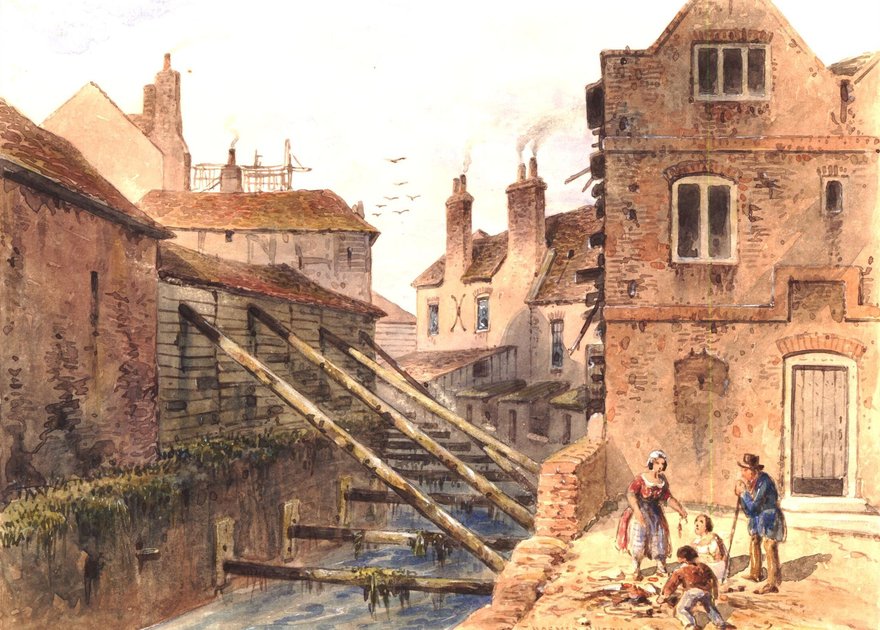
The psychological acceptance of subterranean infrastructure began not with trains, with sewage. By 1700, the Fleet River, once a clear stream known as the "River of Wells," had degenerated into a toxic open sewer. As the population swelled, the Fleet became the primary receptacle for the offal of Smithfield Market and the excrement of Clerkenwell. It was a biological weapon running through the heart of the city. Between 1733 and 1737, the City of London arched over the section from Holborn to Fleet Street, burying the hazard. The lower section followed in 1769. This act of burying the Fleet established a serious precedent: the underground was a place to hide the city's unsightly functions. The "Fleet Ditch" became the "Fleet Sewer," proving that Londoners would tolerate subterranean engineering if it removed filth from their sight.
The pressure to move transport underground was driven by a demographic explosion that physically crushed the medieval street plan. In 1801, the reliable census recorded London's population at approximately 958, 000. By 1851, that figure had surged to 2. 36 million. The density was suffocating. In the City of London, the resident population began to fall as commercial buildings displaced homes, yet the daily influx of workers paralyzed the streets. Commuters walking from the expanding suburbs created a human gridlock that horse-drawn omnibuses could not alleviate. The average speed of traffic in central London during the 1840s dropped to walking pace, rendering the surface transit network functionally obsolete.
London Population and Infrastructure Stress (1801, 1851)
Year
Population
Major Infrastructure Event
1801
958, 863
Census; surface streets remain medieval in layout.
1825
1, 378, 947
Construction begins on the Thames Tunnel (Rotherhithe to Wapping).
1828
~1, 500, 000
Thames Tunnel flood kills six miners; project stalls for seven years.
1843
~2, 100, 000
Thames Tunnel opens; proves sub-river tunneling is possible.
1851
2, 362, 236
Great Exhibition; traffic congestion reaches emergency point.
The engineering viability of an underground railway was proven by the torture of Marc Isambard Brunel. His project to drive a tunnel under the Thames, begun in 1825, was a catalogue of disasters that exposed the lethality of London's geology. Brunel invented the tunneling shield, a rectangular iron cage that supported the face of the excavation while miners dug within individual compartments. This method was necessary because the miners were not digging through solid rock, through the unpredictable soup of the riverbed. On January 12, 1828, the river burst in, drowning six men and nearly killing Brunel's son, Isambard Kingdom Brunel. The project stalled for seven years due to absence of funds and fear of the geology.
When the Thames Tunnel opened in 1843, it was a financial failure a technical triumph. It demonstrated that a tunnel could be maintained within the soft sediments of the London Basin. Although initially used only by pedestrians (and prostitutes, earning it a sordid reputation), the structure confirmed that the earth could hold a void. This proof was necessary for the advocates of the Metropolitan Railway, who faced a skeptical Parliament convinced that tunneling under buildings would cause the city to collapse. The Thames Tunnel remains the oldest section of the modern Underground network, currently carrying the London Overground, a testament to the blood paid for geological knowledge.
By 1850, the conditions for the Underground were set. The clay was suitable, the population was desperate, and the precedent of burying infrastructure was established by the Fleet. The City Solicitor, Charles Pearson, began his tireless campaign for a "train in a drain," arguing that the only way to save the city from its own congestion was to go beneath it. The sanitation failure of the Fleet had taught Londoners to look down; the traffic failure of the 1840s forced them to start digging.
Metropolitan Railway Financing and Cut-and-Cover Displacement (1854, 1890)
Geological Preconditions and the Fleet River Sanitation Failure (1700, 1850)
The financing of the Metropolitan Railway was not a triumph of speculative capitalism, a desperate salvage operation orchestrated by Charles Pearson, the City of London's Solicitor. By 1854, the project was paralyzed. The Crimean War had drained private capital markets, and the initial share offering had failed to attract sufficient investors. Pearson, understanding that the congestion choking the City was an existential threat to its commerce, strong-armed the Corporation of London into an move: a direct investment of £200, 000 (approximately £25 million in 2026 currency). This state-adjacent bailout was the catalyst that unlocked further funding from the Great Western Railway (GWR), bringing the total capital raised to £1. 33 million. It was the clear admission that London's transport infrastructure could not be built by market forces alone.
With capital secured, the physical destruction of the "New Road" ( Euston Road) began in 1860. The engineering method chosen was "cut-and-cover," a sanitized term for a brutal surgical incision through the living tissue of the metropolis. Under the direction of Chief Engineer John Fowler, a trench 33 feet 6 inches wide was gouged out of the earth. The process required the complete demolition of surface structures, the excavation of soil, the construction of brick retaining walls and an arch, and the restoration of the roadway above. For three years, the artery connecting Paddington to King's Cross was an open wound, disrupting trade and choking the district with dust and noise.
The human cost of this engineering marvel was borne almost exclusively by the working poor. The line's trajectory through Clerkenwell and Farringdon necessitated the demolition of dense slum housing. While the railway company was legally obliged to compensate property owners, no such protection existed for the tenants who actually lived there. Investigative analysis of the displacement reveals a: while approximately 300 landlords received compensation for their property titles, an estimated 12, 000 tenants were evicted with zero financial recourse. These "railway refugees" were flushed out of their tenements, forcing them into even more overcrowded rookeries in neighboring districts, the very sanitary emergency the railway was theoretically helping to solve.
The geological risks identified in the previous section materialized with catastrophic force in June 1862. Near Farringdon, the excavation destabilized the Fleet Sewer, the subterranean channel of the buried River Fleet. Following a heavy storm, the sewer walls burst, inundating the railway works with a torrent of effluent and wastewater. The floodwaters rose ten feet deep, collapsing brick arches and scaffolding like matchwood. The disaster cost the company thousands in repairs and delayed the opening, serving as a foul-smelling reminder that London's underground infrastructure was a chaotic palimpsest of forgotten waterways and fragile masonry.
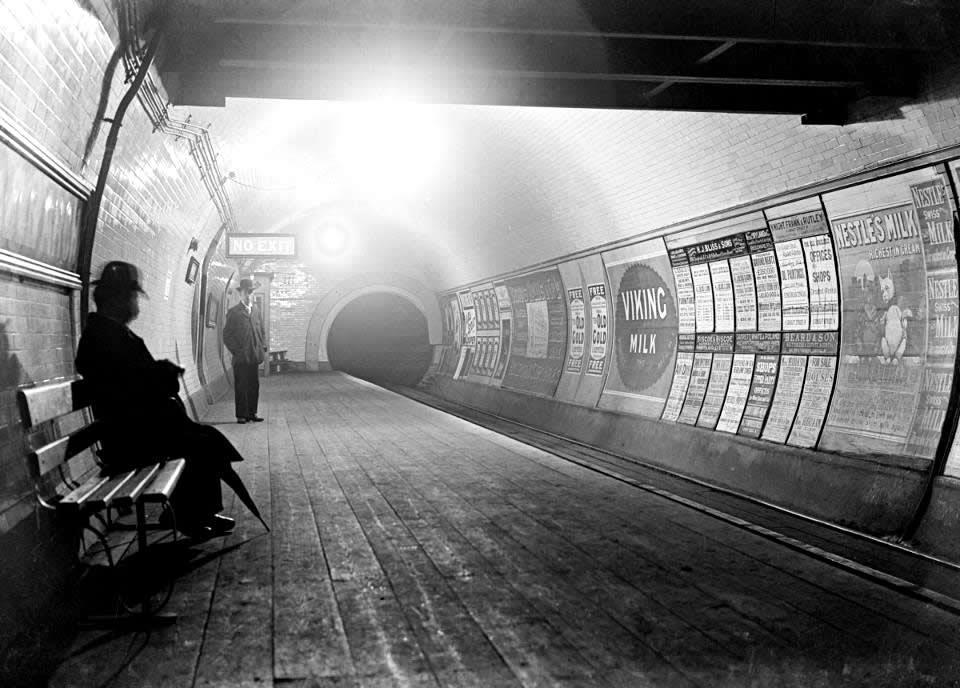
Even with these disasters, the Metropolitan Railway opened to the public on January 10, 1863. The success was immediate and overwhelming. On the day alone, 38, 000 passengers crammed into the gas-lit wooden carriages, hauled by steam locomotives that filled the tunnels with sulfurous smoke and condensing steam. In its twelve months, the line carried 9. 5 million passengers, generating revenue that vindicated Pearson's financial gambling. The data was irrefutable: the demand for subterranean travel was almost infinite.
Metropolitan Railway: Early Operational Metrics (1863, 1864)
Metric
1863 (Year 1)
1864 (Year 2)
Passenger Volume
9, 455, 175
11, 721, 889
Gross Receipts
£101, 707
£116, 489
Daily Average (approx)
26, 000
32, 000
The commercial triumph of the Metropolitan a frenzy of expansion that defined the three decades. The "Inner Circle" (today's Circle Line) became the Holy Grail of London transport planning, yet its completion was delayed until 1884 due to venomous squabbling between the Metropolitan and its rival, the District Railway. This rivalry resulted in a disjointed, adversarial network where cooperation was nonexistent and passengers were frequently left stranded at unconnected termini. The cut-and-cover method continued to tear through the capital, reaching Kensington, Hammersmith, and the City, leaving a legacy of widened lines and displaced communities that permanently altered London's demographic map.
Electrification Wars: Yerkes, Morgan, and the UERL Consolidation (1900, 1918)
The turn of the twentieth century found the London Underground in a state of asphyxiation. Steam locomotives, once the heralds of Victorian progress, had turned the sub-surface lines into sulfurous choke points. The Metropolitan and District Railways were losing passengers to the clean, electric trams seizing the streets above. Electrification was not an option; it was a survival imperative. Yet, London's domestic capital markets, burned by the low returns of earlier rail ventures, refused to fund the necessary transition. Into this financial vacuum stepped Charles Tyson Yerkes, an American financier with a criminal record in Philadelphia and a reputation for ruthless monopolization in Chicago. He did not come to London to build a railway; he came to corner a market. Yerkes's move was the acquisition of the struggling Metropolitan District Railway in 1901. His arrival triggered an immediate technical collision with the Metropolitan Railway. The Met, the older and wealthier partner in the Inner Circle, had already committed to the Ganz system, a Hungarian three-phase alternating current (AC) solution requiring high-voltage overhead wires. Yerkes, backing the District, rejected this out of hand. He insisted on low-voltage direct current (DC) using a fourth rail, a system proven in Chicago and backed by American industrial giant General Electric. The incompatibility threatened to fracture the Inner Circle. The Board of Trade established an arbitration tribunal in late 1901 to settle the dispute. The testimony was brutal; Yerkes's engineers argued that high-voltage AC wires in shallow tunnels were a lethal hazard. The tribunal ruled in favor of Yerkes. The fourth-rail DC system became the standard for the entire London network, a decision that dictates the physics of the Tube to this day. While the engineers fought over voltage, a far more vicious war raged in the boardroom. J. P. Morgan, the titan of Wall Street, had entered the London theater with his own ambition: a rival tube network centered on the "Piccadilly, City and North East London Railway." This proposed line would have cut directly across Yerkes's territory, threatening the viability of his planned group. The conflict, known as the "Great Tube War" of 1901, 1902, was fought in Parliamentary committee rooms. Morgan appeared to have the upper hand until a sudden, devastating betrayal. Yerkes secretly induced the London United Tramways, a key partner in Morgan's consortium, to defect to his side. The collapse of this alliance left Morgan's bill without its required tramway connections, and Parliament threw it out. Morgan, rarely bested, left London in disgust, reportedly calling the maneuver "the greatest rascality and conspiracy I ever heard of." With Morgan vanquished, Yerkes consolidated his prize. In 1902, he formed the Underground Electric Railways Company of London (UERL), a holding company capitalized at £5 million. This entity was not a railway operator a financial engine designed to bypass hesitant British investors. Backed by the Speyer banking family and the Old Colony Trust of Boston, the UERL absorbed the District and three stalled tube projects: the Baker Street & Waterloo (Bakerloo), the Charing Cross, Euston & Hampstead (Hampstead), and the Great Northern, Piccadilly & Brompton (Piccadilly). To power this empire, the UERL constructed the Lots Road Power Station in Chelsea. When it fired up in 1905, it was the largest power station in Europe, consuming 700 tons of coal daily to feed the hungry third and fourth rails of the new electric network. The aggressive expansion came at a ruinous cost. Yerkes died in December 1905, leaving behind a labyrinth of complex financing and debt. When the three "Yerkes Tubes" opened between 1906 and 1907, passenger numbers fell woefully short of the prospectus projections. The Bakerloo carried only 20 percent of its predicted traffic; the Piccadilly managed less than half. The UERL teetered on the edge of insolvency. The American model of high-yield traction monopolies had collided with the reality of London's competitive, fragmented geography. The Speyer brothers, holding the bag for millions in underperforming bonds, realized that financial engineering alone could not run a railroad. Salvation arrived in the form of Albert Stanley, a British-born, American-raised transit manager recruited by the Speyer interests in 1907. Stanley, later Lord Ashfield, understood that the UERL's survival depended on ending the internecine competition between the various underground companies and the bus operators. He initiated a strategy of ruthless integration. Under his leadership, the separate lines began to coordinate fares, print joint maps, and market themselves under a single, unifying brand: the "UndergrounD." The famous roundel logo appeared in 1908, a visual anchor for a disjointed system. By 1912, the UERL had acquired the London General Omnibus Company, securing a monopoly on surface bus transport to feed passengers into the tubes. This "Combine" ended the era of free-market competition in London's transit. When the World War concluded in 1918, the UERL controlled the District, the three major tube lines, the buses, and the trams. The independent Central London and City & South London railways had also been brought into the fold. The chaotic, bankrupt patchwork of 1900 had been forged into a singular, dominant monopoly. Yerkes's methods were piratical, and his financial pledge were fiction, yet his brute force consolidation created the structural skeleton of modern London Transport. The system was no longer a collection of railways; it was a single machine.
UERL Consolidation Timeline (1901, 1918)
Year
Event
Significance
1901
Yerkes buys District Railway
Entry of American capital; beginning of electrification push.
1901
Board of Trade Arbitration
DC (4th rail) selected over Ganz AC; network standard set.
1902
Defeat of J. P. Morgan
Yerkes secures monopoly on Piccadilly route via tramway betrayal.
1902
Formation of UERL
Holding company created to finance Bakerloo, Piccadilly, and Hampstead tubes.
1905
Lots Road Power Station opens
Centralized power supply for the entire UERL network.
1907
Albert Stanley appointed
Shift from financial speculation to operational integration.
1908
"UndergrounD" brand launch
unified marketing and joint mapping of the network.
1912
Acquisition of LGOC
Bus monopoly integrated with rail, forming the "Combine."
Deep-Level Shelter Protocol and Industrial Militarization (1939, 1945)
Metropolitan Railway Financing and Cut-and-Cover Displacement (1854, 1890)
The transformation of the London Underground from a civilian transit network into a hardened military-industrial complex between 1939 and 1945 represents one of the most radical infrastructure repurposing projects in modern engineering history. While popular narratives focus on the "Blitz Spirit" of civilians sheltering on platforms, the operational reality was a state-directed seizure of subterranean assets for strategic command, ballistics manufacture, and mass survival. The government initially opposed the use of Tube stations as shelters, fearing a "deep-level mentality" would paralyze the workforce and halt war production. This policy collapsed in September 1940 when the Luftwaffe began the systematic bombardment of London, forcing the Railway Executive Committee (REC) to capitulate to a public that had already begun smashing locks to access the safety of the clay.
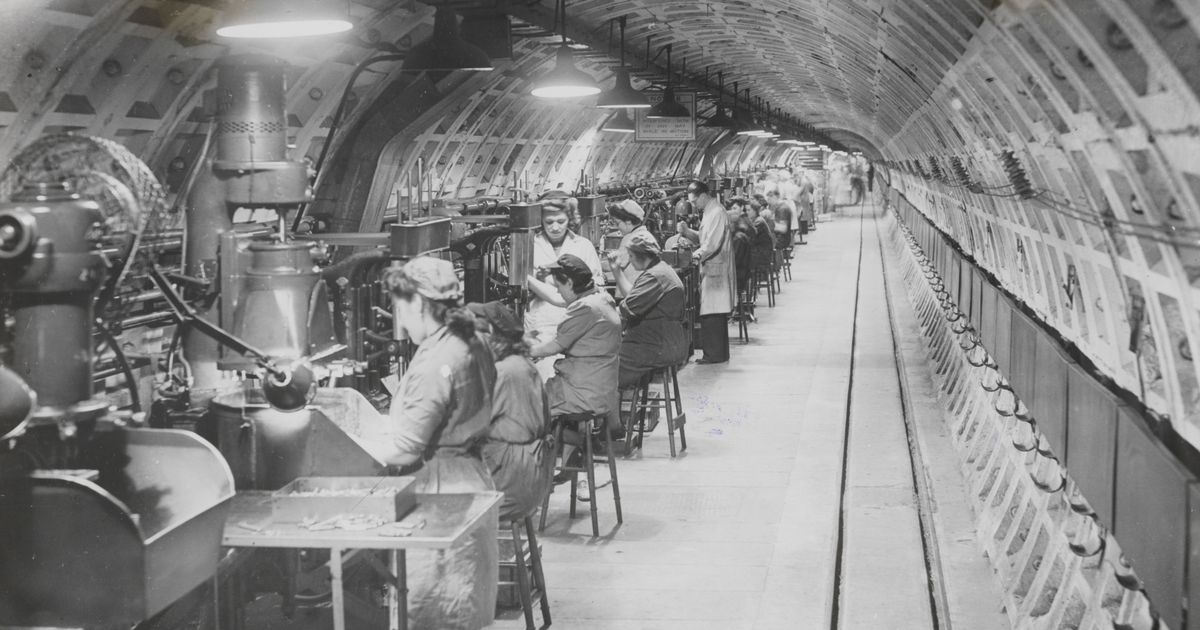
The most significant industrial conversion occurred on the Central Line eastern extension, a project halted by the outbreak of war. In the unfinished twin tunnels running 2. 5 miles between Leytonstone and Gants Hill, the Ministry of Aircraft Production authorized the construction of the Plessey munitions factory. This was not a makeshift workshop a high-output industrial facility occupying 300, 000 square feet of subterranean real estate. By March 1942, the tunnels were fitted with flat concrete floors, air conditioning, and a miniature narrow-gauge railway to transport materials. A workforce of 2, 000, predominantly women, operated heavy 24 hours a day, shielded by sixty feet of earth. The output was serious to the air war: the Plessey tunnels produced wiring looms for Halifax and Lancaster bombers, shell cases, and over 300, 000 fuel pumps for the Rolls-Royce Merlin engines that powered the Spitfire. This facility remains the most successful example of underground industrialization in British history, operating by German intelligence throughout the conflict.
Parallel to this industrialization, the London Passenger Transport Board (LPTB) executed the Deep-Level Shelter Scheme. Unlike the ad-hoc occupation of station platforms, these were purpose-built citadels designed to withstand direct hits from heavy ordnance. The LPTB engineers sank shafts to construct pair-tunnels of 16-foot 6-inch diameter, significantly wider than the standard 11-foot 8-inch running tunnels, located beneath existing Northern Line stations to facilitate future integration into an express rail system. Eight of these deep-level shelters were completed at Belsize Park, Camden Town, Goodge Street, Chancery Lane, Stockwell, Clapham North, Clapham Common, and Clapham South. Each shelter was engineered to house 8, 000 people, providing bunks, medical posts, and canteen facilities for a total capacity of 64, 000. The construction required the excavation of over a million tons of clay, yet the shelters were not opened to the public until 1944, when the V-1 flying bomb campaign renewed the terror of the skies.
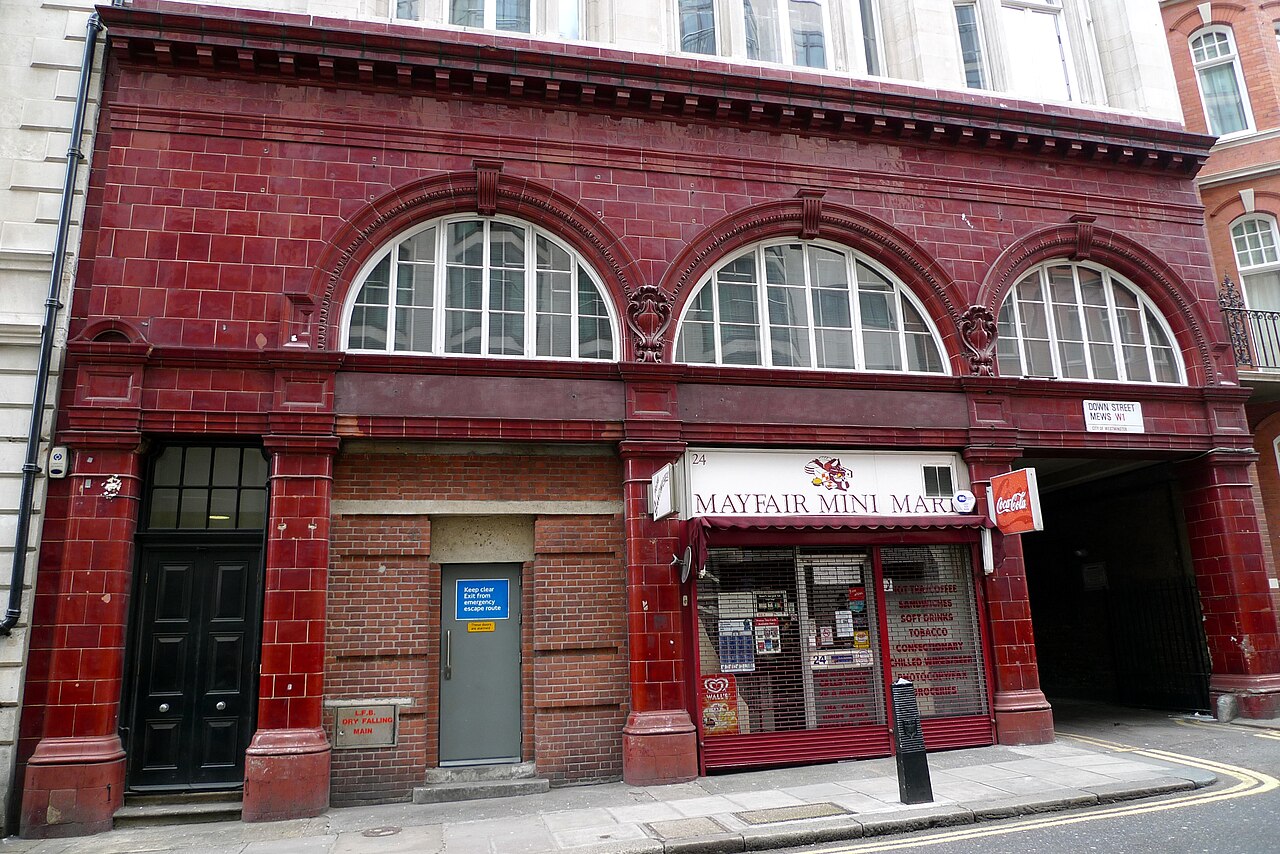
The network also served as the central nervous system for the British government. Down Street station, closed in 1932 due to low ridership, was secretly bricked up and converted into the bomb-proof headquarters of the Railway Executive Committee. Known as "The Barn," it housed the tactical operations center that coordinated the movement of every train in Britain, military and civilian. It also served as a primary bunker for Prime Minister Winston Churchill and the War Cabinet before the completion of the Cabinet War Rooms. The station was fitted with a telephone exchange, dormitories, and an executive mess, all protected by gas-proof airlocks. Similarly, the disused Brompton Road station was requisitioned by the War Office to serve as the control center for the 1st Anti-Aircraft Division, directing the flak batteries defending the capital.
The illusion of subterranean safety was shattered by two catastrophic events that exposed the geological and psychological vulnerabilities of the network. On October 14, 1940, a 1, 400 kg semi-armor-piercing fragmentation bomb struck the road surface directly above Balham station. The weapon did not collapse the tunnel roof; it ruptured the high-pressure water mains and sewage lines in the soil. The explosion created a crater into which a double-decker bus fell, the true agent of death was the slurry. A torrent of water, sand, and gravel, the "sludge" of the Lambeth Group geology, flooded the platform tunnels, drowning or suffocating approximately 66 people. The watertight floodgates, designed to seal off sections of the track, could not be closed in time against the viscosity of the debris flow.
The second disaster, at Bethnal Green on March 3, 1943, involved no enemy action. The station, not yet open for train service, was being used solely as a shelter. During an air raid alert, the sound of a new anti-aircraft rocket battery firing nearby caused a mass panic. A woman carrying a baby tripped on the wet, unlit staircase, triggering a human crush of horrific magnitude. Within seconds, hundreds of bodies were piled onto the landing. The compressive asphyxia killed 173 people, including 62 children, in a space of roughly 300 square feet. The government suppressed the details of the tragedy to prevent a collapse in public morale, marking it as the deadliest civilian incident of the war, caused entirely by the physics of crowd in a confined shaft.
Sanitation in the Tube shelters presented a biological hazard that rivaled the threat of bombing. With 177, 000 people sleeping underground at the peak of the Blitz, the stations absence adequate sewage infrastructure. The LPTB installed thousands of chemical toilets, known as "Elsans," on the platforms. These buckets, filled with formaldehyde, frequently overflowed or were knocked over, creating a toxic miasma that mixed with the stale air of the deep tunnels. To manage the waste, special "sanitation trains" ran through the network in the early hours of the morning. Workers, frequently operating in appalling conditions, manually loaded the waste containers onto these trains for disposal at surface depots. The "mosquito bus," a grim colloquialism for the waste collection service, became a serious component of the Underground's wartime logistics, preventing outbreaks of typhoid and dysentery in the subterranean population.
The protection of national heritage also fell to the Underground. The Aldwych branch, a short spur off the Piccadilly Line, was closed to passenger traffic and converted into a secure vault for the British Museum. The Elgin Marbles, along with priceless manuscripts and artifacts, were stored in the tunnels, protected by the same London Clay that shielded the population. This total mobilization of the network, housing the government, the factories, the people, and the art, demonstrated that the Tube was no longer just a transport system. It had become the subterranean foundation of the British state, a second city constructed in the negative space of the clay, capable of sustaining the war effort even as the surface burned.
Post-War Nationalization and the Victoria Line Automation (1948, 1970)
The nationalization of London's transport network on January 1, 1948, was not a victory lap; it was a salvage operation. Under the Transport Act 1947, the London Passenger Transport Board (LPTB) was dissolved, its assets transferred to the British Transport Commission (BTC), and its operations handed to the new London Transport Executive (LTE). The private-public hybrid that Frank Pick and Lord Ashfield had built into a global icon was a state-owned entity, stripping the network of its autonomy. The LTE inherited a system battered by Luftwaffe bombing, deferred maintenance, and a "Make Do and Mend" philosophy that had stretched mechanical assets to their breaking point. The 1935, 1940 New Works Programme, which promised extensions like the Northern Heights, was largely scrapped. Unfinished viaducts at Bushey Heath and Brockley Hill stood as concrete tombstones to a pre-war optimism that the Treasury could no longer afford. This austerity coincided with a severe labor emergency. By 1955, the Underground faced 3, 500 vacancies. The local workforce, emboldened by full employment in a reconstructing Britain, shunned the unsocial hours and grime of the Tube. The LTE's solution was a logistical pivot that reshaped the demographic reality of London. Beginning in 1956, the Executive launched a direct recruitment campaign in the Caribbean, specifically targeting Barbados. The LTE did not advertise; it established a pipeline. The Barbadian government lent recruits the fare, which was then deducted from their wages over two years. Between 1956 and 1970, approximately 6, 000 workers, including 4, 000 from Barbados, entered the system. These recruits, frequently skilled and overqualified, staffed the stations and operated the trains, keeping the network functional when the domestic labor pool had dried up. While the workforce diversified, the infrastructure stagnated. Central London had not seen a new tube line since 1907. Congestion in the post-war years became untenable, yet the strict financial mandate of the BTC, that the railways must pay their way, paralyzed expansion. The proposed "Route C," connecting Victoria to Walthamstow, was projected to lose money on fare revenue alone. Under traditional accounting, it was a dead project. The deadlock was broken not by engineers, by economists C. D. and M. E. Beesley. In 1963, they published a seminal Cost-Benefit Analysis (CBA) for the Victoria Line. They argued that the value of a railway was not limited to ticket sales included the "social benefit" of time saved by passengers and the relief of road congestion. They quantified these intangibles, proving the line would generate a social return on investment of 11. 3%. This intellectual shift was decisive. It decoupled infrastructure planning from pure profit, allowing the government to approve the £56 million construction budget. The physical construction of the Victoria Line, authorized in 1962, demanded a radical upgrade in tunneling technology. The heavy London Clay, once conquered by the Greathead Shield, faced the "Drum Digger." Developed by Kinnear Moodie, this rotary shield eliminated the manual labor of miners hacking at the clay face. Hydraulic rams pushed the shield forward while rotating teeth cut the earth, which was then carried away by conveyor belts. In the experimental tunnels dug between Finsbury Park and Netherton Road in 1961, the Drum Digger achieved speeds of 3. 5 feet per hour, double the rate of previous methods. This speed was important. The Victoria Line was designed as a deep-level express route with wide station spacing, requiring rapid excavation to meet the aggressive timeline. The Victoria Line's most significant innovation, yet, was invisible to the passenger. It was the automatic railway in the world on this. The 1967 Stock trains were designed without a traditional driver's cab. Instead, they featured a "Train Operator" position. The operator did not drive; they managed the doors and pressed two "Start" buttons simultaneously to initiate movement. The train's brain was a system of coded track circuits. Current pulses in the running rails transmitted speed codes to the train, 420 pulses per minute for full speed, 270 for braking, and 180 for controlled stops. If the train exceeded the coded speed, the emergency brakes applied automatically. This system, tested on the Woodford, Hainault loop of the Central Line in 1964, removed human error from the driving equation. It allowed for a consistent 90-second headway between trains, a frequency impossible with manual control. When the section opened in September 1968, followed by the royal opening by Queen Elizabeth II in March 1969, the Victoria Line represented the apex of 1960s modernism. The stations were tiled not in generic cream with specific motifs, a silhouette of a ton of bricks for Brixton, a cross for King's Cross, designed to aid passenger recognition. The line was a technical triumph, running deeper and faster than its predecessors. It utilized "hump profiles" at stations, where tracks sloped up into the platform to aid braking and down on exit to aid acceleration, a -assisted energy saving measure. Yet, the technical success of the Victoria Line masked a deteriorating financial reality. The Transport Act 1969 ended the BTC era and transferred the Underground to the Greater London Council (GLC) on January 1, 1970. The books were grim. The "golden age" where the Underground cross-subsidized the buses or paid dividends to shareholders was extinct. The network had entered a permanent state of deficit, dependent on central government grants and local rates to function. The 1970 financial data revealed a system where operating costs, driven by inflation and wage demands, consistently outpaced fare revenue. The and Beesley model had justified the capital cost of the Victoria Line, it could not solve the operational bleeding of the wider network. By 1970, the London Underground was a paradox. It possessed the world's most advanced automated railway, the Victoria Line, running beneath a city that was slowly losing its grip on the maintenance of the older lines. The gleaming 1967 Stock trains hummed along the new tunnels, while on the surface, the political to fund the system was fracturing. The era of nationalization had saved the network from bankruptcy, it had not secured its long-term solvency. The stage was set for the decay of the 1970s, where the absence of investment would turn the "social benefit" arguments of the 1960s into a desperate plea for survival. The automation of the Victoria Line was the future, the financial structure supporting it was a relic of the past.
Institutional Neglect and the King's Cross Fire Investigation (1980, 1987)
Electrification Wars: Yerkes, Morgan, and the UERL Consolidation (1900, 1918)
By the mid-1980s, the London Underground had become a monument to managed decline. The political transfer of control in 1984 from the Greater London Council to London Regional Transport marked a decisive shift in priority from public service to financial austerity. The central government, intent on reducing the load on the taxpayer, demanded efficiency above all else. In 1986, the revenue subsidy for the network was slashed from a planned £230 million to just £79 million. This financial strangulation forced management to defer maintenance, cut staffing levels, and ignore the creeping obsolescence of the network's infrastructure. The system was carrying record numbers of passengers, 740 million in 1986, on a skeleton budget. Safety became a secondary concern, eclipsed by the relentless drive to balance the books.
Nowhere was this decay more clear than at King's Cross St. Pancras, a labyrinthine complex connecting five Tube lines and two mainline railway stations. The station relied on heavy-duty wooden escalators installed in the 1930s. These machines, built with cleated wooden steps and plywood side panels, were relics of a pre-war era, churning endlessly beneath the feet of millions. Beneath the visible slats lay a dark accumulation of neglect. For decades, grease from the had mixed with dust, hair, ticket stubs, and clothing lint to form a highly flammable sludge. This "running track" of filth coated the escalator undercarriages, uncleaned and uninspected. Management viewed these machines as strong workhorses; in reality, they were 30-degree wicks waiting for a spark.
The spark arrived at approximately 19: 30 on November 18, 1987. A commuter, likely lighting a cigarette on their way out of the station to beat the smoking ban that applied only to the trains, dropped a match. It fell through a gap between the treads and the skirting board of Escalator 4 on the Piccadilly Line. The match landed in the grease-laden trough. A small fire ignited. Early witnesses described it as innocuous, comparing its size to a large cardboard box. Commuters stepped over the smoke with characteristic London stoicism, assuming it was a minor nuisance. Station staff, untrained in fire safety and absence functioning radios, reacted with confusion rather than urgency. They did not immediately call the London Fire Brigade, believing they could manage the situation themselves. This delay proved fatal.
Physics then conspired with neglect to produce a phenomenon unknown to fire science at the time. As the fire burned within the enclosed wooden trench of the escalator shaft, the flames did not rise vertically as expected. Instead, the airflow and the slope of the escalator caused the superheated gases to adhere to the floor of the trench, a fluid occurrence known as the Coandă effect. This "Trench Effect" drove the flames rapidly up the incline, preheating the wooden steps and side panels ahead of the fire front. The wood, coated in decades of varnish and grease, began to off-gas, releasing a volatile cocktail of hydrocarbons. The escalator shaft became a flamethrower barrel, priming itself for a catastrophic release of energy.
At 19: 45, the fire reached its serious threshold. A flashover occurred. The accumulated gases ignited simultaneously, sending a jet of flame and superheated black smoke roaring up the shaft and into the ticket hall. The blast hit the ceiling, which was coated in over twenty of paint applied one over the other during past renovations. These paint delaminated and burned, adding toxic fuel to the inferno. The ticket hall, crowded with rush-hour commuters, turned into a kiln. Temperatures exceeded 600°C. The thick, acrid smoke obscured exits and asphyxiated victims within seconds. The plastic components of the ticket machines melted, and the tiles peeled from the walls. In the chaos, 31 people died, and over 100 suffered severe injuries.
The subsequent investigation, led by Desmond Fennell QC, peeled back the of administrative failure that led to the tragedy. The Fennell Report, published in 1988, was a devastating indictment of the London Underground's corporate culture. Fennell found that fires on escalators were not anomalies routine occurrences; between 1956 and 1988, there had been over 400 recorded escalator fires. Management accepted these incidents as an operational hazard rather than a warning sign. They termed them "smolderings" to downplay their severity. There were no smoke detectors in the escalator shafts. The water fog equipment, designed to suppress such fires, was not automatic and went unused. Staff had received little to no training in evacuation procedures or the use of fire extinguishers.
Fennell's inquiry exposed a siloed management structure where engineering and operations departments functioned as rival fiefdoms. The engineering directorate did not communicate the fire risks of the paint to the operations team. The safety inspectors were under-resourced and ignored. The report noted a "climate of complacency" where safety was assumed rather than assured. The organization suffered from a shared blindness, believing that because a major disaster had not happened yet, it never would. The concept of "smoker's logic", that a fire would simply burn itself out, permeated the hierarchy from the boardroom to the platform staff.
The financial context of the 1980s played a direct role in this negligence. The pressure to cut costs led to a reduction in cleaning staff, leaving the grease traps to fill with fuel. The removal of uniformed staff from the ticket halls to save money meant there was no one to coordinate an evacuation when the smoke appeared. The decision to keep the wooden escalators in service long past their intended lifespan was a budgetary calculation that ignored the human cost. The King's Cross fire was not an accident of fate; it was the inevitable result of a system that prioritized balance sheets over passenger safety.
King's Cross Fire: Key Metrics of Neglect
Metric
Data Point
Significance
Escalator Age
48 years (Installed 1939)
Wooden construction retained due to budget constraints.
Recorded Fires
400+ (1956, 1987)
Normalized deviance; fires viewed as routine.
Subsidy Cut
£230m to £79m (1986)
Forced deferred maintenance and staff reductions.
Paint
20+
Provided additional fuel for flashover propagation.
Fatalities
31
Direct result of delayed evacuation and flashover.
The aftermath of the fire forced a total reconstruction of the Underground's safety. The wooden escalators were systematically ripped out and replaced with metal versions, a process that took decades to fully complete. Smoking was immediately and strictly banned across the entire network, including the ticket halls. The Fennell Report's 157 recommendations led to the installation of heat detectors, sprinklers, and improved radio communications. Yet, the scars of King's Cross remained. The disaster demonstrated that in a complex subterranean system, the absence of active safety management is not a neutral state; it is a slow march toward catastrophe. The grease under Escalator 4 was not just dirt; it was physical evidence of an institution that had lost sight of its duty of care.
Public-Private Partnership Insolvency and Metronet Liquidation (1999, 2010)
The Public-Private Partnership (PPP) imposed on London Underground in 2003 stands as one of the most expensive administrative failures in British public sector history. Conceived by the Treasury under Chancellor Gordon Brown, the scheme sought to modernize the network without increasing direct government borrowing. The model split the Underground into three infrastructure companies (Infracos) tied to 30-year contracts, while London Underground Limited (LUL) retained operational control of trains and stations. This bifurcation created a fractured command structure that cost the taxpayer billions and delayed essential upgrades for years.
The political genesis of the PPP was defined by a bitter conflict between the Treasury and the newly created Mayor of London, Ken Livingstone. Livingstone and his Transport Commissioner, Bob Kiley, argued for a bond-issuance model, which they calculated would save £4. 5 billion over the contract life compared to the higher cost of private capital. The Treasury rejected this, insisting on risk transfer to the private sector. The legal and consultancy fees alone to establish the PPP contracts totaled £500 million before a single track was laid. In 2003, the network was carved up: Metronet BCV took the Bakerloo, Central, Victoria, and Waterloo & City lines; Metronet SSL took the Sub-Surface lines; and Tube Lines took the Jubilee, Northern, and Piccadilly lines.
Metronet, the larger of the two consortia, was a corporate structure designed for failure. Its shareholders, Atkins, Balfour Beatty, Bombardier, EDF Energy, and Thames Water, operated a "tied supply chain." Instead of competitively tendering work to the most bidder, the consortium awarded lucrative contracts directly to its own parent companies. This arrangement eliminated market discipline. Costs for station refurbishments spiraled out of control. By 2007, Metronet had spent hundreds of millions to renovate stations yet had completed only 14 of the 35 scheduled for delivery. The consortium projected a cost overrun of £2 billion within the 7. 5-year review period.
The collapse arrived in July 2007. Metronet demanded an extraordinary hike in payments from London Underground to cover its. The PPP Arbiter, Chris Bolt, reviewed the claim and ruled that Metronet was entitled to only £121 million of the £992 million it requested, citing the company's failure to operate. Insolvency followed immediately. The administration of Metronet exposed the fallacy of the "risk transfer" argument central to the PPP's justification. Because the contracts guaranteed 95 percent of the lenders' debt, the Department for Transport was forced to pay £1. 7 billion to settle Metronet's liabilities. The National Audit Office later estimated the direct loss to the taxpayer from the Metronet debacle at up to £410 million.
Tube Lines, owned by Bechtel and Amey (Ferrovial), operated differently. It used competitive tendering and delivered upgrades on the Jubilee and Northern lines, though frequently with severe disruption to weekend services. Yet, the friction between the private operator and the public authority. By 2009, a dispute arose over the cost of the wave of upgrades. Tube Lines claimed it needed £5. 75 billion; Transport for London (TfL) offered £4 billion. The Arbiter set the figure at £4. 46 billion, leaving a funding gap TfL could not close without cutting services elsewhere. In May 2010, TfL agreed to buy Tube Lines for £310 million, bringing all maintenance operations back under public control and ending the PPP experiment.
Financial Impact of PPP Failure (2003, 2010)
Entity
Outcome
Cost to Public/TfL
Metronet (BCV & SSL)
Administration (2007)
£1. 7 billion (Debt repayment)
Tube Lines
Acquired by TfL (2010)
£310 million (Purchase price)
Consultancy Fees
Setup Costs (1997, 2003)
£500 million
Total Direct Impact
System Re-nationalized
~£2. 5 billion+
The operational legacy of the PPP was a mixed record of new rolling stock and stalled signaling projects. While Metronet successfully introduced the 2009 Stock on the Victoria line, its collapse delayed the line's signaling upgrade. The Victoria line upgrade, important for increasing frequency, was only completed after TfL took over. Similarly, the Sub-Surface upgrade (S Stock trains and new signaling) was years behind schedule. The PPP era demonstrated that separating infrastructure maintenance from daily operations in a complex, century-old urban rail network created misalignment of incentives that no contract could resolve. The reintegration of these services into TfL in 2010 allowed for a unified method to the massive investment program required for the 2012 London Olympics.
Terrorism Response Mechanisms and the 7/7 Coordinated Attacks (2005)
Deep-Level Shelter Protocol and Industrial Militarization (1939, 1945)
The security architecture of the London Underground was not forged on July 7, 2005. It was hardened decades earlier by the Irish Republican Army (IRA), whose campaigns turned the network into a political pressure valve. Between 1939 and the 1990s, the IRA targeted the Tube repeatedly, establishing a grim baseline for threat detection. The 1939 attacks at Tottenham Court Road and Leicester Square signaled the network's vulnerability, yet the campaigns of the 1970s and early 1990s forced structural changes that remain visible today. The removal of waste bins from stations, a direct response to devices left in public receptacles, became the most enduring symbol of this era. By 1991, when a bomb exploded at Victoria station killing one man, the system had developed a "security theater" designed to deter conventional paramilitary devices. These measures, against warnings and code words, proved useless against the no-warning suicide tactics deployed in 2005.
On the morning of July 7, 2005, the threat method shifted from political negotiation to maximum lethality. At approximately 08: 50 AM, three coordinated improvised explosive devices (IEDs) detonated within fifty seconds of each other. The attackers, Mohammad Sidique Khan, Shehzad Tanweer, and Germaine Lindsay, targeted the Circle and Piccadilly lines. A fourth bomber, Hasib Hussain, detonated his device on a bus at Tavistock Square nearly an hour later. The choice of locations dictated the casualty count. The explosions at Aldgate and Edgware Road occurred on "sub-surface" lines where the tunnels are wide and rectangular, allowing the blast wave to dissipate somewhat. The death tolls there were seven and six, respectively. The explosion between King's Cross and Russell Square occurred deep within the Piccadilly Line's narrow bored tunnel. The physics of the deep tube meant the blast force had nowhere to escape through the carriage and the bodies of commuters. Twenty-six people died in that single carriage.
7/7 Coordinated Attacks: Casualty Distribution by Location
Location
Line Type
Time (BST)
Fatalities (Excl. Bomber)
Aldgate
Sub-Surface (Circle)
08: 49
7
Edgware Road
Sub-Surface (Circle)
08: 50
6
King's Cross / Russell Sq
Deep Tube (Piccadilly)
08: 50
26
Tavistock Square
Surface (Bus No. 30)
09: 47
13
The immediate aftermath revealed a catastrophic failure in communications infrastructure. The "Connect" project, a Private Finance Initiative (PFI) contract intended to upgrade the Underground's radio systems, was behind schedule. On the day of the attacks, the digital TETRA radios used by emergency services did not function ground. Fire, ambulance, and police commanders could not speak to each other or to the Tube drivers trapped in the tunnels. The "Golden Hour", the sixty-minute window where medical intervention is most , was consumed by silence and confusion. Runners had to physically sprint from platform to surface to relay messages, a method of communication that predated the telegraph. This technological void forced station staff to make life-or-death triage decisions without professional medical guidance.
The operational response was further by the classification of the incident. Network Control initially attributed the blasts to a power surge, a common electrical fault. This misidentification delayed the declaration of a major incident. It was not until survivors began emerging from the smoke at King's Cross that the reality of a coordinated attack became clear. The inability to distinguish between a technical failure and a hostile act in the fifteen minutes paralyzed the deployment of specialist counter-terrorism assets. The inquest led by Lady Justice Hallett in 2011 later examined these failures. While the verdict concluded that the delays did not directly cause the deaths of the 52 victims, most died instantly or within minutes, the report produced a Rule 43 recommendation demanding the immediate rollout of Airwave radios underground. This finding forced Transport for London (TfL) to accelerate the Connect project, bridging the communications gap years after the deadline.
Terrorism response method evolved again following the failed attacks of July 21, 2005, and the subsequent shooting of Jean Charles de Menezes. The "shoot-to-kill" policy, known as Operation Kratos, came under intense scrutiny. The strategy relied on the premise that a suicide bomber must be incapacitated instantly by a shot to the brain to prevent detonation. The tragic error at Stockwell station, where police killed an innocent Brazilian electrician, forced a recalibration of armed response. The focus shifted toward behavioral detection and intelligence-led interdiction rather than solely relying on terminal force at the point of contact. By 2026, these had morphed into sophisticated surveillance grids, yet the human element of decision-making remains the final fail-safe.
The attack at Parsons Green on September 15, 2017, tested the post-7/7 improvements. An improvised bucket bomb containing TATP (triacetone triperoxide) partially detonated on a District Line train. Unlike the 2005 devices, which used high-grade organic peroxide mixtures that fully atomized, the Parsons Green device created a fireball rather than a concussive blast. Thirty people suffered burn injuries, yet no one died. The response speed showed a marked improvement over 2005. The Joint Terrorism Analysis Centre (JTAC) raised the threat level to its maximum setting within hours, triggering Operation Temperer, which deployed military personnel to guard key infrastructure. This allowed armed police to flood the transport network. The rapid identification of the suspect via CCTV, tracking him from the station to the port of Dover, demonstrated the integration of digital forensics into the immediate response pattern.
As of 2026, the London Underground operates under a surveillance doctrine defined by density and automation. The network hosts over 15, 500 CCTV cameras, a number that has grown exponentially since the analog tape days of the 1990s. The modern "Connect" system, managed through updated contracts with Thales and Nokia, provides the backbone for real-time data transmission. This digital pipe supports not just voice communication high-definition video feeds capable of running behavioral analysis algorithms. These systems are designed to flag abandoned luggage or erratic passenger movements automatically, reducing the reliance on human vigilance. The integration of the Emergency Services Network (ESN) on 4G and 5G infrastructure ensures that the communications blackout of 2005 cannot be repeated. Yet, the physical reality of the deep tube remains. No amount of software can widen the tunnels or provide escape routes where none exist. The geology that dictated the network's construction in the 1900s still dictates the lethality of any attack in the 2020s.
Crossrail Engineering Delays and Budget Overruns (2008, 2022)
The collapse of the Crossrail delivery schedule represents one of the most significant failures in modern British civil engineering management. Between the granting of Royal Assent in 2008 and the eventual opening of the central section in May 2022, the project mutated from a £14. 8 billion flagship into an £18. 9 billion financial quagmire. For a decade, Crossrail Ltd operated under a "green" status reporting culture that systematically concealed the project's true state from its sponsors, Transport for London (TfL) and the Department for Transport (DfT). This illusion shattered on August 31, 2018, just four months before the Queen was scheduled to open the line. The announcement that the railway would miss its December deadline was not a minor slip; it was an admission that the system integration phase had barely begun.
The primary technical cause of this paralysis was the decision to integrate three distinct signaling systems into a single rolling stock fleet. The Class 345 Aventra trains, manufactured by Bombardier (later Alstom), were required to perform a digital handshake at 60 miles per hour, switching direct between legacy safety systems and new automation. On the western surface sections from Heathrow and Reading, the trains use the European Train Control System (ETCS) Level 2. In the central tunnel core, they switch to Communications-Based Train Control (CBTC), a proprietary system supplied by Siemens. On the eastern Great Eastern Main Line, they revert to the Automatic Warning System (AWS) and Train Protection and Warning System (TPWS), technologies with roots in the mid-20th century.
This "three-brain" architecture created a software nightmare. During testing at the Melton Mowbray test track and in the tunnels, the on-board computers frequently failed to transition between systems, causing emergency braking and "screen freezes" where the driver lost all diagnostic data. The integration was further complicated by the contractual separation between the train manufacturer (Bombardier) and the signaling provider (Siemens). Instead of a unified system, engineers spent years debugging the interfaces between rival proprietary codes. By 2019, the project had accumulated over 200, 000 outstanding snagging items, ranging from software bugs to physical defects in station fit-outs.
While the signaling software remained invisible to the public, the physical failure at Bond Street station became a monument to the project's mismanagement. The station is situated in Mayfair, where the subterranean geology is a treacherous mix of London Clay and the sandy, water-logged Lambeth Group. In 2014, tunneling delays at Bond Street put the station a full year behind schedule. Management then compounded this error by using the unfinished station box as a "mustering point" for the extraction of tunnel boring machines. This decision prioritized the movement of heavy over the station's internal construction, rendering the site inaccessible to fit-out contractors for months. When the central section opened in May 2022, Bond Street remained closed, a ghost station that trains bypassed until November of that year.
The financial was driven by a systematic underestimation of risk. In 2010, the detailed Spending Review cut the project's funding envelope from £15. 9 billion to £14. 8 billion, a political maneuver that stripped away important contingency funds. As delays mounted, the cost of maintaining the "standing army" of contractors, costing up to £30 million per week, burned through the remaining budget. The National Audit Office (NAO) later reported that the program's "compressed schedule" strategy, adopted in a desperate attempt to hit the 2018 deadline, actually destroyed productivity. Contractors were forced to work out of sequence, installing electrical systems before the tunnels were watertight, leading to expensive rework.
Crossrail Cost Escalation and Timeline Slippage (2010, 2022)
Date
Event / Status
Estimated Cost
Planned Opening
Oct 2010
detailed Spending Review
£14. 8 billion
Dec 2018
July 2018
DfT Funding Increase
£15. 4 billion
Dec 2018
Aug 2018
Delay Announcement
Unknown
Autumn 2019
Nov 2019
Revised Plan (Mark Wild)
£18. 25 billion
2021
July 2021
NAO Report Update
£18. 9 billion
Half 2022
May 2022
Central Section Opens
£18. 9 billion (Final)
Actual: May 24, 2022
The governance structure of Crossrail Ltd also insulated the board from reality. The project operated as an autonomous arm's-length body, distinct from TfL. This separation allowed the executive team to filter bad news before it reached the Mayor of London or the DfT. It was not until December 2018, following the resignation of chairman Sir Terry Morgan, that the full extent of the emergency was revealed. The incoming CEO, Mark Wild, discovered that the "98% complete" figure touted by the previous administration was mathematically accurate regarding physical construction operationally meaningless. The remaining 2% represented the complex systems integration, which takes disproportionately longer than pouring concrete.
By 2026, the Elizabeth line (as it was rebranded) had established itself as the busiest railway in Britain, carrying over 700, 000 passengers daily and generating £160 million in revenue per quarter. Liverpool Street station overtook Waterloo as the busiest station in the UK, driven entirely by the influx of Elizabeth line commuters. The operational reliability eventually stabilized, with the Class 345 fleet achieving high availability rates. Yet, the financial scar remains. The £4 billion overspend be serviced by London's farepayers and business rate supplements for decades. The project proved that while Victorian engineering conquered the clay, 21st-century engineering nearly drowned in the code.
Air Quality Toxicity and Particulate Matter Analysis (2015, 2024)
Post-War Nationalization and the Victoria Line Automation (1948, 1970)
The subterranean atmosphere of the London Underground is not air; it is a metallic suspension. For over a century, the friction of steel wheels against steel rails, combined with the degradation of braking blocks and the arcing of current collectors, has generated a unique, toxic particulate cloud trapped within the deep-level tunnels. By 2024, analysis confirmed that the air in the deepest lines contained particulate matter (PM) concentrations up to 15 times higher than the air at street level, a that defines the network's modern environmental emergency. The composition of this dust is distinct from surface pollution. While London's roadside air is choked with carbonaceous soot from combustion engines, the Underground's particulate matter is approximately 47% to 67% iron oxide. This "tube dust" consists of maghemite and magnetite, forms of oxidized iron that are highly magnetic. The remainder is a grim slurry of quartz silica from the track ballast, clothing fibers, skin cells, and hair shed by millions of passengers. A 2022 study by the University of Cambridge identified ultrafine magnetic particles as small as five nanometers, small enough to bypass the lungs' filtration systems and enter the human bloodstream directly. These particles, suspended by the piston effect of passing trains, do not settle. They are ground finer with every wheel rotation, creating a cumulative aerosol that has nowhere to go. The between lines is a function of depth and ventilation. The sub-surface lines (District, Circle, Hammersmith & City, Metropolitan) benefit from frequent open-air sections and larger tunnels that allow pollutants to disperse. The deep-level lines (Victoria, Northern, Bakerloo, Central) are sealed tubes where the air is recycled rather than replaced. Data collected between 2019 and 2024 established the Victoria Line as the most polluted artery in the network, frequently recording PM2. 5 levels exceeding 300 micrograms per cubic meter ($mu g/m^3$). For context, the World Health Organization (WHO) guideline for a safe annual mean is 5 $mu g/m^3$.
Line / Location
Tunnel Type
Median PM2. 5 ($mu g/m^3$)
Toxicity Multiplier (vs. Surface)
Victoria Line
Deep Level
361
~16. 4x
Northern Line
Deep Level
194
~8. 8x
Bakerloo Line
Deep Level
55
~2. 5x
District Line
Sub-Surface
4
0. 2x (Cleaner than road)
London Roadside
Surface Ambient
22
Baseline
The health of this metallic haze became a central focus of investigation in the early 2020s. An Imperial College London study published in 2024, the largest of its kind, examined sickness absence records for nearly 30, 000 Transport for London (TfL) staff. While the study found that drivers on deep lines and staff at interchange stations had significantly higher exposure, it stopped short of declaring a definitive "exposure-response relationship" for sickness absence. Yet, this conclusion was met with skepticism by unions and independent researchers who pointed to the "healthy worker effect", the statistical bias where those most affected by the environment leave the workforce, leaving only the resilient behind. The Cambridge research provided a darker biological method: the iron oxide particles are not inert. Their magnetic properties and ultrafine size allow them to induce oxidative stress in cellular structures, a known precursor to inflammation and cardiovascular disease. TfL's response to the emergency has been characterized by technological setbacks and regulatory arbitrage. Officials frequently cite compliance with Health and Safety Executive (HSE) limits for "nuisance dust" or iron oxide in industrial settings. These limits are designed for welders or factory workers using protective equipment over eight-hour shifts, not for the general public or transport staff exposed daily over decades. The permissible HSE limit for inhalable dust is 10, 000 $mu g/m^3$, a figure so high relative to WHO health standards that it renders the "compliance" claim meaningless in a public health context. Attempts to clean the tunnels have failed to match the of the problem. In 2014, TfL abandoned a "Tunnel Cleaning Train" project after spending years and millions on development; the machine reportedly generated too much heat and threatened to damage sensitive tunnel infrastructure. For the subsequent decade, the network relied on manual cleaning crews walking the tracks with backpack vacuums, a method akin to cleaning a beach with a teaspoon. By 2023, TfL increased its cleaning budget to £2 million annually and began trials of "magnetic filtration" systems at stations like Baker Street and Green Park. These units, designed to trap the ferrous particles before they could be inhaled, represented a shift toward acknowledging the specific metallic nature of the threat. In late 2024, a trial for a new "Bespoke Track Cleaning Train" was initiated, aiming to automate the removal of the deep-seated dust cake lining the tunnel ribs. Yet, the legacy of the Victorian infrastructure remains the primary obstacle. The deep tubes were designed without ventilation shafts for air exchange, relying entirely on the movement of trains to push air forward. As train frequency increased to meet modern demand, the heat and dust became trapped in a closed loop. The introduction of new rolling stock on the Piccadilly Line in 2025 offered a partial engineering solution; these trains feature regenerative braking systems that reduce the friction-based mechanical braking that generates the iron dust. Even with these upgrades, the historical accumulation of a century of steel abrasion remains coating the walls, ready to be re-suspended by the passing train. By 2026, the "London Underground Kidney", a colloquialism for the black mucus coughed up by regular commuters, remained a tangible symptom of the city's subterranean compromise. The air quality data confirms that while the Tube is the circulatory system of the capital's economy, it functions biologically as a respiratory load for the millions who descend into the clay. The between the "safe" industrial limits by operators and the biological warnings issued by medical researchers defines the current standoff, with the lungs of Londoners serving as the filter of last resort.
Post-Pandemic Revenue Deficits and Fare Box Volatility (2020, 2025)
The financial disintegration of Transport for London (TfL) between 2020 and 2022 forced the operator into a dependency on central government in its history. Passenger revenue, which previously covered 72% of operating costs, collapsed by 95% during the lockdown, stripping the network of £1. 5 billion in fares within weeks. To prevent insolvency, the Department for Transport (DfT) injected over £6 billion in emergency funding through a series of short-term settlements. These bailouts came with strict conditions, including a requirement for TfL to generate £0. 5 billion to £1 billion in new annual revenue from 2023 onwards. The uncertainty peaked in August 2022, when TfL officials warned of a "managed decline" scenario that would have necessitated an 18% reduction in bus services and a 9% cut to Tube capacity without a long-term capital deal.
Ridership recovery stalled significantly pre-pandemic forecasts throughout 2023 and 2024. While weekend leisure travel rebounded to near 2019 levels, weekday commuter journeys on the Tube plateaued at approximately 81% of pre-pandemic volume by late 2024. This structural shift in demand created a persistent revenue gap. In the 2024/25 financial year, TfL forecasted a 6% rise in passenger journeys achieved only 1. 3%, resulting in a £209 million shortfall against fare. The network's financial stability in this period relied heavily on the Elizabeth line, which carried over 546 million passengers between its 2022 opening and May 2025, subsidizing the slower recovery of the legacy Underground lines.
Fare policy became a volatile method to plug these deficits, characterized by sharp increases and targeted price hikes. In March 2023, fares rose by 5. 9%, the largest increase in a decade. Although Mayor Sadiq Khan froze TfL-controlled fares in 2024, the reprieve ended in March 2025 when Tube and rail fares increased by 4. 6% to align with National Rail pricing, a condition mandated by the government for future capital funding. TfL also aggressively monetized specific routes; in September 2022, the Mayor permanently removed off-peak fares for journeys to Heathrow Airport, raising the standard fare to £5. 50 ( £5. 80) to capture higher revenue from tourists and business travelers.
By the start of the 2025/26 fiscal year, TfL achieved a technical operating surplus, yet its balance sheet remains load by £16. 3 billion in debt. The organization forecasts a slender operating surplus of £5 million for the full year, a margin that leaves no room for error. Capital investment remains constrained; the government provided only £250 million of the £500 million requested for 2024/25, forcing TfL to rephase payments for the new Piccadilly line trains. A longer-term stability materialized in June 2025, when the government agreed to a £2. 2 billion capital settlement covering 2026 to 2030, ending five years of hand-to-mouth financial survival.
London Underground & TfL Financial Performance (2020, 2025)
Metric
2020/21
2022/23
2024/25 (Actual/Est)
Passenger Income
£1. 6 billion
£4. 2 billion
£5. 0 billion
Govt. Emergency Support
£2. 5 billion
£1. 2 billion
£0 (Emergency Ended)
Total Debt
£13. 0 billion
£15. 2 billion
£16. 3 billion
Weekday Tube Ridership
~20% (vs 2019)
~75% (vs 2019)
81% (vs 2019)
Fare Increase (Tube)
Frozen
+5. 9%
+4. 6%
Automated Train Operation and Bakerloo Line Extension Status (2026)
The history of the London Underground is a timeline of technological leaps punctuated by decades of stagnation, and nowhere is this more visible than in the evolution of Automated Train Operation (ATO). While the popular imagination frequently places driverless trains in the domain of 21st-century futurism, London achieved this mechanical autonomy in 1967. The Victoria line opened as the world's fully automatic deep-level railway, a feat of engineering that renders modern political debates about "driverless" trains ironically belated. The system used a "fixed block" method where coded electrical impulses (running at 125 Hz) were transmitted through the running rails. These codes, 420 pulses per minute for full speed, 270 for braking, 180 for controlled stops, were picked up by induction coils mounted on the 1967 Stock trains. The "driver" became a "train operator," responsible only for closing the doors and two "Start" buttons simultaneously to engage the autopilot. For nearly sixty years, this 1960s logic has underpinned the safest rapid transit operations in the capital.
By 2026, the definition of automation has shifted from the fixed blocks of the Victoria line to Communications-Based Train Control (CBTC), a "moving block" system that allows trains to operate safely in closer proximity. This technology, supplied by Thales (SelTrac) and Siemens, theoretically permits frequencies of up to 32 trains per hour. Yet, the implementation has been a slow, grinding war against the network's Victorian geometry. The "Four Lines Modernisation" (4LM) program, tasked with installing CBTC on the Circle, District, Hammersmith & City, and Metropolitan lines, became a notorious case study in delay. Originally contracted to Bombardier in 2011 and canceled in 2014, the project was handed to Thales. As of February 2026, the signaling upgrade is still inching toward completion, with the section between Finchley Road and Preston Road only integrated. The pledge of automation frequently collides with the reality of mixed-traffic railways where 19th-century steam tunnels meet digital logic.
The arrival of the Siemens Mobility "Inspiro London" trains (Class 24) on the Piccadilly line serves as the current litmus test for this technological friction. In 2018, Transport for London (TfL) signed a £1. 5 billion contract for 94 of these articulated, air-conditioned trains to replace the decaying 1973 Stock. The timeline was optimistic: passenger service by 2025. yet, the integration of 21st-century software into a line built in 1906 proved more "complex" than anticipated. By early 2026, TfL confirmed that passenger service would not begin until the second half of the year. The delay from the hazardous interplay between the new train's computer brain and the legacy infrastructure, specifically, ensuring the train's aggressive acceleration curves do not overwhelm the ancient power supply or signaling blocks before the full line upgrade is complete. Even when these trains enter service in late 2026, they initially run under manual protection, constrained by the old signaling system until funding permits the full rollout of the intended high-frequency automation.
This gap between engineering capability and financial reality defines the status of the "driverless" debate. Former Prime Minister Boris Johnson frequently demanded "driverless" trains (Grade of Automation 4, or GoA4) as a method to break the power of the trade unions (RMT and ASLEF). Engineering studies commissioned by TfL repeatedly dismantled this political ambition. The deep tube lines, with their single-bore tunnels and absence of side walkways, present a serious safety hazard for unattended train operation. In an emergency evacuation, a member of staff must be present to guide passengers. Retrofitting platform edge doors, a requirement for safe GoA4, would cost billions and require straightening curved platforms at historic stations. Consequently, in December 2024, Mayor Sadiq Khan confirmed that the of driverless trains on existing deep tube lines was dead. The network remains at GoA2 (Semi-automatic), where the machine drives, the human guards the doors and the passengers.
If the Piccadilly line represents delayed progress, the Bakerloo Line Extension (BLE) represents the paralysis of hope. The proposal to extend the line south from Elephant & Castle to Lewisham (and chance Hayes) has existed in various forms since 1931. The geological argument is sound: the extension would cut through the "railway desert" of southeast London, serving the Old Kent Road opportunity area. The economic case is also strong, with the chance to unlock 20, 000 new homes. Yet, the project has become a phantom, appearing in every TfL long-term strategy whenever the Treasury opens its chequebook.
In 2021, the route was officially "safeguarded" by the Secretary of State for Transport, a legal maneuver that prevents developers from building deep foundations in the proposed tunnel route. This is the only tangible progress the scheme has seen in a decade. The estimated cost ballooned from £3 billion in 2014 to a range of £5. 2 billion to £8. 7 billion by 2025 (at 2021 prices). Following the financial devastation of the pandemic and the subsequent inflation emergency, the BLE was frozen. In the Autumn 2025 Budget, even with lobbying from Southwark and Lewisham councils, the central government allocated zero capital funding for the extension. The project remains in a "development" phase, meaning TfL pays planners to keep the diagrams warm while the tunnels remain undug.
The only physical evidence of the Bakerloo's future in 2026 is the construction work at Elephant & Castle. A new station box is being excavated as part of a private shopping center redevelopment, designed to accommodate the future extension. This "station box" is a concrete shell waiting for a train that may not arrive for another twenty years. Meanwhile, the Bakerloo line operates the oldest trains in regular passenger service in the United Kingdom. The 1972 Stock, 54 years old, suffers from structural corrosion and failing traction motors. While Sadiq Khan's 2026 budget committed to procuring a replacement fleet (likely an option on the Siemens Piccadilly contract), the funding is drip-fed, with only £24 million allocated in the year. The "Grand Old Duke of York" strategy continues: the line is marched up the hill of safeguarding and planning, only to be marched back down by fiscal austerity.
Table 12. 1: Status of Major Capital Projects (February 2026)
Project
Original Target
2026 Status
Primary Obstacle
Piccadilly Line Upgrade
2025 (Service Entry)
Delayed to H2 2026
Software/Infrastructure Integration
Four Lines Modernisation (4LM)
2018 (Completion)
Ongoing (Partial)
Signaling Complexity (Thales)
Bakerloo Line Extension
2030 (Completion)
Unfunded / Safeguarded
Capital Funding Absence (£5-8bn gap)
Bakerloo Fleet Replacement
2020 (Replacement)
Procurement Phase
Funding confirmed Feb 2026; Delivery ~2030
Central Line Refurbishment (CLIP)
2023 (Completion)
Ongoing
Supply Chain / Motor Failures
The state of the London Underground in 2026 is a paradox of advanced automation and managed decline. On the Victoria and Jubilee lines, computers drive trains with a precision no human can match, delivering frequencies that sustain the city's economy. On the Bakerloo, commuters ride trains built when the Beatles were still together, waiting for an extension that exists only on paper. The network has survived the Fleet River, the Blitz, and the Treasury, it currently sits in a precarious equilibrium, waiting for the capital investment required to turn its 20th-century legacy into a 21st-century system.
Why it matters: Millions of women and girls in India are employed as domestic workers, facing exploitation and lack of legal protection. Despite being essential to urban life,…
What do we know about Geological Preconditions and the Fleet River Sanitation Failure?
London's subterranean destiny was scripted fifty million years before the pickaxe struck the earth. The city sits upon a geological knife-edge that dictated the chaotic sprawl of the modern Underground map.
What do we know about Metropolitan Railway Financing and Cut-and-Cover Displacement?
The financing of the Metropolitan Railway was not a triumph of speculative capitalism, a desperate salvage operation orchestrated by Charles Pearson, the City of London's Solicitor. By 1854, the project was paralyzed.
What do we know about Electrification Wars: Yerkes, Morgan, and the UERL Consolidation?
The turn of the twentieth century found the London Underground in a state of asphyxiation. Steam locomotives, once the heralds of Victorian progress, had turned the sub-surface lines into sulfurous choke points.
What do we know about Deep-Level Shelter Protocol and Industrial Militarization?
The transformation of the London Underground from a civilian transit network into a hardened military-industrial complex between 1939 and 1945 represents one of the most radical infrastructure repurposing projects in modern engineering history. While popular narratives focus on the "Blitz Spirit" of civilians sheltering on platforms, the operational reality was a state-directed seizure of subterranean assets for strategic command, ballistics manufacture, and mass survival.
What do we know about Post-War Nationalization and the Victoria Line Automation?
The nationalization of London's transport network on January 1, 1948, was not a victory lap; it was a salvage operation. Under the Transport Act 1947, the London Passenger Transport Board (LPTB) was dissolved, its assets transferred to the British Transport Commission (BTC), and its operations handed to the new London Transport Executive (LTE).
What do we know about Institutional Neglect and the King's Cross Fire Investigation?
By the mid-1980s, the London Underground had become a monument to managed decline. The political transfer of control in 1984 from the Greater London Council to London Regional Transport marked a decisive shift in priority from public service to financial austerity.
What do we know about Public-Private Partnership Insolvency and Metronet Liquidation?
The Public-Private Partnership (PPP) imposed on London Underground in 2003 stands as one of the most expensive administrative failures in British public sector history. Conceived by the Treasury under Chancellor Gordon Brown, the scheme sought to modernize the network without increasing direct government borrowing.
What do we know about Terrorism Response Mechanisms and the 7/7 Coordinated Attacks?
The security architecture of the London Underground was not forged on July 7, 2005. It was hardened decades earlier by the Irish Republican Army (IRA), whose campaigns turned the network into a political pressure valve.
What do we know about Crossrail Engineering Delays and Budget Overruns?
The collapse of the Crossrail delivery schedule represents one of the most significant failures in modern British civil engineering management. Between the granting of Royal Assent in 2008 and the eventual opening of the central section in May 2022, the project mutated from a £14.
What do we know about Air Quality Toxicity and Particulate Matter Analysis?
The subterranean atmosphere of the London Underground is not air; it is a metallic suspension. For over a century, the friction of steel wheels against steel rails, combined with the degradation of braking blocks and the arcing of current collectors, has generated a unique, toxic particulate cloud trapped within the deep-level tunnels.
What do we know about Post-Pandemic Revenue Deficits and Fare Box Volatility?
The financial disintegration of Transport for London (TfL) between 2020 and 2022 forced the operator into a dependency on central government in its history. Passenger revenue, which previously covered 72% of operating costs, collapsed by 95% during the lockdown, stripping the network of £1.
What do we know about Automated Train Operation and Bakerloo Line Extension Status?
The history of the London Underground is a timeline of technological leaps punctuated by decades of stagnation, and nowhere is this more visible than in the evolution of Automated Train Operation (ATO). While the popular imagination frequently places driverless trains in the domain of 21st-century futurism, London achieved this mechanical autonomy in 1967.
Why it matters: The anti-corruption campaign under Xi Jinping has intensified, with a record number of senior officials detained in 2025. The focus has shifted to targeting Xi's…
Why it matters: The collapse of the NFT market was not gradual but a structural breakdown hidden by fake volume. Factors such as wash trading, algorithmic contagion, and…
Why it matters: Factory safety audits are crucial for assessing safety standards and ensuring compliance with regulations in manufacturing environments. Global incidents highlight the need for rigorous audits…
Why it matters: Federal contracting involves agreements between the U.S. government and private sector companies, with over $600 billion spent annually. The process includes diverse participants, such as…
Why it matters: Streaming platforms like Netflix, Amazon Prime Video, and Disney+ have amassed millions of subscribers, giving them significant influence over global content consumption. Content moderation, involving…
Why it matters: Insurance denials are a significant concern for policyholders globally, impacting accessibility and reliability of coverage. Claim ratios can obscure the real impact on consumers, as…
Get updates on this place
Get verified alerts when this file is updated (verification required).