Verified Against Public And Audited RecordsLast Updated On: 2026-03-06
Reading time: ~53 min
File ID: EHGN-PLACE-36669
Investigative Bio of Moscow Metro
Tsarist Infrastructure Proposals and Religious Opposition 1875, 1913
The late 19th century found Moscow in a state of demographic and infrastructural collapse. Between 1860 and 1897, the city's population surged from approximately 350, 000 to over one million, driven by the abolition of serfdom and rapid industrialization. The ancient capital, unlike the planned avenues of St. Petersburg, remained a medieval tangle of narrow, winding streets ill-equipped for modern density. By 1900, the city relied on a chaotic network of horse-drawn trams and tens of thousands of izvozchiks (cab drivers) who clogged the arteries of commerce. The sanitation was poor, the noise deafening, and the transit speed abysmal. While London (1863), New York (1868), and Budapest (1896) had already embraced grade-separated rail, Moscow's municipal authorities remained paralyzed by conservatism, vested interests, and religious dogma.
The credible attempt to solve this emergency appeared in 1875. Engineer Vasily Titov proposed a subterranean railway connecting the Kursk Railway Station to Lubyanka Square. Titov's plan was modest, utilitarian, and immediately dismissed. The City Duma, dominated by merchants and property owners, saw no value in burying transit when the surface trams were profitable. This rejection set a precedent that would hold for nearly sixty years: the prioritization of short-term revenue over long-term urban planning. The 1875 proposal into the archives, a footnote in the city's struggle against its own modernization.
The most significant pre-revolutionary effort arrived in 1902, spearheaded by engineers Pyotr Balinsky and Yevgeny Knorre. Their proposal was not a transit line a radical reimagining of the urban fabric. They envisioned a "Metropolitan of the Future" comprising 105 kilometers of track, connecting the city center with the rapidly expanding industrial outskirts. The audacity of the Balinsky-Knorre plan lay in its central hub: a massive station located at Red Square, adjacent to St. Basil's Cathedral. The engineers proposed a mix of deep tunnels and elevated viaducts, similar to the systems in Berlin and Paris, with an estimated cost of 155 million rubles. They sought a concession model, asking for the rights to operate the system for 81 years before transferring ownership to the city.
Comparison of 1902 Balinsky-Knorre Proposal vs. 1935 Soviet Reality
Metric
1902 Proposal (Rejected)
1935 Phase I (Built)
Total Length
105 km (Planned)
11. 2 km
Stations
74 (Planned)
13
Cost Estimate
155 Million Rubles (Gold Standard)
~700 Million Rubles (Soviet Fiat)
Central Hub
Red Square / St. Basil's
Okhotny Ryad (Near Kremlin)
Ownership Model
Private Concession (81 Years)
State Owned
The opposition to the 1902 plan was swift,, and vicious. The most vocal critic was the Russian Orthodox Church. Metropolitan Vladimir of Moscow and Kolomna delivered a sermon that framed the subway not as an engineering marvel, as a theological transgression. He argued that "man is created to walk up, towards the heavens, not to descend into the underworld." The clergy painted the metro as a "sinful dream," associating the subterranean depths with hell and spiritual degradation. This religious resistance was not trivial; in Tsarist Russia, the Church held immense sway over public opinion and municipal policy. The idea of burrowing beneath the sacred foundations of Moscow's churches was portrayed as an act of sacrilege, a disturbance to the peace of the saints resting in the city's catacombs.
Secular opposition was equally formidable, driven by the izvozchik lobby and the tram companies. Moscow had over 20, 000 licensed cab drivers who viewed the metro as an existential threat to their livelihood. These drivers, frequently organized and influential in the streets, pressured the City Duma to reject any competition. Simultaneously, the municipal government had invested heavily in the electrification of surface trams. The Duma members, protecting the city's tram revenues, argued that the Balinsky-Knorre plan was financially reckless. They claimed the 81-year concession would rob the city of future profits and hand control of serious infrastructure to private speculators. The Imperial Archaeological Society also intervened, warning that the vibrations from the trains would shatter the foundations of the Kremlin and St. Basil's Cathedral.
The City Duma formally rejected the Balinsky-Knorre proposal in 1903. The official resolution labeled the project "premature" and "harmful to the city's interests." Balinsky, humiliated and bankrupt from the costs of his presentation, faded from the scene. The rejection was a victory for the "Old Moscow" coalition of priests, tram owners, and preservationists, yet it condemned the city to another decade of transit paralysis. By 1910, the tram network was overwhelmed, with passengers frequently hanging off the sides of carriages. The population continued to explode, reaching 1. 6 million by 1912, pushing the city's infrastructure to the breaking point.
In a final twist of irony, the City Duma revisited the idea of a metro in 1913, realizing that surface transport could no longer cope with the density. A new plan was tentatively approved, with construction scheduled to begin in 1914. This project was state-backed, avoiding the concession problem of 1902. Yet, history intervened again. The outbreak of World War I in August 1914 halted all civilian infrastructure projects. The resources, steel, and labor intended for the Moscow underground were diverted to the Eastern Front. The subsequent 1917 Revolution and the Civil War buried the metro plans entirely, leaving Moscow without a subway until the Soviet government resurrected the idea in the 1930s. The delay meant that when the metro opened, it was not a product of capitalist enterprise, a propaganda tool of the Stalinist state.
Stalinist Industrialization and the 1935 Metrostroy Mobilization
Tsarist Infrastructure Proposals and Religious Opposition 1875, 1913
The collapse of Moscow's surface transit reached its nadir on January 6, 1931. A heavy snowfall paralyzed the city, freezing the chaotic network of trams and horse-drawn cabs in a gridlock that lasted nearly twelve hours. Factories stood idle as workers failed to arrive; the Soviet capital ceased to function. This logistical heart attack forced the hand of the Central Committee. The debate over a metropolitan railway, which had oscillated between Tsarist hesitation and Bolshevik poverty for decades, ended abruptly. Lazar Kaganovich, the ruthless Secretary of the Moscow Party Committee and Stalin's "Iron Commissar," convened the June Plenum of the Central Committee on June 15, 1931. In a speech that framed urban transport as a matter of political survival rather than mere civil engineering, Kaganovich demanded the immediate construction of a subway system. The plenum issued a decree prohibiting the further expansion of the tram network in the center and authorized the creation of Metrostroy, a state trust dedicated solely to the metro's construction. Formed in August 1931, Metrostroy was not just a construction company; it was a paramilitary organization tasked with conquering the subterranean geology of Moscow. Pavel Rotert, a civil engineer with experience on the Dnieper Hydroelectric Station, was appointed as the chief of Metrostroy. Rotert initially favored the "Berlin method" of cut-and-cover construction, which involved digging open trenches along city streets. This method, while cheaper, proved disastrous in Moscow's dense medieval center. It required the destruction of existing utility lines and the closure of major thoroughfares, threatening to replicate the very gridlock the metro was meant to solve. A young engineer named Veniamin Makovsky proposed a radical alternative: deep-level mining, similar to the London Underground, which would bore tunnels far beneath the surface without disturbing the city above. Kaganovich, initially skeptical of the cost and technical difficulty, eventually sided with Makovsky after Stalin intervened to support the "English method" for the city center. The labor requirements for such an undertaking were astronomical. In 1933, the project faced a serious absence of skilled workers. The Soviet government responded with the "Komsomol mobilization." The Communist Youth League drafted 13, 000 members to the pits, joining a workforce that would swell to 75, 000 by 1935. These were not professional miners; they were bakers, teachers, and shared farmers, of whom had never seen a machine drill. They worked in three shifts, twenty-four hours a day, frequently knee-deep in freezing water. The conditions were primitive. Workers used pickaxes and shovels to clear soil, while horses hauled debris from the shafts. The geology of Moscow proved to be a formidable enemy. Unlike the stable clay of London or the granite of New York, Moscow sits on a chaotic mix of limestone, clay, and quicksand, with underground rivers. The construction teams frequently encountered "quicksand lenses", pockets of water-saturated soil that could burst into tunnels and drown workers in seconds. To combat this, Soviet engineers used a freezing technique, pumping calcium chloride brine into the ground to stabilize the soil before digging. They also used caissons, pressurized chambers that kept water out subjected workers to the bends. Official records from the 1930s sanitize the human cost, investigative reconstruction suggests that accidents were frequent. A verified incident in 1934 involved a fire in a shaft that killed several workers, though the exact death toll remains classified in FSB archives. The Soviet Union absence the domestic expertise to build deep-level escalators and shield tunnels, forcing a reliance on foreign technology that contradicted the era's xenophobic propaganda. Metrostroy hired engineers from the London Underground and purchased tunneling shields from the British firm Markham & Co. These British specialists worked alongside Soviet engineers, yet they operated under a cloud of suspicion. The Metro-Vickers affair of 1933, where British electrical engineers were arrested and tried for "wrecking," created an atmosphere of terror. Foreign consultants on the metro project were frequently shadowed by the NKVD, and their Soviet counterparts risked arrest if they were seen as too cozy with the "capitalist experts." Even with this tension, the British influence remained stamped on the system's DNA; the deep-level station designs and escalator systems were direct descendants of London's Piccadilly Line. As the 1935 deadline method, the project shifted from a transport initiative to an ideological crusade. Stalin declared that the metro should be a "Palace for the People." The utilitarian concrete favored by Rotert was clad in marble, granite, and porphyry. Materials were sourced from across the empire: white marble from Koyelga in the Urals, red quartzite from Karelia, and black marble from Armenia. The sheer volume of stone required revitalized the Soviet quarrying industry. This opulence served a dual purpose. It projected the power of the Soviet state to its citizens and the world, and it provided a dazzling distraction from the cramped communal apartments and food rationing that defined daily life in 1930s Moscow. The frenzy of the final months, known as *shturmovshchina* (storming), saw safety abandoned in favor of speed. Kaganovich personally inspected the tunnels, threatening delays with charges of sabotage. On February 4, 1935, the test train ran the length of the line. The official opening on May 15, 1935, was a meticulously choreographed spectacle. The line, the Sokolnicheskaya, ran 11. 2 kilometers from Sokolniki to Park Kultury, with a branch to Smolenskaya. It featured 13 stations. On that day, 370, 000 passengers rode the system, marveling at the escalators, a technology most Muscovites had never seen. The financial cost of the line was. The Soviet government spent 169 million rubles in 1932 alone, a figure that ballooned as the "Palace" aesthetic took hold. By 1935, the metro consumed a significant percentage of the Moscow municipal budget. Yet, the political capital generated was immense. The metro stood as physical proof that the Soviet system could surpass the West, not just in industrial output, in culture and comfort.
Table 2. 1: Metrostroy Mobilization and Material Output (1931, 1935)
The success of the line cemented Kaganovich's position and validated the use of forced industrialization to reshape the urban environment. It also established the Moscow Metro not as a transit network, as a subterranean propaganda machine, a function it would perform with increasing intensity as the clouds of war gathered over Europe. The "Palaces for the People" were built on a foundation of forced labor, foreign technology, and the ruthless of the party apparatus.
Subterranean Command Posts and Shelter Operations 1941, 1945
The German invasion of the Soviet Union in June 1941 forced the Moscow Metro to abandon its primary function as a transit network and assume the role of a hardened military asset. For four years, the system operated as a dual-use facility: a bomb shelter for civilians by night and a command center for the Red Army General Staff by day. While the trains continued to run, the stations became the only safe ground in a city targeted for annihilation. On October 15, 1941, the Wehrmacht reached the outskirts of Moscow, creating panic within the capital. The State Defense Committee, fearing imminent capture, issued a secret decree to evacuate key government personnel and destroy infrastructure that could not be moved. Lazar Kaganovich, the People's Commissar of Railways, ordered the Metro to be prepared for demolition. Engineers mined the tunnels and cut the electrical supply. On the morning of October 16, for the only time in its history, the Moscow Metro did not open. The closure triggered immediate chaos. Thousands of Muscovites, finding the heavy iron doors locked, assumed the government had abandoned them. The panic of October 16 remains a suppressed chapter in Soviet history, characterized by looting and a mass exodus along the Entuziastov Highway. By the evening of that same day, the State Defense Committee rescinded the destruction order. Engineers reconnected the power, and the trains resumed operation the following morning. The system had survived its own government's scorched-earth policy by a margin of hours. Following this near-disaster, the Metro became the city's primary air raid shelter. During the Luftwaffe's nightly bombing raids, approximately 500, 000 civilians descended into the stations and tunnels. The depth of the lines, particularly the Arbat and Kirov radii, offered protection that surface basements could not match. The administration established a rigid routine: train service ceased at late evening, the voltage in the contact rail was cut, and the tracks were covered with wooden floorboards to create sleeping space. Life underground developed its own infrastructure. The stations housed medical points, makeshift libraries, and hair salons. The Kurskaya station contained a branch of the State Public Historical Library. Sanitary trains removed waste nightly, yet the air quality remained poor due to overcrowding. Even with these harsh conditions, the Metro provided a level of safety that allowed life to continue; 217 babies were born in the stations during the war. The Soviet leadership used the deep-level stations as secure command posts. The Kirovskaya station ( Chistye Prudy) was disconnected from the network to serve as the headquarters for the Air Defense Forces and the General Staff. Trains passed through the station without stopping, and the platform was walled off with plywood and concrete to create offices. Joseph Stalin used this bunker during the most dangerous days of the Battle of Moscow. On November 6, 1941, the eve of the 24th anniversary of the October Revolution, the Mayakovskaya station hosted the traditional ceremonial meeting of the Moscow Soviet. The choice of venue was pragmatic; Mayakovskaya was one of the deepest and most spacious stations, capable of withstanding a direct hit. Stalin descended the escalators to deliver a speech that was broadcast across the Soviet Union. In the station's central hall, under the stainless steel arches and Alexander Deyneka's mosaics, he addressed an audience of party officials and soldiers who would march directly to the front the day. The event demonstrated that the government remained in the capital, a message intended to halt the demoralization that had peaked in October. Construction of new lines did not stop during the hostilities. Between 1941 and 1945, the Metro administration opened seven new stations, extending the network by 13 kilometers. The Zamoskvoretskaya Line extended south, crossing the Moskva River to reach the industrial districts. The stations Novokuznetskaya, Paveletskaya, and Avtozavodskaya opened in 1943. The construction of Novokuznetskaya is particularly notable for its mosaics, created by Vladimir Frolov in besieged Leningrad. Frolov died of starvation in 1942, his work was transported across the frozen Lake Ladoga via the "Road of Life" and installed in Moscow. In 1944, the Arbatsko-Pokrovskaya Line extended east with four new stations: Baumanskaya, Elektrozavodskaya, Stalinskaya ( Semenovskaya), and Izmailovskaya ( Partizanskaya). These stations featured heavy war-themed iconography. Elektrozavodskaya, named after the nearby electric light bulb factory, displays reliefs of workers on the home front, while Partizanskaya (originally Izmailovsky Park of Culture and Rest named after Stalin) was built with three tracks to handle the anticipated crowds for a stadium that was never built due to the war. The industrial capacity of the Metro also shifted to military production. The depot workshops, previously used for train maintenance, began manufacturing ammunition and repairing tanks. The subterranean environment offered protection from aerial reconnaissance and bombing, allowing production to continue uninterrupted.
Wartime Expansion of Moscow Metro (1941, 1945)
Date Opened
Segment
Stations Added
Strategic Purpose
Jan 1, 1943
Teatralnaya , Avtozavodskaya
Novokuznetskaya, Paveletskaya, Avtozavodskaya
Connect southern industrial zones (ZIS factory) to center.
Link eastern industrial districts and Izmailovo park.
The psychological impact of the Metro during the war exceeded its transport utility. It functioned as a tangible proof of Soviet technological resilience. While other European capitals saw their infrastructure crumble, Moscow not only maintained its subway expanded it. The stations built during this period, known as the "war stations," differ stylistically from the pre-war "palaces." They are heavier, darker, and saturated with military symbolism, serving as permanent monuments to the conflict. By 1945, the Metro had carried millions of passengers and sheltered hundreds of thousands from bombardment. It emerged from the war not just as a transit system, as a political symbol of the state's ability to protect its citizens and project power underground. The dual-use design principles established during these years, hermetic doors, air filtration systems, and independent power supplies, became standard for all future construction, preparing the network for the nuclear age that followed.
Post-War Architectural Ideology and the Circle Line Geopolitics
Stalinist Industrialization and the 1935 Metrostroy Mobilization
The construction of the Circle Line (Koltsevaya Line) between 1950 and 1954 marked the zenith of Soviet architectural triumphalism, a period where the Metro ceased to be a transit system and became a hardened ideological instrument. While the three phases of construction focused on proving the viability of socialist engineering, this fourth phase, the Circle Line, was explicitly designed as a "Temple of Victory" following the Great Patriotic War. The loop, spanning 19. 4 kilometers and connecting seven of Moscow's nine main railway terminuses, fundamentally altered the transit mechanics of the capital. Yet, its primary function was as much psychological as it was logistical: to project the image of a superpower that had not only survived the apocalypse of World War II had emerged with the capacity to build underground palaces of opulence.
A persistent urban legend claims the Circle Line's existence resulted from Joseph Stalin placing a coffee cup on a map of the radial lines, leaving a brown ring stain that planners were too terrified to ignore. This narrative, while illustrative of the dictator's absolute authority, is factually incorrect. The brown color code appeared on maps decades later, and the circular route was a pragmatic need identified as early as the 1930s to relieve pressure on the central interchange hub near the Kremlin. The engineering reality was far more calculating than a whimsical stain. The line was dug at extreme depths, Taganskaya station sits 53 meters underground, not only to navigate complex hydrogeology to serve as a hermetically sealed nuclear shelter. By 1950, the Soviet Union had entered the atomic age, and the Metro's dual-use function as a civil defense system became paramount.
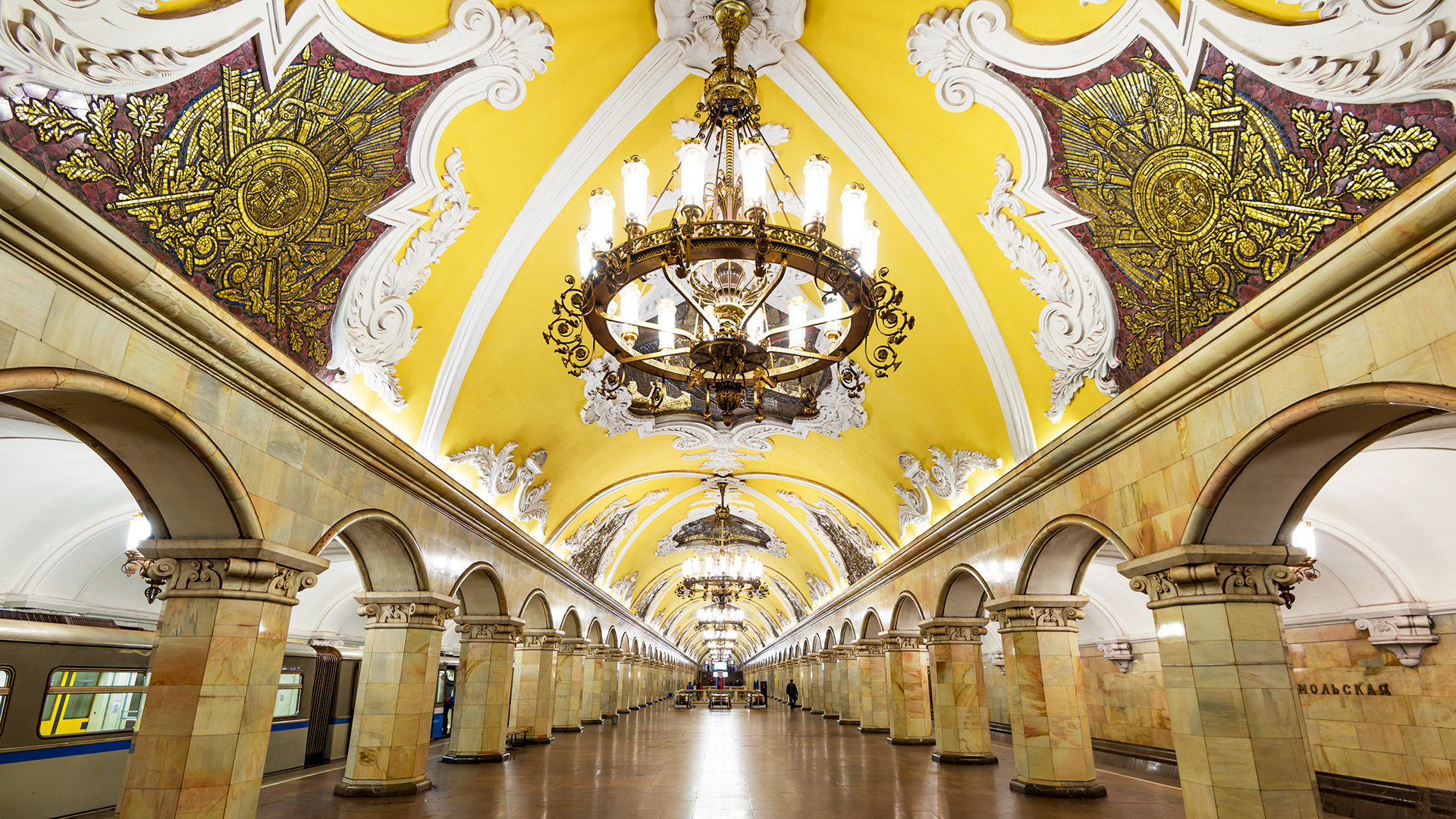
The architectural language of the Circle Line, known as the Stalinist Empire style (Stalinsky Ampir), reached its apotheosis at Komsomolskaya-Koltsevaya. Designed by Alexey Shchusev, who also created Lenin's Mausoleum, the station is a baroque cavern that rejects the modernist restraint of the 1930s. Shchusev, who died in 1949 before the station's opening in 1952, envisioned the platform as a celebration of Russian military glory. The ceiling, painted in a triumphant yellow, features eight monumental mosaic panels by Pavel Korin. These mosaics represent a significant geopolitical pivot: they do not strictly celebrate Marxist revolutionaries rather rehabilitate Tsarist generals such as Alexander Suvorov and Mikhail Kutuzov. This imagery aligns directly with Stalin's November 7, 1941, speech in Red Square, where he invoked these "great ancestors" to rally a besieged nation. The station thus functions as a stone manifesto, merging Soviet power with Imperial Russian nationalism.
At Taganskaya station, the medieval motifs continue, with a darker subtext. The pylons are adorned with majolica panels depicting Red Army and Navy servicemen, framed in floral borders that evoke 17th-century Russian ceramic traditions. Yet, the station's proximity to the Taganka hillside concealed a secret far more sensitive than the trains. Connected to the Metro tunnels by a hidden passage was the Tagansky Protected Command Point, known as Bunker-42. Completed in the mid-1950s, this 7, 000-square-meter complex was built to house the Long-Range Aviation command and the telegraph center for the Ministry of Communications. It was designed to sustain a direct nuclear hit, allowing the Soviet leadership to direct retaliatory strikes while 65 meters beneath the surface. The Metro tunnels served as the logistical artery for this bunker, providing a discreet supply route that bypassed the streets above.
The geopolitical narrative of the Circle Line also extended to the internal politics of the Soviet bloc. Novoslobodskaya station, opened in 1952, features 32 illuminated stained-glass panels, a design element almost entirely alien to Russian Orthodox or Soviet architectural traditions. The glass was manufactured in Riga, Latvia, by artists who used materials originally intended for the Riga Cathedral. This appropriation of religious materials for a secular, communist monument was a deliberate assertion of dominance over the newly annexed Baltic states. The stained glass, depicting geometric patterns and idealized citizens, creates a psychedelic, almost ecclesiastical atmosphere, reinforcing the Metro's role as the cathedral of the new state religion.
The immense cost of these stations, replete with bronze chandeliers, semi-precious stones, and labor-intensive mosaics, eventually became their undoing. Following Stalin's death in 1953, the political wind shifted rapidly. In 1955, Nikita Khrushchev issued the decree "On the Elimination of Excesses in Design and Construction," which condemned the "unjustified" decoration that inflated construction costs and slowed housing development. The effects were immediate and visible. The final stations of the Circle Line, such as Kievskaya, managed to retain their ornate designs (Kievskaya's mosaics celebrate the 300th anniversary of the reunification of Russia and Ukraine, a theme of intense relevance in 2026), the decree marked the abrupt end of the Stalinist Empire style.
By the time the Circle Line was fully operational in 1954, it had established a standard of subterranean luxury that no other city attempted to replicate. It carried millions of passengers daily, acting as a distributor ring that prevented the radial lines from choking the city center., specifically with the 2023 opening of the Big Circle Line (BCL), a second, larger loop designed to handle the sprawl of 21st-century Moscow, the original Circle Line remains a historical artifact of the Cold War. It stands as a physical timeline of the transition from the desperate patriotism of 1945 to the nuclear paranoia of the 1950s, preserved in marble and granite. The "brown line" remains the system's most recognizable feature, a permanent monument to a specific moment when the Soviet Union sought to bury its fear of annihilation under of gold leaf and triumphal mosaic.
Architectural and Engineering Specifications of Key Circle Line Stations (1950, 1954)
Station Name
Opening Date
Depth (Meters)
Architect(s)
Key Decorative Elements
Komsomolskaya
Jan 30, 1952
37
A. Shchusev, V. Kokorin
8 smalt mosaics by P. Korin; Baroque ceiling; 68 octagonal marble columns.
Taganskaya
Jan 1, 1950
53
K. Ryzhkov, A. Medvedev
Majolica panels with military profiles; connection to Bunker-42.
Novoslobodskaya
Jan 30, 1952
40
A. Dushkin, A. Strelkov
32 stained glass panels from Riga; "Peace Throughout the World" mosaic.
Cold War Civil Defense Mechanisms and Deep-Level Bunkers
The Moscow Metro was never a transit system; from its inception, Soviet planners engineered it as a subterranean. While the 1935 master plan prioritized moving the proletariat, the escalating threat of aerial bombardment, from the Luftwaffe and later from American nuclear arsenals, forced a radical integration of civil defense method into the network's very geology. By the onset of the Cold War, the Metro had evolved into the world's largest dual-use facility, a hardened shell capable of housing millions of citizens and the Soviet command structure under of reinforced concrete and Jurassic clay.
The precedent for this militarization was set during the Battle of Moscow in 1941. The station then known as Kirovskaya ( Chistye Prudy) ceased passenger operations to serve as the headquarters for the Red Army General Staff and the Air Defense forces. Engineers erected concrete blast walls on the platforms, shielding Joseph Stalin and his commanders as they directed the defense of the capital from 35 meters underground. Trains passed through the station without stopping, their windows blacked out to conceal the frantic military activity on the illuminated platforms. This improvisation proved that the Metro could sustain command and control functions during total war, a lesson that dictated the design of all subsequent lines.
The nuclear age necessitated a shift in construction depth. The initial shallow lines, such as the Filyovskaya, were deemed indefensible against atomic weaponry. A conventional bomb had already pierced the shallow tunnel between Arbatskaya and Smolenskaya in 1941, proving the vulnerability of cut-and-cover construction. Consequently, the Soviet government commissioned a deep-level parallel line, the Arbatsko-Pokrovskaya, bored at depths exceeding 40 meters. This depth requirement became standard for the Cold War expansion, ensuring that stations could withstand the overpressure of a nuclear airburst. The deepest station, Park Pobedy, opened much later adheres to this doctrine, sitting 84 meters beneath the surface, immune to all direct ground-penetrating strikes.
The primary method for sealing these stations is the hermozatvor (hermetic door). These massive steel gates, frequently weighing between 10 and 20 tons, are recessed into the tunnel walls and station vestibules. In peacetime, they appear as innocuous metal panels or floor plates. In a "Special Period", the Soviet euphemism for war, hydraulics raise or swing these blocks to seal the station box hermetically. This isolation creates a closed-loop life support system. The stations are equipped with Filter-Ventilation Kits (FVK), industrial-grade air scrubbers designed to remove radioactive dust, biological agents, and chemical toxins from surface air intake. Deep-level stations also maintain independent water reservoirs and sewage pumps, allowing the population to survive for days or weeks after the surface becomes uninhabitable.
Strategic Depth and Defense Capabilities of Key Objects
Object Name
Depth (Meters)
Primary Function
Defense Rating
Park Pobedy
84
Civilian Shelter / Transit
High (Nuclear Airburst)
Bunker 42 (Tagansky)
65
Long-Range Aviation Command
High (Direct Command Link)
Chistye Prudy (1941)
35
General Staff HQ
Moderate (Conventional)
Ramenki (D-6 Main)
~200
Government Continuity
Extreme (Direct Hit)
Beyond the public stations lies the shadow network known as Metro-2, or officially as D-6. Unlike the urban legends that circulate in tabloids, the existence of this system is a documented logistical reality, though its exact layout remains a state secret. Built to ensure the continuity of government, Metro-2 consists of single-track tunnels connecting the Kremlin, the FSB headquarters at Lubyanka, the Ministry of Defense, and the government terminal at Vnukovo-2 Airport. These lines run significantly deeper than the public Metro, frequently exceeding 150 meters, and absence the third rail used by civilian trains. Instead, the system uses battery-electric or diesel locomotives to eliminate the risk of power grid failure immobilizing the evacuation transport.
A tangible example of this secret infrastructure is the Tagansky Protected Command Point, known as Bunker 42. Constructed in the 1950s, this 7, 000-square-meter complex sits 65 meters underground, physically connected to the tunnels of the Taganskaya station on the Circle Line. During the Caribbean emergency (Cuban Missile emergency), this facility operated fully staffed, ready to order long-range nuclear strikes. Its construction required the same tubing and tunneling shields as the civilian metro, yet it remained hidden from the millions of passengers passing meters away. The bunker's design included four "blocks" connected by corridors, with one block dedicated solely to fuel storage and diesel generators, ensuring autonomy from the Moscow power grid.
The "Underground City" at Ramenki represents the apex of this paranoia-driven engineering. Located near Moscow State University, this facility is rumored to accommodate up to 15, 000 officials and their families. American intelligence reports from the early 1990s described a multi-level complex capable of sustaining life for 30 years, though such claims likely exaggerate the logistical realities of food storage. Nevertheless, the physical connection between Ramenki and the Metro-2 lines confirms that the Soviet leadership intended to abandon the surface entirely in the event of a NATO strike.
, specifically the window from 2022 to 2026, the civil defense function of the Moscow Metro has returned to the forefront of municipal planning. Following the escalation of geopolitical tensions, city authorities initiated quiet systematic inspections of the hermozatvory and ventilation systems. The "Moskva-2024" and "Moskva-2026" rolling stock updates, while focused on automation and passenger comfort, operate within a network that retains its hard-line military specifications. New stations on the Big Circle Line (BCL) feature integrated blast protection and smoke extraction systems that surpass Soviet standards. The dual-use mandate remains active; the Metro is not just a museum of Soviet anxiety, a functional component of Russia's current strategic defense posture.
The psychological impact of this architecture on the Muscovite population is. The ornate chandeliers and marble columns of the Stalinist stations serve a dual purpose: they project imperial power to the commuter and offer a comforting, palace-like permanence to the refugee. When the air raid sirens sound, the population descends not into a dark hole, into a cathedral of engineering designed to outlast the city above. This synthesis of aesthetic grandeur and brutal survivability defines the Moscow Metro's unique position in the history of urban infrastructure.
Khrushchev Era Cost Reduction and Standardization Protocols
Subterranean Command Posts and Shelter Operations 1941, 1945
The death of Joseph Stalin in 1953 triggered an immediate and violent reversal in Soviet urban planning, nowhere more visible than in the Moscow Metro. For two decades, the system had served as an ideological cathedral, prioritizing marble, mosaics, and bronze over fiscal sanity. Nikita Khrushchev, seeking to distance his administration from the cult of personality and address the desperate housing emergency, viewed these "underground palaces" as criminal waste. The pivot became official policy on November 4, 1955, with the Central Committee's issuance of Decree No. 1871, "On the Elimination of Excesses in Design and Construction." This document did not suggest austerity; it mandated the industrialization of architecture. The decree explicitly attacked architects for "wasting people's money" on decorative porticos and arcades while the population lived in communal squalor. In the Metro, this marked the end of the "individual project" and the birth of the "standard design."
Engineers and architects who had previously received Stalin Prizes for their lavish neoclassical designs found themselves publicly shamed. The new directive was absolute: speed and cost reduction were the only metrics that mattered. The Metro construction administration, Metrostroy, shifted its primary methodology from deep-level mining to shallow "cut-and-cover" techniques. This method involved digging a trench from the surface, installing prefabricated concrete structures, and burying the tunnel. While this destroyed surface traffic patterns during construction, it eliminated the need for expensive cast-iron tubing and complex hydrostatic sealing required at great depths. The cost per kilometer of track dropped by approximately 40 percent between 1955 and 1960, a financial efficiency that allowed the network to expand rapidly into the ballooning residential districts.
The physical manifestation of this doctrine was the "Sorokonozhka" (Centipede) station design. introduced at Pervomayskaya in 1961, this layout became the ubiquitous template for the two decades. The design was ruthlessly functional: a shallow underground hall supported by two rows of prefabricated reinforced concrete columns. While the nickname implies 40 legs, the standard actually varied between 38 and 40 columns depending on the specific entrance configuration. The spacing was standardized to 4 meters, allowing for the use of mass-produced concrete beams identical to those used in industrial warehouses. The ceilings were flat, the lighting was fluorescent and utilitarian, and the platforms were paved with asphalt rather than the granite slabs of the Stalin era. The walls were clad in cheap, glazed ceramic tiles, frequently 15x15 centimeters, giving the stations an aesthetic frequently compared to public restrooms.
The most extreme experiment in cost-cutting occurred on the Filyovskaya Line (Line 4). Planners reasoned that if shallow tunnels were cheap, surface rails would be practically free. Between 1958 and 1961, Metrostroy laid tracks directly on the ground to connect the western districts, creating a string of open-air stations including Fili, Kutuzovskaya, and Pionerskaya. The results were disastrous. The harsh Moscow winter wreaked havoc on the rolling stock and infrastructure. Pneumatic door systems froze, tracks iced over, and concrete platforms disintegrated under the freeze-thaw pattern. Passengers, accustomed to the climate-controlled depths of the Circle Line, waited on windswept platforms in sub-zero temperatures. While the Filyovskaya experiment succeeded in lowering the initial construction cost to roughly 15 million rubles per kilometer (compared to over 60 million for deep-level lines), the long-term maintenance costs skyrocketed. By 2016, the line required a near-total reconstruction, proving that the initial austerity had been a false economy.
The following data comparison highlights the clear operational shifts between the Stalinist apex and the Khrushchev functionalist era:
Metric
Stalin Era (e. g., Komsomolskaya-Koltsevaya)
Khrushchev Era (e. g., Novye Cheryomushki)
Construction Method
Deep-bore mining (30, 60m depth)
Cut-and-cover (6, 10m depth)
Structural Material
Cast-iron tubing, monolithic concrete
Prefabricated reinforced concrete blocks
Flooring
Polished granite, marble
Asphalt (later retrofitted to granite)
Wall Cladding
Ural marble, semi-precious stones
Glazed ceramic bathroom tiles
Lighting
Bronze chandeliers, custom sconces
Standardized fluorescent tubes
Architectural Focus
Ideological narrative, individual identity
Replication, speed, standardized metrics
The standardization of the 1960s erased the visual identity of individual neighborhoods. A passenger waking up on a train at Profsoyuznaya saw the same tiled walls and columns as one at Rechnoy Vokzal. This anonymity was intentional; the Metro was no longer a destination a conveyance. yet, this industrial method succeeded in its primary goal: velocity of expansion. The network grew from 66 kilometers in 1955 to over 120 kilometers by the mid-1960s, keeping pace with the construction of the massive Khrushchyovka housing blocks. Without the "Centipede" design, the Soviet government could not have connected the millions of residents moving into the new micro-districts on the city's periphery. The Metro ceased to be a showpiece for foreign dignitaries and became the circulatory system of a working-class metropolis.
The legacy of this era remains visible in 2026, though the city has spent billions trying to mask it. The asphalt platforms of the 1960s were eventually replaced with stone in the late Soviet period, the structural bones of the "Centipedes" remain. In the 2010s and 2020s, a massive renovation program targeted these Khrushchev-era stations. The ceramic tiles, failing after 50 years of vibration and moisture, were stripped away. Modern architects reclad the columns in aluminum composite panels and stainless steel, attempting to inject retroactive personality into the standardized skeletons. Yet, the low ceilings and narrow column spacing of the Sorokonozhka design impose hard limits on modernization. These stations remain the workhorses of the system, handling higher passenger volumes than the tourist-heavy city center, serving as a permanent concrete testament to the era when the Soviet Union traded grandeur for geometry.
The ideological shift also had a linguistic casualty. In 1955, the system, previously named the "L. M. Kaganovich Moscow Metro" in honor of the ruthless administrator who built it, was stripped of his name. It became simply the "V. I. Lenin Moscow Metro." Kaganovich, purged by Khrushchev, lived to see his name chiseled off the porticos, his bronze statues melted down, and his "palaces" ridiculed as archaic excesses. The Metro had moved from the age of tyrants to the age of technocrats, where the victory of socialism was measured not in tons of marble, in the number of workers transported per hour.
Infrastructure Decay and Fatalities During the 1990s Collapse
The dissolution of the Soviet Union in December 1991 stripped the Moscow Metro of its status as an ideological cathedral and reduced it to a survival shelter for a population under economic siege. As the centralized funding of the USSR evaporated, the system faced a financial abyss. In 1992 alone, inflation in Russia hit 2, 500 percent. The five-kopek coin, the immutable price of a ride for thirty years, became scrap metal overnight. Metro management scrambled to introduce plastic tokens, changing their design and price repeatedly to outpace the devaluation of the ruble. By 1993, the cost of a single trip had multiplied thousands of times in nominal value, yet the revenue barely covered electricity and wages. The infrastructure, once the envy of the industrial world, began to rot from the inside. Federal subsidies, which had previously covered capital construction and heavy maintenance, ceased almost entirely. The metro administration, led by Dmitry Gaev starting in late 1995, turned to aggressive commercialization to keep the lights on. The majestic, marble-clad halls designed to uplift the proletariat were plastered with chaotic advertising. Banners for pyramid schemes like MMM and foreign cigarettes obscured the socialist realist mosaics. The vestibules and underpasses transformed into unregulated bazaars where "shuttlers" (chelnoki) sold cheap imports, pirated VHS tapes, and vodka. This commercial invasion provided necessary cash flow marked a clear degradation of the system's operational discipline. Safety, previously guaranteed by the KGB's iron grip and unlimited state resources, collapsed along with the economy. The metro lost its reputation as the safest place in the capital on June 11, 1996. A homemade explosive device, equivalent to 500 grams of TNT, detonated in a carriage traveling between Tulskaya and Nagatinskaya stations on the Serpukhovsko-Timiryazevskaya line. The blast killed four people and injured twelve others. This attack shattered the psychological immunity of the underground; the Soviet sanctuary had become a soft target for the brewing conflicts in the North Caucasus. The violence continued on January 1, 1998, when a bomb hidden in a handbag exploded at the Tretyakovskaya station, injuring three employees. These incidents forced the administration to confront a new reality where the metro was a frontline in asymmetric warfare, even as they absence the budget for modern security systems. Construction projects initiated during the twilight of the Soviet era turned into protracted nightmares. The Lyublinskaya line (Line 10), intended to serve the grim dormitory districts of the southeast, faced paralyzed work sites and unpaid laborers. In August 1996, metro builders, desperate after months without wages, staged strikes and hunger protests, a phenomenon unthinkable a decade prior. When the line opened in stages between 1995 and 1996, it featured the station Dubrovka, which trains were forced to bypass for years. The station remained a dark, unfinished ghost because the heat generated by a nearby tire factory prevented the ground from freezing, a necessary condition for sinking the escalator shaft. Engineers absence the funds for the liquid nitrogen required to artificially freeze the soil, leaving the station inaccessible until 1999. The rolling stock emergency further exemplified the technological stagnation of the 1990s. The Mytishchi Machine-Building Plant attempted to introduce the "Yauza" (81-720/721) train, a futuristic design conceived in the late 1980s with stainless steel bodies and asynchronous motors. The project failed catastrophically in the execution phase due to the collapse of supply chains and quality control. The few Yauza trains that entered service were plagued by constant breakdowns, door failures, and software errors. Metro workers nicknamed them "plague trains," and the administration was forced to revert to ordering the obsolete "Numbered" series (81-717/714) models designed in the 1970s. This decision locked the Moscow Metro into using outdated technology for another two decades, the consequences of which are still visible in the rolling stock mix of 2026. Crime rates within the system mirrored the lawlessness of the surface. The metro became a dormitory for the city's exploding homeless population. Ventilation shafts and heating mains turned into encampments, and aggressive begging became widespread. Pickpocketing rings operated with impunity, frequently bribing the underpaid police officers assigned to patrol the stations. The "wild 90s" atmosphere permeated the underground, creating an environment of vigilance and distrust. The pristine order maintained by the Soviet militsiya, replaced by private security firms protecting commercial kiosks while passengers fended for themselves. The degradation of technical maintenance during this decade laid the groundwork for future disasters. With budgets slashed, the replacement of rails, signaling systems, and escalators was deferred. Engineers relied on the "Soviet safety margin", the over-engineering of the Stalin and Khrushchev eras, to keep the system running. This cannibalization of the future saved the metro from total shutdown in 1994 and 1995 accumulated a "technical debt" that would be paid in blood years later. The 2014 derailment at Park Pobedy, which killed 24 people, was partly attributed to the of safety and the use of substandard components, a culture of negligence that took root during the desperate austerity of the Gaev era. Even with the chaos, the metro remained the circulatory system of a dying empire. It carried nine million passengers daily, moving the workforce that would eventually rebuild the Russian economy. The sheer physical resilience of the deep-level stations, dug to survive nuclear war, allowed them to withstand the economic collapse. Yet, the 1990s stripped the Moscow Metro of its mystique. It ceased to be a "Palace for the People" and became a gritty, dangerous, and exhausted transit utility, struggling to transport a population traumatized by the sudden arrival of capitalism.
Moscow Metro Major Incidents & Indicators (1992, 1999)
Year
Event / Indicator
Details
1992
Economic Shock
Inflation hits 2, 500%. Metal tokens replaced by plastic.
1994
Ridership Peak
Daily ridership remains high even with economic collapse; maintenance deferred.
June 11 bombing on Serpukhovskaya line. 4 dead, 12 injured.
1996
Labor Strike
Metro builders strike over unpaid wages; hunger strikes in tunnels.
1998
Terrorist Attack
January 1 bombing at Tretyakovskaya station. 3 injured.
1999
Dubrovka Opening
Station opens after years of delay due to funding and soil freezing failure.
Sobyanin Administration Capital Expenditure and Network Doubling
Post-War Architectural Ideology and the Circle Line Geopolitics
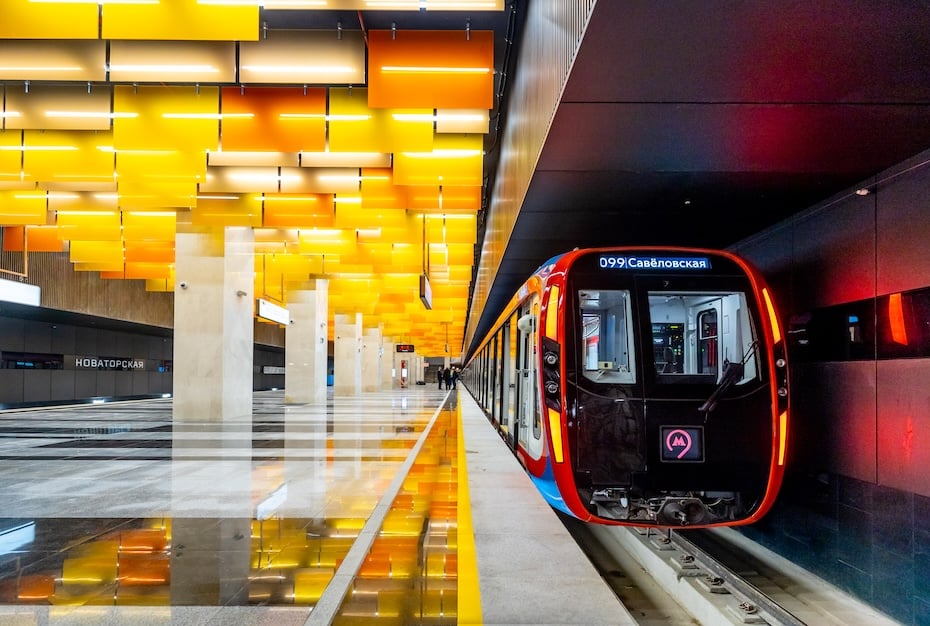
The appointment of Sergei Sobyanin as Mayor of Moscow in October 2010 marked an immediate and radical pivot in the capital's urban planning strategy. Inheriting a city paralyzed by gridlock and a metro system that had stagnated under the late Luzhkov administration, Sobyanin secured a mandate to solve the transport collapse through aggressive capital expenditure (CapEx). Unlike his predecessor, who favored visible surface projects like the Third Ring Road, Sobyanin directed the city's financial firepower underground. Between 2011 and 2026, the Moscow government allocated approximately 70 percent of its transport budget to metro construction, a sustained investment program that has no parallel in modern European history. The administration set a public goal to "double" the metro system, a metric achieved through a combination of relentless tunneling and statistical reclassification. In 2010, the network comprised 301 kilometers of track and 182 stations. By early 2026, the official map displayed over 535 kilometers of route length and more than 300 stations. This expansion relied on two distinct engineering strategies: the construction of traditional deep-level radial and circle lines, and the integration of existing surface railway corridors into the metro tariff zone. The centerpiece of this expansion is the Big Circle Line (BCL), Line 11. Fully operational as of March 1, 2023, the BCL decentralized the network, breaking the historic reliance on the overloaded Koltsevaya Line (Line 5) and the city center interchanges. Spanning 70 kilometers with 31 stations, the BCL surpassed Beijing's Line 10 to become the longest metro circle loop in the world. The project's cost, officially at over 501 billion rubles (approximately $6. 6 billion at the time of completion), required the simultaneous operation of more than 20 tunnel boring machines (TBMs) at peak construction, a logistical mobilization that turned the city's subsoil into a 24-hour factory. While the BCL represented a triumph of civil engineering, the "doubling" statistic relied heavily on the Moscow Central Diameters (MCD). Launched in stages between 2019 and 2023, the MCD project rebranded existing commuter rail lines (elektrichkas) as surface metro. By upgrading platforms, unifying ticketing systems with the Troika card, and increasing frequency, the administration added hundreds of kilometers to the "metro" map without the cost of tunneling. MCD-1 and MCD-2 opened in 2019, followed by MCD-3 and MCD-4 in 2023. This integration allowed the city to claim vast network growth while focusing heavy construction resources on the New Moscow territories. The southward expansion into the Novomoskovsky Administrative Okrug (New Moscow) exemplifies the between transport CapEx and real estate speculation. The extension of the Sokolnicheskaya Line to Potapovo in September 2024 and the phased opening of the Troitskaya Line (Line 16) between 2024 and 2025 served to monetize the fields annexed by the city in 2012. The Troitskaya Line, frequently called the "Emerald Line," opened its segment from Novatorskaya to Tyutchevskaya in September 2024, followed by an extension to the ZIL industrial redevelopment zone in September 2025. These lines do not serve existing populations; they precede and catalyze the construction of high-density housing blocks, using the metro budget to underwrite the value of municipal land banks. The financial of this undertaking is clear in the city's budget documents. For the 2024, 2026 planning period, the Moscow government approved a development budget of 2. 1 trillion rubles, with nearly 900 billion rubles allocated annually to transport infrastructure. This spending power is derived from Moscow's unique position in the Russian tax system, where the concentration of corporate headquarters allows the capital to operate with a budget that dwarfs entire federal districts. Even with the economic pressures of 2025, which forced a reported 10 percent reduction in planned investments for 2026, the absolute figures remain. The city continues to finance these projects primarily through direct revenue rather than debt, a luxury afforded by high oil prices and centralized tax collection.
Major Moscow Metro Expansion Projects (2011, 2026)
Project Name
Type
Key Milestone
/ Metric
Strategic Purpose
Big Circle Line (BCL)
Deep/Shallow Tunnel Loop
Full Opening (March 2023)
70 km, 31 stations
Decongest central interchanges; connect radial lines.
Connect Moscow City financial district to western suburbs.
As of March 2026, the focus has shifted to the Rublyovo-Arkhangelskaya line, designed to connect the Moscow City financial district with the affluent western suburbs. Tunneling is currently underway between Shelepikha and Bulvar Generala Karbysheva. Simultaneously, the rolling stock has undergone a complete overhaul. The introduction of the "Moscow-2024" and "Moscow-2026" train sets, manufactured by Metrowagonmash, has reduced the average age of cars from over 20 years in 2010 to under 10 years. These new trains feature wider doors, USB charging, and improved soundproofing, though their primary advantage for the administration is the support of domestic heavy industry. The pace of construction has exposed the city to criticism regarding quality control and labor practices. The reliance on a vast army of migrant labor from Central Asia, working in shifts to meet politically sensitive deadlines, has been a constant feature of the Sobyanin era. also, the rapid commissioning of stations has frequently resulted in "technical launches", ceremonial openings for cameras followed by weeks of final adjustments before passenger service begins. Yet, the physical result is undeniable: a network that has fundamentally altered the urban geography of Europe's largest city, turning a 1930s Soviet relic into a hyper-modern, multi-modal grid.
Big Circle Line Engineering and Orbital Traffic Redistribution
The activation of the Bolshaya Koltsevaya Line (BCL) on March 1, 2023, represented the most significant structural intervention in Moscow's urban transit history since the 1935 opening of the Sokolnicheskaya line. Spanning 70 kilometers with 31 stations, the BCL obliterated the previous world record for the longest metro loop, surpassing Beijing's Line 10 by 13 kilometers. This project was not an expansion; it was a corrective surgery on a city paralyzed by a centripetal design flaw. For decades, the "radial-ring" structure forced millions of passengers to travel into the city center solely to transfer to another line, creating crushing density at stations like Kievskaya and Komsomolskaya. The BCL broke this pattern by enforcing orbital movement, allowing lateral transit across the metropolis without touching the historic core.
The engineering strategy behind the BCL required a departure from Soviet-era construction norms. Traditionally, Moscow Metro relied on deep-level mining and single-track tunnels bored by 6-meter shields. To accelerate the BCL timeline, engineers deployed 10-meter diameter Tunnel Boring Machines (TBMs), such as the "Liliya" and "Pobeda" shields. These giants excavated double-track tunnels, a method that reduced the number of required support shafts and minimized surface disruption. At the peak of construction in 2020, the project utilized 23 TBMs simultaneously, a concentration of that entered the Guinness Book of Records. This mechanized assault on the subterranean environment was necessary to meet the deadline, yet it faced the eternal adversary of Moscow's geology: a chaotic mix of Jurassic clay, water-saturated limestone, and quicksand.
The geological challenges dictated a hybrid depth profile for the line. While western sections were built using cut-and-cover methods at shallow depths, the northern and eastern arcs required deep-level construction to navigate beneath existing infrastructure and water bodies. The Maryina Roshcha station, for instance, features the longest escalators in the network at 130 meters, descending into the deep clay to avoid the foundations of surface buildings. Engineers used ground-freezing technology to stabilize water-logged soil near the Rizhskaya and Savyolovskaya hubs, creating ice shells around the excavation zones to prevent catastrophic flooding. This method, while, added immense complexity and energy costs to the project, requiring liquid nitrogen circulation systems to maintain soil stability during the boring phase.
International cooperation played a notable role in the BCL's execution, signaling a geopolitical shift in Russia's infrastructure development. For the time, a Chinese state-owned enterprise, the China Railway Construction Corporation (CRCC), was contracted to build a segment of the Moscow Metro. CRCC constructed the southwestern section, including the Michurinsky Prospekt station, bringing their own engineering crews and TBMs. This collaboration introduced new project management techniques to the Mosinzhproekt (the general contractor) workflow, although it also sparked internal debates regarding the reliance on foreign labor and technology for serious national infrastructure. The "Pobeda" TBM, designed specifically for Moscow's hydrogeology, was manufactured in China, illustrating the deep supply chain integration between the two powers.
BCL Impact on Traffic Distribution (2023, 2025 Data)
Metric
Pre-BCL Baseline (2022)
Post-BCL Status (2025)
Change
Daily Ridership (BCL)
N/A
1. 3 Million
+1. 3M (New Flow)
Koltsevaya Line Load
100% (Baseline)
72%
-28% Reduction
Radial Line Congestion
serious (Peak)
High (Peak)
-17% to -22%
Highway Traffic (MKAD/TTK)
Severe
Heavy
-15% Volume
Avg. Travel Time Savings
0 min
35-45 min/day
Significant Gain
The traffic redistribution effects materialized almost immediately upon the full loop's closure. Data from late 2023 and early 2024 confirmed the mathematical models: the load on the old Koltsevaya (Brown) Line dropped by approximately 25 to 28 percent. Stations that historically operated at dangerous capacity levels, such as the transfer nodes at Prospekt Mira and Park Kultury, saw their passenger flow stabilize. The BCL acts as a vacuum, siphoning transit traffic away from the center. Passengers travelling from the north (e. g., Otradnoye) to the west (e. g., Krylatskoye) no longer need to transit through the Garden Ring; they intercept the BCL at Savyolovskaya or Kuntsevskaya, bypassing the core entirely. This orbital logic reduced the on radial lines by up to 22 percent, extending the operational lifespan of older rolling stock and track infrastructure.
By 2025, the BCL had evolved into the primary integration backbone for the entire Moscow transport network. It connects not only radial metro lines also the Moscow Central Diameters (MCD) and the Moscow Central Circle (MCC). The creation of Transport Interchange Hubs (TPUs) at stations like Nizhegorodskaya turned the line into a multi-modal distributor. Nizhegorodskaya alone integrates the BCL, the Nekrasovskaya Line, the MCC, and the MCD-4, creating a massive subterranean city capable of processing 400, 000 passengers daily. These hubs serve as economic catalysts; real estate data from 2024 shows a 15-20 percent premium on commercial and residential property within a 10-minute walk of BCL stations, driving a construction boom in formerly disconnected districts like Nagatinsky Zaton.
The year 2026 marks the transition of the BCL from a construction project to a technological testbed. The Moscow Metro has begun active passenger service testing of the "Moskva-2026" trainsets on the BCL. These units feature widened gangways and autonomous control systems. While a human operator remains in the cab for supervision, the BCL's signaling system is designed for GoA4 (Grade of Automation 4) driverless operation. The loop's consistent geometry and modern communications infrastructure make it the ideal laboratory for automation before these systems are deployed on older, more irregular lines. also, the BCL serves as the launchpad for new radial vectors; the Rublyovo-Arkhangelskaya Line, scheduled to open its section in 2026-2027, grafts onto the BCL at Narodnoye Opolcheniye, proving the loop's function as the new skeletal frame for future expansion.
The financial of the BCL remains a subject of complex accounting. While official figures for specific contracts exist, such as the 27 billion ruble cost for a 6. 4 km segment, the total aggregate cost is estimated in the hundreds of billions of rubles, financed through a mix of municipal bonds and federal allocations. Critics point to the high cost per kilometer compared to European analogs, citing the expense of deep-level stations and the of construction which necessitated overtime labor and simultaneous excavation fronts. Yet, the economic return is calculated not just in ticket sales in the "agglomeration effect", the reduction of time waste. Municipal economists that the 45 minutes saved daily by hundreds of thousands of workers into billions of rubles in regained economic productivity annually.
, the Big Circle Line ended the monocentric dominance of the Kremlin in Moscow's transit topology. It decentralized the flow of human capital, enabling the city to function as a polycentric organism. The engineering feat of threading 70 kilometers of tunnel through one of the world's most densely built environments stands as a testament to the brute force and technical capability of the modern Russian construction complex. As 2026 progresses, the BCL is no longer a novelty the essential circulatory system of a megacity that has outgrown its medieval layout.
Biometric Surveillance Grid and Face Pay Deployment 2020, 2026
Cold War Civil Defense Mechanisms and Deep-Level Bunkers
The transformation of the Moscow Metro from a transit network into a detailed biometric surveillance grid represents one of the most rapid and aggressive deployments of facial recognition technology in urban history. Between 2020 and 2026, the system evolved from a pilot project into a mandatory of the city's digital infrastructure, fundamentally altering the relationship between the state and the passenger. This expansion was driven by the "Safe City" (Bezopasny Gorod) initiative, which integrated turnstile cameras with federal wanted lists, creating a direct dragnet for criminals, political dissidents, and draft evaders.
The of this surveillance architecture is the "Sphere" (Sfera) system, which became fully operational on September 1, 2020. Unlike standard CCTV, Sphere was designed for active interdiction. The system converts the video feed of a passenger's face into a unique biometric key, a mathematical vector, which is then cross-referenced against multiple databases in real-time. By late 2024, officials reported that Sphere had facilitated the detention of over 11, 000 individuals. While the Department of Transport initially marketed the system as a tool to find missing children and serious criminals, its scope widened significantly following the 2022 invasion of Ukraine. During the mobilization drives of 2022 and subsequent conscription pattern in 2024 and 2025, the system was frequently used to flag men of military age at turnstiles, leading to immediate detention by police officers stationed at metro vestibules.
On October 15, 2021, the metro launched "Face Pay," a biometric fare payment system available at all 240+ stations. The rollout was technically ambitious, relying on algorithms provided by Russian vendors VisionLabs, NtechLab, and Tevian. VisionLabs, acquired by the telecom giant MTS in 2021, became a primary technological partner, its algorithms reportedly capable of identifying individuals even when wearing medical masks, a need during the COVID-19 pandemic that served as a convenient training ground for the neural networks. To encourage adoption, the city offered fare discounts, yet public skepticism remained high. By early 2022, only 122, 000 users had registered, a fraction of the metro's daily ridership. yet, aggressive promotion and the gradual elimination of anonymous payment methods pushed this number to over 500, 000 registered users by 2025, with the system processing over 125 million biometric entries annually.
The financial of this digital overhaul was immense. In February 2025 alone, the Moscow Metro allocated 1. 16 billion rubles (approximately $13 million) specifically for domestic servers to support the "Payment by Face 2. 0" project, ensuring the system's resilience against Western sanctions. This was part of a broader 2026 transport budget of 1. 3 trillion rubles, which prioritized the expansion of Face Pay to the Moscow Central Diameters (MCD) and ground surface transport. The strategic goal for 2030, approved by Mayor Sergei Sobyanin, envisions a "direct" biometric environment where physical cards become obsolete, ending anonymous transit in the capital.
Key Milestones in Biometric Deployment 2020, 2026
Date
Event
Significance
Sep 1, 2020
"Sphere" System Launch
Mass deployment of facial recognition for tracking "wanted" persons.
Oct 15, 2021
Face Pay Full Launch
World's city-wide biometric fare payment system goes live.
Sep 2022
Mobilization Raids
System used to detain draft evaders at metro stations.
Feb 2025
Server Infrastructure Upgrade
1. 16 billion ruble investment to localize data processing.
Mar 31, 2025
Cyberattack Disruption
Major outage of metro digital services linked to geopolitical conflict.
Feb 2026
Mandatory Device Checks
New regulations allow security to inspect phones at station entries.
Civil liberties groups, particularly Roskomsvoboda, mounted a sustained legal challenge against this expansion. They argued that the processing of biometric data without explicit written consent violated Russia's law on personal data. In 2020 and 2021, activists filed lawsuits citing cases where the system had been used to track peaceful protesters. One prominent case involved an activist detained after the system flagged an old photo from a 2012 article. even with these efforts, Moscow courts consistently ruled in favor of the Department of Information Technologies (DIT), accepting the government's argument that the system processes "biometric keys" rather than personal data, a legal distinction that critics dismiss as a technicality. The "Ban Cam" campaign, launched to oppose the surveillance, failed to halt the rollout.
The system's security vulnerabilities were exposed in March 2025, when a massive cyberattack disrupted the Moscow Metro's app and website. Users were unable to access their accounts, and digital signage briefly displayed messages linking the attack to the conflict in Ukraine. This incident underscored the fragility of a centralized digital transit infrastructure. also, the commercialization of access to the "Safe City" cameras became a thriving black market industry. Investigative reports revealed that access to live feeds and travel history could be purchased on the dark web for as little as 15, 000 rubles, allowing private individuals to stalk victims using the very infrastructure designed for public safety.
By 2026, the surveillance grid had expanded beyond passive recognition. New security introduced in February 2026 authorized metro security to conduct mandatory functionality checks of passengers' mobile devices at station entrances, a measure justified by "transport safety" widely interpreted as a means to inspect the digital contents of citizens' phones. This, combined with the integration of the "Sphere" system into the expanding tram and bus networks, completed the encirclement of the commuter. The metro, once a symbol of Soviet industrial might, had become the primary sensor in a panopticon that left no journey unrecorded.
Rolling Stock Technical Evolution and Automation Metrics
The technical history of the Moscow Metro rolling stock is a progression from heavy, rheostatic industrial to software-defined, aerodynamic transport nodes. The system operates on a 1, 520 mm Russian gauge track with power supplied via a bottom-contact third rail at 825 V DC. This voltage standard was established with the Type A carriages manufactured by the Mytishchi Machine-Building Plant in 1934 and remains the electrical backbone of the network in 2026. The Type A units featured a wooden frame reinforced with metal, weighing 51. 7 tons for motor cars, and used a simple rheostatic braking system that dissipated kinetic energy as waste heat into the tunnels, a design choice that would contribute to the system's legendary stifling temperatures for decades. For the latter half of the 20th century, the 81-717/714 series, colloquially known as the "Numbered" trains, served as the primary workhorse. Introduced in 1976, these units prioritized capacity and acceleration over passenger comfort. They absence air conditioning, relying instead on roof scoops that forced tunnel air into the cabin only when the train moved at speed. The noise levels inside the 81-717 tunnels frequently exceeded 90 decibels, a result of poor sound insulation and the screech of metal wheels on tight curve radii. Even with these harsh conditions, the "Numbered" series proved mechanically durable, with production continuing in various modifications until 2010. By 2010, the average age of the fleet stood at 22. 5 years, with units nearing the end of their 31-year service life. A massive renewal program initiated in 2011 sought to replace this aging hardware with the "Oka" (81-760/761) and later the "Moskva" series. The introduction of the Moskva-2020 (81-775/776/777) marked a shift toward AC asynchronous traction drives, which reduced energy consumption and allowed for regenerative braking, feeding power back into the network rather than heating the tunnels. The Moskva-2020 featured 1, 600 mm wide doors, up from 1, 250 mm on older models, to accelerate passenger exchange at overcrowded stations. By 2024, the fleet renewal rate had reached 74 percent, dropping the average train age to approximately 12 years.
Model Series
Production Era
Door Width
Traction Type
Key Feature
Type A
1934, 1939
1, 120 mm
DC Rheostatic
generation; wooden/metal frame
81-717 (Numbered)
1976, 2010
1, 208 mm
DC Rheostatic
No AC; forced-air scoops; high noise
Moskva-2020
2020, 2023
1, 600 mm
AC Asynchronous
Regenerative braking; USB ports
Moskva-2024
2024, Present
1, 400 mm*
AC Asynchronous
1. 15m width; aerodynamic mask
*Note: Moskva-2024 optimized door width relative to seating layout changes.
In March 2024, the metro deployed the Moskva-2024 series on the Zamoskvoretskaya Line. This iteration incorporated a new aerodynamic "mask" (front cab design) and reconfigured the interior to increase the width to 1. 15 meters, allowing an additional 17 passengers per car compared to the Moskva-2020. Engineers relocated USB chargers from seat bases to handrails to accommodate standing passengers, reflecting the reality of crush-load conditions. The noise insulation in the Moskva-2024 reduced cabin decibel levels by approximately 15 percent compared to the "Numbered" trains, although the underlying track infrastructure in older tunnels still generates significant vibration. The automation of the Moscow Metro relies on the ALS-ARS (Automatic Locomotive Signaling with Automatic Speed Regulation) system. This technology permits the "Russian interval", a headway of just 90 seconds between trains during peak hours, a frequency unmatched by most Western counterparts. The system enforces safety separation by transmitting speed codes directly to the train's onboard computer. If a driver exceeds the permissible speed or passes a restrictive signal, the ARS engages emergency braking immediately. This rigid, hardware-enforced discipline allows the network to run 40 pairs of trains per hour on main lines. By 2026, the focus shifted toward higher grades of automation (GoA). While the Circle Line and newer radii operate at GoA2 (semi-automatic with a driver supervising), the metro began testing GoA3 and GoA4 (driverless) capabilities on the Moscow Central Circle (MCC) using modified Lastochka trains. The Moskva-2024 and the developing Moskva-2026 series come equipped with the necessary lidar and sensor arrays to support future driverless operation. The Moskva-2026, scheduled for volume delivery starting late 2025, integrates advanced biometric data processing to support the "Face Pay" fare system directly, reducing the latency of passenger flow verification. The 2026 rolling stock strategy a fleet composition of 95 percent modern vehicles by 2030. The Moskva-2026 units feature widened gangways and adaptive lighting that changes color temperature based on the time of day, cold light in the morning to wake passengers, warm light in the evening to induce relaxation. Yet, the primary engineering objective remains the reduction of dwell times. With daily ridership consistently exceeding 9 million, the technical evolution of the rolling stock is less about luxury and more about the physics of mass flow: wider doors, faster acceleration, and the relentless 90-second interval.
Operational Statistics and Daily Passenger Throughput Data 2026
By March 2026, the Moscow Metro has cemented its status as one of the world's most heavily utilized rapid transit systems, recording a daily throughput exceeding 9 million passengers on weekdays. This figure represents a complete recovery from the pandemic-induced lulls of 2020 and a significant surge over the 2019 baseline. The network spans over 535 kilometers of operational track, a metric that includes the integration of the Moscow Central Circle (MCC) and the completed phases of the Moscow Central Diameters (MCD). With more than 300 stations active across the capital and its suburbs, the system's density has reached a point where over 90 percent of Moscow's residents live within walking distance of a rail transit access point.
The Big Circle Line (BCL), fully operational since 2023, serves as the primary driver for these shifting traffic patterns. As the longest metro loop in the world at 57. 5 kilometers, the BCL has fundamentally altered the radial-centric flow that defined the system for eight decades. By early 2026, the BCL alone records approximately 1. 3 million daily trips. This volume has successfully decompressed the historic Koltsevaya Line (Line 5) and the central interchange stations, reducing congestion in the city core by an estimated 25 percent compared to 2015 levels. The BCL's 31 stations function as a secondary distribution ring, intercepting commuters from the suburbs before they reach the overcrowded Sadovoye Ring.
Operational efficiency in 2026 is defined by aggressive headway reductions. The Moscow Metro currently maintains the shortest interval between trains of any major subway system globally. On the Circle and BCL lines, peak-hour headways have been reduced to 80, 90 seconds. This frequency is achieved through the deployment of microprocessor-based interlocking systems and the widespread use of the "Moskva" series rolling stock, which features superior acceleration and braking capabilities compared to the Soviet-era "Nomery" trains. The ability to run 45 pairs of trains per hour on a single line allows the system to absorb the massive passenger influx without the platform overcrowding seen in systems like the New York City Subway or the Paris Métro.
Fleet modernization remains a central pillar of the capital's transport strategy. As of the quarter of 2026, over 80 percent of the rolling stock consists of modern generation trainsets. The newest iteration, the Moskva-2026, entered passenger service in late 2025 and populates the Zamoskvoretskaya and Rublyovo-Arkhangelskaya lines. These units feature 10 percent wider than their predecessors, USB-C charging ports at every seat, and advanced climate control systems capable of sterilizing air. The rapid retirement of the noisy, ribbed 81-717/714 series cars has reduced noise levels in tunnels by 15 decibels, a measurable improvement in passenger comfort that correlates with higher customer satisfaction scores in municipal surveys.
Biometric payment adoption has accelerated, though it remains a subject of privacy debates. The "Face Pay" system, which links a passenger's biometric data to their bank account, has registered over 500, 000 unique users as of August 2025. By March 2026, this system processes more than 170, 000 trips daily. While this represents a fraction of the 9 million total daily rides, the growth curve is steep, driven by incentives such as fare discounts and dedicated express turnstiles. The municipality plans to equip 100 percent of turnstiles with biometric scanners by the end of 2026, creating a barrier-free entry system for registered users. This push aligns with the broader digitization of the Troika card, which has largely migrated to smartphone-based virtual wallets.
The expansion velocity shows no signs of abatement. In September 2025, the city inaugurated the phase of the Troitskaya Line, a 25-kilometer radial spur connecting the ZIL industrial zone to the New Moscow district of Kommunarka. This line alone serves 90, 000 daily passengers, unlocking development chance in the southwest quadrant of the metropolis. Simultaneously, construction crews are active on the Rublyovo-Arkhangelskaya line, designed to link the Moscow International Business Center with the western suburbs. The relentless pace of tunneling, frequently utilizing 20 to 30 tunnel boring machines simultaneously, has kept Moscow at the forefront of global infrastructure development, outpacing the expansion rates of Beijing and Shanghai in the 2024, 2026 window.
Financial opacity regarding the exact ratio of farebox revenue to operational subsidies, yet the of investment is public record. The construction of the BCL alone commanded a budget of 501 billion rubles, a figure that show the state's commitment to rail priority. Unlike Western systems struggling with post-pandemic fiscal cliffs, the Moscow Metro benefits from a unified municipal budget that treats transit availability as a serious utility rather than a profit center. This funding model allows for continuous capital improvements, station renovations, and the maintenance of a workforce exceeding 65, 000 employees, ranging from drivers and mechanics to security personnel and cleaning staff.
Historical Ridership and Infrastructure Growth (1935, 2026)
Year
Daily Ridership (Approx.)
System Length (km)
Stations
Key Milestone
1935
177, 000
11. 2
13
System opens (Sokolniki to Park Kultury).
1955
2, 500, 000
58. 0
40
Post-war expansion; Circle Line completion.
1975
5, 200, 000
160. 0
103
Rapid radial expansion to Brezhnev-era microrayons.
1995
8, 600, 000
256. 0
158
Peak congestion; post-Soviet funding emergency.
2010
6, 500, 000
301. 0
182
Start of the Sobyanin expansion era.
2026
9, 100, 000
535. 0+
304
BCL full operation; Troitskaya Line active.
The integration of the Moscow Central Diameters (MCD) has further blurred the lines between the traditional metro and suburban rail. By treating heavy rail commuter lines as surface metro, complete with unified ticketing, frequent service, and cross-platform transfers, the city has doubled its rail capacity without digging new tunnels for every kilometer. The MCD-3 and MCD-4 lines, fully mature by 2026, carry millions of passengers who previously relied on marshrutkas (private minibuses) or personal vehicles. This modal shift is quantified by a reduction in daily car traffic entering the city center, which has dropped by nearly 300, 000 vehicles compared to 2010 statistics.
Safety and surveillance metrics have also evolved. The metro's "Safe City" network includes intelligent video analytics capable of detecting unattended objects, aggressive behavior, and fare evasion in real-time. While officials cite a 50 percent reduction in petty crime within the system since 2020, independent observers note the dual-use nature of this infrastructure for civil monitoring. The system's reliability remains its most touted statistic: the Moscow Metro consistently reports a schedule adherence rate of 99. 9 percent, a figure that remains the envy of aging Western networks plagued by signal failures and deferred maintenance.
Why it matters: Press freedom in Africa is rapidly declining, with 80% of countries experiencing deteriorating media conditions in recent years. Journalists across the continent face legal harassment,…
What do we know about Tsarist Infrastructure Proposals and Religious Opposition?
The late 19th century found Moscow in a state of demographic and infrastructural collapse. Between 1860 and 1897, the city's population surged from approximately 350, 000 to over one million, driven by the abolition of serfdom and rapid industrialization.
What do we know about Stalinist Industrialization and the Metrostroy Mobilization?
The collapse of Moscow's surface transit reached its nadir on January 6, 1931. A heavy snowfall paralyzed the city, freezing the chaotic network of trams and horse-drawn cabs in a gridlock that lasted nearly twelve hours.
What do we know about Subterranean Command Posts and Shelter Operations?
The German invasion of the Soviet Union in June 1941 forced the Moscow Metro to abandon its primary function as a transit network and assume the role of a hardened military asset. For four years, the system operated as a dual-use facility: a bomb shelter for civilians by night and a command center for the Red Army General Staff by day.
What do we know about Post-War Architectural Ideology and the Circle Line Geopolitics?
The construction of the Circle Line (Koltsevaya Line) between 1950 and 1954 marked the zenith of Soviet architectural triumphalism, a period where the Metro ceased to be a transit system and became a hardened ideological instrument. While the three phases of construction focused on proving the viability of socialist engineering, this fourth phase, the Circle Line, was explicitly designed as a "Temple of Victory" following the Great Patriotic War.
What do we know about Cold War Civil Defense Mechanisms and Deep-Level Bunkers?
The Moscow Metro was never a transit system; from its inception, Soviet planners engineered it as a subterranean. While the 1935 master plan prioritized moving the proletariat, the escalating threat of aerial bombardment, from the Luftwaffe and later from American nuclear arsenals, forced a radical integration of civil defense method into the network's very geology.
What do we know about Khrushchev Era Cost Reduction and Standardization Protocols?
The death of Joseph Stalin in 1953 triggered an immediate and violent reversal in Soviet urban planning, nowhere more visible than in the Moscow Metro. For two decades, the system had served as an ideological cathedral, prioritizing marble, mosaics, and bronze over fiscal sanity.
What do we know about Infrastructure Decay and Fatalities During the 1990s Collapse?
The dissolution of the Soviet Union in December 1991 stripped the Moscow Metro of its status as an ideological cathedral and reduced it to a survival shelter for a population under economic siege. As the centralized funding of the USSR evaporated, the system faced a financial abyss.
What do we know about Sobyanin Administration Capital Expenditure and Network Doubling?
The appointment of Sergei Sobyanin as Mayor of Moscow in October 2010 marked an immediate and radical pivot in the capital's urban planning strategy. Inheriting a city paralyzed by gridlock and a metro system that had stagnated under the late Luzhkov administration, Sobyanin secured a mandate to solve the transport collapse through aggressive capital expenditure (CapEx).
What do we know about Big Circle Line Engineering and Orbital Traffic Redistribution?
The activation of the Bolshaya Koltsevaya Line (BCL) on March 1, 2023, represented the most significant structural intervention in Moscow's urban transit history since the 1935 opening of the Sokolnicheskaya line. Spanning 70 kilometers with 31 stations, the BCL obliterated the previous world record for the longest metro loop, surpassing Beijing's Line 10 by 13 kilometers.
What do we know about Biometric Surveillance Grid and Face Pay Deployment?
The transformation of the Moscow Metro from a transit network into a detailed biometric surveillance grid represents one of the most rapid and aggressive deployments of facial recognition technology in urban history. Between 2020 and 2026, the system evolved from a pilot project into a mandatory of the city's digital infrastructure, fundamentally altering the relationship between the state and the passenger.
What do we know about Rolling Stock Technical Evolution and Automation Metrics?
The technical history of the Moscow Metro rolling stock is a progression from heavy, rheostatic industrial to software-defined, aerodynamic transport nodes. The system operates on a 1, 520 mm Russian gauge track with power supplied via a bottom-contact third rail at 825 V DC.
What do we know about Operational Statistics and Daily Passenger Throughput Data?
By March 2026, the Moscow Metro has cemented its status as one of the world's most heavily utilized rapid transit systems, recording a daily throughput exceeding 9 million passengers on weekdays. This figure represents a complete recovery from the pandemic-induced lulls of 2020 and a significant surge over the 2019 baseline.
Why it matters: America's retail sector faces a financial emergency with total retail shrink reaching an estimated $121.6 billion annually. Organized Retail Crime (ORC) rings are driving this…
Why it matters: Desalination is a critical solution to the global water crisis, offering a stable supply of potable water as freshwater resources dwindle. Technological advancements have made…
Why it matters: Police departments in major U.S. cities are experiencing exponential growth in overtime spending, raising concerns about fiscal management and transparency. Factors contributing to this surge…
Why it matters: Amnesty International's investigation into Denmark's welfare agency reveals discriminatory practices targeting vulnerable groups. The use of algorithms and AI in the welfare system risks expanding…
Why it matters: Latin American journalists turn to nonprofit journalism to uphold democracy in a region facing poverty, inequality, and attacks on press freedom. Despite producing impactful journalism,…
Why it matters: The 'Honour Killing Belt' in India has seen a surge in murders justified as protecting family honor. This report explores the roots of these crimes,…
Get updates on this place
Get verified alerts when this file is updated (verification required).