
Origins and Newgate Prison Integration (1674, 1902)
Edwardian Reconstruction and Mountford Architecture (1902, 1907)
The demolition of Newgate Prison in 1902 marked a physical and psychological break from London's penal history, clearing the ground for a structure designed to project imperial stability rather than medieval squalor. Where the old gaol reeked of typhus and rot, the new Central Criminal Court was conceived as a "Palace of Justice," a deliberate architectural rebranding orchestrated by the City of London Corporation. The site was razed, yet the foundations of the new building were sunk directly into the soil that had held the condemned for centuries. Construction crews unearthed the Roman wall and the remains of "Dead Man's Walk," the subterranean corridor where executed prisoners had been buried in quicklime. The new edifice did not replace the prison; it entombed it.
Edward William Mountford won the design competition in 1900, beating five other architects with a vision of English Baroque grandeur that prioritized Portland stone and imposing rustication. His design required a massive financial outlay, with the final construction cost reaching £392, 277, a sum for the era. Mountford's plan separated the classes of court users with rigid precision. Distinct entrances and waiting rooms were constructed for judges, barristers, witnesses, and the public, ensuring that the chaotic mingling of the old Sessions House was engineered out of existence. The architect did not live to see his creation fully embraced by the legal establishment; he died in 1908, just a year after the building opened.
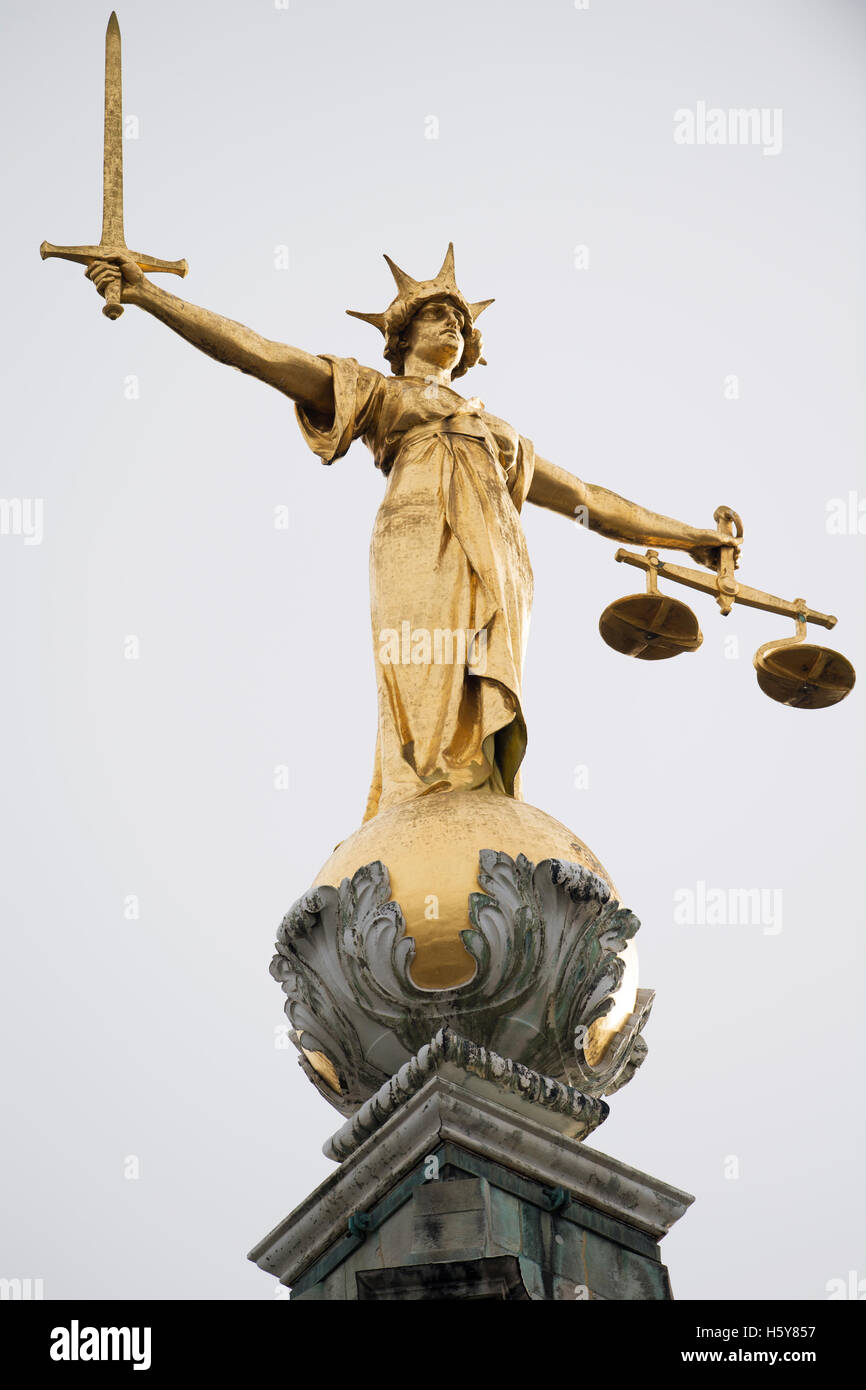
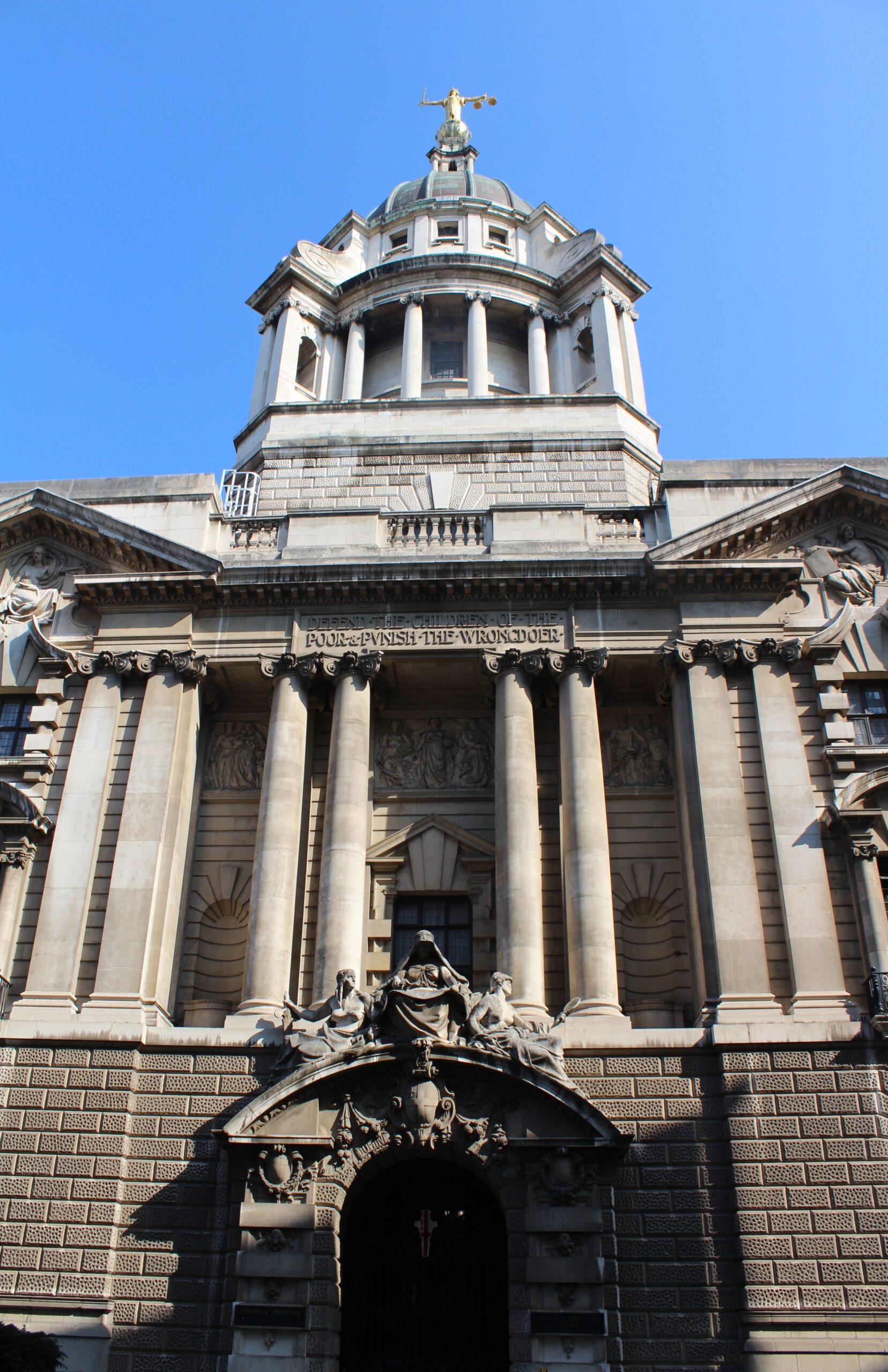
The most visible symbol of this new era was, and remains, the gilded bronze statue of Lady Justice that crowns the dome. Sculpted by F. W. Pomeroy, the figure stands 12 feet tall and, combined with the globe and iron armature beneath her feet, weighs approximately 22 tons. Unlike typical representations of Justice in Western art, Pomeroy's figure is not blindfolded. The rationale provided by the court's brochures at the time was that her "maidenly form" alone guaranteed impartiality, rendering a blindfold redundant. She holds a sword in her right hand and in her left, looming 195 feet above the street, a golden beacon intended to be visible across the London smog.
Beneath the dome, the building's main entrance on Old Bailey street bears an inscription carved into the stone lintel: "Defend the Children of the Poor & Punish the Wrongdoer." Taken from Psalm 72: 4, this motto presented a humanitarian ideal that frequently clashed with the court's punitive reality. The inscription sits a sculptured group also by Pomeroy, depicting the Recording Angel flanked by Fortitude and Truth. This artistic program was designed to intimidate and elevate, framing the legal process as a divine mandate rather than a bureaucratic function. The sheer of the stonework served to dwarf the individual, reinforcing the power of the state over the accused.
The interior of the 1907 structure featured an opulence previously unknown in British criminal courts. The Grand Hall was lined with Sicilian marble and decorated with allegorical murals by Gerald Moira, representing virtues such as Wisdom and Truth. These artistic flourishes were not decorative; they were calculated to sanitize the atmosphere of the court, distancing the new Old Bailey from the filth and disease associated with Newgate. Yet, the operational core of the building remained the cells. Ninety cells were constructed the docks, tiled in white to facilitate cleaning, directly linking the prisoner's holding area to the courtroom via a narrow staircase. This "dock" system ensured that the accused appeared suddenly in the center of the court, and exposed.
King Edward VII formally opened the building on February 27, 1907, accompanied by Queen Alexandra. The ceremony was a display of Edwardian pomp, with the King declaring the building a testament to the "advanced civilization" of the age. The event signaled the official transition of the Old Bailey from a local sessions house attached to a prison into the Central Criminal Court of England and Wales. The legal began to turn immediately, with the trials in the new building commencing the following month. The structure survived the 20th century largely intact, though it would suffer severe damage during the Blitz, requiring significant restoration to the Grand Hall and the dome in the 1950s.
| Architect | Edward William Mountford |
| Sculptor | F. W. Pomeroy |
| Construction Period | 1902, 1907 |
| Total Cost | £392, 277 |
| Primary Material | Portland Stone |
| Statue Height | 12 feet (3. 65 meters) |
| Statue Assembly Weight | Approx. 22 tons |
| Number of Cells | 90 (original 1907 configuration) |
The 1907 building established the physical footprint that the Old Bailey occupies to this day. While an extension was added in 1972 to handle the increasing caseload, Mountford's Edwardian block remains the ceremonial and symbolic heart of the complex. The Great Hall, with its marble floors and Moira's murals, continues to serve as the central artery for the legal professionals who work there. The absence of a blindfold on Lady Justice remains a point of curiosity for tourists and a subject of debate for legal scholars, representing a specific early 20th-century interpretation of judicial oversight, one that claims to see all, rather than ignoring the status of those it judges.
Public Executions and the Dead Man's Walk (1783, 1868)
The relocation of London's gallows from Tyburn to Newgate in December 1783 marked a calculated shift in the theatre of capital punishment. Authorities believed that moving executions to the very threshold of the prison would impose a solemnity absent from the drunken, riotous processions to Tyburn. They were wrong. Instead of subduing the carnival of death, the City of London concentrated it. For the 85 years, the Old Bailey and Newgate Street became the stage for a condensed, high-intensity spectacle where the of justice operated with industrial efficiency. The "New Drop," a scaffold design imported from Dublin, replaced the slow strangulation of the cart-drop method. This device, erected outside the Debtors' Door, featured a falling trapdoor calculated to break the neck, though it frequently failed, leaving the condemned to convulse before a jeering mob.
The route to this began deep within the prison's stone bowels. Known as the "Dead Man's Walk," this corridor remains one of the most chilling architectural remnants surviving into the 2026 judicial complex. It consists of a series of stone arches that narrow progressively, a forced perspective design intended to disorient the prisoner and elongate the final journey. In the era of public hangings, this passage funneled the condemned from their cells, through the Press Yard, and out into the open air of the street. The physical experience of this walk, damp, echoing, and terminating in the roar of thousands, served as the final psychological torture before the physical one.
The crowds that gathered outside the Old Bailey frequently exceeded the population of major provincial towns. On February 23, 1807, the execution of John Holloway and Owen Haggerty demonstrated the lethal volatility of these assemblies. An estimated 40, 000 spectators crammed into the narrow streets to witness the hanging. As the men mounted the scaffold, a wooden cart in the street collapsed under the weight of people climbing it for a better view. The resulting panic triggered a crush of horrific magnitude. By the time the bodies were cut down from the gallows, nearly 30 spectators lay dead on the pavement, trampled or suffocated in the press. Dozens more suffered broken limbs. The "solemn" deterrent had become a mass casualty event, yet the hangings continued at the same location for another six decades.
The economics of these execution days created a thriving, if macabre, micro-economy. Shopkeepers and residents facing the scaffold rented out their windows to the wealthy. A prime view of a high-profile hanging could command prices upwards of £10, a sum exceeding the annual wages of laborers. The "Newgate Calendar," a publication chronicling the crimes and last words of the condemned, sold in vast numbers, turning criminals into celebrities and their deaths into consumable content. This commercialization of justice meant that the Old Bailey was not a court the anchor tenant of a death industry.
| Date | Condemned | Crime | Significance |
|---|---|---|---|
| Dec 9, 1783 | John Austin | Highway Robbery | execution at Newgate; marked the end of the Tyburn era. |
| Feb 23, 1807 | Holloway & Haggerty | Murder | The "Newgate Disaster" crowd crush killed ~30 spectators. |
| May 1, 1820 | Cato Street Conspirators | High Treason | Last beheading in England (post-hanging decapitation). |
| May 26, 1868 | Michael Barrett | Fenian Bombing | The final public execution in Britain before the practice moved inside. |
The brutality reached a medieval crescendo on May 1, 1820, with the execution of the Cato Street Conspirators. Arthur Thistlewood and four associates, convicted of plotting to assassinate the British cabinet, were sentenced to be hanged and beheaded. After hanging for half an hour, their bodies were cut down. A masked man, likely a surgeon rather than the common hangman, used a knife to sever the heads. When the executioner held up Thistlewood's head and proclaimed it the head of a traitor, the crowd did not cheer. Reports from the time describe a visceral groan rising from the onlookers, a reaction that signaled a shifting public morality. The sheer gore of the spectacle began to alienate the very populace it was intended to cow.
By the mid-19th century, the "civilizing" forces of Victorian society viewed the public gallows as an embarrassment. The deterrent effect was unproven; the disorder was undeniable. Charles Dickens, who attended the execution of the Mannings in 1849, wrote savagely to The Times about the "ribaldry, debauchery, levity, drunkenness, and flaunting vice" he witnessed. The government eventually capitulated. The Capital Punishment Amendment Act of 1868 mandated that all future executions take place within the prison walls.
The final act of this public drama occurred on May 26, 1868. Michael Barrett, a Fenian convicted for the Clerkenwell explosion, became the last person publicly hanged in England. A crowd of roughly 2, 000 gathered, a smaller, more controlled assembly than in previous decades, still hostile. As Barrett dropped, the era of the street scaffold ended. From that day forward, the "Dead Man's Walk" no longer led to the open air. It terminated instead in a purpose-built execution shed inside the prison yard. The Old Bailey continued to feed the gallows, the state killed in private, burying the bodies beneath the flagstones of the corridor itself, marked only by initials carved into the wall, graffiti of the dead that remains visible to those few granted access to the site in 2026.
World War II Bombing and Structural Restoration (1941, 1952)
The night of May 10, 1941, marked the single most devastating assault on the Central Criminal Court in its history, an event that physically shattered the Edwardian of law yet failed to halt its. While the Luftwaffe had targeted the City of London repeatedly since September 1940, this raid, later categorized by historians as "The Hardest Night", delivered a direct and catastrophic blow to the Old Bailey. German bombers, utilizing the light of a full moon and a low ebb that firefighters, dropped over 700 tons of high explosives and 86, 000 incendiaries across the capital. At 11: 02 PM, the sirens wailed, and shortly thereafter, a high-explosive bomb struck the north-west corner of the Old Bailey, tearing through the masonry and reducing Court Number 2 to a crater of brick and dust.
The structural violence inflicted upon the building was absolute in specific sectors. Court Number 2, a chamber that had witnessed decades of capital trials, was obliterated. The blast force blew out the heavy oak doors, shattered the gallery seating, and collapsed the roof. In adjacent Court Number 1, the shockwave decimated the windows and filled the room with debris, though the main structure held. The Great Hall, the ceremonial heart of the building designed by E. W. Mountford only three decades prior, suffered severe damage. Its marble floors were buried under shards of glass and plaster, and the intricate murals decorating its walls were scarred by shrapnel and water. The devastation was not cosmetic; it was a structural amputation of the court's north wing.
Amidst the inferno, the gilded bronze statue of Lady Justice atop the dome became a subject of immediate public fixation. Standing 195 feet above the street, the 22-ton figure by F. W. Pomeroy was subjected to the intense heat and rising smoke of the burning city. Contrary to popular myth, the statue did not fall. She remained upright, her sword and intact, even as the building beneath her buckled. This survival was interpreted by the press and the weary public as a symbol of British endurance, yet the reality on the ground was far less romantic. The fire watchers stationed on the roof fought a desperate battle to extinguish incendiaries that landed on the lead and slate, preventing the fire from consuming the entire complex. Their logs from that night record a chaotic struggle against a firestorm that destroyed 700 acres of the City of London.
The aftermath of the bombing revealed a grim irony: the court itself became a crime scene, yet it was simultaneously flooded with new cases generated by the raid. The chaos of the Blitz did not produce a utopian "Blitz Spirit" of universal cooperation; rather, it unleashed a wave of opportunistic crime. Data from the Metropolitan Police shows that between September and December 1941 alone, the Old Bailey and lower courts processed 4, 584 cases of looting. Gangs and individuals exploited the blackout and the bombed-out storefronts to steal rationing coupons, jewelry, and household goods. The judges, sitting in the remaining serviceable courtrooms which smelled of wet ash and cordite, handed down severe sentences to those caught scavenging from the ruins. The court operated without glass in the windows, with cardboard covering the openings, and with the constant noise of repair crews working in the background.
Restoration of the Old Bailey was neither immediate nor simple. For nearly a decade, the scar of the 1941 bombing remained visible, a testament to the post-war austerity that gripped Britain. Materials like steel, glass, and seasoned oak were in serious absence, diverted primarily to housing and industrial recovery. The City of London Corporation, responsible for the court's upkeep, faced a logistical nightmare. They had to maintain judicial functions in a half-ruined building while securing funds and permits for a faithful reconstruction. It was not until the early 1950s that the major restoration work began in earnest, a project that required matching the specific Portland stone of the 1907 facade and sourcing craftsmen capable of replicating the Edwardian plasterwork.
The reconstruction effort culminated in 1952 with the reopening of the Great Hall. The restoration architects chose not to simply erase the history of the war to it into the fabric of the building. New murals were commissioned for the Great Hall to commemorate the Blitz, depicting the scenes of fire and rescue that had played out on the streets outside. These paintings serve as a permanent record of the court's vulnerability. The reopening ceremony was a somber affair, acknowledging that while the stone had been replaced, the legal had shifted. The death penalty, a staple of Old Bailey sentences, was facing increasing scrutiny, and the types of crimes being tried were evolving from the desperate thefts of the war years to the organized criminal enterprises of the 1950s.
The financial cost of the damage was substantial. In 1941 values, the destruction across London that night totaled £20 million, with the Old Bailey's share representing of the civic repair bill. The loss of Court Number 2 also created a backlog of cases that plagued the judicial system for years. To manage the load, trials were shuffled to other venues or crammed into the surviving courtrooms, leading to extended sessions that ran late into the night. The administrative load of the war years proved that the physical building was secondary to the volume of indictments flowing through the system. The Old Bailey was not just a monument; it was a processing plant for London's criminality, and that plant had to keep running even when half its roof was missing.
The 1952 restoration marked the end of the immediate post-war recovery phase, it also set the stage for the modernization that would follow. The rebuilt sections were wired for better lighting and acoustics, acknowledging the deficiencies of the original 1907 design. This period of destruction and renewal proved that the Central Criminal Court was not a static relic a functional entity that absorbed the violence of its time. The bomb that destroyed Court 2 did not stop the gavel from falling; it forced the law to adapt to the rubble.
| Metric | Data Point | Context |
|---|---|---|
| Date of Event | May 10-11, 1941 | Last major raid of the Blitz ("The Hardest Night") |
| Primary Damage | Court No. 2 Destroyed | North-west corner reduced to rubble; Great Hall damaged |
| London Casualties | 1, 436 Killed | Highest single-night death toll of the war for London |
| Looting Cases | 4, 584 (Sept-Dec 1941) | Sharp rise in opportunistic crime processed by courts |
| Restoration Completion | 1952 | Delayed by post-war material absence and austerity |
| Ordnance Dropped | 711 tons (High Explosive) | Combined with 86, 173 incendiary bombs across the city |
1973 IRA Bombing and Security Protocols
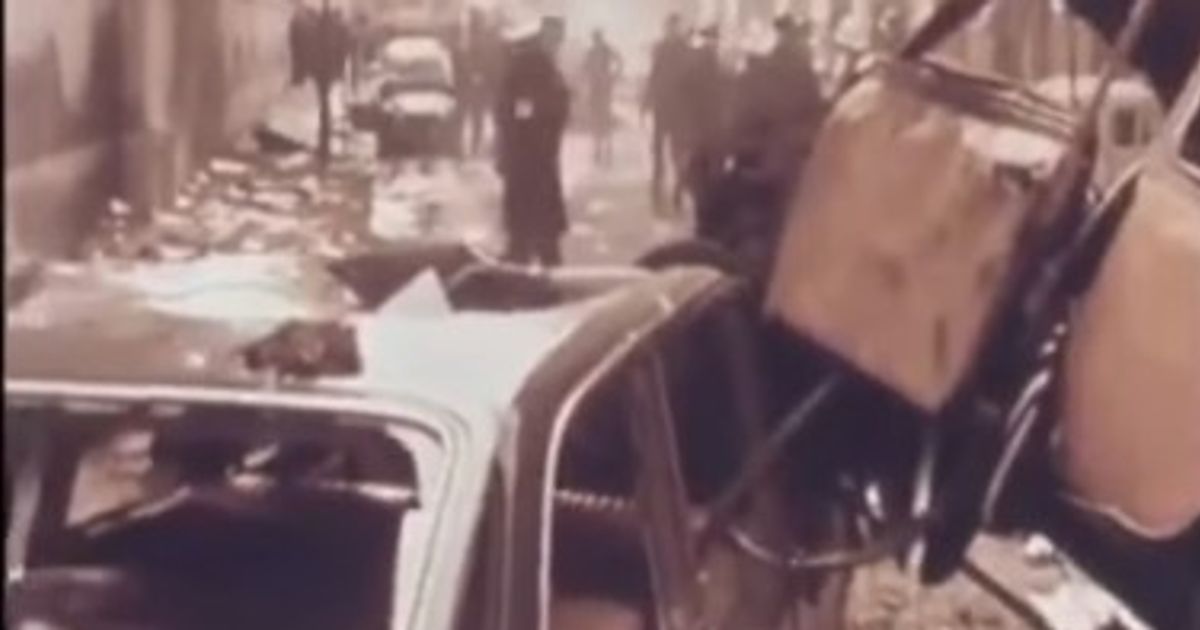
The transformation of the Old Bailey from a porous, disease-ridden 18th-century hall into a modern hinges on a single, violent pivot point: March 8, 1973. While the court had withstood the slow decay of centuries and the aerial bombardment of the Blitz, it was a Green Ford Cortina packed with 175 pounds of explosives that fundamentally altered its operational DNA. At 2: 50 PM, the Provisional IRA detonated the vehicle outside the court's entrance, shattering the Edwardian facade and injuring over 200 people. This event, known as "Bloody Thursday," ended the era of the court as an open public theater and initiated a security regime that continues to tighten in 2026.
The attack was calculated and precise, executed by the "Belfast Ten," a unit that included Dolours and Marian Price. Although a warning was phoned to Scotland Yard at 2: 01 PM, communication failures meant the City of London Police did not locate the vehicle until minutes before detonation. The blast force was sufficient to wreck the court's frontage and send shards of glass flying through the interior. One specific shard remains in the wall at the top of the main stairs today, preserved not as a memorial, as a forensic scar, a permanent reminder of the building's vulnerability. Frederick Milton, a 60-year-old caretaker who helped rescue victims immediately after the blast, died of a heart attack shortly after, becoming the attack's sole fatality.
This bombing forced a total re-evaluation of the court's physical defense. In the 1700s and 1800s, the primary threat to the court came from within: the "gaol fever" (typhus) brought up from the cells, which killed judges and jurors alike in the "Black Sessions" of 1750. By the late 20th century, the threat had inverted. The danger came from external actors seeking to disrupt the judicial process through high-yield explosives. The immediate response to the 1973 attack involved the installation of steel blast blocks and the implementation of search regimes that were previously unimaginable in a British court.
The most visible legacy of the post-1973 security evolution is the "secure dock." For centuries, defendants stood in an open pen, separated from the gallery only by a wooden rail and the pungent herbs spread to mask the smell of Newgate Prison. Following the IRA campaign and subsequent high-risk trials, the court introduced enclosed glass docks. These structures, frequently derided by defense counsel as "goldfish bowls," serve a dual purpose: they prevent the escape of the accused and shield them from projectiles or assassination attempts from the public gallery. By 2026, these docks have been reinforced with ballistic-grade materials, creating a hermetically sealed environment within the courtroom itself.
Modern entry at the Old Bailey rival those of international airports, a clear contrast to the chaotic, unpoliced crowds of the Victorian era. Visitors in 2026 must navigate a "sterile zone" before accessing the building. This involves airport-style metal detectors, X-ray belts for bags, and pat-down searches by uniformed officers. The City of London's "Ring of Steel", a network of checkpoints and cameras established in the 1990s to counter IRA threats, places the court inside a wider surveillance cordon. The casual observer of 1724, who could wander in to watch a hanging trial for entertainment, has been replaced by a vetted, scanned, and monitored participant.
| Era | Primary Threat | Defensive Measure | Outcome |
|---|---|---|---|
| 1750, 1800 | Typhus ("Gaol Fever") | Sweet herbs, vinegar washes | Ineffective; "Black Sessions" killed 60+ officials. |
| 1800, 1900 | Mob Violence / Escape | "Birdcage Walk" tunnel | Physical separation of prison and court. |
| 1940, 1941 | Luftwaffe Bombing | Sandbags, fire watches | North Court destroyed; rebuilt 1952. |
| 1973 | IRA Car Bomb | None (Pre-attack) | 1 dead, 200+ injured; facade wrecked. |
| 1974, 1990 | Terrorism / Assassination | Blast blocks, glass docks | Courtroom hardened; "Goldfish bowl" era begins. |
| 2000, 2026 | Modern Terror / Cyber | X-ray, armed police, CCTV | Total surveillance; " " status. |
The security apparatus also extends to the transport of prisoners. The "Birdcage Walk," the open-air archway used in the 19th century to march prisoners from Newgate, has been superseded by secure vehicle bays and underground tunnels. In high-profile terrorism cases, armed police convoys close off the surrounding streets, creating a temporary exclusion zone. This militarization of the judicial space reflects a grim reality: the Old Bailey is no longer just a place of law, a high-value target. The preservation of the 1973 glass shard serves as a continuous warning that the thick stone walls of the 1907 building are not impenetrable.
Judicial Hierarchy and Crown Court Jurisdiction
The legal authority of the Old Bailey rests on a complex stratification of judicial power that distinguishes it from every other court in the United Kingdom. While the Central Criminal Court Act of 1834 formally established its jurisdiction over London and Middlesex, the Courts Act 1971 marked the most radical restructuring in its history. This legislation abolished the ancient system of Assizes and Quarter Sessions, integrating the Old Bailey into the newly formed national Crown Court system. Yet, the court retained its specific title and unique customs, functioning as a "Centre" for the Crown Court while preserving the ceremonial privileges of the City of London. This dual identity creates a judicial hybrid: a modern instrument of state justice housed within a vessel of medieval tradition.
The hierarchy of judges at the Old Bailey is rigid and visually codified by their robes. At the apex sits the Recorder of London, the senior-most permanent judge, a position held by Mark Lucraft KC as of the mid-2020s. The Recorder is technically a Senior Circuit Judge exercises authority comparable to High Court officials. the Recorder is the Common Serjeant of London, the second senior permanent judge. Both officers are appointed by the Crown yet maintain historic ties to the City of London Corporation. These permanent judges handle the bulk of serious criminal trials, including manslaughter, sexual offenses, and high-value fraud. Unlike Circuit Judges in other parts of the country who wear violet, Circuit Judges sitting at the Old Bailey traditionally wear black silk gowns, a visual marker of the court's distinct lineage.
For the most serious indictments, treason, murder, and terrorism, the court summons High Court Judges from the King's Bench Division. Known colloquially as "Red Judges" due to their scarlet robes, these jurists descend from the Royal Courts of Justice to preside over Class 1 offenses. Their presence signals the severity of the case at hand. A strict protocol governs the bench: the presiding judge sits off-center. The central chair is reserved for the Lord Mayor of London, who technically holds the title of Chief Justice of the Central Criminal Court. While the Lord Mayor rarely attends and never presides over legal arguments, the center seat remains empty in their absence, a silent assertion of the City's nominal supremacy over the King's justices within the Square Mile.
| Judicial Rank | Robes (Criminal) | Typical Offenses (Class) |
|---|---|---|
| High Court Judge | Scarlet (Red) | Class 1: Treason, Murder, Terrorism |
| Recorder of London | Black Silk / Violet | Class 1 & 2: Manslaughter, Attempted Murder |
| Common Serjeant | Black Silk / Violet | Class 2 & 3: Rape, Serious Robbery, Fraud |
| Circuit Judge | Black Silk (Old Bailey custom) | Class 3: Aggravated Burglary, GBH |
The jurisdiction of the Old Bailey extends beyond the geographic boundaries of Greater London for specific categories of crime. Through a "Voluntary Bill of Indictment" or a transfer of proceedings, the court frequently hears cases from across England and Wales if they carry exceptional public interest or security concerns. This national remit makes it the primary venue for terrorism trials and high-profile espionage cases. The court operates under the "Commission of Oyer and Terminer," a legal instrument it to "hear and determine" cases. This commission includes not only the professional judges also, theoretically, the Aldermen of the City of London, though their judicial function is entirely ceremonial.
Operational realities in the 2020s have this historic hierarchy. Following the implementation of the Crown Court (Recording and Broadcasting) Order 2020, the Old Bailey became the testing ground for televised justice. In July 2022, Judge Sarah Munro KC made history in Court 2 by delivering the televised sentencing remarks in a Crown Court, handing down a life sentence in a manslaughter case. This move toward transparency allows the public to witness the rationale behind judicial decisions, though cameras remain strictly focused on the judge, with defendants, victims, and jurors shielded from view.
Even with these modernizations, the court faces a severe logistical emergency. Data from the Ministry of Justice in late 2025 revealed a record backlog across the Crown Court system, exceeding 78, 000 outstanding cases. The Old Bailey, handling the most complex and evidence-heavy trials, bears the brunt of this congestion. By early 2026, listing officers were scheduling trials well into 2027 and 2028, leaving defendants on remand and victims in limbo for years. This administrative gridlock challenges the efficacy of the judicial hierarchy, as even the most senior judges find their courtrooms stalled by widespread delays, barrister absence, and an infrastructure struggling to process the volume of modern digital evidence.
Notable Capital Cases and Treason Trials (1700, 1965)
For more than two centuries, the Old Bailey functioned as the primary for state-sanctioned death in London. Between 1700 and the final abolition of the death penalty for murder in 1965, the Central Criminal Court condemned thousands to the gallows. The courtroom served not as a venue for arbitration as a processing center for the "Bloody Code," a legal system that by the early 1800s listed over 200 offenses punishable by death. While the public spectacle of hanging moved from Tyburn to the street outside Newgate Prison in 1783, and eventually behind prison walls in 1868, the sentence itself, the donning of the Black Cap and the pronouncement of "hanged by the neck until dead", remained the Old Bailey's most terrifying prerogative.
The 18th and 19th centuries saw the court enforce laws where property held higher value than life. Men and women faced execution for crimes as minor as shoplifting goods worth five shillings, cutting down trees, or wrecking a fishpond. Yet, the court's most theatrical moments arose during trials for High Treason, where the state sought to eliminate threats to its own existence. These trials were distinct from common felonies; they were political battles fought with archaic statutes.
In 1820, the court heard the case of the Cato Street Conspirators, a group of radicals led by Arthur Thistlewood who plotted to assassinate the entire British cabinet and the Prime Minister, Lord Liverpool. The trial was a foregone conclusion given the evidence of their armory and intent. On May 1, 1820, five of the conspirators became the subjects of the last beheading in English history. Following their hanging outside Newgate Prison (adjacent to the court), a masked executioner decapitated the corpses, holding the heads aloft to the crowd. This gruesome theater marked the end of medieval-style punishment for treason at the Old Bailey.
Nearly a century later, the court applied a 14th-century statute to convict an Irish nationalist. The 1916 trial of Sir Roger Casement remains one of the most legally contested in the Old Bailey's history. Casement, a former British diplomat, was charged with High Treason for attempting to recruit Irish prisoners of war in Germany to fight against Britain. The defense argued that the Treason Act of 1351 only applied to treason committed "within the," whereas Casement's actions took place in Germany. The prosecution, led by F. E. Smith, successfully argued that a comma in the Norman French text implied the act extended to enemies elsewhere. Casement was convicted and hanged at Pentonville, famously observing that he was "hanged on a comma."
The definition of treason was stretched further in 1945 during the trial of William Joyce, known as the Nazi propagandist "Lord Haw-Haw." Joyce, born in the United States, had broadcast anti-British propaganda from Germany throughout World War II. His defense rested on the fact that he was not a British subject and therefore owed no allegiance to the Crown. The court, yet, ruled that because Joyce had obtained a British passport (albeit by falsely claiming birth in Ireland), he accepted the protection of the Crown and owed allegiance in return. This technicality secured his conviction, and he became the last person executed for treason in the UK.
| Year | Defendant | Charge | Outcome | Legal Significance |
|---|---|---|---|---|
| 1820 | Arthur Thistlewood | High Treason | Hanged & Beheaded | Cato Street Conspiracy; last ritual beheading in England. |
| 1916 | Roger Casement | High Treason | Hanged | Convicted under 1351 Act; dispute over "within the " interpretation. |
| 1945 | William Joyce | High Treason | Hanged | "Lord Haw-Haw"; allegiance established via fraudulently obtained passport. |
| 1950 | Timothy Evans | Murder | Hanged | Wrongfully executed for crimes committed by serial killer John Christie. |
| 1952 | Derek Bentley | Murder | Hanged | Joint enterprise conviction; controversial "Let him have it" statement. |
| 1955 | Ruth Ellis | Murder | Hanged | Last woman executed in the UK; highlighted absence of defense for provocation. |
While treason trials captured national attention, it was the domestic murder trials of the 1950s that dismantled the death penalty. The Old Bailey became the stage for three specific cases that exposed the fatal flaws in capital punishment: the risk of executing the innocent, the rigidity of the law regarding mental capacity, and the absence of nuance in crimes of passion.
The 1950 trial of Timothy Evans stands as the court's most shameful miscarriage of justice. Evans was charged with murdering his infant daughter at 10 Rillington Place. The chief prosecution witness was his neighbor, John Christie. Evans, a man with a low IQ and high suggestibility, initially confessed later accused Christie. The jury believed the "respectable" Christie, and Evans was hanged. Three years later, Christie was revealed to be a serial killer who had murdered at least eight women, including Evans's wife, and hid their bodies in the same house. The realization that the Old Bailey had sent an innocent man to the gallows on the testimony of the actual killer caused a seismic shift in public opinion.
Two years later, the court tried Derek Bentley and Christopher Craig for the murder of a police officer during a burglary. Craig, aged 16, fired the fatal shot, he was too young to hang. Bentley, 19, was armed only with a knife and was under arrest when the shot was fired. The prosecution relied on the ambiguous phrase Bentley allegedly shouted: "Let him have it, Chris." The Crown argued this was an instruction to shoot; the defense claimed it was a plea to surrender the gun. Under the doctrine of "joint enterprise," Bentley was held equally responsible. even with the jury's recommendation for mercy and Bentley's mental age of 11, he was hanged. The state killed a man who never pulled the trigger, sparking protests that continued until his posthumous pardon decades later.
The final blow to the death penalty's legitimacy came with the 1955 trial of Ruth Ellis. Ellis shot her abusive lover, David Blakely, outside a pub in Hampstead. At the Old Bailey, she offered no defense, stating simply, "It was obvious that when I shot him I intended to kill him." Under the law of 1955, provocation was not a defense against a murder charge unless it involved a sudden physical assault. The jury, bound by the rigid statutes, took only minutes to convict. The public, aware of the abuse Ellis suffered and the "crime of passion" nature of the offense, reacted with horror. Her execution at Holloway Prison galvanized the abolitionist movement.
These cases, all adjudicated in the famous Number One Court of the Old Bailey, demonstrated that the legal system could be technically correct yet morally bankrupt. The accumulation of these errors and rigidities led directly to the Murder (Abolition of Death Penalty) Act 1965, which suspended capital punishment for murder in Great Britain. The gallows at Wandsworth and Pentonville, fed for centuries by the verdicts delivered at the Old Bailey, fell silent.
Modern Terrorism and Gang Prosecution (2000, 2026)
The transition of the Central Criminal Court into the twenty- century was defined not by a change in its function, by the hardening of its shell. Following the Provisional IRA's bombing campaigns of the 1970s and early 1990s, the City of London constructed the "Ring of Steel," a network of checkpoints and surveillance that enveloped the Old Bailey. By 2000, the court had ceased to be a public gallery for the curious; it had become a. The open access that characterized the Victorian era, where spectators paid admission fees to watch hangings or trials, was replaced by airport-style scanners, armed police patrols, and concrete blast blocks. This architectural defensiveness was a necessary response to a new era of defendants: transnational terrorists, organized crime syndicates using military-grade encryption, and rogue state actors.
The prosecution of terrorism at the Old Bailey between 2000 and 2026 reflects the changing methodology of violence in the United Kingdom. In the wake of the July 7, 2005 bombings, the court handled the trials of those accused of assisting the attackers, though the suicide bombers themselves were beyond justice. The subsequent 21/7 failed bombing plot trial in 2007 saw the Old Bailey under security, with the jury protected by armed officers. Yet, the nature of the threat shifted from complex cell-based plots to "lone wolf" attacks, altering the courtroom. The 2013 trial of Michael Adebolajo and Michael Adebowale for the murder of Fusilier Lee Rigby stands as a grim marker of this period. In Court Number One, the jury witnessed graphic footage of the defendants justifying their butchery on the streets of Woolwich. The conviction of Thomas Mair in 2016 for the murder of MP Jo Cox, and the 2022 conviction of Ali Harbi Ali for the murder of MP David Amess, further cemented the Old Bailey's role as the final arbiter in cases where political extremism bleeds into savage violence. These trials were not lengthy forensic puzzles ideological confrontations, where the dock became a platform for the accused to profess allegiance to extremist causes before being silenced by life sentences.
While terrorism dominated the headlines, a quiet revolution occurred in the prosecution of organized crime. The early 2020s saw the collapse of the "omertà" code, not through moral awakening, through the penetration of the EncroChat encrypted communication network. Operation Venetic, the UK law enforcement response to the 2020 hack of the EncroChat servers, flooded the Old Bailey with Class A drug trafficking and firearms cases. Prosecutors no longer relied on shaky eyewitness testimony or flipped informants. Instead, they presented juries with millions of messages, photos of blocks of cocaine stamped with cartel logos, and images of firearms laid out on kitchen tables. In cases heard between 2020 and 2024, the evidence was irrefutable digital residue. High-ranking gang members, who had previously insulated themselves from the street-level trade, found their anonymity stripped away by their own data. The court adapted to handle this volume of digital forensics, with trials frequently turning on the attribution of "handles" or usernames to specific defendants.
The intersection of youth culture and gang violence introduced a controversial evidential tool to the Old Bailey: UK Drill music. Throughout the 2010s and 2020s, prosecutors increasingly introduced music videos and lyrics as evidence of intent or gang affiliation. Defense barristers argued this criminalized artistic expression, treating hyperbole as confession. Yet, in numerous murder trials, the court accepted that specific lyrics contained "knowledge only the killer could possess." This practice reached a fever pitch in the mid-2020s, as the Crown Prosecution Service sought to gang hierarchies by linking lyrical threats to physical acts of violence. The courtroom monitors, once reserved for displaying dusty ledgers, played high-definition music videos, requiring juries to decode street slang and visual signals to determine guilt in fatal stabbings.
The integrity of the justice system itself faced a severe test in 2021 with the sentencing of Wayne Couzens. A serving Metropolitan Police officer, Couzens was sentenced to a whole-life order for the kidnap, rape, and murder of Sarah Everard. The Old Bailey, historically the partner of the police in the maintenance of order, became the venue for their condemnation. Lord Justice Fulford's sentencing remarks, delivered in a courtroom heavy with the weight of institutional betrayal, highlighted the unique danger posed by a police officer using his warrant card to facilitate murder. This scrutiny of the police continued into 2024 with the trial and acquittal of marksman Martyn Blake for the shooting of Chris Kaba, a case that brought armed officers to the brink of revolt and forced a re-examination of the legal protections afforded to state enforcers.
Technological advancement within the court culminated on July 28, 2022, when cameras were permitted to broadcast sentencing remarks for the time. Judge Sarah Munro QC made legal history by sentencing Ben Oliver for manslaughter on live television. This ended centuries of prohibition against photography and filming, a rule originally intended to preserve the dignity of the court and protect the privacy of the participants. While the cameras remained fixed on the judge, excluding the defendant and the gallery, the move signaled a desperate attempt to modernize the judiciary and demystify the sentencing process for a skeptical public. By 2026, televised sentencing for high-profile murder and terrorism cases had become routine, turning the final moments of a trial into a national media event.
Even with these technological strides, the physical infrastructure of the Old Bailey began to fail. The "Cathedral of Justice" suffered from the same decay afflicting much of the UK's public estate. In January 2024, a large section of masonry plummeted from the building's facade, injuring a pedestrian and forcing the closure of the ceremonial entrance. This incident was of a wider emergency involving Reinforced Autoclaved Aerated Concrete (RAAC) and antiquated electrical systems. Throughout 2023 and 2024, trials were frequently disrupted by power outages, leaks, and heating failures. The irony was clear: inside the courtrooms, digital evidence and video links represented the cutting edge of legal procedure, while outside, the Edwardian stonework crumbled due to decades of deferred maintenance. By 2025, the backlog of cases, exacerbated by the COVID-19 pandemic and the crumbling estate, meant that victims and defendants frequently waited years for a trial date, the principle that justice delayed is justice denied.
| Year | Defendant(s) | Charge/Event | Significance |
|---|---|---|---|
| 2007 | Muktar Said Ibrahim et al. | Failed 21/7 Bombings | Convicted of conspiracy to murder; highlighted the ongoing terror threat post-7/7. |
| 2013 | Adebolajo & Adebowale | Murder of Lee Rigby | Sentenced to whole-life and life terms; trial highlighted "lone wolf" brutality. |
| 2016 | Thomas Mair | Murder of Jo Cox MP | Whole-life order for politically motivated assassination of a sitting MP. |
| 2021 | Wayne Couzens | Murder of Sarah Everard | Serving police officer sentenced to whole-life term; shattered public trust in policing. |
| 2022 | Ben Oliver | Manslaughter | ever televised sentencing in an English Crown Court. |
| 2022 | Ali Harbi Ali | Murder of David Amess MP | Convicted of terror-related murder; reinforced security concerns for public officials. |
| 2024 | Martyn Blake | Murder (Acquitted) | Police marksman cleared in shooting of Chris Kaba; sparked national debate on police accountability. |
| 2024 | Constance Marten | Manslaughter | High-profile trial involving the death of a newborn; dominated 2024 media coverage. |
As the court moves toward the late 2020s, it remains the primary stage for the nation's morality plays. The data from 2020 to 2026 shows a relentless stream of knife crime, frequently involving defendants barely out of childhood, alongside the complex, multi-jurisdictional fraud and terror cases that define the modern era. The Old Bailey stands as a paradox: a crumbling physical monument to Victorian order, struggling to contain the digital, chaotic, and hyper-violent realities of twenty- -century crime.
The Proceedings and Digital Archiving Projects
The history of the Old Bailey's documentation is a paradox: the further back one looks, the clearer the picture becomes. While the 18th-century court operated in a blaze of commercial publicity, the modern judicial system has retreated behind a veil of digital incompetence and bureaucratic opacity. The Old Bailey Proceedings, published regularly from 1674 to 1913, constitute the largest unbroken run of criminal court records in existence. Yet, these documents were not born from a desire for transparency or legal precedent. They were street literature, sold for pennies to a public hungry for salacious details of murder, theft, and the gallows.
For over two centuries, the Proceedings functioned as a private enterprise sanctioned by the City of London. The Lord Mayor and Aldermen retained the rights to the publication, licensing them to printers who paid a premium for the privilege. This commercial imperative dictated the content; acquittals and complex legal arguments were frequently condensed or omitted in favor of sexually explicit testimony and violent confrontations that drove sales. The accuracy of these records improved dramatically after 1748, when the court appointed Thomas Gurney as its official shorthand writer. The Gurney family held this monopoly for generations, their "Brachygraphy" system capturing the verbatim speech of the courtroom with a fidelity that rivals modern stenography.
The publication of the Proceedings ceased abruptly in 1913. The rise of mass-market newspapers, which could print sensational trial reports faster and cheaper, destroyed the commercial viability of the official sessions papers. Simultaneously, the court system transitioned to state-controlled record-keeping. The "Central Criminal Court" series (CRIM), housed at The National Archives in Kew, replaced the public broadsheets. Unlike their predecessors, these files were never intended for immediate public consumption. They were administrative artifacts, frequently sealed for 30, 75, or even 100 years under strict retention schedules. Consequently, a historian today has immediate, searchable access to a pickpocket's trial from 1785, faces significant legal and physical blocks to examine a murder case from 1955.
The digital resurrection of the court's history began in 2003 with the launch of the Old Bailey Online. A collaboration between the Universities of Hertfordshire and Sheffield, led by Professors Tim Hitchcock and Robert Shoemaker, the project digitized 197, 745 trials comprising 127 million words. This initiative did not scan images; it used manual rekeying to create a fully searchable text database, allowing researchers to track crime waves, sentencing trends, and the decline of the "Bloody Code" with statistical precision. In late 2023, the project released Version 9. 0, a major architectural update funded by alumni donors, ensuring the data remains accessible on modern devices even as the original funding streams dried up.
In clear contrast to the strong preservation of the 18th century, the digital archiving of 21st-century Old Bailey trials has become a catastrophe of mismanagement. The Ministry of Justice's "Common Platform," a £1. 3 billion digital case management system introduced to replace legacy software, has been plagued by serious failures since its rollout. In September 2025, a government minister admitted that a software bug had hidden documents and data fields from view in an unknown number of cases, raising fears that convictions were secured without the defense seeing all the evidence. Unlike the Gurney shorthand notebooks, which survive physically after 250 years, the digital records of the 2020s are fragile, prone to corruption, and frequently inaccessible to the public.
The fragility of modern open justice reached a breaking point in February 2026. HM Courts and Tribunals Service (HMCTS) issued a deletion order against Courtsdesk, a journalism service that had aggregated magistrate and crown court data to help reporters track cases. The government "unauthorized sharing" and demanded the destruction of the archive, a move that would have wiped out five years of organized legal history. Following a backlash from the National Union of Journalists and intervention by the Deputy Prime Minister, the order was paused on February 19, 2026. This incident exposes a chilling reality: while the City of London in 1700 profited from broadcasting the court's business, the modern state actively attempts to delete the digital footprint of its own justice system.
| Feature | 18th Century (The Proceedings) | 21st Century (Common Platform/CRIM) |
|---|---|---|
| Access Method | Sold on street corners; free online. | Restricted database; physical files at Kew. |
| Retention | Permanent public distribution. | Subject to deletion orders and data rot. |
| Transparency | High (driven by profit). | Low (driven by privacy/bureaucracy). |
| Integrity | Verbatim shorthand (Gurney system). | Software bugs hiding evidence (2025). |
The in archival quality poses a serious problem for future historians. The "One Crown" data project, initiated in June 2025 to align methodologies between the Ministry of Justice and HMCTS, attempts to fix the data discrepancies that have made modern court statistics unreliable. Even with these efforts, the record of the Old Bailey in the 2020s likely be less complete than that of the 1720s. We are building a digital dark age, where the trials of the present into proprietary databases, while the ghosts of Newgate remain vividly, permanently searchable.
Infrastructure Failure and Maintenance Backlogs (2015, 2026)
City of London Corporation Administration and Sheriffs
| Function | Responsible Body | Funding Source |
|---|---|---|
| Building Fabric & Maintenance | City of London Corporation | City's Cash / House Estates |
| Court Administration (Clerks/Listing) | HM Courts & Tribunals Service (MoJ) | Central Government Taxation |
| Judicial Salaries | Ministry of Justice | Consolidated Fund |
| Judicial Housing & Hospitality | City of London Corporation | City's Cash |
| Security & Cleaning Staff | City of London Corporation | City's Cash |
The financial of this commitment is substantial. The City spends millions annually on the Old Bailey, covering everything from the cleaning of the golden Lady Justice statue to the repair of the cells. In return, the Corporation maintains a grip on the country's most famous court, a privilege that allows the Lord Mayor and Sheriffs to project authority far beyond the financial district's boundaries. Even with the 2024 infrastructure failures, the City shows no sign of relinquishing this control. The Old Bailey remains a of the Corporation, a place where the state administers justice, the City holds the keys.
Cultural Depictions and Lady Justice Iconography
The most visible symbol of the Old Bailey is not a judge in a wig, the twelve-foot bronze figure standing 195 feet above the street. Created by sculptor F. W. Pomeroy and installed in 1907, the statue of Lady Justice (technically Iustitia) defies the popular convention of being blindfolded. While modern pop culture frequently depicts Justice as blind to represent impartiality, Pomeroy's figure keeps her eyes wide open. This design choice aligns with the Roman tradition where Justice requires clear vision to separate truth from falsehood. The figure holds a sword in her right hand to represent authority and in her left to weigh evidence. Cast in bronze and covered in gold leaf, the statue itself weighs approximately 3. 5 tons, though the entire assembly including the globe and sword reaches 22 tons. The figure requires cleaning every five years to maintain its luster against the London grime, a pattern of maintenance that mirrors the court's own constant need to process the city's criminality.
The physical structure of the court has suffered significant damage during its history, serving as a lightning rod for attacks on the British establishment. During the London Blitz of World War II, the Old Bailey sustained serious damage on May 10, 1941. High explosive bombs destroyed the Number 2 Court and blew out the windows of the Great Hall, yet the golden statue remained standing, becoming a wartime symbol of resilience. Decades later, on March 8, 1973, the Provisional IRA detonated a car bomb outside the courthouse. The explosion injured nearly 200 people and caused extensive structural damage, shattering the glass of the building and leaving a crater in the street. These physical assaults on the building reinforce its status as the physical embodiment of state power, a theme explored extensively in fiction.
Cultural depictions of the Old Bailey frequently oscillate between reverence for its authority and horror at its severity. Charles Dickens, who worked as a court reporter, immortalized the grim atmosphere of the late 18th-century court in A Tale of Two Cities (1859). Dickens described the court not as a place of sterile law, as a "meat-market" where the air was so foul that judges and spectators carried bunches of rue and strong herbs to ward off gaol fever (typhus). His portrayal of the treason trial of Charles Darnay captures the "Bloody Code" era, where the dock was a direct pipeline to the gallows. The practice of carrying posies of flowers continues today during the ceremonial summer term, a sanitized ritual that acknowledges the court's septic past.
Before Dickens, the court produced its own form of mass media through the Old Bailey Proceedings. Published regularly from 1674 to 1913, these accounts created the "true crime" genre long before the term existed. The Proceedings were sold on the streets of London, offering the public detailed, frequently sensationalized transcripts of trials. This publication democratized access to the court's inner workings, allowing the illiterate poor to hear stories of highwaymen and murderers read aloud in alehouses. The Proceedings served a dual purpose: entertainment for the masses and a moral warning from the state. By 2026, these archives had been fully digitized, allowing data scientists to analyze 240 years of judicial trends, revealing the shift from death sentences to transportation and imprisonment.
In modern visual media, the Old Bailey frequently serves as a shorthand for the British establishment. The 2005 film adaptation of V for Vendetta features the destruction of the Old Bailey as its opening act of rebellion. In the narrative, the protagonist V blows up the building to the tune of Tchaikovsky's 1812 Overture, explicitly targeting the Lady Justice statue to signal the end of a corrupt judicial system. This fictional destruction contrasts sharply with the court's role in the television series Rumpole of the Bailey, where the focus shifts to the eccentricities of the bar. Rumpole, a "Old Bailey Hack," represents the human element of the legal machine, fighting small victories against a rigid system. These opposing depictions, one destroying the court, the other humanizing it, demonstrate the building's complex place in the national psyche.
The 21st century brought the most significant change to the court's visibility since the Proceedings ceased publication. For nearly a century, photography and filming were strictly banned inside the courtroom, preserving an atmosphere of secrecy. This changed with the Crown Court (Recording and Broadcasting) Order 2020. On July 28, 2022, the Old Bailey made history by broadcasting sentencing remarks for the time. Judge Sarah Munro QC was filmed sentencing Ben Oliver for manslaughter, marking the end of the absolute ban on cameras. As of 2026, this access remains limited to sentencing remarks by High Court and Senior Circuit judges, preventing the court from becoming a circus of full trial broadcasts while acknowledging the modern demand for transparency.
| Year | Event or Work | Significance |
|---|---|---|
| 1674 | Old Bailey Proceedings Begin | Start of regular published trial accounts; birth of true crime genre. |
| 1859 | A Tale of Two Cities Published | Dickens cements the court's reputation as a grim "meat-market." |
| 1907 | Lady Justice Statue Installed | F. W. Pomeroy's unblindfolded figure defines the Edwardian skyline. |
| 1941 | The Blitz Bombing | Court No. 2 destroyed; statue survives as a symbol of resilience. |
| 1973 | IRA Car Bomb | Terrorist attack injures ~200; highlights the court as a state target. |
| 2005 | V for Vendetta (Film) | Fictional destruction of the building enters pop culture canon. |
| 2022 | Televised Sentencing | Judge Sarah Munro QC filmed; ends centuries of visual blackout. |
| 2026 | Digital Archive Integration | Full integration of 1674, 1913 records with modern case data. |
The evolution of the Old Bailey in the public imagination mirrors the evolution of British justice itself. It began as a terrifying theater of death, where the Proceedings served as a grim playbill. It transitioned into a of Edwardian stability, physically fortified against war and terrorism. In the current era, it attempts to balance its imposing history with the requirements of a digital society. The unblindfolded statue of Lady Justice continues to watch over the City of London, her gold leaf gleaming, serving as a reminder that the court's eyes are always open, even if the cameras inside are only permitted to see the final act of judgment.

Questions And Answers
What do we know about Origins and Newgate Prison Integration?
The Old Bailey did not begin its existence as a cathedral of law, as a grim architectural appendage to Newgate Prison, a site synonymous with squalor and disease. While the current structure projects Edwardian stability, the court's origins lie in a chaotic intersection of medieval fortification and ad-hoc judicial administration.
What do we know about Edwardian Reconstruction and Mountford Architecture?
The demolition of Newgate Prison in 1902 marked a physical and psychological break from London's penal history, clearing the ground for a structure designed to project imperial stability rather than medieval squalor. Where the old gaol reeked of typhus and rot, the new Central Criminal Court was conceived as a "Palace of Justice," a deliberate architectural rebranding orchestrated by the City of London Corporation.
What do we know about Public Executions and the Dead Man's Walk?
The relocation of London's gallows from Tyburn to Newgate in December 1783 marked a calculated shift in the theatre of capital punishment. Authorities believed that moving executions to the very threshold of the prison would impose a solemnity absent from the drunken, riotous processions to Tyburn.
What do we know about World War II Bombing and Structural Restoration?
The night of May 10, 1941, marked the single most devastating assault on the Central Criminal Court in its history, an event that physically shattered the Edwardian of law yet failed to halt its. While the Luftwaffe had targeted the City of London repeatedly since September 1940, this raid, later categorized by historians as "The Hardest Night", delivered a direct and catastrophic blow to the Old Bailey.
What do we know about IRA Bombing and Security Protocols?
The transformation of the Old Bailey from a porous, disease-ridden 18th-century hall into a modern hinges on a single, violent pivot point: March 8, 1973. While the court had withstood the slow decay of centuries and the aerial bombardment of the Blitz, it was a Green Ford Cortina packed with 175 pounds of explosives that fundamentally altered its operational DNA.
What do we know about Judicial Hierarchy and Crown Court Jurisdiction?
The legal authority of the Old Bailey rests on a complex stratification of judicial power that distinguishes it from every other court in the United Kingdom. While the Central Criminal Court Act of 1834 formally established its jurisdiction over London and Middlesex, the Courts Act 1971 marked the most radical restructuring in its history.
What do we know about Notable Capital Cases and Treason Trials?
For more than two centuries, the Old Bailey functioned as the primary for state-sanctioned death in London. Between 1700 and the final abolition of the death penalty for murder in 1965, the Central Criminal Court condemned thousands to the gallows.
What do we know about Modern Terrorism and Gang Prosecution?
The transition of the Central Criminal Court into the twenty- century was defined not by a change in its function, by the hardening of its shell. Following the Provisional IRA's bombing campaigns of the 1970s and early 1990s, the City of London constructed the "Ring of Steel," a network of checkpoints and surveillance that enveloped the Old Bailey.
What do we know about The Proceedings and Digital Archiving Projects?
The history of the Old Bailey's documentation is a paradox: the further back one looks, the clearer the picture becomes. While the 18th-century court operated in a blaze of commercial publicity, the modern judicial system has retreated behind a veil of digital incompetence and bureaucratic opacity.
What do we know about Infrastructure Failure and Maintenance Backlogs?
The Old Bailey, officially the Central Criminal Court, projects an image of immutability. Its Edwardian facade, topped by the bronze figure of Justice, suggests a system impervious to decay.
What do we know about City of London Corporation Administration and Sheriffs?
The Old Bailey stands as a singular anomaly in the British judicial system: a central national court owned, funded, and maintained not by His Majesty's Government, by a local authority, the City of London Corporation. This arrangement, codified by medieval charters and solidified by the Courts Act 1971, creates a complex administrative fiefdom where the Ministry of Justice runs the trials, the Corporation owns the bricks, mortar, and the very air the judges breathe.
What do we know about Cultural Depictions and Lady Justice Iconography?
The most visible symbol of the Old Bailey is not a judge in a wig, the twelve-foot bronze figure standing 195 feet above the street. Created by sculptor F.