Verified Against Public And Audited RecordsLast Updated On: 2026-03-08
Reading time: ~53 min
File ID: EHGN-PLACE-37769
Investigative Bio of Rugby School
Trusteeship Disputes and the Act of 1777
The trajectory of Rugby School shifted permanently not on the playing fields of Warwickshire, in the Court of Chancery and the halls of Westminster. Between the school's foundation in 1567 and the mid-18th century, the institution operated in relative obscurity, functioning primarily as a local grammar school for the boys of Rugby and Brownsover. Its survival, let alone its ascent to national prominence, hinged on a single, volatile asset: the Conduit Close estate in London. Lawrence Sheriff, the founder, purchased this 24-acre plot in Holborn for £320 in 1560. By the 1770s, this land, encompassing present-day Lamb's Conduit Street, Great Ormond Street, and Rugby Street, sat on the precipice of a financial explosion. The long-term leases granted in the late 17th century were nearing expiration, promising a massive reversionary increase in rental income. This impending windfall triggered a fierce legal battle for control, necessitating the intervention of Parliament.
Throughout the early 1700s, the school suffered from administrative neglect and the self-interest of local trustees. The governance structure established by Sheriff's original intent had decayed. Trustees frequently prioritized local patronage over the educational standards or the strategic management of the London estate. By 1748, the school's physical condition had, and enrollment numbers stagnated. The deeper threat, yet, came from the descendants of Lawrence Sheriff. Legal challenges mounted as the "Founder's Kin" sought to reclaim the London estate, arguing that the trust had failed or that the surplus income, soon to be vast, should revert to the family rather than the institution. These disputes paralyzed the Trustees, preventing them from raising the capital needed to repair the crumbling schoolhouse or expand the curriculum.
Sir John Eardley Wilmot, Lord Chief Justice of the Common Pleas and a Trustee of the school, orchestrated the legal counter-offensive. Wilmot recognized that the existing trust deeds were insufficient to manage a property portfolio of such magnitude. The ambiguity of the original bequest left the school to endless litigation. Wilmot's solution was a total legislative overhaul. He drafted and championed the Rugby School Act of 1777, a piece of legislation that refounded the school. The Act extinguished the claims of the Founder's Kin, securing the Conduit Close estate as the permanent, inalienable property of the Trust. This parliamentary title provided the legal certainty required to negotiate new, lucrative leases with London developers.
The Act of 1777 laid down precise governance that stripped power from local cliques and professionalized the Board of Trustees. It mandated that the Trustees be "noble and gentlemen of the county of Warwick," elevating the social standing of the board and connecting the school to the regional aristocracy rather than just the town burghers. The legislation also imposed strict criteria for the Headmaster, requiring him to be a Master of Arts from Oxford or Cambridge and a Protestant. This clause signaled a shift from a parochial grammar school to an academy preparing boys for the universities. Most significantly, the Act codified the school's location. even with proposals to move the institution to the wealthier, more fashionable London estate, the Act decreed that the school must remain in Rugby, forever binding the global asset to the Warwickshire town.
Financial records from the period illustrate the immediate impact of the Act. In the decades prior to 1777, the school's income hovered £120 per annum. Following the Act and the subsequent renewal of the London leases in 1780, revenues surged. By the early 19th century, the rental income exceeded £2, 000 annually, a twenty-fold increase. This capital injection allowed the Trustees to authorize the construction of the "New Schools." They commissioned architect Samuel Wyatt to design a purpose-built campus, moving the center of from the original, dilapidated schoolhouse to the site where the Old Quad stands today. The table highlights the financial managed by the Trust before and after the legislative intervention.
Era
Primary Income Source
Approximate Annual Revenue
Governance Model
1700, 1776
Fixed Agricultural Rents
£116
Local Trustees (Ad Hoc)
1780, 1800
Urban Ground Rents (London)
£2, 000+
Parliamentary Trust (Act of 1777)
2020, 2026
Commercial/Residential Portfolio
Multi-million (Endowment)
Governing Body & Catholic/Protestant Trust
The Act also redefined the scholastic mission. While it preserved the rights of "Foundationers", local boys entitled to free education, it explicitly authorized the admission of non-local boys on a fee-paying basis. This legal distinction created the dual-economy that drives the school to this day: a local obligation funded by a national (and later international) boarding market. Thomas James, appointed Headmaster in 1778 immediately following the Act, used these new powers to implement a rigorous Etonian discipline. He introduced the tutorial system, the praepostors (prefects), and organized the curriculum into forms. Under James, the roll rose from fewer than 60 boys to 245, validating Wilmot's legislative strategy.
The governance structure established in 1777 remained the operating system of the school until the Public Schools Act of 1868, and its DNA in 2026. The separation of the "Governing Body" (academic and pastoral oversight) from the management of the endowment remains a serious feature. Today, the Rugby School estate in Bloomsbury, still centered on Lamb's Conduit Street, is managed by professional surveyors and property firms under the oversight of the Trust. The income from these 18th-century row houses, converted into boutique shops and apartments, continues to fund bursaries and capital projects. The decision in 1777 to retain the land rather than liquidate it for immediate cash proved to be one of the most astute financial maneuvers in the history of British education.
Modern audits of the Rugby School charity accounts in 2024 and 2025 show the enduring value of the Wilmot doctrine. The endowment allows the school to weather economic downturns that capsize less wealthy institutions. The 1777 Act did not resolve a trusteeship dispute; it weaponized the school's assets. It transformed a static bequest into a investment vehicle. The "Founder's Kin" who sued for the land in the 1770s would have sold it for a pittance. Instead, the Trust locked the asset away, allowing the urbanization of London to compound its value over 250 years. This financial provided the stability that allowed Thomas Arnold, fifty years later, to revolutionize the moral framework of the school without worrying about the roof collapsing over his head.
The legal battles of the 18th century also established a precedent for the school's autonomy. By securing a specific Act of Parliament, Rugby School exempted itself from the general jurisdiction of the Charity Commissioners for over a century. This independence a culture of self-governance that characterizes the school's administration in the 21st century. The Governing Body today possesses wide-ranging powers to appoint trustees to associated charities, a direct lineage from the powers consolidated in 1777. The "disputes" of the past are matters of corporate governance, the underlying asset, the London estate, remains the silent, golden thread connecting the Elizabethan grocer to the modern global institution.
Thomas Arnold and the Mechanics of Social Control 1828, 1842
Trusteeship Disputes and the Act of 1777
The appointment of Thomas Arnold as Headmaster in 1828 marked a definitive pivot in the history of British education, not because of his scholarship, because of his administrative ruthlessness. When Arnold arrived at Rugby, the institution was still recovering from the anarchic legacy of the late 18th century, most notably the Great Rebellion of 1797. During that insurrection, students had burned desks, smashed windows, and retreated to the Island (a Bronze Age burial mound on the school grounds), forcing the local militia to storm the campus with drawn swords. Arnold understood that the existing model of governance, a loose collection of masters trying to contain a mob of boys, was structurally failed. He did not seek to teach the boys; he sought to break them, then rebuild them as instruments of the state. Arnold's primary method for this reconstruction was the formalization of the Praepostor system. Previous headmasters had used senior boys to keep order, yet Arnold transformed this ad-hoc arrangement into a rigid legal hierarchy. He deputized the Sixth Form, the oldest and most academically advanced students, as his officers. These boys were granted the explicit right to discipline younger students, including the administration of corporal punishment. This was not a delegation of duties; it was a psychological masterstroke. By giving the strongest chance ringleaders a stake in the regime, Arnold co-opted the very demographic that had led the 1797 rebellion. The "fagging" system, where junior boys acted as personal servants to seniors, was not abolished regulated and enshrined as a necessary stage of development. A boy learned to command by learning to serve, creating a closed loop of humiliation and elevation that mirrored the class structures of the British Empire. The data regarding Arnold's tenure reveals a calculated purification of the student body. He viewed the school as a moral filter. "It is not necessary that this should be a school of three hundred, or one hundred, or of fifty boys," he wrote to the trustees, " it is necessary that it should be a school of Christian gentlemen." He backed this rhetoric with a policy of aggressive expulsion. Unlike his predecessors, who expelled only for flagrant crimes, Arnold removed boys for "moral contagion", a vague category that included disobedience, absence of spirit, or negative influence on peers. This "weeding" process kept the population manageable and the culture homogenous. When he took office, the school roll sat at approximately 123 boys, having dipped significantly under the previous administration. By the time of his death in 1842, the number had risen to 375, proving that the upper classes of Victorian England were desperate for a system that guaranteed behavioral conformity over intellectual freedom.
The curriculum under Arnold remained stubbornly archaic, a deliberate choice to prioritize discipline over utility. While the Industrial Revolution raged outside the gates of Rugby, creating a demand for engineers and scientists, Arnold doubled down on Latin and Greek. He viewed the physical sciences with deep suspicion, considering them devoid of moral instruction. Mathematics and Modern Languages were introduced marginalized, treated as second-tier subjects taught by masters of lower status. The intellectual diet of a Rugby boy was designed to sharpen the memory and instill respect for authority, not to the serious thinking required for scientific discovery. The following table illustrates the hierarchy of value Arnold assigned to the components of a student's development, a ranking he explicitly stated to his staff.
Priority Rank
Component
Objective
Method of Enforcement
1
Religious and Moral Principle
Social Conformity
Chapel Sermons / Expulsion
2
Gentlemanly Conduct
Class Solidarity
Praepostor System / Fagging
3
Intellectual Ability
Academic Competence
Classical Curriculum / Examinations
The Chapel became the nerve center of Arnold's psychological operations. Prior to his arrival, the school chaplaincy was a rote function. Arnold appointed himself chaplain, a move that allowed him to bypass the local clergy and speak directly to the boys' consciences. His sermons were not theological abstractions; they were immediate, demands for loyalty and moral rectitude. He introduced the concept of "sin" into the daily life of the school, transforming minor infractions into spiritual failings. This fusion of God and Headmaster created a surveillance state where a boy's behavior was constantly monitored not just by prefects, by his own internalized guilt. The "Christian Gentleman" was the product of this intense pressure cooker, a man who was physically tough, morally rigid, and unquestioningly loyal to the institution. The success of Arnold's mechanics is best measured by their export. The "Rugby Model" became the standard for the Victorian public school system, which exploded in size and number during the mid-19th century. Between 1842 and 1899, twenty-three of Arnold's assistant masters went on to become headmasters of other major public schools, including Harrow, Marlborough, and Haileybury. They carried with them the Praepostor system, the emphasis on organized sport (which Arnold tolerated rather than invented, which his successors weaponized), and the doctrine of moral elitism. This diaspora standardized the training of the British ruling class. The administrators who would later govern India, Africa, and the Caribbean were forged in the fires of Arnold's Rugby, trained to apply the same logic of "prefects and fags" to the colonial subjects of the Empire. Arnold's death in 1842, from a sudden heart attack at age 46, occurred just as his system was achieving total dominance. He left behind a school that was no longer a local educational charity a national institution of social engineering. The "Flashmans", the bullies and libertines of the old order, had been purged or broken. In their place stood a legion of serious, somber young men, convinced of their right to rule and armed with the conviction that their authority was divinely ordained. The chaotic grammar school of 1567 had been obliterated. In its place stood a factory for the production of imperial authority, its oiled by the expulsion of the weak and the elevation of the compliant.
The Webb Ellis Legend and Codification of Football Rules
The origin story of Rugby football, enshrined in global sporting consciousness, rests on a foundation of retroactive fabrication rather than contemporary evidence. The narrative that William Webb Ellis, a student at Rugby School, "with a fine disregard for the rules of football as played in his time," picked up the ball and ran with it in 1823 is a myth constructed over half a century after the alleged event. Contemporary records from the 1820s are silent on Ellis's supposed innovation. Ellis himself, who later became an evangelical clergyman and died in Menton, France, in 1872, never claimed to have invented the game. The legend originated solely from a letter published in The Meteor, the school magazine, in October 1876. Matthew Bloxam, an Old Rugbeian antiquarian, an unnamed friend who claimed to have witnessed the event. Bloxam's account was second-hand, vague, and published four years after Ellis was dead and unable to confirm or deny the story.
The canonization of this myth occurred in 1895, a year of seismic fracture in the sport. The Old Rugbeian Society launched an inquiry to formalize the game's origins, driven by a need to assert Rugby School's primacy against the rising popularity of Association Football (soccer) and the impending schism that created the Northern Union (later Rugby League). The sub-committee, even with interviewing former students from Ellis's era, found no -hand eyewitnesses to the 1823 incident. Thomas Harris, a student from 1819 to 1828, testified that handling the ball was strictly forbidden. Even with this absence of proof, the Society prioritized prestige over historical accuracy, erecting a stone plaque in 1900 that cemented the Ellis legend as fact. This decision was a strategic maneuver to secure the school's status as the sole progenitor of the code, rebranding a gradual evolution of playground chaos into a "lightbulb moment" of individual genius.
Before the 1845 codification, the game played on the Close was a disorderly mob activity known as "Bigside." Matches could involve over 200 boys, with no limit on numbers and no referee. The rules were customary, oral, and fluid, determined by the "Levée of the Sixth", the student governing body. It was not until August 28, 1845, that three senior pupils, William Delafield Arnold (son of the headmaster), W. W. Shirley, and Frederick Hutchins, drafted the "Laws of Football as Played at Rugby School." This document, the written rules for any code of football, was not an attempt to export the game to bring order to the internal chaos. The 37 rules were legalistic and brutal, reflecting the rough culture of the Victorian public school. They codified "hacking" (kicking an opponent's shins) and the use of "navvies" (heavy boots frequently reinforced with iron), transforming the violence into a sanctioned tactical element.
The 1845 rules also formalized the distinction between the "flying kick" and the "fair catch," laying the groundwork for the handling game. Rule 26 stated, "No hacking with the heel, or above the knee, is fair," implicitly allowing hacking elsewhere. Rule 28 prohibited "projecting nails or iron plates" on boots, a regulation that suggests the severity of prior injuries. These laws were printed by J. S. Crossley in Rugby and distributed to the boys, creating a standardized text that could be exported as Rugbeians graduated and formed clubs. This textualization was the true "invention" of the sport, enabling it to spread beyond the Warwickshire town and evolve into a codified system that could be replicated by adults.
The of Rugby from Association Football was finalized in 1863 during a series of meetings at the Freemasons' Tavern in London. The newly formed Football Association (FA) sought to unify the school codes into a single set of rules. The serious flashpoint was the practice of hacking. F. W. Campbell, the representative for Blackheath (a club founded by Old Rugbeians), argued vehemently that hacking was essential to the "courage and pluck" of the game. He warned that removing it would "do away with all the courage and pluck from the game, and I be bound to bring over a lot of Frenchmen who would beat you with a week's practice." When the FA voted to ban hacking and running with the ball, Campbell withdrew Blackheath from the association. This refusal to compromise preserved the distinct physical character of the Rugby code, leading to the formation of the Rugby Football Union (RFU) in 1871.
By the 21st century, the Webb Ellis myth had transformed from a schoolboy legend into a global commercial asset. In 2023, Rugby School orchestrated a massive marketing campaign to celebrate the "bicentenary" of the game, anchoring the festivities to the fictitious 1823 date. The "Global Pass" initiative saw 200 Gilbert-branded rugby balls, equipped with tracking technology, dispatched to 200 locations worldwide. Sponsored by logistics giant DHL, the campaign utilized high-profile alumni and rugby legends like Mike Tindall and Emily Scarratt to generate social media content, monetizing the school's historical claim. The re-enactment of the "original game" on the Close, performed in period costume, served as a visual reinforcement of the brand, blurring the lines between historical inquiry and corporate pageantry.
The physical evidence of this history remains scattered and contested. Ellis's grave in the Cimetière du Vieux Château in Menton was rediscovered in 1958 by Ross McWhirter and has since become a pilgrimage site, maintained by the French Rugby Federation. Back in Warwickshire, the 2026 of Rugby School continues to use the legend as a central pillar of its identity. The "200 Years" branding remains visible across the campus and digital platforms, a testament to the enduring power of the 1895 fabrication. While historians and the World Rugby Museum acknowledge the absence of evidence for Ellis's run, the utility of the story, providing a single face and a specific moment for the sport's genesis, outweighs the demand for factual rigor. The school successfully converted a Victorian administrative maneuver into a modern heritage industry, ensuring that the name Rugby is synonymous not just with a town, with a global sport.
Key Documents and Events in the Codification of Rugby Football
Year
Event/Document
Key Figures
Significance
1823
Alleged "Run" by Webb Ellis
William Webb Ellis
The mythical origin point; no contemporary evidence exists.
1845
Written Rules
W. D. Arnold, W. W. Shirley, F. Hutchins
codification of any football code; legalized hacking and handling.
1863
FA Freemasons' Tavern Meetings
F. W. Campbell (Blackheath)
Rugby clubs withdraw from the FA over the ban on hacking, cementing the split.
1876
Bloxam's Letter to The Meteor
Matthew Bloxam
written record of the Webb Ellis story, 53 years after the fact.
1895
Old Rugbeian Society Inquiry
Old Rugbeian Committee
Formal investigation that enshrined the myth even with absence of witnesses.
2023
Global Pass Bicentenary
Rugby School, DHL, Gilbert
Global marketing campaign cementing the 1823 date as commercial fact.
The persistence of the hacking debate into the 1870s demonstrates that the violence of the Rugby code was not incidental ideological. The 1845 rules had institutionalized a form of "muscular Christianity" where physical pain was a method for character building. This philosophy, championed by the followers of Headmaster Thomas Arnold (though Arnold himself cared little for the sport), became the exportable ethos of the British Empire. By the time the RFU was founded, the game had transitioned from a chaotic schoolyard pastime to a structured instrument of imperial masculinity. The rejection of the FA's "dribbling game" was a rejection of a perceived softness, a sentiment that F. W. Campbell articulated with precision. The split was not just about rules; it was about the definition of manliness in the Victorian era.
Today, the commodification of this history is absolute. The 2023 bicentenary did not invite a re-examination of the evidence rather reinforced the established narrative through repetition and sponsorship. The "Global Pass" tracked balls traveling through 200 cities, a logistical feat that underscored the sport's modern reach while obscuring its murky origins. The school's museum and tours present the Ellis story with a knowing wink, acknowledging the historical doubts while simultaneously selling merchandise bearing his silhouette. In the data-driven era of 2026, where every metric of a match is analyzed, the sport's founding moment remains a piece of romantic fiction, protected by the very institution that benefits most from its survival.
Clarendon Commission Findings on Curriculum and Governance 1864
Thomas Arnold and the Mechanics of Social Control 1828, 1842
The Royal Commission on the Public Schools, convened in 1861 under the Earl of Clarendon, arrived at Rugby not to canonize Thomas Arnold to audit his legacy. While Arnold's reforms between 1828 and 1842 had salvaged the school's moral reputation, the Commissioners found an institution still tethered to the educational dogmas of the 16th century. The 1864 Report, a four-volume dissection of England's nine elite schools, exposed a curriculum where "dead languages" monopolized the timetable and a governance structure paralyzed by local provincialism. For Rugby, the Commission served as the method that severed its final links to the local community, transforming it into a national asset for the upper classes. The investigation into the curriculum revealed a clear imbalance. Headmaster Frederick Temple, who served from 1858 to 1869, defended the school's academic breadth in his testimony. He argued that Rugby offered more mathematics and modern languages than Eton or Harrow. The data presented to the Commission told a different story. The average Rugby student spent between fifteen and seventeen hours per week on Greek and Latin. Mathematics received three hours. Modern languages were allotted two. Natural science, though introduced by Temple's predecessor Archibald Tait, remained a peripheral curiosity rather than a core discipline. The Commissioners noted that while Rugby was less "ignorant" than its peers, it still produced graduates who were frequently incapable of basic arithmetic or writing coherent English prose.
Subject Area
Weekly Allocation (1864)
Commission Assessment
Classics (Greek/Latin)
15-17 Hours
Dominant. Considered the only vehicle for "mental discipline."
Mathematics
3 Hours
Adequate by 1860 standards secondary to philology.
Modern Languages
2 Hours
Marginal. frequently taught by "visiting" masters with lower status.
Natural Science
Variable / Elective
Emerging. Rugby was a pioneer here, yet it absence systematic rigor.
The Commission's most aggressive findings targeted the school's governance. Since the Act of 1777, the Trustees of Rugby School had been drawn exclusively from the gentry of Warwickshire. These twelve men controlled the appointments and the finances. The Commissioners argued this local monopoly stifled the school's national ambitions. They proposed a radical restructuring: the replacement of local squires with a "Governing Body" comprised of Crown appointees and university representatives. This recommendation was not administrative; it was an act of class consolidation. The Report explicitly stated that the school should serve the "upper and middle classes" of the entire nation, implying that local control was an impediment to this broad, elite mandate. Financial scrutiny centered on the Conduit Close estate in London. By 1864, the income from these 24 acres in Holborn had begun to surge as 17th-century leases expired. The Commission found that this revenue, intended by founder Lawrence Sheriff to support the "almsmen and free grammar school" of Rugby, was subsidizing the education of wealthy boarders. The "Foundationers", local boys entitled to free education, became a point of contention. The Commissioners viewed the presence of local tradesmen's sons as a social contaminant that deterred the aristocracy from sending their children to Rugby. They recommended a phased reduction of Foundation privileges, proposing that free education be restricted to scholarships won through competitive examination rather than granted by right of residence. Frederick Temple fought a nuanced battle during these hearings. He accepted the need for a broader curriculum staunchly defended the primacy of Classics as the engine of intellect. He also resisted the complete disenfranchisement of the local community, though he acknowledged that the mixing of social classes had become "difficult." His testimony highlights the tension between the school's charitable origins and its Victorian destiny. The Commission ignored the protests of Rugby's residents. Their final report laid the groundwork for the Public Schools Act 1868, which stripped the 1777 Trustees of their power. The Act mandated the creation of a new Governing Body, to rewrite the school's statutes and divert the London estate's wealth toward the development of a boarding infrastructure. The immediate consequence of the Clarendon Report was the legal reclassification of Rugby. It was no longer a Warwickshire charity; it was a Public School. The Act of 1868 forced the new governors to modernize the curriculum, the shift was slow. Science and modern languages gained ground only as university entrance requirements evolved in the late 19th century. The "Foundationers" were not immediately purged, their status was eroded. By 1878, a separate "Lower School" ( Lawrence Sheriff School) was established to absorb the local boys, leaving the main school to the fee-paying elite. This segregation fulfilled the Commission's vision of a homogenized upper-class environment. In 2026, the structural legacy of the Clarendon Commission remains visible. The Governing Body today operates with a national and international scope, managing the school's global satellite campuses in Thailand and Japan. The London Estate, still the financial lung of the institution, generates millions in annual revenue, funding bursaries that have replaced the ancient rights of the Foundationers. The curriculum has inverted the 1864 hierarchy; while Classics remains a respected department, the emphasis has shifted entirely to the sciences, mathematics, and the International Baccalaureate. The 15 hours of Greek have, replaced by a -focused syllabus that reflects the demands of the modern global economy. The Clarendon findings also established the "prefect" system as a formal instrument of governance, validating Arnold's earlier experiments. The Commission praised the "vigour and manliness" of the students demanded that this autonomy be checked by professional oversight. This balance between student self-regulation and strict masterly supervision became the blueprint for British independent schools for the century. The 1864 investigation did not destroy the old Rugby; it professionalized it. The amateurism of the 18th-century trust was exchanged for a corporate model of education, where headmasters functioned as CEOs and governors as a board of directors. The Public Schools Act 1868, born from these findings, nationalized the reputation of Rugby while privatizing its benefits. The school ceased to belong to the town that bore its name. The "Conduit Close" rents, once collected to buy coal for almsmen, were redirected to build the Gothic Revival chapels and classrooms that define the campus today. This financial diversion was legalized by the Commission's insistence that the "intentions of the founder" were best served by creating a school of national renown rather than a local charity. It was a utilitarian argument that sacrificed the specific rights of the Rugby residents for the general interest of the British Empire's ruling class. By 2026, the debate over "public benefit" has returned, with tax exemptions for independent schools under scrutiny. Yet the defense mounted by Rugby School today mirrors the arguments of 1864: that the institution produces value for the nation that outweighs its exclusivity. The Clarendon Commission codified this elitism, transforming a Warwickshire grammar school into a factory for statesmen and administrators. The curriculum changes, while slow, eventually aligned the school with the scientific age, the governance changes were immediate and permanent. The removal of the local trustees ended three centuries of community control, ensuring that Rugby School would answer only to the demands of the national market and the university admissions tutors.
Institutionalized Fagging and Student Rebellion 1797, 1890
The explosive trajectory of Rugby School in the 19th century was forged not in the classrooms, in the violent collision between student anarchy and authoritarian control. By 1797, the institution had become a powder keg of adolescent aggression, governed by a faculty that frequently lost control of its charges. The "Great Rebellion" of November 1797 stands as the definitive event of this era, a moment when the breakdown of discipline required military intervention to restore order. The catalyst was trivial, yet the reaction revealed the volatile sociology of the school. Dr. Henry Ingles, a headmaster known as the "Black Tiger" for his severe demeanor, walked into a trap set by a student named Astley, who had been firing cork bullets at a master's window. When interrogated, Astley identified a local grocer, Rowell, as the supplier of his gunpowder. Rowell, protecting his trade, produced a ledger showing the purchase recorded as "tea." Ingles accepted the ledger, branded Astley a liar, and flogged him. The injustice ignited the student body.
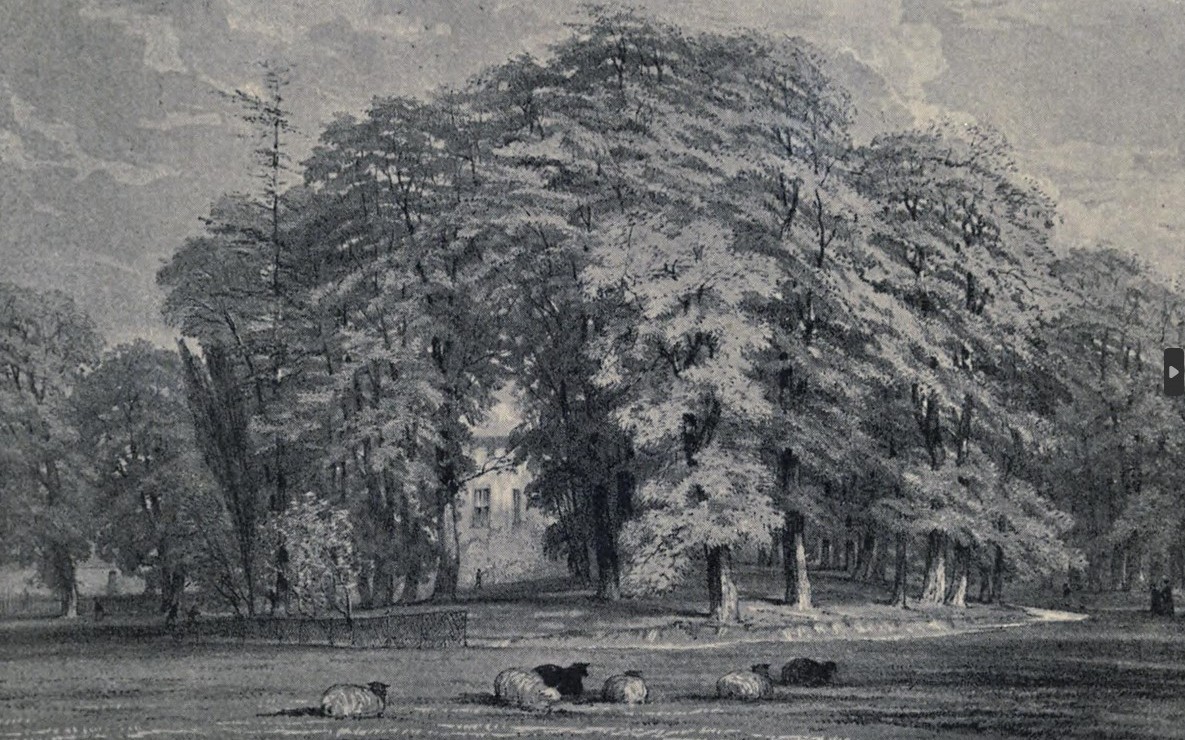
The retaliation was systematic and destructive. Students did not protest; they laid siege to the institution. They smashed Rowell's windows, and when Ingles demanded the Fifth and Sixth Forms pay for the damages, the boys refused. The escalation was rapid. On a Friday afternoon, a student-engineered petard, a small bomb, blew the door of the Headmaster's school off its hinges. The rebels seized the school buildings, piling desks, wainscoting, and books into the close to fuel a massive bonfire. As the flames rose, the boys retreated to "The Island," a Bronze Age burial mound within the school grounds, then surrounded by a six-meter-wide moat. They raised the drawbridge, fortifying themselves against the faculty. The situation had surpassed the capacity of schoolmasters to manage; it was a civil insurrection.
Local authorities responded with force. Mr. Butlin, a local banker and Justice of the Peace, arrived not to negotiate, to read the Riot Act, a legal proclamation reserved for suppressing public disorder, not schoolboy pranks. While Butlin distracted the rebels at the moat's edge, a recruiting party of soldiers, aided by local farmers armed with horsewhips, waded through the water from the rear. The fell. The ringleaders were captured, flogged, and expelled. This event demonstrated the utter failure of the 18th-century model of governance, where authority existed only through brute force and the students existed in a state of suppressed warfare against their teachers.
Following the rebellion, the school did not soften; it hardened its internal hierarchies. The administration realized that controlling hundreds of boys required a system of internal policing. This gave rise to the codified system of "fagging," a practice that transformed bullying from a chaotic occurrence into a recognized institution. Under this system, the Sixth Form, the most senior students, were granted absolute power over the lower forms. A "fag" was not a victim of harassment; he was a servant with specific, mandatory duties. These duties were distinct and time-consuming, functioning as a labor tax on the younger students.
The Hierarchy of Servitude: Fagging Duties at Rugby School (c. 1800, 1890)
Duty Type
Description of Labor
Time Commitment
Study-Fagging
Daily cleaning of a Sixth Former's private study. Included sweeping, dusting, and lighting fires.
30, 60 minutes each morning.
Night-Fagging
Running errands between 8: 30 PM and 9: 30 PM. Fetching food from the buttery, toasting cheese, or delivering messages.
On-call during evening hours.
Cricket-Fagging
Compulsory fielding during senior cricket practice. Fags stood for hours retrieving balls for the Sixth Form batsmen.
Variable; frequently hours on half-holidays.
"Warming"
Using body heat to warm beds or, in documented cases, toilet seats in unheated dormitories before a senior arrived.
Seasonal (Winter).
When Dr. Thomas Arnold assumed the headmastership in 1828, he found a school still plagued by the "lawless tyranny of brute force." Another rebellion had occurred in 1822 under Dr. John Wooll, further proving that the students remained a volatile force. Arnold's genius, or his villainy, depending on the perspective, was not to abolish the power of the Sixth Form, to sanctify it. He viewed the Praepostors (prefects) as his "officers in the army," essential for maintaining moral order. He legitimized fagging, arguing that it created a structured relationship between seniors and juniors, preferable to the anarchy of the playground. In Arnold's view, the Sixth Formers were "moral policemen," tasked with enforcing Christian conduct. In reality, this frequently gave sadists a badge of office. The "roasting" of Tom Brown in Thomas Hughes's 1857 Tom Brown's School Days was based on actual practices where boys were held before open fires to extort compliance or silence.
The psychological impact of this system was. It trained the British ruling class to accept hierarchy as natural and divinely ordained. The fag learned to obey without question; the Praepostor learned to command without hesitation. This was exported to the administration of the British Empire, where the same men applied the logic of the Rugby Close to colonial governance. The "Christian Gentleman" ideal masked a ruthless capacity for enforcing order. Arnold's reforms did reduce the chaotic violence of the 1797 era, they replaced it with a cold, systematic discipline that was harder to resist because it was cloaked in religious duty.
By the 1860s, the state began to scrutinize these peculiar institutions. The Clarendon Commission (1861, 1864) arrived at Rugby to investigate its management, revenues, and discipline. The Commissioners found that while the violence had abated, the monopoly of the upper classes had solidified. The "Foundationers", local boys educated for free as intended by Lawrence Sheriff, were being systematically squeezed out. The Public Schools Act of 1868 followed the Commission's report, severing the school from its local obligations. The Act allowed the new governing bodies to bypass local statutes, ensuring that Rugby became a national boarding school for the elite rather than a grammar school for the town. The "town boys" were marginalized, and the social stratification was complete. The rebellion of the locals against this theft of their endowment was fought in the courts and the press, unlike the boys of 1797, they had no petards to blow open the doors of privilege.
The era closed with the school firmly established as a bastion of Victorian privilege. The wild insurrectionists of the late 18th century had been replaced by the disciplined, athletic, and morally self-assured products of Arnold's machine. The fagging system, protected by the argument that it built character, even as it institutionalized servitude. The transition from the riotous anarchy of the "Black Tiger" to the muscular Christianity of the late 19th century mirrored the broader consolidation of British imperial power: chaotic aggression was tamed, uniformed, and directed outward.
Military Mobilization and Officer Casualties 1914, 1945
The Webb Ellis Legend and Codification of Football Rules
The outbreak of the World War in August 1914 did not interrupt the rhythms of Rugby School; it weaponized the institution's ethos of "muscular Christianity" and service. For decades, the school had functioned as a factory for the officer class, instilling a sense of duty that translated direct from the playing fields of the Close to the trenches of the Western Front. The school's Officers' Training Corps (OTC), originally formed in 1860 as a Rifle Volunteer Corps, had long drilled boys in the rudiments of military command. When war was declared, the transition was immediate and total. The "Boomer," a 3¼-ton bell raised just a month prior in July 1914, was rung at noon every day throughout the conflict, a sombre daily reminder of the school's absent sons.
The statistical cost of the Great War on the school was catastrophic. Of the 3, 252 Old Rugbeians (ORs) who served, 687 were killed, a casualty rate of approximately 21 percent, nearly double the national average for serving men. This arose because Rugbeians primarily served as junior officers, the "subalterns" who were required to lead charges over the top and consequently suffered the highest mortality rates. The carnage decimated a generation of the school's brightest alumni. Among the fallen was Rupert Brooke (School House, 1901, 1906), the golden boy of Georgian poetry, who died of sepsis in 1915 while en route to Gallipoli. His death became a potent symbol of the "lost generation," transforming him from a promising intellectual into a mythical figure of wasted youth.
The war also claimed the life of arguably the greatest rugby player of the era, Ronnie Poulton-Palmer. A legend of the game who had captained England to a Grand Slam in 1914, Poulton-Palmer was killed by a sniper in Belgium in May 1915. His reported last words, "I shall never play at Twickenham again," underscored the tragic severance between the sporting glory the school cultivated and the grim reality of industrial warfare. The school's contribution to the war effort was recognized with four Victoria Crosses awarded to Old Rugbeians during the 1914, 1918 conflict, including Geoffrey St. George Shillington Cather, who was killed on the Somme while rescuing wounded men under direct machine-gun fire.
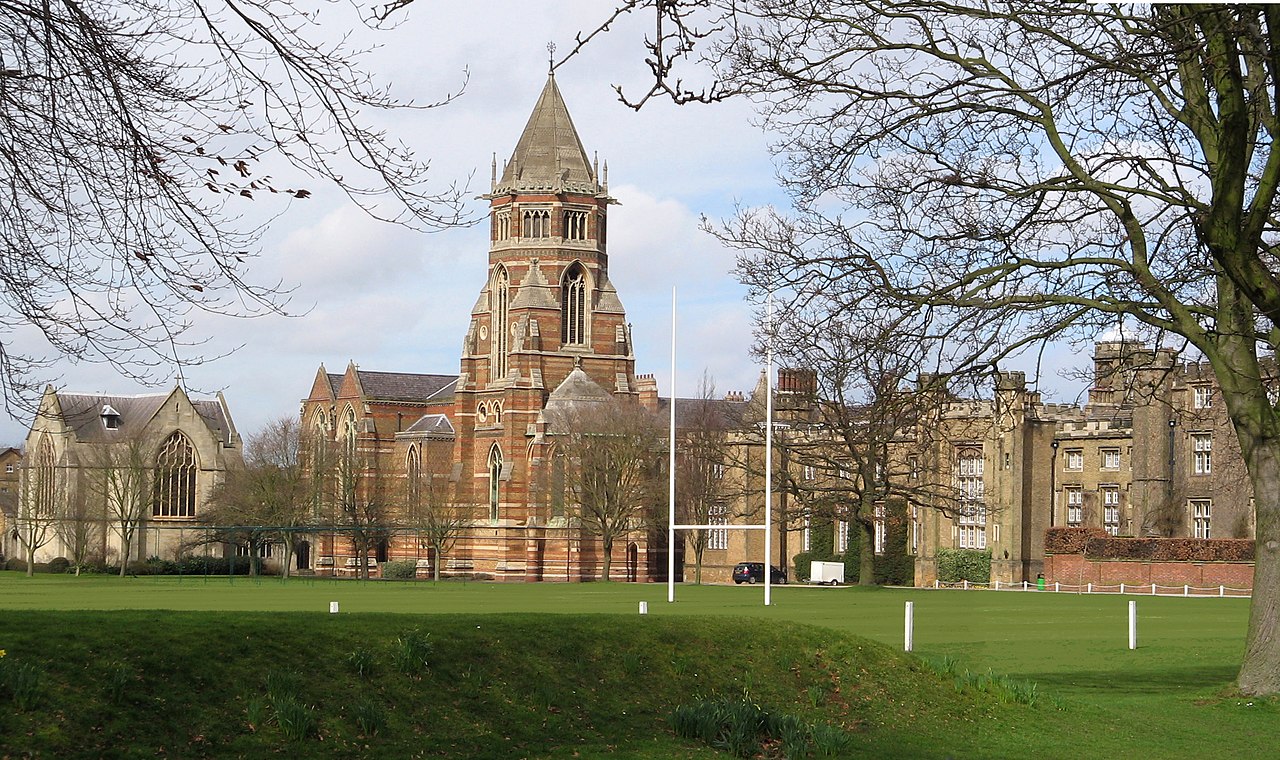
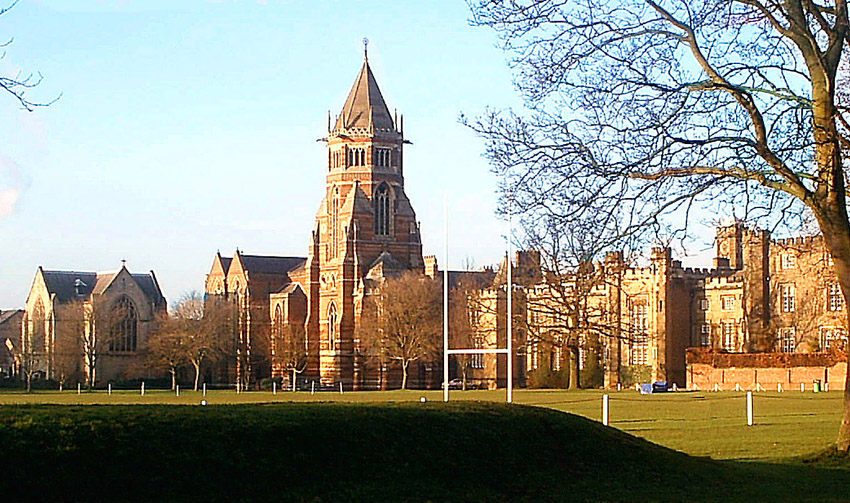
In the aftermath of the Armistice, the school moved to permanently enshrine the memory of its dead. The War Memorial Chapel, designed by Sir Charles Nicholson, was dedicated in 1922. Built of Beer stone in a cruciform plan, it stands distinct from the polychromatic brickwork of William Butterfield's Victorian chapel, offering a sombre, reflective space. The names of the 687 fallen were incised into its walls, a stone ledger of the school's sacrifice. The fundraising effort for the memorial was immense, collecting over £50, 000, which also funded the construction of a new music school and scholarships for the sons of the fallen.
The Second World War brought a different, though no less demanding, set of trials. Unlike public schools that evacuated to the countryside, Rugby remained on its site, operating under the constant threat of aerial bombardment. The atmosphere was less jingoistic than in 1914; the grim determination of 1939 replaced the enthusiastic volunteerism of the earlier generation. Life at the school was defined by blackouts, rationing, and the requisitioning of the sanatorium for military use. Boys tracked the movement of armies on maps pinned to study walls, watching the flags retreat and advance across Europe and North Africa.
Casualties in the Second World War, while fewer than the, were still severe. Over 300 Old Rugbeians died between 1939 and 1945, bringing the total dead from both conflicts to more than 1, 000. Three more Victoria Crosses were awarded to alumni for actions during this period, cementing the school's reputation for producing men of exceptional physical and moral courage. The names of the WWII dead were added to the south transept of the Memorial Chapel, ensuring the continuity of remembrance.
Rugby School Military Awards & Casualties (1914, 1945)
Conflict
Served
Killed in Action
Casualty Rate
Victoria Crosses
World War
3, 252
687
21. 1%
4
Second World War
~2, 800
300+
~11%
3
By 1945, the military character of the school began to evolve. While the Combined Cadet Force (CCF) remained a fixture, the existential threat to the nation had passed, and the school began to pivot toward the academic and social reforms of the post-war era. Yet, the physical presence of the War Memorial Chapel and the daily tolling of the bells ensured that the shadow of the two world wars remained a permanent component of the Rugby School identity. The institution had paid a blood tax for its prominence, trading the lives of its sons for the preservation of the empire they were educated to administer.
Integration of Co-Education and Gender Demographics 1975, 1993
The trajectory of Rugby School shifted permanently in 1975. Headmaster James Woodhouse stood before the assembly on Speech Day and announced that the 408-year-old institution would admit girls to the Sixth Form. This decision broke the male exclusivity mandated by Lawrence Sheriff's 1567 charter. The move was not purely ideological. The severe inflation of the 1970s had eroded the financial stability of independent schools across Britain. Marlborough College had already opened its doors to women in 1968. Rugby needed to secure its market position and financial future. Woodhouse framed the integration as a necessary evolution rather than a surrender to modernity. Three students shattered the gender barrier in September 1975. Jill Rogers, Alison Parker, and Alison Miller entered the Lower XX as the female Rugbeians. They faced an environment that was structurally and culturally unprepared for their presence. The school had no dedicated boarding facilities for women. These pioneers operated as day students attached to Stanley House for administrative purposes absence a physical base of their own. They existed as "outsiders" in a system designed for the Victorian ideal of muscular Christianity. The administration responded to the logistical deficit in 1976 by opening Crescent House. Located on Horton Crescent, this facility provided study spaces for the growing cohort of female Sixth Formers. It was an incomplete solution. Crescent House absence a kitchen and dining hall. The girls were forced to take their meals in boys' houses. This arrangement frequently led to social friction and highlighted the "guest" status of the female students. The true structural commitment to coeducation arrived in 1978 with the opening of Dean House. Named after Sir Patrick Dean, the Chairman of the Governing Body, this boarding house occupied a wing of the school Sanatorium on Hillmorton Road. It provided beds for 19 girls and signaled that women were a permanent resident demographic rather than transient day students. Progress stalled during the 1980s. The number of girls grew slowly and missed the target of 100 students by 1989. Richard Bull, who served as Headmaster from 1985 to 1990, attempted to accelerate the integration faced stiff resistance. The Common Room remained a bastion of traditionalism. senior masters viewed the presence of women as a dilution of the school's rugged ethos. Bull's Quaker background and liberalizing agenda clashed with the entrenched conservatism of the staff. He left in 1990 without achieving the full coeducational transformation he envisioned. The arrival of Michael Mavor in 1990 marked the end of the hesitation. Mavor came from Gordonstoun with a mandate to modernize. He dismantled the remaining blocks to full integration. In 1992 the school admitted girls at age 13 for the time. This decision aligned Rugby with the coeducational standard that had become dominant in the independent sector. The administration converted Stanley House and Bradley House into female boarding houses to accommodate the influx. The "monastic" era of Rugby School was over.
The demographic shift between 1975 and 1993 fundamentally altered the school's composition.
Year
Milestone
Key Demographic Change
1975
Sixth Form Admission
3 girls admitted (Day only)
1976
Crescent House Opens
10 additional girls (Day/Study)
1978
Dean House Opens
32 girls total ( Boarders)
1988
Rupert Brooke House
Expansion of female boarding
1992
Full Co-education
Girls admitted at age 13 (Year 9)
1993
Southfield House
Day house for girls established
The integration process concluded its initial phase in 1995 when Louise Woolcock became the Head Girl. Her appointment symbolized the normalization of female authority within the school hierarchy. The "Flashman" archetype of the bullying aristocratic male was replaced by a mixed-gender meritocracy. By 2026 the ratio of boys to girls would stabilize near parity. The 1975-1993 period stands as the serious that carried Rugby School from its 16th-century roots into the 21st century. The financial gamble taken by Woodhouse paid off. The school survived the economic turbulence of the late 20th century by doubling its chance applicant pool.
Office of Fair Trading Investigation into Fee-Fixing 2005
Clarendon Commission Findings on Curriculum and Governance 1864
The transformation of Rugby School from a landed charity into a fee-dependent corporate entity reached a legal nadir in 2005. That year, the Office of Fair Trading (OFT) exposed the school as a participant in a systematic price-fixing cartel, shattering the gentlemanly image of the independent sector. For years, the school had operated not as an educational trust as a conspirator in a commercial ring designed to manipulate market rates, violating the Competition Act 1998. This episode, known as the "Sevenoaks Survey" scandal, revealed that Rugby School, alongside Eton, Harrow, and Winchester, exchanged confidential data on intended fee increases to align their financial strategies against the interests of parents. The method of the cartel was precise and bureaucratic. Between 2001 and 2004, bursars from fifty of the United Kingdom's most prestigious schools submitted their proposed fee hikes to Sevenoaks School in Kent. Sevenoaks administrators collated this sensitive data into tables and circulated it back to the participating schools before the fees were finalized. This exchange allowed Rugby School to set its tuition rates with full knowledge of its competitors' intentions, eliminating the risk of being undercut or pricing themselves out of the market. The OFT investigation found that this "regular and systematic exchange" distorted competition, resulting in parents paying higher fees than they would have in a truly competitive market. Rugby School's involvement was not passive. The institution was named explicitly in the OFT's decision CA98/05/2006. While the Independent Schools Council (ISC) argued that the schools were charities unaware of their obligations under competition law, the OFT rejected this defense. The regulator established that the exchange of future pricing intentions is a cardinal sin of antitrust law, regardless of the charitable status of the conspirators. The schools admitted to the infringement. In a settlement designed to avoid a protracted legal battle, Rugby School agreed to pay a nominal penalty of £10, 000 and contribute to a shared £3 million charitable trust fund intended to compensate pupils who attended during the cartel years. The financial penalty levied against Rugby School was mathematically negligible compared to its revenue. In 2005, annual boarding fees at Rugby stood at approximately £24, 915. The £10, 000 fine represented less than the tuition of a single pupil for half a year. Even the contribution to the £3 million trust fund, split among fifty schools, amounted to roughly £60, 000 per institution, a fraction of the surplus generated by the fee hikes. Critics noted that the punishment did nothing to alter the economic fundamentals that drove the cartel. The schools had shifted from relying on historical endowments to an aggressive yield-management model where tuition fees covered the escalating costs of facilities, salaries, and expansion. The aftermath of the investigation demonstrates the ineffectiveness of the intervention in curbing fee inflation. The OFT's action was intended to restore competitive pricing, yet the trajectory of Rugby School's fees suggests the opposite occurred. In the two decades following the bust, fees continued to rise at a rate outstripping the Consumer Price Index. By the 2025-2026 academic year, boarding fees at Rugby School had climbed to £19, 640 per term, or £58, 920 annually. This represents a 136% increase from the 2005 levels, while cumulative inflation over the same period was approximately 80%. The cartel may have been dismantled, the pricing power of the school remained absolute.
Metric
2005 (Cartel Era)
2026 (Post-Intervention)
Change
Annual Boarding Fee
£24, 915
£58, 920
+136%
OFT Fine/Penalty
£10, 000 (Nominal)
N/A
N/A
Legal Status
Competition Act Breach
Compliant (Ostensibly)
Regulatory Shift
The ISC's reaction to the ruling revealed a deep-seated resistance to external oversight. Jonathan Shephard, the ISC director-general at the time, branded the investigation a "scandalous waste of money," insisting that fees rose only to match costs in the state sector. This defense ignored the reality that independent schools like Rugby were engaging in an "arms race" of facilities, new theatres, sports complexes, and science blocks, funded by the very fees they colluded to set. The Sevenoaks Survey was not a casual chat among colleagues; it was a tool to ensure that no school fell behind in the revenue generation required to sustain this expansion. The legacy of the 2005 investigation is a permanent stain on the claim that these institutions operate solely for the public benefit. It proved that when pressed by financial exigencies, the trustees and bursars of Rugby School prioritized revenue stability over competitive fairness. The trust fund established for affected families was plagued by bureaucratic delays, with reports in 2008 indicating that of the money remained undistributed. For the parents who paid the inflated fees between 2001 and 2004, the restitution was symbolic at best, while the school retained the capital improvements funded by their overpayments. Current analysis shows that the market identified by the OFT remain in force, even without explicit collusion. The "prestige premium" allows schools like Rugby to hike fees with impunity, as demand from wealthy international families and the domestic elite remains inelastic. The 2005 scandal forced the conversation underground, the data proves that the economic behavior of the school did not change. The fee curve from 2005 to 2026 demonstrates that the removal of the cartel did not result in price competition; it returned the sector to a state of tacit coordination where the leading schools move in lockstep, guided by market signals rather than spreadsheets circulated by Sevenoaks.
International Franchising and Brand Licensing 2017, 2024
The year 2017 marked a definitive rupture in the four-and-a-half-century history of Rugby School. For the time since Lawrence Sheriff's bequest in 1567, the institution decoupled its identity from the physical soil of Warwickshire and the financial bedrock of the London Conduit Close estate. The launch of Rugby School Thailand in September 2017 signaled the activation of a new revenue engine: the monetization of heritage through international franchising. This strategy, executed under the corporate umbrella of Rugby School International Limited (RSIL), transformed the school's name, crest, and "Whole Person" ethos into exportable intellectual property. Unlike the 18th-century model, where revenue was passive income from ground rents in Holborn, the 21st-century model relied on active brand licensing agreements with foreign capital partners who assumed the operational risks and capital expenditures.
The inaugural venture in Chonburi, Thailand, established the template for this expansion. Rugby School partnered with Wisdom Enterprise, a Thai conglomerate controlled by the Teepsuwan family. The of the project dwarfed the original UK campus. Set on an 80-acre (190 rai) plot approximately 110 kilometers from Bangkok, the Thai campus was designed to function as a self-contained educational ecosystem. The partner, Wisdom Enterprise, financed the construction of the facilities, which included boarding houses modeled explicitly on the Victorian structures of the UK parent. In exchange, Rugby School (UK) provided the curriculum, the appointment of senior leadership, and the brand license, receiving a percentage of gross revenue. This "asset-light" method allowed the Governing Body in the UK to generate high-margin income without diluting the endowment or exposing the charity to liabilities in foreign jurisdictions.
The selection of Thailand was not accidental. It capitalized on the saturation of the Bangkok international school market and the desire among the Thai elite for British boarding education without the need to send children to Europe at a young age. By 2024, the Chonburi campus had stabilized its enrollment, validating the thesis that the "Rugby" brand could command premium fees, ranging from 470, 000 to over 800, 000 Thai Baht annually, in a competitive Southeast Asian market. The curriculum mirrored the UK progression, moving from the Early Years Foundation Stage through to IGCSEs and A-Levels, enforced by regular quality assurance inspections from UK-based staff.
Following the stabilization of the Thai franchise, RSIL turned its attention to East Asia. In September 2023, Rugby School Japan opened its doors in Kashiwanoha, a "Smart City" in the Chiba Prefecture, roughly 30 minutes from central Tokyo. This venture represented a different strategic calculation. Unlike the sprawling rural campus in Thailand, the Japanese outpost was integrated into an urban academic hub, located near Chiba University and the University of Tokyo's Kashiwanoha campus. The partner for this venture was Clarence Education Asia (CEAMS), a specialist education investment firm. The financial in Japan were considerably higher, with tuition and boarding fees for the 2025/2026 academic year reaching up to 8. 2 million JPY (approximately £42, 000) for full boarders. This pricing structure positioned Rugby School Japan at the apex of the Japanese private education market, targeting affluent expatriates and Japanese families seeking a direct pipeline to Western universities.
The Japanese campus also highlighted the rigorous control RSIL maintained over its brand assets. The "House" system, a of the Rugby method since the days of Thomas Arnold, was replicated with precision. Students were assigned to Houses named after their UK counterparts, and the daily routine, including the extended day ending at 6: 00 PM or later, was enforced to distinguish the offering from standard international schools. The physical plant in Kashiwanoha included a black box theatre, a 25-meter indoor pool, and rugby pitches, amenities that justified the premium valuation. By early 2026, enrollment had grown, although the school maintained a selective admissions policy to protect its academic league table standing, a metric serious to maintaining brand equity in the grade-obsessed East Asian market.
The expansion trajectory continued into Africa with the opening of Rugby School Nigeria in September 2025. Located in Eko Atlantic City, a massive land reclamation project off the coast of Lagos, this school was the of its kind in West Africa. The decision to enter Nigeria, a market frequently overlooked by other British "public" schools in favor of China or the Middle East, demonstrated a willingness to tap into the oil-wealthy elites of Lagos who traditionally sent their children to the UK. The Eko Atlantic campus was built to accommodate both day and boarding students, offering the British National Curriculum in a secure, high-infrastructure zone designed to mitigate the logistical challenges of the surrounding megacity. As with Thailand and Japan, the Nigerian campus operated on a franchise basis, with local partners funding the construction while RSIL retained control over the headmaster's appointment and educational standards.
The financial of this tripartite international presence, Thailand, Japan, Nigeria, were significant for the UK charity. By the 2025 financial year, income from RSIL had become a material line item in the school's consolidated accounts. These funds were not profit; they were ring-fenced to support the Arnold Foundation, the school's bursary program. This created a cyclical economic model: fees paid by the wealthy elites of Bangkok, Tokyo, and Lagos were cross-subsidizing the education of full-bursary students in Warwickshire. This redistribution of global capital allowed Rugby School to maintain its charitable status and social mission in the UK while operating as a luxury service provider abroad.
Critics of this model have pointed to the chance friction between the liberal, progressive values espoused by the UK school and the political realities of the host nations. In Thailand and Nigeria, where political stability can be fluid, the school's brand is inevitably tethered to the fortunes and reputations of its local partners. Yet, the governance structure of RSIL was designed to insulate the UK parent from these shocks. The licensing agreements contain strict termination clauses related to reputational damage, giving the Governing Body a "kill switch" should a franchise fail to meet ethical or operational standards. As of March 2026, no such clauses had been triggered, and the international network appeared stable.
The period from 2017 to 2026 thus redefined Rugby School. It ceased to be solely a British institution and became a transnational educational brand. The "Whole Person" ethos, once a method for reforming Victorian boyhood, had been repackaged as a global commodity, sold to the rising middle and upper classes of the non-Western world. The Conduit Close estate in London, which had sustained the school for three centuries, shared its load with a network of campuses thousands of miles away, each remitting royalties to the center. The sun literally never sets on the Rugby School administration.
Operational Solvency Following 2025 VAT Imposition
Institutionalized Fagging and Student Rebellion 1797, 1890
The imposition of Value Added Tax (VAT) on private school fees, January 1, 2025, marked the most significant fiscal rupture in the history of British independent education since the Public Schools Act of 1868. For Rugby School, the policy ended a tax-exempt status that had stood for centuries, rooted in its charitable classification. The Labour government, elected in July 2024, moved swiftly to enact the levy, aiming to raise approximately £1. 5 billion annually for state education. This policy required Rugby to apply a 20% tax to tuition and boarding fees, a cost previously absent from parental invoices. Simultaneously, the removal of charitable relief on business rates in April 2025 compounded the operational, creating a "double shock" to the balance sheet that tested the institution's financial architecture.
The immediate arithmetic of the 2025 fiscal year presented a severe liquidity challenge. In the financial year ending June 2024, Rugby School reported a total income of £54. 6 million, with £43. 6 million derived directly from charitable activities, primarily fees. The expenditure for the same period stood at £59. 4 million, resulting in an operating deficit of roughly £4. 8 million, which was only rectified by investment gains of £7. 2 million. The introduction of VAT threatened to widen this operating gap. Unlike smaller independent schools, of which faced immediate closure or merger, reports indicated over 18 closures by early 2026, Rugby possessed the reserves to mitigate the full transfer of the tax to parents. Rather than passing on the full 20% surcharge, the Governing Body, like those of its peers in the "Rugby Group" of schools, likely opted for a partial absorption strategy, increasing headline fees by approximately 10% to 12% while cutting internal costs to cover the remainder. This maneuver aimed to prevent a mass exodus of the domestic middle-class demographic, though it inevitably accelerated the shift toward a wealthier, more international parent body.
Operational solvency in this new tax environment relied heavily on the school's historical endowment, specifically the Conduit Close estate. The foresight of Lawrence Sheriff in 1567, and the subsequent parliamentary intervention in 1777, provided a capital base that few competitors could match. By 2024, the school's investment income totaled £6. 17 million annually. This revenue stream, generated largely from the London property portfolio and diversified financial instruments, acted as a counter-cyclical buffer. While tuition revenue became volatile due to the VAT price sensitivity, the endowment income remained relatively stable, allowing the school to subsidize the operating deficit without eroding its core capital. The 2025 VAT emergency demonstrated the enduring value of the 18th-century restructuring; without the liquidity provided by the Sheriff estate, the necessary fee increases would have been prohibitive, chance shrinking the school's enrollment to unsustainable levels.
Yet, the most distinct response to the 2025 solvency emergency was not found in London real estate, in the aggressive expansion of the "Rugby School Group" international franchise. By 2026, the school had decoupled a portion of its revenue from the UK tax jurisdiction through the licensing of its brand abroad. Rugby School Thailand, established in 2017 in Chonburi, and Rugby School Japan, which opened in Kashiwa in September 2023, generated royalty income classified as export revenue, thus outside the scope of UK VAT. The Japanese campus alone, with tuition fees ranging from 5 million to 8. 2 million JPY (approximately £26, 000 to £43, 000), represented a high-margin revenue source. The opening of Rugby School Nigeria in 2025 and the planned launch of Rugby School Dubai in 2026/27 further solidified this strategy. These overseas branches function as financial buttresses, where the intellectual property of the "Rugby" name is monetized to subsidize the flagship institution in Warwickshire. This global franchise model mirrors the 1777 development of the London estate: an external asset developed to fund the core educational mission.
The enrollment following the VAT imposition revealed a demographic realignment. Sector-wide data from the Independent Schools Council suggested a 6% drop in private school pupils, yet elite "public schools" like Rugby experienced a "flight to quality." Parents who could afford the post-VAT fees consolidated around top-tier brands, abandoning smaller, less resilient schools. Consequently, Rugby's admissions remained strong in raw numbers, the socioeconomic profile of the intake narrowed. The "middle income" professional family, a staple of the school since the Arnoldian reforms of the 19th century, faced increasing exclusion. To counter this, the school placed heavier emphasis on its bursary programs, funded by the very international royalties and endowment yields that kept the lights on. The solvency equation thus shifted: domestic fees covered the base operation, while international franchising and historical wealth covered the bursaries and the VAT shortfall.
The removal of the business rates relief in April 2025 added a further operational cost, estimated in the low millions annually. This forced a rigorous audit of the school's physical plant. The "arms race" of facility construction, lavish performing arts centers and sports complexes that characterized the 2000-2020 era, slowed considerably. Capital expenditure budgets were recalibrated to focus on maintenance and energy efficiency rather than expansion. The school's management also sought to maximize the commercial utility of its estate. The letting of facilities during holidays, a practice long in place, became a serious rather than supplemental revenue line. The commercial arm of the school, distinct from the educational charity, operated with renewed urgency to offset the tax load placed on the academic functions.
By March 2026, Rugby School had navigated the initial turbulence of the VAT era. The institution did not suffer the "carnage" predicted for the broader sector, it emerged as a different financial entity. It was no longer a school supported by fees and a historic legacy; it had transformed into a multinational educational conglomerate where the UK campus served as the loss-leading prestige flagship, supported by a profitable portfolio of global franchises and London real estate. The Act of 1777 had saved the school by monetizing land; the strategy of 2025 saved it by monetizing the brand. The solvency of the school was secure, the cost was a definitive shift away from the domestic, charitable model toward a globalized, corporate structure necessitated by the hostile domestic tax policy.
Historic Abuse Convictions and Safeguarding Reforms
The history of safeguarding at Rugby School is a narrative arc that bends from the institutionalized brutality of the 18th and 19th centuries to the rigorous, statutory compliance of the 2020s. For much of its existence, the school operated under a system of "boy government" where the hierarchy of the student body was absolute, and the line between discipline and abuse was frequently nonexistent. The literary immortalization of this regime in Thomas Hughes's Tom Brown's Schooldays (1857) presented the "fagging" system, where younger boys acted as servants to seniors, as a character-building trial. In reality, historical accounts confirm that this structure frequently facilitated unchecked bullying and physical cruelty, creating a culture of silence that would take nearly two centuries to fully.
The transition from this archaic model to modern child protection was not direct. In October 2002, the school faced a serious scandal when Mark Taylor, the Head of Classics, was arrested in connection with an FBI investigation into internet child pornography. Taylor, a senior figure at the institution, was immediately suspended by then-Headmaster Patrick Derham. The arrest was part of "Operation Ore," a massive international crackdown on consumers of indecent images of children. Taylor's involvement shattered the assumption that elite public schools were insulated from such crimes and forced an immediate re-evaluation of staff vetting and internet monitoring. This incident marked a definitive end to the era where the reputation of the institution could shield it from external scrutiny.
Rugby School's connection to the wider national inquiry into historical abuse was brought into focus during the Independent Inquiry into Child Sexual Abuse (IICSA). The inquiry examined the conduct of James Woodhouse, who served as Headmaster of Rugby School from 1967 to 1980. Woodhouse gave evidence regarding his support for Peter Ball, the former Bishop of Gloucester who was convicted of sexual offences against young men. In 1993, after leaving Rugby, Woodhouse had written a letter to the police in support of Ball, describing the bishop's abusive behavior as chance being "open to misunderstanding." While Woodhouse was not accused of abuse himself, his testimony before the IICSA highlighted the "establishment" mindset that frequently prioritized the protection of reputation and the defence of peers over the safeguarding of chance victims. This historical proximity to the Anglican Church's abuse scandals underscored the need for the school to sever its reliance on informal character
Endowment Asset Allocation and Land Holdings 2026
The financial fortitude of Rugby School in 2026 rests not on tuition fees alone, on a specific, geographically concentrated asset class that few educational institutions possess: prime central London real estate. While peer institutions rely heavily on alumni donations invested in diversified equity funds, Rugby School's balance sheet remains dominated by the legacy of Lawrence Sheriff's 1560 bequest. The "Conduit Close" estate, originally a modest eight-acre pasture in Holborn purchased for £320, has evolved into a property empire encompassing Lamb's Conduit Street, Great Ormond Street, and Rugby Street. This asset allocation strategy, heavily weighted toward direct property ownership, defines the school's financial stability in the 21st century.
By the fiscal year ending 2026, the Rugby School Charity reported total income exceeding £55 million, with a serious component derived from investment yields. Unlike the endowment models of US universities, which favor a "Yale Model" allocation of private equity and hedge funds, Rugby's asset base is tangible. The London Estate consists of approximately 103 properties, including over 20 retail units, 1, 800 square feet of office space, and 112 residential dwellings. This concentration in Bloomsbury provides a hedge against inflation that equity markets cannot match, yet it exposes the institution to the specific risks of the London property market, including rent controls and commercial vacancy rates.
The management of this estate underwent a strategic shift between 2010 and 2026. Historically, the school acted as a passive collector of ground rents. yet, the modern strategy involves active asset management. The Governing Body, through the Rugby Estate Committee, deliberately curates the tenant mix on Lamb's Conduit Street to maintain a "village" atmosphere that commands premium rents. By favoring independent boutiques and high-end menswear retailers over generic chains, the estate sustains high Zone A rental values, pre-pandemic figures reached £550 per square foot, even as other high streets declined. In 2024 alone, investment income contributed over £6. 17 million to the school's revenue, a figure that directly subsidizes the bursary program. This revenue stream lowers the cost of capital for the school's operations, allowing it to maintain operating deficits on the educational side that would bankrupt a less capitalized entity.
Rugby School Charity: Estimated Asset & Income Profile (2024-2026)
Asset Class
Primary Holding
Strategic Function
Est. Annual Yield Contribution
Direct Real Estate
Conduit Close Estate (Bloomsbury)
Long-term capital appreciation, inflation hedge
£6. 2m, £7. 0m
Operational Assets
Warwickshire Campus (400 acres)
Educational delivery, heritage value
N/A (Cost Center)
Intellectual Property
Rugby School International Ltd
High-margin franchise fees, brand licensing
£3. 0m, £4. 5m
Financial Instruments
Equities/Bonds (Bursary Funds)
Liquidity, diversification
£1. 5m, £2. 0m
The second pillar of Rugby's 2026 asset allocation is the monetization of its intellectual property through Rugby School International Limited (RSIL). Recognizing that the London Estate offers stability limited explosive growth, the Governing Body initiated an aggressive franchising model. This strategy treats the "Rugby School" brand as an exportable asset. Following the opening of Rugby School Thailand in 2017, the network expanded to Japan in September 2023, Nigeria in 2025, and Dubai in the 2026-2027 academic pattern. This structure requires minimal capital expenditure from the UK charity. Local partners fund the construction and operational costs, frequently exceeding $50 million per campus, while Rugby School UK receives a percentage of gross revenue and fees for quality assurance and branding.
This "asset-light" international expansion serves as a serious counterweight to the domestic challenges facing independent schools in the mid-2020s. The introduction of VAT on private school fees in January 2025 by the UK government placed immediate pressure on domestic enrollment numbers across the sector. Rugby School's diversified revenue streams provided a buffer that tuition-dependent schools absence. The income from international franchises is not subject to the same UK-specific regulatory risks as domestic tuition, creating a currency and geopolitical hedge within the school's endowment portfolio.
The allocation of funds generated by these assets reveals the school's long-term priorities. While the London Estate revenue is legally bound to support the foundationers and bursaries, honoring Lawrence Sheriff's original , the surplus and international profits fund capital projects in Warwickshire. The refurbishment of boarding houses and the maintenance of the historic Butterfield Chapel and the Close are financed not just by current fees, by the commercial success of the Bloomsbury shops and the Chonburi campus. This circular economy allows Rugby to maintain Grade I and II listed buildings without imposing special levies on parents.
yet, the heavy reliance on the London Estate presents a unique risk profile. The value of the Bloomsbury holdings is inextricably linked to the economic health of Central London. The 2025 rent tribunal decision regarding a flat on Lamb's Conduit Street, which set a "fair rent" significantly market expectations, illustrates the regulatory exposure inherent in residential property portfolios. also, the leasehold enfranchisement reforms debated in Parliament throughout the 2020s pose a theoretical threat to the long-term reversionary value of the estate. If leaseholders gain easier routes to purchase their freeholds, the school could lose the perpetual income engine that has powered it for centuries.
even with these risks, the 2026 financial data shows a charity with a balance sheet that resembles a property holding company as much as an educational trust. The total expenditure of approximately £59 million is matched by a strong income mix where "Charitable Activities" (fees) are supplemented by the commercial engines of real estate and franchising. The endowment does not sit in a bank account; it is a living, working portfolio of brick, mortar, and brand equity. The decision to retain the London land, rather than liquidating it for a diversified portfolio of stocks during the bull markets of the 1990s or 2010s, has proven to be a masterstroke of intergenerational equity preservation.
In the final analysis, the asset allocation of Rugby School in 2026 vindicates the 1777 Act that allowed for the development of the Conduit Close. The transition from a local grammar school to a global educational brand was financed by the urbanization of London. Today, the school's financial directors manage a dual-track portfolio: the hyper-local, high-value dirt of Bloomsbury and the hyper-global, intellectual property of the international schools. This structure ensures that while the playing fields of Warwickshire remain the spiritual heart of the institution, its financial pulse beats in the commercial streets of London and the expanding markets of Asia and the Middle East.
Why it matters: Investigation into leading AI writing platforms reveals varying data-collection practices. OpenAI's ChatGPT faces regulatory scrutiny over data privacy concerns and international legal battles. AI writing…
What do we know about Trusteeship Disputes and the Act of?
The trajectory of Rugby School shifted permanently not on the playing fields of Warwickshire, in the Court of Chancery and the halls of Westminster. Between the school's foundation in 1567 and the mid-18th century, the institution operated in relative obscurity, functioning primarily as a local grammar school for the boys of Rugby and Brownsover.
What do we know about Thomas Arnold and the Mechanics of Social Control?
The appointment of Thomas Arnold as Headmaster in 1828 marked a definitive pivot in the history of British education, not because of his scholarship, because of his administrative ruthlessness. When Arnold arrived at Rugby, the institution was still recovering from the anarchic legacy of the late 18th century, most notably the Great Rebellion of 1797.
What do we know about The Webb Ellis Legend and Codification of Football Rules?
The origin story of Rugby football, enshrined in global sporting consciousness, rests on a foundation of retroactive fabrication rather than contemporary evidence. The narrative that William Webb Ellis, a student at Rugby School, "with a fine disregard for the rules of football as played in his time," picked up the ball and ran with it in 1823 is a myth constructed over half a century after the alleged event.
What do we know about Clarendon Commission Findings on Curriculum and Governance?
The Royal Commission on the Public Schools, convened in 1861 under the Earl of Clarendon, arrived at Rugby not to canonize Thomas Arnold to audit his legacy. While Arnold's reforms between 1828 and 1842 had salvaged the school's moral reputation, the Commissioners found an institution still tethered to the educational dogmas of the 16th century.
What do we know about Institutionalized Fagging and Student Rebellion?
The explosive trajectory of Rugby School in the 19th century was forged not in the classrooms, in the violent collision between student anarchy and authoritarian control. By 1797, the institution had become a powder keg of adolescent aggression, governed by a faculty that frequently lost control of its charges.
What do we know about Military Mobilization and Officer Casualties?
The outbreak of the World War in August 1914 did not interrupt the rhythms of Rugby School; it weaponized the institution's ethos of "muscular Christianity" and service. For decades, the school had functioned as a factory for the officer class, instilling a sense of duty that translated direct from the playing fields of the Close to the trenches of the Western Front.
What do we know about Integration of Co-Education and Gender Demographics?
The trajectory of Rugby School shifted permanently in 1975. Headmaster James Woodhouse stood before the assembly on Speech Day and announced that the 408-year-old institution would admit girls to the Sixth Form.
What do we know about Office of Fair Trading Investigation into Fee-Fixing?
The transformation of Rugby School from a landed charity into a fee-dependent corporate entity reached a legal nadir in 2005. That year, the Office of Fair Trading (OFT) exposed the school as a participant in a systematic price-fixing cartel, shattering the gentlemanly image of the independent sector.
What do we know about International Franchising and Brand Licensing?
The year 2017 marked a definitive rupture in the four-and-a-half-century history of Rugby School. For the time since Lawrence Sheriff's bequest in 1567, the institution decoupled its identity from the physical soil of Warwickshire and the financial bedrock of the London Conduit Close estate.
What do we know about Operational Solvency Following VAT Imposition?
The imposition of Value Added Tax (VAT) on private school fees, January 1, 2025, marked the most significant fiscal rupture in the history of British independent education since the Public Schools Act of 1868. For Rugby School, the policy ended a tax-exempt status that had stood for centuries, rooted in its charitable classification.
What do we know about Historic Abuse Convictions and Safeguarding Reforms?
The history of safeguarding at Rugby School is a narrative arc that bends from the institutionalized brutality of the 18th and 19th centuries to the rigorous, statutory compliance of the 2020s. For much of its existence, the school operated under a system of "boy government" where the hierarchy of the student body was absolute, and the line between discipline and abuse was frequently nonexistent.
What do we know about Endowment Asset Allocation and Land Holdings?
The financial fortitude of Rugby School in 2026 rests not on tuition fees alone, on a specific, geographically concentrated asset class that few educational institutions possess: prime central London real estate. While peer institutions rely heavily on alumni donations invested in diversified equity funds, Rugby School's balance sheet remains dominated by the legacy of Lawrence Sheriff's 1560 bequest.
Why it matters: Editorial interference by billionaire owners in major news organizations has led to significant subscriber losses and erosion of trust. The trend of owner interference in…
Why it matters: Thought leadership in public relations involves positioning individuals or organizations as experts to shape public opinion. While it can inform and educate when done responsibly,…
Why it matters: Professional and amateur dance contests with large cash prizes are increasingly popular worldwide, making them vulnerable to money laundering schemes. Criminals exploit dance competitions to…
Why it matters: Students and young people are increasingly being targeted by gig economy platforms as a cheap source of labor, promising flexibility but often delivering unpredictable and…
Why it matters: Venezuela's ruling regimes have a history of political repression, with a sharp rise in political prisoners under Maduro. Human rights groups report that Venezuela now…
Why it matters: Global digital media landscape shifting rapidly, impacting news consumption habits Emergence of social media, podcasts, and online influencers as primary news sources The Reuters Institute…
Get updates on this place
Get verified alerts when this file is updated (verification required).