Verified Against Public And Audited RecordsLast Updated On: 2026-03-06
Reading time: ~53 min
File ID: EHGN-PLACE-36685
Investigative Bio of Seoul Metropolitan Subway
Urban Transit Precursors and the 1974 Line 1 Inauguration
For over five centuries, the mobility of Seoul's residents remained tethered to the pace of human and animal muscle. During the Joseon Dynasty, the city, then known as Hanyang, relied on a rigid, status-based logistics system. The narrow, winding alleys of the walled city forced the populace to walk, while the aristocracy, the yangban, utilized the gama (palanquin) or horseback. This mode of transport was not functional a strict enforcement of social hierarchy. The palanquin required two to four bearers, moving at a slow, rhythmic gait that defined the city's pulse until the late 19th century. In 1883, the introduction of the rickshaw from Japan offered a slightly faster alternative, yet it remained a human-powered endeavor, limited by the physical endurance of the puller and the muddy, unpaved condition of the roads.
The mechanical rupture in this ancient rhythm arrived in 1899. The Hanseong Electric Company, a joint venture involving American engineers Henry Collbran and Harry Bostwick, laid the tracks for the Seoul electric streetcar. On May 17, 1899, the tram rolled from Seodaemun to Cheongnyangni. This event marked Seoul as the second city in East Asia, following Kyoto, to adopt electric rail transit, predating Tokyo by four years. The introduction was volatile; ten days after the inauguration, a tram struck and killed a child, inciting a mob to burn the carriage. Even with this violent beginning, the streetcar quickly became the city's arterial lifeblood. For the 69 years, these trams dominated the central corridor of Jongno, hauling citizens across the east-west axis of the capital.
By the 1960s, the streetcar system had collapsed under the weight of Seoul's post-war explosion. The Korean War (1950, 1953) had left the city in ruins, yet the subsequent reconstruction drew millions from the countryside. Seoul's population surged from approximately 2. 4 million in 1960 to over 5. 5 million by 1970. The trams, slow and occupying the center of the road, became an obstacle to the rising of automotive traffic. In a decision prioritizing road capacity for buses and cars, the city government dismantled the tram network. The last streetcar retired on November 29, 1968, leaving the sprawling metropolis entirely dependent on a chaotic, overcrowded bus system. The result was "traffic hell," a period where commuters faced two-hour delays and buses were packed to crush-load capacities.
The solution required a radical shift beneath the surface. Mayor Yang Taek-shik, appointed in 1970 and later known as the "Mole Mayor," championed the construction of a subway system even with serious opposition from economic planners who feared the immense cost would bankrupt the city. The decision to build was finalized with the establishment of the Subway Construction Headquarters in 1970. The plan called for a line mirroring the old tram route along the Jongno corridor, connecting the major rail hubs of Seoul Station in the west and Cheongnyangni in the east. To finance and engineer this massive undertaking, South Korea turned to Japan. Under a technical and financial cooperation agreement, Japan provided Official Development Assistance (ODA) loans and engineering expertise, heavily influencing the initial design and rolling stock specifications.
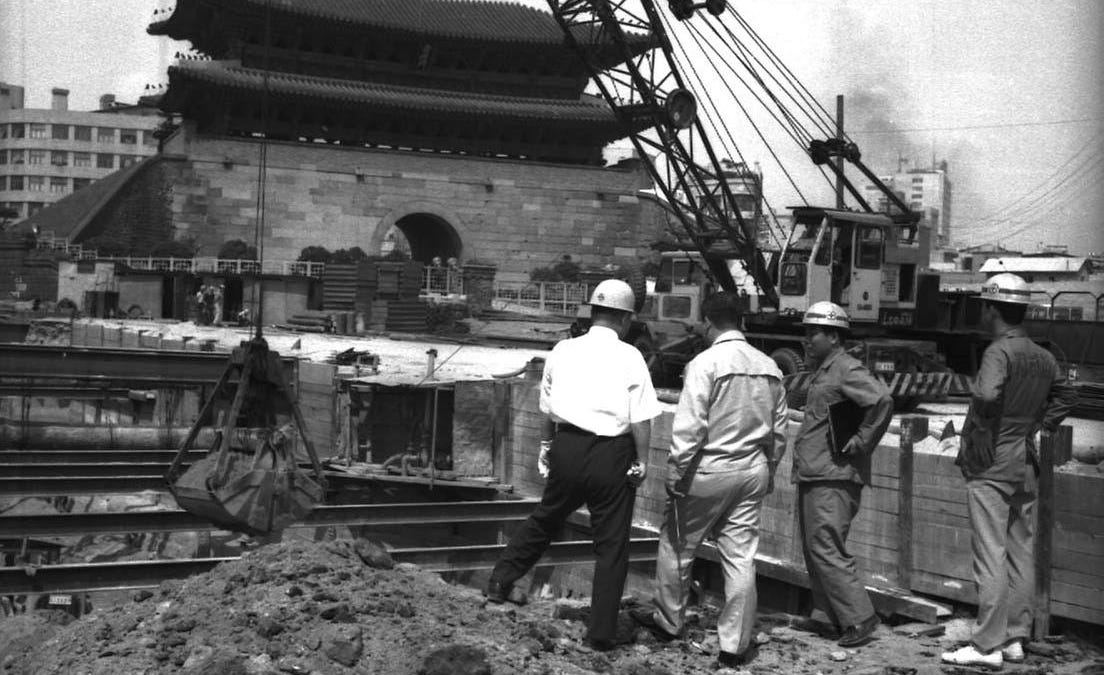
Construction on Line 1 began on April 12, 1971. The engineering method chosen was "cut-and-cover," a brute-force technique that involved excavating the entire street surface, building the concrete box tunnel, and then burying it. For three years, the heart of Seoul was an open wound. The Jongno district, the commercial center of the nation, became a construction site of dust, noise, and detour blocks. Workers toiled around the clock to meet the deadline, driven by the authoritarian efficiency of the Park Chung-hee administration. The physical labor was immense, relying on thousands of workers to dig through the granite bedrock and soil of the capital.
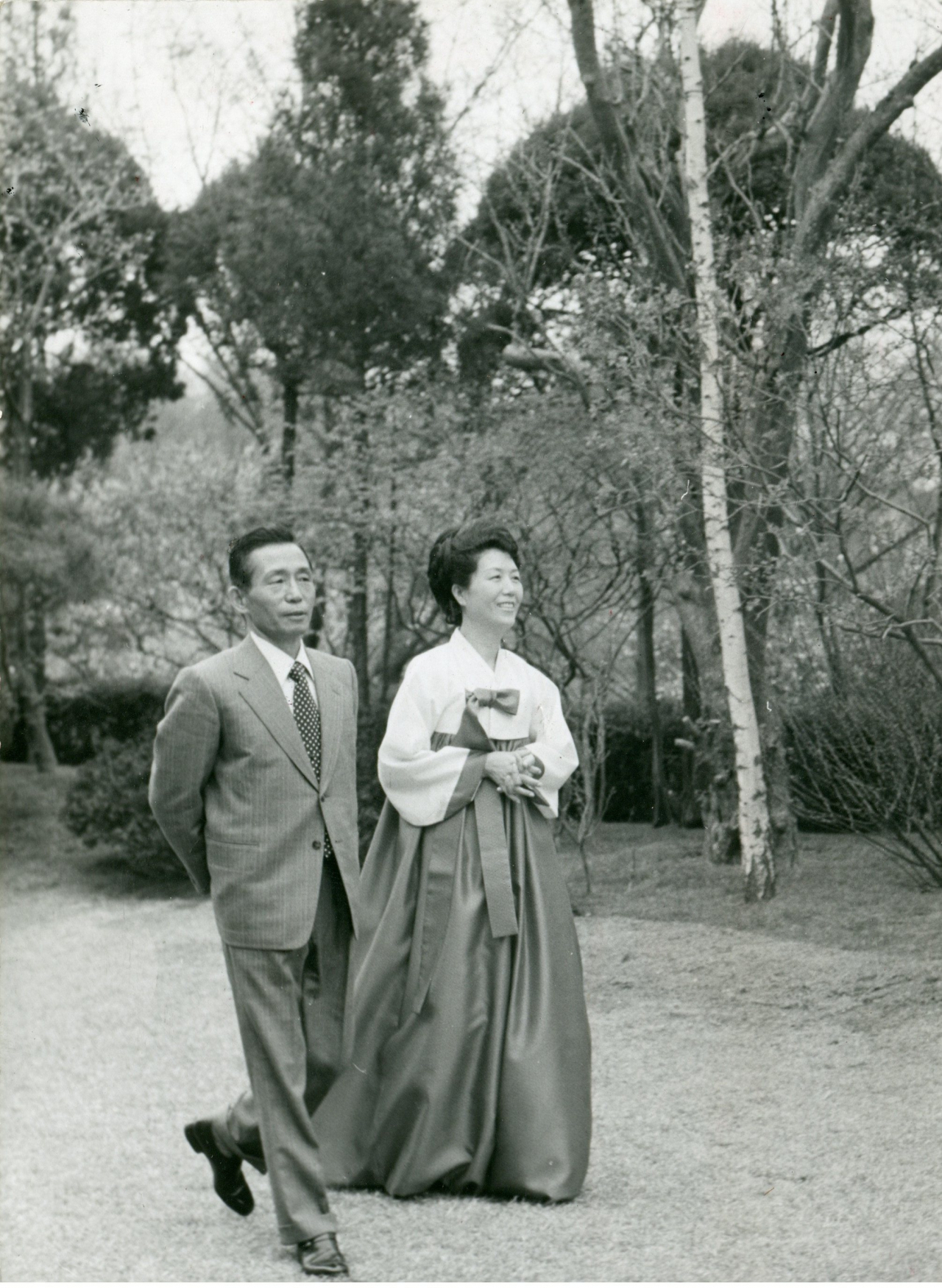
The inauguration of Seoul Metropolitan Subway Line 1 was scheduled for August 15, 1974, to coincide with the 29th National Liberation Day. The day was intended to symbolize South Korea's modernization and industrial prowess. Instead, it is remembered for a national tragedy. During the Liberation Day ceremony at the National Theater, just hours before the subway's ribbon-cutting, a pro-North Korean assassin named Mun Se-gwang fired a revolver at President Park Chung-hee. The President survived, a stray bullet struck and killed the Lady, Yuk Young-soo. The news shattered the celebratory atmosphere. President Park did not attend the subway opening. Mayor Yang Taek-shik, suppressing his shock, led the somber ceremony at Cheongnyangni Station. He would later resign, taking responsibility for the security failure that led to the Lady's death.
even with the blood on the political stage, the trains ran. Line 1 opened with nine stations covering a 7. 8-kilometer underground section from Seoul Station to Cheongnyangni. This short segment was the core of a much larger network. From day one, the system operated a through-service with the Korean National Railroad (KNR) lines, extending reach to Incheon and Suwon. This integration created a technical complexity that today: the underground Line 1 operates on 1, 500V DC power, while the connecting KNR ( Korail) lines use 25, 000V AC. Trains passing between these sections must coast through a "dead section" to switch power modes, a momentary flicker of lights that signals the transition between the city-managed subway and the national rail network.
The initial rolling stock, the 1000-series trains, were built by Japanese manufacturers including Hitachi and Kawasaki, with later units assembled in Korea. These "Resistance" trains used rheostatic control systems, which dissipated excess energy as heat. In the confined tunnels of Line 1, this heat became a serious problem during the summer months, contributing to the sweltering environment of the early subway era. Even with these initial flaws, the system was an immediate success utility. It slashed travel times across the congested city center and provided the reliable, high-capacity link between the burgeoning satellite cities and downtown Seoul. The opening of Line 1 did not solve a traffic problem; it restructured the urban geography of the capital, enabling the outward expansion that would define Seoul's growth for the five decades.
Seoul Transit Evolution: Key Metrics (1899, 1974)
Year
Event / Metric
Details
1899
Tram Inauguration
Route: Seodaemun to Cheongnyangni. Operator: Hanseong Electric Co.
1960
Population Milestone
Seoul population reaches approx. 2. 4 million.
1968
Tram System Closure
Operations ceased Nov 29. Replaced by bus system.
1970
Subway Plan Initiated
Mayor Yang Taek-shik establishes Subway Construction HQ.
1971
Line 1 Groundbreaking
April 12. Cut-and-cover construction begins on Jongno.
1974
Line 1 Opening / Assassination
Aug 15. 7. 8 km underground section opens. Lady Yuk Young-soo killed same day.
Line 2 Construction Logistics and the 1980-1984 Loop Completion
Urban Transit Precursors and the 1974 Line 1 Inauguration
The strategic pivot from a radial rail network to a circular system marked the definitive moment in Seoul's modern urban planning history. While Line 1 followed the colonial-era axis, the conception of Line 2 required a radical reimagining of the city's geography. Mayor Koo Ja-chun, appointed in 1974 following the assassination of Lady Yuk Young-soo, rejected the existing plans for Lines 2 through 5. His administration proposed the "Three Nuclei" concept, aiming to decentralize the population from the historic walled city to two new centers: Yeongdeungpo and the undeveloped rice paddies of Gangnam. Urban legends that Mayor Koo sketched the rough outline of the circular route on a map with a black pencil in a mere twenty minutes, a claim that aligns with the aggressive, top-down administrative style of the Park Chung-hee era.
Construction on Line 2 began on March 9, 1978, driven by an urgency to prepare the capital for the 1986 Asian Games and the 1988 Summer Olympics. The logistics of this undertaking dwarfed the Line 1 project. Unlike the line, which relied heavily on existing surface rail corridors, Line 2 required extensive tunneling through soft alluvial soil and the construction of massive river crossings. The section to open was not the downtown loop, the 14. 3-kilometer segment from Sinseol-dong to the Sports Complex in Jamsil, inaugurated on October 31, 1980. This prioritization was deliberate. By forcing the subway into the empty fields south of the Han River, the government compelled developers and residents to migrate, the Gangnam district into existence through infrastructure.
The engineering methods used during this period prioritized speed over precision. Contractors relied heavily on the "cut-and-cover" technique for the underground sections. This method involved excavating a deep trench, constructing the tunnel box, and then burying it. The process turned major thoroughfares into open scars for years, paralyzing surface traffic and coating the city in a permanent of construction dust. In areas where the ground was too soft or the water table too high, engineers used the New Austrian Tunneling Method (NATM), though the pressure to meet deadlines frequently compromised the curing times for concrete and the reinforcement standards.
Crossing the Han River presented a specific set of logistical blocks. The Jamsil Railway, completed in 1979 by Dongah Construction, was the in Seoul to combine road and rail, with the subway running in the center and automobiles on the flanks. This dual-use design maximized utility increased the vibrational stress on the structure. Further west, the Dangsan Railway was commissioned to connect the industrial zones of Yeongdeungpo with the residential areas of Mapo. Built by Namkwang Construction starting in February 1980, the used a steel truss design. The haste of its construction, completed in November 1983, would later prove catastrophic; the structure suffered from serious defects that necessitated its total demolition and reconstruction in the 1990s.
The phased opening of Line 2 reveals the frantic pace of the early 1980s. Following the 1980 opening of the eastern leg, the line extended westward into the heart of the new Gangnam development. On December 23, 1982, the section from the Sports Complex to the Seoul National University of Education opened. Less than a year later, in September 1983, the line reached Euljiro, piercing the old downtown. By December 1983, trains ran as far as Seoul National University Station. The fragmented nature of these openings meant that for four years, Line 2 operated as a series of disconnected spurs rather than a loop, confusing passengers and limiting the system's initial efficiency.
The loop closed on May 22, 1984. The opening of the segment between Seoul National University and Euljiro 1-ga (via Sindorim) unified the system into a 48. 8-kilometer circle, the longest subway loop in the world at the time. This completion fundamentally altered the flow of human capital in the metropolitan area. Commute times between the northern and southern banks of the Han River dropped from hours to minutes. The "Green Line" immediately became the city's busiest artery, carrying millions of passengers daily and cementing the polycentric structure Mayor Koo had envisioned a decade earlier.
Seoul Subway Line 2 Construction and Opening Timeline (1978-1984)
Date
Event / Section Opened
Length / Note
March 9, 1978
Construction Begins
Groundbreaking for the Circle Line
Oct 31, 1980
Sinseol-dong ↔ Sports Complex
14. 3 km ( operational section)
Dec 23, 1982
Sports Complex ↔ Seoul Nat'l Univ. of Education
Extension into Gangnam core
Sept 16, 1983
Euljiro 1-ga ↔ Seongsu
Connection to downtown; Seongsu branch split
Dec 17, 1983
Seoul Nat'l Univ. of Education ↔ Seoul Nat'l Univ.
Extension to the southwest
May 22, 1984
Seoul Nat'l Univ. ↔ Euljiro 1-ga (via Sindorim)
Full Loop Completion (48. 8 km)
The legacy of the 1980-1984 construction period is dual-edged. On one hand, the completion of Line 2 in just six years stands as a testament to the industrial mobilization capabilities of the South Korean state. It successfully relieved the crushing congestion of the surface road network and enabled the explosive economic growth of the 1980s., the aggressive schedules left a hidden debt in the infrastructure. The use of sea sand in concrete mixtures, insufficient steel reinforcement, and the absence of rigorous oversight during the "cut-and-cover" operations created structural weaknesses that would plague the system in subsequent decades. The Dangsan Railway, a serious link in this loop, had to be shut down on New Year's Eve 1996 due to the discovery of cracks in the truss members, a direct result of the corner-cutting culture that defined the construction boom.
By 1985, Line 2 was not a transit route; it was the method by which Seoul became a megacity. It integrated the industrial, political, and residential sectors into a single, functioning organism. The ridership data from 1984 onward shows a vertical trajectory, with the Green Line quickly surpassing Line 1 in daily passenger volume. This success validated the circular design, proving that a ring road for trains could distribute density more than a simple radial spoke system. The completion of the loop set the stage for the massive expansion of Lines 3 and 4, which were already digging their way through the city's granite bedrock as the Green Line trains completed their inaugural circuits.
2004 Public Transport Reform and T-money Payment Infrastructure
By the early 2000s, Seoul's surface transit network had into a fractured, dangerous marketplace defined by cutthroat competition. Private bus operators, driven solely by profit margins, engaged in reckless racing to secure passengers at crowded stops, a practice known locally as "bus wars." Routes were convoluted, designed to maximize fare collection rather than commuter efficiency, leaving less profitable residential areas underserved. The subway system, though expanding, operated as a financial silo, completely disconnected from the bus network. Commuters paid double fares when transferring between modes, a punitive cost structure that discouraged integrated transit use. The congestion costs, economic losses attributed to traffic gridlock, were estimated at 5 trillion won annually, threatening to strangle the city's productivity.
On July 1, 2004, the Seoul Metropolitan Government executed a "Big Bang" reform that fundamentally dismantled this market-driven chaos. Orchestrated by then-Mayor Lee Myung-bak, the initiative was not an operational tweak a total restructuring of the transit economy. The centerpiece was the "Quasi-Public Bus System," a model where the city government assumed control over route planning and fare pricing, while private companies retained ownership of the vehicles and management of labor. This arrangement guaranteed bus operators a fixed profit margin, with the city covering any operating deficits. In exchange, the dangerous competition for passengers ended immediately, replaced by a regulated service standard that prioritized safety and schedule adherence over ticket volume.
The physical manifestation of this reform was the implementation of the Median Bus Lane system, a Bus Rapid Transit (BRT) network that physically separated public transit from general traffic. By placing bus lanes in the center of major arterials rather than the curbside, the city eliminated the friction caused by illegal parking and right-turning vehicles. The impact was measurable and immediate: bus speeds on key corridors like Dobong-ro and Susaek-ro increased by 33% to 100%. To aid navigation, the chaotic numbering system was replaced with a color-coded hierarchy: Blue buses for high-speed trunk lines connecting districts, Green for feeder lines linking neighborhoods to subway stations, Red for wide-area express routes connecting satellite cities, and Yellow for short-distance circulation within the central business district.
The digital backbone of this integration was the T-money infrastructure, a smart card system that enforced the new "Integrated Distance-Based Fare." Prior to 2004, fare collection was unclear and cash-heavy. The introduction of T-money, managed by the Korea Smart Card Company (KSCC), a joint venture between the Seoul Metropolitan Government and LG CNS, created a centralized clearinghouse for transit data. This system allowed for free transfers between buses and subways within a 30-minute window, with fares calculated based on the total distance traveled rather than the number of boardings. The technical standardization, utilizing ISO 14443 Type A/B and KS X 6923, enabled the processing of millions of transactions daily with millisecond latency, creating a verified data trail that made the quasi-public subsidy model auditable.
The financial of the 2004 reform were clear. While passenger satisfaction surged, dissatisfaction rates dropped from 56% to 13% within months, the cost of stability was a permanent fiscal load. The city's obligation to cover bus operating deficits required subsidies that ballooned from the initial estimates to over 270 million USD annually in the years following the reform. By the 2021-2024 period, the city had poured nearly 2. 48 trillion won ($1. 75 billion) into bus company subsidies. This deficit spending is the price of the "transportation welfare" model, ensuring that unprofitable routes in remote neighborhoods remain operational even with low ridership.
Seoul Public Transit Performance Metrics (2004 Reform Impact)
Metric
Pre-Reform (2003)
Post-Reform (2005/2006)
Bus Operating Model
Private / Profit-Driven
Quasi-Public / City-Managed
Fare Structure
Flat Rate / Double Charge on Transfer
Integrated Distance-Based / Free Transfer
Average Bus Speed (Key Corridors)
11 km/h
18, 22 km/h
Ridership Trend
Declining
Increased by ~14%
Fiscal Impact
Operator Profit/Loss
City Deficit Coverage (~$270M/yr)
By 2024, the focus of Seoul's transit infrastructure shifted from integration to climate resilience and cost-of-living support. On January 27, 2024, the city launched the "Climate Card" (Gihu Donghaeng Card), an unlimited transit pass designed to reduce private vehicle usage. Priced at 62, 000 won (approximately $46) for a basic monthly pass, or 65, 000 won including the "Ttareungyi" public bicycle service, the card represented a pivot away from the distance-based revenue model established in 2004. Data from the four months of operation showed an average of 540, 000 daily users, with estimated savings of 30, 000 won per month for heavy commuters. The city estimated that the initiative reduced private car usage by over 100, 000 trips during the pilot period, directly linking fare policy to greenhouse gas reduction.
Looking toward 2026, the payment infrastructure is undergoing another radical technical evolution: the "Tagless" system. Moving beyond the NFC-based tapping method that defined the T-money era, the new system utilizes Bluetooth Low Energy (BLE) and ultra-wideband technology to detect a passenger's smartphone as they walk through a gantry. Pilot programs on the Ui-Sinseol Light Rail Line in 2023 and subsequent expansions to Line 9 and city buses in 2025 aim to eliminate the physical bottleneck of turnstiles entirely. This shift creates a "walk-through" experience, further reducing dwell times at stations. Concurrently, the closed-loop nature of the Korean payment system is opening; plans for 2026 include the installation of EMV-compliant terminals, allowing foreign visitors to use contactless credit cards directly, the long-standing barrier that required tourists to purchase physical T-money cards.
The trajectory from the chaotic bus wars of 2003 to the algorithmic precision of the 2026 tagless gates illustrates a consistent governance strategy: the use of heavy infrastructure investment and digital surveillance to impose order on urban mobility. The T-money system did not just facilitate payments; it generated the big data necessary to optimize routes and justify the billions of won in annual subsidies. As the system integrates with the Climate Card, the data focus has widened to track carbon footprints alongside passenger kilometers, cementing the subway and bus network as the primary instrument of Seoul's environmental policy.
Sangwangsimni Collision and Safety Protocol Revisions 2014-2020
The collision at Sangwangsimni Station on May 2, 2014, marked a definitive fracture in the public trust regarding Seoul's transit infrastructure. At 3: 30 PM, Seoul Metro Train 2260, a Line 2 service moving eastbound, slammed into the rear of the stationary Train 2258. The impact occurred at a speed of 15 kilometers per hour, reduced from 68 kilometers per hour by the driver's desperate application of emergency brakes. While no fatalities resulted from the crash, 388 passengers sustained injuries, ranging from fractures to severe bruising. The incident was not a mechanical failure; it was a symptom of a decaying signal infrastructure that had been patched rather than overhauled.
Investigative reports revealed that the Automatic Train Stop (ATS) system, the method responsible for maintaining safe distances between trains, had failed. A software modification made to the signaling system three days prior had introduced a fatal logic error. The system was designed to display a "Stop" signal followed by a "Caution" signal to an method train if the track ahead was occupied. Instead, the faulty code broadcast a "Go" (Green) signal for two consecutive blocks, only switching to "Stop" when the moving train was within 128 meters of the stationary one. At 68 kilometers per hour, the braking distance required was significantly longer than the space available. The driver of Train 2260 reacted within seconds, yet the physics of the heavy rolling stock made a collision inevitable.
The passenger reaction to the crash highlighted a psychological shift in South Korean society. Occurring less than three weeks after the Sewol Ferry disaster, which claimed 304 lives, the subway collision triggered immediate, unauthorized self-evacuation. Although onboard announcements initially instructed passengers to remain inside the cars, hundreds forced the doors open and walked along the dark tracks toward the platform. The trauma of the ferry disaster, where compliance with authority led to death, drove the populace to reject official instructions. This behavioral change forced Seoul Metro to rewrite its emergency response, acknowledging that passengers would no longer passively await rescue.
While the Sangwangsimni incident exposed hardware and software deficiencies, the tragedy at Guui Station two years later laid bare the human cost of operational efficiency. On May 28, 2016, a 19-year-old mechanic, identified only by his surname Kim, was killed while repairing a platform screen door (PSD) on Line 2. Kim was trapped between the screen door and an arriving train. He was an employee of Eunsung PSD, a subcontractor hired by Seoul Metro to handle maintenance. The investigation unearthed a brutal labor structure: Kim was working alone, in violation of the "two-person rule" which mandates one worker to spot oncoming trains while the other performs repairs.
The structural rot went deeper than a single safety violation. Eunsung PSD technicians were required to reach any malfunction site within one hour to avoid penalties, a contractual clause that prioritized uptime over worker safety. Kim, earning a meager monthly wage of 1. 44 million won (approximately $1, 200), had skipped meals to meet these impossible quotas. His bag contained only a cup of instant noodles and a spoon, a detail that ignited national outrage. The system incentivized speed and cost-cutting, outsourcing the risk of death to young, low-paid contractors. Seoul Mayor Park Won-soon subsequently issued a public apology and announced the "Safety of the Citizens " policy, which included the direct hiring of safety-related subcontracted workers, ending the era of outsourcing danger.
Following these disasters, Seoul Metro initiated a massive technological overhaul between 2016 and 2020. The aging ATS system, which relied on track-side induction coils and fixed blocks, began a phased transition to Communications-Based Train Control (CBTC). This newer standard uses radio communication to determine the exact position of a train, allowing for "moving blocks" that increase capacity while enhancing safety. The upgrade was serious for Line 2, the busiest loop line in the world, where headways (the time between trains) frequently dropped two minutes during rush hour. By 2020, the integration of CBTC on key lines allowed for real-time speed adjustments and automatic braking profiles that were independent of driver reaction time.
The physical infrastructure also underwent a forced modernization. The "Smart Station" project, launched in 2018, introduced IoT-based monitoring systems across the network. These systems used intelligent CCTV to detect unauthorized track access, fire risks, and even passenger congestion levels. Yet, the financial load of these upgrades was immense. Seoul Metro faced a chronic operating deficit, exacerbated by the free-ride policy for citizens over 65, which accounted for a significant revenue loss. The tension between the need for multi-billion won safety investments and the political impossibility of raising fares created a precarious balancing act for city administrators.
Major Safety Incidents and Protocol Revisions (2014-2020)
Installation of intelligent CCTV and IoT sensors for real-time hazard detection.
The replacement of rolling stock also accelerated during this period. The older trains, utilizing Rheostatic control systems that were prone to heat generation and jerky acceleration, were systematically retired. They were replaced with units featuring Variable Voltage Variable Frequency (VVVF) inverters, which offered smoother operation and better regenerative braking. By 2020, the average age of the fleet on Line 2 had dropped significantly, reducing the risk of mechanical failures like the door malfunctions that had plagued the system in the early 2000s. Even with these, the legacy of the 2014 and 2016 disasters remained a driving force in policy, shifting the metric of success from "on-time performance" to "accident-free days."
This era defined a painful transition from rapid expansion to mature stewardship. The city learned that safety could not be retrofitted through software patches or subcontracted away. It required a fundamental restructuring of how the subway was funded, maintained, and operated. The blood spilled at Guui Station and the twisted metal at Sangwangsimni served as the grim catalyst for a modernized, albeit expensive, safety regime that prioritized human life over logistical speed.
Seoul Metro Deficit Metrics and PSO Compensation Disputes 2015-2025
Line 2 Construction Logistics and the 1980-1984 Loop Completion
The financial trajectory of the Seoul Metropolitan Subway from 2015 to 2025 represents a case study in structural insolvency, driven by a collision between rigid welfare mandates and demographic reality. While the network expanded its physical footprint, its balance sheet into a emergency of accumulated debt and chronic operating losses. By 2024, the cumulative deficit of Seoul Metro, the primary operator, had breached 19 trillion won ($14 billion), a figure that threatens the system's long-term viability and safety.
Operating deficits were not a product of the COVID-19 pandemic, though the virus acted as a catastrophic accelerant. Between 2015 and 2019, the system was already bleeding capital, with annual net losses averaging roughly 586 billion won. The pandemic years of 2020 and 2021 saw these figures nearly double, as ridership plummeted while fixed costs for labor, electricity, and maintenance remained static. In 2020 alone, Seoul Metro recorded a net loss of approximately 1. 11 trillion won. Even as passengers returned in 2023 and 2024, the financial recovery was anemic. The net loss for 2024 stood at 724. 1 billion won, a 40 percent increase from the previous year, driven by inflationary pressures and the refusal of fare revenue to cover operating costs.
Seoul Metro Financial Performance & Deficit Metrics (2019, 2024)
Year
Net Loss (Approx. KRW)
Free Ride Loss (Approx. KRW)
Debt Accumulation (Cumulative)
2019
586 Billion
371 Billion
~6. 0 Trillion
2020
1. 11 Trillion
274 Billion*
~6. 5 Trillion
2021
964 Billion
230 Billion*
~7. 0 Trillion
2022
642 Billion
315 Billion
~7. 3 Trillion
2023
690 Billion
366 Billion
~7. 5 Trillion
2024
724 Billion
400 Billion+
~7. 8 Trillion
*Note: Lower free ride losses in 2020, 2021 reflect reduced mobility among the elderly during the pandemic, not a structural improvement.
The core of this financial is the Public Service Obligation (PSO), specifically the mandate to provide free ridership to citizens aged 65 and older. Enacted in 1984 under the authoritarian regime of Chun Doo-hwan, the policy was originally a minor concession when the elderly population comprised less than 4 percent of the total. By 2025, South Korea had become a "super-aged" society, with the elderly demographic exceeding 20 percent. This demographic shift turned a benevolent welfare perk into a fiscal time bomb. In 2023, free rides accounted for approximately 17 percent of all subway traffic, costing the operator nearly 400 billion won annually. The elderly constitute 85 percent of these non-revenue passengers, dwarfing the costs associated with other PSO categories such as people with disabilities and "men of merit" (veterans and national heroes).
A bitter administrative war has raged between the Seoul Metropolitan Government and the Ministry of Strategy and Finance (MOEF) over who should foot this bill. Seoul officials that because the free ride policy is mandated by the national Welfare of the Aged Act, the central government is legally obligated to compensate the operator for the resulting losses. They point to KORAIL, the national railroad operator, which receives PSO compensation for its loss-making routes. The MOEF, firmly entrenched in fiscal conservatism, rejects this parallel. Their counter-argument rests on the principle of local autonomy: urban rail systems are the jurisdiction of local governments, and thus, the financial load of their operation, including welfare costs, must remain with the municipality.
This stalemate led to a series of legal and political skirmishes. In 2023, Seoul Mayor Oh Se-hoon threatened to raise subway fares significantly unless the central government agreed to a PSO transfer. The Ministry did not blink. Consequently, Seoul was forced to implement a two-stage fare hike, raising the base rate by 150 won in October 2023 and another 150 won in 2024, bringing the standard fare to 1, 550 won. These increases, the since 2015, were insufficient to plug the deficit. City data indicated that the cost to transport one passenger was roughly 1, 760 won, meaning every swipe of a standard ticket still resulted in a loss of over 200 won, even before accounting for free riders.
The introduction of the "Climate Companion Card" in early 2024 further complicated the revenue picture. While the unlimited transit pass was a political success, gaining rapid adoption, it exacerbated the revenue shortfall. In its year, the card contributed to an estimated 134 billion won in operational losses, split between the city and the metro operator. This populist measure, while encouraging public transit use, subsidized heavy users at the expense of the operator's solvency.
By 2025, the debate shifted from "who pays" to "how to cut." Proposals to raise the eligible age for free rides from 65 to 70 gained traction, with the Korea Transport Institute estimating this could reduce annual losses by nearly 30 percent. A more radical proposal, limiting free rides to the elderly in the bottom 70 percent of the income bracket, promised to cut costs by over 70 percent. Yet, political paralysis remained. With the elderly representing a voting bloc, neither the central government nor the city administration showed a willingness to unilaterally the 1984 mandate, leaving Seoul Metro to finance its operations through a dangerous pattern of bond issuance and deferred maintenance.
Labor Disputes over Single-Person Crewing and Workforce Downsizing
The financial of Seoul Metro, accumulating a deficit exceeding 18. 9 trillion KRW by early 2026, serves as the primary engine driving labor conflict in the capital's transit sector. Following the merger of Seoul Metro (Lines 1, 4) and the Seoul Metropolitan Rapid Transit Corporation (Lines 5, 8) in 2017, the integrated entity faced immediate pressure to reduce redundancy. In 2021, the Seoul Metropolitan Government and Seoul Metro management unveiled a "Management Rationalization Plan," which targeted a workforce reduction of approximately 2, 215 employees, roughly 13. 5% of the total staff, by 2026. This objective was to be achieved primarily through outsourcing safety maintenance functions, enforcing hiring freezes, and introducing automation to replace human station personnel. A central flashpoint in this downsizing strategy is the "Single-Person Crewing" (OPC) system. Historically, Lines 1 through 4 operated with a two-person crew: a driver at the front and a conductor at the rear to manage doors and passenger safety. Conversely, Lines 5 through 8, built later with more advanced automation, were designed for single-person operation. Management sought to expand the OPC model to the older lines, specifically targeting Line 2, the system's busiest loop, to cut costs. The labor unions fiercely opposed this, citing the inability of a lone operator to manage emergency evacuations in deep underground tunnels. This dispute culminated in December 2024, when a safety verification committee composed of academic and railroad experts recommended against implementing OPC on Line 2. The committee the line's heavy passenger volume and curved platforms as serious risks that technology alone could not mitigate, forcing management to temporarily shelf the plan. The human cost of workforce reduction became a matter of national outrage following the Sindang Station murder in September 2022. A female station employee, working a solitary night shift, was stalked and killed by a former colleague in a restroom. The incident exposed the dangers of the "lone worker" policy, a direct result of staffing cuts that left stations with only two employees on duty, forcing them to patrol alone. The unions argued that the "two-person patrol" rule, ostensibly a safety protocol, was mathematically impossible to enforce without increasing headcount. This tragedy shifted the public narrative from "efficiency" to "safety," arming the unions with significant political capital to resist further cuts. Labor tensions escalated into brinkmanship during the wage and shared agreement negotiations of late 2024. The unions threatened a general strike set for December 6, 2024, paralyzing the city's transport network. The core disagreement lay in the hiring numbers; management proposed replacing only a fraction of retirees, while the unions demanded a one-to-one replacement to maintain safety standards. Hours before the deadline, a deal was struck. Management agreed to hire 630 new employees, up from their initial offer of 464, and accepted a 2. 5% wage increase. This compromise averted the immediate emergency yet failed to resolve the underlying structural deficit. The pattern repeated with greater intensity in late 2025. By November 2025, the unions accused the city of reneging on safety pledge and continuing to suppress hiring to meet the 2026 reduction. A general strike was declared for December 12, 2025. The were higher, with the "MZ Union" (a younger, politically independent labor faction) joining the traditional unions in opposition to the proposed 5: 00 AM early start time, which they argued increased fatigue without adequate compensation. Once again, a last-minute settlement was reached on the morning of the scheduled walkout. The 2025 agreement secured the recruitment of 820 new employees and a 3% wage hike, stalling the government's 2, 215-job cut target.
Seoul Metro Labor Dispute Key Metrics (2021-2026)
Metric
Management Target
Union Demand
Outcome
Workforce Reduction (2026)
-2, 215 positions
No reduction / Net increase
Reductions slowed; ~1, 450 new hires (2024-25)
2024 New Hires
464
> 800
630
2025 New Hires
289
> 1, 000
820
Wage Increase (2025)
1. 8%
3. 0%
3. 0%
Cumulative Deficit
Reduce via cuts
Gov't PSO subsidy
~18. 9 Trillion KRW (Deficit )
Underlying these disputes is the unresolved matter of the Public Service Obligation (PSO) costs. The free ridership policy for seniors aged 65 and older accounts for approximately 17% of all passengers, contributing nearly 400 billion KRW annually to the deficit. As South Korea entered "super-aged society" status in 2025, with seniors comprising over 20% of the population, this financial load intensified. Management cites this deficit as the justification for austerity, while unions that welfare costs should be borne by the central government, not subsidized by slashing safety personnel. As of March 2026, the "Smart Station" initiative represents the new frontier of this conflict. Seoul Metro continues to roll out AI-driven CCTV systems and automated patrol robots, pitching them as tools to enhance safety. The unions view these technologies as a Trojan horse for the original 2021 downsizing plan, designed to eventually render human station agents obsolete. Even with the hiring victories of 2024 and 2025, the workforce remains stretched, and the fundamental contradiction between the city's austerity mandates and the operational reality of an aging, over-capacity network remains a volatile fault line.
Fine Dust Concentrations and Filtration Unit Deployments in Underground Stations
2004 Public Transport Reform and T-money Payment Infrastructure
The atmospheric history of Seoul, stretching back to the Joseon Dynasty records of the 1700s, was long defined by Hwangsa, the Yellow Dust blowing seasonally from the Gobi Desert. This natural phenomenon was a transient, visible haze that darkened the sky dissipated with the winds. The inauguration of Line 1 in 1974, yet, introduced a permanent, subterranean variant of this hazard: a toxic, metallic particulate cloud trapped within the concrete arteries of the city. Unlike the surface dust of the 18th century, which consisted primarily of soil and sand, the air circulating in the Seoul Metropolitan Subway is a synthetic cocktail of pulverized iron, silica, and heavy metals generated by the friction of steel wheels against steel rails.
For decades following the 1974 opening, air quality in the underground network was a secondary concern to the logistical triumph of mass transit. The "cut-and-cover" construction method used for the initial lines prioritized speed and cost over ventilation efficiency. This engineering legacy left the oldest sections of the network, particularly Lines 1 through 4, with insufficient airflow systems that allowed particulate matter (PM) to accumulate to hazardous levels. By the early 2000s, as medical understanding of PM10 (particles smaller than 10 micrometers) and PM2. 5 (ultrafine particles smaller than 2. 5 micrometers) advanced, the subway's air became a subject of intense public scrutiny. Data from 2021 identified Line 1 as the most polluted artery, recording an annual average PM10 concentration of 74 micrograms per cubic meter (µg/m³), significantly higher than the 66. 6 µg/m³ recorded the previous year. Line 4 followed closely with 70. 8 µg/m³. These figures frequently exceeded the World Health Organization's recommended exposure limits, turning the daily commute into a respiratory health risk for millions.
The composition of this subterranean dust distinguishes it from atmospheric pollution. Investigative analysis shows that a significant percentage of the particulate matter in the subway consists of iron oxide released during braking and acceleration. In older tunnels, the problem is compounded by the trackbed design. Approximately 46% of the tracks on Lines 1 through 4 still use gravel (ballast) roadbeds rather than concrete. As trains pass over these sections, the vibration grinds the stones against each other, releasing silica dust that mixes with the metallic brake dust. This "piston effect", where the train pushes a column of dirty air ahead of it, forces these particles into station platforms and concourses, bypassing older, weaker ventilation fans.
In response to mounting data showing the severity of the problem, the Ministry of Environment and Seoul Metro initiated a series of aggressive interventions starting in 2019, codified under the "Special Act on Fine Dust Reduction and Management." This legislation mandated strict legal limits: subway stations were required to maintain PM10 levels 100 µg/m³ and PM2. 5 levels 50 µg/m³. To meet these, Seoul Metro launched a massive retrofitting campaign. By 2023, the operator had installed high-performance air purifiers in thousands of train cars and station platforms. These units use a two-stage filtration process, combining pre-filters for large debris with electrostatic precipitators designed to capture the microscopic metallic particles unique to the railway environment.
The most recent phase of this battle, the "detailed Plan for Fine Dust Management" (2024, 2026), represents a capital injection of 300 billion KRW (approximately $227 million). The plan the root causes of dust generation rather than just filtration. A primary objective is the replacement of the crumbling gravel roadbeds on Lines 1 through 4 with concrete slabs, a process expected to reduce dust generation in those sectors by 28%. Also, the plan introduces "dust control mats" at station entrances to strip pollutants from passengers' shoes before they reach the platform. Pilot tests at Suyu Station on Line 4 demonstrated that these mats alone could reduce fine dust concentrations by over 5%.
Seoul Subway Fine Dust Concentrations & (2021, 2026)
Metric
2021 Status (Worst Lines)
2024 Legal Limit
2026 Target Goal
PM10 (Fine Dust)
74 µg/m³ (Line 1)
100 µg/m³
< 50 µg/m³ (Station Avg)
PM2. 5 (Ultrafine)
44. 2 µg/m³ (Line 4)
50 µg/m³
32 µg/m³
Filtration Tech
Mechanical Ventilation
HEPA + Electrostatic
AI-Driven Smart Ventilation
Technological innovation has moved beyond passive filters. The 2024-2026 roadmap includes the deployment of "Smart Station" systems that use Artificial Intelligence to monitor air quality in real-time. These systems automatically adjust the intensity of ventilation fans and air purifiers based on live sensor data, rather than running on a fixed schedule. This method addresses the nature of subway pollution, which spikes during rush hours and settles during off-peak times. also, the introduction of tunnel washing trains, specialized maintenance vehicles that scrub the tunnel walls with water, has become a nightly ritual to prevent settled dust from becoming airborne again.
Even with these, the challenge remains formidable. The depth of Seoul's stations, of which are located 30 to 50 meters underground, creates a natural trap for heavy pollutants. While the national ambient air quality improved significantly, hitting a record low PM2. 5 concentration of 15. 6 µg/m³ in 2024, the subway environment operates as a distinct microclimate with its own physics. The friction of steel on steel is an immutable fact of railway operation. Until the gravel roadbeds are fully replaced and the ventilation shafts of the 1970s are completely overhauled, the air underground remain heavier, metallic, and more hazardous than the air above.
GTX-A Deep Tunnel Excavation and High-Speed Commuter Link Status 2024-2026
The inauguration of the GTX-A (Great Train eXpress) line marks the most aggressive shift in Seoul's urban mobility strategy since the 1974 opening of Line 1. Unlike the shallow cut-and-cover tunnels of the 20th century, which disrupted surface traffic and followed existing road networks, the GTX-A operates in the "daesimdo", a legal and engineering designation for deep underground space, exceeding 40 to 50 meters the surface. This depth allows the rail alignment to bypass the complex web of private property rights and building foundations that clutter the shallow subsurface. Where the palanquin bearers of the Joseon Dynasty once navigated the winding, mud-slicked alleys of Hanyang, modern engineers bore through the city's granite bedrock with machines the size of buildings, creating a high-speed artery invisible to the metropolis above.
The excavation of the GTX-A tunnels required a bifurcation of engineering methods to address the geological intransigence of the Korean peninsula. In the city center, particularly under sensitive heritage sites like Gwanghwamun and the dense commercial districts near Seoul Station, contractors deployed a Gripper TBM (Tunnel Boring Machine). This cylindrical behemoth, with a diameter of 11. 6 meters, ranks as the largest of its kind ever used in South Korea. The Gripper TBM grinds through hard rock by bracing itself against the tunnel walls and thrusting forward, a method that minimizes surface vibration and eliminates the need for blasting. This was a calculated choice to protect national treasures and high-value real estate from the tremors associated with traditional mining.
Yet, not all sections benefited from the mechanical precision of the TBM. In areas with fractured rock zones or where the tunnel geometry required complex variability, engineers reverted to the NATM (New Austrian Tunneling Method), which relies on drilling and blasting. This decision ignited fierce opposition in affluent districts such as Cheongdam-dong. Residents there, fearing structural damage to their luxury properties, launched legal and public relations campaigns against the use of explosives beneath their foundations. The conflict exposed the friction between national infrastructure mandates and private property concerns, a tension that delayed specific segments and forced the Ministry of Land, Infrastructure and Transport to enforce strict vibration limits. The geological reality of Seoul, a city sitting on a granite batholith, meant that while the rock provided stability for deep tunnels, it exacted a high price in excavation effort and social friction.
The operational rollout of the GTX-A occurred in a disjointed sequence, creating a temporary "island" system that baffled initial ridership projections. On March 30, 2024, the southern segment connecting Suseo to Dongtan officially opened. This 34. 9-kilometer stretch offered a glimpse of the system's chance, slashing travel times from 80 minutes by bus to a mere 20 minutes by train. The trains themselves, capable of speeds up to 180 kilometers per hour, represent a different class of rolling stock compared to the standard metro cars, featuring noise-dampening doors and airline-style seating. even with the technical success, the initial daily ridership hovered around 19, 000, roughly 78 percent of the forecasted demand. The absence of a direct connection to the central business districts of Gangnam (Samseong Station) and Seoul Station limited the line's utility to a simple shuttle service for residents of the Dongtan New Town, forcing them to transfer at Suseo for access to the wider grid.
The northern leg of the project, linking Unjeong in Paju to Seoul Station, commenced operations on December 28, 2024. This segment addressed the chronic isolation of the northwestern commuter belt, reducing a grueling 90-minute commute to a 20-minute sprint. The opening of the Unjeong-Seoul Station line brought the total operational length of the GTX-A to a significant percentage of its design, yet the system remained severed in the middle. The two operational halves, North and South, functioned as independent entities, separated by the uncompleted trackwork through the Gangnam district. This bifurcation meant that a passenger could travel from Paju to Seoul Station or from Dongtan to Suseo, crossing the Han River to connect these two zones remained impossible on the GTX infrastructure throughout 2024 and 2025.
The serious failure in the timeline centers on Samseong Station. Originally designed as the nexus of the entire network, the station's construction became entangled with the massive Gangnam International Transit Center and the Hyundai Global Business Center (GBC) projects. The sheer of the excavation required at Samseong, creating an underground city rather than a simple stop, pushed the completion date to April 2028. This delay created a void in the network's heart. To mitigate this, the Ministry of Land, Infrastructure and Transport accelerated the connection of the tracks between Seoul Station and Suseo. By August 2026, trains are scheduled to physically traverse the gap, allowing for a continuous ride from Unjeong to Dongtan. Yet, these trains pass through the ghost station at Samseong without stopping, a "passing run" operation that connects the line's termini while bypassing its most commercially important node.
Financial structures for the GTX-A reflect a BTO-rs (Build-Transfer-Operate risk-sharing) model, a departure from the purely state-funded lines of the 20th century. The involvement of private consortiums, led by SG Rail, necessitated a fare structure significantly higher than the standard metropolitan subway. The base fare was set at 3, 200 KRW, with distance surcharges pushing a full-length trip over 4, 450 KRW. While the government introduced the K-Pass system to subsidize costs for frequent commuters, the pricing strategy stratified Seoul's transit demographics. The GTX became a premium service for time-sensitive professionals, while the slower, cheaper Line 1 and bus networks retained the bulk of the working-class ridership. This economic segregation mirrors the Joseon-era distinction between the swift horse-rider and the pedestrian, albeit mediated by ticket gates rather than social caste.
Safety concerns during the construction phase underscored the risks of deep-earth engineering. The fractured rock zones near Yeonsinnae required meticulous reinforcement, yet the project was not immune to industrial accidents. A fatality involving a worker at a related construction site highlighted the human cost of the accelerated schedule. also, the ventilation shafts required for tunnels 50 meters deep became flashpoints for local grievances, with residents in Buam-dong protesting the noise and dust emissions from these "breathing holes" of the subterranean giant. These conflicts illustrate that even at 50 meters of depth, the GTX-A could not fully escape the politics of the surface.
As of 2026, the GTX-A stands as a partial triumph of engineering over geography. The granite bedrock has been conquered by the TBMs, and the travel times between the periphery and the center have been compressed to levels previously unimaginable. The 180 km/h speeds have fundamentally altered the spatial perception of the Capital Area, making Paju and Dongtan functionally closer to Seoul Station than districts within Seoul proper. Yet, the hollow core at Samseong remains a testament to the complexities of integrating mega-projects within a living, breathing city. The full realization of the network's chance waits for 2028, the tunnels are dug, the tracks are laid, and the deep train runs beneath the feet of a populace that once measured distance in the number of steps taken.
Digital Sex Crimes and Illegal Filming Enforcement Statistics 2018-2025
The proliferation of digital sex crimes, specifically *molka* (illegal filming), transformed the Seoul Metropolitan Subway into a primary theater for gender-based violence between 2018 and 2025. even with repeated "zero-tolerance" declarations by the Seoul Metropolitan Government, enforcement statistics reveal a widespread failure to curb the illicit recording of passengers. The subway network, particularly the heavily congested Line 2, evolved into a high-risk environment where technological in miniaturized cameras outpaced the detection capabilities of law enforcement. From 2018 to 2024, the number of reported illegal filming incidents on the subway fluctuated maintained a disturbing prevalence. In 2023 alone, the Seoul Metropolitan Police Agency recorded 3, 516 total subway crimes, a 4 percent increase from the previous year. Of these, sexual offenses, including illegal filming and groping, accounted for 36 percent (1, 230 cases). This data contradicts earlier official narratives suggesting a decline in digital sex crimes following the aggressive crackdowns of 2018. Instead, the locus of these crimes shifted. While station-based incidents garnered attention, 2024 data indicates that nearly 70 percent of sexual assaults occur inside moving train cars, where real-time surveillance is frequently nonexistent or unmonitored. The geography of these crimes is highly concentrated. Line 2, which circumnavigates the city's major commercial and university districts, consistently ranks as the most dangerous line, accounting for approximately 33 to 40 percent of all subway crimes annually. Specific stations have emerged as persistent hotspots. Hongik University Station, a hub for youth nightlife, topped the list for illegal filming reports in 2023 and the half of 2024. The Express Bus Terminal Station and Gangnam Station followed closely, with the former recording 141 sexual crimes between 2021 and July 2024. These transit nodes provide the density and anonymity required for perpetrators to operate. Enforcement relies on a bifurcated and frequently ineffective system: the Seoul Subway Police (sworn officers with arrest powers) and the "Subway Sheriffs" (civilian security officers employed by Seoul Metro). The Sheriffs, introduced to bolster safety, operate with a fatal legal handicap: they possess no judicial authority. They cannot detain suspects, demand identification, or use force. This limitation has rendered them; assaults against subway security staff surged, with 177 incidents recorded in 2023 alone. Perpetrators frequently exploit this absence of authority, fleeing the scene or physically attacking the unarmed officers before police can arrive. The technological arms race between offenders and enforcement units remains lopsided. While police deployed handheld lens detectors to sweep public restrooms and escalators, these devices proved largely ineffective against body-worn cameras. Perpetrators use ultra-miniature lenses (frequently 1mm in diameter) camouflaged in shoes, wristwatches, and eyeglasses. In May 2025, a crackdown at Geumjeong Station apprehended a man using a shoe-mounted camera to film victims for four minutes, a method that evades traditional static sweeps. The import of these "spy cam" devices, primarily from China, surged to $9. 4 million between 2022 and 2024, flooding the market with tools designed specifically to bypass security checks. Prosecution outcomes further dilute the deterrent effect of arrests. Data from 2019 revealed that prosecutors dropped 43. 5 percent of digital sex crime cases. Even when convictions are secured, prison sentences remain rare. A longitudinal analysis of trials indicates that less than 10 percent of convicted offenders receive prison time, with the vast majority receiving fines that fail to match the severity of the privacy violation. The legal system's leniency even as the terminology shifts; while the government prefers the term "illegal filming" over the trivializing *molka*, the conviction rates for 2020-2024 show no significant upward trend in severity for -time offenders.
Seoul Subway Sexual Crime & Illegal Filming Statistics (Selected Years)
Year
Total Subway Crimes
Sexual Offenses (Total)
Key Hotspots (Illegal Filming)
Notes
2018
~2, 200 (est.)
High incidence
Hongik Univ., Gangnam
Post-Hyehwa protest crackdowns initiated.
2020
2, 249
667
Line 2 (General)
Pandemic ridership drop affected totals.
2021
2, 619
833
Express Bus Terminal
Sharp rise as restrictions eased.
2022
3, 378
~1, 100
Hongik Univ., Sadang
Sexual offenses constitute ~33% of total.
2023
3, 516
1, 230
Hongik Univ. (31 cases)
Highest crime total in 10 years.
2024
N/A
632 (Jan-Aug)
Line 2, Line 4
70% of incidents occurred inside trains.
Public outcry, ignited by the 2018 protests at Hyehwa Station, forced the Seoul Metropolitan Government to install safety mirrors and upgrade CCTV systems. Yet, blind spots remain widespread. As of 2025, the vast majority of CCTV feeds inside train cars are not monitored in real-time, serving only as forensic evidence after a crime is reported. The delay between the act and the response allows digital files to be uploaded and distributed before the victim is even aware of the violation. The "Sheriff" program, while visible, functions more as security theater than a genuine deterrent, leaving the load of safety disproportionately on the passengers themselves.
Privately Funded Lines: Sinbundang Line Fare Structures and Ownership
Sangwangsimni Collision and Safety Protocol Revisions 2014-2020
The Sinbundang Line, branded as the DX Line, represents a sharp deviation from the state-led infrastructure model that characterized Seoul's transit history since 1974. It stands as the heavy rail system in South Korea designed, financed, and operated through a Build-Transfer-Operate (BTO) framework. Unlike the standard lines managed by Seoul Metro or Korail, the Sinbundang Line functions as a patchwork of private concessions, a structure that has resulted in the highest fare rates in the metropolitan network. ### The Private Consortium Model The line is not owned by a single entity is fractured across three distinct private operators, each responsible for a specific geographic segment. This fragmentation is the direct result of the BTO model, where private consortiums shoulder the construction costs in exchange for 30-year operating rights and guaranteed returns. The ownership structure is dominated by construction conglomerates, specifically Doosan Engineering & Construction, which holds significant across the operators.
Sinbundang Line Ownership and Operation Structure (2026)
Segment
Operator (Consortium)
Major Shareholders
Opening Date
Phase 1: Gangnam ↔ Jeongja
Shinbundang Railroad Co., Ltd.
Doosan E&C (29. 03%), Korea Infrastructure Fund No. 2, Korea Development Bank
October 2011
Phase 2: Jeongja ↔ Gwanggyo
Gyeonggi Railroad Co., Ltd.
Doosan E&C (31. 41%), DL E&C, GS E&C
January 2016
Phase 3: Sinsa ↔ Gangnam
New Seoul Railroad Co., Ltd.
Doosan E&C (13. 75%), Hanwha E&C
May 2022
The actual day-to-day operation of the trains and stations is outsourced to **NeoTrans**, a subsidiary of the Doosan Group. This corporate structure creates a scenario where the passenger pays not just for transit, for the profit margins of multiple overlapping private entities. ### The Cumulative Fare Structure The most contentious aspect of the Sinbundang Line is its fare policy. While it integrates with the Metropolitan Unity Fare System for transfers, it imposes a "separate fare" (surcharge) on top of the standard distance-based rates. Because different companies own different sections, these surcharges stack. As of the fare adjustment on June 28, 2025, the cost to ride the Sinbundang Line significantly exceeds standard subway fares. A passenger traveling from Sinsa to Gwanggyo does not pay a single surcharge; they pay a cumulative fee that accounts for traversing the jurisdictions of New Seoul Railroad, Shinbundang Railroad, and Gyeonggi Railroad. The pricing method works as follows: 1. **Base Fare:** The standard metropolitan subway fare (KRW 1, 550). 2. **Distance Fare:** Standard calculation based on kilometers traveled. 3. **Section Surcharge:** A specific fee for entering the Sinbundang network. 4. **Crossing Surcharge:** An additional fee triggered when a passenger crosses from one operator's territory to another (e. g., passing Jeongja Station). For a commuter traveling the full length from Sinsa to Gwanggyo, the total fare method KRW 4, 000, nearly double the cost of a comparable distance on a public line like Line 3. This "fare discrimination" has sparked repeated protests from residents in Suji and Gwanggyo, who they are being penalized for the government's refusal to fund infrastructure directly. ### Minimum Revenue Guarantees and Deficits The financial architecture of the Sinbundang Line relies on the Minimum Revenue Guarantee (MRG). When the line was conceived in the early 2000s, the South Korean government promised to compensate the private operators if ridership fell projected levels. These projections were optimistically high. When actual ridership failed to meet these inflated, the government was forced to pay billions of won in subsidies to the consortiums. In response, the Ministry of Land, Infrastructure and Transport (MOLIT) attempted to renegotiate terms, leading to protracted legal battles. * **The MRG Trap:** In the initial years, the government compensated Shinbundang Railroad Co., Ltd. for revenue shortfalls. This load shifted to the passenger through aggressive fare hikes in 2012, 2014, 2023, and 2025. * **Lawsuits:** The operators have frequently sued the government for delayed construction of connecting lines (like the Yongsan extension) and for changes in fare policies that reduced their projected income. In 2024, courts continued to mediate disputes regarding compensation for the delayed opening of the Yongsan section, which operators argued severely capped their ridership chance. ### The Yongsan Stagnation (2016, 2026) The extension from Sinsa to Yongsan remains the missing link. Originally slated to open alongside the Sinsa segment, this 5. 3-kilometer section has been paralyzed by the slow return of the Yongsan Garrison land from the United States Forces Korea (USFK). As of March 2026, the Sinsa-Yongsan section is technically under the jurisdiction of New Seoul Railroad Co., Ltd., physical progress has been minimal. The soil contamination cleanup required at the former military base has delayed the handover, pushing the projected opening to 2030 or beyond. This delay is financially catastrophic for the operators, as the connection to Yongsan Station (and the KTX network) was the linchpin of their original revenue models. ### Homaesil and Future Fragmentation Looking south, the line is expanding toward Homaesil in Suwon. Construction for this extension began in 2024 after years of feasibility disputes. Unlike the earlier phases, the Homaesil extension is being pushed as a fiscal project with a different funding mix, yet the specter of high fares remains. Residents in West Suwon have already expressed alarm that their new connection inherit the punitive surcharge structure of the existing line. The Sinbundang Line serves as a case study in the privatization of public goods. It delivers high-speed, driverless efficiency, the line's RF-CBTC system allows for speeds up to 90 km/h, it does so by shifting the financial risk from the state to the commuter. The result is a two-tier transit system: affordable mobility for the masses on public lines, and premium, high-cost mobility for those who can afford the "DX" surcharge.
Signaling System Upgrades from ATS to CBTC on Aging Lines
The invisible nervous system of the Seoul Metropolitan Subway faces a emergency of obsolescence that threatens to capsize its operational efficiency. While the physical rails and stations have expanded outward since the 1974 inauguration of Line 1, the signaling architecture, the digital logic that prevents trains from colliding, has struggled to keep pace. For over two centuries prior to the subway's existence, from 1700 through the late 19th century, the movement of people and goods in the Joseon capital relied on visual confirmation and rigid, human-enforced intervals. The transition to mechanized rail in the 20th century introduced the Automatic Train Stop (ATS) system, a technology that, by 2026, has become a dangerous liability on the network's oldest arteries.
The urgency of this modernization was written in blood and twisted metal on May 2, 2014. At Sangwangsimni Station on Line 2, a mechanical malfunction in the ATS system caused a moving train to ram into the rear of a stationary one, injuring 238 people. The investigation revealed a chilling flaw: the signaling block had failed to update the "stop" command. The driver saw two green lights indicating "proceed" before a sudden red light appeared too late for the emergency brakes to prevent impact. This incident exposed the fragility of the fixed-block system, where safety relies on large, static buffers of empty track between trains, limiting frequency and leaving the network to single-point hardware failures.
The technical limitation of the legacy ATS and Automatic Train Control (ATC) systems lies in their reliance on "fixed blocks." Under this regime, the track is divided into physical sections. Only one train can occupy a section at a time. If a block is 200 meters long, a train must wait until the preceding train has cleared the entire block before entering. This architecture caps the minimum headway, the time between trains, at approximately 2. 5 to 3 minutes. On lines carrying millions of passengers daily, this physical constraint creates a hard ceiling on capacity. No matter how trains Seoul Metro purchases, they cannot run them closer together without risking a collision under the old rules.
To break this ceiling, Seoul has aggressively pursued Communications-Based Train Control (CBTC). Unlike the analog relays of the 1970s, CBTC uses radio frequency (RF) communication to establish "moving blocks." The train transmits its exact location, speed, and braking curve to a central computer, which calculates a "protection envelope" around it. This digital buffer moves with the train, allowing following trains to method much closer, frequently within 90 seconds or less, while maintaining safety margins. The shift from ATS to CBTC is analogous to upgrading a road from stop signs to autonomous, synchronized traffic flow.
Yet, the transition has been anything smooth. Line 2, the city's busiest circular route, became the primary battleground for this upgrade. The project involved replacing the signaling brain of a live network that operates 20 hours a day. Between 2015 and 2024, engineers had to install transponders and wayside equipment during the brief overnight maintenance windows ( 1: 00 AM to 4: 00 AM). The mixed-mode operation, where new trains equipped with digital controllers had to share tracks with older rolling stock relying on analog backups, created a fragile operational environment. Delays attributed to "signal system checks" became a frequent commuter grievance during this period.
The complexity deepened with the extension of Line 4. When the Jinjeop Line extension opened in March 2022, it introduced a severe compatibility fracture. The new northern section was built with modern signaling standards, while the legacy Line 4 segments south of Danggogae remained on the older ATS/ATC architecture. This mismatch forced trains to perform a "mode switch" at the boundary stations. Drivers had to manually or semi-automatically toggle the onboard systems from the digital CBTC of the extension to the analog ATS of the old line. This handover, frequently taking precious seconds or minutes, destabilized the timetable and led to a phenomenon where high-speed commuter trains were by the technological limitations of the 1980s infrastructure they entered.
Financial and political pressures have also complicated the vendor. Historically, Seoul relied on foreign giants like Siemens, Alstom, and Thales for its advanced signaling needs. The Incheon Line 2 capacity increase, for instance, utilized Thales' SelTrac CBTC system. yet, the South Korean government, citing high maintenance costs and the strategic risk of "black box" foreign technology, initiated the Korean Train Control System (KTCS-M) project. This domestic standard, designed to operate over an LTE-R (Long Term Evolution-Railway) or 5G-R network, aims to replace foreign vendor lock-in with a sovereign technology stack. Line 5 served as the pilot bed for this transition, with full implementation targeted for the mid-2020s.
By early 2026, the in infrastructure maturity remains clear. While the city celebrated the completion of elevator installations at all subway stations in January 2026, a visible victory for accessibility, the invisible signaling upgrades lag behind. The "2nd Seoul Subway" lines (5, 6, 7, 8), originally built in the 1990s, are entering their serious refurbishment window. The cost of stripping out the aging ATC loops and replacing them with KTCS-M infrastructure is estimated in the trillions of won. This expenditure competes directly with the budget for rolling stock replacement and the expansion of new lines like the delayed Wirye-Sinsa Line.
Signaling System Generations on Seoul Metropolitan Subway (1974-2026)
Era
System Type
method
Key Limitation/Advantage
Status (2026)
1974-1980s
ATS (Automatic Train Stop)
Fixed Block (Analog)
Low capacity; relies on driver reaction to lights.
Phased out; active on legacy segments.
1985-1990s
ATC (Automatic Train Control)
Fixed Block (Cab Signal)
Speed codes sent to cab; safer rigid headways.
Being replaced on Lines 3, 4, 5-8.
2000s-Present
CBTC (Comm-Based Train Control)
Moving Block (Digital RF)
High frequency (90s headway); supports driverless (GoA4).
The operational risk in 2026 is no longer just about safety, about recovery. In the legacy fixed-block era, a signal failure meant a localized stop. In the integrated digital network of CBTC and KTCS-M, a software glitch or a communication blackout can paralyze an entire line instantly. The "Green-Green-Red" error of 2014 was a mechanical failure; the failures of the future be widespread and code-based. As Seoul pushes to automate its network fully, the resilience of these digital signaling backbones defines the city's ability to move its 9. 4 million residents.
Gimpo Goldline Congestion Control and 2026 Extension Plans
The Gimpo Goldline, a fully automated light rail transit (LRT) system connecting the Han River New Town to Gimpo International Airport, represents one of the most severe failures in modern urban transport planning. frequently derided by commuters and media alike as the "Hell Train" or "Gimpo Golbyeong" (Gimpo Sickness) Line, the system operates at congestion levels that frequently exceed 200 percent of its design capacity. While the line was intended to serve as the arterial link for Gimpo's explosive population growth, cost-cutting decisions made during its inception, specifically the choice of two-car trainsets, have created a chronic mobility emergency. As of early 2026, the line remains a flashpoint of political contention and public safety risk, even with aggressive mitigation measures including bus expansion and accelerated train deployment.
To understand the magnitude of the Gimpo Goldline emergency, one must examine the historical isolation of the region. For centuries, Gimpo was a quiet agrarian peninsula, geographically separated from the capital by the Han River. In the 1700s, during the late Joseon Dynasty, the area was a collection of farming villages where travel to Hanyang (Seoul) required a ferry crossing at Mapo or Yanghwa, followed by a long trek. It was a "transportation island," a characteristic that ironically in the 21st century. While and highways eventually linked Gimpo to the mainland, the rapid urbanization of the 2000s outpaced infrastructure development. The designation of the Han River New Town brought hundreds of thousands of residents to the area, yet the rail link to Seoul was delayed for nearly a decade due to funding disputes and feasibility studies.
The original sin of the Gimpo Goldline lies in its structural specifications. Planners, constrained by the inability to secure heavy rail funding (such as an extension of Seoul Line 9), opted for a light rail solution funded entirely by Gimpo City and developer contributions. To minimize construction costs, station platforms were built to accommodate only two cars, a decision that permanently capped the system's capacity. When the line opened in September 2019, daily ridership immediately surpassed projections. By 2023, the line was transporting over 78, 000 passengers daily, with peak hour congestion rates hitting 289 percent, nearly three times the recommended density. Inside the trains, passengers are packed at a density of 7 to 8 people per square meter, a level comparable to the crowd density observed during major stampede disasters.
The human cost of this overcrowding became undeniable in April 2023, when two passengers, including a teenager, fainted on the platform at Gimpo International Airport Station due to difficulty breathing. This was not an incident; between January and April 2023 alone, 18 safety accidents related to congestion were recorded, averaging one incident every five days. In January 2026, another surge in medical emergencies occurred, with 28 passengers reporting dizziness or respiratory distress during the morning rush over a single month. The "Goldline" had become a hazard, forcing the deployment of paramedics and emergency response teams to major stations during peak hours solely to manage the of the crush.
In response to the escalating emergency, the Ministry of Land, Infrastructure and Transport (MOLIT) and Gimpo City launched a series of emergency mitigation measures between 2024 and 2026. The most visible intervention was the introduction of the "Seoul Companion Bus" (Seoul Donghaeng Bus) and the expansion of the Route 70 express bus service. To make these buses a viable alternative to the subway, a dedicated bus lane was established on the Olympic Expressway connecting Gimpo to Seoul. This reduced bus travel time significantly, though it did not fully alleviate the rail congestion due to the inherent preference for the subway's punctuality. By early 2025, the bus lane and increased fleet frequency had managed to siphon off demand, yet the Goldline's congestion rate hovered stubbornly around 190 to 200 percent.
A more direct solution involved the expansion of the rolling stock. In a phased deployment that began in June 2024, six additional train sets were introduced to the line. This allowed the operating interval to be reduced from 3 minutes to 2 minutes and 30 seconds during peak hours. By October 2024, these additions had lowered the maximum congestion rate from its peak of 289 percent to approximately 187 percent. yet, this reduction was quickly offset by continued population influx from new apartment complexes in the Gochon and Pungmu districts. Recognizing the insufficiency of these measures, the government committed to deploying five additional train sets by the end of 2026, aiming to further slash the headway to 2 minutes and 10 seconds, the absolute technical limit of the signaling system.
The long-term resolution of Gimpo's transit woes hinges on the extension of Seoul Metropolitan Subway Line 5, a project that has been mired in inter-municipal conflict. The core dispute involves the route alignment through Incheon's Geomdan New Town. Incheon officials advocated for a U-shaped route that would serve multiple stations within Geomdan, maximizing coverage for their residents. Conversely, Gimpo City and MOLIT favored a more direct route to minimize travel time to Seoul and ensure economic feasibility. In early 2024, the Metropolitan Transport Committee (Daegwangwi) proposed a compromise: a route featuring seven stations in Gimpo, two in Incheon, and one in Seoul. This plan, while technically sound, faced fierce political opposition from Incheon, delaying the final agreement.
As of February 2026, the Line 5 extension project is undergoing a "rapid" Preliminary Feasibility Study (PFS). Prime Minister Kim Min-seok, during a site inspection in late February 2026, publicly apologized for the delays and emphasized that the project should ideally have been exempted from the PFS given the humanitarian urgency of the Goldline's condition. The government is pushing to complete the administrative procedures by mid-2026 to ensure construction can begin before the end of the decade, with a target opening date of 2031. yet, the timeline remains tight, and residents fear that any further bureaucratic stalling leave them trapped in the current gridlock for another five years.
Beyond Line 5, the GTX-D (Great Train Express Line D) represents the horizon for Gimpo's connectivity. Planned to link Gimpo and Incheon to Gangnam and beyond, the GTX-D pledge to cut travel times drastically. yet, as of 2026, this project remains in the planning and early design phases, with completion expected well into the 2030s. For the immediate future, Gimpo residents are left with a patchwork of incremental improvements: a few more trains, a few more buses, and a bus-only lane that offers a slight reprieve from the traffic-choked Olympic Expressway.
Dedicated bus lane installed on Olympic Expressway.
210%
Jun-Oct 2024
Deployment of 6 additional train sets; interval reduced to 2. 5 min.
187%
Jan 2026
Renewed surge in medical incidents; 28 cases in one month.
190%, 200%
Late 2026 (Planned)
Deployment of 5 additional train sets; interval target 2. 1 min.
Target <160%
The situation in 2026 serves as a clear lesson in the perils of short-sighted urban planning. The decision to save costs in 2010 by building a two-car light rail system has resulted in billions of dollars in remedial spending and immeasurable daily suffering for commuters. The "Gimpo Goldline" name, originally intended to evoke premium service, is synonymous with policy failure. As the city braces for the arrival of 11, 000 new households in the coming years, the race between infrastructure expansion and population growth continues, with the safety of thousands of daily commuters hanging in the balance.
Why it matters: The sharing economy's evolution from a grassroots concept to a global asset class has transformed cities worldwide. The financialization of residential spaces for short-term rentals…
What do we know about Urban Transit Precursors and the Line 1 Inauguration?
For over five centuries, the mobility of Seoul's residents remained tethered to the pace of human and animal muscle. During the Joseon Dynasty, the city, then known as Hanyang, relied on a rigid, status-based logistics system.
What do we know about Line 2 Construction Logistics and the - Loop Completion?
The strategic pivot from a radial rail network to a circular system marked the definitive moment in Seoul's modern urban planning history. While Line 1 followed the colonial-era axis, the conception of Line 2 required a radical reimagining of the city's geography.
What do we know about Public Transport Reform and T-money Payment Infrastructure?
By the early 2000s, Seoul's surface transit network had into a fractured, dangerous marketplace defined by cutthroat competition. Private bus operators, driven solely by profit margins, engaged in reckless racing to secure passengers at crowded stops, a practice known locally as "bus wars." Routes were convoluted, designed to maximize fare collection rather than commuter efficiency, leaving less profitable residential areas underserved.
What do we know about Sangwangsimni Collision and Safety Protocol Revisions?
The collision at Sangwangsimni Station on May 2, 2014, marked a definitive fracture in the public trust regarding Seoul's transit infrastructure. At 3: 30 PM, Seoul Metro Train 2260, a Line 2 service moving eastbound, slammed into the rear of the stationary Train 2258.
What do we know about Seoul Metro Deficit Metrics and PSO Compensation Disputes?
The financial trajectory of the Seoul Metropolitan Subway from 2015 to 2025 represents a case study in structural insolvency, driven by a collision between rigid welfare mandates and demographic reality. While the network expanded its physical footprint, its balance sheet into a emergency of accumulated debt and chronic operating losses.
What do we know about Labor Disputes over Single-Person Crewing and Workforce Downsizing?
The financial of Seoul Metro, accumulating a deficit exceeding 18. 9 trillion KRW by early 2026, serves as the primary engine driving labor conflict in the capital's transit sector.
What do we know about Fine Dust Concentrations and Filtration Unit Deployments in Underground Stations?
The atmospheric history of Seoul, stretching back to the Joseon Dynasty records of the 1700s, was long defined by Hwangsa, the Yellow Dust blowing seasonally from the Gobi Desert. This natural phenomenon was a transient, visible haze that darkened the sky dissipated with the winds.
What do we know about GTX-A Deep Tunnel Excavation and High-Speed Commuter Link Status?
The inauguration of the GTX-A (Great Train eXpress) line marks the most aggressive shift in Seoul's urban mobility strategy since the 1974 opening of Line 1. Unlike the shallow cut-and-cover tunnels of the 20th century, which disrupted surface traffic and followed existing road networks, the GTX-A operates in the "daesimdo", a legal and engineering designation for deep underground space, exceeding 40 to 50 meters the surface.
What do we know about Digital Sex Crimes and Illegal Filming Enforcement Statistics?
The proliferation of digital sex crimes, specifically *molka* (illegal filming), transformed the Seoul Metropolitan Subway into a primary theater for gender-based violence between 2018 and 2025. even with repeated "zero-tolerance" declarations by the Seoul Metropolitan Government, enforcement statistics reveal a widespread failure to curb the illicit recording of passengers.
What do we know about Privately Funded Lines: Sinbundang Line Fare Structures and Ownership?
The Sinbundang Line, branded as the DX Line, represents a sharp deviation from the state-led infrastructure model that characterized Seoul's transit history since 1974. It stands as the heavy rail system in South Korea designed, financed, and operated through a Build-Transfer-Operate (BTO) framework.
What do we know about Signaling System Upgrades from ATS to CBTC on Aging Lines?
The invisible nervous system of the Seoul Metropolitan Subway faces a emergency of obsolescence that threatens to capsize its operational efficiency. While the physical rails and stations have expanded outward since the 1974 inauguration of Line 1, the signaling architecture, the digital logic that prevents trains from colliding, has struggled to keep pace.
What do we know about Gimpo Goldline Congestion Control and Extension Plans?
The Gimpo Goldline, a fully automated light rail transit (LRT) system connecting the Han River New Town to Gimpo International Airport, represents one of the most severe failures in modern urban transport planning. frequently derided by commuters and media alike as the "Hell Train" or "Gimpo Golbyeong" (Gimpo Sickness) Line, the system operates at congestion levels that frequently exceed 200 percent of its design capacity.
Why it matters: Cross-border VAT fraud is a major financial crime impacting economies globally. Carousel fraud, a common scheme, exploits VAT rules and results in substantial revenue losses…
Why it matters: Police departments in major U.S. cities are experiencing exponential growth in overtime spending, raising concerns about fiscal management and transparency. Factors contributing to this surge…
Why it matters: Investigation into leading AI writing platforms reveals varying data-collection practices. OpenAI's ChatGPT faces regulatory scrutiny over data privacy concerns and international legal battles. AI writing…
Why it matters: Investigation reveals intertwining of Amazon's oil wealth with fraud and environmental destruction in Ecuador. Despite oil revenue, provinces suffer from spills, corruption, and broken promises,…
Why it matters: India's "Digital India" initiative has led to the creation of various digital infrastructure systems, including Aadhaar, DigiLocker, CoWIN, and NDHM. Critics raise concerns about the…
Why it matters: Branding in 2025 is undergoing rapid technological changes and shifting consumer values. The global branding landscape is characterized by constant disruption, consumer empowerment, and the…
Get updates on this place
Get verified alerts when this file is updated (verification required).